
Showing 2488 items matching " late 19th century"
-
 Buninyong & District Historical Society
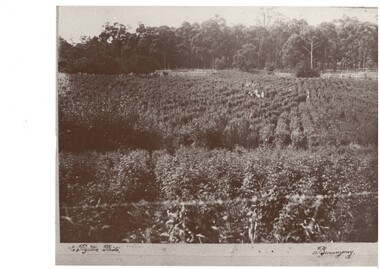
Photograph - Black and white photograph rural scene, Strawberry Glen late 19th Century
... Strawberry Glen late 19th Century...This photograph shows Strawberry Glen, part of Noack's property in the late 19th century...Strawberry Glen and people photographed in the late 19th century...This photograph shows Strawberry Glen, part of Noack's property in the late 19th century This photograph shows part of a prominent berry farm in the late 19th century taken by a well known contemporary photographer Strawberry Glen David Kerr Rural life Agriculture E. ...This photograph shows Strawberry Glen, part of Noack's property in the late 19th centuryThis photograph shows part of a prominent berry farm in the late 19th century taken by a well known contemporary photographerStrawberry Glen and people photographed in the late 19th century"E. Poynton Photo, Buninyong"strawberry glen, david kerr, rural life, agriculture, e. poynton, noack -
 Buninyong & District Historical Society
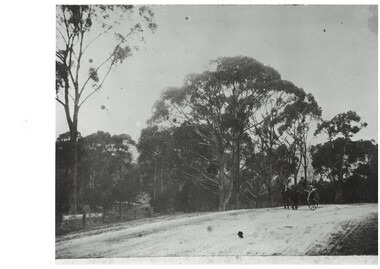
Photograph - Black and white photograph Geelong Road, Geelong Road North of Buninyong late 19th century
... Geelong Road North of Buninyong late 19th century...This photograph shows the main road between Ballarat and Geelong in the late 19th century...Tree lined Geelong Road late 19th century featuring a horse drawn buggy and driver...This photograph shows the main road between Ballarat and Geelong in the late 19th century This photograph shows the state of the main Geelong Road in the late 19th century, a typical means of road transport and a glimpse of the railway viaduct servicing Buninyong at the time Geelong Road Transport Railway viaduct "horse and buggy ascending Geelong Road (Grammar Hill) Railway viaduct visible between trees right Tree lined Geelong Road late 19th century featuring a horse drawn buggy and driver Geelong Road North of Buninyong late 19th century Photograph Black and white photograph Geelong Road ...This photograph shows the main road between Ballarat and Geelong in the late 19th centuryThis photograph shows the state of the main Geelong Road in the late 19th century, a typical means of road transport and a glimpse of the railway viaduct servicing Buninyong at the timeTree lined Geelong Road late 19th century featuring a horse drawn buggy and driver"horse and buggy ascending Geelong Road (Grammar Hill) Railway viaduct visible between trees rightgeelong road, transport, railway viaduct -
 Warrnambool and District Historical Society Inc.
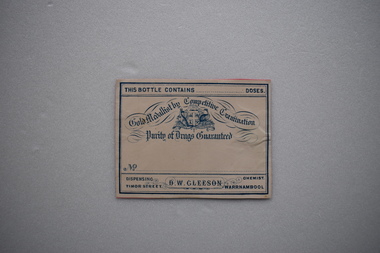
Label, Late 19th century, D.W.Gleeson Chemist
... He had a chemist shop in Timor Street, Warrnambool in the late 19th century. ...Late 19th century...Late 19th century...He had a chemist shop in Timor Street, Warrnambool in the late 19th century. This label is of interest as a memento of a late 19th century chemist in Warrnambool – D.W. ...This label comes from the pharmacy of D.W.Gleeson. He had a chemist shop in Timor Street, Warrnambool in the late 19th century. This label is of interest as a memento of a late 19th century chemist in Warrnambool – D.W. GleesonThis is a piece of cream-coloured paper with blue edging, an Australian logo and blue printing. The paper has been pasted on to a piece of pink card. This bottle contains…. doses Gold Medallist by Competitive Examination Purity of Drugs Guaranteed Dispensing Chemist D.W.Gleeson Timor Street Warrnambool d.w.gleeson, chemist, history of warrnambool -
 Linton and District Historical Society Inc
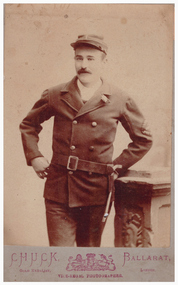
Photograph, CHUCK, Vice-Regal Photographer, BALLARAT, London, Member of Linton Fire Brigade, late 19th century
... Member of Linton Fire Brigade, late 19th century...Unidentified member of Linton Fire Brigade, possibly Bob Cornish, late 19th century...Unidentified member of Linton Fire Brigade, possibly Bob Cornish, late 19th century Member of Linton Fire Brigade, late 19th century Photograph CHUCK, Vice-Regal Photographer, BALLARAT, London ...It is not certain who this young fire brigade member is or when the photograph was taken. A photograph of a group of young fire brigade members wearing similar uniforms is Registration no. 98. In this photograph, believed to have been taken around 1880, are Jim Nicol, George Bennett, Bob Cornish and Jim Wishart.Sepia photograph mounted on grey card, studio portrait of young man in fire brigade uniform. Unidentified member of Linton Fire Brigade, possibly Bob Cornish, late 19th centurylinton fire brigade -
 Wodonga & District Historical Society Inc
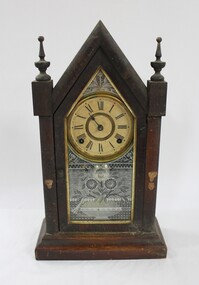
Functional object - 'Ansonia' Clock c. late 19th - early 20th century
... 'Ansonia' Clock c. late 19th - early 20th century...'Ansonia' Clock c. late 19th - early 20th century...This clock was manufactured by American clock company Ansonia in the late 19th - early twentieth century. Ansonia Clock was one of the major 19th century American clock manufacturers, producing millions of clocks between its incorporation in Connecticut in 1850, and its closure in 1929. ...'Ansonia' Clock c. late 19th - early 20th century Functional object 'Ansonia' Clock c. late 19th - early 20th century ...This clock was manufactured by American clock company Ansonia in the late 19th - early twentieth century. Ansonia Clock was one of the major 19th century American clock manufacturers, producing millions of clocks between its incorporation in Connecticut in 1850, and its closure in 1929. In 1877 production moved from Connecticut to New York City, where inventor Thomas Edison visited the factory to experiment in combining clocks with his newly invented phonograph (an early form of gramophone). This clock is significant for its rarity due to age. A gothic style steeple wooden clock with gold and white embellishments, and Roman numeral numbering on the clock face. The interior of the clock is accessed by a hinged glass door. Under pendulum inside glass interior case: "ANSONIA CLOCK COMPANY/U.S."clock, america, american, ansonia, the ansonia clock company -
 Wodonga & District Historical Society Inc
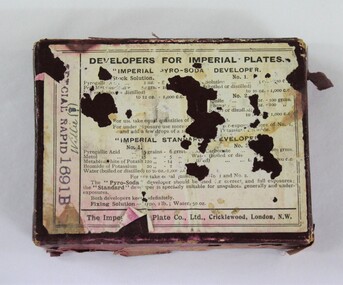
Functional object - Photographic Developer Plates Box late 19th - early 20th century, The Imperial Dry Plate Co., Ltd
... Photographic Developer Plates Box late 19th - early 20th century...Photographic Developer Plates Box late 19th - early 20th century...Photographic Developer Plates Box late 19th - early 20th century Functional object Photographic Developer Plates Box late 19th - early 20th century The Imperial Dry Plate Co., Ltd. ...The Imperial Dry Plate Co., Ltd. was based in London and was founded in the early 1890s by J J Acworth (1853-1927). Kodak manufactured and distributed a wide range of photographic products to Australasia, including those made by the Imperial Dry Plate Co. A burgundy coloured cardboard box for glass photographic development plates with technical and manufacturers information printed on white paper on lid. The box is empty. photography, photograph, history of photography, dry plate photography, photographic equipment -
 Wodonga & District Historical Society Inc
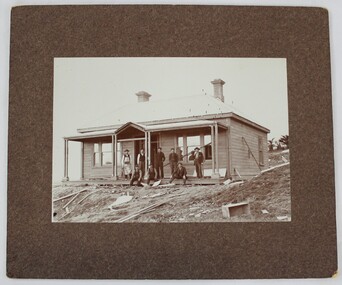
Photograph - Haeusler Collection Mounted Sepia toned Photograph of Men with Farm House late 19th - early 20th century
... Haeusler Collection Mounted Sepia toned Photograph of Men with Farm House late 19th - early 20th century...Haeusler Collection Mounted Sepia toned Photograph of Men with Farm House late 19th - early 20th century...The Haeusler family were one of several German families to migrate from South Australia to Wodonga in the 1860s. haeusler haeusler collection photograph photography portrait farm house agriculture albury wodonga wodonga On reverse "WHS 00132" A sepia toned photograph of a group of men standing in front of a newly erected farm house Haeusler Collection Mounted Sepia toned Photograph of Men with Farm House late 19th - early 20th century Photograph Haeusler Collection Mounted Sepia toned Photograph of Men with Farm House late 19th - early 20th century ...The Wodonga Historical Society Haeusler Collection provides invaluable insight into life in late nineteenth and early twentieth century north east Victoria. The collection comprises manuscripts, personal artefacts used by the Haeusler family on their farm in Wodonga, and a set of glass negatives which offer a unique visual snapshot of the domestic and social lives of the Haeusler family and local Wodonga community. The Haeusler family migrated from Prussia (Germany) to South Australia in the 1840s and 1850s, before purchasing 100 acres of Crown Land made available under the Victorian Lands Act 1862 (also known as ‘Duffy’s Land Act’) in 1866 in what is now Wodonga West. The Haeusler family were one of several German families to migrate from South Australia to Wodonga in the 1860s. A sepia toned photograph of a group of men standing in front of a newly erected farm houseOn reverse "WHS 00132"haeusler, haeusler collection, photograph, photography, portrait, farm house, agriculture, albury wodonga, wodonga -
 Embroiderers Guild, Victoria
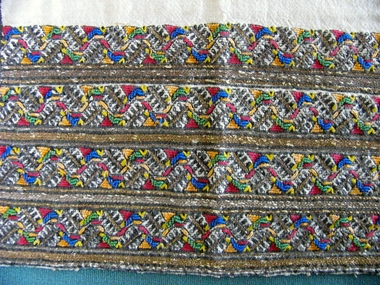
Textile - Romanian Sleeve Shoulder Piece, Late 19th century
... ... Late 19th century...Geometric pattern in bright coloured threads and beads and gold thread on natural linen background. Late 19th century saw the introduction of metal threads and beads to the embroidery....Late 19th century...Late 19th century saw the introduction of metal threads and beads to the embroidery. ...Purchased for Guild by Miss Teague in Greece 1961. From the Bukovina District - The territory is split today, with northern Bukovina forming the Chernivtsi Oblast in Ukraine and southern Bukovina forming Suceava County in Romania.Geometric pattern in bright coloured threads and beads and gold thread on natural linen background. Late 19th century saw the introduction of metal threads and beads to the embroidery.garments, late 19th century, mid european, beadwork, embroidery -
 Embroiderers Guild, Victoria
Accessory - Bag
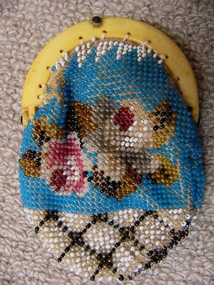
... ... Late 19th century...Small beaded purse with a bone frame, probably late 19th century. Completely beaded with sprays of roses back & front in pink and brown & background of blue beads. ...Bags Bags Beading Late 19th century Small beaded purse with a bone frame, probably late 19th century. ...Small beaded purse with a bone frame, probably late 19th century. Completely beaded with sprays of roses back & front in pink and brown & background of blue beads. bags, bags, beading, late 19th century -
 Glenelg Shire Council Cultural Collection
Photograph - Photograph - Tennis players in the late 19th, early 20th century, 1960-1979
... Photograph - Tennis players in the late 19th, early 20th century...Dress late 19th, early 20th century....Dress late 19th, early 20th century. Photograph Photograph - Tennis players in the late 19th, early 20th century ...Black and white contact print from glass plate negative. Image is of a group of 7 men and women sitting on a bench under a tree. They are all holding tennis racquets. Dress late 19th, early 20th century. -
Glenelg Shire Council Cultural Collection
Photograph - Photograph - Group of men in late 19th, early 20th century tennis attire, 1890-1910
... Photograph - Group of men in late 19th, early 20th century tennis attire....Image shows a group of men in late 19th, early 20th century tennis attire. 3 men seated on grass, 5 standing behind. ...Image shows a group of men in late 19th, early 20th century tennis attire. 3 men seated on grass, 5 standing behind. ...Original black and white photo mounted on white card. Image shows a group of men in late 19th, early 20th century tennis attire. 3 men seated on grass, 5 standing behind. Backdrop of dense shrubbery. -
 Embroiderers Guild, Victoria
Clothing - Chinese Floral Sleeve Band, Late 19th Century
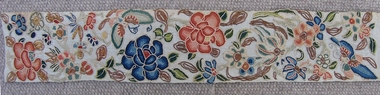
... ... Late 19th century...Chinese sleeve embroidery bands, or wanxiu became popular in the late 19th century during the Qing Dynasty, evolving from the traditional Han cuff embroidery and Manchu styles. ...Late 19th Century...Chinese sleeve embroidery bands, or wanxiu became popular in the late 19th century during the Qing Dynasty, evolving from the traditional Han cuff embroidery and Manchu styles. ...Chinese sleeve embroidery bands, or wanxiu became popular in the late 19th century during the Qing Dynasty, evolving from the traditional Han cuff embroidery and Manchu styles. These detachable, decorated bands were added to women's informal jackets and robes, often featuring symbolic motifs like landscapes, flowers, and auspicious symbols. They served both a decorative function, displaying artistic skill and personal wishes, and a practical one by covering the sleeves when hands were folded at the waist. History and evolution: Origins: The practice of embroidering cuffs on robes existed during the previous Ming Dynasty for Han women, and this was adopted by the Manchu rulers who founded the Qing Dynasty. Qing Dynasty (1644-1911): The practice was popularized and elaborated upon during this era, with detachable bands becoming a fashionable element for informal wear. Symbolism: The embroidery included a complex visual vocabulary of wishes for a long life, many offspring, and a happy marriage, derived from nature, mythology, and classical literature. Functionality: Women would fold their arms, often with their hands inside the sleeves, so the embroidered bands, which were sewn to hang down the back of the jacket, would be displayed prominently down the front. 19th century peak: The late 19th century was the peak of their popularity, with intricate designs becoming fashionable and even influenced by court tastes, such as those favoured by the Empress Dowager Cixi. Later developments: The late 19th century saw the introduction of chemical 'aniline' dyes from Europe, leading to brighter, bolder colours in embroidery. Motifs and their Meanings: Auspicious symbols: Designs often included symbols for good fortune, wealth, and longevity. Natural imagery: Birds, flowers, and landscapes were common motifs that could represent natural beauty or convey specific symbolic meanings. Figurative scenes: Bands could also feature narrative scenes from classical stories or legends. The choice of motifs allowed women to express personal desires, cultural values, and aesthetic preferences, reflecting a more personal and informal style than official court attire.Sleeve band of grey brocade silk, embroidered design of peonies, and butterflies in coloured silk thread in Pekin knot stitch. Flowers are outlined in cream crinkle cord. china, late 19th century, silk, sleeve band, flower, peony, butterfly -
 Embroiderers Guild, Victoria
Accessory - Pair of Chinese Sleeve Bands, Late 19th Century
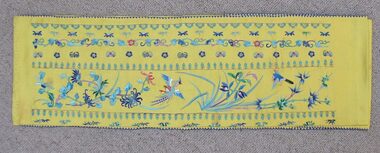
... ... Late 19th century...Chinese sleeve embroidery bands, or wanxiu became popular in the late 19th century during the Qing Dynasty, evolving from the traditional Han cuff embroidery and Manchu styles. ...Late 19th Century...Chinese sleeve embroidery bands, or wanxiu became popular in the late 19th century during the Qing Dynasty, evolving from the traditional Han cuff embroidery and Manchu styles. ...Chinese sleeve embroidery bands, or wanxiu became popular in the late 19th century during the Qing Dynasty, evolving from the traditional Han cuff embroidery and Manchu styles. These detachable, decorated bands were added to women's informal jackets and robes, often featuring symbolic motifs like landscapes, flowers, and auspicious symbols. They served both a decorative function, displaying artistic skill and personal wishes, and a practical one by covering the sleeves when hands were folded at the waist. History and evolution: Origins: The practice of embroidering cuffs on robes existed during the previous Ming Dynasty for Han women, and this was adopted by the Manchu rulers who founded the Qing Dynasty. Qing Dynasty (1644-1911): The practice was popularized and elaborated upon during this era, with detachable bands becoming a fashionable element for informal wear. Symbolism: The embroidery included a complex visual vocabulary of wishes for a long life, many offspring, and a happy marriage, derived from nature, mythology, and classical literature. Functionality: Women would fold their arms, often with their hands inside the sleeves, so the embroidered bands, which were sewn to hang down the back of the jacket, would be displayed prominently down the front. 19th century peak: The late 19th century was the peak of their popularity, with intricate designs becoming fashionable and even influenced by court tastes, such as those favoured by the Empress Dowager Cixi. Later developments: The late 19th century saw the introduction of chemical 'aniline' dyes from Europe, leading to brighter, bolder colours in embroidery. Motifs and their Meanings: Auspicious symbols: Designs often included symbols for good fortune, wealth, and longevity. Natural imagery: Birds, flowers, and landscapes were common motifs that could represent natural beauty or convey specific symbolic meanings. Figurative scenes: Bands could also feature narrative scenes from classical stories or legends. The choice of motifs allowed women to express personal desires, cultural values, and aesthetic preferences, reflecting a more personal and informal style than official court attire.Yellow silk satin, silk embroidery depicting birds and flowers in bright blues, greens, mauve, orange and pinks.embroidery, garments, silk embroidery, china, late 19th century, flowers, garden, bird -
 Embroiderers Guild, Victoria
Accessory - 19th C Breton, Brittany France, Lady's Whitework Coiffe, Late 19th century
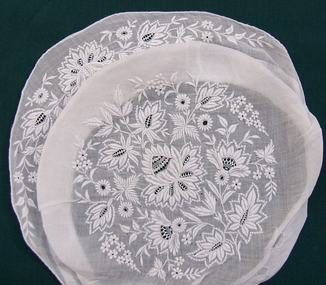
... ... Late 19th century...19th-century traditional lady's head covering from Brittany, France, is known as a coiffe rather than a standard bonnet, famous for its striking regional variations, intricate lace, and soaring heights. Key Features of the Breton Coiffe : Brittany had over 300 distinct styles of coiffes. A woman’s village, marital status, and age could often be identified just by the shape and size of her headwear. Evolution through the 19th Century: Early in the century, coiffes were smaller, softer caps fitting close to the head with small side flaps. By the late...Late 19th century...Embroidery Whitework France Bonnets Late 19th century A traditional bonnet from Brittany. ...Damaged lace from brim removed at some stage. Repairs to back. A 19th-century traditional lady's head covering from Brittany, France, is known as a coiffe rather than a standard bonnet, famous for its striking regional variations, intricate lace, and soaring heights. Key Features of the Breton Coiffe : Brittany had over 300 distinct styles of coiffes. A woman’s village, marital status, and age could often be identified just by the shape and size of her headwear. Evolution through the 19th Century: Early in the century, coiffes were smaller, softer caps fitting close to the head with small side flaps. By the late 19th century, many regional styles—most famously the Bigouden coiffe from southwestern Finistère—grew dramatically taller, sometimes reaching up to 30 or 40 centimeters high. Materials: They were crafted from fine white linen, starched cotton, organdie, or delicate lace. Construction & Decoration: Many featured complex pleating, stiffening, and detailed whitework embroidery rather than heavy coloured ribbons. They were pinned or tied securely to the hair, which was usually parted and tucked away completely beneath the cap.A traditional bonnet from Brittany. White organdy. The crown is worked in a floral design mainly in satin stitch and needle point fillings, the brim has a similar design.embroidery, whitework, france, bonnets, late 19th century -
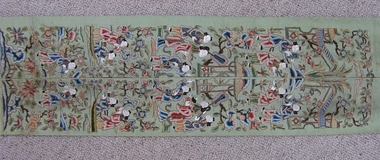 Embroiderers Guild, Victoria
Accessory - Pair of Chinese Sleeve Bands, Late 19th century
... ... Late 19th century...Chinese sleeve embroidery bands, or wanxiu became popular in the late 19th century during the Qing Dynasty, evolving from the traditional Han cuff embroidery and Manchu styles. ...Late 19th century...Chinese sleeve embroidery bands, or wanxiu became popular in the late 19th century during the Qing Dynasty, evolving from the traditional Han cuff embroidery and Manchu styles. ...Chinese sleeve embroidery bands, or wanxiu became popular in the late 19th century during the Qing Dynasty, evolving from the traditional Han cuff embroidery and Manchu styles. These detachable, decorated bands were added to women's informal jackets and robes, often featuring symbolic motifs like landscapes, flowers, and auspicious symbols. They served both a decorative function, displaying artistic skill and personal wishes, and a practical one by covering the sleeves when hands were folded at the waist. History and evolution: Origins: The practice of embroidering cuffs on robes existed during the previous Ming Dynasty for Han women, and this was adopted by the Manchu rulers who founded the Qing Dynasty. Qing Dynasty (1644-1911): The practice was popularized and elaborated upon during this era, with detachable bands becoming a fashionable element for informal wear. Symbolism: The embroidery included a complex visual vocabulary of wishes for a long life, many offspring, and a happy marriage, derived from nature, mythology, and classical literature. Functionality: Women would fold their arms, often with their hands inside the sleeves, so the embroidered bands, which were sewn to hang down the back of the jacket, would be displayed prominently down the front. 19th century peak: The late 19th century was the peak of their popularity, with intricate designs becoming fashionable and even influenced by court tastes, such as those favoured by the Empress Dowager Cixi. Later developments: The late 19th century saw the introduction of chemical 'aniline' dyes from Europe, leading to brighter, bolder colours in embroidery. Motifs and their Meanings: Auspicious symbols: Designs often included symbols for good fortune, wealth, and longevity. Natural imagery: Birds, flowers, and landscapes were common motifs that could represent natural beauty or convey specific symbolic meanings. Figurative scenes: Bands could also feature narrative scenes from classical stories or legends. The choice of motifs allowed women to express personal desires, cultural values, and aesthetic preferences, reflecting a more personal and informal style than official court attire. Looking at the cuffs from bottom to top: there is a rock formation, a zig zag fence and flowers (chrysanthemums and a branch with Buddha's hand citron). Next is a male figure carrying a halberd over his shoulder and surrounded by flowers, foliage and hillocks. Above are two more males in a boat. One is standing, the other kneeling. The one kneeling holds a bamboo pipe, while the one standing holds a branch with pomegranates. The men are surrounded by more flowers, foliage, rocks and bats . Three more figures come next. A male holding a fan, a woman holding a dish and another male. The woman on the left cuff holds a dish which appears to hold fruit, whereas the woman on the right cuff holds a dish containing a ? hat. Further up is a pagoda with a pomegranate tree and two more male figures. One holds the sacred fungus, the other a vase with a lotus flower. Finally there are two pagodas, leaves, flowers and clouds. Symbolism: Buddha's (foshou) hand citron. This plant derives it's name from the shape of the fruit, which is said to resemble Buddha's hand. 'Foshou' is used as a pun from blessings (fu) and longevity (shou). Chrysanthemum - longevity. Halberd - a spear like object symbolizing rank and military achievement. Halberd (ji) is a pun for rank (ji) and represents rapid promotion and doing well in officialdom or politics. Bamboo pipe or mouth organ (skeng) is a pun for giving birth (skeng). The image of a boy with a mouth organ implies the wish for a son. Pomegranate- symbolizes many sons (or possibly children). Boat - may be travelling from or to. Fan (shan)- longevity, and also a pun for goodness (shan). Boy pointing upwards (?to the sun) - may you rise in rank (zhri goosheng). The act of pointing at the sun is a pun for 'soon' (zhri). Fungus - resembles the head of a wish granting wand (ruyi) and has the same meaning of 'as you wish'. Lotus flower - (he) is a pun for harmony. Vase - (ping) a pun for peace (ping'an) therefore a vase with lotus - peace and harmony. These sleeve bands are more generic but they do convey a wish for many sons who will become officials and bring fortune. Dr Rachel Silberstein, visiting Associate Professor at Rhode Island School of Design.Pair of Chinese Sleeve bands using Pekin knots, satin stitch. Depicts an outdoor scene with pagodas, people, zig zag fences, boats and plants embroidered on a pale green silk ground. Both cuffs have been joined at the bottom.embroidery, garments, silk embroidery, china, sleeve bands, late 19th century, garden, figures -
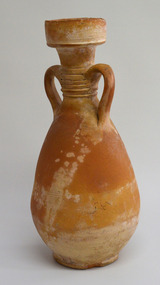 Flagstaff Hill Maritime Museum and Village
Ceramic - Amphora, mid-to-late 19th century
... ...mid-late 19th century...Thermoluminescence testing indicates the relic was made in the mid-to-late 19th century, and experts suggest it was of North African origin. ...mid-to-late 19th century...Thermoluminescence testing indicates the relic was made in the mid-to-late 19th century, and experts suggest it was of North African origin. ...This amphora or jug has a silhouette shaped like a woman with her hands on her hips, wearing a long, flared-out skirt. The design was used in ancient Greece for pottery storage jars, the neck being narrower than the body. According to reports, this amphora was discovered in 1934 by Joe O'Keeffe, in a sand blowout, or sand hummocks, west of Levy's Point, west of Warrnambool, while he was planting marram grass for Mr Duncan. An article in the Warrnambool Standard newspaper of December 21, 1985, states that the amphora may be linked to the wooden sailing ship called the Mahogany Ship (also called the Ancient Wreck). Thermoluminescence testing indicates the relic was made in the mid-to-late 19th century, and experts suggest it was of North African origin. The presence of the amphora in the dunes, and the amphora itself, is still a mystery. The amphora was donated to Flagstaff Hill on a long-term loan by the Duncan family and displayed to the public for the first time on December 21, 1985. The exhibition continued until February 2023, when the objects on display in the Assistant Lighthouse Keepers Cottage (Shipwreck Museum) were returned to storage to rest, and the redevelopment of the Cottage began. A search for members of the Duncan Family was undertaken by Flagstaff Hill and stakeholders to resolve the loan term, but the family at that time was unknown. As such, to properly care for the amphora, it has been registered until ownership can be determined. The amphora is currently on display in the Great Circle Gallery, where members of the Duncan family recognised it and have since made contact with the museum. The amphora's presence in the hummocks remains an intriguing and tantalising mystery, yet to be solved!The amphora is significant for the mystery it holds. Its origin and connection with the local area have led to local speculation since it was discovered in 1934. Amphora or jug; earthenware, orange clay with areas of cream. The vessel has a wide mouth, a deep lip, two opposing handles between the neck and shoulder, and a bulbous body. The curved handles have a design of six bands between them. There are three rings of small dots encircling the body. The underside has concentric circles in the clay, an uneven edge and pinhole markings. The amphora is kindly on loan from the Duncan family.Pinhole patterns: [3 holes above 3 holes] opposite [3 holes above 3 holes], 1 hole] [ 1 hole above 2 holes] flagstaff hill maritime museum and village, warrnambool, great ocean road, shipwreck coast, amphora, jug, mahogany ship, ancient wreck, joe o'keefe, duncan, thermoluminescence, north africa, levy point, pottery, storage jar, flagstaff hill, maritime museum, maritime village, shipwreck artefact, relic, shipwreck museum, pottery jar, ancient jar, egyptian water pot, greek jar, ceramic jar, mystery, exotic jar, mystery antique, historic jug, 1934, joe o’keefe, marshall duncan, port fairy, 1935, 1985, marshall mckenzie duncan, mac duncan, duncan family, 1981, dan madden, scientific investigation, scientific analysis, scientific dating, north african origin, mid-late 19th century, marram grass, levy’s point -
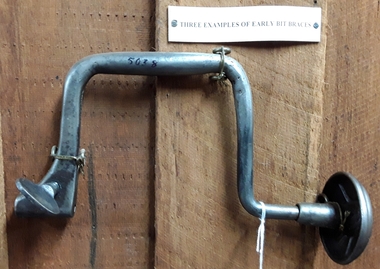 Mont De Lancey
Tool - Bit brace, Unknown
... Used in the late 19th century...It was used in the late 19th century....It was used in the late 19th century. Tool Bit brace ...Used in the late 19th centuryA forged steel Bit brace with a large screw to secure the drill bit and a knob at the end of the turning handle. It was used in the late 19th century.on the knob - "10" is stampedsteel, tools, carpentry tools, woodworking tools, cutting tools -
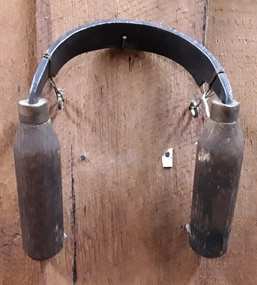 Mont De Lancey
Tool - Cooper's Shave, Unknown
... Used in the late 19th century....It was used in the late 19th Century....It was used in the late 19th Century. Tool Cooper's Shave ...Used in the late 19th century.A steel curved bladed woodworking tool with two wooden handles used to scrape logs or circular pieces of of wood. It was used in the late 19th Century.woodcarving tools, shaves, handtools, steel, wood, woodworking tools -
 Whitehorse Historical Society Inc.
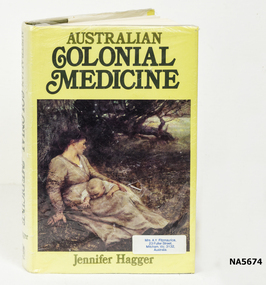
Book - Australian Colonial Medicine, Jennifer Theresa Haggar, 1979
... Publication telling the story of Colonial Medicine from the First fleet to late 19th century...- Handbound book with dust cover - Book discusses medical treatment from the origins of the colony to the late 19th century - Book was published in1979...Publication telling the story of Colonial Medicine from the First fleet to late 19th century Australian Medicine Australian Colony Australian Colonial Medicine Jennifer Hagger - Handbound book with dust cover - Book discusses medical treatment from the origins of the colony to the late 19th century - Book was published in1979 Book Australian Colonial Medicine Jennifer Theresa Haggar Rigby Limited ...Publication telling the story of Colonial Medicine from the First fleet to late 19th century- Handbound book with dust cover - Book discusses medical treatment from the origins of the colony to the late 19th century - Book was published in1979Australian Colonial Medicine Jennifer Haggeraustralian medicine, australian colony -
 Flagstaff Hill Maritime Museum and Village
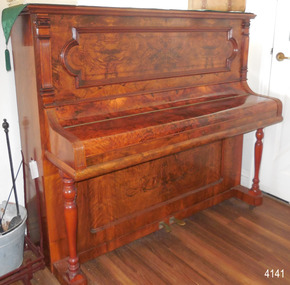
Instrument - Musical, Piano, Renardi, c. 1900
... ...late 19th century...This solid, late Victorian era piano is branded Renardi, which is a German name. In the late 19th century thousands of pianos were exported from Germany to Australia. ...This solid, late Victorian era piano is branded Renardi, which is a German name. In the late 19th century thousands of pianos were exported from Germany to Australia. ...This solid, late Victorian era piano is branded Renardi, which is a German name. In the late 19th century thousands of pianos were exported from Germany to Australia. Some, unfortunately, were amongst the cargo of shipwrecks. It seems that the Renardi pianos were not made by a Renardi company but made to order by any of a number of German piano manufacturer and branded for distribution by Australian music stores.This Renardi piano represents an era where musical gatherings were part of domestic entertainment. Pianos were ialso installed in clubs, public halls and hospitality businesses for song nights and concerts were encouraged for community unity.Piano, upright, walnut veneer with floral design on panels. Turned columns, hinged lid and two metal pedals. Branded Renardi, a German name, made c. 1900. "RENARDI"flagstaff hill, warrnambool, shipwrecked-coast, flagstaff-hill, flagstaff-hill-maritime-museum, maritime-museum, shipwreck-coast, flagstaff-hill-maritime-village, musical instrument, upright piano, german, renardi, victorian era, late 19th century, entertainment -
 Mont De Lancey
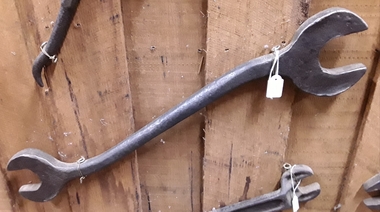
Tool - Plough Spanner, Unknown
... It was made late 19th Century....It was used in the late 19th century....It was used in the late 19th century. Tool Plough Spanner ...It was made late 19th Century.A medium sized steel curved handled double headed plough spanner made by a blacksmith. It was used to tighten or loosen large nuts on a plough or other machinery. It was used in the late 19th century.spanners, wrenches, tools, farm equipment, steel -
 Flagstaff Hill Maritime Museum and Village
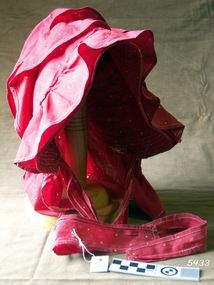
Bonnet, late 19th to early 20th century
... ...late 19th century bonnet...Dated late 19th to early 20th century....late 19th to early 20th century...Dated late 19th to early 20th century. Bonnet ...Worn by a local woman when working in South West Victoria in the late 1800s - early 1900sLadies outdoor bonnet, red cotton fabric with white spots. Bonnet is trimmed with frills and straps to tie under the chin. Dated late 19th to early 20th century.flagstaff hill, warrnambool, shipwrecked-coast, flagstaff-hill, flagstaff-hill-maritime-museum, maritime-museum, shipwreck-coast, flagstaff-hill-maritime-village, ladies bonnet, outdoor bonnet, ladies clothing, late 19th century bonnet, 20th century bonnet, bonnet, 20th century, early 20th century bonnet -
 Embroiderers Guild, Victoria
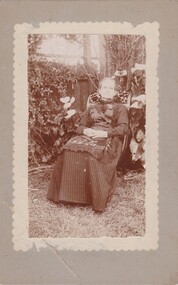
Photograph - Victorian Matron Wearing Apron, Late 19th century
... ... Late 19th century...Late 19th century...Embroidery Aprons Silk Embroidery Late 19th century European Original photo of elderly owner wearing the apron E0761. ...Original photo of elderly owner wearing the apron E0761.embroidery, aprons, silk embroidery, late 19th century, european -
 Embroiderers Guild, Victoria
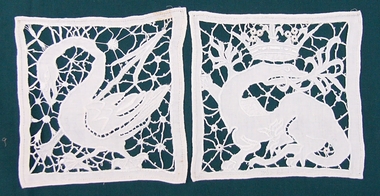
Textile - The Arms of Francis I of France and his wife La Reine Claude (Swan and Arrow) 1494-1547, Late 19th century
... ... Late 19th century...Late 19th century...Embroidery Heraldry Late 19th century France Cutwork Heraldry in white richelieu work. ...Heraldry in white richelieu work. The Arms of Francis I of France and his wife La Reine Claude (Swan and Arrow) 1494-1547 Stitches used are buttonhole, satin stitch, seeding, four sided. Picots and spider webs, some needle weaving.embroidery, heraldry, late 19th century, france, cutwork -
 Embroiderers Guild, Victoria
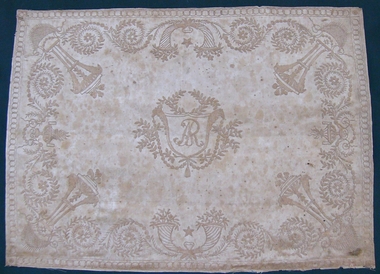
Textile - Silk Tambour Embroidered Panel, Late 19th century
... ... Late 19th century...Late 19th century...Tambour work Panels Late 19th century France AR Central part of design. ...Cream silk panel. Fine tambour embroidery. Classical design - urns, cornucopias and garlands of flowers. Central cartouche with initials.AR Central part of design.tambour work, panels, late 19th century, france -
 Embroiderers Guild, Victoria
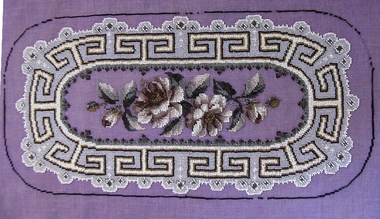
Textile - 19th C Beaded Panel Tray Insert, Late 19th century
... ... Late 19th century...Late 19th century...Piece came to the Guild with a bag of canvas pieces from a deceased estate for disposal to members. Beadwork Late 19th century Oval panel - design is of roses with a geometric border in mauve, grey, black, gold and brown beads on mauve Penelope canvas. ...Piece came to the Guild with a bag of canvas pieces from a deceased estate for disposal to members.Oval panel - design is of roses with a geometric border in mauve, grey, black, gold and brown beads on mauve Penelope canvas. Intended as an inset for a tray.beadwork, late 19th century -
 Embroiderers Guild, Victoria
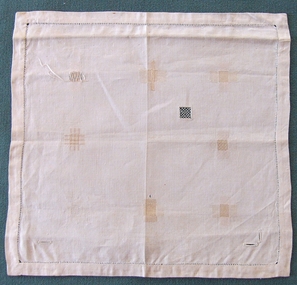
Textile - 19th C Dutch Darning Sampler, Late 19th century (c. 1872)
... ... Late 19th century...Late 19th century (c. 1872)...Embroidery Darning Samplers Late 19th century Holland Fine white linen sampler with darning in brown. ...Made by Donor's grandmother.Fine white linen sampler with darning in brown. Hem stitch edge in the pattern of tea towels and other items of the time including button holes.embroidery, darning, samplers, late 19th century, holland -
 Embroiderers Guild, Victoria
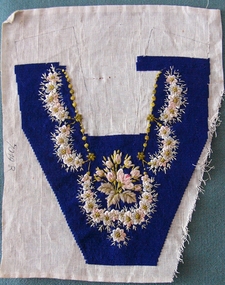
Textile - Berlin Wool Work Slipper Pair Unmade, Late 19th century
... ... Late 19th century...Late 19th century...Embroidery Canvas work Surface stitchery Late 19th century Slippers Uppers for a pair of slippers, one not finished. ...Probably the design was worked professionally and the background worked by an amateur.Uppers for a pair of slippers, one not finished. The design of roses in variegated pinks and blues in surface stitchery in silk and wool threads. The background is half cross stitch and continental stitch in dark blue wool. Fabric, Penelope canvas.embroidery, canvas work, surface stitchery, late 19th century, slippers -
 Embroiderers Guild, Victoria
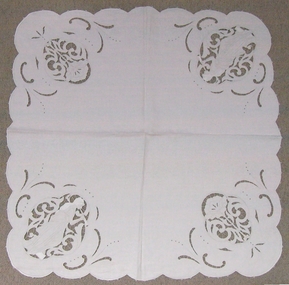
Textile - Cutwork Supper Cloth, Late 19th century
... ... Late 19th century...Late 19th century...Embroidery Cutwork Tablecloths Australian(?) Late 19th century Square supper cloth, with cutwork bands, one of which is quite elaborate with flowers and scrolls. ...Square supper cloth, with cutwork bands, one of which is quite elaborate with flowers and scrolls. Of main interest is one edge with an unusual version of buttonhole stitch (raised edge buttonhole stitch as per Jacqueline Einthoven book).embroidery, cutwork, tablecloths, australian(?), late 19th century -
 Embroiderers Guild, Victoria
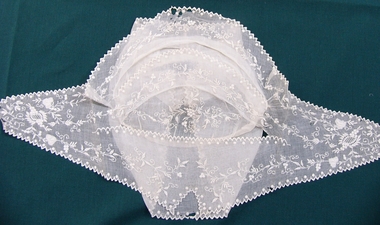
Headwear - Lady's Cap, Late 19th century
... ... Late 19th century...Late 19th century...Purchased by Guild member from the Misses Cochrane Embroidery Caps Ayrshire Scotland Late 19th century Ayrshire embroidery on fine cream muslin. ...Purchased by Guild member from the Misses CochraneAyrshire embroidery on fine cream muslin. Traditional stitchery in floral design.embroidery, caps, ayrshire, scotland, late 19th century
