
Showing 40 items matching " lunch hour"
-
 Ballarat Tramway Museum
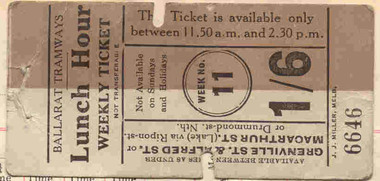
Ephemera - Ticket/s, J.J. Miller, ESCo Lunch Hour Weekly Ticket, 1/6, early to mid 1920's to 1930's
... ESCo Lunch Hour Weekly Ticket, 1/6...... Lunch Hour...Item 2488, page 31, ESCo, Ballarat Tramways, Lunch Hour Weekly Ticket, price 1/6, printed for Week 11, that is not available for Sundays or Holidays. ...Trams tramways Tickets Weekly Tickets Lunch Hour ESCo Some inscriptions about the ticket in pencil. ...Ticket contained within Reg. Item 2488, page 31, ESCo, Ballarat Tramways, Lunch Hour Weekly Ticket, price 1/6, printed for Week 11, that is not available for Sundays or Holidays. Ticket printed on light weight card, in two colours, off white and light brown, numbered 6646 available only between the City and Macarthur St.. Notes the conditions of use, the time available for which the ticket may be used and where. Ticket has been punched or nipped twice and shows that it was stapled to a block. Printed by J.J. Miller, Melbourne. Note Item Not formally Numbered. Image btm2494i2 shows position on page relative to items 2494 to 2504. See Reg Item 2948 for circular detailing their use at the commencement of the issue of this style of Weekly Tickets - some detail differences in the style and colours later on.Some inscriptions about the ticket in pencil.trams, tramways, tickets, weekly tickets, lunch hour, esco -
 Ballarat Tramway Museum
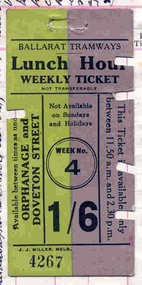
Ephemera - Ticket/s, J.J. Miller, ESCo Lunch Hour Weekly Ticket, 1/6, early to mid 1920's to 1930's
... ESCo Lunch Hour Weekly Ticket, 1/6...... Lunch Hour...Item 2526, page 58, ESCo, Ballarat Tramways, Lunch Hour Weekly Ticket, price 1/6, printed for Week 4, that is not available for Sundays or Holidays. ...Trams tramways Tickets Weekly Tickets Lunch Hour ESCo Ticket contained within Reg. Item 2526, page 58, ESCo, Ballarat Tramways, Lunch Hour Weekly Ticket, price 1/6, printed for Week 4, that is not available for Sundays or Holidays. ...Ticket contained within Reg. Item 2526, page 58, ESCo, Ballarat Tramways, Lunch Hour Weekly Ticket, price 1/6, printed for Week 4, that is not available for Sundays or Holidays. Ticket printed on light weight card, in two colours, dark yellow and light brown, numbered 4267, for specific use between the Orphanage (Victoria St) and Doveton St. Notes the conditions of use, the time available for which the ticket may be used. Ticket has been punched or nipped four times and shows that it was stapled to a block. Printed by J.J. Miller, Melbourne. Note Item Not formally Numbered. Image btm2541i shows position on page relative to items 2541 to 2545. Handwritten notes, Reg. Item 2541, make reference to these items. See Reg Item 2948 for circular detailing their use at the commencement of the issue of this style of Weekly Tickets - some detail differences in the style and colours later on.trams, tramways, tickets, weekly tickets, lunch hour, esco -
 Ballarat Tramway Museum
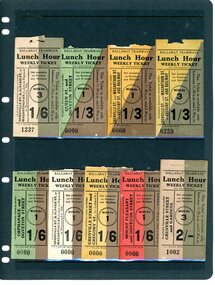
Ephemera - Ticket, Electric Supply Co. of Vic (ESCo), Ballarat Tramways tickets - Lunch hour weekly tickets, c19??
... Ballarat Tramways tickets - Lunch hour weekly tickets....Assorted Ballarat Tramway tickets. The weekly lunch hour tickets, printed on colored card, have a value between 1/3 pence and 2 shillings. ...The weekly lunch hour tickets, printed on colored card, have a value between 1/3 pence and 2 shillings. ...ticketDemonstrates a variety of weekly lunch hour tickets used by Ballarat TramwaysAssorted Ballarat Tramway tickets. The weekly lunch hour tickets, printed on colored card, have a value between 1/3 pence and 2 shillings. tickets, tramways, ballarat tramways -
 Melbourne Tram Museum
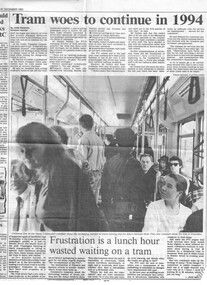
Newspaper, John Mangan, Michael Clayton Jones, The Age, "Tram woes to continue in 1994", "Frustration is a lunch hour wasted on a tram", Jul. 1946
... "Tram woes to continue in 1994", "Frustration is a lunch hour wasted on a tram"...Newspaper cutting from The Age, Monday 27-12-1993, titled "Tram woes to continue in 1994" and "Frustration is a lunch hour wasted on a tram", written by John Mangan, transport reporter, about staff shortages, delays in services, lack of trams, quotes PTC Russell Nathan about the problems. ..."Tram woes to continue in 1994", "Frustration is a lunch hour wasted on a tram" Newspaper John Mangan, Michael Clayton Jones, The Age Russell Nathan ...Newspaper cutting from The Age, Monday 27-12-1993, titled "Tram woes to continue in 1994" and "Frustration is a lunch hour wasted on a tram", written by John Mangan, transport reporter, about staff shortages, delays in services, lack of trams, quotes PTC Russell Nathan about the problems. Has a story about driver arguing with an inspector in Bourke St. Has a photo by Michael Clayton Jones.trams, tramways, ptc, tramways, public transport, employees -
 Ballarat Tramway Museum
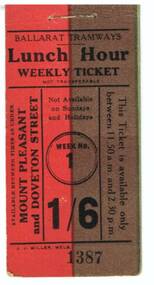
Ephemera - Ticket/s, J.J. Miller, ESCo Lunch Hour Weekly Ticket, 1/6, c1927
... ESCo Lunch Hour Weekly Ticket, 1/6...Lunch hour Weekly Ticket, price 1/6, printed for Week 1, that is not available for Sundays or Holidays. ...Trams tramways Tickets Weekly Tickets ESCo Lunch hour Weekly Ticket, price 1/6, printed for Week 1, that is not available for Sundays or Holidays. ...Demonstrates how ESCo managed Weekly tickets during the late 1920's and yields information about the way the system was arranged. The source of the ticket, NSW tramways is significant in that it was obtained by them as a sample.Lunch hour Weekly Ticket, price 1/6, printed for Week 1, that is not available for Sundays or Holidays. Ticket printed on light weight card, in two colours, orange and brown, printed on off white card, numbered 1387 available only between Mt Pleasant and Doveton St. between the hours of 11.50am and 2.30pm. Notes the conditions of use, the time available for which the ticket may be used and where. Printed by J.J. Miller, Melbourne. Ticket has been removed from a block - has staple hole at the top. See Reg Item 2948 for circular detailing their use at the commencement of the issue of this style of Weekly Tickets - some detail differences in the style and colours later on.trams, tramways, tickets, weekly tickets, esco -
 Heidelberg Theatre Company Inc..
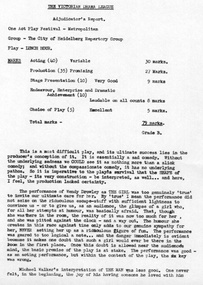
Program Articles Memorabilia, Lunch hour by John Mortimer directed by Alice O'Donnell
... Lunch hour by John Mortimer directed by Alice O'Donnell...1964 87 city of heidelberg repertory group heidelberg theatre company inc Victorian Drama League (VDL) Festival entry Lunch hour by John Mortimer directed by Alice O'Donnell Program Articles Memorabilia ...1964, 87, city of heidelberg repertory group, heidelberg theatre company inc, victorian drama league (vdl) festival entry -
 Ballarat Tramway Museum
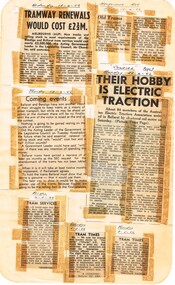
Newspaper, State Electricity Commission of Victoria (SEC) and The Courier Ballarat, Tramway renewals would cost 2.5M pounds', Apr. 1962
... ... Lunch Hour...Courtney local Secretary of the Union, about the lunch hour services - delayed by inspectors to assist the public 7 - "Tram Times" - 8-5-62 - concerning the lunch hour one minute delay and has not be late back to work. ...Yields information about the view of The Courier, and locals about the mooted closure of the tramway system and reporting on the proposal, an AETA visit and lunch hour services. Closure Letter To The Editor Editorial SEC Lunch Hour AETA Foolscap sheet of plain paper, with rounded corners, with 7 newspaper cuttings, concerning the mooted closure of the Ballarat Tram system April and May 1962. ...Yields information about the view of The Courier, and locals about the mooted closure of the tramway system and reporting on the proposal, an AETA visit and lunch hour services.Foolscap sheet of plain paper, with rounded corners, with 7 newspaper cuttings, concerning the mooted closure of the Ballarat Tram system April and May 1962. All from The Courier, unless noted otherwise. 1 - "Tramway renewals would cost 2.5m" - 18-4-62 - quote from Leader in the Legislative Council the previous day, Mr. Chandler, to upgrade tracks and trams in both Ballarat and Bendigo. 2 - "Old Trams" - The Age - 13/4/62 - about the proposed replacement of trams and their services 3 - "Coming Events" - 19-4-62 - reporting on item 1, six month delay as the motion has not been tabled - use them or loose them attitude. 4 - "Their Hobby is Electric Traction" - 23-4-62 - about the visit of about 84 members of the AETA to Ballarat, visiting Ballarat and Bendigo, 2nd hand trams, met by Mr. Denmead 5 - "Tram Services" - letter 4-5-62 - trams not departing on time at Lunch hour and other issues 6 - "Tram Times" - 5-562 - by R. Courtney local Secretary of the Union, about the lunch hour services - delayed by inspectors to assist the public 7 - "Tram Times" - 8-5-62 - concerning the lunch hour one minute delay and has not be late back to work. closure, letter to the editor, editorial, sec, lunch hour, aeta -
 Emerald Museum & Nobelius Heritage Park
Photograph - Packing Shed, Gembrook Nurseries, Unknown maker, 1900-1920
... The image is captioned 'Lunch Hour at the Packing Shed, Gembrook Nurseries.' ...Obverse: 59 NOR (?) 10 (?) + / LUNCH HOUR AT THE PACKING SHED, GEMBROOK NURSERIES...The image is captioned 'Lunch Hour at the Packing Shed, Gembrook Nurseries.' ...The Gembrook Nurseries, informally known as the Nobelius Nurseries after the founder Carl Axel Nobelius, began with the purchase of sixty-three acres in 1886 and boomed in the 1890s due to opportunities provided by employment-promoting schemes to develop public parks and gardens and street shade by local and State Governments around Australia. Trees were sold to more than forty councils and Government organisations in the 1890s, including the Department of Agriculture, Lands Department and Victorian Railways. The need to transport nursery products by train via Ferntree Gully rather than by bullock dray to Narre Warren was a factor in the successful petition to develop what is now known as the Puffing Billy Railway. Railway developments in 1900 included the creation of a siding and Packing Shed, known as Nobelius Station, which is featured in this photograph. The Packing Shed was able to handle 250,000 cases of fruit each year. Gembrook Nurseries had an indirect influence on the development of other farms and industries in the region. As a wholesale nursery with high sales volumes it was an important employer of local people. Peak season for employees was during the cooler months, during most farmers' off-season. This provided local farmers with a source of income while their own farms were becoming established.The photograph is significant because it depicts personnel and infrastructure associated with the Gembrook or Nobelius Nurseries, a business which was instrumental to the development of Emerald as a settlement in the 19th and 20th Centuries and also influenced the development of public and private gardens and the farming of several species in Australia and internationally. The Nobelius Nursery is listed on the Victorian Heritage Register.Black and white rectangular photograph printed on print media paper. The image is captioned 'Lunch Hour at the Packing Shed, Gembrook Nurseries.' It depicts thirty-one men (including one adolescent) and one woman posing for a group photograph behind approximately five large product bales resting in a rectangular metal rail cargo carriage. One of the men has a bandage across one eye. The people depicted are wearing clothing indicating the image may have been taken in the early 20th century. The Packing Shed building (built in 1900) and several stacked wooden storage crates are visible behind the group.Obverse: 59 NOR (?) 10 (?) + / LUNCH HOUR AT THE PACKING SHED, GEMBROOK NURSERIES. /1900s, gembrook nurseries, nobelius nurseries, carl axel nobelius, packing shed, railway, puffing billy railway, nursery employees, farming, agriculture, government initiatives -
 Ballarat Tramway Museum
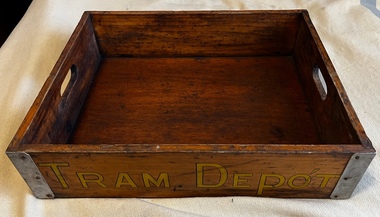
Functional object - SECV Depot lunch box or tray, State Electricity Commission of Victoria (SECV), 1950s
... ...Lunch Hour...SECV tram depot Ballarat tramways Lunch Hour Box or tray made from wood, plywood, strengthened with nailed aluminium corners and lettered "Tram Depot", with an accent over the O' with gold paint within a black outline for each letter, Carry holes have been cut into the short ends. ...Item used to pick up lunch orders from a nearby food outlet and deliver to the SEC Wendouree Parade tram depot - sandwiches, pies etc for the depot workers.Demonstrates a method of transporting pre-ordered lunches from a nearby shop to the Wendouree Parade Ballarat Tram Depot.Box or tray made from wood, plywood, strengthened with nailed aluminium corners and lettered "Tram Depot", with an accent over the O' with gold paint within a black outline for each letter, Carry holes have been cut into the short ends.secv, tram depot, ballarat, tramways, lunch hour -
 Ballarat Tramway Museum
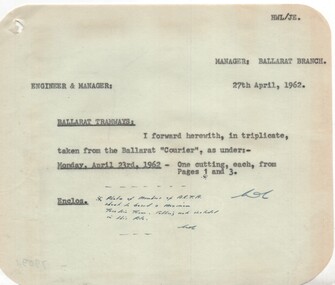
Administrative record - Memorandum, State Electricity Commission of Victoria (SEC) and The Courier Ballarat, cuttings from The Courier re possible closure, May. 1962
... ... Lunch Hour...Trams tramways Closure Letter To The Editor Editorial AETA Trackwork Lunch Hour Set of three memorandums to the Engineer & Manager from the Ballarat Manager, on green paper - all with rounded corners. 1 - enclosing cuttings from The Courier, 23/4/1962 re the AETA visit and a note re a photo (dated 27/4/62) 2 - ditto cuttings for 13/4 and 19/4 (dated 19/4/1962) 4 - memo enclosing cuttings of 13/4, 16/4, 17/4 and 18/4 (dated 18/4/1962) See Reg Item 7910 for these items. cuttings from The Courier re possible closure Administrative record Memorandum State Electricity Commission of Victoria (SEC) and The Courier Ballarat ...Yields information about the method of advising SEC Management of letters to the Editor concerning the possible closure of the SEC Ballarat system., Yields information about the method of advising SEC Management of letters to the Editor concerning the possible closure of the SEC Ballarat system.Set of three memorandums to the Engineer & Manager from the Ballarat Manager, on green paper - all with rounded corners. 1 - enclosing cuttings from The Courier, 23/4/1962 re the AETA visit and a note re a photo (dated 27/4/62) 2 - ditto cuttings for 13/4 and 19/4 (dated 19/4/1962) 4 - memo enclosing cuttings of 13/4, 16/4, 17/4 and 18/4 (dated 18/4/1962) See Reg Item 7910 for these items. trams, tramways, closure, letter to the editor, editorial, aeta, trackwork, lunch hour -
 Ballarat Tramway Museum
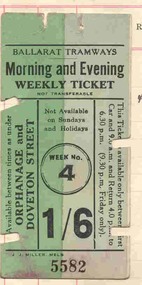
Ephemera - Ticket/s, J.J. Miller, ESCo Morning and Evening Weekly Ticket, 1/6, early to mid 1920's to 1930's
... ... Lunch Hour...Trams tramways Tickets Weekly Tickets Lunch Hour ESCo Ticket contained within Reg. Item 2526, page 58, ESCo, Ballarat Tramways, Morning and Evening Weekly Ticket, price 1/6, printed for Week 4, that is not available for Sundays or Holidays. ...Ticket contained within Reg. Item 2526, page 58, ESCo, Ballarat Tramways, Morning and Evening Weekly Ticket, price 1/6, printed for Week 4, that is not available for Sundays or Holidays. Ticket printed on light weight card, in two colours, light green and grey, numbered 5582, for specific use between the Orphanage (Victoria St) and Doveton St. Notes the conditions of use, the time available for which the ticket may be used. Ticket has been punched or nipped four times and shows that it was stapled to a block. Printed by J.J. Miller, Melbourne. Note Item Not formally Numbered. Image btm2541i shows position on page relative to items 2541 to 2545. Handwritten notes, Reg. Item 2541, make reference to these items. See Reg Item 2948 for circular detailing their use at the commencement of the issue of this style of Weekly Tickets - some detail differences in the style and colours later on.trams, tramways, tickets, weekly tickets, lunch hour, esco -
 St Patrick's Old Collegians Association (SPOCA)
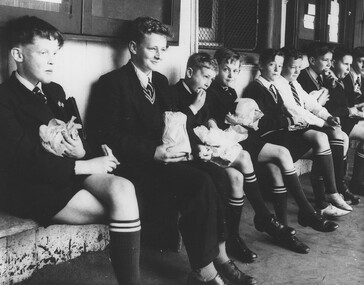
Photograph - Students, 1960s
... 1960 Lunch-hour under veranda for Michael Cavanagh, Larry Burn and others...1960 Lunch-hour under veranda for Michael Cavanagh, Larry Burn and others Photograph Students, 1960s ... -
 Ringwood and District Historical Society
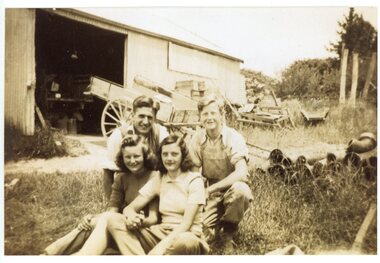
Photograph, Gerald Mahon family photograph -1947. Ringwood
... "Written on back of photograph" Cherry picking lunch hour 1947..."Written on back of photograph" Cherry picking lunch hour 1947 Black and white photograph showing Gerald Mahon and family members cherry picking Gerald Mahon family photograph -1947. ...Black and white photograph showing Gerald Mahon and family members cherry picking "Written on back of photograph" Cherry picking lunch hour 1947 -
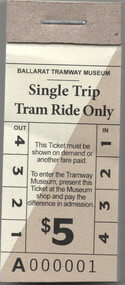 Ballarat Tramway Museum
Ephemera - Ticket/s, Waller & Chester, Block of 100 tickets - $5, Marc 2026
... Notes that the design is based on an ESCo lunch hour ticket design. The 100 tickets have been stapled onto a heavy cardboard back with a heavy metal staple and a small cardboard retaining strip at the top of the ticket. ...Notes that the design is based on an ESCo lunch hour ticket design. The 100 tickets have been stapled onto a heavy cardboard back with a heavy metal staple and a small cardboard retaining strip at the top of the ticket. ...Ticket block headed Ballarat Tramway Museum. On the rear in black ink are details of the Ballarat Tramway Museum, web address etc. Notes that the design is based on an ESCo lunch hour ticket design. The 100 tickets have been stapled onto a heavy cardboard back with a heavy metal staple and a small cardboard retaining strip at the top of the ticket. Ticket Numbers 000001 to 0000100. The $5 ticket was first used for single trips during the 2026 Begonia Festival. Printed by Waller & Chester Ballarat March 2026.Demonstrates the Museums' priced ticket for a specific use.Block of 100 tickets - black ink on two coloured paper.trams, tramways, btm, tickets -
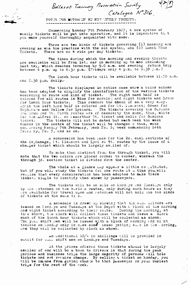 Ballarat Tramway Museum
Document - Instruction, Electric Supply Co. of Vic (ESCo), "Notes for Motormen re New Weekly Tickets.", Feb. 1927
... Details the new style of ESCo weekly tickets to be used in Ballarat from Monday 7/2/1927, where two types of tickets were used - Morning and Evening Tickets and Lunch Hour Tickets. Gives instructions on their use, advantages, colours, fraud protection, schedule of timing when tickets issued against the various run numbers on page 3. ...Details the new style of ESCo weekly tickets to be used in Ballarat from Monday 7/2/1927, where two types of tickets were used - Morning and Evening Tickets and Lunch Hour Tickets. Gives instructions on their use, advantages, colours, fraud protection, schedule of timing when tickets issued against the various run numbers on page 3. ...Four page foolscap stencil duplicated instruction sheet titled "Notes for Motormen re New Weekly Tickets.", pinned in the top left hand corner. Details the new style of ESCo weekly tickets to be used in Ballarat from Monday 7/2/1927, where two types of tickets were used - Morning and Evening Tickets and Lunch Hour Tickets. Gives instructions on their use, advantages, colours, fraud protection, schedule of timing when tickets issued against the various run numbers on page 3. Page four, titled "Instructions for Conductors re New Weekly Return Tickets and Weekly Tickets" gives instructions re the issuing of 4d return tickets, a new 3d return ticket and how the colours varied with each day. Notes when the tickets will be collected by the clerk for runs 13 and 14. See Reg. Item 2498, 2499 2542 and 2543 for examples of the weekly tickets.In black ink in the top right hand corner "4/2/27" and in ink across top of instruction "Ballarat Tramway Preservation Society Catalogue No. 316."trams, tramways, esco, weekly tickets, instructions, tickets -
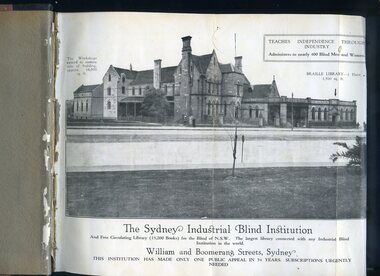 Vision Australia
Administrative record - Text, Sydney Industrial Blind Institution: Fifty-Fifth Report 1935, 1936
... Articles in the annual report include: the provision of braille and Moon books to lepers, an address by Arthur McCredie, the awarding of an MBE to Henry Hedger (past superintendent), resignation of Herbert Tranter, a grant received from the NSW State Government to build additional storage, new floor added in Basket shop and paddock has now been fenced in, a ceremony on the Roof Garden where workers presented Robert McDonald a sea-grass chair to thank him for reading to them during their lunch hour for the past 25 years, a brief history of the library, the importation of the first Talkie Books from AFB, photograph and outline of the work undertaken by Roy Kippax and Ethel Campbell, the progress of pupils by music teacher Gordon Lavers, Annual Picnic and Sports Day, the suggestion to the government that blind children should be compulsorily educated just as sighted children are required to be under law, and the decline of some activities by various branches of the Women's Auxiliary....Articles in the annual report include: the provision of braille and Moon books to lepers, an address by Arthur McCredie, the awarding of an MBE to Henry Hedger (past superintendent), resignation of Herbert Tranter, a grant received from the NSW State Government to build additional storage, new floor added in Basket shop and paddock has now been fenced in, a ceremony on the Roof Garden where workers presented Robert McDonald a sea-grass chair to thank him for reading to them during their lunch hour for the past 25 years, a brief history of the library, the importation of the first Talkie Books from AFB, photograph and outline of the work undertaken by Roy Kippax and Ethel Campbell, the progress of pupils by music teacher Gordon Lavers, Annual Picnic and Sports Day, the suggestion to the government that blind children should be compulsorily educated just as sighted children are required to be under law, and the decline of some activities by various branches of the Women's Auxiliary. ...Articles in the annual report include: the provision of braille and Moon books to lepers, an address by Arthur McCredie, the awarding of an MBE to Henry Hedger (past superintendent), resignation of Herbert Tranter, a grant received from the NSW State Government to build additional storage, new floor added in Basket shop and paddock has now been fenced in, a ceremony on the Roof Garden where workers presented Robert McDonald a sea-grass chair to thank him for reading to them during their lunch hour for the past 25 years, a brief history of the library, the importation of the first Talkie Books from AFB, photograph and outline of the work undertaken by Roy Kippax and Ethel Campbell, the progress of pupils by music teacher Gordon Lavers, Annual Picnic and Sports Day, the suggestion to the government that blind children should be compulsorily educated just as sighted children are required to be under law, and the decline of some activities by various branches of the Women's Auxiliary.1 printed booklet with illustrations in bound sydney industrial blind institution, annual report, arthur mccredie, herbert tranter, robert mcdonald, herbert thompson, jean currie, roy kippax, ethel campbell, gordon lavers -
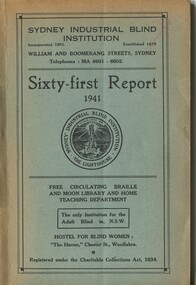 Vision Australia
Administrative record - Text, Sydney Industrial Blind Institution: Sixty-First Report 1941, 1942
... Hudson who edited the Woman's Magazine for over 20 years, 441 Talking books (consisting of 5914 records), appointment of Superintendent A J Harris and Welfare Office Roy Kippax to the NSW War Blinded Welfare Committee, a thoughtful donation of 50 cigarettes to be distributed amongst the blind, the annual Picnic at Clifton Gardens with Alan Green winning the A Consett Stephen Cup, a change in time to 3.45pm for the Glow Worm sessions, and the sad death of R McDonald who read to blind workers during lunch hour for 37 years - the victim of an accident upon his return home from the Institution....Hudson who edited the Woman's Magazine for over 20 years, 441 Talking books (consisting of 5914 records), appointment of Superintendent A J Harris and Welfare Office Roy Kippax to the NSW War Blinded Welfare Committee, a thoughtful donation of 50 cigarettes to be distributed amongst the blind, the annual Picnic at Clifton Gardens with Alan Green winning the A Consett Stephen Cup, a change in time to 3.45pm for the Glow Worm sessions, and the sad death of R McDonald who read to blind workers during lunch hour for 37 years - the victim of an accident upon his return home from the Institution. ...Articles in the annual report include: members of Marcus Clark's Ex-Service Men's Association have dug trenches for air-raid shelters, thanks to the blind artists who performed at the Annual General meeting: soprano Nita Bowman, flautist W Kirkbride-Smith and accompanist Marcus Burkitt, the library now has over 18,000 volumes in Braille and Moon, the passing of L.E. Hudson who edited the Woman's Magazine for over 20 years, 441 Talking books (consisting of 5914 records), appointment of Superintendent A J Harris and Welfare Office Roy Kippax to the NSW War Blinded Welfare Committee, a thoughtful donation of 50 cigarettes to be distributed amongst the blind, the annual Picnic at Clifton Gardens with Alan Green winning the A Consett Stephen Cup, a change in time to 3.45pm for the Glow Worm sessions, and the sad death of R McDonald who read to blind workers during lunch hour for 37 years - the victim of an accident upon his return home from the Institution.1 printed volume with black and white illustrationsannual report, sydney industrial blind institution, nita bowman, marcus burkitt, w kirkbride-smith, a.j. harris, roy kippax, l e hudson, alan green, robert mcdonald, auxiliaries -
 Ringwood and District Historical Society
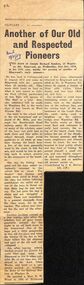
Newspaper, The Mail, Obituary - Joseph Richard Sanders - Old and Respected Pioneer Ringwood 1959 from the Ringwood Mail, 1959
... He remembered many of the scholars, some of the boys and girls had to walk three and four miles to school through rough scrub paddocks in all kinds of weather. During the lunch hour a few of the boys generally went to the creek to fish for eels and would be late in getting back to school, greatly to the annoyance of the teacher. ...He remembered many of the scholars, some of the boys and girls had to walk three and four miles to school through rough scrub paddocks in all kinds of weather. During the lunch hour a few of the boys generally went to the creek to fish for eels and would be late in getting back to school, greatly to the annoyance of the teacher. ...The article was contributed by J.K.McCaskill, JP. a mayor of Ringwood in the years between 1924-1951.The Sanders family came from England and are mentioned in the book "Ringwood a Place of Many Eagles" by Hugh AndersonObituary from The Ringwood Mail of Joseph Richard Sanders of 18, Wantirna Road, Ringwood, aged 87 years. He came from a family who were early pioneers of Ringwood. he was born in Collingwood but schooled in Ringwood, married and brought up his family in Ringwood. He lived at 18, Wantirna Road .The article was contributed by J.K.McCaskill, JP. a mayor of Ringwood in the years between 1924-1951.Transcript: "The death occurred of Joseph Richard Sanders, 18 Wantirna Rd, Ringwood, on Wednesday, 21st October 1959, in his 87th year, marks the passing of another of Ringwood’s early pioneers. He was born in Collingwood in August 1873 and came to Ringwood with his parents when 15 months old. They made their home on land on what is now known as Jubilee Park (Fuller particulars of this Park will appear in ‘The Mail’ at a later date, also reference will be made to Wantirna Rd, in the early days it was known as West Prussia Rd). Joe went to the school held in the old homestead and orchard of Mr. Mills, just through the Heatherdale Road railway gates. He remembered many of the scholars, some of the boys and girls had to walk three and four miles to school through rough scrub paddocks in all kinds of weather. During the lunch hour a few of the boys generally went to the creek to fish for eels and would be late in getting back to school, greatly to the annoyance of the teacher. One day the fishing was good, and the boys rather reluctantly returned to the school late as usual. The teacher was furious and made them stand in front of the class but before inflicting punishment she called out to one of the boys to throw out that dirty bag he was holding. The lad gave the bag a shake and out wriggled a snake. There was immediately a general stampede from the classroom, led by the teacher. The school was closed for the rest of the afternoon. Another incident related to a few tramps who after the scholars had all gone home, generally camped for the night in an old back room in the homestead. One of the boys put a little gunpowder in this old fireplace and when the tramps lit the fire to boil their billies the old chimney and part of the old wall just collapsed. Joe, after leaving school, worked around the district for some time and later left Ringwood to live in other suburbs. He at one time was employed at the Aust Glass Works, and later as a carpenter worked on building the dome of the Railway Station at Flinders St. He married a Miss E. M. Wood in 1901 at Richmond and a few years afterwards returned to Ringwood and resided at No. 18 Wantirna Rd., where he reared a family' of three girls (Alice, Ethel, Joyce) and two boys (Robert and Joe). Joe recalled many interesting events of earlier years, such as the duplication of the railway line, and the cutting back of the embankment at the Goods Shed, the earth being used to heighten up the railway bridge over Wantirna Rd. The brickworks at Ringwood East and reference to early land surveys, the using of the heavy chain links before the use of the theodolite became general, and the many neighbours and friends whom he knew. He was interested in local public affairs and was fond of fishing. He proved himself a good citizen and was highly respected and esteemed throughout the district, and so another old pioneer passes on." (Contributed by J. K. McCaskill, J.P.) RM 19 Nov 1959 -
 Uniting Church Archives - Synod of Victoria
Colour photo, 1986
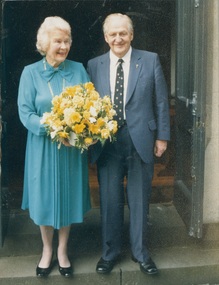
... They grew to become the biggest regular lunch-hour services in the world, with up to 1300 people crowding the church and the hall below. ...They grew to become the biggest regular lunch-hour services in the world, with up to 1300 people crowding the church and the hall below. ...1911–2005: Gordon George Powell, who has died at 94, was for many years the highly influential minister at St Stephen's Presbyterian Church in Sydney and a popular radio broadcaster and author. He began Wednesday services at St Stephen's in Macquarie Street soon after arriving in Sydney from Melbourne in 1952. They grew to become the biggest regular lunch-hour services in the world, with up to 1300 people crowding the church and the hall below. In 1953, with the help of Vernon Turner of the Christian Broadcasting Association, services were broadcast on radio. The broadcasts continued even when Gordon moved back to Melbourne, so for 30 years he maintained a successful weekly radio ministry. While at St Stephen's, he was also involved in the 1959 Billy Graham Crusade in Sydney, attended by 980,000 people over two weeks. Gordon was born in Warrnambool, Victoria, the son of a dentist, George Powell, and his wife, Louisa (nee Clarke). He went to school at Scotch College. He gave up plans to become an electrical engineer after hearing a call to the ministry and studied arts and then theology at the University of Melbourne, where he formed a close friendship with Edward (Weary) Dunlop. Gordon rowed in the Ormond crew, winning the university's inter-college trophy five times. He was a passionate sports lover all his life. He was awarded a scholarship to Trinity College, Glasgow University, in 1935, and for three months stayed with the great Scottish churchman George (later Lord) MacLeod. While on a cycling trip around Scotland, he stopped by the shores of Loch Ness and saw a long neck appear. The monster swam about 300 metres at great speed; Gordon counted three or four humps. Later, when he saw a skeleton of a plesiosaurus at the Victoria and Albert Museum, he recognised it as Nessie. For the rest of his life, he retained an avid interest in the Loch Ness Monster and its attendant scientific debate. While in Scotland, Gordon wrote a weekly article for The Messenger, the official journal of the Presbyterian Church of Victoria. This led to a life as an author of articles and books. He also wrote long letters home to his mother, a habit that later led to his weekly "Dad's Diaries", which were distributed to the wider family. Failing eyesight put an end to his reading and writing two years ago. On returning to Australia in late 1936, he became assistant minister at Toorak, the second-biggest Presbyterian church in Melbourne. There, at last, Gordon married Gwen Gilchrist, whom he had courted for nine years. They moved from the wealthiest church to one of the poorest, at Port Adelaide, which was still in the grip of the Depression. There, he was finally ordained, in May 1938, and the first two of their four children, Rosemary and David, were born. In 1941, Gordon became assistant minister to Scots Church in Melbourne and the following year, after the birth of his third child, Mardi, he reluctantly volunteered as an RAAF chaplain. He was a pacifist but felt bad at not being in uniform. For the following three years, he was stationed in New Guinea and Australia. His war reminiscences were published as Two Steps to Tokyo and sold 6000 copies in 1945 alone. At 34, by then the father of four children, he was invited to be minister of the Collins Street Independent Church in the heart of Melbourne, now St Michael's Uniting Church Before being inducted, he undertook a lecture tour of the US, speaking to Rotary clubs in 48 centres, from Michigan to Maryland. He met, and was impressed by, the liberal theologian Harry Emerson Fosdick, and the US religious leader and author Norman Vincent Peale, who became a close friend and mentor. Back in Australia, Gordon founded and fostered the first Alcoholics Anonymous group in Melbourne. In 1952, he took up what was to become his happiest ministry, at St Stephen's in Sydney. When Queen Elizabeth and Prince Philip toured two years later, Gordon and Gwen were not only invited to lunch with them, but sat beside them. This was a highlight for Gordon, an ardent monarchist. In 1960, Gordon and Gwen embarked on a world tour that included the US, where he was invited to give the opening prayer in the Senate, with vice-president Richard Nixon presiding. After another five years at St Stephen's, Gordon returned to Scots Church in Melbourne. It was a time of bitter debates over church union with the Methodists and Congregationalists. Gordon was in favour, but Scots ultimately voted to stay out and remain Presbyterian. By then in his mid-60s, he and Gwen moved to New York, where Peale was his neighbour. They had six happy years there before retiring to Melbourne. Gordon is survived by Gwen, and children David, Mardi and Jenny (daughter Rosemary died in 1992), 13 grandchildren and 10 great-grandchildren. [From the obituary in the Sydney Morning Herald, 2005, written by Jenny (Powell)] Gwen and Gordon Powell coming out of the Toorak Uniting Church 50 years after they were married there. Gwen and Gordon Powell coming out of the Toorak Uniting Church 50 years after they were married there.gordon powell; gwen powell; port adelaide; toorak presbyterian church; st stephen's presbyterian church sydney; presbyterian minister -
 Eltham District Historical Society Inc
Document - Photocopy, Diamond Valley News, Newspaper article: Fred looks back by Linley Hartley, Diamond Valley News, c.1985
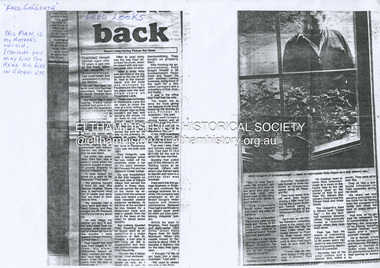
... “He taught me to drive the truck giving me lessons in my lunch hours up the Bourke St and Flinders St extension,” she said. ...“He taught me to drive the truck giving me lessons in my lunch hours up the Bourke St and Flinders St extension,” she said. ...Fred looks back; Report: Linley Hartley, Picture: Ron Grant Teaching himself German again after 70 years is just one of the many tasks Fred Golgerth, of Greensborough, has undertaken and succeeded in during his lifetime. As the two year old tenth child of a German descendent, Fred learnt to speak German from an Aunt. But World War 1 was raging. Fred’s older brother had gone to Europe with the Australian forces, changing his name … to ….. to sound less German. “I used to get my bottom slapped for speaking German at home,” Fred said. Even his name was changed from Otto to the more anglicised Frederick. Fred claims his involvement with Eltham started two years before he was born! His sister, two years older than him, was a babe in arms when his parents bought a piece of grazing property in Mount Pleasant Rd. “It was about 24 acres on a spur of Mt Pleasant,” Fred said. “My parents bought it from Mr and Mrs Hughes. There was a two-room mud hut in wattle and daub that we lived in from time to time. “My parents had a dairy farm and dairy in West Coburg, and they bought the Mt Pleasant land to put the dry stock on. “At one stage my mother got very ill and my older sister took my younger sister and myself to Eltham for four or five months. I went down to Eltham Primary School then.” That wasn’t the only time Fred stayed in Eltham. His sister, Wilhemina, known as Willa, married Jim Watson who had the Eltham hotel for some years from the end of World War 1. Pillar to post living was the way Fred described his youth, when he stayed with one married sister after another. “After a while Will and Jim lived in the big house at the top of Pitt St, next to the Council depot, and the hotel was managed by Fitzsimmons who had a big place near the river down there on Fitzsimons Lane. There was no bridge in Fitzsimons Lane but we used to cross the river at a ford, rolling up our trouser legs so they wouldn’t get wet, and carrying our shoes. I’d o down to visit some friends I had in Templestowe. And sometimes Jim Watson took his horse drawn lorry across the ford on his way to the brewery, instead of going don through Heidelberg.” “The bridge across the Yarra in Fitzsimons was not built until 1961.” Fred Golgerth, was only a teenager when he was rolled off his pushbike under a car on the bend between Mt Pleasant Rd and the Diamond Creek bridge. He was hospitalised in the little hospital on the east side of Eltham village that served the district in those days. He still carries the scars of the burns he received from the exhaust pipe and recent x-rays have revealed several broken vertebrae. At the time of the accident he was treated for a dislocated neck and was in plaster from his hip to the base of his head for about seven months. But nothing daunted Fred. Bouncing back he began work as an apprentice to a motor mechanic in Bell St, Preston, a man who is still living (at 90) in Queensland and who still communicates with Fred frequently. “He was like a father to me,” Fred declared. He was a marine engineer as well, so I …. that as well as blacksmithing. They taught us properly then.” After finishing his apprenticeship, Fred bought himself a 30 hundredweight Fargo truck and began his own contract carting business, doing most of the work for a firm called Carnegie’s and a subsidiary of that, Howard Radio. It was in the office Fred met his wife. “He taught me to drive the truck giving me lessons in my lunch hours up the Bourke St and Flinders St extension,” she said. “After work I’d have a driving lesson and all the girls from the Howard Radio would pile in the back to get a lift to Richmond Station.” In the 1939 bushfires, the Mt Pleasant Rd property was burnt out and the hut raised. Two years later, Fred and Dorothy were married. Fred paid £7.15.0 ($15.50) for the suit in which he was married. Dorothy had pulled out of the Women’s Air Training Corps to be married. Others with whom she trained went to Darwin and were in a convoy that was bombed. Fred went into the garage business in Brighton and continued his cartage business for a while. His company was employed to do all Brown Gouge’s motor repairs and factory maintenance. Because Fred had a certificate to do steam repair work he often got jobs maintaining industrial boilers. While he was in Brighton, Fred bought an eight-seater 1925 Silver Ghost Rolls Royce from Sir Keith Murdoch. When the couple moved to Rosanna in about 1943, it became a delivery van for the dairy they operated. “I thought I’d like to get back into a dairy business” Fred said. “We used to deliver the milk in the Rolls. “But it was hard work. We couldn’t get the labour and we’d drive to the farm and pick up the milk cans, take them back to the dairy, cool the milk, bottle it and deliver it. The inspectors would come regularly and the walls for bacteria.” Fred was exhausted. The couple gave up the dairy and moved to Eltham to live on the old property where a weatherboard house had now been built. It wasn’t a big house and the glassed in Rolls Royce limousine became the daytime nursery for the Golgerth’s second daughter. We’d put her in there to sleep during the day.” “Dorothy Golgerth was known to drive the Rolls at breakneck speed along Mt Pleasant Rd. Fred took some time off work then began driving a little local bus run by the Lyon Brothers before taking a maintenance job at the Athenaeum Club in the city. He’d ride an old Harley-Davidson to the station and travel into the city by train. Later, when the family moved to Pryor St. (their house stood where McEwans car park is now) Fred could walk to and from the station. “There was no resident doctor in the early days of Eltham,” Fred said. “Dr Cordner used to come from Greensborough to a room in the old house next to the old grocery shop on the corner of York St and Main Rd, Eltham (the grocery shop is now the Eltham Feed and Grain Store). The Golgerths lived in Eltham until “Dollar Day” – the day decimal currency became official. They eventually moved to Greensborough, when they have lived since. Fred has had his share of interesting jobs since then, retiring at 65 seven years ago when he was working in the engineering department at Larundel. Recently, two of his older sisters and a brother died, within a month. They were all in their 80s. They all had a profound influence on Fred, especially during his youth. His sharp wit and amusing anecdotes are the richer for his having been the youngest of a family that made the best of every circumstance. And now, as he enjoys his retirement, he is concentrating on relearning the language of his infancy; teaching himself German from tapes and a ‘teach yourself’ manual. He is fiercely proud of his German ancestry and treasures the diary, written in German in Gothic script, kept by his grandparents during their journey to Australia. On the inside in blue pen: "To Sadie, Wal Margaret & Elizabeth with lots & lots of love & best wishes from Mother"marg ball collection, eltham hotel, herbert james watson, otto (fred) golgerth, wilhemina watson (nee golgerth) -
 Ballarat Tramway Museum
Book, H.P. James, "In Other Days", late 1930's
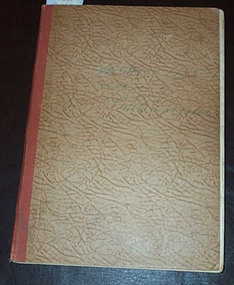
... Item 2497 (2 No.) ESCo/SEC? - lunch hour weekly ticket - See Reg. Item 2498 ESCo/SEC? ...Item 2497 (2 No.) ESCo/SEC? - lunch hour weekly ticket - See Reg. Item 2498 ESCo/SEC? ...ESCo Employee Hours Work Record book that has been used by an ESCo/SEC inspector, H. P. James as a record / note book for his personal collection or papers or journal titled "In Other Days". Book sewn with string in 36 page sections, blank end papers, board covers with stipple paper out sides and Rexene cloth binding. Comprising plain paper end papers and 104 printed pages (52 leaves), with each sheet printed in black on feint ruled paper for recording the hours worked and other details of drivers and conductors employed by ESCo. Printed for daily use, with Day and date page headings - made out for the 1930's. Text generically printed feint ruled paper. Images: Book - i1 Inside front cover - i2 Members Certificate - i3 Photo of H.P. James and index page - i4 Has been used to gather mementos such as photos, articles, newspaper clippings, letters and other miscellaneous documents on Ballarat local history. Newspaper cuttings etc often have side notes written by Mr. James. Inside front cover has certificate recording Mr. James membership to the Ballarat Historical Society (on Australasian Historical Record Society paper) for 1937 - 1938. A side note records Mr. James elected as Vice President in 1939. Receipt signed by Edward Crimmins (See Reg. Item 2486) Has a table of contents for pages 1 to 65. Opposite is a photograph of Mr. James dressed for the Ballarat Tramways Social Club function - See Reg. Item No. 506 Primary items are: 1 - Newspaper cutting "A stroll along Bridge St. 50 years ago" - Nathan F. Speilvogel. 3 - Newspaper cutting "What I Remember of Early Ballarat" - James Sainsberry. 4 - Newspaper cutting "Magnet that Made Ballarat - New Monument Marks Gold Discovery" 7 - Newspaper cutting "Romance of a Ballarat Street Block" - Speilvogel 9 - Newspaper cutting "Sixty years of Dana St. School"- Speilvogel 11 - Newspaper cutting "The White Flat - its Transitions of Service - Historical Review" - J. Hargreaves 15 - Newspaper cutting "Memories of Russell Square - Fireman's Carnivals" - James 16 - Notes on the Alfred Hall 17 - Newspaper cutting - "Alfred Hall" - James 21 - Letter re Russell Square dated 24/2/38, J. McLeish 23 - Newspaper cutting "The First Train to Ballarat" 25 - Newspaper cutting "Story of Ballarat's Horse Trams 1887 to 1913", James - see Reg. Item 2489. 27 - Photos and Newspaper cutting of items re horse trams, and photo of ESCo No. 18 - See Reg. Items 2490, 2491 and 2492. 28 - ESCo opening ticket (See other Reg. Items 608 for examples of this) ticket No. 1595. 29 - Newspaper cutting "Story of Ballarat's Electric Trams", James, See Reg. Item 2493. 30 - Poster - SEC - Ballarat "The New System of Fares and Sections" - 3/10/1997 - See Reg. Item 2494. SEC - Tourist Ticket - See Reg. Item 2495 ESCo - 3d check ticket - See Reg. Item 2496 31 - Tickets and handwritten notes - with reference to page 51 ESCo 1d - See Reg. Item 2497 (2 No.) ESCo/SEC? - lunch hour weekly ticket - See Reg. Item 2498 ESCo/SEC? - Morning and evening weekly ticket - See Reg. Item 2499 ESCo/SEC? - 3d Adult Transfer - See Reg. Item 2500 ESCo/SEC? - 2d child Transfer - See Reg. Item 2501 ESCo - 1.1/2 child ticket - See Reg. Item 2502 ESCo - 3d Adult ticket - See Reg. Item 2503 Extract of an item titled "History of Ballarat Tramways", SEC Magazine, Feb. 1939 - See Reg. Item 2504 2d ESCo token (See other reg items 1794 and 1943 for details of this object) - sewn into page. 33 - Handwritten notes "Alfred Hall" 35 - Handwritten notes "Russell Square" 36, 37 - miscellaneous cuttings from the Courier for 1939 and 1940 39 - Newspaper cutting "South Street Band Contests" - cutting dated 27/10/1932. (See images - i5 to 41, 43, - ditto - contest results 44 - Photo of the Tramway Shelter in Sturt Street being removed - Courier dated 18/12/1923 - see Reg Item 2523. 45 - Extract of April 1938 from SEC Magazine, photos of the launch of the illuminated Ballarat Centenary tram - see Reg Item 2524. 47 - Newspaper cutting "Peeps into the Past" 48 - Listing of "Members of Returned Soldiers Band", Ballarat, dated 18/11/1919. 49 - Newspaper cutting "Ballarat, The Home of the Band Contests", dated 27/10/1932. 51 - Handwritten notes - "Tram Fares methods of collection" - See Reg. Item 2505. 53 - Newspaper cutting "100 years ago", Port Phillip Herald for 1840. 54 - Black and white photo of a gathering of people (tramway?) at the Showgrounds - See Reg. Item 2506 55 - Six black and white photos with handwritten notes ESCo 19 or 20 - See Reg. Item 2507 Group of ESCo employees by ESCo tram - See Reg. Item 2508 Photo of ESCo employee, Si Barker - See Reg. Item 2509 Photo of ESCo company bus - See Reg. Item 2510 (See also Reg Item 3813) Photo of No. 25 - Barkly St - See Reg. Item 2511 Photo of two ESCo employees - See Reg. Item 2512 56 - Loose newspaper cutting "San Francisco Struggle Buggies" - cable trams - The Age 15/3/1947 57 - Letter from Mr. Pringle of ESCo to Inspector James and Handwritten notes on ESCo management - See Reg. Item 2513 Handwritten notes on the token systems - See Reg. Item 2514 59 - Page titled "Bundy clocks and meters" but no notes 61 - Hand drawn map of Ballarat tramways with notes on tracks - horse, SEC and ESCo and loops - See Reg. Item 2515. 63 - Miscellaneous newspaper cuttings and photo of the Arch of Victory 64 - Photo of W. J.K. Dunstan ??? (has notes written on back, but difficult to read)* - Notes on rear of photo p64. "49 years in service W.J.K. Dunstan Office Manager Ballarat Branch Retired 18/3/46" 65 - Newspaper cutting "Old Victorian Schooldays, letters and reminiscences by past scholars". 67 - Newspaper cuttings - photo of Ballarat Choral Union and Urquhart St. school 69 - Newspaper cutting "Saint with a top hat" 71, 73 - Newspaper cutting "District Mining Disasters of By-Gone Days" - John Hargreaves 75 - Newspaper cutting "The Ballarat Courier" banners for 2/9/1939 - outbreak of World War Two - normal and a special edition. 77, 79 - Newspaper cutting "My Youth in Ballarat" - T.P. Long. 81 - Two photos and handwritten notes showing trams in Sturt St and the line up of horse trams - See Reg Item 2516. 83 - Newspaper cutting "Theatrical History - The Charlie Napier" - Speilvogel 85, 87 - Newspaper cutting "Story of the Eureka Stockade Monument" - Speilvogel 89 - Newspaper cutting "The Beginning of Buninyong" - Speilvogel 91 - Newspaper cutting "St. David's Day" 93, 95 - Newspaper cutting "From 1856 to 1894, Ballarat's Foremost Citizen Major (William Collard) Smith Recalled - J. Hargreaves. 97 - Newspaper cutting "All Electrical Exhibition / Ballarat's Electric Supply, its development" - 1936, See Reg. Item 2517. 98 - Loose photo of the ESCo Power station chimney and steeplejacks - See Reg. Item 2518. 98 - Loose sheet of paper about the origin of the ESCo trams - See Reg. Item 2525. 99 - Newspaper cutting - about Electricity in Ballarat and tramway services, and handwritten notes on ESCo Inspectors - See Reg. Item 2519 100, 101 - Newspaper cuttings - "Mr. Melbourne Day by Day" cartoon series and the artist's death notice dated 22/8/1939. 102 - Poster - Dana Street School Jubilee Re-union, has N. Speilvogel and H. James as joint secretaries. 103 - Newspaper cutting of various photos and a scene of a gold train at Bendigo 104 - Newspaper cuttings - Bob Menzies and Adolph Hitler and backs of Melbourne tram tickets - "School Boy Howlers". 105 - Letter in an envelope to H.P. James dated 11/10/1937, by a person about the building of the tram sheds at Wendouree - See Reg. Item 2520. Newspaper cutting of the opening of the tramway to Lydiard St. North from Gregory St. - See Reg. Item 2521 Loose item - 1/- SEC Tourist Ticket No. A2676 - See Reg. Item 2522.Many in pencil and inktrams, tramways, h.p. james, esco, horse trams, ballarat, civic history -
 Ballarat Tramway Museum
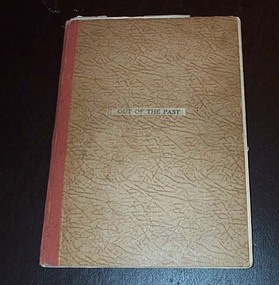
Book, H.P. James, "Out of the Past", 1940
... Middleton. 54 - Newspaper cuttings "Richmond has Links With Early Goldfields" - Malcolm McCullum and "England's Greatest Battle" 55, 56 - Newspaper cuttings - "Ballarat Birthdays" for November and December, a photograph of Nick Oliver - former Ballarat fireman and "Railway Birthday" - birth of the VR. 57, 58 - Handwritten notes on Ballarat tram timetables, weekly tickets, motorman's record cards, tourist tickets and sample tickets or cards, See Reg. Item 2541. Lunch Hour Weekly Ticket - Reg. Item 2542 Morning and Evening Weekly Ticket - Reg. ...Middleton. 54 - Newspaper cuttings "Richmond has Links With Early Goldfields" - Malcolm McCullum and "England's Greatest Battle" 55, 56 - Newspaper cuttings - "Ballarat Birthdays" for November and December, a photograph of Nick Oliver - former Ballarat fireman and "Railway Birthday" - birth of the VR. 57, 58 - Handwritten notes on Ballarat tram timetables, weekly tickets, motorman's record cards, tourist tickets and sample tickets or cards, See Reg. Item 2541. Lunch Hour Weekly Ticket - Reg. Item 2542 Morning and Evening Weekly Ticket - Reg. ...ESCo Employee Hours Work Record book that has been used by an ESCo/SEC inspector, H. P. James as a record / note book for his personal collection or papers or journal titled "Out of the Past". Book sewn with string in 36 page sections, blank end papers, board covers with stipple paper out sides and Rexene cloth binding. Comprising plain paper end papers and 104 printed pages (52 leaves), with each sheet printed in black on feint ruled paper for recording the hours worked and other details of drivers and conductors employed by ESCo. Printed for daily use, with Day and date page headings - made out for the 1930's. Images: Book - i1 Inside front cover - i2 Members Certificate - i3 Has been used to gather mementos such as photos, articles, newspaper clippings, letters and other miscellaneous documents on Ballarat local history. Newspaper cuttings etc often have side notes written by Mr. James. Inside front cover has certificate recording Mr. James membership to the Ballarat Historical Society for 1940. Receipt signed by Edward Crimmins. Also a newspaper cutting on the cost of pensions to Lord Nelson's family. On facing page a photo of Queen Elizabeth, a printer colour cover or sheet about Walt Disney's "Pinocchio", a newspaper cutting regarding Father's Day and a black and white photograph of a young girl in a hospital carriage being pushed by a man. Pages numbered odd numbers only in the top right hand corner in pencil. Primary items are: 1 - Coloured cover to a writing tablet, titled "Australian Birds". Underlying this on the back of the writing tablet is two newspaper cuttings: the Ballarat Historical Society - reports on the 6th Annual meeting of the Society. 3 - Photo of the pattern Ballaarat Horse Tram company tram outside the Duncan and Fraser's Carriage Works in Adelaide with hand written notes underneath, including a sketch of a horse tram drivers seat - see Reg. Item 2527. 4, 6 - Group of nine black and white printed cards (15 illustrations) of early Ballarat pasted onto the sheet - see Reg. Item 2528. 5, 7 & 9 - Printed notes titled "Valedictory to Bob Haines" - see Reg. Item 2529. On page 9 in the left hand margin, a printed list of Church Officers; Church of England. 8 - Newspaper cuttings titled "The Heralds Man's Quiz" and the answers adjacent. City of Ballaarat - Public Inoculation Depot - Influenza form for HP James of ESCo - See Reg. Item 2530. Page Numbering from this point changes - even numbers in top right hand corner of folios instead of odd numbers. 9A - Newspaper cuttings about a Theatre Show, 54 years service of Mr. E. R. Bodycomb (Ballarat Gas) and planting of trees in the Avenue of Honour - with a red line around H. P. James names and a reproduction of the opening photograph of ESCo Electric Trams - noting 30 years ago - See Reg. Item 310.2. ESCo 4d Ticket - Purple - Grenville St to Sebastopol Terminus - See Reg Item 2531. ESCo 3d Adult Transfer Ticket - See Reg. Item 2532. Illustration - cartoon - H.P. James - See Reg. Item 2533. 10 - Newspaper cutting "From Horse Tram to Trolley Bus" - See Reg Item 2534. Newspaper cutting "Melbourne's First Tramcars" - See Reg Item 2535. An inscription or written note from T. Thomas etc. on lower edge of the sheet. 11,12 - Newspaper cuttings about the Passing of Melbourne's Cable Trams, including a photo of cable trailer No. 1 - See Reg. Item 2536. Other cuttings about early residents of the Ballarat district. 13 - Newspaper cutting dated 2/5/1936 about the donation from the CTA to the Ballarat Hospital. 14 - Newspaper cuttings - Photo of Ballarat Bicycle and Tricycle Club in the Gardens, the issue of a stamp to commemorate the Centenary of Ballarat, radio stations in Sydney, Ballarat Choirs and fire brigade demonstrations trophies. 16 - Copy of the "City of Ballaarat Regulation No. 13" concerning Hackney and Stage coaches working within the City - See Reg. item 2537. 18, 20 - Newspaper cutting - "The Working Classes in Early Ballarat" - Nathan Spielvogel 21 - handwritten note on "Doctor" Thomas Blackett who died during 1940. 22 - Miscellaneous cuttings from the Melbourne Sun. 23 - Newspaper cuttings "Story of South Street", Show Grounds, and "The Alfred" Hall and a photograph of the 1938 Floral Carpet at Alfred Hall. 24 - Newspaper cutting - obituary and hand written note on Ballarat identity Mr. J. P. Bourke. 25 - Newspaper cutting - cartoon "Tiddley" Winks and Wally - Stan Cross (later "Wally and the Major" 26 - Newspaper cutting - "Ballarat in the sixties" - General R.E. Williams and "Early Recollections" - Arthur Reid. 27 - Handwritten note re Mrs. Bill Danks, dated Jan. 1941 - Tobacconist in Bridge St. 28 - Newspaper cutting - "First Town Hall" and note on "City Hall". 30 - Newspaper cuttings - "Good Friday, Now and Then - T.P. Long, Mont Albert and "On Fashions" James R. Pound. 32 - Newspaper cutting "School and School life in old Ballarat" - Nathan F. Spielvogel. 34 - Newspaper cutting continued from page 32 and Obituary - Mr. Archie Dawson and Tom Blackett. 35 - Newspaper cutting of Ballarat - 4 photos - include Bridge St. with a tram. 36 - Newspaper cutting - "Ballarat - Pastoral and Industrial Resources" from a Melbourne paper, 17/2/1940. 38 - Newspaper cuttings - obituaries - Mr. R. E. Tunbridge, Graeme Dowling and Thomas Crosthwaite. 39 - Illustration - black and white - Late Mr. P. J. Pringle - See Reg. Item 2538. 40 - Handwritten notes on Ballarat Trams and the power station staff - See Reg. Item 2539. 41 - Handwritten notes on Ballarat Pie Stalls 42 - Newspaper cuttings - cartoon "Professor Nimbus", photo of the Norwegian town of Hell (Railway station); bicycles on a Copenhagen bridge following German occupation and dragon flies in Melbourne. 43 - Newspaper cutting on the official opening of the Ballarat Historical Society's Museum. 44 - Newspaper cuttings and associated handwritten notes on a fire in Ballarat, poultry fanciers, historical dates for August. 46 - Newspaper cuttings - "Victoria's first profitable goldfield" - Ballarat and the unveiling of the Sovereign Hill direction pillar. 48 - Newspaper cutting - "Worked 27 years without holiday" - See Reg. Item. 2540. - Other newspaper cuttings - thoughts of a visitor to Ballarat from Sydney and H.P. James - Liquor control in Ballarat and "This Week at the Zoo". 50 - Handwritten notes on clothing. 51 - Handwritten note on a visit to W. H. Middleton 52 - Newspaper cuttings "The Kings Empire", "Ballarat Birthdays" for Sept and Oct and an obituary on Mr. W. H. Middleton. 54 - Newspaper cuttings "Richmond has Links With Early Goldfields" - Malcolm McCullum and "England's Greatest Battle" 55, 56 - Newspaper cuttings - "Ballarat Birthdays" for November and December, a photograph of Nick Oliver - former Ballarat fireman and "Railway Birthday" - birth of the VR. 57, 58 - Handwritten notes on Ballarat tram timetables, weekly tickets, motorman's record cards, tourist tickets and sample tickets or cards, See Reg. Item 2541. Lunch Hour Weekly Ticket - Reg. Item 2542 Morning and Evening Weekly Ticket - Reg. Item 2543 Motorman's Record - Reg. Item 2544 Tourist Ticket - 1/- - Reg. Item 2545. 60 - Newspaper cuttings - parts 1 and 2 - "The Two Ballarat" by Nathan Spielvogel. 62 - Newspaper cuttings - continued from page 60, the death of comedians Sam Mayo and Gus Bluett and some handwritten notes on comedians. 64 - Newspaper cuttings on cricket, choir rules, a Methodist ladies function at the home of H.P. James, Footballer Percy Beames and entertaining air force recruits at the showgrounds. 66 - Newspaper cuttings - "The Anvil Chorus" - Hitler and Mussolini and "Strength against Nazi Threat". 68 - Newspaper cuttings - 50 years ago in Ballarat, Social function at H.P. James house, coldest morning in Ballarat and the death of Col. A. W. Bennett. 70 - Newspaper cuttings - about the sale of spirits in early Ballarat, the first motorcars in Ballarat and handwritten note about Mr. Jago. 72 - Newspaper cuttings - misc. about horse racing, trainers and racing. 73 - Newspaper cuttings and handwritten notes about Ballarat Schools. 74 - Newspaper cuttings - Bruno Hauptmann (Charles Lindbergh) and the death of actor Darcy Kelway. 75, 76 - Newspaper cuttings - Rail services to and from Ballarat, effects of the war and Ballarat 70 years ago, the invasions of Britain and "A stroll down Memory Lane" - T.P. Long of Mont Albert. 77,78 - Newspaper cuttings - Lake Wendouree - Nathan Spielvogel, the opening of the new Ballarat Historical Society's Museum and farewell function of Mr. James Shannon. 79 - Newspaper cuttings - about boats on lake Wendouree. 99 - Obituary and hand written note re Mr. Arthur M. David. 100 - Newspaper cuttings - cartoon "Wally and the Major", Dr William Maloney, Gus Bluett and "Old Rowley" - in connection with the Melbourne Cup of 1940. 101 - Cartoon advertisement for Kolynos Dental Cream Inside rear cover - Programme for the Centenary of Thanksgiving Service - Back to Ballarat 1934, dated 4/11/1934 (has been affected by other sheets of paper due to their acidic nature), printed notes titled "A ramble on stilts with Freddie" written by Baker James. Many in pencil and inktrams, tramways, h.p. james, esco, horse trams, ballarat, civic history -
 Melton City Libraries
Newspaper, Oral History Day, 1992
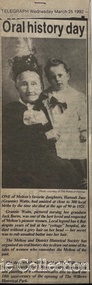
... Tom Barrie said they always used to watched for me as I was always about 3 minutes past 1, my lunch hour was from 1-2. One particular day they missed seeing me and swam on, and of course they were all late for school when they got back and were all kept in a night. ...Tom Barrie said they always used to watched for me as I was always about 3 minutes past 1, my lunch hour was from 1-2. One particular day they missed seeing me and swam on, and of course they were all late for school when they got back and were all kept in a night. ...Mary Tolhurst M&DHS - March 29th Dunvegan Willows Park Melton 1992 Ladies Oral History Day Graham Minns President Ray Radford MC Sound recording transfer to CD 2011 by Tom Wood Edited typescript by Wendy Barrie 2013 I was born in Rockbank, and when I was five years old moved to Toolern Vale and started and finished school there. Toolern Vale only consisted of the Store, Post Office and shop, where you could buy your fodder, and pollard supplies, the Hall, the little Church and the bluestone School. The School changed shape three times from the 1800s[1869] til the time I went there. There was four generations of my family that went there and it was destroyed by fire in 1965. Marjorie nee Myers Butler. Yes, I remember along with it your lovely Ronisch piano. Mary, quite true! Marj what you say about the Ronisch piano. When I came the age to learn music my mum and dad couldn’t really afford it, but still what parents do for their children. They had Marj go along with them and pick this lovely Ronisch piano. It was known round the district. Everyone commented about the loss that lovely piano. After leaving school it was war time, 1939, then it was work, When I was 7 year old I was put out into the cow yard. In 1940 when the soldiers were going away our milk was confiscated it had to go to Bacchus Marsh. It used to go the Sunbury to be brine cooled and then go to Melbourne. Then they took it then to the Lifeguard Milk Factory at Bacchus Marsh. It had to go as condensed milk to the soldiers. This year is 50 years of the Land Army. I was an unofficial Land Army but they still kept check on me. I went onto married life and I followed the cows right through [howls of laughter] and we went on until the 1965 fire. That’s when we got out of the cows. Marjorie asks, was Granny Watts your grandmother or great grandmother? Mary: She was my great grandmother, the midwife of Melton. The 1965 fire started ¾ of a mile above our place, Frank Ryan’s sheds were burnt and his house was saved, then it wiped the School out, the Hall, the Church the Post Office and Store and little house that was Charlie Charlton’s in the early days. Mrs Wilson’s place was saved by the Fire Brigade by pulling boards off the side, and from there it went over the hill and it was stopped at the Rockbank Railway Station. If it had of got over the railway they said it would have gone into Werribee. A lot was burnt out in that strip. Mary nee Nixon Collins: 18 houses burnt that day. Audience question, did Melton get burnt that day? Ray: No. It came down through the Toolern Vale road and cut across about a mile and a half from the cross roads at Toolern Vale from north westerly to the south east and cut through over the Keilor road. Mary: It came in across the creek at Funstons in Toolern, then through Jim Minns. Dorothy was it your place then [nee Knox Beaty] to Ken Beatty’s and from there it went through to Doug McIntosh’s and to Cockbills and the wind changed and it came across to the railway line, and that is where they stopped it. [the cause of the fire was controversial, they had been burning off the night before and there was some talk of someone starting it. It was very hot and very strong wind, it was a terrible day] Ray: When the fire went through McIntosh’s they had a haystack on the north side of their house and the haystack got caught and the fire burnt a hole through the side of the house and the boys pyjamas on the bed. The house was saved. It came through like and express train roaring at you, I was at McIntosh’s when it went roaring past. You couldn’t see, dust and ash and tremendous heat. The fire started about 12 o’clock Jack [husband] said to me, fire, I said where, where? Just up the road, what have I got to do? and he went out and he had gone to the fire and left me. I tried to get the animals and I put out buckets of water, putting the buckets of water out saved my life. Chas Jones and another friend of his came in and they picked up the buckets of water, I thought I had better get out because the fire was on the haystack up the paddock and when I went to go out through the north side of the house and couldn’t get out, I’ll go through the front gate so I went around the other side of the house. I got caught there and Chassy Jones and his friend came round carrying the bucket of water and I panicked. He threw the bucket of water over me. Well that is what saved my life because I was damp, whenever we tried to leave the ball of fire came over me and over my shoulder and my hair was scorched. Chassy Jones lost his truck and Keith Watt his big truck because he had the water tank on it and they couldn’t get out of the yard. Granny Watt’s house, the first private hospital had condemned and Jack and I pulled it down and had it moved up to Toolern and had it in the yard a fortnight and it was all burnt and we didn’t get the shed we wanted. Every 13 years right up until Ash Wednesday fires, there has always been fire close at hand. The 1952 fire went down the back of the house, the 1965 fire took the house, and the house that I live in now, it is the third house that has been on that spot. When the Hunters owned it, Mrs Hunter was nearly burnt in her bed. They had a 13 roomed house. In 1924 the house burnt down, and there was another house was built there and that was the one that burnt down. Edna: So Mary built a brick veneer house. Marjorie: like the three little pigs [laughter] Collins - Mary M &DHS - March 29th 1992 Ladies oral history day at Dunvegan, Willows Park Melton. Graham Minns President Ray Radford MC Sound recording transferred to CD 2011 Edited typescript by Wendy Barrie 2013 Mary Collins nee Nixon born in Terang 1907 down in the Western District and we shifted to Melton when I was 5 and a half then I started school here in Melton, and spent all my school life at Melton State School, next to the Church of England, it’s called the Primary School now. I got my Qualifying and Merit Certificate then I left School because there wasn’t a High School. When I was 16 I got and job in the Melton Post Office and I worked there, I was the first girl in Melton to deliver the mail, and worked on the telephone and the Bank business. Mrs Ross and myself behind the counter, there were about 500 – 600 people in the Shire at that time and now when I go into the new Post Office there is 36,000 here there’s still 2 people behind the counter [laughter from the audience] and wait in a queue right out to the door. Times haven’t changed much have they! There was a manual telephone and you had to ring the handle, and there were eight subscribers when I went there and when I left there were 46 I had coaxed that number to join the telephone, even the police station didn’t have the phone on. The two Hotels and the two Chaff mills and Mr Ernie Barrie, Parkers the butcher, the Shire Office was No 8, and the Police house was next to the Courthouse on the corner. They were number 9. I can remember a lot of the numbers still. The Post Office was the Agency for the Commonwealth Bank [comment from audience member] I used to do the Bank business too, I left after four years there, mother wasn’t very well. The Inspector who used to come up to the Post Office asked me if I would take up casual Post Mistress and to go around the different districts but I refused and when Mrs Ross’s holidays were due I was the replacement. I wasn’t 21. I loved my work meeting everybody and most people had horse and jinkers and when the elderly would come in there would be Mr Tom Morrow, he only had one arm and Mrs Dunn came from Bulman’s road in their horse and jinker. They were elderly I would see them pull up out the front and quickly get their mail and run out to them because they didn’t have to get out of the jinker to tie up their horse. If someone had a baby in arms I would tear out and hold the baby while they got down. Mrs Ross was very very strict. I had to sweep the Post Office, she had a couple of mats and there would be a threepence or a sixpence under the mats show she knew whether I lifted the mat, I was whether I was honest or not. Graham: How much were your wages? I got 27/7 pence a week for a 52 hour week. I had to work every holiday except Good Friday and Christmas Day and even when it was Monday holiday I always had to go to work from 9am - !0 am, the Post Office was always open. In the winter I had to wait until twenty past six in case there were any telegrams to deliver. I delivered them on a push bike. One time Tom Barrie told me this years afterwards. I used to go home for lunch. We lived on the Keilor road and I used to ride my bike home. On the hot days the boys used to go and swim in the swimming pool down near a turn in the creek there was a hole where the boys would swim in the nude, they didn’t have any bathers and they didn’t have any watches in those days. Tom Barrie said they always used to watched for me as I was always about 3 minutes past 1, my lunch hour was from 1-2. One particular day they missed seeing me and swam on, and of course they were all late for school when they got back and were all kept in a night. I did get a fortnight holiday. I loved my work and I knew everyone in the district right from Toolern Vale to the Marsh and everybody at Melton South. Did you listen into conversations on the Switchboard? Oh no. [laughter] Melton did not have electricity then. I had to fill the lamps everyday with kerosene. The Staughton Memorial was outside the Post Office. It had four posts with the chain looped around it, and that’s where the people used to tie up their horses. Marjorie nee Myers Butler comments about sitting and swinging on the chains. Mr Fred Coburn lit the acetylene gas light in the Memorial. It was the only streetlight in Melton. There was no electricity until 1939. Ray Radford comments about another gas street light which was on the corner of Station road. [later] Mary passes around her school photos. Mary mentions the names of those who have passed away, Maisie McDonald, ,Marian Wraith, Hilda McCreey, and Valda McDonald. I have written the names on the back. Marjorie comments about Marie Jongebloed and Greta are the only two girls left out of big family of ten I think there were [hesitates] 4 or 5 girls and the rest were boys. Mary. Flora Woodley, Dorrie Flynn and Margaret McDonald are still alive. They are my age we were all born about 1907. Marjorie points out herself in a later photo [1921 and 1922 School ] Mary mentions the name Walsh and identyfies following names, the Parker boys, Ken Beaty, Malc and Linda Cameron, Maisie Mc Donald, Ted Radford, George Nixon, Norman Minns, he was later the Shire Secretary of Werribee. One of the Woodley girls. [Maisie Arthur] Marjorie: Rosie Shearwood, June Whiting Mary. Lily Mc Donald, she has passed away. Isabel Harrison nee Tinkler, she lives at Werribee, Doreen Rogers, Marjorie Walker, Jess McIntosh, Mary Gillespie. Mr Malone was the Junior teacher Mr Roe and Miss Cooke. Fred Myers, my sister [Elizabeth] and the year was 1921. Myers (Barrie) School Photo Collection. Many of the names were identified at the 1970 Centenary of Melton State School No. 430. Edna Barrie organised, compiled and typed the lists to accompany these photos for the year 1921. The 1922 photo shows the higher grades. Ladies Oral History Day event held by Melton and District Historical Society, article featured in the Telegraphlocal identities, local special interest groups -
 Federation University Historical Collection
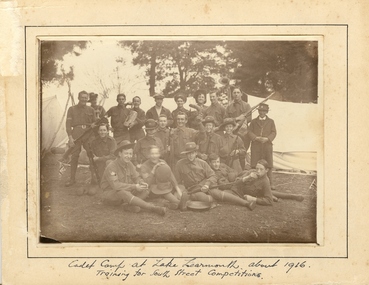
Photograph - Photograph - Sepia, Ballarat School of Mines Cadets, 1916, c1916
... hours. On Tuesday morning Reville sounded at 7. There was no need for it, however, as nearly all the cadets were up before daylight, owing to their beds being too hard. After physical exercises were gone through we had breakfast. We then had rifle exercises until Messrs A.W. Steane and F.N. King arrived. The former put the team through the table of physical exercises set down for competition work, many valuable points being obtained. The visitors remained for dinner, afterwards returning to Ballarat. Wednesday was uneventful, until the soldiers arrived at about 11 a.m., stopping at the park for lunch...hours. On Tuesday morning Reville sounded at 7. There was no need for it, however, as nearly all the cadets were up before daylight, owing to their beds being too hard. After physical exercises were gone through we had breakfast. We then had rifle exercises until Messrs A.W. Steane and F.N. King arrived. The former put the team through the table of physical exercises set down for competition work, many valuable points being obtained. The visitors remained for dinner, afterwards returning to Ballarat. Wednesday was uneventful, until the soldiers arrived at about 11 a.m., stopping at the park for lunch ...Field Marshal Viscount Kitchener of Great Britain was invited by Prime Minister Deakin in 1909 to visit Australia and advise on the best way to provide Australia with a land defence. Kitchener’s report echoed the bill, introduced to Parliament in 1909 and supported by the Opposition Labor Party at its 1908 conference, to introduce compulsory military training in peace time (referred to as universal training). On 1 January 1911, the Commonwealth Defence Act 1911 (Cth) was passed as law and all males aged 12 to 26 were required to receive military training. Men were divided according to age, with junior cadets comprising boys 12-14 years of age, senior cadets comprising boys 14-18, and young men aged 18-26 assigned to the home militia defence. The support of schools was vital to the success of the scheme, since the system of cadet training began in the primary schools, with physical training prescribed by military authorities. Junior cadet training was entirely in the hands of school teachers, who had first been trained by military officers. This early training was less military in nature than focused on physical drill and sport. It also acted to inculcate boys with the notions of loyalty to country and empire. At this age, uniforms were not worn, although there were schools with pre-existing uniformed cadet units, who continued to do so. Senior Cadets were organised by Training Areas, administered by Area Officers. If a school had at least 60 senior cadets, they could form their own units. Unlike their junior counterparts, Senior Cadets were issued uniforms, a rifle, and learned the foundations necessary for service in any arm of the defence forces. Boys and men could be exempted from compulsory training if they lived more than five miles from the nearest training site, or were passed medically unfit. Those who failed to register for training were punished with fines or jail sentences, and the severity of this punishment generated some of the strongest opposition to the scheme. While institutions such as the political parties and most churches generally supported universal training, some in the broader labour movement were less enthusiastic, as evidenced in the Daily Herald newspaper’s editorials and letters. Universal military training persisted after the conclusion of World War 1, with the Junior Cadet scheme the first to go, in 1922. Senior cadets and service with the militia was suspended in November 1929. (http://guides.slsa.sa.gov.au/content.php?pid=575383&sid=4788359, accessed 29/10/2015) According to Neil Leckie, Manager of the Ballarat Ranger Military Museum: * Originally 12 – 14 year olds went to Junior Cadets attached to their school. * From age 14 – 17 they were Senior Cadets attached to the local militia unit. * After 1 July of the year a Cadet turned 18, the Cadet left the Senior Cadets and became a member of the Citizen Military Force. * In October 1918 the AIF, Militia and Cadets were renamed to give some connection to the AIF battalion raised in the area. Ballarat saw: 8th Australian Infantry Regiment comprising: * 8th Battalion AIF renamed 1st Battalion 8th Australian Infantry Regiment * 70th Infantry Militia renamed 2nd Battalion 8th Australian Infantry Regiment * 70th Infantry Cadets renamed 3rd B, 8th Australian Infantry. 39th Australian Infantry Regiment comprising: * 39th Battalion AIF renamed 1st Battalion 39th Australian Regiment * 71st Infantry Militia renamed 2nd Bn, 39th Australian Infantry Regiment * 71st Infantry Cadets renamed 3rd Bn, 39th Australian Infantry Regiment Prior to the reorganisation in 1918 the 18th Brigade was the 70th, 71st and 73rd Infantry. It is thought that the 18th Brigade Cadet units in 1920 were those that came from the old: * 69th Infantry (Geelong/Queenscliff) * 70th Infantry (Ballarat/Colac) * 71st Infantry (Ballarat West) * 72nd Infantry Warrnambool) * 73rd Infantry (NW Vic) The next name change came in 1921!Mounted sepia photograph of 21 young males. They are the Ballarat School of Mines Cadets on a training camp at Lake Learmonth. Back row left to right: Harold Wakeling; ? ; T. Wasley; H. Witter; H.V. Maddison (staff); Lieutenant S.J. Proctor, Joe ? ; ? ; B.C. Burrows. Centre left to right: Howard Beanland; ? ; F.N. Gibbs; H. Siemering; P. Riley; ? : E. Adamthwaite. Front row left to right: Albert E. Williams; Francis Davis (RAAF Dec.); A. Miller; W. Shattock; T. Rees From the Ballarat School of Mines Magazine, 1916 "Our Competition Team, 1916 At a parade, held on the 25th August competition teams were called from from the three colleges - Ballarat College, St Patrick's College, and the School of Mines. In each case, a large muster was obtained, twenty-nine volunteering fro the School of Mines. On account of the number in a team being limited to 21, some had to be weeded out. The team decided to have a camp at Learmonth in the vacation for the benefit of training for the coming competitions. The tents, within our baggage, were brought to the Junior Technical School at 10 a.m. on Monday, 11 September. Everything was carted to the station on a lorry, which was very kindly lent by Mr C. Burrow. ... Arriving at our camp, which was in the Park, we first raised the tents. This was done in record time. Three large tents, A.B.C., were pitched one behind the other. We also pitched a smaller one to act as a provisions tent. The provisions supplied by each cadet were placed in this tent. Dinner was ready by 3.30, and was prepared by the three senior non-coms., who also acted as orderlies. Things went alright Monday night, the two senior non-coms. acting as sentries for the first two hours. On Tuesday morning Reville sounded at 7. There was no need for it, however, as nearly all the cadets were up before daylight, owing to their beds being too hard. After physical exercises were gone through we had breakfast. We then had rifle exercises until Messrs A.W. Steane and F.N. King arrived. The former put the team through the table of physical exercises set down for competition work, many valuable points being obtained. The visitors remained for dinner, afterwards returning to Ballarat. Wednesday was uneventful, until the soldiers arrived at about 11 a.m., stopping at the park for lunch. As we handed over the coppers, etc., to them, our lunch was delayed. Two more visitors arrived after lunch, and after taking a few photos returned home. That night we had a "Sing-a-long" in C Tent until "Lights out" sounded at 9.30. After physical exercises ad breakfast on Thursday, we went for a six mile route march round the lake, doing skirmishing on the way. In the afternoon we practised rifle exercises and the march past. A concert was arranged for that night, the chief singers being cadets H. Siemering and W. Shattock. Supper was served at the end of the entertainment. On Friday, Reveille sounded at 6.30 instead of 7, and, as usual, we had physical exercises before breakfast, after which the team went through skirmishing at the reserve. In the afternoon, section drill and the march past were practised. Friday night, being our last night in camp, leave was granted until 10 p.m., "lights out" sounding at 11. Reveille sounded on Saturday at 4.30, the reason being that all kits, tents, etc., had to be packed away ready to catch the 8.15 train to Balalrat. At 7.30 we were all ready to leave for the station. We had a very enjoyable time in the train, each cadet having a chip in at the patriotic songs. On arriving at Ballarat, we found the lorry awaiting us. The luggage was carted to the Junior Technical School, the team following. The team were here dismissed, everyone feeling that he had had a very good time. F.G. Davis"Written in ink on front 'cadet camp at Lake Learmonth about 1916. Training for South Street Competitions. ballarat school of mines, cadets, ballarat school of mines cadets, lake learmonth, world war one, boomerang, camp, cadet camp, h.g. wakeling, harold wakeling, f.g. davis, albert w. steane, f.n. king, h. siermering, w. shattock, francis davis, harold wakeling, t. wasley, h. witter, h.v. maddison, s.j. proctor, b.c. burrows, howard beanland, f.n. gibbs, h. siemering, p. riley, e. adamthwaite, albert e. williams; francis davis, a. miller, w. shattock, t. rees, photography, foto, boxing gloves -
Marysville & District Historical Society
THE TRIANGLE NEWS-VOLUME 40 NO 4-FEBRUARY 8 2013
... hour...triangle shared trails project...final taggerty community project meeting...murrindindi shire council...notice of special meeting of council...mayor's chair...intrepid triangle bushwalkers...works to improve rail trail experience...marysville lolly shop...councillor comment...marysville golf report...marysville triangle men's shed...working bee volunteers needed...community bbq gallipoli park...marysville & triangle community foundation ltd...marysville world's longest lunch...marysville victoria australia changes at ceaco what's on when in february buxton recreation reserve committee meeting inviting public the committee of management of the gallipoli park precinct marysville brownie guides marysville community market creative triangle mystic mountains tourism general members meeting lions library tool library temporary road closure darwin street marysville lake mountain cycling challenge advertisements church notices world day of prayer lakeside fellowship eildon funded governance training available for community groups marysville community golf & bowls club happy hour triangle shared trails project final taggerty community project meeting murrindindi shire council notice of special meeting of council mayor's chair intrepid triangle bushwalkers works to improve rail trail experience marysville lolly shop councillor comment marysville golf report marysville triangle men's shed working bee volunteers needed community bbq gallipoli park marysville & triangle community foundation ltd marysville world's longest lunch final decision needed for taggerty community project mops sale payment of rates and charges buxton recreation reserve development works update el kanah 2 shows in 1 night sarah jones-ventriloquist dennis coard-comedian marysville cultural community real estate THE TRIANGLE NEWS-VOLUME 40 NO 4-FEBRUARY 8 2013 ...marysville, victoria, australia, changes at ceaco, what's on when in february, buxton recreation reserve, committee meeting inviting public, the committee of management of the gallipoli park precinct, marysville brownie guides, marysville community market, creative triangle, mystic mountains tourism general members meeting, lions library tool library, temporary road closure darwin street, marysville lake mountain cycling challenge, advertisements, church notices, world day of prayer, lakeside fellowship eildon, funded governance training available for community groups, marysville community golf & bowls club, happy hour, triangle shared trails project, final taggerty community project meeting, murrindindi shire council, notice of special meeting of council, mayor's chair, intrepid triangle bushwalkers, works to improve rail trail experience, marysville lolly shop, councillor comment, marysville golf report, marysville triangle men's shed, working bee volunteers needed, community bbq gallipoli park, marysville & triangle community foundation ltd, marysville world's longest lunch, final decision needed for taggerty community project, mops sale, payment of rates and charges, buxton recreation reserve development works update, el kanah 2 shows in 1 night, sarah jones-ventriloquist, dennis coard-comedian, marysville cultural community, real estate -
Marysville & District Historical Society
THE TRIANGLE NEWS-VOL 40 NO 5-FEBRUARY 15 2013
... hour...marysville golf & bowls club...maryton beer & platter garden...modern life music school...triangle shared trails project...madrats weekend...black spur inn...bbq gallipoli oval...marysville & district kindergarten centre...preschool centre...preschool director required...mayor's chair...motorhome weekend...thank you community...district nurse duck hunting protesters fined...advertisements...dalton fiske foundation grants awards...councillor comment...murrindindi shire council...library officer wanted...alexandra library...good results for marysville golfers in the murrindindi masters...marysville brownie guides agm...marysville triangle youth...funded governance training available for community groups...marysville & triangle community foundation...world's longest lunch...marysville victoria australia camp marysville opens steel pans band prepare for festival what's on when in february buxton recreation reserve committee meeting for public the committee of management of the gallipoli park precinct marysville primary school creative triangle marysville community market yea wetlands project development state government melbourne water's regional benefits program yea wetlands trust church news mt cathedral community baptist church lakeside fellowship eildon world day of prayer intrepid triangle bushwalkers community happy hour marysville golf & bowls club maryton beer & platter garden modern life music school triangle shared trails project madrats weekend black spur inn bbq gallipoli oval marysville & district kindergarten centre preschool centre preschool director required mayor's chair motorhome weekend thank you community district nurse duck hunting protesters fined advertisements dalton fiske foundation grants awards councillor comment murrindindi shire council library officer wanted alexandra library good results for marysville golfers in the murrindindi masters marysville brownie guides agm marysville triangle youth funded governance training available for community groups marysville & triangle community foundation world's longest lunch marysville council's roadside fire prevention works continue invitation celebrating positive ageing help save marysville trees marysville fire brigade presentation night valentine's dinner maryton el kanah 2 great shows ventriloquist sarah jones comedian dennis coard marysville cultural community real estate THE TRIANGLE NEWS-VOL 40 NO 5-FEBRUARY 15 2013 ...marysville, victoria, australia, camp marysville opens, steel pans band prepare for festival, what's on when in february, buxton recreation reserve, committee meeting for public, the committee of management of the gallipoli park precinct, marysville primary school, creative triangle, marysville community market, yea wetlands project development, state government, melbourne water's regional benefits program, yea wetlands trust, church news, mt cathedral community baptist church, lakeside fellowship eildon, world day of prayer, intrepid triangle bushwalkers, community happy hour, marysville golf & bowls club, maryton beer & platter garden, modern life music school, triangle shared trails project, madrats weekend, black spur inn, bbq gallipoli oval, marysville & district kindergarten centre, preschool centre, preschool director required, mayor's chair, motorhome weekend, thank you community, district nurse duck hunting protesters fined, advertisements, dalton fiske foundation grants awards, councillor comment, murrindindi shire council, library officer wanted, alexandra library, good results for marysville golfers in the murrindindi masters, marysville brownie guides agm, marysville triangle youth, funded governance training available for community groups, marysville & triangle community foundation, world's longest lunch marysville, council's roadside fire prevention works continue, invitation celebrating positive ageing, help save marysville trees, marysville fire brigade presentation night, valentine's dinner maryton, el kanah 2 great shows, ventriloquist sarah jones, comedian dennis coard, marysville cultural community, real estate -
Marysville & District Historical Society
THE TRIANGLE NEWS-VOL 40 NO 7-MARCH 1 2013
... hour...maryton beer & platter garden...modern life music school...taggerty community ticks off on township projects...marysville netball notice of agm and call for teams...mayor's chair...pet registration by april...temporary road closure...watercolours on display...councillor comment...triangle community dance group...new yarra valley design market...changes to administration at marysville rac...rebuilding advisory centre...survey aims to support inclusiveness stategy...marysville golf report...wriggly fish swimming lessons program...marysville world's longest lunch...marysville victoria australia skate park almost finished gallipoli park lions club what's on when in march marysville sub branch rsl agm marysville community golf & bowls club marysville primary school council agm marysville primary school parents club agm creative triangle marysville community market rates strategy needs further consideration state government review murrindindi shire council labour day office closures church notices world day of prayer triangle community dinner adventurous cooks madrats weekend black spur inn bbq at gallipoli oval community happy hour maryton beer & platter garden modern life music school taggerty community ticks off on township projects marysville netball notice of agm and call for teams mayor's chair pet registration by april temporary road closure watercolours on display councillor comment triangle community dance group new yarra valley design market changes to administration at marysville rac rebuilding advisory centre survey aims to support inclusiveness stategy marysville golf report wriggly fish swimming lessons program marysville world's longest lunch swimming pool season coming to an end advertisments community upgrade regeneration burns in central highlands stephanie alexander-cook marysville primary school fundraiser for dunalley primary school tasmania marysville fire brigade presentation night a positive outlook for ageing in community real estate bakers lane works revised ceaca agm construction of new visitors information and interpretive centre yea wetlands council community services open hall buxton murrindindi planning scheme camp marysville maintenance manager wanted st john's anglican church arts crafts & produce festival memorabilia of buxton memorial hall wanted buxton progress assocn community notice THE TRIANGLE NEWS-VOL 40 NO 7-MARCH 1 2013 ...marysville, victoria, australia, skate park almost finished, gallipoli park, lions club, what's on when in march, marysville sub branch rsl agm, marysville community golf & bowls club, marysville primary school council agm, marysville primary school parents club agm, creative triangle, marysville community market, rates strategy needs further consideration, state government review, murrindindi shire council, labour day office closures, church notices, world day of prayer, triangle community dinner, adventurous cooks, madrats weekend, black spur inn, bbq at gallipoli oval, community happy hour, maryton beer & platter garden, modern life music school, taggerty community ticks off on township projects, marysville netball notice of agm and call for teams, mayor's chair, pet registration by april, temporary road closure, watercolours on display, councillor comment, triangle community dance group, new yarra valley design market, changes to administration at marysville rac, rebuilding advisory centre, survey aims to support inclusiveness stategy, marysville golf report, wriggly fish swimming lessons program, marysville world's longest lunch, swimming pool season coming to an end, advertisments, community upgrade regeneration burns in central highlands, stephanie alexander-cook, marysville primary school fundraiser for dunalley primary school tasmania, marysville fire brigade presentation night, a positive outlook for ageing in community, real estate, bakers lane works revised, ceaca agm, construction of new visitors information and interpretive centre, yea wetlands, council community services, open hall buxton, murrindindi planning scheme, camp marysville maintenance manager wanted, st john's anglican church arts crafts & produce festival, memorabilia of buxton memorial hall wanted, buxton progress assocn community notice -
Marysville & District Historical Society
THE TRIANGLE NEWS-VOL 40 NO 8-MARCH 8 2013
... hour...marysville community golf & bowls club...mayor's chair...freeza is back program...world's greatest shave...trevor harrow oval...advertisements...marysville & district kindergarten assocn...preschool centre...marsysville pattiserie & cottages looking for staff...adventurous cooks...visitor information services officer wanted...mystic mountains tourism...changes to administration services at marysville rac...world's longest lunch...marysville victoria australia australia steel band festival coming remembering elsie jowett what's on when in march the committee of management of the gallipoli park precinct buxton progress assocn community notice marysville primary school parents club agm marysville community market creative triangle autumn domestic firewood collection murrindindi shire council buxton motor home event madrats reunion maryton beer & platter garden community happy hour marysville community golf & bowls club mayor's chair freeza is back program world's greatest shave trevor harrow oval advertisements marysville & district kindergarten assocn preschool centre marsysville pattiserie & cottages looking for staff adventurous cooks visitor information services officer wanted mystic mountains tourism changes to administration services at marysville rac world's longest lunch marysville marysville netball notice of agm and call for teams stephanie alexander-cook marysville primary school fundraiser for dunalley primary school tasmania experienced cook wanted camp marysville attention crafters y water centre at yea wetlands real estate bakers lane work revised ceaca agm construction of visitors information & interpretive centre yea wetlands buxton progress assocn open hall allendale road bridgeworks strath creek tenders st john's anglican church arts crafts & produce festival THE TRIANGLE NEWS-VOL 40 NO 8-MARCH 8 2013 ...marysville, victoria, australia, australia steel band festival coming, remembering elsie jowett, what's on when in march, the committee of management of the gallipoli park precinct, buxton progress assocn community notice, marysville primary school parents club agm, marysville community market, creative triangle, autumn domestic firewood collection, murrindindi shire council, buxton motor home event, madrats reunion, maryton beer & platter garden, community happy hour, marysville community golf & bowls club, mayor's chair, freeza is back program, world's greatest shave, trevor harrow oval, advertisements, marysville & district kindergarten assocn, preschool centre, marsysville pattiserie & cottages looking for staff, adventurous cooks, visitor information services officer wanted, mystic mountains tourism, changes to administration services at marysville rac, world's longest lunch marysville, marysville netball notice of agm and call for teams, stephanie alexander-cook, marysville primary school fundraiser for dunalley primary school tasmania, experienced cook wanted, camp marysville, attention crafters, y water centre at yea wetlands, real estate, bakers lane work revised, ceaca agm, construction of visitors information & interpretive centre yea wetlands, buxton progress assocn open hall, allendale road bridgeworks, strath creek tenders, st john's anglican church arts crafts & produce festival -
Marysville & District Historical Society
THE TRIANGLE NEWS-VOL 40 NO 9-MARCH 15 2013
... hour...murrindindi shire council...notice of application for planning permit...mayor's chair...world's greatest shave...advertisements...marysville & district kindergarten assocn...preschool centre...council continues to meet planned expectations...marysville world's longest lunch...marysville victoria australia el kanah community opening first stage skate park open gallipoli park what's on when in march the committee of management of the gallipoli park precinct buxton progress assocn community notice marysville primary school parents club agm marysville community market marysville golf report thank you from marysville primary school church notices marysville preschool tesselaar bulb fundraiser mops agm ceaca community happy hour murrindindi shire council notice of application for planning permit mayor's chair world's greatest shave advertisements marysville & district kindergarten assocn preschool centre council continues to meet planned expectations marysville world's longest lunch stephanie alexander-cook marysville community golf & bowls club expressions of interest bowls section expressions of interest cook marysville triangle men's shed attention crafters marysville patisserie & cottages junior staff wanted letter to el kanah real estate public notice transfer of land alexandra buxton progress assocn open hall notice of applicaiton for planned permit THE TRIANGLE NEWS-VOL 40 NO 9-MARCH 15 2013 ...marysville, victoria, australia, el kanah community opening, first stage skate park open, gallipoli park, what's on when in march, the committee of management of the gallipoli park precinct, buxton progress assocn community notice, marysville primary school, parents club agm, marysville community market, marysville golf report, thank you from marysville primary school, church notices, marysville preschool tesselaar bulb fundraiser, mops agm, ceaca, community happy hour, murrindindi shire council, notice of application for planning permit, mayor's chair, world's greatest shave, advertisements, marysville & district kindergarten assocn, preschool centre, council continues to meet planned expectations, marysville world's longest lunch, stephanie alexander-cook, marysville community golf & bowls club, expressions of interest bowls section, expressions of interest cook, marysville triangle men's shed, attention crafters, marysville patisserie & cottages junior staff wanted, letter to el kanah, real estate, public notice transfer of land alexandra, buxton progress assocn open hall, notice of applicaiton for planned permit -
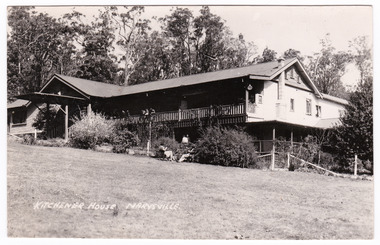 Marysville & District Historical Society
Postcard (item) - Black and white postcard, KITCHENER HOUSE MARYSVILLE, Unknown
... lunch time Margaret/ had three servings of sweets and was coming/ up for one more before I stopped her. We played/ in the snow on Lake Mountain and were/ taken to Steavensons Falls. We are saving/ the Eildon Weir trip to do on our way/ home. I took the girls horse riding and/ for an hour...lunch time Margaret/ had three servings of sweets and was coming/ up for one more before I stopped her. We played/ in the snow on Lake Mountain and were/ taken to Steavensons Falls. We are saving/ the Eildon Weir trip to do on our way/ home. I took the girls horse riding and/ for an hour ...A black and white postcard of Kitchener House in Marysville.A black and white postcard of Kitchener House in Marysville.Dear June, we are having a lovely time. Rather cold/ in the mornings, as the house has no central/ heating. The meals are everything to be desired/ and plenty of it. Yesterday lunch time Margaret/ had three servings of sweets and was coming/ up for one more before I stopped her. We played/ in the snow on Lake Mountain and were/ taken to Steavensons Falls. We are saving/ the Eildon Weir trip to do on our way/ home. I took the girls horse riding and/ for an hour I walked behind and had to/ hit the horses on the rump to make them move./ 7/6 an hour each too. We hope children/ are free from any ills and hoping to see/ you all soon will close how Love Myrtle marysville, victoria, australia, kitchener house, mount kitchener house, mt. kitchener house, accommodation, postcard, souvenir
