
Showing 121 items matching " mid european"
-
 Embroiderers Guild, Victoria
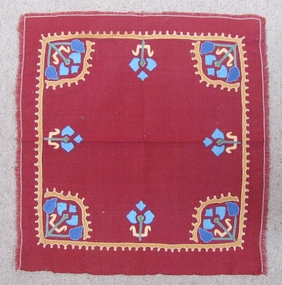
Textile - Mid European Embroidered Cushion Cover, Early 20th century?
... Mid European Embroidered Cushion Cover...Design is an abstract floral. Textile Mid European Embroidered Cushion Cover ...From the collection of the late Dr. Georgina Sweet, who was the first woman veterinarian in Victoria and who travelled extensively in Middle Europe in the Early 20th century.Dull red cotton ground fabric with gold, green and blue embroidery in Bokhara couching. Design is an abstract floral.embroidery, surface stitchery, middle european, cushion covers, 1900-20 -
 Embroiderers Guild, Victoria
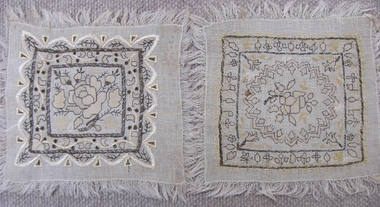
Textile - Mats, 2, Baroness Viola, Early 20th century
... ... Mid European...Embroidery Surface stitchery Mid European 1900-20 floral flowers Natural coloured fine cotton with cream, brown and yellow embroidery in fine filling stitches and satin stitch. 1. ...Belonged to Baroness Felicitas Wiedersperger of Tzouitz, Czechoslovakia and embroidered by her sister Baroness Viola.Natural coloured fine cotton with cream, brown and yellow embroidery in fine filling stitches and satin stitch. 1. Has large rose design in a square 2. Similar but with floral border Fringed edge with button hole stitch around. embroidery, surface stitchery, mid european, 1900-20, floral, flowers -
 Embroiderers Guild, Victoria
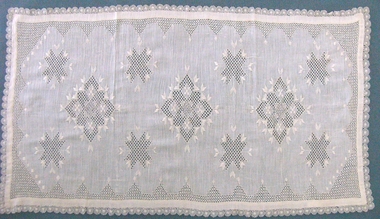
Textile - Linen Drawn Thread Embroidered Mat, Early 20th century
... ... Mid European...Embroidery Mats Drawn thread 1900-20 Mid European Cream handwoven linen with self coloured linen thread embroidery. ...Cream handwoven linen with self coloured linen thread embroidery. Simple design of counted thread and drawn thread. Hem of Armenian edge stitch.embroidery, mats, drawn thread, 1900-20, mid european -
 Embroiderers Guild, Victoria
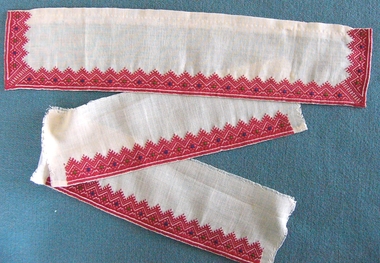
Accessory - Serbian Embroidered Collar and Cuff Set, Early 20th Century
... ... Mid European...Embroidery Garment Darning 1900-20 Mid European Natural coloured cotton (fine) with pattern darning in red, with small satin stitch dots in navy and green. ...Probably made for a blouse.Natural coloured cotton (fine) with pattern darning in red, with small satin stitch dots in navy and green.embroidery, garment, darning, 1900-20, mid european -
 Embroiderers Guild, Victoria
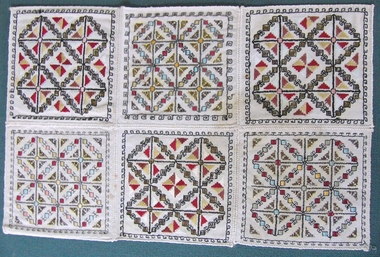
Textile - Eastern European Embroidered Mat, Baroness Viola, Late 19th century
... ... Mid European...Czechoslovakia Embroidery Mats Counted thread Late 19th century Mid European 6 squares of white cotton joined to make a larger mat. 3 squares in one design and 3 in another. ...Belonged to Baroness Felicitas Wiedersperger of Tazivitz, worked by her sister the Baroness Viola.6 squares of white cotton joined to make a larger mat. 3 squares in one design and 3 in another. All 6 squares are outlined in a black border. Designs are in satin stitch in cotton and metal threads (gold).czechoslovakia, embroidery, mats, counted thread, late 19th century, mid european -
 Embroiderers Guild, Victoria
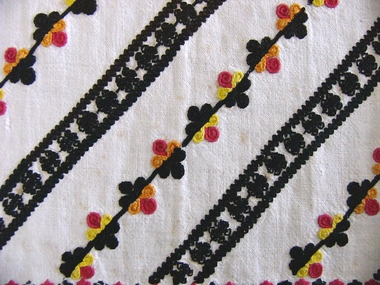
Accessory - Romanian Embroidered Partial Sleeve, Late 19th Century
... ...Mid European...Garment Surface Stitchery Late 19th Century Mid European Romania Part of sleeve with stylised embroidery in red, black and yellow in diagonal stripes with a design in ecru at edge of cuff. ...Purchased for Guild in Greece in 1961.Part of sleeve with stylised embroidery in red, black and yellow in diagonal stripes with a design in ecru at edge of cuff.garment, surface stitchery, late 19th century, mid european, romania -
 Embroiderers Guild, Victoria
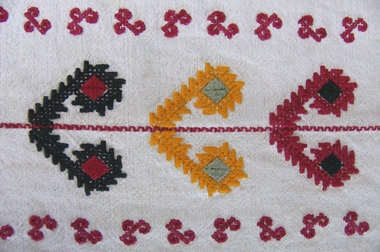
Accessory - Romanian Embroidered Partial Sleeve, Late 19th century
... ... Mid European...Purchased in Greece 1961 Garments Surface stitchery Late 19th century Mid European Romania Natural linen embroidered in black, yellow, red and green. ...Purchased in Greece 1961Natural linen embroidered in black, yellow, red and green.garments, surface stitchery, late 19th century, mid european, romania -
 Embroiderers Guild, Victoria
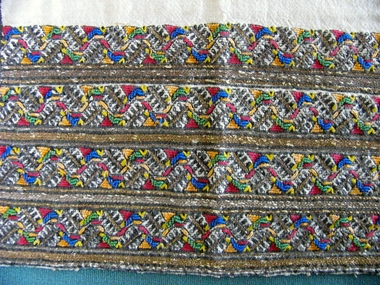
Textile - Romanian Sleeve Shoulder Piece, Late 19th century
... ... Mid European...Garments Late 19th century Mid European Beadwork Embroidery Geometric pattern in bright coloured threads and beads and gold thread on natural linen background. ...Purchased for Guild by Miss Teague in Greece 1961. From the Bukovina District - The territory is split today, with northern Bukovina forming the Chernivtsi Oblast in Ukraine and southern Bukovina forming Suceava County in Romania.Geometric pattern in bright coloured threads and beads and gold thread on natural linen background. Late 19th century saw the introduction of metal threads and beads to the embroidery.garments, late 19th century, mid european, beadwork, embroidery -
 Embroiderers Guild, Victoria
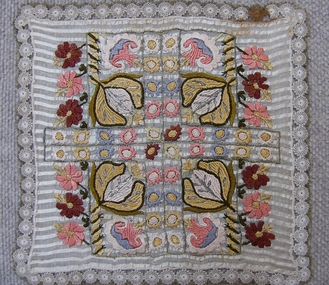
Textile - Embroidered Silk Gauze with Armenian Lace Edge, Baroness Viola, Late 19th century
... ... Mid European...Czechoslovakia Embroidery Surface stitchery Mid European Late 19th century White silk gauze with a self stripe is the background for this ornate design in coloured twisted silks and metal threads. ...Made by Viola, sister of Baroness Felicitas Wiedersperger of Tazovitz. Belonged to the above Baroness.White silk gauze with a self stripe is the background for this ornate design in coloured twisted silks and metal threads. The decorative edge is Armenian edging with an added gilt finish.czechoslovakia, embroidery, surface stitchery, mid european, late 19th century -
 Embroiderers Guild, Victoria
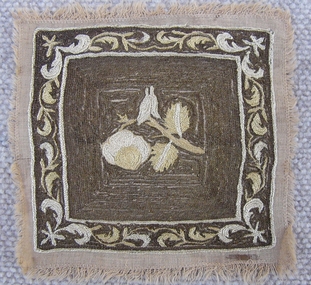
Textile - Brown and Gold Silk Tambour Embroidery Mat, Baroness Viola, Early 20th century
... ... Mid European...Czechoslovakia Embroidery Tambour work Mid European 1900-20 floral flower Fine brown cotton fabric covered with dark brown and gold silk tambour embroidery. ...Made by Viola, sister of the Baroness Felicitas Weidersperger of Tazovitz.Fine brown cotton fabric covered with dark brown and gold silk tambour embroidery. The edge is fringed. Design is of a rose surrounded by a scrolled border.czechoslovakia, embroidery, tambour work, mid european, 1900-20, floral, flower -
 Embroiderers Guild, Victoria
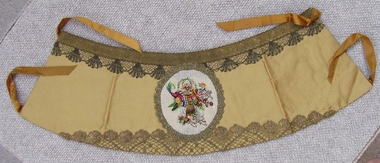
Textile - Petit Point And Gold Lace Lampshade, Baroness Viola, c. 1900
... ... Mid European...Embroidery Furnishings Canvas work Lamp cover Mid European bird floral flowers Gold silk fabric with matching ribbon ties, trimmed with gilt handmade lace from the village of Tazovitz. ...Belonged to the Baroness Felicitas Wiedersperger of Tazvitz. The embroidery was worked by her sister, the Baroness Viola.Gold silk fabric with matching ribbon ties, trimmed with gilt handmade lace from the village of Tazovitz. Oval canvas, motif in petit point at the front. Lining is bright yellow cotton.embroidery, furnishings, canvas work, lamp cover, mid european, bird, floral, flowers -
 Embroiderers Guild, Victoria
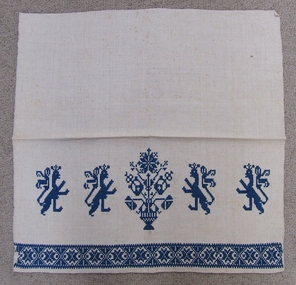
Domestic object - Traditional Hungarian Towel, Mid 20th Century
... ...Mid European...Embroidery Towel Cross Stitch 1940-60 Mid European lions flowers heraldic Label on reverse - Hungarian old design, made in Budapest, work rooms by Save the Children Fund children. ...Purchased in Greece 1961. From the Save the Children Fund in Budapest, worked by a child.Traditional design, in bright deep blue cross stitch on handwoven linen.Label on reverse - Hungarian old design, made in Budapest, work rooms by Save the Children Fund children.embroidery, towel, cross stitch, 1940-60, mid european, lions, flowers, heraldic -
 Bendigo Historical Society Inc.
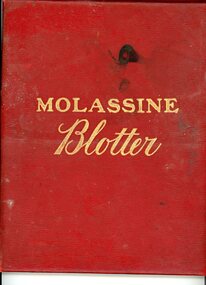
Book - Molassine Blotter, 1910
... The formula had been brought to Britain by Arthur Stein ‘a mid European probably hailing from one of the Balkan States’. ...The formula had been brought to Britain by Arthur Stein ‘a mid European probably hailing from one of the Balkan States’. ...Molassine was created in 1900 to exploit a secret formula for animal fed. The formula had been brought to Britain by Arthur Stein ‘a mid European probably hailing from one of the Balkan States’. At first the feed was made up by Henry Tate but in 1908 they began work in Greenwich. The molasses was bought locally from Silvertown and Plaistow refineries and the company built the first steel tanks for molasses bought from Danks, Steam Boiler Manufacturers, between 1910-1914. Their main product was a molasses based feed for horses - this consisted of sphagnum moss mixed with both beet and cane molasses and a ‘soupcon of maganesium calcum carbonate’. In the First World War this feed was considered antiseptic and soldiers used it as a plaster for wounds.Molassine Blotter Book published by the Molassine Company Limited, Tunnel Avenue, East greenwich, London, S.E. Red covered, it contains information Calendar for three years and information on domestic animals - how to keep them when ill, also an English Dictionary, Atlas, ready reckoner, address book, at home days diary etc.history, james lerk collection, molassine blotter -
 Bendigo Historical Society Inc.
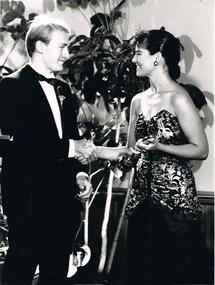
Photograph - BENDIGO ADVERTISER COLLECTION: SPORTS STAR AWARDS PRESENTATIONS
... In preparation for Seoul, Robert rode extensively in Europe in mid-year winning races in West Germany and Belgium against full international fields. ...In preparation for Seoul, Robert rode extensively in Europe in mid-year winning races in West Germany and Belgium against full international fields. ...Black and white photograph, photograph of Robert Burns accepting an award on the stage from a young woman in a dress. Bendigo Advertiser description Robert Burns March: Cycling The 1987-88 Sports Star of the Year was soon back in front of the judging panel's eyes when he was selected in the Australian team to ride at the Seoul Olympics. He was picked as the 50 km points score rider. In preparation for Seoul, Robert rode extensively in Europe in mid-year winning races in West Germany and Belgium against full international fields. At Seoul Robert qualified in the 30 km qualifier in sixth place and then went on to ride a great race to finish fourth in the 50 km final, just out of the medals. In February, Robert and Peter Attard teamed to take out the 75 km Australian Madison and last weekend in Shepparton he beat Garry Sutton to win the Pro-Am Open 50 km points score race.recreations, sports, awards -
 Flagstaff Hill Maritime Museum and Village
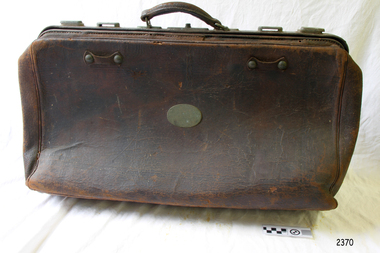
Functional object - Portmanteau, 1930-1950
... European towns each week. In the nineteenth century, the official portmanteau was used to carry the mail, letters and newspapers on Americas New England stagecoaches that travelled the postal routes. Before 1789 newspapers were mostly excluded from the mail and the official portmanteau. After the first United States Congress (1789–1791) the postmaster general allowed printers free postage to communicate reports and articles of Congressional informational newspapers with other publishers in other towns and cities for distribution. Example of a mid ...The etymology of the word portmanteau: A portmanteau was a travelling bag used as a mailbag. During the eighteenth and nineteenth centuries, both newspapers and letters were transported in these leather mailbags that opened into two sections. A portmanteau is a word created by the blending of two other words in terms of the sounds and meaning. Portmanteau itself is a portmanteau; made up of the French ‘porter’ meaning ‘to carry’ and ‘manteau’ meaning ‘cloak’. The other meaning of this word is ‘a travelling case or bag' but was coined by Lewis Carroll with its new meaning in 1882. History: English merchant Thomas Witherings established mail routes throughout Europe in the 1620s. He drew up a proposal in 1635 for an English mail system based in London in which portmanteaux (containing 2 leather bags lined with cotton) could travel to European towns with sealed bags of mail for protection against spies. The system was put into motion and some 26,000 letters were mailed safely and unopened between London and European towns each week. In the nineteenth century, the official portmanteau was used to carry the mail, letters and newspapers on Americas New England stagecoaches that travelled the postal routes. Before 1789 newspapers were mostly excluded from the mail and the official portmanteau. After the first United States Congress (1789–1791) the postmaster general allowed printers free postage to communicate reports and articles of Congressional informational newspapers with other publishers in other towns and cities for distribution. Example of a mid-20th-century leather bag not connected to a person of significance from history or a historic event. The significance lies in the historic social aspect of this type of bag and how it got its name. This type of bag was popular from the mid 19th century for personal use and fell out of favour in until the 1950s and the origin and meaning of the word used to describe this type of leather bag "portmanteau". Portmanteau leather bag, with brass oval badge, tan interior with compartment separator. Inscribed "Allchin Bros Makers Ballarat". flagstaff hill, warrnambool, shipwrecked-coast, flagstaff-hill, flagstaff-hill-maritime-museum, maritime-museum, shipwreck-coast, flagstaff-hill-maritime-village, portmanteau, allchin bros -
 Flagstaff Hill Maritime Museum and Village
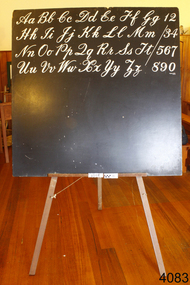
Functional object - Blackboard & Easel, Probably first half of 20th century
... The first classroom uses of large blackboards are difficult to date, but they were used for music education and composition in Europe as far back as the 16th century.The term "blackboard" is attested in English from the mid-18th century; the Oxford English Dictionary provides a citation from 1739, to write "with Chalk on a black-Board". ...The first classroom uses of large blackboards are difficult to date, but they were used for music education and composition in Europe as far back as the 16th century.The term "blackboard" is attested in English from the mid-18th century; the Oxford English Dictionary provides a citation from 1739, to write "with Chalk on a black-Board". ...The first classroom uses of large blackboards are difficult to date, but they were used for music education and composition in Europe as far back as the 16th century.The term "blackboard" is attested in English from the mid-18th century; the Oxford English Dictionary provides a citation from 1739, to write "with Chalk on a black-Board". The first attested use of chalk on blackboard in the United States dates to 1801, in a lecture course in mathematics given by George Baron. James Pillans has been credited with the invention of coloured chalk (1814); he had a recipe with ground chalk, dyes and porridge! The use of blackboards did change methods of education. Manufacturing of slate blackboards began by the 1840s. A green porcelain enamel surface was first used in 1930, and as this type of board became popular, the word "chalkboard" appeared. Various types of easel have been in use since ancient times, in particular for supporting paintings and other artwork. However, the schoolroom easel would have been introduced around the same time as when the blackboard started to be used in educational establishments. Wooden board painted black, resting on wooden easel with rope supporting the three easel legs.Noneflagstaff hill, warrnambool, shipwrecked-coast, flagstaff-hill, flagstaff-hill-maritime-museum, maritime-museum, shipwreck-coast, flagstaff-hill-maritime-village -
 Flagstaff Hill Maritime Museum and Village
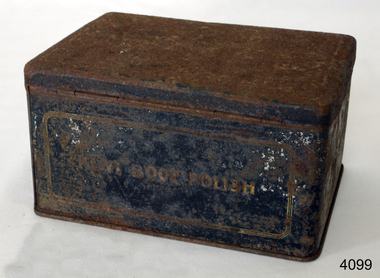
Container - Tin, Kiwi Shoe Polish Manufacture, 1940s
... From here the factory manufactured for the UK market and exported the Kiwi brand too much of Europe and the Middle East. In the mid-1970s, as part of a major streamlining, the UK factory was closed with production switched to France. ...From here the factory manufactured for the UK market and exported the Kiwi brand too much of Europe and the Middle East. In the mid-1970s, as part of a major streamlining, the UK factory was closed with production switched to France. ...The polish was developed in Australia by William Ramsay who named it Kiwi after the flightless bird endemic to New Zealand, the home country of his wife, Annie Elizabeth Meek Ramsay. Its success in Australia expanded overseas when it was adopted by both the British and American armies in World War I. In the UK, Kiwi was for many years manufactured at its British headquarters in Ealing (Brumwell Road, London W5 1DT). From here the factory manufactured for the UK market and exported the Kiwi brand too much of Europe and the Middle East. In the mid-1970s, as part of a major streamlining, the UK factory was closed with production switched to France. The UK operation moved to Surrey at Yately becoming, effectively, a sales and marketing office, with distribution contracted to a third party. In 1980, production for the UK market moved back to the UK and was housed in a factory near Huddersfield. The UK head office was relocated to Maidstone, Kent, where Kiwi had other product interests. Following the global merger with Nicholas Laboratories, the UK head office was again relocated to Slough at the Nicholas building on Bath Road.A significant product as Kiwi is an Australian brand name of shoe polish, first launched and sold in Australia in 1906 and as of 2005 sold in almost 180 countries. Previously owned by the Sara Lee Corporation since 1984, it was sold in 2011 to S. C. Johnson. It is the dominant shoe polish in some countries, including the United Kingdom and the United States, where it has about two thirds of the market. In Malaysia and Singapore, Kiwi has become such a household brand for a shoe polish that the word "kiwi" has been genericized into a verb in the Malay language, meaning "to polish one's shoes".Metal cleaning outfit of Kiwi boot polish brush, scraper, & polish missingKiwi Boot Polish to front of containerflagstaff hill, warrnambool, shipwrecked-coast, flagstaff-hill, flagstaff-hill-maritime-museum, maritime-museum, shipwreck-coast, flagstaff-hill-maritime-village -
 Federation University Historical Collection
Document, Articles on the Bunyip, 1983 - 1989
... Various written accounts of bunyips were made by Europeans in the early and mid-19th century, as settlement spread across the country. ...Various written accounts of bunyips were made by Europeans in the early and mid-19th century, as settlement spread across the country. ...The bunyip is a large mythical creature from Aboriginal mythology, said to lurk in swamps, billabongs, creeks, riverbeds, and waterholes. The origin of the word bunyip has been traced to the Wemba-Wemba or Wergaia language of Aboriginal people of South-Eastern Australia. However, the bunyip appears to have formed part of traditional Aboriginal beliefs and stories throughout Australia, although its name varied according to tribal nomenclature. Various written accounts of bunyips were made by Europeans in the early and mid-19th century, as settlement spread across the country. (http://en.wikipedia.org/wiki/Bunyip) This material was collected and used for resarch purposes by David Waldron A number of articles on the Bunyip * The Nessie Mystery Solver by Roy Fraser (October 1983) * Developers meet match (Wagyl) (The Age, 06 Jan 1989) * Narrandera's bunyips burst into tourism's limelight by Melanie Sincock (wagga Advertiser, 18 November 1986) * Hunting the bunyip by M.A. Troyahn (Australiasian Post, 06 October 1883) * Beware the bunyip, you Moomba skiers by Edel Wignell (The Age, 05 March 1982) * The yarn that grew the bunyip legend (Australasian Post, 30 December 1971) australian animal folklore collections, bunyip, bunyipswagyl, shane picket, narrandera, swan river, david waldron -
 Federation University Historical Collection
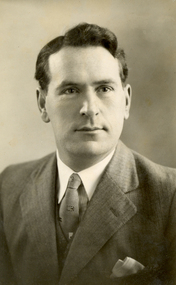
Photograph - Black and White, Frank Wright
... Europe, in Australia, including South Street and in New Zealand. The Frank Wright Medal at the Royal South Street competition is awarded to an individual recognized as making an outstanding contribution to brass music in Australia. He died in England in 1970 at the age of 69. frank wright conductor brass band Printed on back - Post Card, British Made, Jerome Black and white photograph of the torso of a man dressed in a mid-toned suit. ...Frank Wright was a renown resident of Smeaton, where he was born on 2 August 1901. He lived at Laura Villa, and attended Smeaton State School. His father William was a gold miner and his mother's name was Sarah. Their family won many singing and instrumental awards. Frank was tutored by Percy Code and was awarded a gold medal for the highest marks in the ALCM examinations in the British Colonies at the age of seventeen years. He became the Australian Open Cornet Champion by the age of eighteen. A year later, Frank conducted the City of Ballarat Band, and later the Ballarat Soldiers’ Memorial Band. He formed the Frank Wright Frisco Band and Frank Wright and his Coliseum Orchestra. These bands won many South Street awards, and Frank as conductor won many awards in the Australian Band Championship contest. In 1933 Frank Wright sailed to England to conduct the famous St Hilda’s Band and was later appointed Musical Director of the London County Council, where he organized many amazing concerts in parks, in and around the London district. He was made Professor of Brass and Military Band Scoring and conducted at the Guildhall of Music and Drama. Frank was often invited to adjudicate Brass Band Championships around Europe, in Australia, including South Street and in New Zealand. The Frank Wright Medal at the Royal South Street competition is awarded to an individual recognized as making an outstanding contribution to brass music in Australia. He died in England in 1970 at the age of 69.Black and white photograph of the torso of a man dressed in a mid-toned suit. The man is Frank Wright.Printed on back - Post Card, British Made, Jeromefrank wright, conductor, brass band -
 Flagstaff Hill Maritime Museum and Village
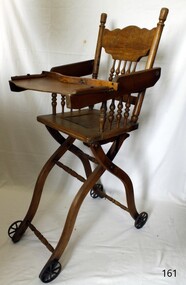
Furniture - Childs high chair, 1890 - 1900
... mid to late 19th century. However, children’s chairs from the 18th century and earlier were being used and are in many museum collections around the world that show woodworkers were adapting chair designs for younger users in Europe and America at this time....mid to late 19th century. However, children’s chairs from the 18th century and earlier were being used and are in many museum collections around the world that show woodworkers were adapting chair designs for younger users in Europe and America at this time. ...It appears that the earliest form of child's high chair is attributed to Jonathan Jacobs (1845-1919) a cabinet maker of Browningsville, Pennsylvania USA around the mid to late 19th century. However, children’s chairs from the 18th century and earlier were being used and are in many museum collections around the world that show woodworkers were adapting chair designs for younger users in Europe and America at this time.An early children's wooden high chair probably made in America around 1890-1900. Many American manufactures made this type of wooden high chair called an “Eastlake” style and many did not mark their work so it is difficult to determine the subject items exact provenance. A significant item giving a snapshot into the evolution of children's furniture and domestic life during the late Victorian era.Convertible pressed back Victorian era high chair with convertible frame, cast iron wheels, Carved picture of a child to back of seatflagstaff hill, warrnambool, shipwrecked coast, flagstaff hill maritime museum, shipwreck coast, flagstaff hill maritime village, great ocean road, high chair, potty chair, baby furniture, kitchen furniture -
 Flagstaff Hill Maritime Museum and Village
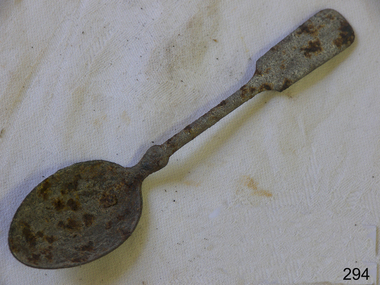
Domestic object - Spoon
... Small spoons were common in Europe since at least the 13th century; the special spoons were introduced almost simultaneously with tea and coffee. (Pettigrew points to its use in the mid-17th century.) ...Small spoons were common in Europe since at least the 13th century; the special spoons were introduced almost simultaneously with tea and coffee. (Pettigrew points to its use in the mid-17th century.) ...The teaspoon is a European invention. Small spoons were common in Europe since at least the 13th century; the special spoons were introduced almost simultaneously with tea and coffee. (Pettigrew points to its use in the mid-17th century.) Originally the teaspoons were exotic items, precious and small, resembling the demitasse spoons of later times. Also used for coffee, these spoons were usually made of gilt silver, and were available with a variety of handle shapes: plain, twisted, or decorated with knobs, also known as knops, hence the knop-top name for such spoons. Widespread use and the modern size dates back to the Georgian era. The teaspoon is first mentioned in an advertisement in a 1686 edition of the London Gazette. Teaspoons, probably of English origin, are present in the 1700 Dutch painting by Nicholas Verkolje, "A Tea Party". An 1825 cartoon makes fun of a Frenchman unfamiliar with the British etiquette. The guest did not place his spoon into the cup and is thus being offered his thirteenth cup of tea! A special dish for resting the teaspoons, a "spoon boat", was a part of the tea set in the 18th century. At that time, the spoons played an important role in tea drinking etiquette: a spoon laid "across" the teacup indicated that the guest did not need any more tea, otherwise, the hostess was obligated to offer a fresh cup of tea, and it was considered impolite to refuse the offering. Pettigrew reports that sometimes the spoons were numbered to make it easier to match the cups with the guests after a refill. https://en.wikipedia.org/wiki/Teaspoon#:~:text=Teaspoon%20is%20a%20European%20invention,the%20mid%2D17th%20century).A history of the teaspoon.Metal teaspoon, badly corrodedNoneflagstaff hill, warrnambool, shipwrecked-coast, flagstaff-hill, flagstaff-hill-maritime-museum, maritime-museum, shipwreck-coast, flagstaff-hill-maritime-village -
 Flagstaff Hill Maritime Museum and Village
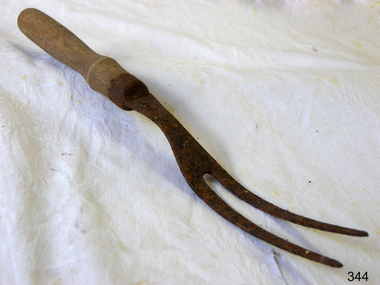
Domestic object - Fork
... mid 18th century while the standard four-tine design became current in the early 19th century. The fork was important in Germany because they believed that eating with the fingers was rude and disrespectful. The fork led to family dinners and sit-down meals, which are important features of German culture. https://www.thevintagenews.com/2016/08/31/priority-fork-came-italy-european...mid 18th century while the standard four-tine design became current in the early 19th century. The fork was important in Germany because they believed that eating with the fingers was rude and disrespectful. The fork led to family dinners and sit-down meals, which are important features of German culture. https://www.thevintagenews.com/2016/08/31/priority-fork-came-italy-european ...Naturally, we tend to take commonplace objects for granted, because they have always been there. Yet how many of you actually have thought “hey, where do forks come from?” Well, it takes one trip to China and a 3-year-old laughing at your face because of your desperate attempt to eat with chopsticks to finally appreciate something so ordinary such as a fork. So, where do forks come from? The early history of the fork is obscure. As a kitchen and dining utensil, it is believed to have originated in the Roman Empire, as proved by archaeological evidence. The personal table fork most likely originated in the Eastern Roman (or Byzantine) Empire. Its use spread to what is now the Middle East during the first millennium AD and then spread into Southern Europe during the second millennium. It did not become common in northern Europe until the 18th century and was not common in North America until the 19th century. Carving fork from 1640. Source: Wikipedia/Public Domain Carving Fork from 1640. Source: Wikipedia/Public Domain Some of the earliest known uses of forks with food occurred in Ancient Egypt, where large forks were used as cooking utensils. Bone forks had been found on the burial site of the Bronze Age Qijia culture (2400–1900 BC) as well as later Chinese dynasties’ tombs.The Ancient Greeks used the fork as a serving utensil. Read also: Steven Spielberg to Remake the Classic Musical ‘West Side Story’ In the Roman Empire, bronze and silver forks were used. The use varied according to local customs, social class and the nature of food, but forks of the earlier periods were mostly used as cooking and serving utensils. The personal table fork was most likely invented in the Eastern Roman (Byzantine) Empire, where they were in everyday use by the 4th century (its origin may even go back to Ancient Greece, before the Roman period). Records show that by the 9th century a similar utensil known as a barjyn was in limited use in Persia within some elite circles. By the 10th century, the table fork was in common use throughout the Middle East. Bronze forks made in Persia during the 8th or 9th century.Source: Wikipedia/Public Domain Bronze forks made in Persia during the 8th or 9th century.Source: Wikipedia/Public Domain The first recorded introduction of the fork to Western Europe, as recorded by the theologian and Cardinal Peter Damian, was by Theophano Sklereina the Byzantine wife of Holy Roman Emperor Otto II, who nonchalantly wielded one at an Imperial banquet in 972, astonishing her Western hosts.By the 11th century, the table fork had become increasingly prevalent in the Italian peninsula. It gained a following in Italy before any other Western European region because of historical ties with Byzantium and continued to get popularity due to the increasing presence of pasta in the Italian diet. At first, pasta was consumed using a long wooden spike, but this eventually evolved into three spikes, design better suited to gathering the noodles. In Italy, it became commonplace by the 14th century and was almost universally used by the merchant and upper classes by 1600. It was proper for a guest to arrive with his fork and spoon enclosed in a box called a cadena; this usage was introduced to the French court with Catherine de’ Medici’s entourage. In Portugal, forks were first used at the time of Infanta Beatrice, Duchess of Viseu, King Manuel I of Portugal’s mother around 1450. However, forks were not commonly used in Western Europe until the 16th century when they became part of Italian etiquette. The utensil had also gained some currency in Spain by this time, and its use gradually spread to France. Nevertheless, most of Europe did not adopt the use of the fork until the 18th century. Read also: The 8 Most Famous ‘Functioning Alcoholics’ in History Long after the personal table fork had become commonplace in France, at the supper celebrating the marriage of the Duc de Chartres to Louis XIV’s natural daughter in 1692, the seating was described in the court memoirs of Saint-Simon: “King James having his Queen on his right hand and the King on his left, and each with their cadenas.” In Perrault’s contemporaneous fairy tale of La Belle au bois dormant (1697), each of the fairies invited for the christening is presented with a splendid “fork holder”. The fork’s adoption in northern Europe was slower. Its use was first described in English by Thomas Coryat in a volume of writings on his Italian travels (1611), but for many years it was viewed as an unmanly Italian affectation. Some writers of the Roman Catholic Church expressly disapproved of its use, St. Peter Damian seeing it as “excessive delicacy.” It was not until the 18th century that the fork became commonly used in Great Britain, although some sources say that forks were common in France, England, and Sweden already by the early 17th century. Spaghetti fork By Lady alys - Own work, CC BY-SA 3.0, https://commons.wikimedia.org/w/index.php?curid=6414948 Spaghetti Fork By Lady alys – Own work, CC BY-SA 3.0, The fork did not become popular in North America until near the time of the American Revolution. The curved fork used in most parts of the world today was developed in Germany in the mid 18th century while the standard four-tine design became current in the early 19th century. The fork was important in Germany because they believed that eating with the fingers was rude and disrespectful. The fork led to family dinners and sit-down meals, which are important features of German culture. https://www.thevintagenews.com/2016/08/31/priority-fork-came-italy-european-country-pasta/?chrome=1Serving fork, two prongs, with a shaped wooden handle. Badly rusted.None.flagstaff hill, warrnambool, shipwrecked-coast, flagstaff-hill, flagstaff-hill-maritime-museum, maritime-museum, shipwreck-coast, flagstaff-hill-maritime-village, food, meat, carving -
 Flagstaff Hill Maritime Museum and Village
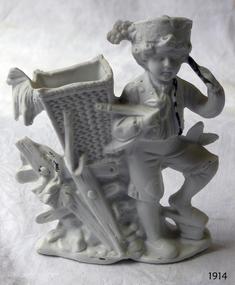
Decorative object - Ornament, ca. 19th century
... mid-18th to early 19th centuries. This ornament was made in Germany, and German manufacturers began to use bisque material to make realistic faces for dolls in the 1850s. The set of six bisque figurines is representative of popular table decorations during the 19th and early 20th centuries. Flagstaff Hill Flagstaff Hill Maritime Museum and Village Warrnambool Maritime Museum Maritime Village Great Ocean Road Shipwreck Coast Bisque China ornament white china ornament German porcelain unglazed porcelain 19th century 18th century European ornament pottery unglazed pottery domestic ornament decoration table decoration Germany boy with basket vase Marked "0847" "GERMANY GASP" Fine unglazed white porcelain ornament, carved to represent a boy holding a basket on his back. ...This fine white unglazed porcelain figurine is one of six donated together. The bisque material was easy to carve and allowed fine detail. Figurine ornaments were popular for table decorations between the mid-18th to early 19th centuries. This ornament was made in Germany, and German manufacturers began to use bisque material to make realistic faces for dolls in the 1850s.The set of six bisque figurines is representative of popular table decorations during the 19th and early 20th centuries.Fine unglazed white porcelain ornament, carved to represent a boy holding a basket on his back. One of a pair, the other being a girl holding a basket on her back. The hollow basket is a vase. It was made in Germany. No 0847. Marked "0847" "GERMANY GASP"flagstaff hill, flagstaff hill maritime museum and village, warrnambool, maritime museum, maritime village, great ocean road, shipwreck coast, bisque, china ornament, white china ornament, german, porcelain, unglazed porcelain, 19th century, 18th century, european ornament, pottery, unglazed pottery, domestic ornament, decoration, table decoration, germany, boy with basket, vase -
 Flagstaff Hill Maritime Museum and Village
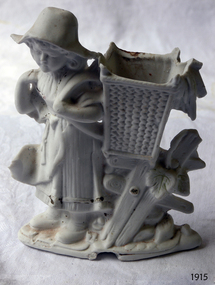
Decorative object - Ornament, ca. 19th century
... mid-18th to early 19th centuries. This ornament was made in Germany, and German manufacturers began to use bisque material to make realistic faces for dolls in the 1850s. The set of six bisque figurines is representative of popular table decorations during the 19th and early 20th centuries. Flagstaff Hill Warrnambool Maritime Museum Bisque China ornament white china ornament German porcelain unglazed porcelain 19th century 18th century European ...This fine white unglazed porcelain figurine is one of six donated together, and one of a pair of two children carrying baskets on thei. The bisque material was easy to carve and allowed fine detail. Figurine ornaments were popular for table decorations between the mid-18th to early 19th centuries. This ornament was made in Germany, and German manufacturers began to use bisque material to make realistic faces for dolls in the 1850s.The set of six bisque figurines is representative of popular table decorations during the 19th and early 20th centuries.Fine unglazed white porcelain ornament, carved to represent a girl holding a basket on her back. One of a pair, the other being a boy holding a basket on his back. The hollow basket is a vase. It was made in Germany. "1084" "105" "GERMANY"flagstaff hill, warrnambool, maritime museum, bisque, china ornament, white china ornament, german, porcelain, unglazed porcelain, 19th century, 18th century, european ornament, pottery, unglazed pottery, domestic ornament, decoration, table decoration, germany, girl with basket, vase -
 Flagstaff Hill Maritime Museum and Village
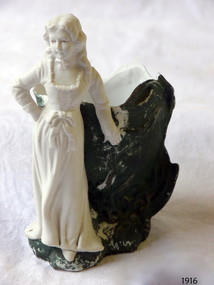
Decorative object - Ornament, 19th century
... mid-18th to early 19th centuries. This ornament was most likely made in Germany, and German manufacturers began to use bisque material to make realistic faces for dolls in the 1850s. The set of six bisque figurines is representative of popular table decorations during the 19th and early 20th centuries. Flagstaff Hill Flagstaff Hill Maritime Museum and Village Warrnambool Maritime Museum Maritime Village Great Ocean Road Shipwreck Coast Bisque China ornament white china ornament German porcelain unglazed porcelain 19th century 18th century European ornament pottery unglazed pottery domestic ornament decoration table decoration vase woman with vase Germany Ornament, fine unglazed white porcelain, carved to represent a woman standing in front of a green vase. ...This fine white unglazed porcelain figurine is one of six donated together. The bisque material was easy to carve and allowed fine detail. Figurine ornaments were popular for table decorations between the mid-18th to early 19th centuries. This ornament was most likely made in Germany, and German manufacturers began to use bisque material to make realistic faces for dolls in the 1850s.The set of six bisque figurines is representative of popular table decorations during the 19th and early 20th centuries.Ornament, fine unglazed white porcelain, carved to represent a woman standing in front of a green vase. flagstaff hill, flagstaff hill maritime museum and village, warrnambool, maritime museum, maritime village, great ocean road, shipwreck coast, bisque, china ornament, white china ornament, german, porcelain, unglazed porcelain, 19th century, 18th century, european ornament, pottery, unglazed pottery, domestic ornament, decoration, table decoration, vase, woman with vase, germany -
 Flagstaff Hill Maritime Museum and Village
Decorative object - Ornament, ca. 19th century
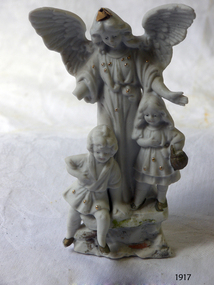
... mid-18th to early 19th centuries. This ornament was likely made in Germany, and German manufacturers began to use bisque material to make realistic faces for dolls in the 1850s. The set of six bisque figurines is representative of popular table decorations during the 19th and early 20th centuries. Flagstaff Hill Flagstaff Hill Maritime Museum and Village Warrnambool Maritime Museum Maritime Village Great Ocean Road Shipwreck Coast Bisque China ornament white china ornament German porcelain unglazed porcelain 19th century 18th century European ornament pottery unglazed pottery domestic ornament decoration table decoration figurine angel figurine Germany angel with children "1914" Figurine; unglazed white porcelain ornament, hollow inside. ...This fine white unglazed porcelain figurine is one of six donated together. The bisque material was easy to carve and allowed fine detail. Figurine ornaments were popular for table decorations between the mid-18th to early 19th centuries. This ornament was likely made in Germany, and German manufacturers began to use bisque material to make realistic faces for dolls in the 1850s.The set of six bisque figurines is representative of popular table decorations during the 19th and early 20th centuries.Figurine; unglazed white porcelain ornament, hollow inside. It is carved to represent an angel with two children, a boy and a girl. The surface is decorated with tiny gold balls and the angel wears a gold tiara. There are remnants of gold, orange, green and brown paint. No 1914. "1914"flagstaff hill, flagstaff hill maritime museum and village, warrnambool, maritime museum, maritime village, great ocean road, shipwreck coast, bisque, china ornament, white china ornament, german, porcelain, unglazed porcelain, 19th century, 18th century, european ornament, pottery, unglazed pottery, domestic ornament, decoration, table decoration, figurine, angel figurine, germany, angel with children -
 Flagstaff Hill Maritime Museum and Village
Decorative object - Ornament, ca. 19th century
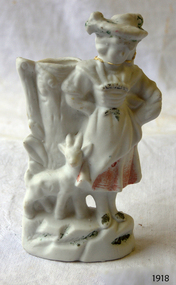
... mid-18th to early 19th centuries. This ornament was likely made in Germany, and German manufacturers began to use bisque material to make realistic faces for dolls in the 1850s. The set of six bisque figurines is representative of popular table decorations during the 19th and early 20th centuries. warrnambool shipwrecked-coast flagstaff-hill-maritime-museum maritime-museum shipwreck-coast ornament Flagstaff Hill Flagstaff Hill Maritime Museum and Village Maritime Museum Maritime Village Great Ocean Road Shipwreck Coast Bisque China ornament white china ornament German Germany porcelain unglazed porcelain 19th century 18th century European ornament pottery unglazed pottery domestic ornament decoration table decoration girl and goat vase "3943: Fine unglazed white porcelain ornament, hollow inside. ...This fine white unglazed porcelain figurine is one of six donated together. The bisque material was easy to carve and allowed fine detail. Figurine ornaments were popular for table decorations between the mid-18th to early 19th centuries. This ornament was likely made in Germany, and German manufacturers began to use bisque material to make realistic faces for dolls in the 1850s.The set of six bisque figurines is representative of popular table decorations during the 19th and early 20th centuries.Fine unglazed white porcelain ornament, hollow inside. It is carved to represent a peasant girl and goat with a vase shaped like a tree stump in the background. The ornament has remnants of gold, red, brown and green paint. There is an inscription on the base."3943:warrnambool, shipwrecked-coast, flagstaff-hill-maritime-museum, maritime-museum, shipwreck-coast, ornament, flagstaff hill, flagstaff hill maritime museum and village, maritime museum, maritime village, great ocean road, shipwreck coast, bisque, china ornament, white china ornament, german, germany, porcelain, unglazed porcelain, 19th century, 18th century, european ornament, pottery, unglazed pottery, domestic ornament, decoration, table decoration, girl and goat, vase -
 Flagstaff Hill Maritime Museum and Village
Decorative object - Ornament, ca. 19th century
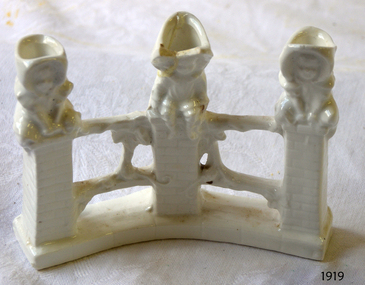
... mid-18th to early 19th centuries. This ornament was likely made in Germany, and German manufacturers began to use bisque material to make realistic faces for dolls in the 1850s. The set of six bisque figurines is representative of popular table decorations during the 19th and early 20th centuries. Flagstaff Hill Flagstaff Hill Maritime Museum and Village Warrnambool Maritime Museum Maritime Village Great Ocean Road Shipwreck Coast Bisque China ornament white china ornament German Germany porcelain unglazed porcelain 19th century 18th century European ornament pottery unglazed pottery domestic ornament decoration table decoration children on a fence vase candle holder "6946" Fine glazed white porcelain ornament, carved to represent three children sitting on three brick fence pillars. ...This fine white glazed porcelain figurine is one of six donated together. The bisque material was easy to carve and allowed fine detail. Figurine ornaments were popular for table decorations between the mid-18th to early 19th centuries. This ornament was likely made in Germany, and German manufacturers began to use bisque material to make realistic faces for dolls in the 1850s.The set of six bisque figurines is representative of popular table decorations during the 19th and early 20th centuries.Fine glazed white porcelain ornament, carved to represent three children sitting on three brick fence pillars. There are gold highlights on the surface. The hats on the children are vases. An inscription is on the base of the centre pillar."6946"flagstaff hill, flagstaff hill maritime museum and village, warrnambool, maritime museum, maritime village, great ocean road, shipwreck coast, bisque, china ornament, white china ornament, german, germany, porcelain, unglazed porcelain, 19th century, 18th century, european ornament, pottery, unglazed pottery, domestic ornament, decoration, table decoration, children on a fence, vase, candle holder -
 Flagstaff Hill Maritime Museum and Village
Accessory - Diamond ring, about 1855
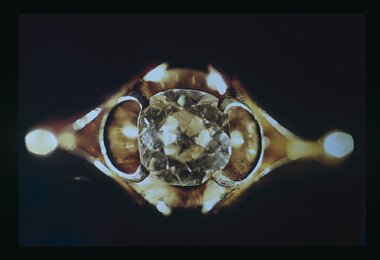
... The collection as a whole is historically significant for representing aspects of Victoria's maritime history and its potential to interpret social and historical themes. warrnambool shipwrecked-coast flagstaff-hill flagstaff-hill-maritime-museum maritime-museum shipwreck-coast flagstaff-hill-maritime-village schomberg shipwrecked-artefact clipper ship black ball line 1855 shipwreck aberdeen clipper ship captain forbes peterborough shipwreck ss queen ciborium ring schomberg-diamond schomberg-ring gentleman's ring dress ring A mid-Victorian gentleman's solitaire diamond dress ring with a Brazilian cut diamond (cushion cut), one and one-third carat set within an 18 carat yellow gold ring consisting of four claws within an open scroll setting and a divided scroll shank. Colour is classified as 'J', clarity SII. The setting is handmade. Accessory Diamond ring Europe ...In 1975, 120 years after the sailing ship Schomberg was wrecked, Flagstaff Hill divers (Peter Ronald, Colin Goodall and Gary Hayden) found an ornate communion set amongst the wreckage. The set comprised a jug, ciborium, lid, chalice and plate. The items, apart from the lid, were then displayed at Flagstaff Hill Maritime Village. The lid had etchings that did not match the chalice and sat in storage for several years. Then in 1978, while the marine concretion inside the lid was being examined, a surface layer came loose and revealed a glint of gold that was assumed to be a piece of brass. The layers of concretion were carefully removed and a ring-like band emerged. Further treatment exposed a 'large faceted stone in an intricate gold setting. Weeks later a detailed examination estimated the value of the ring, known as the Schomberg Diamond, to be $7000. When the Schomberg was launched in 1855, she was considered the "Noblest” ship that ever floated on the water. Schomberg's owners, the Black Ball Line had commissioned the ship for their fleet of passenger liners. She was built by Alexander Hall of Aberdeen at a cost of £43,103 and constructed with 3 skins. One planked fore and aft and two diagonally planked, fastened together with screw-threaded trunnels (wooden rails). Her First Class accommodation was simply luxurious with velvet pile carpets, large mirrors, rosewood, birds-eye maple and mahogany timbers throughout, soft furnishings of satin damask, an oak-lined library with a piano. Overall she had accommodation for 1000 passengers. At the launch, the Schomberg's 34-year-old master, Captain 'Bully' Forbes, had promised to reach Melbourne in sixty days stating, "with or without the help of God." Captain James Nicol Forbes was born in Aberdeen in 1821 and rose to fame with his record-breaking voyages on the famous Black Ball Line ships; Marco Polo and Lightning. In 1852 in the Marco Polo, he made the record passage from London to Melbourne in 68 days. Unfortunately there were 53 deaths on the voyage, but the great news was off the record passage by Captain Forbes. In 1854 he took the clipper “Lighting” to Melbourne in 76 days and back in 63 days, this record was never beaten by a sailing ship. He often drove his crew and ship to breaking point to beat his previous records. He cared little for the comfort of the passengers. On this, the Schomberg's maiden voyage, he was determined to break existing records. Schomberg departed Liverpool on her maiden voyage on 6th October 1855 flying a sign that read "Sixty Days to Melbourne". She departed with 430 passengers and 3000 tons cargo including iron rails and equipment intended to build the Melbourne to Geelong Railway and a bridge over the Yarra from Melbourne to Hawthorn. She also carried a cow for fresh milk, pens for fowls and pigs, 90,000 gallons of water for washing and drinking. She also carried 17,000 letters and 31,800 newspapers. The ship and cargo were insured for $300,000 a fortune for the time. The winds were poor as she sailed across the equator, slowing Schomberg's journey considerably. Land was first sighted on Christmas Day, at Cape Bridgewater near Portland, Captain Forbes followed the coastline towards Melbourne. Forbes was said to be playing cards when called by the third mate Henry Keen, who reported land about 3 miles off. Due in large part to the captain's regarding a card game as more important than his ship, it eventually ran aground on a sand spit near Curdie's Inlet (about 56 km west of Cape Otway) on 26th December 1855, 78 days after leaving Liverpool. The sand spit and the currents were not marked on Forbes's map. Overnight, the crew launched a lifeboat to find a safe place to land the ship’s passengers. The scouting party returned to Schomberg and advised Forbes that it was best to wait until morning because the rough seas could easily overturn the small lifeboats. The ship’s Chief Officer spotted the SS Queen at dawn and signaled the steamer. The master of the Queen approached the stranded vessel and all of Schomberg’s passengers and crew disembarked safely. The Black Ball Line's Melbourne agent sent a steamer to retrieve the passengers' baggage from the Schomberg. Other steamers helped unload her cargo until the weather changed and prevented the salvage teams from accessing the ship. Later one plunderer found a case of Wellington boots, but alas, all were for the left foot. Local merchants Manifold & Bostock bought the wreck and cargo but did not attempt to salvage the cargo still on board the ship. They eventually sold it on to a Melbourne businessman and two seafarers. In 1864 after two of the men drowned when they tried to reach Schomberg, salvage efforts were abandoned. In 1870, nearly 15 years after the wreck parts of the Schomberg had washed ashore on the south island of New Zealand. The wreck now lies in almost 9 meters of water and although the woodwork is mostly disintegrated the shape of the ship can still be determined due to the remaining railway irons, girders and the ship’s frame. A variety of goods and materials can be seen scattered about nearby. The actual lid in which the ring was found has not yet been completely identified and could belong to a coffee pot, sugar bowl or maybe a jug or something similar. Although all survived the wreck no-one came forward to claim the valuable diamond. The Schomberg Diamond is currently on display in the Great Circle Gallery. Flagstaff Hill Maritime Village along with the rest of the communion set. Other artefacts salvaged from the wreck include ship fittings and equipment, personal effects, a lithograph, tickets and photographs from the Schomberg. One of the Schomberg bells is in the Warrnambool Library.The Schomberg Diamond is particularly significant in that it played a crucial part in having the legislation changed to protect shipwrecks, with far tighter control over the salvaging of items from wreck sites. This ring is registered as Artefact S/105 in the Schomberg collection, the Schomberg collection as a whole is of historical and archaeological significance at a State level. Flagstaff Hill’s collection of artefacts from the Schomberg is also significant for its association with the Victorian Heritage Registered shipwreck (VHR S 612). The collection is of prime significant because of the relationship between the objects salvaged, as together they help us to interpret the story of the Schomberg. The collection as a whole is historically significant for representing aspects of Victoria's maritime history and its potential to interpret social and historical themes. A mid-Victorian gentleman's solitaire diamond dress ring with a Brazilian cut diamond (cushion cut), one and one-third carat set within an 18 carat yellow gold ring consisting of four claws within an open scroll setting and a divided scroll shank. Colour is classified as 'J', clarity SII. The setting is handmade. warrnambool, shipwrecked-coast, flagstaff-hill, flagstaff-hill-maritime-museum, maritime-museum, shipwreck-coast, flagstaff-hill-maritime-village, schomberg, shipwrecked-artefact, clipper ship, black ball line, 1855 shipwreck, aberdeen clipper ship, captain forbes, peterborough shipwreck, ss queen, ciborium, ring, schomberg-diamond, schomberg-ring, gentleman's ring, dress ring -
 Flagstaff Hill Maritime Museum and Village
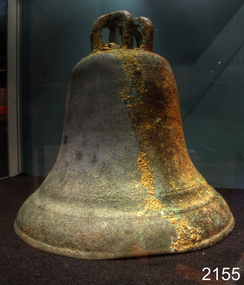
Ceremonial object - Church Bell, Before 1855
... The Schomberg wreck has great historical significance as a rare example of a mid 19th century large, fast clipper ship intended to transport cargo and passengers between England and Australia. The vessel that carried this bell represents the marine advances made in an attempt to break established sailing records between Europe and Australia. ...This artifact is a large brass bell. Local divers recovered the bell from the Schomberg wreck in the 1970s. Its location at the wreck site was described as "found on the west side towards the stern"; the vessel remains on a north-south axis, with the bow pointing towards the shore. As a result, the bell was assessed from this position to have formed part of the cargo. The view that this was not a ship's bell belonging to the Schomberg is gained from two other 'Schomberg Bells' in the Flagstaff Hill collection, both of which have the vessel's name prominently etched into their outer surface. Additional information indicates that this bell was not intended for maritime use due to its rounded 'bell-curve' shape, suggesting it was melodically tunable. Also, the detailed basket-type fittings on the bell dome would allow the bell to be suspended by ropes rather than bolted to a yoke. The bell is currently on display at Flagstaff Hill, categorised as a church bell, and part of Schomberg's cargo, intended for use in a church within the Victorian colony. As the Colony of Victoria became more established and its population expanded with the Gold Rush and other emigration from Britain, the demand for regular religious services and permanent church buildings also grew. We will never know if this bell was a specific order or part of an enterprising bell founder's consignment of general stock to a wholesale supplier in Melbourne. Unfortunately, the cargo manifest for the Schomberg has never been found. The shipwreck of the Schomberg is regarded as of significance to Victoria and is registered on the states Heritage list (S 612). The Schomberg wreck has great historical significance as a rare example of a mid 19th century large, fast clipper ship intended to transport cargo and passengers between England and Australia. The vessel that carried this bell represents the marine advances made in an attempt to break established sailing records between Europe and Australia. Flagstaff Hill holds a noteworthy collection of artefacts from the Schomberg shipwreck. The whole collection is primarily significant because of the relationship the objects have archaeologically, not only to highlight the story of the Schomberg ship and later its wrecking, but also has an important potential to interpret the story and progression of maritime shipping in the 19th century. The church bell has a standard bell-curve shape and is dull bronze in colour. A large brass bell, plain and without visible maker marks, but with traditionally intricate basket-type cast fittings for suspension from a yoke by a number of ropes or chains. Approximately 3/8 of the bell’s outer surface bears a thin layer of marine growth and limestone accretion, and there is some minor pitting and spots of light verdigris over the remainder. The bell mouth, or lip, is slightly compressed-in in two places. It was retrieved from the wreck of the Schomberg. warrnambool, flagstaff-hill, flagstaff-hill-maritime-museum, maritime-museum, shipwreck-coast, flagstaff-hill-maritime-village, schomberg, shipwrecked-artefact, clipper ship, black ball line, 1855 shipwreck, aberdeen clipper ship, captain forbes, peterborough shipwreck, ss queen, brass bell, church bell
