
Showing 198 items matching " pulled work"
-
 Embroiderers Guild, Victoria
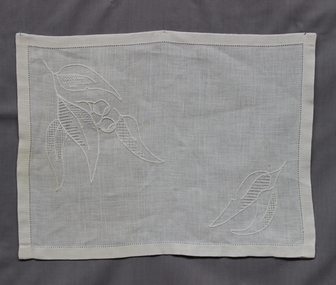
Textile - Cream Linen Pulled Thread Place Mat, Lenore Bull, Late 20th C
... ... Pulled work...Cream linen pulled work. Pattern of gum leaves and gum nuts. ...Embroidery Pulled work Place Mats Australia Labelled "Lenore Anne Bull" Cream linen pulled work. ...Cream linen pulled work. Pattern of gum leaves and gum nuts. Hem stitched edgesLabelled "Lenore Anne Bull"embroidery, pulled work, place mats, australia -
 Embroiderers Guild, Victoria
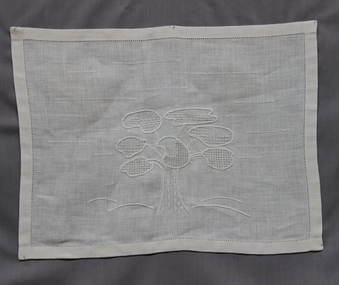
Textile - Cream Linen Pulled Thread Place Mat, Lenore Bull, Late 20th C
... ... Pulled work...Embroidery Pulled work Place Mats Australia Labelled "Lenore Anne Bull" Cream linen, tree, leaves in various pulled stitches. ...Cream linen, tree, leaves in various pulled stitches.Labelled "Lenore Anne Bull"embroidery, pulled work, place mats, australia -
 Embroiderers Guild, Victoria
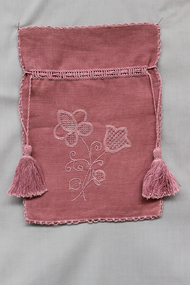
Accessory - Work bag, Lenore Bull, Late 20th/ early 21stC
... ... Pulled work...Embroidery Pulled work Schwalm Bag Deep pink linen bag with drawstring of handmade cord finished with tassels. ...Deep pink linen bag with drawstring of handmade cord finished with tassels. Monogram 'L' on the back of bag, inside an oval of embroidery. Edged all around in scalloped buttonhole stitch.embroidery, pulled work, schwalm, bag -
 Embroiderers Guild, Victoria
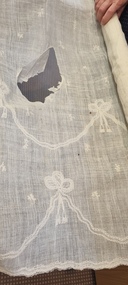
Textile - 18th C Tambour Embroidered Muslin Panel, c 1800
... ... Pulled thread... Tambour work...Fine cotton muslin fabric embroidered with fine chain stitch tambour embroidered garlands, bows and tassels, with pulled thread work centres in various patterns, scattered motifs across ground. ...Found in cupboard in collection room, nil identification other than label saying "this handwork is very old" White work White lawn Drawn fabric Pulled thread Tambour work Tambour Garment Veil 18th Century 19th century Petticoats Fine cotton muslin fabric embroidered with fine chain stitch tambour embroidered garlands, bows and tassels, with pulled thread work centres in various patterns, scattered motifs across ground. ...Found in cupboard in collection room, nil identification other than label saying "this handwork is very old"Fine cotton muslin fabric embroidered with fine chain stitch tambour embroidered garlands, bows and tassels, with pulled thread work centres in various patterns, scattered motifs across ground. Looks like it was gathered across the top so may have been part of a skirt or petticoat or veil. white work, white lawn, drawn fabric, pulled thread, tambour work, tambour, garment, veil, 18th century, 19th century, petticoats -
 Embroiderers Guild, Victoria
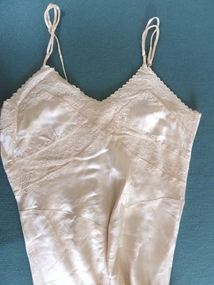
Clothing - Cream Silk Damask Slip, 1930's
... Cream silk damask full slip with bands of shadow and pulled work. Hem and neckline edged in fine buttonhole stitch....Embroidery Silk Underwear Slip & pants Cream silk damask full slip with bands of shadow and pulled work. Hem and neckline edged in fine buttonhole stitch. ...Cream silk damask full slip with bands of shadow and pulled work. Hem and neckline edged in fine buttonhole stitch.embroidery, silk, underwear, slip & pants -
 Embroiderers Guild, Victoria
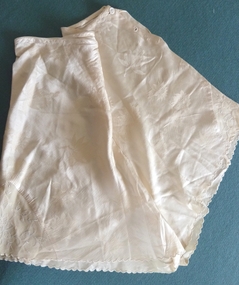
Clothing - Cream Silk Scanties, 1930's
... Cream silk damask scanties with triangles of shadow work and pulled work, edged in fine buttonhole. All seams hand stitched....Embroidery Silk Underwear Slip & pants Cream silk damask scanties with triangles of shadow work and pulled work, edged in fine buttonhole. All seams hand stitched. ...Cream silk damask scanties with triangles of shadow work and pulled work, edged in fine buttonhole. All seams hand stitched.embroidery, silk, underwear, slip & pants -
 Embroiderers Guild, Victoria
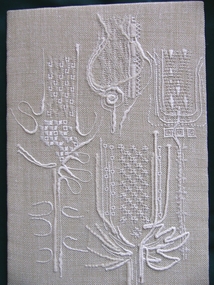
Textile - Creative Embroidery Panel Moyra McNeil, Moyra Mc Neil, Thistles, 1971
... Grey-green open weave linen, the design of thistle heads embroidered in white with pulled work stitches and some couching and surface stitching included....Exhibited at the 1972 Georges Exhibition Embroidery Panel England 1960-1980 Creative Embroidery Grey-green open weave linen, the design of thistle heads embroidered in white with pulled work stitches and some couching and surface stitching included. ...Designed and made by Moyra McNeil (U.K). Exhibited at the 1972 Georges ExhibitionGrey-green open weave linen, the design of thistle heads embroidered in white with pulled work stitches and some couching and surface stitching included.embroidery, panel, england, 1960-1980, creative embroidery -
 Flagstaff Hill Maritime Museum and Village
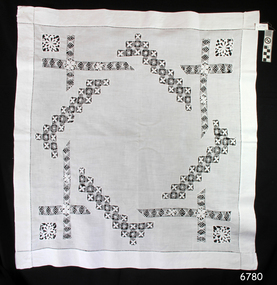
Tablecloth
... White linen tablecloth, fine Drawn or Pulled Thread Work design. H 70cm x W 70cm....flagstaff hill warrnambool shipwrecked-coast flagstaff-hill flagstaff-hill-maritime-museum maritime-museum shipwreck-coast flagstaff-hill-maritime-village tablecloth White linen tablecloth, fine Drawn or Pulled Thread Work design. H 70cm x W 70cm. Tablecloth ...White linen tablecloth, fine Drawn or Pulled Thread Work design. H 70cm x W 70cm.flagstaff hill, warrnambool, shipwrecked-coast, flagstaff-hill, flagstaff-hill-maritime-museum, maritime-museum, shipwreck-coast, flagstaff-hill-maritime-village, tablecloth -
 Buda Historic Home & Garden Castlemaine
Furniture - Desk
... Stained and varnished desk with 3 drawers on r.h.s & pull-out work surface above. Drawer is missing from left....Used by the Leviny family members Stained and varnished desk with 3 drawers on r.h.s & pull-out work surface above. Drawer is missing from left. ...Used by the Leviny family membersStained and varnished desk with 3 drawers on r.h.s & pull-out work surface above. Drawer is missing from left. -
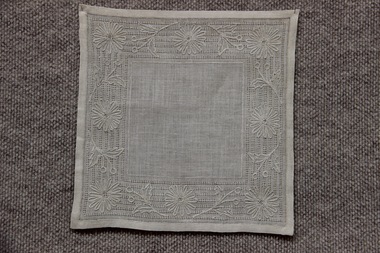 Embroiderers Guild, Victoria
Textile - Mat, Mrs Ethel Oates, 20thC
... Ecru linen square mat stitche4d in pulled thread work around all four sides, then over stitched in a floral design in chain stitch. ...Embroidery Pulled thread Mat Ecru linen square mat stitche4d in pulled thread work around all four sides, then over stitched in a floral design in chain stitch. ...Ecru linen square mat stitche4d in pulled thread work around all four sides, then over stitched in a floral design in chain stitch. Fine satin stitch hem. Silk threadembroidery, pulled thread, mat -
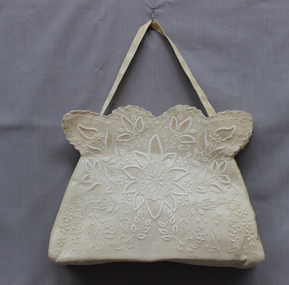 Embroiderers Guild, Victoria
Accessory - Handbag, Sophie Alexandros, 20 th C
... Cream pina cloth, cream embroidery in satin stitch and pulled thread work, scalloped buttonhole top and zipped closure. ...Embroidery Bags Machine made Pina cloth Cream pina cloth, cream embroidery in satin stitch and pulled thread work, scalloped buttonhole top and zipped closure. ...Sophia Alexandros was born on the Greek island of Ithaca. She married an Australian and stitched an extensive trousseau.Cream pina cloth, cream embroidery in satin stitch and pulled thread work, scalloped buttonhole top and zipped closure. Cream satin lining. Back of bag has tiny flowers and dots in satin stitch.embroidery, bags, machine made, pina cloth -
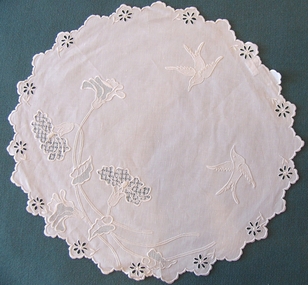 Embroiderers Guild, Victoria
Textile - Mat
... A spray of flowers and drawn and pulled thread work fillings and satin stitch is also part of the decoration....A spray of flowers and drawn and pulled thread work fillings and satin stitch is also part of the decoration. ...Circular white linen fabric with a scalloped satin stitch edge and small broderie anglais flowers. Two birds on one side are in satin and seeding stitches. A spray of flowers and drawn and pulled thread work fillings and satin stitch is also part of the decoration.embroidery, mats, broderie anglais -
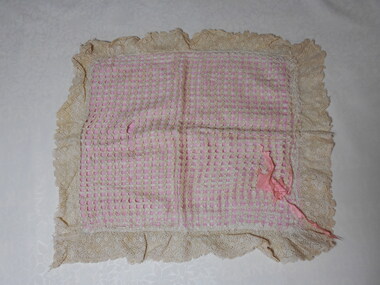 Bendigo Historical Society Inc.
Textile - LINGERIE BAG
... Cream coloured tapestry fabric on both sides. All over pulled thread work to form lattice pattern. All over cross stitch pattern on lattice with cream coloured thread. ...Cream coloured tapestry fabric on both sides. All over pulled thread work to form lattice pattern. All over cross stitch pattern on lattice with cream coloured thread. ...Textiles, lingerie or stocking bag. Cream coloured tapestry fabric on both sides. All over pulled thread work to form lattice pattern. All over cross stitch pattern on lattice with cream coloured thread. Cream coloured 5 cm gathered lace edging on four sides. 12 cm opening on one side. Lined with pink cotton fabric. Hand made.textiles, domestic, lingerie bag. -
 Bendigo Historical Society Inc.
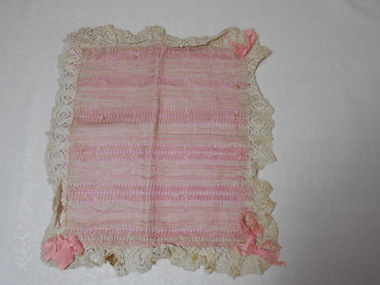
Textile - PINK COTTON LINGERIE BAG
... Front has overlay of cream coloured tapestry fabric with pulled thread work embroidered with pink cross stitch and line patterns. ...Front has overlay of cream coloured tapestry fabric with pulled thread work embroidered with pink cross stitch and line patterns. ...Textiles, pink cotton lingerie or stocking bag with fold over envelope style flap at back over opening. Front has overlay of cream coloured tapestry fabric with pulled thread work embroidered with pink cross stitch and line patterns. Three decorative 2 cm pink satin ribbon bows in three corners. Fourth ribbon detached (stored in bag). 4 cm gathered cream lace edging on four sides.textiles, domestic, pink cotton lingerie bag -
 Kiewa Valley Historical Society
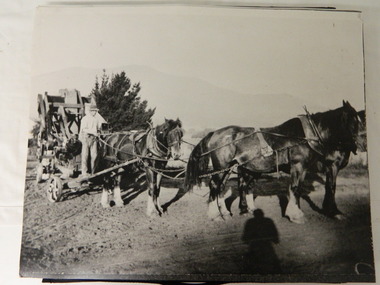
Photos - Horse team working on farm x3
... Horses were coupled together to form a team to pull farm machinery to work on farms. Later, petrol and kerosene equipment was used and then diesel. ...Horses were coupled together to form a team to pull farm machinery to work on farms. Later, petrol and kerosene equipment was used and then diesel. ...Horses were coupled together to form a team to pull farm machinery to work on farms. Later, petrol and kerosene equipment was used and then diesel. The Kiewa Valley consisted of farming families before the Kiewa Hydro Electric Scheme was constructed in the late 1940's at the upper end of the valley. Three large black & white photos of a horse team pulling farm equipment. 1. Mouldboard plough 2. header 3. thresher or chaff cutter. 1.& 2. are working on the farm 3. is pulling the machinery to a nearby farm. No labelsfarm equipment. horse teams. farming. crops. -
 Vision Australia
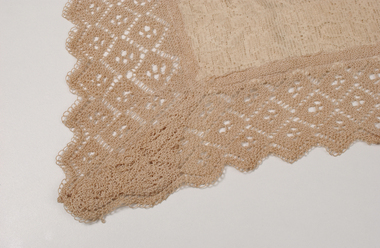
Textile - Object, Tray cloth (attributed to Tilly Aston), 1880-1890s
... The centre piece is cream coloured and consists of 2 layers of pulled thread work The cloth is edged with a beige coloured lace border. ...The centre piece is cream coloured and consists of 2 layers of pulled thread work The cloth is edged with a beige coloured lace border. ...Believed to have been made by Tilly Aston, this tray cloth is an example of the type of skills the Royal Victorian Institute for the Blind school taught its female students. Handicrafts was a possible method of income, and the emphasis was on producing usable pieces rather than highly decorative ones. It is a rectangular shaped tray cloth made from cotton and silk thread. The centre piece is cream coloured and consists of 2 layers of pulled thread work The cloth is edged with a beige coloured lace border. Linen cloth with crocheted edgingtilly aston, royal victorian institute for the blind -
 Bendigo Historical Society Inc.
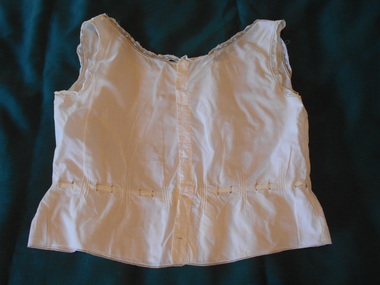
Clothing - MAGGIE BARBER COLLECTION: CAMISOLE, 1880-90's
... Nine floral embroideries and pulled thread work 2.5 cm x 2.5 cm are spaced around the rounded front neckline. ...Nine floral embroideries and pulled thread work 2.5 cm x 2.5 cm are spaced around the rounded front neckline. ...Clothing. Wide scooped neckline, edged with 1.5 cm deep cotton lace. The centre back opening is fastened with six tiny pearl shell buttons .8 cm in diameter- top button is fastened with a loop. 1.5 cm deep cotton lace trims the neckline and armholes. A .5 cm cotton braid trims the lower edge. Nine floral embroideries and pulled thread work 2.5 cm x 2.5 cm are spaced around the rounded front neckline. Below these embroideries on the left side breast, are embroidered the wearers initials-(M) MB. The owners initials are embroidered on the left front in a decorative manner, to compliment the floral embroidery. A lace ribbon, one cm wide at the waistline passes through 1.4 cm eyelets 2 cm apart. Between each set of eyelets, are groups of 4 cm long fine pintucks - 13 groups of two eyelets and 14 groups of pintucks.costume, female, wide scooped neckline camisole -
 Embroiderers Guild, Victoria
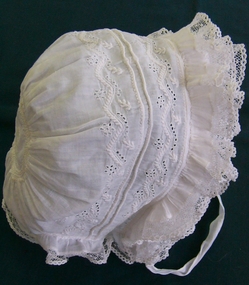
Headwear - Ayrshire Baby Bonnet, Mid 19th century
... Developed from Dresden embroidery (a form of pulled work) and tambour embroidery, it uses a range of stitches, including satin stitch, chain stitch, eyelets and buttonhole edging as well as a range of lace filling stitches. ...Developed from Dresden embroidery (a form of pulled work) and tambour embroidery, it uses a range of stitches, including satin stitch, chain stitch, eyelets and buttonhole edging as well as a range of lace filling stitches. ...Traditionally worked using white thread onto a fine white muslin, Ayrshire embroidery is recognisable by stylised floral motifs with areas of filled in cutwork. Developed from Dresden embroidery (a form of pulled work) and tambour embroidery, it uses a range of stitches, including satin stitch, chain stitch, eyelets and buttonhole edging as well as a range of lace filling stitches. The technique became popular in the early nineteenth century, when the previous fashion of elaborate gowns with hooped skirts was replaced by looser, simpler white cotton muslin garments. Although the elegant simplicity was favoured, women also desired some decoration. However, looms of the time could not create complex designs, so women turned to hand stitching.Using cotton muslin woven in Ayrshire, local women and girls would complete the intricate whitework to help supplement their family income. Mainly produced at home, Ayrshire whitework garments would be initially completed by one person. However, as the technique became more popular and the industry developed, to ensure high quality work, a piece would be passed around so that each embroiderer could focus on completing the stitches they specialised in.It is believed that the designs and motifs used in Ayrshire whitework were inspired by lace filling stitches found within an inset in a French Christening robe that was bought to Scotland by Lady Mary Montgomery, who then lent it to Mrs Jamieson of Ayr. She copied the stitches used within the robe and taught them to her outworkers, and she also produced plain muslin that was stamped with a water-soluble blue ink design that made embroidering the designs neater and more efficient. Ayrshire work became popular quite quickly, and it was incorporated into collars, cuffs and caps as well as children’s clothes and bonnets. Pieces were exported across Europe and the British Empire. As the decades progressed, technology advanced, resulting in looms that could incorporate decoration into the weave of the cloth, reducing the need for hand embroidered Ayrshire whitework.A triple frill of Buckingham lace, followed by two bands of fine embroidery - eyelets and satin stitch, and tucking, with small circle at crown.embroidery, whitework, bonnets, mid 19th century, scotland, garments -
 Bendigo Historical Society Inc.
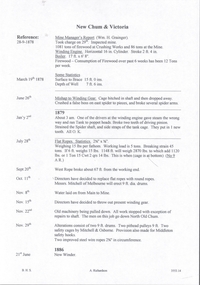
Document - NEW CHUM & VICTORIA LINES OF REEF - NEW CHUM & VICTORIA MINE MANAGER'S REPORT
... Items mentioned are: amount of firewood, winding engine, mishap towinding gear, winding engine driver mistake, flat ropes, rope breaking, Directors deciding to replace flat ropes with round ropes, water laid on from main to mine, Directors decided to throw out present winding gear, old machinery being pulled down and all work stopped except repairs to shaft and alterations to pithead pulleys....Items mentioned are: amount of firewood, winding engine, mishap towinding gear, winding engine driver mistake, flat ropes, rope breaking, Directors deciding to replace flat ropes with round ropes, water laid on from main to mine, Directors decided to throw out present winding gear, old machinery being pulled down and all work stopped except repairs to shaft and alterations to pithead pulleys. ...Handwritten notes on New Chum & Victoria Mine Manager's Report. Dates 1878 and 1879. Wm. H. Grainger Mine Manager. Items mentioned are: amount of firewood, winding engine, mishap towinding gear, winding engine driver mistake, flat ropes, rope breaking, Directors deciding to replace flat ropes with round ropes, water laid on from main to mine, Directors decided to throw out present winding gear, old machinery being pulled down and all work stopped except repairs to shaft and alterations to pithead pulleys.document, gold, new chum & victoria lines of reef, new chum & victoria mine manager's report, wm h grainger, messrs mitchell of melbourne, north old chum, mitchell & osborne, middleton safety hooks, ar -
 Ballarat Tramway Museum
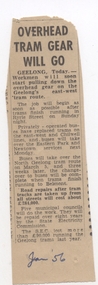
Newspaper, Melbourne Herald?, "Overhead Tram Gear will go", Jan. 1956
... - given the dateline on the top of the cutting) dated Jan. 1956, titled "Overhead Tram Gear will go" reporting that work on pulling down the overhead will soon be started following the completion of tram services in Ryrie St on this Saturday night. ...- given the dateline on the top of the cutting) dated Jan. 1956, titled "Overhead Tram Gear will go" reporting that work on pulling down the overhead will soon be started following the completion of tram services in Ryrie St on this Saturday night. ...Newspaper clipping from a Melbourne paper? (Melbourne Herald? - given the dateline on the top of the cutting) dated Jan. 1956, titled "Overhead Tram Gear will go" reporting that work on pulling down the overhead will soon be started following the completion of tram services in Ryrie St on this Saturday night. Privately operated buses taking over, notes final closure on March 5, road repairs and SEC paying Councils for the road works over a 8 year period. Note on rear has a "Herald Index" of share prices. Contained originally within Reg Item 5623 at the front of this note book. For items see btm5623 loose items list.pdf.geelong, closure, overhead -
 Flagstaff Hill Maritime Museum and Village
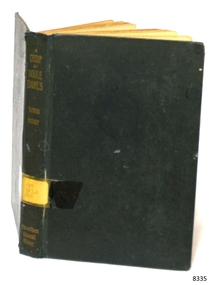
Book - Fictional Stories, Thomas Hardy, A Group of Noble Dames, 1894
... In one of the stories, the tale borders on the Gothic with macabre irony; in another instance, the story "Barbara of the House of Grebe" tells the tale of a deformed statue of a woman's first husband and how it is used by her cruel second husband to psychologically torture her. The work pulls back the curtain on the decline of the aristocracy and the supposedly "glamorous" upper classes, exposing hereditary madness, secret illegitimate births, and moral decay. ...In one of the stories, the tale borders on the Gothic with macabre irony; in another instance, the story "Barbara of the House of Grebe" tells the tale of a deformed statue of a woman's first husband and how it is used by her cruel second husband to psychologically torture her. The work pulls back the curtain on the decline of the aristocracy and the supposedly "glamorous" upper classes, exposing hereditary madness, secret illegitimate births, and moral decay. ...The subject novel A Group of Noble Dames is a collection of ten historical short stories bound together by a classic frame narrative. The premise is that to escape the boredom of a rainy day, ten male members of the "Wessex Field and Antiquarian Club" gather together. To pass the time, each member including a local historian, an old surgeon, a rural dean, and a churchwarden takes a turn telling a scandalous, tragic, or ironic tale about a high-born lady from the local aristocracy of the 17th and 18th centuries. Unlike Hardy's deeply somber major novels, he categorized these stories as "Romances and Fantasies." However, they still contain classic Hardyan cynicism.A Group of Noble Dames Author: Thomas Hardy Publisher: Macmillan And Co Date: 1894 Further Information: Olive hardcover and spine with spine lettering in gold. The spine has a Library label with inscription.non-fictionThe subject novel A Group of Noble Dames is a collection of ten historical short stories bound together by a classic frame narrative. The premise is that to escape the boredom of a rainy day, ten male members of the "Wessex Field and Antiquarian Club" gather together. To pass the time, each member including a local historian, an old surgeon, a rural dean, and a churchwarden takes a turn telling a scandalous, tragic, or ironic tale about a high-born lady from the local aristocracy of the 17th and 18th centuries. Unlike Hardy's deeply somber major novels, he categorized these stories as "Romances and Fantasies." However, they still contain classic Hardyan cynicism.flagstaff hill, warrnambool, shipwrecked coast, flagstaff hill maritime museum, maritime museum, shipwreck coast, flagstaff hill maritime village, great ocean road, book, pattison collection, warrnambool library, warrnambool mechanics’ institute, ralph eric pattison, corangamite regional library service, warrnambool city librarian, mechanics’ institute library, victorian library board, warrnambool books and records, warrnambool children’s library, a group of noble dames, thomas hardy -
 Flagstaff Hill Maritime Museum and Village
Tool - Fid, Late 19th to early 20th century
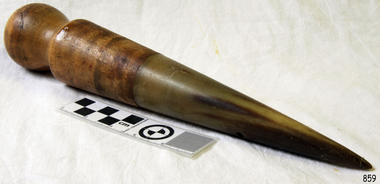
... work with rope and canvas in marlinespike seamanship. A Fid differs from a marlinspike in material and purposes. A marlinspike is used in working with wire rope, natural and synthetic lines also may be used to open shackles, and is made of metal. A Fid is used to hold open knots and holes in the canvas, and to separate the "lays" (or strands) of synthetic or natural rope for splicing. A variation of the Fid, the gripfid, is used for ply-split braiding. The gripfid has a jamming cleat to pull...work with rope and canvas in marlinespike seamanship. A Fid differs from a marlinspike in material and purposes. A marlinspike is used in working with wire rope, natural and synthetic lines also may be used to open shackles, and is made of metal. A Fid is used to hold open knots and holes in the canvas, and to separate the "lays" (or strands) of synthetic or natural rope for splicing. A variation of the Fid, the gripfid, is used for ply-split braiding. The gripfid has a jamming cleat to pull ...A Fid is a conical tapered wooden tool used for separating the strands of rope for splicing. They were a tool traditionally made of wood or bone used to work with rope and canvas in marlinespike seamanship. A Fid differs from a marlinspike in material and purposes. A marlinspike is used in working with wire rope, natural and synthetic lines also may be used to open shackles, and is made of metal. A Fid is used to hold open knots and holes in the canvas, and to separate the "lays" (or strands) of synthetic or natural rope for splicing. A variation of the Fid, the gripfid, is used for ply-split braiding. The gripfid has a jamming cleat to pull a cord back through the cord split by the fid's point. Modern Fids are typically made of aluminium, steel, or plastic. In addition to holding rope open to assist the creation of a rope splice, modern push fid's have markings for precise measurements in a variety of sizes of rope. The length of these fid’s is typically 21 or 22 times the diameter of rope to be spliced. Fids have been used since sailing vessels were first used to travel the worlds seas the tool was invented to be used to splice rope and with working with canvas sails. A Fid is a sailors tool that has maintained its general design for hundreds of years and gives a snapshot into what the working life was like for sailors on board sailing ships for hundreds of years. The tool in its original design is still in regular use today by recreational sailors all over the world to splice and join lengths of rope.Fid with Horn body and wood top.Noneflagstaff hill, warrnambool, shipwrecked-coast, flagstaff-hill, flagstaff-hill-maritime-museum, maritime-museum, shipwreck-coast, flagstaff-hill-maritime-village -
 Flagstaff Hill Maritime Museum and Village
Tool - Fid, Mid 20th Century
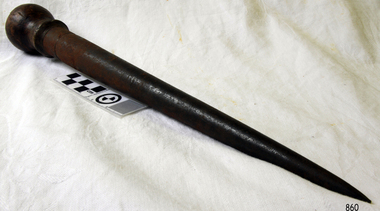
... work with rope and canvas in marlinespike seamanship. A Fid differs from a marlinspike in material and purposes. A marlinspike is used in working with wire rope, natural and synthetic lines also may be used to open shackles, and is made of metal. A Fid is used to hold open knots and holes in the canvas, and to separate the "lays" (or strands) of synthetic or natural rope for splicing. A variation of the Fid, the gripfid, is used for ply-split braiding. The gripfid has a jamming cleat to pull...work with rope and canvas in marlinespike seamanship. A Fid differs from a marlinspike in material and purposes. A marlinspike is used in working with wire rope, natural and synthetic lines also may be used to open shackles, and is made of metal. A Fid is used to hold open knots and holes in the canvas, and to separate the "lays" (or strands) of synthetic or natural rope for splicing. A variation of the Fid, the gripfid, is used for ply-split braiding. The gripfid has a jamming cleat to pull ...A Fid is a conical tapered wooden tool used for separating the strands of rope for splicing. They were a tool traditionally made of wood or bone used to work with rope and canvas in marlinespike seamanship. A Fid differs from a marlinspike in material and purposes. A marlinspike is used in working with wire rope, natural and synthetic lines also may be used to open shackles, and is made of metal. A Fid is used to hold open knots and holes in the canvas, and to separate the "lays" (or strands) of synthetic or natural rope for splicing. A variation of the Fid, the gripfid, is used for ply-split braiding. The gripfid has a jamming cleat to pull a cord back through the cord split by the fid's point. Modern Fids are typically made of aluminium, steel, or plastic. In addition to holding rope open to assist the creation of a rope splice, modern push fid's have markings for precise measurements in a variety of sizes of rope. The length of these fid’s is typically 21 or 22 times the diameter of rope to be spliced. Fids have been used since sailing vessels were first used to travel the worlds seas the tool was invented to be used to splice rope and with working with canvas sails. A Fid is a sailors tool that has maintained its general design for hundreds of years and gives a snapshot into what the working life was like for sailors on board sailing ships for hundreds of years. The tool in its original design is still in regular use today by recreational sailors all over the world to splice and join lengths of rope.Metal Fid with a wooden bulb on top metal body tapering to a point. Noneflagstaff hill, warrnambool, shipwrecked-coast, flagstaff-hill, flagstaff-hill-maritime-museum, maritime-museum, shipwreck-coast, flagstaff-hill-maritime-village -
 Flagstaff Hill Maritime Museum and Village
Tool - Fid, Early 20th century
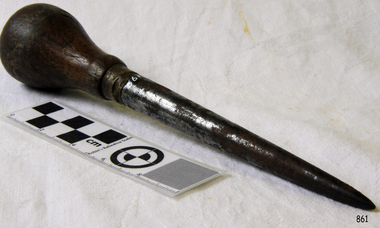
... work with rope and canvas in marlinespike seamanship. A Fid differs from a marlinspike in material and purposes. A marlinspike is used in working with wire rope, natural and synthetic lines also may be used to open shackles, and is made of metal. A Fid is used to hold open knots and holes in the canvas, and to separate the "lays" (or strands) of synthetic or natural rope for splicing. A variation of the Fid, the gripfid, is used for ply-split braiding. The gripfid has a jamming cleat to pull...work with rope and canvas in marlinespike seamanship. A Fid differs from a marlinspike in material and purposes. A marlinspike is used in working with wire rope, natural and synthetic lines also may be used to open shackles, and is made of metal. A Fid is used to hold open knots and holes in the canvas, and to separate the "lays" (or strands) of synthetic or natural rope for splicing. A variation of the Fid, the gripfid, is used for ply-split braiding. The gripfid has a jamming cleat to pull ...A Fid is a conical tapered wooden tool used for separating the strands of rope for splicing. They were a tool traditionally made of wood or bone used to work with rope and canvas in marlinespike seamanship. A Fid differs from a marlinspike in material and purposes. A marlinspike is used in working with wire rope, natural and synthetic lines also may be used to open shackles, and is made of metal. A Fid is used to hold open knots and holes in the canvas, and to separate the "lays" (or strands) of synthetic or natural rope for splicing. A variation of the Fid, the gripfid, is used for ply-split braiding. The gripfid has a jamming cleat to pull a cord back through the cord split by the fid's point. Modern Fids are typically made of aluminium, steel, or plastic. In addition to holding rope open to assist the creation of a rope splice, modern push fid's have markings for precise measurements in a variety of sizes of rope. The length of these fid's is typically 21 or 22 times the diameter of rope to be spliced. Fids have been used since sailing vessels were first used to travel the worlds seas the tool was invented to be used to splice rope and with working with canvas sails. A Fid is a sailors tool that has maintained its general design for hundreds of years and gives a snapshot into what the working life was like for sailors on board sailing ships for hundreds of years. The tool in its original design is still in regular use today by recreational sailors all over the world to splice and join lengths of rope.Fid, Metal and Wood top with brass ferrule between the two.Noneflagstaff hill, warrnambool, shipwrecked-coast, flagstaff-hill, flagstaff-hill-maritime-museum, maritime-museum, shipwreck-coast, flagstaff-hill-maritime-village -
 Flagstaff Hill Maritime Museum and Village
Tool - Fid, Late 19th- early 20th Century
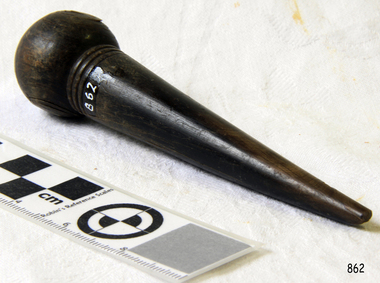
... work with rope and canvas in marlinespike seamanship. A Fid differs from a marlinspike in material and purposes. A marlinspike is used in working with wire rope, natural and synthetic lines also may be used to open shackles, and is made of metal. A Fid is used to hold open knots and holes in the canvas, and to separate the "lays" (or strands) of synthetic or natural rope for splicing. A variation of the Fid, the gripfid, is used for ply-split braiding. The gripfid has a jamming cleat to pull...work with rope and canvas in marlinespike seamanship. A Fid differs from a marlinspike in material and purposes. A marlinspike is used in working with wire rope, natural and synthetic lines also may be used to open shackles, and is made of metal. A Fid is used to hold open knots and holes in the canvas, and to separate the "lays" (or strands) of synthetic or natural rope for splicing. A variation of the Fid, the gripfid, is used for ply-split braiding. The gripfid has a jamming cleat to pull ...A Fid is a conical tapered wooden tool used for separating the strands of rope for splicing. They were a tool traditionally made of wood or bone used to work with rope and canvas in marlinespike seamanship. A Fid differs from a marlinspike in material and purposes. A marlinspike is used in working with wire rope, natural and synthetic lines also may be used to open shackles, and is made of metal. A Fid is used to hold open knots and holes in the canvas, and to separate the "lays" (or strands) of synthetic or natural rope for splicing. A variation of the Fid, the gripfid, is used for ply-split braiding. The gripfid has a jamming cleat to pull a cord back through the cord split by the fid's point. Modern fid's are typically made of aluminium, steel, or plastic. In addition to holding rope open to assist the creation of a rope splice, modern push fid's have markings for precise measurements in a variety of sizes of rope. The length of these fid's is typically 21 or 22 times the diameter of rope to be spliced. Fids have been used since sailing vessels were first used to travel the worlds seas the tool was invented to be used to splice rope and with working with canvas sails. A Fid is a sailors tool that has maintained its general design for hundreds of years and gives a snapshot into what the working life was like for sailors on board sailing ships for hundreds of years. The tool in its original design is still in regular use today by recreational sailors all over the world to splice and join lengths of rope.Wooden Fid with 3 rings around base of knob at the top of fid. Noneflagstaff hill, warrnambool, shipwrecked-coast, flagstaff-hill, flagstaff-hill-maritime-museum, maritime-museum, shipwreck-coast, flagstaff-hill-maritime-village -
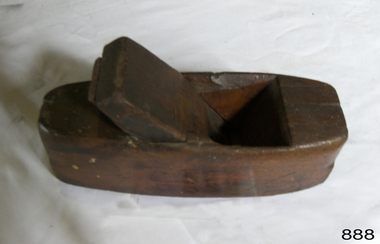 Flagstaff Hill Maritime Museum and Village
Tool - Wood smoothing plane coffin pattern, 18th to early 19th century
... work to be performed. Large crown mouldings required planes of six or more inches in width, which demanded great strength to push and often had additional peg handles on the sides, allowing the craftsman's apprentice or other workers to pull the plane ahead of the master who guided it. ...work to be performed. Large crown mouldings required planes of six or more inches in width, which demanded great strength to push and often had additional peg handles on the sides, allowing the craftsman's apprentice or other workers to pull the plane ahead of the master who guided it. ...Being smaller than other bench planes, the coffin-shaped smoothing plane is better able to work on smaller work pieces and around obstructions. Since the 1700s wooden smoothing planes have predominantly been 'coffin shaped' wider in the middle and slightly rounded making them more manoeuvrable. A vintage tool made by an unknown 18th or early 19th-century woodworking tool maker. This item would have been made for individuals or cabinet makers that worked in wood and needed a tool that could produce a flat smooth finish to timber. These tools were used before routers and spindle moulders came into use in the late 19th and early 20th centuries before this time producing either a decorative moulding or a smooth finish to furniture timber, door trims etc had to be accomplished using hand planing tools and in particular one of these types of planes. Traditionally wood planes were blocks of wear-resistant hardwood, often beech or maple, which were worked to the shape of the intended moulding or had a flat blade used for achieving a flat and smooth finish to timber. The blade or iron was likewise formed to the intended moulding profile or for smoothing and secured in the body of the plane with a wooden wedge. A traditional cabinetmakers' shop might have many, perhaps hundreds, of moulding and flat-bladed planes for a full range of work to be performed. Large crown mouldings required planes of six or more inches in width, which demanded great strength to push and often had additional peg handles on the sides, allowing the craftsman's apprentice or other workers to pull the plane ahead of the master who guided it. These vintage planes are well sought after by collectors of antique tools due to their rarity. A significant tool from the 18th to early 19th century by an unknown maker that today is quite rare and sought after by collectors. It gives us a snapshot of how furniture and other decorative finishes were created on timber by the use of hand tools. Tools that were themselves handmade show the craftsmanship used during this time not only to make a tool such as the subject item but also the craftsmanship needed to produce a decorative finish that was needed to be made for any timber furniture item. Smoothing Plane Coffin type. Stamped GM inside "W" indicating sizeflagstaff hill, warrnambool, shipwrecked-coast, flagstaff-hill, flagstaff-hill-maritime-museum, maritime-museum, shipwreck-coast, flagstaff-hill-maritime-village -
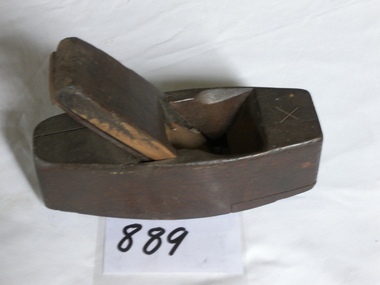 Flagstaff Hill Maritime Museum and Village
Tool - Smoothing Wood Plane Coffin Pattern, 18th to Early 19th Centuries
... work to be performed. Large crown mouldings required planes of six or more inches in width, which demanded great strength to push and often had additional peg handles on the sides, allowing the craftsman's apprentice or other worker to pull the plane ahead of the master who guided it. ...work to be performed. Large crown mouldings required planes of six or more inches in width, which demanded great strength to push and often had additional peg handles on the sides, allowing the craftsman's apprentice or other worker to pull the plane ahead of the master who guided it. ...Being smaller than other bench planes, the coffin shaped smoothing plane is better able to work on smaller work pieces and around obstructions. Since the 1700s wooden smoothing planes have predominantly been 'coffin shaped' wider in the middle and slightly rounded making them more manoeuvrable. A vintage tool made by an unknown 18th or early 19th century woodworking tool maker. This item would have been made for individuals or cabinet makers that worked in wood and needed a tool that could produce a flat smooth finish to timber. These tools were used before routers and spindle moulders came into use in the late 19th and early 20th centuries before this time to produce either a decorative moulding or a smooth finish to furniture timber, door trims etc had to be accomplished using hand planing tools and in particular one of these types of planes. Traditionally wood planes were blocks of wear resistant hardwood, often beech or maple, which were worked to the shape of the intended moulding or had a flat blade use for achieving a flat and smooth finish to timber. The blade, or iron was likewise formed to the intended moulding profile or for smoothing and secured in the body of the plane with a wooden wedge. A traditional cabinetmakers shop might have many, perhaps hundreds, of moulding and flat bladed planes for a full range of work to be performed. Large crown mouldings required planes of six or more inches in width, which demanded great strength to push and often had additional peg handles on the sides, allowing the craftsman's apprentice or other worker to pull the plane ahead of the master who guided it. These vintage planes are well sought after by collectors of antique tools due to their rarity. A significant tool from the 18th to early 19th century that today is quite rare and sought after by collectors. It gives us a snapshot of how furniture and other decorative finishes were created on timber by the use of hand tools. Tools that were themselves hand made shows the craftsmanship used during this time not only to make a tool such as the subject item but also the craftsmanship needed to produce a decorative finish that was needed to be made for any timber furniture item. Wood smoothing plane known as a coffin plane due to it's shape, wood insert screwed on front of base. Stamped "MILLER". Inscribed "X" (probably the size)flagstaff hill, warrnambool, flagstaff-hill, flagstaff-hill-maritime-museum, maritime-museum, shipwreck-coast, flagstaff-hill-maritime-village, cabinet makers tools, woodworking tools, wood plane, smoothing plane, timber finishing, furniture manufacture -
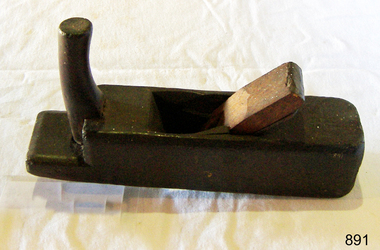 Flagstaff Hill Maritime Museum and Village
Tool - Wood Smoothing Plane, Late 18th to Early 19th Century
... work to be performed. Large crown mouldings required planes of six or more inches in width, which demanded great strength to push and often had additional peg handles on the sides, allowing the craftsman's apprentice or other workers to pull the plane ahead of the master who guided it. ...work to be performed. Large crown mouldings required planes of six or more inches in width, which demanded great strength to push and often had additional peg handles on the sides, allowing the craftsman's apprentice or other workers to pull the plane ahead of the master who guided it. ...A block, jack or smoothing plane is used for making a smooth finish to timber that is used to make furniture or other wooden objects. Traditionally, wood planes were blocks of wear-resistant hardwood, often beech or maple, which were worked to the intended shape of the item being worked on. The blade or iron was likewise formed to a flat shape and secured in the body of the plane with a wooden wedge. A traditional cabinetmakers' shop might have many, perhaps hundreds, of smoothing and moulding planes for the full range of work to be performed. Large crown mouldings required planes of six or more inches in width, which demanded great strength to push and often had additional peg handles on the sides, allowing the craftsman's apprentice or other workers to pull the plane ahead of the master who guided it. A vintage tool by an unknown maker, this item was made for cabinet-making firms and individuals that worked in wood and needed a tool that could remove large amounts of timber. These jack, block or dressing planes as they were known came in various shapes and sizes to achieve a flat and even finish to timber surfaces before the use of mechanical smoothing planes and came in many sizes. A significant tool from the late 18th to early 19th century that's pattern or shape is still in use today. Early models of this type of woodworking plane are sought after by collectors today. This tool gives us a snapshot of how furniture and other finishes were created on timber by the use of cutting-edged hand tools used by craftsmen of the time. Tools that were themselves handmade, demonstrating the craftsmanship used during this time not only to make a tool such as the subject item but also the craftsmanship needed to produce either a decorative or even finish for timber items. Smoothing Plane blade and wedge present. Raised handle at front end. Right-hand wedge guide broken away. Noneflagstaff hill, warrnambool, flagstaff-hill, flagstaff-hill-maritime-museum, maritime-museum, shipwreck-coast, flagstaff-hill-maritime-village, plane, wood plane, cabinet makers tools, furniture making -
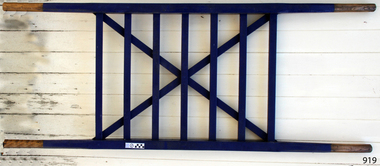 Flagstaff Hill Maritime Museum and Village
Equipment - Hand Barrow, 1860s
... pulling on it, or by using the hooked block on the shore end of the whip and attaching it to a sand anchor. The breeches buoy was attached to the traveller block on the hawser, and the shore crew then used the whip line to haul the breeches buoy to and from the vessel, rescuing the stranded crew one at a time. The rescue crew wore scarlet, numbered armbands and worked...pulling on it, or by using the hooked block on the shore end of the whip and attaching it to a sand anchor. The breeches buoy was attached to the traveller block on the hawser, and the shore crew then used the whip line to haul the breeches buoy to and from the vessel, rescuing the stranded crew one at a time. The rescue crew wore scarlet, numbered armbands and worked ...This hand barrow, sometimes called a Welsh hand barrow, was used to transport a load of marine rescue equipment from the beach cart to the rescue site, particularly over hilly, uneven or rough terrain. Hand barrows were in common use in the 19th century. Saving lives in Warrnambool – The coastline of South West Victoria is the site of over 600 shipwrecks and many lost lives; even in Warrnambool’s Lady Bay there were around 16 known shipwrecks between 1850 and 1905, with eight lives lost. Victoria’s Government responded to the need for lifesaving equipment and, in 1858, the provision of rocket and mortar apparatus was approved for the lifeboat stations. In 1859 the first Government-built lifeboat arrived at Warrnambool Harbour and a shed was soon built for it on the Tramway Jetty, followed by a rocket house in 1864 to safely store the rocket rescue equipment. In 1878 the buildings were moved to the Breakwater (constructed from 1874-1890), and in 1910 the new Lifeboat Warrnambool arrived with its ‘self-righting’ design. For almost a hundred years the lifesaving and rescue crews, mostly local volunteers, trained regularly to rehearse and maintain their rescue skills. They were summoned when needed by alarms, gunshots, ringing bells and foghorns. In July 1873 a brass bell was erected at Flagstaff Hill specifically to call the rescue crew upon news of a shipwreck. Some crew members became local heroes but all served an important role. Rocket apparatus was used as recently as the 1950s. Rocket Rescue Method - Rocket rescue became the preferred lifesaving method of the rescue crews, being much safer that using a lifeboat in rough seas and poor conditions. The Government of Victoria adopted lifesaving methods based on Her Majesty’s Coast Guard in Great Britain. It authorised the first line-throwing rescue system in 1858. Captain Manby’s mortar powered a projectile connected to rope, invented in 1808. The equipment was updated to John Dennett’s 8-foot shaft and rocket method that had a longer range of about 250 yards. From the 1860s the breeches buoy and traveller block rocket rescue apparatus was in use. It was suspended on a hawser line and manually pulled to and from the distressed vessel carrying passengers and items. In the early 1870s Colonel Boxer’s rocket rescue method became the standard in Victoria. His two-stage rockets, charged by a gunpowder composition, could fire the line up to 500-600 yards, although 1000 yards range was possible. Boxer’s rocket carried the light line, which was faked, or coiled, in a particular way between pegs in a faking box to prevent twists and tangles when fired. The angle of firing the rocket to the vessel in distress was measured by a quadrant-type instrument on the side of the rocket machine. Decades later, in about 1920, Schermuly invented the line-throwing pistol that used a small cartridge to fire the rocket. . The British Board of Trade regularly published instructions for both the beach rescue crew and ship’s crew. It involved setting up the rocket launcher on shore at a particular angle, determined by the Head of the crew and measured by the quadrant, inserting a rocket that had a light-weight line threaded through its shaft, and then firing it across the stranded vessel, the line issuing freely from the faking board. A continuous whip line was then sent out to the ship’s crew, who hauled it in then followed the instructions – in four languages - on the attached tally board. The survivors would haul on the line to bring out the heavier, continuous whip line with a tail block connected to it. They then secured the block to the mast or other strong part the ship. The rescue crew on shore then hauled out a stronger hawser line, which the survivors fixed above the whip’s tail block. The hawser was then tightened by the crew pulling on it, or by using the hooked block on the shore end of the whip and attaching it to a sand anchor. The breeches buoy was attached to the traveller block on the hawser, and the shore crew then used the whip line to haul the breeches buoy to and from the vessel, rescuing the stranded crew one at a time. The rescue crew wore scarlet, numbered armbands and worked on a numerical rotation system, swapping members out to rest them. This hand barrow is significant for its connection with local history, maritime history and marine technology. Lifesaving has been an important part of the services performed from Warrnambool's very early days, supported by State and Local Government, and based on the methods and experience of Great Britain. Hundreds of shipwrecks along the coast are evidence of the rough weather and rugged coastline. Ordinary citizens, the Harbour employees, and the volunteer boat and rescue crew, saved lives in adverse circumstances. Some were recognised as heroes, others went unrecognised. In Lady Bay, Warrnambool, there were around 16 known shipwrecks between 1850 and 1905. Many lives were saved but tragically, eight lives were lost.Hand barrow; a transporting device carried between two people walking one in front of the other. A wooden ladder-like frame with two handles at each end, blue painted body with unpainted handles. Seven equal-length slats are joined at equal distance between two parallel poles, and two longer slats are attached diagonally between the first and last slats as a brace. flagstaff hill maritime museum and village, flagstaff hill, maritime museum, maritime village, warrnambool, great ocean road, lady bay, warrnambool harbour, port of warrnambool, tramway jetty, breakwater, shipwreck, life-saving, lifesaving, rescue crew, rescue, rocket rescue, rocket crew, lifeboat men, beach rescue, line rescue, rescue equipment, rocket firing equipment, rocket rescue equipment, maritime accidents, shipwreck victim, rocket equipment, marine technology, rescue boat, lifeboat, volunteer lifesavers, volunteer crew, life saving rescue crew, lifesaving rescue crew, rocket apparatus, rocket rescue method, shore to ship, rocket apparatus rescue, stranded vessel, line throwing mortar, mortar, rocket rescue apparatus, line thrower, line throwing, lifeboat warrnambool, hand barrow, manual transport, welsh hand barrow -
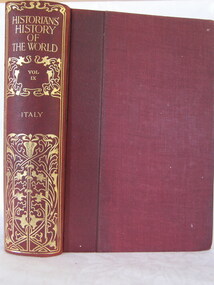 Flagstaff Hill Maritime Museum and Village
Book - Reference Book/History, Henry Smith Williams, The Historians History of the World Vol 9 set 1 - Edited by Henry Smith Williams L.L.D. Published by “The Times” 1908, 1908
... pulling the best descriptions of Italy from legendary historians like Gibbon, Machiavelli, Guicciardini, and Sismondi. By reading this volume, you aren't just getting 1908-era scholarship; you are reading a "Greatest Hits" of historical writing from the last 500 years. (For more information on the Pattison Collection and the Mechanics Institute visit) https://victoriancollections.net.au/items/5580c7e72162f114d8b758db warrnambool shipwrecked-coast flagstaff-hill flagstaff-hill-maritime-museum maritime-museum book the historians history of the world vol 9 set 1 Henry Smith Williams The 1908 edition of The Historians' History of the World is a monumental work of Edwardian scholarship, representing a specific era of "universal history" where the goal was to synthesise all human knowledge into a single narrative. ...The 1908 edition of The Historians' History of the World is a monumental work of Edwardian scholarship, representing a specific era of "universal history" where the goal was to synthesise all human knowledge into a single narrative. While previous volumes dealt with the Roman Empire, Volume 9 picks up the story after the "Fall of Rome" and tracks the peninsula’s evolution through the dawn of the 20th century.The Book is part of a 25 volume set with red cloth bindings and gold filigree design to ribnon-fictionThe 1908 edition of The Historians' History of the World is a monumental work of Edwardian scholarship, representing a specific era of "universal history" where the goal was to synthesise all human knowledge into a single narrative. While previous volumes dealt with the Roman Empire, Volume 9 picks up the story after the "Fall of Rome" and tracks the peninsula’s evolution through the dawn of the 20th century. warrnambool, shipwrecked-coast, flagstaff-hill, flagstaff-hill-maritime-museum, maritime-museum, book, the historians history of the world vol 9 set 1, henry smith williams
