
Showing 149 items matching " ribbon work"
-
 Embroiderers Guild, Victoria
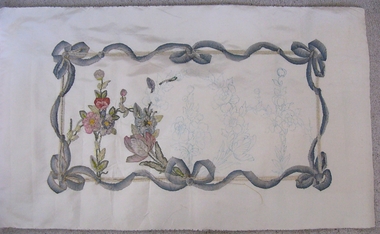
Textile - Unfinished Ribbon Work Kit
... Unfinished Ribbon Work Kit ...... Ribbon work...Textile Unfinished Ribbon Work Kit ...Cream silk background with a stamped design of roses and tulips. Partially embroidered with a selection of softly coloured and shaded ribbons and a fine gold thread.embroidery, ribbon work, silk embroidery, kits -
 Embroiderers Guild, Victoria
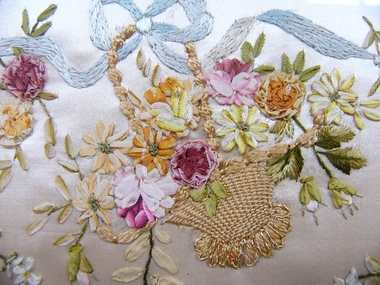
Textile - Ribbon Work Mirror Frame, Late 19th century
... Ribbon Work Mirror Frame...... Ribbon work...Encased in a copper frame. Textile Ribbon Work Mirror Frame ...Cream satin, floral design featuring basket of flowers at top, tied with embroidered ribbons (blue). Sprays of flowers at sides and base. Encased in a copper frame.embroidery, ribbon work, picture frame, late 19th century -
 Embroiderers Guild, Victoria
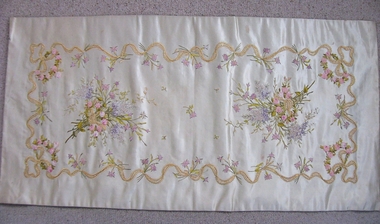
Domestic object - Edwardian Ribbon Work Table Runner, 1910 (1900-20)
... Edwardian Ribbon Work Table Runner...... Ribbon work...Domestic object Edwardian Ribbon Work Table Runner ...Made by the mother of the donor during the Edwardian period while living on a grazing property in far Western Victoria. Travelling was then very difficult as the roads were bad and so was not lightly undertaken. Embroidery of a romantic type was done as a reminder of life at home in England, so filling in the days when visits were relatively rare.A rich pale green satin, embroidered in a design of sprays of lilac, roses and leaves at both ends, mainly using varying widths of narrow ribbons in lavender, pink and green with a surrounding garland of shaded leaves and rosebuds in satin stitch, couched and highlighted with Japanese gold thread.embroidery, mats, 1900-20, australia, ribbon work -
 Embroiderers Guild, Victoria
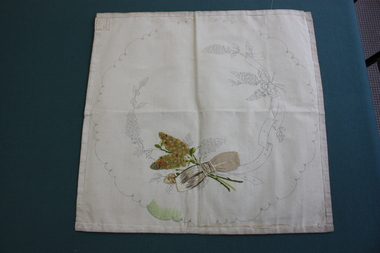
Functional Object - Unfinished Ribbon Work Kit Cushion
... Unfinished Ribbon Work Kit Cushion...Floral design with bow. Ribbon work partly embroidered on a stamped design....Functional Object Unfinished Ribbon Work Kit Cushion ...This item has been removed from Folio 1 and placed in kKits - 7/LB12Floral design with bow. Ribbon work partly embroidered on a stamped design.embroidery, ribbon -
 Embroiderers Guild, Victoria
Accessory - 19 th C Silk Embroidery Handkerchief Sachet, Late 19th/early 20th century
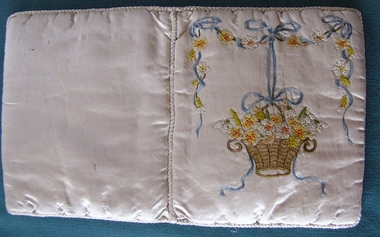
... ... Ribbon work...Cream satin with a design in embroidery and ribbon work, of a basket of flowers suspended by a ribbon and bow. ...Embroidery Ribbon work Late 19th century Cream satin with a design in embroidery and ribbon work, of a basket of flowers suspended by a ribbon and bow. ...Cream satin with a design in embroidery and ribbon work, of a basket of flowers suspended by a ribbon and bow. Inside and pockets are quilted in diamond design, and edge has a cord.embroidery, ribbon work, late 19th century -
 Embroiderers Guild, Victoria
Accessory - 19th C Silk Ribbon Embroidery Sachet, c. 1880
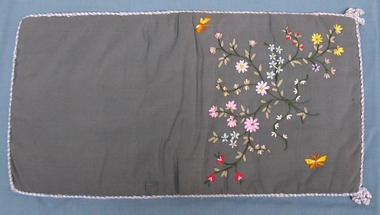
... ... Ribbon work...Sachet front has a spray of flowers in ribbon work and 2 embroidered moths. Edged with a heavy light blue cord....Embroidery Ribbon work Sachet Late 19th century Green corded silk, padded and lined with light blue silk, with 2 pockets. ...Green corded silk, padded and lined with light blue silk, with 2 pockets. Sachet front has a spray of flowers in ribbon work and 2 embroidered moths. Edged with a heavy light blue cord.embroidery, ribbon work, sachet, late 19th century -
 Embroiderers Guild, Victoria
Accessory - 19 th C Silk Ribbon Embroidery Glove Sachet, Late 19th/early 20th century
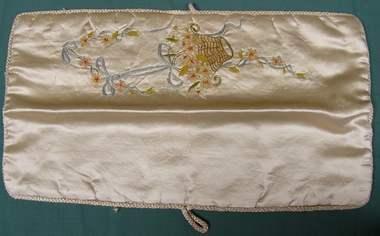
... ... Ribbon work...The front shows a design of a basket, ribbons and flowers worked in ribbons and silk embroidery. ...Embroidery Ribbon work Long narrow sachet of cream coloured satin. ...Long narrow sachet of cream coloured satin. The front shows a design of a basket, ribbons and flowers worked in ribbons and silk embroidery. It is edged with a thick cream silk cord. The lining is Jap silk quilted by machine.embroidery, ribbon work -
 Embroiderers Guild, Victoria
Accessory - Early Victorian Silk Ribbon Reticule, c. 1840
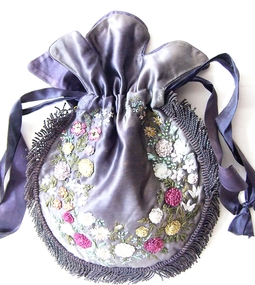
... ... Ribbon work...See Dictionary of Needlework page 67. Embroidery Ribbon work Bags England Mid 19th Century Dark grey/blue silk. ...Bag was obtained by the donor in Maxwelltown, Dumfries, Scotland in 1930. Made around 1840. See Dictionary of Needlework page 67.Dark grey/blue silk. Floral design using fine ribbons, both sides. Fringed edge. Drawstrings are finished with flat bows and top of bag is shaped in 3 deep scallops. Bright yellow lining.embroidery, ribbon work, bags, england, mid 19th century -
 Embroiderers Guild, Victoria
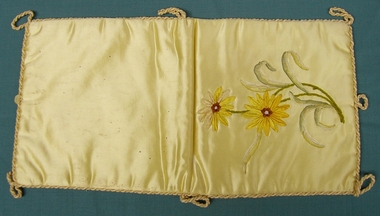
Accessory - Handkerchief sachet, c. 1900
... ... Ribbon work...Embroidery Ribbon work Sachets 1900-20 Yellow satin sachet, with a spray of 2 daisies and leaves in variegated silk ribbon. ...Yellow satin sachet, with a spray of 2 daisies and leaves in variegated silk ribbon. Sachet is edged with a heavy cord. Lined in a paler yellow silk.embroidery, ribbon work, sachets, 1900-20 -
 Embroiderers Guild, Victoria
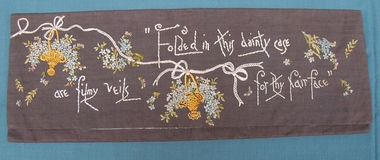
Accessory - Edwardian Silk Ribbon Embroidered Veil Case, Early 1900's
... ... Ribbon work...Embroidery Ribbon work Sachet 1900-20 "Folded in this dainty case are filmy veils for thy Fair Face" Olive green linen envelope lined with green silk. ...Olive green linen envelope lined with green silk. Flap is decorated with embroidery and ribbonwork in a design of ribbons and flowers - shades of yellow, blue and green."Folded in this dainty case are filmy veils for thy Fair Face"embroidery, ribbon work, sachet, 1900-20 -
 Embroiderers Guild, Victoria
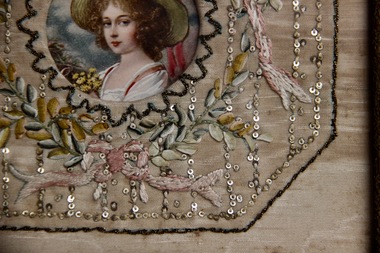
Artwork, other - 18th C Silk Embroidery Framed Picture
... ... Ribbon work...18th Century 19th century Picture Ribbon work Frame : gallery of Art, T.S.Clasier & Co Pty Ltd Union House 286 Lit Collins St Melbourne. ...Miniature picture of a young girl in a straw sunhat, located centrally in an embroidered mounting. The mounting is silk fabric, with an octagonal metal thread outline, decorated inside this with spangles, pink and white embroidered ribbon, and leaves made from green and yellow ribbon. Framed.Frame : gallery of Art, T.S.Clasier & Co Pty Ltd Union House 286 Lit Collins St Melbourne.18th century, 19th century, picture, ribbon work -
 Embroiderers Guild, Victoria
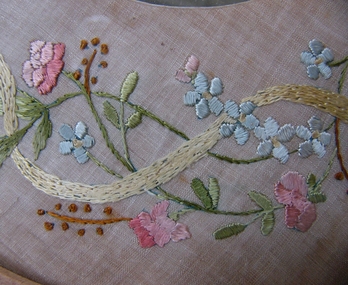
Textile - Surface Embroidered Mirror Mount, Late 19th century
... ... Ribbon work...Embroidery Picture frame Late 19th century Ribbon work Tussore silk fabric with small floral design in blue and pink intertwined with a yellow silk ribbon, round a small circular mirror. ...Tussore silk fabric with small floral design in blue and pink intertwined with a yellow silk ribbon, round a small circular mirror. The frame is a circle of natural wood.embroidery, picture frame, late 19th century, ribbon work -
 Embroiderers Guild, Victoria
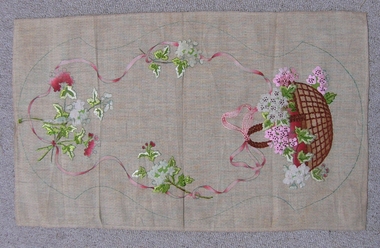
Textile - Silk Ribbon and Embroidery Kit, 1900-20
... Basket and leaves in silk embroidery and flowers in silk ribbon work. The mat's edge is marked in a scalloped shape. ...Basket and leaves in silk embroidery and flowers in silk ribbon work. The mat's edge is marked in a scalloped shape. ...Ecru textured cotton, design basket of flowers and sprays of flowers. Basket and leaves in silk embroidery and flowers in silk ribbon work. The mat's edge is marked in a scalloped shape. (no threads with kits).embroidery, silk embroidery, silk ribbon embroidery -
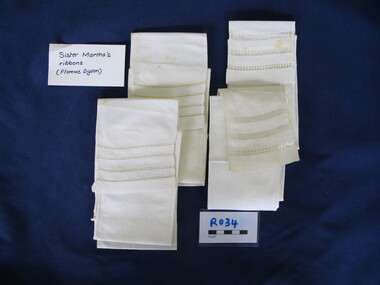 Uniting Church Archives - Synod of Victoria
Methodist ribbons
... White starched lawn ribbons with drawn thread work at one end. R034.2 is darned. ...White starched lawn ribbons with drawn thread work at one end. R034.2 is darned. ...Belonging to Florence Gertrude Edwards, Sister Martha, Deaconess of Carlton Methodist Mission. She later married the Rev. George Dyson.White starched lawn ribbons with drawn thread work at one end. R034.2 is darned. R034.1 has a join midway. -
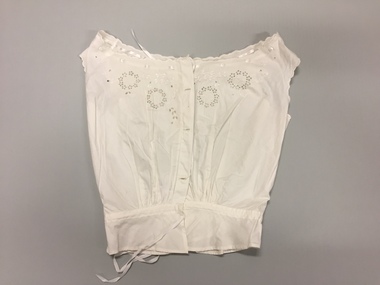 Kew Historical Society Inc
Clothing - Chemisette, 1900s
... Sleeveless chemisette with 3 pearl buttons decorated with 4 rings of cut work flowers. Ribbon threaded around the neckline. ...While the collection includes some examples of international fashion, most items were handmade or purchased in Melbourne. fashion and textiles collection - kew historical society lace women's clothing underwear undergarments chemisettes Sleeveless chemisette with 3 pearl buttons decorated with 4 rings of cut work flowers. Ribbon threaded around the neckline. ...The Fashion & Design collection of Kew Historical Society includes examples of women’s, men’s, children’s and infants' clothing from the 18th, 19th and 20th centuries. While the collection includes some examples of international fashion, most items were handmade or purchased in Melbourne. Sleeveless chemisette with 3 pearl buttons decorated with 4 rings of cut work flowers. Ribbon threaded around the neckline. Bodice gathered to attach to peplum at waist line. Handworked.fashion and textiles collection - kew historical society, lace, women's clothing, underwear, undergarments, chemisettes -
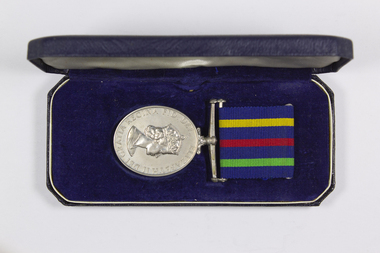 Mission to Seafarers Victoria
Medal - Medal in box, Royal Mint, Civil Defence Long Service Medal
... worked in the Merchant service. After enforced retirement due to injury he was active in Civil Defence. Donated by the estate of Mr Charles Page. charles page medal civil defence On box: "Civil Defence Long Service Medal" Commemorative cast alloy/silver-coloured oval medal with attached ribbon and pin. ...Charles worked in the Merchant service. After enforced retirement due to injury he was active in Civil Defence. Donated by the estate of Mr Charles Page. Commemorative cast alloy/silver-coloured oval medal with attached ribbon and pin. One side of medal depicts profile of QEII, while the other side depicts three shields with acorns. The medal is housed in a small blue velvet lined case.On box: "Civil Defence Long Service Medal"charles page, medal, civil defence -
 Flagstaff Hill Maritime Museum and Village
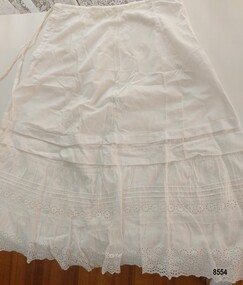
Clothing - Petticoat, late 19th century to early 20th century
... ribbons etc. were being sold in drapers shops all over England and Wales to women who were making clothes and furnishings for their families. It is highly likely that the lady who made this petticoat brought the lengths of broderie anglaise already made to embellish and personalise her petticoat. Susan's family (Harold and Gladys Vedmore) immigrated to Australia from Wales in 1955 and settled in Warrnambool. Susan was well known in the Warrnambool community for her work...ribbons etc. were being sold in drapers shops all over England and Wales to women who were making clothes and furnishings for their families. It is highly likely that the lady who made this petticoat brought the lengths of broderie anglaise already made to embellish and personalise her petticoat. Susan's family (Harold and Gladys Vedmore) immigrated to Australia from Wales in 1955 and settled in Warrnambool. Susan was well known in the Warrnambool community for her work ...This petticoat was one of several items donated from the estate of Susan Henry OAM nee Vedmore (1944 - 2021). It is in very good condition and appears to be from the Edwardian era - early 20th century. A petticoat is a lady's undergarment - worn under a skirt or dress. They provided warmth, modesty and shape to the dress. In the middle of the 19th century, petticoats were worn over hoops, bustles or in layers. Petticoats varied according to the style of the outside skirt or dress. Plain petticoats tended to be worn with everyday wear whilst better dresses (party dresses or silk gowns) were worn with petticoats that often had more trim and embellishments. Edwardian petticoats had less volume than Victorian era petticoats and they had a "dust ruffle" or lining under a lace flounce. The "dust ruffle" protected the lace flounce and gave the petticoat more flare at the bottom, greater freedom when walking as well as saving the flounce (which was often made of finer material) from everyday wear and tear. Tucks are another feature of Edwardian petticoats - when the lace at the bottom became worn, it could be cut off and the tucks released. This extended the life of the petticoat. This petticoat features an intricate trim of broderie anglaise. Although broderie anglaise was a lace that could be made by hand, it was very time consuming to make. St Gallen was a city in Switzerland that had become known for producing quality textiles. At the beginning of the 19th century, the first embroidery machines were developed in St Gallen. Factories used embroidery machines but people also had them in their homes. They were able to produce broderie anglaise for export. By the early 20th century, machine made lace, fabric, ribbons etc. were being sold in drapers shops all over England and Wales to women who were making clothes and furnishings for their families. It is highly likely that the lady who made this petticoat brought the lengths of broderie anglaise already made to embellish and personalise her petticoat. Susan's family (Harold and Gladys Vedmore) immigrated to Australia from Wales in 1955 and settled in Warrnambool. Susan was well known in the Warrnambool community for her work supporting children and families across the district - particular those with disabilities, or those who were homeless, unemployed or isolated. Susan was the founding trustee of the "Vedmore Foundation" - a Warrnambool philanthropic trust set up in 2010 to support a range of charitable and not-for-profit causes by providing grant assistance. In 2021, she was awarded a Medal of the Order of Australia for services to the community.This item is an example of the needlework skills of women in the late 19th century - creating pintucks and adding lace to personalise and embellish a practical item of clothing. It is also significant as an example of a practical solution to the difficulties that women of this era faced with regard to the washing of clothes and household linens.A white lawn petticoat with a 22.5 cm opening that fastens with 2 small buttons and a drawstring tie. It is decorated with two wide pintucks followed by two gathered frills (or flounces) - one decorated with three rows of narrow pintucks and a single row of broderie anglaise and the bottom frilled hem finished with 3 rows of broderie anglaise in a flower design. The two bottom frills are lined with plain white cotton fabric.flagstaff hill maritime museum and village, great ocean road, petticoat, lady's petticoat, undergarment, lady's undergarment, lingerie, edwardian petticoat, broderie anglaise, lace, machine made lace, hand sewn, machine sewn, draper's shop, susan henry oam, vedmore foundation -
 Flagstaff Hill Maritime Museum and Village
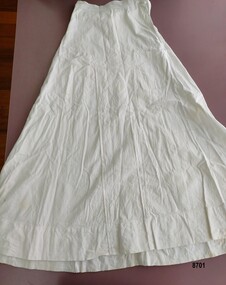
Textile - Overskirt, circa 1910
... work. This item is an example of clothing worn by working women in the late 19th and early 20th century Flagstaff Hill Maritime Museum and Village Great Ocean Road Shipwreck Coast Warrnambool overskirt needlework sewing protective garment Stephenson family A heavy cotton ankle length overskirt made with two wide gored sections containing inset pockets joined to a middle T shaped front band. It has a waistband of grosgrain ribbon ...This item is one of a collection of clothing items that belonged to the Stephenson family who lived at 22 McCracken Street, Kensington, Melbourne. Matthew Stephenson (1861 – 1943) who had grown up on the Bendigo goldfields and shifted to Melbourne in the early 1900’s was a train driver and later, a fireman with the railways. His wife Elizabeth Jane (Betsy) Wigley (1865 – 1953) also grew up on the goldfields around Majorca and Bendigo. They married in 1885 in Bendigo. They had two daughters – Ethel Evelyn Stephenson (1886 – 1956) and Lillian or Lila (1891 – 1977) who were milliners and dressmakers and who continued to live in the family home after the death of their parents. The family are recorded as living at 22 McCracken Street, Kensington, as early as 1914. It is not known who made or owned the clothing that makes up this collection but as it appears to be from the late Victorian and early Edwardian era, the different pieces were probably made and worn by any of the three ladies of the house – Betsy, Ethel and/or Lila. During W.W.2, a local Warrnambool couple (Meryl and Tony Everard) boarded with them – Tony was in the airforce training paratroopers to jump into (and survive) enemy territory and his wife Meryl worked in the Methodist baby Home. The Everards developed a close friendship with the Stephensons and were responsible for clearing out the house (and finding this clothing collection) after Lila died in 1977. This overskirt is an outer protective garment made of durable cotton and was probably worn over a lady's skirt or dress to protect it whilst they were working. The pockets are large enough for the wearer to keep small items in and there is a loop at the back that would allow the wearer to hang it on a hook, when she finished her work. This item is an example of clothing worn by working women in the late 19th and early 20th centuryA heavy cotton ankle length overskirt made with two wide gored sections containing inset pockets joined to a middle T shaped front band. It has a waistband of grosgrain ribbon and a side opening with 3 pairs of metal snaps (one pair is missing) and a hook and eye at the top. The waistband also has a taped loop (for hanging) and an unusual double fabric overlay with unattached curved ends.flagstaff hill maritime museum and village, great ocean road, shipwreck coast, warrnambool, overskirt, needlework, sewing, protective garment, stephenson family -
 Flagstaff Hill Maritime Museum and Village
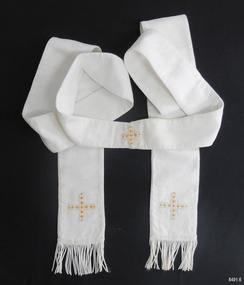
Ceremonial object - Priest's scarf, 1907 to mid 20th century
... The church was funded and attended by the local community in the early 1900's and is now listed on the Victorian Heritage Database (VHD 118083) as a building of historical and social significance. flagstaff hill warrnambool maritime museum shipwreck coast great ocean road st andrews anglican church dennington dennington church warrnambool church 1907 ecclesiastical linen communion linen hand worked linen religious service religious ceremony ceremonial linen needlework embroidered applique cross symbol priest's scarf stole priest's stole Three embroidered symbols [ribbon cross with gold-coloured borders and small gold coloured crosses along the arms] Priest's scarf, also called a stole: part of a set of Ecclesiastical Linen once used in St. ...This item is part of the collection of Ecclesiastical Linen once used by St. Andrews Anglican Church on the corner of the Esplanade and 14 Drummond St, Dennington, Victoria. The first Anglican service was conducted on December 22nd, 1907. The church was decommissioned in January 2003. This item is part of the Ecclesiastical Linen collection, which is significant for its examples of handworked embroidery and drawn-thread work from the early 20th century. The items are also examples of a collection used for religious services during this period. The Ecclesiastical Linen is also significant for its association with the early development of the local township of Dennington and the importance the the community of setting aside land in the 1850's for the purpose of religious worship. The Ecclesiastical Linen is also significant for its connection to St Andrews Anglican Church, Dennington. The church was funded and attended by the local community in the early 1900's and is now listed on the Victorian Heritage Database (VHD 118083) as a building of historical and social significance. Priest's scarf, also called a stole: part of a set of Ecclesiastical Linen once used in St. Andrew's Anglican Church, Dennington, Victoria, between the years 1907 and 2003. The rectangle of lined coarse white fabric is slightly flared at the ends, which are finished with a white twisted cotton fringe. Three cross symbols, one at each end and one in the centre, have been handworked in white ribbon with gold-coloured edging and gold embroidery in the form of rows of small crosse.. Three embroidered symbols [ribbon cross with gold-coloured borders and small gold coloured crosses along the arms]flagstaff hill, warrnambool, maritime museum, shipwreck coast, great ocean road, st andrews anglican church dennington, dennington church, warrnambool church 1907, ecclesiastical linen, communion linen, hand worked linen, religious service, religious ceremony, ceremonial linen, needlework, embroidered, applique, cross symbol, priest's scarf, stole, priest's stole -
 Flagstaff Hill Maritime Museum and Village
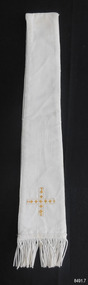
Ceremonial object - Priest's armband, 1907 to mid 20th century
... The church was funded and attended by the local community in the early 1900's and is now listed on the Victorian Heritage Database (VHD 118083) as a building of historical and social significance. flagstaff hill warrnambool maritime museum shipwreck coast great ocean road st andrews anglican church dennington dennington church warrnambool church 1907 ecclesiastical linen communion linen hand worked linen religious service religious ceremony ceremonial linen needlework embroidered applique cross symbol priest's armband Embroidered symbol [ribbon cross with gold-coloured borders and small gold-coloured crosses along the arms] Priest's armband, part of a set of Ecclesiastical Linen once used in St. ...This item is part of the collection of Ecclesiastical Linen once used by St. Andrews Anglican Church on the corner of the Esplanade and 14 Drummond St, Dennington, Victoria. The first Anglican service was conducted on December 22nd, 1907. The church was decommissioned in January 2003. This item is part of the Ecclesiastical Linen collection, which is significant for its examples of handworked embroidery and drawn-thread work from the early 20th century. The items are also examples of a collection used for religious services during this period. The Ecclesiastical Linen is also significant for its association with the early development of the local township of Dennington and the importance the the community of setting aside land in the 1850's for the purpose of religious worship. The Ecclesiastical Linen is also significant for its connection to St Andrews Anglican Church, Dennington. The church was funded and attended by the local community in the early 1900's and is now listed on the Victorian Heritage Database (VHD 118083) as a building of historical and social significance. Priest's armband, part of a set of Ecclesiastical Linen once used in St. Andrew's Anglican Church, Dennington, Victoria, between the years 1907 and 2003. The rectangle of lined coarse white fabric is slightly flared at the ends. The length has been folded in half, then stitched across its width about halfway along to form a loop on the folded half. One side has been finished with a white twisted cotton fringe. A cross symbol has been handworked on the end above the fringe, using white ribbon with gold-coloured edging and gold embroidery in the form of rows of small crosses. Embroidered symbol [ribbon cross with gold-coloured borders and small gold-coloured crosses along the arms]flagstaff hill, warrnambool, maritime museum, shipwreck coast, great ocean road, st andrews anglican church dennington, dennington church, warrnambool church 1907, ecclesiastical linen, communion linen, hand worked linen, religious service, religious ceremony, ceremonial linen, needlework, embroidered, applique, cross symbol, priest's armband -
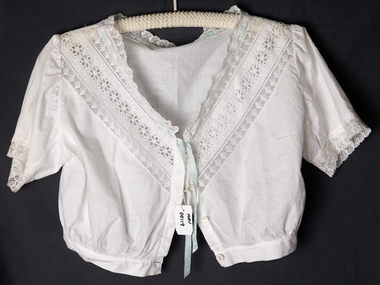 City of Moorabbin Historical Society (Operating the Box Cottage Museum)
Clothing - Clothing, girl's blouse, c1910
... ribbon inserts is an example of the dressmaking skills of the women of the families of the pioneer settlers and market gardeners of the Moorabbin Shire. The Maggs family were early settlers in Moorabbin Shire. The pioneer settlers and market gardeners of Moorabbin Shire had to be self reliant and made their own clothing and utensils. This is one of many items that exhibit the skill and craftsmanship of the women in these families. clothing brighton moorabbin dendy henry market gardeners dressmakers craft work ...This white, girl's blouse with ribbon inserts is an example of the dressmaking skills of the women of the families of the pioneer settlers and market gardeners of the Moorabbin Shire.The Maggs family were early settlers in Moorabbin Shire. The pioneer settlers and market gardeners of Moorabbin Shire had to be self reliant and made their own clothing and utensils. This is one of many items that exhibit the skill and craftsmanship of the women in these families. A white cotton , girl's blouse , decorative with ribbon insert.clothing, brighton, moorabbin, dendy henry, market gardeners, dressmakers, craft work, maggs geoff -
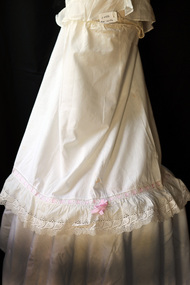 City of Moorabbin Historical Society (Operating the Box Cottage Museum)
Clothing - Clothing, lady's half-slip, c1900
... This is one of the many items that exhibit the skill and craftsmanship of the women of these families This white cotton lady's half slip is an example of the dressmaking skills and craft-work of the women of the pioneer families of Moorabbin Shire clothing brighton moorabbin bentleigh dressmaking early settlers craftwork A lady's white, fine cotton,half-slip with lace and pink ribbon insert Clothing Clothing, lady's half-slip unrecorded early settler ...The pioneer settlers and market gardeners of Moorabbin Shire had to be self reliant and made their own clothing and utensils. This is one of the many items that exhibit the skill and craftsmanship of the women of these familiesThis white cotton lady's half slip is an example of the dressmaking skills and craft-work of the women of the pioneer families of Moorabbin ShireA lady's white, fine cotton,half-slip with lace and pink ribbon insertclothing, brighton, moorabbin, bentleigh, dressmaking, early settlers, craftwork -
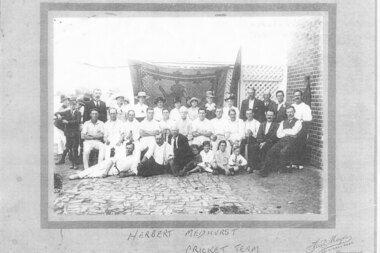 Greensborough Historical Society
Photograph - Digital image, Herb Medhurst in cricket team, 1910c
... ribbons at shows. He moved to Brunswick after his marriage in 1917 where he worked as a carter. ...ribbons at shows. He moved to Brunswick after his marriage in 1917 where he worked as a carter. ...Born in 1883, Herb was the eldest of David and Martha’s 8 children. He moved to Greensborough with the family at age 17. He was a good sportsman, playing cricket and excelling at wood chopping winning many ribbons at shows. He moved to Brunswick after his marriage in 1917 where he worked as a carter. He had many jobs and moved around Victoria finally settling in Brunswick. In this photograph, neither the team nor players are identified.Digital copy of black and white photograph.herb medhurst -
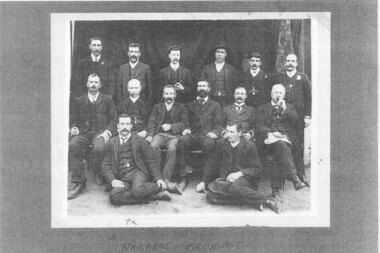 Greensborough Historical Society
Photograph - Digital image, Herb Medhurst in group, 1905c
... ribbons at shows. He moved to Brunswick after his marriage in 1917 where he worked as a carter. ...ribbons at shows. He moved to Brunswick after his marriage in 1917 where he worked as a carter. ...Born in 1883, Herb Medhurst was the eldest of David and Martha’s 8 children. He moved to Greensborough with the family at age 17. He was a good sportsman, playing cricket and excelling at wood chopping winning many ribbons at shows. He moved to Brunswick after his marriage in 1917 where he worked as a carter. He had many jobs and moved around Victoria finally settling in Brunswick. In this photograph neither the group nor individuals are identified.Digital copy of black and white studio photograph.herb medhurst -
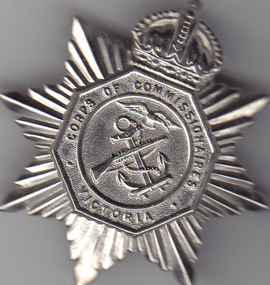 Geelong RSL Sub Branch
Badges & Ribbon, There are no makers identification, Corps of Commissionaires, 20th Century
... work for ex service men. The Corps of Commissionaires is a Security Company and is currently trading as 'Corps Security'. The Company specialises in providing corporate security. This hat badge, buttons and ribbons ...The Corps of Commissionaires was founded in 1859 to provide work for ex service men. The Corps of Commissionaires is a Security Company and is currently trading as 'Corps Security'. The Company specialises in providing corporate security.This hat badge, buttons and ribbons are the originals of someone who was employed by the Corps of Commissionaires.These items include a hat badge, uniform buttons, 2 x ribbons (colour light blue, dark blue and red) with rosettes. The two rosettes indicate 25 years service.Around to centre of the hat badge and the buttons 'Corps of Commissionaires Victoria'.commissionaires, ex serviceman -
 Glenelg Shire Council Cultural Collection
Medal - Medal - Syd Cuffe, Town Crier, c. 1993
... work across the Shire and further afield. Front: '5th WORLD TOWN CRIER CHAMPIONSHIPS', in raised lettering around town crier figure 'MARKHAM CANADA 1993' on box figure is standing on Medal, oval, silver, raised figure of a town crier in the centre of front, standing on a box. Attached to red and white maple leaf ribbon ...Syd Cuffe was the Portland Town Crier from 1983 to 2013. The role of Town Crier was created for Syd Cuffe in 1983 in the lead up to Portland’s 150th anniversary celebrations held in 1984-85. 200 items from Mr. Cuffe’s estate were donated to the Glenelg Shire Cultural Collection. The items relate to his town crying activities and community work across the Shire and further afield.Medal, oval, silver, raised figure of a town crier in the centre of front, standing on a box. Attached to red and white maple leaf ribbon.Front: '5th WORLD TOWN CRIER CHAMPIONSHIPS', in raised lettering around town crier figure 'MARKHAM CANADA 1993' on box figure is standing on -
Glenelg Shire Council Cultural Collection
Clothing - Town Crier's Coat - Syd Cuffe, 1888-1995
... work across the Shire and further afield. Syd Cuffe Portland Town Crier ceremonial regalia coat Syd Cuffe's Town Crier's coat. Navy blue, pure wool, trimmed with gold ribbon ...Syd Cuffe was the Portland Town Crier from 1983 to 2013. The role of Town Crier was created for Syd Cuffe in 1983 in the lead up to Portland’s 150th anniversary celebrations held in 1984-85. 200 items from Mr. Cuffe’s estate were donated to the Glenelg Shire Cultural Collection. The items relate to his town crying activities and community work across the Shire and further afield.Syd Cuffe's Town Crier's coat. Navy blue, pure wool, trimmed with gold ribbon and braid on collar, cuffs and lower front pockets, gold diagonal stripes on front, gold buttons (Australian Military Force)syd cuffe, portland town crier, ceremonial regalia, coat -
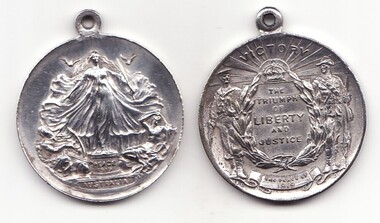 Learmonth and District Historical Society Inc.
Peace 1919 Medal, Medal Peace 1919, 1919
... work as a sculptor. Time constraints as well as pressure from the production of other victory medals meant that no single manufacturer could make the 1,670,000 medals. Six were therefore selected: Amor, Stokes, Schlank, Parkes, Angus & Coote (who later withdrew) and Platers. The medals were silvered bronze, with silver issues for special presentations. The Defence Department supplied a red, white and blue striped ribbon...work as a sculptor. Time constraints as well as pressure from the production of other victory medals meant that no single manufacturer could make the 1,670,000 medals. Six were therefore selected: Amor, Stokes, Schlank, Parkes, Angus & Coote (who later withdrew) and Platers. The medals were silvered bronze, with silver issues for special presentations. The Defence Department supplied a red, white and blue striped ribbon ...Awarded to: School Children of the Commonwealth of Australia Other Details: Of the commemorative medals issued to mark the end of the First World War, the most common was the so-called 'Peace' or 'Victory' medal issued to every child in Australia aged 0-14 years (and aged up to 16 if parents were in the armed forces). The medal was designed by Charles Douglas Richardson, better known for his work as a sculptor. Time constraints as well as pressure from the production of other victory medals meant that no single manufacturer could make the 1,670,000 medals. Six were therefore selected: Amor, Stokes, Schlank, Parkes, Angus & Coote (who later withdrew) and Platers. The medals were silvered bronze, with silver issues for special presentations. The Defence Department supplied a red, white and blue striped ribbon and pin. Distribution began in March 1919. Victorian school children received their medals on Friday 18 July and on 'Peace Day' on Saturday 19 July.To commemorate the end of World War 1.Round white metal medals issued to mark the end of WW1. On the front "PEACE 1919", and on the reverse, "VICTORY", middle of the medal "THE TRIUMPH OF LIBERTY AND JUSTICE". on the bottom "THE PEACE OF 1919". With a plain edge.Peace with two flying doves on pedestal inscribed, PEACE / 1919 below AUSTRALIA; figure in chains on left and another entangled in bush to right (obverse) Australian sailor and soldier support wreath; above, VICTORY; within, THE / TRIUMPH / OF / LIBERTY / AND / JUSTICE; below on plaque, THE PEACE OF 1919(reverse)world war 1, peace, victory medal australia -
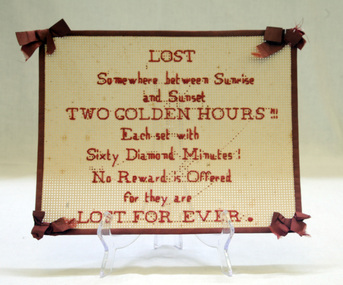 Orbost & District Historical Society
sampler, early 20th century
... work was usually framed and hung. Many of them were messages which reflected the values of the family. needlework handcraft Hand sewn ornamental sampler on a cardboard canvas and bound in ribbon with small bows at each corner." ...Decorative samplers and needlework were usually made by young women. The completed work was usually framed and hung. Many of them were messages which reflected the values of the family.Hand sewn ornamental sampler on a cardboard canvas and bound in ribbon with small bows at each corner."Lost, somewhere between sunrise & sunset, two golden hours each set with sixty diamond minutes. No reward is offered for they are gone forever.' Ribbon and cotton are crimson. needlework handcraft -
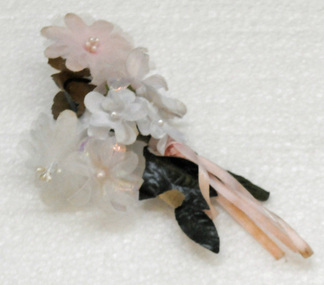 Orbost & District Historical Society
corsage, 1930's -1950's
... work - in accountants’ offices and also trained as a comptometrist with Burroughs in London. She came from a middle-class, working, church-going family. Her mother was a milliner who made many of Marjorie’s clothes, hats and outfits. Marjorie was married in 1938 to a salesman who later became a mechanic in the R.A.F. during WW11 This item is an example of a typical dress accessory and reflects women's clothing styles of the mid 20th century. corsage accessories burton-marjorie A corsage of pink and white artificial flowers with green leaves and tied with a pink ribbon. ...A corsage is a small bouquet of flowers worn on a woman's dress or worn around her wrist to a formal occasion, traditionally purchased by the woman's date. A corsage originally referred to the bodice of a woman's dress. Since a bouquet of flowers was often worn in the center of the bodice, the flowers took on the name "corsage." This corsage was worn by Marjorie Burton.It was probably pinned on a dress to decorate it and may have been made by Marjorie or her mother. Marjorie Burton ( nee Whiteman), born 12 June, in Birmingham, England came to Orbost in 1995. In England she did office work – typing, shorthand and secretarial work - in accountants’ offices and also trained as a comptometrist with Burroughs in London. She came from a middle-class, working, church-going family. Her mother was a milliner who made many of Marjorie’s clothes, hats and outfits. Marjorie was married in 1938 to a salesman who later became a mechanic in the R.A.F. during WW11This item is an example of a typical dress accessory and reflects women's clothing styles of the mid 20th century.A corsage of pink and white artificial flowers with green leaves and tied with a pink ribbon. The stems are bound with green tape. In the centre of the flowers sre tiny white pearly beads.corsage accessories burton-marjorie
