
Showing 298 items matching " sleeve bands"
-
 Embroiderers Guild, Victoria
Accessory - Sleeve Bands, Pre 1985
... Sleeve Bands...... Sleeve Bands...Chinese sleeve embroidery bands, or wanxiu became popular in the late 19th century during the Qing Dynasty, evolving from the traditional Han cuff embroidery and Manchu styles. ...Two sleeve bands. Embroidered in coloured silk and gold metal thread. ...Mostly satin stitch. Accessory Sleeve Bands ...Chinese sleeve embroidery bands, or wanxiu became popular in the late 19th century during the Qing Dynasty, evolving from the traditional Han cuff embroidery and Manchu styles. These detachable, decorated bands were added to women's informal jackets and robes, often featuring symbolic motifs like landscapes, flowers, and auspicious symbols. They served both a decorative function, displaying artistic skill and personal wishes, and a practical one by covering the sleeves when hands were folded at the waist. History and evolution: Origins: The practice of embroidering cuffs on robes existed during the previous Ming Dynasty for Han women, and this was adopted by the Manchu rulers who founded the Qing Dynasty. Qing Dynasty (1644-1911): The practice was popularized and elaborated upon during this era, with detachable bands becoming a fashionable element for informal wear. Symbolism: The embroidery included a complex visual vocabulary of wishes for a long life, many offspring, and a happy marriage, derived from nature, mythology, and classical literature. Functionality: Women would fold their arms, often with their hands inside the sleeves, so the embroidered bands, which were sewn to hang down the back of the jacket, would be displayed prominently down the front. 19th century peak: The late 19th century was the peak of their popularity, with intricate designs becoming fashionable and even influenced by court tastes, such as those favoured by the Empress Dowager Cixi. Later developments: The late 19th century saw the introduction of chemical 'aniline' dyes from Europe, leading to brighter, bolder colours in embroidery. Motifs and their Meanings: Auspicious symbols: Designs often included symbols for good fortune, wealth, and longevity. Natural imagery: Birds, flowers, and landscapes were common motifs that could represent natural beauty or convey specific symbolic meanings. Figurative scenes: Bands could also feature narrative scenes from classical stories or legends. The choice of motifs allowed women to express personal desires, cultural values, and aesthetic preferences, reflecting a more personal and informal style than official court attire.Two sleeve bands. Embroidered in coloured silk and gold metal thread. Motifs of lotus flowers, birds, swastikas and other flowers. Mostly satin stitch.embroidery, silk embroidery, japan, oriental, sleeve bands, garments -
 Embroiderers Guild, Victoria
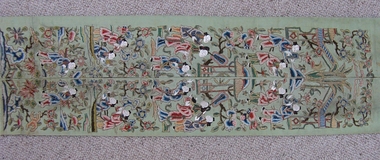
Accessory - Pair of Chinese Sleeve Bands, Late 19th century
... Pair of Chinese Sleeve Bands...... Sleeve Bands...Chinese sleeve embroidery bands, or wanxiu became popular in the late 19th century during the Qing Dynasty, evolving from the traditional Han cuff embroidery and Manchu styles. ...Pair of Chinese Sleeve bands using Pekin knots, satin stitch. ...Accessory Pair of Chinese Sleeve Bands ...Chinese sleeve embroidery bands, or wanxiu became popular in the late 19th century during the Qing Dynasty, evolving from the traditional Han cuff embroidery and Manchu styles. These detachable, decorated bands were added to women's informal jackets and robes, often featuring symbolic motifs like landscapes, flowers, and auspicious symbols. They served both a decorative function, displaying artistic skill and personal wishes, and a practical one by covering the sleeves when hands were folded at the waist. History and evolution: Origins: The practice of embroidering cuffs on robes existed during the previous Ming Dynasty for Han women, and this was adopted by the Manchu rulers who founded the Qing Dynasty. Qing Dynasty (1644-1911): The practice was popularized and elaborated upon during this era, with detachable bands becoming a fashionable element for informal wear. Symbolism: The embroidery included a complex visual vocabulary of wishes for a long life, many offspring, and a happy marriage, derived from nature, mythology, and classical literature. Functionality: Women would fold their arms, often with their hands inside the sleeves, so the embroidered bands, which were sewn to hang down the back of the jacket, would be displayed prominently down the front. 19th century peak: The late 19th century was the peak of their popularity, with intricate designs becoming fashionable and even influenced by court tastes, such as those favoured by the Empress Dowager Cixi. Later developments: The late 19th century saw the introduction of chemical 'aniline' dyes from Europe, leading to brighter, bolder colours in embroidery. Motifs and their Meanings: Auspicious symbols: Designs often included symbols for good fortune, wealth, and longevity. Natural imagery: Birds, flowers, and landscapes were common motifs that could represent natural beauty or convey specific symbolic meanings. Figurative scenes: Bands could also feature narrative scenes from classical stories or legends. The choice of motifs allowed women to express personal desires, cultural values, and aesthetic preferences, reflecting a more personal and informal style than official court attire. Looking at the cuffs from bottom to top: there is a rock formation, a zig zag fence and flowers (chrysanthemums and a branch with Buddha's hand citron). Next is a male figure carrying a halberd over his shoulder and surrounded by flowers, foliage and hillocks. Above are two more males in a boat. One is standing, the other kneeling. The one kneeling holds a bamboo pipe, while the one standing holds a branch with pomegranates. The men are surrounded by more flowers, foliage, rocks and bats . Three more figures come next. A male holding a fan, a woman holding a dish and another male. The woman on the left cuff holds a dish which appears to hold fruit, whereas the woman on the right cuff holds a dish containing a ? hat. Further up is a pagoda with a pomegranate tree and two more male figures. One holds the sacred fungus, the other a vase with a lotus flower. Finally there are two pagodas, leaves, flowers and clouds. Symbolism: Buddha's (foshou) hand citron. This plant derives it's name from the shape of the fruit, which is said to resemble Buddha's hand. 'Foshou' is used as a pun from blessings (fu) and longevity (shou). Chrysanthemum - longevity. Halberd - a spear like object symbolizing rank and military achievement. Halberd (ji) is a pun for rank (ji) and represents rapid promotion and doing well in officialdom or politics. Bamboo pipe or mouth organ (skeng) is a pun for giving birth (skeng). The image of a boy with a mouth organ implies the wish for a son. Pomegranate- symbolizes many sons (or possibly children). Boat - may be travelling from or to. Fan (shan)- longevity, and also a pun for goodness (shan). Boy pointing upwards (?to the sun) - may you rise in rank (zhri goosheng). The act of pointing at the sun is a pun for 'soon' (zhri). Fungus - resembles the head of a wish granting wand (ruyi) and has the same meaning of 'as you wish'. Lotus flower - (he) is a pun for harmony. Vase - (ping) a pun for peace (ping'an) therefore a vase with lotus - peace and harmony. These sleeve bands are more generic but they do convey a wish for many sons who will become officials and bring fortune. Dr Rachel Silberstein, visiting Associate Professor at Rhode Island School of Design.Pair of Chinese Sleeve bands using Pekin knots, satin stitch. Depicts an outdoor scene with pagodas, people, zig zag fences, boats and plants embroidered on a pale green silk ground. Both cuffs have been joined at the bottom.embroidery, garments, silk embroidery, china, sleeve bands, late 19th century, garden, figures -
 Embroiderers Guild, Victoria
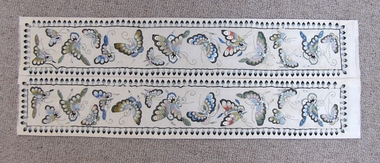
Clothing - Pair of Chinese Embroidered Sleeve Bands, 19 th C
... Pair of Chinese Embroidered Sleeve Bands......sleeve band...Chinese sleeve embroidery bands, or wanxiu became popular in the late 19th century during the Qing Dynasty, evolving from the traditional Han cuff embroidery and Manchu styles. ...Pair of sleeve bands with embroidered butterflies worked in satin stitch. ...Silk Embroidery China Butterflies sleeve band Pair of sleeve bands with embroidered butterflies worked in satin stitch. ...Chinese sleeve embroidery bands, or wanxiu became popular in the late 19th century during the Qing Dynasty, evolving from the traditional Han cuff embroidery and Manchu styles. These detachable, decorated bands were added to women's informal jackets and robes, often featuring symbolic motifs like landscapes, flowers, and auspicious symbols. They served both a decorative function, displaying artistic skill and personal wishes, and a practical one by covering the sleeves when hands were folded at the waist. History and evolution: Origins: The practice of embroidering cuffs on robes existed during the previous Ming Dynasty for Han women, and this was adopted by the Manchu rulers who founded the Qing Dynasty. Qing Dynasty (1644-1911): The practice was popularized and elaborated upon during this era, with detachable bands becoming a fashionable element for informal wear. Symbolism: The embroidery included a complex visual vocabulary of wishes for a long life, many offspring, and a happy marriage, derived from nature, mythology, and classical literature. Functionality: Women would fold their arms, often with their hands inside the sleeves, so the embroidered bands, which were sewn to hang down the back of the jacket, would be displayed prominently down the front. 19th century peak: The late 19th century was the peak of their popularity, with intricate designs becoming fashionable and even influenced by court tastes, such as those favoured by the Empress Dowager Cixi. Later developments: The late 19th century saw the introduction of chemical 'aniline' dyes from Europe, leading to brighter, bolder colours in embroidery. Motifs and their Meanings: Auspicious symbols: Designs often included symbols for good fortune, wealth, and longevity. Natural imagery: Birds, flowers, and landscapes were common motifs that could represent natural beauty or convey specific symbolic meanings. Figurative scenes: Bands could also feature narrative scenes from classical stories or legends. The choice of motifs allowed women to express personal desires, cultural values, and aesthetic preferences, reflecting a more personal and informal style than official court attire.Pair of sleeve bands with embroidered butterflies worked in satin stitch. Ivory satin background and embroidered in silk thread silk embroidery, china, butterflies, sleeve band -
 Embroiderers Guild, Victoria
Accessory - Chinese Sleeve Bands
... Chinese Sleeve Bands...Never been worn. Chinese sleeve embroidery bands, or wanxiu became popular in the late 19th century during the Qing Dynasty, evolving from the traditional Han cuff embroidery and Manchu styles. ...A pair of sleeve bands. Embroidered in gold metallic thread on blue silk fabric in a pattern of peonies, bats and other auspicious symbols....Accessory Chinese Sleeve Bands ...Purchased in Singapore circa 1920 and believed to be old then. Never been worn. Chinese sleeve embroidery bands, or wanxiu became popular in the late 19th century during the Qing Dynasty, evolving from the traditional Han cuff embroidery and Manchu styles. These detachable, decorated bands were added to women's informal jackets and robes, often featuring symbolic motifs like landscapes, flowers, and auspicious symbols. They served both a decorative function, displaying artistic skill and personal wishes, and a practical one by covering the sleeves when hands were folded at the waist. History and evolution: Origins: The practice of embroidering cuffs on robes existed during the previous Ming Dynasty for Han women, and this was adopted by the Manchu rulers who founded the Qing Dynasty. Qing Dynasty (1644-1911): The practice was popularized and elaborated upon during this era, with detachable bands becoming a fashionable element for informal wear. Symbolism: The embroidery included a complex visual vocabulary of wishes for a long life, many offspring, and a happy marriage, derived from nature, mythology, and classical literature. Functionality: Women would fold their arms, often with their hands inside the sleeves, so the embroidered bands, which were sewn to hang down the back of the jacket, would be displayed prominently down the front. 19th century peak: The late 19th century was the peak of their popularity, with intricate designs becoming fashionable and even influenced by court tastes, such as those favoured by the Empress Dowager Cixi. Later developments: The late 19th century saw the introduction of chemical 'aniline' dyes from Europe, leading to brighter, bolder colours in embroidery. Motifs and their Meanings: Auspicious symbols: Designs often included symbols for good fortune, wealth, and longevity. Natural imagery: Birds, flowers, and landscapes were common motifs that could represent natural beauty or convey specific symbolic meanings. Figurative scenes: Bands could also feature narrative scenes from classical stories or legends. The choice of motifs allowed women to express personal desires, cultural values, and aesthetic preferences, reflecting a more personal and informal style than official court attire.A pair of sleeve bands. Embroidered in gold metallic thread on blue silk fabric in a pattern of peonies, bats and other auspicious symbols.embroidery, metal thread, embroidery, garments, japan -
 Embroiderers Guild, Victoria
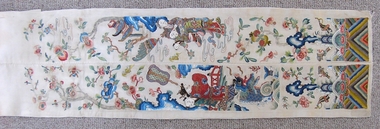
Accessory - Pair of Chinese Embroidered Sleeve Bands, 19 th C
... Pair of Chinese Embroidered Sleeve Bands..."This pair of sleeve bands are two halves of a scene known as "tian xian song zi" or "Heavenly immortals deliver a son". ...Accessory Pair of Chinese Embroidered Sleeve Bands ...Chinese sleeve embroidery bands, or wanxiu became popular in the late 19th century during the Qing Dynasty, evolving from the traditional Han cuff embroidery and Manchu styles. These detachable, decorated bands were added to women's informal jackets and robes, often featuring symbolic motifs like landscapes, flowers, and auspicious symbols. They served both a decorative function, displaying artistic skill and personal wishes, and a practical one by covering the sleeves when hands were folded at the waist. History and evolution: Origins: The practice of embroidering cuffs on robes existed during the previous Ming Dynasty for Han women, and this was adopted by the Manchu rulers who founded the Qing Dynasty. Qing Dynasty (1644-1911): The practice was popularized and elaborated upon during this era, with detachable bands becoming a fashionable element for informal wear. Symbolism: The embroidery included a complex visual vocabulary of wishes for a long life, many offspring, and a happy marriage, derived from nature, mythology, and classical literature. Functionality: Women would fold their arms, often with their hands inside the sleeves, so the embroidered bands, which were sewn to hang down the back of the jacket, would be displayed prominently down the front. 19th century peak: The late 19th century was the peak of their popularity, with intricate designs becoming fashionable and even influenced by court tastes, such as those favoured by the Empress Dowager Cixi. Later developments: The late 19th century saw the introduction of chemical 'aniline' dyes from Europe, leading to brighter, bolder colours in embroidery. Motifs and their Meanings: Auspicious symbols: Designs often included symbols for good fortune, wealth, and longevity. Natural imagery: Birds, flowers, and landscapes were common motifs that could represent natural beauty or convey specific symbolic meanings. Figurative scenes: Bands could also feature narrative scenes from classical stories or legends. The choice of motifs allowed women to express personal desires, cultural values, and aesthetic preferences, reflecting a more personal and informal style than official court attire. Symbolism: Mountains and sea, clouds and waves - Good luck. Dragon/fish tail/flaming pearl = Good fortune. This refers to the legend 'liyutiaolongmen' - a carp rising from the waves with the head already changed into a dragon implies the wish for success in the civil service examination. It is an allegory for the persistent effort needed to overcome obstacles. Male with black hat - Zhuang Yuan conferred. Among patterns with implied meanings , patterns related to the pursuits of scholarly honour and official rand include mainly the 'three number ones'. 'Zheng Yuan conferred' and 'carp jumping over the dragon gate'. In feudal society, examiners for the official positions had to go through three different levels of examinations. Bats - the work for bat is 'fu' and is a visual pun for the word happiness 'fu'. Rhino horn - wealth and good fortune. The ruyi sceptre - is a curved decorative Chinese object that symbolizes power, good fortune, and the wish that “things go as you desire.” The head of the sceptre resembles the 'lingzhi' of the 'longevity fungus'. Pomegranate - fertility ie; offspring, a virtue in China. Boy holding the flowering branch in the arms of the woman - in the selection of officials through imperial examinations in feudal society, the winner of an official position is described as ' having picked the crown'. 'Gui' (sweet scented osmanthus) and 'gui' (high rank or official) are very close in sound Chinese. In this design the boy in the woman's arms is seen waving a sweet scented osmanthus, thus an auspicious message is delivered. Information from Dr Rachel Silberstein, visiting Associate Professor at Rhode Island School of Design. "This pair of sleeve bands are two halves of a scene known as "tian xian song zi" or "Heavenly immortals deliver a son". The historical origins of this saying is a story from 'The History of the Wei Imperial records', involving the Emperor Sheng and an immortal maiden who presents him with a son. After this, the expression "tian xian song zi" came to be used as good wishes for marriage, closely associated with 'qilin song zi' (the qilin delivers a son), another popular topic in nianhua popular prints". Both cuffs show figures in an outdoor setting, done in colourful silk thread on a ivory satin. Reading from the bottom to the top of the cuff both have pointed mountains, clouds and sea with a rhino horn and a 'rui' coming out of the waves. Left cuff: above the sea there are a fish/dragon and a flaming pearl. Next two male figures standing on a bridge. One holds a fan and the other is wearing a black hat. More flowers, peonies and blossoms are above the figures. Right cuff: Above the water and mountains is a bat, peonies and pomegranates. Above these are three figures and another bat. The figure in there rear holds a feathered fan, while the front figure holds a child, who is holding a flowering branch. Above the trio is a low pagoda and blossoms. Silk satin stitch, Pekin knots and couched gold metal thread.embroidery, garments, silk embroidery, china, landscape, garden, figures -
 Embroiderers Guild, Victoria
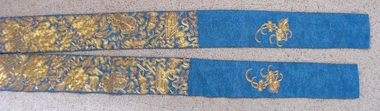
Accessory - Sleeve Bands, Pre 1985
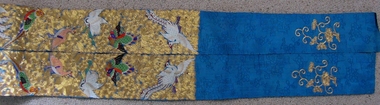
... Sleeve Bands...Chinese sleeve embroidery bands, or wanxiu became popular in the late 19th century during the Qing Dynasty, evolving from the traditional Han cuff embroidery and Manchu styles. ...There is a gold spray (floral) at the base of each band. Accessory Sleeve Bands ...Chinese sleeve embroidery bands, or wanxiu became popular in the late 19th century during the Qing Dynasty, evolving from the traditional Han cuff embroidery and Manchu styles. These detachable, decorated bands were added to women's informal jackets and robes, often featuring symbolic motifs like landscapes, flowers, and auspicious symbols. They served both a decorative function, displaying artistic skill and personal wishes, and a practical one by covering the sleeves when hands were folded at the waist. History and evolution: Origins: The practice of embroidering cuffs on robes existed during the previous Ming Dynasty for Han women, and this was adopted by the Manchu rulers who founded the Qing Dynasty. Qing Dynasty (1644-1911): The practice was popularized and elaborated upon during this era, with detachable bands becoming a fashionable element for informal wear. Symbolism: The embroidery included a complex visual vocabulary of wishes for a long life, many offspring, and a happy marriage, derived from nature, mythology, and classical literature. Functionality: Women would fold their arms, often with their hands inside the sleeves, so the embroidered bands, which were sewn to hang down the back of the jacket, would be displayed prominently down the front. 19th century peak: The late 19th century was the peak of their popularity, with intricate designs becoming fashionable and even influenced by court tastes, such as those favoured by the Empress Dowager Cixi. Later developments: The late 19th century saw the introduction of chemical 'aniline' dyes from Europe, leading to brighter, bolder colours in embroidery. Motifs and their Meanings: Auspicious symbols: Designs often included symbols for good fortune, wealth, and longevity. Natural imagery: Birds, flowers, and landscapes were common motifs that could represent natural beauty or convey specific symbolic meanings. Figurative scenes: Bands could also feature narrative scenes from classical stories or legends. The choice of motifs allowed women to express personal desires, cultural values, and aesthetic preferences, reflecting a more personal and informal style than official court attire.Pair of rich blue silk (figured) bands, 66 cm of which is heavily embroidered in couched gold metal threads in a swirling pattern, with coloured silk birds (18). There is a gold spray (floral) at the base of each band.embroidery, garments, silk embroidery, metal thread, chinese -
 Embroiderers Guild, Victoria
Accessory - Pair of Chinese Embroidered Sleeve Bands
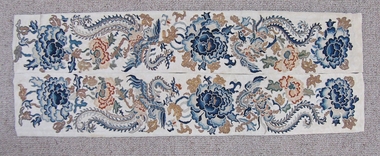
... Pair of Chinese Embroidered Sleeve Bands...Chinese sleeve embroidery bands, or wanxiu became popular in the late 19th century during the Qing Dynasty, evolving from the traditional Han cuff embroidery and Manchu styles. ...Accessory Pair of Chinese Embroidered Sleeve Bands ...Chinese sleeve embroidery bands, or wanxiu became popular in the late 19th century during the Qing Dynasty, evolving from the traditional Han cuff embroidery and Manchu styles. These detachable, decorated bands were added to women's informal jackets and robes, often featuring symbolic motifs like landscapes, flowers, and auspicious symbols. They served both a decorative function, displaying artistic skill and personal wishes, and a practical one by covering the sleeves when hands were folded at the waist. History and evolution: Origins: The practice of embroidering cuffs on robes existed during the previous Ming Dynasty for Han women, and this was adopted by the Manchu rulers who founded the Qing Dynasty. Qing Dynasty (1644-1911): The practice was popularized and elaborated upon during this era, with detachable bands becoming a fashionable element for informal wear. Symbolism: The embroidery included a complex visual vocabulary of wishes for a long life, many offspring, and a happy marriage, derived from nature, mythology, and classical literature. Functionality: Women would fold their arms, often with their hands inside the sleeves, so the embroidered bands, which were sewn to hang down the back of the jacket, would be displayed prominently down the front. 19th century peak: The late 19th century was the peak of their popularity, with intricate designs becoming fashionable and even influenced by court tastes, such as those favoured by the Empress Dowager Cixi. Later developments: The late 19th century saw the introduction of chemical 'aniline' dyes from Europe, leading to brighter, bolder colours in embroidery. Motifs and their Meanings: Auspicious symbols: Designs often included symbols for good fortune, wealth, and longevity. Natural imagery: Birds, flowers, and landscapes were common motifs that could represent natural beauty or convey specific symbolic meanings. Figurative scenes: Bands could also feature narrative scenes from classical stories or legends. The choice of motifs allowed women to express personal desires, cultural values, and aesthetic preferences, reflecting a more personal and informal style than official court attire.Pale green brocade with Pekin knot stitch in blue, green, cream and brown. Large heads and the phoenix used in the design. Gold thread couched with cream thread.embroidery, garments, silk embroidery, oriental, china -
 Embroiderers Guild, Victoria
Accessory - Pair of Chinese Sleeve Bands, Late 19th Century
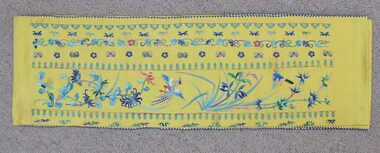
... Pair of Chinese Sleeve Bands...Chinese sleeve embroidery bands, or wanxiu became popular in the late 19th century during the Qing Dynasty, evolving from the traditional Han cuff embroidery and Manchu styles. ...Accessory Pair of Chinese Sleeve Bands ...Chinese sleeve embroidery bands, or wanxiu became popular in the late 19th century during the Qing Dynasty, evolving from the traditional Han cuff embroidery and Manchu styles. These detachable, decorated bands were added to women's informal jackets and robes, often featuring symbolic motifs like landscapes, flowers, and auspicious symbols. They served both a decorative function, displaying artistic skill and personal wishes, and a practical one by covering the sleeves when hands were folded at the waist. History and evolution: Origins: The practice of embroidering cuffs on robes existed during the previous Ming Dynasty for Han women, and this was adopted by the Manchu rulers who founded the Qing Dynasty. Qing Dynasty (1644-1911): The practice was popularized and elaborated upon during this era, with detachable bands becoming a fashionable element for informal wear. Symbolism: The embroidery included a complex visual vocabulary of wishes for a long life, many offspring, and a happy marriage, derived from nature, mythology, and classical literature. Functionality: Women would fold their arms, often with their hands inside the sleeves, so the embroidered bands, which were sewn to hang down the back of the jacket, would be displayed prominently down the front. 19th century peak: The late 19th century was the peak of their popularity, with intricate designs becoming fashionable and even influenced by court tastes, such as those favoured by the Empress Dowager Cixi. Later developments: The late 19th century saw the introduction of chemical 'aniline' dyes from Europe, leading to brighter, bolder colours in embroidery. Motifs and their Meanings: Auspicious symbols: Designs often included symbols for good fortune, wealth, and longevity. Natural imagery: Birds, flowers, and landscapes were common motifs that could represent natural beauty or convey specific symbolic meanings. Figurative scenes: Bands could also feature narrative scenes from classical stories or legends. The choice of motifs allowed women to express personal desires, cultural values, and aesthetic preferences, reflecting a more personal and informal style than official court attire.Yellow silk satin, silk embroidery depicting birds and flowers in bright blues, greens, mauve, orange and pinks.embroidery, garments, silk embroidery, china, late 19th century, flowers, garden, bird -
 Embroiderers Guild, Victoria
Accessory - Pair of Chinese Embroidered Sleeve Bands, 19 th C
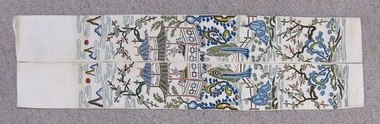
... Pair of Chinese Embroidered Sleeve Bands...Chinese sleeve embroidery bands, or wanxiu became popular in the late 19th century during the Qing Dynasty, evolving from the traditional Han cuff embroidery and Manchu styles. ...Accessory Pair of Chinese Embroidered Sleeve Bands ...Chinese sleeve embroidery bands, or wanxiu became popular in the late 19th century during the Qing Dynasty, evolving from the traditional Han cuff embroidery and Manchu styles. These detachable, decorated bands were added to women's informal jackets and robes, often featuring symbolic motifs like landscapes, flowers, and auspicious symbols. They served both a decorative function, displaying artistic skill and personal wishes, and a practical one by covering the sleeves when hands were folded at the waist. History and evolution: Origins: The practice of embroidering cuffs on robes existed during the previous Ming Dynasty for Han women, and this was adopted by the Manchu rulers who founded the Qing Dynasty. Qing Dynasty (1644-1911): The practice was popularized and elaborated upon during this era, with detachable bands becoming a fashionable element for informal wear. Symbolism: The embroidery included a complex visual vocabulary of wishes for a long life, many offspring, and a happy marriage, derived from nature, mythology, and classical literature. Functionality: Women would fold their arms, often with their hands inside the sleeves, so the embroidered bands, which were sewn to hang down the back of the jacket, would be displayed prominently down the front. 19th century peak: The late 19th century was the peak of their popularity, with intricate designs becoming fashionable and even influenced by court tastes, such as those favoured by the Empress Dowager Cixi. Later developments: The late 19th century saw the introduction of chemical 'aniline' dyes from Europe, leading to brighter, bolder colours in embroidery. Motifs and their Meanings: Auspicious symbols: Designs often included symbols for good fortune, wealth, and longevity. Natural imagery: Birds, flowers, and landscapes were common motifs that could represent natural beauty or convey specific symbolic meanings. Figurative scenes: Bands could also feature narrative scenes from classical stories or legends. The choice of motifs allowed women to express personal desires, cultural values, and aesthetic preferences, reflecting a more personal and informal style than official court attire.Cream satin, silk embroidery in Pekin knot stitch. Fine couched cord. Rural setting with figures, trees and pagoda.embroidery, garments, silk embroidery, china, garden, figures, lanscape -
 Embroiderers Guild, Victoria
Accessory - Pair of Chinese Sleeve Bands, Mid 19th Century
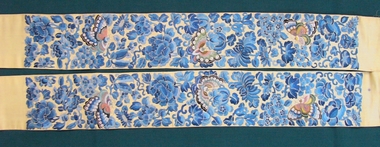
... Pair of Chinese Sleeve Bands...Chinese sleeve embroidery bands, or wanxiu became popular in the late 19th century during the Qing Dynasty, evolving from the traditional Han cuff embroidery and Manchu styles. ...Accessory Pair of Chinese Sleeve Bands ...Chinese sleeve embroidery bands, or wanxiu became popular in the late 19th century during the Qing Dynasty, evolving from the traditional Han cuff embroidery and Manchu styles. These detachable, decorated bands were added to women's informal jackets and robes, often featuring symbolic motifs like landscapes, flowers, and auspicious symbols. They served both a decorative function, displaying artistic skill and personal wishes, and a practical one by covering the sleeves when hands were folded at the waist. History and evolution: Origins: The practice of embroidering cuffs on robes existed during the previous Ming Dynasty for Han women, and this was adopted by the Manchu rulers who founded the Qing Dynasty. Qing Dynasty (1644-1911): The practice was popularized and elaborated upon during this era, with detachable bands becoming a fashionable element for informal wear. Symbolism: The embroidery included a complex visual vocabulary of wishes for a long life, many offspring, and a happy marriage, derived from nature, mythology, and classical literature. Functionality: Women would fold their arms, often with their hands inside the sleeves, so the embroidered bands, which were sewn to hang down the back of the jacket, would be displayed prominently down the front. 19th century peak: The late 19th century was the peak of their popularity, with intricate designs becoming fashionable and even influenced by court tastes, such as those favoured by the Empress Dowager Cixi. Later developments: The late 19th century saw the introduction of chemical 'aniline' dyes from Europe, leading to brighter, bolder colours in embroidery. Motifs and their Meanings: Auspicious symbols: Designs often included symbols for good fortune, wealth, and longevity. Natural imagery: Birds, flowers, and landscapes were common motifs that could represent natural beauty or convey specific symbolic meanings. Figurative scenes: Bands could also feature narrative scenes from classical stories or legends. The choice of motifs allowed women to express personal desires, cultural values, and aesthetic preferences, reflecting a more personal and informal style than official court attire.Pale gold satin. Design of peonies embroidered in shades of blue satin stitch with coloured butterflies..embroidery, garments, silk embroidery, mid 19th century, china, oriental -
 Embroiderers Guild, Victoria
Accessory - Pair of Chinese Sleeve Bands, Mid 19th Century
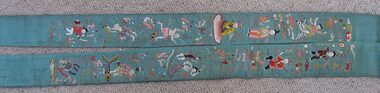
... Pair of Chinese Sleeve Bands...Chinese sleeve embroidery bands, or wanxiu became popular in the late 19th century during the Qing Dynasty, evolving from the traditional Han cuff embroidery and Manchu styles. ...Accessory Pair of Chinese Sleeve Bands ...Chinese sleeve embroidery bands, or wanxiu became popular in the late 19th century during the Qing Dynasty, evolving from the traditional Han cuff embroidery and Manchu styles. These detachable, decorated bands were added to women's informal jackets and robes, often featuring symbolic motifs like landscapes, flowers, and auspicious symbols. They served both a decorative function, displaying artistic skill and personal wishes, and a practical one by covering the sleeves when hands were folded at the waist. History and evolution: Origins: The practice of embroidering cuffs on robes existed during the previous Ming Dynasty for Han women, and this was adopted by the Manchu rulers who founded the Qing Dynasty. Qing Dynasty (1644-1911): The practice was popularized and elaborated upon during this era, with detachable bands becoming a fashionable element for informal wear. Symbolism: The embroidery included a complex visual vocabulary of wishes for a long life, many offspring, and a happy marriage, derived from nature, mythology, and classical literature. Functionality: Women would fold their arms, often with their hands inside the sleeves, so the embroidered bands, which were sewn to hang down the back of the jacket, would be displayed prominently down the front. 19th century peak: The late 19th century was the peak of their popularity, with intricate designs becoming fashionable and even influenced by court tastes, such as those favoured by the Empress Dowager Cixi. Later developments: The late 19th century saw the introduction of chemical 'aniline' dyes from Europe, leading to brighter, bolder colours in embroidery. Motifs and their Meanings: Auspicious symbols: Designs often included symbols for good fortune, wealth, and longevity. Natural imagery: Birds, flowers, and landscapes were common motifs that could represent natural beauty or convey specific symbolic meanings. Figurative scenes: Bands could also feature narrative scenes from classical stories or legends. The choice of motifs allowed women to express personal desires, cultural values, and aesthetic preferences, reflecting a more personal and informal style than official court attire.Mid green silk embroidered with a variety of coloured silk threads and some metal thread.embroidery, garments, china, mid 19th century, figures, fish, turtle, sea -
 Embroiderers Guild, Victoria
Accessory - Pair of Chinese Sleeve Bands
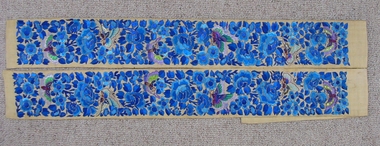
... Pair of Chinese Sleeve Bands...Peonies - flowers of happiness. Chinese sleeve embroidery bands, or wanxiu became popular in the late 19th century during the Qing Dynasty, evolving from the traditional Han cuff embroidery and Manchu styles. ...Accessory Pair of Chinese Sleeve Bands ...Butterfly is a symbol of happiness and conjugal bliss. Peonies - flowers of happiness. Chinese sleeve embroidery bands, or wanxiu became popular in the late 19th century during the Qing Dynasty, evolving from the traditional Han cuff embroidery and Manchu styles. These detachable, decorated bands were added to women's informal jackets and robes, often featuring symbolic motifs like landscapes, flowers, and auspicious symbols. They served both a decorative function, displaying artistic skill and personal wishes, and a practical one by covering the sleeves when hands were folded at the waist. History and evolution: Origins: The practice of embroidering cuffs on robes existed during the previous Ming Dynasty for Han women, and this was adopted by the Manchu rulers who founded the Qing Dynasty. Qing Dynasty (1644-1911): The practice was popularized and elaborated upon during this era, with detachable bands becoming a fashionable element for informal wear. Symbolism: The embroidery included a complex visual vocabulary of wishes for a long life, many offspring, and a happy marriage, derived from nature, mythology, and classical literature. Functionality: Women would fold their arms, often with their hands inside the sleeves, so the embroidered bands, which were sewn to hang down the back of the jacket, would be displayed prominently down the front. 19th century peak: The late 19th century was the peak of their popularity, with intricate designs becoming fashionable and even influenced by court tastes, such as those favoured by the Empress Dowager Cixi. Later developments: The late 19th century saw the introduction of chemical 'aniline' dyes from Europe, leading to brighter, bolder colours in embroidery. Motifs and their Meanings: Auspicious symbols: Designs often included symbols for good fortune, wealth, and longevity. Natural imagery: Birds, flowers, and landscapes were common motifs that could represent natural beauty or convey specific symbolic meanings. Figurative scenes: Bands could also feature narrative scenes from classical stories or legends. The choice of motifs allowed women to express personal desires, cultural values, and aesthetic preferences, reflecting a more personal and informal style than official court attire.Old gold satin embroidered with blue flowers and leaves in silks. Butterflies worked in mauve, green, blue, cream, burgundy and aquamarine.embroidery, garments, silk embroidery, china, oriental, butterflies, flowers -
 Embroiderers Guild, Victoria
Accessory - Pair of Chinese Embroidered Sleeve Bands, 1880
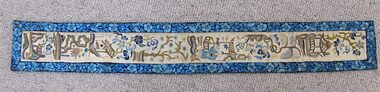
... Pair of Chinese Embroidered Sleeve Bands...Label attached to record card states "Chinese Embroidery from the Royal Palace, Pekin J.M.S." Chinese sleeve embroidery bands, or wanxiu became popular in the late 19th century during the Qing Dynasty, evolving from the traditional Han cuff embroidery and Manchu styles. ...Accessory Pair of Chinese Embroidered Sleeve Bands ...Label attached to record card states "Chinese Embroidery from the Royal Palace, Pekin J.M.S." Chinese sleeve embroidery bands, or wanxiu became popular in the late 19th century during the Qing Dynasty, evolving from the traditional Han cuff embroidery and Manchu styles. These detachable, decorated bands were added to women's informal jackets and robes, often featuring symbolic motifs like landscapes, flowers, and auspicious symbols. They served both a decorative function, displaying artistic skill and personal wishes, and a practical one by covering the sleeves when hands were folded at the waist. History and evolution: Origins: The practice of embroidering cuffs on robes existed during the previous Ming Dynasty for Han women, and this was adopted by the Manchu rulers who founded the Qing Dynasty. Qing Dynasty (1644-1911): The practice was popularized and elaborated upon during this era, with detachable bands becoming a fashionable element for informal wear. Symbolism: The embroidery included a complex visual vocabulary of wishes for a long life, many offspring, and a happy marriage, derived from nature, mythology, and classical literature. Functionality: Women would fold their arms, often with their hands inside the sleeves, so the embroidered bands, which were sewn to hang down the back of the jacket, would be displayed prominently down the front. 19th century peak: The late 19th century was the peak of their popularity, with intricate designs becoming fashionable and even influenced by court tastes, such as those favoured by the Empress Dowager Cixi. Later developments: The late 19th century saw the introduction of chemical 'aniline' dyes from Europe, leading to brighter, bolder colours in embroidery. Motifs and their Meanings: Auspicious symbols: Designs often included symbols for good fortune, wealth, and longevity. Natural imagery: Birds, flowers, and landscapes were common motifs that could represent natural beauty or convey specific symbolic meanings. Figurative scenes: Bands could also feature narrative scenes from classical stories or legends. The choice of motifs allowed women to express personal desires, cultural values, and aesthetic preferences, reflecting a more personal and informal style than official court attire. Pagoda: an omen of good. Two birds (possibly swallows): an omen approaching spring and also of approaching success. Rooster: a symbol of high rank (it's comb/crown (jinguan) is a pun for 'official' guan). Peony: a symbol of wealth. Deer (lu): means wealth and prosperity. Willow: a symbol of spring (chun). Willows with apricot blossoms (xinghuo), willlows (liu) and swallows (yan) symbolizes 'may you attend the spring banquet in the apricot grove (xinglin chunyan), or may you become a successful candidate. Pine: longevity. Mouth organ (sheng): is a pun for giving birth or 'to rise' as in rising in rank.Meaning : this pair of sleeve bands may have been wishing the owner of them good luck, success in an upcoming exam and that he may rapidly rise in rank, live a long life and continue to receive an official salary. Information from 'Hidden Meaning in Chinese Art' Terese Tse BartholomewFine white satin edged in shades oft blue silk flower embroidery. A fine example of Pekin knot stitch outlined with gold thread showing traditional Chinese motifs and figures. From bottom to top there is an outdoor scene with water and a building. Above this are flowers, hills, a rock formation, a pine and an animal (? pig or deer). Another building, blossoms and pine trees and a pot containing a cypress tree. Above the tree there is a male figure holding a bamboo pipe in one hand and a bird in the other. Further buildings follow, with a willow tree and two swallows flying.embroidery, garments, silk embroidery, late 19th century, china, trees, animals, pagoda -
 Embroiderers Guild, Victoria
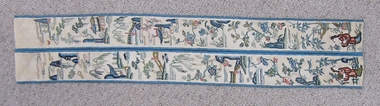
Accessory - Pair of Han Chinese Embroidered Robe Edgings, Late 19th/early 20th century
... I am thinking they are 2" wide? Sleeve bands are much wider, 3 1/4" (just the embroidery width). ...Each band has a human figure at the base with a variety of buildings and plants. Sleeve bands are stitched together....I am thinking they are 2" wide? Sleeve bands are much wider, 3 1/4" (just the embroidery width). ..."These are Han Chinese women’s robe edging. I am thinking they are 2" wide? Sleeve bands are much wider, 3 1/4" (just the embroidery width). The silk gauze denotes from a summer robe. Nice to be able to see the drawing. No one could tell where it was made. It is not special, late 19th c. the subject matter is usual. Ladies in gardens. " Meg Andrews UK Antique Dress and TextilesCanvas work, very fine canvas is used with a blue silk edge. Tent stitch in shades of blue and green with soft pinks. Each band has a human figure at the base with a variety of buildings and plants. Sleeve bands are stitched together.embroidery, garments, china, canvas work, late 19th century, early 20th century -
 Embroiderers Guild, Victoria
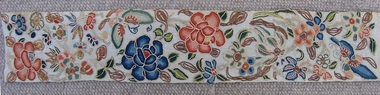
Clothing - Chinese Floral Sleeve Band, Late 19th Century
... Chinese Floral Sleeve Band......sleeve band...Chinese sleeve embroidery bands, or wanxiu became popular in the late 19th century during the Qing Dynasty, evolving from the traditional Han cuff embroidery and Manchu styles. ...Sleeve band of grey brocade silk, embroidered design of peonies, and butterflies in coloured silk thread in Pekin knot stitch. ...Clothing Chinese Floral Sleeve Band ...Chinese sleeve embroidery bands, or wanxiu became popular in the late 19th century during the Qing Dynasty, evolving from the traditional Han cuff embroidery and Manchu styles. These detachable, decorated bands were added to women's informal jackets and robes, often featuring symbolic motifs like landscapes, flowers, and auspicious symbols. They served both a decorative function, displaying artistic skill and personal wishes, and a practical one by covering the sleeves when hands were folded at the waist. History and evolution: Origins: The practice of embroidering cuffs on robes existed during the previous Ming Dynasty for Han women, and this was adopted by the Manchu rulers who founded the Qing Dynasty. Qing Dynasty (1644-1911): The practice was popularized and elaborated upon during this era, with detachable bands becoming a fashionable element for informal wear. Symbolism: The embroidery included a complex visual vocabulary of wishes for a long life, many offspring, and a happy marriage, derived from nature, mythology, and classical literature. Functionality: Women would fold their arms, often with their hands inside the sleeves, so the embroidered bands, which were sewn to hang down the back of the jacket, would be displayed prominently down the front. 19th century peak: The late 19th century was the peak of their popularity, with intricate designs becoming fashionable and even influenced by court tastes, such as those favoured by the Empress Dowager Cixi. Later developments: The late 19th century saw the introduction of chemical 'aniline' dyes from Europe, leading to brighter, bolder colours in embroidery. Motifs and their Meanings: Auspicious symbols: Designs often included symbols for good fortune, wealth, and longevity. Natural imagery: Birds, flowers, and landscapes were common motifs that could represent natural beauty or convey specific symbolic meanings. Figurative scenes: Bands could also feature narrative scenes from classical stories or legends. The choice of motifs allowed women to express personal desires, cultural values, and aesthetic preferences, reflecting a more personal and informal style than official court attire.Sleeve band of grey brocade silk, embroidered design of peonies, and butterflies in coloured silk thread in Pekin knot stitch. Flowers are outlined in cream crinkle cord. china, late 19th century, silk, sleeve band, flower, peony, butterfly -
 Whitehorse Historical Society Inc.
Clothing - Bowling Club Shirt
... Cream bowls shirt with purple collar and sleeve bands. Lettering Jack Foley Blackburn North Bowling Club...Cream bowls shirt with purple collar and sleeve bands. Lettering Jack Foley Blackburn North Bowling Club Clothing Bowling Club Shirt Fashion Clubwear Melbourne ...Shirt belonged to the father of the donorCream bowls shirt with purple collar and sleeve bands. Lettering Jack Foley Blackburn North Bowling ClubBlackburn North Bowling Club. -
 Embroiderers Guild, Victoria
Textile - Chinese Silk Panel, c 1900
... Chinese sleeve embroidery bands, or wanxiu became popular in the late 19th century during the Qing Dynasty, evolving from the traditional Han cuff embroidery and Manchu styles. ...Traditional Chinese embroidered panel - possibly a sleeve band....Traditional Chinese embroidered panel - possibly a sleeve band. Textile Chinese Silk Panel ...Chinese sleeve embroidery bands, or wanxiu became popular in the late 19th century during the Qing Dynasty, evolving from the traditional Han cuff embroidery and Manchu styles. These detachable, decorated bands were added to women's informal jackets and robes, often featuring symbolic motifs like landscapes, flowers, and auspicious symbols. They served both a decorative function, displaying artistic skill and personal wishes, and a practical one by covering the sleeves when hands were folded at the waist. History and evolution: Origins: The practice of embroidering cuffs on robes existed during the previous Ming Dynasty for Han women, and this was adopted by the Manchu rulers who founded the Qing Dynasty. Qing Dynasty (1644-1911): The practice was popularized and elaborated upon during this era, with detachable bands becoming a fashionable element for informal wear. Symbolism: The embroidery included a complex visual vocabulary of wishes for a long life, many offspring, and a happy marriage, derived from nature, mythology, and classical literature. Functionality: Women would fold their arms, often with their hands inside the sleeves, so the embroidered bands, which were sewn to hang down the back of the jacket, would be displayed prominently down the front. 19th century peak: The late 19th century was the peak of their popularity, with intricate designs becoming fashionable and even influenced by court tastes, such as those favoured by the Empress Dowager Cixi. Later developments: The late 19th century saw the introduction of chemical 'aniline' dyes from Europe, leading to brighter, bolder colours in embroidery. Motifs and their Meanings: Auspicious symbols: Designs often included symbols for good fortune, wealth, and longevity. Natural imagery: Birds, flowers, and landscapes were common motifs that could represent natural beauty or convey specific symbolic meanings. Figurative scenes: Bands could also feature narrative scenes from classical stories or legends. The choice of motifs allowed women to express personal desires, cultural values, and aesthetic preferences, reflecting a more personal and informal style than official court attire.Cream silk panel with floral design - four circles surrounded by floral border. Blues, greens, pinks and cream silk in Pekin stitch bordered with fine couched gold passing thread. Traditional Chinese embroidered panel - possibly a sleeve band. -
 Bendigo Military Museum
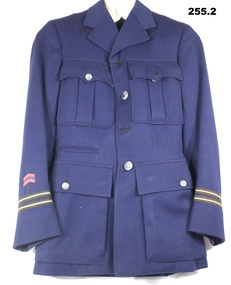
Uniform - JACKET AND SKIRT, WAAAF, C.1939 - 45
... JACKET - CHEVRON LOWER SLEEVE(L) RANK BAND BOTTOM OF EACH SLEEVE...Refer Cat No 252.2 Uniforms Womens RAAF WW2 JACKET - CHEVRON LOWER SLEEVE(L) RANK BAND BOTTOM OF EACH SLEEVE .1) Jacket, Heavy Cotton, Navy, Black Buttons .2) Skirt, Heavy Cotton, Navy Uniform JACKET AND SKIRT, WAAAF ...Uniform re F.O Catherine W Sewell WAAF. Refer Cat No 252.2.1) Jacket, Heavy Cotton, Navy, Black Buttons .2) Skirt, Heavy Cotton, NavyJACKET - CHEVRON LOWER SLEEVE(L) RANK BAND BOTTOM OF EACH SLEEVEuniforms, womens, raaf, ww2 -
 Stawell Historical Society Inc
Costume, Brown Silk Taffeta Wedding Dress belonging to Johanna Draffin ne Bisset Simpson 1880, 1880
... Full length sleeve. Ruched band on upper sleeve. Lower sleeve band attached with matching silk piping which extends into the band as decoration. ...Full length sleeve. Ruched band on upper sleeve. Lower sleeve band attached with matching silk piping which extends into the band as decoration. ...See Marriage Cert in Marriages File 1840-1885 Also Details in Simpson File Belonged to Johanna Simpson married Thomas Draffin on 17th Feb 1880 Presbyterian Church Stawell Silk Taffeta lined wedding dress. Ruffled collar. 18-inch waste. Full length sleeve. Ruched band on upper sleeve. Lower sleeve band attached with matching silk piping which extends into the band as decoration. Garment shaped with two long darts on either side of opening. Opening from neck to below hip uses metal hook and hand sewn eye closing. Lower dress in three sections. Top section is plain matching material attached to the upper garment with piping. Second panel is Ruched material the same material as upper garment. Third lower panel is same material as upper garment consisting of three bands of finely pleated material. Back has pocket on right hip with two pointed flaps and central pleated panel. Back has a Central Bustle extending from back hip to hem. Light Brown with pleated frills at bottom Miss Annie Draffin Mothers Wedding Frock 1880 -
 Kew Historical Society Inc
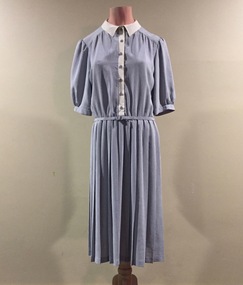
Clothing - Grey and Cream Crepe Dress, Nouvelle, 1960s
... The dress has three quarter length banded sleeve and a pleated skirt...The dress has three quarter length banded sleeve and a pleated skirt Clothing Grey and Cream Crepe Dress Nouvelle ...The Fashion & Design collection of the Kew Historical Society includes examples of women’s, men’s, children’s and infants’ clothing from the 18th, 19th and 20th centuries. Items in the collection were largely produced for, or purchased by women in Melbourne, and includes examples of outerwear, protective wear, nightwear, underwear and costume accessories.Grey coloured crepe dress with cream coloured collar and neckline to waist. The dress has three quarter length banded sleeve and a pleated skirtLabel: Nouvellenouvelle, women's clothing, day dresses, fashion - australia - melbourne (vic), fashion - melbourne - 1950s -
 Embroiderers Guild, Victoria
Clothing - Chinese Embroidered Band, 1900
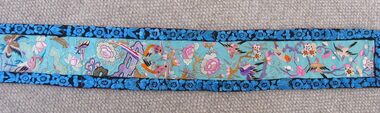
... Sleeve band is believed to have been brought from China by a sea captain. ...Sleeve band is believed to have been brought from China by a sea captain. ...Sleeve band is believed to have been brought from China by a sea captain. Chinese sleeve embroidery bands, or wanxiu became popular in the late 19th century during the Qing Dynasty, evolving from the traditional Han cuff embroidery and Manchu styles. These detachable, decorated bands were added to women's informal jackets and robes, often featuring symbolic motifs like landscapes, flowers, and auspicious symbols. They served both a decorative function, displaying artistic skill and personal wishes, and a practical one by covering the sleeves when hands were folded at the waist. History and evolution: Origins: The practice of embroidering cuffs on robes existed during the previous Ming Dynasty for Han women, and this was adopted by the Manchu rulers who founded the Qing Dynasty. Qing Dynasty (1644-1911): The practice was popularized and elaborated upon during this era, with detachable bands becoming a fashionable element for informal wear. Symbolism: The embroidery included a complex visual vocabulary of wishes for a long life, many offspring, and a happy marriage, derived from nature, mythology, and classical literature. Functionality: Women would fold their arms, often with their hands inside the sleeves, so the embroidered bands, which were sewn to hang down the back of the jacket, would be displayed prominently down the front. 19th century peak: The late 19th century was the peak of their popularity, with intricate designs becoming fashionable and even influenced by court tastes, such as those favoured by the Empress Dowager Cixi. Later developments: The late 19th century saw the introduction of chemical 'aniline' dyes from Europe, leading to brighter, bolder colours in embroidery. Motifs and their Meanings: Auspicious symbols: Designs often included symbols for good fortune, wealth, and longevity. Natural imagery: Birds, flowers, and landscapes were common motifs that could represent natural beauty or convey specific symbolic meanings. Figurative scenes: Bands could also feature narrative scenes from classical stories or legends. The choice of motifs allowed women to express personal desires, cultural values, and aesthetic preferences, reflecting a more personal and informal style than official court attire.Turquoise blue silk band embroidered in a delicate design of flowers, birds, butterflies and insects in classical Chinese style. The edge is bound with black silk worked with a bright blue design and the lining is a magenta brocade. garments, 1900-20, china, silk embroidery, flowers, birds, butterfly -
 Stawell Historical Society Inc
Uniform - Costume and Accessories, 1952
... Navy Blue woollen jacket with embroidered pocket and red band on sleeve. ...Navy Blue woollen jacket with embroidered pocket and red band on sleeve. Uniform Costume and Accessories ...Grampians XI 1952 Cricket Club Blaze. Navy Blue woollen jacket with embroidered pocket and red band on sleeve. stawell clothing material -
 Linton and District Historical Society Inc
Photograph, Juliana Garvey (née Magan), 1915, 1915
... Black and white photograph of a lady with spectacles, wearing light long sleeved gown, with throat band and brooch at centre of v neckline....Mrs Dan Garvey Juliana Magan Old Lintonian Collection Postmistresses "Jan 1915" Black and white photograph of a lady with spectacles, wearing light long sleeved gown, with throat band and brooch at centre of v neckline. ...Juliana Magan was the seventh child of miner Patrick Magan and his wife Mary (née Flanagan). She was Postmistress at Linton from 1898 until at least 1912. Juliana Magan married Daniel Garvey at St Francis' Catholic Church in Melbourne in 1916. Photograph is part of Old Lintonian collection ; no. 61.Black and white photograph of a lady with spectacles, wearing light long sleeved gown, with throat band and brooch at centre of v neckline."Jan 1915"mrs dan garvey, juliana magan, old lintonian collection, postmistresses -
 Brighton Historical Society
Jacket, c1990s
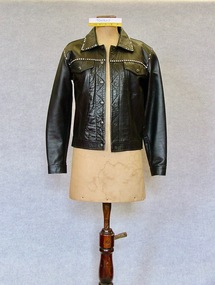
... Full length sleeves with band and black press stud closure. The jacket features diamanté decorative finish along the collar and shoulder placket. ...Full length sleeves with band and black press stud closure. The jacket features diamanté decorative finish along the collar and shoulder placket. ...This item is part of the Di Reidie collection. Diane Reidie was a much loved volunteer and President of Brighton Historical Society from 1999 until 2016. Originally from New Zealand, Di and her family lived in Male Street, Brighton for many years. A vibrant and energetic person with a zest for life and a gift for bringing people together, Di was a friend to many in the Bayside community and active in local community organisations. Her tireless work as President of BHS saw her named Bayside Citizen of the Year in 2008. As a seller and collector of vintage clothing, she was passionate about fashion history; one of her many enduring contributions to BHS was her extensive work in preserving, developing and promoting the Society's costume collection. In 2018-19, Di donated more than one hundred items from her personal vintage clothing collection to the Society. The collection, which includes clothing, hats, handbags and shoes from local and international designers, is representative of Di's wide-ranging interests, colourful personality, creativity, humour and love of fashion and travel. This jacket originally belonged to Australian singer, actress and philanthropist Olivia Newton-John, who autographed it and donated it to be auctioned at a Leather and Lace Ball for the Austin Health Olivia Newton-John Cancer Centre Appeal on 15 May 2004. Newton-John has long been an advocate for cancer research and awareness, having undergone multiple treatments for cancer, a disease Di also battled for many years. Di's husband David purchased the jacket at the auction for around $1,000, and it has since been much worn by Di and her daughter Kathryn. The nature of the jacket - which is faux-leather, with glued-on diamantés, suggests that it was likely part of a stage costume rather than an item from Olivia Newton-John's personal wardrobe.Black polyester leather look jacket with black polyester lining. The jacket features a centre front opening secured by six black press studs, two bust height flap pockets with press studs, and collar. Full length sleeves with band and black press stud closure. The jacket features diamanté decorative finish along the collar and shoulder placket. "IMMAGINE, Made in Italy" "40" "Made in Italy, Fabrique en Italie, 100% Polyiestere, Polyestere, Polyester, Polyester" Personal signature of Olivia Newton John in fine silver pen, "Love Olivia Newton John, 04".olivia newton john, stage costume, olivia newton john cancer centre, austin health, di reidie, immagine, 1990s -
 Tatura Irrigation & Wartime Camps Museum
Clothing - Child's Dress, 1940's
... Bodice rib pattern, embroidered white and blue flowers and white zig zag pattern on ribbed bodice. Long sleeves. Garter stitch band around neck and hem of skirt. 8 glass buttons down the back....Bodice rib pattern, embroidered white and blue flowers and white zig zag pattern on ribbed bodice. Long sleeves. Garter stitch band around neck and hem of skirt. 8 glass buttons down the back. ...Worn by Gretl Hornung, daughter of internee, at Camp 3. Dress made by her mother Emma Frank.Orange knitted dress. Bodice rib pattern, embroidered white and blue flowers and white zig zag pattern on ribbed bodice. Long sleeves. Garter stitch band around neck and hem of skirt. 8 glass buttons down the back.gretl hornung, emma frank, camp 3 clothing, knitted dress -
 Whitehorse Historical Society Inc.
Clothing - Coat Tweed
... Five brown 1 inch buttons down the fly front. Sleeve decorated with band decorated with 2 brown buttons on each raglan sleeve. ...Five brown 1 inch buttons down the fly front. Sleeve decorated with band decorated with 2 brown buttons on each raglan sleeve. ...Type of coat used to travel on Public Transport in the winter.Overcoat, Tweed, - shades of grey/brown. Rayon lining - brown - fawn. Five brown 1 inch buttons down the fly front. Sleeve decorated with band decorated with 2 brown buttons on each raglan sleeve. Two side pockets.costume, female -
 Warrnambool and District Historical Society Inc.
Plaque, Galleywood, C 1990
... The colours are green front with orange (faded) sleeves with blue band. The cap has pink lines. Six holes are around the edge. .2 Galvanised rectangular brass plate with engraved black text ...The colours are green front with orange (faded) sleeves with blue band. The cap has pink lines. Six holes are around the edge. .2 Galvanised rectangular brass plate with engraved black text Galleywood Plaque ...This is one of a series of eighteen plaques which commemorated some of the winner of the Grand Annual Steeplechase which is held each year in Warrnambool. The first Grand Annual was held in 1872 as the Warrnambool Handicap Steeplechase. Galleywood was owned by local people and trained by local trainer Jocka Baillie. Galleywood was a crowd favourite of the 1980's winning two Brierly Steeplechases and the Grand Annual in 1986. This famous local hero died at the age of 30 and is buried at the Warrnambool course and commemorated in the mounting yard. This series of plaques were painted by local artist Leslie Lamey. These items relate to a significant part of Warrnambool's sporting and social history..1 Painted white rectangular tin plaque with rolled edges with painting of jockeys silks and cap. The colours are green front with orange (faded) sleeves with blue band. The cap has pink lines. Six holes are around the edge. .2 Galvanised rectangular brass plate with engraved black text .1 Galleywood written twice on back of plaque. .2 Grand Annual Syndicate GALLEYWOOD. Winner of the Grand Annual Steeplechase 1986warrnambool, grand annual steeplechase, galleywood -
 Kiewa Valley Historical Society
T-shirt - Mt Beauty Sport x2
... Red cotton T-shirt with collar & 2 buttons at the front from the neck. Short sleeves with yellow band. Yellow in capital letters "Mount Beauty" machine sewn on the front and "233" yellow numbers machine sewn on the back. .... / 100% cotton Red cotton T-shirt with collar & 2 buttons at the front from the neck. Short sleeves with yellow band. Yellow in capital letters "Mount Beauty" machine sewn on the front and "233" yellow numbers machine sewn on the back. ...Sporting teams used T-shirts to identify their players.Mt Beauty had a team playing sport and used red T-shirts to identify their players.Red cotton T-shirt with collar & 2 buttons at the front from the neck. Short sleeves with yellow band. Yellow in capital letters "Mount Beauty" machine sewn on the front and "233" yellow numbers machine sewn on the back. Unusual to have a separate piece of material sewn under the arm pits.Label at neck on inside: "Haworth Knit / Glen Iris, Melb. / 100% cottonsporting clothing. team sport. mt beauty. -
 Bendigo Historical Society Inc.
Uniform - GSSC School Rugby Top
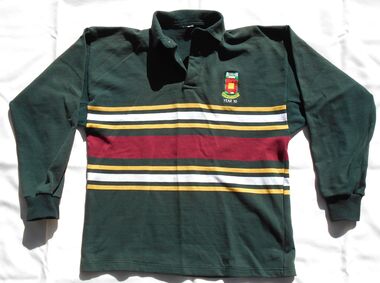
... Ribbed knit fabric with ribbed cuffs on sleeves. 22 cm band of yellow, white and red stripes across the body back and front. ...Ribbed knit fabric with ribbed cuffs on sleeves. 22 cm band of yellow, white and red stripes across the body back and front. ...Golden Square High School in the city of Bendigo, was established in temporary accommodation at Camp Hill Primary School in central Bendigo in 1960. With the completion of the new school's buildings, it moved to Golden Square in 1962, providing for Forms 1 to 6, now known as years 7 to 12. In 1978 it became a 7–10 school and was one of the original feeder schools to Bendigo Senior High School. In 1986, a Hearing Impaired Unit was established and in 1990 it underwent a name change to become Golden Square Secondary College. The Golden Square Secondary College campus closed on 28 November 2008. It merged with Kangaroo Flat and Flora Hill secondary colleges as part of the implementation of the Bendigo Education Plan. Its buildings were demolished. (Wikipedia https://en.wikipedia.org/wiki/Golden_Square_Secondary_College) This uniform collection belonged to Anna Matthews, daughter of the donor, who attended GSSC as part of the last group enrolled before the school closed in 2008. Golden Square Secondary College long sleeved dark green rugby top. Set in long sleeves. Fold over collar. Ribbed knit fabric with ribbed cuffs on sleeves. 22 cm band of yellow, white and red stripes across the body back and front. GSSC Year 10 logo on LHS.gssc, golden square secondary college, uniform, bendigo education plan., rugby top -
 Embroiderers Guild, Victoria
Clothing - Child's Smocked Dress, Early 20th century
... Cream winter cotton fabric with 8 cm deep bands of smocking on front and back. The collar is edged with feather stitching and lace. The sleeves...Embroidery Garments Childrens Late 19th century Smocking Ireland Cream winter cotton fabric with 8 cm deep bands of smocking on front and back. The collar is edged with feather stitching and lace. The sleeves have a narrow band of smocking and a buttonholed edge. ...Cream winter cotton fabric with 8 cm deep bands of smocking on front and back. The collar is edged with feather stitching and lace. The sleeves have a narrow band of smocking and a buttonholed edge. A band of shamrocks decorates the hem.embroidery, garments, childrens, late 19th century, smocking, ireland
