
Showing 53 items matching " st james the great"
-
 Glen Eira Historical Society
Newspaper - St. James The Great Primary School
... St. James The Great Primary School...... St James The Great Primary School...One item about this school: Undated unsourced newspaper article about St James the Great Primary School opening of new upstairs work space with Federal Funding. ...Includes a colour photograph of students in work space Catholic School Ruby Members of Parliament Primary Schools Kai Danby Michael MP St James The Great Primary School Teachers Musicians Students Mills Pam Sultan Dan Ebben Mills John Wilson Scott Newspaper St. ...One item about this school: Undated unsourced newspaper article about St James the Great Primary School opening of new upstairs work space with Federal Funding. It is a school of 20 students. Includes a colour photograph of students in work spacecatholic school, ruby, members of parliament, primary schools, kai, danby michael mp, st james the great primary school, teachers, musicians, students, mills pam, sultan dan, ebben, mills john, wilson scott -
Glen Eira Historical Society
Document - St. James The Great, Inkerman Street, 435, St Kilda East
... St. James The Great, Inkerman Street, 435, St Kilda East...St. James The Great...Fraser Helen Document St. James The Great, Inkerman Street, 435, St Kilda East ...Handwritten notes made by Claire Barton 17/07/2012 from the St. James Community website. Includes information on the history and architectural features of the Church. Also included are comments on its relationship to the St. John’s Seminary. Correspondence to Claire Barton from parishioner Helen Fraser dated 07/05/2012.st. james the great, inkerman street, st. kilda east, north and williams, architects, st. john’s college, religious structures and establishments, alma road, lansdown road, alexander street, anglican church, stephens r. rev., fordham e.d., laurey robert, building, land subdivision, minsters, market gardens, vicarages, tennis courts, tennis, service stations, kelly roger fr., porter brian rev. dr., fraser helen -
Glen Eira Historical Society
Document - National Trust Register
... ... St James the Great...Georges Road Willow Street Grange Road Station Place Railway Parade Alexandra Street Wood Crescent Elizabeth Street Halstead Street Mavho Street Tucker Road McKinnon Road Nepean Highway Wheatly Road Uniting Church Carnegie Athole St Stephen's Uniting Church Caulfield St Aloysius' Catholic Church Halstead St Mary's Anglican Church Caulfield Caulfield Town Hall Anseln The Glen Woolamai Caulfield House Caulfield Hospital Lirrewa Labassa Fairfield Hall Bellecourt Bagatelle Myoora Rosecraddock Adam and Eve - Karl Duldig The Family - Karl Duldig Caulfield Primary School Septimus Miller Memorial Chapel Brighton Cemetery Hopetoun Gardens State Savings Bank Elsternwick Anderson Organ Hopetoun Private Hospital (Melrose) Rippon Lea Ripponlea Burreel O'Neill College Lisbon House Elsternwick Club Merkin-Schutze Organ Presentation Convent Duldig Mural - Kadimah Cultural Centre Glenmoore Craigellachie St James the Great Glenfern Grimwade House Dacre Trinity Congregational Uniting Church Glenhuntly Alnwick Holmwood New Alexandra Joscelyne Organ Smith Organ Fincham Organ St George's Bentleigh McKinnon Progress Hall Wurlitzer Organ Moorabbin Town Hall Christ Anglican Church St Mary's Jubilee School St Stephen's Presbyterian Church Elsternwick Congregational Church St Mary's Church of England Former Metropolitan Fire Brigade Station No. 31 St Mary's Jubilee Church Belle Court Trinity Congregational Church Heatherbrae Carnegie Caulfield Caulfield North Caulfield South Elsternwick Glen Huntly Glenhuntly Murrumbeena St Kilda East Bentleigh McKinnon Moorabbin Ormond National Trust of Australia National Trust Register Houses Churches Schools Organs Vallati Gladys Mansions Document National Trust Register ...This file contains two items relating to historic buildings in Glen Eira listed on the National Trust Registry: 1/A fax, sent to Gladys Vallati on 02/03/1995 from the National Trust of Australia listing buildings on the Trust’s registry in the Glen Eira area, as well as their addresses and status on the register (5 pages). (Additional photocopy taken for preservation purposes). 2/A typed list of buildings in the Glen Eira area (mainly Caulfield) which are on the National Trust list, including address, approximate date of construction and status on the register. Date of production of the list is unknown. (6 pages).neerim road, poplar grove, avoca grove, balaclava road, orrong road, bambra road, glen eira road, hood crescent, hawthorn road, glenferri street, glenhuntly road, glen huntly road, kambrook road, kooyong road, lirrewa grove, manor grove, north road, pearson avenue, seymour road, alma road, craddock avenue, dandenong road, lyndoch avenue, orrong crescent, hotham street, nagle avenue, inkerman street, iknerman road, sandham street, selwyn street, st. georges road, willow street, grange road, station place, railway parade, alexandra street, wood crescent, elizabeth street, halstead street, mavho street, tucker road, mckinnon road, nepean highway, wheatly road, uniting church carnegie, athole, st stephen's uniting church caulfield, st aloysius' catholic church, halstead, st mary's anglican church caulfield, caulfield town hall, anseln, the glen, woolamai, caulfield house, caulfield hospital, lirrewa, labassa, fairfield hall, bellecourt, bagatelle, myoora, rosecraddock, adam and eve - karl duldig, the family - karl duldig, caulfield primary school, septimus miller memorial chapel, brighton cemetery, hopetoun gardens, state savings bank elsternwick, anderson organ, hopetoun private hospital (melrose), rippon lea, ripponlea, burreel, o'neill college, lisbon house, elsternwick club, merkin-schutze organ, presentation convent, duldig mural - kadimah cultural centre, glenmoore, craigellachie, st james the great, glenfern, grimwade house, dacre, trinity congregational uniting church glenhuntly, alnwick, holmwood, new alexandra, joscelyne organ, smith organ, fincham organ, st george's bentleigh, mckinnon progress hall, wurlitzer organ, moorabbin town hall, christ anglican church, st mary's jubilee school, st stephen's presbyterian church, elsternwick congregational church, st mary's church of england, former metropolitan fire brigade station no. 31, st mary's jubilee church, belle court, trinity congregational church, heatherbrae, carnegie, caulfield, caulfield north, caulfield south, elsternwick, glen huntly, glenhuntly, murrumbeena, st kilda east, bentleigh, mckinnon, moorabbin, ormond, national trust of australia, national trust register, houses, churches, schools, organs, vallati gladys, mansions -
 Flagstaff Hill Maritime Museum and Village
Instrument - Clock
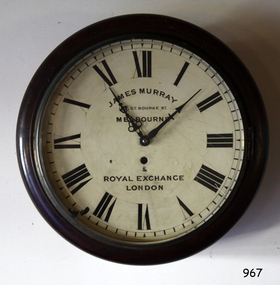
... Flagstaff Hill Warrnambool Shipwrecked coast Flagstaff Hill Maritime Museum Maritime Museum Shipwreck coast Flagstaff Hill Maritime Village Great Ocean Road Bank of Australasia BoA Union Bank Australia & New Zealand Bank ANZ Bank James Murray clock wall clock Great Bourke Street Melbourne Royal Exchange London William Kerr turret clock Old Model School National Model & Training School access door winding key Face: "JAMES MURRAY / - GT. BOURKE ST ...This wall clock originated from the Bank of Australasia. The label on the base matches other items from the same donor. It was spring powered by winding the key mechanism with the clock's key through the hole in the clock face. The hinged door on the base of the clock's case allows access to the clock's working mechanism. James Murray (son of James Murray 1780-1847) was a maker of clocks and chronometers. He worked at No. 1, Royal Exchange, London and from 1861 at 107 Great Bourke Street, Melbourne. In 1854 William Kerr ordered a clock from James Murray and erected it on the Albert Street frontage of the National Model & Training School in Spring Street Melbourne. It was Melbourne's first turret clock and remained there for 80 years before it was transferred to the Public Library in Melbourne in 1934 (now Museum Victoria). The Bank of Australasia was incorporated by Royal Charter of England in March 1834. It had its Australian beginning on 14th December 1835, opening in Sydney. The Acting Superintendent of the bank at that time was David Charters McArthur. He was Superintendent from 1867-to 1876. The Melbourne branch opened on 28th August 1838 in a two-roomed brick cottage on the north side of Little Collins Street, where two huge mastiff dogs were used at night to guard the bank. The government also provided an armed military sentinel. Due to the bank's rapid growth, a new building for the Melbourne branch was opened in 1840 at 75 Collins Street West. By 1879 the bank had been upgraded to a magnificent two-storey building on the corners of Collins and Queens Streets, with the entry on Collins Street. In 1951 the Bank of Australasia amalgamated with the Union Bank to form the Australia and New Zealand Bank, now known as the ANZ. Then in 1970, the ANZ merged with both the ES&A and the London Bank of Australia to form the ANZ Banking Group Limited. The ANZ Banking Group Ltd kindly donated a variety of historic items from the Bank of Australasia. BANK of AUSTRALASIA, WARRNAMBOOL – In 1854 Warrnambool had two banks, the Union Bank and the Bank of Australasia. Later, completely different bank businesses opened; in 1867 the National Bank of Australasia, then in 1875 the Colonial Bank of Australasia. The original Warrnambool branch of the Bank of Australasia was established in July 1854, and operated from a leased cottage on Merri Street, close to Liebig Street. The bank next bought a stone building previously erected by drapers Cramond & Dickson on the corner of Timor and Gibson Streets. Samuel Hannaford was a teller and then Manager at the Warrnambool branch from 1855 to 1856 and the Warrnambool Council chose that bank for its dealings during 1856-57. In 1859 Roberts & Co. was awarded the contract to build the new Bank of Australasia branch for the sum of £3,000. The land was on a sand hill on the northeast corner of Timor and Kepler Streets and had been bought in 1855 from investor James Cust. The new building opened on May 21, 1860. The bank continued to operate there until 1951 when it merged with the Union Bank to form the ANZ Bank, which continued operating from its Liebig Street building. Warrnambool City Council purchased the former Bank of Australasia building in 1971 and renovated it, then on 3rd December 1973 it was officially opened as the Art Gallery by Cr. Harold Stephenson and Gallery Director John Welsh. The Gallery transferred to the purpose-built building in Liebig Street in 1986 and the old bank building is now the Gallery club. Staff at the Bank of Australasia in Warrnambool included the following men but others were also involved: Samuel Hannaford, Teller then Manager from 1855-1856; W H Palmer, Manager from January 1857 until November 1869 when the Teller Basil Spence was promoted to Manager; H B Chomley, Manager from April 1873 and still there in 1886; A Butt, Manager in 1895-1904; J R McCleary Accountant and Acting Manager for 12 months, until 1900; A Kirk, Manager 1904; J Moore, staff until his transfer to Bendigo in December 1908; J S Bath was Manager until 1915; C C Cox, Manager until April 1923; Richard C Stanley, Manager 1923 to April 1928. The clock has significance through its association with the Bank of Australasia. The early Australian bank was established in 1834 by Royal Charter and opened in Sydney, Australia, in Sydney in 1835. The bank had many Australian offices in November 1877, particularly on the east and south coasts. Victoria had 45 percent of all Offices. The clock is significant for its connection with the quality clockmaker James Murray, originally from Royal Exchange London with a branch that opened in Melbourne in 1861. James Murray is renown for making the first turret clock to be installed in Melbourne. The clock is locally significant for its association with the Warrnambool Bank of Australasia, which was established in 1854. It was Warrnambool Council’s first bank. The bank continued to operate until the organisation's merger in 1951 when it became the ANZ Bank Group today. The Bank was an integral part of the growth of local commerce and the community.Wall clock with a round face behind glass in a wooden case. The painted brass face has Roman numerals, two decorative hands, divisions for minutes and a keyhole. The curved base of the case has a hinged access door with a keyhole and adhesive label. The back of the clock's case has metal mounting brackets. Inscriptions on the rectangular white label. Made by James Murray, Melbourne.Face: "JAMES MURRAY / - GT. BOURKE ST. / MELBOURNE / & / ROYAL EXCHANGE / LONEON" Label: "A M / 40"flagstaff hill, warrnambool, shipwrecked coast, flagstaff hill maritime museum, maritime museum, shipwreck coast, flagstaff hill maritime village, great ocean road, bank of australasia, boa, union bank, australia & new zealand bank, anz bank, james murray, clock, wall clock, great bourke street melbourne, royal exchange london, william kerr, turret clock, old model school, national model & training school, access door, winding key -
 Flagstaff Hill Maritime Museum and Village
Photograph - Ship, Monkbarns, ca. 1924
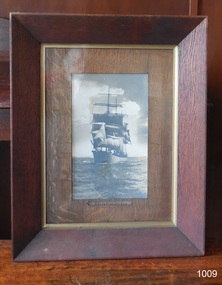
... James A. Young, London - 1926, L.H. Wilson, Liverpool - 1927, Ballener Espando (Brunn & van Lippe, Tonsberg). Flagstaff Hill Warrnambool Maritime Village Maritime Museum Flagstaff Hill Maritime Museum & Village Shipwreck coast Great Ocean Road Monkbarns sailing ship Newccastle New South Wales hulk Front: "MONKBARNS" Reverse handwritten in pen: "PRESENTED TO A.F. WATSON / FOR S.S.V. BY / CAPT. F.K. BAXTER / 74 VERDON ST ...This photograph was taken in about 1924 as it approached Newcastle, New South Wales before the sailing ship Monkbarns was converted for use as a hulk. The steel-hulled, 3-masted fully rigged ship was built in 1895 by Archibald McMillan & Son at Dumbarton in Scotland. It was 267 feet long, 40.1 feet wide and 23.5 feet deep. In 1914 John Stewart & Co. owned ten sailing vessels, one of which was the Monkbarns, but by the end of the first World War, the fleet had only four vessels survived the war, including the Monkbarns. The Monkbarns traded across the world. Some of the destinations included Port Adelaide, Table Bay in South Africa, Liverpool, Sydney, London and New York. Her last commercial voyage was in 1926. Overall, the ship traded for 32 years before it was converted in Spain in 1927 for use as a hulk for carrying coal. There were several owners of the ship over its lifetime. They were - 1895, first owner, Charles Webster Corsar, Liverpool - 1902, the owner was D. Corsar & Son, Liverpool - 1909, owned by John Hardie & Sons, Glasgow - 1911, John Stewart & Co., Liverpool - by1915, James A. Young, London - 1926, L.H. Wilson, Liverpool - 1927, Ballener Espando (Brunn & van Lippe, Tonsberg).Photograph, black and white, of the ship "Monkbarns" , a steel hulled sailing ship under sail, bow facing viewer. Rectangular wooden frame has an inner gilt frame around a wide, natural bark matte. The lover edge of the matte has a decorative rectangular cut-out surrounding an inscription with the ship's name. On the back is a handwritten inscription about the ship and the presentation of the photograph..Front: "MONKBARNS" Reverse handwritten in pen: "PRESENTED TO A.F. WATSON / FOR S.S.V. BY / CAPT. F.K. BAXTER / 74 VERDON ST/ WILLIAMSTOWN " Reverse: "STEEL SHIP MONKBARNS / 1771 TONS REGISTER / 267 x 40' X 27'2" Draft / Build 1895 by McMillan, Dumbarton, Scotland / Converted to a hulk in /Spain 1927. / Photo taken in - Converted from NEWCASTLE N.S.W. about 1924"flagstaff hill, warrnambool, maritime village, maritime museum, flagstaff hill maritime museum & village, shipwreck coast, great ocean road, monkbarns, sailing ship, newccastle, new south wales, hulk -
 Flagstaff Hill Maritime Museum and Village
Book - Religious Book/Bilble, Oxford University Press, The Holy Bible, 1866
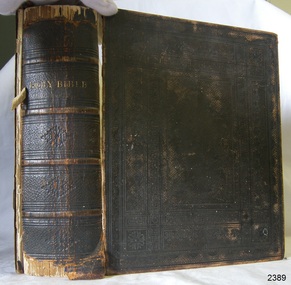
... (For more information on the Pattison Collection see item 3678 Flagstaff Hill collections) https://victoriancollections.net.au/items/5580c7e72162f114d8b758db Flagstaff Hill Flagstaff Hill Maritime Museum and Village Warrnambool Maritime Museum Maritime Village Great Ocean Road Shipwreck Coast Holy Bible book religious book Bell family Bell family Bible Elizabeth Bell Joseph Bell 1826 1833 1854 St Paul's Bristol To understand the nature of your 1866 Oxford University Press (OUP) Bible, it helps to look at how Bibles were produced in the 19th century and the massive historical scale of the publisher. The context of the King James ...To understand the nature of your 1866 Oxford University Press (OUP) Bible, it helps to look at how Bibles were produced in the 19th century and the massive historical scale of the publisher. The context of the King James Version Bible is indicated by the standard phrase on the flyleaf: "Translated out of the Original Tongues... By His Majesty's Special Command." This work is a historical 1866 reprint of the original version published in 1611. This particular volume served as the family Bible for Joseph and Elizabeth Bell, documenting their family history through the births and deaths noted on its end papers.Book, black hard cover with embossed pattern and gold test, metal locking clasp. King James Version of the Holy Bible, containing the Old and New Testaments. It was published by Oxford University Press in 1866. Inscriptions on the loose endpaper list the marriage of Joseph and Elizabeth Bell in 1854 at St Paul's, Bristol, England, and their ten children born from 1856 to 1878.non-fictionTo understand the nature of your 1866 Oxford University Press (OUP) Bible, it helps to look at how Bibles were produced in the 19th century and the massive historical scale of the publisher. The context of the King James Version Bible is indicated by the standard phrase on the flyleaf: "Translated out of the Original Tongues... By His Majesty's Special Command." This work is a historical 1866 reprint of the original version published in 1611. This particular volume served as the family Bible for Joseph and Elizabeth Bell, documenting their family history through the births and deaths noted on its end papers.flagstaff hill, flagstaff hill maritime museum and village, warrnambool, maritime museum, maritime village, great ocean road, shipwreck coast, holy bible, book, religious book, bell family, bell family bible, elizabeth bell, joseph bell, 1826, 1833, 1854, st paul's bristol -
 Flagstaff Hill Maritime Museum and Village
Functional object - Bell, Schomberg 1855, Before 1855
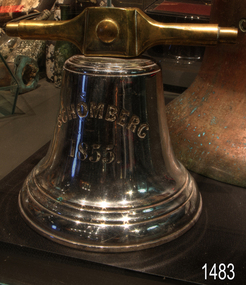
... Great Ocean Road...Shipwreck Coast...Schomberg...silver plated bell...mess bell...bell stands...captain ‘bully’ Forbes...alexander hall and son...James Baines and company...Liverpool’s black ball line...bell...Schomberg bell...ship's bell...small bell...St...Flagstaff Hill Flagstaff Hill Maritime Museum and Village Warrnambool Maritime Museum Maritime Village Great Ocean Road Shipwreck Coast Schomberg silver plated bell mess bell bell stands captain ‘bully’ Forbes alexander hall and son James Baines and company Liverpool’s black ball line bell Schomberg bell ship's bell small bell St Joseph's church Briggs Marine John Manning John Logan Warrnambool Museum Briggs Foundry silver bell Bell's front; “SCHOMBERG” with “1855” below. ...The Rescue and Journey of the Schomberg Bells: This bell was the smaller of two rescued by the crew of the Schomberg following the ship’s wreck in 1855. While the specific purpose of the smaller bell is unknown, it may have served to assemble the crew or signal mealtimes on board. After surviving the shipwreck, the crew carried both bells as they made their way along the coastline. Their journey eventually led them to the home of settler John Manning, located at Hopkins Point near Warrnambool. Manning took possession of the bells and subsequently presented them to two churches in Warrnambool. The smaller bell went to St Joseph’s Catholic Church, while the larger bell went to St John’s Presbyterian Church. After around a year, the small bell at St Joseph’s developed a crack and became unusable. Thomas Manifold imported a replacement bell for the church, and the damaged bell was stored at his farm. Years later, when the property was sold to John Logan, the discarded bell was donated to the old Warrnambool Museum upon its opening in 1886. The Curator, Joseph Archibald, placed the bell on display in the entry. In 1975, it was transferred from the Warrnambool Art Gallery to Flagstaff Hill. The ’Mystery’ of the small bell solved: Despite numerous attempts by the staff at Flagstaff Hill to restore the bell’s lustre, the bell remained dull and tarnished. In October 1986, Director Peter Ronald decided to send the bell for professional advice. The bell was entrusted to Briggs Marine Products, a renowned brass founder established in 1912. Upon examination, the specialists at Briggs discovered the reason behind the bell’s persistent lack of shine: it had originally been silver-plated, but most of the plating had worn away over time. The experts at Briggs then undertook the task of restoring the bell, successfully returning it to a gleaming silver surface. The Sailing Ship Schomberg: Launched in 1855, the Schomberg was regarded as the “Noblest” ship afloat at the time. Owned by the Black Ball Line, it was built for their passenger fleet by Alexander Hall of Aberdeen at a cost of £43,103. The construction featured three skins: one planked fore and aft and two diagonally planked, all fastened with screw-threaded trunnels (wooden rails). The ship’s First Class accommodation was luxurious, boasting velvet pile carpets, large mirrors, rosewood, birds-eye maple and mahogany timbers, satin damask soft furnishings, and an oak-lined library with a piano. Schomberg had a capacity for 1,000 passengers. The ship’s master, Captain James Nicol Forbes—also known as ‘Bully’ Forbes—was only 34 years old at the launch. He had a reputation for setting and breaking speed records on the Black Ball Line’s Marco Polo and Lightning. In 1852, Forbes completed the London to Melbourne journey on the Marco Polo in 68 days, a record at the time, though 53 passengers died during the voyage. In 1854, he sailed the Lightning to Melbourne in 76 days and returned in only 63 days—a record that stood among sailing ships. Forbes was known for driving his ship and crew to their limits, often prioritising speed over passenger comfort. Determined to set new records, he promised to reach Melbourne in sixty days, declaring he would do so “with or without the help of God.” The Maiden Voyage and the Wreck: Schomberg departed Liverpool on 6th October 1855, flying a banner that read “Sixty Days to Melbourne”. The vessel carried 430 passengers and 3,000 tons of cargo, including materials to build the Melbourne to Geelong Railway and a bridge over the Yarra River. Among the cargo were a cow for fresh milk, pens for fowls and pigs, and 90,000 gallons of water for drinking and washing. Additionally, it transported 17,000 letters and 31,800 newspapers. The ship and cargo were insured for $300,000, a considerable sum for the era. Poor winds while crossing the equator delayed Schomberg’s progress. Land was first sighted on Christmas Day at Cape Bridgewater near Portland. Captain Forbes followed the coastline towards Melbourne, but was reportedly playing cards when the third mate, Henry Keen, reported land only three miles away. The ship ran aground on a sand spit near Curdie’s Inlet (approximately 56 km west of Cape Otway) on 26th December 1855, after 78 days at sea. The sand spit and nearby currents were not marked on Forbes’s map. During the night, the crew launched a lifeboat to search for a safe landing spot for the passengers. The scouting party advised Forbes to wait until morning, as rough seas posed a danger to the lifeboats. At dawn, the ship’s Chief Officer spotted the SS Queen and signalled for help. The master of the Queen brought his vessel alongside, and all passengers and crew disembarked safely. The Black Ball Line’s Melbourne agent sent another steamer to collect the passengers’ baggage, and other steamers assisted with cargo salvage until worsening weather forced operations to cease. Notably, a plunderer later recovered a case of Wellington boots, but all were for the left foot. The wreck and its cargo were sold to local merchants Manifold & Bostock, who did not attempt further salvage. They later sold their interest to a Melbourne businessman and two seafarers. In 1864, after two men drowned in their attempt to reach the Schomberg, salvage efforts were abandoned. By 1870, parts of the ship had washed ashore on New Zealand’s South Island. Today, the wreck is about nine metres below the surface. Although most woodwork has disintegrated, the vessel’s shape remains discernible due to the railway irons, girders, and framework. Various goods and materials from the ship are scattered nearby. The bell is particularly significant in that along with other items from the wreck helped in part to having the legislation changed to protect shipwrecks, with far tighter controls being employed to oversee the salvaging of wreck sites. This bell forms part of the Schomberg collection at Flagstaff Hill maritime museum. The collection as a whole is of historical and archaeological significance at a State level. Flagstaff Hill’s collection of artefacts from the Schomberg is also significant for its association with the Victorian Heritage Registered Schomberg shipwreck (VHR S 612). The collection is of additional significance because of the relationship between the objects salvaged, as together they help us to interpret the story of the Schomberg. The collection as a whole is historically significant for representing aspects of Victoria's maritime history and its potential to interpret social and historical themes from society at the time of the wreck. A small ship’s bell. The silver-plated metal bell bears the ship’s name and year of construction on one side and the name and address of the ship’s builders on the other. These details are deeply engraved into the metal and formed in bold, upper-case lettering. The bell has two bell stands: the left and the right. Both stands have an Iron pipe bent into an inverted ‘Y’ shape, with a hole along its length and feet attached to a rectangular metal plate at the other two ends. Feet are bolted to a timber base that has a hole drilled through the centre for mounting. Bell's front; “SCHOMBERG” with “1855” below. Bell's back “HALL & SONS (crack splits letter “N”) / BUILDERS (in italics) / ABERDEEN” (crack splits letter “B”).flagstaff hill, flagstaff hill maritime museum and village, warrnambool, maritime museum, maritime village, great ocean road, shipwreck coast, schomberg, silver plated bell, mess bell, bell stands, captain ‘bully’ forbes, alexander hall and son, james baines and company, liverpool’s black ball line, bell, schomberg bell, ship's bell, small bell, st joseph's church, briggs marine, john manning, john logan, warrnambool museum, briggs foundry, silver bell -
 Federation University Historical Collection
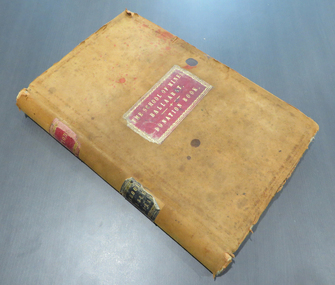
Book - Book - Ledger, Ballarat School of Mines Donation Book, 1878-1896, 01/01/1878 - 01/08/1896
... Great Britain. 1222. 31 October 1884 - Trooper Dowling - Miner's Rest - Owl 1223. 04 November 1884 - W. McKeenan - 3, Adair St, Ballarat - Flying Squirrel. 1259. 16 January 1885 - A.A. Buley - Ballarat - Prospective of Grenville College 1885 1428. 06 October 1885 - Ballarat - Collection of mineral specimens from Silverton (Collected by Mr James Murray). 1442. 20 October 1885 - Ballarat - Specimen of fossil fruits collected by Haddon by Charles Brown. 1682. 28 February 1887 - James Lamb - Ballarat - Copy of the Ballarat Times Newspaper of 3rd December 1854, framed and protected on both sides with glass. 1730. 23 May 1887 - Bella Guerin - Ballarat - Copy of the Victorian Review No 74 December 1885 4786. 27 March 1894 - James Oddie - Ballarat - 3 mineral specimens 4835. 01 August 1896 - P.V> Barnard - Ballarat - {ortion of Mining truck wheel altered to oxide of iron found in the old workings of the Golden Gate Mine at a depth of 200 feet...Great Britain. 1222. 31 October 1884 - Trooper Dowling - Miner's Rest - Owl 1223. 04 November 1884 - W. McKeenan - 3, Adair St, Ballarat - Flying Squirrel. 1259. 16 January 1885 - A.A. Buley - Ballarat - Prospective of Grenville College 1885 1428. 06 October 1885 - Ballarat - Collection of mineral specimens from Silverton (Collected by Mr James Murray). 1442. 20 October 1885 - Ballarat - Specimen of fossil fruits collected by Haddon by Charles Brown. 1682. 28 February 1887 - James Lamb - Ballarat - Copy of the Ballarat Times Newspaper of 3rd December 1854, framed and protected on both sides with glass. 1730. 23 May 1887 - Bella Guerin - Ballarat - Copy of the Victorian Review No 74 December 1885 4786. 27 March 1894 - James Oddie - Ballarat - 3 mineral specimens 4835. 01 August 1896 - P.V> Barnard - Ballarat - {ortion of Mining truck wheel altered to oxide of iron found in the old workings of the Golden Gate Mine at a depth of 200 feet ...Leather bound ledger with hand written details on donations to the Ballarat School of Mines Museum or the Ballarat School of Mines Library. The Ledger was made by J. McHutchison, Bookbinder, paper ruler and Account Book Manufacturer. 267. 07 July 1880 - John Lynch Junior - Smythesdale - Cast of "Golden Age" nugget found at Browns by Co-operative Party - 12 men. Weight 75 oz 12 dwts 12 grs 294. 24 June 1880 - W.H. Shaw - Ballarat - 94 numbers of 'The Engineer'. 295. 28 June 1880 - Rivett Henry Bland - Clunes - Specimen of water pipe from the Port Phillip Consols Mine encrusted with Carbonates of lime and magnesia and sulphate of lime with earthy matter. 418. 17 June 1881 - F. Ratte - Sydney - Catalogue of Rocks, minerals, etc of New Caledonia. 462. 28 September 1881 - Dr Bunce - Ballarat - Concretionary Basalt with Car. Lime and Magnesia. 465. 06 September 1881 - J.J. Sleep (Chairman of the Board) per favor of E.W. Spain, Esq, Manr - Ballarat - Diamond drill core from "Carisbrook Freehold Estate" - cut at a depth of 150 feet. Dedrites from Munster Gully ... 517. 20 January 1882 - William Lester - Ballarat - The Agricultural Teacher 549. 24 March 1882 - C.E. Grainger Manager Ballarat Woollen Mills - Ballarat - Samples of dyed and raw wool and dye material. 600. 04 July 1882 - Henry Sutton - Ballarat - 13th Annual Report of the Aeronautical Society of Great Britain. 1222. 31 October 1884 - Trooper Dowling - Miner's Rest - Owl 1223. 04 November 1884 - W. McKeenan - 3, Adair St, Ballarat - Flying Squirrel. 1259. 16 January 1885 - A.A. Buley - Ballarat - Prospective of Grenville College 1885 1428. 06 October 1885 - Ballarat - Collection of mineral specimens from Silverton (Collected by Mr James Murray). 1442. 20 October 1885 - Ballarat - Specimen of fossil fruits collected by Haddon by Charles Brown. 1682. 28 February 1887 - James Lamb - Ballarat - Copy of the Ballarat Times Newspaper of 3rd December 1854, framed and protected on both sides with glass. 1730. 23 May 1887 - Bella Guerin - Ballarat - Copy of the Victorian Review No 74 December 1885 4786. 27 March 1894 - James Oddie - Ballarat - 3 mineral specimens 4835. 01 August 1896 - P.V> Barnard - Ballarat - {ortion of Mining truck wheel altered to oxide of iron found in the old workings of the Golden Gate Mine at a depth of 200 feet. (4235 is last entry)ballarat school of mines, ballarat school of mines museum, donations, henry sutton, bella guerin -
 Federation University Historical Collection
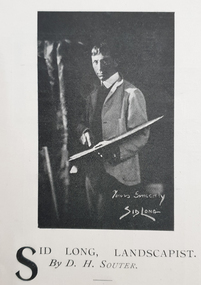
Book, Art Decoration Ornaments
... st andrew'e cathedral sydney...edmond thomas blacket...sydney university...comisariat stores circular quay...the rocks...w. lister-lister...sydney domestic architecture...james barnet...john horbury hunt...sidney long...maori art...wall decoratoni...paperhangings...australian stained glass...art and architecture...stamped metalwork...w.c. piguenit...australian architecture...rose bay convent chapel...australian posters...pottery...cyril blacket...bookbinding...new south wales state library architecture...oxford st sydney'tom roberts...repousse...sydney harbour bridge...john longstaff...women painters...the great...ballarat technical art school ballarat technical art school library bank of australasia mount kosciusko siry henry parkes pyrmont bridge maori ancient egypt julian ashton st andrew'e cathedral sydney edmond thomas blacket sydney university comisariat stores circular quay the rocks w. lister-lister sydney domestic architecture james barnet john horbury hunt sidney long maori art wall decoratoni paperhangings australian stained glass art and architecture stamped metalwork w.c. piguenit australian architecture rose bay convent chapel australian posters pottery cyril blacket bookbinding new south wales state library architecture oxford st sydney'tom roberts repousse sydney harbour bridge john longstaff women painters the great pyramid of egypt skyscraper comes to new south wales melbourne hospital plans governor bligh electric illumination Black cloth covered book with leather spine. ...Black cloth covered book with leather spine. Colour illustrationsballarat technical art school, ballarat technical art school library, bank of australasia, mount kosciusko, siry henry parkes, pyrmont bridge, maori, ancient egypt, julian ashton, st andrew'e cathedral sydney, edmond thomas blacket, sydney university, comisariat stores circular quay, the rocks, w. lister-lister, sydney domestic architecture, james barnet, john horbury hunt, sidney long, maori art, wall decoratoni, paperhangings, australian stained glass, art and architecture, stamped metalwork, w.c. piguenit, australian architecture, rose bay convent chapel, australian posters, pottery, cyril blacket, bookbinding, new south wales state library architecture, oxford st sydney'tom roberts, repousse, sydney harbour bridge, john longstaff, women painters, the great pyramid of egypt, skyscraper comes to new south wales, melbourne hospital plans, governor bligh, electric illumination -
Marysville & District Historical Society
Document (Item) - Report, John F. Waghorn, Yarra Track, Unknown
... great dividing range...cumberland valley...james mcguigan...w elliot...christopher harrison...james marsh...cobb and co...box hill...lilydale...fehrings...koehlers...shaws...bear creek...cairnsville...cumberland creek...walkers...golden bower mine...collins' mountain home hotel...walsh's creek post office...rosa mcveigh...frank barton...hitchins...matthew kennedy...william morris...e r nichols...t woods...tom burchell...peter kerr...henry kuyper...william podlech...george koehler...henry brockmann...henry petty...thomas smith...jacob butchart...john perry...slingsby davis...royal mail hotel...walter gray...john summers...travellers rest hotel...lockington...the oaks...the springs...st...If an ancestor was a postmaster in a Victorian town, he may have been able to reveal the person's occupation, income and working conditions. yarra track john waghorn victoria's postal services wood's point sydney road longwood merton mansfield postmasters bonnie doon melville merton mansfield eltham healesville marysville walhalla melbourne-warburton-wood's point line loose bags heidelberg post office eltham post office kangaroo ground post office yarra glen post office marysville post office healesville post office mansfield post office jamieson post office gaffney's creek post office wood's point post office postal department george rieck stockman jones beecher stockman's reward big river mary mcdonald upper yarra river donovan's creek cornelius donovan bridget buggy matlock alexandra william farrell jordan diggings new chum watts river black spur narbethong granton acheron river mount strickland paradise plains mount grant mount arnold jordan goldfields william robley robley's spur big river crossing great dividing range cumberland valley james mcguigan w elliot christopher harrison james marsh cobb and co box hill lilydale fehrings koehlers shaws bear creek cairnsville cumberland creek walkers golden bower mine collins' mountain home hotel walsh's creek post office rosa mcveigh frank barton hitchins matthew kennedy william morris e r nichols t woods tom burchell peter kerr henry kuyper william podlech george koehler henry brockmann henry petty thomas smith jacob butchart john perry slingsby davis royal mail hotel walter gray john summers travellers rest hotel lockington the oaks the springs st clair thomas crawford springvale hotel john sinclair saint clair hotel gould mathews willie we have missed you hotel germany johan fehring adelaide linton ballarat gunbower murray river anna katerina fehring 1890s depression land boom fehring place fred baker alf sparke fehring's hotel mcveigh's hotel wood's point mountaineer l cox victorian country directories letson cox coburg maria hayes setson fitzroy richmond john cox jordan river jericho e. norris le poidevin newell o'brien alhambra sinclair parker ellis tripp quin vernon thompson charsley james fahie george locke william chester chesterville kirwan cumberland reserve blue spruce e.s. and a bank selby joyce selby charles joy selby joseph joyce A report on the history of the Yarra Track by John Waghorn, a local amateur historian. ...A report on the history of the Yarra Track by John Waghorn, a local amateur historian.A report on the history of the Yarra Track by John Waghorn, a local amateur historian. John Waghorn was an amateur historian, an authority on the history of Victoria's postal services. He could tell you how mail was delivered in the high country in the 1880s, where the town of Gobur was, or when the overland Melbourne-Sydney mail service began. He admitted that his hobby has got a little out of hand. He had 30 filing cabinets, and indexes of more than 70,000 postal workers over the past 160 years crammed into three rooms at his home. If an ancestor was a postmaster in a Victorian town, he may have been able to reveal the person's occupation, income and working conditions.yarra track, john waghorn, victoria's postal services, wood's point, sydney road, longwood, merton, mansfield, postmasters, bonnie doon, melville merton mansfield, eltham, healesville, marysville, walhalla, melbourne-warburton-wood's point line, loose bags, heidelberg post office, eltham post office, kangaroo ground post office, yarra glen post office, marysville post office, healesville post office, mansfield post office, jamieson post office, gaffney's creek post office, wood's point post office, postal department, george rieck, stockman, jones, beecher, stockman's reward, big river, mary mcdonald, upper yarra river, donovan's creek, cornelius donovan, bridget buggy, matlock, alexandra, william farrell, jordan diggings, new chum, watts river, black spur, narbethong, granton, acheron river, mount strickland, paradise plains, mount grant, mount arnold, jordan goldfields, william robley, robley's spur, big river crossing, great dividing range, cumberland valley, james mcguigan, w elliot, christopher harrison, james marsh, cobb and co, box hill, lilydale, fehrings, koehlers, shaws, bear creek, cairnsville, cumberland creek, walkers, golden bower mine, collins' mountain home hotel, walsh's creek post office, rosa mcveigh, frank barton, hitchins, matthew kennedy, william morris, e r nichols, t woods, tom burchell, peter kerr, henry kuyper, william podlech, george koehler, henry brockmann, henry petty, thomas smith, jacob butchart, john perry, slingsby davis, royal mail hotel, walter gray, john summers, travellers rest hotel, lockington, the oaks, the springs, st clair, thomas crawford, springvale hotel, john sinclair, saint clair hotel, gould, mathews, willie we have missed you hotel, germany, johan fehring, adelaide, linton, ballarat, gunbower, murray river, anna katerina fehring, 1890s depression, land boom, fehring place, fred baker, alf sparke, fehring's hotel, mcveigh's hotel, wood's point mountaineer, l cox, victorian country directories, letson cox, coburg, maria hayes, setson, fitzroy, richmond, john cox, jordan river, jericho, e. norris, le poidevin, newell, o'brien, alhambra, sinclair, parker, ellis, tripp, quin, vernon, thompson, charsley, james fahie, george locke, william chester, chesterville, kirwan, cumberland reserve, blue spruce, e.s. and a bank, selby joyce, selby charles joy, selby joseph joyce -
 Flagstaff Hill Maritime Museum and Village
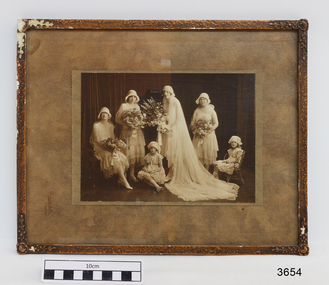
Photograph - Wedding group, c. 1929
... Dr Angus assisted Dr Tom Ryan, a pioneer in the use of X-rays and in ocular surgery. flagstaff hill warrnambool shipwrecked coast flagstaff hill maritime museum maritime museum shipwreck coast flagstaff hill maritime village great ocean road dr w r angus gladys forsyth angus - forsyth wedding marriage of dr w.r. angus wedding photograph photographic record wedding 1929 Label on back of frame with Framer’s details “James Hooper, Picture Framer, 120 Rundle St. ...This wedding photograph shows the bridal party and bride-to-be, Gladys Forsyth. The wedding was held in Ballarat. The photograph was donated to Flagstaff Hill Maritime Village by the family of Doctor William Roy Angus, Surgeon and Oculist. It is part of the “W.R. Angus Collection” that includes historical medical equipment, surgical instruments and material once belonging to Dr Edward Ryan and Dr Thomas Francis Ryan, (both of Nhill, Victoria) as well as Dr Angus’ own belongings. The Collection’s history spans the medical practices of the two Doctors Ryan, from 1885-1926 plus that of Dr Angus, up until 1969. ABOUT THE “W.R.ANGUS COLLECTION” Doctor William Roy Angus M.B., B.S., Adel., 1923, F.R.C.S. Edin.,1928 (also known as Dr Roy Angus) was born in Murrumbeena, Victoria in 1901 and lived until 1970. He qualified as a doctor in 1923 at University of Adelaide, was Resident Medical Officer at the Royal Adelaide Hospital in 1924 and for a period was house surgeon to Sir (then Mr.) Henry Simpson Newland. Dr Angus was briefly an Assistant to Dr Riddell of Kapunda, then commenced private practice at Curramulka, Yorke Peninsula, SA, where he was physician, surgeon and chemist. In 1926, he was appointed as new Medical Assistant to Dr Thomas Francis Ryan (T.F. Ryan, or Tom), in Nhill, Victoria, where his experiences included radiology and pharmacy. In 1927 he was Acting House Surgeon in Dr Tom Ryan’s absence. Dr Angus had become engaged to Gladys Forsyth and they decided he would take time to further his studies overseas in the UK in 1927. He studied at London University College Hospital and at Edinburgh Royal Infirmary and in 1928, was awarded FRCS (Fellow from the Royal College of Surgeons), Edinburgh. He worked his passage back to Australia as a Ship’s Surgeon on the on the Australian Commonwealth Line’s T.S.S. Largs Bay. Dr Angus married Gladys in 1929, in Ballarat. (They went on to have one son (Graham 1932, born in SA) and two daughters (Helen (died 12/07/1996) and Berenice (Berry), both born at Mira, Nhill ) Dr Angus was a ‘flying doctor’ for the A.I.M. (Australian Inland Ministry) Aerial Medical Service in 1928 . The organisation began in South Australia through the Presbyterian Church in that year, with its first station being in the remote town of Oodnadatta, where Dr Angus was stationed. He was locum tenens there on North-South Railway at 21 Mile Camp. He took up this ‘flying doctor’ position in response to a call from Dr John Flynn; the organisation was later known as the Flying Doctor Service, then the Royal Flying Doctor Service. A lot of his work during this time involved dental surgery also. Between 1928-1932 he was surgeon at the Curramulka Hospital, Yorke Peninsula, South Australia. In 1933 Dr Angus returned to Nhill where he’d previously worked as Medical Assistant and purchased a share of the Nelson Street practice and Mira hospital from Dr Les Middleton one of the Middleton Brothers, the current owners of what was once Dr Tom Ryan’s practice. Dr L Middleton was House Surgeon to the Nhill Hospital 1926-1933, when he resigned. [Dr Tom Ryan’s practice had originally belonged to his older brother Dr Edward Ryan, who came to Nhill in 1885. Dr Edward saw patients at his rooms, firstly in Victoria Street and in 1886 in Nelson Street, until 1901. The Nelson Street practice also had a 2 bed ward, called Mira Private Hospital ). Dr Edward Ryan was House Surgeon at the Nhill Hospital 1884-1902 . He also had occasions where he successfully performed veterinary surgery for the local farmers too. Dr Tom Ryan then purchased the practice from his brother in 1901. Both Dr Edward and Dr Tom Ryan work as surgeons included eye surgery. Dr Tom Ryan performed many of his operations in the Mira private hospital on his premises. He too was House Surgeon at the Nhill Hospital 1902-1926. Dr Tom Ryan had one of the only two pieces of radiology equipment in Victoria during his practicing years – The Royal Melbourne Hospital had the other one. Over the years Dr Tom Ryan gradually set up what was effectively a training school for country general-practitioner-surgeons. Each patient was carefully examined, including using the X-ray machine, and any surgery was discussed and planned with Dr Ryan’s assistants several days in advance. Dr Angus gained experience in using the X-ray machine there during his time as assistant to Dr Ryan. Dr Tom Ryan moved from Nhill in 1926. He became a Fellow of the Royal Australasian College of Surgeons in 1927, soon after its formation, a rare accolade for a doctor outside any of the major cities. He remained a bachelor and died suddenly on 7th Dec 1955, aged 91, at his home in Ararat. Scholarships and prizes are still awarded to medical students in the honour of Dr T.F. Ryan and his father, Dr Michael Ryan, and brother, John Patrick Ryan. ] When Dr Angus bought into the Nelson Street premises in Nhill he was also appointed as the Nhill Hospital’s Honorary House Surgeon 1933-1938. His practitioner’s plate from his Nhill surgery states “HOURS Daily, except Tuesdays, Fridays and Saturday afternoons, 9-10am, 2-4pm, 7-8pm. Sundays by appointment”. This plate is now mounted on the doorway to the Port Medical Office at Flagstaff Hill Maritime Village, Warrnambool. Dr Edward Ryan and Dr Tom Ryan had an extensive collection of historical medical equipment and materials spanning 1884-1926 and when Dr Angus took up practice in their old premises he obtained this collection, a large part of which is now on display at the Port Medical Office at Flagstaff Hill Maritime Village in Warrnambool. During his time in Nhill Dr Angus was involved in the merging of the Mira Hospital and Nhill Public Hospital into one public hospital and the property titles passed on to Nhill Hospital in 1939. In 1939 Dr Angus and his family moved to Warrnambool where he purchased “Birchwood,” the 1852 home and medical practice of Dr John Hunter Henderson, at 214 Koroit Street. (This property was sold in1965 to the State Government and is now the site of the Warrnambool Police Station. ). The Angus family was able to afford gardeners, cooks and maids; their home was a popular place for visiting dignitaries to stay whilst visiting Warrnambool. Dr Angus had his own silk worm farm at home in a Mulberry tree. His young daughter used his centrifuge for spinning the silk. Dr Angus was appointed on a part-time basis as Port Medical Officer (Health Officer) in Warrnambool and held this position until the 1940’s when the government no longer required the service of a Port Medical Officer in Warrnambool; he was thus Warrnambool’s last serving Port Medical Officer. (The duties of a Port Medical Officer were outlined by the Colonial Secretary on 21st June, 1839 under the terms of the Quarantine Act. Masters of immigrant ships arriving in port reported incidents of diseases, illness and death and the Port Medical Officer made a decision on whether the ship required Quarantine and for how long, in this way preventing contagious illness from spreading from new immigrants to the residents already in the colony.) Dr Angus was a member of the Australian Medical Association, for 35 years and surgeon at the Warrnambool Base Hospital 1939-1942, He served as a Surgeon Captain during WWII 1941-45, in Ballarat, Victoria, and in Bonegilla, N.S.W., completing his service just before the end of the war due to suffering from a heart attack. During his convalescence he carved an intricate and ‘most artistic’ chess set from the material that dentures were made from. He then studied ophthalmology at the Royal Melbourne Eye and Ear Hospital and created cosmetically superior artificial eyes by pioneering using the intrascleral cartilage. Angus received accolades from the Ophthalmological Society of Australasia for this work. He returned to Warrnambool to commence practice as an ophthalmologist, pioneering in artificial eye improvements. He was Honorary Consultant Ophthalmologist to Warrnambool Base Hospital for 31 years. He made monthly visits to Portland as a visiting surgeon, to perform eye surgery. He represented the Victorian South-West subdivision of the Australian Medical Association as its secretary between 1949 and 1956 and as chairman from 1956 to 1958. In 1968 Dr Angus was elected member of Spain’s Barraquer Institute of Barcelona after his research work in Intrasclearal cartilage grafting, becoming one of the few Australian ophthalmologists to receive this honour, and in the following year presented his final paper on Living Intrasclearal Cartilage Implants at the Inaugural Meeting of the Australian College of Ophthalmologists in Melbourne In his personal life Dr Angus was a Presbyterian and treated Sunday as a Sabbath, a day of rest. He would visit 3 or 4 country patients on a Sunday, taking his children along ‘for the ride’ and to visit with him. Sunday evenings he would play the pianola and sing Scottish songs to his family. One of Dr Angus’ patients was Margaret MacKenzie, author of a book on local shipwrecks that she’d seen as an eye witness from the late 1880’s in Peterborough, Victoria. In the early 1950’s Dr Angus, painted a picture of a shipwreck for the cover jacket of Margaret’s book, Shipwrecks and More Shipwrecks. She was blind in later life and her daughter wrote the actual book for her. Dr Angus and his wife Gladys were very involved in Warrnambool’s society with a strong interest in civic affairs. Their interests included organisations such as Red Cross, Rostrum, Warrnambool and District Historical Society (founding members), Wine and Food Society, Steering Committee for Tertiary Education in Warrnambool, Local National Trust, Good Neighbour Council, Housing Commission Advisory Board, United Services Institute, Legion of Ex-Servicemen, Olympic Pool Committee, Food for Britain Organisation, Warrnambool Hospital, Anti-Cancer Council, Boys’ Club, Charitable Council, National Fitness Council and Air Raid Precautions Group. He was also a member of the Steam Preservation Society and derived much pleasure from a steam traction engine on his farm. He had an interest in people and the community He and his wife Gladys were both involved in the creation of Flagstaff Hill, including the layout of the gardens. After his death (28th March 1970) his family requested his practitioner’s plate, medical instruments and some personal belongings be displayed in the Port Medical Office surgery at Flagstaff Hill Maritime Village, and be called the “W. R. Angus Collection”. The W.R. Angus Collection is significant for still being located at the site it is connected with, Doctor Angus being the last Port Medical Officer in Warrnambool. The collection of medical instruments and other equipment is culturally significant, being an historical example of medicine from late 19th to mid-20th century. Dr Angus assisted Dr Tom Ryan, a pioneer in the use of X-rays and in ocular surgery. Framed, glass covered photograph, sepia colour, Dr.W.R. Angus’ bride-to-be (Gladys) with her three (3) bridesmaids and two (2) flower girls. Frame’s edging is embossed with roses in the corners. Photograph was framed in Adelaide. Framer’s details are on the back of the frame.Label on back of frame with Framer’s details “James Hooper, Picture Framer, 120 Rundle St. Adelaide” flagstaff hill, warrnambool, shipwrecked coast, flagstaff hill maritime museum, maritime museum, shipwreck coast, flagstaff hill maritime village, great ocean road, dr w r angus, gladys forsyth, angus - forsyth wedding, marriage of dr w.r. angus, wedding photograph, photographic record wedding 1929 -
 Flagstaff Hill Maritime Museum and Village
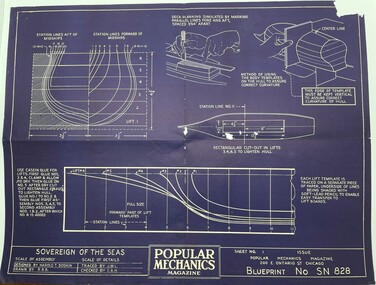
Work on paper - Sovereign of the Seas Model Blueprints, Popular Mechanics Press, "Sovereign of the Seas", 1933
... Flagstaff Hill Warrnambool Maritime Village Maritime Museum Flagstaff Hill Maritime Museum and Village Shipwreck coast Great Ocean Road model ship vessel sovereign of the seas jim williams james bernard williams the forth tasmania freda williams heather williams phyllis bowditch fletcher jones staff 1936 17th century sailing ship cramond and dickson sovereign of the seas royal sovereign sovereign Charles 1 Fletcher Jones Warrnambool Breakwater Popular Mechanics Magazine Sovereign of the Seas, Scale of Assembly, Scale of Details. Designed by Harold T. Bodkin. Drawn by R.B.B. Traced By J.W.L. Checked BY E.R.H. Popular Mechanics Magazine. 200 E. Ontario St ...A complete set of 8 blueprints from “Popular Mechanics Magazine”, Chicago. The blueprints are on a royal purple coloured paper with white print. Each print displays labelled diagrams to assist the hobbyist to assemble the ship model “Sovereign of the Seas”. The designer is Harold T. Bodkin. Distinct fold creases divide the documents into quarters. There is some silverfish damage leaving holes, however, all instructions are visible. flagstaff hill, warrnambool, maritime village, maritime museum, flagstaff hill maritime museum and village, shipwreck coast, great ocean road, model ship, vessel sovereign of the seas, jim williams, james bernard williams, the forth tasmania, freda williams, heather williams, phyllis bowditch, fletcher jones staff 1936, 17th century sailing ship, cramond and dickson, sovereign of the seas, royal sovereign, sovereign, charles 1, fletcher jones, warrnambool breakwater, popular mechanics magazine -
 Flagstaff Hill Maritime Museum and Village
Photograph - Historical, building, Lighthouse Keeper's Quarters Warrnambool, Ca. 1917
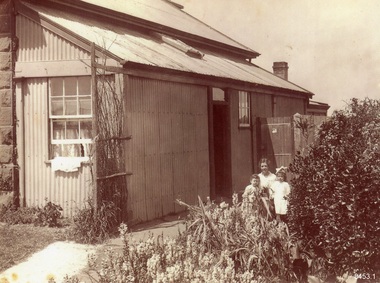
... Flagstaff Hill Warrnambool Maritime Museum Shipwreck coast Great Ocean Road Lighthouse Keeper's quarters Lighthouse Keeper's Cottage Gertrude Shade James Shade Janet Shade John Stewart Lindsay Stewart Lindsay Nestle Warrnambool exports Port of Warrnambool Planning Board 1917 Howard Nicholl William Shade export to Indonesia Janet Lindsay light keeper Typed label "Gertrude Shade with William and Janet. Lighthouse Keeper's Cottage, Flagstaff Hill, Merri St ...This photograph of the Warrnambool Lighthouse Keeper's Quarters was donated together with an accompanying letter written by John Lindsay on October 21st, 1997. The letter was addressed to Howard Nicholl, the Director of Flagstaff Hill at that time. The following information was gleaned from the contents of the letter and the labels attached to the photograph:- The photograph of the Cottage was taken in about 1917. The woman is Gertrude Shade, married to James Shade, who was the Warrnambool Town Council's Officer responsible for keeping records of Shipping activity entering and leaving the busy Port of Warrnambool. The couple and their children, Janet and William, were residents of the Assistant Lighthouse Keeper's Quarters at that time. The family is pictured in the garden on the west side of the building. A washhouse, these days referred to as a laundry, is behind the building and had already been removed when the Flagstaff Hill Planning Board had access to the site in 1972. The corrugated iron veranda was replaced in the 1980s with a smaller covered entry. Janet Shade married the man who lived across the road, Stewart Lindsay, in 1935. Stewart was employed by Nestle at the age of sixteen, working in the export department. He was acting Manager when the Manager became ill, supervising the loading of dairy products and biscuits into the holds of the waiting ships, where they were then exported to Indonesia. Many of the ships were registered in Liberia and the seamen were called 'lascar seamen, or Indian Sailors. Janet and Stewart had a son, John Stewart Lindsay, who was a Pharmacist, a member of the Warrnambool City Council, the Mayor of the City of Warrnambool, a former Director of Flagstaff Hill, and Chairman of the Flagstaff Hill Advisory Committee.This photograph has significance as a historical record of the Warrnambool Lighthouse Kerr'er's Quarters in 1917. The photograph connects the cottage to local families, to local industry, to the Port of Warrnambool, and to overseas exports from Warrnambool. Photograph from c. 1917 depicts the western side of the Warrnambool's Lighthouse keeper's Quarters constructed in bluestone, which was where the Assistant Lighthouse Keeper resided. The image shows the corrugated iron lean-to, and other rooms that were added to the original building after 1872, which were removed in the 1970s due to their poor condition. The members of the family pictured were residents at the time; Gertrude Shade (Mrs James Shade), her daughter Janet and her son William. Inscriptions are on the reverse and the accompanying envelope. Typed label "Gertrude Shade with William and Janet. Lighthouse Keeper's Cottage, Flagstaff Hill, Merri St Warrnambool" Stamp "John Stewart Lindsay, Pharmacist, --0 Thompson Street Warrnambool 3280" "HOWARD NICHOLL / FLAGSTAFF HILL / MERRI STREET" " KEEP OUT OF REACH OF CHILDREN / Lindsay's Pharmacy / 119 Liebig Street, Warrnambool / Tel. 5561 4310" [round symbol of mortar and pestle] Typed letter (from John Lindsay to Howard Nicholl, October 21 1997)flagstaff hill, warrnambool, maritime museum, shipwreck coast, great ocean road, lighthouse keeper's quarters, lighthouse keeper's cottage, gertrude shade, james shade, janet shade, john stewart lindsay, stewart lindsay, nestle, warrnambool exports, port of warrnambool, planning board, 1917, howard nicholl, william shade, export to indonesia, janet lindsay, light keeper -
Glenelg Shire Council Cultural Collection
Functional object - Adding Machine, n.d
... St. James's St/London/Plus/Guaranteed/Wholly made in Great Britian (embossed stamp, back) (Further details on plaque on base) PLUS (plaque, front) Made in England (engraved, base)...St. James's St/London/Plus/Guaranteed/Wholly made in Great Britian (embossed stamp, back) (Further details on plaque on base) PLUS (plaque, front) Made in England (engraved, base) Plus Adding Machine Functional object Adding Machine Bell Punch Company Ltd ...Town of Portland collectionPlus Adding MachineFront: Town of Portland (tape back) Bell Punch Company Ltd/39 St. James's St/London/Plus/Guaranteed/Wholly made in Great Britian (embossed stamp, back) (Further details on plaque on base) PLUS (plaque, front) Made in England (engraved, base) -
 Greensborough Historical Society
Photograph - Digital image, Marilyn Smith, St Katherine's Church St Helena: Beale family plaque, World War 1, 29/05/2015
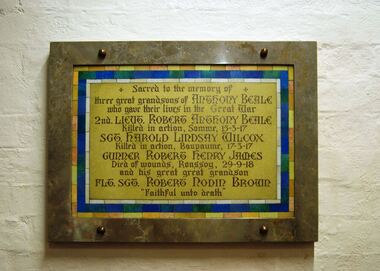
... St Helena dates from 1858. The Church was built by Major Anthony Beale in memory of his wife Katherine Rose Beale. This photograph shows a plaque that commemorates the death of three grandsons of Anthony Beale who were killed in World War I: Robert Beale, Harold Wilcox and Robert James, and his great grandson Robert Brown....St Helena dates from 1858. The Church was built by Major Anthony Beale in memory of his wife Katherine Rose Beale. This photograph shows a plaque that commemorates the death of three grandsons of Anthony Beale who were killed in World War I: Robert Beale, Harold Wilcox and Robert James, and his great grandson Robert Brown. st katherines church st helena anthony beale beale family Digital copy of colour photograph St Katherine's Church St Helena: Beale family plaque, World War 1 Photograph - Digital image Marilyn Smith ...St Katherine's Church St Helena dates from 1858. The Church was built by Major Anthony Beale in memory of his wife Katherine Rose Beale. This photograph shows a plaque that commemorates the death of three grandsons of Anthony Beale who were killed in World War I: Robert Beale, Harold Wilcox and Robert James, and his great grandson Robert Brown.Digital copy of colour photographst katherines church st helena, anthony beale, beale family -
 Orbost & District Historical Society
books, The Memorial Church of St James, Orbost, A History, March 1 1981
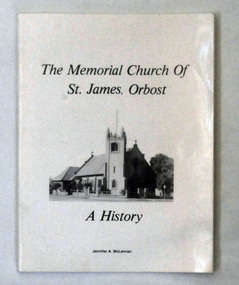
... St. James' Anglican Church, Orbost, was conceived and built as a memorial to the men 'who served and suffered during the Great War' as noted on the foundation stone. ...St. James' Anglican Church, Orbost, was conceived and built as a memorial to the men 'who served and suffered during the Great War' as noted on the foundation stone. ...St. James' Anglican Church, Orbost, was conceived and built as a memorial to the men 'who served and suffered during the Great War' as noted on the foundation stone. The Right Reverend GH Cranswick, DD, Bishop of Gippsland, laid the stone on 1 October 1927.This is a local history book written by a local author.A 54 pp book titled The Memorial Church of St James, Orbost, A History. The front cover is cream/white and has a b/w photograph of a church and spire (St James, Orbost). The text is black. The book was written by Jennifer A. McLennanchurch-history anglican-orbost st-james-orbost -
 Orbost & District Historical Society
black and white photograph, C1900
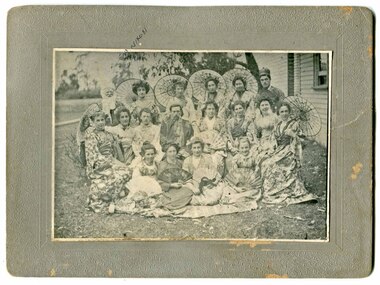
... St. James' Anglican Church, Orbost, was conceived and built as a memorial to the men 'who served and suffered during the Great War' as noted on the foundation stone. ...St. James' Anglican Church, Orbost, was conceived and built as a memorial to the men 'who served and suffered during the Great War' as noted on the foundation stone. ...This is a photograph of a group of people dressed up in traditional Japanese costumes for a Church of England bazaar and fete C 1900. in the late 19th and early 20th centuries Churches in Orbost provided venues for social activities, fellowship and entertainment. Many concerts, festivals and money-raising fetes were held by the church committees. St. James' Anglican Church, Orbost, was conceived and built as a memorial to the men 'who served and suffered during the Great War' as noted on the foundation stone. The Right Reverend GH Cranswick, DD, Bishop of Gippsland, laid the stone on 1 October 1927.This item is reminiscent of the late 19th - mid 20th centuries when church-going was more commonA black / white photograph on grey buff card. It is of a large group of men and women dressed in traditional Japanese costume.on front at top - handwritten - "E. H. NIXON" with an arrow pointing to the first lady standing in the back row.churches-orbost church-of-england-orbost anglican-church-orbost festivals celebrations -
 Flagstaff Hill Maritime Museum and Village
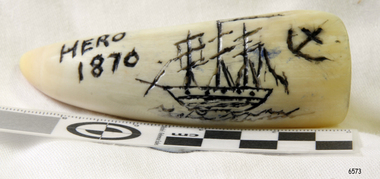
Craft - Scrimshaw, Hero 1870, Late 20th Century
... St. Lawrence River and anchored at Quebec. The Prince was successful with Canadian society visiting Quebec and Montreal during his stay. He went on to visit the United States following an invitation by President James Buchanan. His American journey was regarded as a great...St. Lawrence River and anchored at Quebec. The Prince was successful with Canadian society visiting Quebec and Montreal during his stay. He went on to visit the United States following an invitation by President James Buchanan. His American journey was regarded as a great ...Scrimshaw is regarded as early folk art and is associated primarily with whaling that was opened up in the Pacific at the end of the eighteenth century by sailors mainly from American, English and French vessels. As a result, some of the best scrimshaw from Pacific whales can be found in collections in these countries. Even though sailors must have had plenty of spare time between periods of whaling scrimshaw on whale teeth seems a rarity before the 1830s. One reason may have been the high price paid for whale teeth ivory in this period making scrimshaw on teeth popular only after the market was saturated and the price dropped. The earliest identified engraver of whale teeth is the English whaling master Captain J. S. King who was active between 1817 and 1823. There have been six ships called the Hero in the Royal Navy and this ship was the fourth named Hero, it was a screw-propelled 91-gun and second-rate. In the rating system of the British Royal Navy, this term is used to categorise sailing warships, a second-rate was a ship of the line which by the start of the 18th century mounted 90 to 98 guns on three gun decks. Earlier 17th-century second rates had fewer guns and were originally two-deckers or had only partially armed third gun decks. The Hero was launched in 1858 and sold in 1971. On July 1860 the Prince of Wales embarked onboard HMS Hero, Albert Edward Prince of Wales, was the eldest son of Queen Victoria, and the future King Edward VII, at the time he was then nineteen years of age, and on route to Newfoundland, Canada and the United States on his first state tour. He was the first member of the British royal family to visit North America. In 1860 the Queen had intended to pay a visit to Canada however stress prevented her from travelling. The then Prime Minister Lord Palmerston suggested that “Bertie” the prince of Wales could represent the Queen and on July 10th 1860, Bertie boarded HMS Hero for a tour of Canada and the USA. On July 23rd the ship arrived at Terranova. By the second week of August, the HMS Hero had sailed up the St. Lawrence River and anchored at Quebec. The Prince was successful with Canadian society visiting Quebec and Montreal during his stay. He went on to visit the United States following an invitation by President James Buchanan. His American journey was regarded as a great success. President Buchanan wrote to Queen Victoria: "He “Bertie” has faced a very difficult task for a person his age and his behaviour in all this has been that of his age and position. He has shown himself honourable, Frank and affable and he won the respect of the sensible and wise people". The scrimshaw is believed to be a modern reproduction of a typical scrimshaw scene and engraved very crudely onto a synthetic substance. Scrimshaw art carved into non-natural material in the shape of a whale tooth. The line artwork images of a three-masted, fully rigged ship and an anchor are coloured black. Inscription is engraved into tooth.Engraved "Hero 1870"warrnambool, flagstaff-hill, flagstaff-hill-maritime-museum, maritime-museum, shipwreck-coast, flagstaff-hill-maritime-village, scrimshaw, plastic, resin, replica, prince of wales, british navy vessel, whaling, hms hero, reproduction, carving, engraving -
 Flagstaff Hill Maritime Museum and Village
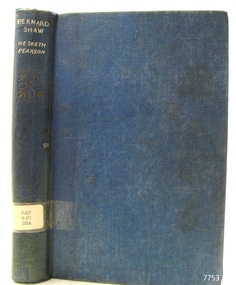
Book, Bernard Shaw
... The Warrnambool Mechanics' Institute publication collection is of both local and state significance. warrnambool shipwrecked-coast flagstaff-hill flagstaff-hill-maritime-museum maritime-museum shipwreck-coast flagstaff-hill-maritime-village shipwrecked-artefact book pattison collection warrnambool library warrnambool mechanics’ institute ralph eric pattison corangamite regional library service warrnambool city librarian mechanics’ institute library victorian library board warrnambool books and records warrnambool children’s library great ocean road bernard shaw hesketh pearson Label on spine cover with typed text PAT 920 SHA Pastedown front endpaper has sticker from Warrnambool Public Library covered by a sticker from Corangamite Regional Library Service Front loose endpaper has a stamp from Corangamite Regional Library Service Bernard Shaw His Life and Personality Author: Hesketh Pearson Publisher: St James Library Date: 1950 Bernard Shaw Book ...This item is from the ‘Pattison Collection’, a collection of books and records that was originally owned by the Warrnambool Mechanics’ Institute, which was founded in Warrnambool in 1853. By 1886 the Warrnambool Mechanics’ Institute (WMI) had grown to have a Library, Museum and Fine Arts Gallery, with a collection of “… choice productions of art, and valuable specimens in almost every branch and many wonderful national curiosities are now to be seen there, including historic relics of the town and district.” It later included a School of Design. Although it was very well patronised, the lack of financial support led the WMI in 1911 to ask the City Council to take it over. In 1935 Ralph Pattison was appointed as City Librarian to establish and organise the Warrnambool Library as it was then called. When the WMI building was pulled down in 1963 a new civic building was erected on the site and the new Warrnambool Library, on behalf of the City Council, took over all the holdings of the WMI. At this time some of the items were separated and identified as the ‘Pattison Collection’, named after Ralph Pattison. Eventually the components of the WMI were distributed from the Warrnambool Library to various places, including the Art Gallery, Historical Society and Flagstaff Hill. Later some were even distributed to other regional branches of Corangamite Regional Library and passed to and fro. It is difficult now to trace just where all of the items have ended up. The books at Flagstaff Hill Maritime Village generally display stamps and markings from Pattison as well as a variety of other institutions including the Mechanics’ Institute itself. RALPH ERIC PATTISON Ralph Eric Pattison was born in Rockhampton, Queensland, in 1891. He married Maude Swan from Warrnambool in 1920 and they set up home in Warrnambool. In 1935 Pattison accepted a position as City Librarian for the Warrnambool City Council. His huge challenge was to make a functional library within two rooms of the Mechanics’ Institute. He tirelessly cleaned, cleared and sorted a disarrayed collection of old books, jars of preserved specimens and other items reserved for exhibition in the city’s museum. He developed and updated the library with a wide variety of books for all tastes, including reference books for students; a difficult task to fulfil during the years following the Depression. He converted all of the lower area of the building into a library, reference room and reading room for members and the public. The books were sorted and stored using a cataloguing and card index system that he had developed himself. He also prepared the upper floor of the building and established the Art Gallery and later the Museum, a place to exhibit the many old relics that had been stored for years for this purpose. One of the treasures he found was a beautiful ancient clock, which he repaired, restored and enjoyed using in his office during the years of his service there. Ralph Pattison was described as “a meticulous gentleman whose punctuality, floorless courtesy and distinctive neat dress were hallmarks of his character, and ‘his’ clock controlled his daily routine, and his opening and closing of the library’s large heavy doors to the minute.” Pattison took leave during 1942 to 1945 to serve in the Royal Australian Navy, Volunteer Reserve as Lieutenant. A few years later he converted one of the Museum’s rooms into a Children’s Library, stocking it with suitable books for the younger generation. This was an instant success. In the 1950’s he had the honour of being appointed to the Victorian Library Board and received more inspiration from the monthly conferences in Melbourne. He was sadly retired in 1959 after over 23 years of service, due to the fact that he had gone over the working age of council officers. However he continued to take a very keen interest in the continual development of the Library until his death in 1969. WARRNAMBOOL PUBLIC LIBRARY The Warrnambool Mechanics’ Institute (WMI) was formed by a voluntary community group in 1863, within six years of Warrnambool’s beginnings, and its Reading Room opened in 1854. The WMI operated until 1963, at which time it was one of the oldest Mechanics’ Institutes in Victoria. Mechanics’ Institutes offered important services to the public including libraries, reading rooms and places to display and store collections of all sorts such as curiosities and local historical relics. In 1886 a Museum and Fine Arts Gallery were added to the WMI and by the beginning of the 20th century there was also a billiards room and a School of Art. By this time all Mechanics’ Institutes in country Victoria had museums attached. Over the years the Warrnambool Mechanics’ Institute Library was also known as the Warrnambool Public Library the Warrnambool Library and the Free Library. Early funding from the government was for the “Free Library”. The inscription in a book “Science of Man” was for the “Warrnambool Public Library”, donated by Joseph Archibald in 1899. Another inscription in the book “Catalogue of Plants Under Cultivation in the Melbourne Botanic Gardens 1 & 2, 1883” was presented to the “Warrnambool Library” and signed by the author W.R. Guilfoyle. In 1903 the Warrnambool Public Library decided to add a Juvenile Department to library and stock it with hundreds of books suitable for youth. In 1905 the Public Library committee decided to update the collection of books and added 100 new novels plus arrangements for the latest novels to be included as soon as they were available in Victoria. In July 1911 the Warrnambool Council took over the management of the Public Library, Art Gallery, Museum and Mechanics’ Institute and planned to double the size of the then-current building. In 1953, when Mr. R. Pattison was Public Librarian, the Warrnambool Public Library’s senior section 10,000 of the 13,000 books were fiction. The children’s section offered an additional 3,400 books. The library had the equivalent of one book per head of population and served around 33 percent of the reading population. The collection of books was made up of around 60 percent reference and 40 percent fiction. The library was lending 400 books per day. In 1963 the Warrnambool City Council allocated the site of the Mechanics’ Institute building, which included the Public Library, Museum and Art Gallery, for the new Municipal Offices and the Collections were dispersed until 1971. The Warrnambool Library took over the Mechanics’ Institute Library’s holdings on behalf of the Warrnambool City Council. Since the closure of the Warrnambool Mechanics’ Institute the exact location and composition of the original WMI books and items has become unclear. Other materials have been added to the collection, including items from Terang MI, Warrnambool Court House and Customs House. Many of the books have been identified as the Pattison Collection, named after the Librarian who catalogued and numbered the books during his time as Warrnambool Public Librarian in the time before the Mechanics’ Institute closed. It seems that when Warrnambool became part of the Corangamite Regional Library some of the books and materials went to its head office in Colac and then back to Warrnambool where they were stored at the Art Gallery for quite some time. Some then went to the Warrnambool Historical Society, some stayed at the Art Gallery and some were moved to Flagstaff Hill Maritime Village. The various stamps and labels on the books held at Flagstaff Hill show the variety of the collection’s distribution and origin. The books in the collection at Flagstaff Hill Maritime Village date from the 1850’s to the late 1950’s and include rare and valuable volumes. Many of the books are part of the “Pattison Collection” after the Warrnambool’s Public Librarian, Mr. R. Pattison. The Pattison Collection, along with other items at Flagstaff Hill Maritime Village, was originally part of the Warrnambool Mechanics' Institute’s collection. The Warrnambool Mechanics’ Institute Collection is primarily significant in its totality, rather than for the individual objects it contains. Its contents are highly representative of the development of Mechanics' Institute libraries across Australia, particularly Victoria. A diversity of publications and themes has been amassed, and these provide clues to our understanding of the nature of and changes in the reading habits of Victorians from the 1850s to the middle of the 20th century. The collection also highlights the Warrnambool community’s commitment to the Mechanics’ Institute, reading, literacy and learning in the regions, and proves that access to knowledge was not impeded by distance. These items help to provide a more complete picture of our community’s ideals and aspirations. The Warrnambool Mechanics Institute book collection has historical and social significance for its strong association with the Mechanics Institute movement and the important role it played in the intellectual, cultural and social development of people throughout the latter part of the nineteenth century and the early twentieth century. The collection of books is a rare example of an early lending library and its significance is enhanced by the survival of an original collection of many volumes. The Warrnambool Mechanics' Institute’s publication collection is of both local and state significance. The Warrnambool Mechanics' Institute Collection is primarily significant in its totality, rather than for the individual objects it contains. Its contents are highly representative of the development of Mechanics' Institute libraries across Australia, particularly Victoria. A diversity of publications and themes has been amassed, and these provide clues to our understanding of the nature of and changes in the reading habits of Victorians from the 1850s to the middle of the 20th century. The collection also highlights the Warrnambool community’s commitment to the Mechanics’ Institute, and to reading, literacy and learning in the regions, and proves that access to knowledge was not impeded by distance. These items help to provide a more complete picture of our community’s ideals and aspirations. As with many Mechanics' Institutes in Australia, the one which operated in Warrnambool was established and overseen for many years by key individuals associated with the development of the city itself. The WMI publication collection is historically significant because of its association with local people, places and the key historical themes in the development of Warrnambool of rural development, industry, farming, education, and community. The collection documents and illustrates the changing interests, focus and tastes of Victorians, especially those in regional cities. Generally the individual items in the collection are not particularly rare, as examples of all probably exist in other public collections in Victoria. It is primarily because there are so very few surviving Mechanics' Institute collections in Victoria, which lends this overall collection its significance. Many items in the WMI Collection have the potential to support further research, both as individual objects and through the collection in its entirety. This material is significant for its ability to assist in the interpretation of the history of the area and adds to the general understanding of the development of the township. Many components of the WMI publication collection complement and reinforce the Flagstaff Hill Maritime Museum Collection, the Warrnambool Art Gallery Collection, and that in the Warrnambool Historical Society, and also contribute to a clearer understanding of the original Warrnambool Mechanics' Institute collections. This will greatly enhance the appreciation of the few surviving Mechanics' Institute collections across Victoria, and also in New South Wales. The similarities and differences between the small number of collections that have survived can provide further insights into how the people of Victoria in general, and Warrnambool in particular, constructed a civic culture of adult learning to foster an informed citizenry. The Warrnambool Mechanics' Institute publication collection is of both local and state significance. Bernard Shaw His Life and Personality Author: Hesketh Pearson Publisher: St James Library Date: 1950Label on spine cover with typed text PAT 920 SHA Pastedown front endpaper has sticker from Warrnambool Public Library covered by a sticker from Corangamite Regional Library Service Front loose endpaper has a stamp from Corangamite Regional Library Servicewarrnambool, shipwrecked-coast, flagstaff-hill, flagstaff-hill-maritime-museum, maritime-museum, shipwreck-coast, flagstaff-hill-maritime-village, shipwrecked-artefact, book, pattison collection, warrnambool library, warrnambool mechanics’ institute, ralph eric pattison, corangamite regional library service, warrnambool city librarian, mechanics’ institute library, victorian library board, warrnambool books and records, warrnambool children’s library, great ocean road, bernard shaw, hesketh pearson -
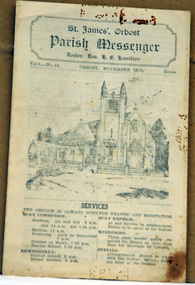 Orbost & District Historical Society
newsletter, St James, Orbost Parish Messenger November, 1933, November 1933
... St. James' Anglican Church, Orbost, was conceived and built as a memorial to the men 'who served and suffered during the Great War' as noted on the foundation stone. ...St. James' Anglican Church, Orbost, was conceived and built as a memorial to the men 'who served and suffered during the Great War' as noted on the foundation stone. ...St. James' Anglican Church, Orbost, was conceived and built as a memorial to the men 'who served and suffered during the Great War' as noted on the foundation stone. The Right Reverend GH Cranswick, DD, Bishop of Gippsland, laid the stone on 1 October 1927. This parish newsletter was published regularly to inform church members of all the latest news, events and information.For many years the Anglican people of Orbost have enjoyed the fellowship of the church and the children, in particular, were socially and spiritually involved. This item is reminiscent of the first half of the 20th century when church-going was more common.A four page newsletter titled, Parish Messenger for Orbost, November 1933, Vol 6 -No 83. It lists the services, times, meetings and news. The rector at the time was Rev. K.E. Hamilton.st-james-anglican-church church newsletter -
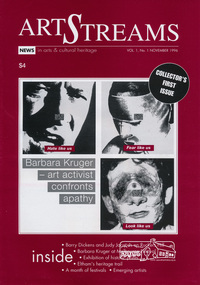 Eltham District Historical Society Inc
Journal, Peter Doughtery, ArtStreams: News in arts and cultural heritage; Vol. 1, No. 1, November 1996, 1996
... james and friends...mermaid in the well...michael eames...michael murray...michele lonsdale...monique di mattina...montsalvat...myra skipper...nell frysteen...nerida kirov...nicole o'connor...nillumbik emerging artists exhibition...nillumbik festival...nola spence...ona henderson...opportunity shop...our lady of help christians church...pamela conder...parafinallen...patrick mccauley...peter burns...peter dougherty...pond...road...robbie greig...roger shuttleworth...ron hanson...rory cole...ross hannaford...ross needham...ruckers hill...sanctuary...scott griffiths...shep huntly...shillinglaw cottage...shire of nillumbik...shoestring...sigmund jorgensen...silvio apponyi...spindrift...st margarets anglican church...stebbing cottage...steve sedergreen...susan street...sweeney...syd tunn...tennis-courts...terry cole...the great..." - Eltham District Historical Society Newsletter No. 161, March 2005 1996 adam simmons akira takizawa alison cassidy alistair knox park allwood house alvaro castagnet angels of soul anita hustas anna kelly anne curry arts ball avenue of honour barbara kruger barry dickens batacuda belli belly dance and drumming group betty rowland bike paths bits & pieces blair fraser blue tongue bridge street bulleen art & garden centre bulleen nursery bux caffe poco cal martin carla cordeiro cate bailey charles morris charlie dowley chris hooke chris kandis chute street circus in a suitcase crucial kick deirdre o'reilly diamond creek diamond valley big band edna kenny ellis cottage eltham arts council eltham cemetery eltham courthouse eltham festival eltham high school stage and jazz band eltham high school eltham library eltham people's choir eltham symphonica band eltham war memorial building eltham wiregrass gallery eucalypso fay alexander jenkins fiona furphy firefly food for all seasons friends of the earth forest action fund gavan gray gene strode geoff braithwaite geoff kluke george kirov gil askey golden cascades graeme barker and the cats greg o'leary harry gilham helen o'grady children's drama academy heritage trail hurstbridge goldworks gallery italian women's choir jackie gaudion jackie stojznova jacqueline gawler janine james jarrold cottage jay atwill jazz band ball jerry hughes jock ryan john rasmussen jon weaving joseph zbukvic joy ness judy jacques judy racz jules burns june cugola kate jones kavisha mazzella kevin spearey les gyori lisa walker lothlorian louise jade magwal margie allan margie lou dyer margo barrett mary burns masquerade ball melody james and friends mermaid in the well michael eames michael murray michele lonsdale monique di mattina montsalvat myra skipper nell frysteen nerida kirov nicole o'connor nillumbik emerging artists exhibition nillumbik festival nola spence ona henderson opportunity shop our lady of help christians church pamela conder parafinallen patrick mccauley peter burns peter dougherty pond road robbie greig roger shuttleworth ron hanson rory cole ross hannaford ross needham ruckers hill sanctuary scott griffiths shep huntly shillinglaw cottage shire of nillumbik shoestring sigmund jorgensen silvio apponyi spindrift st margarets anglican church stebbing cottage steve sedergreen susan street sweeney syd tunn tennis-courts terry cole the great gizmo the picture theo scharf thermal skunkrust untitled scraper board victorian artists supplies war artist warrandyte westgarth writers' week wingrove cottage wolfgangs palace theatre troupe women's circus yarra plenty rock gospel choir you did alright kid art streams Colour front and back cover with feature articles and literary pieces with photographs and advertisements printed in black and white. 36 pages, 30 cm. ...Vol. 1, No. 1 November 1996 CONTENTS REFORMIST?: Barbara Kruger comes to the Museum of Modern Art at Heide 3 FESTIVALS Nillumbik festival celebrates our lifestyle in food, wine, music and art 5 WRITERS WEEK Barry Dickens and Judy Jacques on Ruckers Hill present the "word" in all its possibilities 8 EMERGING ARTISTS Nillumbik presents a new wave of visual artists 11 SHORT STORY Extract from a novel in progress by Jon Weaving 12 POETRY Tribute to Myra Skipper 16 HERITAGE TRAIL Youth of Eltham research local history 1 8 SCULPTURE Akira Takizawa's search for harmony 22 WRITER'S JOURNEY A writer overcomes a nightmare 24 SCIENCE AND ART Pamela Conder analyses nature 26 ARTS BALL Jazz greats come to town 27 HISTORY IN PRINTS Australia's forgotten war artist 28 "Peter Dougherty has been involved in the local art scene for many years. As publisher and editor of the arts magazine Artstreams, his comments on the various branches of the arts are widely respected. His "The Arts" column in the Diamond Valley Leader presents a brief summary for a much wider cross section of the local community. Peter also operates his own gallery and the Artstreams Cafe at the St Andrews market. Peter has a wealth of knowledge about present day and historical aspects of local art and artists." - Eltham District Historical Society Newsletter No. 161, March 2005Colour front and back cover with feature articles and literary pieces with photographs and advertisements printed in black and white. 36 pages, 30 cm. Vol. 1, no. 1 (Nov. 1996) - Vol. 10, no. 5 (summer ed. 2005/06) 1996, adam simmons, akira takizawa, alison cassidy, alistair knox park, allwood house, alvaro castagnet, angels of soul, anita hustas, anna kelly, anne curry, arts ball, avenue of honour, barbara kruger, barry dickens, batacuda, belli, belly dance and drumming group, betty rowland, bike paths, bits & pieces, blair fraser, blue tongue, bridge street, bulleen art & garden centre, bulleen nursery, bux, caffe poco, cal martin, carla cordeiro, cate bailey, charles morris, charlie dowley, chris hooke, chris kandis, chute street, circus in a suitcase, crucial kick, deirdre o'reilly, diamond creek, diamond valley big band, edna kenny, ellis cottage, eltham arts council, eltham cemetery, eltham courthouse, eltham festival, eltham high school stage and jazz band, eltham high school, eltham library, eltham people's choir, eltham symphonica band, eltham war memorial building, eltham wiregrass gallery, eucalypso, fay alexander jenkins, fiona furphy, firefly, food for all seasons, friends of the earth forest action fund, gavan gray, gene strode, geoff braithwaite, geoff kluke, george kirov, gil askey, golden cascades, graeme barker and the cats, greg o'leary, harry gilham, helen o'grady children's drama academy, heritage trail, hurstbridge goldworks gallery, italian women's choir, jackie gaudion, jackie stojznova, jacqueline gawler, janine james, jarrold cottage, jay atwill, jazz band ball, jerry hughes, jock ryan, john rasmussen, jon weaving, joseph zbukvic, joy ness, judy jacques, judy racz, jules burns, june cugola, kate jones, kavisha mazzella, kevin spearey, les gyori, lisa walker, lothlorian, louise jade, magwal, margie allan, margie lou dyer, margo barrett, mary burns, masquerade ball, melody james and friends, mermaid in the well, michael eames, michael murray, michele lonsdale, monique di mattina, montsalvat, myra skipper, nell frysteen, nerida kirov, nicole o'connor, nillumbik emerging artists exhibition, nillumbik festival, nola spence, ona henderson, opportunity shop, our lady of help christians church, pamela conder, parafinallen, patrick mccauley, peter burns, peter dougherty, pond, road, robbie greig, roger shuttleworth, ron hanson, rory cole, ross hannaford, ross needham, ruckers hill, sanctuary, scott griffiths, shep huntly, shillinglaw cottage, shire of nillumbik, shoestring, sigmund jorgensen, silvio apponyi, spindrift, st margarets anglican church, stebbing cottage, steve sedergreen, susan street, sweeney, syd tunn, tennis-courts, terry cole, the great gizmo, the picture, theo scharf, thermal skunkrust, untitled scraper board, victorian artists supplies, war artist, warrandyte, westgarth writers' week, wingrove cottage, wolfgangs palace theatre troupe, women's circus, yarra plenty rock gospel choir, you did alright kid, art streams -
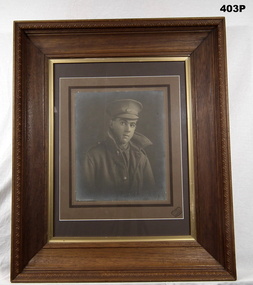 Bendigo Military Museum
Photograph - PHOTOGRAPH, FRAMED
... JAMES WORLAND MILLS 59th Batt AIF No 3441 59th Batt AIF. Refer 169P for the same smaller photo for more details. photographs- photography military history - army frames Stamped RH bottom corner: The Crown Studio, 240 Bourke St, Melbourne Head & shoulders black & white portrait of soldier JAMES WORLAND MILLS 59th Batt AIF in great coat & peak hat. ...JAMES WORLAND MILLS 59th Batt AIF No 3441 59th Batt AIF. Refer 169P for the same smaller photo for more details.Head & shoulders black & white portrait of soldier JAMES WORLAND MILLS 59th Batt AIF in great coat & peak hat. Wooden frame, tan colour with moulded edge, glass front with gold edge around portrait & cardboard backing.Stamped RH bottom corner: The Crown Studio, 240 Bourke St, Melbournephotographs- photography, military history - army, frames -
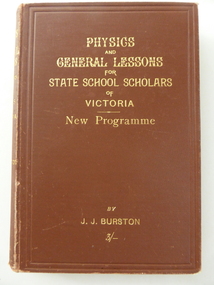 Warrnambool and District Historical Society Inc.
Book, Physics & General Lessons for State School Scholars of Victoria, 1892
... St. Kilda. He spent 16½ years there before retiring in 1911. Burston was a well-known writer of school text books, including The State School Arithmetic, The State School Grammar and Exercises in Practice and Proportion. He died in 1915. This book is of great interest because it was written by John James ...This school text book was written by John James Burston. He was the son of David and Sarah Burston of Warrnambool. Both his father and his brother Benjamin taught in schools in the Warrnambool area. John Burston was at Mepunga and Woodford schools before leaving in 1871 to be the Master of the Anglican School at Creswick. He then became the head teacher at schools in Ballarat and Bendigo before going to the Brighton Road State School in St. Kilda. He spent 16½ years there before retiring in 1911. Burston was a well-known writer of school text books, including The State School Arithmetic, The State School Grammar and Exercises in Practice and Proportion. He died in 1915.This book is of great interest because it was written by John James Burston, a one-time resident in the Warrnambool area and a teacher with a distinguished record in education – he taught in schools in Victoria for 44½ years and wrote several texts for State Schools.This is a hard cover book of 243 pages. There are several blank pages in the middle of the book and at the end for teachers’ notes. The cover is dark red with gold lettering on the front cover and on the spine. There are some illustrations scattered throughout the text.john james burston, physics and general lessons for victorian state schools, warrnambool -
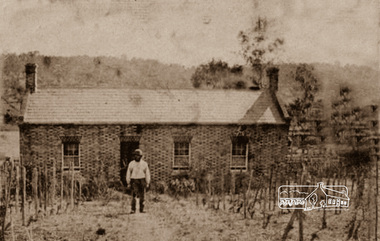 Eltham District Historical Society Inc
Photograph, Thomas Cochrane in front of his family home, in Little Eltham, c.1865
... St James, Melbourne in 1846. They had eight children: • Elizabeth Jane Cochrane born 1847, Keelbundoora • Sarah Cochrane born 1849, Keelbundoora • William John Cochrane born 1854, Eltham • Isabella Mary Cochrane (Cochren) born 1855, Eltham, my Great grandmother • Mary Cochrane born 1857, Eltham • Thomas Cochrane born 1859, Eltham • William James Cochrane born 1861, Eltham • Margaret Anne Cochrane (Cochran) born 1863, Eltham Information received from Richard Stone in 2019, a 2nd-great grandson of Thomas Cochrane suggests that during the early 1930s, one of Isabella’s daughters and her family attended cricket matches at Eltham. ...St James, Melbourne in 1846. They had eight children: • Elizabeth Jane Cochrane born 1847, Keelbundoora • Sarah Cochrane born 1849, Keelbundoora • William John Cochrane born 1854, Eltham • Isabella Mary Cochrane (Cochren) born 1855, Eltham, my Great grandmother • Mary Cochrane born 1857, Eltham • Thomas Cochrane born 1859, Eltham • William James Cochrane born 1861, Eltham • Margaret Anne Cochrane (Cochran) born 1863, Eltham Information received from Richard Stone in 2019, a 2nd-great grandson of Thomas Cochrane suggests that during the early 1930s, one of Isabella’s daughters and her family attended cricket matches at Eltham. ...Originally catalogued around 1998 as John Cochrane in front of Shillinglaw Cottage, this is now believed to be Thomas Cochrane born 1817 in Ireland. The photograph is a reproduction of a low-resolution, poor-quality photograph. Shillinglaw Cottage is significant to Eltham’s local history. It is one of the earliest known buildings still in existence. Records suggest that the cottage was built circa 1859 by a man named Cochrane, believed to be Thomas Cochrane, in conjunction with George Stebbings though it is not known what Stebbings’s contribution was. It is believed Stebbings owned the cottage between 1874 and 1888. According to Margaret Ball’s (2017) book "Shillinglaw Family of Eltham 1660-2007", Thomas Cochrane and family lived there from 1867 to 1874 however this is contrary to the records of assessable rates levied by the Eltham District Road Board, established in 1858, which shows Cochrane was the owner occupier (in Little Eltham) of approximately 25 acres of cultivated land and 25 acres of pastureland upon which a hut was sited in 1860. It is suspected that George Stebbings may have acquired the property from Cochrane in 1874 as it is noted that he had a tenant for a period, James Rossiter, who was the editor for the Evelyn Observer in Kangaroo Ground in 1874 (LATE SHIRE OFFICE AT KANGAROO GROUND (1934, February 16). Advertiser (Hurstbridge, Vic. : 1922 - 1939), p. 5. Retrieved February 25, 2022, from http://nla.gov.au/nla.news-article56743657). In 1881 Phillip Shillinglaw became the ratepayer for the cottage though Stebbings retained ownership until 1888 at which time it was transferred to Shillinglaw. Thomas Cochrane was born in Ireland in 1817 and died at Collingwood 1877. He married Sarah Jane Casey at St James, Melbourne in 1846. They had eight children: • Elizabeth Jane Cochrane born 1847, Keelbundoora • Sarah Cochrane born 1849, Keelbundoora • William John Cochrane born 1854, Eltham • Isabella Mary Cochrane (Cochren) born 1855, Eltham, my Great grandmother • Mary Cochrane born 1857, Eltham • Thomas Cochrane born 1859, Eltham • William James Cochrane born 1861, Eltham • Margaret Anne Cochrane (Cochran) born 1863, Eltham Information received from Richard Stone in 2019, a 2nd-great grandson of Thomas Cochrane suggests that during the early 1930s, one of Isabella’s daughters and her family attended cricket matches at Eltham. The mother and a daughter (Richard’s cousin) would wander around Eltham and a cottage in the main street backing onto the cricket ground. The cousin remembers well her mother telling her that her mother, Isabella Cochrane, lived in the cottage as a young girl. The family also had a similar or the same photo of a man standing in front of the cottage. When the Cochrane family left the cottage in 1874, Thomas Snr would have been 57 and Thomas Jnr 15 and William 13. The man in the photo has a dark and substantial beard. Therefore, it is unlikely to be Thomas Jnr or William and most likely Thomas Snr. The photo is of poor quality and low resolution however, there is little grey evident in his beard. It was possibly taken when Cochrane was a younger man shortly after the cottage was built, circa 1865. When the Eltham District Road Board was established in 1858, the forerunner to Eltham Shire Council, Thomas Cochrane was listed as the occupier/owner of two assessable parcels of farmland in Little Eltham: one of 21 acres of pastureland and another 22 acres of cultivation land. George Stebbings was not recorded as an occupier or landowner. In 1859 and 1860 a Joseph/Joshua Stebbings was recorded as the occupier of a hut owned by G. Atkinson. A hut was recorded on Cochrane’s pastureland parcel in 1860 and this parcel increased in size to 36 acres in 1861 and grew further in size by 1863. George Stebbings first appears as the owner/occupier of a hut in Eltham in 1861, also 1862 and 1863. This is most likely his cottage (still standing in present day) in Pitt Street adjoining the Eltham Hotel property owned by Benjamin Wallis where he was residing in 1867 when they both sued each other for trespass. (POLICE. (1867, August 9). The Argus (Melbourne, Vic. : 1848 - 1957), p. 7. Retrieved February 25, 2022, from http://nla.gov.au/nla.news-article5774640) Thomas Cochrane was appointed one of the original trustees of the ground set aside for Eltham Cemetery in Feb 1860 (GOVERNMENT GAZETTE. (1860, February 11). The Argus (Melbourne, Vic. : 1848 - 1957), p. 7. Retrieved February 25, 2022, from http://nla.gov.au/nla.news-article5676991)A very early photo of Shillinglaw Cottage with its original builder and owner/occupier, Thomas Cochrane. Cochrane was also a founding Trustee of the Eltham Cemetery Trust. Reproduction of sepia photographshillinglaw cottage, eltham, eltham cemetery trust, evelyn observer, george stebbings, james rossiter, little eltham, phillip shillinglaw, thomas cochrane -
 Warrnambool RSL Sub Branch
Book, 3 GREAT WAR STORIES
... St James’s Place London: 1967 Hard Cover with Dust Cover 3 GREAT WAR STORIES Book ...Hard Cover with Dust CoverSub-Title: The Tunnel, The Man Who Saved London, Carve Her Name with Pride Wm. Collins Sons & Co. Ltd. St James’s Place London: 1967 -
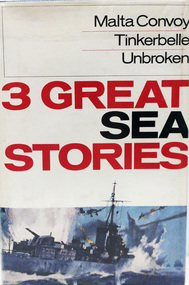 Warrnambool RSL Sub Branch
Book, 3 GREAT SEA STORIES
... St James’s Place London: 1968 Donor's name inside front cover; Hand written Sub-title: Malta Convoy, Tinkerbelle, Unbroken HardCover with dust cover 3 GREAT SEA STORIES Book ...Sub-title: Malta Convoy, Tinkerbelle, Unbroken HardCover with dust cover Wm. Collins Sons & Co. Ltd. St James’s Place London: 1968 Donor's name inside front cover; Hand written -
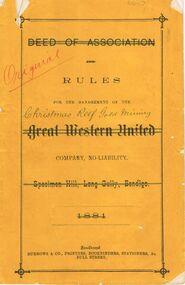 Bendigo Historical Society Inc.
Document - CHRISTMAS REEF GOLD MINING CO. COLLECTION: RULES FOR THE MANAGEMENT
... Great Western United Co. Specimen Hill, Long Gully Bendigo 1881 - all crossed out) Dated 14 July 1894. Booklet has handwritten text inserted throughout. Signatures at end: J.W. ( unclear ) and W. James. Each had 12,000 shares. Booklet printed by Burrows and Co., Printers, Bull St...Great Western United Co. Specimen Hill, Long Gully Bendigo 1881 - all crossed out) Dated 14 July 1894. Booklet has handwritten text inserted throughout. Signatures at end: J.W. ( unclear ) and W. James. Each had 12,000 shares. Booklet printed by Burrows and Co., Printers, Bull St ...Booklet, yellow cover, Rules for the management of the Christmas Reef Gold Mining Company, No Liability. (written over Great Western United Co. Specimen Hill, Long Gully Bendigo 1881 - all crossed out) Dated 14 July 1894. Booklet has handwritten text inserted throughout. Signatures at end: J.W. ( unclear ) and W. James. Each had 12,000 shares. Booklet printed by Burrows and Co., Printers, Bull St., Sandhurst. List of principal nuggets found on Bendigo, showing nuggets by weight and location.Burrows & Co., Printers Bookbinders, Stationers & c., Bull Street.bendigo, mining, christmas reef gold mining -
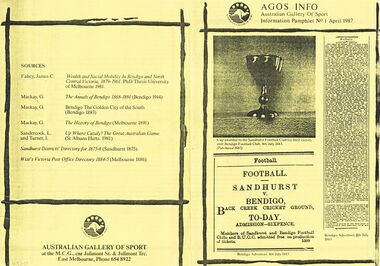 Bendigo Historical Society Inc.
Document - AGOS INFO, BENDIGO, April 1987
... James C. Wealth and Social Mobility In Bendigo and North Central Victoria... 1868-1891. Mackay... G. The Annals of Bendigo 1868-1891 (Bendigo 1914). Mackay... G. Bendigo The Golden City of the South (Bendigo 1893) Mackay... G. The History of Bendigo (Melbourne 1891). Sandercock... L.. And Turner... I. Up Where Cazaly? The Great Australian Game (St...James C. Wealth and Social Mobility In Bendigo and North Central Victoria, 1868-1891. Mackay, G. The Annals of Bendigo 1868-1891 (Bendigo 1914). Mackay, G. Bendigo The Golden City of the South (Bendigo 1893) Mackay, G. The History of Bendigo (Melbourne 1891). Sandercock, L.. And Turner, I. Up Where Cazaly? The Great Australian Game (St...James C. Wealth and Social Mobility In Bendigo and North Central Victoria 1868-1891. Mackay G. The Annals of Bendigo 1868-1891 (Bendigo 1914). Mackay G. Bendigo The Golden City of the South (Bendigo 1893) Mackay G. The History of Bendigo (Melbourne 1891). Sandercock L.. And Turner I. Up Where Cazaly? The Great Australian Game (St ...AGOS INFO, Bendigo. Australian Gallery of Sport. Information Pamphlet No. 1 April 1987. Photo of cup awarded to the Sanhurst Football Club for their victory over Bendigo Football Club, 4th July 1883. (Purchased 1987). Extract from Bendigo Advertiser, 4th July 1883 advertising Match between Sandhurst and Bendigo. Admission - Sixpence. Members of Sanhurst & Bendigo Football Clubs and BUCC admitted free on production of tickets. Extract of Bendigo Advertiser, 5th July 1883, FOOTBALL Sandhurst v. Bendigo. (remainder of print too small to read. Sandhurst. Bendigo July 4th 1883 The match played between Sandhurst and Bendigo provides a rare insight into the Australian game at a crucial stage of its development.. . Trophy presented by local jeweler, Mr Joseph Moody. .. Football was relatively weaker in Bendigo than in the comparable city of Ballarat. This can be explained by the high migrant proportion of the Bendigo population, its economic difficulties in the 1880s and by its distance from Melbourne. .. Football overtook cricket by the end of the decade as the most popular sport. .. A regular Saturday competition was played, with matches also played on Wednesdays. These matches were a legacy of the earliest ''scratch'' matches, suggesting a relatively strong union movement which had won concessions for weekend work. Matches started at 3pm. ..The best player on the ground was a contractor and the captain an accountant. .. Transition. The predominance of the ''little mark'' the participation of sometimes frightened junior teams against adults and the division of the game into halves rather than quarters represents an era that has disappeared. Complaints of rough play, poor losers, the problems posed by children. .. An issue, was seen as a blight on the game in 1883. The greatest offender, alleged by ''Drop-Kick'' in The Bendigo Advertiser, was Sheldon of Sandhurst, an ancestor of current day player Ken Sheldon of St Kilda. .. Fundamental issue about the place of sport in society. .. The reason for this is that the Bendigo club was in dispute with the Bendgio Union Cricket Club over control of the Back Creek Ground. If they had been refused the ground, as it was feared, then the whole association would have been forced to disband. Only last minute negotiations resolved the dispute. .. Reflects the values of society, .. Broader conflicts about power and the control of resources within that society. 2000 turned out. The crowd cheered lustily and the players exhibited similar excitement and were urged on by their captains to play up and kick the ball. In the eventual Sanhurst victory, amongst the best players was Edward Cordner, a forerunner of the renowned Cordner family of the Melbourne Football Clubs. Shane Cahill. Sources: Fahey, James C. Wealth and Social Mobility In Bendigo and North Central Victoria, 1868-1891. Mackay, G. The Annals of Bendigo 1868-1891 (Bendigo 1914). Mackay, G. Bendigo The Golden City of the South (Bendigo 1893) Mackay, G. The History of Bendigo (Melbourne 1891). Sandercock, L.. And Turner, I. Up Where Cazaly? The Great Australian Game (St Albans Herts. 1981) Sanhurst Districts' Directory for 1875-6 (Sandhurst 1875) Wise's Victoria Post Office Directory 1884-5 (Melbourne 1886). Australian Gallery Of Sport at the MCG, cnr Joliment St. & Joliment Trc. East Melbourne, Phone 654 8922.clubs and associations, football, agos, agos info, bendigo. australian gallery of sport. information pamphlet no. 1 april 1987. photo cup awarded sanhurst football club for victory bendigo football club, 4th july 1883. (purchased 1987). advertiser, 4th july 1883 match between sandhurst v. bendigo. admission - sixpence. members sanhurst & bendigo football clubs and bucc free. extract, 5th july 1883, football sandhurst v. bendigo. sandhurst. bendigo july 4th 1883 sandhurst and bendigo provides insight into the australian stage development.. . trophy local jeweler, mr joseph moody. .. football weaker in bendigo than in ballarat. explained by the migrant proportion bendigo population, its economic difficulties 1880s distance from melbourne.. football overtook cricket by end decade the popular sport.. saturday competition played, matches also wednesdays. legacy of the earliest ''scratch'' matches, strong union movement concessions for weekend work. matches started at 3pm.. best player on the ground a contractor the captain accountant. .. transition. predominance ''little mark'' participation frightened junior teams adults game halves rather than quarters represents an era disappeared. complaints rough play, poor losers, problems posed children., a blight 1883. offender, ''drop-kick'', sheldon, ancestor ken sheldon of st kilda...bendigo club was in dispute bendgio union cricket club control of the back creek ground. refused, as it was feared, association forced to disband. negotiations resolved dispute..values of society.. conflicts power control resources. 2000 turned out. crowd cheered players exhibited similar excitement captains. edward cordner. cordner family melbourne football clubs. shane cahill. sources: fahey, james c. wealth and social mobility in bendigo and north central victoria, 1868-1891. mackay, g. the annals of bendigo 1868-1891 (bendigo 1914). mackay, g. bendigo the golden city of the south (bendigo 1893) mackay, g. the history of bendigo (melbourne 1891). sandercock, l.. and turner, i. up where cazaly? the great australian game (st albans herts. 1981) sanhurst districts' directory for 1875-6 (sandhurst 1875) wise's victoria post office directory 1884-5 (melbourne 1886). australian gallery of sport at the mcg, cnr joliment st. & joliment trc. east melbourne, phone 654 8922. -
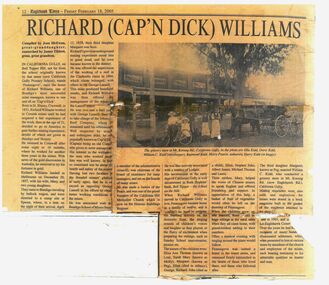 Bendigo Historical Society Inc.
Newspaper - Eaglehawk Times - Friday February 18, 2005
... "Article compiled by Joan McEwan, great-granddaughter, researched by James Tibbett, great, great grandson." Richard Williams was born in St. Blazey, Cornwall in 1831 to James and Ann Williams. ..."Article compiled by Joan McEwan, great-granddaughter, researched by James Tibbett, great, great grandson." Richard Williams was born in St. Blazey, Cornwall in 1831 to James and Ann Williams. ..."Article compiled by Joan McEwan, great-granddaughter, researched by James Tibbett, great, great grandson." Richard Williams was born in St. Blazey, Cornwall in 1831 to James and Ann Williams. Married to Mary Thomas with whom he had 12 children: Eliza Ann "Lou" Thomas, Sarah Mary "Molly" Williams, Margaret "Peg" Williams (born 1858), Ellen Williams (1859-1860), George Williams (b. 1861), Richard Williams (b.1862), John Williams (1863-1866), Ellen Williams (b.1865), Stephen John Williams (b.1867), Albert James Williams (b. 1868), Michael Thomas Williams (b.1871) and Laura Williams (b.1872). Worked in the Cornish mines until he was 21 and sought work in America. Landed in Melbourne on 20 December 1857 in search of gold. Was given supervision of the work conducted in the 1864 Cinderella Claim belonging to Geroge Lansell, among others. Williams was later named manager of all of Lansell's mines. Williams later opposed Lansell in favour of better working conditions for miners. Williams was then in charge of the Johnson Reef Company until his retirement. He worked on the administrative council at the Bendigo School of Mines, was named Justice of the Peace and was a founding member of the California Hill Methodist Church. Williams died in Eaglehawk in 1903. Additional articles further narrate the history of Eaglehawk BoroughA3 colour photocopies of the 18 February 2005 edition of the Eaglehawk Times newspaper. Date of photocopy unknown. Location of original paper unknown. Page 12 contains the biography of Richard Williams, aka Cap'n Dick. The article was compiled by Williams' great-granddaughter, Joan McEwan, and 2 x Great Grandson, James Tibbett. The article shows significant discolouration, rips and tears, folds and cuts. Unknown page number contains articles written about the history of Eaglehawk borough.richard williams, cap'n dick, newspaper, eaglehawk times, lansell mines, biography, johnson reef company, eaglehawk heritage society, allan james, ian glanville, noelene wild, sailors gully mission hall -
 Bendigo Historical Society Inc.
Document - BILL ASHMAN COLLECTION: CORRESPONDENCE
... Great Boulder Proprietary Gold Mines Ltd... W O Galletly...Mr Stronell... Newport Workshops... Victorian Railways... Mr Brownbill... Mr James... The University of Melbourne... J L Osborne... N Clarkson... Sister Mary Gonzaga... St...SCIENCES Instruments - general scalebuoy Bill Ashman Collection - Correspondence Frank A Stevenson Mr Bacon Amalgamated Freezing Co Bendigo G Whalley Gunbower Co-Operative Butter Factory & Trading Coy Ltd Mr Wallace J Charlesworth D V Evershed Bendigo Electronic Co Walshes Crown Hotel Hunter Bros Wybgones Unit 180 Gold Mining Co O'Hallorans Cyanide Unit Crystal Ice Works Stevenson Unit Bendigo Council Central Nell Gwynne Nth Deborugh G M Co Deborugh G M C Deborugh Consolidated Cohuna Butter Factory Geo Ross Victorian Producers' Co-operative Coy Ltd H Abbott Ernest F O Liddell Rothacker Bros Motor Spares Ltd Leggo's Buildings T J Jorgensen Mr Robinson Stevenson Bros R H S Abbott D C House The Electrical Factor in Metabolism W N Abbott The Great Boulder Proprietary Gold Mines Ltd W O Galletly Mr Stronell Newport Workshops Victorian Railways Mr Brownbill Mr James The University of Melbourne J L Osborne N Clarkson Sister Mary Gonzaga St Joseph's Hospital Mater Misericordiae Hospital Mr Herzog Sister m Monica? ...Dull orange folder containing copies of letters, brochures, information sheets and some newspaper cuttings. Name on the front is Frank A. Stevenson 244 Hargreaves St Bendigo. Letters date from 1937 to 1942. Newspaper titles include: Prevention of Rust- Principle of the Scalebuoy, Scalebuoys in Cars, Tragic Death of Captain Hartley Abbott and the Obituary of Captain R.H.S.Abbott.sciences, instruments - general, scalebuoy, bill ashman collection - correspondence, frank a stevenson, mr bacon, amalgamated freezing co bendigo, g whalley, gunbower co-operative butter factory & trading coy ltd, mr wallace, j charlesworth, d v evershed, bendigo electronic co, walshes crown hotel, hunter bros, wybgones unit, 180 gold mining co, o'hallorans cyanide unit, crystal ice works, stevenson unit, bendigo council, central nell gwynne, nth deborugh g m co, deborugh g m c, deborugh consolidated, cohuna butter factory, geo ross, victorian producers' co-operative coy ltd, h abbott, ernest f o liddell, rothacker bros, motor spares ltd, leggo's buildings, t j jorgensen, mr robinson, stevenson bros, r h s abbott, d c house, the electrical factor in metabolism, w n abbott, the great boulder proprietary gold mines ltd, w o galletly, mr stronell, newport workshops, victorian railways, mr brownbill, mr james, the university of melbourne, j l osborne, n clarkson, sister mary gonzaga, st joseph's hospital, mater misericordiae hospital, mr herzog, sister m monica?, vacuum oil, j johns, h j grigg, w a walsh, market square, crown hotel, g e cole, transport & engineering in australia 16/12/1937, mr menderson, mr ross, sanitary age 8/2/1935, northern kiwanis clubs, harry a baxter, w h cunningham & hill ltd, link-belt co ltd, sir william crooks, royal zoological society, ginna works germany, close brothers, w h taylor, geo taylor hardware co ltd, details of hydraulic spinner unit (scalebuoy), a davidson, john g kelly inc, hannon, myers wishart, kennedy, mr critten, pennsylvania rubber coy, paul a douden & co, w e humphrey, kansas city public service co, smith, tangney hotels, wahkonsa hotel, muscatine hotel, arlington hotel, burke hotel, helen tangney-springer, f w woolworth co, w w edan, ymca, n f alcock, b j ingram, scalebuoys, bendigo electronic company of australia proprietary limited, a s bloomfield, harry ponsonby mackenzie, arthur robinson & co, the commercial banking company of sydney ltd, a t madden, victorian railways, e c eyers, city of bendigo, frank h day, lane's motors pty ltd, h c holland, union oil soap & candle co ltd, knox home, n a duthie, w h mccorkindale, maungatapere co-op dairy co ltd, the whangarei co-op dairy co ltd, w h millingford, kettering cartons limited, j g arlidge, w e humphrey, kansas city public service company, h w smith, prospectus of scale buoy distributors limited, edwin gripper banks, richard hartley smith abbott, frank shaw fitchett, hayden smith & fitchett, the commercial bank of australia limited, william john stanley horsfall, frank cooper, scott's hotel, a j phillips, stringer & phillips proprietary ltd, e g banks, edwin gripper banks, reginald william stringer, frank cooper, claude gordon robinson, s reid
