
Showing 101 items matching " the bendigo diggings"
-
 Bendigo Historical Society Inc.
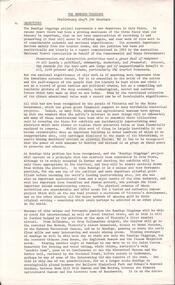
Document - VICTORIA HILL - THE BENDIGO DIGGINGS, PRELIMINARY DRAFT FOR BROCHURE
... VICTORIA HILL - THE BENDIGO DIGGINGS, PRELIMINARY DRAFT FOR BROCHURE...... The Bendigo Diggings - Preliminary Draft for Brochure...Nine typed pages of notes on a preliminary draft for a brochure on the Bendigo Diggings. First part is the objective which is to preserve the mining history and to have exhibits in the places they were used, e.g. quartz mining machinery exhibited in a quartz mining area, not on an alluvial field. ...Document VICTORIA HILL - THE BENDIGO DIGGINGS, PRELIMINARY DRAFT FOR BROCHURE ...BHS CollectionNine typed pages of notes on a preliminary draft for a brochure on the Bendigo Diggings. First part is the objective which is to preserve the mining history and to have exhibits in the places they were used, e.g. quartz mining machinery exhibited in a quartz mining area, not on an alluvial field. Part B is historical notes on the area. Part C is the Site - Victoria Hill area. Part D is Stage One which consists of carpark area, technological museum, restaurant, mineral haulage line, picnic ground, earthworks and planting over the area. Part E is Stage Two which will consist of the open-air exhibits, in the area surrounded by the mineral haulage line, and the Central Nell Gwynne mine on the west side of the site. Part F is Stage Three which will consist of the winery, the steam tram track, the lake, the wildlife sanctuary and various buildings associated with gold mining. Part G is Costing with the prices to be filled in. Parts H and I are the Appeal and the Committee. Details to be filled in. Notes prepared by Albert Richardson.mining, marketing, victoria hill, victoria hill, the bendigo diggings - preliminary draft for brochure, aust national travel association, tullamarine jetport, emu bottom homestead, kyneton historical museum, chinese joss house, eaglehawk museum, whipstick scrub, cairn curran reservoir, castelmaine historical museum and market hall, national trust, ballarat hiatorical park, echuca's hopwood gardens, swan hill folk museum, gibson's mount alexander no 2 squatting run, captain brown, chief commissioner wright, hustler's reef, thomas hustler, mining board, drainage of reefs act 1862, first world war, bendigo amalgamated goldfields, second world war, sandhurst, w c vahland, battery trams, horse trams, steam trams, electric trams, central nell gwynne mine, theodore ballerstadt, george lansell, new chum hill, ballerstadt's open cut, 180 mine, new chum syncline battery, william rae, victoria quartz, wittscheibe's 'jeweller's shop', luffsman and sterry, gold mines hotel, adventure, bendigo and district tourist association, bendigo city council, bendigo branch of the royal historical society of victoria, professor brian lewis, school of architecture and building at the university of melbourne, taylor horsfield, lord robert cecil, south australian gold commissioner -
 Bendigo Historical Society Inc.
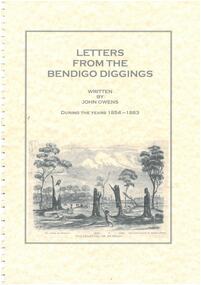
Book - LETTERS FROM THE BENDIGO DIGGINGS
... LETTERS FROM THE BENDIGO DIGGINGS...Letters from the Bendigo diggings comprising copies of letters written by John Owens to his family in Wales during the years 1854 - 1863 & Letters from Bendigo written by John Owens, Great Grandfather of Charles Paterson. ...Book LETTERS FROM THE BENDIGO DIGGINGS ...John Owens (1831-1892) was a Welshman who spent 1853-1863 in Australia, predominantly on the Bendigo goldfields.He was a miner who also initially set up a horse drawn puddling machine, although he sold this in 1857. He gave first hand insight into life on the goldfields through letters he wrote home to his parents. He returned to Wales in 1863 and in 1864 he married his uncles widow, Jane Davis. Jane died in 1872 and John then married Mary Ellen Jackson.Letters from the Bendigo diggings comprising copies of letters written by John Owens to his family in Wales during the years 1854 - 1863 & Letters from Bendigo written by John Owens, Great Grandfather of Charles Paterson. John Owens was in the goldfields of Victoria during the years 1853 - 1863. . One of two books donated by Charles Paterson. Both books spiral bound and contain coloured prints & maps. Books enclosed in plastic sleeve.John Owensperson, family, john owens, history-bendigo-goldfields-family-owens -
 Bendigo Historical Society Inc.
Document - HEALTH ON THE BENDIGO DIGGINGS: 1852 TO 1858
... HEALTH ON THE BENDIGO DIGGINGS: 1852 TO 1858...''Health on the Bendigo Diggings - The Early Years 1852 - 1858'' (Patricia Worsley- Bendigo Technical College , Mature Age Students, 1982, 8-paged Australian History paper). ...Document HEALTH ON THE BENDIGO DIGGINGS: 1852 TO 1858 ...''Health on the Bendigo Diggings - The Early Years 1852 - 1858'' (Patricia Worsley- Bendigo Technical College , Mature Age Students, 1982, 8-paged Australian History paper). Broad scope with references to : Diseases (typhoid, dysentery, 'dandy blight') sanitation and water supply; violence, Publican's licence; suicide; medical 'qualifications'; compulsory registration of legally qualified medical practitioners; inquests, Dr Richard Tracy; Bendigo Waterworks Company; Bendigo Hospital; 'Hospital Hill' ; Bendigo Goldfields Hospital; Benevolent Asylum; Sir John O'Shanassy. Bibliography.Patricia Worsleybendigo, mining, miners health, typhoid, dysentery, dandy blight sanitation, bendigo water supply, hospital hill, benevolent, sir john o'shanassy, dr richard tracy -
 Bendigo Historical Society Inc.
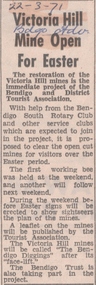
Newspaper - VICTORIA HILL - VICTORIA HILL MINE OPEN FOR EASTER
... ... The Bendigo Diggings...It will be called 'The Bendigo Diggings'....It will be called 'The Bendigo Diggings'. Newspaper VICTORIA HILL - VICTORIA HILL MINE OPEN FOR EASTER ...Newspaper article from the Bendigo Advertiser dated 22/3/71. Article mentions the restoration of the Victoria Hill area with working bees by the Bendigo and District Tourist Association, the Bendigo South Rotary Club and the Bendigo Trust. It was proposed to clear the open cut mines for visitors over the Easter period. It will be called 'The Bendigo Diggings'.newspaper, bendigo advertiser, victoria hill, victoria hill mine open for easter, bendigo and district tourist association, bendigo south rotary club, tourist association, the bendigo diggings, the bendigo trust -
 Deaf Children Australia
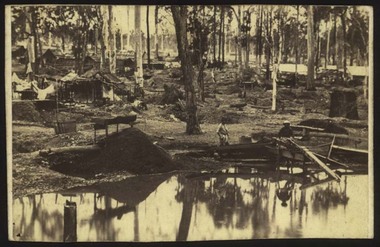
Photograph, Diggings Bendigo 1868, 1868
... Diggings Bendigo 1868...The gold diggings at Bendigo where F.J. Rose tried his luck between 1853 and 1858. ...B&W photograph on cardboard of the diggings, probably Bendigo ...The gold diggings at Bendigo where F.J. Rose tried his luck between 1853 and 1858. f. j. rose diggings deaf children australia On back of photo: written in pencil: 'Diggings/Bingo/1868/Mr Rose was there before ventured out to school' B&W photograph on cardboard of the diggings, probably Bendigo Diggings Bendigo 1868 Photograph ...The gold diggings at Bendigo where F.J. Rose tried his luck between 1853 and 1858. B&W photograph on cardboard of the diggings, probably Bendigo On back of photo: written in pencil: 'Diggings/Bingo/1868/Mr Rose was there before ventured out to school' f. j. rose, diggings, deaf children australia -
 Bendigo Historical Society Inc.
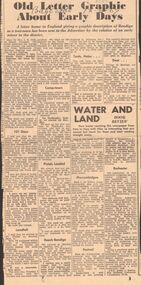
Newspaper - LETTER ABOUT EARLY DAYS ON BENDIGO
... Of Mount Gambier, dated October 9, 1853, Black's Gully, Bendigo Diggings. Article describes journey Bendigo, appearance of diggings, cost of items....Of Mount Gambier, dated October 9, 1853, Black's Gully, Bendigo Diggings. Article describes journey Bendigo, appearance of diggings, cost of items. ...Newspaper article Bendigo Advertiser 13.6.1967 re a letter home to Bendigo giving a graphic description of Bendigo as a tent-town. Sent by Mrs. I.H. Pick to the Bendigo Advertiser ? Published on 13th June 1967. Of Mount Gambier, dated October 9, 1853, Black's Gully, Bendigo Diggings. Article describes journey Bendigo, appearance of diggings, cost of items.Bendigo Advertiser 13/06/1967bendigo, mining, letter -
 Bendigo Historical Society Inc.
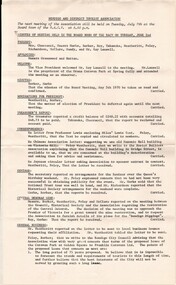
Document - AULSEBROOK COLLECTION: BENDIGO AND DISTRICT TOURIST ASSOCIATION MINUTES
... - (3490.44b) Two pages on minutes -(3490.44a) 9 extensive pages of a draft for Brochure on Bendigo Diggings project (mentioned in minutes)... - (3490.44b) Two pages on minutes -(3490.44a) 9 extensive pages of a draft for Brochure on Bendigo Diggings project (mentioned in minutes) Document AULSEBROOK COLLECTION: BENDIGO AND DISTRICT TOURIST ASSOCIATION MINUTES ...Aulsebrook Collection: Bendigo and District Tourist Association Meeting Minutes. - Notes for Meeting held on June 2nd (no year stated). - (3490.44b) Two pages on minutes -(3490.44a) 9 extensive pages of a draft for Brochure on Bendigo Diggings project (mentioned in minutes)bendigo tourist association, meeting -
 Bendigo Historical Society Inc.
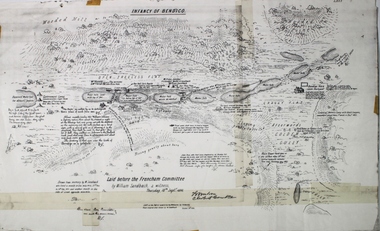
Map - INFANCY OF BENDIGO, Original dated 28/10/1890
... Bendigo... Gold Diggings...Map: Photocopy of the First sketch map of the Bendigo Diggings. Has been assembled from several photocopies taped together. ...MAP Bendigo Infancy of Bendigo Gold Diggings Henry Frencham William Sandbach Where was gold First found William Johnson Map: Photocopy of the First sketch map of the Bendigo Diggings. ...Map: Photocopy of the First sketch map of the Bendigo Diggings. Has been assembled from several photocopies taped together. Laid before the Frencham Committee by William Sandbach , a witness, 18 September 1890. There are Two of these maps. ( x ref 5673 , 8235 , Box 83 , 9077 )map, bendigo, infancy of bendigo, gold diggings, henry frencham, william sandbach, where was gold first found, william johnson -
 Bendigo Historical Society Inc.
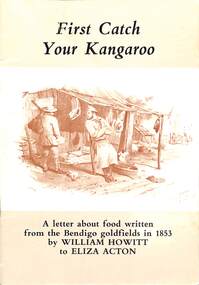
Book - "First Catch Your Kangaroo", 1990
... Whilst in Australia, Howitt wrote a letter to Eliza Acton, describing the food at the Bendigo diggings, published and examined in this publication. ...Whilst in Australia, Howitt wrote a letter to Eliza Acton, describing the food at the Bendigo diggings, published and examined in this publication. ...William Howitt was an elderly Quaker, along with his two sons, went to the Victorian Goldfields. They arrived onboard the 'Kent' in September, 1852. Whilst in Australia, Howitt wrote a letter to Eliza Acton, describing the food at the Bendigo diggings, published and examined in this publication. This letter was dated 1853. Eliza Acton was an English cookery writer, authoress of 'Modern Cookery in all its branches', first published in 1845. Eliza was born in 1799, and died in 1859. "First Catch Your Kangaroo". Soft cover. 20 PP. Beige front and back covers. Sepia image of primitive butcher's hut with two men standing outside inset into front cover. Stapled book, not bound. Contains colored and black and white images. ISBN 0724301046. Limited edition to 300 copies. BHP logo on back cover, who provided funding for the production of the book. Title written in black text on front cover above inset image, and context subtitle written in black text below inset image on front cover. eliza acton, william howitt, goldfields cookery, kangaroo as food -
 Bendigo Historical Society Inc.
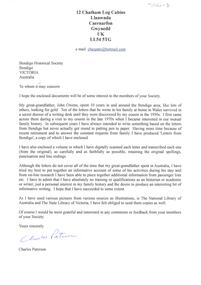
Document - LETTER
... Copies of relevant photographs are used to illustrate the text. 5316.1 Letters from Bendigo 5316.2 Letters from the Bendigo Diggings Both books spiral bound and contain coloured prints and maps. ...Copies of relevant photographs are used to illustrate the text. 5316.1 Letters from Bendigo 5316.2 Letters from the Bendigo Diggings Both books spiral bound and contain coloured prints and maps. ...John Owens (1831-1892) was a Welshman who spent 1853-1863 in Australia, predominantly on the Bendigo goldfields.He was a miner who also initially set up a horse drawn puddling machine, although he sold this in 1857. He gave first hand insight into life on the goldfields through letters he wrote home to his parents. He returned to Wales in 1863 and in 1864 he married his uncles widow, Jane Davis. Jane died in 1872 and John then married Mary Ellen Jackson.Letter from Charles Paterson accompanying donation of two books which contain copies of diary entries of John Owens who spent ten years in the Bendigo region searching for gold. Copies of relevant photographs are used to illustrate the text. 5316.1 Letters from Bendigo 5316.2 Letters from the Bendigo Diggings Both books spiral bound and contain coloured prints and maps. Books enclosed in plastic sleeve.John Owensperson, family, john owens, history-bendigo-goldfields-family-owens -
 Bendigo Historical Society Inc.
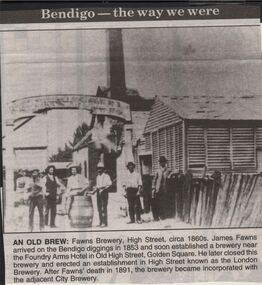
Newspaper - JENNY FOLEY COLLECTION: FAWN'S BREWERY
... James Fawns arrived on the Bendigo diggings in 1853 and soon established a brewery near the Foundry Arms Hotel in Old High Street, Golden Square. ...James Fawns arrived on the Bendigo diggings in 1853 and soon established a brewery near the Foundry Arms Hotel in Old High Street, Golden Square. ...Bendigo Advertiser "The way we were" from 1999. Fawns Brewery, High Street, circa 1860. James Fawns arrived on the Bendigo diggings in 1853 and soon established a brewery near the Foundry Arms Hotel in Old High Street, Golden Square. He later closed this brewery and erected an establishment in High Street known as the London Brewery. After Fawns death in 1891, the brewery became incorporated with the adjacent City Brewery.newspaper, bendigo advertiser, the way we were -
 Bendigo Historical Society Inc.
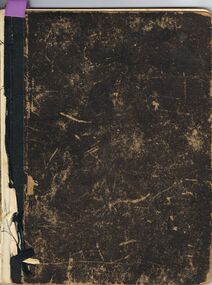
Book - GERMAN HERITAGE SOCIETY COLLECTION: ALBERT BOLDT'S DIARY
... Diary starts with his departure from Germany, his sea voyage, his march to the Bendigo Gold Diggings and his experiences of the first 16 months of his Australian life from 1854 - 55....Diary starts with his departure from Germany, his sea voyage, his march to the Bendigo Gold Diggings and his experiences of the first 16 months of his Australian life from 1854 - 55. ...Albert Boldt's Diary with black and buff cover with black tape spine. Diary starts with his departure from Germany, his sea voyage, his march to the Bendigo Gold Diggings and his experiences of the first 16 months of his Australian life from 1854 - 55.bendigo, clubs, bendigo heritage, german heritage society collection - albert boldt's diary, 'bloomer', grubenan, robert grubmann, rudolph grubmann, luffsman, dihmhad, neumann, ballerstedt's quartz mine, gluckmann, vahland, krohnke, dr waldron, brauns, freitag, wunderlich, kraupe, droze, mr cohn, loeventhel, barth, heinz, barth, brand, kirzeloig, baumbach, lost mates in the whipstick apr 12), miller, buhle, t hommel, miron, heder, buhle, pohl, ohlbrecht, schulz -
 Warrnambool and District Historical Society Inc.
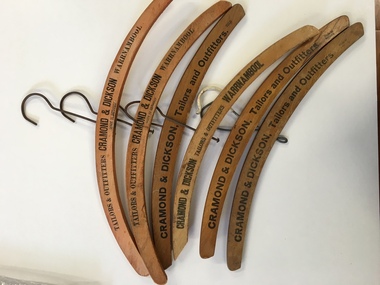
Coat Hanger, Cramond & Dickson Coat Hangers
... Dickson was a farmer’s son but became a draper and while he was unsuccessful on the Bendigo diggings and then returned to Melbourne where he met Cramond and soon after they opened a store on Lonsdale Street. ...Dickson was a farmer’s son but became a draper and while he was unsuccessful on the Bendigo diggings and then returned to Melbourne where he met Cramond and soon after they opened a store on Lonsdale Street. ...John Glass Cramond 1829 and James Dickson 1831-1910 were founders of a large drapery store. Both were Scots and both came separately to Australia in 1852. Cramond initially came for gold but soon opened a store in St Kilda with a post Office attached and he was the first post master there. Dickson was a farmer’s son but became a draper and while he was unsuccessful on the Bendigo diggings and then returned to Melbourne where he met Cramond and soon after they opened a store on Lonsdale Street. They opened their business in Warrnambool in 1855 as a general store with groceries, drapery and ironmongery. Both partners were involved with the community and James Dickson was an original director of the Warrnambool Woollen Mill 1909 and the Warrnambool Cheese and butter factory. He also served on the committee of management of Warrnambool Base Hospital. These coathangers were an everyday item from their store. A common item which provides a link to one of Warrnambool’s largest and longest running businesses.Wooden hangers with rounded corners and metal hooks, one plastic coated. Printed names engraved and painted in black with business name.Cramond & Dickson Tailors & Outfitters Warrnambool. 2 made on America and 3 made in Germany. 1 unmarkedcramond and dickson store, warrnambool -
 Warrnambool and District Historical Society Inc.
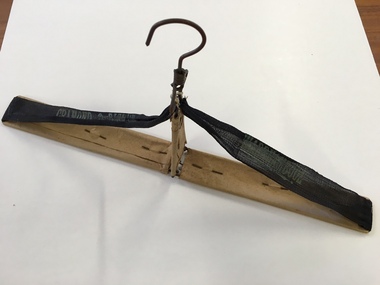
Coat Hanger, Cramond & Dickson Folding
... Dickson was a farmer’s son but became a draper and while he was unsuccessful on the Bendigo diggings and then returned to Melbourne where he met Cramond and soon after they opened a store on Lonsdale Street. ...Dickson was a farmer’s son but became a draper and while he was unsuccessful on the Bendigo diggings and then returned to Melbourne where he met Cramond and soon after they opened a store on Lonsdale Street. ...John Glass Cramond 1829 and James Dickson 1831-1910 were founders of a large drapery store. Both were Scots and both came separately to Australia in 1852. Cramond initially came for gold but soon opened a store in St Kilda with a post Office attached and he was the first post master there. Dickson was a farmer’s son but became a draper and while he was unsuccessful on the Bendigo diggings and then returned to Melbourne where he met Cramond and soon after they opened a store on Lonsdale Street. They opened their business in Warrnambool in 1855 as a general store with groceries, drapery and ironmongery. Both partners were involved with the community and James Dickson was an original director of the Warrnambool Woollen Mill 1909 and the Warrnambool Cheese and butter factory. He also served on the committee of management of Warrnambool Base Hospital. This coathanger would have been used in their store. An everyday item linked to one of Warrnambool’s earliest and longest running businesses.Folding coathanger with metal frame covered in brown paper with black cotton tape. Cramond & Dickson Warrnambool stamped on the cotton tape.cramond and dickson, warrnambool -
 Warrnambool and District Historical Society Inc.
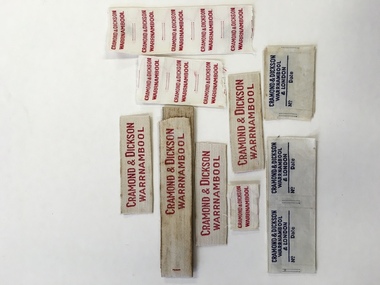
Label, Name labels Cramond & Dickson
... Dickson was a farmer’s son but became a draper and while he was unsuccessful on the Bendigo diggings and then returned to Melbourne where he met Cramond and soon after they opened a store on Lonsdale Street. ...Dickson was a farmer’s son but became a draper and while he was unsuccessful on the Bendigo diggings and then returned to Melbourne where he met Cramond and soon after they opened a store on Lonsdale Street. ...John Glass Cramond 1829 and James Dickson 1831-1910 were founders of a large drapery store. Both were Scots and both came separately to Australia in 1852. Cramond initially came for gold but soon opened a store in St Kilda with a post Office attached and he was the first post master there. Dickson was a farmer’s son but became a draper and while he was unsuccessful on the Bendigo diggings and then returned to Melbourne where he met Cramond and soon after they opened a store on Lonsdale Street. They opened their business in Warrnambool in 1855 as a general store with groceries, drapery and ironmongery. Both partners were involved with the community and James Dickson was an original director of the Warrnambool Woollen Mill 1909 and the Warrnambool Cheese and butter factory. He also served on the committee of management of Warrnambool Base Hospital. These labels would have been used to sew to garments sold by Cramond & Dickson. A common item for many decades with which many people would identify.Eleven cloth name tag labels. White cotton fabric. Some are embroidered in navy blue and others in red.Those embroidered in red state Cramond & Dickson Warrnambool and the ones embroidered in navy blue state Cramond & Dickson Warrnambool & London.cramond & dickson, john glass cramond, warrnambool, james dickson -
 Bendigo Historical Society Inc.
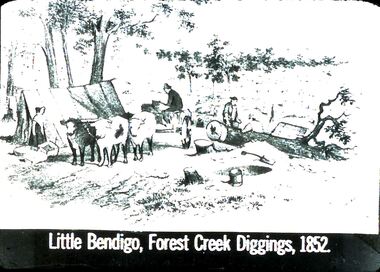
Slide - DIGGERS & MINING: THE DIGGINGS - THE DIGGERS
... Slide depicts areas of Little Bendigo, Forest Creek Diggings, 1852. Markings: 14 994.LIF:6. ...Slide depicts areas of Little Bendigo, Forest Creek Diggings, 1852. Markings: 14 994.LIF:6. ...Diggers & Mining: The Digging - The Diggers. Slide depicts areas of Little Bendigo, Forest Creek Diggings, 1852. Markings: 14 994.LIF:6. Used as a teaching aid.hanimounteducation, tertiary, goldfields -
 Bendigo Historical Society Inc.
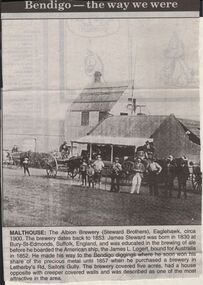
Newspaper - JENNY FOLEY COLLECTION: MALTHOUSE
... He made his way to the Bendigo diggings where he soon won his share of the precious metal until 1857 when he purchased a brewery in Letherby's Rd, Sailors Gully. ...He made his way to the Bendigo diggings where he soon won his share of the precious metal until 1857 when he purchased a brewery in Letherby's Rd, Sailors Gully. ...Bendigo Advertiser "The way we were" from 1999. Malthouse: The Albion Brewery (Steward Brothers), Eaglehawk, circa 1900. The brewery dates back to 1853. James Steward was born in 1830 at Bury-St-Edmonds, Suffolk, England, and was educated in the brewing of ale before he boarded the American ship, the James L. Logert, bound for Australia in 1852. He made his way to the Bendigo diggings where he soon won his share of the precious metal until 1857 when he purchased a brewery in Letherby's Rd, Sailors Gully. The brewery covered five acres, had a house opposite with creeper covered walls and was described as one of the most attractive in the area.newspaper, bendigo advertiser, the way we were -
 Warrnambool and District Historical Society Inc.
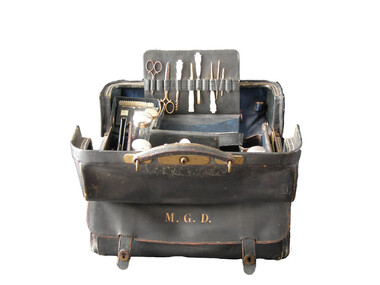
Domestic object - Dressing bag, Mary Glass Dickson, Circa1885
... Dickson was a farmer’s son but became a draper and while he was unsuccessful on the Bendigo diggings and then returned to Melbourne where he met Cramond and soon after they opened a store on Lonsdale Street. ...Dickson was a farmer’s son but became a draper and while he was unsuccessful on the Bendigo diggings and then returned to Melbourne where he met Cramond and soon after they opened a store on Lonsdale Street. ...John Glass Cramond 1829 and James Dickson 1831-1910 were founders of a large drapery store. Both were Scots and both came separately to Australia in 1852. Cramond initially came for gold but soon opened a store in St Kilda with a post Office attached and he was the first post master there. Dickson was a farmer’s son but became a draper and while he was unsuccessful on the Bendigo diggings and then returned to Melbourne where he met Cramond and soon after they opened a store on Lonsdale Street. They opened their business in Warrnambool in 1855 as a general store with groceries, drapery and ironmongery. Both partners were involved with the community and James Dickson was an original director of the Warrnambool Woollen Mill 1909 and the Warrnambool Cheese and butter factory. He also served on the committee of management of Warrnambool Base Hospital. This case was a wedding gift from James Dickson Jnr to his wife Mary Glass Cramond on the occasion of their wedding. This item has significance on a number of levels. It belonged to a member of one of Warrnambool’s earliest pioneering families and it marks the occasion when the two families of Cramond and Dickson were linked through the marriage of James Dickson jnr and Mary Glass Cramond. The firm played a significant part in the development of the city and traded for nearly 150 years. It therefore has social significance to Warrnambool. The item is well provenance with the case initialed and items within the case monogrammed. The case and its items are aesthetically quite beautiful as well as being typical of travelling or dressing cases of the more well to do, of the time. Mappin & Webb were manufacturers of some standing with the Mappin name appearing in manufacturing as early as 1775.The company has held a royal warrant as silversmiths since 1897 to the present day and as crown jeweler since 2012. Throughout this time, they have manufactured quality items for the luxury market. It provides an insight into the way ladies travelled and the items which they considered essential. This consists of a black leather with leather handle attached with brass fittings. Middle opening with side pocket on one side with metal catches. Inside has removable sections for holding the numerous containers and items belonging to the case. Interior of the case is dark blue satin. The items contained within the case are as follows: 321.1 Luggage case 321.2 Glass bottle rectangular, silver monogrammed lid, empty. 321.3 Tall round glass bottle, silver monogrammed lid, empty. 321.4 Small glass bottle with pink powder, silver monogrammed lid. 321.5 Small multi sided bottle with stopper and brass hinged lid. 321.6 Tall round bottle with silver monogrammed lid. 321.7 Tall thin multi sided bottle with brass lid. 321.8 Cream coloured monogrammed jar cotton wool inside. 321.9 Clothes brush rectangular cream back. 321.10.1Glove stretcher bone coloured .10.2 Case black leather. 321.11.1 hair comb cream with silver edge .11.2 Case black leather 321.12 Hair brush cream handle 321.13Spatula cream monogrammed 321.14 Mirror, silver round with handle. 321.15 Writing compendium .1 Case black leather .2 Pen with nib .3 Lead pencil .4 Navy satin covered blotting book 321.16 Inkwell glass bottle in small black leather case. 321.17 Match striker in leather case. 321.18 Mirror in black leather case rectangular 321.19 Small case for visiting cards. 321.20Sewing kit rectangular, contains threads and needles pkts x 3 321.21Container, small, hinged tortoise shell patterned. 321.22.1 Manicure set .2 Scissors small .3 Scissors large .4Corkscrew with Mother of pearl handle .5 Pocket knife with Mother of pearl handle .6Tweezers with Mother of pearl handle .7 File with Mother of pearl handle .8 Fine hook Mother of pearl handle .9 Bodkin .10 Bodkin 321.23 Hairbrush oval silver backed 321.24 Mirror silver handled hand mirror. 321.25 Hairbrush wooden handled with Mother of pearl inlay. 321.26 Cylinder, silver with removable lid and small phial of iodine labelled Felton’s pocket iodine. 321.27 Phial small glass with gold decorations. 321.28 Inhaler with insert 321.29 Thimble, metal. 321.30 Silver backed hair brush 321.31 silver backed clothes brushEngraved on side pocket: M.G.D. Mappin and Webb Sheffield and London. Some of the items are monogrammed as per the list above. A number of the glass bottles have lids hallmarked Mappin & Webb London and Sheffield makers stamped inside lid with hall marks history of warrnambool, cramond and dickson, mary glass cramond, dressing bag, woman's toiletry bag 1880, mappin and webb -
 Bendigo Historical Society Inc.
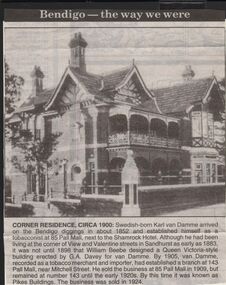
Newspaper - JENNY FOLEY COLLECTION: CORNER RESIDENCE CIRCA 1900
... Corner residence circa 1900: Swedish born Karl Van Damme arrived on the Bendigo diggings in about 1852 and established himself as a tobacconist at 85 Pall Mall, next to the Shamrock Hotel. ...Corner residence circa 1900: Swedish born Karl Van Damme arrived on the Bendigo diggings in about 1852 and established himself as a tobacconist at 85 Pall Mall, next to the Shamrock Hotel. ...Bendigo Advertiser "The way we were" from 1999. Corner residence circa 1900: Swedish born Karl Van Damme arrived on the Bendigo diggings in about 1852 and established himself as a tobacconist at 85 Pall Mall, next to the Shamrock Hotel. Although he had been living at the corner of View and Valentine streets in Sandhurst as early as 1883 it was not until 1898 that William Beebe designed a Queen Victoria style building erected by G.A. Davey for Van Damme. By 1905, van Damme, recorded as a tobacco merchant and importer, had established a branch at 143 Pall Mall, near Mitchell street. He sold the business at 85 Pall Mall in 1909, but remained at number 143 until the early 1920s. By this time it was known as Pikes Buildings. The business was sold in 1924newspaper, bendigo advertiser, the way we were -
 Warrnambool and District Historical Society Inc.
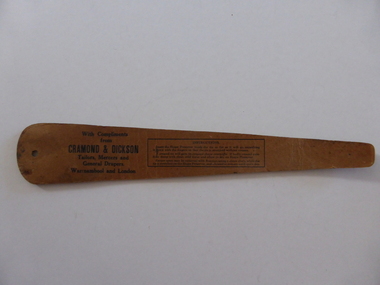
Artefact, Cardboard tie preserver. Cramond & Dickson, Circa 1930's
... Dickson was a farmer’s son but became a draper and while he was unsuccessful on the Bendigo diggings and then returned to Melbourne where he met Cramond and soon after they opened a store on Lonsdale Street. ...Dickson was a farmer’s son but became a draper and while he was unsuccessful on the Bendigo diggings and then returned to Melbourne where he met Cramond and soon after they opened a store on Lonsdale Street. ...John Glass Cramond 1829 and James Dickson 1831-1910 were founders of a large drapery store. Both were Scots and both came separately to Australia in 1852. Cramond initially came for gold but soon opened a store in St Kilda with a post Office attached and he was the first post master there. Dickson was a farmer’s son but became a draper and while he was unsuccessful on the Bendigo diggings and then returned to Melbourne where he met Cramond and soon after they opened a store on Lonsdale Street. They opened their business in Warrnambool in 1855 as a general store with groceries, drapery and ironmongery. Both partners were involved with the community and James Dickson was an original director of the Warrnambool Woollen Mill 1909 and the Warrnambool Cheese and Butter Factory. He also served on the committee of management of Warrnambool Base Hospital. The business in the late 1970's. This shape preserver would have been an item given to customers to maintain their tie in good condition. The shape would indicate that it would have been used around mid 20th century.A common object from one of Warrnambool's longest established businesses.Brown cardboard in the shape of a gentleman's tie with a hanging hole on one end and black text with company details and instructions for use. front surface is smooth while the back is coarse.With Compliments from Cramond & Dickson Tailors, Mercers and general Drapers. Warrnambool and London. warrnambool, cramond & dickson -
 Bendigo Historical Society Inc.
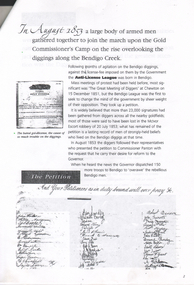
Document - The Red Ribbon Rebellion and the Bendigo Petition
... Bendigo in 1853 the Red Ribbon Rebellion was led by the Anti-Gold Licence Association. Diggers wore red ribbons in their hats as a sign of protest, refused to pay their licences and collected a ‘monster’ petition which was presented to Lieutenant-Governor La Trobe. The petition demanded immediate reform of government administration, a reduction in the licence fee, the right to vote and land reform (with poor returns from diggings...The imposition of a license fee imposed upon the miners, by the Government of Victoria, cause a major agitation on the Bendigo diggings and the Anti-License League was born in Bendigo. ...The imposition of a license fee imposed upon the miners, by the Government of Victoria, cause a major agitation on the Bendigo diggings and the Anti-License League was born in Bendigo. ...The discovery of gold in Victoria in 1851 initially overwhelmed the Colonial administration. Towns appeared almost overnight and it was challenging to keep law and order. To keep some control over the gold seekers and help pay for the administration of the goldfields, Lieutenant-Governor La Trobe introduced gold licences in September 1851. Miners paid 30 shillings per month (later reduced to £1 per month or £8 per year) for the right to dig a small ‘claim’, usually about eight feet square (2.4m²). Not surprisingly the licence system was unpopular. The licence was expensive – 30 shillings was a substantial sum for most diggers, who might spend months digging for gold without success. Resistance to the licence fee spread throughout the fields. A Miner’s Association was formed at Mount Alexander (Castlemaine) in December 1851 and at Bendigo in 1853 the Red Ribbon Rebellion was led by the Anti-Gold Licence Association. Diggers wore red ribbons in their hats as a sign of protest, refused to pay their licences and collected a ‘monster’ petition which was presented to Lieutenant-Governor La Trobe. The petition demanded immediate reform of government administration, a reduction in the licence fee, the right to vote and land reform (with poor returns from diggings, miners wanted affordable land on or near the goldfields). This proposal to commemorate a significant event in the history of Bendigo, is for the creation of a permanent installation in Bendigo that will commemorate the valour and integrity of the Bendigo diggers, who stood fast against the Government in the early days of protest on the Victorian diggings. Nine page photocopy of document titled: ' The Red Ribbon Rebellion & the Bendigo Petition. A proposal to commemorate a significant event in the history of Bendigo'. Contents includes a brief history of the Red Ribbon movement; description of the Digger's Banner; information on Governor LaTrobe; William Dixon Campbell Denovan and an outline of the proposed project to commemorate the event. The imposition of a license fee imposed upon the miners, by the Government of Victoria, cause a major agitation on the Bendigo diggings and the Anti-License League was born in Bendigo. Signatures were gathered for a petition: 'It is widely believed that more than 23,000 signatures had been gathered from diggers across all the nearby goldfields; most of those were said to have been lost in the McIvor Escort Robbery of 20 July 1853'. The proposal was prepared by Geoff Hocking in consultation with the Bendigo Historical Society and Jim Evans of the Red Ribbon Repertory Co.mining, sandhurst, red ribbon rebellion, agitation, denovan, latrobe, miners, license fee, diggers -
 Bendigo Historical Society Inc.
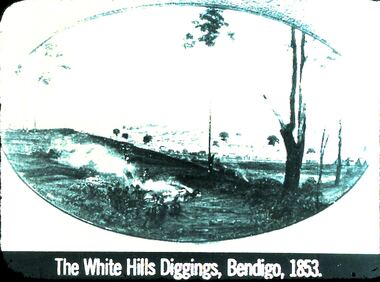
Slide - DIGGERS & MINING: THE DIGGINGS - THE DIGGERS
... Slide depicts: The White Hills Diggings, Bendigo, 1853. Shows aborigines sitting on near side of hill. ...Slide depicts: The White Hills Diggings, Bendigo, 1853. Shows aborigines sitting on near side of hill. ...Diggers & Mining: The Digging - The Diggers. Slide depicts: The White Hills Diggings, Bendigo, 1853. Shows aborigines sitting on near side of hill. Over the hill in the back ground is a small township forming. Markings: 22 994.LIF:6. Used as a teaching aid.hanimounteducation, tertiary, goldfields -
 Bendigo Historical Society Inc.
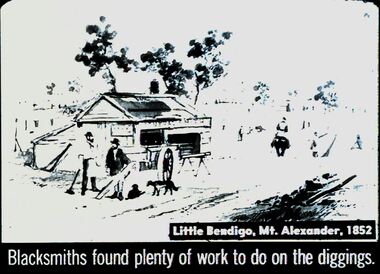
Slide - DIGGERS & MINING. STORES AT THE DIGGINGS, c1852
... Stores at the diggings. Little Bendigo, Mt. Alexander, 1852. Blacksmiths found plenty of work to do on the diggings. ...Stores at the diggings. Little Bendigo, Mt. Alexander, 1852. Blacksmiths found plenty of work to do on the diggings. ...Diggers & Mining. Stores at the diggings. Little Bendigo, Mt. Alexander, 1852. Blacksmiths found plenty of work to do on the diggings. Slide shows a timber building for the blacksmith. Markings: 28 994.LIF. 5. Used as a teaching aid.hanimounteducation, tertiary, goldfields -
 Bendigo Historical Society Inc.
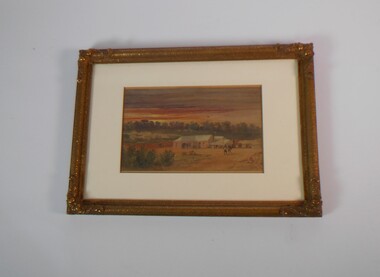
Painting - PAINTING BY GEORGE ROWE: FALCON INN, PEG LEG BENDIGO
... Geroge Rowe (1796-1864) was a successful printmaker in Cheltenham, UK, but due to poor business dealings fell on hard financials times and tried to make his fortune at the Bendigo gold diggings when he arrived in 1853 (followed by his three sons). ...Geroge Rowe (1796-1864) was a successful printmaker in Cheltenham, UK, but due to poor business dealings fell on hard financials times and tried to make his fortune at the Bendigo gold diggings when he arrived in 1853 (followed by his three sons). ...Geroge Rowe (1796-1864) was a successful printmaker in Cheltenham, UK, but due to poor business dealings fell on hard financials times and tried to make his fortune at the Bendigo gold diggings when he arrived in 1853 (followed by his three sons). He was not successful as prospector, nor as a shopkeeper at Long Gully, Bendigo, but found success in Australia by creating water colours of the Bendigo and Castlemaine gold diggings.His works were exhibited at Bendigo in 1857, and in 1858 he created a well known panoramic View of the City of Melbourne from the Observatory. He returned to Britain in 1858 or 1859 and settled in Exeter where he prepared a series of views of Australia and Tasmania for which he won a gold medal at the London 1862 International ExhibitionSmall watercolour painting by George Rowe in a golden wooden frame. Under a red sunset the typical Australian bush and several tents. The main part of the painting shows the Falcon Inn pub in Peg Leg Rd. Eaglehawk, four men are standing at the entrance and two aborigines are walking on the dirt road away from the pub. It is believed to have been painted around 1857.artwork, water colour, landscape, from dudley house. stored at the bendigo art gallery from 2000. returned to bhs 03/02/2023 -
 Bendigo Historical Society Inc.
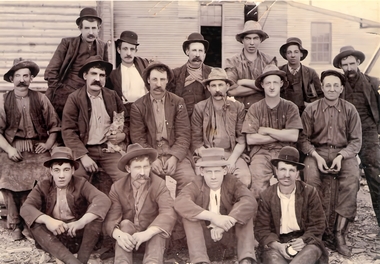
Photograph - The Ruschmeyers - Publicans of the Town and Country Hotel, Diamond Hill Bendigo
... Shortly after his arrival in Australia he travelled to the Bendigo diggings. He became one of many thousands of German diggers on the Central Victorian Goldfields. ...Shortly after his arrival in Australia he travelled to the Bendigo diggings. He became one of many thousands of German diggers on the Central Victorian Goldfields. ...John Christopher Ruschmeyer arrived in Melbourne aged 26 aboard the 'Essex' from Hanover, Germany via London in 1864. Shortly after his arrival in Australia he travelled to the Bendigo diggings. He became one of many thousands of German diggers on the Central Victorian Goldfields. He married Elizabeth Little Shepherd (Morrison) in 1874, a widow who had travelled down from Brisbane after the death of her first husband (John Shepherd). He became a naturalized citizen in 1893. Shortly after his marriage and having mined Golden Gully for some years he turned to hotel keeping and was the licensee of the Town and Country Hotel in Woodward Road, Golden Gully up until his death in 1911. The family of 4 daughters and 3 sons survived him. The family of Ernest, Maude, Christopher, Ethel and Edith (twins), Charles and Dolly Ruschmeyer all lived in the Bendigo area. His sons continued working in the mining tradition. He is buried with his wife in the Bendigo Cemetery. After his death Elizabeth moved to Thistle St until her death in 1922. Christopher Ruschmeyer and his family lived in a small house (now part of a poultry farm) in Woodwood road opposite the TOWN AND COUNTRY HOTEL. A brother Ernest Walter Ruschmeyer lived in a house next to the hotel. Ernest built the house. After Ernest's death in 1927 another brother Charles Hex Ruschmeyer married Ernest's wife Gertrude. The hotel was first licensed in 1898 and closed in 1916. John Ruschmeyer was the licensee until his death in 1911. Elizabeth took over the license until 1912 when it was sold to a Catherine E Hoffaer. This information is provided by Neil Graham of Strathfieldsaye whose Grandfather on his Mother's side was John Ruschmeyer and John Christopher Ruschmeyer was his Great Grandfather.Digital image: image shows Town and Country Hotel, Diamond Hill. Ruschmeyer's were the publicans. Standing outside hotel, were from left, Ethel, Dolly, Maude, Edith, Elizabeth.person, family, ruschmeyer, john christopher ruschmeyer, town and country hotel, ruschmeyer, diamond hill bendigo -
 Bendigo Historical Society Inc.
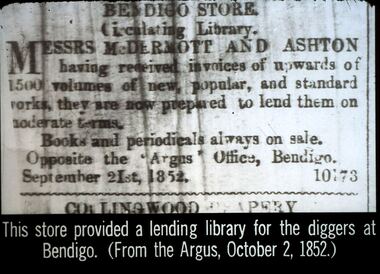
Slide - DIGGERS & MINING. STORES AT THE DIGGINGS, 2 October, 1852
... Stores at the diggings. BENDIGO STORE Circulating Library. Messrs McDermott and Ashton having received invoices of an upwards 1500 volumes of new, popular, and standard works, they are now prepared to lend them on moderate terms. ...Stores at the diggings. BENDIGO STORE Circulating Library. Messrs McDermott and Ashton having received invoices of an upwards 1500 volumes of new, popular, and standard works, they are now prepared to lend them on moderate terms. ...Diggers & Mining. Stores at the diggings. BENDIGO STORE Circulating Library. Messrs McDermott and Ashton having received invoices of an upwards 1500 volumes of new, popular, and standard works, they are now prepared to lend them on moderate terms. Books and periodicals always on sale. Opposite the 'Argus' Offices, Bendigo. September 21st, 1852. 10/73 Slide reads; This store provided a lending library for the diggers at Bendigo. (From the Argus, 1852.) Markings: 18 994.LIF. 5. Used as a teaching aid.hanimounteducation, tertiary, goldfields -
 Bendigo Historical Society Inc.
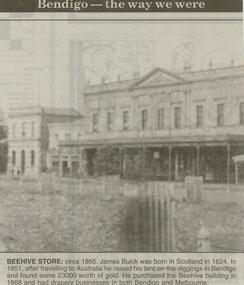
Newspaper - JENNY FOLEY COLLECTION: BEEHIVE
... Bendigo Advertiser ''The way we were'' from 2000. Beehive store: circa 1865. James Buick was born in Scotland in 1824. In 1851, after travelling to Australia he raised his tent on the diggings in Bendigo and found some 3,000 pounds worth of gold.. ...Bendigo Advertiser ''The way we were'' from 2000. Beehive store: circa 1865. James Buick was born in Scotland in 1824. In 1851, after travelling to Australia he raised his tent on the diggings in Bendigo and found some 3,000 pounds worth of gold.. ...Bendigo Advertiser ''The way we were'' from 2000. Beehive store: circa 1865. James Buick was born in Scotland in 1824. In 1851, after travelling to Australia he raised his tent on the diggings in Bendigo and found some 3,000 pounds worth of gold.. He purchased the Beehive building in 1868 and had drapery businesses in both Bendigo and Melbourne. The clip is in a folder.newspaper, bendigo advertiser, the way we were -
 Bendigo Historical Society Inc.
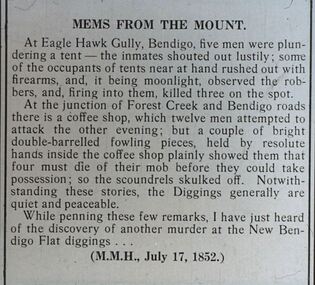
Slide - DIGGERS & MINING. THE DIGGING - THE DIGGERS, c1850s
... While penning these few remarks, I have just heard of the discovery of another murder at the New Bendigo Flat Diggings. (M.M.H., July 17, 1852) Markings: -- 994.LIF:6. ...While penning these few remarks, I have just heard of the discovery of another murder at the New Bendigo Flat Diggings. (M.M.H., July 17, 1852) Markings: -- 994.LIF:6. ...Diggers & Mining. The Digging - The Diggers. Slide; An article titled 'Mems From The Mount' At Eagle Hawk Gully, Bendigo, five men were plundering a tent - the inmates shouted out lustily; some of the occupants of tent near at hand rushed out with firearms, and it being moonlight, observed the robbers, and, firing into them, killed three on the spot. At the junction of Forest Creek and Bendigo roads there is a coffee shop, which twelve men attempted to attack the other evening; but a couple of bright double-barrelled fowling pieces, held by the resolute hands inside the coffee shop plainly showed them that possession; so the scoundrels skulled of. Not with-standing these stories, the Diggers generally are quiet and peaceable. While penning these few remarks, I have just heard of the discovery of another murder at the New Bendigo Flat Diggings. (M.M.H., July 17, 1852) Markings: -- 994.LIF:6. Used as a teaching aid.hanimounteducation, tertiary, goldfields -
 Ballarat Heritage Services
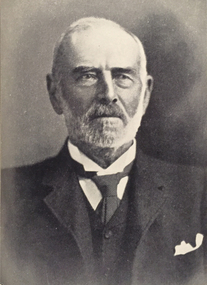
Photograph - Image, David Syme, 1934
... By mid-1852 he was in Melbourne, and in the next three years prospected with some success on Ballarat, Bendigo, Castlemaine and Beechworth diggings. In 1855 he lost a possible fortune at Egerton near Ballarat when a promising claim was jumped. ...By mid-1852 he was in Melbourne, and in the next three years prospected with some success on Ballarat, Bendigo, Castlemaine and Beechworth diggings. In 1855 he lost a possible fortune at Egerton near Ballarat when a promising claim was jumped. ...David Syme (1827-1908) was a newspaper proprietor who was born on 2 October 1827 at North Berwick, Scotland. Early in 1851, he went via Cape Horn to California seeking gold. By mid-1852 he was in Melbourne, and in the next three years prospected with some success on Ballarat, Bendigo, Castlemaine and Beechworth diggings. In 1855 he lost a possible fortune at Egerton near Ballarat when a promising claim was jumped. Ebenezer Syme bought the insolvent Melbourne Age for £2000, and invited David Syme to take up a share. In September 1856 Syme put up some cash and his contracting business to obtain a half-share. He helped to manage the paper but returned to contracting late in 1857. When Ebenezer retired in 1859 Syme reluctantly returned to the business, and on Ebenezer's death next year he began his fifty-year career as publisher and editor of the Age. (C. E. Sayers, 'Syme, David (1827–1908)', Australian Dictionary of Biography, National Centre of Biography, Australian National University, http://adb.anu.edu.au/biography/syme-david-4679/text7741, published first in hardcopy 1976, accessed online 25 August 2019._Reproducation of a image of David Syme.david syme, portrait, the age, journalist -
 Ballarat Heritage Services
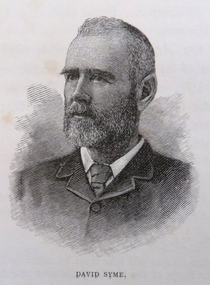
Photograph - Image, David Syme
... By mid-1852 he was in Melbourne, and in the next three years prospected with some success on Ballarat, Bendigo, Castlemaine and Beechworth diggings. In 1855 he lost a possible fortune at Egerton near Ballarat when a promising claim was jumped. ...By mid-1852 he was in Melbourne, and in the next three years prospected with some success on Ballarat, Bendigo, Castlemaine and Beechworth diggings. In 1855 he lost a possible fortune at Egerton near Ballarat when a promising claim was jumped. ...David Syme (1827-1908) was a newspaper proprietor who was born on 2 October 1827 at North Berwick, Scotland. Early in 1851, he went via Cape Horn to California seeking gold. By mid-1852 he was in Melbourne, and in the next three years prospected with some success on Ballarat, Bendigo, Castlemaine and Beechworth diggings. In 1855 he lost a possible fortune at Egerton near Ballarat when a promising claim was jumped. Ebenezer Syme bought the insolvent Melbourne Age for £2000, and invited David Syme to take up a share. In September 1856 Syme put up some cash and his contracting business to obtain a half-share. He helped to manage the paper but returned to contracting late in 1857. When Ebenezer retired in 1859 Syme reluctantly returned to the business, and on Ebenezer's death next year he began his fifty-year career as publisher and editor of the Age. (C. E. Sayers, 'Syme, David (1827–1908)', Australian Dictionary of Biography, National Centre of Biography, Australian National University, http://adb.anu.edu.au/biography/syme-david-4679/text7741, published first in hardcopy 1976, accessed online 25 August 2019._Reproducation of a image of David Syme.david syme, portrait, the age, journalist
