
Showing 96 items matching " the deep mines of bendigo"
-
 Bendigo Historical Society Inc.
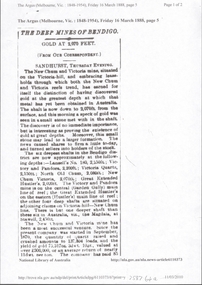
Document - VICTORIA HILL - THE DEEP MINES OF BENDIGO
... VICTORIA HILL - THE DEEP MINES OF BENDIGO...... The Deep Mines of Bendigo...Photocopied article titled 'The Deep Mines of Bendigo. Gold at 2, 070 feet'. From The Argus (Melbourne, Vic.: 1848 - 1954), Friday 16 March 1888, page 5. ...DOCUMENT Gold Victoria Hill The Deep Mines of Bendigo The Argus 16/3/1888 New Chum and Victoria Lansell's No 180 Victory and Pandora Victoria Quartz North Old Chum New Chum victoria Great Extended Hustler's The Magdala at Stawell Mr W W Barker Mr Robert Jackson Photocopied article titled 'The Deep Mines of Bendigo. ...Photocopied article titled 'The Deep Mines of Bendigo. Gold at 2, 070 feet'. From The Argus (Melbourne, Vic.: 1848 - 1954), Friday 16 March 1888, page 5. Article mentions gold being found at the greatest depth at which that metal has yet been obtained in Australia. Mentioned are the six deepest shafts in the Bendigo district. They are: Lansell's No 180, Victory and Pandora, Victoria Quartz, North Old Chum, New Chum Victoria and the Great Extended Hustler's. There was a deeper shaft at Stawell, the Magdala. Also mentioned are yields, amounts crushed, dividends paid and calls.document, gold, victoria hill, the deep mines of bendigo, the argus 16/3/1888, new chum and victoria, lansell's no 180, victory and pandora, victoria quartz, north old chum, new chum victoria, great extended hustler's, the magdala at stawell, mr w w barker, mr robert jackson -
 Bendigo Historical Society Inc.
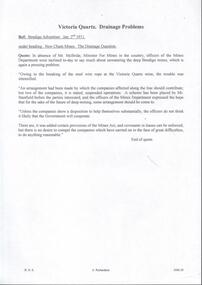
Document - DRAINAGE PROBLEMS - NEW CHUM MINES THE DRAINAGE QUESTION
... Bendigo Advertiser Jan 2nd 1911. ''In absence of Mr McBride, Minister for Mines in the country, officers of the Mines Department were inclined to-day to say much about unwatering the deep Bendigo mines, which is again a pressing problem. ...Mines The Drainage Question Bendigo Advertiser 2/1/1911 Mr McBride Mines Department Victoria Quartz Mine Mr Stanfield Mines Act Albert Richardson. Handwritten extract from the Bendigo Advertiser Jan 2nd 1911. ''In absence of Mr McBride, Minister for Mines in the country, officers of the Mines Department were inclined to-day to say much about unwatering the deep Bendigo mines, which is again a pressing problem. ...Handwritten extract from the Bendigo Advertiser Jan 2nd 1911. ''In absence of Mr McBride, Minister for Mines in the country, officers of the Mines Department were inclined to-day to say much about unwatering the deep Bendigo mines, which is again a pressing problem. Owing to the breaking of the steel wire rope at the victoria Quartz mine, the trouble was intensified. An arrangement had been made by which the companies affected along the line should contribute, but two of the companies, it is stated, suspended operations. A scheme has been placed by Mr Stanfield before the parties interested, and the officers of the Mines Department expressed the hope that for the sake of the future of deep mining, some arrangement should be come to. Unless the companies show a disposition to help themselves substantially, the officers do not think it likely that the Government will co-operate. There are, it was added certain provisions of the Mines Act, and covenants in leases can be enforced, but there is no desire to compel the companies which have carried on in the face of great difficulties, to do anything reasonable.'' Albert Richardson Mining History Collectiongold, drainage problems, drainage problems, new chum mines the drainage question, bendigo advertiser 2/1/1911, mr mcbride, mines department, victoria quartz mine, mr stanfield, mines act, albert richardson. -
 Federation University Historical Collection
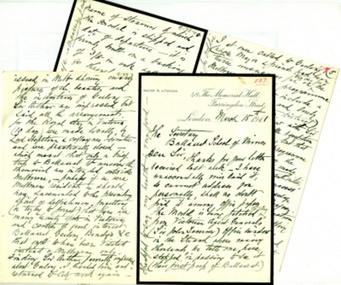
Letter - Correspondence, Walter M. Hitchcock, Letters from Walter M. Hitchcock concerning a model of a Ballarat tent (and more), 1911, 1911 (exact)
... Bendigo I hear had now mines of 4,000 ft in depth (deeper than our tin or coal mines here). ...Bendigo I hear had now mines of 4,000 ft in depth (deeper than our tin or coal mines here). ...The tent model mentioned in the letters was displayed in the Ballarat School of Mines Museum. During the 1960s it was transferred to the Ballarat Historical Society. Two handwritten letters on paper with black mourning edge written by Walter M. Hitchcock to the Ballarat School of Mines, and another written by Walter's brother George M. Hitchcock.Letter transcription follow: Letter from Walter M. Hitchcock regarding the death of James Oddie and early gold mining at Ballarat, 1910 and 1911 48 The Memorial Hall Farringdon St London Dec1/10 The Secretary Ballarat Museum Dear Sir, I am just now sending you this line, i anticipation of further correspondence later on, simply to forward you a Post Card of the 1st mining tent erected 1851 on the site of he then newly proclaimed Township of Ballarat, which, as the sole survivor of the party who built the original, I have had the pleasure in making, and have decided to present it to your museum, Sir Jno Lasenor out Agent General for Victoria came to a Bazaar recently held in London. where I had it on view in the museum from 3 days, - and desired I would allow its [ ? ] exhibited in the first large window of the beautiful new building of the Victoria Agency situate in the Strand. It is there for the past few days and he may wish it to remain a week or two longer, I know of no other exhibition of it to delay it being packed and shipped to my relatives in Geelong (Mr [?] Bright of Hitchock's Firm) who may wish to show it in one of their windows before forwarding it to your museum - I have had an itemised pane glass case made for it with drop down end and [?} it stands on a plateau of moss, to represent grass 32 x 13 x 13 high and chimney 14 1/2 - the case is made 34 x 26 x 20 high inside - I shall have it very carefully packed - tent emptied tools, beds, &c &c in separate packing and insured for 50 pounds - I will send you full details later on. I hope and believe your President will accept it in due time Meantime believe me to be very truly Cat Walter Hitchcock G.F.B. 48 The Memorial Hall Farringdon St London March 15th 1911 The Secretary Ballarat School of Mines Dear Sir, Thanks for your letter received last week – I have unaccountably mislaid it, so cannot address you personally, shall no doubt find it among office papers. The model is being fetched today from Victorian Agent General’s (Sir John [Lavernor?] office window in the Strand where many thousands, he tells me, have stopped in passing to see it (their first peep of Ballaarat). It will be on view at Blackheath (Kent) for a week, then packed and shipped without further delay. I shall enclose in the glass case (which is 26 x 34 x 16 in high) some spare minced moss and gas (smoke) in case in transit the plateau suffers by shaking (though it is well glued down). All the tools, mining appliances, cradle, windlass, &c will be separately packed enclosed – which you can easily place in respective positions. HRH Prince of Wales has graciously accepted a photo of it – and in my letter to him when sending it for his acceptance I said – as he would probably ere long visit Australia as did his grandfather and father, which ought to (and certainly will) include at least a day or two in seeing your beautiful City, and also something of your mines &c instead of the hurried visit of his father (2 hours) when he, as Duke of York, unveiled a statue to the memory of those slain in the sad Boer War, which now is admitted by almost everybody to have been a big political mistake, - though in the future with England’s present wise policy towards that country it will prove for Africa’s welfare. It may interest you to know that when I ascertained that Geelong was not to be visited by the Royal Pair – I went up to St James’s Palace by appointed time the Duke’s private Secy Sir Arthur Bigge – taking with me a specially illustrated paper issued in Melb. showing many pictures of the beauties and industries of Geelong – Sir Arthur was impressed but said all the arrangements for the Royal stay in Victoria (10 days) were made locally, by Lord Hopetoun and collegues and committee, and were practically closed – which meant that only a brief trip to Ballarat to uncover the memorial was intended outside Melbourne. Perhaps if we were Melbourne residents we should have succumbed to the prevailing spirit of selfishness – forgetting (or trying to forget) that there are many beauty spots in Victoria and centres of great interest - Ballarat, Geelong, Bendigo, &c that ought to have been visited instead of Melbourne only. Finding Sir Arthur favorably impressed about Geelong I thanked him and returned to City work again. I at once called to Geelong whose mayor and friends had been twice unsuccessful in trying for the Melbourne functions programme being altered to include a visit to Geelong and lovely spots in the Western District, reporting my interview with Sir A B and his favourable reception of my representations, but that any alteration to the programme of engagements during the Royal visit must be made locally and by the local authorities. This had the desired success for on receipt of my message the Geelong mayor and colleagues again reopened the question and went to Melbourne, resulting in a concession (but what an altogether inadequate one) and they graciously ? consented to the train, on its way with the Duke and Duchess to your city, to stop at the Geelong stn (15 minutes) and so it came about that by a hasty local effort, 3,000 school children, and not a few of the leading people including the Mayor &c were gathered to welcome them in Geelong. The National anthem being sung, an Address read and presented and kindly replied to. Now Ballarat should doubtless has influence. See to it when our P. Of Wales visits Victoria – an unselfish ¬ programme is fixed up – and HRH afforded ample opportunity of visiting leisurely your city, Geelong, Bendigo and other centres of beauty and importance. The Prince himself will be the gainer by such an equitable and enlightened programme, - and come back with all the more favourable views of the marvellous development ever since our family first settled in Geelong in 1850. A far preferable result of such a visit than night after night having Melbourne Banquets and the visiting of its undoubted attractions - whilst all the rest of the State remained unvisited. Such an official mistake must not be made again. I will write you again, stating name of steamer of which the model is shipped and date of departure – it is firmly built on a backing of 3/8 in oak tall uprights so through the 7/8 in plateau and am entrusting the packing be very careful. I expressed firm – so that except possibly any breakage in glass case – it should reach you in due time all right. The top of case will be screwed so that it can be readily removed temporarily to enable my [ ? ] firm to show it in one of their windows. Believe me Yours very truly Captn Walter M. Hitchcock My brother will deliver it on my a/c – all carriage paid. Mt very kind regards to my friend since 1850 Jas Oddie. University of Ballarat Historical Collection Cat. No. 8133.3 & .4 Letter from Walter M. Hitchcock regarding the death of James Oddie and early gold mining at Ballarat, 1911 48 The Memorial Hall Farringdon St London April 20th 1911 My Dear Sir, It is with no ordinary feeling of regret that I received the tidings of the death of my good friend, your fellow citizen for many years, Mr James Oddie. Living at Geelong from March 1850 I came to know him there as carrying on a foundry business in Ashby. With the discovery of gold at Ballarat started off almost of the working people, as well as of all other classes of the male population. Mr Oddie arrived in Ballarat I believe on or about September 1st 1851. My three comrades and I arrived October 1st 1851 – among the many thousands soon gathered within a mile or so of Golden Point – my friend Oddie and I often met. I returning to Geelong after a year mining – my friend on the other hand remaining at Ballarat ever since – a marvellous record, and I am sure his life has been one of unique value to your City in many ways, - his age (87) naturally prepared me for his call home – and only two mails before the news came I received from him on of his kindly chatty letters in which amongst other things – he referred with pleasure to having received from me two 10 x 12 photos – one being of my model and that he was arranging to have it placed in a shop window in your city. I am interested in the fact of your having known each of my three comrades of 1851/52. It was J.M. Garrett and I who got permission to conduct public Sunday morning service in their large Marquee – used all the week for issue of Licenses in the absence of any church buildings, and it being on wet Sundays impossible to have services as usual under the trees – Ballarat then was more like a Gentleman’s Park – than bush country – but the axe soon did its work – and all were felled for our cooking, and hencewith to make our kindling etc. Shafting of holes not being at first done because too shallow – our deepest (at Eureka) was only 115 ft. Bendigo I hear had now mines of 4,000 ft in depth (deeper than our tin or coal mines here). I fortunately have, in excellent state of preservation, my last of 12 licenses dated October 1 1852 and have recently purchased here a Miner’s Right dated 1864, to that when explaining on matters re Gold Licensing I can show sample of each. With kind regards Believe me Yours sincerely Walter M. Hitchcock Geelong June 20/11 Dear Sir, By rail to day through Messrs Bannister I send the model of miner’s tent packed in a case 50 donated by my brother Captain Walter M. Hitchcock of London. This model was made by my brother and represents the tent he worked in on the Ballarat Gold Fields in the year 1851 or 2. In a separate parcel a few extras omitted from the case. Please send me receipts in duplicate, one for my brother, the other for the Customs, Geelong, as being donated to your institution, after some little correspondence it was admitted [??] any payment for duty. You probably have my brother’s address and would like to acknowledge its arrival, direct. I hope it is in good order. I did not open it for show in Geelong, as there would be less risk of breakage on repacking. With kind remembrances. I am Yours Faithfully Geo. M. Hitchcock. A Mr G. F. B. Sharick who is living near my home called in to see my model – he said he knew FM [Fred Martell] and was lately at Ballaratballarat school of mines, frederick martell, fred martell, james oddie, walter m hitchcock, walter hitchcock, f m garratt, george hitchcock, hitchcock, golden point, gold discovery, j m garrett, gold license, j.m. garrett, t.m. hall, george m. hitchcock, f.m. garratt, walter m. hitchcock -
 Federation University Historical Collection
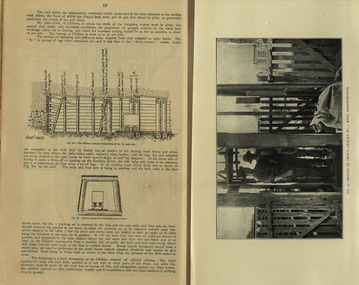
Book, Stanley B. Hunter, Memoirs of the Geological Survey of Victoria No 7., The Deep Leads of Victoria, 1909
... Contents include tunnelling, deep sinking, the Chiltern Method, the Ballarat Method, Stawell, Ararat, Moyston, Raglan, Wimmera, Landsborough, Avoca, Ballarat West Leads, Berry-Moolort-Loddon Lead System, Clunes, Creswick, Bullarook Affluent, Corinella, Daylesford-Castlemaine Tributary, Majorca-Carisbrook tributary, Huntly, Coliban, Campaspe, Rutherglen., Smythesdale, Durham Lead, Tanjil, Evolution of Mining Machinery, size of claims, Definition of a Deep Lead, Discovery of Gold in Victoria, Geographical Position of Deep Leads, Water in Deep Leads, Methods of Deep Lead Mining, Cost of Deep Lead Mining, Stawell, Ararat, Moyston, Raglan, Wimmera, Landsborough, Avoca, Ballarat West, Berry, Springs Hill, Loddon Valley, Charlotte Plains, , Timor, Burn Creek, Huntly, Colinan, Goulburn, Ovens Valley, Chiltern, Indigo, Morrison's Lead, Plans include: geological Map of Stawell, ararat, Raglan and Landsborough; Kempson's Freehold Mine, Stawell; Geological Map of Beaufort, Avoca, Maryborough, Ballarat west, Berry-Moolort, Loddon, Creswick, Marong, &c; Cardigan Propriety Gold Mine; Working Miners United Gold Mine, Homebush; Hepburn Deep Lead Plan; Madame Berry West Mine; West Berry Consols Mine; Spring Hill and Central Leads; Berry Consols Extended Mine; Loddon Valley Goldfields; Chalk's No 3 Mine; Charlotte Plains Considated Mine; Duke United Mine; Geological Map of Bendigo, Huntley, Campaspe, Malmsbury, Kyneton, trentham, &c; Geological Map of Chiltern, Rutherglan, Eldorado, Beechworth, &c; Chiltern Valley Gold Mine; Wallace Chiltern Valley Consols Mine; great Southern and Chiltern Valley United Mine; great Northern extended Consols; Prentice and Southern deep Leads; Glenfine South Gold Mine; Geological map of Pitfield, Rokewood, Mt Mercer, Ballark, Meredith, &c.; McEvoy Mine; Dargo . . . . . . . . . . . . . . . . . . . . . . . ...Contents include tunnelling, deep sinking, the Chiltern Method, the Ballarat Method, Stawell, Ararat, Moyston, Raglan, Wimmera, Landsborough, Avoca, Ballarat West Leads, Berry-Moolort-Loddon Lead System, Clunes, Creswick, Bullarook Affluent, Corinella, Daylesford-Castlemaine Tributary, Majorca-Carisbrook tributary, Huntly, Coliban, Campaspe, Rutherglen., Smythesdale, Durham Lead, Tanjil, Evolution of Mining Machinery, size of claims, Definition of a Deep Lead, Discovery of Gold in Victoria, Geographical Position of Deep Leads, Water in Deep Leads, Methods of Deep Lead Mining, Cost of Deep Lead Mining, Stawell, Ararat, Moyston, Raglan, Wimmera, Landsborough, Avoca, Ballarat West, Berry, Springs Hill, Loddon Valley, Charlotte Plains, , Timor, Burn Creek, Huntly, Colinan, Goulburn, Ovens Valley, Chiltern, Indigo, Morrison's Lead, Plans include: geological Map of Stawell, ararat, Raglan and Landsborough; Kempson's Freehold Mine, Stawell; Geological Map of Beaufort, Avoca, Maryborough, Ballarat west, Berry-Moolort, Loddon, Creswick, Marong, &c; Cardigan Propriety Gold Mine; Working Miners United Gold Mine, Homebush; Hepburn Deep Lead Plan; Madame Berry West Mine; West Berry Consols Mine; Spring Hill and Central Leads; Berry Consols Extended Mine; Loddon Valley Goldfields; Chalk's No 3 Mine; Charlotte Plains Considated Mine; Duke United Mine; Geological Map of Bendigo, Huntley, Campaspe, Malmsbury, Kyneton, trentham, &c; Geological Map of Chiltern, Rutherglan, Eldorado, Beechworth, &c; Chiltern Valley Gold Mine; Wallace Chiltern Valley Consols Mine; great Southern and Chiltern Valley United Mine; great Northern extended Consols; Prentice and Southern deep Leads; Glenfine South Gold Mine; Geological map of Pitfield, Rokewood, Mt Mercer, Ballark, Meredith, &c.; McEvoy Mine; Dargo . . . . . . . . . . . . . . . . . . . . . . . ...Pink paper covered book by Stanley Hunter, Engineer in Charge of Boring Operations. Contents include tunnelling, deep sinking, the Chiltern Method, the Ballarat Method, Stawell, Ararat, Moyston, Raglan, Wimmera, Landsborough, Avoca, Ballarat West Leads, Berry-Moolort-Loddon Lead System, Clunes, Creswick, Bullarook Affluent, Corinella, Daylesford-Castlemaine Tributary, Majorca-Carisbrook tributary, Huntly, Coliban, Campaspe, Rutherglen., Smythesdale, Durham Lead, Tanjil, Evolution of Mining Machinery, size of claims, Definition of a Deep Lead, Discovery of Gold in Victoria, Geographical Position of Deep Leads, Water in Deep Leads, Methods of Deep Lead Mining, Cost of Deep Lead Mining, Stawell, Ararat, Moyston, Raglan, Wimmera, Landsborough, Avoca, Ballarat West, Berry, Springs Hill, Loddon Valley, Charlotte Plains, , Timor, Burn Creek, Huntly, Colinan, Goulburn, Ovens Valley, Chiltern, Indigo, Morrison's Lead, Plans include: geological Map of Stawell, ararat, Raglan and Landsborough; Kempson's Freehold Mine, Stawell; Geological Map of Beaufort, Avoca, Maryborough, Ballarat west, Berry-Moolort, Loddon, Creswick, Marong, &c; Cardigan Propriety Gold Mine; Working Miners United Gold Mine, Homebush; Hepburn Deep Lead Plan; Madame Berry West Mine; West Berry Consols Mine; Spring Hill and Central Leads; Berry Consols Extended Mine; Loddon Valley Goldfields; Chalk's No 3 Mine; Charlotte Plains Considated Mine; Duke United Mine; Geological Map of Bendigo, Huntley, Campaspe, Malmsbury, Kyneton, trentham, &c; Geological Map of Chiltern, Rutherglan, Eldorado, Beechworth, &c; Chiltern Valley Gold Mine; Wallace Chiltern Valley Consols Mine; great Southern and Chiltern Valley United Mine; great Northern extended Consols; Prentice and Southern deep Leads; Glenfine South Gold Mine; Geological map of Pitfield, Rokewood, Mt Mercer, Ballark, Meredith, &c.; McEvoy Mine; Dargo . . . . . . . . . . . . . . . . . . . . . . . mining, deep leads, squire, tools, gold panning, gold cradle, cradling, puddling, tubbing, mining shaft, shaft sinking, whip, horse whip, whim, horse whim, chalk's no. 1 mine, maryborough, mining cage, shaft, mining trucks, maryborough, washdirt, puddler, tunnelling, deep sinking, chiltern method of working, ballarat method of working, sampling washdirt. gravels, balmoral, mt william, stawell, moyston, great western, ararat, raglan, wimmera valley, landsborough, cardigan, haddon, beaufort, waterloo, avoca, lamplough, caralulup, ballarat west, ballarat, smythesdale, glenfine, illabarook, durham lead, morrison's lead, bullengarook, berry-moolort-loddon system, clunes, creswick, spring hill, bullarook, castlemaine - daylesford, majorca, carisbrook, timor, burnt creek tributary, tarnagulla, marong, rheola, inglewood, huntly, coliban, campaspe, goulburn lead system, ovens valley system, mitta mitta, kiewa valley, tarago, tanjil, moondarra, bogong, dargo high plains -
 Federation University Historical Collection
Document, Zelda Martin, Central Victorian Goldmining towns - Boom Towns or Ghost Towns?, c1996
... bendigo...castlemaine...ballarat...Maldon...Stawell...Ararat...maryborough...Creswick...Avoca...Heathcote...Banks...Bank of Australasia...Union bank of Australia...government camp...Sandhurst...water supply...Tarnagulla...Talbot...back creek...Mountain Creek...Police court...Carisbrook...dunolly...thompson's foundry...Charles Clacy...Anthony Trollope...Robert Cecil...Mount Alexander...urbanisation...national schools...education...govenrment...industry...railway...transport...settlement...land settlement in central Victoria...Steiglitz...Joseph Brady...The New Australian Mine...Berry Deep...Zelda Martin Victorian goldfield towns bendigo castlemaine ballarat Maldon Stawell Ararat maryborough Creswick Avoca Heathcote Banks Bank of Australasia Union bank of Australia government camp Sandhurst water supply Tarnagulla Talbot back creek Mountain Creek Police court Carisbrook dunolly thompson's foundry Charles Clacy Anthony Trollope Robert Cecil Mount Alexander urbanisation national schools education govenrment industry railway transport settlement land settlement in central Victoria Steiglitz Joseph Brady The New Australian Mine Berry Deep Leads William Guthrie Spence Creswick State Forest Arthur Worsley Worsley Cottage The Welcome Stranger Moliagul Moonambel Redbank St Arnaud Sebastapol Brown's Scarsdale Clunes Chewton Daylesford Bushfires Inkerman Inglewood Kingower Lintons Happy Valley Piggoreet McIvor Majorca Tarrangower Taradale The Coliban System The Syphon Sandy Creek Wedderburn Koorong Arnold Jones Creek Waanyarra The Golden Triangle Census 1857 Blackwood Buninyong Durham Lead Magpie Carngham Snake Valley Alma Amherst Daisy Hill Amphitheatre Mountain Hut Beaufort Fiery Creek Counties population gold fields commission of enquiry1854 William Westgarth Gold license Fee lieutenant Colonel Valiant administration of the victorian gold fields Commission to Enquire into Sludge 1859 E.S. ...Zelda Martin was a PhD candidate at the University of Melbourne.[.1] 4th item in light blue display book titled Research Approach/Overview of Chapters/Confirmation of Canditure/Chapters1,2,3&4 of proposed thesis. *Twenty-seven page article on Victorian goldfields towns titled: Central Victorian Goldmining Towns - Boom Towns or Ghost Towns. The article was written during the author's PhD study. It outlines the context methodology, and resources and the chapters of the proposed thesis: (1) Central Victorian Goldmining Towns - The Context (2) Contemporary Views of the Factors Necessary for Town Growth (3) Outward Manifestations of Town Growth (4) The Trappings of Government (5-9) The Main Towns and Their Hinterland. [.2] 5th item in Light Blue display book as above item. *Chapter 1 of proposed thesis titled 'Pick, Shovel and Tin Dish Mining.' Covers in Section A: Central Victoria - Pre 1851: Aborigines in Central Victoria, Squatters, and Government. Section B: The years 1851-1854: The Early Gold Rushes, Government Reaction, Township Surveys, Legislation, Town Development, Local Government and Early Settlement. [.3] 6th item in Light Blue display book as above item. *2A of proposed thesis titled 'Contemporary Views of the Factors Necessary for Town Growth'. Similar information to Chapter 1 plus extra re towns and maps. Sections: Introduction, Context of Place - Geographical Towns Listed, The Context of Time - Pre1851 Aborigines, Governance of Port Phillip, The Squatters, The Villages of Central Victorian Highlands, Conclusion, Condensed Version of Chapter2B. [.4] 7th item in Light Blue display book as above item. *Chapter2B of proposed thesis. Sections: Area of Research, Schools, Banks, Newspapers, Progress Association, Town Development - Sandhurst (Bendigo), Ballarat, Castlemaine,, Maryborough, Ararat and Stawell. [.5] 8th item in Light Blue display book as above item. *Chapter 3 of proposed thesis titled 'Outward Manifestations of Town Growth'. Sections: Introduction, Contemporary Writing, Educationalists, The Bankers, The Townsfolk, Current Theory, General Theories of Urban Development, and Conclusion. [.6] 9th item in Light Blue display book as above item. *Chapter 4 of proposed thesis titled 'Trappings of Government' Sections: Introduction, Early Government Attitudes to Mining and Town Development, Law and Order, Township Surveys, Legislation, Local Government, Transport and Communication, The People and Lobbyists. [.7] 10th item in Light Blue display book as above item. *'The Rise and Fall of Central Victorian Goldmining Towns'. Includes a map showing main Goldfields, a table showing towns and villages at two points in time - 1857 and 1871; a Bibliography of Primary and Secondary Sources. [.8] Resource No1. Black display book titled Local Towns 1 : Alma: *Brief history *Directory *Maps Amphitheatre / Mountain Hut: *Brief History Post Office Directory Ararat: *Brief History *Post Office Directory 1869 - Alphabetical Listing by Occupation *Ararat - Prominent Citizens of 1858 *Langi-Morgala Museum Avoca: *Brief History *Excerpts from 'Avoca The Early Years', Margery and Betty Beavis; pg1 - Beginnings; pg11 - The Midas Touch; pg25 - Local Gold Escorts; pg27 - A Town is Born; pg51- The Administration of Justice; pg53 - The Ways of the Law; pg61 - News of the Day; pg65 - A Time to Play; pg72 - Land Ownership *Post Office Directory (Bailliere's) 1869 *Tourism Map and Information of area *Historic Avoca - A 5.5km Tour *Avoca & the Pyrenees Region - information pamphlet Ballarat: *Early History of Ballarat - Ballarat Historical Society, Publication No.1: origin of the name; Ballaarat - the Beginning; Fabulous Yields from the Ballaarat Goldfield; *Streetscape Lydiard Street. *Hand drawn map showing Leigh River, Old Portland Bay Road, plaque on road to Colac; etc. *Newspaper article re 'The Theatre Royal' ( which stood in the vicinity of the current Owen Williams store) - 'The News'15/04/1998 *Article - 'Ballarat's Mechanics' Institute Lives On' Ballarat Courier, 14/09/1985 *Article - Standing the Test of Time' The News 17/11/1993 re The Mechanics Institute & picture of the Reading Room *'Ballarat a Study of a City, Phyllis Reichl, pub. Nelson, 1968; no.3 place, time and people field studies series *Investigator Vol.33 No.2, 1998 Geelong Historical Society. Article on pg75 describes Ballarat in 1861 *Folded poster - 'Ballarat 100' a history of telegraph communication, pub. Telecom. Beaufort (Fiery Creek): *Brief history *Post Office Directory [.9] Resource No.2 Black Folder Titled Towns cont.No2 Bendigo (Sandhurst): *'Family & Local History at the Bendigo Library - 1851-2001 150 years of gold'. *Bendigo Government Camp in 1853 illustration; key to sketch and names of Government officers stationed there *Excerpts from 'Bendigo and Vicinity' Adolph Haman *The Bendigo Goldfield Registry - pgs 1-7 Introduction *Excerpt: 'Breaking the Grip' *Excerpt: The Most Go-Ahead Place *Excerpts from 'History of Bendigo' - anti license agitation; laying out of town; proposed railway; gold calls and dividends; the Sandhurst Municipality; journalism *Bibliography Blackwood: *Excerpts from 'Aspects of Early Blackwood - The Goldfield, the Landmarks, the Pioneers' Alan J Buckingham and Margaret F Hitchcock, JG Publishing,1980 Buninyong: *A Brief History *Investigator Vol1 No.2 Feb 1966 Geelong Historical Society. Pg3 - Article re gold escort route - Mt Alexander to Adelaide - (see a simple monument on the Western Highway a few miles out of Horsham. Pg 15 - Ballarat Excursion - re the finding of gold. *Three articles published by Buninyong and District Historical Society Inc: (Magpie Exploration; Finding Gold In The Green Hills; Magpie Exploration; Burnt Bridge to Cargarie to Mt Mercer) *Copies of newspaper articles/items *Buninyong Street Directory Carisbrook: *In the Beginning There Was Carisbrook *The History of the Carisbrook Racecourse Carngham / Snake Valley: *Brief History *Directory Castlemaine: *Directory 1865-1866 - Alphabetical and Street *Poster - Castlemaine A Contemporary Guide "The Great Centre" 1866 - A Contemporary Guide to the Fascinating Past *Pamphlet - Castlemaine District Community Hospital *Map - Castlemaine, Maldon & Surrounding Districts *Map and Information - The Dry Diggings Track - a 55kl walk among historic goldfields relics ( Castlemaine Fryerstown Vaughan Mt Franklin Hepburn Daylesford) *Postcard - Former Court House *Directory 1867 - Alphabetical, Trade [.10] Resource No.3 Grey folder Titled Towns 3 Creswick to Maryborough Creswick: *Brief History *Booklet - "Creswick Cemetery Walk" *Booklet - The Buried Rivers of Gold Heritage Trail Creswick *Creswick Historical Museum Information Sheet *Chronological History of Creswick *Alphabetical Directory of the Borough of Creswick *Creswick's Creek Directory 1856 *Historic Creswick Walking Tour *A Brief Account of the Schools of Creswick - Past and Present *100 Years of Railway Travel in Creswick *The Berry Deep Leads *The Spence Home at Jackass Gully in the Creswick State Forest ( William Guthrie Spence - Pioneer) *The New Australian Mine and the 1882 Disaster *Creswick District News, Issue 7, July August 1999 *The Creswick Miners Walk - Information and Map *Maps Chewton: *Brief History *Directory Clunes: *Brief History *Clunes Street Directory Daylesford: *Brief History *Notable Bushfires in Daylesford District Over More Than a Century - "Black Thursday" 1851; 1862; 1899; the Disastrous Hepburn Fire of 1906; 1939; 1944; 1969. *Post Office Directory -Daylesford and Hepburn Dunolly / Inkerman: *Brief History *Directory *Pamphlet - Goldfields Historical Museum *Pamphlet - Historic Dunolly - Victoria's Best Kept Secret *Map of Gold Workings at Dunolly Area - showing where the main gold rushes occurred *Brief History - Inglewood *Directory - Inglewood - Name Occupation, Dwelling Kingower: *Brief History *Directory - Name / Ocupation / Dwelling Linton / Happy Valley / Piggoreet: *Brief History *Directory - Lintons McIvor: *"A History of the Shire and the Township of Heathcote" by J.O. Randell Majorca: *Brief History *Official Post Office Directory 1869 - Name / Occupation/ Address Maldon (Tarrangower): *Brief History Part 1 *Brief History Part 2 *Post Office Directory *List - Alphabetical Order by Names plus Business and Trade (Tarrangower Times Oct/1858) *List - Alphabetical Order by Trade plus Name and Business *Directory - Name / Occupation / Dwelling Maryborough: *Worsley Cottage - built by Arthur Worsley, a contractor in stonework in 1894 [.11] Resource No. 4 Blue Display Book titled Towns 4 Moliagul to Stawell Moliagul: *Brief History *Moligul Legislative Assembly (Voting?) List - Names and Occupations *Moliagul Victorian Post Office Directory 1868 - Name / Ocupation / Address / Comments *"The Welcome Stranger" gold nugget *The Sunday School *The Welcome Stranger Discovery Walk - information and map Moonambel (Mountain Creek) Redbank *Brief History *List of names extracted from advertisments of the Pioneer and Mountain Creek Advertiser 16/02/1861. *Bailliere's Directory 1869 - Alphabetical List of Name / Occupation / Place St Arnaud: *Brief History Sebastapol: *Brief History *Directory 1869 - Alphabetical by Name; plus occupation and address. Browns and Scarsdale: *Brief History *Browns Street Directory - Name and Occupation Smythesdale: *Brief Description *Smythesdale Street Directory -Name and Occupation Stawell (Pleasant Creek) *Brief History *Victorian Official Post Office Directory - Name /Occupation / Dwelling *Chronology - 1841-1920 *Production of gold statistics - 1879 - 1900 *Big Hill *Extracts from "The Golden Years of Stawell". Chapt 1 - Stawell's Coming Out. Capt. 2 - The Gold Rush. Caapt.3 - Cradle of Democracy. Chapt.4 - The Reefs Becomes Stawell. Chapt. 5 - Rushing In. Chapt.6 - The Pioneers. Chapt 7 - The Decade of Optimism. [.12] Resource No. 5: Blue Display Book titled 'Towns Steiglitz to the The Golden Triangle. Steiglitz: Brief History Victorian Post Office Directory 1869 *Map of Steiglitz *List of maps relevant to Steiglitz history *Information 6 tables of data from "Reports of Mining Surveyors Talbot (Back Creek) Brief History Taradale: Post office Directory 1869 - Name/Occupation/Street. Also list in alphabetical order by Occupation Taradale *Chronological Reference to Taradale Mines *Water - The Coliban System of Waterworks *Joseph Brady *The Syphon Tarnagulla (Sandy Creek) *Brief History *Tarnagulla Businessmen Cameos to give depth to advertisments in 'The Tarnagulla Courier' various issues 1864-1871 *Directory - Name/Occupation /Address *List - Name/Business/Trade Wedderburn (Koorong) *Brief History *List - Name/Occupation The Golden Triangle: *The Early Rushes - Wedderburn / Moliagul / Sandy Creek - Tarnagulla / Jones Creek - Waanyarra / Kingower / Dunolly - Goldsborough / Inglweood *Census of 1857 - Population / Occupations *1858-1871 - A Time of Consolidation- Wedderburn / Moliagul / Sandy Creek- Tarnagulla / Arnold *Census 1871 - Population *Information gleaned from the census data - Demographics / Population / Occupations / marital / Birthplace / Religion / Literacy/ Occupation and Housing Cameos *Graphs - Birthplace of settlers /Male-Female Ratio / Married males / Children under 15 as Percentage of Population / Religion *Census 1857 - Statistical data *Maps *Bibliography [.13] Resource No. 6 - Black Display Book Information and Research in Central Victoria including: *Banking - Research from ANZ Bank Archives *Institutions - also includes articles listed from the Ballarat Times Newspaper *Australian mining History Association - A.M.H.A. Bibliography *Australia's Mining History * Bibliography - Land Surveys Victoria - *1853 Administration (Statistics and Other) includes: schools / ministers of religion / police / military / local administration / licences for sale of spirits / distances between various Victorian gold fields. * Victoria Government Gazette (Copy) - N0. 116, 12/12/1854 includes: Gold Felds Commission of Enquiry & No. 85, 15/09/1854 - Addresses presented to the Lieutenant Governor (Sir Charles Hotham) during his tour through the Gold Fields of Victoria,1854. Addresses on behalf of : the people of Bendigo; Members of the Church of England, Bendigo; Members of the Wesleyan Church on the Bendigo Gold Fields; Bendigo Gold District General Hospital; the Bendigo Prospecting Association; Committee of the Bendigo Local Exhibition; Bendigo District Medical Association; Coloured Americans Resident at Bendigo; German Inhabitants of Bendigo; Landowners, Inhabitants, and Miners of Castlemaine; Inhabitants of Forest Creek; Inhabitants of Heathcote and Gold Miners of McIvor; Residents and landholders of the District of Bacchus Marsh; Inhabitants of Kilmore and Vicinity. *Gold Fields Correspondence 1853: letter from Lieutenant Colonel Valiant, (Officer commanding the Troops in Victoria) to the Lieutenant Governor re threatened disturbance at Sandhurst (Bendigo) regarding the Gold License Fee. * Extracts from a book "Victoria" re Gold Fields Commission of Enquiry involving mainly Ballarat and Castlemaine and a chapter titled 'A Tour to the Victorian Gold-Fields' *Lists of central Victorian newspapers - listed by date published 1851to 1874; by first date available to State Library. *A list of cities and towns showing County, population in 1861 &1871, and municipal status. [.14] Resource no.7. Black display book. *Reference: Papers presented to Parliament Victoria - 1859-1860 4 volumes - relevant sections copied. Contains information on Branches of Government. General / Finance / Gold / Gazette / Commission and Warrant / Statistic. *Gold Fields Act. In accordance with the Act the gold fields are divided into six districts - Ballaarat, Castlemaine , Sandhurst, Avoca, Ararat, and Beechworth.. Official staff in each gold district consists of a Resident Warden, Wardens, Wardens' Clerks, Bailiffs, Chinese Protectors, Chinese Interpreters, and Mining Surveyors. *Gold Receiver *Gaols *Police magistrates and Clerks of Petty Sessions, etc. *Field Branch *Immigration and Emigration Overland - Chinese - 1859 *Population on the Goldfields *The Geological Survey - The Government Geologist is assisited by staff from four branches - the office Branch; the Publishing Branch; the Field Branch and the Museum Branch. *Commission to Enquire Into Sludge dated 10/02/1859 (Some sections copied) - Report to the Honorable Chief Commissioner of Public Works, Melbourne re the mode of carrying the sludge from the puddling mills in Sandhurst without interfering with the drainage of the town and the roads in the neighbourhood. [.15] Resource No.8: Camel display book titled Resource No. 8. Aborigines *Lists of book titles - +"Readings in Victorian prehistory" +"The Aborigines of Port Phillip" +Aboriginal languages and clans" +"A History of the Port Phillip District" +"Langi Ghiran 1: Aboriginal Rock...." +"Koorie History: sources for aboriginal studies in the State Library of Victoria", ed. Tom Griffiths, Melb. Friends of the State Library, 1989 +"The Public Lands of Australia Felix"; settlement and land appraisal in Victoria1834-91 with special reference to the Western Plains", J.M.Powell, Melb. Oxford University Press 1970 +*Bibliography of the Victorian Aborigines' from the earliest manuscripts to 31st December 1970, Massoa, Aldo, Melb. Hawthorn Press, 1971 +"Aborigines in Colonial Victoria, 1836-1886", M.F. Christie, Sydney University Press, 1979 +"Urban and Industrial Australia: readings in Human Geography" ed J.M. Powell, Melb. Sorrett Pub. 1974 *Extracts: -Processes of Pioneer Settlement - The Squatting Occupation of Victoria, 1834-60. J.M. Powell -Areal Variations in the Class Structure of the Central-Place Hierarchy. P. Scott - Volume1 and Volume 2: Notes Relating to the Habits of the Natives of Other Parts of Australia and Tasmania. Compiled from various sources for the Government of Victoria by R Brough Smyth. John Curry, O'Neil, Melb. 1st pub. Melb. 1876. p31-45 - Numbers and Distribution of the Aborigines in Victoria -Victorian Aborigines 1835-1901 - A Resource Guide to the Holdings of the Public Record Office, Victoria; published by the Government Information Centre 1984. *History of the Aboriginal Artefacts Displayed in the Daylesford Museum. F. G. Powell (4 page pamphlet) *Letter to Zelda Martin from Peter Lovett, Cultural Officer, Ballarat & District Aboriginal Co- Operative, 05/02/1997 *Map: Ian Clarke Victorian Tribunal Boundary Map - Clans of Central Victoria. *Victorian Rock Art and Mythology - Article about Mount Langhi Ghiran and myths of the Tjapwarong people. *Two Aboriginal myths relating to the Grampians - 'The Monster Emu' / 'The Aquisition of Fire', by the Aborigines in the Grampians Areas *Article titled (chapter 8) Ballarat - information re camping sites in the region. Lake Wendouree / Lake Burrumbeet (includes a myth) / Mt Bunninyong / Lal Lal / Pitfield / Mount Elephant / Mount Egerton / Meredith / Lake Goldsmith / Lake Learmonth / Ercildoune *Notes on the Aborigines of the Wider Ballarat Region plus European names=Aboriginal names. John Morris 26/07/1995 *Role of Aborigines in Town Development in Central Victoria. Mentions Native Police Force est. in Port Phillip 1842 and Central Board for Aborigines est. 1860 *The Grave of King Billy. (Frank Wilson) Pamphlet. *Camping Places in Central and Northern Victoria. Article re Lake Burrumbeet site. *Programme for the Unveiling of Memorial Cairn for Edward Stone Parker 1802-1865. Note portrait not accurate. Accurate portrait is available in the book "A Successful Failure A Trilogy The Aborigines and Early Settlers", Edgar Morrison, Graffiti Publications, 2002. * Large envelope addressed to Mr G Netherway containing newspaper cuttings regarding the life of Edward Stone Parker, the unveiling of the Memorial Cairn as mentioned above, articles titled 'Episodes from Our Early Days' (Edgar Morrison, Yandoit)- The Black's School, A School At Last and The Final years. Also a typed page titled 'Historical Background to E.S.Parker's Career. Includes an interesting tale titled 'When the cat lay doggo' re laying power leads for the unveiling ceremony at the memorial site. [.16] green display folder titled 'Research Aids' *List of references to Commissioners' & W'ardens' Reports (formerly held at La Trobe Library Archives, now at Public Records Office [PRO]). Indicates town referred to / date of report / name of camp if different to town. * Archive information re Anglican Records *Movement around the Goldfields - Miners and Storekeepers - usefulness of newspapers in providing information - areas covered - Castlemaine, Maldon, Ararat, Stawell, Tarnagulla, Dunolly. *Port Phillip /Victoria Directories 1839/1867 - Chronological list of Directories included in this series. *"Notes on the History of Local Government in Victoria" A.W. Greig Melb. University Press 1925 - Photo-copied extract p5-p40. (Source - Deakin University Library) - Introduction by W.Harrison Moore. Section 1 - Development in New South Wales Before Separation. Section 2 - Development in Victoria After Its Separation from New South Wales. Hand written notations: 'roads, markets, and local government 1855 on' ;'opportunity of squatters in parliament' and 'opportunities of matters in parliament p33' * Notes on the Establishment of Surveyor General's Department 1851and Commissioner of Crown Lands and Survey. * Newspaper articles from The Argus, 1849, re the discovery of gold in the Pyrenees region. * Excerpt - a report on schools - A.B.Orlebar, Inspector; re the need for permanent school buildings rather than tents. *Excerpt from - 'Approaches to Urban History', Sean Glynn: The Case for Caution * Except from - 'The Urban Sprinkle', Weston Bate: Country Towns and Australian Regional History *Reference- 'The History of Land Tenure in the Colony of Victoria', John Quick. References the Haines Land Bill, land tenure and Land Leagues. [.17] Light blue envelope folder titled 'Birtchnell's Ballarat, etc. Directory 1862 *Contains various directories for Smythesdale, Buninyong, Clunes, Brown's and Creswick. [.18] Red envelope folder no.2 titled Victorian Gazetteer *Selected pages from 1869 Victorian Gazetteer on A4 paper (with a handwritten note questioning if some pages are from 1868 Victorian Gazetteer as appears to be different sizes - A3 pages.) Information includes locations and descriptions of towns, hotels, banks, communications and populations. (Does not include names, residences and occupations) [.19] Red Envelope folder titled Bailliere's Official Post Office Directory 1868 (or1869 or a mixture of both?) *Preface *Contains a selection of pages of towns highlighted in yellow in the the index *Work on this directory was commenced in 1867. *Information includes: Municipalities - mayors and councilors; lists of towns naming male inhabitants and their occupations. [.20]Yellow manila folder titled Post Grad Seminar Presentation 1996 *Gives some background to Zelda Martin's proposed thesis and why she chose the topic Gold Mining Towns Boom or Bust [.21] A3 display book - No. 1A * A list of 'Relevant Newspapers collected: The Tarrangower Times and Maldon Advertiser (first published 1858) Includes dates 1858-1867. The Mount Alexander Mail. Includes dates 1854-1866 The Tarnagulla Courier. Includes dates from1864-1871 Dunolly and Burnt Creek Express. Includes dates from 1862-1871 * Selection of newspaper pages from The Mount Alexander Mail 1854 to 1856, mostly showing advertisements for businesses and services provided to that community. [.22] A3 display book - No. 1B * Selection of newspaper pages from The Mount Alexander Mail 1857 to 1866, mostly showing advertisements for businesses and services provided to that community. [.23] A3 display book -No. 2 * Selection of newspaper pages from The Tarnagulla Courier 1864 to 1871, mostly showing advertisements for businesses and services provided to that community. [.24] A3 display book - No. 3 *Selection of newspaper pages from The Tarrangower Times (and Maldon and Newstead) Advertiser 1858 to1867, mostly showing advertisements for businesses and services provided to that community. [.25] A3 display book - No.4 * Selection of newspaper pages from The Dunolly and Burnt Creek Express; and The Dunolly and Betbetshire Express 1862 to 1871, mostly showing advertisements for businesses and services provided for that community. [.26] A3 display book - No.5 Includes: * Bryce Ross's Diggings Directory. Includes instructions for using this directory. This directory was used by "all persons having connexion or desiring to communicate with 'working parties, private friends, or Stores at the Diggings." As a directory for each area wwas completed it was published in each month's issue of Bonwick's "Digger's Magazine." Years c1852/1853. This Directory commences first at the head of Forest Creek. Includes a directory for Bendigo and Ballarat. Of interest at the end of the Bendigo and Ballarat directory is a list of the number of storekeepers, butchers, doctors, smiths, eating houses, lemonade sellers and chapels. * The Castlemaine Directory and Book of General Information Comprehending Glass's Model Calendar for the Two Years 1862 and1863. "zelda martin, victorian goldfield towns, bendigo, castlemaine, ballarat, maldon, stawell, ararat, maryborough, creswick, avoca, heathcote, banks, bank of australasia, union bank of australia, government camp, sandhurst, water supply, tarnagulla, talbot, back creek, mountain creek, police court, carisbrook, dunolly, thompson's foundry, charles clacy, anthony trollope, robert cecil, mount alexander, urbanisation, national schools, education, govenrment, industry, railway, transport, settlement, land settlement in central victoria, steiglitz, joseph brady, the new australian mine, berry deep leads, william guthrie spence, creswick state forest, arthur worsley, worsley cottage, the welcome stranger, moliagul, moonambel, redbank, st arnaud, sebastapol, brown's, scarsdale, clunes, chewton, daylesford, bushfires, inkerman, inglewood, kingower, lintons, happy valley, piggoreet, mcivor, majorca, tarrangower, taradale, the coliban system, the syphon, sandy creek, wedderburn, koorong, arnold, jones creek, waanyarra, the golden triangle, census 1857, blackwood, buninyong, durham lead, magpie, carngham, snake valley, alma, amherst, daisy hill, amphitheatre, mountain hut, beaufort, fiery creek, counties, population, gold fields commission of enquiry1854, william westgarth, gold license fee, lieutenant colonel valiant, administration of the victorian gold fields, commission to enquire into sludge 1859, e.s. parker, edward stone parker, edgar morrison, mount franklin protectorate, dja dja wurrung, memorial cairn, franklinford, mt franklin memorial cairn, jajowurrong, dja dja wurung, tjaowarong, wothowurong, assistant protectors, daylesford museum, buluk, rock art - grampians, aboriginal mythology - grampians, aborigines, first nations people, mount franklin, aboriginal artifacts, lake burrumbeet, native police force, central board of aborigines, yandoit, commissioners' reports, wardens' reports, port phillip/victoria directories 1839-1867, local government - victoria 1853/1854, surveyor general's department - 1850's, victorian schools 1850's, a.b.orlebar, haines land bill, william charles haines, wilson gray, land tenure, land leagues, victorian gazetteer, the tarrangower times and maldon advertiser - 1858-1867, the mount alexander mail 1854-1866, the tarnagulla courier 1864, dunolly and burnt creek express 1862-1871, bryce rose's diggings directory, the castlemaine directory 1862-1863 -
 Federation University Historical Collection
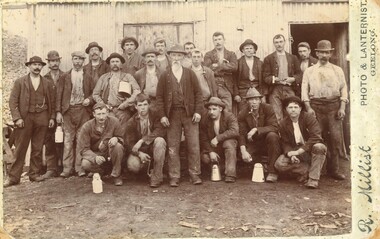
Photograph, R. Millist, Hanlon Consols Mine Rokewood, 1901
... mine at Allendale. They later moved to Yendon) About the Hanlon gold mining company near Rokewood. 1901 - Information Bendigo Prospecting Club, 21/08/2020. Information provided once again by Peter McCarthy. Christopher Hanlon had put down a line of bores south of the Rokewood main street, looking for a continuation of the Break O’Day lead which had been worked for two or three miles with highly payable results, though in a primitive manner. Ground was being paddocked 30 feet deep...mine at Allendale. They later moved to Yendon) About the Hanlon gold mining company near Rokewood. 1901 - Information Bendigo Prospecting Club, 21/08/2020. Information provided once again by Peter McCarthy. Christopher Hanlon had put down a line of bores south of the Rokewood main street, looking for a continuation of the Break O’Day lead which had been worked for two or three miles with highly payable results, though in a primitive manner. Ground was being paddocked 30 feet deep ...The photo depicts one shift of mine hands at Hanlon Consols Mine Rokewod in 1901. ist on the left is George Edgar Yung. George was born in Ararat the son of Yohann Godlip and Christina (b Weller)Yung. They lived at Happy Valley near Linton. and Piggoreet. Yohann was a miner and died in the All Nations Mine collapse at Derwnt Jack's in 1877. Interesting to note in the following information that the Hanlon Consol mamager, William Maughan was also the manager of the Try Again Mine in Piggoreet. He was also on the six man school committee of Piggoreet Common School No. 726. (Is this why George Yung ended up working in Rokewood because of a previous connection at Piggoreet? George married Clara Emma Smith from Happy Valley and worked in a mine at Allendale. They later moved to Yendon) About the Hanlon gold mining company near Rokewood. 1901 - Information Bendigo Prospecting Club, 21/08/2020. Information provided once again by Peter McCarthy. Christopher Hanlon had put down a line of bores south of the Rokewood main street, looking for a continuation of the Break O’Day lead which had been worked for two or three miles with highly payable results, though in a primitive manner. Ground was being paddocked 30 feet deep and made to pay. The bores suggested the sinking would be about 70 feet and a shaft site was selected at the back of Stanbrook’s Hotel. The Hanlon Gold Mining Company was formed in March 1895 and the shaft was bottomed at 68 feet, getting just over an ounce of gold from the shaft bottom. By January 1896, the poppet heads were up, and steam plant was nearly ready. The mine produced 846 oz by September, which was not as good as expected, but they installed a second puddling machine. The mine was profitable for the next three years, with periods of prospecting and the need to install steam pumps in 1897. A second shaft was sunk in 1899, which bottomed at 86 feet on good wash and was sunk on to 109 feet. 1743 oz of gold had been produced in six months to September 1899, but the No1 shaft was let on tribute as the No2 workings were opened and machinery installed the following year. The No1 shaft tributors broke even in 1900 and in 1901 the shaft was shut down, with the No1 shaft machinery sold late in 1902. By September 1901, the mine had produced gold worth £66,124 and the No2 shaft main drive was in 346 feet, with gold being found mainly in crevices in the hard floor. Mining continued, but once the No2 shaft workings met up with the old No1 shaft workings at the end of 1902 there was not much wash remaining. The mine was let on tribute in June 1903 and a drive was put in to test deeper ground. The company was wound up in February 1904 and the plant sold. From what they discovered, the manager concluded that the mine sat at the edge of an ancient coastline and the gold was in a beach deposit. The total gold production from the mine was worth £73,294. J Lee Archer JP, shareholder, was the manager of the Bank of Victoria in Ballarat. Born in Tasmania, he came to Victoria with his parents and first came to Ballarat in 1855 as a junior clerk with the bank. He died in 1902 aged 64. Alexander J. Peacock was a legal manager and a share broker. In 1897 Peacock, born in Creswick, had been elected as one of the Victorian delegates to the Constitutional Convention which wrote the Australian Constitution. He later became a politician, state treasurer and three times state premier of Victoria and was knighted KCGM. He died in 1933 aged 72. William Maughan, director, was an English miner who came to Victoria in the 1850s and became a mine manager, managing the Try Again at Piggoreet, Ryan’s Freehold and the Madam Berry, among others. He died in Williamstown in 1915 aged 85. Sepia photographRhs front of photo: R. Millist Phto & Lanternist Geelong Verso (upside down): ONE SHIFT OF MINE HANDS HANLON CONSOLS MINE ROKEWOOD 1901 Grandfather Yung 1st on left rokewood, hanlon consols mine, shift of mine workers 1901, gold mines, george edgar godlip yung, william maughan -
Federation University Historical Collection
Book - Book - Scrapbook, Ballarat School of MInes: Scrapbook of Newspaper Cuttings, June 1968 - December 1968
... The papers concerned are The Courier, Ballarat, The Australian, The Age over the period from 01/06/1968 to 02/12/1968. staffing advertisements master builders' scholarship jeff white robert kerr smb progress at mt clear peter dudley rio tinto scholarship smb computer centre art in the sunshine stock exchange award to min j loo commonwealth inquiry re salaries analogue computer apex projects business studies group from mildura ben burrow to united states defence standards laboratory melbourne gas company scholarships john grant ian day visitors from maryborough secondary teachers art and craft course new exam report vandals at smb building site look first decide later on careers visitors' day at smb diplomas for 51 students smb staff visit 20 schools high priority for smb residences at mt helen brewing course autonomy for colleges completion of woolclassing building mr g mainwarring to paint picture for australian war museum canberra demolition of old gaol wall smb titles for main sections $130 000 computer for smb error over water supply connection at mt helen basketball premiers ugandan minister on visit to school teachers' college wins annual sports smb won annual trades fours ballarat rowing association visit to ambulance station david pell top student in accountancy bendigo visit by smb michael young sculptor prize winner united states and australia communications re tertiary education josephine brelaz trust fund Book with deep red and white cover back and front, spiral bound. Ballarat School of MInes ...Collection of newspaper articles related to Ballarat School Of Mines.They cover activities and advertisements for staff. The papers concerned are The Courier, Ballarat, The Australian, The Age over the period from 01/06/1968 to 02/12/1968.Book with deep red and white cover back and front, spiral bound. staffing advertisements, master builders' scholarship, jeff white, robert kerr, smb progress at mt clear, peter dudley, rio tinto scholarship, smb computer centre, art in the sunshine, stock exchange award to min j loo, commonwealth inquiry re salaries, analogue computer, apex projects, business studies group from mildura, ben burrow to united states, defence standards laboratory melbourne, gas company scholarships, john grant, ian day, visitors from maryborough, secondary teachers art and craft course, new exam report, vandals at smb building site, look first decide later on careers, visitors' day at smb, diplomas for 51 students, smb staff visit 20 schools, high priority for smb residences at mt helen, brewing course, autonomy for colleges, completion of woolclassing building, mr g mainwarring to paint picture for australian war museum canberra, demolition of old gaol wall, smb titles for main sections, $130, 000 computer for smb, error over water supply connection at mt helen, basketball premiers, ugandan minister on visit to school, teachers' college wins annual sports, smb won annual trades fours, ballarat rowing association, visit to ambulance station, david pell top student in accountancy, bendigo visit by smb, michael young sculptor prize winner, united states and australia communications re tertiary education, josephine brelaz trust fund -
 Federation University Historical Collection
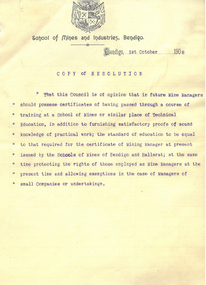
Letter, Ballarat School of Mines, 1908, 1908
... mine managers...bendigo school of mines...telegram...ballarat school of mines battery...roneo co., melbourne...j. donald...york chambers...cochran & co...thames school of mines, new zealand...james chamberseducation department circular...f.w. calaby...* f.w. silberberg & co...crucibles...new black horse mining company...e. howell...* australasian institute of mining engineers...john f. paterson...welcome stranger dredging company, dunolly...w.j. parker...nevett and nevett...john barker...h. barbour...brearley lyndhurst...commonwealth minerals co...a. o'mara...j.h. davidson...'terascoa' port kembla...w.s. macartney...thomas williams...australasian institute of mining engineers...excursion...toongabbie...walhalla...d.l. stirling...george brearley...lyndhurst via scottsdale...berry united deep...rand south africa kalgoorlie school of mines and industries, bendigo certification of mine managers bendigo school of mines telegram ballarat school of mines battery roneo co., melbourne j. donald york chambers cochran & co thames school of mines, new zealand james chamberseducation department circular f.w. calaby * f.w. silberberg & co crucibles new black horse mining company e. howell * australasian institute of mining engineers john f. paterson welcome stranger dredging company, dunolly w.j. parker nevett and nevett john barker h. barbour brearley lyndhurst commonwealth minerals co a. o'mara j.h. davidson 'terascoa' port kembla w.s. macartney thomas williams australasian institute of mining engineers excursion toongabbie walhalla d.l. stirling george brearley lyndhurst via scottsdale berry united deep leads limited, ulina embossed leather classes for coachwork s. mee clunes the lord nelson north gold mning company no liability edward h. shackell may consolidated gold mining company, transvaal jason hawthorne northern assurance company james lidgett "braelands" myrniong gordon sides fraser & chalmers ltd mining machinery w.r. caithness examiners ballarat east school of design edward reid ballarat public library school of design a. gallenkamp and co. creswick advertiser john brittain telescope victorian railways e.b. jones ballarat east town clerk's office elliott, maclean and co. dressmaking j.h. wright ausimm berry united school of mines and industries bendigo lyndhurst tasmania may consolidated gold co germiston transvaal transvaal germiston roneo thames school of mines schools of mines welcome stranger dredging co cowley copper development syndicate ltd department of mines maryborough school pharmacy board of victoria tongalla survey camp ballarat fine art gallery association central microscopical October inwards correspondence for the Ballarat School of Mines. * School of Mines and Industries, Bendigo (certification of Mine Managers) * Telegram - examination papers * Commonwealth telegram - Ballarat School of Mines battery availability for crushing ten tons. * Letterhead from the Roneo Co., Melbourne * J. ...October inwards correspondence for the Ballarat School of Mines. * School of Mines and Industries, Bendigo (certification of Mine Managers) * Telegram - examination papers * Commonwealth telegram - Ballarat School of Mines battery availability for crushing ten tons. * Letterhead from the Roneo Co., Melbourne * J. Donald of Wallace St, Toorak * Letterhead from York Chambers, 49 Queen Street, Melbourne - signed J. Kaufmann * Letterhead from Cochran & Co - re Cocnran boilers * Letterhead of Thames School of Mines, New Zealand * Letter re James Chambers missing school from his father James Chambers Snr of Talbot * Education Department Circular * letter signed by F.W. Calaby * F.W. Silberberg & Co re crucibles * Letterhead of New Black Horse Mining Company - signed E. Howell * Australasian Institute of Mining Engineers, 57-59 Swanston Street, Melbourne - signed D.L. Stirling * Letterhead of John F. Paterson * Letterhead of the Welcome Stranger Dredging Company, Dunolly - W.J. Parker manager * Letterhead of Nevett and Nevett Barristers and Solicitors, Lydiard Street, Ballaarat * John Barker, H. Barbour * Telegram re Brearley Lyndhurst * Letterhead of the Commonwealth Minerals Co - John F. Paterson, Legal Manager * Query re courses at the Ballarat School of Mines - A. O'Mara * Stone to be crushed, Egerton from J.H. Davidson * Letterhead from 'Terascoa' Port Kembla signed by W.S. Macartney * Letter from Thomas Williams * Letterhead from Australian Institute of Mining Engineers regarding excursion to Toongabbie and Walhalla - Signed D.L. Stirling * Assay from George Brearley of Lyndhurst via Scottsdale * Letterhead of Berry United Deep Leads Limited, Ulina * Embossed leather classes for coachwork from S. Mee of Clunes * The Lord Nelson North Gold Mning Company No Liability signed by Edward H. Shackell * Correspondence from May Consolidated Gold Mining Company, Transvaal signed by Jason Hawthorne * Letterhead of the Northern Assurance Company, 448 Collins St, Melbourne * Letter fom James Lidgett of "Braelands" Myrniong * Gordon sides asking for a reference * Letterhead of Fraser & Chalmers Ltd, Manufacturersw of mining machinery, steam engines, boilers and machinery for systematic milling, smelting and concentration of ores, signed by W.R. Caithness * Letterhead of the Board of Examiners for Engine-Drivers, signed by R. Birrell * Letter concerning outstanding amount due to theBallarat East School of Design, signed by Edward Reid, Manager * Letterhead of the Ballarat Public Library concerning an outstanding amount in the School of Design Account. * Letterhead of the A. Gallenkamp and Co. regarding their new catalogue * Letterhead from the Creswick Advertiser, Albert Street, Creswick * Handwritten letter from John Brittain inviting Ballarat School of Mines students to join him at the telescope weather permitting * Letterhead of Victorian Railways, signed by E.B. Jones * Letterhead of the Ballarat East Town Clerk's Office * Letterhead of Elliott, Maclean and Co. Handwritten letter re Dressmaking from J.H. Wrightrand, south africa, kalgoorlie, school of mines and industries, bendigo, certification of mine managers, bendigo school of mines, telegram, ballarat school of mines battery, roneo co., melbourne, j. donald, york chambers, cochran & co, thames school of mines, new zealand, james chamberseducation department circular, f.w. calaby, * f.w. silberberg & co, crucibles, new black horse mining company, e. howell, * australasian institute of mining engineers, john f. paterson, welcome stranger dredging company, dunolly, w.j. parker, nevett and nevett, john barker, h. barbour, brearley lyndhurst, commonwealth minerals co, a. o'mara, j.h. davidson, 'terascoa' port kembla, w.s. macartney, thomas williams, australasian institute of mining engineers, excursion, toongabbie, walhalla, d.l. stirling, george brearley, lyndhurst via scottsdale, berry united deep leads limited, ulina, embossed leather classes for coachwork, s. mee, clunes, the lord nelson north gold mning company no liability, edward h. shackell, may consolidated gold mining company, transvaal, jason hawthorne, northern assurance company, james lidgett, "braelands" myrniong, gordon sides, fraser & chalmers ltd, mining machinery, w.r. caithness, examiners, ballarat east school of design, edward reid, ballarat public library, school of design, a. gallenkamp and co., creswick advertiser, john brittain, telescope, victorian railways, e.b. jones, ballarat east town clerk's office, elliott, maclean and co., dressmaking, j.h. wright, ausimm, berry united, school of mines and industries bendigo, lyndhurst tasmania, may consolidated gold co germiston transvaal, transvaal, germiston, roneo, thames school of mines, schools of mines, welcome stranger dredging co, cowley copper development syndicate ltd, department of mines, maryborough school, pharmacy board of victoria, tongalla survey camp, ballarat fine art gallery association, central microscopical -
 Bendigo Historical Society Inc.
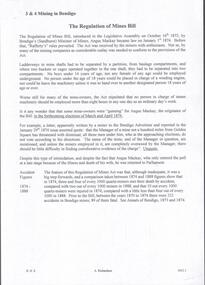
Document - Regulation of Mines Bill, famous mines of Bendigo, April, 2014
... Second page: 'Famous Gold Mines of Bendigo and Eaglehawk' by Albert Richardson, discusses deep shafts, more than 4000 feet shafts, wages for 1911. ...Second page: 'Famous Gold Mines of Bendigo and Eaglehawk' by Albert Richardson, discusses deep shafts, more than 4000 feet shafts, wages for 1911. ...Seven men were killed at the Great Extended Hustler's mine disaster on 2nd May 1914 by an explosion of dynamite occurring as the men were waiting at the plat to ascend the mine at the end of their shift. No blame was attached to anyone in the findings of the inquisition. It was unknown what caused the dynamite to explode. Three page typed document. First page: 'The Regulation of Mines Bill' by Albert Richardson; Angus Mackay, Minister of Mines introduced the Bill in the Legislative Assembly on October 16th 1873 and it became law on January 1st 1874. Second page: 'Famous Gold Mines of Bendigo and Eaglehawk' by Albert Richardson, discusses deep shafts, more than 4000 feet shafts, wages for 1911. Hustler's Line of Reef mines are listed from north to south: Hustler Consols; United Hustler's and Redan, K.K., Comet, Hustler's Reef No. 1, Hustlers Reef, Great Extended Hustlers (formed 4.2.1865) Hustler's Royal Reserve Co., (Park Shaft) Hustler's Royal Reserve (City Shaft) and Fortuna Hustler's (formed August 1888).great extended hustlers, goldmining, accident, quartz, mining, k.k. mine, comet mine, hustler's line of reef, old comet, united hustler's, redan -
 Bendigo Historical Society Inc.
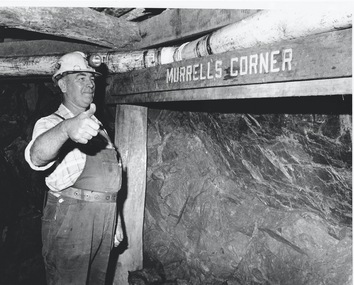
Photograph - AUSTIN COLLECTION: Ray Beer, Central Deborah Gold Mine
... Bendigo’s mining history, after more than 20 years of service at his retirement, a bronze life-sized statue was unveiled in his honour'. Central Deborah Gold Mine history: At its peak, Central Deborah Gold Mine reached a depth of 412 metres. It has 17 separate levels and 15 kilometres of drives and cross cuts (tunnels). The Central Deborah was very much a hands-on mine and the conditions that the miners worked in would be considered shocking by today's standards – being lowered underground in a cage with only two sides, often working ankle to knee deep...Bendigo’s mining history, after more than 20 years of service at his retirement, a bronze life-sized statue was unveiled in his honour'. Central Deborah Gold Mine history: At its peak, Central Deborah Gold Mine reached a depth of 412 metres. It has 17 separate levels and 15 kilometres of drives and cross cuts (tunnels). The Central Deborah was very much a hands-on mine and the conditions that the miners worked in would be considered shocking by today's standards – being lowered underground in a cage with only two sides, often working ankle to knee deep ...Ray Beer was an employee of the Central Deborah Gold Mine. February 15th 2009: Bendigo Advertiser: 'MINING stalwart Raymond Beer has died at the age of 74 after a battle with cancer. He leaves behind an extended family and a legacy in Bendigo’s mining history. Ray was mine manager at the Central Deborah Gold Mine - appointed in 1978 - and led the team that made possible the underground project at the second level. He had a vision to allow visitors to go underground and experience Bendigo’s mining heritage first hand. Ray was responsible for developing the new battery, shaft and poppet head to make this a reality. It took persistence and lots of hard work. Friend and work colleague Bill McNamara said Ray was as good as 10 men. His enthusiasm and work ethic were unprecedented. Ray will be sadly missed by his wife, Thelma, six children, 15 grandchildren, seven brothers, three sisters, his extended family, and friends. He will be remembered for his kindness, tenacity and strength of character. In recognition of his contribution to Bendigo’s mining history, after more than 20 years of service at his retirement, a bronze life-sized statue was unveiled in his honour'. Central Deborah Gold Mine history: At its peak, Central Deborah Gold Mine reached a depth of 412 metres. It has 17 separate levels and 15 kilometres of drives and cross cuts (tunnels). The Central Deborah was very much a hands-on mine and the conditions that the miners worked in would be considered shocking by today's standards – being lowered underground in a cage with only two sides, often working ankle to knee deep in water, filling up to 32 ore trucks a shift by hand which were then pushed a mile or more along rails in the drives, working by carbide lamp, breathing in the fumes and rock dust and communication by bells. Geez, they were ironmen. However, at the time working conditions were considered to be among the best on the goldfields at Central Deborah, after all it was one of the only mines that had hot showers. Following Central Deborah Gold Mine's closure, the Bendigo skyline began to noticeably change. Obvious remnants of mining such as poppet heads, engine rooms, service quarters, battery houses and chimneys were steadily disappearing. After intense lobbying by the local community, the Bendigo City Council purchased the still very much intact Central Deborah Gold Mine in 1970 for a mere $6,000 to ensure that a vital link to Bendigo's historic golden past was maintained. The Bendigo Trust was then formed to oversee the operations of the Central Deborah Gold Mine, which led to the surface of the mine being opened to the public in 1971. Initially the surface was open for just 12 hours a week and as the demand for viewing a part of Bendigo's history increased, so did the opening hours. In 1974 the mine was gazetted as a Public Historical Purposes Reserve and attracted such visitors as H.R.H Prince Charles. By far the greatest shortcoming at this stage was that no one could view the underground workings, as these had become flooded. After what could only be described as a monumental effort by everyone involved, Level 2 of the mine was officially opened to the public by the Premier of Victoria, the Honourable John Cain, on 20 June 1986, which brought to fruition a long standing dream.Black and white photograph. Ray Beer, underground at Central Deborah Gold Mine, standing alongside wooden sign 'Murrell's Corner'. Sign is placed horizontally on timber supports, side of drive visible in background. Ray is wearing bib and brace overalls and hard hat with a belt around his waist. He is giving a 'thumbs up' sign. gold mining, central deborah gold mine, ray beer, mine manager -
 Bendigo Historical Society Inc.
Photograph - AUSTIN COLLECTION: Central Deborah Gold Mine Lift Shaft
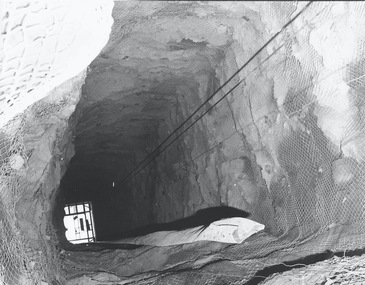
... deep in water, filling up to 32 ore trucks a shift by hand which were then pushed a mile or more along rails in the drives, working by carbide lamp, breathing in the fumes and rock dust and communication by bells. Geez, they were ironmen. However, at the time working conditions were considered to be among the best on the goldfields at Central Deborah, after all it was one of the only mines that had hot showers. Following Central Deborah Gold Mine's closure, the Bendigo...deep in water, filling up to 32 ore trucks a shift by hand which were then pushed a mile or more along rails in the drives, working by carbide lamp, breathing in the fumes and rock dust and communication by bells. Geez, they were ironmen. However, at the time working conditions were considered to be among the best on the goldfields at Central Deborah, after all it was one of the only mines that had hot showers. Following Central Deborah Gold Mine's closure, the Bendigo ...Central Deborah Gold Mine history: At its peak, Central Deborah Gold Mine reached a depth of 412 metres. It has 17 separate levels and 15 kilometres of drives and cross cuts (tunnels). The Central Deborah was very much a hands-on mine and the conditions that the miners worked in would be considered shocking by today's standards – being lowered underground in a cage with only two sides, often working ankle to knee deep in water, filling up to 32 ore trucks a shift by hand which were then pushed a mile or more along rails in the drives, working by carbide lamp, breathing in the fumes and rock dust and communication by bells. Geez, they were ironmen. However, at the time working conditions were considered to be among the best on the goldfields at Central Deborah, after all it was one of the only mines that had hot showers. Following Central Deborah Gold Mine's closure, the Bendigo skyline began to noticeably change. Obvious remnants of mining such as poppet heads, engine rooms, service quarters, battery houses and chimneys were steadily disappearing. After intense lobbying by the local community, the Bendigo City Council purchased the still very much intact Central Deborah Gold Mine in 1970 for a mere $6,000 to ensure that a vital link to Bendigo's historic golden past was maintained. The Bendigo Trust was then formed to oversee the operations of the Central Deborah Gold Mine, which led to the surface of the mine being opened to the public in 1971. Initially the surface was open for just 12 hours a week and as the demand for viewing a part of Bendigo's history increased, so did the opening hours. In 1974 the mine was gazetted as a Public Historical Purposes Reserve and attracted such visitors as H.R.H Prince Charles. By far the greatest shortcoming at this stage was that no one could view the underground workings, as these had become flooded. After what could only be described as a monumental effort by everyone involved, Level 2 of the mine was officially opened to the public by the Premier of Victoria, the Honourable John Cain, on 20 June 1986, which brought to fruition a long standing dream.Black and white photograph, looking from bottom of lift shaft towards the surface; light visible at top of shaft. Lift cables and safety mesh on sides of shaft. gold mining, central deborah gold mine, ray beer, mine manager -
 Bendigo Historical Society Inc.
Photograph - AUSTIN COLLECTION: Central Deborah Gold Mine, Possibly 1990's
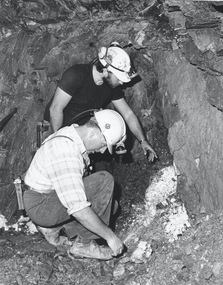
... deep in water, filling up to 32 ore trucks a shift by hand which were then pushed a mile or more along rails in the drives, working by carbide lamp, breathing in the fumes and rock dust and communication by bells. Geez, they were ironmen. However, at the time working conditions were considered to be among the best on the goldfields at Central Deborah, after all it was one of the only mines that had hot showers. Following Central Deborah Gold Mine's closure, the Bendigo...deep in water, filling up to 32 ore trucks a shift by hand which were then pushed a mile or more along rails in the drives, working by carbide lamp, breathing in the fumes and rock dust and communication by bells. Geez, they were ironmen. However, at the time working conditions were considered to be among the best on the goldfields at Central Deborah, after all it was one of the only mines that had hot showers. Following Central Deborah Gold Mine's closure, the Bendigo ...Central Deborah Gold Mine history: At its peak, Central Deborah Gold Mine reached a depth of 412 metres. It has 17 separate levels and 15 kilometres of drives and cross cuts (tunnels). The Central Deborah was very much a hands-on mine and the conditions that the miners worked in would be considered shocking by today's standards – being lowered underground in a cage with only two sides, often working ankle to knee deep in water, filling up to 32 ore trucks a shift by hand which were then pushed a mile or more along rails in the drives, working by carbide lamp, breathing in the fumes and rock dust and communication by bells. Geez, they were ironmen. However, at the time working conditions were considered to be among the best on the goldfields at Central Deborah, after all it was one of the only mines that had hot showers. Following Central Deborah Gold Mine's closure, the Bendigo skyline began to noticeably change. Obvious remnants of mining such as poppet heads, engine rooms, service quarters, battery houses and chimneys were steadily disappearing. After intense lobbying by the local community, the Bendigo City Council purchased the still very much intact Central Deborah Gold Mine in 1970 for a mere $6,000 to ensure that a vital link to Bendigo's historic golden past was maintained. The Bendigo Trust was then formed to oversee the operations of the Central Deborah Gold Mine, which led to the surface of the mine being opened to the public in 1971. Initially the surface was open for just 12 hours a week and as the demand for viewing a part of Bendigo's history increased, so did the opening hours. In 1974 the mine was gazetted as a Public Historical Purposes Reserve and attracted such visitors as H.R.H Prince Charles. By far the greatest shortcoming at this stage was that no one could view the underground workings, as these had become flooded. After what could only be described as a monumental effort by everyone involved, Level 2 of the mine was officially opened to the public by the Premier of Victoria, the Honourable John Cain, on 20 June 1986, which brought to fruition a long standing dream.Black and white photograph. Two men with hard hats and lights, inspecting quartz outcrop on wall of drive at Central Deborah Gold Mine.gold mining, central deborah gold mine, ray beer, mine manager -
 Bendigo Historical Society Inc.
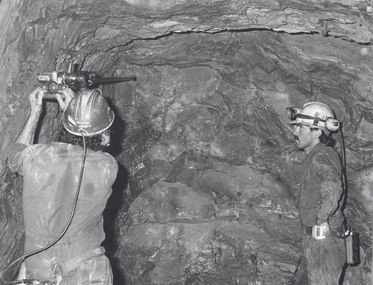
Photograph - AUSTIN COLLECTION: Operating rock drill, Central Deborah Gold Mine, Possibly 1990's
... deep in water, filling up to 32 ore trucks a shift by hand which were then pushed a mile or more along rails in the drives, working by carbide lamp, breathing in the fumes and rock dust and communication by bells. Geez, they were ironmen. However, at the time working conditions were considered to be among the best on the goldfields at Central Deborah, after all it was one of the only mines that had hot showers. Following Central Deborah Gold Mine's closure, the Bendigo...deep in water, filling up to 32 ore trucks a shift by hand which were then pushed a mile or more along rails in the drives, working by carbide lamp, breathing in the fumes and rock dust and communication by bells. Geez, they were ironmen. However, at the time working conditions were considered to be among the best on the goldfields at Central Deborah, after all it was one of the only mines that had hot showers. Following Central Deborah Gold Mine's closure, the Bendigo ...Central Deborah Gold Mine history: At its peak, Central Deborah Gold Mine reached a depth of 412 metres. It has 17 separate levels and 15 kilometres of drives and cross cuts (tunnels). The Central Deborah was very much a hands-on mine and the conditions that the miners worked in would be considered shocking by today's standards – being lowered underground in a cage with only two sides, often working ankle to knee deep in water, filling up to 32 ore trucks a shift by hand which were then pushed a mile or more along rails in the drives, working by carbide lamp, breathing in the fumes and rock dust and communication by bells. Geez, they were ironmen. However, at the time working conditions were considered to be among the best on the goldfields at Central Deborah, after all it was one of the only mines that had hot showers. Following Central Deborah Gold Mine's closure, the Bendigo skyline began to noticeably change. Obvious remnants of mining such as poppet heads, engine rooms, service quarters, battery houses and chimneys were steadily disappearing. After intense lobbying by the local community, the Bendigo City Council purchased the still very much intact Central Deborah Gold Mine in 1970 for a mere $6,000 to ensure that a vital link to Bendigo's historic golden past was maintained. The Bendigo Trust was then formed to oversee the operations of the Central Deborah Gold Mine, which led to the surface of the mine being opened to the public in 1971. Initially the surface was open for just 12 hours a week and as the demand for viewing a part of Bendigo's history increased, so did the opening hours. In 1974 the mine was gazetted as a Public Historical Purposes Reserve and attracted such visitors as H.R.H Prince Charles. By far the greatest shortcoming at this stage was that no one could view the underground workings, as these had become flooded. After what could only be described as a monumental effort by everyone involved, Level 2 of the mine was officially opened to the public by the Premier of Victoria, the Honourable John Cain, on 20 June 1986, which brought to fruition a long standing dream.Black and white photograph. Two men with hard hats and lights standing in front of underground rock surface at Central Deborah Gold Mine. Paul Maker on left hand side of image is operating a small rock drill. John Jeffrey on right hand side is observing the procedure. gold mining, central deborah gold mine, rock drill, underground -
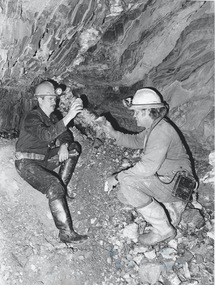 Bendigo Historical Society Inc.
Photograph - AUSTIN COLLECTION: Williams United Mine Eaglehawk, Possibly 1990's
... Photo is duplicate of image published in the Bendigo Advertiser (no date). Text on newspaper image: "Deep in the Williams United mine at Eaglehawk miners examine promising samples from a strong quartz vein at the face. ...Mine Eaglehawk Black and white photograph. Two underground miners inspecting a promising sample from a strong quartz vein at the face. Photo is duplicate of image published in the Bendigo Advertiser (no date). Text on newspaper image: "Deep ...Black and white photograph. Two underground miners inspecting a promising sample from a strong quartz vein at the face. Photo is duplicate of image published in the Bendigo Advertiser (no date). Text on newspaper image: "Deep in the Williams United mine at Eaglehawk miners examine promising samples from a strong quartz vein at the face. To the left is Western Mining's Bendigo residential manager Colin Cruickshank and to the right underground shift boss for the mining contractors, Eltin Pty Ltd Wetner Borchert".gold mining, underground, quartz vein, williams united gold mine, eaglehawk -
 Bendigo Historical Society Inc.
Newspaper - Kangaroo Flat Gold Mine Collection: Bendigo Goldfield
... mine manager) state that 'synclinal folds and inverted saddle reefs had been almost entirely neglected by Bendigo miners'. Mine ventilation and rock temperatures in the New Argus (Eaglehawk) and the New Chum Railway at Golden Square were researched by David Pascoe. Pascoe said 'the resources of the Bendigo field are enormous when it is considered that there are 516 kilometres of surveyed lines of reef down to the depth mines; by including the synclines it almost doubles that figure without any deeper penentration of the field'. ...mine manager) state that 'synclinal folds and inverted saddle reefs had been almost entirely neglected by Bendigo miners'. Mine ventilation and rock temperatures in the New Argus (Eaglehawk) and the New Chum Railway at Golden Square were researched by David Pascoe. Pascoe said 'the resources of the Bendigo field are enormous when it is considered that there are 516 kilometres of surveyed lines of reef down to the depth mines; by including the synclines it almost doubles that figure without any deeper penentration of the field'. ...'Bendigo Advertiser' article, 15th March , 1995, titled ' Miner reckons there's gold in Bendigo hills'. Comments from Mr. David Pascoe (miner and Mines Inspector) and Mr. Harry Clarke (former miner, Mines Inspector and mine manager) state that 'synclinal folds and inverted saddle reefs had been almost entirely neglected by Bendigo miners'. Mine ventilation and rock temperatures in the New Argus (Eaglehawk) and the New Chum Railway at Golden Square were researched by David Pascoe. Pascoe said 'the resources of the Bendigo field are enormous when it is considered that there are 516 kilometres of surveyed lines of reef down to the depth mines; by including the synclines it almost doubles that figure without any deeper penentration of the field'. gold mining, bendigo, bendigo mining nl, harry clarke, david pascoe, quartz legstones, saddle reef, spurs, mine ventilation, rock temperature, new argus, new chum, garden gully reef -
 Bendigo Historical Society Inc.
Newspaper - Kangaroo Flat Gold Mine Collection: shaft subsidence
... Bendigo Advertiser article, undated possibly1995, titled 'Rainfall discloses historic landmark'. Heavy rainfall caused a mine shaft in Wells Street, Ironbark, to subside to a depth of 3 metres. The mine was believed to be at least 50 metres deep...Gold mining Bendigo mine shaft subsidence Ironbark capping Two articles on one page: 1.Bendigo Advertiser article, undated possibly1995, titled 'Rainfall discloses historic landmark'. Heavy rainfall caused a mine shaft in Wells Street, Ironbark, to subside to a depth of 3 metres. The mine was believed to be at least 50 metres deep ...Two articles on one page: 1.Bendigo Advertiser article, undated possibly1995, titled 'Rainfall discloses historic landmark'. Heavy rainfall caused a mine shaft in Wells Street, Ironbark, to subside to a depth of 3 metres. The mine was believed to be at least 50 metres deep. Black and white photo shoed Lynn Amos and Roseanna, inspecting the hole in their front lawn. 2. 'Bendigo Mining plans to double exploration funds'. Mr. Peter Phillips, Bendigo Mining, stated that the company would double its exploration budget to about $330,000 in the next month.gold mining, bendigo, mine shaft, subsidence, ironbark, capping -
 Bendigo Historical Society Inc.
Newspaper - Kangaroo Flat Gold Mine Collection: Bendigo Gold Mining Companies
... Bendigo Advertiser article, 10th June,1995, titled 'New Days of Gold, Companies dig deep for forgotten treasure'. Companies 'set to revive the golden days include Bendigo Mining NL, Bendigo Reef Mining NL (Tarnagulla), Alliance Gold Mines NL (Maldon), Perseverance Corporation (Fosterville), Heathcote Gold Joint Venture (Heathcote), Australian Gold Development (Costerfield). ...Gold mining Bendigo Bendigo Mining NL Bendigo Reef Mining NL (Tarnagulla) Alliance Gold Mines NL (Maldon) Perseverance Corporation (Fosterville) Heathcote Gold Joint Venture (Heathcote) Australian Gold Development (Costerfield). South Deborah Brian Lockyer Julian Bartlett Bendigo Advertiser article, 10th June,1995, titled 'New Days of Gold, Companies dig deep for forgotten treasure'. ...Bendigo Advertiser article, 10th June,1995, titled 'New Days of Gold, Companies dig deep for forgotten treasure'. Companies 'set to revive the golden days include Bendigo Mining NL, Bendigo Reef Mining NL (Tarnagulla), Alliance Gold Mines NL (Maldon), Perseverance Corporation (Fosterville), Heathcote Gold Joint Venture (Heathcote), Australian Gold Development (Costerfield). Colour photo of Julian Bartlett, South Deborah, standing in front of a drill rig holding a core sample. Data inset re mines, shows Brian Lockyer, South Deborah, placing a core sample on the ground. gold mining, bendigo, bendigo mining nl, bendigo reef mining nl (tarnagulla), alliance gold mines nl (maldon), perseverance corporation (fosterville), heathcote gold joint venture (heathcote), australian gold development (costerfield)., south deborah, brian lockyer, julian bartlett -
 Bendigo Historical Society Inc.
Newspaper - Kangaroo Flat Gold Mine Collection: Perseverance Gold, Fosterville
... Gold mining Bendigo Perseverance Gold Mine Fosterville core samples Peta Cameron geologist Bendigo Advertiser article, 6th January 1996, 'Perseverance strikes high grade gold at Fosterville project'. Drilling at Fosterville has 'discovered a likely high grade gold intersection deep ...Bendigo Advertiser article, 6th January 1996, 'Perseverance strikes high grade gold at Fosterville project'. Drilling at Fosterville has 'discovered a likely high grade gold intersection deep beneath the existing operations'. Perseverance's exploration geologist Ms Peta Cameron, is pictured with core samples. gold mining, bendigo, perseverance gold mine, fosterville, core samples, peta cameron, geologist -
 Bendigo Historical Society Inc.
Newspaper - Albert Ernest Richardson, Peter Anderson's article 2020
... mines. His leter work years were spent at John Brown, from where he retired in 1968. Albert had a deep regard for the working man and worked for many years in the position of Secretary at the Trades Hall, Bendigo. ...mines. His leter work years were spent at John Brown, from where he retired in 1968. Albert had a deep regard for the working man and worked for many years in the position of Secretary at the Trades Hall, Bendigo. ...Albert Richardson was born on 22nd. June, 1902 to George Albert Richardson and Catherine Agnes (nee Flynn). He married Mavis Irene Yarwood on 23rd. December, 1931. Albert Richardson's childhood activities in Duncan Street, Long Gully, were influenced strongly by the occupation of his father and grandfather, both of whom were engine drivers on the Bendigo field. Albert had his own model goldmine, complete with poppet head, baling tanks etc and was up and ready to start work with the sound of the 7 a.m. mine whistles. Albert spent a short time working as a motor mechanic and then took up0 welling insurance with T & G. However, his heart was with the mines and he worked daytimes with T. & G. and then took off to learn engine driving with night shift in one of the mines. He gained his engine drivers' ticket in 1938 and began work at the Nell Gwynne. His longest work time was at the North Nell but he also had shorter spells at other mines. His leter work years were spent at John Brown, from where he retired in 1968. Albert had a deep regard for the working man and worked for many years in the position of Secretary at the Trades Hall, Bendigo. (adapted from biography in BHS Collection, written by I. Hendry, 1972) The Bendigo Historical Society holds a wide range of Bendigo mining records researched and written by Mr. Albert Richardson. He was President of the Bendigo Branch of the Royal Historical Society of Victoria from 1969 to 1971.When he joined the Bendigo Branch in 1966 he began compiling a history of the Bendigo mines. He spent many long hours researching at the Bendigo Mines Department, summarising mine records. He gathered relevant mining material wherever it could be obtained. He devoted most of his spare time and energy to the Society, conducting tours of the goldfields, writing articles and presenting talks to various organisations. His first and foremost interest lay in Victoria Hill. He examined mining reports and early newspaper articles to document its history. He envisaged the once fabulously rich hill as becoming a tourist attraction and campaigned vigorously to achieve this. In 1971 his dream was realised, when, with the help of South Bendigo Rotary Club 'The Hill' was cleaned up and historical site4s sign-posted. In 1972 the Bendigo Trust produced a booklet on Victoria Hill. Albert Richardson is acknowledged as the person ' on whose work and writings the text of this booklet has been based' The park adjoining Victoria Hill was named the Albert Richardson Reserve in his honour. Four newspaper clippings on mining, focusing on Albert Richardson's life; his passion for mining history and more generally, the work of engine drivers on the Bendigo goldfield. Clippings taken from the 'Bendigo Weekly' 2016, dated September 29 'Learner Drivers' , October 7 'Becoming qualified', October 14 'Steam power in his veins' and November 11 ' Victoria Hill over the decades'. All articles written by James Lerk in a series titled 'Discover Bendigo'. One page biography on Albert Richardson, on yellow paper.albert richardson, engine driver, mining, bendigo, boiler, engine room, mining cage, albert richardson reserve, victoria hill, george ellis, south bendigo rotary club -
 Bendigo Historical Society Inc.
Newspaper - Article on Miner Elisabeth Viklund, July 17 2022
... Bendigo Advertiser half page article entitled 'Women lead the way for mines sector' with coloured photo of worker in front of a loader deep below the earth's surface....Elisabeth Viklund has been recognised by the Mineral Council of Australia's Women in resources award. bendigo elisabeth viklund mandalay's gold and antimony mine at costerfield Bendigo Advertiser half page article entitled 'Women lead the way for mines sector' with coloured photo of worker in front of a loader deep below the earth's surface. ...Elisabeth Viklund has been recognised by the Mineral Council of Australia's Women in resources award.Bendigo Advertiser half page article entitled 'Women lead the way for mines sector' with coloured photo of worker in front of a loader deep below the earth's surface.bendigo, elisabeth viklund, mandalay's gold and antimony mine at costerfield -
Bendigo Historical Society Inc.
Document - National Trust Collection: Fortuna Bendigo, 20/10/2008
... Bendigo's lucrative gold reefs. Established by the wealthy Ballerstedt family in the 1860s, it was purchased and expanded in the 1870s by George Lansell, who was to become one of Australia's wealthiest men. Fortuna villa and gardens were once occupied and cared for by the Australia Army Survey Regiments since 1942 for over thirty years. The tour guide informs us that Fortuna Villa was originally a modest two-story villa, acquired by George Lansell in 1871 along with the 180 Mine for £230,000.Lansell, known as the "Quartz King," made his fortune through deep...Bendigo's lucrative gold reefs. Established by the wealthy Ballerstedt family in the 1860s, it was purchased and expanded in the 1870s by George Lansell, who was to become one of Australia's wealthiest men. Fortuna villa and gardens were once occupied and cared for by the Australia Army Survey Regiments since 1942 for over thirty years. The tour guide informs us that Fortuna Villa was originally a modest two-story villa, acquired by George Lansell in 1871 along with the 180 Mine for £230,000.Lansell, known as the "Quartz King," made his fortune through deep ...The Fortuna Villa is an expansive Victorian mansion built entirely on the profits of Bendigo's lucrative gold reefs. Established by the wealthy Ballerstedt family in the 1860s, it was purchased and expanded in the 1870s by George Lansell, who was to become one of Australia's wealthiest men. Fortuna villa and gardens were once occupied and cared for by the Australia Army Survey Regiments since 1942 for over thirty years. The tour guide informs us that Fortuna Villa was originally a modest two-story villa, acquired by George Lansell in 1871 along with the 180 Mine for £230,000.Lansell, known as the "Quartz King," made his fortune through deep reef gold mining in Bendigo, particularly with the New Chum Reef and other successful mines. The villa and its grounds expanded significantly as Lansell's wealth grew, incorporating architectural features inspired by his travels. The mansion is built over the New Chum Reef, with its lower floor penetrating the reef, resulting in three floors at the rear and two at the front.Notable features include the Italian water garden, tiered lakes (originally mine settling ponds), elaborate interiors (parquet floors, stained glass, marble baths), and a tunnel used for gold transport. The building underwent several phases of construction, including a reversal of its main entrance and the addition of a cupola stairwell and conservatory. Fortuna Villa hosted many notable guests, including governors and possibly the Prince of Wales.The house was lavishly furnished and decorated, reflecting Lansell's wealth and status. After Lansell's death in 1906, the villa remained in the family until 1934, then was sold and briefly used as a reception house. The property fell into disrepair before being leased by the Army in 1942 for wartime mapping and later purchased by the Commonwealth Government.It became the headquarters for the Army Survey Regiment, with parts of the building repurposed for administrative and mapping functions until the 1980s.Classification Report and Notes on the history of Fortuna from the National Trust to the Bendigo Council 20th October 2008. This item contains the following documents: 3084.46a Tourist brochure for Fortuna; 16 pages - it includes photographs and detailed history of George Lansell's involvement in the property and his mining history. 3084.45b Fortuna Bendigo re Clasification by the National Trust Detailed Letter to the Bendigo Council in 2008 contains an excellent 11 page summary of its history.history, national trust bendigo collection, bendigo, fortuna, george lansell, mining -
 Bendigo Historical Society Inc.
Document - Kangaroo Flat Gold Mine Collection: Psychology of Mine Development on Bendigo Goldfield, 19th century, Bendigo Mining NL, Unknown
... Mine Development on the Bendigo goldfield in the nineteenth century'. Initial discussion refers to Mr. Doug Buerger of Bendigo Mining N.L commenting that the central Bendigo goldfield had a 'further ten million ounces of gold' remaining 'to be extracted from beneath the old workings'. Further paragraphs include: 1. Non-development of the synclinal reefs 2. Mining methods 3. Deep...Bendigo mining gold Kangaroo Flat 1. Non-development of the synclinal reefs 2. Mining methods 3. Deep mining 4. The age of the owners and managers 5. Capital raising 7. Management structures 8. Attitudes to machinery 9. The size of claims and leases 10 Conclusions Doug Buerger Gustave Thureau quartz mining synclinal reefs New Chum Railway Victoria Quartz Great Extended Hustlers Deborah Mines Innovation Eleven page paper titled 'The Psychology of Mine Development on the Bendigo goldfield in the nineteenth century'. ...Eleven page paper titled 'The Psychology of Mine Development on the Bendigo goldfield in the nineteenth century'. Initial discussion refers to Mr. Doug Buerger of Bendigo Mining N.L commenting that the central Bendigo goldfield had a 'further ten million ounces of gold' remaining 'to be extracted from beneath the old workings'. Further paragraphs include: 1. Non-development of the synclinal reefs 2. Mining methods 3. Deep mining 4. The age of the owners and managers 5. Capital raising 6. Attitude to innovation - reference to George Lansell and Gustave Thureau 7. Management structures 8. Attitudes to machinery 9. The size of claims and leases 10. Conclusionsbendigo mining n.l., bendigo, mining, gold, kangaroo flat, 1. non-development of the synclinal reefs, 2. mining methods, 3. deep mining, 4. the age of the owners and managers, 5. capital raising, 7. management structures, 8. attitudes to machinery, 9. the size of claims and leases, 10 conclusions, doug buerger, gustave thureau, quartz mining, synclinal reefs, new chum railway, victoria quartz, great extended hustlers, deborah mines, innovation -
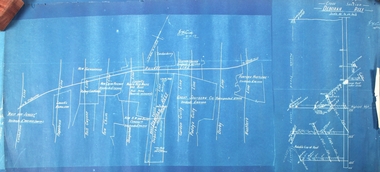 Bendigo Historical Society Inc.
Plan - DEBORAH REEF CROSS SECTION
... Bendigo gold field, was received in Launceston with deep regret. A native of Hobart, Mr. Cundy, who was 71 years of age, went to Bendigo from Tasmania in 1893 to an appointment in the Mines Department, subsequently, in association with Mr. ...Bendigo gold field, was received in Launceston with deep regret. A native of Hobart, Mr. Cundy, who was 71 years of age, went to Bendigo from Tasmania in 1893 to an appointment in the Mines Department, subsequently, in association with Mr. ...OBITUARY MR. W. H. CUNDY PROMINENT FOOTBALLER. The news of the death in a private hospital at Bendigo (VIC.) on Monday of Mr. William Henry Cundy, a geologist and mining engineer, who was regarded as one of the greatest authorities on the Bendigo gold field, was received in Launceston with deep regret. A native of Hobart, Mr. Cundy, who was 71 years of age, went to Bendigo from Tasmania in 1893 to an appointment in the Mines Department, subsequently, in association with Mr. E. J. Dunn, undertaking the task of making a special report on the Bendigo gold fields, and also of charting the lines of reef. He was keenly interested in mining ventures in Tasmania, and his services were in constant demand to investigate and report on shows, particularly gold and tin. In his younger days, at Hobart, Mr. Cundy was a champion footballer, and brought about the modification of the rules of the game in Tasmania. While in Bendigo he was captain of Sandhurst for many years, and a past-president of the Bendigo Football League. He was a widower. Mercury (Hobart, Tas.: 1860 - 1954), Friday 15 February 1935, page 6) A blueprint draftsman's drawing of a cross section of the Deborah Reef to a depth of 435 feet, scale 40 feet to an inch. There is also a map, scale 8 chains to an inch showing the Melbourne Echuca railway and reefs on both sides of Deborah reef including Carshalton, Napoleon, Nell Gwynne, New Chum, Sheepshead, Garden Gully, Paddy's Gully, Derby and names some mines and dividends, Whip and Jersey £200,000, Lansell's Napoleon, Railway Goldfields, New Chum Railway £170,000, Lansell's Red White and Blue Consolidated, Great Southern Co £160,000, Fortuna Hustlers £40,000 It is signed A H Cundy 19.12.17 Forms part of the Margaret Roberts Collection bendigo, margaret roberts, gold, map, mine, w h cundy -
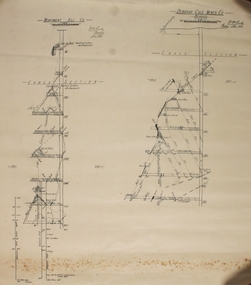 Bendigo Historical Society Inc.
Plan - Monument Hill Co and Deborah Gold Mines Co
... Bendigo gold field, was received in Launceston with deep regret. A native of Hobart, Mr. Cundy, who was 71 years of age, went to Bendigo from Tasmania in 1893 to an appointment in the Mines Department, subsequently, in association with Mr. ...Bendigo gold field, was received in Launceston with deep regret. A native of Hobart, Mr. Cundy, who was 71 years of age, went to Bendigo from Tasmania in 1893 to an appointment in the Mines Department, subsequently, in association with Mr. ...OBITUARY MR. W. H. CUNDY PROMINENT FOOTBALLER. The news of the death in a private hospital at Bendigo (VIC.) on Monday of Mr. William Henry Cundy, a geologist and mining engineer, who was regarded as one of the greatest authorities on the Bendigo gold field, was received in Launceston with deep regret. A native of Hobart, Mr. Cundy, who was 71 years of age, went to Bendigo from Tasmania in 1893 to an appointment in the Mines Department, subsequently, in association with Mr. E. J. Dunn, undertaking the task of making a special report on the Bendigo gold fields, and also of charting the lines of reef. He was keenly interested in mining ventures in Tasmania, and his services were in constant demand to investigate and report on shows, particularly gold and tin. In his younger days, at Hobart, Mr. Cundy was a champion footballer, and brought about the modification of the rules of the game in Tasmania. While in Bendigo he was captain of Sandhurst for many years, and a past-president of the Bendigo Football League. He was a widower. Mercury (Hobart, Tas.: 1860 - 1954), Friday 15 February 1935, page 6) A draftsman's drawing on off-white paper of cross sections labeled MONUMENT HILL Co and DEBORAH GOLD MINES Co BENDIGO. The Monument Hill drawing has seven cross sections down to 820 feet. The Deborah Glod Mines Co Bendigo drawing has five cross sections down to 740 feet. Both drawings are singed W H Cundy, July 1934. Forms part of the Margaret Roberts Collection bendigo, margaret roberts, gold, map, mine, w h cundy, deborah gold mines, monument hill co -
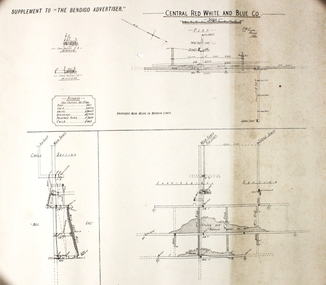 Bendigo Historical Society Inc.
Plan - Central Red White and Blue Co
... Bendigo gold field, was received in Launceston with deep regret. A native of Hobart, Mr. Cundy, who was 71 years of age, went to Bendigo from Tasmania in 1893 to an appointment in the Mines Department, subsequently, in association with Mr. ...Bendigo gold field, was received in Launceston with deep regret. A native of Hobart, Mr. Cundy, who was 71 years of age, went to Bendigo from Tasmania in 1893 to an appointment in the Mines Department, subsequently, in association with Mr. ...OBITUARY MR. W. H. CUNDY PROMINENT FOOTBALLER. The news of the death in a private hospital at Bendigo (VIC.) on Monday of Mr. William Henry Cundy, a geologist and mining engineer, who was regarded as one of the greatest authorities on the Bendigo gold field, was received in Launceston with deep regret. A native of Hobart, Mr. Cundy, who was 71 years of age, went to Bendigo from Tasmania in 1893 to an appointment in the Mines Department, subsequently, in association with Mr. E. J. Dunn, undertaking the task of making a special report on the Bendigo gold fields, and also of charting the lines of reef. He was keenly interested in mining ventures in Tasmania, and his services were in constant demand to investigate and report on shows, particularly gold and tin. In his younger days, at Hobart, Mr. Cundy was a champion footballer, and brought about the modification of the rules of the game in Tasmania. While in Bendigo he was captain of Sandhurst for many years, and a past-president of the Bendigo Football League. He was a widower. Mercury (Hobart, Tas.: 1860 - 1954), Friday 15 February 1935, page 6) The Central Red White and Blue Gold Mine was Bendigo's leading gold mine from 1910 - 1913. During the mine's operation, the main shaft was sunk 670 metres, and retrieved over 2500KG of gold. The Central Red White and Blue Gold Mine was located on the corner of Chum St and Honeysuckle St in Golden Square Three draftsman's drawing in black ink on off-white paper. Printed at the top- SUPPLEMENT TO "THE BENDIGO ADVERTISER" CENTRAL RED WHITE AND BLUE Co. Three drawings are a plan, a cross section and a longitudinal section showing the main shaft, air shaft and Eadie's shaft to a depth of 400 feet. Also, a list headed RETURNS- First crushing 9th Sept 1910, Tons 13601, Gold 22613oz, Value £90452, Dividends £67200, Reserve Fund £5600, Calls £400. Signed W. H. Cundy. Forms part of the Margaret Roberts Collection bendigo, margaret roberts, gold, map, mine, w h cundy, central red white and blue mine -
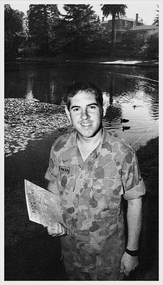 Bendigo Historical Society Inc.
Newspaper - Fortuna Article - "Fortuna Opens its Doors", Mar 30 1996
... Fortuna is a 140-year-old house with deep ties to Bendigo's history.Originally owned by Christopher and Theodore Ballerstedt (1855–1871), it is most famously associated with the Lansell family, particularly George Lansell, a prominent gold mine owner known as the "Quartz King." ...Fortuna is a 140-year-old house with deep ties to Bendigo's history.Originally owned by Christopher and Theodore Ballerstedt (1855–1871), it is most famously associated with the Lansell family, particularly George Lansell, a prominent gold mine owner known as the "Quartz King." ...Despite a report suggesting otherwise, tours of the historic Fortuna house in Bendigo will not cease when the Army Topographic Support Establishment (ATSE) takes over from the Army Survey Regiment. Both Army representatives and ATSE management confirm that public access and tours will remain unchanged. A mistaken news story led to a surge in tour attendance, with numbers tripling as people rushed to visit before the supposed closure. Recent tours have seen up to 70 visitors, including interstate travelers and descendants of the Lansell family. Fortuna is a 140-year-old house with deep ties to Bendigo's history.Originally owned by Christopher and Theodore Ballerstedt (1855–1871), it is most famously associated with the Lansell family, particularly George Lansell, a prominent gold mine owner known as the "Quartz King." The Army initiated tours 20 years ago to connect with the local community and showcase the building and the regiment's work.The tours provide an opportunity for the public to interact with soldiers and learn about their activities. After the death of George Lansell's wife, a symbolic procession with an empty coffin protested poor mine ventilation and miners' health conditions, highlighting social issues of the time.The document shares anecdotes from tours, such as Lansell's purchase of goats from local children, illustrating his character and the community's relationship with him. The homestead includes notable features like a grand entrance hall, glassroom, main staircase, Pompeii fountain, and a Roman bath.The house is known for its eclectic Victorian architecture, with many styles incorporated based on Lansell's preferences. Guided tours cover the complete history of Fortuna Villa and the Lansell family, lasting about three and a half hours on Sundays.Bookings are available by phone.Recent Military UpdatesThe Army will remain at the Fortuna site, though the military side will move out and soldiers will be reassigned or enter the workforce.Fortuna Restoration Article - "Fortuna Opens its Doors" - Bendigo Advertiser Sat Mar 30 1996 - Author Nicole Ferrie This item contains the following: 11217.2a Black and White Photo of one of the tour guides - Lance Cpl Richard Arman in the Fortuna Gardens 11217.2b Black and White Photo of one of the tour guides - Lance Cpl Richard Arman on the balcony 11217.2c Part of page 2 - Fortuna Open its Doors 11217.2d Part of page 2 - Fortuna Open its Doorsnon-fictionbendigo, fortuna, army tropographic support establishment -
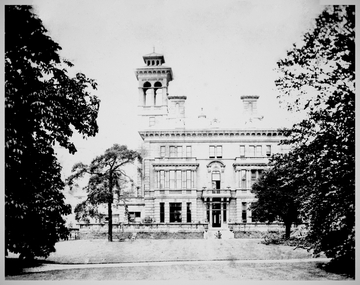 Bendigo Historical Society Inc.
Photograph - Fortuna Articles - Photo of George Lansell's residence in England, 1881-1887
... Bendigo, from 1855. His first investments failed, he lost money, and refocused on his original businesses. In 1865 George re-entered mining and with substantial investment was able to dictate the mining practices of his companies. His approach, of mining ever deeper than had been reached before, was so successful that he became known as the Quartz King of Bendigo. He soon became a millionaire. For a time, he may have been the richest man in the world. In 1871 Lansell purchased the Ballerstedt mines...Bendigo, from 1855. His first investments failed, he lost money, and refocused on his original businesses. In 1865 George re-entered mining and with substantial investment was able to dictate the mining practices of his companies. His approach, of mining ever deeper than had been reached before, was so successful that he became known as the Quartz King of Bendigo. He soon became a millionaire. For a time, he may have been the richest man in the world. In 1871 Lansell purchased the Ballerstedt mines ...George Lansell was persuaded to begin investing in the newly forming mining companies of Bendigo, from 1855. His first investments failed, he lost money, and refocused on his original businesses. In 1865 George re-entered mining and with substantial investment was able to dictate the mining practices of his companies. His approach, of mining ever deeper than had been reached before, was so successful that he became known as the Quartz King of Bendigo. He soon became a millionaire. For a time, he may have been the richest man in the world. In 1871 Lansell purchased the Ballerstedt mines, equipment, machinery and mansion from the now deceased Christopher’s son, for 30,000 pounds. Although this was a large sum for the times, it demonstrated Lansell’s sound judgement: under his direction, the 180 Mine was extended down to over 3000 feet, becoming the deepest mine in the southern hemisphere at the time. By 1889, it was estimated that Ballerstadt and Lansell, over the time of the mine’s operation, had taken out at least a million pounds worth of gold from it. Mr. Lansell returned to England in about 1882 and took up his residence in Surrey, just across the river from London. There, when in his sixtieth year, he married Miss Edith Bassford, who was of English birth, but who was reared in Bendigo, where he first met her and her family. After a residence of seven years in Surrey Mr. Lansell and family returned to Bendigo, having been requested to do so by many leading citizens, who felt that it needed his presence and energy to keep mining in quartzopolis on the up grade. He was heartily welcomed by them on his return. Since then he has lived a quiet, uneventful life at his beautiful residence, "Fortuna." George Lansell travelled extensively, from the 1870’s, and extended his Fortuna Villa residence greatly, embellishing it as his fancy was inspired by his travels. Likewise it was filled with unusual items acquired on those travels. The surrounds did not miss out, being extensively landscaped and developed with features like ornamental lakes, a classical fountain, enclosed Roman style baths.Fortuna Articles - Photo of George Lansell's residence in England This item contains the following document: 11217.66a Black and white Photo Print of George Lansell's residence in England 10 x 8 inches, on rear of photo is written "George Lansell's Residence in England between 1881 and 1887 11217.66b Black and white Negative of George Lansell's residence in England 10 x 8 inches - Contact BHS for detailsnon-fictionbendigo, fortuna, george lansell, edith lansell, edith bassford -
Bendigo Historical Society Inc.
Document - Fortuna - Health, Reports and Risk Assessments of the Site, 2008
... At the peak of the mining era (c.1860s) Fortuna was central to the deep alluvial gold mining operations of Bendigo. In 1871 Theodore Ballerstedt sold the house, mine and associated works to George Lansell 'The Quartz King'. ...At the peak of the mining era (c.1860s) Fortuna was central to the deep alluvial gold mining operations of Bendigo. In 1871 Theodore Ballerstedt sold the house, mine and associated works to George Lansell 'The Quartz King'. ...Theodore Ballerstedt originally purchased the Fortuna site from the Crown in 1857. The firstimprovements at Fortuna were undertaken by the Ballerstedt family and consisted of a small mill and house. At the peak of the mining era (c.1860s) Fortuna was central to the deep alluvial gold mining operations of Bendigo. In 1871 Theodore Ballerstedt sold the house, mine and associated works to George Lansell 'The Quartz King'. During his time at Fortuna, Lansell owned 13 mines and directed a further 73 in Bendigo. The primary building on the site is the Fortuna Villa. With the wealth Lansell generated from gold mining he funded the continuous expansion of the Villa and surrounding grounds. The Villa is built in a number of architectural styles, namely Victorian Italianate and Victorian Free Classical, with Federation influences. The surrounding landscape featured up to seven decorative lakes in the early 1870s, including one larger lake which still remains today. The former lakes were originally used as disposal points for tailings produced in the gold processing activities at the site. Fortuna was occupied by the Department of Defence from 1942 and was compulsorily acquired for Army use in 1957. Since that time Fortuna has been occupied by the Army and other various Defence organisations. During Defence's ownership, additional buildings were constructed and existing buildings were modified for re-use. In 1992 Defence purchased the adjoining undeveloped property, commonly known as the Bush Block. This parcel of land adjoins the main Fortuna landholding. It is approximately 0.8 hectares in size and is predominately covered in vegetation regrowth. Heritage investigations note that the uniqueness of Fortuna lies in the mixture of architectural styles of the Villa. The relationship between mining and domestic areas and the. close proximity of the two is considered rare to Australian domestic building of that time.Fortuna - Health, Reports and Risk Assessments of the Site This item contains the following documents: 11217.75a Fortuna Defense Site - Health Risk Assessment Final Report - 50 pages and appendices A to M - Contact the BHS for details 11217.75b Fortuna Defense Site - Structural inspection and report on various buildings, Department of Defence, Fortuna Site, 30 Chum Street Bendigo - Contact the BHS for details 11217.75c Fortuna Defense Site - Department of Defence Summary Report on Property Disposals Bendigo - Contact the BHS for details 11217.75d Fortuna Defense Site - Department of Defence Report on unexploded ordnance - Contact the BHS for details 11217.75e Fortuna Defense Site - Department of Defence Phase 1 Summary Report on Property Disposals Bendigo - Contact the BHS for details 11217.75f Fortuna Defense Site - Health Risk Assessment Final Report - 50 pages and appendices A to M - Contact the BHS for details 11217.75g Fortuna Defense Site - Environmental Site Assessment - Contact the BHS for detailsnon-fictionbendigo, fortuna, george lansell -
 Bendigo Historical Society Inc.
Photograph - Fortuna - Photos (Photo-copies) of Furnished Rooms, Abt 1900
... At the peak of the mining era (c.1860s) Fortuna was central to the deep alluvial gold mining operations of Bendigo. In 1871 Theodore Ballerstedt sold the house, mine and associated works to George Lansell 'The Quartz King'. ...At the peak of the mining era (c.1860s) Fortuna was central to the deep alluvial gold mining operations of Bendigo. In 1871 Theodore Ballerstedt sold the house, mine and associated works to George Lansell 'The Quartz King'. ...Theodore Ballerstedt originally purchased the Fortuna site from the Crown in 1857. The firstimprovements at Fortuna were undertaken by the Ballerstedt family and consisted of a small mill and house. At the peak of the mining era (c.1860s) Fortuna was central to the deep alluvial gold mining operations of Bendigo. In 1871 Theodore Ballerstedt sold the house, mine and associated works to George Lansell 'The Quartz King'. During his time at Fortuna, Lansell owned 13 mines and directed a further 73 in Bendigo. The primary building on the site is the Fortuna Villa. With the wealth Lansell generated from gold mining he funded the continuous expansion of the Villa and surrounding grounds. The Villa is built in a number of architectural styles, namely Victorian Italianate and Victorian Free Classical, with Federation influences. The surrounding landscape featured up to seven decorative lakes in the early 1870s, including one larger lake which still remains today. The former lakes were originally used as disposal points for tailings produced in the gold processing activities at the site. Heritage investigations note that the uniqueness of Fortuna lies in the mixture of architectural styles of the Villa. The relationship between mining and domestic areas and the. close proximity of the two is considered rare to Australian domestic building of that time.Fortuna - Photos (Photo-copies) of Furnished Rooms This item contains the following 12 documents: 11217.76a Black and White photo of the Gymnasium, a man standing between the horizontal bars and another behind sitting on the exercise bench 11217.76b Black and White photo of a living room with chairs and small table 11217.76c Black and White photo of the conservatory with pot plants 11217.76d Black and White photo of a music room with piano, chairs and a coffee table 11217.76e Black and White photo of a bedroom with sofa, chair and iron framed bed 11217.76f Black and White photo of the games room complete with Billiard Table 11217.76g Black and White photo of the living room, the walls adorned with painting and photographs 11217.76h Black and White photo of the family bedroom, with a child's bed and a large four-poseter with curtains 11217.76i Black and White photo of possibly the function or ballroom 11217.76j Black and White photo of a small room or elcove for quiet conversations 11217.76k Black and White photo of the staircase and statue 11217.76l Black and White photo of the conservatorynon-fictionbendigo, fortuna, george lansell, fortuna furnishings -
 Bendigo Historical Society Inc.
Drawing - Fortuna - Drawing Presented to Brian McLachlon, abt 2000
... At the peak of the mining era (c.1860s) Fortuna was central to the deep alluvial gold mining operations of Bendigo. In 1871 Theodore Ballerstedt sold the house, mine and associated works to George Lansell 'The Quartz King'. ...At the peak of the mining era (c.1860s) Fortuna was central to the deep alluvial gold mining operations of Bendigo. In 1871 Theodore Ballerstedt sold the house, mine and associated works to George Lansell 'The Quartz King'. ...Theodore Ballerstedt originally purchased the Fortuna site from the Crown in 1857. The firstimprovements at Fortuna were undertaken by the Ballerstedt family and consisted of a small mill and house. At the peak of the mining era (c.1860s) Fortuna was central to the deep alluvial gold mining operations of Bendigo. In 1871 Theodore Ballerstedt sold the house, mine and associated works to George Lansell 'The Quartz King'. During his time at Fortuna, Lansell owned 13 mines and directed a further 73 in Bendigo. Fortuna was occupied by the Department of Defence from 1942 and was compulsorily acquired for Army use in 1957. Since that time Fortuna has been occupied by the Army and other various Defence organisations. During Defence's ownership, additional buildings were constructed and existing buildings were modified for re-use. In 1992 Defence purchased the adjoining undeveloped property, commonly known as the Bush Block. This parcel of land adjoins the main Fortuna landholding. It is approximately 0.8 hectares in size and is predominately covered in vegetation regrowth. Heritage investigations note that the uniqueness of Fortuna lies in the mixture of architectural styles of the Villa. The relationship between mining and domestic areas and the. close proximity of the two is considered rare to Australian domestic building of that time. The primary building on the site is the Fortuna Villa. With the wealth Lansell generated from gold mining he funded the continuous expansion of the Villa and surrounding grounds. The Villa is built in a number of architectural styles, namely Victorian Italianate and Victorian Free Classical, with Federation influences. The surrounding landscape featured up to seven decorative lakes in the early 1870s, including one larger lake which still remains today. The former lakes were originally used as disposal points for tailings produced in the gold processing activities at the site. Heritage investigations note that the uniqueness of Fortuna lies in the mixture of architectural styles of the Villa. The relationship between mining and domestic areas and the. close proximity of the two is considered rare to Australian domestic building of that time.Fortuna - Drawing Presented to Brian McLachlon This item contains the following documents: 11217.77a Six copies Black and White drawing by Jason Nickson (cleaner) presented to Brian McLachlon on his transfer to the USA. Drawing shows Brian on a motor bike being farewelled by the Fortuna Villa (holding a baby named DIGO) and welcomed by the Statue of Liberty and the US flagnon-fictionbendigo, fortuna, george lansell, jason nickson fortuna cleaner, brian mclochlon fortuna
