
Showing 45 items matching " the right to vote"
-
 Whitehorse Historical Society Inc.
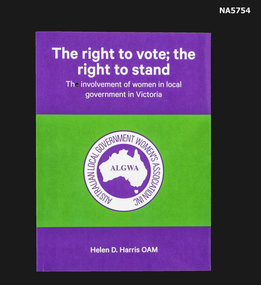
Book - "The Right to vote: the right to stand", Helen Harris, Book POD, 2014
... "The Right to vote: the right to stand"...Purple and green book titled "The right to vote: the right to stand". The involvement of women in local government in Victoria. ...Book has 93 pages. Book "The Right to vote: the right to stand" Helen Harris, Book POD Australian Local Government Women's Ass. ...Women's rights and votingPurple and green book titled "The right to vote: the right to stand". The involvement of women in local government in Victoria. In centre of book map of Australia with ALGWA in centre. Circle around has "Australian Local Government Women's Association Inc" book by Helen D. Harris OAM. Book has 93 pages.As abovevoting, helen harris, women's rights -
 Box Hill Historical Society
Book, Harrris, Helen D. OAM, The right to vote; the right to stand: the involvement of wome in local government in Victoria, 2014
... The right to vote; the right to stand: the involvement of wome in local government in Victoria....Two appendices list the names of women who served on Council pre 1994 and post 1994. The right to vote; the right to stand: the involvement of wome in local government in Victoria. ...The book details the significant points in the history of women being allowed to stand for Council. Two appendices list the names of women who served on Council pre 1994 and post 1994.non-fictionThe book details the significant points in the history of women being allowed to stand for Council. Two appendices list the names of women who served on Council pre 1994 and post 1994.local government, people in political roles, women -
 Bendigo Historical Society Inc.
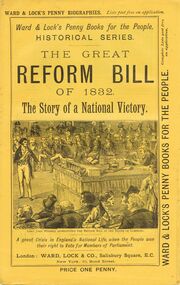
Book - LYDIA CHANCELLOR COLLECTION: THE GREAT REFORM BILL OF 1832. THE STORY OF A NATIONAL VICTORY
... ... the right to vote...A great Crisis in England's life, when the people won their right to vote for members of parliament.' London : Ward, lock & Co., Salisbury Square, E.C. ...A great Crisis in England's life, when the people won their right to vote for members of parliament.' London : Ward, lock & Co., Salisbury Square, E.C. ...A book titled ' The Great Reform Bill of 1832. The story of a National Victory. A great Crisis in England's life, when the people won their right to vote for members of parliament.' London : Ward, lock & Co., Salisbury Square, E.C. New York : 10 Bond Street. 337 - 351 pgs. (ill.) This booklet is one of a series of 37 ' Ward & Lock's Penny Books for the People.' ' Historical Series.' Price one penny. There are also advertisements of note.books, biography, english history, lydia chancellor, collection, ward & lock's penny biographies, biographies, ward & lock's penny books for the people, historical series, english history, history, 1832 reform bill, politics, british politics, english politics, elections, the right to vote, voting, book, books, advertisements, penny books -
 Eltham District Historical Society Inc
Film - Video (DVD), State Government of Victoria, Victorian Women Vote 1908-2008, August 2008
... Centenary celebration of the history of Victorian women achieving the right to vote in 1908 though Aboriginal women did not receive the right to vote till the 1960s....Centenary celebration of the history of Victorian women achieving the right to vote in 1908 though Aboriginal women did not receive the right to vote till the 1960s. ...Centenary celebration of the history of Victorian women achieving the right to vote in 1908 though Aboriginal women did not receive the right to vote till the 1960s.video recording, suffragettes, women's vote, victoria australia -
 Greensborough Historical Society
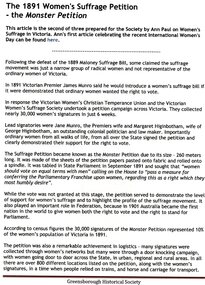
Article, Anne Paul, The 1891 women's suffrage petition - the Monster Petition, by Anne Paul, 25/02/2011
... A petition in favour of women's right to vote was organised by the Victorian Women's Christian Temperance Union and the Victorian Women's Suffrage Society in 1891. ...A petition in favour of women's right to vote was organised by the Victorian Women's Christian Temperance Union and the Victorian Women's Suffrage Society in 1891. ...A petition in favour of women's right to vote was organised by the Victorian Women's Christian Temperance Union and the Victorian Women's Suffrage Society in 1891. It gathered 30,000 signatures and was known as the Monster Petition because of its size.2 p. text and one colour photographwomens suffrage petition, victorian women's christian temperance union, victorian women's suffrage society, women's suffrage -
 Bendigo Historical Society Inc.
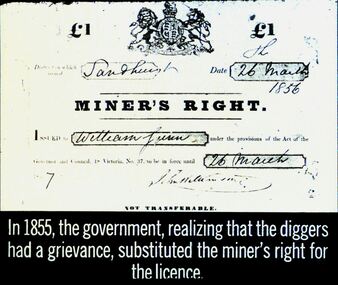
Slide - DIGGERS & MINING. THE GOLD ERA, c1850s
... There was an annual fee of 5/-, giving miners the right to mine, vote and to own land....There was an annual fee of 5/-, giving miners the right to mine, vote and to own land. EDUCATION Tertiary goldfields hanimount Diggers & mining. ...The Miners Right replaced the Miners Licence in 1856. There was an annual fee of 5/-, giving miners the right to mine, vote and to own land.Diggers & mining. The gold era. IN 1855, the government, realizing that the diggers had a grievance, substituted the miner's right for the licence. Slide shows a copy of a Miner's Right 26 March, 1856, William Lunn. Markings 29 994.031 GOL:5. Used as a teaching aid.hanimounteducation, tertiary, goldfields -
Glenelg Shire Council Cultural Collection
Book, The Pioneer Suffragettes of Casterton and District, n.d
... The production of the booklet was funded through the Women's Policy Unit to celebrate 100 years of voting rights for women who contributed to the women's right to vote by signing the petition of 1891. ...The production of the booklet was funded through the Women's Policy Unit to celebrate 100 years of voting rights for women who contributed to the women's right to vote by signing the petition of 1891. ...20 Page booklet compiled by Jan Lier for the Casterton and District Historical Society Inc. Includes list of pioneer women from Casterton and district who signed the 1891 suffrage petition, biographical details of the women, and a number of photographs of the women.womens suffrage, suffragette, casterton, casterton and district historical society -
 Eltham District Historical Society Inc
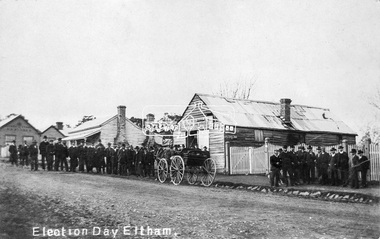
Negative - Photograph, Tom Prior, Election Day, Eltham, 4 June 1907
... At that time women did not have the right to vote. At the far left can be see William B. ...At that time women did not have the right to vote. At the far left can be see William B. ...Election Day, Legislative Council Elections, Tuesday, 4 June 1907, Maria Street (Main Road), Eltham. Group of men standing outside George Knapman’s forge on Election Day (4 June 1907) for the Legislative Council. Voting was conducted in the Eltham Courthouse next door, to the right of photo. At that time women did not have the right to vote. At the far left can be see William B. Andrew’s Corn Store on the corner of Franklin Street. The weatherboard house in between at one stage the home of Miss George.This photo forms part of a collection of photographs gathered by the Shire of Eltham for their centenary project book,"Pioneers and Painters: 100 years of the Shire of Eltham" by Alan Marshall (1971). The collection of over 500 images is held in partnership between Eltham District Historical Society and Yarra Plenty Regional Library (Eltham Library) and is now formally known as the 'The Shire of Eltham Pioneers Photograph Collection.' It is significant in being the first community sourced collection representing the places and people of the Shire's first one hundred years. The Reynolds family were early settlers in Research. The Reynolds/ Prior collection of photographs were taken by Tom Prior, the maternal uncle of Ivy Reynolds, around 1900 and the 60 photos in the album give a fine overview of many of the landmarks of Research and Eltham over 100 years ago. lvy lived in the family home for many years at 106 Thompson Cres Research. Ivy's father, Ernst Richard Reynolds and grandfather, Richard Reynolds, lived at the same address. Ivy's father Richard worked for Mr. Trail on his property in Research. Reynolds Road is named after the family. Mr Tom Prior (wife Eva) worked at the Melbourne zoo. He was very innovative and made his own camera, using the black cloth hood to exclude the light. The photographs are a reminder of the rural nature of Research and Eltham and its rich heritage.Digital image 4 x 5 inch B&W Negelection day, elections, eltham, eltham courthouse, forge, george knapman, knapmans forge, main road, maria street, miss george, reynolds prior collection, shire of eltham pioneers photograph collection, w.b. andrew corn store -
 Orbost & District Historical Society
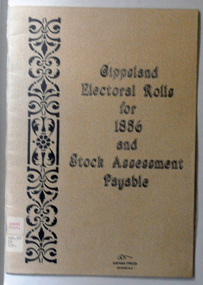
book, E-Gee Printers, Gippsland Electoral Rolls for 1856 and Stock Assessment Payable, 1985
... Men were entitled to vote according to the qualifications described in this book - the right to vote in each house was dependent on status - educational qualifications, income and for either literacy. ...Men were entitled to vote according to the qualifications described in this book - the right to vote in each house was dependent on status - educational qualifications, income and for either literacy. ...The Electoral Act 1856 was passed through Parliament o March 13, 1856. Victoria was the first Australian colony, and the first legislature anywhere in the world, to adopt the practice of the secret ballot. Victoria's constitution prescribed that the Parliament was to be bicameral, consisting of an upper house, the Legislative Council and a lower house, Legislative Assembly. Men were entitled to vote according to the qualifications described in this book - the right to vote in each house was dependent on status - educational qualifications, income and for either literacy. Two names are registered for the Orbost district: James Dickson and J.C. McLeod.This item is a useful research tool.A 16 pp paper back book which has a clear plastic cover. The covers are beige coloured with the title "Gippsland Electoral Rolls for 1856 and Stock Assessment Payable" in blak print. On the left hand side is a vertical pattern in black print. The book contains an alphabetical list of persons claiming or supposed to be entitled to Vote in the Election of a Member for the District. It lists the needed qualifications of electors followed by the Voters Roll for Legislative Assembly, 1856 and the Voters Roll for Legislative Council, 1856 . It then lists the Stock Assessments, 1856.voting-registers-victoria -
 Eltham District Historical Society Inc
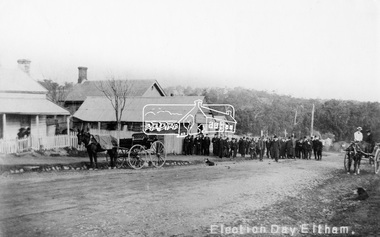
Negative - Photograph, Tom Prior, Election Day, Eltham, 4 June 1907
... At that time women did not have the right to vote; two women wait on the horse and buggy and two others are looking on from the verandah of the house next door. ...At that time women did not have the right to vote; two women wait on the horse and buggy and two others are looking on from the verandah of the house next door. ...Election Day, Legislative Council Elections, Tuesday, 4 June 1907, Maria Street (Main Road), Eltham. Group of men standing outside George Knapman’s forge on Election Day (4 June 1907) for the Legislative Council. Voting was conducted in the Eltham Courthouse next door, visible behind the forge. At that time women did not have the right to vote; two women wait on the horse and buggy and two others are looking on from the verandah of the house next door. A dog also sits patiently on the road. The Police Station and residence are just visible on the corner of Brougham Street. Reproduced on p62 of 'Pioneers & Painters' Cross Ref: 0629This photo forms part of a collection of photographs gathered by the Shire of Eltham for their centenary project book,"Pioneers and Painters: 100 years of the Shire of Eltham" by Alan Marshall (1971). The collection of over 500 images is held in partnership between Eltham District Historical Society and Yarra Plenty Regional Library (Eltham Library) and is now formally known as the 'The Shire of Eltham Pioneers Photograph Collection.' It is significant in being the first community sourced collection representing the places and people of the Shire's first one hundred years. The Reynolds family were early settlers in Research. The Reynolds/ Prior collection of photographs were taken by Tom Prior, the maternal uncle of Ivy Reynolds, around 1900 and the 60 photos in the album give a fine overview of many of the landmarks of Research and Eltham over 100 years ago. lvy lived in the family home for many years at 106 Thompson Cres Research. Ivy's father, Ernst Richard Reynolds and grandfather, Richard Reynolds, lived at the same address. Ivy's father Richard worked for Mr. Trail on his property in Research. Reynolds Road is named after the family. Mr Tom Prior (wife Eva) worked at the Melbourne zoo. He was very innovative and made his own camera, using the black cloth hood to exclude the light. The photographs are a reminder of the rural nature of Research and Eltham and its rich heritage.Digital image 4 x 5 inch B&W Negshire of eltham pioneers photograph collection, eltham, main road, knapman's forge, election day, elections, eltham courthouse, forge, george knapman, knapmans forge, maria street, pioneers and painters, reynolds prior collection, court house, courthouse, g. knapman, sepp -
 Orbost & District Historical Society
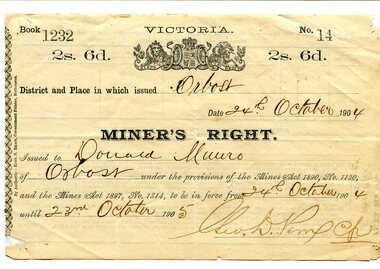
certificate, 24.10.1904
... Protests in 1853 at Bendigo with the formation of the Anti-Gold Licence Association and the rebellion of Eureka Stockade in December 1854 at Ballarat led to reform giving the right to mine gold, the right to vote, and the right to own land. This new system proved economical and sustainable, operating substantially unchanged up until 1975. ...Protests in 1853 at Bendigo with the formation of the Anti-Gold Licence Association and the rebellion of Eureka Stockade in December 1854 at Ballarat led to reform giving the right to mine gold, the right to vote, and the right to own land. This new system proved economical and sustainable, operating substantially unchanged up until 1975. ...This miner's right certificate was issued in Orbost to Donald Munro of Orbost. It was valid from 24.10.1904 until 23.10.1905 and cost two shillings and sixpence. Donald Munro, with his brother, Archie carried on a boot-making business in one of the rooms of a three-storeyed barn at Lochiel. The Munros were musically inclined and through them a band was formed in 1889. Donald Munro was involved in many of the town's activities. (More in Mary Gilbert's Personalities and Stories of the Early Orbost District). The Miner's Right was introduced in 1855 in the colony of Victoria, replacing the Miner's Licence. Protests in 1853 at Bendigo with the formation of the Anti-Gold Licence Association and the rebellion of Eureka Stockade in December 1854 at Ballarat led to reform giving the right to mine gold, the right to vote, and the right to own land. This new system proved economical and sustainable, operating substantially unchanged up until 1975. This item is of historical significance as it is associated with positive outcomes for gold miners brought about by the Eureka Stockade rebellion and its subsequent democrat changes. It is also associated with the Munro family who were early settlers in Orbost.A white paper miner's right certificate. It has black print with hand-written details. It is an elaborate document with the Victorian coat-of-arms at the top.on back- date, hand-written notescertificate-miner's-right munro-donald -
 Bendigo Historical Society Inc.
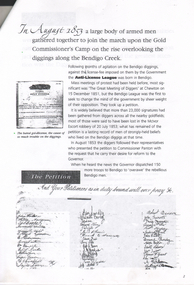
Document - The Red Ribbon Rebellion and the Bendigo Petition
... The petition demanded immediate reform of government administration, a reduction in the licence fee, the right to vote and land reform (with poor returns from diggings, miners wanted affordable land on or near the goldfields). ...The petition demanded immediate reform of government administration, a reduction in the licence fee, the right to vote and land reform (with poor returns from diggings, miners wanted affordable land on or near the goldfields). ...The discovery of gold in Victoria in 1851 initially overwhelmed the Colonial administration. Towns appeared almost overnight and it was challenging to keep law and order. To keep some control over the gold seekers and help pay for the administration of the goldfields, Lieutenant-Governor La Trobe introduced gold licences in September 1851. Miners paid 30 shillings per month (later reduced to £1 per month or £8 per year) for the right to dig a small ‘claim’, usually about eight feet square (2.4m²). Not surprisingly the licence system was unpopular. The licence was expensive – 30 shillings was a substantial sum for most diggers, who might spend months digging for gold without success. Resistance to the licence fee spread throughout the fields. A Miner’s Association was formed at Mount Alexander (Castlemaine) in December 1851 and at Bendigo in 1853 the Red Ribbon Rebellion was led by the Anti-Gold Licence Association. Diggers wore red ribbons in their hats as a sign of protest, refused to pay their licences and collected a ‘monster’ petition which was presented to Lieutenant-Governor La Trobe. The petition demanded immediate reform of government administration, a reduction in the licence fee, the right to vote and land reform (with poor returns from diggings, miners wanted affordable land on or near the goldfields). This proposal to commemorate a significant event in the history of Bendigo, is for the creation of a permanent installation in Bendigo that will commemorate the valour and integrity of the Bendigo diggers, who stood fast against the Government in the early days of protest on the Victorian diggings. Nine page photocopy of document titled: ' The Red Ribbon Rebellion & the Bendigo Petition. A proposal to commemorate a significant event in the history of Bendigo'. Contents includes a brief history of the Red Ribbon movement; description of the Digger's Banner; information on Governor LaTrobe; William Dixon Campbell Denovan and an outline of the proposed project to commemorate the event. The imposition of a license fee imposed upon the miners, by the Government of Victoria, cause a major agitation on the Bendigo diggings and the Anti-License League was born in Bendigo. Signatures were gathered for a petition: 'It is widely believed that more than 23,000 signatures had been gathered from diggers across all the nearby goldfields; most of those were said to have been lost in the McIvor Escort Robbery of 20 July 1853'. The proposal was prepared by Geoff Hocking in consultation with the Bendigo Historical Society and Jim Evans of the Red Ribbon Repertory Co.mining, sandhurst, red ribbon rebellion, agitation, denovan, latrobe, miners, license fee, diggers -
Federation University Historical Collection
Article - Article - Women, Ballarat School of MInes: Women of Note; Bella Guerin, Educator and Activist, (1858 - 1923)
... She wrote speeches for Vida Golstein, a campaigner for women's rights, the right to vote and stand for elections. In recognition of her time at Ballarat School of Mines, a Hall of Residence at Federation University, Mount Helen Campus has been named after her, Bella Guerin Hall of Residence. ...She wrote speeches for Vida Golstein, a campaigner for women's rights, the right to vote and stand for elections. In recognition of her time at Ballarat School of Mines, a Hall of Residence at Federation University, Mount Helen Campus has been named after her, Bella Guerin Hall of Residence. ...Julia Margaret (Bella) Guerin (1858-1923), feminist, political activist and teacher, was born on 23 April 1858. Her father was a Governor of Gaols and was so at Ballarat Gaol from 1860s to 1890.- Having studied at home to pass matriculation in 1878, Bella entered Melbourne University in 1881, the same year her brother Marco began at Ballarat School of Mines to study Metallurgy and Assaying. Bella became the first woman to graduate from an Australian University when she gained her B.A. from the University of Melbourne in December 1883, becoming M.A. upon application in 1885. She taught first at Loreto Convent, Ballarat, urging higher education scholarships for Catholic girls to produce 'a band of noble thoughtful women as a powerful influence for good'; then as Lady Principal of Ballarat School of Mines University classes from 1887-1890, resigning upon marriage. Returning to teaching from financial necessity she began to frequent suffragist circles from the mid 1890s. She also became very involved within the Labor Party. She wrote speeches for Vida Golstein, a campaigner for women's rights, the right to vote and stand for elections. In recognition of her time at Ballarat School of Mines, a Hall of Residence at Federation University, Mount Helen Campus has been named after her, Bella Guerin Hall of Residence. Tunnelling tradition dictates a Tunnel Boring Machine (TBM) cannot start work until it has been given a female name, a sign of good luck for the project ahead. This dates back to the 1500s when miners and military engineers working with explosives for underground excavation, prayed to Saint Barbara for protection.The TBMs working on the two West Gate extensions are named after two very prominent women working for the rights for women. They are named Bella (Bella Guerin) and Vida (Vida Goldstein)women of note, feminist, political activist, teacher, melbourne university, first female university graduate, loreto convent ballarat, lady principal of ballarat school of mines, 1887-1890, labor party, hall of residence, bella guerin hall of residence, federation university, mount helen campus, julia margaret guerin, bella guerin, governor of gaols, ballarat gaol, father, marco guerin, brother, ballarat school of mines, metallurgy, assaying, women's rights, vote for women, vida goldstein, west gate tunnels, tunnel boring machines, tbms, bella, vida -
 Ballarat Clarendon College
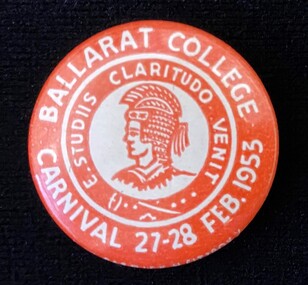
Badge, Ballarat College Carnival 27-28 February 1953 badge
... Opened by His Excellency, the Governor, General Sir Dallas Brooks and dedicated by the Moderator of the Presbyterian Church of Victora, Right Reverend W A Alston the formalities were followed by a two day Carnival and culminated in a dance on Saturday evening. The very successful Carnival raised 1334 pounds and was voted an outstandng success. ...Opened by His Excellency, the Governor, General Sir Dallas Brooks and dedicated by the Moderator of the Presbyterian Church of Victora, Right Reverend W A Alston the formalities were followed by a two day Carnival and culminated in a dance on Saturday evening. The very successful Carnival raised 1334 pounds and was voted an outstandng success. ...The Carnival of 1953 was staged at College as part of the celebrations for the opening of the Tower, dormitories and Hall extension of the main Ballarat College buildings, 1425 Sturt Street, Ballarat. Opened by His Excellency, the Governor, General Sir Dallas Brooks and dedicated by the Moderator of the Presbyterian Church of Victora, Right Reverend W A Alston the formalities were followed by a two day Carnival and culminated in a dance on Saturday evening. The very successful Carnival raised 1334 pounds and was voted an outstandng success. For more information see the school magazine, The Minervan, August 1953, pp 6-8. Small round lapel badge with white printing on red; Ballarat College crest surrounded by motto and encircled with the words: Ballarat College Carnival 27-28 Feb. 1953Ballarat College crest surrounded by motto and encircled with the words: Ballarat College Carnival 27-28 Feb. 1953ballarat-college, fund-raising, 1953, building opening, sir dallas brooks -
 Flagstaff Hill Maritime Museum and Village
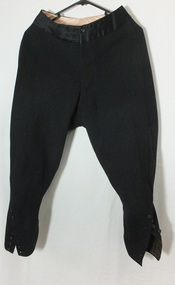
Clothing - Riding Habit, Jodhpurs, 1920s
... A change that was to bring a start to a more liberating societal attitude towards women after the successful establishment of the Representation of People Act 1918 that gave women the right to vote. This garments provenance is linked to one of Victoria's important pioneering families the Manifolds, one of the first families that came from Van Diemen's land to settle the Western District of Victoria in 1844. ...The Manifolds were a significant pioneering pastoral family in Western Victoria. The donated riding jodhpurs originally belonged to Mrs Edward Manifold, formally Beatrice Mary Synnot Anderson. Beatrice was Edward Manifold’s cousin once removed whom he married in 1900. Edward, the son of John Manifold, was born on 15 November 1868 and educated at Geelong and Melbourne Grammar schools and at Trinity Hall, Cambridge (B.A., 1891). He chose the Danedite portion of land at Purrumbete, and on the death of his bachelor brother Thomas Peter (1863-1895), after a hunting accident, he took over his allocation, Wiridgil. He also owned Boortkoi, near Hexham and on these properties, he ran merino sheep, a Lincoln stud which dated back to 1870, and Shorthorn cattle. 3000 acres were also leased to dairy farmers. Edward was a member of Hampden Shire Council in 1909-31 and three times president at Camperdown. The town was largely bordered by Manifold land and partly dependent upon the local pastoral dynasties, which benefited the local area from the families’ various business interests. Though an offer to build public baths to commemorate the Queen Victoria Jubilee in 1897 was not proceeded with, the town acquired a hospital, a reserve on Mount Leura, a clock tower and a cricket pavilion, as well as notable donations from the Manifolds to St Paul's Church and the grammar school. Edward was a keen polo player and racing man. He was also a successful owner of steeplechasers and a committeeman of the Victoria Racing Club for many years. He was also a member of many Western District racing clubs. On the 16 July 1900, Edward had married his sixteen-year-old cousin Beatrice Mary Synnot Anderson by whom he had three sons Thomas Peter, Andrew and Robert Edward Manifold. Edwards's estate at his death was valued for probate at nearly £500,000. Edward died following an operation on 14 February 1931 at a private hospital in Yarra Vale Melbourne. Beatrice passed away in 1954, aged 79 in Ballarat where she was born in 1874. Contextual historic Family background: The Manifold brothers Thomas (1809-1875), John (1811-1877) and Peter (1817-1885) were the fourth, fifth and sixth sons of William Manifold and Mary, nee Barnes, of Courthouse Farm, Bromborough, Cheshire, England. The family had decided to emigrate to Van Diemen's Land. Thomas was sent ahead, arriving in Hobart Town on 23rd January 1828 with £1500 and a letter of recommendation from the Colonial Office. Thomas acquired 1280 acres on the west bank of the Tamar River. John and Peter, with their parents and three sisters, arrived on 8th July 1831. Land grants by then had finished but William brought ninety acres next to his son Thomas’ land and on the combined properties the family built Kelso House. The Manifolds’ properties were comparatively poor and when news of the Port Phillip District, in Victoria reached Thomas, he lost no time in coming to see for himself in February 1836. He was impressed with what he saw and hurried back to Tasmania to buy lambs and ewes. With one of his brothers, on July 9th he landed his stores at Point Henry and proceeded to occupy both sides of the Moorabool River. Thomas, at the end of the year, returned to Tasmania and left Peter and John to run the new property. Thomas, however, returned to Victoria for several visits and on one of these visits he, along with his brothers, examined the country near Ballarat. In December 1838 they managed to penetrate the Stony Rises, and Peter and John reached Lake Purrumbete and the Mount Leura country. During this time, on 4th July 1838, Thomas married Jane Elizabeth, eldest daughter of Captain Walter Synnot, formerly of Ballinate, County Armagh, Ireland, and then of Van Diemen's Land. Thomas joined his brothers, and they occupied the Purrumbete run in January 1839. On the journey to Purrumbete they could not take their stock and drays through the Stony Rises, so went north of Lake Corangamite, to the neck of land between it and Lake Gnarpurt. By April the move from Moorabool area was complete. As yet they had no hut and were working day and night, but their delight in their new run was unbounded. John wrote to his mother: “We are at last got to the land we wished for it is a beautiful place, and cannot be surpassed by any I have ever seen”. The three brothers occupied Purrumbete together, breeding both sheep and cattle until Thomas went to Grassmere run on the Merri River near Warrnambool in 1844. John and Peter soon gave up breeding sheep but retained the well-known '3M' brand for the cattle. These were Shorthorns, derived from four bulls originally imported by the Boldon brothers and later improved by further importations, and were renowned for size and quality. By the time of the gold rush in 1851, John and Peter were breeding over 1000 head a year, as well as fattening stores. The diggings at this time had disorganised Grassmere by drawing away Thomas's men, and his wife decided to take her two sons and two daughters to Europe for their education. Thomas gave up the property next year, went to England to join his family, and eventually brought the family back to live in Melbourne. At Purrumbete things were different. The brothers, John and Peter, preferred black stockmen to white, so the discovery of gold upset them very little while providing the very market they required. John was on his second visit to England when the rush started, and Peter went in his turn soon after John returned. On 2 September 1856 John married Marion Thomson, at Cormiston, Van Diemen's Land. They had four daughters and five sons, from three of whom, William Thomson, James Chester and Edward, the later generations of the family descend. Through the years the brothers had to contend with the scab, fluke and footrot, depression, rabbits, bush fires and pleuro-pneumonia. In 1861 they appointed as manager Henry Manifold Matson, their nephew, who had already been with them for five years. Thomas died in Melbourne on 7 November 1875, John at Purrumbete on 3 January 1877 and Peter at Purrumbete on 31 July 1885. Devout members of the Church of England, John and Peter, during their lives, gave generously towards building St Paul's Church, Camperdown, and guaranteed part of the vicar's stipend. Peter was a member of the Hampden and Heytesbury Roads Board from 1859 and carried on into the Hampden Shire Council when it was formed in 1864. However, it was not for public works that they were known, but for their personal example. In a new land where speculators and adventurers were all too common, the Manifold brothers were among those who intended it to be their home and their children's home. Industrious, unpretentious and hospitable, they were respected in their community as men of the highest integrity. This riding habit is a characteristic example of the type and style of riding clothes that well-dressed ladies wore in the 1920s. It highlights the changes that were beginning in society for women. Prior to 1918 ladies still had to ride side-saddle with skirts over Jodhpurs. Society of the time regarded women riding astride as unseemly and just not done. This riding habit is particularly significant on a number of levels, it shows the beginnings of change in society's attitudes through women's fashion after the First World War. A change that was to bring a start to a more liberating societal attitude towards women after the successful establishment of the Representation of People Act 1918 that gave women the right to vote. This garments provenance is linked to one of Victoria's important pioneering families the Manifolds, one of the first families that came from Van Diemen's land to settle the Western District of Victoria in 1844. Originally the garment belonged to the wife of the great-grandson of pioneer William Manifold, Edward Manifold who married Beatrice May Synnot Anderson, Edwards Cousin in 1900. The garment was made by the Mayfair tailors J. Busvine & Co. in the early to mid-1920s (estimate) who at the turn of the century were tailors to the Courts of Europe. Their clothing is highly collectible today and examples can be found in a number of significant museum collections around the world, notably the Metropolitan Museum of Art in New York and the FIDM in Los Angeles. Jodhpurs, part of a three-piece, side saddle riding habit tailored for Mrs Edward Manifold, with four buttons to the front material black woolen twill the legs are cuffed below the knee with 8 buttons holes which are reinforced to the inside with fabric. Cream Satin waistband and removable chamois lining to the seat makers label Busvines Co. tailored for Mrs Edward Manifold.Embroidered in blue on a Satin Cream label to Jodhpurs "Busvine Ltd / 4, Brook St, London. W. No." Hand written in black ink script "523/ Mrs Edward Manifold"flagstaff hill, warrnambool, shipwrecked coast, flagstaff hill maritime museum, maritime museum, side saddle riding habit, side saddle riding outfit, breeches, mrs edward manifold, beatrice manifold, shipwreck coast, flagstaff hill maritime village, great ocean road -
 Flagstaff Hill Maritime Museum and Village
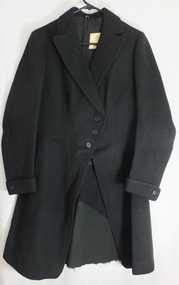
Clothing - Riding Habit, jacket, Early 20th Century
... A change that was to bring a start to a more liberating societal attitude towards women after the successful establishment of the Representation of People Act 1918 that gave women the right to vote. This garments provenance is linked to one of Victoria's important pioneering families the Manifolds, one of the first families that came from Van Diemen's land to settle the Western District of Victoria in 1844. ...The Manifolds were a significant pioneering pastoral family in Western Victoria. The donated riding jacket originally belonged to Mrs Edward Manifold, formally Beatrice Mary Synnot Anderson. Beatrice was Edward Manifold’s cousin once removed whom he married in 1900. Edward, the son of John Manifold, was born on 15 November 1868 and educated at Geelong and Melbourne Grammar schools and at Trinity Hall, Cambridge (B.A., 1891). He chose the Danedite portion of land at Purrumbete, and on the death of his bachelor brother Thomas Peter (1863-1895), after a hunting accident, he took over his allocation, Wiridgil. He also owned Boortkoi, near Hexham and on these properties, he ran merino sheep, a Lincoln stud which dated back to 1870, and Shorthorn cattle. 3000 acres were also leased to dairy farmers. Edward was a member of Hampden Shire Council in 1909-31 and three times president at Camperdown. The town was largely bordered by Manifold land and partly dependent upon the local pastoral dynasties, which benefited the local area from the families’ various business interests. Though an offer to build public baths to commemorate the Queen Victoria Jubilee in 1897 was not proceeded with, the town acquired a hospital, a reserve on Mount Leura, a clock tower and a cricket pavilion, as well as notable donations from the Manifolds to St Paul's Church and the grammar school. Edward was a keen polo player and racing man. He was also a successful owner of steeplechasers and a committeeman of the Victoria Racing Club for many years. He was also a member of many Western District racing clubs. On the 16 July 1900, Edward had married his sixteen-year-old cousin Beatrice Mary Synnot Anderson by whom he had three sons Thomas Peter, Andrew and Robert Edward Manifold. Edwards's estate at his death was valued for probate at nearly £500,000. Edward died following an operation on 14 February 1931 at a private hospital in Yarra Vale Melbourne. Beatrice passed away in 1954, aged 79 in Ballarat where she was born in 1874. Contextual historic Family background: The Manifold brothers Thomas (1809-1875), John (1811-1877) and Peter (1817-1885) were the fourth, fifth and sixth sons of William Manifold and Mary, nee Barnes, of Courthouse Farm, Bromborough, Cheshire, England. The family had decided to emigrate to Van Diemen's Land. Thomas was sent ahead, arriving in Hobart Town on 23rd January 1828 with £1500 and a letter of recommendation from the Colonial Office. Thomas acquired 1280 acres on the west bank of the Tamar River. John and Peter, with their parents and three sisters, arrived on 8th July 1831. Land grants by then had finished but William brought ninety acres next to his son Thomas’ land and on the combined properties the family built Kelso House. The Manifolds’ properties were comparatively poor and when news of the Port Phillip District, in Victoria reached Thomas, he lost no time in coming to see for himself in February 1836. He was impressed with what he saw and hurried back to Tasmania to buy lambs and ewes. With one of his brothers, on July 9th he landed his stores at Point Henry and proceeded to occupy both sides of the Moorabool River. Thomas, at the end of the year, returned to Tasmania and left Peter and John to run the new property. Thomas, however, returned to Victoria for several visits and on one of these visits he, along with his brothers, examined the country near Ballarat. In December 1838 they managed to penetrate the Stony Rises, and Peter and John reached Lake Purrumbete and the Mount Leura country. During this time, on 4th July 1838, Thomas married Jane Elizabeth, eldest daughter of Captain Walter Synnot, formerly of Ballinate, County Armagh, Ireland, and then of Van Diemen's Land. Thomas joined his brothers, and they occupied the Purrumbete run in January 1839. On the journey to Purrumbete they could not take their stock and drays through the Stony Rises, so went north of Lake Corangamite, to the neck of land between it and Lake Gnarpurt. By April the move from Moorabool area was complete. As yet they had no hut and were working day and night, but their delight in their new run was unbounded. John wrote to his mother: “We are at last got to the land we wished for it is a beautiful place, and cannot be surpassed by any I have ever seen”. The three brothers occupied Purrumbete together, breeding both sheep and cattle until Thomas went to Grassmere run on the Merri River near Warrnambool in 1844. John and Peter soon gave up breeding sheep but retained the well-known '3M' brand for the cattle. These were Shorthorns, derived from four bulls originally imported by the Boldon brothers and later improved by further importations, and were renowned for size and quality. By the time of the gold rush in 1851, John and Peter were breeding over 1000 head a year, as well as fattening stores. The diggings at this time had disorganised Grassmere by drawing away Thomas's men, and his wife decided to take her two sons and two daughters to Europe for their education. Thomas gave up the property next year, went to England to join his family, and eventually brought the family back to live in Melbourne. At Purrumbete things were different. The brothers, John and Peter, preferred black stockmen to white, so the discovery of gold upset them very little while providing the very market they required. John was on his second visit to England when the rush started, and Peter went in his turn soon after John returned. On 2 September 1856 John married Marion Thomson, at Cormiston, Van Diemen's Land. They had four daughters and five sons, from three of whom, William Thomson, James Chester and Edward, the later generations of the family descend. Through the years the brothers had to contend with the scab, fluke and footrot, depression, rabbits, bush fires and pleuro-pneumonia. In 1861 they appointed as manager Henry Manifold Matson, their nephew, who had already been with them for five years. Thomas died in Melbourne on 7 November 1875, John at Purrumbete on 3 January 1877 and Peter at Purrumbete on 31 July 1885. Devout members of the Church of England, John and Peter, during their lives, gave generously towards building St Paul's Church, Camperdown, and guaranteed part of the vicar's stipend. Peter was a member of the Hampden and Heytesbury Roads Board from 1859 and carried on into the Hampden Shire Council when it was formed in 1864. However, it was not for public works that they were known, but for their personal example. In a new land where speculators and adventurers were all too common, the Manifold brothers were among those who intended it to be their home and their children's home. Industrious, unpretentious and hospitable, they were respected in their community as men of the highest integrity. This riding habit is a characteristic example of the type and style of riding clothes that well-dressed ladies wore in the 1920s. It highlights the changes that were beginning in society for women. Prior to 1918 ladies still had to ride side-saddle with skirts over Jodhpurs. Society of the time regarded women riding astride as unseemly and just not done. This riding habit is particularly significant on a number of levels, it shows the beginnings of change in society's attitudes through women's fashion after the First World War. A change that was to bring a start to a more liberating societal attitude towards women after the successful establishment of the Representation of People Act 1918 that gave women the right to vote. This garments provenance is linked to one of Victoria's important pioneering families the Manifolds, one of the first families that came from Van Diemen's land to settle the Western District of Victoria in 1844. Originally the garment belonged to the wife of the great-grandson of pioneer William Manifold, Edward Manifold who married Beatrice May Synnot Anderson, Edwards Cousin in 1900. The garment was made by the Mayfair tailors J. Busvine & Co. in the early to mid-1920s (estimate) who at the turn of the century were tailors to the Courts of Europe. Their clothing is highly collectible today and examples can be found in a number of significant museum collections around the world, notably the Metropolitan Museum of Art in New York and the FIDM in Los Angeles. A riding jacket, part of a three-piece, side saddle riding habit tailored for Mrs Edward Manifold. Knee length English woolen jacket black in colour, seamed and fitted to the female client's figure, fastening from the waist with three bone buttons to rather high lapels. The sleeves are long with closely fitted cuffs and one button and lined with cream satin. The jacket is fitted to the waist and flared to below the hips with a 35 cm vent to the back. Lower back to the jacket is reinforced with removable fabric and the jacket is lined with black twill cotton, there is a cream satin label, with makers' emblem Busvine. Circa 1920s Label to Jacket Embroidered in gold with a Royal logo on a Cream Satin label “By Special /Appointment” “To Her Majesty/The Queen”, “Busvine / Ltd / London 4 Brook St. W. / No” “hand written in purple ink 315 / Mrs Edward Manifold”flagstaff hill, warrnambool, shipwrecked coast, flagstaff hill maritime museum, maritime museum, side saddle riding habit, mrs edward manifold, edward manifold, busvines, shipwreck coast, flagstaff hill maritime village, great ocean road -
 Flagstaff Hill Maritime Museum and Village
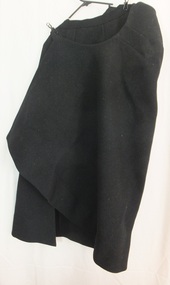
Clothing - Riding Habit, Skirt, 1920s
... A change that was to bring a start to a more liberating societal attitude towards women after the successful establishment of the Representation of People Act 1918 that gave women the right to vote. This garments provenance is linked to one of Victoria's important pioneering families the Manifolds, one of the first families that came from Van Diemen's land to settle the Western District of Victoria in 1844. ...The Manifolds were a significant pioneering pastoral family in Western Victoria. The donated riding skirt originally belonged to Mrs Edward Manifold, formally Beatrice Mary Synnot Anderson. Beatrice was Edward Manifold’s cousin once removed whom he married in 1900. Edward, the son of John Manifold, was born on 15 November 1868 and educated at Geelong and Melbourne Grammar schools and at Trinity Hall, Cambridge (B.A., 1891). He chose the Danedite portion of land at Purrumbete, and on the death of his bachelor brother Thomas Peter (1863-1895), after a hunting accident, he took over his allocation, Wiridgil. He also owned Boortkoi, near Hexham and on these properties, he ran merino sheep, a Lincoln stud which dated back to 1870, and Shorthorn cattle. 3000 acres were also leased to dairy farmers. Edward was a member of Hampden Shire Council in 1909-31 and three times president at Camperdown. The town was largely bordered by Manifold land and partly dependent upon the local pastoral dynasties, which benefited the local area from the families’ various business interests. Though an offer to build public baths to commemorate the Queen Victoria Jubilee in 1897 was not proceeded with, the town acquired a hospital, a reserve on Mount Leura, a clock tower and a cricket pavilion, as well as notable donations from the Manifolds to St Paul's Church and the grammar school. Edward was a keen polo player and racing man. He was also a successful owner of steeplechasers and a committeeman of the Victoria Racing Club for many years. He was also a member of many Western District racing clubs. On the 16 July 1900, Edward had married his sixteen-year-old cousin Beatrice Mary Synnot Anderson by whom he had three sons Thomas Peter, Andrew and Robert Edward Manifold. Edwards's estate at his death was valued for probate at nearly £500,000. Edward died following an operation on 14 February 1931 at a private hospital in Yarra Vale Melbourne. Beatrice passed away in 1954, aged 79 in Ballarat where she was born in 1874. Contextual historic Family background: The Manifold brothers Thomas (1809-1875), John (1811-1877) and Peter (1817-1885) were the fourth, fifth and sixth sons of William Manifold and Mary, nee Barnes, of Courthouse Farm, Bromborough, Cheshire, England. The family had decided to emigrate to Van Diemen's Land. Thomas was sent ahead, arriving in Hobart Town on 23rd January 1828 with £1500 and a letter of recommendation from the Colonial Office. Thomas acquired 1280 acres on the west bank of the Tamar River. John and Peter, with their parents and three sisters, arrived on 8th July 1831. Land grants by then had finished but William brought ninety acres next to his son Thomas’ land and on the combined properties the family built Kelso House. The Manifolds’ properties were comparatively poor and when news of the Port Phillip District, in Victoria reached Thomas, he lost no time in coming to see for himself in February 1836. He was impressed with what he saw and hurried back to Tasmania to buy lambs and ewes. With one of his brothers, on July 9th he landed his stores at Point Henry and proceeded to occupy both sides of the Moorabool River. Thomas, at the end of the year, returned to Tasmania and left Peter and John to run the new property. Thomas, however, returned to Victoria for several visits and on one of these visits he, along with his brothers, examined the country near Ballarat. In December 1838 they managed to penetrate the Stony Rises, and Peter and John reached Lake Purrumbete and the Mount Leura country. During this time, on 4th July 1838, Thomas married Jane Elizabeth, eldest daughter of Captain Walter Synnot, formerly of Ballinate, County Armagh, Ireland, and then of Van Diemen's Land. Thomas joined his brothers, and they occupied the Purrumbete run in January 1839. On the journey to Purrumbete they could not take their stock and drays through the Stony Rises, so went north of Lake Corangamite, to the neck of land between it and Lake Gnarpurt. By April the move from Moorabool area was complete. As yet they had no hut and were working day and night, but their delight in their new run was unbounded. John wrote to his mother: “We are at last got to the land we wished for it is a beautiful place, and cannot be surpassed by any I have ever seen”. The three brothers occupied Purrumbete together, breeding both sheep and cattle until Thomas went to Grassmere run on the Merri River near Warrnambool in 1844. John and Peter soon gave up breeding sheep but retained the well-known '3M' brand for the cattle. These were Shorthorns, derived from four bulls originally imported by the Boldon brothers and later improved by further importations, and were renowned for size and quality. By the time of the gold rush in 1851, John and Peter were breeding over 1000 head a year, as well as fattening stores. The diggings at this time had disorganised Grassmere by drawing away Thomas's men, and his wife decided to take her two sons and two daughters to Europe for their education. Thomas gave up the property next year, went to England to join his family, and eventually brought the family back to live in Melbourne. At Purrumbete things were different. The brothers, John and Peter, preferred black stockmen to white, so the discovery of gold upset them very little while providing the very market they required. John was on his second visit to England when the rush started, and Peter went in his turn soon after John returned. On 2 September 1856 John married Marion Thomson, at Cormiston, Van Diemen's Land. They had four daughters and five sons, from three of whom, William Thomson, James Chester and Edward, the later generations of the family descend. Through the years the brothers had to contend with the scab, fluke and footrot, depression, rabbits, bush fires and pleuro-pneumonia. In 1861 they appointed as manager Henry Manifold Matson, their nephew, who had already been with them for five years. Thomas died in Melbourne on 7 November 1875, John at Purrumbete on 3 January 1877 and Peter at Purrumbete on 31 July 1885. Devout members of the Church of England, John and Peter, during their lives, gave generously towards building St Paul's Church, Camperdown, and guaranteed part of the vicar's stipend. Peter was a member of the Hampden and Heytesbury Roads Board from 1859 and carried on into the Hampden Shire Council when it was formed in 1864. However, it was not for public works that they were known, but for their personal example. In a new land where speculators and adventurers were all too common, the Manifold brothers were among those who intended it to be their home and their children's home. Industrious, unpretentious and hospitable, they were respected in their community as men of the highest integrity. This riding habit is a characteristic example of the type and style of riding clothes that well-dressed ladies wore in the 1920s. It highlights the changes that were beginning in society for women. Prior to 1918 ladies still had to ride side-saddle with skirts over Jodhpurs. Society of the time regarded women riding astride as unseemly and just not done. This riding habit is particularly significant on a number of levels, it shows the beginnings of change in society's attitudes through women's fashion after the First World War. A change that was to bring a start to a more liberating societal attitude towards women after the successful establishment of the Representation of People Act 1918 that gave women the right to vote. This garments provenance is linked to one of Victoria's important pioneering families the Manifolds, one of the first families that came from Van Diemen's land to settle the Western District of Victoria in 1844. Originally the garment belonged to the wife of the great-grandson of pioneer William Manifold, Edward Manifold who married Beatrice May Synnot Anderson, Edwards Cousin in 1900. The garment was made by the Mayfair tailors J. Busvine & Co. in the early to mid-1920s (estimate) who at the turn of the century were tailors to the Courts of Europe. Their clothing is highly collectible today and examples can be found in a number of significant museum collections around the world, notably the Metropolitan Museum of Art in New York and the FIDM in Los Angeles. Safety skirt/apron, part of a three-piece, side saddle riding habit tailored for Mrs Edward Manifold. This side saddle skirt is made from black woolen material fixing at the waist with two metal hooks and three buttons to the front opening. One internal concealed pocket lining to the top part of the apron made of cotton the seat is shaped for side saddle riding and the skirt wraps around the body the longer side draped over the leg that is in the stirrup. flagstaff hill, warrnambool, shipwrecked coast, flagstaff hill maritime museum, maritime museum, side saddle riding habit, side saddle safety skirt, side saddle apron, mrs edward manifold, beatrice manifold, female riding habit 1920s, shipwreck coast, flagstaff hill maritime village, great ocean road -
 Flagstaff Hill Maritime Museum and Village
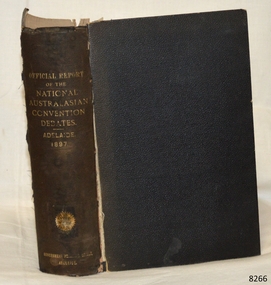
Book - Publication of Speeches, C. E. Bristow Government Printer, Official Report of The National Australasian Convention Debates Adelaide, 1897
... South Australia had already granted women the right to vote in 1894. During these recorded debates, SA delegates led by Premier Charles Kingston fought fiercely to ensure that women in SA would not lose their voting rights under the new national government, ultimately paving the way for a universal franchise across Australia. ...This volume is one of the primary founding documents of the Australian Federation. Published in Adelaide in 1897 by Charles Edward Bristow (the South Australian Government Printer), this heavy octavo volume captures the verbatim transcript of the First Session of the Australasian Federal Convention, held in Adelaide from 22 March to 5 May 1897. The volume contains verbatim debates from the convention, where statesmen from across the colonies drafted the framework for the Australian Constitution.Hard cover book, National Australasian Convention. (Debate Speeches March 22nd to May 5th 1897) Author: Various Speeches by various Speakers Publisher: C. E. Bristow Government Printer, North Terrace ,Adelaide. SA. Editor: C. E. Bristow Government Printer Date: 1897 Further Information: Black embossed cloth hardcover with a brown spine and lettering in gilt. The spine has a publishers logo in gilt.non-fictionThis volume is one of the primary founding documents of the Australian Federation. Published in Adelaide in 1897 by Charles Edward Bristow (the South Australian Government Printer), this heavy octavo volume captures the verbatim transcript of the First Session of the Australasian Federal Convention, held in Adelaide from 22 March to 5 May 1897. The volume contains verbatim debates from the convention, where statesmen from across the colonies drafted the framework for the Australian Constitution.flagstaff hill, warrnambool, shipwrecked coast, flagstaff hill maritime museum, maritime museum, shipwreck coast, flagstaff hill maritime village, great ocean road, book, pattison collection, warrnambool library, warrnambool mechanics’ institute, ralph eric pattison, corangamite regional library service, warrnambool city librarian, mechanics’ institute library, victorian library board, warrnambool books and records, warrnambool children’s library, official report of the national australasian convention debates adelaide -
 Mission to Seafarers Victoria
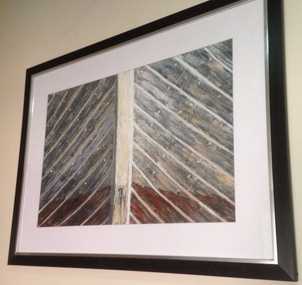
Painting, Berni Ayreart, Forgotten Uncle Bill's story, 2013
... This painting was exhibited at the MTSV 2013 ANL Maritime Art Prize finalists and voted as one of a group of 20 People's Choice top finalists: artwork 2013 berni ayreart artwork-paintings maritime art prize anl boat Artist signature at lower right corner facing in white paint uc : "BERNIE AYRE" painting of the prow of a wooden boat fully mounted and with black mitred frame and glazed with perspex. ...The boat in the painting belonged to a seafarer, my Uncle Bill who used it to fish from when on shore leave.This weathered boat is a familiar image to many who walk the shorelines and ponder the question, "I wonder who the owner is?" Maritime art, Marine artpainting of the prow of a wooden boat fully mounted and with black mitred frame and glazed with perspex. Cord hanger sealed backing with labelsArtist signature at lower right corner facing in white paint uc : "BERNIE AYRE"artwork, 2013, berni ayreart, artwork-paintings, maritime art prize, anl, boat -
 Orbost & District Historical Society
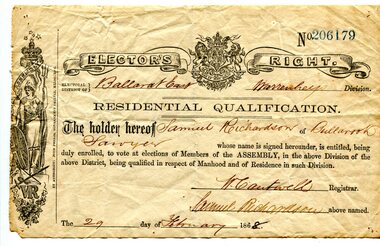
certificate, 29th February 1868
... This Elector's Right Certificate, No. 206179, is for Samuel Richardson, a sawyer, who lived at Bullarook in the Ballarat East Division. It has been signed by W. Cantwell, the registrar and by Samuel Richardson. As a resident and a male he was entitled to vote...This Elector's Right Certificate, No. 206179, is for Samuel Richardson, a sawyer, who lived at Bullarook in the Ballarat East Division. It has been signed by W. Cantwell, the registrar and by Samuel Richardson. As a resident and a male he was entitled to vote ...This Elector's Right Certificate, No. 206179, is for Samuel Richardson, a sawyer, who lived at Bullarook in the Ballarat East Division. It has been signed by W. Cantwell, the registrar and by Samuel Richardson. As a resident and a male he was entitled to vote in the Ballarat East Division at Victorian State elections. Samuel Richardson was a sawmiller and farmer in Orbost. He built The Curlip, a wooden paddle-steamer of 9 tons gross and dimensions of 43 feet long, 10 feet wide and a depth of 3 feet, on the slipway at their Tabarra sawmill in 1890. This item is associated with the Richardson family, early Orbost pioneers,A white paper certificate with black print and hand-written details. at the top is the British coat-of-arms. It is an elector's right certificate made out to Samuel richardson.suffrage richardson-samuel elector's-right-certificate -
 Bendigo Military Museum
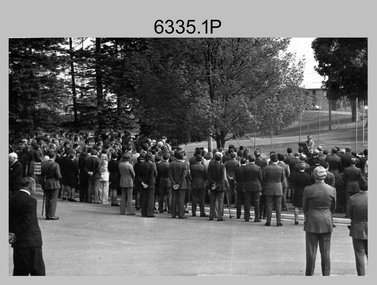
Photograph - Military Funeral for SSGT Peter Dew, Army Survey Regiment, Fortuna, Bendigo, 1977
... On right of tree L to R: Max Neil, Bob Hayden, Dave Malligan, Le-Anne (Smallshaw) Shirley, Stan Vote. ...On right of tree L to R: Max Neil, Bob Hayden, Dave Malligan, Le-Anne (Smallshaw) Shirley, Stan Vote. ...This is a set of five black & white photographs of troops from the Army Headquarters Survey Regiment undertaking ceremonial drill at the military funeral for SSGT Peter Dew in 1977. The location of the funeral service was at Fortuna, Bendigo. He was buried at Bendigo Cemetery in Quarry Hill. Peter Dew died in a tragic accident at home. He was fondly remembered as one of Lithographic Squadron’s colourful personalities. See item 6243.7P for photos of Peter Dew at work in Lithographic Squadron. The "Super Animal of the Year" Peter Dew Memorial Award was an award presented to a member of the squadron for a crude act. To view a photo of this award, refer to item 6230 of the Victorian Collections. This is a set of five black & white photographs of troops from the Army Headquarters Survey Regiment undertaking ceremonial drill at the military funeral for SSGT Peter Dew in 1977. The photographs were printed on photographic paper and are part of the Army Survey Regiment’s Collection. The photographs were scanned at 300 dpi. .1) - Photo, black & white, 1977. Unidentified soldiers and civilians. .2) - Photo, black & white, 1977. In front of the tennis court gates: John McCulloch. Remainder unidentified. .3) - Photo, black & white, 1977. Rifle party rear rank right marker: Russ Mollenhauer. Front rank rifle party commander next to right marker: Greg Kidman. Pall bearers in front of vehicle L to R: Dave Miles, Dick Barwald. Remainder unidentified. .4) - Photo, black & white, 1977. Rifle party commander: Greg Kidman. Right file front to back: Russ Mollenhauer, Peter Breukel, Bill Jones, John Anderson. Remainder unidentified. Left file front to back: unidentified (x2), Rhys De Laine, Frank Lenane, Josh Degroot, Gary Drummond. .5) - Photo, black & white, 1977. Left of minister: Alan Toogood. On right of tree L to R: Max Neil, Bob Hayden, Dave Malligan, Le-Anne (Smallshaw) Shirley, Stan Vote. Remainder unidentified.No personnel are identified.royal australian survey corps, rasvy, army survey regiment, army svy regt, fortuna, asr -
 Bendigo Military Museum
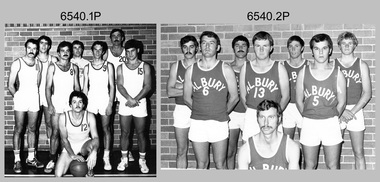
Photograph - Annual Sport Competition: Flag Day - Army Survey Regiment Verses School of Military Survey, Bendigo, 1977
... Vote. .16) - Photo, black & white, 1977, Golf. Putting - Peter Warwick. .17) - Photo, black & white, 1977, Golf. Putting – Roy Morgan. .18) - Photo, black & white, 1977, ASR Rifle Shooting Team - Back row L to R: Paul Davis, unidentified (x2), Max Neil, Rhys De Laine. Front row L to R: Tony Lawler, Rene van den Tol, unidentified, Warren ‘Waldo’ Shirley. .19) - Photo, black & white, 1977, ASR Rifle Shooting Team – L to R: unidentified (x4), 2nd back right: Tony Lawler, unidentified. .20) - Photo, black & white, 1977, SMS Rifle Shooting Team - Back row L to R: John Ashby, unidentified (x3). ...Vote. .16) - Photo, black & white, 1977, Golf. Putting - Peter Warwick. .17) - Photo, black & white, 1977, Golf. Putting – Roy Morgan. .18) - Photo, black & white, 1977, ASR Rifle Shooting Team - Back row L to R: Paul Davis, unidentified (x2), Max Neil, Rhys De Laine. Front row L to R: Tony Lawler, Rene van den Tol, unidentified, Warren ‘Waldo’ Shirley. .19) - Photo, black & white, 1977, ASR Rifle Shooting Team – L to R: unidentified (x4), 2nd back right: Tony Lawler, unidentified. .20) - Photo, black & white, 1977, SMS Rifle Shooting Team - Back row L to R: John Ashby, unidentified (x3). ...This set of 33 photographs of sports action was taken on Flag Day, an annual sports competition between the Army Survey Regiment (ASR) and the School of Military Survey (SMS), at Bendigo on the 13th of May 1977. Softball was held at Beischer Park Strathdale, sailing was most likely held at Lake Eppalock, rifle shooting at Wellsford Rifle Range and tug-of-war at Fortuna. The venues for basketball, golf, squash and volleyball are unknown. The two RA Svy units took turns each year to host the event. Personnel from the ASR’s Detachment located at Bonegilla were part of the SMS’s teams. The day competition usually comprised basketball, cross country, golf, sailing, squash softball, tennis, rifle shooting, touch football, tug-of-war and volleyball. The evening competition often included darts, carpet bowls, hookey, quoits and snooker. See items 6025.15P for photo proofs of sports action and 6326.25P for softball action and taken on the day. There are numerous duplicates previously published from these photo proofs; however they are inferior in quality.This is a set of 33 photographs of sports action was taken on Flag Day, Army Survey Regiment (ASR) versus the School of Military Survey (SMS), at Bendigo on the 13th of May 1977. The photographs were printed on photographic paper and are part of the Army Survey Regiment’s Collection. The black and white photographs were scanned at 300 dpi. .1) - Photo, black & white, 1977, Basketball. ASR Team Back row L to R: unidentified, Stuart Symonds, Bruce Gordon. Front row L to R: unidentified (x2), Bill Jones, unidentified. Sitting: unidentified. .2) - Photo, black & white, 1977, Basketball. SMS Team Back row L to R: Duncan Burns, Stuart Thaxter, unidentified (x2). Front row L to R: Owen Moss, unidentified, Steve Hansen. Sitting: unidentified. .3) to .5) - Photo, black & white, 1977. Basketball action. .6) - Photo, black & white, 1977, Golf - L to R: Kevin ‘Chuck’ Berry, George Austen, unidentified, Roy Morgan. .7) - Photo, black & white, 1977, Golf - L to R: Stan Vote, Gordon Lowery, Peter Warwick, John ‘JB’ Barrie. .8) & .9) - Photo, black & white, 1977, ASR Golf Team – Back row L to R: Peter Warwick, unidentified, Graeme Jeffers, John Sinclair. Front row L to R: Stan Vote, Roy Morgan, George Austen, Len Thirlwell. .10) & .11) - Photo, black & white, 1977, SMS Golf Team - Back row L to R: Kevin ‘Chuck’ Berry, unidentified, Gordon Lowery. Front row L to R: unidentified, Peter Hardy, unidentified, John ‘JB’ Barrie. .12) & .13) - Photo, black & white, 1977, Golf. Teeing off – unidentified. .14) - Photo, black & white, 1977, Golf. Teeing off – John Sinclair. .15) - Photo, black & white, 1977, Golf. Putting – Stan Vote. .16) - Photo, black & white, 1977, Golf. Putting - Peter Warwick. .17) - Photo, black & white, 1977, Golf. Putting – Roy Morgan. .18) - Photo, black & white, 1977, ASR Rifle Shooting Team - Back row L to R: Paul Davis, unidentified (x2), Max Neil, Rhys De Laine. Front row L to R: Tony Lawler, Rene van den Tol, unidentified, Warren ‘Waldo’ Shirley. .19) - Photo, black & white, 1977, ASR Rifle Shooting Team – L to R: unidentified (x4), 2nd back right: Tony Lawler, unidentified. .20) - Photo, black & white, 1977, SMS Rifle Shooting Team - Back row L to R: John Ashby, unidentified (x3). Front row L to R: Dave Murphy, Wolfgang Thun, John ‘Stormy’ Tempest, unidentified. .21) - Photo, black & white, 1977, Softball – L to R: Jenny Haddow, Debbie Brown, unidentified umpire. .22) - Photo, black & white, 1977, ASR & SMS Sailing Teams – Back row L to R: Chris Osborne, Josh De Groot, unidentified (x2), Greg Francis-Wright, Peter Breukel. 3rd row L to R: Marrianne (Van De Zee) De Groot, unidentified, Kim Reynolds, Alex Cairney, unidentified, Sam Chambers. 2nd row L to R: Les Dixon, Jim Macdonald, unidentified, George Graham, Ted ‘FOT’ Burgess. Front row L to R: Doug Carswell, Alan Adsett, Peter Mustart, Tony Waldon, Dave Miles. .23) - Photo, black & white, 1977, Sailing on Lake Eppalock, Victoria. .24) - Photo, black & white, 1977, SMS Squash Team – Back row L to R: Graham Squire, Peter Constantine AM, Peter Colwell, Bill Boyd OAM, Front row L to R: unidentified, Dick Barwald, Colin Darch, unidentified. .25) - Photo, black & white, 1977, ASR Squash Team – Back row L to R: Andy Wilson, Terry Danger, Errol Fletcher, Dennis Puniard. Front row L to R: Lynn Johnson, Kerry Browne. .26) - Photo, black & white, 1977, ASR Tug-of-War Team: Back row L to R: Russ Mollenhauer, Neville Stone, Jim Cook, Jeff Willey, unidentified (x3). Front row L to R: unidentified, John ‘Flash’ Anderson, Mick ‘Buddha’ Ellis, Ken ‘Sluggo’ Slater, Rob ‘Boges’ Bogumil, Frank Lenane, unidentified. .27) - Photo, black & white, 1977, SMS Tug-of-War Team: Back row L to R: unidentified, Stuart Thaxter, Steve Hansen, unidentified (x2). Front row L to R: Kim Lenson, unidentified (x4), Jamie ‘Fish’ McRae. .28) & .29) - Photo, black & white, 1977, ASR Tug-of-War Team in action. .30) - Photo, black & white, 1977, Volleyball action. .31) - Photo, black & white, 1977, Volleyball action. Chris Edwards blocking. .32) & .33) - Photo, black & white, 1977, Volleyball action..1P to .33P –No personnel are identified. ‘Regiment v School 13 May 1977’ annotated on cover sleeve.royal australian survey corps, rasvy, army survey regiment, army svy regt, fortuna, asr, school of military survey, flag day -
 Eltham District Historical Society Inc
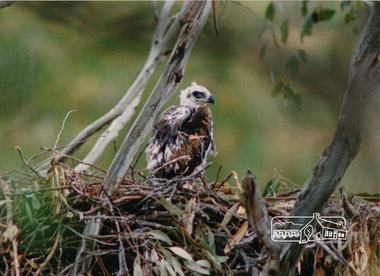
Photograph, Baby eagle on nest, 'The Chase', Warrandyte, c.1990
... In December 1990, Eltham Shire Council voted to acquire 12 hectares of The Chase for a wildlife reserve; the developers received a compensation package which included $125,000 and the right to sell two extra allotments."...In December 1990, Eltham Shire Council voted to acquire 12 hectares of The Chase for a wildlife reserve; the developers received a compensation package which included $125,000 and the right to sell two extra allotments." wildlife eagle warrandyte the chase. ...Defending The Chase by Marcel Cameron; November 16, 1994, Issue 167, News Retrieved from https://www.greenleft.org.au/1994/167/news/defending-chase "In August 1990, a grassroots campaign to halt clearing of bush at The Chase began after access roads encroached on the nesting habitat of Melbourne's last family of wedge-tailed eagles. Three on-site demonstrations were each attended by up to 200 people and attracted widespread media coverage. Young people played an active role in the campaign, including people from Environmental Youth Alliance, Children for Conservation and local school students. In December 1990, Eltham Shire Council voted to acquire 12 hectares of The Chase for a wildlife reserve; the developers received a compensation package which included $125,000 and the right to sell two extra allotments."Colour photograph of a baby wedge-tail eagle on the nest at 'The Chase', Warrandyte.wildlife, eagle, warrandyte, the chase. -
 Bendigo Historical Society Inc.
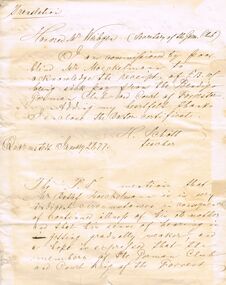
Document - ANCIENT ORDER OF FORESTERS NO. 3770 COLLECTION: CORRESPONDENCE
... voted the money, which was dispatched by the next mail. Mr. Detlef Moeckelmann lost his eyesight through an explosion of gunpowder. His left eye was destroyed, and his right...voted the money, which was dispatched by the next mail. Mr. Detlef Moeckelmann lost his eyesight through an explosion of gunpowder. His left eye was destroyed, and his right ...Translated copy, dated 25 and 28 January 77. Translation refers to the acknowledgement of the receipt of £13.10/- sick pay from the Bendigo German Club and Court of Foresters. Enclosed Doctor's certificate for Mr. Moeckelmann. Because Detlef Moeckelmann was blind, and his sense of hearing was getting gradually weaker, and his old mother had continuous illness, and it was hoped that the German Club and Court King of the Forest could do a little extra for him. The German Club were not in favor of granting extra assistance for an indefinite period. The German Club voted the money, which was dispatched by the next mail. Mr. Detlef Moeckelmann lost his eyesight through an explosion of gunpowder. His left eye was destroyed, and his right eye badly injured to such an extent, that the recovery of sight is an improbability.societies, aof, correspondence, ancient order of foresters no. 3770 collection - correspondence, mr weibgen, bendigo german club, mr moeckelmann, court king of the forest, h schott, d brinckmann, schmidt -
 Bendigo Historical Society Inc.
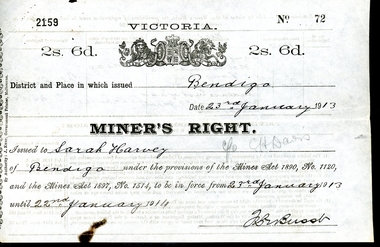
Legal record - WES HARRY COLLECTION: THREE MINER'S RIGHT / RESIDENCY PERMITS
... Unlike the Gold License, the early Miner’s Right, in addition to the right to prospect for gold, also carried with it certain other advantages, such as property rights and voting rights. ...Unlike the Gold License, the early Miner’s Right, in addition to the right to prospect for gold, also carried with it certain other advantages, such as property rights and voting rights. ...The Miner’s Right has a long history in Australia. Still in use today, it was first established in Victoria in 1855, as a replacement for the Gold License (which had been introduced in Victoria in 1851). The Miner’s Right was subsequently adopted by other Australian colonies. Unlike the Gold License, the early Miner’s Right, in addition to the right to prospect for gold, also carried with it certain other advantages, such as property rights and voting rights. The Miner’s Right came about as a recommendation of a government-appointed commission, which had been appointed on 1854 to look into the troubles on the Victorian goldfields, especially regarding the Eureka Rebellion.Three Miner's Rights / Residency Permits for leases on the corner of Holdsworth Road and Wood Street, Long Gully, Bendigo (Area known as American Gully - downstream of the American Mine): a and b No 72 Sarah Harvey, dated 23/01/1913 c and d No 23148 Evalina Gifford Vivian Harvey, dated 14/09/1926 e and f No 23149 Thomas George Harvey, dated 14/09/1926 Issued by the Victorian Government at a cost of two shillings and six penceVictorian State Governmentwes harry collection, miner's right, bendigo, history, long gully bendigo -
 Bendigo Historical Society Inc.
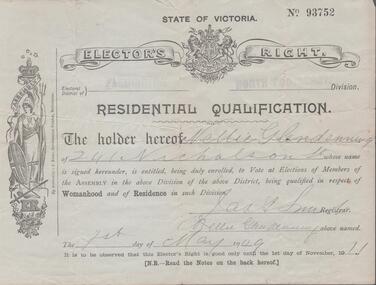
Document - ELECTOR'S RIGHT
... Elector's right for the State of Victoria No. 93752 Electoral district of Flemington, North Footscray division. Residential qualification: the holder hereof Nellie Glendemming of 241 Nicholson Street is entitled to vote at elections of members of the Assembly in the above division being qualified in respect of Womanhood and of Residence in such division. ...GOVERNMENT State electoral right Elector's right for the State of Victoria No. 93752 Electoral district of Flemington, North Footscray division. Residential qualification: the holder hereof Nellie Glendemming of 241 Nicholson Street is entitled to vote at elections of members of the Assembly in the above division being qualified in respect of Womanhood and of Residence in such division. ...Elector's right for the State of Victoria No. 93752 Electoral district of Flemington, North Footscray division. Residential qualification: the holder hereof Nellie Glendemming of 241 Nicholson Street is entitled to vote at elections of members of the Assembly in the above division being qualified in respect of Womanhood and of Residence in such division. Dated 1st dy of May, 1909government, state, electoral right -
 Bendigo Historical Society Inc.
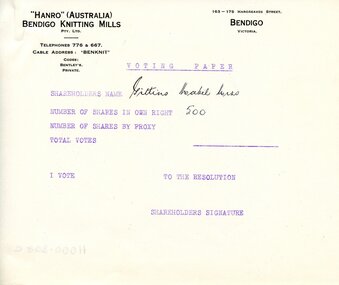
Document - HANRO COLLECTION: VOTING PAPERS
... Voting Papers, typed on paper with Hanro letterhead, unsigned and undated. Papers are in the names of Alexander Lewis Robertson Goldie, Caroline Mary Goldie, Mabel Gittins, Mary Anderson, William Bowman Hanna Neill, Francesca Black, Marie Maranta, William Crowley and William Hall Russell. Also printed on the papers are the Number of Shares in Own Right...Voting Papers, typed on paper with Hanro letterhead, unsigned and undated. Papers are in the names of Alexander Lewis Robertson Goldie, Caroline Mary Goldie, Mabel Gittins, Mary Anderson, William Bowman Hanna Neill, Francesca Black, Marie Maranta, William Crowley and William Hall Russell. Also printed on the papers are the Number of Shares in Own Right ...Nine Voting Papers, typed on paper with Hanro letterhead, unsigned and undated. Papers are in the names of Alexander Lewis Robertson Goldie, Caroline Mary Goldie, Mabel Gittins, Mary Anderson, William Bowman Hanna Neill, Francesca Black, Marie Maranta, William Crowley and William Hall Russell. Also printed on the papers are the Number of Shares in Own Right, Number of Shares by Proxy, Total Votes, a space for how they will vote and a space for a signature.hanro, clothing, share register, hanro collection - voting papers, alexander lewis robertson goldie, caroline mary goldie, mabel gittins, mary anderson, william bowman hanna neill, francesca black, marie maranta, william crowley, william hall russell -
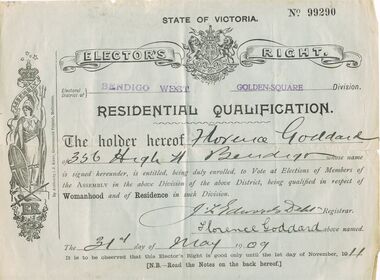 Bendigo Historical Society Inc.
Document - 'ELECTOR'S RIGHT' CERTIFICATE FOR RESIDENTIAL QUALIFICATION, 1909
... 'Elector's Right' - Certificate of Residential Qualification for Florence Goddard, Bendigo West. Entitled to vote ''in respect of Womanhood and of Residence'' in the Golden Square Division, 1909....'Elector's Right' - Certificate of Residential Qualification for Florence Goddard, Bendigo West. Entitled to vote ''in respect of Womanhood and of Residence'' in the Golden Square Division, 1909. ...'Elector's Right' - Certificate of Residential Qualification for Florence Goddard, Bendigo West. Entitled to vote ''in respect of Womanhood and of Residence'' in the Golden Square Division, 1909.person, individual, florence goddard, florence goddard, golden square, bendigo west. -
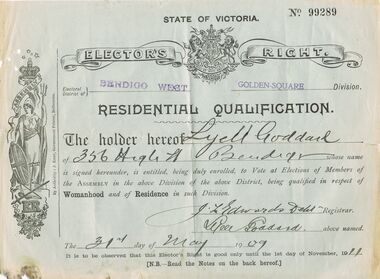 Bendigo Historical Society Inc.
Document - 'ELECTOR'S RIGHT': CERTIFICATE OF RESIDENTIAL QUALIFICATION, 1909
... 'Elector's Right' - Certificate of Residential Qualification for Lyell Goddard, Bendigo West. Entitled to vote ''in respect of Womanhood and of Residence'' in the Golden Square Division, 1909....'Elector's Right' - Certificate of Residential Qualification for Lyell Goddard, Bendigo West. Entitled to vote ''in respect of Womanhood and of Residence'' in the Golden Square Division, 1909. ...'Elector's Right' - Certificate of Residential Qualification for Lyell Goddard, Bendigo West. Entitled to vote ''in respect of Womanhood and of Residence'' in the Golden Square Division, 1909.person, individual, lyall goddard, womanhood and resistance, golden square division. -
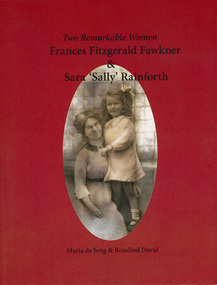 Narre Warren and District Family History Group
Book, Rosalind David et al, Two remarkable women : Frances Fitzgerald Fawkner & Sara 'Sally' Rainforth, 2013
... Frances Elmes Frances Fitzgerald Fawkner Sara 'Sally' Rainforth Charles Chomley Ethel A'Beckett Dr Thomas Elmes "Melbourne in the 1890s - women can't vote and unmarried mothers are social outcasts. Frances, a young journalist, believes in equal rights for women and their right to have children outside of wedlock. ..."Melbourne in the 1890s - women can't vote and unmarried mothers are social outcasts. Frances, a young journalist, believes in equal rights for women and their right to have children outside of wedlock. In 1905, pregnant and alone, she boards a steamship for London. Closely intertwined with the lives of Frances and her daughter Sally are the lives of Frances' best friend Ethel and her husband, author Charles Chomley ... As an adult in rural Wales, Frances' daughter Sally must learn to reconcile the past, her origins, and the loss of loves ones. Gardening becomes her passion. This intriguing double biography shows how women's lives are shaped by society's expectations and how social norms have changed. The book follows the lives of two strong women - Frances Fitzgerald Fawkner and Sara 'Sally' Rainforth"--Back cover.177 p.non-fiction"Melbourne in the 1890s - women can't vote and unmarried mothers are social outcasts. Frances, a young journalist, believes in equal rights for women and their right to have children outside of wedlock. In 1905, pregnant and alone, she boards a steamship for London. Closely intertwined with the lives of Frances and her daughter Sally are the lives of Frances' best friend Ethel and her husband, author Charles Chomley ... As an adult in rural Wales, Frances' daughter Sally must learn to reconcile the past, her origins, and the loss of loves ones. Gardening becomes her passion. This intriguing double biography shows how women's lives are shaped by society's expectations and how social norms have changed. The book follows the lives of two strong women - Frances Fitzgerald Fawkner and Sara 'Sally' Rainforth"--Back cover.berwick (vic.), frances elmes, frances fitzgerald fawkner, sara 'sally' rainforth, charles chomley, ethel a'beckett, dr thomas elmes
