
Showing 173 items matching " village road show"
-
 Sunshine and District Historical Society Incorporated
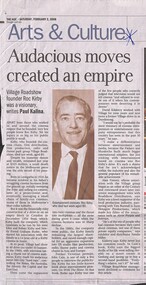
Article - Obituary - Roc Kirby, Kalina, Peter, 2/02/2008 12:00:00 AM
... Cutting of an article in The Age newspaper, 2/2/2008 on Roc Kirby, founder of Village Road Show, who died in January, 2008, aged 89.Reference to book by John Cain: On With the Show....Cut out from The Age Roscoe "Roc" Hubert Kirby Obituary Cutting of an article in The Age newspaper, 2/2/2008 on Roc Kirby, founder of Village Road Show, who died in January, 2008, aged 89.Reference to book by John Cain: On With the Show. ...Cut out from The Ageroscoe "roc" hubert kirby, obituary -
 Sunshine and District Historical Society Incorporated
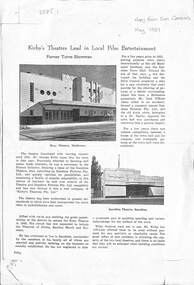
Archive - Kirbys Village Theatres
... ... Village Road Show...Roscoe "Roc" Hubert Kirby Picture Theatre Village Road Show Extract Sun Cavacade Kirby's Theatres Lead in Local Film Entertainment Copy from book On With the Show a glimpse behind the scenes of entertainment in Australia by John Cain Collection of documents relating to Kirby Theatres Archive Kirbys Village Theatres ...Extract Sun Cavacade Kirby's Theatres Lead in Local Film Entertainment Copy from book On With the Show a glimpse behind the scenes of entertainment in Australia by John Cainroscoe "roc" hubert kirby, picture theatre, village road show -
 Flagstaff Hill Maritime Museum and Village
Craft - Ship Model, Cutty Sark
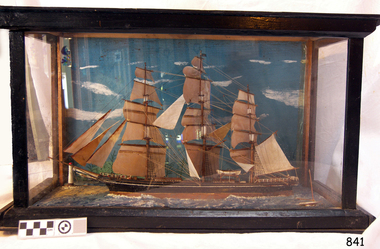
... show us how trade, travel and migration changed over time. The Cutty Sark is also famous for being very fast. It set a record for the journey from Australia to Britain and kept that title for ten years. Today, people still recognise its importance because it has been carefully preserved and is on display at the British Maritime Museum in Greenwich. Its story has also made it a favorite subject for people who enjoy building ship models. Flagstaff Hill Warrnambool Flagstaff Hill Maritime Museum Shipwreck Coast Flagstaff Hill Maritime Village Maritime Museum Great Ocean Road ...THE CUTTY SARK: - The Cutty Sark was built in Britain in 1869 and was one of the last great sailing ships. At first, it carried tea from China. Later, it was used to transport wool from Australia. It became famous for its speed and held the record for the fastest voyage from Australia to Britain for ten years. Later, a Portuguese company bought the ship and renamed it Ferreira. After that, a retired sea captain purchased it to use as a training ship in Cornwall. When the captain died, the ship was given to a training college in Greenwich in 1938. In 1954, it was placed in dry dock at Greenwich, where it remains on display. The Cutty Sark is a special ship because it carried wool from Australia to other parts of the world. Models like this one help us imagine what sea travel was like before steam-powered ships were common, and they show us how trade, travel and migration changed over time. The Cutty Sark is also famous for being very fast. It set a record for the journey from Australia to Britain and kept that title for ten years. Today, people still recognise its importance because it has been carefully preserved and is on display at the British Maritime Museum in Greenwich. Its story has also made it a favorite subject for people who enjoy building ship models. Ship model: the clipper ship Cutty Sark in full ship rig with raised poop deck, deck house, three boats on deck (one has fallen). It has a two-toned black and tan hull and three jibs. The model is set in a diorama of a blue sea, a lighthouse and another small yacht. It is housed in a glass-sided case with a dark grey painted structure. The bow has an inscription."Cutty Sark"flagstaff hill, warrnambool, flagstaff hill maritime museum, shipwreck coast, flagstaff hill maritime village, maritime museum, great ocean road, cutty sark, historic sailing ship, tea clipper, sail training vessel, cadet training ship, commercial trading vessel, cargo sail vessel, ferreria, 1869, tea cargo, tea trade, china tea, wool export, australian export, australian wool export, cornwall, training ship, greenwich, british museum, ship model, craft, hobby, ship model cutty sark, model making -
 Flagstaff Hill Maritime Museum and Village
Print - Vessel, Steamship, A.V. Gregory, SS Casino off Point Lonsdale, ca. 1899-1932
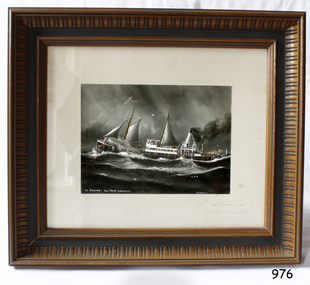
... The detailed image of the vessel depicted in this print shows one of the many sail and steam vessels painted by the renowned Victorian marine artist A V Gregory, whose original works are highly valued today by marine collectors. Flagstaff Hill Flagstaff Hill Maritime Museum and Village Warrnambool Maritime Museum Maritime Village Great Ocean Road Shipwreck Coast newcastle and hunter river steam navigation company belfast and koroit steam navigation company h. sautau and sons s.s. casino west coast trader s.s. casino victorian coastal trader captain boyd captain w. robertson captain chapman captain middleton apollo bay shipwreck s.s. casino at lady bay warrnambool saltau and osburne a v gregory arthur victor gregory Melbourne artist Signed "A V Gregory" Hand painted title "SS Casino off Point Lonsdale" Print with hand-painted watercolour highlights depicting the port side steamship SS Casinounderway in a heavy sea, merchant flag flying at the stern. ...Print of a picture of the S.S. Casino, This print is from an original painting by the Australian marine artist A V Gregory (1867-1957), also known as Arthur Victor Gregory. Gregory lived and worked in South Melbourne. He took over the Gregory Studio owned by his father, George Frederick Gregory, painting actively between 1899 and 1932. He usually signed his works as ‘A V Gregory’. Some of his original works have been sold for thousands of dollars. The S.S. Casino was a passenger and freight steamer built in Dundee, Scotland, in 1882 for the Newcastle and Hunter River Steam Navigation Company of N.S.W. She weighed 425 tons gross with a length of 160.4 feet, beam of 24.1 feet and a depth of 10.2 feet. She had saloon accommodation for 35 people, a fore cabin for 25 more people, and she carried 300 tons of cargo. While on her delivery journey on May 30th 1882 the S.S. Casino called in at the Port of Warrnambool for coal ., narrowly escaping going ashore in gale force winds due to the quick action of the pilot. At that time, still at anchor, she impressed the directors of the Belfast and Koroit Steam Navigation Company so much that they bought her immediately; she was ideal for trade along the West Coast of Victoria. (The Belfast and Koroit Steam Navigation Company was first managed by Messers. Saltau and Osburne and after the passing of Mr. Osburne, by produce merchants Messers H. Sautau and Sons, who had a hay and corn store and shipping agency on the corner of Liebig and Koroit Streets in Warrnambool. ) The S.S. Casino became “the most famous steamer to operate in Victorian waters along the West Coast” by author Jack Loney. Captain Boyd was her first Master, followed by Captain Chapman, who stayed with her from 1890 until 1924. Captain W. Robertson followed for a short term, and then Captain Middleton then took command from 1925 - 1932. The S.S. Casino had several mishaps during her life. One was on 3rd January 1898 when she collided with the S.S. Flinders in Apollo Bay with minor damage. Another was on 24th October 1924 when she grounded on a reef at Point Hawdon near Grey River and most of her cargo (of Christmas goods) had to be dumped into the sea. Then in February 1929 she was ‘holed’ when she struck a submerged object as she entered Lady Bay, Warrnambool. On the morning of 10th July 1932, after attempting to berth at Apollo Bay jetty in heavy seas, Captain Middleton decided to take her out into the bay and wait until the seas abated. It was not realised that the anchor used to steady her as she manoeuvred to her berth had pierced her hull. She put about and headed for the beach but sank. Captain Middleton and nine others lost their lives; nine people were rescued including the two female passengers. Captain Middleton had been in charge of the S.S. Casino for seven years. He was the first ship’s Master to lose his life in a shipwreck in the West Coast trade. In the years following the turn of the century, the S.S. Casino remained the only regular trader with normal passenger accommodation along the West Coast. From 1882 she had made at least 2,500 voyages on the one run. Flagstaff Hill’s collection has a photograph of a portrait of Captain Chapman, , a ship model of the S.S. Casino that shows both forms of power under which she sailed, steam and sail. The ship is painted green and flies three flags. The inscription across the case of the ship model, incorrectly dated, tells the sad story of the wreck of the ship and the loss of lives on July 10th 1932 at Apollo Bay. A print in the Collection shows S.S. Casino underway in the heavy sea off Point Lonsdale, another two photographs show her at the Port of Warrnambool, leaving from the Breakwater in Lady Bay and another identifies the S.S. Casino as a ship from the Belfast and Koroit Steam Navigation Company. (Belfast is the original name for the township of Port Fairy).This print of the S.S. Casino is of significance for its association with the coastal trader S.S. Casino. The wreck of the S.S. Casino is considered an important part of Victorian and Australian cultural heritage and as such has been declared and protected as an Historic Shipwreck under State and Commonwealth Law in the Commonwealth Historic Shipwrecks Act (1976). The detailed image of the vessel depicted in this print shows one of the many sail and steam vessels painted by the renowned Victorian marine artist A V Gregory, whose original works are highly valued today by marine collectors.Print with hand-painted watercolour highlights depicting the port side steamship SS Casinounderway in a heavy sea, merchant flag flying at the stern. Mounted in a decorative wooden frame behind glass. The original painting was by A V Gregory. The title of the picture is repeated in handwritten words on the matte below the artist's signature on the print.Signed "A V Gregory" Hand painted title "SS Casino off Point Lonsdale"flagstaff hill, flagstaff hill maritime museum and village, warrnambool, maritime museum, maritime village, great ocean road, shipwreck coast, newcastle and hunter river steam navigation company, belfast and koroit steam navigation company, h. sautau and sons, s.s. casino, west coast trader s.s. casino, victorian coastal trader, captain boyd, captain w. robertson, captain chapman, captain middleton, apollo bay shipwreck, s.s. casino at lady bay warrnambool, saltau and osburne, a v gregory, arthur victor gregory, melbourne artist -
 Flagstaff Hill Maritime Museum and Village
Instrument - Scale, F Quiney & Son, 1890-1920
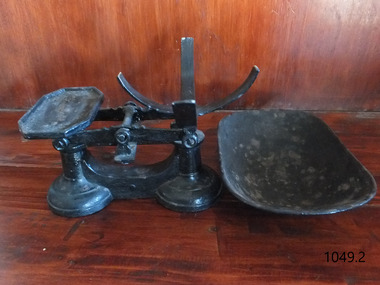
... show that Quiney began working at 4 Ranelagh Place in Leytonstone and from 1908 to 1926 he was at 268 High Road, Leytonstone. The name occurs on brass weights and balance scales dating from the early twentieth 20th century. A balance scale vintage giving a snapshot into mercantile life during the late 19th and early 20th centuries flagstaff hill warrnambool shipwrecked-coast flagstaff-hill flagstaff-hill-maritime-museum maritime-museum shipwreck-coast flagstaff-hill-maritime-village None Beam scale with stand, platform for weights and holding device for metal dish. ...Fredk Quiney & Sons established their company in 1890, council records show that Quiney began working at 4 Ranelagh Place in Leytonstone and from 1908 to 1926 he was at 268 High Road, Leytonstone. The name occurs on brass weights and balance scales dating from the early twentieth 20th century.A balance scale vintage giving a snapshot into mercantile life during the late 19th and early 20th centuriesBeam scale with stand, platform for weights and holding device for metal dish.Noneflagstaff hill, warrnambool, shipwrecked-coast, flagstaff-hill, flagstaff-hill-maritime-museum, maritime-museum, shipwreck-coast, flagstaff-hill-maritime-village -
 Flagstaff Hill Maritime Museum and Village
Document - Navigation Chart, Admiralty Office, Lady Bay and Warrnambool Harbour, 1893
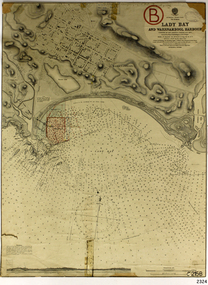
... roads, bridges and many buildings. It also shows the lay of the land and seabed. Flagstaff Hill Warrnambool Flagstaff Hill Maritime Museum & Village Maritime Museum Maritime Village shipwreck coast Map chart Navigation chart plan Lady Bay Warrnambool Harbour Port of Warrnambool Breakwater Jetty Pier Dock extension proposed extension VHR H2024 1870 1893 1910 1925 Warrnambool town late 1800s Warrnambool streets late 1800s Royal Commission 1923 Public Works Water Commission Harbour Trust Victorian Harbours Sir Jon Coode Stamp, rectangular, including "AUG 1910" Stamp, double oval " - - - -CHART" Stamp, hand drawn, red circle, with "B" inside Hand written note "22-8-1910 - - - - - of surveying C. ...This navigation cart of Lady Bay and Warrnambool Harbour was originally surveyed in 1870 but this version includes the update for magnetic variation in 1893. Since the printing of the chart several annotations have been added. These include an additional stamp dated 15-8-1910, a handwritten comment across the top of the page dated August 1910, and another handwritten comment regarding the ‘Proposed Extension of Dock’ dated 19-2-1925, plus connected drawings, notes and figures. The 1925 proposal on this chart may have been a reaction to the Royal Commission of 1923, when the damaged stonework on the seaward side of the Warrnambool Breakwater, caused by the action of the sea, was the subject of enquiry. A conference between the Public Works, Water Commission and the Harbour Trust concluded that it would less costly to make repairs to prevent further damage rather than replaced the damage portion of the wall. A contract was raised in late 1924 to deposit rubble on the damaged side of the breakwater to minimise the Southern Ocean’s destructive action and work had started by August 1925. The Breakwater construction had begun in 1874 and was completed in 1890. The Victorian Government had commissioned Sir John Coode, a British harbour engineer, to present a plan to complete the Warrnambool Breakwater but his original plan was too expensive. He prepared a revised plan for a shorter structure. The construction proved to be too short to protect adequately from the weather and didn't allow enough depth for larger vessels to come into port. The decreasing trade was further affected by siltation in the bay due to the breakwater, and the completion of the railway line. The situation of the harbour became a real problem by 1910 and required continuous dredging. In 1914 the Breakwater was extended but proved to be a failure because the work began to subside and by 1920 about two thirds of the harbour was silted up. Alterations made in the 1920's increased the silting problem and by the 1940's the harbour was no longer used. More alterations were made in the 1950's and 1960's. This chart is significant for its strong connection to the maritime history of Warrnambool Harbour and Lady Bay and the Warrnambool Breakwater. The Warrnambool Breakwater is registered as a place of significance on the Victorian Heritage Database (VHR H2024). The Warrnambool Breakwater is one of the most important late 19th century maritime engineering projects in Victoria and significant in the development of Victorian coastal shipping. It is also significant for its connection with British harbour engineer, Sir John Coode. The chart is a historical record of structures existing in 1893; the Warrnambool Jetties, Warrnambool Breakwater in Lady Bay, the leading lights (lighthouses), streets, roads, bridges and many buildings. It also shows the lay of the land and seabed. Navigation Chart: Lady Bay and Warrnambool Harbour, Australia - South Coast - Victoria. Surveyed by Nav. Lieut. H.J. Stanley, R.N., 1870. Updated for Magnetic Variation, 1893. The rectangular chart is printed on heavy cream paper. Stamps are shaped rectangular, oval and round. Around the Breakwater and Jetty area are handwritten notes, dotted and joined lines, numbers and signatures, and shading of red and green. The chart shows the surrounds of Warrnambool Harbour, Lady Bay, the Breakwater and Jetty, roads, bridges and the streets in Warrnambool. It has sounding details, and angles of line from the leading lights.Stamp, rectangular, including "AUG 1910" Stamp, double oval " - - - -CHART" Stamp, hand drawn, red circle, with "B" inside Hand written note "22-8-1910 - - - - - of surveying C. Ca - - - request of 15-8-10 [initials] " Notes and lines in red pen, including a grid of sounding numbers: "1300" "1050" "1200" "Possible Extension of Dock" "19-2-25" "Dock Dredged to 20 Ft" Notes and lines in blue pen "Extension of Dock to accommodate vessels drawing 20 Feet" and "Light not visible south of this line" Red dots (4) with yellow highlight at both leading lights, breakwater and jettyflagstaff hill, warrnambool, flagstaff hill maritime museum & village, maritime museum, maritime village, shipwreck coast, map, chart, navigation chart, plan, lady bay, warrnambool harbour, port of warrnambool, breakwater, jetty, pier, dock extension, proposed extension, vhr h2024, 1870, 1893, 1910, 1925, warrnambool town late 1800s, warrnambool streets late 1800s royal commission, 1923, public works, water commission, harbour trust, victorian harbours, sir jon coode -
 Flagstaff Hill Maritime Museum and Village
Textile - Tapestry, Mary O'Brien, Gerda Shanley, Judith Stewart, Beryl Conlan (crafts people), 1988
... It shows a visual display of a thousand years of Warrnambool's history, connecting the land and sea to people and events. Flagstaff Hill Flagstaff Hill Maritime Museum and Village Warrnambool Maritime Museum Maritime Village Great Ocean Road Shipwreck Coast tapestry Warrnambool history Warrnambool textiles wall hanging weave South West Victoria history South West Victoria timeline indigenous people early settlement whaling James Grant Nicholas Baudin cotton wool dyed yarn handmade hand-dyed yarn A plaque accompanies the Tapestry "Flagstaff Hill Maritime Tapestry / 1989 / Tapestry: Woven Cotton and Wool / Mary O'Brien Gerda Shanley / Judith Stewart Beryl Conlan" Tapestry of the early history of the Warrnambool area, rectangular in shape. ...This creative tapestry, woven in 1988, documents a thousand years of Warrnambool history. It hangs in the Great Circle Gallery at Flagstaff Hill and complements the theme of the display. Three local women, with the help of Museum staff, researched and designed the tapestry, which was woven in 1988 from wool and cotton. It is ten meters long and seventy centimetres high. The beautiful creation took seven months to create. The tapestry introduces the seafaring theme of Flagstaff Hill Maritime Museum and Village, and illustrates a timeline of events dating back to the arrival of Europeans in the Warrnambool area. It begins with the settlement of the area by Europeans and travels back in time as you walk further into the gallery, depicting shipwrecks along the coast, whaling in the area, early exploration by Europeans James Grant and Nicholas Baudin, back to the indigenous settlement of the area, represented by middens and indigenous symbols. Interestingly, before being hung in the gallery, the tapestry was originally hung with the intention of being framed from right to left. All materials in the cotton and wool tapestry, including dyed wool, were prepared for a cost of $33,000. The project was supported by local philanthropic groups.The tapestry is a hand worked creation by local women. It shows a visual display of a thousand years of Warrnambool's history, connecting the land and sea to people and events.Tapestry of the early history of the Warrnambool area, rectangular in shape. Materials include cotton and wool, some of the wool being hand-dyed. Handmade in 1988 by local women.A plaque accompanies the Tapestry "Flagstaff Hill Maritime Tapestry / 1989 / Tapestry: Woven Cotton and Wool / Mary O'Brien Gerda Shanley / Judith Stewart Beryl Conlan"flagstaff hill, flagstaff hill maritime museum and village, warrnambool, maritime museum, maritime village, great ocean road, shipwreck coast, tapestry, warrnambool history, warrnambool textiles, wall hanging, weave, south west victoria history, south west victoria timeline, indigenous people, early settlement, whaling, james grant, nicholas baudin, cotton, wool, dyed yarn, handmade, hand-dyed yarn -
 Flagstaff Hill Maritime Museum and Village
Instrument - Scale, F Quiney & Son, 1890-1910
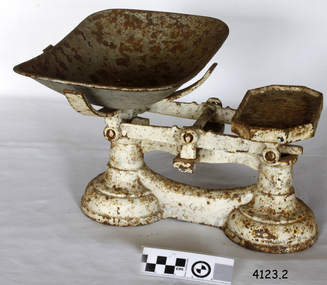
... show that Quiney began working at 4 Ranelagh Place in Leytonstone and from 1908 to 1926 he was at 268 High Road, Leytonstone. The name occurs on brass weights and balance scales dating from the early twentieth 20th century. The company was still producing grocers scales during the 1960s. A balance scale vintage giving a snapshot into mercantile life during the late 19th and early 20th centuries flagstaff hill warrnambool shipwrecked-coast flagstaff-hill flagstaff-hill-maritime-museum maritime-museum shipwreck-coast flagstaff-hill-maritime-village scale weighing equipment None Scale with metal tray. ...Fredk Quiney & Sons established their company in 1890, council records show that Quiney began working at 4 Ranelagh Place in Leytonstone and from 1908 to 1926 he was at 268 High Road, Leytonstone. The name occurs on brass weights and balance scales dating from the early twentieth 20th century. The company was still producing grocers scales during the 1960s.A balance scale vintage giving a snapshot into mercantile life during the late 19th and early 20th centuries Scale with metal tray.Noneflagstaff hill, warrnambool, shipwrecked-coast, flagstaff-hill, flagstaff-hill-maritime-museum, maritime-museum, shipwreck-coast, flagstaff-hill-maritime-village, scale, weighing equipment -
 Flagstaff Hill Maritime Museum and Village
Painting
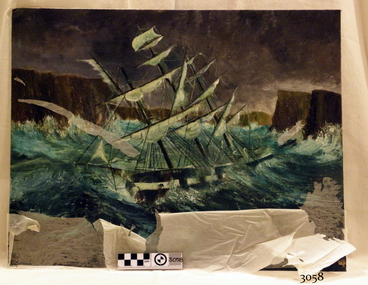
... Flagstaff Hill Warrnambool Shipwrecked coast Flagstaff Hill Maritime Museum Maritime Museum Shipwreck coast Flagstaff Hill Maritime Village Great Ocean Road Loch Line LOCH ARD Captain Gibbs Eva Carmichael Tom Pearce Glenample Station Mutton Bird Island LOCH ARD Gorge painting Painting of The Loch Ard oil on board depicting wreck. It shows ...HISTORY OF THE LOCH ARD The LOCH ARD belonged to the famous Loch Line which sailed many ships from England to Australia. Built in Glasgow by Barclay, Curdle and Co. in 1873, the LOCH ARD was a three-masted square rigged iron sailing ship. The ship measured 262ft 7" (79.87m) in length, 38ft (11.58m) in width, 23ft (7m) in depth and had a gross tonnage of 1693 tons. The LOCH ARD's main mast measured a massive 150ft (45.7m) in height. LOCH ARD made three trips to Australia and one trip to Calcutta before its final voyage. LOCH ARD left England on March 2, 1878, under the command of Captain Gibbs, a newly married, 29 year old. She was bound for Melbourne with a crew of 37, plus 17 passengers and a load of cargo. The general cargo reflected the affluence of Melbourne at the time. On board were straw hats, umbrella, perfumes, clay pipes, pianos, clocks, confectionary, linen and candles, as well as a heavier load of railway irons, cement, lead and copper. There were items included that intended for display in the Melbourne International Exhibition in 1880. The voyage to Port Phillip was long but uneventful. At 3am on June 1, 1878, Captain Gibbs was expecting to see land and the passengers were becoming excited as they prepared to view their new homeland in the early morning. But LOCH ARD was running into a fog which greatly reduced visibility. Captain Gibbs was becoming anxious as there was no sign of land or the Cape Otway lighthouse. At 4am the fog lifted. A man aloft announced that he could see breakers. The sheer cliffs of Victoria's west coast came into view, and Captain Gibbs realised that the ship was much closer to them than expected. He ordered as much sail to be set as time would permit and then attempted to steer the vessel out to sea. On coming head on into the wind, the ship lost momentum, the sails fell limp and LOCH ARD's bow swung back. Gibbs then ordered the anchors to be released in an attempt to hold its position. The anchors sank some 50 fathoms - but did not hold. By this time LOCH ARD was among the breakers and the tall cliffs of Mutton Bird Island rose behind the ship. Just half a mile from the coast, the ship's bow was suddenly pulled around by the anchor. The captain tried to tack out to sea, but the ship struck a reef at the base of Mutton Bird Island, near Port Campbell. Waves broke over the ship and the top deck was loosened from the hull. The masts and rigging came crashing down knocking passengers and crew overboard. When a lifeboat was finally launched, it crashed into the side of LOCH ARD and capsized. Tom Pearce, who had launched the boat, managed to cling to its overturned hull and shelter beneath it. He drifted out to sea and then on the flood tide came into what is now known as LOCH ARD Gorge. He swam to shore, bruised and dazed, and found a cave in which to shelter. Some of the crew stayed below deck to shelter from the falling rigging but drowned when the ship slipped off the reef into deeper water. Eva Carmichael had raced onto deck to find out what was happening only to be confronted by towering cliffs looming above the stricken ship. In all the chaos, Captain Gibbs grabbed Eva and said, "If you are saved Eva, let my dear wife know that I died like a sailor". That was the last Eva Carmichael saw of the captain. She was swept off the ship by a huge wave. Eva saw Tom Pearce on a small rocky beach and yelled to attract his attention. He dived in and swam to the exhausted woman and dragged her to shore. He took her to the cave and broke open case of brandy which had washed up on the beach. He opened a bottle to revive the unconscious woman. A few hours later Tom scaled a cliff in search of help. He followed hoof prints and came by chance upon two men from nearby Glenample Station three and a half miles away. In a state of exhaustion, he told the men of the tragedy. Tom returned to the gorge while the two men rode back to the station to get help. By the time they reached LOCH ARD Gorge, it was cold and dark. The two shipwreck survivors were taken to Glenample Station to recover. Eva stayed at the station for six weeks before returning to Ireland, this time by steamship. In Melbourne, Tom Pearce received a hero's welcome. He was presented with the first gold medal of the Royal Humane Society of Victoria and a £1000 cheque from the Victorian Government. Concerts were performed to honour the young man's bravery and to raise money for those who lost family in the LOCH ARD disaster. Of the 54 crew members and passengers on board, only two survived: the apprentice, Tom Pearce and the young woman passenger, Eva Carmichael, who lost all of her family in the tragedy. Ten days after the LOCH ARD tragedy, salvage rights to the wreck were sold at auction for £2,120. Cargo valued at £3,000 was salvaged and placed on the beach, but most washed back into the sea when another storm developed. The wreck of LOCH ARD still lies at the base of Mutton Bird Island. Much of the cargo has now been salvaged and some was washed up into what is now known as LOCH ARD Gorge. Cargo and artefacts have also been illegally salvaged over many years before protective legislation was introduced. One of the most unlikely pieces of cargo to have survived the shipwreck was a Minton porcelain peacock - one of only nine in the world. The peacock was destined for the Melbourne International Exhibition in 1880. It had been well packed, which gave it adequate protection during the violent storm. Today, the Minton peacock can be seen at the Flagstaff Hill Maritime Museum in Warrnambool. From Australia's most dramatic shipwreck it has now become Australia's most valuable shipwreck artefact and is one of very few 'objects' on the Victorian State Heritage Register. Flagstaff Hill’s collection of artefacts from LOCH ARD is significant for being one of the largest collections of artefacts from this shipwreck in Victoria. It is significant for its association with the shipwreck, which is on the Victorian Heritage Register (VHR S417). The collection is significant because of the relationship between the objects, as together they have a high potential to interpret the story of the LOCH ARD. The LOCH ARD collection is archaeologically significant as the remains of a large international passenger and cargo ship. The LOCH ARD collection is historically significant for representing aspects of Victoria’s shipping history and its potential to interpret sub-theme 1.5 of Victoria’s Framework of Historical Themes (living with natural processes). The collection is also historically significant for its association with the LOCH ARD, which was one of the worst and best known shipwrecks in Victoria’s history. Painting of The Loch Ard oil on board depicting wreck. It shows stormy sea and coastline in background. Ship appears to be capsized.flagstaff hill, warrnambool, shipwrecked coast, flagstaff hill maritime museum, maritime museum, shipwreck coast, flagstaff hill maritime village, great ocean road, loch line, loch ard, captain gibbs, eva carmichael, tom pearce, glenample station, mutton bird island, loch ard gorge, painting -
 Flagstaff Hill Maritime Museum and Village
Photograph
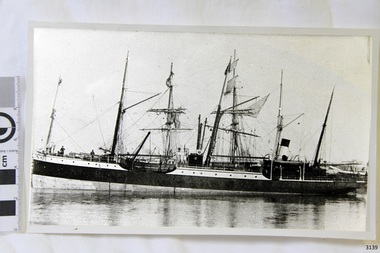
... Casino is considered an important part of Victorian and Australian cultural heritage and as such has been declared and protected as an Historic Shipwreck under State and Commonwealth Law in the Commonwealth Historic Shipwrecks Act (1976). flagstaff hill warrnambool shipwrecked coast flagstaff hill maritime museum maritime museum shipwreck coast flagstaff hill maritime village great ocean road newcastle and hunter river steam navigation company belfast and koroit steam navigation company h. sautau and sons s.s. casino west coast trader s.s. casino victorian coastal trader captain boyd captain w. robertson captain chapman captain middleton apollo bay shipwreck s.s. casino at lady bay warrnambool saltau and osburne Black and White photograph of vessel S.S. Casino in calm water, taken 1882-1932. The coastal trader has light rigging and steam funnel, lifeboat on side, two men on deck. Background shows ...Black and White photograph of vessel S.S. Casino in calm water, taken 1882-1932. The coastal trader has light rigging and steam funnel, lifeboat on side, two men on deck. Background shows other ships. The S.S. Casino was a passenger and freight steamer built in Dundee, Scotland, in 1882 for the Newcastle and Hunter River Steam Navigation Company of N.S.W. She weighed 425 tons gross with a length of 160.4 feet, beam of 24.1 feet and depth of 10.2 feet. She had saloon accommodation for 35 people, forecabin for 25 more people, and she carried 300 tons of cargo. While on her delivery journey on May 30th 1882 the S.S. Casino called in at the Port of Warrnambool for coal ., narrowly escaping going ashore in gale force winds due to the quick action of the pilot. At that time, still at anchor, she impressed the directors of the Belfast and Koroit Steam Navigation Company so much that they bought her immediately; she was ideal for trade in along the West Coast of Victoria. (Belfast is the original name for Port Fairy, South West Victoria. The Belfast and Koroit Steam Navigation Company was first managed by Messers. Saltau and Osburne and after the passing of Mr. Osburne, by produce merchants Messers H. Sautau and Sons, whose had a hay and corn store and shipping agency was on the corner of Liebig and Koroit Streets in Warrnambool. ) The S.S. Casino became “the most famous steamer to operate in Victorian waters along the West Coast” by author Jack Loney. Captain Boyd was her first Master, followed by Captain Chapman, who stayed with her 1890 until 1924. Captain W. Robertson followed for a short term, then Captain Middleton then took command 1925 - 1932. The S.S. Casino had several mishaps during her life. One was on 3rd January 1898 when she collided with the S.S. Flinders in Apollo Bay with minor damage. Another was on 24th October 1924 when she grounded on a reef at Point Hawdon near Grey River and most of her cargo (of Christmas goods) had to be dumped into the sea. Then in February 1929 she was ‘holed’ when she struck a submerged object as she entered Lady Bay, Warrnambool. On the morning of 10th July 1932, after attempting to berth at Apollo Bay jetty in heavy seas, Captain Middleton decided to take her out into the bay and wait until the seas abated. It was not realised that the anchor used to steady her as she manoeuvred to her berth had pierced her hull. She put about and headed for the beach but sank. Captain Middleton and nine others lost their lives; nine people were rescued including the two female passengers . Captain Middleton had been in charge of the S.S. Casino for seven years. He was the first ship’s Master to lose his life through shipwreck in the West Coast trade. In the years following the turn of the century the S.S. Casino remained the only regular trader with normal passenger accommodation along the West Coast. From 1882 she had made at least 2,500 voyages on the one run. Flagstaff Hill’s collection has a photograph of a portrait of Captain Chapman, , a ship model of the S.S. Casino that shows both forms of power under which she sailed, steam and sail. The ship is painted green and flies three flags. The inscription across the case of the ship model, incorrectly dated, tells the sad story of the wreck of the ship and the loss of lives on July 10th 1932 at Apollo Bay. A print in the Collection show S.S. Casino underway in heavy sea off Point Lonsdale, another two photographs show her at the Port of Warrnambool, leaving from the Breakwater in Lady Bay and another identifies the S.S. Casino as a ship from the Belfast and Koroit Steam Navigation Company. (Belfast is the original name for the township of Port Fairy). This photograph was taken 1882-1932. It is significant because of its association with the coastal trader S.S. Casino and its significance to trade along Victoria's West Coast in the late 19th and early 20th century. The wreck of the S.S. Casino is considered an important part of Victorian and Australian cultural heritage and as such has been declared and protected as an Historic Shipwreck under State and Commonwealth Law in the Commonwealth Historic Shipwrecks Act (1976). Black and White photograph of vessel S.S. Casino in calm water, taken 1882-1932. The coastal trader has light rigging and steam funnel, lifeboat on side, two men on deck. Background shows other ships.flagstaff hill, warrnambool, shipwrecked coast, flagstaff hill maritime museum, maritime museum, shipwreck coast, flagstaff hill maritime village, great ocean road, newcastle and hunter river steam navigation company, belfast and koroit steam navigation company, h. sautau and sons, s.s. casino, west coast trader s.s. casino, victorian coastal trader, captain boyd, captain w. robertson, captain chapman, captain middleton, apollo bay shipwreck, s.s. casino at lady bay warrnambool, saltau and osburne -
 Flagstaff Hill Maritime Museum and Village
Document - Navigation Chart, Admiralty Office, Lady Bay and Warrnambool Harbour, 03/04/1871
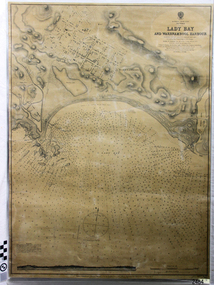
... roads, bridges and many buildings. It also shows the lay of the land and seabed. flagstaff hill warrnambool chart of lady bay warrnambool 1870 warrnambool harbour cartography navigation warrnambool breakwater 1871 AUSTRALIA – SOUTH COAST / VICTORIA Lady Bay 1870 Nav. Lieut. H.J. Stanley R.N Directions for entering Warrnambool Harbour HYDROGRAPHER OFFICE Rear Admiral G.H. Richards Edward Weller Port of Warrnambool flagstaff Hill Maritime Museum & Village ...This Chart titled “Lady Bay and Warrnambool Harbour” was surveyed by Nav. Lieut. H.J. Stanley, of Britain's Royal Navy, in 1870 and printed in April 1871. The chart was made before the Warrnambool Breakwater was built (construction had begun in 1874 and was completed in 1890). The chart includes Directions for entering Lady Bay, Warrnambool Harbour. These are "Vessels entering Warrnambool Harbour must bring the Red Light in sight and steer in with it in line with the upper white Light bearing North, until the Green Light on the Jetty is opened, when steer towards it and anchor. The best anchorage is in 2 ¼ fms [fathoms)] of water, about a cable from ledge off Breakwater rock. Or where convenient, according to draught of water, only endeavouring to anchor as close as possible to Breakwater rock. It is not safe to enter or leave the Harbour in south westerly or Southerly gales.” This chart is significant for its strong connection to the maritime history of Warrnambool Harbour and Lady Bay, and eventually to the Warrnambool Breakwater. The Warrnambool Breakwater is registered as a place of significance on the Victorian Heritage Database (VHR H2024). A copy of the same chart was used to plan several submissions for future changes to the jetty and breakwater. The chart is a historical record of structures existing in 1870; the Warrnambool Jetties, Lady Bay, the leading lights (lighthouses), streets, roads, bridges and many buildings. It also shows the lay of the land and seabed.Canvas chart of Australia, South Coast, Victoria Title: Lady Bay and Warrnambool Harbour Surveyed by Nav. Lieut. H.J. Stanley, R.N., 1870. Magnet Variation, 1870 Published April 3, 1871, by the Admiralty, London. Directions for vessels entering Warrnambool Harbour are printed on the chart. The chart has a lacquer or seal over it.Top of chart has logo "HYDROGRAPHER OFFICE" "Price Eighteen Pence". "Engraved by Edward Weller" Along bottom of Chart: “London… Published at the Admiralty, 3rd April 1871, under the Superintendence of Rear Admiral G.H. Richards, F.R.S. Hydrographer, Corrections July 71” Bottom of chart “Australia South Coast Victoria Lady Bay and Warrnambool Harbour. 2494”flagstaff hill, warrnambool, chart of lady bay warrnambool 1870, warrnambool harbour, cartography, navigation, warrnambool breakwater, 1871, australia – south coast / victoria, lady bay, 1870, nav. lieut. h.j. stanley, r.n, directions for entering warrnambool harbour, hydrographer office, rear admiral g.h. richards, edward weller, port of warrnambool, flagstaff hill maritime museum & village, maritime museum, maritime village, shipwreck coast, map, chart, navigation chart, admiralty chart, breakwater, jetty, pier, vhr h2024 -
 Flagstaff Hill Maritime Museum and Village
Postcard - Vessel, Sailing Ship, B Matthews (photo printer), Cutty Sark, 20t century
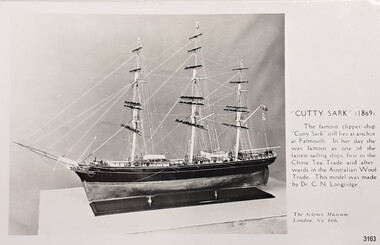
... shows a model of Cutty Sark built by the renowned C. N. Longridge, who was not only a respected surgeon but also a skilled model maker and author of detailed maritime works. A further connection is found in the printer, B Matthews, who photographed and printed collections featuring famous people, model ships and maritime scenes, adding another layer of historical interest to the postcard. Flagstaff Hill Warrnambool Flagstaff Hill Maritime Museum Shipwreck Coast Flagstaff Hill Maritime Village Maritime Museum Great Ocean Road ...The maker of the ship model on the postcard was Dr C Nelson Longridge (1876–1952), an English surgeon, maritime author, and builder of detailed ship models. Other models include the SS Marioness and the steam yacht Asia. He also wrote the books 'Cutty Sark' and 'The Anatomy of Nelson's Ships'. The postcard was printed by B Matthews, Bradford, England, incorporated in 1970 as B. Matthews (Photo Printers) Limited. Collections of B Matthews' photo prints of famous painted portraits are held at The National Portrait Gallery of London. Copies of B Matthews postcards are today sought after by collectors. THE CUTTY SARK: - The Cutty Sark was built in Britain in 1869 and was one of the last great sailing ships. At first, it carried tea from China. Later, it was used to transport wool from Australia. It became famous for its speed and held the record for the fastest voyage from Australia to Britain for ten years. Later, a Portuguese company bought the ship and renamed it Ferreira. After that, a retired sea captain purchased it to use as a training ship in Cornwall. When the captain died, the ship was given to a training college in Greenwich in 1938. In 1954, it was placed in dry dock at Greenwich, where it remains on display. This postcard features a photograph of a model of the sailing ship Cutty Sark, making it significant because of its connection to this well-known vessel. The famous tea clipper transported wool from Australia to markets around the world. Models such as this one help us understand what sea travel was like before steam-powered ships became widespread, while also illustrating how trade, travel and migration developed over time. Cutty Sark was also celebrated for its speed. It broke records on the voyage from Australia to Britain and held this distinction for ten years. Its importance is still recognised today, as the ship has been carefully preserved and is now displayed at the British Maritime Museum in Greenwich. Its remarkable history has also made it a popular subject for model ship enthusiasts. The postcard is also valuable because it shows a model of Cutty Sark built by the renowned C. N. Longridge, who was not only a respected surgeon but also a skilled model maker and author of detailed maritime works. A further connection is found in the printer, B Matthews, who photographed and printed collections featuring famous people, model ships and maritime scenes, adding another layer of historical interest to the postcard. Postcard, black and white, showing a model of the sailing ship Cutty Sark. Printed details are provided on both the front and back of the postcard. Inscriptions include a brief description of the Cutty Sark, the location and maker of the model, and the printer's contact information. The postcard was printed in Great Britain.FRONT: " "CUTTY SARK" (1869) The famous clipper ship "Cutty Sark" still lies at anchor at Falmouth. In her day, she was famous as one of the fastest sailing ships, first in the China Tea Trade, and afterwards in the Australian Wool Trade. This model was made by Dr C.N. Longridge." "The Science Museum, London. No. 166." REVERSE: "POSTCARD" "COMMUNICATION" "ADDRESS" "Printed by B Matthews, Bradford, England"flagstaff hill, warrnambool, flagstaff hill maritime museum, shipwreck coast, flagstaff hill maritime village, maritime museum, great ocean road, cutty sark, historic sailing ship, tea clipper, sail training vessel, cadet training ship, commercial trading vessel, cargo sail vessel, clipper races, scott and linton of dunbarton scottland, race record, ferreria, 1869, tea cargo, tea trade, china tea, wool export, australian export, australian wool export, china tea trade, cornwall, training ship, greenwich, british museum, ship model, craft, hobby, ship model cutty sark, model making, postcard, c nelson longridge, charles nelson longridge, b matthews, photo printer, b matthews bradford england, b matthews (photo printer ) ltd. -
 Flagstaff Hill Maritime Museum and Village
Postcard - Vessel, Sailing Ship, Cutty Sark in Sydney Harbour, After August 1891
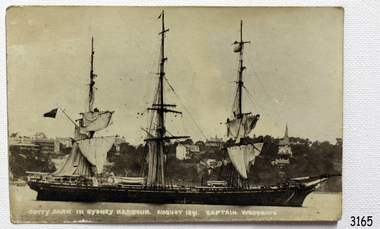
... The postcard is important to Australian history, as it shows the Cutty Sark at Sydney on one of its voyages, in the command of Captain Richard Woodget, a respected mariner and master of sailing ships. Flagstaff Hill Warrnambool Flagstaff Hill Maritime Museum Shipwreck Coast Flagstaff Hill Maritime Village Maritime Museum Great Ocean Road Cutty sark historic sailing ship tea clipper sail training vessel cadet training ship commercial trading vessel cargo sail vessel clipper races Scott and Linton of Dunbarton Scottland race record transportation Ferreria 1869 tea cargo tea trade China tea wool export Australian export Australian wool export China tea trade Cornwall training ship Greenwich British Museum Captain Richard Woodget Captain Woodget "CUTTY SARK IN SYDNEY HARBOUR. ...Captain Richard Woodget (1845-1928) was renowned for his successful command of the Cutty Sark. He began his maritime career in 1861 as an apprentice seaman at almost 15 years old and received his Master Certificate in 1871. In 1881, aged 35, he took his first command on the vessel Coldstream. His sailing skill and careful financial management earned him the command of the Cutty Sark for ten of its voyages. For another year, he commanded the Coldingham, then retired from life as a mariner in 1896. The Cutty Sark was built in Britain in 1869 and was one of the last great sailing ships. At first, it carried tea from China. Later, it was used to transport wool from Australia. It became famous for its speed and held the record for the fastest voyage from Australia to Britain for ten years. Later, a Portuguese company bought the ship and renamed it Ferreira. After that, a retired sea captain purchased it to use as a training ship in Cornwall. When the captain died, the ship was given to a training college in Greenwich in 1938. In 1954, it was placed in dry dock at Greenwich, where it remains on display. The postcard is important for is connection with the vessel, Cutty Sark, a special ship because it carried wool from Australia to other parts of the world. Postcards like this one help us imagine what sea travel was like before steam-powered ships were common, and they show us how trade, travel and migration changed over time. The Cutty Sark is also famous for being very fast. It set a record for the journey from Australia to Britain and kept that title for ten years. Today, people still recognise its importance because it has been carefully preserved and is on display at the British Maritime Museum in Greenwich. Its story has also made it a favourite subject for people who enjoy building ship models. The postcard is important to Australian history, as it shows the Cutty Sark at Sydney on one of its voyages, in the command of Captain Richard Woodget, a respected mariner and master of sailing ships.Postcard: Black and white postcard of a photographed image of a 3-masted sailing ship, sails half-lowered. Behind the vessel is a hill with buildings on it. A white handwritten inscription is along the base of the postcard. The vessel is the Cutty Sark in Sydney Harbour in August 1891. Its master was Captain Woodget."CUTTY SARK IN SYDNEY HARBOUR. AUGUST 1891. CAPTAIN WOODGATE."flagstaff hill, warrnambool, flagstaff hill maritime museum, shipwreck coast, flagstaff hill maritime village, maritime museum, great ocean road, cutty sark, historic sailing ship, tea clipper, sail training vessel, cadet training ship, commercial trading vessel, cargo sail vessel, clipper races, scott and linton of dunbarton scottland, race record, transportation, ferreria, 1869, tea cargo, tea trade, china tea, wool export, australian export, australian wool export, china tea trade, cornwall, training ship, greenwich, british museum, captain richard woodget, captain woodget -
 Flagstaff Hill Maritime Museum and Village
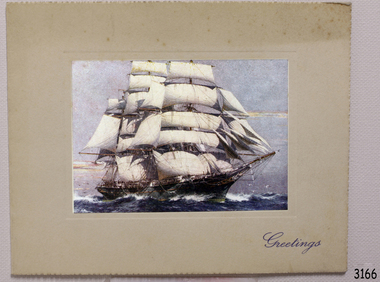
Photograph - Vessel, Sailing Ship, Jack Spurling (John Robert Charles Spurling), marine artist, circa 19th century
... show us how trade, travel, and migration evolved. The Cutty Sark is also famous for its speed. It set a record for the journey from Australia to Britain and kept that title for ten years. Today, people still recognise its importance because it has been carefully preserved and is on display at the British Maritime Museum in Greenwich. The picture is a copy of a painting by renowned maritime artist Jack Spurling, who was famous for his ship portraits. Flagstaff Hill Warrnambool Flagstaff Hill Maritime Museum Shipwreck Coast Flagstaff Hill Maritime Village Maritime Museum Great Ocean Road ...The card is a copy of a painting by the renowned British maritime artist Jack Spurling (John (Jack) Robert Charles Spurling 1870-1933). Spurling's love for the sea was fulfilled as a teenager when he worked as an apprentice, eventually gaining a Second Mate certificate and going on to join the Blue Anchor Line as a junior officer. His love for the sea shows in his detailed paintings of ship portraits. THE CUTTY SARK: - The Cutty Sark was built in Britain in 1869 and was one of the last great sailing ships. At first, it carried tea from China. Later, it was used to transport wool from Australia. It became famous for its speed and held the record for the fastest voyage from Australia to Britain for ten years. Later, a Portuguese company bought the ship and renamed it Ferreira. After that, a retired sea captain purchased it to use as a training ship in Cornwall. When the captain died, the ship was given to a training college in Greenwich in 1938. In 1954, it was placed in dry dock at Greenwich, where it remains on display.The card depicts the clipper, Cutty Sark, which was a special ship because it carried wool from Australia to other parts of the world. Cards like this one help us imagine what sea travel was like before steam-powered ships became common, and they show us how trade, travel, and migration evolved. The Cutty Sark is also famous for its speed. It set a record for the journey from Australia to Britain and kept that title for ten years. Today, people still recognise its importance because it has been carefully preserved and is on display at the British Maritime Museum in Greenwich. The picture is a copy of a painting by renowned maritime artist Jack Spurling, who was famous for his ship portraits.Photograph: coloured image of the sailing ship Cutty Sark by artist J Spurling. The image is mounted on a card used as a greeting card. It has a printed inscription. "Greetings"flagstaff hill, warrnambool, flagstaff hill maritime museum, shipwreck coast, flagstaff hill maritime village, maritime museum, great ocean road, cutty sark, historic sailing ship, tea clipper, sail training vessel, cadet training ship, commercial trading vessel, cargo sail vessel, clipper races, scott and linton of dunbarton scottland, race record, ferreria, 1869, tea cargo, tea trade, china tea, wool export, australian export, australian wool export, china tea trade, cornwall, training ship, greenwich, british museum, postcard, coloured postcard, postcard of a painting, jack spurling, british maritime artist, ship portraits, john 'jack' robert charles spurling -
 Flagstaff Hill Maritime Museum and Village
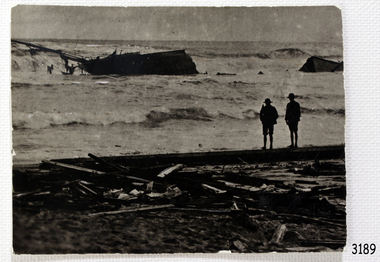
Photograph - Photograph of Edinburgh Castle' stranded and wrecked at Lady Bay, circa 1888
... The “Edinburgh Castle” is included as one of the shipwrecks in Heritage Victoria’s Historic Shipwreck Trail on Victoria’s West Coast. flagstaff hill warrnambool shipwrecked-coast flagstaff-hill flagstaff-hill-maritime-museum maritime-museum shipwreck-coast flagstaff-hill-maritime-village great ocean road edinburgh castle barque 1863 edinburgh castle shipwreck 1888 shipwreck 15-05-1888 glasgow ship jg lawrie t skinner and co liverpool ship register captain j.b. darling gifford & nicholson cement casks cement barrels warrnambool breakwater construction breaches buoy rocket crew rocket launcher lifesaving equipment warrnambool harbour lady bay warrnambool ship pilot carless lady bay shipwreck peter ronald colin goodall lady bay diving site marine archaeology victorian heritage register vhr s209 Black and white photograph of the iron barque 'Edinburgh Castle' stranded and wrecked at Lady Bay, Warrnambool, on January 15th 1888. The photograph shows ...This photograph was taken close to the time of the wreck of the "Edinburgh Castle". The “Edinburgh Castle”, three-masted iron barque, was built in Glasgow, Scotland, in 1863 by J.G. Lawrie. She was 53.7 meters long and weighed 627 tons. She was owned by shipping company T Skinner and Co and registered at Liverpool, England. She sailed from 1863 to 1885 along the trade route between Scotland, China, and Singapore. In 1887 the Master, Captain J.B. Darling, sailed the “Edinburgh Castle” for its new owners Gifford & Nicholson from London to Warrnambool. Her cargo was 4,900 casks of cement for the construction of the new Warrnambool Breakwater. Over the three month journey, the ship met with rough weather and even a hurricane. On January 15th 1888 the “Edinburgh Castle” approached Lady Bay where a welcoming crowd gathered. The Port’s relief Harbour Master, Pilot Carless took over to complete the docking. As he tried to guide her, the Lighthouse Keeper signalled that the ship was too close to shore. The pilot continued on his course, causing her to ‘miss stays’ (make an incorrect tack). The crew dropped anchors and tried to lighten the load by throwing some of the casks of cement overboard but this was to no avail, and she drifted sideways in calm waters, lodging in the sand. A distress signal was sent to the coastal steamer “Julia Percy”, which spent several hours trying to pull the stranded ship away, but it would not budge. Those involved hoped to re-float the ship but efforts to save the vessel were useless. The captain and some crew stayed on board. When the weather became rough the rocket crew brought its lifesaving gear to the shore, ready to launch a line to the ship. The three men on board sent those onshore a message in a bottle to assure the on-lookers that they were quite comfortable to stay aboard. After a night of bad weather, the crew were glad to accept the rocket crew’s help and were in turn safely hauled to shore in a breeches buoy. The ship broke up quickly. Very little of the cargo could be saved. A week later all that could be seen of her was the bow and some of the stern. The beach was littered with wreckage, including cement cask fragments, for weeks. Ironically, on the morning after the ship ran aground, the very same “Edinburgh Castle” was offered for sale at an auction in Melbourne, billed as “a sound ship with all the fittings and in the best order.” The sale was completed before they heard the news that the ship was totally wrecked! Over the decades the shifting sands concealed the wreck of “Edinburgh Castle”. However, in October 1985 two local divers, Peter Ronald and Colin Goodall discovered her near the Hopkins River mouth. Peter said in his book ‘Exploring Shipwrecks of Western Victoria’, “In the midst of this sand-cloud I could clearly see row after row of neatly stacked barrels”. He remarked, “I am privileged to have had at least a glimpse of one of Warrnambool's most significant wrecks.” Some 15 – 17 ships are believed to have sunk in Lady Bay, but only two have been discovered on the seafloor; the “Edinburgh Castle” and the “La Bella”. Both wrecks are popular diving sites and are preserved as significant historical marine and marine archaeological sites. The sailing ship “Edinburgh Castle” is of local and state and national significance. It is one of the only two shipwrecks discovered in Lady Bay, Warrnambool, out of the 15-17 shipwrecks in the bay. The “Edinburgh Castle” is significant for being one of the largest vessels lost in the bay. The significance of the wreck of the “Edinburgh Castle” was recognised by being listed on the Victorian Heritage Database VHR S209. She was declared an Historic Shipwreck on 17th January 1989 under the Commonwealth Historic Shipwrecks Act (1976). The “Edinburgh Castle” wreck is also significant for the connection of its cargo with the building of the Warrnambool Breakwater, also listed on the Victorian Heritage Database VHR H2024. The “Edinburgh Castle” is included as one of the shipwrecks in Heritage Victoria’s Historic Shipwreck Trail on Victoria’s West Coast. Black and white photograph of the iron barque 'Edinburgh Castle' stranded and wrecked at Lady Bay, Warrnambool, on January 15th 1888. The photograph shows wreckage along the shore and two standing figures looking on.flagstaff hill, warrnambool, shipwrecked-coast, flagstaff-hill, flagstaff-hill-maritime-museum, maritime-museum, shipwreck-coast, flagstaff-hill-maritime-village, great ocean road, edinburgh castle barque 1863, edinburgh castle shipwreck 1888, shipwreck 15-05-1888, glasgow ship, jg lawrie, t skinner and co, liverpool ship register, captain j.b. darling, gifford & nicholson, cement casks, cement barrels, warrnambool breakwater construction, breaches buoy, rocket crew, rocket launcher, lifesaving equipment, warrnambool harbour, lady bay warrnambool, ship pilot carless, lady bay shipwreck, peter ronald, colin goodall, lady bay diving site, marine archaeology, victorian heritage register, vhr s209 -
 Flagstaff Hill Maritime Museum and Village
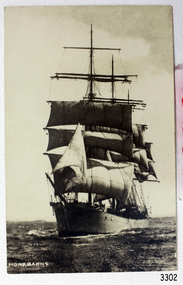
Postcard - Ship, Monkbarns, ca. 1924
... The postcard shows and example of the sailing ships that traded across the seas and into Australia in the late 19th and early 20th century. Monkbarns postcard sailing ship flagstaff hill warrnambool maritime village maritime museum flagstaff hill maritime museum & village shipwreck coast great ocean road newccastle hulk Handwritten on front "MONKBARNS". ...This photograph of the Monkbarns was taken prior to 1927 before the sailing ship was converted for use as a hulk. The steel-hulled, 3-masted fully rigged ship was built in 1895 by Archibald McMillan & Son at Dumbarton in Scotland. It was 267 feet long, 40.1 feet wide and 23.5 feet deep. In 1914 John Stewart & Co. owned ten sailing vessels, one of which was the Monkbarns, but by the end of the first World War, the fleet had only four vessels survived the war, including the Monkbarns. The Monkbarns traded across the world. Some of the destinations included Port Adelaide, Table Bay in South Africa, Liverpool, Sydney, London and New York. Her last commercial voyage was in 1926. Overall, the ship traded for 32 years before it was converted in Spain in 1927 for use as a hulk for carrying coal. There were several owners of the ship over its lifetime. They were - 1895, first owner, Charles Webster Corsar, Liverpool - 1902, the owner was D. Corsar & Son, Liverpool - 1909, owned by John Hardie & Sons, Glasgow - 1911, John Stewart & Co., Liverpool - by1915, James A. Young, London - 1926, L.H. Wilson, Liverpool - 1927, Ballener Espando (Brunn & van Lippe, Tonsberg).The postcard shows and example of the sailing ships that traded across the seas and into Australia in the late 19th and early 20th century.Black and white postcard of a sailing ship, fully rigged, at sea. Handwritten on front of card is "Monkbarns"Handwritten on front "MONKBARNS". monkbarns, postcard, sailing ship, flagstaff hill, warrnambool, maritime village, maritime museum, flagstaff hill maritime museum & village, shipwreck coast, great ocean road, newccastle, hulk -
 Flagstaff Hill Maritime Museum and Village
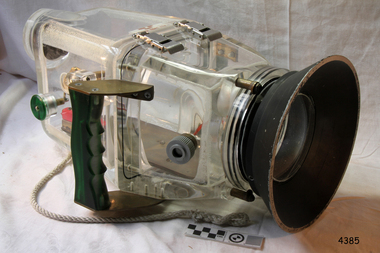
Equipment - Camera Housing, Wills Camera Housings, Late 1960s to the mid-1970s
... Road. Flagstaff Hill Maritime Museum and Village has underwater footage of dives that show the now protected shipwrecks. ...This is an early underwater camera housing for a video camera. It was sold by Wills Camera Housings from Kaniva, Victoria. It is dated around the late 1960s to the mid1970s. The history of underwater photography began with the first protective camera box for underwater photography was made in 1856. In 1914 the first underwater video footage was taken. Colour underwater photography was first shot in 1926. In 1950 the first commercially available underwater camera housing, the "Tarzan" was designed by Henry Broussard, an underwater photographer, for his own camera. It was produced by the French company Beauchat. In 1957 the revolutionary underwater camera was invented by Jaques-Yves Cousteau and Jean de Wouters. The new amphibious "Calypso" changed the nature of underwater photography.This underwater video camera housing is significant for its purpose of underwater photography. Camera housings such as this were used to record the position and layout of shipwrecks along coast of the Great Ocean Road. Flagstaff Hill Maritime Museum and Village has underwater footage of dives that show the now protected shipwrecks.Underwater camera housing for a video camera. Perspex and metal, made by Wills Camera Housings of Kaniva, Victoria. flagstaff hill, flagstaff hill maritime museum and village, warrnambool, maritime museum, maritime village, great ocean road, shipwreck coast, camera housing, underwater camera housing, video camera housing -
 Flagstaff Hill Maritime Museum and Village
Container - Bottle, J R Alexander & Sons Ltd, c. 1936
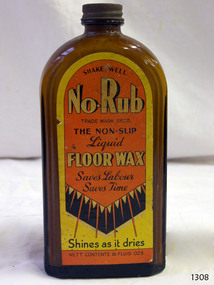
... show sketches of the wax containers, which were round bottles or metal cans. The bottle in our collection is likely to be made around the 1960s. Flagstaff Hill Flagstaff Hill Maritime Museum and Village Warrnambool Maritime Museum Maritime Village Great Ocean Road Shipwreck Coast glass technology bottle glass bottle brown glass cleaning product floor cleaner floor polish domestic cleaner No-Rub floor wax non-slip flat bottle bottle contents liquid wax J R Alexander & Sons household cleaning cleaning products Zippy Starch Zippy Window Cleaner liquid floor wax No Rub floor wax supreme shoe polish rectangular bottle Printed on the label: "SHAKE WELL" "No-Rub" TRADE MARK REGD." ...This bottle labelled No Rub liquid wax proclaims the wonders of No-Rub, no-slip, and shines as it dries. The bottle still contains some of the liquid floor wax, made by J R Alexander & Sons Limited. The company was registered as a limited company from 1924 to 1975. However, the firm's advertisement and referrals from satisfied Melbourne customers, printed in The Argus, Melbourne, on Mach 19th, 1954, states that it made the first shoe polish, Supreme, in Australia as long ago as 1900. The firm made a range of household cleaning products such as floor wax, shoe polish and fabric starch. The J R Alexander & Sons Ltd. No-Rub liquid wax was advertised in various states of Australia from around 1936 until the 1950s. Later advertisements show sketches of the wax containers, which were round bottles or metal cans. The bottle in our collection is likely to be made around the 1960s.Bottle; brown glass with metal cap and yellow, orange and black label on the front. Flat rectangular-shaped bottle with a short neck and rounded shoulders The bottle has a black metal screw top lid and contents inside. There are inscriptions on the label. The bottle contains No Rub Floor Wax. Made by J R Alexander and Sons, of Adelaide, Melbourne, Sydney and BrisbanePrinted on the label: "SHAKE WELL" "No-Rub" TRADE MARK REGD." "THE NON-SLIP / Liquid / FLOOR WAX / Saves Labour / Saves Time" "Shines as it dries" "NETT CONTENTS 15 FLUID OZS"flagstaff hill, flagstaff hill maritime museum and village, warrnambool, maritime museum, maritime village, great ocean road, shipwreck coast, glass technology, bottle, glass bottle, brown glass, cleaning product, floor cleaner, floor polish, domestic cleaner, no-rub, floor wax, non-slip, flat bottle, bottle contents, liquid wax, j r alexander & sons, household cleaning, cleaning products, zippy starch, zippy window cleaner, liquid floor wax, no rub floor wax, supreme shoe polish, rectangular bottle -
 Flagstaff Hill Maritime Museum and Village
Instrument - Fob Watch, ca 1878
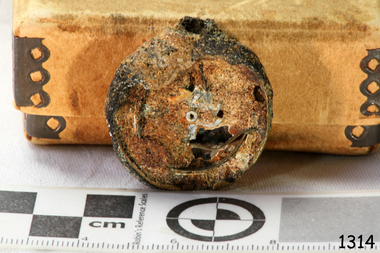
... The survival of the carefully packaged watch and related documents shows the respectful understanding of preservation of historic artefacts, even from almost 150 years ago at the time of writing (2025). Flagstaff Hill Warrnambool Shipwreck Coast Flagstaff Hill Maritime Museum maritime museum Flagstaff Hill Maritime Village Great Ocean Road Loch Ard Eva Carmichael Tom Pearce Loch Ard Gorge Loch Ard souvenir Port Campbell Miss Carmichael Mrs Carmichael Dr Carmichael 1878 Loch Ard: the wreck that became a legend ladies fob watch gold watch fob watch pocket watch horology accessory time keeping scientific instrument ladies' watch ladies' pocket watch lady's watch souvenir watch survivor clocks and watches diagonally striped envelope lining Firenze Busta Earliera Florence italy Glencove Portsea Victoria 1905 1917 Nepean Hotel Moreton Morton Elizabeth Morton Mrs J. ...The story of this gold fob watch is intriguing. The letter is dated March 6, 1905, 27 years after the Loch Ard was wrecked. It appears to be a quick personal note from a relative or friend who briefly writes the history of the enclosed ‘souvenir’ watch, found in Loch Ard Gorge at Port Campbell. Although the finder is not named, it is likely the letter’s author. The writer mentions that the letter and watch would be sent once photographs of the area where the watch was found had been added. The fancy, lined envelope’s date stamp is October 12th, 1917 (12.10.17), almost 12 years after the letter was written. It has a postmark from Florence (Firenze), Italy. The handwriting on the envelope differs from that of the letter, and there is no further mention of photographs being included. The condition of the watch certainly shows the effects of time in the sea. Some inner workings can be seen through broken encrustations and missing sections of its case. The winding knob on the top is recognisable even though it is covered by sand and other adhesions from the sea. Its dainty size and gold case suggest that it was made for a well-to-do female. The watch, envelope and letter were donated along with a 1971 newspaper cutting, all neatly folded and tucked with the watch into a small, strong cardboard box with metal reinforcing on the corners and a fitted lid. The newspaper article gives context to the watch, telling the story of the Loch Ard shipwreck tragedy and the two survivors, but does not refer to the watch. Perhaps one of the 17 passengers sailing on the Loch Ard, including members of the Carmichael family, owned the watch, or maybe it was amongst the cargo, as the ship’s manifest includes ‘clocks and watches £25’. . Considering the dates of the letter and the envelope, did the finder of the ‘souvenir’ watch take it to Europe? Was it used for good luck during service in the military? . Comparing the different writing on the letter and the envelope, does it suggest that the watch’s finder was overseas and asked someone to send the envelope to the intended recipient, with postage from Italy? ABOUT the address, “Glencove”: The details on the envelope are faint and obscured by stiff creases in the paper. The address appears to be “Mrs J. Mortton, Glencove, Portsea, Victoria, Australia”; though the family at that address had the surname “Morton”. Mrs J. Morton, formerly Elizabeth Ford, married her second husband, James Morton, in 1904, the year before the date of the letter. The couple lived at the Nepean Hotel before they were at “Glencove”. Although they never owned that property, it was their home when James died in 1937. Elizabeth’s nephew, Alfred Sandle Ford (1894-1981), and a nephew-in-law were overseas during World War I. Alfred Ford had moved to Melbourne as a young boy with his father. He entered service as Second Lieutenant in 1915, naming his father, Alfred Sandle Ford, as his next of kin. He served in Egypt, France and Belgium with the Australian Imperial Forces as a member of the Field Artillery Brigades. He returned to Melbourne in 1919 and worked in Richmond and Box Hill. He later married Frances Whyburn. Previously, in 1872, Elizabeth Ford’s sister, Julia Ford, acquired the 1-acre property with a 3-room house that became known as “Glencove”, Portsea. The building was originally the first school in the area, established before Crown Land sales. In the Parish of Nepean, it was first assessed for rates in 1871. Julia Ford (1843-1912) and Elizabeth Ford (1859-1957) were daughters of James Sandle Ford (1811-1890), a well-known pioneer of Portsea, formerly a convict limeburner. James Ford acquired several Crown allotments in Portsea. In 1872, he converted his old hotel into the large residential establishment known as the Nepean Hotel, which his family largely ran until it was demolished in 1971. During those years, different family members lived at the Nepean Hotel or Glencove. In 1877, Julia Ford married a significant landowner, John Cain, a limeburner from Rye. They had five daughters, four of whom were never married; Kathleen (1880-1949), Mabel (1881-1973), who was the last family member to own the house until her death, Hilda (1884-1974) and Julia Ethel (1888-1949). Some of the newspaper records refer to “Glencove”, Portsea, inform that: 1927 - Dr. and Mrs. J. E. Shilliday are staying with Mrs. R. B. Sanderson at Glencove. (Australasian) 1937 - James Morton died at his property, Glencove, Portsea, aged 83 years (Argus) 1949 - Julia Ethel Cain died at Glencove, Portsea. (Argus) 1949 - Probate application by sisters of Julia Ethel Cain, deceased, formerly of Nepean Hotel, Portsea, but late of Glencove, Nepean Highway, Portsea. The connection of the watch with the sands of Loch Ard Gorge and to the ship Loch Ard contributes to our knowledge of personal items brought to Australia in 1878, whether as the belongings of a passenger or as cargo; a gold watch would be intended for a wealthy buyer. The little artefact helps us understand the survival of artefacts in the powerful sea, over a quarter of a century after the wreck of the ship. Although many people would have visited the shipwreck site, the length of time before it was found helps us understand the effects of the sea on shipwreck artefacts. The survival of the carefully packaged watch and related documents shows the respectful understanding of preservation of historic artefacts, even from almost 150 years ago at the time of writing (2025). Ladies' fob watch, thought to be gold. It is now covered in encrustation. A bump on the edge would be the winding mechanism for the watch. A small section of the back of the case has broken away, and an engraved surface can be seen. Face and hands are missing, revealing the spring workings inside. Donated with the watch were two documents and a newspaper cutting about the story of the shipwreck of the Loch Ard. They are all in a strong cardboard box with reinforced corners on the base and lid. Found at Loch Ard Gorge and said to have been from the Loch Ard. The three donated documents are: - 1. A rectangular envelope made of cream waxy paper lined with black and white diagonally striped paper. The top right corner, usually meant for a postage stamp, has been torn off, partly exposing text on a rectangular printed logo. A round black postmark stamp near the top centre shows the post office location and date. The address on the front is handwritten in black ink. The creases on the envelope suggest it has been folded three times. 2. A letter on cream rectangular paper features clear, handwritten script in black ink. The unevenly cut bottom edge has two short black vertical lines, possibly the tops of tall written letters. There are creases where the page has been folded three times. 3. A newspaper clipping featuring text, an illustration, and handwritten details of the newspaper’s source.1. Envelope: - Address: ”Australia (per Postage) / [looks like “Mrs J. Mortton”] / Glencove, (Portsea) / Victoria” Postmark: “FIRENZE” 12 10 17” “ - - - -PORTEN – (illegible)” Logo inside envelope: “BUSTA BRE--- / Earliera Lialia” [Italian; Busta = envelope, Earliera == earlier] 2. Letter: - “I am sending you a ‘souvenir’ from the wreck of the Loch Ard 28 years ago at Port Campbell. It is the remains of a lady’s gold watch found in the gorge where Miss Carmichael & Tom Pearce (the only two saved) were washed up. This souvenir was lying there ever since. I went down into the awful gorge & saw the cave where these two unfortunates (or fortunate perhaps, as they were saved) lived until rescued. I also saw the graves of those who were washed up from the wreck. One grave contains Dr and Mrs Carmichael & six of their children. Later on, when I can get some good views of that wild coast I will send them to you. 6/3/05.” 3. Newspaper cutting: - History of the Lochard. Refer to the Sydney Morning Herald, Nov. 28th, 1971: “Loch Ard: the wreck that became a legend” flagstaff hill, warrnambool, shipwreck coast, flagstaff hill maritime museum, maritime museum, flagstaff hill maritime village, great ocean road, loch ard, eva carmichael, tom pearce, loch ard gorge, loch ard souvenir, port campbell, miss carmichael, mrs carmichael, dr carmichael, 1878, loch ard: the wreck that became a legend, ladies fob watch, gold watch, fob watch, pocket watch, horology, accessory, time keeping, scientific instrument, ladies' watch, ladies' pocket watch, lady's watch, souvenir watch, survivor, clocks and watches, diagonally striped envelope lining, firenze, busta, earliera, florence, italy, glencove, portsea, victoria, 1905, 1917, nepean hotel, moreton, morton, elizabeth morton, mrs j. morton, james morton, elizabeth ford, julia ford, alfred sandle ford, frances whyburn, james sandle ford, john cain, kathleen cain, mabel cain, hilda cain, julia ethel cain, australian imperial forces, field artillery brigades, limeburner -
 Flagstaff Hill Maritime Museum and Village
Furniture - Childs high chair, 1890 - 1900
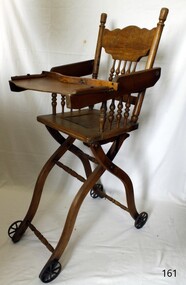
... show woodworkers were adapting chair designs for younger users in Europe and America at this time. An early children's wooden high chair probably made in America around 1890-1900. Many American manufactures made this type of wooden high chair called an “Eastlake” style and many did not mark their work so it is difficult to determine the subject items exact provenance. A significant item giving a snapshot into the evolution of children's furniture and domestic life during the late Victorian era. flagstaff hill warrnambool shipwrecked coast flagstaff hill maritime museum shipwreck coast flagstaff hill maritime village great ocean road ...It appears that the earliest form of child's high chair is attributed to Jonathan Jacobs (1845-1919) a cabinet maker of Browningsville, Pennsylvania USA around the mid to late 19th century. However, children’s chairs from the 18th century and earlier were being used and are in many museum collections around the world that show woodworkers were adapting chair designs for younger users in Europe and America at this time.An early children's wooden high chair probably made in America around 1890-1900. Many American manufactures made this type of wooden high chair called an “Eastlake” style and many did not mark their work so it is difficult to determine the subject items exact provenance. A significant item giving a snapshot into the evolution of children's furniture and domestic life during the late Victorian era.Convertible pressed back Victorian era high chair with convertible frame, cast iron wheels, Carved picture of a child to back of seatflagstaff hill, warrnambool, shipwrecked coast, flagstaff hill maritime museum, shipwreck coast, flagstaff hill maritime village, great ocean road, high chair, potty chair, baby furniture, kitchen furniture -
 Flagstaff Hill Maritime Museum and Village
Document - Sheet Music, Enoch & Sons Ld., music publisher, The Parade of the Tin Soldiers, ca 1911
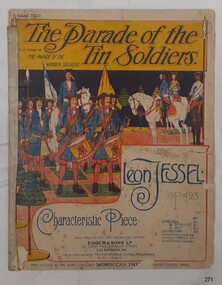
... show and a film. The music an example of entertainment in the early 20th century that has endured to current times and often played at Christmas celebrations. Flagstaff Hill Flagstaff Hill Maritime Museum and Village Warrnambool Maritime Museum Maritime Village Great Ocean Road Shipwreck Coast Leon Jessel composer operetta composer The Parade of the Tin Soldiers The Parade of the Wooden Soldiers musical march music conductor music director bandmaster 19th-century classical composers 19th-century German composers 20th-century classical composers 20th-century German composers sheet music music book piano music Jewish composer World War II victim Composer: Leon Jessel. ...This sheet music is "The Parade of the Tin Soldiers', the original German title, composed by Leon Jessel as a solo piece for the piano in 1905. The work is also known as "The Parade of the Wooden Soldiers". In 1907 the orchestra version was published, Opus 123. (Op. 123, as written on the cover). The sheet music was published by Sole Publishers for the British Empire, Enoch & Sons Ld (1890-1927) of 58 Great Marlborough Street, London, W. Versions for all other countries were published by Neinrichshofen's, Verlag, Magdeburg. Orchestral and Military arrangements of the music were published by Hawkes & Son, Denman St, Piccadilly Circus, London, Leon Jessel (Jan. 22, 1821 to Jan. 4, 1942) was a German composer who was born a Jew and converted to Christianity in 1894. His works included a wide variety of music including 'The Parade of Tin Soldiers' (Die Parade der Zinnsoldaten). Jessel was also a music conductor and bandmaster. The instrumental piece 'Die Marokkanische Patrouille' (The Moroccan Patrol) was published in 1911, Opus 227. He was also known for his operettas 'Schwarzwaldmädel'(Black Forest Girl), presented in 1917, and 'Die Postmeisterin' (The Postmistress), presented in 1921. In December 1941 he was arrested and then tortured by the German Gestapo; he died in January 1942. In the early 1920s, The Parade of the Tin Soldiers became very popular; it was presented as part of a show and was re-titled The Parade of the Wooden Soldiers. It was also made into a film and its recording was a hit single record. The music continues to be played and presented and is a Christmas-time favourite.This music is significant for its connection with the German composer Leon Jessel, a victim of the Germans for being born a Jew, even though he converted to Christianity in his youth. It is also significant as a popular work of music composed in the early 1900s and later used for a variety show and a film. The music an example of entertainment in the early 20th century that has endured to current times and often played at Christmas celebrations.Book of sheet music for four tunes. The thin softcovered book has eight pages, with the front cover featuring colourful graphics of soldiers marching and others on horseback. The four tunes are: - The Parade of the Tin Soldiers, (piano solo), Composer: Leon Jessel. Ballade de la Lune, Enjolement, Lentement, document, tendrament, Publisher: for the British Empire, Hawkes & Son, Denman St, Piccadilly Circus, London, Sole Publishers for the British Empire, Printer: Enoch & Sons Ld. 58 Great Marlborough Street, London, W. Printer: Lowe & Brydone Printers Ltd. London N.W. 10 Publisher, for all other countries: Heinrichshofen's, Verlag, Magdeburg. Printed: in England by Heinrichshofen's Verlag Copyright: 1911 by Heinrichshofen's VerlagOther print on the cover includes: ALSO KNOWN AS "THE PARADE OF THE WOODEN SOLDIERS" "Op. 123" "Characteristic Piede" "SOLE PROPRIETORS FOR THE BRITISH EMPIRE" "NEW SUCCESS BY THE SAME COMPOSER 'MOROCCAN PAT(ROL) (CH)ARASTIC PIECE" "PIANO SOLO" "SIMPLIFIED" "DUET" "VIOLIN & PIANO" "Orchestral & Military Arrangements" On the bottom of pages: "E & S 4370" "Copyright 1911 by Heinrichshofen's Verlag" flagstaff hill, flagstaff hill maritime museum and village, warrnambool, maritime museum, maritime village, great ocean road, shipwreck coast, leon jessel, composer, operetta composer, the parade of the tin soldiers, the parade of the wooden soldiers, musical march, music conductor, music director, bandmaster, 19th-century classical composers, 19th-century german composers, 20th-century classical composers, 20th-century german composers, sheet music, music book, piano music, jewish composer, world war ii victim, composer: leon jessel., ballade de la lune, enjolement, lentement, hawkes & son, for all other countries: heinrichshofen's, verlag, magdeburg., book of sheet music, enoch & sons ltd london, lowe & brydone london, heinrichschofens verlag, marching music, 1911, early 20th century -
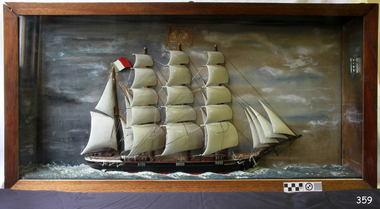 Flagstaff Hill Maritime Museum and Village
Craft - Ship Model, Hygeia, Bef. 1983
... The model also shows the configuration of a three-masted, fully rigged sailing ship, of the type that carried immigrants to Australia. Flagstaff Hill Maritime Museum and Village Maritime Museum Maritime Village Great Ocean Road Shipwreck Coast ship model ship model hygeia hobby craft maritime model model making Hygeia sailing ship 1863 1877 cargo ship Italian flag square-rigged barque three-masted "HYGEIA" Ship model; diorama with a model of the sailing ship HYGEIA at sea in full sail, in a setting of sky and sea. ...This ship model is a representation of the wooden barque Hygeia, which is also the name of the Greek goddess of health, cleanliness and hygiene. The model flies the Italian flag, which was adopted in 1946 but originated in 1797. The colours stand for freedom, solidarity and equality. The three-masted, wooden barque Hygeia was built in 1863 in the UK by J.M. Reed to carry cargo. It was first registered on July 30th, 1863, at Sunderland, UK, by owners Matthew Cay Jr. & Joseph Crisp. In August 1877, the ship was dispatched from Alexandria, Egypt, destined for Fairmouth with a cargo of beans, but mysteriously went missing. The ship diorama exemplifies the popular, centuries-old hobby of ship model making, with the setting of sea and sky giving it depth and context. The model also shows the configuration of a three-masted, fully rigged sailing ship, of the type that carried immigrants to Australia. Ship model; diorama with a model of the sailing ship HYGEIA at sea in full sail, in a setting of sky and sea. It displays a tricolour flag with three vertical stripes of equal width, which from the hoist side are coloured green, white and red. An inscription has the ship's name, Hygeia."HYGEIA"flagstaff hill maritime museum and village, maritime museum, maritime village, great ocean road, shipwreck coast, ship model, ship model hygeia, hobby, craft, maritime model, model making, hygeia, sailing ship, 1863, 1877, cargo ship, italian flag, square-rigged, barque, three-masted -
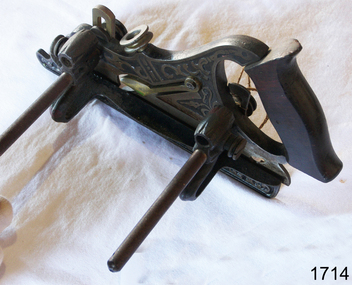 Flagstaff Hill Maritime Museum and Village
Tool - Plane, Stanley Rule & Level Co, 18-05-1886
... Flagstaff Hill Flagstaff Hill Maritime Museum and Village Warrnambool Maritime Museum Maritime Village Great Ocean Road Shipwreck Coast plane beading plane cast steel plane 1880s plane Stanley Rule & Level Co. hand plane woodworking tool woodworking plane steel plane carpentry tool builder's tool Plane; Beading type maker Stanley Rule & Level Co, patented in 1886. The plane has an adjustable fence and depth stop and shows ...Henry Stanley established Stanley Rule and Level Co. in 1857. In the following decade steel hand planes began to replace wooden planes. This decorative plane is an 1886 model, with several options to adjust the plane to suit the work. The antique plane displays quality workmanship of the 1880s. It was designed for hard work, replacing lighter wooden planes that were unsuitable for the big jobs. It was made by Stanley Rule and Level, a firm renowned for its good quality tools and now operating as Stanley Black and Decker.Plane; Beading type maker Stanley Rule & Level Co, patented in 1886. The plane has an adjustable fence and depth stop and shows off fancy Japanned decoration. Cast steel with a wooden handle and brass fittings. 1/4 inch iron.flagstaff hill, flagstaff hill maritime museum and village, warrnambool, maritime museum, maritime village, great ocean road, shipwreck coast, plane, beading plane, cast steel plane, 1880s plane, stanley rule & level co., hand plane, woodworking tool, woodworking plane, steel plane, carpentry tool, builder's tool -
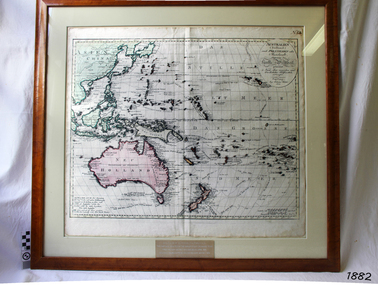 Flagstaff Hill Maritime Museum and Village
Map, Australien (Sudland) auch Polynesien oder Inselwelt, insgemein der funfte Welltheil, c.1990
... shows the early names used for countries and towns and is a valuable reference to historical interpretation. The map itself is a fine example of hand drawn and hand coloured maps of the early 19th century, the method of production, detail included, layout, symbols and so forth. flagstaff hill warrnambool shipwrecked coast flagstaff hill maritime museum maritime museum shipwreck coast flagstaff hill maritime village great ocean road australien (sudland) auch polynesien oder inselwelt, insgemein der funfte welltheil johann (johannes) walch cartographer johann (johannes) walch ausburg publisher johann (johannes) walch johann (johannes) walch map number 5b 1802 map of australia and south pacific rotary international group study exchange team rotary district 233 sweden elliminook frames voyages of tasman voyages of cook voyages of bougainville voyages of carteret voyages of byron barry lange painter of miniature portraits johann (johannes) walch Plague “ROTARY INTERNATIONAL / THE MAP WAS DONATED BY THE GROUP STUDY EXCHANGE TEAM / FROM ROTARY DISTRICT 233 SWEDEN IN APRIL 1990 / AND WAS FRAMED AND PRESENTED BY ROTARY DISTRICT 978 / BARRY LANGE – GOVERNOR DISTRICT 978 1989/90” Stamped on back “ELLIMINOOK FRAMES / MRS. ...This map is a reprint of Johann (Johannes) Walch’s “Australien (Sudland) auch Polynesien oder Inselwelt, insgemein der funfte Welltheil”, published in 1802. It shows Australia, New Zealand, South East Asia and the Pacific Islands shows a large number of places names, many of which have changed since the map was drawn. The map includes the routes and dates of the voyages of Tasman, Cook, Bougainville, Carteret, Byron, and others up to 1802. The shapes of the lands on this early map show that some of the areas had not yet been charted. The map was donated to Flagstaff Hill Maritime Village in April 1990 by the Group Study Exchange Team from Rotary District 233, Sweden. It was framed and presented by Rotary District 978 and presented by Barry Lange, the Governor of District 978 in 1989-90. (District 978, Geelong East, is now District 9780.) Johann (Johannes) Walch Johann Walch, painter and engraver, was born in 1757. He was well known for creating miniature portraits. He gained his training in Geneva, Venice and Rome. His publications include atlases and sheet maps, many of which were reprinted after his death in 1816. This reprint of an 1802 is significant for its historical and geographical contant, showing the voyages of many early explorers to the southern regions of the world including Australia. It also shows the early names used for countries and towns and is a valuable reference to historical interpretation. The map itself is a fine example of hand drawn and hand coloured maps of the early 19th century, the method of production, detail included, layout, symbols and so forth.Map, reprint of Johann (Johannes) Walch’s “Australien (Sudland) auch Polynesien oder Inselwelt, insgemein der funfte Welltheil “, first published by in Ausburg in 1802. The image on this Map No 5B, shows Australia and the south Pacific. The timber framed, glass covered, printed and coloured map was created in two sections and joined. Brass plaque at base of map states that the map was presented to Flagstaff Hill by Rotary International in April 1990. Feint lines used for aligning lettering can be seen on the map and there are large erased letters such as a “D” and “S” that are almost obscured.Plague “ROTARY INTERNATIONAL / THE MAP WAS DONATED BY THE GROUP STUDY EXCHANGE TEAM / FROM ROTARY DISTRICT 233 SWEDEN IN APRIL 1990 / AND WAS FRAMED AND PRESENTED BY ROTARY DISTRICT 978 / BARRY LANGE – GOVERNOR DISTRICT 978 1989/90” Stamped on back “ELLIMINOOK FRAMES / MRS. JILL FALKINER / ELLIMINOOK / BIRREGURRA, VIC. 3242 / PHONE: (052) 36 2080” flagstaff hill, warrnambool, shipwrecked coast, flagstaff hill maritime museum, maritime museum, shipwreck coast, flagstaff hill maritime village, great ocean road, australien (sudland) auch polynesien oder inselwelt, insgemein der funfte welltheil, johann (johannes) walch, cartographer johann (johannes) walch, ausburg publisher johann (johannes) walch, johann (johannes) walch map number 5b, 1802 map of australia and south pacific, rotary international group study exchange team, rotary district 233 sweden, elliminook frames, voyages of tasman, voyages of cook, voyages of bougainville, voyages of carteret, voyages of byron, barry lange, painter of miniature portraits johann (johannes) walch -
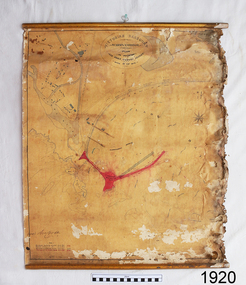 Flagstaff Hill Maritime Museum and Village
Document - Plan, Victorian Harbours Warrnambool, Victorian Harbours, Warrnambool, Plan to Accompany Sir John Coode's Report, 28-02-1879
... While the Warrnambool Breakwater is a demonstration of the engineering skills of the nineteenth century, it also demonstrates the limitations of knowledge relating to sedimentology at the time and the confidence apparent in a number of nineteenth century plans which assumed that natural forces could be overcome or contained by engineering. flagstaff hill warrnambool maritime museum shipwreck coast great ocean road sir john coode borough of warrnambool surveyor plan of warrnambool victorian harbours warrnambool harbour warrnambool breakwater port of warrnambool vhd vhr h2024 Flagstaff Hill Maritime Museum & Village Maritime Village Map chart plan Lady Bay Breakwater Jetty Pier VHR H2024 proposed works 1879 Stamped "VICTORIAN HARBOURS / WARRNAMBOOL / PLAN / to accompany / SIR JOHN GOODE'S REPORT / DATED 28 FEB 1879" Signature "John Coode" Plan of Warrnambool Harbour, Port of Warrnambool, dated 28 Feb 1879. Plan shows ...This plan is of great significance to the local history of Warrnambool, in particular the Breakwater and its impact on Warrnambool's maritime and trade history. The plan shows the existing jetties at the Port of Warrnambool, plus the partially erected Breakwater and proposed works to the Breakwater by both the Borough of Warrnambool Surveyor and Sir John Coode. The plan was signed 28th February 1879 by Sir John Coode. The legend at the bottom left describes the existing works and the proposed works. The Warrnambool Breakwater Sir John Coode was a British harbour engineer. He was brought to Melbourne by the Melbourne Harbour Trust to advise on works to improve the Port of Melbourne. The Victorian Government commissioned him to present a plan to complete the Warrnambool Breakwater. His original plan was too expensive so he prepared a revised plan for a shorter structure. The work was completed in 1890. The construction proved to be too short to protect adequately from the weather and didn't allow enough depth for larger vessels to come into port. The decreasing trade was further affected by siltation in the bay due to the breakwater, and the completion of the railway line. The situation of the harbour became a real problem that, by 1910, required continuous dredging. In 1914 the Breakwater was extended but proved to be a failure because the work began to subside and by 1920 about two thirds of the harbour was silted up. Alterations made in the 1920's increased the silting problem and by the 1940's the harbour was no longer used. More alterations were made in the 1950's and 1960's. The Warrnambool Breakwater is registered as a place of significance on the Victorian Heritage Database. This plan of the proposed works for the existing Warrnambool Breakwater is of great significance to the local history of Warrnambool, in particular the Breakwater and its impact on Warrnambool's maritime and trade history. The Warrnambool Breakwater is registered as a place of significance on the Victorian Heritage Database (VHR H2024). It is historically significant to Victoria as one of the most important maritime engineering projects in Victoria in the late 19th century. The Warrnambool Breakwater is of historical significance as one of the most important maritime engineering projects in Victoria in the late nineteenth century. It is evidence of Victoria's nineteenth century investment in regional port infrastructure and the development of Victorian coastal shipping. It is of significance for its association with the English civil engineer Sir John Coode, the most distinguished harbour engineer of the nineteenth century, who was brought to Victoria to advise on works to improve the Port of Melbourne, but was retained by the Government to advise on improvements to the harbours at Portland, Geelong, Port Fairy, and Lakes Entrance, as well as Warrnambool. His projects for Melbourne, Lakes Entrance and Warrnambool were major engineering projects of the nineteenth century. The breakwater is historically significant as a reminder of Warrnambool's early maritime history as a Western District port, and as one of Victoria's major 'outer ports'. While the Warrnambool Breakwater is a demonstration of the engineering skills of the nineteenth century, it also demonstrates the limitations of knowledge relating to sedimentology at the time and the confidence apparent in a number of nineteenth century plans which assumed that natural forces could be overcome or contained by engineering.Plan of Warrnambool Harbour, Port of Warrnambool, dated 28 Feb 1879. Plan shows existing Breakwater and work proposed by both Warrnambool Borough Surveyor and Sir John Coode. Plan has gold coloured quarter-dowel rods top and bottom and a metal ring at the top. Stamped with title. Signed by Sir John Coode.Stamped "VICTORIAN HARBOURS / WARRNAMBOOL / PLAN / to accompany / SIR JOHN GOODE'S REPORT / DATED 28 FEB 1879" Signature "John Coode"flagstaff hill, warrnambool, maritime museum, shipwreck coast, great ocean road, sir john coode, borough of warrnambool surveyor, plan of warrnambool, victorian harbours, warrnambool harbour, warrnambool breakwater, port of warrnambool, vhd vhr h2024, flagstaff hill maritime museum & village, maritime village, map, chart, plan, lady bay, breakwater, jetty, pier, vhr h2024, proposed works, 1879 -
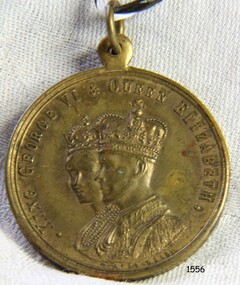 Flagstaff Hill Maritime Museum and Village
Medal - Commemorative Medal, Stokes & Sons, 1937
... shows the importance placed by the Government of Australia in educating the generation of students in 1937 about Australia's place in the Commonwealth and the history of Australia. The history of the medal is socially and politically significant, reflecting the evolution of changes in Australian society. Flagstaff Hill Flagstaff Hill Maritime Museum and Village Warrnambool Maritime Museum Maritime Village Great Ocean Road ...This medal commemorates the coronation of King George VI and Elizabeth as monarchs on the British throne, to be held on May 12th, 1937. The medal is one of over 300,000 distributed to school children as a memento of the occasion. The obverse shows the busts of King George VI and Elizabeth facing left. The reverse shows Victoria's Coat of Arms, the official heraldic symbol, with the Southern Cross on a shield, above it is a kangaroo facing left and holding a crown. The supporting figure on the left holds an olive branch of 'peace' and the supporter on the right holds a cornucopia horn of 'plenty', together representing the text on the ribbon between them 'Peace & Planty' symbol of 'prosperity'. On May 7th, 1937 each school child in Victoria, Australia, received a medal commemorating the upcoming coronation of King George VI and Elizabeth, to be held on May 12th, 1937. medals totalling 318,200 were distributed to scholars in 2,781 Victorian schools. Each school received a letter from the Governor, Lord Humingfield, detailing the significance of the occasion. Lessons on the day focused on the meaning behind the medal, and children recited their Allegiance to the King, saluted the flag bearing the Union Jack and Southern Cross, and sang Australila's then National Anthem "God Save the King", which today is sung as the Royal Anthem. The medal is significant for connecting Victoria, and Australia, to the British Commonwealth and the sovereignty of the British throne, in Australia's post-Federation years. It shows the importance placed by the Government of Australia in educating the generation of students in 1937 about Australia's place in the Commonwealth and the history of Australia. The history of the medal is socially and politically significant, reflecting the evolution of changes in Australian society.Medal or medallion, bgilt rass, with claw and ring on top. The obverse has the bust of a female and male, co-joined, and the reverse has the Coat of arms of the State of Victoria, which includes a kangaroo above a shield and a supporting figure on either side of the shield. Inscriptions are on both sides of the medal. The medal commemorates the coronation of their Majesties, King George VI and Queen Elizabeth, on May 12th 1937.Obverse, around the circle: "KING GEORGE VI & QUEEN ELIZABETH" Reverse, around the circle: "TO COMMEMORATE THEIR MAJESTIES' CORONATION / MAY 12TH 1937" Reverse, within the Coat of Arms: "VICTORIA" "PEACE & PROSPERITY" flagstaff hill, flagstaff hill maritime museum and village, warrnambool, maritime museum, maritime village, great ocean road, shipwreck coast, medallion, medal, commemorative, king george vi and elizabeth, 1937, 12-05-1937, students in victoria, schools in victoria, 7-5-1937, victoria's coat of arms, peace & prosperity, british monarch, british throne, british commonwealth, numesmatics, coil, student, victorian student -
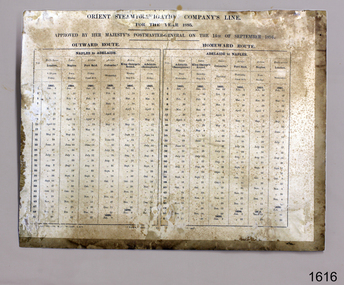 Flagstaff Hill Maritime Museum and Village
Document - Timetable, Orient Steam Navigation Company, Orient Steam Navigation Company's Line for the year 1895, ca. 14-09-1894
... It shows the frequency of voyages between London and Adelaide and the time taken to make the journeys by steamship in 1895. Flagstaff Hill Flagstaff Hill Maritime Museum and Village Warrnambool Maritime Museum Maritime Village Great Ocean Road Shipwreck Coast orient steam navigation company limited Orient Line Steamship line 1895 travel steamship London Naples Port Said Colombo King George's Sound Adelaide (Semaphore) migration early steamships world travel London to Australia London to Adelaide travel late 19th century travel "ORIENT STEAM NAVIGATION COMPANY'S LINE / FOR THE YEAR 1895 / APPROVED BY HER MAJESTY'S POSTMASTER-GENERAL ON THE 14TH OF SEPTEMBER 1894 " "OUTWARD ROUTE" "HOMEWARD ROUTE" "NAPLES TO ADELAIDE " ADELAIDE TO NAPLES" Orient Steam Navigation Company's timetable for steamship voyages outward bound from London to Adelaide, and inward bound back to London, for 1895. ...This timetable was found by Dave Maxwell behind an old photograph. David's family came to Warrnambool in 1838.The timetable is an example of travel in the late 19th century. It shows the frequency of voyages between London and Adelaide and the time taken to make the journeys by steamship in 1895. Orient Steam Navigation Company's timetable for steamship voyages outward bound from London to Adelaide, and inward bound back to London, for 1895. The document has black print on cream-coloured paper and is mounted onto a card backing. The timetable lists voyage n from January 1885 to January 1886, with details of month, date and times. The itinerary begins from London to Naples, Port Said, Colombo, King George's Sound and finally to Adelaide (Semaphore), taking 35 days for the journey. The steamship then returns to London. The timetable was approved by Her Majesty's Postmaster-General on the 14th September 1894. There are indecipherable inscriptions below the timetable."ORIENT STEAM NAVIGATION COMPANY'S LINE / FOR THE YEAR 1895 / APPROVED BY HER MAJESTY'S POSTMASTER-GENERAL ON THE 14TH OF SEPTEMBER 1894 " "OUTWARD ROUTE" "HOMEWARD ROUTE" "NAPLES TO ADELAIDE " ADELAIDE TO NAPLES"flagstaff hill, flagstaff hill maritime museum and village, warrnambool, maritime museum, maritime village, great ocean road, shipwreck coast, orient steam navigation company limited, orient line, steamship line, 1895 travel, steamship, london, naples, port said, colombo, king george's sound, adelaide (semaphore), migration, early steamships, world travel, london to australia, london to adelaide, travel, late 19th century travel -
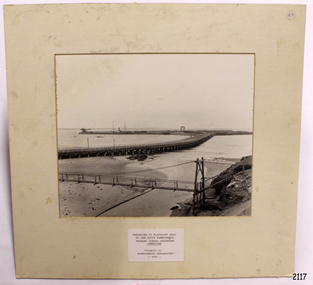 Flagstaff Hill Maritime Museum and Village
Photograph - Coastal Scene, Warrnambool South Primary School Centenary Committee, Viaduct to Warrnambool Breakwater - 1890, 1977
... Warrnambool Shipwreck Coast Flagstaff Hill Flagstaff Hill Maritime Museum Flagstaff Hill Maritime Village Warrnambool Breakwater Viaduct Viaduct Road Merri River bridge Merri footbridge Original Merri foodtridge Titan crane Warrnambool South Primary School Warrnambool South Primary School Centenary Commitee Centenary Committee 1890 1877 1877-1977 Lady Bay Port of Warrnambool Typed onto the label: "PRESENTED TO FLAGSTAFF HILL / BY THE SOUTH WARRNAMBOOL / PRIMARY SCHOOL CENTENARY / COMMITTEE / "VIADUCT TO / WARRNAMBOOL BREAKWATER" / - 1890 - " Photograph, black and white, mounted onto cardboard with a pasted-on label below the photograph. It shows ...The local photograph shows the original footbridge across the Merri River near its mouth, the Viaduct road and the Warrnambool Breakwater with the Titan crane on it. The breakwater's construction was completed in 1890, the year this photograph was taken. The Viaduct has since been filled in to prevent water passing through the pylons, and the footbridge has been replaced. The photograph was presented to Flagstaff Hill on the centenary of South Warrnambool Primary School, 1877 to 1977, by the school's Warrnambool South Primary School Centenary Committee. The centenary was celebrated during August 12-13-14. The school was decommissioned in the 1990s.The photograph is locally significant for recording the completion of the Warrnambool Breakwater, for showing the original design of the Viaduct and for a clear view of the original footbridge across the Merri River. It also records the date of the presentation of the photograph celebrates the centenary of the 1877 to 1977 Warrnambool Sough Primary School.Photograph, black and white, mounted onto cardboard with a pasted-on label below the photograph. It shows the Merri River footbridge, the Viaduct, the Warrnambool Breakwater with the Titan crane, and the Port of Warrnambool. The label has an inscription. The photograph was taken in 1890 and was presented to Flagstaff Hill by the South Warrnambool Primary School's Centenary Committee ca. 1977. The photograph was taken in 1890 and was presented to Flagstaff Hill Maritime Museum by the South Warrnambool Primary School Centenary Committee in the Centenary year of the South Warrnambool Primary School;1977.Typed onto the label: "PRESENTED TO FLAGSTAFF HILL / BY THE SOUTH WARRNAMBOOL / PRIMARY SCHOOL CENTENARY / COMMITTEE / "VIADUCT TO / WARRNAMBOOL BREAKWATER" / - 1890 - "warrnambool, shipwreck coast, flagstaff hill, flagstaff hill maritime museum, flagstaff hill maritime village, warrnambool breakwater, viaduct, viaduct road, merri river bridge, merri footbridge, original merri foodtridge, titan crane, warrnambool south primary school, warrnambool south primary school centenary commitee, centenary committee, 1890, 1877, 1877-1977, lady bay, port of warrnambool -
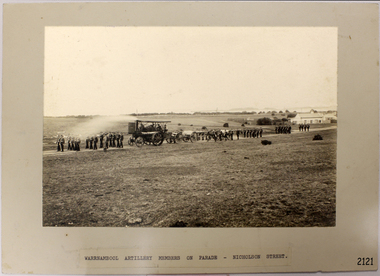 Flagstaff Hill Maritime Museum and Village
Photograph - Military group, Warrnambool Artillery Members on Parade - Nicholson Street [Warrnambool], Early 1900s
... It show the means by which the cannon carriages were moved between locations, the uniforms of the soldiers and the development of the Warrnambool location. Flagstaff Hill Flagstaff Hill Maritime Museum and Village Warrnambool Maritime Museum Maritime Village Great Ocean Road Shipwreck Coast Warrnambool location Militia steam driven gun carriage Nicholson Street Warrnambool "WARRNAMBOOL ARTILLERY MEMBERS ON PARADE - NICHOLSON STREET' Photograph, landscape, sepia, mounted on card. ...Photograph is a point in time with local Militia parading in an area now filled with houses. It show the means by which the cannon carriages were moved between locations, the uniforms of the soldiers and the development of the Warrnambool location.Photograph, landscape, sepia, mounted on card. Image of the Warrnambool Artillery Members on parade in Nicholson Street, Warrnambool. Figures are marching in groups with a steam driven gun carriage pulling several other gun carriages. A house is in the foreground and Lady Bay in the background. A typed label is attached to the bottom of the card."WARRNAMBOOL ARTILLERY MEMBERS ON PARADE - NICHOLSON STREET'flagstaff hill, flagstaff hill maritime museum and village, warrnambool, maritime museum, maritime village, great ocean road, shipwreck coast, warrnambool location, militia, steam driven gun carriage, nicholson street warrnambool -
 Flagstaff Hill Maritime Museum and Village
Photograph - Military, First Warrnambool Battery on Flagstaff Hill, ca. 1868
... shows a group off military men on Flagstaff Hill ready for action. The names are listed on the card, handwritten in pencil: 1. Gorrie 2. Chris Hider 3. David McKinley 4. Captain Cramer 5. Drill Instructor (cannot read name) 6. R.A.C. Macdonald 7. Joseph Gladstone The militia played a significant role in being prepared to defend the Warrnambool district. flagstaff hill warrnambool Maritime Museum Maritime Village Shipwreck Coast Great Ocean Road militia volunteer corps cannon gun firearm first warrnambool battery Warrnambool Battery defence Gorrie Chris Hider David McKinley Captain Cramer Drill Instructor R.A.C. ...There was an active Volunteer Corps in Warrnambool in the 1800s. This photograph shows a group off military men on Flagstaff Hill ready for action. The names are listed on the card, handwritten in pencil: 1. Gorrie 2. Chris Hider 3. David McKinley 4. Captain Cramer 5. Drill Instructor (cannot read name) 6. R.A.C. Macdonald 7. Joseph GladstoneThe militia played a significant role in being prepared to defend the Warrnambool district.Photograph, sepia, mounted on brown card. Depicts the First Warrnambool Battery on Flagstaff Hill. Seven uniformed figures stand beside a cannon mounted on a wooden, waist high carriage. The cannon is aimed between a gap in a timber fence. The lower edge of the card has two labels with handwritten inscriptions; one is the photograph title, the other is a list of seven names written in pencil Photograph is dated ca. 1868. Left hand side: "First Warrnambool Battery on 'Flagstaff Hill'" Right hand side: list of names written in pencil: "1. Gorrie 2. Chris Hider 3. David McKinley 4. Captain Cramer 5. Drill Instructor (cannot read name) 6. R.A.C. Macdonald 7. Joseph Gladstone"flagstaff hill, warrnambool, maritime museum, maritime village, shipwreck coast, great ocean road, militia, volunteer corps, cannon, gun, firearm, first warrnambool battery, warrnambool battery, defence, gorrie, chris hider, david mckinley, captain cramer, drill instructor, r.a.c. macdonald, joseph gladstone
