
Showing 94 items matching " weir family"
-
 Box Hill Historical Society
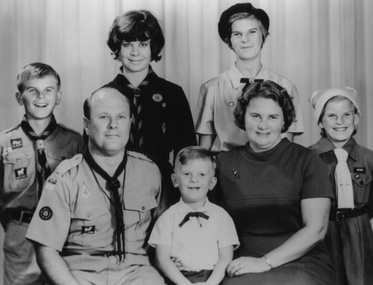
Photograph - Weir family, 1968
... Weir family...The Weir family taken in 1968. Back row: Robert, Lynette, Jennifer, Gwenda Front: Don, Trevor, Dorothy...The Weir family taken in 1968. Back row: Robert, Lynette, Jennifer, Gwenda Front: Don, Trevor, Dorothy Weir> Robert Weir> Lynette Weir> Jennifer Weir> Gwenda Weir> Don Weir> Trevor Weir> Dorothy Scouts Guides B&w photo Photograph Weir family ...The Weir family taken in 1968. Back row: Robert, Lynette, Jennifer, Gwenda Front: Don, Trevor, DorothyB&w photoweir> robert, weir> lynette, weir> jennifer, weir> gwenda, weir> don, weir> trevor, weir> dorothy, scouts, guides -
 Kew Historical Society Inc
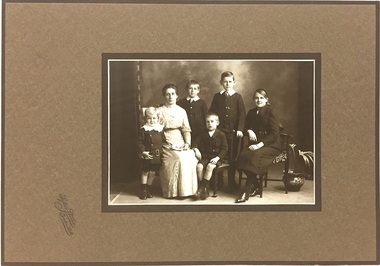
Photograph - The Weir family of Broken Hill, Sykes Studio, c.1914
... The Weir family of Broken Hill...An item forming part of a collection of costumes, photographs and documents relating to the Weir family who lived in a mansion, originally named Illapa, at 84 Princess Street, Kew, from c.1917 to 1950. ...Photograph The Weir family of Broken Hill Sykes Studio ...An item forming part of a collection of costumes, photographs and documents relating to the Weir family who lived in a mansion, originally named Illapa, at 84 Princess Street, Kew, from c.1917 to 1950. This historically significant collection includes items relating to both George Weir (1866-1937), his wife Edith Mary Weir (1867-1948) and their children. George Weir attained national prominence in the mining industry, becoming General Manager of the North Broken Hill Silver Mining Company in 1903 (later renamed North Broken Hill Mining Company 1905-12, and North Broken Hill Ltd 1912-1988), and subsequently President of the Mine Owners Association. He was to remain General Manager of North Broken Hill Ltd until his retirement in 1926.Edith Mary Weir (nee Betteridge) and her children, photographed by a photographer from the Sykes Studio in Broken Hill, c.1914. The children are (L-R) John Rigby Weir, Cecil Rigby Weir, Horace Rigby Weir, George Rigby Weir, and Edith jnr (Edie) Rigby Weir.Sykes Studio / Broken Hilljohn rigby weir, cecil rigby weir, horace rigby weir, george rigby weir, edith jnr (edie) rigby weir, edith mary weir (nee betteridge), weir collection, sykes studio -- broken hill -
 Kew Historical Society Inc
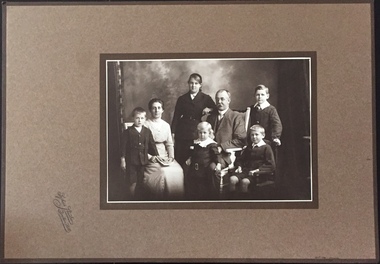
Photograph - The Weir family of Broken Hill, Sykes Studio, c.1914
... The Weir family of Broken Hill...An item forming part of a collection of costumes, photographs and documents relating to the Weir family who lived in the mansion originally named Illapa, 84 Princess Street, Kew, from c.1917 to 1950. ...Studio portrait of George and Edith Weir and their five children, taken by a photographer of the Sykes Studio in Broken Hill, New South Wales. The members of the family...An item forming part of a collection of costumes, photographs and documents relating to the Weir family who lived in the mansion originally named Illapa, 84 Princess Street, Kew, from c.1917 to 1950. ...An item forming part of a collection of costumes, photographs and documents relating to the Weir family who lived in the mansion originally named Illapa, 84 Princess Street, Kew, from c.1917 to 1950. This historically significant collection includes items relating to both George Weir (1866-1937) and his wife Edith Mary Weir (1867-1948). George Weir attained national prominence in the mining industry, becoming General Manager of the North Broken Hill Silver Mining Company in 1903 (later renamed North Broken Hill Mining Company 1905-12, and North Broken Hill Ltd 1912-1988), and subsequently President of the Mine Owners Association. He was to remain General Manager of North Broken Hill Ltd until his retirement in 1926.Important group family photograph, taken in Broken Hill, of the two Weir parents and their children. Another aspect of the photograph is that it is revealing about fashion and the tastes of the period.Studio portrait of George and Edith Weir and their five children, taken by a photographer of the Sykes Studio in Broken Hill, New South Wales. The members of the family are from left to right: Cecil Rigby Weir (1904-1983), Edith Mary Weir (nee Betteridge) (1867-1948), Edith Rigby Weir (1899-1981), John Rigby Weir (1910-1971), George Weir (1866-1937), Horace Rigby Weir (1907-1988), and George Rigby Weir (1901-1927). [John Rigby Weir was the father of the donor]weir collection, george weir, horace rigby weir, george rigby weir, john rigby weir, edith rigby weir, edith mary weir (nee betteridge), sykes studio -- broken hill -
 Kew Historical Society Inc
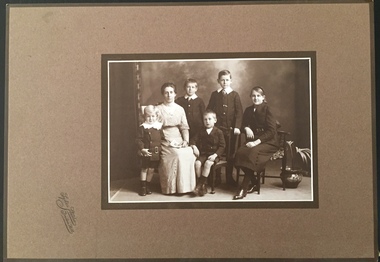
Photograph - The Weir family of Broken Hill, Sykes Studio, c.1914
... The Weir family of Broken Hill...An item forming part of a collection of costumes, photographs and documents relating to the Weir family who lived in the mansion originally named Illapa, 84 Princess Street, Kew, from c.1917 to 1950. ...Studio portrait of Edith Mary Weir and her five children, taken by a photographer of the Sykes Studio in Broken Hill, New South Wales. The members of the family are from left to right: John Rigby Weir (1910-1971), Edith Mary Weir (nee Betteridge), Cecil Rigby Weir (1904-1983), Horace Rigby Weir (1907-1988), George Rigby Weir (1901-1927), and Edith Rigby Weir (1899-1981). ...Photograph The Weir family of Broken Hill Sykes Studio ...An item forming part of a collection of costumes, photographs and documents relating to the Weir family who lived in the mansion originally named Illapa, 84 Princess Street, Kew, from c.1917 to 1950. This historically significant collection includes items relating to both George Weir (1866-1937) and his wife Edith Mary Weir (1867-1948). George Weir attained national prominence in the mining industry, becoming General Manager of the North Broken Hill Silver Mining Company in 1903 (later renamed North Broken Hill Mining Company 1905-12, and North Broken Hill Ltd 1912-1988), and subsequently President of the Mine Owners Association. He was to remain General Manager of North Broken Hill Ltd until his retirement in 1926.Important group family photograph, taken in Broken Hill, of Edith Mary Weir and her children. Another aspect of the photograph is that it is revealing about fashion and the tastes of the period.Studio portrait of Edith Mary Weir and her five children, taken by a photographer of the Sykes Studio in Broken Hill, New South Wales. The members of the family are from left to right: John Rigby Weir (1910-1971), Edith Mary Weir (nee Betteridge), Cecil Rigby Weir (1904-1983), Horace Rigby Weir (1907-1988), George Rigby Weir (1901-1927), and Edith Rigby Weir (1899-1981). [John Rigby Weir was the donor's father].Stykes Studio / Broken Hillweir collection, george weir, horace rigby weir, george rigby weir, john rigby weir, edith rigby weir, edith mary weir (nee betteridge), sykes studio -- broken hill -
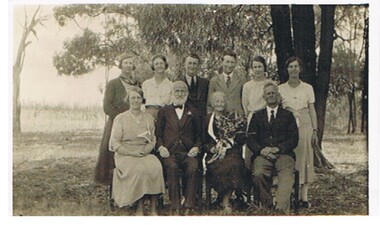 Bendigo Historical Society Inc.
Photograph - E DOWLING COLLECTION: PHOTOGRAPH OF UNCLE GEORGE'S FAMILY
... ...Weir Family...Possibly related to Lithgow and Weir families....GENEALOGY Family lithgow Weir Family Lithgow Family Photograph from Mrs E Dowling collection. ...Photograph from Mrs E Dowling collection. Black and White. Ten people posed in two rows. Bush backdrop. On reverse labelled - Uncle George's Family. Back row left to right - Eva, Nellie, Gilbert, Lansell, Elsie, Edna. Front Row - Edith, Dad, Mum, Hillier. Possibly related to Lithgow and Weir families.genealogy, family, lithgow, weir family, lithgow family -
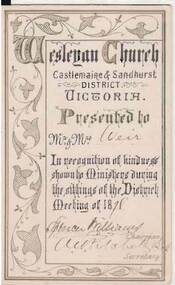 Bendigo Historical Society Inc.
Document - E DOWLING COLLECTION: THANKYOU CARD
... ... Weir family...Related to Lithgow and Weir families....Related to Lithgow and Weir families. Document E DOWLING COLLECTION: THANKYOU CARD ...Thank you card issued by the Weslayan Church, Castlemaine & Sandhurst District Victoria: Presented to Mr & Mrs Weir in recognition of kindness shown to Ministers during the sittings of the District Meeting of 1878. Signed Spencer Williams, Chairman and A. Mitchell, B.A?. The E Dowling Collection. Related to Lithgow and Weir families.genealogy, family, lithgow, lithgow family, weir family, weslayan church castlemaine & sandhurst district -
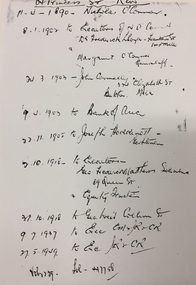 Kew Historical Society Inc
Document - Manuscript [copy], List of Owners, 84 Princess Street (Kew), 1890-1949, c.1949
... An item forming part of a collection of costumes, photographs and documents relating to the Weir family who lived in a mansion, originally named Illapa, at 84 Princess Street, Kew, from c.1917 to 1950. ...The list, compiled for the Weir family before they sold the house in 1950, includes the names of owners between 1890 and 1949....An item forming part of a collection of costumes, photographs and documents relating to the Weir family who lived in a mansion, originally named Illapa, at 84 Princess Street, Kew, from c.1917 to 1950. ...An item forming part of a collection of costumes, photographs and documents relating to the Weir family who lived in a mansion, originally named Illapa, at 84 Princess Street, Kew, from c.1917 to 1950. This historically significant collection includes items relating to both George Weir (1866-1937), his wife Edith Mary Weir (1867-1948) and their children. George Weir attained national prominence in the mining industry, becoming General Manager of the North Broken Hill Silver Mining Company in 1903 (later renamed North Broken Hill Mining Company 1905-12, and North Broken Hill Ltd 1912-1988), and subsequently President of the Mine Owners Association. He was to remain General Manager of North Broken Hill Ltd until his retirement in 1926.Handwritten register of owners of 84 Princes Street, Kew. Built for John Hedderwick, the house was variously known throughout its history as Illapa and Parcnacilla. The list, compiled for the Weir family before they sold the house in 1950, includes the names of owners between 1890 and 1949.84 princess street -- kew (vic.), george weir -
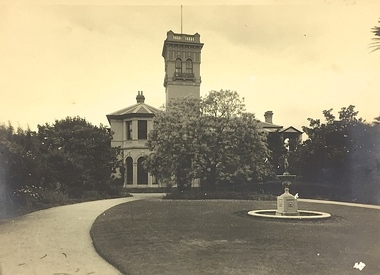 Kew Historical Society Inc
Photograph - 84 Princess Street (Kew), c. 1935
... An item forming part of a collection of costumes, photographs and documents relating to the Weir family who lived in a mansion, originally named Illapa, at 84 Princess Street, Kew, from c.1917 to 1950. ...Sepia-toned photograph of 84 Princess Street, Kew during the occupation of the house by the Weir family during the years 1918-1950. The house and garden had formerly been named Illapa and then Parcnacilla. ...An item forming part of a collection of costumes, photographs and documents relating to the Weir family who lived in a mansion, originally named Illapa, at 84 Princess Street, Kew, from c.1917 to 1950. ...An item forming part of a collection of costumes, photographs and documents relating to the Weir family who lived in a mansion, originally named Illapa, at 84 Princess Street, Kew, from c.1917 to 1950. This historically significant collection includes items relating to both George Weir (1866-1937), his wife Edith Mary Weir (1867-1948) and their children. George Weir attained national prominence in the mining industry, becoming General Manager of the North Broken Hill Silver Mining Company in 1903 (later renamed North Broken Hill Mining Company 1905-12, and North Broken Hill Ltd 1912-1988), and subsequently President of the Mine Owners Association. He was to remain General Manager of North Broken Hill Ltd until his retirement in 1926.Sepia-toned photograph of 84 Princess Street, Kew during the occupation of the house by the Weir family during the years 1918-1950. The house and garden had formerly been named Illapa and then Parcnacilla. In 1950 the family sold the house to a religious order who renamed the house 'The Towers'. It now forms part of 'Rylands'.illapa -- 84 princess street -- kew (vic.), george weir, edith mary weir (nee betteridge), weir collection -
 Kew Historical Society Inc
Photograph - Studley Park (Kew), c.1949
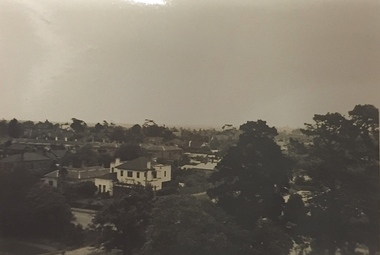
... An item forming part of a collection of costumes, photographs and documents relating to the Weir family who lived in a mansion, originally named Illapa, at 84 Princess Street, Kew, from c.1917 to 1950. ...Small black and white photograph of a panoramic view from the tower of 84 Princess Street, Kew during the occupation of the house by the Weir family during the years 1918-1950. The house and garden had formerly been named Illapa and then Parcnacilla. ...An item forming part of a collection of costumes, photographs and documents relating to the Weir family who lived in a mansion, originally named Illapa, at 84 Princess Street, Kew, from c.1917 to 1950. ...An item forming part of a collection of costumes, photographs and documents relating to the Weir family who lived in a mansion, originally named Illapa, at 84 Princess Street, Kew, from c.1917 to 1950. This historically significant collection includes items relating to both George Weir (1866-1937), his wife Edith Mary Weir (1867-1948) and their children. George Weir attained national prominence in the mining industry, becoming General Manager of the North Broken Hill Silver Mining Company in 1903 (later renamed North Broken Hill Mining Company 1905-12, and North Broken Hill Ltd 1912-1988), and subsequently President of the Mine Owners Association. He was to remain General Manager of North Broken Hill Ltd until his retirement in 1926.Small black and white photograph of a panoramic view from the tower of 84 Princess Street, Kew during the occupation of the house by the Weir family during the years 1918-1950. The house and garden had formerly been named Illapa and then Parcnacilla. In 1950 the family sold the house to a religious order who renamed the house 'The Towers'. It now forms part of 'Rylands'.illapa -- 84 princess street -- kew (vic.), aerial photographs -- kew (vic.), studley park (kew) -1930s -
 Tatura Irrigation & Wartime Camps Museum
Book, A Town at War, 2008
... Features Japanese Soldier's "Good Luck" flag and Japanese prisoners at the Weir family property on the front cover. Japanese War Cemetery at Cowra on a white and cream coloured back cover...Features Japanese Soldier's "Good Luck" flag and Japanese prisoners at the Weir family property on the front cover. Japanese War Cemetery at Cowra on a white and cream coloured back cover A Town at War Book ...Written by Graham Apthorpe after his fascination with WW2 military history. The book reveals for the first time many new stories from WW2. The Cowra story from WW2 is a bitter-sweet one and this book adds considerably to our understanding of this special place in our nations historyBlack and cream coloured soft cover. Features Japanese Soldier's "Good Luck" flag and Japanese prisoners at the Weir family property on the front cover. Japanese War Cemetery at Cowra on a white and cream coloured back coverGraham Apthorpeatown at war, apthorpe g, tatura, ww2, cowra, camp 12, books, history, local -
 Sunshine and District Historical Society Incorporated
Photograph - Melton Yesterday & Today DVD
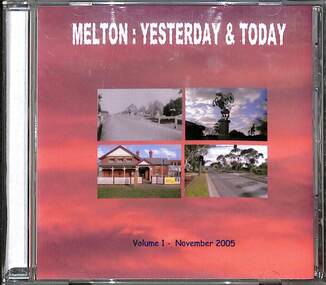
... Weir...Jongebloed Family...The Melton & District Historical Society complied a selection of photographs from their district Melton Clydesdale Horse Chaff Mill High Street City of Melton Council Electricty Exford Weir Jongebloed Family Melton Reservoir Arch Bridge Pinkerton Family Railways Viaduct The Willows Melton: Yesterday & Today Volume 1 November 2005 DVD Photograph Melton Yesterday & Today DVD ...The Melton & District Historical Society complied a selection of photographs from their districtMelton: Yesterday & Today Volume 1 November 2005melton, clydesdale horse, chaff mill, high street, city of melton council, electricty, exford weir, jongebloed family, melton reservoir, arch bridge, pinkerton family, railways, viaduct, the willows -
Tatura Irrigation & Wartime Camps Museum
Book, Grass Seeds and Thistles
... weir...stewart family...Written by local historian Alan McLean. moora victoria gobarup victoria wanalta victoria wanalta creek weir stewart family 264 page book by Alan McLean. ...Book about the early years of Moora Gobarup and Wanalta. Written by local historian Alan McLean.264 page book by Alan McLean. Picture of trees and remains of a stone building on front. Title in blue, authors name in white. Back cover has two photographs of Wanalta Creek weir.moora victoria, gobarup victoria, wanalta victoria, wanalta creek weir, stewart family -
 Bendigo Historical Society Inc.
Document - E DOWLING COLLECTION: MARRIAGE CERTIFICATE
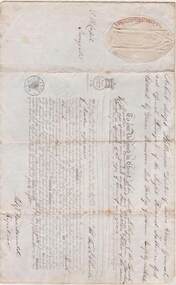
... Possibly related to the Weir family...Possibly related to the Weir family Document E DOWLING COLLECTION: MARRIAGE CERTIFICATE ...Marriage certificate of John Scott Lithgow and Mary Matilda Lithgow. Marriage by licence. Parish church of Morden in the county of Dorset, diocese of Sarum. Date 20 December 1848. Bachelor and spinster, both 21 years of age. T.R Capel, surrogate. Fitz Macdonald, registrar. Possibly related to the Weir familygenealogy, family, lithgow, john scott lithgow, mary matilda hillier, morden (dorset), diocese of sarum, marriage certificate -
 Kew Historical Society Inc
Clothing - Infants Gown, 1899-1910
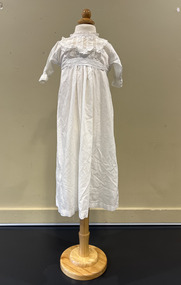
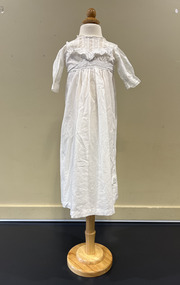
... This high-necked gown with elbow length sleeves is less ornate than the three christening gowns in the Weir Family Collection, indicating that it was used for daily wear by one of the Weir children in the first six months of their life. ...This is one of nine items of clothing, worn by infants in the Weir family of Broken Hill between 1899 and 1910. ...In the early 19th century, infant gowns were modelled on dresses worn by adult women. Gowns were typically made of fine white linen or cotton, and often trimmed with tucks, lace, whitework embroidery, and other handwork. The Kew Historical Society's collection includes over twenty-five gowns dating from the 19th and 20th centuries. This gown was worn by one or more of the Weir children.This is one of nine items of clothing, worn by infants in the Weir family of Broken Hill between 1899 and 1910. They are part of the larger Weir Family collection of clothing, documents and photographs gifted to the Kew Historical Society by their descendants. Due to their known provenence, the gowns are historically and aesthetically significant in that they can be accurately dated to an 11-year-period, allowing other comparable items of infant's and children's clothing to be dated to an earlier, silmilar or later period. They also exemplify the styles and decorative techniques used for christening gowns, infant's and children's clothing of the period.Long, white cotton infant's gown. This high-necked gown with elbow length sleeves is less ornate than the three christening gowns in the Weir Family Collection, indicating that it was used for daily wear by one of the Weir children in the first six months of their life. The looser ruching at the waist would indicate a later date in the period 1899-1910. Nilchildren's wear -
 Kew Historical Society Inc
Clothing - Infants Gown, 1899-1910
... This high-necked gown with elbow length sleeves is less ornate than the three christening gowns in the Weir Family Collection, indicating that it was used for daily wear by one of the Weir children in the first six months of their life. ...This is one of ten items of clothing, worn by infants in the Weir family of Broken Hill between 1899 and 1910. ...In the early 19th century, infant gowns were modelled on dresses worn by adult women. Gowns were typically made of fine white linen or cotton, and often trimmed with tucks, lace, whitework embroidery, and other handwork. The Kew Historical Society's collection includes over twenty-five gowns dating from the 19th and 20th centuries. This gown was worn by one or more of the Weir children.This is one of ten items of clothing, worn by infants in the Weir family of Broken Hill between 1899 and 1910. They are part of the larger Weir Family collection of clothing, documents and photographs gifted to the Kew Historical Society by their descendants. Due to their known provenence, the gowns are historically and aesthetically significant in that they can be accurately dated to an 11-year-period, allowing other comparable items of infant's and children's clothing to be dated to an earlier, silmilar or later period. They also exemplify the styles and decorative techniques used for christening gowns, infant's and children's clothing of the period.Long, white cotton infant's gown. This high-necked gown with elbow length sleeves is less ornate than the three christening gowns in the Weir Family Collection, indicating that it was used for daily wear by one of the Weir children in the first six months of their life. The looser ruching at the waist would indicate a later date in the period 1899-1910. The gown is identical to 2025.26.Nilchildren's wear -
 Wodonga & District Historical Society Inc
Booklet - The Vanished Village - Ebden Weir / Mitta Junction, Lyn Larkin, 2004
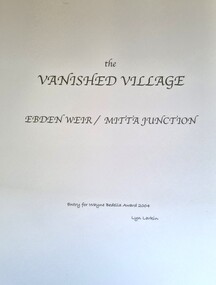
... ...Hume Weir construction...Clark family...MItta Junction township Hume Weir construction Clark family Bonegilla This publication tells the story of the village of Mitta Junction which was established in about 1920 on the Victorian side of the Hume Dam construction site. ...This publication tells the story of the village of Mitta Junction which was established in about 1920 on the Victorian side of the Hume Dam construction site. The town was built to house workers and their families during the construction of the Hume Weir. It included houses, a shop, hall and school as well as tennis courts. After the completion of the weir the village and all its contents was sold at auction in June 1936 for £7000. The Mitta Junction school continued to operate until the mid 1980s. The book also documents aspects of the history of the Clark family of Bonegilla.A small publication by a local author. A4 size including photographs and a map.This publication tells the story of the village of Mitta Junction which was established in about 1920 on the Victorian side of the Hume Dam construction site. The town was built to house workers and their families during the construction of the Hume Weir. It included houses, a shop, hall and school as well as tennis courts. After the completion of the weir the village and all its contents was sold at auction in June 1936 for £7000. The Mitta Junction school continued to operate until the mid 1980s. The book also documents aspects of the history of the Clark family of Bonegilla.mitta junction township, hume weir construction, clark family bonegilla -
 Kew Historical Society Inc
Clothing - Infants Gown, 1899-1910
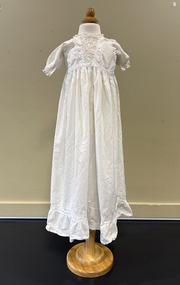
... This high-necked gown with elbow length sleeves is less ornate than the three christening gowns in the Weir Family Collection, indicating that it was used for daily wear by one of the Weir children in the first six months of their life. ...This is one of ten items of clothing, worn by infants in the Weir family of Broken Hill between 1899 and 1910. ...In the early 19th century, infant gowns were modelled on dresses worn by adult women. Gowns were typically made of fine white linen or cotton, and often trimmed with tucks, lace, whitework embroidery, and other handwork. The Kew Historical Society's collection includes over twenty-five gowns dating from the 19th and 20th centuries. This gown was worn by one or more of the Weir children.This is one of ten items of clothing, worn by infants in the Weir family of Broken Hill between 1899 and 1910. They are part of the larger Weir Family collection of clothing, documents and photographs gifted to the Kew Historical Society by their descendants. Due to their known provenence, the gowns are historically and aesthetically significant in that they can be accurately dated to an 11-year-period, allowing other comparable items of infant's and children's clothing to be dated to an earlier, silmilar or later period. They also exemplify the styles and decorative techniques used for christening gowns, infant's and children's clothing of the period.Long, white cotton infant's gown. This high-necked gown with elbow length sleeves is less ornate than the three christening gowns in the Weir Family Collection, indicating that it was used for daily wear by one of the Weir children in the first six months of their life. The looser ruching at the waist would indicate a later date in the period 1899-1910. The gown includes a tie at the waist and a ruffled band forming the hem.Nilchildren's wear -
 Kew Historical Society Inc
Clothing - Infants Gown, 1899-1910
... This high-necked gown with elbow length sleeves is less ornate than the three christening gowns in the Weir Family Collection, indicating that it was used for daily wear by one of the Weir children in the first six months of their life. ...This is one of ten items of clothing, worn by infants in the Weir family of Broken Hill between 1899 and 1910. ...In the early 19th century, infant gowns were modelled on dresses worn by adult women. Gowns were typically made of fine white linen or cotton, and often trimmed with tucks, lace, whitework embroidery, and other handwork. The Kew Historical Society's collection includes over twenty-five gowns dating from the 19th and 20th centuries. This gown was worn by one or more of the Weir children.This is one of ten items of clothing, worn by infants in the Weir family of Broken Hill between 1899 and 1910. They are part of the larger Weir Family collection of clothing, documents and photographs gifted to the Kew Historical Society by their descendants. Due to their known provenence, the gowns are historically and aesthetically significant in that they can be accurately dated to an 11-year-period, allowing other comparable items of infant's and children's clothing to be dated to an earlier, silmilar or later period. They also exemplify the styles and decorative techniques used for christening gowns, infant's and children's clothing of the period.Long, white cotton infant's gown. This high-necked gown with elbow length sleeves is less ornate than the three christening gowns in the Weir Family Collection, indicating that it was used for daily wear by one of the Weir children in the first six months of their life. The looser ruching at the waist would indicate a later date in the period 1899-1910. The gown includes a triangular panel of lace at the front of the bodice and a band of ruffled fabric at the hem..Nilchildren's wear -
 Kew Historical Society Inc
Clothing - Infants Gown, 1899-1910
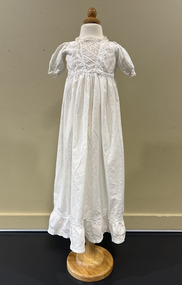
... This high-necked gown with elbow length sleeves is less ornate than the three christening gowns in the Weir Family Collection, indicating that it was used for daily wear by one of the Weir children in the first six months of their life. ...This is one of ten items of clothing, worn by infants in the Weir family of Broken Hill between 1899 and 1910. ...In the early 19th century, infant gowns were modelled on dresses worn by adult women. Gowns were typically made of fine white linen or cotton, and often trimmed with tucks, lace, whitework embroidery, and other handwork. The Kew Historical Society's collection includes over twenty-five gowns dating from the 19th and 20th centuries. This gown was worn by one or more of the Weir children.This is one of ten items of clothing, worn by infants in the Weir family of Broken Hill between 1899 and 1910. They are part of the larger Weir Family collection of clothing, documents and photographs gifted to the Kew Historical Society by their descendants. Due to their known provenence, the gowns are historically and aesthetically significant in that they can be accurately dated to an 11-year-period, allowing other comparable items of infant's and children's clothing to be dated to an earlier, silmilar or later period. They also exemplify the styles and decorative techniques used for christening gowns, infant's and children's clothing of the period.Long, white cotton infant's gown. This high-necked gown with elbow length sleeves is less ornate than the three christening gowns in the Weir Family Collection, indicating that it was used for daily wear by one of the Weir children in the first six months of their life. The looser ruching at the waist would indicate a later date in the period 1899-1910. The gown includes a triangular panel of lace at the front of the bodice and a band of ruffled fabric at the hem.Nilchildren's wear -
 Kew Historical Society Inc
Clothing - Infants Gown, 1899-1910
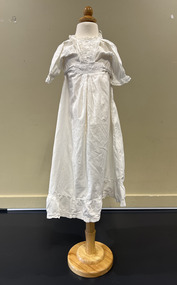
... This high-necked gown with elbow length sleeves is less ornate than the three christening gowns in the Weir Family Collection, indicating that it was used for daily wear by one of the Weir children in the first six months of their life. ...This is one of ten items of clothing, worn by infants in the Weir family of Broken Hill between 1899 and 1910. ...In the early 19th century, infant gowns were modelled on dresses worn by adult women. Gowns were typically made of fine white linen or cotton, and often trimmed with tucks, lace, whitework embroidery, and other handwork. The Kew Historical Society's collection includes over twenty-five gowns dating from the 19th and 20th centuries. This gown was worn by one or more of the Weir children.This is one of ten items of clothing, worn by infants in the Weir family of Broken Hill between 1899 and 1910. They are part of the larger Weir Family collection of clothing, documents and photographs gifted to the Kew Historical Society by their descendants. Due to their known provenence, the gowns are historically and aesthetically significant in that they can be accurately dated to an 11-year-period, allowing other comparable items of infant's and children's clothing to be dated to an earlier, silmilar or later period. They also exemplify the styles and decorative techniques used for christening gowns, infant's and children's clothing of the period.Long, white cotton infant's gown. This high-necked gown with elbow length sleeves is less ornate than the three christening gowns in the Weir Family Collection, indicating that it was used for daily wear by one of the Weir children in the first six months of their life. The looser ruching at the waist would indicate a later date in the period 1899-1910. The gown includes a triangular panel of lace at the front of the bodice and a band of ruffled fabric at the hem.Nilchildren's wear -
 Kew Historical Society Inc
Book - Instructional Book, Weldon & Co, Weldon's Practical Needlework, c.1891
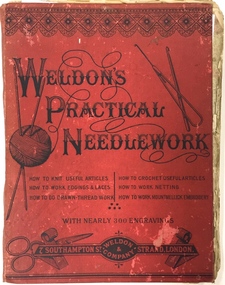
... An item forming part of a collection of costumes, photographs and documents relating to the Weir family who lived in the mansion originally named Illapa, 84 Princess Street, Kew, from c.1917 to 1950. ...An item forming part of a collection of costumes, photographs and documents relating to the Weir family who lived in the mansion originally named Illapa, 84 Princess Street, Kew, from c.1917 to 1950. ...An item forming part of a collection of costumes, photographs and documents relating to the Weir family who lived in the mansion originally named Illapa, 84 Princess Street, Kew, from c.1917 to 1950. This historically significant collection includes items relating to both George Weir (1866-1937) and his wife Edith Mary Weir (1867-1948). Bound copy of Weldon's Practical Needlework, retailed by W.C. Wright and Co., Booksellers & c., Broken Hill, New South Wales. The book includes advice for women on Knitting, Crochet, Drawn Thread Work, Netting, Knitted Edgings or Shawls, Mountmellick Embroidery with full working descriptions.Inscribed top right of title page: "E.M. Betteridge, Broken Hill, July 2nd 1891 / E. Weir".edith mary weir (nee betteridge), 84 princess street -- kew (vic), needlework patterns -
 Kew Historical Society Inc
Photograph - Exhibition: Fashion in the Age of Elegance 1840-1900 [Series 1]
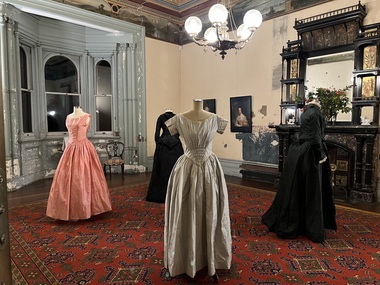
... Following their accession, the Henty costumes were exhibited with other notable examples of fashion and design, previously donated by descendants of the Coombs and Weir families....Following their accession, the Henty costumes were exhibited with other notable examples of fashion and design, previously donated by descendants of the Coombs and Weir families. fashion -- nineteenth century exhibitions -- kew historical society henty collection Coombs collection weir collection 28 x Exhibition photos of Fashion in the Age of Elegance 1840-1900, held at Villa Alba Museum during the 2023 Australian Heritage Festival. ...The Kew Historical Society holds a nationally significant Fashion & Design collection. In 2023 this collection was augmented by a donation by descendants of Francis Henty of nineteenth and early twentieth century costumes and costume accessories. These rare and aesthetically significant acquisitions increased the importance of the nineteenth century costume collection held by the Society. Following their accession, the Henty costumes were exhibited with other notable examples of fashion and design, previously donated by descendants of the Coombs and Weir families.28 x Exhibition photos of Fashion in the Age of Elegance 1840-1900, held at Villa Alba Museum during the 2023 Australian Heritage Festival. The exhibition showcased items drawn from the Henty, Coombs and Weir Collections.fashion -- nineteenth century, exhibitions -- kew historical society, henty collection, coombs collection, weir collection -
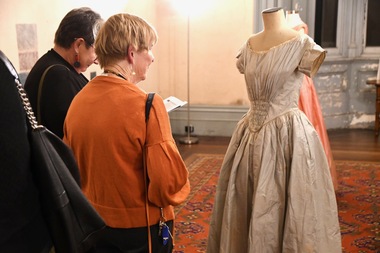 Kew Historical Society Inc
Exhibition: Fashion in the Age of Elegance 1840-1900 [Series 2], 2023
... Following their accession, the Henty costumes were exhibited with other notable examples of fashion and design, previously donated by descendants of the Coombs and Weir families....Following their accession, the Henty costumes were exhibited with other notable examples of fashion and design, previously donated by descendants of the Coombs and Weir families. fashion -- nineteenth century exhibitions -- kew historical society henty collection coombs collection weir collection 7 x Photos of the opening night of Fashion in the Age of Elegance 1840-1900, held at Villa Alba Museum during the 2023 Australian Heritage Festival. ...The Kew Historical Society holds a nationally significant Fashion & Design collection. In 2023 this collection was augmented by a donation by descendants of Francis Henty of nineteenth and early twentieth century costumes and costume accessories. These rare and aesthetically significant acquisitions increased the importance of the nineteenth century costume collection held by the Society. Following their accession, the Henty costumes were exhibited with other notable examples of fashion and design, previously donated by descendants of the Coombs and Weir families.7 x Photos of the opening night of Fashion in the Age of Elegance 1840-1900, held at Villa Alba Museum during the 2023 Australian Heritage Festival. The exhibition showcased items drawn from the Henty, Coombs and Weir Collections. Guests included members of Kew Historical Society, Villa Alba Museum, Heidelberg Historical Society, Royal Historical Society of Victoria, Museums Victoria, City of Boroondara, and National Gallery of Victoria. fashion -- nineteenth century, exhibitions -- kew historical society, henty collection, coombs collection, weir collection -
 Kew Historical Society Inc
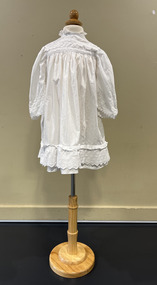
Clothing - Child's Dress, 1899-1910
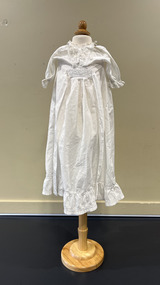
... This high-necked dress with long sleeves, compared to other infant's clothing in the Weir Family Collection, is quite ornate, indicating that it was designed to be a piece of 'best' clothing. ...This is one of ten items of clothing, worn by infants in the Weir family of Broken Hill between 1899 and 1910. ...In the early 19th century, infant gowns were modelled on dresses worn by adult women. Gowns were typically made of fine white linen or cotton, and often trimmed with tucks, lace, whitework embroidery, and other handwork. The Kew Historical Society's collection includes over twenty-five gowns dating from the 19th and 20th centuries. This child's dress was worn by one or more of the Weir children.This is one of ten items of clothing, worn by infants in the Weir family of Broken Hill between 1899 and 1910. They are part of the larger Weir Family collection of clothing, documents and photographs gifted to the Kew Historical Society by their descendants. Due to their known provenence, the gowns are historically and aesthetically significant in that they can be accurately dated to an 11-year-period, allowing other comparable items of infant's and children's clothing to be dated to an earlier, silmilar or later period. They also exemplify the styles and decorative techniques used for christening gowns, infant's and children's clothing of the period.Short, white cotton child's dress. This high-necked dress with long sleeves, compared to other infant's clothing in the Weir Family Collection, is quite ornate, indicating that it was designed to be a piece of 'best' clothing. It is the only child's dress in this collection which is otherwise comprised of christening or infant's gowns. The dress is a one-piecer. It has wide sleeves with scalloped cuffs, designed to allow for movement. What was the waist in the infant's gowns has moved higher towards the neck, but still maintains the decorative eleent of ruching below it. The dress includes extensive use of scalloped lace in the lower portion of the outfit.Nilchildren's wear -
 Kew Historical Society Inc
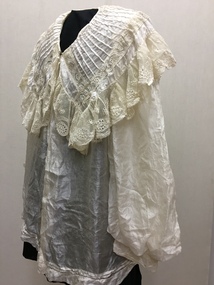
Clothing - Silk & Lace Bed Jacket, c. 1902-11
... An item forming part of a collection of costumes, photographs and documents relating to the Weir family who lived in the mansion originally named Illapa, 84 Princess Street, Kew, from c.1917 to 1950. ...An item forming part of a collection of costumes, photographs and documents relating to the Weir family who lived in the mansion originally named Illapa, 84 Princess Street, Kew, from c.1917 to 1950. ...An item forming part of a collection of costumes, photographs and documents relating to the Weir family who lived in the mansion originally named Illapa, 84 Princess Street, Kew, from c.1917 to 1950. This historically significant collection includes items relating to both George Weir (1866-1937) and his wife Edith Mary Weir (1867-1948). George Weir attained national prominence in the mining industry, becoming General Manager of the North Broken Hill Silver Mining Company in 1903 (later renamed North Broken Hill Mining Company 1905-12, and North Broken Hill Ltd 1912-1988), and subsequently President of the Mine Owners Association. He was to remain General Manager of North Broken Hill Ltd until his retirement in 1926.This garment is significant as it is part of 25-piece collection of women’s clothing owned by Edith Mary Weir (nee Betteridge), who was born in Clare, South Australia in 1867 and who died in Kew at the age of 81 in 1948. The items of clothing in the collection date from the 1880s to the 1940s and constitute outstanding examples of dressmaker’s skills from each of these decades. The collection includes day dresses, evening dresses, evening coats, capes, and undergarments. As the wife of a mining engineer, and later mine manager, Edith Weir’s clothing has historic significance as examples of clothing worn by upper middle class Australian women in domestic circumstances and at social and civic events. The costumes in the collection represent the periods when Edith Weir lived in Broken Hill, New South Wales, and in Kew, Melbourne. A number of the costumes from the 1920s to the 1940s are of a particularly fine quality, being both rare, representative and intact examples of Australian fashion of the period. The garments in the Weir Collection were donated to the Kew Historical Society by the granddaughter of Edith Weir. An Edwardian slik, net and broderie anglaise bed jacket, bought by and worn by Edith Mary (Betteridge) Weir. Given the date of the item, the jacket was initially worn in Broken Hill where the Weir's lived, when her husband was Manager of the North Broken Hill Mine and later brought to Kew, ca. 1917 when the Weirs moved to Princess Street, Kew. The jacket was gifted by Edith Weir's grandaughter. It forms part of the Society's Weir Collection.edith mary weir (nee betteridge), 84 princes street (kew), costumes, fashion & design collection - kew historical society, women's clothing, weir collection -
 Kew Historical Society Inc
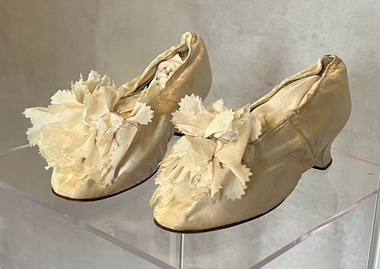
Footwear - Pair of leather soled silk wedding shoes, 1891
... An item forming part of a collection of costumes, photographs and documents relating to the Weir family who lived in the mansion originally named Illapa, 84 Princess Street, Kew, from c.1917 to 1950. ...An item forming part of a collection of costumes, photographs and documents relating to the Weir family who lived in the mansion originally named Illapa, 84 Princess Street, Kew, from c.1917 to 1950. ...An item forming part of a collection of costumes, photographs and documents relating to the Weir family who lived in the mansion originally named Illapa, 84 Princess Street, Kew, from c.1917 to 1950. This historically significant collection includes items relating to both George Weir (1866-1937) and his wife Edith Mary Weir (1867-1948). George Weir attained national prominence in the mining industry, becoming General Manager of the North Broken Hill Silver Mining Company in 1903 (later renamed North Broken Hill Mining Company 1905-12, and North Broken Hill Ltd 1912-1988), and subsequently President of the Mine Owners Association. He was to remain General Manager of North Broken Hill Ltd until his retirement in 1926.These shoes are significant as they are part of a 30-piece collection of women’s clothing owned by Edith Mary Weir (nee Betteridge), who was born in Clare, South Australia in 1867 and who died in Kew at the age of 81 in 1948. The items of clothing in the collection date from the 1880s to the 1940s and constitute outstanding examples of dressmaker’s skills from each of these decades. The collection includes day dresses, evening dresses, evening coats, capes, shoes and undergarments. As the wife of a mining engineer, and later mine manager, Edith Weir’s clothing has historic significance as examples of clothing worn by upper middle class Australian women in domestic circumstances and at social and civic events. The costumes in the collection represent the periods when Edith Weir lived in Broken Hill, New South Wales, and in Kew, Melbourne. A number of the costumes from the 1920s to the 1940s are of a particularly fine quality, being both rare, representative and intact examples of Australian fashion of the period. The garments in the Weir Collection were donated to the Kew Historical Society by the granddaughter of Edith Weir. Pair of ivory silk shoes, worn by Edith Mary Betteridge at her marriage to George Weir in Broken Hill in 1891. The shoes were worn with her ivory silk wedding dress.edith mary (betteridge) weir, 84 princess street (kew), footwear, women's shoes, wedding shoes -
 Kew Historical Society Inc
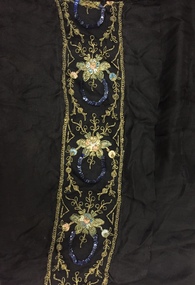
Clothing - Black Chiffon Scarf with Multicoloured Silk Embroidery, c. 1926-1931
... An item forming part of a collection of costumes, photographs and documents relating to the Weir family who lived in the mansion originally named Illapa, 84 Princess Street, Kew, from c.1917 to 1950. ...An item forming part of a collection of costumes, photographs and documents relating to the Weir family who lived in the mansion originally named Illapa, 84 Princess Street, Kew, from c.1917 to 1950. ...An item forming part of a collection of costumes, photographs and documents relating to the Weir family who lived in the mansion originally named Illapa, 84 Princess Street, Kew, from c.1917 to 1950. This historically significant collection includes items relating to both George Weir (1866-1937) and his wife Edith Mary Weir (1867-1948). George Weir attained national prominence in the mining industry, becoming General Manager of the North Broken Hill Silver Mining Company in 1903 (later renamed North Broken Hill Mining Company 1905-12, and North Broken Hill Ltd 1912-1988), and subsequently President of the Mine Owners Association. He was to remain General Manager of North Broken Hill Ltd until his retirement in 1926.This scarf is part of a 30-piece collection of women’s clothing owned by Edith Mary Weir (nee Betteridge), who was born in Clare, South Australia in 1867 and who died in Kew at the age of 81 in 1948. The items of clothing in the collection date from the 1880s to the 1940s and constitute outstanding examples of dressmaker’s skills from each of these decades. The collection includes day dresses, evening dresses, evening coats, capes, shoes and undergarments. As the wife of a mining engineer, and later mine manager, Edith Weir’s clothing has historic significance as examples of clothing worn by upper middle class Australian women in domestic circumstances and at social and civic events. The costumes in the collection represent the periods when Edith Weir lived in Broken Hill, New South Wales, and in Kew, Melbourne. A number of the costumes from the 1920s to the 1940s are of a particularly fine quality, being both rare, representative and intact examples of Australian fashion of the period. The garments in the Weir Collection were donated to the Kew Historical Society by the granddaughter of Edith Weir in 2017Very long, doubled chiffon evening scarf with a silk tassle at one end and multicoloured hand embroidered flowers at the other. The scarf was owned by Edith Mary Weir.edith mary (betteridge) weir, 84 princess street -kew, australian fashion, scarfs -
 Kew Historical Society Inc
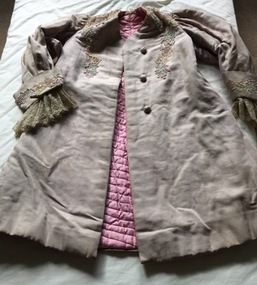
Clothing - Silk & Guipure Lace Evening Coat with Quilted Pink Silk Lining, 1920s
... An item forming part of a collection of costumes, photographs and documents relating to the Weir family who lived in a mansion, originally named Illapa, at 84 Princess Street, Kew, from c.1917 to 1950. ...An item forming part of a collection of costumes, photographs and documents relating to the Weir family who lived in a mansion, originally named Illapa, at 84 Princess Street, Kew, from c.1917 to 1950. ...An item forming part of a collection of costumes, photographs and documents relating to the Weir family who lived in a mansion, originally named Illapa, at 84 Princess Street, Kew, from c.1917 to 1950. This historically significant collection includes items relating to both George Weir (1866-1937), his wife Edith Mary Weir (1867-1948) and their children. George Weir attained national prominence in the mining industry, becoming General Manager of the North Broken Hill Silver Mining Company in 1903 (later renamed North Broken Hill Mining Company 1905-12, and North Broken Hill Ltd 1912-1988), and subsequently President of the Mine Owners Association. He was to remain General Manager of North Broken Hill Ltd until his retirement in 1926.This garment is part of a collection of women’s clothing, owned and worn by Edith Mary Weir (nee Betteridge) - born in Clare, South Australia 1867, died Kew 1948 - and also by her daughter. The garments date from the 1880s to the 1930s. The collection includes day dresses, evening dresses, evening coats, capes, and undergarments. As the wife and daughter of a mine manager, the collection includes representative examples of clothing worn by upper middle class Australian women in domestic circumstances, and at social and civic events. A number of the costumes from the 1920s to the 1930s are of a particularly fine quality, being both rare, representative and intact examples of Australian fashion of the period. The garments in the Weir Collection were donated to the Kew Historical Society by a granddaughter of Edith Weir in 2017.Beige silk theatre or opera jacket with multi-coloured guipure lace at the neck, on the front bordering the opening, and on the cuffs. The long sleeves have extensive old lace extending beyond the wide cuffs. The inside is lined with quilted pink silk, which has darker silk panels at the front. The jacket has a high neck. It is closed using three embroidered fabric buttons at the frontedith mary weir (nee betteridge), 84 princess street - kew, australian fashion, women's clothing, costumes, coats -
 Kew Historical Society Inc
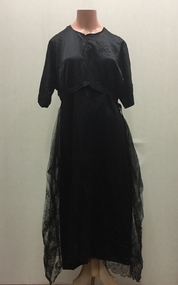
Clothing - Black Silk & Chantilly Lace Evening Dress, 1920s
... An item forming part of a collection of costumes, photographs and documents relating to the Weir family who lived in a mansion, originally named Illapa, at 84 Princess Street, Kew, from c.1917 to 1950. ...An item forming part of a collection of costumes, photographs and documents relating to the Weir family who lived in a mansion, originally named Illapa, at 84 Princess Street, Kew, from c.1917 to 1950. ...An item forming part of a collection of costumes, photographs and documents relating to the Weir family who lived in a mansion, originally named Illapa, at 84 Princess Street, Kew, from c.1917 to 1950. This historically significant collection includes items relating to both George Weir (1866-1937), his wife Edith Mary Weir (1867-1948) and their children. George Weir attained national prominence in the mining industry, becoming General Manager of the North Broken Hill Silver Mining Company in 1903 (later renamed North Broken Hill Mining Company 1905-12, and North Broken Hill Ltd 1912-1988), and subsequently President of the Mine Owners Association. He was to remain General Manager of North Broken Hill Ltd until his retirement in 1926.This garment is part of a collection of women’s clothing, owned and worn by Edith Mary Weir (nee Betteridge) - born in Clare, South Australia 1867, died Kew 1948 - and also by her daughter. The garments date from the 1880s to the 1930s. The collection includes day dresses, evening dresses, evening coats, capes, and undergarments. As the wife and daughter of a mine manager, the collection includes representative examples of clothing worn by upper middle class Australian women in domestic circumstances, and at social and civic events. A number of the costumes from the 1920s to the 1930s are of a particularly fine quality, being both rare, representative and intact examples of Australian fashion of the period. The garments in the Weir Collection were donated to the Kew Historical Society by a granddaughter of Edith Weir in 2017.Long black silk waisted dress, gathered at the waist with and featuring a full skirt. The short-sleeved bodice has a high round neck with a small amount of embroidery at the front in the form of abstract flowers. The skirt features an additional Chantilly lace overskirt that is scalloped at the hem. edith mary weir (nee betteridge), 84 princess street - kew, australian fashion, women's clothing, costumes, coats -
 Kew Historical Society Inc
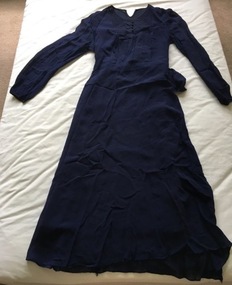
Clothing - Navy Blue Day Dress, 1910s
... An item forming part of a collection of costumes, photographs and documents relating to the Weir family who lived in a mansion, originally named Illapa, at 84 Princess Street, Kew, from c.1917 to 1950. ...An item forming part of a collection of costumes, photographs and documents relating to the Weir family who lived in a mansion, originally named Illapa, at 84 Princess Street, Kew, from c.1917 to 1950. ...An item forming part of a collection of costumes, photographs and documents relating to the Weir family who lived in a mansion, originally named Illapa, at 84 Princess Street, Kew, from c.1917 to 1950. This historically significant collection includes items relating to both George Weir (1866-1937), his wife Edith Mary Weir (1867-1948) and their children. George Weir attained national prominence in the mining industry, becoming General Manager of the North Broken Hill Silver Mining Company in 1903 (later renamed North Broken Hill Mining Company 1905-12, and North Broken Hill Ltd 1912-1988), and subsequently President of the Mine Owners Association. He was to remain General Manager of North Broken Hill Ltd until his retirement in 1926.This garment is part of a collection of women’s clothing, owned and worn by Edith Mary Weir (nee Betteridge) - born in Clare, South Australia 1867, died Kew 1948 - and also by her daughter. The garments date from the 1880s to the 1930s. The collection includes day dresses, evening dresses, evening coats, capes, and undergarments. As the wife and daughter of a mine manager, the collection includes representative examples of clothing worn by upper middle class Australian women in domestic circumstances, and at social and civic events. A number of the costumes from the 1920s to the 1930s are of a particularly fine quality, being both rare, representative and intact examples of Australian fashion of the period. The garments in the Weir Collection were donated to the Kew Historical Society by a granddaughter of Edith Weir in 2017.Long navy blue crepe fitted dress featuring long narrow sleeves. The round-necked bodice includes buttons at the neck bordered by navy blue silk embroidery. The dress has a deep pocket in the same fabric at the right front beneath the waist.edith mary weir (nee betteridge), 84 princess street - kew, australian fashion, women's clothing, costumes, dresses
