
Showing 132 items matching " whitework"
-
 Embroiderers Guild, Victoria
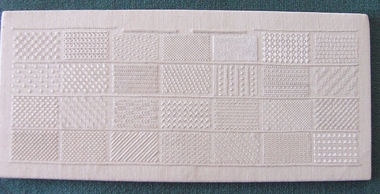
Textile - Royal School of Needlework Whitework Sampler, Miss Elizabeth Lewis, RSN Whitework Sampler, 1940-60
... RSN Whitework Sampler...It is mounted on board. RSN Whitework Sampler Textile Royal School of Needlework Whitework Sampler Miss Elizabeth Lewis ...One of a number of samplers embroidered by the donor's aunt, while she was studying at the Royal School of Needlework. She taught and judged embroidery throughout England.Cream sampler with counted thread work, probably in stranded cotton or fine linen (52 threads to the inch). The sampler is divided into rectangles and each rectangle has a different counted thread pattern. It is mounted on board.embroidery, samplers, 1940-60, england, white work -
 Embroiderers Guild, Victoria
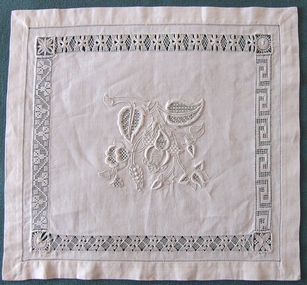
Textile - Royal School of Needlework Whitework Sampler, Miss Elizabeth Lewis, RSN Whitework Sampler, 1940-60
... RSN Whitework Sampler...Embroidery Samplers 1940-60 Pulled thread Drawn thread England Square linen mat with drawn thread borders and a floral spray with drawn thread designs in the centre. RSN Whitework Sampler Textile Royal School of Needlework Whitework Sampler Miss Elizabeth Lewis ...After a three year apprenticeship, this mat was embroidered. One of a number of samplers (see 1206, 1207, 1205) embroidered by the donor's aunt, whilst studying at the Royal School of Needlework. She taught and judged embroidery throughout England.Square linen mat with drawn thread borders and a floral spray with drawn thread designs in the centre.embroidery, samplers, 1940-60, pulled thread, drawn thread, england -
 Embroiderers Guild, Victoria
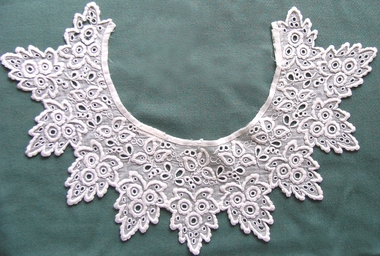
Accessory - Collar, 1900-20
... ... Whitework...Whitework on muslin. Cutwork design of leaves and flowers....Embroidery Garments Whitework Cutwork Garments 1900-20 Whitework on muslin. ...Exhibited April 1996 Archival Exhibition. Exhibited Old Treasury February 1997.Whitework on muslin. Cutwork design of leaves and flowers.embroidery, garments, whitework, cutwork, garments, 1900-20 -
 Embroiderers Guild, Victoria
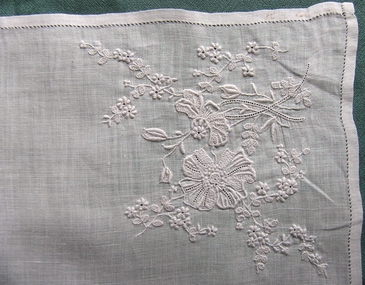
Accessory - White Whitework on Linen Handkerchief, Early 20th century
... ... Whitework...Large spray of flowers in one corner in delicate whitework. Traditional stitches....Large spray of flowers in one corner in delicate whitework. Traditional stitches. Accessory White Whitework on Linen Handkerchief ...Fine white linen with narrow hem-stitched edge. Large spray of flowers in one corner in delicate whitework. Traditional stitches.embroidery, whitework, handkerchief, early 20th century -
 Embroiderers Guild, Victoria
Accessory - Collar, Mid 19th century
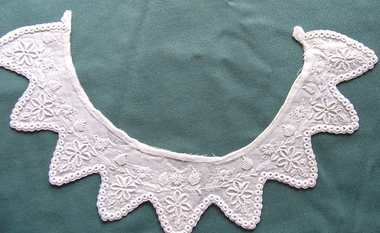
... ... Whitework...White muslin embroidered in whitework. Nine pointed edge with a flower in each point, and a trail of smaller flowers and leaves in satin stitch eyelets and open work....Embroidery Collars Whitework Mid 19th Century White muslin embroidered in whitework. ...White muslin embroidered in whitework. Nine pointed edge with a flower in each point, and a trail of smaller flowers and leaves in satin stitch eyelets and open work.embroidery, collars, whitework, mid 19th century -
 Embroiderers Guild, Victoria
Textile - 50th Anniversary Sampler, Lorna M. Law, 2010
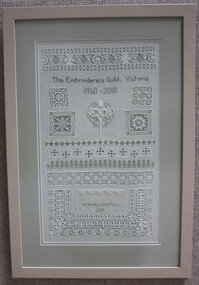
... ... Whitework...Whitework sampler made to celebrate the Guild's 50th anniversary, featuring drawn thread designs from pieces in the Guild's collection. ...Made by Lorna Law (Guild member) to commenorate the Guild's 50th anniversary. Embroidery Whitework Drawn thread Holbein The Embroiderers Guild Victoria 1960-2010. ...Made by Lorna Law (Guild member) to commenorate the Guild's 50th anniversary.Whitework sampler made to celebrate the Guild's 50th anniversary, featuring drawn thread designs from pieces in the Guild's collection. Mounted on a pale green ground and framed.The Embroiderers Guild Victoria 1960-2010. Worked by Lorna M. Law 2010embroidery, whitework, drawn thread, holbein -
 Bendigo Historical Society Inc.
Newspaper - JENNY FOLEY COLLECTIONTOUGH TRIMMING
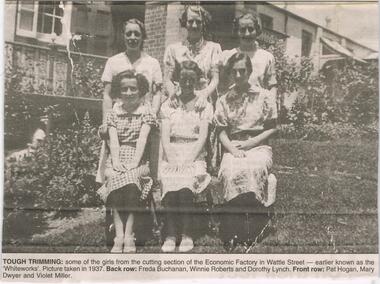
... The Bendigo Whiteworks was proposed in February 1910 and by 1918 was known as the Economic Factory....Tough trimming: some of the girls from the cutting section of the Economic Factory in Wattle Street - earlier known as the ''Whiteworks''. Picture taken in 1937. Back row: Freda Buchanan, Winnie Roberts and Dorothy Lynch. ...The Bendigo Whiteworks was proposed in February 1910 and by 1918 was known as the Economic Factory. ...The Bendigo Whiteworks was proposed in February 1910 and by 1918 was known as the Economic Factory.Bendigo Advertiser '' The way we were'' from 2002. Tough trimming: some of the girls from the cutting section of the Economic Factory in Wattle Street - earlier known as the ''Whiteworks''. Picture taken in 1937. Back row: Freda Buchanan, Winnie Roberts and Dorothy Lynch. Front row: Pat Hogan, Mary Dwyer and Violet Miller. The clip is in a folder.newspaper, bendigo advertiser, the way we were -
 Embroiderers Guild, Victoria
Textile - Oval Whitework Runner, Mrs Ethel Webb, 1910-1930
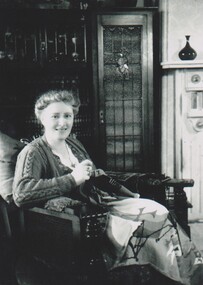
... Whitework mat embroidered mat is very lacy, comprising tape lace with inserts of cutwork and hedebo....Textile Oval Whitework Runner Mrs Ethel Webb ...Biography and photo with Museum sheet. Piece embroidered by the Donor's mother Miss Ethel Webb in the 1910's-1930's.Whitework mat embroidered mat is very lacy, comprising tape lace with inserts of cutwork and hedebo.embroidery, table runner, white work, tape lace, hedebo -
 Whitehorse Historical Society Inc.
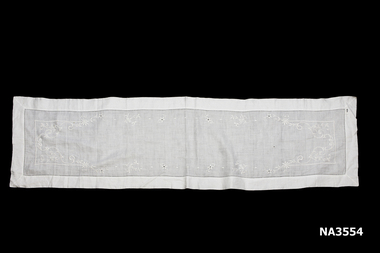
Textile - Table runner, not known
... Fine white linen table runner with drawn threadwork hem and whitework embroidery of flowers, leaves and ribbon...She came from Galashiels Scotland manchester table linen none Fine white linen table runner with drawn threadwork hem and whitework embroidery of flowers, leaves and ribbon Textile Table runner ...Used by Mrs Jean Ashcroft (nee Broad) and probably worked by her. She came from Galashiels ScotlandFine white linen table runner with drawn threadwork hem and whitework embroidery of flowers, leaves and ribbonnonemanchester, table linen -
 Embroiderers Guild, Victoria
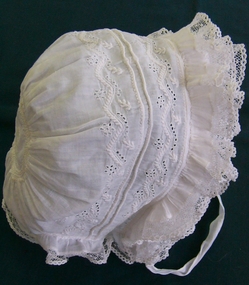
Headwear - Ayrshire Baby Bonnet, Mid 19th century
... ... Whitework...Mainly produced at home, Ayrshire whitework garments would be initially completed by one person. ...Mainly produced at home, Ayrshire whitework garments would be initially completed by one person. ...Traditionally worked using white thread onto a fine white muslin, Ayrshire embroidery is recognisable by stylised floral motifs with areas of filled in cutwork. Developed from Dresden embroidery (a form of pulled work) and tambour embroidery, it uses a range of stitches, including satin stitch, chain stitch, eyelets and buttonhole edging as well as a range of lace filling stitches. The technique became popular in the early nineteenth century, when the previous fashion of elaborate gowns with hooped skirts was replaced by looser, simpler white cotton muslin garments. Although the elegant simplicity was favoured, women also desired some decoration. However, looms of the time could not create complex designs, so women turned to hand stitching.Using cotton muslin woven in Ayrshire, local women and girls would complete the intricate whitework to help supplement their family income. Mainly produced at home, Ayrshire whitework garments would be initially completed by one person. However, as the technique became more popular and the industry developed, to ensure high quality work, a piece would be passed around so that each embroiderer could focus on completing the stitches they specialised in.It is believed that the designs and motifs used in Ayrshire whitework were inspired by lace filling stitches found within an inset in a French Christening robe that was bought to Scotland by Lady Mary Montgomery, who then lent it to Mrs Jamieson of Ayr. She copied the stitches used within the robe and taught them to her outworkers, and she also produced plain muslin that was stamped with a water-soluble blue ink design that made embroidering the designs neater and more efficient. Ayrshire work became popular quite quickly, and it was incorporated into collars, cuffs and caps as well as children’s clothes and bonnets. Pieces were exported across Europe and the British Empire. As the decades progressed, technology advanced, resulting in looms that could incorporate decoration into the weave of the cloth, reducing the need for hand embroidered Ayrshire whitework.A triple frill of Buckingham lace, followed by two bands of fine embroidery - eyelets and satin stitch, and tucking, with small circle at crown.embroidery, whitework, bonnets, mid 19th century, scotland, garments -
 Embroiderers Guild, Victoria
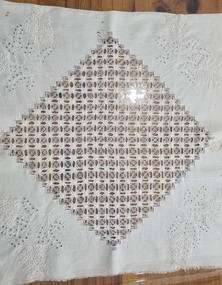
Textile - Drawn Thread Mat
... In each corner is a foliage design in whitework with eyelets, stem stitch and bullions. ...In each corner is a foliage design in whitework with eyelets, stem stitch and bullions. ...Probably English. ? Chalice cover.Exceptional drawn thread centre. Unusual border embellishments.White cotton mat with elaborate central drawn thread diamond shape patter. In each corner is a foliage design in whitework with eyelets, stem stitch and bullions. Three raw edges and one selvedge. -
 Embroiderers Guild, Victoria
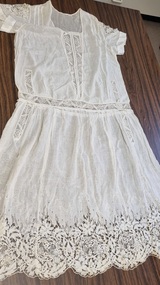
Textile - Early 20th C Lawn Needle Lace Dress
... White lawn dress with deep hem of needle lace and foliage whitework border above. The needle lace is repeated as inserts on the short sleeves. ...White lawn dress with deep hem of needle lace and foliage whitework border above. The needle lace is repeated as inserts on the short sleeves. ...Style 1910-1920's.Exceptional needle lace border.White lawn dress with deep hem of needle lace and foliage whitework border above. The needle lace is repeated as inserts on the short sleeves. Drawn thread inserts at bodice, waist and both sides of bodice extending to skirt. Pin tucks at shoulders. -
 Embroiderers Guild, Victoria
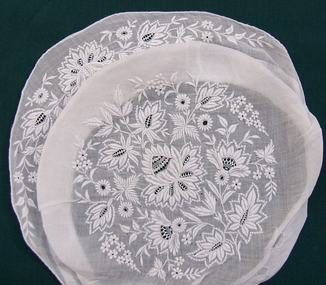
Accessory - 19th C Breton, Brittany France, Lady's Whitework Coiffe, Late 19th century
... ... Whitework...Construction & Decoration: Many featured complex pleating, stiffening, and detailed whitework embroidery rather than heavy coloured ribbons. ...Accessory 19th C Breton, Brittany France, Lady's Whitework Coiffe ...Damaged lace from brim removed at some stage. Repairs to back. A 19th-century traditional lady's head covering from Brittany, France, is known as a coiffe rather than a standard bonnet, famous for its striking regional variations, intricate lace, and soaring heights. Key Features of the Breton Coiffe : Brittany had over 300 distinct styles of coiffes. A woman’s village, marital status, and age could often be identified just by the shape and size of her headwear. Evolution through the 19th Century: Early in the century, coiffes were smaller, softer caps fitting close to the head with small side flaps. By the late 19th century, many regional styles—most famously the Bigouden coiffe from southwestern Finistère—grew dramatically taller, sometimes reaching up to 30 or 40 centimeters high. Materials: They were crafted from fine white linen, starched cotton, organdie, or delicate lace. Construction & Decoration: Many featured complex pleating, stiffening, and detailed whitework embroidery rather than heavy coloured ribbons. They were pinned or tied securely to the hair, which was usually parted and tucked away completely beneath the cap.A traditional bonnet from Brittany. White organdy. The crown is worked in a floral design mainly in satin stitch and needle point fillings, the brim has a similar design.embroidery, whitework, france, bonnets, late 19th century -
 Embroiderers Guild, Victoria
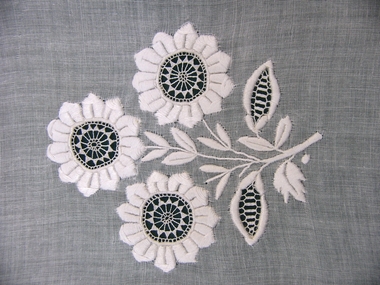
Textile - Fragment
... ... Whitework...Embroidery Whitework White muslin with a white spray of flowers in satin stitch with lace fillings. ...White muslin with a white spray of flowers in satin stitch with lace fillings. This piece may be machine embroidery.embroidery, whitework -
 Embroiderers Guild, Victoria
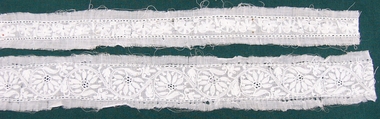
Textile - Insertion fragments (2)
... ... Whitework...Embroidery Whitework 2 bands of insertion on fine muslin in a scrolled design of flowers and leaves. ...2 bands of insertion on fine muslin in a scrolled design of flowers and leaves. Embroideery is reversible, and has drawn fabric in flower centres on larger piece.embroidery, whitework -
 Embroiderers Guild, Victoria
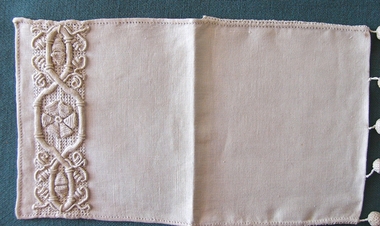
Accessory - Casalguidi Embroidered Envelope Bag, Early 20th century
... A late 19th/early 20th century whitework technique from Tuscany, Italy....A late 19th/early 20th century whitework technique from Tuscany, Italy. Embroidery Casalguidi Bags Early 20th Century Italy flowers Cream linen envelope style bag embroidered in traditional Casalguidi style and five bobble tassels on the bottom edge. ...Casalguidi is an embroidery technique, rather than just a stitch. It consists of very heavy raised stem stitch worked in curves or lines, on a background of pulled thread four-sided stitching. A late 19th/early 20th century whitework technique from Tuscany, Italy.Cream linen envelope style bag embroidered in traditional Casalguidi style and five bobble tassels on the bottom edge.embroidery, casalguidi, bags, early 20th century, italy, flowers -
 Embroiderers Guild, Victoria
Accessory - Handkerchief, Late 19th Century
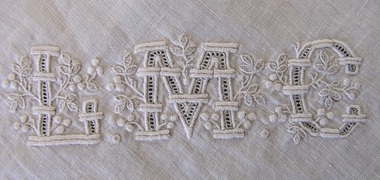
... ... Whitework...Purchased by Guild 17/7/1960 Embroidery Whitework Late 19th century Initials embroidered LMC. ...Purchased by Guild 17/7/1960Fine linen with broad hem stitched border the only decoration. Initials worked in white embroidery stitches.Initials embroidered LMC. Marking ink - L.M. Cochraneembroidery, whitework, late 19th century -
 Embroiderers Guild, Victoria
Textile - Fragment
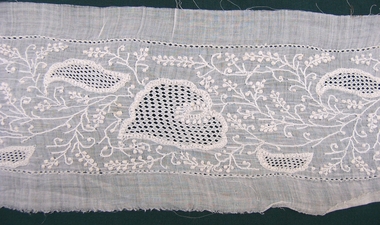
... ... Whitework...Illustrated in Mrs Edna Wark's book - Drawn Thread embroidery Embroidery India Whitework Chikan embroidery on cream muslin. ...Illustrated in Mrs Edna Wark's book - Drawn Thread embroideryChikan embroidery on cream muslin. The fine continuous border has a classical design worked in the traditional stitches which include drawn fabric and satin stitch (little grains of rice). The leaves are in a type of embroidery known as Jali similar to our drawn fabric work.embroidery, india, whitework -
 Embroiderers Guild, Victoria
Accessory - Collar
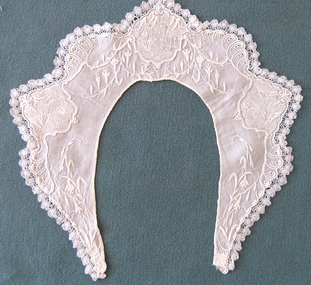
... ... Whitework...Embroidery Whitework Southern Europe Fine cream lawn, edged with bobbin lace to copy the original needlepoint Armenian edge stitching. ...Fine cream lawn, edged with bobbin lace to copy the original needlepoint Armenian edge stitching. This prettily shaped collar has floral sprays, and 3 drawn ground panels with voided designs of birds and a rural scene.embroidery, whitework, southern europe -
 Embroiderers Guild, Victoria
Textile - Border for petticoat, c. 1900
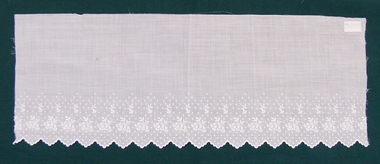
... ... Whitework...Embroidery Whitework 1880-1900 Fine white linen with an 8 cm band of white embroidery of spots and floral sprays. ...Fine white linen with an 8 cm band of white embroidery of spots and floral sprays. Edge of finely scalloped buttonhole.embroidery, whitework, 1880-1900 -
 Kew Historical Society Inc
Clothing - Christening Gown
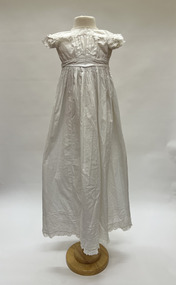
... Gowns were typically made of fine white linen or cotton, and often trimmed with tucks, lace, whitework embroidery, and other handwork. The Kew Historical Society's collection includes over fifteen christening gowns dating from the 19th and 20th centuries....Gowns were typically made of fine white linen or cotton, and often trimmed with tucks, lace, whitework embroidery, and other handwork. The Kew Historical Society's collection includes over fifteen christening gowns dating from the 19th and 20th centuries. ...In the early 19th century, infant baptismal gowns were modelled on dresses worn by adult women. Gowns were typically made of fine white linen or cotton, and often trimmed with tucks, lace, whitework embroidery, and other handwork. The Kew Historical Society's collection includes over fifteen christening gowns dating from the 19th and 20th centuries.Long, white cotton christening gown. Handmade featuring lace on the layered short sleeves, as well as at the neckline. The gown has a tie above the waist. The bodice is designed to form a number of horizontal and vertical panels, most prominently including tapered pleating at the front. The fabric comprising the skirt is gathered at the waist, allowing the full skirt to flare towards the hem. The lower part of the dress features a scalloped double hemline above which are four bands of folded fabric.christening gowns, ceremonial clothing, children's wear, baptismal clothing, victorian historical themes — 8.6 marking the phases of life -
 Kew Historical Society Inc
Clothing - Christening Gown
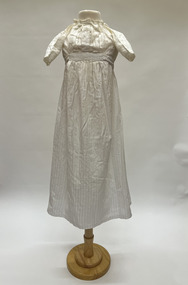
... Gowns were typically made of fine white linen or cotton, and often trimmed with tucks, lace, whitework embroidery, and other handwork. The Kew Historical Society's collection includes over fifteen christening gowns dating from the 19th and 20th centuries....Gowns were typically made of fine white linen or cotton, and often trimmed with tucks, lace, whitework embroidery, and other handwork. The Kew Historical Society's collection includes over fifteen christening gowns dating from the 19th and 20th centuries. ...In the early 19th century, infant baptismal gowns were modelled on dresses worn by adult women. Gowns were typically made of fine white linen or cotton, and often trimmed with tucks, lace, whitework embroidery, and other handwork. The Kew Historical Society's collection includes over fifteen christening gowns dating from the 19th and 20th centuries.A sturdy white cotton christening gown that confirms to a number of conventional design rules. These include pleating on the bodice and at the front of the skirt. The width of the pleats below the waist would indicate a later rather than earlier manufacture. Lace is used in a vertical band at centre front, on the neck and at the waist. christening gowns, ceremonial clothing, children's wear, baptismal clothing, victorian historical themes — 8.6 marking the phases of life -
 Kew Historical Society Inc
Clothing - Christening gown
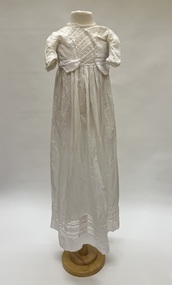
... Gowns were typically made of fine white linen or cotton, and often trimmed with tucks, lace, whitework embroidery, and other handwork. The Kew Historical Society's collection includes over fifteen christening gowns dating from the 19th and 20th centuries....Gowns were typically made of fine white linen or cotton, and often trimmed with tucks, lace, whitework embroidery, and other handwork. The Kew Historical Society's collection includes over fifteen christening gowns dating from the 19th and 20th centuries. ...In the early 19th century, infant baptismal gowns were modelled on dresses worn by adult women. Gowns were typically made of fine white linen or cotton, and often trimmed with tucks, lace, whitework embroidery, and other handwork. The Kew Historical Society's collection includes over fifteen christening gowns dating from the 19th and 20th centuries.Long, white cotton christening gown featuring an elaborate hand-worked bodice. The bodice has diagonal bands of lace as well as sections of fabric that imitate the effect of a bolero. These, as well as the sleeves are also hand embroidered and bordered with tatted lace. The fabric is finely gathered below the waist. The lower part of the gown includes inserted bands of different kinds of lace. The longer sleeves might indicate that the gown was made for an older infant. christening gowns, ceremonial clothing, children's wear, baptismal clothing, victorian historical themes — 8.6 marking the phases of life -
 Kew Historical Society Inc
Clothing - Christening Gown
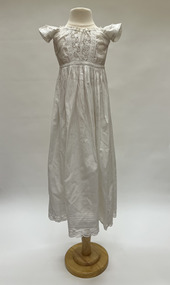
... Gowns were typically made of fine white linen or cotton, and often trimmed with tucks, lace, whitework embroidery, and other handwork. The Kew Historical Society's collection includes over fifteen christening gowns dating from the 19th and 20th centuries....Gowns were typically made of fine white linen or cotton, and often trimmed with tucks, lace, whitework embroidery, and other handwork. The Kew Historical Society's collection includes over fifteen christening gowns dating from the 19th and 20th centuries. ...In the early 19th century, infant baptismal gowns were modelled on dresses worn by adult women. Gowns were typically made of fine white linen or cotton, and often trimmed with tucks, lace, whitework embroidery, and other handwork. The Kew Historical Society's collection includes over fifteen christening gowns dating from the 19th and 20th centuries.Long, white cotton christening gown. The bodice includes a number of pieces of lace, most notably a panel of broderie anglais at the centre of the bodice. Bands of lace are also used at the neck and on the sleeves. The skirt is gathered below the waist allowing the fabric to form folds.The lower section of the skirt five pleated bands and a hem also created from broderie anglais.christening gowns, ceremonial clothing, children's wear, baptismal clothing, victorian historical themes — 8.6 marking the phases of life -
 Kew Historical Society Inc
Clothing - Christening Gown
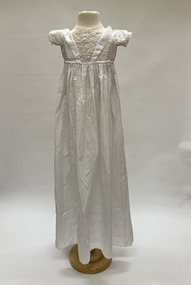
... Gowns were typically made of fine white linen or cotton, and often trimmed with tucks, lace, whitework embroidery, and other handwork. The Kew Historical Society's collection includes over fifteen christening gowns dating from the 19th and 20th centuries....Gowns were typically made of fine white linen or cotton, and often trimmed with tucks, lace, whitework embroidery, and other handwork. The Kew Historical Society's collection includes over fifteen christening gowns dating from the 19th and 20th centuries. ...In the early 19th century, infant baptismal gowns were modelled on dresses worn by adult women. Gowns were typically made of fine white linen or cotton, and often trimmed with tucks, lace, whitework embroidery, and other handwork. The Kew Historical Society's collection includes over fifteen christening gowns dating from the 19th and 20th centuries.Very long, white cotton christening gown. The bodice is distinguished by an intricate panel of handmade lace that forms a semi-circle at the neck. On either side of the lace insert are folded lapels, each bordered with lace. The short sleeves are constructed of two overlapping pieces of fabric. Below the waist the fabric is pleated to allow for the large amount of fabric in the skirt to flare outwards. The extraordinary detail within the gown is extended to the lower section of the skirt where the maker has created five pleated bands, each comprising four layers. The hem also features a band of lace. christening gowns, ceremonial clothing, children's wear, baptismal clothing, victorian historical themes — 8.6 marking the phases of life -
 Kew Historical Society Inc
Clothing - Christening Gown
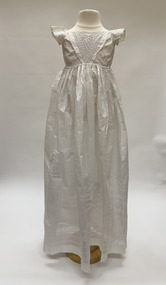
... Gowns were typically made of fine white linen or cotton, and often trimmed with tucks, lace, whitework embroidery, and other handwork. The Kew Historical Society's collection includes over fifteen christening gowns dating from the 19th and 20th centuries....Gowns were typically made of fine white linen or cotton, and often trimmed with tucks, lace, whitework embroidery, and other handwork. The Kew Historical Society's collection includes over fifteen christening gowns dating from the 19th and 20th centuries. ...In the early 19th century, infant baptismal gowns were modelled on dresses worn by adult women. Gowns were typically made of fine white linen or cotton, and often trimmed with tucks, lace, whitework embroidery, and other handwork. The Kew Historical Society's collection includes over fifteen christening gowns dating from the 19th and 20th centuries.Long, white cotton christening gown, ornamented with a v-shaped panel of lace on the bodice. Lace is also used on the upper part of the short sleeves and on the neckline. The fabric of the skirt is gathered below the waist.christening gowns, ceremonial clothing, children's wear, baptismal clothing, victorian historical themes — 8.6 marking the phases of life -
 Kew Historical Society Inc
Clothing - Christening Gown
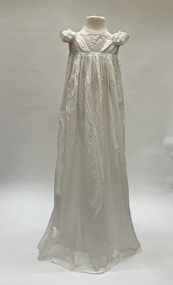
... Gowns were typically made of fine white linen or cotton, and often trimmed with tucks, lace, whitework embroidery, and other handwork. The Kew Historical Society's collection includes over fifteen christening gowns dating from the 19th and 20th centuries....Gowns were typically made of fine white linen or cotton, and often trimmed with tucks, lace, whitework embroidery, and other handwork. The Kew Historical Society's collection includes over fifteen christening gowns dating from the 19th and 20th centuries. ...In the early 19th century, infant baptismal gowns were modelled on dresses worn by adult women. Gowns were typically made of fine white linen or cotton, and often trimmed with tucks, lace, whitework embroidery, and other handwork. The Kew Historical Society's collection includes over fifteen christening gowns dating from the 19th and 20th centuries.Long, fine white cotton christening gown. The short bodice includes a v-shaped lace insert bordered by a scalloped collar. Lace is also used on the neckline, short sleeves, and hem. The lace on the sleeves is attached in rows of overlapping fabric. The fabric below the high waistline is gathered to produce a full long skirt.christening gowns, ceremonial clothing, children's wear, baptismal clothing, victorian historical themes — 8.6 marking the phases of life -
 Kew Historical Society Inc
Clothing - Christening Gown
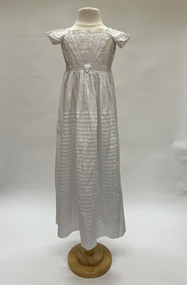
... Gowns were typically made of fine white linen or cotton, and often trimmed with tucks, lace, whitework embroidery, and other handwork. The Kew Historical Society's collection includes over fifteen christening gowns dating from the 19th and 20th centuries....Gowns were typically made of fine white linen or cotton, and often trimmed with tucks, lace, whitework embroidery, and other handwork. The Kew Historical Society's collection includes over fifteen christening gowns dating from the 19th and 20th centuries. ...In the early 19th century, infant baptismal gowns were modelled on dresses worn by adult women. Gowns were typically made of fine white linen or cotton, and often trimmed with tucks, lace, whitework embroidery, and other handwork. The Kew Historical Society's collection includes over fifteen christening gowns dating from the 19th and 20th centuries.A long, white cotton christening gown designed and made using a number of decorative elements. These include an embroidered lace v-shaped insert at the front of the bodice that extends below the waist. Bands and layers of lace are also used at the neck and on the double-panelled sleeves. A broad band of lace has been used to form the waist, below which the fabric of the skirt is very finely gathered. The front of the skirt includes thirty-two horizontal pleated bands. christening gowns, ceremonial clothing, children's wear, baptismal clothing, victorian historical themes — 8.6 marking the phases of life -
 Kew Historical Society Inc
Clothing - Petticoat of a Christening Gown
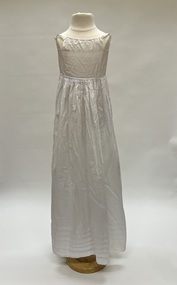
... Gowns were typically made of fine white linen or cotton, and often trimmed with tucks, lace, whitework embroidery, and other handwork. The Kew Historical Society's collection includes over fifteen christening gowns dating from the 19th and 20th centuries....Gowns were typically made of fine white linen or cotton, and often trimmed with tucks, lace, whitework embroidery, and other handwork. The Kew Historical Society's collection includes over fifteen christening gowns dating from the 19th and 20th centuries. ...In the early 19th century, infant baptismal gowns were modelled on dresses worn by adult women. Gowns were typically made of fine white linen or cotton, and often trimmed with tucks, lace, whitework embroidery, and other handwork. The Kew Historical Society's collection includes over fifteen christening gowns dating from the 19th and 20th centuries.Simple fine, white cotton petticoat used underneath an outer christening gown. The petticoat uses the same silhouette as the gown. The sleeveless bodice is held up by shoestring straps at the shoulder. Gathered fabric at the waist creates volume as an undergarment. Six bands of decorative horizontal pleating are used in the lowest section of the skirt as well as a scalloped hem.christening gowns, ceremonial clothing, children's wear, baptismal clothing, victorian historical themes — 8.6 marking the phases of life -
 Kew Historical Society Inc
Clothing - Christening Gown
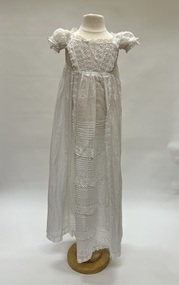
... Gowns were typically made of fine white linen or cotton, and often trimmed with tucks, lace, whitework embroidery, and other handwork. The Kew Historical Society's collection includes over fifteen christening gowns dating from the 19th and 20th centuries....Gowns were typically made of fine white linen or cotton, and often trimmed with tucks, lace, whitework embroidery, and other handwork. The Kew Historical Society's collection includes over fifteen christening gowns dating from the 19th and 20th centuries. ...In the early 19th century, infant baptismal gowns were modelled on dresses worn by adult women. Gowns were typically made of fine white linen or cotton, and often trimmed with tucks, lace, whitework embroidery, and other handwork. The Kew Historical Society's collection includes over fifteen christening gowns dating from the 19th and 20th centuries.Long, white muslin christening gown. The gown features lace on the front of the bodice, neck, and on the short, puffed sleeves. The skirt at the front has pleating separated with inserts of lace and horizontal hanging scalloped bands of lace christening gowns, ceremonial clothing, children's wear, baptismal clothing, victorian historical themes — 8.6 marking the phases of life
