
Showing 42 items matching "1906 1924"
-
 Learmonth and District Historical Society Inc.
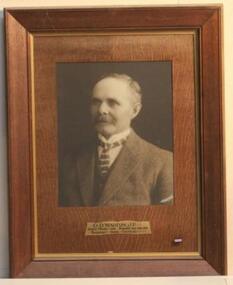
Photo -Walton, Richards & Co. Photos Ballaarat, Councilor D. Walton.J.P, "circa 1924"
... ...1906 1924...J.P. was elected as a member of council in 1906 until 1924. He was nominated for three terms as President in 1912, 1918 and 1924....J.P. was elected as a member of council in 1906 until 1924. He was nominated for three terms as President in 1912, 1918 and 1924. ...Councilor D.Walton. J.P. was elected as a member of council in 1906 until 1924. He was nominated for three terms as President in 1912, 1918 and 1924.Original Historic Photo.Sepia photo,rectangular, of Councilor D.Walton,J.P.It is set in a wide dark frame with gold coloured inner edge. the mount is brown woodgrain finish.Councilor D.Walton,J.P.ballarat shire council, justice of the peace, walton d, 1906 1924 -
 Learmonth and District Historical Society Inc.
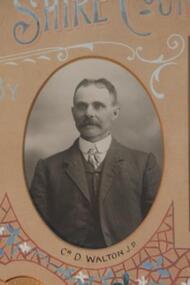
Photo -Walton, Richards & Co. Photos Ballaarat, Councilor D.Walton,J.P
... ...1906 1924...Councilor D.Walton,J.P., was elected to council in 1906 serving until 1924.He was President for three terms, in 1912-13,1918-19 and 1924-25. ...Councilor D.Walton,J.P., was elected to council in 1906 serving until 1924.He was President for three terms, in 1912-13,1918-19 and 1924-25. ...Councilor D.Walton,J.P., was elected to council in 1906 serving until 1924.He was President for three terms, in 1912-13,1918-19 and 1924-25. He died during his last term of office and Councilor G.C.Stewart took over the balance of his term. Original Historic Photo.Sepia photo,oval in shape,of Councilor D.Walton J.P.It is set in pinkish/tan mount with decorative design painted in brown blue and white around base.It is placed second from right top row of collection of photos of all councilors for 1911-12. Presented to the Ballarat Shire Council ,J.Dickie Esq. President !911-12.ballarat shire council, walton d j p, 1906 1924 -
 Mission to Seafarers Victoria
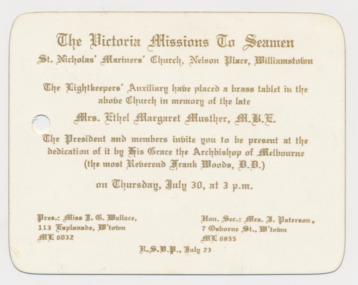
Card - Invitation card, The Victoria Missions to Seamen, 1959
... 1924), a sea pilot and Janet Lidell (1846-1891) Her grandfather, Captain Lidell, was also a seaman. In 1900, she married Nathan George Musther,(18..-1933) a chemist, and dentist in the Navy. They had two daughters: Rosamund Janet Musther(born 1903) and Nanoya Gwendoline Musther (born 1906...1924), a sea pilot and Janet Lidell (1846-1891) Her grandfather, Captain Lidell, was also a seaman. In 1900, she married Nathan George Musther,(18..-1933) a chemist, and dentist in the Navy. They had two daughters: Rosamund Janet Musther(born 1903) and Nanoya Gwendoline Musther (born 1906 ...A Williamstown local, Ethel Margaret Musther nee Barber (1872-1956) was the daughter of Captain John Henry Barber (1842-1924), a sea pilot and Janet Lidell (1846-1891) Her grandfather, Captain Lidell, was also a seaman. In 1900, she married Nathan George Musther,(18..-1933) a chemist, and dentist in the Navy. They had two daughters: Rosamund Janet Musther(born 1903) and Nanoya Gwendoline Musther (born 1906). She was the principal of the Ladies' College in Footscray. She was involved in many philantropic associations especially for sailors but also during WWI and WW2. She worked for the Anzac Club, the Red Cross, She formed: 1941: the R.A.N. Friendly Union of Sailor's Wives and Mothers. 1943: the Lightkeepers Auxiliary to help the Mission raised funds. The plaque was a gift of the Lightskeeper Auxiliaire and unveiled on 30 July 1959 at the St Nicholas Chapel, by her eldest daughter, Mrs Jean McDonald.It was originally on stained and polished hardwood mount made by Mrs Murdoch (AR1959, page 24). On the day, a desk service-book was also dedicated in memory of Dr John Thompson at the request of his daughter, Mrs Sparrow.In early 1943, Ethel Margaret Musther formed the Lightkeepers' Auxiliaire and raised funds for the third building purchased for the Williamstown branch of the Victorian Seamen's Mission, the former E,S & A Bank. Thanks to her philanthropic work, she was rewarded with a Medal of the British Empire in 1953 for all her charitable work.Invitation card to the dedication of a brass plaque in memory of Ethel Margaret Mustherethel margaret musther, st nicholas' mariners' chapel, nelson place, williamstown, lightkeepers' auxiliary -
 Mission to Seafarers Victoria
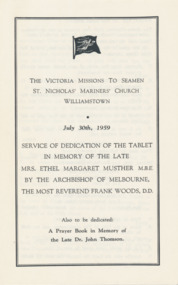
Booklet - Chapel service, The Victoria Missions to Seamen, Dedication of Ethel Musther, 1959
... 1924), a sea pilot and Janet Lidell (1846-1891) Her grandfather, Captain Lidell, was also a seaman. In 1900, she married Nathan George Musther,(18..-1933) a chemist, and dentist in the Navy. They had two daughters: Rosamund Janet Musther(born 1903) and Nanoya Gwendoline Musther (born 1906...1924), a sea pilot and Janet Lidell (1846-1891) Her grandfather, Captain Lidell, was also a seaman. In 1900, she married Nathan George Musther,(18..-1933) a chemist, and dentist in the Navy. They had two daughters: Rosamund Janet Musther(born 1903) and Nanoya Gwendoline Musther (born 1906 ...A Williamstown local, Ethel Margaret Musther nee Barber (1872-1956) was the daughter of Captain John Henry Barber (1842-1924), a sea pilot and Janet Lidell (1846-1891) Her grandfather, Captain Lidell, was also a seaman. In 1900, she married Nathan George Musther,(18..-1933) a chemist, and dentist in the Navy. They had two daughters: Rosamund Janet Musther(born 1903) and Nanoya Gwendoline Musther (born 1906). She was the principal of the Ladies' College in Footscray. She was involved in many philantropic associations especially for sailors but also during WWI and WW2. She worked for the Anzac Club, the Red Cross, She formed: 1941: the R.A.N. Friendly Union of Sailor's Wives and Mothers. 1943: the Lightkeepers Auxiliary to help the Mission raised funds. The plaque was a gift of the Lightskeeper Auxiliaire and unveiled on 30 July 1959 at the St Nicholas Chapel, by her eldest daughter, Mrs Jean McDonald. It was originally on stained and polished hardwood mount made by Mrs Murdoch (AR1959, page 24). On the day, a desk service-book was also dedicated in memory of Dr John Thompson at the request of his daughter, Mrs Sparrow.In early 1943, Ethel Margaret Musther formed the Lightkeepers' Auxiliaire and raised funds for the third building purchased for the Williamstown branch of the Victorian Seamen's Mission, the former E,S & A Bank. Thanks to her philanthropic work, she was rewarded with a Medal of the British Empire in 1953 for all her charitable work.Folded booklet on creamy colour paper and black inkethel margaret musther, st nicholas' mariners' chapel, nelson place, williamstown, lightkeepers' auxiliary, dr john thompson -
 Mission to Seafarers Victoria
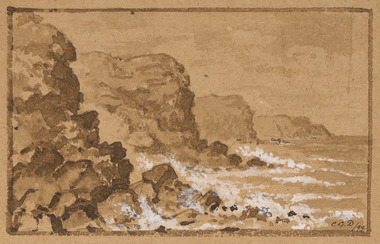
Drawing, Charles George Darvall (1831-1924), 1899
... 1924)...william henry charles darvall (1830-1906)...A watercolour artist, he travelled around the goldfields and later taught at the Sandhurst School of Arts and Design. charles georges darvall (1831-1924) william henry charles darvall (1830-1906) Bottom right corner: C.G.D. 99 Small ink seaside landscape found on the 1896-1902 scrapbook Drawing Charles George Darvall (1831-1924) ...Small illustration by Charles George Darvall (1831-1924), cousin of William Henry Charles Darvall.Born in England in 1831, he arrived in Victoria in 1858. A watercolour artist, he travelled around the goldfields and later taught at the Sandhurst School of Arts and Design.Small ink seaside landscape found on the 1896-1902 scrapbookBottom right corner: C.G.D. 99charles georges darvall (1831-1924), william henry charles darvall (1830-1906) -
 Mission to Seafarers Victoria
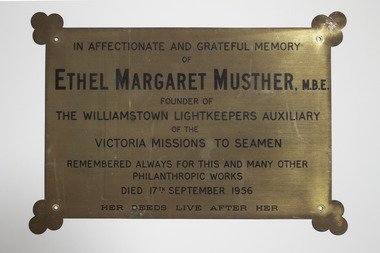
Plaque - Memorial Plaque, Ethel Margaret Musther, 1959
... 1924), a sea pilot and Janet Lidell (1846-1891) Her grandfather, Captain Lidell, was also a seaman. In 1900, she married Nathan George Musther,(18..-1933) a chemist, and dentist in the Navy. They had two daughters: Rosamund Janet Musther(born 1903) and Nanoya Gwendoline Musther (born 1906...1924), a sea pilot and Janet Lidell (1846-1891) Her grandfather, Captain Lidell, was also a seaman. In 1900, she married Nathan George Musther,(18..-1933) a chemist, and dentist in the Navy. They had two daughters: Rosamund Janet Musther(born 1903) and Nanoya Gwendoline Musther (born 1906 ...A Williamstown local, Ethel Margaret Musther nee Barber (1872-1956) was the daughter of Captain John Henry Barber (1842-1924), a sea pilot and Janet Lidell (1846-1891) Her grandfather, Captain Lidell, was also a seaman. In 1900, she married Nathan George Musther,(18..-1933) a chemist, and dentist in the Navy. They had two daughters: Rosamund Janet Musther(born 1903) and Nanoya Gwendoline Musther (born 1906). She was the principal of the Ladies' College in Footscray. She was involved in many philantropic associations especially for sailors but also during WWI and WW2. She worked for the Anzac Club, the Red Cross, She formed: 1941: the R.A.N. Friendly Union of Sailor's Wives and Mothers. 1943: the Lightkeepers Auxiliary to help the Mission raised funds. The plaque was a gift of the Lightskeeper Auxiliaire and unveiled on 30 July 1959 at the St Nicholas Chapel, by her eldest daughter, Mrs Jean McDonald. It was originally on stained and polished hardwood mount made by Mrs Murdoch (AR1959, page 24). On the day, a desk service-book was also dedicated in memory of Dr John Thompson at the request of his daughter, Mrs Sparrow.In early 1943, Ethel Margaret Musther formed the Lightkeepers' Auxiliaire and raised funds for the third building purchased for the Williamstown branch of the Victorian Seamen's Mission, the former E,S & A Bank. Thanks to her philanthropic work, she was rewarded with a Medal of the British Empire in 1953 for all her charitable work. Large rectangular with decorative clover corner Engraved: "In affectionnante and grateful memory / of / Ethel Margaret Musther, M.B.E. / Founder of / The Williamstown Lightkeepers Auxiliary / Of the / Victoria Missions to Seamen / Remembered always for this and many other / Philantropic works / Died 17th of September 1956 / Her deeds live after her.1956, ethel margaret musther, m.b.e., medal of the british empire, 1953, lightkeepers' auxiliary, williamstown, seamen's mission -
 Flagstaff Hill Maritime Museum and Village
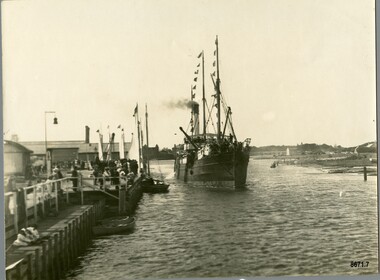
Photograph - S. S. Casino, Early 19th century
... 1906 Terang and District Schools held an excursion to Port Fairy (where the Casino was organised to provide a series of trips around the Bay.) In 1916 new regulations introduced by the Marine Board requiring the Casino to carry enough lifebelts for every passenger on board, prevented the steamer from making trips around the Bay on excursion days. The S.S. Casino had several mishaps during her life. One was on 3rd January 1898 when she collided with the S.S. Flinders in Apollo Bay with minor damage. Another was on 24th October 1924...1906 Terang and District Schools held an excursion to Port Fairy (where the Casino was organised to provide a series of trips around the Bay.) In 1916 new regulations introduced by the Marine Board requiring the Casino to carry enough lifebelts for every passenger on board, prevented the steamer from making trips around the Bay on excursion days. The S.S. Casino had several mishaps during her life. One was on 3rd January 1898 when she collided with the S.S. Flinders in Apollo Bay with minor damage. Another was on 24th October 1924 ...This photograph was one of ten photographs donated to Flagstaff Hill Maritime Museum and Village by Fred Trewartha. Frederick John Fox Trewartha (Fred) was a well-known Warrnambool businessman. He was born in Beeac near Geelong in 1920 and came to Warrnambool with his family as a very young child. He was apprenticed to his father John, as a saddler and later opened his own shop on Raglan Parade. He then moved into working with tarpaulins and canvases for the trucking industry. Fred was keenly interested in photography (and was a member of the Warrnambool Cine Club), yachting and boat building. He kept his yacht moored at Port Fairy for many years and participated in sailing events locally and interstate. He also built boats with his sons. He had the opportunity to meet many older sailors and it's thought this photo (and others in the set) may have been given to him by one of these men. Fred Trewartha died in 2016 in Warrnambool. The S.S. Casino was a passenger and freight steamer built in Dundee, Scotland, in 1882 for the Newcastle and Hunter River Steam Navigation Company of N.S.W. She weighed 425 tons gross with a length of 160.4 feet, beam of 24.1 feet and a depth of 10.2 feet. She had saloon accommodation for 35 people, a fore cabin for 25 more people, and she carried 300 tons of cargo. While on her delivery journey on May 30th 1882, the S.S. Casino called in at the Port of Warrnambool for coal, narrowly escaping going ashore in gale force winds due to the quick action of the pilot. At that time, still at anchor, she impressed the directors of the Belfast and Koroit Steam Navigation Company so much that they bought her immediately; she was ideal for trade along the West Coast of Victoria. (The Belfast and Koroit Steam Navigation Company was first managed by Messers. Saltau and Osburne and after the passing of Mr. Osburne, by produce merchants Messers H. Sautau and Sons, who had a hay and corn store and shipping agency on the corner of Liebig and Koroit Streets in Warrnambool. ) The S.S. Casino became “the most famous steamer to operate in Victorian waters along the West Coast” by author Jack Loney. Captain Boyd was her first Master, followed by Captain Chapman, who stayed with her from 1890 until 1924. Captain W. Robertson followed for a short term, and then Captain Middleton then took command from 1925 - 1932. An article published on Monday 11th June 1932 in The Sun News Pictorial (Melbourne) giving a detailed history of S. S. Casino said "owned by Port Fairy interests, she was an integral part of the town's development ... for a long time, her arrival in Port Fairy was an event, the townspeople going down to the wharf to see her come in". It also said "Except when the weather was bad, the Casino hugged the coast on her trips and passengers obtained wonderful views of the sandstone terraces and caves. A little time ago every member of her regular crew except one, was a Scotsman." This particular photograph of the S.S. Casino shows it decorated with numerous flags in "holiday rigging". During the years between 1884 and 1915, the Casino would take locals and holiday makers on excursions around the Port Fairy Bay. Local towns such as Terang, Penshurst and Mortlake held their Picnic Days in Port Fairy and excursions on the Casino would be available for them and in 1906 Terang and District Schools held an excursion to Port Fairy (where the Casino was organised to provide a series of trips around the Bay.) In 1916 new regulations introduced by the Marine Board requiring the Casino to carry enough lifebelts for every passenger on board, prevented the steamer from making trips around the Bay on excursion days. The S.S. Casino had several mishaps during her life. One was on 3rd January 1898 when she collided with the S.S. Flinders in Apollo Bay with minor damage. Another was on 24th October 1924 when she grounded on a reef at Point Hawdon near Grey River and most of her cargo (of Christmas goods) had to be dumped into the sea. Then in February 1929 she was ‘holed’ when she struck a submerged object as she entered Lady Bay, Warrnambool. In the years following the turn of the century, the S.S. Casino remained the only regular trader with normal passenger accommodation along the West Coast. From 1882 she had made at least 2,500 voyages on the one run. On the morning of 10th July 1932, after attempting to berth at Apollo Bay jetty in heavy seas, Captain Middleton decided to take her out into the bay and wait until the seas abated. It was not realised that the anchor used to steady her as she manoeuvred to her berth had pierced her hull. She put about and headed for the beach but sank. Captain Middleton and nine others lost their lives; nine people were rescued including the two female passengers. Captain Middleton had been in charge of the S.S. Casino for seven years. He was the first ship’s Master to lose his life in a shipwreck in the West Coast trade. In June 1932, the directors of the Belfast and Koroit Steam Navigation Company had proposed to celebrate the completion of fifty years of trading by the steamer Casino in August, but tragically the Casino was wrecked only one month later (and "was only one month off completing its fifty years of valuable service between Melbourne and Portland.") Flagstaff Hill’s collection has a photograph of a portrait of Captain Chapman, a ship model of the S.S. Casino that shows both forms of power under which she sailed, steam and sail. The ship is painted green and flies three flags. The inscription across the case of the ship model, incorrectly dated, tells the sad story of the wreck of the ship and the loss of lives on July 10th 1932 at Apollo Bay. A print in the Collection shows S.S. Casino underway in the heavy sea off Point Lonsdale, another two photographs show her at the Port of Warrnambool, leaving from the Breakwater in Lady Bay and another identifies the S.S. Casino as a ship from the Belfast and Koroit Steam Navigation Company. (Belfast is the original name for the township of Port Fairy).This photograph is significant because of its association with the coastal trader S.S. Casino and its significance to trade along Victoria's West Coast in the late 19th and early 20th centuries. The wreck of the S.S. Casino is considered an important part of Victorian and Australian cultural heritage and as such has been declared and protected as an Historic Shipwreck under State and Commonwealth Law in the Commonwealth Historic Shipwrecks Act (1976).A black and white photograph showing a small steamer with decorative flags on both masts, coming into up a river towards a pier where a small crowd is waiting. The pier on the left of the photograph has several buildings and a bell on it. Three small boats are tied up to the dock. Low lying land with several buildings scattered on it can be seen on the right hand side. On the back of the photograph are handwritten labels. One is printed in dark blue ink and one is written in cursive writing in biro. There is also the number 6944 stamped in the centre of the photograph.Back - Donors name, address and telephone number 6944 "CASINO IN HOLIDAY RIG" "at Port Fairy"flagstaff hill maritime museum and village, warrnambool, great ocean road, shipwreck coast, s. s. casino, steamer casino, casino, port fairy, captain chapman, belfast and koroit steam navigation company, saltau and osburne, captain middleton, apollo bay, apollo bay shipwreck, lady bay -
 Phillip Island and District Historical Society Inc.
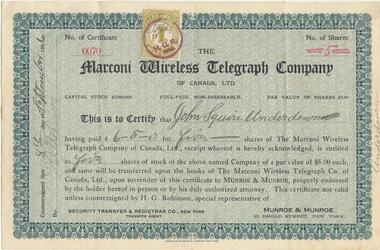
Document - Certificate, 08/09/1906
... 1924, married Sophia Elizabeth Reid. John Squire Underdown Snr took his own life whilst living in Penfield Sth Australia. Ossie (Oswald) Underdown, the doner, is the 2nd son of John Squire Underdown Jnr. Ossie Underdown owned and lived at Strawberry Gardens in Rhyll, Phillip Island. john squire underdown jnr ossie underdown marconi wireless telegraph company shares Part of Inscription: This is to Certify that John Squire Underdown having paid £6.5.0. for Five Shares........Dated 8th day of September 1906. ...This Share Certificate belonged to John Squire Underdown Jnr. born 08/12/1862 died 23/11/1924, married Sophia Elizabeth Reid. John Squire Underdown Snr took his own life whilst living in Penfield Sth Australia. Ossie (Oswald) Underdown, the doner, is the 2nd son of John Squire Underdown Jnr. Ossie Underdown owned and lived at Strawberry Gardens in Rhyll, Phillip Island.A Share Certificate for Marconi Wireless Telegraph Company of Canada, Ltd. Part of Inscription: This is to Certify that John Squire Underdown having paid £6.5.0. for Five Shares........Dated 8th day of September 1906. john squire underdown jnr, ossie underdown, marconi wireless telegraph company shares -
 Mission to Seafarers Victoria
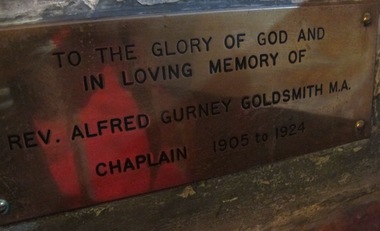
Plaque - Memorial Plaque, Rev. Alfred Gurney Goldsmith, 1925
... He served as Senior Chaplain from 1905 to 1924 through a considerable period of upheaval including the building of two Missions between 1906 and 1917. ...He served as Senior Chaplain from 1905 to 1924 through a considerable period of upheaval including the building of two Missions between 1906 and 1917. ...Reverend Alfred Gurney Goldsmith has two memorial plaques at the Mission to Seafarers Victoria. One in the the Mission's club room and this one in the Chapel of Saint Peter. He served as Senior Chaplain from 1905 to 1924 through a considerable period of upheaval including the building of two Missions between 1906 and 1917. For more information see 0639 an invitation to the laying of the foundation stone, 0704 a photograph of Reverend Goldsmith and his wife as well as the Mission's annual report from 1925 or contact the curator.Rev'd Gurney Goldsmith arrived in Australia in 1905, an experienced missionary with the intention of establishing a branch of the London Mission to Seamen. After a public meeting organised by the Victorian Mission to Seamen he entered into an amalgamation forging formal links with London, enabling a continuation of the services to seafarers, first commenced in 1857. Goldsmith also conceived the formation of an auxiliary, the Ladies Harbour Lights Guild, which was to play a significant role in support of the Mission and seafarers.Long rectangular brass plaque mounted to brick wall.To the glory of God and in loving memory of Rev. Alfred Gurney Goldsmith M.A. Chaplain 1905 to 1924reverend alfred gurney goldsmith, brass, plaque, memorial, chapel, hong kong, kobe, melbourne, lhlg, seamen mission, mission to seafarers, mission to seamen, chaplain -
 Flagstaff Hill Maritime Museum and Village
Domestic object - Razor Strop, Early 19th century
... 1906 Popular Mechanics magazine included an advertisement for Keen Edge Strop. The promise given by the advertiser, Eddy Mfg. Co. (206 Broadway, New York) was “Use the Keen Edge strop for 90 days and if not satisfied return to us and we will refund your money“. The advertisement was for a Combination Razor Strop, “the only strop made which requires no dressing.” Readers were invited to send for a booklet on Razor and the Face. In 1924...1906 Popular Mechanics magazine included an advertisement for Keen Edge Strop. The promise given by the advertiser, Eddy Mfg. Co. (206 Broadway, New York) was “Use the Keen Edge strop for 90 days and if not satisfied return to us and we will refund your money“. The advertisement was for a Combination Razor Strop, “the only strop made which requires no dressing.” Readers were invited to send for a booklet on Razor and the Face. In 1924 ...A razor strop is flexible strip of leather or canvas used to maintain a shaving edge on a thin blade such as a straight razor. Fine powdered jeweler's rouge or other pastes can be added as an abrasive to polish the blade. The strop may be a hanging strip or a hand-held paddle. This one is a hanging strop. Strops were quite commonly found in barber shops and homes before the invention of the safety razor, They are still used for sharpening tool blades. The person using the strop would draw the spine of the blade down along the strop with the blade following, without putting any pressure on the blade. At the end of the stroke, rotate the blade over its spine then draw the spine along the strop again so that the edge moves away from the top. The finer grade of leather strap is used to give the final finish. KEEN EDGE MANUFACTURER In March 1906 Popular Mechanics magazine included an advertisement for Keen Edge Strop. The promise given by the advertiser, Eddy Mfg. Co. (206 Broadway, New York) was “Use the Keen Edge strop for 90 days and if not satisfied return to us and we will refund your money“. The advertisement was for a Combination Razor Strop, “the only strop made which requires no dressing.” Readers were invited to send for a booklet on Razor and the Face. In 1924 Popular Mechanics, published by Hearst Magazines, displayed an advertisement seeking a sales manager “… to sell [to] drug, hardware and cigar stores Keen Edge Strop Dressing, which sharpens straight razors and safety blades and removes old razor strops.” At that time the Keen Edge Mfg. Company was in Dallas, Texas. Razor strops are of historical significance, representing personal effects of men from the time period when men relied on strops to keep a sharp edge on their shaving blade. Strops were commonly owned and used until the acceptance of safety razors.Razor strop, leather and metal. Keen Edge brand, double straps: two straps of different grade leather joined at ends with metal fittings. Stropping faces; sharpening surface is stained red and finishing surface is stained black. One end has padded, bulbous shaped leather handle, the other end has metal, swivel hook hanger. Inscriptions pressed into leather at the ends of the straps. Impressed into leather "FINEST SELECTED HIDE", "KEEN EDGE", "FINISH" (black stained side), “A SHARPENER" (red stained side), “1 2 3”warrnambool, shipwrecked coast, flagstaff hill maritime museum, maritime museum, shipwreck coast, great ocean road, shaving leather, shaving accessory, barber’s equipment, barber shop razor strop, razor strop, straight razor, razor and knife sharpener, keen edge razor strop -
 Mission to Seafarers Victoria
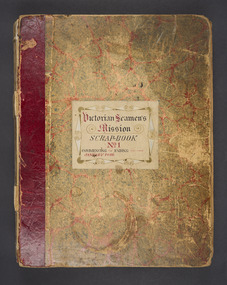
Administrative record (item) - Scrapbook, W.H.C. Darvall, Victorian Seamen's Mission Scrapbook No 1, c.1896
... 1906)...queen victoria (1819-1901)...boer war...charles georges darvall (1831-1924...It includes the names and activities of many prominent Melburnians (politicians, supporters, artists) and shows the vivacity of the work at the Mission. victoria-missions-to-seamen w h c darvall mission to seamen seamen's mission maritime exhibition queen victoria royal merchant seaman orphanage charles g. darvall william henry charles darvall (1830-1906) queen victoria (1819-1901) boer war charles georges darvall (1831-1924) sunbeam lord brassey crawford atchison denman pasco (1818-1898) concerts library association merchant seamen orphans asylum snaresbrook frederica mitchell kitty grindlay syllabus amateur concerts port melbourne standard cole's book arcade the port gazette the port melbourne standard hereward maitland Sticker on the front cover: "Victorian Seamen's/Mission/Scrap-book/No. 1/Commencing/ January 1896 Ending - A large stitched bound book of 210 brown paper pages containing newspaper clippings, advertising flyers, concert programs, drawings and memorabilia relating to the Victorian Seamen's Mission (Mission to Seafarers) and events of the time pasted on brown paper pages. ...This scrapbook holds numerous newspaper clippings recording events, functions and visits to the Seamen's Mission starting in 1896 through to 1902, although a few documents date from 1895. These dates coincide with the commencement of Mr WHC Darvall's various terms of office with the Mission from the mid 1890s. Mr Darvall's involvement with the Mission possibly stems from his arrival in Victoria in 1853 part working his passage from England as a purser on the migrant ship Asia. He first encountered Captain Pascoe on arrival at Williamstown who was also on the Mission executive when Darvall returned to Melbourne from Beechworth in 1871. 1898: Death of Captain Crawford Pasco with a photographic portrait. 1899: Small ink sketch by artist Charles Georges Darvall, WHC Darvall's cousin. 1900 Foundation of Geelong mission 1901: Queen Victoria's death (22 January) Australian Federation (1st January) Boer War (189-1902) Death of chaplain Ebenezer James Nautical exhibition On the inside of the rear cover of the book a plan of Williamstown has been pasted with no date provided. This scrapbook outlines the many events, concerts, important visits and social occasions held at and by the Mission during this time frame. It includes the names and activities of many prominent Melburnians (politicians, supporters, artists) and shows the vivacity of the work at the Mission.Sticker on the front cover: "Victorian Seamen's/Mission/Scrap-book/No. 1/Commencing/ January 1896 Ending - victoria-missions-to-seamen, w h c darvall, mission to seamen, seamen's mission, maritime exhibition, queen victoria, royal merchant seaman orphanage, charles g. darvall, william henry charles darvall (1830-1906), queen victoria (1819-1901), boer war, charles georges darvall (1831-1924), sunbeam, lord brassey, crawford atchison denman pasco (1818-1898), concerts, library association, merchant seamen orphans asylum, snaresbrook, frederica mitchell, kitty grindlay, syllabus, amateur concerts, port melbourne standard, cole's book arcade, the port gazette, the port melbourne standard, hereward, maitland -
 Ringwood and District Historical Society
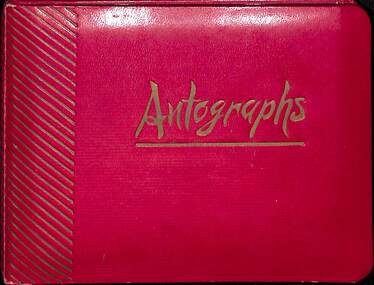
Ephemera - Packet, Gwen Reed nee Woodford family memorabilia, Circa 1880s to c1980s
... (Provided by Nicki Shea, Granddaughter of Stan & Jo Bridgman of Eastwood Cycles) Contents: Hand-written notes – Woodford Family Tree, by Gwen Reed Autograph book with entries "To Gwen" Bookmark - with name "Lorrie B" Christmas card to May with love from George 1906 Christmas card from May to George 1906 Christmas card from Edie to Gwen (Cousin Ede) Christmas card from Dot to Gwen 1925 (from Dot Grundy, dc'd) Christmas card from Ollie S to Gwen 1924 Happy New Year card to Gwen from Grandma (Woodford) Christmas card from Mum & Ethel to Gwen 1926 Christmas card to Gwen from Emily (Gawith, Jeparit East) Christmas card from Olive to Gwen 1919 (Olive Janetski, Jeparit East) Christmas card from Hilda (Obst) to Gwen 1929 Postcard to Miss G Woodford "Bygalorie Park" Tullibigeal PO NSW (To Gwen from Effie - Effie Robson, Jeparit East) Christmas card to Gwennie from C. ...(Provided by Nicki Shea, Granddaughter of Stan & Jo Bridgman of Eastwood Cycles) Contents: Hand-written notes – Woodford Family Tree, by Gwen Reed Autograph book with entries "To Gwen" Bookmark - with name "Lorrie B" Christmas card to May with love from George 1906 Christmas card from May to George 1906 Christmas card from Edie to Gwen (Cousin Ede) Christmas card from Dot to Gwen 1925 (from Dot Grundy, dc'd) Christmas card from Ollie S to Gwen 1924 Happy New Year card to Gwen from Grandma (Woodford) Christmas card from Mum & Ethel to Gwen 1926 Christmas card to Gwen from Emily (Gawith, Jeparit East) Christmas card from Olive to Gwen 1919 (Olive Janetski, Jeparit East) Christmas card from Hilda (Obst) to Gwen 1929 Postcard to Miss G Woodford "Bygalorie Park" Tullibigeal PO NSW (To Gwen from Effie - Effie Robson, Jeparit East) Christmas card to Gwennie from C. ...Collection of various family and personal documents, photographs, and early 1900s greeting cards. Papers of Gwen Reed from Edith Graham of Ware Cres, Ringwood East. (Provided by Nicki Shea, Granddaughter of Stan & Jo Bridgman of Eastwood Cycles) Contents: Hand-written notes – Woodford Family Tree, by Gwen Reed Autograph book with entries "To Gwen" Bookmark - with name "Lorrie B" Christmas card to May with love from George 1906 Christmas card from May to George 1906 Christmas card from Edie to Gwen (Cousin Ede) Christmas card from Dot to Gwen 1925 (from Dot Grundy, dc'd) Christmas card from Ollie S to Gwen 1924 Happy New Year card to Gwen from Grandma (Woodford) Christmas card from Mum & Ethel to Gwen 1926 Christmas card to Gwen from Emily (Gawith, Jeparit East) Christmas card from Olive to Gwen 1919 (Olive Janetski, Jeparit East) Christmas card from Hilda (Obst) to Gwen 1929 Postcard to Miss G Woodford "Bygalorie Park" Tullibigeal PO NSW (To Gwen from Effie - Effie Robson, Jeparit East) Christmas card to Gwennie from C. S. Graham 1915 (School teacher) Christmas card from Mum to May & George Christmas postcard from Grandfather to Gwenny Christmas card to Dear Daddie from Gwen Christmas card from May with love to George Christmas card from Nellie Parker (Nell Rodgers - Albury) to Gwen 1924 Greeting card from Hilda to Gwen 1919 (Hilda Obst Jeparit East) Christmas card from Ethel to Gwen 1927 Christmas card from Anne (MCGrath) to Gwen Christmas card from S. Hoober(?) (School teacher, Bygalorie) to Mr & Mrs Woodford, Gwen & Ollie) 1924 Christmas card from May and George to Mum and Dad 1925 Christmas card to Gwen Syd & Family from May Dad & Kiddies (Stepmother) Christmas card from George to May 1907 Postcard (signed Dulcie) to Mrs G. Reed, 9 Laurence Grove, East Ringwood Vic 3055 postmarked 1993 Envelope (only) addressed to Mrs. G. Reed, 9 Laurence Grove, Ringwood East Vic. 3135 Birth Certificate District of Balmoral, Victoria – Sonia Woodford b.1856 (Issued 1987) Death Certificate District of Stawell, Vic – Archibald Brown d.1914 Marriage Certificate District of Hamilton, Vic – John Brown & Margaret Dale m.1895 Coroner’s Post-Mortem report – Edward John Reed d.1981 Family Data Tree (Family Tree) William Walker/Elizabeth Silk, Hamilton Vic & children b.1842-1862 Newspaper clipping – May & Archibald Brown drowned at North Hamilton, 1887 Pictorial Souvenir – Selected Views of Mount Gambier to Miss L. Boyce, postmarked 1959 Hand-written poems/song lyrics by Gwen Reed (4 pages) Newspaper extract - Weekly Times Magazine Section “At Hamilton”, 1937 Photograph – “My mother standing with Foster parents” Photograph of Gracie (?) Grandma (?) Murray (?) Photograph of costumed performers Photograph of child Photograph of lady at John Mansell dispensary (Chemist at Forest Hill Vic?) Postcard photograph – Gwen & Ethel Woodford Photograph of grave – Victoria May Woodford (died 1957 aged 56 years) Photograph of grave – William Woodford and Sarah Woodford Photograph of un-named male Photograph of baby on chair Photograph – “Myself. Hope you like it May" Photograph (colour) – un-named group on train at Currumbin Qld Photograph – 2 un-named girls Autographs include Arthur Young Rosie Sturgess Joff Ellen Carlu Carter Toni Lamond Dick Curtis Billy Daniels Margaret Whiting Horrie Dargie Duo Moreno Therese Talbert Richard Gray Three Apollos Robert Leeman -
 Eltham District Historical Society Inc
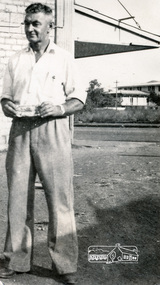
Photograph, Bill Sargeant, son of Constable W.C. and Mrs Sargeant
... His younger brother Gilbert Gerard Brudenell Sargeant (1906-1970) was a porter at Eltham Railway Station in 1924. (Research notes from Alan Sheehan c.2014) ...His younger brother Gilbert Gerard Brudenell Sargeant (1906-1970) was a porter at Eltham Railway Station in 1924. (Research notes from Alan Sheehan c.2014) Heather Jenkins was the daughter of Constable John Thomas Cone, Badge #3935 served at Eltham Police Station 1 May 1911 to 9 July 1922. eltham police residence Bill Sargeant On verso in pencil "Const. ...Whether the photo was taken in Eltham is unknown. William Henry Patrick Sargeant was born in 1898 and dies in 1985. His younger brother Gilbert Gerard Brudenell Sargeant (1906-1970) was a porter at Eltham Railway Station in 1924. (Research notes from Alan Sheehan c.2014) Heather Jenkins was the daughter of Constable John Thomas Cone, Badge #3935 served at Eltham Police Station 1 May 1911 to 9 July 1922.Glued on a brown paper scrapbook page (torn from scrapbook) with 9 black and white/sepia photos of varying sizes, 1 newspaper clipping and handwritten captions in ink.On verso in pencil "Const. W.C. Sargeant 1922-1927 - see Police list"eltham, police residence, bill sargeant -
 Eltham District Historical Society Inc
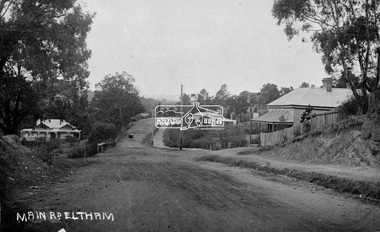
Negative - Photograph, Main Road, Eltham, c.1915
... 1906 between Yoirk Street and Bridge Street. On the left is ‘Derril’ or more commonly known as the Gahan House after it was purchased by Walter Ernest and Alice Miriam Gahan in 1924, on the western side of Main Road near the present-day site of Shillinglaw Cottage where they remained till about 1960 when Walter died. ...1906 between Yoirk Street and Bridge Street. On the left is ‘Derril’ or more commonly known as the Gahan House after it was purchased by Walter Ernest and Alice Miriam Gahan in 1924, on the western side of Main Road near the present-day site of Shillinglaw Cottage where they remained till about 1960 when Walter died. ...Sending postcards to family and friends including short messages was a common form of communication in the early 20th century from 1905 to the 1940s. Many were collected and kept in albums. This scene is viewed looking north along Main Road from near Bridge Street. The old Baker’s shop (Burgoyne’s store) on the corner of York is on the right. Also visible is the footpath dug by hand c.1906 between Yoirk Street and Bridge Street. On the left is ‘Derril’ or more commonly known as the Gahan House after it was purchased by Walter Ernest and Alice Miriam Gahan in 1924, on the western side of Main Road near the present-day site of Shillinglaw Cottage where they remained till about 1960 when Walter died. The house was demolished in 1968 during the widening of Main Road. In the distance on the bend is the Shillinglaw cottage with the Shillinglaw trees out front of the cottage. On the eastern side at the top of the hill (visible immediately to the left of the bakery) is the new St Mary’s Catholic Church on Henry Street near Main Road. The church site was relocated c.1912 from further south along Main Road (near Wingrove Cottage) in order to be more central to the congregation following the shifting of the township away from Little Eltham and closer to the railway station. It was subsequently destroyed by fire in 1961. On the back of the postcard is written: Printed Post Empire Care - correspondence - Address only - stamp Written in ink: 15 ? 1920 Many happy of the day I hope you and ? will have a very pleasant trip ? a great time when you reach England. ? & best wishes from your sincere friend E Harper?This photo forms part of a collection of photographs gathered by the Shire of Eltham for their centenary project book,"Pioneers and Painters: 100 years of the Shire of Eltham" by Alan Marshall (1971). The collection of over 500 images is held in partnership between Eltham District Historical Society and Yarra Plenty Regional Library (Eltham Library) and is now formally known as the 'The Shire of Eltham Pioneers Photograph Collection.' It is significant in being the first community sourced collection representing the places and people of the Shire's first one hundred years.Digital image 4 x 5 inch B&W Neg Sepia Postcard 9 x 14 cm 35mm positive transparencyshire of eltham pioneers photograph collection, eltham, main road, gahan house, bakery, footpath, postcard, shillinglaw cottage, shillinglaw trees, st marys catholic church, york street, michael aitken collection -
 Bendigo Historical Society Inc.
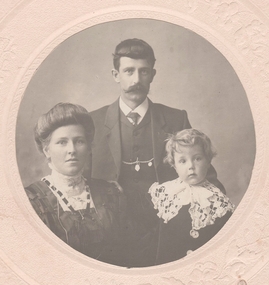
Photograph - Harry & Edith Gee with young son Harry. Posed studio B&W photograph, McKenzie Family Collection, August 2024
... Harry Gee (26/10/1882-7/12/1924) married Edith May Bray (1883-27/5/1957) in 1904. They had the following children:- Harry Edward b. 1904-1904; Harry Herbert b. 1906,Bessie Elsie b. 1908; William James b. 1909....Harry Gee (26/10/1882-7/12/1924) married Edith May Bray (1883-27/5/1957) in 1904. They had the following children:- Harry Edward b. 1904-1904; Harry Herbert b. 1906,Bessie Elsie b. 1908; William James b. 1909. history Eaglehawk Photographers stamp Laurel Studios Bendigo Harry & Edith Gee with young son Harry. ...Harry Gee (26/10/1882-7/12/1924) married Edith May Bray (1883-27/5/1957) in 1904. They had the following children:- Harry Edward b. 1904-1904; Harry Herbert b. 1906,Bessie Elsie b. 1908; William James b. 1909.Harry & Edith Gee with young son Harry. Posed studio B&W photograph with beige cardboard mount. Square format with circular cut out for the family photograph. Photographers stamp Laurel Studios Bendigohistory, eaglehawk -
 Bendigo Historical Society Inc.
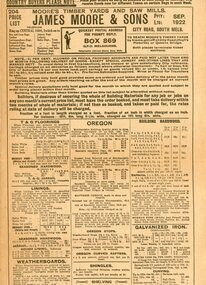
Document - Price Lists, 1922-24
... Another son, William had disappeared in 1906. history bendigo abbott collection james moore and sons James Moore and Sons Timber Yard and Saw Mills Price List for September 1922 and April 1924 listing prices for floorings; Oregon; building hardwood; galvanised iron; linings etc. ...James Moore and Sons had a timber and saw mill at City Rd., South Melbourne. They employed over 600 men with a wide range of skills, turning out milled timber for building, household items and other cabinetry, the wooden bodies of trams and even what is believed to be the first commercially produced airplane propeller. The site also included a nail making factory. These goods were sold throughout the state before the company went into voluntary liquidation in 1935. James Louis Moore was born in Ireland 12/8/1843 and died in London 3/2/1913 before his body was returned to Melbourne for burial in the family vault in April 1913. The business continued under his sons Walter, Louis and Arthur. Another son, William had disappeared in 1906.James Moore and Sons Timber Yard and Saw Mills Price List for September 1922 and April 1924 listing prices for floorings; Oregon; building hardwood; galvanised iron; linings etc. Four pages.history, bendigo, abbott collection, james moore and sons -
 Bendigo Historical Society Inc.
Document - COHN BROTHERS COLLECTION: DOCUMENTS PROFIT AND LOSS
... 1906 through to 1929 catalogued. Note three-1907, three- 1908, 1909 missing, two- 1910, three-1911, four- 1913, two- 1914, two 1919, five-1920, three- 1924, three- 1925. ...1906 through to 1929 catalogued. Note three-1907, three- 1908, 1909 missing, two- 1910, three-1911, four- 1913, two- 1914, two 1919, five-1920, three- 1924, three- 1925. ...Thirty-eight handwritten Cohn blue lined folded documents captioned 'Profit & Loss' . Relevant date with each document. Copies with dates commencing 1906 through to 1929 catalogued. Note three-1907, three- 1908, 1909 missing, two- 1910, three-1911, four- 1913, two- 1914, two 1919, five-1920, three- 1924, three- 1925. Note 1926-27-28 missing.bendigo, industry, cohn bros brewery -
 Bendigo Historical Society Inc.
Document - COHN BROTHERS COLLECTION: DOCUMENTS PROFIT AND LOSS
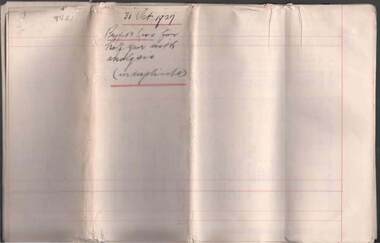
... Note two-1906, three-1908, three- 1909, two-1912, two- 1914, three-1915, four-1916, two-1917, two-1918, three-1919, two-1921, four-1922, two-1924, and two-1925. ...Note two-1906, three-1908, three- 1909, two-1912, two- 1914, three-1915, four-1916, two-1917, two-1918, three-1919, two-1921, four-1922, two-1924, and two-1925. ...Forty - one blue lined handwritten Cohn Bros documents captioned 'Profit & Loss', and include relevant date. Dates commence 1905 through to 1927. Note 1913 and 1926 are missing. Note two-1906, three-1908, three- 1909, two-1912, two- 1914, three-1915, four-1916, two-1917, two-1918, three-1919, two-1921, four-1922, two-1924, and two-1925. Document 8461[1.] is an analysis of Profit & Loss for years 1904-5-6 & 7 to get at profit per hogshead and was enclosed with above described documents.bendigo, industry, cohn bros brewery -
 Bendigo Historical Society Inc.
Newspaper - JENNY FOLEY COLLECTION: A THRIVING MARKET
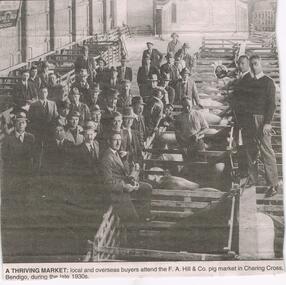
... 1924) was a Bendigo auctioneer who most commonly sold pigs and horses. His business was situated in Charing Cross. Advertising showed that the business was in existence as early as 1906. ...1924) was a Bendigo auctioneer who most commonly sold pigs and horses. His business was situated in Charing Cross. Advertising showed that the business was in existence as early as 1906. ...Francis Albert (Frank) Hill, (1866-1924) was a Bendigo auctioneer who most commonly sold pigs and horses. His business was situated in Charing Cross. Advertising showed that the business was in existence as early as 1906. Frank was also heavily involved in the Bendigo Agricultural Society, and the Bendigo Trotting and Jockey Clubs. He married Hannah Farley in 1897.Bendigo Advertiser '' The way we were'' from 2002. A thriving market: local and overseas buyers attend the F. A. Hill & Co. pig market in Charing Cross, Bendigo, during the late 1930s. The clip is in a folder.newspaper, bendigo advertiser, the way we were -
 Otway Districts Historical Society
Photograph, Harrington's Hotel, Lavers Hill, 1921, 1921
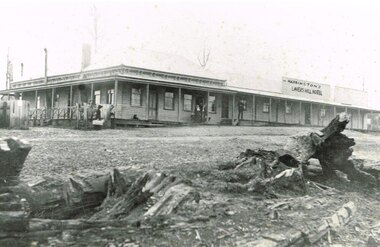
... 1906. The publicans were Messrs. Hedley, Tom McGrath, Pat Harrington and F. Betteridge. When Tom McGrath was publican the hotel boasted 20 rooms and first-class stabling. Pat Harrington when publican supported the local football club when it was formed, and soon after owned the General Store from 1924 until 1926. ...1906. The publicans were Messrs. Hedley, Tom McGrath, Pat Harrington and F. Betteridge. When Tom McGrath was publican the hotel boasted 20 rooms and first-class stabling. Pat Harrington when publican supported the local football club when it was formed, and soon after owned the General Store from 1924 until 1926. ...The Lavers Hill Hotel was established in about 1906. The publicans were Messrs. Hedley, Tom McGrath, Pat Harrington and F. Betteridge. When Tom McGrath was publican the hotel boasted 20 rooms and first-class stabling. Pat Harrington when publican supported the local football club when it was formed, and soon after owned the General Store from 1924 until 1926. When a census officer collecting statistical information asked Mrs Harrington, "What does your husband do?" the answer quickly came, "Well now, what could you say Pat has ever done." The hotel burnt done in 1930.B/W. Harrington's Laver Hill Hotel, with one woman approaching the hotel from the left and three people on a very long, two-dimension veranda.lavers hill; hotel; -
 Essendon Football Club
Premiership cap, 1901
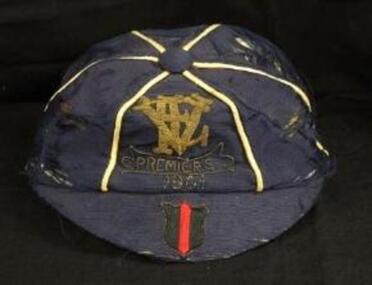
... 1924. The caps were traditionally made of navy silk. This one has had Essendon's colours embroidered on the peak in the shape of a shield. Vollugi was a fine wingman who played 70 games for Essendon from 1901 to 1906....1924. The caps were traditionally made of navy silk. This one has had Essendon's colours embroidered on the peak in the shape of a shield. Vollugi was a fine wingman who played 70 games for Essendon from 1901 to 1906. ...Premiership cap presented to Hercules "Hec" Vollugi after Essendon won the 1901 premiership. Premiership caps were presented by both the VFA and the VFL until about 1924. The caps were traditionally made of navy silk. This one has had Essendon's colours embroidered on the peak in the shape of a shield. Vollugi was a fine wingman who played 70 games for Essendon from 1901 to 1906.Navy blue grosgrain silk cap with small peak; cap is divided into six segments separated by cream silk braid with navy button on top; embroidered badge in metallic and silk gold thread at front of cap; badge consists of monogram of interwined V F L with "Premiers" in a scroll beneath and "1901" beneath that; shield embroidered in red and black longstitch on peak. Cap is lined with "H. A. Vollugi 1901" handwritten in ink in centre."H. A. Vollugi 1901" is handwritten in ink on the inside of the cap -
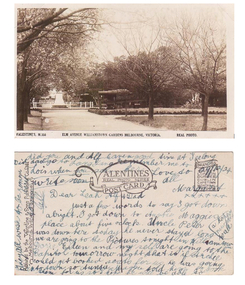 Williamstown Botanic Gardens- Hobsons Bay City Council
Postcard - Williamstown Botanic Gardens, circa 1900-1924
... 1924...Fort-Gellibrand...1906...This postcard is evidence of the placement of two of the cannons relocated from Fort Gellibrand in 1906 and that they were in place in the Gardens in 1924. They were removed from the Gardens in the 1960s. ...The original postcards in this series (2013.002 to 2013.018) were generously loaned to Williamstown Botanic Gardens by a private collector for copying. The postcards are evidence of the interest the gardens held as a subject for postcard publishers. The text and images provide a snapshot into fashions, social interests and concerns of the time. The professionally produced images provide a pictorial history of Gardens including changing planting styles, various structures and features of the Gardens eg the aviary, cannons, the fountain, the second Curator’s Lodge and gates. The images offer an opportunity to compare garden vistas with the present day. This postcard is evidence of the placement of two of the cannons relocated from Fort Gellibrand in 1906 and that they were in place in the Gardens in 1924. They were removed from the Gardens in the 1960s. These same cannons remain a feature on the Williamstown waterfront in 2013. The image also shows the original Elm Avenue plantings. A sepia scene looking west towards statue of Alfred Thomas Clark, with cannons on either side of statue pointing east down what is known as the Palm Avenue. The statue is surrounded by a white fence consisting of posts and a top rail. The top of the statue is hidden by the branches of the elm trees. It appears that the elms are in the process of either losing their leaves or new leaf growth. A cactus plant can be seen beneath the lower branches of the elm tree of the right closest to the camera. The cannons were moved from Fort Gellibrand to the Gardens in 1906.Front: VALENTINE’S, M.356 ELM AVENUE WILLIAMSTOWN GARDENS MELBOURNE, VICTORIA. REAL PHOTO. Reverse: vertical on left side of card and underlined: ‘Published by the Valentine & Sons Publishing Co. Ltd. / Melbourne, Sydney & Brisbane’. Top centre of card: Contains logo of ‘VALENTINES / REAL PHOTO SERIES / POSTCARD’. Top right hand corner is stamped ‘BRANCHES (enclosed in a scroll) / SYDNEY / LONDON / DUNDEE / DUBLIN / CAPETOWN / MONTREAL / TORONTO’ The card is dated ‘29/12/24’ and addressed to ‘Dear Leah Alf & Dad’ signed by ‘Margaret’. postcard, gardens, post-card, williamstown-botanic-gardens, hobsons-bay-city-council, statue, clarke, alfred-thomas-clarke, cannon, elm, cactus, 1924, fort-gellibrand, 1906, armstrong, clark -
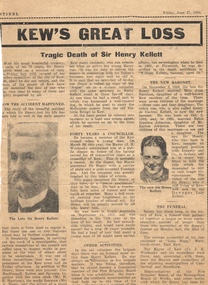 Kew Historical Society Inc
Newspaper - Newspaper Article, Kew's Great Loss, 27/06/1924
... 1924) the son of a hereditary baronet, was born at Mt Gambier, South Australia in 1851. His English title had been created in Ireland in 1801, but the family was originally Norman with the later branches living in England and Ireland. Sir Henry Kellett assumed the title in 1906...1924) the son of a hereditary baronet, was born at Mt Gambier, South Australia in 1851. His English title had been created in Ireland in 1801, but the family was originally Norman with the later branches living in England and Ireland. Sir Henry Kellett assumed the title in 1906 ...Sir Henry de Castres Kellett (1851-1924) the son of a hereditary baronet, was born at Mt Gambier, South Australia in 1851. His English title had been created in Ireland in 1801, but the family was originally Norman with the later branches living in England and Ireland. Sir Henry Kellett assumed the title in 1906. Henry Kellett was a prominent Kew retailer, continuing his father’s newspaper and stationery business in Bulleen Road (now High Street). At various stages, he also acted as an insurance, postal and real estate agent. He lived in Walpole Street and later at Lota Begg (now demolished) in Westbrook Street, East Kew. In 1884, Henry Kellett was elected to the Kew Borough Council and served for 40 years; a remarkable example of public service. He was elected Mayor for a single term in 1888-9. Sir Henry de Castres Kellett died in St George’s Hospital in 1924 following a tragic car accident in Cotham Road, Kew while on Council business. The vehicle, in which he was travelling with fellow councillors and the Town Clerk, collided with a tram. Sir Henry Kellett is commemorated in the naming of Kellett Reserve and Kellett Grove.Newspaper report in The Sentinel reporting the death of Cr Sir Henry Kellett in 1924mayors of kew (vic), sir henry de castres kellett -
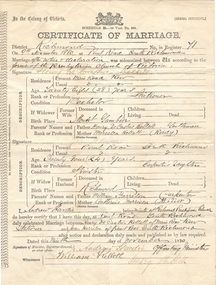 Kew Historical Society Inc
Certificate - Certificate of Marriage, Henry de Castres Kellett & Joan Harrison, 1880, 09/11/1880
... 1924) the son of a hereditary baronet, was born at Mt Gambier, South Australia in 1851. His English title had been created in Ireland in 1801, but the family was originally Norman with the later branches living in England and Ireland. Sir Henry Kellett assumed the title in 1906...1924) the son of a hereditary baronet, was born at Mt Gambier, South Australia in 1851. His English title had been created in Ireland in 1801, but the family was originally Norman with the later branches living in England and Ireland. Sir Henry Kellett assumed the title in 1906 ...Sir Henry de Castres Kellett (1851-1924) the son of a hereditary baronet, was born at Mt Gambier, South Australia in 1851. His English title had been created in Ireland in 1801, but the family was originally Norman with the later branches living in England and Ireland. Sir Henry Kellett assumed the title in 1906. Henry Kellett was a prominent Kew retailer, continuing his father’s newspaper and stationery business in Bulleen Road (now High Street). At various stages, he also acted as an insurance, postal and real estate agent. He lived in Walpole Street and later at Lota Begg (now demolished) in Westbrook Street, East Kew. In 1884, Henry Kellett was elected to the Kew Borough Council and served for 40 years; a remarkable example of public service. He was elected Mayor for a single term in 1888-9. Sir Henry de Castres Kellett died in St George’s Hospital in 1924 following a tragic car accident in Cotham Road, Kew while on Council business. The vehicle, in which he was travelling with fellow councillors and the Town Clerk, collided with a tram. Sir Henry Kellett is commemorated in the naming of Kellett Reserve and Kellett Grove.Original Marriage Certificate of Henry de Castres Kellet and Joan Harrosn, in Richmond on 9 November 1880mayors of kew (vic), sir henry de castres kellett -
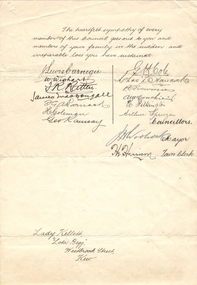 Kew Historical Society Inc
Letter - Letter of Condolence, Lady Kellett, Lota Begg, Westbrook Street, Kew, 1924
... 1924) the son of a hereditary baronet, was born at Mt Gambier, South Australia in 1851. His English title had been created in Ireland in 1801, but the family was originally Norman with the later branches living in England and Ireland. Sir Henry Kellett assumed the title in 1906...1924) the son of a hereditary baronet, was born at Mt Gambier, South Australia in 1851. His English title had been created in Ireland in 1801, but the family was originally Norman with the later branches living in England and Ireland. Sir Henry Kellett assumed the title in 1906 ...Sir Henry de Castres Kellett (1851-1924) the son of a hereditary baronet, was born at Mt Gambier, South Australia in 1851. His English title had been created in Ireland in 1801, but the family was originally Norman with the later branches living in England and Ireland. Sir Henry Kellett assumed the title in 1906. Henry Kellett was a prominent Kew retailer, continuing his father’s newspaper and stationery business in Bulleen Road (now High Street). At various stages, he also acted as an insurance, postal and real estate agent. He lived in Walpole Street and later at Lota Begg (now demolished) in Westbrook Street, East Kew. In 1884, Henry Kellett was elected to the Kew Borough Council and served for 40 years; a remarkable example of public service. He was elected Mayor for a single term in 1888-9. Sir Henry de Castres Kellett died in St George’s Hospital in 1924 following a tragic car accident in Cotham Road, Kew while on Council business. The vehicle, in which he was travelling with fellow councillors and the Town Clerk, collided with a tram. Sir Henry Kellett is commemorated in the naming of Kellett Reserve and Kellett Grove.Original official document from a noted event in Kew's historyOne page undated, handwritten letter of condolence to Lady Kellett on her husband's accidental death in 1924 while serving as a Kew Councillor. The latter is signed by his fellow councillors, the Mayor and the Town Clerkmayors of kew (vic), sir henry de castres kellett -
 Kew Historical Society Inc
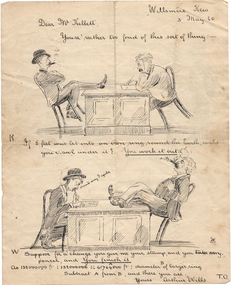
Drawing - Visual Vignettes, Sir Henry de Castres Kellett & Arthur Wills / by Arthur Wills, 1920
... 1924) the son of a hereditary baronet, was born at Mt Gambier, South Australia in 1851. His English title had been created in Ireland in 1801, but the family was originally Norman with the later branches living in England and Ireland. Sir Henry Kellett assumed the title in 1906...1924) the son of a hereditary baronet, was born at Mt Gambier, South Australia in 1851. His English title had been created in Ireland in 1801, but the family was originally Norman with the later branches living in England and Ireland. Sir Henry Kellett assumed the title in 1906 ...Sir Henry de Castres Kellett (1851-1924) the son of a hereditary baronet, was born at Mt Gambier, South Australia in 1851. His English title had been created in Ireland in 1801, but the family was originally Norman with the later branches living in England and Ireland. Sir Henry Kellett assumed the title in 1906. Henry Kellett was a prominent Kew retailer, continuing his father’s newspaper and stationery business in Bulleen Road (now High Street). At various stages, he also acted as an insurance, postal and real estate agent. He lived in Walpole Street and later at Lota Begg (now demolished) in Westbrook Street, East Kew. In 1884, Henry Kellett was elected to the Kew Borough Council and served for 40 years; a remarkable example of public service. He was elected Mayor for a single term in 1888-9. Sir Henry de Castres Kellett died in St George’s Hospital in 1924 following a tragic car accident in Cotham Road, Kew while on Council business. The vehicle, in which he was travelling with fellow councillors and the Town Clerk, collided with a tram. Sir Henry Kellett is commemorated in the naming of Kellett Reserve and Kellett Grove.Original artwork by Arthur Wills, descendent of a noted pioneer family, and former mayor of Kew.Two sided illustrated humorous vignettes featuring two noted Kew citizens: Henry de Castres Kellet and Arthur Wills. The latter is the illustrator. The item was illustrated in 1920.mayors of kew (vic), sir henry de castres kellett, arthur wills, willsmere, wills family -
 Kew Historical Society Inc
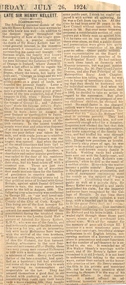
Newspaper - Newspaper Article, Late Sir Henry Kellett, 1924, 1924
... 1924) the son of a hereditary baronet, was born at Mt Gambier, South Australia in 1851. His English title had been created in Ireland in 1801, but the family was originally Norman with the later branches living in England and Ireland. Sir Henry Kellett assumed the title in 1906...1924) the son of a hereditary baronet, was born at Mt Gambier, South Australia in 1851. His English title had been created in Ireland in 1801, but the family was originally Norman with the later branches living in England and Ireland. Sir Henry Kellett assumed the title in 1906 ...Sir Henry de Castres Kellett (1851-1924) the son of a hereditary baronet, was born at Mt Gambier, South Australia in 1851. His English title had been created in Ireland in 1801, but the family was originally Norman with the later branches living in England and Ireland. Sir Henry Kellett assumed the title in 1906. Henry Kellett was a prominent Kew retailer, continuing his father’s newspaper and stationery business in Bulleen Road (now High Street). At various stages, he also acted as an insurance, postal and real estate agent. He lived in Walpole Street and later at Lota Begg (now demolished) in Westbrook Street, East Kew. In 1884, Henry Kellett was elected to the Kew Borough Council and served for 40 years; a remarkable example of public service. He was elected Mayor for a single term in 1888-9. Sir Henry de Castres Kellett died in St George’s Hospital in 1924 following a tragic car accident in Cotham Road, Kew while on Council business. The vehicle, in which he was travelling with fellow councillors and the Town Clerk, collided with a tram. Sir Henry Kellett is commemorated in the naming of Kellett Reserve and Kellett Grove.Newspaper report from 1924, providing an obituary of Sir Henry de Castres Kellettmayors of kew (vic), sir henry de castres kellett -
 Kew Historical Society Inc
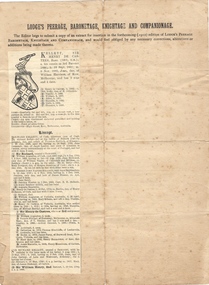
Document, Lodge's Peerage, Baronetage, Knightage and Companionage - KELLETT, Sir Henry de Castres Bart
... 1924) the son of a hereditary baronet, was born at Mt Gambier, South Australia in 1851. His English title had been created in Ireland in 1801, but the family was originally Norman with the later branches living in England and Ireland. Sir Henry Kellett assumed the title in 1906...1924) the son of a hereditary baronet, was born at Mt Gambier, South Australia in 1851. His English title had been created in Ireland in 1801, but the family was originally Norman with the later branches living in England and Ireland. Sir Henry Kellett assumed the title in 1906 ...Sir Henry de Castres Kellett (1851-1924) the son of a hereditary baronet, was born at Mt Gambier, South Australia in 1851. His English title had been created in Ireland in 1801, but the family was originally Norman with the later branches living in England and Ireland. Sir Henry Kellett assumed the title in 1906. Henry Kellett was a prominent Kew retailer, continuing his father’s newspaper and stationery business in Bulleen Road (now High Street). At various stages, he also acted as an insurance, postal and real estate agent. He lived in Walpole Street and later at Lota Begg (now demolished) in Westbrook Street, East Kew. In 1884, Henry Kellett was elected to the Kew Borough Council and served for 40 years; a remarkable example of public service. He was elected Mayor for a single term in 1888-9. Sir Henry de Castres Kellett died in St George’s Hospital in 1924 following a tragic car accident in Cotham Road, Kew while on Council business. The vehicle, in which he was travelling with fellow councillors and the Town Clerk, collided with a tram. Sir Henry Kellett is commemorated in the naming of Kellett Reserve and Kellett Grove.Printed extract from Lodge's Peerage, Baronetage, Knightage and Companionage listing KELLETT, Sir Henry de Castres Bart.mayors of kew (vic), sir henry de castres kellett -
 Kew Historical Society Inc
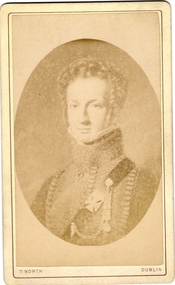
Photograph - Carte de Visite, Captain RJ Napier Kellett, Undated
... 1924) the son of a hereditary baronet, was born at Mt Gambier, South Australia in 1851. His English title had been created in Ireland in 1801, but the family was originally Norman with the later branches living in England and Ireland. Sir Henry Kellett assumed the title in 1906...1924) the son of a hereditary baronet, was born at Mt Gambier, South Australia in 1851. His English title had been created in Ireland in 1801, but the family was originally Norman with the later branches living in England and Ireland. Sir Henry Kellett assumed the title in 1906 ...Sir Henry de Castres Kellett (1851-1924) the son of a hereditary baronet, was born at Mt Gambier, South Australia in 1851. His English title had been created in Ireland in 1801, but the family was originally Norman with the later branches living in England and Ireland. Sir Henry Kellett assumed the title in 1906. Henry Kellett was a prominent Kew retailer, continuing his father’s newspaper and stationery business in Bulleen Road (now High Street). At various stages, he also acted as an insurance, postal and real estate agent. He lived in Walpole Street and later at Lota Begg (now demolished) in Westbrook Street, East Kew. In 1884, Henry Kellett was elected to the Kew Borough Council and served for 40 years; a remarkable example of public service. He was elected Mayor for a single term in 1888-9. Sir Henry de Castres Kellett died in St George’s Hospital in 1924 following a tragic car accident in Cotham Road, Kew while on Council business. The vehicle, in which he was travelling with fellow councillors and the Town Clerk, collided with a tram. Sir Henry Kellett is commemorated in the naming of Kellett Reserve and Kellett Grove.Rare portrait of a Kellett ancestorCarte de Visite of Captain RJ Napier Kellett, an ancestor of Sir Henry de Castres Kellett.CAPN RK NAPIER KELLETT / RIFLE BRIGADE / WATERLOO MEDAL / CAPN ROYAL 42ND HIGHLANDERS THOS NORTH PHOTOGRAPHER / 71 GRAFTON STREET DUBLIN sir henry de castres kellett, cape rj napier kellett, battle of waterloo -
 Kew Historical Society Inc
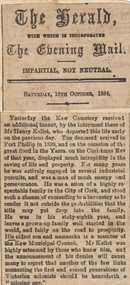
Newspaper - Newspaper Article, Sir Henry de Castres Kellett - Burial Report, 1924
... 1924) the son of a hereditary baronet, was born at Mt Gambier, South Australia in 1851. His English title had been created in Ireland in 1801, but the family was originally Norman with the later branches living in England and Ireland. Sir Henry Kellett assumed the title in 1906...1924) the son of a hereditary baronet, was born at Mt Gambier, South Australia in 1851. His English title had been created in Ireland in 1801, but the family was originally Norman with the later branches living in England and Ireland. Sir Henry Kellett assumed the title in 1906 ...Sir Henry de Castres Kellett (1851-1924) the son of a hereditary baronet, was born at Mt Gambier, South Australia in 1851. His English title had been created in Ireland in 1801, but the family was originally Norman with the later branches living in England and Ireland. Sir Henry Kellett assumed the title in 1906. Henry Kellett was a prominent Kew retailer, continuing his father’s newspaper and stationery business in Bulleen Road (now High Street). At various stages, he also acted as an insurance, postal and real estate agent. He lived in Walpole Street and later at Lota Begg (now demolished) in Westbrook Street, East Kew. In 1884, Henry Kellett was elected to the Kew Borough Council and served for 40 years; a remarkable example of public service. He was elected Mayor for a single term in 1888-9. Sir Henry de Castres Kellett died in St George’s Hospital in 1924 following a tragic car accident in Cotham Road, Kew while on Council business. The vehicle, in which he was travelling with fellow councillors and the Town Clerk, collided with a tram. Sir Henry Kellett is commemorated in the naming of Kellett Reserve and Kellett Grove.Newspaper report from 1924 of the funeral of Sir Henry de Castres Kellett at Boroondara General Cemeterysir henry de castres kellett
