
Showing 640 items matching "1940s - 1950s"
-
 Melbourne Legacy
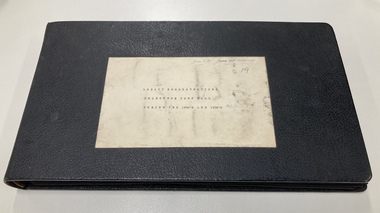
Album, Annual Demonstration 1940s and 1950s, 195
... Annual Demonstration 1940s and 1950s...An album of black and white photos of the Annual Demonstrations in the 1940s and 1950s. They are press photos taken during the dress rehearsals. ...Black photo album with black pages x 34 with black and white photos of demonstrations from the 1940s and 1950s....Cover has a typed label 'Legacy Demonstrations / Melbourne Town Hall / during the 1940s and 1950s' Handwritten in blue ink 'Jnr Ltee June Whitechurch' and '19'...Annual Demonstration 1940s and 1950s Album ...An album of black and white photos of the Annual Demonstrations in the 1940s and 1950s. They are press photos taken during the dress rehearsals. Throughout the year Melbourne Legacy provided classes for Junior Legatees such as dancing, gymnastics and Eurythmics. The Demonstration was an annual event to showcase their skills. Melbourne Legacy conducted Annual Demonstrations / Parades from 1928 through to the 1980's, usually held at Melbourne Town Hall or Olympic Pool Stadium. The beautiful costumes were made by members of the Junior Legacy Mothers' Club and the Melbourne Legacy Wives' Association.A record of the displays at the Annual Demonstrations. Also that Legacy provided classes for junior legatees and the skills learned were displayed in the Annual Demonstration.Black photo album with black pages x 34 with black and white photos of demonstrations from the 1940s and 1950s.Cover has a typed label 'Legacy Demonstrations / Melbourne Town Hall / during the 1940s and 1950s' Handwritten in blue ink 'Jnr Ltee June Whitechurch' and '19'junior legatees, demonstration, annual demonstration, girls classes, boys classes -
 Ringwood and District Historical Society
Work on paper - Letter, Mrs Kerry Puckey (nee Jansen), early resident of Everard Road, East Ringwood, 1940s-1950s. Notes prepared by June Puckey (nee Kemp), 1940s-1950s
... Mrs Kerry Puckey (nee Jansen), early resident of Everard Road, East Ringwood, 1940s-1950s. Notes prepared by June Puckey (nee Kemp)...1940s-1950s...+Additional Keywords: Puckey, June / Kemp, June / Puckey, Kerry / Jansen, Kerry Mrs Kerry Puckey (nee Jansen), early resident of Everard Road, East Ringwood, 1940s-1950s. Notes prepared by June Puckey (nee Kemp) Work on paper Letter ...Mrs. Kerry Puckey, formerly Jansen, C/- Yellingbo Post Office, Yellingbo 3139, student at East Ringwood School.Notes prepared by June Puckey (nee Kemp) on early resident of Everard Road, East Ringwood. +Additional Keywords: Puckey, June / Kemp, June / Puckey, Kerry / Jansen, Kerry -
 Kiewa Valley Historical Society
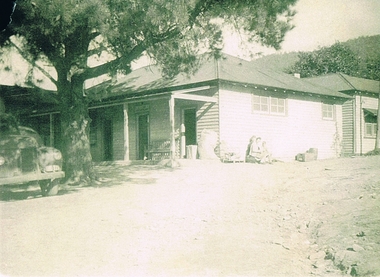
Photograph Tawonga Hotel, Tawonga Hotel Circa 1940s - 1950s, circa 1940s to 1950s
... Tawonga Hotel Circa 1940s - 1950s...This photograph shows the "lay back" atmosphere enjoyed in a small country town in the 1940s to the 1950s. Two women and a young boy basking in the warmth of the sun. ...circa 1940s to 1950s...Tawonga Hotel Circa 1940s - 1950s Photograph Tawonga Hotel Mr George Milne ...This photograph shows the "lay back" atmosphere enjoyed in a small country town in the 1940s to the 1950s. Two women and a young boy basking in the warmth of the sun. The unsealed drive way and cars parked close to the entrance was typical of small towns during this period. Open doors and shady trees provided sufficient cooling for most sunny days. The wooden barrel next to the outside wall shows that storage space within the hotel was limited and that metal aluminium barrels had not been in existence. This photograph was taken at a time when children and women had limited access to the major drinking and entertainment facilities within a hotel(pub). Legal drinking age was for patrons 21 years and older and no strict dress codes where applied. The hotel bar was not open on Sundays (God fearing) and opening time restrictions were in place. "In transit" clients were given some leniency when staying in small country hotels as strict liquor laws This photograph presents a window to a life in the 1940s to 1950s, of a small town in the Kiewa Valley. It covers a period when the local hotel or "pub" was the meeting point for local men and women to talk about local events and life in general. It was also a point where "locals' had the first opportunity to meet new arrivals and converse with tourists and "through traffic". The importance of "face to face" verbal communication was a critical part of community life and interaction. The hotel(pub) was in this period the hub of small communities, and together with local churches provided the essential structure for a balanced existence in rural Australia.Black and white photo of Tawonga Hotel. This photo is in itself a photo of a photo and as such lacks fine detail. This reproduction is on "Kodak XtraLife II paper ""outback" hotels, pubs, rural short stay accommodation, tawonga hotel -
![A Home of My Own: Handy hints and images from domestic life in Australia in the 1940s and 1950s / [collected by] Mary Murray](/media/collectors/550653872162f11fb04854aa/items/5ed03796dcf9cd08346b14b2/item-media/5ed038c8dcf9cd08346b1cfe/item-fit-380x285.jpg?cb=6) Kew Historical Society Inc
Kew Historical Society IncBook, Mallon Publishing, A Home of My Own: Handy hints and images from domestic life in Australia in the 1940s and 1950s, 2001
... A Home of My Own: Handy hints and images from domestic life in Australia in the 1940s and 1950s...A Home of My Own: Handy hints and images from domestic life in Australia in the 1940s and 1950s Book Mallon Publishing Mary Murray ...vi, 130 p. : ill. ; 27 cm.non-fictionhome economics -- australia., home economics -- australia -- history. -
 Ballarat Tramway Museum
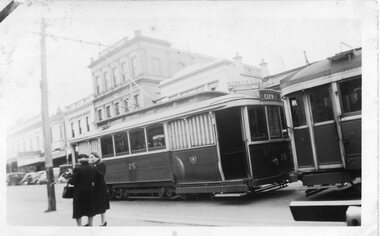
Photograph - Black and White - 26 at City in Sturt Street late 1940s to 1950s
... Black and White - 26 at City in Sturt Street late 1940s to 1950s...1950s. Original and Copy Print. Photograph Black and White - 26 at City in Sturt Street late 1940s to 1950s ...Photograph shows Ballarat tram 26 parked behind a bogie car at the City terminus, in Sturt St at Lydiard St. Alongside there are two ladies talking to each other one holding a sheaf of flowers. In the background is the SEC City Office and Alan Bros Jewellers.Yields information about tram operations post the second world war.Black and White Photograph - 26 at City in Sturt Street 1950s. Original and Copy Print.ballarat, sturt st, city terminus, tram 26, trams, tramcars, tramways -
Emerald Museum & Nobelius Heritage Park
Equipment - Ink Bottle, Angus & Co, 1940s-1950s
... 1930s and 1940s...1950s...1940s-1950s...The item is significant for the insights it provides into the development of writing technologies generally and the application of these to writing practices used by schools and businesses and offices in Emerald and the surrounding region, including the commercial and economic practices required to support these activities. 1930s and 1940s 1950s Ink ink bottle Writing equipment writing Schools Businesses office equipment Obverse: ANGUS & CO. / PTY. ...This item is an ink bottle used to store a quantity of ink ready for writing at a desk or table. The bottle is thought to date from the mid-period of the Twentieth Century, and is likely to have been purchased full of ink rather than filled and refilled from a bulk bottle of household ink. Similarly, in this time period, the ink is likely to have been used to refill a fountain pen with an internal storage reservoir via an eye-dropper or converter mechanism rather than used by a writer who dipped their pen in the ink frequently as they wrote. Ink bottles were typically designed to have a broad, stable base that decreased the likelihood of the article tipping when a pen or converter was dipped into the ink. Bottles were produced in a wide variety of shapes and colours, primarily dictated by product differentiation and aesthetic appeal in the growing retail market that emerged due to improvements in fountain pen design which made access to convenient writing implements cheaper but also more portable. Prior to innovations in fountain pen nibs and filling systems that made them cleaner and more reliable to use, writing may have been conducted at a writing desk which held an inkwell which was refilled from a larger bottle or (prior to the beginning of the Nineteenth Century) filled with ink reconstituted from powder form or dissolved from a tablet or cake of dry ink. Angus & Co. were a Melbourne-based company established in 1896 which manufactured ink, gums and pastes for domestic and industrial purposes, including manufacturing the bottles in which their products were sold. The business was initially located at 112 King Street, Melbourne, after Joseph Armstrong Angus and his wife Emma moved to Melbourne. The company shifted location several times, occupying sites in North Fitzroy and Northcote, including the ink manufacturing plant and bottle works.The item is significant for the insights it provides into the development of writing technologies generally and the application of these to writing practices used by schools and businesses and offices in Emerald and the surrounding region, including the commercial and economic practices required to support these activities.Round flat-bottomed clear glass bottle with a metal lid and an ink-manufacturer's label adhered to the outward-facing surface. The bottle is partially filled with black or dark blue ink. This item is an ink bottle used to store a quantity of ink ready for writing at a desk or table. The bottle is thought to date from the mid-period of the Twentieth Century and is likely to have been used to refill a fountain pen with an internal storage reservoir via an eye-dropper or converter mechanism rather than used by a writer who dipped their pen in the ink frequently as they wrote. The bottle is thought to date from the mid-period of the Twentieth Century, and is likely to have been purchased full of ink rather than filled and refilled from a bulk bottle of household ink. Similarly, in this time period, the ink is likely to have been used to refill a fountain pen with an internal storage reservoir via an eye-dropper or converter mechanism rather than used by a writer who dipped their pen in the ink frequently as they wrote.Obverse: ANGUS & CO. / PTY. LTD. / INDIAN INK / SUPERIOR WATERPROO / DRAWING IN /1930s and 1940s, 1950s, ink, ink bottle, writing equipment, writing, schools, businesses, office equipment -
Emerald Museum & Nobelius Heritage Park
Machine - Portable Typewriter, British Typewriters Ltd, 1940s-1950s
... 1940s...1950s...1940s-1950s...Portable typewriter convenient for home use or for working away from the office 1940s 1950s typewriter portable Bea Boardman 'Empire Aristocrat' superimposed on picture of a reclining lion on top of typewriter 'Made in England' on front of typewriter. ...Portable typewriter convenient for home use or for working away from the officeBlack portable typewriter with lid - 'Empire Aristocrat' brand on typewriter. Donated by Bea Boardman'Empire Aristocrat' superimposed on picture of a reclining lion on top of typewriter 'Made in England' on front of typewriter. Inside the cover is written: 'Head Office & Factory, 175 Archway Rd., MOU 2218-9 City & West End Typewriter Co. Ltd. West End Showroom, 15 Princes Arcade, Piccadilly W.I., GRO. 5588-9"1940s, 1950s, typewriter, portable, bea boardman -
 Emerald Museum & Nobelius Heritage Park
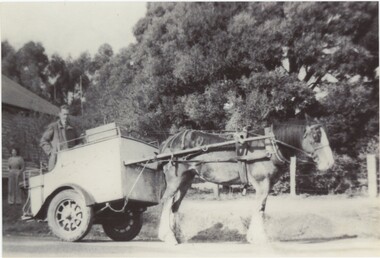
Photograph - Tom Leggett on Baker's Cart, c. Late 1940s - Early 1950s
... ...1940s...1950s...Tom Leggett was born in 1918 in Richmond, moved to Clematis young enough to attend school there, and served in the military from 1940 until the end of the Second World War; based on his apparent age in this photograph, it was likely taken after his return from war - in the late 1940s or early 1950s....c. Late 1940s - Early 1950s...Leggett Family Tom Leggett 1940s 1950s Clematis Reverse, Pencil: "TOM LEGGETT" Reverse, Printed: "10 763 COPYOF~1.TIF 2 03.10.05 05.10.06" This item is a black and white photograph printed on photo paper, with handwritten pencil annotations and printed technical information on the reverse. ...This photograph captures Tom Leggett, a member of the notable local Leggett family, standing on the baker's cart. Tom Leggett was born in 1918 in Richmond, moved to Clematis young enough to attend school there, and served in the military from 1940 until the end of the Second World War; based on his apparent age in this photograph, it was likely taken after his return from war - in the late 1940s or early 1950s.This photograph captures a member of a notable local family.This item is a black and white photograph printed on photo paper, with handwritten pencil annotations and printed technical information on the reverse. The photograph shows a side-on view of a horse-drawn cart - horse facing to the right - in which a man wearing a coat stands, looking towards the camera. In the background, a woman stands besides a wooden house; behind the road is a wire fence, with trees further behind it.Reverse, Pencil: "TOM LEGGETT" Reverse, Printed: "10 763 COPYOF~1.TIF 2 03.10.05 05.10.06"leggett family, tom leggett, 1940s, 1950s, clematis -
 Coal Creek Community Park & Museum
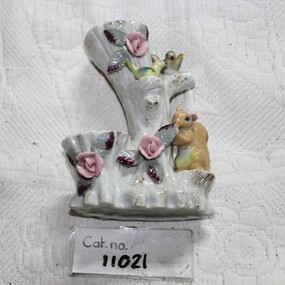
Domestic object - Porcelain 'tree trunk' vase with squirrel and flowers, c.1940s-1950s
... Unmarked, likely made in Japan circa 1940s 1950s. Condition note: broken on back....c.1940s-1950s...Unmarked, likely made in Japan circa 1940s 1950s. Condition note: broken on back. ...After WWII, Japan became an export centre for many items, mostly under heavy US investment. They provided the market with an extensive range of mass-produced and affordable pieces. Pieces are typically unmarked, or else simply say 'Japan' in a fine red ink. These items were designed to replicate German-made porcelain trinkets, export of which was halted due to the war's impact of people's perception of Germany as a country at that time. Commonalities are a white glossy surface, hand-painted details and gold highlights. The Japanese pieces differ in that their casting is not as crisp, and there is often roughly-textured decorative spots of applied grit or extrusions. Small porcelain 'tree trunk' vase, white gloss glaze with a figural squirrel and 2 birds. Flowers dotted about, hand-painted. Unmarked, likely made in Japan circa 1940s 1950s. Condition note: broken on back.none -
Whitehorse Historical Society Inc.
Article, History on record, 15/11/1993 12:00:00 AM
... Re Monash researcher Andrew May compiling a complete history on Nunawading during the 1940s and 1950s....Article from the Gazette of 15 Nov 1993 re Monash researcher Andrew May compiling a complete history on Nunawading during the 1940s and 1950s....Re Monash researcher Andrew May compiling a complete history on Nunawading during the 1940s and 1950s. May Andrew Monash University Article from the Gazette of 15 Nov 1993. ...Article from the Gazette of 15 Nov 1993.Article from the Gazette of 15 Nov 1993 re Monash researcher Andrew May compiling a complete history on Nunawading during the 1940s and 1950s.Article from the Gazette of 15 Nov 1993. may, andrew, monash university -
 Uniting Church Archives - Synod of Victoria
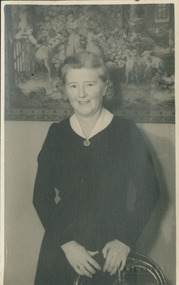
Photograph, Sister Enid (Alice Blenkinsop), 1962
... "Sister Enid Wesley Prahran Mission Hobart 1940s, 1950s 1960s. Alice Blenkinsop. Happy birthday to Win, with my love, Alice"...She is training a children's choir for the Christmas carol service at the mission." blenkinsop, alice sister enid "Sister Enid Wesley Prahran Mission Hobart 1940s, 1950s 1960s. Alice Blenkinsop. Happy birthday to Win, with my love, Alice" Shows her standing behind a chair with a painting behind her. ...The newspaper clipping (item F251-2) reads: "Sister Enid of the Methodist Mission in Prahran has won this week's Bouquet for a Lady. And as the bouquet was given to her by the mission's superintendenet, Rev. Frank Hartley, she said, 'This is the biggest surprise I've ever had.' Sister Enid has been a mission sister for 23 years. As Miss Alice Blenkinsop she trained at Melbourne Central Mission, and later worked in the slums of Collingwood and at the Wesley Mission in Hobart. She has also been a court probation officer. On Thursdays Sister Enid runs the Friendship Club for elderly women and pensioners at Prahran. Children have a special place in her heart. 'We used to mother the poor little dears during the depression, take them on holidays and form clubs where they could be together,' she said. She is training a children's choir for the Christmas carol service at the mission."Shows her standing behind a chair with a painting behind her."Sister Enid Wesley Prahran Mission Hobart 1940s, 1950s 1960s. Alice Blenkinsop. Happy birthday to Win, with my love, Alice"blenkinsop, alice, sister enid -
Emerald Museum & Nobelius Heritage Park
Document - Folder of index cards, Modern Office Equipment Pty. Ltd, 1940s-1950s
... Used by Geoffrey Alexander, a then Belgrave resident, to oversee a family-owned dairy farm at Narre Warren c 1940s-1950s. Donated by his daughter, Karen Alexander....1940s-1950s...Used by Geoffrey Alexander, a then Belgrave resident, to oversee a family-owned dairy farm at Narre Warren c 1940s-1950s. Donated by his daughter, Karen Alexander. ...This folder was used by Geoffrey Alexander 1908-1975, son of local property developer, C. T. Alexander and who was an engineer who was acclaimed for his contributions in the field that became known as stochastic hydrology. It was probably used in the 1940's-1950s as the names of the cows are female names that were popular at that time (eg Betty, Christine, Judith, Phyllis, Enid etc) Geoffrey lived most of his life at Belgrave but oversaw this family-owned dairy farm at Narre Warren which was share-cropped. His method of recording the productivity of the cows seems to have been abandoned after the first five months of recording as there are no further entries and this folder is otherwise un-used. Donated by Geoffrey's daughter, Karen Alexander.That the cows were individually named is a reminder of a time of small-scale dairy farming.Brown, hard folder containing removable index cards used to record the productivity of the individual cows of a dairy herd. The cows are identified by their individual names. Used by Geoffrey Alexander, a then Belgrave resident, to oversee a family-owned dairy farm at Narre Warren c 1940s-1950s. Donated by his daughter, Karen Alexander.'Modern Office Equipment Pty. Ltd. /Adelaide - Brisbane - Melbourne - Sydney' 'Speedex 8 x 5 double unit'alexander, folders, dairy herd, belgrave victoria australia, geoffrey alexander, modern office equipment pty. ltd. -
Whitehorse Historical Society Inc.
Book, Trademarks of the 40s and 50s, 1989
... Interesting trade marks used in the 1940s and 1950s....Trade marks 1940-1859s Interesting trade marks used in the 1940s and 1950s. Interesting trade marks used in the 1940s and 1950s. ...Interesting trade marks used in the 1940s and 1950s.Interesting trade marks used in the 1940s and 1950s.Interesting trade marks used in the 1940s and 1950s.trade marks, 1940-1859s -
 Flagstaff Hill Maritime Museum and Village
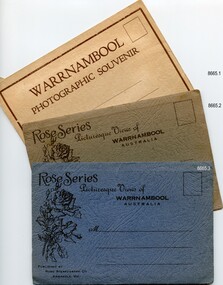
Postcard - Postcard Folder set, George Rose, Rose Stereographic Company, 1880-1942
... ...1940s...1950s...Flagstaff Hill Maritime Museum and Village Great Ocean Road Shipwreck Coast Warrnambool Flagstaff Hill Flagstaff Hill Maritime Museum Flagstaff Hill Maritime Village Warramble postcard postcard folder Warrnambool Scenes Picturesque views of Warrnambool Picturesque views of Warramble Lady Bay Port of Warrnambool Breakwater Warrnambool Breakwater Viaduct Merri River footbridge Merri River suspension bridge suspension footbridge Merri River mouth Hopkins River mouth Proudfoot's Fanny Nelson Nelson's boatsheds Nelson's Boathouse boathouse Hopkins River boathouses Flett's boathouse Flett George Rose image of a rose Rose Series Rose Stereograph Co Rose Stereographic Company Lighograph Armadale Victoria Lady Bay beach beach scene Lower Light concrete footbridge 1922 footbridge Viaduct Road Rose postcard new concrete bridge 1945 1890 1922 small footbridge 1872 footbridge 1872 Merri River Estuary Stingray Bay postcards Shipwrecked coast Maritime Museum Souvenir Warrnambool local scenes Hopkins River Botanic Gardens Soldiers’ Memorial Pier Post Office Municipal Buildings Merri River Proudfoot’s The Cliffs at Shelly Beach The Road to Sandy Beach tourism photographs visitors travel scenes local history mid-20th century 1940s 1950s Rose Stereograph Co Armadale. Vic Valentine Publishing Co. ...Each postcard folder in this set has no address, message or postage stamp. Postcard folders such as these were popular as holiday souvenirs in the early to mid-20th century and were kept in good condition by collectors. The size is convenient for posting to friends and relatives and packing as holiday luggage. Postcards in the early-to-mid-19th century were an inexpensive way to remember and share holiday scenes, as few people could afford a camera and the price of developing the photographs. The images on these postcards were produced from black and white lithographs of photographs taken at Warrnambool and the surrounding district during the early to mid-20th century. Publishing firms such as Melbourne-based Valentine and Rose purchased photographs from local photographers and reproduced them for sale. This set of postcard folders shows that more than one publishing company had access to the same or almost the same images. The photographs include street scapes, the Warrnambool Breakwater and Pier, Botanical Gardens, beach scenes, cliff formations, the Hopkins River, municipal buildings, the Post Office and the Soldiers’ Memorial. The postcard folders in this set of three are significant as a record of local history from the late 19th century to the mid-20th century. The locations of the images match photographs and postcards in our collection that were taken at different times and provide a historical record of the Warrnambool and southwest Victorian locations, growth and changes.. The images record changes in the coastline, land, bay, buildings and other structures, roads, transportation and even the fashions of the times. Set of three postcard folders containing black and white images of photographed scenes showcasing Warrnambool and district between 1880 and 1942. The images were produced from lithographs of the original photographs and are printed on both sides of long strips of white photographic paper that are Z-folded into covers of textured card. Some of the images are repeated in all three folders. Folder 8665.1 - the cream-coloured folder was produced by The Valentine Publishing Co. Pty. Ltd. Melbourne and contains 15 photographs, some of which are also in the blue and the green folders. Folders 8665.2, the green folder, and 8665.3, the blue folder, were published by Rose Stereograph Co, Armadale, Vic. Each contains the same twelve images, but they are presented in a different order. flagstaff hill maritime museum and village, great ocean road, shipwreck coast, warrnambool, flagstaff hill, flagstaff hill maritime museum, flagstaff hill maritime village, warramble, postcard, postcard folder, warrnambool scenes, picturesque views of warrnambool, picturesque views of warramble, lady bay, port of warrnambool, breakwater, warrnambool breakwater, viaduct, merri river footbridge, merri river suspension bridge, suspension footbridge, merri river mouth, hopkins river mouth, proudfoot's, fanny nelson, nelson's boatsheds, nelson's boathouse, boathouse, hopkins river boathouses, flett's boathouse, flett, george rose, image of a rose, rose series, rose stereograph co, rose stereographic company, lighograph, armadale victoria, lady bay beach, beach scene, lower light, concrete footbridge, 1922 footbridge, viaduct road, rose postcard, new concrete bridge, 1945, 1890, 1922, small footbridge, 1872 footbridge, 1872, merri river estuary, stingray bay, postcards, shipwrecked coast, maritime museum, souvenir, warrnambool local scenes, hopkins river, botanic gardens, soldiers’ memorial, pier, post office, municipal buildings, merri river, proudfoot’s, the cliffs at shelly beach, the road to sandy beach, tourism, photographs, visitors, travel, scenes, local history, mid-20th century, 1940s, 1950s, rose stereograph co armadale. vic, valentine publishing co. pty. ltd melbourne, valentine publishing co. pty. ltd sydney -
 Flagstaff Hill Maritime Museum and Village
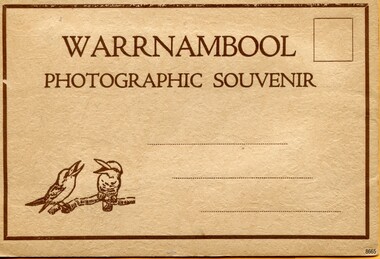
Postcard - Postcard Folder, scenes, Valentine & Sons Co. Publishing Ltd, Warrnambool Photographic Souvenir, Early-to-mod 20th century
... ...1940s...1950s...Flagstaff Hill Maritime Museum and Village Great Ocean Road Shipwreck Coast Warrnambool Flagstaff Hill Flagstaff Hill Maritime Museum Flagstaff Hill Maritime Village Warramble postcard postcard folder Warrnambool Scenes Picturesque views of Warrnambool Picturesque views of Warramble Lady Bay Port of Warrnambool Breakwater Warrnambool Breakwater Viaduct Merri River footbridge Merri River suspension bridge suspension footbridge Merri River mouth Hopkins River mouth Proudfoot's Fanny Nelson Nelson's boatsheds Nelson's Boathouse boathouse Hopkins River boathouses Flett's boathouse Flett George Rose image of a rose Rose Series Rose Stereograph Co Rose Stereographic Company Lighograph Armadale Victoria Lady Bay beach beach scene Lower Light concrete footbridge 1922 footbridge Viaduct Road Rose postcard new concrete bridge 1945 1890 1922 small footbridge 1872 footbridge 1872 Merri River Estuary Stingray Bay postcards concertina fold Z fold Shipwrecked coast Maritime Museum Souvenir Warrnambool local scenes photography local history tourism photographs visitors travel scenes mid-20th century 1940s 1950s Z-fold 1880s collection correspondence Valentine Publishing Co. ...This postcard folder is one of three in a set of postcards that were published in Victoria, Australia, and collected together. The Valentine Publishing Co. Pty. Ltd. produced this folder. Valentine and Sons was a printing and photography business based in Dundee, Scotland, and in Canada. In the early 1900s, at the height of the postcard craze, the firm published large numbers of postcards in the U.K., Canada, U.S., Australia and South Africa. From around 1900 or earlier, the firm bought many lithographic images for its postcards from local and national photographers who sold publishing rights to Valentines, and the business was famous for publishing photographs of popular sites worldwide. Postcard titles in this folder include many of those in the Rose postcard folders plus the following titles that are not duplicated. . Municipal Buildings and Post Office . Soldiers’ Memorial . Hopkins River . The Cliffs at Shelly Beach . The Road to Sandy Beach . The Breakwater and Pier This Valentine postcard folder was produced in Australia. It includes pictures from the early-to-mid 20th century. It is one of three in a set, with images of the same locations as other images in our collection but at different periods in time. Each postcard records a moment in history and is significant as a way to compare and show the changes in the local environment and community, building a story of the local history. The images record changes in the coastline, land, bay, buildings and other structures, roads, transportation and even the fashions of the times.Postcard folder, Valentine Publishing, cream cover. One of a set of three displaying images of Warrnambool and district around the mid-20th century. Print on the front and back covers is in brown ink. The front has an image of two laughing kookaburras on a branch, three address lines and an outline for a postage stamp. The back cover has the publisher’s details and a line for a return address. The cover opens like a book, and then the double-sided, Z-folded page of photographs drops downward. Titles are printed below each of the fifteen black and white photographs inside. The folder is secured on the back cover by placing a tab into a slot. The folder was produced by The Valentine Publishing Co. Pty. Ltd. Melbourne“WARRNAMBOOL / PHOTOGRAPHIC SOUVENIR” Symbol: [Two facing kookaburras standing on a branch with beaks open] “Published by The Valentine Publishing Co. Pty. Ltd. Melbourne” flagstaff hill maritime museum and village, great ocean road, shipwreck coast, warrnambool, flagstaff hill, flagstaff hill maritime museum, flagstaff hill maritime village, warramble, postcard, postcard folder, warrnambool scenes, picturesque views of warrnambool, picturesque views of warramble, lady bay, port of warrnambool, breakwater, warrnambool breakwater, viaduct, merri river footbridge, merri river suspension bridge, suspension footbridge, merri river mouth, hopkins river mouth, proudfoot's, fanny nelson, nelson's boatsheds, nelson's boathouse, boathouse, hopkins river boathouses, flett's boathouse, flett, george rose, image of a rose, rose series, rose stereograph co, rose stereographic company, lighograph, armadale victoria, lady bay beach, beach scene, lower light, concrete footbridge, 1922 footbridge, viaduct road, rose postcard, new concrete bridge, 1945, 1890, 1922, small footbridge, 1872 footbridge, 1872, merri river estuary, stingray bay, postcards, concertina fold, z fold, shipwrecked coast, maritime museum, souvenir, warrnambool local scenes, photography, local history, tourism, photographs, visitors, travel, scenes, mid-20th century, 1940s, 1950s, z-fold, 1880s, collection, correspondence, valentine publishing co. pty. ltd melbourne, valentine publishing co. pty. ltd sydney, municipal buildings and post office, soldiers’ memorial, hopkins river, the cliffs at shelly beach, the road to sandy beach, the breakwater and pier -
 Flagstaff Hill Maritime Museum and Village
Postcard - Postcard Folder, scenes, George Rose, Rose Stereographic Company, Rose Series, Picturesque Views of Warrnambool Australia, 1880-1942
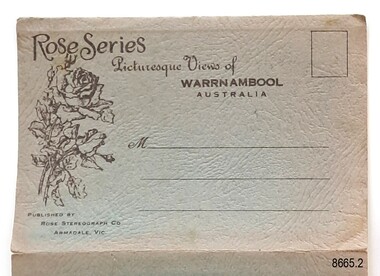
... ...1940s...1950s...Flagstaff Hill Maritime Museum and Village Great Ocean Road Shipwreck Coast Warrnambool Flagstaff Hill Flagstaff Hill Maritime Museum Flagstaff Hill Maritime Village Warramble postcard postcard folder Warrnambool Scenes Picturesque views of Warrnambool Lady Bay Port of Warrnambool Breakwater Warrnambool Breakwater Viaduct Merri River footbridge Merri River suspension bridge suspension footbridge Merri River mouth Hopkins River mouth Proudfoot's Fanny Nelson Nelson's boatsheds Nelson's Boathouse boathouse Hopkins River boathouses Flett's boathouse Flett George Rose image of a rose Rose Series Rose Stereograph Co Rose Stereographic Company Lighograph Armadale Victoria Lady Bay beach beach scene Lower Light concrete footbridge 1922 footbridge Viaduct Road Rose postcard new concrete bridge 1945 1890 1922 small footbridge 1872 footbridge 1872 Merri River Estuary Stingray Bay postcards green-grey postcard folder Shipwrecked coast Maritime Museum Souvenir Warrnambool local scenes photography local history tourism photographs visitors travel scenes mid-20th century 1940s 1950s concertina fold Z-fold 1880s collection correspondence Rose Stereograph Co Armadale Victorian photographer Soldiers’ Memorial Hopkins River The Cliffs at Shelly Beach The Road to Sandy Beach Pier Botanic Gardens Post Office Municipal Buildings Merri River Proudfoot’s Image: [Rose with rosebud and leaves] Printed: "Rose Series / Picturesque Views of / WARRNAMBOOL / AUSTRALIA" "PUBLISHED BY / ROSE STEREOGRAPH CO / ARMADALE. ...GEORGE ROSE 1861-1942: - George Rose was a well-known Victorian photographer, famous for his late 19th and early 20th century photography. He was born in Clunes, Victoria, and was in his 20th year when he founded Rose Stereograph Company in 1880. He took the opportunity of a popular trend of the times to produce stereographs, pairs of almost duplicate photographs that appeared in 3D when viewed in a handheld stereo viewer. By the 1920s, these lost their popularity, so he used his photographic skills to produce cards and postcards of scenes and people. The twelve photographs in the Rose postcard folders include locations connected to other items in our Collection, including the Valentine postcard folder in this set. The photographs are titled: - . The Avenue and War Memorial. Warrnambool. Vic. . The Blow-hole. Thunder Point. Warrnambool. Vic. . Botanical Gardens. Warrnambool. Vic. . Eagle Rock. Warrnambool. Vic. . The New Concrete Bridge and Breakwater. Warrnambool. Vic. . Liebig Street. Warrnambool. Vic. . Looking to Thunder Point. Warrnambool. Vic. . The Beach. Warrnambool. Vic. . Hopkins Falls. Warrnambool. Vic. . Shelly Beach. Warrnambool. Vic. . The Mouth of the Hopkins River. Warrnambool. Vic. . Panorama of Warrnambool, Vic. [Kepler Street towards Presbyterian Church on Spence St] This postcard folder shows scenes and places of interest in and around Warrnambool. The George Rose postcard folders in this set were produced in Victoria and include pictures taken by the renowned photographer between 1880 and 1942. Other postcards in our collection have photographs of the same or similar locations at different periods in time. Each postcard records a moment in history and is significant as a way to compare and show the changes in the local environment and community, building a story of the local history. The images record changes in the coastline, land, bay, buildings and other structures, roads, transportation and even the fashions of the times. This copy folder is one of a set of three. This folder has a green-grey textured rectangular card cover with a sketch of a rose on the front. The cover also contains the name of the postcard series, the location of the series' focus, the producer's details, and lines for adding an address. The folded cover contains a long, concertinaed page with six titled photographs on each side, totalling twelve. The folder contains scenes from Warrnambool and nearby popular areas, including Lady Bay, the Port of Warrnambool, the Warrnambool Breakwater, the Viaduct, the Merri River Footbridge, the Hopkins River Mouth, and Proudfoot’s and the Fanny Nelson/Flett boathouses. The cover has a sketch of a rose and inscriptions. The lithograph photographs were taken between 1880 and 1942 by well-known Victorian photographer George Rose, Rose Stereograph Company of Armadale, Victoria.Image: [Rose with rosebud and leaves] Printed: "Rose Series / Picturesque Views of / WARRNAMBOOL / AUSTRALIA" "PUBLISHED BY / ROSE STEREOGRAPH CO / ARMADALE. VIC."flagstaff hill maritime museum and village, great ocean road, shipwreck coast, warrnambool, flagstaff hill, flagstaff hill maritime museum, flagstaff hill maritime village, warramble, postcard, postcard folder, warrnambool scenes, picturesque views of warrnambool, lady bay, port of warrnambool, breakwater, warrnambool breakwater, viaduct, merri river footbridge, merri river suspension bridge, suspension footbridge, merri river mouth, hopkins river mouth, proudfoot's, fanny nelson, nelson's boatsheds, nelson's boathouse, boathouse, hopkins river boathouses, flett's boathouse, flett, george rose, image of a rose, rose series, rose stereograph co, rose stereographic company, lighograph, armadale victoria, lady bay beach, beach scene, lower light, concrete footbridge, 1922 footbridge, viaduct road, rose postcard, new concrete bridge, 1945, 1890, 1922, small footbridge, 1872 footbridge, 1872, merri river estuary, stingray bay, postcards, green-grey postcard folder, shipwrecked coast, maritime museum, souvenir, warrnambool local scenes, photography, local history, tourism, photographs, visitors, travel, scenes, mid-20th century, 1940s, 1950s, concertina fold, z-fold, 1880s, collection, correspondence, rose stereograph co armadale, victorian photographer, soldiers’ memorial, hopkins river, the cliffs at shelly beach, the road to sandy beach, pier, botanic gardens, post office, municipal buildings, merri river, proudfoot’s -
 Kiewa Valley Historical Society
Photograph Farm Land, Mount Beauty Acreage before Golf Course, Circa 1950
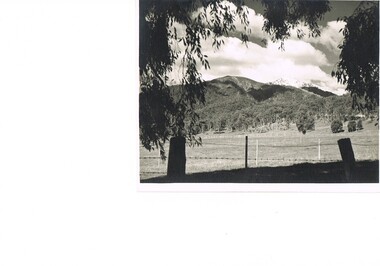
... mount beauty in the 1940s - 1950s...The development of cleaner energy supplies to a growing population has its downside ,which ever way the intrusion into the "natural" landscape is made. mount beauty in the 1940s - 1950s grazing in the kiewa valley sec victoria nil Black and white photograph detailing surveyor posts for construction of golf course. ...This photograph is a "snap shot" in time circa 1950s detailing the rural environment before the effects of the Kiewa Valley Hydro Scheme altered the basic rural setting of the valley. The golfing fairway was being mapped out on previous grazing land, before the laying of a golf course, for use by the construction workers and auxiliary administration employees of the Victorian State Electricity Commission. This photograph details a dramatic period in time which saw an enormous change to the exclusively rural area of the Kiewa Valley region in the mid 1900s. This change presented both physical and mental challenges to the existing quiet rural inhabitants of the valley. The State of Victoria had to make adjustments to the changing demands imposed by population and industrial expansions. The development of cleaner energy supplies to a growing population has its downside ,which ever way the intrusion into the "natural" landscape is made.Black and white photograph detailing surveyor posts for construction of golf course. Land used, before establishment of the Mount Beauty Village, as farming/grazing cattle and viewed towards Mount Bogong and its Alpine ranges. The photo is on 200gms paper and not on photographic paper.nilmount beauty in the 1940s - 1950s, grazing in the kiewa valley, sec victoria -
 Ruyton Girls' School
Uniform - Lascelles House Blazer Pocket, 1950 circa
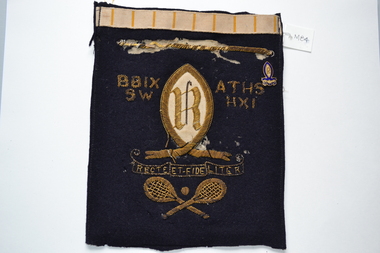
... ...1940s...1950s...Worn by a Ruyton Prefect 1950; House Prefect 1950; member of the General and Sports Committees 1949-1950; Captain Baseball 1949; Captain Hockey, Tennis, and Athletics 1950. ruyton girls' school kew school uniform lascelles school prefect school sports baseball hockey tennis athletics blazer 1940s 1950s Boarding House BBIX ATHS SW HXI RECTE ET FIDELITER Navy blue wool flannel blazer pocket with Ruyton crest embroidered in gold bullion and white silk. ...Worn by a Ruyton Prefect 1950; House Prefect 1950; member of the General and Sports Committees 1949-1950; Captain Baseball 1949; Captain Hockey, Tennis, and Athletics 1950.Navy blue wool flannel blazer pocket with Ruyton crest embroidered in gold bullion and white silk. Lascelles House colours ribbon across the top of the pocket opening. Colours are for House Captain. Bar for boarding house prefect embroidered in gold bullion. Colours for Basketball, Athletics, Swimming, Hockey, Tennis. Lapel pin also attached.BBIX ATHS SW HXI RECTE ET FIDELITERruyton girls' school, kew, school uniform, lascelles, school prefect, school sports, baseball, hockey, tennis, athletics, blazer, 1940s, 1950s, boarding house -
 Brighton Historical Society
Dress, circa 1940s-50s
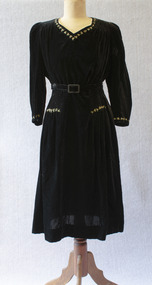
... ...1940s...1950s...An active part of the local community, Katherine was a member of the Brighton Red Cross, Brighton Probus Club and the St Joan of Arc Catholic parish and choir. katherine fennell blair 1940s 1950s Long-sleeved black velvet dress with shallow v-neck and self-covered belt. ...This dress belonged to Katherine Blair, a longtime resident of Brighton. Katherine Fennell Blair (1929-2023) was born in Benalla to magistrate Douglas Granville Blair (1893-1976) and his wife Isabell Nora (“Billie”) Blair, nee McNamara (1895-1989). Katherine was a child when the family moved to Brighton, where she attended St Joan of Arc Catholic Primary School and Star of the Sea College. After school, Katherine worked as a secretary and PA for various companies in the Melbourne CBD. Following a working holiday in the UK in 1959-61, she returned to Brighton, living first with her parents at 14 Kilrush Street and later in Burrows Street. An active part of the local community, Katherine was a member of the Brighton Red Cross, Brighton Probus Club and the St Joan of Arc Catholic parish and choir.Long-sleeved black velvet dress with shallow v-neck and self-covered belt. Smocked at shoulders and either side of waist. Floral embroidery around neck, cuffs and above smocking at waist.katherine fennell blair, 1940s, 1950s -
Emerald Museum & Nobelius Heritage Park
Leisure object - Soft toy koala, Unknown maker, 1940s
... ...1940s - 1950s...Alexander stuffed toy koala bear 1940s - 1950s None discernible A stuffed toy koala bear. ...This toy koala was owned all her life by Emerald resident, Karen Alexander, now aged in her 70s. Karen believes this toy was made by Mrs Wilkinson, a teacher at the Victorian Kindergarten Teachers College, Kew who was a friend of her mother.Indicative of toys owned by children in mid-20th century.A stuffed toy koala bear. Made with kangaroo fur, leather and rubber. Circa 1940s. Known to its owner as 'Teddy'.None discerniblealexander, stuffed toy, koala bear, 1940s - 1950s -
Emerald Museum & Nobelius Heritage Park
Leisure object - Soft toy dog, Mrs Wilkinson, 1940s
... ...1940s - 1950s...Alexander stuffed toy toy dog 1940s - 1950s Mrs Wilkinson None discernible A stuffed toy dog. ...This toy teddy was owned all her life by Emerald resident, Karen Alexander, (now aged in her 70s). Known to her as 'Confucius'.Indicative of toys owned by young children in mid-20th century.A stuffed toy dog. Hand-made with wool and fabric. Glass eyes. Circa 1940s. Known to its owner, Karen Alexander as 'Confucius'.None discerniblealexander, stuffed toy, toy dog, 1940s - 1950s, mrs wilkinson -
 Emerald Museum & Nobelius Heritage Park
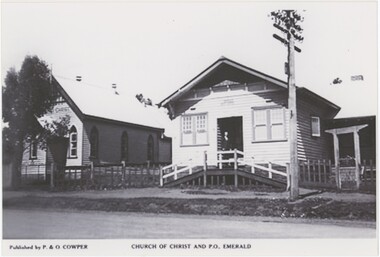
Photograph, P. & O. Cowper, Church of Christ and P.O. Emerald, c. Mid 20th Century
... ...1940s...1950s...This image could date from 1913 until the 1950s, although it is likely toward the later end of that range in the 1940s or 50s. ...This photograph captures two long-standing Emerald institutions from the first half of the 20th century, one of which is no longer in operation and the other which has moved and had its place replaced with an unrecognisable new structure. Emerald 1940s 1950s Emerald Post Office Emerald Church of Christ Obverse: Left, Typed: "Published by P. & O. ..."P. & O. Cowper" does not appear in internet research as a known publishing company; it is possible either that none of their work has made its way online, or that they were locals publishing on a small scale capacity. If the latter is true, "P. Cowper" could have been Mr. P. Cowper who participated in forming the Emerald Co-operative Society in 1945. The Emerald Church of Christ operated from 1913 until 1964 on the site (and building) now part of Fernlea Community House. The old post office was on that location from the 1910s until after the Church stopped operating, although by the 1960s there were telephone booths in front of the post office. This image could date from 1913 until the 1950s, although it is likely toward the later end of that range in the 1940s or 50s. This copy was produced in 2006 from the original.This photograph captures two long-standing Emerald institutions from the first half of the 20th century, one of which is no longer in operation and the other which has moved and had its place replaced with an unrecognisable new structure.This black and white photograph is printed on glossy modern photo paper. Its lower margin is occupied by printed text explaining the publisher and the subject matter. The photograph itself centres on two buildings, each constructed from wooden planks with sloped, likely tin rooves. A power pole stands to the right in front of the rightmost building. The ege of a road is visible in the foreground, indicating that this picture was taken from on or across the road. The reverse has printed technical information about the photograph, typical of a digital printed photograph.Obverse: Left, Typed: "Published by P. & O. COWPER" Centre, Typed: "CHURCH OF CHRIST AND P.O. EMERALD" Sign in Image, Left: "[obscured] CHRIST" Reverse: "10 27 PCEMER~4.JPG 6 16.12.06 18.12.06"emerald, 1940s, 1950s, emerald post office, emerald church of christ -
Emerald Museum & Nobelius Heritage Park
Photograph - Rainey /Bruton families, Unknown, 1940s and 1950s
... ...1940s...1950s...1940s and 1950s...Photos related to Rainey and Bruton families in 1940s and 1950s around Emerald Rainey family Bruton family emerald 1940s 1950s emerald park lake Arnott Joan Lamendola Legge Photographs of or connected to Rainey and Bruton families. ...Photos related to Rainey and Bruton families in 1940s and 1950s around EmeraldPhotographs of or connected to Rainey and Bruton families.rainey family, bruton family, emerald, 1940s, 1950s, emerald park lake, arnott, joan lamendola, legge -
Emerald Museum & Nobelius Heritage Park
Equipment - Ink bottle, 1920s-1940s
... 1930s and 1940s...1950s...The item is significant for the insights it provides into the development of writing technologies generally and the application of these to writing practices used by schools and businesses and offices in Emerald and the surrounding region, including the commercial and economic practices required to support these activities. 1930s and 1940s 1950s Ink ink bottle Writing equipment writing Schools Businesses office equipment Base: VEMU 2001 / ISM-I52 or 1SM-152 / 3 / Oval shaped flat-bottomed clear glass bottle with tiered ripples on the upper surface slanting towards the juncture with the bottle's circular metal lid. ...This item is an ink bottle used to store a quantity of ink ready for writing at a desk or table, with a small brush that could be used to stir the ink to prevent separation of the ink into components or sediment at the bottom of the bottle. The brush could also be used as a direct applicator if larger text was required. The bottle is thought to date from the mid-period of the Twentieth Century, and is likely to have been purchased full of ink rather than filled and refilled from a bulk bottle of household ink. Similarly, in this time period, the ink is likely to have been used to refill a fountain pen with an internal storage reservoir via an eye-dropper or converter mechanism rather than used by a writer who dipped their pen in the ink frequently as they wrote. Ink bottles were typically designed to have a broad, stable base that decreased the likelihood of the article tipping when a pen or converter was dipped into the ink. Bottles were produced in a wide variety of shapes and colours, primarily dictated by product differentiation and aesthetic appeal in the growing retail market that emerged due to improvements in fountain pen design which made access to convenient writing implements cheaper but also more portable. Prior to innovations in fountain pen nibs and filling systems that made them cleaner and more reliable to use, writing may have been conducted at a writing desk which held an inkwell which was refilled from a larger bottle or (prior to the beginning of the Nineteenth Century) filled with ink reconstituted from powder form or dissolved from a tablet or cake of dry ink.The item is significant for the insights it provides into the development of writing technologies generally and the application of these to writing practices used by schools and businesses and offices in Emerald and the surrounding region, including the commercial and economic practices required to support these activities.Oval shaped flat-bottomed clear glass bottle with tiered ripples on the upper surface slanting towards the juncture with the bottle's circular metal lid. The lid has a nub-shaped handle for the user to grasp. The inside of the lid contains a metal pipe on the end of which is a small brush for stirring the ink. This item is an ink bottle used to store a quantity of ink ready for writing at a desk or table, with a small brush that could be used to stir the ink to prevent separation of the ink into components that might cause sedimentation at the bottom of the bottle. The brush could also be used as a direct applicator if larger text was required.Base: VEMU 2001 / ISM-I52 or 1SM-152 / 3 /1930s and 1940s, 1950s, ink, ink bottle, writing equipment, writing, schools, businesses, office equipment -
 Port Melbourne Historical & Preservation Society
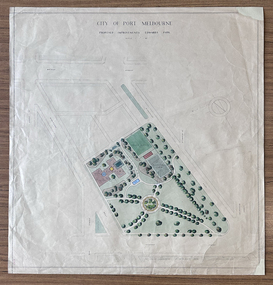
Plan - Edwards Park improvements (Trugo Green), Port Melbourne, 1940s - 1950s
... Although undated, this plan is probably from the late 1940s or early 1950s. Around this time Port Melbourne Council were looking to built a basketball court in Lagoon reserve, and shelters and a senior citizen's clubhouse in Edwards Park. ...Plan drawing to scale, hand coloured, of proposed improvements to Edwards Park (Trugo Green), undated possibly late 1940s or early 1950s....1940s - 1950s...Although undated, this plan is probably from the late 1940s or early 1950s. Around this time Port Melbourne Council were looking to built a basketball court in Lagoon reserve, and shelters and a senior citizen's clubhouse in Edwards Park. ...Although undated, this plan is probably from the late 1940s or early 1950s. Around this time Port Melbourne Council were looking to built a basketball court in Lagoon reserve, and shelters and a senior citizen's clubhouse in Edwards Park. PMHPS does to believe the basketball court shown in the plan was built but the Port Melbourne Senior Citizens and Trugo Club is at the location shown on the plan. A shelter is in a similar location to the one on the plan. A children's playground existed in that location shown in a photograph from the 1930s. The round flowerbed where the paths cross in the centre of the park in not in the 1930s photograph but is a current feature of Edwards Park.Plan drawing to scale, hand coloured, of proposed improvements to Edwards Park (Trugo Green), undated possibly late 1940s or early 1950s."City of Port Melbourne"built environment - recreational facilities, parks and gardens, sport - trugo, port melbourne trugo club, edwards park -
 Kiewa Valley Historical Society
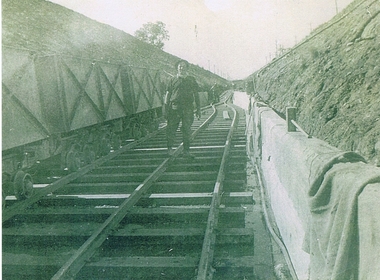
Photograph KHS Rail, Kiewa Hydroelectric Scheme Railway, Circa1940s
... Picture is of a section of railway track servicing the tunnels of the Hydroelectric scheme during the 1940s - 1950s...Picture is of a section of railway track servicing the tunnels of the Hydroelectric scheme during the 1940s - 1950s Kiewa Hydroelectric Scheme Railway Photograph KHS Rail Mr. ...This photograph shows part of the railway constructed and used for the removal of soil and rocks from the tunnels bored out of the mountains for the pipeline servicing the Hydro Electricity power stations in the Kiewa Hydroelectric Scheme. This photo details an era when there were 4,000 construction workers located in two main accommodation camps, Mount Beauty (the larger one) and Bogong village. These accommodation sites were constructed and maintained as a secured or gated residential area with access only available by a special pass authorised by the Kiewa Hydroelectric Scheme. All the power used by the rail system was from electric motors connected to batteries. Overhead power poles seen on either side of the embankment details that electricity from the Scheme was in use. This use was cleaner and more environmentally friendly than the coal still used by large locomotives from city to country railways. The worker shown is not however wearing protective head and hand coverings. This is also an era where there was a lack of health and safety legislation covering workers in dangerous working conditions.Scanned photo of original black and white photo on Kodak XtraLife II paper. Picture is of a section of railway track servicing the tunnels of the Hydroelectric scheme during the 1940s - 1950sOn back of photo "Kodak XtraLife II paper"railway in kiewa electric scheme, tunneling -
 Australian Jazz Museum
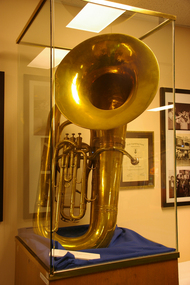
Musical Instrument, 1930 (estimated); "circa 1930s"
... Played by Lou Silbereisen for recordings with Graeme Bell and His Australian Jazz Band in the late 1940s and 1950s. Played by Brian Carter from 1958 to the mid 1960s....Played by Lou Silbereisen for recordings with Graeme Bell and His Australian Jazz Band in the late 1940s and 1950s. Played by Brian Carter from 1958 to the mid 1960s....Played by Lou Silbereisen for recordings with Graeme Bell and His Australian Jazz Band in the late 1940s and 1950s. Played by Brian Carter from 1958 to the mid 1960s. ...Played by Lou Silbereisen for recordings with Graeme Bell and His Australian Jazz Band in the late 1940s and 1950s. Played by Brian Carter from 1958 to the mid 1960s.Boosey & Hawkes is a British music publisher. Until 2003, it was also a major manufacturer of brass, string and wind musical instruments. Recording Brass Bass manufactured by Boosey & Hawkes circa 1930s. Played by Lou Silbereisen for recordings with Graeme Bell and His Australian Jazz Band in the late 1940s and 1950s. Played by Brian Carter from 1958 to the mid 1960s.lou silbereisen, recording brass bass, boosey hawkes, graeme bell and his australian jazz band, brian carter -
 Eltham District Historical Society Inc
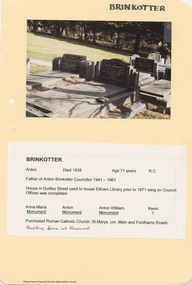
Folder, Brinkkotter, 1940-1960c
... Folder of information on Anton and Bridgene Brinkkotter, Research, 1940s and 1950s...anton brinkkotter bridgene brinkkotter Anna Brinkkotter Anton William Brinkkotter Bridgene Josephine Brinkkotter Eltham Cemetery Folder of information on Anton and Bridgene Brinkkotter, Research, 1940s and 1950s Brinkkotter Folder ...Folder of information on Anton and Bridgene Brinkkotter, Research, 1940s and 1950santon brinkkotter, bridgene brinkkotter, anna brinkkotter, anton william brinkkotter, bridgene josephine brinkkotter, eltham cemetery -
 Federation University Historical Collection
Photograph - Photograph - black and white, Frank Wright, Arc de Triumph, Champ Elysees, Paris, France, 1952, 1952
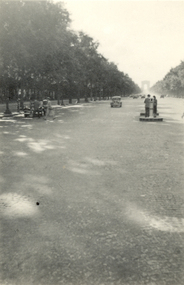
... Black and white photograph of a long tree lined boulevard with several 1940s-1950s automobiles in the distrance and pedrestrians crossing the road. ...The Frank Wright Medal at the Royal South Street competition is awarded to an individual recognized as making an outstanding contribution to brass music in Australia. frank wright paris arc de triumph champs elysees France Written in pencil on the back - Arc de Triumph from "Champs Eleises", Aug '52 Black and white photograph of a long tree lined boulevard with several 1940s-1950s automobiles in the distrance and pedrestrians crossing the road. ...Frank Wright was a renown resident of Smeaton, where he was born on 2 August 1901. He lived at Laura Villa, and attended Smeaton State School. His father William was a gold miner and his mother's name was Sarah. Their family won many singing and instrumental awards. Frank was tutored by Percy Code and was awarded a gold medal for the highest marks in the ALCM examinations in the British Colonies at the age of seventeen years. He became the Australian Open Cornet Champion by the age of eighteen. A year later, Frank conducted the City of Ballarat Band, and later the Ballarat Soldiers’ Memorial Band. He formed the Frank Wright Frisco Band and Frank Wright and his Coliseum Orchestra. These bands won many South Street awards, and Frank as conductor won many awards in the Australian Band Championship contest. In 1933 Frank Wright sailed to England to conduct the famous St Hilda’s Band and was later appointed Musical Director of the London County Council, where he organized many amazing concerts in parks, in and around the London district. He was made Professor of Brass and Military Band Scoring and conducted at the Guildhall of Music and Drama. Frank was often invited to adjudicate Brass Band Championships around Europe, in Australia, including South Street and in New Zealand. The Frank Wright Medal at the Royal South Street competition is awarded to an individual recognized as making an outstanding contribution to brass music in Australia.Black and white photograph of a long tree lined boulevard with several 1940s-1950s automobiles in the distrance and pedrestrians crossing the road. At the far end of the boulevard is a large arch. The place is the Champs Elysees leading to the Arc de Triumph..Written in pencil on the back - Arc de Triumph from "Champs Eleises", Aug '52frank wright, paris, arc de triumph, champs elysees, france -
 Kew Historical Society Inc
Collection, Ceramics of Viola Annie Ayling (1911–1990), 1950–1970
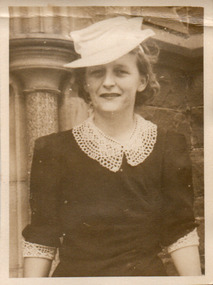
... Parent file of the items in the Viola Annie Ayling collection of 1940s, 1950s, 1960s and 1970s ceramics. This parent file includes digital copies of a photograph of the ceramicist and also of her home at 128 Pakington Street, Kew, in 1951 where she practiced her art....Ceramics -- Victoria (Australia) viola Annie mcvicars viola Annie ayling Parent file of the items in the Viola Annie Ayling collection of 1940s, 1950s, 1960s and 1970s ceramics. This parent file includes digital copies of a photograph of the ceramicist and also of her home at 128 Pakington Street, Kew, in 1951 where she practiced her art. ...Viola Annie McVicars (1911–1990) was born in Korumburra on 29 April 1911. At the age of 21, she married William John Ayling (1909–1995). After their marriage in 1932, they moved to Kew, initially to 81 Tennyson Street, and later to 180 Pakington Street. A professional tailoress, Viola Ayling was also a talented amateur potter, creating her ceramics at her home in Pakington Street, where she had an internal studio and a handmade, wood-fired brick kiln in her backyard. Following her death in 1990, her studio pottery passed to her daughter, and following the daughter’s death, to her granddaughter. This piece of glazed earthenware is part of a collection of 15 functional and decorative ceramic items donated by Viola’s granddaughter to the collection in 2024.Parent file of the items in the Viola Annie Ayling collection of 1940s, 1950s, 1960s and 1970s ceramics. This parent file includes digital copies of a photograph of the ceramicist and also of her home at 128 Pakington Street, Kew, in 1951 where she practiced her art.128 pakington street -- kew (vic.), ceramics -- victoria (australia), viola annie mcvicars, viola annie ayling
