
Showing 775 items matching "19th century design"
-
 Villa Alba Museum
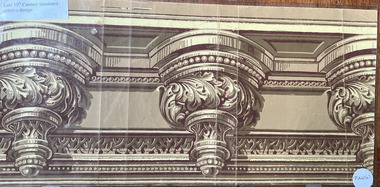
Wallpaper sample - Simulated cornice design, late 19th century
... ...19th century design...Late 19th century simulated cornice design. The wallpaper border uses trompe-loiel to simulate a three dimensional architectural feature to create the illusion of depth. ...Heritage interiors Wallpapers 19th century design borders "P-A6 (f) Late 19th century simulated cornice design. ...Part of a collection of historic wallpapers collected by Phyllis Murphy, most of whose wallpapers were donated to the collection of Historic Houses Sydney. This wallpaper sample, annotated and encased in mylar was used by Phyllis for educational purposes, and donated by her son to Villa Alba Museum's collection in 2025.Late 19th century simulated cornice design. The wallpaper border uses trompe-loiel to simulate a three dimensional architectural feature to create the illusion of depth. The design uses a classically inspired bracketed cornice motif. "P-A6 (f)heritage interiors, wallpapers, 19th century design, borders -
 Villa Alba Museum
Wallpaper sample - Border, mid 19th century
... ...19th century design...Mid 19th century simulated cornice design with handwork and block printing. ...Heritage interiors Wallpapers 19th century design architectural friezes P.B16(f) Mid 19th century simulated cornice design with handwork and block printing. ...Part of a collection of historic wallpapers collected by Phyllis Murphy, most of whose wallpapers were donated to the collection of Historic Houses Sydney. This wallpaper sample, annotated and encased in mylar was used by Phyllis for educational purposes, and donated by her son to Villa Alba Museum's collection in 2025.Mid 19th century simulated cornice design with handwork and block printing. This specific part of the repeat design features a large, detailed pink rose in bloom with green and purple toned foliage against a textured gold background.P.B16(f)heritage interiors, wallpapers, 19th century design, architectural friezes -
 Villa Alba Museum
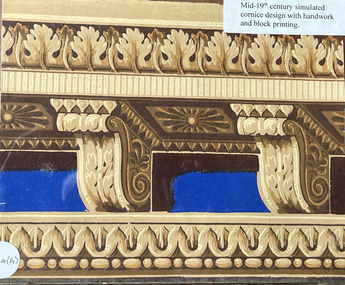
Wallpaper sample - Border, mid 19th century
... ...19th century design...Mid 19th century simulated cornice design with handwork and block printing.The wallpaper frieze imitates classic decorative mouldings including leaf-and-tongue and cable modings at the top, lotus rosettes and scrollwork in the central band, and a stylised draped fabric or 'waterleaf and tongue' pattern along the bottom edge....Heritage interiors Wallpapers 19th century design architectural friezes P_A4(fr) Mid 19th century simulated cornice design with handwork and block printing.The wallpaper frieze imitates classic decorative mouldings including leaf-and-tongue and cable modings at the top, lotus rosettes and scrollwork in the central band, and a stylised draped fabric or 'waterleaf and tongue' pattern along the bottom edge. ...Part of a collection of historic wallpapers collected by Phyllis Murphy, most of whose wallpapers were donated to the collection of Historic Houses Sydney. This wallpaper sample, annotated and encased in mylar was used by Phyllis for educational purposes, and donated by her son to Villa Alba Museum's collection in 2025.Mid 19th century simulated cornice design with handwork and block printing.The wallpaper frieze imitates classic decorative mouldings including leaf-and-tongue and cable modings at the top, lotus rosettes and scrollwork in the central band, and a stylised draped fabric or 'waterleaf and tongue' pattern along the bottom edge.P_A4(fr)heritage interiors, wallpapers, 19th century design, architectural friezes -
 Villa Alba Museum
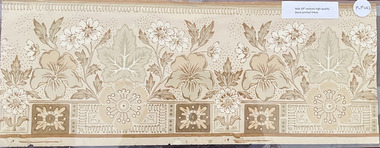
Wallpaper sample - Decorative frieze, mid 19th century
... ...19th century design...Mid 19th century high quality wallpaper frieze. Block printed. The design features intricate floral motifs, foliage, and geometric patterns characteristic of Victorian-era decoration....Dado borders Heritage interiors Wallpapers 19th century design P.F 24 (f) Mid 19th century high quality wallpaper frieze. ...Part of a collection of historic wallpapers collected by Phyllis Murphy, most of whose wallpapers were donated to the collection of Historic Houses Sydney. This wallpaper sample, annotated and encased in mylar was used by Phyllis for educational purposes, and donated by her son to Villa Alba Museum's collection in 2025.Mid 19th century high quality wallpaper frieze. Block printed. The design features intricate floral motifs, foliage, and geometric patterns characteristic of Victorian-era decoration.P.F 24 (f)dado borders, heritage interiors, wallpapers, 19th century design -
 Villa Alba Museum
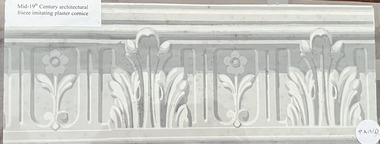
Wallpaper sample - Architectural frieze, mid 19th century
... ...19th century design...Mid 19th century architectural frieze imitating plaster cornice. The monochrome design features recurring acanthus leaf scrolls and floral elements. ...Heritage interiors Wallpapers 19th century design architectural friezes P.A 13 (f) Mid 19th century architectural frieze imitating plaster cornice. ...Part of a collection of historic wallpapers collected by Phyllis Murphy, most of whose wallpapers were donated to the collection of Historic Houses Sydney. This wallpaper sample, annotated and encased in mylar was used by Phyllis for educational purposes, and donated by her son to Villa Alba Museum's collection in 2025.Mid 19th century architectural frieze imitating plaster cornice. The monochrome design features recurring acanthus leaf scrolls and floral elements. P.A 13 (f)heritage interiors, wallpapers, 19th century design, architectural friezes -
 Villa Alba Museum
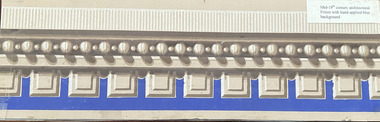
Wallpaper sample - Architectural frieze, mid 19th century
... ...19th century design...Heritage interiors Wallpapers 19th century design architectural friezes P.A1 (f) Mid 19th century architectural frieze to imitate decorative moulding with hand-applied blue background. ...Part of a collection of historic wallpapers collected by Phyllis Murphy, most of whose wallpapers were donated to the collection of Historic Houses Sydney. This wallpaper sample, annotated and encased in mylar was used by Phyllis for educational purposes, and donated by her son to Villa Alba Museum's collection in 2025.Mid 19th century architectural frieze to imitate decorative moulding with hand-applied blue background. It features a geometric bead moulding pattern in white and blue tones. The frieze would typically placed at the top of a wall just below the cornice. P.A1 (f)heritage interiors, wallpapers, 19th century design, architectural friezes -
 Villa Alba Museum
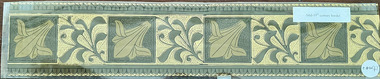
Wallpaper sample - Border, mid 19th century
... ...19th century design...Heritage interiors Wallpapers 19th century design architectural friezes P.B21 (f) Mid 19th century border featuring an architectural floral pattern in shades of green and cream, similar to designs produced by historic Victorian manufacturers like Jeffrey & Co. ...Part of a collection of historic wallpapers collected by Phyllis Murphy, most of whose wallpapers were donated to the collection of Historic Houses Sydney. This wallpaper sample, annotated and encased in mylar was used by Phyllis for educational purposes, and donated by her son to Villa Alba Museum's collection in 2025.Mid 19th century border featuring an architectural floral pattern in shades of green and cream, similar to designs produced by historic Victorian manufacturers like Jeffrey & Co. P.B21 (f)heritage interiors, wallpapers, 19th century design, architectural friezes -
 Villa Alba Museum
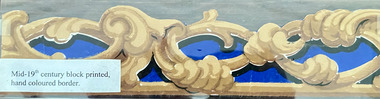
Wallpaper sample - Border, mid 19th century
... ...19th century design...19th century block printed, hand coloured border. Each colour in the pattern required a separate block. After the primary block printing, finer details were added by hand. The design...Heritage interiors Wallpapers 19th century design architectural friezes P-BIO (n-f) Mid 19th century block printed, hand coloured border. ...Part of a collection of historic wallpapers collected by Phyllis Murphy, most of whose wallpapers were donated to the collection of Historic Houses Sydney. This wallpaper sample, annotated and encased in mylar was used by Phyllis for educational purposes, and donated by her son to Villa Alba Museum's collection in 2025.Mid 19th century block printed, hand coloured border. Each colour in the pattern required a separate block. After the primary block printing, finer details were added by hand. The design is in the Rococo Revival Style.P-BIO (n-f)heritage interiors, wallpapers, 19th century design, architectural friezes -
 Villa Alba Museum
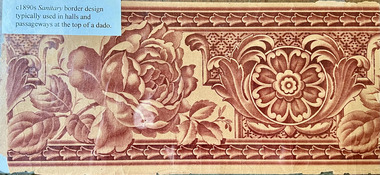
Wallpaper sample - 'Sanitary' border design, 1890s
... ...19th century design...An 1890s 'Sanitary' border design wallpaper, typically used in halls and passageways at the top of a dado. In the late 19th century, 'sanitary' referred to wallpapers printed with oil-base colours or water resistant inks, making them the first mass-produced wall coverings that could be wiped clean with a damp cloth This sample was probably printed using engraved copper rollers, which allowed for intricate shading and tonal variations. 1890s designs frequently featured large, trailing floral motifs or patterns imitating more expensive materials like tiles or wood panelling....Heritage interiors Wallpapers 19th century design borders 1890s sanitary wallpapers "P-B11 (f) An 1890s 'Sanitary' border design wallpaper, typically used in halls and passageways at the top of a dado. ...Part of a collection of historic wallpapers collected by Phyllis Murphy, most of whose wallpapers were donated to the collection of Historic Houses Sydney. This wallpaper sample, annotated and encased in mylar was used by Phyllis for educational purposes, and donated by her son to Villa Alba Museum's collection in 2025.An 1890s 'Sanitary' border design wallpaper, typically used in halls and passageways at the top of a dado. In the late 19th century, 'sanitary' referred to wallpapers printed with oil-base colours or water resistant inks, making them the first mass-produced wall coverings that could be wiped clean with a damp cloth This sample was probably printed using engraved copper rollers, which allowed for intricate shading and tonal variations. 1890s designs frequently featured large, trailing floral motifs or patterns imitating more expensive materials like tiles or wood panelling."P-B11 (f)heritage interiors, wallpapers, 19th century design, borders, 1890s, sanitary wallpapers -
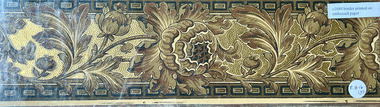 Villa Alba Museum
Wallpaper sample - Floral and foliate border design on embossed paper, 1880
... ...19th century design...Heritage interiors Wallpapers 19th century design borders 1880s Aesthetic movement P. ...Part of a collection of historic wallpapers collected by Phyllis Murphy, most of whose wallpapers were donated to the collection of Historic Houses Sydney. This wallpaper sample, annotated and encased in mylar was used by Phyllis for educational purposes, and donated by her son to Villa Alba Museum's collection in 2025.Wallpaper border printed on embossed paper, circa 1880. Background gilded and embossed to achieve a raised textured appearance. Features a detailed floral and acanthus leaf motifs with a geometric border. This kind of design was popular during the Aesthetic and Victorian design movements. The gilded finish was common to high-end interior decoration of the 1880s. P. B. 16 (f)heritage interiors, wallpapers, 19th century design, borders, 1880s, aesthetic movement -
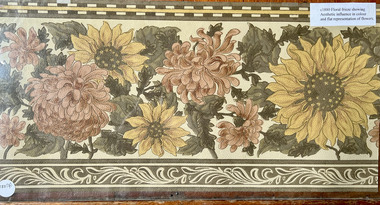 Villa Alba Museum
Wallpaper sample - Textured floral frieze, c.1880
... ...19th century design...Heritage interiors Wallpapers 19th century design borders 1880s Aesthetic movement P. ...Part of a collection of historic wallpapers collected by Phyllis Murphy, most of whose wallpapers were donated to the collection of Historic Houses Sydney. This wallpaper sample, annotated and encased in mylar was used by Phyllis for educational purposes, and donated by her son to Villa Alba Museum's collection in 2025.Textured floral frieze showing the influence of the Aesthetic Movement in the colour and flattened representation of the flowers. The design features prominent sunflowers and chrysanthemums set against a textured background. 1880s.P. F11 (f)heritage interiors, wallpapers, 19th century design, borders, 1880s, aesthetic movement -
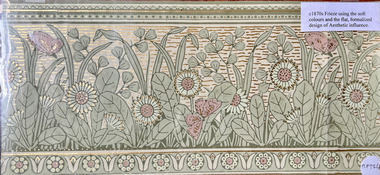 Villa Alba Museum
Wallpaper sample - Floral frieze, 1870s
... ...19th century design...Heritage interiors Wallpapers 19th century design Aesthetic movement 1870s wallpaper borders P. ...Part of a collection of historic wallpapers collected by Phyllis Murphy, most of whose wallpapers were donated to the collection of Historic Houses Sydney. This wallpaper sample, annotated and encased in mylar was used by Phyllis for educational purposes, and donated by her son to Villa Alba Museum's collection in 2025.A wallpaper frieze from the 1870s that exemplifies the Aesthetic Movement's design principles. The design is possibly based on one by Walter Crane around 1875. It features soft colours and flat, formalised botanical motifs, including butterflies and flowers. Friezes like this were common decorative elements in the later Victorian period. P. F72 (f)heritage interiors, wallpapers, 19th century design, aesthetic movement, 1870s, wallpaper borders -
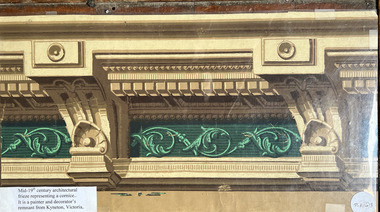 Villa Alba Museum
Wallpaper sample - Architectural border frieze, mid 19th century
... ...19th century design...Mid 19th century architectural frieze wallpaper representing a cornice. The design features a classic cornice with prominent corbels (bracket-like supports) and a decorative frieze section. ...Heritage interiors Wallpapers 19th century design wallpaper borders classical friezes P. ...Part of a collection of historic wallpapers collected by Phyllis Murphy, most of whose wallpapers were donated to the collection of Historic Houses Sydney. This wallpaper sample, annotated and encased in mylar was used by Phyllis for educational purposes, and donated by her son to Villa Alba Museum's collection in 2025.Mid 19th century architectural frieze wallpaper representing a cornice. The design features a classic cornice with prominent corbels (bracket-like supports) and a decorative frieze section. The sample demonstrates the elaborate ornamental style characteristic of the High Victorian Period which utilised classical motifs like scrolls and floral patterns. This particular example was a remnant wallpaper from the work of a painter and decorator in Kyneton, Victoria. P. A3 (f)heritage interiors, wallpapers, 19th century design, wallpaper borders, classical friezes -
 Villa Alba Museum
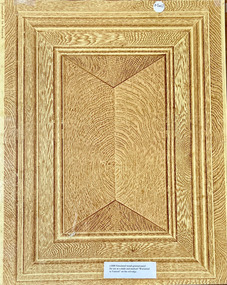
Wallpaper sample - Simulated wood grain dado panel, c.1880
... ...19th century design...Heritage interiors Wallpapers 19th century design simulated woodgrain wallpaper panels 1880s P. ...Part of a collection of historic wallpapers collected by Phyllis Murphy, most of whose wallpapers were donated to the collection of Historic Houses Sydney. This wallpaper sample, annotated and encased in mylar was used by Phyllis for educational purposes, and donated by her son to Villa Alba Museum's collection in 2025.Simulated woodgrain panel for use as a dado and marked "warranted to varnish" on the selvedge. The design features a complex, radial grain pattern within a mitred corner frame. P. In (w)heritage interiors, wallpapers, 19th century design, simulated woodgrain, wallpaper panels, 1880s -
 Villa Alba Museum
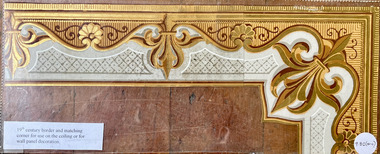
Wallpaper sample - Border and matching corner, 19th century
... ...19th century design...19th century border and matching corner for use as architectural detailing on a ceiling or for wall panel decoration. The pattern includes: whiplash curves, botanical inspiration and geometric accents. The central motif resembles a stylised flowerer lily. The flanking diamond mesh pattern (lattice style) provide a structured contrast to the central figure. The middle of the design...Heritage interiors Wallpapers 19th century design wallpaper borders wallpaper corners wallpapered ceilings P. ...Part of a collection of historic wallpapers collected by Phyllis Murphy, most of whose wallpapers were donated to the collection of Historic Houses Sydney. This wallpaper sample, annotated and encased in mylar was used by Phyllis for educational purposes, and donated by her son to Villa Alba Museum's collection in 2025.19th century border and matching corner for use as architectural detailing on a ceiling or for wall panel decoration. The pattern includes: whiplash curves, botanical inspiration and geometric accents. The central motif resembles a stylised flowerer lily. The flanking diamond mesh pattern (lattice style) provide a structured contrast to the central figure. The middle of the design, to be used as a dado or on a ceiling, simulates varnished planks of wood. P. B2 (m-c)heritage interiors, wallpapers, 19th century design, wallpaper borders, wallpaper corners, wallpapered ceilings -
 Villa Alba Museum
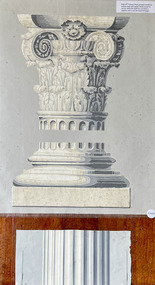
Wallpaper sample - Classical Frieze, mid 19th century
... ...19th century design...Heritage interiors Wallpapers 19th century design architectural friezes classical motif P.AI (Col) Mid 19th century block printed Corinthian column base and capital which would be cut out while the shaft was cut from a separate roll to suit the required height Wallpaper sample - Classical Frieze ...Part of a collection of historic wallpapers collected by Phyllis Murphy, most of whose wallpapers were donated to the collection of Historic Houses Sydney. This wallpaper sample, annotated and encased in mylar was used by Phyllis for educational purposes, and donated by her son to Villa Alba Museum's collection in 2025.Mid 19th century block printed Corinthian column base and capital which would be cut out while the shaft was cut from a separate roll to suit the required heightP.AI (Col)heritage interiors, wallpapers, 19th century design, architectural friezes, classical motif -
 Villa Alba Museum
Wallpaper sample - Narrative scene, mid 19th century
... ...19th century design...Heritage interiors Wallpapers 19th century design architectural friezes classical motif Narrative panels Wallpaper sample featuring scenes adapted from Harriet Beecher Stowe's 1852 anti-slavery novel, Uncle Tom's Cabin. ...Part of a collection of historic wallpapers collected by Phyllis Murphy, most of whose wallpapers were donated to the collection of Historic Houses Sydney. This wallpaper sample, annotated and encased in mylar was used by Phyllis for educational purposes, and donated by her son to Villa Alba Museum's collection in 2025.Wallpaper sample featuring scenes adapted from Harriet Beecher Stowe's 1852 anti-slavery novel, Uncle Tom's Cabin. The scenic/narrative printed wallpaper comprised of visual vignettes depicting various characters and narrative moments from the highly influential novel. heritage interiors, wallpapers, 19th century design, architectural friezes, classical motif, narrative panels -
 Villa Alba Museum
Wallpaper sample - Narrative scene, mid 19th century
... ...19th century design...Heritage interiors Wallpapers 19th century design architectural friezes classical motif Narrative panels Wallpaper sample featuring scenes adapted from Harriet Beecher Stowe's 1852 anti-slavery novel, Uncle Tom's Cabin. ...Part of a collection of historic wallpapers collected by Phyllis Murphy, most of whose wallpapers were donated to the collection of Historic Houses Sydney. This wallpaper sample, annotated and encased in mylar was used by Phyllis for educational purposes, and donated by her son to Villa Alba Museum's collection in 2025.Wallpaper sample featuring scenes adapted from Harriet Beecher Stowe's 1852 anti-slavery novel, Uncle Tom's Cabin. The scenic/narrative printed wallpaper comprised of visual vignettes depicting various characters and narrative moments from the highly influential novel. heritage interiors, wallpapers, 19th century design, architectural friezes, classical motif, narrative panels -
 Villa Alba Museum
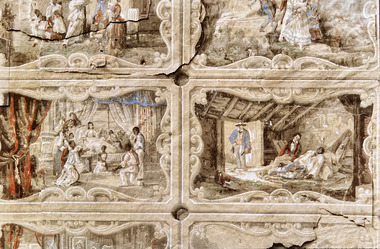
Wallpaper sample - Historical scene, c.1850
... ...19th century interior design...Heritage interiors Wallpapers 19th century interior design Narrative panels Uncle Tom's Cabin Uncle Tom's Cabin wallpaper (Black Rock House) reconstructed from fragments by PCM Wallpaper sample - Historical scene ...Part of a collection of historic wallpapers collected by Phyllis Murphy, most of whose wallpapers were donated to the collection of Historic Houses Sydney. This wallpaper sample, annotated and encased in mylar was used by Phyllis for educational purposes, and donated by her son to Villa Alba Museum's collection in 2025.Uncle Tom's Cabin wallpaper (Black Rock House) reconstructed from fragments by PCMheritage interiors, wallpapers, 19th century interior design, narrative panels, uncle tom's cabin -
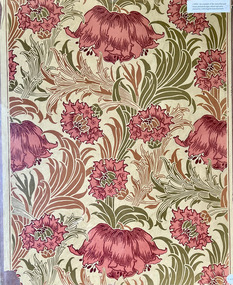 Villa Alba Museum
Wallpaper sample - Floral design, c.1890
... ...19th century interior design...Heritage interiors Wallpapers sanitary wallpapers 19th century interior design I2 c.1890 An example of the stencilled and block printed designs which had some popularity with English manufacturers. ...Part of a collection of historic wallpapers collected by Phyllis Murphy, most of whose wallpapers were donated to the collection of Historic Houses Sydney. This wallpaper sample, annotated and encased in mylar was used by Phyllis for educational purposes, and donated by her son to Villa Alba Museum's collection in 2025.c.1890 An example of the stencilled and block printed designs which had some popularity with English manufacturers. I2heritage interiors, wallpapers, sanitary wallpapers, 19th century interior design -
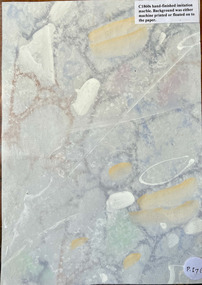 Villa Alba Museum
Wallpaper sample - Imitation marble, 1860s
... ...19th century interior design...Heritage interiors Wallpapers 19th century interior design marbled wallpaper imitation marble P.If(n) c.1860s hand-finished imitation marble wallpaper. ...Part of a collection of historic wallpapers collected by Phyllis Murphy, most of whose wallpapers were donated to the collection of Historic Houses Sydney. This wallpaper sample, annotated and encased in mylar was used by Phyllis for educational purposes, and donated by her son to Villa Alba Museum's collection in 2025.c.1860s hand-finished imitation marble wallpaper. Background was either machine printed or floated onto the paper. The floating process involved floating oil-based paints on a liquid surface and then lifting the pattern onto the paper. This created the unique, somewhat random swirls.P.If(n)heritage interiors, wallpapers, 19th century interior design, marbled wallpaper, imitation marble -
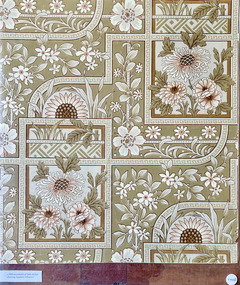 Villa Alba Museum
Wallpaper sample - Dado, c.1880
... ...19th century interior design...c.1880 Asymmetrical dado design showing Japanese influence featuring stylised floral motifs including chrysanthemums and geometric borders in the "Aesthetic" style. This style was part of the 19th-century...Heritage interiors Wallpapers 19th century interior design Dado borders Aesthetic movement P.D9 (f) c.1880 Asymmetrical dado design showing Japanese influence featuring stylised floral motifs including chrysanthemums and geometric borders in the "Aesthetic" style. ...Part of a collection of historic wallpapers collected by Phyllis Murphy, most of whose wallpapers were donated to the collection of Historic Houses Sydney. This wallpaper sample, annotated and encased in mylar was used by Phyllis for educational purposes, and donated by her son to Villa Alba Museum's collection in 2025.c.1880 Asymmetrical dado design showing Japanese influence featuring stylised floral motifs including chrysanthemums and geometric borders in the "Aesthetic" style. This style was part of the 19th-century artistic movement that incorporated nature-inspired elements in structured, layered compositions. A strong Japanese/Chinoiserie influence was a hallmark of the era's decorative arts. P.D9 (f)heritage interiors, wallpapers, 19th century interior design, dado borders, aesthetic movement -
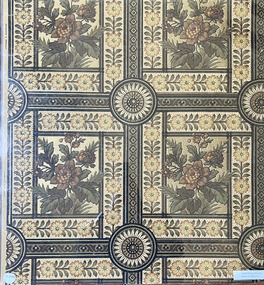 Villa Alba Museum
Wallpaper sample - Dado, c.1880
... ...19th century interior design...Heritage interiors Wallpapers 19th century interior design Dado borders P.D18 (f) c.1880 Dado showing Japanese influence. ...Part of a collection of historic wallpapers collected by Phyllis Murphy, most of whose wallpapers were donated to the collection of Historic Houses Sydney. This wallpaper sample, annotated and encased in mylar was used by Phyllis for educational purposes, and donated by her son to Villa Alba Museum's collection in 2025.c.1880 Dado showing Japanese influence. The pattern is an intricate floral and geometric design, characteristic of Victorian-era decorative arts. It features stylised chrysanthemum-like flowers in muted yellow and brown tones, set within square and rectangular borders.P.D18 (f)heritage interiors, wallpapers, 19th century interior design, dado borders -
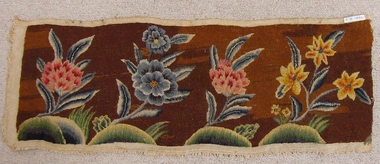 Embroiderers Guild, Victoria
Textile - Strip of Canvas Work
... Strip of canvas work, probably late 19th century. Design is pseudo Elizabethan of flowers and surrounds executed in wool and silk in soft pinks, blues, greens and yellows with a brown background on loosely woven fabric/canvas. ...Embroidery Canvas work Strip of canvas work, probably late 19th century. Design is pseudo Elizabethan of flowers and surrounds executed in wool and silk in soft pinks, blues, greens and yellows with a brown background on loosely woven fabric/canvas. ...Strip of canvas work, probably late 19th century. Design is pseudo Elizabethan of flowers and surrounds executed in wool and silk in soft pinks, blues, greens and yellows with a brown background on loosely woven fabric/canvas. Piece was brought into Guild by a gentleman who left no information.embroidery, canvas work -
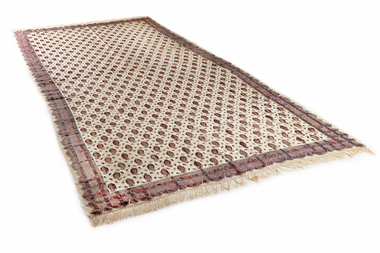 National Wool Museum
Clothing - Paisley Shawl, 1800 - 1830
... 19th Century...Fashion...Clothing...Design...Shawl 19th Century Fashion Clothing Design Paisley Migration Geelong Point Henry Wool and silk fringed cream coloured shawl featuring a paisley pattern in tones of maroon, green, blue, brown and cream. ...Shawl of Jane Francis (nee Piper) 1809-1891 This fine woven silk and woollen shawl is from Shetland, Scotland and belonged orginally to Jane Francis. Jane was born in Devon near the village of Bradworthy. She married Joseph Francis (1803-1878) in 1830 in the Bradworthy Parish, Devon, England and wore the shawl over her wedding dress on her wedding day. Jane and Joseph came to Geelong in 1853 with their family. Jane’s sister and brother were in Geelong and their eldest daughter Elizabeth had arrived in 1849. They arrived on the ship 'Euphemus' at Point Henry, Geelong, on July 20, 1853 and travelled across the bay in the steamer Duncan Hoyle. Jane was wearing the shawl on her arrival in Geelong. They went to live in Sharp Street Chilwell in a house owned by their son in law, John Price, which they later purchased. Jane became well known as a ‘midwife’ having had 10 children of her own. She is known to have delivered twin girls in Fyans Street; Ada and Myrtle Downie in 1884. Jane’s youngest son William (1848-1932) was a spinning master, timekeeper and pay clerk at the Victorian Woollen Mill (later the Godfrey Hirst Excelsior Number Two mill) and together with William Cook owned a wool scour on the Barwon River at Marnockvale. William’s grandson Arthur (1917-1992) was a wool classer undertaking his course at the Gordon Institute and became a wool valuer at Strachan & Co. For a time he taught part time in the Gordon course. Arthur’s son Robert was also a wool classer and worked at the Australian Wool Testing Authority. The shawl was used as a bed spread at 'Woodstock' by Jane's son William and then by his two children Laura and Eve. After their deaths, Eve in 1947 and Laura in 1963, the shawl was passed to their youngest sister Ethel (Effie) Frier (nee Francis). She had no children and it was passed on to grandniece Pat Norman (nee Hughan). Pat then passed the shawl to cousin Carollyn Williams (nee Francis) who donated the shawl to the National Wool Museum. - Donor, 2026 The Francis family were tenant farmers, and the donor speculated that the shawl could potentially have been a wedding gift from the land owners.Wool and silk fringed cream coloured shawl featuring a paisley pattern in tones of maroon, green, blue, brown and cream.shawl, 19th century, fashion, clothing, design, paisley, migration, geelong, point henry -
 Kew Historical Society Inc
Book, Roger Leong, Dressed to Kill: 100 Years of Fashion, 2010
... Costume -- History -- 19th century -- Exhibitions...Fashion design...National Gallery of Australia -- Exhibitions Costume -- History -- 20th century -- Exhibitions Costume -- History -- 19th century -- Exhibitions Fashion design -- History -- 20th century -- Exhibitions Fashion design -- History -- 19th century -- Exhibitions Fashion -- History -- 20th century -- Exhibitions Fashion -- History -- 19th century -- Exhibitions Fashion and art -- Exhibitions. 80 p. : ill. ...80 p. : ill. (some col.), ports. ; 30 cm. non-fictionnational gallery of australia -- exhibitions, costume -- history -- 20th century -- exhibitions, costume -- history -- 19th century -- exhibitions, fashion design -- history -- 20th century -- exhibitions, fashion design -- history -- 19th century -- exhibitions, fashion -- history -- 20th century -- exhibitions, fashion -- history -- 19th century -- exhibitions, fashion and art -- exhibitions. -
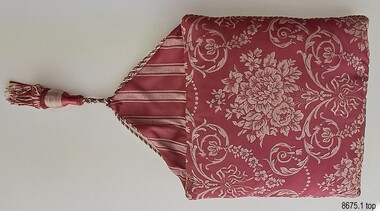 Flagstaff Hill Maritime Museum and Village
Textile - Seat Squabs, mid-20th century
... design incorporates local features such as Warrnambool sandstone, which was no longer commercially available but was procured from demolished buildings and uniformly cut to use as a veneer over the stronger Mt. Gambier stone. Also, traditional green American roofing slate was used, sourced from the 1908 local shipwreck “Falls of Halladale” by Flagstaff Hill volunteer divers. The bell tower includes a bell believed to be from a local shipwreck. Additional furnishings were acquired locally, and several items were donated by Warrnambool residents. Light fittings in both rooms were assembled to simulate 19th-century...These 18th to 19th-century design squabs have crimson and cream satin fabric on top and underneath, and weighted tassels are attached to their rear corners. ...These 18th to 19th-century design squabs have crimson and cream satin fabric on top and underneath, and weighted tassels are attached to their rear corners. ...The term 'seat squabs' is no longer commonly used, but is sometimes referred to in the upholstery and motor vehicle industries. Squabs are padded cushions frequently added to wooden chairs or benches to add comfort to their hard forms. They have been made to an 18th-to-19th-century pattern using beautiful, richly coloured satin fabric and fancy cord tassels. The weighted flap at the rear of the squabs helps to keep them in place on the chair, and could be used on the top of the backrest instead of on the seat. These days, squabs are attached with fabric ties or hook-and-loop tabs. These seat squabs were once used in the St Nicholas Seamen's Church at 139 Nelson Place, Williamstown, Victoria, which was purchased and furnished around 1943. The furniture and furnishings are now part of the St. Nicholas Seamen's Church collection. DETAILED HISTORY of the Missions to Seamen: - The Missions to Seamen is an Anglican (Church of England) charity that has served the world’s seafarers since 1856. It was inspired by the work of Rev. John Ashley, who, 20 years earlier, had pioneered a ministry to seafarers in the Bristol Channel in Great Britain. When Ashley retired, others continued the work, founding the Missions to Seamen. It adopted a Flying Angel as its symbol, inspired by a verse from the Bible in Revelation 14. Today, over 200 world ports have Missions to Seamen centres and chaplains. A Missions to Seamen’s club warmly welcomes sailors of all colours, creeds and races and provides a wide range of facilities. The Missions to Seamen organisation changed its name to the Mission to Seafarers in 2000, continuing to include Missions to Seamen clubs in Victoria’s cities of Melbourne, Portland, Geelong and Hastings. Flagstaff Hill’s St Nicholas’ Seamen’s Church is named after its namesake from Williamstown, Victoria, which began in 1857. Bishop Perry opened the first Sailors’ Church, which was known as ‘Bethel’, on an old hulk floating in Hobson’s Bay, Port of Melbourne. In 1860, a Sailors’ Rest started operating from rented premises in Williamstown. In 1878, the Sailors’ Church moved into an old Wesleyan chapel in Ann Street. By the end of that year, they managed to purchase the building, which they had already refurbished. In 1883, they affiliated with the Victorian Seamen’s Mission. A few years later, in 1906, the building had to be demolished because it was no longer safe. While they raised funds for a new building, the Sailors’ Rest temporarily moved to premises in front of Customs House in Nelson Place. Around this time, in 1906, the Ladies Harbour Lights Guild was formed in Australia to support and raise funds for the Mission to Seamen organisation in Melbourne. Two of the most significant ladies of the Guild were founding members Ethel Godfrey and Alice Sibthorpe. During the Mission's time at Siddeley Street, Melbourne, the activities of the Guild raised funds for the Mission to Seamen's Chapel at their new, and still current, premises in Flinders Street, Melbourne, opened in 1917. The Guild continued its important work until the 1960s. In 1908, the Williamstown Mission had enough money to purchase the former Mascotte skating rink on Thompson Street, Williamstown. In August of that year, they were inaugurated into the Victorian Missions to Seamen. They continued at that venue for a few decades. In 1943, the former ES&A Bank building at 139 Nelson Place, Williamstown, was purchased for the new Mission to Seaman’s Club. The official opening was on May 6th, 1944. It was described as a ‘distinctive little building’. Funds had previously been raised for the building and furnishing of the chapel at the rear. The chapel was named St Nicholas’ Seamen’s Church, after St Nicholas, fourth-century bishop and patron saint of sailors. Services were held on Wednesdays and Sundays. The church was supported by the Williamstown Lightkeepers’ Auxiliary, newly founded by Mrs Ethel Margaret Musther in 1943, as well as the Harbour Lights Guild and the League of Soldiers’ and Sailors’ Friends. The Williamstown Mission to Seamen’s Church operated until 1966, when large international ships no longer used the Port of Williamstown. The Commonwealth Government then leased the premises. In the formative years of Flagstaff Hill Maritime Village, the Advisory Board decided to include a Missions to Seamen Chapel and Recreation Room in its village. The Missions organisation was a significant feature of ports during the late 1800s and early 1900s, the period that the Village represents. They often erected Missions to house social and worshipful activities for seamen. Flagstaff Hill’s curator, Mr Ken Marshman, approached the Melbourne Board of Management of Missions to Seamen regarding the Williamstown branch. Consequently, the Board permitted the furnishings of the Williamstown chapel to be transferred to Flagstaff Hill Maritime Village. A provision of the transfer was that the Victoria Missions to Seamen be recognised, that the items would remain as a collection, and that the chapel would be called St Nicholas Seamen’s Church and conduct Divine services. The donation was approved on 21st May 1979. Flagstaff Hill's St. Nicholas Seamen's Church: - The idea behind Flagstaff Hill’s Missions to Seamen’s Church was partly driven by the offer of Stained Glass Memorial Windows that originated from the Warrnambool and District Base Hospital, which was undergoing multi-storey expansion in the late 1960s and early 1970s. The hospital’s Manager/Secretary was eager to see the historic window installed in a suitable place. The church, or chapel, was designed by a local architectural draftsman in collaboration with the Flagstaff Hill Planning Board and was constructed by Mr Leon Habel. The designers hoped the church would be used for formal worship, such as weddings, funerals, and multi-denominational special services like war commemorations. Its design was inspired by the ‘Missions to Seamen’ buildings in Portland and the Port of Melbourne. The furniture and furnishings were placed as accurately as possible according to photographs of the Williamstown St Nicholas Seamen’s Church and with assistance from local clergy. The Recreation Room was furnished and arranged on advice from experienced members of the Missions to Seamen organisation. A framed document in the building recognises the donor of the furnishings, Victoria Missions to Seamen, and includes the names of some original donors and their donated item/s. The building’s design incorporates local features such as Warrnambool sandstone, which was no longer commercially available but was procured from demolished buildings and uniformly cut to use as a veneer over the stronger Mt. Gambier stone. Also, traditional green American roofing slate was used, sourced from the 1908 local shipwreck “Falls of Halladale” by Flagstaff Hill volunteer divers. The bell tower includes a bell believed to be from a local shipwreck. Additional furnishings were acquired locally, and several items were donated by Warrnambool residents. Light fittings in both rooms were assembled to simulate 19th-century gas light fittings. The stained-glass window at the back of the church is a memorial to Dr Connell, a well-respected member of the Warrnambool community. It was originally installed in 1928 in the main building of Warrnambool Hospital. The St Nicholas’ Seamen’s Church at Flagstaff Hill was officially opened by His Worship the Mayor, Cr. John Lindsay, on Sunday, 11th October 1981. The event included a service of thanksgiving conducted by the Warrnambool Ministers Fraternal. Since then, the Chapel has been the historic venue for many weddings. This pair of seat squabs is historically significant for its origin in the St Nicholas Mission to Seamen's Church in Williamstown, established in 1857 to cater for seafarers’ physical, social, and spiritual needs. The organisation originated in Bristol, England, when a Seamen's Mission was formed in 1837. The squabs are also significant for their use in the St Nicholas Missions to Seamen's chapel, Williamstown, as the original building is now listed on the Victorian Heritage Register. Squabs or padded seat cushions, a pair of two. These 18th to 19th-century design squabs have crimson and cream satin fabric on top and underneath, and weighted tassels are attached to their rear corners. They can be used for comfort on hard seats and benches. The squabs were furnishings from the Missions to Seamen chapel in Williamstown, and they are now part of the St Nicholas Seamen's Church Collection.flagstaff hill, warrnambool, shipwrecked-coast, flagstaff-hill, flagstaff-hill-maritime-museum, maritime-museum, shipwreck-coast, flagstaff-hill-maritime-village, st nicholas mission to seamen's church williamstown, mission to seamen williamstown, mission to seamen victoria, st nicholas mission to seamen, st nicholas seamen's church, religion, religious service, sailor's rest, ladies harbour light guild, squab, seat covers, cushions, squabs, religious furnishing, padded seats, seating, accessory -
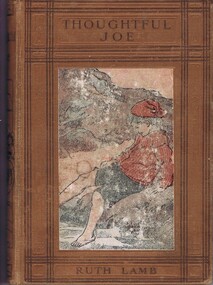 Greensborough Historical Society
Book, Ruth Lamb, Thoughtful Joe, and how he gained his name, by Ruth Lamb, 1897_
... An example of late 19th century childrens' book design....An example of late 19th century childrens' book design. childrens books "To dear Stuart, with all good wishes for a happy Christmas from R. ...An example of late 19th century childrens' book design.Hardback, 80 pages, col. frontispiece and title page. Embossed front cover, with col. illus."To dear Stuart, with all good wishes for a happy Christmas from R. Wedlich S. S. T. 1917"childrens books -
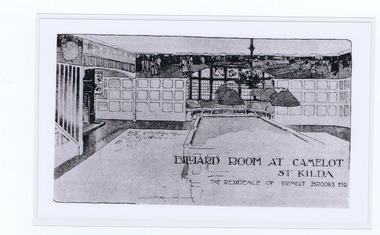 St Kilda Historical Society
Drawing - Building interior, Billiard Room at Camelot St Kilda interior
... It was a prominent 19th-century estate designed by architect Lloyd Tayler. ...It was a prominent 19th-century estate designed by architect Lloyd Tayler. ...The Billiard Room at Camelot, the home of Brooks esq, at 85 Alma Road St Kilda. It was a prominent 19th-century estate designed by architect Lloyd Tayler. The building has been demolished and the land subdivided..Laminated photograph of a drawingBilliard room at Camelot St Kilda. Residence of Ernest Brooks Esqcamelot, mansions, st kilda -
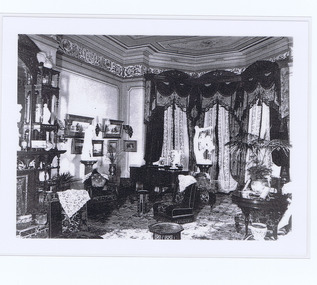 St Kilda Historical Society
Photograph - Building interior, Camelot, 1913
... Camelot was a prominent 19th-century estate designed by architect Lloyd Tayler. ...Camelot was a prominent 19th-century estate designed by architect Lloyd Tayler. ...Drawing room at Camelot, home of Brooks esq. Sumptuous decor, fringed curtains, velvet chairs, at 82 Alma Road St Kilda. Camelot was a prominent 19th-century estate designed by architect Lloyd Tayler. The building has been demolished and the land subdivided.Black and white photograph, laminatedcamelot, mansions, st kilda
