
Showing 1490 items matching "1st years"
-
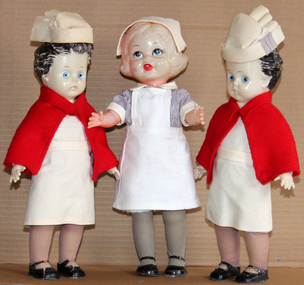 Ballarat Base Hospital Trained Nurses League
Nurses Uniform, 2nd, 1st & 3rd Years, prior 1972, Ballarat Base Hospital
... Nurses Uniform, 2nd, 1st & 3rd Years, prior 1972, Ballarat Base Hospital...Nurses Uniform, 2nd, 1st & 3rd Years, prior 1972, Ballarat Base Hospital...Nurses Uniform, 2nd, 1st & 3rd Years, prior 1972, Ballarat Base Hospital Nurses Uniform, 2nd, 1st & 3rd Years, prior 1972, Ballarat Base Hospital nurses uniform Ballarat 1972 years Plastic doll Nurses Uniform, 2nd, 1st & 3rd Years, prior 1972, Ballarat Base Hospital ...Nurses Uniform, 2nd, 1st & 3rd Years, prior 1972, Ballarat Base HospitalNurses Uniform, 2nd, 1st & 3rd Years, prior 1972, Ballarat Base HospitalPlastic dollnurses, uniform, ballarat, 1972, years -
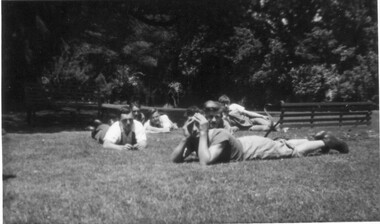 University of Melbourne, Burnley Campus Archives
Photograph - Black and white print, Helen Dudley, 1st and 2nd Years Relaxing on Lawn 1944, 1944
... 1st and 2nd Years Relaxing on Lawn 1944...Black and white photographs of 1st and 2nd Years Relaxing on Lawn 1944...Black and white photographs of 1st and 2nd Years Relaxing on Lawn 1944 1st and 2nd Years Relaxing on Lawn 1944 Photograph Black and white print Helen Dudley ...Donated by Helen Dudley (1945) 18 December 1991 for the Centenary Year.Black and white photographs of 1st and 2nd Years Relaxing on Lawn 1944 (a) On reverse, "1st & 2nd year boys relaxing on lawn." (b) On reverse, "1st & 2nd year students relaxing on lawn."helen dudley, centenary, 1991, students, lawn, male students, recreation -
 Ringwood and District Historical Society
Photograph, people attending the "Inaugural Luncheon of 20 Years Club - 1st May 1986", 1986
... people attending the "Inaugural Luncheon of 20 Years Club - 1st May 1986"...Framed colour photograph of people attending the "Inaugural Luncheon of 20 Years Club - 1st May 1986" +Additional Keywords: Back row / Potts, Don / Gulpin, Brian / Robertson, Alan / Friend, Des Front row / Saddington, Ron / Neal, Alan / Furno, John / Wilkins, Bill (Mayor) / Wilkins, Bernadette (Manager)...Inaugural Luncheon of 20 Years Club - 1st May 1986; City of Ringwood...Inaugural Luncheon of 20 Years Club - 1st May 1986; City of Ringwood Framed colour photograph of people attending the "Inaugural Luncheon of 20 Years Club - 1st May 1986" +Additional Keywords: Back row / Potts, Don / Gulpin, Brian / Robertson, Alan / Friend, Des Front row / Saddington, Ron / Neal, Alan / Furno, John / Wilkins, Bill (Mayor) / Wilkins, Bernadette (Manager) people attending the "Inaugural Luncheon of 20 Years Club - 1st May 1986" Photograph ...Photo taken at the Inaugural Luncheon of 20 Years Club - 1 May 1986, Staff of City of Ringwood.Framed colour photograph of people attending the "Inaugural Luncheon of 20 Years Club - 1st May 1986" +Additional Keywords: Back row / Potts, Don / Gulpin, Brian / Robertson, Alan / Friend, Des Front row / Saddington, Ron / Neal, Alan / Furno, John / Wilkins, Bill (Mayor) / Wilkins, Bernadette (Manager)Inaugural Luncheon of 20 Years Club - 1st May 1986; City of Ringwood -
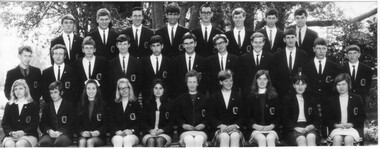 University of Melbourne, Burnley Campus Archives
Photograph - Black and white print and negative, Information Branch Victorian Department of Agriculture, 1st Year Group 1968, 1968
... ...1st years...students year group 1968 1st years publicity Names in paper catalogue. ...Black and white photograph. 1st Year Group 1968 seatred and standing on tiered benches in the Gardens.Names in paper catalogue. On reverse, "(1st Year Group photo 1968," and, "Photograph by Information Branch Victorian Department Of Agriculture Ref. No. D.1341.C."students, year group, 1968, 1st years, publicity -
University of Melbourne, Burnley Campus Archives
Document, List of subject and number of periods for each, 1949
... List of subjects for 1st and 2nd years...courses studies subjects List of subjects for 1st and 2nd years List of subject and number of periods for each Document ...List of subjects for 1st and 2nd yearscourses, studies, subjects -
University of Melbourne, Burnley Campus Archives
Document, Victorian State Schools' Horticultural Society, 1930-1940
... Suggested lessons for 1st, 2nd and 3rd years...victorian state schools horticultural society Suggested lessons for 1st, 2nd and 3rd years Victorian State Schools' Horticultural Society Document ...Suggested lessons for 1st, 2nd and 3rd yearsvictorian state schools, horticultural society -
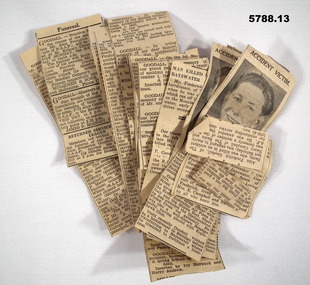 Bendigo Military Museum
Newspaper - OBITUARY ARTICLES 1947, c. Nov 1947
... Allan Frederick Goodall DFC, RAAF was killed in a car crash on Nov 1st 1947 age 25 years. Refer Cat No 543.2 for his service details....Allan Frederick Goodall DFC, RAAF was killed in a car crash on Nov 1st 1947 age 25 years. Refer Cat No 543.2 for his service details. ...Allan Frederick Goodall DFC, RAAF was killed in a car crash on Nov 1st 1947 age 25 years. Refer Cat No 543.2 for his service details.Thirteen Newspaper articles of various sizes relating to the death and funeral of A.F. Goodall DFC, RAAF. The largest is the size shown.obituary, dfc, goodall -
Ringwood and District Historical Society
Ration coupons, Commonwealth of Australia, Collection of five ration coupons for tea and butter (4), meat ration card (1), belonging to the Pullin family of 20 Mullum Road, Ringwood. 1948-1949, 1949
... Pullin - child under 7 years at 1st January 1949 - butter ration card.; 3. ...Pullin - child under 7 years at 1st January 1949 - butter ration card.; 3. ...Used by the Pullin family in 1949 for meat, tea and butter rations. Ellie Pullin.Collection of five ration coupons for tea and butter (4), meat ration card (1), belonging to the Pullin family of 20 Mullum Road, Ringwood. Held together with a small gold safety pin since removed.; 1. E.V. Pullin's meat ration card 1948; 2. David R. Pullin - child under 7 years at 1st January 1949 - butter ration card.; 3. Ellie V. Pullin - tea and butter ration card - 1949; 4. Peter R. Pullin - child under 7 years at 1st January 1949 - butter ration card.; 5. Rowland A. Pullin - tea and butter ration card 1949. +Additional Keywords: Pullin, Rowland A / Pullin, Ellie V / Pullin, Peter R / Pullin, David R -
 Sunshine and District Historical Society Incorporated
Journal - Ray Barnes Dairy - The Long Bloke, Barnes, Ray, 1984
... The Long Bloke|Sunshine State|The Gang|Sunshine Tech|Holidays At Colac|Buddy Gale|Sunshine Anglers|My First Job|National Service|Colonial Gas 1st 10 Years|June Fraser|Life In The Office|Pen Pictures|Move To Head Office|The Lad|Summing Up|The Shack|Steve Rose|En Route To England|RF In England|En Route To Australia|By Train To Cairns|A Mothers Courage|Asian Interlude|Gas And Fuel 1974 - 76|Trip To U.S.A....These events were compiled by Mr Raymond "Ray" Frank Barnes (b1936) from local magazines, newspapers and his own personal diaries Ray Barnes History The Long Bloke|Sunshine State|The Gang|Sunshine Tech|Holidays At Colac|Buddy Gale|Sunshine Anglers|My First Job|National Service|Colonial Gas 1st 10 Years|June Fraser|Life In The Office|Pen Pictures|Move To Head Office|The Lad|Summing Up|The Shack|Steve Rose|En Route To England|RF In England|En Route To Australia|By Train To Cairns|A Mothers Courage|Asian Interlude|Gas And Fuel 1974 - 76|Trip To U.S.A. ...These events were compiled by Mr Raymond "Ray" Frank Barnes (b1936) from local magazines, newspapers and his own personal diariesThe Long Bloke|Sunshine State|The Gang|Sunshine Tech|Holidays At Colac|Buddy Gale|Sunshine Anglers|My First Job|National Service|Colonial Gas 1st 10 Years|June Fraser|Life In The Office|Pen Pictures|Move To Head Office|The Lad|Summing Up|The Shack|Steve Rose|En Route To England|RF In England|En Route To Australia|By Train To Cairns|A Mothers Courage|Asian Interlude|Gas And Fuel 1974 - 76|Trip To U.S.A.|Gas & Fuel 1977 - 79|Sunshine Bowling Club 74 - 80|Island Jaunt|On Reflection|Island Jaunt|Fathers Story|78 Family Home|Makelesiray barnes, history -
 Bendigo Historical Society Inc.
Photograph - HARRY BIGGS COLLECTION: BOORT CEMETERY
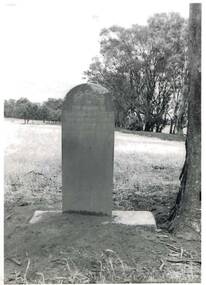
... , who died April 1st 1871, aged 2 years 4 months. He is not dead but sleepeth. ..., who died April 1st 1871, aged 2 years 4 months. He is not dead but sleepeth. ...Black and White photo of a grave next to a tree in a field with trees in the back ground. The grave is of a child Samuel C. Sutlee? Description on the back of photo 2400 414a. This grave is that of a child who died on 'Boort' Station in 1871. The inscription reads 'Sacred to the memory of Samuel C. Sutlee?, who died April 1st 1871, aged 2 years 4 months. He is not dead but sleepeth. Photo taken Oct 1962 by Peter Coutts of Boortmemorials, graveboards, boort cemetery, boort cemetery samuel c. sutlee? -
 Bendigo Historical Society Inc.
Document - DORR FAMILY DOCUMENTS - LEASE AGREEMENT
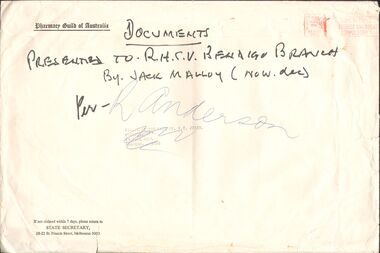
... Watson and John Dorr for 10 years Commencing 1st January 1889 and ending 31st December 1899 and dated 3/6/1889. ...Watson and John Dorr for 10 years Commencing 1st January 1889 and ending 31st December 1899 and dated 3/6/1889. ...Lease Agreement between Mr. Darnlon? Watson and John Dorr for 10 years Commencing 1st January 1889 and ending 31st December 1899 and dated 3/6/1889. Also a large envelope with Documents - Presented to R. H. S. V. Bendigo Branch by Jack Malloy (now Dec.). Document has green ribbon threaded in the left margin and a green duty stamp. On the inside are two small red seals and a receipt for the lease dated 24/6/1889. Lease is for being part and portion of Allotment Number four of Section Twenty five C Town of Sandhurst.person, family, dorr family, dorr family documents - lease agreement, john dorr, darnton watson, lionel leur's, palmer, robt s brain -
 Bendigo Historical Society Inc.
Document - CHRISTMAS REEF GOLD MINING CO. COLLECTION: TRIBUTE AGREEMENT
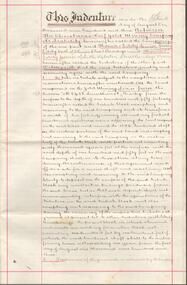
... Hand written agreement for five years from 1st August 1903 and dated 15th August 1903. ...all Mr J James Hand written agreement for five years from 1st August 1903 and dated 15th August 1903. ...Hand written agreement for five years from 1st August 1903 and dated 15th August 1903. Lease of land for mining purposes between Christmas Reef Gold Mining Co. and Messrs Eddy and party. Christmas Reef Gold Mining Co. would take a percentage of the gold. Signed by Fred Douglas Jones, Solicitor, Thomas Eddy Senior, James Herbert Eddy, Thomas Donald Eddy, Mr J James, R ?all, Clerk to Mr F D Jones. Document has two purple ink stamps and three red seals. Written on heavy paper with double red lines 1.5 cm from the edges.mine, gold, christmas reef gold mining company, christmas reef gold mining company n. l., fred douglas jones, thomas eddy senior, james herbert eddy, thomas donald eddy, r ?all, mr j james -
 Eltham District Historical Society Inc
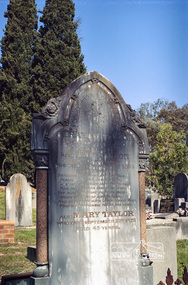
Negative - Photograph, Harry Gilham, Grave of Abraham and Ann Taylor, also Mary Taylor, Eltham Cemetery, Victoria, Sep 2009
... In Loving Remembrance of Abraham Taylor Who died June 1st 1890 Aged 80 years Also Ann Taylor Wife of the above Who died September 1st 1893 Aged 75 years Also Mary Taylor Who died September 22nd 1873 Aged 45 years...In Loving Remembrance of Abraham Taylor Who died June 1st 1890 Aged 80 years Also Ann Taylor Wife of the above Who died September 1st 1893 Aged 75 years Also Mary Taylor Who died September 22nd 1873 Aged 45 years eltham cemetery gravestones abraham taylor ann taylor mary taylor Kodak GC 400-9 Roll of 35mm colour negative film, 6 strips Grave of Abraham and Ann Taylor, also Mary Taylor, Eltham Cemetery, Victoria Negative Photograph Harry Gilham ...Abraham Taylor was born 20 October 1811 in Derrycarn, Drumcree Parish, County Armagh, Ireland, the son of Richard William Taylor and Annie Abraham. He married Ann McClelland on 19 February 1852 in Dumcree. They emigrated to Australia arriving in Geelong aboard the Ann Thompson on Christmas Day, 1852. His younger sisters Mary and Martha and brother William John all having separately preceded them in 1851 and 1852. Abraham and Ann settled in Little Eltham, Abraham was recorded as being 40 years of age and Ann, 36. They made their home and living as an orchardist and gardener where they had three sons, William John (1853 Little Eltham), Richard (1855 Eltham) and Robert David (1857 Eltham), tow of whom became Councillors of the Shire of Eltham; William (1890-1911) and Robert David (1911-1920). In June 1871, Abraham Taylor, Eltham gardener, applied for a 120-acre allotment half a mile northeast of the Research Gully Hotel on June 30, 1871. A license was issued to him January 30, 1872, for 114 acres, being Allotment 8, Section 18, the balance of 6 acres being retained for reserve. He built on the land a two roomed dwelling of slabs and palings. He and his family lived there or at their 6 ½ acre Eltham property, which was used for orchard and garden as a residence. In January 1875 a lease issued to Abraham Taylor for the land one chain wide each side at the gully named ‘Wet Gully’ was excluded. In August 1881 Abraham Taylor paid up all fees and applied for a Crown grant. He vainly requested that the grant be issued to his son, Robert David Taylor, Eltham however the grant was in fact issued to Abraham Taylor, Eltham, gardener. Abraham died at home on June 1, 1890. He was greatly respected by all who knew him. His sister Mary predeceased him 1873and is also buried at Eltham cemetery. Wife Ann died at home 1 September, 1893 and was buried with him. In Loving Remembrance of Abraham Taylor Who died June 1st 1890 Aged 80 years Also Ann Taylor Wife of the above Who died September 1st 1893 Aged 75 years Also Mary Taylor Who died September 22nd 1873 Aged 45 yearsRoll of 35mm colour negative film, 6 stripsKodak GC 400-9eltham cemetery, gravestones, abraham taylor, ann taylor, mary taylor -
 Bendigo Historical Society Inc.
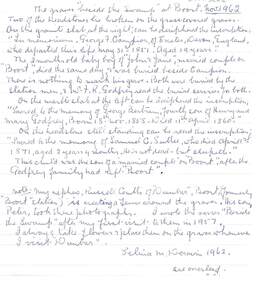
Document - HARRY BIGGS COLLECTION: BOORT CEMETERY
... Sutlee, who died April 1st 1871, aged 2 years 4 months. He is not dead - but sleepeth. ...Sutlee, who died April 1st 1871, aged 2 years 4 months. He is not dead - but sleepeth. ...Selina Deravin (Born 1882, Serpentine Creek. Died 1968, Melbourne, age 85), father John White, mother Mary Ann Nicholls was married to Garnet Deravin, a medical doctor. In 1928, (Electoral Roll Bendigo) Garnet and Selina were living at 109 Queen Street, Bendigo; later at 13 Tuxon Street, North Balwyn, where Garnet died on 15th. April, 1954 (Argus, 17th April, 1954). Deravin family owned the Chateau Dore vineyard and winery. Selina published a book of her poetry. A poem ' Beside the Swamp' was written following her visit to the swamp at Boort: ' In silence by the graves I stood, of those who long had lain at rest/In lonely quiet, in the bush. Long gone are they who loved them best/The trees still whisper by the swamp; the night birds call, and vigil keep/As in those far-off yesterdays - where Campion and three children sleep........'Selina White Birth Date Abt 1882 Birth Place Serpentine Creek, Victoria Registration Year 1882 Registration Place Victoria, Australia Father John White Mother Aary Ann Nicholls Registration Number 25736 Hand written letter by Selina De Ravin, titled 'The graves beside the swamp at Boort.' dated November 1962. Two of the headstones lie broken on the grass covered graves. On the granite slab at the right is the inscription 'In memoriam. George F. Campion of Exeter Devon, England, who departed this life, May 31st 1851. Aged 19 years. The 2 month old baby boy of 'John and Jane', married couple on 'Boort', died the same day and was buried beside Campion. There is nothing to mark his grave. Both were buried by the Station men. Mr J. R. Godfrey read the burial services for both. On the marble slab at the left can be deciphered the inscription sacred to the memory of George Bertram, fourth son of Henry and Mary Godfrey, Born 18th November 1858. Died 11th April 1860. On the headstone still standing can be read the inscription Sacred to the memory of Samuel C. Sutlee, who died April 1st 1871, aged 2 years 4 months. He is not dead - but sleepeth. This child was the son of a married couple 'on Boort', after the Godfrey family had left 'Boort'. Note - My nephew Russell Coutts of 'Dunbar', Boort, (formerly 'Boort' Station) is erecting a fence around the graves. His son, Peter took these photographs. I wrote the verses 'Beside the Swamp' after my first visit to them in 1957. I always take flowers and place them on the graves whenever I visit 'Dunbar' Selina M. Deravin 1962Russell Coutts and his son Peter have restored the graves beside the Lake at 'Dunbar' and erected a graveyard. This photograph was taken by Peter and the flowers placed on the graves by his mother Wilma who helps to care for them. They also discovered a fifth unknown grave there when erecting the fence and re- erecting the broken and fallen headstones. S. M. Deravin. (Selina De Ravin) a. Typed poem on carbon copy flimsy paper: 'Beside the Swamp', signed in blue pen by Lina Deravin, January 1957'. Written on the bottom in blue pen: ' In February 1960 when on a visit to Boort I took some flowers and placed them on these graves beside the swamp'. Signed Lina Devarin.Selina M. Deravinmemorials, graveboards, boort cemetry, russell coutts, 'dunbar', peter coutts, george f. campion, boort cemetery, samuel c. sutlee?., poetry, poem, garnet deravin, selina deravin -
 Flagstaff Hill Maritime Museum and Village
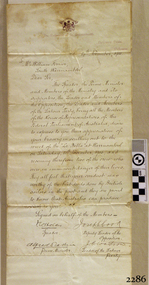
Letter - William Ferrier, 14th November 1905
... years old), R. Payne, Oscar Rosenholme and Jack Noake. Those seven who lost their lives were Mr Coulson (1st mate), Charles Jackman (cook) Gustave Johnson, Pierre Johann and Robert Gent (all able seamen), Harry Watson (ordinary seaman) and Jack Denham (ship’s boy), Captain Mylius was found guilty of careless navigation; he had sailed into the bay without the services of a pilot. ...years old), R. Payne, Oscar Rosenholme and Jack Noake. Those seven who lost their lives were Mr Coulson (1st mate), Charles Jackman (cook) Gustave Johnson, Pierre Johann and Robert Gent (all able seamen), Harry Watson (ordinary seaman) and Jack Denham (ship’s boy), Captain Mylius was found guilty of careless navigation; he had sailed into the bay without the services of a pilot. ...The letter to William Ferrier of South Warrnambool from the Prime Minister and the Parliament of the Commonwealth recognised the significance of William’s brave and courageous lifesaving act to the people of Australia; “They all feel that your conduct was worthy of the best deeds done by British sailors in the past and they are proud to know that Australia can produce such as you.” The story of that brave rescue follows on below … The ship from which the sailors were rescued was the three-masted, iron and steel barquentine the La Bella, built in Norway in 1893. She was one of two iron and steel ships by Johan Smith, The company was one of the leading shipping families in Tvedestrand, Norway. She was significant to Norwegian shipping, being one of only 27 iron and steel ships ever built in Norway. She was registered in New Zealand and engaged from 1902 in inter-colonial trading of timber in the Pacific, between New Zealand and Australia and was often in Port Phillip Bay, Victoria. On 5th October 1905, the twelve-year-old La Bella left Lyttleton, New Zealand carrying a cargo of timber bound for Warrnambool, Australia. She was manned by a crew of twelve: the Master, (Captain Mylius, previously 1st Mate of La Bella, appointed Captain to La Bella on 6th February 1903) 2 Mates, Cook, six able seamen, one ordinary seaman and a boy. Bad weather en route caused her to shelter at Burnie on Tasmania's North West coast. On November 10th, the 37th day of her journey, La Bella approached Warrnambool. Captain Mylius steered her towards Lady Bay Channel in heavy south-west seas and evening mist. He ordered the helmsman to steer for the light. As the ship came round, a tremendous sea struck her on the port quarter, causing her to breach broadside in a north-westerly direction into breakers. The helm was brought round twice more, but each time heavy seas broke over her, the third time throwing the La Bella on to a submerged reef in Lady Bay now known as La Bella Reef (about 100 yards from the Warrnambool breakwater). The sea was so rough that it even wrenched a one-and-a-half ton anchor from its fastenings and into the sea. As Captain Mylius headed to the steel wheelhouse, intending to send up a rocket flare, a huge sea slammed the steel door into him (resulting in massive bruising front and back) Despite his injuries he still managed to set off a blue light, which he held up in his hands. La Bella’s lifeboats were filled with seawater and broke up on their chocks. The blue light was the first indication to people on the shore that there was a ship in distress. The Harbour Master, Captain Roe (who lived in the Harbour Master’s House opposite Flagstaff Hill), organised a group of volunteers to crew the lifeboat because the trained crew was unavailable; the crewmen were working on a steamer in Port Fairy at the time. He then poured oil onto the water to try and smooth the sea. At around 11 pm three of the crew took shelter in the steel forecastle but the sea crashed into it and broke it up. While the rest of the crew and onlookers watched helplessly in the moonlight the bodies were washed away into the sea, never to be seen again. Some of the crew lashed themselves to the weather rail to keep from being washed away. Watson, the ordinary seaman, became tangled in the rigging lines and was too weak to move, so the 2nd Mate, Robertson, put a line onto him so that he wouldn’t wash off. Around 11 pm three of the crew were unconscious from exhaustion. The situation on La Bella was becoming dangerous. The 2nd Mate moved to the ‘house’ and soon afterwards the ship slipped in the heavy sea. The lashings of the 1st Mate and the ‘boy’ Denham had kept them safe until about 2 am when they were washed overboard; no one was able to help. One by one, the exhausted crew were being washed overboard, too weak to hold on any longer. During the night the La Bella had broken into two and the deckhouse ran out towards the sea. Two more men drowned when trying to reach the lifeboat. By sunrise, the only survivors of the twelve were the Master, 2nd Mate and three seamen. Early in the morning, Captain Roe used the rocket apparatus on shore to try and shoot a line to the ship for a safer rescue but each attempt fell short of the target. Several attempts were made by the lifeboat to rescue the stricken sailors, but the rough conditions made this difficult for the boat to get close enough to the ship and the lifeboat had to return to shore. During a final attempt to reach the ship Captain Mylius ordered his men to jump into the sea. Leonard Robertson, 2nd mate, jumped and swam towards the lifeboat, taking hold of the boat hook offered to him. Oscar Rosenholme managed to reach the boat floating on a piece of timber from the ship’s load and a third survivor, Noake, also made the boat. Along with the lifeboat rescue crew, 25-year-old William Ferrier rowed his small dingy through the heavy seas and managed to rescue the Captain, whom he landed on the breakwater. Ferrier then returned to the ship to attempt a final rescue, losing his oars and rowlocks into the high sea. Using just a spare paddle he skulled towards the La Bella, reaching her stern in time to cut loose the lone surviving sailor, Payne, from the lashing that held him to the ship; the terrified sailor dropped from the ship and into the dingy. Shortly after the last man was rescued, the La Bella was lifted by a huge wave and crashed back down on the reef; she broke up and sank. The ordeal had lasted ten hours. The survivors were taken to the nearby Bay View Hotel and gratefully received warm food and clothing, medical attention and a place to sleep. In the following days, an unidentified body of a young person has washed ashore; it was either Watson or Denham. The body was buried in the Warrnambool cemetery with an appropriate gravestone and inscription. William Ferrier became a national hero as news of the daring rescue spread. In recognition of his bravery in the two daring rescues, he was awarded the Silver Medal for Bravery by the Royal Humane Society and was honoured in the letter from the Prime Minister and the Parliament of the Commonwealth, telegrams and a cheque for £20 from the Governor-General, over £150 subscribed by the public, including Warrnambool and district and readers of The Argus, and a gold medal from the Glenelg Dinghy Club of South Australia. Ferrier’s rescue efforts are one of the most heroic in Victoria’s shipwreck history. (William Ferrier’s son, Frank, received a similar award almost fifty years later when he helped rescue four members of the crew on the yacht Merlan after it ran on to a reef near the Point Lonsdale Lighthouse. ) The wreck of La Bella now lies on her port side in 13 metres of sheltered water inside the reef she struck. The bow section is relatively intact and part of the stern has drifted north-easterly towards the mouth of the Hopkins River. The reef the La Bella struck now bears its name. Those five rescued from the La Bella were Captain George Mylius, Leonard Robertson (2nd Mate, 21 years old), R. Payne, Oscar Rosenholme and Jack Noake. Those seven who lost their lives were Mr Coulson (1st mate), Charles Jackman (cook) Gustave Johnson, Pierre Johann and Robert Gent (all able seamen), Harry Watson (ordinary seaman) and Jack Denham (ship’s boy), Captain Mylius was found guilty of careless navigation; he had sailed into the bay without the services of a pilot. His Master Certificate was suspended for twelve months. Later he was also charged with the manslaughter of one of the crew who had died when the La Bella was wrecked but found not guilty. The event’s adverse publicity and damage to his career took a toll on his health and he died of a heart attack six months after the wreck; he was only thirty-seven. His body was buried in the Melbourne General Cemetery. The La Bella was “the best documented of all sailing ships owned in New Zealand”. Her record books, ship logs, correspondence and supporting papers are still available. At the time of the tragedy, she was owned by Messers David C.Turnbull and Co. of Timaru, New Zealand timber merchants and shipping agents, who had purchased her on 13th December 1901. A detailed account of the last journey of La Bella can be read in “Leonard Robertson, the Whangaroa & La Bella” written by Jack Churchouse, published in 1982 by Millwood Press Ltd, Wellington, NZ. As well as this letter, Flagstaff Hill’s La Bella Collection includes a photograph of the wrecked La Bella, a brass rail holder and a postcard of William Ferrier with four of the survivors. Some 15 – 17 ships are believed to have sunk in Lady Bay, but only two have been discovered on the seafloor; the “La Bella” and the “Edinburgh Castle”. Both wrecks are popular diving sites and are preserved as significant historical marine and marine archaeological sites. This original congratulatory letter sent to William Ferrier by the Prime Minister and Government of Australia demonstrates the importance attached to his efforts for Victoria and to Australia. The letter is part of the La Bella Collection and is significant at both a local and state level. Its connection to the La Bella shipwreck and the rescue of five survivors highlights the dangers of Victoria’s Shipwreck Coast. The letter to William Ferrier from the Australian Government acknowledges the bravery of ordinary Australians who risked their lives to save victims of shipwrecks along the coast. The letter is significant to the history of Warrnambool as it honours William Ferrier, a local fisherman whose descendants continue to live in the area. It highlights the way of life of people who lived in coastal towns in 19th century Victoria and the effects of shipwrecks upon them. The letter connects to the postcard of William Ferrier with four of the five rescued crew, the photograph of the wreck of the La Bella and the artefact from the wreck, the rail holder. This letter is significant because of its association with the sailing ship “La Bella”. The “La Bella” is of local and state and national significance. It is one of the only two shipwrecks discovered in Lady Bay, Warrnambool, out of the 15-17 shipwrecks in the bay. Letter to William Ferrier of South Warrnambool from the Prime Minister and Members of Parliament commending him on his bravery. The printed letterhead includes a coat of arms in the top centre and the official address. The letter is very neatly hand written in black pen and includes 4 signatures of Members of Parliament. The rectangular paper is cream coloured with some yellow/brown discolouring. It has the letterhead on the right hand side of it and the written letter begins below the letterhead. The paper has been folded so that the right side becomes the cover page of the letter. The writing is continued onto the inside right hand page of the folded paper and the writing ends here. There is more recent writing on the bottom right hand corner of the back page. The paper has been officially folded in half a total 3 times and there is heavy discolouration on the sections that form the front and back of the folded letter. There is a 4th fold line that is less pronounced that the other folds and would make the paper the size to fit into a pocket. At several fold creases the paper has worn through. The edges of the paper have minor tears. The printed coat of arms is that of the House of Representatives. Underneath is printed “The Parliament of the Commonwealth, / Parliament House / Melbourne”. The hand written, letter is dated “14th November, 1905” and addressed to “Mr. William Ferrier / South Warrnambool” The letter begins “The Speaker, the Prime Minister and Members of the Ministry and its supporters, the Leader and Members of the Opposition, the Leader and Members of the Labour Party, being all the Members of the House of Representatives of the Federal Parliament of Australia” … It continues “desire to express to you their appreciation of your bravery in skulling out to the wreck of the “La Bella” at Warrnambool on Saturday, 11th November, 1905, and recovering therefrom two of the crew who were in imminent danger of their lives. They all feel that your conduct was worthy of the best deeds done by British sailors in the past and they are proud to know that Australia can produce such as you.” The letter is “Signed on behalf of the Members – Speaker (Frederick Holder ), Deputy Leader of the Opposition (Joseph Cook ), Prime Minister (Alfred Deakin), Leader of the Labour Party ( J.C. Watson)” On the back of the letter is blue ink handwriting “OWNER / G. FERRIER / TO. BE. PHOTOGRAPHED / 27-4-76”la bella, william ferrier, bill ferrier, lady bay, 1905, 10th november 1905, 11th november 1905, parliament of the commonwealth, prime minister, australian government, new zealand, flagstaff hill, warrnambool, shipwrecked coast, flagstaff hill maritime museum, maritime museum, shipwreck coast, flagstaff hill maritime village -
 Federation University Historical Collection
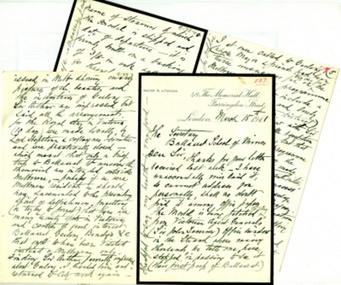
Letter - Correspondence, Walter M. Hitchcock, Letters from Walter M. Hitchcock concerning a model of a Ballarat tent (and more), 1911, 1911 (exact)
... years, Mr James Oddie. Living at Geelong from March 1850 I came to know him there as carrying on a foundry business in Ashby. With the discovery of gold at Ballarat started off almost of the working people, as well as of all other classes of the male population. Mr Oddie arrived in Ballarat I believe on or about September 1st...years, Mr James Oddie. Living at Geelong from March 1850 I came to know him there as carrying on a foundry business in Ashby. With the discovery of gold at Ballarat started off almost of the working people, as well as of all other classes of the male population. Mr Oddie arrived in Ballarat I believe on or about September 1st ...The tent model mentioned in the letters was displayed in the Ballarat School of Mines Museum. During the 1960s it was transferred to the Ballarat Historical Society. Two handwritten letters on paper with black mourning edge written by Walter M. Hitchcock to the Ballarat School of Mines, and another written by Walter's brother George M. Hitchcock.Letter transcription follow: Letter from Walter M. Hitchcock regarding the death of James Oddie and early gold mining at Ballarat, 1910 and 1911 48 The Memorial Hall Farringdon St London Dec1/10 The Secretary Ballarat Museum Dear Sir, I am just now sending you this line, i anticipation of further correspondence later on, simply to forward you a Post Card of the 1st mining tent erected 1851 on the site of he then newly proclaimed Township of Ballarat, which, as the sole survivor of the party who built the original, I have had the pleasure in making, and have decided to present it to your museum, Sir Jno Lasenor out Agent General for Victoria came to a Bazaar recently held in London. where I had it on view in the museum from 3 days, - and desired I would allow its [ ? ] exhibited in the first large window of the beautiful new building of the Victoria Agency situate in the Strand. It is there for the past few days and he may wish it to remain a week or two longer, I know of no other exhibition of it to delay it being packed and shipped to my relatives in Geelong (Mr [?] Bright of Hitchock's Firm) who may wish to show it in one of their windows before forwarding it to your museum - I have had an itemised pane glass case made for it with drop down end and [?} it stands on a plateau of moss, to represent grass 32 x 13 x 13 high and chimney 14 1/2 - the case is made 34 x 26 x 20 high inside - I shall have it very carefully packed - tent emptied tools, beds, &c &c in separate packing and insured for 50 pounds - I will send you full details later on. I hope and believe your President will accept it in due time Meantime believe me to be very truly Cat Walter Hitchcock G.F.B. 48 The Memorial Hall Farringdon St London March 15th 1911 The Secretary Ballarat School of Mines Dear Sir, Thanks for your letter received last week – I have unaccountably mislaid it, so cannot address you personally, shall no doubt find it among office papers. The model is being fetched today from Victorian Agent General’s (Sir John [Lavernor?] office window in the Strand where many thousands, he tells me, have stopped in passing to see it (their first peep of Ballaarat). It will be on view at Blackheath (Kent) for a week, then packed and shipped without further delay. I shall enclose in the glass case (which is 26 x 34 x 16 in high) some spare minced moss and gas (smoke) in case in transit the plateau suffers by shaking (though it is well glued down). All the tools, mining appliances, cradle, windlass, &c will be separately packed enclosed – which you can easily place in respective positions. HRH Prince of Wales has graciously accepted a photo of it – and in my letter to him when sending it for his acceptance I said – as he would probably ere long visit Australia as did his grandfather and father, which ought to (and certainly will) include at least a day or two in seeing your beautiful City, and also something of your mines &c instead of the hurried visit of his father (2 hours) when he, as Duke of York, unveiled a statue to the memory of those slain in the sad Boer War, which now is admitted by almost everybody to have been a big political mistake, - though in the future with England’s present wise policy towards that country it will prove for Africa’s welfare. It may interest you to know that when I ascertained that Geelong was not to be visited by the Royal Pair – I went up to St James’s Palace by appointed time the Duke’s private Secy Sir Arthur Bigge – taking with me a specially illustrated paper issued in Melb. showing many pictures of the beauties and industries of Geelong – Sir Arthur was impressed but said all the arrangements for the Royal stay in Victoria (10 days) were made locally, by Lord Hopetoun and collegues and committee, and were practically closed – which meant that only a brief trip to Ballarat to uncover the memorial was intended outside Melbourne. Perhaps if we were Melbourne residents we should have succumbed to the prevailing spirit of selfishness – forgetting (or trying to forget) that there are many beauty spots in Victoria and centres of great interest - Ballarat, Geelong, Bendigo, &c that ought to have been visited instead of Melbourne only. Finding Sir Arthur favorably impressed about Geelong I thanked him and returned to City work again. I at once called to Geelong whose mayor and friends had been twice unsuccessful in trying for the Melbourne functions programme being altered to include a visit to Geelong and lovely spots in the Western District, reporting my interview with Sir A B and his favourable reception of my representations, but that any alteration to the programme of engagements during the Royal visit must be made locally and by the local authorities. This had the desired success for on receipt of my message the Geelong mayor and colleagues again reopened the question and went to Melbourne, resulting in a concession (but what an altogether inadequate one) and they graciously ? consented to the train, on its way with the Duke and Duchess to your city, to stop at the Geelong stn (15 minutes) and so it came about that by a hasty local effort, 3,000 school children, and not a few of the leading people including the Mayor &c were gathered to welcome them in Geelong. The National anthem being sung, an Address read and presented and kindly replied to. Now Ballarat should doubtless has influence. See to it when our P. Of Wales visits Victoria – an unselfish ¬ programme is fixed up – and HRH afforded ample opportunity of visiting leisurely your city, Geelong, Bendigo and other centres of beauty and importance. The Prince himself will be the gainer by such an equitable and enlightened programme, - and come back with all the more favourable views of the marvellous development ever since our family first settled in Geelong in 1850. A far preferable result of such a visit than night after night having Melbourne Banquets and the visiting of its undoubted attractions - whilst all the rest of the State remained unvisited. Such an official mistake must not be made again. I will write you again, stating name of steamer of which the model is shipped and date of departure – it is firmly built on a backing of 3/8 in oak tall uprights so through the 7/8 in plateau and am entrusting the packing be very careful. I expressed firm – so that except possibly any breakage in glass case – it should reach you in due time all right. The top of case will be screwed so that it can be readily removed temporarily to enable my [ ? ] firm to show it in one of their windows. Believe me Yours very truly Captn Walter M. Hitchcock My brother will deliver it on my a/c – all carriage paid. Mt very kind regards to my friend since 1850 Jas Oddie. University of Ballarat Historical Collection Cat. No. 8133.3 & .4 Letter from Walter M. Hitchcock regarding the death of James Oddie and early gold mining at Ballarat, 1911 48 The Memorial Hall Farringdon St London April 20th 1911 My Dear Sir, It is with no ordinary feeling of regret that I received the tidings of the death of my good friend, your fellow citizen for many years, Mr James Oddie. Living at Geelong from March 1850 I came to know him there as carrying on a foundry business in Ashby. With the discovery of gold at Ballarat started off almost of the working people, as well as of all other classes of the male population. Mr Oddie arrived in Ballarat I believe on or about September 1st 1851. My three comrades and I arrived October 1st 1851 – among the many thousands soon gathered within a mile or so of Golden Point – my friend Oddie and I often met. I returning to Geelong after a year mining – my friend on the other hand remaining at Ballarat ever since – a marvellous record, and I am sure his life has been one of unique value to your City in many ways, - his age (87) naturally prepared me for his call home – and only two mails before the news came I received from him on of his kindly chatty letters in which amongst other things – he referred with pleasure to having received from me two 10 x 12 photos – one being of my model and that he was arranging to have it placed in a shop window in your city. I am interested in the fact of your having known each of my three comrades of 1851/52. It was J.M. Garrett and I who got permission to conduct public Sunday morning service in their large Marquee – used all the week for issue of Licenses in the absence of any church buildings, and it being on wet Sundays impossible to have services as usual under the trees – Ballarat then was more like a Gentleman’s Park – than bush country – but the axe soon did its work – and all were felled for our cooking, and hencewith to make our kindling etc. Shafting of holes not being at first done because too shallow – our deepest (at Eureka) was only 115 ft. Bendigo I hear had now mines of 4,000 ft in depth (deeper than our tin or coal mines here). I fortunately have, in excellent state of preservation, my last of 12 licenses dated October 1 1852 and have recently purchased here a Miner’s Right dated 1864, to that when explaining on matters re Gold Licensing I can show sample of each. With kind regards Believe me Yours sincerely Walter M. Hitchcock Geelong June 20/11 Dear Sir, By rail to day through Messrs Bannister I send the model of miner’s tent packed in a case 50 donated by my brother Captain Walter M. Hitchcock of London. This model was made by my brother and represents the tent he worked in on the Ballarat Gold Fields in the year 1851 or 2. In a separate parcel a few extras omitted from the case. Please send me receipts in duplicate, one for my brother, the other for the Customs, Geelong, as being donated to your institution, after some little correspondence it was admitted [??] any payment for duty. You probably have my brother’s address and would like to acknowledge its arrival, direct. I hope it is in good order. I did not open it for show in Geelong, as there would be less risk of breakage on repacking. With kind remembrances. I am Yours Faithfully Geo. M. Hitchcock. A Mr G. F. B. Sharick who is living near my home called in to see my model – he said he knew FM [Fred Martell] and was lately at Ballaratballarat school of mines, frederick martell, fred martell, james oddie, walter m hitchcock, walter hitchcock, f m garratt, george hitchcock, hitchcock, golden point, gold discovery, j m garrett, gold license, j.m. garrett, t.m. hall, george m. hitchcock, f.m. garratt, walter m. hitchcock -
 Federation University Historical Collection
Photos, 71st Infantry Band Broadmeadows Camp
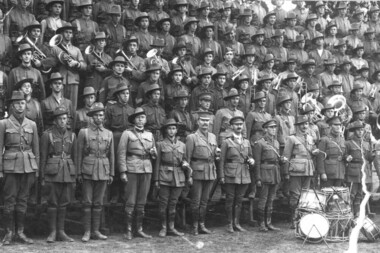
... In the years between its formation and the outbreak of War in 1914, the battalion went through a series of name changes as follows: Victorian Colonial Defence Force: 1858 – Ballarat Volunteer Rifle Regiment 1860 – Ballarat Volunteer Rifle Rangers 1863 – Ballarat Volunteer Rangers 1884 – 3rd Battalion, Victorian Rifles 1892 – 1st Battalion, 3rd Victorian Regiment 1898 – 3rd Battalion, Victorian Infantry Brigade Under the new Federal Government: 1901 – 3rd Battalion, Infantry Brigade Australian Army: 1903 – 7th Australian Infantry Regiment 1908 – 1st Battalion, 7th Australian Infantry Regiment 1912 – 70th Infantry (Ballarat East, Geelong and Queenscliff) 1912 – 71st Infantry (Ballarat West, Warrnambool) 1914 – 70th Infantry (Ballarat Regiment) - in Ballarat East 1914 – 71st (City of Ballarat) Infantry – in Ballarat West...In the years between its formation and the outbreak of War in 1914, the battalion went through a series of name changes as follows: Victorian Colonial Defence Force: 1858 – Ballarat Volunteer Rifle Regiment 1860 – Ballarat Volunteer Rifle Rangers 1863 – Ballarat Volunteer Rangers 1884 – 3rd Battalion, Victorian Rifles 1892 – 1st Battalion, 3rd Victorian Regiment 1898 – 3rd Battalion, Victorian Infantry Brigade Under the new Federal Government: 1901 – 3rd Battalion, Infantry Brigade Australian Army: 1903 – 7th Australian Infantry Regiment 1908 – 1st Battalion, 7th Australian Infantry Regiment 1912 – 70th Infantry (Ballarat East, Geelong and Queenscliff) 1912 – 71st Infantry (Ballarat West, Warrnambool) 1914 – 70th Infantry (Ballarat Regiment) - in Ballarat East 1914 – 71st (City of Ballarat) Infantry – in Ballarat West 71st infantry band broadmeadows camp percy code code frank wright brass band percy shackles shackles 71st Infantry Band (Percy Code Bandmaster) Broadmeadows Camp 1917 .1 Large group photo of members of the band .2 Photograph of part of the band The soldier in the front holding the conductor's batton is Percy Code. ...71st Infantry Band based at the Broadmeadows Camp 1917. Percy Code write a piece of music called the 71st Infantry Quick March. (http://trove.nla.gov.au/work/31795246?selectedversion=NBD11485892) The Ballarat phase of the battalion's history was formed as the Ballarat Volunteer Rifle Regiment on 9 August 1858 as a result of the Crimean War, coupled with the withdrawal of the British Army in 1857. In the years between its formation and the outbreak of War in 1914, the battalion went through a series of name changes as follows: Victorian Colonial Defence Force: 1858 – Ballarat Volunteer Rifle Regiment 1860 – Ballarat Volunteer Rifle Rangers 1863 – Ballarat Volunteer Rangers 1884 – 3rd Battalion, Victorian Rifles 1892 – 1st Battalion, 3rd Victorian Regiment 1898 – 3rd Battalion, Victorian Infantry Brigade Under the new Federal Government: 1901 – 3rd Battalion, Infantry Brigade Australian Army: 1903 – 7th Australian Infantry Regiment 1908 – 1st Battalion, 7th Australian Infantry Regiment 1912 – 70th Infantry (Ballarat East, Geelong and Queenscliff) 1912 – 71st Infantry (Ballarat West, Warrnambool) 1914 – 70th Infantry (Ballarat Regiment) - in Ballarat East 1914 – 71st (City of Ballarat) Infantry – in Ballarat West.1 Large group photo of members of the band .2 Photograph of part of the band The soldier in the front holding the conductor's batton is Percy Code. The trombone player next to Percy Code is Jack Shackles. 71st Infantry Band (Percy Code Bandmaster) Broadmeadows Camp 191771st infantry band, broadmeadows camp, percy code, code, frank wright, brass band, percy shackles, shackles -
 Federation University Historical Collection
Document - letters, Documents relating to the Establishment of the Sandhurst (Bendigo) School of Mines, 1871, 1871
... Sebastopol
June 14th 1871
Gentlemen,
I am desirous of joining the classes of Surveying, drawing, &c in your valuable Institution.i am 16 years of age, and been through the 1st first book of Euclid, Decimals &c. ...The first enrolments took place in 1871 making this group of documents historically important. ballarat school of mines bendigo school of mines sandhurst school of mines sandhurst mechanics' institute bendigo sandhurst joseph phillips phillips hore john hore james phillips ansaldi ballarat school of mines establishment robert borugh smyth robert m. sergeant james baker de la poer wall warrington rogers h.b. de la poer wall r.w. newman lecture royal geological society a. ansaldi mechanics' institute sandhurst R.m. sergeant Sebastopol
June 14th 1871
Gentlemen,
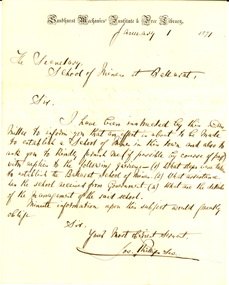
I am desirous of joining the classes of Surveying, drawing, &c in your valuable Institution.i am 16 years of age, and been through the 1st first book of Euclid, Decimals &c. ...The Ballarat School of Mines was established in 1870. The first enrolments took place in 1871 making this group of documents historically important.Paper documents relating to the advice being sought by the Sandhurst Mechanics' Institute from Ballarat School of Mines in relation to starting a School of Mines at Bendigo. .8) Correspondence to the Ballarat School of Mines from Joseph Phillips of the Sandhurst Mechanics' Institute and Free Library. The letter seeks advice on setting up a School of Mines in Bendigo. The correspondence was dated 01 January 1871, was signed by Joseph Phillips, and was answered on 04 January 1871. .14) Ballarat School of Mines Council Agenda, 20 January 1871. Signed by James Baker, secretary. .18) Letter from R.M. Serjeant to the Ballarat School of Mines dated 09 January 1871. .22) Letter from prospective student A. Ansaldi regarding starting at the Ballarat School of Mines. .24) Letter from prospective student James Hore regarding starting at the Ballarat School of Mines. .26) Memorandum during the Mechanics' Institute Sandhurst requesting information concerning teachers. Dated 25 April 1871. .27) Sandhurst Mechanics' Institute & Free Library requesting information from the Ballarat School of Mines in relation to numbers of pupils, number of paid staff, number of honorary staff, salary of head master and whether the school was a success. It is dated 19 April 1871 and is signed by Joseph Phillips. .35) My dear sir If it will suit youor convenience I take the liberty of appointing Friday the 2nd of June for my lecture on Geology at the School of Mines. You expressed a wish to assist me in any diagrams that it might be possible to obtain. In am very anxious to have a large map of the solar system. One that might be clearly seen from any part of the Hall. It will be of great importance to my lecture. [ ? ] diagrams I will find it necessary to prepare myself. I am most faithfully H. B. de la Poer Wall R.W. Newman Esqr Vice President PS as the whole of my lecture depends on the hearing the early part it might be well to put in the Advt at 8.00 punctually. In announcing my name it might be well to put ex-Fellow of the Royal Geological Society. Asking your pardon for these suggestions. Sebastopol June 14th 1871 Gentlemen, I am desirous of joining the classes of Surveying, drawing, &c in your valuable Institution.i am 16 years of age, and been through the 1st first book of Euclid, Decimals &c. Trusting to meet with your approbation. I am gentlemen, Yours obedietly A. Ansaldi To the Administrative Council School of Mines Ballarat Darling Streetl Ballarat July 1871 To the secretary of the School of Mines Ballarat. Sir, I called on Monday but you were not present but I saw Mr Phillips and he informed me that I might commence at once, and that my nomination &c might be going on in the mean time. If there be any objection to my joining the classroom Monday night, will you be good enough to let me know. Yours &c John Hore. Sandhurst April 25 1871 To The secretary School of Mines, Ballarat, Please let me know what subjects your paid instructor teachersl JP By Jas Philipsballarat school of mines, bendigo school of mines, sandhurst school of mines, sandhurst mechanics' institute, bendigo, sandhurst, joseph phillips, phillips, hore, john hore, james phillips, ansaldi, ballarat school of mines establishment, robert borugh smyth, robert m. sergeant, james baker, de la poer wall, warrington rogers, h.b. de la poer wall, r.w. newman, lecture, royal geological society, a. ansaldi, mechanics' institute sandhurst, r.m. sergeant -
 Flagstaff Hill Maritime Museum and Village
Functional object - Rail holder, About 1893, when the ship was made
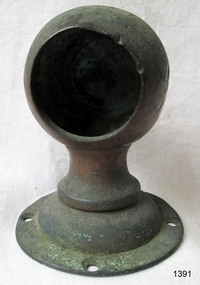
... years old), R. Payne, Oscar Rosenholme and Jack Noake. Those seven who lost their lives were Mr Coulson (1st mate), Charles Jackman (cook) Gustave Johnson, Pierre Johann and Robert Gent (all able seamen), Harry Watson (ordinary seaman) and Jack Denham (ship’s boy), Captain Mylius was found guilty of careless navigation; he had sailed into the bay without the services of a pilot. ...years old), R. Payne, Oscar Rosenholme and Jack Noake. Those seven who lost their lives were Mr Coulson (1st mate), Charles Jackman (cook) Gustave Johnson, Pierre Johann and Robert Gent (all able seamen), Harry Watson (ordinary seaman) and Jack Denham (ship’s boy), Captain Mylius was found guilty of careless navigation; he had sailed into the bay without the services of a pilot. ...This brass rail holder fixture would have been used to hold the end of a rail in place. There is no information as to where the fitting or rail would have been placed on the ship; sailing ships had many brass fittings. It was recovered from the wreck of the La Bella, which lies at the bottom of the Warrnambool Harbour. Some 15 ships are believed to have been wrecked in Lady Bay, but only two have been discovered on the sea floor; the La Bella and the Edinburgh Castle. Both wrecks are popular diving sites and are preserved as significant historical marine and marine archaeological sites. The story of the final voyage of the La Bella is summarised as follows … The ship from which the sailors were rescued was the three-masted, iron and steel barquentine the La Bella, built in Norway in 1893. She was one of two iron and steel ships by Johan Smith, the company being one of the leading shipping families in Tvedestrand, Norway. She was significant to Norwegian shipping, being one of only 27 iron and steel ships ever built in Norway. She was registered in New Zealand and engaged from 1902 in inter-colonial trading of timber in the pacific, between New Zealand and Australia and was often in Port Phillip Bay, Victoria. On 5th October, 1905, the twelve year old La Bella left Lyttleton, New Zealand carrying a cargo of timber bound for Warrnambool, Australia . She was manned by a crew of twelve: the Master, (Captain Mylius, previously 1st Mate of La Bella, appointed Captain to La Bella on 6th February 1903) 2 Mates, Cook, six able seamen, one ordinary seaman and a boy. . Bad weather en route caused her to shelter at Burnie on Tasmania's North West coast. On November 10th, the 37th day of her journey, La Bella approached Warrnambool. Captain Mylius steered her towards Lady Bay Channel in heavy south-west seas and evening mist. He ordered the helmsman to steer for the light. As the ship came round, a tremendous sea struck her on the port quarter, causing her to breach broadside in a north-westerly direction into breakers. The helm was brought round twice more, but each time heavy seas broke over her, the third time throwing the La Bella on to a submerged reef in Lady Bay now known as La Bella Reef (about 100 yards from the Warrnambool breakwater). The sea was so rough that it even wrenched a one-and-a-half ton anchor from its fastenings and into the sea. As Captain Mylius headed to the steel wheelhouse, intending to send up a rocket flare, a huge sea slammed the steel door into him (resulting in massive bruising front and back) Despite his injuries he still managed to set off a blue light, which he held up in his hands. La Bella’s lifeboats were filled with sea water and broke up on their chocks. The blue light was the first indication to people on shore that there was a ship in distress. The Harbour Master, Captain Roe (who lived in the Harbour Master’s House opposite Flagstaff Hill), organised a group of volunteers to crew the lifeboat because the trained crew was unavailable; the crewmen were working on a steamer in Port Fairy at the time. He then poured oil onto the water to try and smooth the sea. At around 11pm three of the crew took shelter in the steel forecastle but the sea crashed into it and broke it up. While the rest of the crew and onlookers watched helplessly in the moonlight the bodies were washed away into the sea, never to be seen again. Some of the crew lashed themselves to the weather rail to keep from being washed away. Watson, the ordinary seaman, became tangled in the rigging lines and was too weak to move, so the 2nd Mate, Robertson, put a line onto him so that he wouldn’t wash off. Around 11pm three of the crew were unconscious from exhaustion. The situation on La Bella was becoming dangerous. The 2nd Mate moved to the ‘house’ and soon afterwards the ship slipped in the heavy sea. The lashings of the 1st Mate and the ‘boy’ Denham had kept them safe until about 2am when they were washed overboard; no one was able to help. One by one, the exhausted crew were being washed overboard, too weak to hold on any longer. During the night the La Bella had broken into two and the deckhouse ran out towards the sea. Two more men drowned when trying to reach the lifeboat. By sunrise the only survivors of the twelve were the Master, 2nd Mate and three seamen. Early in the morning Captain Roe used the rocket apparatus on shore to try and shoot a line to the ship for a safer rescue but each attempt fell short of the target. Several attempts were made by the lifeboat to rescue the stricken sailors, but the rough conditions made this difficult for the boat to get close enough to the ship and the lifeboat had to return to shore. During a final attempt to reach the ship Captain Mylius ordered his men to jump into the sea. Leonard Robertson, 2nd mate, jumped and swam towards the lifeboat, taking hold of the boat hook offered to him. Oscar Rosenholme managed to reach the boat floating on a piece of timber from the ship’s load and a third survivor, Noake, also made the boat. Along with the lifeboat rescue crew, 25 year old William Ferrier rowed his small dingy through the heavy seas and managed to rescue the Captain, whom he landed on the breakwater. Ferrier then returned to the ship to attempt a final rescue, losing his oars and rowlocks into the high sea. Using just a spare paddle he skulled towards the La Bella, reaching her stern in time to cut loose the lone surviving sailor, Payne, from the lashing that held him to the ship; the terrified sailor dropped from the ship and into the dingy. Shortly after the last man was rescued, the La Bella was lifted by a huge wave and crashed back down on the reef; she broke up and sank. The ordeal had lasted ten hours. The survivors were taken to the nearby Bay View Hotel and gratefully received warm food and clothing, medical attention and a place to sleep. In the following days an unidentified body of a young person was washed ashore; it was either Watson or Denham. The body was buried in the Warrnambool cemetery with an appropriate gravestone and inscription. William Ferrier became a national hero as news of the daring rescue spread. In recognition of his bravery in the two daring rescues he was awarded the Silver Medal for Bravery by the Royal Humane Society and was honoured in the letter from the Prime Minister and the Parliament of the Commonwealth, telegrams and a cheque for £20 from the Governor General, over £150 subscribed by the public, including Warrnambool and district and readers of The Argus, and a gold medal from the Glenelg Dinghy Club of South Australia. Ferrier’s rescue efforts are one of the most heroic in Victoria’s shipwreck history. (William Ferrier’s son, Frank, received a similar award almost fifty years later, when he helped rescue four members of the crew on the yacht Merlan, after it ran on to a reef near the Point Lonsdale Lighthouse. ) The wreck of La Bella now lies on her port side in 13 metres of sheltered water inside the reef she struck. The bow section is relatively intact and part of the stern has drifted north-easterly towards the mouth of the Hopkins River. The reef the La Bella struck now bears its name. Those five rescued from the La Bella were Captain George Mylius, Leonard Robertson (2nd Mate, 21 years old), R. Payne, Oscar Rosenholme and Jack Noake. Those seven who lost their lives were Mr Coulson (1st mate), Charles Jackman (cook) Gustave Johnson, Pierre Johann and Robert Gent (all able seamen), Harry Watson (ordinary seaman) and Jack Denham (ship’s boy), Captain Mylius was found guilty of careless navigation; he had sailed into the bay without the services of a pilot. His Master Certificate was suspended for twelve months. Later he was also charged with manslaughter of one of the crew who had died when the La Bella was wrecked, but found not guilty. The event’s adverse publicity and damage to his career took a toll on his health and he died of a heart attack six months after the wreck; he was only thirty-seven. His body was buried in the Melbourne General Cemetery. The La Bella was “the best documented of all sailing ships owned in New Zealand”. Her record books, ship logs, correspondence and supporting papers are still available. At the time of the tragedy, she was owned by Messers David C.Turnbull and Co. of Timaru, New Zealand timber merchants and shipping agents, who had purchased her on 13th December 1901. A detailed account of the last journey of La Bella can be read in “Leonard Robertson, the Whangaroa & La Bella” written by Jack Churchouse, published in 1982 by Millwood Press Ltd, Wellington, NZ. Some 15 – 17 ships are believed to have sunk in Lady Bay, but only two have been discovered on the seafloor; the “La Bella” and the “Edinburgh Castle”. Both wrecks are popular diving sites and are preserved as significant historical marine and marine archaeological sites. As well as this letter, Flagstaff Hill’s La Bella Collection includes a photograph of the wrecked La Bella, a brass rail holder and a postcard of William Ferrier with four of the survivors. This original congratulatory letter sent to William Ferrier by the Prime Minister and Government of Australia demonstrates the importance attached to his efforts for Victoria and to Australia. The letter is part of the La Bella Collection and is significant at both a local and state level. Its connection to the La Bella shipwreck and the rescue of five survivors highlights the dangers of Victoria’s Shipwreck Coast. The letter to William Ferrier from the Australian Government acknowledges the bravery of ordinary Australians who risked their lives to save victims of shipwrecks along the coast. The letter is significant to the history of Warrnambool as it honours William Ferrier, a local fisherman whose descendants continue to live in the area. It highlights the way of life of people who lived in coastal towns in 19th century Victoria and the effects of shipwrecks upon them. The letter connects to the postcard of William Ferrier with four of the five rescued crew, the photograph of the wreck of the La Bella and the artefact from the wreck, the rail holder. This item is significant because of its association with the sailing ship “La Bella” . the “La Bella” is of local and state and national significance. It is one of the only two shipwrecks discovered in Lady Bay, Warrnambool, out of the 15-17 shipwrecks in the bay. Brass rail holder from the wreck "La Bella". This rail holder would have been used as a fitting for the end of a rail. It is made up of two parts and looks a little like a goblet in shape. The top is a hollow spherical shape with a circular hole cut out on one side, into which the end of a round rail would fit. There are two gouge marks close to each other on one side of the hole, about one centimetre apart, at 1 and 2 o’clock position. The sphere has a hollow pipe-like stem with a screw thread turned into the outside of the lower section and the bottom of the stem has been flared out after having the base fitted. The base is round and has a mound in the centre. The edge has four evenly spaced fixture holes around its edge. The metal shows signs of pitting and has mild encrustation. The fitting of the base is loose, allowing it to swivel in a complete circle. The top of the sphere is rough and has a dent in it. Underneath the base there is verdigris; some has flaked off and reveals a bright golden colour underneath. rail holder, brass rail holder, la bella, lady bay, norway, 1893, new zealand, captain mylius, william ferrier, flagstaff hill, warrnambool, shipwrecked coast, flagstaff hill maritime museum, maritime museum, shipwreck coast, flagstaff hill maritime village -
 Flagstaff Hill Maritime Museum and Village
Container - Bottle, Late 19th century or early 20th century
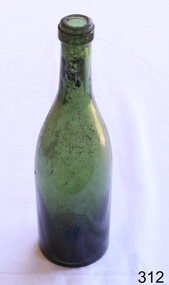
... years. Glass making has been traced back to 3500 BC in Mesopotamia. The earliest known glass objects were beads, perhaps made by accident while working with metal. In the late Bronze Age, several civilizations discovered how to make vessels and glass bottles by wrapping threads of melted glass around cores of sand or clay. Later, moulds were used to form dishes and table wares. Around the 1st...years. Glass making has been traced back to 3500 BC in Mesopotamia. The earliest known glass objects were beads, perhaps made by accident while working with metal. In the late Bronze Age, several civilizations discovered how to make vessels and glass bottles by wrapping threads of melted glass around cores of sand or clay. Later, moulds were used to form dishes and table wares. Around the 1st ...Glass manufacturing has evolved over thousands of years. Glass making has been traced back to 3500 BC in Mesopotamia. The earliest known glass objects were beads, perhaps made by accident while working with metal. In the late Bronze Age, several civilizations discovered how to make vessels and glass bottles by wrapping threads of melted glass around cores of sand or clay. Later, moulds were used to form dishes and table wares. Around the 1st century BC, glassblowing was discovered. This made glass containers less expensive than pottery. Mould-blown glass, the process of blowing a piece of molten glass into a wooden or metal mould, was invented during the 1st century AD. This technique was faster with more consistent results. It paved the way for mass production. It wasn’t until the late 1800s that the production process to become more efficient. In 1887, a company in England created a semi-automatic process that could produce up to 200 bottles an hour. This process has been refined to the point where modern machines can yield more than 600 containers per minute. Blown vs. Manufactured Glass Bottles Nowadays, glass bottles, jars, and cups are usually manufactured on a bigger scale than is found in individual glassblowing studios. If we still depended on hand-blown glass for all of our glass containers, we would see some major differences in the process of creating bottles and jars. First, there's the time. Hand blowing glass takes a significant amount of time, even for one simple container. In contrast, hundreds of jars per minute can be made using modern technology. This leads to the second advantage: price. Because of the automated and streamlined process, the price for manufactured containers is much lower than that of hand-blown glass. Third, manufactured bottles will be much more consistently uniform than bottles blown by hand. Automated glass manufacturing produces nearly identical batches of jars. Glass blowing is awesome for unique, beautiful pieces of art. But for lots of lower priced and uniformly shaped containers, automatic manufacturing is the preferred method to create glass bottles and jars. https://www.containerandpackaging.com/resources/glass-bottles-brief-history The invention and development of glass for domestic items including bottles, has been nothing short of revolutionary. The use of glass bottles, that could be easily washed, led to improved hygiene, and mass manufacturing of drinks of all types, including milk, cordial and alcoholic beverages.Green Glass Bottle Possibly a ginger beer bottle.Concave indentation at the base. Also on base are two raised lumps. flagstaff hill, warrnambool, shipwrecked-coast, flagstaff-hill, flagstaff-hill-maritime-museum, maritime-museum, shipwreck-coast, flagstaff-hill-maritime-village, glass -
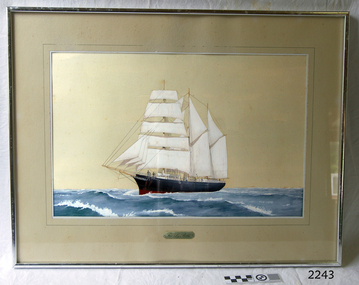 Flagstaff Hill Maritime Museum and Village
Painting - Maritime painting, The La Bella, 1980s
... years old), R. Payne, Oscar Rosenholme and Jack Noake. Those seven who lost their lives were Mr Coulson (1st mate), Charles Jackman (cook) Gustave Johnson, Pierre Johann and Robert Gent (all able seamen), Harry Watson (ordinary seaman) and Jack Denham (ship’s boy). ...years old), R. Payne, Oscar Rosenholme and Jack Noake. Those seven who lost their lives were Mr Coulson (1st mate), Charles Jackman (cook) Gustave Johnson, Pierre Johann and Robert Gent (all able seamen), Harry Watson (ordinary seaman) and Jack Denham (ship’s boy). ...This painting of the “La Bella” is associated with Flagstaff Hill’s collection of artefacts from the wreck of the “La Bella”. It was painted around the 1980s by maritime artist Philip J. Gray. Some 15 – 17 ships are believed to have sunk in Lady Bay, but only two have been discovered on the seafloor; the “La Bella” and the “Edinburgh Castle”. Both wrecks are popular diving sites and are preserved as significant historical marine and marine archaeological sites. The Kosnar Picture Framing and Mirrors Shop identified the "GRAY 3135, Y04/111" as their job number for the framing and said that the label "ANOTHER KOSNAR FEATURE" was last used before about 1990. About artist Philip J. Gray “Philip is one of Australia’s leading maritime artists and his meticulous research and social commentary paintings of ships, such as, the Loch Ard and Schomberg form an important part of Warrnambool’s Flagstaff Hill Maritime Museum.” [Dr Marion Manifold, Artist and Art Historian, 2014] Philip James Gray was born in London but has lived most of his life in Australia. He graduated from a London school of art as an illustrator, specialising in technical and scientific illustration as well as other commercial and applied art. He was also a student for a time of Fyffe Christie - British figurative artist, mural painter and humanitarian – who had a great influence on his career. Philip has always worked as a professional artist and illustrator. Many publications on maritime history have featured his work. His paintings have been released and sold all over the world as limited edition prints. The State Library of Victoria’s ‘Latrobe Collection’ holds two of his paintings. His street painting of ‘The Ashes Contest’ decorates the brick wall of Old Bakery Laneway in Sunbury and a Sunbury café owner commissioned him to paint the ‘Sunbury Pop Festival’ as a remembrance of local history. Philip has been an active member of the Sunbury Art Society in Victoria for several years, serving on the committee for some of that time and being involved in exhibitions. He enjoys helping new artists and sharing his skills and experience. About the “La Bella” The wreck of the La Bella lies at the bottom of the Warrnambool Harbour in Lady Bay. Some 15 ships are believed to have been wrecked there but only two have been discovered on the sea floor; the La Bella and the Edinburgh Castle. Both wrecks are popular diving sites and are preserved as significant historical marine and marine archaeological sites. The story of the final voyage of the La Bella is summarised as follows … The ship from which the sailors were rescued was the three-masted, iron and steel barquentine the La Bella, built in Norway in 1893. She was one of two iron and steel ships by Johan Smith, the company being one of the leading shipping families in Tvedestrand, Norway. She was significant to Norwegian shipping, being one of only 27 iron and steel ships ever built in Norway. La Bella was registered in New Zealand and engaged from 1902 in inter-colonial trading of timber in the pacific, between New Zealand and Australia and was often in Port Phillip Bay, Victoria. On 5th October 1905 the twelve year old La Bella left Lyttleton, New Zealand carrying a cargo of timber bound for Warrnambool, Australia . She was manned by a crew of twelve: the Master, (Captain Mylius, previously 1st Mate of La Bella, appointed Captain to La Bella on 6th February 1903) 2 Mates, Cook, six able seamen, one ordinary seaman and a boy. Bad weather en-route caused her to shelter at Burnie on Tasmania's North West coast. On November 10th, the 37th day of her journey, La Bella approached Warrnambool. Captain Mylius steered her towards Lady Bay Channel in heavy south-west seas and evening mist. He ordered the helmsman to steer for the light. As the ship came round, a tremendous sea struck her on the port quarter, causing her to breach broadside in a north-westerly direction into breakers. The helm was brought round twice more, but each time heavy seas broke over her, the third time throwing the La Bella on to a submerged reef in Lady Bay now known as La Bella Reef (about 100 yards from the Warrnambool breakwater). The sea was so rough that it even wrenched a one-and-a-half ton anchor from its fastenings and into the sea. As Captain Mylius headed to the steel wheelhouse, intending to send up a rocket flare, a huge sea slammed the steel door into him (resulting in massive bruising front and back) Despite his injuries he still managed to set off a blue light, which he held up in his hands. La Bella’s lifeboats were filled with sea water and broke up on their chocks. The blue light was the first indication to people on shore that there was a ship in distress. The Harbour Master, Captain Roe (who lived in the Harbour Master’s House opposite Flagstaff Hill), organised a group of volunteers to crew the lifeboat because the trained crew was unavailable; the crewmen were working on a steamer in Port Fairy at the time. He then poured oil onto the water to try and smooth the sea. At around 11pm three of the crew took shelter in the steel forecastle but the sea crashed into it and broke it up. While the rest of the crew and onlookers watched helplessly in the moonlight the bodies were washed away into the sea, never to be seen again. Some of the crew lashed themselves to the weather rail to keep from being washed away. Watson, the ordinary seaman, became tangled in the rigging lines and was too weak to move, so the 2nd Mate, Robertson, put a line onto him so that he wouldn’t wash off. Around 11pm three of the crew were unconscious from exhaustion. The situation on La Bella was becoming dangerous. The 2nd Mate moved to the ‘house’ and soon afterwards the ship slipped in the heavy sea. The lashings of the 1st Mate and the ‘boy’ Denham had kept them safe until about 2am when they were washed overboard; no one was able to help. One by one, the exhausted crew were being washed overboard, too weak to hold on any longer. During the night the La Bella had broken into two and the deckhouse ran out towards the sea. Two more men drowned when trying to reach the lifeboat. By sunrise the only survivors of the twelve were the Master, 2nd Mate and three seamen. Early in the morning Captain Roe used the rocket apparatus on shore to try and shoot a line to the ship for a safer rescue but each attempt fell short of the target. Several attempts were made by the lifeboat to rescue the stricken sailors, but the rough conditions made this difficult for the boat to get close enough to the ship and the lifeboat had to return to shore. During a final attempt to reach the ship Captain Mylius ordered his men to jump into the sea. Leonard Robertson, 2nd mate, jumped and swam towards the lifeboat, taking hold of the boat hook offered to him. Oscar Rosenholme managed to reach the boat floating on a piece of timber from the ship’s load and a third survivor, Noake, also made the boat. Along with the lifeboat rescue crew, 25 year old William Ferrier rowed his small dingy through the heavy seas and managed to rescue the Captain, whom he landed on the breakwater. Ferrier then returned to the ship to attempt a final rescue, losing his oars and rowlocks into the high sea. Using just a spare paddle he skulled towards the La Bella, reaching her stern in time to cut loose the lone surviving sailor, Payne, from the lashing that held him to the ship; the terrified sailor dropped from the ship and into the dingy. Shortly after the last man was rescued, the La Bella was lifted by a huge wave and crashed back down on the reef; she broke up and sank. The ordeal had lasted ten hours. The survivors were taken to the nearby Bay View Hotel and gratefully received warm food and clothing, medical attention and a place to sleep. In the following days an unidentified body of a young person was washed ashore; it was either Watson or Denham. The body was buried in the Warrnambool cemetery with an appropriate gravestone and inscription. William Ferrier became a national hero as news of the daring rescue spread. In recognition of his bravery in the two daring rescues he was awarded the Silver Medal for Bravery by the Royal Humane Society and was honoured in the letter from the Prime Minister and the Parliament of the Commonwealth, telegrams and a cheque for £20 from the Governor General, over £150 subscribed by the public, including Warrnambool and district and readers of The Argus, and a gold medal from the Glenelg Dinghy Club of South Australia. Ferrier’s rescue efforts are one of the most heroic in Victoria’s shipwreck history. (William Ferrier’s son, Frank, received a similar award almost fifty years later, when he helped rescue four members of the crew on the yacht Merlan, after it ran on to a reef near the Point Lonsdale Lighthouse. ) The wreck of La Bella now lies on her port side in 13 metres of sheltered water inside the reef she struck. The bow section is relatively intact and part of the stern has drifted north-easterly towards the mouth of the Hopkins River. The reef the La Bella struck now bears its name. Those five rescued from the La Bella were Captain George Mylius, Leonard Robertson (2nd Mate, 21 years old), R. Payne, Oscar Rosenholme and Jack Noake. Those seven who lost their lives were Mr Coulson (1st mate), Charles Jackman (cook) Gustave Johnson, Pierre Johann and Robert Gent (all able seamen), Harry Watson (ordinary seaman) and Jack Denham (ship’s boy). Captain Mylius was found guilty of careless navigation; he had sailed into the bay without the services of a pilot. His Master Certificate was suspended for twelve months. Later he was also charged with manslaughter of one of the crew who had died when the La Bella was wrecked, but found not guilty. The event’s adverse publicity and damage to his career took a toll on his health and he died of a heart attack six months after the wreck; he was only thirty-seven. His body was buried in the Melbourne General Cemetery. The La Bella was “the best documented of all sailing ships owned in New Zealand”. Her record books, ship logs, correspondence and supporting papers are still available. At the time of the tragedy she was owned by Messers David C.Turnbull and Co. of Timaru, New Zealand timber merchants and shipping agents, who had purchased her on 13th December 1901. A detailed account of the last journey of La Bella can be read in “Leonard Robertson, the Whangaroa & La Bella” written by Jack Churchouse, published in 1982 by Millwood Press Ltd, Wellington, NZ.This painting of the La Bella by Philip J. Gray is part of the La Bella Collection and is significant at both a local and state level. Its connection to the La Bella shipwreck and the rescue of five survivors highlights the dangers of Victoria’s Shipwreck Coast. The painting connects with other objects and artefacts associated with the wreck of the La Bella. This painting is significant because of its association with the sailing ship “La Bella” . the “La Bella” is of local and state and national significance. It is one of the only two shipwrecks discovered in Lady Bay, Warrnambool, out of the 15-17 shipwrecks in the bay. Large framed painting of the three masted barquentine "La Bella" fully rigged. Painted by Phillip J Gray. A fine printed line squares off the painting. Beneath painting and line is a gold plate with black copper plate designating "La Bella" is encased in glass, surrounded by a silver-metal frame. Yellow and brown paper label is adhered to back of painting. Picture framed by Kosnar in Melbourne."The La Bella" on gold plaque Logo of "K" inside a brown square. "GRAY 3135, Y04/111", "ANOTHER KOSNAR FEATURE" flagstaff hill, warrnambool, shipwrecked-coast, flagstaff-hill, flagstaff-hill-maritime-museum, maritime-museum, shipwreck-coast, flagstaff-hill-maritime-village, painting, la bella, artist phillip j gray, maritime painting, lady bay warrnambool -
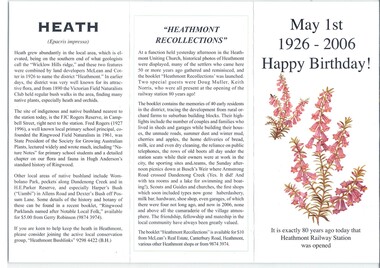 Ringwood and District Historical Society
Document - Information Brochure, Heathmont Railway Station 80 Years 1926-2006
... 1st May 2006. Brochure includes details of associated launch of "Heathmont Recollections" booklet, and outline of Heathmont's history over 80 years....Original opening on 1-May-1926 110 years since pioneer Herman Pump settled in Heathmont 1896 80 years since the opening of the Heathmont railway station 1926 80 years since the formation of Heathmont Tennis Club 1926 60 years since the opening of Cutting's general store 1946 50 years since the opening of Heathmont Anglican Church 1956 50 years since the formation of Heathmont Football Club 50 years since Heathmont's Ron Clarke lit the Olympic flame 1956 40 years since Washushens sold the last Heathmont orchard 1966 Multi-fold brochure marking Heathmont Railway Station's 80th year on 1st May 2006. ...Original opening on 1-May-1926Multi-fold brochure marking Heathmont Railway Station's 80th year on 1st May 2006. Brochure includes details of associated launch of "Heathmont Recollections" booklet, and outline of Heathmont's history over 80 years.110 years since pioneer Herman Pump settled in Heathmont 1896 80 years since the opening of the Heathmont railway station 1926 80 years since the formation of Heathmont Tennis Club 1926 60 years since the opening of Cutting's general store 1946 50 years since the opening of Heathmont Anglican Church 1956 50 years since the formation of Heathmont Football Club 50 years since Heathmont's Ron Clarke lit the Olympic flame 1956 40 years since Washushens sold the last Heathmont orchard 1966 -
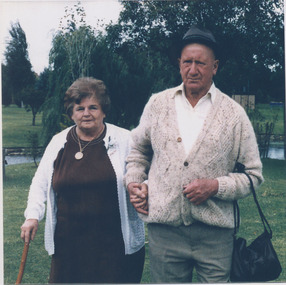 The Beechworth Burke Museum
Audio - Oral History, Jennifer Williams, Mr Braz Borschman, 3-1-2000
... Braz Borschman was born in Beechworth on the 1st of July 1914 at his parents home. He played for many years in the Towns volunteer Brass Band, a popular local band of about 30 members. ...Braz Borschman was born in Beechworth on the 1st of July 1914 at his parents home. He played for many years in the Towns volunteer Brass Band, a popular local band of about 30 members. ...Mr. Braz Borschman was born in Beechworth on the 1st of July 1914 at his parents home. He played for many years in the Towns volunteer Brass Band, a popular local band of about 30 members. Braz played the coronet and later the trombone. His first job was for the post office, but he spend most of his working life at the Beechworth Tannery. His interview contains lots of information about the tanning processes, including the story of 'Young Thomas', who lost his arm in a tannery accident. Braz recalls the open-air picture theatres of Beechworth, the many dances and balls, and distinct lack of cars. His testimony is rich with detail and filled with many other side-stories, including 'Blind Tommy', a self-sufficient, opium-smoking blind man of Chinese descent. This oral history recording was part of a project conducted by Jennifer Williams in the year 2000 to capture the everyday life and struggles in Beechworth during the twentieth century. This project involved recording seventy oral histories on cassette tapes of local Beechworth residents which were then published in a book titled: Listen to what they say: voices of twentieth century Beechworth. These cassette tapes were digitised in July 2021 with funds made available by the Friends of the Burke.Braz' interview is significant for the many historical details it provides about life, work, and leisure in Beechworth, particularly in relation to the period of the depression and after, which is the context which Braz' interview focuses on. His detail about the Beechworth tannery and the many open-air picture gardens is particularly rare and insightful to any social history of Beechworth. The oral history project more broadly is significant for its capture of the lives of ordinary Beechworth residents from incredibly divergent backgrounds, which has led to a rich, nuanced and diverse range of accounts of Beechworth.This is a digital copy of a recording that was originally captured on a cassette tape. The cassette tape is black with a horizontal white strip and is currently stored in a clear flat plastic rectangular container. It holds up 40 minutes of recordings on each side.listen to what they say, beechworth, oral history, braz borschman, brass band -
The Beechworth Burke Museum
Audio - Oral History, Jennifer Williams, Fred and Bette Wyatt, 27 April 2000
... 1st of March 1928 and Bette in 1934, in Beechworth. Both of their families immigrated from England on convict ships in the 1800s. Fred and Bette both had large families of 9 and 5 siblings respectively, with 2 of Fred's siblings suffering from muscular dystrophy both dying at 20 years old which affected the family. ...1st of March 1928 and Bette in 1934, in Beechworth. Both of their families immigrated from England on convict ships in the 1800s. Fred and Bette both had large families of 9 and 5 siblings respectively, with 2 of Fred's siblings suffering from muscular dystrophy both dying at 20 years old which affected the family. ...Fred was born on the 1st of March 1928 and Bette in 1934, in Beechworth. Both of their families immigrated from England on convict ships in the 1800s. Fred and Bette both had large families of 9 and 5 siblings respectively, with 2 of Fred's siblings suffering from muscular dystrophy both dying at 20 years old which affected the family. Bette originally worked in multiple cafes and kitchens in Beechworth before working in "Ennals Store" which was a grocery store, for over 30 years. Fred worked as a milkman during the war before becoming an engineer at the tannery and the brewery in Beechworth. He rebuilt the factory at the brewery during the 1970s and worked there until he retired. This oral history recording was part of a project conducted by Jennifer Williams in the year 2000 to capture the everyday life and struggles in Beechworth during the twentieth century. This project involved recording seventy oral histories on cassette tapes of local Beechworth residents which were then published in a book titled: Listen to what they say: voices of twentieth century Beechworth. These cassette tapes were digitised in July 2021 with funds made available by the Friends of the Burke.Fred and Bette Wyatt's account of their lives in Beechworth and the local area during the 20th century is historically and socially significant to the cultural heritage of the region. They both mention important historical events and hardships in the region's history that had a lasting local, regional and national impact, including Australia during wartime, economic struggles, and the development of Beechworth town. This oral history account is socially and historically significant as it is a part of a broader collection of interviews conducted by Jennifer Williams which were published in the book 'Listen to what they say: voices of twentieth-century Beechworth.' While the township of Beechworth is known for its history as a gold rush town, these accounts provide a unique insight into the day-to-day life of the town's residents during the 20th century, many of which will have now been lost if they had not been preserved.This is a digital copy of a recording that was originally captured on a cassette tape. The cassette tape is black with a horizontal white strip and is currently stored in a clear flat plastic rectangular container. It holds up 40 minutes of recordings on each side.Fred and Bette Wyattbeechworth, beechworth tannery, beechworth brewery, fred and bette wyatt, wyatt, wyatt beechworth, ennals store, ennals beechworth, listen to what they say, burke museum -
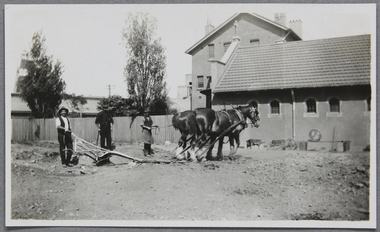 Mission to Seafarers Victoria
Photograph - Photograph, Black and white, Reverend John Reginald Weller, Making the tennis court, January 1926
... The lease started on the 1st of January 1926 and was for 21 years. The tennis court was funded by the Hawtorn branch of Ladies Harbour Lights Guild....The lease started on the 1st of January 1926 and was for 21 years. The tennis court was funded by the Hawtorn branch of Ladies Harbour Lights Guild. ...In the minutes of the 21st meeting of the Victoria Mission to Seamen, held at the Harbour Trust Board Room on Thursday, 8th October 1925 , the Treasurer, Mr Perry reported that he had obtained a fresh lease of land of the Central Institute with an extra piece of land to be used for the future tennis court. The lease started on the 1st of January 1926 and was for 21 years. The tennis court was funded by the Hawtorn branch of Ladies Harbour Lights Guild.The tennis court was a feature of other missions overseas and it seems seamen were asking for one in Melbourne. It was in use until the mid fifties.Small silvertone photograph depicting four men working with horses are preparing the ground of the future tennis court. Behind is the Mission to Seafarers (chapel side) and the docks on the Australian Wharf. The photograph is glued to the photographic album with the caution belowBelow in white ink: Making the tennis courttennis court, weller album, 1926, garden, trees, horses, flinders street -
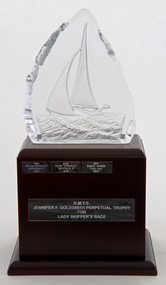 Royal Melbourne Yacht Squadron
Award - Jennifer Goldsmith Perpetual Trophy
... years. Following the donation of a trophy along with prizes from Swarovski Jewellers for Line Honours Winner and 1st, 2nd and 3rd place getters in the combined Y.V Performance Handicap Divisions, presented annually by the Goldsmith family in memory of Jennifer Goldsmith. ...years. Following the donation of a trophy along with prizes from Swarovski Jewellers for Line Honours Winner and 1st, 2nd and 3rd place getters in the combined Y.V Performance Handicap Divisions, presented annually by the Goldsmith family in memory of Jennifer Goldsmith. ...A Lady Skippers Event was introduced in the year 2004, the first such event for over forty years. Following the donation of a trophy along with prizes from Swarovski Jewellers for Line Honours Winner and 1st, 2nd and 3rd place getters in the combined Y.V Performance Handicap Divisions, presented annually by the Goldsmith family in memory of Jennifer Goldsmith. The event became known as the Jennifer F. Goldsmith Perpetual and is open to any yacht on the RMYS Register. It was first contested on Sunday 17th February 2005, when won by Helen Crossley skippering Mystique II and who retained it the following year. The Perpetual Trophy to be engraved with the Y. V. Performance Handicap winner’s name and presented at the RMYS Presentation Night. Proceeds from the event are donated by RMYS to melanoma research.A crystal shard 160 mm high with engraved yacht and wave images, mounted on an 140 mm high oblong rosewood block and base bearing winners’ inscription plaques around.RMYS JENNIFER. F. GOLDSMITH PERPETUAL TROPHY FOR LADY SKIPPERS RACEjennifer goldsmith, trophy, perpetual -
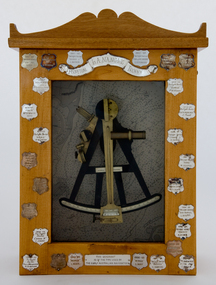 Royal Melbourne Yacht Squadron
Award - L.A. Nangle Perpetual Trophy
... years became Secretary/Manager. Prior to leaving, he presented to the Club the Quadrant once owned and used by his father when one of the Navigating Officers aboard H.M.V.S. Cerberus. This was to lay idle in as cupboard in the Office until one day seen by then Commodore Les Nangle, who decided to put it to good use. Following being mounted in a case, July 1969, it was allocated as a trophy by Commodore Les Nangle. Originally it was for a Distance event for 1st...years became Secretary/Manager. Prior to leaving, he presented to the Club the Quadrant once owned and used by his father when one of the Navigating Officers aboard H.M.V.S. Cerberus. This was to lay idle in as cupboard in the Office until one day seen by then Commodore Les Nangle, who decided to put it to good use. Following being mounted in a case, July 1969, it was allocated as a trophy by Commodore Les Nangle. Originally it was for a Distance event for 1st ...In 1961, George Venables resigned after 38 years of faithful service to the Club. He spent the first 21 years as Head Steward, the remainder as Secretary, a position that in his latter years became Secretary/Manager. Prior to leaving, he presented to the Club the Quadrant once owned and used by his father when one of the Navigating Officers aboard H.M.V.S. Cerberus. This was to lay idle in as cupboard in the Office until one day seen by then Commodore Les Nangle, who decided to put it to good use. Following being mounted in a case, July 1969, it was allocated as a trophy by Commodore Les Nangle. Originally it was for a Distance event for 1st Division and One-Design Classes, with the first event season 1969-70, being from St Kilda to Mornington, won by Brian Morris skippering the Diamond Class yacht, Vulpine. In an endeavour to raise interest in Twilight events for both the racing and Club revenue, the trophy was re-allocated, December 1990, for a Combined Club and Classes, including Trailerable yachts, Mid-Week Summer Twilight Pursuit Series, held on consecutive Wednesday’s, commencing January 1991, of seven, later amended to nine heats without spinnakers, initially with trophies awarded after each heat. The best five results to count, contested in accordance with the VYC handicapping system. Trophy was first won Season 1971-1972, by Roy Duncan with his Tumlare, Marie, From 2007 onwards the contests were amended to allow for at least seven heats to be set in the race calendar with a minimum of 5 heats to be conducted to constitute a series. Seventy percent of results to count for the series scores when the number of heats exceeded ‘Five’.Brass quadrant upon coastal chart, enclosed in a glass fronted wooden case. Silver winners inscription shields attached around edge of case.L. A. NANGLE PERPETUAL TROPHY THIS QUADRANT IS OF THE TYPE USED BY THE EARLY AUSTRALIAN NAVIGATORSl.a. nangle, perpetual, trophy -
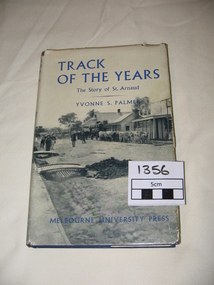 St Arnaud and District Historical Society
Book. Track of the Years, Track Of The Years. The Story of St.Arnaud.By Yvonne S Palmer
... Years by Yvonne S. Palmer. The Story of St.Arnaud. Hardcover book, blue cover with black and white photograph on the dustcover.Includes photographs and maps.308 pages, 1st Edition....Sons of the Antipodes, Diggers in Townsmen, Daughters and Wives, Companies and Miners, Mining Settlements, Increasing Needs, Not by Bread Alone, The beginning of Farming, The Changing Countryside, A New St.Arnaud has Come, Deep Sinking and Dividends, Fewer farmers- Larger farms, Pride but not Complacency. 1st Edition Published by Melbourne University Press in 1955. 308 pages. Track of The Years by Yvonne S. ...TRACK OF THE YEARS. The Story of St.Arnaud by Yvonne S Palmer had aroused local interest when this book was presented in 1955.The fortunes of this prosperous community, whose origins go back to the excitement of of the New Bendigo gold-rush, gleaned from an unusual wealth of reminiscences,diaries, letters, newspapers and photograph albums, are now placed permanently on record in this fascinating narrative. Contents: The New Bendigo Goldrush, Pastoral Settlement, The Aborigines of the Eastern Wimmera, A Permanent Goldrush, The Township Surveyed, Councils at Work 1861- 1870, Local Government in the District. 1861-1870. Sons of the Antipodes, Diggers in Townsmen, Daughters and Wives, Companies and Miners, Mining Settlements, Increasing Needs, Not by Bread Alone, The beginning of Farming, The Changing Countryside, A New St.Arnaud has Come, Deep Sinking and Dividends, Fewer farmers- Larger farms, Pride but not Complacency.Track of The Years by Yvonne S. Palmer. The Story of St.Arnaud. Hardcover book, blue cover with black and white photograph on the dustcover.Includes photographs and maps.308 pages, 1st Edition.1st Edition Published by Melbourne University Press in 1955. 308 pages. -
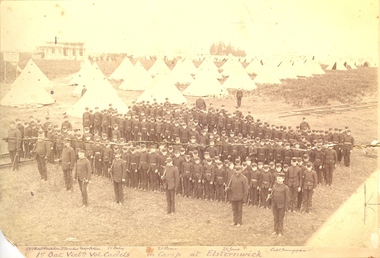 Federation University Historical Collection
Photograph - Photograph - Sepia, First Battalion of Victorian Volunteer Cadets in Camp at Elsternwick
... years old and living in a Nursing Home. He also donated a number of books to the U3 Library. warren perry dr perry victorian volunteer forces victorian volenteer cadets elsternwick 1st battallion victorian volunteer cadets volunteer forces 1st Bat. ...The donor, Warren Perry, wrote the book on the history of the School of Mines. At the time of the donation, he was 100 years old and living in a Nursing Home. He also donated a number of books to the U3 Library.Number of young cadets in formation on the parade ground. Military encampment in Elsternwick in the background1st Bat. Vict'n Vol. Cadets in camp at Elsternwickwarren perry, dr perry, victorian volunteer forces, victorian volenteer cadets, elsternwick, 1st battallion victorian volunteer cadets, volunteer forces -
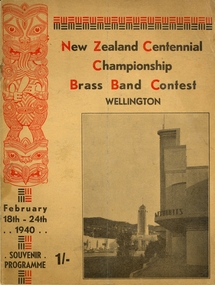 Federation University Historical Collection
Booklet - Programme, T.P.R. Printing Co. Ltd, New Zealand Centennial Champianship Brass Band Contest Wellington Programme, 1940, 02/1940
... The Frank Wright Medal at the Royal South Street competition is awarded to an individual recognized as making an outstanding contribution to brass music in Australia. frank wright new zealand centennial championship brass band contest wellington brass band adjudicator wellington garrison band the woolston band st kilda municipal band From page 15 onward are handwritten point scores beside the performers and the names on the 1st, 2nd and 3rd place winners A 43 page, black and white booklet with a brown cover printed with black and red, containing the programme for New Zealand Centennial Championship Brass Band Contest, held in Wellington on the 18th to 24th of February 1940. On page 3 is a photograph and short bio of Frank Wright who was the Chief Musical Adjudicator. There are also photographs of the previous years ...Frank Wright was a renown resident of Smeaton, where he was born in 1901. He lived at Laura Villa, and attended Smeaton State School. His father William was a gold miner and his mother's name was Sarah. He was the youngest of eleven children. Their family won many singing and instrumental awards. Frank was tutored by Percy Code and was awarded a gold medal for the highest marks in the ALCM examinations in the British Colonies at the age of seventeen years. He became the Australian Open Cornet Champion by the age of eighteen. A year later, Frank conducted the City of Ballarat Band, and later the Ballarat Soldiers’ Memorial Band. He formed the Frank Wright Frisco Band and Frank Wright and his Coliseum Orchestra. These bands won many South Street awards, and Frank as conductor won many awards in the Australian Band Championship contest. In 1933 Frank Wright sailed to England to conduct the famous St Hilda’s Band and was appointed in 1934 as the Musical Director of the London County Council (the GLC or Greater London Council), where he organized many amazing concerts in most of the 150 parks, in and around the London district. He was also responsible for some of London’s major concerts at Kenwood, the Crystal Palace and Holland Park. He was made Professor of Brass and Military Band Scoring and Conducting and was a Fellow of the Guildhall School of Music and Drama. Frank was often invited to adjudicate Brass Band Championships around Europe, in Australia, including South Street and in New Zealand. Frank was awarded an M.B.E. in 1967 and he died in November 1970. The Frank Wright Medal at the Royal South Street competition is awarded to an individual recognized as making an outstanding contribution to brass music in Australia.A 43 page, black and white booklet with a brown cover printed with black and red, containing the programme for New Zealand Centennial Championship Brass Band Contest, held in Wellington on the 18th to 24th of February 1940. On page 3 is a photograph and short bio of Frank Wright who was the Chief Musical Adjudicator. There are also photographs of the previous years winners of the Championship Gold Cup - the Woolston Band and the winners of New Zealand Marching Championship - St. Kilda Municipal Band and on page 33 is a photograph of the Wellington Garrison Band at the Christchurch contest in about 1892. On many of the pages are Frank's handwritten notes and point scores for the contestants. From page 15 onward are handwritten point scores beside the performers and the names on the 1st, 2nd and 3rd place winnersfrank wright, new zealand centennial championship brass band contest, wellington, brass band, adjudicator, wellington garrison band, the woolston band, st kilda municipal band
