
Showing 160 items matching "2nd australian corps"
-
 Lara RSL Sub Branch
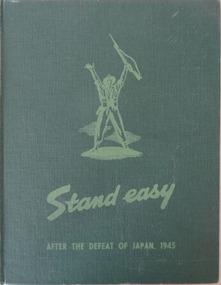
Book, Stand Easy - After the Defeat of Japan 1945 Published for The Australian Military Forces by Australian War Memorial, 1945
... ...2nd australian corps...Contributors to this publication can be identified by their service number. blamey nerve war medical evacuation 2nd australian corps surrender of japan bougainville borneo 5th australian division 6th australian division 7th australian division 9th australian division tarakan Green hardcover with light green text and picture of soldier. ...A collection of personal stories which extended from the collection of Khaki and Green. The service numbers have been used to identify those who have contributed to the content.Personal recounts and reminiscing of service by Army service personnel, after the Japanese surrender. The title 'Stand Easy' meaning that whilst there was a surrender the Army's task still continued. Contributors to this publication can be identified by their service number.Green hardcover with light green text and picture of soldier. The spine also has light green text of title. The inside front and back covers have green art geometric patterns. Illustrations, photographs, cartoons, blamey, nerve war, medical evacuation, 2nd australian corps, surrender of japan, bougainville, borneo, 5th australian division, 6th australian division, 7th australian division, 9th australian division, tarakan -
 Nhill and District Historical Society Inc.
Book - Stand Easy, Australian War Memorial, After the Defeat of Japan 1945, 1945
... ...2nd australian corps...Contributors to this publication can be identified by their service number. blamey nerve war medical evacuation 2nd australian corps surrender of japan bougainville borneo 5th australian division 6th australian division 7th australian division 9th australian division tarakan military - history warfare A collection of personal stories which extended from the collection of Khaki and Green. ...A collection of personal stories which extended from the collection of Khaki and Green. The service numbers have been used to identify those who have contributed to the content.Stand Easy - After the Defeat of Japan 1945; Green hardcover with light green text and picture of soldier. The spine also has light green text of title. The inside front and back covers have green art geometric patterns. Illustrations, photographs, cartoons: 208 pages non-fiction A collection of personal stories which extended from the collection of Khaki and Green. The service numbers have been used to identify those who have contributed to the content.blamey, nerve war, medical evacuation, 2nd australian corps, surrender of japan, bougainville, borneo, 5th australian division, 6th australian division, 7th australian division, 9th australian division, tarakan, military - history, warfare -
 Bendigo Historical Society Inc.
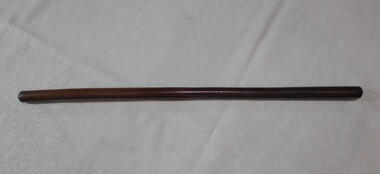
Clothing - JOHN KENNETH MARTIN COLLECTION: SWAGGER STICK, 1939-1945
... Swagger stick belonged to John Kenneth Martin, padre in 2nd Australian Corps AIF. Served overseas as a Chaplain from 1940-1945. ...Swagger stick belonged to John Kenneth Martin, padre in 2nd Australian Corps AIF. Served overseas as a Chaplain from 1940-1945. ...Clothing, brown leather covered swagger stick. Swagger sticks used by Officers as a symbol of authority, carried under left arm. Swagger stick belonged to John Kenneth Martin, padre in 2nd Australian Corps AIF. Served overseas as a Chaplain from 1940-1945. Old box 314Y.costume, male, military officer's swagger stick -
 Bendigo Historical Society Inc.
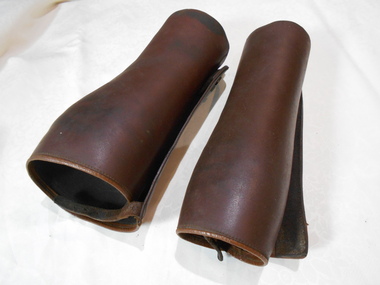
Clothing - JOHN KENNETH MARTIN COLLECTION:WW2 OFFICER'S LEATHER LEGGINGS, WW2 Officer's Leather Leggings, 1939-1945
... Belonged to John Kenneth Martin, padre in 2nd Australian Corps AIF. Served overseas as a Chaplain from 1940-1945. ...Belonged to John Kenneth Martin, padre in 2nd Australian Corps AIF. Served overseas as a Chaplain from 1940-1945. ...Clothing, a pair of Brown leather WW2 officer's leggings. Side opening. Metal hook and eye attachment at lower end. Leather strap and buckle tie at top end. Belonged to John Kenneth Martin, padre in 2nd Australian Corps AIF. Served overseas as a Chaplain from 1940-1945. Old box 314Y.costume, male, brown leather leggings ww2 -
 Bendigo Historical Society Inc.
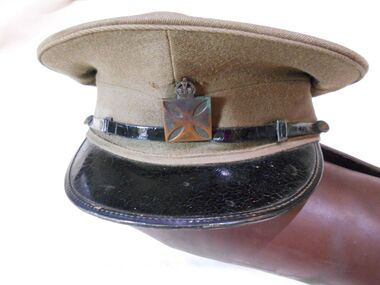
Clothing - JOHN KENNETH MARTIN COLLECTION: WW2 OFFICER'S PEAKED CAP, WW2 Officer's Cap, 1939-1945
... Cap belonged to John Kenneth Martin, padre in 2nd Australian Corps AIF. Served overseas as a Chaplain from 1940-1945. ...Cap belonged to John Kenneth Martin, padre in 2nd Australian Corps AIF. Served overseas as a Chaplain from 1940-1945. ...Clothing, khaki coloured WW2 officer's peaked cap. Black vinyl peak and black vinyl 27 cm X 1 cm strap across front above peak. Metal badge, centre front. Brown vinyl lining. Cap belonged to John Kenneth Martin, padre in 2nd Australian Corps AIF. Served overseas as a Chaplain from 1940-1945. Old box 315Y.Written in pen on inside ''JKM'' stamp inside ''M.T. Size 6 7/8 ''costume, male, military officer's peaked cap. -
 Bendigo Historical Society Inc.
Clothing - JOHN KENNETH MARTIN COLLECTION: COPY OF PHOTOGRAPH, 1940-1946
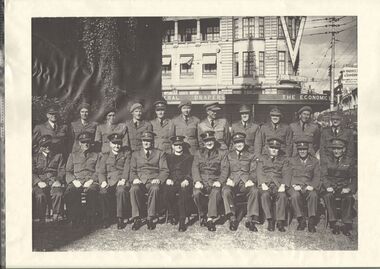
... Photograph belonged to John Kenneth Martin, padre in 2nd Australian Corps AIF. Served overseas as a Chaplain from 1940-1945. ...Photograph belonged to John Kenneth Martin, padre in 2nd Australian Corps AIF. Served overseas as a Chaplain from 1940-1945. ...Clothing, copy of photograph of a group of chaplains (padres) during WW2.Black and white. City buildings in background. Two rows of uniformed men. Front row of ten are seated. Back row of eleven men standing behind them. John Kenneth Martin is standing second from the right in back row. Photograph belonged to John Kenneth Martin, padre in 2nd Australian Corps AIF. Served overseas as a Chaplain from 1940-1945. Old box 314Y.costume, military, copy of photograph -
 Bendigo Historical Society Inc.
Clothing - JOHN KENNETH MARTIN COLLECTION:ARMY WW2 UNIFORM TROUSERS, 1939-1945
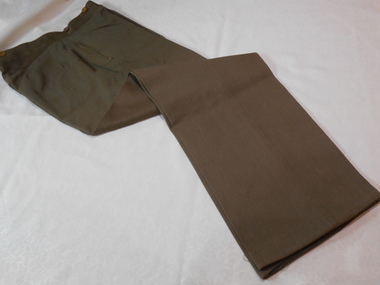
... Trousers belonged to John Kenneth Martin, padre in 2nd Australian Corps AIF. Served overseas as a Chaplain from 1940-1945. ...Trousers belonged to John Kenneth Martin, padre in 2nd Australian Corps AIF. Served overseas as a Chaplain from 1940-1945. ...Clothing, khaki coloured WW2 army uniform trousers. Side pockets lined with cream coloured cotton fabric. Front fly opening (27 cm) fastened with six 1.5 cm plastic brown buttons. Four 1.8 cm brown plastic buttons across outside on either side of the centre back of waist band, to fasten braces. Trousers belonged to John Kenneth Martin, padre in 2nd Australian Corps AIF. Served overseas as a Chaplain from 1940-1945. Old box 314Y.Name tag stitched inside waist band at back ''J.K.Martin''.costume, military, army uniform trousers ww2 -
 Hume City Civic Collection
Photograph, 2/11/1915
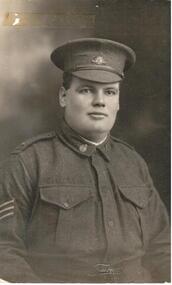
... Sargent Medical Corps. 2nd Australian Casualty Clearing Station...Hume City Civic Collection 44 Macedon Street Sunbury melbourne Sargent Medical Corps. 2nd Australian Casualty Clearing Station world war 1 martin h. j. ...Sargent Medical Corps. 2nd Australian Casualty Clearing StationA b/w postcard portrait of soldier H. Martin.Typewritten on front: Private H. Martin Printed on front: TALMA MELBOURNE Handwritten on back: PRIVATE H.J. MARTIN, 2ND AUST CASUALTY CLEARING STATION A.M.C. (ON ACTIVE SERVICE) 2/11/15world war 1, martin, h. j. (private), soldiers, armed forces, uniforms, clothing and dress, postcards, george evans collection -
 Bendigo Historical Society Inc.
Clothing - JOHN KENNETH MARTIN COLLECTION: WW2 ARMY UNIFORM JACKET, 1939-1945
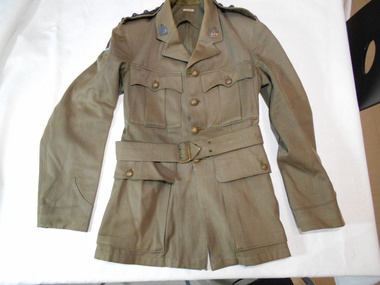
... Cap belonged to John Kenneth Martin, padre in 2nd Australian Corps AIF. Served overseas as a Chaplain from 1940-1945. ...Cap belonged to John Kenneth Martin, padre in 2nd Australian Corps AIF. Served overseas as a Chaplain from 1940-1945. ...Clothing, khaki woollen WW2 army uniform jacket. Single breasted with four brown metal AMF buttons (2 cm). Two breast pockets, (16 X 18 cm) with fold over tabs. All button tabs fastened with 1.5 cm metal buttons. Long sleeves with stitched down cuffs with V shaped peak on upper side. Both sleeves lined with cream and blue striped cotton fabric. 30 cm split at centre back from hem. Button down epaulettes on each shoulder with three captain's pips and two black stripes. Cloth badges on top of each sleeve. 1. Navy and red unit colour, (3 cm X 2.5 cm). 2. Light green, brown and blue colour (5 X 5 cm) (unknown). 2.5 X 2.5 cm square metal badges on each corner at front of collar. 5.5 cm wide cloth belt with metal buckle. Belt attached on side seams at waist by leather tabs threaded through belt keepers and fastened with 1.5 cm buttons. Cap belonged to John Kenneth Martin, padre in 2nd Australian Corps AIF. Served overseas as a Chaplain from 1940-1945. Old box 314Y.Name tag stitched under collar, and inside back '' J.K.Martin''.costume, military, army uniform jacket ww2 -
 Royal Australian and New Zealand College of Obstetricians & Gynaecologists (RANZCOG)
Equipment - Medical case used by Dr Reginald Worcester
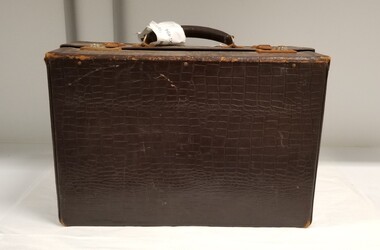
... Australia was appointed as a university tutor in obstetrics and gynaecology. In 1939, he was appointed as the honorary gynaecologist to outpatients at the Royal Women's Hospital. Worcester served with the AIF during World War II as C.O. of the 17th Field Ambulance in Darwin and as A.D.M.S., Northern Territory Force, and the 2nd/9th Australian Army Corps from 1942 to 1943. ...Australia was appointed as a university tutor in obstetrics and gynaecology. In 1939, he was appointed as the honorary gynaecologist to outpatients at the Royal Women's Hospital. Worcester served with the AIF during World War II as C.O. of the 17th Field Ambulance in Darwin and as A.D.M.S., Northern Territory Force, and the 2nd/9th Australian Army Corps from 1942 to 1943. ...Reginald George Worcester (1903-1972) was a highly regarded obstetrics and gynaecology specialist. Between 1930 and 1933, Worcester was the Medical Superintendent at the Royal Women's Hospital. He obtained his MRCOG in England in 1935, and on his return to Australia was appointed as a university tutor in obstetrics and gynaecology. In 1939, he was appointed as the honorary gynaecologist to outpatients at the Royal Women's Hospital. Worcester served with the AIF during World War II as C.O. of the 17th Field Ambulance in Darwin and as A.D.M.S., Northern Territory Force, and the 2nd/9th Australian Army Corps from 1942 to 1943. His major war service, however, was undertaken in Borneo and Moratai, commanding the 2nd/1st Australian C.C.S. and the 2nd/9th Australian General Hospital. Worcester acquitted himself admirably during the war, with company commander Hubert Smith praising his contribution in no uncertain terms: " His [Worcester's] success as C.O. of a Field Ambulance resulted from a complete understanding of what the unit should be able to do in the transportation of casualties in the field, as well as of the usual medial functions. He organized both with efficiency and at all times difficult decisions were made with humility and good humour. The personal qualities which made him such a calm and considerate consultant never left him, even in the most dangerous and trying circumstances of war." Worcester's time in the army greatly affected his health, but despite this he was able to build a strong and reputable practice upon his return to Australia. As outlined by Arthur Hill, Worcester " was appointed in turn to the following important posts: Honorary Outpatient Obstetrician and Inpatient Gynaecologist to the Women’s Hospital (1946-1948); Honorary Gynaecologist to Prince Henry’s Hospital (1946-1963); Guest Examiner in London for the R.C.O.G. (1953); Examiner in Obstetrics and Gynaecology for the Royal Australasian College of Surgeons (1957-1964); Visiting Gynaecologist to the Repatriation General Hospital, Heidelberg 1963- 1967); and first Victorian Members’ representative (1947-1950) and later Fellows’ Representative (1953-1960) on the Australian (Regional) Council of the R.C.O.G. To these posts he brought the benefits of clear thinking and critical awareness. In 1949 he was elected F.R.C.O.G." In early 1967, Worcester suffered a hemiplegia which left him with an impaired gait and paralysed his right hand. Although unable to do major surgery, he returned to part-time practice by September 1967. His ill-health persisted though, and he was retired from practice in 1970. (Source: (1973), REGINALD GEORGE WORCESTER. Medical Journal of Australia, 1: 770-771.)Brown leather medical case. The case has a solid frame and is rectangular, with a leather handle at top. There are two locks on the top of the case, and a metal clasp on either side to fasten the bag closed. The case is embossed with the text 'R.G. WORCESTER' on top, in a position between the two locks and below the handle at bottom centre. The inside of the case is lined with a canvas bag that is buttoned to the case with press studs. The inside of the case also contains a loose canvas bag on which is handwritten 'BAG No/THREE/ R.G. WORCESTER'. The loose canvas bag has a metal zipper at opening.'R.G.WORCESTER'obstetrics, surgery -
 Bendigo Military Museum
Photograph - RSM-Army Visit – Technical Tour, Army Survey Regiment Fortuna, Bendigo, 1989
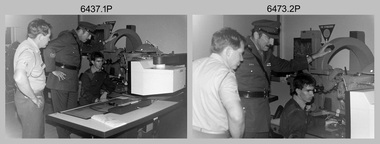
... 2nd RSM to be appointed to the position of RSM-A, the most senior Warrant Officer position in the Australian Army. His appointment was from 1987 to 1990. On this occasion he was escorted by WO1 Neville Stone, who was the RSM of the Army Survey Regiment from 1988 to 1990. Refer to item 6438.15P for photos of the SGT’s Mess function. Royal Australian Survey Corps ...This is a set of 16 photographs of a visit to the Army Survey Regiment, by the Regimental Sergeant-Major of the Australian Army (RSM-A) WO1 Kevin (Lofty) Wendt OAM, BEM on the 10th of August 1989. He was taken on a tour through the production areas and messes. RSM-A WO1 Kevin (Lofty) Wendt OAM, BEM was the 2nd RSM to be appointed to the position of RSM-A, the most senior Warrant Officer position in the Australian Army. His appointment was from 1987 to 1990. On this occasion he was escorted by WO1 Neville Stone, who was the RSM of the Army Survey Regiment from 1988 to 1990. Refer to item 6438.15P for photos of the SGT’s Mess function.This is a set of 16 photographs of a visit to the Army Survey Regiment, Fortuna, Bendigo by the Regimental Sergeant-Major of the Australian Army (RSM-A) WO1 Kevin (Lofty) Wendt OAM, BEM on the 10th of August 1989. The photographs are on 35mm negative film and were scanned at 96 dpi. They are part of the Army Survey Regiment’s Collection. .1) to .2) - Photo, black & white, 1989. Wild B8 plotting on the AUTOMAP 2 system, L to R: WO1 Russell ‘Rusty’ Williams, RSM-A WO1 Kevin (Lofty) Wendt OAM, BEM, SPR Stuart Bowd. .3) to .5) - Photo, black & white, 1989. RAAF Charting, L to R: SSGT Dennis Learmonth, RSM-A WO1 Kevin (Lofty) Wendt OAM, BEM. .6) - Photo, black & white, 1989. RAAF Charting, L to R: SSGT Dennis Learmonth, RSM-A WO1 Kevin (Lofty) Wendt OAM, BEM, unidentified visiting RSM, WO1 Stevo Hinic. .7) to .8) - Photo, black & white, 1989. Map data editing on AUTOMAP 2 system, L to R: SPR Charmian McKean, RSM-A WO1 Kevin (Lofty) Wendt OAM, BEM, WO1 Stevo Hinic. .9) - Photo, black & white, 1989. Map data editing on AUTOMAP 2 system, L to R: SGT Paul ‘Hutch’ Hunter, RSM-A WO1 Kevin (Lofty) Wendt OAM, BEM. .10) - Photo, black & white, 1989. Photo Troop L to R: RSM-A WO1 Kevin (Lofty) Wendt OAM, BEM, WO2 Rob Bogumil. .11) - Photo, black & white, 1989. Print Troop L to R: CPL Peter Swandale, RSM-A WO1 Kevin (Lofty) Wendt OAM, BEM. .12) - Photo, black & white, 1989. Print Troop L to R: RSM-A WO1 Kevin (Lofty) Wendt OAM, BEM, unidentified visiting RSM, CPL Peter Swandale. .13) - Photo, black & white, 1989. OR’s Mess Committee, Tavern L to R: RSM-A WO1 Kevin (Lofty) Wendt OAM, BEM, PMC CPL Brendon McKinless. .14) - Photo, black & white, 1989. OR’s Mess Committee, Tavern L to R: CPL Noel Brinsmead, CPL John Gilbert. .15) - Photo, black & white, 1989. OR’s Mess Committee, Tavern L to R: PMC CPL Brendon McKinless, RSM-A WO1 Kevin (Lofty) Wendt OAM, BEM, CPL Noel Brinsmead, CPL John Gilbert, CPL AM Verley. .16) - Photo, black & white, 1989. OR’s Mess Committee, Tavern L to R: RSM WO1 Neville Stone, PMC CPL Brendon McKinless, RSM-A WO1 Kevin (Lofty) Wendt OAM, BEM, CPL Noel Brinsmead, CPL John Gilbert, CPL AM Verley, CPL Dave Cook..1P to .16P – no annotationsroyal australian survey corps, rasvy, army survey regiment, army svy regt, fortuna, asr -
 Bendigo Military Museum
Photograph - RSM-Army Visit – SGT’s Mess Function, Army Survey Regiment Fortuna, Bendigo, 1989
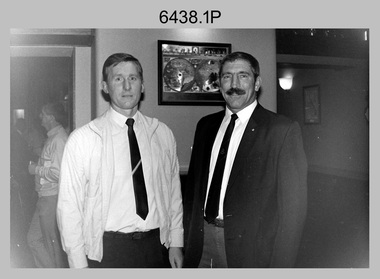
... 2nd RSM to be appointed to the position of RSM-A, the most senior Warrant Officer position in the Australian Army. His appointment was from 1987 to 1990. On this occasion he was escorted by WO1 Neville Stone, who was the RSM of the Army Survey Regiment from 1988 to 1990. Refer to item 6437.16P for photos of the production facilities tour. Royal Australian Survey Corps ...This is a set of 15 photographs of a visit to the Army Survey Regiment, by the Regimental Sergeant-Major of the Australian Army (RSM-A) WO1 Kevin (Lofty) Wendt OAM, BEM on the 10th of August 1989. He was taken on a tour through the production facilities and messes. RSM-A WO1 Kevin (Lofty) Wendt OAM, BEM was the 2nd RSM to be appointed to the position of RSM-A, the most senior Warrant Officer position in the Australian Army. His appointment was from 1987 to 1990. On this occasion he was escorted by WO1 Neville Stone, who was the RSM of the Army Survey Regiment from 1988 to 1990. Refer to item 6437.16P for photos of the production facilities tour.This is a set of 15 photographs of a visit to the Army Survey Regiment (ASR) , Fortuna, Bendigo by the Regimental Sergeant-Major of the Australian Army (RSM-A) WO1 Kevin (Lofty) Wendt OAM, BEM on the 10th of August 1989. The photographs are on 35mm negative film and were scanned at 96 dpi. They are part of the Army Survey Regiment’s Collection. .1) - Photo, black & white, 1989. L to R: ASR RSM WO1 Neville Stone, RSM-A WO1 Kevin (Lofty) Wendt OAM, BEM. .2) - Photo, black & white, 1989. L to R: WO2 Rowan Gillies, SGT Noel McNamara, SGT Bruce Hammond, SGT Roger Rees, WO2 George Graham. .3) - Photo, black & white, 1989. L to R: unidentified, WO2 Steve Egan. WO1 Trevor Osborne, RSM-A WO1 Kevin (Lofty) Wendt OAM, BEM, unidentified, SGT Frank Lenane. .4) - Photo, black & white, 1989. L to R: ASR RSM WO1 Neville Stone, John ‘Stormy’ Tempest, SSGT Brad Peppler. .5) - Photo, black & white, 1989. L to R: RSM-A WO1 Kevin (Lofty) Wendt OAM, BEM, WO2 Barry Lutwyche OAM, SGT Steve Burke, SGT Frank Lenane, SGT Peter Imeson. .6) to .9) - Photo, black & white, 1989. Dinner is served - unidentified Catering Corps staff. .10) - Photo, black & white, 1989. Dinner is served - L to R: RSM-A WO1 Kevin (Lofty) Wendt OAM, BEM, ASR RSM WO1 Neville Stone. .11) - Photo, black & white, 1989. Dinner is served - L to R: ASR RSM WO1 Neville Stone, RSM-A WO1 Kevin (Lofty) Wendt OAM, BEM, WO1 Stevo Hinic, WO2 George Graham, unidentified, SSGT Brad Peppler, SGT Bob Garritty, SGT Paul Hopes. .12) - Photo, black & white, 1989. Dinner is served - unidentified Catering Corps staff. .13) - Photo, black & white, 1989. L to R: SGT Greg Anderson, RSM-A WO1 Kevin (Lofty) Wendt OAM, BEM. .14) - Photo, black & white, 1989. L to R: unidentified, SSGT Rick van der Bom. .15) - Photo, black & white, 1989. L to R: SGT Greg Anderson, unidentified, back of RSM-A WO1 Kevin (Lofty) Wendt OAM, BEM, unidentified..1P to .15P – no annotationsroyal australian survey corps, rasvy, army survey regiment, army svy regt, fortuna, asr -
 Bendigo Military Museum
Photograph - Royal Australian Survey Corps - Map Production Processes, c1990
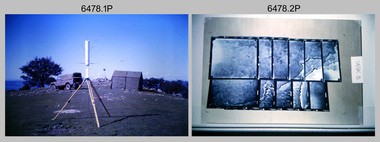
... Photo .19P depicts a map of RASvy’s ARA units before the disbandment of 5th Field Survey Squadron, Perth and 2nd Field Survey Squadron, Sydney in 1990. Royal Australian Survey Corps RASvy Army Survey Regiment Army Svy Regt Fortuna ASR School of Military Survey Army Map Depot .1P, .3P to .20P - Some equipment is identified on the frame of the 35mm slides. ...This is a collection of 20 photographs of Royal Australian Survey Corps phases of map production at the School of Military Survey, Bonegilla, the Army Survey Regiment, Bendigo, and the Army Map Depot, Bandiana circa 1990. Colour photos are on 35mm slide film and were scanned at 96 dpi. They are part of the Army Survey Regiment’s Collection. Photo .1P was probably taken on a survey station overlooking Lake Hume near Albury-Wodonga. The field party occupying the survey station was likely from a Map Control Survey course conducted by the School of Military Survey, Bonegilla. This survey station was part of a geodetic network used in field survey training and RASvy’s Lake Hume Test Range. Photos .3P to .16P were taken at the Army Survey Regiment, Bendigo and photos .17P & .18P were taken at the Army Map Depot, Bandiana. Photo .19P depicts a map of RASvy’s ARA units before the disbandment of 5th Field Survey Squadron, Perth and 2nd Field Survey Squadron, Sydney in 1990. This is a collection of 20 photographs of map production processes taken at the School of Military Survey, Bonegilla, the Army Survey Regiment, Bendigo, and the Army Map Depot, Bandiana circa 1990. Colour photos are on 35mm slide film and were scanned at 96 dpi. They are part of the Army Survey Regiment’s Collection. Photo .2P is printed on photographic and scanned at 300 dpi. .1) – Photo, colour, c1980s. Geodetic Surveying: AN/PRR-14 Geoceiver antenna on hill surrounding Lake Hume. Series 3 Land Rover, field party tent and survey station beacon in background. .2) – Photo, black & white, c1980s. Geodetic Surveying: AN/PRR-14 Geoceiver antennas set up at the School of Military Survey, Bonegilla, Victoria. .3) – Photo, colour, c1990. Aerotriangulation: Wild PUG4 point transfer device, SSGT Bruce Hammond. .4) – Photo, colour, c1990. Aerotriangulation: Zeiss (Jena) Stecometer, SSGT Bruce Hammond. .5) – Photo, colour, c1990. Aerotriangulation: computer tape maintenance, SSGT Noel McNamara. .6) – Photo, colour, c1990. AUTOMAP 2: computer tape maintenance, SPR Nadine (Paul) Read. .7) - Photo, colour, c1990s. AUTOMAP 2: Optronics 4040 scanning/film output in Lithographic Squadron, SGT Sherri (Dally) Burke. .8) - Photo, colour, c1990s. AUTOMAP 2: Benson verification plotter output, SPR Nadine (Paul) Read. .9) – Photo, colour, c1990. Aerotriangulation: data management, SGT Neil ‘Ned’ Kelly. .10) & .11) - Photo, colour, c1990s. AUTOMAP 2: Wild B8 Aviograph stereoplotter Feature Extraction, unidentified technician. .12) - Photo, colour, c1990s. AUTOMAP 2: Graphic Edit Workstation, SPR Nadine (Paul) Read. .13) - Photo, colour, c1990s. AUTOMAP 2: Graphic Edit Workstation, SPR Dawn Hoadley. .14) & .15) - Photo, colour, c1990s. AUTOMAP 2: Graphic Edit Workstation, unidentified technician. .16) – Photo, colour, c1990s. Heidelberg Speedmaster 102 computer-controlled five colour lithographic offset printing press. .17) & .18) – Photo, colour, c1990s. Army Map Depot, unidentified storeman, Bandiana. .19) – Photo, colour, c1990. RASvy ARA Unit Locations before disbandment of field units in Perth and Sydney. .20) – Photo, colour, c1990. Set of overlapping aerial photography..1P, .3P to .20P - Some equipment is identified on the frame of the 35mm slides.royal australian survey corps, rasvy, army survey regiment, army svy regt, fortuna, asr, school of military survey, army map depot -
 Bendigo Military Museum
Photograph - Royal Australian Survey Corps Surveyors in the Field – Project Cutlass, New Guinea, 1956 – 1957
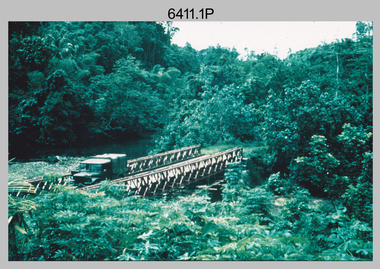
... 2nd year of his career in the Australian Army. He achieved the rank of Lieutenant-Colonel, and his last appointment was the CO of the Army Survey Regiment from 1976 to 1980. Royal Australian Survey Corps ...This is a set of 23 photographs of surveyors and support staff in the field undertaking tasks in New Guinea 1956 – 1957. The surveyors were employed in the establishment of mapping and geodetic control for Project Cutlass, the “Ship-Shore” survey of the New Ireland province. In this survey operation surveyors used theodolites to observe horizontal and vertical angles and chains to measure base line distances between survey stations. Bob Skitch shown in photo .7P was in the 2nd year of his career in the Australian Army. He achieved the rank of Lieutenant-Colonel, and his last appointment was the CO of the Army Survey Regiment from 1976 to 1980.This is a set of 23 photographs of surveyors and support staff in the field undertaking duties during Project Cutlass located in New Ireland, New Guinea 1956 – 1957. The photographs were printed on photographic paper and are part of the Army Survey Regiment’s Collection. The photographs were scanned at 300 dpi. .1) - Photo, colour, 1956. Surveyors travelling main road from Kavieng to Namatanai, New Ireland. .2) - Photo, colour, 1956. Unidentified surveyors assessing recovery of their vehicle after bridge collapsed on west side of New Ireland. .3) - Photo, colour, 1956. Unidentified surveyors assessing recovery of their vehicle after bridge collapsed over flooded creek on west side of New Ireland. .4) - Photo, colour, 1956. Survey personnel L to R: Bev Uwins, John Lambie, Bob Thompson, New Ireland. .5) - Photo, colour, 1956. Survey base camp, New Ireland. .6) - Photo, black & white, 1956-1957. Geoff Helsham with possible human remains, New Ireland. .7) - Photo, black & white, 1956-1957. Bob Skitch undertaking survey observations using Wild T2 theodolite, New Ireland. .8) - Photo, black & white, 1956-1957. Chas Beach undertaking survey observations using Wild T2 theodolite, New Ireland. .9) & .10) - Photo, black & white, 1956-1957. Kev Parker (cook) New Ireland. .11) - Photo, colour, 1957. Brian Berkery taking a break, Top Manor Island, Lihir Island Group off New Ireland. Latitude -2° 46”, Longitude 152° 40”. .12) - Photo, colour, 1957. Survey base camp L to R: Chas Beach, Bev Uwins, Feni Islands, New Ireland. Latitude -4° 05”, Longitude 153° 45”. .13) - Photo, colour, 1957. A Hous Kiap. (Kiaps, known formally as district officers and patrol officers, were travelling representatives of the British and Australian governments), New Ireland. .14) & .15) - Photo, colour, 1957. L to R: Joe Farrington, Tom Royle Bob undertaking survey observations using theodolites from an improvised timber tower, New Ireland. .16) & .17) - Photo, colour, 1957. US Army ship FS216 used for ship-to-shore triangulation docked at Rabaul, New Britain. .18) - Photo, colour, 1957. US Army ship FS216 used for ship-to-shore triangulation docked at Kavieng, New Ireland. Sight target on top of mast. .19) - Photo, colour, 1957. Survey personnel onboard US Army ship FS392, L to R: Peter Frodsham, Bob Thompson, Doc Reid, John Underwood, remainder unidentified, New Ireland. .20) - Photo, colour, 1957. Survey base line party heading ashore, New Ireland. .21) - Photo, colour, 1957. Survey personnel rowing US Army assault boat L to R: Kev Parker, Chas Beach, folded up survey beacons overhanging stern, New Ireland. .22) - Photo, colour, 1957. Les Bailey onboard US Army ship departing Rabaul, New Britain for Brisbane. .23) - Photo, colour, 1957. Ron Newman onboard US Army ship departing Rabaul, New Britain for Brisbane. Active volcano in background..1P to .23P annotated on back – ‘Operation Cutlass’, personnel names, the year and the location. royal australian survey corps, rasvy, army survey regiment, fortuna, a, army svy regt, asr, surveying -
 Bendigo Military Museum
Photograph - Royal Australian Survey Corps Surveyors in the Field – North Queensland, 1958
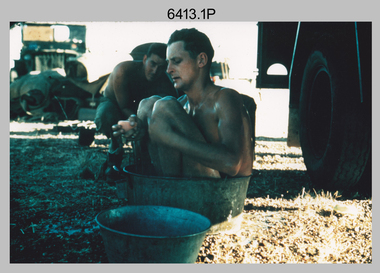
... 2nd year of his career in the Australian Army. He achieved the rank of Lieutenant Colonel and his last appointment was the CO of the Army Survey Regiment from 1976 to 1980. The annotation on the back of photo .5P ‘Black foreground is where Bob Skitch boiled billy and started a grass fire’. Royal Australian Survey Corps ...This is a set of seven photographs of surveyors and support staff in the field undertaking duties in North Queensland in 1958. The surveyors were employed in the establishment of mapping and geodetic control. In this era surveyors used theodolites to observe horizontal and vertical angles and chains to measure base line distances between survey stations. Bob Skitch shown in photos .4P to .6P was in the 2nd year of his career in the Australian Army. He achieved the rank of Lieutenant Colonel and his last appointment was the CO of the Army Survey Regiment from 1976 to 1980. The annotation on the back of photo .5P ‘Black foreground is where Bob Skitch boiled billy and started a grass fire’.This is a set of seven photographs of surveyors and support staff in the field undertaking duties in North Queensland in 1958. The photographs were printed on photographic paper and are part of the Army Survey Regiment’s Collection. The photographs were scanned at 300 dpi. .1) - Photo, colour, 1958. Surveyor in Nth QLD enjoying a bath. L to R: Don Cocker, Bob Thompson. .2) - Photo, colour, 1958. Don Cocker surveyor in Nth QLD, enjoying a bath. .3) - Photo, colour, 1958. Surveyors Nth QLD undertaking survey observations, using MRA1 tellurometer to measure base-line distances. L to R: Len Davies, Lou Sommer, John Van De Graff. MRA1 was covered to stop overheating. .4) - Photo, colour, 1958. Surveyors south of Richmond, QLD digging holes for the erection of a Bilby observation tower. L to R: John Van De Graff, Bob Skitch, Kev Moody, Mal Hayes, Don Gray .5) - Photo, colour, 1958. Surveyors south of Richmond, QLD erecting a Bilby observation tower. L to R: Tom Royle, Bob Skitch (on ground level), Mal Hayes. .6) - Photo, colour, 1958. Surveyors south of Richmond, QLD erecting a Bilby observation tower. L to R: Tom Royle, Bob Skitch, Mal Hayes, Jim McGill (on ground level). .7) - Photo, colour, 1958. Surveyors south of Richmond, QLD undertaking survey measurements from a Bilby observation tower..1P to .7P annotated on back – personnel names, the year and the location. Annotated on back of .5P ‘Black foreground is where Bob Skitch boiled billy and started a grass fire’.royal australian survey corps, rasvy, army survey regiment, asr, army svy regt, fortuna, surveying -
 Bendigo Military Museum
Uniform - JACKET, SERVICE DRESS, ARMY, Australian Defence Industries, 1978/79
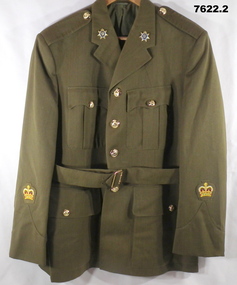
... Two lapel badges - metal, for Royal Australian Corps of Transport. Two rank insignia on sleeves - crown - Warrant Officer 2nd Class. ...Two lapel badges - metal, for Royal Australian Corps of Transport. Two rank insignia on sleeves - crown - Warrant Officer 2nd Class. ...Uniform issued to Warrant Officer 2nd Class. "R. HOSKING", "ROYAL AUSTRALIAN ARMY CORP OF TRANSPORT".1. Jacket, khaki colour wool/polyester fabric. Service dress style with belt. Gold colour plastic buttons with shank and split ring. Buttons have raised emblem and letters - "Royal Australian Army Corp of Transport". Collar, shoulder epaulettes, four front pockets, top two with buttons and two metal press studs on flap, lower button down flap. Two lapel badges - metal, for Royal Australian Corps of Transport. Two rank insignia on sleeves - crown - Warrant Officer 2nd Class. Green colour polyester fabric lining with white cotton manufacturers label inside right. 2. Belt, khaki colour wool/polyester fabric with plastic buckle and leather belt keepers. Green plastic buttons.Manufacturers information on label - black ink print. 1. KEITH COURTNEAY PTY LTD/ VICTORIA/ 1978 1979/ ^/ NAME/ SERVICE NO" "HOSKING R.D." - handwritten black ink pen. "W/02 THOMAS R.J. type written black ink. " 4362/ 42R" Size label - handwritten black ink.uniform, army, service dress r, r. hosking -
 Bendigo Military Museum
Map - Map Extract - Charterhouse of Mendip, John James Raisbeck, Unknown
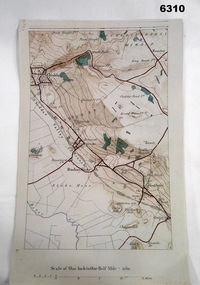
... 2nd Lieutenant. He was required to resign his commission in the CMF. He supervised the draughting work of the Section in Melbourne and was largely responsible for the mapping standards and specifications set in the production of the Cowes one-inch-to-one-mile military map, which became the enduring Australian standard. He was also responsible for supervising the printing of the maps by the Victorian Government Printer. He was appointed 2nd Lieutenant in the AIF Survey Corps...2nd Lieutenant. He was required to resign his commission in the CMF. He supervised the draughting work of the Section in Melbourne and was largely responsible for the mapping standards and specifications set in the production of the Cowes one-inch-to-one-mile military map, which became the enduring Australian standard. He was also responsible for supervising the printing of the maps by the Victorian Government Printer. He was appointed 2nd Lieutenant in the AIF Survey Corps ...Map extract showing the towns of Cheddar, Rodney Stoke, Westbury and a smaller town of Easton. The area depicted is part of Somerset, England. Map is hand drawn by J.J. Raisbeck date unknown. John James RAISBECK was born on 4 July 1880 at Christchurch New Zealand. He served 4 years (Citizen Military Force - CMF) in 9th Australian Light Horse Regiment in Central VIC with the rank 2nd Lieutenant. He was the first Australian appointed to the Survey Section RAE, on 16 April 1910, as a draughtsman which was his civilian profession, with the rank Warrant Officer, honorary 2nd Lieutenant. He was required to resign his commission in the CMF. He supervised the draughting work of the Section in Melbourne and was largely responsible for the mapping standards and specifications set in the production of the Cowes one-inch-to-one-mile military map, which became the enduring Australian standard. He was also responsible for supervising the printing of the maps by the Victorian Government Printer. He was appointed 2nd Lieutenant in the AIF Survey Corps draft on 6 December 1917 (from Melbourne) embarking for England on 22 December 17. He was attached to the Australian Corps Topographic Section in France from 21 April 1918 to 5 March 1919 serving as Second-in-Command and as Officer Commanding. He was promoted Lieutenant 15 October 1918, attending the AIF Survey School, Southampton in 1919, returning to Australia 23 June 1919, before his AIF appointment was terminated 17 July 1919. He went on to serve the Survey Section RAE and Australian Survey Corps, including in the Second World War, having been promoted Captain then Major and Officer Commanding Army Headquarters Cartographic Section until February 1940. He retired after 33 years of service to military survey, and after serving the Corps in two world wars, on 4 July 1943 with the retired rank Lieutenant-Colonel. He was the author of the article ‘A Short History of the Military Survey of Australia, 1907-1936’, published in The Australian Surveyor, Sept 1, 1937Map extract slightly larger than A4. Scale: One Inch to One and a half Mile. 1:31680, 9 x copiesSignature of "J.J. Raisbeck" bottom right-hand cornerroyal australian survey corps, rasvy, fortuna, army survey regiment, army svy regt, asr -
 Bendigo Military Museum
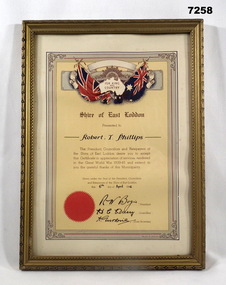
Certificate - SHIRE OF EAST LODDON, FRAMED, Arnall & Jackson, c.1940's
... 2nd Tank Transporter Coy ASC, listed as served in Adelaide River, Winnellie and Darwin between 25.11.1943 to 23.9.1945. Discharged 19/10/45 with the rank CPL in A.A. Pay Corps. Framed Accessories Certificate WW2 Shire of East Loddon Handwritten in black ink: "Robert T. Phillips" - 6th April 1946, Signed by R.W. Bogie, President. H.C....???...... Councilor, A. Gutherie Shire Secretary. CERTIFICATE - ORIGINAL, ON PAPER. Dark Brown print. Illustrated in colours, red, blue, yellow and beige. Top - Rising Sun Badge with British and Australian ...Certificate "FOR KING/ AND/ COUNTRY" from 'SHIRE OF EAST LODDON" "CERTIFICATE IN APPRECIATION FOR SERVICES RENDERED IN THE GREAT WORLD WAR 1939-45" "Robert T. Phillips" Robert Thomas Phillips V28869 (AMF) VX113093 (2nd AIF). Enlisted 16.12.1941 age 20 years 7 months as V28869, transferred to the AIF 14.10.1942 in 2/2nd Tank Transporter Coy ASC, listed as served in Adelaide River, Winnellie and Darwin between 25.11.1943 to 23.9.1945. Discharged 19/10/45 with the rank CPL in A.A. Pay Corps.CERTIFICATE - ORIGINAL, ON PAPER. Dark Brown print. Illustrated in colours, red, blue, yellow and beige. Top - Rising Sun Badge with British and Australian Flags, outline map of Australia and surrounded by decorative scroll work. Bottom - Red seal. Certificate framed with decorative line and scroll work. Frame - timber, gold colour paint with black paint highlights to decorate moulding. Glass front. Backing - cardboard and brown paper. Original metal hanging clips and cotton cord.Handwritten in black ink: "Robert T. Phillips" - 6th April 1946, Signed by R.W. Bogie, President. H.C....???...... Councilor, A. Gutherie Shire Secretary.framed accessories, certificate, ww2, shire of east loddon -
 Bendigo Military Museum
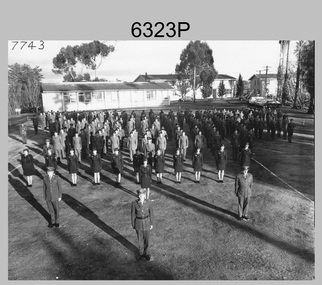
Photograph - Army Headquarters Survey Regiment on Parade at Fortuna, Bendigo, c1973
... Australian Survey Corps RASvy Army Survey Regiment Army Svy Regt Fortuna ASR There are no personnel annotated. ’7743’ is written on the front in the top left corner. This is a photograph of the Army Headquarters Survey Regiment taken on the parade ground in its squadron formation at Fortuna, Bendigo in c1973. The photograph was printed on photographic paper and is part of the Army Survey Regiment’s Collection. The photograph was scanned at 600 dpi. .1) - Photo, black & white c1973. Front – CO LTCOL Don Ridge, Far left – RSM WO1 John Hogan, 2nd ...This is a photograph of the Army Headquarters Survey Regiment personnel in their squadron formations taken on the parade ground at Fortuna, Bendigo in c1973. The Other Ranks (OR’s) Mess and OR’s Accommodation blocks appear in the background. This photograph is rather unique as it was taken possibly using a cherry picker to capture at an elevated angle the whole Regiment in one frame. This is a photograph of the Army Headquarters Survey Regiment taken on the parade ground in its squadron formation at Fortuna, Bendigo in c1973. The photograph was printed on photographic paper and is part of the Army Survey Regiment’s Collection. The photograph was scanned at 600 dpi. .1) - Photo, black & white c1973. Front – CO LTCOL Don Ridge, Far left – RSM WO1 John Hogan, 2nd Row L to R: MAJ Peter Constantine, unidentified. 3rd Row L to R: WO1 Marj Knight, unidentified (x7), PTE Heather (Turnbull) Slater, unidentified (x2), SGT Irene Saunders. 4th Row L to R: CAPT Terry Edwards, unidentified UK Exchange, 5th Row L to R: unidentified (x6), SGT Dave Miles, SPR Warren ‘Waldo’ Shirley, SGT George Austen, unidentified (x2). Unidentified personnel in remaining rows.There are no personnel annotated. ’7743’ is written on the front in the top left corner.royal australian survey corps, rasvy, army survey regiment, army svy regt, fortuna, asr -
 Bendigo Military Museum
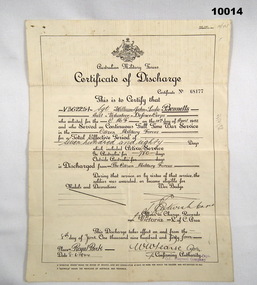
Administrative record - CERTIFICATE OF DISCHARGE WW2, Australian Military Forces of the Commonwealth 2nd Military District, 8 June 1944
... Corps WW2 Handwritten in black ink; “Soldiers details and signatures” Stamped in purple ink at bottom of front: “Capt O.C. Disposal Company” Handwritten in pencil on RHS: “N/W, 21/4/42". Cream coloured Certificate of Discharge for a World War Two Soldier. Pro forma details in black type front and back. Soldier's details handwritten on proforma in black ink. Administrative record CERTIFICATE OF DISCHARGE WW2 Australian Military Forces of the Commonwealth 2nd ...Discharge Certificate for William John Leslie Bennetts, No. V362254, Aust. Volunteer Defence Corps, WW2. Item in the collection of "William John Leslie Bennetts". See Catalogue No. 9886P for details of his service.Cream coloured Certificate of Discharge for a World War Two Soldier. Pro forma details in black type front and back. Soldier's details handwritten on proforma in black ink.Handwritten in black ink; “Soldiers details and signatures” Stamped in purple ink at bottom of front: “Capt O.C. Disposal Company” Handwritten in pencil on RHS: “N/W, 21/4/42".william bennetts, discharge certificate, volunteer defence corps, ww2 -
 Bendigo Military Museum
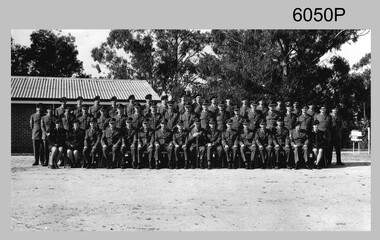
Photograph - Army Survey Regiment Warrant Officers and Sergeants, c1975
... Royal Australian Survey Corps RASvy Army Survey Regiment Army Svy Regt Fortuna ASR no annotations This is a photograph of the Warrant Officers and Sergeants posted to Army Survey Regiment c1975, Fortuna Villa, Bendigo Victoria. The photograph was printed on photographic paper and is part of the Army Survey Regiment’s Collection. The photograph was scanned at 300 dpi. .1) Photo, black & white c1975. Middle Row to L to R: centre WO2 Tom Pattison, Front Row to L to R: 2nd ...This photograph of the Army Survey Regiment’s Warrant Officers and Sergeants was taken at Fortuna Villa Bendigo in c1975. WO1 John Hogan served as RSM of the Regiment from 1968 to 1976.This is a photograph of the Warrant Officers and Sergeants posted to Army Survey Regiment c1975, Fortuna Villa, Bendigo Victoria. The photograph was printed on photographic paper and is part of the Army Survey Regiment’s Collection. The photograph was scanned at 300 dpi. .1) Photo, black & white c1975. Middle Row to L to R: centre WO2 Tom Pattison, Front Row to L to R: 2nd WO1 Marj Knight, centre RSM WO1 John Hogan. All other personnel are unidentified.no annotationsroyal australian survey corps, rasvy, army survey regiment, army svy regt, fortuna, asr -
 Bendigo Military Museum
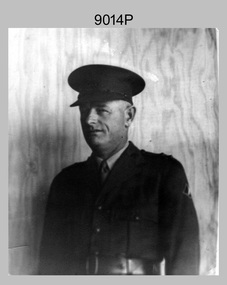
Photograph - Royal Australian Survey Corps - LT Wilfred John Harrison, c1940s
... He was one of the fifty Permanent Force members of the Australian Survey Corps as of 3 Sep 1939. WO2 Harrison’s first unit was No 3 Survey Section, located in the 2nd Military District, New South Wales. ...He was one of the fifty Permanent Force members of the Australian Survey Corps as of 3 Sep 1939. WO2 Harrison’s first unit was No 3 Survey Section, located in the 2nd Military District, New South Wales. ...This is a photograph of 566 WX31826 LT W.J. Harrison. Wilfred John Harrison enlisted in the Permanent Military Force on the 24 Apr 1939 in Western Australia at the rank of WO2. He was one of the fifty Permanent Force members of the Australian Survey Corps as of 3 Sep 1939. WO2 Harrison’s first unit was No 3 Survey Section, located in the 2nd Military District, New South Wales. It is not known when he was commissioned as an officer. He retired at the rank of Lieutenant from the AMF on 15 Dec 1949.This is a photograph of LT Wilfred John Harrison, a member of the Royal Australian Survey Corps, taken in the 1940s. The photograph was printed on photographic paper and is part of the Army Survey Regiment’s Collection. The photograph was scanned at 300 dpi. .1P – There are no personnel identified.royal australian survey corps, rasvy, fortuna, army survey regiment -
 Bendigo Military Museum
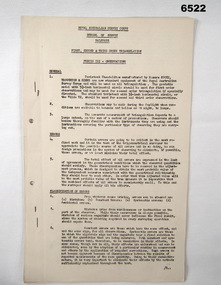
Administrative record - Royal Australian Survey Corps - 1st, 2nd and 3rd Order Triangulation Precis, School of Military Survey, Balcombe, Circa 1948 - 1960
... The precis No 3 covers the Observation procedure to be used for 1st, 2nd and 3rd Order Triangulation using the Royal Australian Survey Corps standard Cooke, Troughton and Simms Tavistock or Wild T2. ...Royal Australian Survey Corps - 1st, 2nd and 3rd Order Triangulation Precis Administrative record Royal Australian Survey Corps - 1st, 2nd and 3rd Order Triangulation Precis School of Military Survey, Balcombe ...A School of Military Survey Precis, 8 x foolscap sized pages of typed text, stapled and two hole punched. The precis No 3 covers the Observation procedure to be used for 1st, 2nd and 3rd Order Triangulation using the Royal Australian Survey Corps standard Cooke, Troughton and Simms Tavistock or Wild T2. The geodetic model Tavistock with a 5.25" horizontal circle should be used for 1st Order Triangulation and maybe used for 2nd Order Triangulation if specially directed. The standard Tavistock with 3.5" horizontal circle or the Wild T2 should be used for 2nd and 3rd Order observations. The Precis discusses the types of errors, the source of errors and the best ways of managing them. In surveying, triangulation is the process of determining the location of a point by measuring only angles to it from known points at either end of a fixed baseline by using trigonometry, rather than measuring distances to the point directly as in trilateration.A School of Military Survey Precis, 8 x foolscap sized pages of typed text, stapled and two hole punched.royal australian survey corps, rasvy, fortuna, army survey regiment, army svy regt, asr, school of military survey, sms, balcombe -
 Bendigo Military Museum
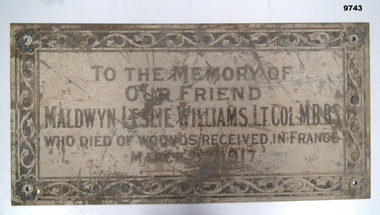
Plaque - MEMORIAL PLAQUE, WW1, C G Roeszler & Son, Post WW1
... Australian Army Medical Corps. Promoted to Major in 1913. Sept 1915 - appointed Major in regular army, 8th Field Ambulance Unit. Nov 1915 - sailed for Egypt; June 1916 - sailed for Marseilles. Jan 1917 - promoted to Lt. Colonel and command of 1st Field Ambulance Unit. Wounded near Bapaume 2nd...Australian Army Medical Corps. Promoted to Major in 1913. Sept 1915 - appointed Major in regular army, 8th Field Ambulance Unit. Nov 1915 - sailed for Egypt; June 1916 - sailed for Marseilles. Jan 1917 - promoted to Lt. Colonel and command of 1st Field Ambulance Unit. Wounded near Bapaume 2nd ...Born in Castlemaine 1886. Maldwyn L. Williams (Leslie) was a prominent doctor in Bendigo, both at Bendigo Base Hospital and in private practice. He played several games in the Victorian Football League (VFL) whilst at university. Enlisted in Citizens Military Force in 1909 as Captain in Royal Australian Army Medical Corps. Promoted to Major in 1913. Sept 1915 - appointed Major in regular army, 8th Field Ambulance Unit. Nov 1915 - sailed for Egypt; June 1916 - sailed for Marseilles. Jan 1917 - promoted to Lt. Colonel and command of 1st Field Ambulance Unit. Wounded near Bapaume 2nd March 1917; died from wounds 3rd March 1917. Buried at Dernancourt Cemetery, France. The engraver of the plaque was C.G. Roeszler & Son of Melbourne. This business was founded in 1869 and is still family-owned and trading today. This company is responsible for many examples of engraving around Melbourne, including work on the 1928 Ringwood Memorial Clock and in St Paul's Cathedral in Flinders St, Melbourne. Rectangular metal plaque, possibly brass. 4cm border featuring botanical motif. A flower with eight round petals at each corner - each flower has a 0.7cm hole at its centre. Decoration and inscription engraved and filled with black material, possibly shellac or enamel paint which is degraded, cracking, and loose.Main inscription: "TO THE MEMORY OF/OUR FRIEND/MALDWYN LESLIE WILLIAMS. LT. COL, M.B,B.S./WHO DIED OF WOUNDS RECEIVED IN FRANCE/MARCH 3RD ['RD" is in smaller font and higher that other letters with a dot beneath] 1917.' Bottom right: "C.G. ROESZLER & SON MELB".plaque, memorial -
 Bendigo Military Museum
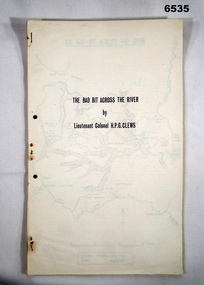
Journal - Royal Australian Survey Corps - The Bad Bit Across the River - LtCol HPG Clews 1934, LTCol HPG Clews RASvy, 1934
... Australian Survey Corps from 1912 - 1949 and then served as the Senior Surveyor with the Snowy Mountains Authority from 1950-1958. A Survey Cairn is errected in Khancoban to record his life 1890 - 1980. This Journal records the field trip to establish Survey Control in very rugged country by a handful of party members on foot. The map shows the routes taken. Royal Australian Survey Corps RASvy Fortuna Army Survey Regiment Army Svy Regt ASR 2nd ...This Journal "The bad bit across the River" was written by - LtCol HPG Clews in 1934 and is about his experiences around the Colo River approximately 60 miles NW of Sydney, NSW. LtCol Clews was a remarkable man and his achievements were just as remarkable. He is affectionately known as "The Major." He served in the British Army 1909 - 1911 with the Sherwood Foresters. He then served in the Royal Australian Survey Corps from 1912 - 1949 and then served as the Senior Surveyor with the Snowy Mountains Authority from 1950-1958. A Survey Cairn is errected in Khancoban to record his life 1890 - 1980. This Journal records the field trip to establish Survey Control in very rugged country by a handful of party members on foot. The map shows the routes taken.14 x foolscap pages stapled and two hole punched. The Journal includes a map, 7 x pages of typed text and 4 x Annexesroyal australian survey corps, rasvy, fortuna, army survey regiment, army svy regt, asr, 2nd field survey company -
 Bendigo Military Museum
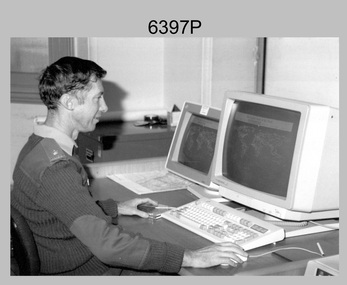
Photograph - MAJ Bob Williams – Technical Award Recipient, Army Survey Regiment, Fortuna, Bendigo, 1990
... 2nd Australian Institute of Cartographers and BHP Engineering Technology Research and Development Awards. The award was announced at the 1990 Australian Cartographic Conference in Darwin where MAJ Williams presented his entry. At the time he had completed PhD studies at the Australian Defence Academy and was the first Survey Corps...2nd Australian Institute of Cartographers and BHP Engineering Technology Research and Development Awards. The award was announced at the 1990 Australian Cartographic Conference in Darwin where MAJ Williams presented his entry. At the time he had completed PhD studies at the Australian Defence Academy and was the first Survey Corps ...In 1990 MAJ Bob Williams was the OC of Technical Development Cell. He won first prize for his entry ‘Innovations in Cartographic Communication’ in the individual category at the 2nd Australian Institute of Cartographers and BHP Engineering Technology Research and Development Awards. The award was announced at the 1990 Australian Cartographic Conference in Darwin where MAJ Williams presented his entry. At the time he had completed PhD studies at the Australian Defence Academy and was the first Survey Corps officer to complete studies at this advanced level. Also, in 1990 the Royal Australian Survey Corps’ meritorious achievements were formally recognised by the Senate of the Australian Parliament in a Notice of Motion on 31st of May 1990. The Royal Australian Survey Corps also featured in the issue of a commemorative stamped envelope issued by Australia Post. These achievements are covered in more detail in page 147 of Valerie Lovejoy’s book 'Mapmakers of Fortuna – A history of the Army Survey Regiment’ ISBN: 0-646-42120-4. This photograph of MAJ Bob Williams was taken in Technical Development Cell at the Army Survey Regiment, Fortuna, Bendigo in 1990. The black & white photograph was printed on photographic paper and is part of the Army Survey Regiment’s Collection. The photograph was scanned at 300 dpi. .1) - Photo, black & white, 1990. MAJ Bob Williams – Technology Award Recipient.1P – annotated in red pen ‘MAJ Williams Technology Awards’royal australian survey corps, rasvy, army survey regiment, army svy regt, fortuna, asr -
 Bendigo Military Museum
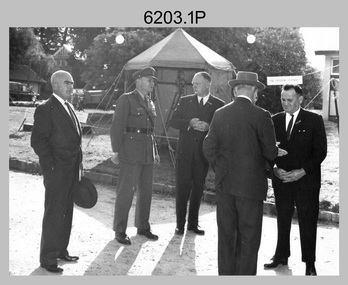
Photograph - AHQ Survey Regiment Open Day, Fortuna Villa, Bendigo, c1958
... Royal Australian Survey Corps RASvy Army Survey Regiment Army Svy Regt Fortuna ASR .1P – annotated on back ‘COL LOCKWOOD’ .2P – no annotations .3P – annotated ‘Bishop Rich-e-a-‘ This is a set of photographs of an Open Day held at the AHQ Survey Regiment, Bendigo c1958. The photographs were printed on photographic paper and are part of the Army Survey Regiment’s Collection. The photographs were scanned at 300 dpi. .1) - Photo, black and white. Unidentified civilian visitors, 2nd ...This is a set of three photographs of an Open Day held at the AHQ Survey Regiment, Bendigo c1958. It’s evident in the background of these group photos there were displays of field surveying equipment. It is known an Open Day was held on the 2nd of November 1958. As the CO LTCOL Lindsay Lockwood MID is positively identified, it’s highly probable these photos were taken at that time. LTCOL Lindsay Lockwood was the CO of the AHQ Survey Regiment from 1951 to 1962. As the longest serving commanding officer of the unit, there was many changes implemented under his command. He decided an Open Day was the best way for the local community in Bendigo to gain an insight into the unit’s important role as Defence’s map production agency, its technical equipment, and its economic importance to Bendigo. It also gave them an opportunity to tour through historic Fortuna Villa. In the background of photo .1P above the man on the right is a sign with the following text: ‘STAR OBSERVING EQUIPMENT.’ LTCOL Lindsay Lockwood’s period as CO is covered in more detail in pages 48-49 of Valerie Lovejoy’s book 'Mapmakers of Fortuna – A history of the Army Survey Regiment’ ISBN: 0-646-42120-4. Also refer to page 75 for more detailed information on the Open Day held in 1958. This is a set of photographs of an Open Day held at the AHQ Survey Regiment, Bendigo c1958. The photographs were printed on photographic paper and are part of the Army Survey Regiment’s Collection. The photographs were scanned at 300 dpi. .1) - Photo, black and white. Unidentified civilian visitors, 2nd from left: LTCOL Lindsay Lockwood MID. .2) - Photo, black and white. Unidentified Army Padre (centre) and civilian visitors. .3) - Photo, black and white. Unidentified civilian visitors..1P – annotated on back ‘COL LOCKWOOD’ .2P – no annotations .3P – annotated ‘Bishop Rich-e-a-‘royal australian survey corps, rasvy, army survey regiment, army svy regt, fortuna, asr -
 Bendigo Military Museum
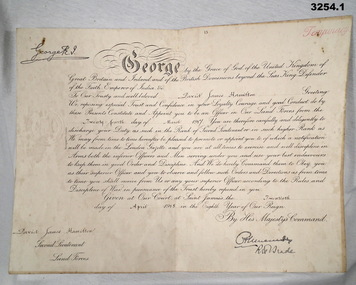
Certificate - CERTIFICATE, OFFICER WW1, 1) 24.3.1917
... Refer Cat No No 2351.5P for his service details. certificate officer .1) Bottom L: "D J Hamilton Second Lieutenant Land Forces Australian Machine Gun Corps" .2) Printed top centre: "ON HIS MAJESTY'S SERVICE" Printed bottom L: "DEPT OF DEFENCE MELBOURNE" Handwritten centre: "Mrs L Hamilton Royal Hotel Williamstown Vic" .1) Certificate, cardboard, yellowed, folded re David James HAMILTON being for his appointment to 2nd Lieutenant. ...Items re David James Wallace HAMILTON No 329 . KIA 7.6.1917. Refer Cat No No 2351.5P for his service details..1) Certificate, cardboard, yellowed, folded re David James HAMILTON being for his appointment to 2nd Lieutenant. Printed in black with black pen writing ornate. Stamped seal on one side. .2) Envelope for .1) Paper yellowed with black print..1) Bottom L: "D J Hamilton Second Lieutenant Land Forces Australian Machine Gun Corps" .2) Printed top centre: "ON HIS MAJESTY'S SERVICE" Printed bottom L: "DEPT OF DEFENCE MELBOURNE" Handwritten centre: "Mrs L Hamilton Royal Hotel Williamstown Vic"certificate, officer -
 Bendigo Military Museum
Administrative record - COMPENDIUM WW1 - WW2, 4) A H Pettifer, Government Printer et al, 2) 14.2.1946; .3) 1.3.1919; .4) 30.11.1954 .5) 24.11.19? - WWI; .6) 31.10.1917; .7) 12.6.1917; .8) Page 1: 20.12.1915, Page 2: 10.12.1915, Page 6: 19.1915; .9) 10.9.1918; .10) 18.4.1919; .11) c.2.3.19?; .12) 18.9.1920; .14) post WWI; .15) 24.4.1920; .17) 18.4.1942; .18) 19.6.1943; .19) 18.3.1947; .20) 1944; .21) 1944; .23) 22.10.1941; .26) 13.9.1944; .27) 1.1944; .30) 7.3.1950; .31) 31.7.1944; .32) 16.4.1942; .33) 13.6.1946; .34) 6.5.1946; .36) a) & b) 3.11.1947; .37) 24.10.1951; .38) 24.9.1957; .39) 9.10.1957; .40) 19.2.1958; .41) 26.2.1958; .42) 1.3.1958; .43) & .44) 7.3.1958; .45) 25.2.1958; .46) 3.1.1948; .47) 26.2.1948; .48) 22.4.1958; .49) 24.2.1958; .50) 12.3.1958; .51) 6.1958; .52) c.Mar/Apr 1958; .53) 5.4.1958; .54) c.end WWII; .55) a.b. 13.6.1967; .56) 26.5.1967; .57) 18.2.1954
... Administrative record COMPENDIUM WW1 - WW2 .2) Pacific Island Regiment .3) War Office .4) A H Pettifer, Government Printer .5) Lord Chamberlain .6) W Birdwood, 1st ANZAC Corps .8) Pages 1 & 2 University of Sydney .8) Pages 3 & 5 Commonwealth Gazette .8) Page 6 Australian Military Forces .8) Pages 7 - 11 Military Forces of the Commonwealth 2nd Military District .9) Department of Defence Base Records Office .10) Military Forces of the Commonwealth, 2nd Military District .11) Lord Birdwood .12) Australian Imperial Force, Base Records Office .13) Australian Military Forces .15) University of Sydney .16) Territory of New Guinea .17) Major General Morshead, Headquarters AIF (ME) .18) Major General Morshead, Headquarters 2 Australian Corps .19) J R Halligan, Secretary of Dept of External Territories .20) 20th Australian Infantry Brigade .21) 2/13 Battalion AIF .22) Australian Anti-Tank Regt AIF .23) 20th Infantry Brigade .24) 2/17 Australian Infantry Battalion 26) Major W A JENNER, New Guinea Force Headquarters .28) & .29) First Australian Army .30) CARO A Block .31) Lt Gen Stanley Gauige, Comd New Guinea Force, Headquarters .33) Ltd Discharge Depot .34) AMF Discharge Depot .35) Joseph Francis, Minister for the Army .36) a) & b) H T Allan (assumed) .37) Brigadier in Charge of Administration, HQ Eastern Command, Victorian Barracks .38) & .39) J V Knight, State Secretary, RSS & AILA Papua New Guinea Branch .41) & .43) 41) Major General T J DALY, General Officer Commanding Northern Command Headquarters, Victoria Barracks .44) H T Allan .46) & .47) Henry G Eckhoff, Honarary Secretary, New Guinea Citizens Association, Lae Branch .48) Major General T J Daly, General Officer Commanding Australian Military Forces, Northern Command Headquarters .49) Lieutenant General Sir Henry Wells, Chief of General Staff .50) H T Allan .51) A PNG Correspondent - Pacific Islands Monthly .53) a.b.c. ...Herbert Trangmar Allan, refer 2755.4 for his extensive service history and wards. .2) Details gifting of a pair of Japanese binoculars to Col H T ALLAN by Pacific Island Regiment. .3) Certificate issued by Winston Churchill, Secretary of State for War (The War of 1914-1918), awarded to Capt H T ALLAN MC. .4) Herbert Trangman ALLAN born 5.1.1895 at Woolwich, NSW. Middle name misspelled, should be Trangmar not Trangman. .6) Congratulating H T ALLAN on receiving the Military Cross award for leading 2 companies which had lost officers during action on Passchendaele Ridge on 9.10.1917. .7) Describes life behind the lines whilst H T ALLAN's battalion has been resting for a month. Daily life consisted of training drills, sport & entertainment. Writer takes time to describe the countryside & weather. .8) Relate to H T ALLAN's military exam results & his promotion to 2nd Lieutenant in 1915. .9) To Herbert Allan's father, Mr P Allan detailing the citation for awarding of the Military Cross to Herbert ALLAN. Original citation appeared in the London Gazette,5.4.1918. .10) Form addressed to Capt H ALLAN MC, 17th Battalion stating his period of enlistment in the 1st AIF was to expire 26.5.1919. .11) Letter from Lord BIRDWOOD (General) to Herbert ALLAN in response to a letter received 19.11.19?. General BIRDWOOD expresses his opinions on difficulties the allied troops face in their fight against the Japanese. .12) Letter to Capt H T ALLAN advising of MID oak leaves sent to him. Details guidelines for attaching oak leaves to both the larger Victory Medal & the small service dress medal. .13) Form details H T ALLAN's WWII Army No, Rank, Unit & Decorations & Medals held. The form has not been signed & dated. .14) Details service record of Lt Col H T ALLAN NX12229. Includes military service from 1912 - 1944, schools & courses attended, decorations, promotions & overseas service. .16) Form issued to H T ALLAN on 15.12.1939 granting permission to leave New Guinea for Australia & return within a period of 12 months. Issued by Customs Office in Salamaua. Lists H T ALLAN's age as 44, height 5' 10" & occupation. .17) Letter from Major General MORSHEAD GOC, AIF (ME) to Major H T ALLAN, OBE, MC congratulating him on being awarded the OBE for outstanding service at Tobruch. .18) Letter from Major General MORSHEAD to Major H T ALLAN, OBE, MC replying to ALLAN's letter of 15.6.1943. MORSHEAD is congratulating ALLAN on his appointment to New Guinea Force, also acknowledges his excellent service record. .19) Letter acknowledges H T ALLAN's resignation from the Office of Production Member of the Australian New Guinea Production Control Board, effective from 28.8.1946. .20) Major General WINDEYER commanded the 20th Brigade from 1942-1946. .22) Card sent from the CO of the 3rd Australian Anti-Tank Regiment. .23) Menu for Farewell Dinner held in the Officer's Mess of the 20th Infantry Brigade, Tobruch on 22.10.1941. .24) Menu & Toast list for Farewell Dinner to Brigadier J J MURRAY DSO MC VD. Attended by H T ALLAN & held in the Officers Mess, 2/17 Australian Infantry Battalion on 22.12.1941. .25) Invitation to Col H T ALLAN by Lady Gowrie (wife of Governor General Baron Gowrie) to attend a Luncheon at Government House, Canberra, ACT. .26) Letter to Major (T/Lt Col) H T ALLAN from Major W A JENNER advising him of his secondment to 2/17 Australian Infantry Battalion & appointment to command 5 Aust Base Sub Area. .27) Application for Africa Star with Eighth Army Clasp signed by H T ALLAN & approved by Lt Colonel of 2/17 Australian Infantry Battalion. H T ALLAN held the rank of Major (substantive) at the time of qualification, 1.3.1942 - 11.1942. He held the rank of Lt Colonel at the time of application in 2.1944. .28) Detailing changes in command & promotions including that of Lt Col H T ALLAN, dated 1.4.19? .29) For Lt Col H T ALLAN detailing movements required by First Australian Army command. .30) Acknowledgement & confirmation of Col H T ALLAN's application for campaign awards for WWII. .31) Letter addressed to Lt Col H T ALLAN from Lt Gen Stanley Sauige requesting information on New Britain for a forthcoming visit. .32) Certificate was presented to H T ALLAN on 16.4.1942 when he was awarded an OBE by King George VI. .33) Document details H T ALLAN's relinguishing of Command of the HQ of Pacific Islands Regiment. ALLAN also relinguished the rank of temporary Colonel & was transferred to the Reserve of Officers with rank of substantive Lt Colonel. .35) Official letter to Colonel H T ALLAN from Joseph Francis, Minister for the Army. The letter acknowledges Col ALLAN's long & distinguished career during both peace & wartime. .36) a) & b) From H T ALLAN (assumed) to Prime Minister J B CHIFFLEY referring to the production of copra in New Guinea, the actions of the Commonwealth Bank in relation to planters & the collaboration of New Guinea natives with the Japanese. Assumed to be a copy of original. .37) Letter to H T ALLAN indicating he had been placed on the Retired List with the rank of Honorary Colonel. .38) Letter invites H T ALLAN to officially open the State Conference in Lae in late March or early April 1958. Invitation was extended due to H T ALLAN for distinguished service in PNG. .39) Letter to H T ALLAN thanking him for accepting the invitation to open the Papua & New Guinea State Conference in late March or early April 1958. .40) Letter from H T ALLAN to Lt Gen Sir Henry WELLS, Chief of the General Staff, Victoria Barracks, Melbourne. ALLAN requests permission to wear his uniform for official engagements during his upcoming visit to New Guinea. ALLAN also offers advice on how to deal with native troops including serving time with them, learning their language & studying their customs. He suggests that this would help quell & dissent & revolt. .41) Reply from Major General DALY to HT ALLAN thanking him for his offer to spend time with the CO of the Pacific Island Regiment to address concerns with that unit. This meeting would coincide with ALLAN's upcoming visit to PNG. .42) HT ALLAN's reply to Major General T J DALY's letter of 26.2.1958. ALLAN requests an opportunity to discuss PIR issues with Major General DALY prior to his visit to PNG. .43) Major General T J DALY's reply to HT ALLAN's request for a meeting to discuss ongoing issues with the Pacific Island Regiment. .44) Letter from HT ALLAN to Brigadier D M CLELAND notifying him that he will be staying in Port Moresby on his way to the RSS&AILA Congress in Lae. .45) Lieutenant Colonel MCGUINN writes to invite Colonel ALLAN to visit the PIR during his visit to New Guinea at the end of March of the beginning of April 1959. .46) Letter of appreciation to H T ALLAN thanking him for his efforts in presenting the case for the Territory of New Guinea during the post WWII transition period. .47) Letter to H T ALLAN from New Guinea Citizens Association, Lae Branch, thanking him for his service on behalf of the people of the Territory of New Guinea. The association offered to send ALLAN a suitable present in recognition of his service. .48) Major General T J DALY's reply to HT ALLAN's suggestions for handling disquiet amongst the native troops in the Pacific Island Regiment. .49) Reply from Lieutenant General WELLS to H T ALLAN granting him permission to wear his uniform on his forthcoming visit to New Guinea. WELLS also notes that he has passed other requests made by ALLAN to Major General DALY. .50) Copy of H T ALLAN's reply to Lieutenant General WELL's letter of 24.2.1958 [.49)]. .51) A written account of Colonel H T Blue ALLAN's visit to New Guinea in 3.1958. Article appeared on p.65 & 67 of the 6.1958 edition of Pacific Islands Monthly. .52) Newspaper account of Colonel H T Blue ALLAN's opening of the Rabaul Branch of the Native Ex Servicemen's Association. Colonel ALLAN spoke of the involvement of the Pacific Islands Regiment during WWII. .53) The Rabaul Times account of Colonel H T Blue ALLAN's opening of the Rabaul Branch of Native Ex Servicemen's Club. Featured on p1, concluded p3. .54) Biographical account of Colonel H T ALLAN's service in WWI & WWII. In addition an account of his success in New Guinea between the wars is included. .55) a.b. Biography of Colonel H T ALLAN written by R W Robson who was the founder of the Pacific Islands Monthly. Article was written following ALLAN's death on 23.5.1967 aged 72. This item is a pre publication copy of Robson's article which appeared in the Pacific Islands Monthly. .56) Text of a valedictory given at the funeral of Colonel Herbert Trangmar ALLAN OBE, MC, ED, NX12229 held 26.5.1967 following his death on 23.5.1967. The speech summarized his life in both wars & civilian life. 57) Invitation issued to Colonel H T & Mrs ALLAN to attend a Garden Party at Government House on 18.2.1954. At this function Colonel H T & Mrs ALLAN were to be presented to her Majesty Queen Elizabeth II.Herbert T ALLAN Collection. The contents are all of various size, the Album is the size documented. .1) Large teal green album containing 16 plastic pockets each with white card insert. Various documents & photos contained in each pocket. .2) Typed letter, black type on cream paper. .3) Certificate mounted on fawn card backed with dark brown veneer. Presented to Capt H T ALLAN MC for being mentioned in despatches on 7.11.1917. .4) New South Wales Birth Certificate extract, printed on pink paper with watermark. .5) Telegram on tissue paper to a sheet of cream paper. Pin located top L corner. Requests the attendance of Lt Herbert ALLAN, Russell Hotel, Russell Square. .6) Typed letter mounted on grey cardboard. .7) 2 page letter on foolscap paper, secured by pin top L corner. Written from France by Herbert (Bert) ALLAN & addressed to his father. .8) 11 pages secured with a clip top L corner. 1st document typed, 2nd handwritten, remainder printed. Relate to H T ALLAN's military exam results. .9) Typed letter from Department of Defence Base Records Office to P ALLAN. .10) Document, printed form to inform the recipient that their period of enlistment in the 1st AIF had expired. .11) 4 page handwritten letter on 2 sheets of paper. 1st page has a printed letterhead. .12) BR Form No 20. Typed formal letter from AIF Base Records Office to accompany Mentioned in Despatches oak leaves sent to the recipient. .13) Form AAFA36 used for recommending the awarding of an Efficiency Decoration. Form details service record & details of a serving soldier. .14) 1 large / 1 small page, numbered, detailing the service record of Lt Col H T ALLAN. Black type on cream paper. 2 pages are loose but evidence of attachment visible. .15) Bachelor of Arts Degree Certificate (testamur) granted by the University of Sydney, awarded to Herbert Trangmar ALLAN. Printed on cream parchment. .16) Proforma document issued by the Territory of New Guinea permitting leave & return to the Territory. Printed 2 sides, black type on cream paper. .17) Letter on Australian Imperial Force letterhead from Major General MORSHEAD to Major H T ALLAN. .18 Letter on HQ2 Aust Corps letterhead from Major General MORSHEAD to Major H T ALLAN. .19) Typed letter on External Territories letterhead from J R Halligan to H T ALLAN. .20) Cream Christmas card folded in 2, sent to H T ALLAN. On front in black lettering is HQ 20th Australian Infantry Brigade below black Rising Sun emblem. Inside in black lettering is With Best Wishes for Christmas and New Year. Christmas 1944. .21) Cream card folded in 2. Front illustration depicts a devil figure riding a platypus & carrying a pennant with 2/13 on it. The devil is depicted attacking a German & Japanese soldier. Below the devil is a boomerang with Greetings Xmas 1944 printed on it. Illustration is in green & black. Inside on LHS is a message from 2/13 Battalion. On RHS is a list of 2/13 battle honours from 1940-1943. On back in black print is 1944-1945 New Guinea Australia. .22) Cream Christmas card folded in 2. Front illustration in brown with word Greetings in green. RHS inside printing in green & brown letters. Artillery badge on back in brown. .23) Cream card folded in 2. Typed menu on cream paper attached inside. Front cover illustrated with 20th Infantry Brigade colour patch & a rat over a scroll with words - So What? .24) Cream card folded in 2. On front black printing accompanied by 2/17 Battalion colour patch that is black over green diamond shape. Inside a list of Toasts & Dinner Menu printed in black. Back page for autographs. .25) Cream invitation card. Black cursive script printing below gold crown on front. .26) Typed letter on cream paper. .27) Typed foolscap application form to claim the Africa Star. .28) & .29) Message form filled with typed orders. .30) Typed letter acknowledging an application for campaign medals & listing eligible awards. .31) Typed letter on bond paper. .32) Certificate on cream parchment. Black print in cursive script. Text details the awarding of an OBE to the recipient. .33) Typed text on Australian Military Forces letterhead. Cream paper. .34) Typed text. Temporary note for H T ALLAN's discharge from AMF. .35) Typed letter on Commonwealth of Australia, Minister for the Army letterhead. .36) a) & b) 2 page letter in black type on cream paper. Pages are loose, letter unsigned. .37) 1 page typed letter on Australian Military Forces letterhead. .38) & .39) 1 page typed letter on Return Sailors, Soldiers & Airmen's Imperial League of Australia, Papua & New Guinea Branch letterhead. .40) 1 page typed letter, unsigned. .41) Single sided typed letter on Australian Military Forces letterhead on cream paper. .42) 1 page typed letter, unsigned on cream paper. .43) Single sided typed letter on Australian Military Forces, Northern Command, Victoria Barracks, Brisbane letterhead on cream paper. .44) Single sided typed letter on cream paper. .45) 2 page typed letter on folded cream paper bearing the letterhead of the Pacific Islands Regiment. .46) 1 page typed letter on cream, lined paper. .47) 1 page typed letter on cream paper. .48) 1 page typed letter on Australian Military Forces, Northern Command Headquarters, Victoria Barracks, Brisbane letterhead on cream paper. .49) 1 page typed letter on Chief of General Staff, Australian Military Forces, Army Headquarters, Victoria Barracks, Melbourne letterhead on cream paper. .50) 1 page copy of an unsigned letter on cream paper. .51) Magazine article: Building a New Nation in New Guinea : Some advice from Colonel Blue ALLAN. Black & white article with a 2nd small section stapled to the main page. Large page features a black & white captioned photo of a group listening to a uniformed Officer deliver a speech. Also features advertising front & back. .52) Newspaper article: Official Opening of Native Ex Servicemen's Club. Black & white typed newspaper article featuring a captioned black & white photo of a uniformed Australian Officer & a group of New Guinea Ex Servicemen. .53) a. b. c. Newspaper article: Master Blue Came Back to the Islands: 4000 Attend Club Opening. 3 Section article cut from a newspaper. One part is the banner of the newspaper with date published. Other sections contain the text of the article. The larger section features a black & white photo of an Australian Army Officer in uniform. .54) Newspaper article, untitled. Black & white typed newspaper article with black & white caricature of an Australian Army Officer featured. .55) a. b. Magazine article: The Story of a Big Man who Loved Soldiering. 2 page black & white typed article with sub headings. .56) Text of a Speech. 2 page typed text written for a valedictory given at a funeral. Pages connected with a staple in the top L corner. .57) Printed, cream card invitation to a Garden Party for the recipient to meet Queen Elizabeth II & The Duke of Edinburgh. Text is in cursive script under the Coat of Arms of Her Majesty. .2) Signature ? Capt S C PIR. .4) Date of issue typed: 30.11.1954 Name of recipient: Herbert Trangman Allan Stamped: T Wells, Registrar General NSW .5) Handwritten: To Lt Herbert Allan, Russell Hotel, Russell Square. Typed: Buckingham Palace OHS. Your attendance is required at Buckingham Palace on Wednesday next the Twentyeighth inst (28.11.19?) at ten o'clock am service dress please telegraph acknowledgement Lord Chamberlain London. Stamped: Central District 24 NO 19. .6) Signed in pencil: W Birdwood. In pencil on back: 15 x 12. .8) p1: Handwritten signature. Copy dated 29.12.1915. p2 Handwritten in ink: P Allan Esq, Mount Hunter Hill. Military Examination. Copy dated 29.12.1915. Handwritten in pencil: Results: H T Allan. Tactics - Distinction 92% HE Barff p3 Underlined in ink: 38th Infantry Herbert Trangmar Allan to be 2nd Lieutenant (provisionally). Dated 16 June 1914. p5 Handwritten: Total 139. Lieut Allan tied with 15 others for 20 place. p7, 9, 10 & 11underlined in ink: H T Allan. p8 Underlined in ink: Allan HT. .9) & .10) Signature in black ink. .12) Handwritten signature in black ink: On back handwritten signature in black ink: Clive Wilkinson, Buddong, Robinson St, Chatswood. Also ? Rd, Cremorne Pt. .13) Handwritten in black ink: Details of HT Allan's Commission Service from 16.6.1914 - 18.2.1946. .15) Handwritten signature of the University Chancellor, Dean of Faculty of Arts & Registrar. Handwritten name of recipient. Seal of the University of Sydney imprinted bottom LHS. .16) Handwritten in black ink: Details of recipient. Stamped in red ink: New Guinea Customs. Stamped in blue ink: H M Customs, Cooktown, dated 17.12.1939. Handwritten on reverse: Signature. Stamped on reverse in red ink: New Guinea Customs, dated 15.12.1939. .17) & .18) Handwritten signature: Major General Morshead. .19) Handwritten signature in black ink: J R Halligan. .20) Handwritten inside in blue ink: Lt Col Allan. Good wishes from your many friends here. Signed by Major General Windeyer. .21) Inside LHS handwritten in blue ink: Lt Col Allan & an indecipherable signature. .22) Inside RHS handwritten: To Major (Blue) Allan OBE MC from Lt Col? .23) On front handwritten in blue ink: H T Allan?. Inside in black ink & pencil are 19 signatures. .24) On front: 3 signatures in black ink & pencil. On back: 36 signatures in black & blue ink & pencil. .25) On back handwritten in black ink: Colonel H T Allan OBE MC, with 3 ink lines below name. .26) Handwritten in blue/black ink: Signature. Handwritten in blue pencil top R corner: A32/3477. Handwritten in black ink bottom L corner: Cond (?) 15/9A. Handwritten in black ink: Signature. .27) Stamped top R corner: 2/17 Bn Received 9.2.1944. Signature in black ink: H T Allan. Signature in black ink: ? Lt Col 2/17 Aust Inf Bn 10.2.1944 Page bottom in pencil: Blue will keep 1 1/4 for you? .30) Handwritten: Details of eligible medals. Handwritten signature: J C K Miller Capt 7.3.50. Handwritten bottom L corner: Col H T Allan Bottom R corner: OBE, MC, 1914-19, Victory, ED, MID 1914-18, MID 1939-45 On back: Steak & Kidney Morris ) Clark ) Vowood ) 10/- 70215 Maughan ) Allan ) .31) Top of page: Imprinted Coat of Arms Top LHS in black ink: TOP SECRET AND PERSONAL Handwritten signature: Stanley Sauige .32) Embossed top L corner: Seal of the Most Excellent Order of the British Empire. Handwritten: Mary R. .32) Signed: Queen Mary, mother of George VI. .33) Handwritten signature. .34) Handwritten in blue ink: HERBERT TRANGMAR ALLAN 6 MAY 46 Handwritten signature. .35) Handwritten signature in blue ink: Joseph Francis, Minister for the Army. .37) Handwritten signature. .38) & .39) Handwritten signature: J W Knight. .41), .43) & .45) Handwritten signature in blue ink. .46) & .47) Handwritten signature in black ink: Henry G Eckhoff. .48) Handwritten signature in blue ink: With best wishes Yours sincerely T J Daly. .49) Handwritten signature in black ink: Yours sincerely H Wells. .57) Handwritten in black ink: Colonel & Mrs H T Allan.certificates, records, awards, administrative, compendium -
 Bendigo Military Museum
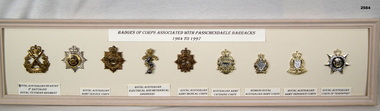
Badge - VARIOUS BADGES, FRAMED, c.1998
... Top centre: “BADGES OF CORPS ASSOCIATED WITH PASSCHANDAELE BARRACKS 1964 TO 1977” Underneath each badge: “1. Royal Australian Infantry 2nd Battalion Royal Victorian Regiment 2. & 3. ...Bendigo Military Museum 37 - 39 Pall Mall Bendigo goldfields Passchendaele Barracks Trust Badges framed Top centre: “BADGES OF CORPS ASSOCIATED WITH PASSCHANDAELE BARRACKS 1964 TO 1977” Underneath each badge: “1. Royal Australian Infantry 2nd Battalion Royal Victorian Regiment 2. & 3. ...Cream wooden framed selection of 9 badges displayed on cream coloured background.Top centre: “BADGES OF CORPS ASSOCIATED WITH PASSCHANDAELE BARRACKS 1964 TO 1977” Underneath each badge: “1. Royal Australian Infantry 2nd Battalion Royal Victorian Regiment 2. & 3. Royal Australian Army Service Corps 4. Royal Australian Electrical & Mechanical Engineers” 5. Royal Australian Army Medical Corp 6. Australian Army Catering Corp 7. Women's Royal Australian Army Corps 8. Royal Australian Army Ordnance Corps 9. Royal Australian Corps of Transportpasschendaele barracks trust, badges, framed
