
Showing 56 items matching "air new south wales"
-
 Moorabbin Air Museum
Memorabilia (Item) - Air New South Wales - brochure on their beginning
... Air New South Wales - brochure on their beginning...Air New South Wales - brochure on their beginning...Air New South Wales - brochure on their beginning Memorabilia Air New South Wales - brochure on their beginning ... -
Moorabbin Air Museum
Magazine (Item) - Air New South Wales 50 Years Inflight magazine
... Air New South Wales 50 Years Inflight magazine...Magazine Air New South Wales 50 Years Inflight magazine ... -
Moorabbin Air Museum
Document (Item) - butler air transport airlines of new south wales articles of association brewarrana holdings income tax form 1976, Ansett correspondence
... butler air transport airlines of new south wales articles of association brewarrana holdings income tax form 1976...Ansett correspondence Document butler air transport airlines of new south wales articles of association brewarrana holdings income tax form 1976 ... -
Moorabbin Air Museum
Drawing (item) - Drawings and paintings of the colour schemes of various aircraft - See Context Vickers Viscount, Electra, F27, B727, DC-9, B767, F28, Airbus A300 airliners operated by Ansett, TAA & East-West Airlines — 51 documents total, Drawings and paintings of the colour schemes of various aircraft - See Context
... new colours at airline collapse)...Air Queensland...Airlines of Northern Australia...Air New South Wales...DA73483000 31 Finishing scheme — HS-748 Support Command HQ MPS A0170 Additional Typed Page Regular Public Transport Airlines — Paint Finishing Schemes for: TAA Viscount TAA Electra Ansett Boeing B767 TAA Boeing 727 TAA DC-9 TAA Fokker F27 Friendship TAA Airbus A300 East-West Airlines Fokker F27 Friendship + Large Metal Paint Samples Plate … 6 colours Ansett Fokker F27 Friendship of: Ansett Airfreight Ansett 500 Series Ansett 200 & 600 Series (orange/brown colours) Ansett (new colours at airline collapse) Air Queensland Airlines of Northern Australia Air New South Wales Airlines of South Australia Bush Pilots Airways (lease) F27 General Exterior markings — 7 sheets Ansett Fokker F28 of: Airlines of New South Wales MMA (Ansett) Airlines of Northern Australia. ...1. Drawings/paintings of the colour schemes of Vickers Viscount, Electra, F27, B727, DC-9, B767, F28, Airbus A300 airliners operated by Ansett, TAA & East-West Airlines — 51 documents total.# title author publisher / reference, 1 exterior finishes & markings — hercules c-130e dept of air, support command da6924b008, 2 exterior camouflage markings — hercules c-130h 〃 da75406000, 3 interior finishes — markings — polyurethane scheme 〃 da69248007 / da69269000, 4 exterior finishes — engine nacelles & cowling — c-130e 〃 da69248007, 5 upper surface of wings — c-130e 〃 da69248006, 6 under surface of wings — c-130e 〃 da69248005, 7 upper fuselage and tailplane — c-130e 〃 da69248004, 8 under fuselage — hercules c-130e 〃 da69248003, 9 r.h. side fuselage — hercules c-130e 〃 da69248001, 10 l.h. side fuselage — hercules c-130e 〃 da69248002, 11 royal australian air force section, port & starboard sides — hercules no. (markings) 〃 a15286 sht 4, 12 raaf lettering on dh-4 caribou 〃 a13266 sht 3, 13 raaf lettering — c-130, f-111, caribou, bac 1-11, bs, f-9, f2-20 department of air, s.t.s.o., support command hq a13280 sht 1, 14 transfers — aircraft serial nos. — bristol 〃 da66b7000, 15 raaf kangaroo 45" dia rounded dimensions 〃 a12762 — left ⃰, 16 fin flash — raaf 〃 da66171000, 17 finishing scheme — pilatus porter 〃 da67179000, 18 finishing scheme — cessna 180 〃 ??, 19 aesl airtrainer ct-4 finishing scheme 〃 da72680000, 20 finishing scheme — bac 1-11 〃 am330, 21 finishing scheme — dassault mirage 30 〃 a16228, 22 finishing scheme — hs-748 〃 a16282, 23 finishing scheme — convair metropolitan 〃 a14276, 24 finishing scheme — papua new guinea c-47 dakota 〃 da75013000, 25 raaf dakota servicing & emergency markings 〃 a13609 sht 2, 26 markings — anti-collision & finishing scheme c-130 h wings department of air, anso technical staff officer, support command a14923 sht 1, a16923 sht 5, a14923 sht 6, a14923 sht 7, 27 finishing scheme — armoires b & c & caribou 〃 a14923 sht 1 …, 28 finishing scheme — bcg-cap nomad 〃 da72591000, 29 finishing scheme — dakota and skyhawk camouflage chief of air force / navy raas / cn1 / hq2 sht 1, 30 finishing scheme — royal australian ct-4 aircraft a.e.s.o. da73483000, 31 finishing scheme — hs-748 support command hq mps a0170, additional typed page, regular public transport airlines — paint finishing schemes for:, taa viscount, taa electra, ansett boeing b767, taa boeing 727, taa dc-9, taa fokker f27 friendship, taa airbus a300, east-west airlines fokker f27 friendship + large metal paint samples plate … 6 colours, ansett fokker f27 friendship of: ansett airfreight, ansett 500 series, ansett 200 & 600 series (orange/brown colours), ansett (new colours at airline collapse), air queensland, airlines of northern australia, air new south wales, airlines of south australia, bush pilots airways (lease), f27 general exterior markings — 7 sheets, ansett fokker f28 of: airlines of new south wales, mma (ansett), airlines of northern australia., ansett technical services paint samples card for: air queensland, ansett airlines of australia, airlines of western australia. -
Moorabbin Air Museum
Drawing - Drawings of painting the colour schemes of Vickers Viscount, Electra, F27, B727, DC-9, B767, F28 Airbus A300 airliners operated by Ansett, TAA & East-West Airlines — 51 documents total
... Ansett Technical Services Paint Samples card for: Air Queensland; Airlines of Northern Australia; Airlines of South Australia; Air New South Wales; Ansett Airlines of Australia; Airlines of Western Australia. ...Ansett Technical Services Paint Samples card for: Air Queensland; Airlines of Northern Australia; Airlines of South Australia; Air New South Wales; Ansett Airlines of Australia; Airlines of Western Australia....Ansett Technical Services Paint Samples card for: Air Queensland; Airlines of Northern Australia; Airlines of South Australia; Air New South Wales; Ansett Airlines of Australia; Airlines of Western Australia. ...This text was translated from a handwritten document by AI so there may be some minor errors. Drawings of painting the colour schemes of Vickers Viscount, Electra, F27, B727, DC-9, B767, F28 Airbus A300 airliners operated by Ansett, TAA & East-West Airlines — 51 documents total TAA — Markings, B10 series Vickers Viscount TAA Technical Services Dept for Historical Record 13M-00-01-05 (TGE) — 4 shts TAA — Markings, Lockheed Electra " 14-M-00-01-02 (PB?) — (G shts) East-West Airlines F27 Fokker Friendship — markings Engineering Manager, East-West Airlines (now see below) 11-10-1238 (M53) — (4 shts) Ansett B767 'Stars' colour scheme — normal at QUALPRO Ansett Technical Services 414, T&210 — 8 shts; VH-RMD, RMS, RMT; VH-RMG, RMH TAA B727-200 markings — VH-TBG, TAB, TBI, TAJ, TAK, TAL, TAM, TAN, TAU, TAV, TAG, TBR TAA Technical Services Dept B37M11-47-01 (2 shts) TAA Airbus A300 painting scheme (1980) — VH-TAA, TAB, TAC, TAD " AB3D15 (2 shts) TAA Douglas DC-9 painting scheme (1980) — VH-TJM, TJF, TJG, TJK; VH-TJC, TJP, TJI " DC9MH-51-01 (2 shts) TAA F27 Friendship painting scheme (1981) — VH-TFB, TFM, TFN; VH-TGN, TGD, TGB; TGG, TGR, TGS, TGT " F27 MM-2601 (2 shts) East-West Airlines large metal paint samples plate Engineering Manager, East-West Airlines 1980 (4 shts) Ansett F27 500 series colours Ansett Technical Services — April 1962, From Public (Historical Record) F2-1146 SHT 1; F2-1146 SHT 3 Ansett F28 'Air Freight' colours " F2-111012 Ansett 'Bush Pilots' Airways colours F27 " F2-111003 Ansett 'Air New South Wales' colours — F27 " F2-111005 Ansett 'Airlines of Northern Australia' colours " F2-111007 Ansett 'Stars' scheme F27 " F2-111009 Ansett F27 'Air Queensland' colours " F2-111010 Ansett F27 'Airlines of South Australia' colours " F2-111006 Ansett 'MMA' F28 colours " F28-1104 Ansett F27 exterior markings " F2-111008 Ansett F27 200 + 600 series exterior markings " F2-111008 SHT 3 Ansett F27 200 + 600 series exterior markings " F2-111008 SHT 2 Ansett F27 aircraft exterior markings " F2-111008 SHT 1 Ansett F27 aircraft exterior markings Ansett Technical Services — April 1985, Public Relations for Historical Record F2-111008 SHT 5 Ansett F27 aircraft exterior markings " F2-111008 SHT 6 Ansett F28 aircraft 'Airlines of New South Wales' " F28-111002 SHT 1 Ansett F28 aircraft 'MMA' colours " F28-1104 SHT 1 Ansett F28 aircraft 'Airlines of Western Australia' colours " F28-111001 SHT 2 Airlines of Western Australia — paint samples " F28-111001 Ansett B737 & 767, B747, Electra, F27 paint samples card " 4N7420 L1-1H001; F27-111009; GSC-22556 Ansett 'Air New South Wales' paint samples card " F2-111005 Ansett 'Airlines of South Australia' paint samples card " F2-111006 Ansett 'Airlines of Northern Australia' paint samples card " F2-111007 Ansett 'Air Queensland' paint samples card " F2-111003 Additional Typed Page Regular Public Transport Airlines — Paint Finishing Schemes for: TAA Viscount; TAA Electra; Ansett Boeing B767; TAA Boeing 727; TAA DC-9; TAA Fokker F27 Friendship; TAA Airbus A300 East-West Airlines Fokker F27 Friendship + Large Metal Paint Samples Plate … 6 colours Ansett Fokker F27 Friendship of: Ansett Airfreight; Ansett 500 Series; Ansett 200 & 600 Series (orange/brown colours); Ansett (new colours at airline collapse); Air Queensland; Airlines of Northern Australia; Air New South Wales; Airlines of South Australia; Bush Pilots Airways (lease); F27 General Exterior markings — 7 sheets Ansett Fokker F28 of: Airlines of New South Wales; MMA (Ansett); Airlines of Northern Australia. Ansett Technical Services Paint Samples card for: Air Queensland; Airlines of Northern Australia; Airlines of South Australia; Air New South Wales; Ansett Airlines of Australia; Airlines of Western Australia. 1 Drawings of painting the colour schemes of Vickers 2 Viscount, Electra, F27, B727, DC-9, B767, F28 3 Airbus A300 airliners operated by Ansett, TAA 4 & East-West Airlines — 51 documents total TAA — Markings, B10 series Vickers Viscount TAA Technical Services Dept for Historical Record 13M-00-01-05 (TGE) — 4 shts TAA — Markings, Lockheed Electra " 14-M-00-01-02 (PB?) — (G shts) East-West Airlines F27 Fokker Friendship — markings Engineering Manager, East- West Airlines (now see below) 11-10-1238 (M53) — (4 shts) Ansett B767 'Stars' colour scheme — normal at QUALPRO Ansett Technical Services 414, T&210 — 8 shts; VH- RMD, RMS, RMT; VH-RMG, RMH TAA B727-200 markings — VH-TBG, TAB, TBI, TAJ, TAK, TAL, TAM, TAN, TAU, TAV, TAG, TBR TAA Technical Services Dept B37M11-47-01 (2 shts) TAA Airbus A300 painting scheme (1980) — VH- TAA, TAB, TAC, TAD " AB3D15 (2 shts) TAA Douglas DC-9 painting scheme (1980) — VH- TJM, TJF, TJG, TJK; VH-TJC, TJP, TJI " DC9MH-51-01 (2 shts) TAA F27 Friendship painting scheme (1981) — VH-TFB, TFM, TFN; VH-TGN, TGD, TGB; TGG, TGR, TGS, TGT " F27 MM-2601 (2 shts) East-West Airlines large metal paint samples plate Engineering Manager, East- West Airlines 1980 (4 shts) Ansett F27 500 series colours Ansett Technical Services — April 1962, From Public (Historical Record) F2-1146 SHT 1; F2-1146 SHT 3 Ansett F28 'Air Freight' colours " F2-111012 Ansett 'Bush Pilots' Airways colours F27 " F2-111003 Ansett 'Air New South Wales' colours — F27 " F2-111005 Ansett 'Airlines of Northern Australia' colours " F2-111007 Ansett 'Stars' scheme F27 " F2-111009 Ansett F27 'Air Queensland' colours " F2-111010 Ansett F27 'Airlines of South Australia' colours " F2-111006 Ansett 'MMA' F28 colours " F28-1104 Ansett F27 exterior markings " F2-111008 Ansett F27 200 + 600 series exterior markings Ansett F27 200 + 600 series exterior markings Ansett F27 aircraft exterior markings Ansett F27 aircraft exterior markings Ansett F27 aircraft exterior markings Ansett F28 aircraft 'Airlines of New South Wales' Ansett F28 aircraft 'MMA' colours Ansett F28 aircraft 'Airlines of Western Australia' colours Airlines of Western Australia — paint samples Ansett B737 & 767, B747, Electra, F27 paint samples card Ansett 'Air New South Wales' paint samples card Ansett 'Airlines of South Australia' paint samples card Ansett 'Airlines of Northern Australia' paint samples card Ansett 'Air Queensland' paint samples card " F2-111008 SHT 3 " F2-111008 SHT 2 " F2-111008 SHT 1 Ansett Technical Services — April 1985, Public Relations for Historical Record F2-111008 SHT 5 " F2-111008 SHT 6 " F28-111002 SHT 1 " F28-1104 SHT 1 " F28-111001 SHT 2 " F28-111001 " 4N7420 L1-1H001; F27- 111009; GSC-22556 " F2-111005 " F2-111006 " F2-111007 " F2-111003 Additional Typed Page Regular Public Transport Airlines — Paint Finishing Schemes for: TAA Viscount; TAA Electra; Ansett Boeing B767; TAA Boeing 727; TAA DC-9; TAA Fokker F27 Friendship; TAA Airbus A300 East-West Airlines Fokker F27 Friendship + Large Metal Paint Samples Plate … 6 colours Ansett Fokker F27 Friendship of: Ansett Airfreight; Ansett 500 Series; Ansett 200 & 600 Series (orange/brown colours); Ansett (new colours at airline collapse); Air Queensland; Airlines of Northern Australia; Air New South Wales; Airlines of South Australia; Bush Pilots Airways (lease); F27 General Exterior markings — 7 sheets Ansett Fokker F28 of: Airlines of New South Wales; MMA (Ansett); Airlines of Northern Australia. Ansett Technical Services Paint Samples card for: Air Queensland; Airlines of Northern Australia; Airlines of South Australia; Air New South Wales; Ansett Airlines of Australia; Airlines of Western Australia. -
 Moorabbin Air Museum
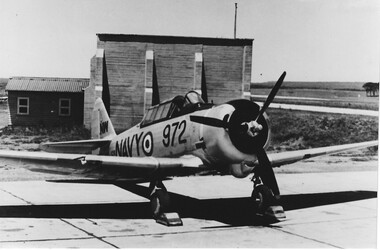
Photograph (Item) - Photograph of RAN CAC Wirraway A20-168 at Nowra, NSW, Wirraway A20-168 Nowra
... Two small, identical photos of a Royal Australian Navy CAC Wirraway trainer at the Naval Air Station in Nowra, New South Wales. Stored in a white postal envelope....Two small, identical photos of a Royal Australian Navy CAC Wirraway trainer at the Naval Air Station in Nowra, New South Wales. Stored in a white postal envelope. ...The RAN used a small number of Wirraways as Fleet Air Arm pilot trainers during the 1950s, although the vast majority of Wirraways were used by the RAAF until the CAC Winjeel superseded it. -
Federation University Historical Collection
Photograph - Photograph - black and white, VIOSH: Royal Australian Airforce Richmond, October 1982
... Photographs are of the Royal Australian Air Force, RAAF Richmond New South Wales, with Dennis Else...Photographs are of the Royal Australian Air Force, RAAF Richmond New South Wales, with Dennis Else victorian institute of occupational safety and health occupational hazard management royal australian air force raaf dennis else richmond nws university of ballarat federation university Stamped on back: ROYAL AUSTRALIAN AIR FORCE RAAF RICHMOND. ...Victorian Institute of Occupational Safety and Health (VIOSH) Australia is the Asia-Pacific centre for teaching and research in occupational health and safety (OHS) and is known as one of Australia's leaders in the field. The University of Ballarat established Australia's first tertiary course in OH&S in 1979. University of Ballarat became Federation University in 2014. Federation University VIOSH Australia students are safety managers, senior advisors and experienced OHS professionals. They come from all over Australia and industry. Students are taught active research and enquiry, rather than textbook learning and a one-size fits all approach. VIOSH accepts people into the Graduate Diploma of Occupational Hazard Management who have no undergraduate degree - on the basis of extensive work experience and knowledge. Photographs are of the Royal Australian Air Force, RAAF Richmond New South Wales, with Dennis ElseBlack and white photographsStamped on back: ROYAL AUSTRALIAN AIR FORCE RAAF RICHMOND. CROWN COPYRIGHT RESERVED. Not to be reproduced without authority. Ref No ........................ Date ................ .1 G3791 15 Oct 1982 .2 G3797 15 Oct 1982victorian institute of occupational safety and health, occupational hazard management, royal australian air force, raaf, dennis else, richmond nws, university of ballarat, federation university -
Moorabbin Air Museum
Photograph (series) - (SP) Lindsay Walker collection of photographs, slides and documents. Various aircraft as described in Context. Many Ansett historic items
... Air New Zealand B747. 34. 1, Darwin Airport. September 185. a) Royal Brunei B737 V8-UEC b) Air North DC3 VH-ITIA c) Ansett W.A. BAE-146 VH-JJQ 35. TAA B727 a) Ansett B727 Long Range VH-ANA 36. 2. Air New South Wales...Air New Zealand B747. 34. 1, Darwin Airport. September 185. a) Royal Brunei B737 V8-UEC b) Air North DC3 VH-ITIA c) Ansett W.A. BAE-146 VH-JJQ 35. TAA B727 a) Ansett B727 Long Range VH-ANA 36. 2. Air New South Wales ... -
Federation University Historical Collection
Book, Australasian Institute of Mining Engineers, Transactions of the Australasian Institute of Mining Engineers, Volume X, 1905, 1905
... Danvers Power * Coal and Coal Mining in New SoPleassant Isuth Wales by Thomas Parton * Method of TImbering at the Mount Rex Tin Mne, Ben Lomand, Tasmania by Mark Ireland * Peck's Centrifugal Elevator by W. Peck * A Portable Assay Furnace by J.J. Gillio * NOtes on Sampling by A.C. Thomas * The Career of the Gold Dredge i n New South Wales by David K. Blair * The Transmission of Power by COmpressed Air...Danvers Power * Coal and Coal Mining in New SoPleassant Isuth Wales by Thomas Parton * Method of TImbering at the Mount Rex Tin Mne, Ben Lomand, Tasmania by Mark Ireland * Peck's Centrifugal Elevator by W. Peck * A Portable Assay Furnace by J.J. Gillio * NOtes on Sampling by A.C. Thomas * The Career of the Gold Dredge i n New South Wales by David K. Blair * The Transmission of Power by COmpressed Air ...Fabric covered hardcovered book of 367 pages. Includes a number of pullout plans. Contents * Mount Lyell Mining Field Tasmania by Professor J.W. Gregory * Concentration of solver-led ores (with 6 plates) by V.F. Stanley Low * Phosphate Deposites of Ocean and Pleasnt Islands (with 15 plates) by F. Danvers Power * Coal and Coal Mining in New SoPleassant Isuth Wales by Thomas Parton * Method of TImbering at the Mount Rex Tin Mne, Ben Lomand, Tasmania by Mark Ireland * Peck's Centrifugal Elevator by W. Peck * A Portable Assay Furnace by J.J. Gillio * NOtes on Sampling by A.C. Thomas * The Career of the Gold Dredge i n New South Wales by David K. Blair * The Transmission of Power by COmpressed Air in Mines by R.W. Chapman * The Misplacement of Mning Shafts and Adits in Victoria (with 7 figures) * The Indicators of the Daylesford Gold Mines, Victoria * Mining Accounts by R.N. Kirknon-fictionausimm, a.s. kenyon, frank a. moss, mount lyell, j.w. gregory, coal, gold dredge, transmission of power, mining shaft audits, daylesford gold mines, spitzkastens, ocean island banaba, pleasant island nauru, pinnacles on flat reef pleasant island, ocean island, blow hole howe bay, rock phosphate, thomas parton, mark ireland, mount rex tin mine, ngapara dredge, w. peck, w.h. vale, daylesford, jim crow diggings, glenmona gmc, f. danvers power, leigh g. hancock, workers' industrial union of australia (barrier district) -
 Lara RSL Sub Branch
Book, British and Foreign Bible Society, NEW TESTAMENT POCKET BIBLE, 1939
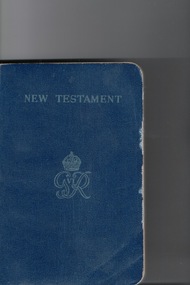
... New South Wales Auxillary. To members of the Navy and Air Force volunteering for Active Service in defence of the British Empire. ...New South Wales Auxillary. To members of the Navy and Air Force volunteering for Active Service in defence of the British Empire. ...Ronald Leslie Gregory (R/22961) served in the Australian Royal Navy. Born 5th August 1921, he enlisted on the 7th March 1939, and served on the HMAS Kuttabul II. He was discharged in 1948. The bible forms part of a collection of Ronald Leslie's belongings that were donated to the Lara RSL in 2006.Royal blue New Testament pocket sized. Presented by 'The British and Foreign Bible Society'. New South Wales Auxillary. To members of the Navy and Air Force volunteering for Active Service in defence of the British Empire. Name: Ronald L. Gregory REverand A. W. Stuart B. A. General Secretary Sydney 1940 [name: unable to be read] Chaplain H.M.A.S. Australia world war 2, ww2, wwii, hmas australia -
 Flagstaff Hill Maritime Museum and Village
Book, The Old Bus
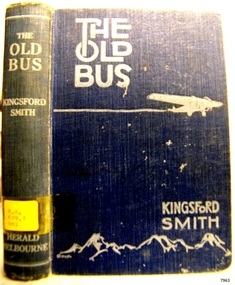
... air transport in such a vast country. He formed a partnership with pilot Keith Anderson in 1924 and they purchased two Bristol Tourer biplanes. Their business broadened to include Charles Ulm and became the Interstate Flying services in Sydney. Together they performed important ‘demonstration’ flights including a flight around Australia in 10 days and 5 hours using very limited navigational equipment. Kingsford Smith immediately started to search for support to do a trans-Pacific flight. This support came from the New South Wales...air transport in such a vast country. He formed a partnership with pilot Keith Anderson in 1924 and they purchased two Bristol Tourer biplanes. Their business broadened to include Charles Ulm and became the Interstate Flying services in Sydney. Together they performed important ‘demonstration’ flights including a flight around Australia in 10 days and 5 hours using very limited navigational equipment. Kingsford Smith immediately started to search for support to do a trans-Pacific flight. This support came from the New South Wales ...Sir Charles Edward Kingsford Smith is a famous Australian, well known in civil aviation history for his courageous endeavours in flight. He broken many flight records for long distance and time travelled and he was also a war hero in World War 1. He has been referred to as being “known to millions of Australians as “Smithy” … he was one of Australia’s true twentieth-century legends”. In honour of his place amongst the world’s famous pioneers his image is featured on Australia’s $20 note, Sydney airport is named after him, there is a memorial to Kingsford Smith, Taylor and Ulm at the Anderson Park, also in Sydney and his plane “Southern Cross” is on view at Brisbane Airport. Kingsford Smith wrote ‘The Old Bus’ (1932) and he and Ulm were co-authors of ‘Story of 'Southern Cross' Trans-Pacific Flight’ (1928). His also wrote a book about his own life ‘My Flying Life’ which was published after his death in 1937. and the story of his life was filmed in Australia in 1946. A BRIEF HISTORY OF SIR CHARLES EDWARD KINGSFORD SMITH (1897 – 1935) … Kingsford Smith was born 9th February 1897 in Brisbane, Queensland, Australia. His parents were William Charles Smith and Catherine Mary, nee Kingsford. His mother’s maiden name of “Kingsford” was added to the family name when they spent time in Canada from around 1903 to 1907, after which they returned to Sydney, Australia. In 1915 Kingsford Smith enlisted in Australian Imperial Force. He served in 4th Signal Troop, 2nd Division Signal Company at Gallipoli Peninsular as a ‘sapper’ or combat engineer and later in Egypt and in France as a dispatch rider. In 1916 Kingsford Smith was transferred to the Australian Flying Corps as a sergeant. He was discharged after training in England and commissioned as a second lieutenant in the Royal Flying Corps. He was appointed fling officer and soon joined the 23rd Squadron in France. He brought down four machines in his first month there and also did invaluable work attacking enemy targets. He was wounded and shot down and later awarded the Military Cross ‘for conspicuous gallantry and devotion to duty’. He was promoted to lieutenant in 1918 and served as a Flying Instructor with the R.F.C. Kingsford Smith was not allowed to participate in the 1919 England to Australia air race because of assumed lack of navigational experience. He and his pilot friend Cyril Maddocks formed a business and flew joy-flights in both England and America. In America he did some stunt flying with a Flying Circus. Kingsford Smith returned to Australia in 1921 and found employment as a pilot. He soon realised the value of air transport in such a vast country. He formed a partnership with pilot Keith Anderson in 1924 and they purchased two Bristol Tourer biplanes. Their business broadened to include Charles Ulm and became the Interstate Flying services in Sydney. Together they performed important ‘demonstration’ flights including a flight around Australia in 10 days and 5 hours using very limited navigational equipment. Kingsford Smith immediately started to search for support to do a trans-Pacific flight. This support came from the New South Wales government, Sidney Myer and G. Allan Hancock, an American oil magnate. On 31st May 1928 Kingsford Smith, Charles Ulm and two American crewmen, Harry Lyan and Jim Warner, took off from Oakland, California and flew to Brisbane via Hawaii and Suva. This historic flight took 83 hours and 38 minutes. Their Fokker plane had three engines and was named the “Southern Cross”. This amazing achievement resulted in huge financial subscriptions. Kingsford Smith was awarded the Air Force Cross and appointed as honorary squadron leader, Royal Australian Air Force. Kingsford Smith flew his Southern Cross plane from Point Cook in Victoria to Perth nonstop. Then in September – October 1928, with Charles Ulm and an Australian crew, he piloted the Southern Cross from Sidney to Christchurch New Zealand. This flight showed that was possible for regular passenger and mail services across the Tasman Sea. Kingsford Smith flew his plane to England to an order for four aircraft, planning to use them for an inter-capital air service in Australia. Sadly on 1st April 1929 he was forced to land, having lost radio contact with the ground and having run into bad weather over north – west Australia. Keith Anderson and Robert Hitchcock both perished before the search party reached them. Once official enquiries were completed the flight to England continued in June and was completed in record time of 12 days and 18 hours. In January 1930 Kingsford Smith piloted the “Southern Cloud”, one of the new Avro Ten planes, on the first flight of his airline, the Australian National Airways, from Sydney to Melbourne. The “Southern Cross” was overhauled in Holland by the Fokker Aircraft Co. and in June 1930 Kingsford Smith achieved an east-west crossing of the Atlantic from Ireland to Newfoundland in 31.5 hours. Kingsford Smith returned to England and took delivery of an Avro Avian biplane that he named the “Southern Cross Junior” and flew solo from England to Darwin, Australia. This record breaking flight took less than 10 days. He beat four other planes that had left England before him and he was 5.5 days faster than Hinkler. Sadly Kingsford Smith’s “Southern Cloud” was lost during a flight from Sydney to Melbourne in 1931 with no surviving crew or passengers; in 1958 the wreckage was discovered in the Snowy Mountains. Later that year Kingsford Smith flew his “Southern Cloud” from Australia to Timor, collecting mail from a damaged Imperial Airways plane in Timor. Other flights followed. Kingsford Smith was knighted in 1932 for his services in Aviation. He returned to selling joy flights then established the Kingsford Smith Air Service, a flying training school in Sydney. In 1933 Kingsford Smith flew the amazing record flight in “Miss Southern Cross” – a Percival Gull - from London to Wyndham in Western Australia in just over ten days. The Australian Commonwealth then gave Kingsford Smith a large grant and he was also appointed as aviation consultant to Vacuum Oil Co. Another flying record was made when Kingsford Smith and Sir P.G. Taylor flow “Lady Southern Cross” from Brisbane to San Francisco in order to sell her there; the west-east-trans-Pacific flight made aviation history. They returned to Australia to make an attempt at the trans-Tasman flight but their attempt failed due to engine failure; they managed to get back to Sydney safely, minus most of their cargo. Kingsford Smith had his unsold “Lady Southern Cross” shipped back to England, from where he and J. T. Pethybridge in the “Lady Southern Cross” attempted another record breaking flight from England The Old Bus Author: Charles Kingsford Smith Publisher: Distibuted by Herald Feature Service Date; 1932Label on spine cover with typed text RA 629.1309 KIN flagstaff hill, warrnambool, shipwrecked coast, flagstaff hill maritime museum, maritime museum, shipwreck coast, flagstaff hill maritime village, great ocean road, the old bus, charles kingsford smith -
 Mission to Seafarers Victoria
Book, Nautical Association of Australia Inc, A Lucky Ship – Nine Lives of Australian Coaster Tambar 1912-1960, 2013
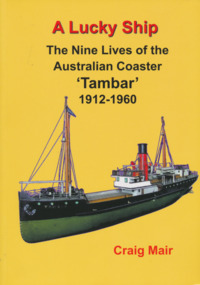
... New South Wales, then for the Tasmanian Government and Holymans in Bass Strait (King Island) and as the last steamer serving the Gippsland Lakes. In between she even spent a few years in Papua New Guinea. When World War II broke out, Tambar was commissioned into the RAN as an auxiliary minesweeper, but after the terrible Darwin air raid in 1942 became the first vessel of the newly formed Salvage Board, later assisting in the search for survivors of the Battle of the Coral Sea. ...This high-quality book is the extraordinary story of an ordinary little ship that had a long and eventful life. Perhaps few Australian coasters have had a more interesting and varied history. Built in Scotland in 1912 for the North Coast Steam Navigation Company, Tambar worked as a lifeline to isolated river and island communities, first in New South Wales, then for the Tasmanian Government and Holymans in Bass Strait (King Island) and as the last steamer serving the Gippsland Lakes. In between she even spent a few years in Papua New Guinea. When World War II broke out, Tambar was commissioned into the RAN as an auxiliary minesweeper, but after the terrible Darwin air raid in 1942 became the first vessel of the newly formed Salvage Board, later assisting in the search for survivors of the Battle of the Coral Sea. Returning to Bass Strait in 1944 for a few more years, she then spent the 1950s on standby as a salvage vessel in Melbourne, working on Merilyn, Terawhiti, E.J. Fairnie, and River Burnett. Craig Mair grew up in Grangemouth, Scotland where Tambar was built, and became interested after inheriting a builder's model from his father. He has consulted thousands of records, including the ship's logs, tracked down witnesses, and assembled over 100 photographs and maps to give a unique insight into Tambar's story, and coastal Australia in the middle decades of the twentieth century, before roads took over the transport task. Besides many colourful stories of shipwrecks and strandings, strange cargoes, salty characters, exotic places, wartime air raids, and salvage jobs, the book includes a definitive account of the worst Second World War 'friendly fire' incident in Australian waters in Moreton Bay in 1942.250 pages, Appendices, Bibliography and Indices, extensively illustratednon-fictionThis high-quality book is the extraordinary story of an ordinary little ship that had a long and eventful life. Perhaps few Australian coasters have had a more interesting and varied history. Built in Scotland in 1912 for the North Coast Steam Navigation Company, Tambar worked as a lifeline to isolated river and island communities, first in New South Wales, then for the Tasmanian Government and Holymans in Bass Strait (King Island) and as the last steamer serving the Gippsland Lakes. In between she even spent a few years in Papua New Guinea. When World War II broke out, Tambar was commissioned into the RAN as an auxiliary minesweeper, but after the terrible Darwin air raid in 1942 became the first vessel of the newly formed Salvage Board, later assisting in the search for survivors of the Battle of the Coral Sea. Returning to Bass Strait in 1944 for a few more years, she then spent the 1950s on standby as a salvage vessel in Melbourne, working on Merilyn, Terawhiti, E.J. Fairnie, and River Burnett. Craig Mair grew up in Grangemouth, Scotland where Tambar was built, and became interested after inheriting a builder's model from his father. He has consulted thousands of records, including the ship's logs, tracked down witnesses, and assembled over 100 photographs and maps to give a unique insight into Tambar's story, and coastal Australia in the middle decades of the twentieth century, before roads took over the transport task. Besides many colourful stories of shipwrecks and strandings, strange cargoes, salty characters, exotic places, wartime air raids, and salvage jobs, the book includes a definitive account of the worst Second World War 'friendly fire' incident in Australian waters in Moreton Bay in 1942.naa, australian national line, interest group, moreton bay, tambar, coaster, ships -
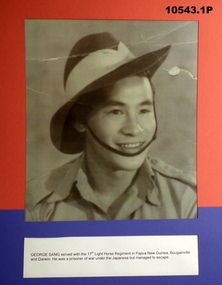 Bendigo Military Museum
Photograph - AUSTRALIAN CHINESE SERVICEMEN, WW1 & WW2, Bendigo & District RSL Club, WW1 & WW2
... Air Training Corps. 3. “COLLIN YOUNG” shown here with his brother ELLIS, joined up in 1842 when he was seventeen and a half. He served in an artillery unit as an anti-tank gunner. With another artillery unit, he toured Queensland and New South Wales...Air Training Corps. 3. “COLLIN YOUNG” shown here with his brother ELLIS, joined up in 1842 when he was seventeen and a half. He served in an artillery unit as an anti-tank gunner. With another artillery unit, he toured Queensland and New South Wales ...Australian Chinese Servicemen from WW1 & WW2 photographs. Exhibition held at the Bendigo & District RSL, post 2010.1.2.3. Photographs on photographic paper, enlarged black and white portrait. Mount - red and blue colour cardboard, double mount with top area containing the photograph, lower area printed information. 1. Serviceman in uniform, portrait. 2. Serviceman in uniform, portrait. 3. Two Servicemen in uniform, full length informal portrait, WW1.Printed information - black ink print. 1. “GEORGE SANG” - served with the 17th Light Horse Regiment in Papua New Guinea, Bougainville and Darwin. He was a prisoner of war under the Japanese but managed to escape. 2. “SAM TONGWAY”enlisted on the 6th June 1917. He tried to enlist in 1916, but was rejected in medical grounds (regulations against those of a Chinese background). He embarked with Reinforcements to A.M.C. on the 6th May 1918. As an Army Signaller he transferred in Egypt to the Division Signalling Company in France in France with his brother Hedley. During World War 2 he served in the Air Training Corps. 3. “COLLIN YOUNG” shown here with his brother ELLIS, joined up in 1842 when he was seventeen and a half. He served in an artillery unit as an anti-tank gunner. With another artillery unit, he toured Queensland and New South Wales, then was posted to an anti-aircraft gun station in Darwin. photographs, australian/chinese, ww1, ww2 -
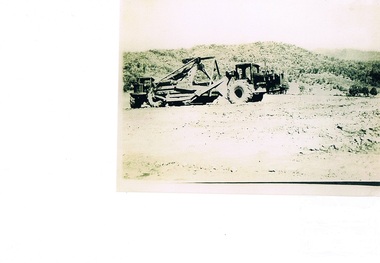 Kiewa Valley Historical Society
Photograph Tournapull, Tournapull C Scraper/Single Bucket, circa 1950
... New South Wales Alps. This was Australia's answer to a non polluting supply of electricity for a fast growing city population. It was at this time that air...New South Wales Alps. This was Australia's answer to a non polluting supply of electricity for a fast growing city population. It was at this time that air ...The machinery in this photo shows a Tournapull C earth moving machine, one of many during this period Circa 1950 - 1960s when hydro electricity powered turbines were being constructed in both the Victoria and New South Wales Alps. This was Australia's answer to a non polluting supply of electricity for a fast growing city population. It was at this time that air pollution from coal powered furnaces was becoming more and more under attack by health authorities.This item is part of a visual account of the construction of dams and hydro electricity facilities during the early 1950s. It was the beginning of the environmental push not to allow the degrading of Australian Alpine regions. Air pollution of the major cities and the increase in power demands of both industries and population within them required an alternative pollution free alternative electricity supply. These for runners of Hydro electricity generators required both large supplies of machinery and human resources. This construction phase within the region brought not only tradesmen but also unskilled workers to an area which had mainly had farming and mining activities. It was the catalyst for the creation of the smaller towns/villages e.g. Bogong Village, Mount Beauty and Bright.Black and white photograph on Kodak Xtralite II paper.(gloss)paper marking on back Kodak Xtralite II papermining, hydro electricity, victorian alps, construction camps, earth moving machines, secv -
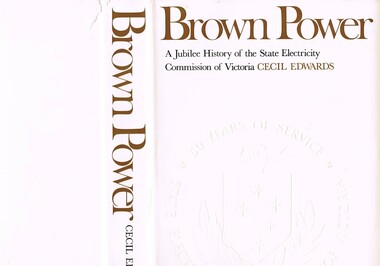 Kiewa Valley Historical Society
Book - Reference S.E.C. History x4, Brown Power A Jubilee History of the State Electricity Commission of Victoria, first published 1969
... air in World War II(1939 -1945). After the war, post 1945, the demand for a continual power supply, not affected by seasonal coastal flooding was together with a lower cost of hydro electricity power the major incentive for the Victoria Government of the day to proceed (in the 1940s) with The Kiewa Hydro Electricity Scheme. In 1946 Victorian government sought greater independence from the New South Wales...air in World War II(1939 -1945). After the war, post 1945, the demand for a continual power supply, not affected by seasonal coastal flooding was together with a lower cost of hydro electricity power the major incentive for the Victoria Government of the day to proceed (in the 1940s) with The Kiewa Hydro Electricity Scheme. In 1946 Victorian government sought greater independence from the New South Wales ...Although this book revolves around the supply of power(Electricity) from brown coal it does cover the period 1937 onwards when the Kiewa Hydro Electricity Scheme was first mooted. This area was believed to be far away from aerial bombardment should the coastal power stations be attacked by air in World War II(1939 -1945). After the war, post 1945, the demand for a continual power supply, not affected by seasonal coastal flooding was together with a lower cost of hydro electricity power the major incentive for the Victoria Government of the day to proceed (in the 1940s) with The Kiewa Hydro Electricity Scheme. In 1946 Victorian government sought greater independence from the New South Wales black coal supplies.The significance of this book to the Kiewa Valley and its outlying regions is that it details why the development of an Alpine region was and now still is pocketed with a European flavour both in buildings and in town vegetation(trees and flowers). European (post World War II refugees) where attracted to these alpine areas not only for hard labouring positions but also for their technical skills and some street names offer a distinct European lineage rather than convict or of earlier English settler. The construction phase accommodation continued after completion of the Kiewa Hydro Electricity Scheme to become popular venues for an increasing winter tourism industry. This book has a brown hard cover encapsulated by a cream sleeve with brown and black print. On the front of the sleeve is an embossed circular motif with centre piece S.E.C. emblem and around this the words "50 YEARS OF SERVICE" and below this" STATE ELECTRICITY COMMISSION OF VICTORIA". The book contains 313 double sided pages of black print and black and white photographs.On front of paper sleeve "Brown Power A Jubilee History of the State Electricity Commission of Victoria Cecil Edwards". On the second page, below the Title "Brown Power" there is a pasted, printed presentation certificate, with the S.E.C. emblem and these printed words " Presented by the Chairman and Commissioners to A.G. MILLIST, ESQ. in recognition of long and valued service with the Commission"electricity, victorian power supplies, hydro electricity, brown coal, cecil edwards -
4th/19th Prince of Wales's Light Horse Regiment Unit History Room
Flag, 173rd Airborne Brigade (US)
... South Vietnam, where further organizational changes were to take place. Australians attached to the Brigade were: 1st Battalion, of the Royal Australian Regiment (I RAR) and support troops of the 4/19th Prince of Wales Light Horse Regiment (1Troop), 105 Field Battery Royal Australian Artillery, 161 Field Battery Royal New Zealand Artillery, 3 Field Troop Royal Australian Engineers, 161 Reconnaissance Flight, Royal Australian Army Air Corps, 1st Australian Logistical Support Company. ...South Vietnam, where further organizational changes were to take place. Australians attached to the Brigade were: 1st Battalion, of the Royal Australian Regiment (I RAR) and support troops of the 4/19th Prince of Wales Light Horse Regiment (1Troop), 105 Field Battery Royal Australian Artillery, 161 Field Battery Royal New Zealand Artillery, 3 Field Troop Royal Australian Engineers, 161 Reconnaissance Flight, Royal Australian Army Air Corps, 1st Australian Logistical Support Company. ...173 AIRBORNE BRIGADE (SEPARATE) US ARMY 1 RAR BATTLE GROUP BIEN HOA 1965-1966 On May 5, 1965, the Brigade deployed to South Viet Nam as the first US Army ground combat unit in that war. Upon arrival, the 1st Battalion of the Royal Australian Regiment (1 RAR) and a battery from New Zealand (161Royal NZ Artillery) were attached to the Brigade -- making the 173d Airborne the only multi-national combat unit in the war. Initially headquartered in Bien Hoa, the Brigade operated in the four provinces around Saigon. (Xuan Loc, Long Khanh, Phuoc Long & Phuoc Tuy), but (in its roll as a "Fire Brigade") also went to the Central Highlands (Pleiku / Kontum) to fight Viet Cong. The 173d also conducted constant operations against the southern stronghold of the VC Main Force in the legendary Iron Triangle in War Zone D. The brigade was organized as a balanced airborne combat force consisting of two infantry battalions, an artillery battalion, a support battalion, an engineer company, a cavalry troop, an armour company, and a headquarters company. Upon activation, it became the first and only separate airborne brigade in the United States Army. This was the beginning of a long series of "Firsts" for the Brigade. On 5 May 1965, it became the first US Army ground combat unit committed to the war in South Vietnam, where further organizational changes were to take place. Australians attached to the Brigade were: 1st Battalion, of the Royal Australian Regiment (I RAR) and support troops of the 4/19th Prince of Wales Light Horse Regiment (1Troop), 105 Field Battery Royal Australian Artillery, 161 Field Battery Royal New Zealand Artillery, 3 Field Troop Royal Australian Engineers, 161 Reconnaissance Flight, Royal Australian Army Air Corps, 1st Australian Logistical Support Company. The Brigade's two infantry battalions, the First Battalion of the 503' Infantry (1/503`d) and the Second Battalion, of the 503`d Infantry (2/503`) and the attached Australians of 1 RAR constituted the infantrymen available to the Brigade. Their mission was to protect the Bien Hoa Air Base and to close with and destroy or capture the enemy. This was in fact the first operational ground force formed under the ANZUS Defence Treaty. ANZUS was a mutual defence treaty signed in 1951 between Australia, New Zealand and the United States of America. In 1965 the spirit of this treaty appeared as 173d Airborne Brigade (Sep) a tri-national brigade. The only such tri-national fighting force formed during the Vietnam War. On deployment to South Vietnam in 1965, 1 Troop A Squadron, 4th/19th Prince of Wales's Light Horse Regiment was part of the US 173rd Airborne Brigade combat group. Flag, two colours divided vertically, hoist half mid blue, fly half red. Badge of 173rd Airborne Brigade (730 x 490 mm) in centreflag, 173rd airborne, south vietnam -
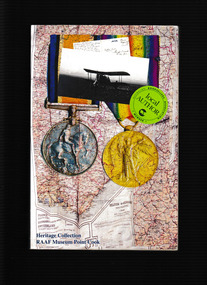 Monbulk RSL Sub Branch
Book, Bruce Anderson, Ploughshares and propellers, 2008
... Royal Australian Air Force - History Royal Australian Air Force - Biographies The Australian Flying Corps (AFC), RAAF and WAAAF have attracted into their ranks many young men and women from the old Shires of Kerang, Cohuna, East Loddon and Gordon in north central Victoria and Wakool in the western Riverina district of New South Wales. ...The Australian Flying Corps (AFC), RAAF and WAAAF have attracted into their ranks many young men and women from the old Shires of Kerang, Cohuna, East Loddon and Gordon in north central Victoria and Wakool in the western Riverina district of New South Wales. This book tells some of their stories and exploits from 1914-1918, 1939-1945 and onwards to the 1990s.Ill, p.560.non-fictionThe Australian Flying Corps (AFC), RAAF and WAAAF have attracted into their ranks many young men and women from the old Shires of Kerang, Cohuna, East Loddon and Gordon in north central Victoria and Wakool in the western Riverina district of New South Wales. This book tells some of their stories and exploits from 1914-1918, 1939-1945 and onwards to the 1990s. royal australian air force - history, royal australian air force - biographies -
 Bendigo Historical Society Inc.
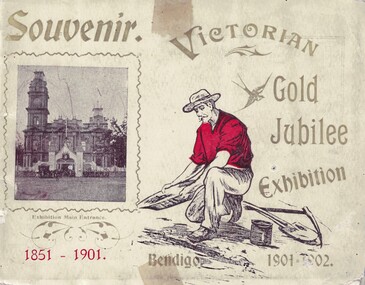
Souvenir - Views of Bendigo, 1902
... The most valuable exhibits were mining machinery such as Taylor Horsfield’s £850 “Air Compressor & Rock Borer” * 8662.1y Victorian Gold Jubilee Exhibition - Page 23 of 29 A Peep at the Education Department 8662.1z Victorian Gold Jubilee Exhibition - Page 24 of 29 John Danks and Co's Exhibit. John Danks & Son was a major manufacturing company in Melbourne, Victoria and Sydney, New South Wales...The most valuable exhibits were mining machinery such as Taylor Horsfield’s £850 “Air Compressor & Rock Borer” * 8662.1y Victorian Gold Jubilee Exhibition - Page 23 of 29 A Peep at the Education Department 8662.1z Victorian Gold Jubilee Exhibition - Page 24 of 29 John Danks and Co's Exhibit. John Danks & Son was a major manufacturing company in Melbourne, Victoria and Sydney, New South Wales ...The Victorian Gold Jubilee Exhibition, held at Bendigo from 13 November 1901 to 14 May 1902. The courts were numbered from one, or had titles like “Machinery”, “Agricultural”, “Naval & Military Court” and “Art”. The female visitors to the Exhibition were able to view exhibits deemed suitable for the fairer sex and located within their own “Women’s Court”. There were exhibits such as “Parasols & Umbrellas”, cotton and haberdashery from Manchester and Staffordshire, “Corsets & Embroideries” from Paris. The most valuable exhibits were mining machinery such as Taylor Horsfield’s £850 “Air Compressor & Rock Borer”. “Bohemian Glassware” brought down from Sydney was valued at £600. The profits from this Exhibition were used to fund the sculpture known as the Gold Monument, which still gazes along Pall Mall (from the McCrae Street end). The Exhibition’s Cash Book shows payments, which totalled £1160, were made to then up and coming sculptor C.D.Richardson. Recently a City of Greater Bendigo staff member used both these volumes to write a detailed report about this monument, for Heritage Victoria.Carol Holsworth Collection: Small book Souvenir, 29 pages plus cover; each page. has a photo of the exhibit. Exhibition was held on the site of the present Bendigo Library between Hargreaves St and Lyttleton Terrace. * 8662.1a Victorian Gold Jubilee Exhibition - Front Cover: Printed 'Souvenir', 'Bendigo 1901-1902'; a photo of the Entrance to the exhibition beside the Town Hall. * 8662.1b Victorian Gold Jubilee Exhibition - Inside Front Cover - Page 1 of 29. Portraits of Exhibition President S.H. Cowen esq.; and G.V. Allen esc., General Secretary. Photos by W.H. Robinson publisher. Printed by T. Cambridge, Market Square Bendigo. * 8662.1c Victorian Gold Jubilee Exhibition - Page 1 of 29 The Governor General at the Exhibition. Photo of the crowd, police, trooper and horse drawn vehicles. * 8662.1d Victorian Gold Jubilee Exhibition - Page 2 of 29 Procession Passing the Fountain, Pall Mall. The crowd and horse drawn vehicles. *8662.1e Victorian Gold Jubilee Exhibition - Page 3 of 29 James Martin and Co's Exhibit. James Martin & Co was an Australian engineering company which progressed from making agricultural equipment to making railway locomotives. * 8662.1f Victorian Gold Jubilee Exhibition - Page 4 of 29 Old Pioneers. Elderly gentlemen on foot and carriage - at the Bendigo Railway Station. * 8662.1g Victorian Gold Jubilee Exhibition - Page 5 of 29 Robert Harper and Company's Exhibit. From Trove - The Brisbane Courier 25 Aug 1891: One of the best known firms in the Southern hemisphere is Messrs. Robert Harper and Co , tea importers, coffee, rice, and spice merchants and manufacturers Then productions circle this continent, and every thrifty housewife is familiar with their Empire tens, their Star' brand of goods, then oatmeal, wheatmeal, and other breakfast table luxuries The headquarters of the firm are placed at Port Melbourne, and the manufactory there occupies over an acre of ground, while the mills at Sydney and Adelaide are as great in proportion It is eight cars since the firm opened business in this colony. The step was taken with much confidence, the principals the firm being quite attracted. * 8662.1h Victorian Gold Jubilee Exhibition - Page 6 of 29 The Electric Tram * 8662.1i Victorian Gold Jubilee Exhibition - Page 7 of 29 G. Weymouth Proprietary Ltd. The business of G. Weymouth & Co was founded in 1898 by George Andrew Philip Weymouth, who began operating from a small workshop on City Road, South Melbourne (opposite Princes Bridge). An early advertisement describes the firm's activities at this time as being 'makers of dynamos, (electric) motors, x-ray apparatus and electrical instruments, &c' together with 'repairs to every class of electrical work'. * 8662.1j Victorian Gold Jubilee Exhibition - Page 8 of 29 The Exhibition Fernery * 8662.1k Victorian Gold Jubilee Exhibition - Page 9 of 29 Cohn Bros'. Exhibit. In 1857 at the height of the gold rush, with people pouring into Central Victoria from all over the world, three brothers from Denmark – Moritz, Julius and Jacob Cohn – founded a small cordial factory in the booming town of Bendigo. They went on to build an empire and, through introducing lager, which is served cold, to the country, changed the drinking preferences of Australians. * 8662.1l Victorian Gold Jubilee Exhibition - Page 10 of 29 Ornamental Lake in the Exhibition Grounds * 8662.1m Victorian Gold Jubilee Exhibition - Page 11 of 29 Australian Explosives and Chemical Co.'s Exhibit. The Australian Explosives and Chemical Company began manufacturing explosives in Melbourne's outskirts (the area now known as Deer Park) in 1875. In 1897 the Company was purchased by Nobel, forming Nobel (Australasia) Ltd. * 8662.1n Victorian Gold Jubilee Exhibition - Page 12 of 29 Tasmanian Court * 8662.1o Victorian Gold Jubilee Exhibition - Page 13 of 29 N. Guthridge's Limited Exhibit. Guthridge sold a variety of mining supplies and equipment; also 'Rackarock' which was used to fill the mining drill holes before blasting. * 8662.1p Victorian Gold Jubilee Exhibition - Page 14 of 29 Navel and Military Court (LARGE File) * 8662.1q Victorian Gold Jubilee Exhibition - Page 15 of 29 Women's Court * 8662.1r Victorian Gold Jubilee Exhibition - Page 16 of 29 T. J. Connelly and Co's Exhibit. T.J. Connelly an American immigrant came to the Bendigo goldfields where he later established Connelly’s Tin Shop on the corner of High and Forest Streets 1853. Connelly was named after Thomas Jefferson the famous statesman who wrote much of the American Declaration of Independence in 1776 and became the third United States President. Connelly, along with other prominent citizens of the time established Bendigo’s first Fire Brigade, Mechanics Institute. * 8662.1s Victorian Gold Jubilee Exhibition - Page 17 of 29 The Potter's Wheel * 8662.1t Victorian Gold Jubilee Exhibition - Page 18 of 29 G. D. Guthrie and Co.'s Exhibit. In 1863 the Bendigo Pottery was set up by Guthrie. * 8662.1u Victorian Gold Jubilee Exhibition - Page 19 of 29 The Ladies' Committee * 8662.1v Victorian Gold Jubilee Exhibition - Page 20 of 29 J. Kitchen and Sons Exhibit. In Port Melbourne since the 1850s they made such products as Velvet Soap and Electrine Candles from the tallow and other animal fats from the nearby slaughter yards. In recent decades the company has become Kitchen & Lever then Unilever and most recently Unichema. * 8662.1w Victorian Gold Jubilee Exhibition - Page 21 1of 29 The Executive Committee * 8662.1x Victorian Gold Jubilee Exhibition - Page 22 of 29 Taylor Horsfield Exhibit. The most valuable exhibits were mining machinery such as Taylor Horsfield’s £850 “Air Compressor & Rock Borer” * 8662.1y Victorian Gold Jubilee Exhibition - Page 23 of 29 A Peep at the Education Department 8662.1z Victorian Gold Jubilee Exhibition - Page 24 of 29 John Danks and Co's Exhibit. John Danks & Son was a major manufacturing company in Melbourne, Victoria and Sydney, New South Wales. * 8662.1aa Victorian Gold Jubilee Exhibition - Page 25 of 29 Glance at the Agricultural Department's Court * 8662.1bb Victorian Gold Jubilee Exhibition - Page 26 of 29 T. York's Exhibit. Thomas York was an instrument repairer and brass instrument maker that resided in Melbourne in the late 19th to the early 20th century. While old newspaper advertisements suggested he repaired all instruments, it appears the focus of his business were military and brass band instruments. (BrassandWoodWind.com) * 8662.1cc Victorian Gold Jubilee Exhibition - Page 27 of 29 T. McPherson and Son's Exhibit. Possibly monumental masons. * 8662.1dd Victorian Gold Jubilee Exhibition - Page 28 of 29 T. Lewis and Whitty's Exhibit - Inside Back Cover. Lewis & Whitty were prominent boot blacking manufacturers as well as a number of other chemical products such as “Odourbane" disinfectant. * 8662.1ee Victorian Gold Jubilee Exhibition - Page 29 of 29 Singer Manufacturing Coy's Exhibithistory, bendigo, victorian gold jubilee exhibition bendigo, carol holsworth collection -
 National Vietnam Veterans Museum (NVVM)
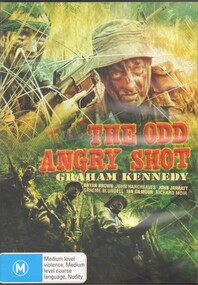
Film - Film, DVD, Roadshow Entertainment, The Odd Angry Shot, 1979
... The movie, which was shot on location in New South Wales and Canungra, Queensland, traces the tour of duty of an Australian Special Air Service Regiment reconnaissance team from their departure to their return home to Australia. ...The movie, which was shot on location in New South Wales and Canungra, Queensland, traces the tour of duty of an Australian Special Air Service Regiment reconnaissance team from their departure to their return home to Australia. ...The Odd Angry Shot is a 1979 Australian war film written, directed and produced by Tom Jeffrey (with Sue Millikin).] It is based on the book of the same title by William Nagle, and follows the experiences of Australian soldiers during the Vietnam War. The movie, which was shot on location in New South Wales and Canungra, Queensland, traces the tour of duty of an Australian Special Air Service Regiment reconnaissance team from their departure to their return home to Australia. It avoids much of the political comment on Australia’s involvement in Vietnam, unlike Hollywood films which tend to explore the rights and wrongs of the Vietnam War. The film focuses on the soldiers in their cantonments away from the battlefield, where they spend the bulk of their time playing cards, smoking, drinking beer, nursing their tinea, making jokes and messing about with American forces. The film also contains some small scale battle scenes. When the men return to Australia, they reflect on how both they and the general Australian society have changed. (In particular, they find it unwise to disclose that they fought in Vietnam: to do so invited abuse in a society divided about whether Australians should have been sent to fight there.) Sourced from WikipediaThe cover of the DVD depicts several soldiers. There is one with a gun behind his head. Inside there is the DVD of the movie titled The Odd Angry Shot starring Graham Kennedydvd, australian special air service (sas), australian actors, graham kennedy (actor) -
 National Vietnam Veterans Museum (NVVM)
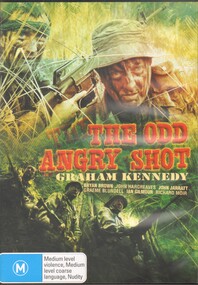
Film - Film, DVD, Roadshow Entertainment, The Odd Angry Shot, 1979
... The movie, which was shot on location in New South Wales and Canungra, Queensland, traces the tour of duty of an Australian Special Air Service Regiment reconnaissance team from their departure to their return home to Australia. ...The movie, which was shot on location in New South Wales and Canungra, Queensland, traces the tour of duty of an Australian Special Air Service Regiment reconnaissance team from their departure to their return home to Australia. ...The Odd Angry Shot is a 1979 Australian war film written, directed and produced by Tom Jeffrey (with Sue Millikin).] It is based on the book of the same title by William Nagle, and follows the experiences of Australian soldiers during the Vietnam War. The movie, which was shot on location in New South Wales and Canungra, Queensland, traces the tour of duty of an Australian Special Air Service Regiment reconnaissance team from their departure to their return home to Australia. It avoids much of the political comment on Australia’s involvement in Vietnam, unlike Hollywood films which tend to explore the rights and wrongs of the Vietnam War. The film focuses on the soldiers in their cantonments away from the battlefield, where they spend the bulk of their time playing cards, smoking, drinking beer, nursing their tinea, making jokes and messing about with American forces. The film also contains some small scale battle scenes. When the men return to Australia, they reflect on how both they and the general Australian society have changed. (In particular, they find it unwise to disclose that they fought in Vietnam: to do so invited abuse in a society divided about whether Australians should have been sent to fight there.) Sourced from WikipediaThe cover of the DVD depicts several soldiers. There is one with a gun behind his head. Inside there is the DVD of the movie titled The Odd Angry Shot starring Graham Kennedydvd, australian special air service (sas), australian actors, graham kennedy (actor) -
Moorabbin Air Museum
Document (item) - Roland Jahne Collection - See Description for details
... Air International Manilla folder No date Argosy. Armstrong Whitworth. Manilla folder Various Whitley. Armstrong Whitworth. Manilla folder Various Armstrong + Manilla folder Jun-85 Ariane 5 Manilla folder Various Arado Folder 1995 The New South Wales, Victoria and Tasmania Country Landing Grounds Guide. ...Air International Manilla folder No date Argosy. Armstrong Whitworth. Manilla folder Various Whitley. Armstrong Whitworth. Manilla folder Various Armstrong + Manilla folder Jun-85 Ariane 5 Manilla folder Various Arado Folder 1995 The New South Wales, Victoria and Tasmania Country Landing Grounds Guide. ... -
 Australian Gliding Museum
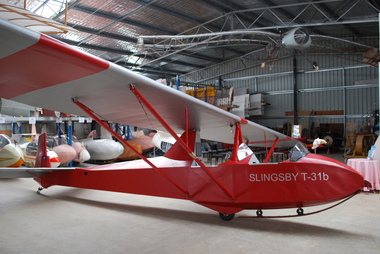
Machine - Glider – Sailplane, 29/071956
... new ES52 Kookaburra. After a couple of years, the wreck was purchased by a member of the Waikerie Gliding Club whereupon the glider was rebuilt with some modifications, including a more rounded and better streamlined fuselage nose. It returned to the air in October 1961 at Clare in South Australia. The ownership of VH-GDB passed through a number of clubs, including at Dubbo in New South Wales...new ES52 Kookaburra. After a couple of years, the wreck was purchased by a member of the Waikerie Gliding Club whereupon the glider was rebuilt with some modifications, including a more rounded and better streamlined fuselage nose. It returned to the air in October 1961 at Clare in South Australia. The ownership of VH-GDB passed through a number of clubs, including at Dubbo in New South Wales ...The Slingsby T31 is a two seat training glider that came available in 1951. It is, in effect, a two seat version of the single seat Kirby Tutor. The T31 was marketed by Slingsby Sailplanes both as complete aircraft and kits of parts for assembly. The Australian Gliding Museum’s example (currently registered as VH-GDB) is one of five of this type to grace Australian skies. Three including GDB were assembled in Australia from kits supplied by Slingsby’s in England, the other two were delivered as completed airframes. To date only four remain of which two are airworthy. This aircraft began flying in at Caversham in Western Australia (the then home of the Gliding Club of Western Australia) in July 1956. It was badly damaged in a crash in June 1958. The wreckage was sent to Schneiders in Adelaide for repair. However, the Club decided against having the repairs done, opting instead to buy a new ES52 Kookaburra. After a couple of years, the wreck was purchased by a member of the Waikerie Gliding Club whereupon the glider was rebuilt with some modifications, including a more rounded and better streamlined fuselage nose. It returned to the air in October 1961 at Clare in South Australia. The ownership of VH-GDB passed through a number of clubs, including at Dubbo in New South Wales, Wimmera in Victoria and Pioneer Valley at Mackay in Queensland. Eventually, it came into the hands of Bill Riley of Tocumwal in New South Wales who held it in storage for many years. Riley donated the aircraft to the Museum. It has been restored to airworthiness and is flown at vintage glider rallies and on Museum open days. This exhibit is an excellent example of a Slingsby T31 Tandem Tutor, a type of glider that was used by a number of clubs in the 1950s and 1960s for dual training of pilots to the solo capability.The Slingsby T31b Tandem Tutor is an open cockpit, tandem, two-seater glider with high, pylon mounted two piece wing supported by double, wire braced, steel tube struts. The glider is fitted with a main wheel, rubber-block sprung, wooden nose skid and steel leaf sprung, brass shod tailskid. The basic controls of aileron, rudder and elevator are not supplemented with pitch trim. Wing lift spoilers and both aerotow and winch releases are fitted. The instrument panels in both cockpits are fitted with an airspeed indicator, cosim variometer and altimeter. This red and silver painted wood and fabric covered aircraft is in excellent condition having been restored to full airworthy status by the Australian Gliding Museum. SLINGSBY – T31b (nose – both sides) DB Australian Gliding Museum (rudder – both sides) It has been given Serial Number GFA/HB/12 and is registered as VH-GDBaustralian gliding, glider, sailplane, slingsby, tandem tutor, t31, gliding club of western australia, waikerie gliding club, wimmera soaring club, pioneer valley soaring club -
 Australian Gliding Museum
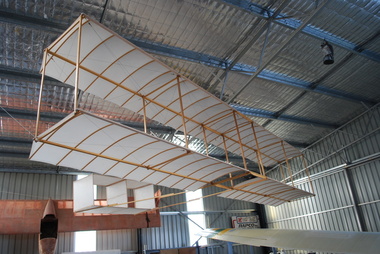
Machine - Glider
... The original “Taylor glider” was the aircraft used by George Taylor for the first heavier than air flight in Australia, which occurred on the 5 December 1909 on the beach at Narrabeen, New South Wales. ...The original “Taylor glider” was the aircraft used by George Taylor for the first heavier than air flight in Australia, which occurred on the 5 December 1909 on the beach at Narrabeen, New South Wales. ...The original “Taylor glider” was the aircraft used by George Taylor for the first heavier than air flight in Australia, which occurred on the 5 December 1909 on the beach at Narrabeen, New South Wales. On that historic day the glider was also flown by Edward Hallstrom, Charles Schultz, and Mrs Taylor and Mrs Schultz. The replicas were built by the Museum to celebrate the centenary of the first Australian heavier than air flight. The glider is an accurate full size replica of George Taylor’s Glider.Wooden frame, wire braced and fabric covered biplane hang-gliderNoneaustralian gliding, glider, biplane, george taylor, edward hallstrom, charles schultz, narrabeen, first flight -
 Australian Gliding Museum
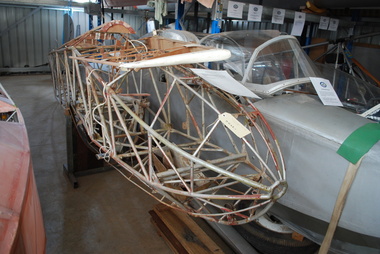
Machine - Glider – Sailplane, 1948
... South Australia on 16 August 1959. Inspections were carried out at that club and airworthiness certificates renewed in 1965. The logbook record indicates that VH-GDI had 1191 flights with an aggregate time in the air of 197 hours at the Wilmington Road Airstrip used by the Port Augusta Club. The glider was transferred to the Cooma Gliding Club, New South Wales...South Australia on 16 August 1959. Inspections were carried out at that club and airworthiness certificates renewed in 1965. The logbook record indicates that VH-GDI had 1191 flights with an aggregate time in the air of 197 hours at the Wilmington Road Airstrip used by the Port Augusta Club. The glider was transferred to the Cooma Gliding Club, New South Wales ...The Schweizer SGS 2-12 or TG-3A as officially certificated is a glider that was designed in 1941-1942 and produced in United States of America from 1942 for training of military glider pilots. It is understood that over 100 TG-As were supplied to the USA military and at the end of the war many were sold off as surplus. Fred Hoinville imported the Museum’s TG-3A into Australia in August 1950. It is understood that it had been built in 1948 and given construction number G15. On arrival in Australia it was assembled at Bankstown aerodrome and delivered by aero-tow behind a DH Tiger Moth to Camden where Hoinville’s club, the Hinkler Soaring Club, was based. Hoinville’s TG-3A performed well at the Hinkler club in 1950-1951. Several altitude records (including a solo flight to 8000 feet by Grace Roberts – a national women’s record) were set and many soaring flight made over Camden. However, it was badly damaged in a crash landing on 15 April 1951. The glider was repaired after the crash at Camden. It is likely that modifications were made to the cockpit canopy at this time. There were three configuration tried at various times: the original dual cockpit canopy as was standard for TG3As; an unusual dual bubble canopy set up; and a single canopy over the forward seating position (in effect converting the glider to a single seater). When the glider was flown by Hoinville at the 1958 Australian Gliding Championships at Benalla, Victoria in January 1959 (refer The Age Newspaper, January 10, 1959 p.21) it had a single canopy. Records show that the glider was entered on the Australian register as VH-GDI on 6 May 1957. And the Logbook commencing in 1959 shows that ownership passed to the Port Augusta Gliding Club in South Australia on 16 August 1959. Inspections were carried out at that club and airworthiness certificates renewed in 1965. The logbook record indicates that VH-GDI had 1191 flights with an aggregate time in the air of 197 hours at the Wilmington Road Airstrip used by the Port Augusta Club. The glider was transferred to the Cooma Gliding Club, New South Wales. Flying at Cooma began in November 1966 and continued until August 1969: the glider was in the air a further 108 hours from 1067 flights. The last recorded technical inspection of the glider was conducted on 28 September 1968. The glider then passed on to Bill Riley on 20 March 1980 who stored the glider until March 2004 when it was collected by the Australian Gliding Museum. It is not clear whether the current poor state of the airframe is due to accident damage or the conditions under which it has been stored over many years or a combination of factors. Although in poor condition, this exhibit is the sole example of a TG3A ex-US military aircraft in Australia. Further the connection with the story of well-known power and glider pilot Fred Hoinville adds to its historical significance. Tubular metal framed fuselage (without covering and fittings), wooden rudder (no covering) and in damaged condition, wooden fuselage component (formers for fuselage top), Parts of control mechanism, Wooden stringers, Wooden wings without fabric covering and in damaged condition, Ailerons, Tailplane /Elevator without fabric covering, Perspex bubble canopies.australian gliding, glider, sailplane, schweizer, tg 3a, hoinville, roberts, hinkler soaring club, port augusta gliding club, cooma gliding club, riley -
 Australian Gliding Museum
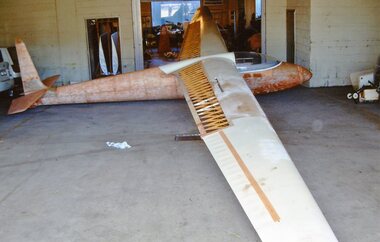
Machine - Glider – Sailplane, 1962
... New South Wales. The glider went to a Tasmania syndicate in June 1976 and finally to the Soaring Club of Tasmania. In total VH-GRW recorded 3369 hours air time from 4952 launches. ...New South Wales. The glider went to a Tasmania syndicate in June 1976 and finally to the Soaring Club of Tasmania. In total VH-GRW recorded 3369 hours air time from 4952 launches. ...This ES Ka6 sailplane (VH-GRW, serial number 55) was built under licence from Alexander Schleicher in 1962 by Edmund Schneider Limited. It was one of 12 Ka6s, with minor variations from the Schleicher product, built by Schneiders in Australia. It was test flown at Parafield Aerodrome, Adelaide, on 8th September 1962. By way of background, the Schleicher KA 6 series of sailplanes were designed by Rudolf Kaiser in Germany. They were quite successful in the Standard Class in the late 1950s and 1960s. Over 1400 were produced. The first owner of VH-GRW was the Victorian Motorless Flight Group which, at the time, was based at Berwick Airfield on the outskirts of Melbourne. On 22 April 1972, the ownership passed to a syndicate of members from the VMFG. It again changed ownership in July 1974. The new owners were another syndicate based at Campbelltown in New South Wales. The glider went to a Tasmania syndicate in June 1976 and finally to the Soaring Club of Tasmania. In total VH-GRW recorded 3369 hours air time from 4952 launches. It was used very little after 1996. This exhibit is an example of the Scheicher Ka6 sailplane type that were built by Edmund Schneider in Australia.Plywood, spruce and fabric covered high wing single seat sailplane. The airframe has been restored to the point of repainting. Currently the fuselage, rudder and the wings aft of the main spar are coated with pink dope. The tailplane retains the white gloss finish of the glider prior to the restoration work. The cockpit to be refitted (with instruments etc). Serial number 55. The manufacture details are displayed on a metal plate fixed to the main bulkhead. australian gliding, glider, sailplane, schneider, schleicher, ka6, rhonsegler, victorian motorless flight group, soaring club of tasmania -
 Australian Gliding Museum
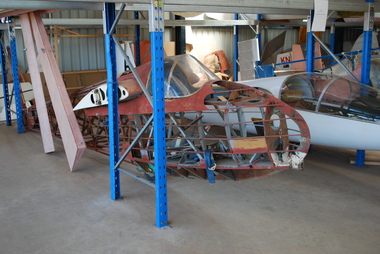
Machine - Glider – Sailplane, 1972
... New South Wales. The glider was registered as VH-GVO on 11 October 1973 and given serial number “GFA-HB-82” by the Gliding Federation of Australia. The Logbook for VH-GVO appears to be a complete record of the flying history; in aggregate 210 hours 40 minutes in the air from 331 flights. ...New South Wales. The glider was registered as VH-GVO on 11 October 1973 and given serial number “GFA-HB-82” by the Gliding Federation of Australia. The Logbook for VH-GVO appears to be a complete record of the flying history; in aggregate 210 hours 40 minutes in the air from 331 flights. ...The Hall Cherokee II glider is an American design for amateur construction from plans. The designer was Stan Hall (1915-2009), a professional engineer, who gained extensive experience in the United States aviation industry during World War 2 including the programs for military gliders. He continued to work as an engineer for aircraft manufacturers and as a consultant to the industry after the war. He was active in gliding and, in particular, the home built sailplane movement. The Cherokee II was one of about 10 glider designs that he produced: it came out in 1956. It is understood that over 100 Cherokee gliders have been built. In Australia the number is possibly 10 or 11. The Hall Cherokee VH-GVO was built by R.D Meares of Caringbah, New South Wales. The glider was registered as VH-GVO on 11 October 1973 and given serial number “GFA-HB-82” by the Gliding Federation of Australia. The Logbook for VH-GVO appears to be a complete record of the flying history; in aggregate 210 hours 40 minutes in the air from 331 flights. The first test hop occurred on 29 July 1972 at Camden, New South Wales. VH-GVO was last flown on 22 July 1986. Many of the flights recorded are of one or two hours duration. The glider was last inspected and certified as airworthy and in a reasonable condition at the Hunter Valley Gliding Club in July 1986. Since that time, until transferred to the Australian Gliding Museum, the glider was in storage. Structural restoration work has been completed on the fuselage and one wing. However, inspection of the other wing revealed extensive damage to the ribs and spars and consequently a decision was taken to make it a static exhibit. The exhibit is an example of home built construction of a type that has proved popular amongst amateur glider builders.The Hall Cherokee (formerly registered as VH-GVO) is a single seat wooden home built glider. The glider is constructed from wood, plywood, fabric and metal fittings, all commercial grade except for main wing fittings, pulleys, cables and bolts. The fuselage is simple with four main longerons and bulkheads with diagonal bracing. The wing has two identical solid spars which form a geodetic structure, hence the leading edge is non-structural. Registration VH-GVO – serial number GFA-HB-82 australian gliding, glider, sailplane, hall, cherokee, meares, hunter valley gliding club -
 Australian Gliding Museum
Machine - Glider - Sailplane, 1974
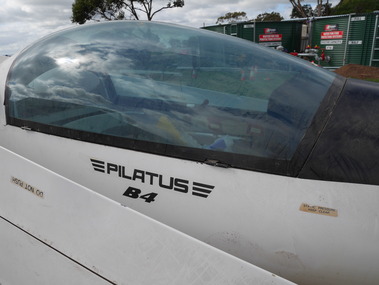
... New South Wales. In 1999 it was acquired by Michael Green and moved to Townsville, Queensland. The aircraft changed ownership again in 2004 and fell out of use for nearly 4 years. By then it had recorded 4377 hours in the air...New South Wales. In 1999 it was acquired by Michael Green and moved to Townsville, Queensland. The aircraft changed ownership again in 2004 and fell out of use for nearly 4 years. By then it had recorded 4377 hours in the air ...The Pilatus B4 is an all metal intermediate sailplane meeting Standard Class rules that was designed in 1966 by Ingo Herbst, Manfred Küppers and Rudolf Reinke. It did not immediately go into production. In 1972 Pilatus Aircraft of Switzerland acquired a licence to build the aircraft and began production. The PCII and PCIIA versions were semi-aerobatic. The PC11AF released in 1975 was rated as fully aerobatic. By 1980, when Pilatus sold the rights to manufacture of the aircraft to Nippi Aircraft of Japan, 322 of the Pilatus B4 had been produced. Nippi Aircraft built a further 13 and also one two seat version. The Pilatus B4 proved popular in Australia with 26 appearing on the Australian register. The Museum’s example is a basic semi-aerobatic type (Serial Number 092) that was built in 1974. It is registered as VH-GID on 8 July 1974 by H.G. Sutton of Mandura, Western Australia and flown out of the Narrogin Gliding Club in Western Australia until September 1986 when it was sold to the Albury – Corowa Gliding Club, New South Wales. In 1999 it was acquired by Michael Green and moved to Townsville, Queensland. The aircraft changed ownership again in 2004 and fell out of use for nearly 4 years. By then it had recorded 4377 hours in the air from 4304 flights. It returned to service briefly in January 2008 (5 flights totalling about 5 hours). It was donated to the Museum by David Millward of the Geelong Gliding Club, Victoria, on 10 April 2017. The aircraft is representative of a popular imported 1970s intermediate single seat sailplane design of aluminium alloy construction.Single seat sailplane of metal alloy constructionWhite colour scheme with yellow fuselage underside highlighted by blue stripe – “Pilatus B4” in black lettering on starboard side of cockpit – black anti-glare paint on the fuselage nose – Registration “GID” on the underside of port wing.australian gliding, glider, sailplane, pilatus b4, sutton, narrogin, albury, corowa, green, townsville, millward, geelong -
 Wangaratta RSL Sub Branch
Essay - Framed essay, Catalina Flying Boat
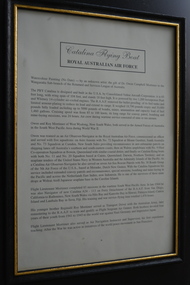
... Document relates to item 199 - Watercolour painting of a Catalina Flying Boat by an unknown artist -tells the history of the Catalina Flying Boat as well as the service histories of Flight Lieutenant Owen Mortimer and his younger brother Flight Sergeant Air Gunner Reginald Roy Mortimer from West Wyalong, New South Wales who served from 1941 to 1945 - relatives of the Donor Dr Owen Campbell Mortimer. ...Document relates to item 199 - Watercolour painting of a Catalina Flying Boat by an unknown artist -tells the history of the Catalina Flying Boat as well as the service histories of Flight Lieutenant Owen Mortimer and his younger brother Flight Sergeant Air Gunner Reginald Roy Mortimer from West Wyalong, New South Wales who served from 1941 to 1945 - relatives of the Donor Dr Owen Campbell Mortimer. ...Document relates to item 199 - Watercolour painting of a Catalina Flying Boat by an unknown artist -tells the history of the Catalina Flying Boat as well as the service histories of Flight Lieutenant Owen Mortimer and his younger brother Flight Sergeant Air Gunner Reginald Roy Mortimer from West Wyalong, New South Wales who served from 1941 to 1945 - relatives of the Donor Dr Owen Campbell Mortimer. Flight Lieutenant Owen Mortimer completed 85 missions in the wartime South West Pacific area. Reginald Mortimer served as a Transport Driver with the Australian Army later remustering to the RAAF to train and qualify as Flight Sergeant Air Gunner.Black frame with gold painted inner edge containing cream coloured paper with black text.Catalina Flying Boat Royal Australian Air Force catalina flying boat, flight lieutenant owen mortimer, flight sergeant air gunner reginald mortimer, ww2, raaf -
 Puffing Billy Railway
Equipment - Victorian Railways Carriage Foot Warmer
... The use of foot warmers began to decline in New South Wales from the 1930s with the first trial of carriage air-conditioning in 1936, steam heating from 1948 ad LP gas heating from 1961. ...The use of foot warmers began to decline in New South Wales from the 1930s with the first trial of carriage air-conditioning in 1936, steam heating from 1948 ad LP gas heating from 1961. ...During prestige, long distance train journeys some carriages had air-conditioning, and the majority of passengers had to brave unheated carriages. To offer some comfort during the winter months, the non-air-conditioned carriages were provided with footwarmers. These were metal containers roughly 100 mm thick and 300 mm wide, and about 750 mm long, which were filled with salt crystals (concentrated crystalline hydrated sodium acetate). The footwarmers were covered by sleeves of thick canvas, and two footwarmers were usually placed in each compartment of non-air-conditioned carriages. To activate the chemicals, the footwarmers were heated almost to boiling point. This was done by removing the canvas sleeves and placing the footwarmers in a large bath of very hot water. After they had been heated, they were removed from the bath and the sleeves refitted. They were then ready to be placed in the carriages. The McLaren patent foot warmer was used on railways in New South Wales, Queensland, Victoria and South Australia as well as South Africa and New Zealand. It was during the 1901 royal visit by the Duke and Duchess of Cornwall that these foot warmers were first used in New Zealand in the royal carriage. Before railway carriage heating was introduced, McLaren patent foot warmers were placed on the floor of New South Wales government railway carriages from 1891 to provide a little passenger comfort. The rectangular steel container worked a bit like a hot water bottle but instead of water contained six and a half kilograms of loosely-packed salt crystals, (concentrated crystalline hydrated sodium acetate). This was permanently sealed inside the container with a soldered cap. After the foot warmer was heated in vat of boiling water for about one and a quarter hours the crystals became a hot liquid. (The melting point for sodium acetate is 58 degrees). There was a whole infrastructure of special furnaces set up at stations for the daily heating of foot warmers. By 1914 the Victorian railways had 4,000 foot warmers in service and by 1935 there were 33 furnaces at principal stations to heat them. After about 10 hours the container was picked up by the handle and given a good vertical shake which helped the cooled liquid reform into a solid mass of hot crystals. Staff or sometimes passengers shook them en route when the foot warmers began to get cold. However, as they were heavy this was only possible by fit and agile passengers. At the end of the journey the containers were boiled again for reuse on the next trip. Sodium acetate railway foot warmers were introduced in Victoria in 1889, Adelaide to Melbourne express in 1899. "Shaking up" on this service took place at Murray Bridge and Stawell on the tip to Melbourne and at Ballarat and Serviceton on the trip to Adelaide. The use of foot warmers began to decline in New South Wales from the 1930s with the first trial of carriage air-conditioning in 1936, steam heating from 1948 ad LP gas heating from 1961. By the early 1960s the main services using foot warmers were the overnight mail trains. info from : http://www.powerhousemuseum.com/collection/database/?irn=67564#ixzz4UBNzVf6t Under Creative Commons License: Attribution Non-Commercial There was a whole infrastructure set up at stations for the daily heating of foot warmers in special furnaces. In Victoria alone in 1935 there were 33 heating works.Historic - Victorian Railways - Carriage Heater - Foot warmerA rectangular-shaped stainless steel casing with a welded seam down the back and welded ends. There is a handle at one end for carrying and shaking. Inside the foot warmer are two baffle plates and three trays to contain the sodium acetate. There was a cast-iron ball in each internal compartment. puffing billy, victorian railways, carriage haeter, foot warmer, passenger comfort, station furnace, railway ephemera, early heating methods -
Moorabbin Air Museum
Manual (Item) - CAC Wirraway Routine Servicing Schedule, Royal Australian Air Force, Aircraft Planned Servicing Schedule: Daily & Weekly Servicing Wirraway Aircraft With Wasp S3H1G Engine, Circa 1950
... New South Wales. Very small booklet bound with a large staple. Aircraft Planned Servicing Schedule: Daily & Weekly Servicing Wirraway Aircraft With Wasp S3H1G Engine Manual CAC Wirraway Routine Servicing Schedule Royal Australian Air Force ...Previously kept in the Technical Library, No. 1 Basic Flight Training School, Uranquinty, New South Wales.
