
Showing 48 items matching "aircraft woods"
-
 Moorabbin Air Museum
Book - Wooden aircraft, Aircraft Woodwork
... Wood properties & characteristics...Aircraft...Wooden aircraft Wood properties & characteristics Aircraft woods Defects in & selection of aircraft woods Plywood Fundamentals of aircraft woodworking Technical drawings Glues & gluing Joints & Laminations Aircraft woodworkers tools Aircraft doping & finishing Safety rules Construction of various wing & tail components Wood propellers Repairs Overview of the characteristics, identification & uses of aircraft woods, circa 1946 Aircraft Woodwork Book Wooden aircraft ...Overview of the characteristics, identification & uses of aircraft woods, circa 1946non-fictionOverview of the characteristics, identification & uses of aircraft woods, circa 1946wood properties & characteristics, aircraft woods, defects in & selection of aircraft woods, plywood, fundamentals of aircraft woodworking, technical drawings, glues & gluing, joints & laminations, aircraft woodworkers tools, aircraft doping & finishing, safety rules, construction of various wing & tail components, wood propellers, repairs -
 Australian Gliding Museum
Machine - Glider – Sailplane, 1953
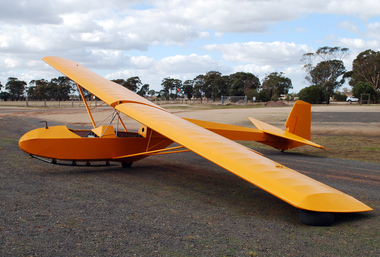
... This is a two seat high wing aircraft of mainly wood and fabric construction. The cockpit area of the fuselage is fabric over tubular steel framing. ...However, it was a later Schneider design, the ES 52 Kookaburra, which was accepted by many Australian gliding clubs for filling their need for a basic two seat training glider in the 1950s and 1960s. australian gliding glider sailplane schneider es50 renmark gliding club millicent gliding club corangamite soaring club sydney technical college gliding club Given serial number 3 by manufacturer and registered as VH-GHP This is a two seat high wing aircraft of mainly wood and fabric construction. The cockpit area of the fuselage is fabric over tubular steel framing. ...The Schneider ES50 Club was built in 1953 and is the only one of its type. It was designed by Schneider to comply with specifications laid down by the Gliding Federation of Australia for a basic two seat training glider*. It was first flown on 10 May 1953 and delivered to the Renmark Gliding Club. The log book shows that it later passed to other gliding clubs, namely Millicent Gliding Club, Corangamite Soaring Club, Sydney Technical College Gliding Club. Overall, as at September 1967, the glider had logged over 5000 flights and a total airtime of 388 hours. The Museum volunteers have partly refurbished the ES50 to static display standard. [*Plans were also prepared for a single seat version which never eventuated] This glider is one of Edmund Schneider Pty Ltd earliest Australian designs. However, it was a later Schneider design, the ES 52 Kookaburra, which was accepted by many Australian gliding clubs for filling their need for a basic two seat training glider in the 1950s and 1960s. This is a two seat high wing aircraft of mainly wood and fabric construction. The cockpit area of the fuselage is fabric over tubular steel framing. Given serial number 3 by manufacturer and registered as VH-GHPaustralian gliding, glider, sailplane, schneider, es50, renmark gliding club, millicent gliding club, corangamite soaring club, sydney technical college gliding club -
 Australian Gliding Museum
Machine - Glider – Sailplane, 1939
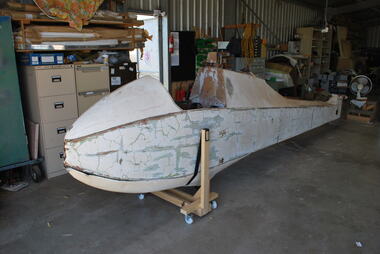
... Aircraft of wood structure skinned with plywood and fabric – off-white colour scheme – crazed flaking paint on fuselage – nose of fuselage has been modified by addition of streamlining – damage includes impact holes to plywood, especially on starboard side – wings have been stripped of fabric covering and some ribs are missing – tailplane and rudder are in reasonable condition although, like wings, have been stripped of fabric. ...Nevertheless it is considered to be an important exhibit for relating the history of gliding in Western Australia. australian gliding glider sailplane dunstable kestrel bill manuel ric new lake pinjar soaring club lake pinjar gliding club of western australia Aircraft of wood structure skinned with plywood and fabric – off-white colour scheme – crazed flaking paint on fuselage – nose of fuselage has been modified by addition of streamlining – damage includes impact holes to plywood, especially on starboard side – wings have been stripped of fabric covering and some ribs are missing – tailplane and rudder are in reasonable condition although, like wings, have been stripped of fabric. ...This Dunstable Kestrel glider (which originally was finished in silver paint) was built in 1939 by Ric New and members of the Lake Pinjar Soaring Club. It first flew on 26 December 1939 at Lake Pinjar. The first extensive flight was on 7 January 1940 when Ric New managed to stay aloft for 30 minutes and reach a height of 3000 metres. Unfortunately the Kestrel was badly damaged the same day when another club member Jim Brabazon stalled and spun in. The Kestrel was repaired by June 1940 and flown extensively at Lake Pinjar in 1940 and 1941 until Government authorities intervened and ploughed up Lake Pinjar as a wartime measure to prevent it being used as a landing field by the enemy [Allan Ash, Gliding in Australia, pp 92 – 94]. The Lake Pinjar Soaring club was reformed as the Perth Gliding Club after the end of the war and was joined by Ric New with his Kestrel [Allan Ash, Gliding in Australia, p 103]. The glider was held in storage at the Gliding Club of Western Australia prior to transfer to the Australia Gliding Museum. The Deed of Gift indicates that it was formerly owned by Wally Williams, also from Western Australia. The aircraft is in poor condition and has some non-original elements. It is one of three that currently exist. Nevertheless it is considered to be an important exhibit for relating the history of gliding in Western Australia.Aircraft of wood structure skinned with plywood and fabric – off-white colour scheme – crazed flaking paint on fuselage – nose of fuselage has been modified by addition of streamlining – damage includes impact holes to plywood, especially on starboard side – wings have been stripped of fabric covering and some ribs are missing – tailplane and rudder are in reasonable condition although, like wings, have been stripped of fabric. Overall, while the main elements of this aircraft are present, there are a number of missing fittings and will require extensive works to restore to a static display standard.australian gliding, glider, sailplane, dunstable, kestrel, bill manuel, ric new, lake pinjar soaring club, lake pinjar, gliding club of western australia -
 Nhill Aviation Heritage Centre
Memorabilia - Joystick, From Tiger Moth crash, c. 1940
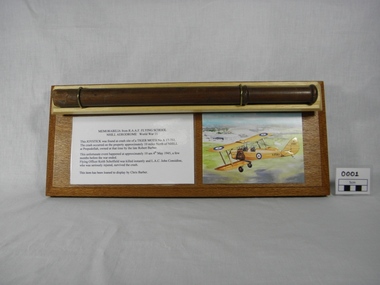
... Section of a wooden aircraft joystick, broken off at the base. Made of turned and polished wood with a turned handle section approx 100mm at the top. ...FLYING SCHOOL / NHILL AERODROME World War II" Section of a wooden aircraft joystick, broken off at the base. Made of turned and polished wood with a turned handle section approx 100mm at the top. ...The joystick has been held by the Barber family since the crash in 1945. It had been kept as a momento to the witnessing of the incident involving an aeroplane from the Nhill Air Training School. In recent times the joystick has been mounted on a display base and loaned to the Nhill Aviation Heritage Centre to add to the awairness of this event. This is the only remains of this aircraft known to existSection of a wooden aircraft joystick, broken off at the base. Made of turned and polished wood with a turned handle section approx 100mm at the top. Mounted on a wooden display base with two brass retaining rings. Display base has information in text and description artwork of the aircraft. Inscription "MEMORABILIA from R.A.A.F. FLYING SCHOOL / NHILL AERODROME World War II"air crash, joy stick, propodollah, barber, tiger moth, a17 751, keith scholfield, lac john considine -
 Lara RSL Sub Branch
Framed photo print of Mosquito fighter plane
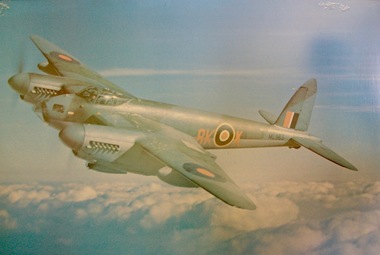
... It was one of few operational front-line aircraft of the era whose frame was constructed almost entirely of wood and was nicknamed The Wooden Wonder. ...It was one of few operational front-line aircraft of the era whose frame was constructed almost entirely of wood and was nicknamed The Wooden Wonder. https://en.wikipedia.org/wiki/De_Havilland_Mosquito It is one of the paradoxes of aircraft development that some of the world's greatest aeroplanes have achieved their fame doing jobs other than the one they were originally designed for. ...The de Havilland DH.98 Mosquito is a British twin-engine shoulder-winged multi-role combat aircraft. The crew of two, pilot and navigator, sat side by side. It served during and after the Second World War. It was one of few operational front-line aircraft of the era whose frame was constructed almost entirely of wood and was nicknamed The Wooden Wonder. https://en.wikipedia.org/wiki/De_Havilland_MosquitoIt is one of the paradoxes of aircraft development that some of the world's greatest aeroplanes have achieved their fame doing jobs other than the one they were originally designed for. No better example of this could be found than the Mosquito, which, conceived as a bomber, became one of the war's most potent fighters. More than this, indeed, it was probably the most successfully versatile of any twin-engined type built between 1939 and 1945. It excelled in all the widely varied roles. Its duties included the duties of low-level and high-attack day and night bomber, long-range photo-reconnaissance, mine layer, pathfinder, high-speed military transport, long-range day and night fighter, and fighter-bomber. It served in Europe, the Middle and Far East and on the Russian front. In fact, the ubiquitous Mosquito reigned supreme among General Purpose types. Of the grand total of 7,781 Mosquitos built, 6,710 were delivered during the war years. www.aviation-history.com/dehavilland/mosquito.html Rectangular shaped picture frame showing Mosquito fighter plane.fighter planes, ww2, british aircraft, mosquito fighter planes, lara r.s.l. -
 Bendigo Military Museum
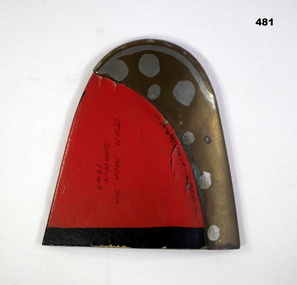
Souvenir - PROPELLER TIP, WW II
... Refer 2473 for service details. military history - souvenirs military-aircraft japan Inscribed "To Bette from AIF, I love you" on metal leading edge. "Jap prop tip Darwin 1943" on red section Japanese propeller tip from a plane shot down over Darwin in 1943. Wood ...Souvenired by Alfred Edward Boland V59811, VX120170. Refer 2473 for service details.Japanese propeller tip from a plane shot down over Darwin in 1943. Wood covered with canvas (painted red and blue), overlayed with metal (possibly brass) in leading edge. Inscribed with "To Bette from AIF, I love you."Inscribed "To Bette from AIF, I love you" on metal leading edge. "Jap prop tip Darwin 1943" on red sectionmilitary history - souvenirs, military-aircraft, japan -
 Bendigo Military Museum
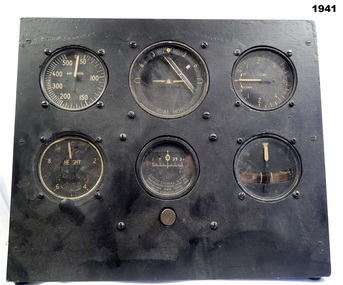
Equipment - INSTRUMENT PANEL RAAF, Early WW2
... wood frame. The 6 instruments all different all represent a replica of a standard "sperry flight instrument panel". These parts were fitted to most RAF and RAAF aircraft. ...wood frame. The 6 instruments all different all represent a replica of a standard "sperry flight instrument panel". These parts were fitted to most RAF and RAAF aircraft. ...Belonged to Maxwell Lennox Matheson 418447 RAAF. Refer 1959 for his service history.Wood frame block with six (6) instruments, round shape set in the wood frame. The 6 instruments all different all represent a replica of a standard "sperry flight instrument panel". These parts were fitted to most RAF and RAAF aircraft. "M Matheson 87 Reservoir Road Strathdale Bendigo" (Label on rear).instruments, equipment, raaf -
 Bendigo Military Museum
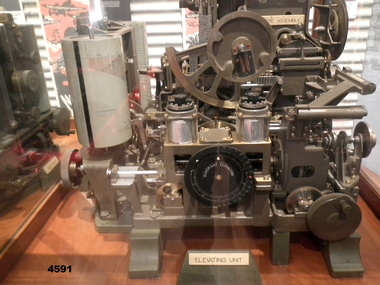
Equipment - VICKERS No1 MK III A.A. PREDICTOR, Commonwealth Government Ordnance Factory, c. 1942
... aircraft Guns Attached to the front of the display case: 'VICKERS A.A. PREDICTOR No1 MK III MANUFACTURED BY ORDNANCE FACTORY MARIBYRNONG' The item is made primarily from metal, is square shaped and bolted to a wooden base. Numerous hand operated wheel dials attached to gauges which input information related to wind speed, bearings and elevation are visible. Each of the four sides has a specific task with three sides being labelled - Elevation Unit, Wind Calculator, Bearing Unit. The item is housed in a glass and wood ...This piece of equipment was used to predict the flight path of an aircraft in order for anti-aircraft artillery to fire accurately at an approaching enemy airborne target. A crew of six operated the machine with information ready to be relayed to a gun within 50 seconds. The predictor was manufactured at the Commonwealth Government Ordnance Factory, Maribyrnong.The item is made primarily from metal, is square shaped and bolted to a wooden base. Numerous hand operated wheel dials attached to gauges which input information related to wind speed, bearings and elevation are visible. Each of the four sides has a specific task with three sides being labelled - Elevation Unit, Wind Calculator, Bearing Unit. The item is housed in a glass and wood display case. Attached to the front of the display case: 'VICKERS A.A. PREDICTOR No1 MK III MANUFACTURED BY ORDNANCE FACTORY MARIBYRNONG'pedictor, military equipment, ordnance, anti-aircraft guns -
4th/19th Prince of Wales's Light Horse Regiment Unit History Room
Plaque: HMAS Aware
... plaque hmas aware Inscription plate attached: Air Sea Rescue 17 Sep 78 MV Seahorse (sunk at sea) Saved Master J Jones Crew B De Jong T Burrell (Lt) 4/19th PWLH Aircraft Lt Cdr P Coulson & crew HMAS Aware Lt C White & crew Plaque, badge of HMAS Aware mounted on wood shield shaped board. ...Plaque, badge of HMAS Aware mounted on wood shield shaped board.Inscription plate attached: Air Sea Rescue 17 Sep 78 MV Seahorse (sunk at sea) Saved Master J Jones Crew B De Jong T Burrell (Lt) 4/19th PWLH Aircraft Lt Cdr P Coulson & crew HMAS Aware Lt C White & crewplaque, hmas aware -
 Bendigo Military Museum
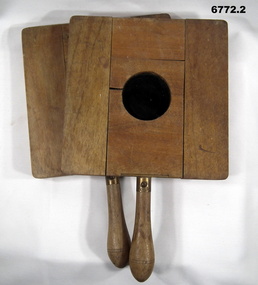
Equipment - AIRCRAFT LANDING PADDLES, Penman & Morrison, 1943
... Passchendaele Barracks Trust Aircraft Landing Paddles WW2 “Penman & Morrison 1943 D (arrow up) D” Two identical Paddles - wood, brown, square shaped with wooden handle. ...Two identical Paddles - wood, brown, square shaped with wooden handle. Round dark glass disc in centre insert.“Penman & Morrison 1943 D (arrow up) D”passchendaele barracks trust, aircraft landing paddles, ww2 -
 National Vietnam Veterans Museum (NVVM)
Print
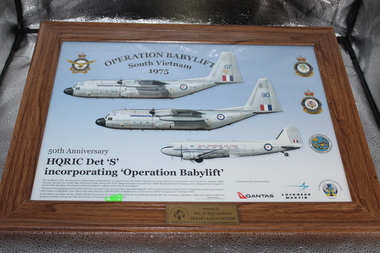
... aircraft. Four crests featured, surrounding images. Brass and gold metal plaque at the base attached to wood frame. ...aircraft. Four crests featured, surrounding images. Brass and gold metal plaque at the base attached to wood frame. ...This item commemorates the war in Vietnam ( 1962 - 1973) during Operation Babylift.A brown wooden frame of a print. Blue background, black print image of three aircraft. Four crests featured, surrounding images. Brass and gold metal plaque at the base attached to wood frame. Glass cover.OPERATION BABYLIFT/50th Anniversary/HQRIC Det "S"/incorporating 'Operation Babylift' babylift, sth vietnam, hqric det"s", 50th anniversary, qantas, lockheed martin -
 National Vietnam Veterans Museum (NVVM)
Photograph - A Framed Black and White Photograph of People Gathered Under The Rear of a Caribou. Luggage on tarmac. Flying Kangaroo insignia on aircraft
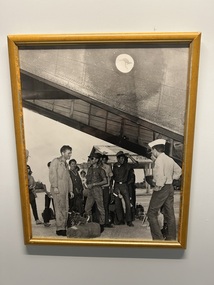
... Black and white photograph in light wood timber frame showing a group of military and civilian personal gathered under rear of Caribou. There is some luggage on tarmac. Flying Kangaroo insignia on aircraft...Caribou Transport Photograph Australian Soldiers Civilians Kangaroo Airlines Black and white photograph in light wood timber frame showing a group of military and civilian personal gathered under rear of Caribou. There is some luggage on tarmac. Flying Kangaroo insignia on aircraft ...Black and white photograph in light wood timber frame showing a group of military and civilian personal gathered under rear of Caribou. There is some luggage on tarmac. Flying Kangaroo insignia on aircraft.caribou, transport, photograph, australian soldiers, civilians, kangaroo airlines -
 National Vietnam Veterans Museum (NVVM)
Plaque, Grand Order Of Tape Dragons
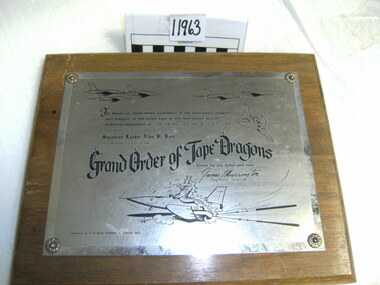
... Plaque Alan Reed Tan Son Nhut For head-sup, hook-down excellence in the emergency snaggin' and draggin' of the nylon tape of the land-based aircraft arresting equipment at Tan Son Nhut, Vietnam on 21st Sept 1968 Silver plaque mounted on solid wood depicting seven fighter jets, five at top, one flying downwards with a dragon in the cockpit, one at bottom with a full length dragon atop of fighter jet. ...Silver plaque mounted on solid wood depicting seven fighter jets, five at top, one flying downwards with a dragon in the cockpit, one at bottom with a full length dragon atop of fighter jet. Sgn Ld Alan r Reed is a Life member of the Grand Order Of tap DragonsFor head-sup, hook-down excellence in the emergency snaggin' and draggin' of the nylon tape of the land-based aircraft arresting equipment at Tan Son Nhut, Vietnam on 21st Sept 1968plaque, alan reed, tan son nhut -
 National Vietnam Veterans Museum (NVVM)
Book, Wood, Derek, Jane's World Aircraft Recognition Booklet, 1982
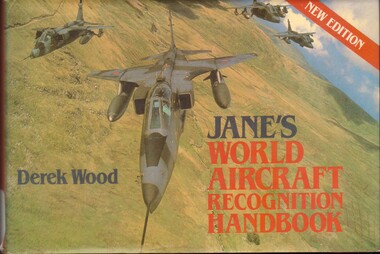
... Jane's World Aircraft Recognition Booklet. Book Book Wood, Derek ...Air traffic controller or aviation enthusiast, fighter pilot or missile battery commander, you need to know how to put a name to the hundreds of civil and military aircraft types that crisscross the world's airspace.Air traffic controller or aviation enthusiast, fighter pilot or missile battery commander, you need to know how to put a name to the hundreds of civil and military aircraft types that crisscross the world's airspace.airplanes - design and construction, helicopters -
 National Vietnam Veterans Museum (NVVM)
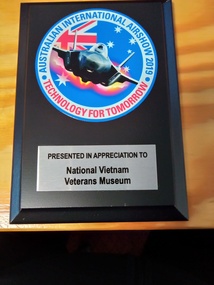
Plaque - Plaque, Airshow 2019
... A black craft wood shield with a circular disc with a jet aircraft superimposed on an Australian flag. ...Shield Australian International Air Show On a silver plaque reads "Presented in appreciation to National Vietnam Veterans Musuem" A black craft wood shield with a circular disc with a jet aircraft superimposed on an Australian flag. ...A black craft wood shield with a circular disc with a jet aircraft superimposed on an Australian flag. In blue writing reads Australian International Airshow 2019. In red writing reads Technology for tomorrow.On a silver plaque reads "Presented in appreciation to National Vietnam Veterans Musuem"shield, australian international air show -
Moorabbin Air Museum
Manual (Item) - Wood - EAA Aircraft
... Wood - EAA Aircraft...Wood - EAA Aircraft...Wood - EAA Aircraft Manual Wood - EAA Aircraft ... -
Moorabbin Air Museum
Manual (Item) - Wood in Aircraft construction - all aspects
... Wood in Aircraft construction - all aspects...Wood in Aircraft construction - all aspects...Wood in Aircraft construction - all aspects Manual Wood in Aircraft construction - all aspects ... -
Moorabbin Air Museum
Manual (collection) - ANC Bulletin Wood Aircraft Inspection And Fabrication
... ANC Bulletin Wood Aircraft Inspection And Fabrication...ANC Bulletin Wood Aircraft Inspection And Fabrication...ANC Bulletin Wood Aircraft Inspection And Fabrication Manual ANC Bulletin Wood Aircraft Inspection And Fabrication ...War Department Army Air Forces -
Moorabbin Air Museum
Manual (collection) - Design of Wood Aircraft Structures
... Design of Wood Aircraft Structures ...Design of Wood Aircraft Structures ...Design of Wood Aircraft Structures Manual Design of Wood Aircraft Structures ... -
Glen Eira Historical Society
Book - Carnegie Primary School No. 2897
... Wood Frederick Geo... Egan Miss dressmakers... Whitlam Fred... Whitlam Christine... Whitlam George... Whitlam Gough... Whitlam Freda... Whitfield Mr.... Patterson Road... Graceburn Avenue... Griffiths R.H.... Koornang Road... Scales Mr.... Reid Athol... Lording Dr.... Mernda Ave... Farmstead... Lord Reserve... Leman’s Swamp... Koornang Park... Cobby Harry... Larkin Aircraft...Wood Frederick Geo Egan Miss dressmakers Whitlam Fred Whitlam Christine Whitlam George Whitlam Gough Whitlam Freda Whitfield Mr. Patterson Road Graceburn Avenue Griffiths R.H. Koornang Road Scales Mr. Reid Athol Lording Dr. Mernda Ave Farmstead Lord Reserve Leman’s Swamp Koornang Park Cobby Harry Larkin Aircraft ...Carnegie Primary School centenary book (96 pages x 2 copies) ‘The First Hundred Years NO2897. Carnegie Primary School 1888-1988’ compiled and edited by Isabel Couper and Deidre Lynch. A detailed history of the school’s beginnings. Many informative memories and recollections from school’s first students and teachers; includes social history of area and people, football teams, debutante sets and school. Also a reprinted newspaper article from school’s Golden Anniversary and photo of school band; and a couple of social history photographs.anderson james, murrumbeena, glen huntly railway station, carnegie state school, wesleyan hall, neerim road, railway stations, carnegie primary school, rosstown, toolambool road, lynch deidre, mcvey claire, ross william murray, findlay francis, couper isabel, brown wesley, rosstown state school, brisbane w, carnegie uniting church, liddelow m.h., evans thomas, selboskar phyl, centenaries, margaret street, caulfield, brewster mr., taylor mr., draper mrs., mcfarlane mr., rule thomas, teachers, campbell ada, ‘ava’, campbell aubrey, campbell vera, matthews ben, hewitts road, matthews funeral service, funeral parlours, leo amy, leo alfie, rudge family, rudge mr., transport, phillips store, general store, phillips corner, emily street, hamlya family, pitt family, sheppard family, pemberton mr., pemberton mrs., dunlop misses, preschools, whitlam family, whitlam gordon, woods family, woods lorna, swaggie, swagman, liddelow amy, anderson mr., anderson archie, dunlop bill, phillips linda, hansen alice, lodge laura, fox arthur , hamlyn eric, hansen dagmar, cooper lina , woods lorna, waite family, cove family, johansen family, koornang road, market gardens, sheppard ernie, wood a.m., ‘nisava’, wood family, wood bill, evans rachel, evans thomas, wood millicent, whitfield mr., griffiths mr., wood malcolm, wood forest, wood joe, roxburgh miss, grange road, clifton street, lord street, wood frederick geo, egan miss dressmakers, whitlam fred, whitlam christine, whitlam george, whitlam gough, whitlam freda, whitfield mr., patterson road, graceburn avenue, griffiths r.h., koornang road, scales mr., reid athol, lording dr., mernda ave, farmstead, lord reserve, leman’s swamp, koornang park, cobby harry, larkin aircraft company, dawson howard, rosedale avenue, spencer reg, turner ruth, turner jack, turner noreen, turner marie, morton alan, morton barney, gardiner martin, frogmore estate, oakleigh road, frogmore road, koornang park, hunt club kennels, raeke miss, morgan miss, pitt winnie, jiggins mr., smith mr., blundy violet, ryall ray, mimosa road, wolseley mr., wolseley family, wolseley ted, brunstein madge, murrumbeena cricket club, sinclair alan, sincliar tinny, thomas ted, walker alec, bone bob, footballers, middleton colin, farquahson mrs., eddy family, eddy rose, wolseley jack, buswell stan, buswell doug, buswell. stan jnr., irving nell, brims ethel, bailey bruce, eason sisters, hands hilda, windlow isabel, madden road, glenhuntly road, griffiths rita, jackson jean, scott mr., ward ‘cap’, caulfield grammar school, kokaribb road, carnegie traders, cricket teams, carnegie south, ward marjory, ryan mr., phillips tony, phillips bessie, buckley street, phillips harriet, phillips marion, phillips ernest, phillips hilda, phillips david, phillips florence, phillips linda, lihou miss, jersey parade, meake family, skewe family, mansfield family, fraser jean, collister alma, sturges millie, retallick girls, lillywhite family, mason nellie, johns nancy, bowsfield family, jenner family, chisholm emma, chisholm doris, chisholm ivy, chisholm netta, chisholm beryl, chisholm eileen, wadsworth ethel, luke mr., plummer t.w., raecke miss, sargent ron, sarkie family, reid family, meake violet, collett reg, mcneil miss, scales mr., carmody thomas william, steele miss, young mac, young margaret, cooper cyril, cooper bill, whiteside d., broadbent neil, broadbent mr., carnegie theatre, theatres, morton family, clarke family, quickand neals grocery store, grocers, billy guyatt’s, shops, spencer the removalist, removalists, collister harold, collister bill, caulfield band, bands, carthews the drapers, drapers, mccarrons alec blacksmiths, skewes keith, oliver frank, pitt ‘squeaker’, knevitt ‘skeeter’ harry, jockeys, britter jack, stanistreet family, gear rita, culleen billy, tailors, sherwoods butchers, butchers, jersey parade, riley didlo, verne harry, cooper horace, cooper linda, cooper martin, cooper claude, cooper reginald, cooper stanley, cooper gladys, cooper muriel, cooper percival, cooper cyril, beaumont w.a., whittfield joe, beaumont eileen, major mary anne sister, major myrtle, major bessie, major alma, stagholl walter, stagholl margaret, stagholl eric, robertson bessie, robertson fred, robertson norman, robertson donald, robertson alma, robertson alan, baird neil, baird john, baird rosemary, dunn helen, baird ian, baird heather, baird dianne, petrie stuart, petrie richard, bailey ron, gaunt mabel, reading harold, reading marge, irwin joyce, dickson margaret, dickson jennifer, dickson peter, wood malcolm, wood millicent, wood forest, wood joe, sinclair ‘trinny’, roberts ‘fly’, footballers, malcolm mr., henderson reg, henderson alice, brew l., rule mr., philbrick mr., wood mr., trembath mr., keogh mr., plummer tom, lane a., fox ernest, souters, market gardeners, fox belle, fox bella, fox vern, couper margaret, couper sandra, couper peter, couper narelle, couper clare, couper jarrod, scott mr., doughty will, doughty tom, lloyd miss, islingworth master, adams joyce, hogan mr., markus jean, cosgrove joan, cosgrove mrs., cosgrove mr., marshall jim, kellow fred, fretwell elizabeth, fretwell betty, shepparson ave, singers, edmonson miss, butters shirley, harwood vera, bracher lloyd, dewhurst irene, dewhurst jack, boyle mr., gow jack, welch len, stanistreet harry, stanistreet jack, stanistreet kathleen, stanistreet frank, stanistreet kingsley, ‘ray sullivan’s harmony boys’, carnegie memorial hall, st. anthony’s hall, welch len, gibbons norm, ashley sylvia, crosswell edna, marks peggy, worth phyllis, cleal jean, tabner edith, jenkins elva, mcintosh gladys, worth reg, waters cyril, downard rex, wild mavis, wild darby, hill roland, eason jean, tyers noel, tyers clive, witten hope, strickland doris, chisholm beryl, harwood family, battershill sid, battershill walter, dixon mavis, boyle mr., ford hilda, forsythe miss, edmonsen miss, ryan mr., grimsley mr., allaway mrs., grant mrs., bone bob, bone bruce, w. bone & son nursery men, bone norman, bone jack, bone william, railway road, green kevin, paris marjorie, mimosa road, green joan, allaway winnie, elliot miss, mcburney mr., purdy mrs., allaway suzanne, barron shirley, hogan mr., rutherford mrs., curtin mr., mckee’s, stores, whelan’s, coles, koornang road, gardiner marty, grange road dairy, dairies, mcwhinney’s tuck shop, shops, williams dorothy, kennedy irene regina, rigby miss, grimsley steve, grimsley muriel, grimsley jack, grimsley margaret, grimsley aimee, grimsley bill, blinkinsop steve, blinkinsop jeannie, mathers max, howie rex, major mr., flatmans paddock, crossover, reid eric, reid athol, lowe margaret, lowe dorothy, lowe ian, poliomyelitis epidemic diseases, forsythe miss, cuddihy miss, dougall keith, grace miss, hattam’s, stores, driver wally, perry max, perry don, perry jack, meagher j., ‘hostile’, racehorses, edney jack, carthews the drapers, fretwell elizabeth, kellow fred, muddyman bill, graceburn ave, caulfield junior citizens band, bands, luke mr., luke percy, luke maise, luke nessie, luke geoff, luke ross, luke jan, luke lynette, bolton douglas, anderson mrs., mcburney mr., hogan mr., scott mr., tyers s., ross j., ryan j., irvine j., muirhead mrs., muirhead j., mcnab m., buller l., emmanuel p., buller m., paton v., moor j., condron a., bibby d., matthews n., holman l., cotterell m., whelan j., jennion g., walker b., taylor e., green a., turner r., matthews e., smith joan, gardiner marty, dairies, hanson family, cove family, gallop family, barrett family, barrett w.a., bolch family, bolch b., burke w., burke bill, burke s., mobbs h., young g., young c., burke m., ward c., hopwood g., gordon mr., milk bars, cooper cr., phillips t., swindell mr., grogan mr., wadsworth mrs., bourke mrs., lewis mrs., worsley mrs., quickenstead mrs., brown wesley, musicians, purdy h., curtain les, jenner’s dairy, riley’s wood yard, occupations, jenner vic, jenner les, grant noel, parker george, connolly keith, purdy mr., glen huntly picture theatre, picture theatres, irvine jack, law christie, hatter bob, joppick les, driver geoff, curtin mrs., frederick street, ormond, waters ron, carnegie junior citizens band, carnegie salvation army band – bands, whelan evan, irwin ray, balgleish jack, cowen laurie, smyth wally, lambeth margaret, kind lorraine, bondini joy, tredennick miss, linton miss, heath graham, shiell bill, shiell myrtle, archard bess, bull joan, craig ida, collins dorrie, collins doreen, diggans jess, cornthwaite h., cripps e., dougall n., dixon joyce, francis d., evans mrs., glass peg, greene jess, grace merle, hocking freda, jillings mrs., price mrs., day kitty, kerr may, mason marge, kind sylvia, muirhead d, mcconchie netta, needham nancy, nickless w, o’connor linda, pilven mrs., ryall h., strother ivy, singleton mrs., kelly phyl, waters von, usher mrs., trotter maude, watson mrs., williams mabel, withers olive, aarsmann norma, shiell norma, close peter, ‘wild cherry’ cake shop, rudi miss, anderson miss, eddy mr., hunter jean, nelson vera, fisher john, hunter ron, read jean, smith brian, newsreaders, nelson miss, singleton billy, quon miss, mchutchison george, valma smith, millar royal r., donoghue nora, lester mr., roberts tom, andreisen colin, miles alec, hine mr., baker mr., clements george, bracher lloyd, dimick miss, muir judy, dunn margaret, sant richard, myring miss, ryan mr., armstrong margaret, share wally, howie rex, barclay bob, rockman udo, hoult david, eisfelder kevin, jacques mr., smith mr., magee mr., stehle belinda, wallace mr., james mrs., main mr., wood miss, verso mr., mcpherson mrs., felotico miss, stehle john, howards mrs., collard mrs., webster vivian, stehle siggy, truong le sen, mcpherson barbara, mitchell eva, moutsos mark, chan benjamin, wilson del, jewell christopher, mitchell keith, grant marilyn, caskie alastair, dixon dennis, armstrong john, lucas edward, clark deanne, coutts natalie, flood zivanja, derham peter, momandwall shaper, couper jarrod, heslop joanne, breeze ginaya, caskie fiona, filippone nadya, mcmahon nina, hedges nigel, williams shae, grimm karen, mcgregor clare, vagenes john, gallagher glenn, mcalister rob, varga marilyn, hunter debbie, courtney cathy, booth carol, mcmahon mary, brown danielle, burska maciej, campbell jason, chryssis aris, d’arcy michael, delaney matthew, doukas vivian, dower samantha, fournarakis andrew, genoli amanda, grammatos jimmy, harrington melanie, karamoshos john, karim sadruddin, kennedy russel, lalani zahra, lightfoot kylie, looby mark, louange veronica, park sung mi, perera dennis, pozvek julie, scurry kate, sievers sarah, smith matthew, svarnas dennis, vassiliou denise, wright tracey, zouzounis spirros, adahall jojie, agar jude, anderson lynette, black renae, bobrowski ursula, caskie catherine, devon hayley, diakoumis maria, duljas kristie, evans lindsay, faucett ebony, filippone annette, fournarakis jimmy, francese sean, gibson jay, gordon michelle, guslitser dora, king jane, lianos villi, lorkin christopher, macleod cheryl, maggs amberley, mitchell keith, mucic renae, o’brien jessica, park matthew, pozvek richard, psarras nancy, rhodes suzanne, simons emma, smith christopher, spokes melanie, tia michael, timewell amanda, vavoudis peter, abbott kristi, allender daniel, bobrowski jacob, carey rebecca, carter daimein, catramados john, christou eugenia, couper jarrod, healey michael, kalaitzakis nick, kennedy rebecca, macleod suzanne, mavridis angelo, morosini amanda, mowforth dustin, okolicsanyi george, park sung chul, pemberton michael, reisman elizabeth, richards kylie, savrone leah, tia charlie, tran paul, wiseman derek, wright dean, wyatt marilyn, andre ryan, breeze ginaya, brown james, campbell chad, charles benjamin, devon john, diakmoumis stacey, diamantis chris, duljas michael, grammatos harry, hill bradd, karim salim, lindsay amanda, lynch jennifer, marrello sol, momandwall shaker, moutsos ireni, oram scott, o’sughrue kristy, panevin david, park catherine, pozvek louise, stratton alisa, timewell rebecca, tsigos stam, yeow sook ling, anderson peter, batson tracey, black craig, brain jason, breeze benjamin, brown kylie, carrington harata, caskie fiona, catramados hercule, chan daphne, christou chris, clarke simone, diamantis anthony, faucett sara, flood natalia, holmes gavin, kotrotsos tony, kuk robin, mitchell david, okolicsanyi steve, pemberton samuel, soos melinda, stephenson gabrielle, tran pauline, vassiliou evan, agar natalia, bennett tracey, buhmann wayne, couper clare, faucett sean, filippone nadya, filippone marie, gallagher glenn, gelman roman, grant shawn, hill tania, jewel chris, kaliappa danny, kiss robert, liacopoulos aris, louey david, macleod mike, malamas voula, oram michelle, scurry ivan, wardley amanda, zouzounis sam, anderson robert, antoniou nick, carey tamara, derham peter, diep dianne, filippone danielle, flood zivanja, frangos katina, handley scott, harrison robin, heath cheryl, hedges megan, hedges nigel, hudson raelene, jacovou daniel, katrotsos george, kuk maggie, leung tracy, lightfoot wendy, mcmahon nina, taylor stephen, vassiliou litsa, liddelow e., anderson james h., boardman thomas h., rule thomas, whitfield j.p., griffiths r.h., scales e., boyle j.b., ryan owen w., eddy h.m., millar royal r., lester russel a., donoghue r., bracher a. lloyd (acting principle), o’brien john d., moller henry r., monahan t.v., barclay robert l., somerville albert v., magee frank c. (acting principle), wallis keith, laing allan i., verso ron (acting principle), wood moira (acting principle), tonkin ernest, share wallace (acting principle), howie rex, harding malcolm (acting principle), crowe brian, schmidt david (acting principle), lynch deidre (acting principle), o’keeffe leo, brierley bob, brierley marjorie, couper isabel, couper peter, lindsay janine, lynch deidre, selboskar phyl, stehle siggy, webster jennifer -
 Bendigo Military Museum
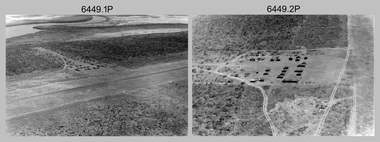
Photograph - RA Svy Project C4 Aerodist Operation, Eastern Arnhem Land, NT, 1967
... Unidentified survey operations base, L to R: unidentified technician. .11) - Unidentified technician reading two survey altimeters to compute corrections to the measured distances for atmospheric refraction and to compute the sea level distances from the slope distances aircraft to the ground stations. .12) - Photo, black & white, 1967. Survey operations base, L to R: unidentified (x3), W01 Pat Wood BEM, unidentified. .13) to .16) - Photo, black & white, 1967. ...Unidentified survey operations base, L to R: unidentified technician. .11) - Unidentified technician reading two survey altimeters to compute corrections to the measured distances for atmospheric refraction and to compute the sea level distances from the slope distances aircraft to the ground stations. .12) - Photo, black & white, 1967. Survey operations base, L to R: unidentified (x3), W01 Pat Wood BEM, unidentified. .13) to .16) - Photo, black & white, 1967. ...This is a set of 30 photographs of Royal Australian Survey Corps (RA Svy) personnel from Central Comd Fd Svy Unit (Adelaide) on Aerodist survey operation - Project C4 in Eastern Arnhem Land, Northern Territory in 1967. Photos of personnel were taken either at the operations base at Numbulwar or the main base at Gove (Nhulunbuy). RA Svy conducted nineteen Aerodist operations for 12 years from 1964 to 1975. Aerodist MRC2 was a tellurometer-based system adapted for aircraft to accurately measure distances between non-intervisible ground survey stations, using the aircraft as an intermediate station. Lower order geodetic results could be achieved by survey network trilateration. The measured distances between stations formed survey networks from which each station’s latitude and longitude was computed. Aerodist MRC2 was RA Svy’s major horizontal control survey tool for mainly medium scale topographic mapping (scale 1:100,000 Class A being spatially accurate to within 50 metres) in PNG, northern NT, north-west WA, Kalimantan Barat (West) Indonesia, Sumatra Indonesia, Gulf of Carpentaria and Cape York, QLD. In 1967, the Aerodist MRC2 Master equipment was installed in the aircraft featured in this set of photos, Executive Air Services’ (Essendon VIC) Grand Aero Commander VH-EXX. It was the same aircraft type and company contracted to Division of National Mapping for Aerodist MRC2 surveys. From July to October 1967 the aircraft was attached to Central Comd Fd Svy Unit (Adelaide - Major Don Ridge) on Project C4 eastern-Arnhem Land NT, where 317 Aerodist lines measuring 17,300 line miles were successfully completed. This was the most productive Aerodist project thus far. The most common helicopter used by RA Svy up to 1972 was the civilian Bell 47G-2 and the Sioux Light Observation Helicopters (LOH), the Australian Army’s equivalent featured in this photo set. These light observation helicopters had a limiting load carrying capacity of up to about 500 pounds. By comparison, one Aerodist team including two people weighed up to 1,500 pounds. Source: Royal Australian Survey Corps – Aerodist Years 1964-1975 by Peter Jensen. Refer to Item 9061.26P for more photos taken during this Aerodist survey operation.This is a set of 30 photographs of Royal Australian Survey Corps (RA Svy) personnel on Aerodist survey operations in Eastern Arnhem Land, Northern Territory in 1967. The photographs are on 35mm negative film and scanned at 96 dpi. They are part of the Army Survey Regiment’s Collection. .1) to .4) - black & white, 20th August 1967, Project C4 Aerodist Operations Base - Numbulwar, NT. .5) - Photo, black & white, 1967. Probable wrecked Indonesian fishing vessel. .6) to .8) - Photo, black & white, 1967. Unidentified survey operations base, L to R: unidentified personnel. .9) - Photo, black & white, 1967. Unidentified survey operations base, unidentified soldier driving a Haflinger 4x4 Light utility vehicle. .10) - Photo, black & white, 1967. Unidentified survey operations base, L to R: unidentified technician. .11) - Unidentified technician reading two survey altimeters to compute corrections to the measured distances for atmospheric refraction and to compute the sea level distances from the slope distances aircraft to the ground stations. .12) - Photo, black & white, 1967. Survey operations base, L to R: unidentified (x3), W01 Pat Wood BEM, unidentified. .13) to .16) - Photo, black & white, 1967. Unidentified personnel operating remote Aerodist MRC2 ground instruments. .17) to .18) - Photo, black & white, 1967. Unknown RA Svy office location. .19) to .20) - Photo, black & white, 1967. Aerodist MRC2 Master equipment. .21) to .22) - Photo, black & white, 1967. Aero Commander VH-EXX probably at Gove, NT, Central Comd Fd Svy Unit (Adelaide) – OC Major Don Ridge. .23) to .25) - Photo, black & white, 1967. Aero Commander VH-EXX probably at Gove, NT. Unidentified personnel. .26) - Photo, black & white, 1967. Aero Commander VH-EXX probably at Gove, NT. Aerodist antenna pods are visible on the aircraft. .27) to .29) - Photo, black & white, 1967. Australian Army Sioux Light Observation Helicopter (LOH) probably at Gove, NT. .30) - Photo, black & white, 1967. Panelled U337 survey station, visible as a white cross on aerial identification photo..1P to .2P – date and location on edge of film negative. .5P to .28P – no annotations .29P - annotated in white ‘RW-JEP Gove NT’ .30P - annotated in white ‘U337 Spool No1 Jun67’royal australian survey corps, rasvy, army survey regiment, army svy regt, fortuna, asr, aerodist, surveying, central comd fd svy unit -
 Australian Gliding Museum
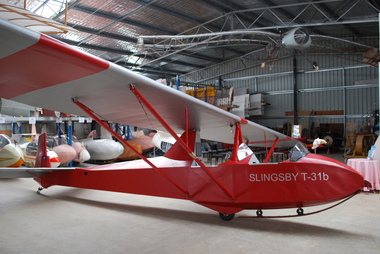
Machine - Glider – Sailplane, 29/071956
... This red and silver painted wood and fabric covered aircraft is in excellent condition having been restored to full airworthy status by the Australian Gliding Museum. ...This red and silver painted wood and fabric covered aircraft is in excellent condition having been restored to full airworthy status by the Australian Gliding Museum. ...The Slingsby T31 is a two seat training glider that came available in 1951. It is, in effect, a two seat version of the single seat Kirby Tutor. The T31 was marketed by Slingsby Sailplanes both as complete aircraft and kits of parts for assembly. The Australian Gliding Museum’s example (currently registered as VH-GDB) is one of five of this type to grace Australian skies. Three including GDB were assembled in Australia from kits supplied by Slingsby’s in England, the other two were delivered as completed airframes. To date only four remain of which two are airworthy. This aircraft began flying in at Caversham in Western Australia (the then home of the Gliding Club of Western Australia) in July 1956. It was badly damaged in a crash in June 1958. The wreckage was sent to Schneiders in Adelaide for repair. However, the Club decided against having the repairs done, opting instead to buy a new ES52 Kookaburra. After a couple of years, the wreck was purchased by a member of the Waikerie Gliding Club whereupon the glider was rebuilt with some modifications, including a more rounded and better streamlined fuselage nose. It returned to the air in October 1961 at Clare in South Australia. The ownership of VH-GDB passed through a number of clubs, including at Dubbo in New South Wales, Wimmera in Victoria and Pioneer Valley at Mackay in Queensland. Eventually, it came into the hands of Bill Riley of Tocumwal in New South Wales who held it in storage for many years. Riley donated the aircraft to the Museum. It has been restored to airworthiness and is flown at vintage glider rallies and on Museum open days. This exhibit is an excellent example of a Slingsby T31 Tandem Tutor, a type of glider that was used by a number of clubs in the 1950s and 1960s for dual training of pilots to the solo capability.The Slingsby T31b Tandem Tutor is an open cockpit, tandem, two-seater glider with high, pylon mounted two piece wing supported by double, wire braced, steel tube struts. The glider is fitted with a main wheel, rubber-block sprung, wooden nose skid and steel leaf sprung, brass shod tailskid. The basic controls of aileron, rudder and elevator are not supplemented with pitch trim. Wing lift spoilers and both aerotow and winch releases are fitted. The instrument panels in both cockpits are fitted with an airspeed indicator, cosim variometer and altimeter. This red and silver painted wood and fabric covered aircraft is in excellent condition having been restored to full airworthy status by the Australian Gliding Museum. SLINGSBY – T31b (nose – both sides) DB Australian Gliding Museum (rudder – both sides) It has been given Serial Number GFA/HB/12 and is registered as VH-GDBaustralian gliding, glider, sailplane, slingsby, tandem tutor, t31, gliding club of western australia, waikerie gliding club, wimmera soaring club, pioneer valley soaring club -
 Australian Gliding Museum
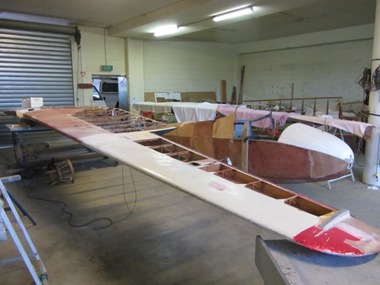
Machine - Glider - Sailplane, 2012
... This is a wood and fabric covered aircraft that is being rebuilt from the components of several aircraft as a non-flying exhibit....This is a wood and fabric covered aircraft that is being rebuilt from the components of several aircraft as a non-flying exhibit. ...The ES52 Kookaburra is a two seat high wing glider – sailplane of wooden construction designed by Harry Schneider and built Edmund Schneider Pty Ltd. It was first flown on 26 June 1954 and became the glider of choice for training new pilots of many gliding clubs around Australia in the 1950s, 1960s and 1970s. Several found there way to New Zealand. Further two kits were sent to Brazil and at least one of these was finished and flow successfully. The ES52 performed well with a glide ratio of about 22:1 and had soaring and cross-country capabilities. A notable feature of the ES52 design was the staggered side-by-side seating arrangement of the cockpit. This made for good in flight communication between instructor and trainee. Overall, thirty six were built by Edmund Schneider Pty Ltd. A longer wing version (the ES52B) was also introduced that had a better glide ratio (around 25:1). Five examples of this version were built. In Germany a modified ES52 was built incorporating a metal tube fuselage frame and with the addition of a engine driven propeller mounted on top of the wing which enabled the glider to be self launching. This museum collection item consists of the fuselage, tailplane, elevators, fin, rudder from the Mark I, ES 52 Kookaburra, formerly registered as VH-GFF and last owned by the Barcaldine and District Airsports Club of Queensland. The glider was in a damaged condition when it was acquired by the Museum. A decision was made by the Museum to repair the glider for display rather than endeavouring to restore it to an airworthy condition. The reconstruction of the wings is being undertaken by using parts of damaged ES 52 Kookaburra wings (as it happened from later ES 52 Marks). The Log Book for VH-GFF reveals operational life with a succession of gliding clubs around Australia. This exhibit will be of interest to gliding enthusiasts wishing to inspect the popular two seat club trainer of a by-gone era.This is a wood and fabric covered aircraft that is being rebuilt from the components of several aircraft as a non-flying exhibit.Fuselage marked with Edmund Schneider Pty Ltd Serial Number 9 and comes from the glider previously registered as VH-GFF.australian gliding, glider, sailplane, edmund schneider, es 52, kookaburra, barcaldine and district airsports club, victorian motorless flight group, alice springs gliding club, raaf richmond, raaf williamtown, gayndah gliding club, blackwater gliding club, southern downs aero and soaring club, charleville gliding club -
 Australian Gliding Museum
Machine - Glider – Sailplane, 1940
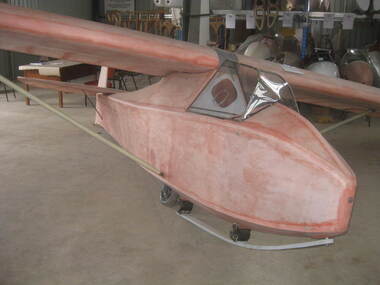
... Also the aircraft provides an insight into gliding technology in Australia in the 1940s. australian gliding glider sailplane coogee tom proctor victorian motorless flight group geelong gliding club Wood and fabric single seat glider sailplane with strutted wings and strutted tailplane – features metal framed perspex canopy, central fuselage skid and wheel, small tail skid, instruments include airspeed, turn and bank indicator; variometer and altimeter. ...The “Coogee” is an intermediate single seat sailplane designed and built by Tom Proctor in 1940. Only one was built. It was first flown at Stuart Hill near Bendigo Victoria in January 1941 and was maintained in flying condition until 1967. The aircraft was flown extensively by the Victorian Motorless Flight Group (now the Melbourne Gliding Club) and Geelong Gliding Club and several subsequent owners. This exhibit is a "one off" Australian designed and built glider similar in some respects to the Hutter H17. Its usage is relevant to the history of gliding in Victoria in the post war years. Also the aircraft provides an insight into gliding technology in Australia in the 1940s. Wood and fabric single seat glider sailplane with strutted wings and strutted tailplane – features metal framed perspex canopy, central fuselage skid and wheel, small tail skid, instruments include airspeed, turn and bank indicator; variometer and altimeter. Metal parts include struts and fairing covering wing joint. All surfaces are pink doped – awaiting painting.australian gliding, glider, sailplane, coogee, tom proctor, victorian motorless flight group, geelong gliding club -
 Australian Gliding Museum
Machine - Glider – Sailplane, 1963
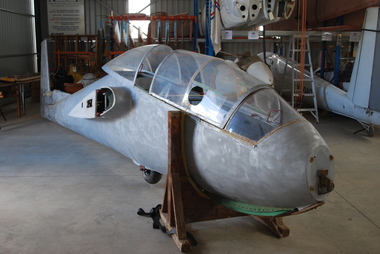
... wood and fabric construction. All components are present with the exception of instruments. However, at the time that the aircraft was transferred to the Museum it had been taken apart for major restoration work. ...wood and fabric construction. All components are present with the exception of instruments. However, at the time that the aircraft was transferred to the Museum it had been taken apart for major restoration work. ...The Bocian is a versatile training sailplane that first flew in 1952. The type has been modified in several respects over the course of production by SZD (tailplane and rudder in particular). About 600 have been built; many for export to 27 countries (including Australia). The aerobatic capability and fine performance (best glide ratio of 26) has enabled the Bocian to be used to train competition pilots as well as those of lesser experience. Many world gliding records were set in the 1950s and 1960s in Bocian gliders. The Museum’s example is a type D test flown in Poland on 3 and 4 April 1963. It was imported into Australia in September 1963 by Austerserve Pty Ltd. The first owner was the Alice Springs Gliding Club and the glider had name “Cumulus” painted on the side of the fuselage (since removed). The glider had recorded 726 hours 46 minutes flying time from 2138 launches as at July 1967 when it was transferred to the Darwin Gliding Club. It appears that the glider was damaged in June 1968. The substantial repairs to the fuselage, both wings and tailplane and other minor repairs were completed on 13 October 1968. The glider continued flying with the Darwin Gliding Club until August 1969 at which time the service to that club amounted to 59 hours 7 minutes flying time from 348 flights. Between August 1969 and August 1976 no flights are recorded in the logbook. It is understood that on its last flight at Bachelor, south of Darwin in the Northern Territory (August 1969) it was severely damaged when it crashed after spinning while being auto-tow launched (although this is not expressly mentioned in the logbook). Reg Hancock purchased the damaged glider and rebuilt the port wing and restored it to airworthy condition (September 1976). It was then transferred to Colac, Victoria, and used by the Colac Gliding Group at the Yeo airfield until February 1981, adding another 153 hours from 403 flights to the glider’s record. After airworthy inspection in September 1982 the glider was used by the Geelong Gliding Club until 1983 (logbook details not held). The 20 year survey was then due and the glider fell out of service. In the course of the most recent restoration attempt it was discovered that the glue used in construction had deteriorated and that it was no longer feasible to bring it back to an airworthy condition. Subject to restoration, this exhibit may be representative of the 1950s - 1960s Bocian two seat sailplane typeThis exhibit is a large two seat glider /sailplane of wood and fabric construction. All components are present with the exception of instruments. However, at the time that the aircraft was transferred to the Museum it had been taken apart for major restoration work. As received it is stripped of the top coats of paint and a number of components (including, amongst others, tip fairings, nose cone and cockpit elements) that were removed for facilitating the repair process. The glider, serial number 803, was registered as VH-GNLaustralian gliding, glider, sailplane, bocian, cumulus, alice springs gliding club, darwin gliding club, colac gliding group, geelong gliding club, hancock -
 Australian Gliding Museum
Machine - Glider – Sailplane, Circa 1971
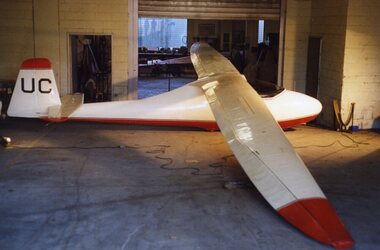
... wood construction. It has a two piece wing of 15 metre (49 feet) span and a fuselage of monocoque design. The first of the type to be imported into Australia arrived in late 1955. In January 1956 this aircraft...wood construction. It has a two piece wing of 15 metre (49 feet) span and a fuselage of monocoque design. The first of the type to be imported into Australia arrived in late 1955. In January 1956 this aircraft ...The Vogt LO150 is a sailplane first produced in 1954. Designed in Germany by Alfred Vogt, the LO150 is of wood construction. It has a two piece wing of 15 metre (49 feet) span and a fuselage of monocoque design. The first of the type to be imported into Australia arrived in late 1955. In January 1956 this aircraft type was used to create a world speed record of just under 75 km/h for speed around a 300 km triangle and went on to win the Australian National Gliding Championships. The Museum’s LO150 (VH-GUC) – serial number EB71 was imported from Germany in 1971 by the late Frank Erdmann and an ownership syndicate formed. Following Erdmann it has had a number of owners. Much of its usage was at Bacchus Marsh and Horsham with excusions elsewhere for competition. This Vogt LO150 was last flown on 3 January 1988. Overall, since arriving in Australia, it has flown 315 hours from 273 launches, which is a commendable average performance of over an hour per flight. VH-GUC was donated to the Museum by Warren Mayfield in 2002. Substantial glue deterioration was discovered in one wing and, as a result, a decision has been made not to restore the glider to an airworthy condition. In due course the glider will be repainted and further prepared for display. This exhibit is an example of the Vogt LO150 semi-aerobatic competition sailplane.Single seat competition sailplane of wood construction.Builder's serial number EB71australian gliding, glider, sailplane, vogt, lo-150, erdmann, mayfield, geelong gliding club -
 Australian Gliding Museum
Machine - Glider – Sailplane, 1963
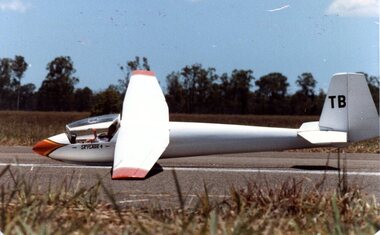
... Slingsby incorporated GRP (glass reinforced plastic) panels to achieve a streamlined fuselage nose and cockpit area while retaining the more traditional wood techniques for the rest of the aircraft. Another notable feature was the smooth wing surface that was obtained using a Gaboon ply skin across the ribs. ...Slingsby incorporated GRP (glass reinforced plastic) panels to achieve a streamlined fuselage nose and cockpit area while retaining the more traditional wood techniques for the rest of the aircraft. Another notable feature was the smooth wing surface that was obtained using a Gaboon ply skin across the ribs. ...The Skylark 4, the final in the Slingsby Skylark series, dates from 1961. The design heralded a trend towards the use of plastics in the construction of gliders. Slingsby incorporated GRP (glass reinforced plastic) panels to achieve a streamlined fuselage nose and cockpit area while retaining the more traditional wood techniques for the rest of the aircraft. Another notable feature was the smooth wing surface that was obtained using a Gaboon ply skin across the ribs. Best glide performance of 1:33 was found to be comparable with the early full GRP glider designs. The Museum’s example (VH-GTB – C/N 1382) was built in 1963 and originally owned by Chuck Bentson of the UK. It was brought to Australia in 1967 by Jeremy Picket-Heaps and flown at various places including Benalla, Cooma and Gundaroo. In 1970 the glider was transferred to the New England Soaring Club. Many flights were made from Armidale and Bellata in Northern New South Wales. On one occasion, the glider was kept aloft for 8 hours 45 minutes and on another the pilot took it around a 500 kilometre triangle in nearly 8 hours. In 1980 it was sold to Ralph (“Feathers”) Crompton and was flown extensively in South Australia until 1988. The final owner before the glider was given to the Museum in 2004 was Ross Dutton of Melbourne. The last recorded flight occurred in 1992. The glider at that point had logged over 2000 hours flying time from about 2000 launches. The airframe is currently being restored to flying condition. Technically this aircraft represents the state of the art at the stage that sailplane design was changing from traditional wood construction to composites (GRP) The Slingsby Skylark 4 is high wing single seat sailplane of mainly wooden construction with plywood and fabric covering. However, the cockpit and forward part of the fuselage consists of glass reinforced plastic which was innovative at the time that the type was designed. The cockpit provides for a semi reclining position for the pilot protected with a full Perspex canopy. The wings are made up of a centre section with constant chord and tapered wing tips. The aircraft has a conventional arrangement for the tail stabiliser / control surfaces. The sailplane bears construction number 1382 and is registered in Australia as VH-GTBaustralian gliding, glider, sailplane, skylark, slingsby, bentson, picket-heaps, crompton, new england soaring club, dutton -
 Australian Gliding Museum
Machine - Glider - Sailplane, 1961
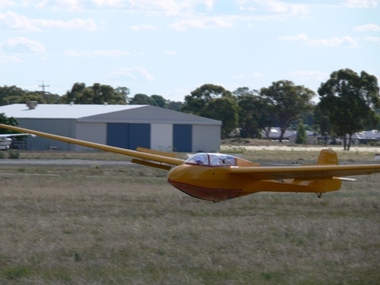
... wood and tubular steel construction covered with plywood and fabric. It has a fully enclosed cockpit under perspex (which is missing from this airframe). The wings which join the fuselage at shoulder height are swept forward such that the aircraft can be flown solo from the front seat and be properly balanced. ...wood and tubular steel construction covered with plywood and fabric. It has a fully enclosed cockpit under perspex (which is missing from this airframe). The wings which join the fuselage at shoulder height are swept forward such that the aircraft can be flown solo from the front seat and be properly balanced. ...The Scheibe Bergfalke II is a high performance (for its day) and relatively inexpensive two seat sailplane designed by Egon Scheibe. It appeared in 1953 as a derivative of the Scheibe Mu13 Bergfalke and incorporated design changes to resolve and simplify structural issues that affected the Mu13. The Bergfalke II-55 followed in 1955. About 300 of the Bergfalke II and II-55 types were built in Germany and Sweden. This aircraft of the Bergfalke II-55 type was built by Scheibe in 1961 (work number 339). After a long life at Fliegergruppe Leimen e.V. logging 6754 flights and 1588 hours in the air, the glider was imported into Australia from Germany in June 2004. The glider was registered as VH-GKZ in January 2005 by Thomas Dattler of Millumbindy and flown only a small number of occasions (probably at Byron Soaring Centre). The Mangalore Gliding Club appears to have taken an interest in the glider in 2006 and completed routine Form 2 inspections in 2006 and 2009. The amount of usage during this period is unclear as the logbook records held are incomplete. In January 2012 the glider was purchased by the Southern Riverina Gliding Club and flown at Tocumwal until it was damaged in 2013 due to being blown over while at rest on the airfield. The 10 year survey was due in March 2013 and a decision was made by the club to donate the glider to the Australian Gliding Museum instead of completing the necessary repairs for returning it to an airworthy condition. It is estimated that the glider was flown about 300 times and perhaps logged about 140 hours in the air in Australia. If restored this exhibit will be representative of the Scheibe Bergfalke II-55 sailplane type (a rarity in Australia).Tandem two seat sailplane of a wood and tubular steel construction covered with plywood and fabric. It has a fully enclosed cockpit under perspex (which is missing from this airframe). The wings which join the fuselage at shoulder height are swept forward such that the aircraft can be flown solo from the front seat and be properly balanced. The aircraft is in a damaged condition. Registration "GKZ" on sides of fuselage glider, sailplane, australian gliding, scheibe, bergfalke, byron soaring centre, mangalore gliding club, dattler, southern riverina gliding club, tocumwal -
 Australian Gliding Museum
Machine - Glider - Sailplane
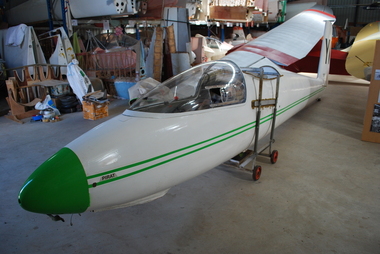
... aircraft flew 1909 hours from 2073 launches. The log discloses numerous silver distance and duration achievements. The Museum's Pirat sailplane is an example of this popular Polish sailplane type and is indicative of the state of sailplane design in the 1960s. australian gliding glider sailplane szd-30 pirat mcmaster alice springs rockhampton Sailplane serial number B-333 and registration “YN” Single seat sailplane of mainly wood construction (some plastic elements) finished in white with green detailing. ...The SZD-30 Pirat was designed by Jerzy Smielkiewicz and first flew in 1966. Over 700 have been produced. The example registered as VH-GYN which was donated to the Australian Gliding Museum by Alan McMaster is one of two that have come to Australia. It carries serial number B-333 and was imported as a new aircraft which was test flown on 29 August 1970. During its logged flying life (last entry 15 April 1990) it was operated in the Northern Territory and Queensland and passed through a number of owners before Alan McMaster at Rockhampton; initially the Alice Springs Gliding Club and then individuals at Charleville and Yeronga in South Brisbane. The aircraft flew 1909 hours from 2073 launches. The log discloses numerous silver distance and duration achievements. The Museum's Pirat sailplane is an example of this popular Polish sailplane type and is indicative of the state of sailplane design in the 1960s.Single seat sailplane of mainly wood construction (some plastic elements) finished in white with green detailing. Sailplane serial number B-333 and registration “YN” australian gliding, glider, sailplane, szd-30, pirat, mcmaster, alice springs, rockhampton -
 Australian Gliding Museum
Machine - Glider - Sailplane, 1937
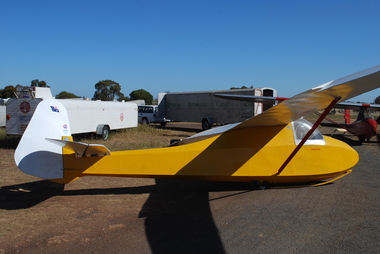
... The exhibit is of great significance for Australian gliding history – the Golden Eagle is a flyable 1930s aircraft in excellent condition that was designed and built by an Australian gliding pioneer. australian gliding glider sailplane golden eagle richardson patching vmfg victorian motorless flight group Registration letters “FC” on fuselage nose port side, Australian flag, Vintage Gliders Australia and VMFG decals on rudder, “Golden Eagle” lettering in red on each side of the fuselage below the canopy, Aboriginal flag decal on port side of fuselage below the canopy. Single seat wood ...The Golden Eagle is an original design by Geoff Richardson. Geoff commenced gliding in the early days of the sport circa 1933 in Melbourne, flying at Coode Island and Mt Frazer. In 1934, he began construction of a secondary type glider but scrapped it upon realizing that a better design was needed. He conducted further research and came up with a sailplane of similar size and general arrangement to the Grunau Baby but with a “Gull” wing using a Gottingen 535 wing section (the same as for the Grunau Baby). Geoff did all the technical calculations himself and even made up and tested a Casein glue for the construction. Geoff competed construction of his new sailplane (which he called the “Golden Eagle”) in 1937 and it was test flown at Laverton at the western edge of Melbourne in September 1937. On the same day, at Laverton, the Gliding Club of Victoria flew its new Grunau Baby 2 sailplane which it had imported as a finished machine from Edmund Schneider in Germany. The Golden Eagle was found to fly well, having a similar performance to the Grunau Baby. In the 1950s, the Golden Eagle was modified by rebuilding the front of the fuselage to enclose the cockpit with a Perspex canopy. A landing wheel was incorporated behind the skid. Spoilers were added to the wings and a trim tab to the elevators. The Golden Eagle has been flown with the VMFG (Victorian Motorless Flight Group) for most of its long life. When donated to the Australian Gliding Museum in 2016 by Alan Patching it was probably the oldest, continuously airworthy glider in the world. Having regard to the historical significance of the Golden Eagle, the Museum has decided to not to fly it anymore to avoid risk of loss or damage. The exhibit is of great significance for Australian gliding history – the Golden Eagle is a flyable 1930s aircraft in excellent condition that was designed and built by an Australian gliding pioneer. Single seat wood and fabric sailplane finished with white wings, tailplane and rudder and yellow fuselage Registration letters “FC” on fuselage nose port side, Australian flag, Vintage Gliders Australia and VMFG decals on rudder, “Golden Eagle” lettering in red on each side of the fuselage below the canopy, Aboriginal flag decal on port side of fuselage below the canopy. australian gliding, glider, sailplane, golden eagle, richardson, patching, vmfg, victorian motorless flight group
