
Showing 272 items matching "american armies"
-
 National Vietnam Veterans Museum (NVVM)
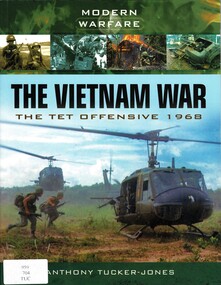
Book, Tucker-Jones, Anthony, The Vietnam War: the Tet Offensive 1968, 2014
... ...American Armies...Tet Offensive 1961-1975 -- United States Vietnam War American Armies South Vietnamese Viet Cong North Vietnamese Army Hue Khe Sanh Saigon On 30 January 1968 the North Vietnamese communists launched a coordinated surprise attack - the Tet Offensive - across South Vietnam against the South Vietnamese and American Armies. ...On 30 January 1968 the North Vietnamese communists launched a coordinated surprise attack - the Tet Offensive - across South Vietnam against the South Vietnamese and American Armies.On 30 January 1968 the North Vietnamese communists launched a coordinated surprise attack - the Tet Offensive - across South Vietnam against the South Vietnamese and American Armies.tet offensive, 1961-1975 -- united states, vietnam war, american armies, south vietnamese, viet cong, north vietnamese army, hue, khe sanh, saigon -
 National Vietnam Veterans Museum (NVVM)
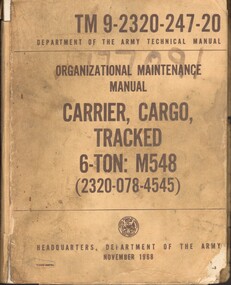
Manual, United States Army, Organizational Maintenance Manual:Carrier, Cargo, Tracked 6-Ton: M548, 1968
... At the bottom on the manual there is an American Army Logo. Also Headquarters, Department of the Army November 1968. ...At the bottom on the manual there is an American Army Logo. Also Headquarters, Department of the Army November 1968. ...A cream coloured manula with TM -9-2320-247-20 on the top right hand side. At the bottom on the manual there is an American Army Logo. Also Headquarters, Department of the Army November 1968. In the centre of the manual there is a description of the item that the manual is for.united states - armed forces - service manuals, carrier cargo tracked 6 tom m548 -
 Frankston RSL Sub Branch
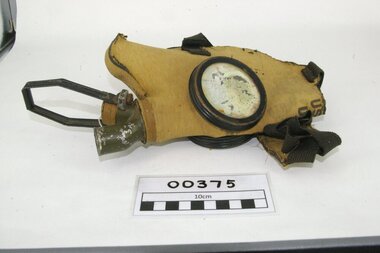
Mask, Gas
... A tank crew gas mask as issued by the United States of America army during World War 2. When correctly worn by the wearer there is a tube fitting at the rear of the head which was connected to a length of flexible hose to receive a fresh air supply....A tank crew gas mask as issued by the United States of America army during World War 2. When correctly worn by the wearer there is a tube fitting at the rear of the head which was connected to a length of flexible hose to receive a fresh air supply. ...A tank crew gas mask as issued by the United States of America army during World War 2. When correctly worn by the wearer there is a tube fitting at the rear of the head which was connected to a length of flexible hose to receive a fresh air supply. -
 National Vietnam Veterans Museum (NVVM)
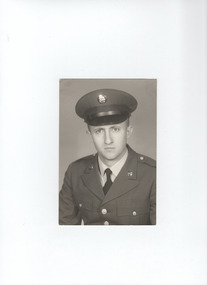
Memorabilia, Private Collection Tschappat, Lawrence E. 4th Infantry Division United States of America
... A private collection of photos and memorabilia collected by Tschappat, Lawrence E of 4th Infantry Division while he served in Vietnam with the United States of America Army. ...A private collection of photos and memorabilia collected by Tschappat, Lawrence E of 4th Infantry Division while he served in Vietnam with the United States of America Army. Private Collection Tschappat USA Boarding pass Methven Vitenam Boonie Hat A photo album containing maps, boarding pass, letters and photograph collected by Tschappat during his time in Vietnam. ...A private collection of photos and memorabilia collected by Tschappat, Lawrence E of 4th Infantry Division while he served in Vietnam with the United States of America Army. A photo album containing maps, boarding pass, letters and photograph collected by Tschappat during his time in Vietnam.private collection, tschappat, usa, boarding pass, methven, vitenam, boonie hat -
 Ballarat Heritage Services
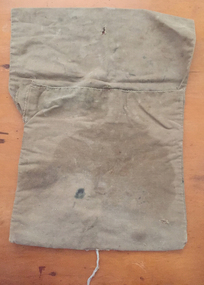
Equipment - Object, c1940
... This material bag could be American Army Supply as Gus Gervason was given many of their items when he served in Darwin and Adelaide River. ...This material bag could be American Army Supply as Gus Gervason was given many of their items when he served in Darwin and Adelaide River. ...This material bag could be American Army Supply as Gus Gervason was given many of their items when he served in Darwin and Adelaide River. Gus Gervasoni was in Darwin when it was bombed.Khaki cloth bag used by George (Gus) Gervasoni during World War Two. In later years this bag was used to keep Gus' boot-cleaning equipment in. gus gervasoni, george gervasoni, army, american army, world war two -
 National Vietnam Veterans Museum (NVVM)
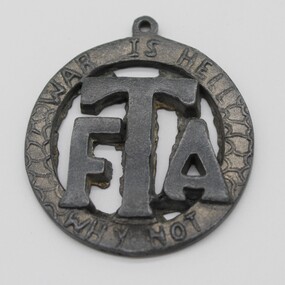
Memorabilia - Medallion, FTA anti-war
... 'Free the army' believed to have been used as a spoof of the American Army recruitment campaign 'Fun, Travel and Adventure'. ...'Free the army' believed to have been used as a spoof of the American Army recruitment campaign 'Fun, Travel and Adventure'. ...Medallion supporting anti-war activists. 'Free the army' believed to have been used as a spoof of the American Army recruitment campaign 'Fun, Travel and Adventure'. Soldiers in Vietnam often converted the slogan to "F-ck The Army ".Round Medallion with large FTA in middle, circled by inscription' War is Hell' at top/ 'Why Not' at bottom.protest movement, antiwar, vietnam, fta, free the army, war is hell, protest, anti-war -
 City of Greater Bendigo - Civic Collection
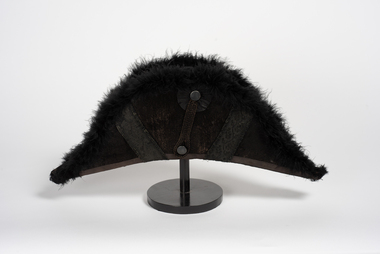
Ceremonial object - Bicorne Hat, 19th Century
... The bicorne or bicorn (two-cornered) was a hat widely adopted in the 1790s as an item of uniform by European and American army and naval officers. Military style uniforms were largely adopted for any man serving in an official capacity, such as a post master, mayor or police before specifically designed uniforms or robes were created....The bicorne or bicorn (two-cornered) was a hat widely adopted in the 1790s as an item of uniform by European and American army and naval officers. Military style uniforms were largely adopted for any man serving in an official capacity, such as a post master, mayor or police before specifically designed uniforms or robes were created. ...The bicorne or bicorn (two-cornered) was a hat widely adopted in the 1790s as an item of uniform by European and American army and naval officers. Military style uniforms were largely adopted for any man serving in an official capacity, such as a post master, mayor or police before specifically designed uniforms or robes were created.Black hand made hat with two distinctive halves pinned up to create a semi circular fan shape. Black braided cockade with two buttons and decorative knot with two decorative fabric pieces running top to bottom on front face only. Trimmed with black ostrich feathers.Makers print under crown illegible (London - Melbourne)city of greater bendigo ceremonial item -
 City of Greater Bendigo - Civic Collection
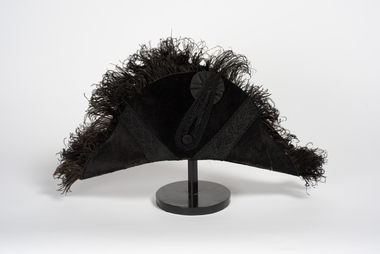
Ceremonial object - Bicorne Hat, 19th Century
... The bicorne or bicorn (two-cornered) was a hat widely adopted in the 1790s as an item of uniform by European and American army and naval officers. Military style uniforms were largely adopted for any man serving in an official capacity, such as a Post Master, Mayor or Police officer before specifically designed uniforms or robes were worn....The bicorne or bicorn (two-cornered) was a hat widely adopted in the 1790s as an item of uniform by European and American army and naval officers. Military style uniforms were largely adopted for any man serving in an official capacity, such as a Post Master, Mayor or Police officer before specifically designed uniforms or robes were worn. ...The bicorne or bicorn (two-cornered) was a hat widely adopted in the 1790s as an item of uniform by European and American army and naval officers. Military style uniforms were largely adopted for any man serving in an official capacity, such as a Post Master, Mayor or Police officer before specifically designed uniforms or robes were worn.Black hand made hat with two distinctive halves pinned up to create a semi circular fan shape. Black braided cockade with single button and decorative knot with wo decorative fabric pieces running top to bottom on front face only. Trimmed with black ostrich feathers.Nonecity of greater bendigo ceremonial item -
 National Vietnam Veterans Museum (NVVM)
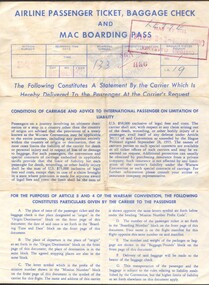
Ephemera - MAC passenger ticker, baggage ticket and boarding pass
... Military Airlift Command (MAC) tickets were issued by the American Army for flights from Saigon to Hong Kong, Bangkok or Taipei from Camp Alpha near Saigon's Tan Son Nhut Air Base. ...Military Airlift Command (MAC) tickets were issued by the American Army for flights from Saigon to Hong Kong, Bangkok or Taipei from Camp Alpha near Saigon's Tan Son Nhut Air Base. ...This MAC air ticket was issued to National Serviceman Allen Doran Lette (Service No. 3795490) for his passage from Saigon to Hong Kong for Rest & Recreation (R&R) during his service in Vietnam. Military Airlift Command (MAC) tickets were issued by the American Army for flights from Saigon to Hong Kong, Bangkok or Taipei from Camp Alpha near Saigon's Tan Son Nhut Air Base. Pte Lette served in the Ordnance Corps,1969-70.QANTAS passenger ticket, baggage check and boarding pass on cream paper in blue ink. ticket, lette, ordnance, vietnam, 3795490, mac, r&r, air ticket -
 National Vietnam Veterans Museum (NVVM)
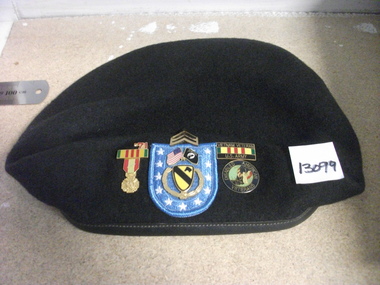
Headwear - Beret with US badges
... Vietnam Veteran US Army, Disabled American Veterans. American Flag Badge POW MIA Badge...Vietnam Veteran US Army, Disabled American Veterans. American Flag Badge POW MIA Badge Headwear Beret with US badges Kingform Cap Co New York NY ...Black woolen Beret with a collection of badges both metal and material. Vietnam Veteran US Army, Disabled American Veterans. American Flag Badge POW MIA Badgebadge, prisoner of war, mia, us military -
 City of Greater Bendigo - Civic Collection
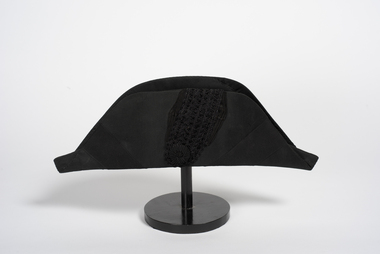
Ceremonial object - Bicorne Hat, Ede and Ravescroft
... The bicorne or bicorn (two-cornered) was a hat widely adopted in the 1790s as an item of uniform by European and American army and naval officers. Military style uniforms were largely adopted for any man serving in an official capacity, such as a post master, mayor or police before specifically designed uniforms or robes were created. ...The bicorne or bicorn (two-cornered) was a hat widely adopted in the 1790s as an item of uniform by European and American army and naval officers. Military style uniforms were largely adopted for any man serving in an official capacity, such as a post master, mayor or police before specifically designed uniforms or robes were created. ...The bicorne or bicorn (two-cornered) was a hat widely adopted in the 1790s as an item of uniform by European and American army and naval officers. Military style uniforms were largely adopted for any man serving in an official capacity, such as a post master, mayor or police before specifically designed uniforms or robes were created. Ede & Ravenscroft is London’s oldest tailor formally established in 1689 in Aldwych from where it had been operating for many years before. It was from here, amongst the many tailors, cloth merchants, robemakers, furriers, embroiderers and haberdashers that the company began its illustrious path of dressing the modern British gent. It began with the respected tailoring family the Shudalls whose work won them the honour of creating the robes for the coronation of their Majesties King William III and Queen Mary II. They soon became a recognised supplier for the royal family, going on to produce a large number or ceremonial robes for the coronation of His Majesty King George III.Black hand made fabric hat with two distinctive halves pinned up to create a semi circular fan shape. Black braided cockade with decorative knot. Makers label underside of crown; Ede and Ravenscroft / Londoncity of greater bendigo ceremonial item -
 City of Greater Bendigo - Civic Collection
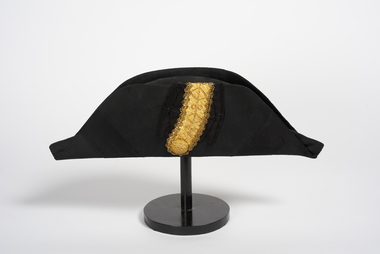
Ceremonial object - Bicorne Hat, Ede and Ravenscroft
... The bicorne or bicorn (two-cornered) was a hat widely adopted in the 1790s as an item of uniform by European and American army and naval officers. Military style uniforms were largely adopted for any man serving in an official capacity, such as a post master, mayor or police before specifically designed uniforms or robes were created. ...The bicorne or bicorn (two-cornered) was a hat widely adopted in the 1790s as an item of uniform by European and American army and naval officers. Military style uniforms were largely adopted for any man serving in an official capacity, such as a post master, mayor or police before specifically designed uniforms or robes were created. ...The bicorne or bicorn (two-cornered) was a hat widely adopted in the 1790s as an item of uniform by European and American army and naval officers. Military style uniforms were largely adopted for any man serving in an official capacity, such as a post master, mayor or police before specifically designed uniforms or robes were created. Ede & Ravenscroft is London’s oldest tailor formally established in 1689 in Aldwych from where it had been operating for many years before. It was from here, amongst the many tailors, cloth merchants, robemakers, furriers, embroiderers and haberdashers that the company began its illustrious path of dressing the modern British gent. It began with the respected tailoring family the Shudalls whose work won them the honour of creating the robes for the coronation of their Majesties King William III and Queen Mary II. They soon became a recognised supplier for the royal family, going on to produce a large number or ceremonial robes for the coronation of His Majesty King George III.Black hand made fabric hat with two distinctive halves pinned up to create a semi circular fan shape. Gold braided and beaded cockade with decorative knot.Makers label underside of crown; Ede and Ravenscroft / Londoncity of greater bendigo ceremonial item -
 Flagstaff Hill Maritime Museum and Village
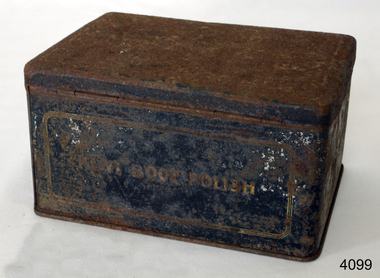
Container - Tin, Kiwi Shoe Polish Manufacture, 1940s
... Its success in Australia expanded overseas when it was adopted by both the British and American armies in World War I. In the UK, Kiwi was for many years manufactured at its British headquarters in Ealing (Brumwell Road, London W5 1DT). ...Its success in Australia expanded overseas when it was adopted by both the British and American armies in World War I. In the UK, Kiwi was for many years manufactured at its British headquarters in Ealing (Brumwell Road, London W5 1DT). ...The polish was developed in Australia by William Ramsay who named it Kiwi after the flightless bird endemic to New Zealand, the home country of his wife, Annie Elizabeth Meek Ramsay. Its success in Australia expanded overseas when it was adopted by both the British and American armies in World War I. In the UK, Kiwi was for many years manufactured at its British headquarters in Ealing (Brumwell Road, London W5 1DT). From here the factory manufactured for the UK market and exported the Kiwi brand too much of Europe and the Middle East. In the mid-1970s, as part of a major streamlining, the UK factory was closed with production switched to France. The UK operation moved to Surrey at Yately becoming, effectively, a sales and marketing office, with distribution contracted to a third party. In 1980, production for the UK market moved back to the UK and was housed in a factory near Huddersfield. The UK head office was relocated to Maidstone, Kent, where Kiwi had other product interests. Following the global merger with Nicholas Laboratories, the UK head office was again relocated to Slough at the Nicholas building on Bath Road.A significant product as Kiwi is an Australian brand name of shoe polish, first launched and sold in Australia in 1906 and as of 2005 sold in almost 180 countries. Previously owned by the Sara Lee Corporation since 1984, it was sold in 2011 to S. C. Johnson. It is the dominant shoe polish in some countries, including the United Kingdom and the United States, where it has about two thirds of the market. In Malaysia and Singapore, Kiwi has become such a household brand for a shoe polish that the word "kiwi" has been genericized into a verb in the Malay language, meaning "to polish one's shoes".Metal cleaning outfit of Kiwi boot polish brush, scraper, & polish missingKiwi Boot Polish to front of containerflagstaff hill, warrnambool, shipwrecked-coast, flagstaff-hill, flagstaff-hill-maritime-museum, maritime-museum, shipwreck-coast, flagstaff-hill-maritime-village -
 Federation University Historical Collection
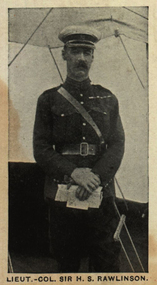
Photograph (black & White), Lieutenant-Colonel Sir Henry Seymour Rawlinson, 1st Baron Rawlinson - South Africa
... Grand Officer of the Legion of Honour of France, 1916; Order of Danilo, 1st Class of the Kingdom of Montenegro, 1916; Obilitch Medal in Gold of the Kingdom of Montenegro, 1917; Order of St George, 4th Class of the Empire of Russia, 1917; Grand Officer of the Order of Leopold of Belgium, 1917; Croix de Guerre of Belgium, 1918; Croix de Guerre of France, 1919; American Army Distinguished Service Medal, 1919; Knight Grand Commander of the Order of the Star of India, 1924. ...Grand Officer of the Legion of Honour of France, 1916; Order of Danilo, 1st Class of the Kingdom of Montenegro, 1916; Obilitch Medal in Gold of the Kingdom of Montenegro, 1917; Order of St George, 4th Class of the Empire of Russia, 1917; Grand Officer of the Order of Leopold of Belgium, 1917; Croix de Guerre of Belgium, 1918; Croix de Guerre of France, 1919; American Army Distinguished Service Medal, 1919; Knight Grand Commander of the Order of the Star of India, 1924. rawlinson second boer war western transvaal battle of rooiwai 1st baron of trent, dorset knight grand cross of the royal victorian order knight commander of the order of st michael and st george knight grand cross of the order of the bath grand officer of the legion of honour france order of danilo 1st class of the kingdom of montenegro obilitch medal in gold of the kingdom of montenegro order fo st george 4th class of theempire of russia grand officer of the order of leopold of belgium croix de guerra of belgium croix de guerra of france american army distinguished service medal knight grand commander of the order of the star of india Individual image from photographed poster of tobacco and cigarette cards. ...Rawlinson served with distinction in a field command in the Second Boer War from 1899 to 1902. He was in Western Transvaal during early 1902 and led a column taking part in the Battle of Rooiwai, the last battle of the war. Following the end of hostilities he returned to England. Rawlinson, for his commands and the battles and wars he was engaged in during his career was awarded many times. Knight Grand Cross of the Royal Victorian Order, 1917; Knight Commander of the Order of St Michael and St George, 1918; Knight Grand Cross of the Order of the Bath, 1919; Baron Rawlinson, of Trent in the County of Dorset, 1919. Grand Officer of the Legion of Honour of France, 1916; Order of Danilo, 1st Class of the Kingdom of Montenegro, 1916; Obilitch Medal in Gold of the Kingdom of Montenegro, 1917; Order of St George, 4th Class of the Empire of Russia, 1917; Grand Officer of the Order of Leopold of Belgium, 1917; Croix de Guerre of Belgium, 1918; Croix de Guerre of France, 1919; American Army Distinguished Service Medal, 1919; Knight Grand Commander of the Order of the Star of India, 1924. Individual image from photographed poster of tobacco and cigarette cards.rawlinson, second boer war, western transvaal, battle of rooiwai, 1st baron of trent, dorset, knight grand cross of the royal victorian order, knight commander of the order of st michael and st george, knight grand cross of the order of the bath, grand officer of the legion of honour france, order of danilo 1st class of the kingdom of montenegro, obilitch medal in gold of the kingdom of montenegro, order fo st george 4th class of theempire of russia, grand officer of the order of leopold of belgium, croix de guerra of belgium, croix de guerra of france, american army distinguished service medal, knight grand commander of the order of the star of india -
 Surrey Hills Historical Society Collection
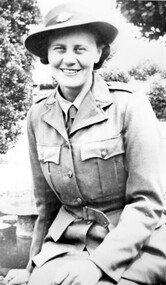
Photograph, Doris Wright, member of the Australian Women's Army Service
... The Army was particular with its recruiting and four references were required; another stipulation was that teeth were in good condition. Doris was located at Elwood. Their training area was along the foreshore and one day to their great surprise there were crowds of American Marines – "the cream of the American Army". ...The Army was particular with its recruiting and four references were required; another stipulation was that teeth were in good condition. Doris was located at Elwood. Their training area was along the foreshore and one day to their great surprise there were crowds of American Marines – "the cream of the American Army". ...Doris Lilian Wright of 214 Union Road was a milliner but joined the Australian Women's Army Service (AWAS) in the early war years. The Women’s Australian National Service (WANS) was inaugurated in 1940. Training for members of the WANS included air raid drills, first aid, basic military drills, and even shooting, signalling, and mechanics. AWAS on formed on 13 August 1941 with the objective of releasing more men into forward areas. The Army was particular with its recruiting and four references were required; another stipulation was that teeth were in good condition. Doris was located at Elwood. Their training area was along the foreshore and one day to their great surprise there were crowds of American Marines – "the cream of the American Army". These were the first Americans to arrive in Australia to strengthen the defence of the country. The Americans soon went north and the AWAS went off to Balcombe on the Mornington Peninsula. At this time there were no uniforms for the girls only ‘giggle’ dresses – of a non-descript colour. They were not expected to appear in public in these and wore civilian dress. Japan had just entered the war and there were more urgent demands on restricted supplies. The formal uniforms eventually arrived.A black and white photograph of a lady in an army uniform and wearing a hat.union road, surrey hills, uniforms, clothing and dress, (miss) doris wright, australian women's army service -
 Federation University Art Collection
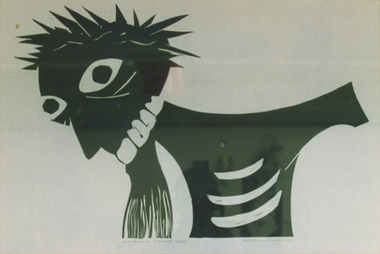
Work on paper - Printmaking - Linocut, 'Laughing Christ', 1970 by Noel Counihan, 1970
... Janet McKenzie in her book 'Noel Counihan' (1986, p. 25) uses Counihan's quote in his description of the Laughing Christ series of art works: "Once again the armies of the Western world were moving against people behind the image of Christ: they were Christian armies. The American and Australian armies in Vietnam had their chaplains with them and were slaughtering Buddhists, as well ironically enough, as Vietnamese Catholics". ...Janet McKenzie in her book 'Noel Counihan' (1986, p. 25) uses Counihan's quote in his description of the Laughing Christ series of art works: "Once again the armies of the Western world were moving against people behind the image of Christ: they were Christian armies. The American and Australian armies in Vietnam had their chaplains with them and were slaughtering Buddhists, as well ironically enough, as Vietnamese Catholics". ...Noel COUNIHAN (04 Oct 1913 - 05 Jul 1986) This lino cut is the second largest version of Counihan's Laughing Christ series of linocuts from the 1970s. Janet McKenzie in her book 'Noel Counihan' (1986, p. 25) uses Counihan's quote in his description of the Laughing Christ series of art works: "Once again the armies of the Western world were moving against people behind the image of Christ: they were Christian armies. The American and Australian armies in Vietnam had their chaplains with them and were slaughtering Buddhists, as well ironically enough, as Vietnamese Catholics". Counihan's fury at the blood shed and massacre of war behind the image of Jesus is evident in his ironic portrayal of a Laughing Christ. Was this what Jesus was about? Not likely! This item is part of the Federation University Art Collection. The Art Collection features over 1000 works and was listed as a 'Ballarat Treasure' in 2007. Description by Dr Susan Paterson Framed linocut, the second large version of the Laughing Christ series. The linocut was commissioned by the Print Council of Australia for members' annual subscription and printed on Japanese paper by William Caulfield & Sons, Melbourne.art, artwork, noel counihan, counihan, printmaking, available, christ, linocut printmaking, print council of australia, workers art guild, social realist, social realism, expressionist artist -
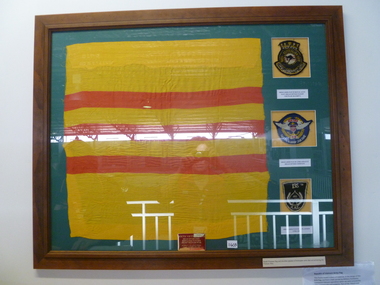 National Vietnam Veterans Museum (NVVM)
Flag - South Vietnam flag
... RAN HFV ) served with the 135th Assault Helicopter Company of the US Army. The Americans named this combined unit the 'experimental military unit' (EMU). ...RAN HFV ) served with the 135th Assault Helicopter Company of the US Army. The Americans named this combined unit the 'experimental military unit' (EMU). ...This piece of fabric in the design of the Republic of Vietnam’s flag was cut from a roll carried by Military Assistance Command Vietnam operatives when they went around the villages, compounds and outposts. As part of the ‘Hearts and Minds’ program, they would cut off sections and hand them out to anyone who wanted a bit. Some pieces became flags, some head scarves, some were even used to wrap babies. Pieces showed up everywhere. Collected by Sub-Lieutenant A C Perry, Royal Australian Navy Helicopter Flight Vietnam (RAN HFV) 1969 -1970. RAN HFV ) served with the 135th Assault Helicopter Company of the US Army. The Americans named this combined unit the 'experimental military unit' (EMU). Framed fabric piece, yellow with three red stripes, representing the South Vietnam flag plus 3 helicopter unit patches mounted on right hand side SOUTH VIETNAM FLAG/ HELICOPTER UNIT/ SHOULDER PATCHES/ FROM VIETNAM WAR/ KINDLEY ON LOAN FROM/ ANDY PERRY (SS US)/ ROYAL AUSTRALIAN NAVYsouth vietnam flag, helicopter patches, arvn, perry, 135th, 135thahc, emu, ranhfv, navy helicopter, andy perry, hearts and minds -
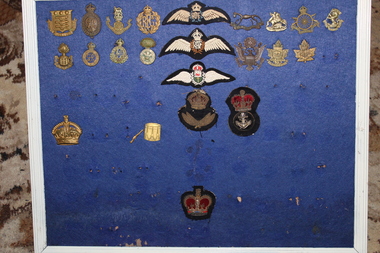 Lara RSL Sub Branch
framed embroaded Patches & Brass military Medals, Blue material background Framed Patches & Medals
... Army Cap Badge. Brass Badge - Queen; Mary's Own - 18th Hussars. Vintage Royal Welsh Fusiliers Cap Badge. R.A. F. Service Dress Wings with King's Crown. American...Army Cap Badge. Brass Badge - Queen; Mary's Own - 18th Hussars. Vintage Royal Welsh Fusiliers Cap Badge. R.A. F. Service Dress Wings with King's Crown. American ...Some are rare in natureBlue material - background, White timber frame surround with 18 metal military cap badges and 6 military cloth patches., Row 1 British Army Cap Badge - Royal Army Ordnance Corps. F1 Household Life guards, Cap Badge, Center G.R. below V. Oval with motto on outside Banner. Royal Lancashire Cap Badge.World War 1 R.F.C. - Royal Flying Corps Cap Badge. surrounded by Laurel Wreath with Crown on top. Circ. 1895 Royal Australian Air Force pilot's wings. The brevet has white cotton embroidered wings, a king's crown, and the letters 'R.A.A.F.' within a pale blue embroidered laurel wreath. Horse Badge - Small Brass - British Army Military. Saint George slaying he dragon - Small Brass Badge. Army Cyclist Corps - World War 1 Cap Badge. Duke of Wellington's Regimental Cap Badge. Row 2 Royal Inniskilling Fusiliers Corps 1895 = Shoulder Title - Officer's. Royal Horse Guards Brass Army Cap Badge. Brass Badge - Queen; Mary's Own - 18th Hussars. Vintage Royal Welsh Fusiliers Cap Badge. R.A. F. Service Dress Wings with King's Crown. American Eagle Brass - Army Officers Cap Badge. 45th Overseas Battalion - Canada Expeditionary Forces. 48th Battlion, Victoria, Canada - British Columbia Brass Cap Badge. World War 1. Row 3. Center World War 11 - Rhodesian Air Force Cloth Pilots wings . row 4 Center - Embossed Woven Crown with metal gold thread woven feathers under. Right - Embossed Woven Crown with Brass Gold Anchor below.- Navy Petty Officer Cap Badge. Row 5. Large Metal Gold color Crown - British Army Warrant Officers Badge. Small Brass Single Rifle with ACT on the Butt of the rifle. Brass Badge - Drummers Proficiency., Last Row - center Embossed woven Crown Red Felt on Blue Back.none - no labels6 cloth patches raised and embossed, 18 military brass metal cap badges vary in type and country and conflict. -
 Federation University Historical Collection
Report, Grampians Puma
... : An up-dated Report of the Deakin Puma Study Australian Animal Folklore Collection John A Henry John Henry Maurice Hornocker grampians geranium springs puma Felis concor mt bepcha scats US Army Peter Morris hans brunner mt Gambier RAAF Ernst Wieher Ellis Tucker halls gap Peter Dryden Geoff Riddle Snow astbury robert hiatt tom schubert trevor clark dick saligari ted saligari terry zerbst brian warren gary Middleton barry henderson morrie lawson bill hower michael harrison ray kerris robert east terry rethus dougal shilcock garth rees ilka rees harry shrive ellis tucker American Airmen Mascot Billywing range Sandy mackirdy mark johnson john morris des paulson feral cat roses gap paula odare gaye beveridge donald macarthur karen jeffery plaster casts terry rethus tom schubert Victoria valley mt talbot fox john spencer ivan bother neal bother evan macklay harry shrive bill hower michael harrsion norma harrison ellis tucker gary middleton barry henderson joy potter les becker John Ryan Cam anderson Richardson Shirley farrant Adinsall max xharles margaret hurley linda crawford don anderson paddy hynes barry bell neal boethe Mark Johnson Victoria Point David Hamilton Wally Smith mythical myth folklore White A4 pages laser printed pages related to a study conducted on the possibility of a Grampians Puma (Felis concolor) populations. ...The study into the Grampians Puma was undertaken by John A. Henry to settle the question of the existence of a puma population in the mountains. People who believe they have sighted a puma, or have sighted other evidence, were interviewed. The study also looked into records relating to the potential of USA army personal leaving a mascot in the grampians. Also see cat no 14012 - Pumas in the Grampians Mountains: A compelling Case?: An up-dated Report of the Deakin Puma StudyWhite A4 pages laser printed pages related to a study conducted on the possibility of a Grampians Puma (Felis concolor) populations. Australian Animal Foklore Collectionaustralian animal folklore collection, john a henry, john henry, maurice hornocker, grampians, geranium springs, puma, felis concor, mt bepcha, scats, us army, peter morris, hans brunner, mt gambier, raaf, ernst wieher, ellis tucker, halls gap, peter dryden, geoff riddle, snow astbury, robert hiatt, tom schubert, trevor clark, dick saligari, ted saligari, terry zerbst, brian warren, gary middleton, barry henderson, morrie lawson, bill hower, michael harrison, ray kerris, robert east, terry rethus, dougal shilcock, garth rees, ilka rees, harry shrive, ellis tucker, american airmen, mascot, billywing range, sandy mackirdy, mark johnson, john morris, des paulson, feral cat, roses gap, paula odare, gaye beveridge, donald macarthur, karen jeffery, plaster casts, terry rethus, tom schubert, victoria valley, mt talbot, fox, john spencer, ivan bother, neal bother, evan macklay, harry shrive, bill hower, michael harrsion, norma harrison, ellis tucker, gary middleton, barry henderson, joy potter, les becker, john ryan, cam anderson, richardson, shirley farrant, adinsall, max xharles, margaret hurley, linda crawford, don anderson, paddy hynes, barry bell, neal boethe, mark johnson, victoria point, david hamilton, wally smith, mythical, myth, folklore -
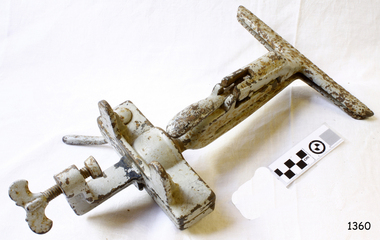 Flagstaff Hill Maritime Museum and Village
Tool - Bench Saw Vice, Henry Disston & Sons, 1910 -1925
... America and began producing the first crucible saw steel ever made in the United States. While his competitors were buying good steel from Britain, he was making his own, to his specification, for his own needs. Disston subsequently constructed a special rolling mill exclusively for saw blades. Over the following decade, the Disston company continued to grow, even while dedicating itself to the Union Army's...America and began producing the first crucible saw steel ever made in the United States. While his competitors were buying good steel from Britain, he was making his own, to his specification, for his own needs. Disston subsequently constructed a special rolling mill exclusively for saw blades. Over the following decade, the Disston company continued to grow, even while dedicating itself to the Union Army's ...The subject item is a saw blade sharpening clamp that attaches to a bench allowing the operator to sharpen the teeth on a saw with a file while keeping the saw blade in an upright position. Henry Disston (1819–1878) began his career as an American saw maker in Philadelphia. He emigrated from England in 1833 and started making saws and squares in 1840. In 1850, he founded the company that would become the largest saw maker in the world the ”Keystone Saw Works” on the Delaware River. Some five years later, Disston built a furnace possibly the first melting plant for steel in America and began producing the first crucible saw steel ever made in the United States. While his competitors were buying good steel from Britain, he was making his own, to his specification, for his own needs. Disston subsequently constructed a special rolling mill exclusively for saw blades. Over the following decade, the Disston company continued to grow, even while dedicating itself to the Union Army's war effort. In 1865, when his son Hamilton Disston rejoined the business after serving in the Civil War, Disston changed the company's name to Henry Disston & Son. Henry Disston and his sons set the standards for American saw makers, both in terms of producing high-quality saws and developing innovative manufacturing techniques. Disston also started making files in 1865. In September 1872, Henry Disston and two other men dug a part of the foundation for what was to become the largest saw manufacturing facility in the world: Disston Saw Works. This was in the Tacony section of Philadelphia. Having previously moved his expanding business from near Second and Market Streets to Front and Laurel Streets, Disston sought to establish his business away from this cramped area. It took over 25 years to move the entire facility to Tacony. This Philadelphia neighborhood seems to have been the only company town in the United States established within an existing city. At its peak of operations, Disston Saw Works employed 8,000 people and the factory covered 300 acres. The company, known as Henry Disston and Sons, Inc by the early 20th century, cast the first crucible steel in the nation from an electric furnace in 1906. The firm's Armour plate building near Princeton Avenue and Milnor Street contributed tremendously to the World War II effort. But the company's innovation and industriousness would not last forever. In 1955, with mounting cash-flow problems and waning interest on the family's part to run the firm, Henry Disston and Sons were sold to the H.K. Porter Company of Pittsburgh. Porter's Disston Division was sold in 1978 and became the Henry Disston Division of Sandvik Saw of Sweden. This division was then sold in 1984 to R.A.F. Industries of Philadelphia and became known as Disston Precision Incorporated, a maker of specialized flat steel products. In 2013, R.A.F. Industries sold Disston Precision Inc. in a private sale. Although the company has ceased making Disston handsaws, the Disston brand name still exists in this firm. A significant American company that pioneered the making of high-quality steel and saws along with other tools and accessories. The subject item is significant as it was made at a time when the company was in its hay day. Adjustable Ball & Socket Saw Sharpening vice, cast iron, with clamp to attach to a workbench. Made by Henry Disston & Co. No 1 painted greyflagstaff hill, warrnambool, flagstaff-hill, flagstaff-hill-maritime-museum, maritime-museum, shipwreck-coast, flagstaff-hill-maritime-village, saw clamp, henry disston & sons, saw sharpening, tool accessories, wood saws -
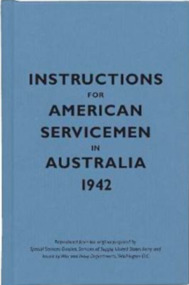 Mission to Seafarers Victoria
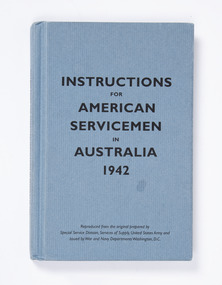
Book - Pocket book, Special Service Devision, Service of Supply, United States Army, Instructions for American Servicemen in Australia 1942, 2007
... As well as general information about the country and its customs. The American Army requisitioned the Port Melbourne Mission on Beach Road. 1942 American soldiers australia In 1942, the United States issued Instructions for American Servicemen in Australia as a quick guide to Australia's people, politics, history and culture for Americans stationed there during the Second World War. ...In 1942, the United States issued Instructions for American Servicemen in Australia as a quick guide to Australia's people, politics, history and culture for Americans stationed there during the Second World War. It was one of several similar sets of instructions put together by the US government to help its soldiers, sailors and airmen adjust to life abroad.Pocket size book of blue colour ix, [54] p. : ill., mapsnon-fictionIn 1942, the United States issued Instructions for American Servicemen in Australia as a quick guide to Australia's people, politics, history and culture for Americans stationed there during the Second World War. It was one of several similar sets of instructions put together by the US government to help its soldiers, sailors and airmen adjust to life abroad. 1942, american soldiers, australia -
 Nhill Aviation Heritage Centre
Booklet - Instruction book, Instructions for American Servicemen in Australia 1942, 2006
... Instructions for American Servicemen in Australia 1942, Reproduce from the original prepared by Special Service Division, Services of Supply, United States Army and issued by War Departments Washington D.C. ...Reproduction of original print booklet reproduction instruction booklet american Instructions for American Servicemen in Australia 1942, Reproduce from the original prepared by Special Service Division, Services of Supply, United States Army and issued by War Departments Washington D.C. ...Reproduction of original printSmall hardback, blue in colour, black print and sketch ilistrations, 54 pagesInstructions for American Servicemen in Australia 1942, Reproduce from the original prepared by Special Service Division, Services of Supply, United States Army and issued by War Departments Washington D.C. Bodlein Library, University of Oxford.booklet, reproduction, instruction booklet, american -
 Lara RSL Sub Branch
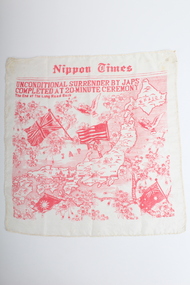
Silk Flag, Nippon Times
... Made of silk after the Japanese Surrender of World War 2 silk american army british army australian military forces aif cherry blossoms nippon times japan world war 2 ww2 japenese surrender See image A silk flag with the words Nippon Times. ...Made at the end of World War 2 to celebrate the surrender of Japan. The item was brought back from Japan by Sapper Albert Alexander Founds VX71775 who joined from Lara Victoria 12 January 1942 and was discharged on 9th July 1947. Made of silk after the Japanese Surrender of World War 2A silk flag with the words Nippon Times. Unconditional Surrender by Japs Completed at 20 minute Ceremony. Picture of cherry blossoms, map of Japan and British, American FlagSee imagesilk, american army, british army, australian military forces, aif, cherry blossoms, nippon times, japan, world war 2, ww2, japenese surrender -
 Shepparton RSL Sub Branch
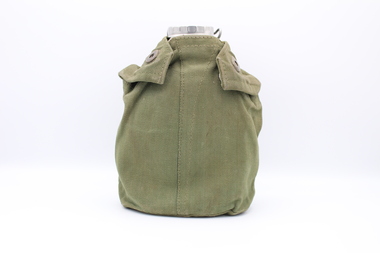
Water Bottle, c. 1940s
... Army during the Korean War, Malayan Confrontation and during the early to mid period of the Vietnam War. The metal lids were often replaced with a much quieter rubber lid, as combat experience proved that the metal ones were too loud when opening or closing. This bottle is recorded as being a United States-issued item so may have been collected during the interactions between Australian and American...Army during the Korean War, Malayan Confrontation and during the early to mid period of the Vietnam War. The metal lids were often replaced with a much quieter rubber lid, as combat experience proved that the metal ones were too loud when opening or closing. This bottle is recorded as being a United States-issued item so may have been collected during the interactions between Australian and American ...According to the Australian War Memorial, these types of water bottles were used by the Australian Army during the Korean War, Malayan Confrontation and during the early to mid period of the Vietnam War. The metal lids were often replaced with a much quieter rubber lid, as combat experience proved that the metal ones were too loud when opening or closing. This bottle is recorded as being a United States-issued item so may have been collected during the interactions between Australian and American troops in Vietnam. It is also noted as being of Second World War era, which predates the AWM suggestion of Korea.Thin stainless steel water bottle, oval in shape with flat base. Around neck of bottle there is a brown cotton string and khaki woven cord with the press stud at end which would insert into the top of the lid. Bottle has twist-on lid with a hole in the top. Bottle dinted throughout. Canvas carry case is cylindrical in shape with oval-shaped flat base. Pieces topstitched with khaki thread. Back of case is woven khaki with a long pin threaded through the top, bent into inward facing hook shapes at end. Bottle is fastened into case via press studs. There is a subtle pocket in the interior of the case.Press studs read "LIFT/THE DOT"water bottle, equipment, united states, korea, malayan confrontation, vietnam war, 1960s -
 Flagstaff Hill Maritime Museum and Village
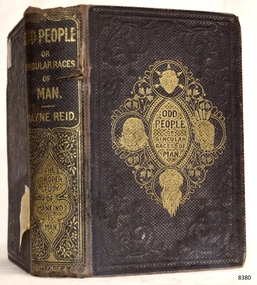
Book - Anthropological Travelogue/Fictional, Captain Mayne Reid, Odd People being A Popular Description of Singular Races of Man, 1860
... American War broke out in 1846, Reid found his true calling. He secured a commission as a First Lieutenant in the New York Volunteer Infantry. He proved to be an incredibly brave—bordering on reckless—soldier. At the Battle of Chapultepec in 1847, Reid led a daring charge up a heavily fortified hill. He was shot through the thigh and left for dead on the battlefield for hours, surrounded by corpses. His survival and bravery earned him a promotion to Captain. Although he later resigned from the army...American War broke out in 1846, Reid found his true calling. He secured a commission as a First Lieutenant in the New York Volunteer Infantry. He proved to be an incredibly brave—bordering on reckless—soldier. At the Battle of Chapultepec in 1847, Reid led a daring charge up a heavily fortified hill. He was shot through the thigh and left for dead on the battlefield for hours, surrounded by corpses. His survival and bravery earned him a promotion to Captain. Although he later resigned from the army ...Odd People: Being a Popular Description of Singular Races of Man (1860) is an interesting piece of 19th-century literature. The book was written by Captain Thomas Mayne Reid (1818–1883), a Scots-Irish American novelist and adventurer. He was immensely popular in the mid-to-late 19th century for his boys' adventure novels, tales of the American West, and travelogues. The true first edition was published in London by Routledge, Warne & Routledge in 1860. In the United States, it was published around the same time (1860/1861) by Ticknor and Fields in Boston, and later editions were retitled The Man-Eaters and Other Odd People. The book is an early work of popular ethnology and anthropology, written for a general audience and heavily marketed toward young readers and armchair travelers of the Victorian era.Book, brown covers, embossed with borders and patterns and gilt decoration and titles. The book includes illustrations. Handwritten inscription on the front paste-down page. The opposite page has a stamped and a handwritten inscription. The book was presented as a prize to a Latin student at the National School, Warrnambool in 1861. Title: Odd People being a Popular Description of Singular Races of Man. Alternate title: Odd People or Singular Races of Man Author: Captain Mayne Reid Publisher: Routledge Warne & Routledge, London Date: 1860 Further information: additional text on the spine reads 'A Proper Study of Mankind is Man'fictionOdd People: Being a Popular Description of Singular Races of Man (1860) is an interesting piece of 19th-century literature. The book was written by Captain Thomas Mayne Reid (1818–1883), a Scots-Irish American novelist and adventurer. He was immensely popular in the mid-to-late 19th century for his boys' adventure novels, tales of the American West, and travelogues. The true first edition was published in London by Routledge, Warne & Routledge in 1860. In the United States, it was published around the same time (1860/1861) by Ticknor and Fields in Boston, and later editions were retitled The Man-Eaters and Other Odd People. The book is an early work of popular ethnology and anthropology, written for a general audience and heavily marketed toward young readers and armchair travelers of the Victorian era.shipwrecked-coast, flagstaff-hill, flagstaff-hill-maritime-museum, warrnambool, maritime-museum, shipwreck-coast, flagstaff-hill-maritime-village, shipwrecked-artefact, book, odd people, captain mayne reid, national school warrnambool., daniel b sellers, classic fiction, the proper study of mankind is man, singular races of man, , routledge warne and routledge, latin student -
 City of Moorabbin Historical Society (Operating the Box Cottage Museum)
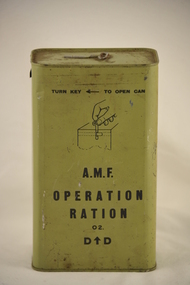
Container - World War 1939-45 Ration pack, c1940
... army catering officer, was born on 2 June 1892 at Mosgiel, New Zealand. University of Otago (B.Sc., N.Z., 1914; M.Sc. Hons, 1915; M.B., Ch.B., 1923) 1916-18 Hicks served as a non-commissioned officer in the New Zealand Expeditionary Force and he assisted Professor J. K. H. Inglis in the synthesis and production of Chloramine-T for use against meningitis among the troops. Hicks was appointed government analyst in 1918. On a Fellowship 1923, he travelled to England and studied at Trinity College, Cambridge (Ph.D., 1926) and caried out research in Switzerland, Germany and the United States of America...army catering officer, was born on 2 June 1892 at Mosgiel, New Zealand. University of Otago (B.Sc., N.Z., 1914; M.Sc. Hons, 1915; M.B., Ch.B., 1923) 1916-18 Hicks served as a non-commissioned officer in the New Zealand Expeditionary Force and he assisted Professor J. K. H. Inglis in the synthesis and production of Chloramine-T for use against meningitis among the troops. Hicks was appointed government analyst in 1918. On a Fellowship 1923, he travelled to England and studied at Trinity College, Cambridge (Ph.D., 1926) and caried out research in Switzerland, Germany and the United States of America ...AMF Operational Ration This ration pack was developed by Sir Stanton Hicks. It contained three meals, each waterproofed (a vital consideration for the tropics), which offered a balanced selection of meat, vegetables, fruit and vitamin supplements. Before the development of this ration pack, Australian soldiers were supplied with quantities of preserved food that were difficult for a man to carry and divide, and which often did not provide a nourishing diet. Sir Cedric Stanton Hicks (1892-1976), university professor and army catering officer, was born on 2 June 1892 at Mosgiel, New Zealand. University of Otago (B.Sc., N.Z., 1914; M.Sc. Hons, 1915; M.B., Ch.B., 1923) 1916-18 Hicks served as a non-commissioned officer in the New Zealand Expeditionary Force and he assisted Professor J. K. H. Inglis in the synthesis and production of Chloramine-T for use against meningitis among the troops. Hicks was appointed government analyst in 1918. On a Fellowship 1923, he travelled to England and studied at Trinity College, Cambridge (Ph.D., 1926) and caried out research in Switzerland, Germany and the United States of America. 1927 he was appointed to the new chair of physiology and pharmacology at Adelaide University, which he was to hold until 1957. During the Depression he studied the dietary patterns of five hundred families receiving relief. 1940 Hicks was appointed temporary captain, Australian Military Forces, and performed part-time duty as catering supervisor. Moved to Melbourne as chief inspector of catering, he began a campaign for applying scientific principles to the feeding of troops. 1943 the Australian Army Catering Corps was formed. Hicks altered the basis of the allowance for military rations from a monetary to a nutrient entitlement, improved the pay and promotion opportunities of cooks, established schools of cooking and catering, devised new methods for preparing food, supported the service's adoption of the Wiles steam-cooker, and designed jungle-patrol, emergency and air-drop rations. His 'Who Called the Cook a Bastard?' (Sydney, 1972) gave an account of his experiences in military catering.Men from most families in the City of Moorabbin area served in the Australian Military Forces during World War 2.A tin container , khaki colour, used for the storage of a food ration item for a soldier serving in the Australian Military Forces World War 11.TURN KEY ← TO OPEN CAN / diagram of key / A.M.F. / OPERATION/ RATION/ 02 / D↑Dworld war 11, australian military forces, sir cedric stanton hicks, army catering corps, soldier rations, food supplys, australian diggers, food preservation -
Phillip Island and District Historical Society Inc.
Book, ABBOTT, John S.C, History of the civil war in America : comprising a full and impartial account of the origin and progress of the rebellion, of the various naval and military engagements, of the heroic deeds performed by armies and individuals, and of touching scenes in the field, the camp, the hospital, and the cabin, 1863
... History of the civil war in America : comprising a full and impartial account of the origin and progress of the rebellion, of the various naval and military engagements, of the heroic deeds performed by armies and individuals, and of touching scenes in the field, the camp, the hospital, and the cabin. ...Labelled 'Cowes Free Public Library', 'Phillip Island Historical Society, Cleeland Bequest'. Stamped 'Jno Cleeland, Albion Hotel, Gt Bourke St., Melbourne'. Inscribed 'Melbourne, Aug 5th 1864'. -
 Australian Commando Association - Victoria
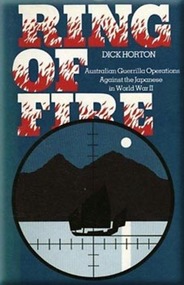
Book, Ring of Fire: Australian Guerrrilla Operations Against Japan in World War II
... American Silver Star for his services. He writes from first-hand knowledge and pays fitting tribute to his brothers-in-arms. He describes the magnificent series of operations of the Independent Companies against the crack 5th and 48th Divisions of the Japanese Army on Timor and the achievements of HMAS KRAIT a converted Japanese fishing boat. ...Dick Horton, as a Lieutenant RNVR. was a member of the Special Forces with which this book is concerned and was awarded the DSC and the American Silver Star for his services. He writes from first-hand knowledge and pays fitting tribute to his brothers-in-arms. He describes the magnificent series of operations of the Independent Companies against the crack 5th and 48th Divisions of the Japanese Army on Timor and the achievements of HMAS KRAIT a converted Japanese fishing boat. He goes on to describe the revolt of the population in Borneo which was engineered by a handful of men. mostly Australians from Z Special Unit, and which materially assisted the Allied Forces when they invaded and re-took it. Apart from its unquestionable value to students of military history, "Ring of Fire" is an exciting account of a variety of imaginativenon-fiction Dick Horton, as a Lieutenant RNVR. was a member of the Special Forces with which this book is concerned and was awarded the DSC and the American Silver Star for his services. He writes from first-hand knowledge and pays fitting tribute to his brothers-in-arms. He describes the magnificent series of operations of the Independent Companies against the crack 5th and 48th Divisions of the Japanese Army on Timor and the achievements of HMAS KRAIT a converted Japanese fishing boat. He goes on to describe the revolt of the population in Borneo which was engineered by a handful of men. mostly Australians from Z Special Unit, and which materially assisted the Allied Forces when they invaded and re-took it. Apart from its unquestionable value to students of military history, "Ring of Fire" is an exciting account of a variety of imaginative -
 Flagstaff Hill Maritime Museum and Village
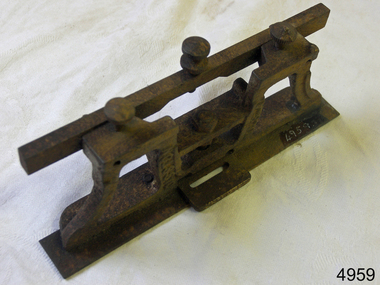
Tool - Saw gauge, Henry Disston, 1890-1920
... America and began producing the first crucible saw steel ever made in the United States. While his competitors were buying good steel from Britain, he was making his own, to his specification, for his own needs. Disston subsequently constructed a special rolling mill exclusively for saw blades. Over the following decade, the Disston company continued to grow, even while dedicating itself to the Union Army's...America and began producing the first crucible saw steel ever made in the United States. While his competitors were buying good steel from Britain, he was making his own, to his specification, for his own needs. Disston subsequently constructed a special rolling mill exclusively for saw blades. Over the following decade, the Disston company continued to grow, even while dedicating itself to the Union Army's ...Disston Saw Works of Philadelphia was one of the better known and highly regarded manufacturers of handsaws in the United States. During the Machine Age, the company was known as Henry Disston & Sons, Inc. a supplier of industrial saw blades. History: The story of handsaws in the United States mirrors the technical and development of steel in Sheffield, England, which was the center of handsaw production during the 18th century and through most of the 19th century. England's political and economic lock-on steel making in the colonies held American saw makers at bay until well after the Revolutionary War. American steel producers were unable to compete until the US government introduced import tariffs to level the playing field in 1861. Henry Disston: Henry Disston (1819–1878) began his career as an American saw maker in Philadelphia. He had emigrated from England in 1833 and started making saws and squares in 1840. In 1850, he founded the company that would become the largest saw maker in the world, the Keystone Saw Works. Some five years later, Disston built a furnace—perhaps the first melting plant for steel in America and began producing the first crucible saw steel ever made in the United States. While his competitors were buying good steel from Britain, he was making his own, to his specification, for his own needs. Disston subsequently constructed a special rolling mill exclusively for saw blades. Over the following decade, the Disston company continued to grow, even while dedicating itself to the Union Army's war effort. In 1865, when his son Hamilton Disston rejoined the business after serving in the Civil War, Disston changed the company's name to Henry Disston & Son. Henry Disston and his sons began to set the standards for American saw makers, both in terms of producing high-quality saws and files in 1865 through his development of innovative manufacturing techniques. In September 1872, Henry Disston and two other men dug a part of the foundation for what was to become the largest saw manufacturing facility in the world: Disston Saw Works. This was in the Tacony section of Philadelphia. Having previously moved his expanding business from near Second and Market Streets to Front and Laurel Streets. It took over 25 years to move the entire facility to Tacony. Henry Disston was renowned for having one of the first industries that exhibited environmental responsibility, as well as a paternalistic view towards his employees. For example, he had thousands of homes built in Tacony for his workmen. Funds to purchase these homes were made available through a building and loan association set up by the Disston firm. His caring influence on the community was evident in everyday life. To meet employees' cultural needs, a hall and a library were built with Henry Disston agreeing to pay a fixed sum towards its maintenance. The Tacony Music Hall was erected in 1885, also with the assistance of Disston money. Henry Disston had fallen ill by 1877 and never truly recovered; he suffered a stroke and died the next year. This came only one and a half years after seeing his products receive the highest honors at the great Philadelphia Centennial Exposition of 1876. His vision of a working-class community and the completion of the transfer of his enormous saw plant was carried out by his wife and his sons. The company, by the early 20th century, cast the first crucible steel in the nation from an electric furnace in 1906. The firm's armor-plate building near Princeton Avenue and Milnor Street contributed tremendously to the World War II effort. But the company's innovation and industriousness would not last forever. In 1955, with mounting cash-flow problems and waning interest on the family's part to run the firm, Henry Disston and Sons were sold to the H.K. Porter Company of Pittsburgh. Porter's Disston Division was sold in 1978 and became the Henry Disston Division of Sandvik Saw of Sweden. This division was then sold in 1984 to R.A.F. Industries of Philadelphia and became known as Disston Precision Incorporated, a maker of specialized flat steel products. In 2013, R.A.F. Industries sold Disston Precision Inc. in a private sale. Although the company has ceased making Disston handsaws, the Disston brand name still exists in this firm. A tool used to set and sharpen cross cut saws used to fell trees for building construction made by a well known American maker whos firm pioneered the making of saws and their related items including files.combination cross cut saw raker and gauge/jointerDisston USA in the castingflagstaff hill, warrnambool, shipwrecked-coast, flagstaff-hill, flagstaff-hill-maritime-museum, maritime-museum, shipwreck-coast, flagstaff-hill-maritime-village -
 Bendigo Military Museum
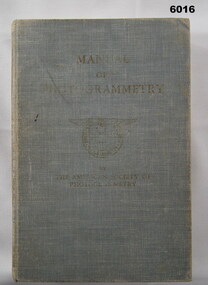
Manual - Manual of Photogrammetry, (Preliminary Edition), 1934 American Society of Photogrammetry, Circa 1934
... This book belonged to Brigadier FD Buckland OBE Director of Survey Land Headquarter Royal Australian Survey Corps RASvy Fortuna Army Survey Regiment Army Svy Regt ASR Photogrammetry Hardcover, light blue, 819 pages, text, diagrams, photographs 1934 American Society of Photogrammetry Manual Manual of Photogrammetry, (Preliminary Edition) American Society of Photogrammetry, Pitman Publishing Corporation, New York, Chicago ...This book belonged to Brigadier FD Buckland OBE Director of Survey Land HeadquarterHardcover, light blue, 819 pages, text, diagrams, photographsroyal australian survey corps, rasvy, fortuna, army survey regiment, army svy regt, asr, photogrammetry
