
Showing 70 items matching "american uniform"
-
 National Vietnam Veterans Museum (NVVM)
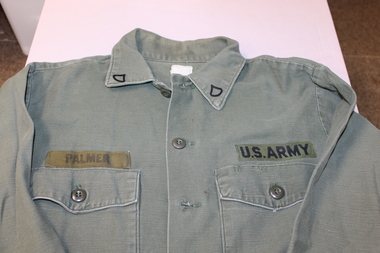
Uniform - Shirt, US Army
... ...American uniform...US Army Shirt Palmer Vietnam US uniform American uniform United states army US Army/Palmer Olive drab long sleeved shirt with embroidery on the collar peaks. ...Early in the Vietnam war, US troops wore this heavy cotton OG-107 utility shirt. Later, the Tropical Combat Uniform (TCU) made of a lighter poplin fabric and featuring angled pockets, became standard, although the OG-107 remained in use. Olive drab long sleeved shirt with embroidery on the collar peaks. Button front with square, buttoned flap chest pockets. A cloth name is stitched above the right-hand pocket. US Army/Palmerus army, shirt, palmer, vietnam, us uniform, american uniform, united states army -
 National Vietnam Veterans Museum (NVVM)
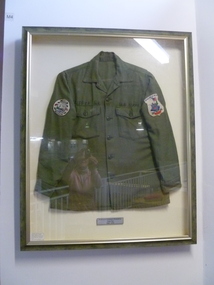
Uniform - Framed Uniform, US Army Jacket, Explosives ordinance demolition Vung Tau 1969-1970, 1969-1970
... ...American Army Jacket...Uniform...US Army American Army Jacket Uniform Pte Lyle Francis Johnson (Johno) 3795023 Royal Australian Army Service Corps 1st Australian Logistic Support Group Australian National Serviceman Story of Acquisition on Frame which reads: I traded a beer mug I had decorated with a green enamel kangaroo and a 20 dong coin for this shirt from the owner at EOD'S Boozer Sig Hill, Vung Tau - one night in 1970. ...Pte Lyle Francis (Johno) Johnson, was a National Serviceman who was with the Royal Australian Army Service Corps and served in Vietnam with Headquarters, 1st Australian Logistic Support Group from September 1969 to August 1970.Green US jacket with two cloth badges on arms and name 'Hupper BK US Navy' in a box frame displayStory of Acquisition on Frame which reads: I traded a beer mug I had decorated with a green enamel kangaroo and a 20 dong coin for this shirt from the owner at EOD'S Boozer Sig Hill, Vung Tau - one night in 1970. Lyle F (Johno) Johnson, HQ Coy. Tpt, 1ALSG (Nasho) 68-70)us army, american army jacket, uniform, pte lyle francis johnson (johno), 3795023, royal australian army service corps, 1st australian logistic support group, australian national serviceman -
 Warrnambool and District Historical Society Inc.
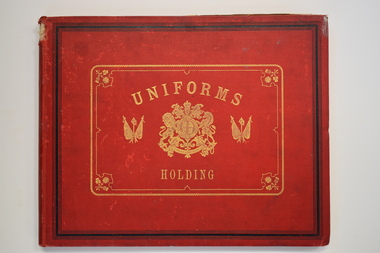
Book - British Military Uniforms, T.H. Holding, London, Uniforms- Holding, 1894
... Holding, is a comprehensive guide to outfitters supplying uniforms to British military and naval personnel. It also has information on American and Italian uniforms and livery, diplomatic and band dress. ...Holding, is a comprehensive guide to outfitters supplying uniforms to British military and naval personnel. It also has information on American and Italian uniforms and livery, diplomatic and band dress. ...A Guide to the Making of British Military and Naval UniformsThis is a book of 82 pages. It has a red cover with gold printing, scroll work, heraldic flags and the official British crest. The pages contain printed text and sketches of military and naval uniforms, hats, badges and other accoutrements. A colour photograph of the Duke of York has a tissue covering. The spine is partly damaged.non-fictionA Guide to the Making of British Military and Naval Uniformsbritish military and naval uniforms, t h holding, 1894 british uniforms -
 Flagstaff Hill Maritime Museum and Village
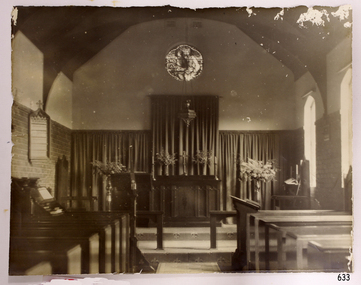
Photograph - Historical, religious, mid-20th century
... The building’s design incorporates local features such as Warrnambool sandstone, which was no longer commercially available but was procured from demolished buildings and uniformly cut to use as a veneer over the stronger Mt. Gambier stone. Also, traditional green American roofing slate was used, sourced from the 1908 local shipwreck “Falls of Halladale” by Flagstaff Hill volunteer divers. ...The building’s design incorporates local features such as Warrnambool sandstone, which was no longer commercially available but was procured from demolished buildings and uniformly cut to use as a veneer over the stronger Mt. Gambier stone. Also, traditional green American roofing slate was used, sourced from the 1908 local shipwreck “Falls of Halladale” by Flagstaff Hill volunteer divers. ...This photograph records the interior of St Nicholas Seamen's Church at 139 Nelson Place, Williamstown, Victoria, which was purchased and furnished around 1943. The furniture and furnishings are now part of the St. Nicholas Seamen's Church collection. HISTORY of the Missions to Seamen: - DETAILED HISTORY of the Missions to Seamen: - The Missions to Seamen is an Anglican (Church of England) charity that has served the world’s seafarers since 1856. It was inspired by the work of Rev. John Ashley, who, 20 years earlier, had pioneered a ministry to seafarers in the Bristol Channel in Great Britain. When Ashley retired, others continued the work, founding the Missions to Seamen. It adopted a Flying Angel as its symbol, inspired by a verse from the Bible in Revelation 14. Today, over 200 world ports have Missions to Seamen centres and chaplains. A Missions to Seamen’s Club warmly welcomes sailors of all colours, creeds and races and provides a wide range of facilities. The Missions to Seamen organisation changed its name to the Mission to Seafarers in 2000, continuing to include Missions to Seamen clubs in Victoria’s cities of Melbourne, Portland, Geelong and Hastings. Flagstaff Hill’s St Nicholas’ Seamen’s Church is named after its namesake from Williamstown, Victoria, which began in 1857. Bishop Perry opened the first Sailors’ Church there, known as ‘Bethel’, on an old hulk floating in Hobson’s Bay, Port of Melbourne. In 1860, a Sailors’ Rest started operating from rented premises in Williamstown. In 1878, the Sailors’ Church moved into an old Wesleyan chapel in Ann Street. By the end of that year, they managed to purchase the building, which they had already refurbished. In 1883, they affiliated with the Victorian Seamen’s Mission. A few years later, in 1906, the building had to be demolished because it was no longer safe. While they raised funds for a new building, the Sailors’ Rest temporarily moved to premises in front of Customs House in Nelson Place. Around this time, in 1906, the Ladies Harbour Lights Guild was formed in Australia to support and raise funds for the Mission to Seamen organisation in Melbourne. Two of the most significant ladies of the Guild were founding members Ethel Godfrey and Alice Sibthorpe. During the Mission's time at Siddeley Street, Melbourne, the activities of the Guild raised funds for the Mission to Seamen's Chapel at their new, and still current, premises in Flinders Street, Melbourne, opened in 1917. The Guild continued its important work until the 1960s. In 1908, the Williamstown Mission had enough money to purchase the former Mascotte skating rink on Thompson Street, Williamstown. In August of that year, they were inaugurated into the Victorian Missions to Seamen. They continued at that venue for a few decades. In 1943, the former ES&A Bank building at 139 Nelson Place, Williamstown, was purchased to become the new Mission to Seamen’s Club. On May 6th, 1944, it was officially opened, described as a ‘distinctive little building’. Funds had previously been raised for the building and furnishing of the chapel at the rear. The chapel was named St Nicholas’ Seamen’s Church, after St Nicholas, fourth-century bishop and patron saint of sailors. Services were held on Wednesdays and Sundays. The church was supported by the Williamstown Lightkeepers’ Auxiliary, newly founded by Mrs Ethel Margaret Musther in 1943, as well as the Harbour Lights Guild and the League of Soldiers’ and Sailors’ Friends. The Williamstown Mission to Seamen’s Church operated until 1966, when large international ships no longer used the Port of Williamstown. The Commonwealth Government then leased the premises. In the formative years of Flagstaff Hill Maritime Village, the Advisory Board decided to include a Missions to Seamen Chapel and Recreation Room in its village. The Missions organisation was a significant feature of ports during the late 1800s and early 1900s, the period that the Village represents. They often erected Missions to house social and worshipful activities for seamen. Flagstaff Hill’s curator, Mr Ken Marshman, approached the Melbourne Board of Management of Missions to Seamen regarding the Williamstown branch. Consequently, the Board permitted the furnishings of the Williamstown chapel to be transferred to Flagstaff Hill Maritime Village. A provision of the transfer was that the Victoria Missions to Seamen be recognised, that the items would remain as a collection, and that the chapel would be called St Nicholas Seamen’s Church and conduct Divine services. The donation was approved on 21st May 1979. Flagstaff Hill's St. Nicholas Seamen's Church: - The idea behind Flagstaff Hill’s Missions to Seamen’s Church was partly driven by the offer of Stained Glass Memorial Windows that originated from the Warrnambool and District Base Hospital, which was undergoing multi-storey expansion in the late 1960s and early 1970s. The hospital’s Manager/Secretary was eager to see the historic window installed in a suitable place. The church, or chapel, was designed by a local architectural draftsman in collaboration with the Flagstaff Hill Planning Board and was constructed by Mr Leon Habel. The designers hoped that the church would be used for formal worship such as weddings, funerals, and multi-denominational special services like war commemorations. The design is inspired by the ‘Missions to Seamen’ buildings in Portland and the Port of Melbourne. The furniture and furnishings were placed as accurately as possible according to photographs of the Williamstown St Nicholas Seamen’s Church and with assistance from local clergy. The Recreation Room was furnished and arranged on advice from experienced members of the Missions to Seamen organisation. A framed document in the building recognises the donor of the furnishings, Victoria Missions to Seamen, and includes the names of some original donors and their donated item/s. The building’s design incorporates local features such as Warrnambool sandstone, which was no longer commercially available but was procured from demolished buildings and uniformly cut to use as a veneer over the stronger Mt. Gambier stone. Also, traditional green American roofing slate was used, sourced from the 1908 local shipwreck “Falls of Halladale” by Flagstaff Hill volunteer divers. The bell tower includes a bell believed to be from a local shipwreck. Additional furnishings were acquired locally, along with several items donated by Warrnambool residents. Light fittings in both rooms were assembled to simulate 19th-century gas light fittings. The stained-glass window at the back of the church is a memorial to Dr Connell, a well-respected member of the Warrnambool community. It was originally installed in 1928 in the main building of Warrnambool Hospital. The St Nicholas’ Seamen’s Church at Flagstaff Hill was officially opened by His Worship the Mayor, Cr. John Lindsay, on Sunday, 11th October 1981. The event included a service of thanksgiving conducted by the Warrnambool Ministers Fraternal. Since then, the Chapel has been the historic venue for many weddings. This photograph is significant through its association with the St Nicholas' Mission to Seamen Church in Williamstown, Melbourne, established in 1857. The building in the photograph is the former English, Scottish and Australian Bank (ES&A bank), also known as the Mission to Seamen. It is listed on the Victorian Heritage Database for having local historic and aesthetic interest. Photograph of St Nicholas Seamen's Church, Williamstown. Sepia photograph. The photograph shows the inside of the Chapel of Mission to Seamen, including organ, pews and other furniture and furnishings. There is a circular stained glass window high on the back wall depicting a sailor at the helm of a ship and a man standing behind him and pointing the way - "Christ Showing The Helmsman The Way". A Sanctuary Light is suspended from the ceiling. The Sanctuary chars are visible. This shows the St Nicholas Seamen's Church in Williamstown, the furnishings and furniture of which is now part of the St Nicholas Seamen's Church Collection’.flagstaff hill, warrnambool, shipwrecked-coast, flagstaff-hill, flagstaff-hill-maritime-museum, maritime-museum, shipwreck-coast, flagstaff-hill-maritime-village, st nicholas mission to seamen's church williamstown, mission to seamen williamstown, mission to seamen victoria, st nicholas mission to seamen, chapel window, christ showing the helmsman the way, stained glass window, st nicholas seamen's church, religion, religious service, sailor's rest, ladies harbour light guild -
 Flagstaff Hill Maritime Museum and Village
Badge - Gripman Badge, Stokes & Sons, Jul 1916 - Nov. 1919
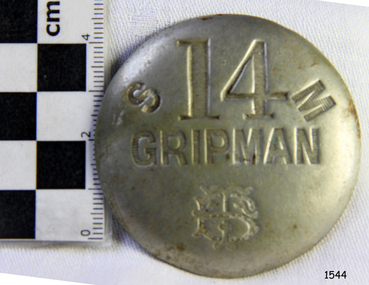
... uniform. The inscriptions on the front of the badge identify it as belonging to Gripman number 14, at the South Melbourne Car House depot of the Tramways Board. The Gripman Badge would be re-issued whenever another Gripman takes over the position. Cable trams were invented in America...uniform. The inscriptions on the front of the badge identify it as belonging to Gripman number 14, at the South Melbourne Car House depot of the Tramways Board. The Gripman Badge would be re-issued whenever another Gripman takes over the position. Cable trams were invented in America ...This cable tram Gripman’s badge, or driver’s badge, was part of a tram driver’s uniform. The inscriptions on the front of the badge identify it as belonging to Gripman number 14, at the South Melbourne Car House depot of the Tramways Board. The Gripman Badge would be re-issued whenever another Gripman takes over the position. Cable trams were invented in America in 1873. In Melbourne, cable trams were in use from 1885 until 1940, with a network of up to 1200 cable cars or 'dummies' and trailers travelling at around 9.5 miles (15km) per hour along 46 miles (74km) of double tracks. The Gripman drove the dummy car, operating the heavy levers to connect the gripping gears to the cable installed in a slot in the road. To turn at intersections he would skilfully disconnect, freewheel around the corner and carefully reconnect to the continuously operating steel cable. Large winding gears in an Engine House along the line pulled the cable along, powered by steam engines and later electric engines. The gripping gears were in the centre of the car's floor with seating all around the sides, a dangerous place for curious children. , whose worried parents would guide them into the tram that was towed behind the dummy car. The Melbourne Tramways Board operated the cable trams between July 1916 and November 1919 after taking over from the privately operated Melbourne Tramway and Omnibus Company. In 1919, the Melbourne and Metropolitan Tramways Board (MMTB) took over the Tramways Board. Stokes & Sons: - The maker of the badge, Thomas Stokes, migrated to Melbourne from Birmingham in 1854 and set up business in Mincer Lane as a die-sinker, producing medals, tokens, buttons and silverware, and an engraving service. He moved to Flinders Lane in 1856. After a time, in 1894, the business became Stokes & Sons Pty: Ltd, electroplates and badge makers at Post Office Place in Melbourne. The maker's mark 'Stokes & Sons' was made on badges until 1962. LOCAL CONNECTION: -t was common practice to recycle the used cables from the tramway. For example, the Wollaston Bridge in Warrnambool, Victoria, is suspended by recycled cable tram Melbourne. (Other recycled cables were used for fencing wire.) -Portland's cable tram is an example of the cable trams used in Melbourne from 1885 to 1940.This badge was used to identify a Gripman who operated a cable car tram's dummy car for the Tramways Board in Melbourne between 1916 and 1919. It represents the need for people to be able to identify workers in the service industry, a need still addressed today by staff ID badges and digital identification. The badge also represents the period in Melbourne's history when cable cars were used for public transport for over four decades, gradually changing from steam to electric power. Trams still have an important role in Melbourne's public transport. Badge, round hollow metal dome with two open metal guides on the back. A cable tram Gripman (driver) badge with embossed inscriptions on the front and stamped on the back. There is a logo of entwined letters T and B on the front. It identifies Gripman number 14, South Melbourne, Tramway Board. It was made by Stokes & Sons of Melbourne. Impressed into the front: "S / 14 / M" "GRIPMAN" Logo intertwined "T" and "B" Embossed on reverse "STOKES &o SONS"flagstaff hill, flagstaff hill maritime museum and village, warrnambool, maritime museum, maritime village, great ocean road, shipwreck coast, badge, gripman, stokes & sons, numesmatics, tramway, tram, tram driver, uniform, cable tram, identification, cable car driver, tramway board, south melbourne, melbourne tramways board, tb, mtb, mmtb, melbourne and metropolitan tramways board, tramway button, gripman button, id, identification badg, staff badge, name badge, employee, grip car, dummy car -
 Lara RSL Sub Branch
Uniform - Russian paratrooper red beret
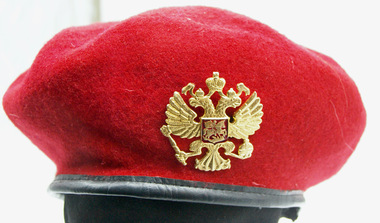
... American-made Irvin parachutes. In April 1930, Soviet industry produced its first run of domestic parachutes, not surprisingly patterned on the Irvin style. russian front 1918-1919 russian paratroopers history of russian paratroopers history of change in aircraft to cater for paratroopers fabric informatiion labelt i.e. dry clean Red felted wool beret withblack leather hat trim Uniform Russian paratrooper red beret ...The Soviet Union was one of the first countries to realize the unique potential of parachute forces. As early as 1927 there were reports of parachute troops being used against bandits in Central Asia. Within the next two to three years Leonid G. Minov began to organize the first military parachute units. He traveled to the United States to study parachute strategy and techniques employed in air rescue missions. He returned to his country with a supply of American-made Irvin parachutes. In April 1930, Soviet industry produced its first run of domestic parachutes, not surprisingly patterned on the Irvin style.Red felted wool beret withblack leather hat trimfabric informatiion labelt i.e. dry cleanrussian front 1918-1919, russian paratroopers history of russian paratroopers, history of change in aircraft to cater for paratroopers -
 Flagstaff Hill Maritime Museum and Village
Textile - Seat Squabs, mid-20th century
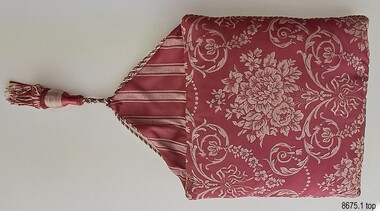
... The building’s design incorporates local features such as Warrnambool sandstone, which was no longer commercially available but was procured from demolished buildings and uniformly cut to use as a veneer over the stronger Mt. Gambier stone. Also, traditional green American roofing slate was used, sourced from the 1908 local shipwreck “Falls of Halladale” by Flagstaff Hill volunteer divers. ...The building’s design incorporates local features such as Warrnambool sandstone, which was no longer commercially available but was procured from demolished buildings and uniformly cut to use as a veneer over the stronger Mt. Gambier stone. Also, traditional green American roofing slate was used, sourced from the 1908 local shipwreck “Falls of Halladale” by Flagstaff Hill volunteer divers. ...The term 'seat squabs' is no longer commonly used, but is sometimes referred to in the upholstery and motor vehicle industries. Squabs are padded cushions frequently added to wooden chairs or benches to add comfort to their hard forms. They have been made to an 18th-to-19th-century pattern using beautiful, richly coloured satin fabric and fancy cord tassels. The weighted flap at the rear of the squabs helps to keep them in place on the chair, and could be used on the top of the backrest instead of on the seat. These days, squabs are attached with fabric ties or hook-and-loop tabs. These seat squabs were once used in the St Nicholas Seamen's Church at 139 Nelson Place, Williamstown, Victoria, which was purchased and furnished around 1943. The furniture and furnishings are now part of the St. Nicholas Seamen's Church collection. DETAILED HISTORY of the Missions to Seamen: - The Missions to Seamen is an Anglican (Church of England) charity that has served the world’s seafarers since 1856. It was inspired by the work of Rev. John Ashley, who, 20 years earlier, had pioneered a ministry to seafarers in the Bristol Channel in Great Britain. When Ashley retired, others continued the work, founding the Missions to Seamen. It adopted a Flying Angel as its symbol, inspired by a verse from the Bible in Revelation 14. Today, over 200 world ports have Missions to Seamen centres and chaplains. A Missions to Seamen’s club warmly welcomes sailors of all colours, creeds and races and provides a wide range of facilities. The Missions to Seamen organisation changed its name to the Mission to Seafarers in 2000, continuing to include Missions to Seamen clubs in Victoria’s cities of Melbourne, Portland, Geelong and Hastings. Flagstaff Hill’s St Nicholas’ Seamen’s Church is named after its namesake from Williamstown, Victoria, which began in 1857. Bishop Perry opened the first Sailors’ Church, which was known as ‘Bethel’, on an old hulk floating in Hobson’s Bay, Port of Melbourne. In 1860, a Sailors’ Rest started operating from rented premises in Williamstown. In 1878, the Sailors’ Church moved into an old Wesleyan chapel in Ann Street. By the end of that year, they managed to purchase the building, which they had already refurbished. In 1883, they affiliated with the Victorian Seamen’s Mission. A few years later, in 1906, the building had to be demolished because it was no longer safe. While they raised funds for a new building, the Sailors’ Rest temporarily moved to premises in front of Customs House in Nelson Place. Around this time, in 1906, the Ladies Harbour Lights Guild was formed in Australia to support and raise funds for the Mission to Seamen organisation in Melbourne. Two of the most significant ladies of the Guild were founding members Ethel Godfrey and Alice Sibthorpe. During the Mission's time at Siddeley Street, Melbourne, the activities of the Guild raised funds for the Mission to Seamen's Chapel at their new, and still current, premises in Flinders Street, Melbourne, opened in 1917. The Guild continued its important work until the 1960s. In 1908, the Williamstown Mission had enough money to purchase the former Mascotte skating rink on Thompson Street, Williamstown. In August of that year, they were inaugurated into the Victorian Missions to Seamen. They continued at that venue for a few decades. In 1943, the former ES&A Bank building at 139 Nelson Place, Williamstown, was purchased for the new Mission to Seaman’s Club. The official opening was on May 6th, 1944. It was described as a ‘distinctive little building’. Funds had previously been raised for the building and furnishing of the chapel at the rear. The chapel was named St Nicholas’ Seamen’s Church, after St Nicholas, fourth-century bishop and patron saint of sailors. Services were held on Wednesdays and Sundays. The church was supported by the Williamstown Lightkeepers’ Auxiliary, newly founded by Mrs Ethel Margaret Musther in 1943, as well as the Harbour Lights Guild and the League of Soldiers’ and Sailors’ Friends. The Williamstown Mission to Seamen’s Church operated until 1966, when large international ships no longer used the Port of Williamstown. The Commonwealth Government then leased the premises. In the formative years of Flagstaff Hill Maritime Village, the Advisory Board decided to include a Missions to Seamen Chapel and Recreation Room in its village. The Missions organisation was a significant feature of ports during the late 1800s and early 1900s, the period that the Village represents. They often erected Missions to house social and worshipful activities for seamen. Flagstaff Hill’s curator, Mr Ken Marshman, approached the Melbourne Board of Management of Missions to Seamen regarding the Williamstown branch. Consequently, the Board permitted the furnishings of the Williamstown chapel to be transferred to Flagstaff Hill Maritime Village. A provision of the transfer was that the Victoria Missions to Seamen be recognised, that the items would remain as a collection, and that the chapel would be called St Nicholas Seamen’s Church and conduct Divine services. The donation was approved on 21st May 1979. Flagstaff Hill's St. Nicholas Seamen's Church: - The idea behind Flagstaff Hill’s Missions to Seamen’s Church was partly driven by the offer of Stained Glass Memorial Windows that originated from the Warrnambool and District Base Hospital, which was undergoing multi-storey expansion in the late 1960s and early 1970s. The hospital’s Manager/Secretary was eager to see the historic window installed in a suitable place. The church, or chapel, was designed by a local architectural draftsman in collaboration with the Flagstaff Hill Planning Board and was constructed by Mr Leon Habel. The designers hoped the church would be used for formal worship, such as weddings, funerals, and multi-denominational special services like war commemorations. Its design was inspired by the ‘Missions to Seamen’ buildings in Portland and the Port of Melbourne. The furniture and furnishings were placed as accurately as possible according to photographs of the Williamstown St Nicholas Seamen’s Church and with assistance from local clergy. The Recreation Room was furnished and arranged on advice from experienced members of the Missions to Seamen organisation. A framed document in the building recognises the donor of the furnishings, Victoria Missions to Seamen, and includes the names of some original donors and their donated item/s. The building’s design incorporates local features such as Warrnambool sandstone, which was no longer commercially available but was procured from demolished buildings and uniformly cut to use as a veneer over the stronger Mt. Gambier stone. Also, traditional green American roofing slate was used, sourced from the 1908 local shipwreck “Falls of Halladale” by Flagstaff Hill volunteer divers. The bell tower includes a bell believed to be from a local shipwreck. Additional furnishings were acquired locally, and several items were donated by Warrnambool residents. Light fittings in both rooms were assembled to simulate 19th-century gas light fittings. The stained-glass window at the back of the church is a memorial to Dr Connell, a well-respected member of the Warrnambool community. It was originally installed in 1928 in the main building of Warrnambool Hospital. The St Nicholas’ Seamen’s Church at Flagstaff Hill was officially opened by His Worship the Mayor, Cr. John Lindsay, on Sunday, 11th October 1981. The event included a service of thanksgiving conducted by the Warrnambool Ministers Fraternal. Since then, the Chapel has been the historic venue for many weddings. This pair of seat squabs is historically significant for its origin in the St Nicholas Mission to Seamen's Church in Williamstown, established in 1857 to cater for seafarers’ physical, social, and spiritual needs. The organisation originated in Bristol, England, when a Seamen's Mission was formed in 1837. The squabs are also significant for their use in the St Nicholas Missions to Seamen's chapel, Williamstown, as the original building is now listed on the Victorian Heritage Register. Squabs or padded seat cushions, a pair of two. These 18th to 19th-century design squabs have crimson and cream satin fabric on top and underneath, and weighted tassels are attached to their rear corners. They can be used for comfort on hard seats and benches. The squabs were furnishings from the Missions to Seamen chapel in Williamstown, and they are now part of the St Nicholas Seamen's Church Collection.flagstaff hill, warrnambool, shipwrecked-coast, flagstaff-hill, flagstaff-hill-maritime-museum, maritime-museum, shipwreck-coast, flagstaff-hill-maritime-village, st nicholas mission to seamen's church williamstown, mission to seamen williamstown, mission to seamen victoria, st nicholas mission to seamen, st nicholas seamen's church, religion, religious service, sailor's rest, ladies harbour light guild, squab, seat covers, cushions, squabs, religious furnishing, padded seats, seating, accessory -
 Orbost & District Historical Society
black and white photograph, 1916
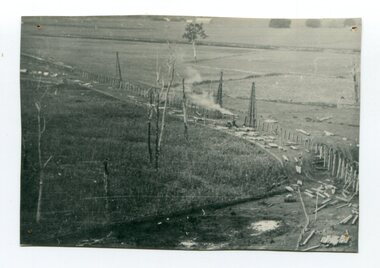
... uniformly 4.57 metre timber-beam construction, and has a sweeping curve in its deck. The longer bridge has a combination of 4.57 metre and 6.1 metrespans, and two 3.66 metre spans. The bridges are constructed from 'Southern Mahogany', Eucalyptus Botryoides, which grew along the coast east of Bairnsdale. The Snowy floodplain bridges were initially built in the context of an early twentieth-century interest in American...uniformly 4.57 metre timber-beam construction, and has a sweeping curve in its deck. The longer bridge has a combination of 4.57 metre and 6.1 metrespans, and two 3.66 metre spans. The bridges are constructed from 'Southern Mahogany', Eucalyptus Botryoides, which grew along the coast east of Bairnsdale. The Snowy floodplain bridges were initially built in the context of an early twentieth-century interest in American ...This photograph shows the pile drivers at work in the construction of the viaduct across the Snowy River flats. The Snowy River Floodplain Railway Bridges, two sequential and exceptionally long and low timber railway bridges on the Snowy River floodplain just west of Orbost, were built in 1916, and provided the original terminus point for the Bairnsdale-Orbost railway. The bridges are 770 metres and 183 metres long respectively. The shorter bridge is of uniformly 4.57 metre timber-beam construction, and has a sweeping curve in its deck. The longer bridge has a combination of 4.57 metre and 6.1 metrespans, and two 3.66 metre spans. The bridges are constructed from 'Southern Mahogany', Eucalyptus Botryoides, which grew along the coast east of Bairnsdale. The Snowy floodplain bridges were initially built in the context of an early twentieth-century interest in American-style 'Developmental Railways', designed to open remote areas to closer settlement, even if that meant running at a loss. The line was closed in August 1987. (information from Victorian Heritage Database)This item is associated with the history of the Orbost-Bairnsdale railway line and therefore reflects the role that the rail line played in the social and economic history of Orbost.A black / white photograph of the farming flats at Orbost during the construction of the East Gippsland railway.orbost-railway east-gippsland-railway viaduct-orbost transport railway -
 Red Cliffs Military Museum
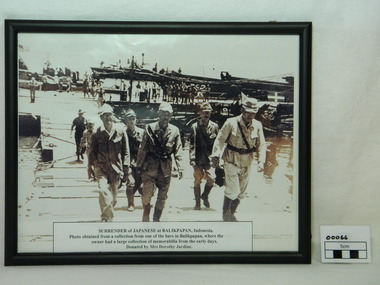
Framed Photograph, Surrender of Japanese at Balikpapan, 1945
... American landing craft next to a Japanese landing barge. The Japanese landing bardge has the required surrender markings which is a green square with a white cross on top right of photo. The Australian soldier following the Japanese soldiers is wearing slouch hat and gungle green uniform...American landing craft next to a Japanese landing barge. The Japanese landing bardge has the required surrender markings which is a green square with a white cross on top right of photo. The Australian soldier following the Japanese soldiers is wearing slouch hat and gungle green uniform ...Japanese Commanders crossing a pontoon bridge under guard by Australian soldier on the way to the official surrender of Japanese forces in Balikpapan in (Dutch East Indies) Indonesia 1945. This was a major event in the ending of World War 2. Following the japanese surrender the Local population began it push for independance. Framed photograph (copy) of Japanese Commanders surrendering at Balikpapan. Black frame and glass covered. The Japanese Command staff with a Japanese general and aid-d-camp (Captian)carring his breif case along with other staff members. In the background here are 2 American PT boats with American naval personal .Note American flag flying in the top left corner. There are several American landing craft next to a Japanese landing barge. The Japanese landing bardge has the required surrender markings which is a green square with a white cross on top right of photo. The Australian soldier following the Japanese soldiers is wearing slouch hat and gungle green uniform. Along the docks are native workers.Paper discription on lower photograph with details of item description, where photo obtained from and donated by.ww2, japanese, surrender, balikpapan, generals, americans, pt boats, japanese landing bardge, american landing craft, dutch east indies -
 Bendigo Military Museum
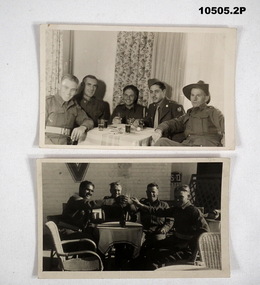
Postcard - PHOTOGRAPHIC POSTCARD, CHRISTMAS, BCOF, c.1947-49
... Black and white photographic postcard of a group of five soldiers in uniform seated around a table. Four soldiers are Australian and one is American. ...Black and white photographic postcard of a group of five soldiers in uniform seated around a table. Four soldiers are Australian and one is American. ...Items collected by Alva Marie Bennetts whilst deployed to BCOF, 1947-1949. Part of the Bennetts collection. See Cat No. 9726P for details of service for Alva Bennetts (No. VFX128835).1. Black and white photographic postcard of a group of five soldiers in uniform seated around a table. Four soldiers are Australian and one is American. Drinks are visible on the table which is covered with a cloth. 2. Black and white photographic postcard of a group of four soldiers in uniform seated around a table. Each is holding a drink and celebrating “Cheers”1. Handwritten in black ink on back: “Taken on Xmas Eve, with two other Aussies and a Yank.” 2. Handwritten in black ink on back: “Taken on Xmas day with our friends from New Zealand.” alva bennetts, bennetts collection, army, bcof, postcards -
 Bendigo Military Museum
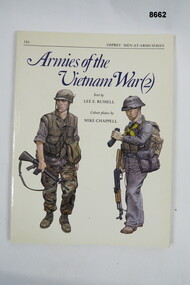
Book - ARMIES OF THE VIETNAM WAR, Osprey Publishing Ltd, 1983
... The book describes the uniforms of the nine armies that fought in Vietnam between 1962-1973 and examines in details their uniforms and equipment. The book has strong American content....Passchendaele Barracks Trust PBT 113 Vietnam Uniforms Equipment The book describes the uniforms of the nine armies that fought in Vietnam between 1962-1973 and examines in details their uniforms and equipment. The book has strong American content. Book ARMIES OF THE VIETNAM WAR Osprey Publishing Ltd ...The book describes the uniforms of the nine armies that fought in Vietnam between 1962-1973 and examines in details their uniforms and equipment. The book has strong American content.passchendaele barracks trust, pbt 113, vietnam, uniforms, equipment -
 Bendigo Military Museum
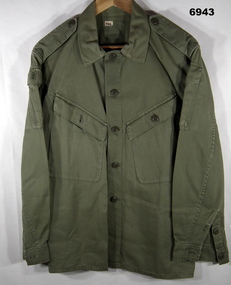
Uniform - SHIRT, ARMY, 1971
... Uniform Army workdress Polwarth Manufacturer's label information - black ink print (some of print illegible) ?? Pty Ltd/ 1971/ ^/ 8405-66-034-5398/ CHEST & SIZE 44-45?/ NAME/ ARMY NO./ ???" handwritten on label - black ink pen "POLWARTH/ 317803". Small white label - handwritten black ink pen "POL". Shirt - green colour cotton fabric with collar, long sleeves, shoulder epaulettes, two front pockets with button down flap, green colour plastic buttons, two front pockets with button down flap. Green colour cotton manufacturer's label, with small white label below collar. Army work dress shirt commonly called "GREENS". This shirt has more of an American ...Uniform shirt issued to POLWARTH No. 3178035.Shirt - green colour cotton fabric with collar, long sleeves, shoulder epaulettes, two front pockets with button down flap, green colour plastic buttons, two front pockets with button down flap. Green colour cotton manufacturer's label, with small white label below collar. Army work dress shirt commonly called "GREENS". This shirt has more of an American style. Manufacturer's label information - black ink print (some of print illegible) ?? Pty Ltd/ 1971/ ^/ 8405-66-034-5398/ CHEST & SIZE 44-45?/ NAME/ ARMY NO./ ???" handwritten on label - black ink pen "POLWARTH/ 317803". Small white label - handwritten black ink pen "POL".passchendaele barracks trust, uniform, army workdress, polwarth -
 Bendigo Military Museum
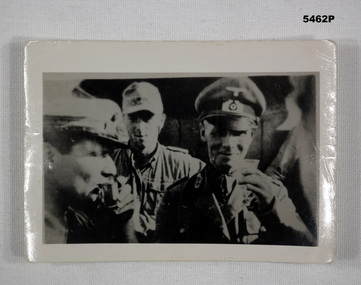
Photograph - PHOTOGRAPH of GERMAN SOLDIERS
... uniform. The two German officers drinking a small amount of drink, with another serviceman in the background. This serviceman could be an American ...uniform. The two German officers drinking a small amount of drink, with another serviceman in the background. This serviceman could be an American Photograph PHOTOGRAPH of GERMAN SOLDIERS ...Photograph- black and white with a white border on all sides. Three servicemen in uniform. The two German officers drinking a small amount of drink, with another serviceman in the background. This serviceman could be an American photography, german officers -
 Bendigo Military Museum
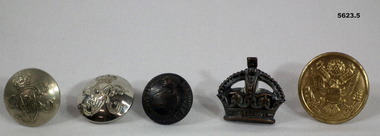
Uniform - BUTTONS AND BADGE, c.1930's onwards
... Silver button, "Stokes and Son Melbourne" .5) On rear, "VAM" .1) - .3) Three buttons, two silver one brown all Australian. .4) One Officers rank badge pressed metal. .5) Button gold coloured with American Eagle on. Uniform BUTTONS AND BADGE ...items in collection relating to the JACKSON Family..1) - .3) Three buttons, two silver one brown all Australian. .4) One Officers rank badge pressed metal. .5) Button gold coloured with American Eagle on..1) - .3) Brown button on rear, "P.J.King PTY LTD". Silver button, "Stokes and Son Melbourne" .5) On rear, "VAM"badges, buttons -
 Bendigo Military Museum
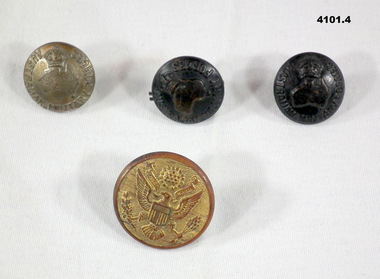
Uniform - BUTTONS, UNIFORM, C 1939 - 45
... Buttons uniforms .1) .2) .3) “Australian Military Forces” .4) On the reverse side, “Waterbury Button Co CONN.” .1) light metal coloured button with map of Australia and crown etched on. .2) & .3) dark metal coloured buttons with same as .1) .4) Yellow coloured button with the American Eagle etched on. ....1) light metal coloured button with map of Australia and crown etched on. .2) & .3) dark metal coloured buttons with same as .1) .4) Yellow coloured button with the American Eagle etched on..1) .2) .3) “Australian Military Forces” .4) On the reverse side, “Waterbury Button Co CONN.”buttons, uniforms, -
 Running Rabbits Military Museum operated by the Upwey Belgrave RSL Sub Branch
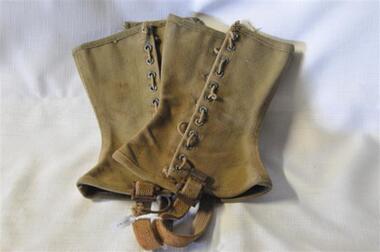
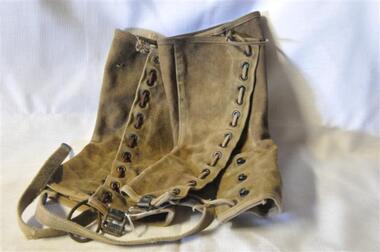
Gaiters
... Uniform Army Canvas. Khaki laceup short. American Gaiters ...Canvas. Khaki laceup short. Americanuniform, army -
 Running Rabbits Military Museum operated by the Upwey Belgrave RSL Sub Branch
Gaiters
... Uniform Army Canvas. Long khaki laceup. American Gaiters ...Canvas. Long khaki laceup. Americanuniform, army -
 Streatham and District Historical Society
Picture, Russell Adams 1965-1967
... uniform of the time of conflict in Vietnam worn by Australian soldiers. Russell Henry Adams was one of thousands that went to service for the country. This war was between the South and North of Vietnam and the American...uniform of the time of conflict in Vietnam worn by Australian soldiers. Russell Henry Adams was one of thousands that went to service for the country. This war was between the South and North of Vietnam and the American ...This picture shows the tipical uniform of the time of conflict in Vietnam worn by Australian soldiers. Russell Henry Adams was one of thousands that went to service for the country. This war was between the South and North of Vietnam and the American troops also were involved. The conflict seen many men killed or wounded and was not a very popular conflict with many back home and overseas.Demonstrats Australias involvement in the Vietnam conflict during the 1960s.Black & white rectangular photo of Russell Henry Adams in uniform of the rifleman of the 6RAR Vietnam V3787341Writting in blue pen across back os the words "Russell Henry Adams". Also in pencil the words "Vietnam V3787341 Rifleman 6RAR + 2RAR Service 29/9/1965-28/9/1967soldiers, east, henry, conflict, streatham, westmere, mininera, nerrin, wars, russell, adams -
 Bendigo Military Museum
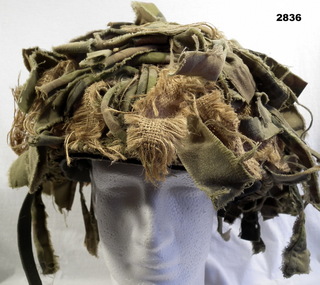
Headwear - STEEL HELMET, Post WW2
... American style helmet used by the Australian Army. uniforms - army costume - male headwear trades-leatherworking Inside: “WHI869 Cat No 8415.50.758.5792” Helmet, steel with fibreglass lining, leather band & green webbing on inside of lining. ...American style helmet used by the Australian Army.Helmet, steel with fibreglass lining, leather band & green webbing on inside of lining. Green material chin strap secured with metal buckle. Helmet covered with strips of camouflage material & hessian.Inside: “WHI869 Cat No 8415.50.758.5792”uniforms - army, costume - male headwear, trades-leatherworking -
 Bendigo Military Museum
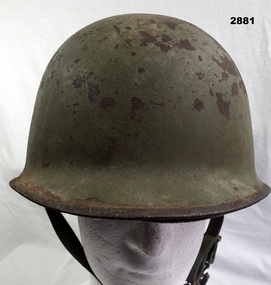
Headwear - HELMET, STEEL, C.WW2
... uniforms - army costume - male headwear Helmet Passchendaele barracks trust American style helmet, green metal with fibreglass lining, green webbing head harness secured with metal clips, green webbing chin strap with metal fastener. ...American style helmet, green metal with fibreglass lining, green webbing head harness secured with metal clips, green webbing chin strap with metal fastener.uniforms - army, costume - male headwear, helmet, passchendaele barracks trust -
 Bendigo Historical Society Inc.
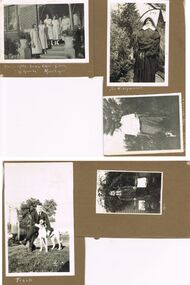
Photograph - HILDA HILL COLLECTION: BLACK AND WHITE PHOTOS, 1922
... America with Fox Terrier, holding a gun in his left hand, garden setting with palm trees. Frank, dressed in black suit white shirt and dark tie with his hands around a Hound Dog enjoying some R&R. Ken with his tennis racquet, in his dark coloured uniform...America with Fox Terrier, holding a gun in his left hand, garden setting with palm trees. Frank, dressed in black suit white shirt and dark tie with his hands around a Hound Dog enjoying some R&R. Ken with his tennis racquet, in his dark coloured uniform ...Series of Black & White Images depicting life for the Hill Family and Friends During 1922 Post War Boom. Total 5 Photos. Ladies Day Out: Alma, Kitty, Lorna Claire & Eileen, all the ladies are dressed in white, lady at front wears dark stockings others are wearing white stockings and shoes, first two are standing on the steps and the others are on the verandah, two stone pillars with garden pots on them, Window of house to the left and curtains hanging inside, 'The Ranche' March 1922. (Aunt Mabel) Sister M. Alphonsus, dressed in dark habit with rosary hanging from her waist, arms crossed, standing in archway covered with vine, to right a spire can be seen. Uncle Percy in South America with Fox Terrier, holding a gun in his left hand, garden setting with palm trees. Frank, dressed in black suit white shirt and dark tie with his hands around a Hound Dog enjoying some R&R. Ken with his tennis racquet, in his dark coloured uniform white shirt and dark tie, standing between two chairs holding a tennis racquet and ball, both chairs have a white cloth backing, left chair with object on seat and large vase on the ground, trellis to the right, weatherboard to the left and shrub.Hilda Hill Personal Collectionaustralia, history, post war life -
 Ithacan Historical Society
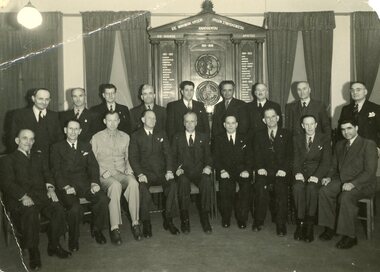
Photograph, Greek Return Soldiers, Victoria, 16 May 1945
... The man seated in front in an army uniform is an American serviceman. Seated fourth from the left is Spiros E. ...The man seated in front in an army uniform is an American serviceman. Seated fourth from the left is Spiros E. ...The eighteen men are assembled at the Greek Returned Servicemen's League hall which was located in Russell Street, Melbourne. The honour board, erected in memory of Greek soldiers, features battle fields where the Greek army participated from 1821, the beginning of Greek War of Independence against the Ottoman Empire, through to World War 2 and the Italian and German occupation of Greece. The man seated in front in an army uniform is an American serviceman. Seated fourth from the left is Spiros E. Raftopoulos who was president of the organisation from 1944 - 1968. Today the Hellenic RSL sub-Branch of Victoria represents and supports the Greek Australian veteran community. In 1978 the organisation joined the Returned and Services League of Australia. The Hellenic RSL sub-Branch commemorates all the Greek and Australian national days each year and proudly marches on Anzac Day in Melbourne, alongside veterans from the wars of Korea, Vietnam, and Afghanistan and earlier wars. On Anzac Day 2013 members of the IPS took part in the Anzac Day march for the first time. Greek national days are commemorated with wreath-laying ceremonies inside the Shrine of Remembrance in Melbourne, at which the IPS participates.A black and white photograph of eighteen men seated and standing in front of an honour board, which has curtains on either side of it. -
 National Vietnam Veterans Museum (NVVM)
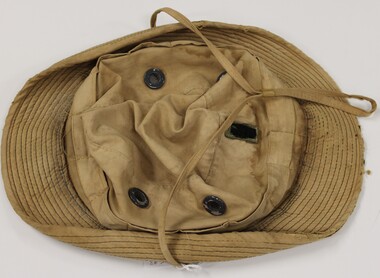
Uniform - Boonie hat
... At the time the American soldiers introduced the slang term "Boondocks" this term was generally used to refer to remote locations. Uniform ...In 1967, the U.S. Army issued boonie hats during the Vietnam conflict. They were made of cotton and wind resistant poplin, in olive drab. They were designed with vent holes, drawstring, and foliage ring - the tape/band around the base of the hat was meant to attach foliage as a means of camouflage. At the time the American soldiers introduced the slang term "Boondocks" this term was generally used to refer to remote locations. -
 National Vietnam Veterans Museum (NVVM)
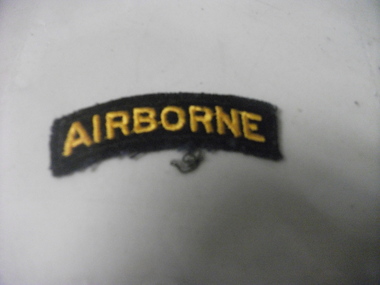
Uniform - Shoulder patch, US Army Airborne
... Americans as the :Screaming Eagles". However, their bald eagle patch led to the North Vietnamese Army referring to 101st Airborne soldiers as "chicken men". United States Airborne Patch Vietnam badge AIRBORNE A narrow curved black cloth patch with yellow embroidery. Uniform ...Worn by the United States Army 101st Airborne Division (Air Assault). The division was known to the Americans as the :Screaming Eagles". However, their bald eagle patch led to the North Vietnamese Army referring to 101st Airborne soldiers as "chicken men".A narrow curved black cloth patch with yellow embroidery. AIRBORNEunited states, airborne, patch, vietnam, badge -
 National Vietnam Veterans Museum (NVVM)
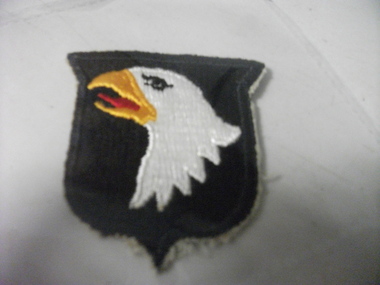
Uniform - US Army 101st Airborne patch
... Americans as the :Screaming Eagles". However, their bald eagle patch led to the North Vietnamese Army referring to 101st Airborne soldiers as "chicken men". US Army Airborne 101st Airborne United states Army patch badge emblem A black shield-shaped cloth patch embroidered with a white bald eagle which has a yellow beak and red tongue. Uniform ...Worn by the United States Army 101st Airborne Division (Air Assault). The division was known to the Americans as the :Screaming Eagles". However, their bald eagle patch led to the North Vietnamese Army referring to 101st Airborne soldiers as "chicken men".A black shield-shaped cloth patch embroidered with a white bald eagle which has a yellow beak and red tongue.us army airborne, 101st airborne, united states army, patch, badge, emblem -
 National Vietnam Veterans Museum (NVVM)
Textile - Patch: US Navy Aircrew
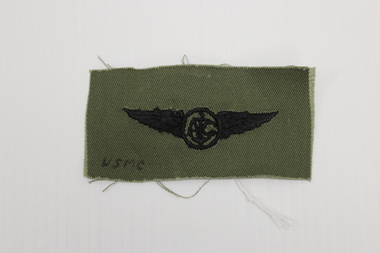
... uniforms. It was collected by WO2 Robert Palmer Matthew (34974) of the Royal Australian Army Ordnance Corps. USMC Badge - Embroidery patch marines US AIr Crew US Navy AIrcrew American military USA Navy Air US Marine U.S.M.C in blue pen bottom left corner Rectangular khaki textile patch with USMC insignia. ...This embroidered US military Air Crew Master wings patch was designed for wear on combat uniforms. It was collected by WO2 Robert Palmer Matthew (34974) of the Royal Australian Army Ordnance Corps.Rectangular khaki textile patch with USMC insignia. Black embroidery of a circle with wings each side, the letters A and C with an anchor between. The patch features an embroidered black wings insignia with an "AC" (Air Crew) in the center on an olive drab green fabric background.U.S.M.C in blue pen bottom left cornerusmc, badge - embroidery, patch, marines, us air crew, us navy aircrew, american military, usa navy air, us marine -
 National Vietnam Veterans Museum (NVVM)
Book, Terry, Wallace, Bloods: An Oral History Of The Vietnam War By Black Veterans. (Copy 2)
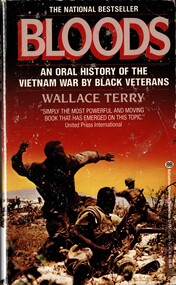
... Vietnam War 1961-1975- Personal narratives American Black American Soldiers Oral histories can never be better or more significant than the talk that went into them. By this measure alond BLOODS is superb. The twenty blacks who discussed their experiences while serving in the Viet Nam War are uniformly eloquent. ...Oral histories can never be better or more significant than the talk that went into them. By this measure alond BLOODS is superb. The twenty blacks who discussed their experiences while serving in the Viet Nam War are uniformly eloquent.Oral histories can never be better or more significant than the talk that went into them. By this measure alond BLOODS is superb. The twenty blacks who discussed their experiences while serving in the Viet Nam War are uniformly eloquent. vietnam war, 1961-1975- personal narratives, american, black american soldiers -
 National Vietnam Veterans Museum (NVVM)
Book, Tougas, Shelley, Weapons, Gear and Uniforms of the Vietnam War, 2012
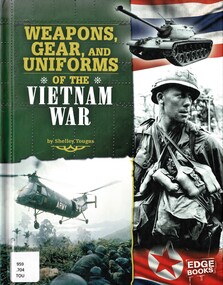
... Vietnam War 1961-1975 -- Equipment and supplies -- Juvenile literature Military weapons -- Vietnam -- History -- 20th century -- Juvenile literature Weapons Gear Uniforms American Soldiers A soldier's clothing and equipment are crucial for surviving on the battlefield Weapons, Gear and Uniforms of the Vietnam War. ...A soldier's clothing and equipment are crucial for surviving on the battlefieldA soldier's clothing and equipment are crucial for surviving on the battlefieldvietnam war, 1961-1975 -- equipment and supplies -- juvenile literature, military weapons -- vietnam -- history -- 20th century -- juvenile literature, weapons, gear, uniforms, american soldiers -
 National Vietnam Veterans Museum (NVVM)
Uniform - Uniform, US Army, American Jacket
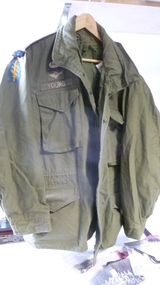
... Zippered pocket on back of collar American Jacket Uniform Uniform, US Army Alpha Industries Inc RN35569 ...This item was donated by Maj (Temp) Peter Raymond Young, (240217) who served with the Australian Intelligence Corps. He served with the Australian Army Training Team Vietnam from June 1962 to July 1963, Official Duty (from Army Headquarters, Canberra) August 1965, Australian Service Attaché Staff, Saigon from November 1965 to May 1966 and June 1966 to December 1967.American field jacket owned by Peter Raymond Young 240217, Australian Intelligence Corp (temporary) Major. Khaki lined jacket, long sleeved, four pockets in front, has plastic zipper down middle, also snap fastners and buttons. 1st Special Forces Command (Airborne) shoulder sleeve insignia. Two jump wings insignia on rithe breast over the name young. Zippered pocket on back of collar240217 Capt young, Aust Int corps written in black texta on right bottom of lined jacketamerican army jacket, us army, maj (temp) peter raymond young, 240217, australian intelligence corp, australian army training team vietnam (aattv), australian service attache staff, saigon, clothing -
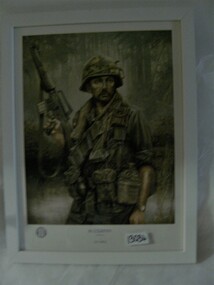 National Vietnam Veterans Museum (NVVM)
Print, In Country - Vietnam
... Uniform in a jungle setting. Featuring a camoflaged coloured helmet, Ammunition belt crossing body. Canteen attached to a belt also containing grenade etc. Below print a sign stating Vietnam Veterans of America...Uniform in a jungle setting. Featuring a camoflaged coloured helmet, Ammunition belt crossing body. Canteen attached to a belt also containing grenade etc. Below print a sign stating Vietnam Veterans of America ...Framed (white) Print of a Soldier holding a rifle in full US Army Uniform in a jungle setting. Featuring a camoflaged coloured helmet, Ammunition belt crossing body. Canteen attached to a belt also containing grenade etc. Below print a sign stating Vietnam Veterans of America.The photo states In Country - Vietnam - by Joe Umbleframed picture
