
Showing 91 items matching "architecture -- victoria -- history"
-
 Kew Historical Society Inc
Book, David Saunders, Historic Buildings of Victoria, 1966
... Architecture -- Victoria -- History.... ; 28 cm. Architecture -- Victoria -- History Historic buildings -- Victoria. 278 p. : ill. ; 28 cm. ...278 p. : ill. ; 28 cm. non-fictionarchitecture -- victoria -- history, historic buildings -- victoria. -
Kew Historical Society Inc
Book, David Saunders, Historic Buildings of Victoria, 1966
... architecture -- victoria -- history.... ; 28 cm. architecture -- victoria -- history historic buildings -- victoria. ...Brisbane : Jacaranda in association with the National Trust, 1966 278 p. : ill. ; 28 cm. non-fictionarchitecture -- victoria -- history, historic buildings -- victoria. -
 Kew Historical Society Inc
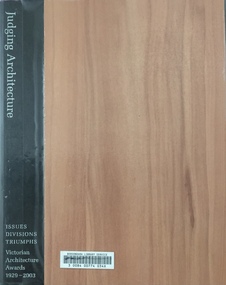
Book, Judging Architecture: Issues, Divisions, Triumphs, Victorian Architecture awards 1929-2003, 2003
... architecture - victoria - awards...architecture - history...Judging Architecture: Issues, Divisions, Triumphs, Victorian Architecture awards 1929-2003 has been added to the reference library maintained by the Kew Historical Society as a relevant text for the study of local history in both Kew and in the City of Boroondara. architecture - victoria - awards architecture - history - victoria Ex library copy Melbourne, Vic. : Royal Australian Institute of Architects, 2003 316 p. : ill. ; 29 cm. + poster (86 x 60 cm) Judging Architecture: Issues, Divisions, Triumphs, Victorian Architecture awards 1929-2003 Book ...Melbourne, Vic. : Royal Australian Institute of Architects, 2003 316 p. : ill. ; 29 cm. + poster (86 x 60 cm) non-fictionarchitecture - victoria - awards, architecture - history - victoria -
 Flagstaff Hill Maritime Museum and Village
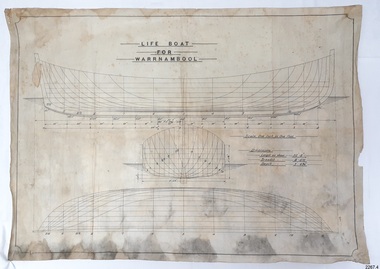
Plan - Vessel Line Drawing, Life Boat for Warrnambool, ca. 1900-1909
... Victoria and holds classes for naval architectural drawing and arithmetic.” The line drawing is significant for its connection with the lifeboat WARRNAMBOOL. The lifeboat is very significant to local and state history ...The plans were used for the construction of the lifeboat ‘Warrnambool’, which began 15th September 1909 and was completed almost 12 months later 1st September 1910. It was built at the Government Dockyard in Williamstown, Victoria, along the lines designed by Great Britain’s Royal Lifeboat Institution, and included whaleback decks fore and aft, mast and centreboard, and rudder and tiller hung from the sternpost. It could be propelled by both sail and oar. At that time Captain Ferguson was Chief Harbour Master and Mr Beagley was the foreman boat builder. Mr Beagley built the lifeboat with his fellow workmen. The boat was described as “… a fine piece of workmanship and does credit to her builders and designers…” It had all the latest improvements in shape, disposition of weight and watertight compartments, and it had space for a large number of people in addition to the crew. It appears that 'H Meiers' whose signature was on the plaque that was found concealed in the hull, was involved with the building of the lifeboat. His signature and the dates of the start and finish of the boat’s construction are pencilled on the raw timber 'plaque' found in the hull in the early 1990s when the lifeboat was being restored. It is interesting that the ‘Melbourne Directory’ of 1911, published by Sands and MacDougal, lists McAuley and Meiers, boat builders, Nelson Place foreshore, between Pasco and Parker Streets, Williamstown, (Victorian Heritage Database, ‘Contextual History, Maritime Facilities’), It is quite possibly the business of the person whose name is inscribed on the lifeboat plaque. Flagstaff Hill’s documentation also mentions that the keel was laid at ‘Harry Myers, boat builders, Williamstown, Melbourne’ – the name ‘Myers’ can also be spelled ‘Meiers’, which could be the same person as the Meiers in “McAuley and Meiers” (as mentioned in genealogy lines of Myers). The new lifeboat, to be named ‘Warrnambool’ was brought to town by train and launched at the breakwater on 1st March 1911 using the Titan crane (the old lifeboat built in 1858, was then returned to Melbourne in 1911). This new lifeboat was stationed at Warrnambool in a shed located at the base of the Breakwater, adjacent to the slipway. A winch was used to bring it in and out of the water. The lifeboat ‘Warrnambool’ was similar in size to the old lifeboat but far superior in design, build and sea-going qualities such as greater manoeuvrability. The ‘self-righting, self-draining design was “practically non-capsizeable” and even if the boat overturned it would right itself to an even keel and the water would drain away. The hull was built of New Zealand Kauri, using double diagonal planking, laid in two layers at right angles, with a layer of canvas and red lead paint between the timbers to help seal the planking. It has “… plenty of freeboard area, high watertight spaces between the deck and bottom… through which pipes lead…” The backbone timbers were made of Jarrah. The lifeboat Warrnambool was one of several rescue boats used at Port Fairy and Warrnambool in the early 1900s. In late 1914 the Warrnambool lifeboat and crew were used to help find what was left of the tragic wreckage of the Antares and were able to discover the body of one of the crewmen, which they brought back to Warrnambool. Between 1951 and 1954 the lifeboat was manned under the guidance of Captain Carrington. He held lifeboat practice each month on a Sunday morning, to comply with the Ports and Harbour’s request that lifeboats be manned by a strong and competent crew, ready for action in case of emergency. In the early 1960’s it ended its service as a lifeboat and was used in Port Fairy as a barge to help dredge the Moyne River, bolted to the Port Fairy lifeboat. Flagstaff Hill obtained the Warrnambool in 1975. In 1984 it was on display at Flagstaff Hill Maritime Village, Warrnambool. On 23rd May 1990, she was lifted from the water and placed in a cradle for restoration. The name ‘WARRNAMBOOL could be seen faintly on the lifeboat before it was restored. It was during the restoration that Flagstaff Hill's boat builder discovered the 'plaque' inside the hull. A copy of the blueprint plans has the name “V.E.E. Gotch” printed on it. His advertisement in Footscray’s ‘Independent’ newspaper of Saturday 11th May 1901 states he is “Principal and Skilled member (Naval Architect) to the Court of Marine Inquiry of Victoria and holds classes for naval architectural drawing and arithmetic.” The line drawing is significant for its connection with the lifeboat WARRNAMBOOL. The lifeboat is very significant to local and state history for its use in the lifesaving rescues of seafarers, particularly in Lady Bay. It was part of the local rescue equipment. It gave a half-century of service to the local community as a lifesaving vessel, including its involvement in retrieving the body of a shipwrecked crew member of the ANTARES. Line drawing in black ink and pencil on rectangular parchment or waxed linen. Drawing has diagrams of three profiles of a vessel, with measurements and connecting pencil lines on the left quarter. The plan is for the lifeboat named “Warrnambool”, which was built in Melbourne and completed in 1910. Old blue copies of the Lifeboat plan are archived also.“LIFE BOAT / FOR / WARRNAMBOOL” “Scale, One Inch to One Foot” “ “Length as shown 30’ – 8” “ “Breadth “ “ 8’ – 6 ½ “ “ “Depth “ “ 3’ – 4 ¾” “flagstaff hill, warrnambool, shipwrecked-coast, flagstaff-hill, flagstaff-hill-maritime-museum, maritime-museum, shipwreck-coast, flagstaff-hill-maritime-village, lifeboat, warrnambool lifeboat, boat plans, lifeboat plans, boat construction, boat building, line drawing, plan for lifeboat, life boat, life boat 'warrnambool', clinker design, 1910 lifeboat, life saving equipment, shipbuilding -
 The Beechworth Burke Museum
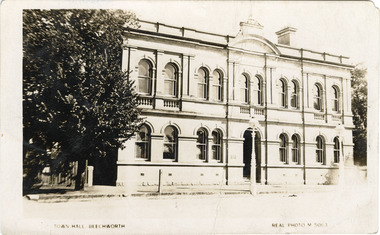
Photograph - Postcard, Town Hall Beechworth, c1910
... Victoria. The building has seen continual use from 1858 as an important public building and displays many aspects of the history of law enforcement in Victoria. The building is also of substantial architectural ...Beechworth Town Hall was designed by architects J.J. Coe and Thomas Dalziel and is dated to 1859. The building was made of granite and constructed to local builders Donald and William Fiddes. The original front to the building was replaced by a two story facade in 1889 designed by George Jobbins and built by Thomas Sandham according to a plaque on the front. The Town Hall is remarkable for its vaulted ceilings and columns. Originally the building was used as the Shire Offices but also doubled as a fire station and a courthouse, with still surviving cells underneath. Among the inmates was notorious bushranger Harry Power who was originally transported to Van Dieman’s Land for stealing a pair of shoes. He gained his freedom six years later but spent time in and out of gaol for the rest of his life for a variety of offences including a number of armed robberies. The Town Hall is now home to the Visitor Information Centre which helps visitors with amongst other things, accommodation, tours, event enquiries, and is the commencement point for Precinct walking tours. The Beechworth Town Hall is one of five distinctive granite buildings on Ford Street that comprise the Justice Precinct. It is of considerable historical significance as activity on the site dates from Australia’s gold rush period and was the administrative centre for north-eastern Victoria. The building has seen continual use from 1858 as an important public building and displays many aspects of the history of law enforcement in Victoria. The building is also of substantial architectural significance for its construction from local honey coloured granite, which also showcases early stone masonry techniques and craftsmanship. The Precinct is listed on the Victorian Heritage register and is protected by Heritage Victoria under the Victorian Heritage Act 2017. The buildings are also registered by the National Estate, the National Trust and protected by Indigo Shire Council’s Planning Scheme. Black and White rectangular postcard printed on cardReverse: 1906-1910?beechworth, beechworth town hall, town hall, jj coe, thomas dalziel, granite, beechworth historic building, courthouse, cells, geoge jobbins, thomas sandham, 1859, 1889, walking tours, beechworth historic precinct, historic precinct, harry power, bushranger, australian bushrangers, van dieman's land, transportation, armed robberies -
Marysville & District Historical Society
THE TRIANGLE NEWS-VOL 38 NO 16-MAY 20 2011
... victoria...australia...local architecture shortlisted in state awards...victorian architecture award regional prize...marysville rebuilding advisory centre...yea...kinglake...bushfire memorial concepts...church notices...murrindindi shire council...blumes fashions...heritage trail...photographic competition...council community services...advertisements...cfa operations...fire risk...narbethong history...marysville victoria australia local architecture shortlisted in state awards victorian architecture award regional prize marysville rebuilding advisory centre yea kinglake bushfire memorial concepts church notices murrindindi shire council blumes fashions heritage trail photographic competition council community services advertisements cfa operations fire risk narbethong history group history book of narbethong black saturday fires marysville golf report marysville villains veterans football THE TRIANGLE NEWS-VOL 38 NO 16-MAY 20 2011 ...marysville, victoria, australia, local architecture shortlisted in state awards, victorian architecture award regional prize, marysville rebuilding advisory centre, yea, kinglake, bushfire memorial concepts, church notices, murrindindi shire council, blumes fashions, heritage trail, photographic competition, council community services, advertisements, cfa operations, fire risk, narbethong history group, history book of narbethong, black saturday fires, marysville golf report, marysville villains, veterans football -
 Flagstaff Hill Maritime Museum and Village
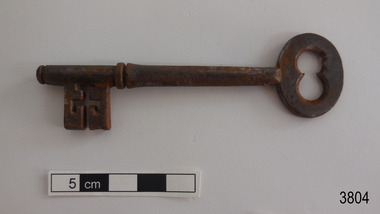
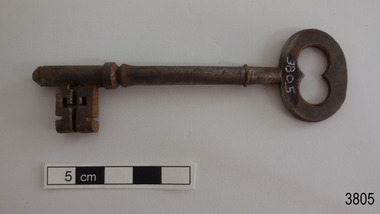
Functional object - Key, circa 1866
... history of the Loch Ard shipwreck’s only two survivors. The set of keys also hold significance as they were discovered by John Chance, who was also a diver from the wreck of the Loch Ard in the 1960s-70s. Items that come from several wrecks along Victoria's coast have since been donated to the Flagstaff Hill Maritime Village’s museum collection by his family, illustrating this item’s level of historical value. Glenample Homestead is of historical, social and architectural ...The key is one of a collection of seven 1860s keys once belonged to the Glenample Homestead near Princetown. They are all keyed with different bits and would have opened the external panelled doors of the Georgian building. The keys would now be around 150 years old. The keys are now part of the John Chance Collection. Locksmiths became a recognised trade by the middle of the 19th century, doing work that blacksmiths and gunsmiths would have done. They were craftsmen and trained apprentices for their trade. The local community and businesses relied on them for making a wide variety of precision objects such as locks and keys, knives, ornamental and decorative latticework, fine instruments, accurate tools and hardware items. Glenample Homestead became famous after the disastrous wreck of the sailing ship Loch Ard on June 1, 1878. The owners, Hugh Hamilton Gibson and Peter McArthur, were involved in the rescue and recovery of Eva Carmichael and Tom Pearce, the only two survivors, as well as overseeing the salvage of items from the shipwreck and the burial of those who lost their lives. Eva first met Jane Shields at Glenample and they became long-time friends. The keys are significant as an example of mid-19th century locksmith hardware, and for their connection with Glenample Homestead, and for their connection to the history of the Loch Ard shipwreck’s only two survivors. The set of keys also hold significance as they were discovered by John Chance, who was also a diver from the wreck of the Loch Ard in the 1960s-70s. Items that come from several wrecks along Victoria's coast have since been donated to the Flagstaff Hill Maritime Village’s museum collection by his family, illustrating this item’s level of historical value. Glenample Homestead is of historical, social and architectural significance to the State of Victoria and is listed on the Victorian Heritage Register (VHR H0392). It is a historical example of early settlement and development of a run in the coastal land of South West Victoria, and it is constructed from locally quarried sandstone but doesn’t take away from its Georgian design. Glenample Homestead is of State significance through its unique connection with the wreck of the ship Loch Ard and the connection to its owners, Hugh and Lavinia Gibson and Peter McArthur, played a historically and socially significant role in the rescue and care of the survivors, the salvage of goods and the burial of those who lost their lives. The shipwreck of the Loch Ard itself is of significance for Victoria and is registered on the Victorian Heritage Register (S417). Key; steel domestic door key. Flat open bow with 'figure 8' space, round shank that flares out slightly above the collar on the bit. The rectangular bit has internal notches and grooves. There is a rounded pin on the end.flagstaff hill, warrnambool, flagstaff hill maritime museum, maritime museum, shipwreck coast, flagstaff hill maritime village, great ocean road, glenample homestead, victorian heritage register vhr h0392, georgian homestead, loch ard, princetown, jane shields, eva carmichael, tom pearce, blue china tea set, antique door key, glenample photographs, john chance -
 Flagstaff Hill Maritime Museum and Village
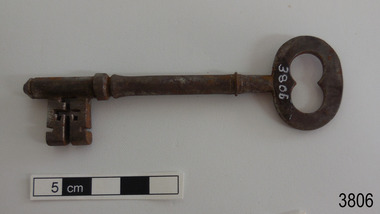
Functional object - Key, circa 1866
... history of the Loch Ard shipwreck’s only two survivors. Glenample Homestead is of historical, social and architectural significance to the State of Victoria and is listed on the Victorian Heritage Register (VHR H0392). ...The key is one of a collection of seven 1860s keys once belonged to the Glenample Homestead near Princetown. They are all keyed with different bits and would have opened the external panelled doors of the Georgian building. The keys would now be around 150 years old. The keys are now part of the John Chance Collection. Locksmiths became a recognised trade by the middle of the 19th century, doing work that blacksmiths and gunsmiths would have done. They were craftsmen and trained apprentices for their trade. The local community and businesses relied on them for making a wide variety of precision objects such as locks and keys, knives, ornamental and decorative latticework, fine instruments, accurate tools and hardware items. Glenample Homestead became famous after the disastrous wreck of the sailing ship Loch Ard on June 1, 1878. The owners, Hugh Hamilton Gibson and Peter McArthur, were involved in the rescue and recovery of Eva Carmichael and Tom Pearce, the only two survivors, as well as overseeing the salvage of items from the shipwreck and the burial of those who lost their lives. Eva first met Jane Shields at Glenample and they became long-time friends. The keys are significant as an example of mid-19th century locksmith hardware, and for their connection with Glenample Homestead, and for their connection to the history of the Loch Ard shipwreck’s only two survivors. Glenample Homestead is of historical, social and architectural significance to the State of Victoria and is listed on the Victorian Heritage Register (VHR H0392). It is a historical example of early settlement and development of a run in the coastal land of South West Victoria, and it is constructed from locally quarried sandstone but doesn’t take away from its Georgian design. Glenample Homestead is of State significance through its unique connection with the wreck of the ship Loch Ard and the connection to its owners, Hugh and Lavinia Gibson and Peter McArthur, played a historically and socially significant role in the rescue and care of the survivors, the salvage of goods and the burial of those who lost their lives. The shipwreck of the Loch Ard itself is of significance for Victoria and is registered on the Victorian Heritage Register (S417). Key; steel domestic door key. Flat open bow with 'figure 8' space, collar on shank, close to the bow. Round shank flares out slightly above the collar on the bit. The rectangular bit has internal and external notches and grooves. There is a rounded pin on the end.flagstaff hill, warrnambool, flagstaff hill maritime museum, maritime museum, shipwreck coast, flagstaff hill maritime village, great ocean road, glenample homestead, victorian heritage register vhr h0392, georgian homestead, loch ard, princetown, jane shields, eva carmichael, tom pearce, blue china tea set, antique door key, glenample photographs, john chance -
 Flagstaff Hill Maritime Museum and Village
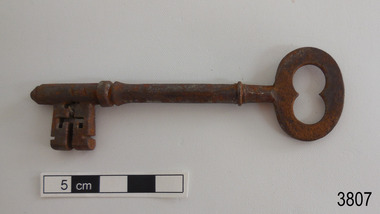
Functional object - Key, circa 1866
... history of the Loch Ard shipwreck’s only two survivors. The set of keys also hold significance as they were discovered by John Chance, who was also a diver from the wreck of the Loch Ard in the 1960s-70s. Items that come from several wrecks along Victoria's coast have since been donated to the Flagstaff Hill Maritime Village’s museum collection by his family, illustrating this item’s level of historical value. Glenample Homestead is of historical, social and architectural ...The key is one of a collection of seven 1860s keys once belonged to the Glenample Homestead near Princetown. They are all keyed with different bits and would have opened the external panelled doors of the Georgian building. The keys would now be around 150 years old. The keys are now part of the John Chance Collection. Locksmiths became a recognised trade by the middle of the 19th century, doing work that blacksmiths and gunsmiths would have done. They were craftsmen and trained apprentices for their trade. The local community and businesses relied on them for making a wide variety of precision objects such as locks and keys, knives, ornamental and decorative latticework, fine instruments, accurate tools and hardware items. Glenample Homestead became famous after the disastrous wreck of the sailing ship Loch Ard on June 1, 1878. The owners, Hugh Hamilton Gibson and Peter McArthur, were involved in the rescue and recovery of Eva Carmichael and Tom Pearce, the only two survivors, as well as overseeing the salvage of items from the shipwreck and the burial of those who lost their lives. Eva first met Jane Shields at Glenample and they became long-time friends.The keys are significant as an example of mid-19th century locksmith hardware, and for their connection with Glenample Homestead, and for their connection to the history of the Loch Ard shipwreck’s only two survivors. The set of keys also hold significance as they were discovered by John Chance, who was also a diver from the wreck of the Loch Ard in the 1960s-70s. Items that come from several wrecks along Victoria's coast have since been donated to the Flagstaff Hill Maritime Village’s museum collection by his family, illustrating this item’s level of historical value. Glenample Homestead is of historical, social and architectural significance to the State of Victoria and is listed on the Victorian Heritage Register (VHR H0392). It is a historical example of early settlement and development of a run in the coastal land of South West Victoria, and it is constructed from locally quarried sandstone but doesn’t take away from its Georgian design. Glenample Homestead is of State significance through its unique connection with the wreck of the ship Loch Ard and the connection to its owners, Hugh and Lavinia Gibson and Peter McArthur, played a historically and socially significant role in the rescue and care of the survivors, the salvage of goods and the burial of those who lost their lives. The shipwreck of the Loch Ard itself is of significance for Victoria and is registered on the Victorian Heritage Register (S417). Key; steel domestic door key. Flat open bow with 'figure 8' space, narrow collar on shank, close to the bow. Round shank flares out slightly above the collar on the bit. The rectangular bit has internal and external notches and grooves. There is a rounded pin on the end.flagstaff hill, warrnambool, flagstaff hill maritime museum, maritime museum, shipwreck coast, flagstaff hill maritime village, great ocean road, glenample homestead, victorian heritage register vhr h0392, georgian homestead, loch ard, princetown, jane shields, eva carmichael, tom pearce, blue china tea set, antique door key, glenample photographs, john chance -
 Flagstaff Hill Maritime Museum and Village
Functional object - Key, circa 1866
... history of the Loch Ard shipwreck’s only two survivors. The set of keys also hold significance as they were discovered by John Chance, who was also a diver from the wreck of the Loch Ard in the 1960s-70s. Items that come from several wrecks along Victoria's coast have since been donated to the Flagstaff Hill Maritime Village’s museum collection by his family, illustrating this item’s level of historical value. Glenample Homestead is of historical, social and architectural ...The key is one of a collection of seven 1860s keys once belonged to the Glenample Homestead near Princetown. They are all keyed with different bits and would have opened the external panelled doors of the Georgian building. The keys would now be around 150 years old. The keys are now part of the John Chance Collection. Locksmiths became a recognised trade by the middle of the 19th century, doing work that blacksmiths and gunsmiths would have done. They were craftsmen and trained apprentices for their trade. The local community and businesses relied on them for making a wide variety of precision objects such as locks and keys, knives, ornamental and decorative latticework, fine instruments, accurate tools and hardware items. Glenample Homestead became famous after the disastrous wreck of the sailing ship Loch Ard on June 1, 1878. The owners, Hugh Hamilton Gibson and Peter McArthur, were involved in the rescue and recovery of Eva Carmichael and Tom Pearce, the only two survivors, as well as overseeing the salvage of items from the shipwreck and the burial of those who lost their lives. Eva first met Jane Shields at Glenample and they became long-time friends. The keys are significant as an example of mid-19th century locksmith hardware, and for their connection with Glenample Homestead, and for their connection to the history of the Loch Ard shipwreck’s only two survivors. The set of keys also hold significance as they were discovered by John Chance, who was also a diver from the wreck of the Loch Ard in the 1960s-70s. Items that come from several wrecks along Victoria's coast have since been donated to the Flagstaff Hill Maritime Village’s museum collection by his family, illustrating this item’s level of historical value. Glenample Homestead is of historical, social and architectural significance to the State of Victoria and is listed on the Victorian Heritage Register (VHR H0392). It is a historical example of early settlement and development of a run in the coastal land of South West Victoria, and it is constructed from locally quarried sandstone but doesn’t take away from its Georgian design. Glenample Homestead is of State significance through its unique connection with the wreck of the ship Loch Ard and the connection to its owners, Hugh and Lavinia Gibson and Peter McArthur, played a historically and socially significant role in the rescue and care of the survivors, the salvage of goods and the burial of those who lost their lives. The shipwreck of the Loch Ard itself is of significance for Victoria and is registered on the Victorian Heritage Register (S417). Key; steel domestic door key. Flat open bow with 'figure 8' space, narrow collar on shank, close to the bow. Round shank flares out slightly above the collar on the bit. The Rectangular bit has internal and external notches and grooves. There is a rounded pin on the end.flagstaff hill, warrnambool, flagstaff hill maritime museum, maritime museum, shipwreck coast, flagstaff hill maritime village, great ocean road, glenample homestead, victorian heritage register vhr h0392, georgian homestead, loch ard, princetown, jane shields, eva carmichael, tom pearce, blue china tea set, antique door key, glenample photographs, john chance -
 Flagstaff Hill Maritime Museum and Village
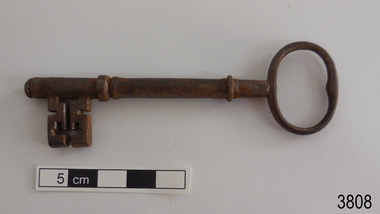
Functional object - Key, circa 1866
... history of the Loch Ard shipwreck’s only two survivors. The set of keys also hold significance as they were discovered by John Chance, who was also a diver from the wreck of the Loch Ard in the 1960s-70s. Items that come from several wrecks along Victoria's coast have since been donated to the Flagstaff Hill Maritime Village’s museum collection by his family, illustrating this item’s level of historical value. Glenample Homestead is of historical, social and architectural ...The key is one of a collection of seven 1860s keys once belonged to the Glenample Homestead near Princetown. They are all keyed with different bits and would have opened the external panelled doors of the Georgian building. The keys would now be around 150 years old. The keys are now part of the John Chance Collection. Locksmiths became a recognised trade by the middle of the 19th century, doing work that blacksmiths and gunsmiths would have done. They were craftsmen and trained apprentices for their trade. The local community and businesses relied on them for making a wide variety of precision objects such as locks and keys, knives, ornamental and decorative latticework, fine instruments, accurate tools and hardware items. Glenample Homestead became famous after the disastrous wreck of the sailing ship Loch Ard on June 1, 1878. The owners, Hugh Hamilton Gibson and Peter McArthur, were involved in the rescue and recovery of Eva Carmichael and Tom Pearce, the only two survivors, as well as overseeing the salvage of items from the shipwreck and the burial of those who lost their lives. Eva first met Jane Shields at Glenample and they became long-time friends. The keys are significant as an example of mid-19th century locksmith hardware, and for their connection with Glenample Homestead, and for their connection to the history of the Loch Ard shipwreck’s only two survivors. The set of keys also hold significance as they were discovered by John Chance, who was also a diver from the wreck of the Loch Ard in the 1960s-70s. Items that come from several wrecks along Victoria's coast have since been donated to the Flagstaff Hill Maritime Village’s museum collection by his family, illustrating this item’s level of historical value. Glenample Homestead is of historical, social and architectural significance to the State of Victoria and is listed on the Victorian Heritage Register (VHR H0392). It is a historical example of early settlement and development of a run in the coastal land of South West Victoria, and it is constructed from locally quarried sandstone but doesn’t take away from its Georgian design. Glenample Homestead is of State significance through its unique connection with the wreck of the ship Loch Ard and the connection to its owners, Hugh and Lavinia Gibson and Peter McArthur, played a historically and socially significant role in the rescue and care of the survivors, the salvage of goods and the burial of those who lost their lives. The shipwreck of the Loch Ard itself is of significance for Victoria and is registered on the Victorian Heritage Register (S417). Key; steel domestic door key. Round, thin open bow with 'B' shaped internal space, collar on shank, close to the bow. Round shank flares out slightly above the collar on the bit. The rectangular bit has internal and external notches and grooves. There is a rounded pin on the end.flagstaff hill, warrnambool, flagstaff hill maritime museum, maritime museum, shipwreck coast, flagstaff hill maritime village, great ocean road, glenample homestead, victorian heritage register vhr h0392, georgian homestead, loch ard, princetown, jane shields, eva carmichael, tom pearce, blue china tea set, antique door key, glenample photographs, john chance -
 Flagstaff Hill Maritime Museum and Village
Functional object - Key, circa 1866
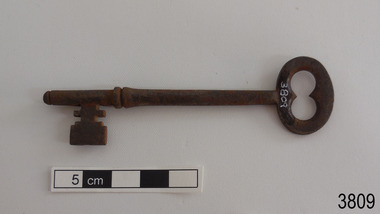
... history of the Loch Ard shipwreck’s only two survivors. The set of keys also hold significance as they were discovered by John Chance, who was also a diver from the wreck of the Loch Ard in the 1960s-70s. Items that come from several wrecks along Victoria's coast have since been donated to the Flagstaff Hill Maritime Village’s museum collection by his family, illustrating this item’s level of historical value. Glenample Homestead is of historical, social and architectural ...The key is one of a collection of seven 1860s keys once belonged to the Glenample Homestead near Princetown. They are all keyed with different bits and would have opened the external panelled doors of the Georgian building. The keys would now be around 150 years old. The keys are now part of the John Chance Collection. Locksmiths became a recognised trade by the middle of the 19th century, doing work that blacksmiths and gunsmiths would have done. They were craftsmen and trained apprentices for their trade. The local community and businesses relied on them for making a wide variety of precision objects such as locks and keys, knives, ornamental and decorative latticework, fine instruments, accurate tools and hardware items. Glenample Homestead became famous after the disastrous wreck of the sailing ship Loch Ard on June 1, 1878. The owners, Hugh Hamilton Gibson and Peter McArthur, were involved in the rescue and recovery of Eva Carmichael and Tom Pearce, the only two survivors, as well as overseeing the salvage of items from the shipwreck and the burial of those who lost their lives. Eva first met Jane Shields at Glenample and they became long-time friends. The keys are significant as an example of mid-19th century locksmith hardware, and for their connection with Glenample Homestead, and for their connection to the history of the Loch Ard shipwreck’s only two survivors. The set of keys also hold significance as they were discovered by John Chance, who was also a diver from the wreck of the Loch Ard in the 1960s-70s. Items that come from several wrecks along Victoria's coast have since been donated to the Flagstaff Hill Maritime Village’s museum collection by his family, illustrating this item’s level of historical value. Glenample Homestead is of historical, social and architectural significance to the State of Victoria and is listed on the Victorian Heritage Register (VHR H0392). It is a historical example of early settlement and development of a run in the coastal land of South West Victoria, and it is constructed from locally quarried sandstone but doesn’t take away from its Georgian design. Glenample Homestead is of State significance through its unique connection with the wreck of the ship Loch Ard and the connection to its owners, Hugh and Lavinia Gibson and Peter McArthur, played a historically and socially significant role in the rescue and care of the survivors, the salvage of goods and the burial of those who lost their lives. The shipwreck of the Loch Ard itself is of significance for Victoria and is registered on the Victorian Heritage Register (S417). Key; steel domestic door key. Flat open bow with 'figure 8' space. Round narrow shank flares out slightly above the collar on the bit. The rectangular bit has has external notches and grooves. There is a rounded pin on the end.flagstaff hill, warrnambool, flagstaff hill maritime museum, maritime museum, shipwreck coast, flagstaff hill maritime village, great ocean road, glenample homestead, victorian heritage register vhr h0392, georgian homestead, loch ard, princetown, jane shields, eva carmichael, tom pearce, blue china tea set, antique door key, glenample photographs, john chance -
 Flagstaff Hill Maritime Museum and Village
Functional object - Key, circa 1866
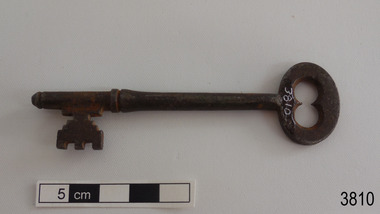
... history of the Loch Ard shipwreck’s only two survivors. The set of keys also hold significance as they were discovered by John Chance, who was also a diver from the wreck of the Loch Ard in the 1960s-70s. Items that come from several wrecks along Victoria's coast have since been donated to the Flagstaff Hill Maritime Village’s museum collection by his family, illustrating this item’s level of historical value. Glenample Homestead is of historical, social and architectural ...The key is one of a collection of seven 1860s keys once belonged to the Glenample Homestead near Princetown. They are all keyed with different bits and would have opened the external panelled doors of the Georgian building. The keys would now be around 150 years old. The keys are now part of the John Chance Collection. Locksmiths became a recognised trade by the middle of the 19th century, doing work that blacksmiths and gunsmiths would have done. They were craftsmen and trained apprentices for their trade. The local community and businesses relied on them for making a wide variety of precision objects such as locks and keys, knives, ornamental and decorative latticework, fine instruments, accurate tools and hardware items. Glenample Homestead became famous after the disastrous wreck of the sailing ship Loch Ard on June 1, 1878. The owners, Hugh Hamilton Gibson and Peter McArthur, were involved in the rescue and recovery of Eva Carmichael and Tom Pearce, the only two survivors, as well as overseeing the salvage of items from the shipwreck and the burial of those who lost their lives. Eva first met Jane Shields at Glenample and they became long-time friends.The keys are significant as an example of mid-19th century locksmith hardware, and for their connection with Glenample Homestead, and for their connection to the history of the Loch Ard shipwreck’s only two survivors. The set of keys also hold significance as they were discovered by John Chance, who was also a diver from the wreck of the Loch Ard in the 1960s-70s. Items that come from several wrecks along Victoria's coast have since been donated to the Flagstaff Hill Maritime Village’s museum collection by his family, illustrating this item’s level of historical value. Glenample Homestead is of historical, social and architectural significance to the State of Victoria and is listed on the Victorian Heritage Register (VHR H0392). It is a historical example of early settlement and development of a run in the coastal land of South West Victoria, and it is constructed from locally quarried sandstone but doesn’t take away from its Georgian design. Glenample Homestead is of State significance through its unique connection with the wreck of the ship Loch Ard and the connection to its owners, Hugh and Lavinia Gibson and Peter McArthur, played a historically and socially significant role in the rescue and care of the survivors, the salvage of goods and the burial of those who lost their lives. The shipwreck of the Loch Ard itself is of significance for Victoria and is registered on the Victorian Heritage Register (S417). Key; steel domestic door key. Flat open bow with 'figure 8' space, collar on shank, close to the bow. Round shank flares out slightly above the collar on the bit. The rectangular bit has external notches and grooves. There is a rounded pin on the end.flagstaff hill, warrnambool, flagstaff hill maritime museum, maritime museum, shipwreck coast, flagstaff hill maritime village, great ocean road, glenample homestead, victorian heritage register vhr h0392, georgian homestead, loch ard, princetown, jane shields, eva carmichael, tom pearce, blue china tea set, antique door key, glenample photographs, john chance -
Glenelg Shire Council Cultural Collection
Certificate - Certificate - Historic Buildings, Portland Town Hall, 1974
... architecture of the first years of settlement in western Victoria. The basalt structure was partially erected of stone from the Portland stockade and has significant historical associations with local Government administration in the district. The Town Hall is the most impressive work of Alexander Ross, a surveyor architect whose career remains largely undocumented. The old Town Hall at Portland has been discreetly extended at the rear to provide additional meeting room accommodation. The premises are no longer used for local government administration. Portland Town Hall History ...From the Victorian Heritage Register: The foundation stone of the original Portland Town Hall was laid by William Learmonth on 21st September, 1863 following a competition and subsequent public controversy over the permitted entry of architect John Barrow. The conservative classical design of municipal surveyor Alexander Ross was preferred and this axially planned design with central council chamber and side offices fronted by a fine axed pedimented gable entablature of basalt and Tuscan Doric pilasters was completed by 24th may 1864. The old Town Hall is one of a distinguished group of public buildings in Portland and an interesting example of conservative classical architecture of the first years of settlement in western Victoria. The basalt structure was partially erected of stone from the Portland stockade and has significant historical associations with local Government administration in the district. The Town Hall is the most impressive work of Alexander Ross, a surveyor architect whose career remains largely undocumented. The old Town Hall at Portland has been discreetly extended at the rear to provide additional meeting room accommodation. The premises are no longer used for local government administration.A4 sized certificate demonstrating Portland Town Hall's special significance to the state of Victoria & inclusion on the Historic Building Register. Singed by Robert Maclellan, Minister for planning & Historic Buildings Council Chairperson. Red seal attached, bottom right.portland town hall, history house, heritage register, historic buildings, certificate -
 Orbost & District Historical Society
black and white photograph, Vogt, Stanley, first half 20th century
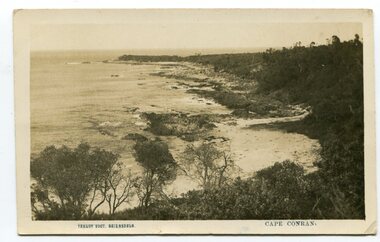
... architecture gone and people gone, showing social history such as dress, or early automobiles. Postcards form a vital part of social and historical records for researchers. postcard-cape-conran on front - "Stanley Voigt - Bairnsdale - Cape Conran" A black / white postcard photograph of a scenic view of the beach and ocean at Cape Conran in Far East Victoria. black and white photograph Vogt, Stanley ...This is a scene of Cape Conran, East Gippsland taken by Bairnsdale photographer, Stanley Vogt. It was probably one of a collection of commercial post cards available to tourists or East Gippsland residents to send to friends or relatives. Cameras in the early 20th century were not a common family possession and a postcard was a common souvenir and way of sending a short message.Between 1901 and 1914 a wide range of subjects were recorded by often anonymous artists and photographers and published by everyone from major companies to enthusiastic individuals. As a result, postcards provide a comprehensive resource for anyone interested in how our forebears lived, laughed and loved one hundred years ago. They are very interesting records of places gone, architecture gone and people gone, showing social history such as dress, or early automobiles. Postcards form a vital part of social and historical records for researchers. A black / white postcard photograph of a scenic view of the beach and ocean at Cape Conran in Far East Victoria.on front - "Stanley Voigt - Bairnsdale - Cape Conran"postcard-cape-conran -
 Flagstaff Hill Maritime Museum and Village
Marble Tile, circa 1878
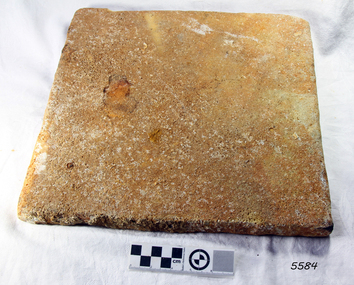
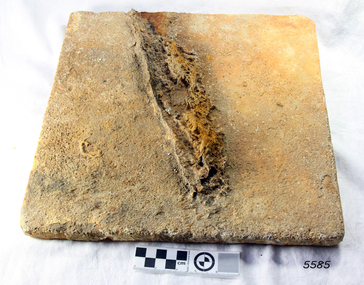
... Victoria’s shipping history and its potential to interpret sub-theme 1.5 of Victoria’s Framework of Historical Themes (living with natural processes). The collection is also historically significant for its association with the LOCH ARD, which was one of the worst and best known shipwrecks in Victoria’s history. Flagstaff Hill Warrnambool Shipwrecked coast Flagstaff Hill Maritime Museum Maritime Museum Shipwreck coast Flagstaff Hill Maritime Village Great Ocean Road Loch Line LOCH ARD Captain Gibbs Eva Carmichael Tom Pearce Glenample Station Mutton Bird Island LOCH ARD Gorge white marble marble tile carrara marble imported marble colonial architecture victorian building materials A square marble tile retrieved from the wreck of the LOCH ARD. ...The artefact is a white marble tile raised from the wreck of the LOCH ARD (1878). The cargo manifest of the sunken vessel has the entry “Marble £400”. This is placed directly following the entry “Glass (604 cases)”. This conjunction suggests the marble tile was originally part of a consignment intended for use in a ‘high end’ residential or public building project in the gold and wool rich Colony of Victoria. Traditionally, white or cream marble was imported into Britain from the Mediterranean region of Europe, where beds of sedimentary limestone (calcium and magnesium carbonate) had been buried over a long geological period of time. Deep in the earth’s crust, it had been subjected to immense pressures and high temperatures, sufficient to completely re-crystallise the original deposits. Marble beds began as layers of sediment at the bottom of ancient tropical seas, forming from the skeletal remains of calcareous fossils, shell, and coral fragments. The metamorphic process of prolonged compression and heating recrystallised this skeletal material, destroying all signs of the original sedimentary fabric. The resulting ‘true’ marbles of, for example, White Carrara (Tuscany, Italy), Verdi (green) Antico (Thessaly, Greece), and Rouge (red) Languadoc (Carcassone, France), were highly prized in classical decoration (sculpture and friezes) and architecture (temples and arches). Marble was found in nineteenth century Australia, but in small, uneconomic deposits, not suitable for commercial quarrying. The comparative expense of imported marble restricted its use in colonial buildings to carved fireplaces and mantel pieces, or outdoor ornaments such as fountains, statuary and grave stones. If Carrara marble floor tiles were used, they were used sparingly, as an arresting feature in entrance halls for instance. However, most prominent private and public construction used timber flooring, waxed or ‘japanned’, with carpet runners and rugs (for example the Austin’s Barwon Park Mansion, 1871), or laid tessellated and ceramic tiles of baked clay infused with colour (for example the Chirnside’s Werribee Park Mansion, 1878). HISTORY OF THE LOCH ARD The LOCH ARD belonged to the famous Loch Line which sailed many ships from England to Australia. Built in Glasgow by Barclay, Curdle and Co. in 1873, the LOCH ARD was a three-masted square rigged iron sailing ship. The ship measured 262ft 7" (79.87m) in length, 38ft (11.58m) in width, 23ft (7m) in depth and had a gross tonnage of 1693 tons. The LOCH ARD's main mast measured a massive 150ft (45.7m) in height. LOCH ARD made three trips to Australia and one trip to Calcutta before its final voyage. LOCH ARD left England on March 2, 1878, under the command of Captain Gibbs, a newly married, 29 year old. She was bound for Melbourne with a crew of 37, plus 17 passengers and a load of cargo. The general cargo reflected the affluence of Melbourne at the time. On board were straw hats, umbrella, perfumes, clay pipes, pianos, clocks, confectionary, linen and candles, as well as a heavier load of railway irons, cement, lead and copper. There were items included that intended for display in the Melbourne International Exhibition in 1880. The voyage to Port Phillip was long but uneventful. At 3am on June 1, 1878, Captain Gibbs was expecting to see land and the passengers were becoming excited as they prepared to view their new homeland in the early morning. But LOCH ARD was running into a fog which greatly reduced visibility. Captain Gibbs was becoming anxious as there was no sign of land or the Cape Otway lighthouse. At 4am the fog lifted. A man aloft announced that he could see breakers. The sheer cliffs of Victoria's west coast came into view, and Captain Gibbs realised that the ship was much closer to them than expected. He ordered as much sail to be set as time would permit and then attempted to steer the vessel out to sea. On coming head on into the wind, the ship lost momentum, the sails fell limp and LOCH ARD's bow swung back. Gibbs then ordered the anchors to be released in an attempt to hold its position. The anchors sank some 50 fathoms - but did not hold. By this time LOCH ARD was among the breakers and the tall cliffs of Mutton Bird Island rose behind the ship. Just half a mile from the coast, the ship's bow was suddenly pulled around by the anchor. The captain tried to tack out to sea, but the ship struck a reef at the base of Mutton Bird Island, near Port Campbell. Waves broke over the ship and the top deck was loosened from the hull. The masts and rigging came crashing down knocking passengers and crew overboard. When a lifeboat was finally launched, it crashed into the side of LOCH ARD and capsized. Tom Pearce, who had launched the boat, managed to cling to its overturned hull and shelter beneath it. He drifted out to sea and then on the flood tide came into what is now known as LOCH ARD Gorge. He swam to shore, bruised and dazed, and found a cave in which to shelter. Some of the crew stayed below deck to shelter from the falling rigging but drowned when the ship slipped off the reef into deeper water. Eva Carmichael had raced onto deck to find out what was happening only to be confronted by towering cliffs looming above the stricken ship. In all the chaos, Captain Gibbs grabbed Eva and said, "If you are saved Eva, let my dear wife know that I died like a sailor". That was the last Eva Carmichael saw of the captain. She was swept off the ship by a huge wave. Eva saw Tom Pearce on a small rocky beach and yelled to attract his attention. He dived in and swam to the exhausted woman and dragged her to shore. He took her to the cave and broke open case of brandy which had washed up on the beach. He opened a bottle to revive the unconscious woman. A few hours later Tom scaled a cliff in search of help. He followed hoof prints and came by chance upon two men from nearby Glenample Station three and a half miles away. In a state of exhaustion, he told the men of the tragedy. Tom returned to the gorge while the two men rode back to the station to get help. By the time they reached LOCH ARD Gorge, it was cold and dark. The two shipwreck survivors were taken to Glenample Station to recover. Eva stayed at the station for six weeks before returning to Ireland, this time by steamship. In Melbourne, Tom Pearce received a hero's welcome. He was presented with the first gold medal of the Royal Humane Society of Victoria and a £1000 cheque from the Victorian Government. Concerts were performed to honour the young man's bravery and to raise money for those who lost family in the LOCH ARD disaster. Of the 54 crew members and passengers on board, only two survived: the apprentice, Tom Pearce and the young woman passenger, Eva Carmichael, who lost all of her family in the tragedy. Ten days after the LOCH ARD tragedy, salvage rights to the wreck were sold at auction for £2,120. Cargo valued at £3,000 was salvaged and placed on the beach, but most washed back into the sea when another storm developed. The wreck of LOCH ARD still lies at the base of Mutton Bird Island. Much of the cargo has now been salvaged and some was washed up into what is now known as LOCH ARD Gorge. Cargo and artefacts have also been illegally salvaged over many years before protective legislation was introduced. One of the most unlikely pieces of cargo to have survived the shipwreck was a Minton porcelain peacock - one of only nine in the world. The peacock was destined for the Melbourne International Exhibition in 1880. It had been well packed, which gave it adequate protection during the violent storm. Today, the Minton peacock can be seen at the Flagstaff Hill Maritime Museum in Warrnambool. From Australia's most dramatic shipwreck it has now become Australia's most valuable shipwreck artefact and is one of very few 'objects' on the Victorian State Heritage Register. The wreck of the LOCH ARD is of State significance — Victorian Heritage Register S417 Flagstaff Hill’s collection of artefacts from LOCH ARD is significant for being one of the largest collections of artefacts from this shipwreck in Victoria. It is significant for its association with the shipwreck, which is on the Victorian Heritage Register (VHR S417). The collection is significant because of the relationship between the objects, as together they have a high potential to interpret the story of the LOCH ARD. The LOCH ARD collection is archaeologically significant as the remains of a large international passenger and cargo ship. The LOCH ARD collection is historically significant for representing aspects of Victoria’s shipping history and its potential to interpret sub-theme 1.5 of Victoria’s Framework of Historical Themes (living with natural processes). The collection is also historically significant for its association with the LOCH ARD, which was one of the worst and best known shipwrecks in Victoria’s history. A square marble tile retrieved from the wreck of the LOCH ARD. Most of its surface is covered by a thin layer of limestone and marine growth encrustation that is stained rust-red. The tile is ‘rough-worked’, cut to shape and size, but not smoothed or polished. There is a companion tile in similar condition in the Flagstaff Hill collection. From visual observation of the original surface (at low magnification) the tile appears to be of white Carrara-type marble.flagstaff hill, warrnambool, shipwrecked coast, flagstaff hill maritime museum, maritime museum, shipwreck coast, flagstaff hill maritime village, great ocean road, loch line, loch ard, captain gibbs, eva carmichael, tom pearce, glenample station, mutton bird island, loch ard gorge, white marble, marble tile, carrara marble, imported marble, colonial architecture, victorian building materials -
 Flagstaff Hill Maritime Museum and Village
Marble Tile, circa 1878
... Victoria’s shipping history and its potential to interpret sub-theme 1.5 of Victoria’s Framework of Historical Themes (living with natural processes). The collection is also historically significant for its association with the LOCH ARD, which was one of the worst and best known shipwrecks in Victoria’s history. flagstaff hill warrnambool shipwrecked coast flagstaff hill maritime museum maritime museum shipwreck coast flagstaff hill maritime village great ocean road loch line loch ard captain gibbs eva carmichael tom pearce glenample station mutton bird island loch ard gorge white marble marble tile carrara marble colonial architecture victorian building materials A square marble tile retrieved from the wreck of the LOCH ARD. ...The artefact is a white marble tile raised from the wreck of the LOCH ARD (1878). The cargo manifest of the sunken vessel has the entry “Marble £400”. This is placed directly following the entry “Glass (604 cases)”. This conjunction suggests the marble tile was originally part of a consignment intended for use in a ‘high end’ residential or public building project in the gold and wool rich Colony of Victoria. Traditionally, white or cream marble was imported into Britain from the Mediterranean region of Europe, where beds of sedimentary limestone (calcium and magnesium carbonate) had been buried over a long geological period of time. Deep in the earth’s crust, it had been subjected to immense pressures and high temperatures, sufficient to completely re-crystallise the original deposits. Marble beds began as layers of sediment at the bottom of ancient tropical seas, forming from the skeletal remains of calcareous fossils, shell, and coral fragments. The metamorphic process of prolonged compression and heating recrystallised this skeletal material, destroying all signs of the original sedimentary fabric. The resulting ‘true’ marbles of, for example, White Carrara (Tuscany, Italy), Verdi (green) Antico (Thessaly, Greece), and Rouge (red) Languadoc (Carcassone, France), were highly prized in classical decoration (sculpture and friezes) and architecture (temples and arches). Marble was found in nineteenth century Australia, but in small, uneconomic deposits, not suitable for commercial quarrying. The comparative expense of imported marble restricted its use in colonial buildings to carved fireplaces and mantel pieces, or outdoor ornaments such as fountains, statuary and grave stones. If Carrara marble floor tiles were used, they were used sparingly, as an arresting feature in entrance halls for instance. However, most prominent private and public construction used timber flooring, waxed or ‘jappaned’, with carpet runners and rugs (for example the Austin’s Barwon Park Mansion, 1871), or laid tessellated and ceramic tiles of baked clay infused with colour (for example the Chirnside’s Werribee Park Mansion, 1878). HISTORY OF THE LOCH ARD The LOCH ARD belonged to the famous Loch Line which sailed many ships from England to Australia. Built in Glasgow by Barclay, Curdle and Co. in 1873, the LOCH ARD was a three-masted square rigged iron sailing ship. The ship measured 262ft 7" (79.87m) in length, 38ft (11.58m) in width, 23ft (7m) in depth and had a gross tonnage of 1693 tons. The LOCH ARD's main mast measured a massive 150ft (45.7m) in height. LOCH ARD made three trips to Australia and one trip to Calcutta before its final voyage. LOCH ARD left England on March 2, 1878, under the command of Captain Gibbs, a newly married, 29 year old. She was bound for Melbourne with a crew of 37, plus 17 passengers and a load of cargo. The general cargo reflected the affluence of Melbourne at the time. On board were straw hats, umbrella, perfumes, clay pipes, pianos, clocks, confectionary, linen and candles, as well as a heavier load of railway irons, cement, lead and copper. There were items included that intended for display in the Melbourne International Exhibition in 1880. The voyage to Port Phillip was long but uneventful. At 3am on June 1, 1878, Captain Gibbs was expecting to see land and the passengers were becoming excited as they prepared to view their new homeland in the early morning. But LOCH ARD was running into a fog which greatly reduced visibility. Captain Gibbs was becoming anxious as there was no sign of land or the Cape Otway lighthouse. At 4am the fog lifted. A man aloft announced that he could see breakers. The sheer cliffs of Victoria's west coast came into view, and Captain Gibbs realised that the ship was much closer to them than expected. He ordered as much sail to be set as time would permit and then attempted to steer the vessel out to sea. On coming head on into the wind, the ship lost momentum, the sails fell limp and LOCH ARD's bow swung back. Gibbs then ordered the anchors to be released in an attempt to hold its position. The anchors sank some 50 fathoms - but did not hold. By this time LOCH ARD was among the breakers and the tall cliffs of Mutton Bird Island rose behind the ship. Just half a mile from the coast, the ship's bow was suddenly pulled around by the anchor. The captain tried to tack out to sea, but the ship struck a reef at the base of Mutton Bird Island, near Port Campbell. Waves broke over the ship and the top deck was loosened from the hull. The masts and rigging came crashing down knocking passengers and crew overboard. When a lifeboat was finally launched, it crashed into the side of LOCH ARD and capsized. Tom Pearce, who had launched the boat, managed to cling to its overturned hull and shelter beneath it. He drifted out to sea and then on the flood tide came into what is now known as LOCH ARD Gorge. He swam to shore, bruised and dazed, and found a cave in which to shelter. Some of the crew stayed below deck to shelter from the falling rigging but drowned when the ship slipped off the reef into deeper water. Eva Carmichael had raced onto deck to find out what was happening only to be confronted by towering cliffs looming above the stricken ship. In all the chaos, Captain Gibbs grabbed Eva and said, "If you are saved Eva, let my dear wife know that I died like a sailor". That was the last Eva Carmichael saw of the captain. She was swept off the ship by a huge wave. Eva saw Tom Pearce on a small rocky beach and yelled to attract his attention. He dived in and swam to the exhausted woman and dragged her to shore. He took her to the cave and broke open case of brandy which had washed up on the beach. He opened a bottle to revive the unconscious woman. A few hours later Tom scaled a cliff in search of help. He followed hoof prints and came by chance upon two men from nearby Glenample Station three and a half miles away. In a state of exhaustion, he told the men of the tragedy. Tom returned to the gorge while the two men rode back to the station to get help. By the time they reached LOCH ARD Gorge, it was cold and dark. The two shipwreck survivors were taken to Glenample Station to recover. Eva stayed at the station for six weeks before returning to Ireland, this time by steamship. In Melbourne, Tom Pearce received a hero's welcome. He was presented with the first gold medal of the Royal Humane Society of Victoria and a £1000 cheque from the Victorian Government. Concerts were performed to honour the young man's bravery and to raise money for those who lost family in the LOCH ARD disaster. Of the 54 crew members and passengers on board, only two survived: the apprentice, Tom Pearce and the young woman passenger, Eva Carmichael, who lost all of her family in the tragedy. Ten days after the LOCH ARD tragedy, salvage rights to the wreck were sold at auction for £2,120. Cargo valued at £3,000 was salvaged and placed on the beach, but most washed back into the sea when another storm developed. The wreck of LOCH ARD still lies at the base of Mutton Bird Island. Much of the cargo has now been salvaged and some was washed up into what is now known as LOCH ARD Gorge. Cargo and artefacts have also been illegally salvaged over many years before protective legislation was introduced. One of the most unlikely pieces of cargo to have survived the shipwreck was a Minton porcelain peacock - one of only nine in the world. The peacock was destined for the Melbourne International Exhibition in 1880. It had been well packed, which gave it adequate protection during the violent storm. Today, the Minton peacock can be seen at the Flagstaff Hill Maritime Museum in Warrnambool. From Australia's most dramatic shipwreck it has now become Australia's most valuable shipwreck artefact and is one of very few 'objects' on the Victorian State Heritage Register. HISTORY OF THE LOCH ARD The LOCH ARD belonged to the famous Loch Line which sailed many ships from England to Australia. Built in Glasgow by Barclay, Curdle and Co. in 1873, the LOCH ARD was a three-masted square rigged iron sailing ship. The ship measured 262ft 7" (79.87m) in length, 38ft (11.58m) in width, 23ft (7m) in depth and had a gross tonnage of 1693 tons. The LOCH ARD's main mast measured a massive 150ft (45.7m) in height. LOCH ARD made three trips to Australia and one trip to Calcutta before its final voyage. LOCH ARD left England on March 2, 1878, under the command of Captain Gibbs, a newly married, 29 year old. She was bound for Melbourne with a crew of 37, plus 17 passengers and a load of cargo. The general cargo reflected the affluence of Melbourne at the time. On board were straw hats, umbrella, perfumes, clay pipes, pianos, clocks, confectionary, linen and candles, as well as a heavier load of railway irons, cement, lead and copper. There were items included that intended for display in the Melbourne International Exhibition in 1880. The voyage to Port Phillip was long but uneventful. At 3am on June 1, 1878, Captain Gibbs was expecting to see land and the passengers were becoming excited as they prepared to view their new homeland in the early morning. But LOCH ARD was running into a fog which greatly reduced visibility. Captain Gibbs was becoming anxious as there was no sign of land or the Cape Otway lighthouse. At 4am the fog lifted. A man aloft announced that he could see breakers. The sheer cliffs of Victoria's west coast came into view, and Captain Gibbs realised that the ship was much closer to them than expected. He ordered as much sail to be set as time would permit and then attempted to steer the vessel out to sea. On coming head on into the wind, the ship lost momentum, the sails fell limp and LOCH ARD's bow swung back. Gibbs then ordered the anchors to be released in an attempt to hold its position. The anchors sank some 50 fathoms - but did not hold. By this time LOCH ARD was among the breakers and the tall cliffs of Mutton Bird Island rose behind the ship. Just half a mile from the coast, the ship's bow was suddenly pulled around by the anchor. The captain tried to tack out to sea, but the ship struck a reef at the base of Mutton Bird Island, near Port Campbell. Waves broke over the ship and the top deck was loosened from the hull. The masts and rigging came crashing down knocking passengers and crew overboard. When a lifeboat was finally launched, it crashed into the side of LOCH ARD and capsized. Tom Pearce, who had launched the boat, managed to cling to its overturned hull and shelter beneath it. He drifted out to sea and then on the flood tide came into what is now known as LOCH ARD Gorge. He swam to shore, bruised and dazed, and found a cave in which to shelter. Some of the crew stayed below deck to shelter from the falling rigging but drowned when the ship slipped off the reef into deeper water. Eva Carmichael had raced onto deck to find out what was happening only to be confronted by towering cliffs looming above the stricken ship. In all the chaos, Captain Gibbs grabbed Eva and said, "If you are saved Eva, let my dear wife know that I died like a sailor". That was the last Eva Carmichael saw of the captain. She was swept off the ship by a huge wave. Eva saw Tom Pearce on a small rocky beach and yelled to attract his attention. He dived in and swam to the exhausted woman and dragged her to shore. He took her to the cave and broke open case of brandy which had washed up on the beach. He opened a bottle to revive the unconscious woman. A few hours later Tom scaled a cliff in search of help. He followed hoof prints and came by chance upon two men from nearby Glenample Station three and a half miles away. In a state of exhaustion, he told the men of the tragedy. Tom returned to the gorge while the two men rode back to the station to get help. By the time they reached LOCH ARD Gorge, it was cold and dark. The two shipwreck survivors were taken to Glenample Station to recover. Eva stayed at the station for six weeks before returning to Ireland, this time by steamship. In Melbourne, Tom Pearce received a hero's welcome. He was presented with the first gold medal of the Royal Humane Society of Victoria and a £1000 cheque from the Victorian Government. Concerts were performed to honour the young man's bravery and to raise money for those who lost family in the LOCH ARD disaster. Of the 54 crew members and passengers on board, only two survived: the apprentice, Tom Pearce and the young woman passenger, Eva Carmichael, who lost all of her family in the tragedy. Ten days after the LOCH ARD tragedy, salvage rights to the wreck were sold at auction for £2,120. Cargo valued at £3,000 was salvaged and placed on the beach, but most washed back into the sea when another storm developed. The wreck of LOCH ARD still lies at the base of Mutton Bird Island. Much of the cargo has now been salvaged and some was washed up into what is now known as LOCH ARD Gorge. Cargo and artefacts have also been illegally salvaged over many years before protective legislation was introduced. One of the most unlikely pieces of cargo to have survived the shipwreck was a Minton porcelain peacock - one of only nine in the world. The peacock was destined for the Melbourne International Exhibition in 1880. It had been well packed, which gave it adequate protection during the violent storm. Today, the Minton peacock can be seen at the Flagstaff Hill Maritime Museum in Warrnambool. From Australia's most dramatic shipwreck it has now become Australia's most valuable shipwreck artefact and is one of very few 'objects' on the Victorian State Heritage Register. The wreck of the LOCH ARD is of State significance — Victorian Heritage Register S417 Flagstaff Hill’s collection of artefacts from LOCH ARD is significant for being one of the largest collections of artefacts from this shipwreck in Victoria. It is significant for its association with the shipwreck, which is on the Victorian Heritage Register (VHR S417). The collection is significant because of the relationship between the objects, as together they have a high potential to interpret the story of the LOCH ARD. The LOCH ARD collection is archaeologically significant as the remains of a large international passenger and cargo ship. The LOCH ARD collection is historically significant for representing aspects of Victoria’s shipping history and its potential to interpret sub-theme 1.5 of Victoria’s Framework of Historical Themes (living with natural processes). The collection is also historically significant for its association with the LOCH ARD, which was one of the worst and best known shipwrecks in Victoria’s history. A square marble tile retrieved from the wreck of the LOCH ARD. Most of its surface is covered by a thin layer of limestone and marine growth encrustation that is stained rust-red. There is a piece of corroded iron encrusted at an oblique angle on the tile’s rear face. The tile is ‘rough-worked’, cut to shape and size, but not smoothed or polished. There is a companion tile in similar condition in the Flagstaff Hill collection. From visual observation of the original surface (at low magnification) the tile appears to be of white Carrara-type marble.flagstaff hill, warrnambool, shipwrecked coast, flagstaff hill maritime museum, maritime museum, shipwreck coast, flagstaff hill maritime village, great ocean road, loch line, loch ard, captain gibbs, eva carmichael, tom pearce, glenample station, mutton bird island, loch ard gorge, white marble, marble tile, carrara marble, colonial architecture, victorian building materials -
 Greensborough Historical Society
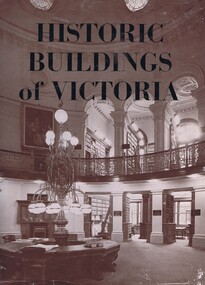
Book, Historic Buildings of Victoria, 1966_
... Victoria in 1966. Each entry has a photograph and caption with some history of the building. Arranged by region. The development of architectural ...A listing of National Trust listed buildings from around Victoria in 1966. Each entry has a photograph and caption with some history of the building. Arranged by region.The development of architectural style in Victoria.278 pages, black and white illustrations. Hard cover. Dust jacket has illustration of interior of the Library of the Supreme Courtmelbourne architecture, victoria architecture, historic buildings victoria, national trust of australia, victoria -
 The Beechworth Burke Museum
Photograph, 1970-71
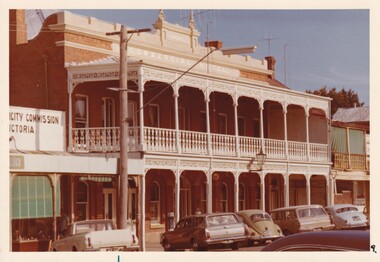
... history, the hotel hosted figures such as the Governor of Victoria in 1906, and reputedly even Ned Kelly. The photos depict the hotel's prominent exterior and antique interiors and furnishings, as well as Gray’s personal interest in antiques. One photograph shows Gray’s family at a Chinese burning tower. The reverse of the photographs contain Gray's handwritten notes. He later opened his own studio in Ivanhoe. These photographs have historic significance as they depict the Tanswell's Commercial Hotel- a notable example of Australian country hotel architecture ...This is a Kodak film packet of colour photographs of the historic Tanswell's Commercial Hotel, Beechworth. They were taken by William Gray in 1970–71, soon after the Tanswell era ended in 1967, after almost a century. Over its long history, the hotel hosted figures such as the Governor of Victoria in 1906, and reputedly even Ned Kelly. The photos depict the hotel's prominent exterior and antique interiors and furnishings, as well as Gray’s personal interest in antiques. One photograph shows Gray’s family at a Chinese burning tower. The reverse of the photographs contain Gray's handwritten notes. He later opened his own studio in Ivanhoe. These photographs have historic significance as they depict the Tanswell's Commercial Hotel- a notable example of Australian country hotel architecture and a prominent local landmark. Furthermore, these photographs were taken prior to the restoration works hence depicting the original colour and texture of the facade's brickwork. These photographs also have artistic significance as they beautifully capture the antique interiors of the hotel.Colour rectangular photographs printed on matte photographic paper unmounted8496.1: Obverse: 9. 8496.1: Reverse: Tanswell's Historic Hotel/Beechworth/About 1970-71?/8496 8496.2: Obverse: 12. 8496.2: Reverse: Tanswell's Historic Hotel/Beechworth/Remarkable ____ ____/1971/8496 8496.3: Obverse: 10. 8496.3: Reverse: Upstairs Antique Furniture/Incl: Triple 'Love Seat'/Tanswells Historic Hotel/Beechworth/About 1970-71/8496 8496.4: Obverse: 16. 8496.4: Reverse: Tanswell's Historic Pub/Beechworth/Upstairs Antique Room/1971/8496 8496.8: Reverse: 1971?/Tanswell's Historic Hotel/Beechworth/Upstairs Antique Room/Triple "Love Seat"/Later.../I bought a red _____/'Double' Love Seat for/__ studio+_____/It was not successful/8496 8496.5: Obverse: 15. 8496.5: Reverse: Bard, Susan, Rosemary Gray/+Sasha (Dalmatian)/Probably Beechworth Cemetry/About 1970-71?/8496 8496.6: Obverse: 14. 8496.6: Reverse: Tanswells Historic Hotel/Beechworth/Upstairs Dining Room/1971/8496 8496.7: Obverse: 11. 8496.7: Reverse: Tanswells Historic Hotel/Beechworth/1st ___/Antique Lounge/About 1970-71/8496 8496.8: Obverse: 13.tanswells commercial hotel, tanswells hotel, beechworth 1970s, william gray, antique furniture -
 Glen Eira Historical Society
Article - Tram Shelter, Dandenong Road
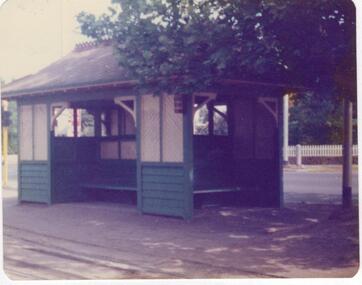
... National Trust of Australia, Victoria, report giving details of tram shelters on the tramways routes of Melbourne; history of cable car system and reasons for tramways amalgamations, includes architectural plan, map and photocopies of two photographs before restoration 1994. ...National Trust of Australia, Victoria, report giving details of tram shelters on the tramways routes of Melbourne; history of cable car system and reasons for tramways amalgamations, includes architectural plan, map and photocopies of two photographs before restoration 1994. ...National Trust of Australia, Victoria, report giving details of tram shelters on the tramways routes of Melbourne; history of cable car system and reasons for tramways amalgamations, includes architectural plan, map and photocopies of two photographs before restoration 1994. Includes bibliography. Two coloured photographs of tram shelter Dandenong Road opposite Hawthorn Road taken in 1978. Detailed history from the Trust News 2000 on history of Melbourne Tram Shelters, various architectural design features, where erected and who design by.dandenong road, hawthorn road, north caulfield, glen eira, flannagan l.s., prahran and malvern tramways trust, street furniture, tram shelters, edwardian style, architectural features, glenhuntly road, caulfield, orrong road, balaclava road, watson stephen, storey rohan, ward andrew -
Glen Eira Historical Society
Document - Kilwinning, Balaclava Road
... history of James Service, the 12th Premier of Victoria who resided at Kilwinning. The article includes a photograph (83mm x 63mm) of James Service. The file also includes two photocopies of a black and white photograph (185mm x 234mm) of James Service with four daughters out the front of Kilwinning. Handwritten notes, undated and unattributed, identify the individuals in the photograph and provide a date of circa 1870. Kilwinning Service James Balaclava Road Service Margaret Service Lillian Service Claire Service Roberta Gardens Architectural ...A two page print out of a Wikipedia article about the history of James Service, the 12th Premier of Victoria who resided at Kilwinning. The article includes a photograph (83mm x 63mm) of James Service. The file also includes two photocopies of a black and white photograph (185mm x 234mm) of James Service with four daughters out the front of Kilwinning. Handwritten notes, undated and unattributed, identify the individuals in the photograph and provide a date of circa 1870.kilwinning, service james, balaclava road, service margaret, service lillian, service claire, service roberta, gardens, architectural features, house names, st kilda east, caulfield, premiers, parliamentary representatives, james service and company, businesspeople -
Glen Eira Historical Society
Letter - Luton, Victoria Street, 4, Elsternwick
... history of Luton and its previous owners. The fourth document is a handwritten note of the research undertaken on Luton. Luton Hopetoun Gardens Landells Rosalind Victoria St Victoria Gardens Cummins Deborah Elsternwick Parish of Prahran Bullock Hilary Glenhuntly Rd Tappin Louise Allee John Caulfield North Landells Wallace (Mrs) Gourlay J Duncombe Edward .T. Duncombe Eleanor A. Carson William S. Sarah C.R. Noel Jones Real Estate Masseurs Real Estate Agents Real Estate Agencies Parks and Reserves Property Developers Land Subdivision Edwardian Style Architectural ...Copies of the correspondence between Louise Tappin and Mrs Wallace Landells dated 17/10/1987 regarding information requested about the Edwardian Style house Luton, Victoria St. Elsternwick. Two documents one handwritten copies of the third, a typed overwritten copy of the original correspondence. One copy is a letter to Ms Tappin while the other correspondence details the history of Luton and its previous owners. The fourth document is a handwritten note of the research undertaken on Luton.luton, hopetoun gardens, landells rosalind, victoria st, victoria gardens, cummins deborah, elsternwick, parish of prahran, bullock hilary, glenhuntly rd, tappin louise, allee john, caulfield north, landells wallace (mrs), gourlay j, duncombe edward .t., duncombe eleanor a., carson william s., sarah c.r., noel jones real estate, masseurs, real estate agents, real estate agencies, parks and reserves, property developers, land subdivision, edwardian style, architectural styles houses -
Glen Eira Historical Society
Pamphlet - Ercildoune
... Victoria), titled, The Story of Ercildoune. It provides a comprehensive history of the property Ercildoune. The front cover of one of the pamphlets includes a black and white photograph (76mmm x 114mm) of the exterior of Ercildoune. Davidson Rodney Jenkins Lindsay E Ercildoune Wilson Samuel Sir Architectural ...This folder contains one item about the station called 'Ercildoune also owned by Sir Samuel Wilson for a time: Two copies of an undated, four page typed pamphlet compiled by Rodney Davidson and Lindsay E Jenkins for the National Trust of Australia (Victoria), titled, The Story of Ercildoune. It provides a comprehensive history of the property Ercildoune. The front cover of one of the pamphlets includes a black and white photograph (76mmm x 114mm) of the exterior of Ercildoune.davidson rodney, jenkins lindsay e, ercildoune, wilson samuel sir, architectural features -
Glen Eira Historical Society
Letter - Bellecourt, Seymour Road, 85, Elsternwick
... Victoria, concerning the listing of Bellecourt by the Trust. The file also includes a print of the Victorian Heritage Database web page on Bellecourt with a black and white photograph (60mm x 45mm) of the house. Also included is a document giving additional details on Bellecourt with a black and white illustration (85mm x 130mm) of the house, source unknown though handwritten notes provide that it is a duplicate from the book Caulfield’s Building Heritage Bellecourt Buildings Heritage studies Architectural features History Johnston Mr Hart Trevor Town clerks Caulfield South Filbert Street Beemery Glen Eira Road Kooyong Road Seymour Road Blanche Street Kooyong Estate Caulfield Caulfield North Langdon Charles Pettey Rosecraddock Rose Craddock Tarqua Hengar Victorian style Seymour Street Kooyong Estate Beemery Park Extension Langdon H J Langdon Montague Lirrewa Rennick Samuel The Garrell Langdon family Victorian era Neringa Little Gromer Little Cromer Parson Charles Moloney James Trezise Alex Vassy Albert Johnston Mrs Solomon G Caulfield’s Heritage Volume 1 City of Caulfield City of Glen Eira Heritage Management Plan Ward Andrew Belemery Park Johnston Archibald Letter Bellecourt, Seymour Road, 85, Elsternwick ...A typewritten letter to Mr Johnston from the National Trust Victoria, concerning the listing of Bellecourt by the Trust. The file also includes a print of the Victorian Heritage Database web page on Bellecourt with a black and white photograph (60mm x 45mm) of the house. Also included is a document giving additional details on Bellecourt with a black and white illustration (85mm x 130mm) of the house, source unknown though handwritten notes provide that it is a duplicate from the book Caulfield’s Building Heritagebellecourt, buildings, heritage studies, architectural features, history, johnston mr, hart trevor, town clerks, caulfield south, filbert street, beemery, glen eira road, kooyong road, seymour road, blanche street, kooyong estate, caulfield, caulfield north, langdon charles pettey, rosecraddock, rose craddock, tarqua, hengar, victorian style, seymour street, kooyong estate, beemery park extension, langdon h j, langdon montague, lirrewa, rennick samuel, the garrell, langdon family, victorian era, neringa, little gromer, little cromer, parson charles, moloney james, trezise alex, vassy albert, johnston mrs, solomon g, caulfield’s heritage , volume 1 city of caulfield, city of glen eira heritage management plan, ward andrew, belemery park, johnston archibald -
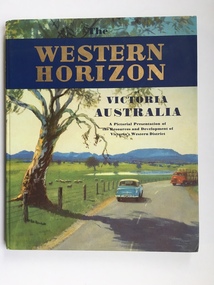 Warrnambool and District Historical Society Inc.
Book, Western Horizon, C 1960
... history of the western District of Victoria. It explores various aspects of the Western District such as water supply,architecture,ports,produce,and agriculture. ...history of the western District of Victoria. It explores various aspects of the Western District such as water supply,architecture,ports,produce,and agriculture. ...This book presents a pictorial history of the western District of Victoria. It explores various aspects of the Western District such as water supply,architecture,ports,produce,and agriculture. It also presents the various scenic spots around the district. The publishers of this book , the Australian publicity Council is dedicated to publicising the state of Victoria and its natural resources in an effort to attract overseas investment and industry.This book provides a snapshot of the Western District in the 1960 's both with the information and the photographs contained within, including some which were taken by Ralph Illidge who was one on Warrnambool's best known photographers. Coloured hard board cover with country scene with road with two vehicles on a road which continues to the back cover.. A large gum tree sits beside the road. The title is gold on a navy blue banner. Thereis a small blurb on the back cover. 112 pages.Australian Publicity Council. Henry Bolte Premier of Victoria.history of warrnambool, western horizon, western victoria, ralph illidge, warrnambool 1960's -
Glen Eira Historical Society
Article - Grand Union Tramway Junction, Balaclava Road and Hawthorn Road
... history of the junction and a statement of significance. Study also includes Four black and white photographs of the junction and of architectural details of the tram tracks. 2. A letter from the Conservation Manager of the National Trust of Australia (Victoria...history of the junction and a statement of significance. Study also includes Four black and white photographs of the junction and of architectural details of the tram tracks. 2. A letter from the Conservation Manager of the National Trust of Australia (Victoria ...This file contains three items. 1. A three-page Caulfield Conservation Study of the Balaclava Road/Hawthorn Road Tramway Crossing, undertake by Andrew Ward and dated September 1994. Study includes a brief history of the junction and a statement of significance. Study also includes Four black and white photographs of the junction and of architectural details of the tram tracks. 2. A letter from the Conservation Manager of the National Trust of Australia (Victoria) to the manager of the Planning Section for the City of Glen Eira, dated 15/06/2001 and attached to a six-page Classification Report. The letter informs of the Classification of the Grand Union Junction at the intersection of Balaclava and Hawthorn Road by the national trust, signed by Conservation Manager Ian Pausacker. Classification Report includes details such as the date of construction, a statement of significance, history of the junction, physical description of the junction and the condition of the junction at the time of writing. Report also includes a map of the Melbourne Tram Network drafted by Keith Kings and dated 01/005/1956, with illustration of the layout of fifteen tram depots, and updated aerial illustration of the Grand Union Junction, and a further map of Melbourne Tramways developed by North Melbourne Electric Tramways and Lighting Co. and Prahran and Malvern Tramways Trust, drafted by Keith Kings and dated January 1914 with illustrations of three tram depots. 3. Two articles from the Caulfield Leader written by Aaron Langmaid and dated 13/02/2007 and the Melbourne Bayside Weekly dated 21/02/2007 written by Joanne Sim, both concerning the Grand Union Junction. The article from the Caulfield Leader includes a picture of Executive Officer of the council of Tramway Museum of Australia Craig Tooke in front of the intersection. The article from the Bayside Weekly includes a picture of a tram passing through the junction and a brief history of the junction and tram network in Caulfield. The article also refers to twp local tram shelters at the intersection of Dandenong Road and Alma Road and also Orrong Road and Balaclava Road.caulfield, caulfield conservation, study, balaclava road, hawthorn road, grand union junction, ward andrew, tramway crossings, transport, acland street, caulfield racecourse, tram tracks, race events, event, tram routes, thorough fares, melbourne and metropolitan tramways board, prahran and malvern tramway trust, prahran and malvern district tramways, caulfield electric tramways, caulfield city council, architectural detail, city of glen eira, balaclava road and hawthorn road intersection, balaclava road and hawthorn road junction, dandenong road, glenhuntly road, four-way tram junctions, access covers darling road, cast metal access covers, hadfields patent, caulfield park, tram systems, tram networks, heritage, tramway heritage, kings keith, tram depots, glenhuntly depot, maps, glen eira, melbourne electric tramways, north melbourne electric tramways and lighting co., prahran and malvern tramways trust, caulfield leader, bayside weekly, tooke craig, tourist attractions, grand union tramways junction, caulfield junction, cable car tramways, tram shelters, building, sheds, alma road, orrong road, caulfield electric line, balaclava junction, elsternwick railway station, caulfield station, caulfield station loop, tram services, transport establishments, thoroughfares, buildings, structures, establishments, parts of buildings or structures, documents, commercial industry, sites, historic sites, melbourne bayside weekly -
Glen Eira Historical Society
Book - Robertson, Alexander William
... history of Labassa (and its owners) as a place for social gatherings and entertaining of Melbourne society of the late nineteenth century, and its letter use as flats and a boarding house. Extensively illustrated with colour photographs, architectural sketches and plans, the book LABASSA: A GRAND VICTORIAN MANSION details Labassa’s architectural significance Please refer to file 1113Y for the other copy of this book. For further information about Labrassa please refer to file 1113. Labassa Ontario Sylliott Hill Caulfield North Friends of Labassa Manor Grove National Trust of Australia (Victoria ...Contains one item about 'Labassa', called 'Ontario' when owned by Alexander William Robertson: 1/One copy of a thirty-two page colour book, published by the Friends of Labassa and The National Trust in 2004. The book details the history of Labassa (and its owners) as a place for social gatherings and entertaining of Melbourne society of the late nineteenth century, and its letter use as flats and a boarding house. Extensively illustrated with colour photographs, architectural sketches and plans, the book LABASSA: A GRAND VICTORIAN MANSION details Labassa’s architectural significance Please refer to file 1113Y for the other copy of this book. For further information about Labrassa please refer to file 1113.labassa, ontario, sylliott hill, caulfield north, friends of labassa, manor grove, national trust of australia (victoria), balaclava road, orrong road, caulfield, mansions, cobb and co., amatil ltd. (limited), alcoa of australia ltd. (limited), lyall william, mickle john, billing richard annesley judge, robertson alexander william, watson john boyd ii, koch john augustus bernard, hammond victoria, palmer lee, davis kingsley, groenhout chris, worrall bronwyn, balderstone sue, biarujia ian, cassidy darien, davidson rodney ao obe, forge warwick, lewis miles dr., sagazio celestina dr., billing mary, billing williamina, billing richard junior, watson flora kate, robertson eva, robertson nina, robertson emily, robertson john, australian-german association, bicentennial gift to the nation, ferguson and urie, crouch and wilson, tangent design, midas printing (asia) limited (ltd), flats, architectural features, architectural styles, auctions, land sales, land subdivision, architects, lawyers, judges, coaches and carriages, businesspeople, german community, victorian style, grants, voluntary workers, property development, construction (events and activities), gold mining, theatrical productions, stairs, stained glass, settlements, graziers, verandas, cast iron work, marble, balconies, bell towers, towers, bay windows, panoramic views, bedrooms, servants quarters, billiards rooms, rooms, fireplaces, sculpture, servants, marvellous melbourne, land use, depression 1890s, photography, photographers, entrance hall, domestic life, cultural events and activities -
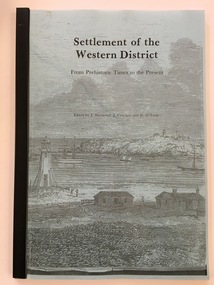 Warrnambool and District Historical Society Inc.
Booklet - Booklet: Settlement of the Western District, Collett, Bain and Gaspar, Printers, Settlement of the Western District From Prehistoric Times to the Present, 1985
... There are articles/lectures by seven experts on various aspects of the history of Western Victoria – geology, early maritime history, aboriginal history, architecture , archeology, farming and sociology. ...There are articles/lectures by seven experts on various aspects of the history of Western Victoria – geology, early maritime history, aboriginal history, architecture , archeology, farming and sociology. ...This booklet documents a public lecture series held in Warrnambool 3rd November 1984.This is a soft-cover book of 133 pages on the settlement of the Western District from prehistoric times to the present. It has a blue paper front cover and a grey paper back cover. The front cover is covered with a clear plastic sheet and the binding is plastic. The cover has an image of a sketch of the Warrnambool beach showing the lighthouse complex on Middle Island and the lighthouse on the beach (established 1860). There are a Contents page, a Foreword, a List of Plates and seven articles on different aspects of the Western District history by different authors. There are black and white photographs and illustrations. One page (p.17) has been annotated by Les O’Callaghan.This booklet documents a public lecture series held in Warrnambool 3rd November 1984.western victorian history, edmund gill, peter ronald, john sherwood, jan critchett, tony dingle, miles lewis, kevin o’toole, warrnambool, history -
Bendigo Historical Society Inc.
Document - National Trust Collection: Forest Street, Bendigo, 1970 to 1990s
... architecturally interesting. Most windows, woodwork, floors, and two mantlepieces are original.Structural changes have been minimal, limited to the extension and enclosure of the back verandah. history National Trust Bendigo Collection bendigo Forest Street 3084.45c 51 Forest Street Bendigo Heritage Research Report and Certificate of Title (1993). 113 Forest Street Letter to the Bendigo Council in 1992 from the National Trust Bendigo (Apply to the Society for Details). 3084.45e This letter refers to the historical and architectural survey of the heritage-listed building at 55 Forest Street, Bendigo, prepared for the National Trust of Australia (Victoria). ...51 FOREST STREET Bendigo The house was under construction in 1860 and completed by the next rate assessment. George Wright likely purchased the land and house from John Melerson, demolished the original building, and constructed a new one. "Old Law" memorials can provide details on the date of transfer and purchase price. Notable alterations occurred in 1871 and 1917, inferred from £10 rate increases, though the specific improvements are speculative.Additional rate increases in 1864 and between 1921–1931 matched general valuation rises in the area. Thomas Hawkey lived at the address from at least 1866, with family events recorded there through the 1870s. His financial success later enabled him to build another house in 1882. Other owners and tenants, such as William Weeks Barker, could be further researched through probate papers for more details about the property. 55 FOREST STREET Bendigo The house was likely built around 1864 for George Vibert, as indicated by rate book records showing payments starting in 1863 and increasing in 1865, suggesting construction just before that date. The survey was conducted to support the building's classification as a heritage site and includes correspondence verifying construction dates and historical significance. The property is a six-roomed brick cottage from circa 1864.Notable features include arched door and window openings, French windows, and a timber front verandah (though the original trim is missing).The roof is constructed with massive King posts and Butt purlins, considered architecturally interesting. Most windows, woodwork, floors, and two mantlepieces are original.Structural changes have been minimal, limited to the extension and enclosure of the back verandah.3084.45c 51 Forest Street Bendigo Heritage Research Report and Certificate of Title (1993). 113 Forest Street Letter to the Bendigo Council in 1992 from the National Trust Bendigo (Apply to the Society for Details). 3084.45e This letter refers to the historical and architectural survey of the heritage-listed building at 55 Forest Street, Bendigo, prepared for the National Trust of Australia (Victoria). Contact BHS for more details.history, national trust bendigo collection, bendigo, forest street -
 Bendigo Historical Society Inc.
Document - National Trust Collection: Graylings 90 Moore Street, Bendigo, 1988
... Victoria in 1865, Desbrowe Annear was the elder son of James Annear, mining contractor, and Eliza Ann (née Hawkins). In 1883, Desbrowe-Annear was articled to Melbourne architect William Salway and during this time his interest and knowledge of architecture grew extensively. In 1889 he chose to pursue a practice of his own having already received recognition for his architectural sketches and papers delivered to the Victorian Institute of Architects. Source Wikipedia. history ...The house was designed in 1924 by Harold Desbrowe Anneal and described as ahead of its time. Born in Happy Valley, Bendigo, Victoria in 1865, Desbrowe Annear was the elder son of James Annear, mining contractor, and Eliza Ann (née Hawkins). In 1883, Desbrowe-Annear was articled to Melbourne architect William Salway and during this time his interest and knowledge of architecture grew extensively. In 1889 he chose to pursue a practice of his own having already received recognition for his architectural sketches and papers delivered to the Victorian Institute of Architects. Source Wikipedia.Letter from National Trust to new owner re the Design of the House and its importance. This item includes the following documents: 3084.48a Google St View in 2023 Graylings, 90 Moore Street, Bendigo 3084.48b National Trust Letter to new owner of Graylings February 1988 (Contact BHS for details)history, national trust bendigo collection, bendigo, harold desbrowe anneal
