
Showing 46 items matching "around the globe"
-
 Moorabbin Air Museum
Book - Avro Lincoln, Lincoln at War 1944 - 1966
... ...Around the globe...Avro Lincoln The die is cast Bomber crew Special duties & odd jobs Malaya The Aussies The long nose Kenya Test beds Around the globe Aden Swansong Surviviors Historical overview of Avro Lincoln at war , circa 1979 Lincoln at War 1944 - 1966 Book Avro Lincoln ...Historical overview of Avro Lincoln at war , circa 1979non-fictionHistorical overview of Avro Lincoln at war , circa 1979the die is cast, bomber crew, special duties & odd jobs, malaya, the aussies, the long nose, kenya, test beds, around the globe, aden, swansong, surviviors -
 Australian National Surfing Museum
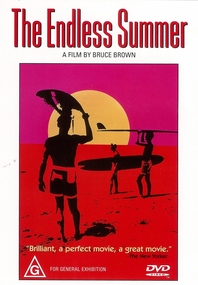
DVD Movie, The Endless Summer
... The ultimate surfing adventure as Robert August and Michael Hynson travel around the globe in search of the perfect wave....The ultimate surfing adventure as Robert August and Michael Hynson travel around the globe in search of the perfect wave. Iconic surf film by Bruce Brown that led to a significant increase in interest of surfing world wide. ...The ultimate surfing adventure as Robert August and Michael Hynson travel around the globe in search of the perfect wave.Iconic surf film by Bruce Brown that led to a significant increase in interest of surfing world wide. THE ENDLESS SUMMER was initially released on 16mm during 1964 receiving world wide acclaim. The film was re-released in 1966 with a new 35mm print and mainstream theatrical release. The film was hugely popular in the USA, Australia and Europe becoming one of the most popular surf films of all time. Colour art of the cover featuring surfers holding longboards against a setting sun.Movie Titlesnat young, endless summer, bruce brown, robert august, michael hynson -
 Young Christian Workers (YCW Australia) Archive and Research Centre
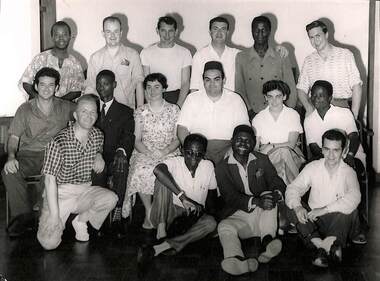
Black and White Photograph
... Around 400 representatives of youth organisations - including national YCW movements - from around the globe attended the conference. This photograph shows the YCW delegates the WAY 1960. ...Around 400 representatives of youth organisations - including national YCW movements - from around the globe attended the conference. This photograph shows the YCW delegates the WAY 1960. ...In 1960, the World Assembly of Youth (WAY) conference was held in Accra, Ghana. The Australian YCW sent two delegates to the conference, Ernie Smith (back row, end right) and Betty King (second row, third from left). Around 400 representatives of youth organisations - including national YCW movements - from around the globe attended the conference. This photograph shows the YCW delegates the WAY 1960. Father Ernie Smith, initiated the establishment of the Sacred Heart Mission in St Kilda, Melbourne. This photograph is copied from his personal collection. -
 National Vietnam Veterans Museum (NVVM)
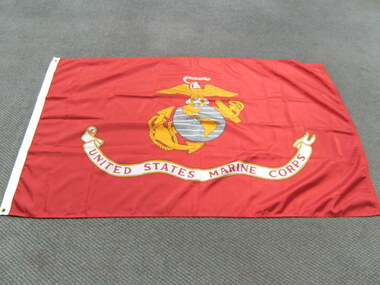
Flag, United States Marine Corps
... Large banner on bottom of flag saying "United States Marine Corps" Also around the world globe is an anchor and rope also in yellow...Large banner on bottom of flag saying "United States Marine Corps" Also around the world globe is an anchor and rope also in yellow United States Marine Corps Flag Flag ...Red nylon flag featuring yellow and white eagle, standing on a gray round map of the world featuring North and South America in yellow. Large banner on bottom of flag saying "United States Marine Corps" Also around the world globe is an anchor and rope also in yellowUnited States Marine Corpsflag, united states - marine corps -
 Stawell Historical Society Inc
Photograph, “Yarram Park” Homestead in Willaura with Mr Kinsella hosting a visit by American Seamen c 1907
... The Great White Fleet was the popular nickname for the group of United States Navy battleships which completed a journey around the globe from December 16, 1907 to February 22, 1909 by order of President Theodore Roosevelt. ...The Great White Fleet was the popular nickname for the group of United States Navy battleships which completed a journey around the globe from December 16, 1907 to February 22, 1909 by order of President Theodore Roosevelt. ...“Yarram Park” Willaura Visited by American Seamen. Gentleman is Mr William Jennings Kinsella. The Great White Fleet was the popular nickname for the group of United States Navy battleships which completed a journey around the globe from December 16, 1907 to February 22, 1909 by order of President Theodore Roosevelt. Its mission was to make friendly courtesy visits to numerous countries while displaying new U.S. naval power to the world. One goal was to deter a threatened war with Japan since tensions were high in 1907. It familiarized the 14,500 officers and men with the logistical and planning needs for extended fleet action far from home. Hulls were painted a stark white, giving the armada its nickname. It consisted of 16 battleships divided into two squadrons, along with various small escorts.[1][2] Roosevelt sought to demonstrate growing American military power and blue-water navy capability.willaura simmons -
 Stawell Historical Society Inc
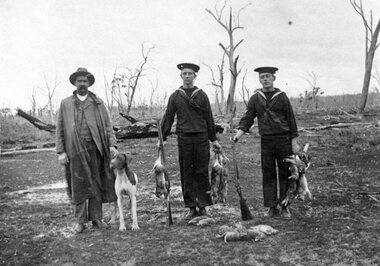
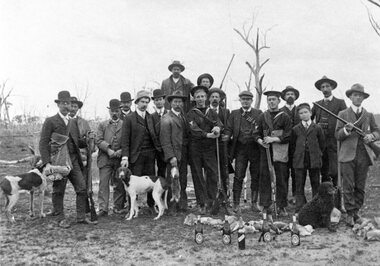
Photograph, “Yarram Park” Homestead Hunting Trip with American Seamen c 1907
... The Great White Fleet was the popular nickname for the group of United States Navy battleships which completed a journey around the globe from December 16, 1907 to February 22, 1909 by order of President Theodore Roosevelt. ...The Great White Fleet was the popular nickname for the group of United States Navy battleships which completed a journey around the globe from December 16, 1907 to February 22, 1909 by order of President Theodore Roosevelt. ...“Yarram Park” Willaura Hunting Trip with American Seamen. Gentleman at top center back is William Jennings Kinsella. The Great White Fleet was the popular nickname for the group of United States Navy battleships which completed a journey around the globe from December 16, 1907 to February 22, 1909 by order of President Theodore Roosevelt. Its mission was to make friendly courtesy visits to numerous countries while displaying new U.S. naval power to the world. One goal was to deter a threatened war with Japan since tensions were high in 1907. It familiarized the 14,500 officers and men with the logistical and planning needs for extended fleet action far from home. Hulls were painted a stark white, giving the armada its nickname. It consisted of 16 battleships divided into two squadrons, along with various small escorts.[1][2] Roosevelt sought to demonstrate growing American military power and blue-water navy capability.willaura simmons -
 Plutarch Project
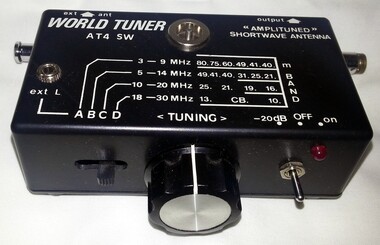
Machine - Shortwave Radio Antenna, Active Antenna, circa late 1980's
... As this was prior to the Internet being established around the globe, it was the fastest news service directly from Greece, in the Greek language. ...As this was prior to the Internet being established around the globe, it was the fastest news service directly from Greece, in the Greek language. ...This antenna was used between 1989 and 1990 to help receive the daily news service in the Greek language directly from Athens, Greece. At the time, news from Greece for the Greek people in Australia were arriving in Melbourne a week late, on newspapers from Athens sent through air-mail. These newspapers were displayed at Salapatas and Carras newsagents at Lonsdale street in Melbourne. One thing that was a problem for this service was that the news came at least 7 days late. Using the Shortwave Antenna we could get the latest news from Athens on shortwave radio directly and within an hour these news were recorded on a cassette tape and taken to the Tricom Group P.L. offices in Melbourne (1155 Malvern Road, Malvern 3144). The tape was loaded onto a system which allowed people to call a local phone number and listen to the latest news with a cost of a local call, or a little bit more. As this was prior to the Internet being established around the globe, it was the fastest news service directly from Greece, in the Greek language. It was used for a span of about 12 months, until Tricom closed down their dial-in services, sometime in 1990. The service was captured and loaded onto the system by Iakovos Garivaldis, then an employee of the Tricom Group which was a subsidiary of Southern Cross TV.The Primary significance of this object is of its historical value, social and informative value for the first generation of Greeks in Victoria"World Tuner AT4 SW" antenna with a 920mm fully extended aerial, a tuned circuit and two transistors to prevent loading of the antenna and boost signal output. It is made of plastic, black in colour with the aerial being made of steel. The signals picked up by the antenna are fed via a 15pF ceramic capacitor to a tuned circuit consisting of either VC1a or VC1b and either L1, L2, L3 or L4. The slider switch S1 selects the band to be tuned. The band range is normally from 3 to 30MHz. When S1 is in position A, L1 and VC1a are selected and the antenna can be tuned from 3-9MHz. Similarly positions B, C, and D select higher frequencies up to 30MHz. It was purchased by Iakovos Garivaldis for this use for $119.WORLD TUNER AT4 SW "Amplituned" Shortwave Antennaantenna, radio, short-wave, language, greek -
 Australian Commando Association - Victoria
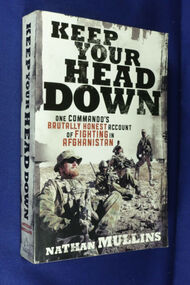
Book, Keep Your Head Down by Nathan Mullins
... In his day job he is the International Program Manager for Australian Aid International, a humanitarian organisation that responds to disasters and emergencies around the globe....In his day job he is the International Program Manager for Australian Aid International, a humanitarian organisation that responds to disasters and emergencies around the globe. Australian special forces Australian commando Afghanistan soft cover book Keep Your Head Down by Nathan Mullins Book ...Nathan Mullins deployed to Afghanistan as a Special Forces Commando. Spearheading Australia's Special Operations troops, he and other Australians like him sought the Taliban in the valleys and hills of Uruzgan through Afghanistan's harsh winter while at the same time attempting to bring a human face to the villagers caught in the middle of the fighting. They lived with the daily threat of roadside bombs, ambush and firefights, where survival meant learning to read the signs to determine friend from foe. And they did what they could to relieve the awful effects of war on the men, women and children of the civilian population caught in the crossfire. But these were not your regular soldiers. Sure, they had trained for years for the role but these were citizen soldiers, reservists who had put aside their usual jobs as salesmen, farmers, scientists, lawyers and students to fight Australia's 'war on terror'. Keep Your Head Down is a brutally honest, first-hand account that takes you into the centre of the action and asks some tough questions. What is Australia doing in Afghanistan? What would winning that war look like? What makes a man leave his family to go to war when he doesn't have to? Can there be such a thing as a just war? Nathan Mullins isn't a typical Special Forces soldier. In his day job he is the International Program Manager for Australian Aid International, a humanitarian organisation that responds to disasters and emergencies around the globe.soft cover bookaustralian special forces, australian commando, afghanistan -
 Mission to Seafarers Victoria
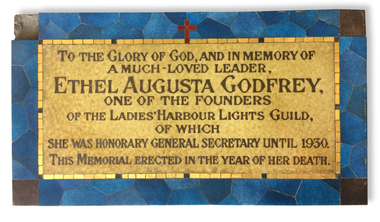
Plaque - Opus sectile tablet, 1936
... The structure of the LHLG was used as a model framework by similar groups supporting Missions around Australia and the Globe. A key achievement was the fundraising campaign for the memorial chapel in St Peters built in 1917 by Walter R.Butler. ...The structure of the LHLG was used as a model framework by similar groups supporting Missions around Australia and the Globe. A key achievement was the fundraising campaign for the memorial chapel in St Peters built in 1917 by Walter R.Butler. ...The memorial tablet was unveiled in the St Nicholas chapel at the Port Melbourne mission (Beach Cnr Nott St) on Wednesday 24 June 1936. The ceremony was performed by her nephew, Reverend John Smerger Drought - her sister's son. Another plaque was erected the same month in the Williamstown Institute. (Annual Report 1936) Along with the windows in the St Peter chapel in the Central Institute, those were the 3 memorials similar to the ones erected in memory of Miss Tracy. Miss Ethel Godfrey was born in 1861 at sea on the vessel called Copenhagen. Daughter of a pioneer, and settler Frederick Race Godfrey MLA and subsequently Lay Dean at St Paul's. Ethel Studied in Melbourne and abroad at Brussels and became a singing teacher and performer. In 1906 she took on the role of Honorary General Secretary to create and lead the volunteer organisation "The Ladies Harbour Lights Guild" and subsequently helped establish similar groups in Newcastle, Brisbane, Sydney, Hobart, Adelaide and also established the mission in Southampton in the UK. The structure of the LHLG was used as a model framework by similar groups supporting Missions around Australia and the Globe. A key achievement was the fundraising campaign for the memorial chapel in St Peters built in 1917 by Walter R.Butler. She died the 7 July 1935, and is buried in the St Kilda Cemetery.On her retirement in 1930 after some 25 years, Miss Godfrey together with Chaplain Gurney Goldsmith was recognised in the journal The Church and the Sailor, as a key influence and promoter of the formation of Harbour Lights groups across the suburbs of Melbourne, Victoria and Australia, the Ladies Harbour Lights Guild, Melbourne being the first such auxiliary group in the world.Clay base rectangular plaque with inlaid blue ceramic regular tesserae surrounding the ceramic centre rectangular ceramic panel with inscription and decorative glazed detail tiles. Support is a metal frame with inset wood pieces .To the Glory of God and in memory ops/ a much loved leaderAthel Augusta Godfrey, / one of the founders/ of the ladies Harbour Lights Guild/ of which she was honorary general secretary / Until 1930./ This memorial erected in the year of her death."memorial plaque, plaque, lhlg, port melbourne, chapel, brooks robinson and co, reverend john smerger drought, sectile tablet, opus sectile mosaic, mosaic, ethel augusta godfrey 1861-1935 -
 Mission to Seafarers Victoria
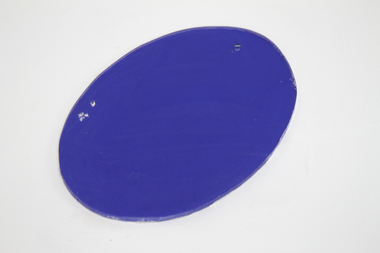
Artwork, other - Art installation, Dagmar Udhe, Leap of the Heart: Ultramarine perspex oval shape by Dagmar Udhe, 1998
... Information for the brochure (http://www.artdes.monash.edu.au/globe/issue8/tbtitle.html) Construction in Process VI The Bridge, Melbourne Event: March 21-31 1998 Exhibition April 1-30 1998 During Construction in Process (CIP) III at Lodz, Poland in 1991, Emmett Williams and other participating artists initiated the idea of a biannual "performance" of their project in different cities and sites around the world. ...Information for the brochure (http://www.artdes.monash.edu.au/globe/issue8/tbtitle.html) Construction in Process VI The Bridge, Melbourne Event: March 21-31 1998 Exhibition April 1-30 1998 During Construction in Process (CIP) III at Lodz, Poland in 1991, Emmett Williams and other participating artists initiated the idea of a biannual "performance" of their project in different cities and sites around the world. ...See document 1507Information for the brochure (http://www.artdes.monash.edu.au/globe/issue8/tbtitle.html) Construction in Process VI The Bridge, Melbourne Event: March 21-31 1998 Exhibition April 1-30 1998 During Construction in Process (CIP) III at Lodz, Poland in 1991, Emmett Williams and other participating artists initiated the idea of a biannual "performance" of their project in different cities and sites around the world. In the first instance, CIP was a response to the strictures of museum contained commodification of art practices and the dissolution of communism. And with this agenda in mind, their events affirm the active participation of international artists with local infrastructure and site specific materials. The organisation of the 1998 CIP in Melbourne, titled "The Bridge", took Richard Thomas, Katherine Armstrong, Gail Davidson and the legion of others over two years of dedication. And they brought off one of the most open-ended, logistically challenging conceptual events this metropolis has witnessed. The following photo essay provides a personal survey of the "The Bridge", as I saw it transpire around me. German artist Dagmar Udhe created several art installation in Swanson Dock and the Mission. This plaque was placed either in the dome or outside the dome. It may have been forgotten or left intentionally by the artist.PerformanceUltramarine ovoid shaped perspex plaque attached to the wall in the entrance of the Mission (Flinders Street).art installation, dagmar udhe, cultural events, artwork-paintings -
Federation University Historical Collection
Book, Henry Sutton The Innovative Man: Australian Inventor, Scientist and Engineer, 2018, 2018
... around the world in his day for his remarkable achievements, Henry Sutton went largely unnoticed in Australia by his peers and the public. It is not until you begin to document, in one place, his enormous body of work that you start to gain the true picture and depth of his remarkable achievements. It is a national travesty that these achievements have slipped largely unrecognised between the pages of Australian scientific history for over a century. Henry Sutton’s inventions and contribution to science has been a part of the evolution of many inventions, including the light globe...around the world in his day for his remarkable achievements, Henry Sutton went largely unnoticed in Australia by his peers and the public. It is not until you begin to document, in one place, his enormous body of work that you start to gain the true picture and depth of his remarkable achievements. It is a national travesty that these achievements have slipped largely unrecognised between the pages of Australian scientific history for over a century. Henry Sutton’s inventions and contribution to science has been a part of the evolution of many inventions, including the light globe ...Nikola Tesla once said “Let the future tell the truth and evaluate each one according to his work and accomplishments” In his lifetime Henry Sutton not only helped shape Ballarat’s history but also that of Australia and the world. Very few people have crossed as many scientific fields as Henry Sutton. His life’s work spanned all avenues of science and engineering and he stands alone in history as one of Australia’s first true men of science and innovation. Based on previously unavailable personal papers as well as articles and letters published in journals worldwide, this book captures the personal triumphs and tragedies of this remarkable Australian. By age 26 Henry Sutton had won world acclaim and graced the world stage among the giants of the scientific world. Henry Sutton stood as an equal alongside such men as Alexander Graham Bell, Nikola Tesla and Thomas Edison. Although applauded around the world in his day for his remarkable achievements, Henry Sutton went largely unnoticed in Australia by his peers and the public. It is not until you begin to document, in one place, his enormous body of work that you start to gain the true picture and depth of his remarkable achievements. It is a national travesty that these achievements have slipped largely unrecognised between the pages of Australian scientific history for over a century. Henry Sutton’s inventions and contribution to science has been a part of the evolution of many inventions, including the light globe, telephone, battery, television and wireless technology all of which are now part of our everyday lives. Henry Sutton’s contribution to Australian and world innovation has been methodically researched and documented in this book and is the first fully documented account of this forgotten and unrecognised extraordinary Australian.Hardcovered book of 397 pages. The cover features a black and white image of Henry Sutton. Gift of Lorayne Branch (author)lorayne branch, henry sutton, ballarat school of mines, former sutton's music store, innovation, inventions, scientist, microscopy, cycle agency, automobile club of victoria, wireless telegraphy, anne tattie, anne sutton, sutton autocar, photography -
 Flagstaff Hill Maritime Museum and Village
Container - Ship Tank, Early 20th century
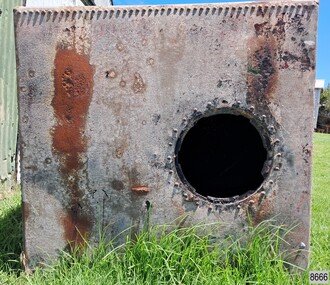
... A 1929 catalogue from Hudson’s Tank Stores advertised square tanks that contained around 600 litres – 160 gallons – which equals an internal measurement of 33.25 inches – 84.5 centimetres – per side ship tanks are still made and sold in 1952 by the Globe Tank and Foundry in Wolverhampton, England, which was incorporated in 1922. ...A 1929 catalogue from Hudson’s Tank Stores advertised square tanks that contained around 600 litres – 160 gallons – which equals an internal measurement of 33.25 inches – 84.5 centimetres – per side ship tanks are still made and sold in 1952 by the Globe Tank and Foundry in Wolverhampton, England, which was incorporated in 1922. ...Cubed iron ship tanks were invented by Richard Trevithich in 1808, in partnership with Robert Dickson, and the design was patented that year. The invention eventually replaced the wooden casks or barrels used at the time, as the ship tanks were more secure and their shape was much more economical in storage space. The robust metal tanks were originally made to transport water, but their preserving quality enabled them to transport perishable dry goods such as grain on long voyages, as well as other forms of liquid and solid cargo. The first ship tanks were made from sheets of iron, and later mild steel sheets, with double riveted edges and corners. A round cast iron lid with handle grips was fitted snugly into the top opening, providing an air-tight and water-tight seal. Brass taps were often fitted into the base, which could have been the case with this tank, but it now has a wooden bung in the hole. Sailing ships began using the new ship tanks on Australian voyages from around the 1830s, storing food and water for those on board, and filling them with other cargo. A large number of the ship tanks were repurposed in 1838 for the Victoria Settlement at Port Essington, N.T., as they were able to protect the food, clothing and other stores from termite and insect damage. Other ‘recycled’ ship tanks were cut in half and used as washing tubs or cookers. A 1929 catalogue from Hudson’s Tank Stores advertised square tanks that contained around 600 litres – 160 gallons – which equals an internal measurement of 33.25 inches – 84.5 centimetres – per side ship tanks are still made and sold in 1952 by the Globe Tank and Foundry in Wolverhampton, England, which was incorporated in 1922. Today, ship tanks can be seen around Australia. Wilsonson’s Promontory Lightstation has the lid from a ship tank that was used on site for the storage of water. Some have been repurposed as domestic water tanks and dog kennels, others for eucalyptus distilleries. Flagstaff Hill has two ship tanks. The Campaspe Port at Echuca, once a bustling river port, has a ship tank beside the locomotive yard. The lids of ship tanks are collectible items. Richard Trevithick (1771-1833): - Trevithick was born in 1771 in Cornwall, England. He was a famous British engineer and inventor during the Industrial Revolution, known for his invention of the first full-scale working railway, the high-pressure steam locomotive, which he demonstrated hauling a railway train in 1804. He set up a small workshop in 1808 at 72 Fore Street, Limehouse, London, to make iron ship tanks, and this invention was instrumental in replacing the wooden casks formerly used for storage on ships. He was involved with mining technology, iron foundry and ship equipment. Ship tanks changed the way that cargo was transported on ships and other vehicles from the 1830s and were used into the mid-20th century. The ship tanks’ advantages were that they could store more content, lasted longer, were waterproof and airtight, stackable and could be repurposed for many uses other than water, such as fuel, dry goods and domestic cargo. They have even been used aa dog kennels and cookers. Ship tanks were part of the evolving methos to transport water, food and cargo, which changed in 1956 when Malcolm McLean invented the large, rectangular shipping containers that are in use today; they speed up the process of loading on and off the ships, saving time and money. Ship tank: a cubed iron container with an offset hole on one side. The hole has cutouts for securely attaching a lid. This tank is on its side on the ground with the opening facing sideways. The side facing upwards has a wooden bung in a round hole. The ship tank is made from six square, thick iron sheets, rolled and riveted along the edges. The inside has a black sticky coating, possibly bitumen, and a strong creosote odour. There are small remnants of green paint on the outer surface.flagstaff hill, flagstaff hill maritime museum and village, warrnambool, maritime museum, maritime village, great ocean road, shipwreck coast, iron cube, water tank, shipping container, ship tank, ship's tank, ship tanks, marine container, richard trevithich, 1808, robert dickson, water transport, water storage, iron foundry, steel sheets, iron sheets, revets, victoria settlement, port essington, globe tank and foundry, wolverhampton, british engineer, british inventor, wooden casks -
Glenelg Shire Council Cultural Collection
Domestic object - Domestic Object Dish - Vitrified Globe Pottery Cobridge, England, n.d
... Globe Potter Co. LTD. Cobridge England Oval dish,off white, glazed, with black 'Gordon Hotel Portland' and Chequer board design around inner rim. ...Oval dish,off white, glazed, with black 'Gordon Hotel Portland' and Chequer board design around inner rim.Front: Base - Made Expressly For John Dynon and Sons Melbourne Vitrified Globe Potter Co. LTD. Cobridge England -
 Orbost & District Historical Society
light bulbs, circa late 1920's
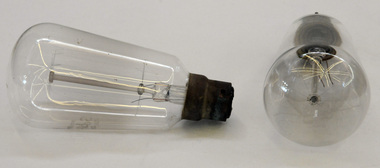
... These light bulbs were in a house at 37 Gladstone Street Orbost which was built around 1928 for Oliver and Edith Hanrahan. The globes were still working when the house was bought in 1983 by Paul Dawson....These light bulbs were in a house at 37 Gladstone Street Orbost which was built around 1928 for Oliver and Edith Hanrahan. The globes were still working when the house was bought in 1983 by Paul Dawson. lighting philips & co. light-bulb .1 - 230-40WT Philips Made in Holland Two clear glass elongated electric light globes. light bulbs Philips & Co ...These light bulbs were in a house at 37 Gladstone Street Orbost which was built around 1928 for Oliver and Edith Hanrahan. The globes were still working when the house was bought in 1983 by Paul Dawson.Two clear glass elongated electric light globes. .1 - 230-40WT Philips Made in Hollandlighting philips & co. light-bulb -
 Glenelg Shire Council Cultural Collection
Book, All Around The World: An Illustrated Record of Voyages, Travels, and Adventures in all Parts of the Globe, n.d
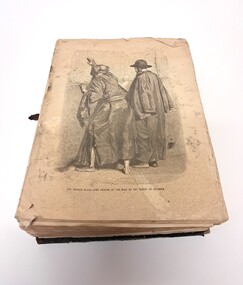
... All Around The World: An Illustrated Record of Voyages, Travels, and Adventures in all Parts of the Globe ...All Around The World: An Illustrated Record of Voyages, Travels, and Adventures in all Parts of the Globe Book ...Travel bookNo front or spine cover. Title and introduction pages missing. Back cover - evidence of leather bound spine. Green cloth-covered cardboard cover. two hundred illustrations after drawings by Gustave Dore, Berard, Lancelot, Jules Noel, and other eminent artists and six finely engraved maps, fully coloured.non-fictionTravel booktravel, books, book, illustrations -
 Flagstaff Hill Maritime Museum and Village
Clock, 1950
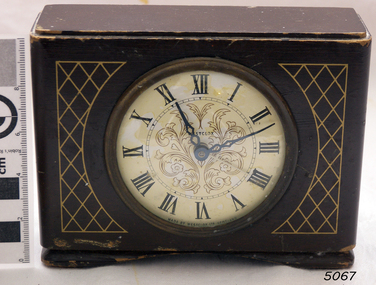
... around 1100. Over a third of the clocks manufactured in Scotland were exported to some 110 countries across the globe. ...around 1100. Over a third of the clocks manufactured in Scotland were exported to some 110 countries across the globe. ...Westclox had a highly successful factory in Scotland situated in the Vale of Leven Industrial Estate, in Dumbarton, around twenty miles from the City of Glasgow. Westclox had originally planned to start production in Scotland in 1939 but the War intervened and it was not until 1948 that they were able to fully commission their factory in Dumbarton. Westclox Scotland produced its first clock on the 21st September 1948; a spring wound alarm with a 4 inch dial. The Westclox factory in Scotland was a full manufacturing plant with all their clocks assembled from start to finish with only the basic raw materials being brought in by outside suppliers. 95% of the staff were local people and the firm trained their employees from scratch to a high level of skill and had an annual apprenticeship for toolmakers and classes in horology. By 1949 Westclox Scotland were making 10,000 clocks a week, and by 1950, 1,000,000 clocks had been produced since its opening. No home in the Dunbartonshire Vale was without at least one Westclox clock, nor any raffle complete without a clock as one of the prizes! Many of these clocks are still around today. So successful was the Dumbarton factory that in the mid 1950’s Westclox had to expand into adjoining buildings. The factory then added watches to what they made as well as timing devices for other sectors. By the mid 1960’s, employment levels at the Scottish plant were around 1100. Over a third of the clocks manufactured in Scotland were exported to some 110 countries across the globe. Difficult times came in 1967/68 when 400 workers were laid off and the future of the plant was in doubt primarily due to cheap clocks from the then communist countries. However, strong petitions to the UK Government produced the passing of an anti-dumping law allowed production from the factory to pick up. In 1968 General Time was bought out by Talley Industries, which was best known as a manufacturer of timing equipment, such as factory time clocks to various industries. Westclox in Scotland enjoyed several boom years under the then Managing Director, John Santos. Westclox Scotland in October 1974 hosted a Space Seminar for the Astronaut, Neil Armstrong and British Astronomer, Sir Patrick Moore. Both visited the Scottish factory to promote the introduction of Quartz time-keeping. In 1976 the Westclox plant in Dumbarton became the Headquarters of General Time (International Operations) Ltd. John Santos retired from General Time and Westclox in the early 1980s and by 1988 the future of Westclox in Scotland was almost over. The advent of Quartz clock technology, developed largely by General Time for use in the Apollo 11 Command Module, resulted in the reduction of mechanical clock production and sales, and the factory fully closed in 1988.The Westclox factory building in Dumbarton has been converted and is now home to many thriving small businesses. The item marks a time when clock production in the United Kingdom was at it’s peak producing clocks for sale in over a 110 countries, they were keenly priced and available to all. The company had many innervation's during it’s life regards clock and later wrist watch making. In 25 years the factory had produced over 50 million clocks, yet it was perhaps inevitable with the advent of Quartz technology that was ironically evolved, largely by General Time for use in the Apollo 11 Command space Module, that would ultimately herald the end of the mechanical clock.Wooden bedroom alarm clock small painted brown with a criss cross pattern in gold and a white enamel face roman numerals & a glass front, clock case is of a fancy design. Inscribed on face "Made by Westclox Ltd Scotland" .flagstaff hill, warrnambool, shipwrecked-coast, flagstaff-hill, flagstaff-hill-maritime-museum, maritime-museum, shipwreck-coast, flagstaff-hill-maritime-village, clock mantle, clock, mantle clock, westclox ltd, horology, clock industries -
 Bendigo Military Museum
Headwear - BERET & RASVY BADGE, Christies, Beret and Royal Australian Survey Corps Badge
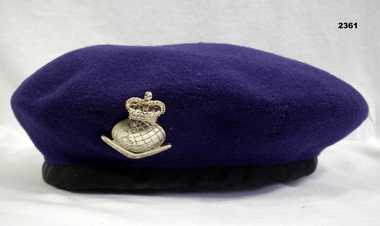
... The "purple" beret was and is used extensively around Australia on ceremonial occasions such as Anzac Day. uniforms - army costume - male, headwear numismatics-badges, military Royal Australian Survey Corps RASvy Beret, woollen, purple colour with a gold anodized badge - Crown over globe, boomerang with Royal Australian Survey Corps. ...This "Purple" Beret sold by Christies in Sydney was produced for the Queensland Ex Survey Corps Association and was not authorised for Service use. The authorised Royal Australian Survey Corps beret was dark blue. The "purple" beret was and is used extensively around Australia on ceremonial occasions such as Anzac Day.Beret, woollen, purple colour with a gold anodized badge - Crown over globe, boomerang with Royal Australian Survey Corps.uniforms - army, costume - male, headwear, numismatics-badges, military, royal australian survey corps, rasvy -
Queenscliffe Maritime Museum
Domestic object - Crockery
... Important organisation around Queenscliff and Port Phillip Port Phillip Sea Pilots 'Port Phillip Sea Pilots' on base of bowls and side plates. 'made expressly for: John Dynon and Sons, Melbourne. Vitrified: Globe ...Port Phillip Sea Pilots have been providing pilotage services to the ports of Melbourne, Geelong and Western Port since 1839.Important organisation around Queenscliff and Port PhillipPort Phillip Sea Pilots crockery: 3 soup bowls, side plates, cups and 2 dinner plates'Port Phillip Sea Pilots' on base of bowls and side plates. 'made expressly for: John Dynon and Sons, Melbourne. Vitrified: Globe Pottery Co, Ltd. Shelton England port phillip sea pilots -
 Bendigo Military Museum
Plaque - AUSTRALIAN FORCE VIETNAM PLAQUE
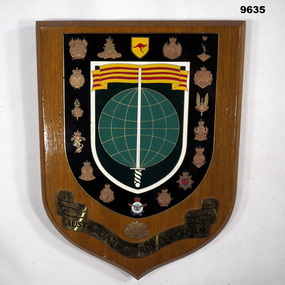
... Plaque features a shield shaped plate with sword, globe with lines of latitude and longitude and banner with yellow and red stripes. Around the outside of this feature are seventeen unit insignia on a black background. ...Plaque features a shield shaped plate with sword, globe with lines of latitude and longitude and banner with yellow and red stripes. Around the outside of this feature are seventeen unit insignia on a black background. ...Plaque features the seventeen insignia of units which served in the Vietnam War. Part of the Cooper Collection. See Catalogue No. 9586.2 for details of service for "Keith Cooper", No.3798359.Shield shaped light brown coloured wooden plaque. Plaque features a shield shaped plate with sword, globe with lines of latitude and longitude and banner with yellow and red stripes. Around the outside of this feature are seventeen unit insignia on a black background. Bottom of the plaque features a Rising Sun Badge above a gold coloured banner with 'AUSTRALIAN FORCE VIETNAM' in black lettering.cooper collection, keith cooper, plaque, unit insignia, vietnam war, australian force vietnam -
4th/19th Prince of Wales's Light Horse Regiment Unit History Room
Plaque: Australian Task Force Vietnam
... Shield shape - globe at centre overlaid with sword pointing upwards, red and yellow scroll representing Republic of Vietnam, badges of participating elements around margin. 2 Rising sun badge 3 Scroll "Australian Force Vietnam"...Shield shape - globe at centre overlaid with sword pointing upwards, red and yellow scroll representing Republic of Vietnam, badges of participating elements around margin. 2 Rising sun badge 3 Scroll "Australian Force Vietnam" Plaque: Australian Task Force Vietnam ...Plaque: 3 metal pieces fixed to wooden mounting. 1. Shield shape - globe at centre overlaid with sword pointing upwards, red and yellow scroll representing Republic of Vietnam, badges of participating elements around margin. 2 Rising sun badge 3 Scroll "Australian Force Vietnam"plaque, vietnam -
 Kiewa Valley Historical Society
Light Bulb - S.E.C.V
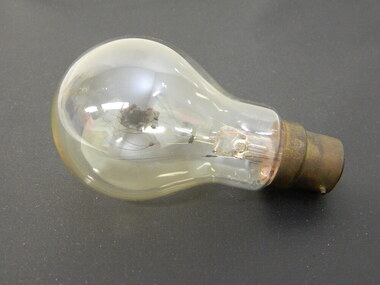
... Clear glass in the shape of a circular bulge around the filament with a metal alloy at the narrow end with 2 small rods jutting out at opposite ends to enable the light to be attached to a fitting. The filament is made of glass and has a very fine wire on each side extending nearly to the top edge of the glass globe. ...The State Electricity Commission of Victoria built the Kiewa Hydro Electric Scheme using unique equipment to achieve its construction. light. electricity. globe. s.e.c.v.. kiewa hydro electric scheme. Clear glass in the shape of a circular bulge around the filament with a metal alloy at the narrow end with 2 small rods jutting out at opposite ends to enable the light to be attached to a fitting. ...This globe is unusual as the filament is coiled and held by 5 points coming from the glass piece inside the globe. This light globe belonged to the State Electricity Commission of Victoria and may have been used for a special purpose on the Kiewa Hydro Electric Scheme.The State Electricity Commission of Victoria built the Kiewa Hydro Electric Scheme using unique equipment to achieve its construction. Clear glass in the shape of a circular bulge around the filament with a metal alloy at the narrow end with 2 small rods jutting out at opposite ends to enable the light to be attached to a fitting. The filament is made of glass and has a very fine wire on each side extending nearly to the top edge of the glass globe. This fine wire is a spiral with each loop connected to each of 3 small fine wires coming up from the top centre of the glass inside. light. electricity. globe. s.e.c.v.. kiewa hydro electric scheme. -
 Monbulk RSL Sub Branch
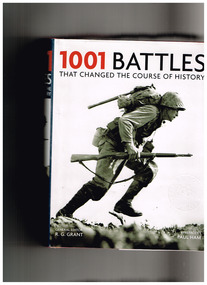
Book, RG Grant, 1001 battles that changed the course of history, 2011
... Conflict - History Military conflict - History This book is an essential guide to the most intense, dramatic, important and extraordinary conflicts over the last 5000 years and the consequences of those clashes on societies around the globe. Ill, maps, index, p.958. 1001 battles that changed the course of history Book RG Grant Harper Collins ...This book is an essential guide to the most intense, dramatic, important and extraordinary conflicts over the last 5000 years and the consequences of those clashes on societies around the globe.Ill, maps, index, p.958.This book is an essential guide to the most intense, dramatic, important and extraordinary conflicts over the last 5000 years and the consequences of those clashes on societies around the globe. conflict - history, military conflict - history -
 Bendigo Historical Society Inc.
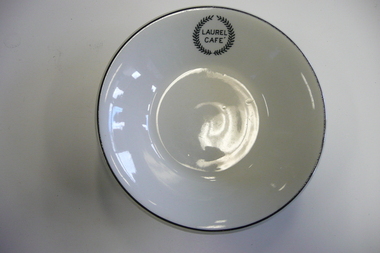
Domestic Object - LAUREL CAFÉ BOWL
... ORGANIZATION Retail Laurel Café Vitrified Globe Pottery Co Ltd Co?bridge England Small white china bowl with black line around rim and inside a laurel wreath around the name Laurel Cafe.On base reads Made expressly for John Dynon and Sons Melbourne. ...Small white china bowl with black line around rim and inside a laurel wreath around the name Laurel Cafe.On base reads Made expressly for John Dynon and Sons Melbourne.Vitrified Globe Pottery Co Ltd Co?bridge Englandorganization, retail, laurel café -
Port Melbourne Historical & Preservation Society
Photograph - Lasercopy, Crockford Street, Port Melbourne in flood, 1919
... around Port Melbourne. Crockford St Port Melbourne in flood March 1919. Shows cable tram moving through water. Floodgate Hotel is at left and Globe hotel is seen above cable tram...around Port Melbourne. Crockford St Port Melbourne in flood March 1919. Shows cable tram moving through water. Floodgate Hotel is at left and Globe hotel is seen above cable tram Photograph Lasercopy, Crockford Street, Port Melbourne in flood ...Photographs taken around Port Melbourne. Crockford St Port Melbourne in flood March 1919. Shows cable tram moving through water. Floodgate Hotel is at left and Globe hotel is seen above cable trambuilt environment - commercial, transport - tramways, crockford street, cable tram, isobel munday -
 Alfred Hospital Nurses League - Nursing History Collection
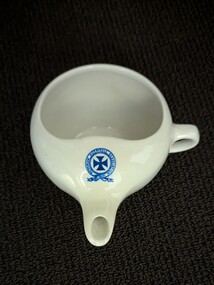
Functional object - Patient feeding cup, Globe Pottery, Victorian Hospitals Association Feeding Cup, 1920's -!930's
... Crest of the Victorian Hospitals Association [words in a circular banner around a cross pattee] is stamped in blue above the spout.On base, stamped in blue, "STEELITE" VITRIFIED GLOBE POTTERY CO LTD ENGLAND SUPPLIED BY J. ...Crest of the Victorian Hospitals Association [words in a circular banner around a cross pattee] is stamped in blue above the spout.On base, stamped in blue, "STEELITE" VITRIFIED GLOBE POTTERY CO LTD ENGLAND SUPPLIED BY J. ...Cup used to assist with patient nutritionUsed in patient careSpouted white ceramic feeding cup with handle on side. Crest of the Victorian Hospitals Association [words in a circular banner around a cross pattee] is stamped in blue above the spout.On base, stamped in blue, "STEELITE" VITRIFIED GLOBE POTTERY CO LTD ENGLAND SUPPLIED BY J. DYNON & SON MELBOURNEPrevious catalogue number written on small white sticker on base. Underneath the spout is a white sticker stamped "ALRED NURSES ARCHIVESnursing, nutrition -
 Warrnambool and District Historical Society Inc.
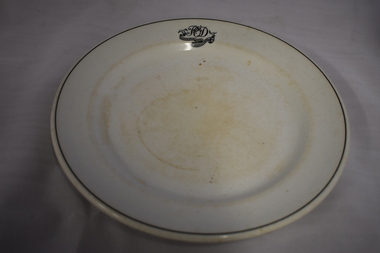
Plate, Commercial Hotel W'bool, 1920s or 1930s
... Globe Pottery Co. Ltd Cobridge England’ This is a white china plate (dinner plate size) with the inner section slightly recessed. The plate has a black line around ...This plate comes from the Commercial Hotel in Warrnambool. This hotel, situated on the north west corner of Liebig and Timor Streets, Warrnambool, was established in 1865. It was built by Thomas Mickle and the first licensee was Charles Anderson. From 1928 on the O’Dwyer family was associated with the Commercial Hotel, either as licensees or owners, for fifty years. The plate would have been first used during the times when Patrick O’Dwyer was the licensee – 1928-1931 and 1932 to 1934. Today the Commercial Hotel still trades as the Whalers Hotel.This plate is of interest as it is a memento of the 1920s and 30s when Patrick O’Dwyer was the licensee of the Commercial Hotel. This hotel, trading today as the Whalers Hotel, is the oldest hotel in Warrnambool and a prominent landmark in the city. This is a white china plate (dinner plate size) with the inner section slightly recessed. The plate has a black line around the outer rim and initials and a hotel name in a scroll pattern on one outer edge. The names of the maker and supplier are on the base of the plate and the top of the plate is somewhat stained. ‘P O’D Commercial Hotel Warrnambool’ ‘Made expressly for John Dynon and Sons, Melbourne Vitrified Globe Pottery Co. Ltd Cobridge England’ commercial hotel / whalers hotel, warrnambool, history of warrnambool -
Kiewa Valley Historical Society
Projector - 'Pictoral' Bogong State School, 1925 - 1935
... The nearest school was 14 km away over a dirt road that wound around the Victorian mountains and often closed due to bad weather. projector bogong primary school education educational films visual education kiewa hydro electric scheme Plaque: Pictorial Projector / Model Q / 120 Volts. 100 Watts / No. 23736 / Manufactured / Society of Visual Education Inc. / Chicago U.S.A Bakelite box holding a globe and a small black tin projector on brown rectangular bakelite base with 4 round rubber stands at each corner. ...As Bogong State School was located in a remote area especially in winter when the weather and therefore the road isolated the school for an indefinite time, the school was provided with up to date equipment with a comprehensive library and educational films that wouldn't disadvantage the students. Educational films covered all subjects and areas of the curriculum. The projector was very modern at the time. The Society for Visual Education Inc was founded in 1919 as a for-profit educational publisher dedicated to the use of new technologies in teaching.This projector was used at the Bogong State School which opened in 1941 for the children of the employees of the State Electricity Commission of Victoria who were working on the Kiewa Hydro Electric Scheme. The school was outstanding as reported by the school inspectors regarding the education of the pupils which was also supported by new and modern equipment. The nearest school was 14 km away over a dirt road that wound around the Victorian mountains and often closed due to bad weather. Bakelite box holding a globe and a small black tin projector on brown rectangular bakelite base with 4 round rubber stands at each corner. It is able to be moved upwards from the front to adjust the height within a cm. The back is a tall irregular box shape with ventilation on 2 sides of the bottom and at the top. There is a brass plaque attached above 1 vent and an electric cord, with switch, below it. Attached at each side of the front of this box is a cylinder fitted horizontally facing the front where the lense is fitted. At right angles above there is another cylinder, hollow, with a rod for the film to be placed. Globe also in Bakelite boxPlaque: Pictorial Projector / Model Q / 120 Volts. 100 Watts / No. 23736 / Manufactured / Society of Visual Education Inc. / Chicago U.S.Aprojector, bogong primary school, education, educational films, visual education, kiewa hydro electric scheme -
 Uniting Church Archives - Synod of Victoria
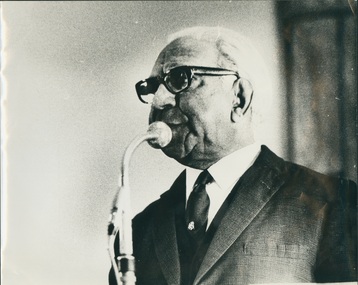
B&W photo of another photo or newspaper photograph of Pastor Sir Douglas Nicholls, Undated
... The Sporting Globe reported in 1929 that ‘he flashes through packs of big men, whisks around small men . . . and attempts marks at the back of any six-footer’. ...The Sporting Globe reported in 1929 that ‘he flashes through packs of big men, whisks around small men . . . and attempts marks at the back of any six-footer’. ...Sir Douglas Ralph Nicholls (1906-1988), footballer, pastor, activist and governor, was born on 9 December 1906 at Cummeragunja Aboriginal mission, New South Wales, fifth child of Herbert Nicholls, seasonal worker, and his wife Florence, née Atkinson. Doug grew up at Cummeragunja, on the Murray River near Barmah, in its golden years of Aboriginal autonomy. Thomas Shadrach James gave him and other Yorta Yorta children a sound primary education, reinforcing the pride and self-assurance gained from their parents. As Doug grew, so too did the powers of the State’s Aboriginal Protection Board. Doug’s elder sister Hilda was removed about 1915. When Doug reached 14, he was moved off under the Aborigines Protection Act (1909) to find work. He took a job with dredging teams constructing levees on the Murray. Like other youths in the region Nicholls played Australian rules football, emulating kinsmen who had won local premierships since the 1890s. Doug and his brother Herbert (‘Dowie’) played with Tongala in the mid-1920s. Melbourne football beckoned, Doug trying out unsuccessfully for Carlton in 1927. He signed with the Northcote Victorian Football Association team, despite his nervousness about his Aboriginality, and was given a job with Northcote City Council. ‘Dowie’ joined him for a season. Doug was short at 5 ft 2 ins (158 cm), but muscular and lightning fast. He competed regularly during a boom in professional running, winning many heat and place prizes. In 1929 he won the Nyah and Warracknabeal gifts, earning a sash and £100 in each, together with a case of cutlery in the latter. Using his speed on the wing for Northcote, he produced great spring and agility from his compact body. The Sporting Globe reported in 1929 that ‘he flashes through packs of big men, whisks around small men . . . and attempts marks at the back of any six-footer’. In front-on clashes he was flattened only to rise again. The sole Aborigine in the VFA, he was known affectionately as the ‘flying Abo’ but called worse by his opponents’ barrackers. He competed for five seasons, being named ‘best and fairest’ twice, appearing in three association grand finals and winning in 1929. Keen to earn more than a seasonal wage, in 1931 Nicholls accepted a three-year contract with Jimmy Sharman’s travelling boxing show. The bouts matched opposites, local against tent boxer, white against black, and sometimes men of different sizes. He faced stiff competition from those who wanted to best the noted Melbourne black footballer, the crowd adding racial abuse. A far better footballer than boxer, he copped some punishment. Fighting in the Melbourne Stadium in December 1931, he was described by Truth as ‘slow and awkward’, but packing a ‘good wallop’. In 1932 Sharman, who treated his boxers fairly, released Nicholls to join the Fitzroy Victorian Football League team, which agreed to employ him as its groundsman. He played fifty-four games for Fitzroy over six seasons until knee trouble forced him out in 1937. Winning cups in 1934 and 1935, he played alongside Haydn Bunton and Wilfred (‘Chicken’) Smallhorn. Grand finals eluded him but he represented Victoria twice. Following his mother’s death, Nicholls revisited the Church of Christ chapel in Northcote, where they had worshipped together. On 17 July 1932 he experienced a conversion. He was soon baptised and witnessed openly, leading his fellow footballers to occasional church parades. Nicholls exhibited leadership qualities. William Cooper, founder of the Australian Aborigines’ League and Nicholls’ Yorta Yorta kinsman and fellow Christian, encouraged the young footballer. In February 1935 Cooper, Nicholls and others lobbied Thomas Paterson, the Commonwealth minister for the interior, over the need for Federal control of Aboriginal affairs. Nicholls attended the Day of Mourning protest for Aborigines held in Sydney on 26 January 1938, declaring: ‘after 150 years our people are still influenced and bossed by white people. I know we can proudly hold our own with others if given the chance’. When Cooper retired in November 1940 Nicholls became secretary of the AAL. On 2 June 1941 Nicholls enlisted in the Citizen Military Forces. He trained at Seymour and Bonegilla before being posted to the 29th Battalion. As Major Frank Corr’s batman, he was popular with other soldiers who tolerated his preaching and Bible reading. His army service was brief, however, and he was discharged in Melbourne on compassionate grounds on 22 January 1942. His biographer claimed that the Fitzroy police requested his return to mediate in the racial tensions developing between servicemen and the mostly respectable Aboriginal families living in crowded and dilapidated Fitzroy housing; Aboriginal people maintain that they requested his release. Nicholls began welfare work and religious services from an Aboriginal home in Gertrude Street, Fitzroy. In April 1942, ‘Dowie’ died of road accident trauma, leaving his wife, Gladys, née Bux, and three children. On 26 December 1942 at Moama Methodist Church, New South Wales, Nicholls married her, a caring gesture which developed into a loving partnership. In January 1943 he initiated ‘Aboriginal Sunday’, featuring a gum leaf orchestra and choir. By 1955 this service had moved to July and later evolved into National Aborigines and Islanders Day Observance Committee (NAIDOC) week. Ordained a Churches of Christ pastor in 1945, Nicholls conducted a vigorous ministry from a chapel in Gore Street, Fitzroy. His work survived on donations, a small honorarium, and his employment as team coach (1947) and curator at the Northcote Football Ground. In the 1950s Gladys established grocery and opportunity shops to earn income and provide services. Their house soon overflowed with people in need or visitors to Melbourne. Nicholls also hosted inspiring African American visitors such as the pianist Winifred Attwell and the singer Harry Belafonte. His ministry extended to Aboriginal country communities. Gladys taught Sunday school, undertook endless fund-raising and welfare work beside her husband, and became his greatest supporter and financial manager. They formed an Aboriginal Girls’ Hostel in 1956, for which they acted as house parents, and bought holiday units for Aborigines at Queenscliff. Persistently advocating Aboriginal rights, Nicholls protested about the impact of the Woomera rocket range on the people of the Warburton Ranges, co-ordinated the production of a concert, Out of the Dark, scripted by Jean Campbell, to rectify the omission of Aborigines from Victoria’s Commonwealth jubilee celebrations, and criticised the Victorian Aboriginal Protection Board. In 1957 when the board was transformed into the Aborigines’ Welfare Board, he and Harold Blair were appointed as Aboriginal representatives. Maintaining the stance of a political moderate, he did not bear grudges and sought to build bridges between black and white. He co-operated with any group that aided the cause, including the Council of Aboriginal Rights, whose executive were members of the Communist Party of Australia. This association attracted the attention of the Australian Security Intelligence Organization, which in 1957 began to keep a file on Nicholls. In May 1957 Nicholls formed the Victorian Aborigines Advancement League with Doris Blackburn and Gordon Bryant, a Federal parliamentarian. As its paid field officer and spokesman, Nicholls contested assimilation policies and used film to raise awareness of issues. When the Welfare Board attempted to close Lake Tyers reserve, Gippsland, he resigned in disgust and led a protest march on parliament in May 1963. The AAL also petitioned the United Nations on land rights in June, perhaps the first indigenous body to do so. He argued for new premises at 58 Cunningham Street, Northcote, opened in 1966 as the ‘Doug Nicholls Centre’. In 1958 Nicholls was a foundation member of the Federal Council for Aboriginal Advancement (Federal Council for the Advancement of Aboriginal and Torres Strait Islanders after 1964), which he served as national field officer (1961) and Victorian secretary (1962-63). While an innovator in tactics, he was alarmed by the influence of confrontational ‘black power’ politics in the AAL and resigned as a director amid turmoil on this issue in 1969, claiming the concept was a ‘bitter word’, not needed in Australia. Similar tensions in FCAATSI led him to join with Kath Walker (Oodgeroo Noonuccal) in establishing the short-lived National Tribal Council as an alternative forum. As the AAL leadership moderated their stance, he returned as president (1969-74) of the new all-Aboriginal organisation. He was also a keen patron of the National Aboriginal Sports Foundation, founded in 1969. Many honours were conferred on Nicholls: he was appointed MBE (1957) and OBE (1968) and knighted (1972). In 1962 he was named Victorian ‘Father of the Year’ and the State’s second Aboriginal justice of the peace. Crowned Melbourne’s 1973 King of Moomba, he was declared Bapu Mamus (a Torres Strait term for ‘headman’) by the NTC. On 1 December 1976 Sir Douglas was appointed Governor of South Australia, but his health deteriorated within weeks, making it difficult for him to perform his official duties. In March 1977 he hosted Queen Elizabeth during her royal tour and was appointed KCVO. He relinquished his governorship on 30 April 1977 following a stroke. Ill health continued to dog him during retirement, but he played his Nelson Eddy records, enjoyed his expanding family, and when able, ministered to the Aboriginal Church at the League’s premises. Sir Douglas Nicholls died on 4 June 1988 at Mooroopna, predeceased (1981) by his wife and survived by his five children. He was given a state funeral and buried in tribal ground at Cummeragunja cemetery. Among the many tributes to him are an oval at Northcote, handed to the AAL in 1982, a Canberra suburb gazetted in 1991, and a fellowship for Indigenous leadership established in 2003, all in his name, and a statue of Sir Doug and Lady Nicholls by Louis Laumen, unveiled in 2007 in Parliament Gardens, Melbourne. Sir Douglas Nicholls is shown speaking at a microphone; head and shoulders; dressed in a suit.Pastor Douglas Nicholls -
 Stawell Historical Society Inc
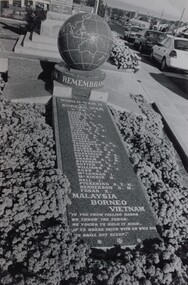
Photograph, Soldiers' Memorial World War 2 in Main Street -- Showing inscription 1999
... At the top of the list is a world globe showing Australia surrounded by Asia, at the base Remembrance is prominently written around the base. ...At the top of the list is a world globe showing Australia surrounded by Asia, at the base Remembrance is prominently written around the base. ...World War 2 Soldiers’ Memorial 1999. "In remembrance WW2 and Korean War, Malaysia, Borneo, Vietnam". The unveiling ceremony of the memorial was held on Sunday Nov 4th, 1956, by Lieutenant Edmond Herring. KCMG. DSO. MC. EO. The ceremony was dedicated "To the men of Stawell and District who paid the supreme sacrifice in World War 2 and Korean War. Two black & white photos taken in 1999 of World War 2 memorial. One photo an enlargement of the other. The memorial includes a list of all these who served in World War 2 and sits in a garden bed. At the top of the list is a world globe showing Australia surrounded by Asia, at the base Remembrance is prominently written around the base. stawell ww2 -
 Plutarch Project
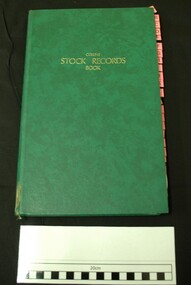
Film screening Log Book, Log Book, Collins late 1950's
... Globe Theatre in Richmond, Galaxy Theatre in Brunswick and the Cosmopolitan Theatre in Brusnwick. At the same time they were hiring other theatres for film projections. They were the Astor Theatre in St. Kilda, Victoria Theatre in Richmond, Sunshine Theatre in Sunshine. Apart from Melbourne they were using the Pantheon Theatre in Adelaide, the Norwood Town Hall in Adelaide, the Shepparton Town Hall in Shepparton, the Premier Theatre in Perth, the Rivoli Theatre in Berri and the Renmark Theatre in Renmark. The number of films shown around...Globe Theatre in Richmond, Galaxy Theatre in Brunswick and the Cosmopolitan Theatre in Brusnwick. At the same time they were hiring other theatres for film projections. They were the Astor Theatre in St. Kilda, Victoria Theatre in Richmond, Sunshine Theatre in Sunshine. Apart from Melbourne they were using the Pantheon Theatre in Adelaide, the Norwood Town Hall in Adelaide, the Shepparton Town Hall in Shepparton, the Premier Theatre in Perth, the Rivoli Theatre in Berri and the Renmark Theatre in Renmark. The number of films shown around ...Yiannoudes Family Film Memorabilia It is normally a time consuming and difficult task to accurately assess a collection’s significance to the primary criteria, however in the case of the “Yiannoudes Family Film Memorabilia” we have no hesitation of its high significance about its historic, social, rarity, interpretive, cultural and provenance to Australia, including the country side where most of this collection memorabilia visited. From January 1959 and until 1982, “Cosmopolitan Motion Pictures”, owned by Mr Peter Yannoudes (Παναγιώτης Γιαννούδης) and Mr Stathis Raftopoulos (Στάθης Ραφτόπουλος) travelled around Australia to entertain the Greek, Turkish, Indian and Yugoslav speaking population of Australia and provide a significant cinema culture. They travelled as far as Perth in WA, Adelaide in SA, Tasmania, Darwin in Nt, Canberra in ACT and Sydney and NSW. However they found themselves also in places like Berri and Renmark in NSW, where concentrations of migrants lived and thrived during the period. Initially they were travelling by train, carrying all their equipment by hand and placing them in boxes and suitcases. However after 1962 when they acquired their first automobile, travelling became less of a burden, nevertheless cumbersome and laborious. They carried with them initially two portable projectors (second one as a backup) and at times travelled with a third in order to ensure that technology will not be letting them down at the time of film projection. At times the films were projected onto a white sheet of cloth because there was no proper screen to project it on at the venue they were using. Mr P. Yiannoudes has also published a book in October 2010, titled “Greek Cinema Across Australia – Behind the Scenes”. The book was published in two languages, English and in Greek. Details about the launch can be found on the Diasporic Literature Spot website at this address (in the Greek language) http://diasporic.org/ellinika/biblia/greek-films-in-australia/. His book is devoted to those with whom he co-operated in order to bring for the first time Greek language films into Australia. Their names are: Stathis Raftopoulos, Andreas Papadopoulos, Andreas Katopodis, Theodoros Kanellopoulos, Michael Ioannou, Fotis Hatzipavlides, Kostas Vrahnas, Evaggelos Terpenos, Dionysis Lourantos, Dimitris Georgiou, Vasilis Florias and Jim Gragie. All businessmen with the right entrepreneurial spirit to be the first and to make their mark in the making of cultural Australia. Mr P. Yiannoudes a Cypriot by descent born in the town of Vouni, a village in the area of Lemesos. In Lemesos he learned the first few things about cinema which would help him in all his later life. He migrated to Australia in 1956 has been a prominent member of the Greek & Cypriot Communities in Melbourne for many decades. He has been President of the Cypriot Community, President of Federation of Cypriot Communities in Australia (for 18 years), President of SEKA (for 26 years) and highly regarded member of the Greek-Cypriots Diaspora since he also has been Vice-President of the Global Federation of Cypriots of Diaspora for 18 years. Mr P. Yiannoudes is now working on creating a small museum of these pieces in the back of the Westgarth Theatre with the help of the Plutarch Project and …. In this collection numbering hundreds of items, we will try and capture some of the glory that was the Greek film industry in Australia for 23 years between 1959 and 1982. “Cosmopolitan Motion Pictures” also owned a large number of cinemas in Melbourne, the National Theatre in Richmond, the Westgarth Theatre in Northcote (which is still owned by the Yiannoudes family today), Sun Theatre in Yarraville, Kinema in Albert Park, Empire Theatre in Brunswick, Paramount Theatre in Oakleigh, Globe Theatre in Richmond, Galaxy Theatre in Brunswick and the Cosmopolitan Theatre in Brusnwick. At the same time they were hiring other theatres for film projections. They were the Astor Theatre in St. Kilda, Victoria Theatre in Richmond, Sunshine Theatre in Sunshine. Apart from Melbourne they were using the Pantheon Theatre in Adelaide, the Norwood Town Hall in Adelaide, the Shepparton Town Hall in Shepparton, the Premier Theatre in Perth, the Rivoli Theatre in Berri and the Renmark Theatre in Renmark. The number of films shown around Australia were over 1500 in total whilst about 1218 of them were in the Greek language. Other languages shown were in Turkish (about 150 films), Yugoslavian (about 100 films), English, French, German, Swedish, Dutch language films. “Cosmopolitan Motion Pictures” was the first company to bring Swedish and Dutch films to Australia. They also showed Martial Arts films for the first time in Australia in 1975 at the Galaxy Theatre in Melbourne. However one of the most significant pieces that tell the story with places and dates is the Show Logbook. The Show Logbook has a large number of stories to tell. It is still intact and in fair condition after all these years of travelling around Australia. It is categorised with an alphabetic index on the right by film title. Greek, Indian, Turkish and Yugoslav language film titles adorn its pages alongside the place where they were first shown, the towns and cities they visited and the dates for each one. It is an extremely significant part of history of the settlement of migrants in Australia. This Log Book is of Primary Significance to the "Cosmopolitan Motion Pictures" and the Yiannoudes family film memorabilia collection. It has a Historic, Social, Provenance and Rarity significance for the settlement of migrants in Australia and the entertainment industry.This is the Log Book, manually updated and used by "Cosmopolitan Motion Pictures" for films shown in different parts of AustraliaCollins Stock Records Booklogbook, films, shown, cultural, language, greek, australia, γιαννούδης, κατάσταση, yiannoudes
