
Showing 13 items matching "associate of the royal red cross"
-
 Returned Nurses RSL Sub-branch
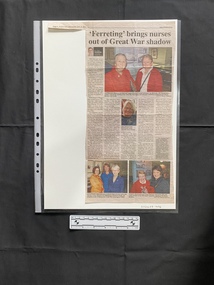
Newspaper - newpaper clipping, Advertiseer, 'Ferreting' brings nurses out of great war shadow, June 10 2015
... ...Associate of the Royal Red Cross...WW1 WWI World War One Wangaratta District Hospital Chiltern Australian Army Vietnam War Anne Hanson SkillShare The Australian Peter Rees The Other Anzacs North East Linda Peacock Associate of the Royal Red Cross ARRC the Queen Ali Rowe Helen McIntyre Elisabeth Modlia Agnes O'Neill Julia Smith Lesley Browne A large newspaper clipping consisting of a title, five columns of text and four colour photos. ...The lives and service of a pair of Great War nurses have inspired a collaboration that has led to a special Anzac centennial exhibition. 'Red capes and suitcases', at Beechworth's Burke Museum, features stories and memorabilia of nineteen nurses associated with Indigo Shire. Included are Rose Carter and Elizabeth Duncan. Both trained at Wangaratta hospital before volunteering to nurse in the Great War. Wangaratta family history researcher, Heather Lane felt an important story remained untold in the nurses' home communities and encouraged the museum to apply for a Veterans' Affairs grant to fund research. Colonel Jan McCarthy, who opened the exhibition, said that seven Australian nurses in the Great War were awarded the Military Medal rather that the Military Cross, as they were volunteers and served in a honorary capacity. Questions remained at the time about srving rank, gender and value. The matron-in-chief was accorded the rank of major but paid as a captain, while nurses ranked as lieutenant were paid as soldiers.A large newspaper clipping consisting of a title, five columns of text and four colour photos. The first and largest photo, directly under the title, is of two older women, both wearing red. The second photo is a small headshot of a smiling woman. The third and fourth photo are both at the bottom of the page and show smiling women, three and two of, respectively.ww1, wwi, world war one, wangaratta district hospital, chiltern, australian army, vietnam war, anne hanson, skillshare, the australian, peter rees, the other anzacs, north east, linda peacock, associate of the royal red cross, arrc, the queen, ali rowe, helen mcintyre, elisabeth modlia, agnes o'neill, julia smith, lesley browne -
 Returned Nurses RSL Sub-branch
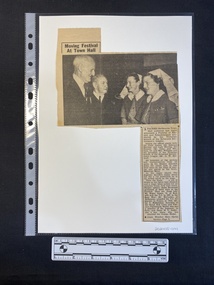
Newspaper - Newspaper clipping, Moving festival at town hall, 1948
... In attendance were many official guests as well as decorated personnel of three wars - Mr Roger James, who won the Victoria Cross(VC) in 1901 in the Boer War; Mr Mcarthy, awarded the VC for bravery in France in 1918; Sister Vivian Bullwinkel, Associate of the Royal Red Cross and Florence Nightingale Medal; Sister Margaret who was awarded the George Medal....In attendance were many official guests as well as decorated personnel of three wars - Mr Roger James, who won the Victoria Cross(VC) in 1901 in the Boer War; Mr Mcarthy, awarded the VC for bravery in France in 1918; Sister Vivian Bullwinkel, Associate of the Royal Red Cross and Florence Nightingale Medal; Sister Margaret who was awarded the George Medal. ...The Victorian Returned Services League(RSL) presented a Festival of Empire and Remembrance. The RSL Memoriall Band played martial airs as all branches of the services and representatives from all parts if the Empire marched down the centre aisle to take their seats on the stage. In attendance were many official guests as well as decorated personnel of three wars - Mr Roger James, who won the Victoria Cross(VC) in 1901 in the Boer War; Mr Mcarthy, awarded the VC for bravery in France in 1918; Sister Vivian Bullwinkel, Associate of the Royal Red Cross and Florence Nightingale Medal; Sister Margaret who was awarded the George Medal.A newspaper clipping of a large black and white photo of two older men and two young women in nurse's uniform with a single column of text beneathmelbourne, town hall, edmund herring, mary ranken lyle, mary herring, john cain, dorothea vera marie grindrod, dorothea cain, mrs williams, gw holland, ww1, wwi, ww2, wwii -
 Melbourne Legacy
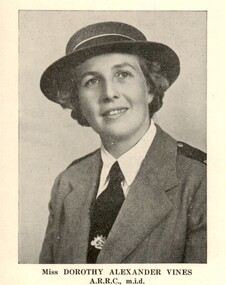
Article, Melbourne Legacy, Miss Dorothy Vines, 1955
... For her war service she was awarded the medal of an Associate of the Royal Red Cross in 1943 and was also mentioned in despatches. ...For her war service she was awarded the medal of an Associate of the Royal Red Cross in 1943 and was also mentioned in despatches. ...The newsletter from August 1955. It featured photos of the Legacy staff, including Miss Dorrie Vines the Matron of Stanhope. It summarises her life before joining Stanhope on 11 November 1946. She had served with distinction overseas during World War 2 as a Major with the Royal Australian Army Nursing Corps. At the beginning of 1940 she went to the Middle East and served as Senior Sister of No.1 Casualty Clearing Station and shortly afterwards was appointed Sister-in-charge of the No.3 Casualty Clearing Station. She returned to Australian in 1943 and was appointed Matron of a hospital in Alice Springs and in 1944 she again left Australia for New Guinea as Matron of the 2/11 Australian General Hospital. For her war service she was awarded the medal of an Associate of the Royal Red Cross in 1943 and was also mentioned in despatches. Miss Vines remained at Stanhope until her retirement in December 1966.Newsletter outlining news of Junior Legatee activities also occassionally contained information about staff.Black and white printed article about Miss Vines from Newsletter published August 1955. Volume 9 Number 2staff, residences, dorothy vines -
 Alfred Hospital Nurses League - Nursing History Collection
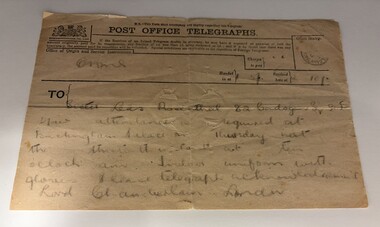
Ephemera - Telegram, Eyre & Spottiswoode Ltd, Telegram from Lord Chamberlain to Leah Rosenthal, 1919
... Leah Rosenthal received this telegram to attend Buckingham Palace to receive the Associate Royal Red Cross at Buckingham Palace in April 1919. ...Leah Rosenthal received this telegram to attend Buckingham Palace to receive the Associate Royal Red Cross at Buckingham Palace in April 1919. ...Leah Rosenthal received this telegram to attend Buckingham Palace to receive the Associate Royal Red Cross at Buckingham Palace in April 1919. Leah Rosenthal had volunteered to join the Queen Alexandra Imperial Nursing Service Reserve in 1914 and served in France during World War I. Of significance as Leah Rosenthal was a graduate of the Alfred HospitalLight brown paper with black print, and penciled messageOld catalogue number written on back at top leftleah rosenthal, world war 1914-1918 -
 Alfred Hospital Nurses League - Nursing History Collection
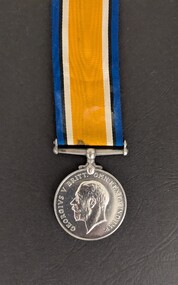
Medal - World War 1 medal, Royal Mint, British War Medal (Leah Rosenthal), 1919
... Leah Rosenthal volunteered with Queen Alexandra's Imperial Nursing Service Reserve, serving in France, and also was awarded the Associate Royal Red Cross...Leah Rosenthal volunteered with Queen Alexandra's Imperial Nursing Service Reserve, serving in France, and also was awarded the Associate Royal Red Cross Of significance to the AHNL as Leah Rosental was an Alfred nursing graduate World War 1 World War 1914-1918 Leah Rosenthal Queen Alexandra's Imperial Nursing Service Reserve Military Medals British War Medal Round silver medal with a straight clasp suspender without swivel. ...The British War Medal was awarded to British and Imperial forces for service during World War 1.Recipients also received the Military Star( where applicable) and the Victory Medal. Leah Rosenthal volunteered with Queen Alexandra's Imperial Nursing Service Reserve, serving in France, and also was awarded the Associate Royal Red CrossOf significance to the AHNL as Leah Rosental was an Alfred nursing graduateRound silver medal with a straight clasp suspender without swivel. The front of the medal depicts the bare head effigy of King George V facing left. Around the perimeter "GEORGIVS V BRITT: OMN: REX ET IND: IMP:" (George V, King of all the British Isles and Emperor of India). The reverse, designed by William McMillan, shows Saint George naked on horseback and armed with a short sword, an allegory of the physical and mental strength which achieved victory over Prussianism. The horse tramples on the Prussian eagle shield and the emblems of death, a skull and crossbones. In the background are ocean waves and just off-centre near the right upper rim is the risen sun of Victory. The years "1914" and "1918" appear on the perimeter in the left and right fields respectively. The attached ribbon consists of a central broad golden-yellow stripe flanked by white and black stipes with royal blue borders. The medal has been mounted on card along with the 1914-1915 Military Star and The Victory Medalworld war 1, world war 1914-1918, leah rosenthal, queen alexandra's imperial nursing service reserve, military medals, british war medal -
 Alfred Hospital Nurses League - Nursing History Collection
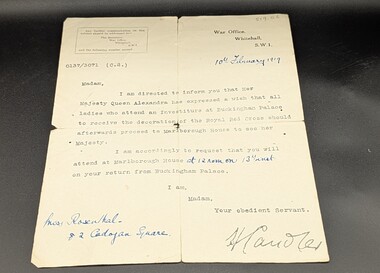
Letter - Invitation Letter, The War Office, Invitation to Leah Rosenthal, 1919
... ...Associate Royal Red Cross...Leah Rosenthal received this invitation to meet with Queen Alexandra after receiving her Associate Royal Red Cross at Buckingham Palace in April 1919. ...Leah Rosenthal received this invitation to meet with Queen Alexandra after receiving her Associate Royal Red Cross at Buckingham Palace in April 1919. ...Leah Rosenthal received this invitation to meet with Queen Alexandra after receiving her Associate Royal Red Cross at Buckingham Palace in April 1919. Leah Rosenthal had volunteered to join the Queen Alexandra Imperial Nursing Service Reserve in 1914 and served in France during World War I. It was customary for the Queen to meet with nurses at Malborough House after they had received their medalsOf significance to the AHNL as Leah Rosenthal had graduated from the Alfred Hospital in 1904Single page, typewritten letter with printed letterhead [all black ink] Date letter sent, time of invitation, recipient's address and senders signature all handwritten [blue ink] Previous catalogue number handwritten at top right [pencil]leah rosenthal, associate royal red cross, queen alexandra imperial nursing service reserve, world war 1914-1918 -
![Colured photograh of Leah Rosenthal [ca.1920's]](/media/collectors/50187a8f023fd7201471f198/items/69781c9e8655f632e89048fc/item-media/697aec96277d71e9c018aff9/item-fit-380x285.jpg?cb=6) Alfred Hospital Nurses League - Nursing History Collection
Alfred Hospital Nurses League - Nursing History CollectionPhotograph - Coloured photograph, Leah Rosenthal, [ca.1920's]
... Leah was awarded the Associate Royal Red Cross for service under fire [ in France] After the war she established Vimy House private hospital with Isabel Jobson (also an AH Graduate) After Leah's death in 1930 Isabel Jobson established the Leah Rosenthal prize for nurses at the Alfred Hospital...Leah was awarded the Associate Royal Red Cross for service under fire [ in France] After the war she established Vimy House private hospital with Isabel Jobson (also an AH Graduate) After Leah's death in 1930 Isabel Jobson established the Leah Rosenthal prize for nurses at the Alfred Hospital Of significance to the AHNL as Leah Rosenthal was an Alfred graduate Leah Rosenthal Queen Alexandra's Imperial Military Nursing Service Reserve QAIMNSR World War 1914-1918 Vimy House Oval frame containing coloured photograph of Leah Rosenthal in profile wearing a white dress and pearl necklace Leah Rosenthal Photograph Coloured photograph ...Leah Rosenthal graduated from the Alfred Hospital in 1904.In 1915 joined the Queen Alexandra Imperial Nursing Service Reserve leaving Australia aboard the Karoola on 18/12/1915. Leah was awarded the Associate Royal Red Cross for service under fire [ in France] After the war she established Vimy House private hospital with Isabel Jobson (also an AH Graduate) After Leah's death in 1930 Isabel Jobson established the Leah Rosenthal prize for nurses at the Alfred HospitalOf significance to the AHNL as Leah Rosenthal was an Alfred graduateOval frame containing coloured photograph of Leah Rosenthal in profile wearing a white dress and pearl necklaceleah rosenthal, queen alexandra's imperial military nursing service reserve, qaimnsr, world war 1914-1918, vimy house -
 Melbourne Legacy
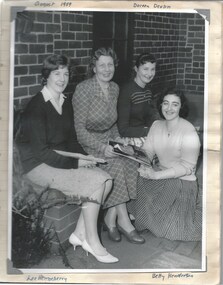
Photograph, Legacy 'Mother' to Twenty Three, 1959
... She had been awarded the medal of an Associate of the Royal Red Cross and was mentioned in despatches. ...She had been awarded the medal of an Associate of the Royal Red Cross and was mentioned in despatches. ...A photo from a book compiled about the Legacy children's residence called Stanhope. This photo shows Matron Dorrie Vines with three residents. Names around the photo L to R: Lee Henneberry, Doreen Devlin, and Betty Henderson. The newspaper article from The Age was published on 28 August 1959 and mentions Miss Vines has worked at Stanhope since 1946 when she returned from war service. She had been a trained nurse and served in Middle East and New Guinea with the RAANC. She had been awarded the medal of an Associate of the Royal Red Cross and was mentioned in despatches. Mention of the routine of the house include that the girls sleep in large airy bedrooms which they look after themselves. They generally do their own washing and ironing. There is a well equipped sewing room where they can make their own clothes. There is a radio and television and piano though between 7 and 9pm is quiet study time. A legacy member joins them for dinner most evenings and the girls do their own washing up. They can cook in the kitchen if they wish. There is staff of an assistant matron, a cook and two housemaids. Girls have picnics and outings arranged and three or four times a year and they have informal dances at Stanhope. Stanhope was supervised by Matron Dorothy (Dorrie) Vines from the time it opened in 1946 until she retired in December 1966. It is likely she compiled this notebook as she is referred to as 'self' in one photo. Individual pages of photos or newspaper clippings have been added separately. Items 01817 to 01834. Stanhope was a residence run by Melbourne Legacy to take care of children whose fathers were deceased servicemen, and who may have been left orphans, or whose mother may have been unable to care for them herself, or they needed to stay in Melbourne for further education. Generally Stanhope looked after girls over 14. The children were cared for until they were old enough to become independent. A record of life at Stanhope as reported in the Age Newspaper.Black and white photo of Matron and girls in 1959 along with a newspaper clipping about her.residences, dorothy vines, stanhope -
 Alfred Hospital Nurses League - Nursing History Collection
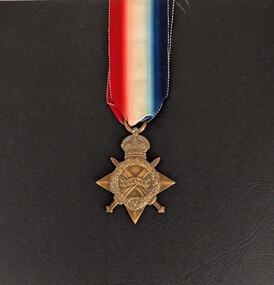
Medal - War War I medal, Royal Mint, 1914-1915 Star (Leah Rosenthal), ca.1918
... Leah Rosenthal volunteered with Queen Alexandra's Imperial Nursing Service Reserve, serving in France, and also was awarded the Associate Royal Red Cross...Leah Rosenthal volunteered with Queen Alexandra's Imperial Nursing Service Reserve, serving in France, and also was awarded the Associate Royal Red Cross Of significance to the AHNL as the recipient was an Alfred Hospital Graduate Alfred Hospital World War 1914-1918 Nurses Leah Rosenthal Queen Alexandra's Imperial Military Nursing Service Reserve The medal, based on the design of the earlier 1914 Star, is a four-pointed star of bright bronze, ensigned with a crown. ...The 1914–15 Star was instituted in December 1918 and was awarded to all who served in the British and Imperial forces against the Central European Powers in any theatre of the Great War between 5 August 1914 and 31 December 1915, provided they had not already received the 1914 Star. The period of eligibility was prior to the Military Service Act 1916, which introduced conscription in Britain. Recipients also received the British War Medal and the Victory Medal. Leah Rosenthal volunteered with Queen Alexandra's Imperial Nursing Service Reserve, serving in France, and also was awarded the Associate Royal Red CrossOf significance to the AHNL as the recipient was an Alfred Hospital GraduateThe medal, based on the design of the earlier 1914 Star, is a four-pointed star of bright bronze, ensigned with a crown. The medal and suspension assembly was struck in one piece. The obverse has two crossed gladii (swords) with their blades upwards, the points and grips of which form what might appear to be four additional points to the star. The swords are overlaid by a wreath of oak leaves, with the Royal Cypher of King George V at the base of the wreath and an overlaying central scroll inscribed "1914–15". The reverse is plain and is impressed with the recipient's details [LIEUT. /J. ROSENTHAL. RANC] The attached ribbon has the red, white and blue colours of the flag of the United Kingdom in shaded and watered bands. The medal has been mounted on card together with recipient's British War Medal and Victory Medalalfred hospital, world war 1914-1918, nurses, leah rosenthal, queen alexandra's imperial military nursing service reserve -
 The Beechworth Burke Museum
Photograph - Lantern Slide, c1900
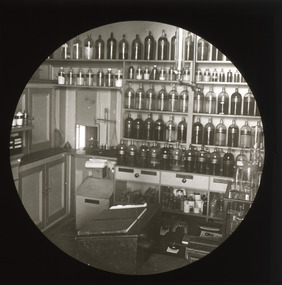
... associated with a Prime Minister of Victoria and some of Victoria's first female medical and pharmaceutical practitioners. Burke Museum Beechworth Lantern Slide Slide Glass Slide Plate Burke Museum Collection Photograph Monochrome hilda dow roy dow chiltern pharmacy dow's pharmacy chiltern indigo shire north east victoria history of pharmacies women in pharmacy women in medicine women in business david mcewan john mcewan national trust national trust victoria north-east victoria national trust heritage buildings industrial heritage helene grey pharmaceutical society of victoria victorian college of pharmacy country women's association caroline copp royal melbourne hospital red cross infant welfare association Thin translucent sheet of glass with a circular image printed on the front and framed in a black backing. ...Chiltern Pharmacy, now called Dow's Pharmacy, opened in 1859 at a time when the township of Chiltern was experiencing a second-wave gold rush that redistributed the balance of commercial and social activity in the region. David McEwan, father of Prime Minister John McEwan, was one of the first pharmacists practicing at the business. It was purchased in 1929 by pharmacist Hilda Dow who ran the business with her apprentice and husband, Roy Dow, until they closed the business in 1968. In 1988, after founding the North East branch of the National Trust, the Dows donated the premises with its entire fittings and stock. Some of the more than 4,000 items in stock at the time of closure in 1968 were present in the shop when the Dows took charge in 1929 and date to the late Nineteenth Century (around the time this image was taken). Hilda Dow (nee Grey) was born in 1897, the daughter of a police magistrate. She enrolled to study at the Victorian College of Pharmacy in 1919 and worked initially for Poynton's Pharmacy in Morwell before purchasing the Chiltern Pharmacy that was later named after her. She was a member of the Pharmaceutical Society of Victoria, a hospital committee and Board, the Red Cross and the Infant Welfare Association and held office for the Chiltern branch of the Country Women's Association. Her sister Helene Grey received an OBE for her work as Lady Superintendent of the Royal Melbourne Hospital. Although Hilda Dow was not Australia's first female pharmacist (this was Caroline Copp in 1880) the preservation of the pharmacy and the stories it presents sheds light on the general issue of recognition for female medical pioneers in Australia. Lantern slides, sometimes called 'magic lantern' slides, are glass plates on which an image has been secured for the purpose of projection. Glass slides were etched or hand-painted for this purpose from the Eighteenth Century but the process became more popular and accessible to the public with the development of photographic-emulsion slides used with a 'Magic Lantern' device in the mid-Nineteenth Century. Photographic lantern slides comprise a double-negative emulsion layer (forming a positive image) between thin glass plates that are bound together. A number of processes existed to form and bind the emulsion layer to the base plate, including the albumen, wet plate collodion, gelatine dry plate and woodburytype techniques. Lantern slides and magic lantern technologies are seen as foundational precursors to the development of modern photography and film-making techniques.This image is significant as it provides insight into social and commercial infrastructure available in the North-East region of Victoria in the late Nineteenth and early Twentieth Centuries. The business pictured is also associated with a Prime Minister of Victoria and some of Victoria's first female medical and pharmaceutical practitioners. Thin translucent sheet of glass with a circular image printed on the front and framed in a black backing. It is held together by metals strips to secure the edges of the slide.burke museum, beechworth, lantern slide, slide, glass slide, plate, burke museum collection, photograph, monochrome, hilda dow, roy dow, chiltern pharmacy, dow's pharmacy, chiltern, indigo shire, north east victoria, history of pharmacies, women in pharmacy, women in medicine, women in business, david mcewan, john mcewan, national trust, national trust victoria, north-east victoria national trust, heritage buildings, industrial heritage, helene grey, pharmaceutical society of victoria, victorian college of pharmacy, country women's association, caroline copp, royal melbourne hospital, red cross, infant welfare association -
 Chiltern Athenaeum Trust
Campaign Ribbons for medals and awards WW1 : Military Cross, 1914 Star, French Croix de Guerre, 2 ANZAC Corps colours (The Joseph Nott Collection), Circa 1914 - 1919
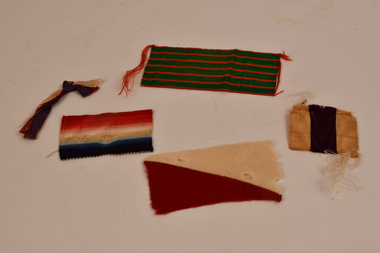
... Medal and Award ribbons associated with WW1 : 1 x bright green with thin red striping (French 1914-1918 Croix de Guerre), 1 x red, cream, white and blue stripes (the 1914 Star), 1 x red and white flag shape cloth patch (2 ANZAC Corps)), and 1 x cream, purple and cream striped ribbon (The Military Cross). The thin ribbon strand consists of cream, crimson and royal...The Joseph Nott collection (Chiltern and Rutherglen resident). 2 anzac corps colours (light horse unit) joseph nott colleciton ww1 soldier rutherglen and chiltern resident. military cross, croix de guerre and 1914 star ribbons ww1 ww1 medals and awards ribbons Medal and Award ribbons associated with WW1 : 1 x bright green with thin red striping (French 1914-1918 Croix de Guerre), 1 x red, cream, white and blue stripes (the 1914 Star), 1 x red and white flag shape cloth patch (2 ANZAC Corps)), and 1 x cream, purple and cream striped ribbon (The Military Cross). The thin ribbon strand consists of cream, crimson and royal ...Associated with WW1 campaign medals and bravery awards. Items from the Joseph Nott collection WW1 soldier. Joseph Nott was a Military Cross recipient. WW1 colored ribbons associated with campaign medals and bravery awards. The Joseph Nott collection (Chiltern and Rutherglen resident). Medal and Award ribbons associated with WW1 : 1 x bright green with thin red striping (French 1914-1918 Croix de Guerre), 1 x red, cream, white and blue stripes (the 1914 Star), 1 x red and white flag shape cloth patch (2 ANZAC Corps)), and 1 x cream, purple and cream striped ribbon (The Military Cross). The thin ribbon strand consists of cream, crimson and royal blue colored ribbons (Empire colors and the 1914 Star colors). 2 anzac corps colours (light horse unit), joseph nott colleciton ww1 soldier rutherglen and chiltern resident., military cross, croix de guerre and 1914 star ribbons ww1, ww1 medals and awards ribbons -
 Surrey Hills Historical Society Collection
Photograph, Demolition of Tower House Day and Boarding School, Surrey Hills in 1932 (1)
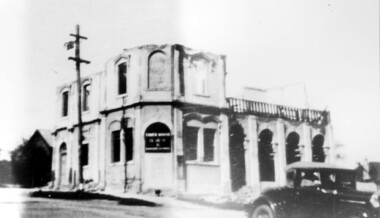
... Royal Hotel closed in 1921 after the area voted to be a 'dry area' in the local option poll. Tower House Day and Boarding School operated from 1921 until 1932. Norman Carter took many photos of Surrey Hills and Mont Albert from the 1920s; many were associated with events and activities of the Church of England. tower house day and boarding school schools education royal hotel hotels construction and demolition dry area licensing polls temperance movement delany's hotel norman carter Rear top centre in blue biro "1932" (crossed out); top RH corner "498" in red biro; centre "Demolition of / Tower House Day & Boarding / cr Canterbury & Broughton Rds / previously Tower House Hotel / originally Royal Hotel / See partner photo ...This building dated back to the 1880s and had previously operated as Delany's Hotel and then the Royal Hotel. It was built near the site of the original Delany's Hotel, built in 1856. The Royal Hotel closed in 1921 after the area voted to be a 'dry area' in the local option poll. Tower House Day and Boarding School operated from 1921 until 1932. Norman Carter took many photos of Surrey Hills and Mont Albert from the 1920s; many were associated with events and activities of the Church of England.Black and white photo of a partially demolished building. The roof and part of the second storey are missing. What remains indicates that it has been a large building in the Victorian style. Along one side at ground level there are 4 arches, perhaps entry to a covered veranda, above which is a colonnade, and perhaps an open veranda on the upper level. There is a mixture of treatments to the surrounds of the windows. On the corner, within an arch which may have once been a doorway, is a sign reading: "TOWER HOUSE / DAY / & / BOARDING SCHOOL". There is a car with a retractable hood in the lower RH Corner of the photo.Rear top centre in blue biro "1932" (crossed out); top RH corner "498" in red biro; centre "Demolition of / Tower House Day & Boarding / cr Canterbury & Broughton Rds / previously Tower House Hotel / originally Royal Hotel / See partner photo."; bottom RH cnr "demol (in red biro) / 20-8-32". All in Jocelyn Hall's handwriting.tower house day and boarding school, schools, education, royal hotel, hotels, construction and demolition, dry area, licensing polls, temperance movement, delany's hotel, norman carter -
 Returned Nurses RSL Sub-branch
Newspaper - Newspaper clipping with correction, Weekly Times, Joan brings life to book characters [and correction paragraph attached], December 13, 1995
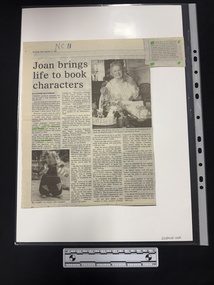
... ...Associate Royal Red Cross Medal Awardee...Joan Kirwan RAAF Nurse Associate Royal Red Cross Medal Awardee 'NC11' [Blue ink at top of page] [various green highlighter marks on page and attached correction clipping] Article with two black and white photographs, four columns of text and a small paragraph clipping attached with corrections printed after the article. ...Biographical article about Joan Kirwan, her Royal Australian Air Force nursing career, her time as a civilian nurse and how after her retirement she makes soft toys inspired by children's books.Article with two black and white photographs, four columns of text and a small paragraph clipping attached with corrections printed after the article. Parts are highlighted in green highlighter.'NC11' [Blue ink at top of page] [various green highlighter marks on page and attached correction clipping]joan kirwan, raaf nurse, associate royal red cross medal awardee
