
Showing 45 items matching "australia day trophy"
-
 Royal Brighton Yacht Club
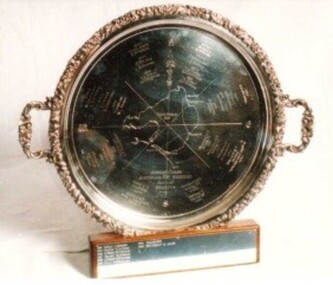
Tray, Australia Day Trophy (Tray)
... Australia Day Trophy (Tray)...Australia Day Trophy...Australia Day Trophy (Tray) Donor: Roy Tapson, Blairgowrie YC 1958 Deed of Gift: No The trophy was donated to encourage inter-club competition for Jubilee yachts from Brighton, Blairgowrie and Sorrento. ... Jubilees inter-club Australia Day Trophy (Tray) Tray ...Australia Day Trophy (Tray) Donor: Roy Tapson, Blairgowrie YC 1958 Deed of Gift: No The trophy was donated to encourage inter-club competition for Jubilee yachts from Brighton, Blairgowrie and Sorrento. The regatta is to be held at the Mornington Yacht Club with each fleet. Racing to Mornington is held on the Saturday of Australia Day weekend, followed by a combined fleet race on the Sunday with all yachts returning to their home clubs on the Monday. First Winner: Aeolus, L. N. Pound 1958 australia day trophy, jubilees, inter-club -
 Bialik College
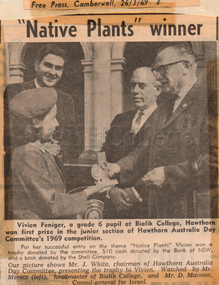
Article (item) - "'Native Plants' Winner", Free Press Camberwell, 26 March 1969, 1969
... White chairman of Hawthorn Australia Day Committee, presenting the trophy to Vivien, watched by Mr. ...White chairman of Hawthorn Australia Day Committee, presenting the trophy to Vivien, watched by Mr. ..."'Native Plants' Winner", Free Press Camberwell, 26 March 1969 "'Native Plants' Winner Vivien Feniger, a grade 6 pupil at Bialik College, Hawthorn won first prize in the junior section of Hawthorn Australia Day Committee's 1969 competition. For her successful entry on the theme "Native Plants" Vivien won a trophy donated by the committee, $10 cash donated by the bank of NSW, and a book donated by the Shell Company. Our picture shows Mr. J. White chairman of Hawthorn Australia Day Committee, presenting the trophy to Vivien, watched by Mr. Meretz (left) headmaster of Bialik College, and Mr. D. Marmor, Consul General for Israel."shakespeare grove, year 6, award, presentation -
 Peterborough History Group
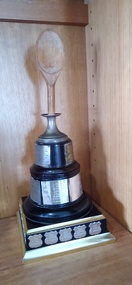
Souvenir - Fred Moore Wooden Spoon Trophy
... The Fred Moore trophy is held on Australia Day long weekend. This trophy commemorates the losers, ie the highest score of the day over 12 holes. ...The Fred Moore trophy is held on Australia Day long weekend. This trophy commemorates the losers, ie the highest score of the day over 12 holes. ...The Fred Moore trophy is held on Australia Day long weekend. This trophy commemorates the losers, ie the highest score of the day over 12 holes. It began in 1967, and continues. Believed to be donated by Bill Cumming to honour the effort of the players. The event is a non handicap game, so anyone can play, not necessarily golfers. It is still quite a coveted prize. The names on this trophy are not generally found on any other trophies! 1967 L Gatenby G Irvine, 1968 F McIntosh D Morrison, 1969 R Richmond J Wilson, 1970 S Cumming D Urquhart, 1971 S Wilcocks M Koser, 1972 J Murnane D Urquhart, 1973 a. Urquhart P Calvert, 1974 D Mercer A Richmond, 1975 J chirnside D Urquhart, 1976 D McKenzie E Stansfield, 1977 R.A.G Chirnside J Jamison, 1978 T Durham A affleck, 1979 R Grice J.A.S. Chirnside, 1980 WR Jamieson D Calvert, 1981 M Fogarty T Durham, 1982 R Chirnside D Moyle, 1983 T Durham L Cummins, 1984 K Moore P Gray ,1985 I chalingsworth N Kirby, 1986 L Brown C McKenzie, 1987 N Porteous J Gilder, 1988 J Porteous D Morrison, 1989 S Wilkinson T Calvert, 1990 N Gransmaa B Richmond, 1991 K Moore J Pangrazio, 1992 J Fullerton- Healy H McFarlane, 1993 H McCulloch and J Kelly, 1994 A McQueen HW Ryan, 1995 K Reggall J Agar, 1996 Deb Bradshaw D Howe, 1997 J Wilson C Emerson, 1998 N Porteous J Dyson, 1999 G McFeeter K Wallice, 2000 Anthony bell Di Whittaker, 2001 T Smith J Irvine, 2002 Patrick Moore Jill Wilson, 2003 D Howe M Watson, 2004 J Porteous D Fisher, 2005 S Heatherly R Densley, 2006 A Finlay G Burns, 2007 A Campbell M Valmorbida, 2008 S Paton J Austin, 2009 C Ross T Dean, 2010 C McPherson A Cooper, 2011 R Lidgerwood Z Baker, 2012 N Robinson T Custance, 2013 D Hay CW Richmond, 2014 E Chartres A Littlechild, 2015 T Clark M Pithie, 2016 A Campbell J Roxburgh, 2017 P devilee S Borghero, 2018 A Austin H Cumming, 2019 J Brown F Devilee, 2020 R Bell O Wilson, 2021 P Moore S Towell,.The trophy is important because it represents the fact that its a fun, all inclusive day celebrating the Peterborough Golf Club, members and non members, winners and losers!Wooden spoon mounted in a plinth, with metal name plates around the base. the original base was round, with one round base added, and a square base added, to provide more space for the names.Name and dates inscribed on nameplatesgolf, golf tournaments, peterborough golf club, fred moore trophy -
 Federation University Historical Collection
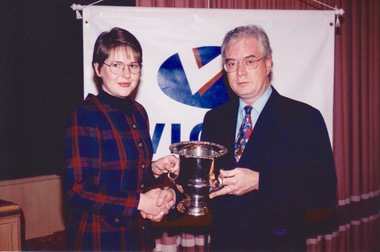
Photograph - Photograph -colour, VIOSH Australia Annual Dinner, July 1998: Presentation of Award to Donna Korke
... australia...occupational health and safety...victorian institute of occupational health and safety...occupational hazard management...ian benjamin...susan capper...george cavanagh...paul coghlan...bryan colburn...timothy crouch...iain day...karina dine...david ellis...ken fuhrmeister...iain gillespie...donald gillies...linda grannas...rhonda hall...sue hardy...genevieve hawkins...paul hennekam...danielle mik...jo millard...vanessa moore...ashok nath...geoffrey poulton...terry ridley...jennifer sever...brian smith...kerry smith...krystie spratt...ian sterry...andrew stevens...david taylor...sean turner...allison warwick...judith wenban...stuart wright...william wasley...linda smith...national safety council of australia...trophy...VIOSH accepts people into the Graduate Diploma of Occupational Hazard Management who have no undergraduate degree – on the basis of extensive work experience and knowledge. viosh viosh australia occupational health and safety victorian institute of occupational health and safety occupational hazard management ian benjamin susan capper george cavanagh paul coghlan bryan colburn timothy crouch iain day karina dine david ellis ken fuhrmeister iain gillespie donald gillies linda grannas rhonda hall sue hardy genevieve hawkins paul hennekam danielle mik jo millard vanessa moore ashok nath geoffrey poulton terry ridley jennifer sever brian smith kerry smith krystie spratt ian sterry andrew stevens david taylor sean turner allison warwick judith wenban stuart wright william wasley linda smith national safety council of australia trophy donna korke frank anderson Professional coloured photographs. ...Victorian Institute of Occupational Safety and Health (VIOSH) Australia is the Asia-Pacific centre for teaching and research in occupational health and safety (OHS) and is known as one of Australia's leaders in the field. VIOSH has a global reputation for its innovative approach within the field of OHS management. Federation University VIOSH Australia students are safety managers, senior advisors and experienced OHS professionals. They come from all over Australia and industry. Students are taught active research and enquiry; rather than textbook learning and a one-size fits all approach. VIOSH accepts people into the Graduate Diploma of Occupational Hazard Management who have no undergraduate degree – on the basis of extensive work experience and knowledge.Professional coloured photographs. Presenter and recipient standing in front of VIOSH banner.viosh, viosh australia, occupational health and safety, victorian institute of occupational health and safety, occupational hazard management, ian benjamin, susan capper, george cavanagh, paul coghlan, bryan colburn, timothy crouch, iain day, karina dine, david ellis, ken fuhrmeister, iain gillespie, donald gillies, linda grannas, rhonda hall, sue hardy, genevieve hawkins, paul hennekam, danielle mik, jo millard, vanessa moore, ashok nath, geoffrey poulton, terry ridley, jennifer sever, brian smith, kerry smith, krystie spratt, ian sterry, andrew stevens, david taylor, sean turner, allison warwick, judith wenban, stuart wright, william wasley, linda smith, national safety council of australia, trophy, donna korke, frank anderson -
 Marysville & District Historical Society
THE TRIANGLE NEWS-VOL 3 NO 30-SEPTEMBER 29 1978
... australia clorination? fluoridation? vale ralph wanted for sale community care centre senior citizens marysville bowls club baby show kinder roster attention! red cross bike race old jewellery floral art demonstration hobbytex party wirreanda halloween ball miniature debutante ball scouts guide dance golf news carpet bowls footy news rainfall floral central division golf day spastic society trophies ladies buswalking THE TRIANGLE NEWS-VOL 3 NO 30-SEPTEMBER 29 1978 ...marysville, victoria, australia, clorination? fluoridation?, vale ralph, wanted, for sale, community care centre, senior citizens, marysville bowls club, baby show, kinder roster, attention!, red cross bike race, old jewellery, floral art demonstration, hobbytex party, wirreanda halloween ball, miniature debutante ball, scouts guide dance, golf news, carpet bowls, footy news, rainfall, floral central division golf day, spastic society, trophies, ladies buswalking -
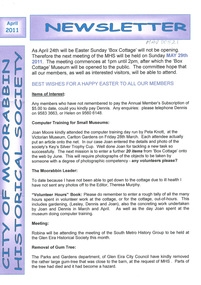 City of Moorabbin Historical Society (Operating the Box Cottage Museum)
Newsletter, City of Moorabbin Historical Society Apr 2011 pdf, April 2011
... Joan Moore, attended a Training Day on March 28th, organised by Peta Knott, Museums Australia Victoria, for small museums to record their artefacts, photos, documents, clothing etc. on the MAV Website. The first item entered on ‘Box Cottage Museum’ site is The Keys Trophy...Joan Moore, attended a Training Day on March 28th, organised by Peta Knott, Museums Australia Victoria, for small museums to record their artefacts, photos, documents, clothing etc. on the MAV Website. The first item entered on ‘Box Cottage Museum’ site is The Keys Trophy ...The City of Moorabbin Historical Society was formed c 1960 by a group of Moorabbin residents who were concerned that the history of the area should be preserved. A good response to a call for items related to the historical area of Moorabbin Shire brought donations of a wide variety of artefacts which are now preserved by the current members of CMHS at Box Cottage Museum . Helen Stanley, Secretary of CMHS, began producing a Newsletter for members in April 2007 to provide current information and well researched items of historical interestHelen Stanley has produced a bi-monthly Newsletter, 2007 - 2013, for the members of the City of Moorabbin Historical Society that contains well researched interesting historical items, notification of upcoming events, current advice from Royal Australian Historical Society , Museums Australia Victoria and activities of Local Historical Societies. The Newsletter is an important record of the activities of the CMHS The Brewer family were early settlers in Moorabbin Shire.3 x A4 paper printed on 1 side Issue 21 of the bi-monthly, City of Moorabbin Historical Society Newsletter produced by Society member and Secretary, Mrs Helen Stanley in April 2011. Notice that the next meeting will be May 29th because April 24th is Easter Sunday and reminders about subscriptions, the Volunteer Hours Record Book, and the South Metro History Group April meeting . Joan Moore, attended a Training Day on March 28th, organised by Peta Knott, Museums Australia Victoria, for small museums to record their artefacts, photos, documents, clothing etc. on the MAV Website. The first item entered on ‘Box Cottage Museum’ site is The Keys Trophy Cup 1881. Cat No. MAV 00001. Helen has compiled a brief history of John and Ann Brewer market gardeners c1841, with photograph CITY of MOORABBIN HISTORICAL SOCIETY / APRIL 2011 NEWSLETTERcity of moorabbin historical society, stanley helen, melbourne, moorabbin, brighton, cheltenham, ormond, bentleigh, mckinnon, market gardeners, pioneers, early settlers, moorabbin shire, box cottage museum, city of moorabbin, box william, glen eira historical society, museums australia victoria, knott peta, south metro history group, brewer john, brewer ann, jasper road, point nepean road, brewer’s road -
 Phillip Island and District Historical Society Inc.
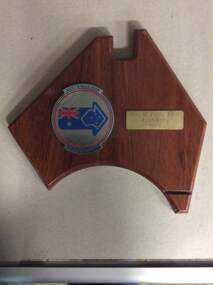
wooden plaque, Australia Day Citizen Award, 1993
... Janet was a long standing volunteer in the local community, especially for Red Cross. janet crilly red cross volunteers trophies & awards Australia Day Citizen Award. Shire of Phillip Island Janet Crilly 1993 Dark wooden plaque in shape of map of Australia. ...Janet was a long standing volunteer in the local community, especially for Red Cross.Dark wooden plaque in shape of map of Australia. Has 2 metal plaques.Australia Day Citizen Award. Shire of Phillip Island Janet Crilly 1993janet crilly, red cross, volunteers, trophies & awards -
 Bendigo Military Museum
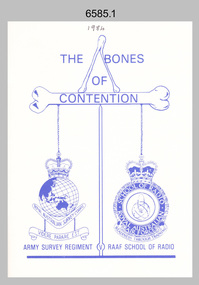
Photograph - Bones Day – Army Survey Regiment Verses RAAF School of Radio at Bendigo, Victoria, 1984
... trophy awarded to the winner of the evening competition. The 3-hour bus trip for the visiting unit on their return was typically very raucous. The history of the Bones Day competition is best described in the booklet titled - Bones of Contention Souvenir Program. 1965. Refer to Item 6267. Photo 6585.41P is also published with Item 6276.5P. Royal Australian ...These 41 photographs were taken at Bones Day, an annual sports competition between the Army Survey Regiment and the RAAF School of Radio, at Bendigo on the 14th of November 1984. The two units took turns each year to host the event. The day competition usually comprised basketball, cricket, cross country, golf, pistol shooting, sailing, squash, rifle shooting, softball, tennis, touch football, tug-of-war and volleyball. The “big bone” trophy comprising a large bone from a beast housed inside a wooden framed glass case, was awarded to the winner of the day competition. The “O.H.A.R.A Rock” seen on the table in photo 6585.10P was awarded to the shooter with the lowest score in rifle shooting. The evening competition often included darts, carpet bowls, hookey, quoits and billiards/snooker. The “little bone” (a mounted chicken bone) was the consolation trophy awarded to the winner of the evening competition. The 3-hour bus trip for the visiting unit on their return was typically very raucous. The history of the Bones Day competition is best described in the booklet titled - Bones of Contention Souvenir Program. 1965. Refer to Item 6267. Photo 6585.41P is also published with Item 6276.5P.This item comprises the cover of a program booklet and a set of 40 photographs from Bones Day, an annual sports competition between the Army Survey Regiment and the RAAF School of Radio, held at Bendigo on the 14th of November 1984. The photographs were printed on photographic paper and are part of the Army Survey Regiment’s Collection. The colour A4 booklet cover and black and white photographs were scanned at 300 dpi. .1) – A5 size program booklet titled ‘The Bones of Contention’, buff card cover, graphics and internal text printed in purple. 32 pages dated 1984. .2) to .4) - Photo, black & white, 1984. Basketball. Army in darker tops, RAAF in white. .5) - Photo, black & white, 1984. Basketball. Unidentified participants from RAAF. .6) - Photo, black & white, 1984. Rifle Shooting. L to R: CPL Graham Johnston, unidentified. .7) & .8) - Photo, black & white, 1984. Rifle Shooting. Unidentified participants. .9) - Photo, black & white, 1984. Rifle Shooting. Unidentified officials at Range Control. .10) - Photo, black & white, 1984. Rifle Shooting. Unidentified participants from RAAF. The “O.H.A.R.A Rock” awarded to the shooter with the lowest score in rifle shooting is seen on the table. .11) - Photo, black & white, 1984. Pistol Shooting. Army CO LTCOL Jorge Gruszka. .12) - Photo, black & white, 1984. Pistol Shooting. L to R: Army CO LTCOL Jorge Gruszka, CPL Doug Home. .13) - Photo, black & white, 1984. Pistol Shooting. Army CO LTCOL Jorge Gruszka. .14) - Photo, black & white, 1984. Pistol Shooting. RAAF’s participants L to R: unidentified, CO WGCDR McCarthy, remainder unidentified. .15) - Photo, black & white, 1984. Pistol Shooting. ARMY’s participants L to R: CPL Doug Home, SSGT Davidson, SPR Andy Godden, CO LTCOL Jorge Gruszka. .16) & .17) - Photo, black & white, 1984. Pistol Shooting. ARMY and RAAF participants Back row L to R: CPL Doug Home, SSGT Davidson, unidentified RAAF participants (x2). Front row L to R: SPR Andy Godden, RAAF CO WGCDR McCarthy, Army CO LTCOL Jorge Gruszka. .18) to .25) - Photo, black & white, 1984. Softball. Unidentified ARMY & RAAF participants. .26) - Photo, black & white, 1984. Tennis. L to R: ARMY’s CPL John ‘Stormy’ Tempest, SPR Steve Coulson. .27) - Photo, black & white, 1984. Tennis. Unidentified participant. .28) - Photo, black & white, 1984. Tennis. CPL Ginny (Turner) Rowe, unidentified in background. .29) to .31) - Photo, black & white, 1984. Tennis. Unidentified participants. .32) - Photo, black & white, 1984. Tug-of-War. Army team lines up L to R: SPR Kerron South, CPL Leon Jackson, SPR Brett McAllister, CPL Jamie ‘Fish’ McRae, unidentified, CPL Roger Graf, CPL Peter Lefel. .33) - Photo, black & white, 1984. Tug-of-War. Army team pulling hard L to R: unidentified, CPL Jamie ‘Fish’ McRae, SPR Brett McAllister, CPL Leon Jackson, SPR Kerron South. .34) - Photo, black & white, 1984. Tug-of-War. Army and RAAF spectators. Centre foreground L to R: MAJ Bob Roche, Army CO LTCOL Jorge Gruszka, RAAF CO WGCDR McCarthy. .35) - Photo, black & white, 1984. Tug-of-War. RAAF team taking the strain on the rope. Unidentified participants. .36) - Photo, black & white, 1984. Tug-of-War. Army and RAAF teams shake hands after Army’s victory. .37) - Photo, black & white, 1984. Volleyball. Army’s team (light shirts) prepare to receive RAAF’s serve. L to R: CPL Rod Skidmore, CPL Ian Nichols, CPL Dan Cirsky, CPL Terry ‘TJ’ Wicker. .38) - Photo, black & white, 1984. Volleyball. Army’s CPL Rod Skidmore (light shirt) attempts to block a RAAF spike. Unidentified RAAF participants at left. Army team L to R: CPL Terry ‘TJ’ Wicker CPL Robin Marshall, CPL Dan Cirsky. .39) - Photo, black & white, Trophy presentation. L to R: RAAF CO WGCDR McCarthy presents ‘the Big Bone’ to Army’s CO LTCOL Jorge Gruszka. .40) - Photo, black & white, Trophy presentation. L to R: RAAF CO WGCDR McCarthy presents ‘the Little Bone’ to Army’s CO LTCOL Jorge Gruszka. .41) - Photo, black & white, Trophy presentation. L to R: RAAF CO WGCDR McCarthy presents an unidentified trophy to Army’s CO LTCOL Jorge Gruszka..1 - 'The Bones of Contention' title on booklet cover. '1984' hand written on top of cover Photos .2P to .41P – 'Bones Day 1984' annotated on cover sleeve.royal australian survey corps, rasvy, army survey regiment, army svy regt, fortuna, bones day -
 Bendigo Military Museum
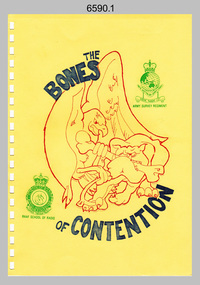
Photograph - Bones Day – Army Survey Regiment Verses RAAF School of Radio at Laverton, Victoria, 1985
... day competition. The “O.H.A.R.A Rock” was awarded to the shooter with the lowest score in rifle shooting. The evening competition often included darts, carpet bowls, hookey, quoits and billiards/snooker. The “little bone” (a mounted chicken bone) was the consolation trophy awarded to the winner of the evening competition. The 3-hour bus trip for the visiting unit on their return was typically very raucous. The history of the Bones Day competition is best described in the booklet titled - Bones of Contention Souvenir Program. 1965. Refer to Item 6267. Royal Australian ...The 10 photographs were taken at Bones Day, an annual sports competition between the Army Survey Regiment and the RAAF School of Radio, at Laverton on the 13th of November 1985. The two units took turns each year to host the event. The day competition usually comprised basketball, cricket, cross country, golf, sailing, pistol shooting, squash, rifle shooting, softball, tennis, touch football, tug-of-war and volleyball. The “big bone” trophy comprising a large bone from a beast housed inside a wooden framed glass case, was awarded to the winner of the day competition. The “O.H.A.R.A Rock” was awarded to the shooter with the lowest score in rifle shooting. The evening competition often included darts, carpet bowls, hookey, quoits and billiards/snooker. The “little bone” (a mounted chicken bone) was the consolation trophy awarded to the winner of the evening competition. The 3-hour bus trip for the visiting unit on their return was typically very raucous. The history of the Bones Day competition is best described in the booklet titled - Bones of Contention Souvenir Program. 1965. Refer to Item 6267. This item comprises the cover of a program booklet and a set of 10 photographs taken at Bones Day, an annual sports competition between the Army Survey Regiment and the RAAF School of Radio, held at Laverton on the 13th of November 1985. The photographs were printed on photographic paper and are part of the Army Survey Regiment’s Collection. The colour A4 booklet cover and black and white photographs were scanned at 300 dpi. .1) – A4 size program booklet titled ‘The Bones of Contention’, buff card cover and colour graphics, internal text and cartoon graphics printed in purple. 32 pages dated 1985. .2) - Photo, black & white, 1985. Basketball teams. Back row L to R: unidentified (x2), Bob Croxton, unidentified, Danny Galbraith, unidentified, Steve Burke. Middle row L to R: Rob Jones, unidentified (x2), Sherri (Dally) Burke, unidentified, Evan Allanson, unidentified. Front row L to R: unidentified (x4), Brenton McDonald, unidentified, Max Shaw. .3) - Photo, black & white, 1985. Cricket teams. Back row L to R: unidentified, Bill Griggs, unidentified, Mick Hogan, unidentified, Jim Ash, Dave Wright, Bob Thrower. Middle row L to R: PTE Hudson, unidentified, Brett McAllister, unidentified (x5). Front row L to R: PTE Wigg, unidentified, Brian Partridge, unidentified, Graham Hales, unidentified (x3). .4) - Photo, black & white, 1985. Cross Country teams. Back row L to R: unidentified (x3), Peter Barrett unidentified (x2), Paul Davis, unidentified. Front row L to R: unidentified, Jeff Rudd, unidentified, Greg Rowe, unidentified (x2), Steve Winner, unidentified. .5) - Photo, black & white, 1985. Golf teams. Back row L to R: unidentified (x2), Brian Johnson, unidentified (x2). Front row L to R: Doug Arman, unidentified, Graeme Dowd, unidentified, Peter Imeson, unidentified (x2). .6) - Photo, black & white, 1985. Pistol Shooting teams. Back row L to R: unidentified, Doug Home, unidentified, Tony Clark, Ben Lucas. Front row L to R: unidentified (x2), Daryl Hockings CSM, unidentified, Max Colletti. .7) - Photo, black & white, 1985. Pistol Shooting teams. Back row L to R: unidentified, Greg Sulman, unidentified, Bob Bright, Tom Bloxham, Bob Hopper, unidentified (x2). Front row L to R: unidentified (x2), Dan Cirsky, unidentified (x3), Brad Peppler, unidentified. .8) - Photo, black & white, 1985. Softball teams. Back row L to R: Scheryl Delforce, unidentified, Le-Anne (Smallshaw) Shirley, unidentified, Raelene (Munting) Brodie, Carmel (Butler) Fauth, Gill Park. Middle row L to R: unidentified (x2), Viv (Hawkins) Doherty, unidentified, Avril (Bray) Lloyd, unidentified (x6). Front row L to R: Wendy (Leitinger) McCarthy, unidentified, Leah (Hoffman) Peppler, unidentified, Lorraine (Daly) Talbot-Smith, unidentified, Chris Gordon, unidentified. .9) - Photo, black & white, 1985. Tennis teams. Back row L to R: Damien Killeen, unidentified, Ozzie Slade, unidentified, Dennis Learmonth, unidentified. Middle row L to R: Carol Dunstan, unidentified, Ginny (Turner) Rowe, unidentified (x2), Steve Coulson. Front row L to R: unidentified (x4), Col McInness, Peter Ball. .10) - Photo, black & white, 1985. Touch Football teams. Back row L to R: unidentified, Paul Baker, Jeff Willey, Per Andersen, unidentified (x4). Middle row L to R: John ’Junior’ Whaling, Simon ‘Andy’ Capp, Daryl South, Ken Talbot-Smith, unidentified (x4). Front row L to R: Frank Downie, Peter ‘Spoon’ Lefel, Roy Hicks, Greg Oaten CSC, unidentified (x4). .11) - Photo, black & white, 1985. Tug-of-War teams. Back row L to R: unidentified (x2), Steve Burke, unidentified (x3). Middle row L to R: unidentified (x2), JB Zahra, unidentified, Mal Paterson, Geunther Ebenwaldner, unidentified, Peter ‘Spoon’ Lefel. Front row L to R: Kerron South, unidentified, Barry Hogan, unidentified (x2), Brett McAllister. .1 - 'The Bones of Contention' title on booklet cover. Photos .2P to .11P – 'Bones Day 1985' annotated on cover sleeve.royal australian survey corps, rasvy, army survey regiment, army svy regt, fortuna, bones day -
 Bendigo Military Museum
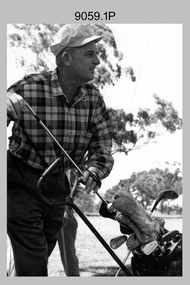
Photograph - Bones Day – Army Survey Regiment Verses RAAF School of Radio at Laverton, Victoria, c1961
... trophy comprising a large bone from a beast housed inside a wooden framed glass case, was awarded to the winner of the day competition. The evening competition often included darts, carpet bowls, hookey, quoits and billiards/snooker. The “little bone” (a mounted chicken bone) was the consolation trophy awarded to the winner of the evening competition. The 3-hour bus trip for the visiting unit on their return was typically very raucous. The history of the Bones Day competition is best described in the booklet titled - Bones of Contention Souvenir Program. 1965. Refer to Item 6267. Royal Australian ...These eight photographs were taken at Bones Day, an annual sports competition between the Army Headquarter (AHQ) Survey Regiment and the RAAF School of Radio at Laverton circa 1961. The two units took turns each year to host the event. The day competition usually comprised basketball, cricket, cross country, golf, sailing, squash, softball, tennis, touch football, rifle shooting, tug-of-war and volleyball. The “big bone” trophy comprising a large bone from a beast housed inside a wooden framed glass case, was awarded to the winner of the day competition. The evening competition often included darts, carpet bowls, hookey, quoits and billiards/snooker. The “little bone” (a mounted chicken bone) was the consolation trophy awarded to the winner of the evening competition. The 3-hour bus trip for the visiting unit on their return was typically very raucous. The history of the Bones Day competition is best described in the booklet titled - Bones of Contention Souvenir Program. 1965. Refer to Item 6267.These eight photographs were taken at Bones Day, an annual sports competition between the Army Survey Regiment and the RAAF School of Radio at Laverton circa 1961. The photographs were printed on photographic paper and are part of the Army Survey Regiment’s Collection. The black and white photographs were scanned at 300 dpi. .1) - Photo, black & white, c1961, Golf. MAJ John Nolan. .2) - Photo, black & white, c1961, Cricket. CPL Walter Mooney. .3) - Photo, black & white, c1961, Volleyball – Army v Ballarat. .4) - Photo, black & white, c1961, Squash. Back row L to R: unidentified (x3), Tom Royale. Front row L to R: unidentified, Barbara Minto. .5) - Photo, black & white, c1961, Hockey. All unidentified. .6) - Photo, black & white, c1961, Evening trophy presentations. L to R: unidentified RAAF School of Radio’s CO/or representative, AHQ Survey Regiment CO’s representative MAJ John Nolan. .7) - Photo, black & white, c1961, Evening trophy presentations. L to R: unidentified RAAF School of Radio’s CO/or representative, AHQ Survey Regiment RSM WO1 De Moore, CO’s representative MAJ John Nolan. .8) - Photo, black & white, c1961, Day Competition Trophy – The Big Bone..1P annotated ‘Nolan’ on back of photo .2P annotated ‘Mooney’ on back of photo .3P annotated ‘Volleyball – Army v Ballarat’ on back of photo .4P to .8P not annotated.royal australian survey corps, rasvy, army survey regiment, army svy regt, fortuna, bones day -
 Bendigo Military Museum
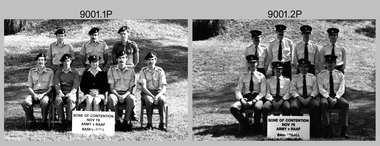
Photograph - Bones Day – Army Survey Regiment Verses RAAF School of Radio at Bendigo, Victoria, 1978
... day competition. The evening competition often included darts, carpet bowls, hookey, quoits and billiards/snooker. The “little bone” (a mounted chicken bone) was the consolation trophy awarded to the winner of the evening competition. The 3-hour bus trip for the visiting unit on their return was typically very raucous. See item 6275.8P for more photographs taken on this occasion. The history of the Bones Day competition is best described in the booklet titled - Bones of Contention Souvenir Program. 1965. Refer to Item 6267. Royal Australian ...This set of 31 photographs was taken at Bones Day, an annual sports competition between the Army Survey Regiment and the RAAF School of Radio at Bendigo in November 1978. The two units took turns each year to host the event. The day competition usually comprised basketball, cricket, cross country, golf, sailing, squash, softball, tennis, touch football, rifle shooting, tug-of-war and volleyball. The “big bone” trophy comprising a large bone from a beast housed inside a wooden framed glass case, was awarded to the winner of the day competition. The evening competition often included darts, carpet bowls, hookey, quoits and billiards/snooker. The “little bone” (a mounted chicken bone) was the consolation trophy awarded to the winner of the evening competition. The 3-hour bus trip for the visiting unit on their return was typically very raucous. See item 6275.8P for more photographs taken on this occasion. The history of the Bones Day competition is best described in the booklet titled - Bones of Contention Souvenir Program. 1965. Refer to Item 6267.This set of 31 photographs were taken at Bones Day, an annual sports competition between the Army Survey Regiment (ASR) and the RAAF School of Radio (RSR) at Bendigo in November 1978. The photographs were printed on photographic paper and are part of the Army Survey Regiment’s Collection. The black and white photographs were scanned at 300 dpi. .1) - Photo, black & white, 1978, ASR Basketball Team Back row L to R: Jamie ‘Fish’ McRae, John Thomas, Gary Kerr. Front row L to R: Phil McGuire, Bill Jones, Gill Park, Bruce ‘Stretch’ Gordon, Stuart Symonds. .2) - Photo, black & white, 1978, RSR Basketball Team: All unidentified. .3) - Photo, black & white, 1978, Basketball action: Gill Park in No. 8 top, remainder unidentified. .4) - Photo, black & white, 1978, Basketball action: L to R: unidentified (x4), Gill Park, unidentified, Bruce ‘Stretch’ Gordon, remainder unidentified. .5) - Photo, black & white, 1978, ASR Cricket Team Back row L to R: Alan Toogood, Bob Norwood, Ken ‘Sluggo’ Slater, unidentified, Josh Degroot. Front row L to R: Rick van der Bom, Greg Byers, Peter Hammer, 2LT Trevor Black, Alan Bunn, Mark Casey. .6) - Photo, black & white, 1978, RSR Cricket Team: All unidentified. .7) - Photo, black & white, 1978, ASR Rifle Shooting Team Back row L to R: John Cain, Bob Clark, Ian Belmont, unidentified. Front row L to R: Steve Hansen, Struan Robinson, Max Neil, Warren ‘Waldo’ Shirley. .8) - Photo, black & white, 1978, RSR Rifle Shooting Team: All unidentified. .9) - Photo, black & white, 1978, ASR Squash Team Back row L to R: Errol Fletcher, Rick Downie, Andy Wilson, George Timmins, John Bennett. Front row L to R: Terry Danger, Di Norling, Rob John, Dennis Puniard. .10) - Photo, black & white, 1978, Softball action: L to R: Janet (Chopping) Justin, Lorraine ‘Snoopy’ (Daly) Talbot-Smith. In left background: Janet (Chopping) Justin. .11) - Photo, black & white, 1978, Softball action: L to R: Le-anne (Smallshaw) Shirley, Lynn Johnson. .12) - Photo, black & white, 1978, Softball action: L to R: Lorraine ‘Snoopy’ (Daly) Talbot-Smith, John Ashby, unidentified. .13) - Photo, black & white, 1978, RSR Tennis Team: All unidentified. .14) - Photo, black & white, 1978, ASR Volleyball Team Back row L to R: Kerry ‘Gags’ Gallager, Gerry Gates, Bob Clisby, unidentified, Cornelius Moorrees, Laurie Justin. Front row L to R: Chris Edwards, Bob Bright, Keith Quinton, Mick ‘Buddha’ Ellis, George Holland, unidentified. .15) - Photo, black & white, 1978, RSR Volleyball Team: All unidentified. .16) - Photo, black & white, 1978, Volleyball action L to R: Keith Quinton, unidentified, Chris Edwards, remainder unidentified. .17) - Photo, black & white, 1978, Volleyball action L to R: unidentified, Keith Quinton in No. 4 top, unidentified, unidentified. .18) - Photo, black & white, 1978, ASR Tug-of-War Team Back row L to R: Russ Mollenhaur, Brian Collings, Noel ‘Macca’ McNamara, Ken ‘Sluggo’ Slater, Mick Davey, Russell ‘Rusty’ Williams, unidentified. Front row L to R: Wolfgang Thun, Rhys Delaine, Phil Boyle, unidentified, Ian Nelson, Jamie ‘Fish’ McRae. .19) - Photo, black & white, 1978, RSR Tug-of-War Team: All unidentified. .20) - Photo, black & white, 1978, ASR Tug-of-War Team in action. .21) - Photo, black & white, 1978, RSR Tug-of-War Team in action. .22) & .23) - Photo, black & white, 1978, Tug-of-War Teams at end of contest. .24) - Photo, black & white, 1978, Darts competition: Di Chalmers in action. John Ashby in right background. .25) - Photo, black & white, 1978, Carpet bowls competition: All unidentified. .26) - Photo, black & white, 1978, Ian Whittington EXCH-UK admires the view from the Tavern’s rafters. .27) - Photo, black & white, 1978, social activities L to R: Paul Baker, unidentified. .28) - Photo, black & white, 1978, social activities L to R: Adrian Rynberk, unidentified, unidentified. .29) - Photo, black & white, 1978, Trophy presentation. L to R: RAAF CO presents ‘the Little Bone’ to Army’s CO LTCOL Bob Skitch. In background L to R: unidentified, Ian Whittington EXCH-UK in right background. .30) - Photo, black & white, 1978, Trophy presentation. L to R: RAAF CO presents ‘the Little Bone’ to Army’s CO LTCOL Bob Skitch. In background L to R: John Smith, Ian Whittington EXCH-UK. .31) - Photo, black & white, 1978, Trophy presentation. L to R: RAAF CO presents ‘the Little Bone’ to Army’s CO LTCOL Bob Skitch. In background L to R: unidentified, Ian Whittington EXCH-UK in right background. .1P to.9P – ‘Bones Day 1978’ annotated on cover sleeve.royal australian survey corps, rasvy, army survey regiment, army svy regt, fortuna, bones day -
 Bendigo Military Museum
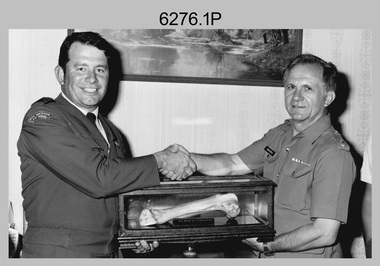
Photograph - Bones Day - Army Survey Regiment, Bendigo versus RAAF School of Radio, Laverton, 1984, 1985 and 1988
... trophy awarded to the winner of the evening competition. The “O.H.A.R.A Rock” seen in photo 6276.2P was awarded to PTE Zahra for the lowest score in rifle shooting. He had to lug it with him for the rest of the evening. The 3-hour bus trip for the visiting unit on their return was typically very raucous. The history of the Bones Day competition is best described in the booklet titled - Bones of Contention Souvenir Program. 1965. Refer to Item 6267. Photo 6276.1P is also published with item 6585.41P. Royal Australian ...These five photographs were taken at Bones Day, an annual sports competition between the Army Survey Regiment and the RAAF School of Radio in November 1984, 1985, and 1988. The two units took turns each year to host the event. The day competition usually comprised basketball, cross country, golf, sailing, squash, softball, tennis, touch football, rifle shooting, tug-of-war and volleyball. The “big bone” trophy comprising a large bone from a beast housed inside a wooden framed glass case, was awarded to the winner of the day competition. The evening competition often included darts, carpet bowls, hookey, quoits and billiards/snooker. The “little bone” (a mounted chicken bone) was the consolation trophy awarded to the winner of the evening competition. The “O.H.A.R.A Rock” seen in photo 6276.2P was awarded to PTE Zahra for the lowest score in rifle shooting. He had to lug it with him for the rest of the evening. The 3-hour bus trip for the visiting unit on their return was typically very raucous. The history of the Bones Day competition is best described in the booklet titled - Bones of Contention Souvenir Program. 1965. Refer to Item 6267. Photo 6276.1P is also published with item 6585.41P.This collection of five photographs was taken at Bones Day, an annual sports competition between the Army Survey Regiment and the RAAF School of Radio, at Bendigo and Laverton respectively in November 1984, 1985, and 1988. The photographs were printed on photographic paper and are part of the Army Survey Regiment’s Collection. The photographs were scanned at 300 dpi. .1) - Photo, black & white, 14th November 1984, RAAF CO WGCDR McCarthy presents ‘the Big Bone’ to Army’s CO LTCOL Jorge Gruszka. .2) - Photo, black & white, 13th November 1985, Trophy presentations L to R: MAJ Daryl Hockings CSM, PTE JB Zahra, unidentified RAAF officer. .3) - Photo, black & white, 13th November 1985, tug-of-war L to R: Peter Lefel, Kerron South, Barry Hogan, DB Zahra, unidentified (x2), Guenther Ebenwaldner, Steve Burke, Mal Paterson. .4) - Photo, colour, 1988, at Bendigo, tug-of-war L to R: Jodi Bowman, unidentified, Frank Savy, Barry Hogan, unidentified (x2), Graeme Spong, unidentified (x2), Mick Duggan, unidentified, Dave Lambton-Young, unidentified (x2). .5) - Photo, colour, 1988, at Bendigo, tug-of-war L to R: Mick Duggan, Dave Lambton-Young, unidentified (x3), Frank Savy (with sign), unidentified, Barry Hogan, unidentified, Graeme Spong, unidentified (x3)..1P to .7P – No personnel are identified. The date is stamped on the back of photos .1P to .3P.royal australian survey corps, rasvy, army survey regiment, army svy regt, fortuna, asr, raaf school of radio, bones day -
 Bendigo Military Museum
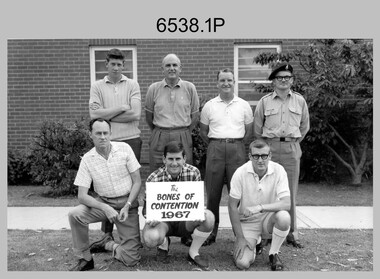
Photograph - Bones Day – Army Survey Regiment Verses RAAF School of Radio at Laverton, Victoria, 1967
... trophy comprising a large bone from a beast housed inside a wooden framed glass case, was awarded to the winner of the day competition. The evening competition often included darts, carpet bowls, hookey, quoits and billiards/snooker. The “little bone” (a mounted chicken bone) was the consolation trophy awarded to the winner of the evening competition. The 3-hour bus trip for the visiting unit on their return was typically very raucous. The history of the Bones Day competition is best described in the booklet titled - Bones of Contention Souvenir Program. 1965. Refer to Item 6267. Royal Australian ...These seven photographs were taken at Bones Day, an annual sports competition between the Army Survey Regiment and the RAAF School of Radio at Laverton in 1967. The two units took turns each year to host the event. The day competition usually comprised basketball, cricket, cross country, golf, sailing, squash, softball, tennis, touch football, rifle shooting, tug-of-war and volleyball. The “big bone” trophy comprising a large bone from a beast housed inside a wooden framed glass case, was awarded to the winner of the day competition. The evening competition often included darts, carpet bowls, hookey, quoits and billiards/snooker. The “little bone” (a mounted chicken bone) was the consolation trophy awarded to the winner of the evening competition. The 3-hour bus trip for the visiting unit on their return was typically very raucous. The history of the Bones Day competition is best described in the booklet titled - Bones of Contention Souvenir Program. 1965. Refer to Item 6267.These seven photographs were taken at Bones Day, an annual sports competition between the Army Survey Regiment and the RAAF School of Radio at Laverton in 1967. The photographs were printed on photographic paper and are part of the Army Survey Regiment’s Collection. The black and white photographs were scanned at 300 dpi. .1) - Photo, black & white, 1967, Golf. ASR Team Back row L to R: Graeme Jeffers, CO LTCOL John Nolan, unidentified, Ace Evans. Front row L to R: unidentified (x2), Stan Vote. .2) - Photo, black & white, 1967, ASR Rifle Shooting Team Back row L to R: Ian ‘Lofty’ Turner, Bill Van Mallenstein, Daryl Hockings CSM, Geoff Haynes, unidentified (x2). Front row L to R: Rob Bridge, Con Tsakalos, unidentified UK exchange officer. .3) - Photo, black & white, 1967, ASR Tennis Team L to R: unidentified, Kalen Sargeant, unidentified, Marj Knight. .4) - Photo, black & white, 1967, ASR Squash Team – Back row L to R: unidentified (x2), Bob Williams, Peter Saunders. Front row L to R: L.D. Clayden, Loretta Hall. .5) - Photo, black & white, 1967, ASR Cricket Team: Back row: unidentified, Bruce Whitecross, Wally Herbst, unidentified (x4). Front row: Paddy Strunks, Don Taylor, unidentified (x2), Warren Chadwick. .6) - Photo, black & white, 1967, ASR Basketball Team Back row L to R: Tom Royal, Geoff Wasser, Gordon Lowery. Front row L to R: unidentified, John McCulloch, Ken ‘Sluggo’ Slater. .7) - Photo, black & white, 1967, ASR Tug-of-War Team Back row unidentified (x4), Tom Pattison, Geoff Wasser, Evan Giri. Front row L to R: unidentified, Ken ‘Sluggo’ Slater, unidentified (x3)..1P to .7P –No personnel are identified.royal australian survey corps, rasvy, army survey regiment, army svy regt, fortuna, bones day -
 Bendigo Military Museum
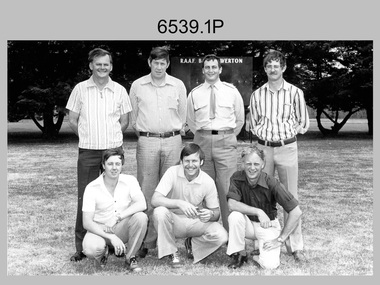
Photograph - Bones Day – Army Survey Regiment Verses RAAF School of Radio at Laverton, Victoria, 1977
... trophy comprising a large bone from a beast housed inside a wooden framed glass case, was awarded to the winner of the day competition. The evening competition often included darts, carpet bowls, hookey, quoits and billiards/snooker. The “little bone” (a mounted chicken bone) was the consolation trophy awarded to the winner of the evening competition. The 3-hour bus trip for the visiting unit on their return was typically very raucous. The history of the Bones Day competition is best described in the booklet titled - Bones of Contention Souvenir Program. 1965. Refer to Item 6267. Royal Australian ...These two photographs were taken at Bones Day, an annual sports competition between the Army Survey Regiment and the RAAF School of Radio at Laverton on the 10th of November 1977. The two units took turns each year to host the event. The day competition usually comprised basketball, cricket, cross country, golf, sailing, squash, softball, tennis, touch football, rifle shooting, tug-of-war and volleyball. The “big bone” trophy comprising a large bone from a beast housed inside a wooden framed glass case, was awarded to the winner of the day competition. The evening competition often included darts, carpet bowls, hookey, quoits and billiards/snooker. The “little bone” (a mounted chicken bone) was the consolation trophy awarded to the winner of the evening competition. The 3-hour bus trip for the visiting unit on their return was typically very raucous. The history of the Bones Day competition is best described in the booklet titled - Bones of Contention Souvenir Program. 1965. Refer to Item 6267.These two photographs were taken at Bones Day, an annual sports competition between the Army Survey Regiment and the RAAF School of Radio at Laverton on the 10th of November 1977. The photographs were printed on photographic paper and are part of the Army Survey Regiment’s Collection. The black and white photographs were scanned at 300 dpi. .1) - Photo, black & white, 1977, ASR Golf Team Back row L to R: Alf Behr, Graeme Jeffers, Lloyd Binion, unidentified. Front row L to R: Ian Marner, Peter Warwick, Roy Morgan. .2) - Photo, black & white, 1977, ASR Squash Team Back row L to R: unidentified (x4), Rob John, Dennis Puniard. Middle row L to R: Kerry Brown, unidentified, Tony Spurling, Errol Fletcher. Front row L to R: Terry Danger, unidentified (x2), Lynn Johnson, unidentified..1P to .2P –No personnel are identified.royal australian survey corps, rasvy, army survey regiment, army svy regt, fortuna -
 Bendigo Military Museum
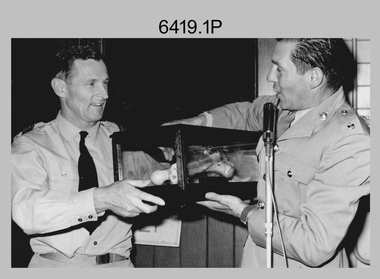
Photograph - Bones Day - Army Survey Regiment Versus RAAF School of Radio, 1969
... Day competition is best described in the booklet titled - Bones of Contention Souvenir Program. 1965. Refer to Item 6267. The winner of the two trophies in 1969 is not known. MAJ Donald Ridge was probably on this occasion was the 2IC of the Army Headquarters Survey Regiment, He was subsequently promoted to the rank of LTCOL was the CO of the unit from 1972 to 1973; and continued as the CO of the renamed Army Survey Regiment from 1974 to 1975. He served from 1946 to 1975. Royal Australian ...These two photographs were taken at Bones Day, an annual sports competition between the Army Survey Regiment and the RAAF School of Radio in 1969. The two units took turns each year to host the event and on this occasion was held at the RAAF School of Radio, Laverton. The day competition usually comprised basketball, cross country, golf, sailing, squash, softball, tennis, touch football, rifle shooting, tug-of-war and volleyball. The “big bone” trophy comprising a large bone from a beast housed inside a wooden framed glass case, was awarded to the winner of the day competition. The evening competition often included darts, carpet bowls, hookey, quoits and billiards/snooker. The “little bone” (a mounted chicken bone) was the consolation trophy awarded to the winner of the evening competition. The 3-hour bus trip for the visiting unit on their return was typically very raucous. The history of the Bones Day competition is best described in the booklet titled - Bones of Contention Souvenir Program. 1965. Refer to Item 6267. The winner of the two trophies in 1969 is not known. MAJ Donald Ridge was probably on this occasion was the 2IC of the Army Headquarters Survey Regiment, He was subsequently promoted to the rank of LTCOL was the CO of the unit from 1972 to 1973; and continued as the CO of the renamed Army Survey Regiment from 1974 to 1975. He served from 1946 to 1975.These two photographs were taken at Bones Day, an annual sports competition between the Army Survey Regiment the RAAF School of Radio in 1969. The photographs were printed on photographic paper and are part of the Army Survey Regiment’s Collection. They were scanned at 300 dpi. .1) - Photo, black & white, 1969. L to R: Unidentified CO or representative from the RAAF School of Radio, MAJ Don Ridge. .2) - Photo, black & white, 1969. L to R: MAJ Don Ridge, unidentified CO or representative from the RAAF School of Radio..1P to .9P – no annotationsroyal australian survey corps, rasvy, army survey regiment, army svy regt, fortuna, asr, bones day, raaf school of radio -
 Bendigo Military Museum
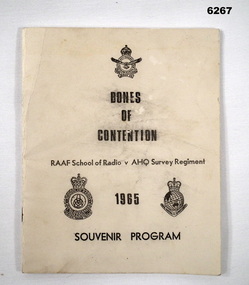
Booklet - Bones of Contention Souvenir Program 1965, RAAF School of Radio, 1965
... The day major sports trophy was the "Large Bone Trophy" and the evening minor sports trophy was the "Little Bone Trophy". Royal Australian ...This is the program for the annual sports competition between the RAAF School of Radio, Laverton and the AHQ Survey Regiment, Bendigo. The location of the sports day alternated annually between the two units. The day major sports trophy was the "Large Bone Trophy" and the evening minor sports trophy was the "Little Bone Trophy".Booklet, B4 size, cream covered card, title, badges of RAAF School of Radio and Royal Australian Survey Corps, 30 pages, caricatures for each sport contested. The pages have been photographed and are stored on a USB Digital Storage Device. The 30 page images have been converted into a video (.mp4) format and are also stored on the USB. The video is 2.4Mb in size and runs for 5 minutes.Forward by Wing Commander E.R. Hall, Commanding Officer RAAF School of Radio.royal australian survey corps, rasvy, fortuna, army survey regiment, army svy regt, asr, raaf, raaf school of radio, bones day -
 Bendigo Military Museum
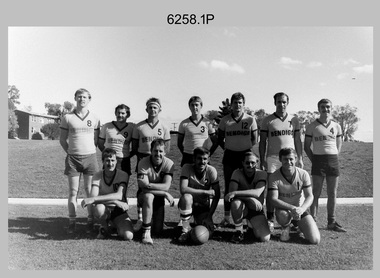
Photograph - Bones Day - Army Survey Regiment Versus RAAF School of Radio. Fortuna, Bendigo, c1982
... trophy comprising a large bone from a beast housed inside a wooden framed glass case, was awarded to the winner of the day competition. The evening competition often included darts, carpet bowls, hookey, quoits and billiards/snooker. The “little bone” (a mounted chicken bone) was the consolation trophy awarded to the winner of the evening competition. The 3-hour bus trip for the visiting unit on their return was typically very raucous. The history of the Bones Day competition is best described in the booklet titled - Bones of Contention Souvenir Program. 1965. Refer to Item 6267. Royal Australian ...These four photographs were taken at Bones Day, an annual sports competition between the Army Survey Regiment and the RAAF School of Radio at Bendigo c1982. The two units took turns each year to host the event. The day competition usually comprised basketball, cross country, golf, sailing, squash, softball, tennis, touch football, rifle shooting, tug-of-war and volleyball. The two sports featuring in these photos are touch football and tug-of-war. The “big bone” trophy comprising a large bone from a beast housed inside a wooden framed glass case, was awarded to the winner of the day competition. The evening competition often included darts, carpet bowls, hookey, quoits and billiards/snooker. The “little bone” (a mounted chicken bone) was the consolation trophy awarded to the winner of the evening competition. The 3-hour bus trip for the visiting unit on their return was typically very raucous. The history of the Bones Day competition is best described in the booklet titled - Bones of Contention Souvenir Program. 1965. Refer to Item 6267.These four photographs were taken at Bones Day, an annual sports competition between the Army Survey Regiment and the RAAF School of Radio at Bendigo c1982. The photographs are on 35mm negative film. They are part of the Army Survey Regiment’s Collection. The photographic negatives were scanned at 96 dpi. There are additional photos in this set that have not been scanned due to poor quality or low historical value. .1) - Photo, black & white, 1982, Touch Football Team Back Row L to R: Brian Fauth, Bruce Bowers, Bob Mason, Paul Baker, Danny Galbraith, John Hook, Scott Payne. Front Row L to R: Roy Hicks, Peter Imeson, Alan Glanville, John Gilbert, Wally Chilcott. .2) - Photo, black & white, 1982, Tug-of-War Team Back Row L to R: Cliff Webb, Peter Treble, John Lane, Tom Pattison, Andy Wilson, Rick Warren, Rusty Williams, Brian Paul. Front Row L to R: Brian Fauth, Rick Downie, unidentified, Ken Slater, Rhys De Laine, John Smith, unidentified. .3) - Photo, black & white, 1982, Tug-of-War Team L to R: Peter Treble, Brian Paul, Rusty Williams, Rhys De Laine, John Lane, unidentified, John Smith. Army personnel in background standing L to R: Rick van der Bom, Paul Hopes, Ian Nelson, Mick Dempster, John ‘Flash’ Anderson, Geoff Havelberg, John ‘Stormy’ Tempest, Bruce Gordon, Dan Cirsky, Neil Jones, Gerry Gates, Peter Main, Bob Thrower, Barry Miller, Gill Park. Army personnel in background seated L to R: Roger Pearson, Mick Gillham, Penny Knott, Leanne Shirley. .4) - Photo, black & white, 1982, Tug-of-War Team L to R: Rick Warren, Cliff Webb, Andy Wilson, Peter Treble, Brian Paul, Rusty Williams, Rhys De Laine, John Lane. Army personnel in background standing L to R: Rick van der Bom, Ian Nelson, Mick Dempster. .1P to .4P – No personnel are identified.royal australian survey corps, rasvy, army survey regiment, army svy regt, fortuna, raaf school of radio, bones day -
 Bendigo Military Museum
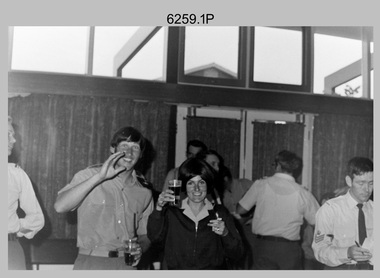
Photograph - Bones Day - Army Survey Regiment Versus RAAF School of Radio, Laverton, c1970s
... trophy comprising a large bone from a beast housed inside a wooden framed glass case, was awarded to the winner of the day competition. The evening competition often included darts, carpet bowls, hookey, quoits and billiards/snooker. The “little bone” (a mounted chicken bone) was the consolation trophy awarded to the winner of the evening competition. The 3-hour bus trip for the visiting unit on their return was typically very raucous. The history of the Bones Day competition is best described in the booklet titled - Bones of Contention Souvenir Program. 1965. Refer to Item 6267. Royal Australian ...These seven photographs were taken at Bones Day, an annual sports competition between the Army Survey Regiment and the RAAF School of Radio c1970s. The two units took turns each year to host the event and on this occasion was held at the RAAF School of Radio, Laverton. The day competition usually comprised basketball, cross country, golf, sailing, squash, softball, tennis, touch football, rifle shooting, tug-of-war and volleyball. The “big bone” trophy comprising a large bone from a beast housed inside a wooden framed glass case, was awarded to the winner of the day competition. The evening competition often included darts, carpet bowls, hookey, quoits and billiards/snooker. The “little bone” (a mounted chicken bone) was the consolation trophy awarded to the winner of the evening competition. The 3-hour bus trip for the visiting unit on their return was typically very raucous. The history of the Bones Day competition is best described in the booklet titled - Bones of Contention Souvenir Program. 1965. Refer to Item 6267.These seven photographs were taken at Bones Day, an annual sports competition between the Army Survey Regiment and the RAAF School of Radio at Laverton, Victoria c1970s. The photographs are on 35mm negative film. They are part of the Army Survey Regiment’s Collection. The photographic negatives were scanned at 96 dpi. There are additional photos taken at the time that have not been scanned. .1) - Photo, black & white, c1970s, L to R: Unknown, Heather Slater and unidentified RAAF personnel. .2) & .3) - Photo, black & white, c1970s, Bill Friswell playing snooker. .4) & .5) - Photo, black & white, c1970s, Bus trip back to Bendigo. Gordon Lowery, unidentified personnel. .6) - Photo, black & white, c1970s, Bus trip back to Bendigo. L to R: Peter Tieman (asleep), Phil Batcheldor, background Bill Friswell (at rear), Steve Gloster, Gordon Lowery (standing), Graham Bradtke, Andy Covington, Greg Towne, TJ Wicker, Roger Pearson (asleep), unidentified personnel. .7) - Photo, black & white, c1970s, Bus trip back to Bendigo. L to R: Peter Tieman (asleep), Phil Batcheldor, background Bill Friswell (at rear), Gordon Lowery (standing), Graham Bradtke, Greg Towne, TJ Wicker, Roger Pearson (asleep), unidentified personnel.1P to .7P – No personnel are identified.royal australian survey corps, army svy regt, rasvy, army survey regiment, raaf school of radio, asr, bones day -
 Bendigo Military Museum
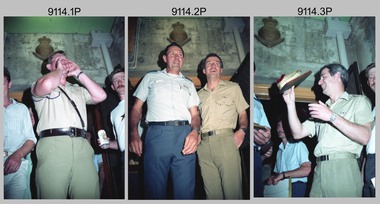
Photograph - Bones Day - Army Survey Regiment versus RAAF School of Radio, Bendigo, 1990
... trophy awarded to the winner of the evening competition. The “O.H.A.R.A Rock” seen in photos 9114.15P and 9114.16P was awarded to the shooter for the lowest score in rifle shooting. He had to lug it with him for the rest of the evening. The 3-hour bus trip for the visiting unit on their return was typically very raucous. The history of the Bones Day competition is best described in the booklet titled - Bones of Contention Souvenir Program. 1965. Refer to Item 6267. Royal Australian ...These 33 photographs were taken at Bones Day, an annual sports competition between the Army Survey Regiment and the RAAF School of Radio in November 1990. The two units took turns each year to host the event. The day competition usually comprised basketball, cross country, golf, sailing, squash, softball, tennis, touch football, rifle shooting, tug-of-war and volleyball. The “big bone” trophy comprising a large bone from a beast housed inside a wooden framed glass case, was awarded to the winner of the day competition. The evening competition often included darts, carpet bowls, hookey, quoits and billiards/snooker. The “little bone” (a mounted chicken bone) was the consolation trophy awarded to the winner of the evening competition. The “O.H.A.R.A Rock” seen in photos 9114.15P and 9114.16P was awarded to the shooter for the lowest score in rifle shooting. He had to lug it with him for the rest of the evening. The 3-hour bus trip for the visiting unit on their return was typically very raucous. The history of the Bones Day competition is best described in the booklet titled - Bones of Contention Souvenir Program. 1965. Refer to Item 6267. This collection of 33 photographs was taken at Bones Day, an annual sports competition between the Army Survey Regiment (ASR) and the RAAF School of Radio (SOR), held at Bendigo in November 1990. The photographs are on 35mm negative film and were scanned at 2400 dpi. They are part of the Army Survey Regiment’s Collection. .1) - Photo, colour, 1990, ASR’s RSM WO1 Neville Stone asked the crowd for silence. .2) - Photo, colour, 1990, L to R: unidentified CO SOR, CO ASR LTCOL Rene van den Tol. .3) - Photo, colour, 1990, CO ASR LTCOL Rene van den Tol holds up an unidentified award. .4) - Photo, colour, 1990, Presentation of an unidentified award - L to R: unidentified CO SOR, CO ASR LTCOL Rene van den Tol, unidentified. .5) - Photo, colour, 1990, Presentation of an unidentified award - L to R: unidentified CO SOR, CO ASR LTCOL Rene van den Tol. .6) - Photo, colour, 1990, Awards presentation - L to R: unidentified CO SOR, CO ASR LTCOL Rene van den Tol, unidentified. .7) - Photo, colour, 1990, Presentation of the ‘Big Bone’ award - L to R: unidentified CO SOR, CO ASR LTCOL Rene van den Tol, unidentified. .8) - Photo, colour, 1990, CO ASR LTCOL Rene van den Tol holds up the ‘Big Bone’ award. .9) & .10) - Photo, colour, 1990, Unidentified Army and RAAF personnel at the Awards presentations. .11) & .12) - Photo, colour, 1990, L to R: the unidentified CO SOR presents a framed photo of RAAF aircraft to CO ASR LTCOL Rene van den Tol. ASR’s RSM WO1 Neville Stone is partially seen on far right. .13) - Photo, colour, 1990, L to R: CO ASR LTCOL Rene van den Tol, unidentified CO SOR with the ‘Big Bone’ award. .14) - Photo, colour, 1990, CO ASR LTCOL Rene van den Tol, unidentified CO SOR with an unidentified award. .15) - Photo, colour, 1990, L to R: unidentified shooter with the “O.H.A.R.A Rock” award, CO ASR LTCOL Rene van den Tol. .16) - Photo, colour, 1990, unidentified shooter with the “O.H.A.R.A Rock” award. .17) - Photo, colour, 1990, L to R: LCPL Nikki Midgley and SPR Del Madge. .18) - Photo, colour, 1990, L to R: unidentified (x3), SPR Del Madge. .19) - Photo, colour, 1990, L to R: CPL John ‘Flash’ Anderson, unidentified (x7), SPR Del Madge, unidentified. .20) - Photo, colour, 1990, L to R: LCPL Chris Woodman, SPR Del Madge. .21) - Photo, colour, 1990, L to R: LCPL Chris Woodman, WO2 Rhys De Laine. .22) - Photo, colour, 1990, L to R: SGT Brian Fauth, SGT Dale Hudson, WO1 Trevor Osborne. .23) - Photo, colour, 1990, L to R: WO1 Trevor Osborne, CO ASR LTCOL Rene van den Tol, WO1 Kevin ‘Sluggo’ Slater. In background - ASR’s RSM WO1 Neville Stone. .24) - Photo, colour, 1990, L to R: SSGT Greg Byers, WO1 Kevin ‘Sluggo’ Slater. .25) - Photo, colour, 1990, L to R: unidentified, SPR Dawn Hoadley, unidentified. .26) - Photo, colour, 1990, L to R: SPR Tony Hilbig, unidentified. .27) - Photo, colour, 1990, L to R: Ken Delmenico, unidentified. .28) - Photo, colour, 1990, unidentified (x4). .29) - Photo, colour, 1990, unidentified (x3). .30) - Photo, colour, 1990, L to R: unidentified, SPR Lee Palfrey. .31) - Photo, colour, 1990, in foreground L to R: unidentified (x2), SPR Lee Palfrey, unidentified. In background L to R: SPR Gavin Craggs, unidentified, SGT Gary Kerr, unidentified (x4). .32) - Photo, colour, 1990, L to R: unidentified, LCPL Chris Woodman, unidentified, SPR Simone Rodgers. .33) - Photo, colour, 1990, unidentified airman..1P to .33P – No personnel are identified. ‘Bones Day 1990’ is annotated on the plastic negative sleeveroyal australian survey corps, rasvy, army survey regiment, army svy regt, fortuna, bones day -
 Kastellorizian Association of Victoria
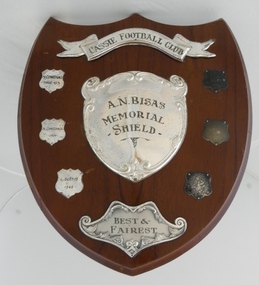
Award, A N Bisas Memorial Shield, 1963
... trophy was awarded to the Best & Fairest for the 3 years of the club's duration - N Constance 1963, N Constance 1964 and L Scotis 1965. This item is of social significance as it represents the hey day of the club, with both an active ladies and men's group supporting the youth. Membership was at its peak across the organisation and the generations, with the sporting teams becoming a key focus of social events. This trophy also symbolises the assimilation of the Castellorizians in Australia ...The Cassie Football Club was part of the Young Men's Castellorizian Club (YMCS), 1962 - 1965, an organisation established within the Castellorizian Association of Victoria to cater for the sporting, social and leisure pursuits of the second and third generations of the Castellorizian youth in Melbourne. Whilst the football team was the main focus for both players and supporters, the YMCS also fielded cricket and debating teams. This football trophy was awarded to the Best & Fairest for the 3 years of the club's duration - N Constance 1963, N Constance 1964 and L Scotis 1965. This item is of social significance as it represents the hey day of the club, with both an active ladies and men's group supporting the youth. Membership was at its peak across the organisation and the generations, with the sporting teams becoming a key focus of social events. This trophy also symbolises the assimilation of the Castellorizians in Australia in fielding teams in the typical Australian sports of Australian Rules Football and cricket.Wooden Shield with 9 silver stirling plaques attached, including a ribbon across the top and the bottom, a central shield, and 3 small shields either side of the central shield. Six silver engravings including one across the top "CASSIE FOOTBALL CLUB," another across the bottom "BEST & FAIREST," and on the three smaller shields to the left, for the top one "N CONSTANCE 1962-1963," on the middle one "N CONSTANCE 1964" and on the bottom shield "L SCOTIS 1965." On the back of the shield price marked as 6 pounds, 6 shillings shield, football trophy, australian greeks in sport -
 National Vietnam Veterans Museum (NVVM)
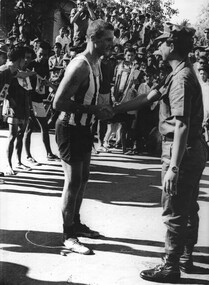
Photograph, Gibbons, Denis, Great Hung Vuong Day Roadrace
... Australian infantry battalions, posting compelling war images from within many combat zones before being flown out in late November 1970 after sustaining injuries. The images held within the National Vietnam Veterans Museum make up the Gibbons Collection. Photograph 1st SAS Sqn Baria Phuoc Tuy Province Trooper Jack Thurgar Col Tu Gibbons Collection Catalogue Great Hung Vuong Day Road Race 1st Special Air Squandron Denis Gibbons A black and white photograph of taken at Baria, Phuoc Tuy Province, South Vietnam, Trooper Jack Thurgar 1st Special Air Squandron is congratulated by Col Tu after being presented with the winners trophy following his first place win in the Great Hung Vuong Day Road Race - 15 April1970 Great Hung Vuong Day Roadrace Photograph Gibbons, Denis ...Denis Gibbons (1937 – 2011) Trained with the Australian Army, before travelling to Vietnam in January 1966, Denis stayed with the 1st Australian Task Force in Nui Dat working as a photographer. For almost five years Gibbons toured with nine Australian infantry battalions, posting compelling war images from within many combat zones before being flown out in late November 1970 after sustaining injuries. The images held within the National Vietnam Veterans Museum make up the Gibbons Collection. A black and white photograph of taken at Baria, Phuoc Tuy Province, South Vietnam, Trooper Jack Thurgar 1st Special Air Squandron is congratulated by Col Tu after being presented with the winners trophy following his first place win in the Great Hung Vuong Day Road Race - 15 April1970photograph, 1st sas sqn, baria, phuoc tuy province, trooper jack thurgar, col tu, gibbons collection catalogue, great hung vuong day road race, 1st special air squandron, denis gibbons -
 National Vietnam Veterans Museum (NVVM)
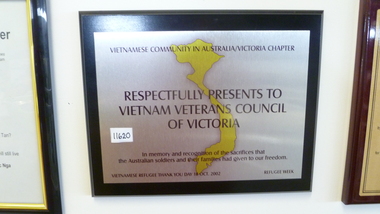
Plaque, Respectfully presents To vietnam veterans Council Of Victoria
... Australian Soldiers had given to our freedon. "Vietnamese Refugee Thank You Day" Respectfully presents To vietnam veterans Council Of Victoria. Plaque Plaque Persinality Trophies ...vietnam Community In Australia/Victoria Chapter. Respectfully presents to Vietnam Veterans Council of Victoria "In memory of the sacrifices of Australian Soldiers had given to our freedon. "Vietnamese Refugee Thank You Day"plaque, vietnam refugees -
 Port Melbourne Historical & Preservation Society
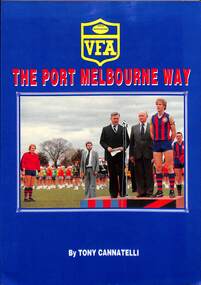
Book, Tony CANNATELLI, The Port Melbourne Way, 1989
... Sport - Australian Rules Football VFA Victorian Football Association Tony CANNATELLI Stephen James ALLENDER Gary BRICE Charlie DANIELS PMFC Port Melbourne Football Club Written by a dedicated member of the Port Melbourne Football Club,Tony CANNATELLI, this book documents the history of the Club up to 1989. It is lavishly illustrated with black & white photographs of players and support staff. The dark blue cover has the title in red below the VFA logo and a photograph taken by Tony CANNATELLI at the Junction Oval, St Kilda on VFA Grand Final day, 21 Sep 1980 showing the 1980 J.J. Liston Trophy ...Written by a dedicated member of the Port Melbourne Football Club,Tony CANNATELLI, this book documents the history of the Club up to 1989. It is lavishly illustrated with black & white photographs of players and support staff. The dark blue cover has the title in red below the VFA logo and a photograph taken by Tony CANNATELLI at the Junction Oval, St Kilda on VFA Grand Final day, 21 Sep 1980 showing the 1980 J.J. Liston Trophy winner, Stephen ALLENDER standing on a dias in Port Melbourne uniform with two men is suits. Port Melbourne captain/coach, Gary BRICE standing at extreme left and Port Melbourne 2nds player, Charlie DANIELS is at the right of the picture behind ALLENDER. DANIELS won the Reserves Best and Fairest.sport - australian rules football, vfa, victorian football association, tony cannatelli, stephen james allender, gary brice, charlie daniels, pmfc, port melbourne football club -
 St Patrick's College
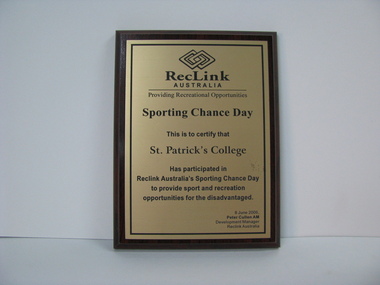
Wooden plaque, Kingston Trophies & Giftware, 2006
... RecLink Australia / Providing Recreational Opportunities / Sporting Chance Day / This is to certify that / St Patrick's College / Has participated in / RecLink Australia's Sporting Chance Day / to provide sport and recreation / opportunities for the disadvantaged. / 8 June 2006. Peter Cullen AM / Development Manager / RecLink Australia. Wooden plaque with brass plate on front. Wooden plaque Kingston Trophies ...Wooden plaque with brass plate on front.RecLink Australia / Providing Recreational Opportunities / Sporting Chance Day / This is to certify that / St Patrick's College / Has participated in / RecLink Australia's Sporting Chance Day / to provide sport and recreation / opportunities for the disadvantaged. / 8 June 2006. Peter Cullen AM / Development Manager / RecLink Australia. -
 Bendigo Military Museum
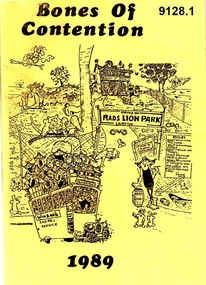
Booklet - Bones of Contention Souvenir Program 1989, RAAF School of Radio, 1989
... day major sports trophy was the "Large Bone Trophy" and the evening minor sports trophy was the "Little Bone Trophy". The day sports contested were: Basketball, Cross Country, Golf, Hockey, Indoor Cricket, Lawn Bowls, Orienteering, Sailing, Softball, Squash, Tennis, Touch football, Tug of War and Volleyball. The Night Sports contested were: Carpet Bowls, Darts, Hookey, Quoits, Snooker and Table Tennis. 9128.1 Cover of Booklet 9128.2 List of Winners since 1950 Royal Australian ...This is the program for the annual sports competition between the RAAF School of Radio, Laverton and the AHQ Survey Regiment, Bendigo. The location of the sports day alternated annually between the two units. The day major sports trophy was the "Large Bone Trophy" and the evening minor sports trophy was the "Little Bone Trophy". The day sports contested were: Basketball, Cross Country, Golf, Hockey, Indoor Cricket, Lawn Bowls, Orienteering, Sailing, Softball, Squash, Tennis, Touch football, Tug of War and Volleyball. The Night Sports contested were: Carpet Bowls, Darts, Hookey, Quoits, Snooker and Table Tennis. 9128.1 Cover of Booklet 9128.2 List of Winners since 1950 Booklet, B5 size, cream covered card, title, Bones of Contention, 32 pages, caricatures for each sport contested. Stapled in the spline.Forward by Wing Commander JM Dallimore, Commanding Officer RAAF School of Radio.royal australian survey corps, rasvy, fortuna, army survey regiment, army svy regt, asr, raaf, raaf school of radio, bones day -
 Warrnambool and District Historical Society Inc.
Trophy, W&D United Friendly Benefit Quoits 1933, 1933
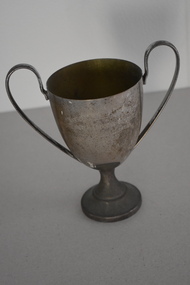
... The Australian Natives Association (A.N.A.) the winner of this trophy was set up in Warrnambool in the late 19th century and it was an active society with regular meetings, discussion groups, lectures and campaigns for the social justice issues of the day. ...The Australian Natives Association (A.N.A.) the winner of this trophy was set up in Warrnambool in the late 19th century and it was an active society with regular meetings, discussion groups, lectures and campaigns for the social justice issues of the day. ...This is a trophy awarded by an association of Friendly Societies in Warrnambool in 1933. Friendly or Benefit Societies have operated in Warrnambool since 1860 when the Manchester Unity Independent Order of Oddfellows Lodge was formed. Benefit societies such as this were set up mainly for social reasons and to assist members in times of sickness or to provide insurance in case of illness or hardship. Other societies had specific aims such as the promotion of temperance or allegiance to a particular church or country. The Australian Natives Association (A.N.A.) the winner of this trophy was set up in Warrnambool in the late 19th century and it was an active society with regular meetings, discussion groups, lectures and campaigns for the social justice issues of the day. The A.N.A. in Australia was influential in promoting nationalism and campaigning for Federation. The A.N.A merged with the M.U.I.O.O.F some years ago and operates today as the benefit group, Australia Unity. The trophy won by A.N.A. in 1933 was for quoits, a popular indoor game in the 1930s and still played today, mainly on social occasions. This trophy is of interest as it dates from the 1930s and is connected with the Warrnambool Friendly Societies of the time and especially the Australian Natives Association (A.N.A.)This is an electro plated nickel silver cup with two side handles, a short stem and a round silver base. An inscription is on one side of the cup. The cup is much stained. ‘Warrnambool & District United Friendly Benefit Societies Association Quoits 1933 Won by A.N.A.’friendly societies warrnambool, australian natives association warrnambool -
 Peterborough History Group
Plaque - Fred Moore Trophy
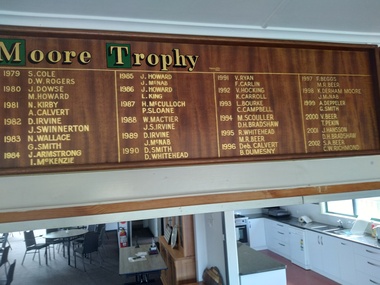
... That weekend, the Australia Day long weekend, ia always a family weekend - the sandcastle competition is held, the tennis tournament is held, the cricket match against Timboon (played at Port Campbell) is played. This Canadian foursomes golf event is also held on this sporting weekend and is a very popular and social event. Peterborough Peterborough Golf Club Fred Moore Trophy ...Fred Moore was a long time holiday maker with a house in Robertson St, whose children continue to visit. This event is played on the long weekend in January and is very popular as non handicapped players can play. Draw for partners, no handicaps required, and it is a 12 hole event. It is the only time the practice tee is used in an official event, it is used as the first tee and the first becomes the 10th. Winners: 1961 F Calvert T Austin 1962 H McCulloch M Howard 1963 F Calvert T Austin, 1964 J Moore J Irvine, 1965 O Horn W Sinclair, 1966 B Nash H Lucas, 1967 P Nash T Austin, 1968 M Moore J Wilson, 1969 J Chirnside J Wilson, 1970 J Gray P Clark, 1971 D Irvine L Hobson, 1972 K Morrison B cook, 1973 G. Paton T Austin, 1974 K Harris DW Rogers, 1975 J Neville DW Rogers, 1976 F Calvert JS Irvine, 1977 S Clark TL Austin, 1978 J McNabb JS Irvine, 1979 S Cole DW Rogers 1890 J. Dowse, M Howard, 1981 N Kirby A Calvert, 1982 D Irvine J Swinnerton, 1983 N Wallace G Smith, 1984 J Armstrong J Mckenzie, 1985 J Howard L King, 1986 J Howard L king, 1987 H McCulloch P Sloan, 1988 W Mactier JS Irvine, 1989 D Irvine J McNab, 1990 D Smith D Whitehead, 1991 V Ryan F Carlin, 1992 V Hocking K Carroll, 1993 L Bourke C Campbell, 1994 M Scouller DH Bradshaw, 1995 R Whitehead M R Beer, 1996 Deb Calvert B Dumesny, 1997 F Beggs MR Beer, 1998 K Derham- Moore J McNab, 1999 A Deppeler G Smith 2000 V Beer T Pekin, 2001 J Hansson DH Bradshaw, 2002 SABeer CW Richmond, 2003 A Christian M Fisher, 2004 M Hesketh M Fisher, 2005 C Bell G Smith, 2006 T Smith P Watson, 2007 K Burl MBeer, 2008 J Manderson M Beer, 2009 A Gilson L Beer, 2010 L Hills B Dumesny, 2011 M Campbell D Dumesny, 2012 V Beer Dumesny, 2013 J Barrett M Bowden, 2014 C Cass G McGorlick, 2015 M McGorlick W Couch, 2016 C Leishman M Fisher 2017 C Bell D Laherty, 2018 J Barrett W Couch, 2019 J Muhor B Dumesny, 2020 M Hammond T Irvine, 2021 K Matheson H PetersSignificant because Fred Moore was a member and great supporter of the Golf Club. That weekend, the Australia Day long weekend, ia always a family weekend - the sandcastle competition is held, the tennis tournament is held, the cricket match against Timboon (played at Port Campbell) is played. This Canadian foursomes golf event is also held on this sporting weekend and is a very popular and social event. Two rectangular wooden honour boards, situated adjacent to each other, wih goldleaf namesList of winners of the Fred Moore Trophypeterborough, peterborough golf club, fred moore trophy, sporting honour boards, golf tournament -
 Peterborough History Group
Plaque - Peterborough Golf Club Sponsor's Day Annual Golf Tournament
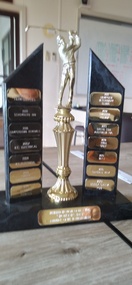
... Peterborough Golf Club sponsors day annual golf tournament winners are 2004 Roberts Farm Supplies, 2005 Schomberg Inn, 2006 Camperdown Removals, 2007 KC Electrica,l 2008 KC Electrica,l 2009 Loader Construction, 2010 Plozza's Pirates, 2011 Hampden Veterinary Clinic, 2012 Timboon Premix, 2013 Green Con Australia P/L, 2014 Ryan golf, 2015 WFI, 2016 Sungold Milk, 2017 Boggy Creek Pub. Significant as it provides a snapshot of club sponsors over the years. Peterborough Peterborough Golf Club Golf Tournament Sporting Honour Boards A plaque on the front engraved with Peterborough Golf Club "Sponsors Day" Annual Golf Tournament. Trophy ...This event was held as a thankyou to the sponsors of the golf club. Peterborough Golf Club sponsors day annual golf tournament winners are 2004 Roberts Farm Supplies, 2005 Schomberg Inn, 2006 Camperdown Removals, 2007 KC Electrica,l 2008 KC Electrica,l 2009 Loader Construction, 2010 Plozza's Pirates, 2011 Hampden Veterinary Clinic, 2012 Timboon Premix, 2013 Green Con Australia P/L, 2014 Ryan golf, 2015 WFI, 2016 Sungold Milk, 2017 Boggy Creek Pub.Significant as it provides a snapshot of club sponsors over the years.Trophy with a central sculpture of a golfer and pylons on either side with the winners' name platesA plaque on the front engraved with Peterborough Golf Club "Sponsors Day" Annual Golf Tournament.peterborough, peterborough golf club, golf tournament, sporting honour boards -
 Sunshine and District Historical Society Incorporated
Ephemera - Scouting XVI World Jamboree 1988 Performances Victorian Branch Scout Band Trophy
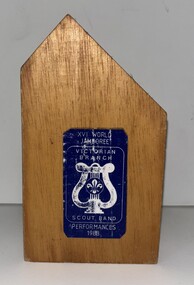
... trophy is from XVI (16th) Jamboree, which was held from 30 December 1987 to 7 January 1988 at Cataract Scout Park, near Sydney, Australia. Key highlights from this jamboree include. - First in the Southern Hemisphere: This was the first World Scout Jamboree held south of the equator, and the first to shift from the traditional August schedule to January to align with the Australian summer. - Theme: Bringing the World Together — a fitting motto for an event that welcomed 14,434 Scouts from 84 countries, plus 13,000 visitors on Visiting Day...trophy is from XVI (16th) Jamboree, which was held from 30 December 1987 to 7 January 1988 at Cataract Scout Park, near Sydney, Australia. Key highlights from this jamboree include. - First in the Southern Hemisphere: This was the first World Scout Jamboree held south of the equator, and the first to shift from the traditional August schedule to January to align with the Australian summer. - Theme: Bringing the World Together — a fitting motto for an event that welcomed 14,434 Scouts from 84 countries, plus 13,000 visitors on Visiting Day ...Scouts from around the world gather for cultural exchange, outdoor activities, leadership development, and global friendship. The first jamboree was held in London in 1921, and they held in different counties every four years. This trophy is from XVI (16th) Jamboree, which was held from 30 December 1987 to 7 January 1988 at Cataract Scout Park, near Sydney, Australia. Key highlights from this jamboree include. - First in the Southern Hemisphere: This was the first World Scout Jamboree held south of the equator, and the first to shift from the traditional August schedule to January to align with the Australian summer. - Theme: Bringing the World Together — a fitting motto for an event that welcomed 14,434 Scouts from 84 countries, plus 13,000 visitors on Visiting Day. - Opening Ceremony: Held at midnight on 31 December 1987, it was the first official event of Australia’s Bicentenary celebrations, adding national significance to the global gathering Wooden trophy with blue stick-on plaque on frontXVI World Jamboree 1988 Performances Victorian Branch Scout Bandscouting, scouts, cataract scout park, jamboree -
Tatura Irrigation & Wartime Camps Museum
Rose Bowl, 1956
... trophy was initiated at T.LC. in 1956, donated by Mr H.S. (Tib) Reilly to attract prominent district & Melbourne players to the annual tournament on Australia Day weekend. ...trophy was initiated at T.LC. in 1956, donated by Mr H.S. (Tib) Reilly to attract prominent district & Melbourne players to the annual tournament on Australia Day weekend. ...This trophy was initiated at T.LC. in 1956, donated by Mr H.S. (Tib) Reilly to attract prominent district & Melbourne players to the annual tournament on Australia Day weekend. The conditions were that any player winning the event 3 times would hold the trophy permanently and Mr Reilly undertook to provide a replacement. Mrs Val Constable (nee Huxtable) won the trophy outright for the first time in 1962 and she has donated it to the museum to honour Mr Reilly's contribution to the Tatura community. Mr Reilly was a prominent businessman, J.P. and very active in promoting the development of Tatura. Winners from 1956-1962: 1956 Mrs N. Nethersole, 1957 Miss P. Radford, 1958 Miss V. Huxtable, 1959 Mrs D. Constable, 1960 Mrs N. Nethersole, 1961 Miss M. Burke, 1962 Mrs D. Constable. Tatura Lawn Tennis Club Mr H.S. Reilly T.L.T.C. Annual Tennis Tournament (Australia Day).Large silver rose bowl provided by Mr H.S. Reilly to promote the annual tennis tournament (Australia Day). First presented in 1956 and won in perpetuity in 1962. Winners' names inscribed for each year.Tatura Lawn Tennis Club. Ladies Open Singles Championship H.S. Reilly Rose Bowltatura, recreations, sports, tatura lawn tennis club, australia day tennis tournament, h s reilly, val constable nee hustable, mrs n nethersole, miss p radford, mrs d constable, miss m burke
