
Showing 60 items matching "australian cruiser"
-
 Flagstaff Hill Maritime Museum and Village
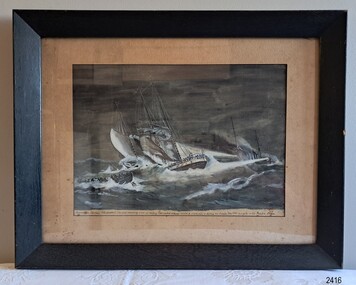
Print - Lithograph, sea rescue, R.N. Duffield, Australian cruiser “MELBOURNE” (Tons 5600) rescuing crew of sinking four-masted schooner “HELEN B. STERLING” of Halifax NS Canada, Tons 1343 in a gale in the Pacific Ocean, 19-11-1924
... Australian cruiser “MELBOURNE” (Tons 5600) rescuing crew of sinking four-masted schooner “HELEN B. ......Australian Cruiser...Officers from the Royal Australian Navy, Captain Henry J Feakes (later Rear-Admiral) and Commander Wilfrid Ward Hunt, were on board the light cruiser, HMAS Melbourne (1913-1928), when it left Sydney for New Zealand. ...STERLING / HALIFAX N S” [Nova Scotia, Canada] Handwritten below the print: “AUSTRALIAN CRUISER “MEMBOURNE” (Tons 5600) rescuing crew of sinking four-masted schooner “HELEN B. ...A Frith of Footscray, Melbourne framed it. Australian cruiser “MELBOURNE” (Tons 5600) rescuing crew of sinking four-masted schooner “HELEN B. ...This framed lithograph print in watercolour and gouache was produced on November 19th, 1924, by 20th-century marine artist, Mr R.N. Duffield. It depicts the event of a sea rescue that took place two years earlier. The framer was A.L. Frith of Footscray, Melbourne, who actively advertised from 1933 to 1935. The now disbanded Shiplovers' Society of Victoria (1930-2018) donated the print, and it seems likely that this print was framed for that organisation. This graphic image shows the conditions in which the rescue from the wrecked Helen B. Sterling happened. Captain George Harris was master of the American-owned, four-masted windjammer. His wife Edith and their ten-year-old son Leslie were on board, along with a crew of fifteen seamen. The ship set off from Newcastle, NSW, on January 5th, 1922, loaded with a cargo of coal to deliver to the Society Islands and on to San Francisco. Young Leslie later wrote a lively school composition for his teacher about his experiences on board the Helen B Sterling. He tells of a fire that broke out the day after they departed and burned a hole in a beam. Then another troublesome time on the 9th, when a strong gale blew a sail off the ship. Finally, he tells of the highlight of his voyage when, on the 18th January, the ship was right in the path of a strong cyclone, which broke the mainmast. Huge waves crashed over both sides of the deck, meeting in the middle, and the ship began to sink. The rescue from the wreck was an exciting time for the young boy, and even more so when one of his cats survived after being carefully wrapped in a pillowcase and thrown down from the ship for the boy. Reporters later wrote about Leslie’s comments, “... what had grieved him most was the thought that he might never see his two little sisters again”. Captain Harris said in a published statement, “… the gale was the worst he had met in his 12 years’ experience at sea. All went well for the first week. We then encountered a strong blow from the south-east. We tried the gasoline pump, but the engine broke down, and we had to do the pumping by hand. We at once shortened sail, but the sea increased in fury to such an extent that men were washed from the pumps. I was below at 5:30 on Sunday morning [January 22nd, 1922] when the main mast went over the side, … I at once sent out SOS signals, and got word that HMAS Melbourne was coming to our assistance. I had made a mistake with regard to our position, but did not know it until 11:30 o’clock, when I sent out the correct location. This was picked up by the Melbourne and I received the following reply: “We will reach you about 2 am. Keep a good heart. The Melbourne will do all she can.” Our ship was practically awash when we were taken off.” (Ref: the ‘Helen B. Sterling Disaster’, Maitland Weekly Mercury, NSW, 4-2-1922.) Officers from the Royal Australian Navy, Captain Henry J Feakes (later Rear-Admiral) and Commander Wilfrid Ward Hunt, were on board the light cruiser, HMAS Melbourne (1913-1928), when it left Sydney for New Zealand. After the SOS was received, the ship sped at full steam towards the sinking Helen B. Sterling. They found the vessel at about midnight and shone bright search lights on the distressed ship to illuminate the desperate scene. The Melbourne was unable to move close to the schooner, so sixteen seamen, including Commander Hunt, volunteered to man the Melbourne’s lifesaving 12-oared cutter. They rowed the sea boat with great urgency towards the victims of the sinking ship, keen to save lives no matter what the conditions. When the cutter was close to the Sterling, a line was secured between the Sterling and the cutter. The weary, waterlogged and anxious men on board could be rescued, one at a time, in the breeches buoy equipment, which looked like canvas shorts with a lifesaving ring in the waistband. The victims were hauled along the line and pulled aboard by many willing hands. All eighteen crew and passengers were saved, including Captain Harris and his family. The seamen of the Melbourne received a heroes’ welcome when they arrived in New Zealand. The grateful survivors were taken to Auckland, where they received the care and comfort they needed. Melbourne’s Lord Mayor, Cr. Swanston, on behalf of the citizens of Melbourne, formally recognised the heroic rescue efforts of the seamen of the HMAS Melbourne on March 2nd, 1922, at a special presentation. Two large flags, a White Ensign and an Australian “Jack" Flag, were presented to the Captain of HMAS Melbourne, and souvenirs were awarded to the sea boat’s crew and its Commander, Wilfred Ward Hunt. Commander Hunt was also presented with an original watercolour depicting the heroic rescue from the wreck of the Helen B. Sterling, painted just after the event by renowned marine artist Arthur V Gregory (1867-1957), and he received a silver cigarette case bearing the City’s coat of arms and the inscription, "To Commander Ward Hunt from the Citizens of Melbourne as a memento of the rescue of the crew of Helen B. Stirling by H.M.A.S. Melbourne, on 23.1.22". Both the painting and the cigarette case are now treasured items inherited by his grandson; a reminder of “… a very fine naval gentleman who believed in leading by example." R.N. DUFFIELD: - The Lithograph print in our collection by 20th-century English artist R.N. Duffield is dated Nov. 19, 1924. It is very similar to, and possibly created from, the original A V Gregory watercolour presented to Commander Hunt and dated 1922. Mr R.N. Duffield has art works in the Yarmouth Museums, Norfolk Museums Collection; “Orient Liner Otranto …,” and "Convoy of six ships at sea", both painted in watercolour and gouache during the 1940s. Some of his other works, also painted in watercolour and gouache, have been advertised for sale on Internet sites. Some details differ between the original A.V. Gregory and this Lithograph Print: - -the words on the bow on the original watercolour are “Helen B. Sterling, Blain”, which is in Washington, USA, where the Sterling Shipping Company was registered from around 1919; the words on the print are “Helen B. Sterling, Halifax, N S”, for Nova Scotia, Canada, which is the hometown of Sterling Shipping Company founder’s wife, Helen B Sterling. -The watercolour is coloured and has fine details; the print is monochrome - The A V Gregory signed the watercolour in 1922, on the lower left; the print is signed with the Lithographer’s name on the lower right; “R N Duffield, Nov. 19. 1924” ARTHUR VICTOR GREGORY (1867-1957): - A.V. Gregory is a renowned marine artist who worked in watercolour and gouache. He painted actively between 1899 and 1932, creating over 3o0 works. South Melbourne, Victoria, was where he lived and worked. This Lithograph print is significant in that it depicts the rescuing of the passengers and crew of the schooner “Helen B Stirling”. At the time this was a significant event that made most Australian and New Zealand papers because of the involvement of the Australian cruiser “Melbourne”. The image demonstrates the perilous conditions experienced by seafarers. It includes an example of the line and breeches buoy method used to save lives at sea from the 1860s and into the 20th century. It reflects a time in our history when sail and steam ships cruised the world’s seas together, the former trading with a cargo of coal from Newcastle, the latter defending our country in World War I. The print is part of Flagstaff Hill Maritime Museum’s Collection of maritime artworks that depict famous events, vessels and locations, showing the evolution of sea craft, and aiding the interpretation of our maritime history. The Lithograph print is behind glass in a black painted timber frame and mounted under a cream matte. The vivid image depicts a sea rescue in progress. The night scene is illuminated by a light beaming from a steamship, the Cruiser HMAS Melbourne. It reveals figures on the deck of a sinking sailing ship, the schooner Helen B. Sterling, as foaming waves roll across it. The stricken ship has a broken main mast, and a sail has been detached. A small figure is floating in the choppy sea, secured in a breeches buoy that is attached to a rescue line between a lifesaving cutter and the sailing ship. The crewmen in the cutter are ready to haul the shipwrecked victim aboard, while the figures on the foundering ‘Sterling’ watch them. The print’s paper-covered wooden backboard is attached to the frame with small tacks. A metal hanging wire is secured to two dissimilar eyelet screws. Inscriptions include text on the bow of the sinking vessel, a handwritten title below the picture, and a handwritten name in the print’s lower right corner. On the reverse are two oval, black ink stamps and a round cream label with printed text. The hand-painted print was reproduced from a lithograph, signed in the lower right, by R.N. Duffield of England, on November 19th, 1924. A Frith of Footscray, Melbourne framed it. Painted on the ship’s bow: “HELEN B. STERLING / HALIFAX N S” [Nova Scotia, Canada] Handwritten below the print: “AUSTRALIAN CRUISER “MEMBOURNE” (Tons 5600) rescuing crew of sinking four-masted schooner “HELEN B. STERLING” of Halifax NS Canada, Tons 1343 in a gale in the Pacific Ocean.” Handwritten on lower right: “R.N. DUFFIELD / Nov. 19. 1924” (underlined) On paper label: “Phone: / Footscray 398 [some of the text has torn off] / “A. FRITH / PICTURE FRAMER / Manufacturer / 17 Paisley Street / Footscray.“ On both oval stamps: “SHIPLOVERS SOCIETY OF VICTORIA / LIBRARY” flagstaff hill, flagstaff hill maritime museum and village, warrnambool, maritime museum, maritime village, great ocean road, shipwreck coast, lithograph, lithograph print, reproduction print, helen b. sterling, the sterling, american owned schooner, halifax, halifax n s, halifax nova scotia, nova scotia, halifax n s canada, schooner, windjammer, sailing ship, four-masted ship, captain george harris, george harris, edith harris, leslie harris, sterling shipping line, hmas melbourne, hmas melbourne (1), cruiser hmas melbourne, the melbourne, australian cruiser, captain henry j feakes, commander wilfred ward hunt, sinking ship, shipwreck, sea rescue, gale, cyclone, 1922 rescue, shipwreck rescue, breeches buoy, line rescue, rescue line, lifesaving, cutter, cutter melbourne, sea boat, lifesaving crew, 12-oar cutter, shipwreck victim, r.n. duffield, marine artist, nov. 19. 1924, 20th century artist, a frith, footscray picture framer, shiplovers’ society of victoria, shiplovers’ society library, watercolour, a v gregory, arthur victor gregory, melbourne artist, newcastle coal, newcastle nsw, society islands, san fracisco, aukland new zealand, school composition, ship’s cat, sos signal, lord mayor cr. swanston, heroes, cigarette case -
 Lara RSL Sub Branch
Photograph, H.M.A.S.ADELAIDE
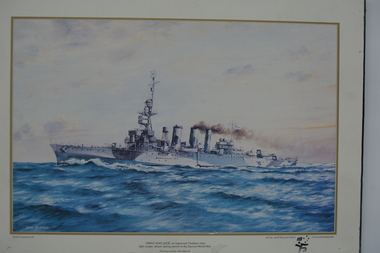
... ...royal australian navy...ship...cruiser...Royal Australian Navy 75th Anniversary. h.m.a.s. navy royal australian navy ship cruiser ww2 world war two lara r.s.l. ...On 1 September 1939 Adelaide (I) commissioned for war service under the command of Captain HA Showers RAN, and operated on the Australian coast for defence of trade.This is a limited print of HMAS Adelaide. No 6 in a series of 25. Royal Australian Navy 75th Anniversary.White bordered coloured print mounted on M.D.F.board.H.M.A.S.ADELAIDE,an improved Chatham class light crusier,shown during service in the Second World War. No 6 in a series of 25 ROYAL AUSTRALIAN NAVY 75 TH ANNIVERSARYh.m.a.s., navy, royal australian navy, ship, cruiser, ww2, world war two, lara r.s.l. -
 Tatura Irrigation & Wartime Camps Museum
Documents- Archives, Compiled by Tatura Historical Society, Dahm's "Kormoran" Story, 01.02.2016
... A German participant's account of the naval battle between the disguised German Raider HSK "Kormoran", and the Australian Light Cruiser HMAS "Sydney" off the West Australian Coast, Both vessels sank. ...A German participant's account of the naval battle between the disguised German Raider HSK "Kormoran", and the Australian Light Cruiser HMAS "Sydney" off the West Australian Coast, Both vessels sank. ...A German participant's account of the naval battle between the disguised German Raider HSK "Kormoran", and the Australian Light Cruiser HMAS "Sydney" off the West Australian Coast, Both vessels sank. The "Sydney" with all hands. The account follows his time in the lifeboat, his rescue, time in hospital in Perth then as Prisoner of War in Camp 13, Murchison, Vic.The author Dahm is listed as a crew member of HSK "Kormoran", and as a Prisoner of War in the National Australian Archives. The translator Barkei is a respected translator and one who has done much work for the Tatura & District Historical Society.Clear fronted plastic folder containing 95 printed pages bound with plastic strip on left side.Dahm's 'kormoran" Story Excerps from the Diary of Franz Heinrich Dahm. -
 Wangaratta RSL Sub Branch
Memorabilia - Framed newspaper articles photos and flags
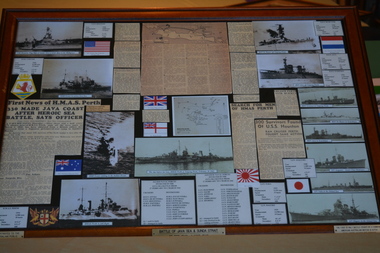
... On the night of 28 February – 1 March 1942, the Australian light cruiser HMAS Perth and the American heavy cruiser USS Houston faced a major Imperial Japanese Navy task force. ...On the night of 28 February – 1 March 1942, the Australian light cruiser HMAS Perth and the American heavy cruiser USS Houston faced a major Imperial Japanese Navy task force. ...The Battle of Sunda Strait was a naval battle which occurred during World War II in the Sunda Strait between the islands of Java, and Sumatra. On the night of 28 February – 1 March 1942, the Australian light cruiser HMAS Perth and the American heavy cruiser USS Houston faced a major Imperial Japanese Navy task force. After a fierce battle of several hours duration, both Allied ships were sunk. The sinking of HMAS Perth at the Battle of Sunda Strait 28 February -1 March 1942 cost 357 Australian lives. A further 324 crewmen fell into enemy hands. Two and a half years of brutal captivity claimed the lives of 106 of these men - 53 on the Thai Burma Railway alone.Framed cuttings of newspaper articles,13 photographs and 7 flags As Portrayed to the Australian Public 1942-1945 BATTLE OF JAVA SEA & SUNDA STRAIT 27 FEB - 1 MAR 1942 The first and only battle fought by a combined American Australian British and Dutch Naval Force against the Japanesesunda strait, hmas perth -
 Bendigo Military Museum
Photograph - PHOTOGRAPH, RAN, C.1939 - 40
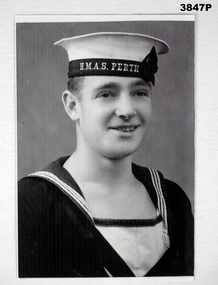
... He was posted to Australian light cruiser, HMAS Perth. HMAS Perth was torpedoed & sunk by the Japanese Navy in the Battle of the Sunda Strait, between the islands of Java & Sumatra in late February 1942. ...He was posted to Australian light cruiser, HMAS Perth. HMAS Perth was torpedoed & sunk by the Japanese Navy in the Battle of the Sunda Strait, between the islands of Java & Sumatra in late February 1942. ...George Bradshaw MORRISS No 23670 enlisted in the RAN on 23.10.1939 aged 17 years. He was posted to Australian light cruiser, HMAS Perth. HMAS Perth was torpedoed & sunk by the Japanese Navy in the Battle of the Sunda Strait, between the islands of Java & Sumatra in late February 1942. Approximately half of the crew were lost & the remainder taken into captivity. 106 died as POWs. George died at Sandakan on 29.5.1945. He is rembered on the Sandakan Memorial in Bendigo, Victoria.Black / white photo of sailor, George Bradshaw MORRISS in uniform including hat.On hat band in white: “H.M.A.S. PERTH”photograph, ran, perth, pow, sandakan -
 Frankston RSL Sub Branch
Souvenir, Ashtray
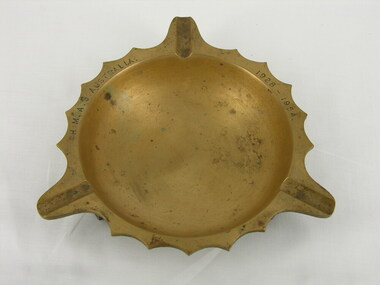
... The HMAS Australia was a heavy cruiser class fighting ship which was commissioned by the RAN on the 24th September, 1928 and de-commissioned on the 31st August, 1954....The HMAS Australia was a heavy cruiser class fighting ship which was commissioned by the RAN on the 24th September, 1928 and de-commissioned on the 31st August, 1954. ...A trench art souvenir of HMAS Australia. This brass ashtray is apparently made from part of a propellor. The HMAS Australia was a heavy cruiser class fighting ship which was commissioned by the RAN on the 24th September, 1928 and de-commissioned on the 31st August, 1954.The ashtray has the following stamped inscription across the top rim. "H.M.A.S. AUSTRALIA", "1928 - 1954".trench art, brass, ashtray, ran, navy, world war 2, ww2, hmas australia, -
 Dandenong/Cranbourne RSL Sub Branch
Print - Framed Print, 1975
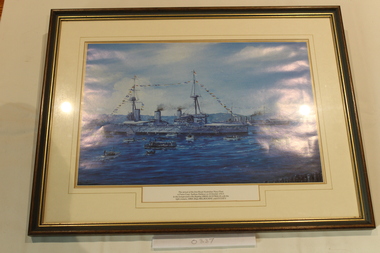
... In the foreground is the flagship HMAS Australia with the light cruisers HMAS Melbourne and HMAS Sydney. ...In the foreground is the flagship HMAS Australia with the light cruisers HMAS Melbourne and HMAS Sydney. ...Wooden and gold framed print of painting showing the arrival of "Royal Australian Navy Fleet" at Farm Cove , Sydney Harbour on 4th October 1913. In the foreground is the flagship HMAS Australia with the light cruisers HMAS Melbourne and HMAS Sydney. Original painting by John Bastock in 1975.Shows inscriptions and information as described in physical description. -
 Bendigo Military Museum
Print - PRINT RAN, FRAMED, Post 1978
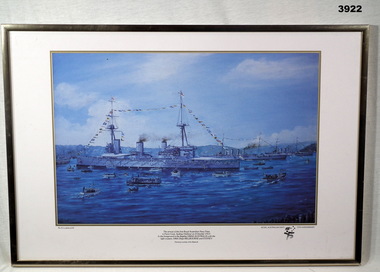
... In the foreground is the flagship HMAS Australia with the light cruisers HMAS ships Melbourne & Sydney. ...In the foreground is the flagship HMAS Australia with the light cruisers HMAS ships Melbourne & Sydney. ...Painting courtesy of John Bastock.Colour print of the arrival of the first RAN fleet in Farm Cove, Sydney Harbour on 4.10.1913. In the foreground is the flagship HMAS Australia with the light cruisers HMAS ships Melbourne & Sydney. Photo is No 2 in a series of 25. Mounted with white border, gold metal frame with masonite backing & wire hanging strap. In print at bottom RHS: “ROYAL AUSTRALIAN NAVY 75TH ANNIVERSARY”print, 75th, anniversary, ran -
Port Melbourne Historical & Preservation Society
Postcard - Princes Pier, Port Melbourne, 1880 - 1952
... RAN vessel at right is cruiser Australia and carrier Melbourne in background. ...RAN vessel at right is cruiser Australia and carrier Melbourne in background. ...Collected by Alison KELLy when she was caretaking the Missions to Seamen Building 1987-90. Image taken- between 1948 and 1952 vessel on left is Shaw Savill's Doric. RAN vessel at right is cruiser Australia and carrier Melbourne in background. Note also that electrical overhead still standing on both sides of pier for trains (removed late 1952). Local shipping expert Glen STUART advised that the Pier was Princes Pier and not Station Pier as shownOne of four postcards of various locations in Port Melbourne. B&W postcard - (The Rose Series 4535) - Entrance to Princes Pier - not Station Pier as shown piers and wharves - railway pier, piers and wharves - princes pier, parks and gardens -
 Kyneton RSL Sub Branch
Framed photograph, HMAS Australia
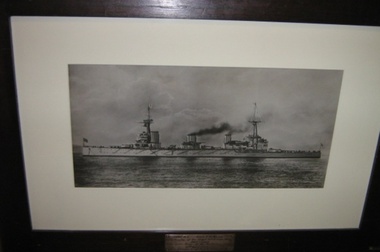
... The Australian Navy's first flagship, the battle cruiser HMAS Australia (I) was the centrepiece of the 'Fleet Unit', whose acquisition signalled the RAN's arrival as a credible ocean-going force. ...The Australian Navy's first flagship, the battle cruiser HMAS Australia (I) was the centrepiece of the 'Fleet Unit', whose acquisition signalled the RAN's arrival as a credible ocean-going force. ...The Australian Navy's first flagship, the battle cruiser HMAS Australia (I) was the centrepiece of the 'Fleet Unit', whose acquisition signalled the RAN's arrival as a credible ocean-going force. The Commonwealth Government decided upon the name Australia, and it proved a popular choice, carefully avoiding any suggestion of favouritism towards any one Australian State. Notwithstanding some construction delays, John Brown delivered Australia £295 000 under budget. Following successful gun, torpedo and machinery trials she commissioned as an Australian unit at Portsmouth, England, on 21 June 1913 under the command of Captain Stephen H. Radcliffe, RN. Two days later the ship hoisted the flag of Rear Admiral George Edwin Patey, MVO (later Vice Admiral Sir George Patey, KCMG, KCVO), who had been selected to command the Australian Fleet. In company with the new light cruiser HMAS Sydney (I), Australia sailed from Portsmouth on 21 July 1913, and their voyage home was seen as a further opportunity to stimulate public awareness and naval sentiment around the British Empire. Arrangements were made at the first opportunity for the flagship to visit many of the principal Australian ports. On the outbreak of World War I Australia (I) operated (with other ships of the Australian Fleet) as a counter to the German East Asiatic Cruiser Squadron under Admiral Graf von Spee. On 11 November 1918, the signing of the Armistice brought the fighting in Europe to an end. On 21 November, the Grand Fleet came out from the Firth-of-Forth in two divisions to meet the German High Seas Fleet steaming across the North Sea to be interned at Scapa Flow. Australia (I) had the honour of leading the port line at the head of her squadron. After returning home Australia (I) resumed the role of RAN flagship. A year later she played the leading part in the naval activities associated with the visit of the Prince of Wales in HMS Renown, but her time was rapidly running out. In November 1921 she returned to Sydney and the following month was paid off into reserve on 12 December 1921. Less than three years later she was prepared for scuttling to comply with the terms of the Washington Naval Treaty of 1922, which provided for a reduction in naval strengths. The RAN had already removed some of the ship's equipment for use in other warships, and now began the deliberate scrapping of Australia (I) by extracting piping and other small fittings. She was towed to sea by tugs and sunk along with her main armament in position 095 degrees, 24 miles from Inner South Head, Sydney, on 12 April 1924. Extracts from http://www.navy.gov.au/HMAS_Australia_(I)Teak frame photograph Metal Plaque on frame: HMAS Australia First flagship of the Royal Australian Navy 1913-1920 Sunk under terms of the Washington Treaty 12th April 1924 navy, world war one, australia, war, wwi, flagship, hmas australia, ran -
 Flagstaff Hill Maritime Museum and Village
Craft - Ship Model, S.S. Orotava, ca. 1930-1974
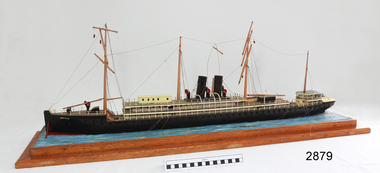
... In 1906, the Pacific Steam Line Australian service was taken over by the Royal Mail Steam Packet Co., and the alliance between them and the Orient Line was dissolved in 1909. Orotava then served the West Indies service of the Royal Mail Line. In World War 1 (Dec 1914 – June 1916), the vessel served as HMS OROTAVA, an armed merchant cruiser...In 1906, the Pacific Steam Line Australian service was taken over by the Royal Mail Steam Packet Co., and the alliance between them and the Orient Line was dissolved in 1909. Orotava then served the West Indies service of the Royal Mail Line. In World War 1 (Dec 1914 – June 1916), the vessel served as HMS OROTAVA, an armed merchant cruiser ...This is a ship model of the SS Orotava, a British Screw Steamship built at Barrow-in-Furness, county of Lancashire, by the Naval Construction and Armaments Company (NC & A Co.) in 1889. The gross tonnage was 5552.10 tons, length 430 feet, breadth 49.3 feet and depth 34.2 feet. It was built for the Pacific Steam Navigation Company (of 31, James Street, Liverpool) and used as a passenger liner. The vessel was launched in 1889 and made two voyages for the Pacific Steam Navigation Company during 1889. Then, under the new management of the Orient Line, its first sailing was 6th June 1890 from Liverpool to Australia via Suez. During the Boer War (1889 – 1903), Orotava served as a troop ship, but apart from this, it remained in the Orient Line’s Australia service until 1906. On 14th December 1896, the Orotava sank at Tilbury Docks after being serviced on her return from Australia, becoming unstable and taking in water. Five men lost their lives. The ship was then raised to dry dock and repaired for service again, and an investigation was launched into the cause of the sinking. Between 1901 – 1906, the name Orient-Pacific Steam Line was used due to the close ties between the Pacific and the Orient lines. In 1906, the Pacific Steam Line Australian service was taken over by the Royal Mail Steam Packet Co., and the alliance between them and the Orient Line was dissolved in 1909. Orotava then served the West Indies service of the Royal Mail Line. In World War 1 (Dec 1914 – June 1916), the vessel served as HMS OROTAVA, an armed merchant cruiser. It was broken up in 1919.The model shows a visual description of the SS Orotava, which was used for commercial and government purposes from 1889 to 1919. The model is also an example of ship model-making, a skilled craft enjoyed for hundreds of years, demonstrating the evolution of ocean vessels. Ship model: SS Orotava. The model, without a case, has four masts and two funnels, and is mounted on a small timber base. The SS Orotave was a British passenger liner, launched in 1889. Inscriptions are painted on the hull. "OROTAVA" painted in white on each side of the bow. 'OROTAVA / LONDON" painted in white on the stern.flagstaff hill, warrnambool, shipwrecked-coast, flagstaff-hill, flagstaff-hill-maritime-museum, maritime-museum, shipwreck-coast, flagstaff-hill-maritime-village, ship model, ss orotava, naval construction and armaments co., n c & a co., pacific steam navigaiton company, passenger liner, orient line, orient-pacific steam line, royal mail line, hms orotava -
 Flagstaff Hill Maritime Museum and Village
Equipment - Lifebuoy, Loch Ness, 1869-1909
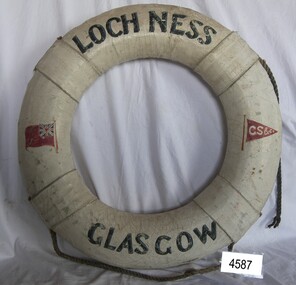
... In 1914 the Australian Government took over the ship for naval defence purposeless. In 1926 the ship was sunk during gunfire practice by the 1922 built, light cruiser HMAS Melbourne, near Fremantle, Western Australia. ...In 1914 the Australian Government took over the ship for naval defence purposeless. In 1926 the ship was sunk during gunfire practice by the 1922 built, light cruiser HMAS Melbourne, near Fremantle, Western Australia. ...This lifebuoy bears the name of the ship, its origin, the shipping company and the red ensign. These details mean that the lifebuoy was part of the lifesaving equipment on the sailing ship the Loch Ness, part of the Glasgow Shipping Company’s Loch Line (G.S.C. on the red pennant) and a British-registered ship (the red flag with the Union Jack on it). Lifebuoys were part of the emergency lifesaving equipment carried on vessels in the late 19th and early 20th century. The ring was made of strips of cork wood joined together to make the ring shape then covered in canvas and sealed usually with white paint. Four evenly spaced canvas reinforcing bands would be added for strength and for a place to thread a rope or line. A lifebuoy, or life-preserver, is used as a buoyancy device often thrown to an endangered or distressed person in the water to keep them afloat while they receive help. It is usually connected by a rope to a person in a safe area such a nearby vessel or on shore. Lifebuoys is a made from a buoyant materials such as cork or foam and ae usually covered with canvas for protection and to make it easy to grip. The first use of life saving devices in recent centuries was by the Nordic people, who used light weight wood or cork blocks to keep afloat. Cork lifebuoys were used from the late 19th to early 20th century. Kapok fibre was then used as a filling for buoys but wasn’t entirely successful. Light weight balsa wood was used as a filler after WW1. In 1928 Peter Markus invented and patented the first inflatable life-preserver. By WW2 foam was combined with Kapok. Laws were passed over time that has required aeroplanes and water going-vessels to carry life-preservers on board. The ship LOCH NESS 1869-1922 … The ship Loch Ness, of Glasgow, was the same ship what William Carmichael sailed on to Australia when he laid the commemoration stone on behalf of his sister Eva and himself, dedicated to their parents, brothers and sisters. The family members lost their lives on June 1, 1878, when their ship, the Loch Ard, was wrecked at Mutton Bird Island in south west Victoria. Eva Carmichael was one of the two survivors from that shipwreck, the other 52 tragically lost their lives. The ship Loch Ness was a three-masted sailing ship built in 1869 for the Loch Line owned by the Glasgow Shipping Company. The line transported cargo and passengers from Glasgow, Scotland, to Australian ports. The Loch Ness was sold in 1908 to Stevedore & Shipping Co, Sydney for use as a coal hulk. In 1914 the Australian Government took over the ship for naval defence purposeless. In 1926 the ship was sunk during gunfire practice by the 1922 built, light cruiser HMAS Melbourne, near Fremantle, Western Australia. The lifebuoy is an example of equipment carried on vessels in the late 19th and early 20th century to help preserve life. There were many lives lost in Australia’s colonial period, particularly along the coast of South West Victoria. The lifebuoy is significant for its connection to the ship Loch Ness on which William Carmichael, brother of Eva Carmichael, travelled to lay a memorial to their parents and all of their other siblings who lost their lives in the Loch Ard disaster of 1878 near Peterborough, Victoria. Lifebuoy, round, cork filling inside canvas cover, painted white, with rope attached. Lifebuoy has printed name of vessel Loch Ness, Glasgow. Symbols of red flag with white initials G S Co. There is also a red ensign."LOCH NESS", "GLASGOW" "G S Co"flagstaff hill, warrnambool, shipwrecked-coast, flagstaff-hill, flagstaff-hill-maritime-museum, maritime-museum, shipwreck-coast, flagstaff-hill-maritime-village, loch ness, loch ard, william carmichael, eva carmichael, lifebuoy, glasgow sailing ship, loch ness of glasgow, life rings, safety ring, life-saving buoy, ring buoy, life preserver, personal floating device, floatation device, safety equipment, g s c, glasgow shipping company, hmas melbourne, cruiser melbourne -
 Mission to Seafarers Victoria
Journal (item) - Periodicals-Annual, Shiplovers' Society of Victoria, The Annual Dog Watch
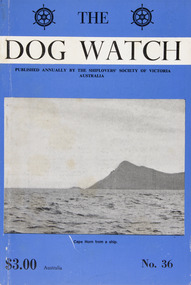
... Cruiser Squadron, 1916 - From the papers of the late Captain W. J. Cowling - 71 Cape Horn - Captain G. Molyneux - 79 Immigrant to the Antipodes - H. Vaughan Evans - 82 The "Lauriston" -- Start of Bad Weather - R. W. Rudd - 85 Songs of the Finnish Sailormen - Captain Eino Koivistoinen - 89 Farewell Windjammer - Chris. A. Smith - 92 The Voyage of the "Storm King" - N. S. Smith - 100 Editors' Comment - - 105 An Australian...Cruiser Squadron, 1916 - From the papers of the late Captain W. J. Cowling - 71 Cape Horn - Captain G. Molyneux - 79 Immigrant to the Antipodes - H. Vaughan Evans - 82 The "Lauriston" -- Start of Bad Weather - R. W. Rudd - 85 Songs of the Finnish Sailormen - Captain Eino Koivistoinen - 89 Farewell Windjammer - Chris. A. Smith - 92 The Voyage of the "Storm King" - N. S. Smith - 100 Editors' Comment - - 105 An Australian ...This journal provides the reader with glimpses of the adventures and hardships of a seaman's life. Many of the stories are of sailing ships.Contributes to our knowledge of the importance of shipping and places on record those stories of the sea which would otherwise be lost.Contents Foreword - Captain Sir John P. Williams, C.M.G., O.B.E.- 5 Editorial - C. A. Halls - 8 The Cape Horners - S. A. E. Strom - 13 Cape Horners (Verse) - C. E. Bonwick - 21 "All the World Lovers . . ." - Dr. Stanislaw Bernatt - 24 "Beatrice" Memories - Captain H. P. Nicholson - 25 Maritime Bottle Post - E. Harper - 30 The Saltpetre Cross - Captain Leif Asklund - 32 The "Caledon" - R. N. Thiele - 34 The Last Voyage of the "Olivebank" - Captain Evert Blomqvist - 39 The Figurehead on Macquarie Island - E. A. Mitchener - 44 The Ups and Downs of Dougherty Island - Captain W. B. Eastoe - 51 "Pom" Apprentice - Captain Frank Kirk - 57 A Fortunate Encounter - D. R. Rickard and A. Stallard - 61 Times Remembered; - Captain Bruce Bell - 65 Service in the 10th Cruiser Squadron, 1916 - From the papers of the late Captain W. J. Cowling - 71 Cape Horn - Captain G. Molyneux - 79 Immigrant to the Antipodes - H. Vaughan Evans - 82 The "Lauriston" -- Start of Bad Weather - R. W. Rudd - 85 Songs of the Finnish Sailormen - Captain Eino Koivistoinen - 89 Farewell Windjammer - Chris. A. Smith - 92 The Voyage of the "Storm King" - N. S. Smith - 100 Editors' Comment - - 105 An Australian Shell Back - Captain G. Heyen - 107 First Voyage in the S.S. "Port Campbell" - I. L. Barton - 111 A Few More Ships - - 120 Book Reviews - 121sailing ships, steamships, shipping, seafaring life, shiplovers' society of victoria, dog watch, cape horn -
 Mission to Seafarers Victoria
Photograph, New Year 1923 - Jules Michelet, 1923
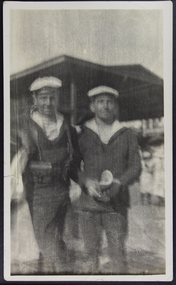
... In January 1923, 5 years after the end of WWI, the two French cruisers Jules Michelet and Victor Hugo went on a tour in South East Asia, Australia and New Zealand consolidating the friendship between the countries. ...In January 1923, 5 years after the end of WWI, the two French cruisers Jules Michelet and Victor Hugo went on a tour in South East Asia, Australia and New Zealand consolidating the friendship between the countries. ...In January 1923, 5 years after the end of WWI, the two French cruisers Jules Michelet and Victor Hugo went on a tour in South East Asia, Australia and New Zealand consolidating the friendship between the countries. The cruisers arrived in January 1923 and Melbournians were invited to visit the ships. Amongst them the ladies from the Guild. In the "Jottings from Our Log"number 69 dated from January 1923 we can read: Our French Visitors The French cruisers, “Jules Michelet” and “Victor Hugo”, each with a complement of 26 officers and 747 men, paid a visit to this port towards the end of the year. Many of the sailors made good use of our institute, and were supplied with French magazines and papers, and were delighted to find that quite a number of ladies could speak French fluently. Over one hundred men were present at the Institute on one of our special nights during Christmas week, when each French visitor was supplied with refreshments and a cigar. Through the great kindness of some of our ladies, each man aboard the two cruisers was supplied with a packet of cigarettes. These were greatly appreciated by the men, and a warm letter of thanks was received from each of the captains."Reflects strong community and LHLG links via the Mission and as a result of WW1 support and fundraising efforts.Sepia tone blurry photograph with a white frame depicting two French seafarers with their traditional uniform and beret on shore near a pier shed children or women in the far distance at lwr right.Handwritten at the back in pencil: New Year 1923 Jules Micheletfrench cruiser, jules michelet, victor hugo, wwi -
 Mission to Seafarers Victoria
Photograph - Photograph, Black and white, 1923
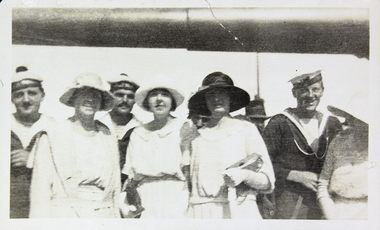
... In January 1923, 5 years after the end of WWI, the two French cruisers Jules Michelet and Victor Hugo went on a tour in South East Asia, Australia and New Zealand consolidating the friendship between the countries. ...In January 1923, 5 years after the end of WWI, the two French cruisers Jules Michelet and Victor Hugo went on a tour in South East Asia, Australia and New Zealand consolidating the friendship between the countries. ...In January 1923, 5 years after the end of WWI, the two French cruisers Jules Michelet and Victor Hugo went on a tour in South East Asia, Australia and New Zealand consolidating the friendship between the countries. The cruisers arrived in January 1923 and Melbournians were invited to visit the ships. Amongst them the ladies from the Guild and especially Dora Walker. In the "Jottings from Our Log"number 69 dated from January 1923 we can read: Our French Visitors The French cruisers, “Jules Michelet” and “Victor Hugo”, each with a complement of 26 officers and 747 men, paid a visit to this port towards the end of the year. Many of the sailors made good use of our institute, and were supplied with French magazines and papers, and were delighted to find that quite a number of ladies could speak French fluently. Over one hundred men were present at the Institute on one of our special nights during Christmas week, when each French visitor was supplied with refreshments and a cigar. Through the great kindness of some of our ladies, each man aboard the two cruisers was supplied with a packet of cigarettes. These were greatly appreciated by the men, and a warm letter of thanks was received from each of the captains."Reflects the close links and mutual friendships developed between French and Australian community developed between LHLG members from 1906 onward especially during WW1 and support of the French Red Cross.Black and white photograph jules michelet, victor hugo, french cruiser, ww1, france, dora walker, french sailors, dora simpson, lhlg, navy -
 Mission to Seafarers Victoria
Photograph - Photograph, Sepia, Cruiser HMAS Australia - Destroyers: Anzac, Success and Swordsman, 1928
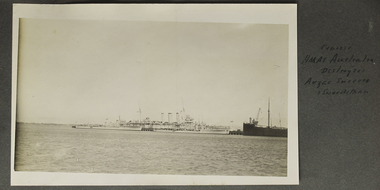
... Cruiser HMAS Australia - Destroyers: Anzac, Success and Swordsman ...Cruiser HMAS Australia - Destroyers: Anzac, Success and Swordsman Photograph Photograph, Sepia ...In 1919, Anzac, along with five S class destroyers, Tattoo, Swordsman, Success, Stalwart and Tasmania, was gifted to the RAN by the British Government. Photograph with white border depicting military ships berthed in a port; photograph glued in album.hmas australia, destroyers, fan album, cruisers, anzac, swordsman -
 Mission to Seafarers Victoria
Photograph - Photograph, Sepia, HMAS Australia
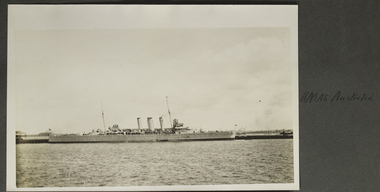
... hmas australia fan album cruisers Black and white photograph with white border depicting a military ship berthed in port; glued in album on page 5 HMAS Australia Photograph Photograph, Sepia ...Black and white photograph with white border depicting a military ship berthed in port; glued in album on page 5hmas australia, fan album, cruisers -
 Mission to Seafarers Victoria
Photograph - Photograph, Sepia, HMAS Cruiser Australia Princess Pier Port Melbourne, 5-9 November 1928
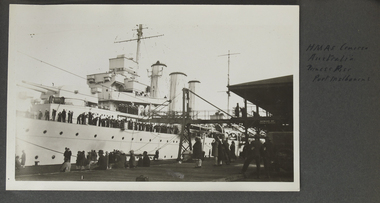
... HMAS Cruiser Australia Princess Pier Port Melbourne ...The Hmas Australia was open to the public from 5 to 9 November 1928. fan album hmas australia princess pier port melbourne on page 7 HMAS Cruiser Australia Princess Pier Port Melbourne Photograph Photograph, Sepia ...The Hmas Australia was open to the public from 5 to 9 November 1928.on page 7fan album, hmas australia, princess pier, port melbourne -
 Mission to Seafarers Victoria
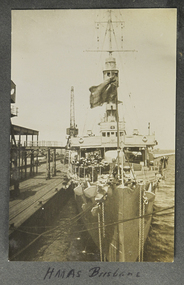
Photograph - Photograph, Sepia, HMAS Brisbane
... The HMAS Brisbane, Australia, and the three destroyers Anzac, Success and Swordsman were open to the public on 5 November 1928. hmas brisbane port melbourne fan album 1928 cruisers warships on page 10 HMAS Brisbane Photograph Photograph, Sepia ...The HMAS Brisbane left Geelong (Corio Bay) on 31 October 1928 to sail to Port Melbourne in November 1928 during the Melbourne Cup festivities. She left Port Melbourne on Wednesday 12 December 1928. The HMAS Brisbane, Australia, and the three destroyers Anzac, Success and Swordsman were open to the public on 5 November 1928.on page 10hmas brisbane, port melbourne, fan album, 1928, cruisers, warships -
 Royal Melbourne Yacht Squadron
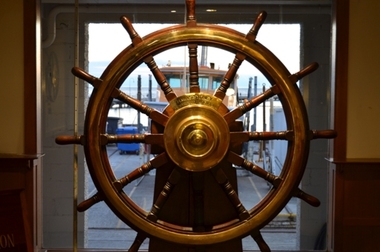
Memorabilia - Wheel of HMAS Sydney, Early 20th Century
... On 1 November 1914, led by the flagship SS Orvieto, a large convoy of 28 Australian and 10 New Zealand transports escorted by the Light Cruisers HMAS Melbourne, HMAS Sydney, HMS Minotaur and the Japanese ship Ibuki, departed King George Sound, Albany Western Australia with a large contingent of Australian and New Zealand troops bound for Egypt, to become the original Anzac’s. ...On 1 November 1914, led by the flagship SS Orvieto, a large convoy of 28 Australian and 10 New Zealand transports escorted by the Light Cruisers HMAS Melbourne, HMAS Sydney, HMS Minotaur and the Japanese ship Ibuki, departed King George Sound, Albany Western Australia with a large contingent of Australian and New Zealand troops bound for Egypt, to become the original Anzac’s. ...THE WHEEL OF HMAS SYDNEY COMMEMORATING AUSTRALIA’S FIRST NAVAL ENGAGEMENT The historic wheel of HMAS Sydney commemorates the Royal Australian Navy’s first ship- to- ship naval engagement. It was purchased early in 1930 and later presented to the Royal St Kilda Yacht Club (now Royal Melbourne Yacht Squadron) by then Commodore Joe White, following HMAS Sydney being broken up at Cockatoo Dock, Sydney. On 1 November 1914, led by the flagship SS Orvieto, a large convoy of 28 Australian and 10 New Zealand transports escorted by the Light Cruisers HMAS Melbourne, HMAS Sydney, HMS Minotaur and the Japanese ship Ibuki, departed King George Sound, Albany Western Australia with a large contingent of Australian and New Zealand troops bound for Egypt, to become the original Anzac’s. As the convoy steamed northwest across the Indian Ocean, leaving Cocos-Keeling Islands well to the westward, Captain Karl von Muller in the German Light Cruiser Emden of 3,600 tons, after having wrought much havoc to allied shipping in the Indian Ocean, ignorant of the convoys presence, had in mind to destroy the Cocos Island Cable Station on Direction Island. In the early hours of the morning of Monday the 9 November, he anchored “Emden” off Direction Island to send a landing party ashore, In the meantime the Cable Station had sent out a Morse Code message ‘Strange ship approaching’, this was followed soon after by a ‘S.O.S.’ These messages were picked up by ships in the convoy and at 7.00 a.m., Captain J.C. Glossop of the 5,400 ton HMAS Sydney was directed to leave the convoy and proceed at full speed for Cocos Islands. Two hours later Cocos Island was on the horizon. Captain von Muller, with the boarding party ashore to destroy the Cable station, steamed out to intercept the intruder. Captain Glossop decided to close in to 9,500 yards ( 8686.8m) before delivering his first salvo. Emden on the other hand, opened fire at 10,500 yards (9601m), its ten, 4.1 inch (104mm) guns firing 38 pound (17.24 kg ) shells, some of which scored near misses. Emden was hit repeatedly by HMAS Sydney’s eight, 6 inch (152.4mm) guns firing 100 pound (45.36kg ) shells. Within two hours Captain von Muller had decided to run the badly damaged Emden aground on North Keeling Island. Captain Glossop then broke off the engagement to speed off to intercept Emden’s collier, “Buresk”, seen lurking in the distance, soon to overtake her. A boarding party from HMAS Sydney was too late to prevent Buresk from being scuttled but able to rescue her crew. Returning to finish off Emden, HMAS Sydney was again met by heavy gunfire. Sydney scored a number of direct hits to Emden and only after having suffered 134 killed and 65 wounded, did Captain von Muller finally decide to lower his Naval Ensign. He was among those captured and was allowed to retain his Naval sword. In the engagements HMAS Sydney only suffered four direct hits, 4 killed and 12 wounded. J.H.(Bert) Ferris Extremely significant as part of Australia's Naval and Military history.Ships wheel, timber, mounted on a timber plinth, wheel of ship first HMAS Sydney.Plaque notifying that wheel donated by Commodore Joe White 1930ww1, sydney, german, hmas, raider, emden, cocos keeling, islands, hmas sydney, wheel -
 Lara RSL Sub Branch
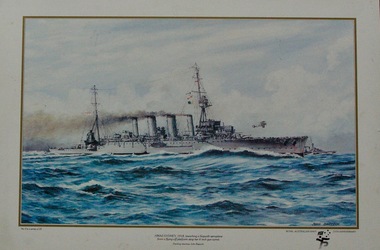
Coloured Print of HMAS SYDNEY 1918
... HMAS Sydney was a Chatham-class light cruiser of the Royal Australian Navy. Laid down in 1911 and launched in 1912, the cruiser was commissioned into the RAN in 1913. ...HMAS Sydney was a Chatham-class light cruiser of the Royal Australian Navy. Laid down in 1911 and launched in 1912, the cruiser was commissioned into the RAN in 1913. ...HMAS Sydney was a Chatham-class light cruiser of the Royal Australian Navy. Laid down in 1911 and launched in 1912, the cruiser was commissioned into the RAN in 1913. During the early stages of World War I, Sydney was involved in supporting the Australian Naval and Military Expeditionary Force, and escorting the first ANZAC convoy. On 9 November 1914, the cruiser defeated the German cruiser SMS Emden at the Battle of Cocos. During 1915 and 1916, Sydney operated on the North America and West Indies Station, before joining the 2nd Light Cruiser Squadron at Greenock, Scotland in November 1916. On 4 May 1917, the cruiser was involved in an inconclusive action against the German zeppelin L43; neither was damaged. During late 1917, Sydney became the first Australian warship to launch an aircraft, and the first warship to do so from a rotatable platform.Rectangular shaped mounted Print of HMAS SYDNEY 1918HMAS SYDNEY 1918,launching a Sopwith aeroplane from a flying-off platform atop her 6 inch gun turret. ROYAL AUSTRALIAN NAVY 75TH ANNIVERSARYww1, hmas sydney,lara r.s.l. australian naval ships, light cruisers. -
 Lara RSL Sub Branch
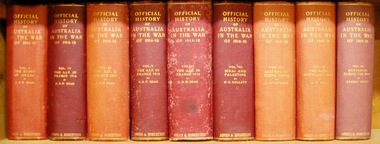
Book, Official History of Australia in the War of 1914-18 - Volume IX - The Royal Australian Navy Author A.W. Jose, 1937 fifth edition
... Australian Navy duty occasioning navy vessels in addition to the drudgery of patrol work and the search for enemy vessels. Working in isolation because of being a vessel that is under their own control. This volume of the War Histories is concerned with the doings of an infant navy. german colonies samoa nauru western pacific africa dardenelles north atlantic european waters raiders and minefields ran brigade hospital ships transports and dockyards radio-telegraphy suvla bay sinking of the cumberland german cruiser squadron cocos sydney-emden action north sea Official History of Australia in the War of 1914-18 - Volume IX - The Royal Australian Navy Maps and Illustrations Official History of Australia in the War of 1914-18 - Volume IX - The Royal Australian Navy Author A.W. ...Historically depicts the operations of the Royal Australian Navy duty occasioning navy vessels in addition to the drudgery of patrol work and the search for enemy vessels. Working in isolation because of being a vessel that is under their own control.This volume of the War Histories is concerned with the doings of an infant navy.Official History of Australia in the War of 1914-18 - Volume IX - The Royal Australian Navy Maps and Illustrationsgerman colonies, samoa, nauru, western pacific, africa, dardenelles, north atlantic, european waters, raiders and minefields, ran brigade, hospital ships, transports and dockyards, radio-telegraphy, suvla bay, sinking of the cumberland, german cruiser squadron, cocos, sydney-emden action, north sea -
 Lara RSL Sub Branch
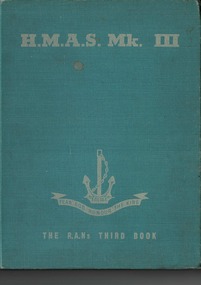
Book, HMAS MK III - The RAN's Third Book, 1951
... This volume is a further unfolding of the story of WWII which because of its nature as a world wide conflict, is so largely the story of sea power and its influence on the final outcome wwii royal australian navy sea power germans europe japanese communications rear admiral v.a.c. crutchley, v.c., d.s.c destroyers corvettes frigates escort duties motor launches aircraft carriers battleships battle cruisers cruises armed merchant cruisers sloops submarine sweepers mediterranean warspite valiant pacific american forces dneiper bend solomon islands makin tarawa h.m.a australia h.m.a shropshire h.m.a arunta h.m.a warramunga h.m.a.s westralia arctic h.m. jamaica h.m.saumarez u.s. marines h.m.a.s benalla h.m.a.s shepparton royal australian navy reserves Tribute - Grey she is and stately Young alive and shapely Lissome, yes, and graceful, With perfect lines of elegance and dignity Her noble, lovely head She nods and shakes, With confidence to face Whatever may come. ...This book tells of the mounting sea power of the Allies told by men of the RAN who with their ships have added the weight of their blows to the common effort. It tells stories of which the Royal Australian Navy may be proud.This volume is a further unfolding of the story of WWII which because of its nature as a world wide conflict, is so largely the story of sea power and its influence on the final outcome HMAS MK III - The RAN's Third Book. Green hardcover with black text and Navy insignia on front cover, text on spine. Inside front and back cover green sepia drawing of a fleet of Navy ships. Graphs, drawings, photographs, maps, poems.Tribute - Grey she is and stately Young alive and shapely Lissome, yes, and graceful, With perfect lines of elegance and dignity Her noble, lovely head She nods and shakes, With confidence to face Whatever may come. She nurses me And nourishes; Shields me, gives me courage. Alone I have been with her, when afraid. And in a crowd of friends, both hers and mine. Through conflict tense, with element or foe; through danger from above and from below. Through anguish keen Of loss, of death, of pain. Through gaiety, through joy victorious and safe She is my life, my only love, My ship.wwii, royal australian navy, sea power, germans, europe, japanese, communications, rear admiral v.a.c. crutchley, v.c., d.s.c, destroyers, corvettes, frigates, escort duties, motor launches, aircraft carriers, battleships, battle cruisers, cruises, armed merchant cruisers, sloops, submarine sweepers, mediterranean, warspite, valiant, pacific, american forces, dneiper bend, solomon islands, makin, tarawa, h.m.a australia, h.m.a shropshire, h.m.a arunta, h.m.a warramunga, h.m.a.s westralia, arctic, h.m. jamaica, h.m.saumarez, u.s. marines, h.m.a.s benalla, h.m.a.s shepparton, royal australian navy reserves -
 Flagstaff Hill Maritime Museum and Village
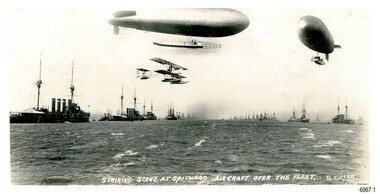
Postcard - Ships Collection, Stephen Cribb, circa 1914-1945
... Cruiser, launched 1912, completed 1913, 27,000 tons, 75,000 S.H.P., 28 knots per hour, 8 13.5-inch guns, 16 4-inch guns, 2 torpedoes. Commissioned September 1913. Printed in England. 6967.35 HMS SUPERB 6967.36 HMS TEMERAIRE 6967.37 HMS MONARCH Small photograph, not a postcard, H 6 x W 9 cm 6967.38 PHOTOGRAPH NESTOR? Small sepia photograph, ship at dock. Stamped “Kodak print” “549”. Handwritten on back is “NESTOR?“ The Ships Collection of postcards and a small photograph depict maritime vessels connected to our Australian ...The postcards and photograph in this Ships Collection were found by the donor. Two of the cards are addressed to a local person "Master Jack de Little, Caramut House, Caramut, Victoria, Australia". Another has a message written in a different language. The remainder have no personal messages on them. The details of the postcards are- Published by Stephen Cribb, Southsea: 6967.1 Striking scene at Spithead; Aircraft over the fleet, including airships 6967.2 The King’s Ships; Fleet of ships. Aircraft overhead. 6967.3 HMS HIBERNIA; King Edward Class ship 6967.4 For Docking; Super Dreadnaughts, largest floating dock in the world, in Portsmouth Harbour 6967.5 HMS COLLINGWOOD; Dreadnaught, on which His Majesty’s son is serving. 6967.6 HMS BRITANNICA; Pre-Dreadnaught, 16,350 tons. Inscription “b1” or “61” written on the sea on the front of the postcard. 6967.7 HMS IRON DUKE; Fleet Flagship 6967.8 HMS Submarine D8. Ship numbered “78” 6967.9 HMS IRON DUKE, Fleet Flagship 6967.10 HMS SOUTHAMPTON 6967.11 SHAMROCK IV (Ketch rigged), leaving for America July 18, 14 (1914’) to fetch home the American to Gosport 6967.12 HMS CONQUEROR, June 1913 6967.13 Portsmouth Harbour, The Entrance (from Gosport Hard) 6967.14 Seaplane rising; 20th Century Marvel. Naval air defence. Types of airships, Seaplanes, Monoplanes in The Solent review 6967.15 HMS AUDACIOUS 6967.16 HMS DREADNAUGHT, pioneer of the all-big-gun warship ”Marcus Ward Series, McCaw Stevenson & Oms Ltd” 6967.17 HMS TERRIBLE, textured paper on front with aqua lower border, remnants of blue paper on the back. Published by Stephen Cribb, Southsea 6967.18 “In time of peace, prepare for war” Hoisting guns and torpedo heads on board a warship 6967.19 HMS LORD NELSON 6967.20 HMS HINDUSTAN 6967.21 Spitbank Fort, Spithead, on Solvent Sea 6967.22 HMS GARLAND of Netley Photographer Edgar Ward. “A halfpenny stamp for inland, one penny for foreign” 6967.23 Entrance to the Cambor, from Portsmouth Harbour. “312, copyright Edgar Ward” 6967.24 Royal yacht alongside Portsmouth Dockyard, “305” J. Welch & Sons, English Photography 6967.25 The Royal Yacht, Victoria & Albert “50” 6967.26 The VICTORY, firing a Royal Salute “21” Published by E.A. Schwerdtfeger & Co. London E.C. Printed at their works in Berline. Trade Mark E.A.S. 6967.27 The Hard and Viaduct, Portsea, Portsmouth 6967.28 SS MACEDONIA, P&O, 15212 tons, 1500 h.p., Coloured drawing. On reverse “Master Jack de Little, Caramut House, Caramut, Victoria, Australia” Published by Union Postale Universelle, Gibralta. 6967.29 HMS KING EDWARD VII leaving Dock N.3 GIBRALTAR – 11/3/05 (1905). Printer V.B. Cumbo, Gibraltar. Drawing. Handwritten “Oroton 28/5/06”. “Master Jack De Little Caramut, Victoria, Australia” 6967.30 7274 BARBARA, Hamburg. Imprinted “ ---O WEDDE ----- VORSETZEN 35/37” inscription, six lines of handwritten text in another language on the back. Published by the Valentine & Sons Co. Publishing Ltd., Melbourne, Sydney and Brisbane. Branches Sydney. London, Dundee, Cape Town, Montreal, Toronto. 6967.31 SS MOLDAVIA, the first dining saloon, Valentine Series M.4059. Valentines Real Photo Series Postcard. Postcard made in U.S.A. Agfa ANSCO 6967.32 Port McNicoll, Ont. DSR.. 6967.33 Orient Line SS ORONSAY, 20,000 tons. On board the Orient Line. Tuck’s Post Card, Carte Postale. ‘Our Navy’ Series II, Raphael Tuck & Sons. “Photogravure” Postcard Nu. 4305. Art publishers to their Majesties the King and Queen. 6967.34 HMS QUEEN MARY, HMS Queen Mary, Battle Cruiser, launched 1912, completed 1913, 27,000 tons, 75,000 S.H.P., 28 knots per hour, 8 13.5-inch guns, 16 4-inch guns, 2 torpedoes. Commissioned September 1913. Printed in England. 6967.35 HMS SUPERB 6967.36 HMS TEMERAIRE 6967.37 HMS MONARCH Small photograph, not a postcard, H 6 x W 9 cm 6967.38 PHOTOGRAPH NESTOR? Small sepia photograph, ship at dock. Stamped “Kodak print” “549”. Handwritten on back is “NESTOR?“ The Ships Collection of postcards and a small photograph depict maritime vessels connected to our Australian alliance with Britain, particularly during World War I. Two of the postcards are specifically addressed to a ‘Master Jack de Little’ at Caramut House, in the local township of Caramut which was a Pioneer Settlement and a Soldier Settlement area after World War I. Collection of thirty-eight postcards from various photographers. They depict shipping, harbours and naval vessels from the Great War to the Second War War. Most of the cards have a title, generally handwritten, on the front of the postcard. A few of the postcards have inscriptions.6967.6 Handwritten on the sea in the photograph “b1” or “61” 6967.28 Handwritten on reverse “Master Jack de Little, Caramut House, Caramut, Victoria, Australia” 6967.29 Handwritten “Oroton 28/5/06”. “Master Jack De Little Caramut, Victoria, Australia” 6967.30 Imprinted Stamp “ ---O WEDDE ----- VORSETZEN 35/37” (a location in Germany). Handwritten, six lines of text in another language, possibly German. 6967.38 Handwritten on the back is “NESTOR?“flagstaff hill, maritime village, maritime museum, postcard, world war ii, ww2, royal navy, british merchant navy, portsmouth, the great war, ship, world war i, wwi, british, 1914-1918, jack de little, caramut, caramut house, vorsetzen, spithead, sea fort, fort, spithead fort, aircraft, fleet, airship, the king’s ships, hms hibernia, king edward class ship, super dreadnaught, floating dock, portsmouth harbour, hms collingwood, dreadnaught, hms britannica, hms iron duke, fleet flagship, hms submarine d8, hms southampton, shamrock iv, hms conqueror, the entrance, gosport head, seaplane, naval air defence, monoplane, the solvent, hms audacious, hms dreadnaught, warship, marcus ward series, mccaw stevenson & oms ltd, s cribb, southsea, hms terrible, hms hindustan, hms garland, edgar ward, cambor, portsmouth dockyard, j. welch & sons, the royal yacht, victoria & albert “50”, victory, royal salute “21”, e.a. schwerdtfeger & co, e.a.s., the hard and viaduct, ss macedonia, p&o, master jack de little, hms king edward vii, dock n.3 gibraltar, v.b. cumbo, gibraltar, union postale universelle, 7274 barbara, ss moldavia, valentine series, valentine & sons co, port mcnicoll, agfa ansco, ss oronsay, orient line, raphael tuck & sons, hms queen mary, hms superb, hms temeraire, hms monarch, nestor, stephen cribb, stephen cribb photography, hms lord nelson -
 Geelong RSL Sub Branch
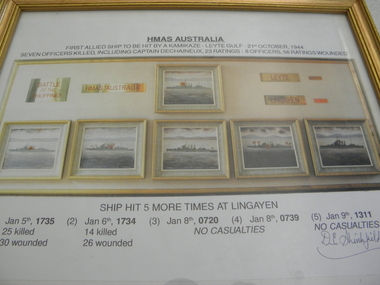
Photograph - HMAS Australia, No makers listed, Late 20th Century
... HMAS Australia (84), RAN, Heavy Class Cruiser...The HMAS Australia (D84) was a County-class heavy cruiser of the Royal Australian Navy. ...The HMAS Australia (D84) was a County-class heavy cruiser of the Royal Australian Navy. ...The HMAS Australia (D84) was launched in March 1927, commissioned in April 1928 and de commissioned in August 1954. The HMAS Australia (D84) was a County-class heavy cruiser of the Royal Australian Navy. The HMAS Australia (D84) was Commissioned in 1928 and de Commissioned in 1954. These photographs show the ship during her service in the Leyte Gulf and Lingayen Gulf 1944 - 1945.A colour photograph of HMAS Australia (D84) in a gold colour frame. There are six (6) small photographs of the HMAS Australia during its period at sea at Leyte Gulf and Lingayen 1944-1945. There is a history of the dates/time the ship was attacked and the personnel losses per attack. The photograph has been signed by D E Shinkfield.hmas australia (84), ran, heavy class cruiser -
 City of Moorabbin Historical Society (Operating the Box Cottage Museum)
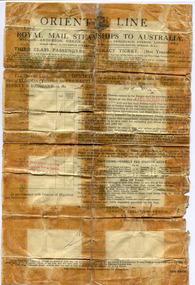
Document - Steerage Passenger Ticket for RMS Orvieto, John Herron, 1 May 1926
... Australia aboard the Royal Mail Ship Orvieto leaving the Port of London on 6 May 1926 and arriving in Melbourne on 1 June 1926. The ORVIETO was built by Workman Clark at Belfast in 1909. It was chartered by the Orient Steam Navigation Co until 1919 when it was taken over by the P&O Line. The passenger ship of 12,133 tons could accommodate 1117 people. Its maiden voyage in 1909 was from London to Sydney and Melbourne via the Suez Canal. During World War I the ship was used a minelayer and converted into an armed Merchant cruiser...Australia aboard the Royal Mail Ship Orvieto leaving the Port of London on 6 May 1926 and arriving in Melbourne on 1 June 1926. The ORVIETO was built by Workman Clark at Belfast in 1909. It was chartered by the Orient Steam Navigation Co until 1919 when it was taken over by the P&O Line. The passenger ship of 12,133 tons could accommodate 1117 people. Its maiden voyage in 1909 was from London to Sydney and Melbourne via the Suez Canal. During World War I the ship was used a minelayer and converted into an armed Merchant cruiser ...John Herron immigrated to Australia aboard the Royal Mail Ship Orvieto leaving the Port of London on 6 May 1926 and arriving in Melbourne on 1 June 1926. The ORVIETO was built by Workman Clark at Belfast in 1909. It was chartered by the Orient Steam Navigation Co until 1919 when it was taken over by the P&O Line. The passenger ship of 12,133 tons could accommodate 1117 people. Its maiden voyage in 1909 was from London to Sydney and Melbourne via the Suez Canal. During World War I the ship was used a minelayer and converted into an armed Merchant cruiser. In 1919 under the P&O line the ORVIETO resumed the passenger run between England and Australia, operating until 1930 when it was scrapped.John Herron was the husband of Isa May (nee Kennedy). Isa was the granddaughter of one of the oldest residents born in Bentleigh in 1857, James Jones.Third Class Passengers Contract Ticket for John Herron aboard the Royal Mail Steamship ORVIETO to Australia departed London 1 May 1926 two sided First day of May 1926 - John Herron, aged 17. - Melbourne - This ticket is available at the Company's option for a berth in a six, eight or ten berth cabinjohn herron, immigration, rms orvieto, ship, travel, moorabbin, bentleigh, london, steerage ticket, orient line, mail -
 Mission to Seafarers Victoria
Drawing - Artist sketch, Gerry Cummins & Jill Stehn Pty. Ltd, 1980
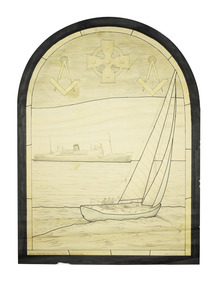
... Designed to carry 400 passengers , she plied her trade around the Southern and Eastern Ports of Australia. In WW2 she was an armed merchant cruiser and served in Indian waters and escorted the 1st convoy out of the Singapore after the Japanese invasion. ...Designed to carry 400 passengers , she plied her trade around the Southern and Eastern Ports of Australia. In WW2 she was an armed merchant cruiser and served in Indian waters and escorted the 1st convoy out of the Singapore after the Japanese invasion. ...The window in this photograph was commissioned by the Sandringham Yacht Club in conjunction with a Masonic Lodge and work carried out by Gerry Cummins in 1980. In the background is the S.S. 'Kanimbla' built 1935, Belfast for McIlwraith McEacham and was the last large passenger ship built specifically for Australian owners. Designed to carry 400 passengers , she plied her trade around the Southern and Eastern Ports of Australia. In WW2 she was an armed merchant cruiser and served in Indian waters and escorted the 1st convoy out of the Singapore after the Japanese invasion. She later operated in the Pacific after the war and after repatriation duties she was decommissioned and subsequently sold to be renamed 'Oriental Queen' which eventually caught fire and sank. . The small yacht in the foreground refers to the Sandringham YC. Window measurements: 600mm x 900mmShows the link with Freemasonry.Sketch in pencil and ink on cream paper for an arched stained glass window depicting a yacht.Bottom left corner: Proposed Stained Glass Window, Mission to Seamen. (Scale: Full Size) Right Left corner: Gerry Cummingsfreemasons, st peter chapel, flinders street, mission to seafarers, gerry cummins, jill stehn, stained glass window, sandringham yacht club, hearts of oak lodge, yacht, symbols, square, compass, ss kanimbla -
 Ringwood and District Historical Society
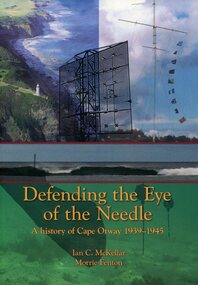
Book, Defending the Eye of the Needle - A History of Cape Otway 1939-1945 - Ian C. McKellar, Morrie Fenton, 2007
... cruiser squadrons of the Royal Navy, showing the flag at the furthest corner of the Empire. The lighthouse and its associated signal station made no distinction between merchant vessel and warship. In this book Ian McKellar examines a little known aspect of the history of Cape Otway - its role in war, more particularly the Second World War between 1939 and 1945. It takes the reader back to a time when Australia...cruiser squadrons of the Royal Navy, showing the flag at the furthest corner of the Empire. The lighthouse and its associated signal station made no distinction between merchant vessel and warship. In this book Ian McKellar examines a little known aspect of the history of Cape Otway - its role in war, more particularly the Second World War between 1939 and 1945. It takes the reader back to a time when Australia ...Soft covered 195-page book with sketches, photographs and charts.Foreword extract: "In 1848 the vital beam of the nobly proportioned Cape Otway lighthouse first shone out over the perilous, previously unlit, waters of Bass Strait. It has now maintained that watch over its narrow western entrance, the aptly named 'Eye of the Needle', for over a century and a half. During that time ships of all shapes and sizes passed below Cape Otway's high cliffs - clipper ships with a hectare of canvas aloft, their masters determined to achieve the fastest passage out to the goldfields, four-masted grain ships and, by the turn of the century, the punctual, comfortable, Orient liners. They were followed by the battleships of the American White fleet in 1908 and, from time to time, cruiser squadrons of the Royal Navy, showing the flag at the furthest corner of the Empire. The lighthouse and its associated signal station made no distinction between merchant vessel and warship. In this book Ian McKellar examines a little known aspect of the history of Cape Otway - its role in war, more particularly the Second World War between 1939 and 1945. It takes the reader back to a time when Australia was ill-prepared for another war so soon after the conclusion of the Great War." -
 Bendigo Military Museum
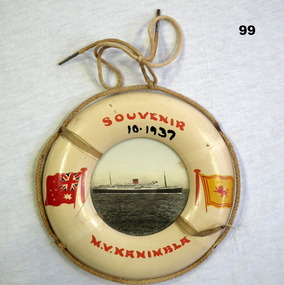
Souvenir - CRUISE SOUVENIR, 10.1937
... M V Kanimbla coastal liner requisitioned in Australia August 1939 to become armed merchant cruiser 1943. It was converted to a landing ship for infantry, saw service at Hollandia, Borneo, Morotai & Phillipines....M V Kanimbla coastal liner requisitioned in Australia August 1939 to become armed merchant cruiser 1943. It was converted to a landing ship for infantry, saw service at Hollandia, Borneo, Morotai & Phillipines. photography - photos souvenirs military history - navy Handwritten on back: Melb to Adelaide 10.37 Troopship L K Morgan Painted on front: Souvenir 10.1937 M V Kanimbla Photo of H V Kanimbla mounted in a frame the shape of a lifebelt depicting the Australian Merchant Flag with red Scottish Lion. ...M V Kanimbla coastal liner requisitioned in Australia August 1939 to become armed merchant cruiser 1943. It was converted to a landing ship for infantry, saw service at Hollandia, Borneo, Morotai & Phillipines.Photo of H V Kanimbla mounted in a frame the shape of a lifebelt depicting the Australian Merchant Flag with red Scottish Lion. Shoelace attached to hang it.Handwritten on back: Melb to Adelaide 10.37 Troopship L K Morgan Painted on front: Souvenir 10.1937 M V Kanimblaphotography - photos, souvenirs, military history - navy -
 Queenscliffe Maritime Museum
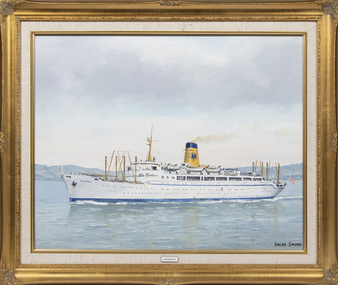
Painting - Mariposa, Dacre Smyth, SS Mariposa
... On the 12th January 1942 the Mariposa left San Francisco in the "Australian — Suva" convoy escorted by two destroyers and the light cruiser and with two other troopships (destined for Suva). ...On the 12th January 1942 the Mariposa left San Francisco in the "Australian — Suva" convoy escorted by two destroyers and the light cruiser and with two other troopships (destined for Suva). ...SS Mariposa was a luxury ocean liner launched in 1931, one of four ships in the Matson Lines "White Fleet", which included SS Monterey, SS Malolo, and SS Lurline. She was later renamed SS Homeric. Mariposa was designed for service in the Pacific Ocean, including regular stops in ports along the West Coast of the United States, Hawaii, Samoa, Fiji, New Zealand, and Australia. On the 12th January 1942 the Mariposa left San Francisco in the "Australian — Suva" convoy escorted by two destroyers and the light cruiser and with two other troopships (destined for Suva). This was the first large convoy to Australia after Pearl Harbor with Mariposa transporting Army personnel, ammunition and fifty P-40 fighters intended for the Philippines and Java.Mrs B SmythAn oil painting of the SS Mariposa in an ornate gold frame. Mariposamigrant ships, ss mariposa, wwii
