
Showing 28 items matching "australian exhibition of women's work"
-
 Kew Historical Society Inc
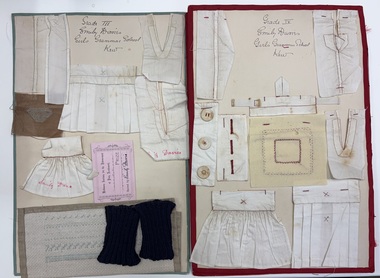
Textile - Australian Exhibition of Women's Work, Emily Davies, c.1907
... Australian Exhibition of Women's Work......Australian Exhibition of Women's Work...The first Australian Exhibition of Women's Work was a national exhibition held over thirty-nine days in 1907 in Melbourne, and in the seventh year of the country's Federation. ...The first Australian Exhibition of Women's Work was a national exhibition held over thirty-nine days in 1907 in Melbourne, and in the seventh year of the country's Federation. ...The first Australian Exhibition of Women's Work was a national exhibition held over thirty-nine days in 1907 in Melbourne, and in the seventh year of the country's Federation. The exhibition was a celebration of the creativity and productivity of women in the manual and fine arts. It was visited by over 250,000 people who saw 16,000 exhibits by women from around Australia in competition for prizes, and 3,000 (non-competitive) entries from the rest of the world. It was one of the largest women's exhibitions ever mounted. The exhibition opened on 23 October and closed on 30 November at the Royal Exhibition Building.A prize-winning collection of early 20th century embroideries created by Emily Muriel Grace Davies, the daughter of the Mayor of Richmond. Most of the embroideries were created while Emily was a student of Baldur Grammar in Kew. Baldur Grammar was founded in 1897 and was located at 17-19 Denmark Street. emily davies, baldur grammar school, plain sewing competitions, schools -- materials technology, knitting, australian exhibition of women's work -
 Linton and District Historical Society Inc
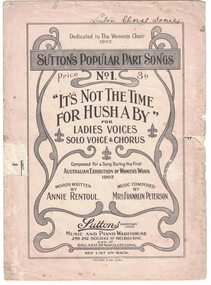
Sheet music, Suttons Proprietary Limited, It's Not The Time For Hush A By : sheet music c.1907
... ...Australian Exhibition of Women's Work 1907...This song was composed for and sung during the Australian Exhibition of Women's Work, held in 1907..... / IT'S NOT THE TIME / FOR HUSH A BY / FOR / LADIES VOICES / SOLO VOICE & CHORUS / Composed for & Sung During the First / AUSTRALIAN EXHIBITION OF WOMEN'S WORK / 1907. ". Pencilled on back page: "No. 17(?) ...This song was composed for and sung during the Australian Exhibition of Women's Work, held in 1907. Sheet music Songs Linton Choral Society Australian Exhibition of Women's Work 1907 Text: " Linton Choral Society / Dedicated to The Women's Choir / 1907 / SUTTONS POPULAR PART SONGS / No. 1. / IT'S NOT THE TIME / FOR HUSH A BY / FOR / LADIES VOICES / SOLO VOICE & CHORUS / Composed for & Sung During the First / AUSTRALIAN EXHIBITION OF WOMEN'S WORK / 1907. ". ...This song was composed for and sung during the Australian Exhibition of Women's Work, held in 1907.Single sheet, folded in two to form four pages. "Linton Choral Society" written in ink across top RH. Sheet music for a song, "It's not the time for hush a by Sheet music published in series "Suttons Popular Part Songs; No. 1". Price 3d.Text: " Linton Choral Society / Dedicated to The Women's Choir / 1907 / SUTTONS POPULAR PART SONGS / No. 1. / IT'S NOT THE TIME / FOR HUSH A BY / FOR / LADIES VOICES / SOLO VOICE & CHORUS / Composed for & Sung During the First / AUSTRALIAN EXHIBITION OF WOMEN'S WORK / 1907. ". Pencilled on back page: "No. 17(?) / Imp. edition / Sonatina / Album F. Schmitt".sheet music, songs, linton choral society, australian exhibition of women's work 1907 -
 Wodonga & District Historical Society Inc
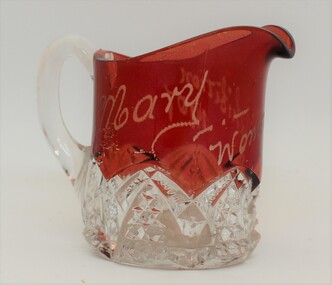
Decorative object - Ruby Glass and crystal jug, 1907
... The First Australian Exhibition of Women's Work was held at the Exhibition Building, Melbourne, from 23 October to 30 November 1907. ...A small ruby glass and crystal jug which was produced as a souvenir of the Australian Exhibition of Women's Work held at the Exhibition Building in Melbourne in 1907. ...The First Australian Exhibition of Women's Work was held at the Exhibition Building, Melbourne, from 23 October to 30 November 1907. ...The First Australian Exhibition of Women's Work was held at the Exhibition Building, Melbourne, from 23 October to 30 November 1907. It was opened by Lady Northcote (the wife of Australia’s Governor General) and Pattie Deakin (wife of the Prime Minister), who also ran a model creche during the exhibition. The five week exhibition showcased the work of women musicians, artists and craftswomen with over 16,000 exhibits in all fields of artistic endeavour. It was attended by approximately 250,000 people. Exhibits were divided into Classes, including Fine Arts; Applied Arts; Photography; Plain Needlework; Cookery, Preserves and Laundry Work; Horticulture; and Medical and Nursing. This item was owned by Mrs. Mary Burrowes, aunt of Mrs. Jean Raper.This item is from Raper Collection donated to the Wodonga Historical Society by Mrs. Jean Raper. A small ruby glass and crystal jug which was produced as a souvenir of the Australian Exhibition of Women's Work held at the Exhibition Building in Melbourne in 1907. It has been inscribed in gold coloured paint. "Mary Women's Exhibition 1907"vase, glassware, decorative items -
 Wodonga & District Historical Society Inc
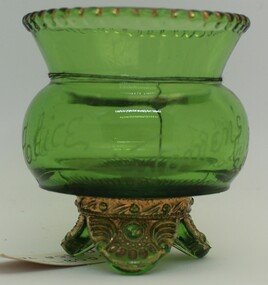
Decorative object - Small green glass vase, 1907
... The First Australian Exhibition of Women's Work was held at the Exhibition Building, Melbourne, from 23 October to 30 November 1907. ...A small green glass vase with gilt edge which was produced as a souvenir of the Australian Exhibition of Women's Work held at the Exhibition Building in Melbourne in 1907. ...The First Australian Exhibition of Women's Work was held at the Exhibition Building, Melbourne, from 23 October to 30 November 1907. ...The First Australian Exhibition of Women's Work was held at the Exhibition Building, Melbourne, from 23 October to 30 November 1907. It was opened by Lady Northcote (the wife of Australia’s Governor General) and Pattie Deakin (wife of the Prime Minister), who also ran a model creche during the exhibition. The five week exhibition showcased the work of women musicians, artists and craftswomen with over 16,000 exhibits in all fields of artistic endeavour. It was attended by approximately 250,000 people. Exhibits were divided into Classes, including Fine Arts; Applied Arts; Photography; Plain Needlework; Cookery, Preserves and Laundry Work; Horticulture; and Medical and Nursing. This item was owned by Mrs. Alice Yardy nee Dinsmore, grandmother of Mrs. Jean Raper.This item is from Raper Collection donated to the Wodonga Historical Society by Mrs. Jean Raper. A small green glass vase with gilt edge which was produced as a souvenir of the Australian Exhibition of Women's Work held at the Exhibition Building in Melbourne in 1907. It has been inscribed in gold lettering. "Alice Women's Exhibition 1907"vase, glassware, decorative items -
 Embroiderers Guild, Victoria
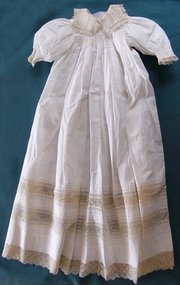
Clothing - Christening Robe, Mrs Charlotte Sarah Webb, Before 1907
... The layette won equal second prize at the First Australia Exhibition of Women's Work 1907. Part of a complete layette, which won equal second prize at the first Australian Exhibition of Women's Work 1907. ...The layette won equal second prize at the First Australia Exhibition of Women's Work 1907. Part of a complete layette, which won equal second prize at the first Australian Exhibition of Women's Work 1907. ...Part of a complete layette made by donor's maternal grandmother Mrs Charlotte Sarah Webb (nee Richardson) before 1907 (1865-51). The layette won equal second prize at the First Australia Exhibition of Women's Work 1907. Part of a complete layette, which won equal second prize at the first Australian Exhibition of Women's Work 1907. White cotton, dress has a fine self stripe, gathered bodice and squared collar of torchon lace and insertion, gathered sleeves, and pintucks, insertion and lace at skirt edge. christening robe, petticoats, embroidery, heirloom sewing, australia, 1900-20, lace -
 Embroiderers Guild, Victoria
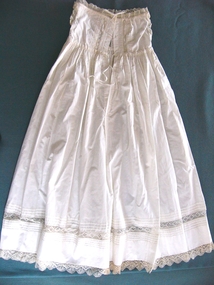
Clothing - Christening Robe Petticoat, Mrs Charlotte Sarah Webb, Before 1807
... The layette won equal second prize at the First Australia Exhibition of Women's Work 1907. Refer file for information. ...The layette won equal second prize at the First Australia Exhibition of Women's Work 1907. Refer file for information. ...Part of a complete layette made by donor's maternal grandmother Mrs Charlotte Sarah Webb (nee Richardson) before 1907 (1865-51). The layette won equal second prize at the First Australia Exhibition of Women's Work 1907. Refer file for information. Part of a complete layette, which won equal second prize at the first Australian Exhibition of Women's Work 1907. See also 1113, 1114, 1115, 1116, 1117. Letters in archives.White cotton petticoat decorated with lace and pintucks.christening robe, petticoats, embroidery, heirloom sewing, australia, 1900-20, lace -
 Buda Historic Home & Garden Castlemaine
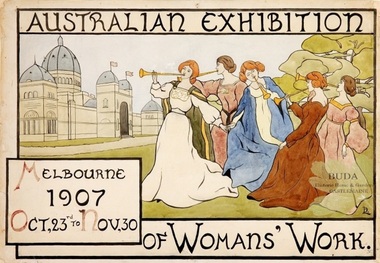
Artwork, other - Illustration - Poster Design, Australian Exhibition of Womans' Work 1907, 1907
... This original poster design was produced as entry in the First Australian Exhibition of Women's Work 1907 in Melbourne. Dorothy Leviny was studying art and design at the Bendigo School of Mines at this time, under the tutelage of Arthur T. ...Original poster design by (Bertha) Dorothy Leviny for the 'Australian Exhibition of Womans' Work', Melbourne 1907. Watercolour design showing Exhibition Buildings (Carlton) and five women in medieval costume blowing their trumpets with trees in background. ...This original poster design was produced as entry in the First Australian Exhibition of Women's Work 1907 in Melbourne. Dorothy Leviny was studying art and design at the Bendigo School of Mines at this time, under the tutelage of Arthur T. ...This original poster design was produced as entry in the First Australian Exhibition of Women's Work 1907 in Melbourne. Dorothy Leviny was studying art and design at the Bendigo School of Mines at this time, under the tutelage of Arthur T. Woodward, who was recognised as one of Australia's foremost proponents of the Arts and Crafts Movement. Reference: Castlemaine Art Gallery and Historical Society (2007): Catalogue. Portrait of an Exhibition. Centenary celebration of the first Australian exhibition of women's work 1907, p. 44.One of the few original poster design entries known to remain in existence from the First Australian Exhibition of Women's Work, Melbourne 1907.Original poster design by (Bertha) Dorothy Leviny for the 'Australian Exhibition of Womans' Work', Melbourne 1907. Watercolour design showing Exhibition Buildings (Carlton) and five women in medieval costume blowing their trumpets with trees in background. Text top: 'Australian Exhibition', bottom 'of Womans' (sic) Work' and lower left corner 'Melbourne/1907/Oct, 23rd to Nov. 30.Lower right-hand of design - Dorothy Leviny's insignia: A 'B' inside a 'D' with and 'L'(bertha) dorothy leviny, first australian women's exhibition, 1907, exhibition building, carlton, australian women's work, watercolour design, poster, arts and crafts movement -
 Buda Historic Home & Garden Castlemaine
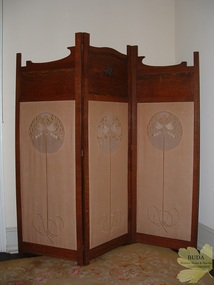
Domestic furniture, Arts and Crafts embroidered draught screen, c1900
... This screen with embroidered and appliqued panels was entered in the First Australian Exhibition of Women's Work 1907, at the Royal Exhibition Building in Melbourne. ...This screen with embroidered and appliqued panels was entered in the First Australian Exhibition of Women's Work 1907, at the Royal Exhibition Building in Melbourne. ...This screen with embroidered and appliqued panels was entered in the First Australian Exhibition of Women's Work 1907, at the Royal Exhibition Building in Melbourne. This landmark exhibition gave women artists and craft workers an opportunity to display their works to a broad audience and gain recognition for the variety and high standard of the works in both traditional and non-traditional fields for women. The embroidery and applique design is based on an original design for a similar object made by British Arts and Crafts Architect and Designer, M.H. Baillie-Scott, which was published in The Studio magazine in the early 1900s,This three-panel draught screen was made by Hilda Leviny in the Arts and Crafts style and entered into the First Exhibition of Women's Work, at the Exhibition Buildings, Melbourne in 1907.Arts and Crafts style three-panel draught screen made from timber(American Oak), linen panels, silk embroidery threads, beaten copper decoration and varnish. The embroidered panels, made by Hilda Leviny, are mounted within the timer framework, depicting a design of birds and trees in the Arts and Crafts style. Pattern Reg. No. 3227.2 and 2503. With copper decoration.hilda leviny, buda, castlemaine, domestic furniture, handcrafts, needlework, art nouveau, 1907, exhibition of women's work, royal exhibition building, woodwork, draught sceen, arts and crafts movement, embroidery and applique -
 Buda Historic Home & Garden Castlemaine
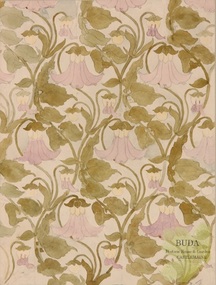
Illustration - Watercolour, Dorothy Leviny, Original Wallpaper Design by Dorothy LEviny, 1906
... Dorothy Leviny, along with two of her sisters, entered a number of items in the First Australian Exhibition of Women's Work, Melbourne, 1907, and was awarded second prize for one of her wallpaper designs. ...Dorothy Leviny, along with two of her sisters, entered a number of items in the First Australian Exhibition of Women's Work, Melbourne, 1907, and was awarded second prize for one of her wallpaper designs. ...Original design by Dorothy Leviny, aged 25, while she was a student at the Bendigo School Of Mines under the tutelage of Arthur T. Woodward. Woodward, who had come to Australia from Britain, was a renowned proponent of the Arts and Crafts Movement in Australia during the late nineteenth and early twentieth centuries. Dorothy Leviny, along with two of her sisters, entered a number of items in the First Australian Exhibition of Women's Work, Melbourne, 1907, and was awarded second prize for one of her wallpaper designs. Dorothy Leviny was the ninth child born to noted colonial silversmith and jeweller, Ernest Leviny, and his wife, Bertha (nee Hudson).This original wallpaper design by Dorothy Leviny is one of few that remain in existence from the early twentieth century showing the influence of the British Arts and Crafts Movement in Australia.Original wallpaper design made by (Bertha) Dorothy Leviny painted in watercolour. The repetitive floral design consists of pale pink bell-shaped flowers with green stems and leaves. Paper, card, watercolour paint.'D. Leviny /06'.dorothy leviny, watercolour painting, arts and crafts movement, 1906, buda, castlemaine, arthur t woodward, bendigo school of mines, exhibition of womens work 1907, wallpaper design, illustration -
 Federation University Historical Collection
Book, Victoria Education Gazette and Teachers' Aid, 1900-1910, 1900-1910
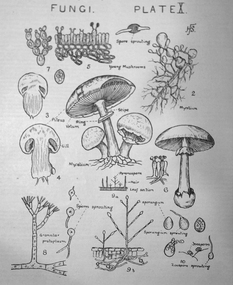
... Parker (p. 18); Freearm Drawing- Sale State School (p.71) .5) Images: Map of Australia (p.33); Formalin lamps for disinfecting rooms (p. 80); Melbourne Teachers Training College (p. 167) .6) Werribee Gorge Supplement (p. 3, 4, 11, 12, 13) .7) First Exhibition of Women's Work (p. 7, 73-76) .8) Images: Franco-British Exhibition; Memorial to William H. ...Parker (p. 18); Freearm Drawing- Sale State School (p.71) .5) Images: Map of Australia (p.33); Formalin lamps for disinfecting rooms (p. 80); Melbourne Teachers Training College (p. 167) .6) Werribee Gorge Supplement (p. 3, 4, 11, 12, 13) .7) First Exhibition of Women's Work (p. 7, 73-76) .8) Images: Franco-British Exhibition; Memorial to William H. ...The Federation University Historical Collection holds a full range of Victoria Education Gazette and Teachers' Aid from 1900-1968.Ten black hard covered volumes with red tape spine, covering 1900 to 1910. The gazettes include Education Department appointments, transfers, resignations and retirements, notices, queries, notices of books, examination papers, original articles, lesson plans, suggestions for lessons, drawing, obituaries, notes on nature study, mathematics, music, sloyd woodwork, English grammar, Victorian State School Swimming Clubs, Geography, penmanship, science, History, Latin, Geography; The School Garden - Shean's Creek .1) Arbour Day (pg 135) Images: Melbourne Teachers' College 1888 Building (p.8); Union Jack (p. 80); Gasometer (p. 132) .2) Plant Life lesson plans, The Antarctic in 1910, Model Nature Lesson - what plants live on , Superannuation Fund, Saluting the Flag, A.N.A. School Children's Competitions, school garden awards, Teacher Training College, Nature Study - A page from a Teacher's Diary, A Mushroom, Mrs Bush's Kindergarten Christmas Images: Dookie Agricultural College, George R. Button, training college students attending the university, Sloyd teachers, Staff at the Summer School, Outside Wilson Hall, Watt's River Weir, Fungi .3) Images: Walhalla State School; Francis W. Parker (p. 18); Freearm Drawing- Sale State School (p.71) .5) Images: Map of Australia (p.33); Formalin lamps for disinfecting rooms (p. 80); Melbourne Teachers Training College (p. 167) .6) Werribee Gorge Supplement (p. 3, 4, 11, 12, 13) .7) First Exhibition of Women's Work (p. 7, 73-76) .8) Images: Franco-British Exhibition; Memorial to William H. Nichols (p. 191) .9) Temperance Teaching; Birds native to Australia (p.4) Images: Royal Agricultural Show State Schools Exhibit (p. 5-18); Leonard's Hill School; Visit of the American Fleet .10) Funeral of Edward VII Images: Portsea Quarantine Station (p. 33-35)w.o. ryan, f. thomas, a.a. tipping, t.n. considine, w.c. fordyce, e.e. bull, h.w. byrne, j.t. flynn, r.t. smith, a.w. steane, james bagge, theo fink, frank tate, siede, nature, garden, education, school, teacher, teaching, arbor day, arbour day -
 Mission to Seafarers Victoria
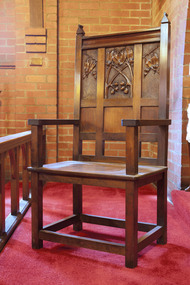
Furniture - Sanctuary chairs, pair, Gladys Hawkey (1886-1974), c. 1917
... work is made in an article in 1915 where her escritoire is offered in a raffle to raise funds for the Australian sick and Wounded. The chairs were donated in 1919 when the Flinders Street mission was open. In a style of Robert Prenzel with Australian Flora, the chairs are in the typical Arts and Crafts style. Like many women from the early 1900s, she was likely to have been inspired by the Australian exhibition ...William Scott Purves Godfrey (1872-1953) designed the chairs and Miss Gladys Hawkey (1886-1974) carved them. W.S.P Godfrey was born in Toorak on 6 April 1872. He was was the cousin of Ethel Godfrey. Educated in Brussels and at Melbourne Grammar, he studied Architecture at the University of Melbourne. He and Henry Howard Spowers established the architectural firm Godfrey & Spowers, known for the design of the Argus building, around 1901. W S P Godfrey retired from practice in 1944. He died in August 1953, aged 81. He's buired in the St Kilda Cemetery with the Godfrey family. Gladys Hawkey was a member of the Guild. (photographed during the Norla Fete). She was born in Sandhurst, Bendigo and is buired in the Bendigo Cemetery. Little is known about Gladys Hawkey. She may have been a student of Robert Prenzel. Another mention of her work is made in an article in 1915 where her escritoire is offered in a raffle to raise funds for the Australian sick and Wounded. The chairs were donated in 1919 when the Flinders Street mission was open. In a style of Robert Prenzel with Australian Flora, the chairs are in the typical Arts and Crafts style. Like many women from the early 1900s, she was likely to have been inspired by the Australian exhibition of women's work and other female woodworkers of the time.Handcarvedgladys amy hawkey (1886-1974), william scott purves godfrey (1872-1953), lhlg, ladies harbour lights guild, chapel, flinders street, mission to seafarers, seamen's mission, wood carving, godfrey and spowers, heritage listed, arts and crafts, gifts-1917 -
 Warrnambool and District Historical Society Inc.
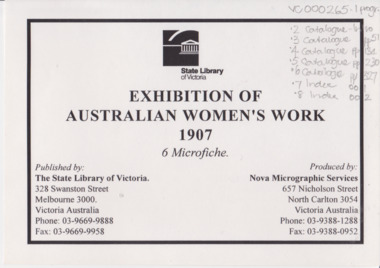
Programme - Microfiche, Exhibition of Women's Work, 1907, Circa 2000
... State Library of Victoria Exhibition os Australian Women’s work 1907 6 microfiche. ... women’s work 1907 women’s work exhibition State Library of Victoria Exhibition os Australian Women’s work 1907 6 microfiche. ...This exhibition was held in October 1907 and ran for 5 weeks. There were over 15000 contributors in the fields of needlework, cookery, Horticulture, fine and applied arts. There was a wide variety of activities, lectures and social events. There were approximately 250,000 people who attended.An important source of work and information relating to a major event in the State of Victoria and in the work of women.Eight sheets of microfilm enclosed in plastic sheet with title page, white with black text.State Library of Victoria Exhibition os Australian Women’s work 1907 6 microfiche. warrnambool, exhibition australian women’s work, 1907 women’s work exhibition -
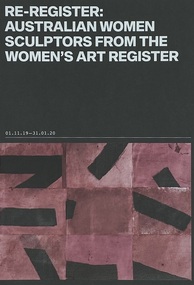 Women's Art Register
Books, Re-Register: Australian Women Sculptors From The Women’s Art Register
... The exhibition catalogue for the inaugural artist in residence program at the Women’s Art Register, featuring work by artist-in-residence Julia Boros, essays, images and archival material. art women artists sculpture contemporary art exhibition women’s art register textiles julia boros katve-kaisa kontturi anna sandy bonita ely richmond australian artists A5 Booklet 12 pages stapled in centre, full colour, with image of textile work on cover Re-Register: Australian Women Sculptors From The Women’s Art Register Books ...art, women artists, sculpture, contemporary art, exhibition, women’s art register, textiles, julia boros, katve-kaisa kontturi, anna sandy, bonita ely, richmond, australian artistsart, women artists, sculpture, contemporary art, exhibition, women’s art register, textiles, julia boros, katve-kaisa kontturi, anna sandy, bonita ely, richmond, australian artists -
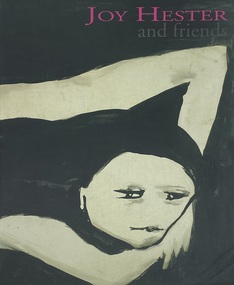 Women's Art Register
Book - Catalogue, National Gallery of Australia, Joy Hester and Friends, 2001
... work has been acknowledged more and more since her early death. Complements material held on this Australian artist in the Women's Art Register collection. Enables access to images of work from public, corporate and private collections. contemporary art society angry penguins painting watercolour gouache Catalogue accompanying exhibition at National Gallery of Australia in 2001 with two essays interweaving Hester's life and art, 1920-1960. ...Catalogue accompanying exhibition at National Gallery of Australia in 2001 with two essays interweaving Hester's life and art, 1920-1960.Booknon-fictionCatalogue accompanying exhibition at National Gallery of Australia in 2001 with two essays interweaving Hester's life and art, 1920-1960.contemporary art society, angry penguins, painting, watercolour, gouache -
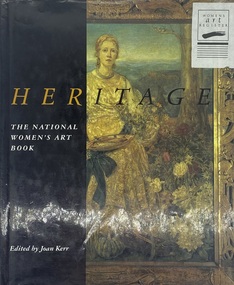 Women's Art Register
Book, Joan Kerr, Heritage. The National Women's Art Book, 1995
... Women. It was the springboard for a large number of exhibitions and activities held nationally also marking the anniversary. Complements and expands similar material held in The Womens Art Register. colonial art craft competitions portraiture furniture sculpture indigenous art museology 500 works of art by 500 Australian women from colonial times to 1955 with images and commentaries on each work prepared by by 200 curators, critics, family member or the artists herself. ...500 works of art by 500 Australian women from colonial times to 1955 with images and commentaries on each work prepared by by 200 curators, critics, family member or the artists herself. Includes images of many works which may never have been reproduced. A biographical section comprises concise entries on these artists.Booknon-fiction500 works of art by 500 Australian women from colonial times to 1955 with images and commentaries on each work prepared by by 200 curators, critics, family member or the artists herself. Includes images of many works which may never have been reproduced. A biographical section comprises concise entries on these artists.colonial art, craft, competitions, portraiture, furniture, sculpture, indigenous art, museology -
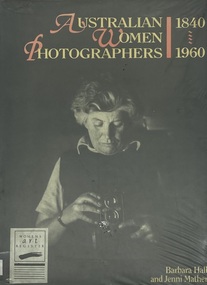 Women's Art Register
Book, Barbara Hall and Jenni Mather, Australian Women Photographers 1840 - 1960, 1986
... Australian Women photographers, positioning them within the cultural, social and political developments, and technological advances, of their time. Complements other material held in The Women's Art Register on women photographers. self portraiture self-portraiture pictorialism Home magazine studio photography melbourne Society of Women Painters and Sculptors Olive Cotton Ruth Hollick Arising from research for an exhibition of the same name, which toured Australia 1981- 1982 the book covers the work of 45 amateur and professional photographers and their lives as innovators and travellers. ...Arising from research for an exhibition of the same name, which toured Australia 1981- 1982 the book covers the work of 45 amateur and professional photographers and their lives as innovators and travellers. Many of the works come from private collections and have not been previously published.Booknon-fictionArising from research for an exhibition of the same name, which toured Australia 1981- 1982 the book covers the work of 45 amateur and professional photographers and their lives as innovators and travellers. Many of the works come from private collections and have not been previously published.self portraiture, self-portraiture, pictorialism, home magazine, studio photography, melbourne society of women painters and sculptors, olive cotton, ruth hollick -
 Women's Art Register
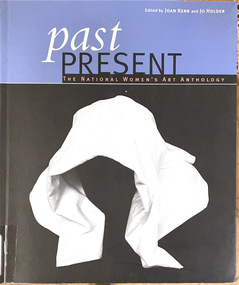
Book - Anthology, Joan Kerr and Jo Holder, Past Present. The National Women's Art Anthology, N/A
... work in the National Women's Art Project which Joan Kerr started in 1993, which was marked by major publications and exhibitions in 1995. Complements material held in The Women's Art register Indigenous art political art gender represenation museology photography installation graphic design collaborative practices Essays on feminist art, art history, criticism and museum practices in 1990s Australia by writers, academics, artists. "709.9.94/KER" Inside Front Cover. ...Essays on feminist art, art history, criticism and museum practices in 1990s Australia by writers, academics, artists.non-fictionEssays on feminist art, art history, criticism and museum practices in 1990s Australia by writers, academics, artists.indigenous art, political art, gender, represenation, museology, photography, installation, graphic design, collaborative practices -
 Victoria Police Museum
Oral history, Sergeant Eileen Rainford, April 2017
... Australia. Speaking numerous languages, including Polish and German, Rainford worked as a translator and radio broadcaster during and after the second world war. On moving to Australia Rainford joined Victoria Police, where as one of only eight policewomen, she noted a major difference in public attitude towards women working in the force. In this interview, Rainford reflects on these different attitudes and her roles at numerous stations. police woman policewoman policewomen oral history rainford victoria police Digital archive of oral history of former police woman Eileen Rainford. Cut for exhibition ...Eileen Rainford is a retired Sergeant who joined Victoria Police as one of only eight police women in 1952. Born in England, she served with Liverpool police, patrolling the docks, prior to moving to Australia. Speaking numerous languages, including Polish and German, Rainford worked as a translator and radio broadcaster during and after the second world war. On moving to Australia Rainford joined Victoria Police, where as one of only eight policewomen, she noted a major difference in public attitude towards women working in the force. In this interview, Rainford reflects on these different attitudes and her roles at numerous stations.Digital archive of oral history of former police woman Eileen Rainford. Cut for exhibition purposespolice woman, policewoman, policewomen, oral history, rainford, victoria police -
 Warrnambool and District Historical Society Inc.
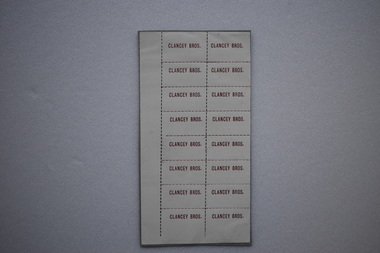
Label, Mrs. Wm. Wright, Early 20th century
... Her pupils were successful at local shows and she herself won second prize in the Australian Womens Work Exhibition of 1907 for the best made washing dress for a girl of 12. ...Her pupils were successful at local shows and she herself won second prize in the Australian Womens Work Exhibition of 1907 for the best made washing dress for a girl of 12. ...Martha Wright was the proprietor of a fancy goods store in Liebig Street, Warrnambool opposite Jordan's studio. She took art needlework classes offering seven lessons for 5 shillings . Her pupils were successful at local shows and she herself won second prize in the Australian Womens Work Exhibition of 1907 for the best made washing dress for a girl of 12. This item is significant as Mrs.Wright was a prominent business woman in Warrnambool in the early 20th century.White rectangular label with dark blue lines and background .ART NEEDLEWORK AND REQUISITES From Mrs. Wm. Wright LIEBIG ST. WARRNAMBOOL Telephone 158 GOLFERS & KNITTED SUITS A SPECIALITY martha wright, fancy goods, australian womens work exhibition -
 Buda Historic Home & Garden Castlemaine
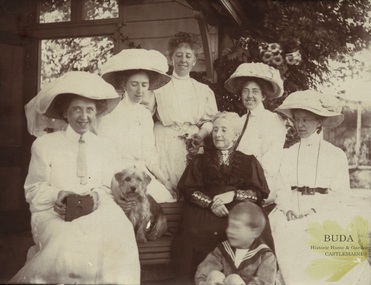
Photograph, Bertha Leviny with her daughters, a grandson and dog, 1906
... Australian silversmith. The Leviny daughters were artistic in their own right, following the principles of the Arts and Crafts Movement. Three of the daughters entered works in the 1907 Exhibition of Women's Work held at the Exhibition Buildings, Melbourne. bertha leviny mary leviny gertrude leviny hilda leviny dorothy leviny kate leviny james leviny australian terrier dog kodak box brownie camera edwardian costume buda 1906 photograph portrait leviny women castlemaine Handwritten in ink (verso): "At Buda 1906" Silver gelatin, toned print. ...Photo - Bertha Leviny (seated centre) with five of her daughters L-R: Gertrude, Hilda, Mary (standing), Dorothy and Kate. Her grandson James Leviny is at Bertha's knee. The pet dog is an Australian terrier. Bertha was the wife of noted colonial silversmith and jeweller, Ernest Leviny. Together, they raised a family of ten children in their home Buda, Castlemaine. The five unmarried daughters pursued their interests in various creative pastimes linked with the Arts and Crafts Movement of the late nineteenth and early twentieth centuries.One of the few photographs of Bertha Leviny and her daughters taken together after the death of Bertha's husband, Ernest, a prominent Australian silversmith. The Leviny daughters were artistic in their own right, following the principles of the Arts and Crafts Movement. Three of the daughters entered works in the 1907 Exhibition of Women's Work held at the Exhibition Buildings, Melbourne.Silver gelatin, toned print. Black and white photograph of a group of six women, a child and a dog. The women are seated on and around a garden bench with the tennis pavilion in the background. All are smiling at the dog which is standing on its back legs in the foreground. The little boy's face is blurred from movement during the exposure.Handwritten in ink (verso): "At Buda 1906"bertha leviny, mary leviny, gertrude leviny, hilda leviny, dorothy leviny, kate leviny, james leviny, australian terrier dog, kodak box brownie camera, edwardian costume, buda, 1906, photograph, portrait, leviny women, castlemaine -
 Embroiderers Guild, Victoria
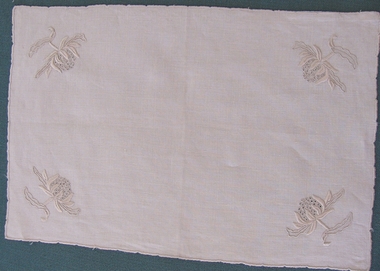
Textile - Thelma Crawford Waratah Mat, c. 1940
... women of Melbourne. In 1950 she ran a week long exhibition of her work at the Hotel South Australia in Adelaide. ...women of Melbourne. In 1950 she ran a week long exhibition of her work at the Hotel South Australia in Adelaide. ...Thelma Kinleside Crawford is remembered for her wild flower designs for embroidery. After finishing 3 years studying art at Swinburne Technical College (her aim was to become a writer and illustrator of children's books) she was employed as a designer by Miss Hilda King of International Needlework. In 1939 Miss Crawford established a small shop on the 3rd floor of Block Arcade - well frequented through to 1960's by the women of Melbourne. In 1950 she ran a week long exhibition of her work at the Hotel South Australia in Adelaide. in 1954 a pale pink linen cloth embroidered by Miss Crawford was presented to the Queen by the YWCA now known as the 'Queen's Cloth". In October 1954 Woman's Day ran a feature of Miss Crawford's designs. In 1959 and 1960 displays were mounted at the Tasmanian Tourist Bureau. In 1960 she closed her Block Arcade shop and moved to the "Little Shop" in Croydon near her home. In 1968 she retired to the Brotherhood of St. Laurence homes in Lara. She died in 1985 and bequeathed all her designs to the Geelong Branch of the EGV. She was a foundation member of the EGV.Natural coloured linen luncheon mat worked with self coloured linen threads. Simple decoration of waratah flower head embroidered in each corner using surface stitchery and eyelet holes. The edge is buttonholed.embroidery, 1940-60, australia, surface stitchery, mats -
 Kew Historical Society Inc
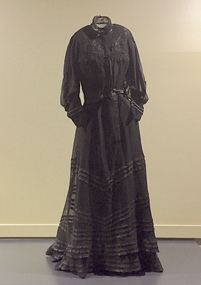
Clothing - Black Lace Evening Dress, c.1907
... Exhibition of Women's Work.' The dress is locally significant as the work of a skilled home-dressmaker in Kew, who was also a leading civic figure in the municipality. One tends to think of amateur dressmakers as women who could not afford to purchase clothes from a retailer. Clearly, 'women's work' and the skills that educated and wealthy women acquired in the period allowed them to fashion their own garments. fashion & design collection - kew historical society australian fashion - 1900s evening dresses lily clara wishart fashion design fashion -- 1900s Full length evening dress in four parts. ...Lily and William Wishart lived during this period in 'Noranook', Fernhurst grove, Kew. There are numerous contemporary accounts of the social and civic activities of Lily Wishart as mayoress of Kew. In a description of a 'Mayoral At Home' in the Kew Recreation Hall, a report in The Australasian (10 Aug 1907, p.46) described the event thus: MAYORAL AT HOME In the Kew Recreation-hall on Thursday evening the Mayor and Mrs. W. Wishart gave an at home to between two and three hundred guests. ... Prior to the musical programme, the mayor and mayoress held a reception, standing on a dais at one side of the room. Mrs. Wishart was gowned in black glace silk, trimmed with handsome lace applique, and she wore a cream Maltese lace scarf over her shoulders, and held a bouquet of cardinal carnations.' This may be the dress in the collection. Another interesting and relevant report is an account in The Argus (19 March 1907, p.6): 'WOMEN'S WORK EXHIBITION The mayoress of Kew (Mrs. W. Wishart) invited the ladies of the district to meet in the mayor's room, town-hall, Kew, at half past 3 o'clock tomorrow afternoon, to consider steps to be taken locally in support of the proposed Exhibition of Women's Work.'The dress is locally significant as the work of a skilled home-dressmaker in Kew, who was also a leading civic figure in the municipality. One tends to think of amateur dressmakers as women who could not afford to purchase clothes from a retailer. Clearly, 'women's work' and the skills that educated and wealthy women acquired in the period allowed them to fashion their own garments.Full length evening dress in four parts. Undergarments include two items: a basic black silk petticoat and an upper black silk slip, the latter with two bands of ruffles. The lace dress is in two parts: a bodice and a skirt. The black, high-necked bodice is constructed of silk organza to which guipure lace has been extensively applied. The bodice has long puffed sleeves, gathered on the forearm to form a wide band of lace and ribbon at the wrist. The skirt is constructed of the same black fabric with descending bands of gathered black silk ribbon, used as ornamentation. The skirt also features a long train. Apart from the donor information about its provenance, the style of the dress can confidently be dated to the period 1900-1910. The dress was made and worn to civic functions by Mrs Lily Wishart, Mayoress of Kew in 1906-7. Earlier items belonging to William and Lily Wishart entered the collection as early as 2002. The dress was donated by a descendant of a friend of Lily Wishart in 2020. The photograph of the dress and its components attached to the record needed to be digitally enhanced so that details of the dress could be viewed online, as the fabric of the dress is an intense black. A physical assessment of the dress is included in the condition report.fashion & design collection - kew historical society, australian fashion - 1900s, evening dresses, lily clara wishart, fashion design, fashion -- 1900s -
 Melton City Libraries
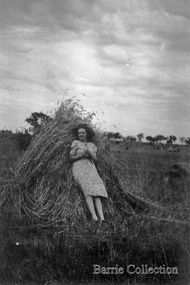
Photograph, Edna Barrie, 1920, 1924, 1933 and 1940
... Australian Boy Scout Association Cub Pack Preliminary Training and achieved her Wood Badge. Country Women’s Association In 1944-1996 she was a member of the Melton Branch Country Women’s Association (CWA), Melton Branch, Secretary of the Branch in 1945 – 1946 and Branch International Secretary 1970-1971. She worked with choir, music and drama interest groups within the branch attaining both first and second place in 1959, second place in 1952 Exhibition...Australian Boy Scout Association Cub Pack Preliminary Training and achieved her Wood Badge. Country Women’s Association In 1944-1996 she was a member of the Melton Branch Country Women’s Association (CWA), Melton Branch, Secretary of the Branch in 1945 – 1946 and Branch International Secretary 1970-1971. She worked with choir, music and drama interest groups within the branch attaining both first and second place in 1959, second place in 1952 Exhibition ...SUMMARY - Edna (Myers) Barrie, 1918 – 2018, Profile Early Life Edna was born at Melton and delivered by Hannah Watts. Her mother Martha walked in the dark at night with her basket under her arm to the bridge over the Toolern Creek Bridge and into Sherwin Street to the corner of Yuille Street to Hannah’s house Lynch Cottage. Martha’s husband was away shearing and eventually heard the news of the birth of their blue eyed third child and second daughter. She was born into a family that was surrounded by music; her father played the “squeeze box” and mother the mouth organ. From an early age the family were aware of the great composers, a framed picture of Beethoven, Chopin, Schubert and Wagner hung above the door to the lounge room of their 4 roomed cottage, the room where the piano stood. Her life on stage started as a singer aged 6 years at the Melton Mechanics Institute Hall. Edna was born with a natural ear for music learning piano and singing from her older sister Marjorie who became an accomplished pianist and soloist and renowned music teacher in Melton and district. In the 1920s and 1930s concerts at the Melton Mechanics Institute were regular events were the local talent was fostered. The Myers children, like other children of Melton and Rockbank, studied singing, piano and elocution, sat examinations, entered in competitions in South Street Ballarat, Footscray and Melbourne. In 1929 a Sacred Concert was broadcast by 3AR from the Hall as part of the Back to Melton Celebrations. Marjorie Myers performed two of the items on the piano. Edna attended Melton State School 430 from 1924 – 1933. Her father Fred had also attended the same school. In 1924 the School staged Cinderella at the Melton Mechanics Institute Hall with a cast of 33 students. After completing her education a Melton she boarded in South Melbourne and attending Melbourne Girls High School (MacRobertson Girls High School), a school which recognized her musical attributes. She travelled home on the train on the weekends, sometimes getting off at Rockbank to save a few pennies in fares. Working life The early 1930s the Depression was a difficult time for a young woman to find work. Jobs were often menial and given to the youngest and therefore cheapest applicant. She worked as sales assistant at Polonskis and Myer in the city, and Irvines Modes in Footscray. Working to 1pm on Saturday, and when held up by a customer meant missing the train home. While at Myer Department store she lived at home and rode her bike to the Melton railway station. On one occasion she had a nasty fall when a part of her bicycle came loose causing the bike to crash rendering her concussed and injuring her nose. During the 1930s she was given a camera “a little snap” by Mrs Kelly her landlady. This began her interest in photography documenting family life at their “Burnbank” home. Musically, while at Myers she participated in annual performances held at The Kings Hall and the Myer Mural Hall. Working in the basement at Myers she was often embarrassed when her name was called, customers assuming she belonged to the Myer Family. Ken Myer worked in the basement at the same time handling the ‘Wheeler’, a wicker basket used for moving goods around the store. The family philosophy was for the children to start at the bottom and work their way up. Social life Social life in her teenage years was connected also with Scots Presbyterian Church. She attended Sunday School classes and received book prizes for attendance. She loved to read and welcomed the times when she received new book. She took part in the Sunday School Anniversaries and was presented with a Bible from the Superintendent, Henry Robinson for her assistance with the music. Marriage and War years In 1941 Edna married Ernest “Bonnie” Barrie. War in the Pacific was soon to break out. While in Sydney on their honeymoon they met up with Jim Barrie who was on his way to Canada via Hawaii just missing Pearl Harbour by two days. Jim became a Spitfire Pilot and joined the RAF and was based in England. He returned to Australia later in RAAF to fight the Japanese off the coast of New Guinea. The three eldest Barrie brothers were farmers and food producers and were thus except from military service. Edna and Bon were members of the VAOC- Volunteer Air Observers Corp entailing being rostered on duty as plane spotters. The women took shifts during the day and the men at night which involved staying overnight in the Shire Offices. Later the spotting tower was built in the plantation opposite the Post Office. Edna and Bon carried on with this from their home in Ferris Rd when the threat of invasion had ceased Community life Community life in Melton revolved around fund raising events for the Melton Mechanics Institute for the War effort and keeping up with maintenance for the Hall. In 1944 the Minister for Health gave approval for the Shire of Melton to open and Infant Welfare Centre inviting Edna to form part of the Committee with seven other women. In 1948 she was President of Melton Branch of the Victorian Health Centres Association. She volunteered this use of her car driving the person in charge, Sister Smith to visit mothers and their babies. In 1963, along with Betty Jones and Isabel Snell, Edna was instrumental in forming the 1st Melton Cub Pack and later supported the formation of the 1st Melton Scouts. During 1963 – 1968 she completed the Australian Boy Scout Association Cub Pack Preliminary Training and achieved her Wood Badge. Country Women’s Association In 1944-1996 she was a member of the Melton Branch Country Women’s Association (CWA), Melton Branch, Secretary of the Branch in 1945 – 1946 and Branch International Secretary 1970-1971. She worked with choir, music and drama interest groups within the branch attaining both first and second place in 1959, second place in 1952 Exhibition and second in Music in 1960 in the state. She was involved in their handicraft craft events, fund raising and musical events and singing competitions. During the 1950s she trained Trios and Quartets in part singing for the CWA competitions in Ballarat and Melbourne. It was at this time that she developed her skill as a conductor and trainer of choirs. She later auditioned for the Victorian Choir for alto parts believing she would stand a better chance of being chosen, because of her ability to sing in natural harmony. In 1962 she participated in the Tenth Australian Country Women of the World (ACWW) Triennial Conference “Australia Presents: CWA Massed Choir” in the Melbourne Town Hall. This event was recorded by Super Sound Spotlight on 45 extended play vinyl record. The songs were Australian music and words, for example The Silver Stars are in the Sky, The Graceful Swaying Wattle and Kookaburra. Edna continued with her interest in the Victorian Choir regularly meeting at the CWA Headquarters in Toorak for rehearsals. In 1974 she took part in the Australian Choir at the fourteenth Triennial conference of the ACWW Interfaith Service held at the Perth Concert Hall on the 13th of October. Arts and Culture Edna was also in the Choir of 3KZ Carols by Candlelight at the Myer Music Bowl in 1963 and 1964. Melton Choral Society. Edna was Director and Conductor in the 1970s performing at many community events such as Carols by Candle Light, Church Services, Easter and Palm Sunday services, Mothers Union and the 1976 Community Services Week Combined Church Service. The October – November 1978 Program covered the following: songs from the Musicals, Choral and Solo with Narratives, Guest Instrumental Item, Recitation Negro Spirituals and Australian Songs. Her involvement with church choirs included the Scots Presbyterian Church Choir Easter and Christmas performances and the 1967 Centenary Service. In 1980s the Melton Uniting Church Sacred Music Performances included The Crucifixion by Stainer, The Olivet to Calvary and other church Hymns. Edna was Musical Director of the Melton Amateur Theatrical Society and worked on performances in collaboration with Mabel Rogers on script and musical interpretation. Melton and District Historical Society Annual Art and Craft Show. First held in Melton Mechanics Institute Hall in 1973, it later took place in the in the Melton Community Hall. The Art Show was also run in conjunction with other community organizations such as Rotary and Girl Guides. Community history and research Melton streetscape and society Over 20 years commencing in the 1970s, Edna undertook extensive photographing of the changing streetscape of Melton’s High Street. She anticipated the impact of change on the community during the time of Melton’s rapid transition from a small farming district to a large urban community and this led to her extensively document and photograph many of the structures and landscape features of the township that have since been lost. She also meticulously recorded much of the contemporary life of the town and has left a significant legacy of archival material. Melton State School 100 Years Celebration, October 1970 Co-author with Mabel Rogers “The First 100 Years, 1870 – 1970” Assembled a collection of School Class Photograph and identified and compiled lists of names for future school history. She also assembled a photographic display for the 125th anniversary in 1995. Melton and District Historical Society (M&DHS) Foundation Member, 1968 Held President and Secretary positions from its inception Research associated with the classification of Heritage buildings Christ Church Classification C Scots’ Presbyterian Church Classification D Set up the storage and Catalogue system in the Office at the Willows Organised society visits to Heritage sites in and beyond the Shire of Melton, including Stathtulloh, Eynesbury, Deanside, ToolernVale sites including Merrywood (now demolished) Staughton Vale, Chirnside, Point Cook, Shwerkolts Cottage. 1970 – 1983 Melton and District Historical Society Letterhead. Staughton Memorial Light from early newspaper cutting in its location before restoration to present location. Sketch by Wendy Barrie. Designing and printing pamphlets, stationery, and other sale items with Willows title. M&DHS street naming research for new housing developments (1970 – 2000). Collaborated with Mary Tolhurst to research the names of early landowners and pioneer families connected to the first settlers. Researched Aboriginal names for inclusion on lists submitted to developers. An early example is the naming of Kuranjang and the street names associated with the McPherson family. Plains of Promise (Shire of Melton history) by Joan Starr (1985). Edna assisted with Historical Society materials and contributed her own research and photographs. Contacted and organised for Hubert Opperman to launch the book. (She was also present at his last bike ride at Rochester in 1995.) Western Metropolitan Groups of Historical Societies. Member attending meetings and representing Melton, also hosted the Group at Melton The Willows Member of the Committee of Management for the restoration of the “Willows” house the establishment of The Willows Park 1982 March - Official Opening of the Willows Park- Preparation and planning for the event. Involved in the collecting of items in the furnishing of the display rooms in the Willows house. Donated items and furniture from the Myers and Daley family houses. (19th century) Machinery Shed Establishment. Involved with Jeff Robinson in the construction and collection of machinery display Other significant sites Championed and participated in the restoration and preservation significant sites in Melton, including: restoration of the Staughton Memorial Light and its return to its present site restoration of the Pykes Grave (using EW Barrie earthmoving equipment) restoration and reconstruction of Dunvegan restoration and reconstruction of Macs Cottage, the management and Caretakers residence Melton State School War Memorial Gates removed from Unitt Street entrance and relocated to the Willows Park Donated the Barrie family single furrow plough which was standing at the Court House Plaza. It removed and to Council Depot and later missing. The plaque was taken to the Willows. Jimmy Melrose (aviator) cairn restoration at crash site in Melton South Donald Mackintosh (Olympic gold medallist marksman) grave site at the Melton Cemetery (Historical items held by the Myers family collection.) Houdini first flight at Diggers Rest. Edna’s father was shearing at Diggers Rest at the time and witnessed the flight. She attended the 90 year anniversary of the event at the site in 2000. Radio and electronics Edna’s husband Bon interest in wireless communication dates in the 1920s with the building of a crystal set in the early days of public broadcasting. At the Back to Melton Celebrations in 1929, 3AR broadcast a concert from the Melton Mechanics Institute on the 20th February at 8pm featuring Footscray City Band, James Hill baritone, Vera Carew Soprano, James Foran Tenor, Marjorie Myers Piano, and James Williamson Entertainer. Accompanists: Miss Agnes Ross and Mrs James Hill. The Myers children had recordings of their piano playing made onto the aluminium records, Martha Myers’ voice can be heard introducing an item. These were made in a studio in Melbourne. Marjorie was given a upright Gramophone by Donald Mackintosh in recognition of her talent and her contribution to the cultural life of Melton. The family were then able to listen to 78rpm recordings of the famous classical recordings. The turntable was hand wound metal stylus needles had to be regularly replaced. The aluminium disk needed a bamboo needle to prevent damage to the surface. Before electricity was introduced to Melton in 1939 the Mechanics Hall relied on generators to produce electricity. Bon Barrie, being mechanically minded, built a public address system for be used a community functions at the Hall and Recreational Park. By 1939 this was up and running and used for over three decades. A large Collection of 78rpm records provided music for dances, marching, parades and any public event needing music and microphones. The early system was portable and worked on batteries. CFA Radio Communication In the 1950s with the introduction two-way HF and later VHF very high frequency radio sets. Melton Rural Fire Brigade was part of the Bacchus Marsh Group. Radio sets where located in the Melton Fire Truck, and in the house of the Barrie family at Ferris Road. This was an ideal location to observe a 360 degree view in all directions when smoke appeared on the horizon. An antenna was erected beside the house. The set OX 7 was located in the kitchen and monitored 24 hours by the family. When an electrical fire occurred at the junction of the electricity to the house there was time to radio the fire station and summons the men working in the paddocks, thus saving the house from possible destruction. With the introduction of UHF – ultra high frequency Vinten Radios the signal was clearer and static and interference lessened and radio traffic became easier to read, and reduced noise levels in the household. VL3 LY Radio Base became the Group Headquarters was established in 1967. By 1970 the Brigades were: Melton, Rockbank, Sydenham, Toolern Vale, Diggers Rest, Truganina, and Werribee. In 1974 when the family moved to First Avenue, another antenna and a small building were erected adjacent to the residence and used to house the equipment, maps. Radio traffic consisted of regular schedule times and communication with adjoining groups of brigades such as Bacchus Marsh, Mt Macedon and Little River Groups. Many of the brigade and group base radios were situated in private residences and operated primarily by fire fighters wives who held the position of Communications Officer, either registered as a brigade member or informally. Edna was never registered as an operational brigade member but operated informally as an assistant to her husband Bon. She was however a member of the Melton Fire Brigade Ladies Auxiliary from its inception in 1968, a non-operational position. Edna kept up to date with radio procedure following the 1967 handbook; preparing maps, plotting compass points and taking notes on weather forecasts from the SA Border and Western District. Daily notes were taken in anticipation of fire warnings. These log books and daily radio traffic were incidental to the regular radio schedules. Emergency turnouts noted, burning off times and predicted location of smoke. In the summer fire season all TBF (total fire ban days were recorded.) In times of emergency the Barrie family assisted Bon the base radio operator to plot the position and location of fire trucks and to help clarify garbled radio traffic, keep notes and make telephone calls. These log books are held in the EE and EW Family Archive. Melton Uniting Church Edna founded the Church Opportunity with Maisie Robinson in 1975 in the Melton South Methodist Church building. Methodist and Presbyterian Churches of Melton had combined severing their long held connection with Bacchus Marsh. A Manse had been recently built for the Melton Minister. At a Parish Committee meeting at the Melton South Church it was suggested to use the building as an Opportunity Shop. It opened in July 1975, and it raised $1,600 contribution to the church budget in 1976. In 1977 The Uniting Church in Australia was formed and the Melton South Uniting Church Opportunity shop continued to go from strength to strength expanding the buildings providing the welfare needs of the community. Archive Set up by Edna Catalogued items dating from 1857 Minute Book and set ongoing system and storage of items of heritage. Melton Un Awards and recognition of service to the Melton community Rotary Award for Community Service, 1980 Victoria 150th Anniversary Celebrations contributions, 1985 Life Membership of the Melton and District Historical Society (M&DHS), 1989 Extra-Ordinary Contribution for years of service to M&DHS, 1992 Long Service for Exceptional Service MD&HS, 1993 Royal Historical Society of Victoria Award of Merit, 1997 Shire of Melton Certificate of Appreciation for continued support and dedication as a member of MD&HS to the preservation of Melton’s History, 1998 Centenary of Federation Peoplescape (Canberra) Melton Shire nomination, 2001 Uniting Church Melton Life Membership of the Opportunity Shop Uniting Church in Australia Commission for Mission for 30 years of hard work and dedications to the Uniting Church, 2007 Uniting Church Adult Fellowship Certificate appreciation in recognition of valuable support through the “Sammy” Stamp Fund Neighbourhood Watch 5 year award Photographs of Edna at different ageslocal identities -
 Kew Historical Society Inc
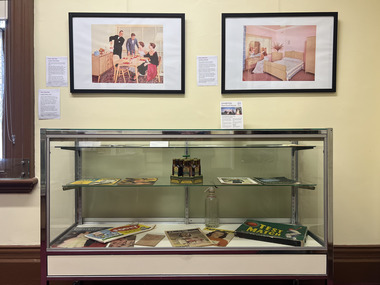
Exhibition, Postwar Kew 1945-60 : Continuity & change, 2025
... worked, and the everyday lives of men and women. The decade beginning in 1950 included monumental shifts in the social and cultural fabric of life in Australia more widely, and also in Kew. This exhibition...worked, and the everyday lives of men and women. The decade beginning in 1950 included monumental shifts in the social and cultural fabric of life in Australia more widely, and also in Kew. This exhibition ...While the end of World War II heralded a new era, postwar restrictions on resources affected what could be built, how people worked, and the everyday lives of men and women. The decade beginning in 1950 included monumental shifts in the social and cultural fabric of life in Australia more widely, and also in Kew. This exhibition explores how life changed by exploring the memories of people who lived in Kew during these years, the development of notable private and public modern architecture, and the ways that innovation transformed the lives of Kew’s residents. Set of five photos of artefacts and photographs of the main exhibition room of the Kew Historical Society at the Kew Court House. The secondary room includes images of 1950s and 1960s architecture. Also included in this file is the exhibition flyer.kew -- history -- postwar, kew historical society -- exhibitions -
 Ballarat Heritage Services
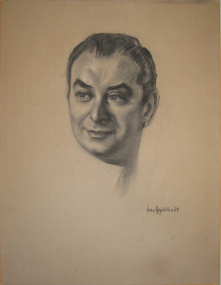
Drawing - Artwork - Painting, Portrait by Jean Appletom
... Australia, thereafter teaching at high schools in the ACT and NSW and at the Julian Ashton and National Art Schools in Sydney. The first of her thirteen solo exhibitions was held at Sydney’s Macquarie Galleries in 1940. Resident in England from 1969 to 1981, she continued to teach intermittently into the late 1970s. After a difficult first marriage to artist Eric Wilson, who died, she married painter Tom Green and they settled in Moss Vale. Though her work is now represented in major state and regional collections, Appleton was like many women...Australia, thereafter teaching at high schools in the ACT and NSW and at the Julian Ashton and National Art Schools in Sydney. The first of her thirteen solo exhibitions was held at Sydney’s Macquarie Galleries in 1940. Resident in England from 1969 to 1981, she continued to teach intermittently into the late 1970s. After a difficult first marriage to artist Eric Wilson, who died, she married painter Tom Green and they settled in Moss Vale. Though her work is now represented in major state and regional collections, Appleton was like many women ...Jean APPLETON (1911-2003) Jean Appleton was a painter and craftworker who studied at East Sydney Technical College and at the Westminster School, London. After seeing French sculptor Maillol's work 'The Cyclist' she was inspired to try sculpture and consequently studied under Eric Schilsky in London. With the outbreak of war she returned to Australia, thereafter teaching at high schools in the ACT and NSW and at the Julian Ashton and National Art Schools in Sydney. The first of her thirteen solo exhibitions was held at Sydney’s Macquarie Galleries in 1940. Resident in England from 1969 to 1981, she continued to teach intermittently into the late 1970s. After a difficult first marriage to artist Eric Wilson, who died, she married painter Tom Green and they settled in Moss Vale. Though her work is now represented in major state and regional collections, Appleton was like many women artists of her generation in that recognition of her work came late in life: she was in her eighties when a public gallery first presented a retrospective exhibition of her art. (https://www.portrait.gov.au/portraits/2013.92/self-portrait, accessed 15 September 2019) Jean Appleton won the inaugural Portia Geach Memorial Award in 1965 with this work. She dies in 2003.A sketched portrait of a man's head by Jean Apppleton. It may be Jean Appleton's first husband, Eric Wilson. drawing, portrait, jean appleton -
 Bendigo Historical Society Inc.
Textile - Tea Towel
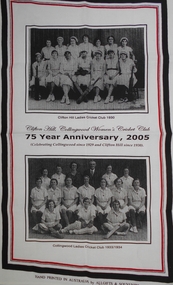
... AUSTRALIA by ALLGIFTS & SOUVENIRS" 1. Two souvenir tea towels. Cream coloured cotton fabric tea towels. Red and black printed rectangular border. Hemmed on all four sides. Printed across the centre "Clifton Hill, Collingwood Women's Cricket Club 75 Year Anniversary, 2005 (Celebrating Collingwood since 1929 and Clifton Hill since 1930)" Two black and white photographs screen printed on the front. The top photograph is the "Clifton Hill Ladies Cricket Club 1930" 2. Thank you card to Kay MacGregor from the Pioneer Victorian Women's Cricket Association, thanking her for her work for the 150th Anniversary Celebrations and Exhibition ...1. Two souvenir tea towels. Cream coloured cotton fabric tea towels. Red and black printed rectangular border. Hemmed on all four sides. Printed across the centre "Clifton Hill, Collingwood Women's Cricket Club 75 Year Anniversary, 2005 (Celebrating Collingwood since 1929 and Clifton Hill since 1930)" Two black and white photographs screen printed on the front. The top photograph is the "Clifton Hill Ladies Cricket Club 1930" 2. Thank you card to Kay MacGregor from the Pioneer Victorian Women's Cricket Association, thanking her for her work for the 150th Anniversary Celebrations and Exhibition. The bottom photograph is "Collingwood Ladies Cricket Club 1933/1934" The women in both photographs are wearing white uniforms. The Collingwood team also has a man and woman in the back row."HAND PRINTED IN AUSTRALIA by ALLGIFTS & SOUVENIRS"textiles, domestic -
 City of Melbourne Libraries
Photograph, Bull, Hugh Jones, 1897-1993, Miss Katherine Rymill
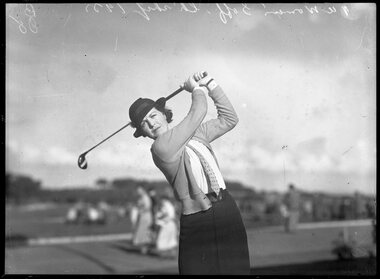
... worked for the Red Cross during WWII and continued to play golf throughout her life. MCK116 Published The Age 29 August 1935 Featured in "Newsworthy: Melbourne in photographs 1933-1936" exhibition at East Melbourne Library, October to December 2023. Exhibition caption by project volunteer, Fiona Collyer. Published: The Age 29 August 1935 p. 11 Published title: SIX STATE CHAMPIONS IN NATIONAL GOLF CHAMPIONSHIP. Published caption: Six State champions for the first time in the history of women’s golf are competing in the matches for the Australian...worked for the Red Cross during WWII and continued to play golf throughout her life. MCK116 Published The Age 29 August 1935 Featured in "Newsworthy: Melbourne in photographs 1933-1936" exhibition at East Melbourne Library, October to December 2023. Exhibition caption by project volunteer, Fiona Collyer. Published: The Age 29 August 1935 p. 11 Published title: SIX STATE CHAMPIONS IN NATIONAL GOLF CHAMPIONSHIP. Published caption: Six State champions for the first time in the history of women’s golf are competing in the matches for the Australian ...Stylishly dressed in trilby, neck-tie and leather belt, champion Adelaidian golfer Katherine Rymill practises her drive at Royal Melbourne Golf Course. Katherine Rymill (1913-2008) won the Royal Adelaide championships in 1934, 1935 and 1937. Commenting on the NSW “no stockings” controversy of 1935, she said, “In England, players are allowed to appear without stockings in summer and to wear “slacks” in the winter… Playing without stockings makes no difference to one’s performance and it is certainly cooler...” Katherine worked for the Red Cross during WWII and continued to play golf throughout her life. MCK116 Published The Age 29 August 1935 Featured in "Newsworthy: Melbourne in photographs 1933-1936" exhibition at East Melbourne Library, October to December 2023. Exhibition caption by project volunteer, Fiona Collyer. Published: The Age 29 August 1935 p. 11 Published title: SIX STATE CHAMPIONS IN NATIONAL GOLF CHAMPIONSHIP. Published caption: Six State champions for the first time in the history of women’s golf are competing in the matches for the Australian title. — 1. Miss B. Sale (Tas.). 2. Miss J. Hood-Hammond (N.S.W.). 3. Miss J. Gardiner (Qld,) 4. Miss K. Rymill (S.A.). 5. Mrs. O. J. Negus (W.A.). 6. Mrs. S. Morpeth (Vic.) RESEARCHER'S NOTE: The Age listed Golfer 1 as Miss B. Sale and Golfer 4 as Miss K. Rymill. We verified that these should in fact be the other way around: 1 is Miss K. Rymill, 4 is Miss B. Sale. Description: Action shot of woman driving golf ball Research by project volunteer, Fiona Collyer: MISS KATHERINE LUCY RYMILL (1913–2008) Katherine was a champion South Australian golfer. She won the Royal Adelaide championships in 1934, 1935 and 1937. She competed in the Australian Women’s Golf Championships at Royal Melbourne in 1935 against British women golfers and was eliminated by Mrs T S McKay nee Odette Lebebvre. Katherine was from a prominent and wealthy Adelaide family and her social activities and golfing career was closely followed in the local papers. Her mother, Shylee Rymill, was the S.A. Girl Guides’ Commissioner from 1935-1950. Her father H.L. (Cargie) Rymill grew up in a Dutch Renaissance style mansion called “The Firs” in East Terrace, Adelaide (now called Rymill House and State heritage listed), and designed Kooyonga, Seaton, Grange, Glenelg and Mount Lofty golf courses. Both parents were champion golfers and have tournaments named after them. Katherine worked for the Red Cross during WWII. In 1935, for the first time in NSW, the Ladies Golf Union (L.G.V.) enforced their rule regarding the wearing of stockings in official associates’ golf matches. Though the Long Reef competitor’s long skirt and golf socks almost hid her sun-tanned legs from view, an eagle-eyed official had noticed the absence of regulation covering and she and her partner were disqualified. Commenting on the Long Reef “no stockings” controversy, Katherine said “In England, players are allowed to appear without stockings in summer and to wear “slacks” in the winter.” “Playing without stockings makes no difference to one’s performance and it is certainly cooler. However, rules which are formed must be obeyed and that seems all there is to say about it.” Katherine continued to play golf throughout her life and died in 2008.Photographer notations on slide: "Vic Womens Golf Ch'ship 1935 B98".golf, women golfers, royal melbourne golf club -
 City of Melbourne Libraries
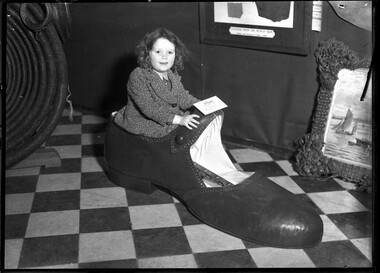
Photograph, Bull, Hugh Jones, 1897-1993, Leather Exhibition, Melbourne Town Hall
... As Patricia Keep notes in her excellent entry of Stella Allan in the Australian Dictionary of Biography: “In 1907 The Argus commissioned her to write a series of articles on the first Australian Women's Work Exhibition held in October. ...As Patricia Keep notes in her excellent entry of Stella Allan in the Australian Dictionary of Biography: “In 1907 The Argus commissioned her to write a series of articles on the first Australian Women's Work Exhibition held in October. ...Photographer notations on slide: At the Leather Exhib. at T. Hall Melb 1933 Age Published: Age (Melbourne, Vic.: 1854- ), 1933 THE EXHIBITS. (1933, September 20). The Age (Melbourne, Vic. : 1854 - 1954), p. 16. Retrieved January 25, 2026, from http://nla.gov.au/nla.news-article205109730 Published title: THE EXHIBITS. A COMPREHENSIVE RANGE. Curios, Novelties, Working Displays Published Caption: ONE OF THE NOVELTIES – AN OUTSIZE IN SHOES Research by Project Volunteer, Louise McKenzie: Our photo is dated 20 September 1933, and shows a happy, chubby-faced young girl sitting in a very over-sized girl’s shoe. It is labelled – “Shoe, An Out Size, loaned by Messrs Blackman & Rose”. (1) It is an effective way to capture the attention of the readership and alert them to the Melbourne Leather Show 1933. This show was designed to be a drawcard of extraordinary proportion, and there is no doubt that this leather exhibition was a really big deal for Melbourne. It completely took over the Melbourne Town Hall, and was open from 10.30 am until 10.30 pm. It seemed to contain something for everyone – the military, the man about town, the home handyman, the housewife, the child, the sporting types, the domestic workers, the outdoor enthusiasts, the horseracing fans, car enthusiasts, those wishing to show off the latest fashion – both men and women - and those just intrigued by a lot of fascinating and wide ranging exhibits. One of the most comprehensive descriptions of the Exhibition accompanies the photograph, and is worth quoting in full: “PROMINENT among exhibits which first attract attention in the foyer of the Town Hall is a comprehensive display of leather articles used by the defence forces. A conspicuous legend states that leather plays an important part in national defence, being used for saddlery, tool containers, holdalls, range-finding, surveying and signalling equipment, explosives factories, harness accoutrement, bandsmen's equipment and clothing. Three models of horses and several figures of soldiers wearing leather equipment illustrate the lesson, and a great range of leather goods used in military training and work variegate the display. Nearby are Texas cowboy, buckjumping and breaking-in saddles; whips, a walking stick, made of leather and numerous other curios. The general exhibition occupies the whole floor space of the main Town Hall, and is subdivided by partitions running most of the length of the hall. A bewildering variety, of leather goods presses for close and leisured inspection. Here and there operatives in charge of working machinery give practical demonstrations of factory processes in the production of footwear. Polishing materials are well represented. One attractive exhibit includes two bush huts constructed of leather, with wattle bark for roofing. Opossums, rosellas and a kookaburra add touches of bush realism. Adjacent exhibits include bags, fishing boots, leggings, leather covers in all colours. Factory Processes. One exhibitor has installed an automatic cinema apparatus and screen, which projects various factory processes in making a shoe, the operator being shown at work. Elsewhere an interesting exhibit depicts the five stages in the manufacture of sole leather, and the tanning materials employed. "Very handsome effects are achieved in the interior appointments of motor cars, which are attended by figures of smart chauffeurs in leather coats. Motor-trimming leather is said to be more durable and hygienic than fabric materials, and cheaper. The neat finish of the material, its excellent appearance, certainly make a very favourable impression. It takes the hides of three beasts to cover the cushions, squabs and door panels of a full-sized sedan, while to finish the entire interior, including quarter-panels and head linings would take four or even five. Special Exhibits. Amongst the special sections the display arranged by the handicrafts and home industries- committee of the Country Women's Association of Victoria is a notable one. In all there are about 130 entries which are in four classifications, viz., hand-tooled or embossed leathers, suede, hand-made gloves and undecorated leather. The glove section attracted the most numerous entries, a number being the work of members and craft subscribers of the Country Women's Association. In the leathercraft competition, organised by the Country Women's Association, the judges yesterday awarded the first prize for bookbinding (the only prize given in this division) to Miss M. Alston, of South Yarra. There is also a creditable display of exhibits submitted by boys of the orthopaedic section of the Children's Hospital at Frankston. Amongst the novelties on view in other portions of the exhibition were the following: — Leather coats worn by Sir C. Kingsford Smith on his Atlantic flight. Model Wellington boot, Phar Lap's saddle. Melbourne Cup winner's saddle. Longest whip in world, 108 feet long. (33 metres) [See our photo, to left of Girl in Shoe] Diminutive shoes. Pair of shoes 65 years old. Pair of men's working boots 75 years old. Larwood's, Tate’s and Pataudi’s cricket boots. [Three internationally revered cricketers of the day] (2) Picture frame made of leather bought 63 years ago. [See our photo, to right of Girl in Shoe] Leather frame, powder bowl, &c. Saddle used by world's champion buckjumper in U.S.A. Mexican cowboy outfit. Miniature saddle and bridle. A fireman's helmet made of sole leather. (3) Sample of the leather hat worn by porters at the Billingsgate Fish Market, London. (4) From South Australia there have been obtained sets of harness for donkeys, goats and camels, the equipment being displayed to good advantage on stuffed representations of the animals mentioned. Close to the platform is a glass case containing snow shoes and coats which have been used in Antarctic exploration work. Trade Display. Amongst the trade exhibits may be seen in operation a slipper turn shoe sewing machine, with heeling and channelling facilities, and the various stages in the production of ladies' sandals are shown. There is a wide contrast between sole leather of varying degrees of thickness on view in one stall and the choice samples of ladies' footwear in another — footwear, by the way, which could almost be used as ornaments, so dainty in colour and production are they. Again, there are displays of upholstering leathers of such soft texture that they could he readily mistaken for some of the finest cloth. Those who may be particularly interested in the production of chamois leather may gain an insight into the materials and chemicals used in the "working up” of this variety of leather. Supplies of glace kid (5) are tastefully arranged, and there may also be seen bags of all shapes and sizes, including satchels, suit cases and "sporting" cases, and bags for tennis players and golfers. Further variety is given to the exhibition by the display of antique hides, brightly coloured, with punching balls, boxing gloves and batsman's pads. There are crocodile skins and snake skins so cleverly "Worked up" that one could be almost pardoned for betraying an affection for such unpopular creatures.” “ Another wonderful article on this Exhibition, published the same day in one of the opposition daily newspapers, The Argus, is in the weekly article “Women to Women”, entitled “A Great Victorian Industry: Many Uses for Leather”. This weekly column was penned by Vesta, and she writes, with much purpose: “Yesterday afternoon I paid a hurried visit to the Leather Exhibition now being held in the Melbourne Town Hall and I was disappointed to find that the early visitors to the main exhibition were almost all men. Women, I think, should make a point of seeing every exhibition of our great industries, for women are the buyers of household requisites and goods for their own use and their tastes, and opinion influence also, to a large extent, the purchases of men. So, the welfare of industries is more or less in their hands and it becomes a duty for them to inform themselves fully of the extent and the quality of the manufacturing that is done here. The value of the output of the Australian boot and shoe factories alone was in 1930-31, the latest year for which the figures are given, Stg 3,750,000. Fully two thirds of that amount must have been spent by women on boots and shoes for themselves and their children. In a host of other directions, in the purchase of handbags, travelling bags, belts and straps, cushions, furniture coverings, purses, notebooks, spectacle cases, their annual expenditure must be very high. Their interest, therefore, in this industry is practical, and their support of it should be governed by knowledge of comparable values and qualities of the goods they buy. From the point of view of women, however, the exhibition itself is rather disappointing. There is an amazing collection of good stuff on show, but most of it is not displayed in a fashion that attracts attention. I was surprised, for example, at the range and quality of the leathers displayed, the suppleness of the finer qualities, and the varied range of colours and designs. But they are shown in such a fashion that if one set out deliberately to look for them it would be quite easy to miss most of them.” …It was surprising, too, that no one seemed to have taken advantage of the present fashion of wearing coloured gloves, or the cult of glove making, which the Country Women’s Association has fostered so successfully. Outside the collection of chamois leathers I saw no skins which were suitable to glove making. (6) However, it is perhaps a little unfair to be highly critical of the exhibition, inasmuch as it is the first of its kind. The material is there, undoubtedly, for a splendid show of every phase of this enterprising industry, and I am confident that experience will prove to those concerned that it will be worth while next time to devote a great deal of attention of the method of display.” With further research, it transpires that “Vera” is in fact NZ born Stella May Allen (nee Henderson) (1871-1962), a journalist, the first woman in NZ to begin a law course, in 1890-91). She later worked at a law firm while she completed her degree. Study of the law had always been open to women in NZ, but its practice was still barred to them. Her case “…led to amending legislation in 1896 allowing women to practise as barristers or solicitors. However, on gaining her LL.B. in November 1897 she did not apply for admission to the Bar. Instead, she became the Wellington-based correspondent and leader-writer for the Lyttelton Times. Her appointment, the first for a woman, was not welcomed by the all-male Press Gallery, and special permission had to be obtained from a subcommittee of the House before her presence was accepted. In 1900 she married Edwin Allen, a senior leader-writer for the Wellington Evening Post, and they moved to Australia in 1903 when Edwin Allen took up the post of foreign affairs leader-writer and parliamentary man for the Melbourne Argus. As Patricia Keep notes in her excellent entry of Stella Allan in the Australian Dictionary of Biography: “In 1907 The Argus commissioned her to write a series of articles on the first Australian Women's Work Exhibition held in October. They aroused much interest and next year The Argus invited her to join its full-time staff and begin a weekly section on the particular interests of women. She adopted the nom de plume 'Vesta' and called the column 'Women to Women'. Her work was unique in an Australian daily paper at that time. Her pages extended to cover every aspect of women's affairs, children's interests and community welfare, and 'Vesta' became a household word for authoritative information and advice on such matters. An excellent needlewoman and first-rate cook herself, she thoroughly tutored her staff in the work and needs of women in both country and city, as well as providing the usual training for cadet journalists. She conducted interviews and also visited the country to see at first hand the results of bushfires, mouse plagues, droughts and floods. In 1910 she was one of three women foundation members of the Australian Journalists' Association. “…she found time to become deeply involved in community affairs. She was an original committee-member of the Victorian Association of Crèches and of the Free Kindergarten Union of Victoria, and had much to do with the early days of the Victorian Bush Nursing Association, the Baby Health Centres Association and the Queen Victoria Hospital. She was a member of the National Council of Women, first in New Zealand and then in Melbourne, and of the Country Women's Association from its inception. … in 1924 she was appointed substitute delegate for Australia to the fifth assembly of the League of Nations at Geneva and was a delegate to the second Pan Pacific Women's Conference in Hawaii in 1930. A meeting held in the Melbourne Town Hall in 1938 by representatives of all the main Victorian women's organizations paid special tribute to her work and influence. She retired next year to England where she continued to write for the Argus, contributing articles on the experiences of women and children in wartime.” It is little wonder that “Vesta” was unafraid to take to task both the women of Victoria, and those who created the exhibition! One item which appears to have gone unnoticed, or at least unreported, is a framed article in the background of the photo of the chubby girl in the shoe. The display frame is labelled “Leather from the Human Skin, Tanned and Dressed by French artists.” The exhibition was certainly a cabinet of curiosities! A charming article in The Argus is a nice note on which to end. It gives a quick history and overview of the Australian leather industry and its unprecedented, and possibly unexpected, development and success, and states with pride: “Though Victoria is the largest leather producer in the Commonwealth all tanners in the Commonwealth can look back with pride on the long march of progress.” Footnotes: (1) “Blackman and Rose”. Messrs Blackman and Rose were shoe manufacturers, from 1927 located at 200 Noone Street, Clifton Hill. The Melbourne Circle describes their building as a “fine-looking building in the Federation ‘blood and bandage’ style.” It was built around 1912 for Puttifoot and Bloom, boot manufacturers, and today the building is apartments. (2) These cricketers were household names in the day: Tate: Maurice Tate, “English cricketer of the 1920s and 1930s, and leader of England’s Test bowling attack for a long time during this period. The founder of modern seam bowling. “ Larwood: Harold Larwood, “English right-arm fast bowler and the main exponent of the bowling style known as “bodyline”. Used to considerable effect in the 1932-33 Test series in Australia. Pataudi: Iftikhar A K Pataudi, “an Indian prince who in the 1930s played Test cricket for England, and in the 1940s played Test cricket for India (as Captain) – the only test cricketer to have played for both India and England. (3) “sole” leather “… is the thickest and most resistant material existing in the tanning industry … made from vegetable tanned leathers, usually bovine butts, processed in a special way to make them the hardest type of leather in existence.” (4) The hats worn by porters at Billingsgate Fish Market were also known as a “Bobbin” and look quite squat and rather unsophisticated. They were made of wood and tarred leather, with a “flat, hardened top designed to support large rectangular boxes of fish. The upturned brim protected the porter’s head against fish juice draining from the boxes of fish which would be carried on top of the hat. Some hats featured a small drain hole at the rear to allow this collected juice to drain down the back of the carrier. The hats were made using the ‘cuir bouilli’ technique. The leather was immersed in water which was heated until the leather began to shrink. It was then removed and put on a wooden former. The leather was stitched together to make the hat while still wet, and then held in place until dry.” (See article and photo on the London Museum website) (5) Glace kid – described on the Boston Museum of Fine Arts’ Cameo database as “A smooth glossy leather originally prepared from goat or sheepskin. Early glace kid had a shiny surface that was originally prepared by tawing the skin in a mixture of alum, table salt, flour, and egg yolk. Today, glace kid is prepared from many types of vegetable or chrome tanned leathers. The smooth polished surface is obtained mechanically by shaving, glazing, ironing, and/or rolling the dry leather.” (6) In the 1930s, Melbourne’s glovemaking industry was characterised by local manufacturing, with key producers like Simpson’s Gloves Pty Ltd in Richmond and the Stagg Glove Company in Clifton Hill leading the market. These factories produced high-quality leather gloves, handbags, and specialty gear, often employing a clear gendered division of labour and training young, local women. Museum Victoria holds the Simpson’s Gloves Collection, comprising over 1200 items, and the University of Melbourne Archives holds the company’s business records. References: THE EXHIBITS. (1933, September 20). The Age (Melbourne, Vic. : 1854 - 1954), p. 16. Retrieved January 25, 2026, from http://nla.gov.au/nla.news-article205109730 EXPORT LEATHER. (1929, September 17). The Argus (Melbourne, Vic. : 1848 - 1957), p. 17. Retrieved January 19, 2026, from http://nla.gov.au/nla.news-article4037647 LEATHER EXHIBITION (1933, September 18). The Argus (Melbourne, Vic. : 1848 - 1957), p. 10. Retrieved January 19, 2026, from http://nla.gov.au/nla.news-article11693362 (1933, September 23). The Argus (Melbourne, Vic. : 1848 - 1957), p. 21. Retrieved January 19, 2026, from http://nla.gov.au/nla.news-page522766 WOMEN TO WOMEN (1933, September 20). The Argus (Melbourne, Vic. : 1848 - 1957), p. 13. Retrieved January 19, 2026, from http://nla.gov.au/nla.news-article11694034 Australian Dictionary of Biography, Stella May Allan (1871–1962) https://adb.anu.edu.au/biography/allan-stella-may-4998 WOMEN TO WOMEN (1930, January 22). The Argus (Melbourne, Vic. : 1848 - 1957), p. 13. Retrieved January 19, 2026, from http://nla.gov.au/nla.news-article4063888 Museums Victoria, Simpson’s Gloves, 486-496 Victoria Street, North Richmond, VIC, Australia https://collections.museumsvictoria.com.au/articles/2702 The Argus. (1927, October 31). The Argus (Melbourne, Vic. : 1848 - 1957), p. 20. Retrieved February 7, 2026, from http://nla.gov.au/nla.news-article3888451 Melbourne Circle: stories from the suburbs: “Boots and all in Clifton Hill” https://melbournecircle.net/2015/11/20/bootmakers-of-clifton-hill/ Wikipedia, Maurice Tate, https://en.wikipedia.org/wiki/Maurice_Tate Wikipedia, Harold Larwood, https://en.wikipedia.org/wiki/Harold_Larwood Wikipedia, Iftikhar Ali Khan Pataudi, https://en.wikipedia.org/wiki/Iftikhar_Ali_Khan_Pataudi Buy Leather Online Italy, Sole leather: https://buyleatheronline.com/en/blog/outsole-and-insole-leather-n7 London Museum, Porters hats, https://www.londonmuseum.org.uk/collections/v/object-731122/hat-porters-hat/ Cameo Database, Museum of Fine Arts, Boston, Glace Kid, https://cameo.mfa.org/wiki/Glac%C3%A9_kid VICTORIAN LEATHER HAS WON RENOWN (1937, September 22). The Argus (Melbourne, Vic. : 1848 - 1957), p. 31 (March of Progress Supplement). Retrieved February 7, 2026, from http://nla.gov.au/nla.news-article1108704 Photographer notations on slide: "At the Leather Exhib. at T. Hall Melb 1933 Age B5".displays, melbourne town hall, leather, children, shoes, 1930-1939, industry, hats, gloves
