
Showing 224 items matching "australian governor general"
-
 Whitehorse Historical Society Inc.
Letter - Correspondence, Letter from Australian Governor-General, 2011
... Letter from Australian Governor-General...Photocopy of hand-written letter of condolence from Quentin Bryce, Australian Governor-General to Alan Way on the death of Kaele Way....Letter from Australian Governor-General Letter Correspondence ...Photocopy of hand-written letter of condolence from Quentin Bryce, Australian Governor-General to Alan Way on the death of Kaele Way.Photocopy of hand-written letter of condolence from Quentin Bryce, Australian Governor-General to Alan Way on the death of Kaele Way.Photocopy of hand-written letter of condolence from Quentin Bryce, Australian Governor-General to Alan Way on the death of Kaele Way.way, kaele -
 Linton and District Historical Society Inc
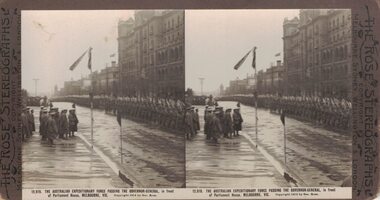
Stereograph, The Rose Stereographs, Melbourne, Sydney, Wellington and London, 12,919 Australian Expeditionary Force Passing Governor-General, Copyright 1914
... 12,919 Australian Expeditionary Force Passing Governor-General..."12,919 THE AUSTRALIAN EXPEDITIONARY FORCE PASSING THE GOVERNOR-GENERAL, in front / of Parliament House, MELBOURNE."...Large group of uniformed soldiers saluting the Governor General as they march past him outside Parliament House, Spring Street, Melbourne. 12,919 Australian Expeditionary Force Passing Governor-General Stereograph The Rose Stereographs, Melbourne, Sydney, Wellington and London ...One of two sets of stereographs donated by the O'Beirne family along with a stereoscope for viewing (Stereoscope is Registration no. 2014-51).Large group of uniformed soldiers saluting the Governor General as they march past him outside Parliament House, Spring Street, Melbourne."12,919 THE AUSTRALIAN EXPEDITIONARY FORCE PASSING THE GOVERNOR-GENERAL, in front / of Parliament House, MELBOURNE."stereographs, australian expeditionary force -
 Tatura Irrigation & Wartime Camps Museum
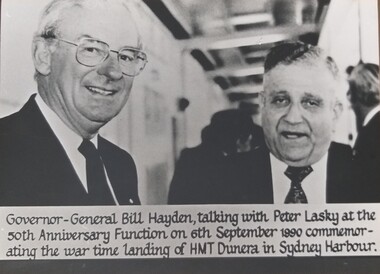
Photograph, Bill Hayden and Peter Lasky, 1940
... ...Australian Governor General...Peter Lasky, Dunera boy, talking with Governor General Bill Hayden at the 50th anniversary, Dunera reunion. dunera boys Dunera reunion 50th aniversary Dunera reunion Peter Lasky Bill Hayden Australian Governor General Black and white photograph of Governor General Bill Hayden, talking with Peter Lasky at the 50th anniversary on 6 September 1990. ...Peter Lasky, Dunera boy, talking with Governor General Bill Hayden at the 50th anniversary, Dunera reunion.Black and white photograph of Governor General Bill Hayden, talking with Peter Lasky at the 50th anniversary on 6 September 1990. Commemorating and landing of the Dunera 1940.dunera boys, dunera reunion, 50th aniversary dunera reunion, peter lasky, bill hayden, australian governor general -
 Bendigo Historical Society Inc.
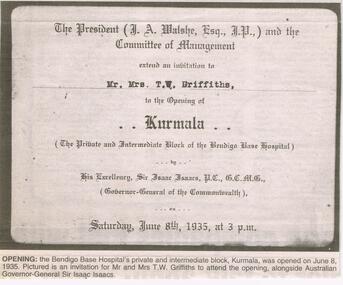
Newspaper - JENNY FOLEY COLLECTION: OPENING
... Griffiths to attend the opening, alongside Australian Governor-General Sir Isaac Isaacs. The clip is in a folder....Griffiths to attend the opening, alongside Australian Governor-General Sir Isaac Isaacs. The clip is in a folder. ...BHS CollectionBendigo Advertiser '' The way we were'' from 2002. Opening: the Bendigo Base Hospital's private and intermediate block, Kurmala, was opened on June 8, 1935. Pictured is an invitation to Mr. and Mrs. T. W. Griffiths to attend the opening, alongside Australian Governor-General Sir Isaac Isaacs. The clip is in a folder.newspaper, bendigo advertiser, the way we were -
Unions Ballarat
Hayden, Stubbs, John, 1989
... ...australian labor party...governor general...Biographical interest - Bill Hayden. btlc ballarat trades hall ballarat trades and labour council hayden, bill hawke, bob politics politicians alp australian labor party governor general elections biography prime minister hayden, william george Front cover: title and author name. ...An autobiography of ALP MP Bill Hayden, formerly leader of the opposition. Hayden relinquished this role, after which Bob Hawke became leader and won the 1983 election. Hayden served as Governor General from 1989-1996.Relevant to the history of the Australian Labor Party and Australian political history. Biographical interest - Bill Hayden.Paper; book. Cover: Separate photos of Bill Hayden and a house - sepia tones.Front cover: title and author name.btlc, ballarat trades hall, ballarat trades and labour council, hayden, bill, hawke, bob, politics, politicians, alp, australian labor party, governor general, elections, biography, prime minister, hayden, william george -
 Clunes Museum
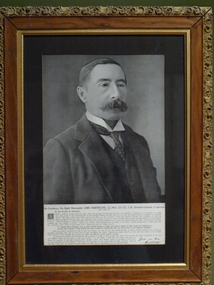
Photograph, Crown Photographers
... Lord Northcote was Australia's 3rd Governor General....Framed black and white photograph of the Governor General of Australia Lord Northcote. Carved frame around edge, gilt edge on inside of frame. ...Lord Northcote was Australia's 3rd Governor General. Lord Northcote Governor General Politics Framed black and white photograph of the Governor General of Australia Lord Northcote. ...Lord Northcote was Australia's 3rd Governor General.Framed black and white photograph of the Governor General of Australia Lord Northcote. Carved frame around edge, gilt edge on inside of frame. Typed message on rectangular paper by Lord Northcote.lord northcote, governor general, politics -
Unions Ballarat
Hayden: an Autobiography, Hayden, Bill, 1996
... Hayden served as Australian Governor General from 1989-1996. Prior to his career as a politician, Bill Hayden was a policeman....Hayden served as Australian Governor General from 1989-1996. Prior to his career as a politician, Bill Hayden was a policeman. ...An autobiography of ALP MP Bill Hayden, formerly leader of the opposition. Hayden relinquished this role, after which Bob Hawke became leader and won the 1983 election. Hayden served as Australian Governor General from 1989-1996. Prior to his career as a politician, Bill Hayden was a policeman.Relevant to the history of the Australian Labor Party and Australian political history.Paper; book; 610 pages. Front cover: maroon. Dustjacket: artistic impression of Bill Hayden (colour); gold and white lettering; author's name and title.btlc, ballarat trades hall, ballarat trades and labour council, hayden, bill, hawke, bob, alp, australian labour council, politics, politicians, elections, autobiography, prime minister, governor general -
 Warrnambool and District Historical Society Inc.
Badge - Badges, Republican Referendum 1999
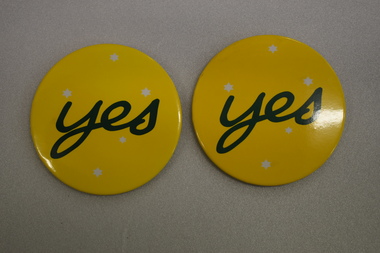
... In 1999 a referendum was held in Australia to determine whether a Republic would be established with the Queen of England and the Australian Governor- General being replaced by a President elected by two thirds of the members of the Australian Government. ...In 1999 a referendum was held in Australia to determine whether a Republic would be established with the Queen of England and the Australian Governor- General being replaced by a President elected by two thirds of the members of the Australian Government. ...In 1999 a referendum was held in Australia to determine whether a Republic would be established with the Queen of England and the Australian Governor- General being replaced by a President elected by two thirds of the members of the Australian Government. The Republican referendum failed with 54.8 % of voters being opposed to the Republican model offered. These badges were issued by the groups mounting the campaign in favour of a Republic.These badges are of interest as a memento of an historic referendum in Australia .1 Circular concave metal badge with yellow background, dark green text and five small white stars. The silver coloured reverse has a pin clip .2 As above .1 yes .2 yes -
 Hymettus Cottage & Garden Ballarat
Work on paper - Book, The Voyage of the Endeavour
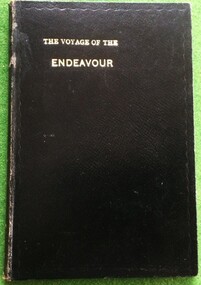
... This volume was specially bound in leather with a hand-painted dedicatory plate to Prince William when he planted a tree together with his parents the Duke and Duchess of Gloucester, Australia's Governor General & wife at Kurnell in 1946. ...This volume was specially bound in leather with a hand-painted dedicatory plate to Prince William when he planted a tree together with his parents the Duke and Duchess of Gloucester, Australia's Governor General & wife at Kurnell in 1946. ...A practical and readable story of the voyage of the Endeavour and its exploratory journey of Australia's east coast.Black leather binding with gilt title to front cover.non-fictionA practical and readable story of the voyage of the Endeavour and its exploratory journey of Australia's east coast.duke of gloucester, governor general, kurnell, prince william, sydney, tree planting, captain cook, endeavour, -
 Melbourne Tram Museum
Photograph - Set of 5, "Norm Maddock", 2007
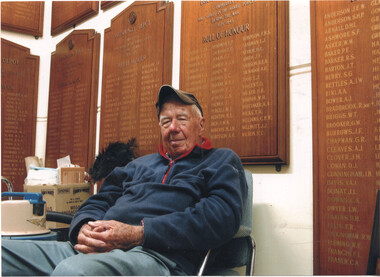
... 1 - Photo of Norm Maddock sitting in front of the war memorial boards at the entry into the former Malvern Tramway Museum 2 - Photo of Norm and the workers who probably painted the buildings with some images hanging on the wall behind and four uniformed dummies. 3 - Set of two consultative committees that Norm worked on. 4 - Photocopy of Norm's Order of Australia award dated 11/6/2007, signed by Michael Jeffery Australian Governor-General....1 - Photo of Norm Maddock sitting in front of the war memorial boards at the entry into the former Malvern Tramway Museum 2 - Photo of Norm and the workers who probably painted the buildings with some images hanging on the wall behind and four uniformed dummies. 3 - Set of two consultative committees that Norm worked on. 4 - Photocopy of Norm's Order of Australia award dated 11/6/2007, signed by Michael Jeffery Australian Governor-General. Have a close association with the work of Norm Maddock. ...1 - Photo of Norm Maddock sitting in front of the war memorial boards at the entry into the former Malvern Tramway Museum 2 - Photo of Norm and the workers who probably painted the buildings with some images hanging on the wall behind and four uniformed dummies. 3 - Set of two consultative committees that Norm worked on. 4 - Photocopy of Norm's Order of Australia award dated 11/6/2007, signed by Michael Jeffery Australian Governor-General.Have a close association with the work of Norm Maddock.Set of five photographs and one photocopied documentnorm maddock, consultation, malvern, tram museum, certificates -
4th/19th Prince of Wales's Light Horse Regiment Unit History Room
DVD, The Light Horsemen of Beersheba, 2008 (exact)
... On April 28, 2008, along with Israel's President Shimon Peres and Australia's Governor-General, Major General (ret) Michael Jeffrey AC, CVO, MC, the late Richard Pratt opened the Park of the Australian Soldier in Beersheba, Israel. ...australian world war 1 ceremonial light horse beersheba israel richard pratt shimon peres michael jeffrey memorials park of the australian soldier turkish army playground australian world war 1 ceremonial light horse beersheba israel richard pratt shimon peres michael jeffrey memorials park of the australian soldier turkish army playground On April 28, 2008, along with Israel's President Shimon Peres and Australia's Governor-General, Major General (ret) Michael Jeffrey AC, CVO, MC, the late Richard Pratt opened the Park of the Australian Soldier in Beersheba, Israel. ...On April 28, 2008, along with Israel's President Shimon Peres and Australia's Governor-General, Major General (ret) Michael Jeffrey AC, CVO, MC, the late Richard Pratt opened the Park of the Australian Soldier in Beersheba, Israel. An initiative of the Melbourne-based Pratt Foundation, the Park commemorates the involvement of the Australian military forces in the Middle East in two World Wars and in other conflicts in the region. It features a memorial to the Australian Light Horse Brigade which won Beersheba from the Turks in World War 1 and a dual purpose playground which provides access to children with disabilities. This DVD tells the Park's story from its inception to its dedication in 2008australian, world war 1, ceremonial, light horse, beersheba, israel, richard pratt, shimon peres, michael jeffrey, memorials, park of the australian soldier, turkish army, playground, australian, world war 1, ceremonial, light horse, beersheba, israel, richard pratt, shimon peres, michael jeffrey, memorials, park of the australian soldier, turkish army, playground -
4th/19th Prince of Wales's Light Horse Regiment Unit History Room
DVD, The Park of the Australian Soldier. Remembering the Light Horse April 28, 2008, 2008 (exact)
... On April 28, 2008, along with Israel's President Shimon Peres and Australia's Governor-General, Major General (ret) Michael Jeffrey AC, CVO, MC, the late Richard Pratt opened the Park of the Australian Soldier in Beersheba, Israel. ...australian world war 1 ceremonial light horse beersheba israel richard pratt shimon peres michael jeffrey memorials park of the australian soldier turkish army playground On April 28, 2008, along with Israel's President Shimon Peres and Australia's Governor-General, Major General (ret) Michael Jeffrey AC, CVO, MC, the late Richard Pratt opened the Park of the Australian Soldier in Beersheba, Israel. ...On April 28, 2008, along with Israel's President Shimon Peres and Australia's Governor-General, Major General (ret) Michael Jeffrey AC, CVO, MC, the late Richard Pratt opened the Park of the Australian Soldier in Beersheba, Israel. An initiative of the Melbourne-based Pratt Foundation, the Park commemorates the involvement of the Australian military forces in the Middle East in two World Wars and in other conflicts in the region. It features a memorial to the Australian Light Horse Brigade which won Beersheba from the Turks in World War 1 and a dual purpose playground which provides access to children with disabilities. This DVD records the Park's opening ceremony on April 28, 2008. australian, world war 1, ceremonial, light horse, beersheba, israel, richard pratt, shimon peres, michael jeffrey, memorials, park of the australian soldier, turkish army, playground -
4th/19th Prince of Wales's Light Horse Regiment Unit History Room
DVD, The Australian Light Horse. A Park in Beersheba. April 28, 2008, 2008 (exact)
... On April 28, 2008, along with Israel's President Shimon Peres and Australia's Governor-General, Major General (ret) Michael Jeffrey AC, CVO, MC, the late Richard Pratt opened the Park of the Australian Soldier in Beersheba, Israel. ...australian world war 1 ceremonial light horse beersheba israel richard pratt shimon peres michael jeffrey memorials park of the australian soldier turkish army playground On April 28, 2008, along with Israel's President Shimon Peres and Australia's Governor-General, Major General (ret) Michael Jeffrey AC, CVO, MC, the late Richard Pratt opened the Park of the Australian Soldier in Beersheba, Israel. ...On April 28, 2008, along with Israel's President Shimon Peres and Australia's Governor-General, Major General (ret) Michael Jeffrey AC, CVO, MC, the late Richard Pratt opened the Park of the Australian Soldier in Beersheba, Israel. An initiative of the Melbourne-based Pratt Foundation, the Park commemorates the involvement of the Australian military forces in the Middle East in two World Wars and in other conflicts in the region. It features a memorial to the Australian Light Horse Brigade which won Beersheba from the Turks in World War 1 and a dual purpose playground which provides access to children with disabilities. This DVD records the highlights of the Park's opening ceremony on April 28, 2008australian, world war 1, ceremonial, light horse, beersheba, israel, richard pratt, shimon peres, michael jeffrey, memorials, park of the australian soldier, turkish army, playground -
 Melbourne Legacy
Photograph, 100th Birthday, 1994
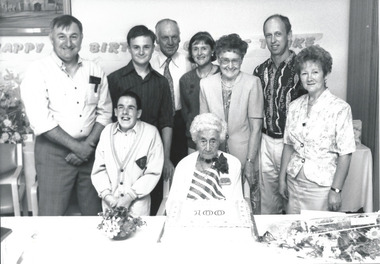
... She had a wonderful day and Telegrams and messages were received from the Queen, The Australian Governor General, Prime Minister Keating, Governor of Victoria and Premier Jeff Kennett."...She had a wonderful day and Telegrams and messages were received from the Queen, The Australian Governor General, Prime Minister Keating, Governor of Victoria and Premier Jeff Kennett." ...Photograph of 100th birthday celebrations for Gladys Troke on 20 December 1994. The picture was published in The Answer in April 1995 with the story saying: "Latrobe Valley Group Legacy widow Gladys Broke, 100 years old on 20th December 1994 celebrated her birthday at Latrobe Valley Village Hostel with 100 family members and friends, some of whom had made the trip from England. She had a wonderful day and Telegrams and messages were received from the Queen, The Australian Governor General, Prime Minister Keating, Governor of Victoria and Premier Jeff Kennett."A record of a widow reaching 100 years of age and being celebrated by Legacy.Black and white photo of the 100th birthday of Gladys Troke.widows, answer, birthday -
Unions Ballarat
Sir Isaac Isaacs: A life of service (Don Woodward Collection), Gordon, Max, 1963
... Governor General...politics and government...history - australia...Sir Isaac Isaacs was the first Australian born Governor General. He was also a key player in drafting of the Australian Constitution. ...Sir Isaac Isaacs was the first Australian born Governor General. He was also a key player in drafting of the Australian Constitution. ...Sir Isaac Isaacs was the first Australian born Governor General. He was also a key player in drafting of the Australian Constitution. He practised as a lawyer (specialising in company law) and a judge and was known to defend individuals against bureaucratic injustices.Australian politics and constitution. Book; 228 pages. Dust jacket: pink and white background; black and white photo of Isaac Isaacs; white, pink and black lettering; author's name and title. Cover: yellow; gold lettering; author's name and title on spine.Inside cover: "To Colin King, With all very best wishes from Ian Hayward, Christmas, 1963."btlc, ballarat trades and labour council, ballarat trades hall, isaacs, isaac, governor general, politics and government, history - australia -
 Wodonga & District Historical Society Inc
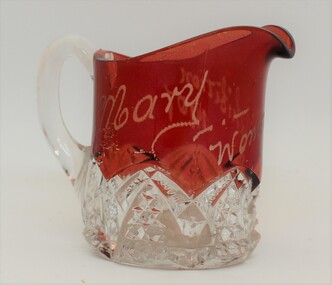
Decorative object - Ruby Glass and crystal jug, 1907
... It was opened by Lady Northcote (the wife of Australia’s Governor General) and Pattie Deakin (wife of the Prime Minister), who also ran a model creche during the exhibition. ...It was opened by Lady Northcote (the wife of Australia’s Governor General) and Pattie Deakin (wife of the Prime Minister), who also ran a model creche during the exhibition. ...The First Australian Exhibition of Women's Work was held at the Exhibition Building, Melbourne, from 23 October to 30 November 1907. It was opened by Lady Northcote (the wife of Australia’s Governor General) and Pattie Deakin (wife of the Prime Minister), who also ran a model creche during the exhibition. The five week exhibition showcased the work of women musicians, artists and craftswomen with over 16,000 exhibits in all fields of artistic endeavour. It was attended by approximately 250,000 people. Exhibits were divided into Classes, including Fine Arts; Applied Arts; Photography; Plain Needlework; Cookery, Preserves and Laundry Work; Horticulture; and Medical and Nursing. This item was owned by Mrs. Mary Burrowes, aunt of Mrs. Jean Raper.This item is from Raper Collection donated to the Wodonga Historical Society by Mrs. Jean Raper. A small ruby glass and crystal jug which was produced as a souvenir of the Australian Exhibition of Women's Work held at the Exhibition Building in Melbourne in 1907. It has been inscribed in gold coloured paint. "Mary Women's Exhibition 1907"vase, glassware, decorative items -
 Wodonga & District Historical Society Inc
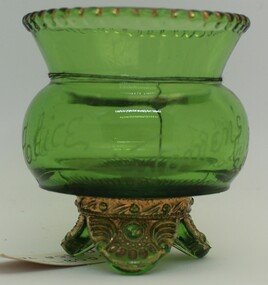
Decorative object - Small green glass vase, 1907
... It was opened by Lady Northcote (the wife of Australia’s Governor General) and Pattie Deakin (wife of the Prime Minister), who also ran a model creche during the exhibition. ...It was opened by Lady Northcote (the wife of Australia’s Governor General) and Pattie Deakin (wife of the Prime Minister), who also ran a model creche during the exhibition. ...The First Australian Exhibition of Women's Work was held at the Exhibition Building, Melbourne, from 23 October to 30 November 1907. It was opened by Lady Northcote (the wife of Australia’s Governor General) and Pattie Deakin (wife of the Prime Minister), who also ran a model creche during the exhibition. The five week exhibition showcased the work of women musicians, artists and craftswomen with over 16,000 exhibits in all fields of artistic endeavour. It was attended by approximately 250,000 people. Exhibits were divided into Classes, including Fine Arts; Applied Arts; Photography; Plain Needlework; Cookery, Preserves and Laundry Work; Horticulture; and Medical and Nursing. This item was owned by Mrs. Alice Yardy nee Dinsmore, grandmother of Mrs. Jean Raper.This item is from Raper Collection donated to the Wodonga Historical Society by Mrs. Jean Raper. A small green glass vase with gilt edge which was produced as a souvenir of the Australian Exhibition of Women's Work held at the Exhibition Building in Melbourne in 1907. It has been inscribed in gold lettering. "Alice Women's Exhibition 1907"vase, glassware, decorative items -
 Sunshine and District Historical Society Incorporated
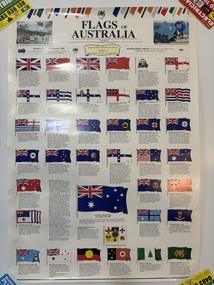
Poster - Australian Day 1984 Posters, Standard Publishing House, 1984
... 4787 .01 - Flags Of Australia|4787 .02 - Prime Ministers Of Australia|4787 .03 - Coinage Of Australia|4787 .04 - Emblems Of Austraia|4787 .05 - Australian Governors And Governors General...These posters were sponsored by Woolworths Limited an Australian Company to celebrate Australia Day 26th January 1984 Australian Day 4787 .01 - Flags Of Australia|4787 .02 - Prime Ministers Of Australia|4787 .03 - Coinage Of Australia|4787 .04 - Emblems Of Austraia|4787 .05 - Australian Governors And Governors General Collection of 5 limited edition posters sponsored by Woolworths Limited an Australian Company to celebrate Australia Day 26th January 1984 Poster Australian Day 1984 Posters Standard Publishing House Margaret Alberts Ken Roberts ...These posters were sponsored by Woolworths Limited an Australian Company to celebrate Australia Day 26th January 19844787 .01 - Flags Of Australia|4787 .02 - Prime Ministers Of Australia|4787 .03 - Coinage Of Australia|4787 .04 - Emblems Of Austraia|4787 .05 - Australian Governors And Governors Generalaustralian day -
 Vision Australia
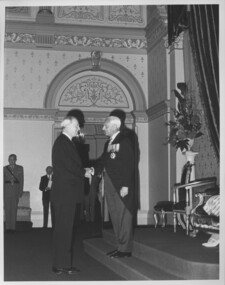
Photograph - Image, John Wicking shaking hands after receiving Australia Day honours by the Governor of Victoria, 26/01/1981
... Association for the Blind President John Wicking receives his Member of the Order of Australia medal from the Governor General of Victoria, Sir Henry Winneke....Association for the Blind President John Wicking receives his Member of the Order of Australia medal from the Governor General of Victoria, Sir Henry Winneke. john wicking sir henry winneke association for the blind B/W photograph of John Wicking receiving his award at Government House (Victoria) John Wicking shaking hands after receiving Australia Day honours by the Governor of Victoria Photograph Image ...Association for the Blind President John Wicking receives his Member of the Order of Australia medal from the Governor General of Victoria, Sir Henry Winneke.B/W photograph of John Wicking receiving his award at Government House (Victoria)john wicking, sir henry winneke, association for the blind -
 Lara RSL Sub Branch
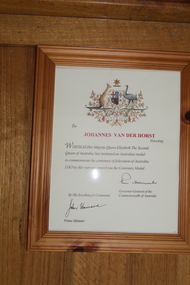
Photograph - Warrant award, Warrant award of Centenary Medal to Hans Van Der Horst granted by Queen Elizabeth the Second
... Signed by the Governor-General of the Commonwealth of Australia and Prime Minister "John Howard" Warrant is crowned by the Emblem of Australia....Under the Official Emblem of Australia Her Majesty Queen Elizabeth The Second, Queen of Australia has warrant Award to Johannes Van Der Horst The Australian Medal to commemorate the Centenary of Federation of Australia. Signed by Governor-General of the Commonwealth of Australia and Prime Minister,...centenary medal johannes van der horst Under the Official Emblem of Australia Her Majesty Queen Elizabeth The Second, Queen of Australia has warrant Award to Johannes Van Der Horst The Australian Medal to commemorate the Centenary of Federation of Australia. Signed by Governor-General of the Commonwealth of Australia and Prime Minister, Awarded to Hans Van Der Horst Centenary of Federation Medal granted Queen Elizabeth the Second. ...Awarded to Hans Van Der Horst Centenary of Federation Medal granted Queen Elizabeth the Second. Signed by the Governor-General of the Commonwealth of Australia and Prime Minister "John Howard" Warrant is crowned by the Emblem of Australia.Under the Official Emblem of Australia Her Majesty Queen Elizabeth The Second, Queen of Australia has warrant Award to Johannes Van Der Horst The Australian Medal to commemorate the Centenary of Federation of Australia. Signed by Governor-General of the Commonwealth of Australia and Prime Minister,centenary medal, johannes van der horst -
 Yarrawonga and Mulwala Pioneer Museum
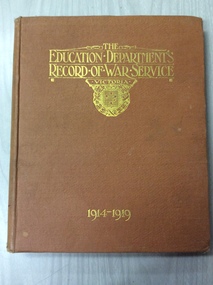
Record of War Service for Victorian School teachers, The Education Department's Record of War Service 1914 - 1919, 1921
... Foreward comments written September 1917 by Sir Arthur Stanley Governor of Victoria, Sir Ronald Munro Ferguson, Governor General Australia and Frank Tate Director of Education 1st March 1921. ...Foreward comments written September 1917 by Sir Arthur Stanley Governor of Victoria, Sir Ronald Munro Ferguson, Governor General Australia and Frank Tate Director of Education 1st March 1921. ...Foreward comments written September 1917 by Sir Arthur Stanley Governor of Victoria, Sir Ronald Munro Ferguson, Governor General Australia and Frank Tate Director of Education 1st March 1921. These books were distributed to each state school in VictoriaHard cover book, 303 pages containing photographs of teachers who enlisted and served in WW1, along with the stories of those who fell and those who returned. List of honours and decorations, chapters on War Relief Organisation, Patriotic Guild and Fund donationsInside front page - presented to Bathumi School. Signed by Stradbroke. (Governor of Victoria 1920 to 1926 -
 Bendigo Historical Society Inc.
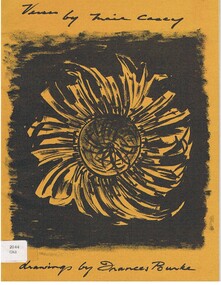
Book - ALEC H CHISHOLM COLLECTION: BOOK 'VERSES BY MAIE CASEY'
... Maie Casey was the wife of Lord Casey, Australian politician and Governor General....Maie Casey was the wife of Lord Casey, Australian politician and Governor General. Book ALEC H CHISHOLM COLLECTION: BOOK 'VERSES BY MAIE CASEY' ...Book. ALEC H CHISHOLM COLLECTION. A 19 page soft cover book of verse by Maie Casey with drawings by Frances Burke. Printed by McLaren & Co. Pty Ltd, Melbourne in 1963. (copy No. 213) Handwritten in ink on flyleaf 'Mr Alec Chisholm with best wishes from Maie Casey 8.11.63. Also the signature of Frances Burke. Catalogue sticker '2044 CAS' on front cover. Maie Casey was the wife of Lord Casey, Australian politician and Governor General.Maie Caseybooks, collections, poetry, alec h chisholm collection, poetry, maie casey, frances burke -
Moorabbin Air Museum
Unknown (item) - Lord Casey'S Hangar (1938)
... The Casey Hangar is associated with a notable Australian, Lord Casey, former Governor General and Federal Minister, with...The Casey Hangar is associated with a notable Australian, Lord Casey, former Governor General and Federal Minister, with Lord Casey'S Hangar (1938) Unknown Lord Casey'S Hangar (1938) ...Description: Unboxed Folders Machine Shop Planning/Operation Sheets Folder No 4 contains 1/N-11-820 to 1/N-18-249 Level of Importance: National. Historical Details: The Casey Hangar is considered to be rare and important survivor of pre-war Australian made pre-fabricated private aircraft hangars. The Casey Hangar is associated with a notable Australian, Lord Casey, former Governor General and Federal Minister, with -
 Bendigo Historical Society Inc.
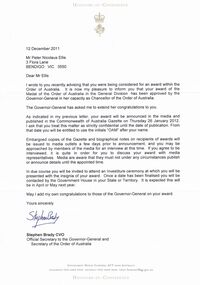
Document - PETER ELLIS COLLECTION: LETTER TO PETER ELLIS
... It is now my pleasure to inform you that your award of the Medal of the Order of Australia in the General Division has been approved by the Governor-General in her capacity as Chancellor of the Order of Australia. ...It is now my pleasure to inform you that your award of the Medal of the Order of Australia in the General Division has been approved by the Governor-General in her capacity as Chancellor of the Order of Australia. ...Letter written to Peter Ellis from Stephen Brady Official Secretary to the Governor-General and Secretary of the Order of Australia. Dated 12 December 2011. Honours-in-Confidence. Mr Peter Nicolaus Ellis 3 Flora Lane Flora Hill Vic 3550. Dear Mr Ellis I wrote to you recently advising you that you were being considered for an award within the Order of Australia. It is now my pleasure to inform you that your award of the Medal of the Order of Australia in the General Division has been approved by the Governor-General in her capacity as Chancellor of the Order of Australia. The Governor General has asked me to extend her congratulations to you. As indicated in my previous letter, your award will be announced in the media and published in the Commonwealth of Australia Gazette on Thursday 26 January 2012. I ask that you treat this manner as strictly confidential until the date of publication. From that date you will be entitled to use the initials 'OAM' after your name. Embargoed copies of the Gazette and biographical notes on recipients of awards will be issued to media outlets a few days prior to announcement, and you may be approached by members of the media for an interview at this time. If you agree to be interviewed, it is quite in order for you to discuss your award with media representatives. Media are aware that they must not under any circumstances publish or announce details until the appointed time. In due course you will be invited to attend an Investiture ceremony at which you will be presented with the insignia of your award. Once a date has been finalised you will be contacted by the Government House in your state or Territory. It is expected this will be in April or May next year. May I add my own congratulations to those of the Governor-General on your award. Yours sincerely Stephen Brady Official Secretary to the Governor-General and Secretary of the Order of Australia. Government House Canberra, ACT 2600 Australia telephone (02) 6283 3533 Facsimile (02) 62833620 Email [email protected] Honours-in-confidenceperson, individual, peter ellis oam -
 Flagstaff Hill Maritime Museum and Village
Memorabilia - Horseshoe Case, 1906 – 1907
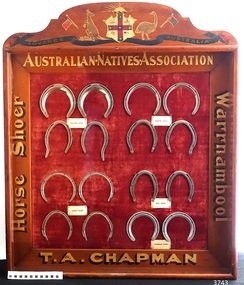
... The organisation was most prominent in Victoria and sought to shape Australia’s national identity and was a training ground for businessmen, trade unionists and politicians including many of Australia’s early prime ministers such as Edmund Barton, Alfred Deakin, James Scullin and Francis Forde, and the first Australian-born governor-general, Isaac Isaacs, was a member. ...The organisation was most prominent in Victoria and sought to shape Australia’s national identity and was a training ground for businessmen, trade unionists and politicians including many of Australia’s early prime ministers such as Edmund Barton, Alfred Deakin, James Scullin and Francis Forde, and the first Australian-born governor-general, Isaac Isaacs, was a member. ...The horseshoes in this purpose-built display case were made by Thomas Alfred Chapman in 1906-1907. Chapman operated a blacksmith’s shop in Mortlake Rd, Purnim, about 15 mins drive from Warrnambool. Chapman made this horseshoe case especially for the 3rd Exhibition of Australian Manufacturers and Products, held in the Exhibition Building in Melbourne, which was organised and promoted by the Australian Natives Association (ANA). Reference is made to the horseshoe case in the Exhibition’s Souvenir Catalogue of 1907 on page 85, under the heading 'In the Machinery Section the following exhibits are also shown … 'CHAPMAN, T.A. , Woolsthorpe, via Warrnambool, Case of Horseshoes'. The Australian Natives’ Association (ANA) were a non-partisan and non-sectarian, friendly society founded in Melbourne, Australia in April 1871. It was set-up for the benefit of Australian-born white men, and membership was restricted exclusively to that group. Men of other races including the Chinese and Indigenous people were not allowed to join. The ANA had relatively progressive views on women (for the time) and attracted suffragists seeking support for their cause, and in 1894, the ANA advocated for women’s enfranchisement. Although, white women were only admitted as members from 1964. The organisation was most prominent in Victoria and sought to shape Australia’s national identity and was a training ground for businessmen, trade unionists and politicians including many of Australia’s early prime ministers such as Edmund Barton, Alfred Deakin, James Scullin and Francis Forde, and the first Australian-born governor-general, Isaac Isaacs, was a member. By 1910 it had developed into a nationwide association with real political and social influence, and members would participate in many activities. The ANA lobbied strongly for anti-Chinese legislation and were an ardent believer of colonial unification. Its mission and efforts are largely credited for the successful referendums that resulted in Federation of the six Australian colonies into a new nation, the association’s most important legacy. The ANA was also a supporter of trade protection, and were a staunch advocate of the first act of Australia's new parliament, the Immigration Restriction Act 1901 (cth) or commonly known as the White Australia Policy, which became one of the central pillars of Australian nationalism in the 20th-century. The ANA campaigned against the Australian Federal Government's new immigration policy after the Second World War (non-British immigration from southern and central Europe) in order to maintain a 'white Australia', and resisted changes when the Labor government during the 1970s fully dismantled and abandoned the White Australia Policy. The ANA merged with Manchester Unity Independent Order of Oddfellows, in 1993 to become Australian Unity Ltd. The display case of horseshoes changed hands several times, going from its maker Thomas Chapman to his mother then various other members of his family. The case was also displayed at the Lee Family’s butcher shop at 188 Liebig St Warrnambool, and in the Purnim Hotel during the Warrnambool May Races. In the late 1950s the horseshoe case went to Thomas’s son, Brian. He was a Master Farrier and completed his apprenticeship at Flemington Racecourse, and in Warrnambool he owned a blacksmith business at the Warrnambool Racecourse Grounds. Brian later operated a blacksmith’s at Flagstaff Hill, where his customers would bring their horses to be shod. Brian passed away in August 2017. The horseshoe case is significant as an example of trades in the early 20th century in Western Victoria, Australia. It is also significant as an example of horseshoes from the early 20th century. The horseshoe display case is also significant for its association with the Australian Exhibition of 1907, showcasing Australian produce and manufacturing to the world. The horseshoe display case is locally significant for its association with local families, essential businesses and community events. Display case of homemade horseshoes. Wooden case with glass front containing 16 horse shoes grouped in sets, each set with a label: Made 1906-1907 for Australian Exhibition of 1907 by Thomas Alfred Chapman of Warrnambool. The case contains (a) complete chrome set each of Trotting Shoes, Hunting Shoes and Racing Plates, and (b) one pair of Hind Polo Shoes and one pair of Front Aluminium Shoes. The wooden frame has gold lettering on each side proclaiming “Australian Natives Association, T.A. Chapman, horse shoer, Warrnambool” and is topped by a painted Australian coat of arms. Gold lettering on frame, in the order of top/bottom/ left/right “AUSTRALIAN.NATIVES.ASSOCIATION / T.A. CHAPMAN / Horse Shoer / Warrnambool”flagstaff hill, warrnambool, shipwrecked coast, maritime museum, shipwreck coast, horseshoe display case 1906-1907, chromed set of trotting shoes 1906-1907, chrome set of hunting shoes 1906-1907, chrome set of racing plates 1906-1907, pair of hind polo shoes 1906-1907, pair of front aluminium shoes 1906-1907, australian exhibition 1907, australian natives association (ana), t.a. chapman horse shoer warrnambool, thomas alfred chapman, brian chapman, brian “snacks” chapman, blacksmith warrnambool, warrnambool may races, warrnambool racecourse, purnim hotel, lee family’s butcher shop warrnambool -
 City of Melbourne Libraries
Photograph (item), Bull, Hugh Jones, 1897-1993, Unloading timber at Victoria Dock, 1933
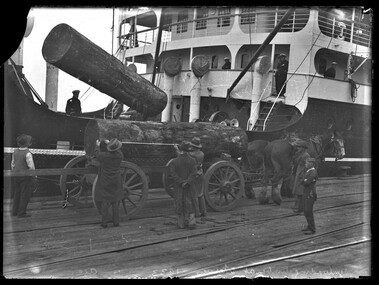
... On March 22, 1892, Victoria Dock was opened by Victoria’s Governor, the Earl of Hopetoun (later Australia’s first Governor-General) who opened the sluice to let the Yarra in. ...On March 22, 1892, Victoria Dock was opened by Victoria’s Governor, the Earl of Hopetoun (later Australia’s first Governor-General) who opened the sluice to let the Yarra in. ...Photographer notations on slide: "Unloading Timber at Wharves 1933 Age B5" Published: Age (Melbourne, Vic.: 1854- ), Tuesday 15 August 1933 MAHOGANY FROM MANILA. (1933, August 15). The Age (Melbourne, Vic. : 1854 - 1954), p. 11. Retrieved January 16, 2026, from http://nla.gov.au/nla.news-article204377024 Published title: MAHOGANY FROM MANILA Published Caption: Age Tue 15 Aug 1933 Caption: Unloading Mahogany Logs brought from Manila, Philippine Islands, by the steamer Taiping, which berthed yesterday at Victoria Dock. The vessel discharged twenty logs, each weighing three tons, the first shipment of this type of timber landed in Melbourne. Research by Project Volunteer, Louise McKenzie: This photograph in many ways epitomises Melbourne in the 1930s. It is a time of enormous growth, development and change. But before delving into that, the photo itself is very powerful. The huge mahogany logs being unloaded appear to be so heavy that the ship itself seems to list to port as they are craned over the side. They are being levered into a cart to which two large and sturdy Clydesdale horses are hitched. In contrast to the traditional horses, the wharf is crisscrossed with modern railway tracks. Unloading is both mechanical and manual, and the scene is one of intense interest to a young boy bystander. The ship appears to be squat and solid, but the whole image also gives a feeling of movement and intensity. The mahogany being delivered to Melbourne would be intended for high quality furniture. In the 1930s Australia actually had a growing timber industry, but much of the eucalyptus wood was being utilised for mass produced furniture, and much of this furniture would then have had a veneer applied to it. The fact that it was economic to import this timber from the “Philippine Islands” – not a traditional trading market for Australia – reflects a Victorian economy that was strong enough to support a growing demand for good quality furniture Mahogany was described as a classic, strong hardwood, often used for dark opulent furniture. In the 1930s the importation of timber from Manila (Philippines) to Australia was a notable trade, particularly in Philippine Lauan (often referred to as Philippine Mahogany), which was used as a cheaper alternative to other hardwoods. 1930s furniture, dominated by the art deco style, used a mix of luxurious exotic woods like mahogany, macassar and ebony for high-end pieces, often veneered over less expensive woods such as walnut, birch and poplar, and with plywood, chrome and lacquer also popular for more practical, streamlined designs during the Depression era. By the mid 1930s timber mills were being relocated away from the immediate dock area, but the fact that these logs were being transported by horse-drawn cart implies that the load would not have had to be taken too far for milling. 1885 the Melbourne Harbour Trust Commissioners had decided that land in or near the city was far too valuable to be used as timber yards. Furthermore, large stacks of timber posed a fire risk. The Trust asked the Victorian Government to reserve a site on the east side of the Yarra River opposite Yarraville and Spotswood. Here, in 1889, the Trust began building six jetties and a wharf specifically for the landing of timber. Clydesdale horses were initially brought to Victoria from Tasmania in the 1830s, and with the 1850s gold rush they were imported direct from Scotland. Melbourne was from its earliest years an important centre of horse-breeding from both imported and colonial-bred stock, providing the well-built draught horse for pulling heavily loaded wagons, the harness horse for delivery work and drawing coaches, and the saddle-horse used for riding. Stud breeding facilities were advertised from the early 1840s. By the 1870s the horse export trade was thriving, and the Port of Melbourne was the country's busiest exporter of horses to Indian, Asian and New Zealand markets. Kirk's Melbourne Horse and Carriage Bazaar in Bourke Street first advertised for business in 1840, and by the 1850s Bourke Street West was famed for its horse bazaars and saleyards. The Victorian Clydesdale Horse Society reports that Clydesdale working horses were a vital part of Melbourne's infrastructure and agricultural industry in the 1930s, when they reached the peak of their popularity despite the increasing competition from mechanization. Their main roles and usage at this time were: • City Delivery: Clydesdales were a common sight for metropolitan deliveries, particularly for breweries (such as Carlton & United Breweries), milk runs, and bread deliveries. • Industrial Work: They were heavily used for hauling cargo at the docks, in construction, and at specialized sites like the Truganina Explosives Reserve, where they pulled wagons. • Agriculture: In surrounding rural areas, they were the primary power source for ploughing and agricultural machinery. • Specialization: By the 1930s, the Clydesdale was smaller and more compact than the Shire or Percheron breeds, making them ideal for navigation in urban environments. After the 1930s their numbers decreased due to the onset of WWI and mechanisation. Wartime petrol rationing led to a brief revival for the working horse, as suburban tradesmen, now used to motor delivery, took their old jinkers out of mothballs. By 1947, however, only 1.5% of city traffic was horse-drawn. In 1952 the large horse cartage company A. Kellet Pty Ltd sold its 250 horses and converted its Richmond stables to storage. In the 1950s at Station and Princes piers, wharf labourers refused to work with the six draught horses still being used to haul trolleys and which were soon superseded by the fork lift, semi-trailer and mobile crane. Where carefully trained horses had once shunted trains in city goods yards, a few hundred a week were now being killed at the abattoirs for pet and human consumption. The last MCC dray horse was withdrawn from service in 1958, but some of the few remaining working animals are used by the mounted police for crowd control at demonstrations and football games. The death knell had also sounded for the associated trades of farrier, saddler and blacksmith. Our photo, therefore, showing the wharf with both the haulage Clydesdales and the rail lines, is a strong visual summary of the social and economic changes experienced in Victoria in the 1930s and on towards the 1950s. Our photo is located at Victoria Dock (also known as Victoria Harbour) which is still an active component of Melbourne’s port system. In 1892 the West Melbourne Dock (later Victoria Dock) was opened, downstream and immediately west of the Spencer Street railway shunting yards. It contained a swing basin for ships, replacing the one which had been provided on the south side of the river, later to be the Duke and Orr dry dock, west of the Charles Grimes Bridge. Further west was the South Wharf along the river bank. The history of Victoria Dock is extremely well described by Ashley Smith in his 2 March 2022 article in Docklands News, and its accompanying aerial photo of the Dock taken in 1934. He writes: "In the early 1930s Victoria Dock was one of the biggest sites for trade and export in Melbourne. A constant queue of ships sailed in, unloaded their cargo, recharged and reloaded, then left for the next port. Around the time this photo was taken (found in a 1934 photo book), the trapezium-shaped basin had been through some changes since its construction in the 1890s. The 497-metre-long Central Pier, finished in 1919, now featured six sheds to house the ever-increasing volume of cargo. The entrance had also been widened in the 1920s to allow better access. Some of the berths featured three-ton jib electric cranes to help with loading cargo and a rail network connected to the State Railway service. By the time construction was completed, the dock was 39 hectares and hailed as the second-largest dock in the world (behind Cavendish Dock, Barrow-in-Furness). To further save costs, excavations were dug to a more reasonable seven metres below low water, instead of British engineer Sir John Coode’s recommended 8.3 metres. Even then, the costs were still around £900,000. It was envisaged, with the extra wharfage, that around thirty 90-metre ships could berth inside. On March 22, 1892, Victoria Dock was opened by Victoria’s Governor, the Earl of Hopetoun (later Australia’s first Governor-General) who opened the sluice to let the Yarra in. It took six days to fill the basin with The Leader newspaper estimating that it would take another six months to completely fill (March 26, 1892). In the end, it took nearly a year before the first ship was allowed to enter on February 20, 1893, when the steamer Hubbuck sailed in to unload 1200 tonnes of cargo in 15 hours. The Argus (February 23, 1893) reported that the ship’s captain, J. R. Brodie, called the Yarra “better than the Thames”, and compared Victoria Dock favourably to the Albert Dock (Liverpool)." This would be a good time to move our focus on to the Taiping, which is the transporter of these giant mahogany logs. The Taiping was a steel-hulled, single-screw passenger-cargo Chinese steamer, which today has the dubious legacy of being involved in a collision headlined as “The Chinese Titanic”. It was constructed by the Hong Kong and Shampoa Dock Company at its facility in Hong Kong, with completion in 1926 for service under the Australia Oriental Line. Her gross register tonnage measured 4,324 tons, reflecting her design for inter-island and coastal trade routes, accommodating both passengers and freight. She operated routes connecting Australian ports with East Asian destinations. As World War II approached, Taiping continued predominantly working the trade routes between China and Australia, until December 1941, when she evacuated women and children from Hong Kong to Manila just before Japanese forces overran the region. She then safely reached Australia despite enemy air raids. Taiping was then requisitioned by the Royal Navy and repurposed as a victualling stores issuing ship for the Eastern Fleet, supporting logistical needs in the Pacific and Indian oceans. Returned to the Australian Oriental Line in 1947, she underwent refitting and by mid-1948 was chartered to the Shanghai Shipping Company, and modified for greater passenger accommodation – approximately 500 passengers. In 1948/49 the Chinese Civil War took place. The Taiping departed Shanghai on 26 January 1949 as one of the final vessels evacuating civilians from to Keelung Harbour in Taiwan. Reports indicate that the Taiping carried double the rated capacity of passengers i.e. 1000. The ship carried families, military personnel, civilians, carrying personal belongings, gold and valuables in hope of resettlement in Nationalist Taiwan. It also held heavy cargo in the form of silver and gold bullion loaded by the Central Bank of China. Because of the risk of patrols, and to conserve fuel, the Captain took the ship away from the usual open-sea passage, and instead navigated along the coast. He also extinguished navigation lights to avoid detection. Shortly after midnight on 27 January 1949 the Taiping collided with the smaller cargo steamer Chien Yuan in the East China Sea near the Zhoushan Archipelago. The Chien Yuan was also operating in darkness. The subsequent collision was catastrophic. The Chien Yuan sank with in 5 minutes, with the loss of 72 of its 74 crew. The Taiping sustained severe structural compromise from the broadside strike and initially remained afloat, then made a swift descent into the freezing water, with no attempt at an organised evacuation. No formal recovery process was instigated, however a distress signal went out. 32 survivors were picked up by the Australian destroyer HMAS Warramunga (on patrol nearby), a passing US vessel found 2 more, and local Zhoushan fishermen retrieved others. In the end, only 37 people survived. The event is remembered as a poignant moment in the mass migration to Taiwan, with families tragically separated. A memorial to the disaster exists at the Keelung Harbour naval base on Taiwan. With its total of over 1,500 deaths, it constituted one of the worst peacetime maritime losses. It is sometimes referred to as the “Oriental Titanic” because of the similarly large loss of life and speed of demise with the RMS Titanic in 1912. A fictional depiction of this event appears in the John Woo movies “The Crossing (Part 1) (2014), and The Crossing II (2015), known in Chinese as “Taiping Wheel”. The narrative weaves a story around pre-disaster romances and wartime turmoil among passengers, culminating in the ship’s rapid sinking. “The production, a high-budget Sino-Taiwanese-Hong Kong co-effort, portrays the event as a microcosm of the 1940s Sino-Japanese and civil war legacies, though critics noted the melodramatic style prioritizing spectacle over historical precision.” In conclusion, it is nice to return to our photo, and observe the people involved in this moment. The dockworkers are, so typical of the 1930s, dressed in what looks to us like formal clothing – dark suits or coats, white shirts, and black hats. I am particularly drawn to the young boy, bare-headed, arms crossed, and so intent on the unloading process. He too is wearing a white shirt, black trousers and jacket, and black shoes. This is 1933 Melbourne – but the haircut he is sporting is now very “hipster” and modern in 2026 Melbourne. References: MAHOGANY FROM MANILA. (1933, August 15). The Age (Melbourne, Vic. : 1854 - 1954), p. 11. Retrieved January 30, 2026, from http://nla.gov.au/nla.news-article204377024 Wikipedia, Taiping steamer, https://en.wikipedia.org/wiki/Taiping_(steamer) Wikipedia, Victoria Dock, https://en.wikipedia.org/wiki/Victoria_Dock_(Melbourne) Docklands News, Ashley Smith, 2 Mar 2022, https://www.docklandsnews.com.au/victoria-dock/ Living Histories: Heritage Council of Victoria, Jill Barnard, 2008, Jetties and Piers, https://livinghistories.net.au/wp-content/uploads/2015/11/Jetties-ONL-intro_Part-1.pdf eMelbourne, Wharves and Docks, https://www.emelbourne.net.au/biogs/EM01612b.htm Australian Academy of Technological Sciences – Harvesting Wood, https://www.austehc.unimelb.edu.au/tia/225.html Old Treasury Building, On the Water – The Docks, https://tinyurl.com/3wkbk66m Old Treasury Building, On The Road, https://tinyurl.com/dw44yr3t Port of Melbourne, Victorian Places, https://www.victorianplaces.com.au/port-of-melbourne Docklands Heritage Study - Environmental History, https://mvga-prod-files.s3.ap-southeast-4.amazonaws.com/public/2024-05/docklands-heritage-review-thematic-environmental-history-1991.pdf eMelbourne, Horses, https://www.emelbourne.net.au/biogs/EM00723b.htm Victorian Clydesdale Horse Society, https://www.clydesdalesvic.org.au/history The Crossing, https://letterboxd.com/film/the-crossing-i/Photographer notations on slide: "Unloading Timber at Wharves 1933 Age B5"ships, shipping, timber industry, shipwrecks, horses, docks, wharves, 1930-1939, wars, docklands -
 Flagstaff Hill Maritime Museum and Village
Award - Certificate of Merit, Royal Humane Society of Australia, James Patten, 21-05-1890
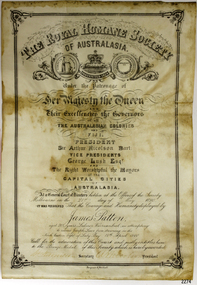
... Print and writing includes - "The Royal Humane Society of Australia under the patronage of Her Majesty the Queen and their excellencies, the Governors of all the Australian Colonies and Fiji. At a general...The bronze medal and accompanying certificate of the Royal Humane Society of Australasia recognise the bravery of James Patten, a Warrnambool citizen who risked his life in the attempt to save the life of his friend Joseph Lowe. flagstaff hill Warrnambool flagstaff-hill maritime museum maritime village shipwreck-coast flagstaff hill maritime museum & village bronze medal 1890 royal humane society of Australasia james patten medal Australian award medal commemorative medal numismatics life saving lifesaving rescue bravery drowning Joseph Lowe james ferrier lady bay hopkins river boating accident certificate of merit lithograph north eastern bight Print and writing includes - "The Royal Humane Society of Australia under the patronage of Her Majesty the Queen and their excellencies, the Governors of all the Australian Colonies and Fiji. At a general ...The Bronze Medal and Certificate of Merit of the Royal Humane Society of Australasia were awarded to James Patten for the bravery he displayed on 18th April 1890, and presented to him on 21st May 1890. The Royal Humane Society of Australasia was founded in 1874 with the aim to recognise those who risked their lives to save others and to assist those whose acts of bravery caused them or their surviving dependants to be disadvantaged in some way. The producers of the certificate were Fergusson & Mitchell, a Melbourne organisation established by 1858 that was an engraver, lithographer and printer. Details of the incident were published in the Argus, Saturday 19 April 1890, page 11 - "FATAL BOATING ACCIDENT, (BY TELEGRAPH FROM OUR CORRESPONDENT.), WARRNAMBOOL, FRIDAY A fatal boating disaster occurred in Lady Bay this morning, the victim being Joseph Lowe, licensee of the Bay View Hotel, South Warrnambool. The deceased, in company with two lads named James Ferrier and James Patten, went out in a small dingy to shoot musk ducks. The water was perfectly smooth, and the party were tempted to proceed as far as the mouth of the Hopkins River. In their eagerness they neglected to keep clear of the breakers, and were presently carried in on the crest of a large wave, and the boat cap sized within a cable's length of the shore, precipitating the occupants into the water. Patten and Lowe stuck to the overturned boat, Ferrier striking out for the shore, which he reached in an exhausted state. In the meantime his companions had been washed off the boat, and were struggling in the breakers. Lowe was unable to swim, and Patten kept him afloat, at the same time making gallant attempts to get him ashore, but finally had to leave him to his fate. Ferrier, seeing Lowe's danger, undressed and swam out, but became exhausted. Ferrier and Patten were both found in a fainting condition by persons who saw the catastrophe from the jetty, and ran along the beach to render assistance. Attempts were subsequently made to rescue Lowe's body, which could be seen washing abort in the surf. These proved unsuccessful, and no hope is now entertained of recovering it. Lowe was a smart young man, 28 years of age, and unmarried. He was formerly bar-man at the Commercial Hotel here, having been engaged in Melbourne...." The bronze medal and accompanying certificate of the Royal Humane Society of Australasia recognise the bravery of James Patten, a Warrnambool citizen who risked his life in the attempt to save the life of his friend Joseph Lowe.Certificate, cream paper, rectangular, decorative border and headings, printed and handwritten in pen and ink. Letterhead of The Royal Humane Society of Australasia. Awarded on 21st May 1890 to James Patten of Warrnambool. for his bravery on 18th April 1890.Print and writing includes - "The Royal Humane Society of Australia under the patronage of Her Majesty the Queen and their excellencies, the Governors of all the Australian Colonies and Fiji. At a general court of directors holden at the Offices of the Society Melbourne on the 21st day of May 1890, it was resolves that the courage and humanity displayed by James Patten, aged 20 years, labourer Warrnambool in attempting to rescue Joseph Lowe from drowning in the North Eastern bight of Lady Bay 18th April 1890. Call for the admiration of this court and justly, entitles him to the Bronze Medal of this society which is hereby awarded." Signatures [Secretary] and [President]flagstaff hill, warrnambool, flagstaff-hill, maritime museum, maritime village, shipwreck-coast, flagstaff hill maritime museum & village, bronze medal 1890, royal humane society of australasia, james patten, medal, australian award medal, commemorative medal, numismatics, life saving, lifesaving, rescue, bravery, drowning, joseph lowe, james ferrier, lady bay, hopkins river, boating accident, certificate of merit, lithograph, north eastern bight -
 Flagstaff Hill Maritime Museum and Village
Letter - William Ferrier, 14th November 1905
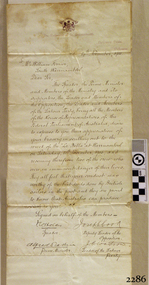
... In recognition of his bravery in the two daring rescues, he was awarded the Silver Medal for Bravery by the Royal Humane Society and was honoured in the letter from the Prime Minister and the Parliament of the Commonwealth, telegrams and a cheque for £20 from the Governor-General, over £150 subscribed by the public, including Warrnambool and district and readers of The Argus, and a gold medal from the Glenelg Dinghy Club of South Australia. ...In recognition of his bravery in the two daring rescues, he was awarded the Silver Medal for Bravery by the Royal Humane Society and was honoured in the letter from the Prime Minister and the Parliament of the Commonwealth, telegrams and a cheque for £20 from the Governor-General, over £150 subscribed by the public, including Warrnambool and district and readers of The Argus, and a gold medal from the Glenelg Dinghy Club of South Australia. ...The letter to William Ferrier of South Warrnambool from the Prime Minister and the Parliament of the Commonwealth recognised the significance of William’s brave and courageous lifesaving act to the people of Australia; “They all feel that your conduct was worthy of the best deeds done by British sailors in the past and they are proud to know that Australia can produce such as you.” The story of that brave rescue follows on below … The ship from which the sailors were rescued was the three-masted, iron and steel barquentine the La Bella, built in Norway in 1893. She was one of two iron and steel ships by Johan Smith, The company was one of the leading shipping families in Tvedestrand, Norway. She was significant to Norwegian shipping, being one of only 27 iron and steel ships ever built in Norway. She was registered in New Zealand and engaged from 1902 in inter-colonial trading of timber in the Pacific, between New Zealand and Australia and was often in Port Phillip Bay, Victoria. On 5th October 1905, the twelve-year-old La Bella left Lyttleton, New Zealand carrying a cargo of timber bound for Warrnambool, Australia. She was manned by a crew of twelve: the Master, (Captain Mylius, previously 1st Mate of La Bella, appointed Captain to La Bella on 6th February 1903) 2 Mates, Cook, six able seamen, one ordinary seaman and a boy. Bad weather en route caused her to shelter at Burnie on Tasmania's North West coast. On November 10th, the 37th day of her journey, La Bella approached Warrnambool. Captain Mylius steered her towards Lady Bay Channel in heavy south-west seas and evening mist. He ordered the helmsman to steer for the light. As the ship came round, a tremendous sea struck her on the port quarter, causing her to breach broadside in a north-westerly direction into breakers. The helm was brought round twice more, but each time heavy seas broke over her, the third time throwing the La Bella on to a submerged reef in Lady Bay now known as La Bella Reef (about 100 yards from the Warrnambool breakwater). The sea was so rough that it even wrenched a one-and-a-half ton anchor from its fastenings and into the sea. As Captain Mylius headed to the steel wheelhouse, intending to send up a rocket flare, a huge sea slammed the steel door into him (resulting in massive bruising front and back) Despite his injuries he still managed to set off a blue light, which he held up in his hands. La Bella’s lifeboats were filled with seawater and broke up on their chocks. The blue light was the first indication to people on the shore that there was a ship in distress. The Harbour Master, Captain Roe (who lived in the Harbour Master’s House opposite Flagstaff Hill), organised a group of volunteers to crew the lifeboat because the trained crew was unavailable; the crewmen were working on a steamer in Port Fairy at the time. He then poured oil onto the water to try and smooth the sea. At around 11 pm three of the crew took shelter in the steel forecastle but the sea crashed into it and broke it up. While the rest of the crew and onlookers watched helplessly in the moonlight the bodies were washed away into the sea, never to be seen again. Some of the crew lashed themselves to the weather rail to keep from being washed away. Watson, the ordinary seaman, became tangled in the rigging lines and was too weak to move, so the 2nd Mate, Robertson, put a line onto him so that he wouldn’t wash off. Around 11 pm three of the crew were unconscious from exhaustion. The situation on La Bella was becoming dangerous. The 2nd Mate moved to the ‘house’ and soon afterwards the ship slipped in the heavy sea. The lashings of the 1st Mate and the ‘boy’ Denham had kept them safe until about 2 am when they were washed overboard; no one was able to help. One by one, the exhausted crew were being washed overboard, too weak to hold on any longer. During the night the La Bella had broken into two and the deckhouse ran out towards the sea. Two more men drowned when trying to reach the lifeboat. By sunrise, the only survivors of the twelve were the Master, 2nd Mate and three seamen. Early in the morning, Captain Roe used the rocket apparatus on shore to try and shoot a line to the ship for a safer rescue but each attempt fell short of the target. Several attempts were made by the lifeboat to rescue the stricken sailors, but the rough conditions made this difficult for the boat to get close enough to the ship and the lifeboat had to return to shore. During a final attempt to reach the ship Captain Mylius ordered his men to jump into the sea. Leonard Robertson, 2nd mate, jumped and swam towards the lifeboat, taking hold of the boat hook offered to him. Oscar Rosenholme managed to reach the boat floating on a piece of timber from the ship’s load and a third survivor, Noake, also made the boat. Along with the lifeboat rescue crew, 25-year-old William Ferrier rowed his small dingy through the heavy seas and managed to rescue the Captain, whom he landed on the breakwater. Ferrier then returned to the ship to attempt a final rescue, losing his oars and rowlocks into the high sea. Using just a spare paddle he skulled towards the La Bella, reaching her stern in time to cut loose the lone surviving sailor, Payne, from the lashing that held him to the ship; the terrified sailor dropped from the ship and into the dingy. Shortly after the last man was rescued, the La Bella was lifted by a huge wave and crashed back down on the reef; she broke up and sank. The ordeal had lasted ten hours. The survivors were taken to the nearby Bay View Hotel and gratefully received warm food and clothing, medical attention and a place to sleep. In the following days, an unidentified body of a young person has washed ashore; it was either Watson or Denham. The body was buried in the Warrnambool cemetery with an appropriate gravestone and inscription. William Ferrier became a national hero as news of the daring rescue spread. In recognition of his bravery in the two daring rescues, he was awarded the Silver Medal for Bravery by the Royal Humane Society and was honoured in the letter from the Prime Minister and the Parliament of the Commonwealth, telegrams and a cheque for £20 from the Governor-General, over £150 subscribed by the public, including Warrnambool and district and readers of The Argus, and a gold medal from the Glenelg Dinghy Club of South Australia. Ferrier’s rescue efforts are one of the most heroic in Victoria’s shipwreck history. (William Ferrier’s son, Frank, received a similar award almost fifty years later when he helped rescue four members of the crew on the yacht Merlan after it ran on to a reef near the Point Lonsdale Lighthouse. ) The wreck of La Bella now lies on her port side in 13 metres of sheltered water inside the reef she struck. The bow section is relatively intact and part of the stern has drifted north-easterly towards the mouth of the Hopkins River. The reef the La Bella struck now bears its name. Those five rescued from the La Bella were Captain George Mylius, Leonard Robertson (2nd Mate, 21 years old), R. Payne, Oscar Rosenholme and Jack Noake. Those seven who lost their lives were Mr Coulson (1st mate), Charles Jackman (cook) Gustave Johnson, Pierre Johann and Robert Gent (all able seamen), Harry Watson (ordinary seaman) and Jack Denham (ship’s boy), Captain Mylius was found guilty of careless navigation; he had sailed into the bay without the services of a pilot. His Master Certificate was suspended for twelve months. Later he was also charged with the manslaughter of one of the crew who had died when the La Bella was wrecked but found not guilty. The event’s adverse publicity and damage to his career took a toll on his health and he died of a heart attack six months after the wreck; he was only thirty-seven. His body was buried in the Melbourne General Cemetery. The La Bella was “the best documented of all sailing ships owned in New Zealand”. Her record books, ship logs, correspondence and supporting papers are still available. At the time of the tragedy, she was owned by Messers David C.Turnbull and Co. of Timaru, New Zealand timber merchants and shipping agents, who had purchased her on 13th December 1901. A detailed account of the last journey of La Bella can be read in “Leonard Robertson, the Whangaroa & La Bella” written by Jack Churchouse, published in 1982 by Millwood Press Ltd, Wellington, NZ. As well as this letter, Flagstaff Hill’s La Bella Collection includes a photograph of the wrecked La Bella, a brass rail holder and a postcard of William Ferrier with four of the survivors. Some 15 – 17 ships are believed to have sunk in Lady Bay, but only two have been discovered on the seafloor; the “La Bella” and the “Edinburgh Castle”. Both wrecks are popular diving sites and are preserved as significant historical marine and marine archaeological sites. This original congratulatory letter sent to William Ferrier by the Prime Minister and Government of Australia demonstrates the importance attached to his efforts for Victoria and to Australia. The letter is part of the La Bella Collection and is significant at both a local and state level. Its connection to the La Bella shipwreck and the rescue of five survivors highlights the dangers of Victoria’s Shipwreck Coast. The letter to William Ferrier from the Australian Government acknowledges the bravery of ordinary Australians who risked their lives to save victims of shipwrecks along the coast. The letter is significant to the history of Warrnambool as it honours William Ferrier, a local fisherman whose descendants continue to live in the area. It highlights the way of life of people who lived in coastal towns in 19th century Victoria and the effects of shipwrecks upon them. The letter connects to the postcard of William Ferrier with four of the five rescued crew, the photograph of the wreck of the La Bella and the artefact from the wreck, the rail holder. This letter is significant because of its association with the sailing ship “La Bella”. The “La Bella” is of local and state and national significance. It is one of the only two shipwrecks discovered in Lady Bay, Warrnambool, out of the 15-17 shipwrecks in the bay. Letter to William Ferrier of South Warrnambool from the Prime Minister and Members of Parliament commending him on his bravery. The printed letterhead includes a coat of arms in the top centre and the official address. The letter is very neatly hand written in black pen and includes 4 signatures of Members of Parliament. The rectangular paper is cream coloured with some yellow/brown discolouring. It has the letterhead on the right hand side of it and the written letter begins below the letterhead. The paper has been folded so that the right side becomes the cover page of the letter. The writing is continued onto the inside right hand page of the folded paper and the writing ends here. There is more recent writing on the bottom right hand corner of the back page. The paper has been officially folded in half a total 3 times and there is heavy discolouration on the sections that form the front and back of the folded letter. There is a 4th fold line that is less pronounced that the other folds and would make the paper the size to fit into a pocket. At several fold creases the paper has worn through. The edges of the paper have minor tears. The printed coat of arms is that of the House of Representatives. Underneath is printed “The Parliament of the Commonwealth, / Parliament House / Melbourne”. The hand written, letter is dated “14th November, 1905” and addressed to “Mr. William Ferrier / South Warrnambool” The letter begins “The Speaker, the Prime Minister and Members of the Ministry and its supporters, the Leader and Members of the Opposition, the Leader and Members of the Labour Party, being all the Members of the House of Representatives of the Federal Parliament of Australia” … It continues “desire to express to you their appreciation of your bravery in skulling out to the wreck of the “La Bella” at Warrnambool on Saturday, 11th November, 1905, and recovering therefrom two of the crew who were in imminent danger of their lives. They all feel that your conduct was worthy of the best deeds done by British sailors in the past and they are proud to know that Australia can produce such as you.” The letter is “Signed on behalf of the Members – Speaker (Frederick Holder ), Deputy Leader of the Opposition (Joseph Cook ), Prime Minister (Alfred Deakin), Leader of the Labour Party ( J.C. Watson)” On the back of the letter is blue ink handwriting “OWNER / G. FERRIER / TO. BE. PHOTOGRAPHED / 27-4-76”la bella, william ferrier, bill ferrier, lady bay, 1905, 10th november 1905, 11th november 1905, parliament of the commonwealth, prime minister, australian government, new zealand, flagstaff hill, warrnambool, shipwrecked coast, flagstaff hill maritime museum, maritime museum, shipwreck coast, flagstaff hill maritime village -
Federation University Historical Collection
Programme, Programme for the Official Opening of the Mt Helen Campus, 10/1970
... A master plan has been produced to develop this beautiful and spacious site as a tertiary institution enrolling, in due course, some 3000 full time students. the first sod was turned, to initiate this development, by the then Governor General of Australia, The Right Honourable Lord Casey, on 19th October, 1967. ...A master plan has been produced to develop this beautiful and spacious site as a tertiary institution enrolling, in due course, some 3000 full time students. the first sod was turned, to initiate this development, by the then Governor General of Australia, The Right Honourable Lord Casey, on 19th October, 1967. ...The first building at the Mt Helen Campus was opened in October 1970. Students first starting using the campus in the same year. The programme includes the following historical information: "On 26th October, 1870, Sir Redmond Barry officially opened the first venture into formal technical education in Australia - the Ballarat School of Mines. Over the preceding year a small group of Ballarat citizens interested in mining had conceived and brought into being the idea of creating such a school. They leased a derelict Court House next to the Ballarat Gaol in Lydiard St., at a nominal rental for15 years, and started classes with 4 students and an honorary lecturer. The School developed its courses beyond the initially intended range of studies related to mining, increased in enrolments, took over neighbouring properties and buildings and developed three levels of education - tertiary, trade and secondary. From the latter part of the 19th Century, even though remaining under the control of its own autonomous Council, it developed close links with the State Education Department. From the earliest times the School achieved widespread recognition and a particularly high reputation, and its graduates spread across Australia and the world. For several years it was affiliated with Melbourne University. In the last decade its scope has been further broadened by the introduction of new tertiary courses. During 1965 the State Government created the Victoria Institute of Colleges - a non-teaching body empowered to award degrees and directed towards the task of co-ordinating and developing tertiary education in Victorian in institutions other than universities. the tertiary division of the School became affiliated with the V.I.C. at the end of that same year. Subsequently the Council of the School decided that, whilst retaining for the whole establishment the time honoured title - The School of Mines and Industries, Ballarat - it should more distinctly sub-title the three divisions. the tertiary division then became known as the Ballarat Institute of Advanced Education. On receipt of substantial Commonwealth-State Grants, made to it as a college of advanced education, the Council was enabled at the start of 1967, to purchase for the Institute the 20 acre campus at Mt Helen. A master plan has been produced to develop this beautiful and spacious site as a tertiary institution enrolling, in due course, some 3000 full time students. the first sod was turned, to initiate this development, by the then Governor General of Australia, The Right Honourable Lord Casey, on 19th October, 1967. The first building group, now completed and occupied, has involved an expenditure approaching $1,000,000. It contains the departments of Mechanical, Civil and Mining Engineering, Metallurgy and Geology. it also contains the Computer Centre, a temporary Library and temporary student amenities. Over the next two years a further four buildings, costing about $2,500,000, will be erected, and a further major portion of the Institute will move to Mt Helen. these buildings, in addition to one for direct teaching work, will include a Library, a Union and the first stage of a Hall of Residence."White, folded, paper programme printed on the occasion of the official opening of the Ballarat Institute of Advanced Education (BIAE) Mount Helen Campus on the occasion of the centenary of the Ballarat School of Minesuniversity of ballarat, ballarat school of mines, biae, mount helen, mt helen campus, mb john, jack barker, e.j. barker, rolly parfenovics, parfenovics, nigel bown, campus. victorian institute of colleges, m.b. john -
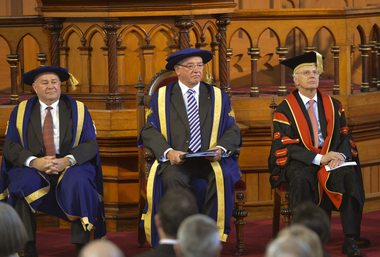 Federation University Historical Collection
Photograph - Photograph - Colour, Installation of University of Ballarat Chancellor Paul Hemming, 2012, 17/0/2012
... Australian College of General Practitioners. He was also president of the Australian Medical Association Victoria and has served on numerous federal government medical bodies and tribunals. Chancellors are appointed to chair the university's council (governing body) as the senior office holder of the University. They also confer the academic awards of the university, and represent the university at meetings, functions and ceremonies. At the installation of Dr Hemming as the Fifth Chancellor Of The University Of Ballarat Governor...Australian College of General Practitioners. He was also president of the Australian Medical Association Victoria and has served on numerous federal government medical bodies and tribunals. Chancellors are appointed to chair the university's council (governing body) as the senior office holder of the University. They also confer the academic awards of the university, and represent the university at meetings, functions and ceremonies. At the installation of Dr Hemming as the Fifth Chancellor Of The University Of Ballarat Governor ...In April 2012 former Royal Australian College of General Practitioners president Dr Paul Hemming was appointed the University of Ballarat’s new chancellor. Dr Hemming was a deputy chancellor of the university since 2011 and a member of the university council since 2007, and replaces outgoing chancellor Robert Smith. He was a founding director of Beyondblue and has been president of the Royal Australian College of General Practitioners. He was also president of the Australian Medical Association Victoria and has served on numerous federal government medical bodies and tribunals. Chancellors are appointed to chair the university's council (governing body) as the senior office holder of the University. They also confer the academic awards of the university, and represent the university at meetings, functions and ceremonies. At the installation of Dr Hemming as the Fifth Chancellor Of The University Of Ballarat Governor of Victoria Alex Chrnov said: "I join Bonnie Fagan in acknowledging the traditional owners of this land and I pay my respects to their elders past and present. It is my great pleasure, as Governor of Victoria and Visitor to the University of Ballarat, to install Dr Paul Hemming as the fifth Chancellor of this University. I extend to him and his family my warmest congratulations on this appointment and wish him all the best in his new role. I have no doubt that he will be an industrious and wise leader of this University. Although the University of Ballarat is one of Australia’s newest Universities, it is the third oldest Tertiary institution in our country with the School of Mines being established in 1870. It has much to be proud of, and should be recognised for its commitment to being one of our most outstanding regionally focused higher education institutions. It offers on six campuses a diverse, yet suitably targeted, group of learning models that include higher education, TAFE and senior secondary school education, and is one of the few universities in the country that has an associated Technology Park. This University is uniquely placed to provide higher education in Regional Victoria. For example, I understand that by 2020 the population in the Ballarat area will increase by 20% so this University will have the responsibility and opportunity to provide educational opportunities for this growing population. The role of the Governor can be divided into three parts – ceremonial, constitutional and community engagement. It is the third aspect of the role that is most time consuming and, I add, enjoyable. It includes making official visits to Regional areas of Victoria. To date Elizabeth and I have been on 16 such visits and the thing that stands out is that despite the challenges that face Regional communities whether it be through natural disasters, or the economy more broadly – the stoicism, volunteerism and self reliance are always present. Ballarat is an example of such resilience and confidence in its future that can be dated back to this University’s inception. When the School of Mines was established in 1870 on the back of the gold rush era of the 1850s, the local community had vision and faith in its future that is reflected in the building of this institution. It is not dissimilar to Melbourne, where its relatively few citizens established the iconic pillars of our society like the State Library, the University of Melbourne, Parliament Houses and the National Gallery of Victoria. The contribution by the University of Ballarat to Regional Victoria cannot be overstated. Not only does it provide top educational opportunities for students from the Region but its graduates almost invariably end up working in Regional Australia, and often in their own local communities. More specifically, almost three out of every four of the graduates from this University end up finding employment in Regional areas. Such figures highlight the University’s significant contribution to the Regional economy. But its impact is not limited to our Regional areas – it extends to other parts of Australia and overseas. But like so many other higher education institutions in Australia, the University of Ballarat is facing challenges brought about by events such as global uncertainties and the high Australian dollar that impact on the inflow of international students, and dealing with students, more and more of whom come from the lower socio economic sector. It is in those circumstances that the Chancellor must show leadership that involves, amongst others, objectively guiding the Council and supporting the Vice-Chancellor, albeit without becoming involved in the day to day micro management of the University. A strong, trusting and respectful working relationship between the Chancellor and the Vice-Chancellor is, I believe, critical to the sound progress of a University. Before I turn more specifically to Dr Hemming, I would like to reflect briefly on his immediate predecessor, Emeritus Professor Robert Smith. I am sure that Dr Hemming has already found in Professor Smith an invaluable source of assistance. He was a skilled and effective leader not only here, but also in the broader higher education sector. I mention by way of example his instigation and leadership two years ago of the much acclaimed Chancellors’ Conference that was held in Melbourne. There was great diffidence amongst the Chancellors in having it at all. It was a little like herding cats. But Bob Smith spearheaded the organisation of it, with great attention to detail. And it was his hard work and leadership that resulted in the Conference being such a success and of assistance to all Chancellors who attended. It was an illustration of Bob Smith’s skills as a leader in the sector and of this University. And the sector, just as this University remains indebted to him. And I have no doubt that Dr Hemming will similarly lead this University through the challenging, yet exciting, times that lie ahead. He is eminently qualified to do so, in terms of his personal attributes, academic achievements and experience in governance. With his extensive medical career as a General Practitioner, service on a number of Federal Government medical boards and tribunals, and having been a Founding Director of ‘Beyondblue’, President of the Royal Australian College of General Practitioners and President of the Australian Medical Association (Victoria), his list of personal and professional achievements, as well as his strong sense of public and community duty, is impressive. Importantly, Dr Hemming has a long standing connection with the Ballarat community, having moved here with his family from the United Kingdom in 1977. He is now even accepted as a “local” I am told. Given his range of experience to which I have referred and the time he has already spent on the Council and Standing Committees of this University, he is obviously well placed to take part in leading this University. So it is a great pleasure for me to install Dr Hemming as the fifth Chancellor of the University of Ballarat." (http://www.governor.vic.gov.au/victorias-governor/publications/speeches/speech/speech/104) Colour photographS of three men in academic regalia sitting inside the Ballarat Uniting Church, Lydiard Street South. Chancellor Dr Paul Hemming sit in the centre, with Vice-Chancellor Professor david Battersby on the left. Also audience images, academics and a dinner at Craig's Hotel.university of ballarat, federation university, regalia, chancellor, vice chancellor, paul hemming, david battersby, alex chrnov, todd walker, andy smith, craig's hotel, academics
