
Showing 138 items matching "australian stained glass"
-
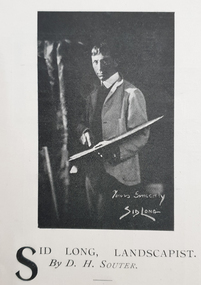 Federation University Historical Collection
Book, Art Decoration Ornaments
... ...australian stained glass...ballarat technical art school ballarat technical art school library bank of australasia mount kosciusko siry henry parkes pyrmont bridge maori ancient egypt julian ashton st andrew'e cathedral sydney edmond thomas blacket sydney university comisariat stores circular quay the rocks w. lister-lister sydney domestic architecture james barnet john horbury hunt sidney long maori art wall decoratoni paperhangings australian stained glass art and architecture stamped metalwork w.c. piguenit australian architecture rose bay convent chapel australian posters pottery cyril blacket bookbinding new south wales state library architecture oxford st sydney'tom roberts repousse sydney harbour bridge john longstaff women painters the great pyramid of egypt skyscraper comes to new south wales melbourne hospital plans governor bligh electric illumination Black cloth covered book with leather spine. ...Black cloth covered book with leather spine. Colour illustrationsballarat technical art school, ballarat technical art school library, bank of australasia, mount kosciusko, siry henry parkes, pyrmont bridge, maori, ancient egypt, julian ashton, st andrew'e cathedral sydney, edmond thomas blacket, sydney university, comisariat stores circular quay, the rocks, w. lister-lister, sydney domestic architecture, james barnet, john horbury hunt, sidney long, maori art, wall decoratoni, paperhangings, australian stained glass, art and architecture, stamped metalwork, w.c. piguenit, australian architecture, rose bay convent chapel, australian posters, pottery, cyril blacket, bookbinding, new south wales state library architecture, oxford st sydney'tom roberts, repousse, sydney harbour bridge, john longstaff, women painters, the great pyramid of egypt, skyscraper comes to new south wales, melbourne hospital plans, governor bligh, electric illumination -
 Mission to Seafarers Victoria
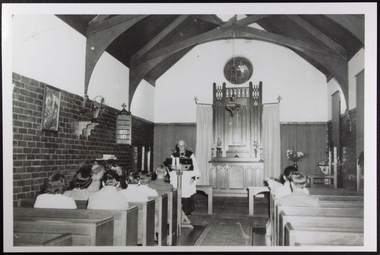
Photograph - Photograph, copy, The Age, St Nicholas' Mariners' Church, at Williamstown Mission to Seamen, with the lay reader in charge (Mr Stewart Murray) conducting a service, 14 June 1958
... english, scottish and australian bank...stained-glass...The furniture and window were donated in 1979 to the Flagstaff Hill Maritime Village in Warrnanbool, and located in the chapel. randall stewart murray st nicholas the mariner chapel chapel lay reader williamstown victorian-seamens-mission 139 nelson place e,s and a bank english, scottish and australian bank stained-glass window pews lightkeepers' auxiliary warrnambool mrs musther brooks, robinson & co hymn board david conolly Hand written in black texta; ... ...The photograph wa published in the Age, 14th of June 1958. The picture shows the round stained glass dedicated on Sunday 14 December 1947 and the reredos with hangings donated by Maud Breaks in memory of her sister Louise Breaks and dedicated on 26 August 1954 by the Bishop of Geelong.This is a rare picture of the interior of the St Nicholas chapel which was erected behind the former E, S & A Bank building used by the Williamstown Seamen's Mission branch from 1944. Article in the Age reading: "Seamen's Window Dedicated - A window in St. Nicholas' Mariners' Church, at Williamstown, in memory of the merchant seamen who were killed on active service In the last war, was unveiled and dedicated yesterday.The ceremony was performed by the Bishop of Geelong (Rt. Rev. J. D. McKie). The window, erected by the Williamstown Lightkeepers' Auxiliary of the Victoria Missions to Seamen is placed behind the altar. It shows a quartermaster, with his hand on the wheel, and the figure of Christ pointing ahead. Bishop McKie paid a tribute to the spirit of the men who gave their lives at sea in the service of their country. He said the work of the auxiliary would still be of great value, although the war was over." The decision of the window was published in August 1947, Mrs Musther -who created the Lightkeepers' Auxiliary branch in Williamstown - ordered it from Brooks, Robinson & Co. (job books 1923-1966). The furniture and window were donated in 1979 to the Flagstaff Hill Maritime Village in Warrnanbool, and located in the chapel.Black and White Gloss print photograph - Image features a minister delivering a chapel serviceHand written in black texta; ... Mission to Seamen, Williamstown Chapel service... Circa 1957randall stewart murray, st nicholas the mariner chapel, chapel, lay reader, williamstown, victorian-seamens-mission, 139 nelson place, e,s and a bank, english, scottish and australian bank, stained-glass window, pews, lightkeepers' auxiliary, warrnambool, mrs musther, brooks, robinson & co, hymn board, david conolly -
 Flagstaff Hill Maritime Museum and Village
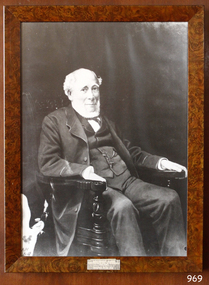
Photograph - Portrait, David Charles McArthur, Superintendent, Bank of Australasia 1867-1876
... The Melbourne branch of Australia and New Zealand Bank has a portrait of McArthur in its boardroom. St John's Church, Heidelberg, commemorates him with a stained-glass window entitled 'King David'. ...The Melbourne branch of Australia and New Zealand Bank has a portrait of McArthur in its boardroom. St John's Church, Heidelberg, commemorates him with a stained-glass window entitled 'King David'. ...The subject of this photograph, David Charteris McArthur, was the founding manager of the Bank of Australasia in Port Phillip (Melbourne). McArthur was born in 1808 in Gloucester, England, and educated in Scotland. He worked for an insurance firm in Edinburgh, where in 1835 he married Caroline, nee Wright. McArthur and his family party sailed from the U.K. to arrive in Sydney in October 1835, where he joined the Bank of Australasia when it opened in Sydney in December. McArthur sailed to Melbourne in August 1838 with 3000 pounds in coins, protected by armed guards and two bulldogs, to open the Melbourne branch of the Bank of Australasia. The branch grew quickly, servicing both private and government customers. He opened many branches in the goldfields during the 1850s. In 1862, he was appointed as general inspector of branches. He spent time with the bank in New Zealand. On his return to Melbourne, at age 57, he was put in charge of the entire bank. McArthur lived in the hills of Heidelberg, Melbourne. He was the first chairman of Associated Banks and was an advisor to politicians and merchants. He was retired in October 1876 by the London directors and given a free trip to London, an annuity and a seat on the bank’s Advisory Board. McArthur was active in the community, being a member of the Mechanics’ Institute, on the committee that advised Governor Hotham on the Colony’s finances, chairman of the Heidelberg Road Board, one of the original trustees of the Library of Victoria in 1853 and president of the trustees of the Public Library, Museums and National Gallery of Victoria in 1880-83. He was also on many other community organisations. He died in his home “Charterisville” in East Ivanhoe in 1887. He and Caroline had no children. The Melbourne branch of Australia and New Zealand Bank has a portrait of McArthur in its boardroom. St John's Church, Heidelberg, commemorates him with a stained-glass window entitled 'King David'. The McArthur Gallery in the National Gallery of Victoria is also named after him. (David's brother, Donald, moved from Sydney to Melbourne in 1836 with the first government survey team.) ABOUT THE BANK OF AUSTRALASIA In 1836 the Bank of Australasia was established in London by Royal Charter. In 1951 the bank merged with the Union Bank of Australia, to form ANZ Bank Limited. In 1970 it merged with the English, Scottish and Australian Bank to become Australia and New Zealand Banking Group Limited. Since that time the ANZ has acquired other banks and introduced Internet banking and mobile banking. BANK OF AUSTRALASIA IN WARRNAMBOOL The Bank of Australasia first opened in Warrnambool in July 1854 in a building on Merri Street. The manager was Mr Samuel Hannaford. The bank then purchased and moved to a stone building on the corner of Timor and Gibson Streets, previously owned by Cramond and Dickson and almost opposite the Examiner’s office. In January 1957 Mr W.H. Palmer became the new manager and was there until November 1869. The bank then built its own building on the corner of Timor and Kepler Streets in 1859. Mr Basil Spence, the teller, was appointed acting manager in 1869 and Mr H.B. Chomley was the next appointed manager, in April 1873 and was still manager in 1886. The municipality of Warrnambool first banked with the Bank of Australasia from 1856 to April 1857. David Charteris McArthur served as the founding manager of the Bank of Australasia. His leadership marked a significant chapter in Warrnambool's early commercial development. The municipality of Warrnambool relied on the Bank of Australasia as its official bank from 1856 until April 1857. This period is symbolised by a photograph of McArthur, which represents the origins of Warrnambool's commercial history and its early financial infrastructure.Photograph; portrait of David Charteris McArthur. Heavily retouched black and white print in plain brown varnished frame, behind glass, with plaque on lower edge and inscription lower left corner.Lower left corner "A-H 1-9". Engraved on plaque "DAVID CHARTERS MCARTHUR \ SUPERINTENDENT \ BANK OF AUSTRALASIA \ 1867-1876"flagstaff hill, warrnambool, shipwrecked-coast, flagstaff-hill, flagstaff-hill-maritime-museum, maritime-museum, shipwreck-coast, flagstaff-hill-maritime-village, bank of australasia, david charteris mcarthur, superintendent bank of australasia, colonial commerce, manager bank of australasia melbourne, colonial bank, warrnambool bank of australasia, shipwrecked coast, flagstaff hill maritime museum, maritime museum, shipwreck coast, flagstaff hill maritime village, great ocean road, boa, union bank, australia & new zealand bank, anz bank, david charters mcarthur, d c mcarthur -
 Flagstaff Hill Maritime Museum and Village
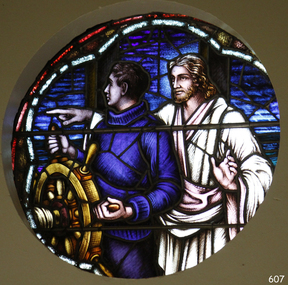
Artwork, other - Window, Brooks, Robinson & Co, Christ Showing the Helmsman the Way, circa August 1947
... This stained glass window is historically significant for its connection to the St Nicholas Mission to Seamen's Church in Williamstown, established in 1857 to cater for the physical, social, and spiritual needs of seafarers. It was donated to the Mission by the Lightkeepers Auxiliary (Ladies Harbour Lights Guild, which was formed in 1905). The Missions to Seamen organisation had its origins in Bristol, England, when a Seamen's Mission was formed in 1837. The first Australian ...This round, stained glass window, titled "Christ Showing the Helmsman the Way", was also referred to as the Sanctuary Window or Memorial window. It was installed in the St Nicholas Seamen's Church at 139 Nelson Place, Williamstown, Victoria, inside the chapel above the altar. This memorial window has significance as a part of Victoria's War Heritage and is listed on the Victorian Heritage Database. The window and subsequent plaque were donated to St Nicholas Seamen’s Church as a memorial to the members of the Merchant Navy whose lives were lost in the Second World War, 1939-1945. The donor was the Williamstown Lightkeepers Auxiliary, an independent ladies' association working with the Williamstown Missions to Seamen (the Missions to Seamen organisation was re-named the Mission to Seafarers in the year 2000). The window was officially dedicated on December 14, 1947, by Geelong's Anglican Bishop, Rt. Rev. J.D. McKie. In the early months of 1948, a bronze plaque was also placed in the chapel above the altar. It recognises the lost souls of the Merchant Navy during World War 2, as well as the donor of the window, the Williamstown Lightkeepers Auxiliary. The inscription impressed on the rectangular bronze plaque, 20.4 x 10.2cm, is as follows: “IN MEMORY OF THE MEMBERS OF THE MERCHANT NAVY WHO WERE LOST IN THE SECOND WORLD WAR 1939-1945 FAITHFUL UNTO DEATH. THE WINDOW ABOVE THE ALTAR WAS ERECTED BY THE WILLIAMSTOWN LIGHTKEEPERS AUXILIARY 1947.” The Williamstown St Nicholas Seamen’s Church ceased operation in 1966. In 1979, the Victoria Missions to Seamen donated this round, stained glass window and the memorial plaque to Flagstaff Hill Maritime Village, along with many other items and furnishings. These items have been used to simulate the Williamstown Mission and Chapel as much as possible. The round space that formerly displayed the window can still be seen at the back of the old St Nicholas Seamen’s Church, previously the ES&A bank, in Williamstown. THE MISSIONS TO SEAMEN (Brief History): - The Missions to Seamen was an Anglican charity in Great Britain that has served the world's seafarers since 1856. Its symbol is a Flying Angel, inspired by a Bible verse. Today, there are centres in over 200 ports worldwide where seamen of all backgrounds are offered a warm welcome and provided with a wide range of facilities. In Victoria, the organisation began in Williamstown in 1857 as a Sailors’ Church, also known as ‘Bethel’ or the ‘Floating Church’ in an old hulk floating in Hobson’s Bay, Port of Melbourne. It soon became part of the Missions to Seamen, Victoria. In 2000, the organisation, now named Mission to Seafarers, still operated locally in Melbourne, Portland, Geelong and Hastings. The Ladies’ Harbour Lights Guild was formed in 1906 to support the Missions to Seamen in Melbourne and other centres, such as Williamstown. Two of the most significant ladies of the Guild were founder Ethel Augusta Godfrey and foundation member Alice Sibthorpe Tracy (who established a branch of the Guild in Warrnambool in 1920). The Guild continued its work until the 1960s. In 1943, a former Williamstown bank was purchased for the Missions to Seamen Club. The chapel was named St Nicholas’ Seamen’s Church and was supported by the Ladies’ Harbour Lights Guild, the Williamstown Lightkeepers’ Auxiliary and the League of Soldiers’ and Sailors’ Friends. It ceased operation in 1966. A Missions to Seamen Chapel and Recreation Room was a significant feature of ports during the late 1800s and 1900s. It seemed appropriate for Flagstaff Hill to include such a representation within the new Maritime Village, and the Melbourne Board of Management of Missions to Seamen Victoria gave its permission on 21st May 1979 for the entire furnishings of the Williamstown chapel to be transferred to Flagstaff Hill. The St Nicholas Seamen’s Church was officially opened on October 11, 1981, and resembles the Williamstown chapel. This stained glass window is historically significant for its connection to the St Nicholas Mission to Seamen's Church in Williamstown, established in 1857 to cater for the physical, social, and spiritual needs of seafarers. It was donated to the Mission by the Lightkeepers Auxiliary (Ladies Harbour Lights Guild, which was formed in 1905). The Missions to Seamen organisation had its origins in Bristol, England, when a Seamen's Mission was formed in 1837. The first Australian branch was started in 1856 by the Rev. Kerr Johnston, a Church of England clergyman, and operated from a hulk moored in Hobson’s Bay. Later, the Mission occupied buildings in Williamstown and Port Melbourne. The connection of this window, the Mission to Seamen and the Ladies Harbour Lights Guild highlights the strong community awareness of the life of people at sea, their dangers and hardships, and their need for physical, financial, spiritual and moral support. This memorial window is significant as a part of Victoria's War Heritage and is listed on the Victorian Heritage Database, Heritage Number 196973.Window, stained glass, circular, with reinforcing bars. The window represents Christ showing the helmsman the way. It shows a man in blue knitted jumper holding onto a ship's wheel, looking over his right shoulder. Behind him stands a man in a white robe, pointing to his right and looking to his left, his left hand gesturing to pause. The background has various shapes and patterns of blue glass, bordered by two arcs; the outer one is white, the inner one is red. This beautiful window is in our St Nicholas Seamen's Church Collection and was brought to Warrnambool from the original St Nicholas Seamen’s Church in Williamstown. flagstaff hill, warrnambool, shipwrecked coast, flagstaff hill maritime museum, maritime museum, shipwreck coast, flagstaff hill maritime village, great ocean road, mission to seamen williamstown, st nicholas seaman’s church williamstown, missions to seamen victoria, mission to seafarers, lightkeepers auxiliary, ladies harbour light guild, 139 nelson place williamstown, religion, religious service, sailors rest, bethel sailors’ church, bethel floating church, e. s. & a. bank williamstown, christ directing a sailor, christ showing the helmsman the way, quartermaster’s hand on the wheel, stained glass window, church window, religious window, sanctuary window, memorial window, war memorial window, victorian war heritage inventory, victorian heritage database, merchant navy ww2, 1939-1945, anglican church, bishop mckie, mrs musther, brooks robinson & co, flying angel club, williamstown lightkeepers' auxiliary, ladies' harbour lights guild, commemorative window -
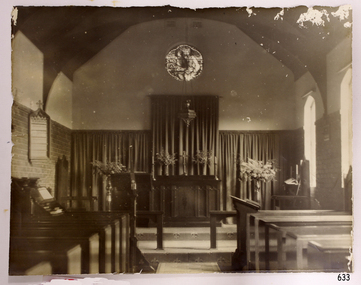 Flagstaff Hill Maritime Museum and Village
Photograph - Historical, religious, mid-20th century
... Australian Bank (ES&A bank), also known as the Mission to Seamen. It is listed on the Victorian Heritage Database for having local historic and aesthetic interest. flagstaff hill warrnambool shipwrecked-coast flagstaff-hill flagstaff-hill-maritime-museum maritime-museum shipwreck-coast flagstaff-hill-maritime-village st nicholas mission to seamen's church williamstown mission to seamen williamstown mission to seamen victoria st nicholas mission to seamen chapel window christ showing the helmsman the way stained glass window st nicholas seamen's church religion religious service sailor's rest ladies harbour light guild Photograph of St Nicholas Seamen's Church, Williamstown. ...This photograph records the interior of St Nicholas Seamen's Church at 139 Nelson Place, Williamstown, Victoria, which was purchased and furnished around 1943. The furniture and furnishings are now part of the St. Nicholas Seamen's Church collection. HISTORY of the Missions to Seamen: - DETAILED HISTORY of the Missions to Seamen: - The Missions to Seamen is an Anglican (Church of England) charity that has served the world’s seafarers since 1856. It was inspired by the work of Rev. John Ashley, who, 20 years earlier, had pioneered a ministry to seafarers in the Bristol Channel in Great Britain. When Ashley retired, others continued the work, founding the Missions to Seamen. It adopted a Flying Angel as its symbol, inspired by a verse from the Bible in Revelation 14. Today, over 200 world ports have Missions to Seamen centres and chaplains. A Missions to Seamen’s Club warmly welcomes sailors of all colours, creeds and races and provides a wide range of facilities. The Missions to Seamen organisation changed its name to the Mission to Seafarers in 2000, continuing to include Missions to Seamen clubs in Victoria’s cities of Melbourne, Portland, Geelong and Hastings. Flagstaff Hill’s St Nicholas’ Seamen’s Church is named after its namesake from Williamstown, Victoria, which began in 1857. Bishop Perry opened the first Sailors’ Church there, known as ‘Bethel’, on an old hulk floating in Hobson’s Bay, Port of Melbourne. In 1860, a Sailors’ Rest started operating from rented premises in Williamstown. In 1878, the Sailors’ Church moved into an old Wesleyan chapel in Ann Street. By the end of that year, they managed to purchase the building, which they had already refurbished. In 1883, they affiliated with the Victorian Seamen’s Mission. A few years later, in 1906, the building had to be demolished because it was no longer safe. While they raised funds for a new building, the Sailors’ Rest temporarily moved to premises in front of Customs House in Nelson Place. Around this time, in 1906, the Ladies Harbour Lights Guild was formed in Australia to support and raise funds for the Mission to Seamen organisation in Melbourne. Two of the most significant ladies of the Guild were founding members Ethel Godfrey and Alice Sibthorpe. During the Mission's time at Siddeley Street, Melbourne, the activities of the Guild raised funds for the Mission to Seamen's Chapel at their new, and still current, premises in Flinders Street, Melbourne, opened in 1917. The Guild continued its important work until the 1960s. In 1908, the Williamstown Mission had enough money to purchase the former Mascotte skating rink on Thompson Street, Williamstown. In August of that year, they were inaugurated into the Victorian Missions to Seamen. They continued at that venue for a few decades. In 1943, the former ES&A Bank building at 139 Nelson Place, Williamstown, was purchased to become the new Mission to Seamen’s Club. On May 6th, 1944, it was officially opened, described as a ‘distinctive little building’. Funds had previously been raised for the building and furnishing of the chapel at the rear. The chapel was named St Nicholas’ Seamen’s Church, after St Nicholas, fourth-century bishop and patron saint of sailors. Services were held on Wednesdays and Sundays. The church was supported by the Williamstown Lightkeepers’ Auxiliary, newly founded by Mrs Ethel Margaret Musther in 1943, as well as the Harbour Lights Guild and the League of Soldiers’ and Sailors’ Friends. The Williamstown Mission to Seamen’s Church operated until 1966, when large international ships no longer used the Port of Williamstown. The Commonwealth Government then leased the premises. In the formative years of Flagstaff Hill Maritime Village, the Advisory Board decided to include a Missions to Seamen Chapel and Recreation Room in its village. The Missions organisation was a significant feature of ports during the late 1800s and early 1900s, the period that the Village represents. They often erected Missions to house social and worshipful activities for seamen. Flagstaff Hill’s curator, Mr Ken Marshman, approached the Melbourne Board of Management of Missions to Seamen regarding the Williamstown branch. Consequently, the Board permitted the furnishings of the Williamstown chapel to be transferred to Flagstaff Hill Maritime Village. A provision of the transfer was that the Victoria Missions to Seamen be recognised, that the items would remain as a collection, and that the chapel would be called St Nicholas Seamen’s Church and conduct Divine services. The donation was approved on 21st May 1979. Flagstaff Hill's St. Nicholas Seamen's Church: - The idea behind Flagstaff Hill’s Missions to Seamen’s Church was partly driven by the offer of Stained Glass Memorial Windows that originated from the Warrnambool and District Base Hospital, which was undergoing multi-storey expansion in the late 1960s and early 1970s. The hospital’s Manager/Secretary was eager to see the historic window installed in a suitable place. The church, or chapel, was designed by a local architectural draftsman in collaboration with the Flagstaff Hill Planning Board and was constructed by Mr Leon Habel. The designers hoped that the church would be used for formal worship such as weddings, funerals, and multi-denominational special services like war commemorations. The design is inspired by the ‘Missions to Seamen’ buildings in Portland and the Port of Melbourne. The furniture and furnishings were placed as accurately as possible according to photographs of the Williamstown St Nicholas Seamen’s Church and with assistance from local clergy. The Recreation Room was furnished and arranged on advice from experienced members of the Missions to Seamen organisation. A framed document in the building recognises the donor of the furnishings, Victoria Missions to Seamen, and includes the names of some original donors and their donated item/s. The building’s design incorporates local features such as Warrnambool sandstone, which was no longer commercially available but was procured from demolished buildings and uniformly cut to use as a veneer over the stronger Mt. Gambier stone. Also, traditional green American roofing slate was used, sourced from the 1908 local shipwreck “Falls of Halladale” by Flagstaff Hill volunteer divers. The bell tower includes a bell believed to be from a local shipwreck. Additional furnishings were acquired locally, along with several items donated by Warrnambool residents. Light fittings in both rooms were assembled to simulate 19th-century gas light fittings. The stained-glass window at the back of the church is a memorial to Dr Connell, a well-respected member of the Warrnambool community. It was originally installed in 1928 in the main building of Warrnambool Hospital. The St Nicholas’ Seamen’s Church at Flagstaff Hill was officially opened by His Worship the Mayor, Cr. John Lindsay, on Sunday, 11th October 1981. The event included a service of thanksgiving conducted by the Warrnambool Ministers Fraternal. Since then, the Chapel has been the historic venue for many weddings. This photograph is significant through its association with the St Nicholas' Mission to Seamen Church in Williamstown, Melbourne, established in 1857. The building in the photograph is the former English, Scottish and Australian Bank (ES&A bank), also known as the Mission to Seamen. It is listed on the Victorian Heritage Database for having local historic and aesthetic interest. Photograph of St Nicholas Seamen's Church, Williamstown. Sepia photograph. The photograph shows the inside of the Chapel of Mission to Seamen, including organ, pews and other furniture and furnishings. There is a circular stained glass window high on the back wall depicting a sailor at the helm of a ship and a man standing behind him and pointing the way - "Christ Showing The Helmsman The Way". A Sanctuary Light is suspended from the ceiling. The Sanctuary chars are visible. This shows the St Nicholas Seamen's Church in Williamstown, the furnishings and furniture of which is now part of the St Nicholas Seamen's Church Collection’.flagstaff hill, warrnambool, shipwrecked-coast, flagstaff-hill, flagstaff-hill-maritime-museum, maritime-museum, shipwreck-coast, flagstaff-hill-maritime-village, st nicholas mission to seamen's church williamstown, mission to seamen williamstown, mission to seamen victoria, st nicholas mission to seamen, chapel window, christ showing the helmsman the way, stained glass window, st nicholas seamen's church, religion, religious service, sailor's rest, ladies harbour light guild -
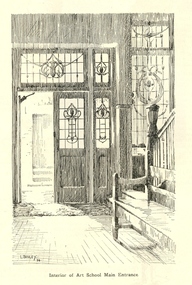 Federation University Historical Collection
Artwork, other - Artwork, Artwork from the Ballarat School of Mines Students' Magazine, 1934, 1934
... This building is now the Gribble Building on the Federation University Australia SMB Campus. ballarat technical art school gribble building gribble stained glass white flat hopwood bailey gude Ballarat Junior Technical School Visual Arts Artwork by students of the Ballarat Technical Art School from the 1934 Ballarat School of Mines Students' Magazine .1) Stairs to the Ballarat Junior Technical School from Grant Street .2) Caricatures by Nornie Gude .3) work by Colin S. ...Sir Alexander Peacock opened the Ballarat Technical Art School in July 1915. It cost 10,000 pounds and was constructed by the Public Works Department from plans drawn by the then Art School Principal, Herbert H. Smith. The building contractors were Messrs Gower and Eddards. According to the SMB Annual Report of 1914 'the internal upholstering and fittings have all been carried out in Australian timbers, with Queensland maple largely used throughout.' Before this building was constructed art and craft classes were held in various buildings around Ballarat. The building could be described as federation-art deco in style. It features sandstone insertion with sandstone string coursing. The base of the building is rusticated sandstone. The relief stone panel on the front with the words "Technical Art School" features stone pilaster brackets and corbels. In the centre front can be seen rectangular sandstone pediment with decorative stonework incorporating the date of construction. The windows in the lower floor feature five supporting keystones whereas the upper windows have sandstone lintels. The building also features decorative cast iron downpipes. The entrance on the northern side has attractive leadlight glazing in an art deco style. Above the door a miner's lamp and pick are featured in the design. The building is functional in design with large metal windows in the south wall to ensure good light into the studios. The northern wall has standard double hung windows. The interior of the building features a carved wooden staircase and cast iron ceiling vents. The rear drawing studios can be made into one large studio by opening panelled timber doors. This opening features classical plaster pilasters with a pediment above. This building is now the Gribble Building on the Federation University Australia SMB Campus.Artwork by students of the Ballarat Technical Art School from the 1934 Ballarat School of Mines Students' Magazine .1) Stairs to the Ballarat Junior Technical School from Grant Street .2) Caricatures by Nornie Gude .3) work by Colin S. Hunt .4) A girl and a rooster by Gilda Gude .5) Self Portrait .6) Main entrance to the Ballarat Technical Art School by Lorna Bailey .7) Artwork from the magazineballarat technical art school, gribble building, gribble, stained glass, white flat, hopwood, bailey, gude, ballarat junior technical school, visual arts -
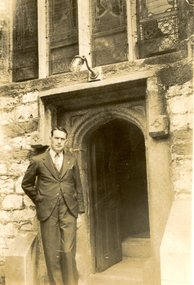 Federation University Historical Collection
Photograph - Black and White, Frank Wright, St Andrew's Plymouth, 1934, 19/6/34
... The Frank Wright Medal at the Royal South Street competition is awarded to an individual recognized as making an outstanding contribution to brass music in Australia. frank wright conductor st andrew's parish church plymouth church door Written in pencil on the back - Frank Wright 32, outside St Andrew's Parish Church (13th Century), Plymouth 19-6-34 Black and white photograph of a man dressed in a suit standing leaning against the entrance surround of an ornate stone door of a church. Above the door is the lower part of a four sectioned stained glass ...Frank Wright was a renown resident of Smeaton, where he was born. He lived at Laura Villa, and attended Smeaton State School. His father William was a gold miner and his mother's name was Sarah. Their family won many singing and instrumental awards. Frank was tutored by Percy Code and was awarded a gold medal for the highest marks in the ALCM examinations in the British Colonies at the age of seventeen years. He became the Australian Open Cornet Champion by the age of eighteen. A year later, Frank conducted the City of Ballarat Band, and later the Ballarat Soldiers’ Memorial Band. He formed the Frank Wright Frisco Band and Frank Wright and his Coliseum Orchestra. These bands won many South Street awards, and Frank as conductor won many awards in the Australian Band Championship contest. In 1933 Frank Wright sailed to England to conduct the famous St Hilda’s Band and was later appointed Musical Director of the London County Council, where he organized many amazing concerts in parks, in and around the London district. He was made Professor of Brass and Military Band Scoring and conducted at the Guildhall of Music and Drama. Frank was often invited to adjudicate Brass Band Championships around Europe, in Australia, including South Street and in New Zealand. The Frank Wright Medal at the Royal South Street competition is awarded to an individual recognized as making an outstanding contribution to brass music in Australia.Black and white photograph of a man dressed in a suit standing leaning against the entrance surround of an ornate stone door of a church. Above the door is the lower part of a four sectioned stained glass window. The man is Frank Wright and the place is St. Andrew's Parish Church in Plymouth.Written in pencil on the back - Frank Wright 32, outside St Andrew's Parish Church (13th Century), Plymouth 19-6-34frank wright, conductor, st andrew's parish church, plymouth, church door -
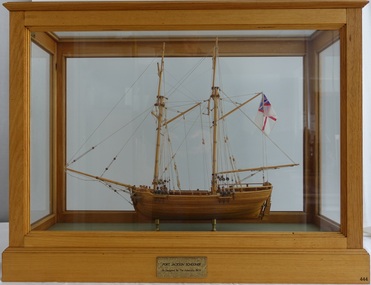 Flagstaff Hill Maritime Museum and Village
Craft - Ship Model, Port Jackson Schooner
... The colonial Port Jackson schooner is considered significant to Australian history, and represented on the 1994 twenty dollar banknote and its new version being rolled out in October 2019. flagstaff hill warrnambool shipwrecked-coast flagstaff-hill flagstaff-hill-maritime-museum maritime-museum shipwreck-coast flagstaff-hill-maritime-village ship model port jackson schooner sailing ship limited edition model model maker bill leonard david mcgregor design maritime trade maritime vessel colonial port jackson schooner pacific island trade in early 1800s sydney cove governor arthur phillip governor philip gidley king a schooner for port jackson national maritime museum greenwich australian $20 banknote Engraved on metal plaque "PORT JACKSON SCHOONER / As Designed By The Admiralty. 1803" Ship model of a colonial Port Jackson Schooner. Two-masted sailing ship displaying the flag named The British White Ensign. Mode of light coloured stained timberl is mounted on brass legs inside a glass ...This ship model is of a Colonial Port Jackson schooner, originally designed by the British Admiralty in 1803 as a response to the request of New South Wales' Governor Arthur Phillip. The drafts for the original plans are in Greenwich, UK, in the National Maritime Museum. The model is a Ledition edition, number 2 of 5, modelled by Bill Leonard. The model is rigged and decked in the manner of David McGregor. The flag on model of Port Jackson schooner is that of the British White Ensign which was used as the flag design of the Royal Australian Navy from 1911 - 1967. In 1785 the First Fleet arrived in the new British colony of Port Jackson (now Sydney Harbour) in New South Wales and Arthur Phillip was appointed as the first Governor. The following year Governor Phillip asked the English Royal Navy to provide drafts and materials for two ships for use in the Port Jackson colony for exploring and surveying rivers. The vessels needed a shallow draught and to be made from local cedar timber. He asked for the frames of the schooners to be provided along with shipwrights to assemble them. Many years later, in 1803, Governor Phillip’s request was fulfilled but he had already resigned from his post. The drafts titled ‘Schooner for Port Jackson’ were despatched by the Royal Navy from England to Australia. The original draft is still in the National Maritime Museum in Greenwich, UK. Meanwhile, the NSW Government had already built various other ships before 1803. In 1797 His Majesty’s Dockyard was opened at Port Jackson for building larger vessels. The Royal Navy’s 1803 design of a ‘Schooner for Port Jackson’ has been recognised on the obverse of Australia’s twenty dollar banknote since 1994. A sketch of the schooner is beside the portrait of Mrs Mary Reibey, who arrived as a convict and rose to become a respected and successful owner of a cargo shipping business. Her fleet included the Mercury, a schooner similar to the 1803 design for the Port Jackson schooner. Although the 1803 plans for a ‘Schooner for Port Jackson’ are commonly believed to be used for the first ship built in Australia, no records have been found of any ships being built according to these plans. However, it can be claimed that the plans were the ‘first Royal Navy plans made for a ship for use at Port Jackson, and to be built at Port Jackson, in Australia’. William (Bill) Leonard passed away on March 1st 1995.This ship model is significant for its representation of an early Australian colonial schooner. The 1803 Royal Navy’s plans for the colonial ‘Schooner for Port Jackson, were for the first ship specifically designed by the Royal Navy to be built and used in Port Jackson, for use in exploration and surveying of Australian ports and rivers. The plans are associated with Australia’s colonial settlement in the late 1700s. This ship model is significant for its association with the emblems of Australia’s history on the twenty dollar banknote. The colonial Port Jackson schooner is considered significant to Australian history, and represented on the 1994 twenty dollar banknote and its new version being rolled out in October 2019.Ship model of a colonial Port Jackson Schooner. Two-masted sailing ship displaying the flag named The British White Ensign. Mode of light coloured stained timberl is mounted on brass legs inside a glass case with timber frame and base. Metal engraved plaque states that the model is as designed by The Admiralty in 1803. Model is a number 2 of 5 in a limited edition, made by Bill Leonard.Engraved on metal plaque "PORT JACKSON SCHOONER / As Designed By The Admiralty. 1803"flagstaff hill, warrnambool, shipwrecked-coast, flagstaff-hill, flagstaff-hill-maritime-museum, maritime-museum, shipwreck-coast, flagstaff-hill-maritime-village, ship model port jackson schooner, sailing ship, limited edition model, model maker bill leonard, david mcgregor design, maritime trade, maritime vessel, colonial port jackson schooner, pacific island trade in early 1800s, sydney cove, governor arthur phillip, governor philip gidley king, a schooner for port jackson, national maritime museum greenwich, australian $20 banknote -
 Mission to Seafarers Victoria
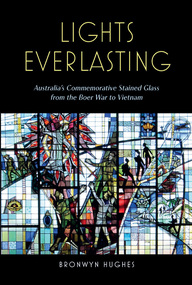
Book, Australian Scholarly Publishing, Lights Everlasting: Australia’s commemorative stained glass from the Boer War to Vietnam, 2023
... The book was launched in June 2023 at in the St Peter chapel of the Mission, as several stained glass windows are mentioned in the book. Bronwyn Hughes is the stained glass specialist in Australia and has a long connection with the Mission as she helped identifies the chapel windows' origins. australian history ww1 ww2 boer war vietnam war stained glass windows bronwyn hughes Almost hidden within religious buildings, hospitals, school chapels and civic buildings, stained-glass windows tell of Australians at war. ...Almost hidden within religious buildings, hospitals, school chapels and civic buildings, stained-glass windows tell of Australians at war. Bronwyn Hughes focuses on commemorative stained glass—an overlooked art form—describing its rich artistic and architectural heritage and the artists and firms who created it. Memorial stained glass serves to depict and illuminate the men and women who fought and died for their faith and their country. It has a tragic beauty. The book includes stained glass windows from the St Peter chapel of the Mission to Seafarers.255 pages with colour and black and white illustrations; notes, bibliography, index.non-fictionAlmost hidden within religious buildings, hospitals, school chapels and civic buildings, stained-glass windows tell of Australians at war. Bronwyn Hughes focuses on commemorative stained glass—an overlooked art form—describing its rich artistic and architectural heritage and the artists and firms who created it. Memorial stained glass serves to depict and illuminate the men and women who fought and died for their faith and their country. It has a tragic beauty. The book includes stained glass windows from the St Peter chapel of the Mission to Seafarers.australian history, ww1, ww2, boer war, vietnam war, stained glass windows, bronwyn hughes -
 Mission to Seafarers Victoria
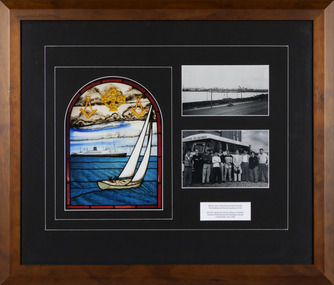
Photograph - Framed montage, Arthouse - Picture Framing & Gallery, On the Seas, 2013
... For over 150 years the Mission to Seafarers in Victoria has continued to meet the welfare needs of seafarers who arrive on Australian shores from around the world. This exhibition presents a selection of stained glass windows and historical photographs from the Mission, to capture a glimpse of some of the people and scenes integrale to this relationship. reflections of the sea georgia melville exhibition 2013 world trade centre wtc creative victoria prov mission to seafarers stained glass windows justine m. philip greg cummins flinders street catherine mclay arthouse on label: ABOVE: View of the Princes Pier from the Port Melbourne Mission windows in 1928. ...HUMBLE BEGINNINGS The Mission to Seafarers, which was originally known as the ‘Bethel Union’, was established in London in 1835, a recognition of the spiritual needs of seafarers who live a lonely life at sea. In 1857, the Bethel Union began a mission in Victoria aboard the Emily, a large hulk vessel donated by the government, with the object of establishing a floating church for sailors moored in Hobson’s Bay. The first chaplain, his wife and their eight children, three servants and livestock called the Emily home for two and a half years. Each week, sailors were taken to the Emily via a longboat to join in the Sunday services. Today following the same custom, seafarers are transported by bus to and from the docks by a volunteer bus service run from the Mission building at 717 Flinders Street. This window, named ‘On the Seas’, was installed in 1980 and represents the origins and history of the Mission to Seafarers through the symbols of a cross, maritime and Masonic imagery.Reflections of the Sea was an exhibition of 10 framed montage of photographs from the mission's archive collection showcasing 10 stained glass windows from the St Peter chapel. This exhibition curated by Georgia Melville and Catherine McLay, and funded by PROV and Creative Victoria, was displayed in the World Trade Centre Wharf Gallery in June July 2013 and toured to Queenscliff Maritime Museum. The photographs of the windows were taken by scientific photographer Justine M. Philip. This frame is showcasing the window by Greg Cummins with a photograph of seamen in front of a van and a view of Port Melbourne.Framed and mounted on black cardboard of black and white and colour reproductions from the MTSV collection for the exhibition Reflections of the Sea with brief label signageon label: ABOVE: View of the Princes Pier from the Port Melbourne Mission windows in 1928. BELOW: A group of visiting seafarers standing in front of the Mission bus during an outing to the beach, circa 1950s.reflections of the sea, georgia melville, exhibition, 2013, world trade centre, wtc, creative victoria, prov, mission to seafarers, stained glass windows, justine m. philip, greg cummins, flinders street, catherine mclay, arthouse -
 Mission to Seafarers Victoria
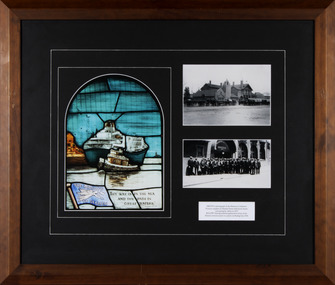
Photograph - Framed montage, Arthouse - Picture Framing & Gallery, Missions to Seafarers, 2013
... For over 150 years the Mission to Seafarers in Victoria has continued to meet the welfare needs of seafarers who arrive on Australian shores from around the world. This exhibition presents a selection of stained glass windows and historical photographs from the Mission, to capture a glimpse of some of the people and scenes integrale to this relationship. reflections of the sea georgia melville exhibition 2013 world trade centre wtc justine m. philip flying angel flag tugboat mission to seafarers flinders street creative victoria prov stained glass windows catherine mclay arthouse on label: ABOVE: A photograph of the Mission to Seafarers complex on Flinders Street with horse drawn carts going by, taken in 1927 BELOW: Visiting seafarers gathered in front of the Mission entrance prior to a picnic on Boxing Day 1926 Framed and mounted on black cardboard of black and white and colour reproductions from the MTSV collection for the exhibition Reflections of the Sea with brief label signage Missions to Seafarers Photograph Framed montage Arthouse - Picture Framing & Gallery Justine M.Philip Daniel Climent ...THE HOME OF THE MISSION TO SEAFARERS By 1907 the Mission to Seafarers Victoria had moved from providing its services aboard a floating vessel, the Emily, to three different bases in Melbourne locations: Williamstown, Port Melbourne and the North Bank of the Yarra - opening a central home in 1907, and finally at 717 Flinders Street in 1917. The Mission to Seafarers Victoria complex, includes the landmark domed gymnasium, which opened in 1920. The State heritage listed buildings of the Mission are considered architecturally significant urban examples of two distinct architectural styles: the external Spanish Mission Revival and the Arts and Crafts influence of the interior. This window, titled ‘Missions to Seamen’, was installed in 1980 and depicts a cargo ship, tug and lighthouse representing the working seaman, and is further supported by the Flying Angel emblem of the Mission to Seafarers ministry.Reflections of the Sea was an exhibition of 10 framed montage of photographs from the mission's archive collection showcasing 10 stained glass windows from the St Peter chapel. This exhibition curated by Georgia Melville and Catherine McLay, and funded by PROV and Creative Victoria, was displayed in the World Trade Centre Wharf Gallery in June-July 2013 and toured to Queenscliff Maritime Museum. The photographs of the windows were taken by scientific photographer Justine M. Philip. This frame is showcasing the window depicting a ship and tugboat, two photographs of the Flinders Street building and seamen departing for a picnic.Framed and mounted on black cardboard of black and white and colour reproductions from the MTSV collection for the exhibition Reflections of the Sea with brief label signageon label: ABOVE: A photograph of the Mission to Seafarers complex on Flinders Street with horse drawn carts going by, taken in 1927 BELOW: Visiting seafarers gathered in front of the Mission entrance prior to a picnic on Boxing Day 1926reflections of the sea, georgia melville, exhibition, 2013, world trade centre, wtc, justine m. philip, flying angel flag, tugboat, mission to seafarers, flinders street, creative victoria, prov, stained glass windows, catherine mclay, arthouse -
 Mission to Seafarers Victoria
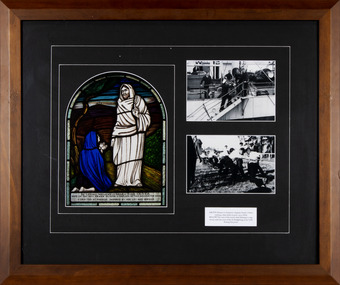
Photograph - Framed montage, Arthouse - Picture Framing & Gallery, Noli Me Tangere, 2013
... For over 150 years the Mission to Seafarers in Victoria has continued to meet the welfare needs of seafarers who arrive on Australian shores from around the world. This exhibition presents a selection of stained glass windows and historical photographs from the Mission, to capture a glimpse of some of the people and scenes integrale to this relationship. reflections of the sea georgia melville exhibition 2013 world trade centre wtc creative victoria prov mission to seafarers stained glass windows justine m. philip moira bird oliver moira bird oliver (nee good) padre frank leslie oliver picnic tug-of-war flinders street catherine mclay arthouse on label: ABOVE: Mission to Seafarers' chaplain Frank L Oliver, visiting a ship whilst in port, c1950s BELOW: The crew of the motor ship Nyhaugin a tug-of-war with the crew of the SS Madgeburg at the 1926 Boxing Day picnic Framed and mounted on black cardboard of black and white and colour reproductions from the MTSV collection for the exhibition Reflections of the Sea with brief label signage Noli Me Tangere Photograph Framed montage Arthouse - Picture Framing & Gallery Justine M.Philip Daniel Climent ...A GLOBAL PERSPECTIVE Before the increase of air transport, everything that arrived or departed from Australia did so via the ports and wharves. The Mission to Seafarersis not a Victorian initiative, but rather a global network that currently operates in over 260 ports worldwide, assisting over 1.3 million seafaring men and women each year. The importance of the Mission’s role is demonstrated in the Chaplain’s Report 1947, which notes that ships and their crews are: “...inextricably linked with the well-being of Australian industrial and economic life... This, in turn, means that you cannot escape some share in responsibility for their welfare.” This window, titled ‘Noli Me Tangere’, was installed in memoriam of Moira Oliver, the wife of the Reverend Frank Oliver, chaplain at the Mission 1930-60, and whose dedication in life and service to the welfare of seafarers was inspirational to many.Reflections of the Sea was an exhibition of 10 framed montage of photographs from the mission's archive collection showcasing 10 stained glass windows from the St Peter chapel. This exhibition curated by Georgia Melville and Catherine McLay, and funded by PROV and Creative Victoria, was displayed in the World Trade Centre Wharf Gallery in June July 2013 and toured to Queenscliff Maritime Museum. The photographs of the windows were taken by scientific photographer Justine M. Philip. This frame is showcasing the memorial window to Moira Bird Oliver, wife of Padre Oliver , a photograph of Padre Oliver listing a ship and a photograph of sailors playing tug-of-war during a picnic.Framed and mounted on black cardboard of black and white and colour reproductions from the MTSV collection for the exhibition Reflections of the Sea with brief label signageon label: ABOVE: Mission to Seafarers' chaplain Frank L Oliver, visiting a ship whilst in port, c1950s BELOW: The crew of the motor ship Nyhaugin a tug-of-war with the crew of the SS Madgeburg at the 1926 Boxing Day picnicreflections of the sea, georgia melville, exhibition, 2013, world trade centre, wtc, creative victoria, prov, mission to seafarers, stained glass windows, justine m. philip, moira bird oliver, moira bird oliver (nee good), padre frank leslie oliver, picnic, tug-of-war, flinders street, catherine mclay, arthouse -
 Mission to Seafarers Victoria
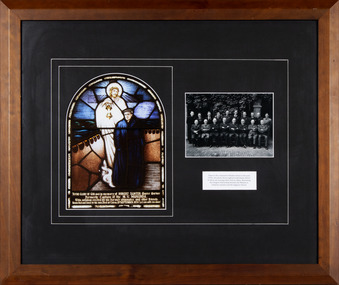
Photograph - Framed montage, Arthouse - Picture Framing & Gallery, Light of the World, 2013
... stained glass windows from the St Peter chapel. This exhibition curated by Georgia Melville and Catherine McLay, and funded by PROV and Creative Victoria, was displayed in the World Trade Centre Wharf Gallery in June July 2013 and toured to Queenscliff Maritime Museum. The photographs of the windows were taken by scientific photographer Justine M. Philip. his frame is showcasing the memorial window to Captain Robert Sunter and a photograph of a chaplains conférence in the 1950s. For over 150 years the Mission to Seafarers in Victoria has continued to meet the welfare needs of seafarers who arrive on Australian ...THE CHAPLAINCY Although fostered by the Anglican Church since 1906, the work of the Mission to Seafarers’ is inter- denominational and is not limited by the physical space of its buildings. When the old Melbourne wharves and their moorings were still in use, chaplains would also visit ships to look after the welfare of those who could not visit the Mission. Today, the Mission’s ‘Ship Visitors’ provide a similar service. The Flinders Street central complex was purpose built to meet with seafarers’ needs: “...the first thing a sailor would see before the traps and temptations of the city would be the Institute and its comfortable rooms.” (The Argus, ND). Today, the Mission continues to offer its comfortable, safe spaces and a friendly ear to seafarers, alongside other services that extend well beyond those traditionally offered - including TV, phone cards, and access to the internet. This window, titled ‘Light of the World’, was installed in 1935 in memory of a former ‘M.V. Manunda’ captain and represents chaplaincy support to the seafaring community.Reflections of the Sea was an exhibition of 10 framed montage of photographs from the mission's archive collection showcasing 10 stained glass windows from the St Peter chapel. This exhibition curated by Georgia Melville and Catherine McLay, and funded by PROV and Creative Victoria, was displayed in the World Trade Centre Wharf Gallery in June July 2013 and toured to Queenscliff Maritime Museum. The photographs of the windows were taken by scientific photographer Justine M. Philip. his frame is showcasing the memorial window to Captain Robert Sunter and a photograph of a chaplains conférence in the 1950s.Framed and mounted on black cardboard of black and white and colour reproductions from the MTSV collection for the exhibition Reflections of the Sea with brief label signageon label: Taken in the courtyard at Flinders Street in the early 1950s, this photo shows eighteen individuals, fifteen of whom are wearing white clerical collars, illutsrating the integral relationship between the Mission to Seafarers ministry and the Anglican Churchreflections of the sea, georgia melville, exhibition, 2013, world trade centre, wtc, captain robert sunter, chaplaincy, conference, mv manunda, creative victoria, prov, mission to seafarers, stained glass windows, justine m. philip, flinders street, catherine mclay, arthouse -
 Mission to Seafarers Victoria
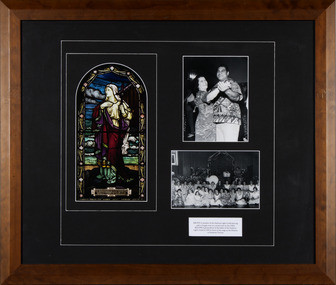
Photograph - Framed montage, Arthouse - Picture Framing & Gallery, Faith, 2013
... stained glass windows from the St Peter chapel. This exhibition curated by Georgia Melville and Catherine McLay, and funded by PROV and Creative Victoria, was displayed in the World Trade Centre Wharf Gallery in June July 2013 and toured to Queenscliff Maritime Museum. The photographs of the windows were taken by scientific photographer Justine M. Philip. This frame is showcasing the memorial window to Ethel Godfrey, and two photographs of ladies from the Harbour Lights Guild. For over 150 years the Mission to Seafarers in Victoria has continued to meet the welfare needs of seafarers who arrive on Australian ...THE HARBOUR LIGHTS GUILD The ‘Ladies Committee’ was formalised in 1906 to assist the chaplain with the social demands of the Mission, and was renamed the ‘Ladies Harbour Lights Guild’ the following year. According to former members, it operated with all proper decorum and with precise guidelines that restricted women from coming into contact with seafarers outside of Mission activities. With some 1,600 Victorian members during its early years, these volunteers gave their prayers, money, handiwork time and considerable energy in order to assist in providing for the welfare needs of visiting seafarers. The heritage chapel of St Peter, often referred to as the Mariners’ Chapel, features many examples of stained glass. Commemorating the service of Mercantile mariners, the funds to build the chapel were raised by the ladies of the Harbour Lights Guild. This window, titled ‘Faith’, was installed in 1933 to commemorate the devoted service of Miss Ethel Godfrey, a founding key member of the Ladies Harbour Lights Guild.Reflections of the Sea was an exhibition of 10 framed montage of photographs from the mission's archive collection showcasing 10 stained glass windows from the St Peter chapel. This exhibition curated by Georgia Melville and Catherine McLay, and funded by PROV and Creative Victoria, was displayed in the World Trade Centre Wharf Gallery in June July 2013 and toured to Queenscliff Maritime Museum. The photographs of the windows were taken by scientific photographer Justine M. Philip. This frame is showcasing the memorial window to Ethel Godfrey, and two photographs of ladies from the Harbour Lights Guild.Framed and mounted on black cardboard of black and white and colour reproductions from the MTSV collection for the exhibition Reflections of the Sea with brief label signageon label: ABOVE: a member of the Harbour Lights Guild dancing with a Tongan man at a social event during the 1960s. BELOW: A group photo of the ladies of the Harbour Lights Guild in front of the stage at the Mission to Seafarers Victoriareflections of the sea, georgia melville, exhibition, 2013, world trade centre, wtc, ethel augusta godfrey 1861-1935, lhlg, harbour lights guild, ladies harbour lights guild, dance, creative victoria, prov, mission to seafarers, stained glass windows, justine m. philip, catherine mclay, arthouse -
 Mission to Seafarers Victoria
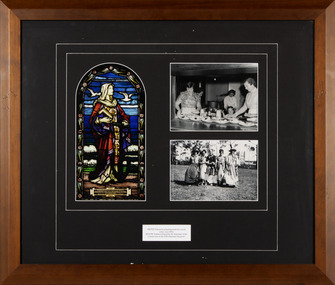
Photograph - Framed montage, Arthouse - Picture Framing & Gallery, Hope, 2013
... For over 150 years the Mission to Seafarers in Victoria has continued to meet the welfare needs of seafarers who arrive on Australian shores from around the world. This exhibition presents a selection of stained glass windows and historical photographs from the Mission, to capture a glimpse of some of the people and scenes integrale to this relationship. reflections of the sea georgia melville exhibition 2013 world trade centre wtc creative victoria prov mission to seafarers stained glass windows justine m. philip alice sibthorpe tracy social events kitchen lhlg picnic fancy dress seamen sailors catherine mclay arthouse on label: ABOVE: Volunteers preparing meals for a social event, circa 1950s BELOW: Seafarers dressed for the "final heat"of the costume race at the 1926 Christmas Day picnic Framed and mounted on black cardboard of black and white and colour reproductions from the MTSV collection for the exhibition Reflections of the Sea with brief label signage Hope Photograph Framed montage Arthouse - Picture Framing & Gallery Justine M.Philip Daniel Climent ...ENTERTAINMENT AND SOCIAL EVENTS The Ladies of the Harbour Lights Guild played a central role in everyday functions of the Mission to Seafarers. Concerts and social events were held nightly all the year round, as were special events on Cup Day, the King and Queen’s Birthdays, Christmas Day, Boxing Day and New Years Eve. Ladies of the Guild and other friends of the Mission contributed greatly to the organisation of such occasions, which provided great comfort to seafarers so far removed from home and their loved ones. As one seafarer remarked: “Ah miss, it is not so much the concerts and picnics that does us men so good, but that you ladies will come and talk to us”. This window, titled ‘Hope’, was installed in 1933 in memoriam of one of the founders and long- standing members of the Guild, Miss Alice Tracey, who passed away in 1932. She is remembered as a much- loved leader and key member of LHLG.Reflections of the Sea was an exhibition of 10 framed montage of photographs from the mission's archive collection showcasing 10 stained glass windows from the St Peter chapel. This exhibition curated by Georgia Melville and Catherine McLay, and funded by PROV and Creative Victoria, was displayed in the World Trade Centre Wharf Gallery in June July 2013 and toured to Queenscliff Maritime Museum. The photographs of the windows were taken by scientific photographer Justine M. Philip. This frame is showcasing the memorial window to Alice Sibthorpe Tracy, a photograph of ladies pin the kitchen in the Flinders Street building, and seamen dressed up during a picnic.Framed and mounted on black cardboard of black and white and colour reproductions from the MTSV collection for the exhibition Reflections of the Sea with brief label signageon label: ABOVE: Volunteers preparing meals for a social event, circa 1950s BELOW: Seafarers dressed for the "final heat"of the costume race at the 1926 Christmas Day picnicreflections of the sea, georgia melville, exhibition, 2013, world trade centre, wtc, creative victoria, prov, mission to seafarers, stained glass windows, justine m. philip, alice sibthorpe tracy, social events, kitchen, lhlg, picnic, fancy dress, seamen, sailors, catherine mclay, arthouse -
 Mission to Seafarers Victoria
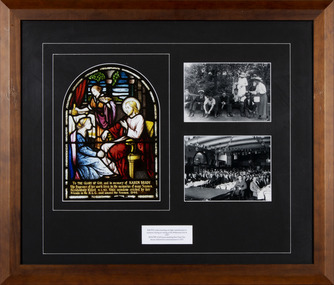
Photograph - Framed montage, Arthouse - Picture Framing & Gallery, Jesus in the House of Martha and Mary, 2013
... For over 150 years the Mission to Seafarers in Victoria has continued to meet the welfare needs of seafarers who arrive on Australian shores from around the world. This exhibition presents a selection of stained glass windows and historical photographs from the Mission, to capture a glimpse of some of the people and scenes integrale to this relationship. reflections of the sea georgia melville exhibition 2013 world trade centre wtc creative victoria prov mission to seafarers stained glass windows justine m. philip flinders street karen brady lhlg picnic social events catherine mclay arthouse on label: ABOVE: Ladies handing out light refreshments to seafarers during an outang at the Melbourne Zoo in 1907 BELOW: A full house awaiting New Years Eve dinner followed by entertainment in 1927 Framed and mounted on black cardboard of black and white and colour reproductions from the MTSV collection for the exhibition Reflections of the Sea with brief label signage Jesus in the House of Martha and Mary Photograph Framed montage Arthouse - Picture Framing & Gallery Justine M.Philip Daniel Climent ...FRIENDS OF THE MISSION The Mission has always relied heavily on the patronage of its volunteers and sponsors who are kind enough to donate much-needed funds, time and expertise. In its first year, the Mission had only 99 pounds to its name, 90 pounds of which was taken up by the chaplain’s salary! Today the Mission is overseen by a Board of Directors and is run by a dedicated team of employees and volunteers. Even though developments such as containerisation in the shipping industry have meant that the number of seafarers on each vessel and their time spent in port has been drastically reduced, the needs of seafarers are just as pressing today as they were when the Mission first began. This window, titled ‘Jesus in the House of Martha and Mary’, was installed in 1947 in memory of Karen Brady, a volunteer and friend of the Mission, dedicated to providing for the needs of seafarers. This window is symbolic of the continuation of such needs in modern times.ontextual or historic information Reflections of the Sea was an exhibition of 10 framed montage of photographs from the mission's archive collection showcasing 10 stained glass windows from the St Peter chapel. This exhibition curated by Georgia Melville and Catherine McLay, and funded by PROV and Creative Victoria, was displayed in the World Trade Centre Wharf Gallery in June July 2013 and toured to Queenscliff Maritime Museum. The photographs of the windows were taken by scientific photographer Justine M. Philip. This frame is showcasing the memorial window to member of the Guild, Karen Brady, who died during a black out hit by a car while she was on her way back home from the Mission, and two photographs of social activities organised for seafarers.Framed and mounted on black cardboard of black and white and colour reproductions from the MTSV collection for the exhibition Reflections of the Sea with brief label signageon label: ABOVE: Ladies handing out light refreshments to seafarers during an outang at the Melbourne Zoo in 1907 BELOW: A full house awaiting New Years Eve dinner followed by entertainment in 1927reflections of the sea, georgia melville, exhibition, 2013, world trade centre, wtc, creative victoria, prov, mission to seafarers, stained glass windows, justine m. philip, flinders street, karen brady, lhlg, picnic, social events, catherine mclay, arthouse -
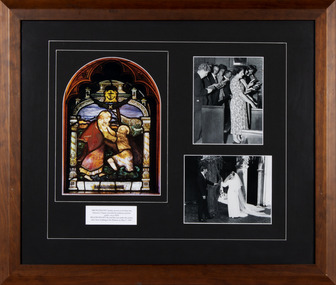 Mission to Seafarers Victoria
Photograph - Framed montage, Arthouse - Picture Framing & Gallery, Thou of Little Faith, 2013
... For over 150 years the Mission to Seafarers in Victoria has continued to meet the welfare needs of seafarers who arrive on Australian shores from around the world. This exhibition presents a selection of stained glass windows and historical photographs from the Mission, to capture a glimpse of some of the people and scenes integrale to this relationship. reflections of the sea georgia melville exhibition 2013 world trade centre wtc creative victoria prov mission to seafarers stained glass windows justine m. philip flinders street james leslie forge weddings service chapel of saint peter catherine mclay arthouse on label: ABOVE RIGHT: Sunday services in St Peter the Mariner's chapel, attended by seafarers and the public, circa 1950s BELOW RIGHT: Mr and Mrs Lee under the arches after their wedding at the Mission on May 1st, 1967 Framed and mounted on black cardboard of black and white and colour reproductions from the MTSV collection for the exhibition Reflections of the Sea with brief label signage Thou of Little Faith Photograph Framed montage Arthouse - Picture Framing & Gallery Justine M.Philip Daniel Climent ...A KEY MELBOURNE LANDMARK Although primarily dedicated to providing for the welfare of visitors from abroad, the Mission has always been a community-based organisation, and its doors are always open to the general public. Today, the Flinders Street complex lends its ample space to a variety of community pursuits – including yoga classes, religious sermons and gallery exhibitions. The Mission also continues as a popular venue for weddings and other social events, mainly due to the endearing historical connections and unique architecture and ambience. It is a distinctive and significant feature of Melbourne’s riverside streetscape. This window, titled ‘Thou of Little Faith’ is part of a pair that were installed at around the time the Mission was built in 1917. It is dedicated to a prominent family member of the ‘Forges of Footscray’ store fame, who were great supporters of the Mission’s work.Reflections of the Sea was an exhibition of 10 framed montage of photographs from the mission's archive collection showcasing 10 stained glass windows from the St Peter chapel. This exhibition curated by Georgia Melville and Catherine McLay, and funded by PROV and Creative Victoria, was displayed in the World Trade Centre Wharf Gallery in June July 2013 and toured to Queenscliff Maritime Museum. The photographs of the windows were taken by scientific photographer Justine M. Philip. This frame is showcasing the window in memry of James Leslie Forge, a photograph during a service in the chapel and a wedding photograph.Framed and mounted on black cardboard of black and white and colour reproductions from the MTSV collection for the exhibition Reflections of the Sea with brief label signageon label: ABOVE RIGHT: Sunday services in St Peter the Mariner's chapel, attended by seafarers and the public, circa 1950s BELOW RIGHT: Mr and Mrs Lee under the arches after their wedding at the Mission on May 1st, 1967reflections of the sea, georgia melville, exhibition, 2013, world trade centre, wtc, creative victoria, prov, mission to seafarers, stained glass windows, justine m. philip, flinders street, james leslie forge, weddings, service, chapel of saint peter, catherine mclay, arthouse -
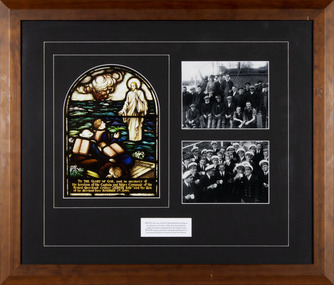 Mission to Seafarers Victoria
Photograph - Framed montage, Arthouse - Picture Framing & Gallery, Jervis Bay, 2013
... This frame is showcasing the memorial window to the Jervis Bay crew, a group photograph of the seamen from the SS Siltonhall and a group photograph of seamen For over 150 years the Mission to Seafarers in Victoria has continued to meet the welfare needs of seafarers who arrive on Australian shores from around the world. This exhibition presents a selection of stained glass windows and historical photographs from the Mission, to capture a glimpse of some of the people and scenes integrale to this relationship. reflections of the sea georgia melville exhibition 2013 world trade centre wtc hms jervis bay ss siltonhall siltonhall ww2 creative victoria prov mission to seafarers stained glass windows justine m. philip flinders street catherine mclay arthouse on label: ABOVE: VThe crew of the SS Siltonhall found refuge at the Mission in October, 1929, after their ship had caught fire and was abandoned in the Indian Ocean BELOW: A group of seafarers enjoying refreshments at the docks provided by volunteers from the Mission Framed and mounted on black cardboard of black and white and colour reproductions from the MTSV collection for the exhibition Reflections of the Sea with brief label signage Jervis Bay Photograph Framed montage Arthouse - Picture Framing & Gallery Justine M.Philip Daniel Climent ...THE SEAS IN WARTIME During WWII, as many as 27,000 men of the merchant and the King’s navy perished during active service. Dedicated to seafarers’ wellbeing, the Mission’s spiritual roots also make it a place for reflection on the loss of human life at sea. The Mission to Seafarers’ ministry offers its support in hundreds of seaports around the world, and has played an important role in supporting those who have lost friends and family at sea during wartime. Many of the stained glass windows in the chapel are dedicated to these people, and represent many close maritime community relationships. This window was installed in 1947 in recognition of the heroism and courage of those who have served in the Merchant Navy, and in particular to those who lost their lives aboard the armed merchant cruiser, ‘Jervis Bay’. This vessel was attacked by an enemy packet battleship whilst leading an escort from Nova Scotia to the UK in 1940.Reflections of the Sea was an exhibition of 10 framed montage of photographs from the mission's archive collection showcasing 10 stained glass windows from the St Peter chapel. This exhibition curated by Georgia Melville and Catherine McLay, and funded by PROV and Creative Victoria, was displayed in the World Trade Centre Wharf Gallery in June July 2013 and toured to Queenscliff Maritime Museum. The photographs of the windows were taken by scientific photographer Justine M. Philip. This frame is showcasing the memorial window to the Jervis Bay crew, a group photograph of the seamen from the SS Siltonhall and a group photograph of seamenFramed and mounted on black cardboard of black and white and colour reproductions from the MTSV collection for the exhibition Reflections of the Sea with brief label signageon label: ABOVE: VThe crew of the SS Siltonhall found refuge at the Mission in October, 1929, after their ship had caught fire and was abandoned in the Indian Ocean BELOW: A group of seafarers enjoying refreshments at the docks provided by volunteers from the Missionreflections of the sea, georgia melville, exhibition, 2013, world trade centre, wtc, hms jervis bay, ss siltonhall, siltonhall, ww2, creative victoria, prov, mission to seafarers, stained glass windows, justine m. philip, flinders street, catherine mclay, arthouse -
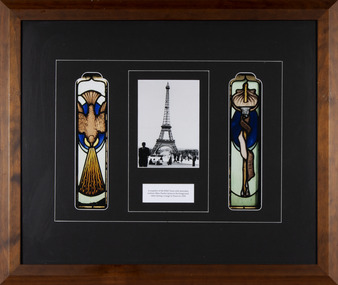 Mission to Seafarers Victoria
Photograph - Framed montage, Arthouse - Picture Framing & Gallery, Baptism and Holy Spirit, 2013
... For over 150 years the Mission to Seafarers in Victoria has continued to meet the welfare needs of seafarers who arrive on Australian shores from around the world. This exhibition presents a selection of stained glass windows and historical photographs from the Mission, to capture a glimpse of some of the people and scenes integrale to this relationship. reflections of the sea georgia melville exhibition 2013 world trade centre wtc creative victoria prov mission to seafarers stained glass windows justine m. philip flinders street allan charles quinn eiffel tower france travel migration baptistry paris catherine mclay arthouse on label: A snapshot of the Eiffel Tower with Australian seafarer Allan Charles Quinn in the foreground, taken during a voyage to France in 1956 Framed and mounted on black cardboard of black and white and colour reproductions from the MTSV collection for the exhibition Reflections of the Sea with brief label signage Baptism and Holy Spirit Photograph Framed montage Arthouse - Picture Framing & Gallery Justine M.Philip Daniel Climent ...MIGRATION Travel is a luxury for most people, and although seafarers undoubtedly face hardships as part of their profession, they are also able to experience parts of the broader world than that of friends and family at home. The stories and experiences of seafarers - together with the work of the Mission to Seafarers ministry - contribute to the archive of ongoing global links and narratives of world trade and migration. As an example of this, in 1917 alone the Mission directed almost 6,000 letters written by visiting seafarers home to their families abroad, and received almost 3,000 letters in return. After experiencing Melbourne through the Mission, many seafarers later chose to make the city and Australia their home, and some chose to marry their partners at the Mission’s chapel. This pair of windows, titled ‘Baptism’ and ‘Holy Spirit’, was installed during 1933 and represents the integral links between seafaring and the world.Reflections of the Sea was an exhibition of 10 framed montage of photographs from the mission's archive collection showcasing 10 stained glass windows from the St Peter chapel. This exhibition curated by Georgia Melville and Catherine McLay, and funded by PROV and Creative Victoria, was displayed in the World Trade Centre Wharf Gallery in June July 2013 and toured to Queenscliff Maritime Museum. The photographs of the windows were taken by scientific photographer Justine M. Philip. This frame is showcasing the lancet windows in the baptistry ad a photograph of the Eiffel Tower taken by Allan Charles Quinn during one of his voyages.Framed and mounted on black cardboard of black and white and colour reproductions from the MTSV collection for the exhibition Reflections of the Sea with brief label signageon label: A snapshot of the Eiffel Tower with Australian seafarer Allan Charles Quinn in the foreground, taken during a voyage to France in 1956reflections of the sea, georgia melville, exhibition, 2013, world trade centre, wtc, creative victoria, prov, mission to seafarers, stained glass windows, justine m. philip, flinders street, allan charles quinn, eiffel tower, france, travel, migration, baptistry, paris, catherine mclay, arthouse -
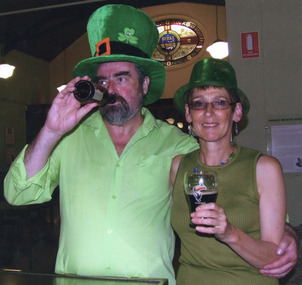 The Beechworth Burke Museum
Photograph, c.2000s
... Australia to celebrate an idea of Irish culture. These celebrations often include wearing green clothes, especially a shamrock hat, and drinking beer, all pictured here. This celebration appears to be taking place within the Burke Museum itself, with museum's iconic stained glass oval window in the background. ...Australia to celebrate an idea of Irish culture. These celebrations often include wearing green clothes, especially a shamrock hat, and drinking beer, all pictured here. This celebration appears to be taking place within the Burke Museum itself, with museum's iconic stained glass oval window in the background. ...This is a photograph of two people (James Toole and Beryl Witkowski) amid celebrations for St Patrick's Day at the Burke Museum in an unknown year. St Patrick's Day is traditionally an Irish religious holiday, but has been adopted in countries such as Australia to celebrate an idea of Irish culture. These celebrations often include wearing green clothes, especially a shamrock hat, and drinking beer, all pictured here. This celebration appears to be taking place within the Burke Museum itself, with museum's iconic stained glass oval window in the background. The Museum, situated in Beechworth, holds a collection of over 30,000 individual objects - including this photograph. James Toole (left) was the 'face of the Beechworth Post Office' until his retirement in 2015, following a 45-year career in mail service. He is a Friend of the Burke Museum, volunteering on projects such as crafting the Burke Museum's float in the 2018 Beechworth Bakery and Beechworth Honey Grand Parade at the Golden Horseshoes Festival. He is known for his flamboyant character. Beryl Witkowski (right) was a historian and curator for the Burke Museum, retiring from her position in 2016. She was involved as a Friend of the Burke Museum from at least 2004.This photograph is significant to the Burke Museum and Beechworth as it depicts two prominent, contemporary members of the museum's paid and volunteer staff in the museum itself. It highlights both how the staff interacted with the museum through celebrations and how the museum itself was used in capacities other than object display. The photograph can also be used to interpret Australia's relationship to the St Patrick's Day holiday, especially given the presence of Irish immigrants to the Beechworth area in the nineteenth century.A colour, square photograph printed on rectangular photographic paper.First Card: WITKOWSKI, Beryl / TOOLE, James / BMM 3067 / Databased Second Card: Burke Museum / 3067 /burke museum, beechworth, museum staff, celebrations, st patrick's day, beer, australia, st patrick's day celebration -
 Federation University Historical Collection
Photograph, Clare Gervasoni, Stained Glass window at the Ballarat School of Mines, 04/2020
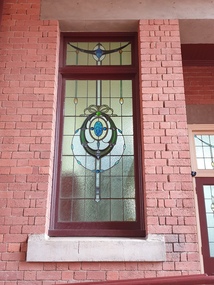
... stained glass was put into position. ballarat school of mines ballarat technical art school stained glass miners lamp entrance Colour digital photograph showing the stained glass at the Ballarat Technical Art School. The mining lamp detail is on the entrance door to the Ballarat School of Mines Technical Art School building. The design features three tools associated with mining, the miners lamp and two hammers. Their is also stained glass on the entrance doors and a window by the entrance. Stained Glass window at the Ballarat School of Mines Photograph Australia ...The Ballarat Technical Art School building was opened in 1915. It is not known when the stained glass was put into position.Colour digital photograph showing the stained glass at the Ballarat Technical Art School. The mining lamp detail is on the entrance door to the Ballarat School of Mines Technical Art School building. The design features three tools associated with mining, the miners lamp and two hammers. Their is also stained glass on the entrance doors and a window by the entrance.ballarat school of mines, ballarat technical art school, stained glass, miners lamp, entrance -
 Federation University Historical Collection
Photograph, Ballarat Observatory, c1915
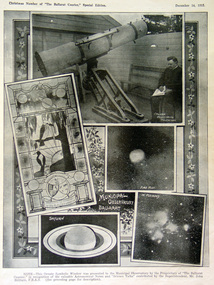
... Australia, the Baker Telescope, opened 1888. In 1913 the Council of the Ballarat School of Mines handed over the Observatory to the Ballarat East Town Council. Ballarat Observatory telescope stained glass ...In 1884 the Ballarat School of Mines Council reserved a three acre site on a spur of the White horse Ranges known as Mount Pleasant. The Vice-President of the Ballarat School of Mines, James Oddie undertook at his own expense (said to be 4,000 pounds) to erect and equip the observatory. By 1886 seven rooms, a workshop and a cottage had been erected. The first large telescope built in Australia, the Baker Telescope, opened 1888. In 1913 the Council of the Ballarat School of Mines handed over the Observatory to the Ballarat East Town Council. A number of images as depicted in a newspaper. The top image shows the Carlver Equitorial Telescope. Middle left is a stained glass window at the observatory (donated by the Ballarat Courier), middle right is 'fire mist'; lower left shows Saturn, and lower right is 'in pleiades'.ballarat observatory, telescope, stained glass window, jelbart telescope, equalateral telescope, meterological apparatus, john brittain -
 Federation University Historical Collection
Book - Book - Scrapbook, Ballarat College of Advanced Education: Scrapbook of newspaper cutting, Book 3; November 1977 to May 1978
... Australian, The Herald. The cuttings cover the period from 15 November 1977 to 12 May 1978. employment advertisements application for enrolment outline of courses $5000 for reseach at bcae art display by bcae third year students government to increase expenditure on bcae $1060000 contract for bcae education building terry lee - rock drilling championship graduate course for librarians business degree course engineer off to antarctic ron brown more want to study in ballarat d taylor keeock retires stained glass windows no jobs for many new teachers anne vine student counsellor gifts for research new bcae computer has all the answers father ray gregory lectures mr james tye - british safety chief tv equipment to cae criticism rejected by barker building over drain vertical windmill top facilities 'the lost generation' coaching panel visits ballarat endurance test for students accident prevention seminar jim reid ron moulds derek viner harold thomas shake-up urged in tertiary education education report - partridge report maureen boon wins prize 'scrap deakin' - 12 college principals percy cerutty's ideas transplanted romp through war years hitz of the blitz orienteering - canadian forest education no answer to unemployment future of bcae assured canoe class course on hearing conservation program billycart designs Book with yellow cover, front. ...Newspaper cuttings relating to Ballarat College of Advanced Education. These are from various newspapers and include The Age, Ballarat Courier, The Australian, The Herald. The cuttings cover the period from 15 November 1977 to 12 May 1978. Book with yellow cover, front. Spiral bound.employment advertisements, application for enrolment, outline of courses, $5000 for reseach at bcae, art display by bcae third year students, government to increase expenditure on bcae, $1060000 contract for bcae education building, terry lee - rock drilling championship, graduate course for librarians, business degree course, engineer off to antarctic, ron brown, more want to study in ballarat, d taylor keeock retires, stained glass windows, no jobs for many new teachers, anne vine student counsellor, gifts for research, new bcae computer has all the answers, father ray gregory lectures, mr james tye - british safety chief, tv equipment to cae, criticism rejected by barker, building over drain, vertical windmill, top facilities, 'the lost generation', coaching panel visits ballarat, endurance test for students, accident prevention seminar, jim reid, ron moulds, derek viner, harold thomas, shake-up urged in tertiary education, education report - partridge report, maureen boon wins prize, 'scrap deakin' - 12 college principals, percy cerutty's ideas transplanted, romp through war years, hitz of the blitz, orienteering - canadian forest, education no answer to unemployment, future of bcae assured, canoe class, course on hearing conservation program, billycart designs -
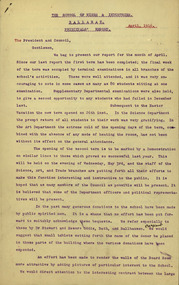 Federation University Historical Collection
Document - Report, Ballarat School of Mines Principal's Monthly Report, 1916, 04/1916
... charles fenner herbert h. smith h.h. smith ballarat school of mines museum w.h. middleton dr stewart james oddie thomas bath ballhausen donations australian miners' corps tunnellers australian mining corps andrew robertson president's medal a. boanas conscription soldiers robert dixon ballarat junior technical school donald clark leslie coulter returned soldiers albert gesell factory day E.J. McConnon trade teachers Ponsonby Carew Smyth Agricultural High School Stained Glass ...4 typed foolscap pages containing the Ballarat School of Mines Principal's Report for 1916charles fenner, herbert h. smith, h.h. smith, ballarat school of mines museum, w.h. middleton, dr stewart, james oddie, thomas bath, ballhausen, donations, australian miners' corps, tunnellers, australian mining corps, andrew robertson, president's medal, a. boanas, conscription, soldiers, robert dixon, ballarat junior technical school, donald clark, leslie coulter, returned soldiers, albert gesell, factory day, e.j. mcconnon, trade teachers, ponsonby carew smyth, agricultural high school stained glass windows, peacock hall stained glass windows, victorian wildflower exhibibition, patriotic funds, red cross funds, telephone mechanics, plumbing, telegraphy, needlework, blacksmithing, d. ronaldson, annual fancy dress procession, dr james stewart, ballhauson, robert m. serjeant, trade department report, electric wiring, w.h. collyer, harold herbert, l.j. middleton, ballarat home coming, forward ballarat committee, eureka pageant, c.a. hoadley, c.a. hoadley resignation -
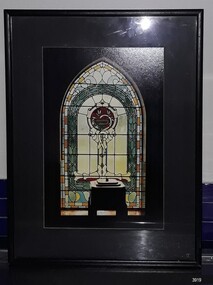 Flagstaff Hill Maritime Museum and Village
Card - Commemorative, Julian Aird, 'Illumination', Early 21st Century
... stained glass window behind a baptismal font. Rectangular framed photograph, portrait view, behind glass, with black frame and matt. A cord for hanging it is attached at the black, and there is a black, round felt pad on each lower rear corner. The photograph by Julian Aird is titled 'Illumination' and was framed in Geelong. Details of title, and photographer are handwritten on the back and and printed label gives the contact details of the framer. 'Illumination' Card Commemorative Australia ...The photograph was created by Geelong artist Julian Aird and framed by a business in Geelong. The window in the photograph is of the 1928 stained glass window and the baptism fold in the St Nicholas' Seamen's Chapel at Flagstaff Hill Maritime Village, which were installed at Flagstaff Hill's for the Chapel's opening in 1981. About the Window - The window in this photograph, once known as the Dr Connell Memorial Window, was a feature of an external wall adjacent to the Women’s and Children’s Wards of Warrnambool Hospital. Honorary Doctors had played a significant role in the operation of the hospital between the years 1900 to 1939. One of these doctors was Dr. Connell, who passed away in 1928. The green glass memorial nameplate has an inscription that dedicates the window to Dr. Connell. The inscription reads: "A tribute to Egbert John Connell M.B.B.S. who for 30 years rendered devoted and valuable service to this institution. Obiit April 4th 1928, A.D." The photograph's significance lies in the subject of the stained glass window, and its connection with the history of the local Warrnambool Base Hospital, dating to Dr Connell's work there in the early 20th century.This photograph captures the light shining through an arched, stained glass window behind a baptismal font. Rectangular framed photograph, portrait view, behind glass, with black frame and matt. A cord for hanging it is attached at the black, and there is a black, round felt pad on each lower rear corner. The photograph by Julian Aird is titled 'Illumination' and was framed in Geelong. Details of title, and photographer are handwritten on the back and and printed label gives the contact details of the framer. Written by hand in black pen " 'ILLUMINATION' / MARITIME MUSEUM WARRNAMBOOL", "JULIAN AIRD / TEL/FAX. 03 52890457" " Printed on adhesive label "EASTERN VIEW / PICTURE FRAMERS" "Proprietors Steven & Annemarie Hocking / 162 Malop Street, Geelong, Vic, 3220 / Ph. (03) 5229 5935" Logo on label in centre of oval with text [2 tall water birds facing each other with a water fountain between them]flagstaff hill maritime museum & village, maritime museum, maritime village, great ocean road, shipwreck coast, ulian aird, illumination, photograph, dr. connell, stained glass window, baptism font, gbert john connell, st nicholas seamen's church, warrnambool hospital, dr connell memorial window, eastern view picture framers, steven & annemarie hocking -
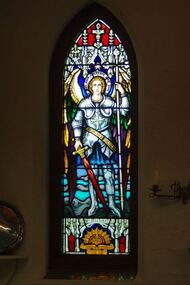 Greensborough Historical Society
Photograph - Digital image, Marilyn Smith, St Katherine's Church St Helena: Window 1, 29/05/2015
... This photograph shows one of the stained glass windows, depicting St Michael and dedicated to the Australian Commonwealth Military Forces....This photograph shows one of the stained glass windows, depicting St Michael and dedicated to the Australian Commonwealth Military Forces. st katherines church st helena anthony beale Digital copy of colour photograph St Katherine's Church St Helena: Window 1. ...St Katherine's Church St Helena dates from 1858. The Church was built by Major Anthony Beale in memory of his wife Katherine Rose Beale. This photograph shows one of the stained glass windows, depicting St Michael and dedicated to the Australian Commonwealth Military Forces.Digital copy of colour photographst katherines church st helena, anthony beale -
Glenelg Shire Council Cultural Collection
Photograph - Photograph - H.M.A.S. Australia, 1913-1920, n.d
... AUSTRALIA, mounted and framed in stained timber frame under glass....AUSTRALIA, mounted and framed in stained timber frame under glass. Photograph Photograph - H.M.A.S. ...UnknownImperial War Museum photograph of H.M.A.S. AUSTRALIA, mounted and framed in stained timber frame under glass.Front: Brass plaque on frame - HMAS AUSTRALIA. Australian Flagship of the Royal Australian Navy 1913-1920. Sunk under terms of the Washing. Treaty 12 April 1924. This frame is of teck from her deck. Back: (no inscriptions) -
 Mission to Seafarers Victoria
Programme (item) - Program, National Trust, Australian Heritage Festival - Victorian Program 2019, 2019
... Australian Heritage Festival is a yearly event organised by the National Trust. Organisations can register their events held during a month, with dates varying in each state. The Mission to Seafarers holds tours and other events every year during this Festival for the community to discover its history. In 2019, The Mission hosted "Practice Makes Perfect", a showcase of rare trades: stained glass ...The Australian Heritage Festival is a yearly event organised by the National Trust. Organisations can register their events held during a month, with dates varying in each state.The Mission to Seafarers holds tours and other events every year during this Festival for the community to discover its history. In 2019, The Mission hosted "Practice Makes Perfect", a showcase of rare trades: stained glass windows, lace making, marine knots, wood carving etc.australian heritage festival, 2019, events, victorian program, national trust, friend of the festival, practice makes perfect, lost trades, artisans, rare trades, gordon byrne, artisan's guild of australia, bruce hutton, bruce walker, henry hakopian, keiran dunleavy, david stephenson, duncan mcharg, james charlwood, barry smith -
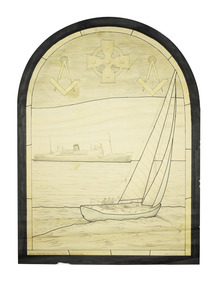 Mission to Seafarers Victoria
Drawing - Artist sketch, Gerry Cummins & Jill Stehn Pty. Ltd, 1980
... Australia. In WW2 she was an armed merchant cruiser and served in Indian waters and escorted the 1st convoy out of the Singapore after the Japanese invasion. She later operated in the Pacific after the war and after repatriation duties she was decommissioned and subsequently sold to be renamed 'Oriental Queen' which eventually caught fire and sank. . The small yacht in the foreground refers to the Sandringham YC. Window measurements: 600mm x 900mm Shows the link with Freemasonry. freemasons st peter chapel flinders street mission to seafarers gerry cummins jill stehn stained glass ...The window in this photograph was commissioned by the Sandringham Yacht Club in conjunction with a Masonic Lodge and work carried out by Gerry Cummins in 1980. In the background is the S.S. 'Kanimbla' built 1935, Belfast for McIlwraith McEacham and was the last large passenger ship built specifically for Australian owners. Designed to carry 400 passengers , she plied her trade around the Southern and Eastern Ports of Australia. In WW2 she was an armed merchant cruiser and served in Indian waters and escorted the 1st convoy out of the Singapore after the Japanese invasion. She later operated in the Pacific after the war and after repatriation duties she was decommissioned and subsequently sold to be renamed 'Oriental Queen' which eventually caught fire and sank. . The small yacht in the foreground refers to the Sandringham YC. Window measurements: 600mm x 900mmShows the link with Freemasonry.Sketch in pencil and ink on cream paper for an arched stained glass window depicting a yacht.Bottom left corner: Proposed Stained Glass Window, Mission to Seamen. (Scale: Full Size) Right Left corner: Gerry Cummingsfreemasons, st peter chapel, flinders street, mission to seafarers, gerry cummins, jill stehn, stained glass window, sandringham yacht club, hearts of oak lodge, yacht, symbols, square, compass, ss kanimbla -
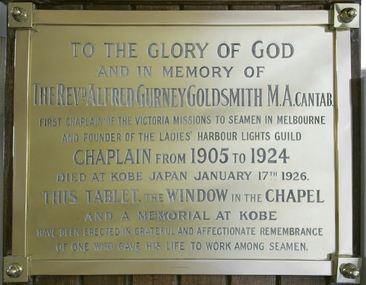 Mission to Seafarers Victoria
Plaque - Memorial plaque, P.J. King, Rev. Alfred Gurney Goldsmith, 1927
... He died a few months after leaving Australia in Kobe where he had accepted a new position in this Mission in Japan. This plaque along with the stained glass window in the St Peter chapel (the first one to be installer) demonstrate the affection for the Reverend and the appreciation for all the work he did. chaplains mission to seafarers Seamen's mission kobe japan lhlg 1926 reverend alfred gurney goldsmith Large rectangular bronze plaque in memory of Reverend Alfred Gurney Goldsmith Rev. ...Reverend Alfred Gurney Goldsmith arrived from England in 1905 and left the Mission in 1925. He died a few months after leaving Australia in Kobe where he had accepted a new position in this Mission in Japan.This plaque along with the stained glass window in the St Peter chapel (the first one to be installer) demonstrate the affection for the Reverend and the appreciation for all the work he did.Large rectangular bronze plaque in memory of Reverend Alfred Gurney Goldsmithchaplains, mission to seafarers, seamen's mission, kobe, japan, lhlg, 1926, reverend alfred gurney goldsmith
