Showing 36 items matching "ball 1957"
-
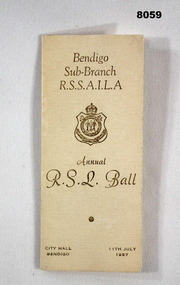
Bendigo Military MuseumCard - RSL ANNUAL BALL 1957, Hocking & Sloan Print Bendigo, C. 1957
... RSL ANNUAL BALL 1957.......Ball 1957...Card folding, front when folded is in gold writing with "Bendigo Sub Branch R.S.S.A.I.L.A at the top followed by the RSL logo then "ANNUAL RSL BALL", at the bottom "City Hall Bendigo - sixth July 1957". Inside has 3 columns, first two are the "Dance Program 1 - 28", 3rd space for Autographs (unsigned). ...Card RSL ANNUAL BALL 1957. Hocking & Sloan Print Bendigo Bendigo RSL Sub Branch ...Card folding, front when folded is in gold writing with "Bendigo Sub Branch R.S.S.A.I.L.A at the top followed by the RSL logo then "ANNUAL RSL BALL", at the bottom "City Hall Bendigo - sixth July 1957". Inside has 3 columns, first two are the "Dance Program 1 - 28", 3rd space for Autographs (unsigned). Rear has 2 columns, one for "Debutante's names" and one for "Partners names". Both have the Chaperones and Committee/Organizers names.brsl, smirsl, annual, ball 1957 -
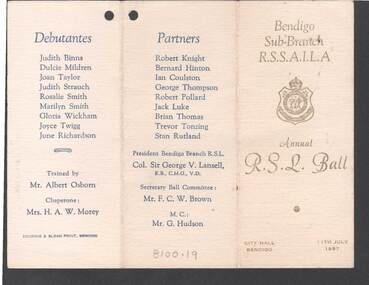
Bendigo Historical Society Inc.Document - R.S.L. BENDIGO COLLECTION: ANNUAL R.S.L. BALL 1957
... BENDIGO COLLECTION: ANNUAL R.S.L. BALL 1957...Bendigo Collection - Annual R.S.L. Ball 1957...Ball held at the City Hall, Bendigo on 11th July 1957. Card is cream with gold print on the front and a gold RLS badge. ...BENDIGO COLLECTION: ANNUAL R.S.L. BALL 1957 ...Three copies of the Bendigo Sub-branch R.S.S.A.I.L.A. Annual R.S.L. Ball held at the City Hall, Bendigo on 11th July 1957. Card is cream with gold print on the front and a gold RLS badge. Other printing is blue. The inside of the tri-fold card has a Dance Program of 28 dances and a space for Autographs. The other side has the Debutantes: Judith Binns, Dulcie Mildren, Joan Taylor, Judith Strauch, Rosalie Smith, Marilyn Smith, Gloria Wickham, Joyce Twigg and June Richardson. Trained by Mr Albert Osborn. Chaperone: Mrs H A W Morey. Partners: Robert Knight, Bernard Hinton, Ian Coulston, George Thompson, Robert Pollard, Jack Luke, Brian Thomas, Trevor Tonzing and Stan Rutland. President Bendigo Branch R.S.L. Col Sir George V Lansell, K.B., C.M.G., V.D. Secretary Ball Committee: Mr F C W Brown. M.C.: Mr G Hudson. Printed by Hocking & Sloan Print, Bendigo.Hocking & Sloan Print, Bendigoevent, social, annual ball, r.s.l. bendigo collection - annual r.s.l. ball 1957, judith binns, dulcie mildren, joan taylor, judith strauch, rosalie smith, marilyn smith, gloria wickham, joyce twigg, june richardson, mr albert osborn, mrs h a w morey, robert knight, bernard hinton, ian soulston, george thompson, robert pollard, jack luke, brian thomas, trevor tonzing, stan rutland, col sir george v lansell, mr f c w brown, mr g hudson, hocking & sloan print -
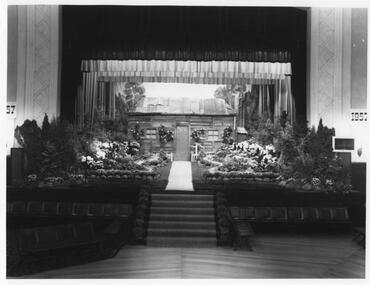
Box Hill Historical SocietyPhotograph - Mayoral Ball 1957, 1957
... Mayoral Ball 1957...Mayoral balls Exhibits Box Hill Town Hall Black and white photo Photograph Mayoral Ball 1957 ...View of stage Box Hill Town Hall. Setup in a garden setting for a debutante ball.Black and white photomayoral balls, exhibits, box hill town hall -
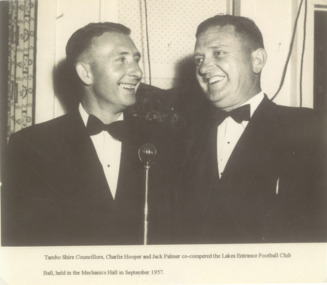
Lakes Entrance Historical SocietyPhotograph - Lakes Entrance Football Club Ball 1957
... Lakes Entrance Football Club Ball 1957...Football Clubs Events Balls Black and white photograph of Tambo Shire Councellors Charlie Hooper and Jack Palmer who co-compared the Football Club Ball held at the Mechanics Hall Lakes Entrance Victoria Photograph Lakes Entrance Football Club Ball 1957 ...Black and white photograph of Tambo Shire Councellors Charlie Hooper and Jack Palmer who co-compared the Football Club Ball held at the Mechanics Hall Lakes Entrance Victoriafootball, clubs, events, balls -
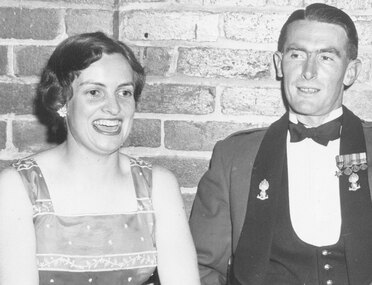
Ringwood and District Historical SocietyPhotograph, Ringwood Military Ball, 1957
... Ringwood Military Ball, 1957, ...Written on back of photograph: "Mail 12/12/1957. Army Ball, Dr. Joan Bradley (Balwyn) and Major Robertson (Hawthorn), O.C. 10th Field Squadron."...Black and white photograph Ringwood Military Ball, 1957, Photograph ...Black and white photographWritten on back of photograph: "Mail 12/12/1957. Army Ball, Dr. Joan Bradley (Balwyn) and Major Robertson (Hawthorn), O.C. 10th Field Squadron." -
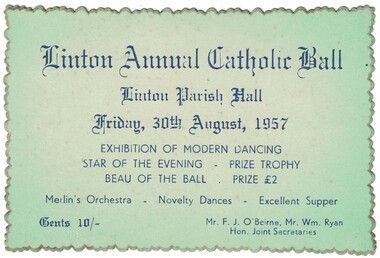
Linton and District Historical Society IncTicket, Linton Annual Catholic Ball, 1957
... Linton Annual Catholic Ball, 1957...Ticket is for a ball held at Linton Parish Hall, Friday, 30th August, 1957....Text: " Linton Annual Catholic Ball / Linton Parish Hall / Friday, 30th August, 1957 / EXHIBITION OF MODERN DANCING / STAR OF THE EVENING / Merlin's Orchestra Novelty Dances...Ticket is for a ball held at Linton Parish Hall, Friday, 30th August, 1957. Linton Annual Catholic Ball, 1957 Ticket ...Pale green coloured cardboard ticket with blue printed text. Ticket is for a ball held at Linton Parish Hall, Friday, 30th August, 1957.Text: " Linton Annual Catholic Ball / Linton Parish Hall / Friday, 30th August, 1957 / EXHIBITION OF MODERN DANCING / STAR OF THE EVENING / Merlin's Orchestra Novelty Dances. "linton annual catholic ball, linton parish hall -
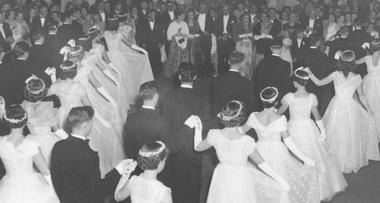
Ringwood and District Historical SocietyPhotograph, Deb group, Ringwood Youth ball, 23rd October 1957
... Deb group, Ringwood Youth ball, 23rd October 1957....Written on back of large photograph, CE171C: "Deb group, Ringwood Youth ball, 23rd October 1957. Photo by Peter Payens Ringwood Studio."...Black and white photograph (3 images- 1 large, 2 smaller) Deb group, Ringwood Youth ball, 23rd October 1957. Photograph ...Black and white photograph (3 images- 1 large, 2 smaller)Written on back of large photograph, CE171C: "Deb group, Ringwood Youth ball, 23rd October 1957. Photo by Peter Payens Ringwood Studio." -
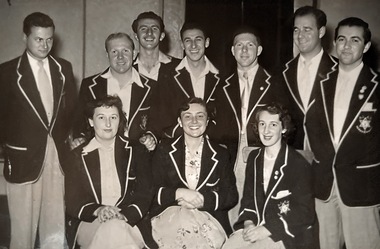
Mission to Seafarers VictoriaPhotograph, Mr David Conolly and Ms Marjorie Stafford Debutante Ball at St Kilda Town Hall, 1957
... Taken at a Debutante Ball 1957 St Kilda Town Hall. David Canolly was a lay reader and Marjorie Stafford, the daughter of George Stafford, a policeman who was involved in the Mission helping during the 1950s. ...Hand written in black texta; l Circa 1957 Marjorie Stafford daughter of George Stafford, & D C at Debutante Ball for Robert Burns Lodge at Stkilda TRown Hall ...Mission to Seafarers Victoria 717 Flinders Street Docklands melbourne Taken at a Debutante Ball 1957 St Kilda Town Hall. David Canolly was a lay reader and Marjorie Stafford, the daughter of George Stafford, a policeman who was involved in the Mission helping during the 1950s. ...Taken at a Debutante Ball 1957 St Kilda Town Hall. David Canolly was a lay reader and Marjorie Stafford, the daughter of George Stafford, a policeman who was involved in the Mission helping during the 1950s. (Conolly interview in 2016)Subjects LHLG member MS and Lay Reader DC had a long standing connection with the Mission Black and White Gloss print photograph of a couple in evening dress, both are standing.Hand written in black texta; l Circa 1957 Marjorie Stafford daughter of George Stafford, & D C at Debutante Ball for Robert Burns Lodge at Stkilda TRown Hall lay reader, david conolly, marjorie stafford, lhlg, st kilda town hall, george stafford -
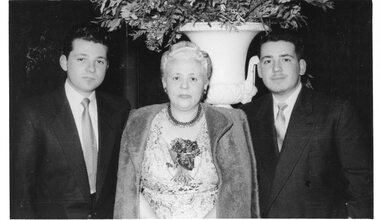
Ithacan Historical SocietyPhotograph, Ithacan Ball, 1957
... Anastasia Coutsouvelis with her two sons, 20 year old Speros and 17 year old George attended the Ithacan Ball in 1957. The function was held at the Exhibition Building in Carlton....Ithacan Historical Society Ithaca House 329 Elizabeth Street Melbourne melbourne Anastasia Coutsouvelis with her two sons, 20 year old Speros and 17 year old George attended the Ithacan Ball in 1957. The function was held at the Exhibition Building in Carlton. ...Anastasia Coutsouvelis with her two sons, 20 year old Speros and 17 year old George attended the Ithacan Ball in 1957. The function was held at the Exhibition Building in Carlton.The annual ball has been a regular and popular social event on the Ithacan Club calendar since the 1950s, where members and their families and friends have an enjoyable night. A black and white photograph with a surrounding white border of a lady and two young men standing in front of a large white urn at a formal function. -
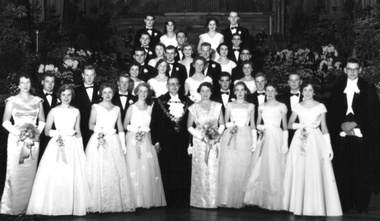
Box Hill Historical SocietyPhotograph - Mayoral Ball, 1957
... Mayoral Ball of 1957, showing the Mayor, Cr. James K. Proudfoot and the Mayoress, Mrs. ...Mayoral Ball of 1957, showing the Mayor, Cr. James K. Proudfoot and the Mayoress, Mrs. ...Mayoral Ball of 1957, showing the Mayor, Cr. James K. Proudfoot and the Mayoress, Mrs. Proudfoot, with the debutantes and their partners, standing in front of a decorated stage. Town Clerk, Mr. Andrew Walls, is standing on the right hand side.B&w photomayoral balls, mayors, town clerks, proudfoot> james k. (cr.), proudfoot> - (mrs.), walls> andrew n., debutantes, box hill town hall, dances and balls, mayoral robes, clothing and dress -
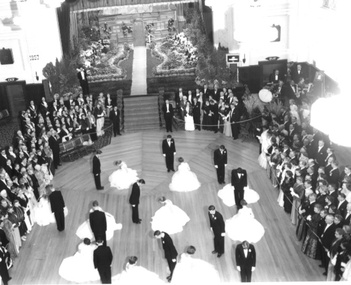
Box Hill Historical SocietyPhotograph - Mayoral Balls, 1957
... The Mayoral Ball of 1957, showing the debutantes bowing to their partners, preparing to dance. ...The Mayoral Ball of 1957, showing the debutantes bowing to their partners, preparing to dance. ...The Mayoral Ball of 1957, showing the debutantes bowing to their partners, preparing to dance. The six-piece band can be seen in the rear RH corner of the hall. The stage is decorated with flowers and rocks. It must have been a celebratory dance of 100 years as the year "1857" is on the LH side of the stage.B&w photomayoral balls, debutantes, festive decorations, centenaries, box hill town hall, unidentified, clothing and dress, dances and balls, proudfoot> james kneale (cr.) -
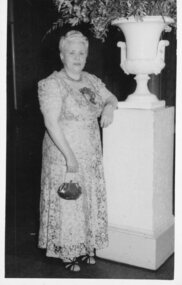
Ithacan Historical SocietyPhotograph, Anastasia Coutsouvelis, 1957
... The photograph of Anastasia Coutsouvelis was taken at the 1957 Ithacan Ball which took place at the Exhibition Buildings in Carlton. ...Ithacan Historical Society Ithaca House 329 Elizabeth Street Melbourne melbourne The photograph of Anastasia Coutsouvelis was taken at the 1957 Ithacan Ball which took place at the Exhibition Buildings in Carlton. ...The photograph of Anastasia Coutsouvelis was taken at the 1957 Ithacan Ball which took place at the Exhibition Buildings in Carlton. A black and white photograph with a surrounding white border of as lady in evening dress standing next to a large urn with flowers. -
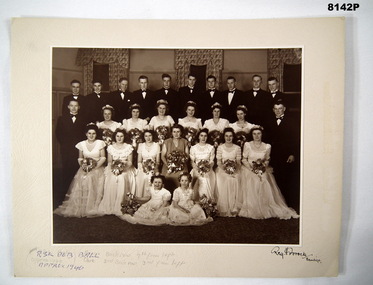
Bendigo Military MuseumPhotograph - BENDIGO RSL DEBUTANTE BALL, Reg Brock, C. August 1947
... . : 1848 - 1957), Thursday 14 August 1947, page 8 ________________________________________ 12 debutantes presented at Bendigo Ball Early Victorian posies which matched the pastel flowers in their hair were carried by the 12 debutantes who came out at the Annual RSL Ball at Bendigo Town Hall last night. .... : 1848 - 1957), Thursday 14 August 1947, page 8 ________________________________________ 12 debutantes presented at Bendigo Ball Early Victorian posies which matched the pastel flowers in their hair were carried by the 12 debutantes who came out at the Annual RSL Ball at Bendigo Town Hall last night. ...The date on the photograph states "approx 1946", actually 1947. The Bendigo RSL conducted Annual and Debutante Balls for many years as a fund raiser. The following article appeared in the Argus; “Argus (Melbourne, Vic. : 1848 - 1957), Thursday 14 August 1947, page 8 ________________________________________ 12 debutantes presented at Bendigo Ball Early Victorian posies which matched the pastel flowers in their hair were carried by the 12 debutantes who came out at the Annual RSL Ball at Bendigo Town Hall last night. The debutantes, who were presented to Lieut-General and Mrs V. A. H. Sturdee, were Eileen Clarke, Daphne Green, Norma Knopp, Doris Purtell, Inez Somerville, Eileen Simpson, Joy Taylor, Olive Tope, Judith Waters, Elvie Walker, Patricia Young, and Dorothy Herbert. The official party included Cr and Mrs D. W. Streader, Mayor and Mayoress of Bendigo; Cr and Mrs. McEwen, Mayor and Mayoress of Castlemaine; Major-General Rankin, MP, and Mrs Rankin; Mr Galvin, Minister for Lands, and Mrs Galvin; and Colonel Lansell MLC, President of Bendigo RSL.” Photograph B & W on light cream backing board. There are 12 young men, 12 Debutante girls, 2 Flower girls and 1 female Chaperone. Text has been written on the front in blue pen and black pencil.In blue pen and black pencil, "RSL Deb Ball approx 1946", In black pencil, "Bruce back row 7th from left, Olive 2nd back row from left", in black pen, "Reg Brock Bendigo"brsl, smirsl, debutante -
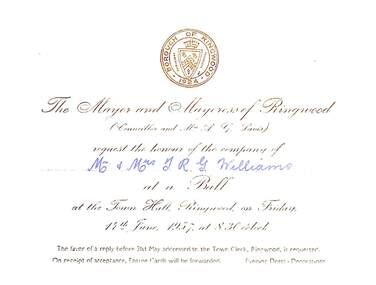
Ringwood and District Historical SocietyCard, Invitation from the Mayor and Mayoress of Ringwood (Councillor and Mrs A.G. Lavis) issued to Mr and Mrs T.R.G. Williams to attend a Ball at the Town Hall in Ringwood on Friday 14th June 1957 at 8.30 o'clock
... Williams to attend a Ball at the Town Hall in Ringwood on Friday 14th June 1957 at 8.30 o'clock...Williams to attend a Ball at the Town Hall in Ringwood on Friday 14th June 1957 at 8.30 o'clock Card ...Buff card with gold type. The favour of a reply before 31st May addressed to the Town Clerk, Ringwood, is requested. On receipt of acceptance, Entree Cards will be forwarded. Evening Dress, Decorations -
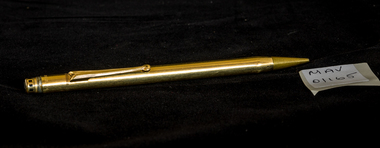
City of Moorabbin Historical Society (Operating the Box Cottage Museum)Office Equipment, propelling pencil Eversharp, c1941
... 1957 when it was acquired by Parker Pen, which continued to use the Eversharp brand for a time. In 1993 Parker was purchased by the Gillette Company, which already owned the 'Paper Mate' brand - the best-selling disposable ballpoint pen. In 2000 Gillette sold its writing instruments division to the company Newell Rubbermaid, USA, and In 2011 the Parker factory at Newhaven, East Sussex, England, was closed, and its production transferred to Nantes, France. An 'Eversharp' propelling pencil manufactured prior to to the development of the ball ...George Reed was a draftsman who lived in Bentleigh , City of Moorabbin in mid 20th C and used this pencil for his work. Eversharp is an American brand of writing implements founded by Charles Rood Keeran in 1913 and marketed by Keeran & Co., based in Chicago. Keeran commercialised Eversharp mechanical pencils (manufactured by two companies, Heath and Wahl) then expanding to fountain pens when the company was acquired by the Wahl Adding Machine Co. in 1916 and it was named "Wahl-Eversharp". In 1941 the company renamed itself, this time as Eversharp. The company continued until 1957 when it was acquired by Parker Pen, which continued to use the Eversharp brand for a time. In 1993 Parker was purchased by the Gillette Company, which already owned the 'Paper Mate' brand - the best-selling disposable ballpoint pen. In 2000 Gillette sold its writing instruments division to the company Newell Rubbermaid, USA, and In 2011 the Parker factory at Newhaven, East Sussex, England, was closed, and its production transferred to Nantes, France.An 'Eversharp' propelling pencil manufactured prior to to the development of the ball point penA gold plated propelling pencil c1941engraved : G. . Reed Made in Eversharpwriting implements, pencils, pens , propelling pencil, fountain pen, biro, ballpoint pen, keeran & company chicago, parker pen pty ltd, gillette pty ltd, eversharp, paper mate, bic pty ltd, -
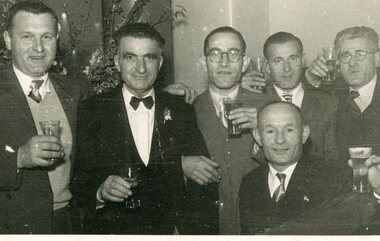
Ithacan Historical SocietyPhotograph, Ithacan social gathering, 1959
... Ball which took place at the Royal Exhibition Building in 1959. Pictured from L- R standing: Peter Paxinos, Othon Kostopoulos, Stathi Vlass who served as President of the Ithacan Philanthropic Society from 1957 to 1959, Nick Kandiliotis, ...?.....Ball which took place at the Royal Exhibition Building in 1959. Pictured from L- R standing: Peter Paxinos, Othon Kostopoulos, Stathi Vlass who served as President of the Ithacan Philanthropic Society from 1957 to 1959, Nick Kandiliotis, ...?.. ...The photograph of the six men, who are drinking a toast, was taken at the 45th Annual Ithacan Ball which took place at the Royal Exhibition Building in 1959. Pictured from L- R standing: Peter Paxinos, Othon Kostopoulos, Stathi Vlass who served as President of the Ithacan Philanthropic Society from 1957 to 1959, Nick Kandiliotis, ...?..; seated ...?...A black and white photograph of six men at a social function. -
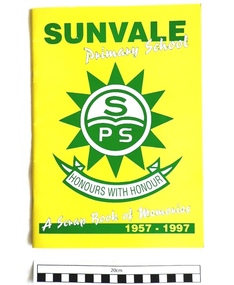
Sunshine and District Historical Society IncorporatedMagazine - Sunshine Primary School. A Scrap Book of Memories 1957 - 1997, Probably about 1997
... 1957 to Mr. A. Dash in 1997, and also the names of Chairs of the School Council, from Mr. F. Sanford to Mr. T. Cuddy. It also features articles on the history of the school, the mothers club, the parents & friends members, special events & features, class & staff photographs, sport, and has a memories section. The special events & features section includes the school ball ...The Sunvale Primary School was situated on Neil Street, near Hertford Road, Sunshine, on the former Moons paddock. The school was officially opened on the 9th of October 1957 with an enrolment of 214 students. Most of the students were transferred from the overcrowded Sunshine, and Sunshine East Primary Schools. The acting head teacher and five temporary teachers came from the East Sunshine Primary School from which about 170 students also came. During the later years the school operated as part of a three campus primary school complex formed between Sunvale Primary School, Sunshine East Primary School, and Braybrook Primary School. After the modern Sunshine Harvester Primary School was built on the East Sunshine Primary School site, the students from the Braybrook and Sunvale schools were transferred there. Sunvale Primary School was closed on 9th September 2009.The magazine is a historical record of the initial 40 years of the school and of activities associated with the school. It contains the names of the Principals, from Mr. Bartels in 1957 to Mr. A. Dash in 1997, and also the names of Chairs of the School Council, from Mr. F. Sanford to Mr. T. Cuddy. It also features articles on the history of the school, the mothers club, the parents & friends members, special events & features, class & staff photographs, sport, and has a memories section. The special events & features section includes the school ball, camps, the Governor's visit in 1995, and Sunvale's famous Olympian staff member Pam Kilborn.SUNVALE Primary School S/PS HONOURS WITH HONOUR A Scrap Book of Memories 1957 - 1997sunvale, primary school, school magazine, scrap book of memories, moons paddock, bartels, dash, sanford, kilborn, cuddy -
City of Melbourne LibrariesPhotograph, Bull, Hugh Jones, 1897-1993, Scotch College v. Xavier College football match
... 1957), p. 9. Retrieved June 15, 2025, from http://nla.gov.au/nla.news-article23174340 FOR YOUNG PEOPLE AMONG THE SCHOOLS. (1934, August 7). The Age (Melbourne, Vic. : 1854 - 1954), p. 4. Retrieved June 14, 2025, from http://nla.gov.au/nla.news-article205521661 https://www.nma.gov.au/defining-moments/resources/australian-rules-football#:~:text=In%20the%20winter%20of%201858,games%20of%20Australian%20Rules%20football. https://apssport.org.au/about/ http://lindsaymagazine.co/from-marngrook-to-australian-rules-football/ https://collection.australiansportsmuseum.org.au/objects/70993/possum-skin-ball...1957), p. 9. Retrieved June 15, 2025, from http://nla.gov.au/nla.news-article23174340 FOR YOUNG PEOPLE AMONG THE SCHOOLS. (1934, August 7). The Age (Melbourne, Vic. : 1854 - 1954), p. 4. Retrieved June 14, 2025, from http://nla.gov.au/nla.news-article205521661 https://www.nma.gov.au/defining-moments/resources/australian-rules-football#:~:text=In%20the%20winter%20of%201858,games%20of%20Australian%20Rules%20football. https://apssport.org.au/about/ http://lindsaymagazine.co/from-marngrook-to-australian-rules-football/ https://collection.australiansportsmuseum.org.au/objects/70993/possum-skin-ball ...Published: 29 June 1934 Published title: PUBLIC SCHOOLS FOOTBALL BEGINS WITH SCOTCH--XAVIER MATCH. Published caption: “The Public Schools 1934 Football season began yesterday when Scotch met Xavier on the Olympic Park ground, and after a wonderful recovery in the third term, Scotch registered a narrow win. Pictured above is the crowd of Scotch boys who congregated behind the goal after the addition of another goal to their score.” Description: Scotch College pupils exuberantly cheer their team’s goal at the first football match of the Public Schools Premiership and Championship for 1934 between Scotch College and Xavier College at Olympic Park, Melbourne (where AAMI Park is now). Research by project volunteer, Fiona Collyer: The Public Schools Premiership and Championship was an Australian Rules football tournament held every winter, over five weeks between six schools- Scotch College, Xavier College, Melbourne Grammar, Wesley College and traditional rivals Geelong Grammar and Geelong College. The school that won the most games out of the five played, won the competition. As the 1933 Premiers, Xavier College had the honour of playing the opening match of the season on 28 June against runners-up Scotch College at Olympic Park (where AAMI Park is now). The Public Schools Premiership matches were widely reported in Melbourne’s daily newspapers with photographs and commentary of every game. Weekly society magazine “Table Talk” featured reports and seven photographs of the first games of the season. Australian Broadcasting Commission (ABC) wireless station 3AR interspersed their afternoon program of reproduced music with detailed descriptions of the matches. Also reporting the matches was “Forty-Years-On”, presumably a student in the 1890s, whose regular column in The Herald newspaper “Activities In The Public Schools” published all the latest news on Victoria’s public (private) schools. In his column for The Australasian 7 July 1934, “Old Boy” writes about the Scotch versus Xavier match- “For more than half the game last week, Scotch was outplayed, but took the lead early in the last term and kept it. Scotch surprised even its own supporters by its dash in the last 25 minutes. Xavier, who became over confident by the prospects of victory, could not withstand the final onslaught. In the last quarter Scotch was the better side and won by seven points.” The final score was Scotch 11.11 (77 points) and Xavier 10.10 (70 points). At the end of this exciting match the overjoyed Scotch boys swarmed over the Olympic Park fences to chair their captain, Stanley Steele and carry him shoulder high, to the pavilion. The first documented game of a variation of Australian Rules football was played at Richmond Paddock (now Yarra Park) from 7 August 1858. Australian Rules football writer Hugh Buggy of The Argus 16 April 1952 explains- “It began when boys and masters of Scotch College and Melbourne Grammar School decided to play a 40-a-side game, with the first team to score two goals to be the winner. Goal posts were pitched more than a mile apart, one set on the Jolimont Hill and the other at Punt road Richmond. Nobody defined the boundary, and the play swung over the broad acres of the park and around the gum trees. It went on and on like a Test match, from noon till dusk. After 15 hours of play on three Saturdays the score was one goal all, and the game was abandoned for that season.” Rules of the game hadn’t been decided at this time - the earliest known rules were codified a year later in 1859. A sculpture and plaque located outside the Melbourne Cricket Ground (MCG), created by sculptor Louis Laumen in 2001, commemorates this game. It depicts two school boys chasing a ball along with umpire Tom Wills, a co-writer of the rules and promoter of Australian Rules football. A medley of Gaelic football, an Aboriginal game called marngrook as well as football played in English public (that is private) schools have been cited as inspiration for Australian Rules football. The word “Marngrook” meaning “game ball”, comes from the language of the Gunditjmara, First Nations people of southwestern Victoria. Marngrook was played at gatherings and celebrations and involved players competing to jump and catch the ball after it is kicked high into the air. The player that catches the ball then gets to kick it. The ball was made from possum skin, filled with pounded charcoal and tied with kangaroo sinews. Protector of Aborigines in Victoria, William Thomas (1794-1867) observed in 1841- “The men and boys joyfully assemble when this game is to be played. One makes a ball of possum skin, somewhat elastic, but firm and strong… The players of this game do not throw the ball as a white man might do, but drop it and at the same time kick it with their feet, using the instep for that purpose. The tallest men have the best chances in this game. Some of them will leap as high as five feet from the ground to catch the ball. The person who secures the ball kicks it. This continues for hours and the natives never seem to tire of the exercise.” The Victorian Football League (VFL), was founded in 1897 with eight teams playing Australian Rules football and held its first Grand Final at the MCG in 1902. From the start the games attracted large enthusiastic crowds, which included women. “Viva” writing in the Supplement to The Weekly Times-3 July 1886- LADIES COLUMN (By Viva) FOOTBALL. A Social Sketch. “…Of the popularity of football and footballers among women, there can be no doubt. Young, soft hearted girls, who would not “tread upon a worm," avow that football matches are "awfully jolly," and seem to regard accidents as a necessary part of the amusement…a great proportion of the spectators were ladies.” “Minetta” writing for Punch Magazine - “Ladies Letter, Holmby House, Toorak” 22 June 1905 “The "Football Girl" is a feminine genus at present much to the fore in Melbourne. Not that she plays football—at least not beyond a kick in the backyard or paddock—oh, dear, no! Her interest in the game is purely from a spectacular point of view. "Football Girls" usually hunt in couples, with two male barrackers attached. They know all about So-and-So's form, and whether he is a trier or has been bought. They go to each match of their particular club, and watch the play intently, their faces wearing a decidedly strained expression when their club is getting the worst of it. They are not ashamed to barrack either, when matters are progressing successfully… Yours ever, MINETTA.” The Herald 2 July 1909 published a cartoon by Ambrose Dyson depicting women football fans, which asked- “THE QUESTION OF THE DAY. Should Girls Go To Football Matches? Should they? The sex made up their mind about the matter very early on.” The resounding answer was- “Well, I’d like to see the man that would stop me!” At the final match of the 1934 tournament on August 2, Melbourne Grammar finished the season unbeaten, winning their tenth Public Schools premiership in 16 years. The Weekly Times 11 August 1934 reported-“Melbourne Grammar…had a rather lucky escape against Xavier…Had a Xavier player not touched a shot, kicked by a team-mate, as it was going through goal Grammar would have been beaten.” Final score - Melbourne Grammar 13.7 (85 points) defeated Xavier College 12.9 (81 points). Ladder for the 1934 Season- Melbourne Grammar-5 wins Wesley College- 4 wins Scotch College- 3 wins Xavier College- 2 wins Geelong Grammar- 1 win Geelong College- 0 wins The Associated Public Schools of Victoria (APS) exists today where eleven member (private) schools, including co-educational schools, participate in 21 sporting competitions throughout the year. (The descriptor “Public School” references the historical usage of the term and the model of the British public school). PUBLIC SCHOOLS FOOTBALL BEGINS WITH SCOTCH--XAVIER MATCH. (1934, June 29). The Age (Melbourne, Vic. : 1854 - 1954), p. 11. Retrieved June 18, 2025, from http://nla.gov.au/nla.news-article204824484 PUBLIC SCHOOLS FOOTBALL AT OLYMPIC PARK (1934, July 5). Table Talk (Melbourne, Vic. : 1885 - 1939), p. 5. Retrieved June 18, 2025, from http://nla.gov.au/nla.news-article149682433 PUBLIC SCHOOLS. (1934, June 29). The Age (Melbourne, Vic. : 1854 - 1954), p. 5. Retrieved June 3, 2025, from http://nla.gov.au/nla.news-article204824486 PUBLIC SCHOOLS FOOTBALL. (1936, July 3). The Argus (Melbourne, Vic. : 1848 - 1957), p. 18. Retrieved August 6, 2025, from http://nla.gov.au/nla.news-article11888301 https://en.m.wikipedia.org/wiki/History_of_Australian_rules_football COLLEGE SPORTS (1934, July 7). The Australasian (Melbourne, Vic. : 1864 - 1946), p. 48 (METROPOLITAN EDITION). Retrieved May 30, 2025, from http://nla.gov.au/nla.news-article145238393 GRAMMAR CHAMPIONS (1934, August 11). Weekly Times (Melbourne, Vic. : 1869 - 1954), p. 72. Retrieved June 1, 2025, from http://nla.gov.au/nla.news-article224562842 LETS LOOK AT FOOTBALL with HUGH BUGGY (1952, April 16). The Argus (Melbourne, Vic. : 1848 - 1957), p. 9. Retrieved June 15, 2025, from http://nla.gov.au/nla.news-article23174340 FOR YOUNG PEOPLE AMONG THE SCHOOLS. (1934, August 7). The Age (Melbourne, Vic. : 1854 - 1954), p. 4. Retrieved June 14, 2025, from http://nla.gov.au/nla.news-article205521661 https://www.nma.gov.au/defining-moments/resources/australian-rules-football#:~:text=In%20the%20winter%20of%201858,games%20of%20Australian%20Rules%20football. https://apssport.org.au/about/ http://lindsaymagazine.co/from-marngrook-to-australian-rules-football/ https://collection.australiansportsmuseum.org.au/objects/70993/possum-skin-ball FOOTBALL. (1886, July 3). Weekly Times (Melbourne, Vic. : 1869 - 1954), p. 6 (SUPPLEMENT TO THE STORY TELLER). Retrieved September 7, 2025, from http://nla.gov.au/nla.news-article221741193 Ladies' Letter. (1905, June 22). Punch (Melbourne, Vic. : 1900 - 1918; 1925), p. 28. Retrieved September 11, 2025, from http://nla.gov.au/nla.news-article175410975 THE QUESTION OF THE DAY. (1909, July 2). The Herald (Melbourne, Vic. : 1861 - 1954), p. 9. Retrieved September 17, 2025, from http://nla.gov.au/nla.news-article242062970 Photographer notations on slide: "Scotch v Xavier - Olympic Park B42".schools, football -
City of Melbourne LibrariesPhotograph, Bull, Hugh Jones, 1897-1993, Photograph, Scotch College v. Xavier College football match, 1934
... 1957), p. 9. Retrieved August 6, 2025, from http://nla.gov.au/nla.news-article23174340 FOR YOUNG PEOPLE AMONG THE SCHOOLS. (1934, August 7). The Age (Melbourne, Vic. : 1854 - 1954), p. 4. Retrieved August 6, 2025, from http://nla.gov.au/nla.news-article205521661 https://www.nma.gov.au/defining-moments/resources/australian-rules-football#:~:text=In%20the%20winter%20of%201858,games%20of%20Australian%20Rules%20football. https://apssport.org.au/about/ http://lindsaymagazine.co/from-marngrook-to-australian-rules-football/ https://collection.australiansportsmuseum.org.au/objects/70993/possum-skin-ball...1957), p. 9. Retrieved August 6, 2025, from http://nla.gov.au/nla.news-article23174340 FOR YOUNG PEOPLE AMONG THE SCHOOLS. (1934, August 7). The Age (Melbourne, Vic. : 1854 - 1954), p. 4. Retrieved August 6, 2025, from http://nla.gov.au/nla.news-article205521661 https://www.nma.gov.au/defining-moments/resources/australian-rules-football#:~:text=In%20the%20winter%20of%201858,games%20of%20Australian%20Rules%20football. https://apssport.org.au/about/ http://lindsaymagazine.co/from-marngrook-to-australian-rules-football/ https://collection.australiansportsmuseum.org.au/objects/70993/possum-skin-ball ...At the first match of the 1934 Public Schools Premiership and Championships at Olympic Park (where AAMI Park is now) between Scotch College (white shorts) and Xavier College, (black shorts) a mark is missed by Xavier players and then taken by a Scotch player. Research by project volunteer, Fiona Collyer: A crowd of schoolboys standing behind a picket fence, watch with anticipation as two teams contest a football at the goalposts. The Public Schools Premiership and Championship was an Australian Rules football tournament held every winter over five weeks between six schools- Scotch College, Xavier College, Melbourne Grammar, Wesley College and traditional rivals Geelong Grammar and Geelong College. The school that won the most games out of the five played, won the competition. As the 1933 Premiers, Xavier College had the honour of playing the opening match of the season on 28 June against runners-up Scotch College at Olympic Park (where AAMI Park is now). The Public Schools Premiership matches were widely reported in Melbourne’s daily newspapers with photographs and commentary of every game. Weekly society magazine “Table Talk” featured reports and seven photographs of the first games of the season. Australian Broadcasting Commission (ABC) wireless station 3AR interspersed their afternoon program of reproduced music with detailed descriptions of the matches. Also reporting the matches was “Forty-Years-On”, presumably a student in the 1890s, whose regular column in The Herald newspaper “Activities In The Public Schools” published all the latest news on Victoria’s public (private) schools. In his column for The Australasian 7 July 1934, “Old Boy” writes about the Scotch versus Xavier match: “For more than half the game last week, Scotch was outplayed, but took the lead early in the last term and kept it. Scotch surprised even its own supporters by its dash in the last 25 minutes. Xavier, who became over confident by the prospects of victory, could not withstand the final onslaught. In the last quarter Scotch was the better side and won by seven points.” The final score was Scotch 11.11 (77 points) and Xavier 10.10 (70 points). At the end of this exciting match the overjoyed Scotch boys swarmed over the Olympic Park fences to chair their captain, Stanley Steele and carry him shoulder high, to the pavilion. The first documented game of a variation of Australian Rules football was played at Richmond Paddock (now Yarra Park) from 7 August 1858. Australian Rules football writer Hugh Buggy of The Argus 16 April 1952 explains: “It began when boys and masters of Scotch College and Melbourne Grammar School decided to play a 40-a-side game, with the first team to score two goals to be the winner. Goal posts were pitched more than a mile apart, one set on the Jolimont Hill and the other at Punt road Richmond. Nobody defined the boundary, and the play swung over the broad acres of the park and around the gum trees. It went on and on like a Test match, from noon till dusk. After 15 hours of play on three Saturdays the score was one goal all, and the game was abandoned for that season.” Rules of the game hadn’t been decided at this time - the earliest known rules were codified a year later in 1859. A sculpture and plaque located outside the Melbourne Cricket Ground (MCG), created by sculptor Louis Laumen in 2001, commemorates this game. It depicts two school boys chasing a ball along with umpire Tom Wills, a co-writer of the rules and promoter of Australian Rules football. A medley of Gaelic football, an Aboriginal game called marngrook as well as football played in English public (that is private) schools have been cited as inspiration for Australian Rules football. The word “Marngrook” meaning “game ball”, comes from the language of the Gunditjmara, First Nations people of southwestern Victoria. Marngrook was played at gatherings and celebrations and involved players competing to jump and catch the ball after it was kicked high into the air. The player that catches the ball then gets to kick it. The ball was made from possum skin, filled with pounded charcoal and tied with kangaroo sinews. Protector of Aborigines in Victoria, William Thomas (1794-1867) observed in 1841- “The men and boys joyfully assemble when this game is to be played. One makes a ball of possum skin, somewhat elastic, but firm and strong… The players of this game do not throw the ball as a white man might do, but drop it and at the same time kick it with their feet, using the instep for that purpose. The tallest men have the best chances in this game. Some of them will leap as high as five feet from the ground to catch the ball. The person who secures the ball kicks it. This continues for hours and the natives never seem to tire of the exercise.” The Victorian Football League (VFL), was founded in 1897 with eight teams playing Australian Rules football and held its first Grand Final at the MCG in 1902. From the start the games attracted large enthusiastic crowds, which included women. “Viva” writing in the Supplement to The Weekly Times - 3 July 1886 LADIES COLUMN (By Viva) FOOTBALL. A Social Sketch. “…Of the popularity of football and footballers among women, there can be no doubt. Young, soft hearted girls, who would not “tread upon a worm," avow that football matches are "awfully jolly," and seem to regard accidents as a necessary part of the amusement…a great proportion of the spectators were ladies.” “Minetta” writing for Punch Magazine - “Ladies Letter, Holmby House, Toorak” 22 June 1905 “The "Football Girl" is a feminine genus at present much to the fore in Melbourne. Not that she plays football—at least not beyond a kick in the backyard or paddock—oh, dear, no! Her interest in the game is purely from a spectacular point of view. "Football Girls" usually hunt in couples, with two male barrackers attached. They know all about So-and-So's form, and whether he is a trier or has been bought. They go to each match of their particular club, and watch the play intently, their faces wearing a decidedly strained expression when their club is getting the worst of it. They are not ashamed to barrack either, when matters are progressing successfully… Yours ever, MINETTA.” The Herald 2 July 1909 published a cartoon by Ambrose Dyson depicting women football fans, which asked- “THE QUESTION OF THE DAY. Should Girls Go To Football Matches? Should they? The sex made up their mind about the matter very early on.” The resounding answer was- “Well, I’d like to see the man that would stop me!” At the final match of the 1934 tournament on August 2, Melbourne Grammar finished the season unbeaten, winning their tenth Public Schools premiership in 16 years. The Weekly Times 11 August 1934 reported-“Melbourne Grammar…had a rather lucky escape against Xavier…Had a Xavier player not touched a shot, kicked by a team-mate, as it was going through goal Grammar would have been beaten.” Final score - Melbourne Grammar 13.7 (85 points) defeated Xavier College 12.9 (81 points). Ladder for the 1934 Season- Melbourne Grammar-5 wins Wesley College- 4 wins Scotch College- 3 wins Xavier College- 2 wins Geelong Grammar- 1 win Geelong College- 0 wins The Associated Public Schools of Victoria (APS) exists today where eleven member (private) schools, including co-educational schools, participate in 21 sporting competitions throughout the year. (The descriptor “Public School” references the historical usage of the term and the model of the British public). PUBLIC SCHOOLS FOOTBALL BEGINS WITH SCOTCH--XAVIER MATCH. (1934, June 29). The Age (Melbourne, Vic. : 1854 - 1954), p. 11. Retrieved June 23, 2025, from http://nla.gov.au/nla.news-article204824484 PUBLIC SCHOOLS FOOTBALL AT OLYMPIC PARK (1934, July 5). Table Talk (Melbourne, Vic. : 1885 - 1939), p. 5. Retrieved May 30, 2025, from http://nla.gov.au/nla.news-article149682433 PUBLIC SCHOOLS FOOTBALL. (1936, July 3). The Argus (Melbourne, Vic. : 1848 - 1957), p. 18. Retrieved May 30, 2025, from http://nla.gov.au/nla.news-article11888301 PUBLIC SCHOOLS. (1934, June 29). The Age (Melbourne, Vic. : 1854 - 1954), p. 5. Retrieved August 6, 2025, from http://nla.gov.au/nla.news-article204824486 https://en.m.wikipedia.org/wiki/History_of_Australian_rules_football COLLEGE SPORTS (1934, July 7). The Australasian (Melbourne, Vic. : 1864 - 1946), p. 48 (METROPOLITAN EDITION). Retrieved August 6, 2025, from http://nla.gov.au/nla.news-article145238393 GRAMMAR CHAMPIONS (1934, August 11). Weekly Times (Melbourne, Vic. : 1869 - 1954), p. 72. Retrieved August 6, 2025, from http://nla.gov.au/nla.news-article224562842 LETS LOOK AT FOOTBALL with HUGH BUGGY (1952, April 16). The Argus (Melbourne, Vic. : 1848 - 1957), p. 9. Retrieved August 6, 2025, from http://nla.gov.au/nla.news-article23174340 FOR YOUNG PEOPLE AMONG THE SCHOOLS. (1934, August 7). The Age (Melbourne, Vic. : 1854 - 1954), p. 4. Retrieved August 6, 2025, from http://nla.gov.au/nla.news-article205521661 https://www.nma.gov.au/defining-moments/resources/australian-rules-football#:~:text=In%20the%20winter%20of%201858,games%20of%20Australian%20Rules%20football. https://apssport.org.au/about/ http://lindsaymagazine.co/from-marngrook-to-australian-rules-football/ https://collection.australiansportsmuseum.org.au/objects/70993/possum-skin-ball FOOTBALL. (1886, July 3). Weekly Times (Melbourne, Vic. : 1869 - 1954), p. 6 (SUPPLEMENT TO THE STORY TELLER). Retrieved September 7, 2025, from http://nla.gov.au/nla.news-article221741193 Ladies' Letter. (1905, June 22). Punch (Melbourne, Vic. : 1900 - 1918; 1925), p. 28. Retrieved September 22, 2025, from http://nla.gov.au/nla.news-article175410975 THE QUESTION OF THE DAY. (1909, July 2). The Herald (Melbourne, Vic. : 1861 - 1954), p. 9. Retrieved September 22, 2025, from http://nla.gov.au/nla.news-article242062970Photographer notations on slide: "Scotch v. Xavier - Olympic Park B42".football, schools -
City of Melbourne LibrariesPhotograph, Bull, Hugh Jones, 1897-1993, Lord Mayor's Dinner, Melbourne Town Hall
... Retrieved September 26, 2024, from http://nla.gov.au/nla.news-article205939643 BRILLIANT SCENE AT LORD MAYOR'S BALL Hall Becomes a Garden (1936, November 4). The Argus (Melbourne, Vic. : 1848 - 1957), p. 14. ...Retrieved September 26, 2024, from http://nla.gov.au/nla.news-article205939643 BRILLIANT SCENE AT LORD MAYOR'S BALL Hall Becomes a Garden (1936, November 4). The Argus (Melbourne, Vic. : 1848 - 1957), p. 14. ...Photographer notations on slide: "General View Of Lord Mayor's Dinner At Town Hall Nov 1936 B112" Published: The Age, Tuesday 10 November 1936, page 13 Published title: LORD MAYOR'S BANQUET Published caption: The brilliant scene inside the Melbourne Town Hall last night during the Lord Mayor’s banquet. Trove article identifier: http://nla.gov.au/nla.news-article205939431 Description: 700 guests (all men) are seated around numerous tables in the Melbourne Town Hall for the Lord Mayor's dinner in November 1936. Before the stage is a top table of 35 men, all dressed smartly in black dinner suits, with either a black or white bow tie. Many are wearing their medals. The Lord Mayor has on his Mayoral chains, and to his right is the Governor of Victoria, Lord Huntingfield. The stage is heavily decorated with fresh flowers. Research by project volunteer, Louise McKenzie: This image takes up one quarter of the photographic space on page 13 of The Age on 10 November 1936, reflecting the importance of the event and also the sheer dramatics of the image: 700 guests (all men), a top table of 35, and all dressed smartly in black dinner suits, with either a black or white bow tie. Many are wearing their medals. The Lord Mayor has on his Mayoral chains, and to his right is the Governor of Victoria, Lord Huntingfield. Further to his right is a man with an impressive sash across his chest. It is a very animated, and rather informal, moment. Banks of fresh flowers smother the stage, which is decorated in the manner of a terrace at an English stately home. Tables are laden with food, drink and decorations, and the wait staff (men and women) are also formally dressed, in the manner of Downton Abbey. It is spectacular, dramatic, and luxurious, and perpetuates the proud descriptor of “Marvellous Melbourne” as conferred by London Journalist George Augustus Sala when he visited the city in 1885. During its 1880s boom, Melbourne was the second-largest city in the British Empire, after London, and reputedly the richest city in the world. At times the expression was used with some irony, but "...in Victoria’s centenary year, 1934, with the city mired in another depression, a publisher bravely entitled a book of souvenir photographs Marvellous Melbourne, claiming that the subject ‘still finds apt expression in the happy one-time sobriquet’.” This photo seems to reflect an ongoing pride in Melbourne and a desire for it to live up to its descriptor and celebrate its post-centenary era in style. So it is no surprise to find that on page 11 of The Age on the same day, a second photo is to be found – a cropped view of one table – along with a very detailed description of the night, its purpose, and a surprise announcement. But, who was the Lord Mayor in whose honour the dinner was held? In 1934, the Lord Mayor of Melbourne was Cr. Alexander George Wales, (born Richmond, 11 October 1885, died Elsterwick, 31 May 1962). His father was a contractor and quarry-owner, but was blinded in an industrial accident in 1899. Consequently Alexander, then aged 14, left Brunswick State School to become a railway labourer working at a quarry, and in 1903 joined the Commonwealth public service as a clerk and began studying at night school, determined to improve himself. In 1907 he was appointed secretary of the Albion Quarrying Co. (in which the family had an interest), then its managing director and chairman. As the Australian Dictionary of Biography notes, he was instrumental in expanding the company’s interests, "...becoming director of the Hardware Co. of Australia Pty Ltd, the Twentieth Century Building and Investment Society, the Albion Sand Co. and the Geelong Brick Co.”. His public career began in 1914 when he was elected to the Brunswick council. He was mayor 1917-18, and in 1925 progressed to the Melbourne City Council where he remained for 29 years, being a member of most council committees. He served three successive terms as lord mayor (1934-37), was Chairman of the council’s decorations committee for Melbourne’s centenary, president of the Metropolitan Fire Brigades Board (1936), and Chairman of the Public Works Committee (1937-39). In 1936 he was elected to the Legislative Council with United Australia Party support, but later resigned over possible State government contract tender irregularities. Wales received "the customary reward” of a knighthood and was invested at Buckingham Palace by King George VI whose coronation he attended in 1937. He was an early director of what is now Ampol, and helped the development of the petroleum industry in Australia after visiting the USA in 1943 and 1946. He was impressed by that country’s wartime shipbuilding efforts and supported closer ties with the USA. “While president (1947-48) of the Melbourne Chamber of Commerce, Wales was a vocal critic of the Federal Labor Government, ...a staunch anti-socialist ... and a focus for conservative opposition to the Curtin and Chifley governments...” He is described as “a natural leader in business and civic politics,... a powerful force in the Melbourne City Council... opposing democratic reforms such as the creation of a Greater Melbourne Council and the abolition of plural voting, but advocat[ing] the redevelopment of city-owned property like the Eastern and Western markets...” So, this Lord Mayor’s dinner marks the third successive term in office for Governor Cr. A G Wales. The room is filled with powerful and influential men, and provided a platform for the Premier of Victoria, Albert Dunstan (1882-1950, United Country party) to announce that if the City Council would bear half the cost the State Government would build a bridge at Punt Road “at once”. He announced that the Government proposed to have the bridge built by the Country Roads Board, and allow the City Council to pay its share on convenient terms, and further, it would investigate the shared provision of more Yarra bridges. The proposal for the Punt Road Bridge was met with applause as the Yarra River constituted a serious traffic barrier. On 12 November 1936, two days after the Lord Mayor’s dinner, The Age published an article, “Building without a Plan”. It questions the appropriateness of the next Yarra bridge being the one at Punt Road, and encourages a “proper procedure” to look at the provision of additional Yarra bridges as a whole. But in fact this topic had been canvassed back in August when Melbourne City Council’s public works committee had recommended the replacement of the footbridge at Punt Road with a bridge, and if the Country Roads Board would declare this portion of Punt Road, including the river crossing, a State Highway, this could give the Board authority to construct the bridge and allocate the cost. Hence the reference at the dinner to a shared expense. Still an integral part of traffic management today, the Hoddle Bridge carries Punt Road over the Yarra River between Richmond and South Yarra in Melbourne. It is a five-lane road bridge with narrow footpaths on either side. It is of continuous reinforced concrete T-beam construction with five segmental arched spans, supported on transverse piers, and linked by concrete cross-beams. “The piers terminate in a series of tapered concrete pillars with Art Deco-styled steamlined decoration. Each pillar supports a Victorian-style lamp. The infill railings are geometric-patterned painted metal. Construction began in late 1937, and it was opened by Premier Albert Dunstan on 22 December 1938. It replaced an earlier footbridge, which in turn had replaced a punt service. The bridge (originally referred to as Punt Road Bridge) was named after Robert Hoddle, who planned central Melbourne’s Hoddle Grid, the grid of streets which form Melbourne’s central business district. Hoddle arrived in Australia from the UK in 1823 and went on to carry out surveys in NSW and Queensland before arriving in Melbourne in 1837. He designed layouts for both Melbourne and Williamstown, and later Geelong and other Victorian country areas. He was keen that major streets be at least 30 metres wide. ”With remarkable foresight he provided for wide boulevards from the city to the suburbs, but the subdivisions of early speculators in inner suburbs created the bottle-necks of today. After the separation of the colony in 1851, he became Victoria’s first surveyor-general... and advocated the provision of three-chain (60 m) roads and the widening of all existing main roads from one (20 m) to three chains." However, he was met with constant opposition and in 1853, was eased out of office. As a small and interesting aside: Hoddle was appointed auctioneer for the first sale of crown land in Melbourne on 1 June 1837. His commission was 57 pounds 12s 7d. and he bought two allotments for himself at a cost of 54 pounds. After he died his second wife married Richard Buckhurst Buxton, a member of the family which in 1860s Melbourne established the Australian property dynasty of Buxton Real Estate, Becton, MAB Corporation etc. Returning to the dinner and The Age article of 10 November 1836: Another topic of the after-dinner speeches was a reference to the upcoming Armistice Day. “The Minister of Customs (Mr White) said the proximity of Armistice day reminded us that eighteen years ago we had high hopes of prolonged peace.” The term “Armistice Day” was coined after WWI: “At 11 am on 11 November 1918, the guns on the Western Front fell silent after more than four years of continuous warfare. The Germans called for an armistice (suspension of fighting) in order to secure a peace settlement. They accepted the allied terms on unconditional surrender. Therefore on the 11th hour of the 11th day of the 11th month, a minute’s silence is observed and dedicated to those soldiers who died fighting to protect the nation. Originally known as Armistice Day, it was renamed Remembrance Day after World War Two to commemorate those who were killed in both World Wars. Today it refers to the loss of Australian lives from all wars and conflicts, accompanied by the words, "We will remember them, Lest we forget"." There was comment at the dinner about the need to remain firm in supporting the “democratic government in the British Empire to avoid a “plunge into savagery”. There was a grave responsibility on the British people to keep democracy alive, and that could not be done without adequate defence forces... Many weak governments in non-British countries had been swept aside by strong-fisted dictators, who now were the real threat to peace”. With the benefit of hindsight these were very pertinent comments and tragically prophetic. The Melbourne Shrine of Remembrance had only been dedicated two years earlier, at a ceremony attended by the Duke of Gloucester, son of King George V. Over 300,000 citizens attended: one third of the population of Melbourne. It became the location for the Anzac Day Dawn Service. Originally the march travelled from the Shrine into the city, however, in 1936, this was reversed, and the Shrine became the termination point for Anzac Day Marches. Also significant in 1936, was the installation of a statue in the west forecourt of the Shrine: “The Man with the Donkey” (aka 'Private John Simpson and his Little Donkey'). The work is said to represent the “valour and compassion of the Australian soldier”. Its full citation, according to the City of Melbourne City Collection is: West Side of Base: "The / Man with his Donkey / Gallipoli, April 25 to May 19 / in Commemoration / of the valour and compassion / of the Australian Soldier" AFTER LANDING AT GALLIPOLI, SIMPSON, WITH HIS LITTLE DONKEY, WORKED ALONE, DAY AND NIGHT TAKING WATER TO THE FRONT LINE AND CARRYING THE WOUNDED BACK TO THE DRESSING STATIONS. HE AND HIS DONKEY WERE KILLED BY A SHRAPNEL SHELL ON THE 19TH MAY, 1915. SIMPSON WAS MENTIONED IN DISPATCHES BY SIR IAN HAMILTON, COMMANDER-IN-CHIEF OF THE MEDITERRANEAN EXPEDITIONARY FORCE. / Erected by Public Subscription under auspices of the / Red Cross Society. East Side of Base: Private John Simpson." Their summary in background states: "A bronze figure of Simpson and his donkey with a wounded man on the donkey's back on a granite pedestal. Private John Simpson Kirkpatrick’s intrepid and short-lived exploits during the Gallipoli campaign have made him a popular figure of World War One. He has been mythologised to represent the lauded values of the digger, and he symbolises all those who went into battle unarmed. Born in England in 1892, he came to Australia in 1910. He enlisted to make his way back to England, but as a member of the 3rd Field Ambulance AIA was sent to Gallipoli. After just three weeks of bearing wounded soldiers across Shrapnel Gully on the back of his donkey, Simpson was killed by shrapnel fire. Simpson’s story became a powerful propaganda tool for enlistment in Australia, but following the war he was quickly forgotten. With the Shrine of Remembrance nearing completion in 1933, the memory of Simpson was rekindled to commemorate all who gave their lives to help others during the war. One plaque reads: ‘The / Man with his donkey / Gallipoli … / In commemoration / of the valour and compassion / of the Australian soldier’. In 1935, Wallace Anderson’s design for the memorial was selected though a competition organised by the Australian Red Cross. Anderson had served during the war and worked at the Australian War Memorial after his return. His Man with the Donkey was cast in Italy, and after some debate was sited near the shrine. Unveiled 20th June, 1936." The sculptor, Victorian-born William Wallace Anderson (1888-1975), served in France during WWI and afterwards produced a number of bronze war memorials and memorial portraits, predominantly in Victoria. “His most famous work is that of Simpson and his Donkey (1935), which he completed after winning a competition conducted by the Victorian Division of the Australian Red Cross. Anderson’s fee was 350 pounds; the cast, made by the Chiurazzi Foundry, Naples, Italy, cost 40 pounds. The work... has become well known as a symbol of the Anzac tradition.” A debate as to the siting of the statue arose from a strong view expressed by General Sir John Monash that no representation of individual members of the Australian Defence Force be located on the Shrine itself. Hence its location off to the northwest of the forecourt, in a garden of rosemary. And finally we return to the photo of the grand Lord Mayor’s dinner! An article in The Argus of 4 November 1936 refers to “Brilliant Scene at Lord Mayor’s Ball – Hall Becomes a Garden”. So now it becomes clear why the Town Hall, location of the Lord Mayor’s Dinner on 10 November 1934, only 6 days later, is so lavishly decorated. The floral decorations from the Ball are still in place - an early example of “recycling”, which is gratifying to note at a time of Depression. The reporter has captured the scene with enthusiasm: “Hundreds of tiny rose lights, hidden among pink roses, transformed the Melbourne Town Hall into a magical garden last night, when the Lord Mayor and Lady Mayoress (Councillor A. C. Wales, M.L.C., and Mrs. Wales) entertained about 3,500 guests at a ball. His Excellency the Governor (Lord Huntingfield) and Lady Huntingfield were present, while Rear-Admiral and Mrs. Lane Poole and officers from the visiting squadron were among the special guests. The balconies all round the hall were hidden by a white trellis, covered with pink blossoms and greenery. Rosy flowers were issued up every pillar, and great golden lamps, hanging from the door, were seated in greenery and trails of sweet peas. The organ gallery was converted into a terrace garden with stone steps leading to banks of pink azaleas, pink pelargoniums, masses of calceolarias, and the lovely deep mauve and blue of cinerarias. Slender Japanese maples and poplar trees grew from the higher slopes amid thickets of hostas, while a fascinating illusion was created by the lofty conservatory windows, which formed the background, and which were tinted cerulean blue to simulate the sky seen through glass. Large fern baskets hung from the conservatory roof, and the whole scene was enclosed in trellises of blossom. In the entrance palm green shrubs stood like sentinels round the passed floor, and flowers bloomed in misty golds. The long corridor upstairs leading to the council chamber was lined with an avenue of poplar trees in tubs. In the Lower Town Hall great banks of calceolarias and azaleas decked the upper dais, and each supper table was adorned with a different coloured flower with sprays of roses and Japanese maple laid on the snowy cloths. The adjoining supper-rooms were fragrant with the scent of huge bowls of stock in mauve, purple, and pink, while the white walls were covered with palm leaves and flowers. The roof garden below the clock tower was enclosed as a buffet with rose wreathed walls, and flowers were arranged attractively in the Lady Mayoress's rooms." References: LORD MAYOR'S BANQUET. CENTURY MAKERS AT THE M.C.G. BEFORE THE CHANGE. (1936, November 10). The Age (Melbourne, Vic. : 1854 - 1954), p. 13. Retrieved September 4, 2024, from http://nla.gov.au/nla.news-article205939431 'Portrait of Sir George Wales (Lord Mayor 1934-1937)', City Collection, City of Melbourne, https://citycollection.melbourne.vic.gov.au/portrait-of-sir-george-wales-lord-mayor-1934-37/ Graeme Davison, 'Marvellous Melbourne', eMelbourne, https://www.emelbourne.net.au/biogs/EM00906b.htm THE LORD MAYOR'S BANQUET. (1936, November 10). The Age (Melbourne, Vic. : 1854 - 1954), p. 11. Retrieved September 26, 2024, from http://nla.gov.au/nla.news-article205939643 BRILLIANT SCENE AT LORD MAYOR'S BALL Hall Becomes a Garden (1936, November 4). The Argus (Melbourne, Vic. : 1848 - 1957), p. 14. Retrieved September 26, 2024, from http://nla.gov.au/nla.news-article11932746 'Hoddle Bridge', Wikipedia, https://en.wikipedia.org/wiki/Hoddle_Bridge 'Hoddle Bridge', Victorian Heritage Database Report, Victorian Heritage Council, https://vhd.heritagecouncil.vic.gov.au/places/195689/download-report David Dunstan, 'Wales, Sir Alexander George (1885–1962)', Australian Dictionary of Biography, National Centre of Biography, Australian National University, https://adb.anu.edu.au/biography/wales-sir-alexander-george-8951/text15737, published first in hardcopy 1990, accessed online 26 September 2024. Marjorie J. Tipping, 'Hoddle, Robert (1794–1881)', Australian Dictionary of Biography, National Centre of Biography, Australian National University, https://adb.anu.edu.au/biography/hoddle-robert-2190/text2823, published first in hardcopy 1966, accessed online 26 September 2024. BUILDING WITHOUT A PLAN. (1936, November 12). The Age (Melbourne, Vic. : 1854 - 1954), p. 8. Retrieved September 26, 2024, from http://nla.gov.au/nla.news-article205949762 NEW BRIDGE AT PUNT ROAD (1936, August 12). The Argus (Melbourne, Vic. : 1848 - 1957), p. 10. Retrieved September 26, 2024, from http://nla.gov.au/nla.news-article11902131 'The Shrine of Remembrance', Beaconsfield’s Soldiers: https://beaconsfield.org.au/digitalmemorial/shrine-introduction/ 'Shrine of Remembrance', Wikipedia, https://en.wikipedia.org/wiki/Shrine_of_Remembrance Ken Scarlett, 'Anderson, William Wallace (1888–1975)', Australian Dictionary of Biography, National Centre of Biography, Australian National University, https://adb.anu.edu.au/biography/anderson-william-wallace-9362/text16441, published first in hardcopy 1993, accessed online 26 September 2024. 'Man with the Donkey', City Collection, City of Melbourne, https://citycollection.melbourne.vic.gov.au/man-with-the-donkey-aka-private-john-simpson-and-his-little-donkey/ 'Remembrance Day', Australian Army, https://www.army.gov.au/about-us/history-and-research/traditions/remembrance-day Photographer notations on slide: "General View Of Lord Mayor's Dinner At Town Hall Nov 1936 B112".melbourne town hall, mayors, lord mayors, centenaries, bridges, dinners, clothing and dress, festive decorations, dances and balls, eating and drinking, shrine of remembrance, governors, monuments and memorials, 1930-1939, plants -
Sunshine and District Historical Society IncorporatedPhotograph - Lielinski Family Photos
... Teresa's Catholic School Ball St Sunshine Townhall 1955 2369.06 - Lielinski Family Photos - Wieslaw And Ryszard 'Richard' Heading For Confirmation Ceremony At Our Lady's Church C1957 2369.07 - Lielinski Family Photos - ST. Teresa's Albion First Holy Communion 1954 & Confirmation 1957...Teresa's Catholic School Ball St Sunshine Townhall 1955 2369.06 - Lielinski Family Photos - Wieslaw And Ryszard 'Richard' Heading For Confirmation Ceremony At Our Lady's Church C1957 2369.07 - Lielinski Family Photos - ST. Teresa's Albion First Holy Communion 1954 & Confirmation 1957 ...2369.01 - Lielinski Family Photos - St. Teresa's Grade 2 First Holy Communion Breakfast 1954 With Father James Egan At Head Of Table 2369.02 - Lielinski Family Photos - St. Teresa's Grade 2 First Holy Communion Breakfast 1954 2369.03 - Lielinski Family Photos - Wieslaw Lielinski Souvenir Of First Holly Communion 2369.04 - Lielinski Family Photos - Mary And Wieslaw At St. Teresa's Catholic School Ball St Sunshine Townhall 1954 2369.05 - Lielinski Family Photos - Ryszard 'Richard' And Wieslaw At St. Teresa's Catholic School Ball St Sunshine Townhall 1955 2369.06 - Lielinski Family Photos - Wieslaw And Ryszard 'Richard' Heading For Confirmation Ceremony At Our Lady's Church C1957 2369.07 - Lielinski Family Photos - ST. Teresa's Albion First Holy Communion 1954 & Confirmation 1957 Badges 2369.08 - Lielinski Family Photos - Virgin Mary 2369.09 - Lielinski Family Photos - Wieslaw Lielinski St. Teresa's Grade Three Reward Card 2369.10 - Lielinski Family Photos - Gramophone 2369.11 - Lielinski Family Photos - Richard Popczyk, Zofia Rasztabiga, Wieslaw Zielinski, Richard Zielinski & Jan Skowron 2369.12 - Lielinski Family Photos - Albion Aerial Photograph 2369.13 - Lielinski Family Photos - St. Teresa's Aerial Photograph 2369.14 - Lielinski Family Photos - Sunshine North Aerial Photograph 2369.15 - Lielinski Family Photos - Sunshine North Aerial Photograph 2369.16 - Lielinski Family Photos - Black Forest Car Rally With Alf Faulkner & John Muir Back 2369.16 - Lielinski Family Photos - Black Forest Car Rally With Alf Faulkner & John Muir Frontwieslaw lielinski -
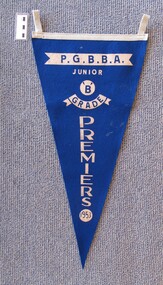
Uniting Church Archives - Synod of VictoriaBanner - Pennant, P.G.B.B.A, 1953
... Presbyterian Girls' Basket Ball Association BN022.1 : "JUNIOR 'B' GRADE PREMIERS 1953" BN022.2 : " 'D' GRADE PREMIERS 1954" BN022.3 : " 'C' GRADE PREMIERS 1955" BN022.4 : " 'A' GRADE RUNNERS UP 1957" BN022.1 - BN022.4 Four felt triangular navy blue pennants with white screen printing. ...BN022.1 - BN022.4 Four felt triangular navy blue pennants with white screen printing.BN022.1 : "JUNIOR 'B' GRADE PREMIERS 1953" BN022.2 : " 'D' GRADE PREMIERS 1954" BN022.3 : " 'C' GRADE PREMIERS 1955" BN022.4 : " 'A' GRADE RUNNERS UP 1957"p.g.b.b.a., presbyterian girls' basket ball association -
Sunshine and District Historical Society IncorporatedArchive - Arlene Andrewartha Dossier, Arlene Andrewartha, 1954 - 1958
... Email containing a photograph of Arlene dated 30 April 2014|Type written notes Arlene satisfying a model ambition|Email dated 28 March 2014 contains Posts pick of a thousand beautiful women Our Miss Australia and Wegs Day cartoon|Newspaper Article Arlene Andrewartha Life after Sunshine Technical School|Newspaper Article Sunshine Advocate 26 November 1954 Local girl in Miss Teen Age Quest|Email dated 12 March 2014|Email dated 15 March 2014|Email dated 15 March 2014|Email dated 16 March 2014|Email dated 16 March 2014|Email dated 16 March 2014 contains Abion State School Photograph|Email dated 16 March 2014|Email dated 16 March 2014|Newspaper Article dated 25 November 1959 The Weekly Round|Email dated 16 March 2014|Email dated 16 March 2014 Photograph of students when Arlene was 10|Email dated 21 March 2014 Photographs of Miss Sunshine whe Arlene was 14|Email dated 21 March 2014 Photographs from The Sun newspaper|Email dated 22 March 2014 Photograph of the 1956 Debutantes and program|Email dated 22 March 2014 Dance program|Program Albion State School Mothers Club Parade of Fashion and Faults or the ABC of Dress 20 July 1956|Ticket 14 April 1956 Grand United Cricket Club Presentation Night Albion Progress hall|Email dated 25 March 2014|Ticket Football Centenary Year Sunshine Football Club Cabaret Ball 4 July 1958|Program Sunshine City Band Grand Cabaret Ball at Sunshine Town Hal 6 June 1958|Email dated 25 March 2014 Program Sunday Carnival Crowning of the Queen Footscray Oval 30 November 1957|Email dated 29 March 2014 Ticket Sunshine Hospital Ball Belle of the Ball 6 July 1956|Email dated 29 March 2014 Photograph of Arlenes house been built|Ticket Sunshine District Community Hospital Second Annual Ball 16 July 1954 Belle of the Ball|Ticket Finalist for the Belle of Sunshine Hospital Ball 1954|Email dated 29 March 2014 Train Tickets from Albion to Sunshine|Email dated 29 March 2014 Photographs from Debutantes night|Newspaper Pix 22 February 1958 A girl like Kim|Email dated 4 April 2014 Photographs of Debutantes|Email dated 7 April 2014 Photographs Belle of the Ball night 1955|Email dated 7 April 2014 Photograph at Sunshine Technical School reunion with Rhonda Francis...Andrewartha Sunshine City Band Sunshine Football Club Sunshine Hospital Sunshine Technical School Band Football Hosptial Technical School Email containing a photograph of Arlene dated 30 April 2014|Type written notes Arlene satisfying a model ambition|Email dated 28 March 2014 contains Posts pick of a thousand beautiful women Our Miss Australia and Wegs Day cartoon|Newspaper Article Arlene Andrewartha Life after Sunshine Technical School|Newspaper Article Sunshine Advocate 26 November 1954 Local girl in Miss Teen Age Quest|Email dated 12 March 2014|Email dated 15 March 2014|Email dated 15 March 2014|Email dated 16 March 2014|Email dated 16 March 2014|Email dated 16 March 2014 contains Abion State School Photograph|Email dated 16 March 2014|Email dated 16 March 2014|Newspaper Article dated 25 November 1959 The Weekly Round|Email dated 16 March 2014|Email dated 16 March 2014 Photograph of students when Arlene was 10|Email dated 21 March 2014 Photographs of Miss Sunshine whe Arlene was 14|Email dated 21 March 2014 Photographs from The Sun newspaper|Email dated 22 March 2014 Photograph of the 1956 Debutantes and program|Email dated 22 March 2014 Dance program|Program Albion State School Mothers Club Parade of Fashion and Faults or the ABC of Dress 20 July 1956|Ticket 14 April 1956 Grand United Cricket Club Presentation Night Albion Progress hall|Email dated 25 March 2014|Ticket Football Centenary Year Sunshine Football Club Cabaret Ball 4 July 1958|Program Sunshine City Band Grand Cabaret Ball at Sunshine Town Hal 6 June 1958|Email dated 25 March 2014 Program Sunday Carnival Crowning of the Queen Footscray Oval 30 November 1957|Email dated 29 March 2014 Ticket Sunshine Hospital Ball Belle of the Ball 6 July 1956|Email dated 29 March 2014 Photograph of Arlenes house been built|Ticket Sunshine District Community Hospital Second Annual Ball 16 July 1954 Belle of the Ball|Ticket Finalist for the Belle of Sunshine Hospital Ball 1954|Email dated 29 March 2014 Train Tickets from Albion to Sunshine|Email dated 29 March 2014 Photographs from Debutantes night|Newspaper Pix 22 February 1958 A girl like Kim|Email dated 4 April 2014 Photographs of Debutantes|Email dated 7 April 2014 Photographs Belle of the Ball night 1955|Email dated 7 April 2014 Photograph at Sunshine Technical School reunion with Rhonda Francis Documents containing notes, photographs (USB) and photocopies of Arlenes history from a child in Sunshine to a model including Miss Sunshine and Model of the year Various cards and booklets from events Train tickets Archive Arlene Andrewartha Dossier Arlene Andrewartha ...Email containing a photograph of Arlene dated 30 April 2014|Type written notes Arlene satisfying a model ambition|Email dated 28 March 2014 contains Posts pick of a thousand beautiful women Our Miss Australia and Wegs Day cartoon|Newspaper Article Arlene Andrewartha Life after Sunshine Technical School|Newspaper Article Sunshine Advocate 26 November 1954 Local girl in Miss Teen Age Quest|Email dated 12 March 2014|Email dated 15 March 2014|Email dated 15 March 2014|Email dated 16 March 2014|Email dated 16 March 2014|Email dated 16 March 2014 contains Abion State School Photograph|Email dated 16 March 2014|Email dated 16 March 2014|Newspaper Article dated 25 November 1959 The Weekly Round|Email dated 16 March 2014|Email dated 16 March 2014 Photograph of students when Arlene was 10|Email dated 21 March 2014 Photographs of Miss Sunshine whe Arlene was 14|Email dated 21 March 2014 Photographs from The Sun newspaper|Email dated 22 March 2014 Photograph of the 1956 Debutantes and program|Email dated 22 March 2014 Dance program|Program Albion State School Mothers Club Parade of Fashion and Faults or the ABC of Dress 20 July 1956|Ticket 14 April 1956 Grand United Cricket Club Presentation Night Albion Progress hall|Email dated 25 March 2014|Ticket Football Centenary Year Sunshine Football Club Cabaret Ball 4 July 1958|Program Sunshine City Band Grand Cabaret Ball at Sunshine Town Hal 6 June 1958|Email dated 25 March 2014 Program Sunday Carnival Crowning of the Queen Footscray Oval 30 November 1957|Email dated 29 March 2014 Ticket Sunshine Hospital Ball Belle of the Ball 6 July 1956|Email dated 29 March 2014 Photograph of Arlenes house been built|Ticket Sunshine District Community Hospital Second Annual Ball 16 July 1954 Belle of the Ball|Ticket Finalist for the Belle of Sunshine Hospital Ball 1954|Email dated 29 March 2014 Train Tickets from Albion to Sunshine|Email dated 29 March 2014 Photographs from Debutantes night|Newspaper Pix 22 February 1958 A girl like Kim|Email dated 4 April 2014 Photographs of Debutantes|Email dated 7 April 2014 Photographs Belle of the Ball night 1955|Email dated 7 April 2014 Photograph at Sunshine Technical School reunion with Rhonda Francisandrewartha, sunshine city band, sunshine football club, sunshine hospital, sunshine technical school, band, football, hosptial, technical school -
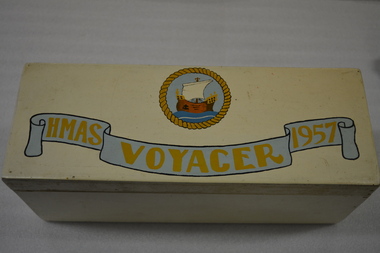
Wangaratta RSL Sub BranchContainer - Box, HMAS Voyager, c1957
... ball point pen belonged to the crew attached to the portside Forward Mess. They presented the box to Cochrane who was responsible for the Mess as a token of appreciation. Ron Cochrane R46195 served as a Leading Hand with the Royal Australian Navy between 1951 and 1957 and served on numerous ships including HMAS Voyager between 6/2 - 6/10/1957. ...ball point pen belonged to the crew attached to the portside Forward Mess. They presented the box to Cochrane who was responsible for the Mess as a token of appreciation. Ron Cochrane R46195 served as a Leading Hand with the Royal Australian Navy between 1951 and 1957 and served on numerous ships including HMAS Voyager between 6/2 - 6/10/1957. ...A gift to Ron Cochrane, a member of the Navy commissioning team of HMAS Voyager. The box was handmade by two brothers CLARK/E (?) from Benalla. The signatures done in ball point pen belonged to the crew attached to the portside Forward Mess. They presented the box to Cochrane who was responsible for the Mess as a token of appreciation. Ron Cochrane R46195 served as a Leading Hand with the Royal Australian Navy between 1951 and 1957 and served on numerous ships including HMAS Voyager between 6/2 - 6/10/1957. He was born on 20/3/1933 at Ballarat East. Daring class destroyer, Voyager, was the first ship of her class to enter Australian service, and the first all-welded ship to be built in Australia. During the night of 10 February 1964, Voyager and the aircraft carrier HMAS Melbourne collided off Jervis Bay, when the destroyer passed in front of the carrier during post-refit sea trials. Voyager was cut in two by the collision, sinking with the loss of 82 of the 314 people aboard. This was the largest loss of Australian military personnel in peacetime, and the subsequent investigations resulted in the holding of two Royal Commissions—the only time in Australian history this has occurred.Cream painted wooden box with metal hinges. There is an inscription and ship on the lid and autographs written in ink on the underside of the lid. On top of lid - HMAS Voyager 1957 On bottom: Bills, bills and more bills !!!!!! Dotted line R Cochranehmas, voyager -
Clunes MuseumDocument - BOOK-MINUTE- ACCOUNTS
... .1 CLUNES TENNIS CLUB MINUTES BOOK WITH SOME CORROSPONDENCE AND FINANCIAL RECORDS LOOSE IN THE BACK 1957-1975 .2 BLUE FOLDER CONTAINING CORRESPONDENCE, LIST OF DEBS AND PARTNERS FOR THE BALL 21/08/1987 .3 BOOKLET WITH FINANCIAL RECORDS FOR 1968-69...Clunes Museum 36 Fraser Street enter building through Collins Place Clunes goldfields deb ball1987 clunes tennis club finacial records .1 CLUNES TENNIS CLUB MINUTES BOOK WITH SOME CORROSPONDENCE AND FINANCIAL RECORDS LOOSE IN THE BACK 1957-1975 .2 BLUE FOLDER CONTAINING CORRESPONDENCE, LIST OF DEBS AND PARTNERS FOR THE BALL 21/08/1987 .3 BOOKLET WITH FINANCIAL RECORDS FOR 1968-69 Document BOOK-MINUTE- ACCOUNTS ....1 CLUNES TENNIS CLUB MINUTES BOOK WITH SOME CORROSPONDENCE AND FINANCIAL RECORDS LOOSE IN THE BACK 1957-1975 .2 BLUE FOLDER CONTAINING CORRESPONDENCE, LIST OF DEBS AND PARTNERS FOR THE BALL 21/08/1987 .3 BOOKLET WITH FINANCIAL RECORDS FOR 1968-69deb ball1987, clunes tennis club, finacial records -
Kew Historical Society IncPhotograph, Kew Light Opera Company, A Country Girl, 1957
... Sepia-toned photograph of Nancy Ball and Stan Wilson in the Kew Light Opera Company's production of A Country Girl by Lionel Monckton. The production was performed in the Kew Recreation Hall in June 1957. ...Sepia-toned photograph of Nancy Ball and Stan Wilson in the Kew Light Opera Company's production of A Country Girl by Lionel Monckton. The production was performed in the Kew Recreation Hall in June 1957. ...The Kew Light Opera Company was formed in 1952, and mounted a number of musical and variety productions each year until it was subsumed in the "Q" Theatre Guild in 1957. A partial record of performances by the company includes: 1952 Florodora, 1953 The Cingalee - San Toy or The Emperor's Own, 1954 While the Sun Shines - A Country Girl - Our Miss Gibbs, 1955 The Toreador - The Arcadians, 1956 The Maid of the Mountains - Whiteoaks - Goodnight Vienna!, 1957 A Country Girl. Most of the Company's performances took place in the Kew Recreation Hall in Wellington Street, Kew. The scrapbook of annotated photographs, programmes, and newspaper reviews of which this item is a part was assembled by Marion Tilley, wardrobe mistress for, and performer in, productions by the Kew Light Opera Company and the "Q" Theatre Guild. It is significant as a remarkably complete document of theatre performances in Kew, Victoria during the 1950s and 1960s. The scrapbook, and the items individually catalogued within it, have artistic and aesthetic significance within the history of performing arts in Victoria in the middle of the 20th Century. They have social significance in that they reveal socio-cultural values and preoccupations during the period. The records also act as a history of arts activities in the Kew Recreation Hall and later in the Kew City Hall as entertainment and community arts and music precincts.Sepia-toned photograph of Nancy Ball and Stan Wilson in the Kew Light Opera Company's production of A Country Girl by Lionel Monckton. The production was performed in the Kew Recreation Hall in June 1957. Stan Wilson played 'Geoffrey Challoner' while Nancy Ball played ' Marjorie Joy'. Inscribed underneath the photo in the scrapbook by Marion Tilley: "Nancy Ball. Stan Wilson."performing arts -- kew (vic.), scrapbooks, marion tilley collection, kew light opera company, kew recreation hall, musical comedy -- melbourne -- victoria -
Clunes MuseumDocument - BOOK, BACK TO CLUNES 1957-60
... Clunes Museum 36 Fraser Street enter building through Collins Place Clunes goldfields LOCAL HISTORY LOCAL HISTORY BACK TO CLUNES 1957-60 MINUTES BACK TO CLUNES COMMITTEE YEAR 1957 GREY CARDBOARD COVERED EXERCISE BOOK 'THE SHELL EX BOOK' CONTAINING MINUTES FROM PLANNING MEETINGS. DETAILS OF BALL ...LOCAL HISTORYGREY CARDBOARD COVERED EXERCISE BOOK 'THE SHELL EX BOOK' CONTAINING MINUTES FROM PLANNING MEETINGS. DETAILS OF BALL TAKINGS, NEWSPAPER ARTICLE REQUESTBACK TO CLUNES COMMITTEE YEAR 1957local history, back to clunes 1957-60, minutes -
Southern Sherbrooke Historical Society Inc.Information folder - Edelston family
... Ball this Friday night", also card "A. W. Edelston/builder and designer" -Royal Melbourne Hospital School of Nursing Contract of Service by student nurse, for Cherry Edelston, dated 11 December 1957, with photo of Cherry attached. ...Ball this Friday night", also card "A. W. Edelston/builder and designer" -Royal Melbourne Hospital School of Nursing Contract of Service by student nurse, for Cherry Edelston, dated 11 December 1957, with photo of Cherry attached. ...Ephemera collected by Edelston family.Information folder containing items pertaining to the Edelston family. Contents: -Sheet of lined paper with hand-written names and dates of birth. -Southern Sherbrooke Historical Society data sheet, containing names and dates of birth. -Article, "Narre North lass weds leading footballer", re. Vivienne Loveridge and Geoffrey Beasley. -Article, "Doctor, 43, shot dead: Wife hit", Sun, 26th January, 1965, re. death of Dr Ronald Hyde. -Medical certificate of vaccinations and innoculations, Edwen Edelston, army record dated 1958. -Record of Services card, National Service, Edwen Edelston, dated 1958./Photo, party scene. -Baby Show certificate, Menzies Creek branch of the Red Cross Society, awarded to Leigh Edelston, plus photo of Leigh (?) and father. (2 copies) -Invitation to Robin Edelston's 21st birthday party, 24th January 1959, family photograph, and card notifying of change of venue for party. -Notice of change of venue for Robin Edelston's 21st birthday party, with small photos (apparently taken at the event) attached. -Article, "They helped Robin to celebrate". re. 21st birthday, with small photos attached. -Article, "Novel jet-age touch for spectacular Belle of Belles Ball", Dandenong Journal, 2nd November 1960 -Article, "Fourteen Belles for big Belle of Belles Ball this Friday night", also card "A. W. Edelston/builder and designer" -Royal Melbourne Hospital School of Nursing Contract of Service by student nurse, for Cherry Edelston, dated 11 December 1957, with photo of Cherry attached. -Poem, "Growing Old" by William Powell: cover of wedding service, St John's Church of England, Malvern, 10 December 1960 for Cherry and Brian; photo of de Rooy family house destroyed by fire, April 1962: article, "Surprise shower tea for bride-elect"/Photo, "Signing the register", marriage of Cherry Edelston & Brian Fischer, 12 December 1960; article, "It was a great night for Cherry"; card, Wild Cherry Cafe, 163 Collins St; photo, Brian & Cherry Fischer; epithet, "Of all my wife's relations I like myself the best". -Article, "Engagement announced at 21st birthday party", re. engagement of Cherry Edelston and Brian Fischer; thankyou card. -Article, "Married in same church as her parents", re. Cherry and Brian Fischer; bereavement card, Mrs Lillian Davie and daughter, dated August 1861; article, "'Miss City' sets the wedding date", re.Cherrie Gillingham. -Article, "Kerry Fox, many times belle, was pretty bride", re. Kerry and Edwen-Robin Edelston, Dandenong Journal, 1963, plus photo of bride and groom; card dated 4 January 1963, from Kerry & Robin to Mr & Mrs E. -Article, "Kerry Fox, hospital Ball belle at Narre Warren"; article, untitled from Weekly Times, on same subject, dated 12 December 1962. -Photo, Kerry Fox & Robin Edelston, re. Belle of Belles. -Photo, Kerry & Robin Edelston; engagement notice, Free Press, Fox-Edelston; article, "Double party: engagement, birthday, NWN"; Dandenong Journal flyer; (2 copies).edelston family -
Geelong Football ClubNorm Scott Photograph, Norm Scott GFC
... ball, gain possession, tear through and create attacking moves from defence. Courage and determination were evident in his play. Total Brownlow Medal votes: 1 Career span: 1946-52 Total matches: Premiership 101 Total goals: Premiership 4 Finals matches: 2 Finals goals: 0 Last senior match: Round 3, 1952 v St Kilda at Kardinia Park Died: 17/02/1957 ...ball, gain possession, tear through and create attacking moves from defence. Courage and determination were evident in his play. Total Brownlow Medal votes: 1 Career span: 1946-52 Total matches: Premiership 101 Total goals: Premiership 4 Finals matches: 2 Finals goals: 0 Last senior match: Round 3, 1952 v St Kilda at Kardinia Park Died: 17/02/1957 Norm Scott Cats Small, black and white photograph of three men standing together. ...Norm Scott Born: 06/06/1921 From: East Geelong Height: 182cm Weight: 83kg Natural kicking foot: Right Guernsey number: 29 First senior match: Round 5, 1946 v St Kilda at Kardinia Park The hard-working, dashing half-back was a solid performer during the latter half of the 1940s. He was fast, kicked very well and liked to sprint to the ball, gain possession, tear through and create attacking moves from defence. Courage and determination were evident in his play. Total Brownlow Medal votes: 1 Career span: 1946-52 Total matches: Premiership 101 Total goals: Premiership 4 Finals matches: 2 Finals goals: 0 Last senior match: Round 3, 1952 v St Kilda at Kardinia Park Died: 17/02/1957 Small, black and white photograph of three men standing together. The man standing in the middle is Norm Scott and he is holding a small, black toy cat. The three men are standing under a Geelong Cats Mascot banner at the entrance to the race. There is a white border around the photograph. Perhaps the 1951 Finals norm scott, cats -
Carlton Football ClubDinner Program & Menu, Carlton Football Club November 21st 1957 to Mr H R Clover, 1957
... ball 63 yards, and later with Carlton, Clover place kicked 8 goals in one match. To read click here> http://nla.gov.au/nla.news-article137253000 Milestones 50 Games: Round 1, 1923 vs Fitzroy 100 Games: Round 18, 1927 vs St Kilda 100 Goals: Round 18, 1921 vs Collingwood 200 Goals: Round 3, 1924 vs St Kilda 300 Goals: Round 11, 1928 vs Geelong Links Articles: The Magical 'Three Goal Average' | A Letter From Horrie | Our Flagless Greats Blueseum: Stat Shot for Horrie Clover | Career Breakdown | Clover's big goals hauls | Clover's Blueseum Image Gallery A dinner to celebrate career Horrie Clover in 1957 Four Page Program & Menu 1927 Carlton Football Club November 21st 1957 to Mr H R Clover Dinner Program & Menu ...Dinner to Mr H R Clover player Career : 1920-24, 1926-31 Debut : Round 2, 1920 vs. Richmond, aged 25 years, 46 days Carlton Player No. 346 Games : 147 Goals : 396 Guernsey No. 1 Last Game : Semi Final, 1931 vs. Collingwood, aged 36 years, 180 days Height : 185 cm (6 ft. 1 in.) Weight : 86.5 kg (13 stone, 9 lbs.) DOB : 20 March, 1895 League Leading Goalkicker: 1922 Leading Goalkicker: 1920, 1921, 1922, 1923, 1926, 1928 Best and Fairest: 1929 Captain Coach: 1922-1924, 1927 Champion of the Colony: 1921 VFL AFL Hall of Fame Carlton Hall of Fame Team of the Century President: 1956-57 Vice President: 1932, 1935-54 Club Secretary: 1925-26 Horace “Horrie” Clover was Carlton’s star centre half-forward of the 1920’s; a high flying, long-kicking champion who enjoyed a stellar career with the Old Dark Navy Blues, then went on to be one of our longest-serving administrators. But even before he took the field for Carlton, Clover had to conquer the odds on the battlefields of France in World War 1. From Maryborough in central Victoria, Horrie enlisted in the 1st AIF in September 1915. After basic training, he embarked for France with reinforcements for the 7th Battalion in January of 1916. Soon pitched into the horrors of trench warfare, he fought and survived until September of that year, when he was transferred to a machine gun company and promoted to the rank of Corporal. On Christmas day, 1916, Horrie was struck down with acute appendicitis. He was evacuated to a field hospital for emergency surgery, where the doctors discovered that his appendix was gangrenous and that his life was in danger. He was immediately transferred to London for specialist treatment, and months of recuperation. Pronounced unfit for further front-line service, he was repatriated back to Australia in August 1917, and honourably discharged in May of the following year – six months before the Armistice. Having recovered, and keen to have a crack at senior football, Clover trained with Richmond and Melbourne before Carlton gave him an opportunity at VFL level. And how he delivered! In his first match in 1920 – ironically, against Richmond - he kicked four goals from centre half-forward, and hit the post three times! By the end of his first season at Princes Park, Clover was one of Carlton’s drawcards. Former Australian Prime Minister Sir Robert Menzies was just one of the many Carlton fans who were captivated; “he was the most artistic of high marks, unforgettable at half-forward,” said Menzies. Horrie could kick a football, too. A balanced, deceptively quick mover, he was a glorious running drop-kick for goal. Playing against Richmond again at Princes Park in July, 1921, he let fly with a monster kick that was later measured at 86.26 metres – that’s 94 yards, 2 feet in imperial terms! And there are numerous other instances where he roosted the ball more than 70 metres. In round 12 of 1921, he slotted 13 goals in a game against St Kilda; a club record which still stands today. The Blues made the finals in third place in 1921 and battled through to meet Richmond for the Premiership. Then the heavens above the MCG opened up on the day before the decider, turning the ground into a quagmire. In what was to be Clover’s only Grand Final appearance, Richmond won a slogging, mauling contest by four points. While Premiership glory eluded him, Horrie was Carlton’s top goalkicker in three of his first four seasons, including 1922, where his total of 58 was the competition’s best. He was appointed captain of the Blues that same year, and in 1923 took on the dual role of captain-coach. Over 1924 / 1925, he suffered more debilitating illness that prevented him from playing all season. Unable to pull on his football boots, he took on the job of Club Secretary, and continued in that position even after returning to the field in 1926. When he did eventually resume, he formed a new, powerful Carlton forward set-up with a young Harry “Soapy” Vallence at full-forward. Twice more – in 1926 and 1928, Clover’s brilliance and accuracy in front of goal saw him at the top of Carlton’s goal-kicking, and in 1929 – aged 34, he was honoured with the captaincy of Victoria against WA in his ninth and final game in the Big Vee. show_image.php?id=205 Horrie Clover retired as a player in 1931 after 147 games. His total of 396 goals is still ranked fifth best in Carlton’s proud history (only displaced for fourth when Brendan Fevola broke through in 2007/2008) – and it should be remembered that all but a handful of his games were played at centre half-forward, not in the goal square. In 1932 he was elected Vice-President of the Carlton Football Club, but retired after one year. In February 1935 on learning of Terry Ogden's the serious illness, Clover and Newton Chandler offered their services for a blood transfusion for the club's wing man. After a blood test Chandler's blood was accepted. However, Ogden passed away the next month. Clover stood again in 1935, was elected – and spent twenty unbroken years serving his beloved Blues. He even took on the Presidency in 1956, aged 60, and was as vigorous and determined as ever in his two years in the job. Carlton Football Club mourned deeply when Horrie Clover passed away on the first day of January, 1984. Three years later, he was among the first to be inducted into the Carlton Hall of Fame. Testament to his stature in the game as a whole, he was elected to the AFL Hall of Fame in 1996; and May 2000 saw him named as one of four emergencies in Carlton’s Team of the Century. A champion in every sense of the word, he spent 37 years of his remarkable life at Princes Park. Footnote The Argus published an article on Maryborough, April 12 1930, it said; "Clover has been the leading half-forward in League ranks for some time. It takes a specialist to fill the position capably, and the Carisbrook man does this admirably. Like good wine he has improved with age, and besides being one of the greatest half forwards that has ever appeared on a football field, he is about the best all round kicker that has ever played the game. He excells in punting, drop, and place kicking. He is a great marksman and a splendid exponent, one of the greatest the district has produced, besides being a fair cricketer also." When Clover returned to football in 1926, The Argus mentioned that they thought it was the first time a member of the Permit and Umpire Committee had played in a League game. 13 GOAL AWARD Round 12, 1921 At the Carlton AGM held on Monday 27 February 1922, Horrie Clover "was presented with ball used on the occasion, the St.Kilda club having generously donated it to the Carlton officials, who had it mounted for the purpose." (Age February 22 1922) 1922 The Art Of Forward Play Horrie wrote an article for the Sporting Globe August 30 p7 To read click here> http://nla.gov.au/nla.news-article184798404 1928 Idol of Carlton Crowds - Australia's Best Centre Half Forward The Sporting Globe's football writer W. S. "Jumbo" Sharland writes about Horrie Clover To read click here> http://nla.gov.au/nla.news-article183958222 Footballer Who Gambles With Death. Daily Pictorial (Sydney) article about Horrie. http://nla.gov.au/nla.news-article246129350 1932 Jack Worrall on Clover Writing for the Australasian September 03 p7; "Take Horrie Clover as an example, a real specialist, one of the best forwards the game has seen, and the best all-round kick that has ever come under my purview. For that reason he deserves a line to himself. He played the game like a sportsman, was a glorious high mark, and could cover a great distance by either drop, punt, or place kick - a remarkable accomplishment. Many players have been notable kicks in two aspects of the game, yet none have equalled Clover in the three branches. His nearest rival as an all-round kick, though not quite as certain in his efforts, was Frank Caine, of Carlton, who, like Clover, also hailed from the country." 1933 Coming Football Champion Melbourne, Saturday A special warning was issued to the Victorian Football League delegates last night by Mr. D. H. Crone, a Carlton delegate, not to angle for a certain "coming" champion that the Carlton Club had signed up that day. At first delegates were a little puzzled at the statement, but when it was explained that Horrie Clover, former champion half-forward, had that day become the father of of a son they burst into sustained laughter. It was only by persistent ringing of the bell by the chairman that order was restored. (News (Adelaide) May 20 1933 p3) 1933 - The Place Kick A letter to The Argus via the Huon Times about the lack of place kicking expertise in the VFL. The writer mentions that he got Horrie to play football in Maryborough after he saw the then 15 y.o. place kick a ball 63 yards, and later with Carlton, Clover place kicked 8 goals in one match. To read click here> http://nla.gov.au/nla.news-article137253000 Milestones 50 Games: Round 1, 1923 vs Fitzroy 100 Games: Round 18, 1927 vs St Kilda 100 Goals: Round 18, 1921 vs Collingwood 200 Goals: Round 3, 1924 vs St Kilda 300 Goals: Round 11, 1928 vs Geelong Links Articles: The Magical 'Three Goal Average' | A Letter From Horrie | Our Flagless Greats Blueseum: Stat Shot for Horrie Clover | Career Breakdown | Clover's big goals hauls | Clover's Blueseum Image Gallery A dinner to celebrate career Horrie Clover in 1957Four Page Program & Menu 1927