
Showing 8 items matching "beaconsfield ranges"
-
 Narre Warren and District Family History Group
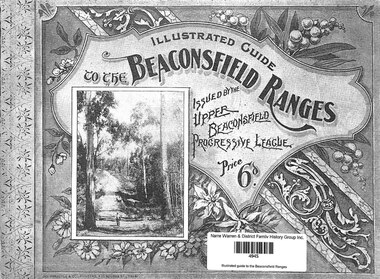
Book, Green Circle Plant Nursery (volunteer), Illustrated guide to the Beaconsfield Ranges, 2018
... Illustrated guide to the Beaconsfield Ranges......beaconsfield ranges...upper beaconsfield (vic.) beaconsfield ranges A reproduction of the Illustrated Guide to the Beaconsfield Ranges, that was first published in 1899 by the Upper Beaconsfield Progressive League 40 p.; 25 cm Illustrated guide to the Beaconsfield Ranges Book Green Circle Plant Nursery (volunteer) ...A reproduction of the Illustrated Guide to the Beaconsfield Ranges, that was first published in 1899 by the Upper Beaconsfield Progressive League40 p.; 25 cmnon-fictionA reproduction of the Illustrated Guide to the Beaconsfield Ranges, that was first published in 1899 by the Upper Beaconsfield Progressive Leagueupper beaconsfield (vic.), beaconsfield ranges -
 Federation University Historical Collection
Booklet - Booklet - Syllabus, Government Technical School, Hobart, Syllabus, 1892, 1892
... Beaconsfield. Curricula quickly expanded to include subjects ranging from mineralogy and metallurgy to commercial economy, beginning the long tradition of directly linking the schools with the interests of business and industry. ...Beaconsfield. Curricula quickly expanded to include subjects ranging from mineralogy and metallurgy to commercial economy, beginning the long tradition of directly linking the schools with the interests of business and industry. ...The Tasmanian Parliament made provision for 'the teaching of the principles of technical education' in the Education Act (1885). Regulations specifying courses of instruction and establishing a committee of Technical Education followed in 1887. The first government Technical School opened in Hobart in 1888, offering evening classes in technical art and applied mechanics. Two months later a school was established in Launceston. Small classes were also held in regional centres and Schools of Mines were established in Zeehan, Queenstown and Beaconsfield. Curricula quickly expanded to include subjects ranging from mineralogy and metallurgy to commercial economy, beginning the long tradition of directly linking the schools with the interests of business and industry. The Technical Schools largely worked independently, with varying degrees of success, until 1916 when a Commission of Inquiry recommended the integration of technical education into the state education system. The outcome was a new Technical Education Branch, formed to administer Technical Schools and Schools of Mines and to provide a structured technical education system, comprising distinct trade certificates and applied sciences, engineering and arts diploma courses. Pale orange soft covered booklet.hobart, technical school, syllabus, malcolm kennedy, a. mault, r.s. pemberton, a. morton, a.j. taylor, henry lamb, j. mcmeekin, j.h. hunt, j.r. trantham-fryer, f.g. howell, w. middleton, trevor russell, j.f. echlin, w.f. ward, archibald park, a paton miller, committee members of technical education, department of art, department of mathematics, department of engineering, department of commercial economy, department of geology mineralogy mining, department of chemistry, department of pharmacy, department of veterinary science -
 Hawthorn Historical Society
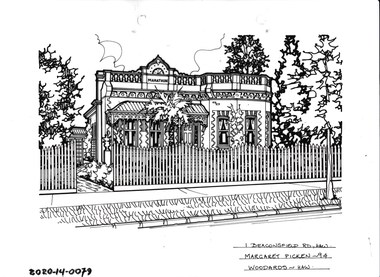
Drawing - Property Illustration, 1 Beaconsfield Road, Hawthorn
... range of real estate agents in Melbourne between c. 1983 and c. 2006. Each work is signed and dated by the artist. The series of property illustrations in the Picken Collection are invaluable assets for identifying architectural styles and features. The year in which the drawing was created is also a valuable record for house historians, as a number of the properties depicted have either been altered since that date or demolished. artist - margaret picken 1950- 1 Beaconsfield Road, Hawthorn, Margaret Picken '94. ...'After training as a Cartographic Draftsman within the mining industry, I worked as a property illustrator for real estate firms in the eastern suburbs of Melbourne for 23 years from 1983. I initially photographed houses with a Polaroid camera and made a 'thumbnail' sketch while there. The photos were used to scale off a sketch in pencil and then that sketch was overlaid with drafting film and the 'pen and ink' completed. The pens I used were the Rotring ‘Rapidigraph’ drafting pens. The ink was also made by Rotring (German).The film was ‘Rapidraw’, polyester drafting film, double matte. It takes a very fine line and doesn’t bleed. As well as house sketches, there were often floor plans and site plans ordered. Aerial sketches were ordered when the property needed an overall view.' (Margaret Picken, 2020)This property illustration is one of a series created by Margaret Picken for a range of real estate agents in Melbourne between c. 1983 and c. 2006. Each work is signed and dated by the artist.Gift of Margaret Picken, 2020Pen and ink property illustration on drafting film of 1 Beaconsfield Road, Hawthorn by Margaret Picken.1 Beaconsfield Road, Hawthorn, Margaret Picken '94. Woodards - Hawthorn.artist - margaret picken 1950- -
 Hawthorn Historical Society
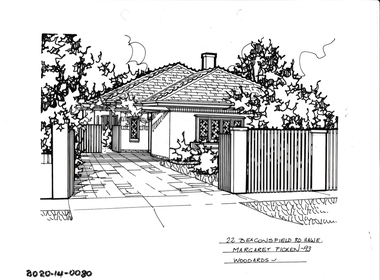
Drawing - Property Illustration, 22 Beaconsfield Road, Hawthorn
... range of real estate agents in Melbourne between c. 1983 and c. 2006. Each work is signed and dated by the artist. The series of property illustrations in the Picken Collection are invaluable assets for identifying architectural styles and features. The year in which the drawing was created is also a valuable record for house historians, as a number of the properties depicted have either been altered since that date or demolished. artist - margaret picken 1950- 22 Beaconsfield Road, Haw E, Margaret Picken '93. ...'After training as a Cartographic Draftsman within the mining industry, I worked as a property illustrator for real estate firms in the eastern suburbs of Melbourne for 23 years from 1983. I initially photographed houses with a Polaroid camera and made a 'thumbnail' sketch while there. The photos were used to scale off a sketch in pencil and then that sketch was overlaid with drafting film and the 'pen and ink' completed. The pens I used were the Rotring ‘Rapidigraph’ drafting pens. The ink was also made by Rotring (German).The film was ‘Rapidraw’, polyester drafting film, double matte. It takes a very fine line and doesn’t bleed. As well as house sketches, there were often floor plans and site plans ordered. Aerial sketches were ordered when the property needed an overall view.' (Margaret Picken, 2020)This property illustration is one of a series created by Margaret Picken for a range of real estate agents in Melbourne between c. 1983 and c. 2006. Each work is signed and dated by the artist.Gift of Margaret Picken, 2020Pen and ink property illustration on drafting film of 22 Beaconsfield Road, Hawthorn by Margaret Picken.22 Beaconsfield Road, Haw E, Margaret Picken '93. Woodards - Hawthorn.artist - margaret picken 1950- -
Emerald Museum & Nobelius Heritage Park
Photograph - Cross - Uniting Church, Upper Beaconsfield, Unknown photographer, 1980s
... Twenty-one of the people killed were located in Upper Beaconsfield; twelve of the people killed in the area were fire-fighters, along with nine residents. 186 homes and countless livestock were also lost in the fires which ranged through Victoria and into South Australia due to a combination of dry, hot and windy weather. ...Twenty-one of the people killed were located in Upper Beaconsfield; twelve of the people killed in the area were fire-fighters, along with nine residents. 186 homes and countless livestock were also lost in the fires which ranged through Victoria and into South Australia due to a combination of dry, hot and windy weather. ...The cross depicted in the photograph is stated to be from the Uniting Church in Upper Beaconsfield in the Museum's registration records but may instead be from St John's Anglican Church which burned down in the Ash Wednesday bushfires as no Uniting Church site is recorded in Upper Beaconsfield. Forty-seven people were killed in the Ash Wednesday fires in Victoria, including twenty-seven from the Cardinia Shire area. Twenty-one of the people killed were located in Upper Beaconsfield; twelve of the people killed in the area were fire-fighters, along with nine residents. 186 homes and countless livestock were also lost in the fires which ranged through Victoria and into South Australia due to a combination of dry, hot and windy weather. The date of the fires corresponds with the the date of the Christian religious festival of the same name that year. St John's Anglican Church was rebuilt on the same site within the next three years. The design, by local architect Paul Reid, combined elements of the previous building with the style of village churches Reid had observed in Austria and Bavaria after his graduation from Melbourne University. The cross, which buckled in the heat generated by the fires, is believed to be on display at the Ash Wednesday Bushfire Education Centre in Cockatoo, which was itself constructed as a memorial on the site of a kindergarten in which 300 Cockatoo residents sheltered from the fire. The specific occasion on which this photograph was taken is not known.This item is significant because of its association with the Ash Wednesday bushfires, one of the worst natural disasters in Victoria's history. The Ash Wednesday fires occurred on 16th February 1983. Twenty-seven people from the Cardinia Shire area were killed in the fires, including twenty-one who died within a kilometre of the church in which the cross depicted resided.Black and white rectangular photograph printed on photographic paper. The photograph depicts a plain dark-coloured metal cross on a stand. The cross has buckled forwards. The item is resting on a table covered with a pale-coloured table-cloth. A bouquet of flowers is visible to the left-hand side of the image. Chairs and three women in special occasion-style clothing are visible at the rear of the image. The cross featured in the photograph is from a church in Upper Beaconsfield which was damaged in the Ash Wednesday bushfires in February 1983. The specific occasion on which this photograph was taken is not known.ash wednesday 1983, bushfires, churches, st john's anglican church, uniting church, upper beaconsfield victoria australia, cockatoo victoria australia, cross, deceased persons, natural disasters, ash wednesday bushfire education centre, paul reid, cardinia shire council -
Emerald Museum & Nobelius Heritage Park
Map - Melbourne and surrounds map, Broadbent's Maps et al, Fifty Miles Round Melbourne, 1929
... Ranges. See p. 46 for advertisaements for 'The Falls' guest house (with photograph), owned by Mr and Mrs J.B. Holman, and Nottingham house, owned by M. Slee, both on Emerald-Beaconsfield...Ranges. See p. 46 for advertisaements for 'The Falls' guest house (with photograph), owned by Mr and Mrs J.B. Holman, and Nottingham house, owned by M. Slee, both on Emerald-Beaconsfield ...Road map of Melbourne and surrounds showing main tourist areas. Booklet contains information on each area, including Dandenong Ranges. See p. 46 for advertisaements for 'The Falls' guest house (with photograph), owned by Mr and Mrs J.B. Holman, and Nottingham house, owned by M. Slee, both on Emerald-Beaconsfield Road. The map is of interest for showing main roads into Emerald in the 1920s and 1930s, well before construction of Cardinia Reservoir.Folded road map contained in soft cover booklet. 1929-1930 Edition. Includes photographsemerald, victoria, australia, tourism, guest houses, broadbent's maps, royal automobile club of victoria, the falls guest house, nottingham house, j.b. holman, m. slee -
 Emerald Museum & Nobelius Heritage Park
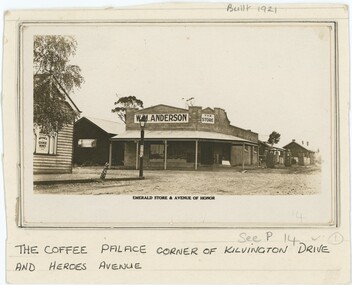
Photograph, Emerald Store & Avenue of Honor, 1920s-1940s
... Beaconsfield Road and, according to the label, Avenue of Honor. Anderson's store is believed to have been built by the Stillwell family in 1921, but Anderson had his store at least from 1923 and therefore likely owned it from the point of its first construction. By the late 1940s, Anderson's had become Legge's General Store. It is difficult to determine precisely when within that range...Beaconsfield Road and, according to the label, Avenue of Honor. Anderson's store is believed to have been built by the Stillwell family in 1921, but Anderson had his store at least from 1923 and therefore likely owned it from the point of its first construction. By the late 1940s, Anderson's had become Legge's General Store. It is difficult to determine precisely when within that range ...This photograph depicts W. M. Anderson's store on the corner of what is now Kilvington Drive and Heroes Avenue. At the time, these may have respectively been Beaconsfield Road and, according to the label, Avenue of Honor. Anderson's store is believed to have been built by the Stillwell family in 1921, but Anderson had his store at least from 1923 and therefore likely owned it from the point of its first construction. By the late 1940s, Anderson's had become Legge's General Store. It is difficult to determine precisely when within that range this photograph was taken, although one local history page attributes it to the earlier end of the range. We believe Anderson's store was on the corner now occupied by Grace and Louie Booksellers.This photograph captures a now-unfamiliar store in a familiar part of old Emerald, documenting the changes to the commercial landscape over the past century.This black and white photograph is attached to a card backing. The backing is annotated in pen below the photograph, describing its location. Other pencil annotation is present on the obverse and reverse of the backing. The photograph shows a store on the street corner, with a porch shading the walkway in front of the building and other shops along the street. On the corner closer top the camera and across from the store is a lamp post, with another shop besides it. On the photograph paper itself is another annotation, this one printed. Obverse: Backing, Top: "Built 1921" Backing, Bottom: "THE COFFEE PALACE CORNER OF KILVINGTON DRIVE / AND HEROES AVENUE" Photograph, Printed Text Below Image: "EMERALD STORE & AVENUE OF HONOR" Photograph, Sign in Left of Image: "IRVINE'S / CHOICE WINES" Photograph, Sign in Centre-Left of Image: "W. M. ANDERSON" Photograph, Sign in Centre of Image: "THE / STORE" Reverse: "Built in 1921 By Stillwell. / Andersons Store - later Legge's"emerald, 1920s, 1930s, commerce -
 Emerald Museum & Nobelius Heritage Park
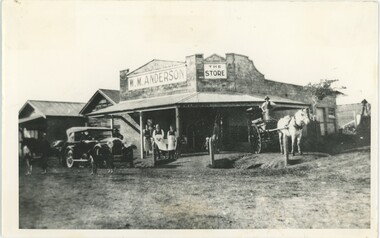
Photograph - W. M. Anderson Store, 1920s-40s
... Beaconsfield Road and, according to the label, Avenue of Honor. Anderson's store is believed to have been built by the Stillwell family in 1921, but Anderson had his store at least from 1923 and therefore likely owned it from the point of its first construction. By the late 1940s, Anderson's had become Legge's General Store. It is difficult to determine precisely when within that range...Beaconsfield Road and, according to the label, Avenue of Honor. Anderson's store is believed to have been built by the Stillwell family in 1921, but Anderson had his store at least from 1923 and therefore likely owned it from the point of its first construction. By the late 1940s, Anderson's had become Legge's General Store. It is difficult to determine precisely when within that range ...This photograph depicts W. M. Anderson's store on the corner of what is now Kilvington Drive and Heroes Avenue. At the time, these may have respectively been Beaconsfield Road and, according to the label, Avenue of Honor. Anderson's store is believed to have been built by the Stillwell family in 1921, but Anderson had his store at least from 1923 and therefore likely owned it from the point of its first construction. By the late 1940s, Anderson's had become Legge's General Store. It is difficult to determine precisely when within that range this photograph was taken. We believe Anderson's store was on the corner now occupied by Grace and Louie Booksellers. Some of the people in the photograph include Bill Anderson with Albert Legge, and Leo Hirst - employees of Anderson - in the center-left, and George Davey standing in the cart.This photograph captures a now-unfamiliar store in a familiar part of old Emerald, documenting the changes to the commercial landscape over the past century.This black and white photograph depicts a store on a street corner, with a porch covering the walkway outside and several signs on the building, along with writing on the end of the porch covering. In the left of the frame is a car, with two dogs, a horse, and a man surrounding it; in the right, a man strands on a horsecart drawn by a white horse. In the center-left are three men wearing aprons with a child besides them, while in the center a woman and child stand in the doorway. In the background, other buildings continue down both streets. The reverse is annotated, and has six rectangular artefacts where adhesive was once applied. A section of handwriting is illegible due to damage, but likely read 'Heroes Avenue' or 'Avenue of Honour'.Reverse: "Built in 1921 / Cr [illegible] & Kilvington / Cross reference 56" Obverse: In Photograph Sign, Left: "W. M. ANDERSON" In Photograph Sign, Right: "THE / STORE" In Photograph, Porch: "W.M.ANDERSON [illegible]"emerald, commerce, 1920s, 1930s, 1940s
