
Showing 372 items matching "belt - accessories"
-
 Bendigo Military Museum
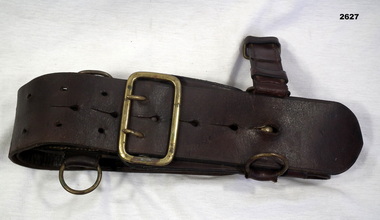
Uniform - BELT, LEATHER, c.1915
... costume accessories - belt accessories...17th Light Horse Regiment, Bendigo possibly. costume accessories - belt accessories trades-leatherworking Passchendaele barracks trust “Hector E Baston” Leather belt, Sam Browne, dark brown, stitched metal, brass buckles (double fastener) & loops, 1 length of leather hanging from belt. ...17th Light Horse Regiment, Bendigo possibly.Leather belt, Sam Browne, dark brown, stitched metal, brass buckles (double fastener) & loops, 1 length of leather hanging from belt.“Hector E Baston”costume accessories - belt accessories, trades-leatherworking, passchendaele barracks trust -
 Mont De Lancey
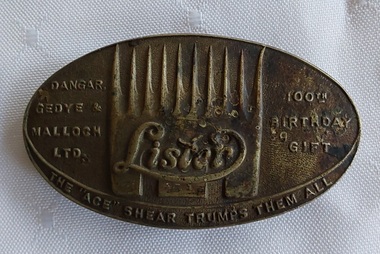
Accessory - Belt Buckle, Lister, 1900's
... ...Belt - accessories...There is a rusted metal attachment on the back. Accessory Belt Buckle Lister Jim Davidson ...Dangar, Gedye and Malloch (DGM) was an historic Australian agricultural machinery and merchant company established in 1838 and became associated with Lister in 1909. Based in Sydney, it was famous for distributing farm equipment like Lister shearing machines designed by Australian Jim Davidson. In the 1970s and 1980s, large, solid-brass belt buckles became a popular fashion statement and collectible. Companies like Lister used them as promotional merchandise and customer giveaways for farmers, agricultural mechanics, and shearing gangs.An oval shaped brass and metal Lister belt buckle with the name, a symbol of shears and the manufacturing details stamped on the front. There is a rusted metal attachment on the back. Stamped on the front of the buckle is: 'Dangar Gedye & Malloch' 'Lister' '100th Birthday Gift' 'The Ace Shear Trumps Them All'belts, clothing - accessories, buckles, belt - accessories -
 Wodonga & District Historical Society Inc
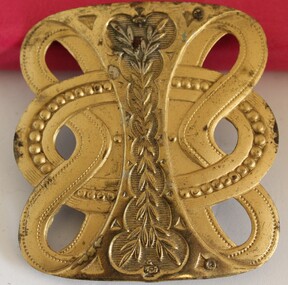
Accessory - Gold Belt Buckle, c1920s
... This belt buckle accessory is part of collection donated by Mrs. ...It also features entwined loops. Gold Belt Buckle Accessory Gold Belt Buckle ...This belt buckle accessory is part of collection donated by Mrs. Jean RaperThis item is from Raper Collection donated to the Wodonga Historical Society by Mrs. Jean Raper. A rectangular gold metallic belt buckle with an embossed leaf design. It also features entwined loops.fashion accessory, metallic jewellery -
 Orbost & District Historical Society
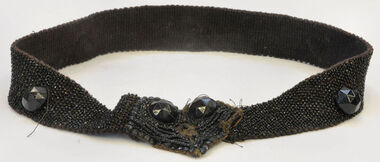
Clothing - belt, 1890-1910
... belt beads costume-accessories jewelry jet-beads temple-george...It is highly decorative. belt beads costume-accessories jewelry jet-beads temple-george Jet beaded belt . ...This item is from the Temple estate. George Temple (1832-1916) started Temple's store opposite Post Office. Packed stores to Bendoc area gold fields.This item is significant because it represents part of a woman's costume worn c. late 19th Century to 1910. It is highly decorative.Jet beaded belt . Large and small beads. Large jet bead fastener (Paris Jet).belt beads costume-accessories jewelry jet-beads temple-george -
 Bendigo Historical Society Inc.
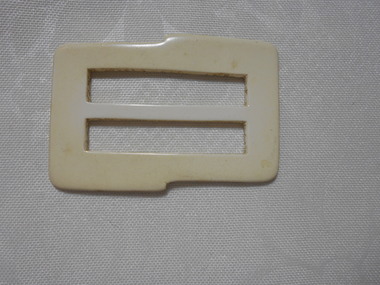
Clothing - MERLE BUSH COLLECTION: BELT BUCKLE
... ...Clothing accessories...belt...COSTUME ACCESSORIES Clothing accessories belt buckle Cream coloured plastic rectangular belt buckle. ...Cream coloured plastic rectangular belt buckle. Cut out shape on two corners.costume accessories, clothing accessories, belt buckle -
 Bendigo Historical Society Inc.
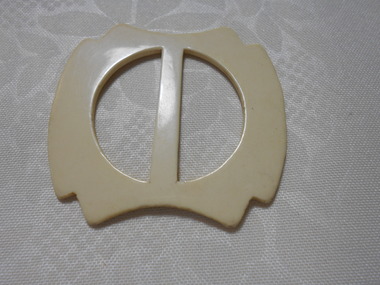
Clothing - MERLE BUSH COLLECTION:BELT BUCKLE
... ...Clothing accessories...belt...COSTUME ACCESSORIES Clothing accessories belt buckle Clothing. Cream coloured rounded plastic belt buckle.Two opposite sides convex. ...Clothing. Cream coloured rounded plastic belt buckle.Two opposite sides convex. Other two sides concave. Old box 573.costume accessories, clothing accessories, belt buckle -
 Bendigo Historical Society Inc.
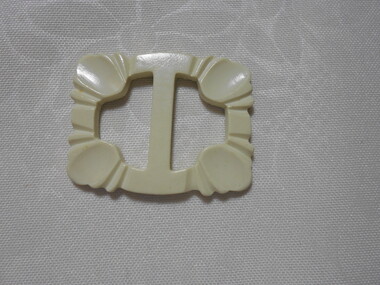
Clothing - MERLE BUSH COLLECTION: BELT BUCKLE
... ...Clothing accessories...belt...COSTUME ACCESSORIES Clothing accessories belt buckle Cream coloured rectangular plastic belt buckle. ...Cream coloured rectangular plastic belt buckle. Fingernail shaped pattern in each corner, forming rounded corners.costume accessories, clothing accessories, belt buckle -
 Bendigo Historical Society Inc.
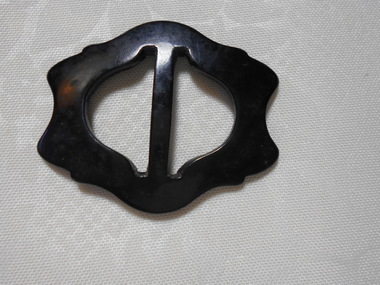
Clothing - MERLE BUSH COLLECTION: BELT BUCKLE
... ...Clothing accessories...belt...COSTUME ACCESSORIES Clothing accessories belt buckle Clothing. Black rectangular plastic belt buckle. ...Clothing. Black rectangular plastic belt buckle. Two opposite sides convex. Other two sides concave. Old box 573.costume accessories, clothing accessories, belt buckle -
 Bendigo Historical Society Inc.
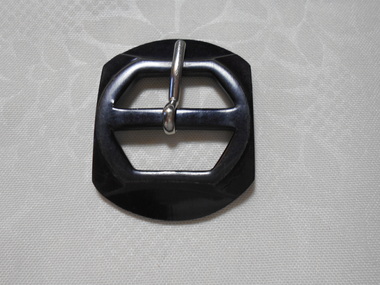
Clothing - MERLE BUSH COLLECTION: BELT BUCKLE
... ...Clothing accessories...belt...COSTUME ACCESSORIES Clothing accessories belt buckle Clothing. Black rectangular plastic belt buckle. ...Clothing. Black rectangular plastic belt buckle. Two opposite sides rounded. Metal prod. Old box 573.costume accessories, clothing accessories, belt buckle -
 Bendigo Historical Society Inc.
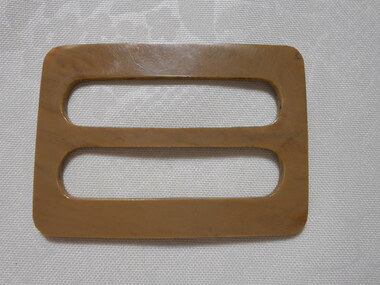
Clothing - MERLE BUSH COLLECTION: BELT BUCKLE
... ...Clothing accessories...belt...COSTUME ACCESSORIES Clothing accessories belt buckle Clothing. Light brown rectangular plastic belt buckle. ...Clothing. Light brown rectangular plastic belt buckle. Old box 57costume accessories, clothing accessories, belt buckle -
 The Beechworth Burke Museum
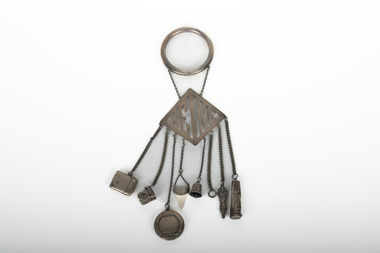
Accessory - Chatelaine, C. 1890
... belt hook with small household object attached by chains to a suspended name plate. There are 8 chains and 7 objects; a vesta case, scent bottle lid, compact, shark tooth, bell, button hook handle, container. Accessory ...The exact creation date of this chatelaine is unknown, however the hallmarks and engravings on some of the attached objects indicate that this chatelaine was made in the late 1890s. The shark tooth and the liberty bell attached to the chatelaine suggest that the item once belonged to an Australian who had connections to America. The compact, scent bottle lid, and feminine design of the other objects suggest that this wasowned by a woman. The name on the plate indicates that this object may have belonged to someone with the surname Heine. The hallmarks on the scent bottle lid and the compact indicate that they were made in Birmingham, England in the late 1890s, and that the compact was made by H. Matthews. Chatelaines where used by both men and women, usually fastened to a belt or pocket, and small household objects were attached to the main body of the chatelaine by chains. They were only worn by the heads of the household as a display of position and power.The social history objects held in the Burke Museum's collection help to tell the stories of Beechworth's past by showing the social, cultural, and economic aspects of the town's history.A decorative silver belt hook with small household object attached by chains to a suspended name plate. There are 8 chains and 7 objects; a vesta case, scent bottle lid, compact, shark tooth, bell, button hook handle, container.HEINE/ [plate] CHERRY./ from/ LEO/ May 12th 1899/ [inscription on vesta case] L??S/ Anchor symbol/ x symbol/ lion symbol/ [Hallmark on scent bottle lid] R/ HM/ Anchor symbol/ Lion symbol/ m symbol/ [Hallmark on back of the compact] SYDNEY/ [inscription on shark tooth] Proclaim liberty throughout all the land unto all inhabitants thereof/ By order of the Assembly of the Province of Pensylvania for the State House in Philada/ [inscription on bell] A01176/ burke museum, silverware, social history, heine -
 Upper Yarra Museum
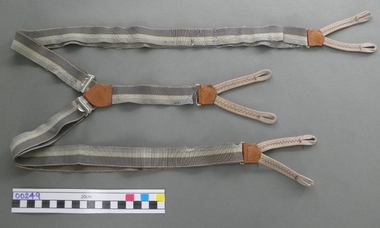
Clothing Accessory
... belts, suspenders were still standard throughout the 1920s. TODAY http://www.fabsugar.co.uk/Love-Hate-Trousers-Braces-1585776 Androgynous fashion nearly always appears on the catwalk and trousers with braces made an appearance this season at Paul Smith... trousers braces straps Grey Elastic braces forming a y shape at the back, with leather tabs to hold clips and braided loops to attach to buttons on trousers. Clothing Accessory ...Braces - straps worn over shoulders for holding up trousers http://en.wikipedia.org/wiki/Suspenders Suspenders (Am. English) or braces (British English) are fabric or leather straps worn over the shoulders to hold up trousers. Straps may be elasticated, either entirely or only at attachment ends and most straps are of woven cloth forming an X or Y shape at the back. Braces are typically attached to trousers with buttons using leather tabs at the ends or, incorrectly according to traditional protocol, clips.. HISTORY the modern type were first invented in 1822 by Albert Thurston and were once almost universally worn due to the high cut of mid-nineteenth and early twentieth century trousers, a cut that made a belt impractical. After losing popularity in the first World War, as men became accustomed to uniform belts, suspenders were still standard throughout the 1920s. TODAY http://www.fabsugar.co.uk/Love-Hate-Trousers-Braces-1585776 Androgynous fashion nearly always appears on the catwalk and trousers with braces made an appearance this season at Paul Smith...Grey Elastic braces forming a y shape at the back, with leather tabs to hold clips and braided loops to attach to buttons on trousers. trousers, braces, straps -
 Shepparton RSL Sub Branch
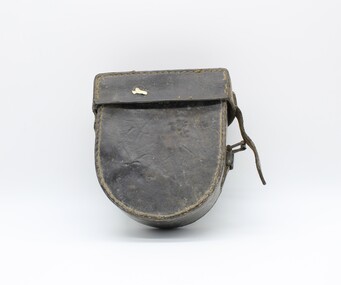
Case, c. 1916
... This case may have once attached to the belt of a soldier as a carry case for an artillery sight. carry case bag accessory acoutrement world war one military uniform world war i first world war the great war germany german berlin franz cobal franz cobalt artillery sight Manufacturer's stamp reads "FRANZ COBAL/BERLIN/1916" Dark leather case constructed of two elongated semi-circle shapes, hand or machine stitched with a gusset. ...This case may have once attached to the belt of a soldier as a carry case for an artillery sight.Dark leather case constructed of two elongated semi-circle shapes, hand or machine stitched with a gusset. Edges trimmed in leather binding and rectangular lid held in place on one side by stitched leather hinge and fastened with metal buckle on other side. Reverse of the case has a leather loop held in place with stitching and 6 metal studs or rivets; a metal rectangular loop is stitched in place with fine wire twisted and attached to loop. Interior of case appears to be felted wool or fibre, cream in colour with small leather loop on right side, perhaps to hold a small accessory. Front of case is stamped with manufacturer's name; lid has remnants of a circular adhesive label.Manufacturer's stamp reads "FRANZ COBAL/BERLIN/1916"carry case, bag, accessory, acoutrement, world war one, military, uniform, world war i, first world war, the great war, germany, german, berlin, franz cobal, franz cobalt, artillery sight -
 Orbost & District Historical Society
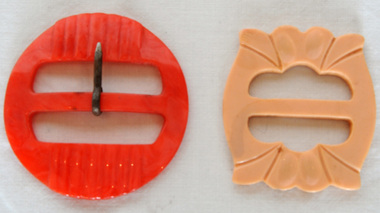
buckles, !930's -1940's
... belt is just slid through the clasp. There is no notch in the centre bar indicating that there was never a hasp. ( Info. from Button Bower) These two items are good examples of dress accessories typical of the first half of the 20th century era. buckles dress-accessories women's-clothing bakelite Two buckles probably made of bakelite. 1950.1 is orange/ red, circular with a metal prong. 1950.2 is a slide, rectangular shape, light salmon pink (butterscotch) with no prong. buckles ...These items are probably American ). A lot of carved bakelite jewellery/buttons/buckles were manufactured in the U.S.A. The orange (red?) one is especially reminiscent of American bakelite, due to its polished look. The other one is probably butterscotch bakelite. Originally it would have been white or cream, but the plastic oxidises over time and changes colour to a butterscotch colour. The rectangular one is probably a belt slide. Some types of belts don't have any holes in them. The belt is just slid through the clasp. There is no notch in the centre bar indicating that there was never a hasp. ( Info. from Button Bower)These two items are good examples of dress accessories typical of the first half of the 20th century era.Two buckles probably made of bakelite. 1950.1 is orange/ red, circular with a metal prong. 1950.2 is a slide, rectangular shape, light salmon pink (butterscotch) with no prong.buckles dress-accessories women's-clothing bakelite -
 Orbost & District Historical Society
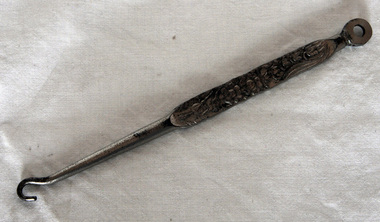
button hook, 1895 – 1905
... This item is an example of a commonly used accessory no longer relevant. clothing footwear gaiters boots button-hook A button hook made of metal with a beaten silver handle ornately decorated with scrolls and foliate design. At the top is a small ring on the handle end. This could have been for a lady to attach the item to her chatelaine at her belt ...Button hooks were used to fastens buttons on boots and long gloves. It is a tool used for the closing of shoes, gloves or other apparel that uses buttons as fasteners. The steel hook end is inserted through the buttonhole to capture the button by the shank and draw it through the opening. This hook is most likely to have been used to do up bootsWomen and young girls generally wore boots that were either front laced or side buttoned, particularly in the period from the 1870s . Buttonhooks were needed to do up the buttons on buttoned boots and were used by poking the metal hook through the buttonhole, grabbing the button and pulling it through the eyelet. This item is an example of a commonly used accessory no longer relevant.A button hook made of metal with a beaten silver handle ornately decorated with scrolls and foliate design. At the top is a small ring on the handle end. This could have been for a lady to attach the item to her chatelaine at her belt, or on a necklace. clothing footwear gaiters boots button-hook -
 Montmorency–Eltham RSL Sub Branch
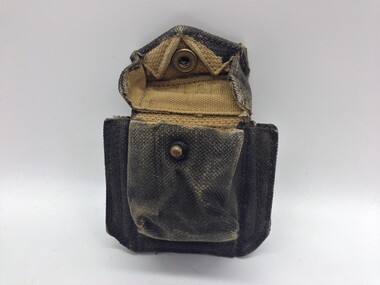
Pouch, Pistol Ammunition, Patt. '37 W.E
... . – accessory for pistol holster (see item #0242). On back of pouch: brass clips for attaching to webbing belt and cotton sleeve for attaching to (above) pistol holster..... – accessory for pistol holster (see item #0242). On back of pouch: brass clips for attaching to webbing belt and cotton sleeve for attaching to (above) pistol holster. ...Blackened Khaki cotton webbing ammunition pouch, Pattern 1937 W.E. – accessory for pistol holster (see item #0242). On back of pouch: brass clips for attaching to webbing belt and cotton sleeve for attaching to (above) pistol holster.Inside flap cover: "ZL & T Ltd" (refers to ... Zephyr Looms & textiles) On snap fastener: UNITED CARR CANADA (on snap fastener) -
 Montmorency–Eltham RSL Sub Branch
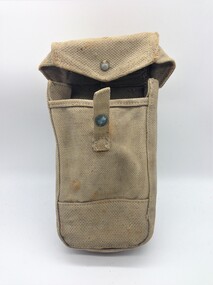
Equipment - Pouch, Basic, Patt. '37 W.E. (Vietnam Modified)
... equipment accessory Pattern 1937 khaki Web Equipment Basic Pouch with brass snap fastener and improvised belt loop at rear. ...Pattern 1937 khaki Web Equipment Basic Pouch with brass snap fastener and improvised belt loop at rear. The Patt. '37 W.E. equipment brass belt hooks and brace buckle have been removed to allow the pouch to be placed lower on the US M1956 belt used by Australian forces in Vietnam.equipment, accessory -
 Montmorency–Eltham RSL Sub Branch
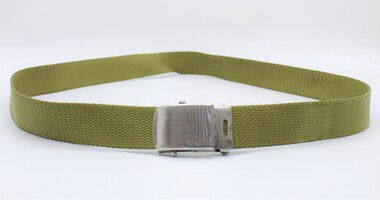
Accessory - Belt, Dress, Green
... Reverse side of buckle - AF 73 Lion Metal Goods P/L Woven green dress belt with metal buckle & slide stop. Metal tab on the other end. Accessory Belt, Dress, Green Lion Metal Goods Pty Ltd ...Woven green dress belt with metal buckle & slide stop. Metal tab on the other end. Reverse side of buckle - AF 73 Lion Metal Goods P/L -
 Montmorency–Eltham RSL Sub Branch
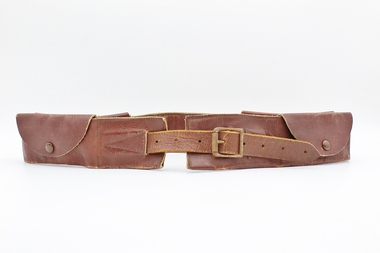
Accessory - Money Belt
... The belt has four pouches on the exterior of the belt with the pouches being secured closed with metal press studs. Money Belt Accessory Money Belt ...Brown leather money belt, with metal buckle. The belt has four pouches on the exterior of the belt with the pouches being secured closed with metal press studs. At the rear of the belt is the following inscription: “With Best Wishes from the Mayor, Councillors & Citizens of the City of Prahran”harrison, ww2 -
 Montmorency–Eltham RSL Sub Branch
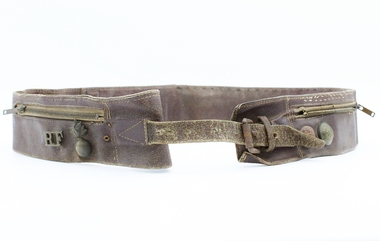
Accessory - Money Belt, AMF Money Belt
... Also affixed are 2 brass buttons. AMF Money Belt Accessory Money Belt ...Brown leather money belt with metal buckle and 3 pockets secured by metal zips. Affixed to the belt is a brass regimental shoulder badge, with the initials “ RF” ( Royal Fusiliers ) and brass flaming grenade with 7 points. Also affixed are 2 brass buttons.The inscription on the brass button nearest the buckle refers to “Australian Military Forces”; and the remaining brass button has inscription too small to decipher, with a rose imprint.harrison, ww2 -
 Flagstaff Hill Maritime Museum and Village
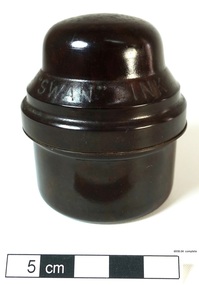
Container - Ink Bottle & Case, 1934 – Mid 1950’s
... accessory for nib pen writers. The first patent for a “pocket-case for bottles”, a wooden case, was applied for in the US in 1891. Other materials such as steel, pewter and aluminum as well as Bakelite have also been used. The British Museum has an elaborately decorated bronze ink pot holder that is inlaid with turquoise. Today ink bottle cases are even available in fabric with loops to attach to a belt...accessory for nib pen writers. The first patent for a “pocket-case for bottles”, a wooden case, was applied for in the US in 1891. Other materials such as steel, pewter and aluminum as well as Bakelite have also been used. The British Museum has an elaborately decorated bronze ink pot holder that is inlaid with turquoise. Today ink bottle cases are even available in fabric with loops to attach to a belt ...Pens, nib pens and later fountain pens, with suitable inks, were commonly used for writing communications from the 18th century to the mod 20th century. Fountain pens continue to be used and enjoyed. Dip pens with a wide variety of nibs are used for calligraphy writing, a hobby enjoyed by many people. The quality of the pen handle, the nib and the ink all work together to produce fine handwriting that expresses the character and mood of the writer. This Bakelite ink case has been specifically moulded to snugly contain an ink bottle, with just enough room to wrap the bottle with a padding or card or blotting paper. The screw top lid fits the case well and this container would be a good way to travel with ink because any spillage would be kept within the waterproof case. The Bakelite material is lightweight and strong. Ink bottle cases, or travelling cases, have been made as an accessory for nib pen writers. The first patent for a “pocket-case for bottles”, a wooden case, was applied for in the US in 1891. Other materials such as steel, pewter and aluminum as well as Bakelite have also been used. The British Museum has an elaborately decorated bronze ink pot holder that is inlaid with turquoise. Today ink bottle cases are even available in fabric with loops to attach to a belt. Bakelite, the material used for this ink bottle case, is made from synthetic materials and is an early form of plastic, developed in 1907 and used extensively until the 1940’s. It is still in used today for specific applications but has been largely replaced by more modern forms of plastics. This ink bottle case carries the imprint of Mabie, Todd & Co. (Aust.) Pty. Ltd. This form of company name was used from 1938 to the mid 1950’s. The Swan ink bottle’s information says it was made by Mabie, Todd & Co. Ltd., London and Sydney, so dates the ink bottle from about 1908 until 1934. (Australian newspapers display advertisements dated 1908 until 1934 for Sydney wholesalers and agents for Mabie, Todd & Co. Ltd.) ABOUT PERSONAL FOUNTAIN PENS (FOUNT PENS) A 1917 newspaper advertisement recommends that the owner of a “Swan” doesn’t lend it to anyone else to use due to its qualities of it personalised to the owner. It reads “Don’t lend your “Swan” fountpen, recommend it, but don’t let other people use it. You see, a good pen doesn’t wear, but its “tamper” (or spring) works into the writer’s pressure and manner of holding. Another person with a dashing style of writing may strain it do that it will no longer feel just like your own.” This personalisation of nib pens may be the reason that legal documents in the past being acceptable only if they were signed using a ‘wet ink’ pen. Forgeries of signatures could be easily detected as the nib takes on the character of the pen’s owner. A ballpoint pen was not acceptable. This is a strong contrast to modern times when a digital signature is widely accepted. ABOUT MABIE TODD Pty Ltd. The American company Mabie Todd began by making pencil cases in New York in the 1860’s. The Bard Brothers, makers of Gold nibs, joined Mabie Todd and the company was established in the 1870’s as Mabie Todd and Bard. In 1878 the company filed a patent for the design of a fountain pen and in 1884 the first Swan fountain pen was released. In 1884 a Mabie Todd and Bard office and showroom was established in London. In 1906 the company’s name changed to Mabie Todd & Co, New York. The UK offices also used this new name and in 1907 the UK began producing their own Swan pens. Manufacturing was going so well in England that New York sold their rights to European and Colonial business to the new Mabie Todd & Company Ltd of England. By the end of the 1930’s all components for the pens were being made in the UK; the pens in the London factory, the gold nibs in Birmingham and the ink in Liverpool. Newspaper articles from 1934 stated that Mabie Todd were large buyers of Tasmanian iridium, which had been welded with gold and used since 1834 for the tips of nib and fountain pens. Fountain pen points were the largest market buyers for Tasmanian iridium, which was classed as “the best in the world”. Production growth continued up until WWII times, when the headquarters and main factory were destroyed. Mabie Todd & Company Ltd of England rebuilt out of the inner city and by 1946 pen production began again. The market for nib and fountain pens was diminishing by this time, with people beginning to use the new ballpoint ‘Biro’ pens. The Mabie Todd bought shares in Biro Pens and in 1952 became Biro Swan. They went on to make more ballpoint pens than any other manufacturer in Britain. The ink refills that Biro-Swan produced came in five different viscosity or thickness xhoices, depending on the season and location of where the pen would be used . Along with the ballpoint pens, Biro-Swan also introduced a range of Calligraph pens to attract those following the new trend for italic writing. In 1948 Mr. T. Burke, a director for Mabie Todd & Co. (Aust.) Pty Ltd., announced that there would be a £40,000 factory built in Sydney in 1949 for the manufacture of ink. The plant for the factory would be imported from overseas. Sadly the company struggled against competition and in 1956 Mabie Todd closed business and no more Swan pens were produced. The ink bottle and container was donated to Flagstaff Hill Maritime Village by the family of Doctor William Roy Angus, Surgeon and Oculist. It is part of the “W.R. Angus Collection” includes historical medical equipment, surgical instruments and material once belonging to Dr Edward Ryan and Dr Thomas Francis Ryan, (both of Nhill, Victoria) as well as Dr Angus’ own belongings. The Collection’s history spans the medical practices of the two Doctors Ryan, from 1885-1926 plus that of Dr Angus, up until 1969. ABOUT THE “W.R.ANGUS COLLECTION” Doctor William Roy Angus M.B., B.S., Adel., 1923, F.R.C.S. Edin.,1928 (also known as Dr Roy Angus) was born in Murrumbeena, Victoria in 1901 and lived until 1970. He qualified as a doctor in 1923 at University of Adelaide, was Resident Medical Officer at the Royal Adelaide Hospital in 1924 and for a period was house surgeon to Sir (then Mr.) Henry Simpson Newland. Dr Angus was briefly an Assistant to Dr Riddell of Kapunda, then commenced private practice at Curramulka, Yorke Peninsula, SA, where he was physician, surgeon and chemist. In 1926, he was appointed as new Medical Assistant to Dr Thomas Francis Ryan (T.F. Ryan, or Tom), in Nhill, Victoria, where his experiences included radiology and pharmacy. In 1927 he was Acting House Surgeon in Dr Tom Ryan’s absence. Dr Angus had become engaged to Gladys Forsyth and they decided he further his studies overseas in the UK in 1927. He studied at London University College Hospital and at Edinburgh Royal Infirmary and in 1928, was awarded FRCS (Fellow from the Royal College of Surgeons), Edinburgh. He worked his passage back to Australia as a Ship’s Surgeon on the on the Australian Commonwealth Line’s T.S.S. Largs Bay. Dr Angus married Gladys in 1929, in Ballarat. (They went on to have one son (Graham 1932, born in SA) and two daughters (Helen (died 12/07/1996) and Berenice (Berry), both born at Mira, Nhill ) According to Berry, her mother Gladys made a lot of their clothes. She was very talented and did some lovely embroidery including lingerie for her trousseau and beautifully handmade baby clothes. Dr Angus was a ‘flying doctor’ for the A.I.M. (Australian Inland Ministry) Aerial Medical Service in 1928 . Its first station was in the remote town of Oodnadatta, where Dr Angus was stationed. He was locum tenens there on North-South Railway at 21 Mile Camp. He took up this ‘flying doctor’ position in response to a call from Dr John Flynn; the organisation was later known as the Flying Doctor Service, then the Royal Flying Doctor Service. A lot of his work during this time involved dental surgery also. Between 1928-1932 he was surgeon at the Curramulka Hospital, Yorke Peninsula, South Australia. In 1933 Dr Angus returned to Nhill and purchased a share of the Nelson Street practice and Mira hospital (a 2 bed ward at the Nelson Street Practice) from Dr Les Middleton one of the Middleton Brothers, the current owners of what previously once Dr Tom Ryan’s practice. Dr Tom and his brother had worked as surgeons included eye surgery. Dr Tom Ryan performed many of his operations in the Mira private hospital on his premises. He had been House Surgeon at the Nhill Hospital 1902-1926. Dr Tom Ryan had one of the only two pieces of radiology equipment in Victoria during his practicing years – The Royal Melbourne Hospital had the other one. Over the years Dr Tom Ryan had gradually set up what was effectively a training school for country general-practitioner-surgeons. Each patient was carefully examined, including using the X-ray machine, and any surgery was discussed and planned with Dr Ryan’s assistants several days in advance. Dr Angus gained experience in using the X-ray machine there during his time as assistant to Dr Ryan. When Dr Angus bought into the Nelson Street premises in Nhill he was also appointed as the Nhill Hospital’s Honorary House Surgeon 1933-1938. His practitioner’s plate from his Nhill surgery is now mounted on the doorway to the Port Medical Office at Flagstaff Hill Maritime Village, Warrnambool. When Dr Angus took up practice in the Dr Edward and Dr Tom Ryan’s old premises he obtained their extensive collection of historical medical equipment and materials spanning 1884-1926. A large part of this collection is now on display at the Port Medical Office at Flagstaff Hill Maritime Village in Warrnambool. In 1939 Dr Angus and his family moved to Warrnambool where he purchased “Birchwood,” the 1852 home and medical practice of Dr John Hunter Henderson, at 214 Koroit Street. (This property was sold in1965 to the State Government and is now the site of the Warrnambool Police Station. and an ALDI sore is on the land that was once their tennis court). The Angus family was able to afford gardeners, cooks and maids; their home was a popular place for visiting dignitaries to stay whilst visiting Warrnambool. Dr Angus had his own silk worm farm at home in a Mulberry tree. His young daughter used his centrifuge for spinning the silk. Dr Angus was appointed on a part-time basis as Port Medical Officer (Health Officer) in Warrnambool and held this position until the 1940’s when the government no longer required the service of a Port Medical Officer in Warrnambool; he was thus Warrnambool’s last serving Port Medical Officer. (Masters of immigrant ships arriving in port reported incidents of diseases, illness and death and the Port Medical Officer made a decision on whether the ship required Quarantine and for how long, in this way preventing contagious illness from spreading from new immigrants to the residents already in the colony.) Dr Angus was a member of the Australian Medical Association, for 35 years and surgeon at the Warrnambool Base Hospital 1939-1942, He served with the Australian Department of Defence as a Surgeon Captain during WWII 1942-45, in Ballarat, Victoria, and in Bonegilla, N.S.W., completing his service just before the end of the war due to suffering from a heart attack. During his convalescence he carved an intricate and ‘most artistic’ chess set from the material that dentures were made from. He then studied ophthalmology at the Royal Melbourne Eye and Ear Hospital and created cosmetically superior artificial eyes by pioneering using the intrascleral cartilage. Angus received accolades from the Ophthalmological Society of Australasia for this work. He returned to Warrnambool to commence practice as an ophthalmologist, pioneering in artificial eye improvements. He was Honorary Consultant Ophthalmologist to Warrnambool Base Hospital for 31 years. He made monthly visits to Portland as a visiting surgeon, to perform eye surgery. He represented the Victorian South-West subdivision of the Australian Medical Association as its secretary between 1949 and 1956 and as chairman from 1956 to 1958. In 1968 Dr Angus was elected member of Spain’s Barraquer Institute of Barcelona after his research work in Intrasclearal cartilage grafting, becoming one of the few Australian ophthalmologists to receive this honour, and in the following year presented his final paper on Living Intrasclearal Cartilage Implants at the Inaugural Meeting of the Australian College of Ophthalmologists in Melbourne In his personal life Dr Angus was a Presbyterian and treated Sunday as a Sabbath, a day of rest. He would visit 3 or 4 country patients on a Sunday, taking his children along ‘for the ride’ and to visit with him. Sunday evenings he would play the pianola and sing Scottish songs to his family. One of Dr Angus’ patients was Margaret MacKenzie, author of a book on local shipwrecks that she’d seen as an eye witness from the late 1880’s in Peterborough, Victoria. In the early 1950’s Dr Angus, painted a picture of a shipwreck for the cover jacket of Margaret’s book, Shipwrecks and More Shipwrecks. She was blind in later life and her daughter wrote the actual book for her. Dr Angus and his wife Gladys were very involved in Warrnambool’s society with a strong interest in civic affairs. He had an interest in people and the community They were both involved in the creation of Flagstaff Hill, including the layout of the gardens. After his death (28th March 1970) his family requested his practitioner’s plate, medical instruments and some personal belongings be displayed in the Port Medical Office surgery at Flagstaff Hill Maritime Village, and be called the “W. R. Angus Collection”. The ink bottle case is significant for its association with writing methods commonly used during the colonisation of Australia until the mid-20th century. The protective Bakelite case demonstrates the value placed on caring for the user’s supply of ink and protecting other belongings of the user, enabling writers to easily carry and safely transport their ink without the concern of spilling it. The case’s design is a good example of the use of new technology. The properties of Bakelite have enabled its moulded design and make it waterproof and lightweight, easily cleaned, closely fitted to the shape of the ink bottle within and lid and base join together using a smooth screwing action. The maker’s marks have also been moulded into the Bakelite, therefore not distracting from the simple but elegant design. This ink bottle case also represents the period of early to mid-20th century when handwriting materials for writers using ink and nib pens were imported into Australia and developed for the Australian market and sold by wholesalers on behalf of overseas companies. Vintage brown Bakelite travelling ink bottle case (or holder, pot, well) containing glass ink bottle and original textured cardboard liner, made by Swan Ink, Mabie, Todd & Co. (Aust) Pty.. Ltd. The Bakelite container is shaped to fit snugly around the ink bottle. It still retains its original shiny finish, the lid screws on and off perfectly. The maker’s name is embossed on lid and base of the Bakelite container. The inkwell contains a glass Ink bottle with a tiny amount of dried up ink Swan triple filtered ink inside. The bottle is cylindrical with curved shoulders tapering to a neck of around 2cm. The white metal screw-on lid and the white and red paper label on the side of the bottle both have a printed description of the ink and maker. Circa 1934-1950’sBAKELITE INK CASE - embossed on either side of the lid “ “SWAN” INK / ”SWAN” INK “ - embossed into base, written in a circle “MABIE TODD & Co (Aust.) PTY. LTD.” GLASS BOTTLE – printed on lid “SWAN”/ [corporate logo combining letters ‘M, T, co’]/TRIPLE FILTERED/ INK.” - printed on label “SWAN” INK /FOR FOUNTAIN & / STEEL PENS / A BLUE BLACK INK OF/ THE FINEST QUALITY/ MADE IN ENGLAND/ MABIE. TODD & CO LTD …….. LONDON. SYDNEY/ Makers of “SWAN” Pens, Gold Pens & Ink“ - moulded into the base of the ink bottle and written around the bottom outside edge of the bottle are the words “THIS BOTTLE ALWAYS REMAINS THE PROPERTY OF/ MABIE TODD/AUST”flagstaff hill, warrnambool, shipwrecked coast, flagstaff hill maritime museum, maritime museum, shipwreck coast, flagstaff hill maritime village, great ocean road, ink bottle holder, ink bottle case, ink bottle pot, travelling inkwell, portable inkwell, travelling ink pot, travelling ink bottle case, ink bottle, inkwell, ink well, swan ink, bakelite, dip pen ink, nib pen ink, fountain pen, fontpen, writing methods, stationery, mabie todd & co, swan fountain pens, biro-swan -
 Flagstaff Hill Maritime Museum and Village
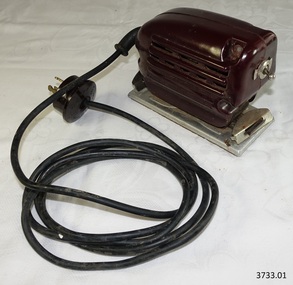
Tool - Sander, c. 1930-1955
... Belt sander, electric. Portable power tool, Portrix model Sander–Polisher, burgundy coloured body with swivelling, black electric cable, 250V 1 / 4 amp. For sanding wood and metal, and for polishing. (Stored in original box.) Made in England. Part of a collection of tools and accessories...Belt sander, electric. Portable power tool, Portrix model Sander–Polisher, burgundy coloured body with swivelling, black electric cable, 250V 1 / 4 amp. For sanding wood and metal, and for polishing. (Stored in original box.) Made in England. Part of a collection of tools and accessories ...This burgundy coloured, portable electric belt sander is stored in its own heavy duty cardboard box. It was made in England and, according to the label on the lid of the box, it is a Portrix Sander-Polisher, all-electric, portable, sands wood metal and polishes. Its uses include decorating, carpentry and polishing. It has a complete with electric unit with flex. The price of 75/- (75 shillings) is printed on the label of the box. The model and the brand of the sander have been removed from the manufacturer’s information embossed on the side of the sander. The sander is part of a collection of objects used by Jim Williams, maker of fine ship models from about 1930-1955. Most of the components for the models, as well as many of the tools, were handmade by Jim Williams. Jim’s family has donated the ship model “Sovereign of the Seas” and many tools, accessories and documents used in the making of this and other ship models have been donated to Flagstaff Hill Maritime Village. Please see our record 3732 of the mode Sovereign of the Seas for further details of the ship and the maker.This vintage Portrix sander-polisher represents tools used for the hobby and skill of ship model making that has been carried as a leisure activity out for generations. Ship model making was also a pastime for sailing crew, who often made a model of the ship in which they were sailing. This sander was used by local Warrnambool man, Jim Williams, who was employed at Cramond and Dickson clothing store, and then at Fletcher Jones menswear for 27 years. It was used in making components for the model of the historic ship, the Sovereign of the Seas. The Sovereign of the Seas was a historic 17th century English war ship with important maritime heritage.Belt sander, electric. Portable power tool, Portrix model Sander–Polisher, burgundy coloured body with swivelling, black electric cable, 250V 1 / 4 amp. For sanding wood and metal, and for polishing. (Stored in original box.) Made in England. Part of a collection of tools and accessories used by Mr. Jim Williams to build ship model of the “Sovereign of the Sea” and other models. c. 1930-1955. Moulded into body “ - - - SANDER –POLISHER / 1 / 4 amp. PRODUCT OF - - - MANUFACTURING CO. LTD. 50 CYCLES / MADE IN ENGLAND PAT. PEND. 200/250 volts A.C.” (the Brand and Manufacturer’s name have been removed)flagstaff hill, warrnambool, shipwrecked coast, flagstaff hill maritime museum, maritime museum, shipwreck coast, flagstaff hill maritime village, great ocean road, portrix sander-polisher, portrix power tool, portrix belt sander, woodworking equipment, ship modelling equipment, jim williams, james bernard williams, ship model, hobby, ship model tool, sovereign of the seas, english war ship -
 Bendigo Military Museum
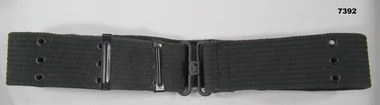
Accessory - BELT - WEBBING, unknown
... Accessories...Army...Belt...Possibly not Australian Military. Accessory BELT - WEBBING ...Belt - dark jungle green, three-hole web belt, using rows of 3 eyelets all the way round the belt. With metal clasp closure, hook waist measurement adjuster and metal keepers. Possibly not Australian Military.accessories, army, belt -
 Bendigo Military Museum
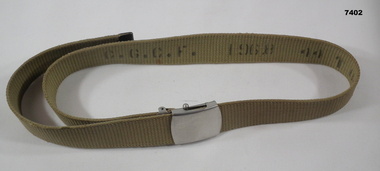
Uniform - BELT, ARMY, Commonwealth Govt Clothing Factory, 1968
... Accessories...Army...Belt...Accessories Army Belt Inside belt - printed in black ink. ...Belt - Khaki colour webbing cotton canvas belt with metal slide buckle and metal tip to end of belt.Inside belt - printed in black ink. "C.G.C.F. 1968 44 ^ 8440-66-012-6305”accessories, army, belt -
 Bendigo Military Museum
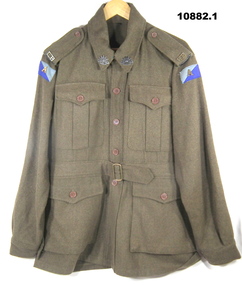
Uniform - REPLICA, LIGHTHORSE, WW1, Unknown
... accessories. 1. Jacket, khaki wool fabric. Collar with metal look plastic "Rising Sun" Badge. Shoulder epaulettes with buttons, two metal look plastic "AUSTRALIA" badges and two silver plastic Light Horse rectangular badge - an unofficial shoulder title. Front four patch pockets with button down flap. Sleeves with cuff and button colour patch. rectangular light blue/ mid blue on diagonal top left to bottom right. Brass metal look plastic "A" for ANZAC". No rank stripes - Private. Pleated back and attached half belt...accessories. 1. Jacket, khaki wool fabric. Collar with metal look plastic "Rising Sun" Badge. Shoulder epaulettes with buttons, two metal look plastic "AUSTRALIA" badges and two silver plastic Light Horse rectangular badge - an unofficial shoulder title. Front four patch pockets with button down flap. Sleeves with cuff and button colour patch. rectangular light blue/ mid blue on diagonal top left to bottom right. Brass metal look plastic "A" for ANZAC". No rank stripes - Private. Pleated back and attached half belt ...Replica 4th Light Horse AIF Uniform, WW1, used for Museum displays and Bendigo RSL Commemorative Services.Replica Uniform, Lighthorse WW1. Jacket, Breeches with braces, Shirt, Leggings and Light Horse leather accessories. 1. Jacket, khaki wool fabric. Collar with metal look plastic "Rising Sun" Badge. Shoulder epaulettes with buttons, two metal look plastic "AUSTRALIA" badges and two silver plastic Light Horse rectangular badge - an unofficial shoulder title. Front four patch pockets with button down flap. Sleeves with cuff and button colour patch. rectangular light blue/ mid blue on diagonal top left to bottom right. Brass metal look plastic "A" for ANZAC". No rank stripes - Private. Pleated back and attached half belt with metal slide buckle. Brown plastic buttons. 2. Breeches (fabric as above), ankle length close fitting trousers, snug fit below the knees with side opening and metal eyelets and ribbon laces. Five pockets - money pocket, two inset on an angle and back two inset. Numerous khaki plastic buttons at waist for braces, five button fly. 3. Shirt - grey wool flannel fabric with white cotton mandarin collar and 1/4 waistband. Half opening with three black plastic buttons. Long sleeves with cuff and three buttons. Shirt tails. 4. Braces - set of beige coloured cotton twill webbing with brown leatgher attachments for breeches. 5. Waist belt. 6. Bandolier, brown leather, brass studs and metal buckles. Waist belt with bayonet frog and four pouches and attached bandolier has nine pouches. 7. & 8. Leggings, one pair, L & R, brown leather with two leather straps and brass metal buckles.uniform, replica, light horse, ww1 -
 Bendigo Military Museum
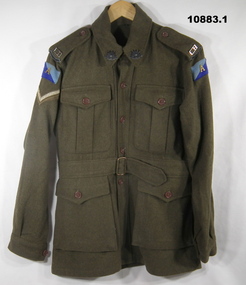
Uniform - REPLICA, LIGHTHORSE, WW1, Unknown
... accessories. 1. Jacket, khaki wool fabric. Collar with metal look plastic "Rising Sun" Badge. Shoulder epaulettes with buttons, two metal look plastic "AUSTRALIA" badges and two silver plastic Light Horse rectangular badge - an unofficial shoulder title. Front four patch pockets with button down flap. Sleeves with cuff and button colour patch. rectangular light blue/ mid blue on diagonal top left to bottom right. Brass metal look plastic "A" for ANZAC". One rank stripe - Lance Corporal. Pleated back and attached half belt...accessories. 1. Jacket, khaki wool fabric. Collar with metal look plastic "Rising Sun" Badge. Shoulder epaulettes with buttons, two metal look plastic "AUSTRALIA" badges and two silver plastic Light Horse rectangular badge - an unofficial shoulder title. Front four patch pockets with button down flap. Sleeves with cuff and button colour patch. rectangular light blue/ mid blue on diagonal top left to bottom right. Brass metal look plastic "A" for ANZAC". One rank stripe - Lance Corporal. Pleated back and attached half belt ...Replica 4th Light Horse AIF Uniform, WW1. Used for Museum displays and Bendigo RSL Commemorative Services.Replica Uniform, Lighthorse WW1. Jacket, Breeches with braces, Shirt, Leggings and Light Horse leather accessories. 1. Jacket, khaki wool fabric. Collar with metal look plastic "Rising Sun" Badge. Shoulder epaulettes with buttons, two metal look plastic "AUSTRALIA" badges and two silver plastic Light Horse rectangular badge - an unofficial shoulder title. Front four patch pockets with button down flap. Sleeves with cuff and button colour patch. rectangular light blue/ mid blue on diagonal top left to bottom right. Brass metal look plastic "A" for ANZAC". One rank stripe - Lance Corporal. Pleated back and attached half belt with metal slide buckle. Brown plastic buttons. 2. Breeches (fabric as above), ankle length close fitting trousers, snug fit below the knees with side opening and metal eyelets and ribbon laces. Five pockets - money pocket, two inset on an angle and back two inset. Numerous khaki plastic buttons at waist for braces, five button fly. 3. Shirt - grey wool flannel fabric with white cotton mandarin collar and 1/4 waistband. Half opening with three black plastic buttons. Long sleeves with cuff and three buttons. Shirt tails. 4. Braces - set of beige coloured cotton twill webbing with brown leatgher attachments for breeches. 5. Waist belt. 6. Bandolier, brown leather, brass studs and metal buckles. Waist belt with bayonet frog and four pouches and attached bandolier has nine pouches. 7. & 8. Leggings, one pair, L & R, brown leather with two leather straps and brass metal buckles.uniform, replica, light horse, ww1 -
 Bendigo Military Museum
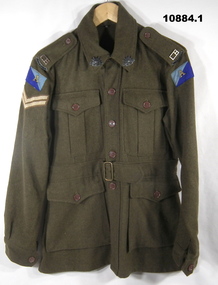
Uniform - REPLICA, LIGHTHORSE, WW1, Unknown
... accessories. 1. Jacket, khaki wool fabric. Collar with metal look plastic "Rising Sun" Badge. Shoulder epaulettes with buttons, two metal look plastic "AUSTRALIA" badges and two silver plastic Light Horse rectangular badge - an unofficial shoulder title. Front four patch pockets with button down flap. Sleeves with cuff and button colour patch. rectangular light blue/ mid blue on diagonal top left to bottom right. Brass metal look plastic "A" for ANZAC". Two rank stripes - Corporal. Pleated back and attached half belt...accessories. 1. Jacket, khaki wool fabric. Collar with metal look plastic "Rising Sun" Badge. Shoulder epaulettes with buttons, two metal look plastic "AUSTRALIA" badges and two silver plastic Light Horse rectangular badge - an unofficial shoulder title. Front four patch pockets with button down flap. Sleeves with cuff and button colour patch. rectangular light blue/ mid blue on diagonal top left to bottom right. Brass metal look plastic "A" for ANZAC". Two rank stripes - Corporal. Pleated back and attached half belt ...Replica 4th Light Horse AIF Uniform, WW1. Used for Museum Displays and Bendigo RSL Commemorative Services.Replica Uniform, Lighthorse WW1. Jacket, Breeches with braces, Shirt, Leggings and Light Horse leather accessories. 1. Jacket, khaki wool fabric. Collar with metal look plastic "Rising Sun" Badge. Shoulder epaulettes with buttons, two metal look plastic "AUSTRALIA" badges and two silver plastic Light Horse rectangular badge - an unofficial shoulder title. Front four patch pockets with button down flap. Sleeves with cuff and button colour patch. rectangular light blue/ mid blue on diagonal top left to bottom right. Brass metal look plastic "A" for ANZAC". Two rank stripes - Corporal. Pleated back and attached half belt with metal slide buckle. Brown plastic buttons. 2. Breeches (fabric as above), ankle length close fitting trousers, snug fit below the knees with side opening and metal eyelets and ribbon laces. Five pockets - money pocket, two inset on an angle and back two inset. Numerous khaki plastic buttons at waist for braces, five button fly. 3. Shirt - grey wool flannel fabric with white cotton mandarin collar and 1/4 waistband. Half opening with three black plastic buttons. Long sleeves with cuff and three buttons. Shirt tails. 4. Braces - set of beige coloured cotton twill webbing with brown leather attachments for breeches. 5. Waist belt. 6. Bandolier, brown leather, brass studs and metal buckles. Waist belt with bayonet frog and four pouches and attached bandolier has nine pouches. 7. & 8. Leggings, one pair, L & R, brown leather with two leather straps and brass metal buckles.uniform, replica, light horse, ww1 -
 Bendigo Military Museum
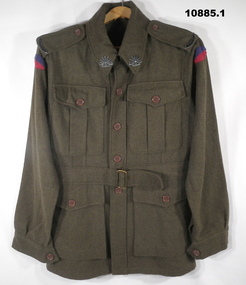
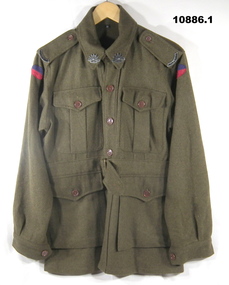
Uniform - REPLICA, ARMY, WW1, Unknown
... accessories and boots. 1. Jacket, khaki wool fabric. Collar with metal look plastic "Rising Sun" Badge. Shoulder epaulettes with buttons, two metal look plastic "AUSTRALIA" badges and two silver plastic Light Horse rectangular badge - an unofficial shoulder title. Front four patch pockets with button down flap. Sleeves with cuff and button colour patch, oval shape , purple over maroon, 38th Battalion AIF. Five front buttons - brown coloured plastic. No rank stripes - Private. Pleated back and attached half belt...accessories and boots. 1. Jacket, khaki wool fabric. Collar with metal look plastic "Rising Sun" Badge. Shoulder epaulettes with buttons, two metal look plastic "AUSTRALIA" badges and two silver plastic Light Horse rectangular badge - an unofficial shoulder title. Front four patch pockets with button down flap. Sleeves with cuff and button colour patch, oval shape , purple over maroon, 38th Battalion AIF. Five front buttons - brown coloured plastic. No rank stripes - Private. Pleated back and attached half belt ...Replica 38th Battalion AIF Uniform, WW1, used for Museum displays and Bendigo RSL Commemorative Services.Replica Uniform, Light Horse WW1. Jacket, Breeches with braces, Shirt, Puttees and Army leather accessories and boots. 1. Jacket, khaki wool fabric. Collar with metal look plastic "Rising Sun" Badge. Shoulder epaulettes with buttons, two metal look plastic "AUSTRALIA" badges and two silver plastic Light Horse rectangular badge - an unofficial shoulder title. Front four patch pockets with button down flap. Sleeves with cuff and button colour patch, oval shape , purple over maroon, 38th Battalion AIF. Five front buttons - brown coloured plastic. No rank stripes - Private. Pleated back and attached half belt with metal slide buckle. Brown plastic buttons. 2. Breeches (fabric as above), ankle length close fitting trousers, snug fit below the knees with side opening and metal eyelets and ribbon laces. Five pockets - money pocket, two inset on an angle and back two inset. Numerous khaki plastic buttons at waist for braces, five button fly. 3. Shirt - grey wool flannel fabric with white cotton mandarin collar and 1/4 waistband. Half opening with three black plastic buttons. Long sleeves with cuff and three buttons. Shirt tails. 4. Braces - set of beige and green coloured cotton twill webbing with brown leather attachments for breeches. 5. Waist belt. Brown coloured leather with brass studs and metal buckle. Bayonet frog on belt. 6. & 7. Puttees - pair of khaki coloured long strips of woven wool fabric which are wrapped spirally around the lowe leg, ankle to knee. Ribbon tape on end. 8. & 9. Boots - pair of brown/tan coloured leather, above ankle height, boots with eight metal eyelets per side and brown leather laces. No size on leather sole, heel with metal plate.uniform, replica, 38th battalion, aif, ww1 -
 Bendigo Military Museum
Uniform - REPLICA, ARMY, WW1, Unknown
... accessories and boots. 1. Jacket, khaki wool fabric. Collar with metal look plastic "Rising Sun" Badge. Shoulder epaulettes with buttons, two metal look plastic "AUSTRALIA" badges and two silver plastic Light Horse rectangular badge - an unofficial shoulder title. Front four patch pockets with button down flap. Sleeves with cuff and button colour patch, oval shape , purple over maroon, 38th Battalion AIF. Five front buttons - brown coloured plastic. No rank stripes - Private. Pleated back and attached half belt...accessories and boots. 1. Jacket, khaki wool fabric. Collar with metal look plastic "Rising Sun" Badge. Shoulder epaulettes with buttons, two metal look plastic "AUSTRALIA" badges and two silver plastic Light Horse rectangular badge - an unofficial shoulder title. Front four patch pockets with button down flap. Sleeves with cuff and button colour patch, oval shape , purple over maroon, 38th Battalion AIF. Five front buttons - brown coloured plastic. No rank stripes - Private. Pleated back and attached half belt ...Replica 38th Battalion AIF Uniform, WW1 used for Museum Displays and Bendigo RSL Commemorative Services.Replica Uniform, Army WW1. Jacket, Breeches with braces, Shirt, Puttees and Army leather accessories and boots. 1. Jacket, khaki wool fabric. Collar with metal look plastic "Rising Sun" Badge. Shoulder epaulettes with buttons, two metal look plastic "AUSTRALIA" badges and two silver plastic Light Horse rectangular badge - an unofficial shoulder title. Front four patch pockets with button down flap. Sleeves with cuff and button colour patch, oval shape , purple over maroon, 38th Battalion AIF. Five front buttons - brown coloured plastic. No rank stripes - Private. Pleated back and attached half belt with metal slide buckle. Brown plastic buttons. 2. Breeches (fabric as above), ankle length close fitting trousers, snug fit below the knees with side opening and metal eyelets and ribbon laces. Five pockets - money pocket, two inset on an angle and back two inset. Numerous khaki plastic buttons at waist for braces, five button fly. 3. Shirt - grey wool flannel fabric with white cotton mandarin collar and 1/4 waistband. Half opening with three black plastic buttons. Long sleeves with cuff and three buttons. Shirt tails. 4. Braces - set of beige and green coloured cotton twill webbing with brown leather attachments for breeches. 5. Waist belt. Brown coloured leather with brass studs and metal buckle. Bayonet frog on belt. 6. & 7. Puttees - pair of khaki coloured long strips of woven wool fabric which are wrapped spirally around the lowe leg, ankle to knee. Ribbon tape on end. 8. & 9. Boots - pair of brown/tan coloured leather, above ankle height, boots with eight metal eyelets per side and brown leather laces. No size on leather sole, heel with metal plate. Handwritten owner's name on sole.8. 9. Boots - handwritten - black ink pen. On sole "Walko".uniform, replica, 38th battalion, aif, ww1 -
 Bendigo Military Museum
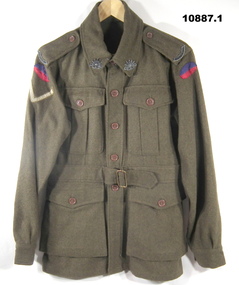
Uniform - REPLICA, ARMY, WW1, Unknown
... accessories and boots. 1. Jacket, khaki wool fabric. Collar with metal look plastic "Rising Sun" Badge. Shoulder epaulettes with buttons, two metal look plastic "AUSTRALIA" badges and two silver plastic Light Horse rectangular badge - an unofficial shoulder title. Front four patch pockets with button down flap. Sleeves with cuff and button colour patch, oval shape , purple over maroon, 38th Battalion AIF. Five front buttons - brown coloured plastic. One rank stripe - Lance Corporal. Pleated back and attached half belt...accessories and boots. 1. Jacket, khaki wool fabric. Collar with metal look plastic "Rising Sun" Badge. Shoulder epaulettes with buttons, two metal look plastic "AUSTRALIA" badges and two silver plastic Light Horse rectangular badge - an unofficial shoulder title. Front four patch pockets with button down flap. Sleeves with cuff and button colour patch, oval shape , purple over maroon, 38th Battalion AIF. Five front buttons - brown coloured plastic. One rank stripe - Lance Corporal. Pleated back and attached half belt ...Replica 38th Battalion AIF uniform, WW1, used for Museum displays and Bendigo RSL Commemorative Services.Replica Uniform, Army WW1. Jacket, Breeches with braces, Shirt, Puttees and Army leather accessories and boots. 1. Jacket, khaki wool fabric. Collar with metal look plastic "Rising Sun" Badge. Shoulder epaulettes with buttons, two metal look plastic "AUSTRALIA" badges and two silver plastic Light Horse rectangular badge - an unofficial shoulder title. Front four patch pockets with button down flap. Sleeves with cuff and button colour patch, oval shape , purple over maroon, 38th Battalion AIF. Five front buttons - brown coloured plastic. One rank stripe - Lance Corporal. Pleated back and attached half belt with metal slide buckle. Brown plastic buttons. 2. Breeches (fabric as above), ankle length close fitting trousers, snug fit below the knees with side opening and metal eyelets and ribbon laces. Five pockets - money pocket, two inset on an angle and back two inset. Numerous khaki plastic buttons at waist for braces, five button fly. 3. Shirt - grey wool flannel fabric with white cotton mandarin collar and 1/4 waistband. Half opening with three black plastic buttons. Long sleeves with cuff and three buttons. Shirt tails. 4. Braces - set of beige and green coloured cotton twill webbing with brown leather attachments for breeches. 5. Waist belt. Brown coloured leather with brass studs and metal buckle. Bayonet frog on belt. 6. & 7. Puttees - pair of khaki coloured long strips of woven wool fabric which are wrapped spirally around the lowe leg, ankle to knee. Ribbon tape on end. 8. & 9. Boots - pair of brown/tan coloured leather, above ankle height, boots with eight metal eyelets per side and brown leather laces. Size 11 on leather sole, heel with metal plate. uniform, replica, 38th battalion, aif, ww1
