
Showing 589 items matching "book rest"
-
 Flagstaff Hill Maritime Museum and Village
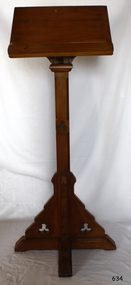
Furniture - Book Rest, circa 1930
... Book Rest......book rest...This altar book rest, also called a lectern, was part of the original furnishings of the St Nicholas' Mission to Seamen's Church at 139 Nelson Place, Williamstown, Victoria, operated by the Mission to Seamen organisation. ...Book rest, or lectern: This is a traditional book rest made of kauri pine with column support. ...Nicholas Seamen's Church Collection. Furniture Book Rest St Nicholas Seamen's Church ...This altar book rest, also called a lectern, was part of the original furnishings of the St Nicholas' Mission to Seamen's Church at 139 Nelson Place, Williamstown, Victoria, operated by the Mission to Seamen organisation. THE MISSIONS TO SEAMEN (Brief History): - The Missions to Seamen was an Anglican charity in Great Britain that has served the world's seafarers since 1856. Its symbol is a Flying Angel, inspired by a Bible verse. Today, there are centres in over 200 ports worldwide where seamen of all backgrounds are offered a warm welcome and provided with a wide range of facilities. In Victoria, the organisation began in Williamstown in 1857 as a Sailors’ Church, also known as ‘Bethel’ or the ‘Floating Church’ in an old hulk floating in Hobson’s Bay, Port of Melbourne. It soon became part of the Missions to Seamen, Victoria. In 2000, the organisation, now named Mission to Seafarers, still operated locally in Melbourne, Portland, Geelong and Hastings. The Ladies’ Harbour Lights Guild was formed in 1906 to support the Missions to Seamen in Melbourne and other centres, such as Williamstown. Two of the most significant ladies of the Guild were founder Ethel Augusta Godfrey and foundation member Alice Sibthorpe Tracy (who established a branch of the Guild in Warrnambool in 1920). The Guild continued its work until the 1960s. In 1943, a former Williamstown bank was purchased for the Missions to Seamen Club. The chapel was named St Nicholas’ Seamen’s Church and was supported by the Ladies’ Harbour Lights Guild, the Williamstown Lightkeepers’ Auxiliary and the League of Soldiers’ and Sailors’ Friends. It ceased operation in 1966. A Missions to Seamen Chapel and Recreation Room was a significant feature of ports during the late 1800s and 1900s. It seemed appropriate for Flagstaff Hill to include such a representation within the new Maritime Village, and the Melbourne Board of Management of Missions to Seamen Victoria gave its permission on 21st May 1979 for the entire furnishings of the Williamstown chapel to be transferred to Flagstaff Hill. The St Nicholas Seamen’s Church was officially opened on October 11, 1981, and resembles the Williamstown chapel. This altar book rest is significant historically for its origin in the St Nicholas Mission to Seamen's Church in Williamstown, established in 1857 to cater for the physical, social, and spiritual needs of seafarers. It originated in Bristol, England when a Seamen's Mission was formed in 1837. The lectern is historically significant for its connection to the Ladies Lightkeepers’ Auxiliary, an organisation of women, formed to support seafarers. The connection of this item to the Mission to Seamen and to the Ladies Lightkeepers’ Auxiliary highlights the strong community awareness of the life of people at sea, their dangers and hardships, and their need for physical, financial, spiritual and moral support. Book rest, or lectern: This is a traditional book rest made of kauri pine with column support. The top section, designed to support a Bible, has an angled backrest and shelf. The item has some decorative cutaway relief. This book restis part of the St. Nicholas Seamen's Church Collection. religious service, missions to seamen victoria, church furniture, religious worship, lectern, book rest, bible rest, preaching accessory, flagstaff hill, warrnambool, shipwrecked coast, flagstaff hill maritime museum, maritime museum, shipwreck coast, flagstaff hill maritime village, great ocean road, religion, sailors rest, bethel sailors’ church, bethel floating church, ladies harbour light guild, harbor lights guild, joy club for fighters, ladies lightkeepers’ auxiliary, mission to seafarers, flying angel’s club, st nicholas seamen’s church williamstown, st nicholas mission to seamen church williamstown, mission to seamen williamstown, st nicholas seamen’s church flagstaff hill, 139 nelson place williamstown, religious furniture, anglican church, altar book rest -
 Hymettus Cottage & Garden Ballarat
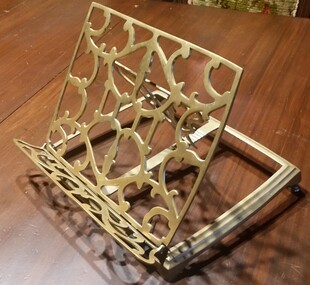
Functional object - Table book-rest/lectern, Table bookstand
... Table book-rest/lectern...Brass, bookstand, book-rest, altar lectern, reading, library, display, 19th century. church....Table bookstand Functional object Table book-rest/lectern ...Nineteenth century brass bookstand or table lectern used to hold book for reading or display purpose often deemed an essential item for the nineteenth and early twentieth century library. Also used as altar lectern in church items. This example was purchased to enhance reading in a household private library and also used to display books when on loan in the public domain in libraries and other repositories.brass, bookstand, book-rest, altar lectern, reading, library, display, 19th century. church. -
 Flagstaff Hill Maritime Museum and Village
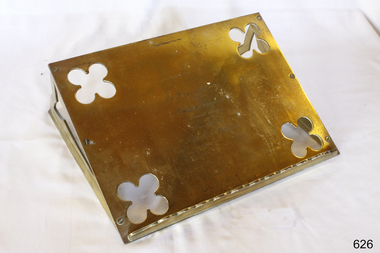
Functional object - Table-top Missal stand, after 1938
... ...book rest...This decorative brass table-top Missal stand was presented to the Missions to Seamen in Williamstown in memory of Richard Hodgkiss, after his death on December 14th 1938, by Mrs M A Hodgkiss. Decorative book rests like this one were used to support the Bible during services at the Williamstown Missions to Seamen and is now part of the St. ...Table-top Missal stand, also called a Bible rest, book rest or table top stand: brass, rectangular surface with clover motifs holes in each corner. ...Table-top Missal stand, also called a Bible rest, book rest or table top stand: brass, rectangular surface with clover motifs holes in each corner. ...This decorative brass table-top Missal stand was presented to the Missions to Seamen in Williamstown in memory of Richard Hodgkiss, after his death on December 14th 1938, by Mrs M A Hodgkiss. Decorative book rests like this one were used to support the Bible during services at the Williamstown Missions to Seamen and is now part of the St. Nicholas Seamen's Church Collection. THE MISSIONS TO SEAMEN (Brief History): - The Missions to Seamen was an Anglican charity in Great Britain that has served the world's seafarers since 1856. Its symbol is a Flying Angel, inspired by a Bible verse. Today, there are centres in over 200 ports worldwide where seamen of all backgrounds are offered a warm welcome and provided with a wide range of facilities. In Victoria, the organisation began in Williamstown in 1857 as a Sailors’ Church, also known as ‘Bethel’ or the ‘Floating Church’ in an old hulk floating in Hobson’s Bay, Port of Melbourne. It soon became part of the Missions to Seamen, Victoria. In the year 2000, the organisation, now named Mission to Seafarers, still operated locally in Melbourne, Portland, Geelong and Hastings. The Ladies’ Harbour Lights Guild was formed in 1906 to support the Missions to Seamen in Melbourne and other centres, such as Williamstown. Two of the most significant ladies of the Guild were founder Ethel Augusta Godfrey and foundation member Alice Sibthorpe Tracy (who established a branch of the Guild in Warrnambool in 1920). The Guild continued its work until the 1960s. In 1943, a former Williamstown bank was purchased for the Missions to Seaman Club. The chapel was named St Nicholas’ Seamen’s Church and was supported by the Ladies’ Harbour Lights Guild, the Williamstown Lightkeepers’ Auxiliary and the League of Soldiers’ and Sailors’ Friends. It ceased operation in 1966. A Missions to Seamen Chapel and Recreation Room was a significant feature of ports during the late 1800s and into the 1900s. It seemed appropriate for Flagstaff Hill to include such a representation within the new Maritime Village, so the Melbourne Board of Management of Missions to Seamen Victoria gave its permission on 21st May 1979 for the entire furnishings of the Williamstown chapel to be transferred to Flagstaff Hill. The St Nicholas Seamen’s Church was officially opened on October 11, 1981, and closely resembles the Williamstown chapel.This table-top Missal stand is historically significant for its origin in the St Nicholas Mission to Seamen's Church in Williamstown, established in 1857 to cater for the physical, social, and spiritual needs of seafarers. It originated in Bristol, England, when a Seamen's Mission was formed in 1837. It is socially important for its connection to the Williamstown St. Nicholas Seamen's church as it was dedicated to a family member.Table-top Missal stand, also called a Bible rest, book rest or table top stand: brass, rectangular surface with clover motifs holes in each corner. The triangular leg frames are screwed beneath the short sides to create a slope. The lower edge has a vertical, decorative shelf. The inscription on the top surface dedicates the book stand to Richard Hodgkiss, 1938. This book stand is part of the St. Nicholas Seamen's Church Collection. "In Loving Memory of Richard Hodgkiss - passed away 14 12 38. Presented by Mrs M A Hodgkiss."flagstaff hill, warrnambool, shipwrecked coast, flagstaff hill maritime museum, maritime museum, shipwreck coast, flagstaff hill maritime village, great ocean road, religious service, missions to seamen victoria, st nicholas seaman’s church williamstown, church furniture, religious worship, bible rest, tabletop lectern, bible reading, preaching accessory, book rest, memorial object, m a hodgkiss, richard hodgkiss, missel table book stand, book stand, bible stand, table-top stand, table-top book rest, table-top missal stand, missal desk -
 Flagstaff Hill Maritime Museum and Village
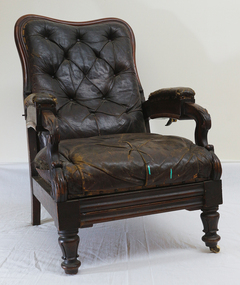
Furniture - Chair, Haberfield Chair, Michael Bradshaw, Circa 1860s-1890s
... ...book rest...The Haberfield Chair is a reclining armchair that includes a footrest and a detachable book rest. The chair features a dark timber frame and dark burgundy (now dark brown), Morocco goat skin leather upholstery. ...Flagstaff Hill Maritime Museum and Village Great Ocean Road Shipwreck Coast armchair reclining armchair reading board Mahogany chair Haberfield Chair furniture living room furniture domestic furniture 19th century luxury Morroco leather book stand book rest side table music stand reading stand reading rest foot rest reading table In pen and ink: “Made from Mahogany Ship wrecked near Tower Hill, July 3, 1835: made by Michael Bradshaw 18-2-“ [originally thought to read 1842] The Haberfield Chair is a reclining armchair that includes a footrest and a detachable book rest. ...This elegant reclining armchair is generously on loan from the local Haberfield family. Mrs Haberfield is a member of the Anderson family from the Tower Hill region, and the chair was handed down to her from them. When it arrived at Flagstaff Hill in 2009, it was at least 100 years old. The maker, Michael Bradshaw, is currently unknown. The origin of the chair's timber has been lost through the generations, but some have named the armchair the 'Mahogany Chair' after the legendary Mahogany Ship. In August 2009, the wood was expertly examined. The structure of the wood specimens was found to be consistent with: • Pale coloured carcass timber - Fagus sylvatica – Beech (European) • Pale coloured frame timber - Agathis sp – NZ Kauri • Dark coloured timber chair legs (solid) - Swietenia sp. – True Mahogany • Dark coloured timber veneer - Swietenia sp. – True Mahogany • Repair fill-in piece – Quercus sp. – White Oak ( Northern hemisphere) • Repair fill-in piece (fine textured) – Populus sp. – Poplar • Runner wood - Eucalyptus sp – Pale coloured ash group, or messmate The chair is significant for its local origin and history, being connected to generations of the Anderson and Haberfield families. It is also significant for its elaborate and unusual design, the quality of its workmanship and materials. It is a fine example of good quality furniture of the late 19th century.The Haberfield Chair is a reclining armchair that includes a footrest and a detachable book rest. The chair features a dark timber frame and dark burgundy (now dark brown), Morocco goat skin leather upholstery. The backrest is finished with button detailing, and its frame is distinguished by gracefully curved corners, lending the chair an elegant appearance. The chair’s padded leather armrests have attractive, crafted carvings at each end. A lever located below the armrest operates the recliner’s ratchet mechanism, which also causes a footrest to slide forward for greater comfort. The turned and carved front legs are equipped with wheels, allowing for easy movement. The removable book rest is mounted on a brass pedestal. Its angle can be conveniently adjusted using a screw to move the ball and socket joint, ensuring personalised reading comfort. There is a handwritten inscription on the underside of the back rail. The chair is kindly on loan from the local Haberfield family. In pen and ink: “Made from Mahogany Ship wrecked near Tower Hill, July 3, 1835: made by Michael Bradshaw 18-2-“ [originally thought to read 1842]flagstaff hill maritime museum and village, great ocean road, shipwreck coast, armchair, reclining armchair, reading board, mahogany chair, haberfield chair, furniture, living room furniture, domestic furniture, 19th century, luxury, morroco leather, book stand, book rest, side table, music stand, reading stand, reading rest, foot rest, reading table -
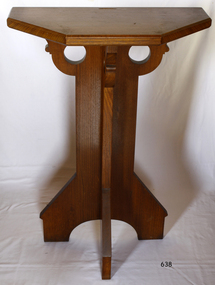 Flagstaff Hill Maritime Museum and Village
Furniture - Credence Table, c. 1944
... ...book rest...It is also significant for its connection with the church Eucharist service still being performed in the Anglican church as part of its traditional worship. flagstaff hill warrnambool religious service missions to seamen victoria church furniture religious worship pedestal book rest book stand bible rest church service Shipwrecked coast Flagstaff Hill Maritime Museum Maritime Museum Shipwreck coast Flagstaff Hill Maritime Village Great Ocean Road credence table pentagonal table half-table Eucarist Holy Communion Anglican church Communion Service tradition ritual worship Mrs F Clark ecclesiastical furniture side table small table Credence table; traditional design in timber. ...Mrs F Clark donated this Credence Table to the original St Nicholas Seamen's Church, Williamstown, Victoria, operated by the Missions to Seamen organisation. The oak table is decorated with Gothic trefoils and shaped to fit against the Sanctuary wall. Its purpose is to hold the Eucarist plate and chalice for the Holy Communion service of the Anglican Church. THE MISSIONS TO SEAMEN (Brief History): - The Missions to Seamen was an Anglican charity in Great Britain that has served the world's seafarers since 1856. Its symbol is a Flying Angel, inspired by a Bible verse. Today, there are centres in over 200 ports worldwide where seamen of all backgrounds are offered a warm welcome and provided with a wide range of facilities. In Victoria, the organisation began in Williamstown in 1857 as a Sailors’ Church, also known as ‘Bethel’ or the ‘Floating Church’ in an old hulk floating in Hobson’s Bay, Port of Melbourne. It soon became part of the Missions to Seamen, Victoria. In the year 2000, the organisation, now named Mission to Seafarers, still operated locally in Melbourne, Portland, Geelong and Hastings. The Ladies’ Harbour Lights Guild was formed in 1906 to support the Missions to Seamen in Melbourne and other centres, such as Williamstown. Two of the most significant ladies of the Guild were founder Ethel Augusta Godfrey and foundation member Alice Sibthorpe Tracy (who established a branch of the Guild in Warrnambool in 1920). The Guild continued its work until the 1960s. In 1943, a former Williamstown bank was purchased for the Missions to Seaman Club. The chapel was named St Nicholas’ Seamen’s Church and was supported by the Ladies’ Harbour Lights Guild, the Williamstown Lightkeepers’ Auxiliary and the League of Soldiers’ and Sailors’ Friends. It ceased operation in 1966. A Missions to Seamen Chapel and Recreation Room was a significant feature of ports during the late 1800s and into the 1900s. It seemed appropriate for Flagstaff Hill to include such a representation within the new Maritime Village, so the Melbourne Board of Management of Missions to Seamen Victoria gave its permission on 21st May 1979 for the entire furnishings of the Williamstown chapel to be transferred to Flagstaff Hill. The St Nicholas Seamen’s Church was officially opened on October 11, 1981, and closely resembles the Williamstown chapel. This Chrdence table is historically significant for its origin in the St Nicholas Mission to Seamen's Church in Williamstown, established in 1857 to cater for seafarers’ physical, social, and spiritual needs. The organisation originated in Bristol, England, when a Seamen's Mission was formed in 1837. It is also significant for its connection with the church Eucharist service still being performed in the Anglican church as part of its traditional worship.Credence table; traditional design in timber. The solid oak pedestal is shaped like half an octagon with the long side fitting against a flat, vertical surface. The column support has decorative Gothic trefoil cut-away holes. This item is part of the St. Nicholas Seamen's Church Collection. flagstaff hill, warrnambool, religious service, missions to seamen victoria, church furniture, religious worship, pedestal, book rest, book stand, bible rest, church service, shipwrecked coast, flagstaff hill maritime museum, maritime museum, shipwreck coast, flagstaff hill maritime village, great ocean road, credence table, pentagonal table, half-table, eucarist, holy communion, anglican church, communion service, tradition, ritual, worship, mrs f clark, ecclesiastical furniture, side table, small table -
 Greensborough Historical Society
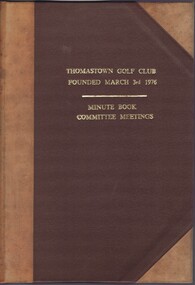
Administrative record - Minute Book, Thomastown Golf Club et al, Thomastown Golf Club Minute books - Committee Meetings 25/03/1976, 25/03/1976
... Minute book with one entry. Rest of book is blank....Thomastown Golf Club Bob Jones minute books committee meetings Handwritten minutes. Minute book with one entry. Rest of book is blank. Thomastown Golf Club Minute books - Committee Meetings 25/03/1976 Administrative record Minute Book Thomastown Golf Club Robert Jones ...Book used by Thomastown Golf Club to record minutes of Committee Meeting 25/03/1976. One entry only in this book. Maintained by Robert (Bob) Jones, Golf Club Secretary.Thomastown Golf Club was a social club formed in 1976. This is part of the Robert (Bob) Jones collection of Club memorabilia.Minute book with one entry. Rest of book is blank.Handwritten minutes.thomastown golf club, bob jones, minute books, committee meetings -
 Ballarat Clarendon College
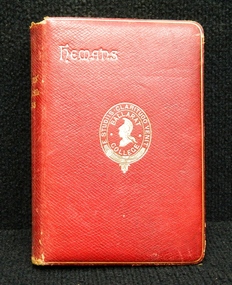
Book, William Michael Rossetti, The poetical works of Mrs. Felicia Hemans, Prior to the book prize presented on Christmas, 1891
... book-prize...miners-rest...Book was awarded to Stephen John Holgate in 1891 for first prize in bookkeeping. Stephen (D.O.B. 09/07/1877) entered the college on 27/01/1890. The original registry notes parent as Stephen Holgate from Miners Rest and Stephen's previously school is noted as 'Home Tuition'. ...Connection to college war memorabilia and war heroes. stephen-john-holgate 1891 book-prize miners-rest harold-holgate george-holgate edward-holgate robert-holgate thomas-holgate. ...Book was awarded to Stephen John Holgate in 1891 for first prize in bookkeeping. Stephen (D.O.B. 09/07/1877) entered the college on 27/01/1890. The original registry notes parent as Stephen Holgate from Miners Rest and Stephen's previously school is noted as 'Home Tuition'. Other family members noted as attending the college are Harold, George, Edward, Robert and Thomas. Archives also hold war memorabilia for Edward and George Holgate.Presbyterian educators placed great value on a classical education matched with diligence in study. Book prizes were highly regarded and academic success admired. In the school’s early years prizes were ordered direct from London and had the school crest embossed in gold on the front or back cover. Many of the prizes given in early years were returned to the school to equip the Weatherly Library when it opened in 1936. Connection to college war memorabilia and war heroes.Bound in soft red calf with gilt lettering and college crest embossed on front cover and gilt lettering on spine. Floral end papers, foxing on pages, black and white illustrations throughout. 595 p.Book plate inside front cover: College crest/ Bookkeeping/ V Form./ First Prize. Awarded to/ S. Holgate/ Christmas, 1891.stephen-john-holgate, 1891, book-prize, miners-rest, harold-holgate, george-holgate, edward-holgate, robert-holgate, thomas-holgate. -
 Linton and District Historical Society Inc
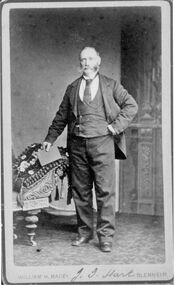
Photograph, William H Macey, Blenheim, J. J. Hart
... Sepia photograph of a gentleman with moustache and side whiskers, wearing three piece suit, collar and tie, standing with left arm crooked at waist, right arm holding a book resting on the end of an carved chaise-longue....Sepia photograph of a gentleman with moustache and side whiskers, wearing three piece suit, collar and tie, standing with left arm crooked at waist, right arm holding a book resting on the end of an carved chaise-longue. ...Sepia photograph of a gentleman with moustache and side whiskers, wearing three piece suit, collar and tie, standing with left arm crooked at waist, right arm holding a book resting on the end of an carved chaise-longue."J J Hart".mr j. j. hart -
 Vision Australia
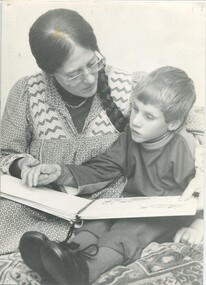
Photograph - Image, A woman helps a boy feel the pages of a print-Braille book, 197
... A woman and a boy sit on a couch, with a Braille book resting on their laps. The woman turns towards the boy as she guides his hand along the page to feel the Braille....A woman and a boy sit on a couch, with a Braille book resting on their laps. The woman turns towards the boy as she guides his hand along the page to feel the Braille. ...A woman and a boy sit on a couch, with a Braille book resting on their laps. The woman turns towards the boy as she guides his hand along the page to feel the Braille.1 black and white photograph of female with male childroyal victorian institute for the blind, education, braille -
 Musculoskeletal Health Australia (now held by the Glen Eira Historical Society)
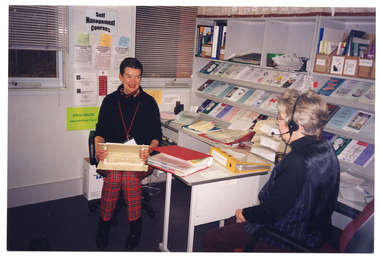
Photograph - Group photo, Circa May 2000
... One woman is wearing a telephone headset and the other woman is holding a wooden book rest on her lap. There are two large folders on the desk, and on top of the desks (against the wall), there are shelves containing brochures and folders. ...One woman is wearing a telephone headset and the other woman is holding a wooden book rest on her lap. There are two large folders on the desk, and on top of the desks (against the wall), there are shelves containing brochures and folders. ...The Arthritis Foundation of Victoria's Telephone Information Service (TIS) was staffed by volunteers, and provided information and referral services to members. In this photo, volunteer members, Judy Pullar and Joan Cotton, are doing a shift in the Telephone Information Service (TIS) room.Colour photo of two women seated at two desks against the wall. One woman is wearing a telephone headset and the other woman is holding a wooden book rest on her lap. There are two large folders on the desk, and on top of the desks (against the wall), there are shelves containing brochures and folders. On another wall, there is a sign on the wall between two windows that says, "Self Management Courses".[On a yellow sticky note, handwritten in black ink - archivist's notes] TIS [underlined] (L) Judy Pullar (R) Joan Cotton Probably MAY to JUNE ["to JUNE" has been crossed out several times] 2000? ["?" has been crossed out]arthritis foundation of victoria, afv, telephone information service, tis, telephone enquiries, joan cotton, judy pullar, volunteer members, 2000 -
 Flagstaff Hill Maritime Museum and Village
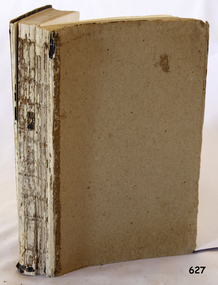
Badge - Religious Book, The Book of Common Prayer, 1928-1944
... Logo: [Shield enclosing three crowns and an open book with test, resting on six rods] Inscription: "Florence Harrison"...Flagstaff Hill Maritime Museum and Village Flagstaff Hill Warrnambool Maritime Museum Maritime Village Shipwreck Coast Great Ocean Road Religion Religious service St Nicholas Seamen’s Church Williamstown Missions to Seamen Victoria Prayer Book The Book of Common Prayer Oxford University Press Florence Harrison church service Logo: [Shield enclosing three crowns and an open book with test, resting on six rods] Inscription: "Florence Harrison" Prayer book, cardboard front cover, textured black cover, rice paper pages with gold leaf edges. ...Prayer book, cardboard front cover, textured black cover, rice paper pages with gold leaf edges. "The Book of Common Prayer with the additions and deviations proposed in 1928".There is an image on the fly page. Published in Oxford at the University Press London. The book was owned by Florence Harrison. The book is now part of the St Nicholas Seamen's Church Collection. flagstaff hill maritime museum and village, flagstaff hill, warrnambool, maritime museum, maritime village, shipwreck coast, great ocean road, religion, religious service, st nicholas seamen’s church, williamstown, missions to seamen victoria, prayer book, the book of common prayer, oxford university press, florence harrison, church service -
 Linton and District Historical Society Inc
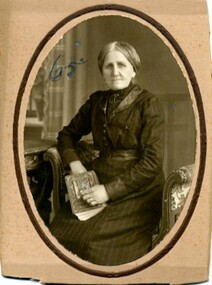
Photograph, Mrs Rule
... Oval sepia portrait of a lady seated in armchair with left hand resting on a book, right arm resting on arm of chair....Part of Old Lintonian collection ; No. 65 Mrs Rule (nee Hodge) Old Lintonian Collection Oval sepia portrait of a lady seated in armchair with left hand resting on a book, right arm resting on arm of chair. ...Part of Old Lintonian collection ; No. 65Oval sepia portrait of a lady seated in armchair with left hand resting on a book, right arm resting on arm of chair.mrs rule (nee hodge), old lintonian collection -
 Linton and District Historical Society Inc
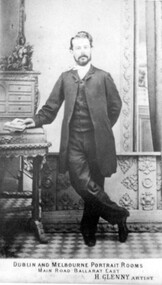
Photograph, H. Glenny, artist, Dublin and Melbourne Portrait Rooms, Main Rd, Ballarat East, Reverend John Seccombe
... Bearded gentleman in frock coat, right hand resting on book on table....Bearded gentleman in frock coat, right hand resting on book on table. Reverend John Seccombe Photograph H. ...John Seccombe was Wesleyan minister of the Scarsdale and Linton circuit, 1890 - 93.Copy of sepia photograph of Rev John Seccombe. Bearded gentleman in frock coat, right hand resting on book on table."Rev. John Seccombe, Wesleyan minister of Scarsdale and Linton circuit 1890 - 93".john seccombe -
 Diamond Valley Vietnam Veterans Sub-Branch
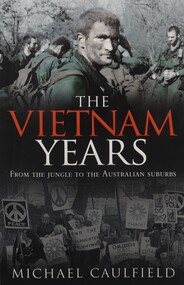
Book - n/a, The Vietnam Years (From the Jungle To the Australian Suburbs)
... Cover of the book has at the top, a picture of Australian soldiers in Vietnam; at the bottom presents pictures of activities in Australia at same time of pictures of anti-war protestors. The book tile rests in the middle of the cover: The Vietnam Years. ...One of many books written about the Vietnam War (Australia). vietnam vietnam war diamond valley vietnam veterans sub branch Cover of the book has at the top, a picture of Australian soldiers in Vietnam; at the bottom presents pictures of activities in Australia at same time of pictures of anti-war protestors. The book tile rests in the middle of the cover: The Vietnam Years. ...The authors presentation of the years of the Vietnam War both in Vietnam and in Australia.One of many books written about the Vietnam War (Australia).Book, Paperback - The Vietnam Years (from the jungle to the Australian suburbs) by Michael Caulfield; Published 2007.Cover of the book has at the top, a picture of Australian soldiers in Vietnam; at the bottom presents pictures of activities in Australia at same time of pictures of anti-war protestors. The book tile rests in the middle of the cover: The Vietnam Years. From the jungle to the Australian suburbs. The authors name is at the very bottom of the cover: Michael Caulfield. vietnam, vietnam war, diamond valley vietnam veterans sub branch -
 Linton and District Historical Society Inc
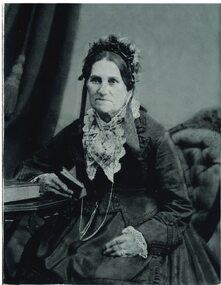
Photograph, Geo Richards studio photographer opposite Star office, Ballarat, Mrs Joseph Linton, nee Mary Dunlop
... Sepia photograph of a woman wearing a gown with a lace collar and cap, seated with right arm resting on book on table, left arm resting on lap....Part of Old Lintonian collection ; No. 12 Mrs Joseph Linton Mary Linton Mary Dunlop Old Lintonian collection Sepia photograph of a woman wearing a gown with a lace collar and cap, seated with right arm resting on book on table, left arm resting on lap. ...Mary Linton, nee Dunlop, was born in 1809 the West Indies, and married Joseph Linton in Scotland when she was eighteen. Mary and Joseph Linton migrated to Victoria in 1839, and took up a pastoral lease in the Wardy Yaloak district which they called Emu Hill. They had eleven children, ten of whom survived to adulthood. Mary died in Ballarat in 1887. The township of Linton derives its name from this family. Part of Old Lintonian collection ; No. 12Sepia photograph of a woman wearing a gown with a lace collar and cap, seated with right arm resting on book on table, left arm resting on lap.mrs joseph linton, mary linton, mary dunlop, old lintonian collection -
 Linton and District Historical Society Inc
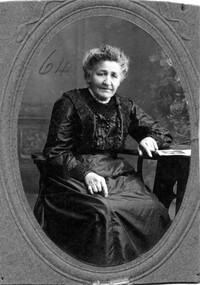
Photograph, Mrs Ellen Gray, née Hodge
... Oval photograph of a lady wearing high necked long costume, seated with left hand resting on book on side table, right hand resting on lap....Ellen Selina Gray née Ellen Selina Hodge Old Lintonian Collection Oval photograph of a lady wearing high necked long costume, seated with left hand resting on book on side table, right hand resting on lap. ...Part of Old Lintonian collection ; No. 64. Ellen Gray was the daughter of Linton miner William Hodge, and the mother of singer Nellie Gray.Oval photograph of a lady wearing high necked long costume, seated with left hand resting on book on side table, right hand resting on lap.ellen selina gray née ellen selina hodge, old lintonian collection -
 Linton and District Historical Society Inc
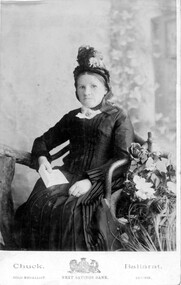
Photograph, The Queen Studio Ballarat Chuck Artist, Mrs William Blamire
... Sepia photograph of a well dressed woman wearing gown and hat, seated with right hand resting on a table while holding a book and left hand resting on her lap....Mrs William Blamire Mary Ann Blamire Old Lintonian Collection "Mary Ann Blamire wife of William Blamire of Linton" "1633" Sepia photograph of a well dressed woman wearing gown and hat, seated with right hand resting on a table while holding a book and left hand resting on her lap. ...Sepia photograph of a well dressed woman wearing gown and hat, seated with right hand resting on a table while holding a book and left hand resting on her lap."Mary Ann Blamire wife of William Blamire of Linton" "1633"mrs william blamire, mary ann blamire, old lintonian collection -
 Linton and District Historical Society Inc
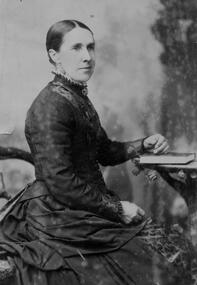
Photograph, Mrs. C. Smith
... Sepia photograph of a woman with hair drawn back off face, wearing long sleeved high necked long gown with bustle, seated with left hand resting on book on side table, right arm on lap....Smith Old Lintonian collection Sepia photograph of a woman with hair drawn back off face, wearing long sleeved high necked long gown with bustle, seated with left hand resting on book on side table, right arm on lap. ...Part of Old Lintonian collection ; No. 107.Sepia photograph of a woman with hair drawn back off face, wearing long sleeved high necked long gown with bustle, seated with left hand resting on book on side table, right arm on lap.mrs c. smith, old lintonian collection -
 Bendigo Historical Society Inc.
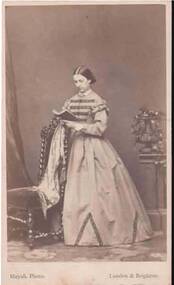
Photograph - PORTRAIT OF A LADY
... Small full length portrait of a lady standing beside a chair reading a book which is resting on the back of the chair. She is wearing a long high neck dress with frills at the sleeve tops and dark bands across the bodice. ...PHOTOGRAPH Portrait female Portrait of a Lady Mayall Mayall, 224 Regent Street, London. 90 King's Road, Brighton Small full length portrait of a lady standing beside a chair reading a book which is resting on the back of the chair. She is wearing a long high neck dress with frills at the sleeve tops and dark bands across the bodice. ...Small full length portrait of a lady standing beside a chair reading a book which is resting on the back of the chair. She is wearing a long high neck dress with frills at the sleeve tops and dark bands across the bodice. The dark material is also repeated at the hem in a V shape. Photographer's name and address printed on the front and back.Mayall, 224 Regent Street, London. 90 King's Road, Brightonphotograph, portrait, female, portrait of a lady, mayall -
 Flagstaff Hill Maritime Museum and Village
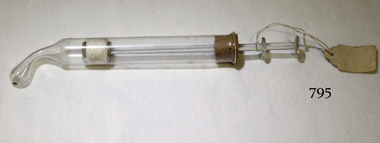
Equipment - Syringe
... rest. He would visit 3 or 4 country patients on a Sunday, taking his children along ‘for the ride’ and to visit with him. Sunday evenings he would play the pianola and sing Scottish songs to his family. One of Dr Angus’ patients was Margaret MacKenzie, author of a book...rest. He would visit 3 or 4 country patients on a Sunday, taking his children along ‘for the ride’ and to visit with him. Sunday evenings he would play the pianola and sing Scottish songs to his family. One of Dr Angus’ patients was Margaret MacKenzie, author of a book ...In 1821 the French otologist Jean Marc Itard irrigated the ear canal to remove hard wax, by using a syringe prototype designed for enemas which was made from tin and brass. This glass and cork ear syringe was manufactured by the Ambson Company in the United Kingdom, about eighty years afterwards. Its lightweight properties would have been ideal for application to the sensitive regions of the ear canal. https://www.racgp.org.au/the-racgp/history/the-racgp-museum-collection/syringes/ambson-ear-syringe Otology is a branch of medicine which studies normal and pathological anatomy and physiology of the ear (hearing and vestibular sensory systems and related structures and functions) as well as their diseases, diagnosis and treatment. Otologic surgery generally refers to surgery of the middle ear and mastoid related to chronic otitis media, such as tympanoplasty, or ear drum surgery, ossiculoplasty, or surgery of the hearing bones, and mastoidectomy. Otology also includes surgical treatment of conductive hearing loss, such as stapedectomy surgery for otosclerosis. https://en.wikipedia.org/wiki/Otology The ear syringe was donated to Flagstaff Hill Maritime Village by the family of Doctor William Roy Angus, Surgeon and Oculist. It is part of the “W.R. Angus Collection” includes historical medical equipment, surgical instruments and material once belonging to Dr Edward Ryan and Dr Thomas Francis Ryan, (both of Nhill, Victoria) as well as Dr Angus’ own belongings. The Collection’s history spans the medical practices of the two Doctors Ryan, from 1885-1926 plus that of Dr Angus, up until 1969. ABOUT THE “W.R.ANGUS COLLECTION” Doctor William Roy Angus M.B., B.S., Adel., 1923, F.R.C.S. Edin.,1928 (also known as Dr Roy Angus) was born in Murrumbeena, Victoria in 1901 and lived until 1970. He qualified as a doctor in 1923 at University of Adelaide, was Resident Medical Officer at the Royal Adelaide Hospital in 1924 and for a period was house surgeon to Sir (then Mr.) Henry Simpson Newland. Dr Angus was briefly an Assistant to Dr Riddell of Kapunda, then commenced private practice at Curramulka, Yorke Peninsula, SA, where he was physician, surgeon and chemist. In 1926, he was appointed as new Medical Assistant to Dr Thomas Francis Ryan (T.F. Ryan, or Tom), in Nhill, Victoria, where his experiences included radiology and pharmacy. In 1927 he was Acting House Surgeon in Dr Tom Ryan’s absence. Dr Angus had become engaged to Gladys Forsyth and they decided he further his studies overseas in the UK in 1927. He studied at London University College Hospital and at Edinburgh Royal Infirmary and in 1928, was awarded FRCS (Fellow from the Royal College of Surgeons), Edinburgh. He worked his passage back to Australia as a Ship’s Surgeon on the on the Australian Commonwealth Line’s T.S.S. Largs Bay. Dr Angus married Gladys in 1929, in Ballarat. (They went on to have one son (Graham 1932, born in SA) and two daughters (Helen (died 12/07/1996) and Berenice (Berry), both born at Mira, Nhill ) According to Berry, her mother Gladys made a lot of their clothes. She was very talented and did some lovely embroidery including lingerie for her trousseau and beautifully handmade baby clothes. Dr Angus was a ‘flying doctor’ for the A.I.M. (Australian Inland Ministry) Aerial Medical Service in 1928 . Its first station was in the remote town of Oodnadatta, where Dr Angus was stationed. He was locum tenens there on North-South Railway at 21 Mile Camp. He took up this ‘flying doctor’ position in response to a call from Dr John Flynn; the organisation was later known as the Flying Doctor Service, then the Royal Flying Doctor Service. A lot of his work during this time involved dental surgery also. Between 1928-1932 he was surgeon at the Curramulka Hospital, Yorke Peninsula, South Australia. In 1933 Dr Angus returned to Nhill and purchased a share of the Nelson Street practice and Mira hospital (a 2 bed ward at the Nelson Street Practice) from Dr Les Middleton one of the Middleton Brothers, the current owners of what previously once Dr Tom Ryan’s practice. Dr Tom and his brother had worked as surgeons included eye surgery. Dr Tom Ryan performed many of his operations in the Mira private hospital on his premises. He had been House Surgeon at the Nhill Hospital 1902-1926. Dr Tom Ryan had one of the only two pieces of radiology equipment in Victoria during his practicing years – The Royal Melbourne Hospital had the other one. Over the years Dr Tom Ryan had gradually set up what was effectively a training school for country general-practitioner-surgeons. Each patient was carefully examined, including using the X-ray machine, and any surgery was discussed and planned with Dr Ryan’s assistants several days in advance. Dr Angus gained experience in using the X-ray machine there during his time as assistant to Dr Ryan. When Dr Angus bought into the Nelson Street premises in Nhill he was also appointed as the Nhill Hospital’s Honorary House Surgeon 1933-1938. His practitioner’s plate from his Nhill surgery is now mounted on the doorway to the Port Medical Office at Flagstaff Hill Maritime Village, Warrnambool. When Dr Angus took up practice in the Dr Edward and Dr Tom Ryan’s old premises he obtained their extensive collection of historical medical equipment and materials spanning 1884-1926. A large part of this collection is now on display at the Port Medical Office at Flagstaff Hill Maritime Village in Warrnambool. In 1939 Dr Angus and his family moved to Warrnambool where he purchased “Birchwood,” the 1852 home and medical practice of Dr John Hunter Henderson, at 214 Koroit Street. (This property was sold in1965 to the State Government and is now the site of the Warrnambool Police Station. and an ALDI sore is on the land that was once their tennis court). The Angus family was able to afford gardeners, cooks and maids; their home was a popular place for visiting dignitaries to stay whilst visiting Warrnambool. Dr Angus had his own silk worm farm at home in a Mulberry tree. His young daughter used his centrifuge for spinning the silk. Dr Angus was appointed on a part-time basis as Port Medical Officer (Health Officer) in Warrnambool and held this position until the 1940’s when the government no longer required the service of a Port Medical Officer in Warrnambool; he was thus Warrnambool’s last serving Port Medical Officer. (Masters of immigrant ships arriving in port reported incidents of diseases, illness and death and the Port Medical Officer made a decision on whether the ship required Quarantine and for how long, in this way preventing contagious illness from spreading from new immigrants to the residents already in the colony.) Dr Angus was a member of the Australian Medical Association, for 35 years and surgeon at the Warrnambool Base Hospital 1939-1942, He served with the Australian Department of Defence as a Surgeon Captain during WWII 1942-45, in Ballarat, Victoria, and in Bonegilla, N.S.W., completing his service just before the end of the war due to suffering from a heart attack. During his convalescence he carved an intricate and ‘most artistic’ chess set from the material that dentures were made from. He then studied ophthalmology at the Royal Melbourne Eye and Ear Hospital and created cosmetically superior artificial eyes by pioneering using the intrascleral cartilage. Angus received accolades from the Ophthalmological Society of Australasia for this work. He returned to Warrnambool to commence practice as an ophthalmologist, pioneering in artificial eye improvements. He was Honorary Consultant Ophthalmologist to Warrnambool Base Hospital for 31 years. He made monthly visits to Portland as a visiting surgeon, to perform eye surgery. He represented the Victorian South-West subdivision of the Australian Medical Association as its secretary between 1949 and 1956 and as chairman from 1956 to 1958. In 1968 Dr Angus was elected member of Spain’s Barraquer Institute of Barcelona after his research work in Intrasclearal cartilage grafting, becoming one of the few Australian ophthalmologists to receive this honour, and in the following year presented his final paper on Living Intrasclearal Cartilage Implants at the Inaugural Meeting of the Australian College of Ophthalmologists in Melbourne In his personal life Dr Angus was a Presbyterian and treated Sunday as a Sabbath, a day of rest. He would visit 3 or 4 country patients on a Sunday, taking his children along ‘for the ride’ and to visit with him. Sunday evenings he would play the pianola and sing Scottish songs to his family. One of Dr Angus’ patients was Margaret MacKenzie, author of a book on local shipwrecks that she’d seen as an eye witness from the late 1880’s in Peterborough, Victoria. In the early 1950’s Dr Angus, painted a picture of a shipwreck for the cover jacket of Margaret’s book, Shipwrecks and More Shipwrecks. She was blind in later life and her daughter wrote the actual book for her. Dr Angus and his wife Gladys were very involved in Warrnambool’s society with a strong interest in civic affairs. He had an interest in people and the community They were both involved in the creation of Flagstaff Hill, including the layout of the gardens. After his death (28th March 1970) his family requested his practitioner’s plate, medical instruments and some personal belongings be displayed in the Port Medical Office surgery at Flagstaff Hill Maritime Village, and be called the “W. R. Angus Collection”.The W.R. Angus Collection is significant for still being located at the site it is connected with, Doctor Angus being the last Port Medical Officer in Warrnambool. The collection of medical instruments and other equipment is culturally significant, being an historical example of medicine from late 19th to mid-20th century. Dr Angus assisted Dr Tom Ryan, a pioneer in the use of X-rays and in ocular surgery.Glass ear syringe. Has cork stopper at top and cotton wrapped at base of plunger. Has a curved end.None.flagstaff hill, warrnambool, shipwrecked-coast, flagstaff-hill, flagstaff-hill-maritime-museum, maritime-museum, shipwreck-coast, flagstaff-hill-maritime-village, otology, ears, ear syringe, deafness, ear wax -
 Flagstaff Hill Maritime Museum and Village
Gauze Bandage
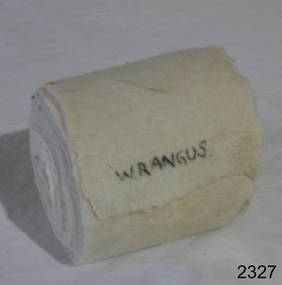
... rest. He would visit 3 or 4 country patients on a Sunday, taking his children along ‘for the ride’ and to visit with him. Sunday evenings he would play the pianola and sing Scottish songs to his family. One of Dr Angus’ patients was Margaret MacKenzie, author of a book...rest. He would visit 3 or 4 country patients on a Sunday, taking his children along ‘for the ride’ and to visit with him. Sunday evenings he would play the pianola and sing Scottish songs to his family. One of Dr Angus’ patients was Margaret MacKenzie, author of a book ...This gauze bandage was donated to Flagstaff Hill Maritime Village by the family of Doctor William Roy Angus, Surgeon and Oculist. It is part of the “W.R. Angus Collection” that includes historical medical equipment, surgical instruments and material once belonging to Dr Edward Ryan and Dr Thomas Francis Ryan, (both of Nhill, Victoria) as well as Dr Angus’ own belongings. The Collection’s history spans the medical practices of the two Doctors Ryan, from 1885-1926 plus that of Dr Angus, up until 1969. ABOUT THE “W.R.ANGUS COLLECTION” Doctor William Roy Angus M.B., B.S., Adel., 1923, F.R.C.S. Edin.,1928 (also known as Dr Roy Angus) was born in Murrumbeena, Victoria in 1901 and lived until 1970. He qualified as a doctor in 1923 at University of Adelaide, was Resident Medical Officer at the Royal Adelaide Hospital in 1924 and for a period was house surgeon to Sir (then Mr.) Henry Simpson Newland. Dr Angus was briefly an Assistant to Dr Riddell of Kapunda, then commenced private practice at Curramulka, Yorke Peninsula, SA, where he was physician, surgeon and chemist. In 1926, he was appointed as new Medical Assistant to Dr Thomas Francis Ryan (T.F. Ryan, or Tom), in Nhill, Victoria, where his experiences included radiology and pharmacy. In 1927 he was Acting House Surgeon in Dr Tom Ryan’s absence. Dr Angus had become engaged to Gladys Forsyth and they decided he would take time to further his studies overseas in the UK in 1927. He studied at London University College Hospital and at Edinburgh Royal Infirmary and in 1928, was awarded FRCS (Fellow from the Royal College of Surgeons), Edinburgh. He worked his passage back to Australia as a Ship’s Surgeon on the on the Australian Commonwealth Line’s T.S.S. Largs Bay. Dr Angus married Gladys in 1929, in Ballarat. (They went on to have one son (Graham 1932, born in SA) and two daughters (Helen (died 12/07/1996) and Berenice (Berry), both born at Mira, Nhill ) Dr Angus was a ‘flying doctor’ for the A.I.M. (Australian Inland Ministry) Aerial Medical Service in 1928 . The organisation began in South Australia through the Presbyterian Church in that year, with its first station being in the remote town of Oodnadatta, where Dr Angus was stationed. He was locum tenens there on North-South Railway at 21 Mile Camp. He took up this ‘flying doctor’ position in response to a call from Dr John Flynn; the organisation was later known as the Flying Doctor Service, then the Royal Flying Doctor Service. A lot of his work during this time involved dental surgery also. Between 1928-1932 he was surgeon at the Curramulka Hospital, Yorke Peninsula, South Australia. In 1933 Dr Angus returned to Nhill where he’d previously worked as Medical Assistant and purchased a share of the Nelson Street practice and Mira hospital from Dr Les Middleton one of the Middleton Brothers, the current owners of what was once Dr Tom Ryan’s practice. Dr L Middleton was House Surgeon to the Nhill Hospital 1926-1933, when he resigned. [Dr Tom Ryan’s practice had originally belonged to his older brother Dr Edward Ryan, who came to Nhill in 1885. Dr Edward saw patients at his rooms, firstly in Victoria Street and in 1886 in Nelson Street, until 1901. The Nelson Street practice also had a 2 bed ward, called Mira Private Hospital ). Dr Edward Ryan was House Surgeon at the Nhill Hospital 1884-1902 . He also had occasions where he successfully performed veterinary surgery for the local farmers too. Dr Tom Ryan then purchased the practice from his brother in 1901. Both Dr Edward and Dr Tom Ryan work as surgeons included eye surgery. Dr Tom Ryan performed many of his operations in the Mira private hospital on his premises. He too was House Surgeon at the Nhill Hospital 1902-1926. Dr Tom Ryan had one of the only two pieces of radiology equipment in Victoria during his practicing years – The Royal Melbourne Hospital had the other one. Over the years Dr Tom Ryan gradually set up what was effectively a training school for country general-practitioner-surgeons. Each patient was carefully examined, including using the X-ray machine, and any surgery was discussed and planned with Dr Ryan’s assistants several days in advance. Dr Angus gained experience in using the X-ray machine there during his time as assistant to Dr Ryan. Dr Tom Ryan moved from Nhill in 1926. He became a Fellow of the Royal Australasian College of Surgeons in 1927, soon after its formation, a rare accolade for a doctor outside any of the major cities. He remained a bachelor and died suddenly on 7th Dec 1955, aged 91, at his home in Ararat. Scholarships and prizes are still awarded to medical students in the honour of Dr T.F. Ryan and his father, Dr Michael Ryan, and brother, John Patrick Ryan. ] When Dr Angus bought into the Nelson Street premises in Nhill he was also appointed as the Nhill Hospital’s Honorary House Surgeon 1933-1938. His practitioner’s plate from his Nhill surgery states “HOURS Daily, except Tuesdays, Fridays and Saturday afternoons, 9-10am, 2-4pm, 7-8pm. Sundays by appointment”. This plate is now mounted on the doorway to the Port Medical Office at Flagstaff Hill Maritime Village, Warrnambool. Dr Edward Ryan and Dr Tom Ryan had an extensive collection of historical medical equipment and materials spanning 1884-1926 and when Dr Angus took up practice in their old premises he obtained this collection, a large part of which is now on display at the Port Medical Office at Flagstaff Hill Maritime Village in Warrnambool. During his time in Nhill Dr Angus was involved in the merging of the Mira Hospital and Nhill Public Hospital into one public hospital and the property titles passed on to Nhill Hospital in 1939. In 1939 Dr Angus and his family moved to Warrnambool where he purchased “Birchwood,” the 1852 home and medical practice of Dr John Hunter Henderson, at 214 Koroit Street. (This property was sold in1965 to the State Government and is now the site of the Warrnambool Police Station. ). The Angus family was able to afford gardeners, cooks and maids; their home was a popular place for visiting dignitaries to stay whilst visiting Warrnambool. Dr Angus had his own silk worm farm at home in a Mulberry tree. His young daughter used his centrifuge for spinning the silk. Dr Angus was appointed on a part-time basis as Port Medical Officer (Health Officer) in Warrnambool and held this position until the 1940’s when the government no longer required the service of a Port Medical Officer in Warrnambool; he was thus Warrnambool’s last serving Port Medical Officer. (The duties of a Port Medical Officer were outlined by the Colonial Secretary on 21st June, 1839 under the terms of the Quarantine Act. Masters of immigrant ships arriving in port reported incidents of diseases, illness and death and the Port Medical Officer made a decision on whether the ship required Quarantine and for how long, in this way preventing contagious illness from spreading from new immigrants to the residents already in the colony.) Dr Angus was a member of the Australian Medical Association, for 35 years and surgeon at the Warrnambool Base Hospital 1939-1942, He served as a Surgeon Captain during WWII1942-45, in Ballarat, Victoria, and in Bonegilla, N.S.W., completing his service just before the end of the war due to suffering from a heart attack. During his convalescence he carved an intricate and ‘most artistic’ chess set from the material that dentures were made from. He then studied ophthalmology at the Royal Melbourne Eye and Ear Hospital and created cosmetically superior artificial eyes by pioneering using the intrascleral cartilage. Angus received accolades from the Ophthalmological Society of Australasia for this work. He returned to Warrnambool to commence practice as an ophthalmologist, pioneering in artificial eye improvements. He was Honorary Consultant Ophthalmologist to Warrnambool Base Hospital for 31 years. He made monthly visits to Portland as a visiting surgeon, to perform eye surgery. He represented the Victorian South-West subdivision of the Australian Medical Association as its secretary between 1949 and 1956 and as chairman from 1956 to 1958. In 1968 Dr Angus was elected member of Spain’s Barraquer Institute of Barcelona after his research work in Intrasclearal cartilage grafting, becoming one of the few Australian ophthalmologists to receive this honour, and in the following year presented his final paper on Living Intrasclearal Cartilage Implants at the Inaugural Meeting of the Australian College of Ophthalmologists in Melbourne In his personal life Dr Angus was a Presbyterian and treated Sunday as a Sabbath, a day of rest. He would visit 3 or 4 country patients on a Sunday, taking his children along ‘for the ride’ and to visit with him. Sunday evenings he would play the pianola and sing Scottish songs to his family. One of Dr Angus’ patients was Margaret MacKenzie, author of a book on local shipwrecks that she’d seen as an eye witness from the late 1880’s in Peterborough, Victoria. In the early 1950’s Dr Angus, painted a picture of a shipwreck for the cover jacket of Margaret’s book, Shipwrecks and More Shipwrecks. She was blind in later life and her daughter wrote the actual book for her. Dr Angus and his wife Gladys were very involved in Warrnambool’s society with a strong interest in civic affairs. Their interests included organisations such as Red Cross, Rostrum, Warrnambool and District Historical Society (founding members), Wine and Food Society, Steering Committee for Tertiary Education in Warrnambool, Local National Trust, Good Neighbour Council, Housing Commission Advisory Board, United Services Institute, Legion of Ex-Servicemen, Olympic Pool Committee, Food for Britain Organisation, Warrnambool Hospital, Anti-Cancer Council, Boys’ Club, Charitable Council, National Fitness Council and Air Raid Precautions Group. He was also a member of the Steam Preservation Society and derived much pleasure from a steam traction engine on his farm. He had an interest in people and the community He and his wife Gladys were both involved in the creation of Flagstaff Hill, including the layout of the gardens. After his death (28th March 1970) his family requested his practitioner’s plate, medical instruments and some personal belongings be displayed in the Port Medical Office surgery at Flagstaff Hill Maritime Village, and be called the “W. R. Angus Collection”. The W.R. Angus Collection is significant for still being located at the site it is connected with, Doctor Angus being the last Port Medical Officer in Warrnambool. The collection of medical instruments and other equipment is culturally significant, being an historical example of medicine from late 19th to mid-20th century. Dr Angus assisted Dr Tom Ryan, a pioneer in the use of X-rays and in ocular surgery. Gauze bandage, four inch, part of the W.R. Angus Collection. Hand written on end of bandage "W.R. Angus" Hand written on end of bandage "W.R. Angus" flagstaff hill, warrnambool, shipwrecked-coast, flagstaff-hill, flagstaff-hill-maritime-museum, maritime-museum, shipwreck-coast, flagstaff-hill-maritime-village, gauze bandage, w.r.angus -
 Flagstaff Hill Maritime Museum and Village
Trousers, Paislyo Ltd
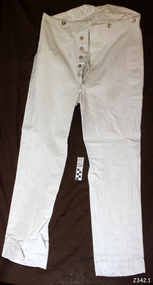
... rest. He would visit 3 or 4 country patients on a Sunday, taking his children along ‘for the ride’ and to visit with him. Sunday evenings he would play the pianola and sing Scottish songs to his family. One of Dr Angus’ patients was Margaret MacKenzie, author of a book...rest. He would visit 3 or 4 country patients on a Sunday, taking his children along ‘for the ride’ and to visit with him. Sunday evenings he would play the pianola and sing Scottish songs to his family. One of Dr Angus’ patients was Margaret MacKenzie, author of a book ...This uniform, consisting of 3 pairs of trousers and 1 jacket, was owned by Dr W.R. Angus. Due to the manufacturer's label saying the uniform was made in Glasgow, it is likely that Dr Angus acquired the uniform around the time of his studies in Edinburgh. His name on the uniform suggests that it was part of his usual clothing and it was most likely worn on his homeward passage to Australia in 1928, during which time he worked as a Ship's Surgeon on T.S.S. LARGS BAY.. This uniform was donated to Flagstaff Hill Maritime Village by the family of Doctor William Roy Angus, Surgeon and Oculist. It is part of the “W.R. Angus Collection” that includes historical medical equipment, surgical instruments and material once belonging to Dr Edward Ryan and Dr Thomas Francis Ryan, (both of Nhill, Victoria) as well as Dr Angus’ own belongings. The Collection’s history spans the medical practices of the two Doctors Ryan, from 1885-1926 plus that of Dr Angus, up until 1969. ABOUT THE “W.R.ANGUS COLLECTION” Doctor William Roy Angus M.B., B.S., Adel., 1923, F.R.C.S. Edin.,1928 (also known as Dr Roy Angus) was born in Murrumbeena, Victoria in 1901 and lived until 1970. He qualified as a doctor in 1923 at University of Adelaide, was Resident Medical Officer at the Royal Adelaide Hospital in 1924 and for a period was house surgeon to Sir (then Mr.) Henry Simpson Newland. Dr Angus was briefly an Assistant to Dr Riddell of Kapunda, then commenced private practice at Curramulka, Yorke Peninsula, SA, where he was physician, surgeon and chemist. In 1926, he was appointed as new Medical Assistant to Dr Thomas Francis Ryan (T.F. Ryan, or Tom), in Nhill, Victoria, where his experiences included radiology and pharmacy. In 1927 he was Acting House Surgeon in Dr Tom Ryan’s absence. Dr Angus had become engaged to Gladys Forsyth and they decided he would take time to further his studies overseas in the UK in 1927. He studied at London University College Hospital and at Edinburgh Royal Infirmary and in 1928, was awarded FRCS (Fellow from the Royal College of Surgeons), Edinburgh. He worked his passage back to Australia as a Ship’s Surgeon on the on the Australian Commonwealth Line’s T.S.S. Largs Bay. Dr Angus married Gladys in 1929, in Ballarat. (They went on to have one son (Graham 1932, born in SA) and two daughters (Helen (died 12/07/1996) and Berenice (Berry), both born at Mira, Nhill ) Dr Angus was a ‘flying doctor’ for the A.I.M. (Australian Inland Ministry) Aerial Medical Service in 1928 . The organisation began in South Australia through the Presbyterian Church in that year, with its first station being in the remote town of Oodnadatta, where Dr Angus was stationed. He was locum tenens there on North-South Railway at 21 Mile Camp. He took up this ‘flying doctor’ position in response to a call from Dr John Flynn; the organisation was later known as the Flying Doctor Service, then the Royal Flying Doctor Service. A lot of his work during this time involved dental surgery also. Between 1928-1932 he was surgeon at the Curramulka Hospital, Yorke Peninsula, South Australia. In 1933 Dr Angus returned to Nhill where he’d previously worked as Medical Assistant and purchased a share of the Nelson Street practice and Mira hospital from Dr Les Middleton one of the Middleton Brothers, the current owners of what was once Dr Tom Ryan’s practice. Dr L Middleton was House Surgeon to the Nhill Hospital 1926-1933, when he resigned. [Dr Tom Ryan’s practice had originally belonged to his older brother Dr Edward Ryan, who came to Nhill in 1885. Dr Edward saw patients at his rooms, firstly in Victoria Street and in 1886 in Nelson Street, until 1901. The Nelson Street practice also had a 2 bed ward, called Mira Private Hospital ). Dr Edward Ryan was House Surgeon at the Nhill Hospital 1884-1902 . He also had occasions where he successfully performed veterinary surgery for the local farmers too. Dr Tom Ryan then purchased the practice from his brother in 1901. Both Dr Edward and Dr Tom Ryan work as surgeons included eye surgery. Dr Tom Ryan performed many of his operations in the Mira private hospital on his premises. He too was House Surgeon at the Nhill Hospital 1902-1926. Dr Tom Ryan had one of the only two pieces of radiology equipment in Victoria during his practicing years – The Royal Melbourne Hospital had the other one. Over the years Dr Tom Ryan gradually set up what was effectively a training school for country general-practitioner-surgeons. Each patient was carefully examined, including using the X-ray machine, and any surgery was discussed and planned with Dr Ryan’s assistants several days in advance. Dr Angus gained experience in using the X-ray machine there during his time as assistant to Dr Ryan. Dr Tom Ryan moved from Nhill in 1926. He became a Fellow of the Royal Australasian College of Surgeons in 1927, soon after its formation, a rare accolade for a doctor outside any of the major cities. He remained a bachelor and died suddenly on 7th Dec 1955, aged 91, at his home in Ararat. Scholarships and prizes are still awarded to medical students in the honour of Dr T.F. Ryan and his father, Dr Michael Ryan, and brother, John Patrick Ryan. ] When Dr Angus bought into the Nelson Street premises in Nhill he was also appointed as the Nhill Hospital’s Honorary House Surgeon 1933-1938. His practitioner’s plate from his Nhill surgery states “HOURS Daily, except Tuesdays, Fridays and Saturday afternoons, 9-10am, 2-4pm, 7-8pm. Sundays by appointment”. This plate is now mounted on the doorway to the Port Medical Office at Flagstaff Hill Maritime Village, Warrnambool. Dr Edward Ryan and Dr Tom Ryan had an extensive collection of historical medical equipment and materials spanning 1884-1926 and when Dr Angus took up practice in their old premises he obtained this collection, a large part of which is now on display at the Port Medical Office at Flagstaff Hill Maritime Village in Warrnambool. During his time in Nhill Dr Angus was involved in the merging of the Mira Hospital and Nhill Public Hospital into one public hospital and the property titles passed on to Nhill Hospital in 1939. In 1939 Dr Angus and his family moved to Warrnambool where he purchased “Birchwood,” the 1852 home and medical practice of Dr John Hunter Henderson, at 214 Koroit Street. (This property was sold in1965 to the State Government and is now the site of the Warrnambool Police Station. ). The Angus family was able to afford gardeners, cooks and maids; their home was a popular place for visiting dignitaries to stay whilst visiting Warrnambool. Dr Angus had his own silk worm farm at home in a Mulberry tree. His young daughter used his centrifuge for spinning the silk. Dr Angus was appointed on a part-time basis as Port Medical Officer (Health Officer) in Warrnambool and held this position until the 1940’s when the government no longer required the service of a Port Medical Officer in Warrnambool; he was thus Warrnambool’s last serving Port Medical Officer. (The duties of a Port Medical Officer were outlined by the Colonial Secretary on 21st June, 1839 under the terms of the Quarantine Act. Masters of immigrant ships arriving in port reported incidents of diseases, illness and death and the Port Medical Officer made a decision on whether the ship required Quarantine and for how long, in this way preventing contagious illness from spreading from new immigrants to the residents already in the colony.) Dr Angus was a member of the Australian Medical Association, for 35 years and surgeon at the Warrnambool Base Hospital 1939-1942, He served as a Surgeon Captain during WWII1942-45, in Ballarat, Victoria, and in Bonegilla, N.S.W., completing his service just before the end of the war due to suffering from a heart attack. During his convalescence he carved an intricate and ‘most artistic’ chess set from the material that dentures were made from. He then studied ophthalmology at the Royal Melbourne Eye and Ear Hospital and created cosmetically superior artificial eyes by pioneering using the intrascleral cartilage. Angus received accolades from the Ophthalmological Society of Australasia for this work. He returned to Warrnambool to commence practice as an ophthalmologist, pioneering in artificial eye improvements. He was Honorary Consultant Ophthalmologist to Warrnambool Base Hospital for 31 years. He made monthly visits to Portland as a visiting surgeon, to perform eye surgery. He represented the Victorian South-West subdivision of the Australian Medical Association as its secretary between 1949 and 1956 and as chairman from 1956 to 1958. In 1968 Dr Angus was elected member of Spain’s Barraquer Institute of Barcelona after his research work in Intrasclearal cartilage grafting, becoming one of the few Australian ophthalmologists to receive this honour, and in the following year presented his final paper on Living Intrasclearal Cartilage Implants at the Inaugural Meeting of the Australian College of Ophthalmologists in Melbourne In his personal life Dr Angus was a Presbyterian and treated Sunday as a Sabbath, a day of rest. He would visit 3 or 4 country patients on a Sunday, taking his children along ‘for the ride’ and to visit with him. Sunday evenings he would play the pianola and sing Scottish songs to his family. One of Dr Angus’ patients was Margaret MacKenzie, author of a book on local shipwrecks that she’d seen as an eye witness from the late 1880’s in Peterborough, Victoria. In the early 1950’s Dr Angus, painted a picture of a shipwreck for the cover jacket of Margaret’s book, Shipwrecks and More Shipwrecks. She was blind in later life and her daughter wrote the actual book for her. Dr Angus and his wife Gladys were very involved in Warrnambool’s society with a strong interest in civic affairs. Their interests included organisations such as Red Cross, Rostrum, Warrnambool and District Historical Society (founding members), Wine and Food Society, Steering Committee for Tertiary Education in Warrnambool, Local National Trust, Good Neighbour Council, Housing Commission Advisory Board, United Services Institute, Legion of Ex-Servicemen, Olympic Pool Committee, Food for Britain Organisation, Warrnambool Hospital, Anti-Cancer Council, Boys’ Club, Charitable Council, National Fitness Council and Air Raid Precautions Group. He was also a member of the Steam Preservation Society and derived much pleasure from a steam traction engine on his farm. He had an interest in people and the community He and his wife Gladys were both involved in the creation of Flagstaff Hill, including the layout of the gardens. After his death (28th March 1970) his family requested his practitioner’s plate, medical instruments and some personal belongings be displayed in the Port Medical Office surgery at Flagstaff Hill Maritime Village, and be called the “W. R. Angus Collection”. The W.R. Angus Collection is significant for still being located at the site it is connected with, Doctor Angus being the last Port Medical Officer in Warrnambool. The collection of medical instruments and other equipment is culturally significant, being an historical example of medicine from late 19th to mid-20th century. Dr Angus assisted Dr Tom Ryan, a pioneer in the use of X-rays and in ocular surgery. Trousers (3) white uniform with silver buttons, buttons inscribed "V.Falzon Malta". On inside - W R Angus, R Poore. Tailored in Glasgow, Scotland 1900s by Paislyo Ltd Glasgow. (said to be a Cadet naval officer's uniform)Inscribed on buttons "V.Falson Malta". Marked on fabric "W R Angus, R Poore" and "Paislyo Ltd Glasgow"flagstaff hill, warrnambool, shipwrecked-coast, flagstaff-hill, flagstaff-hill-maritime-museum, maritime-museum, shipwreck-coast, flagstaff-hill-maritime-village, uniform trousers, silver button trousers, v.falzon malta, w r angus, paislyo ltd -
 Flagstaff Hill Maritime Museum and Village
Coat, 1900's
... rest. He would visit 3 or 4 country patients on a Sunday, taking his children along ‘for the ride’ and to visit with him. Sunday evenings he would play the pianola and sing Scottish songs to his family. One of Dr Angus’ patients was Margaret MacKenzie, author of a book...rest. He would visit 3 or 4 country patients on a Sunday, taking his children along ‘for the ride’ and to visit with him. Sunday evenings he would play the pianola and sing Scottish songs to his family. One of Dr Angus’ patients was Margaret MacKenzie, author of a book ...This uniform, consisting of 3 pairs of trousers and 1 jacket, was owned by Dr W.R. Angus. Due to the manufacturer's label saying the uniform was made in Glasgow, it is likely that Dr Angus acquired the uniform around the time of his studies in Edinburgh. His name on the uniform suggests that it was part of his usual clothing and it was most likely worn on his homeward passage to Australia in 1928, during which time he worked as a Ship's Surgeon on T.S.S. LARGS BAY.. This object was donated to Flagstaff Hill Maritime Village by the family of Doctor William Roy Angus, Surgeon and Oculist. It is part of the “W.R. Angus Collection” that includes historical medical equipment, surgical instruments and material once belonging to Dr Edward Ryan and Dr Thomas Francis Ryan, (both of Nhill, Victoria) as well as Dr Angus’ own belongings. The Collection’s history spans the medical practices of the two Doctors Ryan, from 1885-1926 plus that of Dr Angus, up until 1969. ABOUT THE “W.R.ANGUS COLLECTION” Doctor William Roy Angus M.B., B.S., Adel., 1923, F.R.C.S. Edin.,1928 (also known as Dr Roy Angus) was born in Murrumbeena, Victoria in 1901 and lived until 1970. He qualified as a doctor in 1923 at University of Adelaide, was Resident Medical Officer at the Royal Adelaide Hospital in 1924 and for a period was house surgeon to Sir (then Mr.) Henry Simpson Newland. Dr Angus was briefly an Assistant to Dr Riddell of Kapunda, then commenced private practice at Curramulka, Yorke Peninsula, SA, where he was physician, surgeon and chemist. In 1926, he was appointed as new Medical Assistant to Dr Thomas Francis Ryan (T.F. Ryan, or Tom), in Nhill, Victoria, where his experiences included radiology and pharmacy. In 1927 he was Acting House Surgeon in Dr Tom Ryan’s absence. Dr Angus had become engaged to Gladys Forsyth and they decided he would take time to further his studies overseas in the UK in 1927. He studied at London University College Hospital and at Edinburgh Royal Infirmary and in 1928, was awarded FRCS (Fellow from the Royal College of Surgeons), Edinburgh. He worked his passage back to Australia as a Ship’s Surgeon on the on the Australian Commonwealth Line’s T.S.S. Largs Bay. Dr Angus married Gladys in 1929, in Ballarat. (They went on to have one son (Graham 1932, born in SA) and two daughters (Helen (died 12/07/1996) and Berenice (Berry), both born at Mira, Nhill ) Dr Angus was a ‘flying doctor’ for the A.I.M. (Australian Inland Ministry) Aerial Medical Service in 1928 . The organisation began in South Australia through the Presbyterian Church in that year, with its first station being in the remote town of Oodnadatta, where Dr Angus was stationed. He was locum tenens there on North-South Railway at 21 Mile Camp. He took up this ‘flying doctor’ position in response to a call from Dr John Flynn; the organisation was later known as the Flying Doctor Service, then the Royal Flying Doctor Service. A lot of his work during this time involved dental surgery also. Between 1928-1932 he was surgeon at the Curramulka Hospital, Yorke Peninsula, South Australia. In 1933 Dr Angus returned to Nhill where he’d previously worked as Medical Assistant and purchased a share of the Nelson Street practice and Mira hospital from Dr Les Middleton one of the Middleton Brothers, the current owners of what was once Dr Tom Ryan’s practice. Dr L Middleton was House Surgeon to the Nhill Hospital 1926-1933, when he resigned. [Dr Tom Ryan’s practice had originally belonged to his older brother Dr Edward Ryan, who came to Nhill in 1885. Dr Edward saw patients at his rooms, firstly in Victoria Street and in 1886 in Nelson Street, until 1901. The Nelson Street practice also had a 2 bed ward, called Mira Private Hospital ). Dr Edward Ryan was House Surgeon at the Nhill Hospital 1884-1902 . He also had occasions where he successfully performed veterinary surgery for the local farmers too. Dr Tom Ryan then purchased the practice from his brother in 1901. Both Dr Edward and Dr Tom Ryan work as surgeons included eye surgery. Dr Tom Ryan performed many of his operations in the Mira private hospital on his premises. He too was House Surgeon at the Nhill Hospital 1902-1926. Dr Tom Ryan had one of the only two pieces of radiology equipment in Victoria during his practicing years – The Royal Melbourne Hospital had the other one. Over the years Dr Tom Ryan gradually set up what was effectively a training school for country general-practitioner-surgeons. Each patient was carefully examined, including using the X-ray machine, and any surgery was discussed and planned with Dr Ryan’s assistants several days in advance. Dr Angus gained experience in using the X-ray machine there during his time as assistant to Dr Ryan. Dr Tom Ryan moved from Nhill in 1926. He became a Fellow of the Royal Australasian College of Surgeons in 1927, soon after its formation, a rare accolade for a doctor outside any of the major cities. He remained a bachelor and died suddenly on 7th Dec 1955, aged 91, at his home in Ararat. Scholarships and prizes are still awarded to medical students in the honour of Dr T.F. Ryan and his father, Dr Michael Ryan, and brother, John Patrick Ryan. ] When Dr Angus bought into the Nelson Street premises in Nhill he was also appointed as the Nhill Hospital’s Honorary House Surgeon 1933-1938. His practitioner’s plate from his Nhill surgery states “HOURS Daily, except Tuesdays, Fridays and Saturday afternoons, 9-10am, 2-4pm, 7-8pm. Sundays by appointment”. This plate is now mounted on the doorway to the Port Medical Office at Flagstaff Hill Maritime Village, Warrnambool. Dr Edward Ryan and Dr Tom Ryan had an extensive collection of historical medical equipment and materials spanning 1884-1926 and when Dr Angus took up practice in their old premises he obtained this collection, a large part of which is now on display at the Port Medical Office at Flagstaff Hill Maritime Village in Warrnambool. During his time in Nhill Dr Angus was involved in the merging of the Mira Hospital and Nhill Public Hospital into one public hospital and the property titles passed on to Nhill Hospital in 1939. In 1939 Dr Angus and his family moved to Warrnambool where he purchased “Birchwood,” the 1852 home and medical practice of Dr John Hunter Henderson, at 214 Koroit Street. (This property was sold in1965 to the State Government and is now the site of the Warrnambool Police Station. ). The Angus family was able to afford gardeners, cooks and maids; their home was a popular place for visiting dignitaries to stay whilst visiting Warrnambool. Dr Angus had his own silk worm farm at home in a Mulberry tree. His young daughter used his centrifuge for spinning the silk. Dr Angus was appointed on a part-time basis as Port Medical Officer (Health Officer) in Warrnambool and held this position until the 1940’s when the government no longer required the service of a Port Medical Officer in Warrnambool; he was thus Warrnambool’s last serving Port Medical Officer. (The duties of a Port Medical Officer were outlined by the Colonial Secretary on 21st June, 1839 under the terms of the Quarantine Act. Masters of immigrant ships arriving in port reported incidents of diseases, illness and death and the Port Medical Officer made a decision on whether the ship required Quarantine and for how long, in this way preventing contagious illness from spreading from new immigrants to the residents already in the colony.) Dr Angus was a member of the Australian Medical Association, for 35 years and surgeon at the Warrnambool Base Hospital 1939-1942, He served as a Surgeon Captain during WWII1942-45, in Ballarat, Victoria, and in Bonegilla, N.S.W., completing his service just before the end of the war due to suffering from a heart attack. During his convalescence he carved an intricate and ‘most artistic’ chess set from the material that dentures were made from. He then studied ophthalmology at the Royal Melbourne Eye and Ear Hospital and created cosmetically superior artificial eyes by pioneering using the intrascleral cartilage. Angus received accolades from the Ophthalmological Society of Australasia for this work. He returned to Warrnambool to commence practice as an ophthalmologist, pioneering in artificial eye improvements. He was Honorary Consultant Ophthalmologist to Warrnambool Base Hospital for 31 years. He made monthly visits to Portland as a visiting surgeon, to perform eye surgery. He represented the Victorian South-West subdivision of the Australian Medical Association as its secretary between 1949 and 1956 and as chairman from 1956 to 1958. In 1968 Dr Angus was elected member of Spain’s Barraquer Institute of Barcelona after his research work in Intrasclearal cartilage grafting, becoming one of the few Australian ophthalmologists to receive this honour, and in the following year presented his final paper on Living Intrasclearal Cartilage Implants at the Inaugural Meeting of the Australian College of Ophthalmologists in Melbourne In his personal life Dr Angus was a Presbyterian and treated Sunday as a Sabbath, a day of rest. He would visit 3 or 4 country patients on a Sunday, taking his children along ‘for the ride’ and to visit with him. Sunday evenings he would play the pianola and sing Scottish songs to his family. One of Dr Angus’ patients was Margaret MacKenzie, author of a book on local shipwrecks that she’d seen as an eye witness from the late 1880’s in Peterborough, Victoria. In the early 1950’s Dr Angus, painted a picture of a shipwreck for the cover jacket of Margaret’s book, Shipwrecks and More Shipwrecks. She was blind in later life and her daughter wrote the actual book for her. Dr Angus and his wife Gladys were very involved in Warrnambool’s society with a strong interest in civic affairs. Their interests included organisations such as Red Cross, Rostrum, Warrnambool and District Historical Society (founding members), Wine and Food Society, Steering Committee for Tertiary Education in Warrnambool, Local National Trust, Good Neighbour Council, Housing Commission Advisory Board, United Services Institute, Legion of Ex-Servicemen, Olympic Pool Committee, Food for Britain Organisation, Warrnambool Hospital, Anti-Cancer Council, Boys’ Club, Charitable Council, National Fitness Council and Air Raid Precautions Group. He was also a member of the Steam Preservation Society and derived much pleasure from a steam traction engine on his farm. He had an interest in people and the community He and his wife Gladys were both involved in the creation of Flagstaff Hill, including the layout of the gardens. After his death (28th March 1970) his family requested his practitioner’s plate, medical instruments and some personal belongings be displayed in the Port Medical Office surgery at Flagstaff Hill Maritime Village, and be called the “W. R. Angus Collection”. The W.R. Angus Collection is significant for still being located at the site it is connected with, Doctor Angus being the last Port Medical Officer in Warrnambool. The collection of medical instruments and other equipment is culturally significant, being an historical example of medicine from late 19th to mid-20th century. Dr Angus assisted Dr Tom Ryan, a pioneer in the use of X-rays and in ocular surgery. Coat, white linen jacket, brass buttons, epaulets and collar badges have been removed, holes remain. Tailored in Glasgow, Scotland 1900s by Paislyo Ltd Glasgow. (said to be the uniform of a Cadet naval officer).flagstaff hill, warrnambool, shipwrecked-coast, flagstaff-hill, flagstaff-hill-maritime-museum, maritime-museum, shipwreck-coast, flagstaff-hill-maritime-village, dr w r angus, t.s.s. largs bay, uniform jacket, ship's surgeon -
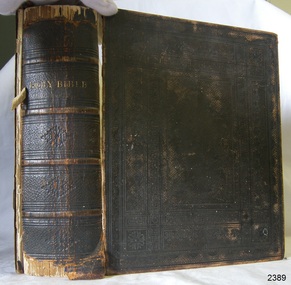 Flagstaff Hill Maritime Museum and Village
Book - Religious Book/Bilble, Oxford University Press, The Holy Bible, 1866
... book dating back to 1478. For centuries in England, printing the King James Bible was strictly regulated. Only a select few entities held the Royal Patent to print it: the King's Printer, Cambridge University Press, and Oxford University Press. This "Bible Privilege" was highly lucrative and essentially funded the rest...book dating back to 1478. For centuries in England, printing the King James Bible was strictly regulated. Only a select few entities held the Royal Patent to print it: the King's Printer, Cambridge University Press, and Oxford University Press. This "Bible Privilege" was highly lucrative and essentially funded the rest ...To understand the nature of your 1866 Oxford University Press (OUP) Bible, it helps to look at how Bibles were produced in the 19th century and the massive historical scale of the publisher. The context of the King James Version Bible is indicated by the standard phrase on the flyleaf: "Translated out of the Original Tongues... By His Majesty's Special Command." This work is a historical 1866 reprint of the original version published in 1611. This particular volume served as the family Bible for Joseph and Elizabeth Bell, documenting their family history through the births and deaths noted on its end papers.Book, black hard cover with embossed pattern and gold test, metal locking clasp. King James Version of the Holy Bible, containing the Old and New Testaments. It was published by Oxford University Press in 1866. Inscriptions on the loose endpaper list the marriage of Joseph and Elizabeth Bell in 1854 at St Paul's, Bristol, England, and their ten children born from 1856 to 1878.non-fictionTo understand the nature of your 1866 Oxford University Press (OUP) Bible, it helps to look at how Bibles were produced in the 19th century and the massive historical scale of the publisher. The context of the King James Version Bible is indicated by the standard phrase on the flyleaf: "Translated out of the Original Tongues... By His Majesty's Special Command." This work is a historical 1866 reprint of the original version published in 1611. This particular volume served as the family Bible for Joseph and Elizabeth Bell, documenting their family history through the births and deaths noted on its end papers.flagstaff hill, flagstaff hill maritime museum and village, warrnambool, maritime museum, maritime village, great ocean road, shipwreck coast, holy bible, book, religious book, bell family, bell family bible, elizabeth bell, joseph bell, 1826, 1833, 1854, st paul's bristol -
 Flagstaff Hill Maritime Museum and Village
Book - Reference Book/History, Henry Smith Williams, The Historians History of the World Vol 14 set 1 - Edited by Henry Smith Williams L.L.D. Published by “The Times” 1908, 1908
... rest of the set, its significance lies in Williams' unique editorial style. Instead of a single author's view, Volume 14 blends the accounts of great historians (such as Leopold von Ranke or Theodor Mommsen) into a continuous story. (For more information on the Pattison Collection and the Mechanics Institute visit) https://victoriancollections.net.au/items/5580c7e72162f114d8b758db flagstaff hill warrnambool flagstaff-hill-maritime-museum maritime-museum shipwreck-coast flagstaff-hill-maritime-village book the historians history of the world vol 14 set 1 Henry Smith Williams Henry Smith Williams’ “The Historians' History of the World” is a chronological and geographical "tapestry" of human events, these twenty five volumes occupy a very specific and prestigious place in historical research. ...Henry Smith Williams’ “The Historians' History of the World” is a chronological and geographical "tapestry" of human events, these twenty five volumes occupy a very specific and prestigious place in historical research. Volume 14 serves as a bridge between the late early-modern period and the height of the imperial era for two major European powers. It is titled "The Netherlands (concluded), The Germanic Empires."The Book is part of a 25 volume set with red cloth bindings and gold filigree design to rib.non-fictionHenry Smith Williams’ “The Historians' History of the World” is a chronological and geographical "tapestry" of human events, these twenty five volumes occupy a very specific and prestigious place in historical research. Volume 14 serves as a bridge between the late early-modern period and the height of the imperial era for two major European powers. It is titled "The Netherlands (concluded), The Germanic Empires."flagstaff hill, warrnambool, flagstaff-hill-maritime-museum, maritime-museum, shipwreck-coast, flagstaff-hill-maritime-village, book, the historians history of the world vol 14 set 1, henry smith williams -
 Flagstaff Hill Maritime Museum and Village
Book - Reference Book/History, Henry Smith Williams, The Historians History of the World Vol 19 set 1 - Edited by Henry Smith Williams L.L.D. Published by “The Times” 1908, 1908
... rest of the set, its significance lies in Williams' "mosaic" method. Instead of a single author's perspective, Volume 19 synthesises the writings of over 2,000 great historians (such as Hume, Macaulay, and Froude), providing a curated historical scholarship available in 1908. (For more information on the Pattison Collection and the Mechanics Institute visit) https://victoriancollections.net.au/items/5580c7e72162f114d8b758db flagstaff hill warrnambool shipwrecked-coast flagstaff-hill-maritime-museum maritime-museum shipwreck-coast flagstaff-hill-maritime-village book the historians history of the world vol 19 set 1 Henry Smith Williams Henry Smith Williams’ “The Historians' History of the World” is a chronological and geographical "tapestry" of human events, these twenty five volumes occupy a very specific and prestigious place in historical research. ...Henry Smith Williams’ “The Historians' History of the World” is a chronological and geographical "tapestry" of human events, these twenty five volumes occupy a very specific and prestigious place in historical research. Volume 19 is a pivotal component of the series, focusing specifically on a trans-formative era of British history from 1485 to 1642 covering the history of England from the rise of the Tudor Dynasty to the eve of the English Civil War.The Book is part of a 25 volume set with red cloth bindings and gold filigree design to rib.non-fictionHenry Smith Williams’ “The Historians' History of the World” is a chronological and geographical "tapestry" of human events, these twenty five volumes occupy a very specific and prestigious place in historical research. Volume 19 is a pivotal component of the series, focusing specifically on a trans-formative era of British history from 1485 to 1642 covering the history of England from the rise of the Tudor Dynasty to the eve of the English Civil War.flagstaff hill, warrnambool, shipwrecked-coast, flagstaff-hill-maritime-museum, maritime-museum, shipwreck-coast, flagstaff-hill-maritime-village, book, the historians history of the world vol 19 set 1, henry smith williams -
 Flagstaff Hill Maritime Museum and Village
Book - Reference Book/History, Henry Smith Williams, The Historians History of the World Vol 20 set 1 - Edited by Henry Smith Williams L.L.D. Published by “The Times” 1908, 1908
... rest of the set, its significance lies in its "mosaic" approach. Rather than being written by a single author, it compiles the writings of over 2,000 historians (such as Hume, Macaulay, and Guizot) to provide a "history of histories." (For more information on the Pattison Collection and the Mechanics Institute visit) https://victoriancollections.net.au/items/5580c7e72162f114d8b758db warrnambool flagstaff-hill flagstaff-hill-maritime-museum maritime-museum shipwreck-coast flagstaff-hill-maritime-village book the historians history of the world vol 20 set 1 Henry Smith Williams Henry Smith Williams’ “The Historians' History of the World” is a chronological and geographical "tapestry" of human events, these twenty five volumes occupy a very specific and prestigious place in historical research. ...Henry Smith Williams’ “The Historians' History of the World” is a chronological and geographical "tapestry" of human events, these twenty five volumes occupy a very specific and prestigious place in historical research. Volume 20 focuses on the transformation period of England from the outbreak of the English Civil War to the late 18th century.The Book is part of a 25 volume set with red cloth bindings and gold filigree design to rib.non-fictionHenry Smith Williams’ “The Historians' History of the World” is a chronological and geographical "tapestry" of human events, these twenty five volumes occupy a very specific and prestigious place in historical research. Volume 20 focuses on the transformation period of England from the outbreak of the English Civil War to the late 18th century. warrnambool, flagstaff-hill, flagstaff-hill-maritime-museum, maritime-museum, shipwreck-coast, flagstaff-hill-maritime-village, book, the historians history of the world vol 20 set 1, henry smith williams -
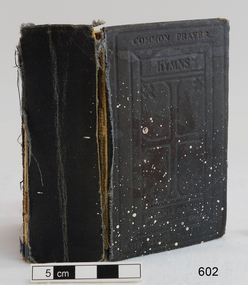 Flagstaff Hill Maritime Museum and Village
Book - Religious Book, The Book of Common Prayer, 20th century
... book...anne ambrose...religion...religious service...sailors rest...(For more information on the Pattison Collection see item 3678 Flagstaff Hill collections) https://victoriancollections.net.au/items/5580c7e72162f114d8b758db flagstaff hill warrnambool shipwrecked-coast flagstaff-hill flagstaff-hill-maritime-museum maritime-museum shipwreck-coast flagstaff-hill-maritime-village book prayer book the book of common prayer church of england prayer book anne ambrose religion religious service sailors rest bethel sailors’ church bethel floating church ladies harbour light guild missions to seamen victoria mission to seafarers st nicholas seaman’s church williamstown st nicholas mission to seamen church williamstown mission to seamen williamstown st nicholas seamen’s church flagstaff hill 139 nelson place williamstown flying angel club The Book of Common Prayer is the foundational liturgical text of the Church of England and the broader Anglican Communion. ...The Book of Common Prayer is the foundational liturgical text of the Church of England and the broader Anglican Communion. The subject book as a standard 730-page UK edition often printed in the late 19th or early 20th century by major privilege presses like Cambridge University Press, Oxford University Press, or William Clowes & Sons contains the complete 1662 standard text. The volume is structured into distinct sections designed for daily worship, sacramental rites, and personal devotion. There is introductory matter within the text that includes the original prefaces regarding the service of the Church and how the Psalter and Holy Scriptures are ordered to be read. Lectionary and calendar tables are also included as well as lessons for daily Bible readings, rules for determining the date of Easter, and the calendar of Holy Days and saints' days.The Book of Common Prayer. Small book, dark fabric hardcovers, both embossed design on cover incorporating a cross. Owner's name written in black ink inside the cover, also four brown stamps of a cross inside cover. Titled "The Book of Common Prayer and Administration of the Sacraments and other Rules and Ceremonies of the CHURCH according to the use of The Church of England". Printed in Great Britain. Book has 730 numbered pages. Inscribed with a signature inside the front cover as well as brown stamps of images of a cross.. This is one of the original items in our St Nicholas Seamen's Church Williamstown Collection.non-fictionThe Book of Common Prayer is the foundational liturgical text of the Church of England and the broader Anglican Communion. The subject book as a standard 730-page UK edition often printed in the late 19th or early 20th century by major privilege presses like Cambridge University Press, Oxford University Press, or William Clowes & Sons contains the complete 1662 standard text. The volume is structured into distinct sections designed for daily worship, sacramental rites, and personal devotion. There is introductory matter within the text that includes the original prefaces regarding the service of the Church and how the Psalter and Holy Scriptures are ordered to be read. Lectionary and calendar tables are also included as well as lessons for daily Bible readings, rules for determining the date of Easter, and the calendar of Holy Days and saints' days.flagstaff hill, warrnambool, shipwrecked-coast, flagstaff-hill, flagstaff-hill-maritime-museum, maritime-museum, shipwreck-coast, flagstaff-hill-maritime-village, book, prayer book, the book of common prayer, church of england prayer book, anne ambrose, religion, religious service, sailors rest, bethel sailors’ church, bethel floating church, ladies harbour light guild, missions to seamen victoria, mission to seafarers, st nicholas seaman’s church williamstown, st nicholas mission to seamen church williamstown, mission to seamen williamstown, st nicholas seamen’s church flagstaff hill, 139 nelson place williamstown, flying angel club -
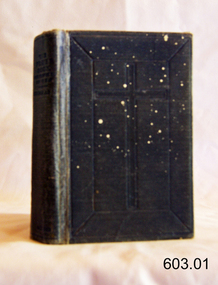 Flagstaff Hill Maritime Museum and Village
Book - Religious Book, Oxford University Press, The Book of Common Prayer, early 20th century
... book...religion...religious service...sailors rest...The connection of this set of books to the Mission to Seamen and to the Ladies Lightkeepers Auxiliary highlights the strong community awareness of the life of people at sea, their dangers and hardships, and their need for physical, financial, spiritual and moral support. flagstaff hill warrnambool shipwrecked coast flagstaff hill maritime museum maritime museum shipwreck coast flagstaff hill maritime village great ocean road preyer books book of common prayer anglican church prayer book religion religious service sailors rest bethel sailors’ church bethel floating church ladies harbour light guild missions to seamen victoria mission to seafarers flying angels club st nicholas seaman’s church williamstown st nicholas mission to seamen church williamstown mission to seamen williamstown st nicholas seamen’s church flagstaff hill 139 nelson place williamstown anglican church religious book vc queries search - photo st nicholas seamen’s church williamstown collection The Book of Common Prayer is the foundational liturgical text of the Church of England and the broader Anglican Communion. ...The Book of Common Prayer is the foundational liturgical text of the Church of England and the broader Anglican Communion. The subject book as a standard 730-page UK edition often printed in the late 19th or early 20th century by major privilege presses like Cambridge University Press, Oxford University Press, or William Clowes & Sons contains the complete 1662 standard text. The volume is structured into distinct sections designed for daily worship, sacramental rites, and personal devotion. There is introductory matter within the text that includes the original prefaces regarding the service of the Church and how the Psalter and Holy Scriptures are ordered to be read. Lectionary and calendar tables are also included as well as lessons for daily Bible readings, rules for determining the date of Easter, and the calendar of Holy Days and saints' days.The Book of Common Prayer. Blue cloth cover. Title: The Book of Common Prayer with the Additions and Deviations proposed in 1928 Publisher: Humphrey Milford, Oxford University Press, London. 244 numbered pages. This is one of a set of original items in our ‘St Nicholas Seamen's Church Williamstown Collection’.non-fictionThe Book of Common Prayer is the foundational liturgical text of the Church of England and the broader Anglican Communion. The subject book as a standard 730-page UK edition often printed in the late 19th or early 20th century by major privilege presses like Cambridge University Press, Oxford University Press, or William Clowes & Sons contains the complete 1662 standard text. The volume is structured into distinct sections designed for daily worship, sacramental rites, and personal devotion. There is introductory matter within the text that includes the original prefaces regarding the service of the Church and how the Psalter and Holy Scriptures are ordered to be read. Lectionary and calendar tables are also included as well as lessons for daily Bible readings, rules for determining the date of Easter, and the calendar of Holy Days and saints' days.flagstaff hill, warrnambool, shipwrecked coast, flagstaff hill maritime museum, maritime museum, shipwreck coast, flagstaff hill maritime village, great ocean road, preyer books, book of common prayer, anglican church prayer book, religion, religious service, sailors rest, bethel sailors’ church, bethel floating church, ladies harbour light guild, missions to seamen victoria, mission to seafarers, flying angels club, st nicholas seaman’s church williamstown, st nicholas mission to seamen church williamstown, mission to seamen williamstown, st nicholas seamen’s church flagstaff hill, 139 nelson place williamstown, anglican church, religious book, vc queries, search -, photo, st nicholas seamen’s church williamstown collection -
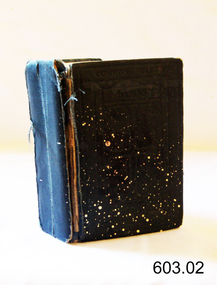 Flagstaff Hill Maritime Museum and Village
Book - Religious Book, Oxford University Press, The Book of Common Prayer, Early 20th century
... book...religion...religious service...sailors rest...The connection of this set of books to the Mission to Seamen and to the Ladies Lightkeepers Auxiliary highlights the strong community awareness of the life of people at sea, their dangers and hardships, and their need for physical, financial, spiritual and moral support. flagstaff hill warrnambool shipwrecked coast flagstaff hill maritime museum maritime museum shipwreck coast flagstaff hill maritime village great ocean road preyer books book of common prayer anglican church prayer book religion religious service sailors rest bethel sailors’ church bethel floating church ladies harbour light guild missions to seamen victoria mission to seafarers flying angels club st nicholas seaman’s church williamstown st nicholas mission to seamen church williamstown missions to seamen williamstown st nicholas seamen’s church flagstaff hill 139 nelson place williamstown anglican church religious book The Book of Common Prayer is the foundational liturgical text of the Church of England and the broader Anglican Communion. ...The Book of Common Prayer is the foundational liturgical text of the Church of England and the broader Anglican Communion. The subject book as a standard 730-page UK edition often printed in the late 19th or early 20th century by major privilege presses like Cambridge University Press, Oxford University Press, or William Clowes & Sons contains the complete 1662 standard text. The volume is structured into distinct sections designed for daily worship, sacramental rites, and personal devotion. There is introductory matter within the text that includes the original prefaces regarding the service of the Church and how the Psalter and Holy Scriptures are ordered to be read. Lectionary and calendar tables are also included as well as lessons for daily Bible readings, rules for determining the date of Easter, and the calendar of Holy Days and saints' days.The Book of Common Prayer. Blue cloth cover. Title: The Book of Common Prayer with the Additions and Deviations proposed in 1928 Publisher: Humphrey Milford, Oxford University Press, London. Spines have gold inlay print. 244 numbered pages. This is one of a set of original items in our ‘St Nicholas Seamen's Church Williamstown Collection’.non-fictionThe Book of Common Prayer is the foundational liturgical text of the Church of England and the broader Anglican Communion. The subject book as a standard 730-page UK edition often printed in the late 19th or early 20th century by major privilege presses like Cambridge University Press, Oxford University Press, or William Clowes & Sons contains the complete 1662 standard text. The volume is structured into distinct sections designed for daily worship, sacramental rites, and personal devotion. There is introductory matter within the text that includes the original prefaces regarding the service of the Church and how the Psalter and Holy Scriptures are ordered to be read. Lectionary and calendar tables are also included as well as lessons for daily Bible readings, rules for determining the date of Easter, and the calendar of Holy Days and saints' days.flagstaff hill, warrnambool, shipwrecked coast, flagstaff hill maritime museum, maritime museum, shipwreck coast, flagstaff hill maritime village, great ocean road, preyer books, book of common prayer, anglican church prayer book, religion, religious service, sailors rest, bethel sailors’ church, bethel floating church, ladies harbour light guild, missions to seamen victoria, mission to seafarers, flying angels club, st nicholas seaman’s church williamstown, st nicholas mission to seamen church williamstown, missions to seamen williamstown, st nicholas seamen’s church flagstaff hill, 139 nelson place williamstown, anglican church, religious book
