
Showing 34 items matching "british medical history"
-
 Returned Nurses RSL Sub-branch
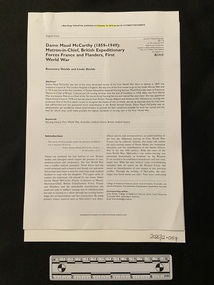
Document - Photocopy of journal article, Sage Journals et al, Dame Maud McCarthy (1859-1949), 2014
... Australian medical history...British... World War 1 World War 1914-1918 First World War WWI Australian medical history British medical history Nurses Emma Maud McCarthy Maud McCarthy 'February 19, 2015' [Highlighted in yellow highlight marker at the top of the first page] Black and white photocopy of an eight page, double-sided, journal article with text divided into two columns down each page. ...Article published in the Journal of Medical Biography in 2014 about the life of Emma Maud McCarthy, "one of the most decorated nurses of the First World War". She had a profound influence on nursing, serving overseas throughout WWI and then later becoming "one of the first senior nurses to recognise the impact of war on minds, she set up separate units for men who had self-harmed and she pioneered nurse anaesthetists in the British Armed Forces" (from abstract).Black and white photocopy of an eight page, double-sided, journal article with text divided into two columns down each page. The article contains two photographic images of Maud McCarthy, one dressed as a Matron and the other as Dame on the occasion of the King's coronation. 'February 19, 2015' [Highlighted in yellow highlight marker at the top of the first page]nursing history, world war 1, world war 1914-1918, first world war, wwi, australian medical history, british medical history, nurses, emma maud mccarthy, maud mccarthy -
 Returned Nurses RSL Sub-branch
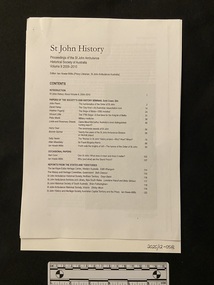
Document - Photocopy of journal article, Rosemary Shields et al, Dame Maud McCarthy: Australia's most distinguished nursing export?, circa 2009-10
... Australian medical history...British...British Armed Forces" (-Rosemary Shields). Nursing history World War 1 World War 1914-1918 First World War WWI Australian medical history British medical history Nurses Emma Maud McCarthy Maud McCarthy Photocopied article from the St John History Journal. ...Article published in the St John Ambulance Historical Society of Australia journal, volume 9 (2009-2010), about the life and nursing career of Emma Maud McCarthy. Maud McCarthy had a profound influence on nursing, serving overseas throughout WWI and then later becoming "one of the first senior nurses to recognise the impact of war on minds, she set up separate units for men who had self-harmed and she pioneered nurse anaesthetists in the British Armed Forces" (-Rosemary Shields). Photocopied article from the St John History Journal. The first page is a copy of the contents page of volume 9, followed by copies of pages 49-55 containing the article and photographs. nursing history, world war 1, world war 1914-1918, first world war, wwi, australian medical history, british medical history, nurses, emma maud mccarthy, maud mccarthy -
 Returned Nurses RSL Sub-branch
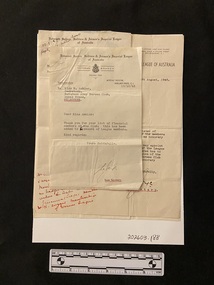
Document - Typed correspondence, Sage Journals et al, 2014
... Australian medical history...British... World War 1 World War 1914-1918 First World War WWI Australian medical history British medical history Nurses Emma Maud McCarthy Maud McCarthy '22.3.45 / papers are with books ?' ...Article published in the Journal of Medical Biography in 2014 about the life of Emma Maud McCarthy, "one of the most decorated nurses of the First World War". She had a profound influence on nursing, serving overseas throughout WWI and then later becoming "one of the first senior nurses to recognise the impact of war on minds, she set up separate units for men who had self-harmed and she pioneered nurse anaesthetists in the British Armed Forces" (from abstract). Collection of four typed letters. Two are on A4 paper and two on A5. Each one has the 'Returned Sailors, Soldiers & Airmen's Imperial League of Australia' title across the top, followed by the Victorian Branch emblem.'22.3.45 / papers are with books ?' [Handwritten in the top left corner of the second memorandum letter] '1.2.45. / Mrs Holland seen by ? + ? / + ? of honorary League Membership received but / no badges will be issued / unless the sister becomes a / ? League Member / ? suggest membership / of Womens League' [Handwritten in brown and red ink the bottom left corner of the final letter]nursing history, world war 1, world war 1914-1918, first world war, wwi, australian medical history, british medical history, nurses, emma maud mccarthy, maud mccarthy -
 Flagstaff Hill Maritime Museum and Village
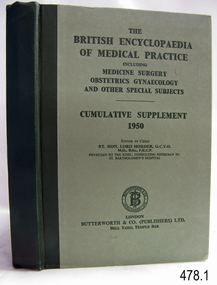
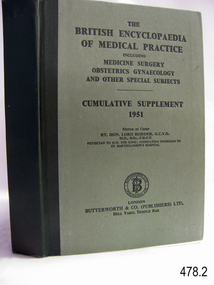
Book, The British Encyclopaedia of Medical Practice 1950
... medical instruments and other equipment is culturally significant, being an historical example of medicine, administration, household equipment and clothing from late 19th to mid-20th century. Dr Angus assisted Dr Tom Ryan, a pioneer in the use of X-rays and in ocular surgery. flagstaff hill warrnambool shipwrecked-coast flagstaff-hill flagstaff-hill-maritime-museum maritime-museum shipwreck-coast flagstaff-hill-maritime-village the british encyclopaedia of medical practice 1950 book dr. w.r. angus dr ryan t.s.s. largs bay warrnambool base hospital nhill base hospital mira hospital flying doctor medical treatment medical history medical education Pastedown front endpaper has sticker that reads "W. ...This Book was donated to Flagstaff Hill Maritime Village by the family of Doctor William Roy Angus, Surgeon and Oculist. It is part of the “W.R. Angus Collection” that includes historical medical equipment, surgical instruments and material once belonging to Dr Edward Ryan and Dr Thomas Francis Ryan, (both of Nhill, Victoria) as well as Dr Angus’ own belongings. The Collection’s history spans the medical practices of the two Doctors Ryan, from 1885-1926 plus that of Dr Angus, up until 1969. ABOUT THE “W.R.ANGUS COLLECTION” Doctor William Roy Angus M.B., B.S., Adel., 1923, F.R.C.S. Edin.,1928 (also known as Dr Roy Angus) was born in Murrumbeena, Victoria in 1901 and lived until 1970. He qualified as a doctor in 1923 at University of Adelaide, was Resident Medical Officer at the Royal Adelaide Hospital in 1924 and for a period was house surgeon to Sir (then Mr.) Henry Simpson Newland. Dr Angus was briefly an Assistant to Dr Riddell of Kapunda, then commenced private practice at Curramulka, Yorke Peninsula, SA, where he was physician, surgeon and chemist. In 1926, he was appointed as new Medical Assistant to Dr Thomas Francis Ryan (T.F. Ryan, or Tom), in Nhill, Victoria, where his experiences included radiology and pharmacy. In 1927 he was Acting House Surgeon in Dr Tom Ryan’s absence. Dr Angus had become engaged to Gladys Forsyth and they decided he further his studies overseas in the UK in 1927. He studied at London University College Hospital and at Edinburgh Royal Infirmary and in 1928, was awarded FRCS (Fellow from the Royal College of Surgeons), Edinburgh. He worked his passage back to Australia as a Ship’s Surgeon on the on the Australian Commonwealth Line’s T.S.S. Largs Bay. Dr Angus married Gladys in 1929, in Ballarat. (They went on to have one son (Graham 1932, born in SA) and two daughters (Helen (died 12/07/1996) and Berenice (Berry), both born at Mira, Nhill According to Berry, her mother Gladys made a lot of their clothes. She was very talented and did some lovely embroidery including lingerie for her trousseau and beautifully handmade baby clothes. Dr Angus was a ‘flying doctor’ for the A.I.M. (Australian Inland Ministry) Aerial Medical Service in 1928. Its first station was in the remote town of Oodnadatta, where Dr Angus was stationed. He was locum tenens there on North-South Railway at 21 Mile Camp. He took up this ‘flying doctor’ position in response to a call from Dr John Flynn; the organisation was later known as the Flying Doctor Service, then the Royal Flying Doctor Service. A lot of his work during this time involved dental surgery also. Between 1928-1932 he was surgeon at the Curramulka Hospital, Yorke Peninsula, South Australia. In 1933 Dr Angus returned to Nhill and purchased a share of the Nelson Street practice and Mira hospital (a 2 bed ward at the Nelson Street Practice) from Dr Les Middleton one of the Middleton Brothers, the current owners of what previously once Dr Tom Ryan’s practice. Dr Tom and his brother had worked as surgeons included eye surgery. Dr Tom Ryan performed many of his operations in the Mira private hospital on his premises. He had been House Surgeon at the Nhill Hospital 1902-1926. Dr Tom Ryan had one of the only two pieces of radiology equipment in Victoria during his practicing years – The Royal Melbourne Hospital had the other one. Over the years Dr Tom Ryan had gradually set up what was effectively a training school for country general-practitioner-surgeons. Each patient was carefully examined, including using the X-ray machine, and any surgery was discussed and planned with Dr Ryan’s assistants several days in advance. Dr Angus gained experience in using the X-ray machine there during his time as assistant to Dr Ryan. When Dr Angus bought into the Nelson Street premises in Nhill he was also appointed as the Nhill Hospital’s Honorary House Surgeon 1933-1938. His practitioner’s plate from his Nhill surgery is now mounted on the doorway to the Port Medical Office at Flagstaff Hill Maritime Village, Warrnambool. When Dr Angus took up practice in the Dr Edward and Dr Tom Ryan’s old premises he obtained their extensive collection of historical medical equipment and materials spanning 1884-1926. A large part of this collection is now on display at the Port Medical Office at Flagstaff Hill Maritime Village in Warrnambool. In 1939 Dr Angus and his family moved to Warrnambool where he purchased “Birchwood,” the 1852 home and medical practice of Dr John Hunter Henderson, at 214 Koroit Street. (This property was sold in1965 to the State Government and is now the site of the Warrnambool Police Station and an ALDI sore is on the land that was once their tennis court). The Angus family was able to afford gardeners, cooks and maids; their home was a popular place for visiting dignitaries to stay whilst visiting Warrnambool. Dr Angus had his own silk worm farm at home in a Mulberry tree. His young daughter used his centrifuge for spinning the silk. Dr Angus was appointed on a part-time basis as Port Medical Officer (Health Officer) in Warrnambool and held this position until the 1940’s when the government no longer required the service of a Port Medical Officer in Warrnambool; he was thus Warrnambool’s last serving Port Medical Officer. (Masters of immigrant ships arriving in port reported incidents of diseases, illness and death and the Port Medical Officer made a decision on whether the ship required Quarantine and for how long, in this way preventing contagious illness from spreading from new immigrants to the residents already in the colony.) Dr Angus was a member of the Australian Medical Association, for 35 years and surgeon at the Warrnambool Base Hospital 1939-1942, He served as a Surgeon Captain during WWII 1942-45, in Ballarat, Victoria, and in Bonegilla, N.S.W., completing his service just before the end of the war due to suffering from a heart attack. During his convalescence he carved an intricate and ‘most artistic’ chess set from the material that dentures were made from. He then studied ophthalmology at the Royal Melbourne Eye and Ear Hospital and created cosmetically superior artificial eyes by pioneering using the intrascleral cartilage. Angus received accolades from the Ophthalmological Society of Australasia for this work. He returned to Warrnambool to commence practice as an ophthalmologist, pioneering in artificial eye improvements. He was Honorary Consultant Ophthalmologist to Warrnambool Base Hospital for 31 years. He made monthly visits to Portland as a visiting surgeon, to perform eye surgery. He represented the Victorian South-West subdivision of the Australian Medical Association as its secretary between 1949 and 1956 and as chairman from 1956 to 1958. In 1968 Dr Angus was elected member of Spain’s Barraquer Institute of Barcelona after his research work in Intrasclearal cartilage grafting, becoming one of the few Australian ophthalmologists to receive this honour, and in the following year presented his final paper on Living Intrasclearal Cartilage Implants at the Inaugural Meeting of the Australian College of Ophthalmologists in Melbourne In his personal life Dr Angus was a Presbyterian and treated Sunday as a Sabbath, a day of rest. He would visit 3 or 4 country patients on a Sunday, taking his children along ‘for the ride’ and to visit with him. Sunday evenings he would play the pianola and sing Scottish songs to his family. One of Dr Angus’ patients was Margaret MacKenzie, author of a book on local shipwrecks that she’d seen as an eye witness from the late 1880’s in Peterborough, Victoria. In the early 1950’s Dr Angus, painted a picture of a shipwreck for the cover jacket of Margaret’s book, Shipwrecks and More Shipwrecks. She was blind in later life and her daughter wrote the actual book for her. Dr Angus and his wife Gladys were very involved in Warrnambool’s society with a strong interest in civic affairs. He had an interest in people and the community. They were both involved in the creation of Flagstaff Hill, including the layout of the gardens. After his death (28th March 1970) his family requested his practitioner’s plate, medical instruments and some personal belongings be displayed in the Port Medical Office surgery at Flagstaff Hill Maritime Village, and be called the “W. R. Angus Collection”. The W.R. Angus Collection is significant for still being located at the site it is connected with, Doctor Angus being the last Port Medical Officer in Warrnambool. The collection of medical instruments and other equipment is culturally significant, being an historical example of medicine, administration, household equipment and clothing from late 19th to mid-20th century. Dr Angus assisted Dr Tom Ryan, a pioneer in the use of X-rays and in ocular surgery. The British Encyclopaedia of Medical Practice 1950 Author: Rt. Hon. Lord Horder Publisher: Butterworth & Company Date: 1950Pastedown front endpaper has sticker that reads "W. R. Angus, 309 Koroit Street, Warrnambool"flagstaff hill, warrnambool, shipwrecked-coast, flagstaff-hill, flagstaff-hill-maritime-museum, maritime-museum, shipwreck-coast, flagstaff-hill-maritime-village, the british encyclopaedia of medical practice 1950, book, dr. w.r. angus, dr ryan, t.s.s. largs bay, warrnambool base hospital, nhill base hospital, mira hospital, flying doctor, medical treatment, medical history, medical education -
 Flagstaff Hill Maritime Museum and Village
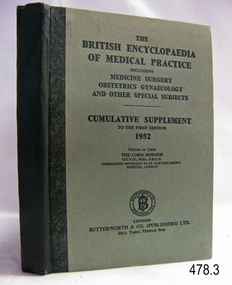
Book, The British Encyclopaedia of Medical Practice 1951
... medical instruments and other equipment is culturally significant, being an historical example of medicine, administration, household equipment and clothing from late 19th to mid-20th century. Dr Angus assisted Dr Tom Ryan, a pioneer in the use of X-rays and in ocular surgery. flagstaff hill warrnambool shipwrecked-coast flagstaff-hill flagstaff-hill-maritime-museum maritime-museum shipwreck-coast flagstaff-hill-maritime-village the british encyclopaedia of medical practice 1951 book dr w r angus dr ryan surgical instrument t.s.s. largs bay warrnambool base hospital nhill base hospital mira hospital flying doctor medical treatment medical history medical education Pastedown front endpaper has sticker that reads W. ...This Book was donated to Flagstaff Hill Maritime Village by the family of Doctor William Roy Angus, Surgeon and Oculist. It is part of the “W.R. Angus Collection” that includes historical medical equipment, surgical instruments and material once belonging to Dr Edward Ryan and Dr Thomas Francis Ryan, (both of Nhill, Victoria) as well as Dr Angus’ own belongings. The Collection’s history spans the medical practices of the two Doctors Ryan, from 1885-1926 plus that of Dr Angus, up until 1969. ABOUT THE “W.R.ANGUS COLLECTION” Doctor William Roy Angus M.B., B.S., Adel., 1923, F.R.C.S. Edin.,1928 (also known as Dr Roy Angus) was born in Murrumbeena, Victoria in 1901 and lived until 1970. He qualified as a doctor in 1923 at University of Adelaide, was Resident Medical Officer at the Royal Adelaide Hospital in 1924 and for a period was house surgeon to Sir (then Mr.) Henry Simpson Newland. Dr Angus was briefly an Assistant to Dr Riddell of Kapunda, then commenced private practice at Curramulka, Yorke Peninsula, SA, where he was physician, surgeon and chemist. In 1926, he was appointed as new Medical Assistant to Dr Thomas Francis Ryan (T.F. Ryan, or Tom), in Nhill, Victoria, where his experiences included radiology and pharmacy. In 1927 he was Acting House Surgeon in Dr Tom Ryan’s absence. Dr Angus had become engaged to Gladys Forsyth and they decided he further his studies overseas in the UK in 1927. He studied at London University College Hospital and at Edinburgh Royal Infirmary and in 1928, was awarded FRCS (Fellow from the Royal College of Surgeons), Edinburgh. He worked his passage back to Australia as a Ship’s Surgeon on the on the Australian Commonwealth Line’s T.S.S. Largs Bay. Dr Angus married Gladys in 1929, in Ballarat. (They went on to have one son (Graham 1932, born in SA) and two daughters (Helen (died 12/07/1996) and Berenice (Berry), both born at Mira, Nhill According to Berry, her mother Gladys made a lot of their clothes. She was very talented and did some lovely embroidery including lingerie for her trousseau and beautifully handmade baby clothes. Dr Angus was a ‘flying doctor’ for the A.I.M. (Australian Inland Ministry) Aerial Medical Service in 1928. Its first station was in the remote town of Oodnadatta, where Dr Angus was stationed. He was locum tenens there on North-South Railway at 21 Mile Camp. He took up this ‘flying doctor’ position in response to a call from Dr John Flynn; the organisation was later known as the Flying Doctor Service, then the Royal Flying Doctor Service. A lot of his work during this time involved dental surgery also. Between 1928-1932 he was surgeon at the Curramulka Hospital, Yorke Peninsula, South Australia. In 1933 Dr Angus returned to Nhill and purchased a share of the Nelson Street practice and Mira hospital (a 2 bed ward at the Nelson Street Practice) from Dr Les Middleton one of the Middleton Brothers, the current owners of what previously once Dr Tom Ryan’s practice. Dr Tom and his brother had worked as surgeons included eye surgery. Dr Tom Ryan performed many of his operations in the Mira private hospital on his premises. He had been House Surgeon at the Nhill Hospital 1902-1926. Dr Tom Ryan had one of the only two pieces of radiology equipment in Victoria during his practicing years – The Royal Melbourne Hospital had the other one. Over the years Dr Tom Ryan had gradually set up what was effectively a training school for country general-practitioner-surgeons. Each patient was carefully examined, including using the X-ray machine, and any surgery was discussed and planned with Dr Ryan’s assistants several days in advance. Dr Angus gained experience in using the X-ray machine there during his time as assistant to Dr Ryan. When Dr Angus bought into the Nelson Street premises in Nhill he was also appointed as the Nhill Hospital’s Honorary House Surgeon 1933-1938. His practitioner’s plate from his Nhill surgery is now mounted on the doorway to the Port Medical Office at Flagstaff Hill Maritime Village, Warrnambool. When Dr Angus took up practice in the Dr Edward and Dr Tom Ryan’s old premises he obtained their extensive collection of historical medical equipment and materials spanning 1884-1926. A large part of this collection is now on display at the Port Medical Office at Flagstaff Hill Maritime Village in Warrnambool. In 1939 Dr Angus and his family moved to Warrnambool where he purchased “Birchwood,” the 1852 home and medical practice of Dr John Hunter Henderson, at 214 Koroit Street. (This property was sold in1965 to the State Government and is now the site of the Warrnambool Police Station and an ALDI sore is on the land that was once their tennis court). The Angus family was able to afford gardeners, cooks and maids; their home was a popular place for visiting dignitaries to stay whilst visiting Warrnambool. Dr Angus had his own silk worm farm at home in a Mulberry tree. His young daughter used his centrifuge for spinning the silk. Dr Angus was appointed on a part-time basis as Port Medical Officer (Health Officer) in Warrnambool and held this position until the 1940’s when the government no longer required the service of a Port Medical Officer in Warrnambool; he was thus Warrnambool’s last serving Port Medical Officer. (Masters of immigrant ships arriving in port reported incidents of diseases, illness and death and the Port Medical Officer made a decision on whether the ship required Quarantine and for how long, in this way preventing contagious illness from spreading from new immigrants to the residents already in the colony.) Dr Angus was a member of the Australian Medical Association, for 35 years and surgeon at the Warrnambool Base Hospital 1939-1942, He served as a Surgeon Captain during WWII 1942-45, in Ballarat, Victoria, and in Bonegilla, N.S.W., completing his service just before the end of the war due to suffering from a heart attack. During his convalescence he carved an intricate and ‘most artistic’ chess set from the material that dentures were made from. He then studied ophthalmology at the Royal Melbourne Eye and Ear Hospital and created cosmetically superior artificial eyes by pioneering using the intrascleral cartilage. Angus received accolades from the Ophthalmological Society of Australasia for this work. He returned to Warrnambool to commence practice as an ophthalmologist, pioneering in artificial eye improvements. He was Honorary Consultant Ophthalmologist to Warrnambool Base Hospital for 31 years. He made monthly visits to Portland as a visiting surgeon, to perform eye surgery. He represented the Victorian South-West subdivision of the Australian Medical Association as its secretary between 1949 and 1956 and as chairman from 1956 to 1958. In 1968 Dr Angus was elected member of Spain’s Barraquer Institute of Barcelona after his research work in Intrasclearal cartilage grafting, becoming one of the few Australian ophthalmologists to receive this honour, and in the following year presented his final paper on Living Intrasclearal Cartilage Implants at the Inaugural Meeting of the Australian College of Ophthalmologists in Melbourne In his personal life Dr Angus was a Presbyterian and treated Sunday as a Sabbath, a day of rest. He would visit 3 or 4 country patients on a Sunday, taking his children along ‘for the ride’ and to visit with him. Sunday evenings he would play the pianola and sing Scottish songs to his family. One of Dr Angus’ patients was Margaret MacKenzie, author of a book on local shipwrecks that she’d seen as an eye witness from the late 1880’s in Peterborough, Victoria. In the early 1950’s Dr Angus, painted a picture of a shipwreck for the cover jacket of Margaret’s book, Shipwrecks and More Shipwrecks. She was blind in later life and her daughter wrote the actual book for her. Dr Angus and his wife Gladys were very involved in Warrnambool’s society with a strong interest in civic affairs. He had an interest in people and the community. They were both involved in the creation of Flagstaff Hill, including the layout of the gardens. After his death (28th March 1970) his family requested his practitioner’s plate, medical instruments and some personal belongings be displayed in the Port Medical Office surgery at Flagstaff Hill Maritime Village, and be called the “W. R. Angus Collection”. The W.R. Angus Collection is significant for still being located at the site it is connected with, Doctor Angus being the last Port Medical Officer in Warrnambool. The collection of medical instruments and other equipment is culturally significant, being an historical example of medicine, administration, household equipment and clothing from late 19th to mid-20th century. Dr Angus assisted Dr Tom Ryan, a pioneer in the use of X-rays and in ocular surgery. The British Encyclopaedia of Medical Practice 1951 Author: Rt. Hon. Lord Horder Publisher: Butterworth & Company Date: 1952Pastedown front endpaper has sticker that reads W. R. Angus, 309 kroit Street, Warrnamboolflagstaff hill, warrnambool, shipwrecked-coast, flagstaff-hill, flagstaff-hill-maritime-museum, maritime-museum, shipwreck-coast, flagstaff-hill-maritime-village, the british encyclopaedia of medical practice 1951, book, dr w r angus, dr ryan, surgical instrument, t.s.s. largs bay, warrnambool base hospital, nhill base hospital, mira hospital, flying doctor, medical treatment, medical history, medical education -
 Flagstaff Hill Maritime Museum and Village
Book, The British Encyclopaedia of Medical Practice 1952
... Medical Office surgery at Flagstaff Hill Maritime Village, and be called the “W. R. Angus Collection”. flagstaff hill warrnambool shipwrecked-coast flagstaff-hill flagstaff-hill-maritime-museum maritime-museum shipwreck-coast flagstaff-hill-maritime-village the british encyclopaedia of medical practice 1952 book dr w r angus dr ryan t.s.s. largs bay warrnambool base hospital nhill base hospital mira hospital flying doctor medical treatment medical history medical education Pastedown front endpaper has sticker that reads "W.R.Angus, 309 Koroit Street, Warrnambool" The British Encyclopaedia of Medical Practice 1952 Author: Rt. ...This Book was donated to Flagstaff Hill Maritime Village by the family of Doctor William Roy Angus, Surgeon and Oculist. It is part of the “W.R. Angus Collection” that includes historical medical equipment, surgical instruments and material once belonging to Dr Edward Ryan and Dr Thomas Francis Ryan, (both of Nhill, Victoria) as well as Dr Angus’ own belongings. The Collection’s history spans the medical practices of the two Doctors Ryan, from 1885-1926 plus that of Dr Angus, up until 1969. ABOUT THE “W.R.ANGUS COLLECTION” Doctor William Roy Angus M.B., B.S., Adel., 1923, F.R.C.S. Edin.,1928 (also known as Dr Roy Angus) was born in Murrumbeena, Victoria in 1901 and lived until 1970. He qualified as a doctor in 1923 at University of Adelaide, was Resident Medical Officer at the Royal Adelaide Hospital in 1924 and for a period was house surgeon to Sir (then Mr.) Henry Simpson Newland. Dr Angus was briefly an Assistant to Dr Riddell of Kapunda, then commenced private practice at Curramulka, Yorke Peninsula, SA, where he was physician, surgeon and chemist. In 1926, he was appointed as new Medical Assistant to Dr Thomas Francis Ryan (T.F. Ryan, or Tom), in Nhill, Victoria, where his experiences included radiology and pharmacy. In 1927 he was Acting House Surgeon in Dr Tom Ryan’s absence. Dr Angus had become engaged to Gladys Forsyth and they decided he further his studies overseas in the UK in 1927. He studied at London University College Hospital and at Edinburgh Royal Infirmary and in 1928, was awarded FRCS (Fellow from the Royal College of Surgeons), Edinburgh. He worked his passage back to Australia as a Ship’s Surgeon on the on the Australian Commonwealth Line’s T.S.S. Largs Bay. Dr Angus married Gladys in 1929, in Ballarat. (They went on to have one son (Graham 1932, born in SA) and two daughters (Helen (died 12/07/1996) and Berenice (Berry), both born at Mira, Nhill According to Berry, her mother Gladys made a lot of their clothes. She was very talented and did some lovely embroidery including lingerie for her trousseau and beautifully handmade baby clothes. Dr Angus was a ‘flying doctor’ for the A.I.M. (Australian Inland Ministry) Aerial Medical Service in 1928. Its first station was in the remote town of Oodnadatta, where Dr Angus was stationed. He was locum tenens there on North-South Railway at 21 Mile Camp. He took up this ‘flying doctor’ position in response to a call from Dr John Flynn; the organisation was later known as the Flying Doctor Service, then the Royal Flying Doctor Service. A lot of his work during this time involved dental surgery also. Between 1928-1932 he was surgeon at the Curramulka Hospital, Yorke Peninsula, South Australia. In 1933 Dr Angus returned to Nhill and purchased a share of the Nelson Street practice and Mira hospital (a 2 bed ward at the Nelson Street Practice) from Dr Les Middleton one of the Middleton Brothers, the current owners of what previously once Dr Tom Ryan’s practice. Dr Tom and his brother had worked as surgeons included eye surgery. Dr Tom Ryan performed many of his operations in the Mira private hospital on his premises. He had been House Surgeon at the Nhill Hospital 1902-1926. Dr Tom Ryan had one of the only two pieces of radiology equipment in Victoria during his practicing years – The Royal Melbourne Hospital had the other one. Over the years Dr Tom Ryan had gradually set up what was effectively a training school for country general-practitioner-surgeons. Each patient was carefully examined, including using the X-ray machine, and any surgery was discussed and planned with Dr Ryan’s assistants several days in advance. Dr Angus gained experience in using the X-ray machine there during his time as assistant to Dr Ryan. When Dr Angus bought into the Nelson Street premises in Nhill he was also appointed as the Nhill Hospital’s Honorary House Surgeon 1933-1938. His practitioner’s plate from his Nhill surgery is now mounted on the doorway to the Port Medical Office at Flagstaff Hill Maritime Village, Warrnambool. When Dr Angus took up practice in the Dr Edward and Dr Tom Ryan’s old premises he obtained their extensive collection of historical medical equipment and materials spanning 1884-1926. A large part of this collection is now on display at the Port Medical Office at Flagstaff Hill Maritime Village in Warrnambool. In 1939 Dr Angus and his family moved to Warrnambool where he purchased “Birchwood,” the 1852 home and medical practice of Dr John Hunter Henderson, at 214 Koroit Street. (This property was sold in1965 to the State Government and is now the site of the Warrnambool Police Station and an ALDI sore is on the land that was once their tennis court). The Angus family was able to afford gardeners, cooks and maids; their home was a popular place for visiting dignitaries to stay whilst visiting Warrnambool. Dr Angus had his own silk worm farm at home in a Mulberry tree. His young daughter used his centrifuge for spinning the silk. Dr Angus was appointed on a part-time basis as Port Medical Officer (Health Officer) in Warrnambool and held this position until the 1940’s when the government no longer required the service of a Port Medical Officer in Warrnambool; he was thus Warrnambool’s last serving Port Medical Officer. (Masters of immigrant ships arriving in port reported incidents of diseases, illness and death and the Port Medical Officer made a decision on whether the ship required Quarantine and for how long, in this way preventing contagious illness from spreading from new immigrants to the residents already in the colony.) Dr Angus was a member of the Australian Medical Association, for 35 years and surgeon at the Warrnambool Base Hospital 1939-1942, He served as a Surgeon Captain during WWII 1942-45, in Ballarat, Victoria, and in Bonegilla, N.S.W., completing his service just before the end of the war due to suffering from a heart attack. During his convalescence he carved an intricate and ‘most artistic’ chess set from the material that dentures were made from. He then studied ophthalmology at the Royal Melbourne Eye and Ear Hospital and created cosmetically superior artificial eyes by pioneering using the intrascleral cartilage. Angus received accolades from the Ophthalmological Society of Australasia for this work. He returned to Warrnambool to commence practice as an ophthalmologist, pioneering in artificial eye improvements. He was Honorary Consultant Ophthalmologist to Warrnambool Base Hospital for 31 years. He made monthly visits to Portland as a visiting surgeon, to perform eye surgery. He represented the Victorian South-West subdivision of the Australian Medical Association as its secretary between 1949 and 1956 and as chairman from 1956 to 1958. In 1968 Dr Angus was elected member of Spain’s Barraquer Institute of Barcelona after his research work in Intrasclearal cartilage grafting, becoming one of the few Australian ophthalmologists to receive this honour, and in the following year presented his final paper on Living Intrasclearal Cartilage Implants at the Inaugural Meeting of the Australian College of Ophthalmologists in Melbourne In his personal life Dr Angus was a Presbyterian and treated Sunday as a Sabbath, a day of rest. He would visit 3 or 4 country patients on a Sunday, taking his children along ‘for the ride’ and to visit with him. Sunday evenings he would play the pianola and sing Scottish songs to his family. One of Dr Angus’ patients was Margaret MacKenzie, author of a book on local shipwrecks that she’d seen as an eye witness from the late 1880’s in Peterborough, Victoria. In the early 1950’s Dr Angus, painted a picture of a shipwreck for the cover jacket of Margaret’s book, Shipwrecks and More Shipwrecks. She was blind in later life and her daughter wrote the actual book for her. Dr Angus and his wife Gladys were very involved in Warrnambool’s society with a strong interest in civic affairs. He had an interest in people and the community. They were both involved in the creation of Flagstaff Hill, including the layout of the gardens. After his death (28th March 1970) his family requested his practitioner’s plate, medical instruments and some personal belongings be displayed in the Port Medical Office surgery at Flagstaff Hill Maritime Village, and be called the “W. R. Angus Collection”. The British Encyclopaedia of Medical Practice 1952 Author: Rt. Hon. Lord Horder Publisher: Butterworth & Company Date: 1952Pastedown front endpaper has sticker that reads "W.R.Angus, 309 Koroit Street, Warrnambool"flagstaff hill, warrnambool, shipwrecked-coast, flagstaff-hill, flagstaff-hill-maritime-museum, maritime-museum, shipwreck-coast, flagstaff-hill-maritime-village, the british encyclopaedia of medical practice 1952, book, dr w r angus, dr ryan, t.s.s. largs bay, warrnambool base hospital, nhill base hospital, mira hospital, flying doctor, medical treatment, medical history, medical education -
 Lara RSL Sub Branch
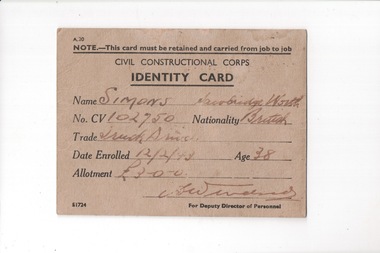
Personal Records, Civilian Construction Corps Identity Card, 1943
... Civil Constructional Corps Identity Card Issued to Simons Macrobridge Worth Nationality British Trade Truck Service 12/2/43 Allotment 3.0.0 Medical History...Civil Constructional Corps Identity Card Issued to Simons Macrobridge Worth Nationality British Trade Truck Service 12/2/43 Allotment 3.0.0 Medical History Cardboard Civilian Construction Corps Identity Card Personal Records ...Identity Card for Civilian Construction Corps issued to SimonsID card issued to civilian trades persons during world war two.CardboardCivil Constructional Corps Identity Card Issued to Simons Macrobridge Worth Nationality British Trade Truck Service 12/2/43 Allotment 3.0.0 Medical History -
 Flagstaff Hill Maritime Museum and Village
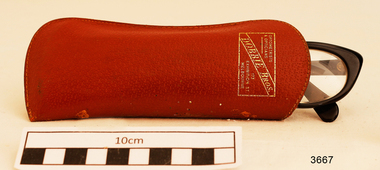
Functional object - Spectacles and case, c. 1969
... british-optical-association-museum/the-history-of-spectacles These spectacles and case were used by Dr. Angus in his surgery in Warrnambool to test patients' eye sight. They were donated to Flagstaff Hill Maritime Village by the family of Doctor William Roy Angus, Surgeon and Oculist. It is part of the “W.R. Angus Collection” that includes historical medical...british-optical-association-museum/the-history-of-spectacles These spectacles and case were used by Dr. Angus in his surgery in Warrnambool to test patients' eye sight. They were donated to Flagstaff Hill Maritime Village by the family of Doctor William Roy Angus, Surgeon and Oculist. It is part of the “W.R. Angus Collection” that includes historical medical ...The history of spectacles The earliest form of spectacles are generally agreed to have been invented in Northern Italy in the thirteenth century. Over hundreds of years of innovation and refinement, they have been perfected into the stylish and functional designs you see today worn by millions of people to correct their eyesight. Here's a look at the key moments that defined the history of spectacles. Thirteenth century - Rivet spectacles The earliest form of spectacles was simply two mounted lenses riveted together at the handle ends. They had no sides and were secured to the face by clamping the nose between the rims, some of which had notches which may have been intended to improve the grip. Even then the wearer could only keep them in place by remaining relatively still and would normally support them with the hand. These spectacles contained convex lenses for the correction of presbyopic long-sightedness and were generally suited only to those few who lived beyond their forties and had the ability to read. Sixteenth century - Nose spectacles Nose spectacles were in more common use by the early sixteenth century. These often had a bow-shaped continuous bridge, almost of a modern appearance, that was sometimes flexible depending upon the material, for example leather or whalebone. The bridge was as much an area to be gripped as to rest on the nose. Spectacles were still usually held in place with the hand whilst being used temporarily for a brief period of reading or close inspection. By now the lenses could be used to correct both long and short sight. The general design changed little through the seventeenth century, though certain refinements increased the flexibility and comfort for some wearers. In some localised areas, notably in Spain, people experimented with ear loops made of string. This allowed them to walk around with their spectacles on. Eighteenth century - Temple glasses Only in the eighteenth century did the first modern eyewear, or ‘glasses’ as we would understand them, start to appear. The lenses might be glass, rock crystal or any other transparent mineral substance and were prone to smashing if the spectacles fell off, so there was an impetus to develop frames that could be worn continuously and would stay in place. London optician Edward Scarlett is credited with developing the modern style of spectacles which were kept in place with arms, known as ‘temples’. These were made of iron or steel and gripped the side of the head but did not yet hook over the ears because often the ears were concealed beneath a powdered wig, such as was fashionable at the time. As temples developed they were made with wide ring ends through which the wearer could pass a ribbon, thus tying the spectacles securely to the head. As spectacles were no longer primarily for use in sedentary activities, people began to be noticed out and about in their spectacles and might come to be identified as a ‘spectacle wearer’. By the end of the eighteenth century, people who needed correction for both distance and near could choose bifocals. Nineteenth century - Pince-nez Pince-nez were a nineteenth century innovation that literally translates as ‘pinching the nose’. They had a spring clip to retain the item in place under its own tension. Sometimes this clip was too tight and the wearer struggled to breathe. If it was too loose the pince-nez could fall off so, for safety and security, they were often connected to the wearer's clothing by a cord or a chain to avoid them being dropped or lost. Pince-nez were sometimes chosen by people who felt that large spectacles were too prominent and drew attention to a physical defect. They were also suitable for mounting lenses that could correct astigmatism. Twentieth century spectacles Spectacle wearing continued to become more widespread, key developments being the supply of spectacles to troops in the First World War, cheaper spectacles being subsidised through insurance schemes arranged by friendly societies, and the beginning of the National Health Service in 1948, when free spectacles were made available to all who might benefit from them. This normalised spectacle wearing and led to a significant increase in the scale of production. Entirely separate categories of women’s spectacles and sports eyewear both emerged in the 1930s. The latter half of the twentieth century saw spectacles become more fashionable and stylish as frames with different shapes, materials, and colours became available. Plastics frames, in particular, allowed a greater choice of colours and textured finishes. Plastic lenses were more durable and could be made lighter and thinner than glass, spurring a renewed interest in rimless designs. Designer eyewear bearing popular high-street brand names encouraged patients to regard spectacles as a desirable commodity, even as a fashion accessory, not just a disability aid. https://www.college-optometrists.org/the-british-optical-association-museum/the-history-of-spectacles These spectacles and case were used by Dr. Angus in his surgery in Warrnambool to test patients' eye sight. They were donated to Flagstaff Hill Maritime Village by the family of Doctor William Roy Angus, Surgeon and Oculist. It is part of the “W.R. Angus Collection” that includes historical medical equipment, surgical instruments and material once belonging to Dr Edward Ryan and Dr Thomas Francis Ryan, (both of Nhill, Victoria) as well as Dr Angus’ own belongings. The Collection’s history spans the medical practices of the two Doctors Ryan, from 1885-1926 plus that of Dr Angus, up until 1969. ABOUT THE “W.R.ANGUS COLLECTION” Doctor William Roy Angus M.B., B.S., Adel., 1923, F.R.C.S. Edin.,1928 (also known as Dr Roy Angus) was born in Murrumbeena, Victoria in 1901 and lived until 1970. He qualified as a doctor in 1923 at University of Adelaide, was Resident Medical Officer at the Royal Adelaide Hospital in 1924 and for a period was house surgeon to Sir (then Mr.) Henry Simpson Newland. Dr Angus was briefly an Assistant to Dr Riddell of Kapunda, then commenced private practice at Curramulka, Yorke Peninsula, SA, where he was physician, surgeon and chemist. In 1926, he was appointed as new Medical Assistant to Dr Thomas Francis Ryan (T.F. Ryan, or Tom), in Nhill, Victoria, where his experiences included radiology and pharmacy. In 1927 he was Acting House Surgeon in Dr Tom Ryan’s absence. Dr Angus had become engaged to Gladys Forsyth and they decided he would take time to further his studies overseas in the UK in 1927. He studied at London University College Hospital and at Edinburgh Royal Infirmary and in 1928, was awarded FRCS (Fellow from the Royal College of Surgeons), Edinburgh. He worked his passage back to Australia as a Ship’s Surgeon on the on the Australian Commonwealth Line’s T.S.S. Largs Bay. Dr Angus married Gladys in 1929, in Ballarat. (They went on to have one son (Graham 1932, born in SA) and two daughters (Helen (died 12/07/1996) and Berenice (Berry), both born at Mira, Nhill ) Dr Angus was a ‘flying doctor’ for the A.I.M. (Australian Inland Ministry) Aerial Medical Service in 1928 . The organisation began in South Australia through the Presbyterian Church in that year, with its first station being in the remote town of Oodnadatta, where Dr Angus was stationed. He was locum tenens there on North-South Railway at 21 Mile Camp. He took up this ‘flying doctor’ position in response to a call from Dr John Flynn; the organisation was later known as the Flying Doctor Service, then the Royal Flying Doctor Service. A lot of his work during this time involved dental surgery also. Between 1928-1932 he was surgeon at the Curramulka Hospital, Yorke Peninsula, South Australia. In 1933 Dr Angus returned to Nhill where he’d previously worked as Medical Assistant and purchased a share of the Nelson Street practice and Mira hospital from Dr Les Middleton one of the Middleton Brothers, the current owners of what was once Dr Tom Ryan’s practice. Dr L Middleton was House Surgeon to the Nhill Hospital 1926-1933, when he resigned. [Dr Tom Ryan’s practice had originally belonged to his older brother Dr Edward Ryan, who came to Nhill in 1885. Dr Edward saw patients at his rooms, firstly in Victoria Street and in 1886 in Nelson Street, until 1901. The Nelson Street practice also had a 2 bed ward, called Mira Private Hospital ). Dr Edward Ryan was House Surgeon at the Nhill Hospital 1884-1902 . He also had occasions where he successfully performed veterinary surgery for the local farmers too. Dr Tom Ryan then purchased the practice from his brother in 1901. Both Dr Edward and Dr Tom Ryan work as surgeons included eye surgery. Dr Tom Ryan performed many of his operations in the Mira private hospital on his premises. He too was House Surgeon at the Nhill Hospital 1902-1926. Dr Tom Ryan had one of the only two pieces of radiology equipment in Victoria during his practicing years – The Royal Melbourne Hospital had the other one. Over the years Dr Tom Ryan gradually set up what was effectively a training school for country general-practitioner-surgeons. Each patient was carefully examined, including using the X-ray machine, and any surgery was discussed and planned with Dr Ryan’s assistants several days in advance. Dr Angus gained experience in using the X-ray machine there during his time as assistant to Dr Ryan. Dr Tom Ryan moved from Nhill in 1926. He became a Fellow of the Royal Australasian College of Surgeons in 1927, soon after its formation, a rare accolade for a doctor outside any of the major cities. He remained a bachelor and died suddenly on 7th Dec 1955, aged 91, at his home in Ararat. Scholarships and prizes are still awarded to medical students in the honour of Dr T.F. Ryan and his father, Dr Michael Ryan, and brother, John Patrick Ryan. ] When Dr Angus bought into the Nelson Street premises in Nhill he was also appointed as the Nhill Hospital’s Honorary House Surgeon 1933-1938. His practitioner’s plate from his Nhill surgery states “HOURS Daily, except Tuesdays, Fridays and Saturday afternoons, 9-10am, 2-4pm, 7-8pm. Sundays by appointment”. This plate is now mounted on the doorway to the Port Medical Office at Flagstaff Hill Maritime Village, Warrnambool. Dr Edward Ryan and Dr Tom Ryan had an extensive collection of historical medical equipment and materials spanning 1884-1926 and when Dr Angus took up practice in their old premises he obtained this collection, a large part of which is now on display at the Port Medical Office at Flagstaff Hill Maritime Village in Warrnambool. During his time in Nhill Dr Angus was involved in the merging of the Mira Hospital and Nhill Public Hospital into one public hospital and the property titles passed on to Nhill Hospital in 1939. In 1939 Dr Angus and his family moved to Warrnambool where he purchased “Birchwood,” the 1852 home and medical practice of Dr John Hunter Henderson, at 214 Koroit Street. (This property was sold in1965 to the State Government and is now the site of the Warrnambool Police Station. ). The Angus family was able to afford gardeners, cooks and maids; their home was a popular place for visiting dignitaries to stay whilst visiting Warrnambool. Dr Angus had his own silk worm farm at home in a Mulberry tree. His young daughter used his centrifuge for spinning the silk. Dr Angus was appointed on a part-time basis as Port Medical Officer (Health Officer) in Warrnambool and held this position until the 1940’s when the government no longer required the service of a Port Medical Officer in Warrnambool; he was thus Warrnambool’s last serving Port Medical Officer. (The duties of a Port Medical Officer were outlined by the Colonial Secretary on 21st June, 1839 under the terms of the Quarantine Act. Masters of immigrant ships arriving in port reported incidents of diseases, illness and death and the Port Medical Officer made a decision on whether the ship required Quarantine and for how long, in this way preventing contagious illness from spreading from new immigrants to the residents already in the colony.) Dr Angus was a member of the Australian Medical Association, for 35 years and surgeon at the Warrnambool Base Hospital 1939-1942, He served as a Surgeon Captain during WWII 1941-45, in Ballarat, Victoria, and in Bonegilla, N.S.W., completing his service just before the end of the war due to suffering from a heart attack. During his convalescence he carved an intricate and ‘most artistic’ chess set from the material that dentures were made from. He then studied ophthalmology at the Royal Melbourne Eye and Ear Hospital and created cosmetically superior artificial eyes by pioneering using the intrascleral cartilage. Angus received accolades from the Ophthalmological Society of Australasia for this work. He returned to Warrnambool to commence practice as an ophthalmologist, pioneering in artificial eye improvements. He was Honorary Consultant Ophthalmologist to Warrnambool Base Hospital for 31 years. He made monthly visits to Portland as a visiting surgeon, to perform eye surgery. He represented the Victorian South-West subdivision of the Australian Medical Association as its secretary between 1949 and 1956 and as chairman from 1956 to 1958. In 1968 Dr Angus was elected member of Spain’s Barraquer Institute of Barcelona after his research work in Intrasclearal cartilage grafting, becoming one of the few Australian ophthalmologists to receive this honour, and in the following year presented his final paper on Living Intrasclearal Cartilage Implants at the Inaugural Meeting of the Australian College of Ophthalmologists in Melbourne In his personal life Dr Angus was a Presbyterian and treated Sunday as a Sabbath, a day of rest. He would visit 3 or 4 country patients on a Sunday, taking his children along ‘for the ride’ and to visit with him. Sunday evenings he would play the pianola and sing Scottish songs to his family. One of Dr Angus’ patients was Margaret MacKenzie, author of a book on local shipwrecks that she’d seen as an eye witness from the late 1880’s in Peterborough, Victoria. In the early 1950’s Dr Angus, painted a picture of a shipwreck for the cover jacket of Margaret’s book, Shipwrecks and More Shipwrecks. She was blind in later life and her daughter wrote the actual book for her. Dr Angus and his wife Gladys were very involved in Warrnambool’s society with a strong interest in civic affairs. Their interests included organisations such as Red Cross, Rostrum, Warrnambool and District Historical Society (founding members), Wine and Food Society, Steering Committee for Tertiary Education in Warrnambool, Local National Trust, Good Neighbour Council, Housing Commission Advisory Board, United Services Institute, Legion of Ex-Servicemen, Olympic Pool Committee, Food for Britain Organisation, Warrnambool Hospital, Anti-Cancer Council, Boys’ Club, Charitable Council, National Fitness Council and Air Raid Precautions Group. He was also a member of the Steam Preservation Society and derived much pleasure from a steam traction engine on his farm. He had an interest in people and the community He and his wife Gladys were both involved in the creation of Flagstaff Hill, including the layout of the gardens. After his death (28th March 1970) his family requested his practitioner’s plate, medical instruments and some personal belongings be displayed in the Port Medical Office surgery at Flagstaff Hill Maritime Village, and be called the “W. R. Angus Collection”. The W.R. Angus Collection is significant for still being located at the site it is connected with, Doctor Angus being the last Port Medical Officer in Warrnambool. The collection of medical instruments and other equipment is culturally significant, being an historical example of medicine from late 19th to mid-20th century. Dr Angus assisted Dr Tom Ryan, a pioneer in the use of X-rays and in ocular surgery. Spectacles and case, from the W.R. Angus Collection and used by Dr. Angus for testing the sight of his patients. Black rimmed spectacles in tan, open ended pouch. Inscription is stamped into frame and printed in gold lettering on the case. c. 1969 Inscriptions read on spectacles;“52 (square) 18” and “RODENSTOCK > ELBA < 130“ and printed in gold lettering on the pouch “DOBBIE BROS. / OPTOMETRISTS & OPTICIANS / 173 EXHIBITION ST. MELBOURNE”flagstaff hill, warrnambool, shipwrecked coast, flagstaff hill maritime museum, maritime museum, shipwreck coast, flagstaff hill maritime village, great ocean road, dr w r angus, dr ryan, surgical instrument, t.s.s. largs bay, warrnambool base hospital, nhill base hospital, mira hospital, flying doctor, medical treatment, spectacles and case, optical testing, optometrist examination, dobbie bros melbourne -
 Flagstaff Hill Maritime Museum and Village
Functional object - Spectacles and Case, 1930s - 1960s
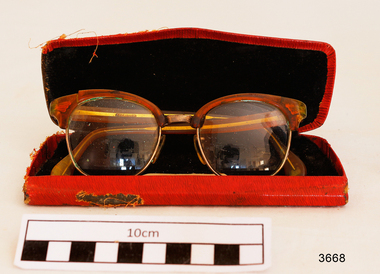
... british-optical-association-museum/the-history-of-spectacles The company Optical Prescription Spectacle Makers (OPSM ) was formed in Sydney in 1932 and publically listed in 1953. These spectacles and case were used by Dr. Angus when testing patients' eyes. The spectacles and case were donated to Flagstaff Hill Maritime Village by the family of Doctor William Roy Angus, Surgeon and Oculist. It is part of the “W.R. Angus Collection” that includes historical medical...british-optical-association-museum/the-history-of-spectacles The company Optical Prescription Spectacle Makers (OPSM ) was formed in Sydney in 1932 and publically listed in 1953. These spectacles and case were used by Dr. Angus when testing patients' eyes. The spectacles and case were donated to Flagstaff Hill Maritime Village by the family of Doctor William Roy Angus, Surgeon and Oculist. It is part of the “W.R. Angus Collection” that includes historical medical ...The history of spectacles The earliest form of spectacles are generally agreed to have been invented in Northern Italy in the thirteenth century. Over hundreds of years of innovation and refinement, they have been perfected into the stylish and functional designs you see today worn by millions of people to correct their eyesight. Here's a look at the key moments that defined the history of spectacles. Thirteenth century - Rivet spectacles The earliest form of spectacles was simply two mounted lenses riveted together at the handle ends. They had no sides and were secured to the face by clamping the nose between the rims, some of which had notches which may have been intended to improve the grip. Even then the wearer could only keep them in place by remaining relatively still and would normally support them with the hand. These spectacles contained convex lenses for the correction of presbyopic long-sightedness and were generally suited only to those few who lived beyond their forties and had the ability to read. Sixteenth century - Nose spectacles Nose spectacles were in more common use by the early sixteenth century. These often had a bow-shaped continuous bridge, almost of a modern appearance, that was sometimes flexible depending upon the material, for example leather or whalebone. The bridge was as much an area to be gripped as to rest on the nose. Spectacles were still usually held in place with the hand whilst being used temporarily for a brief period of reading or close inspection. By now the lenses could be used to correct both long and short sight. The general design changed little through the seventeenth century, though certain refinements increased the flexibility and comfort for some wearers. In some localised areas, notably in Spain, people experimented with ear loops made of string. This allowed them to walk around with their spectacles on. Eighteenth century - Temple glasses Only in the eighteenth century did the first modern eyewear, or ‘glasses’ as we would understand them, start to appear. The lenses might be glass, rock crystal or any other transparent mineral substance and were prone to smashing if the spectacles fell off, so there was an impetus to develop frames that could be worn continuously and would stay in place. London optician Edward Scarlett is credited with developing the modern style of spectacles which were kept in place with arms, known as ‘temples’. These were made of iron or steel and gripped the side of the head but did not yet hook over the ears because often the ears were concealed beneath a powdered wig, such as was fashionable at the time. As temples developed they were made with wide ring ends through which the wearer could pass a ribbon, thus tying the spectacles securely to the head. As spectacles were no longer primarily for use in sedentary activities, people began to be noticed out and about in their spectacles and might come to be identified as a ‘spectacle wearer’. By the end of the eighteenth century, people who needed correction for both distance and near could choose bifocals. Nineteenth century - Pince-nez Pince-nez were a nineteenth century innovation that literally translates as ‘pinching the nose’. They had a spring clip to retain the item in place under its own tension. Sometimes this clip was too tight and the wearer struggled to breathe. If it was too loose the pince-nez could fall off so, for safety and security, they were often connected to the wearer's clothing by a cord or a chain to avoid them being dropped or lost. Pince-nez were sometimes chosen by people who felt that large spectacles were too prominent and drew attention to a physical defect. They were also suitable for mounting lenses that could correct astigmatism. Twentieth century spectacles Spectacle wearing continued to become more widespread, key developments being the supply of spectacles to troops in the First World War, cheaper spectacles being subsidised through insurance schemes arranged by friendly societies, and the beginning of the National Health Service in 1948, when free spectacles were made available to all who might benefit from them. This normalised spectacle wearing and led to a significant increase in the scale of production. Entirely separate categories of women’s spectacles and sports eyewear both emerged in the 1930s. The latter half of the twentieth century saw spectacles become more fashionable and stylish as frames with different shapes, materials, and colours became available. Plastics frames, in particular, allowed a greater choice of colours and textured finishes. Plastic lenses were more durable and could be made lighter and thinner than glass, spurring a renewed interest in rimless designs. Designer eyewear bearing popular high-street brand names encouraged patients to regard spectacles as a desirable commodity, even as a fashion accessory, not just a disability aid. https://www.college-optometrists.org/the-british-optical-association-museum/the-history-of-spectacles The company Optical Prescription Spectacle Makers (OPSM ) was formed in Sydney in 1932 and publically listed in 1953. These spectacles and case were used by Dr. Angus when testing patients' eyes. The spectacles and case were donated to Flagstaff Hill Maritime Village by the family of Doctor William Roy Angus, Surgeon and Oculist. It is part of the “W.R. Angus Collection” that includes historical medical equipment, surgical instruments and material once belonging to Dr Edward Ryan and Dr Thomas Francis Ryan, (both of Nhill, Victoria) as well as Dr Angus’ own belongings. The Collection’s history spans the medical practices of the two Doctors Ryan, from 1885-1926 plus that of Dr Angus, up until 1969. ABOUT THE “W.R.ANGUS COLLECTION” Doctor William Roy Angus M.B., B.S., Adel., 1923, F.R.C.S. Edin.,1928 (also known as Dr Roy Angus) was born in Murrumbeena, Victoria in 1901 and lived until 1970. He qualified as a doctor in 1923 at University of Adelaide, was Resident Medical Officer at the Royal Adelaide Hospital in 1924 and for a period was house surgeon to Sir (then Mr.) Henry Simpson Newland. Dr Angus was briefly an Assistant to Dr Riddell of Kapunda, then commenced private practice at Curramulka, Yorke Peninsula, SA, where he was physician, surgeon and chemist. In 1926, he was appointed as new Medical Assistant to Dr Thomas Francis Ryan (T.F. Ryan, or Tom), in Nhill, Victoria, where his experiences included radiology and pharmacy. In 1927 he was Acting House Surgeon in Dr Tom Ryan’s absence. Dr Angus had become engaged to Gladys Forsyth and they decided he would take time to further his studies overseas in the UK in 1927. He studied at London University College Hospital and at Edinburgh Royal Infirmary and in 1928, was awarded FRCS (Fellow from the Royal College of Surgeons), Edinburgh. He worked his passage back to Australia as a Ship’s Surgeon on the on the Australian Commonwealth Line’s T.S.S. Largs Bay. Dr Angus married Gladys in 1929, in Ballarat. (They went on to have one son (Graham 1932, born in SA) and two daughters (Helen (died 12/07/1996) and Berenice (Berry), both born at Mira, Nhill ) Dr Angus was a ‘flying doctor’ for the A.I.M. (Australian Inland Ministry) Aerial Medical Service in 1928 . The organisation began in South Australia through the Presbyterian Church in that year, with its first station being in the remote town of Oodnadatta, where Dr Angus was stationed. He was locum tenens there on North-South Railway at 21 Mile Camp. He took up this ‘flying doctor’ position in response to a call from Dr John Flynn; the organisation was later known as the Flying Doctor Service, then the Royal Flying Doctor Service. A lot of his work during this time involved dental surgery also. Between 1928-1932 he was surgeon at the Curramulka Hospital, Yorke Peninsula, South Australia. In 1933 Dr Angus returned to Nhill where he’d previously worked as Medical Assistant and purchased a share of the Nelson Street practice and Mira hospital from Dr Les Middleton one of the Middleton Brothers, the current owners of what was once Dr Tom Ryan’s practice. Dr L Middleton was House Surgeon to the Nhill Hospital 1926-1933, when he resigned. [Dr Tom Ryan’s practice had originally belonged to his older brother Dr Edward Ryan, who came to Nhill in 1885. Dr Edward saw patients at his rooms, firstly in Victoria Street and in 1886 in Nelson Street, until 1901. The Nelson Street practice also had a 2 bed ward, called Mira Private Hospital ). Dr Edward Ryan was House Surgeon at the Nhill Hospital 1884-1902 . He also had occasions where he successfully performed veterinary surgery for the local farmers too. Dr Tom Ryan then purchased the practice from his brother in 1901. Both Dr Edward and Dr Tom Ryan work as surgeons included eye surgery. Dr Tom Ryan performed many of his operations in the Mira private hospital on his premises. He too was House Surgeon at the Nhill Hospital 1902-1926. Dr Tom Ryan had one of the only two pieces of radiology equipment in Victoria during his practicing years – The Royal Melbourne Hospital had the other one. Over the years Dr Tom Ryan gradually set up what was effectively a training school for country general-practitioner-surgeons. Each patient was carefully examined, including using the X-ray machine, and any surgery was discussed and planned with Dr Ryan’s assistants several days in advance. Dr Angus gained experience in using the X-ray machine there during his time as assistant to Dr Ryan. Dr Tom Ryan moved from Nhill in 1926. He became a Fellow of the Royal Australasian College of Surgeons in 1927, soon after its formation, a rare accolade for a doctor outside any of the major cities. He remained a bachelor and died suddenly on 7th Dec 1955, aged 91, at his home in Ararat. Scholarships and prizes are still awarded to medical students in the honour of Dr T.F. Ryan and his father, Dr Michael Ryan, and brother, John Patrick Ryan. ] When Dr Angus bought into the Nelson Street premises in Nhill he was also appointed as the Nhill Hospital’s Honorary House Surgeon 1933-1938. His practitioner’s plate from his Nhill surgery states “HOURS Daily, except Tuesdays, Fridays and Saturday afternoons, 9-10am, 2-4pm, 7-8pm. Sundays by appointment”. This plate is now mounted on the doorway to the Port Medical Office at Flagstaff Hill Maritime Village, Warrnambool. Dr Edward Ryan and Dr Tom Ryan had an extensive collection of historical medical equipment and materials spanning 1884-1926 and when Dr Angus took up practice in their old premises he obtained this collection, a large part of which is now on display at the Port Medical Office at Flagstaff Hill Maritime Village in Warrnambool. During his time in Nhill Dr Angus was involved in the merging of the Mira Hospital and Nhill Public Hospital into one public hospital and the property titles passed on to Nhill Hospital in 1939. In 1939 Dr Angus and his family moved to Warrnambool where he purchased “Birchwood,” the 1852 home and medical practice of Dr John Hunter Henderson, at 214 Koroit Street. (This property was sold in1965 to the State Government and is now the site of the Warrnambool Police Station. ). The Angus family was able to afford gardeners, cooks and maids; their home was a popular place for visiting dignitaries to stay whilst visiting Warrnambool. Dr Angus had his own silk worm farm at home in a Mulberry tree. His young daughter used his centrifuge for spinning the silk. Dr Angus was appointed on a part-time basis as Port Medical Officer (Health Officer) in Warrnambool and held this position until the 1940’s when the government no longer required the service of a Port Medical Officer in Warrnambool; he was thus Warrnambool’s last serving Port Medical Officer. (The duties of a Port Medical Officer were outlined by the Colonial Secretary on 21st June, 1839 under the terms of the Quarantine Act. Masters of immigrant ships arriving in port reported incidents of diseases, illness and death and the Port Medical Officer made a decision on whether the ship required Quarantine and for how long, in this way preventing contagious illness from spreading from new immigrants to the residents already in the colony.) Dr Angus was a member of the Australian Medical Association, for 35 years and surgeon at the Warrnambool Base Hospital 1939-1942, He served as a Surgeon Captain during WWII 1941-45, in Ballarat, Victoria, and in Bonegilla, N.S.W., completing his service just before the end of the war due to suffering from a heart attack. During his convalescence he carved an intricate and ‘most artistic’ chess set from the material that dentures were made from. He then studied ophthalmology at the Royal Melbourne Eye and Ear Hospital and created cosmetically superior artificial eyes by pioneering using the intrascleral cartilage. Angus received accolades from the Ophthalmological Society of Australasia for this work. He returned to Warrnambool to commence practice as an ophthalmologist, pioneering in artificial eye improvements. He was Honorary Consultant Ophthalmologist to Warrnambool Base Hospital for 31 years. He made monthly visits to Portland as a visiting surgeon, to perform eye surgery. He represented the Victorian South-West subdivision of the Australian Medical Association as its secretary between 1949 and 1956 and as chairman from 1956 to 1958. In 1968 Dr Angus was elected member of Spain’s Barraquer Institute of Barcelona after his research work in Intrasclearal cartilage grafting, becoming one of the few Australian ophthalmologists to receive this honour, and in the following year presented his final paper on Living Intrasclearal Cartilage Implants at the Inaugural Meeting of the Australian College of Ophthalmologists in Melbourne In his personal life Dr Angus was a Presbyterian and treated Sunday as a Sabbath, a day of rest. He would visit 3 or 4 country patients on a Sunday, taking his children along ‘for the ride’ and to visit with him. Sunday evenings he would play the pianola and sing Scottish songs to his family. One of Dr Angus’ patients was Margaret MacKenzie, author of a book on local shipwrecks that she’d seen as an eye witness from the late 1880’s in Peterborough, Victoria. In the early 1950’s Dr Angus, painted a picture of a shipwreck for the cover jacket of Margaret’s book, Shipwrecks and More Shipwrecks. She was blind in later life and her daughter wrote the actual book for her. Dr Angus and his wife Gladys were very involved in Warrnambool’s society with a strong interest in civic affairs. Their interests included organisations such as Red Cross, Rostrum, Warrnambool and District Historical Society (founding members), Wine and Food Society, Steering Committee for Tertiary Education in Warrnambool, Local National Trust, Good Neighbour Council, Housing Commission Advisory Board, United Services Institute, Legion of Ex-Servicemen, Olympic Pool Committee, Food for Britain Organisation, Warrnambool Hospital, Anti-Cancer Council, Boys’ Club, Charitable Council, National Fitness Council and Air Raid Precautions Group. He was also a member of the Steam Preservation Society and derived much pleasure from a steam traction engine on his farm. He had an interest in people and the community He and his wife Gladys were both involved in the creation of Flagstaff Hill, including the layout of the gardens. After his death (28th March 1970) his family requested his practitioner’s plate, medical instruments and some personal belongings be displayed in the Port Medical Office surgery at Flagstaff Hill Maritime Village, and be called the “W. R. Angus Collection”. The W.R. Angus Collection is significant for still being located at the site it is connected with, Doctor Angus being the last Port Medical Officer in Warrnambool. The collection of medical instruments and other equipment is culturally significant, being an historical example of medicine from late 19th to mid-20th century. Dr Angus assisted Dr Tom Ryan, a pioneer in the use of X-rays and in ocular surgery. Spectacles and case, from the W.R. Angus Collection and used by Dr. Angus testing the sight of his patients. Metal case covered in red leather, black velvet lining. Tan rimmed spectacles. Maker is OPSM. Inscriptions on case, inside case and on spectacle rim.Inscribed on spectacle arms “CONTORA”. Inscription on case in gold print “OPSM Optical Prescription Spectacle Makers Pty Ltd”. Inscription on white oval label inside case is illegible. flagstaff hill, warrnambool, shipwrecked coast, flagstaff hill maritime museum, maritime museum, shipwreck coast, flagstaff hill maritime village, great ocean road, dr w r angus, spectacles and case, optical testing, optometrist examination, opsm optical prescription spectacle makers -
 Flagstaff Hill Maritime Museum and Village
Functional object - Spectacles and Case, Mid 20th Century
... british-optical-association-museum/the-history-of-spectacles These spectacles and case from F.G. and R.G. Bennett of Warrnambool were used by Dr. Angus to test his patients' eye sight. They were donated to Flagstaff Hill Maritime Village by the family of Doctor William Roy Angus, Surgeon and Oculist. It is part of the “W.R. Angus Collection” that includes historical medical...british-optical-association-museum/the-history-of-spectacles These spectacles and case from F.G. and R.G. Bennett of Warrnambool were used by Dr. Angus to test his patients' eye sight. They were donated to Flagstaff Hill Maritime Village by the family of Doctor William Roy Angus, Surgeon and Oculist. It is part of the “W.R. Angus Collection” that includes historical medical ...The history of spectacles The earliest form of spectacles are generally agreed to have been invented in Northern Italy in the thirteenth century. Over hundreds of years of innovation and refinement, they have been perfected into the stylish and functional designs you see today worn by millions of people to correct their eyesight. Here's a look at the key moments that defined the history of spectacles. Thirteenth century - Rivet spectacles The earliest form of spectacles was simply two mounted lenses riveted together at the handle ends. They had no sides and were secured to the face by clamping the nose between the rims, some of which had notches which may have been intended to improve the grip. Even then the wearer could only keep them in place by remaining relatively still and would normally support them with the hand. These spectacles contained convex lenses for the correction of presbyopic long-sightedness and were generally suited only to those few who lived beyond their forties and had the ability to read. Sixteenth century - Nose spectacles Nose spectacles were in more common use by the early sixteenth century. These often had a bow-shaped continuous bridge, almost of a modern appearance, that was sometimes flexible depending upon the material, for example leather or whalebone. The bridge was as much an area to be gripped as to rest on the nose. Spectacles were still usually held in place with the hand whilst being used temporarily for a brief period of reading or close inspection. By now the lenses could be used to correct both long and short sight. The general design changed little through the seventeenth century, though certain refinements increased the flexibility and comfort for some wearers. In some localised areas, notably in Spain, people experimented with ear loops made of string. This allowed them to walk around with their spectacles on. Eighteenth century - Temple glasses Only in the eighteenth century did the first modern eyewear, or ‘glasses’ as we would understand them, start to appear. The lenses might be glass, rock crystal or any other transparent mineral substance and were prone to smashing if the spectacles fell off, so there was an impetus to develop frames that could be worn continuously and would stay in place. London optician Edward Scarlett is credited with developing the modern style of spectacles which were kept in place with arms, known as ‘temples’. These were made of iron or steel and gripped the side of the head but did not yet hook over the ears because often the ears were concealed beneath a powdered wig, such as was fashionable at the time. As temples developed they were made with wide ring ends through which the wearer could pass a ribbon, thus tying the spectacles securely to the head. As spectacles were no longer primarily for use in sedentary activities, people began to be noticed out and about in their spectacles and might come to be identified as a ‘spectacle wearer’. By the end of the eighteenth century, people who needed correction for both distance and near could choose bifocals. Nineteenth century - Pince-nez Pince-nez were a nineteenth century innovation that literally translates as ‘pinching the nose’. They had a spring clip to retain the item in place under its own tension. Sometimes this clip was too tight and the wearer struggled to breathe. If it was too loose the pince-nez could fall off so, for safety and security, they were often connected to the wearer's clothing by a cord or a chain to avoid them being dropped or lost. Pince-nez were sometimes chosen by people who felt that large spectacles were too prominent and drew attention to a physical defect. They were also suitable for mounting lenses that could correct astigmatism. Twentieth century spectacles Spectacle wearing continued to become more widespread, key developments being the supply of spectacles to troops in the First World War, cheaper spectacles being subsidised through insurance schemes arranged by friendly societies, and the beginning of the National Health Service in 1948, when free spectacles were made available to all who might benefit from them. This normalised spectacle wearing and led to a significant increase in the scale of production. Entirely separate categories of women’s spectacles and sports eyewear both emerged in the 1930s. The latter half of the twentieth century saw spectacles become more fashionable and stylish as frames with different shapes, materials, and colours became available. Plastics frames, in particular, allowed a greater choice of colours and textured finishes. Plastic lenses were more durable and could be made lighter and thinner than glass, spurring a renewed interest in rimless designs. Designer eyewear bearing popular high-street brand names encouraged patients to regard spectacles as a desirable commodity, even as a fashion accessory, not just a disability aid. https://www.college-optometrists.org/the-british-optical-association-museum/the-history-of-spectacles These spectacles and case from F.G. and R.G. Bennett of Warrnambool were used by Dr. Angus to test his patients' eye sight. They were donated to Flagstaff Hill Maritime Village by the family of Doctor William Roy Angus, Surgeon and Oculist. It is part of the “W.R. Angus Collection” that includes historical medical equipment, surgical instruments and material once belonging to Dr Edward Ryan and Dr Thomas Francis Ryan, (both of Nhill, Victoria) as well as Dr Angus’ own belongings. The Collection’s history spans the medical practices of the two Doctors Ryan, from 1885-1926 plus that of Dr Angus, up until 1969. ABOUT THE “W.R.ANGUS COLLECTION” Doctor William Roy Angus M.B., B.S., Adel., 1923, F.R.C.S. Edin.,1928 (also known as Dr Roy Angus) was born in Murrumbeena, Victoria in 1901 and lived until 1970. He qualified as a doctor in 1923 at University of Adelaide, was Resident Medical Officer at the Royal Adelaide Hospital in 1924 and for a period was house surgeon to Sir (then Mr.) Henry Simpson Newland. Dr Angus was briefly an Assistant to Dr Riddell of Kapunda, then commenced private practice at Curramulka, Yorke Peninsula, SA, where he was physician, surgeon and chemist. In 1926, he was appointed as new Medical Assistant to Dr Thomas Francis Ryan (T.F. Ryan, or Tom), in Nhill, Victoria, where his experiences included radiology and pharmacy. In 1927 he was Acting House Surgeon in Dr Tom Ryan’s absence. Dr Angus had become engaged to Gladys Forsyth and they decided he would take time to further his studies overseas in the UK in 1927. He studied at London University College Hospital and at Edinburgh Royal Infirmary and in 1928, was awarded FRCS (Fellow from the Royal College of Surgeons), Edinburgh. He worked his passage back to Australia as a Ship’s Surgeon on the on the Australian Commonwealth Line’s T.S.S. Largs Bay. Dr Angus married Gladys in 1929, in Ballarat. (They went on to have one son (Graham 1932, born in SA) and two daughters (Helen (died 12/07/1996) and Berenice (Berry), both born at Mira, Nhill ) Dr Angus was a ‘flying doctor’ for the A.I.M. (Australian Inland Ministry) Aerial Medical Service in 1928 . The organisation began in South Australia through the Presbyterian Church in that year, with its first station being in the remote town of Oodnadatta, where Dr Angus was stationed. He was locum tenens there on North-South Railway at 21 Mile Camp. He took up this ‘flying doctor’ position in response to a call from Dr John Flynn; the organisation was later known as the Flying Doctor Service, then the Royal Flying Doctor Service. A lot of his work during this time involved dental surgery also. Between 1928-1932 he was surgeon at the Curramulka Hospital, Yorke Peninsula, South Australia. In 1933 Dr Angus returned to Nhill where he’d previously worked as Medical Assistant and purchased a share of the Nelson Street practice and Mira hospital from Dr Les Middleton one of the Middleton Brothers, the current owners of what was once Dr Tom Ryan’s practice. Dr L Middleton was House Surgeon to the Nhill Hospital 1926-1933, when he resigned. [Dr Tom Ryan’s practice had originally belonged to his older brother Dr Edward Ryan, who came to Nhill in 1885. Dr Edward saw patients at his rooms, firstly in Victoria Street and in 1886 in Nelson Street, until 1901. The Nelson Street practice also had a 2 bed ward, called Mira Private Hospital ). Dr Edward Ryan was House Surgeon at the Nhill Hospital 1884-1902 . He also had occasions where he successfully performed veterinary surgery for the local farmers too. Dr Tom Ryan then purchased the practice from his brother in 1901. Both Dr Edward and Dr Tom Ryan work as surgeons included eye surgery. Dr Tom Ryan performed many of his operations in the Mira private hospital on his premises. He too was House Surgeon at the Nhill Hospital 1902-1926. Dr Tom Ryan had one of the only two pieces of radiology equipment in Victoria during his practicing years – The Royal Melbourne Hospital had the other one. Over the years Dr Tom Ryan gradually set up what was effectively a training school for country general-practitioner-surgeons. Each patient was carefully examined, including using the X-ray machine, and any surgery was discussed and planned with Dr Ryan’s assistants several days in advance. Dr Angus gained experience in using the X-ray machine there during his time as assistant to Dr Ryan. Dr Tom Ryan moved from Nhill in 1926. He became a Fellow of the Royal Australasian College of Surgeons in 1927, soon after its formation, a rare accolade for a doctor outside any of the major cities. He remained a bachelor and died suddenly on 7th Dec 1955, aged 91, at his home in Ararat. Scholarships and prizes are still awarded to medical students in the honour of Dr T.F. Ryan and his father, Dr Michael Ryan, and brother, John Patrick Ryan. ] When Dr Angus bought into the Nelson Street premises in Nhill he was also appointed as the Nhill Hospital’s Honorary House Surgeon 1933-1938. His practitioner’s plate from his Nhill surgery states “HOURS Daily, except Tuesdays, Fridays and Saturday afternoons, 9-10am, 2-4pm, 7-8pm. Sundays by appointment”. This plate is now mounted on the doorway to the Port Medical Office at Flagstaff Hill Maritime Village, Warrnambool. Dr Edward Ryan and Dr Tom Ryan had an extensive collection of historical medical equipment and materials spanning 1884-1926 and when Dr Angus took up practice in their old premises he obtained this collection, a large part of which is now on display at the Port Medical Office at Flagstaff Hill Maritime Village in Warrnambool. During his time in Nhill Dr Angus was involved in the merging of the Mira Hospital and Nhill Public Hospital into one public hospital and the property titles passed on to Nhill Hospital in 1939. In 1939 Dr Angus and his family moved to Warrnambool where he purchased “Birchwood,” the 1852 home and medical practice of Dr John Hunter Henderson, at 214 Koroit Street. (This property was sold in1965 to the State Government and is now the site of the Warrnambool Police Station. ). The Angus family was able to afford gardeners, cooks and maids; their home was a popular place for visiting dignitaries to stay whilst visiting Warrnambool. Dr Angus had his own silk worm farm at home in a Mulberry tree. His young daughter used his centrifuge for spinning the silk. Dr Angus was appointed on a part-time basis as Port Medical Officer (Health Officer) in Warrnambool and held this position until the 1940’s when the government no longer required the service of a Port Medical Officer in Warrnambool; he was thus Warrnambool’s last serving Port Medical Officer. (The duties of a Port Medical Officer were outlined by the Colonial Secretary on 21st June, 1839 under the terms of the Quarantine Act. Masters of immigrant ships arriving in port reported incidents of diseases, illness and death and the Port Medical Officer made a decision on whether the ship required Quarantine and for how long, in this way preventing contagious illness from spreading from new immigrants to the residents already in the colony.) Dr Angus was a member of the Australian Medical Association, for 35 years and surgeon at the Warrnambool Base Hospital 1939-1942, He served as a Surgeon Captain during WWII 1941-45, in Ballarat, Victoria, and in Bonegilla, N.S.W., completing his service just before the end of the war due to suffering from a heart attack. During his convalescence he carved an intricate and ‘most artistic’ chess set from the material that dentures were made from. He then studied ophthalmology at the Royal Melbourne Eye and Ear Hospital and created cosmetically superior artificial eyes by pioneering using the intrascleral cartilage. Angus received accolades from the Ophthalmological Society of Australasia for this work. He returned to Warrnambool to commence practice as an ophthalmologist, pioneering in artificial eye improvements. He was Honorary Consultant Ophthalmologist to Warrnambool Base Hospital for 31 years. He made monthly visits to Portland as a visiting surgeon, to perform eye surgery. He represented the Victorian South-West subdivision of the Australian Medical Association as its secretary between 1949 and 1956 and as chairman from 1956 to 1958. In 1968 Dr Angus was elected member of Spain’s Barraquer Institute of Barcelona after his research work in Intrasclearal cartilage grafting, becoming one of the few Australian ophthalmologists to receive this honour, and in the following year presented his final paper on Living Intrasclearal Cartilage Implants at the Inaugural Meeting of the Australian College of Ophthalmologists in Melbourne In his personal life Dr Angus was a Presbyterian and treated Sunday as a Sabbath, a day of rest. He would visit 3 or 4 country patients on a Sunday, taking his children along ‘for the ride’ and to visit with him. Sunday evenings he would play the pianola and sing Scottish songs to his family. One of Dr Angus’ patients was Margaret MacKenzie, author of a book on local shipwrecks that she’d seen as an eye witness from the late 1880’s in Peterborough, Victoria. In the early 1950’s Dr Angus, painted a picture of a shipwreck for the cover jacket of Margaret’s book, Shipwrecks and More Shipwrecks. She was blind in later life and her daughter wrote the actual book for her. Dr Angus and his wife Gladys were very involved in Warrnambool’s society with a strong interest in civic affairs. Their interests included organisations such as Red Cross, Rostrum, Warrnambool and District Historical Society (founding members), Wine and Food Society, Steering Committee for Tertiary Education in Warrnambool, Local National Trust, Good Neighbour Council, Housing Commission Advisory Board, United Services Institute, Legion of Ex-Servicemen, Olympic Pool Committee, Food for Britain Organisation, Warrnambool Hospital, Anti-Cancer Council, Boys’ Club, Charitable Council, National Fitness Council and Air Raid Precautions Group. He was also a member of the Steam Preservation Society and derived much pleasure from a steam traction engine on his farm. He had an interest in people and the community He and his wife Gladys were both involved in the creation of Flagstaff Hill, including the layout of the gardens. After his death (28th March 1970) his family requested his practitioner’s plate, medical instruments and some personal belongings be displayed in the Port Medical Office surgery at Flagstaff Hill Maritime Village, and be called the “W. R. Angus Collection”. The W.R. Angus Collection is significant for still being located at the site it is connected with, Doctor Angus being the last Port Medical Officer in Warrnambool. The collection of medical instruments and other equipment is culturally significant, being an historical example of medicine from late 19th to mid-20th century. Dr Angus assisted Dr Tom Ryan, a pioneer in the use of X-rays and in ocular surgery. Spectacles and case, from the W.R. Angus Collection and used by Dr. Angus testing the sight of his patients. Metal case covered in blue leather, blue velvet lining. Orange/yellow rimmed spectacles, one lens covered with cardboard. White oval label inside case. Inscription on case with maker’s details in gold print.Inscription on case reads “F. G. & R. G. BENNETT / WARRNAMBOOL”. flagstaff hill, warrnambool, shipwrecked coast, flagstaff hill maritime museum, maritime museum, shipwreck coast, flagstaff hill maritime village, great ocean road, dr w r angus, spectacles and case, optical testing, optometrist examination, f.g. and r.g. bennett of warrnambool -
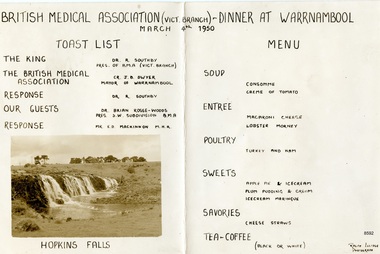 Flagstaff Hill Maritime Museum and Village
Document - Dinner Program, British Medical Association (Vict. Branch) - Dinner at Warrnambool, 1950
... British Medical Association dinner belonged to Dr.William Roy Angus, Surgeon and Oculist. It was donated to Flagstaff Hill Maritime Village by his daughter, Bernice McDade. It is part of the “W.R. Angus Collection” includes historical medical equipment, surgical instruments and material once belonging to Dr Edward Ryan and Dr Thomas Francis Ryan, (both of Nhill, Victoria) as well as Dr Angus’ own belongings. The Collection’s history...British Medical Association dinner belonged to Dr.William Roy Angus, Surgeon and Oculist. It was donated to Flagstaff Hill Maritime Village by his daughter, Bernice McDade. It is part of the “W.R. Angus Collection” includes historical medical equipment, surgical instruments and material once belonging to Dr Edward Ryan and Dr Thomas Francis Ryan, (both of Nhill, Victoria) as well as Dr Angus’ own belongings. The Collection’s history ...This handwritten menu for the British Medical Association dinner belonged to Dr.William Roy Angus, Surgeon and Oculist. It was donated to Flagstaff Hill Maritime Village by his daughter, Bernice McDade. It is part of the “W.R. Angus Collection” includes historical medical equipment, surgical instruments and material once belonging to Dr Edward Ryan and Dr Thomas Francis Ryan, (both of Nhill, Victoria) as well as Dr Angus’ own belongings. The Collection’s history spans the medical practices of the two Doctors Ryan, from 1885-1926 plus that of Dr Angus, up until 1969. Powder or soap in boxes such as this was perfumed and used as part of a women’s personal grooming in the early to mid 20th century. Faulding’s Company began in Adelaide, Australia, in 1845 and made a wide range of cosmetic and perfume products as well as pharmaceuticals. The company is still in operation today. ABOUT THE “W.R.ANGUS COLLECTION” Doctor William Roy Angus M.B., B.S., Adel., 1923, F.R.C.S. Edin.,1928 (also known as Dr Roy Angus) was born in Murrumbeena, Victoria in 1901 and lived until 1970. He qualified as a doctor in 1923 at University of Adelaide, was Resident Medical Officer at the Royal Adelaide Hospital in 1924 and for a period was house surgeon to Sir (then Mr.) Henry Simpson Newland. Dr Angus was briefly an Assistant to Dr Riddell of Kapunda, then commenced private practice at Curramulka, Yorke Peninsula, SA, where he was physician, surgeon and chemist. In 1926, he was appointed as new Medical Assistant to Dr Thomas Francis Ryan (T.F. Ryan, or Tom), in Nhill, Victoria, where his experiences included radiology and pharmacy. In 1927 he was Acting House Surgeon in Dr Tom Ryan’s absence. Dr Angus had become engaged to Gladys Forsyth and they decided he further his studies overseas in the UK in 1927. He studied at London University College Hospital and at Edinburgh Royal Infirmary and in 1928, was awarded FRCS (Fellow from the Royal College of Surgeons), Edinburgh. He worked his passage back to Australia as a Ship’s Surgeon on the on the Australian Commonwealth Line’s T.S.S. Largs Bay. Dr Angus married Gladys in 1929, in Ballarat. (They went on to have one son (Graham 1932, born in SA) and two daughters (Helen (died 12/07/1996) and Berenice (Berry), both born at Mira, Nhill ) According to Berry, her mother Gladys made a lot of their clothes. She was very talented and did some lovely embroidery including lingerie for her trousseau and beautifully handmade baby clothes. Dr Angus was a ‘flying doctor’ for the A.I.M. (Australian Inland Ministry) Aerial Medical Service in 1928 . Its first station was in the remote town of Oodnadatta, where Dr Angus was stationed. He was locum tenens there on North-South Railway at 21 Mile Camp. He took up this ‘flying doctor’ position in response to a call from Dr John Flynn; the organisation was later known as the Flying Doctor Service, then the Royal Flying Doctor Service. A lot of his work during this time involved dental surgery also. Between 1928-1932 he was surgeon at the Curramulka Hospital, Yorke Peninsula, South Australia. In 1933 Dr Angus returned to Nhill and purchased a share of the Nelson Street practice and Mira hospital (a 2 bed ward at the Nelson Street Practice) from Dr Les Middleton one of the Middleton Brothers, the current owners of what previously once Dr Tom Ryan’s practice. Dr Tom and his brother had worked as surgeons included eye surgery. Dr Tom Ryan performed many of his operations in the Mira private hospital on his premises. He had been House Surgeon at the Nhill Hospital 1902-1926. Dr Tom Ryan had one of the only two pieces of radiology equipment in Victoria during his practicing years – The Royal Melbourne Hospital had the other one. Over the years Dr Tom Ryan had gradually set up what was effectively a training school for country general-practitioner-surgeons. Each patient was carefully examined, including using the X-ray machine, and any surgery was discussed and planned with Dr Ryan’s assistants several days in advance. Dr Angus gained experience in using the X-ray machine there during his time as assistant to Dr Ryan. When Dr Angus bought into the Nelson Street premises in Nhill he was also appointed as the Nhill Hospital’s Honorary House Surgeon 1933-1938. His practitioner’s plate from his Nhill surgery is now mounted on the doorway to the Port Medical Office at Flagstaff Hill Maritime Village, Warrnambool. When Dr Angus took up practice in the Dr Edward and Dr Tom Ryan’s old premises he obtained their extensive collection of historical medical equipment and materials spanning 1884-1926. A large part of this collection is now on display at the Port Medical Office at Flagstaff Hill Maritime Village in Warrnambool. In 1939 Dr Angus and his family moved to Warrnambool where he purchased “Birchwood,” the 1852 home and medical practice of Dr John Hunter Henderson, at 214 Koroit Street. (This property was sold in1965 to the State Government and is now the site of the Warrnambool Police Station. and an ALDI sore is on the land that was once their tennis court). The Angus family was able to afford gardeners, cooks and maids; their home was a popular place for visiting dignitaries to stay whilst visiting Warrnambool. Dr Angus had his own silk worm farm at home in a Mulberry tree. His young daughter used his centrifuge for spinning the silk. Dr Angus was appointed on a part-time basis as Port Medical Officer (Health Officer) in Warrnambool and held this position until the 1940’s when the government no longer required the service of a Port Medical Officer in Warrnambool; he was thus Warrnambool’s last serving Port Medical Officer. (Masters of immigrant ships arriving in port reported incidents of diseases, illness and death and the Port Medical Officer made a decision on whether the ship required Quarantine and for how long, in this way preventing contagious illness from spreading from new immigrants to the residents already in the colony.) Dr Angus was a member of the Australian Medical Association, for 35 years and surgeon at the Warrnambool Base Hospital 1939-1942, He served as a Surgeon Captain during WWII1942-45, in Ballarat, Victoria, and in Bonegilla, N.S.W., completing his service just before the end of the war due to suffering from a heart attack. During his convalescence he carved an intricate and ‘most artistic’ chess set from the material that dentures were made from. He then studied ophthalmology at the Royal Melbourne Eye and Ear Hospital and created cosmetically superior artificial eyes by pioneering using the intrascleral cartilage. Angus received accolades from the Ophthalmological Society of Australasia for this work. He returned to Warrnambool to commence practice as an ophthalmologist, pioneering in artificial eye improvements. He was Honorary Consultant Ophthalmologist to Warrnambool Base Hospital for 31 years. He made monthly visits to Portland as a visiting surgeon, to perform eye surgery. He represented the Victorian South-West subdivision of the Australian Medical Association as its secretary between 1949 and 1956 and as chairman from 1956 to 1958. In 1968 Dr Angus was elected member of Spain’s Barraquer Institute of Barcelona after his research work in Intrasclearal cartilage grafting, becoming one of the few Australian ophthalmologists to receive this honour, and in the following year presented his final paper on Living Intrasclearal Cartilage Implants at the Inaugural Meeting of the Australian College of Ophthalmologists in Melbourne In his personal life Dr Angus was a Presbyterian and treated Sunday as a Sabbath, a day of rest. He would visit 3 or 4 country patients on a Sunday, taking his children along ‘for the ride’ and to visit with him. Sunday evenings he would play the pianola and sing Scottish songs to his family. One of Dr Angus’ patients was Margaret MacKenzie, author of a book on local shipwrecks that she’d seen as an eye witness from the late 1880’s in Peterborough, Victoria. In the early 1950’s Dr Angus, painted a picture of a shipwreck for the cover jacket of Margaret’s book, Shipwrecks and More Shipwrecks. She was blind in later life and her daughter wrote the actual book for her. Dr Angus and his wife Gladys were very involved in Warrnambool’s society with a strong interest in civic affairs. He had an interest in people and the community They were both involved in the creation of Flagstaff Hill, including the layout of the gardens. After his death (28th March 1970) his family requested his practitioner’s plate, medical instruments and some personal belongings be displayed in the Port Medical Office surgery at Flagstaff Hill Maritime Village, and be called the “W. R. Angus Collection”.The W.R. Angus Collection is significant for still being located at the site it is connected with, Doctor Angus being the last Port Medical Officer in Warrnambool. The collection of medical instruments and other items and equipment is culturally significant, being an historical example of medicine from late 19th to mid-20th century. Dr Angus assisted Dr Tom Ryan, a pioneer in the use of X-rays and in ocular surgery.A handwritten program with a Toast List, Menu, and a photograph of the Hopkins Falls. The dinner was held in 1950 in Warrnambool for the British Medical Association (Victoria Branch). The object is part of the W.R. Angus Collection. "BRITISH MEDICAL ASSOCIATION (VICT. BRANCH - DINNER AT WARRNAMBOOL" "MARCH 4TH 1950" "TOAST LIST" "MENU" "HOPKINS FALLS"flagstaff hill maritime museum and village, great ocean road, shipwreck coast, british medical associaition, warrnambool, menu, british medical association, 1950, dinner, w.r. angus, hopkins falls -
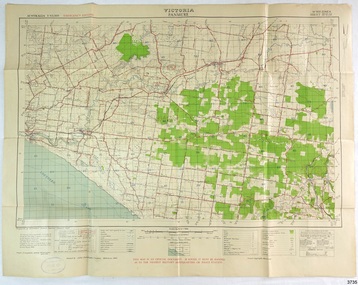 Flagstaff Hill Maritime Museum and Village
Document - Map, Department of Lands & Survey, Victoria / Panmure, 1942
... Britain and its Empire. It was printed by A.H.Q. Cartographic Company, Survey Corps, which was formed in 1941. The Corp changed its name to L.H.Q. Cartographic Company of Bendigo. In 1947 the name reverted back to the A.H.Q. Cartographic Company until 1955 when it became the A.H.Q. Survey Regiment. The W.R. Angus Collection includes historical medical equipment, surgical instruments and material once belonging to Dr Edward Ryan and Dr Thomas Francis Ryan, (both of Nhill, Victoria) as well as Dr Angus’ own belongings. The Collection’s history...Britain and its Empire. It was printed by A.H.Q. Cartographic Company, Survey Corps, which was formed in 1941. The Corp changed its name to L.H.Q. Cartographic Company of Bendigo. In 1947 the name reverted back to the A.H.Q. Cartographic Company until 1955 when it became the A.H.Q. Survey Regiment. The W.R. Angus Collection includes historical medical equipment, surgical instruments and material once belonging to Dr Edward Ryan and Dr Thomas Francis Ryan, (both of Nhill, Victoria) as well as Dr Angus’ own belongings. The Collection’s history ...This Emergency Edition of the map of Panmure, Victoria, is part of the W.R. Angus Collection. It was printed in 1942 during World War II. It is one of two maps donated to Flagstaff Hill Maritime Village by the family of Doctor William Roy Angus, who served as Surgeon Captain in the Australian Defence Department. The map was compiled for the Dept. of Army by the Dept. of Lands and Survey in Melbourne, prepared by the Australian Section of the Imperial General Staff, which was a British Government body created in 1907 to co-ordinate the defence of Britain and its Empire. It was printed by A.H.Q. Cartographic Company, Survey Corps, which was formed in 1941. The Corp changed its name to L.H.Q. Cartographic Company of Bendigo. In 1947 the name reverted back to the A.H.Q. Cartographic Company until 1955 when it became the A.H.Q. Survey Regiment. The W.R. Angus Collection includes historical medical equipment, surgical instruments and material once belonging to Dr Edward Ryan and Dr Thomas Francis Ryan, (both of Nhill, Victoria) as well as Dr Angus’ own belongings. The Collection’s history spans the medical practices of the two Doctors Ryan, from 1885-1926 plus that of Dr Angus who began practice in 1924. Dr. Angus served with the Australian Department of Defence as a Surgeon Captain during the Second World Was from 1942 to 1945. He served in Ballarat, Victoria, and in Bonegilla, N.S.W. until he suffering from a heart attack just before the war ended. ABOUT THE “W.R.ANGUS COLLECTION” - Doctor William Roy Angus M.B., B.S., Adel., 1923, F.R.C.S. Edin.,1928, was generally known as Dr Roy Angus. His working life included a position as a doctor with the Flying Doctor Service in Australia’s rural and remote areas. After many varied experiences Dr Angus and his family moved to Warrnambool in 1939 where he purchased “Birchwood,” the 1852 home and medical practice of Dr John Hunter Henderson. He was appointed on a part-time basis as Port Medical Officer in Warrnambool and held this position until the 1940’s when the government no longer required the service of a Port Medical Officer. Dr Angus was a surgeon at the Warrnambool Base Hospital 1939-1942. After further studies he commenced practice as an ophthalmologist in Warrnambool, pioneering in artificial eye improvements. He was Honorary Consultant Ophthalmologist to Warrnambool Base Hospital for 31 years and made monthly visits to Portland to perform eye surgery. Dr Angus and his wife Gladys were very involved in Warrnambool’s community with a strong interest in civic affairs. They were both involved in the creation of Flagstaff Hill Maritime Village, including the layout of the gardens. After his death on 28th March 1970 his family requested his practitioner’s plate, medical instruments and some personal belongings be displayed in the Port Medical Office surgery at Flagstaff Hill Maritime Village, and be called the “W. R. Angus Collection”. This Emergency Edition of the Map of Panmure is significant as an example of the documents prepared for the defence of Australia in World War 2. The Map is also significant for its connection between the Australian Army and the involvement of Dr WR Angus as a Surgeon in the Medical Services during World War II. The W.R. Angus Collection is significant for still being located at the site it is connected with, Doctor Angus being the last Port Medical Officer in Warrnambool. The collection of medical instruments and other equipment is culturally significant, being an historical example of medicine, administration, household equipment and clothing from late 19th to mid-20th century. Dr Angus assisted Dr Tom Ryan, a pioneer in the use of X-rays and in ocular surgery. The collection includes Dr Angus’s Army objects and is significant as an example of items issued to Doctors and Surgeons in the Medical Services of the Australian Army in World War IIMilitary map of Panmure, Victoria, Australia; part of the W.R. Angus Collection. Rectangular coloured map on cream paper for the Australian Army. Details include sea, waterways and land, contour lines, grid lines, names of districts, towns and roads, bridges, swamps, rail lines, cuttings, tracks, buildings (including blacksmiths), pumps, lighthouses, telegraph, telephones and electric transmission lines, and fire stations. The map has margin notes that include distances in miles to nearby towns. The map was compiled for the Dept. of Army by the Dept. of Lands and Survey in Melbourne, prepared by the Australian Section, Imperial General Staff and printed by A.H.Q. Cartographic Company, Melbourne in 1942. Crown Copyright Reserved. Inscriptions in red print state that it is and Emergency Edition and an Official document. An oval purple stamp includes the price.Printed in black; 'Victoria / Panmure", "No. 930 / Zone 6" Printed in red; “EMERGENCY EDITION”, “THIS MAP IS AN OFFICIAL DOCUMENT. IF FOUND, IT MUST BE HANDED / IN TO THE NEAREST MILITARY HEADQUARTERS OR POLICE STATION” Stamped: within concentric ovals (“- - - FOR SALE / PRICE 2/- / - - - - - OF THE ARMY”)flagstaff hill, warrnambool, flagstaff hill maritime museum, maritime museum, shipwreck coast, flagstaff hill maritime village, great ocean road, dr w r angus, dr ryan, warrnambool base hospital, flying doctor, surgeon captain, australian department of defence, royal australian army, world war 2, map panmure 1942, roy angus, port medical officer, nhill base hospital, military map, emergency map, military service australian army, department of army, department of lands and survey, a.h.q. cartographic company melbourne, panmure 1942, australian section, imperial general staff -
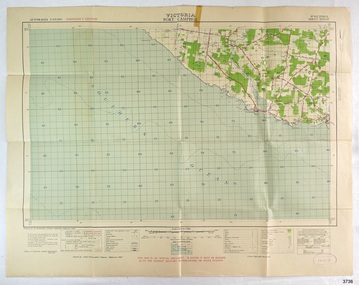 Flagstaff Hill Maritime Museum and Village
Document - Map, Department of Lands & Survey, Victoria / Port Campbell, 1942
... Britain and its Empire. It was printed by A.H.Q. Cartographic Company, Survey Corps, which was formed in 1941. The Corp changed its name to L.H.Q. Cartographic Company of Bendigo. In 1947 the name reverted back to the A.H.Q. Cartographic Company until 1955 when it became the A.H.Q. Survey Regiment. The W.R. Angus Collection includes historical medical equipment, surgical instruments and material once belonging to Dr Edward Ryan and Dr Thomas Francis Ryan, (both of Nhill, Victoria) as well as Dr Angus’ own belongings. The Collection’s history...Britain and its Empire. It was printed by A.H.Q. Cartographic Company, Survey Corps, which was formed in 1941. The Corp changed its name to L.H.Q. Cartographic Company of Bendigo. In 1947 the name reverted back to the A.H.Q. Cartographic Company until 1955 when it became the A.H.Q. Survey Regiment. The W.R. Angus Collection includes historical medical equipment, surgical instruments and material once belonging to Dr Edward Ryan and Dr Thomas Francis Ryan, (both of Nhill, Victoria) as well as Dr Angus’ own belongings. The Collection’s history ...This Emergency Edition of the map of Port Campbell, Victoria, is part of the W.R. Angus Collection. It was printed in 1942 during World War II. It is one of two maps donated to Flagstaff Hill Maritime Village by the family of Doctor William Roy Angus, who served as Surgeon Captain in the Australian Defence Department. The map was compiled for the Dept. of Army by the Dept. of Lands and Survey in Melbourne, prepared by the Australian Section of the Imperial General Staff, which was a British Government body created in 1907 to co-ordinate the defence of Britain and its Empire. It was printed by A.H.Q. Cartographic Company, Survey Corps, which was formed in 1941. The Corp changed its name to L.H.Q. Cartographic Company of Bendigo. In 1947 the name reverted back to the A.H.Q. Cartographic Company until 1955 when it became the A.H.Q. Survey Regiment. The W.R. Angus Collection includes historical medical equipment, surgical instruments and material once belonging to Dr Edward Ryan and Dr Thomas Francis Ryan, (both of Nhill, Victoria) as well as Dr Angus’ own belongings. The Collection’s history spans the medical practices of the two Doctors Ryan, from 1885-1926 plus that of Dr Angus who began practice in 1924. Dr Angus served with the Australian Department of Defence as a Surgeon Captain during the Second World Was from 1942 to 1945. He served in Ballarat, Victoria, and in Bonegilla, N.S.W. until he suffering from a heart attack just before the war ended. ABOUT THE “W.R.ANGUS COLLECTION” - Doctor William Roy Angus M.B., B.S., Adel., 1923, F.R.C.S. Edin.,1928, was generally known as Dr Roy Angus. His working life included a position as a doctor with the Flying Doctor Service in Australia’s rural and remote areas. After many varied experiences Dr Angus and his family moved to Warrnambool in 1939 where he purchased “Birchwood,” the 1852 home and medical practice of Dr John Hunter Henderson. He was appointed on a part-time basis as Port Medical Officer in Warrnambool and held this position until the 1940’s when the government no longer required the service of a Port Medical Officer. Dr Angus was a surgeon at the Warrnambool Base Hospital 1939-1942. After further studies he commenced practice as an ophthalmologist in Warrnambool, pioneering in artificial eye improvements. He was Honorary Consultant Ophthalmologist to Warrnambool Base Hospital for 31 years and made monthly visits to Portland to perform eye surgery. Dr Angus and his wife Gladys were very involved in Warrnambool’s community with a strong interest in civic affairs. They were both involved in the creation of Flagstaff Hill Maritime Village, including the layout of the gardens. After his death on 28th March 1970 his family requested his practitioner’s plate, medical instruments and some personal belongings be displayed in the Port Medical Office surgery at Flagstaff Hill Maritime Village, and be called the “W. R. Angus Collection”. This Emergency Edition of the Map of Port Campbell is significant as an example of the documents prepared for the defence of Australia in World War 2. The Map is also significant for its connection between the Australian Army and the involvement of Dr WR Angus as a Surgeon in the Medical Services during World War II. The W.R. Angus Collection is significant for still being located at the site it is connected with, Doctor Angus being the last Port Medical Officer in Warrnambool. The collection of medical instruments and other equipment is culturally significant, being an historical example of medicine, administration, household equipment and clothing from late 19th to mid-20th century. Dr Angus assisted Dr Tom Ryan, a pioneer in the use of X-rays and in ocular surgery. The collection includes Dr Angus’s Army objects and is significant as an example of items issued to Doctors and Surgeons in the Medical Services of the Australian Army in World War IIMilitary map of Port Campbell, Victoria, Australia; part of the W.R. Angus Collection. Rectangular coloured map on cream paper for the Australian Army. Details include sea, waterways and land, contour lines, grid lines, names of districts, towns and roads, bridges, swamps, rail lines, cuttings, tracks, buildings (including blacksmiths), pumps, lighthouses, telegraph, telephones and electric transmission lines, and fire stations. The map has margin notes that include distances in miles to nearby towns. The map was compiled for the Dept. of Army by the Dept. of Lands and Survey in Melbourne, prepared by the Australian Section, Imperial General Staff and printed by A.H.Q. Cartographic Company, Melbourne in 1942. Crown Copyright Reserved. Inscriptions in red print state that it is and Emergency Edition and an Official document. An oval purple stamp includes the price.Printed in black; 'Victoria / Port Campbell", "No. 932 / Zone 6" Printed in red; “EMERGENCY EDITION”, “THIS MAP IS AN OFFICIAL DOCUMENT. IF FOUND, IT MUST BE HANDED / IN TO THE NEAREST MILITARY HEADQUARTERS OR POLICE STATION” Stamped: within concentric ovals (“- - - FOR SALE / PRICE 2/- / - - - - - OF THE ARMY”)flagstaff hill, warrnambool, flagstaff hill maritime museum, maritime museum, shipwreck coast, flagstaff hill maritime village, great ocean road, dr w r angus, dr ryan, warrnambool base hospital, nhill base hospital, flying doctor, surgeon captain, map port campbell 1942, roy angus, port medical officer, military map, emergency map, australian department of defence, royal australian army, military service australian army, department of army, department of lands and survey, world war 2, a.h.q. cartographic company melbourne, australian section, imperial general staff, port campbell 1942 -
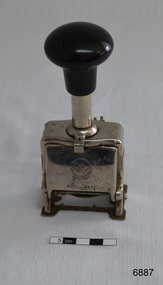 Flagstaff Hill Maritime Museum and Village
Functional object - Date Stamp, Mid 20th century
... British Industries Fair, (stand number D 539). This Fair operated annually from the 1920 – 1960 and was attended by royalty and dignitaries as well as the general public. At its peak there were over 1000 exhibitors. This date stamp was donated to Flagstaff Hill Maritime Village by the family of Doctor William Roy Angus, Surgeon and Oculist. It is part of the “W.R. Angus Collection” includes historical medical equipment, surgical instruments and material once belonging to Dr Edward Ryan and Dr Thomas Francis Ryan, (both of Nhill, Victoria) as well as Dr Angus’ own belongings. The Collection’s history...British Industries Fair, (stand number D 539). This Fair operated annually from the 1920 – 1960 and was attended by royalty and dignitaries as well as the general public. At its peak there were over 1000 exhibitors. This date stamp was donated to Flagstaff Hill Maritime Village by the family of Doctor William Roy Angus, Surgeon and Oculist. It is part of the “W.R. Angus Collection” includes historical medical equipment, surgical instruments and material once belonging to Dr Edward Ryan and Dr Thomas Francis Ryan, (both of Nhill, Victoria) as well as Dr Angus’ own belongings. The Collection’s history ...This hand held, mechanical date stamp, made in mid-20th century by English Numbering Machines Ltd (ENM) in Enfield, England and is part of the stationary items once used by Dr. W.R. Angus in his medical service. ENM was a well know manufacturer of mechanical counters and hand numbering machines, both printing and non-printing, for the stationery industry, offices, sales control and the legal profession. The company was amongst the exhibitors at the Birmingham section of the British Industries Fair, (stand number D 539). This Fair operated annually from the 1920 – 1960 and was attended by royalty and dignitaries as well as the general public. At its peak there were over 1000 exhibitors. This date stamp was donated to Flagstaff Hill Maritime Village by the family of Doctor William Roy Angus, Surgeon and Oculist. It is part of the “W.R. Angus Collection” includes historical medical equipment, surgical instruments and material once belonging to Dr Edward Ryan and Dr Thomas Francis Ryan, (both of Nhill, Victoria) as well as Dr Angus’ own belongings. The Collection’s history spans the medical practices of the two Doctors Ryan, from 1885-1926 plus that of Dr Angus, up until 1969. ABOUT THE “W.R.ANGUS COLLECTION” Doctor William Roy Angus M.B., B.S., Adel., 1923, F.R.C.S. Edin.,1928 (also known as Dr Roy Angus) was born in Murrumbeena, Victoria in 1901 and lived until 1970. He qualified as a doctor in 1923 at University of Adelaide, was Resident Medical Officer at the Royal Adelaide Hospital in 1924 and for a period was house surgeon to Sir (then Mr.) Henry Simpson Newland. Dr Angus was briefly an Assistant to Dr Riddell of Kapunda, then commenced private practice at Curramulka, Yorke Peninsula, SA, where he was physician, surgeon and chemist. In 1926, he was appointed as new Medical Assistant to Dr Thomas Francis Ryan (T.F. Ryan, or Tom), in Nhill, Victoria, where his experiences included radiology and pharmacy. In 1927 he was Acting House Surgeon in Dr Tom Ryan’s absence. Dr Angus had become engaged to Gladys Forsyth and they decided he further his studies overseas in the UK in 1927. He studied at London University College Hospital and at Edinburgh Royal Infirmary and in 1928, was awarded FRCS (Fellow from the Royal College of Surgeons), Edinburgh. He worked his passage back to Australia as a Ship’s Surgeon on the on the Australian Commonwealth Line’s T.S.S. Largs Bay. Dr Angus married Gladys in 1929, in Ballarat. (They went on to have one son (Graham 1932, born in SA) and two daughters (Helen (died 12/07/1996) and Berenice (Berry), both born at Mira, Nhill ) According to Berry, her mother Gladys made a lot of their clothes. She was very talented and did some lovely embroidery including lingerie for her trousseau and beautifully handmade baby clothes. Dr Angus was a ‘flying doctor’ for the A.I.M. (Australian Inland Ministry) Aerial Medical Service in 1928 . Its first station was in the remote town of Oodnadatta, where Dr Angus was stationed. He was locum tenens there on North-South Railway at 21 Mile Camp. He took up this ‘flying doctor’ position in response to a call from Dr John Flynn; the organisation was later known as the Flying Doctor Service, then the Royal Flying Doctor Service. A lot of his work during this time involved dental surgery also. Between 1928-1932 he was surgeon at the Curramulka Hospital, Yorke Peninsula, South Australia. In 1933 Dr Angus returned to Nhill and purchased a share of the Nelson Street practice and Mira hospital (a 2 bed ward at the Nelson Street Practice) from Dr Les Middleton one of the Middleton Brothers, the current owners of what previously once Dr Tom Ryan’s practice. Dr Tom and his brother had worked as surgeons included eye surgery. Dr Tom Ryan performed many of his operations in the Mira private hospital on his premises. He had been House Surgeon at the Nhill Hospital 1902-1926. Dr Tom Ryan had one of the only two pieces of radiology equipment in Victoria during his practicing years – The Royal Melbourne Hospital had the other one. Over the years Dr Tom Ryan had gradually set up what was effectively a training school for country general-practitioner-surgeons. Each patient was carefully examined, including using the X-ray machine, and any surgery was discussed and planned with Dr Ryan’s assistants several days in advance. Dr Angus gained experience in using the X-ray machine there during his time as assistant to Dr Ryan. When Dr Angus bought into the Nelson Street premises in Nhill he was also appointed as the Nhill Hospital’s Honorary House Surgeon 1933-1938. His practitioner’s plate from his Nhill surgery is now mounted on the doorway to the Port Medical Office at Flagstaff Hill Maritime Village, Warrnambool. When Dr Angus took up practice in the Dr Edward and Dr Tom Ryan’s old premises he obtained their extensive collection of historical medical equipment and materials spanning 1884-1926. A large part of this collection is now on display at the Port Medical Office at Flagstaff Hill Maritime Village in Warrnambool. In 1939 Dr Angus and his family moved to Warrnambool where he purchased “Birchwood,” the 1852 home and medical practice of Dr John Hunter Henderson, at 214 Koroit Street. (This property was sold in1965 to the State Government and is now the site of the Warrnambool Police Station. and an ALDI sore is on the land that was once their tennis court). The Angus family was able to afford gardeners, cooks and maids; their home was a popular place for visiting dignitaries to stay whilst visiting Warrnambool. Dr Angus had his own silk worm farm at home in a Mulberry tree. His young daughter used his centrifuge for spinning the silk. Dr Angus was appointed on a part-time basis as Port Medical Officer (Health Officer) in Warrnambool and held this position until the 1940’s when the government no longer required the service of a Port Medical Officer in Warrnambool; he was thus Warrnambool’s last serving Port Medical Officer. (Masters of immigrant ships arriving in port reported incidents of diseases, illness and death and the Port Medical Officer made a decision on whether the ship required Quarantine and for how long, in this way preventing contagious illness from spreading from new immigrants to the residents already in the colony.) Dr Angus was a member of the Australian Medical Association, for 35 years and surgeon at the Warrnambool Base Hospital 1939-1942, He served with the Australian Department of Defence as a Surgeon Captain during WWII 1942-45, in Ballarat, Victoria, and in Bonegilla, N.S.W., completing his service just before the end of the war due to suffering from a heart attack. During his convalescence he carved an intricate and ‘most artistic’ chess set from the material that dentures were made from. He then studied ophthalmology at the Royal Melbourne Eye and Ear Hospital and created cosmetically superior artificial eyes by pioneering using the intrascleral cartilage. Angus received accolades from the Ophthalmological Society of Australasia for this work. He returned to Warrnambool to commence practice as an ophthalmologist, pioneering in artificial eye improvements. He was Honorary Consultant Ophthalmologist to Warrnambool Base Hospital for 31 years. He made monthly visits to Portland as a visiting surgeon, to perform eye surgery. He represented the Victorian South-West subdivision of the Australian Medical Association as its secretary between 1949 and 1956 and as chairman from 1956 to 1958. In 1968 Dr Angus was elected member of Spain’s Barraquer Institute of Barcelona after his research work in Intrasclearal cartilage grafting, becoming one of the few Australian ophthalmologists to receive this honour, and in the following year presented his final paper on Living Intrasclearal Cartilage Implants at the Inaugural Meeting of the Australian College of Ophthalmologists in Melbourne In his personal life Dr Angus was a Presbyterian and treated Sunday as a Sabbath, a day of rest. He would visit 3 or 4 country patients on a Sunday, taking his children along ‘for the ride’ and to visit with him. Sunday evenings he would play the pianola and sing Scottish songs to his family. One of Dr Angus’ patients was Margaret MacKenzie, author of a book on local shipwrecks that she’d seen as an eye witness from the late 1880’s in Peterborough, Victoria. In the early 1950’s Dr Angus, painted a picture of a shipwreck for the cover jacket of Margaret’s book, Shipwrecks and More Shipwrecks. She was blind in later life and her daughter wrote the actual book for her. Dr Angus and his wife Gladys were very involved in Warrnambool’s society with a strong interest in civic affairs. He had an interest in people and the community They were both involved in the creation of Flagstaff Hill, including the layout of the gardens. After his death (28th March 1970) his family requested his practitioner’s plate, medical instruments and some personal belongings be displayed in the Port Medical Office surgery at Flagstaff Hill Maritime Village, and be called the “W. R. Angus Collection”. The W.R. Angus Collection is significant for still being located at the site it is connected with, Doctor Angus being the last Port Medical Officer in Warrnambool. The collection of medical instruments and other equipment is culturally significant, being an historical example of medicine from late 19th to mid-20th century. Dr Angus assisted Dr Tom Ryan, a pioneer in the use of X-rays and in ocular surgery. Metal date stamp with Bakelite handle, made in Britain by English Numbering Machines. Model No. 4531; part of the W.R. Angus Collection. Stamped on metal: “ENM / British made / Model 4531” flagstaff hill, warrnambool, shipwrecked coast, flagstaff hill maritime museum, maritime museum, shipwreck coast, flagstaff hill maritime village, great ocean road, dr w r angus, dr ryan, surgical instrument, t.s.s. largs bay, warrnambool base hospital, nhill base hospital, mira hospital, flying doctor, date stamp, office stationery, mechanical date stamp, enm date stamp, english numbering machines, enm model 4531 -
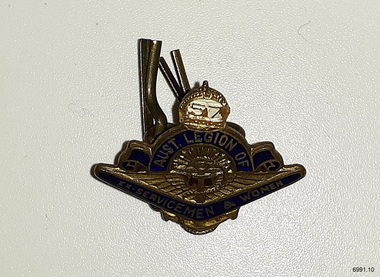 Flagstaff Hill Maritime Museum and Village
Badge - Australian Legion of Ex-Servicemen and Women, Stokes, Membership badge, 1957
... British Commonwealth and Allied ex-service personnel. The W.R. Angus Collection: - The W.R. Angus Collection includes historical medical equipment, surgical instruments and material once belonging to Dr Edward Ryan and Dr Thomas Francis Ryan, (both of Nhill, Victoria) as well as Dr Angus’ own belongings. The Collection’s history...British Commonwealth and Allied ex-service personnel. The W.R. Angus Collection: - The W.R. Angus Collection includes historical medical equipment, surgical instruments and material once belonging to Dr Edward Ryan and Dr Thomas Francis Ryan, (both of Nhill, Victoria) as well as Dr Angus’ own belongings. The Collection’s history ...The badge was issued by the Victorian branch (indicated by the 'V' on the reverse) of the Australian Legion of Ex-Servicemen and Women and is referred to as The Badge of Unity or Tri-Services badge, uniting the armed services of Australia; the Army (rising sun), the Navy (anchor) and the Air Force (pair of wings). The number '57' on the crown represents the year of paid membership; 1957. The badge belonged to Dr W R Angus, who served in the Australian Army as a military doctor during WWII. It was made in Melbourne by Stokes in 1957, around 100 years after the firm was established by Thomas Stokes in Mincing Lane, Melbourne. The firm was operating from Caledonian Lane/Post Office Place in the 1950s. The badge is one of a set of badges collected by Dr W R Angus from the organisations in which he was involved. They are now part of Flagstaff Hill’s comprehensive W.R. Angus Collection, donated by the family of Dr W R Angus, surgeon and oculist. Australian Legion of Ex-Servicemen and Women was formed in 1944 to "entourage fellowship and assist those who have served". The organisation is open to members from Australia, British Commonwealth and Allied ex-service personnel. The W.R. Angus Collection: - The W.R. Angus Collection includes historical medical equipment, surgical instruments and material once belonging to Dr Edward Ryan and Dr Thomas Francis Ryan, (both of Nhill, Victoria) as well as Dr Angus’ own belongings. The Collection’s history spans the medical practices of the two Doctors Ryan, from 1885-1926 plus that of Dr Angus, up until 1969. It includes historical medical and surgical equipment and instruments from the doctors Edward and Thomas Ryan of Nhill, Victoria. Dr Angus married Gladys in 1927 at Ballarat, the nearest big city to Nhill where he began as a Medical Assistant. He was also Acting House surgeon at the Nhill hospital where their two daughters were born. During World War II He served as a Military Doctor in the Australian Defence Force. Dr Angus and his family moved to Warrnambool in 1939, where Dr Angus operated his own medical practice. He later added the responsibility of part-time Port Medical Officer and was the last person appointed to that position. Both Dr Angus and his wife were very involved in the local community, including the planning stages of the new Flagstaff Hill and the layout of the gardens there. Dr Angus passed away in March 1970.This Badge of Unity, or Tri-Service badge, is significant for connecting Doctor Angus with organisations that support men and women who performed military service for Australia. The badge was for membership with the organisation, which supports ex-servicemen and women of the three military forces; Army, Navy and Air Force. The W.R. Angus Collection is significant for still being located at the site it is connected with, Doctor Angus being the last Port Medical Officer in Warrnambool. The Collection includes historical medical objects that date back to the late 1800s.Badge; a gold-coloured metal and enamel badge. The blue boomerang-shaped band is below an arch of blue, below a crown with a number and coloured red, white and blue. There are symbols in the centre; a rising sun, above a pair of wings, with an anchor in the centre of both. There is red and blue scrollwork behind the symbols. Inscriptions are on the front and back of the badge. There are two loops and pins on the back of the badge. It is a membership badge of the Victorian branch of the Australian Legion of Ex-Servicemen and Women and was made by Stokes in 1957. The badge has a Serial Number. This badge is part of a set of badges collected by Dr Angus and is part of the W.R. Angus Collection.FRONT; “AUST. LEGION OF / EX-SERVICEMEN & WOMEN” On crown “57” REVERSE; “V” “13156" "STOKES” flagstaff hill, warrnambool, maritime museum, maritime village, great ocean road, shipwreck coast, w.r. angus, badge, ladies’ badge, military service, stokes, melbourne, australian legion of ex-servicemen and women, membership badge, 1957 membership badge, ex=service personnel, heraldry, world war ii, second world war, tri-services symbol, badge of unity, rising sun, anchor, pair of wings -
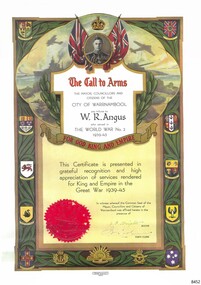 Flagstaff Hill Maritime Museum and Village
Certificate - Call to Arms, Osboldstone & Co. Pty. Ltd, W.R. Angus, ca. 1945
... British Commonwealth, which is illustrated by the emblems of the Commonwealth countries and of the states of Australia. It also has symbols for the three Australian Military Forces; Navy, Army and Air Vorce. The Certificate also carries the Common Seal of the Mayor, Councillors and Citizens of the City of Warrnambool, and the signatures of the Mayor and Town Clerk. The W.R. Angus Collection: - The W.R. Angus Collection includes historical medical equipment, surgical instruments and material belonging to Dr Edward Ryan and Dr Thomas Francis Ryan, (both of Nhill, Victoria) and Dr Angus’ own belongings. The Collection’s history...British Commonwealth, which is illustrated by the emblems of the Commonwealth countries and of the states of Australia. It also has symbols for the three Australian Military Forces; Navy, Army and Air Vorce. The Certificate also carries the Common Seal of the Mayor, Councillors and Citizens of the City of Warrnambool, and the signatures of the Mayor and Town Clerk. The W.R. Angus Collection: - The W.R. Angus Collection includes historical medical equipment, surgical instruments and material belonging to Dr Edward Ryan and Dr Thomas Francis Ryan, (both of Nhill, Victoria) and Dr Angus’ own belongings. The Collection’s history ...This copy of the Certificate of Call to Arms was presented to Dr William Roy Angus at the completion of World War II by the May, Councillors and Citizens of Warrnambool in appreciation for his service. It is now part of Flagstaff Hill’s comprehensive W.R. Angus Collection, donated by the family of Dr W R Angus, 1901-1970, surgeon and oculist. During World War II between 1942-45, Dr Angus served with the Australian Department of Defence as a Surgeon Captain in Ballarat, Victoria, and in Bonegilla, N.S.W., completing his service just before the end of the war due to suffering from a heart attack. The Certificate is headed by a crown above the portrait of King George VI, the reigning British monarch at the time of WWII and afterwards. King George was King of the United Kingdom and the Dominions of the British Commonwealth, which is illustrated by the emblems of the Commonwealth countries and of the states of Australia. It also has symbols for the three Australian Military Forces; Navy, Army and Air Vorce. The Certificate also carries the Common Seal of the Mayor, Councillors and Citizens of the City of Warrnambool, and the signatures of the Mayor and Town Clerk. The W.R. Angus Collection: - The W.R. Angus Collection includes historical medical equipment, surgical instruments and material belonging to Dr Edward Ryan and Dr Thomas Francis Ryan, (both of Nhill, Victoria) and Dr Angus’ own belongings. The Collection’s history spans the medical practices of the two Doctors Ryan, from 1885-1926 plus that of Dr Angus, up until 1969. It includes historical medical and surgical equipment and instruments from the doctors Edward and Thomas Ryan of Nhill, Victoria. Dr Angus married Gladys in 1927 at Ballarat, the nearest big city to Nhill where he began as a Medical Assistant. He was also Acting House surgeon at the Nhill hospital where their two daughters were born. During World War II He served as a Military Doctor in the Australian Defence Force. Dr Angus and his family moved to Warrnambool in 1939, where Dr Angus operated his own medical practice. He later added the part-time Port Medical Officer responsibility and was the last person appointed to that position. Both Dr Angus and his wife were very involved in the local community, including the planning stages of the new Flagstaff Hill and the layout of the gardens there. Dr Angus passed away in March 1970.This is an example of objects used by or issued to Doctor Angus during and after his military service as Surgeon Captain in Australia during World War II. The W.R. Angus Collection is significant for still being located at the site it is connected with, Doctor Angus being the last Port Medical Officer in Warrnambool. The Collection includes historical medical objects that date back to the late 1800s.Call to Arms; certificate of service awarded as a tribute to W. R. Angus by the Mayor, Councillors and Citizens of the City of Warrnambool and sealed with Common Seal and the signatures of the Mayor and the Town Clerk. The top of the certificate has a portrait of King George VI below a crown emblem. The border has logos for countries of the British Commonwealth - Canada, South Africa, Inda and New Zealand - and the Australian States of Queensland, South Australia, Victoria, West Australia and Tasmania. The bottom has the badges of the Royal Australian Navy, the Australian Commonwealth Military Forces and the Royal Australian Air Force. The Certificate was printed by Osboldstone & Co. of Melbourne, with the registered serial number 55319. This copy of the original certificate is part of the W. R. Angus Collection.Printed; "The Mayor, Councillors and citizens of the City of Warrnambool pay tribute to W.R. Angus who served in The World War No. 2 1939-45, for God, King and Empire" "This Certificate is presented in grateful recognition and high appreciation of services rendered for King and Empire in the Great War 1939-45." "In witness whereof, the Common Seal of the Mayor, Councillors and Citizens of Warrnambool was affixed hereto in the presence of " (Signatures of "J.F. Knights" [Mayor] "H.J. Worland" [Town Clerk]) Printed under the certificate: "Osboldstone & Co. Pty. Ltd. Printers, Melbourne" and "55319"flagstaff hill, warrnambool, maritime village, maritime museum, shipwreck coast, great ocean road, flagstaff hill maritime museum and village, dr w r angus, dr ryan, warrnambool base hospital, nhill base hospital, mira hospital, flying doctor, w.r. angus collection, australian department of defence, australian army, world war ii, wwii, surgeon captain, ballarat, bonegilla, certificate, call to arms, warrnambool mayor, j.f. knights, warrnambool town clerk, h.j. worland", city of warrnambool, world war no. 2', 1939-45, great war 1939-45, common seal of city of warrnambool, osboldstone & co. pty ltd., 55319, king george vi, british commonwealth, canada, south aftrica, india, new zealand, australian commonwealth military forces -
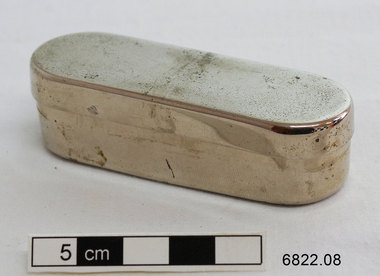 Flagstaff Hill Maritime Museum and Village
Instrument - Syringe set, c. 1940s
... Dr Angus assisted Dr Tom Ryan, a pioneer in the use of X-rays and in ocular surgery. flagstaff hill warrnambool shipwrecked coast flagstaff hill maritime museum maritime museum shipwreck coast flagstaff hill maritime village great ocean road dr w r angus dr ryan surgical instrument t.s.s. largs bay warrnambool base hospital nhill base hospital mira hospital flying doctor medical treatment medical history medical education medical text book fivepoint syringe general surgical co. injections Printed on syringe cylinder "FIVEPOINT BRITISH" and symbol of a red star. ...Whether it’s an anaesthetic, blood test, insulin, vitamin shot or vaccination, at a base human level something feels instinctively wrong about having a long thin piece of metal stuck deep into your flesh. And yet, in allowing physicians to administer medicine directly into the bloodstream, the hypodermic needle has been one of the most important inventions of medical science. In the beginning… Typically, it was the Romans. The word ‘syringe’ is derived from Greek mythology. Chased to the edge of a river by the god Pan, a rather chaste nymph by the name of Syrinx magically disguised herself as water reeds. Determined, Pan chopped the hollow reeds off and blew into them to create a musical whistling sound, thereby fashioning the first of his fabled pipes. Taking that concept of ‘hollow tubes’, and having observed how snakes could transmit venom, the practice of administering ointments and unctions via simple piston syringes is originally described in the writings of the first-century Roman scholar Aulus Cornelius Celsus and the equally famous Greek surgeon Galen. It’s unclear if the Egyptian surgeon Ammar bin Ali al-Mawsili was a fan of either of their scribblings, but 800 years later he employed a hollow glass tube and simple suction power to remove cataracts from his patients’ eyes – a technique copied up until the 13th century, but only to extract blood, fluid or poison, not to inject anything. Syringes get modern Then, in 1650, while experimenting with hydrodynamics, the legendary French polymath Blaise Pascal invented the first modern syringe. His device exemplified the law of physics that became known as Pascal’s Law, which proposes “when there is an increase in pressure at any point in a confined fluid, there is an equal increase at every other point in the container.” But it wasn’t until six years later that a fellow Renaissance man, the English architect Sir Christopher Wren took Pascal’s concept and made the first intravenous experiment. Combining hollow goose quills, pig bladders, a kennel of stray dogs and enough opium to fell a herd of elephants, Wren started injecting the hapless mutts with the ‘milk of the poppy’. By the mid-1660s, thinking this seemed like a great idea, two German doctors, Johann Daniel Major and Johann Sigismund Elsholtz, decided to try their hand at squirting various stuff into human subjects. Things didn’t end well, and people died. Consequently, injections fell out of medical favour for 200 years. Let's try again… Enter the Irish doctor Francis Rynd in 1844. Constructing the first-ever hollow steel needle, he used it to inject medicine subcutaneously and then bragged about it in an issue of the Dublin Medical Press. Then, in 1853, depending on who you believe, it was either a Frenchman or a Scot who invented the first real hypodermic needle. The French physician Charles Pravaz adapted Rynd’s needle to administer a coagulant in order to stem bleeding in a sheep by using a system of measuring screws. However, it was the Scottish surgeon Alexander Wood who first combined a hollow steel needle with a proper syringe to inject morphine into a human. Thus, Wood is usually credited with the invention. Sharp advancements Over the following century, the technology was refined and intravenous injections became commonplace – whether in the administering of pain relief, penicillin, insulin, immunisation and blood transfusions, needles became a staple of medicine. By 1946, the Chance Brothers’ Birmingham glassworks factory began mass-producing the first all-glass syringe with interchangeable parts. Then, a decade later, after sterilisation issues in re-used glass syringes had plagued the industry for years, a Kiwi inventor called Colin Murdoch applied for a patent of a disposable plastic syringe. Several patents followed, and the disposable syringe is now widespread. https://www.medibank.com.au/livebetter/be-magazine/wellbeing/the-history-of-the-hypodermic-needle/ This syringe set was donated to Flagstaff Hill Maritime Village by the family of Doctor William Roy Angus, Surgeon and Oculist. It is part of the “W.R. Angus Collection” that includes historical medical equipment, surgical instruments and material once belonging to Dr Edward Ryan and Dr Thomas Francis Ryan, (both of Nhill, Victoria) as well as Dr Angus’ own belongings. The Collection’s history spans the medical practices of the two Doctors Ryan, from 1885-1926 plus that of Dr Angus, up until 1969. ABOUT THE “W.R.ANGUS COLLECTION” Doctor William Roy Angus M.B., B.S., Adel., 1923, F.R.C.S. Edin.,1928 (also known as Dr Roy Angus) was born in Murrumbeena, Victoria in 1901 and lived until 1970. He qualified as a doctor in 1923 at University of Adelaide, was Resident Medical Officer at the Royal Adelaide Hospital in 1924 and for a period was house surgeon to Sir (then Mr.) Henry Simpson Newland. Dr Angus was briefly an Assistant to Dr Riddell of Kapunda, then commenced private practice at Curramulka, Yorke Peninsula, SA, where he was physician, surgeon and chemist. In 1926, he was appointed as new Medical Assistant to Dr Thomas Francis Ryan (T.F. Ryan, or Tom), in Nhill, Victoria, where his experiences included radiology and pharmacy. In 1927 he was Acting House Surgeon in Dr Tom Ryan’s absence. Dr Angus had become engaged to Gladys Forsyth and they decided he would take time to further his studies overseas in the UK in 1927. He studied at London University College Hospital and at Edinburgh Royal Infirmary and in 1928, was awarded FRCS (Fellow from the Royal College of Surgeons), Edinburgh. He worked his passage back to Australia as a Ship’s Surgeon on the on the Australian Commonwealth Line’s T.S.S. Largs Bay. Dr Angus married Gladys in 1929, in Ballarat. (They went on to have one son (Graham 1932, born in SA) and two daughters (Helen (died 12/07/1996) and Berenice (Berry), both born at Mira, Nhill ) Dr Angus was a ‘flying doctor’ for the A.I.M. (Australian Inland Ministry) Aerial Medical Service in 1928 . The organisation began in South Australia through the Presbyterian Church in that year, with its first station being in the remote town of Oodnadatta, where Dr Angus was stationed. He was locum tenens there on North-South Railway at 21 Mile Camp. He took up this ‘flying doctor’ position in response to a call from Dr John Flynn; the organisation was later known as the Flying Doctor Service, then the Royal Flying Doctor Service. A lot of his work during this time involved dental surgery also. Between 1928-1932 he was surgeon at the Curramulka Hospital, Yorke Peninsula, South Australia. In 1933 Dr Angus returned to Nhill where he’d previously worked as Medical Assistant and purchased a share of the Nelson Street practice and Mira hospital from Dr Les Middleton one of the Middleton Brothers, the current owners of what was once Dr Tom Ryan’s practice. Dr L Middleton was House Surgeon to the Nhill Hospital 1926-1933, when he resigned. [Dr Tom Ryan’s practice had originally belonged to his older brother Dr Edward Ryan, who came to Nhill in 1885. Dr Edward saw patients at his rooms, firstly in Victoria Street and in 1886 in Nelson Street, until 1901. The Nelson Street practice also had a 2 bed ward, called Mira Private Hospital ). Dr Edward Ryan was House Surgeon at the Nhill Hospital 1884-1902 . He also had occasions where he successfully performed veterinary surgery for the local farmers too. Dr Tom Ryan then purchased the practice from his brother in 1901. Both Dr Edward and Dr Tom Ryan work as surgeons included eye surgery. Dr Tom Ryan performed many of his operations in the Mira private hospital on his premises. He too was House Surgeon at the Nhill Hospital 1902-1926. Dr Tom Ryan had one of the only two pieces of radiology equipment in Victoria during his practicing years – The Royal Melbourne Hospital had the other one. Over the years Dr Tom Ryan gradually set up what was effectively a training school for country general-practitioner-surgeons. Each patient was carefully examined, including using the X-ray machine, and any surgery was discussed and planned with Dr Ryan’s assistants several days in advance. Dr Angus gained experience in using the X-ray machine there during his time as assistant to Dr Ryan. Dr Tom Ryan moved from Nhill in 1926. He became a Fellow of the Royal Australasian College of Surgeons in 1927, soon after its formation, a rare accolade for a doctor outside any of the major cities. He remained a bachelor and died suddenly on 7th Dec 1955, aged 91, at his home in Ararat. Scholarships and prizes are still awarded to medical students in the honour of Dr T.F. Ryan and his father, Dr Michael Ryan, and brother, John Patrick Ryan. ] When Dr Angus bought into the Nelson Street premises in Nhill he was also appointed as the Nhill Hospital’s Honorary House Surgeon 1933-1938. His practitioner’s plate from his Nhill surgery states “HOURS Daily, except Tuesdays, Fridays and Saturday afternoons, 9-10am, 2-4pm, 7-8pm. Sundays by appointment”. This plate is now mounted on the doorway to the Port Medical Office at Flagstaff Hill Maritime Village, Warrnambool. Dr Edward Ryan and Dr Tom Ryan had an extensive collection of historical medical equipment and materials spanning 1884-1926 and when Dr Angus took up practice in their old premises he obtained this collection, a large part of which is now on display at the Port Medical Office at Flagstaff Hill Maritime Village in Warrnambool. During his time in Nhill Dr Angus was involved in the merging of the Mira Hospital and Nhill Public Hospital into one public hospital and the property titles passed on to Nhill Hospital in 1939. In 1939 Dr Angus and his family moved to Warrnambool where he purchased “Birchwood,” the 1852 home and medical practice of Dr John Hunter Henderson, at 214 Koroit Street. (This property was sold in1965 to the State Government and is now the site of the Warrnambool Police Station. ). The Angus family was able to afford gardeners, cooks and maids; their home was a popular place for visiting dignitaries to stay whilst visiting Warrnambool. Dr Angus had his own silk worm farm at home in a Mulberry tree. His young daughter used his centrifuge for spinning the silk. Dr Angus was appointed on a part-time basis as Port Medical Officer (Health Officer) in Warrnambool and held this position until the 1940’s when the government no longer required the service of a Port Medical Officer in Warrnambool; he was thus Warrnambool’s last serving Port Medical Officer. (The duties of a Port Medical Officer were outlined by the Colonial Secretary on 21st June, 1839 under the terms of the Quarantine Act. Masters of immigrant ships arriving in port reported incidents of diseases, illness and death and the Port Medical Officer made a decision on whether the ship required Quarantine and for how long, in this way preventing contagious illness from spreading from new immigrants to the residents already in the colony.) Dr Angus was a member of the Australian Medical Association, for 35 years and surgeon at the Warrnambool Base Hospital 1939-1942, He served as a Surgeon Captain during WWII1942-45, in Ballarat, Victoria, and in Bonegilla, N.S.W., completing his service just before the end of the war due to suffering from a heart attack. During his convalescence he carved an intricate and ‘most artistic’ chess set from the material that dentures were made from. He then studied ophthalmology at the Royal Melbourne Eye and Ear Hospital and created cosmetically superior artificial eyes by pioneering using the intrascleral cartilage. Angus received accolades from the Ophthalmological Society of Australasia for this work. He returned to Warrnambool to commence practice as an ophthalmologist, pioneering in artificial eye improvements. He was Honorary Consultant Ophthalmologist to Warrnambool Base Hospital for 31 years. He made monthly visits to Portland as a visiting surgeon, to perform eye surgery. He represented the Victorian South-West subdivision of the Australian Medical Association as its secretary between 1949 and 1956 and as chairman from 1956 to 1958. In 1968 Dr Angus was elected member of Spain’s Barraquer Institute of Barcelona after his research work in Intrasclearal cartilage grafting, becoming one of the few Australian ophthalmologists to receive this honour, and in the following year presented his final paper on Living Intrasclearal Cartilage Implants at the Inaugural Meeting of the Australian College of Ophthalmologists in Melbourne In his personal life Dr Angus was a Presbyterian and treated Sunday as a Sabbath, a day of rest. He would visit 3 or 4 country patients on a Sunday, taking his children along ‘for the ride’ and to visit with him. Sunday evenings he would play the pianola and sing Scottish songs to his family. One of Dr Angus’ patients was Margaret MacKenzie, author of a book on local shipwrecks that she’d seen as an eye witness from the late 1880’s in Peterborough, Victoria. In the early 1950’s Dr Angus, painted a picture of a shipwreck for the cover jacket of Margaret’s book, Shipwrecks and More Shipwrecks. She was blind in later life and her daughter wrote the actual book for her. Dr Angus and his wife Gladys were very involved in Warrnambool’s society with a strong interest in civic affairs. Their interests included organisations such as Red Cross, Rostrum, Warrnambool and District Historical Society (founding members), Wine and Food Society, Steering Committee for Tertiary Education in Warrnambool, Local National Trust, Good Neighbour Council, Housing Commission Advisory Board, United Services Institute, Legion of Ex-Servicemen, Olympic Pool Committee, Food for Britain Organisation, Warrnambool Hospital, Anti-Cancer Council, Boys’ Club, Charitable Council, National Fitness Council and Air Raid Precautions Group. He was also a member of the Steam Preservation Society and derived much pleasure from a steam traction engine on his farm. He had an interest in people and the community He and his wife Gladys were both involved in the creation of Flagstaff Hill, including the layout of the gardens. After his death (28th March 1970) his family requested his practitioner’s plate, medical instruments and some personal belongings be displayed in the Port Medical Office surgery at Flagstaff Hill Maritime Village, and be called the “W. R. Angus Collection”. The W.R. Angus Collection is significant for still being located at the site it is connected with, Doctor Angus being the last Port Medical Officer in Warrnambool. The collection of medical instruments and other equipment is culturally significant, being an historical example of medicine from late 19th to mid-20th century. Dr Angus assisted Dr Tom Ryan, a pioneer in the use of X-rays and in ocular surgery. Syringe set (8 pieces),part of the W.R. Angus Collection. Pocket syringe kit in oval stainless steel container with separate lid. Container holds syringe cylinder, plunger, 2 needles, blade and cap. Printed on syringe cylinder "FIVEPOINT BRITISH" and symbol of a red star. One needle stamped "22"flagstaff hill, warrnambool, shipwrecked coast, flagstaff hill maritime museum, maritime museum, shipwreck coast, flagstaff hill maritime village, great ocean road, dr w r angus, dr ryan, surgical instrument, t.s.s. largs bay, warrnambool base hospital, nhill base hospital, mira hospital, flying doctor, medical treatment, medical history, medical education, medical text book, fivepoint syringe, general surgical co., injections -
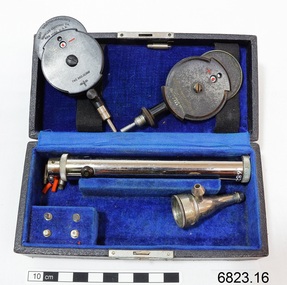 Flagstaff Hill Maritime Museum and Village
Instrument - Ophthalmoscope Kit, 1910-1920
... Dr Angus assisted Dr Tom Ryan, a pioneer in the use of X-rays and in ocular surgery. flagstaff hill warrnambool shipwrecked coast flagstaff hill maritime museum maritime museum shipwreck coast flagstaff hill maritime village great ocean road dr w r angus dr ryan surgical instrument t.s.s. largs bay warrnambool base hospital nhill base hospital mira hospital flying doctor medical treatment medical history medical education medical text book ophthalmoscope kit otoscope eye examination ear examination The Ophthalmoscope head is inscribed "SURGICAL MANUFACTURING CO. (AUST.) (PTY LTD) / MADE IN GREAT BRITAIN ...This Ophthalmoscope Kit would have been used to examine and test eyes and ears. It was most likely used by Dr T. Ryan of Nhill during the early 20th century and passed on to Dr Roy Angus, who was his assistant at one stage. It was donated to Flagstaff Hill Maritime Village by the family of Doctor William Roy Angus, Surgeon and Oculist. It is part of the “W.R. Angus Collection” that includes historical medical equipment, surgical instruments and material once belonging to Dr Edward Ryan and Dr Thomas Francis Ryan, (both of Nhill, Victoria) as well as Dr Angus’ own belongings. The Collection’s history spans the medical practices of the two Doctors Ryan, from 1885-1926 plus that of Dr Angus, up until 1969. ABOUT THE “W.R.ANGUS COLLECTION” Doctor William Roy Angus M.B., B.S., Adel., 1923, F.R.C.S. Edin.,1928 (also known as Dr Roy Angus) was born in Murrumbeena, Victoria in 1901 and lived until 1970. He qualified as a doctor in 1923 at University of Adelaide, was Resident Medical Officer at the Royal Adelaide Hospital in 1924 and for a period was house surgeon to Sir (then Mr.) Henry Simpson Newland. Dr Angus was briefly an Assistant to Dr Riddell of Kapunda, then commenced private practice at Curramulka, Yorke Peninsula, SA, where he was physician, surgeon and chemist. In 1926, he was appointed as new Medical Assistant to Dr Thomas Francis Ryan (T.F. Ryan, or Tom), in Nhill, Victoria, where his experiences included radiology and pharmacy. In 1927 he was Acting House Surgeon in Dr Tom Ryan’s absence. Dr Angus had become engaged to Gladys Forsyth and they decided he would take time to further his studies overseas in the UK in 1927. He studied at London University College Hospital and at Edinburgh Royal Infirmary and in 1928, was awarded FRCS (Fellow from the Royal College of Surgeons), Edinburgh. He worked his passage back to Australia as a Ship’s Surgeon on the on the Australian Commonwealth Line’s T.S.S. Largs Bay. Dr Angus married Gladys in 1929, in Ballarat. (They went on to have one son (Graham 1932, born in SA) and two daughters (Helen (died 12/07/1996) and Berenice (Berry), both born at Mira, Nhill ) Dr Angus was a ‘flying doctor’ for the A.I.M. (Australian Inland Ministry) Aerial Medical Service in 1928 . The organisation began in South Australia through the Presbyterian Church in that year, with its first station being in the remote town of Oodnadatta, where Dr Angus was stationed. He was locum tenens there on North-South Railway at 21 Mile Camp. He took up this ‘flying doctor’ position in response to a call from Dr John Flynn; the organisation was later known as the Flying Doctor Service, then the Royal Flying Doctor Service. A lot of his work during this time involved dental surgery also. Between 1928-1932 he was surgeon at the Curramulka Hospital, Yorke Peninsula, South Australia. In 1933 Dr Angus returned to Nhill where he’d previously worked as Medical Assistant and purchased a share of the Nelson Street practice and Mira hospital from Dr Les Middleton one of the Middleton Brothers, the current owners of what was once Dr Tom Ryan’s practice. Dr L Middleton was House Surgeon to the Nhill Hospital 1926-1933, when he resigned. [Dr Tom Ryan’s practice had originally belonged to his older brother Dr Edward Ryan, who came to Nhill in 1885. Dr Edward saw patients at his rooms, firstly in Victoria Street and in 1886 in Nelson Street, until 1901. The Nelson Street practice also had a 2 bed ward, called Mira Private Hospital ). Dr Edward Ryan was House Surgeon at the Nhill Hospital 1884-1902 . He also had occasions where he successfully performed veterinary surgery for the local farmers too. Dr Tom Ryan then purchased the practice from his brother in 1901. Both Dr Edward and Dr Tom Ryan work as surgeons included eye surgery. Dr Tom Ryan performed many of his operations in the Mira private hospital on his premises. He too was House Surgeon at the Nhill Hospital 1902-1926. Dr Tom Ryan had one of the only two pieces of radiology equipment in Victoria during his practicing years – The Royal Melbourne Hospital had the other one. Over the years Dr Tom Ryan gradually set up what was effectively a training school for country general-practitioner-surgeons. Each patient was carefully examined, including using the X-ray machine, and any surgery was discussed and planned with Dr Ryan’s assistants several days in advance. Dr Angus gained experience in using the X-ray machine there during his time as assistant to Dr Ryan. Dr Tom Ryan moved from Nhill in 1926. He became a Fellow of the Royal Australasian College of Surgeons in 1927, soon after its formation, a rare accolade for a doctor outside any of the major cities. He remained a bachelor and died suddenly on 7th Dec 1955, aged 91, at his home in Ararat. Scholarships and prizes are still awarded to medical students in the honour of Dr T.F. Ryan and his father, Dr Michael Ryan, and brother, John Patrick Ryan. ] When Dr Angus bought into the Nelson Street premises in Nhill he was also appointed as the Nhill Hospital’s Honorary House Surgeon 1933-1938. His practitioner’s plate from his Nhill surgery states “HOURS Daily, except Tuesdays, Fridays and Saturday afternoons, 9-10am, 2-4pm, 7-8pm. Sundays by appointment”. This plate is now mounted on the doorway to the Port Medical Office at Flagstaff Hill Maritime Village, Warrnambool. Dr Edward Ryan and Dr Tom Ryan had an extensive collection of historical medical equipment and materials spanning 1884-1926 and when Dr Angus took up practice in their old premises he obtained this collection, a large part of which is now on display at the Port Medical Office at Flagstaff Hill Maritime Village in Warrnambool. During his time in Nhill Dr Angus was involved in the merging of the Mira Hospital and Nhill Public Hospital into one public hospital and the property titles passed on to Nhill Hospital in 1939. In 1939 Dr Angus and his family moved to Warrnambool where he purchased “Birchwood,” the 1852 home and medical practice of Dr John Hunter Henderson, at 214 Koroit Street. (This property was sold in1965 to the State Government and is now the site of the Warrnambool Police Station. ). The Angus family was able to afford gardeners, cooks and maids; their home was a popular place for visiting dignitaries to stay whilst visiting Warrnambool. Dr Angus had his own silk worm farm at home in a Mulberry tree. His young daughter used his centrifuge for spinning the silk. Dr Angus was appointed on a part-time basis as Port Medical Officer (Health Officer) in Warrnambool and held this position until the 1940’s when the government no longer required the service of a Port Medical Officer in Warrnambool; he was thus Warrnambool’s last serving Port Medical Officer. (The duties of a Port Medical Officer were outlined by the Colonial Secretary on 21st June, 1839 under the terms of the Quarantine Act. Masters of immigrant ships arriving in port reported incidents of diseases, illness and death and the Port Medical Officer made a decision on whether the ship required Quarantine and for how long, in this way preventing contagious illness from spreading from new immigrants to the residents already in the colony.) Dr Angus was a member of the Australian Medical Association, for 35 years and surgeon at the Warrnambool Base Hospital 1939-1942, He served as a Surgeon Captain during WWII1942-45, in Ballarat, Victoria, and in Bonegilla, N.S.W., completing his service just before the end of the war due to suffering from a heart attack. During his convalescence he carved an intricate and ‘most artistic’ chess set from the material that dentures were made from. He then studied ophthalmology at the Royal Melbourne Eye and Ear Hospital and created cosmetically superior artificial eyes by pioneering using the intrascleral cartilage. Angus received accolades from the Ophthalmological Society of Australasia for this work. He returned to Warrnambool to commence practice as an ophthalmologist, pioneering in artificial eye improvements. He was Honorary Consultant Ophthalmologist to Warrnambool Base Hospital for 31 years. He made monthly visits to Portland as a visiting surgeon, to perform eye surgery. He represented the Victorian South-West subdivision of the Australian Medical Association as its secretary between 1949 and 1956 and as chairman from 1956 to 1958. In 1968 Dr Angus was elected member of Spain’s Barraquer Institute of Barcelona after his research work in Intrasclearal cartilage grafting, becoming one of the few Australian ophthalmologists to receive this honour, and in the following year presented his final paper on Living Intrasclearal Cartilage Implants at the Inaugural Meeting of the Australian College of Ophthalmologists in Melbourne In his personal life Dr Angus was a Presbyterian and treated Sunday as a Sabbath, a day of rest. He would visit 3 or 4 country patients on a Sunday, taking his children along ‘for the ride’ and to visit with him. Sunday evenings he would play the pianola and sing Scottish songs to his family. One of Dr Angus’ patients was Margaret MacKenzie, author of a book on local shipwrecks that she’d seen as an eye witness from the late 1880’s in Peterborough, Victoria. In the early 1950’s Dr Angus, painted a picture of a shipwreck for the cover jacket of Margaret’s book, Shipwrecks and More Shipwrecks. She was blind in later life and her daughter wrote the actual book for her. Dr Angus and his wife Gladys were very involved in Warrnambool’s society with a strong interest in civic affairs. Their interests included organisations such as Red Cross, Rostrum, Warrnambool and District Historical Society (founding members), Wine and Food Society, Steering Committee for Tertiary Education in Warrnambool, Local National Trust, Good Neighbour Council, Housing Commission Advisory Board, United Services Institute, Legion of Ex-Servicemen, Olympic Pool Committee, Food for Britain Organisation, Warrnambool Hospital, Anti-Cancer Council, Boys’ Club, Charitable Council, National Fitness Council and Air Raid Precautions Group. He was also a member of the Steam Preservation Society and derived much pleasure from a steam traction engine on his farm. He had an interest in people and the community He and his wife Gladys were both involved in the creation of Flagstaff Hill, including the layout of the gardens. After his death (28th March 1970) his family requested his practitioner’s plate, medical instruments and some personal belongings be displayed in the Port Medical Office surgery at Flagstaff Hill Maritime Village, and be called the “W. R. Angus Collection”. The W.R. Angus Collection is significant for still being located at the site it is connected with, Doctor Angus being the last Port Medical Officer in Warrnambool. The collection of medical instruments and other equipment is culturally significant, being an historical example of medicine from late 19th to mid-20th century. Dr Angus assisted Dr Tom Ryan, a pioneer in the use of X-rays and in ocular surgery. Ophthalmoscope Kit; combination Otoscope and May Ophthalmoscope, part of the W.R. Angus Collection. Electric ophthalmoscope and Otoscope in hinged, leather covered, hinged wood box with slide catch, lined with blue fabric. Kit contains an Ophthalmoscope head, an Otoscope head, an aural speculum, a stainless steel handle (3 pieces) powered by 2x AA batteries, orange rubber peg, 8 globes. The Ophthalmoscope head is inscribed "SURGICAL MANUFACTURING CO. (AUST.) (PTY LTD) / MADE IN GREAT BRITAIN, J.S & S." on reverse "PAT 338 766" and on the top "MAY ™ OPTHALMOSCOPE IMPROVED". Otoscope is inscribed "WAPPLER ELECTRIC CO. / NEW YOURK U.S.A.", "PAT. DEC 12 1916"flagstaff hill, warrnambool, shipwrecked coast, flagstaff hill maritime museum, maritime museum, shipwreck coast, flagstaff hill maritime village, great ocean road, dr w r angus, dr ryan, surgical instrument, t.s.s. largs bay, warrnambool base hospital, nhill base hospital, mira hospital, flying doctor, medical treatment, medical history, medical education, medical text book, ophthalmoscope kit, otoscope, eye examination, ear examination -
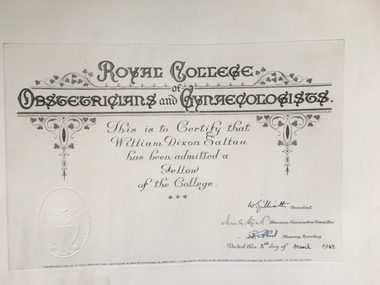 Warrnambool and District Historical Society Inc.
Document, University of Melbourne, First half of 20th C
... medical career. Saltau family History of Warrnambool Dr William Dixon Saltau Item Three Cover: ‘University of Melbourne Certificates of the Degrees of M.B. & B.S.’ These are three items belonging to Dr William Dixon Saltau:- Item One: Certificate of Dr William Saltau’s admission to the British Royal College of Obstetricians and Gynaecologists – a cream sheet of parchment paper with the stamp of the Royal College and black printed material and three signatures and two ornamental scrolls under the heading. ...These three items give details of the medical qualifications of Dr William Dixon Saltau. Born in Warrnambool, Dr Saltau (1894-1970) was the son of Hon. Marcus Saltau. M.L.C. and Jean Saltau (nee Anton). The Saltau family had been prominent in Warrnambool affairs since Henry Saltau arrived in Warrnambool in the 1870s and founded the business of Saltau and Son – general carriers, coal, wood and produce merchants and forwarding agents. Marcus Saltau was active in Warrnambool community affairs as Mayor, Chairman of the Warrnambool Hospital Board and a long-serving State politician. William Dixon Saltau was educated at Warrnambool Academy and Scotch College and graduated from Melbourne University in 1918. He worked as a doctor in Melbourne and Adelaide hospitals and in England. He was the Medical Superintendent of the Women’s Hospital in Melbourne for 25 years and was elected to the Fellowship of the Royal College of Obstetricians and Gynaecologists in 1947. These items are of considerable importance as they are original documents connected to the medical career of Dr William Saltau. He came from a prominent Warrnambool family and had a distinguished medical career. These are three items belonging to Dr William Dixon Saltau:- Item One: Certificate of Dr William Saltau’s admission to the British Royal College of Obstetricians and Gynaecologists – a cream sheet of parchment paper with the stamp of the Royal College and black printed material and three signatures and two ornamental scrolls under the heading. Item Two: Oval cardboard cylinder to hold the certificate. It has one enclosed end and a label on the outside with a British stamp and a typed address. Item Three: A leather bound folder containing 37 pages, 34 of them with details of the medical courses completed at the University of Melbourne by Dr Saltau. The cover has a gold border. Item Three Cover: ‘University of Melbourne Certificates of the Degrees of M.B. & B.S.’saltau family, history of warrnambool, dr william dixon saltau -
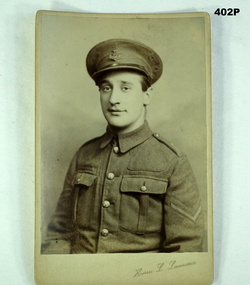 Bendigo Military Museum
Photograph - PHOTOGRAPH BRITISH SOLDIER, 1914 -1917
... medically unfit 23.1.18. Refer 420 medals Sydney Cook also 875 Medals W.E Cook his brother KIA. military history - army Photography British "Sydney Cook Dec 1895 - Nov 1978" "9.12.1895 - 14.11.1978" Photo, Sepia colour, Soldier (British) in uniform with Lance Corporal stripes. ...L/cpl Sydney Cook- Yorkshire Regt enlisted 31.12.14, WIA 6.4.16, 10.7.16 and 8.10.17. Discharged medically unfit 23.1.18. Refer 420 medals Sydney Cook also 875 Medals W.E Cook his brother KIA.Photo, Sepia colour, Soldier (British) in uniform with Lance Corporal stripes. Photo is on cardboard with gold edging. Writing on rear in black pen."Sydney Cook Dec 1895 - Nov 1978" "9.12.1895 - 14.11.1978"military history - army, photography british -
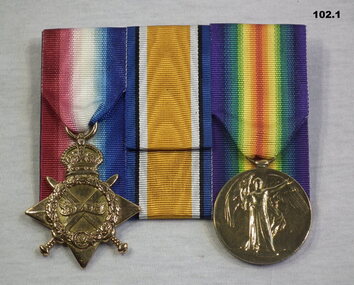 Bendigo Military Museum
Award - MEDAL SET WW1 AND BADGES, Post 1919
... Medically unfit. numismatics-medals-military badges-military military history-army .1) “1572 Pte W.H.Smith 25 Bn AIF” .3) Front: “TPI 1981. Totally and Permanently Incapacitated Disabled Soldiers Association” .4) Front. “World War I Veterans. Travel Pass1980, 3152” Medals, WWI. Court mounted, set of 2 medals with 3 ribbons. 1914-15 Star, British ...Walter Henry SMITH ( Born London, enlisted Lismore NSW) No 1572 enlisted in C Coy 25th Batt AIF on 9.4.1915. Embarked for Eygpt 29.6.1915, embarked for Gallipoli 4.9.1915. Hospitalised with enteritis on 21.10.1915. Embarked for France 14.3.1916. Transferred to 7th MG Coy on 17.7.1916. WIA 27.8.1916 shell shock and again on 29.7.1917 shell wound left leg. Discharged from the AIF on 26.7.1919 classed Medically unfit. Medals, WWI. Court mounted, set of 2 medals with 3 ribbons. 1914-15 Star, British War Medal 1914 - 18 Ribbon. Victory Medal 1914 - 19 .2) Badge, No. V43195 RSSILA . Red, white & blue enamel, 2 figures in centre. Surmounted with a crown with gold No 80 on red background. Denotes financial member 1980. .3) Badge TPI No 01068. Blue enamel on brass, surmounted with a crown. Centre is black enamel & brass mini-badge with TPI 1981. .4) Medallion, WW1 Veterans Travel Pass for 1980. No. 3152. Black & gold..1) “1572 Pte W.H.Smith 25 Bn AIF” .3) Front: “TPI 1981. Totally and Permanently Incapacitated Disabled Soldiers Association” .4) Front. “World War I Veterans. Travel Pass1980, 3152”numismatics-medals-military, badges-military, military history-army -
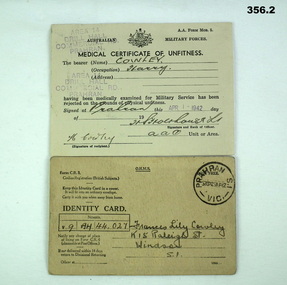 Bendigo Military Museum
Card - MEDICAL CERTIFICATE AND ID CARD, 1942
... history. Obviously he tried to enlist in WW2 but was rejected on medical grounds. documents Medical identification .1) For "Harry Cowley, Area 14 Drill Hall Prahran, Dated 1 Apr 1942" .2) For "Francis Lily Cowley, K15 Raleigh St Windsor S1" .1) Medical Certificate of Unfitness AA.Form MoB 5 .2) ID Card Civilian Registration ( British Subjects ) Number V9 F94 44,027 Stamped Prahran Vic 29 April 1942 Card MEDICAL CERTIFICATE AND ID CARD ...Items relating to Harry and Lily COWLEY. Refer 347.3. Refer 347.3 for Harry Cowley, WW1 service history. Obviously he tried to enlist in WW2 but was rejected on medical grounds..1) Medical Certificate of Unfitness AA.Form MoB 5 .2) ID Card Civilian Registration ( British Subjects ) Number V9 F94 44,027 Stamped Prahran Vic 29 April 1942.1) For "Harry Cowley, Area 14 Drill Hall Prahran, Dated 1 Apr 1942" .2) For "Francis Lily Cowley, K15 Raleigh St Windsor S1"documents, medical, identification -
 Bendigo Military Museum
Award - MEDAL SET, ACTIVE SERVICE BADGE WW1, Post 1919
... medically unfit not due to misconduct. Pre War he had 3 years in Snr Cadets. Refer Reg No's 66 & 68P. awards numismatics - medals metalcraft military history .1) Engraved: ”7326 T-SGT F.J.WILLIAMS-8BN-AIF” .2) Engraved on rear: “117672” Medal set, court mounted. .1) British War medal 1914-1918. ...Francis John WILLIAMS No 7326 enlisted on 22.9.1916 in the 24th reinforcements 8th Batt AIF aged 18 years 1 month. Embarked for England 19.2.1917, embarked fro France 18.10.1917, WIA 9.8.1918 GSW to right shoulder. Promoted Temp Sergeant 1.6.1919, discharged from the AIF on 11.7.1920 medically unfit not due to misconduct. Pre War he had 3 years in Snr Cadets. Refer Reg No's 66 & 68P. Medal set, court mounted. .1) British War medal 1914-1918. Ribbon on own is for the Victory medal 1914 — 19. .2) Badge, copper coloured - Returned from Active Service WW1..1) Engraved: ”7326 T-SGT F.J.WILLIAMS-8BN-AIF” .2) Engraved on rear: “117672”awards, numismatics - medals, metalcraft, military history -
 4th/19th Prince of Wales's Light Horse Regiment Unit History Room
Flag - Red Ensign, Surgeons' Banner, 1850 (estimated)
... medical personnel, hospitals and ambulances identified by the emblem of a red cross on a white background. The treaty was called the Geneva Convention. This Convention was concerned only with soldiers wounded on the battlefield. Over the years, however, it has been expanded to cover everyone caught up in conflicts but not actually taking an active part in the fighting. The Surgeons’ Banner complements the Colours of the Kyneton District Mounted Rifles, also held by the Unit History Room, in presenting the colonial period of the Regiment’s history. Provenance It is believed that the Banner was manufactured in Britain ...Red Ensign 1801 design. - The British red ensign was altered in 1801 to include the change to the design of the Union Jack. British legislation required, with a few exceptions, that all merchant shipping throughout the British Empire fly the British Red Ensign, without any defacement or modification. The ensign is sometimes referred to as the red duster. The Royal Navy stopped using the Red Ensign in 1864. This red ensign was used by the Surgeons of the Kyneton District Mounted Rifles to indicate their location. The Banner is a large red ensign mounted on a 10 foot long polished wooden pike. The Banner was used by the Kyneton District Mounted Rifles, later The Royal Volunteer Cavalry Regiment (Prince of Wales Hussars), then Prince of Wales Victorian Light Horse, ancestor units of the modern day 4th /19th Prince of Wales’s Light Horse Regiment. In the binding is the inscription ‘Kyneton Prince of Wales Light Horse’ and three names: Surg-Major S Smith MRSLE, Dr McMillan, and Maj Thirkettle. These surgeons played a significant role in the military and civil affairs of Kyneton. Dr McMillan Dr McMillan was the first surgeon but left KPWLH 2-3 months after its formation and little else is known of him. Surgeon-Major Samuel Smith 1836 Born, Scotland 1857 Surgeon to the Hon. Hudson Bay Company. Ship “Prince Arthur” from London to Moose Fort, Hudson Bay. June 13 – Aug. 24 1857. 1858 Appointed Medical Officer of large immigrant ship to Port Phillip 1859 Appointed Assistant District Coroner, Castlemaine 1859 Appointed to Castlemaine Hospital 1862 Appointed first resident surgeon and manager of Kyneton Hospital Foundation member of Kyneton District Mounted Rifles 1874 Appointed Surgeon-Major Kyneton Volunteer Prince of Wales Light Horse Conducted a private practice in Kyneton. 1909 Died 8 November 1909, aged 73 years Samuel Smith was a Life Governor of Castlemaine Benevolent Asylum, a member of St Andrews Presbyterian Church, a Mark Master Mason of the Edward Coulson Lodge No 17, Kyneton. He also had a notable collection of stuffed native birds and animals of which he had great knowledge. Major Thirkettle 1855 Major Thirkettle arrived in Kyneton Established a timber merchant and ironmongery business in Kyneton with Robert Burton. 1857 By 1857 he was practising as an architect. His house is still standing in Yaldwin St, West Kyneton. 1860 Joined the Prince of Wales Light Horse 1863 Joined Rifle Volunteers and appointed Captain. On their disbandment he was made Honorary Major. 1864 Won Queen’s prize for rifle shooting. Major Thirkettle was noted for his skill with woodwork. He won many prizes and orders of merit for his models of yachts It is believed likely that he made the wooden pike with its metal head (now missing). He was Tyler of the Zetland Lodge, also Secretary of the MUIOOF and Bowling Club. 1904 Died in Kyneton, aged 75 years Protection for medical services The Surgeons’ Banner indicated the location of the Regimental Aid Post. The use of this device in the 1860’s overlapped the adoption of the Red Cross which became the symbol for the protection of sick and wounded soldiers. In 1864 twelve European nations signed a treaty stating that in future wars they would care for all sick and wounded military personnel, regardless of nationality. They would also recognise the neutrality of medical personnel, hospitals and ambulances identified by the emblem of a red cross on a white background. The treaty was called the Geneva Convention. This Convention was concerned only with soldiers wounded on the battlefield. Over the years, however, it has been expanded to cover everyone caught up in conflicts but not actually taking an active part in the fighting. The Surgeons’ Banner complements the Colours of the Kyneton District Mounted Rifles, also held by the Unit History Room, in presenting the colonial period of the Regiment’s history. Provenance It is believed that the Banner was manufactured in Britain and brought to Australia by Samuel Smith. After the disbanding of Colonial units, the Banner was in the care of the Shire of Kyneton until presented to the 4/19 Prince of Wales’s Light Horse Regiment on 14 September 1986 on the occasion of the Regiment exercising its right of freedom of entry to the city. There are many examples of Regimental and King’s/Queen’s Colours held by various organisations. However A Surgeons’ Banner such as this is rare, if not unique, in Australia. A large red ensign, post 1801 design. - The British red ensign was altered in 1801 to include the change to the design of the Union Jack. British legislation required, with a few exceptions, that all merchant shipping throughout the British Empire fly the British Red Ensign, without any defacement or modification. The ensign is sometimes referred to as the red duster. The Royal Navy stopped using the Red Ensign in 1864. On the binding is the inscription: "Kyneton Prince of Wales Light Horse", and three names - Surgeon Major S Smith MRSLE Dr McMillan Major Thirkettleheraldry, red ensign, surgeons banner, kyneton district mounted rifles -
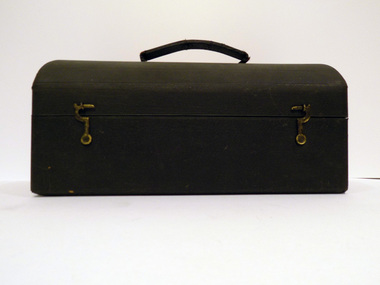 Geoffrey Kaye Museum of Anaesthetic History
Container - Medical Carry Box, Allen & Hanbury Ltd
... Britain and Ireland, 'of spinal anaesthesia fame', and a leading practitioner in his day. He apparently committed suicide in 1935, there are references that he 'could not make a living from anaesthesia'. (Norman, 2002, 'An informal history of the first 25 years', The British Journal of Anaesthesia, 88 (3): 445-450) The maker of this medical box, Allen and Hanburys Ltd., was a British pharmaceutical manufacturer, founded in 1715, absorbed by Glaxo Laboratories in 1958....Britain and Ireland, 'of spinal anaesthesia fame', and a leading practitioner in his day. He apparently committed suicide in 1935, there are references that he 'could not make a living from anaesthesia'. (Norman, 2002, 'An informal history of the first 25 years', The British Journal of Anaesthesia, 88 (3): 445-450) The maker of this medical box, Allen and Hanburys Ltd., was a British pharmaceutical manufacturer, founded in 1715, absorbed by Glaxo Laboratories in 1958. dr. ...A characteristic black, round topped box, to carry medical equipment with a divider which would have held a square, plain glass bottle. The donor, Dr. Holloway is known to have acquired much of Dr. Howard Jones' equipment. In 1930 Dr Howard Jones, M.B., B.S., (Lond.). Surgeon Anaesthetist to Charing Cross Hospital first described percaine in an article in the British Journal of Anaesthesia. According to Norman, J. in the British Journal of Anaesthesia, Jones was the first honorary secretary of the Association of Great Britain and Ireland, 'of spinal anaesthesia fame', and a leading practitioner in his day. He apparently committed suicide in 1935, there are references that he 'could not make a living from anaesthesia'. (Norman, 2002, 'An informal history of the first 25 years', The British Journal of Anaesthesia, 88 (3): 445-450) The maker of this medical box, Allen and Hanburys Ltd., was a British pharmaceutical manufacturer, founded in 1715, absorbed by Glaxo Laboratories in 1958.Black cardboard box with handle and simple border decoration on top. Brass hinges at the rear and two brass hook clasps at the front. Interior is lined with black linen. Cardboard divider inside and square compartment in corner would have been used to hold a bottle of ether in place.Printed in gold leaf inside lid: ALLEN & HANBURYS LTD / LONDON.W. / 48.WIGMORE STdr. [e.s.] holloway, medical box, carry kit, allen & hanbury's ltd. -
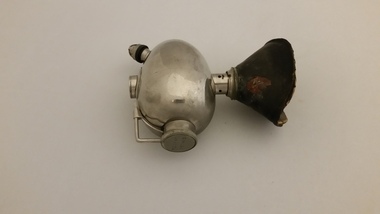 Geoffrey Kaye Museum of Anaesthetic History
Equipment - Inhaler, Probyn Williams, Mayer & Meltzer, c. 1900
... Britain. The Probyn Williams inhaler was a further modification of the Clover inhaler with narrow airways and rebreathing. anaesthetic anaesthesiology medical history ether inhaler Probyn Williams Moulded into inhaler: MAYER & MELTZER / LONDON Ovoid shaped metal ether inhaler device with a dark brown leather fask mask attached. ...In 1896 Robert James Probyn-Williams was appointed first honorary anaesthetist to the London Hospital and joined a select band of fulltime anaesthetists (26) in Great Britain. The Probyn Williams inhaler was a further modification of the Clover inhaler with narrow airways and rebreathing.Ovoid shaped metal ether inhaler device with a dark brown leather fask mask attached.Moulded into inhaler: MAYER & MELTZER / LONDONanaesthetic, anaesthesiology, medical history, ether, inhaler, probyn williams -
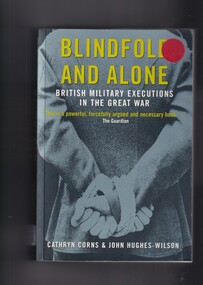 Monbulk RSL Sub Branch
Book, Cathryn Corns et al, Blindfold and all alone: British military executions in the great war, 2001
... history world war 1914-1918 - military tribunals It was one of the most controversial and still haunting aspects of World War One: the execution of 351 British soldiers for cowardice and desertion in the face of the enemy. Using new material that only now has become available from the Public Records Office and other sources, this compelling history sets out the facts of these courts-martial and shootings--and just as important, places them in the context of the military, social, and medical context of the period. ...It was one of the most controversial and still haunting aspects of World War One: the execution of 351 British soldiers for cowardice and desertion in the face of the enemy. Using new material that only now has become available from the Public Records Office and other sources, this compelling history sets out the facts of these courts-martial and shootings--and just as important, places them in the context of the military, social, and medical context of the period.Index, notes, appendices, glossary, ill (plates b/w), p.463.non-fictionIt was one of the most controversial and still haunting aspects of World War One: the execution of 351 British soldiers for cowardice and desertion in the face of the enemy. Using new material that only now has become available from the Public Records Office and other sources, this compelling history sets out the facts of these courts-martial and shootings--and just as important, places them in the context of the military, social, and medical context of the period.world war 1914-1918 - history, world war 1914-1918 - military tribunals -
 Alfred Hospital Nurses League - Nursing History Collection
Book - Illustrated book, Thornton Butterworth Limited, Florence Nightingale 1820-1856: a study of her life down to the end of the Crimean War, 1931
... History Crimean War 1853-1856-medical care This book focuses on the early life and work of Florence Nightingale, particularly her contribution to healthcare and nursing, up to her involvement in the Crimean War. The book also explores Nightingale's experiences in the Crimean War, where she helped establish a hospital and improved sanitation, leading to better care for the soldiers. The book also delves into the impact of her work and its influence on civilian hospital reforms in Great Britain ...This book focuses on the early life and work of Florence Nightingale, particularly her contribution to healthcare and nursing, up to her involvement in the Crimean War. The book also explores Nightingale's experiences in the Crimean War, where she helped establish a hospital and improved sanitation, leading to better care for the soldiers. The book also delves into the impact of her work and its influence on civilian hospital reforms in Great Britain.Illustrated book has been covered with adhesive dark blue plastic. Handwritten in silver on the spine are the words 'Hist of N I' and the number 9.non-fictionThis book focuses on the early life and work of Florence Nightingale, particularly her contribution to healthcare and nursing, up to her involvement in the Crimean War. The book also explores Nightingale's experiences in the Crimean War, where she helped establish a hospital and improved sanitation, leading to better care for the soldiers. The book also delves into the impact of her work and its influence on civilian hospital reforms in Great Britain.florence nightingale, military nursing-history, nurses-biography, nursing-history, crimean war 1853-1856-medical care -
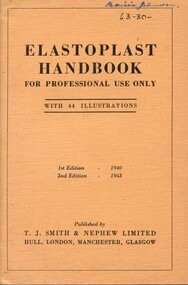 Alfred Hospital Nurses League - Nursing History Collection
Booklet - Illustrated Booklet, T J Smith and Nephrw Limited, Elastoplast handbook - for professional use only, 1943
... During world wWar II the compan was a major supplier of medical dressings to British and Allied forces Insight into wound management in the 1940's Medical dressings Adhesive bandages Elastoplast Bandaging wound management-history Vintage handbook with illustrations to provide guidence for medical and nursing staff on the prpoer application of Elastoplat bandages Handwritten at top right of front cover: 'Patricia Johnston' [blue ink] and previous catalogue number [black ink] Stitche illustrated booklet, orange cover with black print detailing title, edition and publisher there is a thin single line border. ...Vintage handbook with illustrations to provide guidence for medical and nursing staff on the prpoer application of Elastoplat bandagesStitche illustrated booklet, orange cover with black print detailing title, edition and publisher there is a thin single line border. non-fictionVintage handbook with illustrations to provide guidence for medical and nursing staff on the prpoer application of Elastoplat bandagesmedical dressings, adhesive bandages, elastoplast, bandaging, wound management-history -
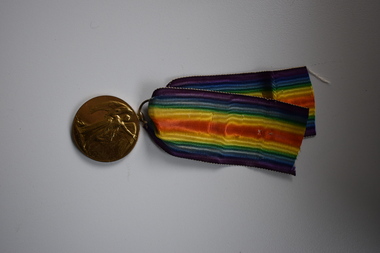 Warrnambool and District Historical Society Inc.
Medal, Victory Medal World War One, 1919
... British service personnel. The medal described above was awarded to Private Thomas Wickham. He was born in Port Fairy in 1886 and died in Warrnambool in 1955. Private Wickham enlisted in February 1916 and his next of kin was his wife Elizabeth, living at that time in Terang. Thomas Wickham was a member of the 58th Battalion, 2nd Reinforcement. He served overseas and returned to Australia in 1919 and was discharged as medically unfit because of rheumatism. world war one thomas wickham history ...The Victory medal was awarded to all Allied servicemen and women who served in World War One. Australians were issued with the medal made for British service personnel. The medal described above was awarded to Private Thomas Wickham. He was born in Port Fairy in 1886 and died in Warrnambool in 1955. Private Wickham enlisted in February 1916 and his next of kin was his wife Elizabeth, living at that time in Terang. Thomas Wickham was a member of the 58th Battalion, 2nd Reinforcement. He served overseas and returned to Australia in 1919 and was discharged as medically unfit because of rheumatism. This is a round bronze medal with the image of a winged female figure of Victory on the obverse side and engraved lettering surrounded by laurel leaves on the reverse side. There is lettering around the edge of the medal. The medal has a metal ring to which is attached a rainbow-coloured ribbonThe Great War For Civilisation 1914-1919 1773 Pte. T. Wickham 58 Bn. A.I.F. world war one, thomas wickham, history of warrnambool
