
Showing 131 items matching "bronze cross"
-
 Returned Nurses RSL Sub-branch
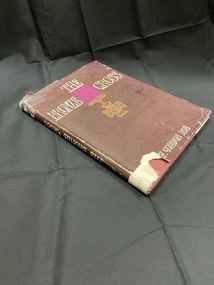
Book - Hardcover book, P R Gawthorn, The Bronze Cross: a tribute to those who won the Supreme Award for Valour in the years 1940-45, 1945
... The Bronze Cross: a tribute to those who won the Supreme Award for Valour in the years 1940-45.......Bronze Cross...Title printed down the spine and across the top of the cover in brown and white shadow print. Image of the bronze cross displayed in the middle of the title....The Bronze Cross: a tribute to those who won the Supreme Award for Valour in the years 1940-45. ...The history of the Victoria Cross award and those who were honoured with it between 1940-45.Maroon hard cover book with torn brown dust jacket. Title printed down the spine and across the top of the cover in brown and white shadow print. Image of the bronze cross displayed in the middle of the title.non-fictionThe history of the Victoria Cross award and those who were honoured with it between 1940-45.ww2, wwii, world war two, victoria cross, bronze cross, military decorations - great britain, great britain - armed forces -
 Warrnambool RSL Sub Branch
Book, BOOK: The Bronze Cross - A tribute to those who won the supreme award for Valour in the years 1940-45
... BOOK: The Bronze Cross - A tribute to those who won the supreme award for Valour in the years 1940-45...London. 1945 BOOK: The Bronze Cross - A tribute to those who won the supreme award for Valour in the years 1940-45 Book ... -
 Kew Historical Society Inc
Medal - Queen Victoria Diamond Jubilee Bronze Maltese Cross, State of Victoria, 1897
... Queen Victoria Diamond Jubilee Bronze Maltese Cross...cross. Inscription (centre): '1897'. Arms: 'TO COMMEMORATE THE 60TH YEAR OF THE REIGN OF H . M . QUEEN VICTORIA'. Medal Queen Victoria Diamond Jubilee Bronze Maltese Cross State of Victoria ...Medal commemorating Queen Victoria's Diamond Jubilee 1897. Brass cross pattée fitted with a loop and with a separate pressed brass crown. Obverse: In the centre the head of Queen Victoria. On the arms of the cross (top) the cypher 'VRI' between flags (left) '1837' (right) '1897' (bottom) 'VICTORIA THE GOOD'. Reverse: Crown in centre with inscription on each arm of cross. Inscription (centre): '1897'. Arms: 'TO COMMEMORATE THE 60TH YEAR OF THE REIGN OF H . M . QUEEN VICTORIA'.Front: VIR : Victoria the Good : 1837-1897 Reverse: To Commemorate the 60th Year of the Reign of H.M. Queen Victoria : 1897queen victoria, queen victoria - commemorations - victoria, australian commemorative medals -
 Emerald Museum & Nobelius Heritage Park
Award - Emerald Life Saving Club awards
... 1 Award of Merit; 1 Bronze Cross; 6 Emerald Life Saving Club plus a strip of 8 fabric award badges...Came with 6 trophies from Emerald Life Saving Club Emerald Victoria Australia sports Life Saving Club, Royal Life Saving Society 1 Award of Merit; 1 Bronze Cross; 6 Emerald Life Saving Club plus a strip of 8 fabric award badges Award Emerald Life Saving Club awards ...Came with 6 trophies from Emerald Life Saving Club1 Award of Merit; 1 Bronze Cross; 6 Emerald Life Saving Club plus a strip of 8 fabric award badgesLife Saving Club, Royal Life Saving Societyemerald, victoria, australia, sports -
 Uniting Church Archives - Synod of Victoria
Medal
... Bronze Maltese cross Junior Methodist Church Distinguished Service Order medal on a dark blue and brown grosgrain ribbon. ...The practice started in 1904 with the Wesleyan Methodists by a man called Stanley Sowton so £5 was a large amount in those days. junior methodist church On the large cross: "JMC DSO" "FOR ZEAL FOR CHRIST", on small cross: "JMC DSO" "FOR ZEAL FOR CHRIST" "10 YEARS", on bar: "1956" Bronze Maltese cross Junior Methodist Church Distinguished Service Order medal on a dark blue and brown grosgrain ribbon. ...The medal was awarded to junior missionary collectors for collecting over £5 for the missionary work of the church during a year. The first year this was achieved the medal was awarded and in subsequent years a bar was awarded. After 10 years a long service badge was also given. The practice started in 1904 with the Wesleyan Methodists by a man called Stanley Sowton so £5 was a large amount in those days.Bronze Maltese cross Junior Methodist Church Distinguished Service Order medal on a dark blue and brown grosgrain ribbon. The ribbon has a metal bar and smaller Maltese cross on it.On the large cross: "JMC DSO" "FOR ZEAL FOR CHRIST", on small cross: "JMC DSO" "FOR ZEAL FOR CHRIST" "10 YEARS", on bar: "1956"junior methodist church -
 Bendigo Military Museum
Award - MEDAL
... Medal is bronze featuring Southern Cross, surrounded by Wattle, Ribbon has 3 vertical bands, ochre in middle with green either side and white stripes....Medal is bronze featuring Southern Cross, surrounded by Wattle, Ribbon has 3 vertical bands, ochre in middle with green either side and white stripes. ...Recognises Australian Civilians who rendered eligible service in support of War Service, the medal was established in 1994.Civilian Service Medal. Medal is bronze featuring Southern Cross, surrounded by Wattle, Ribbon has 3 vertical bands, ochre in middle with green either side and white stripes.Civilian Service.passchendaele barracks trust, pbt718, award, medal -
 Dandenong/Cranbourne RSL Sub Branch
Medal - Iron Cross Medal WW1, Circa 1914
... Black and bronze 2nd Class Iron Cross from1914. With black and white cotton ribbon attached. ( Eisernes Kreuz 2 Klasse )....Black and bronze 2nd Class Iron Cross from1914. With black and white cotton ribbon attached. ( Eisernes Kreuz 2 Klasse ). ...Black and bronze 2nd Class Iron Cross from1914. With black and white cotton ribbon attached. ( Eisernes Kreuz 2 Klasse ).Obverse side has crown above the letter W with 1914 beneath. Reverse side has crown above FW over oakleaves and 1813 beneath. -
 Bendigo Military Museum
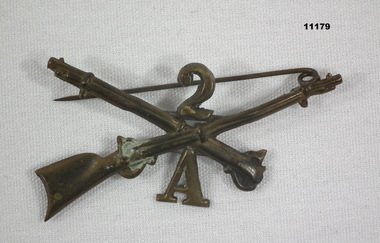
Badge - UNIT INSIGNIA, Unknown
... Metaliic bronze badge of two crossed rifles with a pin on the back and identification of "2" & "A" above and below. 2 stands for Regiment and A represents the Company....Unit Badge US Cavalry Ron Mills Collection Metaliic bronze badge of two crossed rifles with a pin on the back and identification of "2" & "A" above and below. 2 stands for Regiment and A represents the Company. ...Pin is likely a vintage insignia for a US Cavalry Unit with the "2 & A" identifying the Regiment and the Company it came from. Would generally be worn on the hat.Metaliic bronze badge of two crossed rifles with a pin on the back and identification of "2" & "A" above and below. 2 stands for Regiment and A represents the Company.unit badge, us cavalry, ron mills collection -
 National Vietnam Veterans Museum (NVVM)
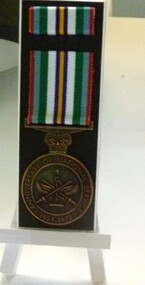
Medal, Anniversary of National Service medal
... Bronze round medal depicting crossed swords, anchor and wings with a star above. ...The ANSM was introduced on 2001 to recognise those who completed their obligation under the two National Service Schemes that operated in Australia between 1951 and 1972 Australian Medal National Service Anniversary Anniversary of National Service 1951-1972 Bronze round medal depicting crossed swords, anchor and wings with a star above. ...tis replica Anniversary of National Service 1951-1975 Medal. The ANSM was introduced on 2001 to recognise those who completed their obligation under the two National Service Schemes that operated in Australia between 1951 and 1972Bronze round medal depicting crossed swords, anchor and wings with a star above. Ribbon is striped brown, blue, green, white, navy and gold.Anniversary of National Service 1951-1972australian medal, national service, anniversary -
 Koroit & District Historical Society
medal, Croix de Guerre avec Palme, WW1 vintage Made in France
... A cast bronze medal comprising a cross pattee interspersed with crossed swords. ...This is a relatively rare award for Australian soldiers with only 213 Australians awarded this medal during WW1 Awarded between 1915 and 1919 and is thought to have been awarded to a Koroit district soldier. medal World War Croix de Guerre avec Palme A cast bronze medal comprising a cross pattee interspersed with crossed swords. ...This is a relatively rare award for Australian soldiers with only 213 Australians awarded this medal during WW1Awarded between 1915 and 1919 and is thought to have been awarded to a Koroit district soldier. A cast bronze medal comprising a cross pattee interspersed with crossed swords. The medal is held by a green ribbon which has 7 thin red vertical stripes. Across the ribbon is a bronze palm which is a symbol of victorymedal, world war, croix de guerre avec palme -
 Kew Historical Society Inc
Medal, Stokes & Sons, Town of Kew : To Commemorate its Jubilee, 1910
... Kew Jubilee medal in the shape of a Maltese cross. Gilded bronze with attached original red, white and blue cloth ribbon. .... / MAYOR on arms of cross, top, KEW bottom, JUBILEE, left 1860, right, 1910 Kew Jubilee medal in the shape of a Maltese cross. Gilded bronze with attached original red, white and blue cloth ribbon. ...Medal issued to commemorate the 50th jubilee of the Town of Kew. It names J.F. McCrea as Mayor. John Falding McCrea was Mayor of Kew 1910-11. Kew was proclaimed a municipality on 22 December 1860, seceding from the Boroondara Road Board District, then comprising Kew, Hawthorn and Camberwell. It was proclaimed a town on 8 December 1910, the year this medal was issued, and a city on 10 March 1921. On 22 June 1994 Kew city was united with Camberwell and Hawthorn cities to form Boroondara city.Mint gilt medal with original ribbon.Kew Jubilee medal in the shape of a Maltese cross. Gilded bronze with attached original red, white and blue cloth ribbon. On the front is the Coat of Arms of the Town of Kew and an inscription: ‘Town of Kew. To Commemorate Its Jubilee 1910’. On the reverse is inscribed 'Kew Jubilee 1860-1910. Cr J.F. McCrae J.P. Mayor'. The medal was also issued in bronze.Obverse description Shield of six wheat-sheafs above motto CRESCO on ribbon; above shield is the Royal coat of arms with lion and unicorn supporters and, on ribbon DIEU ET MIN DROIT; on arms of cross top, TOWN / OF, bottom, KEW, left TO COMMEM / -ORATE, right, ITS JUBILEE / 1910 Reverse description Within line circle set at centre of cross shaped flan, CR. J.F. McCREA / J.P. / MAYOR on arms of cross, top, KEW bottom, JUBILEE, left 1860, right, 1910jubilee - kew (vic), commemorative medals - kew (vic), australian commemorative medals -
 Bendigo Military Museum
Award - MEDALS, ETHIOPIAN, Unknown
... Star of Victory - cross shaped, bronze. No ribbon. 3. Coronation medal of Emperor Halle Selassie I. 4. ...Star of Victory - cross shaped, bronze. No ribbon. 3. Coronation medal of Emperor Halle Selassie I. 4. ...1. & 2. Star of Victory - In 1941 Ethiopian, British and Commonwealth Forces liberated the country and the Emperor reinterred Capital. 3. Coronation Medal was issued to celebrate the 1930 accession of Emperor Halle Selassie I to the throne. 4. Eritrean Medal was struck during the period to commemorate the ties between Ethiopia and Eritrea. 5. Order of St. George - Awarded for Action against Italian Forces from 1935-41 for Acts of Bravery and Long Distinguished Service. 6. Ribbon is off Ethiopian Campaign/ Victory Award with Rosette.Five medals unmounted. 1. Star of Victory - cross shaped, silver with ribbon. 2. Star of Victory - cross shaped, bronze. No ribbon. 3. Coronation medal of Emperor Halle Selassie I. 4. Eritrean Medal of Halle Selassie I in bronze. 5. Order of St George - Medal of Merit. 6. Military Ribbon bars British Combined with an Ethiopian Imperial Award.1. No name - Inscribed "Star of Victory 1941". 2. No name - Inscribed "Star of Victory 1941". 3. No Name. 4. Inscription in Foreign Text. 5. Inscription in Foreign Text. 6. Nil.ron mills collection, medals, ethiopian collection -
 Bayside Gallery - Bayside City Council Art & Heritage Collection
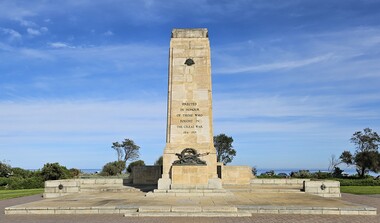
Monument - Memorial, Irwin and Stevenson, Brighton War Memorial, 1927
... The cenotaph bears the Rising Sun badge in bronze relief near its top with bronze lettering running down the cenotaph reading "ERECTED IN HONOUR OF THOSE WHO FOUGHT IN THE GREAT WAR 1914 – 1919". A bronze relief assemblage of crossed weapons, a wreath, the lamp of valour and the Latin phrase "DUCIT AMOR PATRIA" (love of country leads me) sit above the base which is carved with the word "SERVICE". ...The cenotaph bears the Rising Sun badge in bronze relief near its top with bronze lettering running down the cenotaph reading "ERECTED IN HONOUR OF THOSE WHO FOUGHT IN THE GREAT WAR 1914 – 1919". A bronze relief assemblage of crossed weapons, a wreath, the lamp of valour and the Latin phrase "DUCIT AMOR PATRIA" (love of country leads me) sit above the base which is carved with the word "SERVICE". ...On 23 July 1922, Brighton City Council adopted the recommendation from a sub-committee that the site for a war memorial be at Green Point, Brighton Beach. Brighton Council invited designs, limited to returned soldier architects and 18 designs were received. The first prize of £30 was awarded to the architecture firm Irwin and Stevenson and the designs were exhibited at the Brighton Town Hall in 1925. The bronze casting, using lost wax technique, was executed by sculptor Mr. Paul Montford, to the design of the architect and the central assemblage was believed to be the largest bronze casting in relief carried out in Australia at the time. The Brighton War Memorial was unveiled by His Excellency the Governor, the Right Honourable Arthur Herbert Tennyson Baron Somers, K.C.M.G., D.S.O., M.C., on Sunday 24th April 1927 in the presence of 4,000 people. The memorial was originally constructed to commemorate those from the City of Brighton who served in World War One but has since been augmented to commemorate those from the municipality of Bayside who have made the ultimate sacrifice during official periods of hostility.War memorial consisting of a sandstone cenotaph, granite base and sandstone terrace situated at Green Point, Brighton. The cenotaph is a truncated obelisk with classical decoration in stone and bronze. The cenotaph bears the Rising Sun badge in bronze relief near its top with bronze lettering running down the cenotaph reading "ERECTED IN HONOUR OF THOSE WHO FOUGHT IN THE GREAT WAR 1914 – 1919". A bronze relief assemblage of crossed weapons, a wreath, the lamp of valour and the Latin phrase "DUCIT AMOR PATRIA" (love of country leads me) sit above the base which is carved with the word "SERVICE". The terrace walls have bronze relief medallions with images of the head of an airman on the left and an infantryman on the right. The back of the cenotaph bears a torch in bronze relief near its top. On the sandstone wall behind the cenotaph are three large bronze plaques that lists the names of those from the City of Bayside who have served in the various conflicts in which Australia has been involved. At the back of the sandstone wall is carved lettering reading "HISTORY GAVE THEM A COMMON FAME. POSTERITY A COMMON MONUMENT" with 1914 carved on the left and 1919 on the right.brighton war memorial, memorial, cenotaph, green point, war memorial, brighton, service, paul montford, irwin and stevenson, rising sun, wreath, weapons, lamp of valour, great war, world war one, honour roll, honour board, roll of honour, ducit amor patriae, brighton beach, city of brighton, leighton major francis irwin, roy kenneth stevenson -
 Tramways/East Melbourne RSL Sub Branch - RSL Victoria Listing id: 27511
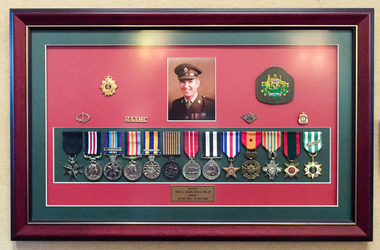
Memorabilia - Medal Board, Ceremonial Medal Board for JJ Davis, 2001
... Silver Star (Unites States of America) 9. Gallantry Cross with Bronze Star (South Vietnam) 10. The Armed Forces Honour Medal (2nd Class) (South Vietnam) 11. ...Silver Star (Unites States of America) 9. Gallantry Cross with Bronze Star (South Vietnam) 10. The Armed Forces Honour Medal (2nd Class) (South Vietnam) 11. ...John James Davis (J.J. Davis) was Australia's most decorated NCO in the Vietnam conflict. This plaque commemorates the deeds he performed and medals received.Framed ceremonial medal board for JJ Davis. The piece includes a service photograph of JJ Davis in uniform, a fabric patch with the Australian Coat of Arms, five metal pins and 13 replica medals as listed below. The information plaque states '5411313 WO1 J.J. DAVIS, SB St J, MM, JP - RAAMC - 30 JAN 1963 - 30 JAN 1986. The five metal pins are: 1. Returned Services League Australia 2. Returned Active Service 3. RAAMC 4. Royal Australian Army Medical Corps 5. Knife surrounded by laurel leaves. Replica medals included are: 1. Military Medal 2. Australian Active Service Medal 1945-75, Vietnam 3. Vietnam Medal 4. Defence Force Medal with 1st Clasp 5. National Medal 6. Australian Defence Medal 7. St John 12 Year Long Service Medal with five year clasp 8. Silver Star (Unites States of America) 9. Gallantry Cross with Bronze Star (South Vietnam) 10. The Armed Forces Honour Medal (2nd Class) (South Vietnam) 11. Civil Action Medal (2nd Class) (South Vietnam) 12. Vietnamese Campaign Medal 13. ACT Emergency Service Medal (2003 Bushfires) john jams davis, john james davis, j j davis, vietnam, nco, photographs, portraits, badges, medals -
 Flagstaff Hill Maritime Museum and Village
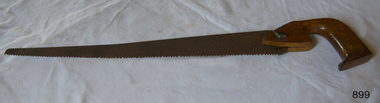
Tool - Compass Saw, Mid to late 20th Century
... bronze and later iron. In the Iron Age, frame saws were developed holding the thin blades in tension. The earliest known sawmill is the Roman Hierapolis sawmill from the third century AD used for cutting stone. The subject item is believed to date from around the mid to late 20th century and is regarded as a modern item. The maker is unknown but the pattern or design and type of wood used indicate it is a tool of modern manufacture. flagstaff hill warrnambool flagstaff-hill flagstaff-hill-maritime-museum maritime-museum shipwreck-coast flagstaff-hill-maritime-village Wood Cutting Wood Saw Cross Cut Saw Cabinet Makers Tools Wood Working Tools Tool None Compass saw blade with wooden handle attached with wingnut. ...A saw is a tool consisting of a tough blade, wire, or chain with a hard-toothed edge. It is used to cut through material, very often wood, though sometimes metal or stone. The cut is made by placing the toothed edge against the material and moving it forcefully forth and less vigorously back or continuously forward. This force may be applied by hand, or powered by steam, water, electricity or other power sources. An abrasive saw has a powered circular blade designed to cut through metal or ceramic. In ancient Egypt, open (unframed) saws made of copper are documented as early as the Early Dynastic Period, circa 3,100–2,686 BC. Many copper saws were found in tombs dating to the 31st century BC. Models of saws have been found in many contexts throughout Egyptian history. As the saw developed, teeth were raked to cut only on the pull stroke and set with the teeth projecting only on one side, rather than in the modern fashion with an alternating set. Saws were also made of bronze and later iron. In the Iron Age, frame saws were developed holding the thin blades in tension. The earliest known sawmill is the Roman Hierapolis sawmill from the third century AD used for cutting stone.The subject item is believed to date from around the mid to late 20th century and is regarded as a modern item. The maker is unknown but the pattern or design and type of wood used indicate it is a tool of modern manufacture. Compass saw blade with wooden handle attached with wingnut.Noneflagstaff hill, warrnambool, flagstaff-hill, flagstaff-hill-maritime-museum, maritime-museum, shipwreck-coast, flagstaff-hill-maritime-village, wood cutting, wood saw, cross cut saw, cabinet makers tools, wood working tools, tool -
 Federation University Historical Collection
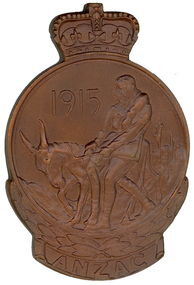
Medal - Numismatics, ANZAC Commemorative Medal for R.M. Serjeant, 1967
... Cross. The lower half will be bordered by New Zealand fern leaves. The medallion will be cast in bronze and the lapel badge will be metal of a bronze colour. ...Bronze commemorative medal in black presentation case showing Simpson and his donkey carrying a wounded soldier to safety. A crown is situated on top of the medal, and the word ANZAC beneath the medal. The opposite side depicts Australia, New Zealand and the Southern Cross...Cross. The lower half will be bordered by New Zealand fern leaves. The medallion will be cast in bronze and the lapel badge will be metal of a bronze colour. ...Robert M. Serjeant was the only son of Theo and Alice Serjeant, and grandson of famed mine manager Robert Malachy Serjeant (1829-1902). Robert Serjeant was a past student of the Ballarat School of Mines (SMB), and at the time of his World War One enlistment he had just finished an electrical course, and was working as a junior member of the SMB Department of Electricity. Robert Serjeant enlisted in December 1914. Corporal Serjeant (2138) of the 8th Battalion, died of wounds received in action at Gallipoli on 28 April 1915, aged 20. He was buried at sea and his name is listed at the Lone Pine Memorial. A brown paper parcel of Robert Serjeant's belongings was returned to his parents. It contained his discs, wrist-watch (damaged), notebook, hymn book and letters. [1] The Ballarat Courier reported: 'He was of quiet disposition, and a great student, devoting himself closely to his work.' Further information on R.M. Serjeant can be found at https://bih.federation.edu.au/index.php/Robert_M._Serjeant_Jnr The following statement on the ANZAC Commemorative Medallion and Badge was made by by Prime Minister Holt in 16 March 1967 when the Minister for Defence announced that it had been decided by the Australian Government, in consultation with the New Zealand Government, to issue a medallion and lapel badge to the veterans of the Gallipoli Campaign. "Last March, the Minister for Defence announced that it had been decided by the Australian Government, in consultation with the New Zealand Government, to issue a medallion and lapel badge to the veterans of the Gallipoli Campaign. I am glad to be able to announce that arrangements have now been completed for the production of the medallion and the badge. The Minister for the Army will be arranging distribution to those wishing to receive them as soon as possible. The Government hopes that production of the medallion and lapel badge will be sufficiently advanced to permit at least some of them to be distributed by ANZAC Day. The medallion (with the name of the recipient inscribed) will be issued to the surviving members of the Australian Defence Force who served on the Gallipoli Peninsula, or in direct support of the operations from close off-shore, at any time during the period from the first ANZAC Day in April, 1915 to the date of final evacuation in January, 1916. Next of kin or other entitled persons will be entitled to receive the medallion on behalf of their relatives, if the relative died on active service or has since died. For surviving members, a lapel badge will also be available for wearing. This will be a replica of the obverse (or front) of the medallion and will be about 1 inch high and 2/3 inch wide - the same size as the RSL badge. The medallion is the work of Mr. Raymond Ewers, the well-known Australian artist, based on a suggestion by Mr. Eric Garrett, a staff artist with the Department of the Army. It has been endorsed by both the Government of New Zealand and ourselves. It will be approximately 3 inches high and 2 inches wide. The obverse of the medallion depicts Simpson and his donkey carrying a wounded soldier to safety. It will be bordered on the lower half by a laurel wreath above the word ANZAC. The reverse (the back) shows a relief map of Australian and New Zealand superimposed by the Southern Cross. The lower half will be bordered by New Zealand fern leaves. The medallion will be cast in bronze and the lapel badge will be metal of a bronze colour. For the information of the honourable members I present also a brief statement setting out the conditions of eligibility which will apply to the medallion and badge and the manner in which those desiring to receive them should apply."(https://www.awm.gov.au/encyclopedia/anzac/medallion/doc.asp, accessed 26/02/2014) Conditions of eligibility. All members of the Australian Defence Force who served during the Gallipoli Campaign are entitled to receive the ANZAC Commemorative medallion. The campaign lasted from April 25, 1915 to January 8, 1916. The award will be made for service on the Gallipoli Peninsula and service in support of the operations in an area off-shore eastward of a line drawn from Yukyeri Point (lat 39 50' 40'' N long 26 9' 45'' E) through a point in lat 39 53' N long 26 0' E thence to Cape Gremea (lat 40 35' N long 26 6' E). The award will also be available to members of philanthropic organisations and the Press who were accredited to the AIF, and to Australian members of the crews of merchant ships or hospital ships which operated in direct support within the defined area. Note: The boundary line would run just off-shore from the land masses north and south of the Dardanelles, and is estimated to be within about 5 miles from the beach at ANZAC Cove. (https://www.awm.gov.au/encyclopedia/anzac/medallion/doc.asp, accessed 26/02/2014) This Item is significance because is was only issued to members of the Australian and New Zealand Defence Force who served at Gallipoli. This Medallion is significant because of its relationship to Robert M. Serjeant who died on 28 April 2015 at Gallipoli of wounds received in Action. Bronze commemorative medal in black presentation case showing Simpson and his donkey carrying a wounded soldier to safety. A crown is situated on top of the medal, and the word ANZAC beneath the medal. The opposite side depicts Australia, New Zealand and the Southern Cross Constellation. The lower half is bordered with New Zealand Fern leaves. The commemorative medal was presented to the family of Robert M. Serjeant. Gift of David Stevens, 2014.Engraved: "1238 R.M. Serjeant"serjeant, r.m. serjeant, robert m. sergeant, anzac, medal, numismatics -
 Flagstaff Hill Maritime Museum and Village
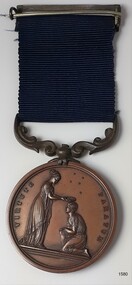
Award - Medal, James Patten, 18-041890
... bronze bar with pin closure, dark blue, braided ribbon with brass swivel mount. The case has a gold embossed rectangular border on the lid and base. Embossed inscription on lid. The obverse shows a woman on the left in long robe placing a wreath on the head of a kneeling man at right, with the five stars of the Southern Cross constellation above his head. ...bronze bar with pin closure, dark blue, braided ribbon with brass swivel mount. The case has a gold embossed rectangular border on the lid and base. Embossed inscription on lid. The obverse shows a woman on the left in long robe placing a wreath on the head of a kneeling man at right, with the five stars of the Southern Cross constellation above his head. ...The Bronze Medal and Certificate of Merit of the Royal Humane Society of Australasia were awarded to James Patten for the bravery he displayed on 18th April 1890, and presented to him on 21st May 1890. The Royal Humane Society of Australasia was founded in 1874 with the aim to recognise those who risked their lives to save others and to assist those whose acts of bravery caused them or their surviving dependants to be disadvantaged in some way. Details of the incident were published in the Argus, Saturday 19 April 1890, page 11 - "FATAL BOATING ACCIDENT, (BY TELEGRAPH FROM OUR CORRESPONDENT.), WARRNAMBOOL, FRIDAY A fatal boating disaster occurred in Lady Bay this morning, the victim being Joseph Lowe, licensee of the Bay View Hotel, South Warrnambool. The deceased, in company with two lads named James Ferrier and James Patten, went out in a small dingy to shoot musk ducks. The water was perfectly smooth, and the party were tempted to proceed as far as the mouth of the Hopkins River. In their eagerness they neglected to keep clear of the breakers, and were presently carried in on the crest of a large wave, and the boat cap sized within a cable's length of the shore, precipitating the occupants into the water. Patten and Lowe stuck to the overturned boat, Ferrier striking out for the shore, which he reached in an exhausted state. In the meantime his companions had been washed off the boat, and were struggling in the breakers. Lowe was unable to swim, and Patten kept him afloat, at the same time making gallant attempts to get him ashore, but finally had to leave him to his fate. Ferrier, seeing Lowe's danger, undressed and swam out, but became exhausted. Ferrier and Patten were both found in a fainting condition by persons who saw the catastrophe from the jetty, and ran along the beach to render assistance. Attempts were subsequently made to rescue Lowe's body, which could be seen washing abort in the surf. These proved unsuccessful, and no hope is now entertained of recovering it. Lowe was a smart young man, 28 years of age, and unmarried. He was formerly bar-man at the Commercial Hotel here, having been engaged in Melbourne ..." This medal recognises the bravery of James Patten, a local citizen who risked his life to save the life of his friend Joseph Lowe whilst at sea and was recognised for this act by the Royal Humane Society of Australasia.Medal awarded to James Patten by the Royal Humane Society of Australasia for his bravery on18 April 1890 and presented to him on 21 May 1890. Bronze medal in hard black rectangular case. Lid and base have centre hinge and brass spring button catch. Case is padded and lined with blue silk and has a fitted hook. The round medal has a bronze bar with pin closure, dark blue, braided ribbon with brass swivel mount. The case has a gold embossed rectangular border on the lid and base. Embossed inscription on lid. The obverse shows a woman on the left in long robe placing a wreath on the head of a kneeling man at right, with the five stars of the Southern Cross constellation above his head. A motto is inscribed around the edge. The reverse has inscriptions around the edge, a wreath of two overlapping olive branches, and engraved text.OBVERSE: Embossed around "VIRTUTE PARATUM" REVERSE: Embossed on the medal around the edge "ROYAL HUMANE SOCIETY OF AUSTRALASIA INSTD. A.D. 1874", in the centre "AWARDED TO" Engraved in the centre "James Patten/ 18th April / 1890" CASE LID: "PRESENTED BY / THE ROYAL HUMANE SOCIETY / OF AUSTRALASIA / TO / JAS. PATTEN. / 21ST MAY 1890."flagstaff hill, warrnambool, flagstaff-hill, maritime museum, maritime village, shipwreck-coast, flagstaff hill maritime museum & village, bronze medal 1890, royal humane society of australasia, james patten, medal, australian award medal, commemorative medal, numismatics, life saving, lifesaving, rescue, bravery, drowning, joseph lowe, james ferrier, lady bay, hopkins river, boating accident, certificate of merit, north eastern bight -
 Mission to Seafarers Victoria
Decorative object - Finial, c. 1920
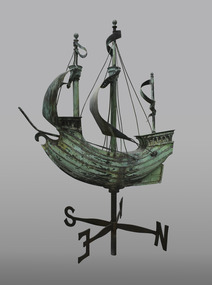
... Bronze and copper sculpture fashioned as a Wind Vane in the form of a Galleon style sailing ship with 2 pennants flying and two sails rigged atop with lower cross piece with wind directions N S E W . ...The galleon is often a decorative design of Mission to Seafarers wind vane (London, Adelaide). weather vane wind vane sculpture galleon sailing ship finial henry alfred saw david hope windvane weathervane walter richmond butler (1864–1949) richard butler john sanderson Bronze and copper sculpture fashioned as a Wind Vane in the form of a Galleon style sailing ship with 2 pennants flying and two sails rigged atop with lower cross piece with wind directions N S E W . ...Appearances to the contrary, the item is not a weathervane but a finial. It was the gift of Mr John Sanderson (Jottings Easter 1920), from John Sanderson & Co., wool merchants, stock and station agents, commission and shipping agents before he leaves for England to become senior partner in Sanderson Murray & Elder, London, import and export agents. It was designed by Walter & Richard Butler Architects. (sketch published in Building : the magazine for the architect, builder, property owner and merchant vol.33, no 193, 12 Sept. 1923). The finial was already drawn on the sketch of the Central Institute made by Walter Butler. The maker of the finial, was Henry Alfred George Arnold Saw (born June 1881 in Hotham, Victoria was the son of Edward Saw (1854-1926) a tinsmith and Catherine Barton (1863-1907). He worked as a metal artificer for a metal-working business located opposite the Trades Hall in Lygon Street and was given the job of making the copper ship finial. Henry married Florence Charlotte Reeder and they had four children. Also known as Harry Saw according to his grandson Brian, he died on 9th February 1960. Henry and Florence both died within two months of each other in 1960. It is not clear when the ship was actually installed on the roof, the earliest photograph dating from 1927. The windvane fell or moved several times because of gale forces: - In 1995 : After the funds were raised to repair it, it was treated by sculptor David Hope, and reinstalled in the 1998 (Ship to Shore #3 Sept 1998). - In 2017: Carmela Lonetti from the Grimwade Centre for Cultural Materials Conservation (Ship to Shore Autumn 2017) - In 2019: a generous passerby donated the necessary funds for the conservation. It was sent to Grimwade Centre for Cultural Materials Conservation (Ship to Shore 2019), treated by Evan Tindal (City of Melbourne Magainze Oct. 2020). It was reinstalled over the Summer of 2019-2020 (Ship to Shore Summer 2020). The weathervane was stolen during the night of the 6-7 March 2022. Copper price surge sparks rise in theft in Victoria in 2021-22 so it's likely the vane was stolen to be melted This sculpture is closely associated with the 1917 building and described in clippings and annual reports when the building was first newly opened. It can be seen in some of the earliest photographs of the new building and in the artist/architect Butler's impressions. The galleon is often a decorative design of Mission to Seafarers wind vane (London, Adelaide).Bronze and copper sculpture fashioned as a Wind Vane in the form of a Galleon style sailing ship with 2 pennants flying and two sails rigged atop with lower cross piece with wind directions N S E W . There is a decorative ornamental pierced scrollwork ferrule / finial with reinforcing chrome steel piping armature at base of main support which attaches to the roof or a base support. See also comments below weather vane, wind vane, sculpture, galleon, sailing ship, finial, henry alfred saw, david hope, windvane, weathervane, walter richmond butler (1864–1949), richard butler, john sanderson -
 Frankston RSL Sub Branch
Medallion, ANZAC, Government issue, 50th Anniversary of Gallipoli Medallion
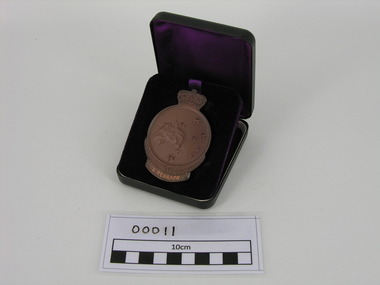
... bronze medallion surmounted by the Queen's crown. Obverse depicts Simpson and his donkey assisting a wounded man, a laurel wreath, the date '1915' and the word 'ANZAC'. Reverse depicts a map of Australia and New Zealand with the Southern Cross...bronze medallion surmounted by the Queen's crown. Obverse depicts Simpson and his donkey assisting a wounded man, a laurel wreath, the date '1915' and the word 'ANZAC'. Reverse depicts a map of Australia and New Zealand with the Southern Cross ...Circular bronze medallion surmounted by the Queen's crown. Obverse depicts Simpson and his donkey assisting a wounded man, a laurel wreath, the date '1915' and the word 'ANZAC'. Reverse depicts a map of Australia and New Zealand with the Southern Cross superimposed, fern fronds and the engraved name of the recipient 'A. PEARSON'. This medallion is in its original presentation case. The Anzac Medallion was issued by the Australian government in 1967 to commemorate the 1965 50th anniversary of the Gallipoli landings. The medallion was issued to surviving veterans of the campaign or their next of kin. Refer to AWM item for further information < http://www.awm.gov.au/collection/RELAWM16790.001/ >The name of the recipient, A. Pearson, is engraved on the reverse of this medallion. -
 Frankston RSL Sub Branch
Medallion, ANZAC, Government issue, 50th Anniversary of Gallipoli Medallion
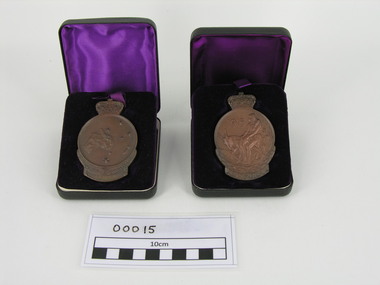
... bronze medallion surmounted by the Queen's crown. Obverse depicts Simpson and his donkey assisting a wounded man, a laurel wreath, the date '1915' and the word 'ANZAC'. Reverse depicts a map of Australia and New Zealand with the Southern Cross...bronze medallion surmounted by the Queen's crown. Obverse depicts Simpson and his donkey assisting a wounded man, a laurel wreath, the date '1915' and the word 'ANZAC'. Reverse depicts a map of Australia and New Zealand with the Southern Cross ...Circular bronze medallion surmounted by the Queen's crown. Obverse depicts Simpson and his donkey assisting a wounded man, a laurel wreath, the date '1915' and the word 'ANZAC'. Reverse depicts a map of Australia and New Zealand with the Southern Cross superimposed, fern fronds and the engraved name of the recipient 'G. R. GRIFFITH'. This medallion is in its original presentation case. The Anzac Medallion was issued by the Australian government in 1967 to commemorate the 1965 50th anniversary of the Gallipoli landings. The medallion was issued to surviving veterans of the campaign or their next of kin. Refer to AWM item for further information < http://www.awm.gov.au/collection/RELAWM16790.001/ >The recipients name, G.R. Griffith, is engraved on the reverse of the medallion.ww1, gallipoli, medallion, g r, griffith -
 Frankston RSL Sub Branch
Medallions, ANZAC, 50th Anniversary of Gallipoli Medallions
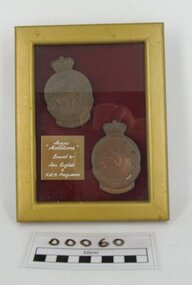
... bronze medallion surmounted by the Queen's crown. Obverse depicts Simpson and his donkey assisting a wounded man, a laurel wreath, the date '1915' and the word 'ANZAC'. Reverse depicts a map of Australia and New Zealand with the Southern Cross...bronze medallion surmounted by the Queen's crown. Obverse depicts Simpson and his donkey assisting a wounded man, a laurel wreath, the date '1915' and the word 'ANZAC'. Reverse depicts a map of Australia and New Zealand with the Southern Cross ...Two medallions which were awarded to Australian World War 1 servicemen, T ENGLISH and C R C FERGUSSON, who had landed at Gallipoli in 1915. These medallions have been mounted on a burgundy felt backing and framed in a small gold coloured photo frame. Each is a circular bronze medallion surmounted by the Queen's crown. Obverse depicts Simpson and his donkey assisting a wounded man, a laurel wreath, the date '1915' and the word 'ANZAC'. Reverse depicts a map of Australia and New Zealand with the Southern Cross superimposed, fern fronds and the engraved name of the recipient. The Anzac Medallion was issued by the Australian government in 1967 to commemorate the 1965 50th anniversary of the Gallipoli landings. The medallion was issued to surviving veterans of the campaign or their next of kin. Refer to AWM item for further information < http://www.awm.gov.au/collection/RELAWM16790.001/ >There is an engraved label mounted within the picture frame with the inscription "ANZAC Medallions", "Issued to Tom English & C R C Fergusson".anzac, ww1, 1915, world war 1, gallipoli medallion -
 Ballarat Clarendon College
Medal, The 1914-15 Star, 12/1918
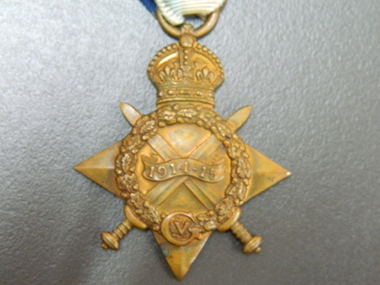
... The 1914-15 Star is a four pointed star of bright bronze, ensigned with a crown. The obverse has crossed gladius, overlaid with an oak wreath that is ensigned with the cypher of King George V. ...The 1914-15 Star is a four pointed star of bright bronze, ensigned with a crown. The obverse has crossed gladius, overlaid with an oak wreath that is ensigned with the cypher of King George V. ...The 1914–15 Star was authorised in 1918 and was awarded for service in specified theatres of war between 5 August 1914 and 31 December 1915. A recipient of the 1914 Star could not also be awarded the 1914–15 Star. The medal is accompanied by its original box. The Holgate medals were the first war medals held by BCC archives. They have historical and social significance for the College.The 1914-15 Star is a four pointed star of bright bronze, ensigned with a crown. The obverse has crossed gladius, overlaid with an oak wreath that is ensigned with the cypher of King George V. A scroll bearing the legend 1914-15 is centrally placed across the crossed blades. The 1914-15 Star ribbon has the red white and blue colours of the Empire, in shaded and watered stripes. The medal is accompanied by its original box.Engraved on a scroll in the centre of the medal front: '1914-15' The oak wreath is ensigned with the cypher of King George V. The back of the medal is engraved: '3193 / Pte E. S. HOLGATE / 6/F AMB. A.I.F. The box lid is inscribed: 'AMC/13 / 3193 / Pte. E. S. Holgate / 6/F.Amb,A.I.F. / 9350/Decd.'world war one, medal, 1914, the 1914 15 star, w w 1, private e s holgate, holgate, a i f, australian imperial force, holgate medal -
 Ballarat Clarendon College
Medal, 1914-15 Star
... The 1914-15 Star is a four pointed star of bright bronze, ensigned with a crown. The obverse has crossed gladius, overlaid with an oak wreath that is ensigned with the cypher of King George V. ...The 1914-15 Star is a four pointed star of bright bronze, ensigned with a crown. The obverse has crossed gladius, overlaid with an oak wreath that is ensigned with the cypher of King George V. ...The 1914–15 Star was authorised in 1918 and was awarded for service in specified theatres of war between 5 August 1914 and 31 December 1915. A recipient of the 1914 Star could not also be awarded the 1914–15 Star. Albert was born 29 June 1897 at his home 'Ashford Vale" farm, Cuthbert's Road, Cardigan. Albert, a second generation Australian, was the fourth son and sixth of eleven children born to dairy farmer John White and his wife Elizabeth, nee Douglas. Albert attended Bunker's Hill State School prior to enrolling at Ballarat College. After College he obtained employment with the engineering firm Ronaldson and Tippett in Ballarat. Following his eighteenth birthday Albert enlisted in the AIF in Ballarat with the rank of Private, No 2012. He embarked for the Middle East with 23rd Battalion on 26 August 1915 and was 'taken on strength at the Gallipoli Peninsular 25 October 1915". On 10 January 1916 Albert was posted to Alexandria, Egypt and during this time he was able to meet with his aunt Rose Douglas, an Australian Army Nursing Sister. This was a great comfort to his family. Albert was sent to France 19 March 1916 and transferred to the 22nd Battalion. He was mentioned in dispatches for 'good and gallant conduct' 5 August (1917?). Albert was hospitalised 30 March 1918, rejoined 22nd Battalion 3 June 1918, wounded in action 3 October 1918 but died of wounds at Rouen 10 October 1918. news of his death was received by his family in Australia just prior to the armistice. Albert Telfer White's sacrifice is commemorated at Ballarat College, Avenue of Honour Ballarat (Tree 1214), Ballarat Shire Honour Avenue Learmonth (Tree 163) and the Australian War Memorial Canberra. (These notes provided by family November 2016)Part of a greater A T White CollectionThe 1914-15 Star is a four pointed star of bright bronze, ensigned with a crown. The obverse has crossed gladius, overlaid with an oak wreath that is ensigned with the cypher of King George V. A scroll bearing the legend 1914-15 is centrally placed across the crossed blades. The 1914-15 Star ribbon has the red white and blue colours of the Empire, in shaded and watered stripes.Engraved on a scroll in the centre of the medal front: '1914-15' The oak wreath is ensigned with the cypher of King George V. The back of the medal is engraved: 2012 / Pte A T White / 23/BN. A.I.F. albert-telfer-white, medal, world war one, 1914-15 star -
 Flagstaff Hill Maritime Museum and Village
Functional object - Nail
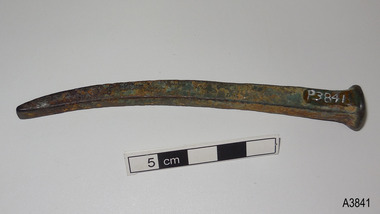
... Nail; bronze, deck nail. Rounded rectangular head, rectangular shank cross-section, tip flattened to a rounded wedge shape but cut straight down at the end instead of a point. ...Items that come from several wrecks have since been donated to the Flagstaff Hill Maritime Village’s museum collection by his family, illustrating this item’s level of historical value. flagstaff hill warrnambool flagstaff hill maritime museum maritime museum shipwreck coast flagstaff hill maritime village great ocean road john chance fastener nail square nail machine cut mail blacksmith historic nail bronze nail hand forged coastal shipwreck victorian shipwreck Nail; bronze, deck nail. Rounded rectangular head, rectangular shank cross-section, tip flattened to a rounded wedge shape but cut straight down at the end instead of a point. ...This historic bronze nail dates back to 1790ss to 1890s. Nails such as this one were used for ship building, as deck fasteners and many other uses. This nail was made at a time when the shanks of nails were usually machine cut but the heads were hand formed by blacksmiths. The nail was recovered from a shipwreck along the coast of Victoria in around 1968 and is part of the John Chance Collection. The nail is significant historically as an example of hardware used when building wooden ships in the early to mid-19th century. The nail is historically significant as an example of the work and trade of blacksmith. The nail is also significant as it was recovered by John Chance, a diver in Victoria’s coastal waters in the late 1960s to early 1970s. Items that come from several wrecks have since been donated to the Flagstaff Hill Maritime Village’s museum collection by his family, illustrating this item’s level of historical value.Nail; bronze, deck nail. Rounded rectangular head, rectangular shank cross-section, tip flattened to a rounded wedge shape but cut straight down at the end instead of a point. The surface is pitted and rough and has yellow and orange concretion and degradation on the nail's surface. Recovered from an unspecified shipwreck along the coast of Victoria. Part of the John Chance Collection. flagstaff hill, warrnambool, flagstaff hill maritime museum, maritime museum, shipwreck coast, flagstaff hill maritime village, great ocean road, john chance, fastener, nail, square nail, machine cut mail, blacksmith, historic nail, bronze nail, hand forged, coastal shipwreck, victorian shipwreck -
 Flagstaff Hill Maritime Museum and Village
Functional object - Nail
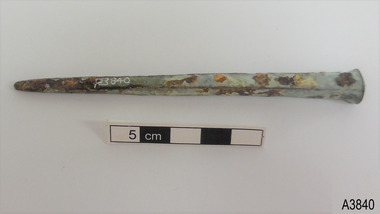
... Nail; bronze, deck nail. Rounded rectangular head, rectangular shank cross-section, tip flattened to a rounded wedge shape. ...Items that come from several wrecks have since been donated to the Flagstaff Hill Maritime Village’s museum collection by his family, illustrating this item’s level of historical value. flagstaff hill warrnambool flagstaff hill maritime museum maritime museum shipwreck coast flagstaff hill maritime village great ocean road john chance fastener nail square nail machine cut mail blacksmith historic nail bronze nail hand forged coastal shipwreck victorian shipwreck Nail; bronze, deck nail. Rounded rectangular head, rectangular shank cross-section, tip flattened to a rounded wedge shape. ...This historic bronze nail dates back to 1790s to 1890s. Nails such as this one were used for ship building, as deck fasteners and many other uses. This nail was made at a time when the shanks of nails were usually machine cut but the heads were hand formed by blacksmiths. The nail was recovered from a shipwreck along the coast of Victoria in around 1968 and is part of the John Chance Collection. The nail is significant historically as an example of hardware used when building wooden ships in the early to mid-19th century. The nail is historically significant as an example of the work and trade of blacksmith. The nail is also significant as it was recovered by John Chance, a diver in Victoria’s coastal waters in the late 1960s to early 1970s. Items that come from several wrecks have since been donated to the Flagstaff Hill Maritime Village’s museum collection by his family, illustrating this item’s level of historical value.Nail; bronze, deck nail. Rounded rectangular head, rectangular shank cross-section, tip flattened to a rounded wedge shape. The surface is pitted and rough and has blue-grey, green and orange concretion and degradation on the nail's surface. Recovered from an unspecified shipwreck along the coast of Victoria. Part of the John Chance Collection. flagstaff hill, warrnambool, flagstaff hill maritime museum, maritime museum, shipwreck coast, flagstaff hill maritime village, great ocean road, john chance, fastener, nail, square nail, machine cut mail, blacksmith, historic nail, bronze nail, hand forged, coastal shipwreck, victorian shipwreck -
 Flagstaff Hill Maritime Museum and Village
Tool - Saw, Mid 20th Century
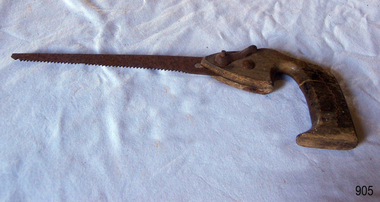
... bronze and later iron. In the Iron Age, frame saws were developed holding the thin blades in tension. The earliest known sawmill is the Roman Hierapolis sawmill from the third century AD used for cutting stone. The subject item is believed to date from around the mid to late 20th century and is regarded as a modern item. The maker is unknown but the pattern or design and type of wood used indicate it is a tool of modern manufacture. flagstaff hill warrnambool flagstaff-hill flagstaff-hill-maritime-museum maritime-museum shipwreck-coast flagstaff-hill-maritime-village Wood Cutting Wood Saw Cross Cut Saw Cabinet Makers Tools Wood Working Tools Tool None Compass saw blade with wooden with open handle blade attached with wingnut lever at side to adjust long narrow blade Tool Saw ...A saw is a tool consisting of a tough blade, wire, or chain with a hard-toothed edge. It is used to cut through material, very often wood, though sometimes metal or stone. The cut is made by placing the toothed edge against the material and moving it forcefully forth and less vigorously back or continuously forward. This force may be applied by hand, or powered by steam, water, electricity or other power sources. An abrasive saw has a powered circular blade designed to cut through metal or ceramic. In ancient Egypt, open (unframed) saws made of copper are documented as early as the Early Dynastic Period, circa 3,100–2,686 BC. Many copper saws were found in tombs dating to the 31st century BC. Models of saws have been found in many contexts throughout Egyptian history. As the saw developed, teeth were raked to cut only on the pull stroke and set with the teeth projecting only on one side, rather than in the modern fashion with an alternating set. Saws were also made of bronze and later iron. In the Iron Age, frame saws were developed holding the thin blades in tension. The earliest known sawmill is the Roman Hierapolis sawmill from the third century AD used for cutting stone.The subject item is believed to date from around the mid to late 20th century and is regarded as a modern item. The maker is unknown but the pattern or design and type of wood used indicate it is a tool of modern manufacture. Compass saw blade with wooden with open handle blade attached with wingnut lever at side to adjust long narrow blade Noneflagstaff hill, warrnambool, flagstaff-hill, flagstaff-hill-maritime-museum, maritime-museum, shipwreck-coast, flagstaff-hill-maritime-village, wood cutting, wood saw, cross cut saw, cabinet makers tools, wood working tools, tool -
 Flagstaff Hill Maritime Museum and Village
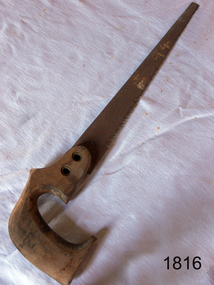
Tool - Compass Saw, Mid to late 20th Century
... bronze and later iron. In the Iron Age, frame saws were developed holding the thin blades in tension. The earliest known sawmill is the Roman Hierapolis sawmill from the third century AD used for cutting stone. The subject item is believed to date from around the mid to late 20th century and is regarded as a modern item. The maker is unknown but the pattern or design and type of wood used indicate it is a tool of modern manufacture. flagstaff hill warrnambool flagstaff-hill flagstaff-hill-maritime-museum maritime-museum shipwreck-coast flagstaff-hill-maritime-village Wood Cutting Wood Saw Cross Cut Saw Cabinet Makers Tools Wood Working Tools Tool compass saw Compass saw with wooden handle and metal blade. ...A saw is a tool consisting of a tough blade, wire, or chain with a hard-toothed edge. It is used to cut through material, very often wood, though sometimes metal or stone. The cut is made by placing the toothed edge against the material and moving it forcefully forth and less vigorously back or continuously forward. This force may be applied by hand, or powered by steam, water, electricity or other power sources. An abrasive saw has a powered circular blade designed to cut through metal or ceramic. In ancient Egypt, open (unframed) saws made of copper are documented as early as the Early Dynastic Period, circa 3,100–2,686 BC. Many copper saws were found in tombs dating to the 31st century BC. Models of saws have been found in many contexts throughout Egyptian history. As the saw developed, teeth were raked to cut only on the pull stroke and set with the teeth projecting only on one side, rather than in the modern fashion with an alternating set. Saws were also made of bronze and later iron. In the Iron Age, frame saws were developed holding the thin blades in tension. The earliest known sawmill is the Roman Hierapolis sawmill from the third century AD used for cutting stone.The subject item is believed to date from around the mid to late 20th century and is regarded as a modern item. The maker is unknown but the pattern or design and type of wood used indicate it is a tool of modern manufacture.Compass saw with wooden handle and metal blade. Small teeth. flagstaff hill, warrnambool, flagstaff-hill, flagstaff-hill-maritime-museum, maritime-museum, shipwreck-coast, flagstaff-hill-maritime-village, wood cutting, wood saw, cross cut saw, cabinet makers tools, wood working tools, tool, compass saw -
 Flagstaff Hill Maritime Museum and Village
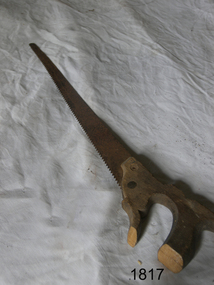
Tool - Compass Saw, Mid to late 20th Century
... bronze and later iron. In the Iron Age, frame saws were developed holding the thin blades in tension. The earliest known sawmill is the Roman Hierapolis sawmill from the third century AD used for cutting stone. The subject item is believed to date from around the mid to late 20th century and is regarded as a modern item. The maker is unknown but the pattern or design and type of wood used indicate it is a tool of modern manufacture. flagstaff hill warrnambool flagstaff-hill flagstaff-hill-maritime-museum maritime-museum shipwreck-coast flagstaff-hill-maritime-village Wood Cutting Wood Saw Cross Cut Saw Cabinet Makers Tools Wood Working Tools Tool compass saw None Compass saw with wooden handle broken and metal blade. ...A saw is a tool consisting of a tough blade, wire, or chain with a hard-toothed edge. It is used to cut through material, very often wood, though sometimes metal or stone. The cut is made by placing the toothed edge against the material and moving it forcefully forth and less vigorously back or continuously forward. This force may be applied by hand, or powered by steam, water, electricity or other power sources. An abrasive saw has a powered circular blade designed to cut through metal or ceramic. In ancient Egypt, open (unframed) saws made of copper are documented as early as the Early Dynastic Period, circa 3,100–2,686 BC. Many copper saws were found in tombs dating to the 31st century BC. Models of saws have been found in many contexts throughout Egyptian history. As the saw developed, teeth were raked to cut only on the pull stroke and set with the teeth projecting only on one side, rather than in the modern fashion with an alternating set. Saws were also made of bronze and later iron. In the Iron Age, frame saws were developed holding the thin blades in tension. The earliest known sawmill is the Roman Hierapolis sawmill from the third century AD used for cutting stone.The subject item is believed to date from around the mid to late 20th century and is regarded as a modern item. The maker is unknown but the pattern or design and type of wood used indicate it is a tool of modern manufacture. Compass saw with wooden handle broken and metal blade. Small teeth.Noneflagstaff hill, warrnambool, flagstaff-hill, flagstaff-hill-maritime-museum, maritime-museum, shipwreck-coast, flagstaff-hill-maritime-village, wood cutting, wood saw, cross cut saw, cabinet makers tools, wood working tools, tool, compass saw -
 City of Moorabbin Historical Society (Operating the Box Cottage Museum)
Medal - World War 1914-1918, Wartime medal, 1918
... Cross Society. The same medal was made in a variety of metals, including bronze, silvered bronze, (as with this one), silver and gold....Cross Society. The same medal was made in a variety of metals, including bronze, silvered bronze, (as with this one), silver and gold. ...This medal is one of the type issued by the Victorian Education Department, EVD, and sold on behalf of the Australian Branch of the British Red Cross Society. The same medal was made in a variety of metals, including bronze, silvered bronze, (as with this one), silver and gold.Many Moorabbin Shire young men volunteered to serve in World War 1 and their families willingly gave financial support to Red Cross and similar aid agenciesA small silvered bronze medallion with a metal loop at the top.One side of the medallion has a flag embossed in the middle inscribed with the words, Gallipoli, France, Palestine. At the top of the medallion are the initials EVD. Around the lower edge is embossed ANZAC DAY 1918. On the reverse side fo the medallion is embossed an AIF soldiers bust, he is wearing his slouch hat. Around the edge of the medallion is embossed the words HONOR TO THE AIFarmy, badge, medallion, victorian education department, british red cross, australian red cross, world war 1918 gallipoli medal -
 Greensborough Historical Society
Commemorative Coin, Royal Australian Mint, Victoria Cross, 2017_
... Bronze coin featuring an Australian Victoria Cross, laminated, mounted on card printed in colour both sides...Corporal Cameron Baird was the 100th Australian to receive the award This coin is one of a series "Legends of ANZACS", uncirculated, with a value of 25 cents. victoria cross coins commemorative coins Logos of Westpac, 100 years of ANZAC, and Legacy, with photographs of Albert Jacka and Cameron Baird, VC recipients. Bronze ...Victoria Cross for Australia was introduced in 1991 for actions in Afghanistan. Corporal Cameron Baird was the 100th Australian to receive the award This coin is one of a series "Legends of ANZACS", uncirculated, with a value of 25 cents.Bronze coin featuring an Australian Victoria Cross, laminated, mounted on card printed in colour both sidesLogos of Westpac, 100 years of ANZAC, and Legacy, with photographs of Albert Jacka and Cameron Baird, VC recipients.victoria cross, coins, commemorative coins
