
Showing 25 items matching "build up for war"
-
 Moorabbin Air Museum
Book - Aviation history, The History of Aviation
... ...Build up for war...Aviation history The Wright Brothers Primitive flying machines Reims meeting Higher & faster World War 1 New technologies Distance flights Commercial aviation start Build up for war World War 2. The age of turbine propulsion Rotary wing & vertical take off Civil aviation The future Overview of aviation history, circa 1998 The History of Aviation Book Aviation history ...Overview of aviation history, circa 1998non-fictionOverview of aviation history, circa 1998the wright brothers, primitive flying machines, reims meeting, higher & faster, world war 1, new technologies, distance flights, commercial aviation start, build up for war, world war 2., the age of turbine propulsion, rotary wing & vertical take off, civil aviation, the future -
 Lara RSL Sub Branch
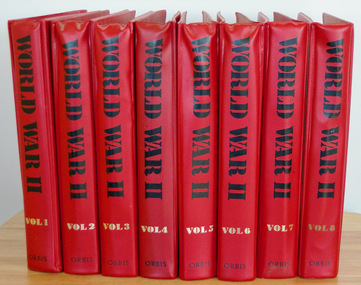
Book - World War II Vol 1-8 Orbis
... Magazines describing the build up to World War 2. The invasion of countries by Germany to American and japan's involvement. ...Magazines describing the build up to World War 2. The invasion of countries by Germany to American and japan's involvement. ...Magazines describing the build up to World War 2. The invasion of countries by Germany to American and japan's involvement. There are 8 volumes with an index compiled by F. D. BuckPictorial .History of Word War 2 in Magazine format containing 3360 pages 0415Eight Red Plastic Folders Containing paper Magazines World War II Vol 1-8 orbis -
 Sunshine and District Historical Society Incorporated
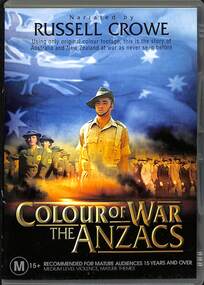
Article - Colour of War The ANZACS
... war as never seen before. For the first time, only original colour footage is used to paint a vidifly detailed picture of these closely allied nations, from the build-up to World War Two to the end of the Vietnam Conflict....war as never seen before. For the first time, only original colour footage is used to paint a vidifly detailed picture of these closely allied nations, from the build-up to World War Two to the end of the Vietnam Conflict. ...Narrated by Russell Crowe Colour of War The ANZACS This is the story of Australia and New Zealand at war as never seen before. For the first time, only original colour footage is used to paint a vidifly detailed picture of these closely allied nations, from the build-up to World War Two to the end of the Vietnam Conflict.anzac, world war 1914 - 1918 -
 Returned Nurses RSL Sub-branch
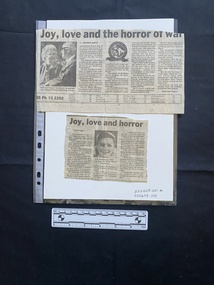
Newspaper - Newspaper clippings, Amanda Smith, Joy, love and the horror of war, [1995]
... In the build up to Brisbane's World War II commemorations, "Australia Remembers", ex-servicewoman Win Goodman remembers watching the matron of the Redbank Hospital sliding down the banisters whooping with joy the day the war ended. ...In the build up to Brisbane's World War II commemorations, "Australia Remembers", ex-servicewoman Win Goodman remembers watching the matron of the Redbank Hospital sliding down the banisters whooping with joy the day the war ended. ...In the build up to Brisbane's World War II commemorations, "Australia Remembers", ex-servicewoman Win Goodman remembers watching the matron of the Redbank Hospital sliding down the banisters whooping with joy the day the war ended. Win, (then Win Ruthning) worked as a radiographer in war hospitals in queensland during the war.Two newspaper clippings, one story continued over two pages. The larger clipping has a large title with four columns of text and two embedded black and white images. The larger image on the left is a photo of an older couple looking at each other. The smaller image is an Anzac memorial pin design for 1945 - 1995. The smaller clipping has a title above three columns of text with a centred, embedded black and white image. The image is a photo headshot of a young woman.wwii, ww2, world war two, world war 2, veteran affairs minister, con sciacca, pacific, rupert goodman, australian medical women's army service, vp day, middle east, tobruk, jerusalem, ceylon, borneo, pow, st lucia, kokoda track, the centaur, centaur, moreton bay -
 Flagstaff Hill Maritime Museum and Village
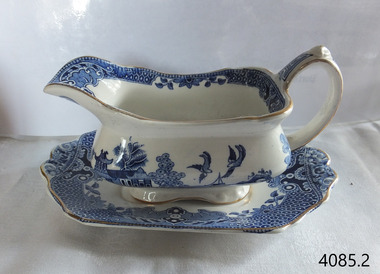
Ceramic - Gravy Boat and Saucer, Burleigh Pottery, 1930
... wars are often regarded as the company's "golden age", with many extremely talented designers and artists such as Harold Bennett, Charles Wilkes and Ernest Bailey. Perhaps the best known was Charlotte Rhead, who worked between 1926 and 1931, noted particularly for her work in tubelining. By 1939, the factory was employing over 500 people. The business took great pains, from as early as 1897, to build up...wars are often regarded as the company's "golden age", with many extremely talented designers and artists such as Harold Bennett, Charles Wilkes and Ernest Bailey. Perhaps the best known was Charlotte Rhead, who worked between 1926 and 1931, noted particularly for her work in tubelining. By 1939, the factory was employing over 500 people. The business took great pains, from as early as 1897, to build up ...Burleigh Pottery, also known as Burgess & Leigh, is the name of a pottery manufacturer in Middleport, Stoke-on-Trent. The business specialises in traditionally shaped and patterned domestic earthenware of high quality. The business was established in 1851 at the Central Pottery in Burslem as Hulme and Booth. The pottery was taken over in 1862 by William Leigh and Frederick Rathbone Burgess, and traded from that date as Burgess & Leigh. The trademark "Burleigh", used from the 1930s, is a combination of the two names. Burgess and Leigh moved to different works, first in 1868 to the Hill Pottery in Burslem and then in 1889 to the present factory at Middleport, which at the time was regarded as a model pottery. Its scale and linear organisation was in contrast to other potteries' constricted sites and haphazard layout of their working spaces. In 1887, Davenport Pottery was acquired by Burleigh primarily for its moulds. These historic moulds are still used today in the production of Burleigh ware. Leigh and Burgess died in 1889 and 1895, respectively, and were succeeded by their sons, Edmund Leigh and Richard Burgess. On Richard's death in 1912, the business passed entirely into the ownership of the Leigh family. In 1919, it became a private limited company, Burgess & Leigh Ltd. The years between the wars are often regarded as the company's "golden age", with many extremely talented designers and artists such as Harold Bennett, Charles Wilkes and Ernest Bailey. Perhaps the best known was Charlotte Rhead, who worked between 1926 and 1931, noted particularly for her work in tubelining. By 1939, the factory was employing over 500 people. The business took great pains, from as early as 1897, to build up a thriving export network, concentrating primarily on the Empire, later becoming the Commonwealth and American markets, and focusing later on Europe. After a run of financial difficulty, the company was sold in 1999 to the Dorling family, Rosemary and William Dorling, and traded as Burgess Dorling & Leigh. In 2010, it was acquired by Denby Holdings Ltd, the parent company of Denby Pottery.Burleigh was a significant company producing pottery over many generations and exporting their products all over the world. Its designs are still in use today, demonstrating the longevity and significance of the Burleigh Ware trade mark.Gravy boat with curved handle, and a matching saucer. The set has an overall rectangular design, with blue and white willow pattern on both pieces. The edges of the boat and saucer have gold line trim. The undersides of both pieces have a blue maker's mark stamp. The Willow pattern Burleigh Ware pieces were made in England.Burleigh Ware: "WILLOW" within a floral decoration, and "Made in England"flagstaff hill, flagstaff hill maritime museum and village, warrnambool, maritime museum, maritime village, great ocean road, shipwreck coast, willow pattern, willow ware, burleigh ware, made in england, blue and white china, gravy boat, gravy jug, gravy saucer, serving ware, domestic object, matching jug and saucer, oriental design, burleigh pottery, burgess & leigh -
 Mission to Seafarers Victoria
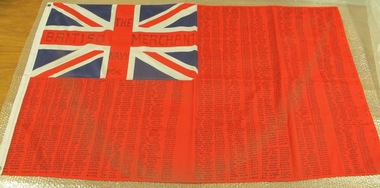
Flag, late 20th to 21st century
... The flag appears to be a commemorative listing of British seafarers of World War 2 noting those who served, but this needs confirmation and an improved image. The flag was removed from permanent display in the Flying Angels Club as it requires assessment for cleaning of a build up of dust and smoke. ...War 2 noting those who served, but this needs confirmation and an improved image. The flag was removed from permanent display in the Flying Angels Club as it requires assessment for cleaning of a build up of dust and smoke. ...Requires more research. The flag appears to be a commemorative listing of British seafarers of World War 2 noting those who served, but this needs confirmation and an improved image. The flag was removed from permanent display in the Flying Angels Club as it requires assessment for cleaning of a build up of dust and smoke. See also existing condition report a new inspection needs to be carried out.If simply a listing of British merchant seamen visiting the Missions in the 2nd half of the 20th Century it is also notable in the history of the MTSV at 717 Flinders st.If confirmed as a WW2 memorial it is also significant. Reg nylon based flag with Union Jack in the top left corner. White trimming down left side with two metal hoops, one at each end. Across the Union Jack is written, 'THE BRITISH MERCHANT NAVY' and in small writing at the bottom of the Union Jack it reads, 'DONATED BY MIKE HALL IN THE U.K.'. Down the right side of the flag says, 'FLAG DONATED BY MIKE HALL IN THE U.K.' The red portion of the flag is covered with handwritten seamen's names and the seamen's registration numbers. THE BRITISH MERCHANT NAVY DONATED BY MIKE HALL IN THE U.K. FLAG DONATED BY MIKE HALL IN THE U.K. See image for more detail flag, british, mike hall, union jack, names, red ensign, merchant navy -
 Flagstaff Hill Maritime Museum and Village
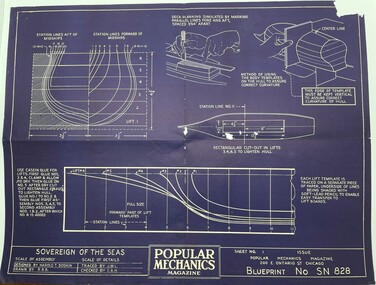
Work on paper - Sovereign of the Seas Model Blueprints, Popular Mechanics Press, "Sovereign of the Seas", 1933
... war he moved to Warrnambool, Victoria, where he worked at the Cramond & Dickson clothing store until the Great Depression in the 1930’s. He was later employed at Fletcher Jones Menswear, where he worked for 27 years until just before his death in 1959. Jim was a passionate ship model builder. He worked on his model ships between 1930 and 1955, including The Endeavour and The Sovereign of the Seas, which was one of the most intricate historic ship models to build. He had a table set up...war he moved to Warrnambool, Victoria, where he worked at the Cramond & Dickson clothing store until the Great Depression in the 1930’s. He was later employed at Fletcher Jones Menswear, where he worked for 27 years until just before his death in 1959. Jim was a passionate ship model builder. He worked on his model ships between 1930 and 1955, including The Endeavour and The Sovereign of the Seas, which was one of the most intricate historic ship models to build. He had a table set up ...A complete set of 8 blueprints from “Popular Mechanics Magazine”, Chicago. The blueprints are on a royal purple coloured paper with white print. Each print displays labelled diagrams to assist the hobbyist to assemble the ship model “Sovereign of the Seas”. The designer is Harold T. Bodkin. Distinct fold creases divide the documents into quarters. There is some silverfish damage leaving holes, however, all instructions are visible. flagstaff hill, warrnambool, maritime village, maritime museum, flagstaff hill maritime museum and village, shipwreck coast, great ocean road, model ship, vessel sovereign of the seas, jim williams, james bernard williams, the forth tasmania, freda williams, heather williams, phyllis bowditch, fletcher jones staff 1936, 17th century sailing ship, cramond and dickson, sovereign of the seas, royal sovereign, sovereign, charles 1, fletcher jones, warrnambool breakwater, popular mechanics magazine -
 City of Moorabbin Historical Society (Operating the Box Cottage Museum)
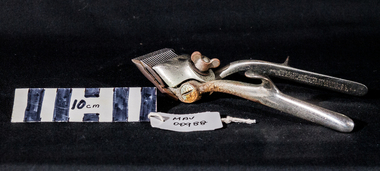
Equipment - Barbers’ Equipment, hair clippers steel 'Brown & Sharpe", c1940
... War I recession and depression of 1920–21. The Roaring Twenties brought renewed sales, but then the Great Depression slashed them. The armament-build-up...War I recession and depression of 1920–21. The Roaring Twenties brought renewed sales, but then the Great Depression slashed them. The armament-build-up ...1833 Brown & Sharpe was founded in Providence, Rhode Island by David Brown and his son Joseph R. Brown. David Brown retired in 1841 and Joseph Brown formed a partnership with Lucian Sharpe in 1853. During the 19th and 20th centuries, Brown & Sharpe was one of the best-known and most influential machine tool builders and was a leading manufacturer of instruments for machinists (such as micrometers and indicators ) and helped establish: The American wire gauge (AWG) standards for wire; The Brown & Sharpe taper in machine tool spindle tapers; and The Brown & Sharpe worm threadform for worm gears. .Like most machine tool builders, Brown & Sharpe rode a business cycle roller coaster during 1920- 40. After being kept very busy during World War I, builders suffered a slump in the post–World War I recession and depression of 1920–21. The Roaring Twenties brought renewed sales, but then the Great Depression slashed them. The armament-build-up period of 1936 to 1940 again renewed machine tool activity, and then the World War II materiel effort exploded demand, pushing it to record heights and employed 11,000 workers. Brown and Sharpe machine tools were a mainstay of American metal manufacturing until the late 20th Century and could be found in most machine shops and factories that worked with metal. Brown and Sharpe made callipers and micrometers that were essential to products built to fine tolerances. Shortly after World War II, Henry D. Sharpe, Jr. succeeded his father as president of Brown & Sharpe Manufacturing Company, at which point it evolved into a new and modern company built, or at least designed, to last. The firm stopped producing its old stalwarts: sewing machines, hair clippers, and certain categories of machine tools and employment dropped to 3,500 in 1976. Due to industrial disputes in the 1980’s B&S started focusing more on developing Coordinate-Measuring Machines. The company began to lose money as it shifted production away from machine tools and toward advanced metrology equipment, losing $14.6 million in 1990 and employed only 700. In 1994 Brown & Sharpe acquired DEA of Italy, an established manufacturer of CMMs. In 2001, substantially all of the assets of the Brown & Sharpe Manufacturing Company, including the intellectual property, designs, trademarks, facilities and inventory, were acquired by Hexagon AB, Switzerland, without the acquisition of the Brown & Sharpe Manufacturing Company itself. A set of manual barbers’ hair clippers with an adjustable wing screw, from Brown and Sharpe, Manufacturing Company Ltd., Providence, Rhode Island, USA. Chrome plated, in fair condition, c1940on Right handle; MADE BY BROWN & SHARPE MFG. CO. POV. R.I. / PAT'D IN GREAT BRITAIN, EN FRANCE, S.G.D.G. / U.S.A. PATENTS JULY 1-79, JUNE 3-84, AUG 23- 92 on top blade ; BRESSANT / TRADEMARK on base of lower blade ; No. 2* barbers, hairdressers, hair clippers, brown and sharpe manufacturing company, providence rhode island, hexagon ab, switzerland, great britain, france, ww1 1914-1918, ww11 1939-1945, great depression 1930, micrometers, tools, precision instruments, brown david, brown joseph r , sharpe lucian, sharpe henry d jnr, american wire gauge standard, sewing machines, metrological tools, worm gears, spindle tapers, screw machines, moorabbin, bentleigh, cheltenham, city of moorabbin industries, -
 Flagstaff Hill Maritime Museum and Village
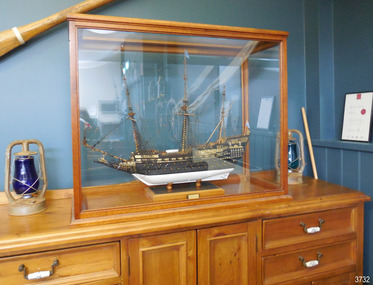
Craft - Ship Model, Sovereign of the Seas, Made between 1930-1955
... war he moved to Warrnambool, Victoria, where he worked at the Cramond & Dickson clothing store until the Great Depression in the 1930’s. He was later employed at Fletcher Jones Menswear, where he worked for 27 years until just before his death in 1959. Jim was a passionate ship model builder. He worked on his model ships between 1930 and 1955, including The Endeavour and The Sovereign of the Seas, which was one of the most intricate historic ship models to build. He had a table set up...war he moved to Warrnambool, Victoria, where he worked at the Cramond & Dickson clothing store until the Great Depression in the 1930’s. He was later employed at Fletcher Jones Menswear, where he worked for 27 years until just before his death in 1959. Jim was a passionate ship model builder. He worked on his model ships between 1930 and 1955, including The Endeavour and The Sovereign of the Seas, which was one of the most intricate historic ship models to build. He had a table set up ...This meticulously hand crafted ship model is one of the most intricate and challenging projects for a ship modeller to create. Jim Williams took up the challenge, choosing to make all of the components by hand, following a plan of the ship rather than purchasing a pre-made kit. He even made his own tools specifically for working with this model. The “Sovereign of the Seas” 1637-1697 - The magnificent ship “Sovereign of the Seas” was ordered by Charles I of England, who desired a giant Great Ship to be built. It was built by Peter Pett under the guidance of his father Phineas, the King's master shipwright, and launched with 102-guns at Woolwich Dockyard on 13th October 1637, as the Navy’s second three-decker first-rate ship. It was the most extravagantly decorated warship in the Royal Navy, bought with the help of a special 'Ship Money' tax imposed by the King. Soon afterwards the ship was remodelled and cut down to a safer and faster ship. Over the ship’s lifetime it was renamed “Commonwealth”, then in 1650 it became simply “Sovereign” then again after a rebuild in 1660 it was named “Royal Sovereign”. By 1642 the ship’s armament had been reduced to 90 guns. In 1651 Sovereign was made more manoeuvrable by reducing the upper works. It served throughout the wars of the Commonwealth and became the flagship of General Robert Blake. It was involved in all of the great English naval conflicts fought against the United Provinces and France and was referred to as 'The Golden Devil' by the Dutch. By 1660 the armament was changed attain to 100 guns. After the English Restoration, it was rebuilt as a first-rate ship of the line, with flatter gun decks and 100 guns, and most of the carvings were removed. During the First Anglo-Dutch War, in a secret session on 21 October 1652, the States-General of the Netherlands announced reward money for the crews of fire ships that succeeded in destroying enemy vessels; the Sovereign was singled out with an extra prize of 3000 guilders to sink or ruin it. Although repeatedly occupied by the Dutch, the Sovereign was retaken every time by the British and remained in service for nearly sixty years as the best ship in the English fleet. The Sovereign was in regular service during the three Anglo-Dutch Wars, surviving the Raid on the Medway in 1667. After a second rebuild in 1685 the Sovereign was relaunched as a first-rate ship of 100 guns, before taking part in the outset of the War of the Grand Alliance against Louis XIV of France, venturing into the Irish Sea, and later participating in the Battle of Beachy Head in 1690 and the Battle of La Hougue. At this time she was more than fifty years old. It was the first ship in history to fly ‘royals’ above the topgallant sails and a top gallant sail on the jigger-mast. The Sovereign eventually became leaky and defective with age and was laid up at Chatham when, on 27th January 1697, the famous ship caught fire, burning to the waterline. Jim Williams, the model’s maker - Jim (James Bernard) Williams was born in 1888 at The Forth in Scotland. He lived in Tasmania for some time and enlisted to fight in France in WW1. After the war he moved to Warrnambool, Victoria, where he worked at the Cramond & Dickson clothing store until the Great Depression in the 1930’s. He was later employed at Fletcher Jones Menswear, where he worked for 27 years until just before his death in 1959. Jim was a passionate ship model builder. He worked on his model ships between 1930 and 1955, including The Endeavour and The Sovereign of the Seas, which was one of the most intricate historic ship models to build. He had a table set up in a bay window and worked on them on and off using a jeweller's eye glass on the finer pieces. Jim’s long-time employer, Fletcher Jones, knew of Jim’s hobby and skill as a ship model builder and requested Jim to describe the model, Sovereign of the Seas, with the view of putting it on display. When the model was finished there was a full article and photo in The Standard newspaper. Jim described his work on the ship mode “Sovereign of the Seas” in correspondence to his then employer, Fletcher Jones. The document gives us an insight into his skill, patience, and regard for replicating the details of the original ship. Some of the details are: "In making the model the time taken to make certain items might be of interest. For instance "The Great Lantern" on the stern, four weeks, a similar time for the figurehead of St George & the Dragon. "The lower shrouds three to each side about six weeks & the rigging as whole several months. There are nearly 300 blocks and pulleys ranging from nearly 1 / 16 inch in diameter. Dead eyes were bored with 3 to 5 holes. To do this needles of different sizes, set in handles & ground to wedge ends were used. Glass cut and ground to shape were used windows. All gun-port covers (74) hinged. "All guns and anchors made of wood. Nothing for the model was purchased ready-made; everything hand made." Jim’s family donated the ship model along with many associated tools, accessories and papers. The model represents the Sovereign of the Seas. The Royal Navy ship of the line launched in 1637 has a significant British maritime heritage. These days the Sovereign of the Seas still remains one of the most intricate historic ship models to build, representing to the model enthusiast a true challenge to the art of model shipbuilding. The model of Sovereign of the Seas in Flagstaff Hill's collection is an exemplary example of a ship model built and hand crafted from a plan with the making of every item on the model, not a model kit with prefabricated parts. It was made by a local Warrnambool man Jim Williams as a leisure activity in the mid 20th century. The hobby and craft of ship model making has resulted in visual representations of the changes in maritime technology and advances in world-wide navigation. Ship model of HMS Sovereign of the Seas, a 17th century British warship. The handmade model is in wooden framed, airtight glass case. All components were hand crafted. Many of the tools used were made by the model maker, Jim Williams. An inscribed plaque is within the case. Inscribed on plaque "SOVEREIGN OF THE SEAS / 102 GUNS - 1634"flagstaff hill, warrnambool, shipwrecked coast, flagstaff hill maritime museum, maritime museum, shipwreck coast, flagstaff hill maritime village, great ocean road, model ship, vessel sovereign of the seas, jim williams, james bernard williams, the forth tasmania, freda williams, heather williams, phyllis bowditch, fletcher jones staff 1936, 17th century sailing ship, cramond and dickson, sovereign of the seas, royal sovereign, sovereign, charles 1, ship model -
 Monbulk RSL Sub Branch
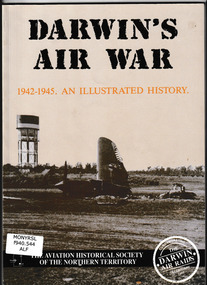
Book, Aviation Historical Society of the Northern Territory, Darwin's air war : 1942-1945, an illustrated history, 1991
... World war 1939-1945 - Aerial operations - Northern Territory Darwin - Bombardment - 1942-1945 Contents : Introduction. The defence build up ...Contents : Introduction. The defence build up, Darwin 1920's to 1942. 19 February 1942, the first raids. Initial defence, American and Australian Kittyhawks. Striking back with Hudsons & Beaufighters. Colour plates the 49 FighterGroup USAAD. The Spitfires arrive No 1 fighter wing RAAF. The heavy bombers USAAF and RAAF strikes. Staging the offensive, the war moves North. Pilot profiles. Conclusion, Darwin's present defences. Air forces. World War 2. Warfare.Bib, ill, maps, p.80.non-fictionContents : Introduction. The defence build up, Darwin 1920's to 1942. 19 February 1942, the first raids. Initial defence, American and Australian Kittyhawks. Striking back with Hudsons & Beaufighters. Colour plates the 49 FighterGroup USAAD. The Spitfires arrive No 1 fighter wing RAAF. The heavy bombers USAAF and RAAF strikes. Staging the offensive, the war moves North. Pilot profiles. Conclusion, Darwin's present defences. Air forces. World War 2. Warfare. world war 1939-1945 - aerial operations - northern territory, darwin - bombardment - 1942-1945 -
 National Vietnam Veterans Museum (NVVM)
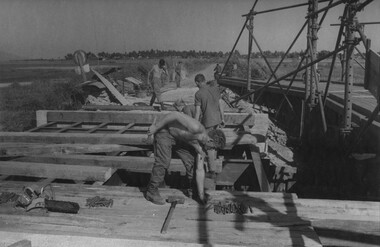
Photograph, Gibbons, Denis, Bridge Building
... war images from within many combat zones before being flown out in late November 1970 after sustaining injuries. The images held within the National Vietnam Veterans Museum make up the Gibbons Collection. Photograph 17 Const Sqn NVA/VC Gibbons Collection Catalogue Engineers NVA/VietCong Denis Gibbons A black and white photograph of Engineers from 17 Construction Squadron, build a bridge across on of the many creeks and streams which had been previously destroyed by NVA/VietCong forces and some as long ago as the war with the French. ...Denis Gibbons (1937 – 2011) Trained with the Australian Army, before travelling to Vietnam in January 1966, Denis stayed with the 1st Australian Task Force in Nui Dat working as a photographer. For almost five years Gibbons toured with nine Australian infantry battalions, posting compelling war images from within many combat zones before being flown out in late November 1970 after sustaining injuries. The images held within the National Vietnam Veterans Museum make up the Gibbons Collection. A black and white photograph of Engineers from 17 Construction Squadron, build a bridge across on of the many creeks and streams which had been previously destroyed by NVA/VietCong forces and some as long ago as the war with the French. These bridges were built with solid steel foundations.photograph, 17 const sqn, nva/vc, gibbons collection catalogue, engineers, nva/vietcong, denis gibbons -
 Bendigo Military Museum
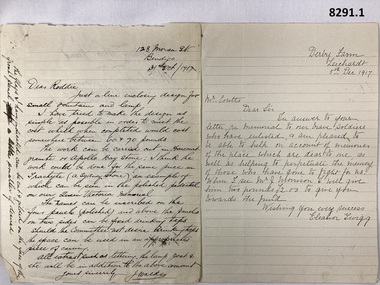
Mixed media - KANGAROO FLAT SOLDIERS MEMORIAL 1917 - 1921
... build a Memorial. They are dated from 31.10.1917 to 12.4.1921. This also includes documentation to have a "War Trophy(s)" on the site. At this time in history Kangaroo Flat was part of the Marong Shire not Bendigo. .1) 1917. These two letters are addressed to Roderick Coutts who was the Secretary of the Memorial Committee. .2) 1918.These letters & documents are broken up into 14 groups (a - n) all re the Kangaroo Flat Memorial. ...build a Memorial. They are dated from 31.10.1917 to 12.4.1921. This also includes documentation to have a "War Trophy(s)" on the site. At this time in history Kangaroo Flat was part of the Marong Shire not Bendigo. .1) 1917. These two letters are addressed to Roderick Coutts who was the Secretary of the Memorial Committee. .2) 1918.These letters & documents are broken up into 14 groups (a - n) all re the Kangaroo Flat Memorial. ...The Cat No 8290 pre this is the Minute book related to "The Kangaroo Flat Soldiers Memorial fund project". These letters, documents, name lists, sketches, quotes all revolve around the project to build a Memorial. They are dated from 31.10.1917 to 12.4.1921. This also includes documentation to have a "War Trophy(s)" on the site. At this time in history Kangaroo Flat was part of the Marong Shire not Bendigo. .1) 1917. These two letters are addressed to Roderick Coutts who was the Secretary of the Memorial Committee. .2) 1918.These letters & documents are broken up into 14 groups (a - n) all re the Kangaroo Flat Memorial. (a) Shire of Marong x two dated 7.6.1918 & 4.10.1918. (b) J.B. Wilson Monumental Sculptures x three dated 2.5.1918 to 9.10.1918. (c) J. Harris Monumental and General Masons dated 6.5.1918. (d) P Finn & Co General Masons dated 21.5.1918. (e) W & R Quinn General Masons dated 21.5.1918. (f) A. M. Irwin Builder & Contractors x two dated 10.11.1918 & 18.11.1918. (g) Herbert Keck & Sons Nurseryman and Orchardist dated 18.9.1918. (h) Department of Public Works x three dated 13.5.1918 - 24.9.1918 - 27.9.1918. (i) Education Department Melbourne x six re State School No 981 Kangaroo Flat dated 6 .3.1918 to 29.8. 1918. (j) Letters x two re R Coutts dated 6.2.1918 & 4.3.1918. (k) Kangaroo Flat & District Soldiers Memorial Fund x one Coutts to Okey. (l) McColl, Rankin & Stanistreet Legal Managers & Accountants x one dated 5.12.1918. (m) Snowden, Neave & Demaine Solicitors & Co x two dated 24.1.1918 & 7.8.1918. (n) Auditors report x one dated 16.12.1918. .3) 1919. Letters x two from "Myr - Nong" Elsternwick to Mr Okey dated 19.3.1919 & 31.3.1919. .4) 1920. Letters x two from the "Prime Ministers Department & Australian Military Forces 3rd Military District" dated 4.3.1920 & 8.3.1920. .5) Six miscellaneous items, only one has a date. (a) Short note re a donation to the Memorial. (b)Price list for Soldiers Memorial works. (c) Sketch in pencil re "Cyclone Spring coil". (d) Letter in Pencil, has a date "Wed April 10th" regarding the final site of the Memorial either, a block of ground in front of the Methodist Church or a block of ground in front of State School. Both fronted the Main Road. Mrs Allen donated the block in front of the School, this offer was accepted. (e) Sketch plan in pencil and red ink showing a proposal of how the site would look with the Memorial on. (f) Two sections of paper pinned together, one in ink, one in pencil. The ink piece is name listed 1 - 65 and some names have notations written next to and is double sided. The notations are "Returned or Killed". The pencil listing has a list of 18 names with "Killed" next to. The other part has 45 names. On the rear of this one is some pencil notes, a sketch and re a meeting on "June 5th". .6) Newspaper cuttings x 2. one relates the site chosen for the Kangaroo Flat Soldiers Memorial being the block in front of the school and donated by Mrs Allen. The other relates to the Repatriation Commission and the costing of local Memorials. .7) War trophy documents & correspondence. (a & b) Dated 10th & 17th December 1918 re application for War trophies replied by the State Parliament House Melbourne. (c) Dated 24 the October 1919. From the Australian War Museum - Wool Exchange King Street Melbourne. (d & e) Dated 22.10.1919 & 8.10.1920. From the Victorian State Trophy Committee and State Parliament. (f) Dated 17th April 1921. From the Victorian State Trophy Committee re allotment of a War trophy. (g) Double sided correspondence with "V98a" at top details the process of allotting War trophies, the Committee, conditions, town size and what is allotted per size. Stamped in purple is "One Machinegun". .1) 1917.Two letters, white paper, ruled lines with black ink hand writing, dated 31.10.1917 & 5.12.1917, the October letter has pencil notes on the rear. .2) 1918. Twenty six letters, documents, quotes either hand written in black pen, pencil, black & purple typed, Business names re letter heads some with images dating from 24.1.1918 ot 30.12.1918. .3) 1919. Two letters all in black pen, one has two pages, both letters have same heading stamp at the top in purple. Dated 19.3.1919 & 31.3.1919. .4) 1920. Two letters typed in black, both have a letter head, dated 4.3.1920 & 8.3.1920. .5) Items. Six miscellaneous items, letter, lists, prices, sketches of the proposed memorial site. .6) Articles. Two Newspaper clippings, yellowed black print, one has been found being 18.4.1918. .7) War trophies. Seven letters and documents, six have a date relating to "War Trophies", black and purple print, dates are 17.2.1918 to 12.4.1921. Sizes vary from note pad size to Foolscap.brsl, smirsl, kfsmf, letters -
 Warrnambool and District Historical Society Inc.
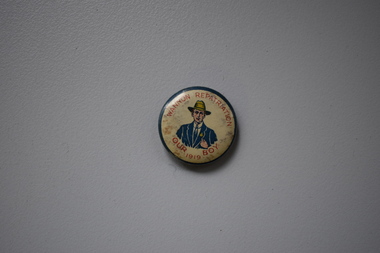
Badge, Wannon Repatriation Our Boy 1919, 1919
... war the Wannon and Corangamite Territorial Repatriation Scheme was set up to assist returning soldiers to adapt to civilian life. It is presumed that similar schemes were established in other electorates in Australia. Wannon is the name of a Federal electorate in the south west of Victoria and includes Warrnambool and the name on the badge may be an abbreviation of the fuller name mentioned above or an offshoot of the above organization. The scheme included assistance to soldiers with loans to set up businesses and build...war the Wannon and Corangamite Territorial Repatriation Scheme was set up to assist returning soldiers to adapt to civilian life. It is presumed that similar schemes were established in other electorates in Australia. Wannon is the name of a Federal electorate in the south west of Victoria and includes Warrnambool and the name on the badge may be an abbreviation of the fuller name mentioned above or an offshoot of the above organization. The scheme included assistance to soldiers with loans to set up businesses and build ...This badge has been produced and sold to raise funds to assist Australian soldiers returning from active service in World War One. At the end of the war the Wannon and Corangamite Territorial Repatriation Scheme was set up to assist returning soldiers to adapt to civilian life. It is presumed that similar schemes were established in other electorates in Australia. Wannon is the name of a Federal electorate in the south west of Victoria and includes Warrnambool and the name on the badge may be an abbreviation of the fuller name mentioned above or an offshoot of the above organization. The scheme included assistance to soldiers with loans to set up businesses and build homes. This badge is retained as an example of a local effort to assist Australian soldiers returning from active service in World War One. This is a metal badge with a blue outer rim and an image on a cream background of a young man in a blue jacket and brown hat. The printing is in red. Wannon Repatriation Our Boy 1919world war one, history of warrnambool, badge, wannon and corangamite territorial repatriation scheme -
 Uniting Church Archives - Synod of Victoria
BW photo, Undated
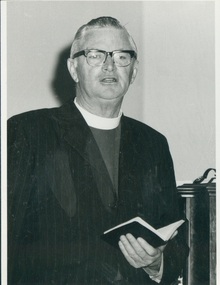
... war. His immediate task was to provide the impetus of fresh leadership and a long-term overall policy. His aim from-the outset was to build up a strong autonomous church with its own indigenous pastorate. ...war. His immediate task was to provide the impetus of fresh leadership and a long-term overall policy. His aim from-the outset was to build up a strong autonomous church with its own indigenous pastorate. ...STANWAY, ALFRED (b. 9 Sept 1908; d. Melbourne, Vic, 27 June 1989). Anglican bishop, missionary. Stanway grew up in the Wimmera district of western Victoria, and left school when 14 years old. He found work in Melbourne, trained as an accountant, and at the age of 20, held a responsible position with a publishing company. This background, allied with an uncommon flair for figures and finance, was to stand him in good stead throughout his life. But he had little knowledge and no experience of the grace of God until 29 July 1928. At the Evening Service in the parish church of Fairfield on 29 July, he heard the Rev C H Nash (q.v.) preach a sermon which led to his conversion. Within two years he made up his mind to become a missionary and began night studies in order to matriculate. He entered Ridley College in March 1932 to prepare for ordination undertaking week-end duties as a catechist at Deer Park and St Albans. He joined the CMS League of Youth, became chairman, and gathered a fine band of young people many of whom were to become missionaries. He was closely involved with the Belgrave Heights Convention (then at Upwey) and established a League of Youth camp on the site. All his energies were thrown into the task of building up its members in personal holiness and vigorous evangelism. Stanway was ordained in St Paul's Cathedral, Melbourne on St Thomas Day 1934 and was placed in charge of the Old Mission Church of St James and St John, Melbourne. The duties were light enough to allow him to enrol in the Melbourne Teachers College and to complete the Diploma in Teaching. On 26 January 1937, he sailed for Africa to become a missionary in the Anglican Diocese of Mombasa, which at that time embraced the whole of Kenya. He was sent to the hot coastal town of Kaloleni as principal of a Secondary Boys School. Before he left Melbourne, he had become engaged to Marjory Harrison: she followed him to Africa and their marriage took place in Mombasa Cathedral in June 1939. He remained at Kaloleni until 1944 when he was transferred to the inland station of Maseno where all his gifts were to be deployed as rural dean of Nyanza. His oversight of some 500 village churches as well as a widespread primary school system was so efficient that in 1948 he was appointed archdeacon of Kenya with his home and office in Nairobi. As secretary of the African Church Council and of the African Education Board, he was responsible for all African work in the diocese. His contacts with government ministers and public servants were of first class significance at the time when the cry of Uhuru and the demand for independence was travelling throughout the colonial world. On 2 Feb 1951, Alfred Stanway was consecrated in Westminster Abbey as the third Anglican Bp of Central Tanganyika. This Diocese was the special sphere of the CMS Australia, and he already knew most of the missionary personnel. He brought with him the understanding and experience of one who had fully shared the lot and problems of a district missionary, but he came to the diocese at a time when it had yet to recover from its losses in personnel and finance as a result of the war. His immediate task was to provide the impetus of fresh leadership and a long-term overall policy. His aim from-the outset was to build up a strong autonomous church with its own indigenous pastorate. With the whole-hearted confidence of the home base, he was able to enlist the service of new missionaries. He saw a great increase in the number of African clergy and he encouraged village evangelists to open new fields of work. Simple structures were built as new churches at the rate of two a week, week in and week out, year by year. He worked hard to meet the need for Christian literature, bookshops, adult literacy and theological training. He opened Bible schools for village evangelists and sent suitable clergy overseas for further studies. He encouraged initiative in others, helped them to find and use their talents, and gave them his unstinted confidence and support. Fresh finance was required for new ventures. This led him to travel widely in Germany and America, where he raised large funds for these projects. Mackay House was built in Dodoma as the central administrative base for the diocese, hospitals such as those at Mvumi and Hombolo were modernised or established, schools were built and upgraded. In keeping with his vision for ultimate leadership by African personnel, he consecrated Yohana Omari in 1955 as his assistant, he was the first national to become a bp in East Africa. Bp Stanway then set on foot the long and complicated process for the division of his sprawling diocese. In 1963, the diocese of Victoria Nyanza came into being; in 1965, that of Morogoro; in 1966, that of Western Tanganyika. Yet in 1971, his own diocese of Central Tanganyika, though greatly reduced in size, had more churches and more clergy than in its undivided state in 195 l. Stanway then played a leading part in the formation of the Province of Tanzania in 1970, with an African abp as metropolitan. A year later, after 35 years in East Africa and 20 years as bishop of Central Tanganyika, he resigned. His leadership and achievements throughout those years had placed him in the front rank as a great missionary statesman. Stanway had returned to Melbourne at the time when his resignation took effect in August 1971. His early love for Ridley College reasserted itself and he went into residence as deputy principal under the Rev Dr Leon Morris. He was put in charge of chapel worship and the pastoral oversight of the students. All his gifts and experience were called into play as he sought to guide and encourage those who were on the threshold of their ministry. The whole bent of his heart was to foster the spiritual life and missionary calling of those whose hearts the Lord had touched. It was during those years that his life-long zeal for the spread of the gospel through Christian literature had its ultimate flowering. It had begun in his Nairobi days with a small church bookstall, this had developed into a major book-shop in the heart of the city. Then in Dodoma he had established the Central Tanganyika Press in order to promote the publication and distribution of Christian literature at all levels. He had marked out Kevin Engel, trained him, and launched him on the international scene. Hence it was natural that in Melbourne he and Kevin Engel should found the Australian Christian Literature Society. But his time at Ridley College was not to last. Unknown to him, the Rev J R W Stott had put his name forward as that of a person who could head a new school of theology in the United States to provide a sound training for evangelical ordinands. Such a task would have been formidable enough for a younger man who had grown up in America. How could an Australian who had spent half his life in Africa hope to succeed in a venture of that kind in America? How could one who had been a missionary, not a theologian, found a new school to train men for ordination? Nevertheless he rose to the challenge. In Sept 1975, he and Mrs Stanway left Melbourne for Sewickly, an outer suburb of Pittsburg, with the promise of three years' service. He had to start from scratch. He found a house to live in, but there was no land for the school, no funds in hand, no staff yet appointed, no students, and no buildings. His drive, his infections enthusiasm, and his flair for practical enterprise carried the day. One by one, obstacles were overcome and support grew in volume and strength. Twelve months after his arrival, in Sept 1976, the Trinity Episcopal School for Ministry was opened with three staff members, seventeen students, and the goodwill of the whole American Episcopal Church to win. During the next two years, the school took shape and was firmly established. Bp Stanway left an indelible stamp on every aspect of its life and work, its spiritual tone and ideals, its financial and administrative principles. He had inspired widespread support among evangelical episcopalians and had imparted a strong sense of divine guidance and purpose. The council would gladly have extended his term in office beyond three years, but at 75 years of age he knew that his health had begun to fail. When he finally relinquished his office in Nov 1978, he could look back on those three years as the crown of his ministry. It is not too much to say that his name was even more highly honoured and revered in the Trinity School of Ministry than in his own dearly loved Africa. His return to Melbourne led to quiet retirement at Mount Waverley where he settled down to a long battle with the ever worsening effects of Parkinson's Disease. The slow loss of physical capacity and the ultimate failure in powers of speech were a great trial, but he never complained. His faith was summed up in his brief reply when he was asked why he had not prayed for healing: 'What God allows, I accept'. That acceptance was without reserve; his testimony was never brighter. His mental powers were undiminished and his spiritual concerns were as wide as ever. He kept in touch with CMS, he went to church, he met with missionaries, he led Bible studies in his home as long as he was able. Africa was always in his heart, news from Sewickly always gave him great pleasure. He had left a mark for God on three great continents and his death left sad but thankful hearts in them all. It was the close of a life in which he had felt that he could never do enough for God who had done so much for him. One of Bp Stanway's sayings was 'when the Holy Spirit takes hold of you, anything can happen'. So it was in his case. He was very human, with his full share of human foibles and frailties. He had a great zest for life and an endless fund of stories drawn from his own experience. He was himself the subject of many stories, some true, others legendary. His vibrant personality always seemed to fill the house where he was, his presence could not be overlooked. His own home was one in which Mrs Stanway had a paramount influence. She was a trained teacher, a skilled artist, a born hostess and a first-class linguist. They had no children of their own, but were devoted Godparents and always deeply interested in the children of missionaries. Home life allowed him to relax in a serene and contented atmosphere and to exercise his gifts for friendship and hospitality. He was always on the watch for souls, a person-to-person evangelist par excellence. He was a man of faith and prayer who dared to believe in the God of the impossible. His love for Africa, his total dedication as a missionary; his gifts as a soulwinner; his genius for finance; his shrewd practical initiatives, and his statesmanlike vision were outstanding characteristics. But great or small, all his gifts were laid out in the service of the gospel, and that service marked him out as one of the most remarkable Australian missionaries of his generation. M L Loane, Men to Remember (Sydney, 1987) Rev. Alfred Stanway is standing with open book in hand, dressed in clerical garb.Bishop Alfred Stanwaybishop alfred stanway -
Clunes Museum
Poster
... His accomplice, Black described as Height over 6 feet, straight figure, slight build, bright red hair, worn in general rather long and brushed backwards, red and large whiskers, meeting under the chin, blue eyes, large thin nose, ruddy complexion and rather small mouth. Lawlor was wanted for treasonable seditious language and incite men to take up arms with a view to make war...His accomplice, Black described as Height over 6 feet, straight figure, slight build, bright red hair, worn in general rather long and brushed backwards, red and large whiskers, meeting under the chin, blue eyes, large thin nose, ruddy complexion and rather small mouth. Lawlor was wanted for treasonable seditious language and incite men to take up arms with a view to make war ...PROCLAMATION ISSUED BY THE COLONIAL SECRETARY'S OFFICE IN MELBOURNE IN 1854. Describes Lawlor as Height, 5 ft 1&/34 in, age 35 hair dark brown, whiskers dark brown, and shaved under the chin, no moustache, rather good looking, and is a well made man. His accomplice, Black described as Height over 6 feet, straight figure, slight build, bright red hair, worn in general rather long and brushed backwards, red and large whiskers, meeting under the chin, blue eyes, large thin nose, ruddy complexion and rather small mouth. Lawlor was wanted for treasonable seditious language and incite men to take up arms with a view to make war against our sovereign lady the Queen.TWO PHOTOCOPIES OF POSTER FOR TWO WANTED MEN - LAWLOR AND BLACK. WITH A REWARD OF 400 POUNDS LEADING TO THEIR ARRESTNILlawlor/black, wanted poster, lalor -
 Wangaratta RSL Sub Branch
Badge - Boxed badge, 2012
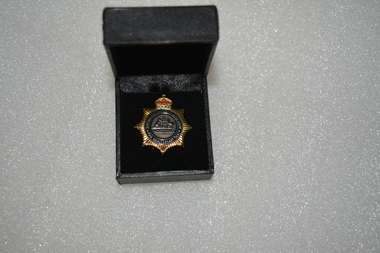
... From December 1941, when Japan entered the war, the nation’s need to build up its armed forces was placed above the needs of other industries. ...From December 1941, when Japan entered the war, the nation’s need to build up its armed forces was placed above the needs of other industries. ...Badge received by Dorothy Kiely in 2012 on the 70th anniversary of the Australian Women's Land Army. The Australian Women’s Land Army (AWLA) was formed during the Second World War to combat rising labour shortages in the farming sector. From December 1941, when Japan entered the war, the nation’s need to build up its armed forces was placed above the needs of other industries. Agricultural labour was steadily diverted to the armed services and war industry To meet the shortfall in rural labour, State and private women’s land organisations were organised, modelled on those established in Great Britain during the First and Second World Wars. A national body was formed on 27 July 1942 under the jurisdiction of the Director General of Manpower. While policy was devised by the Commonwealth Government, the organisation of the AWLA remained State-based. An extensive recruiting campaign was undertaken for new members. Most members of the existing land armies were later incorporated into the AWLA as well. Black box containing gold star shaped badge with red crown above Australian coat of arms Badge:-Australian Women's Land Army 70th Anniversary 2012 Box:- top in gold lettering 70th Anniversary of the Australian Women's Land Armyawla, ww2, dorothy kiely -
 Puffing Billy Railway
Railway Mine and Plantation (RMP) 0-6-0 Diesel Mechanical Locomotive 2' Gauge - "LI'L TOOT", 1951
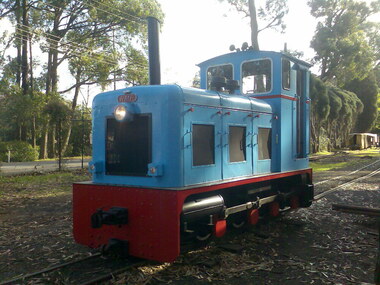
... Builders Number 3354 Build for Inkerman Mill Queensland in 1951 Displayed at the British Industrial Fair at Castle Bromwich, England 1951 prior to delivery to Australia Weight: 10 Tons Known at Inkerman mill as "LI'L TOOT" Major Ernest E. Baguley (1863–1948) was a British engineer.- In the years leading up to the First World War...Builders Number 3354 Build for Inkerman Mill Queensland in 1951 Displayed at the British Industrial Fair at Castle Bromwich, England 1951 prior to delivery to Australia Weight: 10 Tons Known at Inkerman mill as "LI'L TOOT" Major Ernest E. Baguley (1863–1948) was a British engineer.- In the years leading up to the First World War ...Builders Number 3354 Build for Inkerman Mill Queensland in 1951 Displayed at the British Industrial Fair at Castle Bromwich, England 1951 prior to delivery to Australia Weight: 10 Tons Known at Inkerman mill as "LI'L TOOT" Major Ernest E. Baguley (1863–1948) was a British engineer.- In the years leading up to the First World War, Baguley served in the Territorial Army and became Second-in-Command, 6th Battalion, North Staffordshire Regiment, rising to the rank of Major. He served in France from 1914 to 1915. Baguley (Engineers) Ltd After the War there was a decline in the production of road vehicles (probably due to competition from other manufacturers) and an increase in the production of railway equipment. The name of the company was changed from Baguley Cars Ltd to Baguley (Engineers) Ltd on 10 April 1923. Following a dispute with their partners Drewry Cars. Ltd, Baguley (Engineers) Ltd went into decline and entered liquidation in 1931. Most of the plant and effects, including Major Baguley's own Baguley car, were sold at auction on 10 November 1931. E. E. Baguley Ltd Major Baguley was a great survivor of WW1 and, he set up a small repair business for Baguley products at Clarence Street, Burton-on-Trent. A new company, E. E. Baguley Ltd, was registered on 30 April 1932 and was soon building locomotives again. In 1934 E. E. Baguley Ltd moved to larger premises at Uxbridge Street, Burton-on-Trent. The company merged with Drewry to form Baguley-Drewry Ltd in 1962.Historic - Industrial Narrow Gauge Railway Diesel Mechanical Locomotive - Pioneer Sugar Mills - Inkerman Sugar Mill, Home Hill, Queensland, AustraliaRail Mine and Plantation (RMP) 0-6-0 Diesel Mechanical 2' Gauge - " LI'L TOOT " Builders Number 3354 Steel (Painted)RMP / 3354 "LI'L TOOT"rmp, diesel, mechanical, locomotive, 2', 2' gauge, puffing billy, inkerman, li'l toot, industrial narrow gauge railway, e. e. baguley ltd, pioneer sugar mills - inkerman sugar mill, rail mine and plantation (rmp) -
 Wodonga & District Historical Society Inc
Container - Foot Powder Tin
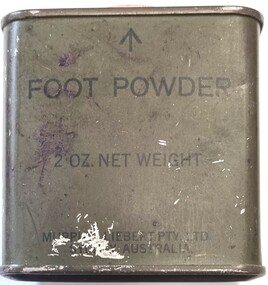
... build up of moisture and protect against possible bacterial infection. Murphy, Liebert Pty Ltd was a notable Sydney-based manufacturing chemist company that operated during the 20th century. The company was highly regarded for producing a wide array of personal care, medical, and household products, many of which were supplied to the Australian Defence Forces This tin of foot powder was standard issue to Australian soldiers serving in the Malayan Emergency and the Vietnam War where tropical conditions caused precautions were necessary to prevent bacterial infections....build up of moisture and protect against possible bacterial infection. Murphy, Liebert Pty Ltd was a notable Sydney-based manufacturing chemist company that operated during the 20th century. The company was highly regarded for producing a wide array of personal care, medical, and household products, many of which were supplied to the Australian Defence Forces This tin of foot powder was standard issue to Australian soldiers serving in the Malayan Emergency and the Vietnam War where tropical conditions caused precautions were necessary to prevent bacterial infections. ...Foot powder was used to absorb potential build up of moisture and protect against possible bacterial infection. Murphy, Liebert Pty Ltd was a notable Sydney-based manufacturing chemist company that operated during the 20th century. The company was highly regarded for producing a wide array of personal care, medical, and household products, many of which were supplied to the Australian Defence Forces This tin of foot powder was standard issue to Australian soldiers serving in the Malayan Emergency and the Vietnam War where tropical conditions caused precautions were necessary to prevent bacterial infections.This item is significant because it represents one of the measures needed to protect Australian soldiers and the wider community from foot health issues.A small tin with perforated lid containing foot powderOn front FOOT POWDER 2 OZ. NET WEIGHT MURPY LIEBERT PTY LTD SYDNEY AUSTRALIA On reverse FORMULA SALICYLIC ACID 3% STARCH 10% TALC 87% personal toiletry items, australian soldiers' personal supplies -
 Kew Historical Society Inc
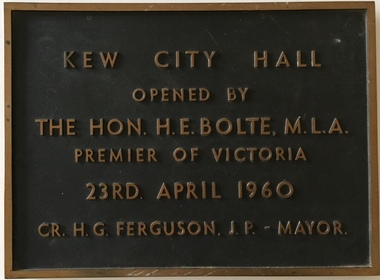
Plaque, Kew City Hall : Opened by The Hon H.E. Bolte M.L.A. Premier of Victoria 23rd April 1960 : Cr H.H. Ferguson J.P. Mayor, 1960
... build a new civic centre as a war memorial. The council acquired Southesk, a mansion on the south-west corner of Cotham Road and Charles Street – first mooted as a possible Town Hall site two decades earlier – and plans for a civic precinct were drawn up by John Scarborough. ...build a new civic centre as a war memorial. The council acquired Southesk, a mansion on the south-west corner of Cotham Road and Charles Street – first mooted as a possible Town Hall site two decades earlier – and plans for a civic precinct were drawn up by John Scarborough. ...The Municipality of Kew was proclaimed on 19 December 1860, then upgraded to a Borough (1863), a Town (1910) and finally a City (1921). From 1865, its offices were based in the former Athenaeum Hall in Walpole Street, which, although extended in 1883, inevitably became inadequate. Plans for a new purpose-built Town Hall were first mooted in the late 1880s, but fell prey to six subsequent decades of debate. During that time, many sites were considered and rejected, and several schemes prepared. Finally, in 1945, it was resolved to build a new civic centre as a war memorial. The council acquired Southesk, a mansion on the south-west corner of Cotham Road and Charles Street – first mooted as a possible Town Hall site two decades earlier – and plans for a civic precinct were drawn up by John Scarborough. The project stalled until 1957, when a Town Hall Committee was formed and a new architect appointed: Harold Bartlett of Leith & Bartlett. He also proposed an entire civic precinct, of which a large public hall would constitute Stage One. Designed to accommodate almost any public or official function, the space had had a small stage at one end for intimate theatrical productions, a larger stage at the other (with operable sunken orchestra pit) for musical performances, plus the most up-to-date equipment for live TV transmission. The building, befitting its original intent as a war memorial, was also to include a sculpted monument, for which a separate design competition was held. First prize went to George H Allen (1900-1972), long-time head of the Sculpture Department at RMIT and a former war artist himself (the only one, in fact, to have worked in the medium of sculpture). At the time of the Kew project, Allen was best known for his Cenotaph at the Shrine of Remembrance (1955) and a controversial abstract sculpture at Hume House in William Street (1957). Tenders for the new hall were called and the contract (worth £104,986) was awarded to H F Yuncken. The foundation stone was laid by the Mayor, Cr F C O'Brien, on 1 June 1959. Completion (initially scheduled for October) was delayed by the unavailability of certain materials; it was barely finished in time for the official opening (by Premier Henry Bolte) on 23 April 1960. The war memorial was unveiled two days later (Anzac Day) by Bolte's deputy, the Hon A G Rylah. Fittingly, that year also marked Kew's municipal centenary, and many celebratory events were held in and around the new civic centre in December, including a special council meeting (attended by the Prime Minister), a tree planting ceremony and a youth ball. Source: Survey of Built Heritage in Victoria: Stage Two (Built Heritage Pty Ltd., 2010)Plaque commemorating the opening of a new town hall in KewMetal plaque recording the official opening of the Kew City Hall, 23rd April 1960. This plaque was given to the Kew Historical Society in 1991 by the former City of Kew.Kew City Hall / Opened by / The Hon. H.E. Bolte M.L.A. / Premier of Victoria / 23rd April 1960 / Cr. H.G. Ferguson J.P. - Mayor.kew city hall, foundation stones - kew (vic), sir henry bolte, local government -- kew (vic.) -
 Kew Historical Society Inc
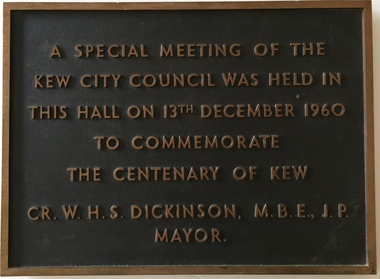
Plaque, A Special Meeting of the Kew City Council Was Held in This Hall on 13th December 1960 to Commemorate the Centenary of Kew : Cr. W.H.S. Dickinson M.B.E., J.P. Mayor, 1960
... build a new civic centre as a war memorial. The council acquired Southesk, a mansion on the south-west corner of Cotham Road and Charles Street – first mooted as a possible Town Hall site two decades earlier – and plans for a civic precinct were drawn up by John Scarborough. ...build a new civic centre as a war memorial. The council acquired Southesk, a mansion on the south-west corner of Cotham Road and Charles Street – first mooted as a possible Town Hall site two decades earlier – and plans for a civic precinct were drawn up by John Scarborough. ...The Municipality of Kew was proclaimed on 19 December 1860, then upgraded to a Borough (1863), a Town (1910) and finally a City (1921). From 1865, its offices were based in the former Athenaeum Hall in Walpole Street, which, although extended in 1883, inevitably became inadequate. Plans for a new purpose-built Town Hall were first mooted in the late 1880s, but fell prey to six subsequent decades of debate. During that time, many sites were considered and rejected, and several schemes prepared. Finally, in 1945, it was resolved to build a new civic centre as a war memorial. The council acquired Southesk, a mansion on the south-west corner of Cotham Road and Charles Street – first mooted as a possible Town Hall site two decades earlier – and plans for a civic precinct were drawn up by John Scarborough. The project stalled until 1957, when a Town Hall Committee was formed and a new architect appointed: Harold Bartlett of Leith & Bartlett. He also proposed an entire civic precinct, of which a large public hall would constitute Stage One. Designed to accommodate almost any public or official function, the space had had a small stage at one end for intimate theatrical productions, a larger stage at the other (with operable sunken orchestra pit) for musical performances, plus the most up-to-date equipment for live TV transmission. The building, befitting its original intent as a war memorial, was also to include a sculpted monument, for which a separate design competition was held. First prize went to George H Allen (1900-1972), long-time head of the Sculpture Department at RMIT and a former war artist himself (the only one, in fact, to have worked in the medium of sculpture). At the time of the Kew project, Allen was best known for his Cenotaph at the Shrine of Remembrance (1955) and a controversial abstract sculpture at Hume House in William Street (1957). Tenders for the new hall were called and the contract (worth £104,986) was awarded to H F Yuncken. The foundation stone was laid by the Mayor, Cr F C O'Brien, on 1 June 1959. Completion (initially scheduled for October) was delayed by the unavailability of certain materials; it was barely finished in time for the official opening (by Premier Henry Bolte) on 23 April 1960. The war memorial was unveiled two days later (Anzac Day) by Bolte's deputy, the Hon A G Rylah. Fittingly, that year also marked Kew's municipal centenary, and many celebratory events were held in and around the new civic centre in December, including a special council meeting (attended by the Prime Minister), a tree planting ceremony and a youth ball. Source: Survey of Built Heritage in Victoria: Stage Two (Built Heritage Pty Ltd., 2010)Historically significant commemorative plaqueMetal plaque relating to special Council meeting to mark centenary of Kew, 13th December 1960. This plaque was given to the Kew Historical Society in 1991 by the former City of Kew.A Special Meeting Of The / Kew City Council Was Held In / This Hall On 13th December 1960 / To Commemorate / The Centenary of Kew / Cr. W.H.S. Dickinson, M.B.E., J.P., / Mayorkew city hall, foundation stones - kew (vic), cr. w.h.s. dickinson, local government -- kew (vic.) -
 Wodonga & District Historical Society Inc
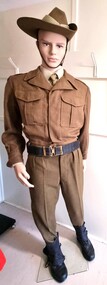
Uniform - Australian Military Uniform - RAEME Corps, c1965
... War. The Corps began sending advisers to Vietnam in 1964 and this foreshadowed a massive build- up of RAEME personnel and equipment which peaked in 1971. ...War. The Corps began sending advisers to Vietnam in 1964 and this foreshadowed a massive build- up of RAEME personnel and equipment which peaked in 1971. ...RAEME Corps was first established in 1942 when the Ordnance Corps and the Service Corps were combined. This uniform was donated by a RAEME member who served during the Vietnam War. The Corps began sending advisers to Vietnam in 1964 and this foreshadowed a massive build- up of RAEME personnel and equipment which peaked in 1971. The first direct RAEME support was provided in early 1965 as part of 1 Aust Logistic Support Coy (1 ALSC). Prior to 1971 the RAEME elements of 1 Australian Logistic Support Group built up to a stage where there were two field workshops. The withdrawal of all Australian forces was completed in 1972 and RAEME reverted to its peacetime role.This uniform was worn by a member of the Wodonga community who served with RAEME during the Vietnam War. RAEME Corps members are also represented at the Army Logistic Training Centre at Bandiana.Australian Military uniform - this uniform was issued during Australia's involvement in the Vietnam war. It was worn by a member of RAEME (The Royal Australian Engineers), Damien Hunt who is a resident of Wodonga.On shoulder badge: "ROYAL AUSTRALIAN ELECTRICAL / & MECHANICAL ENGINEERS"raeme, military uniforms, australian army -
 Wodonga & District Historical Society Inc
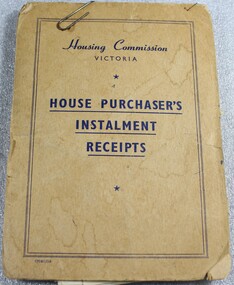
Financial record - Housing Commission Victoria House Purchaser's payment book, C. 1950's
... war industries. With greater funding and a severe housing shortage, the Commission's activities greatly expanded through the late 1940s into the 1950s. They began to build larger and larger estates of housing in the suburban fringes, as well as country towns The Housing Commission was largely responsible for the development of Wodonga up to 1973 and in 1975 was said to have built one-third of all homes in Wodonga, though many of these were handed to the Army. ...war industries. With greater funding and a severe housing shortage, the Commission's activities greatly expanded through the late 1940s into the 1950s. They began to build larger and larger estates of housing in the suburban fringes, as well as country towns The Housing Commission was largely responsible for the development of Wodonga up to 1973 and in 1975 was said to have built one-third of all homes in Wodonga, though many of these were handed to the Army. ...The Housing Commission of Victoria (HCV) was established by the Victorian Government in 1938 after a public campaign for housing reform. After 1942 the HCV was responsible for developing regional and outer suburban housing estates where low-income families were located in proximity to expanding population areas and post-war industries. With greater funding and a severe housing shortage, the Commission's activities greatly expanded through the late 1940s into the 1950s. They began to build larger and larger estates of housing in the suburban fringes, as well as country towns The Housing Commission was largely responsible for the development of Wodonga up to 1973 and in 1975 was said to have built one-third of all homes in Wodonga, though many of these were handed to the Army. Criticism of the bureaucratic and undemocratic nature of the Commission and scandals over corruption in relation to housing developments in Melbourne's fringe areas resulted in the disbandment of the HCV and the formation of a Ministry of Housing in 1984. The work of the Housing Commission of Victoria allowed many people in Wodonga to acquire affordable housing and pay it off over time through monthly instalments. This booklet is of local and state significance as it is evidence of the role of the Victorian Government is providing access to affordable housing. It supported the development of Wodonga and the realisation of the "Australian dream" of home ownership.A small receipt book issued by the Housing Commission of Victoria to record payments and receipts for tenants who were purchasing their home through the Housing Commission. Monthly installments allowed people to access and purchase, affordable housing. On the front cover "Housing Commission/VICTORIA/ HOUSE PURCHASER'S/ INSTALMENT/RECEIPTS"housing wodonga, housing commission of victoria, public housing wodonga -
 Mentone Grammar School
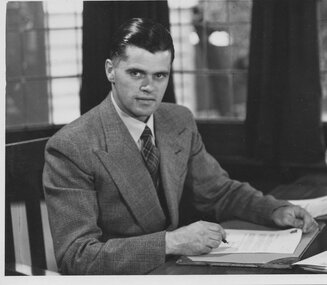
Principal (1939-1960) John Jeffrey Thorold
... up for sale. Fortunes changed when the parent of a boarder offered financial support and together with the skeptical backing of Francis Wellington Were, father of J.J.'s step mother, Jessie, the School numbers grew during the war from 50 to 280. The majority of the newcomers were boarders and evacuees from northern Australia as well as England. J.J. adopted the title Principal and worked tirelessly to build...up for sale. Fortunes changed when the parent of a boarder offered financial support and together with the skeptical backing of Francis Wellington Were, father of J.J.'s step mother, Jessie, the School numbers grew during the war from 50 to 280. The majority of the newcomers were boarders and evacuees from northern Australia as well as England. J.J. adopted the title Principal and worked tirelessly to build ...In October 1939, on the sudden death of his father, Headmaster Charles C Thorold, son, John Jeffery (J.J.) Thorold, a 26-year-old accountant and sole beneficiary and executor was suddenly responsible for 42 students. Numbers had dwindled during the Depression and the situation was so dire, J.J. put the School up for sale. Fortunes changed when the parent of a boarder offered financial support and together with the skeptical backing of Francis Wellington Were, father of J.J.'s step mother, Jessie, the School numbers grew during the war from 50 to 280. The majority of the newcomers were boarders and evacuees from northern Australia as well as England. J.J. adopted the title Principal and worked tirelessly to build the school. He briefly appointed Arthur Burnaby as Headmaster before his search for a permanent Head resulted with the appointment of Lionel Ashley Large in 1945. -
 Returned Nurses RSL Sub-branch
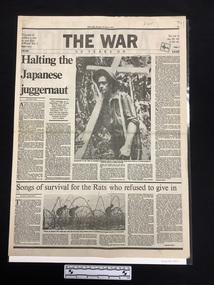
Newspaper - Newspaper liftout, Alan Howe, 'The War : 50 years on', 'Halting the Japanese juggernaut', 'Songs of survival for the Rats who refused to give in', 'A chronicle of conflict', 'Death, glory and faulty strategies in the fight for supremacy at sea', 'The day the horror hit home' & 'The vital build-up in air power', 19890902
... 'The War : 50 years on', 'Halting the Japanese juggernaut', 'Songs of survival for the Rats who refused to give in', 'A chronicle of conflict', 'Death, glory and faulty strategies in the fight for supremacy at sea', 'The day the horror hit home' & 'The vital build-up in air power'...'The War : 50 years on', 'Halting the Japanese juggernaut', 'Songs of survival for the Rats who refused to give in', 'A chronicle of conflict', 'Death, glory and faulty strategies in the fight for supremacy at sea', 'The day the horror hit home' & 'The vital build-up in air power' Newspaper Newspaper liftout Alan Howe Nick Creech The Weekend Australian ...Newspaper lift-out commemorating 50 years since the declaration of WWII. 'The war that forced a nation to come of age' (article p1 and continued on p22) - by Professor Manning Clark - Article provides political background within Australia to armed forces and WWII. 'The week before the world went mad' (article & photos p2) - Six sections on what was happening that week prior to war declared in Sydney, Melbourne, Adelaide, Brisbane, Perth and Hobart. '1939 - 1945 An Australian perspective' (article & timeline with captioned images and photos p3-8) - by Christine McGee - Article provides timeline of events at a personal/local through to national and international, influences and politics, statistics, and information on various fronts of battle from 03/09/1939 - 02/09/1945. Nursing mentioned on p6, there is a photo of a group of women in uniform walking towards the camera and the caption mentions the sinking of the Centaur, loss of 11 of 12 nurses aboard, and how 55 nurses were decorated and 82 mentioned in dispatches. 'The Australians killed in action in World War II : while serving with the nation's defence forces' (roll of honour list p9-21) - Official roll of honour for those who died between 3 September 1929 and 30 June 1947. Includes amendments. People are listed with their units surname followed by initials. 'Curtin's turn to America and the reshaping of Australia...' (article p22) - by Paul Kelly - Article looks at the circumstances and key people involved in the moving of ties away from Britain towards the United States. A large black and white newspaper lift-out with the cover showing the numerals 1939 filled with photos collaged together, several large headlines and subtitles, one article with two columns and a large captioned photo of a man in uniform with a gun on his shoulder, cigarette in his mouth, wearing a hat. Inside is a mix of articles, a timeline with photos and captions, a list of those who died with the unit they served and more photos and articles on the back cover.'WWII' [blue ink top of cover] 'Sept.2.3 1989' [blue ink top of cover]world war two, wwii, ww2, commemorative, timeline, australia -
 Monbulk RSL Sub Branch
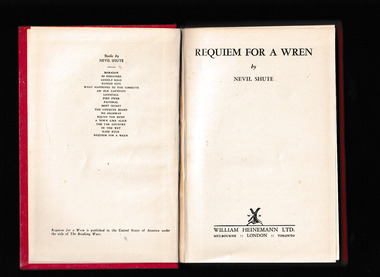
Book, William Heinemann, Requiem for a WREN, 1955
... war. But his homecoming is marred by the suicide of his parents’ parlormaid, of whom they were very fond. Alan soon realizes that the dead young woman is not the person she pretended to be. Upon discovering that she had served in the Royal Navy and participated along with his brother in the secret build-up to the Normandy invasion, Alan sets out to piece together the tragic events and the lonely burden of guilt that unravelled one woman’s life. ...Sidelined by a wartime injury, fighter pilot Alan Duncan reluctantly returns to his parents’ remote sheep station in Australia to take the place of his brother Bill, who died a hero in the war. But his homecoming is marred by the suicide of his parents’ parlormaid, of whom they were very fond. Alan soon realizes that the dead young woman is not the person she pretended to be. Upon discovering that she had served in the Royal Navy and participated along with his brother in the secret build-up to the Normandy invasion, Alan sets out to piece together the tragic events and the lonely burden of guilt that unravelled one woman’s life. In the process of finding the answer to the mystery, he realizes how much he had in common with this woman he never knew and how “a war can go on killing people long after it’s all over.”p.283.fictionSidelined by a wartime injury, fighter pilot Alan Duncan reluctantly returns to his parents’ remote sheep station in Australia to take the place of his brother Bill, who died a hero in the war. But his homecoming is marred by the suicide of his parents’ parlormaid, of whom they were very fond. Alan soon realizes that the dead young woman is not the person she pretended to be. Upon discovering that she had served in the Royal Navy and participated along with his brother in the secret build-up to the Normandy invasion, Alan sets out to piece together the tragic events and the lonely burden of guilt that unravelled one woman’s life. In the process of finding the answer to the mystery, he realizes how much he had in common with this woman he never knew and how “a war can go on killing people long after it’s all over.”english fiction, world war two - fiction
