
Showing 51 items matching "bullock drays"
-
 Greensborough Historical Society
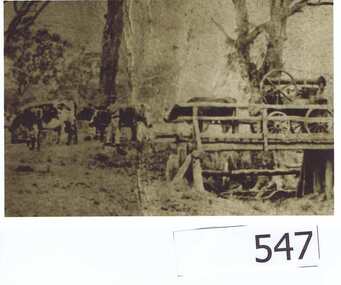
Photograph, Peter Ruston and bullock dray, 1860c
... Peter Ruston and bullock dray......bullock dray...A black and white photograph of a bullock dray with machinery loaded....A black and white photograph of a bullock dray with machinery loaded. Peter Ruston and bullock dray Photograph Photograph ...The photo features Peter Ruston a pioneer of Greensborough. Peter Ruston was an ancestor of the Partington family.A black and white photograph of a bullock dray with machinery loaded.Detailed inscription with details of the "bullocky" on the rear in blue biro.peter rustin, rustin, ruston, bullock dray, transportation -
 City of Moorabbin Historical Society (Operating the Box Cottage Museum)
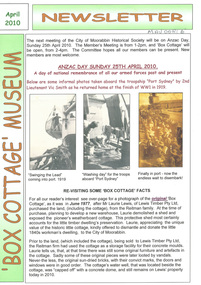
Newsletter, City of Moorabbin Historical Society Apr 2010 pdf, April 2010
... ...bullock drays...The Newsletter is an important record of the activities of the CMHS Local newspaper reports about the ‘discovery’ of Box Cottage’ 1977 city of moorabbin historical society stanley helen lewis laurie lewis grace lewis timber pty. ltd. melbourne moorabbin cheltenham ormond bentleigh market gardeners pioneers early settlers moorabbin shire box cottage museum smith vic ss port sydney world war one 1914 – 1918 soldiers aif reitman j. box john box william dendy henry bullock drays moorabbin roads board 1862 dendy’s special survey 1841 mclean n box henry joyce park ormond city of moorabbin CITY of MOORABBIN HISTORICAL SOCIETY / APRIL 2010 NEWSLETTER 3 x A4 paper printed on 1 side Issue 16 of the bi-monthly, City of Moorabbin Historical Society Newsletter produced by Society member and Secretary, Mrs Helen Stanley in April 2010.. ...The City of Moorabbin Historical Society was formed c 1960 by a group of Moorabbin residents who were concerned that the history of the area should be preserved. A good response to a call for items related to the historical area of Moorabbin Shire brought donations of a wide variety of artefacts which are now preserved by the current members of CMHS at Box Cottage Museum . Helen Stanley, Secretary of CMHS, began producing a Newsletter for members in April 2007 to provide current information and well researched items of historical interest. Helen Stanley has produced a bi-monthly Newsletter, 2007 - 2013, for the members of the City of Moorabbin Historical Society that contains well researched interesting historical items, notification of upcoming events, current advice from Royal Australian Historical Society , Museums Australia Victoria and activities of Local Historical Societies. The Newsletter is an important record of the activities of the CMHS Local newspaper reports about the ‘discovery’ of Box Cottage’ 1977 3 x A4 paper printed on 1 side Issue 16 of the bi-monthly, City of Moorabbin Historical Society Newsletter produced by Society member and Secretary, Mrs Helen Stanley in April 2010.. Notice for the meeting on Anzac Day, Sunday 25th , 3 photocopied photographs taken by 2nd Lieutenant Vic Smith aboard the troopship “Port Sydney” coming home from WW1 in 1919. An article ‘Re-visiting some ‘Box Cottage’ Facts recounts the discovery of the ‘Cottage’ in a shed on the property purchased by Mr Laurie Lewis from the Reitman family in 1977. Thankfully Mr Lewis appreciated such a find and donated it to the City of Moorabbin, and together it was dismantled and re-constructed in Joyce Park, Ormond in 1988 – 100 yards from the original site. Excerpts from 3 articles in ‘The Moorabbin Standard’ and ‘Chadstone Progress’ Newspapers 1977 describing the newly discovered early settler cottage on the Lewis Timber Pty Ltd property in Jasper Road, Ormond. A photocopied photograph of the ‘Box Cottage’ June 1977 when used as a storage facility. CITY of MOORABBIN HISTORICAL SOCIETY / APRIL 2010 NEWSLETTERcity of moorabbin historical society, stanley helen, lewis laurie, lewis grace, lewis timber pty. ltd., melbourne, moorabbin, cheltenham, ormond, bentleigh, market gardeners, pioneers, early settlers, moorabbin shire, box cottage museum, smith vic, ss port sydney, world war one 1914 – 1918, soldiers, aif, reitman j., box john, box william, dendy henry, bullock drays, moorabbin roads board 1862, dendy’s special survey 1841, mclean n, box henry, joyce park ormond, city of moorabbin -
 Emerald Museum & Nobelius Heritage Park
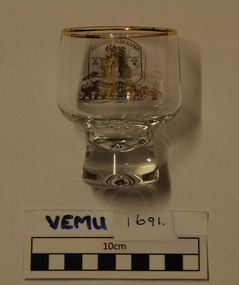
Emerald School Centenary Glass
... Picture on back of bullock dray pulling a large log on a wagon....Picture on back of bullock dray pulling a large log on a wagon. Set of 3 glasses; one small and two larger ones. ...The first school in the Emerald District No.2110 opened with 25 students in 1879 in a rented room on Avon Rd, East Emerald (now Avonsleigh). That school was closed in 1909 and the Emerald State School No.3381 was opened in the Emerald township. In 1915 a permanent school was built in Heroes Avenue where it remains today. The celebration of the centenary in 1979 was a large community event involving former and current students and staff as well as local residents.This is a souvenir of the centenary celebrations of the Emerald Primary School 1879-1979Set of 3 glasses; one small and two larger ones. Gilt rim and 2 gold emblems on the sides.Emerald Schools' Centenary 1879-1979 on front. Picture on back of bullock dray pulling a large log on a wagon.emerald primary school; -
 Glenelg Shire Council Cultural Collection
Postcard, Vanda Savill, c. 1985
... Black and white postcard, hand drawn by Vanda Savill. Image of bullock dray, Benbow's Sawmill in Scott Street, Heywood....Vanda Savill, Bower Bird Museum, Heywood 'Dear Friends' serves Black and white postcard, hand drawn by Vanda Savill. Image of bullock dray, Benbow's Sawmill in Scott Street, Heywood. ...Vanda Savill, Bower Bird Museum, Heywood 'Dear Friends' servesBlack and white postcard, hand drawn by Vanda Savill. Image of bullock dray, Benbow's Sawmill in Scott Street, Heywood. -
 Buninyong & District Historical Society
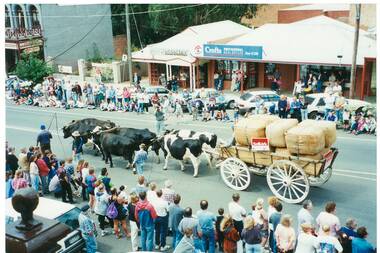
Photograph - Colour photograph, Buninyong Gold King Festival Feb.Feb.1995, Procession on Warrenheip St. from Crown Hotel, Buninyong Gold King Festival Feb.Feb.1995, Procession on Warrenheip St. from Crown Hotel
... Colour photo, Buninyong Gold King Festival Feb.Feb.1995, bullock dray in Procession on Warrenheip St. from Crown Hotel....historic, mining, De Soza, Gold King Mining Gold King De Soza Colour photo, Buninyong Gold King Festival Feb.Feb.1995, bullock dray in Procession on Warrenheip St. from Crown Hotel. ...historic, mining, De Soza, Gold KingColour photo, Buninyong Gold King Festival Feb.Feb.1995, bullock dray in Procession on Warrenheip St. from Crown Hotel.mining, gold king, de soza -
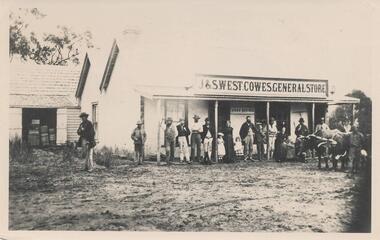 Phillip Island and District Historical Society Inc.
Photograph, 1880's
... Group of people in front and bullock dray. Possibly West family, employees and public. ...Group of people in front and bullock dray. Possibly West family, employees and public. ...Photograph from the Bryant West Collection. Copied by Jack Jenner 1968. West General Store was in Thompson Ave, on west side between Chapel Street and The Esplanade. Closer to The Esplanade. Sepia photograph of J & S West Cowes General Store & sheds in Thompson Avenue. Group of people in front and bullock dray. Possibly West family, employees and public. As above with the names.cowes general store phillip island, mary karney, bryant west collection -
Whitehorse Historical Society Inc.
Document, Edward Nolan, 1857
... Photocopy of registry entry of death certificate of Edward Nolan 'killed by Bullock dray passing over chest. certified by Rich. ...Nolan Edward Death Certificates Photocopy of registry entry of death certificate of Edward Nolan 'killed by Bullock dray passing over chest. Photocopy of registry entry of death certificate of Edward Nolan 'killed by Bullock dray passing over chest. certified by Rich. ...Photocopy of registry entry of death certificate of Edward Nolan 'killed by Bullock dray passing over chest.Photocopy of registry entry of death certificate of Edward Nolan 'killed by Bullock dray passing over chest. certified by Rich. Youl, coroner', on March 13 1857 in Nunawading.Photocopy of registry entry of death certificate of Edward Nolan 'killed by Bullock dray passing over chest. nolan, edward, death certificates -
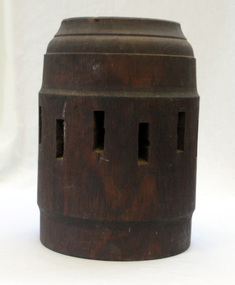 Orbost & District Historical Society
wheel hubs, first half 20th century
... Two large solid elm bullock dray wheel hubs. They have a hole through the centre for spokes and have cut out sections at the sides. ...Horse-drawn wagons are an important part of Orbost’s agricultural history. wheel-hubs transport-bullock handcraft carving Two large solid elm bullock dray wheel hubs. They have a hole through the centre for spokes and have cut out sections at the sides. ...Wagon wheels were required equipment in Australia early days. They were used for transporting goods, commodities, agricultural materials, supplies, and sometimes people. Horse-drawn wagons are an important part of Orbost’s agricultural history.Two large solid elm bullock dray wheel hubs. They have a hole through the centre for spokes and have cut out sections at the sides. They are possibly hand-made. 456.1 is lighter coloured.wheel-hubs transport-bullock handcraft carving -
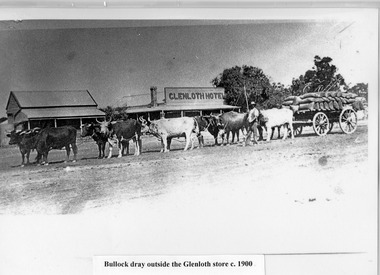 Charlton Golden Grains Museum Inc
Photograph, Bullock dray, Glenloth c. 1900
... Bullock dray, Glenloth c. 1900...A typed note at the bottom the photo reads Bullock dray outside the Glenloth store c. 1900....Bullock dray, Glenloth c. 1900 Photograph Photograph ...Black and white photo of a bullock team and wagon outside Glenloth Store and Hotel c. 1900. There are 10 bullocks pulling the wagon. A man in a hat is standing beside the bullocks holding a whip. The dray is loaded with three layers of full bags and there is a bicycle on top of the bags. There are two buildings behind the bullock dray. The building on the right has a large sign reading GLENLOTH HOTEL. A typed note at the bottom the photo reads Bullock dray outside the Glenloth store c. 1900.glenloth store, glenloth hotel -
Emerald Museum & Nobelius Heritage Park
Photograph - J H Legg's Bullock team and dray, circa 1970
... J H Legg's Bullock team and dray...Photograph depicting J H Legg's Bullock team and Dray at the Gembrook Wood Chop & Carnival. ...Gembrook Wood Chop and Carnival New Years Day. Bullock team and Dray. J H Legg Bullock Team. 1 Jan 1970. ...New Year's Day 1970 Photograph J H Legg's Bullock team and dray ...Photograph depicting J H Legg's Bullock team and Dray at the Gembrook Wood Chop & Carnival. New Year's Day 1970Gembrook Wood Chop and Carnival New Years Day. Bullock team and Dray. J H Legg Bullock Team. 1 Jan 1970. David Moyle Collection – ex Emerald policeman, per Kevin Teasdalecockatoo, bullock, carnival, david moyle collection -
Glenelg Shire Council Cultural Collection
Souvenir - Salt and Pepper Shakers, 1984
... Oven flat one side, black stamp, bullock dray, '150th Anniversary' in banner above dray; 'VICTORIA' in banner beneath dray. ...Oven flat one side, black stamp, bullock dray, '150th Anniversary' in banner above dray; 'VICTORIA' in banner beneath dray. ...China salt and pepper shakes. Shape of oven and basin, beige and brown. Oven flat one side, black stamp, bullock dray, '150th Anniversary' in banner above dray; 'VICTORIA' in banner beneath dray. Identifying numbers 6232 a, b -
Glenelg Shire Council Cultural Collection
Souvenir - Souvenir Wine Glass, c. 1985
... Gold rim on top, gold depiction of bullock dray, with 'Heywood 150th' above and '1835 - 1985' below, in gold. ...Gold rim on top, gold depiction of bullock dray, with 'Heywood 150th' above and '1835 - 1985' below, in gold. ...Wine glass, souvenir of Heywood's 150th 1835 - 1985. Gold rim on top, gold depiction of bullock dray, with 'Heywood 150th' above and '1835 - 1985' below, in gold. Opposite side of glass has history of the Heywood Fitzroy River bridge in gold print.souvenir, heywood, 150th anniversary, 1835 to 1985 -
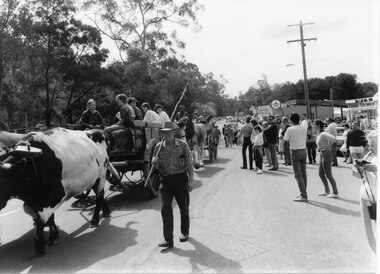 Halls Gap & Grampians Historical Society
Photograph - B/W, Oct-86
... The photo shows a crowd watching a bullock team hauling a dray with five children sitting in it down a road. ...EVENTS Parades The photo shows a crowd watching a bullock team hauling a dray with five children sitting in it down a road. ...The bullock team was part of a parade held on the main street of Halls Gap in conjunction with the 150th anniversary of Major Mitchell's visit to the area. There was also a plaque unveiled in commemoration of the Wildflower Show and its many volunteers.The photo shows a crowd watching a bullock team hauling a dray with five children sitting in it down a road. The bullock driver is walking alongside holding a long handled whip over his shoulder. A wagon pulled by draught horses can be seen behind the bullock dray. Buildings can be seen to the right rear of the photo and trees line the left side of the street.events, parades -
 Bendigo Historical Society Inc.
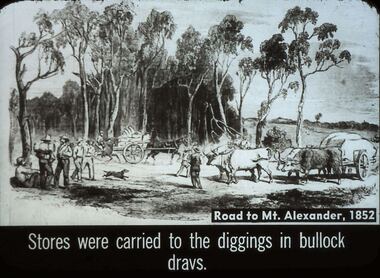
Slide - DIGGERS & MINING. STORES AT THE DIGGINGS, c1852
... Stores were carried to the diggings in bullock drays. Slide shows travellers with swags and drays pulled by ox, with stores also a horse pulling a dray with supplies. ...Stores were carried to the diggings in bullock drays. Slide shows travellers with swags and drays pulled by ox, with stores also a horse pulling a dray with supplies. ...Diggers & Mining. Stores at the diggings. Road to Mt. Alexander, 1852. Stores were carried to the diggings in bullock drays. Slide shows travellers with swags and drays pulled by ox, with stores also a horse pulling a dray with supplies. Markings: 37 994.LIF. 5. Used as a teaching aid.hanimounteducation, tertiary, goldfields -
 Federation University Historical Collection
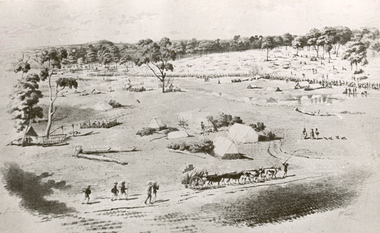
Photograph - Photograph - black and white, William Strutt, View of Golden Point, Ballarat, Taken from West
... The Golden Point goldfield at Ballarat is depicted with a number of people congregated along a creek (Yarrowee Creek), some tents, stockyards evident, a butcher's shambles (tent) a bullock dray, three aborigines and a number of 'diggers' walking towards the goldfield are evident....The Golden Point goldfield at Ballarat is depicted with a number of people congregated along a creek (Yarrowee Creek), some tents, stockyards evident, a butcher's shambles (tent) a bullock dray, three aborigines and a number of 'diggers' walking towards the goldfield are evident. ...The lithograph is held by the State Library of Victoria. Printed below the image is Lithographed by Campbell & Macartney. The title is beneath image and continues: 'Respectfully dedicated to the inhabitants of Victoria / By their obedient servant / Wm. Strutt.'Photograph of a lithograph of view of the Golden Point - Ballarat by William Strutt. The Golden Point goldfield at Ballarat is depicted with a number of people congregated along a creek (Yarrowee Creek), some tents, stockyards evident, a butcher's shambles (tent) a bullock dray, three aborigines and a number of 'diggers' walking towards the goldfield are evident.ballarat, golden point, william strutt, ballarat townscape, mining, goldfield -
 Bendigo Historical Society Inc.
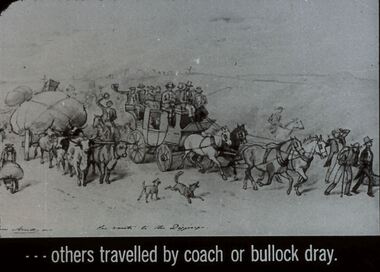
Slide - DIGGERS & MINING. THE GOLD ERA, c1850s
... . - - - others travelled by coach or bullock dray. Slide shows a dray pulled by 4 ox, a coach pulled by 4 horses, men on horseback, and men on foot one with a wheel barrow. .... - - - others travelled by coach or bullock dray. Slide shows a dray pulled by 4 ox, a coach pulled by 4 horses, men on horseback, and men on foot one with a wheel barrow. ...BHS CollectionDiggers & mining. The gold era. - - - others travelled by coach or bullock dray. Slide shows a dray pulled by 4 ox, a coach pulled by 4 horses, men on horseback, and men on foot one with a wheel barrow. There are also several dogs. Markings 14 994.031 GOL:5. Used as a teaching aid.hanimounteducation, tertiary, goldfields -
 Kiewa Valley Historical Society
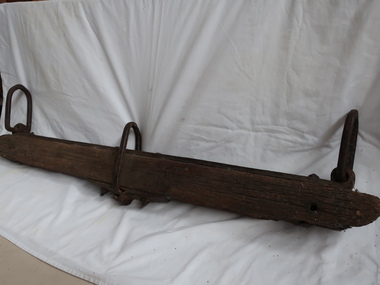
Plough Yoke - Swingletree
... Bullock drays were commonly used to transport heavy loads, such as the wool clip from a large property, across long distances.In the 19th century. ...Bullock drays were commonly used to transport heavy loads, such as the wool clip from a large property, across long distances.In the 19th century. ...Bullock drays were commonly used to transport heavy loads, such as the wool clip from a large property, across long distances.In the 19th century. The yoke is worn on the neck of the bullocks and is secured by a belt around the neck. The bullocks push the yoke with their shoulders, hump and neck; therefore, the work is performed.This yoke seems to be handmade on a farm. It was used in the Kiewa ValleyA wooden bar behind a harnessed horse. It is used to balance the pull of a draught horse or other draft animal (bullock) when pulling a vehicle like a plough. A yoke is an interface between bullock power and actual work to be performed.This yoke is timber with a shape to form curved depressions that allow it to rest across the necks of two bullocks to keep them together.The bullocks were chained to the steel oblong ring - one at each end of the yoke. The middle ring was attached to the bullock or vehicle in front of them.bullock yoke, swingletree, farm equipment, plough -
 Stawell Historical Society Inc
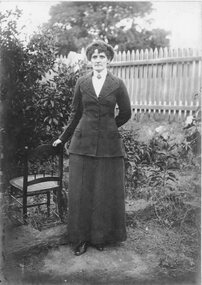
Photograph, Mrs Ede Sowden in the Raitt garden in Upper Main Street Stawell
... Family home brought from Creswick by bullock dray. On the front: Auntie Ede passed away 1940...Family home brought from Creswick by bullock dray. On the front: Auntie Ede passed away 1940 Lady dressed in a dark coloured suit, white high-necked blouse with brooch at centre, standing beside a chair in the garden. ...Portrait of lady in garden beside chair. Noted Aunty Ede passed away 1940. Mrs Ede Sowden was taken in the Garden of the Raitt home upper Main Street.Lady dressed in a dark coloured suit, white high-necked blouse with brooch at centre, standing beside a chair in the garden. Picket fence is in the background.on the back: Nov '83 Lemon tree has just been removed at property of Mrs Raitt , Upper Main Beverley Biggs (possibly Briggs) has the chair - this is her grandma's sister. Family home brought from Creswick by bullock dray. On the front: Auntie Ede passed away 1940stawell -
 Bendigo Historical Society Inc.
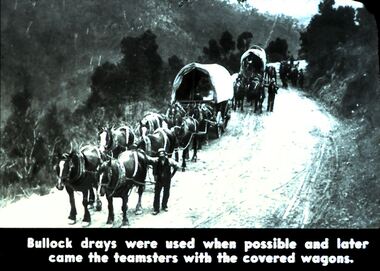
Slide - DIGGERS & MINING. DIGGERS AND MINERS, c1800s
... Walhalla - Gold Town. Bullock drays were used when possible and later came the teamsters with the covered wagons. ...Walhalla - Gold Town. Bullock drays were used when possible and later came the teamsters with the covered wagons. ...Diggers & Mining. Diggers and miners. Walhalla - Gold Town. Bullock drays were used when possible and later came the teamsters with the covered wagons. Picture shows 3 covered wagons pulled by teams of eight horses. Men with the wagons. On a track carved into a mountain. Markings: 13 995 WAL. Used as a teaching aid.hanimounteducation, tertiary, goldfields -
Glenelg Shire Council Cultural Collection
Photograph - Sheet of 10 contact prints - Various Portland historic buildings and landmarks, c. 1970
... Identifying numbers 5715a, b, c, d, e, f, g, h, i, j (a) Portland form Battery Point (b) Henty Beach, looking south (c) Palmer Street Primary School, No. 489 (d) Guardian Office, Bentinck Street (e) Railway Station Harbour Baths Bentinck Street (f) Jane Henty - wife of Stephen (g) bullock dray, bush (h) Ocean Pier (i) Bentinck Street Percy Street (j) Henty Beach...Identifying numbers 5715a, b, c, d, e, f, g, h, i, j (a) Portland form Battery Point (b) Henty Beach, looking south (c) Palmer Street Primary School, No. 489 (d) Guardian Office, Bentinck Street (e) Railway Station Harbour Baths Bentinck Street (f) Jane Henty - wife of Stephen (g) bullock dray, bush (h) Ocean Pier (i) Bentinck Street Percy Street (j) Henty Beach Photograph Sheet of 10 contact prints - Various Portland historic buildings and landmarks ...Sheet of 10 contact prints of rephotographed photographs. Identifying numbers 5715a, b, c, d, e, f, g, h, i, j (a) Portland form Battery Point (b) Henty Beach, looking south (c) Palmer Street Primary School, No. 489 (d) Guardian Office, Bentinck Street (e) Railway Station Harbour Baths Bentinck Street (f) Jane Henty - wife of Stephen (g) bullock dray, bush (h) Ocean Pier (i) Bentinck Street Percy Street (j) Henty BeachFront: (a) Portland from Battery Point. - The Rose Series (c) .... School, Portland Vic. - Toys Photo (d) Bentinck Street The Guardian Office Portland. - Magnus Photo (e) Railway Harbour & Jetty (f) Price $3.70 (i) Bentinck Street Percy Street The Harbour and Town of Portland (j) Henty Beach, Portland -
 Stawell Historical Society Inc
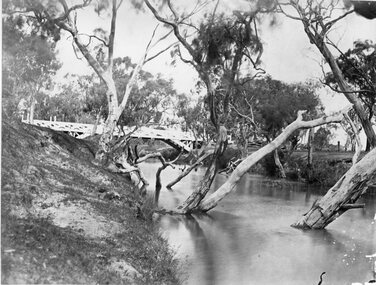
Photograph, Glenorchy Bridge on the Wimmera River 1866
... These Fords were popular crossing spots for Bullock Drays which were delayed for days during floods before the bridge was built. ...These Fords were popular crossing spots for Bullock Drays which were delayed for days during floods before the bridge was built. ...Glenorchy Bridge Wimmera River. Part of a collection of Photographs by Mr. O.G. Armstrong as commissioned by the Shire of Stawell for the Inter-colonial and Paris Exhibition in Melbourne in 1866. Prior to the construction of this bridge in 1860, there existed two forwards across the Wimmer River at Glenorchy. One was 2 miles on the Stawell side of Glenorchy and 500 metres from the present railway bridge. It was well made, stone floor and can be seen today. The second was located 800 metres downstream of the town and was known as Stuart’s Crossing. These Fords were popular crossing spots for Bullock Drays which were delayed for days during floods before the bridge was built. The original Bridge was built near the site of the present ‘old’ bridge. stawell -
Emerald Museum & Nobelius Heritage Park
Photograph - Packing Shed, Gembrook Nurseries, Unknown maker, 1900-1920
... The need to transport nursery products by train via Ferntree Gully rather than by bullock dray to Narre Warren was a factor in the successful petition to develop what is now known as the Puffing Billy Railway. ...The need to transport nursery products by train via Ferntree Gully rather than by bullock dray to Narre Warren was a factor in the successful petition to develop what is now known as the Puffing Billy Railway. ...The Gembrook Nurseries, informally known as the Nobelius Nurseries after the founder Carl Axel Nobelius, began with the purchase of sixty-three acres in 1886 and boomed in the 1890s due to opportunities provided by employment-promoting schemes to develop public parks and gardens and street shade by local and State Governments around Australia. Trees were sold to more than forty councils and Government organisations in the 1890s, including the Department of Agriculture, Lands Department and Victorian Railways. The need to transport nursery products by train via Ferntree Gully rather than by bullock dray to Narre Warren was a factor in the successful petition to develop what is now known as the Puffing Billy Railway. Railway developments in 1900 included the creation of a siding and Packing Shed, known as Nobelius Station, which is featured in this photograph. The Packing Shed was able to handle 250,000 cases of fruit each year. Gembrook Nurseries had an indirect influence on the development of other farms and industries in the region. As a wholesale nursery with high sales volumes it was an important employer of local people. Peak season for employees was during the cooler months, during most farmers' off-season. This provided local farmers with a source of income while their own farms were becoming established.The photograph is significant because it depicts personnel and infrastructure associated with the Gembrook or Nobelius Nurseries, a business which was instrumental to the development of Emerald as a settlement in the 19th and 20th Centuries and also influenced the development of public and private gardens and the farming of several species in Australia and internationally. The Nobelius Nursery is listed on the Victorian Heritage Register.Black and white rectangular photograph printed on print media paper. The image is captioned 'Lunch Hour at the Packing Shed, Gembrook Nurseries.' It depicts thirty-one men (including one adolescent) and one woman posing for a group photograph behind approximately five large product bales resting in a rectangular metal rail cargo carriage. One of the men has a bandage across one eye. The people depicted are wearing clothing indicating the image may have been taken in the early 20th century. The Packing Shed building (built in 1900) and several stacked wooden storage crates are visible behind the group.Obverse: 59 NOR (?) 10 (?) + / LUNCH HOUR AT THE PACKING SHED, GEMBROOK NURSERIES. /1900s, gembrook nurseries, nobelius nurseries, carl axel nobelius, packing shed, railway, puffing billy railway, nursery employees, farming, agriculture, government initiatives -
Emerald Museum & Nobelius Heritage Park
Photograph - Nobelius Packing Shed, Unknown photographer, 2000s
... The need to transport nursery products by train via Ferntree Gully rather than by bullock dray to Narre Warren was a factor in the successful petition to develop what is now known as the Puffing Billy Railway. ...The need to transport nursery products by train via Ferntree Gully rather than by bullock dray to Narre Warren was a factor in the successful petition to develop what is now known as the Puffing Billy Railway. ...The Gembrook Nurseries, informally known as the Nobelius Nurseries after the founder Carl Axel Nobelius, began with the purchase of sixty-three acres in 1886 and boomed in the 1890s due to opportunities provided by employment-promoting schemes to develop public parks and gardens and street shade by local and State Governments around Australia. Trees were sold to more than forty councils and Government organisations in the 1890s, including the Department of Agriculture, Lands Department and Victorian Railways. The need to transport nursery products by train via Ferntree Gully rather than by bullock dray to Narre Warren was a factor in the successful petition to develop what is now known as the Puffing Billy Railway. Railway developments in 1900 included the creation of a siding and Packing Shed, known as Nobelius Station, which is featured in this photograph. The Packing Shed was able to handle 250,000 cases of fruit each year at the height of the nurseries' activities. The image shows the Packing Shed with boarded-up windows, suggesting it was taken prior to the purchase of the facility for use in the Puffing Billy Railway service. Gembrook Nurseries had an indirect influence on the development of other farms and industries in the region. As a wholesale nursery with high sales volumes it was an important employer of local people. Peak season for employees was during the cooler months, during most farmers' off-season. This provided local farmers with a source of income while their own farms were becoming established.The photograph is significant because it depicts infrastructure associated with the Gembrook or Nobelius Nurseries, a business which was instrumental to the development of Emerald as a settlement in the 19th and 20th Centuries and also influenced the development of public and private gardens and the farming of several species in Australia and internationally. The Nobelius Nursery is listed on the Victorian Heritage Register.A coloured rectangular photograph of the Nobelius Nurseries Packing Shed. The photograph was taken in the grounds looking up towards the packing shed. There are various trees and vegetation throughout the grounds and surrounding the packing shed. The Nobelius Nurseries Packing Shed was used to sort and pack trees to be sent overseas during the 1900s-1940s.No inscriptions/marksnobelius nursery, packing shed, 2000s, puffing billy railway, nobelius heritage park -
Emerald Museum & Nobelius Heritage Park
Photograph - Nobelius Nursery Packing Shed, Unknown photographer, 1970s
... The need to transport nursery products by train via Ferntree Gully rather than by bullock dray to Narre Warren was a factor in the successful petition to develop what is now known as the Puffing Billy Railway. ...The need to transport nursery products by train via Ferntree Gully rather than by bullock dray to Narre Warren was a factor in the successful petition to develop what is now known as the Puffing Billy Railway. ...The Gembrook Nurseries, informally known as the Nobelius Nurseries after the founder Carl Axel Nobelius, began with the purchase of sixty-three acres in 1886 and boomed in the 1890s due to opportunities provided by employment-promoting schemes to develop public parks and gardens and street shade by local and State Governments around Australia. Trees were sold to more than forty councils and Government organisations in the 1890s, including the Department of Agriculture, Lands Department and Victorian Railways. The need to transport nursery products by train via Ferntree Gully rather than by bullock dray to Narre Warren was a factor in the successful petition to develop what is now known as the Puffing Billy Railway. Railway developments in 1900 included the creation of a siding and Packing Shed, known as Nobelius Station, which is featured in this photograph. The Packing Shed was able to handle 250,000 cases of fruit each year at the height of the nurseries' activities. The image shows the Packing Shed with boarded-up windows, suggesting it was taken prior to the purchase of the facility for use in the Puffing Billy Railway service. Gembrook Nurseries had an indirect influence on the development of other farms and industries in the region. As a wholesale nursery with high sales volumes it was an important employer of local people. Peak season for employees was during the cooler months, during most farmers' off-season. This provided local farmers with a source of income while their own farms were becoming established.The photograph is significant because it depicts infrastructure associated with the Gembrook or Nobelius Nurseries, a business which was instrumental to the development of Emerald as a settlement in the 19th and 20th Centuries and also influenced the development of public and private gardens and the farming of several species in Australia and internationally. The Nobelius Nursery is listed on the Victorian Heritage Register. The image appears to show the Packing Shed building prior to its restoration as a tourist facility.Black and white rectangular photograph printed on print media paper. The image depicts the Gembrook Nurseries Packing Shed building with boarded up windows.Obverse: NOBELIUS NURSERIES / . WEEKEND TRADING . /1970s, gembrook nurseries, puffing billy railway, carl axel nobelius, packing shed, railway stations, farming, agriculture -
Emerald Museum & Nobelius Heritage Park
Photograph - Nobelius Packing Shed, Unknown photographer
... The need to transport nursery products by train via Ferntree Gully rather than by bullock dray to Narre Warren was a factor in the successful petition to develop what is now known as the Puffing Billy Railway. ...The need to transport nursery products by train via Ferntree Gully rather than by bullock dray to Narre Warren was a factor in the successful petition to develop what is now known as the Puffing Billy Railway. ...The Gembrook Nurseries, informally known as the Nobelius Nurseries after the founder Carl Axel Nobelius, began with the purchase of sixty-three acres in 1886 and boomed in the 1890s due to opportunities provided by employment-promoting schemes to develop public parks and gardens and street shade by local and State Governments around Australia. Trees were sold to more than forty councils and Government organisations in the 1890s, including the Department of Agriculture, Lands Department and Victorian Railways. The need to transport nursery products by train via Ferntree Gully rather than by bullock dray to Narre Warren was a factor in the successful petition to develop what is now known as the Puffing Billy Railway. Railway developments in 1900 included the creation of a siding and Packing Shed, known as Nobelius Station, which is featured in this photograph. The Packing Shed was able to handle 250,000 cases of fruit each year at the height of the nurseries' activities. The image shows the Packing Shed prior to the purchase of the facility for use in the Puffing Billy Railway service. Gembrook Nurseries had an indirect influence on the development of other farms and industries in the region. As a wholesale nursery with high sales volumes it was an important employer of local people. Peak season for employees was during the cooler months, during most farmers' off-season. This provided local farmers with a source of income while their own farms were becoming established.The photograph is significant because it depicts infrastructure associated with the Gembrook or Nobelius Nurseries, a business which was instrumental to the development of Emerald as a settlement in the 19th and 20th Centuries and also influenced the development of public and private gardens and the farming of several species in Australia and internationally. The Nobelius Nursery is listed on the Victorian Heritage Register. The image appears to show the Packing Shed building prior to its restoration as a tourist facility.Black and white rectangular photograph printed on print media paper. The image depicts the Gembrook Nurseries Packing Shed building. The building is made from weatherboard and features a brick chimney. There is also a tall tree standing next to the chimney.Obverse: IUS NURSERIES / TRADING ... /gembrook nurseries, puffing billy railway, carl axel nobelius, packing shed, railway stations, farming, agriculture -
 Federation University Historical Collection
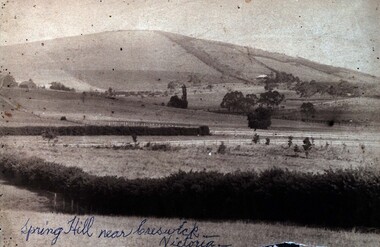
Photograph (Black & White), Spring Hill Near Creswick
... He took his bride, Bridget Hyde (19 years old) by bullock dray from St James Church, Elizabeth Street, Melbourne to this new allotment - 10 children born there - William, Robert, Samuel, Elizabeth, Ellen, Emily, Mary (died 2 months old mother also died). ...He took his bride, Bridget Hyde (19 years old) by bullock dray from St James Church, Elizabeth Street, Melbourne to this new allotment - 10 children born there - William, Robert, Samuel, Elizabeth, Ellen, Emily, Mary (died 2 months old mother also died). ...Both images are associated with Ellie Campbell. James and Bridget Martin were early settlers at Spring Hill. All their children attended the Ballarat School of Mines..1) A black and white image of Spring Hill near Creswick, glued into a thick card with a gold gilt edge. .2) Martin family house at Subiaco Hill, Western Australia. Brick house built by Corby Statford Cambell, Elly Campbell's father. .1) Written in blue pen on front of photograph 'Spring Hill near Creswick - Victoria' Taped onto back 'Farmland allotted to James George Martin in c1849. He took his bride, Bridget Hyde (19 years old) by bullock dray from St James Church, Elizabeth Street, Melbourne to this new allotment - 10 children born there - William, Robert, Samuel, Elizabeth, Ellen, Emily, Mary (died 2 months old mother also died). J.G.M. moved to Ballarat - attended Dawson Street Baptist Church. Here he married a widow with 2 sons, Mrs ____. Her 2 sons were born, George and Charles (was in USA) . Children all attended School of Mines, Ballarat .2) On yellow sticky label with photo - "Family home Subiace Rd Subiac WA. Builtby Statford Campbell, Elly's fayher. Now Coppin St.ballarat school of mines, william martin, james martin, bridget martin, bridget hyde, samuel martin, elizabeth martin, ellen martin, mary martin, george martin, charles martin -
 Port Melbourne Historical & Preservation Society
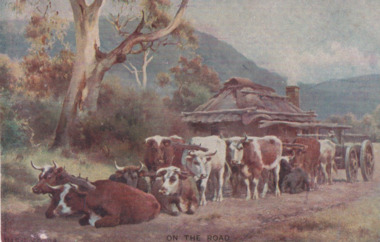
Postcard - Swallow & Ariell promotion, On the Road
... "On the Road" Coloured postcard, front shows a bullock team and dray in front of a bark hut. Large gum tree on right and hills behind. ...Industry - Food Swallow & Ariell Ltd "On the Road" Coloured postcard, front shows a bullock team and dray in front of a bark hut. Large gum tree on right and hills behind. ..."On the Road" Coloured postcard, front shows a bullock team and dray in front of a bark hut. Large gum tree on right and hills behind. Back shows Swallow & Ariell's renowned biscuits and cakes, pure jams and canned fruits. Plum puddings and Australian seeded raisins etc. are the bestindustry - food, swallow & ariell ltd -
 Wodonga & District Historical Society Inc
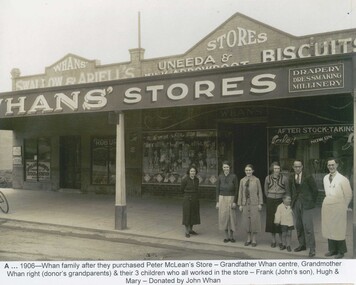
Photograph - Whans' Stores, Wodonga
... John Whan was born in Carlton of Irish parents and moved with them to Wodonga by bullock dray at the age of 12. After completing his education in Wodonga, John became manager of McLean Brothers and Rigg branch store in Sydney Street, Wodonga for a number of years after which he bought the business and operated Whan’s General Store in Sydney Road, Wodonga which at its peak employed his six children. ...John Whan was born in Carlton of Irish parents and moved with them to Wodonga by bullock dray at the age of 12. After completing his education in Wodonga, John became manager of McLean Brothers and Rigg branch store in Sydney Street, Wodonga for a number of years after which he bought the business and operated Whan’s General Store in Sydney Road, Wodonga which at its peak employed his six children. ...John Whan was born in Carlton of Irish parents and moved with them to Wodonga by bullock dray at the age of 12. After completing his education in Wodonga, John became manager of McLean Brothers and Rigg branch store in Sydney Street, Wodonga for a number of years after which he bought the business and operated Whan’s General Store in Sydney Road, Wodonga which at its peak employed his six children. John Whan was Wodonga Shire Councillor for 15 years, including a term as Shire President in 1904-5. He was also Chairman of the Wodonga Water Trust when it built the water tower in 1922 – 23. He had many other community involvements including the School board and the Library Committee, served as an honorary justice and Deputy Coroner. secretary of the Wodonga branch of the I.O.O.F., and the Wodonga Cemetery Trust and the Masonic Lodge. He was a foundation member of the Presbyterian Church in Wodonga. He died on 10 October 1933. After his death, Whan's store was operated by John's son Francis William Whan who was born in Wodonga on 1 September 1901. He also served the community as a Justice of the Peace and Magostrate. Frank was a caring gentleman who looked after many during the difficult times of the Depression and World War 11. He continued to provide outstanding service to the Wodonga community. Frank was a dedicated member of the Presbyterian Church. The Whan General Store was purchased by Lincoln and Butterworth in 1945 and Francis and his family moved to Queensland He passed away in Lismore, NSW on 24 December 1975.These photographs represent the business of a prominent Wodonga family and community member.3 black and white photographs showing the Whan store in Wodonga at various stages in its developmentwodonga businesses, whan's store, whan family -
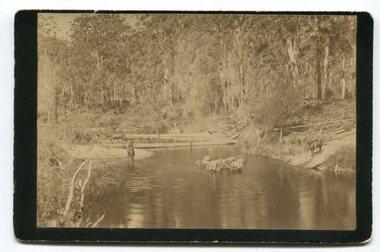 Orbost & District Historical Society
black and white photograph, late 19th - early 20th century
... In the late 1800's early 1900's transporting goods by road was difficult and at times impossible because roads as thoroughfares did not exist.The means of travelling along the roads in the 1800's was by bullock wagon, horse pulled dray, pack horse or simply by foot. ...In the late 1800's early 1900's transporting goods by road was difficult and at times impossible because roads as thoroughfares did not exist.The means of travelling along the roads in the 1800's was by bullock wagon, horse pulled dray, pack horse or simply by foot. ...In the late 1800's early 1900's transporting goods by road was difficult and at times impossible because roads as thoroughfares did not exist.The means of travelling along the roads in the 1800's was by bullock wagon, horse pulled dray, pack horse or simply by foot. This is a pictorial record of transport in the mid 18th - early 19th century. Pack horses were vital for the delivery of goods, responding to emergencies as they could travel in country inaccessible to larger horse - drawn carts or wagons.A black / white photograph on a black buff card. It is of a group of pack horses being guided across a waterway with a man on horseback on either side of the river.transport pack-horses -
Glenelg Shire Council Cultural Collection
Photograph - Photograph reprint of scan of photograph - Henty Street Casterton, n.d
... Image is oval inshape, shows Henty Street Casterton. Bullock team and dray, horse and cart on right of street, horse and carriage with two horses and a woman and small child, centre of street. ...Image is oval inshape, shows Henty Street Casterton. Bullock team and dray, horse and cart on right of street, horse and carriage with two horses and a woman and small child, centre of street. ...Vern McCallum CollectionReprint of scan of black and white photograph. Image is oval inshape, shows Henty Street Casterton. Bullock team and dray, horse and cart on right of street, horse and carriage with two horses and a woman and small child, centre of street. Various other horsedrawn vehicles in bakground. Casterton Hotel and railway Hotel on right. Print is mounted on white, archival mountboard frame.Front: Front- 'Henty Street Casterton, Victoria' across bottom print.
