
Showing 45 items matching "burke expeditions"
-
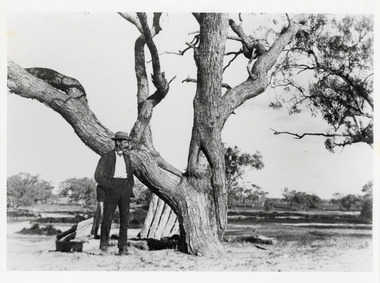 The Beechworth Burke Museum
Photograph, 1910
... ...Burke Expeditions...The photograph and copy depict the Dig Tree, a coolibah tree on Cooper Creek linked to the ill-fated Burke and Wills expedition of 1860–61. This was the site where Robert O’Hara Burke and William John Wills returned from the Gulf of Carpentaria and found their support party had left only hours earlier. ... Conrick John Burke Expeditions Dig Tree 4611.1 Reverse: 84.75 1/4611-1/THE BURKE AND Wills "DIG TREE". ...The photograph and copy depict the Dig Tree, a coolibah tree on Cooper Creek linked to the ill-fated Burke and Wills expedition of 1860–61. This was the site where Robert O’Hara Burke and William John Wills returned from the Gulf of Carpentaria and found their support party had left only hours earlier. And carvings on the tree pointed to buried supplies. The tree became a reminder of the tragedy and fatal misjudgements that led to it, as well as the harsh conditions of inland exploration.This 1910 photograph of the Dig Tree holds historic significance as it depicts one of the most iconic exploration sites. It captures the landscape and features of the location just fifty years after the expedition and offers insight into how the site was remembered and commemorated in the early 20th century. Black and white rectangular photograph printed on matte photographic paper unmounted. 4611.1 Reverse: 84.75 1/4611-1/THE BURKE AND Wills "DIG TREE"./SITUATED ON NAPPA MERRIE STATION, COOPERS CREEK QLD,/PHOTO TAKEN BY JOHN W. CONRICK OF NAPPA MERRIE ABOUT 1910. 4611.2 Reverse: 4611-2robert o'hara burke, conrick john, burke expeditions, dig tree -
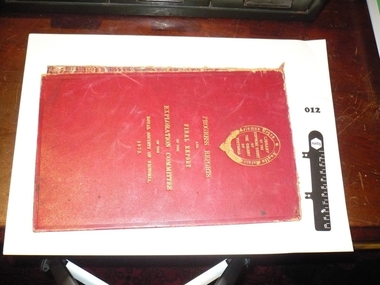 Supreme Court of Victoria Library
Report, Progress Reports & Final Report of the Exploration Committee (Burke & Wills), 1872
... This is the report prepared by the Royal Society of Victoria regarding the ill fated expedition of the explorers Robert Burke and William Wills in 1861. ...Red leather bound report of the Exploration Committee (Burke & Wills Expedition). Gold lettering on front....Red leather bound report of the Exploration Committee (Burke & Wills Expedition). Gold lettering on front. Progress Reports & Final Report of the Exploration Committee (Burke & Wills) Report ...This is the report prepared by the Royal Society of Victoria regarding the ill fated expedition of the explorers Robert Burke and William Wills in 1861. This volume appears to be Chief Justice Stawell's, the president of the Royal Society, personal copy.The report is rare, held by both the University of Melbourne and the State Library, as well as a few other libraries.Red leather bound report of the Exploration Committee (Burke & Wills Expedition). Gold lettering on front.Progress reports & Final Report of the Exploration Committee of the Royal Society of Victoria 1872 on front cover in gold lettering. As well as Library stamp. -
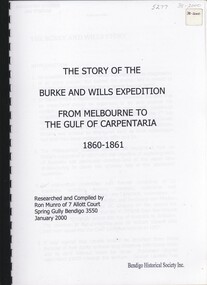 Bendigo Historical Society Inc.
Book - THE STORY OF THE BURKE AND WILLS EXPEDITION, 2000
... THE STORY OF THE BURKE AND WILLS EXPEDITION...The Story of the Burke and Wills Expedition. From Melbourne to the Gulf of Ccarpentaria, 1860 - 1861....Book THE STORY OF THE BURKE AND WILLS EXPEDITION ...The Story of the Burke and Wills Expedition. From Melbourne to the Gulf of Ccarpentaria, 1860 - 1861.Ron Munroaustralia, pioneer history and early australia -
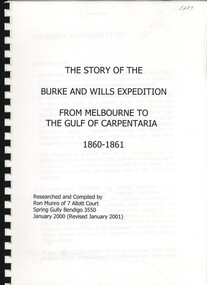 Bendigo Historical Society Inc.
Book - THE STORY OF THE BURKE AND WILLS EXPEDITION, 2000
... THE STORY OF THE BURKE AND WILLS EXPEDITION...The Story of the Burke and Wills expedition, from Melbourne to the Gulf of Carpentaria 1860-1861 189 pages with photographs and maps....Book THE STORY OF THE BURKE AND WILLS EXPEDITION ...The Story of the Burke and Wills expedition, from Melbourne to the Gulf of Carpentaria 1860-1861 189 pages with photographs and maps.Ron Munroaustralia, history, explorers, australia-history-explorers -
 Bendigo Historical Society Inc.
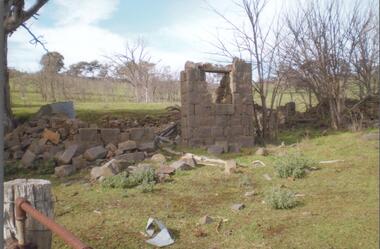
Photograph - BENDIGO HISTORICAL SOCIETY COLLECTION: RUINS OF MIA MIA HOTEL
... Bare trees in background and on side. Burke and Wills Expedition travelled through this region and allegedly visited the Mia Mia Hotel. ...Bare trees in background and on side. Burke and Wills Expedition travelled through this region and allegedly visited the Mia Mia Hotel. ...Colour photograph of bluestone ruins of former Mia Mia Hotel, Mia Mia. Part of one wall standing with window opening. Bare trees in background and on side. Burke and Wills Expedition travelled through this region and allegedly visited the Mia Mia Hotel. The Burke and Wills expedition passed through Mia Mia in 1860 on their journey across Australia from Melbourne to the Gulf of Carpentaria. They arrived on Saturday, 25 August 1860 and made Camp VI at Mia Mia.buildings, commercial, mia mia hotel -
 Bendigo Historical Society Inc.
Document - FRANK CUSACK: 'THE GERMAN CONTRIBUTION TO EARLY BENDIGO'
... .; others - Conrad Meyerhoff (patent gold cradle), Benno Sluytmann (first electricity plant in Bendigo), Gustavus con Tempsky (re Burke & Wills expedition), Ludwig Becker (Burke & Wills expedition); Josef Von St. ....; others - Conrad Meyerhoff (patent gold cradle), Benno Sluytmann (first electricity plant in Bendigo), Gustavus con Tempsky (re Burke & Wills expedition), Ludwig Becker (Burke & Wills expedition); Josef Von St. ...'The German Contribution to Early Bendigo' ( 23rd Feb) 1986 lecture by Frank Cusack on the occasion of the 130th anniversary of the first Lutheran service in Bendigo). Origins of the large flow of Germans to the goldfields (failure of liberalism at home; conscription threat). Mention of George Bruhn, Menge (opal discoverer), Jacob Brahe; Ballerstedt; Wittscheibe; Schlemm; Ernst Mueller; Morris Collman; Louis Samuels; Gustave Adolphus Hugo Thureau; Backhaus; Pastor Friedrich Leypoldt; various German vignerons; ''The Hamburg'' (hotel); ''The Berlin'' (hotel); ''The European'' (hotel); Deutsche Verein; Paul Bucholz; Herr Gollmick; Early architects - Getzschmann, Bosselmann, Nicolai, Emil Mauermann, Friedrich Lehmann; Medical people - Dr Barnett; , Dr Landvoigt. Dr Sandner Snr.; others - Conrad Meyerhoff (patent gold cradle), Benno Sluytmann (first electricity plant in Bendigo), Gustavus con Tempsky (re Burke & Wills expedition), Ludwig Becker (Burke & Wills expedition); Josef Von St. Nicolai (Freemasonry); Captain Von Paleski.bendigo, mining, early german history, german diggers, diamond hill, mangurang, mexican enclave at eaglehawke, irish town, back creek, ironbark gully, white hills, georg bruhn, menge, jacob brahe. old bendigo cemetery. -
 Bendigo Historical Society Inc.
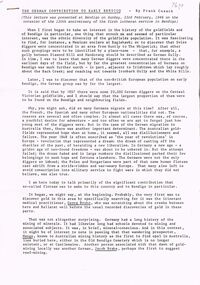
Document - FRANK CUSACK: 'THE GERMAN CONTRIBUTION TO EARLY BENDIGO'
... .; others - Conrad Meyerhoff (patent gold cradle), Benno Sluytmann (first electricity plant in Bendigo), Gustavus con Tempsky (re Burke & Wills expedition), Ludwig Becker (Burke & Wills expedition); Josef Von St. ....; others - Conrad Meyerhoff (patent gold cradle), Benno Sluytmann (first electricity plant in Bendigo), Gustavus con Tempsky (re Burke & Wills expedition), Ludwig Becker (Burke & Wills expedition); Josef Von St. ...'The German Contribution to Early Bendigo' ( 23rd Feb) 1986 lecture by Frank Cusack on the occasion of the 130th anniversary of the first Lutheran service in Bendigo). Origins of the large flow of Germans to the goldfields (failure of liberalism at home; conscription threat). Mention of George Bruhn, Menge (opal discoverer), Jacob Brahe; Ballerstedt; Wittscheibe; Schlemm; Ernst Mueller; Morris Collman; Louis Samuels; Gustave Adolphus Hugo Thureau; Backhaus; Pastor Friedrich Leypoldt; various German vignerons; ''The Hamburg'' (hotel); ''The Berlin'' (hotel); ''The European'' (hotel); Deutsche Verein; Paul Bucholz; Herr Gollmick; Early architects - Getzschmann, Bosselmann, Nicolai, Emil Mauermann, Friedrich Lehmann; Medical people - Dr Barnett; , Dr Landvoigt. Dr Sandner Snr.; others - Conrad Meyerhoff (patent gold cradle), Benno Sluytmann (first electricity plant in Bendigo), Gustavus con Tempsky (re Burke & Wills expedition), Ludwig Becker (Burke & Wills expedition); Josef Von St. Nicolai (Freemasonry); Captain Von Paleski.Frank Cusackbendigo, mining, early german history, german diggers, diamond hill, mangurang, mexican enclave at eaglehawke, irish town, back creek, ironbark gully, white hills, georg bruhn, menge, jacob brahe. old bendigo cemetery. -
 Bendigo Historical Society Inc.
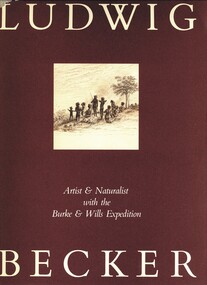
Book - LUDWIG BECKER, ARTIST AND NATURALIST WITH THE BURKE & WILLS EXPEDITION, c1979
... LUDWIG BECKER, ARTIST AND NATURALIST WITH THE BURKE & WILLS EXPEDITION...... Burke & Wills Expedition...Artist & Naturalist with the Burke & Wills Expedition. Brown Dust jacket and clear plastic jacket. ...Artist & Naturalist with the Burke & Wills Expedition. Brown Dust jacket and clear plastic jacket. ...Ludwig Becker. Artist & Naturalist with the Burke & Wills Expedition. Brown Dust jacket and clear plastic jacket. Publisher: Melbourne University Press, Carlton. Edited with an Introduction by Marjorie Tipping. Sketches & paintings. Markings/Inscriptions: Bendigo Historical Society stamp. Book signed by Marjorie Tipping. 21st Birthday gift card (business card size): With all Best Wishes on this most important occasion, H C Lee-Archer, Nov 1979. Pres RHSVMarjorie Tippingbook, burke & wills, ludwig becker, burke & wills expedition, h c lee-archer rhsv, australia history, flora fauna -
 Orbost & District Historical Society
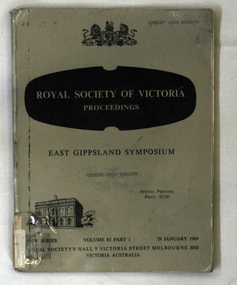
magazine, Royal Society of Victoria Proceedings, 29 January 1969
... In 1860 the R.S.V. organised the Burke and Wills expedition. The Society has played an important role in the life of Melbourne and Victoria including establishing the Melbourne Museum and National Parks, convening the first Australian Antarctic Exploration Committee in 1885, organising the Burke and Wills expedition and establishing the Victorian Institute of Marine Sciences in 1978. ...In 1860 the R.S.V. organised the Burke and Wills expedition. The Society has played an important role in the life of Melbourne and Victoria including establishing the Melbourne Museum and National Parks, convening the first Australian Antarctic Exploration Committee in 1885, organising the Burke and Wills expedition and establishing the Victorian Institute of Marine Sciences in 1978. ...The Royal Society of Victoria was formed in 1859 from a merger between The Philosophical Society of Victoria and The Victorian Institute for the Advancement of Science, both founded in 1854. The first president of the Royal Society was Baron Sir Ferdinand von Mueller, then Government botanist. In 1860 the R.S.V. organised the Burke and Wills expedition. The Society has played an important role in the life of Melbourne and Victoria including establishing the Melbourne Museum and National Parks, convening the first Australian Antarctic Exploration Committee in 1885, organising the Burke and Wills expedition and establishing the Victorian Institute of Marine Sciences in 1978. The Royal Society of Victoria has published articles of scientific interest in the Proceedings of the Royal Society of Victoria annually since 1854. The aim of the Proceedings magazine is to contribute to the advancement of science by enhancing the knowledge and appreciation of science and technology and their impact on society. This magazine is a useful research tool.A 148 pp magazine, Royal Society of Victoria Proceedings - East Gippsland Symposium Vol 82 Part 1 - 29 Jan 1969. It contains a series of scientific articles pertaining to East Gippsland. The Proceedings of the Royal Society of Victoria is a refereed journal, published annually. The front cover is grey with black text. At the top is the royal coat of arms. Below that is the title Royal Society of Victoria Proceedings in white print on a black background. On the bottom left is a black drawing of the Royal Society of Victoria building.Stamped twice on front cover is ORBOST HIGH SCHOOLscience-research-east gippsland royal-society-of-victoria -
 Bendigo Historical Society Inc.
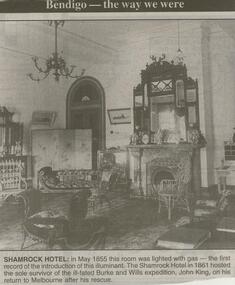
Newspaper - JENNY FOLEY COLLECTION: SHAMROCK HOTEL
... The Shamrock Hotel in 1861 hosted the sole survivor of the ill-fated Burke and Wills expedition, John King, on his return to Melbourne after his rescue. ...The Shamrock Hotel in 1861 hosted the sole survivor of the ill-fated Burke and Wills expedition, John King, on his return to Melbourne after his rescue. ...Bendigo Advertiser ''The way we were'' from 2000. Shamrock Hotel: in May 1855 this room was lighted with gas - the first record of the introduction of this illuminant. The Shamrock Hotel in 1861 hosted the sole survivor of the ill-fated Burke and Wills expedition, John King, on his return to Melbourne after his rescue. The clip is in a folder.newspaper, bendigo advertiser, the way we were -
 The Beechworth Burke Museum
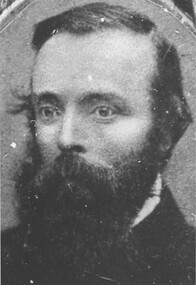
Photograph
... Prior to leading this expedition, Burke was the superintendent of Police in Beechworth from 1854-1858. ...Prior to leading this expedition, Burke was the superintendent of Police in Beechworth from 1854-1858. ...This photograph is of Robert O'Hara Burke (6 May 1821 – c. 28 June 1861) who was an Irish soldier and police officer who achieved fame as an Australian explorer. He was the leader of the ill-fated Burke and Wills expedition, which was the first expedition to cross Australia from south to north, finding a route across the continent from the settled areas of Victoria to the Gulf of Carpentaria. Prior to leading this expedition, Burke was the superintendent of Police in Beechworth from 1854-1858. The Robert O’Hara Burke Memorial Museum was named in honour of Robert O’Hara Burke after his death at Coopers Creek in 1861 during expedition. This particular image of Robert O'Hara Burke features on the 'Pioneer Board' which is currently on display in the Museum. Black and white rectangular copy of a photograph. Image is printed on gloss photographic paper and has a white unprinted boarder. Reverse: 34 / Photo credit: Burke Museum / BEECHWORTH / 46% /robert o'hara burke, pioneers of beechworth, pioneer board, beechworth, police superintendent -
 Bendigo Historical Society Inc.
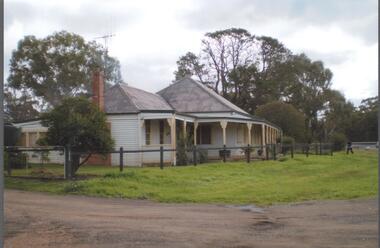
Photograph - BENDIGO HISTORICAL SOCIETY COLLECTION: MATHIESON'S HOTEL, KNOWSLEY
... Photo taken on BHS tour. Burke and Wills Expedition camped near this site in 1860, allegedly opposite the Mathieson's Hotel....Photo taken on BHS tour. Burke and Wills Expedition camped near this site in 1860, allegedly opposite the Mathieson's Hotel. ...Colour photograph of Mathieson's Hotel, Knowsley. Weatherboard building with iron roof, verandah at front. Hotel is also known locally as Cosmos and has been used as a residence for many years. Currently owned by Don and Carol White, Knowsley. Photo taken on BHS tour. Burke and Wills Expedition camped near this site in 1860, allegedly opposite the Mathieson's Hotel.buildings, commercial, mathieson's hotel, knowsley -
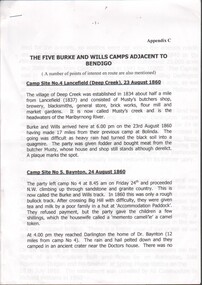 Bendigo Historical Society Inc.
Document - Tour Guide
... The Burke and Wills expedition in 1860–61 planned to cross Australia from Melbourne to the Gulf of Carpentaria. ...The Burke and Wills expedition in 1860–61 planned to cross Australia from Melbourne to the Gulf of Carpentaria. ...The Burke and Wills expedition in 1860–61 planned to cross Australia from Melbourne to the Gulf of Carpentaria. It was made up of 19 men led by Robert O'Hara Burke, with William John Wills as deputy commander. Only one man survived. This tour guide lists the Burke and Wills camp sites adjacent to Bendigo.The Five Burke and Wills Camps Adjacent to Bendigo Tour guide. Photocopy of six typed pages of variable format type, single page typing, black and white. Source unknownburke and wills, bendigo, tour guide, camp sites -
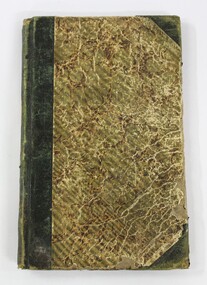 Wodonga & District Historical Society Inc
Administrative record - Wodonga Police Register of Duties 1855-1857
... It has several references to Robert O'Hara Burke, who was a soldier, police officer in Victoria, and well-known explorer in the ill-fated Burke and Wills expedition....It has several references to Robert O'Hara Burke, who was a soldier, police officer in Victoria, and well-known explorer in the ill-fated Burke and Wills expedition. The Wodonga police register has local significance due to the detailed information and date in the 1850s, which was before Wodonga became a separate Shire from Yackandandah Shire. ...The Wodonga Police register dated to 1855-1857 provides a record of the names of police officers and details of their day-to-day duties, including crimes committed and steps taken to trace and apprehend perpetrators. It has several references to Robert O'Hara Burke, who was a soldier, police officer in Victoria, and well-known explorer in the ill-fated Burke and Wills expedition.The Wodonga police register has local significance due to the detailed information and date in the 1850s, which was before Wodonga became a separate Shire from Yackandandah Shire. It is also significant on a state and national level as an example of early police records. The detailed information provides significant research and interpretive potential. Green leather and faded green and brown marbled paper bound register or diary, recording the day-to-day duties of the Wodonga Police in 1855-1857. Pale blue watermarked paper with faint lines in the interior. Every second page has been removed and there is staining on some of the pages.The entries are written in iron gall ink and are deteriorated/faded in places. Red-brown and green marbled paper on the interior front and back covers, with linen binding. There are three small red wax seals on the inside front cover used to secure an introductory page of writing. The paper around the seals is torn and the page has become detached. Fragmentary inscription written on paper on the green leather spine.wodonga police, robert o'hara burke, police records, police register, wodonga, police journal, police diary -
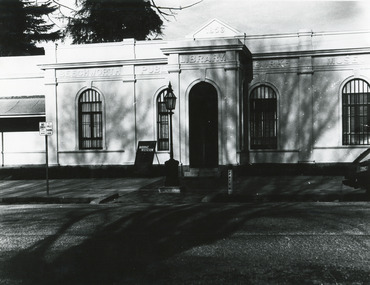 The Beechworth Burke Museum
Photograph, c1970
... As Australia’s oldest regional museum, the building used for the Burke Museum was originally built as the Beechworth Athenaeum, and was later dedicated as a museum in memorial to the explorer Robert O’Hara Burke, who died on the Burke and Wills expeditions in 1861. The Burke and Wills exhibitions were a significant colonial event that was memorialised in paintings, buildings, monuments, and statues. ...Described as quick-tempered yet generous, Burke later joined an expedition to explore the interior of the Victorian colony, which was later termed the Burke and Wills expeditions. ...Historical photograph taken of the frontage of the Burke Museum in Beechworth. As Australia’s oldest regional museum, the building used for the Burke Museum was originally built as the Beechworth Athenaeum, and was later dedicated as a museum in memorial to the explorer Robert O’Hara Burke, who died on the Burke and Wills expeditions in 1861. The Burke and Wills exhibitions were a significant colonial event that was memorialised in paintings, buildings, monuments, and statues. The photograph has historical significance, connecting with various themes such as exploring, establishing pathways, and significant colonial events or persons. The photograph depicts the frontage of the Burke Museum, which was dedicated as a memorial to the explorer Robert O’Hara Burke, who died on the Burke and Wills expeditions in 1861. Robert O’Hara Burke was a significant person who was connected to both Beechworth and to an important colonial event, the Burke and Wills expeditions. Born in Ireland, Burke migrated to Australia in 1853 and nearly a year later, was appointed to senior inspector at Beechworth. Described as quick-tempered yet generous, Burke later joined an expedition to explore the interior of the Victorian colony, which was later termed the Burke and Wills expeditions. While the expeditions generated a significant amount of interest, the objectives of the Burke and Wills expeditions were hazy, as was its planned route, leading to disaster on the trip as group infighting, poor provisions, and a lack of clear instructions ultimately resulted in Burke’s death. Regardless, the Burke and Wills expeditions promoted discovery and endures today in popular memory.Black and white rectangular photograph printed on paper.Obverse: 1856/ BEECHWORTH/ PUBLIC/ LIBRARY/ BURKE/ MUSEUM/ BURK MUSEUM/ (parking signs illegible) Reverse: BMM 84-2-1/ A02989 1997 2696/ BMM 84-2-3burke museum, beechworth, beechworth athenaeum, athenaeum, memorial, robert o'hara burke, robert burke, burke and wills exhibitions -
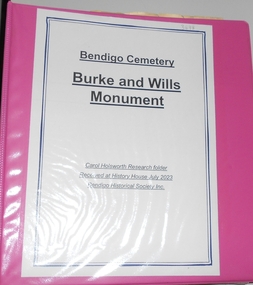 Bendigo Historical Society Inc.
Document - RESEARCH FOLDER COLLECTION: BURKE AND WILLS MONUMENT, 1990 - 2015
... Burke and Wills Monument A folder of material relating to the Burke and Wills monument at the Bendigo cemetery including photographs and historical information, The folder also contains information about the Burke and Wills expedition that Carol collected over many years. ...Burke and Wills Monument A folder of material relating to the Burke and Wills monument at the Bendigo cemetery including photographs and historical information, The folder also contains information about the Burke and Wills expedition that Carol collected over many years. ...Folder of research material compiled by Carol Holsworth. Received at History House in July 2023. Burke and Wills Monument A folder of material relating to the Burke and Wills monument at the Bendigo cemetery including photographs and historical information, The folder also contains information about the Burke and Wills expedition that Carol collected over many years. This material was presented to the Bendigo Historical Society in 2010 after the commemoration events marking the 150th Anniversary Celebration that year.Carol Holsworthbendigo, history, burke and wills monument -
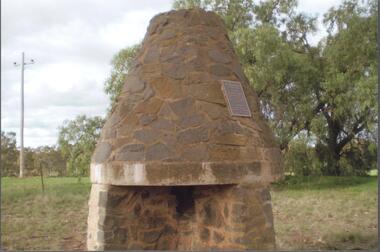 Bendigo Historical Society Inc.
Photograph - BENDIGO HISTORICAL SOCIETY COLLECTION: BURKE AND WILLS CAIRN BARNADOWN
... Colour photograph of bluestone fireplace erected at Barnadown to commemorate the camp site of the Burke and Wills expedition.The stone fireplace is a memorial to the Burke and Wills Expedition which camped near here. It was erected by the Waranga Shire Council to commemorate the centenary of the Victorian Exploring Expedition`s passage through the Barnadown district in 1860. ...EXPLORATION Terrestrial burke and wills Colour photograph of bluestone fireplace erected at Barnadown to commemorate the camp site of the Burke and Wills expedition.The stone fireplace is a memorial to the Burke and Wills Expedition which camped near here. It was erected by the Waranga Shire Council to commemorate the centenary of the Victorian Exploring Expedition`s passage through the Barnadown district in 1860. ...Colour photograph of bluestone fireplace erected at Barnadown to commemorate the camp site of the Burke and Wills expedition.The stone fireplace is a memorial to the Burke and Wills Expedition which camped near here. It was erected by the Waranga Shire Council to commemorate the centenary of the Victorian Exploring Expedition`s passage through the Barnadown district in 1860. A plaque on the structure reads: 'Burke and Wills Centenary. The party camped near this spot on 28th August 1860 on its outward journey. Erected by the Shire of Waranga 1960'.exploration, terrestrial, burke and wills -
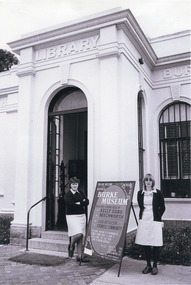 The Beechworth Burke Museum
Photograph, c.1980
... The building was turned into a museum and renamed the Robert O'Hara Burke Memorial Museum in 1863 in honour of Robert O'Hara Burke, former Police Superindendent of Beechworth who died in 1861 on the Burke and Wills expedition. The Burke Museum has been in almost continual operation since that time. ...The building was turned into a museum and renamed the Robert O'Hara Burke Memorial Museum in 1863 in honour of Robert O'Hara Burke, former Police Superindendent of Beechworth who died in 1861 on the Burke and Wills expedition. The Burke Museum has been in almost continual operation since that time. ...This photograph depicts the entrance to the Burke Museum in Beechworth, most likely in 1980. The building was originally established as the Beechworth Athenaeum in 1857 to provide a lecture hall and reading room at the peak of the gold rush. In 1859, it became the Beechworth Public Library, which is why the writing embossed above the main entry says 'Library' rather than 'Museum'. The building was turned into a museum and renamed the Robert O'Hara Burke Memorial Museum in 1863 in honour of Robert O'Hara Burke, former Police Superindendent of Beechworth who died in 1861 on the Burke and Wills expedition. The Burke Museum has been in almost continual operation since that time. In the 1970s, the building underwent renovations to create several verandas, though the main façade visible in this photograph remained as it was when originally built. The Burke Museum currently contains over 30,000 individual objects, including the Gold Rush era items and the Ned Kelly collection advertised on the a-frame in the photograph. The photograph itself is also part of the Burke Museum collection.The Burke Museum itself is very significant to Victorian history. It is on both the Victorian Heritage Register and is part of the National Trust due to its relevance to the history of the Gold Rush period, its architectural features, and its significant collection. Photographs of it throughout its history are an important part of telling the museum's story. This photograph in particular highlights what the museum staff believed would be appealing to a 1980s public, evident by the A-frame advertising board.A black and white rectangular photograph printed on photographic paper.Top right text: 5147. Bottom left text: Beryl Seatt (or possibly Scatt) & friend 1980beechworth, burke museum, beechworth museum, beechworth historic precinct, architecture, museum, library, 1980s, 1980s australia, museum staff -
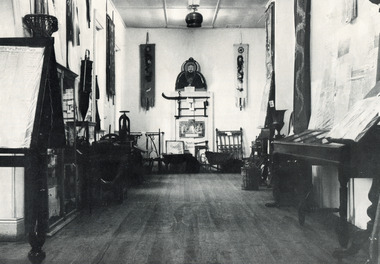 The Beechworth Burke Museum
Photograph
... ...Burke and Wills Expedition...Originally built as the Beechworth Athenaeum in 1857, the museum was later renamed to the Robert O'Hara Burke Memorial Museum, more commonly known as the Burke Museum, in honour of the famous explorer and former Beechworth Superintendent of Police, Robert O'Hara Burke, after his death in 1861 at Coopers Creek during the famed ill-fated Burke and Wills expedition....Beechworth Spring Creek Chinese Burke Museum Immigration Chinese Immigration Ovens Goldfield China Museum Robert O'Hara Burke Burke and Wills Expedition Burke and Wills Goldfields Black and white rectangular photograph printed on paper. ...This black and white photograph is estimated to have been taken c1900 inside the Burke Museum. Several objects part of the museum collection at the time can be seen, with a high number of Asian influence objects visible; potentially Chinese in origin, as several Chinese villages were located around Beechworth and across Spring Creek, from the mid 1800s. The Burke Museum is part of the Precinct of Beechworth, which was established upon the discovery of gold in 1852. Originally built as the Beechworth Athenaeum in 1857, the museum was later renamed to the Robert O'Hara Burke Memorial Museum, more commonly known as the Burke Museum, in honour of the famous explorer and former Beechworth Superintendent of Police, Robert O'Hara Burke, after his death in 1861 at Coopers Creek during the famed ill-fated Burke and Wills expedition.This photograph is contextually, historically and socially significant due to its connection to both the Burke Museum and Chinese culture in and around Beechworth during the mid-1800s through to 1900s. Around 4700 people of Chinese heritage lived at the Ovens goldfield by April of 1857, representing one-quarter of the entire population at the time. The object holds strong representativeness to the history of the Burke Museum and to the objects in its collection. Its interpretive capacity could be supported and enhanced with other photographs and objects in the collection. Collectively, these records and objects could provide an insight into the museum's collection and its relationship with the origins of the objects.Black and white rectangular photograph printed on paper. Unmounted; taped to paper. beechworth, spring creek, chinese, burke museum, immigration, chinese immigration, ovens goldfield, china, museum, robert o'hara burke, burke and wills expedition, burke and wills, goldfields -
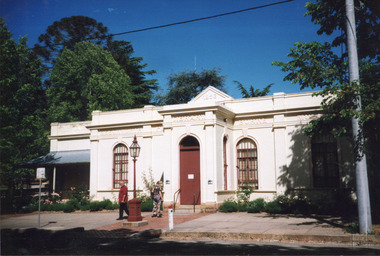 The Beechworth Burke Museum
Photograph, c1999-2000
... ...burke and wills expedition...In 1863 the museum was dedicated as a memorial to former Beechworth police superintendent (1854-1858) and explorer Robert O’Hara Burke, following Burke’s death from malnutrition on the Burke and Wills expedition in 1861. Funded by the Victorian Government and the Royal Society of Victoria, the officially titled 'Victorian Exploring Expedition' was tasked with being the first European party to traverse Australia from south to north. ...In 1863 the museum was dedicated as a memorial to former Beechworth police superintendent (1854-1858) and explorer Robert O’Hara Burke, following Burke’s death from malnutrition on the Burke and Wills expedition in 1861. Funded by the Victorian Government and the Royal Society of Victoria, the officially titled 'Victorian Exploring Expedition' was tasked with being the first European party to traverse Australia from south to north. ...This photograph taken c1999/2000, depicts the Burke Museum’s granite façade and vestibule entrance. The museum's large red door is closed and there is a white sign is attached to the door. The museum site dates to the 1857 founding of the Beechworth Public Library and Athenaeum by a newly formed Young Men's Association (YMA). In 1863 the museum was dedicated as a memorial to former Beechworth police superintendent (1854-1858) and explorer Robert O’Hara Burke, following Burke’s death from malnutrition on the Burke and Wills expedition in 1861. Funded by the Victorian Government and the Royal Society of Victoria, the officially titled 'Victorian Exploring Expedition' was tasked with being the first European party to traverse Australia from south to north. The Burke Museum holds objects from the famous expedition and explores the multi-layered history of Beechworth and surrounds from the gold rush era to the present.This photograph is historically significant for its depiction of the Burke Museum c1999/2000. The Burke Museum is Australia’s oldest regional museum and part of Beechworth's Historic and Cultural Precinct, one of Australia’s best preserved historic-town sites and a popular tourist destination. Once the government centre for a vast gold fields region, this collection of nationally significant buildings tells the story of how Australia grew and prospered. The frequent use of honey-coloured local granite as a building material, which can be seen in the museum's fabric, gives Beechworth’s historic buildings a distinct and cohesive local character. This photograph captures this distinctive character and may be compared and studied alongside other images of historic buildings in the Burke Museum Photographic Collection.Rectangular colour photograph printed on photographic paper.Reverse: 7031 / Label: Burke Museum / 1999/2000 /burke museum, indigo shire, beechworth athanaeum, beechworth library, beechworth historic building, historic precinct, burke museum exhibition, from the liedertafel to the skating rink, honey-coloured local granite, robert o'hara burke, victorian gold fields, historic towns in victoria, colonial australia, liedertafel, colonial entertainments, beechworth brass band, historic victorian architecture, australia's oldest regional museum, burke and wills expedition, first europeans to cross australia, yound mens associations, beechworth tourism, things to see in beechworth, beechworth historic trail, young men's associations -
 Glen Eira Historical Society
Document - Howitt family
... Includes details of his professional life. 2/Newspaper reprinted article from ‘News’ Shepparton, dated 19/07/1960 on the centenary of the start if Burke and Wills’ expedition mentioned the journey made by author William Howitt and his two sons, and about his book he wrote ‘Land, Labour and Gold’, and about son Alfred who became a scientist and later brought the remains of Burke and Wills back to Melbourne. 3/A 15-page booklet written by family member Gwen Webb on the life and work of Alfred William Howitt, explorer, scientist and public servant. ...Includes details of his professional life. 2/Newspaper reprinted article from ‘News’ Shepparton, dated 19/07/1960 on the centenary of the start if Burke and Wills’ expedition mentioned the journey made by author William Howitt and his two sons, and about his book he wrote ‘Land, Labour and Gold’, and about son Alfred who became a scientist and later brought the remains of Burke and Wills back to Melbourne. 3/A 15-page booklet written by family member Gwen Webb on the life and work of Alfred William Howitt, explorer, scientist and public servant. ...3 items about the Howitt family in the 1800s to early 1900s: 1/Twelve photocopied pages from ‘The Educational Magazine’ August 1955. The article is about Dr. Godfrey Howitt, his arrival in Melbourne with his family, the house he lived in in Collins Street before moving to Caulfield, and his other family members. Includes details of his professional life. 2/Newspaper reprinted article from ‘News’ Shepparton, dated 19/07/1960 on the centenary of the start if Burke and Wills’ expedition mentioned the journey made by author William Howitt and his two sons, and about his book he wrote ‘Land, Labour and Gold’, and about son Alfred who became a scientist and later brought the remains of Burke and Wills back to Melbourne. 3/A 15-page booklet written by family member Gwen Webb on the life and work of Alfred William Howitt, explorer, scientist and public servant. Booklet covers prospecting, Burke and Wills, East Gippsland, Bairnsdale, science, public service, and a chronology and his honours and distinctions, printed in 1980, titled ‘A. W. Howitt 1830-1908’howitt godfrey dr., howitt richard, botanists, naturalists, howitt alfred, cussen dr., howard mr., were mr., howitt mary, howitt lane, howitt william, gold rush, writers, ‘grosvenor chambers’, balaclava road, kooyong road, caulfield, howitt william godfrey dr., surgeon, ‘harvard house’, howitt edith mary, anderson edith mary, howitt edward, howitt charles ernest, howitt charlton, scientists, explorers, howitt mrs., webb gwen, howitt a. w., howitt walker mary, howitt alfred william, farms, boothby liney, howitt liney mrs. -
 Bendigo Historical Society Inc.
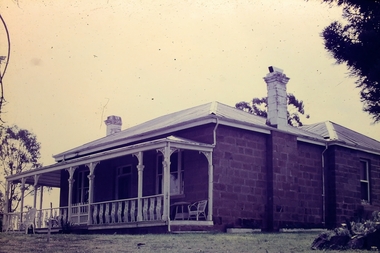
Slide - Adelaide Vale Homestead Fosterville
... The homestead is picturesquely sited and overlooks the Campaspe River valley, the Burke and Wills expedition camped nearby on their ill-fated expedition north. ...The homestead is picturesquely sited and overlooks the Campaspe River valley, the Burke and Wills expedition camped nearby on their ill-fated expedition north. ...Adelaide Vale Homestead was begun in 1853 by John Harvey and was later occupied by Edward and Andrew O'Keefe. The building comprises a series of single storey stone buildings arranged behind a simple composed, verandah facade with a centrally located doorway flanked by windows. A central corridor leads from this doorway to a transverse corridor which was probably once an open breezeway. A free- standing octagonal pavilion is located close to the house. This is an interesting homestead dating from early times and constructed of local stone. The front facade is typically composed and the plan reflects the continuous growth of the property throughout the nineteenth century. The octagonal pavillion is a significant and unusual feature. The homestead is picturesquely sited and overlooks the Campaspe River valley, the Burke and Wills expedition camped nearby on their ill-fated expedition north. The old cheese factory is the sole survivor of the once extensive out-buildings. Some of the nineteenth century buildings have been demolished and there have been some later additions and alterations, notably an extensive side wing added in the 1920's. [In Butcher & Flanders, Bendigo Historic Buildings, 1987, the date of the house is given as 1868. Presumably this house replaced an older one on the property.]Adelaide Vale Homestead Fostervillehistory, bendigo, national trust collection bendigo, adelaide vale homestead -
 Bendigo Military Museum
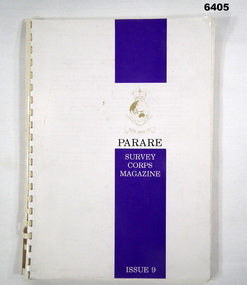
Magazine - "Parare" Survey Corps Magazine Issue 9, Royal Australian Survey Corps, 1993
... The William Patton Expedition - Locating his grave as part of the " Burke and Wills " expedition, list of personnel involved - page 43. 8 Fd Svy Sqn - names mentioned and photo - page 50. 4 Fd Svy Sqn (1992) names mentioned page 69. ...The William Patton Expedition - Locating his grave as part of the " Burke and Wills " expedition, list of personnel involved - page 43. 8 Fd Svy Sqn - names mentioned and photo - page 50. 4 Fd Svy Sqn (1992) names mentioned page 69. ...An annual magazine published for release on RASvy Corps birthday 1st July. All units with RASvy Corps are invited / expected to submit an article depicting their activities over the preceding years 1991 to 1993. 4Fd Svy Sqn Adventure training list pages 7, 8. Army Map Depot - Unit Ski Day, pages 20, 21. The William Patton Expedition - Locating his grave as part of the " Burke and Wills " expedition, list of personnel involved - page 43. 8 Fd Svy Sqn - names mentioned and photo - page 50. 4 Fd Svy Sqn (1992) names mentioned page 69. The G Res manning list on page 70. Names mentioned in "Unit sports pages 73, 74. Exercise Kokoda Cartographer July 1992 list of participants on Page 78. Iraq - The Gulf War, Topographic Support page 52. Adelaide (4 Fd Svy Sqn) 1992 page 65. 8 Fd Svy Sqn manning wind down list pages 89-90. Military Geographic Information Pilot Project page 92. Royal Australian Survey Corps Aerial photography Team personnel list page 95. Operation Belama 92 Team list page 96. Long term Schooling attendees and promotions, page 105. Litho Sqn Postings in and out pages 116-117. Special awards SGT Durrant page 113, SSGT SR Hill page 114. RASvy completes 1:50,000 scale mapping of the Pilbara Region page 121. 1st Topo Svy Sqn personnel mentioned on page 122. A4 sized booklet with soft glossy card covers, paper pages held together with a plastic spiral binder.army survey regiment, army survey regt, fortuna, royal australian survey corps, rasvy, asr -
University of Melbourne, School of Chemistry
Combustion Demonstration
... Appointed secretary of the Royal Society of Victoria in 1860 and vice-president in 1863, he was also the secretary of the exploration committee of the Burke and Wills expedition. When the Medical School of the University of Melbourne opened in 1862 Macadam was appointed lecturer in chemistry. ...Appointed secretary of the Royal Society of Victoria in 1860 and vice-president in 1863, he was also the secretary of the exploration committee of the Burke and Wills expedition. When the Medical School of the University of Melbourne opened in 1862 Macadam was appointed lecturer in chemistry. ...John Macadam was a Scottish born analytical chemist, medical practitioner and politician. As a student he soon showed a flair for analytical chemistry, and later also studied medicine. He arrived in Melbourne in 1855 to take up an appointment as lecturer in chemistry and natural science at Scotch College, a position he held until 1865. In 1857 Ferdinand von Mueller named the Macadamia nut after him. He officiated as one of two umpires at one of the earliest recorded games of Australian rules football, between Scotch College and Melbourne Grammar in 1858. Macadam was appointed government analytical chemist in 1858 and health officer to the City of Melbourne in 1860. He represented Castlemaine in the Legislative Assembly between 1859 and 1864. Appointed secretary of the Royal Society of Victoria in 1860 and vice-president in 1863, he was also the secretary of the exploration committee of the Burke and Wills expedition. When the Medical School of the University of Melbourne opened in 1862 Macadam was appointed lecturer in chemistry. He was a skilled, popular and eloquent lecturer, learned and generous with his knowledge. Sadly, just three years later, and aged only 38, he died at sea on the way to give evidence at a murder trial in New Zealand, leaving his widow Elizabeth (n�e Clark), and a son. He was accompanied on that voyage by his assistant, the medical student John Drummond Kirkland, who later became the University?s first Professor of Chemistry. Born in Ireland, John Drummond Kirkland trained as a chemical analyst through apprenticeship in a medical laboratory in Dublin, before migrating to Australia in 1852 and moving to Melbourne in 1855. While still an undergraduate medical student at the University of Melbourne, he was appointed lecturer in chemistry following the sudden death of John Macadam in 1865. Due to the enthusiastic support of his fellow students this temporary role became a permanent appointment the following year. Kirkland continued his studies, graduating in medicine in 1873 and surgery in 1880. His son, John Booth Kirkland, was appointed as his assistant in 1878, later leading to accusations of nepotism. In 1882 John Drummond Kirkland became the University?s first professor of chemistry and metallurgy, continuing until his death in 1885. Today?s researchers use a high performance computing facility named ?Kirkland? after the first Professor of Chemistry at the University of Melbourne. Chemistry was still controlled by the medical school during Kirkland?s career, but became part of the science degree from 1886, along with the appointment of David Orme Masson as professor. Kirkland struggled for University funding to buy new apparatus. To compensate, he bought much from his own personal funds, including analytical chemistry equipment. Chemistry was first taught at Melbourne in the medical school, located in the area now occupied by Physics and the Ian Potter Museum of Art.Demonstration of combustion Mid 19th century, used by McCoy, MacAdam,and Kirkland -
 Flagstaff Hill Maritime Museum and Village
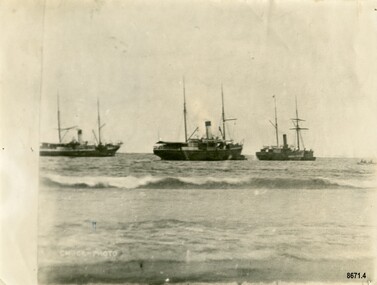
Photograph - Steamers - Julia Percy, Dawn and Coorong, Chuck Photo Ballarat, Circa 1885
... The following year he produced and toured a "Grand Moving Diarama" of dramatic painted scenes from the Burke and Wills expedition. By 1866 he had established a photography studio in Daylesford and later he returned to Melbourne where he opened a studio in the Royal Arcade. ...The following year he produced and toured a "Grand Moving Diarama" of dramatic painted scenes from the Burke and Wills expedition. By 1866 he had established a photography studio in Daylesford and later he returned to Melbourne where he opened a studio in the Royal Arcade. ...This photograph was one of ten photographs donated to Flagstaff Hill Maritime Museum and Village by Fred Trewartha. Frederick John Fox Trewartha (Fred) was a well-known Warrnambool businessman. He was born in Beeac near Geelong in 1920 and came to Warrnambool with his family as a very young child. He was apprenticed to his father John, as a saddler and later opened his own shop on Raglan Parade. He then moved into working with tarpaulins and canvases for the trucking industry. Fred was keenly interested in photography (and was a member of the Warrnambool Cine Club), yachting and boat building. He kept his yacht moored at Port Fairy for many years and participated in sailing events locally and interstate. He also built boats with his sons. He had the opportunity to meet many older sailors and it's thought this photo (and others in the set) may have been given to him by one of these men. Fred Trewartha died in 2016 in Warrnambool. Shipping was the cheapest and most practical means of carrying produce and goods during the period 1840-1890. Regular domestic steamer services commenced in the Warrnambool district in the late 1850’s and by 1870 the passenger trade was booming. Four coastal traders made regular stops at Warrnambool in the 1880's - S. S. Julia Percy, S. S. Dawn, S. S. Nelson and S. S. Casino. The S.S. Julia Percy (later named Leeuwin) was an iron passenger-cargo steam ship built in 1876. At one point in time the Julia Percy would sail from Warrnambool to Melbourne every Friday and return from Melbourne to Warrnambool every Tuesday. The cost of a return ticket for a Saloon Fare was £1.0.0. The Julia Percy was built in Glasgow by Thomas Wingate & Company, Whiteinch, in 1876 for the Warrnambool Steam Packet Company, which commissioned it for trade in Victoria’s western district. It was first registered in Warrnambool, Victoria in 1876. Two steamships, the Julia Percy and the Nelson, collided on 25th December 1881. The Julia Percy was at that time owned by its first owners, the Warrnambool Steam Packet Company, and she sailed under the command of Captain Chapman. It had left Melbourne the evening of 24th December, with about 150 passengers, sailing in fine weather through Port Phillip Heads around 9pm. It was headed for Warrnambool, Belfast (now named Port Fairy) and Portland. The Julia Percy was off Apollo Bay when Captain Chapman was woken by the ship’s whistle after midnight, the steamer Nelson being on a collision course with the Julia Percy. The Nelson struck Julia Percy midship. Boats were lowered from the ship (apart from a damaged lifeboat) and about 30-40 of the passengers boarded the Nelson. The engine room and the forehold were checked and found clear of water. The company manager, Mr. Evans, had been on the Nelson, so he boarded and inspected the Julia Percy and the decision was made to continue on to Warrnambool with the passengers as there appeared to be no immediate danger. However, Captain Thomas Smith said the Nelson was taking on water, so Julia Percy followed it for about an hour towards Melbourne on standby in case of need. Then Julia Percy turned around towards Warrnambool again. Shortly afterwards the Nelson turned to follow her, the ships stopped and passengers were returned to Julia Percy, and three from Julia Percy boarded the Nelson. Both ships proceeded on their way. Julia Percy passed Cape Otway light afterwards, signaling that there had been a collision. It was discovered later that one of the passengers was missing, then thought to have boarded the Nelson but later thought to have fallen into the sea and drowned while trying to jump from Julia Percy to Nelson. There had been 3 tickets purchased under the same name of that passenger “Cutler”; a father, son and friend named Wordsworth, which had caused quite some confusion. No further mishap occurred to either ship and both the Julia Percy and the Nelson reached their destinations safely. An enquiry was instigated by the Victoria Steam Navigation Board regarding the cause of the accident between the two steamships, in connection with the death of Cutler who was supposed to have lost his life by the collision. The enquiry resulted in Captain Thomas Smith having his master's certificate suspended for six months. The Julia Percy changed hands several times. Its next owner was the Western Steam Navigation Co (1887), managed by Mr. T.H. Osborne (the company’s office was on the corner of Timor and Liebig Streets - its north-western wall is now part of the current Warrnambool Regional Art Gallery.) The Melbourne Steamship Co became the next owners (1890), followed by William Howard Smith and Sons (1901) for use in Queensland coastal trades and then it was bought by George Turnbull in 1903 and used for local mail contract in Western Australia. The Julia Percy was sold to the Melbourne Steamship Company Ltd. (1906) and re-named the “Leeuwin” but continued in her Western Australian coastal run. It was converted into a coal hulk in Melbourne in 1910 as a result of damaged caused when it was driven against the jetty at Dongara during a gale. The ship was eventually dismantled and scuttled off Port Phillip Heads on 28 December 1934. The steamship "Dawn" was a 522-ton coastal trader built in 1876 and the vessel operated around the Victorian west coast from 1877 until 1898 for the Portland & Belfast Steam Navigation Co. sailing between Melbourne and Portland, via Warrnambool. The vessel was then owned in October 1885 by the renamed company, Belfast & Koroit Steam Navigation Co., until March 1896 when its ownership moved to W Howard Smith & Sons Ltd. This Melbourne company used the ship to service most ports around Australia. Captain F. Chapman took over from Captain Jones and served on the SS Dawn from 1898 until 1900 when he took command of the SS Casino. On September 4th 1880, the three masted clipper ship, "Eric the Red" struck Otway Reef, near Cape Otway. The S. S. Dawn, under the command of Captain Jones, was returning to Warrnambool from Melbourne, its sailing time different to its usual schedule. The provedore of the Dawn, Benjamin Lear, heard cries of distress coming through the portholes of the saloon. He gave the alarm and the engines were stopped. Cries could be heard clearly, coming from the land. Captain Jones sent out crew in two boats, and fired off rockets and blue lights to illuminate the area. They picked up the three survivors who were in the long boat from "Eric the Red". Two men were picked up out of the water, one being the owner’s son who was clinging to floating kerosene boxes. At daylight the Dawn then rescued the 18 men from the floating portion of the deckhouse, which had drifted about 4 miles from where they’d struck the reef. Shortly after the rescue the deckhouse drifted onto breakers and was thrown onto rocks at Point Franklin, about 2 miles east of Cape Otway. Captain Jones had signalled to Cape Otway lighthouse the number of the Eric the Red and later signalled that there was a wreck at Otway Reef but there was no response from the lighthouse. The captain and crew of the Dawn spent several more hours searching unsuccessfully for more survivors, even going back as far as Apollo Bay. On board the Dawn the exhausted men received care and attention to their needs and wants, including much needed clothing. Four men (three crew and one passenger) died. A week after the shipwreck, the Australian Government had also conveyed its thanks to the Captain and crew of the S.S. Dawn - “Captain Griffith Jones, S.S. Dawn, The Hon. Mr Clark desires that the thanks of the Government should be conveyed to you for the prompt, persevering and seamanlike qualities displayed by you, your officers and crew in saving the number of lives you did on the occasion referred to. The Hon. The Commissioner has also been pleased to award you a souvenir in commemoration of the occasion, and a sum of 65 pounds to be awarded to your officers and crew according to annexed scale. I am, &c, W Collins Rees, for and in the absence of the Chief Harbour Master.” The Awards are as follows: - Crew of DAWN'S lifeboat-Chief Officer, Mr G. Peat, 15 pounds; boat's crew-G. Sterge, A.B., 5 pounds; T. Hammond, A.B., 5 pounds; J. Black, A.B., 5 pounds; H. Edwards, A.B., 5 pounds. Dinghy's Crew-Second Officer, Mr Christie, 10 pounds; boat's crew -F. Lafer, A.B., 5 pounds; W. Johnstone, A.B., 5 pounds; Mr Lear, provedore, 5 pounds; Mr Dove, purser, 5 pounds. Captain Jones receives a piece of plate. (from “Wreck of the ship Eric the Red” by Jack Loney). Medals of Bravery were awarded to the Captain and crew of the S.S. Dawn by the President of the United States, through the Consul-general (Mr Oliver M. Spencer), in July 1881 “ … in recognition of their humane efforts in rescuing the 23 survivors of the American built wooden sailing ship, the Eric the Red, on 4th September 1880.” The men were also presented with substantial monetary rewards and gifts. The city of Warrnambool’s care of the survivors was also mentioned by the President at the presentation, saying that “the city hosted and supported the crew ‘most graciously’. The Medal of Bravery awarded to Nelson Johnson is in the collection at Flagstaff Hill Maritime Museum and Village in Warrnambool. Prior to 1882, and the arrival of the S. S. Casino, the "Dawn" was the only steamer to be able to navigate up the Moyne River at Port Fairy and unload at the wharf. The other regular steamers had to anchor in the bay instead. In February 1891 (as reported in The Age newspaper) the "Dawn" became the first vessel to berth alongside the newly completed Warrnambool Breakwater. The occasion was celebrated with a number of prominent townspeople assembling on board to "participate of a glass of wine". In 1895 the owners of the S.S. Dawn, the Portland and Belfast Steam Navigation Co., wound up and sold out to the Belfast Company who took over the Dawn for one year before selling it to Howard Smith. It took over the Melbourne to Warrnambool run in 1906 when the S. S. Flinders was sold. The S. S. Dawn was condemned and sunk in Suva in 1928. The State Library of Victoria has a lithograph in its collection depicting the steamer Dawn and the shipwrecked men, titled. "Wreck of the ship Eric the Red, Cape Otway: rescue of the crew by the Dawn". The third ship depicted in the photograph was thought to be the S. S. Coorong but there was a question mark next to its name. The photograph was thought to have been taken in 1885 and it's possible the S.S. Coorong was working in Clarence River, N. S. W. by this time. The steamer "Coorong" was built in 1862 by J. G. Lawrie of Glasgow. It was an "iron screw" steamer of 304 tons. It had many owners including Joseph Darwent of Adelaide (1863 - 1871), McMeckan Blackwood and Company, Melbourne (1871 - 1877), Mount Gambier Steamship Company Ltd. (1877 - 1881). William Whineham, Port Adelaide (1882), John See and Company, Sydney (1884 - 1892) and the North Coast Steam Navigation Company Ltd, Sydney (1892 - 1910). In 1911 it was hulked in Sydney Harbour and in 1921 it was being used as a coal hulk at Sydney. It had been originally imported into South Australia for the Port Augusta trade (primarily transporting goods needed by the early settlers) however the owners recognized that it had too much space for that purpose, so it was moved to work on the Adelaide to Melbourne line. Its passenger accommodation was enlarged and it enjoyed a "first class reputation" and by 1874 had made 313 voyages between Melbourne and Adelaide. Its captains included Captain McLean, Captain Ashton and Captain Dowell. In 1867, when 25 miles west of Cape Otway, while travelling from Adelaide to Melbourne, it came across the crew of the schooner "Black Watch" who had abandoned ship after it began quickly taking on water. The crew (six men) were able to get away in a small boat with a compass, chart and few candles. They were "excessively cold from exposure to the weather" when the S. S. Coorong picked them up. In 1877 the Coorong ran aground when entering the Outer Harbour at Adelaide (but was not damaged) and in 1882 it was stranded (for a short time) near Curdies Inlet (Victoria) with some slight damage to its bottom plates. Note - A ship with the same name "Coorong" (a coal carrying barque) was often on the Newcastle / Wollongong to Adelaide route also stopped several times in Warrnambool in the mid 1880's. The photograph has the label "Chuck Photos" printed on the front. Thomas Foster Chuck (born 1826 in London) was a photographer and entrepreneur who arrived in Victoria in 1861. The following year he produced and toured a "Grand Moving Diarama" of dramatic painted scenes from the Burke and Wills expedition. By 1866 he had established a photography studio in Daylesford and later he returned to Melbourne where he opened a studio in the Royal Arcade. In 1874 a collection of Chuck's photographs won a gold medal at the Annual International Exhibition in London. Throughout the 1870's he took over 700 individual photographs of prominent citizens for his historical photographic montage titled "Historical Pictures of the Explorers and Early Colonists of Victoria" which is now in the collection of the National Library of Australia. By 1888 he had sold his Melbourne studio and had established a studio in Ballarat (with his son Thomas Henry Chuck). In 1886 they produced an album titled "Warrnambool and District 1886, Western Hotel - J. Fox proprietor" containing over sixty large photographs of local coastal scenes and seascapes, for the use of patrons of the Western Hotel. This photo (of the three steamers in Lady Bay) was taken at this time and is in the album. Thomas Chuck died on December 7th, 1898, in Albert Park, Melbourne and his son Thomas Henry continued to operate the photography studio in Ballarat into the 1920's.This photograph is a significant record of several of the well-known coastal traders (S. S. Julia Percy, S. S. Dawn and possibly S. S. Coorong) that sailed along the southwest coast of Victoria for many years - transporting goods and passengers between Melbourne and Warrnambool in the 1880's. They are also significant in the role they played in the history of Warrnambool and the other coastal ports they visited as well as being examples of the dangers and hazards associated with navigating the waters along the southern coast of Australia. It is also a good example of a photograph taken by a well-known and significant photographer of that era.Black and white photograph of three steam ships anchored in Lady Bay, Warrnambool. They each have a funnel and two masts and are side on to the beach. A small rowboat with a crew can be seen on the far right. The words "CHUCK-PHOTO" are on the bottom left of the photograph. On the back of the photograph is the name and telephone number of the donor (handwritten in black ball point pen) and the names of the three steamships and date written in uppercase letters in dark blue ink. There is a four-figure number stamped in the centre of the back.Front - "CHUCK-PHOTO" Back - Name of donor and telephone number "6944" "JULIA PERCY, DAWN & KOORONG(?) IN LADY BAY 1885"flagstaff hill maritime museum and village, warrnambool, great ocean road, fred trewartha, s. s. julia percy, s. s. dawn, s. s. nelson, s. s. casino, leeuwin, steamer, steamship, coastal trader, warrnambool steam packet company, captain chapman, victorian steam navigation board, western steam navigation company, melbourne steamship company, william howard smith and sons, portland and belfast steam navigation company, w howard smith and sons ltd, eric the red, captain jones, medal of bravery, rescue, moyne river, warrnambool breakwater, lady bay, s. s. coorong, mount gambier steamship company, black watch, thomas foster chuck, chuck photos, chuck photography -
 Flagstaff Hill Maritime Museum and Village
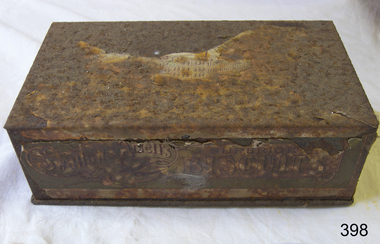
Container - Biscuit Tin, Swallow and Ariell Pty Ltd, Mid-19th to mid-20th century
... With no equal outside Great Britain, Swallow & Ariell was the fifth largest biscuit company in the world, manufacturing over 100 varieties, including the common ship biscuit (an original product) and meat biscuits (apparently taken by Burke and Wills on their ill-fated expedition). The company also boasted popular sideline products, including cakes, plum puddings, ice-cream and dried fruit. ...With no equal outside Great Britain, Swallow & Ariell was the fifth largest biscuit company in the world, manufacturing over 100 varieties, including the common ship biscuit (an original product) and meat biscuits (apparently taken by Burke and Wills on their ill-fated expedition). The company also boasted popular sideline products, including cakes, plum puddings, ice-cream and dried fruit. ...This tin was made in Melbourne and contained Swallows and Ariells biscuits. The label was written in four languages. The biscuits may have been made for export or perhaps for immigrants now living in Australia. Australia's first biscuit company was founded in 1854 by Thomas Swallow. Within five years he had taken in a partner, T.H. Ariell. After Ariell died in 1875, F.T. Derham was appointed partner and managing director in 1877, a position held by several generations of his descendants. By the early 1880s the Port Melbourne factory extended to 3 acres (1.2 ha), and the company owned flourmills and sugar plantations in the Goulburn Valley and Northern Queensland. With no equal outside Great Britain, Swallow & Ariell was the fifth largest biscuit company in the world, manufacturing over 100 varieties, including the common ship biscuit (an original product) and meat biscuits (apparently taken by Burke and Wills on their ill-fated expedition). The company also boasted popular sideline products, including cakes, plum puddings, ice-cream and dried fruit. Renowned for its patriotic fundraising campaigns during both world wars, it diverted most of its biscuits and plum puddings to the Australian and US services in World War II. Company employees were filmed leaving work in 1905 in the Salvation Army film unit's first sponsored industrial documentary film. The surviving opening sequences are held by ScreenSound Australia. The company was delisted on 5 August 1964 following acquisition of more than 95% of its capital by the Australian Biscuit Co. The factory was later registered by the National Trust and converted into units. https://www.emelbourne.net.au/biogs/EM01456b.htmThis biscuit tin is representative of local Melbourne and Victorian produce. The label was in four languages, perhaps for export or for local immigrants. The firm Swallow and Ariells Pty Ltd was a very early manufacture and was in business for over 100 years.Rectangular tin container with attached lid. Label advertises Swallow and Ariells biscuits. Made in Melbourne. The label is written in four languages. The trademark, a swallow, is on the tin. The tin is very badly corroded.'Swallow and Ariells Superior Melbourne Biscuits' Trademark: image [swallow]flagstaff hill, warrnambool, shipwrecked-coast, flagstaff-hill, flagstaff-hill-maritime-museum, maritime-museum, shipwreck-coast, flagstaff-hill-maritime-village, metal craft, tin ware, biscuit box, biscuit tin, food container, melbourne biscuit maker, swallow, thomas swallow, thomas ariell, ariell -
 Flagstaff Hill Maritime Museum and Village
Book, Journal of Landsboroughs Expedition
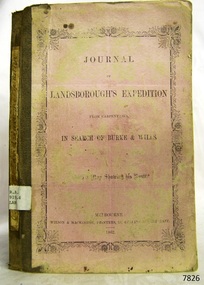
... Journal of Landsboroughs Expedition From Carpentaria in search of Burke and Wills (maps missing) Publisher: Wilson & Mackinnon Date: 1862...The Warrnambool Mechanics' Institute Library book collection is deemed to be of great importance because it is one of the few collections in an almost intact state, and many of the books are now very rare and of great value. warrnambool shipwrecked-coast flagstaff-hill flagstaff-hill-maritime-museum maritime-museum shipwreck-coast flagstaff-hill-maritime-village shipwrecked-artefact great ocean road book warrnambool library warrnambool mechanics’ institute mechanics’ institute library victorian library board warrnambool books and records warrnambool children’s library warrnambool public library journal of landsboroughs expedition carpentaria wilson & mackinnon Label on spine cover with typed text RA 919.4 LAN Pastedown front endpaper has sticker from Warrnambool Mechanics Institute and Free Library Journal of Landsboroughs Expedition From Carpentaria in search of Burke and Wills (maps missing) Publisher: Wilson & Mackinnon Date: 1862 Journal of Landsboroughs Expedition Book ...WARRNAMBOOL MECHANICS’ INSTITUTE Warrnambool's Mechanics' Institute (or Institution as it was sometimes called) was one of the earliest in Victoria. On 17th October 1853 a meeting was held where it was resolved to request the Lieutenant Governor of the Colony to grant land for the erection of a Mechanics' Institutes building. A committee was formed at the meeting and Richard Osburne chaired the first meeting of this committee. The land on the North West corner of Banyan and Merri Streets was granted but there were no funds to erect the building. The Formal Rights of the Warrnambool Mechanics' Institute's encompassed its aims and these were officially adopted in1859; "This Institution has for its object the diffusion of literary, scientific, and other useful knowledge amongst its members, excluding all controversial subjects, religious or political. These objects are sought to be obtained by means of a circulating library, a reading room, the establishment of classes, debates, and the occasional delivery of lectures on natural and experimental philosophy, mechanics, astronomy, chemistry, natural history, literature, and the useful and ornamental arts, particularly those which have a more immediate reference to the colony." The Warrnambool Mechanics' Institute opened its first reading room in November1884 in the National School building at the corner of Banyan and Timor Streets. The Institute was funded by member subscription, payable on a quarterly, half yearly or yearly basis. Samuel Hannaford, the Manager of the Warrnambool Bank of Australasia, was the first Honorary Secretary of the Mechanics' Institutes, and an early President and Vice-President. He also gave several of the early lectures in the Reading Room. Another early Secretary, Librarian and lecturer was Marmaduke Fisher, the teacher at the National School. Lecture topics included The Poets and Poetry of Ireland', 'The Birth and Development of the Earth', 'The Vertebrae - with Remarks on the pleasures resulting from the study of Natural History' and 'Architecture'. In 1856 the Reading Room was moved to James Hider's shop in Timor Street, and by 1864 it was located in the bookshop of Davies and Read. In the 1860's the Mechanics' Institute struggled as membership waned but in 1866, after a series of fund raising efforts, the committee was able to purchase land in Liebig Street, on a site then called Market Square, between the weighbridge and the fire station. A Mechanics' Institute building was opened at this site in August 1871. The following year four more rooms were added to the main Reading Room and in 1873 the Artisan School of Design was incorporated into the Institute. The same year Joseph Archibald established a Museum; however it deteriorated when he was transferred to Bendigo in 1877. In 1880, with Archibald's return to Warrnambool, the Museum was re-established, and in 1885 a new building was built at the back of the Institute to accommodate the re-created School of Design, the Art Gallery and the Museum. In 1887 the Museum section was moved to the former court house in Timor Street (for some time the walls of the building formed part of the TAFE cafeteria but all is now demolished)). In 1911 the Museum was transferred back to the original building and the management of the Mechanics' Institute was handed over to the Warrnambool City Council. The Museum and Art Gallery became one and housed many fine works of art, and the Library continued to grow. The building was well patronised, with records showing that at the beginning of the 20th century there were between 500 and 800 visitors. During World War One the monthly figures were in the thousands, with 3,400 people visiting in January 1915. The Museum was a much loved Institution in Warrnambool until the contents of the Museum and Art Gallery were removed to make room for the Warrnambool City Council Engineers' Department. The contents were stored but many of the items were scattered or lost. When the original building was demolished the site became occupied by the Civic Centre, which included the new City Library. (The library was temporarily located in the old Palais building in Koroit Street.) In the process of reorganisation the Collection was distributed amongst the community groups: -The new City Library took some of the historic books and some important documents, historic photographs and newspapers. -The Art Gallery kept the 19th Century art collection and some of the artefacts from the museum. -The Historic Society has some items -The State Museum has some items -Some items were destroyed -Flagstaff Hill Maritime Village has old newspapers, Government Gazettes, most of the Mechanics' Institute Library, ledgers and documents connected to the Mechanics' Institute Library, some framed and unframed art works and some photographs. The Warrnambool Mechanics' Institute Library book collection is deemed to be of great importance because it is one of the few collections in an almost intact state, and many of the books are now very rare and of great value. Journal of Landsboroughs Expedition From Carpentaria in search of Burke and Wills (maps missing) Publisher: Wilson & Mackinnon Date: 1862Label on spine cover with typed text RA 919.4 LAN Pastedown front endpaper has sticker from Warrnambool Mechanics Institute and Free Librarywarrnambool, shipwrecked-coast, flagstaff-hill, flagstaff-hill-maritime-museum, maritime-museum, shipwreck-coast, flagstaff-hill-maritime-village, shipwrecked-artefact, great ocean road, book, warrnambool library, warrnambool mechanics’ institute, mechanics’ institute library, victorian library board, warrnambool books and records, warrnambool children’s library, warrnambool public library, journal of landsboroughs expedition, carpentaria, wilson & mackinnon -
 The Beechworth Burke Museum
Weapon - Tranter Revolver, Robert O'Hara Burke's Revolver
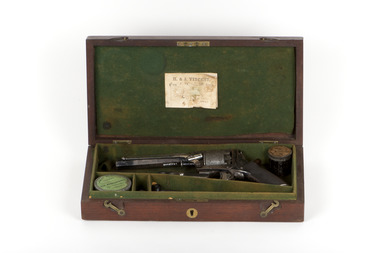
... ...burke and wills expedition...It arrived back in Beechworth on Thursday 10th April, 2014. burke robert o'hara burke burke museum robert o'hara burke museum firearm burke and wills burke & wills burke and wills expedition expedition beechworth indigo shire north-east victoria revolver Presented to R. ...This gun was presented to Robert O’Hara Burke Esq in 1858 by the Beechworth Police in recognition of his four years’ service as the Police Superintendent at Beechworth. It arrived back in Beechworth on Thursday 10th April, 2014.Presented to R. O’Hara Burke Esq / Supt. of Police by the Officers of the district on his transfer from Beechworth / November 1858 /burke, robert o'hara burke, burke museum, robert o'hara burke museum, firearm, burke and wills, burke & wills, burke and wills expedition, expedition, beechworth, indigo shire, north-east victoria, revolver -
 Bendigo Historical Society Inc.
Document - PETER ELLIS COLLECTION: 130TH ANNIVERSARY OF FIRST LUTHERAN SERVICE, 23rd February, 1986
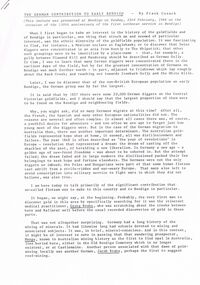
... ... Burke & Wills Expedition...HISTORY Australian bendigo Peter Ellis Collection The German Contribution to Early Bendigo Frank Cusack Georg Bruhn Menge Jacob Brahe Bendigo General Cemetery Blucher Johann Gottfried Tobias Christopher Ballerstedt Wittscheibe Schlemm Ernst Mueller Morris Collman Louis Samuels School of Mines Gustave Adolphus Hugo Thureau Rev Dr George Henry Backhaus Pastor Friedrich Leypoldt Dean MacCullagh Grieffenhagen Carl Pohl Henry Meyer Albert Bruhn Ernst Bruhn Louis Bruhn Frederick Grosse The Hamburg Hotel The Berlin Hotel The European Hotel Deutscher Verein Paul Bucholz French Foreign Legion William Craig Herr Gollmick Erna Mueller Kate Samuels W C Vahland Getzschmann Bosselmann Nicolai Emil Mauermann Friedrich Lehmann Dr Barnett Dr Landvoigt Dr Sandner Snr Conrad Meyerhoff Benno Sluytmann Ludwig Becker Burke & Wills Expedition Gustavus von Tempsky von Brusindorff Josef von St Nicolai Captain von Paleski Copy of a three page lecture presented at Bendigo on Sunday, 23rd February, 1986 on the occasion of the 130th anniversary of the first Lutheran service in Bendigo. ...Copy of a three page lecture presented at Bendigo on Sunday, 23rd February, 1986 on the occasion of the 130th anniversary of the first Lutheran service in Bendigo. Titled 'The German Contribution to early Bendigo' by Frank Cusack. Mentioned are the areas where German diggers lived, why they may have left their home country, the gold mining, Germans who contributed to business, wine-growing, farming and other types of work.history, australian, bendigo, peter ellis collection, the german contribution to early bendigo, frank cusack, georg bruhn, menge, jacob brahe, bendigo general cemetery, blucher, johann gottfried tobias christopher ballerstedt, wittscheibe, schlemm, ernst mueller, morris collman, louis samuels, school of mines, gustave adolphus hugo thureau, rev dr george henry backhaus, pastor friedrich leypoldt, dean maccullagh, grieffenhagen, carl pohl, henry meyer, albert bruhn, ernst bruhn, louis bruhn, frederick grosse, the hamburg hotel, the berlin hotel, the european hotel, deutscher verein, paul bucholz, french foreign legion, william craig, herr gollmick, erna mueller, kate samuels, w c vahland, getzschmann, bosselmann, nicolai, emil mauermann, friedrich lehmann, dr barnett, dr landvoigt, dr sandner snr, conrad meyerhoff, benno sluytmann, ludwig becker, burke & wills expedition, gustavus von tempsky, von brusindorff, josef von st nicolai, captain von paleski -
 Bendigo Historical Society Inc.
Document - NEWSLETTER OF AUSTRALASIA 1860: LETTER OF JOHN REED, 21st October, 2010
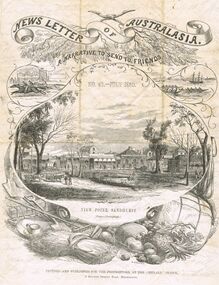
... ... Burke and Wills Expedition...John Reed Burke and Wills Expedition The Herald, 9 Bourke Street, East Melbourne. ...''Newsletter of Australasia'' -1860 (Letter of John Reed to family on very light paper with etching from photograph of View Point, Sandhurst on front page). Four pages printed and published by the ''Herald'' and sub-titled 'A Narrative to send to friends'. The original presented to the BHS by Richard Guy. Text of the handwritten letter is within the accompanying 'History Lives' (Jim Evans) article in the Bendigo Miner, 21/10/2010.The Herald, 9 Bourke Street, East Melbourne. Bendigo Minerperson, individual, john reed, view point sandhurst. john reed, burke and wills expedition
