
Showing 133 items matching "by-laws and objects"
-
 National Vietnam Veterans Museum (NVVM)
Equipment - Equipment, Army, Army trunk containing various objects donated by John J Frewen
... Army trunk containing various objects donated by John J Frewen. ...Items used by John Frewen in the Vietnam War.vietnam war, 1961 - 1975, personal narratives - australian, army trunk -
 Federation University Art Collection
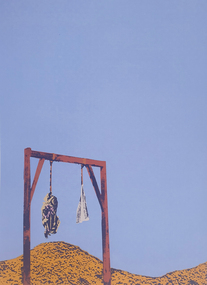
Work on paper - Silkscreen, Graeme Drendel, The Objects Suspended by Graeme Drendel
... The Objects Suspended by Graeme Drendel ...Graeme DRENDEL (1953- ) Born Ouyen, Victoria Graeme Drendel is a key Australian figurative painter and printmaker who believes you should paint what you know. He studied Art Teaching at the Ballarat Teacher' College and Ballarat School of Mines in 1971 and 1972 before completing a Diploma of Teaching Art and Craft at Melbourne State College in 1974. While studying in Ballarat Graeme lived in the student hostel 'Beaufort House'. After teaching for several years, Graeme undertook a life changing and extensive travelling tour throughout Italy, United Kingdom and United States at which time he decided he would always depict the human figure. Recognised for his intelligent observations of the human condition, Graeme’s art invites contemplation and reveals the humour of everyday life. The isolation he portrays through his characters may relate back to the isolation he felt on the wheat farm he grew up on. As a prolific user of sketchbooks Graeme Drendel records close observations, which can inform his paintings. Graeme Drendel is regularly a finalist in the Archibald Portrait Prize, Sulman Prize, Paul Guest Prize and in 2022 he won the prestigious Doug Moran National Portrait Prize with his portrait of fellow artist Lewis Miller. In 2021 he received a Federation University Distinguished Alumni Award. Two objects hang from a timber structure.graeme drendel, printmaking, silkscreen -
Clunes Museum
Document, CLUNES DISTRICT HOSPITAL, BY-LAWS OF THE CLUNES DISTRICT HOSPTAL, 1965
... .1 CONSTITUTION, OBJECTS AND BY-LAWS OF THE CLUNES DISTRICT HOSPITAL 1965. 16 PAGES. ...CLUNES DISTRICT HOSPITAL CONSTITUTION 1965 CONSTITUTION 1988 BY-LAWS AND OBJECTS .1 CONSTITUTION, OBJECTS AND BY-LAWS OF THE CLUNES DISTRICT HOSPITAL 1965. 16 PAGES. ....1 CONSTITUTION, OBJECTS AND BY-LAWS OF THE CLUNES DISTRICT HOSPITAL 1965. 16 PAGES. TYPED AND STAPLED. PLUS COPIES OF PAGES 10 AND 14. .2 CONSTITUTION, OBJECTS AND BY-LAWS OF THE CLUNES DISTRICT HOSPITAL UPDATED VERSION REF. HEALTH SERVICES ACT 1988. 18 PAGES STAPLED. .3 BUFF MANILLA FOLDERclunes district hospital, constitution 1965, constitution 1988, by-laws and objects -
 Kiewa Valley Historical Society
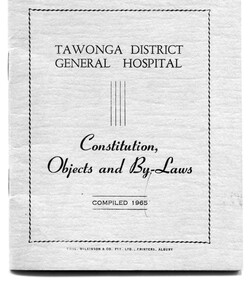
Papers - Tawonga District Hospital Memorabilia
... Small booklet "Constitution Objects and By-Laws, 19th Annual Report 1967/68. ...Small booklet "Constitution Objects and By-Laws, 19th Annual Report 1967/68. ...These items were found in a house being demolished in Mt Beauty in 2021Very relevant to the history of the Tawonga District General Hospital and Social history of Mt BeautyAll papers have the heading "Tawonga District General Hospital". Small booklet "Constitution Objects and By-Laws, 19th Annual Report 1967/68. Letter head sheets of white papertawonga district general hospital mt beauty -
 Greensborough Historical Society
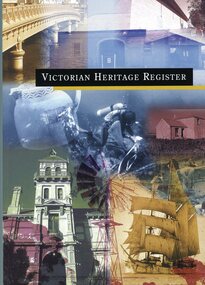
Book, Heritage Victoria, Victorian Heritage Register. 2nd ed, 1999
... Once listed, they are protected by law....The Victorian Heritage Register lists objects and places which have the highest level of cultural significance in Victoria. ...The Victorian Heritage Register lists objects and places which have the highest level of cultural significance in Victoria. Once listed, they are protected by law.189 p. black print on white paper, illus.heritage places, victorian heritage register, heritage council of victoria -
 Ballarat Tramway Museum
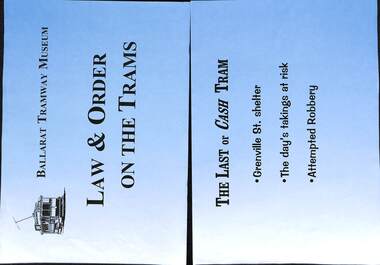
Poster, Warren Doubleday, "Law & Order on the Trams", Oct. 1997
... Seven colour printed A4 sheets used on the "Law & Order" Exhibition at the depot and the CHHA fair. ...Trams tramways Law and Order Exhibitions Employees Police Seven colour printed A4 sheets used on the "Law & Order" Exhibition at the depot and the CHHA fair. ...Seven colour printed A4 sheets used on the "Law & Order" Exhibition at the depot and the CHHA fair. No. 1 to 5 Printed onto graduated colour paper (Geo Paper - Geo Blue) and printed with a HP6P printer. 777.1 - Title poster - "Law & Order on the Trams" 777.2 - "Relations with the Police" (mounted onto a cardboard sheet) 777.3 - "The Last or Cash Tram" 777.4 - "Tramway Closure - out with a Bang!" 777.5 - "Acknowledgments" 777.6 - "Policing Employees" 777.7 - "The Horse Tram Era" See also items 778, and 713 for further objects for this exhibition. Items printed using a HP6P printer and PowerPoint.trams, tramways, law and order, exhibitions, employees, police -
 Bendigo Historical Society Inc.
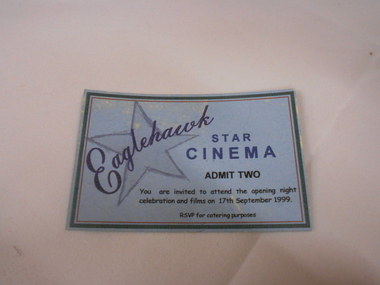
Memorabilia - STAR THEATRE, EAGLEHAWK OPENING NIGHT THEATRE TICKET, 17 September 1999
... This ticket is issued subject to the By-Laws. 1d....This ticket is issued subject to the By-Laws. 1d. Memorabilia STAR THEATRE, EAGLEHAWK OPENING NIGHT THEATRE TICKET ...Objects. This ticket was issued to Ken Stringer, on the Opening night of the Star Cinema, at Eaglehawk Town Hall. The projectors ordered from China, did not arrive in time and Ken loaned the Owner two projectors from his own collection. It was quite a few weeks before the projectors ordered from China arrived! Two pink tram tickets issued by the State Electricity Commission of Victoria - ELECTRICITY SUPPLY DEPARTMENT. 1d for specific section destinations as printed.Tram tickets A233962, Electricity Supply Department Provincial Tramways. This ticket is issued subject to the By-Laws. 1d.Eaglehawk star Cinema Admit Two. You are invited to attend the opening night celebrations and films on 17th September 1999, RSVP for catering purposes. Theatre ticket: 1999. Tram Tickets: pre decimal currency in 1966.theatre, eaglehawk star cinema -
 Bendigo Historical Society Inc.
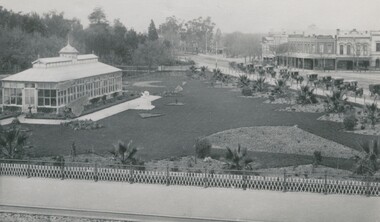
Photograph - CONSERVATORY, ROSALIND PARK, BENDIGO, c.1899
... Inscription on back 'MP 262', Circular blue rubber stamp 'Royal Historical Society of Victoria, Bendigo Branch'. History of object: Photo taken from upper floor of Law courts, Pall Mall, soon after the Conservatory was completed. ...Inscription on back 'MP 262', Circular blue rubber stamp 'Royal Historical Society of Victoria, Bendigo Branch'. History of object: Photo taken from upper floor of Law courts, Pall Mall, soon after the Conservatory was completed. ...Black and white photograph. Conservatory, Rosalind Park, Bendigo. Inscription on back 'MP 262', Circular blue rubber stamp 'Royal Historical Society of Victoria, Bendigo Branch'. History of object: Photo taken from upper floor of Law courts, Pall Mall, soon after the Conservatory was completed. Photo could date as late as after May 1920. A.E Sayer occupied the corner building of Howard Place from 1909 until this time. Prior to this it was Vale's Pharmacy, Beckett's, Boully's and originally Garsed's Conservatory Centenary was 1998. UK inscription inserted. Corner building now Bazzani's Restaurant.buildings, conservatory -
Unions Ballarat
Minutes of meetings of the Federation Council. Includes constitution and rough minutes of meetings and Progressive Political League of Victoria, Ballarat West Branch, 19 September 1890-6 June 1892
... Its platform included "electoral reform, reform of the labour laws, social reform and supported Federation on a ‘democratic basis’." ...Its platform included "electoral reform, reform of the labour laws, social reform and supported Federation on a ‘democratic basis’." ...The Progressive Political League was formed in 1891 after the 1890 Maritime Workers Strike; it subsequently became the Australian Labor Party. This object includes the organisation's constitution. The PPL is also contemporaneous with the defeat of the Shearer's Strike (1891). Its platform included "electoral reform, reform of the labour laws, social reform and supported Federation on a ‘democratic basis’." (Anarchist Age 2008). More information about the formation of the Progressive Political League in Victoria can be found at http://anarchistmedia.org/pdf/701-800/AAWR-07768.htmlProvides significant background to the formation of the ALP and political activity around the period of significant industrial actions and Australian Federation. The minutes are from the Ballarat West Branch of the League.Paper, 1 bound volume.ballarat trades and labour council, btlc, progressive political league of victoria, ballarat west, minutes, ppl, federation council, alp, australian labor party, maritime workers' strike, shearer's strike -
 Chiltern Athenaeum Trust
Domestic object, Unknown
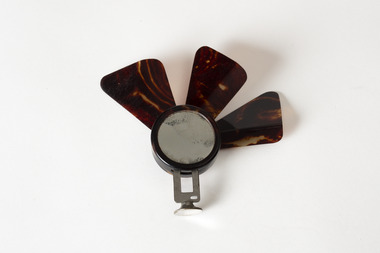
... This object is part of the Wilfred Clarence Busse Collection. ...This object is part of the Wilfred Clarence Busse Collection. ...This object is part of the Wilfred Clarence Busse Collection. Wilfred Clarence Busse was born in Chiltern, Victoria in 1898. His family first arrived in this region during the gold rush era, purchasing a piece of land adjacent to the Murray River. The spectacular scenery and rich history of the area is said to have inspired Busse in his writing. He attended Wesley College in his school days, before going on to study law at the University of Melbourne. After graduating from university, Busse would go on to become a barrister, but he is best known as a writer of fiction, publishing two novels: 'The Blue Beyond: A Romance of the Early Days in South Eastern Australia' and 'The Golden Plague: A Romance in the Early Fifties'. Busse died in 1960. This object is significant as it is associated with Wilfred Clarence Busse, a successful writer and barrister who was born in Chiltern, Victoria. A small fan with a metal base and three brown blades protruding upwards; possibly only partially complete. wilfred clarence busse, w.c. busse, busse, handheld fan, fan, "the blue beyond", "the blue beyond: a romance of the early days in south eastern australia", "the golden plague”, "the golden plague: a romance of the early fifties.", gold rush -
 Chiltern Athenaeum Trust
Medal, Royal Agricultural Society of Victoria, 1895
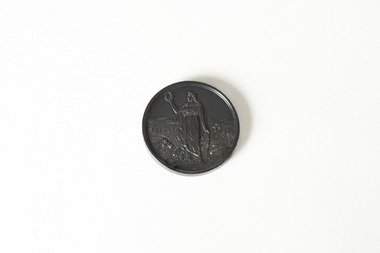
... Busse died in 1960. This particular object is dated 1895, three years before Busse was born. ...Busse died in 1960. This particular object is dated 1895, three years before Busse was born. ...Wilfred Clarence Busse was born in Chiltern, Victoria in 1898. His family first arrived in this region during the gold rush era, purchasing a piece of land adjacent to the Murray River. The spectacular scenery and rich history of the area is said to have inspired Busse in his writing. He attended Wesley College in his school days, before going on to study law at the University of Melbourne. After graduating from university, Busse would go on to become a barrister, but he is best known as a writer of fiction, publishing two novels: 'The Blue Beyond: A Romance of the Early Days in South Eastern Australia' and 'The Golden Plague: A Romance in the Early Fifties'. Busse died in 1960. This particular object is dated 1895, three years before Busse was born. It can thus be assumed that it was awarded to a relative of his, possibly his father in relation to their land by the Murray River. This object is significant as it is associated with Wilfred Clarence Busse, a celebrated author and barrister who grew up in the locality of Chiltern. It is also a medal awarded by the Royal Agricultural Society of Victoria, a society that has held social and industrial significance since it was founded in the nineteenth century. Small, circular medal - made of either bronze or brass metal - depicting an agricultural background behind a female figure in a toga holding a wreath. Back side: The Royal Agricultural Society of Victoria / Busse & Son / 1895wilfred clarence busse, w.c. busse, busse, gold rush, gold rush chiltern, busse author, the royal agricultural society of victoria, "the golden plague: a romance of the early fifties., "the blue beyond, rasv, medal, agricultural medal -
 Chiltern Athenaeum Trust
Domestic object, Stewart Dawson and Co, Unknown
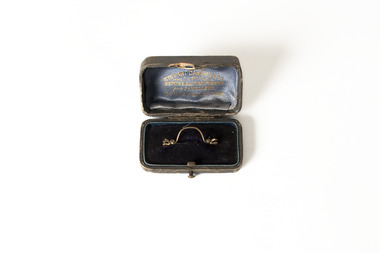
... Busse died in 1960. This particular object was owned by Busse. It is a tie pin and, as inscribed on its box, it was manufactured by Stewart Dawson and Co, a successful jewellery company - founded in Sydney in the late nineteenth century - that is still active today. ...Inscribed beneath the lid are the words 'Stewart Dawson and Co. / Watch Manufacturers / and Jewellers / Sydney & London. Domestic object Domestic object Stewart Dawson and Co. ...Wilfred Clarence Busse was born in Chiltern, Victoria in 1898. His family first arrived in this region during the gold rush era, purchasing a piece of land adjacent to the Murray River. The spectacular scenery and rich history of the area is said to have inspired Busse in his writing. He attended Wesley College in his school days, before going on to study law at the University of Melbourne. After graduating from university, Busse would go on to become a barrister, but he is best known as a writer of fiction, publishing two novels: 'The Blue Beyond: A Romance of the Early Days in South Eastern Australia' and 'The Golden Plague: A Romance in the Early Fifties'. Busse died in 1960. This particular object was owned by Busse. It is a tie pin and, as inscribed on its box, it was manufactured by Stewart Dawson and Co, a successful jewellery company - founded in Sydney in the late nineteenth century - that is still active today. This object is significant as it was owned by Wilfred Clarence Busse, an accomplished barrister and writer from Chiltern, Victoria. It was also manufactured by Stewart Dawson and Co, a successful jewellery company, founded in the nineteenth century, that is still active today. A thin, curved, gold-coloured tie pin placed inside an open velvet-lined jewellery box. Inscribed beneath the lid are the words 'Stewart Dawson and Co. / Watch Manufacturers / and Jewellers / Sydney & London.Box open: Stewart Dawson and Co. / Watch Manufacturers / and Jewellers / Sydney & London w.c. busse, wilfred clarence busse, gold rush, gold rush chiltern, busse barrister, busse author, "the golden plague: a romance of the early fifties., "the golden plague”, "the blue beyond: a romance of the early days in south eastern australia", "the blue beyond", tie pin, jewellery, jewellery manufacturers, sydney jewellers nineteenth century, stewart dawson and co -
 Chiltern Athenaeum Trust
Accessory - Locket
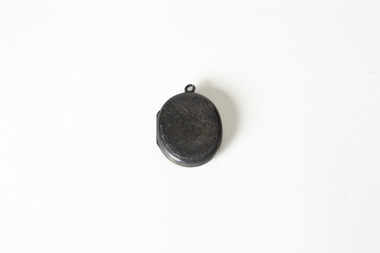
... This locket is from the museum's collection of objects relating to Wilfred Clarence Busse. ...This locket is from the museum's collection of objects relating to Wilfred Clarence Busse. ...This locket is from the museum's collection of objects relating to Wilfred Clarence Busse. Busse was born in Chiltern in 1898, completed his secondary education as Wesley College in the early twentieth century, and went on to study law at the University of Melbourne. As a lawyer, he spent time in the room of Supreme Court Judge Bernard Cussen (1859-1933). Judge Cussen was popular, known for being just and precise and for completing through statutory consolidation in his spare time. As well as working as a lawyer, Busse wrote historical fiction inspired by his life in Chiltern, these included The Blue Beyond; A Romance of the Early Days in South Eastern Australia" and "The Golden Plague: A Romance of the Early Fifties," which won the T.E.Role gold medal for the best historical novel in 1930 and went on to become a best seller. He was a member of the Chiltern Athenaeum until his death in 1960. The placing of hair in lockets was a common 19th and early 20th century, with Queen Victoria wearing a locket containing a piece of Albert’s hair after his death in 1861. Wearing a loved one’s hair or giving a lock of your hair to someone for wearing, could be a gesture of love and friendship, or of mourning. The tangibility and personal nature of hair made it a common keepsake, especially in cases of high mortality or where family members were separated by oceans without the possibility of air travel. The intention and origin of this locket is currently unknown, but it is likely it was a keepsake of love or mourning, either way, a emotional object. This object artistically significant as an example of late 19th/early 20th century jewellery, and social and spiritual sigifiicance as locket containing a piece of hair, which, regardless of exact intention, imbues it with a strong emotional aura. A small dark metal locket with a decorative leaf pattern on the exterior. The locket contains a small amount of reddish hair, supposedly from a loved one or family member of the original owner, and a degraded image that may have ocne represented a person. busse, w.c. busse, wilfred clarence busse, chiltern, chiltern athenaeum, "the blue beyond, a romance of the early days in south eastern australia”, "the golden plague: a romance of the early fifties.", "the golden plague”, wesley college, university of melbourne, sir leo finn bernard cussen, supreme court of victoria, locket, hair locket, hair jewellery, jewellery -
 Bendigo Historical Society Inc.
Legal record - Transcript of High Court Appeal Philip Cooney v John Thomas Burns, 1921
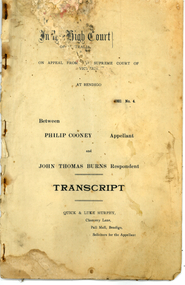
... The owner of the hotel Philip Cooney then objected to the sale of the furniture, although at some stage John Burns offered him 650 pounds to cover the items. ...The owner of the hotel Philip Cooney then objected to the sale of the furniture, although at some stage John Burns offered him 650 pounds to cover the items. ...The hearing of the case of John T. Burns, retired railway employee, of Buckley Street, Essendon v. Philip Cooney, licensed victualler, was concluded in the Supreme Court of Victoria (Bendigo) in June 1921. John sued the defendant for a specific performance of contract regarding the sale of ingoing furniture, etc., of the Limerick Castle Hotel, in Williamson Street, Bendigo. He also claimed the profits of the business from 21 February last to the date of possession. Burns also applied for an injunction restraining the defendant from disposing of the lease, licence and furniture of the hotel and premises to anybody else. The defence was that no agreement had been made between defendant and plaintiff for the sale of the hotel lease, although several attempts had been made to bring them to an agreement. Mr Cooney had authorized Mr. J. F. Kelly to sell the ingoing for £750. Burns had offered £650, but the defendant refused to accept that sum. The jury returned a verdict in favour of plaintiff. Judgment was deferred, pending an appeal, it was again heard by the High Court (Melbourne) and the onto the High Court of Australia (Sydney) on a point of law. The legal principle determined by this appeal is of great importance to buyers and sellers of landed property establishing the rule of law: that a house and land agent cannot, safely sell such property without the authority of the owner in writing, signed by such owner. It appears that the hotel-owner's agents had organised a sale to of the hotel along with furniture etc. to John Burns. The owner of the hotel Philip Cooney then objected to the sale of the furniture, although at some stage John Burns offered him 650 pounds to cover the items. The appeal came up for argument before the High Court at its Melbourne sittings on February 20 1922 the hearing extending over four days. Mr. Charles Gavan Duffy (instructed by Messrs. Quick and Luke Murphy) appeared for the appellant, and Messrs; Cohen and Robertson (instructed by Messrs. Macoboy and Taylor); for the respondent. The last court of appeal, the High Court in Sydney reserved its decision, as follows: The Appeal was allowed, with, costs. Judgment to he entered for the defendant Philip Clooney. The Deposit of £50 to be returned to the defendant.48 Pages - A Court Case involving the Limerick Castle Hotel in Williamson Street, Bendigo - Transcript "on appeal from the Supreme Court of Victoria at Bendigo to the High Court of Australia. 1921 No. 4 between Phillip Cooney (Appellant) and John Thomas Burns (Respondent). Quick and Luke Murphy, Chancery Lane, Solicitors for the Appellant. The Document contains seven sections: 1. Statement of Claim 2. Defenant's request for further particulars under the statement of claim 3. Plaintiff's further particulars 4. Defence 5. Reply 6. Judge's notes of evidence taken at the trial 7. Plaintiff's Exhibits - "A" lease, the Trustees, Executors and Agency Company Limited to Appelant "B" Notice of Application to Transfer Licence of Hotel to Responent, testimonials by Messrs. H. Donovan and J. K. Byrne "C" Assignment of Lease, Appelant to Responentbendigo, limerick castle hotel, john burns, philip cooney -
 Flagstaff Hill Maritime Museum and Village
Machine - Lathe, W F & John Barnes, early 1900s
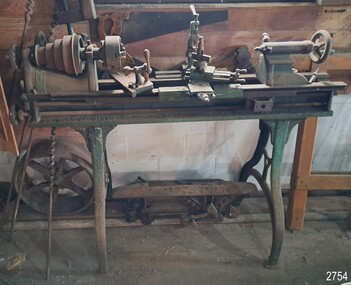
... The lathe was donated by Briggs Marine, Melbourne: In Flagstaff Hill’s formative years, 1972-1975, Briggs Marine, Melbourne (Briggs Brass Foundry), donated equipment and objects used or made at their premises. The foundry was established in 1912 by Herbert Harrison Briggs. ...The lathe was donated by Briggs Marine, Melbourne: In Flagstaff Hill’s formative years, 1972-1975, Briggs Marine, Melbourne (Briggs Brass Foundry), donated equipment and objects used or made at their premises. The foundry was established in 1912 by Herbert Harrison Briggs. ...This woodworking lathe, connected to both a pulley and a flywheel, demonstrates its historical operation with a steam engine. Such a configuration reflects manufacturing practices from the late 1800s and early 1900s, when steam power was the predominant source for driving workshop and factory machinery. Large machine shops often utilised a single power source, distributing power via roof-mounted belts and pulleys to operate several machines simultaneously. Over time, petrol-driven motors were introduced, and eventually, electricity became the standard power source. Conversion kits were made available in the late 19th and early 20th centuries to adapt older lathes to these newer, cleaner fuels. Manufacturer's History: W.F. & J. Barnes was a renowned maker of hand- and foot-powered treadle woodworking and metalworking machinery, established in 1869. The partnership between William F. Barnes and John Barnes was formalised in 1872, and the firm was incorporated in 1884. Their machines were used for both ‘farm’ applications and professional engineering. By 1881, the company began producing electrically powered machinery. By 1937, W.F. & J. Barnes expanded into manufacturing machinery for automotive assembly. The business closed in 1983, and in 1998, LeBlond Ltd. of Ohio acquired the firm. The lathe was donated by Briggs Marine, Melbourne: In Flagstaff Hill’s formative years, 1972-1975, Briggs Marine, Melbourne (Briggs Brass Foundry), donated equipment and objects used or made at their premises. The foundry was established in 1912 by Herbert Harrison Briggs. In 1965, the firm was owned by partners Cyril Briggs and Frank Lee: Cyril died in 1967, and Frank died in 1971, so the foundry was then run by his son and daughter-in-law, Les and Eva Lee. Briggs Marine’s Warrnambool Branch closed in 1972 after the death of Frank Lee in 1971. Flagstaff Hill’s founding director, John Lindsay, recalled that Briggs Marine’s family members gave personal assistance in setting up the displays in the original village shops, particularly the ‘Brass Foundry’ building, around the time the Maritime Museum opened in 1975. Briggs Marine still exists today, but the Briggs family is no longer involved. This early 1900s lathe marks a significant stage in the evolution of machinery, positioned between the era of hand-operated machines and the advent of electrically powered equipment. Its presence exemplifies the progression of industrial technology and craftsmanship during this period. The lathe is particularly notable for its association with the Briggs Brass Foundry. The foundry was known for developing a specialised brass alloy composed of non-ferrous metals, a formulation that resulted in durable products built to withstand the demanding conditions of marine environments. This focus on resilience and longevity made Briggs Brass Foundry’s goods highly sought after within the maritime sector. Briggs Maine, a long-established business, utilised the foundry’s capabilities to create cast goods tailored to the needs of the marine industry. The facility was equipped to deliver both custom-designed and mass-produced items, ensuring versatility in meeting various requirements. Many of Briggs Foundry’s products found their place on sailing and steam vessels throughout Victoria’s coastline, including in the port town of Warrnambool, where there was once a brancy of Briggs Marine. In addition to general marine fittings, Briggs Marine earned recognition for its expertise in bell-founding. The foundry’s reputation is closely linked to the restoration of the Schomberg Bell at Flagstaff Hill, a small but historically significant bell from a luxury migrant vessel dating back to the mid-19th century. The successful restoration of the Schomberg Bell demonstrates Briggs Brass Foundry’s commitment to preserving craftsmanship and maritime heritage.The lathe is a green, bench-type, steam-powered woodworking machine. Its bench is supported by decorative posts at each end, with each post dividing into arched legs. The lathe is mechanically connected to both a pulley and a flywheel, designed to be operated in conjunction with a steam engine. Included with the lathe is a range of accessories. Across the front of the machine, an inscription is cast, and a stamped, metal lathe pulley guide is attached to the drive mechanism. The lathe was manufactured by W. F. and J. Barnes, Rockford, Illinois, USA, during the 1900s.“W F and J Barnes, Rockford, USA” "1820" "1887"flagstaff hill, flagstaff hill maritime museum and village, warrnambool, maritime museum, maritime village, great ocean road, shipwreck coast, lathe, steam-operated lathe, steam-operated pulley, steam power, steam engine, machine, steam operated machine, metal work, foundry work, metal working trade, tool, pulley driven, metalworking, woodworking, barnes lathe, briggs marine, belt driven, wordworking lathe, free standing lathe, bench lathe, steam powered, vintage lathe, woodturning lathe, w. f. and j. barnes, illanois, early 20th century, briggs, briggs brass foundry, briggs marine foundry, briggs marine products, herbert harrison briggs, george edward briggs, cyril falkiner mckinnon briggs, collingwood, moorabbin, frank lee, les lee, eva lee, briggs marine warrnambool, non-ferrous founders, bell specialists, ship bell specialists, sand cast, marine equipment, marine fittings, foundry, brass foundry, founders -
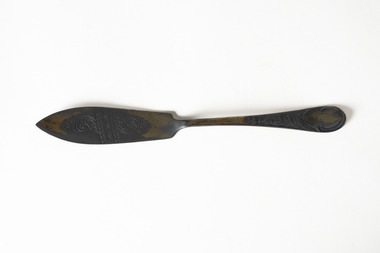 Chiltern Athenaeum Trust
Domestic object - Butter knife belonging to W.C.Busse
... Wilfred Clarence Busse was a member of Chiltern Athenaeum (where this object is now held) up until his death in 1960, he is buried in the Barnawartha Cemetery. ...Wilfred Clarence Busse was a member of Chiltern Athenaeum (where this object is now held) up until his death in 1960, he is buried in the Barnawartha Cemetery. ...Wilfred Clarence Busse, born in Chiltern in 1898, His family moved to the region during the gold rush and continued to reside in the area, purchasing land adjacent the Murray River. Busse completed his secondary education at Wesley College in Melbourne then studied law at the University of Melbourne. Busse went on to become a barrister, often in the chambers of Sir Leo Finn Bernard Cussen (1859-1933) a judge of the Supreme Court of Victoria. He worked most of his life in Chiltern as a Barrister and Solicitor and gained the unofficial title of historian of Chiltern, leaving behind several manuscript histories and a scrap book. Busse was an avid fictional writer and in 1930 he published two novels. Time spent on a Victorian station in his early twenties, as well as careful documentary research, informed the writing of his historical novels of bush life. "The Blue Beyond; A Romance of the Early Days in South Eastern Australia” and "The Golden Plague: A Romance of the Early Fifties." "The Golden Plague” won the T. E. Role gold medal for the best historical novel which went on to become a best seller. Busse often drew inspiration for his novels from his younger years living Chiltern. His passion for the region lead him to write “The History of Chiltern” which was published in a serial form in the Chiltern Federal Standard from 1922-1923. Wilfred Clarence Busse was a member of Chiltern Athenaeum (where this object is now held) up until his death in 1960, he is buried in the Barnawartha Cemetery. Likely Silverplate due to the intensity of the tarnishing of the metal, with indecipherable hallmarks on the handle, the method of production and the maker mark are unclear. The delicate swirling fernlike motif on this particular butter knife appears to be stylised in either Art deco the decorative arts and craft style favoured in Europe between 1880-1930's and less representational than examples of Australiana flora captured in silversmithing from the 1850's onwards produced in Australia. It is likely that those producing silverware at the time would be drawing on the decorative arts movement while incorporating elements of the natural beauty in the flora of their newfound environment into the silverware they produced.Wilfred Clarence Busse was of social significance to Chiltern, he helped to document the cultural story of the area in his published works "The Golden Plague" and "The Beyond Blue" by recounting his own upbringing in a bush lifestyle. He was a respected Barrister and was the unofficial historian of the Chiltern Athenaeum for many years. This butter knife represents a window into the domestic life of this person who was well loved in the area, and it continues its relationship to Busse as well as Chiltern by being held within the very collection he helped to maintain in his life. Domestic objects tell us the story about how people lived, objects of daily use hold particular meaning in that they can tell us the story of an individual, we feel closer to their life and habits, it humanises and connects us across time. Wilfred Busse ate food, he buttered his bread and he did it with a wonderfully decorated silver butter knife.A tarnished metal butter knife with engraved and embossed spiral fern details on the knife and handlesilverware, wilfred clarence busse, busse, chiltern, chiltern athenaeum, federal standard, t. e. role, "the blue beyond, a romance of the early days in south eastern australia”, "the golden plague: a romance of the early fifties.", "the golden plague”, wesley college, university of melbourne, sir leo finn bernard cussen, supreme court of victoria, gold rush, murray river, “the history of chiltern”, silversmithing, decorative arts, floral, flora, australiana, australian flora, arts and craft movement, australian silver, cussen, cutlery, butter knife, knife, silverplate -
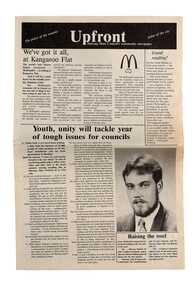 City of Greater Bendigo - Civic Collection
Newspaper, Shire of Marong, Upfront, c 1989
... Marong, Eaglehawk and Huntly had earlier objected to the proposal, and the Board noted a weak no vote against the merger proposal in a referendum in the region; about 70% had voted against, but with a turnout of between 30% and 40% of eligible voters. ...Marong, Eaglehawk and Huntly had earlier objected to the proposal, and the Board noted a weak no vote against the merger proposal in a referendum in the region; about 70% had voted against, but with a turnout of between 30% and 40% of eligible voters. ...Marong was first incorporated as a road district on 27 August 1861, and became a shire on 23 December 1864. On 1 October 1915, the Borough of Raywood, which was gazetted on 17 January 1865 on 23.31 square kilometres of land 28 kilometres north of Bendigo was united with Marong. On 1 October 1990, the Shire of Marong became a rural city, under the Local Government Act 1989. In a report on 17 February 1994, the Local Government Board recommended that the five councils in the Bendigo region merge to form a "super city", with a population of about 81,000. Marong, Eaglehawk and Huntly had earlier objected to the proposal, and the Board noted a weak no vote against the merger proposal in a referendum in the region; about 70% had voted against, but with a turnout of between 30% and 40% of eligible voters. The three councils filed a writ in the Supreme Court, alleging failure to follow process by the Minister for Local Government, Roger Hallam, but by the time the new "super city" was announced, the writ had not yet been heard, and on 24 March 1994, the Rural City of Marong successfully applied for an injunction blocking the publication of the gazette the following day abolishing the five councils and appointing three commissioners. The government responded by introducing legislation, the City of Greater Bendigo Bill 1994, to Parliament, to effectively override the Supreme Court action, with Hallam saying "the bill would make clear that the Government is determined to achieve its objective for a more efficient municipal structure for the Bendigo region." Marong mayor Robert Hynes described the action as "terribly disappointing", adding, "One way or another, I believe it does mean an end to our fight... it seems the Government are above the law to me." On 6 April 1994, Marong voted to drop the Supreme Court action, effectively in doing so voting itself out of existence, and on 7 April 1994, the Rural City of Marong was abolished, and along with the City of Bendigo, the Borough of Eaglehawk and the Shires of Huntly and Strathfieldsaye, was merged into the newly created City of Greater Bendigo. On 29 April 1994, the Minister confirmed the Bill was not being proceeded with. https://en.wikipedia.org/wiki/Rural_City_of_MarongEight page newspaper style council newsletter providing community updates, news and information. shire of marong, city of greater bendigo amalgamation, councillor phillip eddy, rural city of marong -
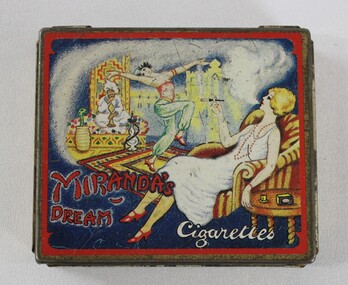 Wodonga & District Historical Society Inc
Functional object - Haeusler Collection Mid 20th Century 'Miranda's Dream Cigarettes' Tobacco Tin, Dodo Designs
... This tobacco tin is one of the many objects in the Haeusler Collection that provides insight into life in early to mid-twentieth century Wodonga, and Australia more broadly. ...This tobacco tin is one of the many objects in the Haeusler Collection that provides insight into life in early to mid-twentieth century Wodonga, and Australia more broadly. ...The Wodonga Historical Society Haeusler Collection provides invaluable insight into life in late nineteenth and early twentieth century north east Victoria. The collection comprises manuscripts, personal artefacts used by the Haeusler family on their farm in Wodonga, and a set of glass negatives which offer a unique visual snapshot of the domestic and social lives of the Haeusler family and local Wodonga community. The Haeusler family migrated from Prussia (Germany) to South Australia in the 1840s and 1850s, before purchasing 100 acres of Crown Land made available under the Victorian Lands Act 1862 (also known as ‘Duffy’s Land Act’) in 1866 in what is now Wodonga West. The Haeusler family were one of several German families to migrate from South Australia to Wodonga in the 1860s. This tobacco tin is one of the many objects in the Haeusler Collection that provides insight into life in early to mid-twentieth century Wodonga, and Australia more broadly. Smoking in the first half of the twentieth century was incredibly common in Australia and other western countries. In 1945, more than three out of every four men and one in every four women were regular smokers. While rates of smoking decreased over the next two decades due to observations and research regarding the links between smoking and illness, an increase in tobacco use was documented after the advent of television as people were bombarded with advertisements for cigarettes. These advertisements, much like the image on the Haeusler Collection 'Miranda's Dream Cigarettes' Tobacco Tin, depicted smoking as sophisticated and glamorous, distracting consumers from the serious health risks associated with smoking. Orientalist depictions of Middle East were common in tobacco advertising in the West in the first half of the twentieth century, an attempt to associate cigarettes with the supposed sensuality and mystery of the Orient. There have been significant changes in both legislation and popular perceptions of smoking in Australian society since the manufacture and consumption of 'Miranda's Dream Cigarettes'. In 1992 the Tobacco Advertising Prohibition Act was introduced, making it illegal in Australia to publish or broadcast messages that encourage people to start or continue smoking. In 2011 the Australian government also introduced plain packaging laws to reduce the appeal and promotion of tobacco products, and make health warnings more effective. This item has well documented provenance and a known owner. It forms part of a significant and representative historical collection which reflects the local history of Wodonga. It contributes to our understanding of domestic and family life in early twentieth century Wodonga, as well as providing interpretative capacity for themes including local history and social history. A tobacco tin with a coloured illustration of a woman in stylish 1920s-1930s dress sitting in an armchair smoking a cigarette, while watching an Orientalist scene featuring a belly dancer and a snake charmer wearing a turban. Branding on the lid of tin: "Miranda's Dream Cigarettes"cigarettes, tobacco, smoking, cigarette tin, haeusler, haeusler collection, wodonga -
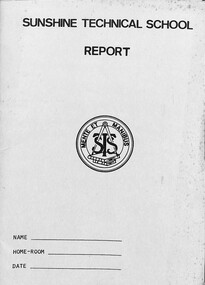 Sunshine and District Historical Society Incorporated
Memorabilia - Sunshine Technical School Memorabila
... Newspaper Article Williamstown Mail June 1987 - Premier ponders school problems Sunshine Technical School 75 years Diamond Jubilee Flyer Sunshine Technical School 75 years Diamond Jubilee Booklet Sunshine Technical School 75 years Diamond Jubilee Reunion Guide Sunshine Technical School 1970 Pocket Calendar Sunshine Technical School Ball 1977 Ticket Sunshine Technical School Annual Speech Night 1960 Constitution and Standing Orders of the Sunshine Technical School Sunshine Technical School Ex-Students Association Constitution and By-Laws May 1947 Sunshine Technical School Spelling and Vocabulary Notebook Sunshine Technical School VCE Course Information Book and Application Form 1989 Sunshine Technical School VCE Course Outline and Application Form 1987 Social Studies Neil McQuinn Form 2B Workbook Sunshine Technical School Report Cards Sunshine Technical School Progress Report Cards Meanwhile your children still suffer these conditions flyer Sunshine Technical School Co-operative Society Correspondence Book Accident Register Cleaners End of Year Party Notes Book given to Mavis Batten Girls' Junior School "C" Form 1st Prize 1929 Sunshine Technical School Green Plastic Document Folder Cast Aluminium Cookaburrow Object Back to Sunshine 1988 An Australian Bicentennial Activity Triple MMM Rocks Sunshine Technical College Sticker Sunshine Technical School Inventory Used Official Opening of the New and Refurbished Section of the Secondary School Ticket for Ms. ...Vella) Newspaper Article The Advocate 8th October 1980 Page 12 - A 77 year wait for an official opening Technical Schools (Boys) Student's Record Book Collection of documents and objects from the Sunshine Technical School Memorabilia Sunshine Technical School Memorabila ...Newspaper Article Williamstown Mail June 1987 - Premier ponders school problems Sunshine Technical School 75 years Diamond Jubilee Flyer Sunshine Technical School 75 years Diamond Jubilee Booklet Sunshine Technical School 75 years Diamond Jubilee Reunion Guide Sunshine Technical School 1970 Pocket Calendar Sunshine Technical School Ball 1977 Ticket Sunshine Technical School Annual Speech Night 1960 Constitution and Standing Orders of the Sunshine Technical School Sunshine Technical School Ex-Students Association Constitution and By-Laws May 1947 Sunshine Technical School Spelling and Vocabulary Notebook Sunshine Technical School VCE Course Information Book and Application Form 1989 Sunshine Technical School VCE Course Outline and Application Form 1987 Social Studies Neil McQuinn Form 2B Workbook Sunshine Technical School Report Cards Sunshine Technical School Progress Report Cards Meanwhile your children still suffer these conditions flyer Sunshine Technical School Co-operative Society Correspondence Book Accident Register Cleaners End of Year Party Notes Book given to Mavis Batten Girls' Junior School "C" Form 1st Prize 1929 Sunshine Technical School Green Plastic Document Folder Cast Aluminium Cookaburrow Object Back to Sunshine 1988 An Australian Bicentennial Activity Triple MMM Rocks Sunshine Technical College Sticker Sunshine Technical School Inventory Used Official Opening of the New and Refurbished Section of the Secondary School Ticket for Ms. G. Templeton 1980 75 Years Reunion Dance 1987 The Australian Science Teachers Journals 1955, 1956 & 1959 (Teacher J. Vella) Newspaper Article The Advocate 8th October 1980 Page 12 - A 77 year wait for an official opening Technical Schools (Boys) Student's Record Booksunshine technical school, technical school -
 Chiltern Athenaeum Trust
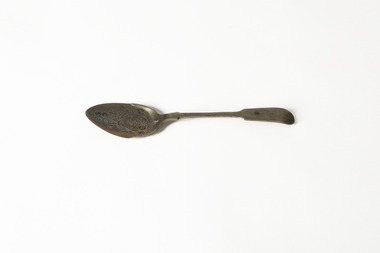
Domestic object - Spoon belonging to W.C.Busse
... Wilfred Clarence Busse was a member of Chiltern Athenaeum (where this object is now held) up until his death in 1960, he is buried in the Barnawartha Cemetery. ...Wilfred Clarence Busse was a member of Chiltern Athenaeum (where this object is now held) up until his death in 1960, he is buried in the Barnawartha Cemetery. ...Wilfred Clarence Busse, born in Chiltern in 1898, His family moved to the region during the gold rush and continued to reside in the area, purchasing land adjacent the Murray River. Busse completed his secondary education at Wesley College in Melbourne then studied law at the University of Melbourne. Busse went on to become a barrister, often in the chambers of Sir Leo Finn Bernard Cussen (1859-1933) a judge of the Supreme Court of Victoria. He worked most of his life in Chiltern as a Barrister and Solicitor and gained the unofficial title of historian of Chiltern, leaving behind several manuscript histories and a scrap book. Busse was an avid fictional writer and in 1930 he published two novels. Time spent on a Victorian station in his early twenties, as well as careful documentary research, informed the writing of his historical novels of bush life. "The Blue Beyond; A Romance of the Early Days in South Eastern Australia” and "The Golden Plague: A Romance of the Early Fifties." "The Golden Plague” won the T. E. Role gold medal for the best historical novel which went on to become a best seller. Busse often drew inspiration for his novels from his younger years living Chiltern. His passion for the region lead him to write “The History of Chiltern” which was published in a serial form in the Chiltern Federal Standard from 1922-1923. Wilfred Clarence Busse was a member of Chiltern Athenaeum (where this object is now held) up until his death in 1960, he is buried in the Barnawartha Cemetery. The floral motif on this particular spoon appears to be stylised in the decorative arts and craft style favoured in Europe between 1880-1920 and less representational than examples of Australiana flora captured in silversmithing from the 1850's onwards produced in Australia. It is likely that those producing silverware at the time would be drawing on the decorative arts movement while incorporating elements of the natural beauty in the flora of their newfound environment into the silverware they produced. This spoon seems more likely to have been produced in Europe and imported to the colony. The hallmarks on the handle DON and BP indicate it may have been produced from English electroplating silver which is a more cost effective product than solid silver, most likely produced by Cooper Brothers, Don Plate Works, established in Sheffield in 1866 who distributed silverware in Europe, America and the colonies well into the 1950's.Wilfred Clarence Busse was of social significance to Chiltern, he helped to document the cultural story of the area in his published works "The Golden Plague" and "The Beyond Blue" by recounting his own upbringing in a bush lifestyle. He was a respected Barrister and was the unofficial historian of the Chiltern Athenaeum for many years. This spoon represents a window into the domestic life of this person who was well loved in the area, and it continues its relationship to Busse as well as Chiltern by being held within the very collection he helped to maintain in his life. Domestic objects tell us the story about how people lived, objects of daily use hold particular meaning in that they can tell us the story of an individual, we feel closer to their life and habits, it humanises and connects us across time. Wilfred Busse ate food and he did it from a beautiful silver floral detailed spoon.A silver tablespoon with floral embossed head and hallmarks embossed on reverse handleDON/ BP/silverware, wilfred clarence busse, busse, chiltern, chiltern athenaeum, federal standard, t. e. role, "the blue beyond, a romance of the early days in south eastern australia”, "the golden plague: a romance of the early fifties.", "the golden plague”, wesley college, university of melbourne, sir leo finn bernard cussen, supreme court of victoria, gold rush, murray river, “the history of chiltern”, silversmithing, spoon, decorative arts, floral, flora, australiana, australian flora, arts and craft movement, australian silver, cussen -
 Flagstaff Hill Maritime Museum and Village
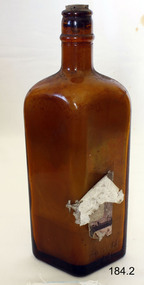
Container - Bottle, Pre 1974
... However, passing these laws was not easy, and the manufacturers were essentially left to do as they wished. ...However, passing these laws was not easy, and the manufacturers were essentially left to do as they wished. ...Phenyle has been used for decades as a cleaner and disinfectant. It is well know for its use for cleaning outdoor toilets and easily identified by its strong odour. The brown glass bottle is immediately recognised as containing a poison. We've all seen them in a hundred different mystery movie scenes. The medicine cabinet opens and there, sitting on a shelf, is the incriminating object -- the ominous dark bottle with the skull and crossbones on the label. In off-screen reality, however, poison bottles have quite a different identity -- they are distinctive, varied, colorful -- and definitely collectible. Obviously, the one thing that sets the poison bottle apart from all other bottles is the need for prominent and immediate identification as a receptacle for toxic material, and this was achieved in a number of ways, including shape, color, embossing and labeling. Poisons were commonly found in the home for the purpose of controlling rodents and other pests, and were sold by grocers and druggists. For consumer protection, as far back as 1829, New York State made mandatory the marking of the bottles with the word "poison" in large letters. Then, in the middle of the 19th century, the American Pharmaceutical Association recommended legislation regarding identification of all poison bottles. In 1872 the American Medical Association also made recommendations -- namely that poison bottles be made of colored glass, and also have a rough surface on one side -- making them identifiable even in the dark -- and the word "poison" visible on the other (the skull and crossbones wasn't quite as ubiquitous as those movies led us to believe). However, passing these laws was not easy, and the manufacturers were essentially left to do as they wished. For collectors, the high point of poison bottle manufacturing was the period ranging roughly from the 1870s to the 1930s. At that time some, of the bottles were distinguished by particularly bright colors, such as cobalt blue (the most common) and emerald green. Others, particularly rare and collectible, had unusual -- and appropriate -- shapes, including skulls, leg bones and coffins. In order to better identify these lethal vessels by feel (not forgetting that there were many people in this period who could not read) when groping for them in the dark, they had such elaborate tactile patterns as quilted diamonds, lattices, hobnails and prominent vertical or horizontal ribbing, as well as spiky knobs and ridges. In addition, many had sharp points on top for the same precautionary purpose. Further efforts to distinguish poison bottles from others included uncommon multisided and triangular shapes, and unusual, hard-to-open tops, the predecessors of the modern child-proof openings. https://www.southcoasttoday.com/story/lifestyle/2001/08/19/poison-bottles-steeped-in-history/50352280007/The recognition and awareness of bottles containing poisonpous substances is extremely important for safety reasons.Bottle, brown glass, diamond shaped. "Bright Star" phenyle. Paper label attached, but peeling off and badly damaged. Corked with contents. Text moulded into glass, some with a border of stars. Poisonous contents, not to be taken. Registered Number 2140. Volume is 20 fluid ounces. Printed label "Bright Star". Text is moulded in the glass in raised lettering: "PHENYLE" outlined and decorated with star border. "POISONOUS", "NOT TO BE TAKEN" "V / DM / A" within oval, "REGD NO. 2140" (D and O are smaller and underlined) . Base is marked "F190".flagstaff hill, warrnambool, shipwrecked-coast, flagstaff-hill, flagstaff-hill-maritime-museum, maritime-museum, shipwreck-coast, flagstaff-hill-maritime-village, bright star, phenyl, cleaning and disinfecting chemical, poison, bottles -
 Flagstaff Hill Maritime Museum and Village
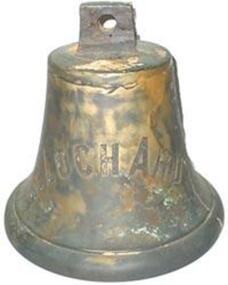
Equipment - Ship's Bell, Loch Ard
... Mrs McArthur was the daughter-in-law of Peter McArthur, and the mother of Colin McArthur, who had then inherited Glenample. ...Mrs McArthur was the daughter-in-law of Peter McArthur, and the mother of Colin McArthur, who had then inherited Glenample. ...This Loch Ard ship's bell was kindly loaned by Heritage Victoria. The Loch Ard was an 85-metre, three-masted square-rigged iron clipper that sank in bad weather after hitting Mutton Bird Island, near Port Campbell, on June 1, 1878, just days after completing its three-month journey from Britain. Loch Ard carried some of the finest items that 19th-century Europe had to offer, intended for display at Melbourne’s International Exhibition in 1880. Before the modern age, a ship’s bell was one of the most important functional objects on a ship, used to regulate the daily routine of life, sound the time, and to signal watches and emergencies to everyone on board. The Loch Ard Bell is made of lead, bronze and copper alloy, and weighs 33 kg. It is missing its clapper. The bell disappeared after being recovered from the wreck in the 1960s, and reappeared in November 2003 when it was soon returned to Heritage Victoria staff. Ship bells are used for time-keeping, with codes to signify every half-hour and the fourth hour, to mark the time to change the watch or shift. They are also used in emergencies, to warn of fire and other danger, and to alert nearby vessels of their presence, especially in poor weather. Ship bells are usually cast or engraved with the ship’s name and often its launch date. If time allowed during an imminent disaster, seamen would save the ship’s bell, but if the ship sank, its bell would be searched for by those who discovered the wreck, as proof of the ship’s identification. Some ships, such as the famous luxury sailing ship Schomberg, had two bells: the main deck bell and a small bell used in the pilot house. The location of another bell from the Loch Ard is currently unknown. Sometime after the initial salvaging of the wreckage of the Loch Ard, a ship's bell for the Loch Ard was washed up. It was used for several years to summon men to meals at Glenample homestead, where part-owner Hugh Gibson and his family had previously sheltered the Loch Ard survivors, Tom Pearce and Eva Carmichael, as they recovered. Gibson's business partner, Peter McArthur, purchased Gibson's share of the property in 1887. In 1942, the Princetown A.R.P. (Air Raid Precautions, part of the World War 2 Air Raid Warden Service) and Observation group accepted the offer of the Loch Ard Bell from Mrs R.E. McArthur of Glenample homestead, for sounding an air raid alarm. Mrs McArthur was the daughter-in-law of Peter McArthur, and the mother of Colin McArthur, who had then inherited Glenample. Since then, the bell's whereabouts is unclear.Ship's bell: a cast bell of metal alloy - lead, bronze and copper. It has a square flat head with a central hole, a flat head, a band at the shoulder and waist, and a rounded sound bow. It no longer has its clapper. The surface is uneven and discoloured, and a vertical split has been mended at some stage. This ship's name has been cast into the bell's body. The bell was recovered from the wreck of the sailing ship Loch Ard in 1967, and is on loan from Heritage Victoria. "LOCH ARD"flagstaff hill maritime museum and village, great ocean road, shipwreck coast, flagstaff hill, warrnambool, maritime museum, loch ard, loch ard gorge, victorian heritage register, ship bell, ship's bell, loch ard bell, marine equipment, signal, alarm, marinter's watch, shipwreck artefact, shipwreck discovery -
 Coal Creek Community Park & Museum
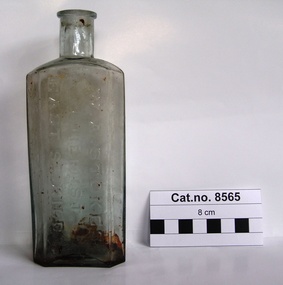
Domestic object - Glass Bottle
... The mayor announced that there was a doubt in the minds of the magistrates as to whether the defendant could be held guilty under the law, but they thought the prosecution had attained its object by making known the fact that "Rough on Rats" is a poison. ...The mayor announced that there was a doubt in the minds of the magistrates as to whether the defendant could be held guilty under the law, but they thought the prosecution had attained its object by making known the fact that "Rough on Rats" is a poison. ...TROVE : Jewish Herald (Vic. : 1879 - 1920) Friday 14 March 1913 p 10 Advertising. Mr. Frank Newman desires to intimate that he has purchased the old-established business of the late MR. W. A. STOKES, recently carried on by Mr. P. J. Winch, and hopes by giving; his personal attention to the Pharmacy to merit your support. 181 CARLISLE ST.. BALACLAVA. Tel. Windsor 30. TROVE : The Age (Melbourne, Vic. : 1854 - 1954) Tuesday 13 December 1887 p 5 Article " ROUGH ON RATS" POISON.' . PROSECUTION UNDER THE POISONS ACT. At the St. Kilda police court, on Friday, W, A. Stokes, chemist, Carlisle-street, Balaclava, was prosecuted under the Poisons Statute on the charge of selling to one Mrs. Hannah Charlton a poison without having made and signed the entry required by the act. A second charge of selling to Mrs, Hannah Charlton a poison without having obtained the signature of the purchaser to an entry as required by the act was also preferred against the defendant. Both cases were taken together. Mr, Donovan appeared to prosecute, and Mr. Cole for the defence. Senior-constable Connell deposed that he knew the defendant. On the 24th of October last an inquest was held at East St. Kilda relative to the cause of the death of a man named Charlton. A packet bearing the label " Rough on Rats," which was found. in the deceased's bedroom, was produced at the inqiry, and afterwards handed over to Mr. Blackett, Government analytical chemist for analysis. The verdict of the jury was that the deceased died from the effects of arsenical poisoning. Hannah Charlton, a widow, residing in South Yarra, said in September last she purchased a packet of "Rough on Rats" from the defendant's assistant. Witness was not asked her name, place of abode, occupation or for what purpose the poison was required; neither did she observe the assistant make any entry in a book, She did not attach her signature to any document, and was not asked to do so. The packet was purchased for the purpose of poisoning rats. Cuthbert Robert Blackett, Government analytical chemist, stated that Constable Ballantyne handed him the packet produced. Witness made an analysis of the contents, and found it composed of arsenic, slightly coloured with a carbonaceous matter. The mayor announced that there was a doubt in the minds of the magistrates as to whether the defendant could be held guilty under the law, but they thought the prosecution had attained its object by making known the fact that "Rough on Rats" is a poison. They thought that such preparations should be entered by the sellers, but in that case they were inclined to give the defendant the benefit of the doubt and dismiss the case.Rectangular clear light green tinted glass bottle with embossed text and numerals on side and base.'W. A. STOKES CHEMIST EAST ST.KILDA' on side. 'K6232' on base.chemist, poison, arsenic -
 Chiltern Athenaeum Trust
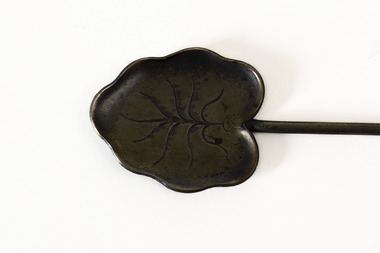
Domestic object - Spoon belonging to W.C.Busse
... Wilfred Clarence Busse was a member of Chiltern Athenaeum (where this object is now held) up until his death in 1960, he is buried in the Barnawartha Cemetery. ...Wilfred Clarence Busse was a member of Chiltern Athenaeum (where this object is now held) up until his death in 1960, he is buried in the Barnawartha Cemetery. ...Wilfred Clarence Busse, born in Chiltern in 1898, His family moved to the region during the gold rush and continued to reside in the area, purchasing land adjacent the Murray River. Busse completed his secondary education at Wesley College in Melbourne then studied law at the University of Melbourne. Busse went on to become a barrister, often in the chambers of Sir Leo Finn Bernard Cussen (1859-1933) a judge of the Supreme Court of Victoria. He worked most of his life in Chiltern as a Barrister and Solicitor and gained the unofficial title of historian of Chiltern, leaving behind several manuscript histories and a scrap book. Busse was an avid fictional writer and in 1930 he published two novels. Time spent on a Victorian station in his early twenties, as well as careful documentary research, informed the writing of his historical novels of bush life. "The Blue Beyond; A Romance of the Early Days in South Eastern Australia” and "The Golden Plague: A Romance of the Early Fifties." "The Golden Plague” won the T. E. Role gold medal for the best historical novel which went on to become a best seller. Busse often drew inspiration for his novels from his younger years living Chiltern. His passion for the region lead him to write “The History of Chiltern” which was published in a serial form in the Chiltern Federal Standard from 1922-1923. Wilfred Clarence Busse was a member of Chiltern Athenaeum (where this object is now held) up until his death in 1960, he is buried in the Barnawartha Cemetery. The leaf shaped motif of this particular spoon appears to be stylised in a simple form of decorative arts and craft or even Art Nouveau style favoured in Europe between 1880-1920 and less representational than examples of Australiana flora captured in silversmithing from the 1850's onwards. According to Christine Erratt, due to the goldrush in the 1850's, there was increased wealth in the colony and an influx of immigrants from Europe to Australia who brought with them silversmithing skills which began ‘the golden age’ of Australian silver', Erratt says that 'Australia's unique flora has been portrayed in the decorative arts since the early colonial times of the last decade of the 18th century. The use of Australian flora to decorate silverware is of particular interest and diversity'. It is likely that those producing silverware at the time would be drawing on the decorative arts movement while incorporating elements of the natural beauty in the flora of their newfound environment into the silverware they produced. There are no discerning maker hallmarks to place where it was produced or ascertain the material accurately.Wilfred Clarence Busse was of social significance to Chiltern, he helped to document the cultural story of the area in his published works "The Golden Plague" and "The Beyond Blue" by recounting his own upbringing in a bush lifestyle. He was a respected Barrister and was the unofficial historian of the Chiltern Athenaeum for many years. This spoon represents a window into the domestic life of this person who was well loved in the area, and it continues its relationship to Busse as well as Chiltern by being held within the very collection he helped to maintain in his life. Domestic objects tell us the story about how people lived, objects of daily use hold particular meaning in that they can tell us the story of an individual, we feel closer to their life and habits, it humanises and connects us across time. A tarnished small silver teaspoon with leaf-shaped head and slim handlesilverware, wilfred clarence busse, busse, chiltern, chiltern athenaeum, federal standard, t. e. role, "the blue beyond, a romance of the early days in south eastern australia”, "the golden plague: a romance of the early fifties.", "the golden plague”, wesley college, university of melbourne, sir leo finn bernard cussen, supreme court of victoria, gold rush, murray river, “the history of chiltern”, silversmithing, spoon, decorative arts, floral, flora, australiana, australian flora, arts and craft movement, australian silver, cussen -
 Ballarat and District Irish Association
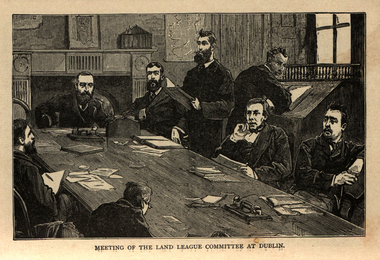
Image, Land League Committee Meeting, Dublin, 1864
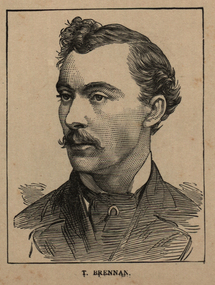
... This in turn led on to stronger criminal laws being passed that were described by the League as "Coercion Acts". ...This in turn led on to stronger criminal laws being passed that were described by the League as "Coercion Acts". ...The Irish National Land League (Irish: Conradh na Talún) was an Irish political organisation of the late 19th century which sought to help poor tenant farmers. Its primary aim was to abolish landlordism in Ireland and enable tenant farmers to own the land they worked on. The period of the Land League's agitation is known as the Land War. Within decades of the league's foundation, through the efforts of William O'Brien and George Wyndham (a descendant of Lord Edward FitzGerald), the 1902 Land Conference produced the Land (Purchase) Act 1903 which allowed Irish tenant farmers buy out their freeholds with UK government loans over 68 years through the Land Commission (an arrangement that has never been possible in Britain itself). For agricultural labourers, D.D. Sheehan and the Irish Land and Labour Association secured their demands from the Liberal government elected in 1905 to pass the Labourers (Ireland) Act 1906, and the Labourers (Ireland) Act 1911, which paid County Councils to build over 40,000 new rural cottages, each on an acre of land. By 1914, 75% of occupiers were buying out their landlords, mostly under the two Acts. In all, under the pre-UK Land Acts over 316,000 tenants purchased their holdings amounting to 15 million acres (61,000 km2) out of a total of 20 million acres (81,000 km2) in the country. Sometimes the holdings were described as "uneconomic", but the overall sense of social justice was undeniable. (http://en.wikipedia.org/wiki/Irish_National_Land_League, accessed 21 January 2014) The Irish National Land League was founded at the Imperial Hotel in Castlebar, the County town of Mayo, on 21 October 1879. At that meeting Charles Stewart Parnell was elected president of the league. Andrew Kettle, Michael Davitt, and Thomas Brennan were appointed as honorary secretaries. This united practically all the different strands of land agitation and tenant rights movements under a single organisation. The two aims of the Land League, as stated in the resolutions adopted in the meeting, were: ...first, to bring out a reduction of rack-rents; second, to facilitate the obtaining of the ownership of the soil by the occupiers. That the object of the League can be best attained by promoting organisation among the tenant-farmers; by defending those who may be threatened with eviction for refusing to pay unjust rents; by facilitating the working of the Bright clauses of the Irish Land Act during the winter; and by obtaining such reforms in the laws relating to land as will enable every tenant to become owner of his holding by paying a fair rent for a limited number of years. Charles Stewart Parnell, John Dillon, Michael Davitt, and others including Cal Lynn then went to America to raise funds for the League with spectacular results. Branches were also set up in Scotland, where the Crofters Party imitated the League and secured a reforming Act in 1886. The government had introduced the first ineffective Land Act in 1870, then the equally inadequate Acts of 1880 and 1881 followed. These established a Land Commission that started to reduce some rents. Parnell together with all of his party lieutenants, including Father Eugene Sheehy known as "the Land League priest", went into a bitter verbal offensive and were imprisoned in October 1881 under the Irish Coercion Act in Kilmainham Jail for "sabotaging the Land Act", from where the No-Rent Manifesto was issued, calling for a national tenant farmer rent strike which was partially followed. Although the League discouraged violence, agrarian crimes increased widely. Typically a rent strike would be followed by evictions by the police, or those tenants paying rent would be subject to a local boycott by League members. Where cases went to court, witnesses would change their stories, resulting in an unworkable legal system. This in turn led on to stronger criminal laws being passed that were described by the League as "Coercion Acts". The bitterness that developed helped Parnell later in his Home Rule campaign. Davitt's views were much more extreme, seeking to nationalise all land, as seen in his famous slogan: "The land of Ireland for the people of Ireland". Parnell aimed to harness the emotive element, but he and his party preferred for tenant farmers to become freeholders on the land they rented, instead of land being vested in "the people".(http://en.wikipedia.org/wiki/Irish_National_Land_League, accessed 21 January 2014)Image of a number of men sitting around a table. They are members of the Land League Committee during a meeting in Dublin.ballarat irish, land league, land league committee, dublin -
 Ballarat and District Irish Association
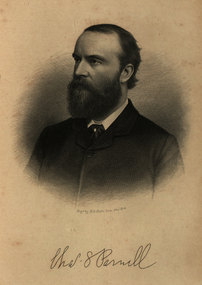
Image, Charles Parnell, c1864, 1864
... This in turn led on to stronger criminal laws being passed that were described by the League as "Coercion Acts". ...This in turn led on to stronger criminal laws being passed that were described by the League as "Coercion Acts". ...Parnell was an Irish nationalist and statesman who led the fight for Irish Home Rule in the 1880s. Charles Stewart Parnell was born on 27 June 1846 in County Wicklow into a family of Anglo-Irish Protestant landowners. He studied at Cambridge University and was elected to parliament in 1875 as a member of the Home Rule League (later re-named by Parnell the Irish Parliamentary Party). His abilities soon became evident. In 1878, Parnell became an active opponent of the Irish land laws, believing their reform should be the first step on the road to Home Rule. In 1879, Parnell was elected president of the newly founded National Land League and the following year he visited the United States to gain both funds and support for land reform. In the 1880 election, he supported the Liberal leader William Gladstone, but when Gladstone's Land Act of 1881 fell short of expectations, he joined the opposition. By now he had become the accepted leader of the Irish nationalist movement. Parnell now encouraged boycott as a means of influencing landlords and land agents, and as a result he was sent to jail and the Land League was suppressed. From Kilmainham prison he called on Irish peasants to stop paying rent. In March 1882, he negotiated an agreement with Gladstone - the Kilmainham Treaty - in which he urged his followers to avoid violence. But this peaceful policy was severely challenged by the murder in May 1882 of two senior British officials in Phoenix Park in Dublin by members of an Irish terrorist group. Parnell condemned the murders. In 1886, Parnell joined with the Liberals to defeat Lord Salisbury's Conservative government. Gladstone became prime minister and introduced the first Irish Home Rule Bill. Parnell believed it was flawed but said he was prepared to vote for it. The Bill split the Liberal Party and was defeated in the House of Commons. Gladstone's government fell soon afterwards.(http://www.bbc.co.uk/history/historic_figures/parnell_charles.shtml, accessed 21 January 2014) The Irish National Land League (Irish: Conradh na Talún) was an Irish political organisation of the late 19th century which sought to help poor tenant farmers. Its primary aim was to abolish landlordism in Ireland and enable tenant farmers to own the land they worked on. The period of the Land League's agitation is known as the Land War. Within decades of the league's foundation, through the efforts of William O'Brien and George Wyndham (a descendant of Lord Edward FitzGerald), the 1902 Land Conference produced the Land (Purchase) Act 1903 which allowed Irish tenant farmers buy out their freeholds with UK government loans over 68 years through the Land Commission (an arrangement that has never been possible in Britain itself). For agricultural labourers, D.D. Sheehan and the Irish Land and Labour Association secured their demands from the Liberal government elected in 1905 to pass the Labourers (Ireland) Act 1906, and the Labourers (Ireland) Act 1911, which paid County Councils to build over 40,000 new rural cottages, each on an acre of land. By 1914, 75% of occupiers were buying out their landlords, mostly under the two Acts. In all, under the pre-UK Land Acts over 316,000 tenants purchased their holdings amounting to 15 million acres (61,000 km2) out of a total of 20 million acres (81,000 km2) in the country. Sometimes the holdings were described as "uneconomic", but the overall sense of social justice was undeniable. (http://en.wikipedia.org/wiki/Irish_National_Land_League, accessed 21 January 2014) The Irish National Land League was founded at the Imperial Hotel in Castlebar, the County town of Mayo, on 21 October 1879. At that meeting Charles Stewart Parnell was elected president of the league. Andrew Kettle, Michael Davitt, and Thomas Brennan were appointed as honorary secretaries. This united practically all the different strands of land agitation and tenant rights movements under a single organisation. The two aims of the Land League, as stated in the resolutions adopted in the meeting, were: ...first, to bring out a reduction of rack-rents; second, to facilitate the obtaining of the ownership of the soil by the occupiers. That the object of the League can be best attained by promoting organisation among the tenant-farmers; by defending those who may be threatened with eviction for refusing to pay unjust rents; by facilitating the working of the Bright clauses of the Irish Land Act during the winter; and by obtaining such reforms in the laws relating to land as will enable every tenant to become owner of his holding by paying a fair rent for a limited number of years. Charles Stewart Parnell, John Dillon, Michael Davitt, and others including Cal Lynn then went to America to raise funds for the League with spectacular results. Branches were also set up in Scotland, where the Crofters Party imitated the League and secured a reforming Act in 1886. The government had introduced the first ineffective Land Act in 1870, then the equally inadequate Acts of 1880 and 1881 followed. These established a Land Commission that started to reduce some rents. Parnell together with all of his party lieutenants, including Father Eugene Sheehy known as "the Land League priest", went into a bitter verbal offensive and were imprisoned in October 1881 under the Irish Coercion Act in Kilmainham Jail for "sabotaging the Land Act", from where the No-Rent Manifesto was issued, calling for a national tenant farmer rent strike which was partially followed. Although the League discouraged violence, agrarian crimes increased widely. Typically a rent strike would be followed by evictions by the police, or those tenants paying rent would be subject to a local boycott by League members. Where cases went to court, witnesses would change their stories, resulting in an unworkable legal system. This in turn led on to stronger criminal laws being passed that were described by the League as "Coercion Acts". The bitterness that developed helped Parnell later in his Home Rule campaign. Davitt's views were much more extreme, seeking to nationalise all land, as seen in his famous slogan: "The land of Ireland for the people of Ireland". Parnell aimed to harness the emotive element, but he and his party preferred for tenant farmers to become freeholders on the land they rented, instead of land being vested in "the people".(http://en.wikipedia.org/wiki/Irish_National_Land_League, accessed 21 January 2014)Image of bearded man known as Charles Stewart Parnellballarat irish, parnell, charles parnell, home rule -
 Coal Creek Community Park & Museum
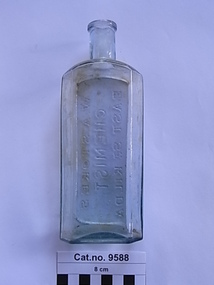
Bottle, glass, c.1887- c.1903
... The mayor announced that there was a doubt in the minds of the magistrates as to whether the defendant could be held guilty under the law, but they thought the prosecution had attained its object by making known the fact that "Rough on Rats" is a poison. ...The mayor announced that there was a doubt in the minds of the magistrates as to whether the defendant could be held guilty under the law, but they thought the prosecution had attained its object by making known the fact that "Rough on Rats" is a poison. ...Victorian Government gazette, Wednesday January 28, 1902, page 20. 'The Pharmaceutical Register cont'd.........No. on register : 140, Date of registration : 30 May 1877, Stokes, William Albert, Balaclava Road, East St. Kilda, Qualification : in business in Victoria before 1 October 1876'. TROVE : Argus (Melbourne, Vic. : 1848 - 1957), Tuesday 7 September 1875, page 1. 'WANTED, a respectable BOY ; must live in the neighbourhood. References W. A. Stokes, chemist, Balaclava'. TROVE : Bendigo Independent (Vic. : 1891 - 1918), Tuesday 1 December 1914, page 5. 'ABOUT PEOPLE. The death of Dr. James Stokes, M.R.C.S., L., occurred at his home, 43 Ebden Street, Elsternwick, on Saturday at the age of 90 years. Dr. Stokes, who was born in London,, arrived in Victoria in 1849 and for many years practiced in different parts of the State. He was the last on the male side of an old family, one of his sons, who predeceased him, being the late Mr. W. A. Stokes, chemist, of Carlisle Street, St. Kilda. The funeral took place yesterday morning, when the remains were in interred in the family grave at St, Kilda Cemetery'. TROVE : The Age (Melbourne, Vic. : 1854 - 1954) Tuesday 13 December 1887 p 5 Article " ROUGH ON RATS" POISON.' . PROSECUTION UNDER THE POISONS ACT. At the St. Kilda police court, on Friday, W, A. Stokes, chemist, Carlisle-street, Balaclava, was prosecuted under the Poisons Statute on the charge of selling to one Mrs. Hannah Charlton a poison without having made and signed the entry required by the act. A second charge of selling to Mrs, Hannah Charlton a poison without having obtained the signature of the purchaser to an entry as required by the act was also preferred against the defendant. Both cases were taken together. Mr, Donovan appeared to prosecute, and Mr. Cole for the defence. Senior-constable Connell deposed that he knew the defendant. On the 24th of October last an inquest was held at East St. Kilda relative to the cause of the death of a man named Charlton. A packet bearing the label " Rough on Rats," which was found. in the deceased's bedroom, was produced at the inqiry, and afterwards handed over to Mr. Blackett, Government analytical chemist for analysis. The verdict of the jury was that the deceased died from the effects of arsenical poisoning. Hannah Charlton, a widow, residing in South Yarra, said in September last she purchased a packet of "Rough on Rats" from the defendant's assistant. Witness was not asked her name, place of abode, occupation or for what purpose the poison was required; neither did she observe the assistant make any entry in a book, She did not attach her signature to any document, and was not asked to do so. The packet was purchased for the purpose of poisoning rats. Cuthbert Robert Blackett, Government analytical chemist, stated that Constable Ballantyne handed him the packet produced. Witness made an analysis of the contents, and found it composed of arsenic, slightly coloured with a carbonaceous matter. The mayor announced that there was a doubt in the minds of the magistrates as to whether the defendant could be held guilty under the law, but they thought the prosecution had attained its object by making known the fact that "Rough on Rats" is a poison. They thought that such preparations should be entered by the sellers, but in that case they were inclined to give the defendant the benefit of the doubt and dismiss the case.Aqua tinted clear glass bottle with angled corners for stopper seal with text embossed on one side and on base.On side : 'W.A.STOKES CHEMIST EAST ST. KILDA'. On base : 'K6228'.w a stokes, chemist -
 Ballarat and District Irish Association
Image, T. Brennan, c1864, 1864
... Michael Davitt Founder of the Land League The two aims of the Land League, as stated in the resolutions adopted in the meeting, were: ...first, to bring out a reduction of rack-rents; second, to facilitate the obtaining of the ownership of the soil by the occupiers. That the object of the League can be best attained by promoting organisation among the tenant-farmers; by defending those who may be threatened with eviction for refusing to pay unjust rents; by facilitating the working of the Bright clauses of the Irish Land Act during the winter; and by obtaining such reforms in the laws relating to land as will enable every tenant to become owner of his holding by paying a fair rent for a limited number of years. ...Michael Davitt Founder of the Land League The two aims of the Land League, as stated in the resolutions adopted in the meeting, were: ...first, to bring out a reduction of rack-rents; second, to facilitate the obtaining of the ownership of the soil by the occupiers. That the object of the League can be best attained by promoting organisation among the tenant-farmers; by defending those who may be threatened with eviction for refusing to pay unjust rents; by facilitating the working of the Bright clauses of the Irish Land Act during the winter; and by obtaining such reforms in the laws relating to land as will enable every tenant to become owner of his holding by paying a fair rent for a limited number of years. ...Following the founding meeting of the Mayo Tenants Defence Association in Castlebar, County Mayo on 26 October 1878 the demand for The Land of Ireland for the people of Ireland was reported in the Connaught Telegraph 2 November 1878. The first of many "monster meetings" of tenant farmers was held in Irishtown near Claremorris on 20 April 1879, with an estimated turnout of 15,000 to 20,000 people. This meeting was addressed by James Daly (who presided), John O'Connor Power, John Ferguson, Thomas Brennan, and J. J. Louden. The Connaught Telegraph's report of the meeting in its edition of 26 April 1879 began: Since the days of O'Connell a larger public demonstration has not been witnessed than that of Sunday last. About 1 o'clock the monster procession started from Claremorris, headed by several thousand men on foot – the men of each district wearing a laural leaf or green ribbon in hat or coat to distinguish the several contingents. At 11 o'clock a monster contingent of tenant-farmers on horseback drew up in front of Hughes's hotel, showing discipline and order that a cavalry regiment might feel proud of. They were led on in sections, each having a marshal who kept his troops well in hand. Messrs. P.W. Nally, J.W. Nally, H. French, and M. Griffin, wearing green and gold sashes, led on their different sections, who rode two deep, occupying, at least, over an Irish mile of the road. Next followed a train of carriages, brakes, cares, etc. led on by Mr. Martin Hughes, the spirited hotel proprietor, driving a pair of rare black ponies to a phæton, taking Messrs. J.J. Louden and J. Daly. Next came Messrs. O'Connor, J. Ferguson, and Thomas Brennan in a covered carriage, followed by at least 500 vehicles from the neighbouring towns. On passing through Ballindine the sight was truly imposing, the endless train directing its course to Irishtown – a neat little hamlet on the boundaries of Mayo, Roscommon, and Galway. Evolving out of this a number of local land league organisations were set up to work against the excessive rents being demanded by landlords all over Ireland, but especially in Mayo and surrounding counties. From 1874 agricultural prices in Europe had dropped, followed by some bad harvests due to wet weather during the Long Depression. The effect by 1878 was that many Irish farmers were unable to pay the rents that they had agreed, particularly in the poorer and wetter parts of Connacht. The localised 1879 Famine added to the misery. Unlike other parts of Europe the Irish land tenure system was inflexible in times of hardship. (Wikipedia) The Irish National Land League was founded at the Imperial Hotel in Castlebar, the County town of Mayo, on 21 October 1879. At that meeting Charles Stewart Parnell was elected president of the league. Andrew Kettle, Michael Davitt, and Thomas Brennan were appointed as honorary secretaries. This united practically all the different strands of land agitation and tenant rights movements under a single organisation. Michael Davitt Founder of the Land League The two aims of the Land League, as stated in the resolutions adopted in the meeting, were: ...first, to bring out a reduction of rack-rents; second, to facilitate the obtaining of the ownership of the soil by the occupiers. That the object of the League can be best attained by promoting organisation among the tenant-farmers; by defending those who may be threatened with eviction for refusing to pay unjust rents; by facilitating the working of the Bright clauses of the Irish Land Act during the winter; and by obtaining such reforms in the laws relating to land as will enable every tenant to become owner of his holding by paying a fair rent for a limited number of years. (Wikipedia)Image of a man with a moustache. He is T. Brennan.ballarat irish, brennan, thomas brennan, irish land act, rent -
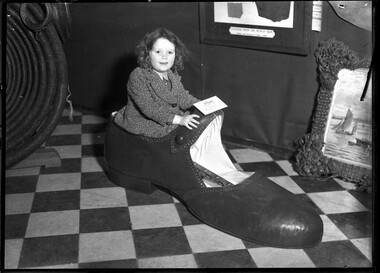 City of Melbourne Libraries
Photograph, Bull, Hugh Jones, 1897-1993, Leather Exhibition, Melbourne Town Hall
... Study of the law had always been open to women in NZ, but its practice was still barred to them. ...Study of the law had always been open to women in NZ, but its practice was still barred to them. ...Photographer notations on slide: At the Leather Exhib. at T. Hall Melb 1933 Age Published: Age (Melbourne, Vic.: 1854- ), 1933 THE EXHIBITS. (1933, September 20). The Age (Melbourne, Vic. : 1854 - 1954), p. 16. Retrieved January 25, 2026, from http://nla.gov.au/nla.news-article205109730 Published title: THE EXHIBITS. A COMPREHENSIVE RANGE. Curios, Novelties, Working Displays Published Caption: ONE OF THE NOVELTIES – AN OUTSIZE IN SHOES Research by Project Volunteer, Louise McKenzie: Our photo is dated 20 September 1933, and shows a happy, chubby-faced young girl sitting in a very over-sized girl’s shoe. It is labelled – “Shoe, An Out Size, loaned by Messrs Blackman & Rose”. (1) It is an effective way to capture the attention of the readership and alert them to the Melbourne Leather Show 1933. This show was designed to be a drawcard of extraordinary proportion, and there is no doubt that this leather exhibition was a really big deal for Melbourne. It completely took over the Melbourne Town Hall, and was open from 10.30 am until 10.30 pm. It seemed to contain something for everyone – the military, the man about town, the home handyman, the housewife, the child, the sporting types, the domestic workers, the outdoor enthusiasts, the horseracing fans, car enthusiasts, those wishing to show off the latest fashion – both men and women - and those just intrigued by a lot of fascinating and wide ranging exhibits. One of the most comprehensive descriptions of the Exhibition accompanies the photograph, and is worth quoting in full: “PROMINENT among exhibits which first attract attention in the foyer of the Town Hall is a comprehensive display of leather articles used by the defence forces. A conspicuous legend states that leather plays an important part in national defence, being used for saddlery, tool containers, holdalls, range-finding, surveying and signalling equipment, explosives factories, harness accoutrement, bandsmen's equipment and clothing. Three models of horses and several figures of soldiers wearing leather equipment illustrate the lesson, and a great range of leather goods used in military training and work variegate the display. Nearby are Texas cowboy, buckjumping and breaking-in saddles; whips, a walking stick, made of leather and numerous other curios. The general exhibition occupies the whole floor space of the main Town Hall, and is subdivided by partitions running most of the length of the hall. A bewildering variety, of leather goods presses for close and leisured inspection. Here and there operatives in charge of working machinery give practical demonstrations of factory processes in the production of footwear. Polishing materials are well represented. One attractive exhibit includes two bush huts constructed of leather, with wattle bark for roofing. Opossums, rosellas and a kookaburra add touches of bush realism. Adjacent exhibits include bags, fishing boots, leggings, leather covers in all colours. Factory Processes. One exhibitor has installed an automatic cinema apparatus and screen, which projects various factory processes in making a shoe, the operator being shown at work. Elsewhere an interesting exhibit depicts the five stages in the manufacture of sole leather, and the tanning materials employed. "Very handsome effects are achieved in the interior appointments of motor cars, which are attended by figures of smart chauffeurs in leather coats. Motor-trimming leather is said to be more durable and hygienic than fabric materials, and cheaper. The neat finish of the material, its excellent appearance, certainly make a very favourable impression. It takes the hides of three beasts to cover the cushions, squabs and door panels of a full-sized sedan, while to finish the entire interior, including quarter-panels and head linings would take four or even five. Special Exhibits. Amongst the special sections the display arranged by the handicrafts and home industries- committee of the Country Women's Association of Victoria is a notable one. In all there are about 130 entries which are in four classifications, viz., hand-tooled or embossed leathers, suede, hand-made gloves and undecorated leather. The glove section attracted the most numerous entries, a number being the work of members and craft subscribers of the Country Women's Association. In the leathercraft competition, organised by the Country Women's Association, the judges yesterday awarded the first prize for bookbinding (the only prize given in this division) to Miss M. Alston, of South Yarra. There is also a creditable display of exhibits submitted by boys of the orthopaedic section of the Children's Hospital at Frankston. Amongst the novelties on view in other portions of the exhibition were the following: — Leather coats worn by Sir C. Kingsford Smith on his Atlantic flight. Model Wellington boot, Phar Lap's saddle. Melbourne Cup winner's saddle. Longest whip in world, 108 feet long. (33 metres) [See our photo, to left of Girl in Shoe] Diminutive shoes. Pair of shoes 65 years old. Pair of men's working boots 75 years old. Larwood's, Tate’s and Pataudi’s cricket boots. [Three internationally revered cricketers of the day] (2) Picture frame made of leather bought 63 years ago. [See our photo, to right of Girl in Shoe] Leather frame, powder bowl, &c. Saddle used by world's champion buckjumper in U.S.A. Mexican cowboy outfit. Miniature saddle and bridle. A fireman's helmet made of sole leather. (3) Sample of the leather hat worn by porters at the Billingsgate Fish Market, London. (4) From South Australia there have been obtained sets of harness for donkeys, goats and camels, the equipment being displayed to good advantage on stuffed representations of the animals mentioned. Close to the platform is a glass case containing snow shoes and coats which have been used in Antarctic exploration work. Trade Display. Amongst the trade exhibits may be seen in operation a slipper turn shoe sewing machine, with heeling and channelling facilities, and the various stages in the production of ladies' sandals are shown. There is a wide contrast between sole leather of varying degrees of thickness on view in one stall and the choice samples of ladies' footwear in another — footwear, by the way, which could almost be used as ornaments, so dainty in colour and production are they. Again, there are displays of upholstering leathers of such soft texture that they could he readily mistaken for some of the finest cloth. Those who may be particularly interested in the production of chamois leather may gain an insight into the materials and chemicals used in the "working up” of this variety of leather. Supplies of glace kid (5) are tastefully arranged, and there may also be seen bags of all shapes and sizes, including satchels, suit cases and "sporting" cases, and bags for tennis players and golfers. Further variety is given to the exhibition by the display of antique hides, brightly coloured, with punching balls, boxing gloves and batsman's pads. There are crocodile skins and snake skins so cleverly "Worked up" that one could be almost pardoned for betraying an affection for such unpopular creatures.” “ Another wonderful article on this Exhibition, published the same day in one of the opposition daily newspapers, The Argus, is in the weekly article “Women to Women”, entitled “A Great Victorian Industry: Many Uses for Leather”. This weekly column was penned by Vesta, and she writes, with much purpose: “Yesterday afternoon I paid a hurried visit to the Leather Exhibition now being held in the Melbourne Town Hall and I was disappointed to find that the early visitors to the main exhibition were almost all men. Women, I think, should make a point of seeing every exhibition of our great industries, for women are the buyers of household requisites and goods for their own use and their tastes, and opinion influence also, to a large extent, the purchases of men. So, the welfare of industries is more or less in their hands and it becomes a duty for them to inform themselves fully of the extent and the quality of the manufacturing that is done here. The value of the output of the Australian boot and shoe factories alone was in 1930-31, the latest year for which the figures are given, Stg 3,750,000. Fully two thirds of that amount must have been spent by women on boots and shoes for themselves and their children. In a host of other directions, in the purchase of handbags, travelling bags, belts and straps, cushions, furniture coverings, purses, notebooks, spectacle cases, their annual expenditure must be very high. Their interest, therefore, in this industry is practical, and their support of it should be governed by knowledge of comparable values and qualities of the goods they buy. From the point of view of women, however, the exhibition itself is rather disappointing. There is an amazing collection of good stuff on show, but most of it is not displayed in a fashion that attracts attention. I was surprised, for example, at the range and quality of the leathers displayed, the suppleness of the finer qualities, and the varied range of colours and designs. But they are shown in such a fashion that if one set out deliberately to look for them it would be quite easy to miss most of them.” …It was surprising, too, that no one seemed to have taken advantage of the present fashion of wearing coloured gloves, or the cult of glove making, which the Country Women’s Association has fostered so successfully. Outside the collection of chamois leathers I saw no skins which were suitable to glove making. (6) However, it is perhaps a little unfair to be highly critical of the exhibition, inasmuch as it is the first of its kind. The material is there, undoubtedly, for a splendid show of every phase of this enterprising industry, and I am confident that experience will prove to those concerned that it will be worth while next time to devote a great deal of attention of the method of display.” With further research, it transpires that “Vera” is in fact NZ born Stella May Allen (nee Henderson) (1871-1962), a journalist, the first woman in NZ to begin a law course, in 1890-91). She later worked at a law firm while she completed her degree. Study of the law had always been open to women in NZ, but its practice was still barred to them. Her case “…led to amending legislation in 1896 allowing women to practise as barristers or solicitors. However, on gaining her LL.B. in November 1897 she did not apply for admission to the Bar. Instead, she became the Wellington-based correspondent and leader-writer for the Lyttelton Times. Her appointment, the first for a woman, was not welcomed by the all-male Press Gallery, and special permission had to be obtained from a subcommittee of the House before her presence was accepted. In 1900 she married Edwin Allen, a senior leader-writer for the Wellington Evening Post, and they moved to Australia in 1903 when Edwin Allen took up the post of foreign affairs leader-writer and parliamentary man for the Melbourne Argus. As Patricia Keep notes in her excellent entry of Stella Allan in the Australian Dictionary of Biography: “In 1907 The Argus commissioned her to write a series of articles on the first Australian Women's Work Exhibition held in October. They aroused much interest and next year The Argus invited her to join its full-time staff and begin a weekly section on the particular interests of women. She adopted the nom de plume 'Vesta' and called the column 'Women to Women'. Her work was unique in an Australian daily paper at that time. Her pages extended to cover every aspect of women's affairs, children's interests and community welfare, and 'Vesta' became a household word for authoritative information and advice on such matters. An excellent needlewoman and first-rate cook herself, she thoroughly tutored her staff in the work and needs of women in both country and city, as well as providing the usual training for cadet journalists. She conducted interviews and also visited the country to see at first hand the results of bushfires, mouse plagues, droughts and floods. In 1910 she was one of three women foundation members of the Australian Journalists' Association. “…she found time to become deeply involved in community affairs. She was an original committee-member of the Victorian Association of Crèches and of the Free Kindergarten Union of Victoria, and had much to do with the early days of the Victorian Bush Nursing Association, the Baby Health Centres Association and the Queen Victoria Hospital. She was a member of the National Council of Women, first in New Zealand and then in Melbourne, and of the Country Women's Association from its inception. … in 1924 she was appointed substitute delegate for Australia to the fifth assembly of the League of Nations at Geneva and was a delegate to the second Pan Pacific Women's Conference in Hawaii in 1930. A meeting held in the Melbourne Town Hall in 1938 by representatives of all the main Victorian women's organizations paid special tribute to her work and influence. She retired next year to England where she continued to write for the Argus, contributing articles on the experiences of women and children in wartime.” It is little wonder that “Vesta” was unafraid to take to task both the women of Victoria, and those who created the exhibition! One item which appears to have gone unnoticed, or at least unreported, is a framed article in the background of the photo of the chubby girl in the shoe. The display frame is labelled “Leather from the Human Skin, Tanned and Dressed by French artists.” The exhibition was certainly a cabinet of curiosities! A charming article in The Argus is a nice note on which to end. It gives a quick history and overview of the Australian leather industry and its unprecedented, and possibly unexpected, development and success, and states with pride: “Though Victoria is the largest leather producer in the Commonwealth all tanners in the Commonwealth can look back with pride on the long march of progress.” Footnotes: (1) “Blackman and Rose”. Messrs Blackman and Rose were shoe manufacturers, from 1927 located at 200 Noone Street, Clifton Hill. The Melbourne Circle describes their building as a “fine-looking building in the Federation ‘blood and bandage’ style.” It was built around 1912 for Puttifoot and Bloom, boot manufacturers, and today the building is apartments. (2) These cricketers were household names in the day: Tate: Maurice Tate, “English cricketer of the 1920s and 1930s, and leader of England’s Test bowling attack for a long time during this period. The founder of modern seam bowling. “ Larwood: Harold Larwood, “English right-arm fast bowler and the main exponent of the bowling style known as “bodyline”. Used to considerable effect in the 1932-33 Test series in Australia. Pataudi: Iftikhar A K Pataudi, “an Indian prince who in the 1930s played Test cricket for England, and in the 1940s played Test cricket for India (as Captain) – the only test cricketer to have played for both India and England. (3) “sole” leather “… is the thickest and most resistant material existing in the tanning industry … made from vegetable tanned leathers, usually bovine butts, processed in a special way to make them the hardest type of leather in existence.” (4) The hats worn by porters at Billingsgate Fish Market were also known as a “Bobbin” and look quite squat and rather unsophisticated. They were made of wood and tarred leather, with a “flat, hardened top designed to support large rectangular boxes of fish. The upturned brim protected the porter’s head against fish juice draining from the boxes of fish which would be carried on top of the hat. Some hats featured a small drain hole at the rear to allow this collected juice to drain down the back of the carrier. The hats were made using the ‘cuir bouilli’ technique. The leather was immersed in water which was heated until the leather began to shrink. It was then removed and put on a wooden former. The leather was stitched together to make the hat while still wet, and then held in place until dry.” (See article and photo on the London Museum website) (5) Glace kid – described on the Boston Museum of Fine Arts’ Cameo database as “A smooth glossy leather originally prepared from goat or sheepskin. Early glace kid had a shiny surface that was originally prepared by tawing the skin in a mixture of alum, table salt, flour, and egg yolk. Today, glace kid is prepared from many types of vegetable or chrome tanned leathers. The smooth polished surface is obtained mechanically by shaving, glazing, ironing, and/or rolling the dry leather.” (6) In the 1930s, Melbourne’s glovemaking industry was characterised by local manufacturing, with key producers like Simpson’s Gloves Pty Ltd in Richmond and the Stagg Glove Company in Clifton Hill leading the market. These factories produced high-quality leather gloves, handbags, and specialty gear, often employing a clear gendered division of labour and training young, local women. Museum Victoria holds the Simpson’s Gloves Collection, comprising over 1200 items, and the University of Melbourne Archives holds the company’s business records. References: THE EXHIBITS. (1933, September 20). The Age (Melbourne, Vic. : 1854 - 1954), p. 16. Retrieved January 25, 2026, from http://nla.gov.au/nla.news-article205109730 EXPORT LEATHER. (1929, September 17). The Argus (Melbourne, Vic. : 1848 - 1957), p. 17. Retrieved January 19, 2026, from http://nla.gov.au/nla.news-article4037647 LEATHER EXHIBITION (1933, September 18). The Argus (Melbourne, Vic. : 1848 - 1957), p. 10. Retrieved January 19, 2026, from http://nla.gov.au/nla.news-article11693362 (1933, September 23). The Argus (Melbourne, Vic. : 1848 - 1957), p. 21. Retrieved January 19, 2026, from http://nla.gov.au/nla.news-page522766 WOMEN TO WOMEN (1933, September 20). The Argus (Melbourne, Vic. : 1848 - 1957), p. 13. Retrieved January 19, 2026, from http://nla.gov.au/nla.news-article11694034 Australian Dictionary of Biography, Stella May Allan (1871–1962) https://adb.anu.edu.au/biography/allan-stella-may-4998 WOMEN TO WOMEN (1930, January 22). The Argus (Melbourne, Vic. : 1848 - 1957), p. 13. Retrieved January 19, 2026, from http://nla.gov.au/nla.news-article4063888 Museums Victoria, Simpson’s Gloves, 486-496 Victoria Street, North Richmond, VIC, Australia https://collections.museumsvictoria.com.au/articles/2702 The Argus. (1927, October 31). The Argus (Melbourne, Vic. : 1848 - 1957), p. 20. Retrieved February 7, 2026, from http://nla.gov.au/nla.news-article3888451 Melbourne Circle: stories from the suburbs: “Boots and all in Clifton Hill” https://melbournecircle.net/2015/11/20/bootmakers-of-clifton-hill/ Wikipedia, Maurice Tate, https://en.wikipedia.org/wiki/Maurice_Tate Wikipedia, Harold Larwood, https://en.wikipedia.org/wiki/Harold_Larwood Wikipedia, Iftikhar Ali Khan Pataudi, https://en.wikipedia.org/wiki/Iftikhar_Ali_Khan_Pataudi Buy Leather Online Italy, Sole leather: https://buyleatheronline.com/en/blog/outsole-and-insole-leather-n7 London Museum, Porters hats, https://www.londonmuseum.org.uk/collections/v/object-731122/hat-porters-hat/ Cameo Database, Museum of Fine Arts, Boston, Glace Kid, https://cameo.mfa.org/wiki/Glac%C3%A9_kid VICTORIAN LEATHER HAS WON RENOWN (1937, September 22). The Argus (Melbourne, Vic. : 1848 - 1957), p. 31 (March of Progress Supplement). Retrieved February 7, 2026, from http://nla.gov.au/nla.news-article1108704 Photographer notations on slide: "At the Leather Exhib. at T. Hall Melb 1933 Age B5".displays, melbourne town hall, leather, children, shoes, 1930-1939, industry, hats, gloves -
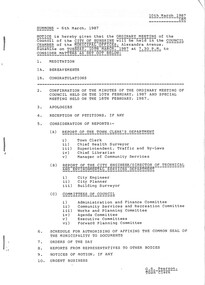 Sunshine and District Historical Society Incorporated
Administrative record - City of Sunshine Council Meetings 1986 - 1994 - Notice of Ordinary Meeting 10th March 1987, City of Sunshine, 6th March 1987
... Albans Confidential Report Council Polices Consideration of a Petition on behalf of 45 Residents of Maribyrnong in Relation to Objecting to the Establishment of a Night Club at the Angler's Hotel Notice of Motions Sunshine Leisure Centre Contingency Account Cleaning Kerb & Channel and Drainage Pits Referendum Ceding of Brooklyn to Altona Road Surface Maintenance Management of Child Care Centres Financial Return Child Care Centres Finance Manager Council Auspiced Services Removal of Rubbish 2 Derrimut Street Albion Slogan Sunshine Multicultural City of Victoria Sand & Dust Menace Corner Sunshine Avenue and McIntyre Road Sunshine North 125 Durham Road Sunshine Traffic lights Corner McIntyre Road, Furlong Road and Berkshire Road Sunshine North Deer Park Football Club Pavilion Nuclear Free Zones Palm Sunday Peace Celebrations Seed Patenting and Plant Variety Rights Toxic Waste Disposal Facility...Albans Confidential Report Council Polices Consideration of a Petition on behalf of 45 Residents of Maribyrnong in Relation to Objecting to the Establishment of a Night Club at the Angler's Hotel Notice of Motions Sunshine Leisure Centre Contingency Account Cleaning Kerb & Channel and Drainage Pits Referendum Ceding of Brooklyn to Altona Road Surface Maintenance Management of Child Care Centres Financial Return Child Care Centres Finance Manager Council Auspiced Services Removal of Rubbish 2 Derrimut Street Albion Slogan Sunshine Multicultural City of Victoria Sand & Dust Menace Corner Sunshine Avenue and McIntyre Road Sunshine North 125 Durham Road Sunshine Traffic lights Corner McIntyre Road, Furlong Road and Berkshire Road Sunshine North Deer Park Football Club Pavilion Nuclear Free Zones Palm Sunday Peace Celebrations Seed Patenting and Plant Variety Rights Toxic Waste Disposal Facility A4 Stapled Document Administrative record City of Sunshine Council Meetings 1986 - 1994 - Notice of Ordinary Meeting 10th March 1987 City of Sunshine ...Notice of Ordinary Meeting 10th March 1987 Report of the Town Clerk's Department Report of the Town Clerk Accounts for Payment as at 15th February 1987 The New Western Independent Newspaper to Replace the Now Closed Western Independent Newspaper Request to Use Roadways Essendon District Tri-Antulas Triathlon Club Chifley Drive and Coulson Gardens Heart Health Awareness Programme National Hearth Foundation of Australia Lease of Council Land to Sunshine & District Helping Hand Association Furlong Road Australia Post Municipal Association of Victoria (M.A.V.) Chief Executive Officer St. John Ambulance Land for Headquarters Notice of Motion Possible Locations Fraser Street Bus Depot, Land Adjacent to Deer Park Club, Land Adjacent to Sunshine Ambulance Station Westmoreland Road, Sassella Park & George Street Ports & Harbour Development Notice of Motion Rate Recovery Sale Lot 204 George Street Maidstone Nuclear Free Zone Local Authorities Conference Perugia Italy October 1986 Loan 177 Refinancing of Loan 163 Sunshine Community Committee Bicentenary 1988 Municipal Representation on the Melbourne & Metropolitan Board of Works Vesting of Crown Land Reserves in Council More Park & Pennell Reserve Roads & Streets Trading Occupational Health and Safety Domiciliary Workers Workcare Family Day Care Scheme Loan 179 Discontinued Road Reserve and Right of Way East of Beachley Street North of Turner Crescent Braybrook Discontinued Right of Way Between Anderson Road, Durham Road, Derby Road and Graham Street Sunshine Report of Chief Health Surveyor Registration of Premises Health Act & Food Act Registration Transfers Health Act & Food Act Prosecution Proceedings Sunshine Magistrates Court Use of Property 11 Davey Street Sunshine West Report of the Superintendent Traffic & By-Laws Court Proceedings Sunshine Magistrates Court ANZAC Commemoration March Change of Name St. Albans Special School to Furlong Park School & Pre-School Centre Change of Name Highpoint West Post Office to Highpoint City Post Office Proposed Procession Scout Association of Australia by Sunshine District Report of the Chief Librarian History of Sunshine by Prue McGoldrick Commonwealth Assistance for Public Libraries (CAPLS) Campaign Sunshine Art Collection 3WRB Community Radio Station Report of the Acting Manager Community Services Disability Services Programme Bridging the Gap Project Change in Method of Calculation CEP DEIR Region sponsor Contribution Fresh start in the Park Braybrook - Maidstone Community Health Centre Neighborhood Watch Appeal Against Council Decision Regarding Holiday Programme West Sunshine Castley Hall Redevelopment Committee Marie Mill Community Centre Purchase of Equipment Marie Mill Community Centre Sunshine West Community Centre Sunshine West Community Centre Management Committee Marie Mill Community Centre Minutes of Meeting Home & Community Care Program Home Help Grant Ceiling 1986/87 Report of the City Engineer Smorgan Consolidated Industries New Development Waste Disposal Proposed New Tip Jones Road Brooklyn Braybrook - Maidstone Public Tenants Union Community Bus Maintenance House of Sunshine Additions & Alterations Corio Street and Watt Street Portable Changerooms Chaplin Reserve Anderson Road Sunshine Development of Billingham Reserve Deer Park Notice of Motion Proposed Footscray Institute of Technology Sciences Park Renovations and Restoration of The Hunt Club Ballarat Road Deer Park Maribyrnong Viaduct Fencing Pedestrian Operated Signals Ballarat Road (East of Leonard Street) Sunshine Installation of Audio Tactile Pedestrian Facility Quinn Street Private Street Scheme Variations Deer Park Certificate of Completion Quinn Street Private Street Scheme Deer Park Metropolitan Street Name Signing Programme Traffic Control Items Tenders Two Amenities Caravan Proposed Alterations to Existing Separators and Medians in Geelong Road Between Holmwood Road and Somerville Road Brooklyn New Sunshine Fire Station McIntyre Road (East & West) Parking Prohibition Sunshine North Stanford Street (East Side) 90 Degree Angle Parking Sunshine Quinn Street Private Street Scheme Stage 2 Deer Park Proposed Lease of Railway Land off Anderson Road Sunshine Tenders for Fencing Station Road Deer Park Proposed Car Park on Railway Land Lot 2 St. Albans Road St. Albans Station Road Widening Gladstone Street to Furlong Road St. Albans Paramount Road / Somerville Road Intersection Fairbairn Road Private Street Scheme Sunshine West Report of the City Planner Enforcement of Metropolitan Planning Scheme Inspection of Use of Property 11 Davey Street Ardeer Planning Permit Application Truck Parking 18 Baynton Avenue Sunshine North Planning Permit Application Truck Parking 22 Baynton Avenue Sunshine North Planning Permit Application Truck Parking 24 Baynton Avenue Sunshine North Planning Permit Application Factory Lot 10 Tottenham Parade Brooklyn Planning Permit Application Enforcement of the Planning Scheme Amusement Parlour 113 Durham Road Sunshine Maribyrnong Advisory Committee Rezoning Land West of Kororoiit Creek and North of the Western Highway Shire of Melton Planning Permit Application Car Park Lot 53 Cromer Avenue Sunshine North Planning Permit Application Extension of Place of Assembly Dutch Australian Community Council 96 Cromer Avenue Sunshine North Planning Permit Application Health Centre 57 Dickson Street Sunshine Planning Permit Recreation Centre Lot 2 McKechnie Street North East Corner of Gratz Street St. Albans Planning Permit Application Double Sided Promotional Panel Sign Sunshine Road Tottenham Planning Permit Application Double Sided Promotional Panel Sign Sunshine Road Tottenham Planning Permit Application Double Sided Promotional Panel Sign Tilburn Road Deer Park Planning Permit Application Extension to Existing Shops 87 - 89 McIntyre Road Sunshine North Planning Permit Application Convenience Shop, Petrol Filling Station Restaurant, 10 Cinema Complex and Medical Centre 2/72 Neale Road Deer Park Planning Permit Application Alterations to Flats Lot 4 to 8 The Gables Albion Planning Permit Application Motel / Restaurant and Caretaker's Residence Lots 3 & 4 Ballarat Road North West Corner Miles Street Deer Park Planning Permit Application Motor Repair Station 58 Omar Street Maidstone Sunshine District Centre Road Works Planning Permit Application Livestock Sale Yards 690 Geelong Road North East Corner Old Geelong Road Brooklyn Planning Permit Application Private Rubbish Tip Associated Quarries Pty Ltd Market Road Quarry Market Road Sunshine Delegated Matters Removal of Easement Lot 21 Camperdown Avenue and Lot 22 Cary Street Sunshine North Plan of Subdivision Corner Robinsons Road and Ballarat Road Deer Park Plan of Proposed Strata Subdivision 1 White Street Maribyrnong Plan of Consolidation F.B. Transport Amanda Road Tottenham Plan of Consolidation Smogan Consolidated Industries Somerville Road Footscray West Plan of Consolidation Lots 5 & 6 McIntyre Road Sunshine North Plan of Consolidation Lots 1 & 2 Adams Street South East Corner Disraeli Street St. Albans Plan of Consolidation lots 4 & 5 Jefferson Street South West Corner Disraeli Street St. Albans Plan of Strata Subdivision lot 2 Corner McKechnie Street and Gratz Street St. Albans Plan of Surrender of Easement 592 Western Highway (Ballarat Road) Albion Report of the Building Surveyor Show Cause Notice 24 Chicago Street Maribyrnong Above Ground Tank Grain Elevators Board Sunshine Terminal Wright Street Sunshine Show Cause Notice 15 Beech Court Sunshine West Beech Court 32 Knight Avenue Sunshine North Siting of Open Garage 8 Diamond Avenue Albanvale Show Cause Notice Beech Court 9 Apollo Place Ardeer Show Cause Notice 154 Neale Road Deer Park Show Cause Notice 28 Cleveland Street St. Albans Show Cause Notice 1D Bell Street Sunshine West Show Cause Notice 7 Nova Avenue Deer Park Dangerous Building 16 Cypress Avenue Brooklyn Show Cause Notice 25 Chatsworth Avenue Ardeer Show Cause Notice 11 Concord Circuit Albanvale Show Cause Notice 50 Ford Avenue Sunshine North Show Cause Notice 553 Geelong Road Brooklyn Show Cause Notice 40 Joan Street Ardeer Show Cause Notice 49 Denton Avenue St. Albans Show Cause Notice 41 Mulhall Drive St. Albans Show Cause Notice 1 White Street Maribyrnong Show Cause Notice 74 Ford Avenue Sunshine North Show Cause Notice 11 Davey Street Sunshine West Schedule for Authorising of Affixing the Common Seal of the Municipality to Documents Orders of the Day West Sunshine Community Centre Show Cause Notice 19 Second Avenue Sunshine Show Cause Notice 34 Harris Street St. Albans Confidential Report Council Polices Consideration of a Petition on behalf of 45 Residents of Maribyrnong in Relation to Objecting to the Establishment of a Night Club at the Angler's Hotel Notice of Motions Sunshine Leisure Centre Contingency Account Cleaning Kerb & Channel and Drainage Pits Referendum Ceding of Brooklyn to Altona Road Surface Maintenance Management of Child Care Centres Financial Return Child Care Centres Finance Manager Council Auspiced Services Removal of Rubbish 2 Derrimut Street Albion Slogan Sunshine Multicultural City of Victoria Sand & Dust Menace Corner Sunshine Avenue and McIntyre Road Sunshine North 125 Durham Road Sunshine Traffic lights Corner McIntyre Road, Furlong Road and Berkshire Road Sunshine North Deer Park Football Club Pavilion Nuclear Free Zones Palm Sunday Peace Celebrations Seed Patenting and Plant Variety Rights Toxic Waste Disposal Facilityessendon district tri-antulas triathlon club, chifley drive, coulson gardens, maribyrnong, sunshine & district helping hand association, furlong road, sunshine north, fraser street, deer park club, westmoreland road, sassella park, george street, sunshine, ballarat road, deer park, more park, esmond street, ardeer, pennell reserve, burke street, braybrook, beachley street, turner crescent, anderson road, durham road, derby road, graham street, davey street, st. albans special school, furlong park school & pre-school centre, highpoint west post office, highpoint city post office, 3wrb community radio station, braybrook - maidstone community health centre, marie mill community centre, randall street, sunshine west community centre, kermeen street, sunshine west, smorgan consolidated industries, jones road, brooklyn, braybrook - maidstone public tenants union, house of sunshine, corio street, watt street, chaplin reserve, billingham reserve, the hunt club, leonard street, the hunt club hotel, quinn street, holmwood road, somerville road, sunshine fire station, mcintyre road, stanford street, station road, st. albans road, st. albans, paramount road, fairbairn road, baynton avenue, tottenham parade, kororoiit creek, western highway, cromer avenue, dutch australian community council, dickson street, mckechnie street, gratz street, sunshine road, tottenham, tilburn road, neale road, the gables, albion, miles street, omar street, maidstone, geelong road, old geelong road, associated quarries, market road, camperdown avenue, cary street, robinsons road, white street, amanda road, adams street, disraeli street, jefferson street, chicago street, wright street, beech court, knight avenue, diamond avenue, albanvale, apollo place, cleveland street, bell street, nova avenue, cypress avenue, chatsworth avenue, concord circuit, ford avenue, joan street, denton avenue, mulhall drive, second avenue, harris street, angler's hotel, anglers way, derrimut street, sunshine avenue, berkshire road, deer park football club, john mcleod reserve
