
Showing 129 items matching "c1950s"
-
 Federation University Historical Collection
Photograph - Black and White, Chatham-Holmes Collection: Holmes Family, c1950s, c1950s
... Chatham-Holmes Collection: Holmes Family, c1950s...c1950s...Left to Right: David Holmes, Edith Holmes (Pickford), Bill Holmes Front: Jack Holmes, Mary Elizabeth Holmes chatham-holmes collection launchley david holmes edith holmes (nee pickford) bill holmes jack holmes elizabeth holmes Ascot Chatham-Holmes Collection: Holmes Family, c1950s Photograph - Black and White ...Photograph of members of the Holmes family in the garden at "Launchley" Ascot 3364. Left to Right: David Holmes, Edith Holmes (Pickford), Bill Holmes Front: Jack Holmes, Mary Elizabeth Holmeschatham-holmes collection, launchley, david holmes, edith holmes (nee pickford), bill holmes, jack holmes, elizabeth holmes, ascot -
 Federation University Historical Collection
Photograph - Black and White, Ballarat School of Mines Metallurgy Laboratory Bench with a large Reichert Stage Microscope, c1950s, 1950s
... Ballarat School of Mines Metallurgy Laboratory Bench with a large Reichert Stage Microscope, c1950s...Ballarat School of Mines Metallurgy Laboratory Bench with a large Reichert Stage Microscope, c1950s Photograph - Black and White ...The Reichert microscope is catalogue number 4106.Black and White photograph of a Ballarat School of Mines Metallurgy Laboratory Bench with a large Reichert Stage Microscope. Also in view on the right side is the electro-polishing apparatus, and on the left side is the Reichert MeF1 stage microscope, which as still in use in 2001.microscope, reichert microscope, metallurgy laboratory, electro-polishing apparatus, ballarat school of mines -
Malmsbury Historical Society
Photograph (Item), Copy Of Colour Photo Of Boy In Cricket Outfit In Back Yard, Malmsbury c1950s
... Copy Of Colour Photo Of Boy In Cricket Outfit In Back Yard, Malmsbury c1950s...People - Ashwell Collection Buildings - "Back Yard, Fence" Copy Of Colour Photo Of Boy In Cricket Outfit In Back Yard, Malmsbury c1950s Photograph Photograph ...People - Ashwell Collection Buildings - "Back Yard, Fence" -
 Stawell Historical Society Inc
Photograph, Mr Alf Cray, Mr Frank Bennett & Mr Alf Bert Hamilton cutting hay with scythes on the Bennett Farm in Deep Lead c1950s
... Mr Alf Cray, Mr Frank Bennett & Mr Alf Bert Hamilton cutting hay with scythes on the Bennett Farm in Deep Lead c1950s...Frank Bennett Alf Bert Hamilton Stawell Deep Lead Mr Alf Cray, Mr Frank Bennett & Mr Alf Bert Hamilton cutting hay with scythes on the Bennett Farm in Deep Lead c1950s Photograph ...Deep Lead Scene Workmen cutting hay with Scythe at Bennett Farm 1950’s. Alf Cray. Frank Bennett Alf Bert Hamiltonstawell deep lead -
 Wodonga & District Historical Society Inc
Functional object - Five cell metal torch c1950s
... Five cell metal torch c1950s...Five cell metal torch c1950s Functional object Five cell metal torch c1950s ...The five cell metal torch from c. 1950s has local significance due to being used by Wodonga resident, Bill Harris, in his youth, as well as historical significance due to its age and representativeness.Metal torch with a plated yellow surface around the light bulb and a long grip with repeated bands of three lines in the surface and a sliding on-off button. "EVEREADY / TRADE-MARK / MADE IN HONG KONG" - on the base of the torch.1950s torches, metal torches, eveready torches, five cell torches, vintage torches -
 Wodonga & District Historical Society Inc
Photograph - Hamilton-Smith Collection Framed Photograph of Jack Hamilton-Smith c1950s
... Hamilton-Smith Collection Framed Photograph of Jack Hamilton-Smith c1950s...Hamilton-Smith Collection Framed Photograph of Jack Hamilton-Smith c1950s Photograph Hamilton-Smith Collection Framed Photograph of Jack Hamilton-Smith c1950s ...The Hamilton-Smith collection was donated by the children of Grace Mary Hamilton-Smith nee Ellwood (1911-2004) and John Hamilton-Smith (1909-1984) who settled in Wodonga in the 1940s. The Ellwood family had lived in north-east Victoria since the late 1800s. Grace’s mother, Rosina Ellwood nee Smale, was the first teacher at Baranduda in 1888, and a foundation member of the C.W.A. Rosina and her husband Mark retired to Wodonga in 1934. Grace and John married at St. David’s Church, Albury in 1941. John was a grazier, and actively involved in Agricultural Societies. The collection contains significant items which reflect the local history of Wodonga, including handmade needlework, books, photographs, a wedding dress, maps, and material relating to the world wars. This item has well documented provenance and a known owner. It forms part of a significant and representative historical collection which reflects the local history of Wodonga. It contributes to our understanding of social and family life in early twentieth century Wodonga, as well as providing interpretative capacity for themes including local history and social history. A black and white photograph in a white painted wooden frame. It features Jack Hamilton-Smith mounted on his horse.hamilton-smith collection, hamilton-smith, ellwood, horse, horse riding, photograph, photography, portrait photography -
 Bendigo Military Museum
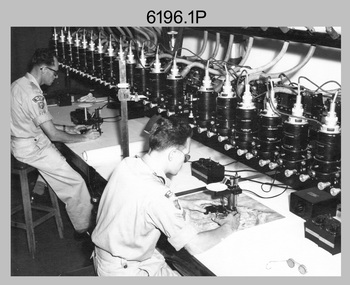
Photograph - Multiplex mechanical stereoplotting equipment, Army Survey Regiment, Fortuna Bendigo, c1950s
... This is a set of five photographs of Multiplex mechanical stereoplotting equipment at the Army Survey Regiment, Fortuna Bendigo. c1950s. Multiplex equipment was imported from the UK in 1951 and introduced in the following year, to accelerate map production output covering CMF training areas at 1:25,000 map scale. ...The photographs were scanned at 300 dpi. .1) - Photo, black & white, c1950s, unidentified personnel operating Multiplex equipment. .2) - Photo, black & white, c1950s, Multiplex equipment. .3) - Photo, black & white, c1950s, Multiplex components identified. .4) - Photo, black & white, c1950s, Multiplex optical components. .5) - Photo, black & white, c1950s. ...c1950s...The photographs were scanned at 300 dpi. .1) - Photo, black & white, c1950s, unidentified personnel operating Multiplex equipment. .2) - Photo, black & white, c1950s, Multiplex equipment. .3) - Photo, black & white, c1950s, Multiplex components identified. .4) - Photo, black & white, c1950s, Multiplex optical components. .5) - Photo, black & white, c1950s. ...This is a set of five photographs of Multiplex mechanical stereoplotting equipment at the Army Survey Regiment, Fortuna Bendigo. c1950s. Multiplex equipment was imported from the UK in 1951 and introduced in the following year, to accelerate map production output covering CMF training areas at 1:25,000 map scale. Multiplex plotting was a productive advancement replacing the ‘Arundel’ method of graphical plotting planimetric detail that was expensive and slow, especially in timbered mountainous terrain. Air photos were made into small diapositives and mounted on racks in the exact position relative to when the aerial photos were taken. The technicians operated the Multiplex in a darkened room, with one photo projected with a green filter and the other through a red filter to form a 3D view of the overlapping photos. The 3D model projected onto a platen, which was a small platform that was raised up and down. The technician viewed the 3D image with special glasses fitted with red and green lenses. In the centre of the platen was a small pinhole that served as a floating mark, with a vertical pencil located exactly below the pinhole. This tracing table was moved to follow the topographic feature or contour line and draw it on the paper underneath. The technician raising or lowering the platform’s floating mark to match the height of the 3D terrain. It also replaced the slotted template method of mechanical adjustment of strips of aerial photography, however was restricted to each strip rather than between strips in the block. Although the Multiplex was phased out of production in 1968, it was used in the training of photogrammetry and aero-triangulation at the School of Military Survey located at Bonegilla, Victoria until the early 1990s. The history of the Multiplex is covered in more detail with additional historic photographs, in pages 50 to 51 of Valerie Lovejoy’s book 'Mapmakers of Fortuna – A history of the Army Survey Regiment’ ISBN: 0-646-42120-4.This is a set of five photographs of Multiplex mechanical stereoplotting equipment at the Army Survey Regiment, Fortuna, Bendigo. c1950s. The photographs were printed on photographic paper and are part of the Army Survey Regiment’s Collection. The photographs were scanned at 300 dpi. .1) - Photo, black & white, c1950s, unidentified personnel operating Multiplex equipment. .2) - Photo, black & white, c1950s, Multiplex equipment. .3) - Photo, black & white, c1950s, Multiplex components identified. .4) - Photo, black & white, c1950s, Multiplex optical components. .5) - Photo, black & white, c1950s. Unidentified technician laying down individual Multiplex plots..1P to .2P, .4P – No annotations. .3P annotations identifying Multiplex components on front of photo. .5P annotated on front ‘Lay down of individual Multiplex plots at 1/14000 to framework of master grid to form Composite Compilation Sheet – Material Duralex.’royal australian survey corps, rasvy, army survey regiment, army svy regt, fortuna, asr, photogrammetry -
 Bendigo Military Museum
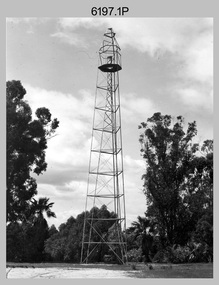
Photograph - Royal Australian Survey Corps Survey Observation Towers, c1950s
... This is a set of seven photographs of Royal Australian Survey Corps surveyors setting up observation towers in the field and undertaking survey observations during mapping and geodetic control operations. c1950s. Survey observation towers were used mainly to take angular measurements in flat or heavily forested terrain, where height was necessary to achieve observer’s line-of-sight between field survey station. ...The photographs were scanned at 300 dpi. .1) - Photo, black & white, c1950s, ‘Bilby’ survey observation tower. .2) - Photo, black & white, c1950s, CAPT George Ricketts climbing ‘Bilby’ survey observation tower. .3) - Photo, black & white, c1950s, geodetic survey equipment on ‘Bilby’ survey observation tower. .4) - Photo, black & white, c1950s, two unidentified field surveyors on ‘Bilby’ survey observation tower. .5) - Photo, black & white, c1950s, two unidentified field surveyors, with CAPT Ricketts climbing ‘Bilby’ survey observation tower. .6) - Photo, black & white, c1950s, two unidentified field surveyors undertaking observations on survey observation tower. .7) - Photo, black & white, c1950, two unidentified field surveyors erecting or dismantling a survey observation tower....c1950s...The photographs were scanned at 300 dpi. .1) - Photo, black & white, c1950s, ‘Bilby’ survey observation tower. .2) - Photo, black & white, c1950s, CAPT George Ricketts climbing ‘Bilby’ survey observation tower. .3) - Photo, black & white, c1950s, geodetic survey equipment on ‘Bilby’ survey observation tower. .4) - Photo, black & white, c1950s, two unidentified field surveyors on ‘Bilby’ survey observation tower. .5) - Photo, black & white, c1950s, two unidentified field surveyors, with CAPT Ricketts climbing ‘Bilby’ survey observation tower. .6) - Photo, black & white, c1950s, two unidentified field surveyors undertaking observations on survey observation tower. .7) - Photo, black & white, c1950, two unidentified field surveyors erecting or dismantling a survey observation tower. ...This is a set of seven photographs of Royal Australian Survey Corps surveyors setting up observation towers in the field and undertaking survey observations during mapping and geodetic control operations. c1950s. Survey observation towers were used mainly to take angular measurements in flat or heavily forested terrain, where height was necessary to achieve observer’s line-of-sight between field survey station. The Bilby Tower seen in photo .5P was erected to a height of 75 feet (23m) above ground level. The use of the Bilby Tower in Topographic Squadron’s field survey operations from 1955 to 1966 is described in page 54 of Valerie Lovejoy’s book 'Mapmakers of Fortuna – A history of the Army Survey Regiment’ ISBN: 0-646-42120-4. CAPT George Ricketts’ period of service was from 1942 to 1976 reaching the rank of LTCOL. It is noted in page 35 of Valerie Lovejoy’s book that then SGT Ricketts hand lettering skills came to the fore from his contribution to the draughting of one of the Japan’s Instruments of Surrender in 1945.This is a set of seven photographs of Royal Australian Survey Corps surveyors setting up observation towers in the field and undertaking survey observations during mapping and geodetic control operations. c1950s. The photographs were printed on photographic paper and are part of the Army Survey Regiment’s Collection. The photographs were scanned at 300 dpi. .1) - Photo, black & white, c1950s, ‘Bilby’ survey observation tower. .2) - Photo, black & white, c1950s, CAPT George Ricketts climbing ‘Bilby’ survey observation tower. .3) - Photo, black & white, c1950s, geodetic survey equipment on ‘Bilby’ survey observation tower. .4) - Photo, black & white, c1950s, two unidentified field surveyors on ‘Bilby’ survey observation tower. .5) - Photo, black & white, c1950s, two unidentified field surveyors, with CAPT Ricketts climbing ‘Bilby’ survey observation tower. .6) - Photo, black & white, c1950s, two unidentified field surveyors undertaking observations on survey observation tower. .7) - Photo, black & white, c1950, two unidentified field surveyors erecting or dismantling a survey observation tower..1P with paper tag annotated ‘Bilby Tower’ .4P on back – ‘Bilby Tower’. .5P on back – ‘Survey Observing Tower. Observing tower used for angular measurement in flat country. 75’ high – CAPT Ricketts climbing. .6P, .7P on back. ‘1960s?’royal australian survey corps, rasvy, army survey regiment, army svy regt, fortuna, asr, surveying -
 Bendigo Military Museum
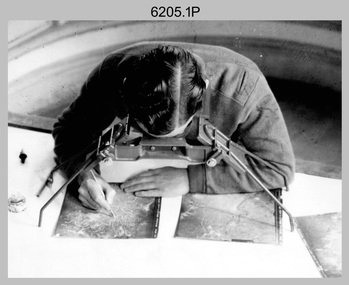
Photograph - Stereoscopic Equipment – Army Survey Regiment, Fortuna, Bendigo
... This is a set of six photographs of stereoscopic equipment and personnel at the Army Survey Regiment, Fortuna, Bendigo, c1950s to c1960s. The stereoscopes shown in photos .1P and .2P were used to stereoscopically view and interpret features in overlapping aerial photographs. ...This is a set of six photographs of stereoscopic equipment and personnel at the Army Survey Regiment, Fortuna, Bendigo, c1950s to c1960s. Black and white photos are on photographic paper and were scanned at 300 dpi. .1) - Photo, black & white, c1950s to c1960s, Universal Stereoscope, unidentified technician. .2) - Photo, black & white, c1950s to c1960s, Old Delft Scanning Stereoscopes, unidentified technicians. .3) - Photo, black & white, c1950s to c1960s, Unidentified stereoscopic plotters and technicians. .4) - Photo, black & white, c1950s to c1960s, Unidentified stereoscopic plotter, CPL Bill Shapcott. .5) and .6) - Photo, black & white, c1950s to c1960s, Ryker Model PL-3 stereoscopic plotter....Royal Australian Survey Corps Army Svy Regt RASvy Army Survey Regiment Fortuna ASR air survey Photogrammetry Photo .4P is annotated on back - ‘Bill Shapcott (CPL)’ This is a set of six photographs of stereoscopic equipment and personnel at the Army Survey Regiment, Fortuna, Bendigo, c1950s to c1960s. Black and white photos are on photographic paper and were scanned at 300 dpi. .1) - Photo, black & white, c1950s to c1960s, Universal Stereoscope, unidentified technician. .2) - Photo, black & white, c1950s to c1960s, Old Delft Scanning Stereoscopes, unidentified technicians. .3) - Photo, black & white, c1950s to c1960s, Unidentified stereoscopic plotters and technicians. .4) - Photo, black & white, c1950s to c1960s, Unidentified stereoscopic plotter, CPL Bill Shapcott. .5) and .6) - Photo, black & white, c1950s to c1960s, Ryker Model PL-3 stereoscopic plotter. ...This is a set of six photographs of stereoscopic equipment and personnel at the Army Survey Regiment, Fortuna, Bendigo, c1950s to c1960s. The stereoscopes shown in photos .1P and .2P were used to stereoscopically view and interpret features in overlapping aerial photographs. The stereoscopic plotters shown in photos .3P and .4P were used to stereoscopically plot topographic detail from overlapping aerial photographs using a pantograph arm with pencil onto a controlled plotting sheet. The Ryker Model PL-3 Wernstedt-Mahan type stereoscopic plotter shown in photos .5P and .6P was used for precision contouring, planimetry and profiling. It was a comparatively simple stereoscopic mapping instrument designed to use ordinary contact prints of aerial photographs. It provides for plotting on a constant scale and approximate tilt correction but does not provide refinements such as correction for lens distortion. The plotter in Photo .6P does not have its pantograph arm attached. These plotters pre-date the Wild B9 and B8 stereo plotters introduced in the 1960s.This is a set of six photographs of stereoscopic equipment and personnel at the Army Survey Regiment, Fortuna, Bendigo, c1950s to c1960s. Black and white photos are on photographic paper and were scanned at 300 dpi. .1) - Photo, black & white, c1950s to c1960s, Universal Stereoscope, unidentified technician. .2) - Photo, black & white, c1950s to c1960s, Old Delft Scanning Stereoscopes, unidentified technicians. .3) - Photo, black & white, c1950s to c1960s, Unidentified stereoscopic plotters and technicians. .4) - Photo, black & white, c1950s to c1960s, Unidentified stereoscopic plotter, CPL Bill Shapcott. .5) and .6) - Photo, black & white, c1950s to c1960s, Ryker Model PL-3 stereoscopic plotter.Photo .4P is annotated on back - ‘Bill Shapcott (CPL)’royal australian survey corps, army svy regt, rasvy, army survey regiment, fortuna, asr, air survey, photogrammetry -
 Linton and District Historical Society Inc
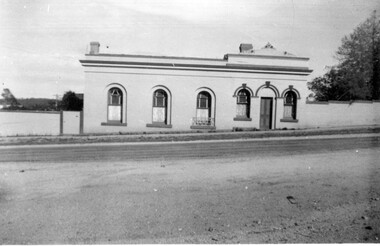
Photograph, Traquair House, circa 1950, 1950
... "Traquair House c1950s"...Buildings Traquair House Bank of NSW "Traquair House c1950s" Black and white photograph of a single storey building showing five arched windows and front door facing the street. ...Black and white photograph of a single storey building showing five arched windows and front door facing the street."Traquair House c1950s"buildings, traquair house, bank of nsw -
 Mt Dandenong & District Historical Society Inc.
Photograph, Group Outside Quamby Cafe Olinda, c1950s
... A woman with two young children posed outside the Quamby Café at Olinda c1950s....c1950s...quamby quamby cafe Olinda A woman with two young children posed outside the Quamby Café at Olinda c1950s. Group Outside Quamby Cafe Olinda Photograph ...A woman with two young children posed outside the Quamby Café at Olinda c1950s.quamby, quamby cafe, olinda -
 Mt Dandenong & District Historical Society Inc.
Photograph, Group Outside Quamby Cafe Olinda, c1950s
... Group of three women and two young girls posed outside the Quamby café at Olinda c1950s....c1950s...quamby quamby cafe Olinda Group of three women and two young girls posed outside the Quamby café at Olinda c1950s. Group Outside Quamby Cafe Olinda Photograph ...Group of three women and two young girls posed outside the Quamby café at Olinda c1950s.quamby, quamby cafe, olinda -
 Mt Dandenong & District Historical Society Inc.
Photograph, Group Outside Quamby Cafe Olinda, c1950s
... Group of two men, two women and two young girls posed outside the front of the Quamby Café at Olinda c1950s....c1950s...quamby quamby cafe Olinda Group of two men, two women and two young girls posed outside the front of the Quamby Café at Olinda c1950s. Group Outside Quamby Cafe Olinda Photograph ...Group of two men, two women and two young girls posed outside the front of the Quamby Café at Olinda c1950s.quamby, quamby cafe, olinda -
Port Melbourne Historical & Preservation Society
Book - Collins Melbourne Street Directory, 1950s
... Collins Melbourne Street Directory c1950s...From Glen Stuart - used by his father, William Raeburn Stuart. transport - roads william raeburn stuart Collins Melbourne Street Directory c1950s Book Collins Melbourne Street Directory Collins Book Depot Premier Printing Co ...From Glen Stuart - used by his father, William Raeburn Stuart.Collins Melbourne Street Directory c1950stransport - roads, william raeburn stuart -
 Mt Dandenong & District Historical Society Inc.
Photograph, Two Men Outside Quamby Cafe Olinda, c1950s
... One man is holding a Gladstone bag. c1950s...c1950s...One man is holding a Gladstone bag. c1950s Two Men Outside Quamby Cafe Olinda Photograph ...Close up photograph of the front of Quamby Café with two men standing, chatting. One man is holding a Gladstone bag. c1950squamby, quamby cafe, olinda -
 Mt Dandenong & District Historical Society Inc.
Photograph, The Main Mountain Road, Olinda, c1950s
... The Lich gate and 'Hathaway" on LHS. c1950s....c1950s...The Lich gate and 'Hathaway" on LHS. c1950s. The Main Mountain Road, Olinda Photograph ...Copy of Rose Series Postcard number 1834Copy of Rose Series Postcard # 1834 showing the Main Road, Olinda looking towards Sassafras. The Lich gate and 'Hathaway" on LHS. c1950s.olinda, lich gate, hathaway -
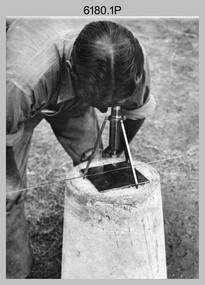 Bendigo Military Museum
Photograph - RASvy Surveyors in the field, c1950s – 1960s
... The photographs were scanned at 300 dpi. .1) - Photo, black & white, c1950s, unidentified personnel using geodetic survey chaining equipment. .2) to .4) - Photo, black & white, c1950s, geodetic survey chaining equipment. .5) – Photo, black & white, c1950s, Jim Stedman using geodetic survey chaining equipment to measure distances. .6) - Photo, black & white, c1950s, Unidentified personnel geodetic survey chaining equipment. .7) – Photo, black & white, mounted on card, c1950s. ...c1950s – 1960s...The photographs were scanned at 300 dpi. .1) - Photo, black & white, c1950s, unidentified personnel using geodetic survey chaining equipment. .2) to .4) - Photo, black & white, c1950s, geodetic survey chaining equipment. .5) – Photo, black & white, c1950s, Jim Stedman using geodetic survey chaining equipment to measure distances. .6) - Photo, black & white, c1950s, Unidentified personnel geodetic survey chaining equipment. .7) – Photo, black & white, mounted on card, c1950s. ...This is a set of 1photographs of surveyors in the field measuring distances using chains, taking observations using theodolites and operating electric distance measurement equipment. They were probably employed in establishing mapping and geodetic control operations or the surveyors may have been in training. The photos were most likely taken in the 1950s and 1960s. Photos .1P to .6P feature personnel setting up geodetic survey chaining equipment to measure distances. The surveyor in Photo .5P is LTCOL Howard Angus Johnson MBE who served from 1936 to 1954. The RA Svy surveyor in photos .7P to .12P were using a theodolite to take angular measurements. They were usually supported by an observer who recording their readings on a booking form. The surveyor in Photo .10P and .11P is LTCOL Jorge Gruszka, who served from 1955 to 1985. He was CO of the Army Survey Regiment from 1982 to 1985. The surveyor in photo .13P is cutting an identification blaze on a tree using a hammer and chisel. The tellurometer in Photos .14P to .16P was a MRA1 microwave Electronic Distance Measuring instrument (EDM) introduced in 1958. It and later models were man-portable systems that improved geodetic survey efficiencies for rapid network extension and densification replacing triangulation with EDM and theodolite traverse sometimes using Bilby Towers to extend line lengths. The surveyor with the slouch hat is Colonel James ‘Jim’ Leslie Stedman, who served from 1941 to 1978. He was Director of Military Survey from 1975 to 1978 and was appointed as Colonel Commandant (honorary appointment, Retd) of the Royal Australian Survey Corps from 1978 to 1983. Jim Stedman is demonstrating EDM equipment.This is a set of 17 photographs of surveyors in the field measuring distances using chains, taking observations using theodolites and operating electric distance measurement (EDM) equipment. c1950s – 1960s. The photographs were printed on photographic paper and are part of the Army Survey Regiment’s Collection. The photographs were scanned at 300 dpi. .1) - Photo, black & white, c1950s, unidentified personnel using geodetic survey chaining equipment. .2) to .4) - Photo, black & white, c1950s, geodetic survey chaining equipment. .5) – Photo, black & white, c1950s, Jim Stedman using geodetic survey chaining equipment to measure distances. .6) - Photo, black & white, c1950s, Unidentified personnel geodetic survey chaining equipment. .7) – Photo, black & white, mounted on card, c1950s. Unidentified surveyor undertaking observations on a coral reef using a theodolite. .8) – Photo, black & white, c1950, unidentified surveyor undertaking observations with a Tavistock theodolite. .9) – Photo, black & white, mounted on green card, c1950s. Unidentified surveyor undertaking observations using a plane table. .10) – Photo, black & white, c1955, Jorge Gruszka undertaking observations with a theodolite. 7/55 Basic Survey Course Balcombe. .11) – Photo, black & white, c1950s, Jorge Gruszka undertaking observations with a theodolite. .12) – Photo, black & white, c1946-1948, unidentified surveyor undertaking observations with a theodolite to gain control for the mapping of the Snowy Mountain Diversion Scheme. .13) – Photo, black & white, c1950s, unidentified surveyor cutting a blaze in a tree. .14) and .15) – Photo, black & white, c1960s, Jim Stedman demonstrating EDM equipment. .16) – Photo, black & white, c1960s, L to R: Jim Stedman (probably) and unidentified surveyor demonstrating EDM equipment. .17) – Photo, black & white, 1956, Operation Cutlass - Surveyors SPR W. Crane and J.A. Campbell undertaking observations with a theodolite in extreme conditions..1P on back - First Order Chaining Equipment .2P on back - First Order Chaining Equipment .3P on back - Full catenary 1800 – 1960 replaced by EDM .4P on back - First Order Chaining Equipment .5P on back - H.A. Johnson, Benambra baseline? 1st Order Chaining .6P on back - Chaining .7P on front - Difficult observing conditions especially when the tide is in. The station is sighted (sic) on a coral reef. .8P on back - Tavistock. .10P on back of duplicate in Photo Folder 14 – George (sic) Gruszka 7/55 Basic Survey Course Balcomme (sic) 1955/56 .14P and .15P on back - Jim Stedman demonstrating early EDM equipment.royal australian survey corps, rasvy, army survey regiment, army svy regt, fortuna, asr, surveying -
 Mt Dandenong & District Historical Society Inc.
Photograph, Gill's Store Olinda In The Snow, c1950s
... Note Golf Course sign on the building in the background. c1950s....c1950s...Note Golf Course sign on the building in the background. c1950s. Gill's Store Olinda In The Snow Photograph ...Small photograph showing people outside Gill's Store in the main street of Olinda with snow on the ground. Note Golf Course sign on the building in the background. c1950s.gills newsagency, olinda, snow, golf course -
Eltham District Historical Society Inc
Folder, Burgoyne Family, 1950s
... Folder of information on Burgoyne Family, shopkeepers, Eltham, c1950s...Burgoyne Folder of information on Burgoyne Family, shopkeepers, Eltham, c1950s Burgoyne Family Folder ...Folder of information on Burgoyne Family, shopkeepers, Eltham, c1950sburgoyne -
Emerald Museum & Nobelius Heritage Park
Equipment - Ceramic Electric Kettle, Unknown, c1950s
... No discernible manufacturer's markings. c1950s...c1950s...No discernible manufacturer's markings. c1950s Equipment Ceramic Electric Kettle Unknown ...This type of electric kettle was popular in Australia 1930s-1970s but not in most other countries because of safety concerns re the combination of water and electricity. The kettles had a replaceable element so that users were able to extend the life of their kettle well beyond that of modern kettles. The steaming of the kettle in the kitchen was a prelude to a welcoming cup of tea. Many of these kettles came in quite eccentric and collectable shapes - this one is plain but graceful by comparison.Cream, ceramic, electric kettle. Original lid has been replaced by an ill-fitting black plastic lid. No electric cord. No discernible manufacturer's markings. c1950sAppears to be none.electric kettle, kitchenware, mid-20th century -
 St Patrick's Old Collegians Association (SPOCA)
Photograph - Buildings, Catherdral, c1950s
... St Patrick's Cathedral - Bishops Palace looking East (c1950s)...St Patrick's Cathedral - Bishops Palace looking East (c1950s) Photograph Buildings, Catherdral, c1950s ... -
Eltham District Historical Society Inc
Folder, Stanley Simpson Addison, 1950s
... Folder of information on Stanley S Addison, Councillor, Shire of Eltham c1950s...Stanley Simpson Addison Folder of information on Stanley S Addison, Councillor, Shire of Eltham c1950s Stanley Simpson Addison Folder ...Folder of information on Stanley S Addison, Councillor, Shire of Eltham c1950sstanley simpson addison -
 Port Melbourne Historical & Preservation Society
Badge - Port Melbourne Amateur Football Club, 1940s - 1950s
... Two badges from the Port Melbourne Amateur Football Club c1950s...Sport - Australian Rules Football Dot WYCHCOMBE Vin WYNCHCOMBE Port Melbourne Amateur Football Club Two badges from the Port Melbourne Amateur Football Club c1950s Badge Port Melbourne Amateur Football Club ...Port Melbourne Amateur Football Club (Port Melbourne AFC) played in the Victorian Amateur Football League 1956 - 59. They won the Division 2 (formerly E Section) Premiership in 1957, Port Melbourne 8.13.61 def AJAX 7.10.52 and the Division 1 (formerly D Section) Premiership in 1958, Port Melbourne 14.10.94 def Bellfield 10.12.72.Two badges from the Port Melbourne Amateur Football Club c1950ssport - australian rules football, dot wychcombe, vin wynchcombe, port melbourne amateur football club -
City of Moorabbin Historical Society (Operating the Box Cottage Museum)
Education kit - School Writing Slate early 20thC, 20thC
... A writing slate in a wood frame used by school children from c1880s to c1950s...The pioneer settlers in the Moorabbin Shire area valued education and established schools for their children in Cheltenham and East Brighton c1860's This writing slate is typical of the type used up to the mid 20th Century in preparatory classes. schools education writing equipment slate writing boards victoria melbourne market gardeners pioneer settlers cheltenham state school no. 84. bentleigh east state school no. 2083 st stephens c of e school tucker road east brighton A writing slate in a wood frame used by school children from c1880s to c1950s Education kit School Writing Slate early 20thC Victorian Education Department Carpenter ...School children learned to write using a slate From 1880’s to mid 1950’s in most schools, very young children first learned to write their letters in sand trays using their fingers or a stick. When about 6, they progressed onto writing on slates . The board was made from a piece of quarry slate set in a wooden frame. A slate pencil (not chalk) was used to form the letters. This slate pencil was often sharpened on the school wall. The advantage of slates over paper was that they could be wiped clean and used again and again. Until the mid 20thC paper was expensive . After the pupil wrote on the Slate, the work was checked by the teacher and then erased for a new task Children had to bring a dampened cloth or sponge to school so that they could clean the slate and start again. The pioneer settlers in the Moorabbin Shire area valued education and established schools for their children in Cheltenham and East Brighton c1860's This writing slate is typical of the type used up to the mid 20th Century in preparatory classes.A writing slate in a wood frame used by school children from c1880s to c1950sschools, education, writing equipment, slate writing boards, victoria melbourne, market gardeners, pioneer, settlers, cheltenham state school no. 84., bentleigh east state school no. 2083, st stephens c of e school tucker road east brighton -
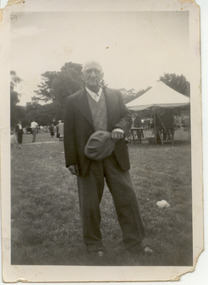 Port Melbourne Historical & Preservation Society
Photograph - William Devine at Wharfies' Picnic
... Digital copy of a B&W photograph of William DEVINE at the Wharfies' picnic c1950s....DEVINE Family William DEVINE Piers and Wharves - Waterside Workers Digital copy of a B&W photograph of William DEVINE at the Wharfies' picnic c1950s. Photograph William Devine at Wharfies' Picnic ...William DEVINE married Mary Ellen LARKIN in West Hartlepool, Co. Durham, England. They had two children John Bruce aka 'Tilly' (b 1902) and Margaret Philomena aka 'Mag' (b 1899).Digital copy of a B&W photograph of William DEVINE at the Wharfies' picnic c1950s.devine family, william devine, piers and wharves - waterside workers -
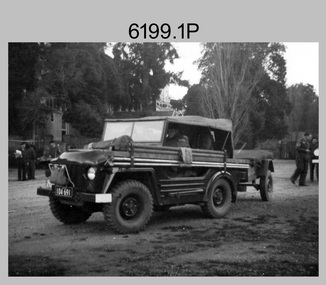 Bendigo Military Museum
Photograph - Royal Australian Survey Corps Field Survey Vehicles, c1950s
... This is a set of five photographs of vehicles used by field survey parties. c1950s – 1960s. The photographs were printed on photographic paper and are part of the Army Survey Regiment’s Collection. ...c1950s...This is a set of five photographs of vehicles used by field survey parties. c1950s – 1960s. The photographs were printed on photographic paper and are part of the Army Survey Regiment’s Collection. ...This is a set of five photographs of vehicles used by field survey parties during the 1950s and 1960s. The first two photos show unidentified surveyors and field survey vehicles departing the Army Survey Regiment’s transport compound. The third photo of LTCOL Lindsay Lockwood and CAPT Jim Stedman standing beside an early 1950s International light truck was taken at a field survey camp at Camooweal, QLD. LTCOL Lindsay Lockwood was the CO of the Army Survey Regiment from 1951 to 1962. As the longest serving commanding officer of the unit, there was many changes implemented. LTCOL Lindsay Lockwood’s period as CO is covered in more detail in pages 48-49 of Valerie Lovejoy’s book 'Mapmakers of Fortuna – A history of the Army Survey Regiment’ ISBN: 0-646-42120-4. CAPT Jim Stedman later reached the rank of Colonel, was Director of Military Survey from 1975 to 1978 and was appointed as Colonel Commandant (honorary appointment, Retd) of the Royal Australian Survey Corps from 1978 to 1983. The International truck and low loader trailer in Photo .4P was carrying RASvy’s field deployable printing press, the George Mann Double Crown. See pages 44 -45 of Valerie Lovejoy’s book for more information on how this trailer mounted printing press was used in a recruitment drive in 1948. More photos of RASvy vehicles can be found at 9019.6P.This is a set of five photographs of vehicles used by field survey parties. c1950s – 1960s. The photographs were printed on photographic paper and are part of the Army Survey Regiment’s Collection. The photographs were scanned at 300 dpi. .1) - Photo, black & white, c1950s, unidentified surveyors in an Austin Champ field survey vehicle departing the Army Survey Regiment’s transport compound. .2) - Photo, black & white, c1950s, unidentified surveyors in a Humber 1 ton survey vehicle departing the Army Survey Regiment’s transport compound. .3) - Photo, black & white, 1958, L to R: LTCOL Lindsay Lockwood and CAPT Jim Stedman standing beside a 1950's International truck at Camooweal, QLD., .4) - Photo, black & white, c1950s, unidentified surveyor, field survey truck and trailer carrying deployable "Mann" press trailer. .5) – Photo black & white, May 1960. PTE R. Eastwood, an attached Service Corps driver on survey operations, extracts his Land Rover from the Archer River in northern Queensland..3P on back – Lindsay Lockwood (LT COL) Jim Stedman (Capt) 1958 Camooweal .4P on back – Early vehicles for field trips. .5P with card strip annotation’ Survey field parties often strike difficult terrain when driving’.royal australian survey corps, rasvy, army survey regiment, army svy regt, fortuna, asr, surveying -
Port Melbourne Historical & Preservation Society
Photograph - Port Melbourne Library, Liardet Street, Douglas Smallpage, 1970s
... B&W photos of various locations in Port Melbourne c1950s Port Melbourne Library in Liardet St. ...Local Government - City of Port Melbourne Port Melbourne Library Liardet Street Several have descriptions of locations in pencil on rear of photos B&W photos of various locations in Port Melbourne c1950s Port Melbourne Library in Liardet St. ...B&W photos of various locations in Port Melbourne c1950s Port Melbourne Library in Liardet St. (Demolished in 1988)Several have descriptions of locations in pencil on rear of photoslocal government - city of port melbourne, port melbourne library, liardet street -
 Damascus College
Uniform - Blazer
... Navy blue felt blazer with SHC crest on pocket and blue piping with red and white pinstripe detail worn from C1950s...Sisters of Mercy Convent of Mercy Ballarat Sacred Heart College Navy blue felt blazer with SHC crest on pocket and blue piping with red and white pinstripe detail worn from C1950s Uniform Blazer ...This navy blue felt blazer with SHC crest on pocket and blue piping with red and white pinstripe detail was worn as part of the SHC uniform from sometime during the 1950s. Prior to the 1950s students wore a plain blazer of dark material which lacked the crest and pinstripe detailing.Navy blue felt blazer with SHC crest on pocket and blue piping with red and white pinstripe detail worn from C1950ssisters of mercy, convent of mercy, ballarat, sacred heart college -
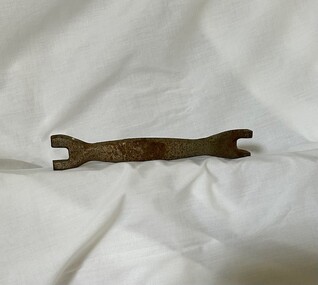 Greensborough Historical Society
Domestic object - Handle, Warmray, Handle for heater, 1950s
... Handle used for Warmray heater to remover hot ash pan from briquette and wood heaters c1950s...Handle used for Warmray heater to remover hot ash pan from briquette and wood heaters c1950s tools heaters Steal with hooks at both ends, rusty Handle for heater Domestic object Handle Warmray ...Handle used for Warmray heater to remover hot ash pan from briquette and wood heaters c1950sSteal with hooks at both ends, rustytools, heaters -
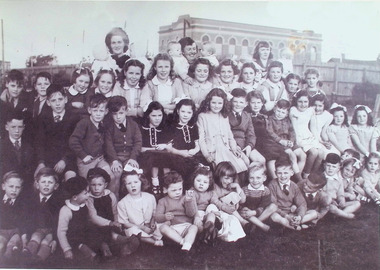 Williamstown Historical Society Inc
Photograph - Gathering of 'Twins' in Newport, c.1950's
... ...c1950s...Gathering of Twins Newport c1950s Vin & Alan Raymer (top left), triplets middle front row, and Joyce Eaton & brother in middle front row, 4th pair from left Photograph Gathering of 'Twins' in Newport, c.1950's. ...Vin & Alan Raymer (top left), triplets middle front row, and Joyce Eaton & brother in middle front row, 4th pair from left gathering of twins, newport, c1950s
