
Showing 194 items matching "casualty of war"
-
 Whitehorse Historical Society Inc.
Document - School Project, Remembering a casualty of World War II, 1/06/1997 12:00:00 AM
... Remembering a casualty of World War II...Remembering a casualty of World War II Document School Project ...A Luther College Year 10 essayA Luther College Year 10 essay which researches the history of George Maxwell Walker (1924 - 1944). A pilot with the R.A.A.F. who spent much of his flying days with the British R.A.F. At the time of his death his squadron was carrying out anti-submarine patrols and internal security in and around the Middle East. He was the son of George Walker and grandson of Edgar and Myra Walker, owners of Australia Tesselated Tile Company. The George Walker family lived in Harrison St, Mitcham. The home is on the City of Whitehorse Heritage planning overlay.A Luther College Year 10 essay walker, george maxwell, royal australian air force, royal air force, world war, 1939 - 1945, war memorials -
 Whitehorse Historical Society Inc.
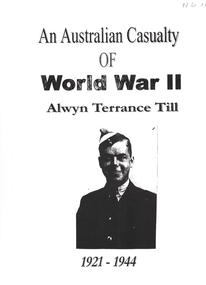
Work on paper - School Project, An Australian casualty of World War II, Alwyn Terrance Till, 1/06/1997 12:00:00 AM
... An Australian casualty of World War II, Alwyn Terrance Till....till alwyn war memorial lilydale war memorial mitcham war memorial box hill war memorial blackburn royal australian air force hotton war cemetery belgium world war 1939 - 1945 Luther College Year 10 History assignment Photocopy of Luther College Year 10 History assignment telling the story of Alwyn Terrance Till who died on 21 August 1944 in Germany and is buried at Hotton War Cemetery, Belgium. An Australian casualty of World War II, Alwyn Terrance Till. ...Luther College Year 10 History assignmentPhotocopy of Luther College Year 10 History assignment telling the story of Alwyn Terrance Till who died on 21 August 1944 in Germany and is buried at Hotton War Cemetery, Belgium.Luther College Year 10 History assignmenttill, alwyn, war memorial lilydale, war memorial mitcham, war memorial box hill, war memorial blackburn, royal australian air force, hotton war cemetery, belgium, world war, 1939 - 1945 -
 Whitehorse Historical Society Inc.
Document, An Australian Casualty of World War 2, 1997?
... An Australian Casualty of World War 2...An Australian Casualty of World War 2 Document Document ...Alwyn Terrance (sic) Till, 1921 - 1944. School history project. With letter to Una Taylor.Alwyn Terrance (sic) Till, 1921 - 1944. School history project. With letter to Una Taylor.Alwyn Terrance (sic) Till, 1921 - 1944. School history project. With letter to Una Taylor.till, alwyn -
 Warrnambool RSL Sub Branch
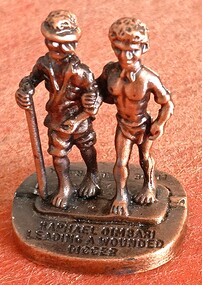
Sculpture - Miniature Bronze Statuette, Wounded Soldier and Guide - Kokoda Trail
... ...Casualty of war...He was immortalized in an iconic photograph taken by war photographer George Silk on Christmas Day 1942, which depicts Oimbari leading a blinded, wounded Australian soldier, Private George "Dick" Whittington, to a casualty clearing station. ...More information -https://kokodahistorical.com.au/diggers-stories/george-whittington-and-raphael-oimbari One of the most famous photographs from PNG in WW2 WW2 mateship Casualty of war PNG on base front- RAPHAEL OIMBARI LEADING A WOUNDED DIGGER. ...WW2, Kokoda trail 1942 Raphael Oimbari (d. 1996) was a Papuan orderly and national hero of Papua New Guinea, famously known as a "Fuzzy Wuzzy Angel" during World War II. He was immortalized in an iconic photograph taken by war photographer George Silk on Christmas Day 1942, which depicts Oimbari leading a blinded, wounded Australian soldier, Private George "Dick" Whittington, to a casualty clearing station. The image stands as one of the most enduring symbols of wartime mateship between Australia and Papua New Guinea. More information -https://kokodahistorical.com.au/diggers-stories/george-whittington-and-raphael-oimbari One of the most famous photographs from PNG in WW2two figures mounted on small stand on a larger oval base 26 mm x 23 mm. Overal height 35mmon base front- RAPHAEL OIMBARI LEADING A WOUNDED DIGGER. On base rear MADE IN AUSTRALIA Base underside – Astor Base Metal 02 97500111 Reg Des ww2, mateship, casualty of war, png -
 Ballarat RSL Sub-Branch Inc.
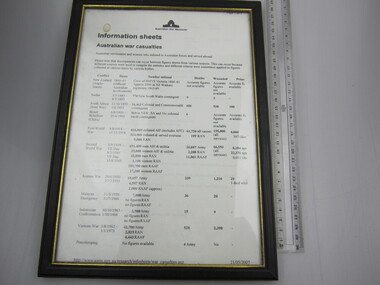
Information Sheet - Framed
... Australian war casualties covering 1860-1973+...Literature Ballarat RSL Ballarat Australian war casualties covering 1860-1973+ Information Sheet - Framed ...Australian war casualties covering 1860-1973+literature, ballarat rsl, ballarat -
Tatura Irrigation & Wartime Camps Museum
A4 Display Book, Reginald Leslie EICKE
... Contents include Enlistment papers, service and casualty form, attestation papers, war gratuity schedule papers, casualty form active service, statement of service and photograph of Reginald in uniform during WW1. ...Contents include Enlistment papers, service and casualty form, attestation papers, war gratuity schedule papers, casualty form active service, statement of service and photograph of Reginald in uniform during WW1. ...Contents include Enlistment papers, service and casualty form, attestation papers, war gratuity schedule papers, casualty form active service, statement of service and photograph of Reginald in uniform during WW1. Reginald signed up again for WW2 (V16077) was an internment camp guard with the 17 Australian Garrison Battalion.Blue A4 display book containing 6 plastic sleeves with enlistment information on Reginald Leslie Eicke.australian imperial forces, reginald leslie eicke, 17 australian garrison battalion -
 Bendigo Historical Society Inc.
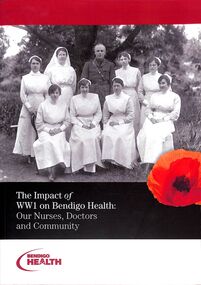
Book - "The Impact of WW1 on Bendigo Health: Our nurses, Doctors and Community.", 1914
... Over 416,000 persons enlisted to serve in World War One out of a population of 5 million. The Australian Government recorded 215,585 casualties during the war. ...Over 416,000 persons enlisted to serve in World War One out of a population of 5 million. The Australian Government recorded 215,585 casualties during the war. ...Over 4000 Bendigo residents enlisted to serve in W.W. 1. Much is known about their contributions to the war effort, but less is known about the contributions made by the medical staff who provided care at the front lines or otherwise supported care. People enlisted for many reasons - patriotism, duty and adventure being just a few. Over 416,000 persons enlisted to serve in World War One out of a population of 5 million. The Australian Government recorded 215,585 casualties during the war. Over 80% of those casualties occurred on the Western Front, in Belgium and France. The weapons used in trench warfare created horrendous injuries for both sides in the war. In the Australian Imperial Force (AIF), for example, most wounds were the result of flying metal. During their service, many of the 331,781 AIF troops and medical staff were injured more than once: over 50% were hit by shell fragments or shrapnel bullets from artillery fire 40% were hit by high-velocity bullets from rifles or machine guns 12% were affected by chlorine or mustard gas 2% were hit by bombs or grenades only 0.3% suffered bayonet wounds Many health risks also developed into large-scale problems on the front. Those who served lived and work in crowded spaces, which helped to spread bacterial, viral and parasitic infections. Unhealthy living conditions for soldiers (and sailors) included: poor diet lack of sleep exposure to cold contact with mice, rats, fleas, lice and other parasites. Soft cover. 41pp. Black and white image of nurses on front cover, along with red poppy. Tile written in white to bottom third of front cover on black background. Bendigo Health logo to bottom of front cover. Back cover has image of signage for the 'Old Mortuary' of Bendigo Hospital, with burgundy, black and white stipes above and below image. Contains black and white and color images. soldiers, world war one, british empire, doctors, nurses, bendigo hospital -
 National Vietnam Veterans Museum (NVVM)
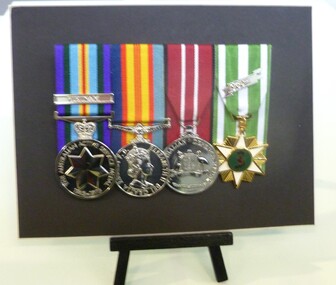
Medal - Medal, Replica
... Barbara Black was the only woman casualty of the Vietnam War, dying from illness incurred while on active service. ...Barbara Black was the only woman casualty of the Vietnam War, dying from illness incurred while on active service. ...The following replica medals belonged to Barbara Frances Black, Royal Australian Army Nursing Corps, Unit: 1 Field Hospital. Vietnam Service: 14 may 1968 - 16 April 1969. Date of death: 3 November 1971, Fitzroy, Victoria. Barbara Black was the only woman casualty of the Vietnam War, dying from illness incurred while on active service. Australian Active Service Medal 1945-1975 with clasp 'Vietnam'. The AASM 1945 - 75 was approved in 1997. It was awarded for service in, or in connection with, prescribed warlike operations from 3 September 1945 until 13 February 1975. Vietnam Medal: The Vietnam Medal was instituted in 1968 and awarded for service in Vietnam between 29 May 1964 and 27 January 1973. The Vietnam Medal was issued under the Imperial System but was mainly awarded to Australian and New Zealand personnel. Republic of Vietnam Campaign Medal 1960- this medal was issued by the Government of the Republic of Vietnam for service in the prescribed area of operations in Vietnam during the period from 31 July 1962 to 27 January 1973.1x Australian Active Service Medal 45-75 Vietnam 1x Vietnam Medal 1x Australian Defence Medal 1x Republic of Vietnam Campaign Medal 1960-australian, medals, barbara frances black, t/captain -
 National Vietnam Veterans Museum (NVVM)
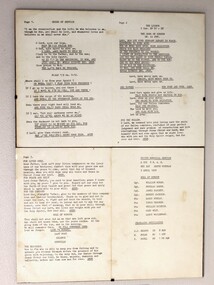
Ephemera - Order of Service, framed
... The worst day for mine casualties in Australia's war in Vietnam occurred on 28 February 1970. ...The worst day for mine casualties in Australia's war in Vietnam occurred on 28 February 1970. ...Operation Hammersley , 10 February until 9 March 1970, was undertaken by a combined force of: C Company, 8th Battalion, the Royal Australian Regiment (8RAR); armoured personnel carriers from 3 Cavalry Regiment; tanks from 1 Armoured Regiment; sappers from the Royal Australian Engineers; a mortar section from 8RAR’s Support Company; air support, and even a Navy destroyer off-shore to provide gunfire support. The operation aimed to protect 17 Construction Squadron, Royal Australian Engineers, at a quarry in the western foothills of the Long Hai hills. The Long Hai hills were a stronghold for the Viet Cong, who used the caves there as a bunker complex and had planted many landmines and booby traps in the area. Over two fierce weeks, 8 RAR carried out patrols and conducted ambushes, engaging VC troops and eventually capturing the bunker system. However, it was a costly campaign. In total, over 70 Australians were killed or wounded during the operation. The worst day for mine casualties in Australia's war in Vietnam occurred on 28 February 1970. It became known as 'Black Saturday". Nine members of 8RAR were killed and 29 wounded. This item is the Order of Service from the memorial service held at Nui Dat on 3 April 1970 to honour those killed at Long Hai. It was issued to the donor, National Serviceman G G Ravenscroft, who was serving in 1 Platoon, A Company 8RAR during Operation Hammersley, and received a minor shrapnel wound on Black Saturday. This was donated by Cpl (Temp) Geoffrey Grant Ravenscroft (3795037) who was a National Serviceman with the Royal Australian Infantry Corps and served in Vietnam with the 8th Battalion The Royal Australian Regiment from November 1969 to July 1970Two typed A-4 pages that have been folded into booklet, now flattened and framed. Listed are the prayers, Bible readings and sermon given, along with the names of the 8 fallen soldiers, and the chaplains who officiated. See media for more information.8rar, long hai, long hai hills, black saturday, 1970, operation hammersley, ravenscroft, geoff ravenscroft, memorial service, c company, 8th battalion, the royal australian regiment, apc, 3 cavalry regiment, 1 armoured regiment, sappers, royal australian engineers, 17 construction squadron, viet cong, viet cong troops, nui dat, australian national serviceman, 1 platoon, a company, cpl (temp) geoffrey grant ravenscroft, 3795037 -
 Federation University Art Collection
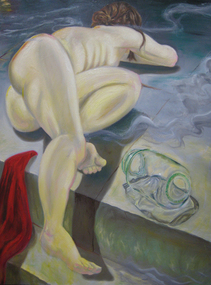
Artwork, 'Cassandra After the Fact' by Andrew Potter, 2009
... Cassandra is undoubtedly a Trojan War casualty, symbolizing the personal pain of widows and rape victims. ...Cassandra is undoubtedly a Trojan War casualty, symbolizing the personal pain of widows and rape victims. ...This work pays homage to Solomon J. Solomon’s Ajax and Cassandra. Andrew Potter’s painting tells of the subsequent event. Cassandra is undoubtedly a Trojan War casualty, symbolizing the personal pain of widows and rape victims. The flow of the fabric is the allegory of bloodshed, while the empty jar suggests displacement of refugees. Cassandra’s body, as mother earth, is a metaphor for the peaceful landscape that is desecrated by acts of war. The artist uses these iconic figures to exemplify and demonstrate why peace is always better than war. This work was awarded second prize in the 2009 Lucato Peace Prize. During that year Andrew Potter was undertaking the first year of a Bachelor of Visual Arts (Fine Arts) at the University of Ballarat’s Arts Academy. This item was runner up in the Lucato Peace Prize, and is part of the Federation University Art Collection. The Art Collection features over 1000 works and was listed as a 'Ballarat Treasure' in 2007.Painted canvas depicting a naked woman lying on the round beside a glass jar.art, artwork, andrew potter, potter, lucato peace prize, mythology, available -
 Bendigo Military Museum
Album - SERVICE HISTORY AND RECORDS WW2, C. 1939 - 1951
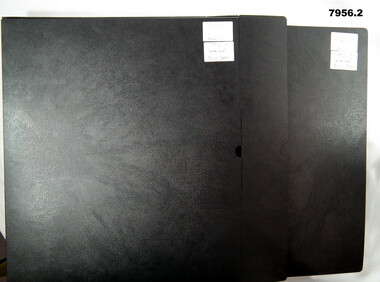
... Eight newspaper cuttings re casualty lists and War news. 21. List of Australian POW's in Sumatra. 22. ...Eight newspaper cuttings re casualty lists and War news. 21. List of Australian POW's in Sumatra. 22. ...The items in this Archival folder relate to Arthur Edmund TRANTER V50166, VX52843 POW, his wife Pat and Daughter Brenda. There are two more Archival folders, Cat No's 7957.2 & 7958.2. Refer Cat No 7944 for A.E. Tranters service history..1) Black Archival folder container. .2) Black Archival folder, 3 ring binder with plastic inserts. This has the following: 1. Certificate of Service 2nd AIF 1941 - 45 2. Certificate of service CMF 1939 - 1941 3. Corporals certificate 38th BN 1939. 4. Certificate relating to a "mention in Despatches" 5 &6. Letters re the awards of the "Efficiency Medal" 7. Black and white photo with "Streader, Drake and Tranter" 1939. 8. Ships menu "TMS SIBAKAK" Sept 1941. 9. 2/29th BN reunion menu 50th Anniversary. 10. Document on "How to learn Morse Code". 11. Document, Grant of a War pension, Tranter 1951. 12. Document re War pension Payments. 13. Document re "Return to Civilian life for POW"s. 14. Exercise book from Singapore with names re 2/29th BN. 15. Cartoon copy, Medan Melbourne Frog Cup 1942. 16. Hand drawn sketch black pencil of "Tranter" by E.W. Porter 17th Dec 1942. 17. List of recommendations for an "MID" re POW's in captivity. 18. POW working party list and casualties 8.3.1944 at "Atjeh". 19. POW casualties on the "Harukiki Maru"26.6.1944. 20. Eight newspaper cuttings re casualty lists and War news. 21. List of Australian POW's in Sumatra. 22. Menu Sheraton Hotel 2/29th BN Reunion. 23. Five photos of the Tranter Family re wife Pat and Daughter Brenda. 24. 2/29th BN Xmas card 1942. Card, General Base AIF Malaya 1941 - 42. 25. Twenty four POW Post cards via Australian/Japanese Red Cross. 26. Nineteen telegrams re "Welcome home 1945" 27. Two photos re "Welcome home, Shire of McIvor. 28. Letter written at sea to Pat and Brenda. 29. Welcome home luncheon menu Shire of McIvor 8th April 1946. 30. Letter dated 15.9.1945 to Pat and Brenda. album pow, documents, tranter -
 Ringwood and District Historical Society
Letter, Cheevers, Margaret (Mayor), Letter from Margaret Cheevers to Desmond Lindsay referring to his work on the history of the site of the City of Ringwood Bowls Club - 2/08/1994, 2-Aug-94
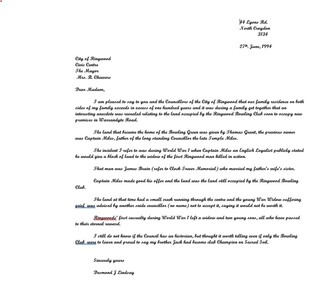
... The land at that time had a small creek running through the centre and the young War Widow suffering grief was advised by another snide councillor (no name) not to accept it, saying it would not be worth it. Ringwoods’ first casualty...The land at that time had a small creek running through the centre and the young War Widow suffering grief was advised by another snide councillor (no name) not to accept it, saying it would not be worth it. Ringwoods’ first casualty ...Letter from Margaret Cheevers to Desmond Lindsay referring to his work on the history of the site of the City of Ringwood Bowls Club.Letter from Margaret Cheevers to Desmond Lindsay referring to his work on the history of the site of the City of Ringwood Bowls Club. One page,white paper, printed on Ringwood Council letter head. +Additional Keywords: Cheevers, Margaret (Mayor) / Lindsay, Desmond44 Lyons Rd. North Croydon 3134 27th. June, 1994 City of Ringwood Civic Centre The Mayor Mrs. B. Cheevers Dear Madam, I am pleased to say to you and the Councillors of the City of Ringwood that our family residence on both sides of my family exceeds in excess of one hundred years and it was during a family get together that an interesting anecdote was revealed relating to the land occupied by the Ringwood Bowling Club soon to occupy new premises in Warrandyte Road. The land that became the home of the Bowling Green was given by Thomas Grant, the previous owner was Captain Miles, father of the long standing Councillor the late Temple Miles. The incident I refer to was during World War 1 when Captain Miles an English Loyalist publicly stated he would give a block of land to the widow of the first Ringwood man killed in action. That man was James Brain (refer to Clock Tower Memorial) who married my father’s wife’s sister. Captain Miles made good his offer and the land was the land still occupied by the Ringwood Bowling Club. The land at that time had a small creek running through the centre and the young War Widow suffering grief was advised by another snide councillor (no name) not to accept it, saying it would not be worth it. Ringwoods’ first casualty during World War 1 left a widow and two young sons, all who have passed to their eternal reward. I still do not know if the Council has an historian, but thought it worth telling even if only the Bowling Club were to learn and proud to say my brother Jack had become club Champion on Sacred Soil. Sincerely yours Desmond J Lindsay -
 Ballarat Heritage Services
Photograph, Clare Gervasoni, Maryborough Town Hall and Post Office, 04/05/2025
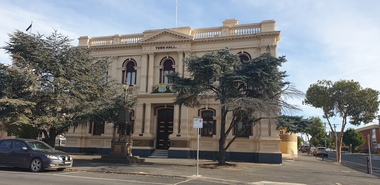
... Designed and made by George Daws, a Melbourne monumental mason, it commemorates Gerald Wilkinson, Maryborough's first war casualty, who was killed in action in 1901 during the Boer War. ...Designed and made by George Daws, a Melbourne monumental mason, it commemorates Gerald Wilkinson, Maryborough's first war casualty, who was killed in action in 1901 during the Boer War. ...The Town Hall has architectural significance as a notable and largely intact example of a late nineteenth century provincial town hall, and as a major public building designed by the prominent Melbourne architect George Johnson. In 1887 the decision was made to build a new Town Hall on vacant land in the Civic Square near the Post Office. The architect was George Johnson, possibly the most prolific designer of municipal buildings in late nineteenth century Victoria. Tenders were called in March 1887, the successful quote being for ₤6454.5.0 by George Clayfield Senior. The foundation stone was laid in June 1887 and the new town hall opened with a grand ball in July 1888. In 1903 a memorial drinking fountain was erected in front of the building. Designed and made by George Daws, a Melbourne monumental mason, it commemorates Gerald Wilkinson, Maryborough's first war casualty, who was killed in action in 1901 during the Boer War. Films were screened at the Town Hall between 1908 and 1967. In 1939 a new entrance foyer for the hall and a Lower Town Hall were constructed, providing much needed public work during the depression. They were built by Steve Hunn for ₤5000, to plans by the Melbourne architect Harry J. Little. Funds were made available by the sale of the Borough electrical supply to the SEC. In 1971 the administrative offices at the front of the building were vacated when new administrative offices were built opposite. The old offices are now used for council and community purposes.Black and white image of a double storey town hall in Maryborough, Victoria maryborough, maryborough town hall, maryborough post office, george johnson, gerald wilkinson, harry j. little -
 Ballarat Heritage Services
Photograph, Maryborough Town Hall and Post Office
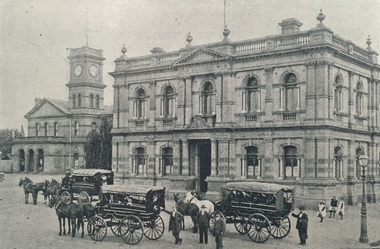
... Designed and made by George Daws, a Melbourne monumental mason, it commemorates Gerald Wilkinson, Maryborough's first war casualty, who was killed in action in 1901 during the Boer War. ...Designed and made by George Daws, a Melbourne monumental mason, it commemorates Gerald Wilkinson, Maryborough's first war casualty, who was killed in action in 1901 during the Boer War. ...The Town Hall has architectural significance as a notable and largely intact example of a late nineteenth century provincial town hall, and as a major public building designed by the prominent Melbourne architect George Johnson. In 1887 the decision was made to build a new Town Hall on vacant land in the Civic Square near the Post Office. The architect was George Johnson, possibly the most prolific designer of municipal buildings in late nineteenth century Victoria. Tenders were called in March 1887, the successful quote being for ₤6454.5.0 by George Clayfield Senior. The foundation stone was laid in June 1887 and the new town hall opened with a grand ball in July 1888. In 1903 a memorial drinking fountain was erected in front of the building. Designed and made by George Daws, a Melbourne monumental mason, it commemorates Gerald Wilkinson, Maryborough's first war casualty, who was killed in action in 1901 during the Boer War. Films were screened at the Town Hall between 1908 and 1967. In 1939 a new entrance foyer for the hall and a Lower Town Hall were constructed, providing much needed public work during the depression. They were built by Steve Hunn for ₤5000, to plans by the Melbourne architect Harry J. Little. Funds were made available by the sale of the Borough electrical supply to the SEC. In 1971 the administrative offices at the front of the building were vacated when new administrative offices were built opposite. The old offices are now used for council and community purposes.Black and white image of a double storey town hall in Maryborough, Victoria maryborough, maryborough town hall, maryborough post office, george johnson, gerald wilkinson, harry j. little -
 Flagstaff Hill Maritime Museum and Village
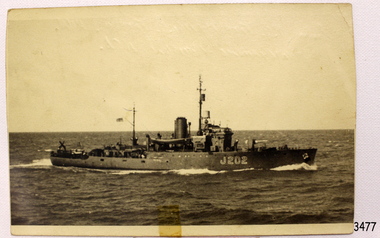
Photograph - Vessel, Steam Ship, H.M.A.S. Warrnambool J202, Between 1941-1947
... The HMAS Warrnambool was the only RAN ship to be sunk by a mine, and the four who lost their livers were the last naval casualties from World War II. The ship’s wartime service was recognised by three honours. ...The HMAS Warrnambool was the only RAN ship to be sunk by a mine, and the four who lost their livers were the last naval casualties from World War II. The ship’s wartime service was recognised by three honours. ...This photograph is connected to the first HMAS Warrnambool (J202), which was one of 60 Bathurst class corvette vessels built during World War II by Mort's Dock & Engineering Co Ltd of Sydney under the commission of the Royal Australian Navy (RAN). It was the namesake of the City of Warrnambool in Victoria. The armed minesweeper was 57 metres long and could had a complement of 85 personnel. Its armament included 1 × 4 inch Mk XIX gun, 1 × 40 mm Bofors AA gun (installed later), 3 × 20 mm Oerlikon guns (1 later removed), machine guns and depth charge chutes and throwers. It was launched in Sydney in May, 1941. The HMAS Warrnambool began service with patrols off Bass Strait in 1941. In December the ship docked in Warrnambool Harbour and the crew marched in a parade along Timor Street. The ship’s crew received a donation of 110 books from the Warrnambool Patriotic Fund, and a plaque of the City of Warrnambool’s Coat of Arms presented by the Mayor, Cr. John R Astbury. In September 1942 a Dutch East Indies family, Samuel and Annie Jacob and seven of their eight children, was rescued by the HMAS Warrnambool and evacuated to Darwin. The family settled in Melbourne, then in 1944 Samuel tragically died. After the war ended the family was threatened with deportation under Australia’s Immigration Restriction Act 1901 (known also as the White Australia policy). Annie married her landlord, John O’Keefe but was still issued a deportation order in 1949. The family appealed to the High Court and the case became famous for being the first successful legal challenge to the Act. The HMAS Warrnambool was in Darwin during the time it was bombed, attacked by the Japanese while rescuing 73 crew from a merchant vessel that had also been attacked. The ship was involved in several other rescues and carried troops to New Guinea. Other events included escort and patrol duties on Australia's east coast, then at Fremantle and back to Darwin. When the Japanese surrendered on September 11, 1945, at the end of World War II, the ship was at Timor. It performed mine clearance work around the Solomon Islands and New Guinea after the war. On 13th September 1947 the ship was sent to lead a flotilla at the Great Barrier Reef, off the Queensland coast. The mission was to clear the defensive British mines that were laid during1941-43 to protect Australia’s boarders. The HMAS Warrnambool hit a mine near Cockburn Reef, exploded and sank shortly afterwards. One of the 70 or so men on board was killed at the time and thirty-two men were badly injured; three of these also lost their lives. The four deceased were Victorian seamen. The wounded men were transferred by boats to the nearby HMAS Swan II, where the Swan’s and the Warrnambool’s doctors cared for them. The HMAS Swan II took the survivors to Cairns, and from there the men were flown by RAAF to either Brisbane or Sydney hospitals. The HMAS Warrnambool was the only RAN ship to be sunk by a mine, and the four who lost their livers were the last naval casualties from World War II. The ship’s wartime service was recognised by three honours. In May 1948 a number of items were recovered by Navy divers from the wreck of HMAS Warrnambool. The items included the ship’s bell (inscribed HMAS Warrnambool 1941) and the round plaque with the Seal of the Warrnambool City Council. In 1949 the plaque was returned to the Council, and the bell was donated to the Australian War Memorial. Further objects were recovered by the new owners of the wreck, Southern Cross Diving and Salvage, in 1972-75. A memorial plaque, honouring the memories of all those who served on the HMAS Warrnambool until is sunk on September 13 1947, was erected in Warrnambool on September 13, 1995. NOTE: (1)- The second HMAS Warrnambool (FCPB204), also the namesake of the City of Warrnambool, was built in 1980 in Cairns, one of fifteen Fremantle Class Patrol Boats ordered by the RAN. It was just over 41 metres long with a compliment of 22 personnel. It patrolled Australia’s northern waters for illegal fishing vessels. This vessel was decommissioned in 2005. (2)- There was also a steam and sail ship named the S.S. Warrnambool, built in 1892 in London and broken up in 1926.This photograph is significant for its association with Royal Australian Navy and its vessel, HMAS Warrnambool (j202). The HMAS Warrnambool played a nationally significant role in overturning Australia’s Immigration Restriction Act 1901 (colloquially known as the White Australia policy). The ship rescued, and brought to Australia, Samuel and Annie Jacob and their family after they evacuated Dutch East India. The family was threatened with deportation and made the first successful appeal to High Court regarding that Act. The HMAS Warrnambool has - Local significance for being the namesake of the City of Warrnambool - Local significance, having docked in Warrnambool Harbour - Local significance, the crew having paraded in Timor Street, Warrnambool - State significance for its first patrol being in Bass Strait. - National significance, being present in Timor at the Japanese surrender - National significance as part of Australia’s defence force history, being one of only four Bathurst class corvettes lost while in Australian service, the only Bathurst class corvette lost after World War II, the only RAN vessel to be sunk by a mine, and associated with the last four Navy deaths of WWIIBlack and white photograph of vessel H.M.A.S. Warrnambool J202 on an open sea. The identifying number is painted on the hull. The ship is flying a white ensign. A lifeboat is suspended near the centre of the ship. Figures can be seen on deck. Hand written inscription on the reverse side. On ship's hull "J202" On reverse of photo "From P.O. FRED MATTHEWS. 23378. R.A.N." "MARIBYRNONG MAIDSTON RSL" "H.M.A.S. WARRNAMBOOL"flagstaff hill, warrnambool, shipwrecked-coast, flagstaff-hill, flagstaff-hill-maritime-museum, maritime-museum, shipwreck-coast, flagstaff-hill-maritime-village, photograph, h.m.a.s. warrnambool, maritime village, maritime museum, shipwreck coast, mort's dock & engineering co ltd, hmas warrnambool, hmas warrnambool i, hmas warrnambool j202, hmas swan ii, j202, world war ii, bathurst class corvette, royal australian navy, ran, sydney built ship, bass strait patrol, sea mine patrol, mine sweeper, mine clearance, navy divers, great barrier reef, cockburn reef, southern cross diving and salvage, warrnambool city council, cr j r astbury, mayor j r astbury, warrnambool patriotic fund, seal, coat of arms, ship’s bell, hmas warrnambool 1941, shipwreck by sea mine 1947, sea rescue, life saving, lifesaving, sinking ship, sunk ship, immigration restrictions act 1901, white australia policy, samuel and annie jacob, john o'keere, minesweeper -
 City of Melbourne Libraries
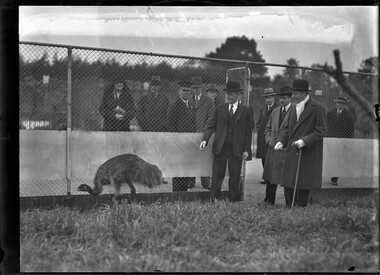
Photograph, Bull, Hugh Jones, 1897-1993, Vice-regal visit to zoo: Lord Huntingfield meets an emu
... The Major’s official report stated that there were no human casualties in “The Emu War.” Emus are considered the victors of “The Great Emu War.” ...The Major’s official report stated that there were no human casualties in “The Emu War.” Emus are considered the victors of “The Great Emu War.” ...Photographer notations on slide: "Vice Regal visit to Zoo B42" Not published. Description: A group of men and one woman all dressed in hats and overcoats stand by a wire fence while watching an emu. Research by project volunteer, Fiona Collyer: On 25 June 1934, new Victorian Governor, His Excellency Lord Huntingfield and his wife Lady Huntingfield made an official visit to the Melbourne Zoological Gardens in order to grant his patronage to the Royal Zoological and Acclimatisation Society. During the visit, zoo director Mr. Andrew Wilkie introduced them to some of the zoo’s inhabitants, including an emu. After the First World War, many returned soldiers took up the Government’s offer of land in the Soldier Settlement Scheme. Most of the veterans had little or no farming experience and much of the land offered was of poor quality, with blocks often too small to be viable. Many of the settlers had ongoing physical and mental injuries from the war. The Western Australian government allocated land to 5000 former soldiers but by 1929, one quarter of the men had already abandoned their land, unable to make a living. Not only was the world economy struggling with the Great Depression, but the settlers also had to contend with plummeting wheat and wool prices, crippling drought and rabbit infestation. The Scullin Government (Oct 1929-Jan 1932) had promised subsidies to the Western Australian farmers if they increased their wheat crops but were unable to pass the legislation in the Senate. The new Lyons Government (Jan 1932-April 1939) abandoned the legislation and the subsidies were never paid, bringing calls from Western Australia of secession from Australia. In October 1932, a deputation of soldier settlers from the Campion wheatbelt region in Western Australia, petitioned Commonwealth Minister for Defence, Western Australian Senator Sir George Pearce, for assistance. A mob of 20,000 emus were migrating to the coast after breeding and were gathering along the eastern side of the Number 1 Rabbit Proof Fence, attracted to the ripening crops and the dams the farmers had built. They were heading towards Campion, 303 kilometres east of Perth, eating and trampling the wheat, destroying the fences and letting the rabbits in. Having witnessed firsthand the effectiveness of machine guns in killing people in war, the former soldiers thought the guns would be ideal for killing emus. Sir George, wanting to demonstrate that his government was sympathetic to the settlers and hoping to quell Western Australian succession talk, agreed. However, he stipulated that no expense would be incurred by the Commonwealth Government and only active military personnel could use the machine guns. The farmers had to pay for the ammunition, food and accommodation for the military for the length of the operation. The cost for the ammunition was £50 for 10,000 rounds. Sir George also felt the operation would provide excellent target practice for the soldiers! The operation was headed by Major Gwynydd Purves Wynn-Aubrey Meredith, 1887-1975, of the Seventh Heavy Battery of the Royal Australian Artillery, and assisted by Sergeant S. McMurray and Gunner J. O'Halloran. They were equipped with two American-designed Lewis light machine guns and 10,000 rounds. Each magazine held 47 rounds of ammunition and the gun was capable of firing 500 to 600 rounds per minute with effective firing range of 800 metres. A cinematographer from British Movietone News accompanied the soldiers in order to record what was expected to be not only an easy victory but also useful propaganda for both the military and the Lyons Government. Emu (Dromaius novaehollandiae, meaning New Holland Racer) is a species of long-necked flightless bird endemic to Australia. The Tasmanian and the dwarf King and Kangaroo Island subspecies were hunted to extinction after the European settlement of Australia. It is the second largest bird in the world after the ostrich, standing up to 1.9 metres tall and weighing up to 50 kilograms. The Emu has long, powerful legs with three forward facing toes and is the only bird with calf muscles. It is able to jump 2.1 metres into the air and run 50 kilometres per hour. It communicates by drumming and booming through an inflatable neck sac which can be heard up to two kilometres away. Along with its tough hide and a body more feathers than flesh, the emu can be a tricky target. Emus had been a protected native species until 1922, when the government changed their status to “vermin” in response to the emus breaking down fences and destroying crops. Major Meredith told the press that Colonel Oswald V. Hoad of the 1st Cavalry Division NSW had especially requested he send 100 emu skins to replenish the plumage on his Light Horsemen’s hat tops. On the first day of the Emu War, 2 November 1932, Major Meredith spotted a mob of emus out of range of the guns, so he asked the farmers to use their vehicles to drive the emus towards the fence and the guns. The panicked birds split into small groups, kicking up the dust and scattering every which way. Only six were killed, though some were wounded. After that, the emus became very wary of humans. On 4 November, Major Meredith staged a dawn ambush at a dam. As 1000 emus approached to drink, the soldiers opened fire, killing 12 emus. After reloading, the gun jammed and the emus dispersed in all directions, and were not sighted again that day. The West Australian newspaper reported on 4 November 1932 that, “The emus have proved that they are not so stupid as they are usually considered to be. Each mob has its leader, always an enormous black-plumed bird standing fully six-feet high, who keeps watch while his fellows busy themselves with the wheat. At the first suspicious sign, he gives the signal, and dozens of heads stretch up out of the crop. A few birds will take fright, starting a headlong stampede for the scrub, the leader always remaining until his followers have reached safety.” In a later attempt, they mounted a gun onto the bed of a truck in order to chase and mow down the birds. However the truck couldn’t drive fast enough over the rough terrain and it was too bumpy to fire the gun accurately. The birds easily outran the truck except for one hapless emu who faltered while being chased and fell under the truck, its body wedging in the steering gear, causing the driver to crash the truck, and bringing down half a chain of the rabbit proof fence. RSPCA inspector Mr. Arthur Austin arrived with a rifle and knife in order to finish the work of the Lewis guns and dispatch injured emus. He said that while his society was sympathetic to the stricken settlers, he was anxious that wounded birds should not be left to suffer. Major Meredith told the inspector, “What speed can you run? You have to be better than Peter Pan if you want to catch wounded emus that make for the scrub.” (Racehorse “Peter Pan” had won the 1932 Melbourne Cup a few weeks earlier.) The commentator of the British Movietime newsreel uses a jocular tone to optimistically proclaim, “The scouts [emus] of the advancing army have keen eyesight, and in order to get close to the main body, our lads have to do some real stalking, with the enemy watching events through their periscopes raised up over the heads of corn... Instead of the birds ruining the farmers, tables are turned, there will be no more damage down here for many a day to come once the enemy is eliminated.” Emus proved tougher adversaries than expected, barely breaking stride even when badly injured from machine gun bullets, and the suspicious emus soon learnt to stay out of range of the men and their guns. Meanwhile, in the eastern states concern was being expressed about the cruelty of machine-gunning the native birds. Senator James Guthrie UAP of Victoria suggested that there must be “more humane, if less spectacular methods” of coping with the pests. People wrote letters to the newspapers to express their dismay at the inhumane methods used. R.F. Bellchambers from Humbug Scrub, 25 November 1932, lamented that, “At the present rate of extinctions, it will shortly be necessary to go to the Museum to see the remains of our fauna.” The Murchison Times published a letter on 16 November 1932 from “Clay Pan Joe”: “War on Emus. Slaughter of innocent birds would be more appropriate... The birds may be a nuisance and it may be necessary to destroy them, but why cause so much suffering amongst these innocent birds.” E.S. Playford of Norton’s Summit wrote to The Advertiser, 22 November 1932, that “...habitation on the earth would be impossible without bird life. Therefore, it is unwise to say that any bird is useless. Is sentiment dying? Are we so keen on personal gain that our lovely and unique birds have to be ruthlessly slaughtered in thousands and their bodies left rotting in the sun?” In Sydney, picture palace patrons expressed “considerable concern” after viewing the Movietone News newsreel of emus fleeing from the barrage of machine-guns, and wounded emus in the fields in Campion. The press had a field day, dubbing it the “The Emu War” and joking that the “Chicago method” was being used against the feathered foe. The Daily News newspaper published a cartoon depicting the emus outrunning and outsmarting the soldiers. In Parliament NSW Senator James Dunn called Sir George the “Minister for the Emu War”. Labor member Mr. Rosevear, midst great laughter, asked if the minister would consider declaring an armistice and withdrawing his troops from the Western Front. Prime Minister Joe Lyons was asked if medals would be struck for those taking part in the war. Labor parliamentarian Mr. A.E. Green declared any medals should go to the emus who had “won every round so far”. With the embarrassing press coverage and poor results, Sir George ordered a stop to the project on 9 November, and Major Meredith and the soldiers departed for Perth. The WA Premier Sir James Mitchell and the Campion farmers demanded they return, citing the continued destruction of crops and fences by the emus. Major Meredith and his two gunners were allowed to return on 13 November and seemingly having learnt from their previous experiences, had slightly more success this time killing emus. The operation finally finished on 10 December with Major Meredith reporting “definite kills” of 986 emus for 9860 rounds of ammunition, coincidentally and conveniently exactly 10% of the number of rounds used. A further 2500 birds were said to have died from their injuries and although this is a disputed figure, even if accurate, the ratio of rounds expended to emu casualties was thought too high to justify continuing. The operation barely caused a dint in the marauding mob of 20,000 emus. “There’s only one way to kill an emu”, one of the party bitterly remarked: “Shoot him through the back of the head when his mouth is closed or through the front of his mouth when his mouth is open. That’s how hard it is.” Australian ornithologist Dominic L. Serventy noted that “The machine-gunners’ dreams of point blank fire into serried masses of Emus were soon dissipated. The Emu command had evidently ordered guerrilla tactics, and its unwieldy army soon split up into innumerable small units that made use of the military equipment uneconomic. A crestfallen field force therefore withdrew from the combat area after about a month.” Major Meredith expressed the greatest of respect for the enemy. He said, “If we had a military division with the bullet-carrying capacity of these birds, it would face any army in the world. They could face machine guns with the invulnerability of tanks. They are like Zulus, whom even dum dum bullets would not stop." The Major’s official report stated that there were no human casualties in “The Emu War.” Emus are considered the victors of “The Great Emu War.” Western Australian farmers requested military assistance in 1934, 1943 and 1948, including using bombs, but the government refused. The bounty system instigated in 1923 continued, with farmers using rifles against their fleet-footed foe, with 57,034 bounties for dead emus claimed in six months in 1934 in Western Australia alone. 284,704 emus were killed in Western Australia between 1945 and 1960. The other most effective defence against the emus was the construction of a robust, vermin proof fence spanning over a long distance. Emus were formally protected in 1999 by the Environment Protection and Biodiversity Conservation Act. It’s estimated there are between 625,000 to 725,000 wild emus in Australia in 2024. An emu and a kangaroo feature on Australia’s coat of arms, holding up a shield illustrated with symbols of the six states. The animals symbolise the nation moving forward as neither animal can walk backwards. Campion is now a ghost town. A book about the operation, “Letters from the Emu War” by J.A. Bryden was published in 2023 by Playtime Books. In 2024, an Australian film called “The Emu War” was released, starring Damian Callinan and Luke McGregor. Andrew Arthur Wellesley Wilkie, 1853-1948, was Director of the Melbourne Zoo from 1923 to 1936 and was associated with the zoo for 70 years. He first worked as a horticultural assistant to Government botanist Baron Ferdinand von Mueller at the Botanical Gardens at the age of 13, along with his older brother David. One of Andrew’s jobs was to capture moths for the National Herbarium. In 1857, a group of prominent Melburnians assembled at St. Patrick’s Hall to form the Zoological Society of Victoria, with the aim of introducing animals and plants from overseas. It was conceived, “For the purposes of science and for that of affording the public the advantages of studying the habits of the animal creation in properly arranged zoological gardens.” The Victorian Government granted 32 acres (13 hectares) of land to the Zoological Society at the southern end of Richmond Paddock on the opposite bank to the Botanical Gardens. (This is where AAMI Stadium and Collingwood Football Club now stand.) In 1861, the Zoological Society of Victoria was renamed The Acclimatisation Society of Victoria. Unfortunately the Yarra River frontage was damp, swampy and subject to flooding, so the animals were briefly housed at the Botanical Gardens until in 1862, the City of Melbourne donated 55 acres (22 hectares) of land at Royal Park for the fledgling zoo. Baron von Mueller secured employment at Royal Park for Andrew and David and they helped to lay out the gardens, plant trees and take care of a collection of deer, pheasants, hares and partridges. Initially the zoo was used for the acclimatisation of animals recovering from the long voyage to Australia and for breeding them for sport. In 1872, the zoo bought two lions, a leopard and a cheetah that had been seized from circus showmen Keith and Phillips when they were unable to pay the bill of butcher Mr T K Bennet of Bourke Street. The first zoo director, Mr. Albert Le Souef, negotiated with captains of ships to buy animals at overseas ports they visited and soon a multitude of exotic species arrived, including a ten-year-old Indian elephant in 1878. In 1923, after being head keeper for some years, Andrew was appointed director of the zoo. By 1933, the zoo had 110 different species of animals, 200 species of birds and 72 species of reptiles under Andrew’s care. He had personally planted all but six trees and laid out the garden beds. As director he lobbied authorities for funds to build more humane enclosures for the animals. In June 1928, Table Talk magazine wrote of Andrew Wilkie: “Up at the Zoo there is a humble gentleman who is a lion among the lions, who knows the proper specific to employ when the boa constrictor has chilblains, and who is a friend and confidant of Queenie the elephant. His fount of zoological lore has never been plumbed. It is bottomless, like his good fellowship and geniality. Every day he may be seen somewhere in the grounds of that growing sanctuary for the strange and arresting fauna and creeping things of the world, and I assure you as one who is privy to his passion that that area and its inhabitants are rarely out of his thoughts.” Andrew retired from the zoo in 1936 at the age of 83 and in 1948 died at his home in Brunswick aged 94. He and his wife Josephine had six children. The Victorian Acclimatisation Society was founded in 1861 by Edward Wilson, 1813-1878, then owner and editor of The Argus newspaper. He said that Australian indigenous animals were practically useless, providing only “a little sport and an occasional meal”. The Society believed that Australia’s plants and animals were vastly inferior to those in Europe. They wanted to introduce and acclimatise to Victoria “all innoxious animals, birds, fishes, insects and vegetables, whether useful or ornamental” for sport and for the table, and to spread indigenous animals and plants from the colony around the world. Their motto was “if it lives, we want it”. The Society was primarily responsible for introducing sparrows, starlings, sambar and hog deer, ostriches, brown trout, blackberries, and carp to the Murray River. They released the European songbirds, thrush and blackbird to quell the homesickness of British settlers. The Society also sent Australian animals like platypus, echidnas, kangaroos and koalas to Europe for scientific and novelty purposes. Thomas Austin, a wealthy sheep farmer of Barwon Park, Winchelsea (property now owned by the National Trust) was a member and in 1859 he introduced hares, blackbirds, thrushes and partridges onto his property. He is probably best known for introducing 24 breeding rabbits onto his estate as game for shooting parties. Thomas quipped, “The introduction of a few rabbits could do little harm and might provide a touch of home, in addition to a spot of hunting." In 2022, genomic data confirmed that Australia’s feral rabbit population is entirely descended from these rabbits. Biological control has brought the rabbit population down from an estimated high of 10 billion rabbits in the 1920s to approximately 200 million today, inhabiting 70% of Australian landmass (5.3 million square kilometres). In 1872, the Acclimatisation Society was renamed The Zoological and Acclimatisation Society of Victoria and they focused on importing exotic animals for display purposes to the zoo. In 1937, the Royal Acclimatisation Society of Victoria was recreated as the Zoological Board of Victoria with a focus on research of native animals threatened with extinction. In an editorial for The Argus newspaper, 16 March 1856, Edward Wilson lamented: "...this country has been shamelessly stolen from the blacks. Had they been like the New Zealanders or the North American Indians, we should have bought their land, and supplied them with the means of living when we took it... In less than twenty years we have nearly swept them off the face of the earth. We have shot them down like dogs. In the guise of friendship we have issued corrosion sublimate in their damper, and consigned whole tribes to the agonies of an excruciating death. We have made them drunkards, and infected them with disease which has rotted the bones of their adults, and made such few children as are born amongst them a sorrow and a torture from the very instant of their birth. We have made them outcasts on their own land, and are rapidly consigning them to entire annihilation. There are but a few of them left, comparatively. This is what we would do for that few. We would feed and clothe every one of them.” [Note: this last sentence is italicized in the original newspaper article text]. Lord Huntingfield, (William Charles Arcedeckne Vanneck) 1883-1969, Governor of Victoria 1934-1939, was a British Conservative Party politician and the first ever Australian-born Governor of an Australian state (although he was always considered British). He was patron of the Royal Zoological and Acclimatisation Society of Victoria and was acting Governor-General for six months during the absence of Lord Gowie in 1938. Lady Huntingfield (née Margaret Eleanor Crosby) 1884-1943, his American-born wife showed great interest in social welfare and the advancement of women and children. She was president of the City Newsboys Society and Patroness of the Girls Friendly Society. In 1937, rose breeder Alister Clark named a yellow hybrid tea rose for her. In 1940, the City of Melbourne opened the Lady Huntingfield Free Kindergarten in North Melbourne, now the Lady Huntingfield Early Learning and Family Services Centre. Lady Huntingfield died in London in 1943 after her house was bombed during a German airstrike. The Lady Huntingfield Memorial Scholarship was established after the City of Melbourne raised £1000 in a public appeal conducted in her memory for students undertaking a Social Work degree at the University of Melbourne. It is awarded annually to this day. The Queen Victoria Hospital named a bed in her honour. References: VICE-ROYALTY GREETS THE KING OF BEASTS AT THE ZOO. (1934, June 26). The Age (Melbourne, Vic. : 1854 - 1954), p. 11. Retrieved August 23, 2024, from http://nla.gov.au/nla.news-article204818472 Prominent Personalities ANDREW WILKIE (1928, June 7). Table Talk (Melbourne, Vic. : 1885 - 1939), p. 15. Retrieved August 29, 2024, from http://nla.gov.au/nla.news-article146562949 'Edward Wilson (journalist)', Wikipedia, https://en.wikipedia.org/wiki/Edward_Wilson_(journalist) 'Thomas Austin (pastoralist)', Wikipedia, https://en.wikipedia.org/wiki/Thomas_Austin_(pastoralist) 'The Acclimatisation Society was driven by misguided ideals about 'fixing nature' in Australia', ABC News, https://www.abc.net.au/news/2022-11-04/acclimatisation-society-introduced-species-history-listen/101588262?utm_campaign=abc_news_web&utm_content=link&utm_medium=content_shared&utm_source=abc_news_web THE ABORIGINES. (1856, March 16). The Argus (Melbourne, Vic. : 1848 - 1957), p. 5. Retrieved September 28, 2024, from http://nla.gov.au/nla.news-article4833244 WAR ON EMUS. (1932, November 4). The West Australian (Perth, WA : 1879 - 1954), p. 12. Retrieved September 29, 2024, from http://nla.gov.au/nla.news-article32588972 'The Great Emu War: how it started and who won', ABC Australia, https://www.youtube.com/watch?v=Y1wA0PKeJqc Advertising (1932, November 25). The West Australian (Perth, WA : 1879 - 1954), p. 2. Retrieved October 26, 2024, from http://nla.gov.au/nla.news-article32584578 Emu Chasers Must Outstrip Peter Pan (1932, November 9). The Labor Daily (Sydney, NSW : 1924 - 1938), p. 5. Retrieved October 10, 2024, from http://nla.gov.au/nla.news-article237042749 WAR ON EMUS (1932, November 22). The Advertiser (Adelaide, SA : 1931 - 1954), p. 18. Retrieved October 15, 2024, from http://nla.gov.au/nla.news-article73997254 WAR ON EMUS. (1932, October 28). The Labor Daily (Sydney, NSW : 1924 - 1938), p. 6. Retrieved October 24, 2024, from http://nla.gov.au/nla.news-article237046601 EMU WAR (1932, December 3). Mirror (Perth, WA : 1921 - 1956), p. 7. Retrieved October 24, 2024, from http://nla.gov.au/nla.news-article75626301 Machine Gun Offensive Against Emus. (1932, November 10). Western Mail (Perth, WA : 1885 - 1954), p. 3 (PICTORIAL SECTION). Retrieved October 24, 2024, from http://nla.gov.au/nla.news-article37766670 A THOUSAND BIRDS IN LUCK. (1932, November 10). Western Mail (Perth, WA : 1885 - 1954), p. 28. Retrieved October 11, 2024, from http://nla.gov.au/nla.news-article37766849 New Strategy In A War On The Emu (1953, July 5). The Sunday Herald (Sydney, NSW : 1949 - 1953), p. 13. Retrieved October 11, 2024, from http://nla.gov.au/nla.news-article18516559 This is a nice emu-that was! (1932, November 5). The Daily News (Perth, WA : 1882 - 1955), p. 9 (HOME EDITION). Retrieved September 30, 2024, from http://nla.gov.au/nla.news-article82878309 LOCAL AND GENERAL (1932, November 16). The Murchison Times (Cue, WA : 1924 - 1937), p. 2. Retrieved October 14, 2024, from http://nla.gov.au/nla.news-article257500260 Taking Him for a Ride! (1932, October 13). The Daily News (Perth, WA : 1882 - 1955), p. 6 (HOME EDITION). Retrieved September 30, 2024, from http://nla.gov.au/nla.news-article83717338 'The Emu War', History Nuggets, https://historynuggets.squarespace.com/nuggets/2018/4/21/the-emu-war New Strategy In A War On The Emu (1953, July 5). The Sunday Herald (Sydney, NSW : 1949 - 1953), p. 13. Retrieved October 23, 2024, from http://nla.gov.au/nla.news-article18516559 'This is the story of how Australia went to war with emus and lost', First Dog on the Moon, https://www.theguardian.com/commentisfree/2018/jul/26/this-is-the-story-of-how-australia-went-to-war-with-emus-and-lost Photographer notations on slide: "Vice Regal visit to Zoo B42"emu wars, governors, melbourne zoo, city of melbourne, 1930-1939, hunting, lord huntingfield, lady huntingfield, royal park, animals, wildlife -
 Federation University Historical Collection
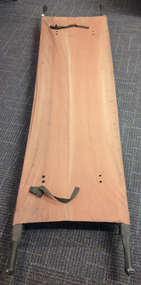
Equipment - Stretcher, Military Stretcher, c1915
... war...stretcher...casualty...Stretcher dates from the first World War period and is thought to be a British army stretcher carrier. world war stretcher casualty ambulance stretcher world war one ambulance classes medical first aid Brown canvas stretcher with timber handles and metal fittings painted khaki green. ...Stretcher dates from the first World War period and is thought to be a British army stretcher carrier. Brown canvas stretcher with timber handles and metal fittings painted khaki green. world war, stretcher, casualty, ambulance stretcher, world war one, ambulance classes, medical, first aid -
 Flagstaff Hill Maritime Museum and Village
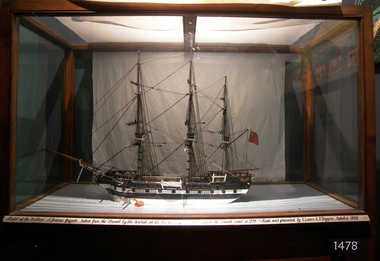
Craft - Ship Model, Arethusa, 1894
... Thames and Venus engaged her with heavy fire, causing 60 casualties before the vessel surrendered. She entered service with the Royal Navy for the rest of the war, and was in service in British home waters and became responsible for the capture of several French privateer cutters. ...Thames and Venus engaged her with heavy fire, causing 60 casualties before the vessel surrendered. She entered service with the Royal Navy for the rest of the war, and was in service in British home waters and became responsible for the capture of several French privateer cutters. ...Original Ships History: Aréthuse was a French frigate, launched in 1757 during the Seven Years War between England and France. She was captured by the Royal Navy in 1759 and became the fifth-rate HMS Arethusa. She remained in Royal Navy service for twenty years until she was wrecked after being badly damaged in battle. The ship was constructed at Le Havre for privateer warfare as ”Pélerine” and soon after her launch, she was purchased by King Louis XV (1710-1774) and commissioned as Aréthuse on 21 January 1758. In June, under captain Vauquelin, she sailed through the British blockade of Louisbourg helping to defend the site before departing, again forcing the blockade. On 18 May 1759, she was in transit from Rochefort to Brest, under the command of Louis-Philippe de Rigaud, Marquis of Vaudreuil, when she was intercepted near Audierne Bay (Baie d'Audierne) by three Royal Navy ships the Thames, Venus and Chatham. She attempted to escape but after two hours, lost her topmasts and was overtaken by her pursuers. Thames and Venus engaged her with heavy fire, causing 60 casualties before the vessel surrendered. She entered service with the Royal Navy for the rest of the war, and was in service in British home waters and became responsible for the capture of several French privateer cutters. In 1777, a Scotsman James Aitken, widely known as John the Painter, was hanged from her mizzenmast for burning the Rope House at Portsmouth Royal Dockyard on 7 December 1776, to aid the struggle of American independence. The mast was struck from the ship and re-erected at the dockyard entrance so as many people as possible could watch the execution. On 17 June 1778, she fought a famous duel against the French 36-gun frigate, Belle Poule. Belle Poule was on a reconnaissance mission, along with the 26-gun Licorne, the corvette Hirondelle and the smaller Coureur when she encountered a large British squadron that included Arethusa at a point 37 km south of The Lizard. Admiral Keppel, commanding the British fleet ordered that the French ships be pursued. The captain of Belle Poule refused the order to sail back to the British fleet. The British fired a warning shot across his ship's bow, to which he responded with a full broadside. This action began a furious, two-hour battle between the two ships that resulted in the deaths of the French second captain and 30 of the crew. However, Arethusa was crippled by the loss of a mast and withdrew, allowing Belle Poule to escape. This battle was the first between British and French naval forces during the American Revolutionary War and took place around three weeks before France had made a formal declaration of war. The battle was widely celebrated in France as a victory, even inspiring a hair-style in court circles that included a model of Belle Poule. It was also viewed as a victory in Britain and became the subject of a traditional Sea shanty, The Saucy Arethusa. On 18 March 1779, under captain Charles Holmes Everitt, Arethusa engaged the French Aigrette, under Lieutenant Mortemart, sustaining considerable damage in the fight. Arethusa was wrecked the next day off Ushant, It was the fame of this Arethusa which induced the Royal Navy, during the following two centuries, to bestow the name on a further seven consecutive individual ships and two consecutive classes of cruisers. (See Provenance Sec this document for information on the makers of this model). Model ship of the 3 masted frigate the “Arethusa”, model is painted black and white with varnished deck and masts. A British flag is flown at the stern. The ship is displayed in a glass case with timber frame and 4 legged stand.Label at bottom of glass case, printed in black script on a gold strip “Model of the “Arethusa" "A famous frigate, taken from the French by the British, on the 18th of May 1759 and lost on the French coast in 1779. – Made and presented by G. Lance & P. Diggins, October 1894” flagstaff hill, warrnambool, shipwrecked-coast, flagstaff-hill, flagstaff-hill-maritime-museum, maritime-museum, shipwreck-coast, flagstaff-hill-maritime-village, arethusa ship model, george lance, peter diggins, len asling, warrnambool art gallery, warrnambool exhibition, message in a bottle -
 The Beechworth Burke Museum
Photograph, 1916-17
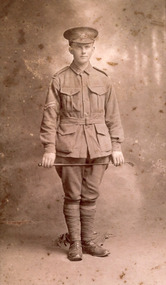
... War One, with almost half a million lives were lost on all sides. According to the recommendation for his military medal, Peach 'displayed conspicuous courage and initiative', taking charge after his platoon commander became a casualty, handling the men 'under heavy fire with great skill'. ...Portrait of William Edward Peach in First World War military uniform, holding a crop in front of his thighs with military kit on the ground behind him. A Beechworth postal employee who enlisted in 1915, this photograph is probably taken in 1917, as he is a corporal in the photo and was promoted to this rank in May 1917. This photograph is of historic significance as it depicts William Edward Peach, a Beechworth postal assistant who enlisted in the Australian Imperial Force (AIF) on his nineteenth birthday, 5 August 1915, which required his parents' permission. He was decorated with the military medal for his courage in battle 4/5 October 1917 at the Battle of Broodseinde Ridge near Ypres, the most successful allied attack of the Third Battle of Ypres (31 July to 10 November 1917), also known as the Battle of Paschendale, which saw the greatest loss of human life during World War One, with almost half a million lives were lost on all sides. According to the recommendation for his military medal, Peach 'displayed conspicuous courage and initiative', taking charge after his platoon commander became a casualty, handling the men 'under heavy fire with great skill'. He also assisted the Company Commander in reorganising their military objectives. The photograph is of social as well as historic significance for the Beechworth community, because it provides a direct link between local, national and international histories in relation to Australia' s participation in one of WWI's best-known battles. The record has strong research potential given the ongoing public and scholarly interest in war, history, and especially the ANZAC legend, which is commemorated annually on 25 April, known as ANZAC Day. Peach is also one of the diarists of WWI, including of this significant period of Australian military history, from 1916 to 18, which can be accessed via the Australian War Memorial. Sepia rectangular photograph printed on gloss Kodak photographic paper mounted on board. Reverse: BMM 8779 item catalogue number pencilled in right-hand bottom corner.military medal, defending australia and victoria, military service, hmat a64 demosthenes, wipers, anzac, burke museum, beechworth, ypres, australian military services, beechworth post office, first world war, wartime, our boys, belgium, flanders fields, ww1, british war medal, victory medal, broodseinde, third battle of ypres -
 Lara RSL Sub Branch
Photo, The Battle of Amiens,France,8Aug,1918
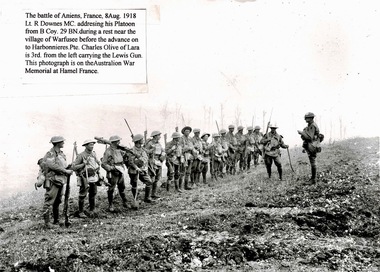
... War. By the end of August 8—dubbed “the black day of the German army” by Ludendorff—the Allies had penetrated German lines around the Somme with a gap some 15 miles long. Of the 27, 000 German casualties ...The Battle of Amiens, also known as the Third Battle of Picardy (French: 3ème Bataille de Picardie), was the opening phase of the Allied offensive which began on 8 August 1918, later known as the Hundred Days Offensive, that ultimately led to the end of the First World War.By the end of August 8—dubbed “the black day of the German army” by Ludendorff—the Allies had penetrated German lines around the Somme with a gap some 15 miles long. Of the 27, 000 German casualties on August 8, an unprecedented proportion—12,000—had surrendered to the enemy. Though the Allies at Amiens failed to continue their impressive success in the days following August 8, the damage had been done.Rectangular shaped black and white photograph.The battle of Amiens,France,8thAug.1918.Lt R Downes MC.addressing his Platoon from B Coy.29 BN.during a rest near the village of Warfusee before the advance on to Harbonnieres.Pte Charles Olive of Lara is 3rd,from the left carrying the Lewis Gun. He was killed in action three weeks later charging a German machine gun post. Earlier in the day, he had successfully taken two machine gun posts. Photo from Australian War Memorial, Canberra.ww1, battle of amiens, australian army, lara r.s.l. pte charles olive., awm accession no e2790 -
 Lara RSL Sub Branch
Booklet, Wadsworth & Company, Recollections of the War Hospital Keighley and its Auxiliaries 1916-19, circa 1920
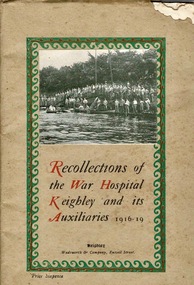
... War Hospital. It opened in time to take some of the first casualties from the Battle of the Somme in July 1916 and continued until the end of the war. ...War Hospital. It opened in time to take some of the first casualties from the Battle of the Somme in July 1916 and continued until the end of the war. ...Keighley War Hospital at Morton Banks was originally The Morton Banks Fever Hospital and after local funds were raised, extra wards were built to turn it into a War Hospital. It opened in time to take some of the first casualties from the Battle of the Somme in July 1916 and continued until the end of the war. The War Hospital Register archived at Keighley Library contains 13,214 names of servicemen who were treated there. It also contains the names of German prisoners of war who were being held locally and required treatment from time to time, notably from the influenza epidemic. Morton Banks had 746 beds. The book records the details of the hospital between 1916-19 including staff, hospital layout and departments, the Auxiliary Hospitals, Discipline, Recreation, Education, Comforts Committee and Affiliated Associations.Document of Military Hospital in Keighley, U.K. during WW1. Contains significant information on staff and different departments at the hospital.Carboard and paper booklet of 48 pages. The cover is beige with green border with black and red writing. Silverfish have eaten top right corner of cover.On front cover is publisher Wadsworth & Company, Russell Street, Keighley, (also known as Rydal Press) title and cost of Sixpence. Inside first blank page is written 'With kind regards from Willie To Jack'. 'Jack' refers to J.L.McIntyreworld war 1, ww1, military hospital, army hospital, keighley war hospital, morton banks, morton banks fever hospital, keighley -
 Lara RSL Sub Branch
Photograph Album, To Allan Groves, 1917
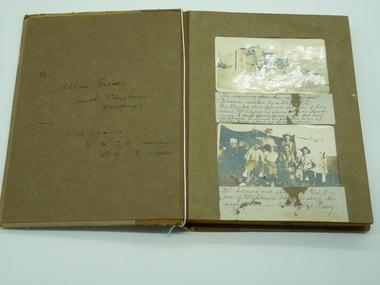
... In general the photos are of Will Adams experience in Egypt The Rafa Raid Prisoners of war, Beni Selah women waiting for water. Women making bricks, 53rd Casualty Clearing Station destroyed by a bomb, Royal Scots Fusilier Pipe Band after church parade, The Sultan Hasser Mosque ...casualty clearing station Front sleeve To Allan Groves With Christmas greetings from Will Adams YMCA Secretary with A.L.H. Brigade There are explanations under each couple of photos too much to write in this space. In general the photos are of Will Adams experience in Egypt The Rafa Raid Prisoners of war ...Cardboard Album Khaki coloured 8 leaves with photos and written descriptionsFront sleeve To Allan Groves With Christmas greetings from Will Adams YMCA Secretary with A.L.H. Brigade There are explanations under each couple of photos too much to write in this space. In general the photos are of Will Adams experience in Egypt The Rafa Raid Prisoners of war, Beni Selah women waiting for water. Women making bricks, 53rd Casualty Clearing Station destroyed by a bomb, Royal Scots Fusilier Pipe Band after church parade, The Sultan Hasser Mosque photograph, album, egyp, ww1, allan groves, will adams, rafa raid, 53rd casualty clearing station -
 Lara RSL Sub Branch
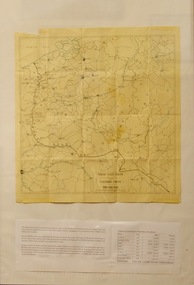
Map, Framed Map of the western front 1914-1918, Map made by G.F.Trudgion R.A.E. circa 1916
... War. Below is description of Australian ANZAC's on Western Front and a graph on Comparison of Casualties from Major Western Front Battles...War. Below is description of Australian ANZAC's on Western Front and a graph on Comparison of Casualties from Major Western Front Battles Map of the western front 1914-1918 Framed Map of the western front 1914-1918 Map Map ...Map showing position of western front line in 1914 at the start of WW1Map is from circa 1916 showing battle area of the Western Front during WW1Map of the western front 1914-1918North West Europe Shewing the Western Front 1914-1918 War. Below is description of Australian ANZAC's on Western Front and a graph on Comparison of Casualties from Major Western Front Battlesmap, g.f.trudgion, r.a.e., western front, ww1, world war one, north west europe, 1914, 1916, ww1 casulaties -
 Federation University Historical Collection
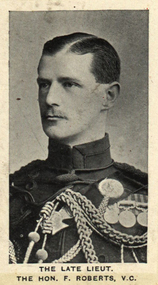
Photograph (black & White), Lieutenant, The Honourable Frederick Hugh Sherston Roberts - South Africa
... War. During battle he, with two officers tried to assist and save guns when the detachments serving the guns had all become casualties or been driven away. ...War. During battle he, with two officers tried to assist and save guns when the detachments serving the guns had all become casualties or been driven away. ...Frederick Roberts was the son of Field Marshall Frederick Roberts, 1st Earl Roberts. At the age of 27 he went with the King's Rifles to the Second Boer War. During battle he, with two officers tried to assist and save guns when the detachments serving the guns had all become casualties or been driven away. While doing this Roberts fell badly wounded and 2 days later died. Commander-in-Chief Redvers Buller recommended Roberts for the Victoria Cross. Confirmation of the award made after his death. Roberts and his father were one of only three father son pairs to win the Victoria Cross. His father's was in 1858.Individual image from photographed poster of tobacco and cigarette cards.frederick roberts, field marshall roberts, king's rifles, second boer war, redvers buller, south africa -
 City of Moorabbin Historical Society (Operating the Box Cottage Museum)
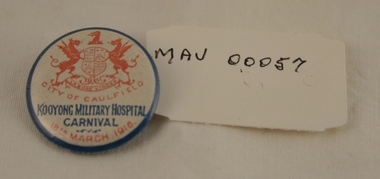
Badge - World War 1914 - 1918, Badge fund-raising, c1916
... This badge is a reminder of the Community support for injured soldiers when they returned from WW1 conflict and were hospitalized at Kooyong Military Hospital Caulfield 1914 - 1948 This badge was displayed at the GECC 'Wounded Soldier WW1 1914-1918 Exhibition" 2016 at Glen Eira Town Hall Caulfield ww1 1914-18 kooyong military hospital war casualties caulfield moorabbin bentleigh carnivals fundraising patriotism anzac australian commonwealth military forces A copy of the City of Caulfield's Coat-of- Arms and the words, City of Caulfield, is written on the front of the button, as is the date 18th March 1916. ...The Kooyong Military Hospital in Kooyong Road, Caulfield was established for the care and rehabilitation of soldiers injured in World War 1. Many events like carnivals were held by the Red Cross to raise funds for the war effort and entertain the patients.This badge is a reminder of the Community support for injured soldiers when they returned from WW1 conflict and were hospitalized at Kooyong Military Hospital Caulfield 1914 - 1948 This badge was displayed at the GECC 'Wounded Soldier WW1 1914-1918 Exhibition" 2016 at Glen Eira Town Hall Caulfield A small tin button, with pin attachment at the back. The button was produced and sold as a fund-raiser for the Kooyong Military Hospital during the World War1, 1914-18, at that organisation's Carnival held on March 18th 1916. The front of the button is white with a blue perimeter. A copy of the City of Caulfield's Coat-of- Arms and the words, City of Caulfield, is written on the front of the button, as is the date 18th March 1916. Both the above are written in red. Kooyong Military Hospital is written in blue. ww1, 1914-18, kooyong military hospital, war casualties, caulfield, moorabbin, bentleigh, carnivals, fundraising, patriotism, anzac, australian commonwealth military forces -
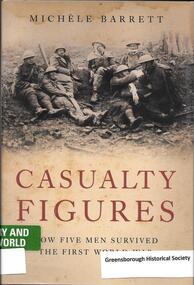 Greensborough Historical Society
Book, Verso, Casualty figures: how five men survived the First World War / Michele Barrett, 2007_
... Casualty figures: how five men survived the First World War / Michele Barrett...Tells the story of five survivors of World War I who suffered from shell shock. world war i shell shock 174 p., illus. Hard cover. Casualty figures: how five men survived the First World War / Michele Barrett Book Book Verso ...Tells the story of five survivors of World War I who suffered from shell shock.174 p., illus. Hard cover.world war i, shell shock -
 The Beechworth Burke Museum
Photograph
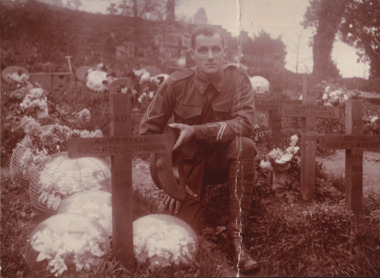
... War I. This conflict is integral to Australian culture as it was the single greatest loss of life and the greatest repatriation of casualties in the country's history. ...Taken on an unknown date, depicted is a portrait of a young, unidentified male soldier kneeling beside a grave in a cemetery. He is dressed in an Australian military uniform. The cemetery pictured is the Arnos Vale Cemetery in Bristol, United Kingdom. There are multiple crosses marking graves in this photograph, all marked in memory of different soldiers who fought with the Australian Imperial Force (AIF) during World War I. It is believed that the soldier who is kneeling was also part of the Australian Imperial Force. This can be inferred by the chevron rank insignia visible on the uniform. The placement of this insignia on the sleeve of the right arm suggests that this soldier was either a Warrant Officer or a Non-Commissioned Officer (NCO). Another signifier of the Australian Imperial Force uniform are the three inverted chevron stripes positioned on the lower part of the left sleeve, near the wrist. These are called Good Conduct Stripes and were worn by Warrant Officers and NCOs. This patch consisted of a single chevron stripe for each year of military service meeting certain requirements of good conduct. Additionally, the man in this photograph is also wearing a 'Rising Sun' collar badge on his coat. Australia, unlike most other Commonwealth countries, did not adopt metal regimental badges during the First World War. All units were issued with the Australian Army General Service Badge, better known as the 'Rising Sun’ badge. This insignia is almost always identified with the Australian Imperial Force. Furthermore, the grave that this unidentified soldier is kneeling next to is the resting place of Private John James (J. J.) Simpson. He was born in Stanley, Victoria in 1883. He enlisted in the Australian Imperial Force in Melbourne, Victoria on 12 July, 1915, with the service number 4909. John James Simpson was then posted to the 60th Company Depot at Seymour for military recruit training. John James Simpson was reported wounded in action in France on 19 July, 1916. He was admitted to 13th General Hospital, France with gunshot wounds to his legs. From Boulogne, France, he traveled to the United Kingdom aboard the Hospital Ship 'St. Denis' for medical care. Upon arrival, he was admitted to 2nd Southern General Hospital, Bristol, England on 27 July, 1916. John James Simpson passed away from his wounds on 1 August, 1916. He was 33 years old.The record is historically significant due to its connection to World War I. This conflict is integral to Australian culture as it was the single greatest loss of life and the greatest repatriation of casualties in the country's history. Australia’s involvement in the First World War began when the Australian government established the Australian Imperial Force (AIF) in August 1914. Immediately, men were recruited to serve the British Empire in the Middle East and on the Western Front. The first significant Australian action of the war was the Australian Naval and Military Expeditionary Force’s (ANMEF) landing on Rabaul on 11 September 1914. The ANMEF took possession of German New Guinea at Toma on 17 September 1914 and of the neighbouring islands of the Bismarck Archipelago in October 1914. On 25 April 1915, members of the AIF landed on Gallipoli in Turkey with troops from New Zealand, Britain, and France. This specific event holds very strong significance within Australian history. The record has strong research potential. This is due to the ongoing public and scholarly interest in war, history, and especially the ANZAC legend, which is commemorated annually on 25 April, known as ANZAC Day.Sepia rectangular photograph printed on matte photographic paper mounted on card.Obverse: A.I.F. / AUSTRALIA / 441, PTE.T. / T (?) / 26B (?) / 6.1.17 / (?) / LANGTON RD. / ST. ANNES PK. / BRISTOL / A.I.F. / AUSTRALIA. / 708, GNR B.L.CRAWFORD. / FR / 5 D.A.C. / 13.2.17 / A.I.F. / AUSTRALIA. / 4481, P (?) D.MORRIS. / (?) / 31.12.(?) / A.I.F. / AUSTRALIA. / 4909, PTE J.J.SIMPSON. / 608(?) / 1.8.16 / Winchester / LANGTON RD. / ST. ANNES PK / BRISTOL / Reverse: 2641 /military album, military, war, world war i, wwi, australian imperial force, aif, j. j. simpson, uniform, cemetery -
 Seaworks Maritime Museum
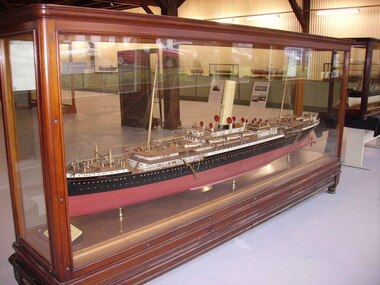
Shipbuilders Model, SS Omrah
... War I, she was converted to a troopship and was used to transport soldiers and assist with military operations. She was torpedoed and sunk by German submarine UB-52, 40 nautical miles (74km) off the coast of Sardinia in the 12 May 1918. She was on her return journey from Alexandria to Marseilles with six other transports, carrying troops of the 52nd and 74th divisions when she was lost, resulting in one casualty. ...War I, she was converted to a troopship and was used to transport soldiers and assist with military operations. She was torpedoed and sunk by German submarine UB-52, 40 nautical miles (74km) off the coast of Sardinia in the 12 May 1918. She was on her return journey from Alexandria to Marseilles with six other transports, carrying troops of the 52nd and 74th divisions when she was lost, resulting in one casualty. ...The original ship was built in Glasgow in 1899 by Fairfield Shipbuilding and Engineering Co for the Orient Line. It was the largest Orient Line passenger ship completed in the nineteenth century and was the third vessel of the Line to bear the famous “O” prefix, which was traditional through to the last ship, the mighty 'Oriana'. Her dimensions were 8,130 gross tons, length 490.6ft x beam 56.6ft (149.50 x 17.22m). She had one funnel, two masts, twin screw and a speed of 18½ knots. Her maiden voyage from London, via Suez, to Melbourne and Sydney commenced on 3rd February 1899. She was the largest British flag ship sailing to Australia at the time and continued to regularly sail between London, Melbourne and Sydney throughout her life. She last sailed as a passenger ship between Melbourne and Sydney on the 3rd November 1916. During World War I, she was converted to a troopship and was used to transport soldiers and assist with military operations. She was torpedoed and sunk by German submarine UB-52, 40 nautical miles (74km) off the coast of Sardinia in the 12 May 1918. She was on her return journey from Alexandria to Marseilles with six other transports, carrying troops of the 52nd and 74th divisions when she was lost, resulting in one casualty. Her maiden voyage brought her to Melbourne in 1899. The ship carried the first Australian troops from Brisbane to WWI in September 1914.A large ship builder's model of the 'SS Omrah' an Orient Line one funnel passenger steamer of 1899. The model is displayed in a large glass and polished timber case on legs.2 Plaques at foot of model: "MODEL/ OF TWIN SCREW STEAMER/ "OMRAH"/ BUILT FOR/ ORIENT STEAM NAVIGATION CO LTD/ BY/ THE FAIRFIELD SHIPBUILDING & engineering CO LTD/ DIMENSIONS/ 507-0X56-9X37-6MLD/ GROSS TONNAGE 8291 TONS SPEED 18 1/2 KNOTS on boat: "OMRAH" -
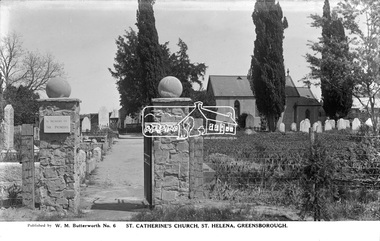 Eltham District Historical Society Inc
Photograph, The Rose Stereograph Company, St. Katherine's Church, St Helena. Greensborough, c.1936
... Rose Chapel with its stained-glass windows of local historical significance, commemorates casualties of the Beale family in World War One. This glass plate negative was used to manufacture postcards (1:1 printing) for commercial sale by the Rose Sterograph Company and its subsidiaries. ...Rose Chapel with its stained-glass windows of local historical significance, commemorates casualties of the Beale family in World War One. This glass plate negative was used to manufacture postcards (1:1 printing) for commercial sale by the Rose Sterograph Company and its subsidiaries. ...View of St Katherine's Church from the Memorial Gate which were dedicated Saturday, September 12, 1936 "In Memory of The Pioneers". A prominent gravestone for the Mapleton and Ellis families visible to the far left of the path. St Katherine’s Anglican Church was built in 1858, by Anthony Beale as a memorial to his late wife Katherine. The cemetery is a rare example in Victoria of a traditional English parish church with its private graveyard and is of State Significance. Rose Chapel with its stained-glass windows of local historical significance, commemorates casualties of the Beale family in World War One. This glass plate negative was used to manufacture postcards (1:1 printing) for commercial sale by the Rose Sterograph Company and its subsidiaries. George Rose founded the Rose Stereograph Company in 1880 and was joined by Herbert (Bert) Cutts in the early 20th Century. The pair formed a lifetime working partnership and strong personal friendship. Assisted by George’s two sons, Herbert George and Walter, and later by Neil Cutts, the Rose Stereograph Company continued its operations for more than 140 years. The company was initially built on stereographs, but as cinema took over and stereographs fell out of fashion, the Rose Stereograph Company developed Australia’s first commercially viable photographic postcard business. Specialising in postcards of iconic historical moments and significant landmarks, The Rose Stereograph Company became a staple of the Australian travel industry.This remarkable collection of glass plate negatives, transparencies, and postcards – arguably Australia’s most significant photography collection outside of public hands – has been passed down through the generations, surviving war, relocation, and the harsh Victorian climate. The historic Rose Stereograph collection is the culmination of George Rose’s dream of capturing and preserving precious moments in time and remains the legacy of the Rose and Cutts families. It is with great sadness that the Cutts family says goodbye to a collection that spans five generations and 140 years. The Cutts family understands that for these historically important pieces to rest with one family is to deny others the pleasure of their custodianship.Glass Plate Negative Size: 9 x 14 cmSt. Catherine's Church, St Helena, Greensborough, Published by W. M. Butterworth No. 6postcard, travel, rose stereograph company, glass plate negative, greensborough, st helena, w. m. butterworth, st katherine's church, memorial gate, mapleton, ellis, mediterranean cypress, peter and elizabeth pidgeon collection -
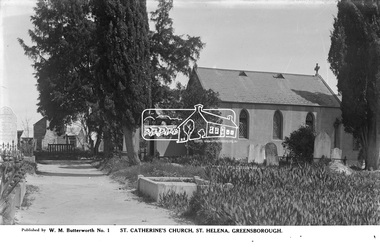 Eltham District Historical Society Inc
Photograph, The Rose Stereograph Company, St. Katherine's Church, St Helena. Greensborough, c.1936
... Rose Chapel with its stained-glass windows of local historical significance, commemorates casualties of the Beale family in World War One. This glass plate negative was used to manufacture postcards (1:1 printing) for commercial sale by the Rose Sterograph Company and its subsidiaries. ...Rose Chapel with its stained-glass windows of local historical significance, commemorates casualties of the Beale family in World War One. This glass plate negative was used to manufacture postcards (1:1 printing) for commercial sale by the Rose Sterograph Company and its subsidiaries. ...View of St Katherine's Church from the path inside the Memorial Gate. Also visible several Mediterranean Cypress trees. A prominent gravestone for the Mapleton and Ellis families visible to the far left of the path. St Katherine’s Anglican Church was built in 1858, by Anthony Beale as a memorial to his late wife Katherine. The cemetery is a rare example in Victoria of a traditional English parish church with its private graveyard and is of State Significance. Rose Chapel with its stained-glass windows of local historical significance, commemorates casualties of the Beale family in World War One. This glass plate negative was used to manufacture postcards (1:1 printing) for commercial sale by the Rose Sterograph Company and its subsidiaries. George Rose founded the Rose Stereograph Company in 1880 and was joined by Herbert (Bert) Cutts in the early 20th Century. The pair formed a lifetime working partnership and strong personal friendship. Assisted by George’s two sons, Herbert George and Walter, and later by Neil Cutts, the Rose Stereograph Company continued its operations for more than 140 years. The company was initially built on stereographs, but as cinema took over and stereographs fell out of fashion, the Rose Stereograph Company developed Australia’s first commercially viable photographic postcard business. Specialising in postcards of iconic historical moments and significant landmarks, The Rose Stereograph Company became a staple of the Australian travel industry.This remarkable collection of glass plate negatives, transparencies, and postcards – arguably Australia’s most significant photography collection outside of public hands – has been passed down through the generations, surviving war, relocation, and the harsh Victorian climate. The historic Rose Stereograph collection is the culmination of George Rose’s dream of capturing and preserving precious moments in time and remains the legacy of the Rose and Cutts families. It is with great sadness that the Cutts family says goodbye to a collection that spans five generations and 140 years. The Cutts family understands that for these historically important pieces to rest with one family is to deny others the pleasure of their custodianship.Glass Plate Negative Size: 9.2 x 14 cmSt. Catherine's Church, St Helena, Greensborough, Published by W. M. Butterworth No. 1postcard, travel, rose stereograph company, glass plate negative, greensborough, st helena, w. m. butterworth, st katherine's church, memorial gate, mapleton, ellis, mediterranean cypress, peter and elizabeth pidgeon collection
