
Showing 103 items matching "centenary of victoria 1934"
-
 Clunes Museum
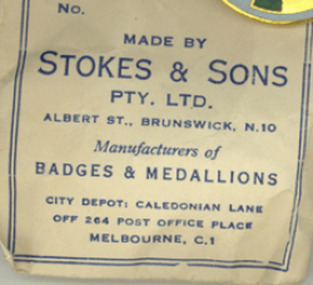
Memorabilia - NUMISMATICS, STOKES & SONS
... Centenary of Victoria 1934...On Reverse: Centenary of Victoria 1934 and Portland 1834 On Obverse: Centenary of Melbourne 1935 (AD)...Centenary of Victoria 1934 Centenary of Melbourne 1935 On Reverse: Centenary of Victoria 1934 and Portland 1834 On Obverse: Centenary of Melbourne 1935 (AD) .1 White metal medal with a tricolour ribbon of red, white and blue. ....1 White metal medal with a tricolour ribbon of red, white and blue. Attached to a ring connected to the medal. One side depicts the scene of landing at Portland in 1834 and the other side depicts a pioneer on the south bank of the Yarra river looking across Melbourne. On Reverse: Centenary of Victoria 1934 and Portland 1834 On Obverse: Centenary of Melbourne 1935 (AD)centenary of victoria 1934, centenary of melbourne 1935 -
 Mont De Lancey
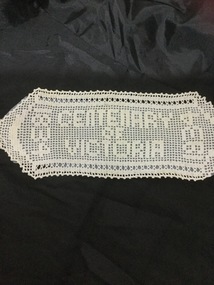
Doily, 1934
... Made to commemorate the centenary of Victoria 1834 - 1934...."Centenary of Victoria 1834 - 1934"...Made to commemorate the centenary of Victoria 1834 - 1934. table ware. commemorative objects doilies "Centenary of Victoria 1834 - 1934" White cotton, hexagonal, commemorative doily with pulled thread and embroidery pattern and inscription. ...Made to commemorate the centenary of Victoria 1834 - 1934.White cotton, hexagonal, commemorative doily with pulled thread and embroidery pattern and inscription."Centenary of Victoria 1834 - 1934"table ware., commemorative objects, doilies -
 Glenelg Shire Council Cultural Collection
Medal, Centenary of Melbourne 1835 Commemorative Medallion, 1834
... centenary 1934-35. This medal was given out to Victorian school children; 325,600 white metal medals were struck. There were also a few VIP pieces in other metals, including two in gold. The medal references Portland, the location of Victoria's...centenary of Victoria and Portland 1834 and Melbourne 1835. Obverse:Scene of landing at Portland Bay; in ground below, PORTLAND / 1834; above, centenary of victoria / 1934 Reverse: Pioneer on south bank of Yarra looking across to Melbourne, below 1835 above, CENTENARY / OF / MELBOURNE / 1935...Front: Inverse: Centenary of Melbourne 1835 (Top) 1835 (Bottom) Back: Obverse: Centenary of Victoria 1934 (Round Top) Portland 1834 (Bottom)...Melbourne was established the following year by a party of settlers led by John Batman. medal numismatics celebration 1834 1934 1935 Melbourne Portland Front: Inverse: Centenary of Melbourne 1835 (Top) 1835 (Bottom) Back: Obverse: Centenary of Victoria 1934 (Round Top) Portland 1834 (Bottom) White metal medal. ...White metal medal issued to commemorate Melbourne's centenary 1934-35. This medal was given out to Victorian school children; 325,600 white metal medals were struck. There were also a few VIP pieces in other metals, including two in gold. The medal references Portland, the location of Victoria's first settlement. The Henty brothers, entrepreneur farmers and whalers, established the state's first permanent European settlement in Portland in 1834. Melbourne was established the following year by a party of settlers led by John Batman.White metal medal. Medal, silver. with hole and ring at the top. Obverse: Sailing Ship, Coast, Boat on shore, 3 men. Reverse Colonial man on grass, river, city buildings on other river bank Medal commemorates the centenary of Victoria and Portland 1834 and Melbourne 1835. Obverse:Scene of landing at Portland Bay; in ground below, PORTLAND / 1834; above, centenary of victoria / 1934 Reverse: Pioneer on south bank of Yarra looking across to Melbourne, below 1835 above, CENTENARY / OF / MELBOURNE / 1935Front: Inverse: Centenary of Melbourne 1835 (Top) 1835 (Bottom) Back: Obverse: Centenary of Victoria 1934 (Round Top) Portland 1834 (Bottom)medal, numismatics, celebration, 1834, 1934, 1935, melbourne, portland -
Numurkah & District Historical Society
Medal - Centenary Medal
... Centenary of Victoria 1934 & Melbourne 1935...Centenary of Victoria 1934 & Melbourne 1935 Medal Centenary Medal ...Centenary of Victoria 1934 & Melbourne 1935 -
 Flagstaff Hill Maritime Museum and Village
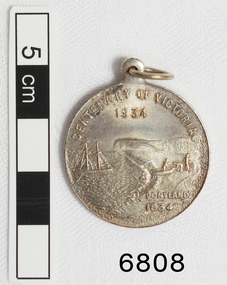
Medal - Commemorative, Centenary of Victoria, Melbourne and Portland, 1935
... centenary of victoria...centenary of melbourne...1834-1934... "CENTENARY OF VICTORIA 1934" & "PORTLAND 1834", "CENTENARY OF MELBOURNE 1935" & "1835" ...The medal shows the significance placed on the colonisation of Victoria and the growth of the hundred year period. flagstaff hill warrnambool shipwrecked-coast flagstaff-hill flagstaff-hill-maritime-museum maritime-museum shipwreck-coast flagstaff-hill-maritime-village medal centenary medal centenary of victoria centenary of melbourne 1834-1934 1835-1935 colonial centenary of POrtland colonisation of Victoria "CENTENARY OF VICTORIA 1934" & "PORTLAND 1834", "CENTENARY OF MELBOURNE 1935" & "1835" Medal, silver. with hole and ring at the top. ...This commemorative medal celebrates a colonisation of two towns, now cities, in Victoria; Melbourne and Portland. The medal shows the significance placed on the colonisation of Victoria and the growth of the hundred year period. Medal, silver. with hole and ring at the top. Obverse: Sailing Ship, Coast, Boat on shore, 3 men. Reverse Colonial man on grass, river, city buildings on other river bank Medal commemorates the centenary of Victoria and Portland 1834 and Melbourne 1835. "CENTENARY OF VICTORIA 1934" & "PORTLAND 1834", "CENTENARY OF MELBOURNE 1935" & "1835" flagstaff hill, warrnambool, shipwrecked-coast, flagstaff-hill, flagstaff-hill-maritime-museum, maritime-museum, shipwreck-coast, flagstaff-hill-maritime-village, medal, centenary medal, centenary of victoria, centenary of melbourne, 1834-1934, 1835-1935, colonial, centenary of portland, colonisation of victoria -
 Wangaratta RSL Sub Branch
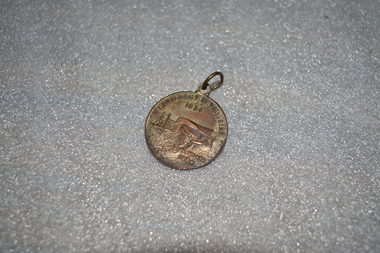
Medal - Silver Medal, C1934
... centenary 1934-35. This medal was given out to Victorian school children; 325,600 white metal medals were struck. The medal references Portland, the location of Victoria's first settlement. ...Front - Centenary of Victoria 1934 - Portland 1934 Rear - Centenary of Melbourne 1935...Commemorates the settlement of Portland, Melbourne and Victoria, 1834 - 1935 centenary victoria melbourne medal Front - Centenary of Victoria 1934 - Portland 1934 Rear - Centenary of Melbourne 1935 Round two sided silver metal medal Medal Silver Medal Stokes & Son ...White metal medal issued to commemorate Melbourne's centenary 1934-35. This medal was given out to Victorian school children; 325,600 white metal medals were struck. The medal references Portland, the location of Victoria's first settlement. The Henty brothers, entrepreneur farmers and whalers, established the state's first permanent European settlement in Portland in 1834. Melbourne was established the following year by a party of settlers led by John Batman.Commemorates the settlement of Portland, Melbourne and Victoria, 1834 - 1935Round two sided silver metal medalFront - Centenary of Victoria 1934 - Portland 1934 Rear - Centenary of Melbourne 1935centenary, victoria, melbourne, medal -
Warrnambool and District Historical Society Inc.
Medallion, Stokes Melbourne, Centenary of Victoria 1935, 1933
... Obverse CENTENARY OF VICTORIA 1934 PORTLAND 1834 Reverse CENTENARY OF MELBOURNE 1935 1835...centenary of European settlement in Victoria and the establishment of Melbourne in 1835. Portland was settled by the Henty brothers and John Batman and John Fawkner are the two names associated with the founding of Melbourne. The Melbourne Shrine of Remembrance was dedicated during these celebrations. This medal is a memento of the centenary of Victoria and may have been given a local Warrnambool school child. Obverse CENTENARY OF VICTORIA 1934 ...This medal was given to Victorian school children to celebrate the centenary of European settlement in Victoria and the establishment of Melbourne in 1835. Portland was settled by the Henty brothers and John Batman and John Fawkner are the two names associated with the founding of Melbourne. The Melbourne Shrine of Remembrance was dedicated during these celebrations. This medal is a memento of the centenary of Victoria and may have been given a local Warrnambool school child. Circular silver coloured medal with ring at top and a further ring inserted. The obverse features a sailing ship entering a bay. Since "Portland " is part of the text it is assumed the bay is situated in Portland. Text The reverse features a hatted man wearing a suit and holding a walking stick standing on a grassy shore, a body of water and a sky line of buildings Obverse CENTENARY OF VICTORIA 1934 PORTLAND 1834 Reverse CENTENARY OF MELBOURNE 1935 1835 -
Port Melbourne Historical & Preservation Society
Medal - Centenary of Victoria/Melbourne, 1934
... Silver Centenary Medal, double sided for 'Centenary of Victoria 1934' and 'Centenary of Melbourne 1935'. ...celebrations fetes and exhibitions marjorie williams On card, 'Centenary Medal 1934' Silver Centenary Medal, double sided for 'Centenary of Victoria 1934' and 'Centenary of Melbourne 1935'. ...Silver Centenary Medal, double sided for 'Centenary of Victoria 1934' and 'Centenary of Melbourne 1935'. With red, white and blue ribbon; pinned to white card.On card, 'Centenary Medal 1934'celebrations fetes and exhibitions, marjorie williams -
Glenelg Shire Council Cultural Collection
Souvenir - Medallion - Centenary of Melbourne 1935 Commemorative Medallion Victoria 1935", 1834
... Front: Inverse: Centenary of Melbourne 1935 (Top) 1835 (Bottom) Back: Obverse: Centenary of Victoria 1934 (Round Top) Portland 1834 (Bottom)...Front: Inverse: Centenary of Melbourne 1935 (Top) 1835 (Bottom) Back: Obverse: Centenary of Victoria 1934 (Round Top) Portland 1834 (Bottom) Medallion - "Centenary of Melbourne 1935 Commemorative Medallion Victoria 1935" Souvenir Medallion - Centenary of Melbourne 1935 Commemorative Medallion Victoria 1935" ...Displayed at History House.Medallion - "Centenary of Melbourne 1935 Commemorative Medallion Victoria 1935"Front: Inverse: Centenary of Melbourne 1935 (Top) 1835 (Bottom) Back: Obverse: Centenary of Victoria 1934 (Round Top) Portland 1834 (Bottom) -
Glenelg Shire Council Cultural Collection
Memorabilia - Stamp Set - Victoria's Centenary, c. 1934
... Set of 3 stamps Centenary of Victoria 1934. Oblong stamps depicting Aborigine standing on banks of Yarra River, Melbourne on other sided. ...stamps stamp set 1934 Set of 3 stamps Centenary of Victoria 1934. Oblong stamps depicting Aborigine standing on banks of Yarra River, Melbourne on other sided. ...Set of 3 stamps Centenary of Victoria 1934. Oblong stamps depicting Aborigine standing on banks of Yarra River, Melbourne on other sided. Red, 2D, blue 3D, black 1 shillingstamps, stamp set, 1934 -
 Learmonth and District Historical Society Inc.
Medal - Centenary of Victoria, Centenary of Melbourne 1935
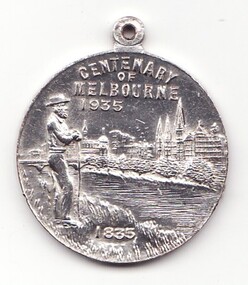
... centenary 1934-35. This medal was given out to Victorian school children; 325,600 white metal medals were struck. There were also a few VIP pieces in other metals, including two in gold. The medal references Portland, the location of Victoria's...The front is inscribed, "CENTENARY OF VICTORIA" 1934, across the top, bottom right has the words "PORTLAND 1834". ...The centenary celebrations now seem dated, but the image of Melbourne as a conservative city largely influenced by Britain has been more enduring. Details the settlement of Portland, Melbourne and Victoria, 1834 - 1935 melbourne medal portland centenary of victoria 1935 The front is inscribed, "CENTENARY OF VICTORIA" 1934, across the top, bottom right has the words "PORTLAND 1834". ...White metal medal issued to commemorate Melbourne's centenary 1934-35. This medal was given out to Victorian school children; 325,600 white metal medals were struck. There were also a few VIP pieces in other metals, including two in gold. The medal references Portland, the location of Victoria's first settlement. The Henty brothers, entrepreneur farmers and whalers, established the state's first permanent European settlement in Portland in 1834. Melbourne was established the following year by a party of settlers led by John Batman. In 1934, as Melbourne planned to celebrate the centenary of European settlement, it seemed to some that there was little to celebrate. The financial strains of the depression, unemployment and the scandal of the city's slums all undercut claims of unbridled progress. Perhaps because of such troubles, the organisers of the centenary celebrations tried doubly hard to be positive. The themes of the celebrations were conservative, reflecting the desire of some Melburnians for security in troubled times. The widely promoted image of the 'Garden City' and 'Queen City of the South' emphasised the idea of Melbourne as a very British city. A visit by the Duke of Gloucester, son of George V, the ageing king, provided a reassuring strengthening of Melbourne's imperial connections. The presented view of Melbourne's history stressed the 'myth of the pioneer', embodied in the person of John Batman. Elevated to heroic status, he was reinvented as a courageous pioneer whose life exemplified the rewards of self-improvement. Such a portrayal ignored Batman's dubious 'treaty' with local Aborigines and the less savoury details of his personal life. Melbourne's indigenous people were excluded from this triumphant view of Melbourne's past. The centenary celebrations now seem dated, but the image of Melbourne as a conservative city largely influenced by Britain has been more enduring.Details the settlement of Portland, Melbourne and Victoria, 1834 - 1935Double sided round white metal medal, featuring on front face, the bay of Portland showing a ship in the harbour. On the reverse side of the medal is John Bateman overlooking the city of Melbourne and the Yarra river.The front is inscribed, "CENTENARY OF VICTORIA" 1934, across the top, bottom right has the words "PORTLAND 1834". Reverse side shows "CENTENARY OF MELBOURNE 1935", and the date 1835 at the bottom. melbourne, medal, portland, centenary of victoria 1935 -
Glenelg Shire Council Cultural Collection
Craft - Doily, n.d
... White, filet hand-crocheted doily, 'Centenary of Victoria 1834-1934' incorporated in design....celebration commemorative doily handicraft craft crochet White, filet hand-crocheted doily, 'Centenary of Victoria 1834-1934' incorporated in design. ...White, filet hand-crocheted doily, 'Centenary of Victoria 1834-1934' incorporated in design.celebration, commemorative, doily, handicraft, craft, crochet -
 Clunes Museum
Badge
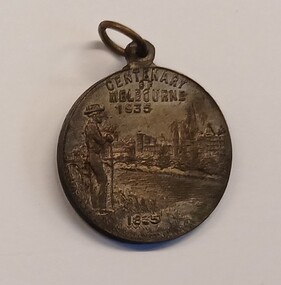
... SMALL METAL BADGE COMMEMORATING THE CENTENARY OF VICTORIA IN 1934. ON REVERSE SIDE, CENTENARY OF MELBOURNE 1935...FIRST SETTLEMENT IN VICTORIA AT PORTLAND 1834 local history numismatics badges SMALL METAL BADGE COMMEMORATING THE CENTENARY OF VICTORIA IN 1934. ON REVERSE SIDE, CENTENARY OF MELBOURNE 1935 Badge BADGE ...FIRST SETTLEMENT IN VICTORIA AT PORTLAND 1834SMALL METAL BADGE COMMEMORATING THE CENTENARY OF VICTORIA IN 1934. ON REVERSE SIDE, CENTENARY OF MELBOURNE 1935local history, numismatics, badges -
Glenelg Shire Council Cultural Collection
Memorabilia - Token / Stamp, 1934-1935
... Stamp/token Centenary of Victoria Fund 1934/35. White background, blue print on black mount, clear perspex front....centenary Victoria token Stamp/token Centenary of Victoria Fund 1934/35. White background, blue print on black mount, clear perspex front. ...Stamp/token Centenary of Victoria Fund 1934/35. White background, blue print on black mount, clear perspex front.centenary, victoria, token -
 Whitehorse Historical Society Inc.
Textile - Doyley, c1934
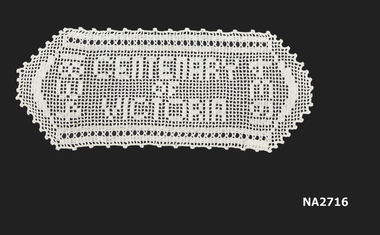
... Crochet sandwich tray doyley in white cotton. Centenary of Victoria 1834 - 1934 crochet in pattern, fillet type crochet with picot edge....Purchased by Valda Arrowsmith on behalf of the Society. handcrafts crocheting or crochet work manchester table linen Crochet sandwich tray doyley in white cotton. Centenary of Victoria 1834 - 1934 crochet in pattern, fillet type crochet with picot edge. ...Purchased by Valda Arrowsmith on behalf of the Society.Crochet sandwich tray doyley in white cotton. Centenary of Victoria 1834 - 1934 crochet in pattern, fillet type crochet with picot edge.handcrafts, crocheting or crochet work, manchester, table linen -
 Whitehorse Historical Society Inc.
Medal, 1934-35
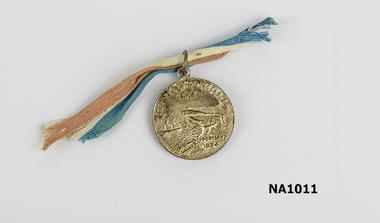
... Silver plated medal - Melbourne Centenary 1935 on one side and Centenary of Victoria Portland 1934 on reverse. Red, blue and white ribbon attached....numismatics medals - commemorative Silver plated medal - Melbourne Centenary 1935 on one side and Centenary of Victoria Portland 1934 on reverse. Red, blue and white ribbon attached. ...Silver plated medal - Melbourne Centenary 1935 on one side and Centenary of Victoria Portland 1934 on reverse. Red, blue and white ribbon attached.numismatics, medals - commemorative -
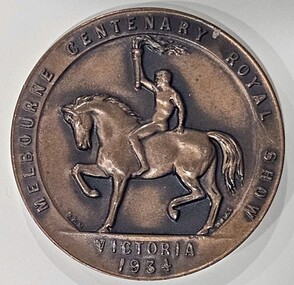 Melbourne Royal
Medal, The Royal Agricultural Society of Victoria, 1934
... [obverse] MELBOURNE CENTENARY ROYAL SHOW / VICTORIA / 1934 / [reverse] DAIRY SHORTHORN BULL / 1 YEAR THIRD / J . ...While there are a few other examples of Melbourne Centenary Royal Show medals in the collection, most of them are blanks that were never awarded - it is much rarer to find remaining examples of medals that are engraved with winners in circulation. melbourne royal show 1934 melbourne royal show CENTENARY SHOW melbourne centenary royal show medal prize prize medal winners dairy shorthorn shorthorn JG Hopkins Hopkins [obverse] MELBOURNE CENTENARY ROYAL SHOW / VICTORIA / 1934 / [reverse] DAIRY SHORTHORN BULL / 1 YEAR THIRD / J . ...This medal was awarded to JG Hopkins at the 1934 Melbourne Centenary Royal Show for placing third for the best Dairy Shorthorn Bull, 1 Year. The animal's name was Carramar Lord Deverley". In 1934, the Show recognised the 100th anniversary of the founding of the city of Melbourne with a Centenary Show, which included awarding specially designed medals to placegetters with the man carrying torch on a horse design.While there are a few other examples of Melbourne Centenary Royal Show medals in the collection, most of them are blanks that were never awarded - it is much rarer to find remaining examples of medals that are engraved with winners in circulation.A bronze-coloured circular medal with engraved designs and text.[obverse] MELBOURNE CENTENARY ROYAL SHOW / VICTORIA / 1934 / [reverse] DAIRY SHORTHORN BULL / 1 YEAR THIRD / J . G . HOPKINS . / "CARRAMAR / LORD BEVERLEY"melbourne royal show, 1934 melbourne royal show, centenary show, melbourne centenary royal show, medal, prize, prize medal, winners, dairy shorthorn, shorthorn, jg hopkins, hopkins -
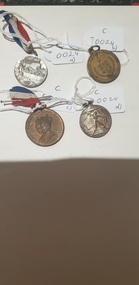 Colac RSL Sub Branch
Medal - Medals x 4, a) Centenary of Melbourne medal. b) Borough & Shire of Colac. 1945 Peace & Victory Medal. c) Coronation Medal 1937. d) Victory Medal 1945, NK
... Back:- Centenary of Victoria. 1934. Sailing ship/shoreline. 1834 b) Front:- Borough & Shire of Colac. ...Back:- Centenary of Victoria. 1934. Sailing ship/shoreline. 1834 b) Front:- Borough & Shire of Colac. ...Commemorative medallionsmediumRound commemorative medals x 4. a) Silver coloured medal with a with Red, white and blue ribbon. b) Bronze coloured medal. No ribbon c) Bronze " " with a red, white and blue ribbon d) Silver " " . No ribbon a) Front:- Centenary of Melbourne. 1932. Man looking at city skyline. 1835. Back:- Centenary of Victoria. 1934. Sailing ship/shoreline. 1834 b) Front:- Borough & Shire of Colac. Coat of Arms surrounded by wreath and crossed swords. Back:- Peace and Victory. Surrounded by a wreath c) Front:- King George VI & Queen Elizabeth. Portraits of King and Queen Back:- To Commemorate their Majesties' Coronation d) Front:- Man with a sword on a map of Australia. 1945 Back:- Map -
Southern Sherbrooke Historical Society Inc.
Information folder - Cr. Violet Lambert, 1930s & 40s
... Contents: -letter dated 26th June (2001), Heather Ronald to society, enclosing copies of some of her mother's speeches (listed below) -notes for a speech, "Visit to Menzies Creek to commemorate the centenary of Victoria 1934", delivered at Menzies Creek primary school -notes for a speech delivered to the Church (?) ...Contents: -letter dated 26th June (2001), Heather Ronald to society, enclosing copies of some of her mother's speeches (listed below) -notes for a speech, "Visit to Menzies Creek to commemorate the centenary of Victoria 1934", delivered at Menzies Creek primary school -notes for a speech delivered to the Church (?) ...Folder containing information pertaining to Councillor Violet Lambert. Contents: -letter dated 26th June (2001), Heather Ronald to society, enclosing copies of some of her mother's speeches (listed below) -notes for a speech, "Visit to Menzies Creek to commemorate the centenary of Victoria 1934", delivered at Menzies Creek primary school -notes for a speech delivered to the Church (?) Ladies' Guild, Belgrave South, n.d. but possibly 1940s -notes for a speech, "Opening the St Martin's Annual Fete at South Belgrave", c.1946 -article, "Sale Marked An Era's End - Netherlea goes under the hammer", Knox News, 19th December 1983st martins anglican church, belgrave south, menzies creek primary school, mrs ramshaw, formerly florence butlin -
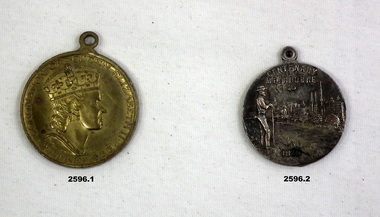 Bendigo Military Museum
Souvenir - MEDALLIONS, 1) c. 1954, .2) 1934 - 35
... .1) Medallion, metal, gold colour, Shire of Doncaster & Templestowe, Queen one side & x 2 shields the other. .2) Medallion, metal, silver colour, Centenary of Melbourne & Victoria 1934-35, Depiction of Portland Harbour one side & farmer overlooking Melbourne the other....Williams, refer Cat No 2580 for service details. numismatics civic mementoes metalcraft .1) Medallion, metal, gold colour, Shire of Doncaster & Templestowe, Queen one side & x 2 shields the other. .2) Medallion, metal, silver colour, Centenary of Melbourne & Victoria 1934-35, Depiction of Portland Harbour one side & farmer overlooking Melbourne the other. ...items in collection re Brig E.M. Williams, refer Cat No 2580 for service details..1) Medallion, metal, gold colour, Shire of Doncaster & Templestowe, Queen one side & x 2 shields the other. .2) Medallion, metal, silver colour, Centenary of Melbourne & Victoria 1934-35, Depiction of Portland Harbour one side & farmer overlooking Melbourne the other.numismatics, civic mementoes, metalcraft -
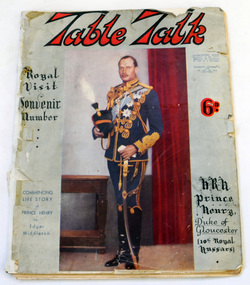 Orbost & District Historical Society
magazine, Table Talk, August 1 1934
... This magazine was published as a souvenir to commemorate the centenary of European settlement in Victoria, 1934...This magazine was published as a souvenir to commemorate the centenary of European settlement in Victoria, 1934 tourism recreation history Melbourne magazine Table-Talk A 104 page soft covered magazine relating to Melbourne's first 100 years. ...This magazine was published as a souvenir to commemorate the centenary of European settlement in Victoria, 1934A 104 page soft covered magazine relating to Melbourne's first 100 years. It contains stories about the settlement of early Melbourne, businesses, land purchases and advertisements. The front cover has a brown background and a colour reproduction of a painting titled Pioneers by W. B. McInnes.tourism recreation history melbourne magazine table-talk -
 City of Greater Geelong
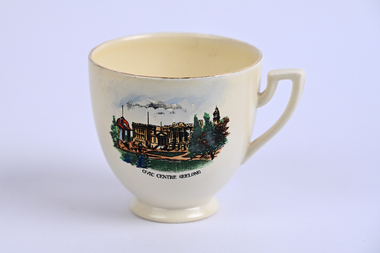
Ceramic - Commemorative Teacup - Geelong's 100th Birthday, Carlton Wares, 1938
... They also aligned with the broader Centenary of Victoria (1834–1934), with regional celebrations continuing to 1938, solidifying Geelong's reputation as a major Victorian city....They also aligned with the broader Centenary of Victoria (1834–1934), with regional celebrations continuing to 1938, solidifying Geelong's reputation as a major Victorian city. ...Geelong celebrated its centenary of European settlement in 1938, marking 100 years since it was formally surveyed and declared a town by Governor Sir Richard Bourke on October 26, 1838. The 1938 celebrations were a major, year-long event highlighting industrial growth and history. They also aligned with the broader Centenary of Victoria (1834–1934), with regional celebrations continuing to 1938, solidifying Geelong's reputation as a major Victorian city.Small ceramic cream teacup with pictures and inscriptions.Commemorating / 1838 1938 / Geelong's 100th Birthday / Civic Centre Geelong / Carlton Waresanniversary, birthday, celebrations, geelong, history, industrial growth, centenary, cup, tea cup, crockery, ceramic, carlton wares -
 Warrnambool and District Historical Society Inc.
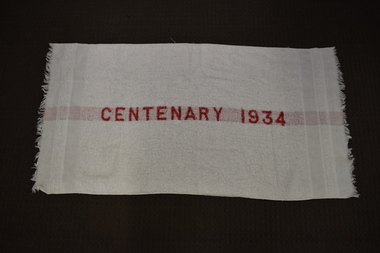
Souvenir - Souvenir Towel, Centenary of Victoria, 1934
... Centenary of Victoria...souvenir towel...warrnambool...victoria 1834-1934...This towel is a souvenir of the Centenary of Victoria celebrated in 1934. It marks the centenary of the officially-recognized first permanent European settlement at Portland with the arrival of the Henty families in 1834 in Victoria (then known as the colony of Port Phillip). ...This towel is a souvenir of the Centenary of Victoria celebrated in 1934. It marks the centenary of the officially-recognized first permanent European settlement at Portland with the arrival of the Henty families in 1834 in Victoria (then known as the colony of Port Phillip). ...This towel is a souvenir of the Centenary of Victoria celebrated in 1934. It marks the centenary of the officially-recognized first permanent European settlement at Portland with the arrival of the Henty families in 1834 in Victoria (then known as the colony of Port Phillip). European settlement occurred at Melbourne in the following year. This towel is one of many souvenir items produced in 1934.This towel is of minor interest as a memento of the centenary of Victoria. It is a comparatively rare souvenir of that event as towels such as this would have been used and most would not have survived for nearly 90 years.This is a white cotton towel with a white fringe at both ends. There is a red strip down the centre of the back of the towel with red lettering in this strip down the front of the towel.The maker's name is stitched into one corner.Centenary 1934 Osmancentenary of victoria, souvenir towel, warrnambool, victoria 1834-1934 -
 Ringwood and District Historical Society
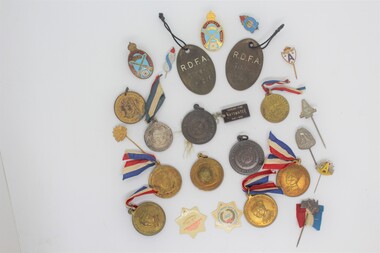
Ephemera, Badges and Coins 1939-45: 50 years of Queen Victoria's Reign; ANZAC Pins, King George and Queen Elizabeth; City of Wangaratta; etc, 1939 - 1945
... .; Awarded to G Pratt v 1945; Victorian Rifle Association (2 badges); Legacy Badges/Pins (2 badges); Map of Australia on metal pin; Badge: Side 1 Centenary of Victoria 1934. On undeveloped scene embossed)/ Side 2 Centenary of Victoria 1935. ....; Awarded to G Pratt v 1945; Victorian Rifle Association (2 badges); Legacy Badges/Pins (2 badges); Map of Australia on metal pin; Badge: Side 1 Centenary of Victoria 1934. On undeveloped scene embossed)/ Side 2 Centenary of Victoria 1935. ...Many issues - ANZAC DayBadges and coins. Refer photograph. +Additional Keywords: Pratt, G / GibbonTop Row L_R:; Victoria - 50 Years of Reign. Diam 3cm.; RDFA/Time Keeper (2 badges); Plastic 7-pointed badge (2 badges): Palestine-Gallipoli, FRANCE, Egypt, Mesopotamia, North Sea, New Guinea. In Centre: Lest We Forget printed across a map of Australia.; Assorted ANZAC pins/badges (5 badges); Middle Row L-R:; Side 1: King George VI & Queen Elizabeth (5 badges); Side 2: City of Wangaratta. Wangaratta Proclaimed a City.; Bottom Row:; Royal Life Saving Society, Established 1891. Centre: Awarded to G. Gibbon 1945.; Awarded to G Pratt v 1945; Victorian Rifle Association (2 badges); Legacy Badges/Pins (2 badges); Map of Australia on metal pin; Badge: Side 1 Centenary of Victoria 1934. On undeveloped scene embossed)/ Side 2 Centenary of Victoria 1935. (On city skyline embossed) Diam 2.6 cm.; Pavilion Fund Bayswater 1947-1948 -
 Box Hill Historical Society
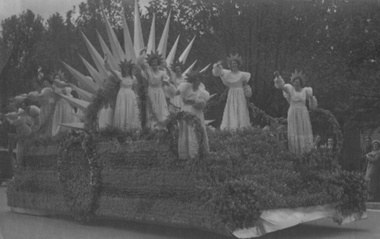
Photograph - Street Parade, 1934
... The winning float in the Centenary of Victoria celebrations in 1934. The float has a rising sun with a number of girls from the Iris Roderick School of Dancing standing on it dressed in similar long dresses. ...The winning float in the Centenary of Victoria celebrations in 1934. The float has a rising sun with a number of girls from the Iris Roderick School of Dancing standing on it dressed in similar long dresses. ...The winning float in the Centenary of Victoria celebrations in 1934. The float has a rising sun with a number of girls from the Iris Roderick School of Dancing standing on it dressed in similar long dresses. The float is decorated in flowers. See Page 30 "Those were the days". A street parade of decorated floats was part of the Centenary of Victoria celebrations in 1934. When the photograph was donated to the City of Box Hill on 15 January 1979 the accompanying letter from Mrs West explained she had found the photograph among those left by an aunt, who she believed had hand-coloured it. Title given on the page 'First prize Float, Box Hill, Centenary.' Mrs West donation was acknowledged by letter by I. Port, the Town Clerk. Photograph looks as if it may have been removed from an album. Image was used by Museum Victoria in their 2008 exhibition 'The Melbourne Story'. Image was also used by Museum Victoria in the accompanying publication to 'The Melbourne Story'.festivals and celebrations, centenary of victoria, iris roderick school of dancing, dance, centenaries, clothing and dress, floats, "those were the days" -
Tatura Irrigation & Wartime Camps Museum
Photograph, Duke of Glouchester Visit, 1934
... Copies of 2 black and white photographs. 1 - depicts Tatura procession to welcome the Duke of Gloucester, Victoria's Centenary 1934. Light horseman mounted, in foreground, costumed group in gig. ...copies of original photographs owned by Mrs Jean Davies Mrs Jean Davies Victoria's Centenary 1934 Duke of Gloucester visit See back of photographs Copies of 2 black and white photographs. 1 - depicts Tatura procession to welcome the Duke of Gloucester, Victoria's Centenary 1934. ...copies of original photographs owned by Mrs Jean DaviesCopies of 2 black and white photographs. 1 - depicts Tatura procession to welcome the Duke of Gloucester, Victoria's Centenary 1934. Light horseman mounted, in foreground, costumed group in gig. G. J. Martin, McPherson Callender, Criterion Hotel. A. Hampton. 2 - photos showing front of shops, old cards, procession a little further along.See back of photographsmrs jean davies, victoria's centenary 1934, duke of gloucester visit -
 Mont De Lancey
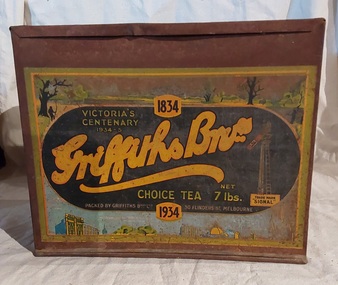
Functional object - Tea Caddy, Griffiths Bros Ltd, 1934
... A large rectangular Griffiths Bros Choice Tea Net 7lbs. 1834 - 1934, metal storage tin with a hinged lid. Victoria's Centenary 1934 -5 is printed on the top left corner of the label. ...A large rectangular Griffiths Bros Choice Tea Net 7lbs. 1834 - 1934, metal storage tin with a hinged lid. Victoria's Centenary 1934 -5 is printed on the top left corner of the label. ...The tin was made for Griffiths Bros who were Australian merchants of tea, coffee and cocoa. They had branches in Melbourne, Sydney, Brisbane and Adelaide. The tins when emptied became useful storage containers.A large rectangular Griffiths Bros Choice Tea Net 7lbs. 1834 - 1934, metal storage tin with a hinged lid. Victoria's Centenary 1934 -5 is printed on the top left corner of the label. The Griffiths Bros label is in yellow script on the front with other text related to the contents, as well as a Trade Mark "SIGNAL" illustration and text at the bottom right. The label is outlined in green and yellow edging with country landscape at the top and city views at the bottom. The tin has much information as noted above, as well as - 'Packed by Griffiths Bros Ltd 30 Flinders St. Melbourne.'food containers, tea, tea caddies, tins, containers -
University of Melbourne, Burnley Campus Archives
Certificate - Award Certificates, Burnley Past Students Association Horticultural Society display awards, 1933-1934
... Centenary Horticultural Council...1934...Exhibitions...The Royal Horticultural Society of Victoria...All the four items were awarded to the Burnley Horticultural Past Students Association in 1933-34. (1) The Royal Horticultural Society of Victoria Spring Show 1933, Highly Commended (2) The Royal Horticultural Society of Victoria Chrysanthemum Show 1934, Commended, (3) Victorian Centenary Horticultural Council, Certification of Exhibit 1934 (4) Malvern and District Horticultural Society, Display Autumn Show 1934. ... Horticultural Council, In the Centenary Year of Victoria 1934 This is to Certify that the Burnley Horticultural Past Students Association Exhibited Alpine Garden and Wall Ornamentation at the Combined Centenary Horticultural Exhibition, Fitzroy Gardens, Melbourne 23rd to 27th October, 1934. ... Horticultural Council, In the Centenary Year of Victoria 1934 This is to Certify that the Burnley Horticultural Past Students Association Exhibited Alpine Garden and Wall Ornamentation at the Combined Centenary Horticultural Exhibition, Fitzroy Gardens, Melbourne 23rd to 27th October, 1934. ...Association of Past Students active in the 1930's submitted entries to shows in Melbourne for awards under the Burnley banner.All the four items were awarded to the Burnley Horticultural Past Students Association in 1933-34. (1) The Royal Horticultural Society of Victoria Spring Show 1933, Highly Commended (2) The Royal Horticultural Society of Victoria Chrysanthemum Show 1934, Commended, (3) Victorian Centenary Horticultural Council, Certification of Exhibit 1934 (4) Malvern and District Horticultural Society, Display Autumn Show 1934. Commended(1) The Royal Horticultural Society of Victoria Spring Show 1933, Exhibit: Display of Spring Flowers, Highly Commended, Awarded to Burnley Horticultural Past Students Association. Signed by Hon. Secretary (2) The Royal Horticultural Society of Victoria Chrysanthemum Show 1934, Exhibit: Display of Cut Flowers and Mixed Roots(?), Class: Non Competitive, Commended, Awarded to Burnley Horticultural Past Students Association. Signed by Hon. Secretary (3) Under Vice Regal Patronage Victorian Centenary Horticultural Council, In the Centenary Year of Victoria 1934 This is to Certify that the Burnley Horticultural Past Students Association Exhibited Alpine Garden and Wall Ornamentation at the Combined Centenary Horticultural Exhibition, Fitzroy Gardens, Melbourne 23rd to 27th October, 1934. Signed by the President and General Secretary Dated 31/10/34 (4) Malvern and District Horticultural Society Affiliations The Royal Horticultural Society of England. The National Rose Society of Victoria, Commended, Awarded to Burnley Past Students for Display Autumn Show 1934. Signed by President and Secretaryspring show, flowers, chrysanthemum, autumn show, display, victorian centenary horticultural council, 1934, exhibitions, the royal horticultural society of victoria, malvern district horticultural society -
 City of Melbourne Libraries
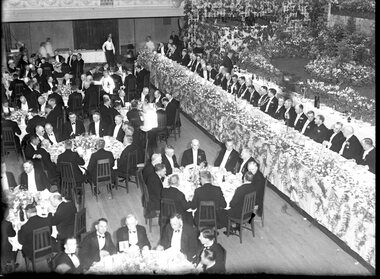
Photograph, Bull, Hugh Jones, 1897-1993, Lord Mayor's Dinner, Melbourne Town Hall
... At times the expression was used with some irony, but "...in Victoria’s centenary year, 1934, with the city mired in another depression, a publisher bravely entitled a book of souvenir photographs Marvellous Melbourne, claiming that the subject ‘still finds apt expression in the happy one-time sobriquet’.” ...At times the expression was used with some irony, but "...in Victoria’s centenary year, 1934, with the city mired in another depression, a publisher bravely entitled a book of souvenir photographs Marvellous Melbourne, claiming that the subject ‘still finds apt expression in the happy one-time sobriquet’.” ...Photographer notations on slide: "General View Of Lord Mayor's Dinner At Town Hall Nov 1936 B112" Published: The Age, Tuesday 10 November 1936, page 13 Published title: LORD MAYOR'S BANQUET Published caption: The brilliant scene inside the Melbourne Town Hall last night during the Lord Mayor’s banquet. Trove article identifier: http://nla.gov.au/nla.news-article205939431 Description: 700 guests (all men) are seated around numerous tables in the Melbourne Town Hall for the Lord Mayor's dinner in November 1936. Before the stage is a top table of 35 men, all dressed smartly in black dinner suits, with either a black or white bow tie. Many are wearing their medals. The Lord Mayor has on his Mayoral chains, and to his right is the Governor of Victoria, Lord Huntingfield. The stage is heavily decorated with fresh flowers. Research by project volunteer, Louise McKenzie: This image takes up one quarter of the photographic space on page 13 of The Age on 10 November 1936, reflecting the importance of the event and also the sheer dramatics of the image: 700 guests (all men), a top table of 35, and all dressed smartly in black dinner suits, with either a black or white bow tie. Many are wearing their medals. The Lord Mayor has on his Mayoral chains, and to his right is the Governor of Victoria, Lord Huntingfield. Further to his right is a man with an impressive sash across his chest. It is a very animated, and rather informal, moment. Banks of fresh flowers smother the stage, which is decorated in the manner of a terrace at an English stately home. Tables are laden with food, drink and decorations, and the wait staff (men and women) are also formally dressed, in the manner of Downton Abbey. It is spectacular, dramatic, and luxurious, and perpetuates the proud descriptor of “Marvellous Melbourne” as conferred by London Journalist George Augustus Sala when he visited the city in 1885. During its 1880s boom, Melbourne was the second-largest city in the British Empire, after London, and reputedly the richest city in the world. At times the expression was used with some irony, but "...in Victoria’s centenary year, 1934, with the city mired in another depression, a publisher bravely entitled a book of souvenir photographs Marvellous Melbourne, claiming that the subject ‘still finds apt expression in the happy one-time sobriquet’.” This photo seems to reflect an ongoing pride in Melbourne and a desire for it to live up to its descriptor and celebrate its post-centenary era in style. So it is no surprise to find that on page 11 of The Age on the same day, a second photo is to be found – a cropped view of one table – along with a very detailed description of the night, its purpose, and a surprise announcement. But, who was the Lord Mayor in whose honour the dinner was held? In 1934, the Lord Mayor of Melbourne was Cr. Alexander George Wales, (born Richmond, 11 October 1885, died Elsterwick, 31 May 1962). His father was a contractor and quarry-owner, but was blinded in an industrial accident in 1899. Consequently Alexander, then aged 14, left Brunswick State School to become a railway labourer working at a quarry, and in 1903 joined the Commonwealth public service as a clerk and began studying at night school, determined to improve himself. In 1907 he was appointed secretary of the Albion Quarrying Co. (in which the family had an interest), then its managing director and chairman. As the Australian Dictionary of Biography notes, he was instrumental in expanding the company’s interests, "...becoming director of the Hardware Co. of Australia Pty Ltd, the Twentieth Century Building and Investment Society, the Albion Sand Co. and the Geelong Brick Co.”. His public career began in 1914 when he was elected to the Brunswick council. He was mayor 1917-18, and in 1925 progressed to the Melbourne City Council where he remained for 29 years, being a member of most council committees. He served three successive terms as lord mayor (1934-37), was Chairman of the council’s decorations committee for Melbourne’s centenary, president of the Metropolitan Fire Brigades Board (1936), and Chairman of the Public Works Committee (1937-39). In 1936 he was elected to the Legislative Council with United Australia Party support, but later resigned over possible State government contract tender irregularities. Wales received "the customary reward” of a knighthood and was invested at Buckingham Palace by King George VI whose coronation he attended in 1937. He was an early director of what is now Ampol, and helped the development of the petroleum industry in Australia after visiting the USA in 1943 and 1946. He was impressed by that country’s wartime shipbuilding efforts and supported closer ties with the USA. “While president (1947-48) of the Melbourne Chamber of Commerce, Wales was a vocal critic of the Federal Labor Government, ...a staunch anti-socialist ... and a focus for conservative opposition to the Curtin and Chifley governments...” He is described as “a natural leader in business and civic politics,... a powerful force in the Melbourne City Council... opposing democratic reforms such as the creation of a Greater Melbourne Council and the abolition of plural voting, but advocat[ing] the redevelopment of city-owned property like the Eastern and Western markets...” So, this Lord Mayor’s dinner marks the third successive term in office for Governor Cr. A G Wales. The room is filled with powerful and influential men, and provided a platform for the Premier of Victoria, Albert Dunstan (1882-1950, United Country party) to announce that if the City Council would bear half the cost the State Government would build a bridge at Punt Road “at once”. He announced that the Government proposed to have the bridge built by the Country Roads Board, and allow the City Council to pay its share on convenient terms, and further, it would investigate the shared provision of more Yarra bridges. The proposal for the Punt Road Bridge was met with applause as the Yarra River constituted a serious traffic barrier. On 12 November 1936, two days after the Lord Mayor’s dinner, The Age published an article, “Building without a Plan”. It questions the appropriateness of the next Yarra bridge being the one at Punt Road, and encourages a “proper procedure” to look at the provision of additional Yarra bridges as a whole. But in fact this topic had been canvassed back in August when Melbourne City Council’s public works committee had recommended the replacement of the footbridge at Punt Road with a bridge, and if the Country Roads Board would declare this portion of Punt Road, including the river crossing, a State Highway, this could give the Board authority to construct the bridge and allocate the cost. Hence the reference at the dinner to a shared expense. Still an integral part of traffic management today, the Hoddle Bridge carries Punt Road over the Yarra River between Richmond and South Yarra in Melbourne. It is a five-lane road bridge with narrow footpaths on either side. It is of continuous reinforced concrete T-beam construction with five segmental arched spans, supported on transverse piers, and linked by concrete cross-beams. “The piers terminate in a series of tapered concrete pillars with Art Deco-styled steamlined decoration. Each pillar supports a Victorian-style lamp. The infill railings are geometric-patterned painted metal. Construction began in late 1937, and it was opened by Premier Albert Dunstan on 22 December 1938. It replaced an earlier footbridge, which in turn had replaced a punt service. The bridge (originally referred to as Punt Road Bridge) was named after Robert Hoddle, who planned central Melbourne’s Hoddle Grid, the grid of streets which form Melbourne’s central business district. Hoddle arrived in Australia from the UK in 1823 and went on to carry out surveys in NSW and Queensland before arriving in Melbourne in 1837. He designed layouts for both Melbourne and Williamstown, and later Geelong and other Victorian country areas. He was keen that major streets be at least 30 metres wide. ”With remarkable foresight he provided for wide boulevards from the city to the suburbs, but the subdivisions of early speculators in inner suburbs created the bottle-necks of today. After the separation of the colony in 1851, he became Victoria’s first surveyor-general... and advocated the provision of three-chain (60 m) roads and the widening of all existing main roads from one (20 m) to three chains." However, he was met with constant opposition and in 1853, was eased out of office. As a small and interesting aside: Hoddle was appointed auctioneer for the first sale of crown land in Melbourne on 1 June 1837. His commission was 57 pounds 12s 7d. and he bought two allotments for himself at a cost of 54 pounds. After he died his second wife married Richard Buckhurst Buxton, a member of the family which in 1860s Melbourne established the Australian property dynasty of Buxton Real Estate, Becton, MAB Corporation etc. Returning to the dinner and The Age article of 10 November 1836: Another topic of the after-dinner speeches was a reference to the upcoming Armistice Day. “The Minister of Customs (Mr White) said the proximity of Armistice day reminded us that eighteen years ago we had high hopes of prolonged peace.” The term “Armistice Day” was coined after WWI: “At 11 am on 11 November 1918, the guns on the Western Front fell silent after more than four years of continuous warfare. The Germans called for an armistice (suspension of fighting) in order to secure a peace settlement. They accepted the allied terms on unconditional surrender. Therefore on the 11th hour of the 11th day of the 11th month, a minute’s silence is observed and dedicated to those soldiers who died fighting to protect the nation. Originally known as Armistice Day, it was renamed Remembrance Day after World War Two to commemorate those who were killed in both World Wars. Today it refers to the loss of Australian lives from all wars and conflicts, accompanied by the words, "We will remember them, Lest we forget"." There was comment at the dinner about the need to remain firm in supporting the “democratic government in the British Empire to avoid a “plunge into savagery”. There was a grave responsibility on the British people to keep democracy alive, and that could not be done without adequate defence forces... Many weak governments in non-British countries had been swept aside by strong-fisted dictators, who now were the real threat to peace”. With the benefit of hindsight these were very pertinent comments and tragically prophetic. The Melbourne Shrine of Remembrance had only been dedicated two years earlier, at a ceremony attended by the Duke of Gloucester, son of King George V. Over 300,000 citizens attended: one third of the population of Melbourne. It became the location for the Anzac Day Dawn Service. Originally the march travelled from the Shrine into the city, however, in 1936, this was reversed, and the Shrine became the termination point for Anzac Day Marches. Also significant in 1936, was the installation of a statue in the west forecourt of the Shrine: “The Man with the Donkey” (aka 'Private John Simpson and his Little Donkey'). The work is said to represent the “valour and compassion of the Australian soldier”. Its full citation, according to the City of Melbourne City Collection is: West Side of Base: "The / Man with his Donkey / Gallipoli, April 25 to May 19 / in Commemoration / of the valour and compassion / of the Australian Soldier" AFTER LANDING AT GALLIPOLI, SIMPSON, WITH HIS LITTLE DONKEY, WORKED ALONE, DAY AND NIGHT TAKING WATER TO THE FRONT LINE AND CARRYING THE WOUNDED BACK TO THE DRESSING STATIONS. HE AND HIS DONKEY WERE KILLED BY A SHRAPNEL SHELL ON THE 19TH MAY, 1915. SIMPSON WAS MENTIONED IN DISPATCHES BY SIR IAN HAMILTON, COMMANDER-IN-CHIEF OF THE MEDITERRANEAN EXPEDITIONARY FORCE. / Erected by Public Subscription under auspices of the / Red Cross Society. East Side of Base: Private John Simpson." Their summary in background states: "A bronze figure of Simpson and his donkey with a wounded man on the donkey's back on a granite pedestal. Private John Simpson Kirkpatrick’s intrepid and short-lived exploits during the Gallipoli campaign have made him a popular figure of World War One. He has been mythologised to represent the lauded values of the digger, and he symbolises all those who went into battle unarmed. Born in England in 1892, he came to Australia in 1910. He enlisted to make his way back to England, but as a member of the 3rd Field Ambulance AIA was sent to Gallipoli. After just three weeks of bearing wounded soldiers across Shrapnel Gully on the back of his donkey, Simpson was killed by shrapnel fire. Simpson’s story became a powerful propaganda tool for enlistment in Australia, but following the war he was quickly forgotten. With the Shrine of Remembrance nearing completion in 1933, the memory of Simpson was rekindled to commemorate all who gave their lives to help others during the war. One plaque reads: ‘The / Man with his donkey / Gallipoli … / In commemoration / of the valour and compassion / of the Australian soldier’. In 1935, Wallace Anderson’s design for the memorial was selected though a competition organised by the Australian Red Cross. Anderson had served during the war and worked at the Australian War Memorial after his return. His Man with the Donkey was cast in Italy, and after some debate was sited near the shrine. Unveiled 20th June, 1936." The sculptor, Victorian-born William Wallace Anderson (1888-1975), served in France during WWI and afterwards produced a number of bronze war memorials and memorial portraits, predominantly in Victoria. “His most famous work is that of Simpson and his Donkey (1935), which he completed after winning a competition conducted by the Victorian Division of the Australian Red Cross. Anderson’s fee was 350 pounds; the cast, made by the Chiurazzi Foundry, Naples, Italy, cost 40 pounds. The work... has become well known as a symbol of the Anzac tradition.” A debate as to the siting of the statue arose from a strong view expressed by General Sir John Monash that no representation of individual members of the Australian Defence Force be located on the Shrine itself. Hence its location off to the northwest of the forecourt, in a garden of rosemary. And finally we return to the photo of the grand Lord Mayor’s dinner! An article in The Argus of 4 November 1936 refers to “Brilliant Scene at Lord Mayor’s Ball – Hall Becomes a Garden”. So now it becomes clear why the Town Hall, location of the Lord Mayor’s Dinner on 10 November 1934, only 6 days later, is so lavishly decorated. The floral decorations from the Ball are still in place - an early example of “recycling”, which is gratifying to note at a time of Depression. The reporter has captured the scene with enthusiasm: “Hundreds of tiny rose lights, hidden among pink roses, transformed the Melbourne Town Hall into a magical garden last night, when the Lord Mayor and Lady Mayoress (Councillor A. C. Wales, M.L.C., and Mrs. Wales) entertained about 3,500 guests at a ball. His Excellency the Governor (Lord Huntingfield) and Lady Huntingfield were present, while Rear-Admiral and Mrs. Lane Poole and officers from the visiting squadron were among the special guests. The balconies all round the hall were hidden by a white trellis, covered with pink blossoms and greenery. Rosy flowers were issued up every pillar, and great golden lamps, hanging from the door, were seated in greenery and trails of sweet peas. The organ gallery was converted into a terrace garden with stone steps leading to banks of pink azaleas, pink pelargoniums, masses of calceolarias, and the lovely deep mauve and blue of cinerarias. Slender Japanese maples and poplar trees grew from the higher slopes amid thickets of hostas, while a fascinating illusion was created by the lofty conservatory windows, which formed the background, and which were tinted cerulean blue to simulate the sky seen through glass. Large fern baskets hung from the conservatory roof, and the whole scene was enclosed in trellises of blossom. In the entrance palm green shrubs stood like sentinels round the passed floor, and flowers bloomed in misty golds. The long corridor upstairs leading to the council chamber was lined with an avenue of poplar trees in tubs. In the Lower Town Hall great banks of calceolarias and azaleas decked the upper dais, and each supper table was adorned with a different coloured flower with sprays of roses and Japanese maple laid on the snowy cloths. The adjoining supper-rooms were fragrant with the scent of huge bowls of stock in mauve, purple, and pink, while the white walls were covered with palm leaves and flowers. The roof garden below the clock tower was enclosed as a buffet with rose wreathed walls, and flowers were arranged attractively in the Lady Mayoress's rooms." References: LORD MAYOR'S BANQUET. CENTURY MAKERS AT THE M.C.G. BEFORE THE CHANGE. (1936, November 10). The Age (Melbourne, Vic. : 1854 - 1954), p. 13. Retrieved September 4, 2024, from http://nla.gov.au/nla.news-article205939431 'Portrait of Sir George Wales (Lord Mayor 1934-1937)', City Collection, City of Melbourne, https://citycollection.melbourne.vic.gov.au/portrait-of-sir-george-wales-lord-mayor-1934-37/ Graeme Davison, 'Marvellous Melbourne', eMelbourne, https://www.emelbourne.net.au/biogs/EM00906b.htm THE LORD MAYOR'S BANQUET. (1936, November 10). The Age (Melbourne, Vic. : 1854 - 1954), p. 11. Retrieved September 26, 2024, from http://nla.gov.au/nla.news-article205939643 BRILLIANT SCENE AT LORD MAYOR'S BALL Hall Becomes a Garden (1936, November 4). The Argus (Melbourne, Vic. : 1848 - 1957), p. 14. Retrieved September 26, 2024, from http://nla.gov.au/nla.news-article11932746 'Hoddle Bridge', Wikipedia, https://en.wikipedia.org/wiki/Hoddle_Bridge 'Hoddle Bridge', Victorian Heritage Database Report, Victorian Heritage Council, https://vhd.heritagecouncil.vic.gov.au/places/195689/download-report David Dunstan, 'Wales, Sir Alexander George (1885–1962)', Australian Dictionary of Biography, National Centre of Biography, Australian National University, https://adb.anu.edu.au/biography/wales-sir-alexander-george-8951/text15737, published first in hardcopy 1990, accessed online 26 September 2024. Marjorie J. Tipping, 'Hoddle, Robert (1794–1881)', Australian Dictionary of Biography, National Centre of Biography, Australian National University, https://adb.anu.edu.au/biography/hoddle-robert-2190/text2823, published first in hardcopy 1966, accessed online 26 September 2024. BUILDING WITHOUT A PLAN. (1936, November 12). The Age (Melbourne, Vic. : 1854 - 1954), p. 8. Retrieved September 26, 2024, from http://nla.gov.au/nla.news-article205949762 NEW BRIDGE AT PUNT ROAD (1936, August 12). The Argus (Melbourne, Vic. : 1848 - 1957), p. 10. Retrieved September 26, 2024, from http://nla.gov.au/nla.news-article11902131 'The Shrine of Remembrance', Beaconsfield’s Soldiers: https://beaconsfield.org.au/digitalmemorial/shrine-introduction/ 'Shrine of Remembrance', Wikipedia, https://en.wikipedia.org/wiki/Shrine_of_Remembrance Ken Scarlett, 'Anderson, William Wallace (1888–1975)', Australian Dictionary of Biography, National Centre of Biography, Australian National University, https://adb.anu.edu.au/biography/anderson-william-wallace-9362/text16441, published first in hardcopy 1993, accessed online 26 September 2024. 'Man with the Donkey', City Collection, City of Melbourne, https://citycollection.melbourne.vic.gov.au/man-with-the-donkey-aka-private-john-simpson-and-his-little-donkey/ 'Remembrance Day', Australian Army, https://www.army.gov.au/about-us/history-and-research/traditions/remembrance-day Photographer notations on slide: "General View Of Lord Mayor's Dinner At Town Hall Nov 1936 B112".melbourne town hall, mayors, lord mayors, centenaries, bridges, dinners, clothing and dress, festive decorations, dances and balls, eating and drinking, shrine of remembrance, governors, monuments and memorials, 1930-1939, plants -
 Flagstaff Hill Maritime Museum and Village
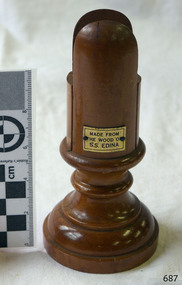
Domestic object - Card Holder, c. 1854 - 1957
... centenary maritime exhibition 1934...a brief review of steam navigation in victoria...The SS Edina’s original ‘fair maid of Judea’ figurehead was broken to pieces in a collision with another vessel (the SS Dandenong) in a gale off Warrnambool, Victoria, in 1870. warrnambool shipwrecked coast flagstaff hill flagstaff hill maritime museum maritime museum shipwreck coast flagstaff hill maritime village shipwrecked artefact Barclay & Curle figurehead 'fair maid of Judea' centenary maritime exhibition 1934 a brief review of steam navigation in victoria pleasure steamer edina trade and travel late 19th and early 20th century trade melbourne to geelong screw steamer Edina coastal trader Edina lighter Dinah cargo carrying for cremean war cargo carrying for American civil war passenger and trade in western district of victoria export gold and currency and gold diggers to New Zealand export vessel to h r h the duke of edinburgh melbourne - warrnambool - port fairy - portland cargo run warrnambool steam packet company stephen henty captain john thompson chief engineer john davies lady bay warrnambool lighter Edina shipping Victoria port phillip bay steamers steamship great Britain Edina, VHR S199 Victorian Heritage Database card holder menu holder table number holder souvenir of the ss edina Printed on plaque "MADE FROM / THE WOOD OF / S.S. ...This wooden cardholder was made from the wood of the screw steamer S.S. Edina, most probably after she was broken up in 1957, but could have been made after one of several renovations during her lifetime. The slotted design of the cardholder allows a card to stand vertically, and the base is made wider to stabilise the holder. It could be used for holding items such as place cards, menus, and table numbers. ABOUT THE SS EDINA: - The three-masted, iron-hulled screw steamer SS Edina was built in Glasgow, Scotland, in 1854 by Barclay and Curle and launched on the Clyde on May 4th, 1854. The 322-ton, three-masted ship was 171 feet long, 23 feet 6 inches broad, and 12 feet 7 inches deep (52.12 L x 7.16 B x 3.84 D metres). The traditional figurehead of Edina, the ‘fair maid of Judea’, adorned its bow. The Edina later became famous worldwide for being the longest-serving screw steamer. (The term screw steamer comes from being driven by a single propeller, sometimes called a screw, driven by a steam engine.) During its long working life, SS Edina had its accommodation enlarged for war service, was completely overhauled and serviced several times; boilers were replaced, masts were reduced to one, and later added then reduced, a Poop Deck, Forecastle and additional accommodation were added, the hull was gutted completely, new decks and bulwarks, saloon was redecorated and upgraded, and several changes of commander. The busy vessel also survived several mishaps at sea. SS Edina’s interesting history includes English Channel runs, carrying stores and horses to the Black Sea in the Crimean War as HMS Edina 1864-55. The vessel then sailed to Europe and the UK before being sold and used for further service in 1861 as a blockade runner in the American Civil War. The vessel later served as a coastal trader in the western district of Victoria and Queensland, then carried gold, currency, and gold prospectors from Australia to New Zealand. SS Edina was an escort vessel to H.R.H. the Duke of Edinburgh during his visit to Australia in 1867. SOME EVENTS in the life of SS EDINA: - The SS Edina had voyaged to Australia under sail. Owners Leith, Hull & Hamburg Steam Packet Co. sold the SS Edina in March 1863 at Port Phillip Bay, Melbourne, to Stephen Henty of Portland, Victoria; Edina was perfect for working the West Coast cargo and passenger run between Melbourne and Portland, via the Port of Warrnambool, and Port Fairy. It first visited Warrnambool on April 4, 1863. SS Edina briefly worked the run from Australia to New Zealand, then returned to the West Coast run; the cargo included bales of wool produced in the western district of Victoria. In 1867-68, Stephen Henty sold SS Edina to the Warrnambool Steam Packet Company to continue trading along the coast of western Victoria. Captain John Thompson was the commander, and John Davies was the Chief Engineer. In 1870, SS Edina was in Lady Bay, Warrnambool, when a gale sprang up and caused a collision with the iron screw steamer SS Dandenong. SS Edina’s figurehead was broken into pieces and was never replaced. The Edina was refitted that year for use as a coastal trader in Queensland for a period, named R.M.S. Edina. It then went to Melbourne and carried cargo and passengers between there and Geelong from 1880 to 1938, with modifications in 1917; the ship was extensively overhauled, radically changing its appearance. It returned to having two masts, and the funnel, bridge, engines, and promenade deck were upgraded, and the saloon reupholstered. By 1924, Edina had made over 12,000 journeys, carrying over one million travellers between Melbourne and Geelong. In 1937, Australian Steamships Pty Ltd advertised in The Argus its Bay Excursions on the SS Edina from Portarlington and Geelong; it promoted, “Splendid Beaches, Excellent Bathing Facilities, and Light Refreshments available on board”. After several collisions, the SS Edina was taken out of service in 1938 and sold by its owner, Howard Smith Ltd., to a Williamstown shipbreaker, Mr George Burton. The Melbourne Harbour Trust permitted Burton to strip the hull and sell all parts at auction. The fittings were sold by auctioneers J.W. Styles & Son, c. 1938, on site at the Port of Melbourne and became widely dispersed. Victorian Lighterage Pty Ltd. purchased the hull, removed the engine and superstructure, and repurposed it as a ‘lighter’ named Dinah. It was loaded with wool and general cargo, then towed behind small tugs around the bay between Melbourne and Geelong. In 1957, after 104 years of activity, the SS Edina was broken up on the banks of the Maribyrnong River, Footscray, Melbourne, and used as landfill. A piece of the hull with Victorian Heritage significance is buried in the river. This card holder is made from wood from the SS Edina and is significant for its association with that vessel. The SS Edina is heritage listed on the Victorian Heritage Database VHR S199. She had endeared herself to the people of Port Phillip Bay as a passenger ferry, part of their history and culture. She played a significant role in the Crimean War, the American Civil War and the gold rush in New Zealand. She also served Western Victoria for many years in her cargo and passenger runs. The SS Edina is famous for being the longest-serving screw steamer in the world. After spending her first nine years overseas, she arrived in Melbourne, and her work included running the essential service of transporting cargo and passengers between Melbourne and the western Victoria ports of Warrnambool, Port Fairy and Portland. The SS Edina was purchased in the late 1860s by local Warrnambool business, the Warrnambool Steam Packet Co. and continued trading from there as part of the local business community. The SS Edina’s original ‘fair maid of Judea’ figurehead was broken to pieces in a collision with another vessel (the SS Dandenong) in a gale off Warrnambool, Victoria, in 1870. Card holder, made from the wood from the SS Edina (screw steamer ship). Holder is cylindrical shape, wider turned wood base. Top is divided with a space in the centre tor inserting a card. Rectangular metal plaque, gold-coloured, has a printed inscription within black border. Made c. 1854 - 1957.Printed on plaque "MADE FROM / THE WOOD OF / S.S. EDINA"warrnambool, shipwrecked coast, flagstaff hill, flagstaff hill maritime museum, maritime museum, shipwreck coast, flagstaff hill maritime village, shipwrecked artefact, barclay & curle, figurehead 'fair maid of judea', centenary maritime exhibition 1934, a brief review of steam navigation in victoria, pleasure steamer edina, trade and travel late 19th and early 20th century, trade melbourne to geelong, screw steamer edina, coastal trader edina, lighter dinah, cargo carrying for cremean war, cargo carrying for american civil war, passenger and trade in western district of victoria, export gold and currency and gold diggers to new zealand, export vessel to h r h the duke of edinburgh, melbourne - warrnambool - port fairy - portland cargo run, warrnambool steam packet company, stephen henty, captain john thompson, chief engineer john davies, lady bay warrnambool, lighter edina, shipping victoria, port phillip bay steamers, steamship great britain, edina, vhr s199 victorian heritage database, card holder, menu holder, table number holder, souvenir of the ss edina
