
Showing 117 items matching "charity organisation"
-
 Bendigo Military Museum
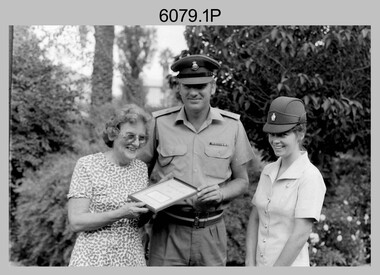
Photograph - Army Survey Regiment – Presentation to Charity Organisation, c1982
... Army Survey Regiment – Presentation to Charity Organisation...Army Survey Regiment – Presentation to Charity Organisation...These photographs of a presentation to a charity organisation were taken in the grounds of Fortuna Villa, Army Survey Regiment in c1982. ...This is a set of four photographs of a presentation to a charity organisation at the Army Survey Regiment, Bendigo in c1982. ...These photographs of a presentation to a charity organisation were taken in the grounds of Fortuna Villa, Army Survey Regiment in c1982. ...These photographs of a presentation to a charity organisation were taken in the grounds of Fortuna Villa, Army Survey Regiment in c1982. SPR Gae (Robinson) Amato was the unit’s first Miss Golden North entrant in the Miss Australia Quest. LTCOL Peter Eddy and SPR Amato presented a fundraising cheque to the unidentified representative from the Spastic Society. In later years SPR Amato took the opportunity of a new career as a commissioned officer in another Corps of the Australian Army.This is a set of four photographs of a presentation to a charity organisation at the Army Survey Regiment, Bendigo in c1982. The photographs were printed on photographic paper and are part of the Army Survey Regiment’s Collection. The photographic prints were scanned at 300 dpi, however better clarity was achieve scanning 35mm negatives at 96 dpi. .1) to .4) - Photo, black & white, c1982, L to R: unidentified charity organisation representative, LTCOL Peter Eddy, SPR Gae (Robinson) Amato..1P to .2P – No personnel identified .3P to .4P – ‘Gae Robertson MISS AUST 1980s’royal australian survey corps, rasvy, army survey regiment, army svy regt, fortuna, asr -
 Bendigo Military Museum
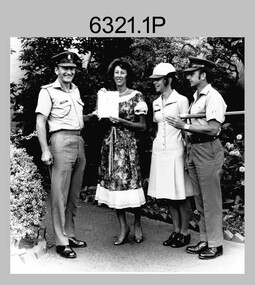
Photograph - Army Survey Regiment – Presentation to Charity Organisation, 1984
... Army Survey Regiment – Presentation to Charity Organisation. ...Army Survey Regiment – Presentation to Charity Organisation. ...These photographs of a presentation to a charity organisation were taken in the grounds of Fortuna Villa, Army Survey Regiment in 1984. ...The first three items are photographs of a presentation to a charity organisation at the Army Survey Regiment, Bendigo in 1984. ...These photographs of a presentation to a charity organisation were taken in the grounds of Fortuna Villa, Army Survey Regiment in 1984. ...These photographs of a presentation to a charity organisation were taken in the grounds of Fortuna Villa, Army Survey Regiment in 1984. SPR Tracy (Parker) Ash was the unit’s Miss Golden North section entrant in the Miss Australia Quest. MAJ Bob Roche, RSM Bob Mason and SPR Parker presented a fundraising cheque to the unidentified representative from the Spastic Society. The the newspaper article is from the Bendigo Advertiser. The following wording is taken from the article: ‘Tracy Parker is a sapper in the Army, and a cartographic technician stationed at Fortuna, Bendigo. Originally from Melbourne, Tracy, 23, is the latest entrant in the Miss Golden North segment of the Miss Australia Quest. The highlight of Tracy’s quest will be an open day at Fortuna, once the magnificent home of Bendigo’s Quartz King, George Lansell. This open day at Fortuna, on Sunday, August 26, between 10 am and 4 pm, will give district residents a rare opportunity of inspecting this magnificent building and its gardens. Tracy said there will be handicrafts, rides, competitions and refreshments available at the open day. The main attraction, apart from the building and gardens, would be a hot air balloon. Admission to the open day would be: Adults $2, children and pensioners $1, family party $5. All proceeds from the open day at Fortuna will go to the Spastic Society. Tracy, like all other Miss Australia candidates work hard for the Spastic Society in fundraising activities. Getting further involved in fundraising, Tracy and her strong committee have organised a 6km fun run for Sunday August 19. Entry forms are available at Bendigo sports stores, and at the end of the fun run will be a barbecue. Apart from her vocation in the Army, and fundraising for the Spastic Society, Tracy Parker has a great love of horses, and associated activities of riding, jumping and showing her horses. Tracy is keen to do well in her fundraising, and with the Australian Army, or more particularly, the ranks of Fortuna behind her, Tracy looks like succeeding.’The first three items are photographs of a presentation to a charity organisation at the Army Survey Regiment, Bendigo in 1984. The fourth item is an article from the Bendigo Advertiser describing Army Survey Regiment’s fund-raising activities. The photographs were printed on photographic paper and are part of the Army Survey Regiment’s Collection. The photographic proof prints were scanned at 600 dpi. Photos .1P and .2P were scanned at 300 dpi. The newspaper article was scanned at 762 dpi. .1) to .3P) - Photo, black & white, 1984, L to R: MAJ Bob Roche, Regional Coordinator Mrs Jan Lamborn, SPR Tracy (Parker) Ash, RSM WO1 Bob Mason. .4) – Bendigo Advertiser newspaper article with photo, black & white, 1984, SPR Tracy (Parker) Ash. .1P to .2P – ‘Presentation of Certificate of Appreciation from Spastic Society. Presented by Regional Coordinator Mrs Jan Lamborn to MAJ Roche, SPR Tracy Ash (entrant in Miss Australia Quest (1984) and WO1 Mason.' .3P – No personnel identified. .4P – SPR Tracy Parker named in newspaper article.royal australian survey corps, rasvy, army survey regiment, army svy regt, fortuna, asr -
 Whitehorse Historical Society Inc.
Article, Charity group faces dual peril : Chairman, 1992
... The chairman of the Nunawading Community Chest, Keith Rooney, warned that the charity organisation will fold unless local residents give more money....Nunawading Community Chest Rooney Keith The chairman of the Nunawading Community Chest, Keith Rooney, warned that the charity organisation will fold unless local residents give more money. ...The chairman of the Nunawading Community Chest, Keith Rooney, warned that the charity organisation will fold unless local residents give more money.The chairman of the Nunawading Community Chest, Keith Rooney, warned that the charity organisation will fold unless local residents give more money.The chairman of the Nunawading Community Chest, Keith Rooney, warned that the charity organisation will fold unless local residents give more money.nunawading community chest, rooney, keith -
 Kiewa Valley Historical Society
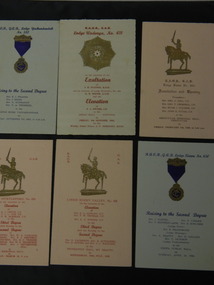
Cards - Royal Antediluvian Order of Buffaloes x8 (A - H) plus 4 (I - L), 1950's
... ...charity organisation...Royal Antediluvian Order of Buffaloes charity organisation lodge organisation Tawonga Lodge Rocky Valley Lodge Kiewa Valley Lodges Signatures on the invitation 8 Cardboard R.A.O.B., G.A.B. ...The Royal Antediluvian Order of Buffaloes is an organisation that started in 1822 in the United Kingdom. It aids members, their families, dependents of former members and other charitable organisations. Membership is open to all males over the age of 18 years. The R.A.O.B. had lodges in the Kiewa Valley including Rocky Valley, Kiewa and in Tawonga as well as in nearby towns indicating that it was a popular organisation at the time. Lodge Officers are listed on each card.8 Cardboard R.A.O.B., G.A.B. Cards folded in half each with an emblem on the centre front and all with a date of meeting at the bottom. Card A - Blue from Yackandandah, Nov. 1953; Card B - Pink from Myrtleford, March 18th; Card C - Pink from Rocky Valley, July 1955; Card D - Pink from Kiewa (Foundation and Opening) Feb. 1955; Card E - Pale blue from Wodonga, Oct. 1958; Card F- Blue from Kiewa, April 1956; Card G - Blue from Rocky Valley, July 1956; Card H - Blue from Rocky Valley, May 1958. Card I-cream from Tawonga and Rocky Valley. April 1957.Card J -beige from Rocky Valley and Tawonga January 1954. Card K-Beige from Rocky Valley and Tawonga February 1956. Item L - Invitation pink December 1957 from Rocky Valley. Signatures on the invitationr.a.o.b., royal antediluvian order of buffaloes, charity organisation, lodge organisation, tawonga lodge, rocky valley lodge, kiewa valley lodges -
 Flagstaff Hill Maritime Museum and Village
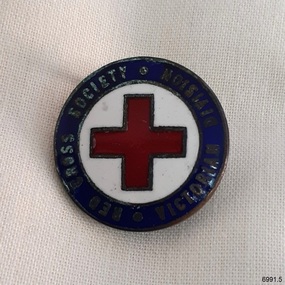
badge - Red Cross Society badge, Australian Red Cross Society, Victorian Division, 1914-1940s
... organisation badge...Flagstaff Hill Maritime Museum and Village...Australian Red Cross...Victorian Division...charity...Angus badge organisation badge Flagstaff Hill Maritime Museum and Village Australian Red Cross Victorian Division charity volunteer organisation W.R. ...The badge represents the Victoria Division of the Australian Red Cross Society, which was formed on 21st August 1914 at the outbreak of the First World War. Stokes & Sons of Melbourne made the button. It was made by Stokes & Sons Pty. Ltd. in Melbourne. The maker, Thomas Stokes, migrated to Melbourne from Birmingham in 1854 and set up business in Mincer Lane as a die-sinker, producing medals, tokens, buttons and silverware, and offered an engraving service. He moved to Flinders Lane in 1856. After a time, in 1894, the business became Stokes & Sons Pty. Ltd, electroplates and badge makers at Post Office Place in Melbourne. The maker's mark 'Stokes & Sons' continued to be made on badges up until 1962. This badge is one of a set of badges collected by Dr W R Angus from the organisations in which he was involved. The set of badges is now part of Flagstaff Hill’s comprehensive W.R. Angus Collection, donated by the family of Dr W R Angus, surgeon and oculist. The W.R. Angus Collection: - The W.R. Angus Collection includes historical medical equipment, surgical instruments and material belonging to Dr Edward Ryan and Dr Thomas Francis Ryan, (both of Nhill, Victoria) and Dr Angus’ own belongings. The Collection’s history spans the medical practices of the two Doctors Ryan, from 1885-1926 plus that of Dr Angus, up until 1969. It includes historical medical and surgical equipment and instruments from the doctors Edward and Thomas Ryan of Nhill, Victoria. Dr Angus married Gladys in 1927 at Ballarat, the nearest big city to Nhill where he began as a Medical Assistant. He was also Acting House surgeon at the Nhill hospital where their two daughters were born. During World War II He served as a Military Doctor in the Australian Defence Forces. Dr Angus and his family moved to Warrnambool in 1939, where Dr Angus operated his own medical practice. He later added the part-time Port Medical Officer responsibility and was the last person appointed to that position. Both Dr Angus and his wife were very involved in the local community, including the planning stages of the new Flagstaff Hill and the layout of the gardens there. Dr Angus passed away in March 1970.This badge is significant for connecting Doctor Angus with organisations that he supported. The W.R. Angus Collection is significant for still being located at the site it is connected with, Doctor Angus being the last Port Medical Officer in Warrnambool. The Collection includes historical medical objects that date back to the late 1800s.Badge; a round metal and enamel badge with a blue band around the perimeter and a silver-edged red cross on a white background in the centre. The badge has a vertical pin on the back. It is the badge of the Victorian Division of the Red Cross Society. the maker was Stokes & Sons of Melbourne. This badge is part of a set of badges collected by Dr W R Angus. the set represents organisations that he was involved in, and is part of the W.R. Angus Collection.Printed within the blue band; “RED CROSS SOCIETY” “VICTORIAN DIVISION” Embossed on the reverse; “STOKES & SONS / MELB” flagstaff hill, warrnambool, maritime village, maritime museum, shipwreck coast, great ocean road, w.r. angus, badge, organisation badge, flagstaff hill maritime museum and village, australian red cross, victorian division, charity, volunteer organisation, w.r. angus collection -
 Flagstaff Hill Maritime Museum and Village
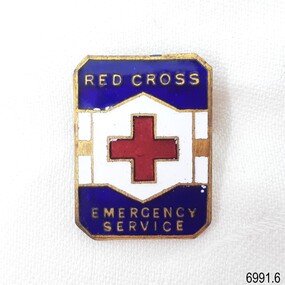
badge - Red Cross Society badge, K.G. Luke Pty. Ltd, Emergency Service, 1935-1945
... organisation badge...Flagstaff Hill Maritime Museum and Village...Australian Red Cross...charity...Angus badge organisation badge Flagstaff Hill Maritime Museum and Village Australian Red Cross charity volunteer organisation Red Cross K.G. ...The badge represents the Emergency Services section of the Red Cross Society. The Australian Red Cross was formed on 21st August 1914 at the outbreak of the First World War. The badge was made by K.G. Luke Pty. Ltd. in Melbourne. Kenneth George Luke, began work as an apprentice in 1910 at Stokes & Sons Pty. Ltd. in Melbourne and stayed with the company for eleven years. He then became a partner in a metalworking business, wholly owning this successful Carlton business in 1925. From 1935-1945 his products included silverware and supplies for military needs. The firm was K.G. Luke Pty. Ltd. by 1936, making buttons, badges, brooches, and heated food trolleys at his office and factory in North Fitzroy, and selling from his showroom in Elizabeth Street Melbourne. His customers included the Australian Red Cross, Victoria Police, TAA Airline, and the military forces of Australia and the United States. Seventeen years later the company was K.G. Luke (A/Asia) Ltd, then twenty-three years on it was Luke Ltd. until in 1983 it was taken over by National Consolidated Ltd. Sir Kenneth George Luke was also a V.F.L. football administrator. This badge is one of a set of badges collected by Dr W R Angus from the organisations in which he was involved. The set of badges is now part of Flagstaff Hill’s comprehensive W.R. Angus Collection, donated by the family of Dr W R Angus, surgeon and oculist. The W.R. Angus Collection: - The W.R. Angus Collection includes historical medical equipment, surgical instruments and material belonging to Dr Edward Ryan and Dr Thomas Francis Ryan, (both of Nhill, Victoria) and Dr Angus’ own belongings. The Collection’s history spans the medical practices of the two Doctors Ryan, from 1885-1926 plus that of Dr Angus, up until 1969. It includes historical medical and surgical equipment and instruments from the doctors Edward and Thomas Ryan of Nhill, Victoria. Dr Angus married Gladys in 1927 at Ballarat, the nearest big city to Nhill where he began as a Medical Assistant. He was also Acting House surgeon at the Nhill hospital where their two daughters were born. During World War II He served as a Military Doctor in the Australian Defence Forces. Dr Angus and his family moved to Warrnambool in 1939, where Dr Angus operated his own medical practice. He later added the part-time Port Medical Officer responsibility and was the last person appointed to that position. Both Dr Angus and his wife were very involved in the local community, including the planning stages of the new Flagstaff Hill and the layout of the gardens there. Dr Angus passed away in March 1970.This badge is significant for connecting Doctor Angus with organisations that he supported. The W.R. Angus Collection is significant for still being located at the site it is connected with, Doctor Angus being the last Port Medical Officer in Warrnambool. The Collection includes historical medical objects that date back to the late 1800s.Badge, rectangular metal and enamel badge, with a blue band across the top and bottom, and a white and gold band in the middle similar to a belt with the buckle of a red cross. The badge has a horizontal pin on the back. Inscriptions on top and bottom bands and on the reverse. It is the badge of the Red Cross Emergency Service, made by K.G. Luke of Melbourne.This badge is part of a set of badges collected by Dr W R Angus. the set represents organisations that he was involved in, and is part of the W.R. Angus Collection.Printed on front; “RED CROSS” above “EMERGENCY / SERVICE”. Embossed on back “8029” “K.G. LUKE / MELB” flagstaff hill, warrnambool, maritime village, maritime museum, shipwreck coast, great ocean road, w.r. angus, badge, organisation badge, flagstaff hill maritime museum and village, australian red cross, charity, volunteer organisation, red cross, k.g. luke pty. ltd., kenneth george luke, north fitzroy, stokes & sons, w.r. angus collection -
 Flagstaff Hill Maritime Museum and Village
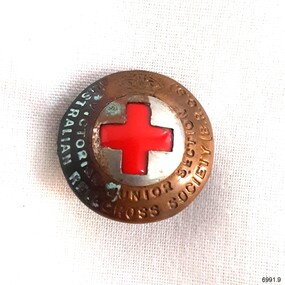
badge - Australia Red Cross Society (B.R.C.S.) badge, J R Gaunt and Son Limited, Victoria Junior Section, 1930
... organisation badge...Flagstaff Hill Maritime Museum and Village...Australian Red Cross...charity...Angus badge organisation badge Flagstaff Hill Maritime Museum and Village Australian Red Cross charity volunteer organisation Red Cross J R Gaunt & Son Birmingham badges buttons military buttons uniform buttons lapel badge Junior Section B.R.C.S. ...The badge represents the Victorian Junior Section of the Australian Red Cross Society, which was formed in 1914 at the outbreak of World War I as a branch of the British Red Cross Society (B.R.C.S.), hence the crown on top of the red cross. It wasn't until 1941 that he Australian Branch was Incorporated by Royal Charter. The badge was made in London by J.R. Gaunt & Son Ltd. James Richard Gaunt and his son Charles Frederick Gaunt established the Birmingham firm of J R Gaunt & Son in 1884. The business operated for over a hundred years and specialised in making buttons for uniforms. This badge is one of a set of badges collected by Dr W R Angus from the organisations in which he was involved. The set of badges is now part of Flagstaff Hill’s comprehensive W.R. Angus Collection, donated by the family of Dr W R Angus, surgeon and oculist. The W.R. Angus Collection: - The W.R. Angus Collection includes historical medical equipment, surgical instruments and material belonging to Dr Edward Ryan and Dr Thomas Francis Ryan, (both of Nhill, Victoria) and Dr Angus’ own belongings. The Collection’s history spans the medical practices of the two Doctors Ryan, from 1885-1926 plus that of Dr Angus, up until 1969. It includes historical medical and surgical equipment and instruments from the doctors Edward and Thomas Ryan of Nhill, Victoria. Dr Angus married Gladys in 1927 at Ballarat, the nearest big city to Nhill where he began as a Medical Assistant. He was also Acting House surgeon at the Nhill hospital where their two daughters were born. During World War II He served as a Military Doctor in the Australian Defence Forces. Dr Angus and his family moved to Warrnambool in 1939, where Dr Angus operated his own medical practice. He later added the part-time Port Medical Officer responsibility and was the last person appointed to that position. Both Dr Angus and his wife were very involved in the local community, including the planning stages of the new Flagstaff Hill and the layout of the gardens there. Dr Angus passed away in March 1970.This badge is significant for connecting Doctor Angus with organisations that he supported. The W.R. Angus Collection is significant for still being located at the site it is connected with, Doctor Angus being the last Port Medical Officer in Warrnambool. The Collection includes historical medical objects that date back to the late 1800s.Badge; a brass dome'shaped badge with two rows of text around the outer edge and a white enamel centre behind a red enamel cross. A crown symbol is embossed above the cross. Text is embossed around the edges with remnants of white within the some of the letters. The reverse has text around the emblem of a wreath and the remnants of a catch. Inscriptions include text and emblems on front and reverse. The badge is for the Australian Red Cross Society, Victorian Junior Section. It was made by J. R. Gaunt & son, London. This badge is part of a set of badges collected by Dr W R Angus. the set represents organisations that he was involved in, and is part of the W.R. Angus Collection.FRONT; Symbol [King;s Crown], Embossed “AUSTRALIAN RED CROSS SOCIETY (B.R.C.S.)“. Inner text “VICTORIA JUNIOR SECTION” REVERSE: Symbol p[wreath] “J R GAUNT LTD, LONDON"flagstaff hill, warrnambool, maritime village, maritime museum, shipwreck coast, great ocean road, w.r. angus, badge, organisation badge, flagstaff hill maritime museum and village, australian red cross, charity, volunteer organisation, red cross, j r gaunt & son, birmingham, badges, buttons, military buttons, uniform buttons, lapel badge, junior section, b.r.c.s., british red cross society, london manufacturer -
Whitehorse Historical Society Inc.
Article, Annual appeal, 1991
... Contributions over the last four years have enabled distribution of more than $40,000 to 90 charities and community organisations....Contributions over the last four years have enabled distribution of more than $40,000 to 90 charities and community organisations....Contributions over the last four years have enabled distribution of more than $40,000 to 90 charities and community organisations. Annual appeal Article Article ...The Mayor of Nunawading, Bruce Atkinson, is appealing to residents to 'dig deep' during the City of Nunawading Community Chest appeal.The Mayor of Nunawading, Bruce Atkinson, is appealing to residents to 'dig deep' during the City of Nunawading Community Chest appeal. Contributions over the last four years have enabled distribution of more than $40,000 to 90 charities and community organisations.The Mayor of Nunawading, Bruce Atkinson, is appealing to residents to 'dig deep' during the City of Nunawading Community Chest appeal. fundraising events, city of nunawading community chest, cedergren, neil, browne, dot -
 Mission to Seafarers Victoria
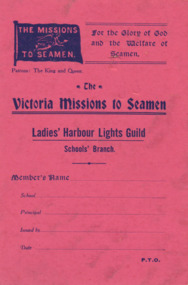
Card - Membership card, School branches, Missions to Seamen Institute, c. 1915
... Charity organisation, Ladies' Harbour Lights Guild, was formed within The Missions to Seamen Institute to provide a home away from home, for visiting seamen. ...Charity organisation, Ladies' Harbour Lights Guild, was formed within The Missions to Seamen Institute to provide a home away from home, for visiting seamen. ...Charity organisation, Ladies' Harbour Lights Guild, was formed within The Missions to Seamen Institute to provide a home away from home, for visiting seamen. These cards illustrate the rules for different type of Members and the suggested Intercession. These cards hold historical significance at a local level because it illustrates the membership types of the Ladies' Harbour Lights' Guild organization and how each member (according to membership) contributed to charity. The Ladies' Harbour Lights Guild grew to become a significant charity in Melbourne raising large amounts of money which helped to establish the current MTS building, supporting seafarers as well as attending social events. Small bright pink membership card typed in blue ink. Font is for the name of the member and her branch. On the back rules and the suggested Intercession.missions to seamen institute, williamstown, port melbourne, rules for members, ladies' harbour lights guild, australian wharf, school branches, membership -
 Mission to Seafarers Victoria
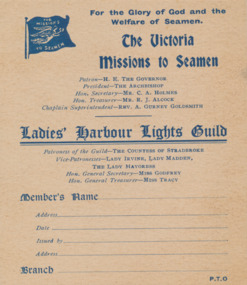
Card - Membership card, Working members, Missions to Seamen Institute, 1921-1926
... Charity organisation, Ladies' Harbour Lights Guild, was formed within The Missions to Seamen Institute to provide a home away from home, for visiting seamen. ...Charity organisation, Ladies' Harbour Lights Guild, was formed within The Missions to Seamen Institute to provide a home away from home, for visiting seamen. ...Charity organisation, Ladies' Harbour Lights Guild, was formed within The Missions to Seamen Institute to provide a home away from home, for visiting seamen. These cards illustrate the rules for different type of Members and the suggested Intercession. These cards hold historical significance at a local level because it illustrates the membership types of the Ladies' Harbour Lights' Guild organization and how each member (according to membership) contributed to charity. The Ladies' Harbour Lights Guild grew to become a significant charity in Melbourne raising large amounts of money which helped to establish the current MTS building, supporting seafarers as well as attending social events. Small creamy colour membership card typed in blue ink. Font is for the name of the member and her branch. On the back rules and the suggested Intercession.missions to seamen institute, williamstown, port melbourne, rules for members, ladies' harbour lights guild, australian wharf, school branches, membership -
 Mission to Seafarers Victoria
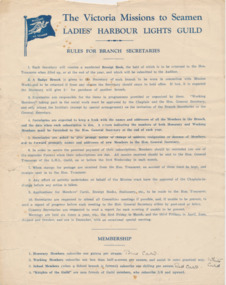
Document - Rules, Mission to Seamen, Rules for Branch Secretaries, c. 1915
... Charity organisation, Ladies' Harbour Lights Guild, was formed within The Missions to Seamen Institute to provide a home away from home, for visiting seamen. ...Charity organisation, Ladies' Harbour Lights Guild, was formed within The Missions to Seamen Institute to provide a home away from home, for visiting seamen. ...Charity organisation, Ladies' Harbour Lights Guild, was formed within The Missions to Seamen Institute to provide a home away from home, for visiting seamen. This paper illustrates the rules for branch secretaries as well as the membership types at the bottom. This paper holds historical significance at a local level because it illustrates the Ladies' Harbour Lights' Guild organization and membership types that were essential to for the success of the charity. The Ladies' Harbour Lights Guild grew to become a significant charity in Melbourne raising large amounts of money which helped to establish the current MTS building, supporting seafarers as well as attending social events.Cream colour document with typed text in blue ink about the rules for Branch secretaries and written inscriptionWritten in black ink 'Blue card' next to '1. Honorary Members' and 'White card' next to '2. Working Members' and 'Red card' next to '3. School Members'. missions to seamen institute, williamstown, port melbourne, ladies' harbour lights guild, lhlg, branches, rules, secretaries, seamen's mission, mission to seafarers, flinders street, australian wharf, honorary members, working members, school members, knights of the guild -
Mission to Seafarers Victoria
Flyer, The Victoria Missions to Seamen (being the Victorian Seamen's Mission and the Melbourne to Seamen amalgamated), c. 1920
... Charity organisation, Ladies' Harbour Lights Guild,was formed within The Missions to Seamen Institute to provide a home away from home, for visiting seamen. ...Charity organisation, Ladies' Harbour Lights Guild,was formed within The Missions to Seamen Institute to provide a home away from home, for visiting seamen. ...Charity organisation, Ladies' Harbour Lights Guild,was formed within The Missions to Seamen Institute to provide a home away from home, for visiting seamen. The flyer invited seafarers to use the institutes for 'Reading, Smoking and Writing and Special Events such as 'Sacred Song Service' and Concerts. This paper flyer holds historical significance at a local level because it illustrates the events and services that seafarers were invited to use and attend organized by the Mission to Seafarers.The Ladies' Harbour Lights Guild grew to become a significant charity in Melbourne raising large amounts of money which helped to establish the current MTS building, supporting seafarers as well as attending social events such as the ones promoted in the flyer. Paper Flyer in blue ink inviting seafarers to use the institutes for 'Reading, Smoking and Writing ;. Also invites them to Special events including dates venues for Socials, 'Sacred Song Services' and Concerts. Written in Black ink on the back: "The crues of the Cashelot" (?)missions to seamen institute, williamstown, port melbourne, special events, ladies' harbour lights guild, australian-wharf, lhlg, flinders street, seafarers, seamen, sailors, reading, smoking, writing, religious services, mission to seamen, seamen's institute, mission to seafarers -
 Mission to Seafarers Victoria
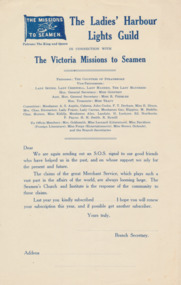
Flyer - Subscription, Mission to Seamen Institute, The Ladies' Harbour Lights Guild in Connection with The Victoria Mission to Seamen, 1921-1926
... The charity organisation, Ladies' Harbour Lights Guild, was formed within the Missions to Seamen Institute to provide a home away from home, for visiting seamen. ...The charity organisation, Ladies' Harbour Lights Guild, was formed within the Missions to Seamen Institute to provide a home away from home, for visiting seamen. ...The charity organisation, Ladies' Harbour Lights Guild, was formed within the Missions to Seamen Institute to provide a home away from home, for visiting seamen. The flyer was to recruit new members or for former Members of the charity to renew their subscription. The patroness was always the governor's wife: here the Countess of Stradbroke whose husband, the Earl of Stradbroke was governor of Victoria between 1921 to 1926.This paper flyer holds historical significance at a local level because it illustrates the Ladies' Harbour Lights Guild involvement in the Mission to Seafarers.The Ladies' Harbour Lights Guild grew to become a significant charity in Melbourne raising large amounts of money which helped to establish the current MTS building, supporting seafarers.Cream colour paper flyer's in blue ink that are also subscription forms in order to become Honorary Members/Working/School Members or renewals of previous Membership of the Ladies' Harbour Lights Guild. (9 copies)missions to seamen institute, ladies' harbour lights guild, australian wharf, lhlg, subscriptions, countess of stradbroke, patroness, lady irvine, lady creswell, lady madden, the lady mayoress, ethel augusta godfrey 1861-1935, miss b. peebles, alice sibthorpe tracy -
 Mission to Seafarers Victoria
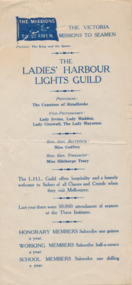
Flyer - Subscription, Mission to Seamen Institute, The Ladies' Harbour Lights Guild in Connection with The Victoria Mission to Seamen, 1921-1926
... The charity organisation, Ladies' Harbour Lights Guild, was formed within the Missions to Seamen Institute to provide a home away from home, for visiting seamen. ...The charity organisation, Ladies' Harbour Lights Guild, was formed within the Missions to Seamen Institute to provide a home away from home, for visiting seamen. ...The charity organisation, Ladies' Harbour Lights Guild, was formed within the Missions to Seamen Institute to provide a home away from home, for visiting seamen. The flyer was to recruit new members or for former Members of the charity to renew their subscription. The patroness was always the governor's wife: here the Countess of Stradbroke whose husband, the Earl of Stradbroke was governor of Victoria between 1921 to 1926.This paper flyer holds historical significance at a local level because it illustrates the Ladies' Harbour Lights Guild involvement in the Mission to Seafarers.The Ladies' Harbour Lights Guild grew to become a significant charity in Melbourne raising large amounts of money which helped to establish the current MTS building, supporting seafarers.Cream colour paper 3 fold-flyer in blue ink that are also subscription forms in order to become Honorary Members/Working/School Members or renewals of previous Membership of the Ladies' Harbour Lights Guild. Includes an extract from the Age.missions to seamen institute, ladies' harbour lights guild, australian wharf, lhlg, subscriptions, countess of stradbroke, patroness, lady irvine, lady creswell, lady madden, the lady mayoress, ethel augusta godfrey 1861-1935, miss b. peebles, alice sibthorpe tracy -
 Mission to Seafarers Victoria
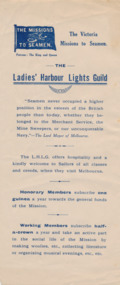
Flyer - Subscription, Mission to Seamen Institute, The Ladies' Harbour Lights Guild, c.1909
... The charity organisation, Ladies' Harbour Lights Guild, was formed within the Missions to Seamen Institute to provide a home away from home, for visiting seamen. ...The charity organisation, Ladies' Harbour Lights Guild, was formed within the Missions to Seamen Institute to provide a home away from home, for visiting seamen. ...The charity organisation, Ladies' Harbour Lights Guild, was formed within the Missions to Seamen Institute to provide a home away from home, for visiting seamen. The flyer was to recruit new members or for former Members of the charity to renew their subscription. The patroness was always the governor's wife: here the Countess of Stradbroke whose husband, the Earl of Stradbroke was governor of Victoria between 1921 to 1926.This paper flyer holds historical significance at a local level because it illustrates the Ladies' Harbour Lights Guild involvement in the Mission to Seafarers.The Ladies' Harbour Lights Guild grew to become a significant charity in Melbourne raising large amounts of money which helped to establish the current MTS building, supporting seafarers.Cream colour paper 2 fold-flyer in blue ink that are also subscription forms in order to become Honorary Members/Working/School Members or renewals of previous Membership of the Ladies' Harbour Lights Guild. missions to seamen institute, ladies' harbour lights guild, australian wharf, lhlg, subscriptions, patroness, ethel augusta godfrey 1861-1935 -
 Mission to Seafarers Victoria
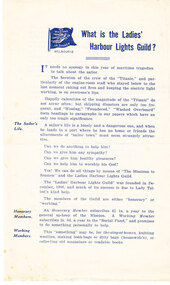
Flyer, What is the Ladies' Harbour Lights Guild?, c. 1912
... Charity organisation, Ladies' Harbour Lights Guild,was formed within The Missions to Seamen Institute to provide a home away from home, for visiting seamen. ...Charity organisation, Ladies' Harbour Lights Guild,was formed within The Missions to Seamen Institute to provide a home away from home, for visiting seamen. ...Charity organisation, Ladies' Harbour Lights Guild,was formed within The Missions to Seamen Institute to provide a home away from home, for visiting seamen. The flyer was to recruit members. The flyer mentions the sinking of the Titanic in 1912 and the bravery of the seamen staying in the engine room. The flyer mentions also Lady Talbot Margaret Jane nee Stuart-Wortley (1855-1937), wife of Governor Reginald Taldot, actively promoted advanced social welfare projects.This paper flyer holds historical significance at a local level because it illustrates the Ladies' Harbour Lights Guild involvement in the Mission to Seafarers.The Ladies' Harbour Lights Guild formally named in 1907 grew to become a significant charity in Melbourne raising large amounts of money which helped to establish the current MTSV building, supporting seafarers. In 1960s the LHLG merged with the Flying Angels Club of the MTSV.A cream colour paper flyer describing in blue ink the work and value of membership of The Ladies' Harbour Lights Guild, in order to recruit new members. Also includes a photocopy of the flyer. (2 copies)The photocopy of the original has written in blue "1912". ladies' harbour lights guild, australian wharf, chapel, ephemera, titanic, 1912, lhlg, mission to seamen, seamens' mission, mission to seafarers, alice sibthorpe tracy, reverend alfred gurney goldsmith, philanthropy, charity, welfare, sailors, tragedy, heroism, honorary members, working members, norwegian, foreign language, pit, card game, animal grab, le jeu des animaux, margaret jane (née stuart-wortley), lady talbot, lady margaret jane talbot (nee stuart-wortley), ethel augusta godfrey 1861-1935, knitting, woolies -
Mission to Seafarers Victoria
Booklet, Mission to Seamen, Object of the Mission: moral and spiritual well-being of our Sailors, 1920?
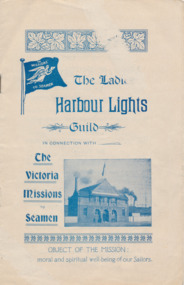
... Charity organisation, Ladies' Harbour Lights Guild, was formed within The Missions to Seamen Institute to provide a home away from home, for visiting seamen. ...Charity organisation, Ladies' Harbour Lights Guild, was formed within The Missions to Seamen Institute to provide a home away from home, for visiting seamen. ...Charity organisation, Ladies' Harbour Lights Guild, was formed within The Missions to Seamen Institute to provide a home away from home, for visiting seamen. The booklet reviews the object of the mission and in particular the role of the Ladies Harbour Light Guild which is to ensure the moral and spiritual well-being of sailors through social events, arranging and attending picnics for the men on public holidays, presiding at the Sunday teas, making gloves, woollies and other comforts and helping to collect and distribute literature (books, papers, etc) . This paper flyer holds historical significance at a local level because it illustrates the Ladies' Harbour Lights Guild involvement in the Mission to Seafarers.The Ladies' Harbour Lights Guild grew to become a significant charity in Melbourne raising large amounts of money which helped to establish the current MTS building, supporting seafarers as well as organizing and attending social events for the seafarers. Small booklet, Written in Blue 8 pages, back to front. The cover has a photo of the MtSV building next to the words " The Victorian Missions to Seamen" and at the bottom the title reads "OBJECT OF THE MISSION: moral and spiritual well-being of our Sailors."missions to seamen institute, ladies' harbour lights guild, purpose, social events, lhlg, australian wharf -
 Mission to Seafarers Victoria
Booklet - Object, Missions to Seamen Institute, The Ladies' Harbour Lights Guild in connection with the Victoria Missions to Seamen-Object of the Mission: moral and spiritual well-being of our Sailors, 1909-1911
... Charity organisation, Ladies' Harbour Lights Guild, was formed within The Missions to Seamen Institute to provide a home away from home, for visiting seamen. ...Charity organisation, Ladies' Harbour Lights Guild, was formed within The Missions to Seamen Institute to provide a home away from home, for visiting seamen. ...Charity organisation, Ladies' Harbour Lights Guild, was formed within The Missions to Seamen Institute to provide a home away from home, for visiting seamen. The booklet reviews the object of the mission and in particular the role of the Ladies Harbour Light Guild which is to ensure the moral and spiritual well-being of sailors through social events, arranging and attending picnics for the men on public holidays, presiding at the Sunday teas, making gloves, woollies and other comforts and helping to collect and distribute literature (books, papers, etc) .This paper flyer holds historical significance at a local level because it illustrates the Ladies' Harbour Lights Guild involvement in the Mission to Seafarers. The Ladies' Harbour Lights Guild grew to become a significant charity in Melbourne raising large amounts of money which helped to establish the current MTS building, supporting seafarers. Small booklet, Written in Blue 8 pages, back to front. The cover has a photo of the MtSV building next to the words " The Victorian Missions to Seamen" and at the bottom the title reads "OBJECT OF THE MISSION: moral and spiritual well-being of our Sailors."missions to seamen institute, ladies' harbour lights guild, mission to seafarers, seamen's mission, lhlg, chapel, flinders street, sir thomas david gibson carmichael (1859–1926) -
 Vision Australia
Document - Text, Blind Lawn Bowls papers
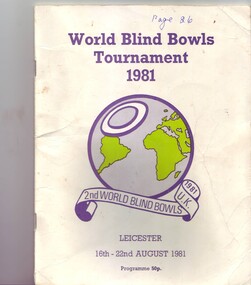
... in 1959, Albert Henry established the NABA (firstly in jest in response to a unfulfilling game of bowls, then as a charity organisation). All monies were to be directed to sick children, and the Blinded Babies fund received a good proportion of this. ...in 1959, Albert Henry established the NABA (firstly in jest in response to a unfulfilling game of bowls, then as a charity organisation). All monies were to be directed to sick children, and the Blinded Babies fund received a good proportion of this. ...This collection of papers provides various information on blind bowls and the charity work undertaken by the Mentone Bowls club. In 1980, Clarrie Hoppitt attended a demonstration at his local club and was so impressed, that he offered his services to help teach blind people to play lawn bowls. This enthusiasm was shared by his wife Grace and together they travelled to Perth and other places to teach as outlined in both the newspaper article and Grace's recollection in this file. Grace's involvement in the 1981 World Blind Bowls Tournament held in Leicester is demonstrated in the programme, alongside the signatures that were collected from the players, coaches and helpers. Also included is a menu from the British Airways flight taken to the tournament, which was signed by the crew, and Clarrie Hoppitt's copy of 'To Teach a Blind Person to Play Bowls'. Additionally there is a photograph of Grace in her Australian team uniform, taken outside a house. in 1959, Albert Henry established the NABA (firstly in jest in response to a unfulfilling game of bowls, then as a charity organisation). All monies were to be directed to sick children, and the Blinded Babies fund received a good proportion of this. Over time the NABA raised $34, 683 during over 20 years of operation (1963-1982) and became a definable part of the Mentone Bowls club.Various loose papers including a newspaper article, 1981 World Blind Bowls Tournament programme, British Airways flight menu signed by the crew for the Blind Bowls team, a photograph and a history of the NABAroyal blind society of new south wales, albert henry, mentone bowls club, clarrie hoppitt, grace hoppitt -
 Clayton RSL Sub Branch
Button, Red Triangle Day, God King Country
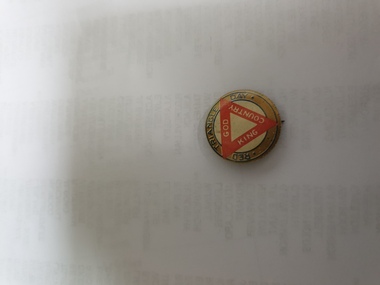
... During World War I, a large number of benevolent and patriotic organisations and charities were formed to raise money from the public for Australia’s war effort and soldiers, whilst other established organisations held specific patriotic fund raising days. ...During World War I, a large number of benevolent and patriotic organisations and charities were formed to raise money from the public for Australia’s war effort and soldiers, whilst other established organisations held specific patriotic fund raising days. ...During World War I, a large number of benevolent and patriotic organisations and charities were formed to raise money from the public for Australia’s war effort and soldiers, whilst other established organisations held specific patriotic fund raising days. ...A circular celluloid and tin button badge with stick pin at back. The badge features black text 'RED TRIANGLE DAY 1 JUNE 1917' printed in a gold border around the outer edge and white text 'GOD/ KING/ COUNTRY' in a red triangle in the centre. The centre background is white. During World War I, a large number of benevolent and patriotic organisations and charities were formed to raise money from the public for Australia’s war effort and soldiers, whilst other established organisations held specific patriotic fund raising days. Red Triangle Day was an initiative of the Young Men's Christian Association, commonly known as the YMCA and this badge incorporates the red triangle used as the everyday logo of the YMCA from 1897 to 1967. In 1917 Red Triangle Day raised £159,037 28 towards the war work of the YMCA.A circular celluloid and tin button badge with stick pin at back. The badge features black text 'RED TRIANGLE DAY 1 JUNE 1917' printed in a gold border around the outer edge and white text 'GOD/ KING/ COUNTRY' in a red triangle in the centre. The centre background is white. During World War I, a large number of benevolent and patriotic organisations and charities were formed to raise money from the public for Australia’s war effort and soldiers, whilst other established organisations held specific patriotic fund raising days. Red Triangle Day was an initiative of the Young Men's Christian Association, commonly known as the YMCA and this badge incorporates the red triangle used as the everyday logo of the YMCA from 1897 to 1967. In 1917 Red Triangle Day raised £159,037 28 towards the war work of the YMCA.Red Triangle Day God King Country -
 Eltham District Historical Society Inc
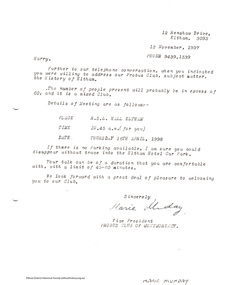
Folder, Notes for talk on the History of Eltham by Harry Gilham, 1997
... A list of community groups, charity funds and other organisations operating in the Shire of Eltham in the 1950s. ...A list of community groups, charity funds and other organisations operating in the Shire of Eltham in the 1950s. ...Folder includes letter confirming invitation to speak at the Probus Club of Montmorency. A list of community groups, charity funds and other organisations operating in the Shire of Eltham in the 1950s. Notes on discussion on what is local history and reference to local places including bridges and examples of change of names and meanings of place names10 pages, 9 of handwritten notesHG Booklet 18harry gilham collection, shire of eltham, community groups, harry gilham -
 Victorian Aboriginal Corporation for Languages
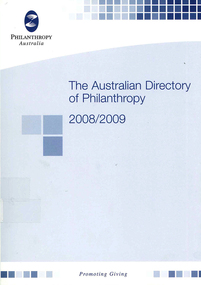
Book, Philanthropy Australia, The Australian directory of philanthropy 2008/?2009, 2007
... 09 is an essential resource for not-for-profit organisations, charities and community groups. It features tips on how to apply for grants, write submissions and research potential funders, and also contains important tax information to help those seeking grants understand what needs to be supplied to foundations in any application for funding. ...09 is an essential resource for not-for-profit organisations, charities and community groups. It features tips on how to apply for grants, write submissions and research potential funders, and also contains important tax information to help those seeking grants understand what needs to be supplied to foundations in any application for funding. ...Listing approximately 350 trusts and foundations, The Australian Directory of Philanthropy 2008/?09 is an essential resource for not-for-profit organisations, charities and community groups. It features tips on how to apply for grants, write submissions and research potential funders, and also contains important tax information to help those seeking grants understand what needs to be supplied to foundations in any application for funding. Includes: charitable trusts and foundations; how to apply for donations from a charitable trust or foundation; the taxation of charitable institutions and trusts; recent developments; directory.document reproductionsphilanthropists, endowments, fund raising, directories -
 Flagstaff Hill Maritime Museum and Village
Furniture - Stool, circa 1880
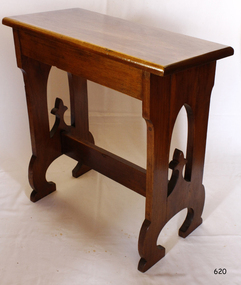
... The stool was possibly donated together with the Mason & Hamilton reed organ, which was generously donated by the Joy Club for Fighters, a charity organisation in Williamstown. THE MISSIONS TO SEAMEN (Brief History: for more, see our Reg. ...The stool was possibly donated together with the Mason & Hamilton reed organ, which was generously donated by the Joy Club for Fighters, a charity organisation in Williamstown. THE MISSIONS TO SEAMEN (Brief History: for more, see our Reg. ...This organ stool was part of the original furnishings of the St Nicholas' Mission to Seamen's Church at 139 Nelson Place, Williamstown, Victoria. The Church was operated by the Mission to Seamen organisation. The stool was possibly donated together with the Mason & Hamilton reed organ, which was generously donated by the Joy Club for Fighters, a charity organisation in Williamstown. THE MISSIONS TO SEAMEN (Brief History: for more, see our Reg. No. 611, Set of Pews) The Missions to Seamen, an Anglican charity, has served seafarers of the world since 1856 in Great Britain. It symbol is a Flying Angel, inspired by a Bible verse. Today there are centr4es in over 200 ports world-wide where seamen of all backgrounds are offered a warm welcome and provided with a wide range of facilities. In Victoria the orgainsation began in Williamstown in 1857. It was as a Sailors’ Church, also known as ‘Bethel’ or the ‘Floating Church’. Its location was an old hulk floating in Hobson’s Bay, Port of Melbourne. It soon became part of the Missions to Seamen, Victoria. In the year 2000 the organisation, now named Mission to Seafarers, still operated locally in Melbourne, Portland, Geelong and Hastings. The Ladies’ Harbour Lights Guild was formed in 1906 to support the Missions to Seamen in Melbourne and other centres such as Williamstown. Two of the most significant ladies of the Guild were founder Ethel Augusta Godfrey and foundation member Alice Sibthorpe Tracy (who established a branch of the Guild in Warrnambool in 1920). The Guild continued its work until the 1960s. In 1943 a former Williamstown bank was purchased for the Missions to Seaman Club. The chapel was named St Nicholas’ Seamen’s Church and was supported by the Ladies’ Harbour Lights Guild, the Williamstown Lightkeepers’ Auxiliary and the League of Soldiers’ and Sailors’ Friends. It ceased operation in 1966. A Missions to Seamen Chapel and Recreation Room was a significant feature of ports during the late 1800s and into the 1900s. It seemed appropriate for Flagstaff Hill to include such a representation within the new Maritime Village, so the Melbourne Board of Management of Missions to Seamen Victoria gave its permission on 21st May 1979 for the entire furnishings of the Williamstown chapel to be transferred to Flagstaff Hill. The St Nicholas Seamen’s Church was officially opened on October 11, 1981 and closely resembles the Williamstown chapel. This organ stool is significant historically for its origin in the St Nicholas Mission to Seamen's Church in Williamstown, established in 1857 to cater for the physical, social, and spiritual needs of seafarers. It originated in Bristol, England when a Seamen's Mission was formed in 1837. The stool is historically significant for its connection to the 1880s Mason & Hamilton reed organ that was also in the St Nicholas Seamen's Church in Williamstown. The connection of this stool to the Mission to Seamen and to the Ladies Lightkeepers’ Auxiliary, and possibly to the Joy Club for Fighters, highlights the strong community awareness of the life of people at sea, their dangers and hardships, and their need for physical, financial, spiritual and moral support. Stool; mahogany organ stool, angled seat with two legs reinforced by horizontal wooden bar. Legs have a decorative cut away design. This stool is in our St Nicholas Seamen's Church Collection.flagstaff hill, warrnambool, maritime museum, maritime village, shipwreck coast, great ocean road, church furniture, religious furniture, religious worship, missions to seamen victoria, st nicholas seamen’s church williamstown, st nicholas seamen’s church flagstaff hill, church music, stool, organ stool, piano stool -
 Brighton Historical Society
Dress, late 1920s
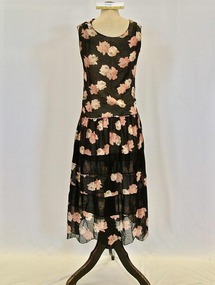
... A passionate member (and founder) of many community organisations and charities, Marie Freda Breen (nee Chamberlin, 1902-1993) had her first experience of public life when her husband Robert became Mayor of Brighton in 1940. ...A passionate member (and founder) of many community organisations and charities, Marie Freda Breen (nee Chamberlin, 1902-1993) had her first experience of public life when her husband Robert became Mayor of Brighton in 1940. ...Worn by Dame Marie Breen DBE OBE, Federal Senator for Victoria and Brighton resident. A passionate member (and founder) of many community organisations and charities, Marie Freda Breen (nee Chamberlin, 1902-1993) had her first experience of public life when her husband Robert became Mayor of Brighton in 1940. She became involved in the fledgeling Liberal Party, and Robert encouraged her to run for office. Marie because Victoria's first female Federal Senator in 1962. In Parliament, she was a vocal advocate for women and families and supported building a stronger relationship between Australia and Asia. In 1965 she became the first woman to chair a Senate committee. Marie retired from politics in 1968, after Robert was badly injured in a car accident. He died shortly after and she re-dedicated herself to community service, raising funds for UNICEF and serving on the Victorian Consultative Committee on Social Development and the Australian Advisory Council of Elders. In 1959 she was appointed an Officer of the British Empire for her work in the role of State President of the National Council of Women (Victoria) and in 1979 she was appointed Dame Commander of the Order of the British Empire. Marie and Robert had three daughters, one of whom, Jeannette Patrick, was the Liberal Member for Brighton (1976-1985) and Parliamentary Secretary of the Liberal Party, (1979-82).Sleeveless black cotton voile dress printed with large cream and apricot coloured roses. Dropped waist; bias-cut triangular draping applied to back neck; two horizontal bands of black voile inserted into skirt.dame marie breen, 1920s, liberal party of australia, australian senate, politics, robert breen -
 Wodonga & District Historical Society Inc
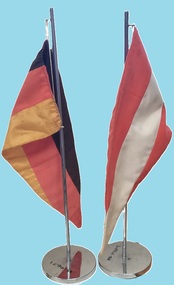
Memorabilia - German and Austrian miniature flags, Unknown
... At the same time members supported other organisations and charities in the Wodonga and wider community. ...At the same time members supported other organisations and charities in the Wodonga and wider community. ...Thousands of German migrants started a new life at Bonegilla, Victoria in the 1950s. Among them were five men who met each other in Wodonga, became friends and decided to form a German Austrian Club, where they could enjoy the company of likeminded individuals. They were Kurt Mueller, Willi Klimt, Toni Krischa and Erwin Klein from Germany and Manfred Teissl from Austria. On the 16th July 1960, after advertising in the Border Morning Mail, the German Austrian Club in Wodonga was born. Office bearers were Paul Peters as President. Gerhard Ziermann as Secretary and Günter Schmehl as Treasurer. Their aim was "To promote the upkeep of the German language in written and spoken form and to promote good German fellowship, while enjoying functions of a cultural and entertaining nature". By 1963 the Club boasted 40 members, holding meetings at the RSL Clubrooms and other suitable locations before they found a house in Hovell Street, Wodonga. It was used for meetings, Skat meetings, film nights and "Sonnabendschule” or Saturday school where children of members could continue to learn German. The Committee organised a wide range of activities and functions in their small rooms but dreamed of having a bigger home. This became reality in July 1979, when the Committee purchased land from the Albury Wodonga Development Corporation at 5 McFarland Road, Wodonga. The first brick was laid on the Club's land in May 1980, and the double-storey brick building was completed within 12 months voluntarily by Club members. At the same time members supported other organisations and charities in the Wodonga and wider community. The first Oktoberfest in Wodonga was held in 1975, drawing 4,000 attendees. The event was organized to promote German culture, and the profits from the first year were donated to the Wodonga District Hospital, raising $20,000. In 2001 the German Austrian Club was presented with the Certificate of Meritorious Service by the Government of Victoria for Community Works in Wodonga and district. The Club raised $23,000 for the Wodonga Hospital, had numerous fundraisers to assist in bushfires and drought situations and was involved in the Red Cross Calling campaign for many years. After much fundraising, hard work and making their way through extensive government red tape, the Club moved to its new premises in McFarland Road on 1st August 1981. The members continued to make necessary internal adjustments and sought an alcohol licence. The building was officially opened in May 1983. The Club prospered and had 300 members, making it necessary for new applicants to be put on a waiting list to be accepted as members. Interest groups consisted of Competition Air Rifle Shooting Group, a Skat (German Card game) Group, Folk Dancing Group, Ladies Group, Table Tennis Group, Darts Group, Chess Group and the Billiard Group. In later years, as so many Australians became members, the Club’s name was changed to the German Austrian Australian Club. Over recent years patronage and interest in the Club and its activities changed. Children of the original members had become “real Aussies” and did not always want to carry on traditions. Aging membership and lack of volunteers forced the Club to disband in 2025. The Club building has been gifted to the Albury Wodonga Theatre Company.These items are significant because they are representative of an important cultural organisation which operated in Wodonga for over 60 years.Two small flags of Germany and Austria attached to metal stands with string. Each stand has a metal circular base. "Lufthansa" is inscribed on the base.On base: Lufthansagerman austrian australian club, german austrian club -
 Wodonga & District Historical Society Inc
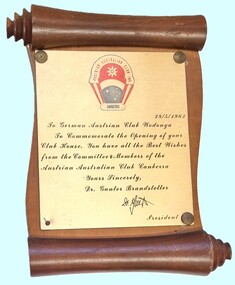
Plaque - German-Austrian Club Wodonga Opening, 1983
... At the same time members supported other organisations and charities in the Wodonga and wider community. ...At the same time members supported other organisations and charities in the Wodonga and wider community. ...Thousands of German migrants started a new life at Bonegilla, Victoria in the 1950s. Among them were five men who met each other in Wodonga, became friends and decided to form a German Austrian Club, where they could enjoy the company of likeminded individuals. They were Kurt Mueller, Willi Klimt, Toni Krischa and Erwin Klein from Germany and Manfred Teissl from Austria. On the 16th July 1960, after advertising in the Border Morning Mail the German Austrian Club in Wodonga was born. Office bearers were Paul Peters as President. Gerhard Ziermann as Secretary and Günter Schmehl as Treasurer. Their aim was "To promote the upkeep of the German language in written and spoken form and to promote good German fellowship, while enjoying functions of a cultural and entertaining nature". By 1963 the Club boasted 40 members, holding meetings at the RSL Clubrooms and other suitable locations before they found a house in Hovell Street, Wodonga. It was used for meetings, Skat meetings, film nights and Sonnabendschule” or Saturday school where children of members could continue to learn German. The Committee organised a wide range of activities and functions in their small rooms but dreamed of having a bigger home. This became reality in July 1979, when the Committee purchased land from the Albury Wodonga Development Corporation at 5 McFarland Road, Wodonga. The first brick was laid on the Club's land in May 1980, and the double-story brick building was completed within 12 months voluntarily by Club members. At the same time members supported other organisations and charities in the Wodonga and wider community. The first Oktoberfest in Wodonga was held in 1975, drawing 4,000 attendees. The event was organized to promote German culture, and the profits from the first year were donated to the Wodonga District Hospital, raising $20,000. In 2001 the German Austrian Club was presented with the Certificate of Meritorious Service by the Government of Victoria for Community Works in Wodonga and district. The Club raised $23,000 for the Wodonga Hospital, had numerous fundraisers to assist in bushfires and drought situations and was involved in the Red Cross Calling campaign for many years. After much fundraising, hard work and making their way through extensive government red tape, the Club moved to its new premises in McFarland Road on 1st August 1981. The members continued to make necessary internal adjustments and sought an alcohol licence. The building was officially opened in May 1983. The Club prospered and had 300 members, making it necessary for new applicants to be put on a waiting list to be accepted as members. Interest groups formed consisted of Competition Air Rifle Shooting Group, a Skat (German Card game) Group, Folk Dancing Group, Ladies Group, Table Tennis Group, Darts Group, Chess Group and the Billiard Group. In later years, as so many Australians became members, the Club’s name was changed to the German Austrian Australian Club. Over recent years patronage and interest in the Club and its activities changed. Children of the original members had become “real Aussies” and did not always want to carry on traditions. Aging membership and lack of volunteers forced the Club to disband in 2025. The Club building has been gifted to the Albury Wodonga Theatre Company. These items are significant because they are representative of an important cultural organisation which operated in Wodonga for over 60 years.A metal plaque attached to a wooden backing shaped like a scroll. The text is in the form of a letter.Emblem of the Austrian - Australian Clubs Inc. Canberra 28/5/1983 To German Austrian Club Wodonga To Commemorate the Opening of your Club House. You have all the Best Wishes from the Committee & Members of the Austrian Australian Club Canberra Yours Sincerely, Dr. Gunter Brandstetter Presidentgerman austrian australian club, german migrants wodonga -
 Wodonga & District Historical Society Inc
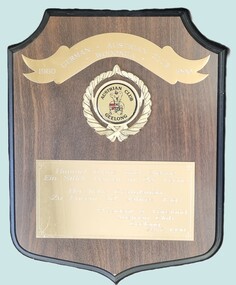
Plaque - German-Austrian Club Wodonga 30th Anniversary, 1990
... At the same time members supported other organisations and charities in the Wodonga and wider community. ...At the same time members supported other organisations and charities in the Wodonga and wider community. ...Thousands of German migrants started a new life at Bonegilla, Victoria in the 1950s. Among them were five men who met each other in Wodonga, became friends and decided to form a German Austrian Club, where they could enjoy the company of likeminded individuals. They were Kurt Mueller, Willi Klimt, Toni Krischa and Erwin Klein from Germany and Manfred Teissl from Austria. On the 16th July 1960, after advertising in the Border Morning Mail the German Austrian Club in Wodonga was born. Office bearers were Paul Peters as President. Gerhard Ziermann as Secretary and Günter Schmehl as Treasurer. Their aim was "To promote the upkeep of the German language in written and spoken form and to promote good German fellowship, while enjoying functions of a cultural and entertaining nature". By 1963 the Club boasted 40 members, holding meetings at the RSL Clubrooms and other suitable locations before they found a house in Hovell Street, Wodonga. It was used for meetings, Skat meetings, film nights and Sonnabendschule” or Saturday school where children of members could continue to learn German. The Committee organised a wide range of activities and functions in their small rooms but dreamed of having a bigger home. This became reality in July 1979, when the Committee purchased land from the Albury Wodonga Development Corporation at 5 McFarland Road, Wodonga. The first brick was laid on the Club's land in May 1980, and the double-story brick building was completed within 12 months voluntarily by Club members. At the same time members supported other organisations and charities in the Wodonga and wider community. The first Oktoberfest in Wodonga was held in 1975, drawing 4,000 attendees. The event was organized to promote German culture, and the profits from the first year were donated to the Wodonga District Hospital, raising $20,000. In 2001 the German Austrian Club was presented with the Certificate of Meritorious Service by the Government of Victoria for Community Works in Wodonga and district. The Club raised $23,000 for the Wodonga Hospital, had numerous fundraisers to assist in bushfires and drought situations and was involved in the Red Cross Calling campaign for many years. After much fundraising, hard work and making their way through extensive government red tape, the Club moved to its new premises in McFarland Road on 1st August 1981. The members continued to make necessary internal adjustments and sought an alcohol licence. The building was officially opened in May 1983. The Club prospered and had 300 members, making it necessary for new applicants to be put on a waiting list to be accepted as members. Interest groups formed consisted of Competition Air Rifle Shooting Group, a Skat (German Card game) Group, Folk Dancing Group, Ladies Group, Table Tennis Group, Darts Group, Chess Group and the Billiard Group. In later years, as so many Australians became members, the Club’s name was changed to the German Austrian Australian Club. Over recent years patronage and interest in the Club and its activities changed. Children of the original members had become “real Aussies” and did not always want to carry on traditions. Aging membership and lack of volunteers forced the Club to disband in 2025. The Club building has been gifted to the Albury Wodonga Theatre Company.This item is significant because it is representative of an important cultural organisation which operated in Wodonga for over 60 years.A wooden plaque with metal insignia and a plate with text in German. This plaque was presented by the German Austrian Club of Geelong on the occasion of the 30th Anniversary of the Wodonga Club and bears its insignia.Himmel Glanz und Sterne Ein Stuck Heimat in Der Fern Herzliche Gratulation Zu Eurem 30 Jahres Tag President and Vorstand Translation Sky, splendour and stars A piece of home away from home Congratulations On your 30th anniversary President and Board of Directorsgerman austrian australian club, german migrants wodonga -
 Wodonga & District Historical Society Inc
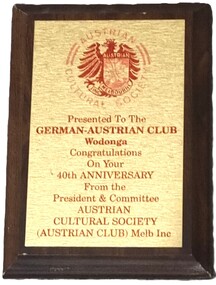
Plaque - German-Austrian Club Wodonga 40th Anniversary, 2000
... At the same time members supported other organisations and charities in the Wodonga and wider community. ...At the same time members supported other organisations and charities in the Wodonga and wider community. ...Thousands of German migrants started a new life at Bonegilla, Victoria in the 1950s. Among them were five men who met each other in Wodonga, became friends and decided to form a German Austrian Club, where they could enjoy the company of likeminded individuals. They were Kurt Mueller, Willi Klimt, Toni Krischa and Erwin Klein from Germany and Manfred Teissl from Austria. On the 16th July 1960, after advertising in the Border Morning Mail the German Austrian Club in Wodonga was born. Office bearers were Paul Peters as President. Gerhard Ziermann as Secretary and Günter Schmehl as Treasurer. Their aim was "To promote the upkeep of the German language in written and spoken form and to promote good German fellowship, while enjoying functions of a cultural and entertaining nature". By 1963 the Club boasted 40 members, holding meetings at the RSL Clubrooms and other suitable locations before they found a house in Hovell Street, Wodonga. It was used for meetings, Skat meetings, film nights and Sonnabendschule” or Saturday school where children of members could continue to learn German. The Committee organised a wide range of activities and functions in their small rooms but dreamed of having a bigger home. This became reality in July 1979, when the Committee purchased land from the Albury Wodonga Development Corporation at 5 McFarland Road, Wodonga. The first brick was laid on the Club's land in May 1980, and the double-story brick building was completed within 12 months voluntarily by Club members. At the same time members supported other organisations and charities in the Wodonga and wider community. The first Oktoberfest in Wodonga was held in 1975, drawing 4,000 attendees. The event was organized to promote German culture, and the profits from the first year were donated to the Wodonga District Hospital, raising $20,000. In 2001 the German Austrian Club was presented with the Certificate of Meritorious Service by the Government of Victoria for Community Works in Wodonga and district. The Club raised $23,000 for the Wodonga Hospital, had numerous fundraisers to assist in bushfires and drought situations and was involved in the Red Cross Calling campaign for many years. After much fundraising, hard work and making their way through extensive government red tape, the Club moved to its new premises in McFarland Road on 1st August 1981. The members continued to make necessary internal adjustments and sought an alcohol licence. The building was officially opened in May 1983. The Club prospered and had 300 members, making it necessary for new applicants to be put on a waiting list to be accepted as members. Interest groups formed consisted of Competition Air Rifle Shooting Group, a Skat (German Card game) Group, Folk Dancing Group, Ladies Group, Table Tennis Group, Darts Group, Chess Group and the Billiard Group. In later years, as so many Australians became members, the Club’s name was changed to the German Austrian Australian Club. Over recent years patronage and interest in the Club and its activities changed. Children of the original members had become “real Aussies” and did not always want to carry on traditions. Aging membership and lack of volunteers forced the Club to disband in 2025. The Club building has been gifted to the Albury Wodonga Theatre Company.This item is significant because it is representative of an important cultural organisation which operated in Wodonga for over 60 years.A small metal plaque on a wooden backing with red text. It includes the insignia of the Austrian Cultural Society of Melbourne.Presented To The GERMAN-AUSTRIAN CLUB Wodonga Congratulations On Your 40th ANNIVERSARY From the President & Committee AUSTRIAN CULTURAL SOCIETY (AUSTRIAN CLUB) Melb Incgerman austrian australian club, german migrants wodonga -
 Wodonga & District Historical Society Inc
Plaque - German-Austrian Club Wodonga 50th Anniversary, 2010
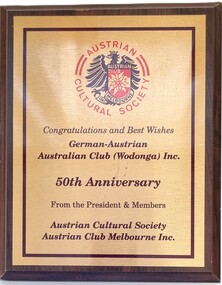
... At the same time members supported other organisations and charities in the Wodonga and wider community. ...At the same time members supported other organisations and charities in the Wodonga and wider community. ...Thousands of German migrants started a new life at Bonegilla, Victoria in the 1950s. Among them were five men who met each other in Wodonga, became friends and decided to form a German Austrian Club, where they could enjoy the company of likeminded individuals. They were Kurt Mueller, Willi Klimt, Toni Krischa and Erwin Klein from Germany and Manfred Teissl from Austria. On the 16th July 1960, after advertising in the Border Morning Mail the German Austrian Club in Wodonga was born. Office bearers were Paul Peters as President. Gerhard Ziermann as Secretary and Günter Schmehl as Treasurer. Their aim was "To promote the upkeep of the German language in written and spoken form and to promote good German fellowship, while enjoying functions of a cultural and entertaining nature". By 1963 the Club boasted 40 members, holding meetings at the RSL Clubrooms and other suitable locations before they found a house in Hovell Street, Wodonga. It was used for meetings, Skat meetings, film nights and Sonnabendschule” or Saturday school where children of members could continue to learn German. The Committee organised a wide range of activities and functions in their small rooms but dreamed of having a bigger home. This became reality in July 1979, when the Committee purchased land from the Albury Wodonga Development Corporation at 5 McFarland Road, Wodonga. The first brick was laid on the Club's land in May 1980, and the double-story brick building was completed within 12 months voluntarily by Club members. At the same time members supported other organisations and charities in the Wodonga and wider community. The first Oktoberfest in Wodonga was held in 1975, drawing 4,000 attendees. The event was organized to promote German culture, and the profits from the first year were donated to the Wodonga District Hospital, raising $20,000. In 2001 the German Austrian Club was presented with the Certificate of Meritorious Service by the Government of Victoria for Community Works in Wodonga and district. The Club raised $23,000 for the Wodonga Hospital, had numerous fundraisers to assist in bushfires and drought situations and was involved in the Red Cross Calling campaign for many years. After much fundraising, hard work and making their way through extensive government red tape, the Club moved to its new premises in McFarland Road on 1st August 1981. The members continued to make necessary internal adjustments and sought an alcohol licence. The building was officially opened in May 1983. The Club prospered and had 300 members, making it necessary for new applicants to be put on a waiting list to be accepted as members. Interest groups formed consisted of Competition Air Rifle Shooting Group, a Skat (German Card game) Group, Folk Dancing Group, Ladies Group, Table Tennis Group, Darts Group, Chess Group and the Billiard Group. In later years, as so many Australians became members, the Club’s name was changed to the German Austrian Australian Club. Over recent years patronage and interest in the Club and its activities changed. Children of the original members had become “real Aussies” and did not always want to carry on traditions. Aging membership and lack of volunteers forced the Club to disband in 2025. The Club building has been gifted to the Albury Wodonga Theatre Company.This item is significant because it is representative of an important cultural organisation which operated in Wodonga for over 60 years.A small metal plaque on a wooden backing with red text. It includes the insignia of the Austrian Cultural Society of Melbourne.Congratulations and Best Wishes German-Austrian Australian Club (Wodonga) Inc. 50th Anniversary From the President & Members Austrian Cultural Society Austrian Club Melbourne Inc.german austrian australian club, german migrants wodonga -
 Flagstaff Hill Maritime Museum and Village
Furniture - Chair, ca. 1944
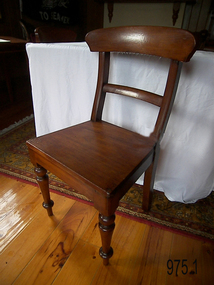
... organisation. THE MISSIONS TO SEAMEN (Brief History: for more, see our Reg. No. 611, Set of Pews) The Missions to Seamen was an Anglican charity that served seafarers of the world since 1856 in Great Britain. ...organisation. THE MISSIONS TO SEAMEN (Brief History: for more, see our Reg. No. 611, Set of Pews) The Missions to Seamen was an Anglican charity that served seafarers of the world since 1856 in Great Britain. ...This chair, one of a set of three, was part of the original furnishings of the St Nicholas' Mission to Seamen's Church at 139 Nelson Place, Williamstown, Victoria. The Church was operated by the Mission to Seamen organisation. THE MISSIONS TO SEAMEN (Brief History: for more, see our Reg. No. 611, Set of Pews) The Missions to Seamen was an Anglican charity that served seafarers of the world since 1856 in Great Britain. It symbol is a Flying Angel, inspired by a Bible verse. Today there are centres in over 200 ports worldwide where seamen of all backgrounds are offered a warm welcome and provided with a wide range of facilities. In Victoria, the organisation began in Williamstown in 1857 as a Sailors’ Church, also known as ‘Bethel’ or the ‘Floating Church’ in an old hulk floating in Hobson’s Bay, Port of Melbourne. It soon became part of the Missions to Seamen, Victoria. In the year 2000 the organisation, now named Mission to Seafarers, still operated locally in Melbourne, Portland, Geelong and Hastings. The Ladies’ Harbour Lights Guild was formed in 1906 to support the Missions to Seamen in Melbourne and other centres such as Williamstown. Two of the most significant ladies of the Guild were founder Ethel Augusta Godfrey and foundation member Alice Sibthorpe Tracy (who established a branch of the Guild in Warrnambool in 1920). The Guild continued its work until the 1960s. In 1943 a former Williamstown bank was purchased for the Missions to Seaman Club. The chapel was named St Nicholas’ Seamen’s Church and was supported by the Ladies’ Harbour Lights Guild, the Williamstown Lightkeepers’ Auxiliary and the League of Soldiers’ and Sailors’ Friends. It ceased operation in 1966. A Missions to Seamen Chapel and Recreation Room was a significant feature of ports during the late 1800s and into the 1900s. It seemed appropriate for Flagstaff Hill to include such a representation within the new Maritime Village, so the Melbourne Board of Management of Missions to Seamen Victoria gave its permission on 21st May 1979 for the entire furnishings of the Williamstown chapel to be transferred to Flagstaff Hill. The St Nicholas Seamen’s Church was officially opened on October 11, 1981, and closely resembles the Williamstown chapel. This chair is historically significant for its origin in the St Nicholas Mission to Seamen's Church in Williamstown, established in 1857 to cater for the physical, social, and spiritual needs of seafarers. The organisation originated in Bristol, England, when a Seamen's Mission was formed in 1837. Chair, dark brown wood, curved backrest. One of a set of three. The two front legs are decoratively shaped (turned), while the back legs are plain and flat-sided. It has an almost square flat seat. This chair is part of the St Nicholas Seamen's Church Collection. flagstaff hill maritime museum and village, flagstaff hill, warrnambool, maritime museum, maritime village, shipwreck coast, great ocean road, religion, religious service, st nicholas seamen’s church, williamstown, missions to seamen victoria, chair, religious furniture, dining chair, church furniture, religious worship, anglican church, worship service, mission to seafarers, st nicholas missions to seamen’s church williamstown, missions to seamen, st nicholas missions to seamen’s church flagstaff hill, 139 nelson place williamstown
