
Showing 502 items matching "conservation areas"
-
 Port Melbourne Historical & Preservation Society
Booklet, Ministry of Planning & Environment, Urban Conservation Areas, Aug 1986
... Urban Conservation Areas......urban conservation areas...Booklet outlining the historic and architectural character of a number of areas in Melbourne's inner suburbs including Port Melbourne, and their subsequent designation as Urban Conservation areas. Brown and cream 14 page booklet, cover showing terrace houses. ...Also Community Planning Bulletin Urban Conservation Areas Booklet Ministry of Planning & Environment F D Atkinson, Government Printer ...Booklet outlining the historic and architectural character of a number of areas in Melbourne's inner suburbs including Port Melbourne, and their subsequent designation as Urban Conservation areas. Brown and cream 14 page booklet, cover showing terrace houses. Also Community Planning Bulletintown planning, built environment, parks and gardens, heritage, conservation - urban, conservation - parks and boulevards, ministry for planning and environment, urban conservation areas -
Glen Eira Historical Society
Document - Historic Conservation Areas Project
... Historic Conservation Areas Project...Historic Conservation Areas Project Niven Barbara...Note: newsletters stamped with Caulfield Historical Society. 2/Letter (one page on official city of Caulfield letterhead) from Andrew Rodda (manager planning) to Hazal Ford (dated 13/11/1989) describing ‘council resolved on 18/07/1989 to proceed with preliminary conservation survey’ and mentions that a copy is included. 3/Preliminary conservation survey for the City of Caulfield (nine pages) describing background, study area, budget, purpose, study outline, timeframe, report format, ownership, tasks and background information (mentions number and types of houses and properties as at 1986 and 1988) and a map of City of Caulfield. 4/Booklet (28 pages) titled ‘Heritage Area – Caulfield North Draft Heritage Guidelines July 1999 – City of Glen Eira’, containing Caulfield North Heritage Area, cultural heritage, Heritage Overlay Area, architectural description, common architectural forms and features, development guidelines, key design checklist. ...It includes a map of the Caulfield North Heritage Overlay Area, two illustrations about the development envelope and many black-and-white photographs of houses and architectural features. Historic Conservation Areas Project Niven Barbara Newsletters Town Planning Historic Buildings Heritage Studies Housing Royal Historical Society of Victoria (RHSV) Read Michael Plans Local Government Historical Societies Committee for Urban Action (CUA) National Trust Hopkins Sherry Ms. ...Contains 4 items relating to historic conservation: 1/Five newsletters (one page each newsletter, dated 07/1975, 08/1975, 09/1975, 10/1975 and the final one 12/1975) describing how the project evolved, project funds, progress, study method, project 1 report, project 2 report and summary as no further funds available. Project was to include all of Melbourne but funding did not allow this. Note: newsletters stamped with Caulfield Historical Society. 2/Letter (one page on official city of Caulfield letterhead) from Andrew Rodda (manager planning) to Hazal Ford (dated 13/11/1989) describing ‘council resolved on 18/07/1989 to proceed with preliminary conservation survey’ and mentions that a copy is included. 3/Preliminary conservation survey for the City of Caulfield (nine pages) describing background, study area, budget, purpose, study outline, timeframe, report format, ownership, tasks and background information (mentions number and types of houses and properties as at 1986 and 1988) and a map of City of Caulfield. 4/Booklet (28 pages) titled ‘Heritage Area – Caulfield North Draft Heritage Guidelines July 1999 – City of Glen Eira’, containing Caulfield North Heritage Area, cultural heritage, Heritage Overlay Area, architectural description, common architectural forms and features, development guidelines, key design checklist. It includes a map of the Caulfield North Heritage Overlay Area, two illustrations about the development envelope and many black-and-white photographs of houses and architectural features.historic conservation areas project niven barbara, newsletters, town planning, historic buildings, heritage studies, housing, royal historical society of victoria (rhsv), read michael, plans, local government, historical societies, committee for urban action (cua), national trust, hopkins sherry ms., ford hazel, preliminary conservation survey, town planning, heritage studies, rodda andrew, city of caulfield, housing estates, victoria national estate grants program, australia icomos, burra charter, buildings structures and establishments, land surveys, suburbs, historic buildings, architectural significance, ‘caulfield’s heritage study’, soloman geulah dr., caulfield library, dandenong road, nepean highway, hotham street, iknerman road, orrong road, north road, poath road, ‘plan of the city of caulfield’, north ward, east ward, south ward, west ward, kooyong road, neerim road, bambra road, balaclava road, shire of caulfield, railways, world war 1914-1918, depression 1929-1939, rippon lea, labassa, parks, mansions, community services, ‘caulfield north draft heritage guidelines july 1999’, city of glen eira, caulfield north heritage area, glen eira heritage management plan, mayfield grove, normanby avenue, carnarvon street, glenferrie street, arthur street, malakoff street, normanby road, heritage advisory service, construction materials, victorian style, mediterranean style, spanish mission style, californian bungalow style, federation style, architectural style, architectural features, heritage conservation design, building construction, building regulations, aboriginal peoples, carnarvon road -
Port Melbourne Historical & Preservation Society
Booklet - Ministry for Planning and Environment, Urban Conservation Areas, Aug 1986
... Urban Conservation Areas...Ministry for Planning and Environment booklet of Urban Conservation Areas August 1986, detailing in words and sketches areas of inner Melbourne of special significance historically and architecturally, to be preserved. 16 pp, brown ink on cream paper....Urban Conservation Areas Booklet Ministry for Planning and Environment Ministry for Planning and Environment Government Printer ...Ministry for Planning and Environment booklet of Urban Conservation Areas August 1986, detailing in words and sketches areas of inner Melbourne of special significance historically and architecturally, to be preserved. 16 pp, brown ink on cream paper.built environment, garden city, town planning, victorian ministry for planning and environment -
 Robin Boyd Foundation
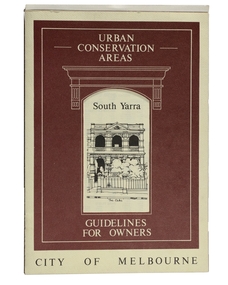
Pamphlet, City of Melbourne, Urban Conservation Areas South Yarra, 1987
... Urban Conservation Areas South Yarra...Guidelines to newly introduced Urban Conservation Area...Guidelines to newly introduced Urban Conservation Area urban conservation environment Walsh St library Urban Conservation Areas South Yarra Pamphlet City of Melbourne ...Guidelines to newly introduced Urban Conservation Areaurban conservation, environment, walsh st library -
 Eltham District Historical Society Inc
Document, Carlotta Kellaway, Shire of Eltham Heritage Study 1992 Volume 2 (draft): Background History - Themes identified by this study, Bibliography (pages 201-289), 1992
... ...conservation areas...Shire of Eltham Heritage Study 1992 prepared by David Bick and Carlotta Kellaway; Garden Evaluation by John Patrick and Planting Evaluation by Ken Wallace Volume One: Recommendations, Conservation Areas, Identified Places Volume Two: Environmental History and Bibliography Volume Three: Culturally Significant Themes and the Evaluations of the Individually Identified Places that Illustrate the Themes...Background history carlotta kellaway conservation areas culturally significant themes david bick garden evaluation Heritage Study identified places john patrick ken wallace planting evaluation recommendations shire of eltham heritage study 90 A4 pages (double sided), contyained in black PVC 2-ring binder. ...Shire of Eltham Heritage Study 1992 prepared by David Bick and Carlotta Kellaway; Garden Evaluation by John Patrick and Planting Evaluation by Ken Wallace Volume One: Recommendations, Conservation Areas, Identified Places Volume Two: Environmental History and Bibliography Volume Three: Culturally Significant Themes and the Evaluations of the Individually Identified Places that Illustrate the ThemesProvides the foundation for future planning assessments in the Shire of Eltham.90 A4 pages (double sided), contyained in black PVC 2-ring binder.background history, carlotta kellaway, conservation areas, culturally significant themes, david bick, garden evaluation, heritage study, identified places, john patrick, ken wallace, planting evaluation, recommendations, shire of eltham heritage study -
 Eltham District Historical Society Inc
Document, Carlotta Kellaway, Shire of Eltham Heritage Study 1992 Volume 3: Culturally Significant Themes - Evaluation of identified places that illustrate them; Volume 3, Part A (pages 302-631), 1992
... david bick, carlotta kellaway, john patrick, ken wallace, shire of eltham heritage study, garden evaluation, planting evaluation, recommendations, conservation areas, identified places, environmental history, culturally significant themes...Shire of Eltham Heritage Study 1992 prepared by David Bick and Carlotta Kellaway; Garden Evaluation by John Patrick and Planting Evaluation by Ken Wallace Volume One: Recommendations, Conservation Areas, Identified Places Volume Two: Environmental History and Bibliography Volume Three: Culturally Significant Themes and the Evaluations of the Individually Identified Places that Illustrate the Themes...Shire of Eltham Heritage Study 1992 prepared by David Bick and Carlotta Kellaway; Garden Evaluation by John Patrick and Planting Evaluation by Ken Wallace Volume One: Recommendations, Conservation Areas, Identified Places Volume Two: Environmental History and Bibliography Volume Three: Culturally Significant Themes and the Evaluations of the Individually Identified Places that Illustrate the Themes Provide the foundation for future planning assessments in the shire david bick, carlotta kellaway, john patrick, ken wallace, shire of eltham heritage study, garden evaluation, planting evaluation, recommendations, conservation areas, identified places, environmental history, culturally significant themes 167 A4 pages (double sided), spiral bound with clear pastic front cover and black card end cover. ...Shire of Eltham Heritage Study 1992 prepared by David Bick and Carlotta Kellaway; Garden Evaluation by John Patrick and Planting Evaluation by Ken Wallace Volume One: Recommendations, Conservation Areas, Identified Places Volume Two: Environmental History and Bibliography Volume Three: Culturally Significant Themes and the Evaluations of the Individually Identified Places that Illustrate the ThemesProvide the foundation for future planning assessments in the shire167 A4 pages (double sided), spiral bound with clear pastic front cover and black card end cover.david bick, carlotta kellaway, john patrick, ken wallace, shire of eltham heritage study, garden evaluation, planting evaluation, recommendations, conservation areas, identified places, environmental history, culturally significant themes -
 Eltham District Historical Society Inc
Document, Carlotta Kellaway, Shire of Eltham Heritage Study 1992 Volume 3: Culturally Significant Themes - Evaluation of identified places that illustrate them; Volume 3, Part B (pages 632-887), 1992
... david bick, carlotta kellaway, john patrick, ken wallace, shire of eltham heritage study, garden evaluation, planting evaluation, recommendations, conservation areas, identified places, environmental history, culturally significant themes...Shire of Eltham Heritage Study 1992 prepared by David Bick and Carlotta Kellaway; Garden Evaluation by John Patrick and Planting Evaluation by Ken Wallace Volume One: Recommendations, Conservation Areas, Identified Places Volume Two: Environmental History and Bibliography Volume Three: Culturally Significant Themes and the Evaluations of the Individually Identified Places that Illustrate the Themes...Shire of Eltham Heritage Study 1992 prepared by David Bick and Carlotta Kellaway; Garden Evaluation by John Patrick and Planting Evaluation by Ken Wallace Volume One: Recommendations, Conservation Areas, Identified Places Volume Two: Environmental History and Bibliography Volume Three: Culturally Significant Themes and the Evaluations of the Individually Identified Places that Illustrate the Themes Provide the foundation for future planning assessments in the shire david bick, carlotta kellaway, john patrick, ken wallace, shire of eltham heritage study, garden evaluation, planting evaluation, recommendations, conservation areas, identified places, environmental history, culturally significant themes 130 A4 pages (double sided), spiral bound with clear pastic front cover and black card end cover. ...Shire of Eltham Heritage Study 1992 prepared by David Bick and Carlotta Kellaway; Garden Evaluation by John Patrick and Planting Evaluation by Ken Wallace Volume One: Recommendations, Conservation Areas, Identified Places Volume Two: Environmental History and Bibliography Volume Three: Culturally Significant Themes and the Evaluations of the Individually Identified Places that Illustrate the ThemesProvide the foundation for future planning assessments in the shire130 A4 pages (double sided), spiral bound with clear pastic front cover and black card end cover.david bick, carlotta kellaway, john patrick, ken wallace, shire of eltham heritage study, garden evaluation, planting evaluation, recommendations, conservation areas, identified places, environmental history, culturally significant themes -
 Eltham District Historical Society Inc
Document, Carlotta Kellaway, Shire of Eltham Heritage Study 1992 Volume 3: Culturally Significant Themes - Evaluation of identified places that illustrate them; Volume 3, Part C (pages 888-1115), 1992
... david bick, carlotta kellaway, john patrick, ken wallace, shire of eltham heritage study, garden evaluation, planting evaluation, recommendations, conservation areas, identified places, environmental history, culturally significant themes...Shire of Eltham Heritage Study 1992 prepared by David Bick and Carlotta Kellaway; Garden Evaluation by John Patrick and Planting Evaluation by Ken Wallace Volume One: Recommendations, Conservation Areas, Identified Places Volume Two: Environmental History and Bibliography Volume Three: Culturally Significant Themes and the Evaluations of the Individually Identified Places that Illustrate the Themes...Shire of Eltham Heritage Study 1992 prepared by David Bick and Carlotta Kellaway; Garden Evaluation by John Patrick and Planting Evaluation by Ken Wallace Volume One: Recommendations, Conservation Areas, Identified Places Volume Two: Environmental History and Bibliography Volume Three: Culturally Significant Themes and the Evaluations of the Individually Identified Places that Illustrate the Themes Provide the foundation for future planning assessments in the shire david bick, carlotta kellaway, john patrick, ken wallace, shire of eltham heritage study, garden evaluation, planting evaluation, recommendations, conservation areas, identified places, environmental history, culturally significant themes 115 A4 pages (double sided), spiral bound with clear pastic front cover and black card end cover. ...Shire of Eltham Heritage Study 1992 prepared by David Bick and Carlotta Kellaway; Garden Evaluation by John Patrick and Planting Evaluation by Ken Wallace Volume One: Recommendations, Conservation Areas, Identified Places Volume Two: Environmental History and Bibliography Volume Three: Culturally Significant Themes and the Evaluations of the Individually Identified Places that Illustrate the ThemesProvide the foundation for future planning assessments in the shire115 A4 pages (double sided), spiral bound with clear pastic front cover and black card end cover.david bick, carlotta kellaway, john patrick, ken wallace, shire of eltham heritage study, garden evaluation, planting evaluation, recommendations, conservation areas, identified places, environmental history, culturally significant themes -
 Eltham District Historical Society Inc
Document, Carlotta Kellaway, Shire of Eltham Heritage Study 1992 Volume 3: Culturally Significant Themes - Evaluation of identified places that illustrate them; Volume 3, Part D (pages 1116-1367), 1992
... david bick, carlotta kellaway, john patrick, ken wallace, shire of eltham heritage study, garden evaluation, planting evaluation, recommendations, conservation areas, identified places, environmental history, culturally significant themes...Shire of Eltham Heritage Study 1992 prepared by David Bick and Carlotta Kellaway; Garden Evaluation by John Patrick and Planting Evaluation by Ken Wallace Volume One: Recommendations, Conservation Areas, Identified Places Volume Two: Environmental History and Bibliography Volume Three: Culturally Significant Themes and the Evaluations of the Individually Identified Places that Illustrate the Themes...Shire of Eltham Heritage Study 1992 prepared by David Bick and Carlotta Kellaway; Garden Evaluation by John Patrick and Planting Evaluation by Ken Wallace Volume One: Recommendations, Conservation Areas, Identified Places Volume Two: Environmental History and Bibliography Volume Three: Culturally Significant Themes and the Evaluations of the Individually Identified Places that Illustrate the Themes Provide the foundation for future planning assessments in the shire david bick, carlotta kellaway, john patrick, ken wallace, shire of eltham heritage study, garden evaluation, planting evaluation, recommendations, conservation areas, identified places, environmental history, culturally significant themes 127 A4 pages (double sided) and 3 A3 fold-out pages, spiral bound with clear pastic front cover and black card end cover. ...Shire of Eltham Heritage Study 1992 prepared by David Bick and Carlotta Kellaway; Garden Evaluation by John Patrick and Planting Evaluation by Ken Wallace Volume One: Recommendations, Conservation Areas, Identified Places Volume Two: Environmental History and Bibliography Volume Three: Culturally Significant Themes and the Evaluations of the Individually Identified Places that Illustrate the ThemesProvide the foundation for future planning assessments in the shire127 A4 pages (double sided) and 3 A3 fold-out pages, spiral bound with clear pastic front cover and black card end cover.david bick, carlotta kellaway, john patrick, ken wallace, shire of eltham heritage study, garden evaluation, planting evaluation, recommendations, conservation areas, identified places, environmental history, culturally significant themes -
 Eltham District Historical Society Inc
Document, Carlotta Kellaway, Shire of Eltham Heritage Study 1992 Volume 3: Culturally Significant Themes - Evaluation of identified places that illustrate them; Volume 3, Part E (pages 1368-1597), 1992
... david bick, carlotta kellaway, john patrick, ken wallace, shire of eltham heritage study, garden evaluation, planting evaluation, recommendations, conservation areas, identified places, environmental history, culturally significant themes...Shire of Eltham Heritage Study 1992 prepared by David Bick and Carlotta Kellaway; Garden Evaluation by John Patrick and Planting Evaluation by Ken Wallace Volume One: Recommendations, Conservation Areas, Identified Places Volume Two: Environmental History and Bibliography Volume Three: Culturally Significant Themes and the Evaluations of the Individually Identified Places that Illustrate the Themes...Shire of Eltham Heritage Study 1992 prepared by David Bick and Carlotta Kellaway; Garden Evaluation by John Patrick and Planting Evaluation by Ken Wallace Volume One: Recommendations, Conservation Areas, Identified Places Volume Two: Environmental History and Bibliography Volume Three: Culturally Significant Themes and the Evaluations of the Individually Identified Places that Illustrate the Themes Provide the foundation for future planning assessments in the shire david bick, carlotta kellaway, john patrick, ken wallace, shire of eltham heritage study, garden evaluation, planting evaluation, recommendations, conservation areas, identified places, environmental history, culturally significant themes 117 A4 pages (double sided) and on A3 (double-dided) fold-out page, spiral bound with clear pastic front cover and black card end cover. ...Shire of Eltham Heritage Study 1992 prepared by David Bick and Carlotta Kellaway; Garden Evaluation by John Patrick and Planting Evaluation by Ken Wallace Volume One: Recommendations, Conservation Areas, Identified Places Volume Two: Environmental History and Bibliography Volume Three: Culturally Significant Themes and the Evaluations of the Individually Identified Places that Illustrate the ThemesProvide the foundation for future planning assessments in the shire117 A4 pages (double sided) and on A3 (double-dided) fold-out page, spiral bound with clear pastic front cover and black card end cover.david bick, carlotta kellaway, john patrick, ken wallace, shire of eltham heritage study, garden evaluation, planting evaluation, recommendations, conservation areas, identified places, environmental history, culturally significant themes -
 Eltham District Historical Society Inc
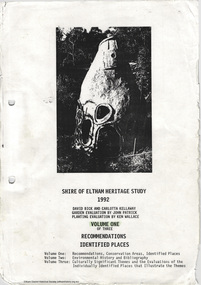
Document, Carlotta Kellaway, Shire of Eltham Heritage Study 1992 Volume 1: Recommendations Identified Places, 1992
... ...conservation areas...Shire of Eltham Heritage Study 1992 prepared by David Bick and Carlotta Kellaway; Garden Evaluation by John Patrick and Planting Evaluation by Ken Wallace Volume One: Recommendations, Conservation Areas, Identified Places Volume Two: Environmental History and Bibliography Volume Three: Culturally Significant Themes and the Evaluations of the Individually Identified Places that Illustrate the Themes...Background history carlotta kellaway conservation areas culturally significant themes david bick garden evaluation Heritage Study identified places john patrick ken wallace planting evaluation recommendations shire of eltham heritage study 167 A4 pages (double sided), spiral bound with clear pastic front cover and black card end cover. ...Shire of Eltham Heritage Study 1992 prepared by David Bick and Carlotta Kellaway; Garden Evaluation by John Patrick and Planting Evaluation by Ken Wallace Volume One: Recommendations, Conservation Areas, Identified Places Volume Two: Environmental History and Bibliography Volume Three: Culturally Significant Themes and the Evaluations of the Individually Identified Places that Illustrate the ThemesProvides the foundation for future planning assessments in the Shire of Eltham.167 A4 pages (double sided), spiral bound with clear pastic front cover and black card end cover.background history, carlotta kellaway, conservation areas, culturally significant themes, david bick, garden evaluation, heritage study, identified places, john patrick, ken wallace, planting evaluation, recommendations, shire of eltham heritage study -
 Greensborough Historical Society
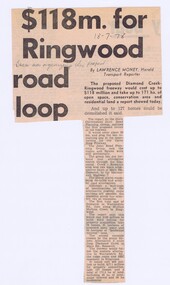
Memorabilia - Newspaper Clipping, The Herald, $118m. for Ringwood road loop, 18/07/1978
... The proposed Diamond Creek to Ringwood freeway would cost up to $118 million and take up to 171 ha. of open space, conservation area and residential land a report showed today. ...The proposed Diamond Creek to Ringwood freeway would cost up to $118 million and take up to 171 ha. of open space, conservation area and residential land a report showed today. ...The proposed Diamond Creek to Ringwood freeway would cost up to $118 million and take up to 171 ha. of open space, conservation area and residential land a report showed today. Bruce Morgan was the first Shire Secretary (1964-1983) of the Shire of Diamond Valley. This collection was compiled by his wife, Mavis Morgan, detailing the events they attended in their official capacityNews clipping in black textHandwritten on clipping: "Bruce Morgan was organising this proposal"bruce morgan, mavis morgan, shire of diamond valley, outer ring freeway -
 Mont De Lancey
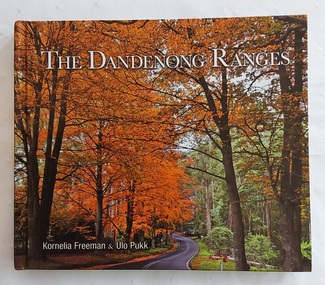
Book, Kornelia Freeman et al, The Dandenong Ranges, 2011
... The Dandenong ranges have a rich history spanning over 35,000 years of indigenous occupation, significant 19th-century timber clearing for Melbourne, and development into a popular 20th-century tourism, residential, and conservation area. The ranges were heavily logged in the 1850s, leading to the establishment of the Dandenong Ranges National Park in 1987. ...The Dandenong ranges have a rich history spanning over 35,000 years of indigenous occupation, significant 19th-century timber clearing for Melbourne, and development into a popular 20th-century tourism, residential, and conservation area. The ranges were heavily logged in the 1850s, leading to the establishment of the Dandenong Ranges National Park in 1987. ...Tourists come from all over the world to enjoy the prized gardens of Victoria's Dandenong Ranges. This beautifully produced book showcases the splendour of the public and private gardens of the Dandenongs as well as its unique villages and native animals and birds.A colourful covered book showing a road winding through the beautiful autumn trees in the Dandenong Ranges approximately 40km from Melbourne. The title The Dandenong Ranges is printed in white lettering at the top with the two authors listed below. The spine has the title, authors and M symbol for Melbourne Publishers. The title page has the same information with Portraits of Victoria added at the bottom right. There is a Contents, Introduction and then in alphabetical order, stunning photographs and detailed information about each place included. Mont De Lancey Historical Homestead is featured on p.144. At the back is an Acknowlegments list. Pp. 151.non-fictionTourists come from all over the world to enjoy the prized gardens of Victoria's Dandenong Ranges. This beautifully produced book showcases the splendour of the public and private gardens of the Dandenongs as well as its unique villages and native animals and birds.dandenong ranges - victoria, dandenong ranges - history, tourism victoria -
 Bendigo Historical Society Inc.
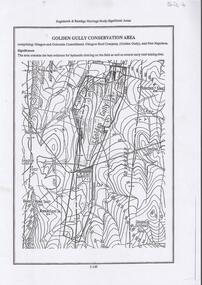
Document - DIAMOND HILL, GOLDEN GULLY COSERVATION AREA
... Map of Golden Gully conservation area comprising Glasgow and Golconda Consolidated, Glasgow Reef Company (Golden Gully) and New Napoleon. ...BENDIGO Mining golden gully Map of Golden Gully conservation area comprising Glasgow and Golconda Consolidated, Glasgow Reef Company (Golden Gully) and New Napoleon. ...Map of Golden Gully conservation area comprising Glasgow and Golconda Consolidated, Glasgow Reef Company (Golden Gully) and New Napoleon. The area is significant because it contains the 'best evidence for hydraulic sluicing on the field as well as several early reef mining sites' On top of page 'Eaglehawk & Bendigo Heritage Study, Significant areas' Mines marked on page: Goldfields Extended shaft South Concord shaft Concord shaft Morning Light shaft Hansel and Mundy shaftbendigo, mining, golden gully -
 City of Whittlesea
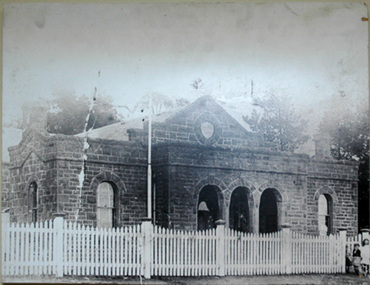
Photograph (item) - Photographs - Buildings, Epping Shire Hall
... Part of Epping Civic Precinct Heritage Conservation Area - 'the building reverted to its original role in 1939 when Epping again became the seat of the Whittlesea Council'...Part of Epping Civic Precinct Heritage Conservation Area - 'the building reverted to its original role in 1939 when Epping again became the seat of the Whittlesea Council' Epping Shire Council Whittlesea Council Epping Police Station digital image Epping Shire Hall Photograph Photographs - Buildings ...Image - Epping Shire Hall, c 1905 (F Coote) The Shire Hall was erected by Thomas Mitchell in 1871, at a cost of 628 Pounds. It served as council chambers and offices, courthouse, public meeting room and dance hall. (Wuchatsch & Hawke, 1988/1985). Part of Epping Civic Precinct Heritage Conservation Area - 'the building reverted to its original role in 1939 when Epping again became the seat of the Whittlesea Council'epping shire council, whittlesea council, epping police station -
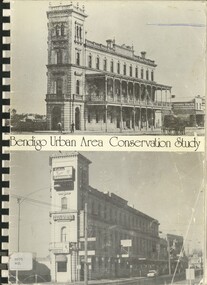 Bendigo Historical Society Inc.
Book - BENDIGO URBAN AREA CONSERVATION STUDY, 1977
... BENDIGO URBAN AREA CONSERVATION STUDY...Bendigo Area Conservation Study - 192 pages with photos, illustrations and maps. ...Book BENDIGO URBAN AREA CONSERVATION STUDY ...Bendigo Area Conservation Study - 192 pages with photos, illustrations and maps. Written on front page ' 133 Mackenzie Street, Bendigo. Indecipherable signature with 'Bendigo, presented to RHSV Bendigo 1978'. 255pp.Lawrie Wilson & Associatesbendigo, buildings, conservation study, conservation, planning schemes, architecture, heritage houses -
Canterbury History Group
Document - Significant 19th century properties in Camberwell, Sanders and Butler, 1986
... A chronological list of significant nineteenth century properties in Camberwell, from the Camberwell Conservation Study - Study Area 1, 1986...A chronological list of significant nineteenth century properties in Camberwell, from the Camberwell Conservation Study - Study Area 1, 1986 Canterbury Camberwell Balwyn Surrey Hills Camberwell Conservation Study Heritage Studies Butler> Graeme Historic Buildings City of Camberwell Shrublands Cullymont Eyre Court Frognall 1 page A4 typed document Document Significant 19th century properties in Camberwell Sanders and Butler ...A chronological list of significant nineteenth century properties in Camberwell, from the Camberwell Conservation Study - Study Area 1, 19861 page A4 typed documentcanterbury, camberwell, balwyn, surrey hills, camberwell conservation study, heritage studies, butler> graeme, historic buildings, city of camberwell, shrublands, cullymont, eyre court, frognall -
 Sunshine and District Historical Society Incorporated
Document - Maribyrnong Heritage Reviews, Jill Barnard, Graeme Butler, Francine Gilfedder & Gary Vines, 2000 & 2001
... 5822.01 - Maribyrnong Heritage Review Volume 1.pdf Historic Places - Project Methods and Results 5822.02 - Maribyrnong Heritage Review Volume 2.pdf Environmental History City of Maribyrnong 5822.03 - Maribyrnong Heritage Review Volume 3.pdf Historic Places Industrial places in the City of Maribyrnong 5822.04 - Maribyrnong Heritage Review Volume 4.pdf Historic Places - Non-industrial places in former City of Sunshine (Maribyrnong, Maidstone, Braybrook and Tottenham) 5822.05 - Maribyrnong Heritage Review Volume 5.pdf Historic Places - Urban Conservation Areas & Individual Places in the former City of Footscray 5822.06 - Maribyrnong Heritage Review Volume 6.pdf Historic Places - Significant Trees in the City of Maribyrnong...Maidstone Braybrook Maribyrnong Tottenham 5822.01 - Maribyrnong Heritage Review Volume 1.pdf Historic Places - Project Methods and Results 5822.02 - Maribyrnong Heritage Review Volume 2.pdf Environmental History City of Maribyrnong 5822.03 - Maribyrnong Heritage Review Volume 3.pdf Historic Places Industrial places in the City of Maribyrnong 5822.04 - Maribyrnong Heritage Review Volume 4.pdf Historic Places - Non-industrial places in former City of Sunshine (Maribyrnong, Maidstone, Braybrook and Tottenham) 5822.05 - Maribyrnong Heritage Review Volume 5.pdf Historic Places - Urban Conservation Areas & Individual Places in the former City of Footscray 5822.06 - Maribyrnong Heritage Review Volume 6.pdf Historic Places - Significant Trees in the City of Maribyrnong Six digital PDF files Document Maribyrnong Heritage Reviews Jill Barnard, Graeme Butler, Francine Gilfedder & Gary Vines ...Braybrook, Maribyrnong, Tottenham and sections of Maidstone were in the Shire of Braybrook and subsequently the City of Sunshine prior to the 1994 council mergers. A number of sites from the above locations are listed in these documents and therefore are of interest to the Sunshine and District Historical Society.5822.01 - Maribyrnong Heritage Review Volume 1.pdf Historic Places - Project Methods and Results 5822.02 - Maribyrnong Heritage Review Volume 2.pdf Environmental History City of Maribyrnong 5822.03 - Maribyrnong Heritage Review Volume 3.pdf Historic Places Industrial places in the City of Maribyrnong 5822.04 - Maribyrnong Heritage Review Volume 4.pdf Historic Places - Non-industrial places in former City of Sunshine (Maribyrnong, Maidstone, Braybrook and Tottenham) 5822.05 - Maribyrnong Heritage Review Volume 5.pdf Historic Places - Urban Conservation Areas & Individual Places in the former City of Footscray 5822.06 - Maribyrnong Heritage Review Volume 6.pdf Historic Places - Significant Trees in the City of Maribyrnongmaidstone, braybrook, maribyrnong, tottenham -
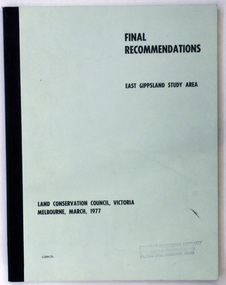 Orbost & District Historical Society
document, FINAL RECOMMENDATIONS E. GIPPSLAND STUDY AREA - LAND CONSERVATION COUNCIL, VICTORIA March 1977, March 1977
... GIPPSLAND STUDY AREA - LAND CONSERVATION COUNCIL, VICTORIA March 1977...A document of 75 pp with a pale green cover and black print, titled Final Recommendations East Gippsland Study area. Land Conservation Council, Melbourne, March, 1977....Land Conservation Council, Melbourne, March, 1977. FINAL RECOMMENDATIONS E. GIPPSLAND STUDY AREA - LAND CONSERVATION COUNCIL, VICTORIA March 1977 document Land Conservation Council ...Established in 1971, the Land Conservation Council operated under the Land Conservation Council Act 1970. In July 1997, the Environment Conservation Council Act 1997 came into operation. This Act revoked the Land Conservation Council Act 1970 and abolished the Land Conservation Council. An Environment Conservation Council was established in its place. (ref. TROVE) This document is a useful reference tool.A document of 75 pp with a pale green cover and black print, titled Final Recommendations East Gippsland Study area. Land Conservation Council, Melbourne, March, 1977.land-conservation-east-gippsland -
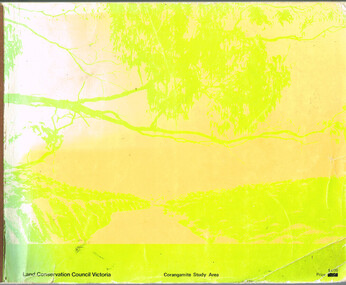 Otway Districts Historical Society
Book, Land Conservation Council, Report on the Corangamite Study Area, May 1976
... Report on the Corangamite study area. Land Conservation Council. Melbourne; Land Conservation Council; May 1976. x, 310 p.; illus, maps (separate). ... Council; Corangamite; geology; physiography; climate; water resources; soils; vegetation; fauna; Report on the Corangamite study area. Land Conservation Council. Melbourne; Land Conservation Council; May 1976. x, 310 p.; illus, maps (separate). ...The Report describes and assesses the natural resources of public land in the Corangamite study area, and provides a factual basis on which members of the community may base their submissions to the Council.Report on the Corangamite study area. Land Conservation Council. Melbourne; Land Conservation Council; May 1976. x, 310 p.; illus, maps (separate). Soft cover.land conservation council; corangamite; geology; physiography; climate; water resources; soils; vegetation; fauna; -
 Greensborough Historical Society
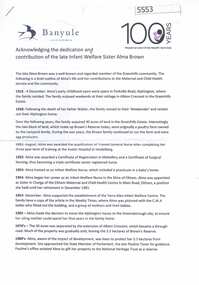
Article, Acknowledging the dedication and contribution of the late Infant Welfare Sister Alma Brown, 1916o
... Chronology of Alama Brown's life, work in maternal and child health in the Diamond Valley area and conservation, memorialised by Brown's Reserve in Greenhills. ...Chronology of Alama Brown's life, work in maternal and child health in the Diamond Valley area and conservation, memorialised by Brown's Reserve in Greenhills. ...Chronology of Alama Brown's life, work in maternal and child health in the Diamond Valley area and conservation, memorialised by Brown's Reserve in Greenhills. Also a celebration of 100 years of Maternal and Child Health.4p. col. documents, photographsalma brown, infant welfare -
 Eltham District Historical Society Inc
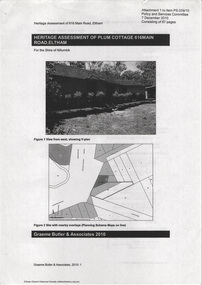
Document - Property Binder, 616 Main Road, Eltham; Plum Cottage
... This house was identified in the Shire of Shire of Eltham Heritage 1992 as contributory to the Eltham Gateway Conservation Area, then proposed as an urban conservation area (now Heritage Overlay Area). ...This house was identified in the Shire of Shire of Eltham Heritage 1992 as contributory to the Eltham Gateway Conservation Area, then proposed as an urban conservation area (now Heritage Overlay Area). ...Plum Cottage is covered by Heritage Overelay HO256 in the Nillumbuk Planning Scheme This two-lot land holding was created as a subdivision and sold to Charles Stuart McNeil by May 1955. Sometime in the period 1955-1960, the builder-designer, John Harcourt had created a pise house on the site, straddling the two subdivision lots. The designer, John M. Harcourt was a pioneer builder in pise-de-terre and mudbrick in the Eltham Shire, Eltham being synonymous with alternative lifestyles and building practises until the onset of suburbia in the late 20th and early 21st centuries. This hipped-roof house is set high above Main Road on a V-shape plan characteristic of the Arts & Crafts style, with rammed earth or pise walls, timber joinery and a cement tiled roof. The V shape plan was used by important English and Eltham Arts & Crafts designers. The use of natural materials such as stone and timber construction is an essential part of the Arts & Crafts style and Harcourt’s work. So too is the application of the style on both the exterior and interior of the house as a holistic concept. The house adjoins the Lim Joon adobe house built and designed by Alistair Knox in the same era (HO119), thus forming a distinctive pair, both using an uncommon plan form. This house was identified in the Shire of Shire of Eltham Heritage 1992 as contributory to the Eltham Gateway Conservation Area, then proposed as an urban conservation area (now Heritage Overlay Area). Land Ownership Emily Jane Smith of 12 Woodside Street Fitzroy owned Crown Allotments 1 & 2 Sections 14, 27 by August 1918, selling to William Henry Smith of 12 Woodside Street, Nth Fitzroy May 1921. (John) James Isherwood of Main Road, Eltham owned the property by 1928 (the year of his death) with the beneficiary of his estate and next owner of this site being his widow, Minnie Maria Isherwood of Cemetery Road, Eltham. His holding in Main Road included parts of what was described in rate records as allotments1 & 2 Section E6. In the late 1930s, early 1940s her son Alfred John Isherwood was also rated for the land around this site, with the rated nett annual value varying between £2 and £5. Alfred Isherwood also lived at Main Road, Eltham with his wife Ellen: her early death at the age of 24 was reported in the Argus of 1923. Part of the Isherwood land was divided off and sold to Charles Stuart McNeil by May1955. Sometime in the period 1955-1960, the builder-designer, John Harcourt had created a pise house on the site, straddling the two subdivision lots. The house is visible on an aerial photograph from 1960s. Reputedly the house was called Plum Cottage and erected for Harcourt’s mother-in-law. A garage was added in 1959. Charles McNeil died in1971 aged 87: he was the son of Don McNeil and Margaret Arkell. Available rate records from the construction era start in the of the 1970s (1972-3) and list Mr H.C. & M/S A.V. Charity at 616 Main Road Eltham of this property with a nett annual value of $740. More recent valuer's data describes the property as lots 1 & 2 LP25668, located in the Central Riding of Eltham Shire, owned by Ann Valerie Charity and later, in 1990, by the Chincarini family. Building Description This hipped roof 11 .5 square house is set high above Main Road on a characteristic-shape plan and has rammed earth or pise walls, timber joinery and a cement tiled roof. The V-shape plan was used by Important designers such as C.F.A. Voysey (UK) who interpreted medieval domestic architecture as part of the Arts & Crafts style of the late 19th and early 20th centuries. The pise walls are covered with a textured render while the cement roofing tiles are also seen in the Harcourt Hill examples. Reputedly the ceiling joists are of a deep section and span long lengths with no need for hanging beams in the roof space. The ceilings are low and panelled in main rooms with apparently Caneite soft board infill panels between the exposed ceiling beams. These are painted white but may have been stained at one time. The focus of the house is the large living area with its vast random stone fireplace. Significance Plum Cottage is significant to the locality of Eltham because: Historically: • Plum Cottage is closely associated with the important historical theme of earth construction evident in Eltham and elsewhere in the Shire since theear1y Arts & Crafts inspired creations at Penleigh Boyd's The Robins (1912, HO101) and those at Montsalvat (1934-, HO82) but more prominent from the Second War period when earth building in Eltham was promoted in national periodicals as an alternative building method that avoided the building materials shortages of that era; • The choice of the earth building technique also expresses the theme of refuge or alternative living, synonymous with Eltham in the early to mid 20th century; • as a good example of domestic architecture from John Harcourt who was the first major post Second War figure in an important phase of Eltham’s earth building development, using his characteristic Old English or Arts& Crafts style that relies in this case on the pise wall construction, pitched roof forms, exposed ceiling joists, half timbering, random stonework, and panelled internal wall finishes. Architecturally: • Plum Cottage's pise wall construction is uncommon among the early earth-walled structures in the Shire, that are mainly of adobe or mud brick, and as a building material is uncommon among the Shire’s suburban dwellings generally which are clad typically with either fired clay bricks or timber boarding. Aesthetically: • Plum Cottage is a good and well preserved example of a modern Old English or Arts & Crafts style earth-walled building in the Shire • For the proximity of the significant Lim Joon adobe house designed by Alistair Knox adjoining to the north, providing a distinctive earth wall house pair, with uncommon plan forms. Reference Heritage Assessment of Plum Cottage, 616 Main Road, Eltham; Graeme Butler & Associates 2010main road, eltham, property, houses, (john) james isherwood, alfred john isherwood, ann valerie charity, arts and crafts style, charles stuart mcneil, chincarini family, eltham gateway zone, emily jane smith, h.c. charity, heritage assessment, john harcourt, john m. harcourt, lim joon house, main road eltham, minnie maria isherwood, pise construction, plum cottage -
 Flagstaff Hill Maritime Museum and Village
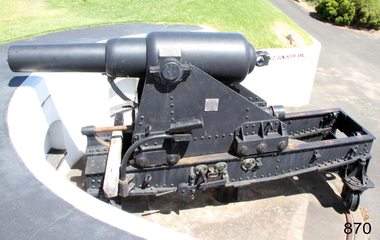
Weapon - Cannon, 1866
... area at the entrance to Flagstaff Hill Maritime Village. Both of these guns are mounted on their original wooden garrison carriages. There are only seven 32 Pounder SB made by Carron and fifteen 68 Pounder SB made at Low Moor known to exist in the State of Victoria. Funding was received to repair Cannon No.2 and its iron carriage. After completion, both Cannon No 1 and No. 2 were 'fired' in a public re-enactment on April 4th, 2026. (Conservation...area at the entrance to Flagstaff Hill Maritime Village. Both of these guns are mounted on their original wooden garrison carriages. There are only seven 32 Pounder SB made by Carron and fifteen 68 Pounder SB made at Low Moor known to exist in the State of Victoria. Funding was received to repair Cannon No.2 and its iron carriage. After completion, both Cannon No 1 and No. 2 were 'fired' in a public re-enactment on April 4th, 2026. (Conservation ...In the years following the Crimean War (1854-1857J) there was a great concern in the Colony that Imperial Russia would attempt an invasion. Coastal defences in the colony of Victoria were greatly strengthened by the Government as a result. Warrnambool was originally protected by cannons at Cannon Hill, approximately 1 kilometer west of the Flagstaff Hill Fortifications. These cannons included two 1866 guns, both 80 Pound Rifled Muzzle Loaders (RML) purchased by Victoria’s Colonial Government. They were part of a shipment of 26 such guns sent from England in December 1866. They are registered as No. 23 (80cwt-2qr-0lbs) - Gun 1, and No.13 (81cwt-1qr-12lbs) - Gun 2. They were cast at the Royal Gun Factory, Woolwich Arsenal, in 1866 and have a 6.3 inch bore. Both barrels carry the Royal Cypher of Queen Victoria, Insignia of the Royal Engineers, within the Garter and Motto surmounted by the Crown, with the Royal Cypher of Queen Victoria within the Garter (letters in centre “VR”, motto “HONI SOIT QUI MAL Y PENSE”, "Shame be to him who thinks evil of it."). The guns were originally supplied with wooden carriages. (The Royal Arsenal at Woolwich, England, was established eleven years after the Restoration of King Charles II. It was the principal supplier of armaments to the British and Empire Governments. At the height of its operations during World War One the factory covered 1300 acres and employed very nearly 80,000 workers. Woolwich was the Headquarters of the Royal Artillery since the raising of that Regiment in 1716. The Arsenal was closed in the late 1960’s.) These two cannons were transferred to the Warrnambool Garrison Artillery Battery Fortifications erected at Flagstaff Hill in 1887 as part of Victoria’s Coastal Defences. The original wooden carriages were subsequently replaced with the present iron garrison carriages in 1888. They are a “C” pivot. The ‘racers’ or curved track set into the floor of the gun emplacement (which enabled the guns to be traversed more quickly) are as specified for guns up to 10 inch, being of wrought iron 2.78 inches wide. A temporary third gun, now no longer on Flagstaff Hill’s site, was a 5 inch Rifled Breech Loading (BL) Armstrong gun mounted on an Elswick hydro pneumatic disappearing carriage It was faster to load and fire than the 80 pound RMLs and its arrival spelt the end of the older 80 pound guns’ useful life, apart from being used for practice sessions. The 5 inch BL gun was the main defensive weapon of the Warrnambool Battery until the Battery was downgraded in importance and the gun was recalled to Melbourne in 1910. The State of Victoria took over the ownership of the guns at the time of Australian Federation in 1901. In about 1901/1902 the Garrison Battery was converted to the Warrnambool Battery of the Australian Field Artillery (No 4 Field Battery). It was equipped with 4.7 inch naval guns mounted on field carriages. They were now a mobile unit but continued to use the Warrnambool Garrison area at Flagstaff Hill for practice. When the Fortifications were declared obsolete, the two 80 Pounder RML were relocated to Cannon Hill in 1910. On the outbreak of World War One the 4.7 inch guns were recalled to Melbourne, and the Battery was disbanded. Most of the personnel probably re-enlisted in the local 4th Australian Light Horse Regiment. The two 80 Pounder RML were moved back to the Fortifications in 1973. They were both fully restored by Army First Year Apprentices at the Ordinance Factory in Bendigo in time for the centenary year of the fortifications in 1987. The guns are capable of firing 80 pound (32.3kg) armour piercing exploding shells 3.65kms out to sea. They were original manned by volunteers before a paid Garrison was established. Now the Guns are again fired by volunteers on Special Event days. Since restoration the Gun Number 1 had been fired on a regular basis but Gun Number 2 hadn’t been fired since the mid 1990’s. In April 2015 Gun Number 2 was serviced in preparation for the firing of both cannons on the ANZAC Centenary commemorations on April 25th 2015. Other guns from the original Cannon Hill location were obsolete by the time the 1887 Warrnambool Garrison Artillery Battery was built. These guns are (1) a 32 Pounder Muzzle Loading Smooth Bore (SB) cast in 1813 at the famous Carron Foundry, number 80837 and now located in the Warrnambool Botanic Gardens (2) a 68 Pounder Muzzle Loading Smooth Bore cast in 1861 at the equally august Low Moor Foundry, number 10310 and now located on the lawn area at the entrance to Flagstaff Hill Maritime Village. Both of these guns are mounted on their original wooden garrison carriages. There are only seven 32 Pounder SB made by Carron and fifteen 68 Pounder SB made at Low Moor known to exist in the State of Victoria. Funding was received to repair Cannon No.2 and its iron carriage. After completion, both Cannon No 1 and No. 2 were 'fired' in a public re-enactment on April 4th, 2026. (Conservation Management Plan for Victorian Guns and Cannon, South Western Victoria, May 2008, ref W/F/05)The Warrnambool Garrison has been added to the Victorian Heritage Register H1250 “for its intact battery and guns, a strong reminder of Victoria’s wealth and determination to protect itself from the perceived threat of invasion in the 1880’s.” The City of Warrnambool is one of several custodians of a collection of artillery pieces of heritage significance at a state, national and international level. These pieces are directly related to the defence of south-west Victoria in the 19th century. The care and preservation come under the Heritage Act 1995. Cannon. 80 Pound Rifled Muzzle Loading (RML) Gun on iron carriage and slide, installed in the Battery at Flagstaff Hill’s Fortifications. Made in 1866 at the Royal Gun Factory (R-G-F), Woolich, England. Gun Reg No 13. Flagstaff Hill Garrison Gun 2 (Gun No. 2). Insignia of the Royal Engineers, and the weight of the gun, stamped on top of the gun’s barrel. There is a brass plate on the side of the gun with the details of 1987 restoration.Stamped into the metal on top of the barrel, Insignia of the Royal Engineers; Garter and Motto “HONI SOIT QUI MAL Y PENSE”, surmounted by the Crown, with the Royal Cypher of Queen Victoria “VR” within the Garter. Also stamped on top of the gun are 2 inward pointing arrows above the weight ”81-1-12”. Brass plate “RESTORATION / BY / FIRST YEAR / APPRENTICES / ORDANANCE FACTORY / BENDIGO 1987”flagstaff hill, warrnambool, shipwrecked coast, flagstaff hill maritime museum, maritime museum, shipwreck coast, flagstaff hill maritime village, great ocean road, colonial defences, victoria’s coastal defences, warrnambool fortification, warrnambool garrison battery, warrnambool volunteer corps, ordinance, armaments, cannon hill fortifications, 4th australian light horse regiment, no 4 field battery, 80 pound cannon rifled muzzle loaders (rml), victorian colonial government, royal gun factory england, woolwich arsenal, royal cypher of queen victoria, garrison gun -
 Federation University Historical Collection
Book, Final recommendations Ballarat Study Area Land Conservation Council, Victoria, 1982, 1982
... Final recommendations Ballarat Study Area Land Conservation Council, Victoria, 1982...The contents of the report include: Parks, reference areas, wildlife reserves, water production, hardwood production, softwood production, flora Reserves and Flora and Fauna reserves, bushland reserves, historic area and reserves, rivers and streams, Roadside conservation and Highway parks, Education areas and School Plantations, Lake Reserves, geological reserves, recreation, scenic reserves, agriculture, mineral and stone production, utilities and survey, township land, Uncommitted Land, military training, other reserves and public land. ...Maps include: The Study area 1: 250 000 Supplementary Maps Final recommendations Ballarat Study Area Land Conservation Council, Victoria, 1982 Book Book ...Yellow soft covered report of 95 pages . The contents of the report include: Parks, reference areas, wildlife reserves, water production, hardwood production, softwood production, flora Reserves and Flora and Fauna reserves, bushland reserves, historic area and reserves, rivers and streams, Roadside conservation and Highway parks, Education areas and School Plantations, Lake Reserves, geological reserves, recreation, scenic reserves, agriculture, mineral and stone production, utilities and survey, township land, Uncommitted Land, military training, other reserves and public land. Maps include: The Study area 1: 250 000 Supplementary Mapsland conservation authority, ballarat, endowment plantations, pine plantations, langi ghiran state park, mount buangor state park, enfield state park, ballarat-creswick regional park, rossbridge, black lake, flax mill swamp, dereel lagoon, lake bolac, lake wongan, langi ghiran reservoir, gong gong reservoir, pincotts reservoir, beales reservoir, wilsons reservoir, moorabool reservoir, korweinguboora, korweinguborra reservoir, learmonth bores, sago hill, illabarook reservoir, ballarat water commission, dunneworthy, mount cole, mont lonarch, ben major, waterloo, trawalla, linton, ross creek, canadian, shepherds flat, lal lal, mount doran, raglan, chute, carngham, buninyong, watsons hill, enfield, cape clear, illabrook, rokewood junction, mount warrenheip, nerrina, jubilee, golden stream, australasian deep lead mine, happy valley school, piggoreet, berringa, bulldog, ballarat common, wildlife, water, timber, flora, rivers, geology, agriculture, warrenheip, biodiversity -
 The Beechworth Burke Museum
Photograph, 25 October 1930
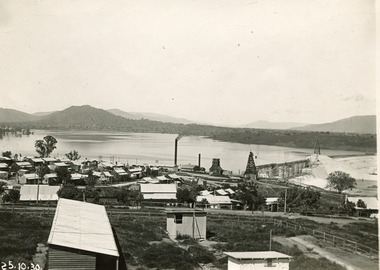
... The Dam was named after Hamilton Hume, who is an important historical figure for this area as he helped discover the area where resources were found. construction houses veterans Mitta Junction Village Hume Dam World War I Federation Wodonga Archaeological survey excavation Austral Archaeology Department of Land & Water Conservation Camp Ganger's Quarter's Stableman's Quarters Industrial Dump artefacts Mitta Mitta Mount Welcome Mount Misery Murray River Hamilton Hume William Hilton Hovell Hume and Hovell expedition Reverse: 1997.3145/ 84-20-2 Black and white rectangular photograph printer unmounted Photograph Photograph ...Taken on 25 October 1930, various houses with the Hume Dam under construction are depicted in the background. The construction of the Hume Dam took place from 1919 to 1936. At the time of construction, it was the second largest dam in the world. It was also one of the earliest civil projects developed after the Federation. Some of the Dam workers consisted of World War I veterans. Dam workers often settled their families in Mitta Junction Village and Wodonga. Archaeological surveys were completed by Austral Archaeology, which was done when the Department of Land & Water Conservation was doing work to improve Hume Dam. The archaeological report that came out of the survey recommended three sites of interest where archaeological excavation should be done: Camp Ganger’s Quarters, Stableman’s Quarters, and the Industrial Dump. The excavation uncovered artefacts. Mitta Mitta: Mitta Mitta is situated between Mount Welcome and Mount Misery. It is named after the river that explorers Hume and Hovell discovered in 1824. The town would eventually become a huge gold mining town. Mitta Mitta is called Midamodunga by the local Indigenous peoples Wodonga: Wodonga is situated on the Murray River and is part of North East Victoria. Hume and Hovell: Hamilton Hume (1979-1873) and William Hilton Hovell (1786-1875). W. H. Hovell was born in Norfolk England and Hume was born in Parramatta, New South Wales Hovell and Hume undertook an exploration journey in 1824 and thought they discovered a river, which turned out to be the Murray River. They returned home in 1825, but returned to the area in 1826 and discovered coal in the area. This photo is historically significant as it shows the Hume Dam under construction in 1930. The Dam was named after Hamilton Hume, who is an important historical figure for this area as he helped discover the area where resources were found. Black and white rectangular photograph printer unmountedReverse: 1997.3145/ 84-20-2construction, houses, veterans, mitta junction village, hume dam, world war i, federation, wodonga, archaeological survey, excavation, austral archaeology, department of land & water conservation, camp ganger's quarter's, stableman's quarters, industrial dump, artefacts, mitta mitta, mount welcome, mount misery, murray river, hamilton hume, william hilton hovell, hume and hovell expedition -
Federation University Historical Collection
Book, Historic Sites Survey: North Central Study Area, 1979, 1979
... It is an historic sites survey for the North Central Study Area commissioned by the Land Conservation Council, the Ministry for COnservation and the Australian Heritage Commission. ...It is an historic sites survey for the North Central Study Area commissioned by the Land Conservation Council, the Ministry for COnservation and the Australian Heritage Commission. ...The North Central Study Area included the Shires of Avoca, Bet Bet, east Loddon, Goulburn, Untly, Kara Kara, Korong, Maldon, Marong, Metcalfe, McIvor, Newstead, Strathfieldsaye, Stawell, Talbot, Clunes, Tullaroop and Waranga. 153 page book with white plastic binding. It is an historic sites survey for the North Central Study Area commissioned by the Land Conservation Council, the Ministry for COnservation and the Australian Heritage Commission. castlemaine, mount alexander goldfield, maldon, percydale, warrenmang, moliagul, tarnagulla, stuart mill, the whipstick, whroo, rushworth, graytown ironbark forest, st arnoaud, new bendigo, landsborough, inglewood, kurting, wedderburn, wehla, kooroora, langham flat, mcintyre, rheola, diamond hill, fosterville, coliban water works, green gully, newstead, muckleford forest, costerfield, graytown, bailieston, waranga irrigaiton system, eucalyptus distillery, mia mia bridge, korokubeal township researce, concegella slate quarry, chewton, fryerstown, kingower, timor, talbot, majorca, carisbroook, clunes, st arnaud, taradale, icomos, dunolly, limestone, castlemaine slate quarry, harcourt granite, taradale railway viaduct, loddon united waterworks trust, gouldburn weir, carisbrook lock-up, history of tree planting in streets, history of public reserves, r.u. nicholls nurseryman, thomas lang, francis moss, ballarat botanical gardens, ballarat school of mines botanical gardens, lake wendouree, victoria park, ballarat, muont holled smith, ballaarat old cemetery planting, eastern oval, ballarat east botanical gardens, ballarat east town hall gardens, eureka stockade reserve, ballarat observatory plantings, yarrowee creek plantings, yarrowee bluestone channels, ballarat woollen mill, band and albion mullock heap, black hill plantings, yarrowee creek channels, canadian creek channel, specimen vale channel, poverty point reserve, union jack reserve buninyong, imperial mine, buninyong, victoria street plantings, bridge mall, sturt street gardens, ballarat avenue of honour plantings, white flat oval plantings, camp street, elms, burnt creek -
 The Beechworth Burke Museum
Animal specimen - White-bellied Cuckooshrike, Trustees of the Australian Museum, 1860-1880
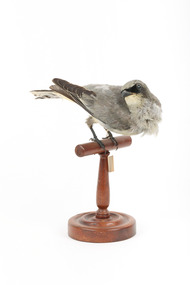
... areas as well as in the eastern parts of the country, including northern Western Australia, the Northern Territory, Queensland, New South Wales, Victoria, and southeastern South Australia. The species is prevalent throughout Papua New Guinea and the Solomon Islands, but less frequently observed in Indonesia. Within Indonesia, it is most commonly found in the northern Moluccas, with occasional sightings in Eastern Wallacea. This specimen was originally identified as a young Black-Cuckoo-shrike and catalogued as such in the Burke Museum original catalogue. Analysis conducted as part of a conservation...areas as well as in the eastern parts of the country, including northern Western Australia, the Northern Territory, Queensland, New South Wales, Victoria, and southeastern South Australia. The species is prevalent throughout Papua New Guinea and the Solomon Islands, but less frequently observed in Indonesia. Within Indonesia, it is most commonly found in the northern Moluccas, with occasional sightings in Eastern Wallacea. This specimen was originally identified as a young Black-Cuckoo-shrike and catalogued as such in the Burke Museum original catalogue. Analysis conducted as part of a conservation ...The white-bellied cuckooshrike inhabits regions across Australia, Indonesia, Papua New Guinea, and the Solomon Islands. In Australia, it is distributed widely, occurring in tropical northern areas as well as in the eastern parts of the country, including northern Western Australia, the Northern Territory, Queensland, New South Wales, Victoria, and southeastern South Australia. The species is prevalent throughout Papua New Guinea and the Solomon Islands, but less frequently observed in Indonesia. Within Indonesia, it is most commonly found in the northern Moluccas, with occasional sightings in Eastern Wallacea. This specimen was originally identified as a young Black-Cuckoo-shrike and catalogued as such in the Burke Museum original catalogue. Analysis conducted as part of a conservation treatment in 2024 reclassified the specimen as a white-bellied cuckooshrike. This specimen is part of a collection of almost 200 animal specimens that were originally acquired as skins from various institutions across Australia, including the Australian Museum in Sydney and the National Museum of Victoria (known as Museums Victoria since 1983), as well as individuals such as amateur anthropologist Reynell Eveleigh Johns between 1860-1880. These skins were then mounted by members of the Burke Museum Committee and put-on display in the formal space of the Museum’s original exhibition hall where they continue to be on display. This display of taxidermy mounts initially served to instruct visitors to the Burke Museum of the natural world around them, today it serves as an insight into the collecting habits of the 19th century.This specimen is part of a significant and rare taxidermy mount collection in the Burke Museum. This collection is scientifically and culturally important for reminding us of how science continues to shape our understanding of the modern world. They demonstrate a capacity to hold evidence of how Australia’s fauna history existed in the past and are potentially important for future environmental research. This collection continues to be on display in the Museum and has become a key part to interpreting the collecting habits of the 19th century.This specimen is a young White-bellied cuckooshrike which stands perched on a wooden mount. It has pale grey colouring which is darker on the rear. The wings are tipped with grey-brown feathers and the same colour feathers also appear on the bird's tale. The specimen has dark limbs and bill and this specimen is provided with two glass eyes which are dark in colouring. The bird has a more creamy pale grey on the throat and stomach. It has a black facial mask which is restricted to an eye stripe. 21a / Black Faced Graculus / See catalogue page 11taxidermy mount, taxidermy, animalia, burke museum, beechworth, australian museum, skin, reynell eveleigh johns, bird, cuckoo, shrike, common birds, australian birds, australian bird, white-bellied cuckooshrike -
 The Beechworth Burke Museum
Photograph
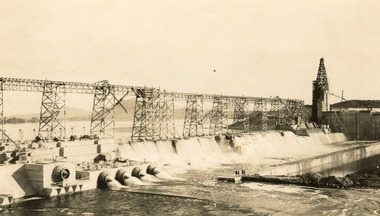
... The Dam was named after Hamilton Hume, who is an important historical figure for this area as he helped discover the area where resources were found. construction houses veterans Mitta Junction Village Hume Dam World War I Federation Wodonga Archaeological survey excavation Austral Archaeology Department of Land & Water Conservation Camp Ganger's Quarter's Stableman's Quarters Industrial Dump artefacts Mitta Mitta Mount Welcome Mount Misery Murray River Hamilton Hume William Hilton Hovell Hume and Hovell expedition Reverse: 84-19-5 / 1997.3185/ Values & spillway. / When completed the wall / will be as high as the / scaffolding. ...Taken on 25 October 1930, various houses with the Hume Dam under construction are depicted in the background. The construction of the Hume Dam took place from 1919 to 1936. At the time of construction, it was the second largest dam in the world. It was also one of the earliest civil projects developed after the Federation. Some of the Dam workers consisted of World War I veterans. Dam workers often settled their families in Mitta Junction Village and Wodonga. Archaeological surveys were completed by Austral Archaeology, which was done when the Department of Land & Water Conservation was doing work to improve Hume Dam. The archaeological report that came out of the survey recommended three sites of interest where archaeological excavation should be done: Camp Ganger’s Quarters, Stableman’s Quarters, and the Industrial Dump. The excavation uncovered artefacts. Mitta Mitta: Mitta Mitta is situated between Mount Welcome and Mount Misery. It is named after the river that explorers Hume and Hovell discovered in 1824. The town would eventually become a huge gold mining town. Mitta Mitta is called Midamodunga by the local Indigenous peoples Wodonga: Wodonga is situated on the Murray River and is part of North East Victoria. Hume and Hovell: Hamilton Hume (1979-1873) and William Hilton Hovell (1786-1875). W. H. Hovell was born in Norfolk England and Hume was born in Parramatta, New South Wales Hovell and Hume undertook an exploration journey in 1824 and thought they discovered a river, which turned out to be the Murray River. They returned home in 1825, but returned to the area in 1826 and discovered coal in the area. This photo is historically significant as it shows the Hume Dam under construction in 1930. The Dam was named after Hamilton Hume, who is an important historical figure for this area as he helped discover the area where resources were found.Sepia rectangular photograph printed unmountedReverse: 84-19-5 / 1997.3185/ Values & spillway. / When completed the wall / will be as high as the / scaffolding. [featuring trademark: kodak print]construction, houses, veterans, mitta junction village, hume dam, world war i, federation, wodonga, archaeological survey, excavation, austral archaeology, department of land & water conservation, camp ganger's quarter's, stableman's quarters, industrial dump, artefacts, mitta mitta, mount welcome, mount misery, murray river, hamilton hume, william hilton hovell, hume and hovell expedition -
 The Beechworth Burke Museum
Photograph, c1930
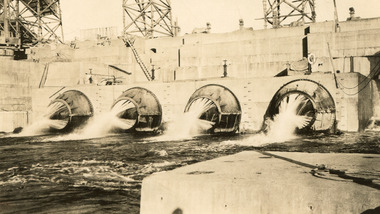
... The Dam was named after Hamilton Hume, who is an important historical figure for this area as he helped discover the area where resources were found. construction houses veterans Mitta Junction Village Hume Dam World War I Federation Wodonga Archaeological survey excavation Austral Archaeology Department of Land & Water Conservation Camp Ganger's Quarter's Stableman's Quarters Industrial Dump artefacts Mitta Mitta Mount Welcome Mount Misery Murray River Hamilton Hume William Hilton Hovell Hume and Hovell expedition Reverse: 84-19-2/ 1997.3188/ These are the four / release valves they are / not always open (illegible) this / when closed the water flows / over the spillway. ...Taken on 25 October 1930, various houses with the Hume Dam under construction are depicted in the background. The construction of the Hume Dam took place from 1919 to 1936. At the time of construction, it was the second largest dam in the world. It was also one of the earliest civil projects developed after the Federation. Some of the Dam workers consisted of World War I veterans. Dam workers often settled their families in Mitta Junction Village and Wodonga. Archaeological surveys were completed by Austral Archaeology, which was done when the Department of Land & Water Conservation was doing work to improve Hume Dam. The archaeological report that came out of the survey recommended three sites of interest where archaeological excavation should be done: Camp Ganger’s Quarters, Stableman’s Quarters, and the Industrial Dump. The excavation uncovered artefacts. Mitta Mitta: Mitta Mitta is situated between Mount Welcome and Mount Misery. It is named after the river that explorers Hume and Hovell discovered in 1824. The town would eventually become a huge gold mining town. Mitta Mitta is called Midamodunga by the local Indigenous peoples Wodonga: Wodonga is situated on the Murray River and is part of North East Victoria. Hume and Hovell: Hamilton Hume (1979-1873) and William Hilton Hovell (1786-1875). W. H. Hovell was born in Norfolk England and Hume was born in Parramatta, New South Wales Hovell and Hume undertook an exploration journey in 1824 and thought they discovered a river, which turned out to be the Murray River. They returned home in 1825, but returned to the area in 1826 and discovered coal in the area.This photo is historically significant as it shows the Hume Dam under construction in 1930. The Dam was named after Hamilton Hume, who is an important historical figure for this area as he helped discover the area where resources were found.Sepia rectangular photograph printed unmountedReverse: 84-19-2/ 1997.3188/ These are the four / release valves they are / not always open (illegible) this / when closed the water flows / over the spillway. [featuring trademark: kodak print] photograph number: 354construction, houses, veterans, mitta junction village, hume dam, world war i, federation, wodonga, archaeological survey, excavation, austral archaeology, department of land & water conservation, camp ganger's quarter's, stableman's quarters, industrial dump, artefacts, mitta mitta, mount welcome, mount misery, murray river, hamilton hume, william hilton hovell, hume and hovell expedition -
 The Beechworth Burke Museum
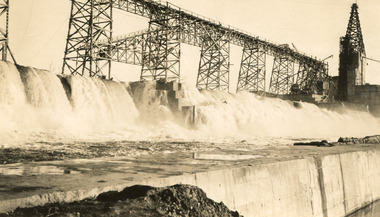
Photograph, 25 October 1930
... The Dam was named after Hamilton Hume, who is an important historical figure for this area as he helped discover the area where resources were found. construction houses veterans Mitta Junction Village Hume Dam World War I Federation Wodonga Archaeological survey excavation Austral Archaeology Department of Land & Water Conservation Camp Ganger's Quarter's Stableman's Quarters Industrial Dump artefacts Mitta Mitta Mount Welcome Mount Misery Murray River Hamilton Hume William Hilton Hovell Hume and Hovell expedition Reverse: 84-19-6/ 1997.3187/ The spillway [featuring trademark: kodak print] Sepia rectangular photograph printed unmounted Photograph Photograph ...Taken on 25 October 1930, various houses with the Hume Dam under construction are depicted in the background. The construction of the Hume Dam took place from 1919 to 1936. At the time of construction, it was the second largest dam in the world. It was also one of the earliest civil projects developed after the Federation. Some of the Dam workers consisted of World War I veterans. Dam workers often settled their families in Mitta Junction Village and Wodonga. Archaeological surveys were completed by Austral Archaeology, which was done when the Department of Land & Water Conservation was doing work to improve Hume Dam. The archaeological report that came out of the survey recommended three sites of interest where archaeological excavation should be done: Camp Ganger’s Quarters, Stableman’s Quarters, and the Industrial Dump. The excavation uncovered artefacts. Mitta Mitta: Mitta Mitta is situated between Mount Welcome and Mount Misery. It is named after the river that explorers Hume and Hovell discovered in 1824. The town would eventually become a huge gold mining town. Mitta Mitta is called Midamodunga by the local Indigenous peoples Wodonga: Wodonga is situated on the Murray River and is part of North East Victoria. Hume and Hovell: Hamilton Hume (1979-1873) and William Hilton Hovell (1786-1875). W. H. Hovell was born in Norfolk England and Hume was born in Parramatta, New South Wales Hovell and Hume undertook an exploration journey in 1824 and thought they discovered a river, which turned out to be the Murray River. They returned home in 1825, but returned to the area in 1826 and discovered coal in the area.This photo is historically significant as it shows the Hume Dam under construction in 1930. The Dam was named after Hamilton Hume, who is an important historical figure for this area as he helped discover the area where resources were found.Sepia rectangular photograph printed unmountedReverse: 84-19-6/ 1997.3187/ The spillway [featuring trademark: kodak print] construction, houses, veterans, mitta junction village, hume dam, world war i, federation, wodonga, archaeological survey, excavation, austral archaeology, department of land & water conservation, camp ganger's quarter's, stableman's quarters, industrial dump, artefacts, mitta mitta, mount welcome, mount misery, murray river, hamilton hume, william hilton hovell, hume and hovell expedition
