
Showing 21 items matching "construction - fuselage "
-
 Moorabbin Air Museum
Book - Wooden aircraft, Aircraft Woodwork
... ...Construction - fuselage & tail...Wooden aircraft Wood / wind & sky Materials & equipment Construction - fuselage & tail Wings Construction of spars Construction of ribs Making bows Wing assembly Repair of airframes & wings Overview of building an aircraft with wood, circa 1972 Aircraft Woodwork Book Wooden aircraft ...Overview of building an aircraft with wood, circa 1972non-fictionOverview of building an aircraft with wood, circa 1972wood / wind & sky, materials & equipment, construction - fuselage & tail, wings, construction of spars, construction of ribs, making bows, wing assembly, repair of airframes & wings -
 Bendigo Historical Society Inc.
Memorabilia - BASIL WATSON COLLECTION: PIECE OF SILK - BASIL WATSON'S BIPLANE, c. 1916
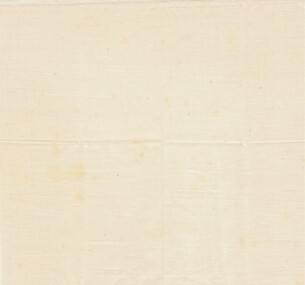
... construction stage. Handwritten note states : 'Assam silk material used in covering the wings and fuselage of Basil Watson's airplane built by him in 1916. ...construction stage. Handwritten note states : 'Assam silk material used in covering the wings and fuselage of Basil Watson's airplane built by him in 1916. ...Piece of cream-coloured silk, no markings, from Basil Watson's biplane, in construction stage. Handwritten note states : 'Assam silk material used in covering the wings and fuselage of Basil Watson's airplane built by him in 1916. The wings and fuselage were then painted with an oil protective covering'person, individual, basil watson -
 Australian Gliding Museum
Machine - Glider – Sailplane, 1953
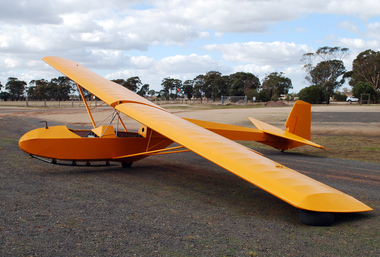
... This is a two seat high wing aircraft of mainly wood and fabric construction. The cockpit area of the fuselage is fabric over tubular steel framing. ...However, it was a later Schneider design, the ES 52 Kookaburra, which was accepted by many Australian gliding clubs for filling their need for a basic two seat training glider in the 1950s and 1960s. australian gliding glider sailplane schneider es50 renmark gliding club millicent gliding club corangamite soaring club sydney technical college gliding club Given serial number 3 by manufacturer and registered as VH-GHP This is a two seat high wing aircraft of mainly wood and fabric construction. The cockpit area of the fuselage is fabric over tubular steel framing. ...The Schneider ES50 Club was built in 1953 and is the only one of its type. It was designed by Schneider to comply with specifications laid down by the Gliding Federation of Australia for a basic two seat training glider*. It was first flown on 10 May 1953 and delivered to the Renmark Gliding Club. The log book shows that it later passed to other gliding clubs, namely Millicent Gliding Club, Corangamite Soaring Club, Sydney Technical College Gliding Club. Overall, as at September 1967, the glider had logged over 5000 flights and a total airtime of 388 hours. The Museum volunteers have partly refurbished the ES50 to static display standard. [*Plans were also prepared for a single seat version which never eventuated] This glider is one of Edmund Schneider Pty Ltd earliest Australian designs. However, it was a later Schneider design, the ES 52 Kookaburra, which was accepted by many Australian gliding clubs for filling their need for a basic two seat training glider in the 1950s and 1960s. This is a two seat high wing aircraft of mainly wood and fabric construction. The cockpit area of the fuselage is fabric over tubular steel framing. Given serial number 3 by manufacturer and registered as VH-GHPaustralian gliding, glider, sailplane, schneider, es50, renmark gliding club, millicent gliding club, corangamite soaring club, sydney technical college gliding club -
 Australian Gliding Museum
Machine - Glider – Sailplane, 1952-1953
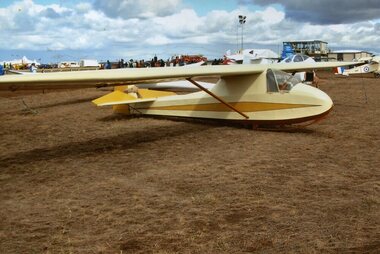
... Single seat glider of wood and fabric construction, with steel wing struts. Currently painted crème with yellow details. Underside of fuselage is painted orange....The glider is an improved Grunau Baby design that Edmund Schneider built after coming to Australia. australian gliding grunau grunau baby schneider gliding club of victoria sunraysia gliding club millicent gliding club darbyshire lewis bugler hudson Single seat glider of wood and fabric construction, with steel wing struts. Currently painted crème with yellow details. Underside of fuselage is painted orange. ...This aircraft, the first glider built by Schneiders after they immigrated to Australia, was test flown on 3 January 1953 by Dave Darbyshire and Owen Lewis. It is the only machine of its type. It is essentially a Grunau Baby 2B with a Perspex enclosed cockpit, wing airbrakes and a landing wheel. However, the wing design came from an existing Grunau 3 type that was being built in Germany. The glider has given extensive service for a number of owners – including the Gliding Club of Victoria, Sunraysia Gliding Club, Millicent Gliding Club, Max Bugler of Morwell and Garth Hudson of Brighton in Victoria. Prior to being donated to the Australian Gliding Museum in January 2001 the glider had logged over 2200 hours flying time from over 9000 flights. The glider is an improved Grunau Baby design that Edmund Schneider built after coming to Australia.Single seat glider of wood and fabric construction, with steel wing struts. Currently painted crème with yellow details. Underside of fuselage is painted orange.australian gliding, grunau, grunau baby, schneider, gliding club of victoria, sunraysia gliding club, millicent gliding club, darbyshire, lewis, bugler, hudson -
 Australian Gliding Museum
Machine - Glider – Sailplane, Circa 1971
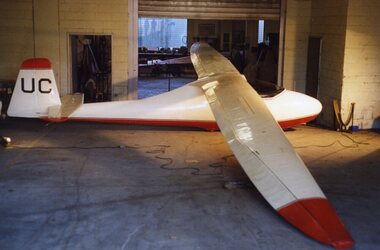
... construction. It has a two piece wing of 15 metre (49 feet) span and a fuselage of monocoque design. ...construction. It has a two piece wing of 15 metre (49 feet) span and a fuselage of monocoque design. ...The Vogt LO150 is a sailplane first produced in 1954. Designed in Germany by Alfred Vogt, the LO150 is of wood construction. It has a two piece wing of 15 metre (49 feet) span and a fuselage of monocoque design. The first of the type to be imported into Australia arrived in late 1955. In January 1956 this aircraft type was used to create a world speed record of just under 75 km/h for speed around a 300 km triangle and went on to win the Australian National Gliding Championships. The Museum’s LO150 (VH-GUC) – serial number EB71 was imported from Germany in 1971 by the late Frank Erdmann and an ownership syndicate formed. Following Erdmann it has had a number of owners. Much of its usage was at Bacchus Marsh and Horsham with excusions elsewhere for competition. This Vogt LO150 was last flown on 3 January 1988. Overall, since arriving in Australia, it has flown 315 hours from 273 launches, which is a commendable average performance of over an hour per flight. VH-GUC was donated to the Museum by Warren Mayfield in 2002. Substantial glue deterioration was discovered in one wing and, as a result, a decision has been made not to restore the glider to an airworthy condition. In due course the glider will be repainted and further prepared for display. This exhibit is an example of the Vogt LO150 semi-aerobatic competition sailplane.Single seat competition sailplane of wood construction.Builder's serial number EB71australian gliding, glider, sailplane, vogt, lo-150, erdmann, mayfield, geelong gliding club -
 Australian Gliding Museum
Machine - Glider – Sailplane, March 1964
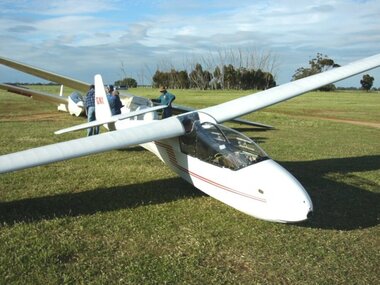
... The fuselage is built using steel tube framing covered with fabric. The swept-forward cantilever wing is of wood and fabric construction with a single spar and a plywood covered leading edge “D” box for strength. ...The fuselage is built using steel tube framing covered with fabric. The swept-forward cantilever wing is of wood and fabric construction with a single spar and a plywood covered leading edge “D” box for strength. ...The Schleicher K7 is a high wing tandem two-seat sailplane designed in the late 1950s by Rudolf Kaiser for the Alexander Schleicher company in Germany. The fuselage is built using steel tube framing covered with fabric. The swept-forward cantilever wing is of wood and fabric construction with a single spar and a plywood covered leading edge “D” box for strength. The wing is equipped with Schempp-Hirth airbrakes. The K7 first flew in 1959. It is a versatile design that can be used for both basic and more advanced training of pilots. Over 500 were built. VH-GNX was manufactured in Germany and imported into Australia by Edmund Schneider Limited. It was test flown by them at Parafield Aerodrome, Adelaide, South Australia in March 1964. The original owner of VH-GNX was the Adelaide Soaring Club and it was maintained by Edmund Schneider Limited until May 1971. It appears that about this time it was transferred to the Gold Coast Soaring Club. In July 1974, after it had flown for an aggregate 3075 hours from 13919 flights, it was purchased by the Bundaberg Soaring Club. About 10 years later, it was acquired by the Bendigo Gliding Club. At that stage it had recorded over 4600 hours flying time from 21546 launches. When it was retired from service by the Bendigo Gliding Club in June 2006 due to age related defects the hours flown had reached 7259 from 31820 flights. It appears that the airframe has had a relatively trouble free life with only minor damage from storage / ground handling incidents, a heavy landing (January 1987) and a bird strike (January 2002). It was donated to the Museum in April 2007.This exhibit is an example of the Schleicher K7 two seat sailplane type.Two seat high wing glider sailplane finished in white with red detailing.Serial Number 7134, registered as VH-GNX. The registration appears on each side of the Fin / Rudder in red letteringaustralian gliding, glider, sailplane, schleicher, k7, schneider, adelaide soaring club, gold coast soaring club, bundaberg soaring club, bendigo gliding club -
 Australian Gliding Museum
Machine - Glider – Sailplane, 1971
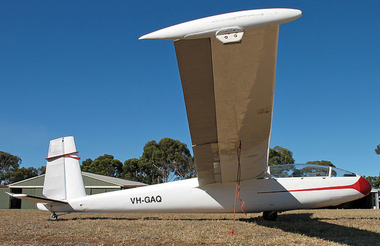
... construction. It is finished in a white colour scheme with red detailing consisting of a red fuselage nose and adjoining red stripe along the fuselage sides to about midships. ...Used by many clubs in Australia in the 1970s. australian gliding glider sailplane let kunovice blanik Registration VH-GAQ in black on sides of fuselage to the rear The Blanik VH-GAQ is a large two seat glider – sailplane of metal construction. ...The Let 13 Blanik was designed in 1956 by Karel Dlouhý of VZLÚ Letňany as a training glider. It filled that role very well and approximately 3000 have been built since production started in 1958. However, following a fatal accident involving a Blanik in Austria in 2010 that raised concerns about main spar metal fatigue, the type was grounded in Europe and America. In Australia, the extension of the life of this type of glider beyond 5000 hours / 18000 launches is dependent on compliance with directives for the inspection and modification of fatigue critical components. It is understood that VH-GAQ was built in 1971 and first registered on 14 August 1972. It is a Blanik that has been retired from service because of the metal fatigue concerns that apply to the type generally and the expense involved in complying with the applicable directives for on-going airworthiness certification. VH-GAQ was donated to the Australian Gliding Museum by the Australian Junior Gliding Club in 2010. Popular mass produced, metal, two seat sailplane. Used by many clubs in Australia in the 1970s. The Blanik VH-GAQ is a large two seat glider – sailplane of metal construction. It is finished in a white colour scheme with red detailing consisting of a red fuselage nose and adjoining red stripe along the fuselage sides to about midships. The control surfaces (ailerons, flaps, elevators and rudder) are covered with aircraft fabric and painted silver. The Perspex canopy fully encloses the cockpit which is fully equipped for dual flying. Registration VH-GAQ in black on sides of fuselage to the rearaustralian gliding, glider, sailplane, let kunovice, blanik -
 Australian Gliding Museum
Machine - Glider – Sailplane, 2001
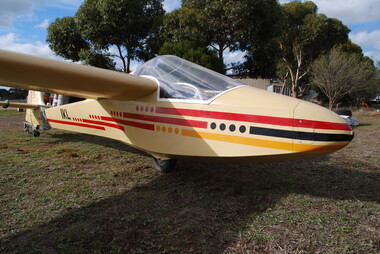
... construction of the Museum’s Woodstock (a “Woodstock 1”) was commenced by Ken Davies who, due to age related health difficulties, was unable to finish the project. The project was taken over by James Garay and was completed in 2001. It is registered with the Gliding Federation of Australia as GFA/HB123 and allocated letters VH-IKL. It is practically a new aircraft with very few flying hours logged. VH-IKL differs from the original Woodstock 1 design in one respect in that the rear fuselage...construction of the Museum’s Woodstock (a “Woodstock 1”) was commenced by Ken Davies who, due to age related health difficulties, was unable to finish the project. The project was taken over by James Garay and was completed in 2001. It is registered with the Gliding Federation of Australia as GFA/HB123 and allocated letters VH-IKL. It is practically a new aircraft with very few flying hours logged. VH-IKL differs from the original Woodstock 1 design in one respect in that the rear fuselage ...This glider type was designed by Jim Maupin in United States in the 1970s. The prototype first flew in 1978. It is a design intended as suitable for amateur construction using wood (principally Douglas Fir and Birch plywood). It is understood that hundreds of sets of plans have been sold. It is not known how many Woodstocks have been built but there are at least 3 flyable examples in existence in Australia. Over time the design has been altered increasing the wingspan from 11.9 metres to 12.6 metres and then to 13.1 metres for Types 1, 2 and 3 respectively. Some builders of Woodstock gliders have also made their own changes to the Jim Maupin design. The construction of the Museum’s Woodstock (a “Woodstock 1”) was commenced by Ken Davies who, due to age related health difficulties, was unable to finish the project. The project was taken over by James Garay and was completed in 2001. It is registered with the Gliding Federation of Australia as GFA/HB123 and allocated letters VH-IKL. It is practically a new aircraft with very few flying hours logged. VH-IKL differs from the original Woodstock 1 design in one respect in that the rear fuselage has been modified to enable the tailplane to be removed for de-rigging. The Museum holds technical drawings prepared by Ken Davies in relation to this feature of the glider. James Garay kindly donated VH-IKL to the Australian Gliding Museum in March 2013. An example of a successful glider-sailplane design for amateur construction from the 1970s.Home built single seat sailplane of wooden construction finished in a light desert sand colour with aboriginal art theme markings.Marked with registration – VH-IKLaustralian gliding, glider, sailplane, woodstock, maupin, davies, garay, woody roo -
 Australian Gliding Museum
Machine - Glider – Sailplane, 1963
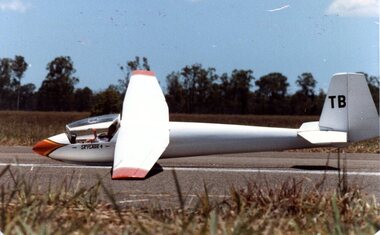
... construction of gliders. Slingsby incorporated GRP (glass reinforced plastic) panels to achieve a streamlined fuselage nose and cockpit area while retaining the more traditional wood techniques for the rest of the aircraft. ...The Slingsby Skylark 4 is high wing single seat sailplane of mainly wooden construction with plywood and fabric covering. However, the cockpit and forward part of the fuselage consists of glass reinforced plastic which was innovative at the time that the type was designed. ...construction of gliders. Slingsby incorporated GRP (glass reinforced plastic) panels to achieve a streamlined fuselage nose and cockpit area while retaining the more traditional wood techniques for the rest of the aircraft. ...The Skylark 4, the final in the Slingsby Skylark series, dates from 1961. The design heralded a trend towards the use of plastics in the construction of gliders. Slingsby incorporated GRP (glass reinforced plastic) panels to achieve a streamlined fuselage nose and cockpit area while retaining the more traditional wood techniques for the rest of the aircraft. Another notable feature was the smooth wing surface that was obtained using a Gaboon ply skin across the ribs. Best glide performance of 1:33 was found to be comparable with the early full GRP glider designs. The Museum’s example (VH-GTB – C/N 1382) was built in 1963 and originally owned by Chuck Bentson of the UK. It was brought to Australia in 1967 by Jeremy Picket-Heaps and flown at various places including Benalla, Cooma and Gundaroo. In 1970 the glider was transferred to the New England Soaring Club. Many flights were made from Armidale and Bellata in Northern New South Wales. On one occasion, the glider was kept aloft for 8 hours 45 minutes and on another the pilot took it around a 500 kilometre triangle in nearly 8 hours. In 1980 it was sold to Ralph (“Feathers”) Crompton and was flown extensively in South Australia until 1988. The final owner before the glider was given to the Museum in 2004 was Ross Dutton of Melbourne. The last recorded flight occurred in 1992. The glider at that point had logged over 2000 hours flying time from about 2000 launches. The airframe is currently being restored to flying condition. Technically this aircraft represents the state of the art at the stage that sailplane design was changing from traditional wood construction to composites (GRP) The Slingsby Skylark 4 is high wing single seat sailplane of mainly wooden construction with plywood and fabric covering. However, the cockpit and forward part of the fuselage consists of glass reinforced plastic which was innovative at the time that the type was designed. The cockpit provides for a semi reclining position for the pilot protected with a full Perspex canopy. The wings are made up of a centre section with constant chord and tapered wing tips. The aircraft has a conventional arrangement for the tail stabiliser / control surfaces. The sailplane bears construction number 1382 and is registered in Australia as VH-GTBaustralian gliding, glider, sailplane, skylark, slingsby, bentson, picket-heaps, crompton, new england soaring club, dutton -
 Australian Gliding Museum
Machine - Glider - Sailplane, 1961
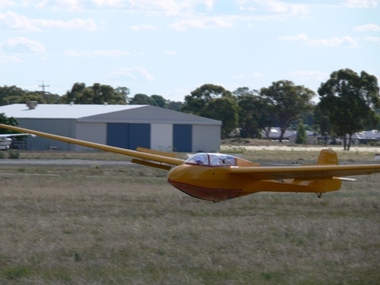
... construction covered with plywood and fabric. It has a fully enclosed cockpit under perspex (which is missing from this airframe). The wings which join the fuselage...If restored this exhibit will be representative of the Scheibe Bergfalke II-55 sailplane type (a rarity in Australia). glider sailplane australian gliding scheibe bergfalke byron soaring centre mangalore gliding club dattler southern riverina gliding club tocumwal Registration "GKZ" on sides of fuselage Tandem two seat sailplane of a wood and tubular steel construction covered with plywood and fabric. ...The Scheibe Bergfalke II is a high performance (for its day) and relatively inexpensive two seat sailplane designed by Egon Scheibe. It appeared in 1953 as a derivative of the Scheibe Mu13 Bergfalke and incorporated design changes to resolve and simplify structural issues that affected the Mu13. The Bergfalke II-55 followed in 1955. About 300 of the Bergfalke II and II-55 types were built in Germany and Sweden. This aircraft of the Bergfalke II-55 type was built by Scheibe in 1961 (work number 339). After a long life at Fliegergruppe Leimen e.V. logging 6754 flights and 1588 hours in the air, the glider was imported into Australia from Germany in June 2004. The glider was registered as VH-GKZ in January 2005 by Thomas Dattler of Millumbindy and flown only a small number of occasions (probably at Byron Soaring Centre). The Mangalore Gliding Club appears to have taken an interest in the glider in 2006 and completed routine Form 2 inspections in 2006 and 2009. The amount of usage during this period is unclear as the logbook records held are incomplete. In January 2012 the glider was purchased by the Southern Riverina Gliding Club and flown at Tocumwal until it was damaged in 2013 due to being blown over while at rest on the airfield. The 10 year survey was due in March 2013 and a decision was made by the club to donate the glider to the Australian Gliding Museum instead of completing the necessary repairs for returning it to an airworthy condition. It is estimated that the glider was flown about 300 times and perhaps logged about 140 hours in the air in Australia. If restored this exhibit will be representative of the Scheibe Bergfalke II-55 sailplane type (a rarity in Australia).Tandem two seat sailplane of a wood and tubular steel construction covered with plywood and fabric. It has a fully enclosed cockpit under perspex (which is missing from this airframe). The wings which join the fuselage at shoulder height are swept forward such that the aircraft can be flown solo from the front seat and be properly balanced. The aircraft is in a damaged condition. Registration "GKZ" on sides of fuselage glider, sailplane, australian gliding, scheibe, bergfalke, byron soaring centre, mangalore gliding club, dattler, southern riverina gliding club, tocumwal -
 Australian Gliding Museum
Machine - Glider – Sailplane, Kaiser Ka 2B Rhonschwalbe, 1960
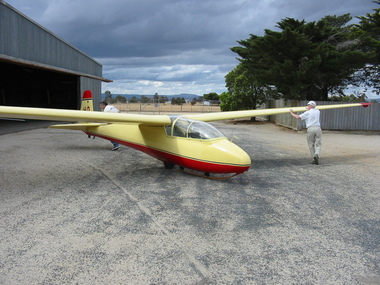
... fuselage was lengthened slightly as well. Schleicher built 42 Ka2s from 1953 to 1955 and 75 Ka 2Bs from 1955 to 1957. In addition Schleicher supplied kits for construction of the sailplane by independent builders. ...fuselage was lengthened slightly as well. Schleicher built 42 Ka2s from 1953 to 1955 and 75 Ka 2Bs from 1955 to 1957. In addition Schleicher supplied kits for construction of the sailplane by independent builders. ...The Ka 2, a tandem two seat training sailplane of 15 metre wing span, was designed by Rudolf Kaiser for Schleicher in 1953. It was a versatile craft due to its good cross country soaring capability. With the Ka 2B, the design was improved in 1955 by lengthening the wing span to 16 metres and increasing the dihedral and tip washout. The fuselage was lengthened slightly as well. Schleicher built 42 Ka2s from 1953 to 1955 and 75 Ka 2Bs from 1955 to 1957. In addition Schleicher supplied kits for construction of the sailplane by independent builders. The Australian Gliding Museum’s example is the single Ka 2b built in Australia from plans and is designated as GFA-HB-47. The club concerned was the Illawarra Soaring Club of Sydney. The glider registered as VH-GHO and first flew in October 1960. However, within a short time it was badly damaged and needed major repairs which took over a year to complete. After about 10 years service at Illawarra Soaring Club it was transferred in February 1972 to W.G. Hingston, Rosebud, Victoria, and flown with the Peninsula Soaring Association, a small club of about 20 members, operating at the Moorooduc Airfield. The Ka2b was disposed of to the Stirling Gliding Club in Western Australia in August 1976. Once again it suffered damage in a landing accident in 1978. The damaged glider was put into storage at Northam where it remained for approximately 11 years. It was acquired by Mike Valentine in 1989 and brought back to flying condition at Bacchus Marsh, Victoria. The last entry in the log book is dated January 1997 at which time it had accumulated 1170 hours from 2446 flights. The last owner prior to transfer to the Australian Gliding Museum was John Ashford of the Geelong Gliding Club. The Museum's Ka 2B sailplane is a potentially airworthy example of this German 1950s sailplane type. It is a rarity in Australia as the only Ka 2b appearing on the Australian register.Tandem two seat sailplane of wood and fabric construction finished in cream and red colour schemeRegistration VH-GHO (with "HO" letters painted on the fin / rudder) Serial number - GFA HB 47 australian gliding, glider, sailplane, schleicher, kaiser, ka 2, illawarra soaring club, stirling gliding club, valentine, ashford, peninsulasoaring association -
 Australian Gliding Museum
Machine - Glider – Sailplane, 2015
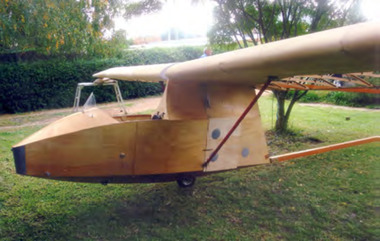
... However, it is an important exhibit in that it shows in tangible form a nacelle fuselage training glider in configuration and construction detail. As such it revisits the pioneering era of the 1930s and 1940s in Australia when wood, wire and fabric were the rule and the nacelle primary glider was generally the first step up for pilots who had mastered the basics in an open primary. australian gliding sailplane glider salamandra czerwinshi poland ash None Nacelled solo training glider of traditional wood and fabric construction. ...The Salamandra is a Polish glider designed by Waclaw Czerwinski at the Military Glider Workshops in Krakow in 1936. This glider, designated “W.W.S.1”, was produced in substantial numbers prior to the second world war and used in Poland and some other eastern European countries for training pilots. Only one example survived the war, hidden away in the village of Goleszow in Silesia. In addition, no technical drawings could be found, so when the glider was discovered, the Gliding Institute being keen to re-establish gliding in Poland, used the glider to draw up new plans for construction. Five were built for the Institute in 1947 before production was resumed of the “Salamandra 48” at the SZD Jezow Workshops. Improvement were made by adding airbrakes and structural changes for the “Salamandra 49” and a windscreen and larger tailplane were changes adopted for the “Salamandra 53”. An export version designated “53A” was sold to and built under licence in China. Production of the Salamandra ceased in the early 1960s. Total production may have been in excess of 500. The glider was well regarded as a light weight trainer capable of soaring performance. The Museum’s replica was built by Ray Ash and may be may be classified as a “Salamandra 53”. However, he has added something of his own to the design by replacing the cable runs in the wings with control rods. The glider is substantially complete. The wings and tail / rudder surfaces have been covered with poly-fibre fabric. The fuselage woodwork is sealed with varnish. In addition to the finishing work (including painting) and rigging of the main components, the linkages for Ray’s control rod modification may need further engineering to make them operational. The Ray Ash Salamandra is the first of the type to appear in Australia. The Salamandra did not play any role in the development of gliding in Australia in the early years. However, it is an important exhibit in that it shows in tangible form a nacelle fuselage training glider in configuration and construction detail. As such it revisits the pioneering era of the 1930s and 1940s in Australia when wood, wire and fabric were the rule and the nacelle primary glider was generally the first step up for pilots who had mastered the basics in an open primary.Nacelled solo training glider of traditional wood and fabric construction. Construction incomplete.Noneaustralian gliding, sailplane, glider, salamandra, czerwinshi, poland, ash -
 Australian Gliding Museum
Machine - Glider - Sailplane
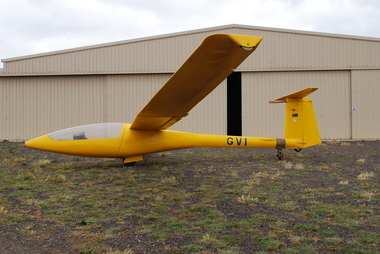
... The MOBA2 is a notable home built 1970s sailplane design that featured a number of innovative elements including composite construction without the need for expensive jigs, nose cone canopy and asymmetrical placement of control column. australian gliding glider sailplane moba2b moba2c sunderland moba2d victorian motorless flight group vmfg Registration "GVI" on fuselage; Kangaroo, Australian Flag and VMFG decals on vertical stabiliser Composite single seat glider / sailplane finished in bright yellow Machine Glider - Sailplane Gary Sunderland ...MOBA2 is a 15 metre sailplane designed by Gary Sunderland, who was an aeronautical engineer working for the Department of Civil Aviation (Australia) and a member of the Victorian Motorless Flight Group (VMFG). The design gave effect to ideas that he developed circa 1970 for an aircraft that he could build himself. He entered a 13 metre wingspan version of his MOBA design (MOBA2B) in an Australian Gliding sailplane design competition that was announced in 1970. The competition called for sailplane designs with a maximum wingspan of 13 metres that could be built by amateurs in a small workshop with limited tools and facilities. In 1973, Gary’s MOBA was judged by the competition panel as equal best with the other outstanding submission, which were chosen from a field of 19 entrants. However, after gathering further information and deliberation by the competition panel neither of the two outstanding designs were chosen as the winner. Notwithstanding the outcome, in 1974 Gary proceeded built his glider to the original 15 metre design. The wing was equipped with camber changing flaps that were permitted under special standard class rules for the 1974 world championships. Changes were made along the way in the light of construction experience and the completed glider was given the designation MOBA2C. The glider first flew on 12 December 1979. It was never flown in standard class competition as by the time the glider was built the special 1974 rules were revoked and wing flaps were no longer permitted in that class. However, Gary flew MOBA2C in the Australian national gliding competitions held at Benalla in the summer of 1979 / 1980 competing in the open class. After adjustment to the aileron gearing during initial trials MOBA2C was found to fly well and in competition produced performances believed to be better than contemporary standard class sailplanes but not as good as the open class machines. The glider was later modified in a number of respects including amongst other things the installation of spoilers located just forward of the wing flaps and by increasing the chord marginally at the wing root. With these changes the glider type was given the designation MOBA2D. The last recorded flights occurred in February 1996 at which time MOBA2 had flown an aggregate of 401 hours and 59 minutes during its 297 launches. Its operational life was brought to an end due to expansion of the foam in the wings causing distortion of the wing surface.The MOBA2 is a notable home built 1970s sailplane design that featured a number of innovative elements including composite construction without the need for expensive jigs, nose cone canopy and asymmetrical placement of control column.Composite single seat glider / sailplane finished in bright yellowRegistration "GVI" on fuselage; Kangaroo, Australian Flag and VMFG decals on vertical stabiliseraustralian gliding, glider, sailplane, moba2b, moba2c, sunderland, moba2d, victorian motorless flight group, vmfg -
 Australian Gliding Museum
Machine - Glider - Sailplane, 1937
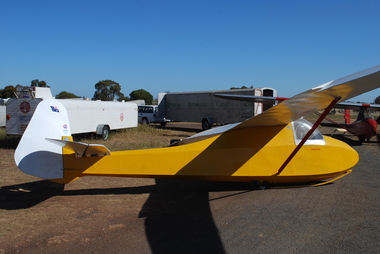
... construction of his new sailplane (which he called the “Golden Eagle”) in 1937 and it was test flown at Laverton at the western edge of Melbourne in September 1937. On the same day, at Laverton, the Gliding Club of Victoria flew its new Grunau Baby 2 sailplane which it had imported as a finished machine from Edmund Schneider in Germany. The Golden Eagle was found to fly well, having a similar performance to the Grunau Baby. In the 1950s, the Golden Eagle was modified by rebuilding the front of the fuselage...construction of his new sailplane (which he called the “Golden Eagle”) in 1937 and it was test flown at Laverton at the western edge of Melbourne in September 1937. On the same day, at Laverton, the Gliding Club of Victoria flew its new Grunau Baby 2 sailplane which it had imported as a finished machine from Edmund Schneider in Germany. The Golden Eagle was found to fly well, having a similar performance to the Grunau Baby. In the 1950s, the Golden Eagle was modified by rebuilding the front of the fuselage ...The Golden Eagle is an original design by Geoff Richardson. Geoff commenced gliding in the early days of the sport circa 1933 in Melbourne, flying at Coode Island and Mt Frazer. In 1934, he began construction of a secondary type glider but scrapped it upon realizing that a better design was needed. He conducted further research and came up with a sailplane of similar size and general arrangement to the Grunau Baby but with a “Gull” wing using a Gottingen 535 wing section (the same as for the Grunau Baby). Geoff did all the technical calculations himself and even made up and tested a Casein glue for the construction. Geoff competed construction of his new sailplane (which he called the “Golden Eagle”) in 1937 and it was test flown at Laverton at the western edge of Melbourne in September 1937. On the same day, at Laverton, the Gliding Club of Victoria flew its new Grunau Baby 2 sailplane which it had imported as a finished machine from Edmund Schneider in Germany. The Golden Eagle was found to fly well, having a similar performance to the Grunau Baby. In the 1950s, the Golden Eagle was modified by rebuilding the front of the fuselage to enclose the cockpit with a Perspex canopy. A landing wheel was incorporated behind the skid. Spoilers were added to the wings and a trim tab to the elevators. The Golden Eagle has been flown with the VMFG (Victorian Motorless Flight Group) for most of its long life. When donated to the Australian Gliding Museum in 2016 by Alan Patching it was probably the oldest, continuously airworthy glider in the world. Having regard to the historical significance of the Golden Eagle, the Museum has decided to not to fly it anymore to avoid risk of loss or damage. The exhibit is of great significance for Australian gliding history – the Golden Eagle is a flyable 1930s aircraft in excellent condition that was designed and built by an Australian gliding pioneer. Single seat wood and fabric sailplane finished with white wings, tailplane and rudder and yellow fuselage Registration letters “FC” on fuselage nose port side, Australian flag, Vintage Gliders Australia and VMFG decals on rudder, “Golden Eagle” lettering in red on each side of the fuselage below the canopy, Aboriginal flag decal on port side of fuselage below the canopy. australian gliding, glider, sailplane, golden eagle, richardson, patching, vmfg, victorian motorless flight group -
 Australian Gliding Museum
Machine - Glider – Sailplane, 1972
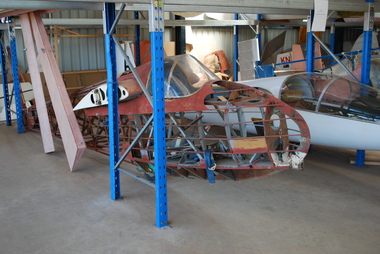
... fuselage and one wing. However, inspection of the other wing revealed extensive damage to the ribs and spars and consequently a decision was taken to make it a static exhibit. The exhibit is an example of home built construction ...The Hall Cherokee II glider is an American design for amateur construction from plans. The designer was Stan Hall (1915-2009), a professional engineer, who gained extensive experience in the United States aviation industry during World War 2 including the programs for military gliders. He continued to work as an engineer for aircraft manufacturers and as a consultant to the industry after the war. He was active in gliding and, in particular, the home built sailplane movement. The Cherokee II was one of about 10 glider designs that he produced: it came out in 1956. It is understood that over 100 Cherokee gliders have been built. In Australia the number is possibly 10 or 11. The Hall Cherokee VH-GVO was built by R.D Meares of Caringbah, New South Wales. The glider was registered as VH-GVO on 11 October 1973 and given serial number “GFA-HB-82” by the Gliding Federation of Australia. The Logbook for VH-GVO appears to be a complete record of the flying history; in aggregate 210 hours 40 minutes in the air from 331 flights. The first test hop occurred on 29 July 1972 at Camden, New South Wales. VH-GVO was last flown on 22 July 1986. Many of the flights recorded are of one or two hours duration. The glider was last inspected and certified as airworthy and in a reasonable condition at the Hunter Valley Gliding Club in July 1986. Since that time, until transferred to the Australian Gliding Museum, the glider was in storage. Structural restoration work has been completed on the fuselage and one wing. However, inspection of the other wing revealed extensive damage to the ribs and spars and consequently a decision was taken to make it a static exhibit. The exhibit is an example of home built construction of a type that has proved popular amongst amateur glider builders.The Hall Cherokee (formerly registered as VH-GVO) is a single seat wooden home built glider. The glider is constructed from wood, plywood, fabric and metal fittings, all commercial grade except for main wing fittings, pulleys, cables and bolts. The fuselage is simple with four main longerons and bulkheads with diagonal bracing. The wing has two identical solid spars which form a geodetic structure, hence the leading edge is non-structural. Registration VH-GVO – serial number GFA-HB-82 australian gliding, glider, sailplane, hall, cherokee, meares, hunter valley gliding club -
 Australian Gliding Museum
Machine - Glider - Sailplane, 1974
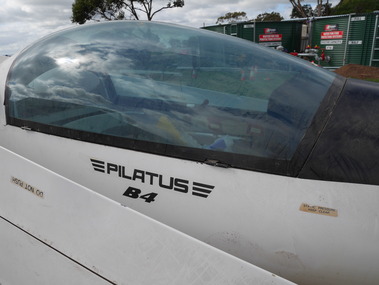
... The aircraft is representative of a popular imported 1970s intermediate single seat sailplane design of aluminium alloy construction. australian gliding glider sailplane pilatus b4 sutton narrogin albury corowa green townsville millward geelong White colour scheme with yellow fuselage underside highlighted by blue stripe – “Pilatus B4” in black lettering on starboard side of cockpit – black anti-glare paint on the fuselage nose – Registration “GID” on the underside of port wing. ...The Pilatus B4 is an all metal intermediate sailplane meeting Standard Class rules that was designed in 1966 by Ingo Herbst, Manfred Küppers and Rudolf Reinke. It did not immediately go into production. In 1972 Pilatus Aircraft of Switzerland acquired a licence to build the aircraft and began production. The PCII and PCIIA versions were semi-aerobatic. The PC11AF released in 1975 was rated as fully aerobatic. By 1980, when Pilatus sold the rights to manufacture of the aircraft to Nippi Aircraft of Japan, 322 of the Pilatus B4 had been produced. Nippi Aircraft built a further 13 and also one two seat version. The Pilatus B4 proved popular in Australia with 26 appearing on the Australian register. The Museum’s example is a basic semi-aerobatic type (Serial Number 092) that was built in 1974. It is registered as VH-GID on 8 July 1974 by H.G. Sutton of Mandura, Western Australia and flown out of the Narrogin Gliding Club in Western Australia until September 1986 when it was sold to the Albury – Corowa Gliding Club, New South Wales. In 1999 it was acquired by Michael Green and moved to Townsville, Queensland. The aircraft changed ownership again in 2004 and fell out of use for nearly 4 years. By then it had recorded 4377 hours in the air from 4304 flights. It returned to service briefly in January 2008 (5 flights totalling about 5 hours). It was donated to the Museum by David Millward of the Geelong Gliding Club, Victoria, on 10 April 2017. The aircraft is representative of a popular imported 1970s intermediate single seat sailplane design of aluminium alloy construction.Single seat sailplane of metal alloy constructionWhite colour scheme with yellow fuselage underside highlighted by blue stripe – “Pilatus B4” in black lettering on starboard side of cockpit – black anti-glare paint on the fuselage nose – Registration “GID” on the underside of port wing.australian gliding, glider, sailplane, pilatus b4, sutton, narrogin, albury, corowa, green, townsville, millward, geelong -
 Australian Gliding Museum
Machine - Glider - Sailplane
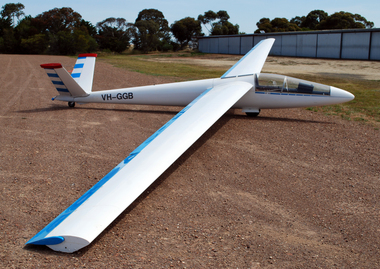
... A well-engineered metal sailplane from the 1970s with good soaring performance which was designed for amateur construction. australian gliding glider sailplane schreder slingsby bache waikerie gliding club moore lovell rickert o’sullivan canberra gliding club geelong gliding club. Registration letters 'GGB' on sides of fuselage ...The Schreder HP 14V is an all metal single seat sailplane designed by Richard Schreder in America. The design is an evolution of Schreder’s metal sailplane designs that date from the late 1950s. Schreder won the United States National Soaring Championship in 1966 in the prototype HP 14. He marketed the glider in kit form in the 1960s and 1970s and allowed Slingsby in the UK to further develop the design for production. Schreder HP14 V, registered as VH-GGB, was built in South Australia by Harry Bache of the Waikerie Gliding Club in the 1970s. Martin Simons, an authority on vintage sailplanes (including Slingsby types), refers to this airframe as “built entirely from scratch”. After Bache, this Schreder HP14V passed on to E.G. Moore and N.L. Lovell at Ararat in Western Victoria, then Graeme Rickert of the Canberra Gliding Club and finally, to Greg O’Sullivan of the Geelong Gliding Club. The glider was first flown on 20 December 1975. It appears to have been flown regularly over its life to 2015 and the cumulative use being 1386 hours flown from 702 launches. The log book does not disclose details of flights except as aggregates of flights and times. Details of notable flights by Bache and Moore et al are not available. However, reports from Rickert and O’Sullivan indicate that a good number of cross-country flights of 300km or longer were achieved in this aircraft. A well-engineered metal sailplane from the 1970s with good soaring performance which was designed for amateur construction. All metal single seat glider sailplane with a distinctive V-tail, finished in a white and blue colour schemeRegistration letters 'GGB' on sides of fuselageaustralian gliding, glider, sailplane, schreder, slingsby, bache, waikerie gliding club, moore, lovell, rickert, o’sullivan, canberra gliding club, geelong gliding club. -
Moorabbin Air Museum
Book - Aircraft construction, Metal Aircraft Construction
... Aircraft construction Materials Main planes Fuselages Flying boat hulls & seaplane floats Workshop processes Corrosion Riveting Overview of practice of metal construction of aircraft, circa 1942 Metal Aircraft Construction Book Aircraft construction ...Overview of practice of metal construction of aircraft, circa 1942non-fictionOverview of practice of metal construction of aircraft, circa 1942materials, main planes, fuselages, flying boat hulls & seaplane floats, workshop processes, corrosion, riveting -
Moorabbin Air Museum
Book - Aircraft construction, Practical Lightplane Design and Construction for the Amateur
... Fuselage...Wings...Tail surfaces...Control systems...Miscellaneous construction...Aircraft construction Airfoils Power plants Propellers Fuel systems Landing Gear Fuselage Wings Tail surfaces Control systems Miscellaneous construction details Guidance on light aircraft construction for amateur builders, circa 1965 Practical Lightplane Design and Construction for the Amateur Book Aircraft construction ...Guidance on light aircraft construction for amateur builders, circa 1965non-fictionGuidance on light aircraft construction for amateur builders, circa 1965airfoils, power plants, propellers, fuel systems, landing gear, fuselage, wings, tail surfaces, control systems, miscellaneous construction details -
Moorabbin Air Museum
Book - Airplane stress analysis, Airplane Stress Analysis An Introductory Treatise
... Construction materials...Wing analysis...Chassis analysis...Fuselage...Aircraft stress analysis Applied mechanics Beam theory Construction materials Wing analysis Chassis analysis Fuselage analysis Tail surfaces Step by step introduction to calculations required for aircraft stress analysis, circa 1929 Airplane Stress Analysis An Introductory Treatise Book Airplane stress analysis ...Step by step introduction to calculations required for aircraft stress analysis, circa 1929non-fictionStep by step introduction to calculations required for aircraft stress analysis, circa 1929applied mechanics, beam theory, construction materials, wing analysis, chassis analysis, fuselage analysis, tail surfaces -
 Melton City Libraries
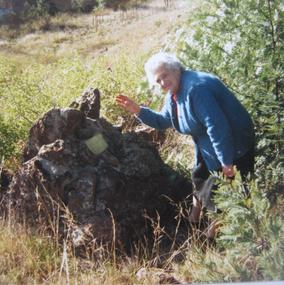
Photograph, The Cairn- Jimmy Melrose's plane crash site, 1988
... fuselage was a streamlined rectangular section and the rear portion was a monocogue shell; the whole was of plywood fabric covered. The wing was built up of spruce box spars and lattice ribs, ply covered from the leading edge to the front spar and the fabric covered over the remainder. The tail surfaces were of similar construction...fuselage was a streamlined rectangular section and the rear portion was a monocogue shell; the whole was of plywood fabric covered. The wing was built up of spruce box spars and lattice ribs, ply covered from the leading edge to the front spar and the fabric covered over the remainder. The tail surfaces were of similar construction ...Edna Barrie at the cairn, photo received from Graeme Minns in 1988. The cairn marks the site of Jimmy Melrose's plane crash in Melton South. The accident which happened on July 5th 1936. In 1934 Melrose made headlines with a series of spectacular flights. In July of that year, he set around Australia record and in that year established a new solo Australia England record when he flew to England to compete in the MacRoberston race with a De Havilland Puss Moth VH- YQO. The only Australian and the only solo pilot to complete the course within the time limit. He was seventh in finishing order and third in the handicap section making news again during the race with a dramatic landing in Darwin with empty fuel tanks. Late in 1935 Melrose imported the Phoenix for his “Adelaide to Anywhere” Charter Service. The previous year the Heston Aircraft Company had taken over the interests of the well known Comper Aircraft Company, and the first production of the new firm was the Phoenix, a single-engined all wooden five seater machine of sesquiplane configuration. The forward half of the fuselage was a streamlined rectangular section and the rear portion was a monocogue shell; the whole was of plywood fabric covered. The wing was built up of spruce box spars and lattice ribs, ply covered from the leading edge to the front spar and the fabric covered over the remainder. The tail surfaces were of similar construction. The most notable feature of the design was the lower stub wing which ran right across the fuselage embodying two box spars, plywood covered it housed the main undercarriage wheels when retracted and provided a substantial anchorage for the Nu form wing struts. The Dowty undercarriage retracted inwards, operated manually by hydraulic packs, Dual control fitted, with side by side seating for the pilots and three passenger seats behind. Power was a 200 h.p. De Havilland Gipsy VI 6 cylinder inverted in-line air-cooled engine. Six Phoenix were built; five of them registered in Great Britain and one of those was later sold abroad the remaining four were impressed into the R.A.F. in 1940. Specifications were: 40 feet 4 inches length 30 ft 2 ins height, 9ft 7ins, wing area 270 sq ft, Tare weight 2,600lbs loaded weight 3,300lbs; cruising speed 360 m.p.h. landing 50mph ceiling 14,000 ft range 700 miles. Melrose’s machine the first production aircraft was built early in 1936 and test flown of the 24th March. Painted green it carries the words “South Australian Centenary 1936” in silver of the fuselage and the name “Billing on the engine cowling in honor of Melrose’s uncle Noel Pemberton Billing, pioneer designer and founder of the Supermarine Aviation Company. The delivery flight was planned as a goodwill mission to publicise the forthcoming South Australian Centenary celebrations. Melrose left Dympne on the 9th April 1936, and flying via Marseilles, Naples, Athens, Baghdad, Basra, Karachi, Jodphur, Calcutta, Akyab, Penang, Singapore, Lombok, Darwin, Newcastle Waters and Alice Springs reached Adelaide on the 25th of April. Continuing the goodwill flight to other States, he visited Melbourne, Sydney, Newcastle, Grafton, Brisbane, Coff’s Harbour, Sydney again, Launceston, Hobart and Mount Gambier before returning to Adelaide on the 13th May. During June Jimmy made some charter flights and early in July was engaged by Mr. A.J. Campbell a director of several mining companies from Melbourne to Darwin to commence at Essendon on the4th July. However on that day low cloud and steady rain caused the postponement. There was little improvement and Melrose was advised to delay the departure again. However he wished to reach Oodnadatta that night, and when he observed the break in the clouds decided to leave. He planned to climb above the cloud and fly to Adelaide at 3,000 feet. The aircraft was airborne about 8.10 a.m. and was last seen from Essendon climbing above the clouds. At 8.45 people at Melton (30 miles West of Melbourne) heard an approaching aircraft. The engine noise increased abnormally and eye witnesses saw the machine fall out of control from the cloud base about 800 feet and then disintegrate, fragments were scattered for 1½ miles and both occupants were killed. Hand written carbon copy by Edna Barrie.Typed by Wendy Barrie March 2014 Last Flight of Jimmy Melrose by John Burke Parade Magazine July 1972 Page 2 –4 This article gives the take off time of 7.50 am from Essendon Airport Eyewitness account at the time Maisie Arthur’s description. Newspaper article. Edna Barrie at the site of the 'Cairn'local identities, local significant events
