
Showing 50 items matching "court rules -- victoria"
-
 RMIT GSBL Justice Smith Collection
Book, Williams, Neil J, Supreme Court civil procedure under chapter I of the rules of the Supreme Court of Victoria, 1987
... ...court rules -- victoria...Smith victoria. supreme court civil procedure court rules civil procedure -- australia -- victoria court rules -- australia -- victoria civil procedure -- victoria court rules -- victoria ISBN: 0409492183 Supreme Court civil procedure under chapter I of the rules of the Supreme Court of Victoria Book Williams, Neil J. ...Previous owner: T. H. SmithISBN: 0409492183victoria. supreme court, civil procedure, court rules, civil procedure -- australia -- victoria, court rules -- australia -- victoria, civil procedure -- victoria, court rules -- victoria -
RMIT GSBL Justice Smith Collection
Folio, [Chief Justice of the Supreme Court of Victoria], Supreme Court of Victoria practice notes [loose-leaf papers in folder belonging to The Hon. Justice Smith], [2007]
... ...court rules -- victoria...practice of law -- australia -- victoria court rules -- victoria victoria. supreme court [2006-2007] Dividers hang out the side a bit Supreme Court of Victoria practice notes [loose-leaf papers in folder belonging to The Hon. ...[2006-2007] Dividers hang out the side a bitpractice of law -- australia -- victoria, court rules -- victoria, victoria. supreme court -
RMIT GSBL Justice Smith Collection
Report, Guide to commercial list practice, 1992
... ...court rules -- victoria...victoria. supreme court commercial courts -- victoria court rules -- victoria ISBN: 0730630323 Guide to commercial list practice Report Supreme Court of Victoria ...ISBN: 0730630323victoria. supreme court, commercial courts -- victoria, court rules -- victoria -
RMIT GSBL Justice Smith Collection
Book, Butterworth & Company (Australia) Ltd, Practice of the County Court of Victoria : being an annotation of County Court act 1958, and the rules of court thereunder, Foreign judgments act 1962, Instruments act 1958, Imprisonment of fraudulent debtors act 1958, and Service and execution of process act 1901-1963 (Com.), 1965
... court rules -- victoria...H. Smith court rules -- victoria Includes multiple loose-leaf amendments placed in appropriate places Practice of the County Court of Victoria : being an annotation of County Court act 1958, and the rules of court thereunder, Foreign judgments act 1962, Instruments act 1958, Imprisonment of fraudulent debtors act 1958, and Service and execution of process act 1901-1963 (Com.) ...Previous owner: T. H. SmithIncludes multiple loose-leaf amendments placed in appropriate placescourt rules -- victoria -
RMIT GSBL Justice Smith Collection
Book, CCH Australia Limited, Victoria civil procedure 1987, 1987
... ...court rules -- victoria....Smith victoria. supreme court victoria. county court victoria. magistrates' courts court rules -- victoria. civil procedure -- victoria ISBN: 0869039326 Index included Victoria civil procedure 1987 Book Bravender-Coyle, Paul, Krever, Richard, Pinos, Timothy CCH Australia Limited ...Previous owner: T. H. SmithIndex includedISBN: 0869039326victoria. supreme court, victoria. county court, victoria. magistrates' courts, court rules -- victoria., civil procedure -- victoria -
RMIT GSBL Justice Smith Collection
Book series, Rules of the Supreme Court of the State of Victoria relating to civil proceedings, 1966 - 1971
... court rules -- victoria...W. Smith court rules -- victoria No. of volumes: 3 Volume range: No. 333 of 1969,No. 183 of 1969 and No. 260 of 1971 Includes: Letter and legislation in No.260 of 1971 Rules of the Supreme Court of the State of Victoria relating to civil proceedings Book series Supreme Court of Victoria ...Previous owners: T. H. Smith, T. W. SmithNo. of volumes: 3 Volume range: No. 333 of 1969,No. 183 of 1969 and No. 260 of 1971 Includes: Letter and legislation in No.260 of 1971 court rules -- victoria -
RMIT GSBL Justice Smith Collection
Book, Cook, Richard et al, The annotated rules of court, 1996
... ...court rules -- victoria....victoria. supreme court victoria. county court victoria. county court victoria. magistrates' courts court rules -- victoria. civil procedure -- victoria ISBN: 0646287362 The annotated rules of court Book Cook, Richard Australian Law Books ...ISBN: 0646287362victoria. supreme court, victoria. county court victoria. county court, victoria. magistrates' courts, court rules -- victoria., civil procedure -- victoria -
RMIT GSBL Justice Smith Collection
Book series, Rules of the Supreme Court of the State of Victoria 1986 Chapter 1 General Rules of Procedure in Civil Proceedings Statutory Rule No. 99/1986, 1986
... Rules of the Supreme Court of the State of Victoria 1986 Chapter 1 General Rules of Procedure in Civil Proceedings Statutory Rule No. 99/1986 ...court rules -- victoria...court rules -- victoria No. of volumes: 3 Volume range: Reprint no. 2, Reprint no. 3, Reprint. no 4 Missing volume: Reprint no. 1 Rules of the Supreme Court of the State of Victoria 1986 Chapter 1 General Rules of Procedure in Civil Proceedings Statutory Rule No. 99/1986 Book series Supreme Court of Victoria ...No. of volumes: 3 Volume range: Reprint no. 2, Reprint no. 3, Reprint. no 4 Missing volume: Reprint no. 1court rules -- victoria -
RMIT GSBL Justice Smith Collection
Book, Supreme Court of Victoria, Rules of the Supreme Court of the state of Victoria relating to Civil Proceedings, divorce and probate, 1957
... court rules -- victoria...W. Smith court rules -- victoria Rules of the Supreme Court of the state of Victoria relating to Civil Proceedings, divorce and probate Book Supreme Court of Victoria W.M Houston Government Printer ...Previous owners: T. H. Smith, T. W. Smithcourt rules -- victoria -
 Flagstaff Hill Maritime Museum and Village
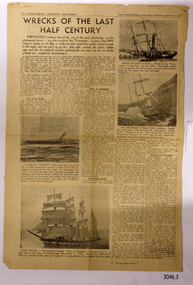
Newspaper - Newspaper clipping, 22-03-1947
... Court of Marine Inquiry in Melbourne ruled that the foundering of the ship was entirely due to Captain David Wood Thomson’s navigational error, not too technical failure of the Clyde-built ship. The shipwreck is a popular site for divers, about 300m offshore and in 3 – 15m of water. Some of the original cargo can be seen at the site, including pieces of roof slate and coils of barbed wire. The newspaper articles are of historical significance, retelling the stories of shipwrecks along the South West coast of Victoria ...Newspaper clippings and a typed sheet regarding shipwrecks in South West Victoria. (1) The first clipping is titled Wrecks of the Last Half Century, page 12 of the Warrnambool Centenary Supplement, The Warrnambool Standard, Saturday, March 22, 1947. The ships mentioned are FREE TRADER, LA BELLA, FALLS OF HALLADALE, CASINO and CARAMBA. (2) The second clipping's main article Divers Find old shipwreck from Geoff Clancy has a handwritten date Circa Jan 30, 1960, and is possibly from a Melbourne newspaper, as it mentions non-local events. It tells of the then-current finding of the 52-year-old wreck of the Falls of Halladale near Port Campbell by skin divers. (3) Type is written 2-page article The Romance of the Clipper Ships by Basil Lubbock sub-title Falls of Halladale. The iron-hulled, four-masted barque, the Falls of Halladale, was a bulk carrier of general cargo. She left New York in August 1908 on her way to Melbourne and Sydney. In her hold, along with 56,763 tiles of unusual beautiful green American slates (roofing tiles), 5,673 coils of barbed wire, 600 stoves, 500 sewing machines, 6500 gallons of oil, 14400 gallons of benzene, and many other manufactured items, were 117 cases of crockery and glassware. Three months later and close to her destination, a navigational error caused the Falls of Halladale to be wrecked on a reef off the Peterborough headland at 3 am on the morning of the 15th of November, 1908. The captain and 29 crew members all survived, but her valuable cargo was largely lost, despite two salvage attempts in 1908-09 and 1910. ABOUT THE ‘FALLS OF HALLADALE’ (1886 - 1908): - Built: in1886 by Russell & Co., Greenock shipyards, River Clyde, Scotland, UK. The company was founded in 1870 (or 1873) as a partnership between Joseph Russell (1834-1917), Anderson Rodger and William Todd Lithgow. During the period 1882-92 Russell & Co. they standardised designs, which sped up their building process so much that they were able to build 271 ships over that time. In 1886 they introduced a 3000 ton class of sailing vessel with auxiliary engines and brace halyard winches. In 1890 they broke the world output record. Owner: Falls Line, Wright, Breakenridge & Co, 111 Union Street, Glasgow, Scotland. Configuration: Four masted sailing ship; iron-hulled barque; iron masts, wire rigging, fore & aft lifting bridges. Size: Length 83.87m x Breadth 12.6m x Depth 7.23m, Gross tonnage 2085 ton Wrecked: the night of 14th November 1908, Curdies Inlet, Peterborough south west Victoria Crew: 29 The Falls of Halladale was a four-masted sailing ship built-in 1886 in Glasgow, Scotland, for the long-distance cargo trade and was mostly used for Pacific grain trade. She was owned by Wright, Breakenridge & Co of Glasgow and was one of several Falls Line ships, all of which were named after waterfalls in Scotland. The lines flag was of red, blue and white vertical stripes. The Falls of Halladale had a sturdy construction built to carry maximum cargo and able to maintain full sail in heavy gales, one of the last of the ‘windjammers’ that sailed the Trade Route. She and her sister ship, the Falls of Garry, were the first ships in the world to include fore and aft lifting bridges. Previous to this, heavily loaded vessels could have heavy seas break along the full length of the deck, causing serious injury or even death to those on deck. The new, raised catwalk-type decking allowed the crew to move above the deck stormy conditions. This idea is still used today in the most modern tankers and cargo vessels and has proved to be an important step forward in the safety of men at sea. On 4th August 1908, with new sails, 29 crew, and 2800 tons of cargo, the Falls of Halladale left New York, bound for Melbourne and Sydney via the Cape of Good Hope. The cargo on board was valued at £35,000 and included 56,763 tiles of American slate roofing tiles (roof slates), 5,673 coils of barbed wire, 600 stoves, 500 sewing machines, 6,500 gallons of oil, 14,400 gallons of benzene, plumbing iron, 117 cases of crockery and glassware and many other manufactured items. The Falls of Halladale had been at sail for 102 days when, at 3 am on the night of 14th November 1908, under full sail in calm seas with a six knots breeze behind and misleading fog along the coast, the great vessel rose upon an ocean swell and settled on top of a submerged reef near Peterborough on south-west Victoria’s coast. The ship was jammed on the rocks and began filling with water. The crew launched the two lifeboats and all 29 crew landed safely on the beach over 4 miles away at the Bay of Islands. The postmistress at Peterborough, who kept a watch for vessels in distress, saw the stranding and sent out an alert to the local people. A rescue party went to the aid of the sailors and the Port Campbell rocket crew was dispatched, but the crew had all managed to reach shore safely by the time help arrived. The ship stayed in full sail on the rocky shelf for nearly two months, attracting hundreds of sightseers who watched her slowly disintegrate until the pounding seas and dynamiting by salvagers finally broke her back, and her remains disappeared back into deeper water. The valuable cargo was largely lost, despite two salvage attempts in 1908-09 and 1910. Further salvage operations were made from 1974-1986, during which time 22,000 slate tiles were recovered with the help of 14 oil drums to float them, plus personal artefacts, ship fittings, reams of paper and other items. The Court of Marine Inquiry in Melbourne ruled that the foundering of the ship was entirely due to Captain David Wood Thomson’s navigational error, not too technical failure of the Clyde-built ship. The shipwreck is a popular site for divers, about 300m offshore and in 3 – 15m of water. Some of the original cargo can be seen at the site, including pieces of roof slate and coils of barbed wire.The newspaper articles are of historical significance, retelling the stories of shipwrecks along the South West coast of Victoria. The Falls of Halladale shipwreck is listed on the Victorian Heritage Register (No. S255). She was one of the last ships to sail the Trade Routes. She is one of the first vessels to have fore and aft lifting bridges. She is an example of the remains of an International Cargo Ship and also represents aspects of Victoria’s shipping industry. The wreck is protected as a Historic Shipwreck under the Commonwealth Historic Shipwrecks Act (1976).Newspaper cuttings with text and photographs (3) relevant to Falls of Halladale, La Bella, Casino, Free Trader and the refurbishing of the Falls of Clyde. Also included is typewritten information about Falls of Halladale. Printed between 1947 and 1972 in Melbourne, Victoria Author of the typed article "The Romance of the Clipper Ships" was Basil Lubbock Handwritten on article "Circa: JAN 30 1960" Headline "Divers find old shipwreck" "Geoff Clancy" "Not salvaged" "Still wedged" "Falls of Halladale" Typed pages: "THE ROMANCE OF THE CLIPPER SHIPS BY BASIL LUBBOCK" "FALLS OF HALLADALE" flagstaff hill, warrnambool, shipwrecked-coast, flagstaff-hill, flagstaff-hill-maritime-museum, maritime-museum, shipwreck-coast, flagstaff-hill-maritime-village, falls of halladale, la bella, falls of clyde, freetrader, casino, coramba, geoff clancy, warrnambool standard january 30 1947, warrnambool centenary supplement 1947, wrecks of the last half century, newspaper article divers find by geoff clancy, the romance of the clipper ships by basil lubbock, free trader, speculant, clipper ship, shipwrecks -
 Federation University Historical Collection
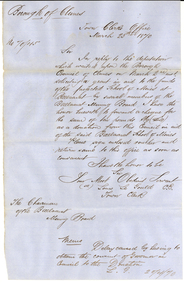
Document, Establishment of the Ballarat School of Mines, 1870, 1870
... It's first president was Redmond Barry. ballarat school of mines frieberg mining academy learmonth somerville learmonth wreford weymouth bland rivet henry bland barry redmond barry mcculloch phillips john phillips robson gillies duncan gillies warrington rogers melbourne public library whitty robert park newman william newman charles abbott janes baler de la poer wall odgers louis le gould wood harrie wood steinfeld emanuel steinfeld ainswood pucke thomas robson telegraph telegram state library of victoria fulks architecture reed j. reed rosales abbott charles a. abbott mechanical drawing drawing ballarat circuit courthouse ballarat courthouse national insurance company of australia grenville college chief secretary's office robert sandon school of mines schools of mines establishment ballarat school of mines establishment germany london ercildoun Correspondence and planning documents relating to the setting up of the Ballarat School of Mines. it includes tenders for contractors for the refurbishment of the former Ballarat Circuit Court. .1) Rules for the pupils of the Mining School at Zurickau, 18/11/1870 (not translated by Emanuel Steinfeld, perhaps by W. ...The Ballarat School of Mines was the first site of technical edducation in Australasia. It is now a predecessor institution of Federation University Australia. It's first president was Redmond Barry.Correspondence and planning documents relating to the setting up of the Ballarat School of Mines. it includes tenders for contractors for the refurbishment of the former Ballarat Circuit Court. .1) Rules for the pupils of the Mining School at Zurickau, 18/11/1870 (not translated by Emanuel Steinfeld, perhaps by W. Henderson) .2) Regulations of the Mining Academy at Frieberg, 18/11/1870 .3) Einrichtungen, Freiberg, 1870 (written in German) .4) Letter from Somerville Learmonth of Ercildoun to Harrie Wood, Clerk of the Board of Mines Ballarat, accepting a position as one of three trustees of the Ballarat School of Mines, along with Redmond Barry and R.H. Bland, 08/01/1870 .5) Printing order with Robert Wreford, 26/01/1870 .6) H. Waymouth to Mr Bickett re the Ballarat School of Mines, 1780 .7) Letter from R.H. Bland of Clunes to Harrie Wood of the Ballarat Mining Board, 27/01/1870 .8) Letter from Somerville Livingstone Learmonth of Ercildoun to Harrie Woods of the Ballarat Mining Board refusing the offer to be a Trustee of the Ballarat School of Mines, 28/01/1870 .9) Minutes of the meeting of the Ballarat School of Mines Executive Council, 05/02/1870 and Correspondence from Harrie Wood to J. Warrington Rogers re the lease of the building for the Ballarat School of Mines, 21/01/1870 .10) Chief Secretary's Office to Ballarat Mining Board re Life Membership of the Ballarat School of Mines, 02/02/1870 .10b) Letter from Redmond Barry, Carlton Gardens, Melbourne re the visit of the Governor of Victoria to the Ballarat School of Mines, 04/02/1870 .12) Letter from Charles Pucke on behalf of Mr McCulloch to H, Ainswood, Secretary of the Ballarat Mining Board, 11/07/1870 .13) Correspondence from Henry Rosales of Walhalla (Chairman of the Gippsland Mining Board) to James Baker of the Ballarat School of Mines, 28/12/1870 .11) Meeting of the Executive Council, Bickett, Eddy Downes, 08/02/1870 .14) Letter from John Phillips, contract surveyor of St Arnaud to Mr Newman, Vice-President of the Ballarat School of Mines, 15/12/1870 .15) Articles ordered and obtained for the Ballarat School of Mines, 03/01/1870 .16) Telegram from John Lewis of Clunes to the Ballarat School of Mines. .16b) Quote from painter Thomas Robson for painting the Ballarat School of Mines, 05/06/1870 .17) Note from Duncan Gillies to Harrie Wood re grant for the Ballarat School of Mines, 05/06/1870 .18) Correspondence re Grant to the Ballarat School of Mines, Duncan Gillies, 04/07/1870 .19) Correspondence concerning the Ballarat School of Mines from F. Valient to Harrie Wood, 14/05/1870 .19b) Correspondence from Somerville Livingstone Learmonth to Harrie Woods - an apology for a meeting with Judge Rogers, 23/05/1870 .20) Letter from R.H. Bland to Harrie Wood, 15/07/1870 .22) Telegraph from J. Warrington Rogers to Harrie Wood of the Ballarat Mining Board concerning tenders for the Ballarat School of Mines, which was established in 1870. .23) Letter from Ballarat Mining Board to Judge Warrington Rogers, 31/05/1870 .24) Telegraph to Harrie Wood of the Ballarat Mining Board from J. Warrington Rogers concerning Sir Redmond Barry. A note at the bottom of the telegraph notes ‘This telegram has been delayed through repairs on line. .25) Letter on Melbourne Public Library Letterhead from librarian Augustus Fulk, 05/08/1870 .26) Letter from R.H. Bland to Harrie Wood, 30/05/1870 .27) Letter from Robert Park re alteration of the former Ballarat Court House for use as the Ballarat School of Mines, 05/05/1870. .28) Letter from G. Whitty re painting of the former Ballarat Court House for use as the Ballarat School of Mines, 04/05/1870 .29) Letter from William Newman re plastering of the former Ballarat Court House for use as the Ballarat School of Mines, 05/05/1870 .30) Letter from Charles A. Abbott re teaching Mechanical Drawing at the Ballarat School of Mines, 04/04/1870 .32) Letter from Redmond Barry to the Ballarat School of Mines, 07/1870 .31) National Insurance Company of Australia insurance for the Ballarat School of Mines (former Ballarat Circuit Court), 01/05/1870 .33) Letter from R.H. Bland to Harrie Wood, 09/1870 .34) Letter from Somerville Livingstone Learmonth to Harrie Wood, 06/09/1870 .35) Letter to the Chief Secretary to the Ballarat School of Mines Library & Museum, 30/11/1870 .36) Parliament house (Kitto) to the Ballarat Mining Board, 15/11/1870 .37) H. de la Poer Wall of Grenville College to R.W. Newman of the Ballarat School of Mines, 27/04/1971 .38) W.H. Odgers to the Ballarat East Town Clerk, 20/05/1870 .39) Correspondence to the Borough of Clunes for the Ballarat Mining Board requesting a grant to set of a school of mines at Ballarat. 25/03/1870 .40) Surveyor to Harrie Wood, Mining Registrar, 27/04/1870 .40) Letter to Judge Warrington Rogers re the contractor's account for satisfactory completion of work on the Ballarat School of Mines, 11/07/1870 .43) Desks for the Ballarat School of Mines by Henry Gough, 1870 .44) Ballarat Star Office to James Baker of the Ballarat School of Mines, 1870ballarat school of mines, frieberg mining academy, learmonth, somerville learmonth, wreford, weymouth, bland, rivet henry bland, barry, redmond barry, mcculloch, phillips, john phillips, robson, gillies, duncan gillies, warrington rogers, melbourne public library, whitty, robert park, newman, william newman, charles abbott, janes baler, de la poer wall, odgers, louis le gould, wood, harrie wood, steinfeld, emanuel steinfeld, ainswood, pucke, thomas robson, telegraph, telegram, state library of victoria, fulks, architecture, reed, j. reed, rosales, abbott, charles a. abbott, mechanical drawing, drawing, ballarat circuit courthouse, ballarat courthouse, national insurance company of australia, grenville college, chief secretary's office, robert sandon, school of mines, schools of mines, establishment, ballarat school of mines establishment, germany, london, ercildoun -
 Flagstaff Hill Maritime Museum and Village
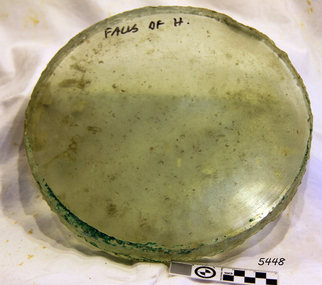
Functional object - Porthole Glass
... Court of Marine Inquiry in Melbourne ruled that the foundering of the ship was entirely due to Captain David Wood Thomson’s navigational error, not too technical failure of the Clyde-built ship. The Falls of Halladale shipwreck is listed on the Victorian Heritage Register (No. S255). She was one of the last ships to sail the Trade Routes. She is one of the first vessels to have fore and aft lifting bridges. She is an example of the remains of an International Cargo Ship and also represents aspects of Victoria’s ...The iron-hulled, four-masted barque, the Falls of Halladale, was a bulk carrier of general cargo. She left New York in August 1908 on her way to Melbourne and Sydney. In her hold, along with 56,763 tiles of unusual beautiful green American slates (roofing tiles), 5,673 coils of barbed wire, 600 stoves, 500 sewing machines, 6500 gallons of oil, 14400 gallons of benzene, and many other manufactured items, were 117 cases of crockery and glassware. Three months later and close to her destination, a navigational error caused the Falls of Halladale to be wrecked on a reef off the Peterborough headland at 3 am on the morning of the 15th of November, 1908. The captain and 29 crew members all survived, but her valuable cargo was largely lost, despite two salvage attempts in 1908-09 and 1910. ABOUT THE ‘FALLS OF HALLADALE’ (1886 - 1908) Built: in1886 by Russell & Co., Greenock shipyards, River Clyde, Scotland, UK. The company was founded in 1870 (or 1873) as a partnership between Joseph Russell (1834-1917), Anderson Rodger and William Todd Lithgow. During the period 1882-92 Russell & Co., standardised designs, which sped up their building process so much that they were able to build 271 ships over that time. In 1886 they introduced a 3000 ton class of sailing vessel with auxiliary engines and brace halyard winches. In 1890 they broke the world output record. Owner: Falls Line, Wright, Breakenridge & Co, 111 Union Street, Glasgow, Scotland. Configuration: Four masted sailing ship; iron-hulled barque; iron masts, wire rigging, fore & aft lifting bridges. Size: Length 83.87m x Breadth 12.6m x Depth 7.23m, Gross tonnage 2085 ton Wrecked: the night of 14th November 1908, Curdies Inlet, Peterborough south west Victoria Crew: 29 The Falls of Halladale was a four-masted sailing ship built-in 1886 in Glasgow, Scotland, for the long-distance cargo trade and was mostly used for Pacific grain trade. She was owned by Wright, Breakenridge & Co of Glasgow and was one of several Falls Line ships, all of which were named after waterfalls in Scotland. The lines flag was of red, blue and white vertical stripes. The Falls of Halladale had a sturdy construction built to carry maximum cargo and able to maintain full sail in heavy gales, one of the last of the ‘windjammers’ that sailed the Trade Route. She and her sister ship, the Falls of Garry, were the first ships in the world to include fore and aft lifting bridges. Previous to this, heavily loaded vessels could have heavy seas break along the full length of the deck, causing serious injury or even death to those on deck. The new, raised catwalk-type decking allowed the crew to move above the deck stormy conditions. This idea is still used today on the most modern tankers and cargo vessels and has proved to be an important step forward in the safety of men at sea. On 4th August 1908, with new sails, 29 crew, and 2800 tons of cargo, the Falls of Halladale left New York, bound for Melbourne and Sydney via the Cape of Good Hope. The cargo on board was valued at £35,000 and included 56,763 tiles of American slate roofing tiles (roof slates), 5,673 coils of barbed wire, 600 stoves, 500 sewing machines, 6,500 gallons of oil, 14,400 gallons of benzene, plumbing iron, 117 cases of crockery and glassware and many other manufactured items. The Falls of Halladale had been at sail for 102 days when, at 3 am on the night of 14th November 1908, under full sail in calm seas with a six knots breeze behind and misleading fog along the coast, the great vessel rose upon an ocean swell and settled on top of a submerged reef near Peterborough on the south-west Victoria’s coast. The ship was jammed on the rocks and began filling with water. The crew launched the two lifeboats and all 29 crew landed safely on the beach over 4 miles away at the Bay of Islands. The postmistress at Peterborough, who kept a watch for vessels in distress, saw the stranding and sent out an alert to the local people. A rescue party went to the aid of the sailors and the Port Campbell rocket crew was dispatched, but the crew had all managed to reach shore safely by the time help arrived. The ship stayed in full sail on the rocky shelf for nearly two months, attracting hundreds of sightseers who watched her slowly disintegrate until the pounding seas and dynamiting by salvagers finally broke her back, and her remains disappeared back into deeper water. The valuable cargo was largely lost, despite two salvage attempts in 1908-09 and 1910. Further salvage operations were made from 1974-1986, during which time 22,000 slate tiles were recovered with the help of 14 oil drums to float them, plus personal artefacts, ship fittings, reams of paper and other items. The Court of Marine Inquiry in Melbourne ruled that the foundering of the ship was entirely due to Captain David Wood Thomson’s navigational error, not too technical failure of the Clyde-built ship. The Falls of Halladale shipwreck is listed on the Victorian Heritage Register (No. S255). She was one of the last ships to sail the Trade Routes. She is one of the first vessels to have fore and aft lifting bridges. She is an example of the remains of an International Cargo Ship and also represents aspects of Victoria’s shipping industry. The wreck is protected as a Historic Shipwreck under the Commonwealth Historic Shipwrecks Act (1976).Porthole Glass, from the wreck of the Falls of Halladale, little encrustation. "Falls of H" written in black texta penporthole glass, flagstaff hill, warrnambool, shipwrecked coast, flagstaff hill maritime museum, maritime museum, shipwreck coast, flagstaff hill maritime village, great ocean road, falls of halladale, shipwreck peterborough, 1908 shipwreck, great clipper ships, russell & co. -
 Flagstaff Hill Maritime Museum and Village
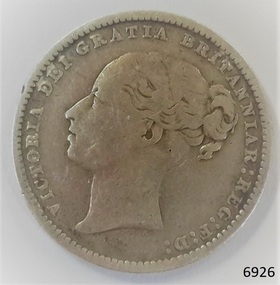
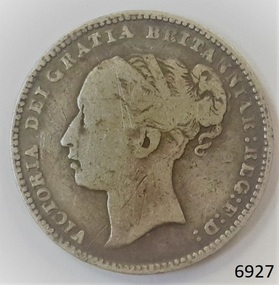
Currency - Coin, 1883
... Victoria succeeded King William IV to the British Throne in 1837 – she was only 18 years old at the time – and she ruled until 1901. British coins such as this one shilling were in circulation in the colony of Australia until 1910, when the Commonwealth of Australia began producing its own coinage. This one shilling coin was minted by the Royal Mint at Royal Mint Court...Victoria succeeded King William IV to the British Throne in 1837 – she was only 18 years old at the time – and she ruled until 1901. British coins such as this one shilling were in circulation in the colony of Australia until 1910, when the Commonwealth of Australia began producing its own coinage. This one shilling coin was minted by the Royal Mint at Royal Mint Court ...This Great Britain one shilling coin is dated 1883, which is during the reign of Queen Victoria. There were over 7 million of these coins minted. Queen Victoria succeeded King William IV to the British Throne in 1837 – she was only 18 years old at the time – and she ruled until 1901. British coins such as this one shilling were in circulation in the colony of Australia until 1910, when the Commonwealth of Australia began producing its own coinage. This one shilling coin was minted by the Royal Mint at Royal Mint Court, in Little Tower Hill, London, England. Coins for circulation in the Kingdom of England, Great Britain and most of the British Empire were produced here until the 1960’s when the Royal Mint shifted location to Wales. There are three main groups of shillings produced during Queen Victoria’s reign:- - The Young Head; 1837-1887, in 8 different versions, on the obverse showing the Queen’s maturing face over 50 years. - The Junior Head; 1887-1892, minted when Queen Victoria had been reigning for 50 years. Her head was smaller on the coins minted 1887-1889 than on those shillings minted 1889-1892. - The Old Head; 1893-1901, shows the veiled head of Queen Victoria. The obverse side of the coin’s inscription translation is “Victoria by the Grace of God, Queen of the British territories, Defender of the Faith”. The engraver of the obverse image was William Wyon. The reverse side of the coin is inscribed "ONE SHILLING. The engraver of the reverse image was Jean Baptiste Merlen. AUSTRALIAN CURRENCY The early settlers of Australia brought their own currency with them so a wide variety of coins, tokens and even ‘promissory’ notes (often called IOU’s) were used in the exchange of goods and services. In 1813 40,000 silver Spanish dollars, purchased by the English government, were delivered to Sydney to help resolve the currency problem reported by Governor Macquarie. The coins were converted for use by punching a hole in the centre of the coin. Both the outer ring, called the holey dollar, and the punched out ‘hole’, called the dump, were then used as the official currency. The holey dollars hold the place of being the first distinctively Australian coins. In 1825 the British Government passed the Sterling Silver Currency Act, making the British Pound the only legal form of currency in the Australian colonies. Not enough British currency was imported into the colony so other forms of currency were still used. In the mid 1800’s Australia entered the Gold Rush period when many made their fortunes. Gold was used for trading, often shaped into ingots, stamped with their weight and purity, and one pound tokens. In 1852 the Adelaide Assay Office, without British approval, made Australia’s first gold coin to meet the need for currency in South Australia after the Gold Rush began. In 1855 the official Australian Mint opened in Sydney, operating as a branch of the Royal Mint in London, and the gold was turned into coins called ‘sovereigns’. Other branches also opened in Melbourne and Perth. Up to the time of Australia becoming a federation in 1901 its currency included British copper and silver coins, Australian gold sovereigns, locally minted copper trade tokens, private banknotes, New South Wales and Queensland government treasury notes and Queensland government banknotes. After Federation the Australian government began to overwrite privately issued notes and prepared for the introduction of its own currency. In 1910 a National Australian Currency was formed, based on the British currency of ‘pounds, shillings and pence’ and the first Commonwealth coining was produced. In 1966, on February 14th, Australia changed over to the decimal currency system of dollars and cents. Australia did not have its own currency in the colonial times. Settlers brought money from other countries and they also traded goods such as grain when currency was scarce. For a long time there was no standardised value for the different currencies. In 1825 British currency became the only official currency in the colony of Australia and coins such as this silver shilling were imported into Australia to replace the mixture of foreign currency. Australia became a Federated nation on 1st January 1901. In 1910 National Australian Currency was formed and Australia produced its own currency, based on the British ‘pounds, shillings and pence’. The British currency was no longer valid. This silver shilling is of national significance as it represents the British currency used in Australia from 1825-1910. Coin, Great Britain Shilling, 1883. Silver coin, round. Obverse; Queen Victoria head, ‘Young Head’, looking left. Reverse; crown on top of wreath. Inscriptions on both sides of coin.Obverse “VICTORIA DEI GRATIA BRITANNIAR: REG: F: D :” Reverse “ONE SHILLING, 1883” flagstaff hill, warrnambool, shipwrecked coast, flagstaff hill maritime museum, maritime museum, shipwreck coast, flagstaff hill maritime village, great ocean road, coin, currency, money, legal tender, australian currency history, royal mint, great britain shilling 1883, queen victoria currency, colonial australia currency, wlliam wyon, jean baptiste merlen, numismatics -
 Flagstaff Hill Maritime Museum and Village
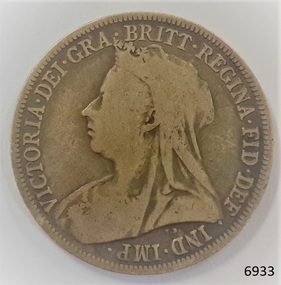
Currency - Coin, 1885
... Victoria succeeded King William IV to the British Throne in 1837 – she was only 18 years old at the time – and she ruled until 1901. British coins such as this one shilling were in circulation in the colony of Australia until 1910, when the Commonwealth of Australia began producing its own coinage. This one shilling coin was minted by the Royal Mint at Royal Mint Court...Victoria succeeded King William IV to the British Throne in 1837 – she was only 18 years old at the time – and she ruled until 1901. British coins such as this one shilling were in circulation in the colony of Australia until 1910, when the Commonwealth of Australia began producing its own coinage. This one shilling coin was minted by the Royal Mint at Royal Mint Court ...This Great Britain one shilling coin is dated 1885, which is during the reign of Queen Victoria. There were over 3 million of these coins minted. Queen Victoria succeeded King William IV to the British Throne in 1837 – she was only 18 years old at the time – and she ruled until 1901. British coins such as this one shilling were in circulation in the colony of Australia until 1910, when the Commonwealth of Australia began producing its own coinage. This one shilling coin was minted by the Royal Mint at Royal Mint Court, in Little Tower Hill, London, England. Coins for circulation in the Kingdom of England, Great Britain and most of the British Empire were produced here until the 1960’s when the Royal Mint shifted location to Wales. There are three main groups of shillings produced during Queen Victoria’s reign:- - The Young Head; 1837-1887, in 8 different versions, on the obverse showing the Queen’s maturing face over 50 years. - The Junior Head; 1887-1892, minted when Queen Victoria had been reigning for 50 years. Her head was smaller on the coins minted 1887-1889 than on those shillings minted 1889-1892. - The Old Head; 1893-1901, shows the veiled head of Queen Victoria. The obverse side of the coin’s inscription translation is “Victoria by the Grace of God, Queen of the British territories, Defender of the Faith”. The engraver of the obverse image was William Wyon. The reverse side of the coin is inscribed "ONE SHILLING. The engraver of the reverse image was Jean Baptiste Merlen. AUSTRALIAN CURRENCY The early settlers of Australia brought their own currency with them so a wide variety of coins, tokens and even ‘promissory’ notes (often called IOU’s) were used in the exchange of goods and services. In 1813 40,000 silver Spanish dollars, purchased by the English government, were delivered to Sydney to help resolve the currency problem reported by Governor Macquarie. The coins were converted for use by punching a hole in the centre of the coin. Both the outer ring, called the holey dollar, and the punched out ‘hole’, called the dump, were then used as the official currency. The holey dollars hold the place of being the first distinctively Australian coins. In 1825 the British Government passed the Sterling Silver Currency Act, making the British Pound the only legal form of currency in the Australian colonies. Not enough British currency was imported into the colony so other forms of currency were still used. In the mid 1800’s Australia entered the Gold Rush period when many made their fortunes. Gold was used for trading, often shaped into ingots, stamped with their weight and purity, and one pound tokens. In 1852 the Adelaide Assay Office, without British approval, made Australia’s first gold coin to meet the need for currency in South Australia after the Gold Rush began. In 1855 the official Australian Mint opened in Sydney, operating as a branch of the Royal Mint in London, and the gold was turned into coins called ‘sovereigns’. Other branches also opened in Melbourne and Perth. Up to the time of Australia becoming a federation in 1901 its currency included British copper and silver coins, Australian gold sovereigns, locally minted copper trade tokens, private banknotes, New South Wales and Queensland government treasury notes and Queensland government banknotes. After Federation the Australian government began to overwrite privately issued notes and prepared for the introduction of its own currency. In 1910 a National Australian Currency was formed, based on the British currency of ‘pounds, shillings and pence’ and the first Commonwealth coining was produced. In 1966, on February 14th, Australia changed over to the decimal currency system of dollars and cents. Australia did not have its own currency in the colonial times. Settlers brought money from other countries and they also traded goods such as grain when currency was scarce. For a long time there was no standardised value for the different currencies. In 1825 British currency became the only official currency in the colony of Australia and coins such as this silver shilling were imported into Australia to replace the mixture of foreign currency. Australia became a Federated nation on 1st January 1901. In 1910 National Australian Currency was formed and Australia produced its own currency, based on the British ‘pounds, shillings and pence’. The British currency was no longer valid. This silver shilling is of national significance as it represents the British currency used in Australia from 1825-1910. Coin, Great Britain Shilling, 1885. Silver coin, round. Obverse; Queen Victoria head, ‘Young Head’, looking left. Reverse; crown on top of wreath. Inscriptions on both sides of coin.Obverse “VICTORIA DEI GRATIA BRITANNIAR : REG : F : D :” Reverse “ONE SHILLING, 1885” flagstaff hill, warrnambool, shipwrecked coast, flagstaff hill maritime museum, maritime museum, shipwreck coast, flagstaff hill maritime village, great ocean road, coin, currency, money, legal tender, australian currency history, royal mint, great britain shilling 1885, queen victoria currency, colonial australia currency, wlliam wyon, jean baptiste merlen, numismatics -
 Flagstaff Hill Maritime Museum and Village
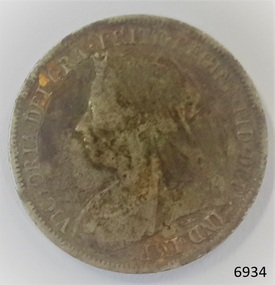
Currency - Coin, 1896
... Victoria succeeded King William IV to the British Throne in 1837 – she was only 18 years old at the time – and she ruled until 1901. British coins such as this one shilling were in circulation in the colony of Australia until 1910, when the Commonwealth of Australia began producing its own coinage. This one shilling coin was minted by the Royal Mint at Royal Mint Court...Victoria succeeded King William IV to the British Throne in 1837 – she was only 18 years old at the time – and she ruled until 1901. British coins such as this one shilling were in circulation in the colony of Australia until 1910, when the Commonwealth of Australia began producing its own coinage. This one shilling coin was minted by the Royal Mint at Royal Mint Court ...This Great Britain one shilling coin is dated 1896, which is during the reign of Queen Victoria. There were over 9 million of these coins minted. Queen Victoria succeeded King William IV to the British Throne in 1837 – she was only 18 years old at the time – and she ruled until 1901. British coins such as this one shilling were in circulation in the colony of Australia until 1910, when the Commonwealth of Australia began producing its own coinage. This one shilling coin was minted by the Royal Mint at Royal Mint Court, in Little Tower Hill, London, England. Coins for circulation in the Kingdom of England, Great Britain and most of the British Empire were produced here until the 1960’s when the Royal Mint shifted location to Wales. There are three main groups of shillings produced during Queen Victoria’s reign:- - The Young Head; 1837-1887, in 8 different versions, on the obverse showing the Queen’s maturing face over 50 years. - The Junior Head; 1887-1892, minted when Queen Victoria had been reigning for 50 years. Her head was smaller on the coins minted 1887-1889 than on those shillings minted 1889-1892. - The Old Head; 1893-1901, shows the veiled head of Queen Victoria. The obverse side of the coin was designed by Thomas Brock. The inscription’s translation is “Victoria by the Grace of God, Queen of the British territories, Defender of the Faith, Empress of India”. The reverse side of the coin was designed by Edward Paynter. The inscription "HONI SOIT QUI MAL Y PENSE" translates as "Evil be to him who evil thinks". AUSTRALIAN CURRENCY The early settlers of Australia brought their own currency with them so a wide variety of coins, tokens and even ‘promissory’ notes (often called IOU’s) were used in the exchange of goods and services. In 1813 Spanish dollars were imported and converted for use by punching a hole in the centre of the coin. Both the outer ring, called the holey dollar, and the punched out ‘hole’, called the dump, were then used as the official currency. In 1825 the British Government passed the Sterling Silver Currency Act, making the British Pound the only legal form of currency in the Australian colonies. Not enough British currency was imported into the colony so other forms of currency were still used. In the mid 1800’s Australia entered the Gold Rush period when many made their fortunes. Gold was used for trading, often shaped into ingots, stamped with their weight and purity, and one pound tokens. In 1852 the Adelaide Assay Office, without British approval, made Australia’s first gold coin to meet the need for currency in South Australia after the Gold Rush began. In 1855 the official Australian Mint opened in Sydney, operating as a branch of the Royal Mint in London, and the gold was turned into coins called ‘sovereigns’. Other branches also opened in Melbourne and Perth. Up to the time of Australia becoming a federation in 1901 its currency included British copper and silver coins, Australian gold sovereigns, locally minted copper trade tokens, private banknotes, New South Wales and Queensland government treasury notes and Queensland government banknotes. After Federation the Australian government began to overwrite privately issued notes and prepared for the introduction of its own currency. In 1910 a National Australian Currency was formed, based on the British currency of ‘pounds, shillings and pence’ and the first Commonwealth coining was produced. In 1966, on February 14th, Australia changed over to the decimal currency system of dollars and cents. Australia did not have its own currency in the colonial times. Settlers brought money from other countries and they also traded goods such as grain when currency was scarce. For a long time there was no standardised value for the different currencies. In 1825 British currency became the only official currency in the colony of Australia and coins such as this silver shilling were imported into Australia to replace the mixture of foreign currency. Australia became a Federated nation on 1st January 1901. In 1910 National Australian Currency was formed and Australia produced its own currency, based on the British ‘pounds, shillings and pence’. The British currency was no longer valid. This silver shilling is of national significance as it represents the British currency used in Australia from 1825-1910. This silver shilling is also of significance to Australia as part one of the British Colonies ruled by Queen Victoria. It is part of the special silver and gold coins minted 1887-1893 to celebrate the 50 years Jubilee of Queen Victoria’s reign 1837-1887.Coin, Great Britain Shilling, 1896. Silver coin, round. Obverse; Queen Victoria head, ‘Old Head’, looking left. Reverse; 3 shields (each crowned) - 3 passant lions (England), 1 rampant lion (Scotland), golden harp (Northern Ireland) - floral symbols between them – 1 rose, 2 thistles. Inscriptions on both sides of coin.Obverse “VICTORIA . DEI . GRA . BRITT . REGINA . FID . DEF . IND . IMP” Reverse “ONE SHILLING, 1896, Inner band, some letters hidden - HONI SO VI Y PENSE” flagstaff hill, warrnambool, shipwrecked coast, flagstaff hill maritime museum, maritime museum, shipwreck coast, flagstaff hill maritime village, great ocean road, coin, currency, money, legal tender, australian currency history, royal mint, british shilling 1896, thomas brock, edward paynter, great britain shilling, queen victoria currency, queen victoria 50 years golden jubilee shilling, colonial australia currency, numismatics -
 Flagstaff Hill Maritime Museum and Village
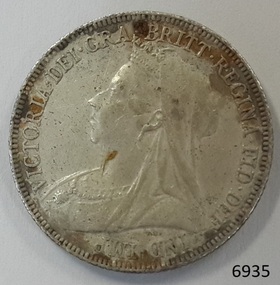
Currency - Coin, 1896
... Victoria succeeded King William IV to the British Throne in 1837 – she was only 18 years old at the time – and she ruled until 1901. British coins such as this one shilling were in circulation in the colony of Australia until 1910, when the Commonwealth of Australia began producing its own coinage. This one shilling coin was minted by the Royal Mint at Royal Mint Court...Victoria succeeded King William IV to the British Throne in 1837 – she was only 18 years old at the time – and she ruled until 1901. British coins such as this one shilling were in circulation in the colony of Australia until 1910, when the Commonwealth of Australia began producing its own coinage. This one shilling coin was minted by the Royal Mint at Royal Mint Court ...This Great Britain one shilling coin is dated 1896, which is during the reign of Queen Victoria. There were over 9 million of these coins minted. Queen Victoria succeeded King William IV to the British Throne in 1837 – she was only 18 years old at the time – and she ruled until 1901. British coins such as this one shilling were in circulation in the colony of Australia until 1910, when the Commonwealth of Australia began producing its own coinage. This one shilling coin was minted by the Royal Mint at Royal Mint Court, in Little Tower Hill, London, England. Coins for circulation in the Kingdom of England, Great Britain and most of the British Empire were produced here until the 1960’s when the Royal Mint shifted location to Wales. There are three main groups of shillings produced during Queen Victoria’s reign:- - The Young Head; 1837-1887, in 8 different versions, on the obverse showing the Queen’s maturing face over 50 years. - The Junior Head; 1887-1892, minted when Queen Victoria had been reigning for 50 years. Her head was smaller on the coins minted 1887-1889 than on those shillings minted 1889-1892. - The Old Head; 1893-1901, shows the veiled head of Queen Victoria. The obverse side of the coin was designed by Thomas Brock. The inscription’s translation is “Victoria by the Grace of God, Queen of the British territories, Defender of the Faith, Empress of India”. The reverse side of the coin was designed by Edward Paynter. The inscription "HONI SOIT QUI MAL Y PENSE" translates as "Evil be to him who evil thinks". AUSTRALIAN CURRENCY The early settlers of Australia brought their own currency with them so a wide variety of coins, tokens and even ‘promissory’ notes (often called IOU’s) were used in the exchange of goods and services. In 1813 Spanish dollars were imported and converted for use by punching a hole in the centre of the coin. Both the outer ring, called the holey dollar, and the punched out ‘hole’, called the dump, were then used as the official currency. In 1825 the British Government passed the Sterling Silver Currency Act, making the British Pound the only legal form of currency in the Australian colonies. Not enough British currency was imported into the colony so other forms of currency were still used. In the mid 1800’s Australia entered the Gold Rush period when many made their fortunes. Gold was used for trading, often shaped into ingots, stamped with their weight and purity, and one pound tokens. In 1852 the Adelaide Assay Office, without British approval, made Australia’s first gold coin to meet the need for currency in South Australia after the Gold Rush began. In 1855 the official Australian Mint opened in Sydney, operating as a branch of the Royal Mint in London, and the gold was turned into coins called ‘sovereigns’. Other branches also opened in Melbourne and Perth. Up to the time of Australia becoming a federation in 1901 its currency included British copper and silver coins, Australian gold sovereigns, locally minted copper trade tokens, private banknotes, New South Wales and Queensland government treasury notes and Queensland government banknotes. After Federation the Australian government began to overwrite privately issued notes and prepared for the introduction of its own currency. In 1910 a National Australian Currency was formed, based on the British currency of ‘pounds, shillings and pence’ and the first Commonwealth coining was produced. In 1966, on February 14th, Australia changed over to the decimal currency system of dollars and cents. Australia did not have its own currency in the colonial times. Settlers brought money from other countries and they also traded goods such as grain when currency was scarce. For a long time there was no standardised value for the different currencies. In 1825 British currency became the only official currency in the colony of Australia and coins such as this silver shilling were imported into Australia to replace the mixture of foreign currency. Australia became a Federated nation on 1st January 1901. In 1910 National Australian Currency was formed and Australia produced its own currency, based on the British ‘pounds, shillings and pence’. The British currency was no longer valid. This silver shilling is of national significance as it represents the British currency used in Australia from 1825-1910. This silver shilling is also of significance to Australia as part one of the British Colonies ruled by Queen Victoria. It is part of the special silver and gold coins minted 1887-1893 to celebrate the 50 years Jubilee of Queen Victoria’s reign 1837-1887. Coin, Great Britain Shilling, 1896. Silver coin, round. Obverse; Queen Victoria head, ‘Old Head’, looking left. Reverse; 3 shields (each crowned) - 3 passant lions (England), 1 rampant lion (Scotland), golden harp (Northern Ireland) - floral symbols between them – 1 rose, 2 thistles. Inscriptions on both sides of coin.Obverse “VICTORIA . DEI . GRA . BRITT . REGINA . FID . DEF . IND . IMP” Reverse “ONE SHILLING, 1896”, Inner band, [some letters hidden] “HONI SO VI Y PENSE” flagstaff hill, warrnambool, shipwrecked coast, flagstaff hill maritime museum, maritime museum, shipwreck coast, flagstaff hill maritime village, great ocean road, coin, currency, money, legal tender, australian currency history, royal mint, british shilling 1896, thomas brock, edward paynter, great britain shilling, queen victoria currency, queen victoria 50 years golden jubilee shilling, colonial australia currency, numismatics -
 Flagstaff Hill Maritime Museum and Village
Currency - Coin, 1897
... Victoria succeeded King William IV to the British Throne in 1837 – she was only 18 years old at the time – and she ruled until 1901. British coins such as this one shilling were in circulation in the colony of Australia until 1910, when the Commonwealth of Australia began producing its own coinage. This one shilling coin was minted by the Royal Mint at Royal Mint Court...Victoria succeeded King William IV to the British Throne in 1837 – she was only 18 years old at the time – and she ruled until 1901. British coins such as this one shilling were in circulation in the colony of Australia until 1910, when the Commonwealth of Australia began producing its own coinage. This one shilling coin was minted by the Royal Mint at Royal Mint Court ...This Great Britain one shilling coin is dated 1897, which is during the reign of Queen Victoria. There were over 6 million of these coins minted. Queen Victoria succeeded King William IV to the British Throne in 1837 – she was only 18 years old at the time – and she ruled until 1901. British coins such as this one shilling were in circulation in the colony of Australia until 1910, when the Commonwealth of Australia began producing its own coinage. This one shilling coin was minted by the Royal Mint at Royal Mint Court, in Little Tower Hill, London, England. Coins for circulation in the Kingdom of England, Great Britain and most of the British Empire were produced here until the 1960’s when the Royal Mint shifted location to Wales. There are three main groups of shillings produced during Queen Victoria’s reign:- - The Young Head; 1837-1887, in 8 different versions, on the obverse showing the Queen’s maturing face over 50 years. - The Junior Head; 1887-1892, minted when Queen Victoria had been reigning for 50 years. Her head was smaller on the coins minted 1887-1889 than on those shillings minted 1889-1892. - The Old Head; 1893-1901, shows the veiled head of Queen Victoria. The obverse side of the coin was designed by Thomas Brock. The inscription’s translation is “Victoria by the Grace of God, Queen of the British territories, Defender of the Faith, Empress of India”. The reverse side of the coin was designed by Edward Paynter. The inscription "HONI SOIT QUI MAL Y PENSE" translates as "Evil be to him who evil thinks". AUSTRALIAN CURRENCY The early settlers of Australia brought their own currency with them so a wide variety of coins, tokens and even ‘promissory’ notes (often called IOU’s) were used in the exchange of goods and services. In 1813 Spanish dollars were imported and converted for use by punching a hole in the centre of the coin. Both the outer ring, called the holey dollar, and the punched out ‘hole’, called the dump, were then counter-stamped and used as the official currency. In 1825 the British Government passed the Sterling Silver Currency Act, making the British Pound the only legal form of currency in the Australian colonies. Not enough British currency was imported into the colony so other forms of currency were still used. In the mid 1800’s Australia entered the Gold Rush period when many made their fortunes. Gold was used for trading, often shaped into ingots, stamped with their weight and purity, and one pound tokens. In 1852 the Adelaide Assay Office, without British approval, made Australia’s first gold coin to meet the need for currency in South Australia after the Gold Rush began. In 1855 the official Australian Mint opened in Sydney, operating as a branch of the Royal Mint in London, and the gold was turned into coins called ‘sovereigns’. Other branches also opened in Melbourne and Perth. Up to the time of Australia becoming a federation in 1901 its currency included British copper and silver coins, Australian gold sovereigns, locally minted copper trade tokens, private banknotes, New South Wales and Queensland government treasury notes and Queensland government banknotes. After Federation the Australian government began to overwrite privately issued notes and prepared for the introduction of its own currency. In 1910 a National Australian Currency was formed, based on the British currency of ‘pounds, shillings and pence’ and the first Commonwealth coining was produced, removing the power from the States. In 1966, on February 14th, Australia changed over to the decimal currency system of dollars and cents. Australia did not have its own currency in the colonial times. Settlers brought money from other countries and they also traded goods such as grain when currency was scarce. For a long time there was no standardised value for the different currencies. In 1825 British currency became the only official currency in the colony of Australia and coins such as this silver shilling were imported into Australia to replace the mixture of foreign currency. Australia became a Federated nation on 1st January 1901. In 1910 National Australian Currency was formed and Australia produced its own currency, based on the British ‘pounds, shillings and pence’. The British currency was no longer valid. This silver shilling is of national significance as it represents the British currency used in Australia from 1825-1910. This silver shilling is also of significance to Australia as part one of the British Colonies ruled by Queen Victoria. It is part of the special silver and gold coins minted 1887-1893 to celebrate the 50 years Jubilee of Queen Victoria’s reign 1837-1887. Coin, Great Britain Shilling, 1897. Silver coin, round. Obverse; Queen Victoria head, ‘Old Head’, looking left. Reverse; 3 shields (each crowned) - 3 passant lions (England), 1 rampant lion (Scotland), golden harp (Northern Ireland) - floral symbols between them – 1 open rose, 2 thistles. Inscriptions on both sides of coin.Obverse “VICTORIA . DEI . GRA . BRITT . REGINA . FID . DEF . IND . IMP” Reverse “ONE SHILLING, 1897, Inner band, some letters hidden - HONI SO VI Y PENSE” flagstaff hill, warrnambool, shipwrecked coast, flagstaff hill maritime museum, maritime museum, shipwreck coast, flagstaff hill maritime village, great ocean road, coin, currency, money, legal tender, australian currency history, royal mint, british shilling 1897, thomas brock, edward paynter, great britain shilling, queen victoria currency, queen victoria 50 years golden jubilee shilling, colonial australia currency, numismatics -
 Flagstaff Hill Maritime Museum and Village
Currency - Coin, 1897
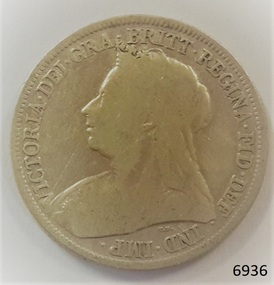
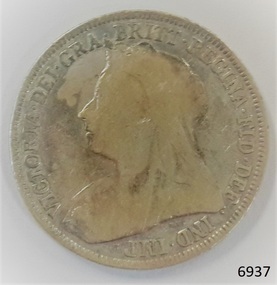
... Victoria succeeded King William IV to the British Throne in 1837 – she was only 18 years old at the time – and she ruled until 1901. British coins such as this one shilling were in circulation in the colony of Australia until 1910, when the Commonwealth of Australia began producing its own coinage. This one shilling coin was minted by the Royal Mint at Royal Mint Court...Victoria succeeded King William IV to the British Throne in 1837 – she was only 18 years old at the time – and she ruled until 1901. British coins such as this one shilling were in circulation in the colony of Australia until 1910, when the Commonwealth of Australia began producing its own coinage. This one shilling coin was minted by the Royal Mint at Royal Mint Court ...This Great Britain one shilling coin is dated 1897, which is during the reign of Queen Victoria. There were over 6 million of these coins minted. Queen Victoria succeeded King William IV to the British Throne in 1837 – she was only 18 years old at the time – and she ruled until 1901. British coins such as this one shilling were in circulation in the colony of Australia until 1910, when the Commonwealth of Australia began producing its own coinage. This one shilling coin was minted by the Royal Mint at Royal Mint Court, in Little Tower Hill, London, England. Coins for circulation in the Kingdom of England, Great Britain and most of the British Empire were produced here until the 1960’s when the Royal Mint shifted location to Wales. There are three main groups of shillings produced during Queen Victoria’s reign:- - The Young Head; 1837-1887, in 8 different versions, on the obverse showing the Queen’s maturing face over 50 years. - The Junior Head; 1887-1892, minted when Queen Victoria had been reigning for 50 years. Her head was smaller on the coins minted 1887-1889 than on those shillings minted 1889-1892. - The Old Head; 1893-1901, shows the veiled head of Queen Victoria. The obverse side of the coin was designed by Thomas Brock. The inscription’s translation is “Victoria by the Grace of God, Queen of the British territories, Defender of the Faith, Empress of India”. The reverse side of the coin was designed by Edward Paynter. The inscription "HONI SOIT QUI MAL Y PENSE" translates as "Evil be to him who evil thinks". AUSTRALIAN CURRENCY The early settlers of Australia brought their own currency with them so a wide variety of coins, tokens and even ‘promissory’ notes (often called IOU’s) were used in the exchange of goods and services. In 1813 Spanish dollars were imported and converted for use by punching a hole in the centre of the coin. Both the outer ring, called the holey dollar, and the punched out ‘hole’, called the dump, were then counter-stamped and used as the official currency. In 1825 the British Government passed the Sterling Silver Currency Act, making the British Pound the only legal form of currency in the Australian colonies. Not enough British currency was imported into the colony so other forms of currency were still used. In the mid 1800’s Australia entered the Gold Rush period when many made their fortunes. Gold was used for trading, often shaped into ingots, stamped with their weight and purity, and one pound tokens. In 1852 the Adelaide Assay Office, without British approval, made Australia’s first gold coin to meet the need for currency in South Australia after the Gold Rush began. In 1855 the official Australian Mint opened in Sydney, operating as a branch of the Royal Mint in London, and the gold was turned into coins called ‘sovereigns’. Other branches also opened in Melbourne and Perth. Up to the time of Australia becoming a federation in 1901 its currency included British copper and silver coins, Australian gold sovereigns, locally minted copper trade tokens, private banknotes, New South Wales and Queensland government treasury notes and Queensland government banknotes. After Federation the Australian government began to overwrite privately issued notes and prepared for the introduction of its own currency. In 1910 a National Australian Currency was formed, based on the British currency of ‘pounds, shillings and pence’ and the first Commonwealth coining was produced, removing the power from the States. In 1966, on February 14th, Australia changed over to the decimal currency system of dollars and cents. Australia did not have its own currency in the colonial times. Settlers brought money from other countries and they also traded goods such as grain when currency was scarce. For a long time there was no standardised value for the different currencies. In 1825 British currency became the only official currency in the colony of Australia and coins such as this silver shilling were imported into Australia to replace the mixture of foreign currency. Australia became a Federated nation on 1st January 1901. In 1910 National Australian Currency was formed and Australia produced its own currency, based on the British ‘pounds, shillings and pence’. The British currency was no longer valid. This silver shilling is of national significance as it represents the British currency used in Australia from 1825-1910. This silver shilling is also of significance to Australia as part one of the British Colonies ruled by Queen Victoria. It is part of the special silver and gold coins minted 1887-1893 to celebrate the 50 years Jubilee of Queen Victoria’s reign 1837-1887. Coin, Great Britain Shilling, 1897. Silver coin, round. Obverse; Queen Victoria head, ‘Old Head’, looking left. Reverse; 3 shields (each crowned) - 3 passant lions (England), 1 rampant lion (Scotland), golden harp (Northern Ireland) - floral symbols between them – 1 rose, 2 thistles. Inscriptions on both sides of coin.Obverse “VICTORIA . DEI . GRA . BRITT . REGINA . FID . DEF . IND . IMP” Reverse “ONE SHILLING, 1897, Inner band, some letters hidden - HONI SO VI Y PENSE” flagstaff hill, warrnambool, shipwrecked coast, flagstaff hill maritime museum, maritime museum, shipwreck coast, flagstaff hill maritime village, great ocean road, coin, currency, money, legal tender, australian currency history, royal mint, british shilling 1897, thomas brock, edward paynter, great britain shilling, queen victoria currency, queen victoria 50 years golden jubilee shilling, colonial australia currency, numismatics -
 Flagstaff Hill Maritime Museum and Village
Currency - Coin, 1898
... Victoria succeeded King William IV to the British Throne in 1837 – she was only 18 years old at the time – and she ruled until 1901. British coins such as this one shilling were in circulation in the colony of Australia until 1910, when the Commonwealth of Australia began producing its own coinage. This one shilling coin was minted by the Royal Mint at Royal Mint Court...Victoria succeeded King William IV to the British Throne in 1837 – she was only 18 years old at the time – and she ruled until 1901. British coins such as this one shilling were in circulation in the colony of Australia until 1910, when the Commonwealth of Australia began producing its own coinage. This one shilling coin was minted by the Royal Mint at Royal Mint Court ...This Great Britain one shilling coin is dated 1898, which is during the reign of Queen Victoria. There were over 9 million of these coins minted. Queen Victoria succeeded King William IV to the British Throne in 1837 – she was only 18 years old at the time – and she ruled until 1901. British coins such as this one shilling were in circulation in the colony of Australia until 1910, when the Commonwealth of Australia began producing its own coinage. This one shilling coin was minted by the Royal Mint at Royal Mint Court, in Little Tower Hill, London, England. Coins for circulation in the Kingdom of England, Great Britain and most of the British Empire were produced here until the 1960’s when the Royal Mint shifted location to Wales. There are three main groups of shillings produced during Queen Victoria’s reign:- - The Young Head; 1837-1887, in 8 different versions, on the obverse showing the Queen’s maturing face over 50 years. - The Junior Head; 1887-1892, minted when Queen Victoria had been reigning for 50 years. Her head was smaller on the coins minted 1887-1889 than on those shillings minted 1889-1892. - The Old Head; 1893-1901, shows the veiled head of Queen Victoria. The obverse side of the coin was designed by Thomas Brock. The inscription’s translation is “Victoria by the Grace of God, Queen of the British territories, Defender of the Faith, Empress of India”. The reverse side of the coin was designed by Edward Paynter. The inscription "HONI SOIT QUI MAL Y PENSE" translates as "Evil be to him who evil thinks". AUSTRALIAN CURRENCY The early settlers of Australia brought their own currency with them so a wide variety of coins, tokens and even ‘promissory’ notes (often called IOU’s) were used in the exchange of goods and services. In 1813 Spanish dollars were imported and converted for use by punching a hole in the centre of the coin. Both the outer ring, called the holey dollar, and the punched out ‘hole’, called the dump, were then used as the official currency. In 1825 the British Government passed the Sterling Silver Currency Act, making the British Pound the only legal form of currency in the Australian colonies. Not enough British currency was imported into the colony so other forms of currency were still used. In the mid 1800’s Australia entered the Gold Rush period when many made their fortunes. Gold was used for trading, often shaped into ingots, stamped with their weight and purity, and one pound tokens. In 1852 the Adelaide Assay Office, without British approval, made Australia’s first gold coin to meet the need for currency in South Australia after the Gold Rush began. In 1855 the official Australian Mint opened in Sydney, operating as a branch of the Royal Mint in London, and the gold was turned into coins called ‘sovereigns’. Other branches also opened in Melbourne and Perth. Up to the time of Australia becoming a federation in 1901 its currency included British copper and silver coins, Australian gold sovereigns, locally minted copper trade tokens, private banknotes, New South Wales and Queensland government treasury notes and Queensland government banknotes. After Federation the Australian government began to overwrite privately issued notes and prepared for the introduction of its own currency. In 1910 a National Australian Currency was formed, based on the British currency of ‘pounds, shillings and pence’ and the first Commonwealth coining was produced. In 1966, on February 14th, Australia changed over to the decimal currency system of dollars and cents. Australia did not have its own currency in the colonial times. Settlers brought money from other countries and they also traded goods such as grain when currency was scarce. For a long time there was no standardised value for the different currencies. In 1825 British currency became the only official currency in the colony of Australia and coins such as this silver shilling were imported into Australia to replace the mixture of foreign currency. Australia became a Federated nation on 1st January 1901. In 1910 National Australian Currency was formed and Australia produced its own currency, based on the British ‘pounds, shillings and pence’. The British currency was no longer valid. This silver shilling is of national significance as it represents the British currency used in Australia from 1825-1910. This silver shilling is also of significance to Australia as part one of the British Colonies ruled by Queen Victoria. It is part of the special silver and gold coins minted 1887-1893 to celebrate the 50 years Jubilee of Queen Victoria’s reign 1837-1887. Coin, Great Britain Shilling, 1898. Silver coin, round. Obverse; Queen Victoria head, ‘Old Head’, looking left. Reverse; 3 shields (each crowned) - 3 passant lions (England), 1 rampant lion (Scotland), golden harp (Northern Ireland) - floral symbols between them – 1 rose, 2 thistles. Inscriptions on both sides of coin.Obverse “VICTORIA . DEI . GRA . BRITT . REGINA . FID . DEF . IND . IMP” Reverse “ONE SHILLING, 1898, Inner band, some letters hidden - HONI SO VI Y PENSE” flagstaff hill, warrnambool, shipwrecked coast, flagstaff hill maritime museum, maritime museum, shipwreck coast, flagstaff hill maritime village, great ocean road, coin, currency, money, legal tender, australian currency history, royal mint, british shilling 1898, thomas brock, edward paynter, great britain shilling, queen victoria currency, queen victoria 50 years golden jubilee shilling, colonial australia currency, numismatics -
 Warrnambool and District Historical Society Inc.
Document - Jane Murray Letters of Administration 1876, 1878
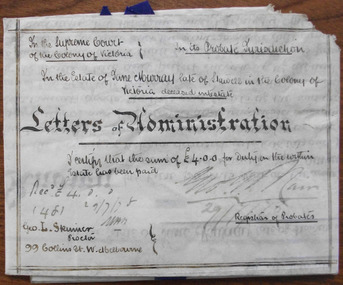
... This is a piece of parchment folded and sealed at the bottom edge with a seal of the Supreme Court of the Colony of Victoria attached by a blue ribbon. The document has ruled black lines and handwritten material in black ink. ...Victoria, deceased intestate, Letters of Administration, I certify that the sum of £4-0-0 for Duty on the within estate has been paid, Registrar of Estates, Geo. L. Skinner, Proctor, 99 Collins St. W. Melbourne’. This is a piece of parchment folded and sealed at the bottom edge with a seal of the Supreme Court of the Colony of Victoria attached by a blue ribbon. The document has ruled ...Nothing is known of the deceased, Jane Murray except that she died at the age of 49 and her husband was William Murray, a Stawell saddler. She left an estate to the value of £400. Tait collection: item 4 of 62This document is only of interest in that it came from the former legal offices of Mackay Taylor in Kepler Street, Warrnambool. It originally came from Thomas Goodall, a legal clerk in the office of Ernest Chambers who passed it on to George Mackay, the lawyer in a forerunner firm to Mackay Taylor where it remained until the firm of Mackay Taylor ceased to exist and the buildings were cleaned out.This is a piece of parchment folded and sealed at the bottom edge with a seal of the Supreme Court of the Colony of Victoria attached by a blue ribbon. The document has ruled black lines and handwritten material in black ink. There is a hole on the document at one of the folds and one edge is torn.‘In the Estate of Jane Murray late of Stawell in the Colony of Victoria, deceased intestate, Letters of Administration, I certify that the sum of £4-0-0 for Duty on the within estate has been paid, Registrar of Estates, Geo. L. Skinner, Proctor, 99 Collins St. W. Melbourne’. jane murray, stawell, warrnambool -
 Warrnambool and District Historical Society Inc.
Document - Robert Main Letters of Administration 1881, 1881
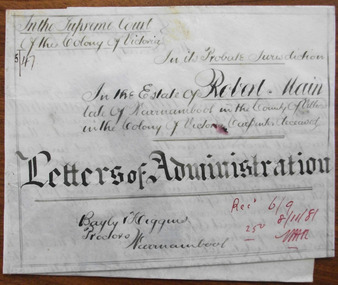
... This is a piece of white parchment with ruled black lines and folded and sealed at the bottom with a seal of the Supreme Court of the Colony of Victoria. ...Tait collection: item 6 of 62 This document is of significance only in that it is an example of probate papers drawn up by Warrnambool solicitors for a deceased Warrnambool resident in the 1880s. robert main bayley and higgins solicitors ‘In the Supreme Court of the Colony of Victoria, in its Probate Jurisdiction, in the Estate of Robert Main, late of Warrnambool, in the County of Villiers in the Colony of Victoria, carpenter, deceased, Letters of Administration, Bayly and Higgins, Proctors, Warrnambool, Recd. 6/9, 25o, 8/11/81, W.A.R.’ This is a piece of white parchment with ruled ...Nothing is known of Robert Main except that he was a Warrnambool carpenter who had a wife named Jane and he died on 9th August 1880. He left an estate to the value of £35. The Warrnambool lawyers, Bayley and Higgins operated in Warrnambool in the 1880s. Mr Bayley came from Port Fairy and Jabez Higgins, well-known in Warrnambool for his sporting and community interests, purchased the legal practice of Bayley and Higgins with his brother in 1875. Jabez Higgins built the residence, ‘Corio’ in Warrnambool and died in 1886. Tait collection: item 6 of 62This document is of significance only in that it is an example of probate papers drawn up by Warrnambool solicitors for a deceased Warrnambool resident in the 1880s. This is a piece of white parchment with ruled black lines and folded and sealed at the bottom with a seal of the Supreme Court of the Colony of Victoria. The seal is attached to the document by a blue ribbon. There is also a red stamp of the Master in Equity of the Supreme Court. The document is dated 1881. Apart from some minor staining the document is in good condition. The material is handwritten in black and red ink‘In the Supreme Court of the Colony of Victoria, in its Probate Jurisdiction, in the Estate of Robert Main, late of Warrnambool, in the County of Villiers in the Colony of Victoria, carpenter, deceased, Letters of Administration, Bayly and Higgins, Proctors, Warrnambool, Recd. 6/9, 25o, 8/11/81, W.A.R.’robert main, bayley and higgins, solicitors -
 Warrnambool and District Historical Society Inc.
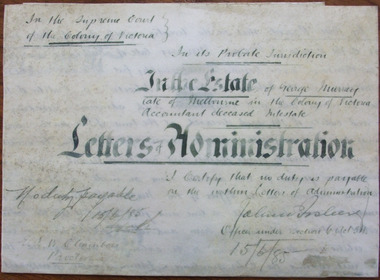
Document - George Murray Letters of Administration 1883, 1885
... ruled lines and has handwritten material in black ink. The document is folded at the lower edge with a seal of the Supreme Court of the Colony of Victoria. ...Tait collection: item 7 of 62 This document is of interest in that it was originally issued by the lawyer Ernest Chambers who later had an office in Warrnambool. george murray ernest chambers warrnambool ‘In the Supreme Court of the Colony of Victoria in its probate jurisdiction, in the Estate of George Murray, late of Melbourne in the Colony of Victoria, accountant, deceased intestate, Letters of Administration, I certify that no duty is payable on the within Letters of Administration, John W. … (office under section 6), 15/6/85’. This is a piece of parchment containing the 1885 Letters of Administration in the estate of George Murray, a Melbourne accountant. The document is white with black ruled ...No information is available on George Murray except that he was a Melbourne accountant and died intestate in 1885. He left property to the value of £91 and the lawyer, Ernest Chambers, who was at that time at 12 Chancery Lane, Melbourne, was directed to list the creditors of George Murray and distribute the estate accordingly. Mr Chambers was one of George Murray’s creditors. Ernest Chambers later had a legal practice with offices at Warrnambool, Koroit and Port Fairy with the known dates 1897 to 1910. Thomas Goodall was the manager of the Warrnambool office and he was the one who had this document in his possession at that time and it was passed down to succeeding lawyers in the Kepler Street building. Tait collection: item 7 of 62This document is of interest in that it was originally issued by the lawyer Ernest Chambers who later had an office in Warrnambool. This is a piece of parchment containing the 1885 Letters of Administration in the estate of George Murray, a Melbourne accountant. The document is white with black ruled lines and has handwritten material in black ink. The document is folded at the lower edge with a seal of the Supreme Court of the Colony of Victoria. The seal is attached to the document by a green ribbon. There is also a blue stamp of the Master in Equity of the Supreme Court. The document is in good condition apart from some minor staining. ‘In the Supreme Court of the Colony of Victoria in its probate jurisdiction, in the Estate of George Murray, late of Melbourne in the Colony of Victoria, accountant, deceased intestate, Letters of Administration, I certify that no duty is payable on the within Letters of Administration, John W. … (office under section 6), 15/6/85’. george murray, ernest chambers, warrnambool -
 Warrnambool and District Historical Society Inc.
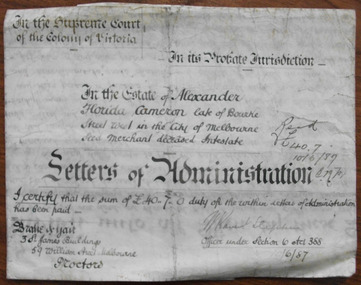
Document - Alexander F Cameron Letters of Administration 1887, 1887
... This is a piece of cream parchment with ruled black lines and the lower edge folded back with a seal of the Supreme Court of the Colony of Victoria attached to the document by a black ribbon. ...Tait collection: item 8 of 62 This document has no apparent local significance and is of interest only as an example of the Letters of Administration issued in the 1880s. alexander florida cameron drake & gair, solicitors warrnambool ‘In the Supreme Court of the Colony of Victoria in its probate jurisdiction in the Estate of Alexander Florida Cameron, late of Bourke Street West in the City of Melbourne, Seed Merchant, deceased intestate, Letters of Administration, I certify that the sum of £40-7-0 duty of the within Letters of Administration has been paid, Drake and Gair, 3 St. James Buildings, 59 William Street Melbourne, Proctors. W. Ravent Stephen, Office under Section 6, Act 388, 10/6/87’ This is a piece of cream parchment with ruled ...This document concerns the estate of Alexander Florida Cameron, a seedsman from Melbourne in the firm of Grant and Cameron of 41 Bourke Street West, Melbourne. He died intestate in 1887 and left real estate to the value of £263 and personal estate to the value of £4744. This estate was to be administered by his son, Richard Ross Cameron. Tait collection: item 8 of 62This document has no apparent local significance and is of interest only as an example of the Letters of Administration issued in the 1880s. This is a piece of cream parchment with ruled black lines and the lower edge folded back with a seal of the Supreme Court of the Colony of Victoria attached to the document by a black ribbon. The document contains handwritten material in black ink and a blue stamp from the Revenue and Pay Office and a red stamp from the Master in Equity of the Supreme Court. The document is somewhat stained but is otherwise in good condition.‘In the Supreme Court of the Colony of Victoria in its probate jurisdiction in the Estate of Alexander Florida Cameron, late of Bourke Street West in the City of Melbourne, Seed Merchant, deceased intestate, Letters of Administration, I certify that the sum of £40-7-0 duty of the within Letters of Administration has been paid, Drake and Gair, 3 St. James Buildings, 59 William Street Melbourne, Proctors. W. Ravent Stephen, Office under Section 6, Act 388, 10/6/87’alexander florida cameron, drake & gair, solicitors, warrnambool -
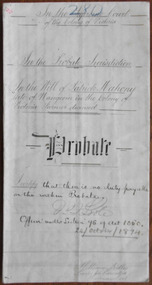 Warrnambool and District Historical Society Inc.
Document - Patrick Mahony Probate 1894, 1894
... There is a seal of the Supreme Court of the Colony of Victoria attached with a green ribbon and three red stamps of the Master in Equity in the Supreme Court. The document has ruled...Victoria, Farmer deceased, Probate. I certify that there is no duty payable on the within Probate, J. Poole, Officer under Section 96 of Act 1060, 24/October/1894, William Ardlie, Proctor for Executors, Warrnambool’ This is a piece of parchment paper, folded in two with writing in black ink on all four pages. There is a seal of the Supreme Court of the Colony of Victoria attached with a green ribbon and three red stamps of the Master in Equity in the Supreme Court. The document has ruled ...These are the Probate papers for Patrick Mahony, a farmer from Wangoom who died in 1894. He left an estate of £995 and personal effects worth £138. The estate was to be administered by the two sons, William and Timothy in trust for another son, Michael Mahony. The wife Margaret was granted three acres of land, £25 a year and ‘the choice of two cows out of my stock’. The daughter Johanna was to receive the same benefits after the death of her mother. Patrick Mahony, being illiterate, signed his will with a cross. Tait collection: item 12 of 62This document is of interest as it concerns a local farmer, Patrick Mahony and a local lawyer, William Ardlie. The latter had a practice in Warrnambool for the best part of seventy years, firstly in Timor Street and then in Kepler Street. He was a prominent resident in Warrnambool. The document was originally in the hands of the law clerk, Thomas Goodall and it was passed on to lawyers occupying the Kepler Street premises until it was found in the buildings once used by the law firm of Mackay Taylor. This is a piece of parchment paper, folded in two with writing in black ink on all four pages. There is a seal of the Supreme Court of the Colony of Victoria attached with a green ribbon and three red stamps of the Master in Equity in the Supreme Court. The document has ruled lines and some annotations in the margins. ‘280, In the Supreme Court of the Colony of Victoria, in the Probate Jurisdiction in the Will of Patrick Mahony, late of Wangoom, in the Colony of Victoria, Farmer deceased, Probate. I certify that there is no duty payable on the within Probate, J. Poole, Officer under Section 96 of Act 1060, 24/October/1894, William Ardlie, Proctor for Executors, Warrnambool’patrick mahony, william ardlie, warrnambool -
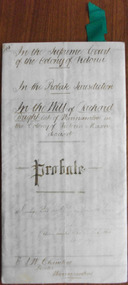 Warrnambool and District Historical Society Inc.
Document - Richard Bright Probate 1897, 1897
... There is a seal of the Supreme Court of the Colony of Victoria attached with a green ribbon and a red stamp of the Master in Equity of the Supreme Court. There are ruled...Court of the Colony of Victoria, In the Probate Jurisdiction In the Will of Richard Bright, late of Warrnambool in the Colony of Victoria, Mason, deceased. Probate. I certify that no duty is payable herewith. J. Poole, Officer under Sec. 96, Act 1060, 16/11/97. E.J.W. Chambers, Proctor, Warrnambool’ This is a piece of parchment paper, folded in two, with handwriting on all pages. There is a seal of the Supreme Court of the Colony of Victoria attached with a green ribbon and a red stamp of the Master in Equity of the Supreme Court. There are ruled ...This document contains the Probate Papers following the death of Richard Bright, a Warrnambool stonemason who died in August 1897. No other information has been found on Richard Bright but he must have been a successful tradesman as he left real estate to the value of £680 and personal estate to the value of £94. His executors were his son, Daniel Bright of Terang and the law clerk, Thomas Goodall. Richard Bright left a number of properties to his wife, Elizabeth, his sons, Daniel and John and his daughters, Adelaide Scown and Martha Head. This document was in the possession of Thomas Goodall , a law clerk managing the Ernest Chambers legal offices in Warrnambool and it was eventually passed on to the law firms operating from the same premises in Kepler Street. It was handed to the Historical Society when it was found in the premises once occupied by the law firm of Mackay Taylor. Tait collection: item 14 of 62This document is of interest as it originally was drawn up by a local lawyer. Ernest Chambers, and the probate papers are for a local Warrnambool resident, Richard Bright. This is a piece of parchment paper, folded in two, with handwriting on all pages. There is a seal of the Supreme Court of the Colony of Victoria attached with a green ribbon and a red stamp of the Master in Equity of the Supreme Court. There are ruled black lines on three pages and pencilled writing in the margin of the first page. Some of the writing is a little faded. ‘In the Supreme Court of the Colony of Victoria, In the Probate Jurisdiction In the Will of Richard Bright, late of Warrnambool in the Colony of Victoria, Mason, deceased. Probate. I certify that no duty is payable herewith. J. Poole, Officer under Sec. 96, Act 1060, 16/11/97. E.J.W. Chambers, Proctor, Warrnambool’ernest chambers, thomas goodall richard bright, richard bright, tait collection -
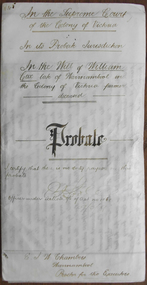 Warrnambool and District Historical Society Inc.
Document - William Cox Probate 1899, 1899
... The seal of the Supreme Court of the Colony of Victoria is attached with blue ribbon and there are two stamps, one blue one of the Colonial Bank in Warrnambool and the other a red one of the Master in Equity of the Supreme Court in Melbourne. Two of the pages have ruled...The seal of the Supreme Court of the Colony of Victoria is attached with blue ribbon and there are two stamps, one blue one of the Colonial Bank in Warrnambool and the other a red one of the Master in Equity of the Supreme Court in Melbourne. Two of the pages have ruled ...Tait collection: item 19 of 62 This is an 1899 document giving Will and Probate details of William Cox who died in Warrnambool in March 1899. He was a farmer residing in Moore Street Warrnambool at the time of his death at the age of 83. He left real estate to the value of £425 and personal estate to the value of £412 to Gwenllian Williams who may have been his sister or niece. A Mr and Mrs Williams were also living in the Moore Street house at the time of Cox’s death. His executors were Thomas Goodall, a law clerk who managed the office of the lawyer Ernest Chambers in Warrnambool and John Ward, a pioneer settler in Warrnambool and a shopkeeper in Jamieson Street in 1899. No other details are available on William Cox. This is an interesting document as it gives details of the Will and Probate belonging to a local Warrnambool person, William Cox. The lawyer dealing with the document was Ernest Chambers who had legal offices in Warrnambool, Port Fairy and Koroit at the end of the 19th century and the beginning of the 20th century. This document has been passed on to successive lawyers occupying legal chambers in the Kepler Street building and that is where the document was held until passed on to the Warrnambool and District Historical Society in 2014.This is an 1899 piece of parchment paper folded in two with handwritten material on three sides of the paper. The seal of the Supreme Court of the Colony of Victoria is attached with blue ribbon and there are two stamps, one blue one of the Colonial Bank in Warrnambool and the other a red one of the Master in Equity of the Supreme Court in Melbourne. Two of the pages have ruled black lines. The writing is very clear but the pages are a little stained.In the Supreme Court of the Colony of Victoria In its Probate Jurisdiction In the Will of William Cox late of Warrnambool in the Colony of Victoria farmer deceased; Probate; I certify there is no duty payable on this probate (signature) Officer under Section 96 of act No 106; E J W Chambers Warrnambool Proctors for the Executorswilliam cox, ernest chambers, john ward, thomas goodall, tait collection -
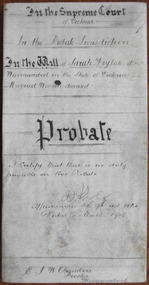 Warrnambool and District Historical Society Inc.
Document - Sarah Fry Probate 1905, 1906
... Three of the pages are ruled with black ink. There is a seal of the Supreme Court of Victoria attached with a blue ribbon and a red stamp of the Master-in-Equity of the Supreme Court. ...It will be useful for researchers. ernest chambers sarah fry warrnambool tait collection In the Supreme Court of Victoria; In the Probate Jurisdiction; In the Will of Sarah Fry late of Warrnambool in the State of Victoria Married Woman deceased. This is a 1906 cream-coloured parchment sheet folded in two with handwritten material on three sides. Three of the pages are ruled ...Tait collection: item 27 of 62 This document contains details on the will and probate of Sarah Fry who died in Warrnambool in March 1905 at the age of 47. She was the daughter of Edmund and Jane Lord and came to Australia with her parents and some of her siblings aboard the Electric in 1869. In 1888 she married Francis Joseph Fry, a Warrnambool plasterer. Sarah Fry left real estate to the value of £450 and personal estate to the value of £202. The beneficiaries of her will were her husband, Francis and her three children, Sarah, James and Doris. The lawyer Ernest Chambers had offices in Warrnambool, Koroit and Port Fairy at the end of the 19th century and the beginning of the 20th century. He had this document in his possession and it was passed down to successive lawyers occupying the legal premises in Kepler Street where it was located in 2014 and handed over to the Warrnambool and District Historical Society. This document is of interest as it contains information on the will and probate of Sarah Fry, a resident of Warnambool in the late 19th century and early 20th century. It will be useful for researchers.This is a 1906 cream-coloured parchment sheet folded in two with handwritten material on three sides. Three of the pages are ruled with black ink. There is a seal of the Supreme Court of Victoria attached with a blue ribbon and a red stamp of the Master-in-Equity of the Supreme Court. The document includes the will and probate details of Sarah Fry, a married woman from Warrnambool. All the pages are somewhat stained but one page is very grubby. In the Supreme Court of Victoria; In the Probate Jurisdiction; In the Will of Sarah Fry late of Warrnambool in the State of Victoria Married Woman deceased.ernest chambers, sarah fry, warrnambool, tait collection -
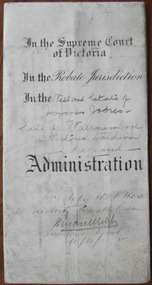 Warrnambool and District Historical Society Inc.
Document - James Jones Letters of Administration 1910, 1910
... The paper is ruled on one side with black lines. The seal of the Supreme Court of Victoria is attached with green ribbon. ...James Jones Warrnambool tait collection In the Supreme Court of Victoria; In the Probate Jurisdiction; In the Will and Estate of James Jones late of Warrnambool in Victoria Gardener deceased This is a cream-coloured piece of parchment paper (1910) folded in two with handwritten material on three sides. The first page has black printed material in script with the information filled in in black ink. It contains the information on the Will and Letters of Administration of James Jones, a gardener from Warrnambool. The paper is ruled ...Tait collection: item 29 of 62 This document contains information on the Will and Letters of Administration of James Jones, a gardener from Warrnambool. The document indicates that he died intestate in August 1896 at the age of 57 but details of a will are included in the document. The fact that this document was drawn up 14 years after his death indicates that there was a problem with the will. James Jones left real estate to the value of £80 and personal estate to the value of £10. The sole beneficiary was his widow, Mary Ann Jones. No other information has been found on James Jones. No Warrnambool lawyer is mentioned in this document but it was located at the former legal premises in Kepler Street of Mackay Taylor and passed on to the Warrnambool and District Historical Society in 2014. It is presumed that it had been passed down to successive lawyers occupying the same building since 1910. This document is of interest because it contains information on the Will and Letters of Administration of a Warrnambool resident, James Jones. It will be useful for research.This is a cream-coloured piece of parchment paper (1910) folded in two with handwritten material on three sides. The first page has black printed material in script with the information filled in in black ink. It contains the information on the Will and Letters of Administration of James Jones, a gardener from Warrnambool. The paper is ruled on one side with black lines. The seal of the Supreme Court of Victoria is attached with green ribbon. One page is very stained. In the Supreme Court of Victoria; In the Probate Jurisdiction; In the Will and Estate of James Jones late of Warrnambool in Victoria Gardener deceasedjames jones, warrnambool, tait collection -
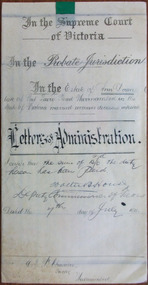 Warrnambool and District Historical Society Inc.
Document - Ann Doran Letters of Administration 1911, 1911
... One page has ruled black lines. A seal of the Supreme Court of Victoria is attached with a green ribbon and there are four red stamps of the Master in Equity of the Supreme Court. ...Ann Doran Ernest Chambers Warrnambool In the Supreme Court of Victoria; In the Probate Jurisdiction; In the Estate of Ann Doran late of Port Fairy Road Warrnambool in the State of Victoria married woman deceased intestate. Letters of Administration. This is a cream-coloured piece of parchment paper folded in two with handwritten material on two sides. One page has ruled ...Tait collection: item 30 of 62 This document contains information on the Letters of Administration of Ann Doran of Port Fairy Road, Warrnambool. She died in December 1889 but, as she died intestate, the Letters of Administration were not processed until 1911. Ann Doran left no real estate but left personal estate to the value of £116. The sole beneficiary was her daughter, Jane Doran. The lawyer in the case was Ernest Chambers who had legal offices in Port Fairy, Warrnambool and Koroit at the end of the 19th century and the beginning of the 20th century. He had this document in his possession and it was passed down to successive lawyers occupying the legal premises in Kepler Street. It was located in this building in 2014 and passed on to the Warrnambool and District Historical Society at that time. This document is of some interest as it contains information on the Letters of Administration of Ann Doran who lived in Warrnambool at the time of her death in 1889. It will be of use to researchers. This is a cream-coloured piece of parchment paper folded in two with handwritten material on two sides. One page has ruled black lines. A seal of the Supreme Court of Victoria is attached with a green ribbon and there are four red stamps of the Master in Equity of the Supreme Court. One page is somewhat stained.In the Supreme Court of Victoria; In the Probate Jurisdiction; In the Estate of Ann Doran late of Port Fairy Road Warrnambool in the State of Victoria married woman deceased intestate. Letters of Administration.ann doran, ernest chambers, warrnambool -
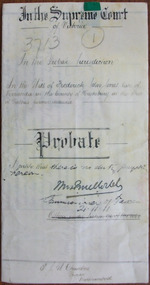 Warrnambool and District Historical Society Inc.
Document - Frederick J Jones Probate 1911, 1911
... Two of the pages have ruled black lines. The seal of the Supreme Court of Victoria is attached with green ribbon and there are four red stamps of the Master in Equity of the Supreme Court. ...Frederick Jones Ernest Chambers Warrnambool tait collection In the Supreme Court of Victoria in the Probate Jurisdiction in the Will of Frederick John Jones late of Nirranda in the County of Heytesbury in the State of Victoria farmer deceased This is a cream-coloured piece of parchment folded in two containing handwritten material on the Probate of Frederick Jones of Nirranda, 1911. Two of the pages have ruled ...Tait collection: item 31 of 62 This document contains details of the Will and Probate of Frederick John Jones, a farmer of Nirranda who died in October 1910. He left real estate to the value of £200 and personal estate to the value of £43. The beneficiaries were his daughter Harriet Jones, his son Frederick Augustus Jones and his grandson, Claude Eagle. No other information has been found on Frederick Jones, Senior. This document was in the possession of Ernest Chambers who had legal offices in Warrnambool, Port Fairy and Koroit at the end of the 19th century and the beginning of the 20th century. It was then passed down to successive lawyers occupying the legal premises in Kepler Street and located in 2014 in the same building, the former offices of Mackay Taylor. It was then passed on to the Warrnambool and District Historical Society. This is a cream-coloured piece of parchment folded in two containing handwritten material on the Probate of Frederick Jones of Nirranda, 1911. Two of the pages have ruled black lines. The seal of the Supreme Court of Victoria is attached with green ribbon and there are four red stamps of the Master in Equity of the Supreme Court. The document is somewhat discoloured.In the Supreme Court of Victoria in the Probate Jurisdiction in the Will of Frederick John Jones late of Nirranda in the County of Heytesbury in the State of Victoria farmer deceased frederick jones, ernest chambers, warrnambool, tait collection
