
Showing 184 items matching "cowes west"
-
 Phillip Island and District Historical Society Inc.
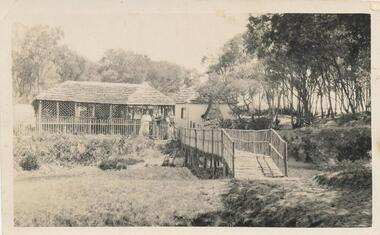
Photograph, Tea Rooms, West Cowes, 1920
... Tea Rooms, West Cowes......west cowes...The Tea Rooms West Cowes - 1920. Bungalow with lady and gent at doorway and footbridge at centre right foreground. ...This is the current Cowes Foreshore Tourist Park. 2020 Tea Rooms, West Cowes Photograph Photograph ...Part of a collection from Jessie Smith showing an early Tea Rooms, 1920.The Tea Rooms West Cowes - 1920. Bungalow with lady and gent at doorway and footbridge at centre right foreground. Trees at right top. This is the current Cowes Foreshore Tourist Park. 2020local history, photographs, tea rooms, west cowes, phillip island, black & white photograph, seaside end of council camp, jessie smith collection, stan mcfee, camping -
 Phillip Island and District Historical Society Inc.
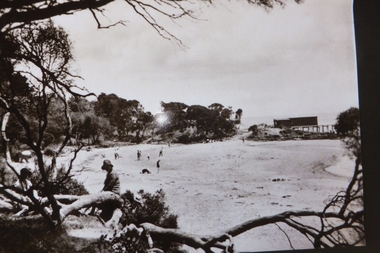
Photograph, 1920's
... cowes west beach phillip island...Large Black & White photograph of Cowes West Beach, Mussell Rocks and the Sea Baths....One of a group of Historical photographs purchased from Photo First Shop in Thompson Avenue, Cowes when it closed in June, 2014. cowes west beach phillip island mussell rocks cowes phillip island cowes sea baths photo first phillip island Cowes Beach Large Black & White photograph of Cowes West Beach, Mussell Rocks and the Sea Baths. ...One of a group of Historical photographs purchased from Photo First Shop in Thompson Avenue, Cowes when it closed in June, 2014.Large Black & White photograph of Cowes West Beach, Mussell Rocks and the Sea Baths.Cowes Beachcowes west beach phillip island, mussell rocks cowes phillip island, cowes sea baths, photo first phillip island -
 Phillip Island and District Historical Society Inc.
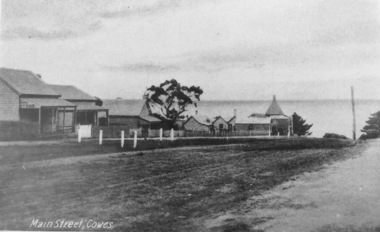
Photography, Main Street, Cowes, 1890 approx
... View of Main Street, Cowes. Wests General Store on left. Chicory Kiln in background. ...Copied by John Jansson 1984 local history photography photographs postcards view cowes phillip island black & white postcard - copy thompson ave cowes wests general store chicory kilns Main Street, Cowes View of Main Street, Cowes. ...Part of a collection of Rose & Valentine Postcards. Copied by John Jansson 1984View of Main Street, Cowes. Wests General Store on left. Chicory Kiln in background. Approx. 1890.Main Street, Coweslocal history, photography, photographs, postcards, view cowes, phillip island, black & white postcard - copy, thompson ave cowes, wests general store, chicory kilns -
 Phillip Island and District Historical Society Inc.
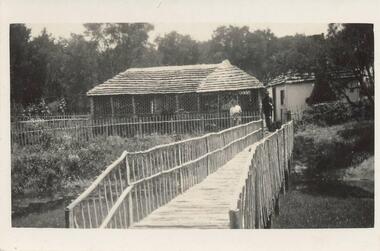
Photograph
... ...Cowes West...This is the current Cowes Foreshore Tourist Park 2020 council camp beach phillip island jessie smith collection stan mcfee Camping Cowes West On back: "Shelter Shed at Council Camp beach - Mr. ...One of 23 photographs from the Jessie Smith Collection. Donated by Stan McFee. This is the current Cowes Foreshore Tourist Park 2020Black & White photograph of a Shelter Shed at the Council Camp Beach. A figure of a person standing behind a fence and another person between the two buildings. Trees in the background. Footbridge and garden in the foreground.On back: "Shelter Shed at Council Camp beach - Mr. McKenzie owned it."council camp beach, phillip island, jessie smith collection, stan mcfee, camping, cowes west -
 Phillip Island and District Historical Society Inc.
Booklet, Cowes McRae Beach Estate, 1960s
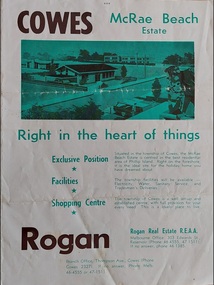
... ...Cowes West...Historical Housing Justice family McRae family Cowes West rogan real estate cowes phillip island Glen Isla Cowes McRae Beach Estate - Right in the heart of things .Phillip Island - The Loveliest Isle on Earth Coloured A4 brochure describing the McRae Beach Estate, including plan of streets and location on Island, photos and description of the Island. ...This land was owned by the McRae family, whose wife was a Justice. Hence the street names of McRae and Justice. The weatherboard family home [ originally a guest house called Glen Isle] was at the end of the current Justice Road. The estate was created in the mid 1960s. The house was put on skids and dragged by two tractors and a bulldozer to 364 Church Street while the family home was built at 368 Church Street, Cowes.[ Source Sandra Rocotas, nee McCrae. Facebook Community Noticeboard 5/2/2023. Permission given to use information and photos ] Estate was sold by Rogan Real Estate.HistoricalColoured A4 brochure describing the McRae Beach Estate, including plan of streets and location on Island, photos and description of the Island. Sold by Rogan Real Estate.Cowes McRae Beach Estate - Right in the heart of things .Phillip Island - The Loveliest Isle on Earthhousing, justice family, mcrae family, cowes west, rogan real estate cowes phillip island, glen isla -
 Phillip Island and District Historical Society Inc.
Postcard, Souvenir of Cowes, Phillip Island
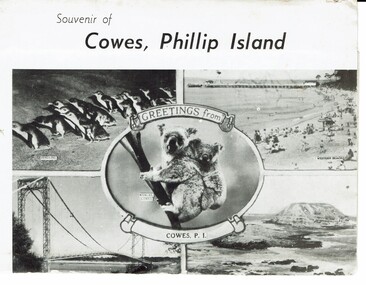
... ...Cowes West beach...Historical Postcards Lillian Atkinson Phillip Island Car Racing motor car racing Cowes West beach Cowes Jan. 1959 Picture postcard set. 10 black & white postcards of Island attractions on fold out sheet in attached envelope. ...Typical tourist souvenir and photographs of the 1950s. Collected by Lillian Atkinson on holiday in 1959.HistoricalPicture postcard set. 10 black & white postcards of Island attractions on fold out sheet in attached envelope. Contains a brief explanation of tourist attractions on Phillip Island. Produced by Rose Stereograph Co., Armadale, Victoria. Several postcards have writing in blue pen under them. Cowes Jan. 1959postcards, lillian atkinson, phillip island car racing, motor car racing, cowes west beach -
 Phillip Island and District Historical Society Inc.
Photograph, Murray Views, Bayview Beach, Cowes
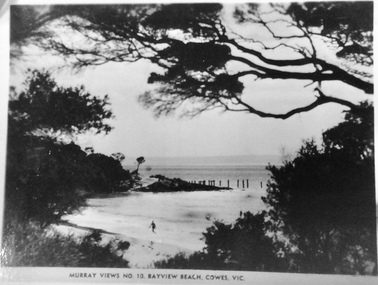
... Small black and white postcard of Cowes west beach near Mussell Rocks, showing the remains of the public baths....No 10 Bayview Beach, Cowes, Vic Small black and white postcard of Cowes west beach near Mussell Rocks, showing the remains of the public baths. ...The area near Mussell Rocks was once a public baths and was named Bayview Beach, after the nearby Bayview Guesthouse.Small black and white postcard of Cowes west beach near Mussell Rocks, showing the remains of the public baths.Murray Views. No 10 Bayview Beach, Cowes, Vic postcards, cowes, mussell rocks cowes phillip island, swimming baths, photographs -
 Phillip Island and District Historical Society Inc.
Photograph
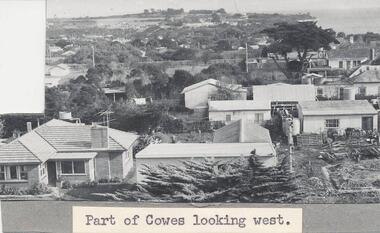
... Photograph of part of Cowes looking west....One of a collection of over 400 photographs in an album commenced in 1960 and presented to the Phillip Island & Westernport Historical Society by the Shire of Phillip Island local history photography photographs cowes phillip island john jenner bryant west Photograph of part of Cowes looking west. ...One of a collection of over 400 photographs in an album commenced in 1960 and presented to the Phillip Island & Westernport Historical Society by the Shire of Phillip IslandPhotograph of part of Cowes looking west.local history, photography, photographs, cowes, phillip island, john jenner, bryant west -
 Phillip Island and District Historical Society Inc.
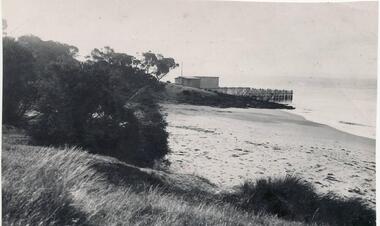
Photograph, Bryan West
... Photograph of Cowes Sea Baths Beach west of Cowes Jetty - 1900...One of a collection of over 400 photographs in an album commenced in 1960 and presented to the Phillip Island & Westernport Historical Society by the Shire of Phillip Island local history photography photographs coastline cowes sea baths phillip island john jenner bryant west Photograph of Cowes Sea Baths Beach west of Cowes Jetty - 1900 Photograph Bryan West ...One of a collection of over 400 photographs in an album commenced in 1960 and presented to the Phillip Island & Westernport Historical Society by the Shire of Phillip IslandPhotograph of Cowes Sea Baths Beach west of Cowes Jetty - 1900local history, photography, photographs, coastline, cowes, sea baths, phillip island, john jenner, bryant west -
 Phillip Island and District Historical Society Inc.
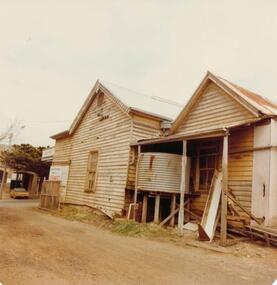
Photograph, 1978/79
... January 1869 at the first land sale in Cowes, John West bought Lot 1 for £45 . In the 1870's he built the first Chicory Kiln on Phillip Island. ...Photograph of remains of West's store, Cowes. Timber building with corrugated roofing. ...January 1869 at the first land sale in Cowes, John West bought Lot 1 for £45 . In the 1870's he built the first Chicory Kiln on Phillip Island. ...January 1869 at the first land sale in Cowes, John West bought Lot 1 for £45 . In the 1870's he built the first Chicory Kiln on Phillip Island. With his brother, Solomon, he started the General Store next to the Chicory Kiln in Thompson Avenue. Over the years the original building was extended and altered.Photograph of remains of West's store, Cowes. Timber building with corrugated roofing. Old iron water tank in front of building.local history, photographs, buildings, historic, buildings - historical, sepia photograph, john cook, phillip island, west's general store -
 Phillip Island and District Historical Society Inc.
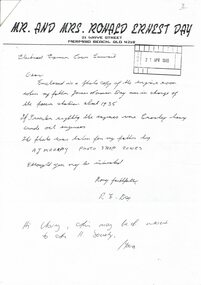
Photograph, Power station, Cowes 1930s, 1995
... The Cowes Power station was in Cowes west, corner of Chapel Street and Osborne Avenue. ...The Cowes Power station was in Cowes west, corner of Chapel Street and Osborne Avenue. ...The Cowes Power station was in Cowes west, corner of Chapel Street and Osborne Avenue. James Norman Day was in charge c. 1935.HistoricalPhotocopy of letter from Mr & Mrs Ronald Day, Mermaid Beach, Queensland, sent to the Electrical Engineer, Cowes Council, 1995. and reply to sender. Also copy of photo of equipment in power station.Mr and Mrs Ronald Ernest Daypower station, electricity, james norman day -
 Phillip Island and District Historical Society Inc.
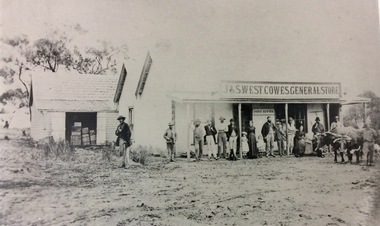
Photograph, Wests General Store, Cowes
... Black & White Postcard of Main Street, Cowes showing Wests General Store, Cowes with locals in front of shop....Copied by John Jansson 1984 local history photography photographs postcards view cowes phillip island black & white postcard - copied thompson ave cowes wests general store Black & White Postcard of Main Street, Cowes showing Wests General Store, Cowes with locals in front of shop. ...Part of a collection of Rose & Valentine Series of Postcards. Copied by John Jansson 1984Black & White Postcard of Main Street, Cowes showing Wests General Store, Cowes with locals in front of shop.local history, photography, photographs, postcards, view cowes, phillip island, black & white postcard - copied, thompson ave cowes, wests general store -
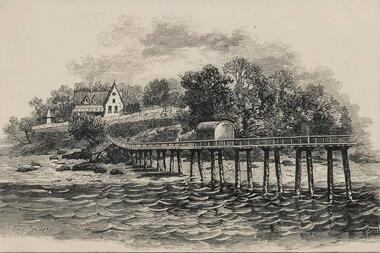 Phillip Island and District Historical Society Inc.
Photograph, Bryant West, 1880
... west...cowes jetty...One of a collection of over 400 photographs in an album commenced in 1960 and presented to the Phillip Island & Westernport Historical Society by the Shire of Phillip Island local history photography photographs jetties phillip island isle of wight hotel john jenner bryant west cowes jetty Photograph of an etching depicting the Cowes Jetty and the Isle of Wight Hotel 1880. ...One of a collection of over 400 photographs in an album commenced in 1960 and presented to the Phillip Island & Westernport Historical Society by the Shire of Phillip IslandPhotograph of an etching depicting the Cowes Jetty and the Isle of Wight Hotel 1880.local history, photography, photographs, jetties, phillip island, isle of wight hotel, john jenner, bryant west, cowes jetty -
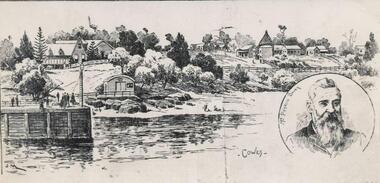 Phillip Island and District Historical Society Inc.
Photograph, Bryant West
... west...cowes jetty shed...One of a collection of over 400 photographs in an album commenced in 1960 and presented to the Phillip Island & Westernport Historical Society by the Shire of Phillip Island local history photography photographs cowes foreshore phillip island jetties isle of wight thompson avenue cowes chicory kiln john jenner bryant west cowes jetty shed Photograph of an etching depicting the Cowes Jetty, Jetty Shed, Chicory Kiln in Thompson Avenue. ...One of a collection of over 400 photographs in an album commenced in 1960 and presented to the Phillip Island & Westernport Historical Society by the Shire of Phillip IslandPhotograph of an etching depicting the Cowes Jetty, Jetty Shed, Chicory Kiln in Thompson Avenue. Inset illustration of Francis Bauer, first licensee of Isle of Wight Hotel.local history, photography, photographs, cowes foreshore, phillip island, jetties, isle of wight, thompson avenue cowes, chicory kiln, john jenner, bryant west, cowes jetty shed -
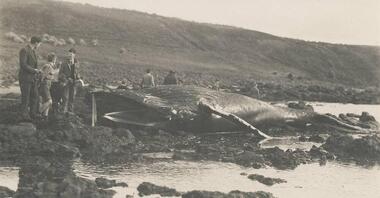 Phillip Island and District Historical Society Inc.
Photograph, Whale carcass Cat Bay
... West...cowes primary school...Cowes State School. One of those students was Helen Forrest who believes it was in 1948. One of a collection of over 400 photographs in an album commenced in 1960 and presented to the Phillip Island & Westernport Historical Society by the Shire of Phillip Island local history photography stranded whale black & white photograph wild life whales coastline cat bay John Jenner Bryant West cowes primary school Photograph of stranded whale at Cat Bay with school children examining it. ...Students were from Cowes State School. One of those students was Helen Forrest who believes it was in 1948. One of a collection of over 400 photographs in an album commenced in 1960 and presented to the Phillip Island & Westernport Historical Society by the Shire of Phillip IslandPhotograph of stranded whale at Cat Bay with school children examining it. local history, photography, stranded whale, black & white photograph, wild life, whales, coastline, cat bay, john jenner, bryant west, cowes primary school -
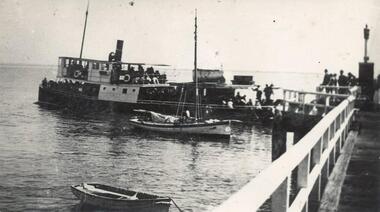 Phillip Island and District Historical Society Inc.
Photograph
... Photograph along west side Cowes Jetty showing "Genista" departing....One of a collection of over 400 photographs in an album commenced in 1960 and presented to the Historical Society by the Shire of Phillip Island local history photography photographs maritime technology ferries ferry "genista" - cowes jetty black & white photograph genista cowes jetty John Jenner Bryant West Photograph along west side Cowes Jetty showing "Genista" departing. ...One of a collection of over 400 photographs in an album commenced in 1960 and presented to the Historical Society by the Shire of Phillip IslandPhotograph along west side Cowes Jetty showing "Genista" departing.local history, photography, photographs, maritime technology, ferries, ferry "genista" - cowes jetty, black & white photograph, genista, cowes jetty, john jenner, bryant west -
 Phillip Island and District Historical Society Inc.
Photograph
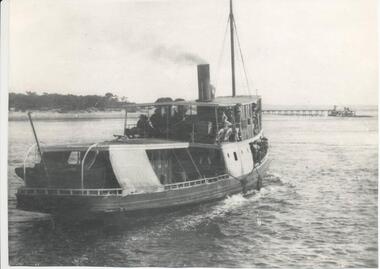
... Photograph of the ferry, "Genista" from a point astern and steaming west towards Cowes Jetty...One of a collection of over 400 photographs in an album commenced in 1960 and presented to the Phillip Island & Westernport Historical Society by the Shire of Phillip Island local history photography photographs maritime technology ferries ferry "genista" black & white photograph shipping genista john jenner bryant west Photograph of the ferry, "Genista" from a point astern and steaming west towards Cowes Jetty Photograph Bryant West ...One of a collection of over 400 photographs in an album commenced in 1960 and presented to the Phillip Island & Westernport Historical Society by the Shire of Phillip IslandPhotograph of the ferry, "Genista" from a point astern and steaming west towards Cowes Jettylocal history, photography, photographs, maritime technology, ferries, ferry "genista", black & white photograph, shipping, genista, john jenner, bryant west -
 Phillip Island Conservation Society Inc.
Work on paper - Photocopy of newspaper cutting, Melbourne Sun newspaper, "PHILLIP ISLAND SPECIAL PREPARED BY BILL HITCHINGS", 29.08.1969
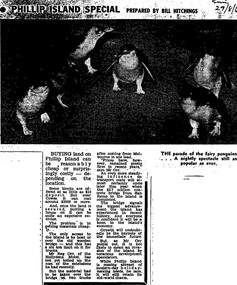
... At that stage a number of outlying residential estates had been created, especially on Phillip Island South Coast and at Cowes West. While blocks of land on the outlier estates were very cheap and poorly serviced, the Cowes blocks were selling at $3000 per residential block. ...At that stage a number of outlying residential estates had been created, especially on Phillip Island South Coast and at Cowes West. While blocks of land on the outlier estates were very cheap and poorly serviced, the Cowes blocks were selling at $3000 per residential block. ...This article by journalist Bill Hitchings describes the state of the land market and cost of transporting building materials, Phillip Island, late 1960s. At that stage a number of outlying residential estates had been created, especially on Phillip Island South Coast and at Cowes West. While blocks of land on the outlier estates were very cheap and poorly serviced, the Cowes blocks were selling at $3000 per residential block. Hitchings quotes the owner of the Hollydene motel, Reg Orr, as saying that when the new bridge opens shortly he did not expect it to create a rush of visitors or residents.Bill Hitching was a well-known Melbourne journalist. This article gives an idea of land values on Phillip Island in the late 1960s, the fact that business owners were prepared to upgrade and expand their businesses to cater for extra potential demand on accommodation, and the strong identification of Phillip Island with the Phillip Island Penguin Parade in the minds of the general public in Melbourne. The significance of the new Phillip Island bridge to Phillip Islanders and visitors, and the cost of the bridge, are also outlined. Reg Orr was highly active in the business community of that era on Phillip Island. The Hollydene motel was a well-known Phillip Island accommodation venue.T-shaped article cutting with large image at top of article, dark due to poor photcopy. Double collumn text under photo clearly readable. Black and white.Sun/29/8/6 (?) Probably: Melbourne Sun newspaper, 29 August, 1969phillip island, phillip island tourism, development, hollydene motel, reg orr, phillip island penguin parade, land values, phillip island first bridge, phillip island 2nd bridge, transportation costs -
 Phillip Island and District Historical Society Inc.
Photograph, Late 1800's
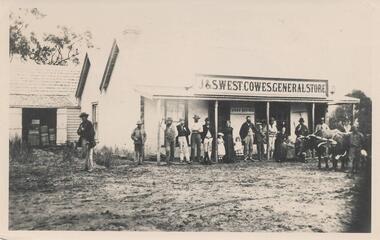
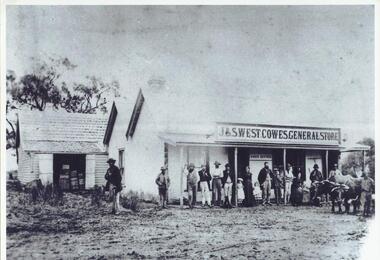
... Black & White photograph of J & S West Cowes General Store and Post Office. Men, women and children outside with bullock team on far right....One of 17 photographs donated by Olive Blamey j & s west general store cowes cowes phillip island Black & White photograph of J & S West Cowes General Store and Post Office. ...One of 17 photographs donated by Olive BlameyBlack & White photograph of J & S West Cowes General Store and Post Office. Men, women and children outside with bullock team on far right.j & s west general store cowes, cowes phillip island -
 Phillip Island and District Historical Society Inc.
Photograph, 1880's
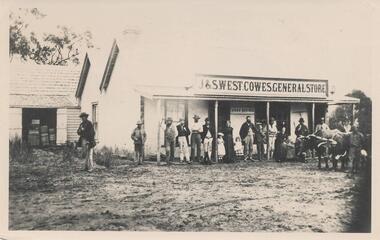
... Sepia photograph of J & S West Cowes General Store & sheds in Thompson Avenue. ...Sepia photograph of J & S West Cowes General Store & sheds in Thompson Avenue. ...Photograph from the Bryant West Collection. Copied by Jack Jenner 1968. West General Store was in Thompson Ave, on west side between Chapel Street and The Esplanade. Closer to The Esplanade. Sepia photograph of J & S West Cowes General Store & sheds in Thompson Avenue. Group of people in front and bullock dray. Possibly West family, employees and public. As above with the names.cowes general store phillip island, mary karney, bryant west collection -
 Phillip Island and District Historical Society Inc.
Photograph, c 1900
... Black & White enlargement of a photograph of the J & S West Cowes General Store in Thompson Avenue Cowes. ...Original photograph was copied and enlarged for museum display. j & s west general store cowes phillip island cowes general store phillip island Black & White enlargement of a photograph of the J & S West Cowes General Store in Thompson Avenue Cowes. ...Original photograph was copied and enlarged for museum display.Black & White enlargement of a photograph of the J & S West Cowes General Store in Thompson Avenue Cowes. People standing on verandah in front of the store. Bullock team right front of picture. The original photograph is catalogue/registration no. 154-10.j & s west general store cowes phillip island, cowes general store phillip island -
 Phillip Island and District Historical Society Inc.
Photographs, 1940's
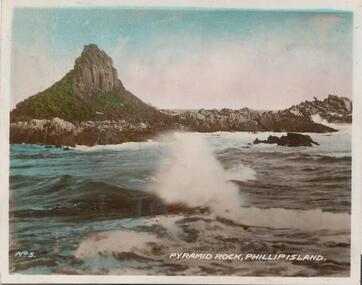
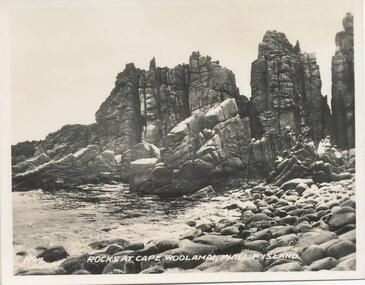
... (beachgoers on the Cowes west beach enjoying the sun - many sitting under beach umbrellas.) 344-06: The Nobbies showing Seal Rocks, Phillip Island. ...(beachgoers on the Cowes west beach enjoying the sun - many sitting under beach umbrellas.) 344-06: The Nobbies showing Seal Rocks, Phillip Island. ...A selection of photographs sold to tourists. A selection of hand coloured photographs of Phillip Island. Following description as on the photographs. 344-01: Pyramid Rock, Phillip Island. No. 5. 344-02: Penguin Beach, Summerlands, Phillip Island No. 3. 344-03: The 'Killara' at the pier, Cowes. No. 10 (shows Cowes Pier with shed and Killara Ferry.) 344-04: Boat arriving at Cowes. No. 9. (shows the Killara near the pier full of people.) 344-05: The beach, Cowes No. 8. (beachgoers on the Cowes west beach enjoying the sun - many sitting under beach umbrellas.) 344-06: The Nobbies showing Seal Rocks, Phillip Island. No. 4. (Coastal scene at The Nobbies with Seal Rocks in the distance.) 344-07: Penguins, Phillip Island No. 11. (Penguins arriving on the beach at dusk after a day out fishing.) 344-08: Rocks at Cape Woolamai, Phillip Island. No. 7. 344-09: The Pier, Cowes. No. 1. (Photo taken from the end of the Cowes Pier looking towards Cowes Township. Jetty shed and Isle of Wight Hotel in the background.) 344-10: The Pier & War Memorial, Cowes. No. 12. (Taken looking from The Esplanade to the War Memorial and Cowes Pier. People and boats at the Pier.) 344-11: Seals at Phillip Island. No. 6. (Seals are on Seal Rocks out from The Nobbies.)As above.pyramid rock, summerland beach, the killara ferry, cowes pier phillip island, cowes beach phillip island, the nobbies, penguins, wildlife - penguins, cape woolamai phillip island, cowes war memorial, seals on seal rocks phillip island, wildlife - seals, cheryl burton -
 Phillip Island and District Historical Society Inc.
Photographs, 1930's
... Seven small black & white photographs taken around Phillip Island. 357-01: Rocks at Cape Woolamai. 357-02: The Nobbies near the Blowhole. 357-03: Seals on Seal Rocks. 357-04: Main Cowes beach looking west towards Mussel Rocks. 357-05: Cowes Pier and the Killara Ferry. 357-06: Cowes Pier and the War Memorial taken from The Esplanade. 357-07: The Nobbies....Seven small black & white photographs taken around Phillip Island. 357-01: Rocks at Cape Woolamai. 357-02: The Nobbies near the Blowhole. 357-03: Seals on Seal Rocks. 357-04: Main Cowes beach looking west towards Mussel Rocks. 357-05: Cowes Pier and the Killara Ferry. 357-06: Cowes Pier and the War Memorial taken from The Esplanade. 357-07: The Nobbies. ...Seven of a collection of 12 photographs donated by Jill Palmer. Possibly part of series from local Photoshop.Seven small black & white photographs taken around Phillip Island. 357-01: Rocks at Cape Woolamai. 357-02: The Nobbies near the Blowhole. 357-03: Seals on Seal Rocks. 357-04: Main Cowes beach looking west towards Mussel Rocks. 357-05: Cowes Pier and the Killara Ferry. 357-06: Cowes Pier and the War Memorial taken from The Esplanade. 357-07: The Nobbies.357-01: Rocks at Cape Woolamai, Phillip Island. No. 7. 357-02: The Nobbies, Phillip Island. No. 4 357-03: Seals at Phillip island. No. 6. 357-04: The Beach, Cowes. No. 8. 357-05: The "Killara" at the Pier, Cowes. No. 10. 357-06: The Pier & War Memorial, Cowes. No. 12. 357-07: Cowes - Jan 1939.the nobbies phillip island, cowes beach phillip island, cape woolamai, seal rocks, wildlife - seals, war memorial cowes phillip island, cowes pier phillip island, the killara, jill palmer -
 Phillip Island and District Historical Society Inc.
Photograph Album, Kodak, Phillip Island Cemetery, c 1990
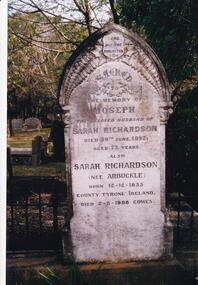
... The family moved to Phillip Island shortly afterwards, to a house they built on a hill west of Cowes. They called their home "Everton" after a Liverpool suburb. ...The family moved to Phillip Island shortly afterwards, to a house they built on a hill west of Cowes. They called their home "Everton" after a Liverpool suburb. ...The Album was compiled by Nancy McHaffie late 1990's, with the assistance of Edith Jeffery's, with her book "Garden of Memories" and extensive knowledge of Phillip Island. The Cemetery lies back from the road and is surrounded by Manna Gums, rare Peppermint Gums, Blackwoods and other native trees. In all 25 acres of land were set aside as Crown Land in the land settlement of 1868. There are 6.2 acres of wetlands near the cemetery entrance.466-23: Joseph Richardson came to Australia in 1837 from Liverpool, England. Sarah Arbuckle and her two sisters arrived in 1850. Sarah and Joseph were married when gold was discovered in Victoria. They went to the diggings and had some success. Joseph bought land on Phillip Island when it was open to freehold selection in 1868. The family moved to Phillip Island shortly afterwards, to a house they built on a hill west of Cowes. They called their home "Everton" after a Liverpool suburb. The house still stands in Church Street, known as "Tallawalla". 466-24: The McIlwraith family came from Melton, Victoria to Heath Hill, Rhyll in 1869. They played an important part in the early history of Phillip Island. James was a foundation member of the Trust, John and Alan played their part in the local scene. John was President and Alan Secretary of the Cemetery Trust for many years.phillip island cemetery, nancy mchaffie, edith jeffery -
 Flagstaff Hill Maritime Museum and Village
Functional object - Service Bell, 1855
... cow for fresh milk, pens for fowls and pigs, plus 90,000 gallons of water for washing and drinking. She also carried 17,000 letters and 31,800 newspapers. There were approximately 473 passengers and a crew of 105. It was hoped that Schomberg would make Melbourne in sixty days, setting a record for the voyage, but light winds at the equator dashed those expectations. The ship sighted Moonlight Head in south west...cow for fresh milk, pens for fowls and pigs, plus 90,000 gallons of water for washing and drinking. She also carried 17,000 letters and 31,800 newspapers. There were approximately 473 passengers and a crew of 105. It was hoped that Schomberg would make Melbourne in sixty days, setting a record for the voyage, but light winds at the equator dashed those expectations. The ship sighted Moonlight Head in south west ...This service bell was recovered from the wreck of the ship Schomberg. The Schomberg was a large three-masted full-ship rigged wooden ship built in 1855 by Alexander Hall and Co in Aberdeen, Scotland for James Baines' famous Black Ball Line at £43,103. The vessel was 288 feet (88 meters) in length, with a beam of 45 feet (14 meters), a depth of 29.5 feet (8.99 meters) of 2,284 tons. The mainmast was 210 feet (64 meters) high and she carried 3.3 acres of sail. The vessel was constructed with three skins. One planked fore and aft, and two diagonally planked, fastened together with screw-threaded trunnels (wooden rails). The Schomberg is one of only three clipper wrecks in Victorian waters that operated the England to Australia run. While the other two, Empress of the Sea and Lightning, were built by the famous American shipbuilder, Donald Mac Kay. Schomberg was an attempt to build a faster ship than Mac Kay and a vessel fast enough to break the sailing record to Australia. The Schomberg sailed on her maiden voyage from Liverpool on 6 October 1855, under the command of Captain James Forbes, on its maiden voyage to Australia with a general cargo, jewellery, spirits, machinery, and 2,000 tons of iron rails and equipment intended to build the Melbourne to Geelong Railway and a bridge over the Yarra from Melbourne to Hawthorn. She also carried a cow for fresh milk, pens for fowls and pigs, plus 90,000 gallons of water for washing and drinking. She also carried 17,000 letters and 31,800 newspapers. There were approximately 473 passengers and a crew of 105. It was hoped that Schomberg would make Melbourne in sixty days, setting a record for the voyage, but light winds at the equator dashed those expectations. The ship sighted Moonlight Head in south west Victoria on Christmas Day but through a deadly combination of wind, currents and unmarked sand spits, the vessel gently ran aground on 26 December 1855 on a spit that juts into Newfield Bay, just east of Curdies Inlet, and the present town of Peterborough. Fortunately, the SS Queen was nearby and managed to save all passengers and crew. The steamers Keera and Maitland were dispatched to salvage the passenger's baggage and the more valuable cargo. Other salvage attempts were made, but deteriorating weather made the work impossible, and within two weeks the Schomberg's hull was broken up and the vessel abandoned. The wrecking of the Schomberg caused quite the public stir particularly in light of the fact the vessel was supposed to be, the most perfect clipper ship ever built. Captain Forbes was charged in the Supreme Court under suspicion that he was playing cards with two female passengers below decks when his ship ran aground. Despite a protest meeting, two inquiries and the court proceedings, he was found not guilty and cleared of all charges. In 1975, divers from Flagstaff Hill, including Peter Ronald, found an ornate communion set at the wreck. The set comprised a jug, two chalices, a plate and a lid. The lid did not fit any of the other objects and in 1978 a piece of the lid broke off, revealing a glint of gold. As museum staff carefully examined the lid and removed marine growth, they found a diamond ring, which is currently on display in the Great Circle Gallery at the Flagstaff Hill Maritime museum that also displays ship fittings and equipment, personal effects. Most of the artefacts were salvaged from the wreck by Peter Ronald, former director of Flagstaff Hill.The Schomberg has historical significance as one of the first luxurious ships built to bring emigrants to Australia to cash in on the gold rush era. And is included on the Victorian Heritage Register (VHR S612). The collection of Schomberg artefacts held at Flagstaff Hill Museum is primarily significant because of the relationship between these recovered items having a high potential to interpret the story of the Schomberg and its foundering during a storm. The shipwreck is of additional historically significance for representing aspects of Victoria’s shipping history and for its association with the first passenger ship, which was designed not only to be the fastest and most luxurious of its day but foundered on its maiden voyage to Australia.Bell; small service bell, brass, with heavy encrustation. Bell has a square loop at the top. The bell was recovered from the wreck of the Schomberg.Nonewarrnambool, flagstaff-hill, flagstaff-hill-maritime-museum, shipwreck-coast, flagstaff-hill-maritime-village, schomberg, shipwrecked-artefact, clipper ship, black ball line, 1855 shipwreck, aberdeen clipper ship, captain forbes, peterborough shipwreck, ss queen, bell, service bell -
 Flagstaff Hill Maritime Museum and Village
Ceremonial object - Chalice, 1855 or earlier
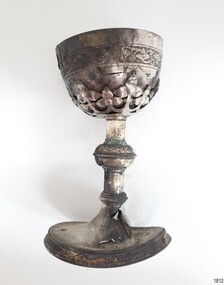
... cow for fresh milk, pens for fowls and pigs, plus 90,000 gallons of water for washing and drinking. She also carried 17,000 letters and 31,800 newspapers. There were approximately 473 passengers and a crew of 105. It was hoped that Schomberg would make Melbourne in sixty days, setting a record for the voyage, but light winds at the equator dashed those expectations. The ship sighted Moonlight Head in south west...cow for fresh milk, pens for fowls and pigs, plus 90,000 gallons of water for washing and drinking. She also carried 17,000 letters and 31,800 newspapers. There were approximately 473 passengers and a crew of 105. It was hoped that Schomberg would make Melbourne in sixty days, setting a record for the voyage, but light winds at the equator dashed those expectations. The ship sighted Moonlight Head in south west ...In 1975, divers from Flagstaff Hill, found an ornate communion set used to celebrate the Eucharist or holy communion by a number of different Christian faiths was recovered from the wreck of the Schomberg. The set comprised a jug, two chalices, a plate and a lid. The lid did not fit any of the other objects and in 1978 a piece of the lid broke off, revealing a glint of gold. As museum staff carefully examined the lid and removed marine growth, they found a diamond ring, which is currently on display in the Great Circle Gallery at Flagstaff Hill. The collection of artefacts from the Schomberg also contains ship fittings and equipment, personal effects, a lithograph, tickets and a photograph from the Schomberg. Most of the artefacts were salvaged from the wreck by Peter Ronald a former director of Flagstaff Hill maritime museum. The Schomberg was a large three-masted full-ship rigged wooden ship built in 1855 by Alexander Hall and Co in Aberdeen, Scotland for James Baines' famous Black Ball Line at £43,103. The vessel was 288 feet (88 meters) in length, with a beam of 45 feet (14 meters), a depth of 29.5 feet (8.99 meters) of 2,284 tons. The mainmast was 210 feet (64 meters) high and she carried 3.3 acres of sail. The vessel was constructed with three skins. One planked fore and aft, and two diagonally planked, fastened together with screw-threaded trunnels (wooden rails). The Schomberg is one of only three clipper wrecks in Victorian waters that operated the England to Australia run. While the other two, Empress of the Sea and Lightning, were built by the famous American shipbuilder, Donald Mac Kay. Schomberg was an attempt to build a faster ship than Mac Kay and a vessel fast enough to break the sailing record to Australia. The Schomberg sailed on her maiden voyage from Liverpool on 6 October 1855, under the command of Captain James Forbes, on its maiden voyage to Australia with a general cargo, jewellery, spirits, machinery, and 2,000 tons of iron rails and equipment intended to build the Melbourne to Geelong Railway and a bridge over the Yarra from Melbourne to Hawthorn. She also carried a cow for fresh milk, pens for fowls and pigs, plus 90,000 gallons of water for washing and drinking. She also carried 17,000 letters and 31,800 newspapers. There were approximately 473 passengers and a crew of 105. It was hoped that Schomberg would make Melbourne in sixty days, setting a record for the voyage, but light winds at the equator dashed those expectations. The ship sighted Moonlight Head in south west Victoria on Christmas Day but through a deadly combination of wind, currents and unmarked sand spits, the vessel gently ran aground on 26 December 1855 on a spit that juts into Newfield Bay, just east of Curdies Inlet, and the present town of Peterborough. Fortunately, the SS Queen was nearby and managed to save all passengers and crew. The steamers Keera and Maitland were dispatched to salvage the passenger's baggage and the more valuable cargo. Other salvage attempts were made, but deteriorating weather made the work impossible, and within two weeks the Schomberg's hull was broken up and the vessel abandoned. The wrecking of the Schomberg caused quite the public stir particularly in light of the fact the vessel was supposed to be, the most perfect clipper ship ever built. Captain Forbes was charged in the Supreme Court under suspicion that he was playing cards with two female passengers below decks when his ship ran aground. Despite a protest meeting, two inquiries and the court proceedings, he was found not guilty and cleared of all charges. In 1975, divers from Flagstaff Hill, including Peter Ronald, found an ornate communion set at the wreck. The set comprised a jug, two chalices, a plate and a lid. The lid did not fit any of the other objects and in 1978 a piece of the lid broke off, revealing a glint of gold. As museum staff carefully examined the lid and removed marine growth, they found a diamond ring, which is currently on display in the Great Circle Gallery at the Flagstaff Hill Maritime museum that also displays ship fittings and equipment, personal effects. Most of the artefacts were salvaged from the wreck by Peter Ronald, former director of Flagstaff Hill.This chalice is significant as an example of an item in common use in the mid-19th century that is still in use today. The Schomberg has historical significance as one of the first luxurious ships built to bring emigrants to Australia to cash in on the gold rush era. And is included on the Victorian Heritage Register (VHR S612). The collection of Schomberg artefacts held at Flagstaff Hill Museum is primarily significant because of the relationship between these recovered items having a high potential to interpret the story of the Schomberg and its foundering during a storm. The shipwreck is of additional historical significance for representing aspects of Victoria’s shipping history and for its association with the first passenger ship, which was designed not only to be the fastest and most luxurious of its day but foundered on its maiden voyage to Australia.Chalice; electroplated silver metal over metal, possibly nickle. The chalice has a wide bowl with an outer layer of intricately cut metal on the underside and a ribbon-like border of grapes and grapevine leaves is etched around it. It is supported by a tall stem with a circular knob partway down its length, and the stem is attached to a round base that is hollow underneath. The decorative pattern around the perimeter of the base is repeated on the knob on the stem. The base also has a pattern of lines around the vertical edge. There is a white sticker attached to the underside of the base. Its inscription is undecipherable. The chalice is part of a Communion set that was recovered from the wreck of the Schomberg. White sticker attached to the base of the chaliceflagstaff hill, flagstaff hill maritime museum and village, warrnambool, maritime museum, maritime village, great ocean road, shipwreck coast, schomberg, 1855, clipper ship, james baines & co, black ball line, luxury ship, emigrant ship, captain forbes, bully forbes, ss queen, peterborough shipwreck, communion set, religious service, communion service, ceremonial service, mass, chalice -
 Flagstaff Hill Maritime Museum and Village
Functional object - Bell, Schomberg 1855, Before 1855
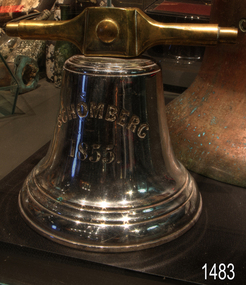
... cow for fresh milk, pens for fowls and pigs, and 90,000 gallons of water for drinking and washing. Additionally, it transported 17,000 letters and 31,800 newspapers. The ship and cargo were insured for $300,000, a considerable sum for the era. Poor winds while crossing the equator delayed Schomberg’s progress. Land was first sighted on Christmas Day at Cape Bridgewater near Portland. Captain Forbes followed the coastline towards Melbourne, but was reportedly playing cards when the third mate, Henry Keen, reported land only three miles away. The ship ran aground on a sand spit near Curdie’s Inlet (approximately 56 km west...cow for fresh milk, pens for fowls and pigs, and 90,000 gallons of water for drinking and washing. Additionally, it transported 17,000 letters and 31,800 newspapers. The ship and cargo were insured for $300,000, a considerable sum for the era. Poor winds while crossing the equator delayed Schomberg’s progress. Land was first sighted on Christmas Day at Cape Bridgewater near Portland. Captain Forbes followed the coastline towards Melbourne, but was reportedly playing cards when the third mate, Henry Keen, reported land only three miles away. The ship ran aground on a sand spit near Curdie’s Inlet (approximately 56 km west ...The Rescue and Journey of the Schomberg Bells: This bell was the smaller of two rescued by the crew of the Schomberg following the ship’s wreck in 1855. While the specific purpose of the smaller bell is unknown, it may have served to assemble the crew or signal mealtimes on board. After surviving the shipwreck, the crew carried both bells as they made their way along the coastline. Their journey eventually led them to the home of settler John Manning, located at Hopkins Point near Warrnambool. Manning took possession of the bells and subsequently presented them to two churches in Warrnambool. The smaller bell went to St Joseph’s Catholic Church, while the larger bell went to St John’s Presbyterian Church. After around a year, the small bell at St Joseph’s developed a crack and became unusable. Thomas Manifold imported a replacement bell for the church, and the damaged bell was stored at his farm. Years later, when the property was sold to John Logan, the discarded bell was donated to the old Warrnambool Museum upon its opening in 1886. The Curator, Joseph Archibald, placed the bell on display in the entry. In 1975, it was transferred from the Warrnambool Art Gallery to Flagstaff Hill. The ’Mystery’ of the small bell solved: Despite numerous attempts by the staff at Flagstaff Hill to restore the bell’s lustre, the bell remained dull and tarnished. In October 1986, Director Peter Ronald decided to send the bell for professional advice. The bell was entrusted to Briggs Marine Products, a renowned brass founder established in 1912. Upon examination, the specialists at Briggs discovered the reason behind the bell’s persistent lack of shine: it had originally been silver-plated, but most of the plating had worn away over time. The experts at Briggs then undertook the task of restoring the bell, successfully returning it to a gleaming silver surface. The Sailing Ship Schomberg: Launched in 1855, the Schomberg was regarded as the “Noblest” ship afloat at the time. Owned by the Black Ball Line, it was built for their passenger fleet by Alexander Hall of Aberdeen at a cost of £43,103. The construction featured three skins: one planked fore and aft and two diagonally planked, all fastened with screw-threaded trunnels (wooden rails). The ship’s First Class accommodation was luxurious, boasting velvet pile carpets, large mirrors, rosewood, birds-eye maple and mahogany timbers, satin damask soft furnishings, and an oak-lined library with a piano. Schomberg had a capacity for 1,000 passengers. The ship’s master, Captain James Nicol Forbes—also known as ‘Bully’ Forbes—was only 34 years old at the launch. He had a reputation for setting and breaking speed records on the Black Ball Line’s Marco Polo and Lightning. In 1852, Forbes completed the London to Melbourne journey on the Marco Polo in 68 days, a record at the time, though 53 passengers died during the voyage. In 1854, he sailed the Lightning to Melbourne in 76 days and returned in only 63 days—a record that stood among sailing ships. Forbes was known for driving his ship and crew to their limits, often prioritising speed over passenger comfort. Determined to set new records, he promised to reach Melbourne in sixty days, declaring he would do so “with or without the help of God.” The Maiden Voyage and the Wreck: Schomberg departed Liverpool on 6th October 1855, flying a banner that read “Sixty Days to Melbourne”. The vessel carried 430 passengers and 3,000 tons of cargo, including materials to build the Melbourne to Geelong Railway and a bridge over the Yarra River. Among the cargo were a cow for fresh milk, pens for fowls and pigs, and 90,000 gallons of water for drinking and washing. Additionally, it transported 17,000 letters and 31,800 newspapers. The ship and cargo were insured for $300,000, a considerable sum for the era. Poor winds while crossing the equator delayed Schomberg’s progress. Land was first sighted on Christmas Day at Cape Bridgewater near Portland. Captain Forbes followed the coastline towards Melbourne, but was reportedly playing cards when the third mate, Henry Keen, reported land only three miles away. The ship ran aground on a sand spit near Curdie’s Inlet (approximately 56 km west of Cape Otway) on 26th December 1855, after 78 days at sea. The sand spit and nearby currents were not marked on Forbes’s map. During the night, the crew launched a lifeboat to search for a safe landing spot for the passengers. The scouting party advised Forbes to wait until morning, as rough seas posed a danger to the lifeboats. At dawn, the ship’s Chief Officer spotted the SS Queen and signalled for help. The master of the Queen brought his vessel alongside, and all passengers and crew disembarked safely. The Black Ball Line’s Melbourne agent sent another steamer to collect the passengers’ baggage, and other steamers assisted with cargo salvage until worsening weather forced operations to cease. Notably, a plunderer later recovered a case of Wellington boots, but all were for the left foot. The wreck and its cargo were sold to local merchants Manifold & Bostock, who did not attempt further salvage. They later sold their interest to a Melbourne businessman and two seafarers. In 1864, after two men drowned in their attempt to reach the Schomberg, salvage efforts were abandoned. By 1870, parts of the ship had washed ashore on New Zealand’s South Island. Today, the wreck is about nine metres below the surface. Although most woodwork has disintegrated, the vessel’s shape remains discernible due to the railway irons, girders, and framework. Various goods and materials from the ship are scattered nearby. The bell is particularly significant in that along with other items from the wreck helped in part to having the legislation changed to protect shipwrecks, with far tighter controls being employed to oversee the salvaging of wreck sites. This bell forms part of the Schomberg collection at Flagstaff Hill maritime museum. The collection as a whole is of historical and archaeological significance at a State level. Flagstaff Hill’s collection of artefacts from the Schomberg is also significant for its association with the Victorian Heritage Registered Schomberg shipwreck (VHR S 612). The collection is of additional significance because of the relationship between the objects salvaged, as together they help us to interpret the story of the Schomberg. The collection as a whole is historically significant for representing aspects of Victoria's maritime history and its potential to interpret social and historical themes from society at the time of the wreck. A small ship’s bell. The silver-plated metal bell bears the ship’s name and year of construction on one side and the name and address of the ship’s builders on the other. These details are deeply engraved into the metal and formed in bold, upper-case lettering. The bell has two bell stands: the left and the right. Both stands have an Iron pipe bent into an inverted ‘Y’ shape, with a hole along its length and feet attached to a rectangular metal plate at the other two ends. Feet are bolted to a timber base that has a hole drilled through the centre for mounting. Bell's front; “SCHOMBERG” with “1855” below. Bell's back “HALL & SONS (crack splits letter “N”) / BUILDERS (in italics) / ABERDEEN” (crack splits letter “B”).flagstaff hill, flagstaff hill maritime museum and village, warrnambool, maritime museum, maritime village, great ocean road, shipwreck coast, schomberg, silver plated bell, mess bell, bell stands, captain ‘bully’ forbes, alexander hall and son, james baines and company, liverpool’s black ball line, bell, schomberg bell, ship's bell, small bell, st joseph's church, briggs marine, john manning, john logan, warrnambool museum, briggs foundry, silver bell -
 Orbost & District Historical Society
black and white photograph, late 19th century - early 20th century
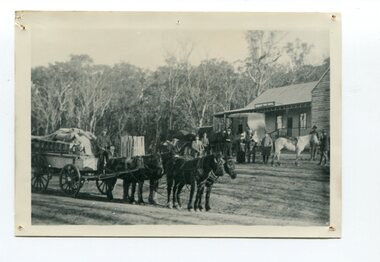
... west. Several families cleared the alluvial flats, growing maize, peas and beans and raising pigs, cattle and sheep. Later the farmers milked cows...west. Several families cleared the alluvial flats, growing maize, peas and beans and raising pigs, cattle and sheep. Later the farmers milked cows ...This is a photograph of Alice Swallow's hotel at Cabbage Tree. The settlement of Cabbage Tree Creek is located on the Princes Highway, 27 km east of Orbost in East Gippsland. The first white settler arrived in the valley in 1887 cutting a dray track from Marlo to the south-west. Several families cleared the alluvial flats, growing maize, peas and beans and raising pigs, cattle and sheep. Later the farmers milked cows, sending cream to Orbost. In the late 1890s, small quantities of alluvial gold were found in the creek. A school commenced classes in 1913, but enrolment was small and at times the school operated part time with several other small schools in the area. The school building served as a hall for the district. From the 1920s the Cabbage Tree Hotel catered to drivers on the improved Princes Highway. (info. from Victorian Places)This is a pictorial record of Cabbage Tree, East Gippsland in the late 20th century. It shows a building that no longer exists.A black / white photograph of a small, single - storey wooden building in a bush setting. There are people standing in front of the building with a horse and wagon nearby. In the foreground is a wagon with four horses hitched to it and the driver seated behind the horses. -
 Orbost & District Historical Society
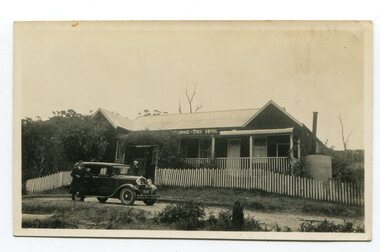
black and white photograph, 1920s -1930s
... west. Several families cleared the alluvial flats, growing maize, peas and beans and raising pigs, cattle and sheep. Later the farmers milked cows...west. Several families cleared the alluvial flats, growing maize, peas and beans and raising pigs, cattle and sheep. Later the farmers milked cows ...The Cabbage Tree Creek township was originally established to support the booming timber industry of the mid 20th century. Five timber mills worked full time supporting the families that were drawn to the area's wealth of natural resources. The settlement of Cabbage Tree Creek is located on the Princes Highway, 27 km east of Orbost in East Gippsland. The first white settler arrived in the valley in 1887 cutting a dray track from Marlo to the south-west. Several families cleared the alluvial flats, growing maize, peas and beans and raising pigs, cattle and sheep. Later the farmers milked cows, sending cream to Orbost. In the late 1890s, small quantities of alluvial gold were found in the creek. A school commenced classes in 1913, but enrolment was small and at times the school operated part time with several other small schools in the area. The school building served as a hall for the district. From the 1920s the Cabbage Tree Hotel catered to drivers on the improved Princes Highway. (info. from Victorian Places)This is a pictorial record of Cabbage Tree, East Gippsland in the late 20th century. It shows a building that no longer exists.A small black / white photograph of a single storey timber building. On a sign below the roof is "Cabbage Tree Hotel". The hotel is surrounded by a wooden picket fence. A man and woman are standing on either side of a motor car parked on the roadway in front of the building.on back - on label - Cabbage Tree Hotelcabbage-tree-hotel -
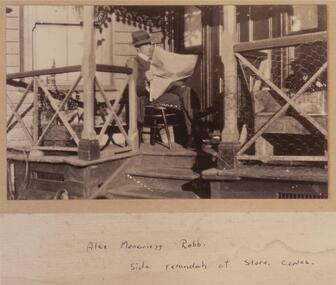 Phillip Island and District Historical Society Inc.
Photograph - Photographs, black + white, Robb Bros. General Store Cowes Phillip Island, c.1920
... They owned the store until 1924. robb bros general store cowes alex moncrieff robb cowes general store phillip island mary karney Jim Pearce Harmon West phil West Harry Walton David Henry Robb Alex Moncrieff Robb. ...Mr Robb purchased the General Store in about 1904. Photo in 1905. They owned the store until 1924. Two sepia photographs of Robb Bros Cowes General Store. Photograph 251-01 show Alex Moncrieff Robb sitting reading the newspaper on the side verandah of the General Store, Cowes. Photograph 251-02 shows people outside the front of the General Store., 1905. Horse and cart to the left of the photograph. Names of people written on back.Alex Moncrieff Robb. Side verandah at Store, Cowes.robb bros general store cowes, alex moncrieff robb, cowes general store phillip island, mary karney, jim pearce, harmon west, phil west, harry walton, david henry robb
