
Showing 220 items matching "cream containers"
-
 Whitehorse Historical Society Inc.
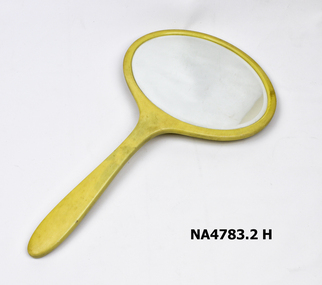
Domestic object - Dressing Table Set - Male, c1900
... A Man's dressing table set comprising - .1 rectangular cream coloured tray .2 oval shaped hand mirror with handle, coloured cream .3 narrow oblong cream coloured brush .4 oblong cream brush .5 rounded square cream powder container with raised bump on each side .6 lid for powder container with raised bumps on each side square shape . 8 round pink coloured powder puff, dark pink. .9 round pink coloured powder puff, light pink. .10 round circle of nylon mesh. ...on cream container 'made in England'...Ray was also a local builder personal effects-toilet requisites cosmetics on cream container 'made in England' A Man's dressing table set comprising - .1 rectangular cream coloured tray .2 oval shaped hand mirror with handle, coloured cream .3 narrow oblong cream coloured brush .4 oblong cream brush .5 rounded square cream powder container with raised bump on each side .6 lid for powder container with raised bumps on each side square shape . 8 round pink coloured powder puff, dark pink. .9 round pink coloured powder puff, light pink. .10 round circle of nylon mesh. ...belonged to Dorothy Meaghers' motherdonated by Ray Meagher who was a councillor 1972-1979. He was also chairman of works committee 1974-76, and Mayor of Nunawading 1976-77. Rays' wife Dorothy was on lake committee and supported the extension of the lake reserve. Ray was also a local builderA Man's dressing table set comprising - .1 rectangular cream coloured tray .2 oval shaped hand mirror with handle, coloured cream .3 narrow oblong cream coloured brush .4 oblong cream brush .5 rounded square cream powder container with raised bump on each side .6 lid for powder container with raised bumps on each side square shape . 8 round pink coloured powder puff, dark pink. .9 round pink coloured powder puff, light pink. .10 round circle of nylon mesh. on cream container 'made in England'personal effects-toilet requisites, cosmetics -
 Mont De Lancey
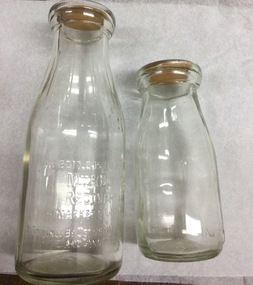
Glass bottle, Devonshire Dairy
... ...cream containers...bottles containers cream containers Devonshire Dairy. This bottle is the property of Milk Bottles Recovery Ltd. 18 Market Street, Melbourne. ...Two glass bottles. 1. Imperial Pint with name and address of Milk Recovery. 2. Imperial half pint. For cream. Both have cardboard lids. Devonshire Dairy. This bottle is the property of Milk Bottles Recovery Ltd. 18 Market Street, Melbourne. It can only be used by written permission and cannot be sold.bottles, containers, cream containers -
 Mont De Lancey
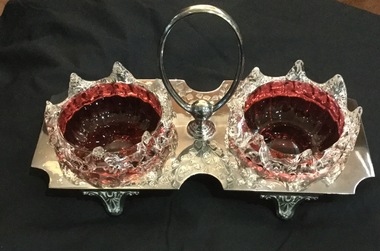
Jam and cream set, 1900's
... ...cream containers...jam containers jam cream containers cream Ruby glass jam and cream set, with two glass bowls with fluted edge in clear glass. ...Ruby glass jam and cream set, with two glass bowls with fluted edge in clear glass. On silver stand with embossed feet. Has large silver oval handle.jam containers, jam, cream containers, cream -
 City of Moorabbin Historical Society (Operating the Box Cottage Museum)
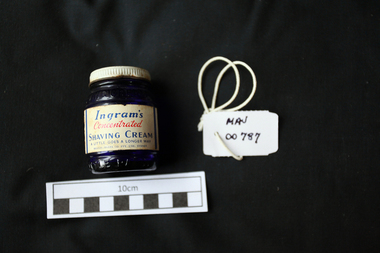
Containers, Shaving cream, blue glass jar, 20thC
... Containers, Shaving cream, blue glass jar...A blue glass jar with a screw top lid containing 'Ingrams' men’s shaving cream. Containers, Shaving cream, blue glass jar Bristol Meyers Co. ...Shaving cream is a cream applied to the face, or wherever else hair grows, to facilitate shaving. The use of cream achieves three effects: lubricates the cutting process; swells keratin; and de-sensitizes skin. Shaving creams commonly consist of an emulsion of oils, soaps or surfactants, and water. Until the early 20th century, bars or sticks of hard shaving soap were used. Later, tubes containing compounds of oils and soft soap were sold. Newer creams introduced in the 1940s neither produced lather nor required brushes, often referred to as brushless creams. Creams that are in tubes or tubs are commonly used with a shaving brush to produce a rich lather (most often used in wet shaving). Bristol-Myers Squibb Australia Pty Ltd is a foreign owned proprietary company that obtains its revenue through the importation and distribution of pharmaceutical products. Bristol-Myers Australia is now headquartered in Mulgrave, Victoria and with an Australian presence dating back more than 80 years, Bristol-Myers Squibb Australia is a long-standing contributor to Australia’s health and economy. A blue glass jar with a screw top lid containing 'Ingrams' men’s shaving cream. Lid : Ingrams / Shaving / Cream Bottle Label : Ingrams / Concentrated / SHAVING CREAM / A LITTLE GOES A LONGER WAY / BRISTOL MEYERS CO. PTY. LTD. SYDNEY.shaving equipment, soap, safety razor, straight razor, cutthroat razors, moorabbin, bentleigh, cheltenham, early settlers, ingram pty ltd, bristol-myer squibb australia pty ltd, shaving cream, -
 City of Moorabbin Historical Society (Operating the Box Cottage Museum)
Containers,Shaving cream, J.B.Williams Co, mid 20thC
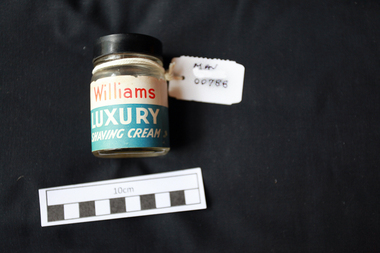
... Containers,Shaving cream, J.B.Williams Co..... / All States A clear glass jar with a screw lid containing 'Williams Shaving Cream' Containers,Shaving cream, J.B.Williams Co. ...Shaving cream is a cream applied to the face, or wherever else hair grows, to facilitate shaving. The use of cream achieves three effects: lubricates the cutting process; swells keratin; and de-sensitizes skin. Shaving creams commonly consist of an emulsion of oils, soaps or surfactants, and water. James Baker Williams was born in 1818 in Lebanon, Connecticut USA and, in 1834, began employment with F. and H.C. Woodbridge, a general store located in Manchester. Williams was offered half-interest in the store in 1838, after which its name was changed to Keeny and Williams. Two years later, Williams sold his interest in the store, but retained his share in the drug department. He began experimenting with various soaps to determine which were best for shaving, and eventually developed Williams' Genuine Yankee Soap, the first manufactured soap for use in shaving mugs. In 1847, Williams moved his enterprise to a rented gristmill on William Street in Glastonbury, Connecticut, and his brother, William S. Williams, joined the firm around 1848, when the firm's name was changed to the James B. Williams and Company. William's shaving soaps were sold throughout the United States and Canada and James Williams supervised many aspects of the company until shortly before his death in 1907 at the age of eighty-eight. The Williams family continued to manage the company until it was sold in 1957. By the early 1900s, the company was known throughout the world. In addition to its line of shaving creams, the firm produced talcum powder, toilet soaps, and other toilet preparations. The original 1847 factory is still standing in Glastonbury and, in 1979, was converted into a condominium complex. I In 1983 it was placed on the National Register of Historic Places. 1927 - 1990 Salmond and Spraggon (Australia) Limited , Sydney , New South Wales, was registered as a company on 10 June 1927 following the liquidation of Salmond and Spraggon (Australia) Limited known as the Old Company. The company distributed household cleaning and mineral, metal and chemical wholesaling, pharmaceutical wholesaling throughout Australia on behalf of manufacturers. In 1990 the company was taken over by Alberto Culver, a manufacturer of hair and skin products. A clear glass jar with a screw lid containing 'Williams Shaving Cream' Front Label : J.B WILLIAMS / LUXURY / SHAVING CREAM Back Label : The contents of this jar are guaranteed to be / The J.B.WILLIAMS Luxury Shaving Cream Jar has been changed to meet the Wartime conditions but / the cream is of the same high quality / made in Australia for / J.B. WILLIAMS COMPANY / Glastonbury, Conn. U.S.A. / Vendors / SALMOND & SPRAGGON (AUST.) PTY.LTD. / All Statesshaving equipment, razors, safety razors, cutthroat razors, soap, world war 11 1939-1945, moorabbin, bentleigh, cheltenham, early settlers, shaving cream, williams j.b. company ltd, connecticut usa, glastonbury connecticut usa, salmond & spraggon pty ltd, sydney, new south wales, toiletries, shaving soap, -
 Whitehorse Historical Society Inc.
Container, c.1960
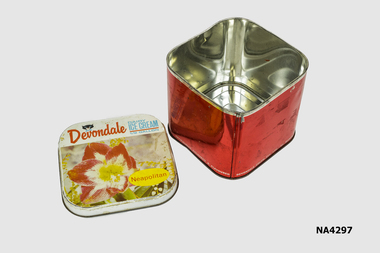
... 1960s Ice Cream container. Belonged to donor's mother...Square Tin Container for ice cream. Decorated lid, with flowers, also describing flavour of contents and weight. ...1960s Ice Cream container. Belonged to donor's mother DOMESTIC ITEMS Food Storage & Preservation Devondale Dairy Ice Cream 1/2 Gallon Square Tin Container for ice cream. ...1960s Ice Cream container. Belonged to donor's motherSquare Tin Container for ice cream. Decorated lid, with flowers, also describing flavour of contents and weight. Half gallon Devondale Ice Cream. Product of Australia, Reg No. 268. Half gallon Ice Cream, artificially coloured and flavoured.Devondale Dairy Ice Cream 1/2 Gallondomestic items, food storage & preservation -
 Greensborough Historical Society
Domestic object - Container, S & M Utility Plastics Container, 1950s
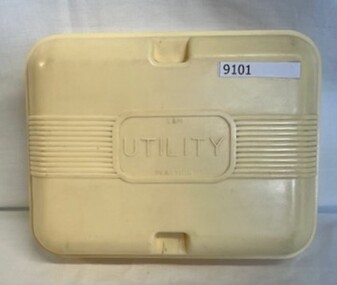
... Cream plastic container with lid....Item used for covering and storing food in the refrigerator. household implements container storage containers "S & M Utility Plastics" moulded into lid. Cream plastic container with lid. ...Item used for covering and storing food in the refrigerator. Cream plastic container with lid."S & M Utility Plastics" moulded into lid.household implements, container, storage containers -
 Greensborough Historical Society
Salt cellar, M&L Plastics, 1950c
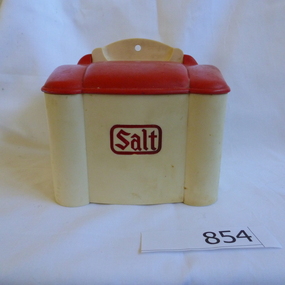
... Cream plastic container with red hinged lid....Most kitchens would have had one of these. saltcellars "Salt" impressed in red on front of container. Cream plastic container with red hinged lid. ...A mid 20th century salt cellar was used to store salt. This item is made of bakelite-style hard plastic. Most kitchens would have had one of these.Cream plastic container with red hinged lid."Salt" impressed in red on front of container.saltcellars -
 Bellarine Historical Society Museum
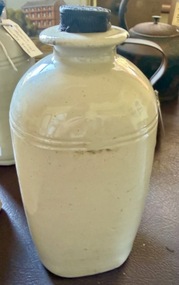
Domestic object - Bed Warmer with metal bung, Bendigo Potteris, Bed Warmer, early 20th century
... Cream stoneware container, circular with slightly flattened sides. ...Sharpe Brothers, Australia and New Zealand on top bung Cream stoneware container, circular with slightly flattened sides. ...Sharpe Brothers were founded in Dunedin, NZ in 1903 by John Sharpe. They manufactured non-alcoholic beverages transported in demijohn jars for home delivery. They established branches in Adelaide, Sydney and Melbourne and in most larger regional cities in NSW and Victoria. After his death in 1926, his sons carried on the business. It was sold to Tarax in 1962 which was taken over by Cadbury Schwepps Australia in 1972. However, the jar shape is more consistent with a flat bottomed foot warmer than a beverage demijohn. Either this is a rare example of that product being made by Sharpe Brothers or the bung has been later added, possibly as a replacement for a lost original stopper.Sharpe Brothers were a significant metropolitan and regional beverage manufacturer in the 20th century producing home delivered cordials, ginger beer and dandelion ale throughout southern Australia. The significance of their jar stopper being attached to a bed warmer needs investigation.Cream stoneware container, circular with slightly flattened sides. Flat bottomSharpe Brothers, Australia and New Zealand on top bung -
 Vision Australia
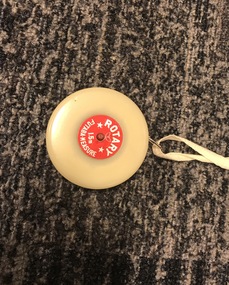
Functional object - Object, Rotary, Measuring tape
... 1 white measuring tape with red markings and numbers including tactile raised eyelets inside cream round container...Assistive devices Rotary Rotary 1.5 Futuba Measure 1 white measuring tape with red markings and numbers including tactile raised eyelets inside cream round container Measuring tape Functional object Object Rotary ...A retractable tape measure inside a cream disc. On the front of the tape measure is a round red sticker. In the middle of the sticker is a red button for retracting tape measure. Eyelets are placed at every number between 0 and 10, then at 10 centimeter intervals. 1 white measuring tape with red markings and numbers including tactile raised eyelets inside cream round containerRotary 1.5 Futuba Measureassistive devices, rotary -
 Flagstaff Hill Maritime Museum and Village
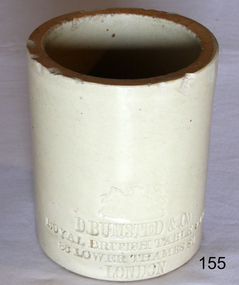
Container - Ceramic Salt Container, Doulton Lambeth, circa 1880
... Glazed Container; cream coloured ceramic salt jar, round shaped, ....\ ROYAL BRITISH TABLE SALT \ 86 LOWER THAMES ST \ LONDON" Glazed Container; cream coloured ceramic salt jar, round shaped, Container Ceramic Salt Container D. ...The 1846 London Directory lists David Bumsted & Co., trading at 86 Lower Thames Street, 35 Bridge Wharf, City Road Basin & 338 Wapping High Street Droitwich, as a salt merchant. The London Gazette had the following announcement dated 30th November 1887 advising his partnership with John Campbell Bumsted, carrying on business at 36, King William-street, in the city of London, as Salt Merchants, is dissolved as and from this date; and that the business will be continued to be carried on by the said John Campbell Bumsted alone.A rare item now sought after by collector of ceramics and significant as a collectors item from the late 19th century.Glazed Container; cream coloured ceramic salt jar, round shaped, Has lion and unicorn emblem and inscription impressed on outside. "D.BUMSTEAD & CO.\ ROYAL BRITISH TABLE SALT \ 86 LOWER THAMES ST \ LONDON"flagstaff hill, warrnambool, flagstaff hill maritime museum, shipwreck coast, flagstaff hill maritime village, great ocean road, ceramic container, salt jar, d. bumstead & co, london salt merchant, food and drink, doulton & co -
 Charlton Golden Grains Museum Inc
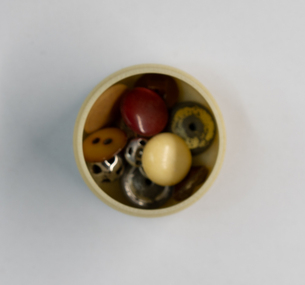
Domestic object - Cream coloured xylonite container with lid
... Cream coloured xylonite container with lid....Cream coloured small container with lid. Made from Xylonite. ...Personal Hygiene Cream coloured small container with lid. Made from Xylonite. ...Cream coloured small container with lid. Made from Xylonite. Part of a set.personal hygiene -
 Whitehorse Historical Society Inc.
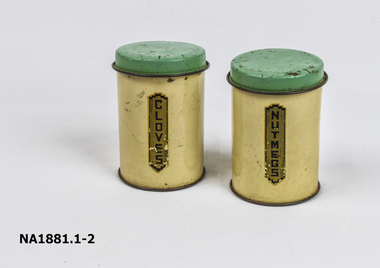
Container - Spice Tins
... Two spice containers painted cream with green lids....domestic items containers Nutmegs Cloves Two spice containers painted cream with green lids. Container Spice Tins ...Two spice containers painted cream with green lids.Nutmegs Clovesdomestic items, containers -
 Federation University Historical Collection
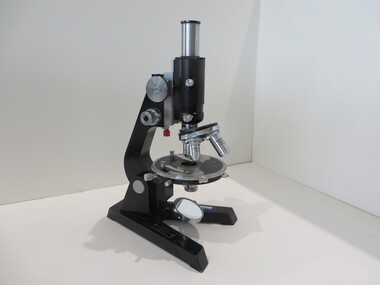
Instrument - Scientific Instrument, Petrographic Microscope
... Black enamel frame, chrome-plated accessories. Cream, plastic container with clear plastic speciman jars. ...Black enamel frame, chrome-plated accessories. Cream, plastic container with clear plastic speciman jars. ...This microscope used in SMB/BIAE/BCAE geology laboratoriesOptical Microscope, petrographic type, with 4-lens objective turret. Black enamel frame, chrome-plated accessories. Cream, plastic container with clear plastic speciman jars. Small, brown Reichert case containing objective and glass plate. Housed in a polished wood case. REICHERT, ser. No. 273065 Inside storage box "3" in red marker pen. On microscope frame a self-adhesive sticker "Ballarat CAE Geology". Also riveted to base frame a label "Supplied by H.B. Selby & Co Pty Ltd, Australia". Inside carry case door a card giving visual magnifications.microscope, reichert, selby, laboratory -
 Whitehorse Historical Society Inc.
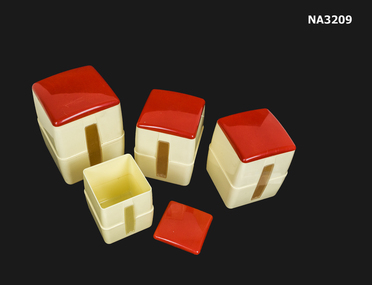
Container - Food Canisters
... Four square cream plastic food storage containers with red lids and a window down centre to show the contents....Used by donor in her home since 1950s domestic items food storage & preservation Four square cream plastic food storage containers with red lids and a window down centre to show the contents. ...Used by donor in her home since 1950sFour square cream plastic food storage containers with red lids and a window down centre to show the contents.domestic items, food storage & preservation -
 Coal Creek Community Park & Museum
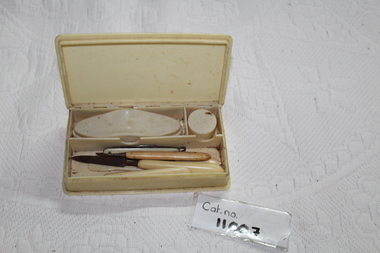
Nail Kit
... Cream colour case box. 11007.1 - cream box with 3 sections varying sizes. 11007.2 - nail buffer cream white with two bumps on top. 11007.3 - cream container - empty. 11007.4 - sharp object with carvings - cream colour. 11007.5 - cream stick with two flat sides, one carved, on pointy. 11007.6 - cream handle with hook - metal 11007.7 - nail file with cream/yellow handle - file is rusted with sharp point on top. 11007.8 - long handle cream with curved and flat/straight surface. 11007.9 - same as above, but handle is a darker cream. 11007.10 - pocket knife - two blades - cream - has loop on top - DOES NOT OPEN....11007.3 - says England on bottom Cream colour case box. 11007.1 - cream box with 3 sections varying sizes. 11007.2 - nail buffer cream white with two bumps on top. 11007.3 - cream container - empty. 11007.4 - sharp object with carvings - cream colour. 11007.5 - cream stick with two flat sides, one carved, on pointy. 11007.6 - cream handle with hook - metal 11007.7 - nail file with cream/yellow handle - file is rusted with sharp point on top. 11007.8 - long handle cream with curved and flat/straight surface. 11007.9 - same as above, but handle is a darker cream. 11007.10 - pocket knife - two blades - cream - has loop on top - DOES NOT OPEN. ...Cream colour case box. 11007.1 - cream box with 3 sections varying sizes. 11007.2 - nail buffer cream white with two bumps on top. 11007.3 - cream container - empty. 11007.4 - sharp object with carvings - cream colour. 11007.5 - cream stick with two flat sides, one carved, on pointy. 11007.6 - cream handle with hook - metal 11007.7 - nail file with cream/yellow handle - file is rusted with sharp point on top. 11007.8 - long handle cream with curved and flat/straight surface. 11007.9 - same as above, but handle is a darker cream. 11007.10 - pocket knife - two blades - cream - has loop on top - DOES NOT OPEN.11007.3 - says England on bottom -
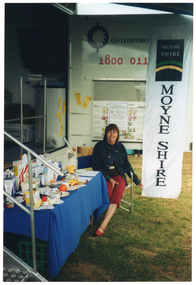 Musculoskeletal Health Australia (now held by the Glen Eira Historical Society)
Photograph - Solo photo
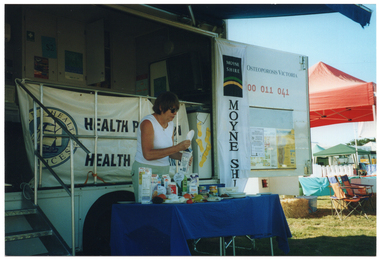
... On it, there is a range of healthy food items such as cereals, various types of milk, cheeses, yoghurt, a plastic ice cream container, some canned food, and some fresh fruit. ...On it, there is a range of healthy food items such as cereals, various types of milk, cheeses, yoghurt, a plastic ice cream container, some canned food, and some fresh fruit. ...ACME Field Days are an expo event where exhibitors, particularly from the agricultural sector, can display and promote their products. In the early 2000s, Arthritis Victoria (AV) brought its Healthy Bones Bus to some of these events in Timboon to spread the 'strong bones, healthy joints' message to south west Victoria. This initiative was made possible through a partnership with the Moyne Shire Council. This photo depicts an Arthritis Victoria representative staffing AV's Healthy Bones Bus information stall at an ACME Field Day at Timboon, in south west Victoria.COL photo of a woman sitting on a deck chair in front of a large van. The van has a large door open on the side, displaying the text, "Osteoporosis Victoria 1800 011 041" (partially obscured). Below the text, there is a display board with some posters on it. Hanging from the edge of the van door is a long vertical banner with the text and logo for the Moyne Shire. In front of the side of the van (beside the woman), there is a rectangular table covered with a blue tablecloth. On it, there is a range of healthy food items such as cereals, various types of milk, cheeses, yoghurt, a plastic ice cream container, some canned food, and some fresh fruit. In the foreground, to the left of the frame, there are some metal steps with a ballustrade.arthritis foundation of victoria, afv, osteoporosis victoria, ov, arthritis victoria, av, acme field day, healthy bones bus, outreach, education, information stall, healthy food, heathy diet, calcium, bone health, strong bones, timboon, moyne shire, sponsorship, partnership, c2000s -
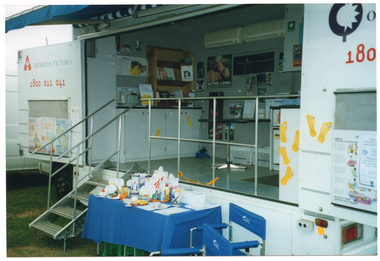 Musculoskeletal Health Australia (now held by the Glen Eira Historical Society)
Photograph - Objects
... On it, there is a range of healthy food items such as cereals, various types of milk, cheeses, a plastic ice cream container, some canned food, and some fresh fruit. ...On it, there is a range of healthy food items such as cereals, various types of milk, cheeses, a plastic ice cream container, some canned food, and some fresh fruit. ...ACME Field Day is an expo event where exhibitors, particularly from the agricultural sector, can display and promote their products. In the early 2000s, Arthritis Victoria brought its Healthy Bones Bus to an Acme Field Day event in Timboon to spread the 'strong bones, healthy joints' message to south west Victoria. This initiative was made possible through a partnership with the Moyne Shire Council. This photo depicts the Healthy Bones Bus set up at an ACME Field Day at Timboon.COL photo of a large van parked on the grass. Wide double doors on the side of the van are open, displaying the text "Arthritis Victoria 1800 011 041" on one door, and "Osteoporosis Victoria 1800 011 041" (partially obscured) on the other door. Inside the van, there are built-in cupboards, shelves displaying brochures and fact sheets, a small table, and two air conditioning units up high on one wall. In front of the van, next to the retractable metal steps, there is a small table covered with a bright blue tablecloth. On it, there is a range of healthy food items such as cereals, various types of milk, cheeses, a plastic ice cream container, some canned food, and some fresh fruit. Next to the table, there is a bright blue fabric deck chair.[On a yellow sticky note, handwritten in black ink] ACME Field Day - Timboonarthritis foundation of victoria, afv, osteoporosis victoria, ov, arthritis victoria, av, acme field day, healthy bones bus, outreach, education, information stall, healthy food, heathy diet, calcium, bone health, strong bones, timboon, moyne shire, sponsorship, partnership, c2000s -
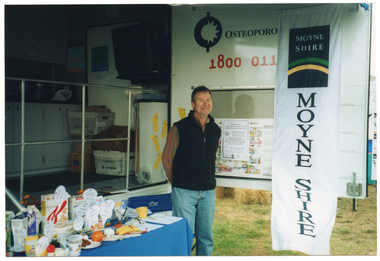 Musculoskeletal Health Australia (now held by the Glen Eira Historical Society)
Photograph - Solo photo
... On it, there is a range of healthy food items such as cereals, various types of milk, cheeses, yoghurt, a plastic ice cream container, some canned food, and some fresh fruit. ...On it, there is a range of healthy food items such as cereals, various types of milk, cheeses, yoghurt, a plastic ice cream container, some canned food, and some fresh fruit. ...ACME Field Days are an expo event where exhibitors, particularly from the agricultural sector, can display and promote their products. In the early 2000s, Arthritis Victoria (AV) brought its Healthy Bones Bus to some of these events in Timboon to spread the 'strong bones, healthy joints' message to south west Victoria. This initiative was made possible through a partnership with the Moyne Shire Council. This photo depicts an unidentified man staffing AV's Healthy Bones Bus information stall at an ACME Field Day at Timboon, in south west Victoria.COL photo of a man standing next to a rectangular table and a deck chair, which have been set up in front of a large van. The van has a large door open on the side, displaying the text, "Osteoporosis Victoria 1800 011 041" (partially obscured). Below the text, there is a display board with some posters on it. Hanging from the edge of the van door is a long vertical banner with the text and logo for the Moyne Shire. The table is covered with a blue tablecloth. On it, there is a range of healthy food items such as cereals, various types of milk, cheeses, yoghurt, a plastic ice cream container, some canned food, and some fresh fruit. In the background, built-in cupboards, boxes and crates, and a television set affixed to the wall are evident inside the van.arthritis foundation of victoria, afv, osteoporosis victoria, ov, arthritis victoria, av, acme field day, healthy bones bus, outreach, education, information stall, healthy food, heathy diet, calcium, bone health, strong bones, timboon, moyne shire, sponsorship, partnership, c2000s -
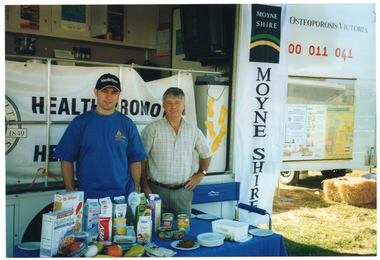 Musculoskeletal Health Australia (now held by the Glen Eira Historical Society)
Photograph - Group photo
... On it, there is a range of healthy food items such as cereals, various types of milk, cheeses, yoghurt, a plastic ice cream container, some canned food, and some fresh fruit. ...On it, there is a range of healthy food items such as cereals, various types of milk, cheeses, yoghurt, a plastic ice cream container, some canned food, and some fresh fruit. ...ACME Field Days are an expo event where exhibitors, particularly from the agricultural sector, can display and promote their products. In the early 2000s, Arthritis Victoria (AV) brought its Healthy Bones Bus to south west Victoria to spread the 'strong bones, healthy joints' message to regional areas. This initiative was made possible through a partnership with the Moyne Shire Council and Moyne Health Services. This photo depicts an Arthritis Victoria representative and an unidentified man staffing AV's Healthy Bones Bus information stall at an ACME Field Day.COL photo of two men standing behind a rectangular table in front of a large van. On it, there is a range of healthy food items such as cereals, various types of milk, cheeses, yoghurt, a plastic ice cream container, some canned food, and some fresh fruit. The van has a large door open on the side, displaying the text, "Osteoporosis Victoria 1800 011 041". Below the text, there is a display board with some posters on it. Hanging from the inside edge of the van door is a long vertical banner with the text and logo for the Moyne Shire. Behind the men, there is a large "Moyne Health Services" banner (partially obscured) attached to the ballustrade on the side of the van. In the background, there is a bale of hay on the grass, and two vehicle or trailer wheels are evident behind it.arthritis foundation of victoria, afv, osteoporosis victoria, ov, arthritis victoria, av, acme field day, healthy bones bus, outreach, education, information stall, healthy food, heathy diet, calcium, bone health, strong bones, south west victoria, moyne shire, moyne health services, sponsorship, partnership, c2000s -
 Musculoskeletal Health Australia (now held by the Glen Eira Historical Society)
Photograph - Solo photo
... On it, there is a range of healthy food items such as cereals, various types of milk, cheeses, yoghurt, a plastic ice cream container, some canned food, and some fresh fruit. ...On it, there is a range of healthy food items such as cereals, various types of milk, cheeses, yoghurt, a plastic ice cream container, some canned food, and some fresh fruit. ...ACME Field Days are an expo event where exhibitors, particularly from the agricultural sector, can display and promote their products. In the early 2000s, Arthritis Victoria (AV) brought its Healthy Bones Bus to south west Victoria to spread the 'strong bones, healthy joints' message to regional areas. This initiative was made possible through a partnership with the Moyne Shire Council and Moyne Health Services. This photo depicts an unidentified woman staffing AV's Healthy Bones Bus information stall at an ACME Field Day.COL photo of a woman standing behind a rectangular table in front of a large van. On it, there is a range of healthy food items such as cereals, various types of milk, cheeses, yoghurt, a plastic ice cream container, some canned food, and some fresh fruit. The woman is affixing a display label to the top of a milk carton. The van has a large door open on the side, displaying the text, "Osteoporosis Victoria 1800 011 041" (partially obscured). Below the text, there is a display board with some posters on it. Hanging from the inside edge of the van door is a long vertical banner with the text and logo for the Moyne Shire. Behind the woman, there is a large "Moyne Health Services" banner attached to the ballustrade on the side of the van. In the foreground, to the left of the frame, there are some metal steps with a ballustrade. In the background, some market stall tents and marquees are evident, with tables and deck chairs underneath them.arthritis foundation of victoria, afv, osteoporosis victoria, ov, arthritis victoria, av, acme field day, healthy bones bus, outreach, education, information stall, healthy food, heathy diet, calcium, bone health, strong bones, south west victoria, moyne shire, moyne health services, sponsorship, partnership, c2000s -
 Bendigo Military Museum
Equipment - REPELLENT HOLDER, C Ltd, 1964
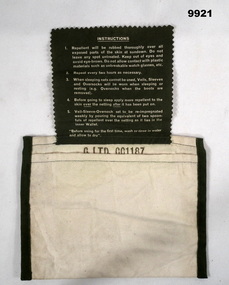
... Cloth, cream coloured envelope shaped container, open at the top and stitched black reinforcement material on both sides. ...Cloth, cream coloured envelope shaped container, open at the top and stitched black reinforcement material on both sides. ...Part of the collection of John Young. Refer Cat No. 1181.3 for service details. Used to contain insect repellent for tropical regions.Cloth, cream coloured envelope shaped container, open at the top and stitched black reinforcement material on both sides. Complete instructions on black material and white writing of instructions for use.Stamped "C LTD CC1187 1964".equipment, holder for insect repellent -
 Bendigo Military Museum
Equipment - MEDICAL ITEMS, c1939-1945
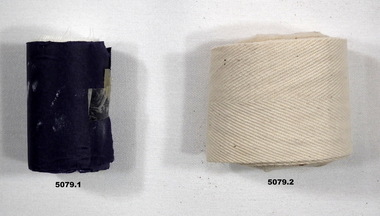
... Pressure bandage - cotton twill - cream. 3. Container for Iodine - black plastic, brown screw top glass tube - attached to brown screw top. 4. ...Pressure bandage - cotton twill - cream. 3. Container for Iodine - black plastic, brown screw top glass tube - attached to brown screw top. 4. ...Francis Metternick - served in Merchant Navy WW2 - British or Australian ??1. Gauze bandage - white cotton, Dark Blue Paper wrap. 2. Pressure bandage - cotton twill - cream. 3. Container for Iodine - black plastic, brown screw top glass tube - attached to brown screw top. 4. Glass bottle with brown stopper containing liquid. 5. Glass syringes and i measurement pipette & 4 solid tapered glass tubes. 6. Dressings - 2 cotton, pink in blue labelled paper wrap,3.B Hax Iodine, Tincture British Pharmacopoeia Hack, 72 Red Lion Street, London, WC1. 4. Ammoniated Tincture/Quinine. Prepared in Accordance with the British Pharmacopoeia. Dose from half to one teaspoonful in a wine glass & water, Boots, Nottingham. 6. Boric Lint, Antiseptic dressing for surgical purposes. Australian Herbal stores, 10 Bath Street, Jersey C1. medical equipment, bandages, syringes -
 Flagstaff Hill Maritime Museum and Village
Domestic object - Cream Can, Malleys Ltd, 1920-1950
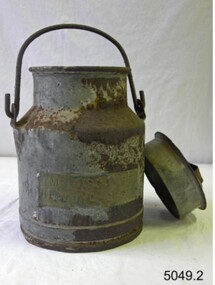
... Cream Can...Dairy Container...Cream can, round metal container with fitted lid and carrying handle. ...Text on nameplate ""M LUSCOMBE / DIAMOND CREEK " Cream can, round metal container with fitted lid and carrying handle. ...This small cream can was made by the Sydney firm of Malleys Ltd from the 1930s until the 1950s and came in various sizes. Malleys Ltd was established in about 1890 by Francis Malley (1863-1932). This firm was located in the Sydney suburb of Alexandria, in McEvoy Street. They manufactured items for use in the dairy industry, as well as for hardware related to building and plumbing. Many of the Malley dairy products were sold under the "Sunrise" name. Malley retired in 1912. In 1931 there were branches at Parramatta, Hurstville & North Sydney. This cream can was designed for domestic home use and was used to fetch cream from a dairy or retailer of dairy products between 1920 to 1950s. M Luscombe Diamond Creek on the nameplate suggests this is the farm dairy that supplied the cream the can would hold and that they were the owners of the can. This dairy no longer exists as the area is now a housing estate.Cream can, round metal container with fitted lid and carrying handle. Can has a short wide neck. Body has embossed letters and an attached metal nameplate that has been soldered. Made by Malleys. Embossed raised letters "MALLEYS". Text on nameplate ""M LUSCOMBE / DIAMOND CREEK " warrnambool, flagstaff-hill, flagstaff-hill-maritime-museum, shipwreck-coast, flagstaff-hill-maritime-village, malleys, domestic object, cream can, dairy container, diamond creek, m luscombe -
 Emerald Museum & Nobelius Heritage Park
Functional object - Butter(?) Churn, c. Late 19th-Early 20th Century
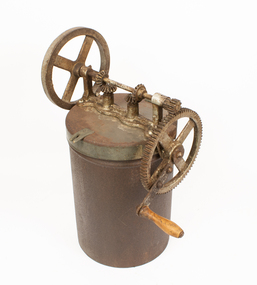
... The smaller section is both the lid to the container and a whisk for the butter churn; it has a whisk section which protrudes into the cream in the container, which is turned by the hand-crank and gears....The smaller section is both the lid to the container and a whisk for the butter churn; it has a whisk section which protrudes into the cream in the container, which is turned by the hand-crank and gears. ...This item was brought to Australia by an Italian family in the 1920s who settled in Avonsleigh. It resembles historical hand-crank butter churns; however, it does have the notable difference of using a whisk-like structure rather than a paddle-based churn. (The whisks may have been a modification of the original machine.) It is possible it was used for another similar application requiring faster spinning, such as whipping cream, and it has been suggested it could be an ice-cream maker (though ice-cream makers also tend to use paddles). Another suggestion has been a cheese maker. There are no visible corporate logos or manufacturer's marks, limiting our ability to determine its true origins.This is a unique example of food production tools in the late 19th and early 20th centuries.This item is in two parts, both made with metal heavily rusted on the outside and mostly clean on the inside. The larger section is the empty cylindrical container. The smaller section is both the lid to the container and a whisk for the butter churn; it has a whisk section which protrudes into the cream in the container, which is turned by the hand-crank and gears.N/Atools, agriculture, domestic life -
 Orbost & District Historical Society
cuticle cream, mid 20th century
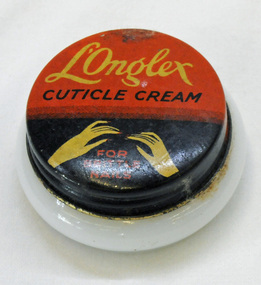
... A round, white ceramic glass container containing cream. It has a tin screw top lid which is red and black with cream, and black print. ...Burton-Marjorie cuticle-cream handcare manicure Longlex Cuticle Cream for brittle nails A round, white ceramic glass container containing cream. ...This item belonged to Marjorie Burton. Marjorie Burton ( nee Whiteman), born 12 June, in Birmingham, England came to Orbost in 1995. In England she did office work – typing, shorthand and secretarial work - in accountants’ offices and also trained as a comptometrist with Burroughs in London. She came from a middle-class, working, church-going family. Her mother was a milliner who made many of Marjorie’s clothes, hats and outfits. Marjorie was married in 1938 to a salesman who later became a mechanic in the R.A.F This item is an example of a nail care product commonly used by women in the mid 20th century.A round, white ceramic glass container containing cream. It has a tin screw top lid which is red and black with cream, and black print. Underneath the brand name is a a picture of two hands with long fingers. the base is recessed with instructions and details on a paper label.Longlex Cuticle Cream for brittle nailsburton-marjorie cuticle-cream handcare manicure -
 Flagstaff Hill Maritime Museum and Village
Ceramic - Lid, circa 1878
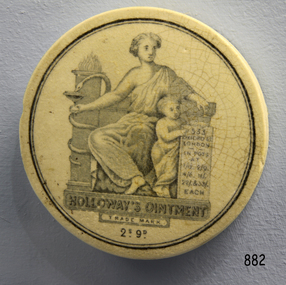
... containers. Holloway’s claims for his “great remedy” included the cure of sores, wounds, ulcers and boils, gout, rheumatism, diphtheria, bronchitis, influenza, sore throats, coughs and colds, “all varieties of skin diseases”, scrofula, ringworm, scurvy, “dropsical swellings” and liver disease, piles, fistulas, and internal inflammation. The salve cream...containers. Holloway’s claims for his “great remedy” included the cure of sores, wounds, ulcers and boils, gout, rheumatism, diphtheria, bronchitis, influenza, sore throats, coughs and colds, “all varieties of skin diseases”, scrofula, ringworm, scurvy, “dropsical swellings” and liver disease, piles, fistulas, and internal inflammation. The salve cream ...This ceramic lid is from a Holloway’s Ointment pot. It was retrieved from the wreckage of the LOCH ARD. The vessel was laden with an up-to-date, high-value cargo, including luxury items intended for the Melbourne International Exhibition in 1880. Britain exported her manufactures to the Australasian colonies and the Americas. Holloway’s Ointment was one nineteenth-century pharmaceutical product that was advertised in both these markets. The price of this particular jar and its contents was printed on the label as “2S 9D” (2 shillings and nine pence). This value calculated to the approximate price in 2014, would be £51.31 (UK pounds and decimal pence) or $85 AU ― quite an expensive ointment. The label also shows a picture of a stone tablet with the inscription "IN POTS AT 1/½, 2/9, 4/6,11/-, 22/- & 33/- EACH”, which is most likely the alternative prices that the ointment was available for in differently sized containers. Holloway’s claims for his “great remedy” included the cure of sores, wounds, ulcers and boils, gout, rheumatism, diphtheria, bronchitis, influenza, sore throats, coughs and colds, “all varieties of skin diseases”, scrofula, ringworm, scurvy, “dropsical swellings” and liver disease, piles, fistulas, and internal inflammation. The salve cream was said to penetrate the skin when rubbed on; purifying internal tissues and organs, cleansing all bodily fluids particularly the blood, and eradicating all disease from the body. Purchasers were assured that if Holloway’s Ointment alone did not affect immediate cure, then the combination of it and Holloway’s Pills (sold separately) most certainly would. Thomas Holloway began manufacturing and marketing his miraculous ointment from premises at 244 Strand in the 1840s, moving to the more prestigious address of 533 Oxford in the late 1860s. The London address was an important part of his promotional appeal and was displayed prominently on the packaging of his products. Holloway’s attention to marketing is also observed in the pseudo-Classical emblems that decorated his containers. The sign of a snake curled around a staff is a longstanding and commonly recognised symbol of the physician’s power to heal. Similar reference on this lid is also being made to an ancient goddess of healing and her healthy young offspring. History of the Loch Ard: The Loch Ard got its name from ”Loch Ard” a loch which lies to the west of Aberfoyle, and the east of Loch Lomond. It means "high lake" in Scottish Gaelic. The vessel belonged to the famous Loch Line which sailed many vessels from England to Australia. The Loch Ard was built in Glasgow by Barclay, Curdle and Co. in 1873, the vessel was a three-masted square-rigged iron sailing ship that measured 79.87 meters in length, 11.58 m in width, and 7 m in depth with a gross tonnage of 1693 tons with a mainmast that measured a massive 45.7 m in height. Loch Ard made three trips to Australia and one trip to Calcutta before its fateful voyage. Loch Ard left England on March 2, 1878, under the command of 29-year-old Captain Gibbs, who was newly married. The ship was bound for Melbourne with a crew of 37, plus 17 passengers. The general cargo reflected the affluence of Melbourne at the time. Onboard were straw hats, umbrella, perfumes, clay pipes, pianos, clocks, confectionery, linen and candles, as well as a heavier load of railway irons, cement, lead and copper. There were other items included that were intended for display in the Melbourne International Exhibition of 1880. The voyage to Port Phillip was long but uneventful. Then at 3 am on June 1, 1878, Captain Gibbs was expecting to see land. But the Loch Ard was running into a fog which greatly reduced visibility. Captain Gibbs was becoming anxious as there was no sign of land or the Cape Otway lighthouse. At 4 am the fog lifted and a lookout aloft announced that he could see breakers. The sheer cliffs of Victoria's west coast came into view, and Captain Gibbs realised that the ship was much closer to them than expected. He ordered as much sail to be set as time would permit and then attempted to steer the vessel out to sea. On coming head-on into the wind, the ship lost momentum, the sails fell limp and Loch Ard's bow swung back towards land. Gibbs then ordered the anchors to be released in an attempt to hold its position. The anchors sank some 50 fathoms - but did not hold. By this time the ship was among the breakers and the tall cliffs of Mutton Bird Island rose behind. Just half a mile from the coast, the ship's bow was suddenly pulled around by the anchor. The captain tried to tack out to sea, but the ship struck a reef at the base of Mutton Bird Island, near Port Campbell. Waves subsequently broke over the ship and the top deck became loosened from the hull. The masts and rigging came crashing down knocking passengers and crew overboard. When a lifeboat was finally launched, it crashed into the side of Loch Ard and capsized. Tom Pearce, who had launched the boat, managed to cling to its overturned hull and shelter beneath it. He drifted out to sea and then on the flood tide came into what is now known as Lochard Gorge. He swam to shore, bruised and dazed, and found a cave in which to shelter. Some of the crew stayed below deck to shelter from the falling rigging but drowned when the ship slipped off the reef into deeper water. Eva Carmichael a passenger had raced onto the deck to find out what was happening only to be confronted by towering cliffs looming above the stricken ship. In all the chaos, Captain Gibbs grabbed Eva and said, "If you are saved Eva, let my dear wife know that I died like a sailor". That was the last Eva Carmichael saw of the captain. She was swept off the ship by a huge wave. Eva saw Tom Pearce on a small rocky beach and yelled to attract his attention. He dived in and swam to the exhausted woman and dragged her to shore. He took her to the cave and broke the open case of brandy which had washed up on the beach. He opened a bottle to revive the unconscious woman. A few hours later Tom scaled a cliff in search of help. He followed hoof prints and came by chance upon two men from nearby Glenample Station three and a half miles away. In a complete state of exhaustion, he told the men of the tragedy. Tom then returned to the gorge while the two men rode back to the station to get help. By the time they reached Loch Ard Gorge, it was cold and dark. The two shipwreck survivors were taken to Glenample Station to recover. Eva stayed at the station for six weeks before returning to Ireland by steamship. In Melbourne, Tom Pearce received a hero's welcome. He was presented with the first gold medal of the Royal Humane Society of Victoria and a £1000 cheque from the Victorian Government. Concerts were performed to honour the young man's bravery and to raise money for those who lost family in the disaster. Of the 54 crew members and passengers on board, only two survived: the apprentice, Tom Pearce and the young woman passenger, Eva Carmichael, who lost her family in the tragedy. Ten days after the Lochard tragedy, salvage rights to the wreck were sold at auction for £2,120. Cargo valued at £3,000 was salvaged and placed on the beach, but most washed back into the sea when another storm developed. The wreck of Lochard still lies at the base of Mutton Bird Island. Much of the cargo has now been salvaged and some items were washed up into Lochard Gorge. Cargo and artefacts have also been illegally salvaged over many years before protective legislation was introduced in March 1982. One of the most unlikely pieces of cargo to have survived the shipwreck was a Minton majolica peacock- one of only nine in the world. The peacock was destined for the Melbourne 1880 International Exhibition in. It had been well packed, which gave it adequate protection during the violent storm. Today the Minton peacock can be seen at the Flagstaff Hill Maritime Museum in Warrnambool. From Australia's most dramatic shipwreck it has now become Australia's most valuable shipwreck artifact and is one of very few 'objects' on the Victorian State Heritage Register.The shipwreck of the Loch Ard is of significance for Victoria and is registered on the Victorian Heritage Register ( S 417). Flagstaff Hill has a varied collection of artefacts from Loch Ard and its collection is significant for being one of the largest accumulation of artefacts from this notable Victorian shipwreck of which the subject items are a small part. The collections objects give us a snapshot of how we can interpret the story of this tragic event. The collection is also archaeologically significant as it represents aspects of Victoria's shipping history that allows us to interpret Victoria's social and historical themes of the time. Through is associated with the worst and best-known shipwreck in Victoria's history. The ceramic lid off a Holloway’s Ointment container, retrieved from the wreckage of the LOCH ARD. The artefact is white with the pale blue image of a woman (seated) and a child (standing). The woman is draped in a soft white robe and her throne is beside a pillar that is entwined by a serpent. The child points to an inscribed stone tablet he is holding on the other side of seated woman. The front face of the lid, at the base of the woman on the throne, bears the label “HOLLOWAY’S OINTMENT”. Below this, in smaller letters, is written “TRADE MARK” and “2S.9D.” On the stone tablet pointed to by the child is inscribed “533 OXFORD ST. LONDON”, and beneath this, “IN POTS AT 1/½, 2/9, 4/6,11/-, 22/- & 33/- EACH”.flagstaff hill, warrnambool, flagstaff hill maritime museum, shipwreck coast, flagstaff hill maritime village, great ocean road, loch line, loch ard, captain gibbs, eva carmichael, tom pearce, glenample station, mutton bird island, loch ard gorge, holloway’s ointment, ceramic lid, pot lid, nineteenth-century medicines, pharmaceutical marketing -
 Flagstaff Hill Maritime Museum and Village
Decorative object - Container, 1910 to 1945
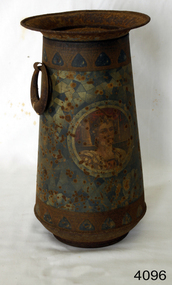
... The container has a broad, thin lip, and its round body flares outwards towards base, then tapers inwards to a short heel. A loop holding a metal ring is attached to the side, near the top. A decorative geometrical transfer pattern in blue and cream...The container has a broad, thin lip, and its round body flares outwards towards base, then tapers inwards to a short heel. A loop holding a metal ring is attached to the side, near the top. A decorative geometrical transfer pattern in blue and cream ...A mass produced utilitarian item made for domestic decorative use. No history or manufacturing provenance currently available.The subject item at this time cannot be associated with an historical event, person or place, provenance is unknown. The item is assessed as a collection asset as it is believed to have been produced after 1910 and before 1950.Container of pressed metal. The container has a broad, thin lip, and its round body flares outwards towards base, then tapers inwards to a short heel. A loop holding a metal ring is attached to the side, near the top. A decorative geometrical transfer pattern in blue and cream covers the body and inside of the lip. In the centre of one side is a round frame with the portrait of an Egyptian woman within.warrnambool, flagstaff-hill, flagstaff-hill-maritime-museum, maritime-museum, shipwreck-coast, flagstaff-hill-maritime-village, flower vase, decorative object, tin vase -
 Flagstaff Hill Maritime Museum and Village
Container
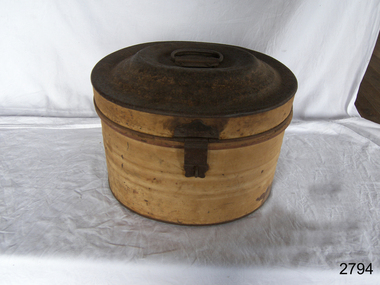
... Container metal round with hinged lid, handle at top & lock at front painted cream....flagstaff hill warrnambool shipwrecked-coast flagstaff-hill flagstaff-hill-maritime-museum maritime-museum shipwreck-coast flagstaff-hill-maritime-village Container metal round with hinged lid, handle at top & lock at front painted cream. Container ...Container metal round with hinged lid, handle at top & lock at front painted cream.flagstaff hill, warrnambool, shipwrecked-coast, flagstaff-hill, flagstaff-hill-maritime-museum, maritime-museum, shipwreck-coast, flagstaff-hill-maritime-village -
 Federation University Historical Collection
Object - Candle Remnant, Candle remnant from early Two Ballarat mines, c1860 ?
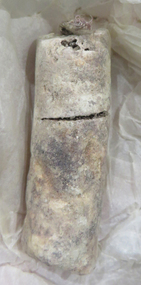
... cream candle remnant. Candle mold seams are evident. Stored in green pharmaceutical tin with screw lid. (?) Found when removing for filling motor spaces Camp Street. .2) white candle remnant from the Britannia Mine at Cambrian Hill held in a 'Barker Cake Container; tin. ...cream candle remnant. Candle mold seams are evident. Stored in green pharmaceutical tin with screw lid. (?) Found when removing for filling motor spaces Camp Street. .2) white candle remnant from the Britannia Mine at Cambrian Hill held in a 'Barker Cake Container; tin. ...From the Britannia Mine (Ballarat) Candle remnants from early Ballarat mines are quite rare..1) White/cream candle remnant. Candle mold seams are evident. Stored in green pharmaceutical tin with screw lid. (?) Found when removing for filling motor spaces Camp Street. .2) white candle remnant from the Britannia Mine at Cambrian Hill held in a 'Barker Cake Container; tin. A handwritten note inside the tin indicates 'Piece of Candle from Mullock's Britannia Mine. Ballarat. .2) Piece of Candle The Great Leviathan Quartz Mining CosMine at Cambrian Hill near Ballarat. Picked up by Donald Doyles Mather whilst cleaning out Ballarat South Goldfield Co's Leviathan Shaft when reopening "Great Leviathan in in the year 1948. The candle was last used by miners in the Great Leviathan in the drive where found Year G. Leviathan Closed down "______" mining, candle, lard, great leviathan, donald mather, cambrian hill, great leviathan quartz mining company
