
Showing 33 items matching "currency conversion"
-
 Melbourne Tram Museum
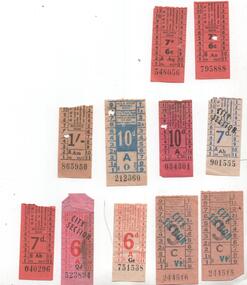
Ephemera - Ticket/s, Melbourne & Metropolitan Tramways Board (MMTB), Set of 9 MMTB imperial currency tickets and two decimal currency conversion tickets, 1960's
... Set of 9 MMTB imperial currency tickets and two decimal currency conversion tickets...Currency... Decimal Conversion...Set of 9 MMTB imperial currency tickets and two decimal currency conversion tickets. Some tickets have notes or advertisements on the rear as noted. ...Trams tramways MMTB Tickets Decimal Currency Decimal Conversion advertisements City section Set of 9 MMTB imperial currency tickets and two decimal currency conversion tickets. ...Set of 9 MMTB imperial currency tickets and two decimal currency conversion tickets. Some tickets have notes or advertisements on the rear as noted. If not noted, all printed with black ink on coloured paper with black numbers. 1 - 3d - on a light cream paper, overprinted "City Section" and letter Vt in Blue, numbers 244515 and 244516, both with Stamina trousers adverts on rear. 2 - 6d - red ink on off white paper - GE 751538 (has been creased badly) 3 - 6d - red ink on pink paper - overprinted "City Section" Qd 523894 - has dirt marks at top and stains on right hand side 4 - 7d - blue ink on off white paper, overprinted "City Section" in black ink, Ab901555 - with pencil note "Wed 23 Dec 1964 ? Collins St Sp St to Swanston St." 5 - 7d - on orange paper Ah 040296 - with an advert for "Blind babies" help on rear. 6 - 10d - on pink paper Ch 034301 - with a "Hicks advert on rear - 385 Bourke St for a trade in on a new Kelvinator Refrigerator" 7 - 10d - on off white paper, printed in blue ink, O 212360, with Stamina trousers adverts on rear 8 - 1/- on off white paper, Am 865950 9 - 7d / 6c - decimal conversion - orange paper, numbers Aq 548056 and An 795888, the second with a note in pencil on the rear "W2 604 6pm Glenferrie Road Gardiner to Camberwell 7D Fri 14 Nov 1965"trams, tramways, mmtb, tickets, decimal currency, decimal conversion, advertisements, city section -
 Ballarat Tramway Museum
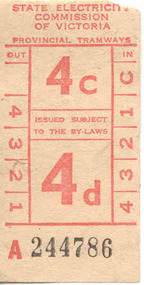
Ephemera - Ticket/s, State Electricity Commission of Victoria (SECV), Collection of 5 number 4c/4d decimal currency conversion tickets, 1966
... Collection of 5 number 4c/4d decimal currency conversion tickets...Collection of 5 number 4c/4d decimal currency conversion tickets showing the pre decimal price of 4d and post conversion of 4c. ...Trams tramways SECV Tickets Decimal Conversion Collection of 5 number 4c/4d decimal currency conversion tickets showing the pre decimal price of 4d and post conversion of 4c. ...Collection of 5 number 4c/4d decimal currency conversion tickets showing the pre decimal price of 4d and post conversion of 4c. Printed on off white paper, red ink with black number at base of ticket. All tickets have been punched, but only with some showing the hole completely clear. Ticket numbers: A244786, A287414, A196805, A245708 and A209343. Ticket has a cross hatched pattern printed on the back of the ticket in red.trams, tramways, secv, tickets, decimal conversion -
 Kew Historical Society Inc
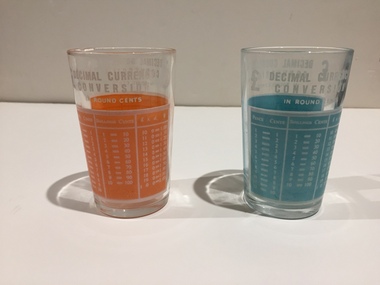
Domestic object - Glasses, Pair of Decimal Currency Conversion Glasses, circa 1966, c.1966
... Pair of Decimal Currency Conversion Glasses, circa 1966...Presumably made around the time that Australia switched from Imperial to Decimal Currency in 1966 to aid the householder make quick conversions....Pair of Decimal Currency Conversion Glasses, circa 1966 Domestic object Glasses ...Presumably made around the time that Australia switched from Imperial to Decimal Currency in 1966 to aid the householder make quick conversions.Pair of transfer printed glasses with decimal currency converters printed on them.decimal currency - australia, glasses, currency converters -
 Hand Tool Preservation Association of Australia Inc
Card
... Card, decimal currency conversion...Card, decimal currency conversion Card ...This item is part of the Thomas Caine Tool Collection, owned by The National Trust of Australia (Victoria) and curated by the Hand Tools Preservation Association of Australia.Card, decimal currency conversion -
 Mission to Seafarers Victoria
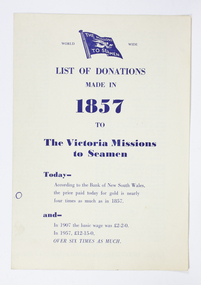
Pamphlet, List of Donations made in 1857 to the Victoria Missions to Seamen, 1957
... ...currency conversion...The listing of donors is of some historical significance showing the range and names and is a useful reference for further research re significant figures of Melbourne and Victoria in the original establishment of the Mission by the Bethel Union. donor names 1857 centenary fundraising mission to seafarers seamen's mission donations 1957 1907 currency conversion List of Donations / made in 1857 to the / Victoria Missions / to Seamen / Today - According to the bank of New South Wales / the price paid today for gold is nearly four times as much as in 1857. / and- / In 1907 the basic wage was 2 pounds 2/- ( 2 Guineas) / In 1957, 12 - 15 pounds/ Over six times as much. ...The inside pages of this pamphlet list the many donors and subscribers who initially supported the Victorian Mission to Seamen whose first chapel was based on a floating Hulk named the Emily. The most generous 1857 donors at 20 guineas Dove and Oswald, ship owners, (also the name of the Heritage floating dock at Williamstown). The point of this pamphlet published in 1957 appears to be a reminder of longstanding support and as part of an appeal to new donors to assist with increased costs. It also compairs the donations betwwen 1857, 50 years later in 1907, and in 1957 the year of Centenary. It may well have been designed to hand out at screening of the short documentary produced by Cinesound circa 1956/57 and 'starring' Padre Oliver visiting ships and footage of the Mission interiors at both 717 Flinders st and the Deco 1936 building at Port Melbourne.The listing of donors is of some historical significance showing the range and names and is a useful reference for further research re significant figures of Melbourne and Victoria in the original establishment of the Mission by the Bethel Union.single fold paper pamphlet with blue printed text with flag of the Missions to Seamen at top of page.List of Donations / made in 1857 to the / Victoria Missions / to Seamen / Today - According to the bank of New South Wales / the price paid today for gold is nearly four times as much as in 1857. / and- / In 1907 the basic wage was 2 pounds 2/- ( 2 Guineas) / In 1957, 12 - 15 pounds/ Over six times as much. Inside the pamphlet alphabetical list of donorsdonor names, 1857, centenary, fundraising, mission to seafarers, seamen's mission, donations, 1957, 1907, currency conversion -
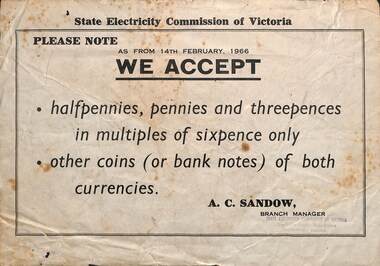 Ballarat Tramway Museum
Poster, State Electricity Commission of Victoria (SECV), SEC Poster, about the acceptance of imperial currency, Feb. 1966
... Currency... Conversion...Trams tramways Decimal Currency Conversion Sec Posters various pencil notations on the first page and the last page such as telephone numbers. ...A poster issued to advise people of the acceptance of imperial currency at offices or on trams.Poster - SEC Poster, about the acceptance of imperial currency following the introduction of Decimal currency from 14/2/1966. Advises what multiples imperial coins would be accepted in at SEC offices and trams. Signed A C Sandow Branch Manager and has the SEC Ballarat branch stamp. See Reg Item 8344 for another poster. various pencil notations on the first page and the last page such as telephone numbers.trams, tramways, decimal currency, conversion, sec, posters -
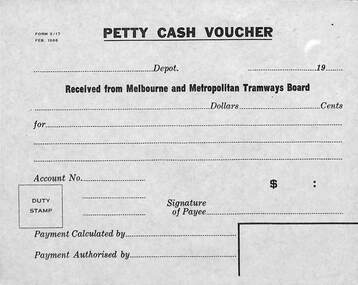 Melbourne Tram Museum
Document - Form/s, Melbourne & Metropolitan Tramways Board (MMTB), "Petty Cash Voucher", Feb. 1966
... Form - printed on off white paper - MMTB - "Petty Cash Voucher", form number 3/17, printed Feb. 1966 at the time of decimal currency conversion, for payment of small expenses. ...Trams tramways MMTB Accounting Decimal Conversion Finances Form - printed on off white paper - MMTB - "Petty Cash Voucher", form number 3/17, printed Feb. 1966 at the time of decimal currency conversion, for payment of small expenses. ...Form - printed on off white paper - MMTB - "Petty Cash Voucher", form number 3/17, printed Feb. 1966 at the time of decimal currency conversion, for payment of small expenses. Has spaces for depot, date, amount, for, account numbers and three signatures and space for a Duty Stamp.trams, tramways, mmtb, accounting, decimal conversion, finances -
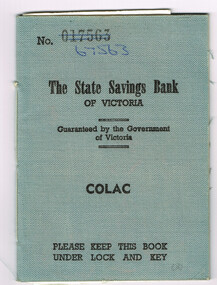 Otway Districts Historical Society
Passbook, Beech Forest Progress Association. Passbook, 1959-1981
... The State Savings Bank of Victoria passbook number 67563 running from October 1959 until mid 1982 has several features. (1) The cover is held in place by string. (2) The cover has the name of Colac printed on it. (3) Inside the front cover the SSB conditions relating to Depositors, and the Rules and Regulations of the SSB. (4) Inside the back cover the SSB branches and agencies are printed.. (5) On the inside back cover the withdrawl by depositors from branches other than their own. (6) Inside, the February 14 1966 decimal currency conversion....The State Savings Bank of Victoria passbook number 67563 running from October 1959 until mid 1982 has several features. (1) The cover is held in place by string. (2) The cover has the name of Colac printed on it. (3) Inside the front cover the SSB conditions relating to Depositors, and the Rules and Regulations of the SSB. (4) Inside the back cover the SSB branches and agencies are printed.. (5) On the inside back cover the withdrawl by depositors from branches other than their own. (6) Inside, the February 14 1966 decimal currency conversion. beech forest progress association; passbook; state savings bank; dc conversion; state bank of victoria; (1) Original passbook number crossed out and the number 67563 inserted. (2) re Estate of S.R. ...The State Savings Bank of Victoria passbook number 67563 running from October 1959 until mid 1982 has several features. (1) The cover is held in place by string. (2) The cover has the name of Colac printed on it. (3) Inside the front cover the SSB conditions relating to Depositors, and the Rules and Regulations of the SSB. (4) Inside the back cover the SSB branches and agencies are printed.. (5) On the inside back cover the withdrawl by depositors from branches other than their own. (6) Inside, the February 14 1966 decimal currency conversion.Beech Forest Progress Association passbook 67563, 29 October 1959 to 1 June 1981. The State Savings Bank of Victoria, Colac Branch. (1) Original passbook number crossed out and the number 67563 inserted. (2) re Estate of S.R. Cameron dec'd, from Clarke & Barwood. Memorandum included.beech forest progress association; passbook; state savings bank; dc conversion; state bank of victoria; -
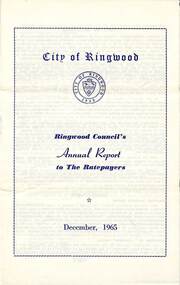 Ringwood and District Historical Society
Pamphlet, F.P. Dwerryhouse, Town Clerk and Treasurer, Ringwood Council's Annual Report To The Ratepayers - December 1965, 1965
... City of Ringwood community information annual report for 1965, including sections covering Ringwood Planning Scheme, Extensions to Lionswood Village, Building Activity, Private Street Construction, Other Road Works, Drainage Works, Town Planning, Retention of Native Flora, General Rate Notice, Sanitary Service Charge, Dandenong Valley Authority Rate, Decimal Currency Conversion, Children's Playgrounds, Annual Special Clearance of Refuse, Garbage Removal, Immunisations, Infant Welfare Centres, Home Help Service, House Numbering, Dogs, Horse Riding, Fire Hazards and Burning Off, Secondary School Grants, and list of Council Representatives....rinx City of Ringwood community information annual report for 1965, including sections covering Ringwood Planning Scheme, Extensions to Lionswood Village, Building Activity, Private Street Construction, Other Road Works, Drainage Works, Town Planning, Retention of Native Flora, General Rate Notice, Sanitary Service Charge, Dandenong Valley Authority Rate, Decimal Currency Conversion, Children's Playgrounds, Annual Special Clearance of Refuse, Garbage Removal, Immunisations, Infant Welfare Centres, Home Help Service, House Numbering, Dogs, Horse Riding, Fire Hazards and Burning Off, Secondary School Grants, and list of Council Representatives. ...City of Ringwood community information annual report for 1965, including sections covering Ringwood Planning Scheme, Extensions to Lionswood Village, Building Activity, Private Street Construction, Other Road Works, Drainage Works, Town Planning, Retention of Native Flora, General Rate Notice, Sanitary Service Charge, Dandenong Valley Authority Rate, Decimal Currency Conversion, Children's Playgrounds, Annual Special Clearance of Refuse, Garbage Removal, Immunisations, Infant Welfare Centres, Home Help Service, House Numbering, Dogs, Horse Riding, Fire Hazards and Burning Off, Secondary School Grants, and list of Council Representatives.rinx -
 Ringwood and District Historical Society
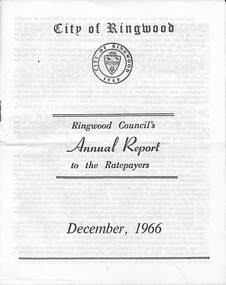
Pamphlet, F.P. Dwerryhouse, Town Clerk and Treasurer, Ringwood Council's Annual Report To The Ratepayers - December 1966, 1966
... . & Travellers' Facilities (Ringwood Station), Appreciation - Decimal Currency Conversion, Annual Special Clearance of Refuse, Garbage Removal, Fly Control, Immunisations, Infant Welfare Centres, Retention of Native Flora, Home Help Service, Dogs, Horse Riding, Fire Hazards and Burning Off, Secondary School Grants, and list of Council Representatives..... & Travellers' Facilities (Ringwood Station), Appreciation - Decimal Currency Conversion, Annual Special Clearance of Refuse, Garbage Removal, Fly Control, Immunisations, Infant Welfare Centres, Retention of Native Flora, Home Help Service, Dogs, Horse Riding, Fire Hazards and Burning Off, Secondary School Grants, and list of Council Representatives. ...City of Ringwood community information annual report for 1966, including sections covering Finance, Sanitary Service Charge, Municipal Library, Memorial Clock Tower, Reserves, Civic Centre, Maroondah Highway Reconstruction, Other Road Works, Building Activity and Development - Education, MacRobertsons Pty. Ltd. & Travellers' Facilities (Ringwood Station), Appreciation - Decimal Currency Conversion, Annual Special Clearance of Refuse, Garbage Removal, Fly Control, Immunisations, Infant Welfare Centres, Retention of Native Flora, Home Help Service, Dogs, Horse Riding, Fire Hazards and Burning Off, Secondary School Grants, and list of Council Representatives.rinx -
 Ballarat Tramway Museum
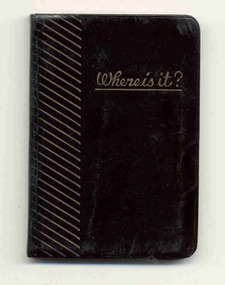
Ephemera, Dave Kellett, questions for tram drivers, 1967
... Has a decimal currency conversion table in the front inside cover and a 1967 calendar on the rear inside cover. ...Has a decimal currency conversion table in the front inside cover and a 1967 calendar on the rear inside cover. ...Has a strong association with tram crews, possibly inspector (Dave Kellett?) in Ballarat. Prepared by Dave Kallett to undertake follow ups and to assist in the training of crews by checking their knowledge.Black gloss paper covered notebook or address book, titled "Where is it?, use by Dave Kellett? as a note book to record questions for tram drivers, when acting as an inspector. Note book has tabs marked for "A to W". Notebook consists of four sections, sewn into the spine, with glued full page covers. Gold block on top and bottom edges. Last few pages torn out. Each page ruled with blue and red lines at the top. Has a decimal currency conversion table in the front inside cover and a 1967 calendar on the rear inside cover. On bottom of rear cover, stamped, "Made in Japan". Handwritten questions cover various driving and electrical aspects of the trams, both 4 wheelers and bogie trams. Full scan of document added as a pdf file 5/6/2019.trams, tramways, notebooks, training, tramcar equipment -
 Ballarat Tramway Museum
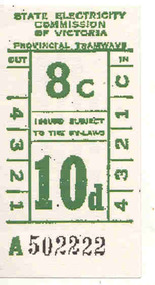
Ephemera - Ticket/s, Australian Railway Historical Society (ARHS), ARHS Tramway Tour to Ballarat and Haddon o, Nov. 2006
... Facsimile of a dual currency or decimal conversion tram ticket, produced on about 100gsm paper, for the ARHS Tramway Tour to Ballarat and Haddon on 2/12/2006. ...Trams tramways Tickets ARHS Tours Haddon Decimal Conversion Facsimile of a dual currency or decimal conversion tram ticket, produced on about 100gsm paper, for the ARHS Tramway Tour to Ballarat and Haddon on 2/12/2006. ...Facsimile of a dual currency or decimal conversion tram ticket, produced on about 100gsm paper, for the ARHS Tramway Tour to Ballarat and Haddon on 2/12/2006. Has an reproduction of an 8c/10d tram ticket in green ink with number A502222. Printed on the rear of the ticket are details of the tour, date and that it is a facsimile of a 1966/67 dual currency ticket. Has initial "PJC" on rear as well.trams, tramways, tickets, arhs, tours, haddon, decimal conversion -
 Melbourne Tram Museum
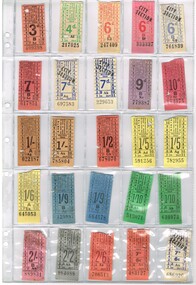
Ephemera - Folder with tickets, Harry Jackson, 1960's to 1980's
... conversion tickets, including 5 tickets which have been overstamped "City Section". On the rear are adverts for Blind Babies (Royal Victorian Institute for the blind), John Randle hair salon, Leighton home builders and the Promote Thomastown Committee. Sheet 2 - 25 No. MMTB tickets - decimal currency...conversion tickets, including 5 tickets which have been overstamped "City Section". On the rear are adverts for Blind Babies (Royal Victorian Institute for the blind), John Randle hair salon, Leighton home builders and the Promote Thomastown Committee. Sheet 2 - 25 No. MMTB tickets - decimal currency ...Manila folder, Wotan flat file, with built in fold back metal clips (see images 19 and 20) holding 9 plastic sheets that have been made to hold railway (Edmondson pasteboard) or tramway paper tickets. Sheet 1 - 25 No. MMTB tickets, ranging from 3d to 2/6 and two decimal conversion tickets, including 5 tickets which have been overstamped "City Section". On the rear are adverts for Blind Babies (Royal Victorian Institute for the blind), John Randle hair salon, Leighton home builders and the Promote Thomastown Committee. Sheet 2 - 25 No. MMTB tickets - decimal currency - two conversion tickets and other decimal currency tickets ranging from 6c to 25c. Included are 6 overstamped City Section tickets. Sheet 3 - 25 No. MMTB decimal currency tickets - ranging from 25c to $1 with one ticket overstamped "City Section". Includes one ticket with a red P overstamp. Sheet 4 - 22 No. MMTB tickets - 13 tickets overstamp P, for Pensioner, one bus transfer ticket, 3 non-cash tickets, one city concession tickets and four machine issued bus tickets. Sheet 5 - small sheet with four pockets with three tickets, - MMTB 1981 single journal ticket, MMTB day tripper $2 and MMTB bus ticket. Sheet 6 - 13 No. MMTB Section tickets, hospital travel, Australia post, incapacitated soldier and special police department concession. Sheet 7 - 8 MTA paper tram tickets and 9 The Met paper tram tickets. Sheet 8 - 23 Ballarat or Bendigo tickets, both pence and decimal currency including 6 BTM or BTPS tickets. Sheet 9 - 10 VR motor coach tickets, both pence and decimal and one single ticket - East Kew to East Camberwell. See Reg Item 5424 for a further folder of tickets from the same donor.trams, tramways, tickets, mmtb, vr, the met, btps, btm, ptc -
 Flagstaff Hill Maritime Museum and Village
Functional object - Standard Measure, James McEwan & Co, 1860s-1900s
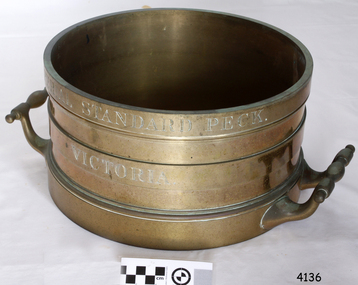
... On February 14th, 1966, Australia began its conversion to metric measures and currency, and a new set of Standard Measures was introduced; the conversion took place in stages. ...On February 14th, 1966, Australia began its conversion to metric measures and currency, and a new set of Standard Measures was introduced; the conversion took place in stages. ...This container is a pre-Decimal, Imperial Standard Peck, part of a three-piece set of Standard measures used in Victoria from around 1900 to 1940. The measures were made in Melbourne by J. McEwan & Co. These three measures were likely used by the local Melbourne authority that monitored weights and measures in the mid to late 19th century. . An Imperial Bushel was equal to 8 gallons, or 36.36872 litres . An Imperial Peck equals a quarter of a Bushel, or 9.09 litres Standards for weights and measures began in Victoria when the Melbourne Observatory received primary sets of Imperial Standard Weights and Measures from Britain. These were tested against the then British Imperial Standards to measure length, weight and currency. Administrative bodies in the Colony of Australia could then compare their weights and measures against these British Primary Standards and adjust their Measures accordingly, to maintain the Standards. The Weights and Measures Act of 1862 was passed in Victoria, and local inspectors were established throughout the colony. By the 1870s, local councils and shires in Victoria held a set of Standards used to test scales, weights, and measures used by manufacturers, wholesalers, and retailers. Every ten years, the councils’ Standards needed to be rechecked against the Victorian Standards. In the 19th Century, the Victorian Customs Department inspected and maintained the Standards. In 1901, the Customs Department was transferred to the Federal Government, but the Weights and Measures authority remained with the Victorian Government and relocated to the Melbourne Observatory. In 1904, the Standard weights and measures, and testing equipment, were installed in the room of a new building erected at the south end of the Great Melbourne Telescope House. The room became known as the Whirling Room, due to its large whirling apparatus that tested air meters. When the Melbourne Observatory closed in 1944, the Weights and Measures Branch was formed to continue maintaining the Standards. On February 14th, 1966, Australia began its conversion to metric measures and currency, and a new set of Standard Measures was introduced; the conversion took place in stages. The Weights and Measures Branch remained at the Observatory site until 1995. James McEwan & Co.: - The maker of this set of Standard Measures was James McEwan. His Melbourne business was established in 1852 and sold retail furniture and wholesale ironmongery. The firm’s warehouses were situated at the intersection of 81-83 Elizabeth and Little Collins Streets. Shortly afterwards, the firm partnered with William Kerr Thomson and Samuel Renwick. When McEwan died in 1868, his partners carried on and expanded the business under his name, J McEwan. The business was expanded to provide a retail shop, counting-house and private offices. Wholesale warehouses adjoined these premises at 4, 6 and 10 Little Collins Street, West. This company provided and sold a large and varied amount of imported goods into the colony; agricultural equipment, building materials, mining items, steam engines, tools of all types and marble fireplaces. The company grew to employ over 150 people in Melbourne and opened offices at 27 Lombard St, London, as well as in New Zealand and Fiji. It also serviced the Mauritius islands and the Pacific area with its steamship, the Suva, and a brig, the Shannon. The set of Imperial Standard Measures is an example of a bronze measure container made specifically for J. McEwan & Co. Today, it helps us to understand how imperial weights and measures were used, and how a standard of measurement for merchants was developed in the Australian colonies based on the Imperial British measurement system. The container has social significance as an item retailed by J McEwan, and used by Victoria’s authorities legally responsible for ensuring that dry goods sold in Victoria by wholesalers and retailers are correct. Imperial Standard Measure: a container to measure the volume of a Peck. It is part of a set of three precision measures - a Peck, a Half Bushel and a Bushel – used by government authorities in Victoria. The cast brass cylinder has straight sides and a flat base, and two handles are attached near the base by two posts on each handle. The wall inside is straight, and outside has grooves and horizontal bands. Inscriptions are engraved on the outside. The Measures were made for the retailer, J. McEwan & Co., London and Melbourne. Engraved on side: "IMPERIAL STANDARD PECK. / VICTORIA."flagstaff hill, flagstaff hill maritime museum and village, warrnambool, maritime museum, maritime village, great ocean road, shipwreck coast, weights and measurements, science, james mcewan & co., precision instrument, technology, melbourne observatory, british imperial standards, standard weights & measures, volume measure, dry measure, customs, commerce, victorian standard measure, pre-decimal measure, imperial standard, imperial bushel, imperial half bushel, imperial peck, peck measure, bronze container, brass container, cast container -
 Flagstaff Hill Maritime Museum and Village
Functional object - Standard Measure, James McEwan & Co, 1860s-1900s
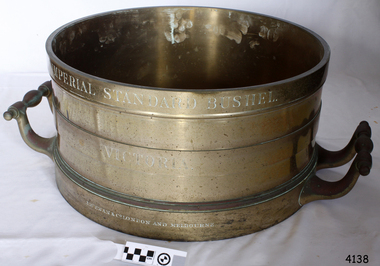
... On February 14th, 1966, Australia began its conversion to metric measures and currency, and a new set of Standard Measures was introduced; the conversion took place in stages. ...On February 14th, 1966, Australia began its conversion to metric measures and currency, and a new set of Standard Measures was introduced; the conversion took place in stages. ...This container is a pre-Decimal, Imperial Standard Bushel, part of a three-piece set of Standard measures used in Victoria from around 1900 to 1940. The measures were made in Melbourne by J. McEwan & Co. These three measures were likely used by the local Melbourne authority that monitored weights and measures in the mid to late 19th century. . An Imperial Bushel was equal to 8 gallons, or 36.36872 litres . An Imperial Peck equals a quarter of a Bushel, or 9.09 litres Standards for weights and measures began in Victoria when the Melbourne Observatory received primary sets of Imperial Standard Weights and Measures from Britain. These were tested against the then British Imperial Standards to measure length, weight and currency. Administrative bodies in the Colony of Australia could then compare their weights and measures against these British Primary Standards and adjust their Measures accordingly, to maintain the Standards. The Weights and Measures Act of 1862 was passed in Victoria, and local inspectors were established throughout the colony. By the 1870s, local councils and shires in Victoria held a set of Standards used to test scales, weights, and measures used by manufacturers, wholesalers, and retailers. Every ten years, the councils’ Standards needed to be rechecked against the Victorian Standards. In the 19th Century, the Victorian Customs Department inspected and maintained the Standards. In 1901, the Customs Department was transferred to the Federal Government, but the Weights and Measures authority remained with the Victorian Government and relocated to the Melbourne Observatory. In 1904, the Standard weights and measures, and testing equipment, were installed in the room of a new building erected at the south end of the Great Melbourne Telescope House. The room became known as the Whirling Room, due to its large whirling apparatus that tested air meters. When the Melbourne Observatory closed in 1944, the Weights and Measures Branch was formed to continue maintaining the Standards. On February 14th, 1966, Australia began its conversion to metric measures and currency, and a new set of Standard Measures was introduced; the conversion took place in stages. The Weights and Measures Branch remained at the Observatory site until 1995. James McEwan & Co.: - The maker of this set of Standard Measures was James McEwan. His Melbourne business was established in 1852 and sold retail furniture and wholesale ironmongery. The firm’s warehouses were situated at the intersection of 81-83 Elizabeth and Little Collins Streets. Shortly afterwards, the firm partnered with William Kerr Thomson and Samuel Renwick. When McEwan died in 1868, his partners carried on and expanded the business under his name, J McEwan. The business was expanded to provide a retail shop, counting-house and private offices. Wholesale warehouses adjoined these premises at 4, 6 and 10 Little Collins Street, West. This company provided and sold a large and varied amount of imported goods into the colony; agricultural equipment, building materials, mining items, steam engines, tools of all types and marble fireplaces. The company grew to employ over 150 people in Melbourne and opened offices at 27 Lombard St, London, as well as in New Zealand and Fiji. It also serviced the Mauritius islands and the Pacific area with its steamship, the Suva, and a brig, the ShannonThe set of Imperial Standard Measures is an example of a bronze measure container made specifically for J. McEwan & Co. Today, it helps us to understand how imperial weights and measures were used, and how a standard of measurement for merchants was developed in the Australian colonies based on the Imperial British measurement system. The container has social significance as an item retailed by J McEwan, and used by Victoria’s authorities legally responsible for ensuring that dry goods sold in Victoria by wholesalers and retailers are correct.Imperial Standard Measure: a container to measure the volume of a Busel. It is part of a set of three precision measures - a Peck, a Half Bushel and a Bushel – used by government authorities in Victoria. The cast brass cylinder has straight sides and a flat base, and two handles are attached near the base by two posts on each handle. The wall inside is straight, and outside has grooves and horizontal bands. Inscriptions are engraved on the outside. The Measures were made for the retailer, J. McEwan & Co., London and Melbourne.Engraved on side: "IMPERIAL STANDARD BUSHEL. / VICTORIA ./ J. MCEWAN & CO. LONDON AND MELBOURNE."flagstaff hill, flagstaff hill maritime museum and village, warrnambool, maritime museum, maritime village, great ocean road, shipwreck coast, weights and measurements, science, james mcewan & co., precision instrument, technology, melbourne observatory, british imperial standards, standard weights & measures, volume measure, dry measure, customs, commerce, victorian standard measure, pre-decimal measure, imperial standard, imperial bushel, peck measure, bronze container, brass container, cast container -
 Flagstaff Hill Maritime Museum and Village
Equipment - Standard Measure, James McEwan & Co, 1860s-1900s
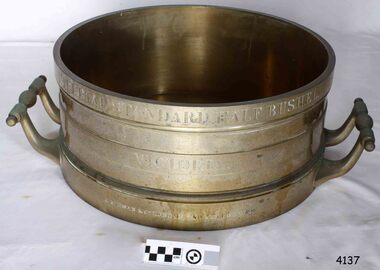
... On February 14th, 1966, Australia began its conversion to metric measures and currency, and a new set of Standard Measures was introduced; the conversion took place in stages. ...On February 14th, 1966, Australia began its conversion to metric measures and currency, and a new set of Standard Measures was introduced; the conversion took place in stages. ...This container is a pre-Decimal, Imperial Standard Half Bushel, part of a three-piece set of Standard measures used in Victoria from around 1900 to 1940. The measures were made in Melbourne by J. McEwan & Co. These three measures were likely used by the local Melbourne authority that monitored weights and measures in the mid to late 19th century. . An Imperial Bushel was equal to 8 gallons, or 36.36872 litres . An Imperial Peck equals a quarter of a Bushel, or 9.09 litres Standards for weights and measures began in Victoria when the Melbourne Observatory received primary sets of Imperial Standard Weights and Measures from Britain. These were tested against the then British Imperial Standards to measure length, weight and currency. Administrative bodies in the Colony of Australia could then compare their weights and measures against these British Primary Standards and adjust their Measures accordingly, to maintain the Standards. The Weights and Measures Act of 1862 was passed in Victoria, and local inspectors were established throughout the colony. By the 1870s, local councils and shires in Victoria held a set of Standards used to test scales, weights, and measures used by manufacturers, wholesalers, and retailers. Every ten years, the councils’ Standards needed to be rechecked against the Victorian Standards. In the 19th Century, the Victorian Customs Department inspected and maintained the Standards. In 1901, the Customs Department was transferred to the Federal Government, but the Weights and Measures authority remained with the Victorian Government and relocated to the Melbourne Observatory. In 1904, the Standard weights and measures, and testing equipment, were installed in the room of a new building erected at the south end of the Great Melbourne Telescope House. The room became known as the Whirling Room, due to its large whirling apparatus that tested air meters. When the Melbourne Observatory closed in 1944, the Weights and Measures Branch was formed to continue maintaining the Standards. On February 14th, 1966, Australia began its conversion to metric measures and currency, and a new set of Standard Measures was introduced; the conversion took place in stages. The Weights and Measures Branch remained at the Observatory site until 1995. James McEwan & Co.: - The maker of this set of Standard Measures was James McEwan. His Melbourne business was established in 1852 and sold retail furniture and wholesale ironmongery. The firm’s warehouses were situated at the intersection of 81-83 Elizabeth and Little Collins Streets. Shortly afterwards, the firm partnered with William Kerr Thomson and Samuel Renwick. When McEwan died in 1868, his partners carried on and expanded the business under his name, J McEwan. The business was expanded to provide a retail shop, counting-house and private offices. Wholesale warehouses adjoined these premises at 4, 6 and 10 Little Collins Street, West. This company provided and sold a large and varied amount of imported goods into the colony; agricultural equipment, building materials, mining items, steam engines, tools of all types and marble fireplaces. The company grew to employ over 150 people in Melbourne and opened offices at 27 Lombard St, London, as well as in New Zealand and Fiji. It also serviced the Mauritius islands and the Pacific area with its steamship, the Suva, and a brig, the Shannon.The set of Imperial Standard Measures is an example of a bronze measure container made specifically for J. McEwan & Co. Today, it helps us to understand how imperial weights and measures were used, and how a standard of measurement for merchants was developed in the Australian colonies based on the Imperial British measurement system. The container has social significance as an item retailed by J McEwan, and used by Victoria’s authorities legally responsible for ensuring that dry goods sold in Victoria by wholesalers and retailers are correct.Imperial Standard Measure: a container to measure the volume of a Half Bushel. It is part of a set of three precision measures - a Peck, a Half Bushel and a Bushel – used by government authorities in Victoria. The cast brass cylinder has straight sides and a flat base, and two handles are attached near the base by two posts on each handle. The wall inside is straight, and outside has grooves and horizontal bands. Inscriptions are engraved on the outside. The Measures were made for the retailer, J. McEwan & Co., London and Melbourne. Engraved test: "IMPERIAL STANDARD HALF BUSHEL. / VICTORIA / J. MCEWAN & O. LONDON AND MELBOURNE."flagstaff hill, flagstaff hill maritime museum and village, warrnambool, maritime museum, maritime village, great ocean road, shipwreck coast, weights and measurements, science, james mcewan & co., precision instrument, technology, melbourne observatory, british imperial standards, standard weights & measures, volume measure, dry measure, customs, commerce, victorian standard measure, pre-decimal measure, imperial standard, imperial half bushel, bronze container, brass container, cast container -
 Flagstaff Hill Maritime Museum and Village
Badge - Legacy Appeal badge, A.J. Parkes, 1966
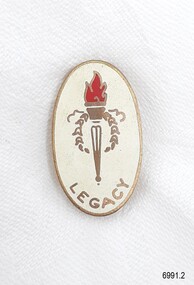
... It is interesting to note that the dollar sign "$2" has two vertical lines through the 'S', but the Australian currency sign for a dollar has only one vertical line. The badge may have been produced before the date of decimal conversion, which began on February 14th, 1966. ...It is also historically significant for representing Australia's conversion to decimal currency. The W.R. Angus Collection is significant for still being located at the site it is connected with, Doctor Angus being the last Port Medical Officer in Warrnambool. ...This Legacy badge is one of a set of badges collected by Dr W R Angus from the organisations in which he was involved. The badge was made by A.J. Parkes of Brisbane, an Australia-wide firm that has been making badges for over a century. The $2' and "£1" (one pound) embossed on the back dates the badge dates the badge to the year 1966 when Australian money was in the process of converting from pounds and pence to decimal currency's dollars and cents. It is interesting to note that the dollar sign "$2" has two vertical lines through the 'S', but the Australian currency sign for a dollar has only one vertical line. The badge may have been produced before the date of decimal conversion, which began on February 14th, 1966. A J Parkes may have ordered the badges before the published use of the dollar symbol. The set of badges is now part of Flagstaff Hill’s comprehensive W.R. Angus Collection, donated by the family of Dr W R Angus, surgeon and oculist. The W.R. Angus Collection: - The W.R. Angus Collection includes historical medical equipment, surgical instruments and material belonging to Dr Edward Ryan and Dr Thomas Francis Ryan, (both of Nhill, Victoria) and Dr Angus’ own belongings. The Collection’s history spans the medical practices of the two Doctors Ryan, from 1885-1926 plus that of Dr Angus, up until 1969. It includes historical medical and surgical equipment and instruments from the doctors Edward and Thomas Ryan of Nhill, Victoria. Dr Angus married Gladys in 1927 at Ballarat, the nearest big city to Nhill where he began as a Medical Assistant. He was also Acting House surgeon at the Nhill hospital where their two daughters were born. During World War II He served as a Military Doctor in the Australian Defence Forces. Dr Angus and his family moved to Warrnambool in 1939, where Dr Angus operated his own medical practice. He later added the part-time Port Medical Officer responsibility and was the last person appointed to that position. Both Dr Angus and his wife were very involved in the local community, including the planning stages of the new Flagstaff Hill and the layout of the gardens there. Dr Angus passed away in March 1970.This badge is significant for connecting Doctor Angus to organisations that he supported. It is also historically significant for representing Australia's conversion to decimal currency. The W.R. Angus Collection is significant for still being located at the site it is connected with, Doctor Angus being the last Port Medical Officer in Warrnambool. The Collection includes historical medical objects that date back to the late 1800s.Legacy Appeal badge; an oval-shaped metal and enamel badge, white enamel on gold, with the Legacy symbol of a flaming torch in the centre. It has a vertical stick pin and inscriptions on the back. It was made by A.J. Parks, Brisbane. The badge was given to a donor of $2 (£1 or one pound) to Legacy. This badge is part of a set of badges collected by Dr W R Angus. the set represents organisations that he was involved in, and is part of the W.R. Angus Collection.Embossed: "PARIVETTE 77-“ "A J PARKES" "BRISBANE" "£1" (one pound) "$2” (2 dollars) flagstaff hill, warrnambool, maritime village, maritime museum, shipwreck coast, great ocean road, badge, legacy badge, organisation badge, a.j. parkes, donor's badge, £1 badge, $2 badge, 14th february 1966, australian decimal conversion, brisbane, legacy appeal, w.r. angus collection -
 Bendigo Historical Society Inc.
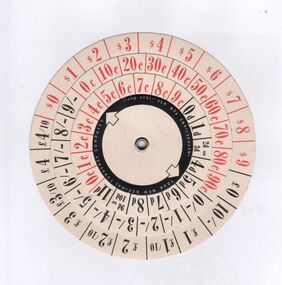
Ephemera - Decimal currency computer, Win Jennings Collection, 1966
... Conversion of Australian currency from pounds/shilling/pence to dollars/cents. on 14 February 1966....Printed in 1965/64 for the conversion of Australian currency which was affected on 14 February 1966. ...Conversion of Australian currency from pounds/shilling/pence to dollars/cents. on 14 February 1966. bendigo decimal converter Circular paper computer used by hand to convert pounds/shilling/pence to dollars/cents, or the reverse calculation. ...Conversion of Australian currency from pounds/shilling/pence to dollars/cents. on 14 February 1966.Circular paper computer used by hand to convert pounds/shilling/pence to dollars/cents, or the reverse calculation. Printed in 1965/64 for the conversion of Australian currency which was affected on 14 February 1966. Printed in red and black on four circular plains. Printed by Earles Printing Pty Ltd for Ultra Publicity Pty Ltd, 104 Wellington parade, East Melbournebendigo, decimal converter -
 National Vietnam Veterans Museum (NVVM)
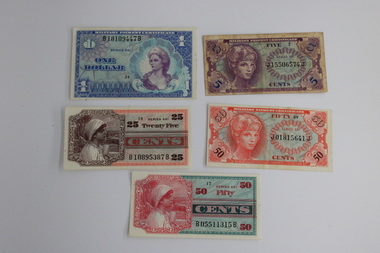
Currency - Military Payment Certificates
... Only those authorised to have MPC on a Conversion Day were able to convert them to the newly issued notes. Military Payment Certificate Vietnam money pay currency notes malicki Military Payment Certificate Five Military payment certificates. ...Military Payment Certificates (MPC) were an accepted form of payment on military bases but could generally not be used to buy local goods or services. When American officials believed that a series of MPC was being used fraudulently on the black market, a new series would be released, making the previous version worthless. Only those authorised to have MPC on a Conversion Day were able to convert them to the newly issued notes. Five Military payment certificates. The value ranges from 1 X five cent note, 1 x 25 cent note and 2 fifty cent notes and 1 x one dollar note. Military Payment Certificatemilitary payment certificate, vietnam, money, pay, currency, notes, malicki -
 Anglesea and District Historical Society
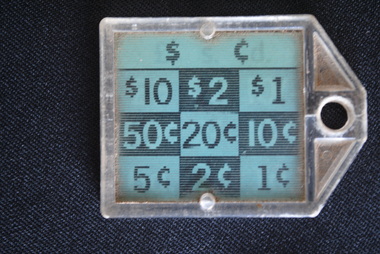
Key Ring, Estimated 1966
... currency converter advertising john edward caltex service station essendon Back: With compliments JOHN EDWARD'S CALTEX SERVICE STATION. 902-912 MT ALEXANDER RD. ESSENDON. Phone: 37-3203. Converts £5,... £1,...10sh,...5sh,...2sh,...1sh,...6d,...2½d,...1d. To:..........$10,...$2,...$1,......50c,...20c,...10c,...5c,...2c,.......1c Plastic key ring showing conversions ...Plastic key ring showing conversions from £ to $ - Pounds to Dollars. By moving key ring back and forth the different amounts show as listed under inscriptions.Back: With compliments JOHN EDWARD'S CALTEX SERVICE STATION. 902-912 MT ALEXANDER RD. ESSENDON. Phone: 37-3203. Converts £5,... £1,...10sh,...5sh,...2sh,...1sh,...6d,...2½d,...1d. To:..........$10,...$2,...$1,......50c,...20c,...10c,...5c,...2c,.......1c decimal currency converter, advertising, john edward, caltex service station, essendon -
 Ballarat Tramway Museum
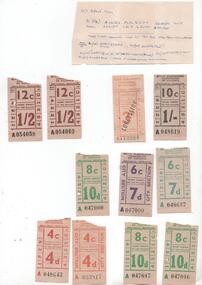
Ephemera - Ticket/s, State Electricity Commission of Victoria (SECV), Set of 10 decimal conversion tickets, 1965
... Conversion... Decimal Currency...Trams tramways Tickets SECV Ballarat Decimal Conversion Decimal Currency Set of 10 decimal conversion tickets used on the Ballarat tramway system Oct. 1965 and a handwritten note regarding them. 3d - Concession - orange - A773884 4c/4d - red A048643 4c/4d orange - City Section - A033817 6c/7d purple - City Section - A47000 6c/7d teal - -A048637 8c/10d green - A047016 and 017 10c/ 1/- black - A048619 12c/ 1/2 - brown - A054058 and 063 Handwritten note records that the 8c (10d) tickets were used on 2 Oct. 1965 on tram 39, the rest of the tickets were found on No. 39. ...Has a strong association with the Ballarat tramway system as being identified as being used on the system and for which trip on a specific date and demonstrates the ticket style at the time of decimal conversion in Australia.Set of 10 decimal conversion tickets used on the Ballarat tramway system Oct. 1965 and a handwritten note regarding them. 3d - Concession - orange - A773884 4c/4d - red A048643 4c/4d orange - City Section - A033817 6c/7d purple - City Section - A47000 6c/7d teal - -A048637 8c/10d green - A047016 and 017 10c/ 1/- black - A048619 12c/ 1/2 - brown - A054058 and 063 Handwritten note records that the 8c (10d) tickets were used on 2 Oct. 1965 on tram 39, the rest of the tickets were found on No. 39. trams, tramways, tickets, secv, ballarat, decimal conversion, decimal currency -
 Ballarat Tramway Museum
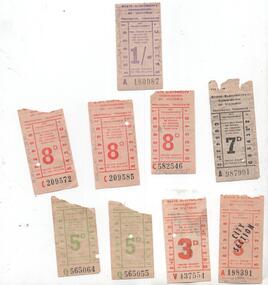
Ephemera - Ticket/s, State Electricity Commission of Victoria (SECV), Set of 9 pre-decimal or imperial currency, 1959 to 1965
... conversion in Australia. Trams tramways Tickets SECV Ballarat Bendigo Gold Sebastopol Quarry Hill Mt Pleasant Lydiard St North Set of 9 pre-decimal or imperial currency tickets used on the Ballarat or the Bendigo tramway system with three of them noted as to their use on the rear. 1 - 3d - orange ticket, over printed "City Section" - A 198391 - used "Charing Cross to Station - tram 23 - Sat 22 May 1965" 2 - 3d - orange - V437554 - on rear "Tram 34 Going to Mt Pleasant Easter Tuesday 31 March 1959". 3 - 5d - green - Q565064 - on rear in pencil "Quarry Hill to Charing Cross (No. 3) 4 - 5d - green - Q565055 - ditto, with addition of "2nd tram" 5 - 7d - black A987991 - on side in pencil' "Eaglehawk to Q Hill No. 3" 6 - 8d - red C209572 - "18 Drummond from L St N Sun 8 Nov. 1964" 7 - 8d- red - C209585 - "ditto" 8 - 8d - red - C582546 - "Q Hill to station tram 23, Sat 22 May 1965" 9 - 1/- purple - A 180987 - "18 decorated for Sebastopol Gold Cent. ...Has a strong association with the Ballarat and Bendigo tramway system as being identified as being used on the system and for which trip on a specific date and demonstrates the ticket style prior to the time of decimal conversion in Australia.Set of 9 pre-decimal or imperial currency tickets used on the Ballarat or the Bendigo tramway system with three of them noted as to their use on the rear. 1 - 3d - orange ticket, over printed "City Section" - A 198391 - used "Charing Cross to Station - tram 23 - Sat 22 May 1965" 2 - 3d - orange - V437554 - on rear "Tram 34 Going to Mt Pleasant Easter Tuesday 31 March 1959". 3 - 5d - green - Q565064 - on rear in pencil "Quarry Hill to Charing Cross (No. 3) 4 - 5d - green - Q565055 - ditto, with addition of "2nd tram" 5 - 7d - black A987991 - on side in pencil' "Eaglehawk to Q Hill No. 3" 6 - 8d - red C209572 - "18 Drummond from L St N Sun 8 Nov. 1964" 7 - 8d- red - C209585 - "ditto" 8 - 8d - red - C582546 - "Q Hill to station tram 23, Sat 22 May 1965" 9 - 1/- purple - A 180987 - "18 decorated for Sebastopol Gold Cent. Sun 8 Nov. 1964 to Sebastopol" trams, tramways, tickets, secv, ballarat, bendigo, gold, sebastopol, quarry hill, mt pleasant, lydiard st north -
 Yarrawonga and Mulwala Pioneer Museum
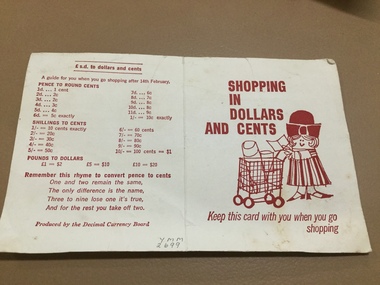
Shopping Card, Decimal Currency Board, est 1966
... Dollars Cents Currency Shillings Shopping Decimal Currency This is a conversion shopping card with information regarding converting "pences" to "cents / shillings to cents".g and converting prices. ...When the changeover of decimal currency began in 1966.This is a conversion shopping card with information regarding converting "pences" to "cents / shillings to cents".g and converting prices. On the flip side it has information and examples of shopping. Also information and conversion of new notes.dollars, cents, currency, shillings, shopping, decimal currency -
 Ballarat Tramway Museum
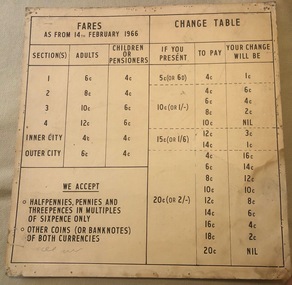
Poster - Fares and Change Table as from 14th February 1966
... Printed at the time to advise passengers the arrangements for fares and change to apply from the time of Decimal Conversion in Australia, that took place on 14/2/1966 and that change would be given in decimal currency only. ...Yields information about the methodology of advising passengers how fares could be paid and the change to be received at the time of conversion in Australia to decimal currency. Decimal conversion fares trams tramways SECV Conversion Ballarat Bendigo Poster printed on cardboard detailing the tram fares for SEC tramways and the change that would be given for various presentations. ...Printed at the time to advise passengers the arrangements for fares and change to apply from the time of Decimal Conversion in Australia, that took place on 14/2/1966 and that change would be given in decimal currency only. See also Reg Item 8037 for a another poster.Yields information about the methodology of advising passengers how fares could be paid and the change to be received at the time of conversion in Australia to decimal currency.Poster printed on cardboard detailing the tram fares for SEC tramways and the change that would be given for various presentations. Cut to fit in a tramcar internal advertisement rack.decimal conversion, fares, trams, tramways, secv, conversion, ballarat, bendigo -
 Brighton Historical Society
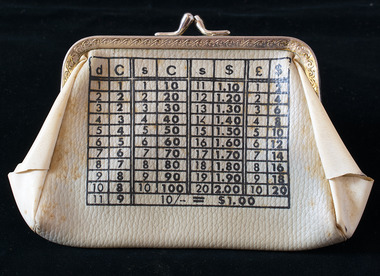
Purse, Coin purse, circa 1966
... Australia converted to decimal currency on 14 February 1966. This coin purse is printed with a simple conversion table to help the user navigate the switch from pounds, shillings and pence to the new dollars and cents....Cream vinyl coin purse with conversion table for pre-decimal and decimal currency printed in black on each side. ...Australia converted to decimal currency on 14 February 1966. This coin purse is printed with a simple conversion table to help the user navigate the switch from pounds, shillings and pence to the new dollars and cents. coin purse decimal currency 1960s Cream vinyl coin purse with conversion table for pre-decimal and decimal currency printed in black on each side. ...Australia converted to decimal currency on 14 February 1966. This coin purse is printed with a simple conversion table to help the user navigate the switch from pounds, shillings and pence to the new dollars and cents.Cream vinyl coin purse with conversion table for pre-decimal and decimal currency printed in black on each side. Hinged silver metal opening and kiss clasp. Unlined.coin purse, decimal currency, 1960s -
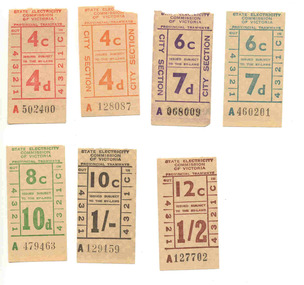 Ballarat Tramway Museum
Ephemera - Ticket/s, State Electricity Commission of Victoria (SECV), Set of 7 mixed SEC tickets ex Bendigo decimal conversion, 1966
... Set of 7 mixed SEC tickets ex Bendigo decimal conversion tickets or dual currency, donated by Peter. W. ...Trams tramways Tickets SECV Ballarat Decimal Conversion Set of 7 mixed SEC tickets ex Bendigo decimal conversion tickets or dual currency, donated by Peter. W. ...Set of 7 mixed SEC tickets ex Bendigo decimal conversion tickets or dual currency, donated by Peter. W. Watt. Tickets do not appear to have been used in traffic - no punch marks. Tickets have not been individually numbered with the Registration Number, but can be identified by their ticket number and denomination. All on off white paper unless otherwise noted with a tartan style back unless noted with number printed in black ink. 4c/4d - City Section - A128087 - orange printing. 6c/7d - City Section - A068009 - purple printing. 4c/4d - A502400 - red printing. 6c/7d - A460201 - teal printing. 8c/10d - A479463 - green printing. 10c/1/- - A129159 - black printing. 12c/ 1/2 - A127702 - brown printing. See Reg Item 3985 for a sample of the 6c/7d ticket in a block. See Alan Bradley prepared scheduled of fares on SEC Systemstrams, tramways, tickets, secv, ballarat, decimal conversion -
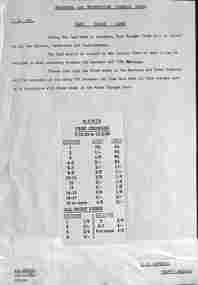 Melbourne Tram Museum
Document, Melbourne & Metropolitan Tramways Board (MMTB), "Fare Change cards", 12/1965
... Yields information about the fares prior to the introduction of decimal currency. tramways fares Decimal Conversion conductors crews Notice printed on quarto paper with a piece of paper glue to the base on the rear. ...Notice to Drivers, conductors and conductresses titled "Fare Change cards" for reference for the period from 5/12/1965 to 13/2/1966. This followed an increase in fares and prior to the introduction of decimal currency on 14/2/1966. The card gives the revised fares for each section, and all night fares. Dated 15/11/1965 and signed by R C Drummond as Traffic Manager.Yields information about the fares prior to the introduction of decimal currency.Notice printed on quarto paper with a piece of paper glue to the base on the rear.tramways, fares, decimal conversion, conductors, crews -
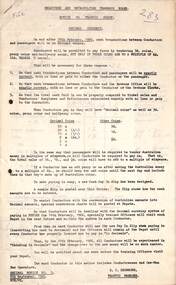 Melbourne Tram Museum
Document, Melbourne & Metropolitan Tramways Board (MMTB), Decimal Currency, 1965
... Conversion...Decimal Currency...Set of three notices regarding the introduction of Decimal Currency that took place on 14/2/1966 1 - Notice No. 3 dated 6/9/1965 regarding how revenue pay-in would be made and coins counted. Has a sample pay-in form showing the methods. Notes the training to be provided. 2 - Notice No. 4 dated 16/9/1965 - in a question and answer format about the conversion from imperial to decimal currency. 3 - Notice No. 5 dated 31/10/1965 - training using plastic model coins and conversions....Tramways Instructions operations conductors Decimal Conversion Decimal Currency training Some have numbers in the top left hand corner in ink. ...Set of three notices regarding the introduction of Decimal Currency that took place on 14/2/1966 1 - Notice No. 3 dated 6/9/1965 regarding how revenue pay-in would be made and coins counted. Has a sample pay-in form showing the methods. Notes the training to be provided. 2 - Notice No. 4 dated 16/9/1965 - in a question and answer format about the conversion from imperial to decimal currency. 3 - Notice No. 5 dated 31/10/1965 - training using plastic model coins and conversions.Yields information about the conversion from imperial to decimal currency and the training undertaken for this.Document - Set of three notices foolscap, each with two punched holes on left side.Some have numbers in the top left hand corner in ink.tramways, instructions, operations, conductors, decimal conversion, decimal currency, training -
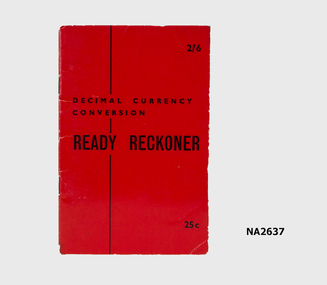 Whitehorse Historical Society Inc.
Book, 1963-1964
... Conversion tables and ready reckoner for decimal currency. Front cover features sterling and decimal prices....Conversion tables and ready reckoner for decimal currency. Front cover features sterling and decimal prices. ...Small pocket size booklet - red cover with black title and price. Twenty two pages. Conversion tables and ready reckoner for decimal currency. Front cover features sterling and decimal prices.books, reference -
 Melbourne Tram Museum
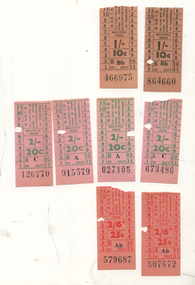
Ephemera - Set of 8 dual currency tram tickets, Melbourne & Metropolitan Tramways Board (MMTB), 2/1966
... conversion...dual currency...When Australia changed from imperial currency to decimal currency on 14/2/1966, a well-planned operation of conversion took place. ...Tramways MMTB tickets decimal conversion dual currency Set of 8 dual currency MMTB tram tickets - flimsy - paper Ephemera Set of 8 dual currency tram tickets Melbourne & Metropolitan Tramways Board (MMTB) ...When Australia changed from imperial currency to decimal currency on 14/2/1966, a well-planned operation of conversion took place. This involved changing public transport tickets as well, especially those where a printed value was shown. The MMTB printed dual currency tickets as part of the process. This set of tickets show the value in both imperial and decimal currency 1 schilling or 1/- = 10 cents, 2 schillings or 2/- = 20c, and 2 schillings and 6 pence or 2/6 = 25 cents.Demonstrates dual currency tickets used at the time of decimal conversion in Australia.Set of 8 dual currency MMTB tram tickets - flimsy - papertramways, mmtb, tickets, decimal conversion, dual currency
